1. Executive Summary
The People’s Liberation Army (PLA) is currently navigating one of the most tumultuous, contradictory, and consequential periods of institutional restructuring and doctrinal evolution in its modern history. Tasked directly by the Chinese Communist Party (CCP) leadership to achieve the capabilities necessary to win a major regional conflict by the 2027 centennial anniversary of the military, the force finds itself simultaneously accelerating its technological modernization efforts while confronting profound internal friction and structural instability.1 An exhaustive analysis of military developments, force posture, and doctrinal shifts through early 2026 reveals a fundamental paradox at the heart of China’s martial ambitions: the PLA is rapidly advancing its hardware, joint operations frameworks, and synthetic training ecosystems, yet it remains heavily encumbered by a severe leadership vacuum, deeply entrenched bureaucratic inertia, and an absolute absence of modern combat experience.
Between 2022 and January 2026, an unprecedented anti-corruption and political rectification campaign initiated by CCP General Secretary Xi Jinping decimated the PLA’s high command.3 Over 100 senior general officers have been officially dismissed, purged, or have inexplicably disappeared from public view, impacting approximately 52 percent of the military’s senior leadership positions ranging from the Central Military Commission (CMC) down to theater command deputy leader grades.4 This sweeping purge has aggressively removed veteran officers who possessed realistic, unvarnished views of the force’s logistical and operational capabilities, replacing them with a generation of newly promoted, potentially inexperienced commanders who must operate in an environment fraught with political peril.4 Concurrently, the CCP’s unyielding insistence on absolute political loyalty actively centralizes command and control, inhibiting the systemic adoption of a localized “mission command” structure that PLA theorists acknowledge is required for the complex, multi-domain warfare the military expects to fight.6
Compounding these severe structural challenges is the so-called “peace disease” (和平病)—a systemic, recognized institutional malaise born from the fact that the PLA has not engaged in large-scale, kinetic combat operations since its border conflict with Vietnam in 1979.7 The CCP explicitly recognizes that its officer corps lacks an intuitive, visceral understanding of the intensity, attrition, friction, and chaos inherent in contemporary battlefields.9 To systematically mitigate this crippling vulnerability, the PLA has constructed an expansive, technologically advanced ecosystem of simulated combat environments. This includes the establishment of dedicated, highly lethal opposing forces (OPFOR) capable of replicating advanced Western adversaries, the integration of artificial intelligence and virtual reality into tactical simulations, and the institutionalization of rigorous “Fupan” (after-action review) processes designed to extract maximum educational value from peacetime exercises.10 Furthermore, the military is heavily studying the ongoing conflicts in Ukraine and the Middle East to refine its evolving doctrine on unmanned systems, resilient logistics, and electronic warfare.13
However, the absorption and implementation of these critical lessons are often distorted by preexisting doctrinal biases and bureaucratic self-interest.13 While the PLA has successfully internalized tactical lessons regarding resilient energy distribution and contested logistics 15, it has shown a marked institutional resistance to fully embracing the low-cost, attritable drone dynamics witnessed in Eastern Europe, preferring instead to continue funding “exquisite,” highly expensive legacy systems that align with pre-existing modernization benchmarks.13
Despite these glaring internal contradictions, the PLA’s baseline capability to project power, enforce regional deterrence, and execute sophisticated joint campaigns is undeniably expanding at a formidable rate. Recent large-scale exercises, such as Justice Mission 2025, demonstrate an increasing, demonstrable proficiency in multidomain coordination, long-range precision fires, and seamless integration with paramilitary forces like the China Coast Guard (CCG) to enforce blockades.17 The strategic trajectory of the PLA indicates a force that is methodically engineering surrogate experience to overcome its historical deficits. While its command architecture remains brittle and its true resilience in a protracted conflict is entirely untested, the PLA presents a highly capable, asymmetric challenge in the Indo-Pacific theater that is diligently preparing to fight, and win, modern wars.
2. The Scope, Mechanics, and Strategic Fallout of the 2022–2026 Purges
The structural integrity and operational continuity of the PLA’s command hierarchy have been severely tested by a sweeping political and anti-corruption purge that began gaining momentum around 2023 and reached a critical crescendo in early 2026.3 Billed officially by the CCP as a vital anti-corruption drive necessary to clear bureaucratic impediments to the military’s modernization agenda, the campaign also undeniably serves as a mechanism for internal political consolidation, ensuring that the armed forces remain absolutely subservient to the paramount leader.3
2.1 Disruption and Decimation at the Central Military Commission
The Central Military Commission (CMC) represents the supreme, absolute command authority of the PLA. Historically composed of seven elite members, the CMC serves as the vital organizational nexus translating the CCP’s political objectives into the military’s strategic execution.20 By January 2026, the abrupt removal of PLA senior generals Zhang Youxia, who served as the CMC Senior Vice Chairman, and Liu Zhenli, the Chief of the Joint Staff Department, marked an institutional reset of a scale not seen in decades.5
The scale of removals within the CMC is staggering and historically unprecedented in the modern era. Over the preceding years, the leadership orchestrated the downfall of six sitting CMC members.3 This list includes former Ministers of Defense Wei Fenghe and Li Shangfu, CMC Vice Chairman He Weidong, and the Director of the CMC Political Work Department Miao Hua.3 These high-profile removals have resulted in the highest proportion of vacancies on the CMC since the chaotic era of Mao Zedong.20 Following the Fourth Plenum of the 20th CCP Central Committee in October 2025, which sets broader strategic policy via the 15th Five-Year Plan (2026-2030), the only officer promoted to the supreme body was PLA Rocket Force General Zhang Shengmin.20 Notably, General Zhang possesses a career background deeply rooted in discipline inspection and anti-corruption roles rather than operational, warfighting command.20 Consequently, the CMC has been virtually gutted of its seasoned warfighters. Defense analysts assess that this hollowing out drastically reduces the CMC’s capacity to execute strategic-level leadership tasks, manage complex multi-theater crises, and coordinate the large-scale joint operations necessary for an invasion scenario.7
2.2 Cascading Decimation Across Theater Command Echelons
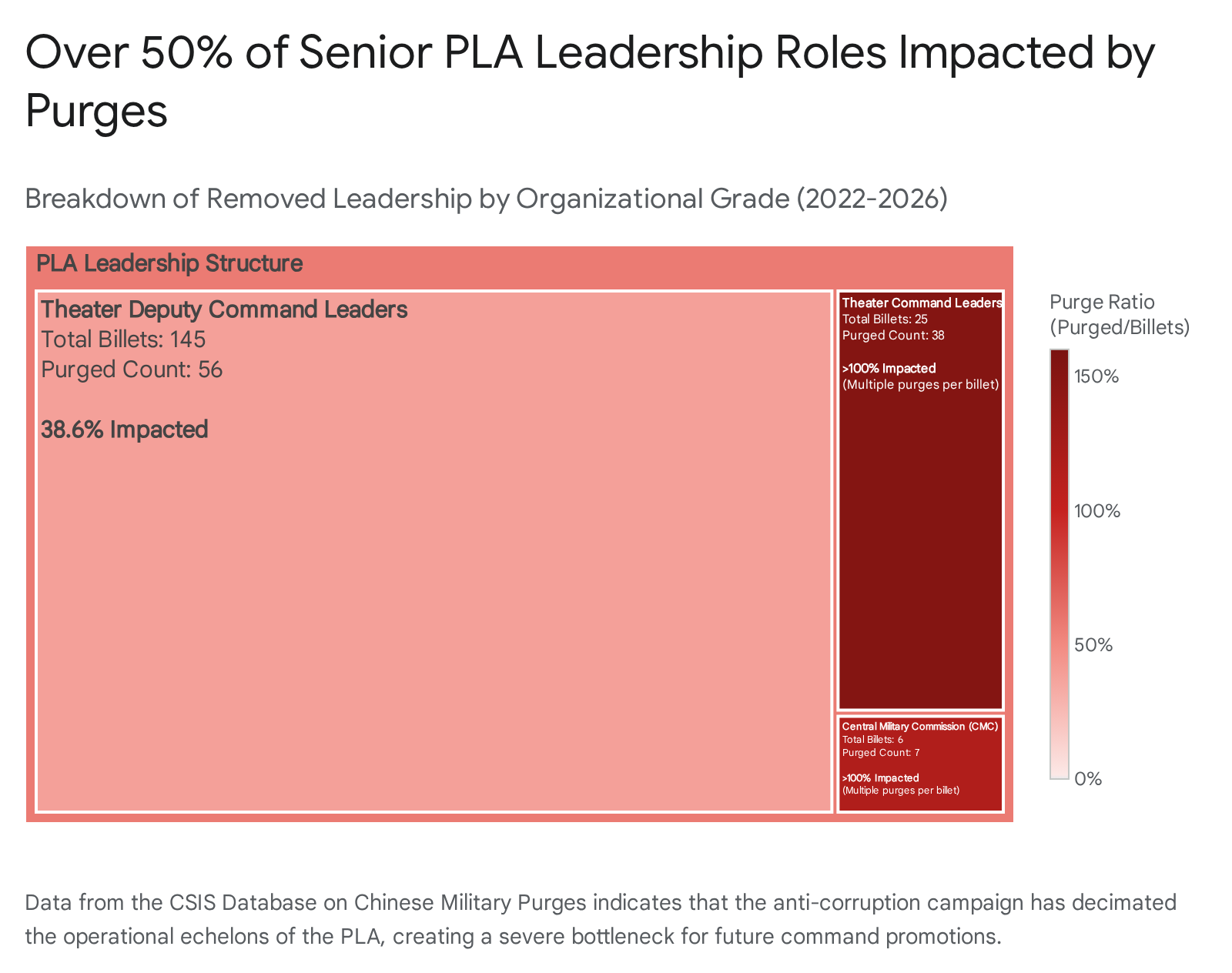
The purge’s destabilizing impact cascades far beyond the localized environment of the CMC in Beijing, severely affecting the entire operational leadership track of the PLA.4 Understanding this impact requires examining the PLA’s unique organizational structure, wherein an officer’s “grade” is often more significant than their “rank.” Grade corresponds directly to the level of the unit they command, oversee, or direct.4 Below the CMC, the highest operational grade an officer can achieve is the theater command leader grade, which encompasses the commanders and political commissars of the five regional theater commands and the heads of the four distinct military services.4 In total, there are approximately 25 theater command leader positions and another 145 theater command deputy leader positions.4
According to exhaustive assessments utilizing the 2026 PLA Military Leadership directories and dedicated databases tracking the purges, 101 senior officers who served in CMC, theater command, or theater deputy command grade positions have been officially dismissed, expelled from the CCP, or have simply vanished from public view.3 This staggering figure equates to approximately 52 percent of all positions within the PLA’s senior leadership being directly impacted.4 Breaking these figures down further indicates that 36 generals and lieutenant generals have been officially purged through state channels, with an additional 65 missing or presumed purged based on unexplained absences from mandatory high-level procedural meetings.3
The command vacuum is particularly acute at the operational levels required to execute complex regional campaigns, such as an amphibious assault, a joint blockade, or an aerospace isolation campaign against Taiwan. A total of 38 officers serving in theater command leader positions have been dismissed, including highly influential figures such as Lin Xiangyang, the commander of the Eastern Theater Command responsible for Taiwan contingencies.1 Historically, institutional voids at this echelon would be systematically filled by promoting competent officers from the theater deputy leader grade. However, the anti-corruption apparatus has removed 56 officers within that very deputy grade, thereby shrinking the pool of viable, experienced candidates available for promotion by more than one-third.1
| Leadership Grade / Entity | Total Estimated Purged / Missing | Estimated Percentage of Billets Impacted | Notable Figures Removed (2022–2026) |
| Central Military Commission (CMC) | 6 | High (Unprecedented Vacancies) | Zhang Youxia, Liu Zhenli, Li Shangfu, Wei Fenghe, He Weidong, Miao Hua 3 |
| Theater Command Leader | 38 | ~53% | Lin Xiangyang (ETC Commander) 1 |
| Theater Deputy Command Leader | 56 | ~68% | Various operational and political officers 1 |
| Total PLA Senior Leadership | 101 | ~52% | 3 |
2.3 The Generational Void and the Risk of Miscalculation
The structural consequence of removing such a vast swath of the high command is a profound generational disruption in military experience and institutional memory.4 In the PLA, rigid promotion protocols dictate that an officer typically must serve three to five years in a specific grade before becoming eligible for advancement to the next tier.1 The mass dismissal of the deputy leadership tier means that the PLA faces an impossible bureaucratic choice: it must either accelerate the promotion of highly inexperienced junior officers—violating established advancement timelines and risking incompetence—or leave vital command billets entirely vacant during a period of intense, unprecedented military buildup.4
Strategic analysts express profound concern that the loss of veteran, “realistic” commanders heightens the danger of catastrophic military miscalculation.5 Combat-experienced peers who might previously have possessed the standing to offer candid, professional military counsel regarding the logistical impossibilities, economic fallout, or operational risks of a near-term invasion are no longer present within the decision-making apparatus.5 Instead, the strategic decision-making architecture has recentered entirely upon Xi Jinping’s personal preferences, potentially isolated from unvarnished military reality 5].
While immediate impacts on the day-to-day readiness of tactical line units appear minimal—as operational units have proactively insulated themselves from the political fallout and taken steps to shield their training schedules—the strategic implications for complex, multi-theater warfighting cannot be ignored.7 These implications will become unavoidable as the newly promoted, politically compliant, but operationally inexperienced generation of general officers attempts to manage large-scale crises and de-escalation scenarios in the coming years.21
3. The Command Paradigm Crisis: Centralization versus Mission Command
As the PLA rapidly modernizes its hardware, its operational doctrine increasingly acknowledges a fundamental truth of 21st-century warfare: emerging technologies, pervasive electronic warfare, and overwhelming floods of battlefield data place mounting, unsustainable cognitive demands on human decision-makers at the top of the command chain.6 To remain agile and resilient, PLA theorists and researchers have openly argued for the adoption of “mission command” (任务式指挥)—a decentralized command philosophy that empowers lower-level tactical commanders to make rapid, independent decisions within the bounds of a broader strategic intent.6
3.1 Political Rectification Against Professional Military Counsel
The implementation of mission command, however, fundamentally clashes with the CCP’s paramount, non-negotiable objective: maintaining absolute political control over the armed forces.6 In April 2026, during an inaugural training program for senior PLA officers held at the National Defense University, Xi Jinping explicitly addressed this tension, demanding that the military greet its 2027 centennial with a “brand-new political outlook”.2 He reiterated forcefully that the military must endure deep, ongoing political rectification to maintain ideological “purity” and that unyielding loyalty to the CCP remains the ultimate metric of military success, taking strict precedence over operational ingenuity or localized autonomy.2 Xi further stressed that there is “no place in the military for those who are disloyal to the Party,” underscoring that anti-corruption and political oversight mechanisms will systematically monitor the exercise of power down to the lowest echelons.23
This top-down ideological mandate forces an inherently centralized command structure. Because the CCP fundamentally fears that empowering frontline officers with independent command authority could lead to ideological drift, the formation of independent power bases, or direct insubordination, the PLA’s adoption of mission command remains highly uneven, incomplete, and theoretically stunted across the joint force.6 The political environment severely discourages the risk-taking and independent thought required for effective decentralized leadership.5
3.2 Forecasting Risks: Paralysis or Unpredictable Escalation
The tension between the operational necessity for mission command and the political demand for centralization generates significant strategic friction, carrying direct implications for adversaries. If the PLA continues to rely on a highly centralized command architecture, coordination and control of frontline forces during a high-intensity conflict will likely degrade rapidly once secure communication links are severed, jammed, or destroyed by enemy action.6 This degradation can lead to highly unpredictable crisis behavior. Paralyzed local commanders may fail to act entirely, awaiting orders that will never arrive; conversely, they may act erratically without situational awareness, drastically increasing the chances of unintentional escalation or friendly fire incidents.6
Conversely, should the PLA leadership overcome its political paranoia, fully trust its officer corps, and successfully embrace mission command, the result would be a highly adaptable, resilient decision-making apparatus.6 Such a doctrinal evolution would severely blunt traditional U.S. concepts of operations that rely heavily on degrading an adversary’s centralized command and control networks to induce operational paralysis.6 While a full embrace of mission command could embolden Beijing to utilize military force by increasing their confidence in operational resilience, the current consensus indicates that the environment of political fear generated by the sweeping 2026 purges renders this outcome highly unlikely in the near term.5
4. Diagnosing the “Peace Disease”: The Absolute Absence of Combat Experience
Arguably the most debated, studied, and internally lamented vulnerability within the PLA is its lack of real-world combat experience. This institutional deficiency is frequently and officially referred to by Xi Jinping, senior commanders, and PLA commentators as the “peace disease” (和平病).8
4.1 Historical Context and the 1979 Benchmark
The PLA has not engaged in sustained, large-scale kinetic combat operations since its brief, bloody, and operationally flawed punitive border conflict with Vietnam in 1979.7 While it is true that the PLA has participated extensively in United Nations Peacekeeping Operations (PKOs), sustained counterpiracy deployments in the Gulf of Aden for over a decade, and executed successful noncombatant evacuation operations (NEOs) in regions like Yemen and Sudan, these activities fundamentally do not replicate the kinetic intensity, high-end electronic warfare, or massive casualty rates of modern multidomain warfare against a peer adversary.24
The military’s official daily newspaper, the PLA Daily, has explicitly and repeatedly warned that decades of uninterrupted peace and unprecedented domestic prosperity have inadvertently exacerbated systemic corruption, degraded unit readiness, and fostered a dangerous, false sense of security among the ranks.8 In a highly publicized and unusually candid statement before his retirement, Chinese Lieutenant General He Lei remarked that his greatest professional regret was never having fought in a war.8 This sentiment reflects deep-seated, pervasive anxieties within the upper echelons of the CCP leadership that the current generation of PLA personnel fundamentally does not possess an intuitive understanding of the psychological trauma and physical intensity of modern combat.9 Writing in the PLA Daily, military commentators Chen Yongyi and Liu Yuanyuan argued forcefully that proximity to a lethal enemy is the only true mechanism for personnel to grasp the responsibilities and acute, life-or-death challenges of the modern battlespace.9
4.2 Human Capital, Attrition, and Demographic Realities
The systemic lack of combat experience is intrinsically linked to broader, complex questions regarding the PLA’s human capital. The military relies heavily on successive generations of soldiers raised under the stringent “one-child policy”.24 While these recruits are generally better educated and more adept at operating sophisticated technological platforms, there are unverified but persistent internal questions regarding the resilience, morale, and willingness of the force to sustain mass casualties in a protracted, brutal war of attrition.8 The CCP worries that the societal fallout from high casualty rates among single-child families could threaten regime stability.24
To combat the “peace disease” and harden its human capital, the PLA has mandated that training must become hyper-realistic, pushing troops to their physical and psychological limits.9 Military theorists acknowledge that while nothing perfectly replaces the crucible of actual war, highly demanding training that closely simulates combat conditions, exhaustion, and friction correlates directly with superior battlefield performance.8 The capability of a highly educated, technologically proficient force to operate complex weaponry can, theoretically, offset a lack of historical combat experience, provided that the training ecosystem rigorously and consistently exposes personnel to the systemic failures and chaos expected in a peer conflict.8
5. Surrogate Experience: Doctrinal Adaptation from Contemporary Conflicts
Lacking its own modern wars to draw empirical data from, the PLA relies heavily on the meticulous observation and analysis of foreign conflicts to shape its modernization trajectory and doctrinal rewrites. The ongoing, protracted wars in Ukraine and the Middle East are currently serving as real-world laboratories, supplying the PLA with terabytes of data on the rapidly changing character of war.13 However, the PLA’s interpretation and institutionalization of these lessons are highly filtered through its preexisting biases, strategic assumptions, and massive, multi-year defense production programs.13
5.1 Information Operations, AI, and the Drive for Intelligentization
The absolute core modernization priority for the PLA is the concept of “Intelligentization” (智能化)—a strategic goal formalized by Xi Jinping in 2020 that dictates the deep, systemic integration of artificial intelligence into kill chains, logistics networks, and command systems.13 The PLA’s 2020 foundational doctrinal document, The Science of Military Strategy, classifies this AI integration as nothing less than a “new military revolution”.13
Observations drawn from the battlefields of Ukraine have heavily reinforced the PLA’s belief in the necessity of autonomous AI. Noting that reliance on space-based communications infrastructure (such as the struggles surrounding the Starlink network) is highly vulnerable to pervasive, localized electronic warfare (EW), PLA researchers have concluded that the next evolution of combat belongs to autonomous AI-driven swarms.13 The PLA envisions utilizing AI to enable a single, secure command node to simultaneously direct dozens of autonomous drones that can operate, navigate, and select targets without requiring constant, jam-susceptible pilot contact.13 Strategically, the PLA intends to deploy these intelligent swarms to overwhelm advanced air and missile defenses in Taiwan or target U.S. military infrastructure dispersed across the Indo-Pacific, severely complicating the interception of the PLA’s formidable stockpile of precision guided munitions.13
5.2 Lessons from Ukraine: Energy Management and Contested Logistics
Beyond the realm of AI and kinetic strike, the PLA is actively rewriting its sustainment doctrine based on the harsh logistical realities exposed by the Ukraine conflict. Dedicated analyses highlight the absolute necessity for integrated air defense covering supply lines, the fragility of railway transport for operational sustainment, and the critical need for resilient, decentralized logistics.14
A highly specific takeaway currently being institutionalized is the realization that tactical energy delivery must be revolutionized.16 The PLA recognizes that electricity must now be treated as a consumable class of supply on par with diesel fuel and ammunition.16 Ukrainian experiences clearly demonstrated that the integration of microgrids, solar arrays, and modular energy storage modules (ESMs) allows frontline units to maintain continuous operation of drones, radios, and mission-critical electronics without relying on loud, heat-generating fuel generators.16 By adopting these technologies, units significantly reduce their acoustic and thermal signatures, shielding them from adversary reconnaissance-strike complexes while simultaneously reducing their reliance on highly vulnerable fuel resupply convoys.15 The PLA is actively incorporating these energy management principles into its multidomain and combined-arms coordination manuals.15
5.3 Institutional Inertia and the Preference for “Exquisite” Systems
Despite these acute and highly accurate observations, the PLA’s learning process suffers from a critical, potentially fatal blind spot driven by its own institutional culture.13 A defining feature of the contemporary conflicts in Ukraine and the Middle East is the absolute battlefield dominance of low-cost, “attritable” systems, such as First-Person View (FPV) kamikaze drones and improvised one-way attack munitions.13
However, the PLA’s pre-existing financial and intellectual investments lean heavily toward sophisticated, highly expensive, and large fixed-wing platforms (such as the Wing Loong-2, GJ-11, and CH-4) that closely mirror American design philosophies intended for high-duration reconnaissance and precision strikes in uncontested airspace.13 Defense production inertia, combined with a rigid military culture that severely punishes deviations from high-level CCP modernization directives, creates a climate where it is professionally risky for mid-level officers to advocate for cheap, attritable systems if it contradicts established, multi-billion-dollar procurement programs.13
Consequently, prominent PLA academic publications frequently downplay the role of cheap drones, arguing erroneously that unmanned warfare “does not necessarily reduce the material costs of war,” citing multi-million dollar U.S. systems to justify their own expensive acquisitions.13 While the PLA is experimenting with FPV technology, its broader procurement priorities suggest that elements of the leadership are downplaying the central role of low-cost mass in favor of purpose-built, survivable platforms.13 This severe misalignment suggests the PLA is doctrinally preparing for a highly sterilized, technologically advanced version of unmanned warfare that may not survive the brutal, cost-imposition, attrition-centric dynamics of a real, protracted conflict.13
6. Synthetic Warfare: Constructing Artificial Combat Experience
To directly overcome its deficit in combat experience, safely test new doctrinal concepts, and harden its troops against the “peace disease,” the PLA has aggressively expanded its network of combat training centers (CTCs) and invested massively in synthetic, technology-driven simulation systems.11
6.1 The “Whetstone”: Zhurihe and the 195th OPFOR Brigade
The undisputed epicenter of the PLA’s realistic training ecosystem is the Zhurihe Training Base located in the austere deserts of Inner Mongolia. This sprawling facility serves as the direct, modernized analog to the U.S. Army’s National Training Center (NTC).11 Recognizing the need for expanded realism, Zhurihe underwent massive infrastructural expansion between March 2020 and late 2021.27 During this brief timeframe, the PLA more than doubled the size of its urban combat training centers (MOUT facilities), significantly expanded rail depots to test rapid mobilization, and constructed dedicated energy farms to support continuous, uninterrupted joint operations training.27
At the very heart of Zhurihe’s operations is the 195th Mechanized Infantry Brigade, serving as the PLA’s premier, permanent “Blue Force” (OPFOR).7 The 195th acts as a dedicated “whetstone” for the rest of the military. It meticulously emulates the current equipment, tactical formations, rules of engagement, and command philosophies of the United States military, providing rotating PLA “Red Forces” with a highly lethal, uncooperative, and technologically advanced adversary.18 Precedent suggests that approximately ten brigades drawn from across China’s five theater commands cycle through Zhurihe annually, engaging in high-intensity, multidomain exercises set within incredibly complex electromagnetic and information environments.11
6.2 Virtual Reality and AI-Driven Simulation Systems
The physical, kinetic training conducted at Zhurihe is now heavily augmented by cutting-edge digital simulations that seek to replicate the psychological stress of combat. The PLA is actively deploying and refining advanced systems like the “God of War Simulation Training System” (战神模拟训练系统), which deeply integrates Virtual Reality (VR) and Augmented Reality (AR) to immerse soldiers in highly realistic, customized battlefield environments, ranging from dense urban street fighting to complex mountain warfare.28
Crucially, these next-generation simulation platforms do not rely on static programming; they utilize advanced machine learning algorithms to generate dynamic, reactive multi-agent models.28 Instead of relying on pre-scripted enemy actions that soldiers can quickly memorize, the AI actively adapts to the trainee’s behavior in real-time, punishing predictable flanking maneuvers, adjusting training difficulty, and forcing soldiers to develop agile operational decision-making skills under immense simulated stress.28 This sophisticated technology, often combined with emerging haptic feedback suits that simulate the physical forces of direct fire and environmental interaction, provides a safer, high-repetition environment designed specifically to build the intuitive combat reflexes that the force historically lacks.28 Furthermore, specialized virtual medical simulation systems, similar to the U.S. VALOR program, are utilized to train personnel in combat casualty care and high-consequence triage scenarios, allowing them to practice clinical decision-making until failure is no longer an option.32
6.3 The “Fupan” (After-Action Review) Process and the “Problem Show”
The ultimate efficacy of both physical maneuvers and synthetic simulation training hinges entirely on the PLA’s internal evaluation and learning mechanisms. Following every major training event or simulation cycle, participating units are strictly mandated to conduct rigorous “Fupan” (复盘)—comprehensive after-action reviews intended to summarize and reflect on the operation.10 These structured sessions are designed to systematically detect specific tactical shortcomings, identify capability gaps, highlight successes, and rapidly direct targeted remedial training for the upcoming season.10
However, the hyper-bureaucratic, politically sensitive nature of the PLA often severely undermines this critical learning process. Because higher headquarters explicitly mandated that units must “discover problems” as a metric of command emphasis, a destructive phenomenon known internally as the “problem show” (问题秀) has become deeply endemic across the force.10 Units routinely game the evaluation system by intentionally highlighting the exact same minor, easily solvable problems year after year merely to fulfill bureaucratic quotas and demonstrate false compliance to their superiors.10 In doing so, they actively hide deeper, more systemic combat vulnerabilities to protect their careers.10 While the PLA has published numerous articles and directives attempting to stamp out this performative practice, the culture of fear instilled by the recent purges ensures that the “problem show” remains a persistent, critical barrier to genuine, force-wide learning and adaptation.10
7. Reforming Professional Military Education (PME) to Bridge the Gap
Recognizing the widening, dangerous gap between academic military theory and the harsh, evolving realities of operational units, the PLA is attempting to aggressively reform its Professional Military Education (PME) institutions. The focal point of this effort is the prestigious PLA National Defense University (NDU) in Beijing, tasked with developing the joint operations talent required for future conflicts.34
7.1 The Revival of the NDU Operational Instructor Program
In a tacit, institutional admission that its joint officer education system suffers from a severe lack of practical, warfighting grounding, the PLA revived the “Operational Instructor Program” at the NDU in 2022, expanding its scope significantly through 2026.34 The program selectively pulls “outstanding senior and mid-level leaders”—specifically defined as active commanders, political commissars, and senior staff officers serving at the regiment grade or higher (holding the rank of colonel and above)—directly from operational units across all services.34 These officers are assigned to serve as full-time instructors at the NDU for mandatory two-year rotations.34
These experienced field officers are tasked with directly augmenting the NDU’s permanent faculty, which historically consists almost entirely of non-active-duty, uniformed civilian professors who hold PhDs but lack any recent, practical field experience.34 By leading specialized lectures and directing complex simulation exercises in joint operations, these operational instructors ensure that the academic curriculum accurately reflects the current tactical, logistical, and technological realities of the active force, grounding theoretical doctrine in operational truth.34
7.2 Structuring the Joint Operations Talent Pipeline
The historical context of this program is highly revealing. The PLA attempted to implement a nearly identical instructor exchange program in 2003–2004.34 By 2009, approximately 12 percent of the NDU faculty were sourced from operational units.34 However, the experiment was quietly abandoned in subsequent years because the operational officers who served in these vital teaching positions were subsequently passed over for critical command promotions, viewing the academic assignment as a career-ending diversion.34
The aggressive second iteration and revival of this concept in 2026 indicates a top-down mandate from the CMC to permanently alter the incentive structure within the PLA.34 It signals clearly that PME teaching tours must no longer be viewed as bureaucratic dead-ends, but rather as essential, highly valued steps for advancing within the joint operations hierarchy. Balancing theoretical study with practical application is now viewed as an existential requirement for the PLA’s future command cadre.34
8. Analyzing Theater Command Disparities and Joint Operations Readiness
The ultimate, defining metric of the PLA’s decades-long modernization effort is its ability to seamlessly execute complex joint operations—integrating land, sea, air, space, and cyber domains—across its five regional theater commands. Announced by Xi Jinping in November 2020, the PLA’s foundational military training reform follows a highly structured, sequential path: advancing from basic training, to combined-arms training, and finally culminating in joint operations training.35
8.1 The Joint Training Reform: Stuck in an Exploratory Phase
Despite the high-profile nature of recent military exercises, internal PLA assessments and documentation from early 2026 reveal a critical vulnerability: the final, most crucial stage of this sequence—joint operations training—remains decidedly stuck in an “exploratory phase” across much of the force.35 While the PLA successfully completed its exploratory phases and established formalized models for basic training (concluded June 2023) and combined-arms training (concluded October 2024), it has yet to finalize or mandate a force-wide implementation model for true, integrated joint operations.35
8.2 The Vanguard Role of the Southern Theater Command (STC)
According to an authoritative January 2026 report published on the front page of the Liberation Army Daily, the Southern Theater Command (STC) has emerged as the PLA’s undisputed vanguard and “most model-worthy organization” for institutionalizing joint training.35 The STC has recently implemented a unified, deeply integrated management approach that firmly links actual combat requirements to training content, evaluation standard measurement, and task execution across its assigned services.35
Crucially, the STC routinely establishes formal, trackable lists of weaknesses and gaps in system-level capabilities, assigning specific corrective actions and responsibilities directly to units to force sustained, measurable improvements in both horizontal and vertical command relationships.35 By utilizing actual combat scenarios to lead its training cycles, the STC aims to ensure the steady, reliable operation of a joint-centered mechanism.35
8.3 Comparative Analysis of the Five Theater Commands
The purposeful elevation of the STC as the model for joint operations highlights severe capability disparities and uneven development across the broader PLA. Furthermore, the development of highly capable, technologically advanced Intelligence and Reconnaissance Brigades (IRBs) at the theater army level has given operational ground forces unprecedented ability to collect and exploit intelligence for deep targeting, but the integration of these assets varies wildly.36
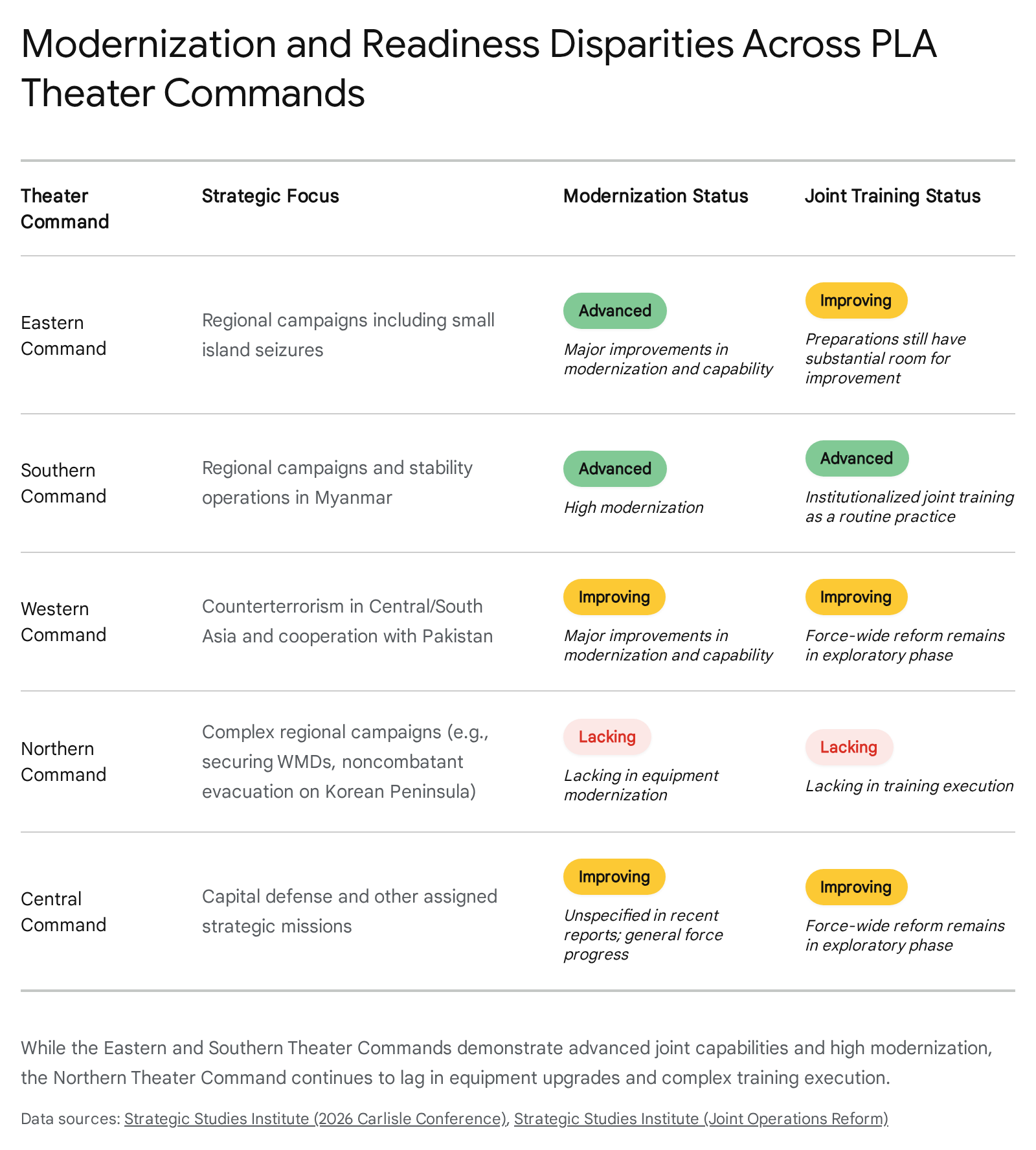
- Northern Theater Command (NTC): Despite bearing the responsibility for highly complex, volatile regional contingencies—including securing weapons of mass destruction (WMD) on the Korean Peninsula, executing massive noncombatant evacuation operations, and managing the Russian border—the NTC is currently assessed as lacking significantly in both equipment modernization and advanced joint training execution.21
- Western Theater Command (WTC): Tasked with counterterrorism operations in Central and South Asia, managing cooperation with Pakistan, and overseeing the highly contested border with India, the WTC has demonstrated growing capacity.21 However, it remains heavily focused on specialized, high-altitude expeditionary land power rather than holistic joint multidomain operations.21
- Central Theater Command (CTC): Focused primarily on the defense of the capital and serving as a strategic reserve force to rapidly reinforce other commands during a crisis, the CTC’s capabilities remain stable and tailored to internal defense.21
- Eastern Theater Command (ETC): As the command bearing primary, direct responsibility for executing any operations against Taiwan (including comprehensive blockades and complex small island seizure campaigns), the ETC has seen massive, prioritized improvements in equipment modernization.21 However, the stark fact that the STC, rather than the ETC, is currently presented as the PLA’s primary model for joint training exploration strongly indicates that the ETC’s preparations for Taiwan still possess substantial room for improvement.35 The PLA internally recognizes that the ETC has not yet perfected joint operations. Therefore, the existing patterns of military activity around the Taiwan Strait represent ongoing capability development and testing, rather than the PLA’s final, intended operational form for an invasion.35
| Theater Command | Strategic Focus & Key Campaigns | Modernization & Capability Status Assessment (2026) |
| Eastern (ETC) | Taiwan contingencies, small island seizures, East China Sea operations. | Major improvements in modernization; primary vector for Taiwan operations, yet trails STC in finalizing joint training models.21 |
| Southern (STC) | South China Sea, Myanmar stability operations, regional deterrence. | High modernization; currently the PLA’s vanguard and model organization for exploring and standardizing joint operations.21 |
| Northern (NTC) | Korean Peninsula (WMD securing, NEOs), Russian border. | Currently lagging significantly in both equipment modernization and advanced training execution.21 |
| Western (WTC) | India border, Central/South Asia counterterrorism, Pakistan cooperation. | Growing capacity for specialized terrain operations; improving expeditionary logistics.21 |
| Central (CTC) | Capital defense, strategic reserve. | Stable; oversees assigned strategic missions and internal defense.21 |
9. Operationalizing the Threat: Force Posture, Exercises, and Paramilitary Integration
Despite the internal structural friction caused by leadership purges and the ongoing, incomplete exploration of joint doctrine, the PLA continues to rapidly scale the complexity, lethality, and geographic reach of its combat readiness patrols and deterrence exercises, particularly regarding Taiwan and the First Island Chain.18
9.1 Justice Mission 2025 and High-Fidelity Blockade Simulations
In late December 2025, the PLA launched a massive, highly coordinated joint exercise code-named “Justice Mission 2025” (正义使命—2025).17 Far from a routine patrol, this drill served as a comprehensive, high-fidelity rehearsal for a multi-domain campaign specifically designed to isolate Taiwan from external support. The exercise focused explicitly on testing sea-air combat readiness patrols, achieving rapid multidomain superiority, and executing tight blockades of key Taiwanese ports to interdict energy imports.11
The operational scale and aggressive nature of Justice Mission 2025 were unprecedented. Over the course of the opening day, regional defense ministries detected 89 PLA aircraft and 28 naval vessels operating in a highly coordinated, multi-axis encirclement.39 During the critical second phase of the exercise, the PLA Ground Force (PLAGF) demonstrated its integration into maritime interdiction by launching a barrage of long-range rocket artillery from coastal batteries located in Pingtan and Shishi in Fujian Province.40 Likely utilizing the advanced PHL-16/PCL-191 Multiple Rocket Launcher Systems—which are capable of firing guided rockets up to 280 kilometers—the PLAGF fired a total of 27 rockets into defined exclusion zones directly north (targeting the approaches to the port of Keelung) and southwest (targeting the port of Kaohsiung).40 Most notably, 10 of these guided rockets landed deliberately within Taiwan’s contiguous zone (12–24 nautical miles from the coast), marking the closest PLA projectiles to impact near the island to date and signaling a dramatic escalation in risk tolerance.40 The exercise also featured a formation of four amphibious assault ships deployed east of Taiwan, indicating a rehearsal for counter-intervention operations against U.S. forces.40
9.2 China Coast Guard (CCG) Integration as a Strategic Multiplier
A critical, deeply concerning evolution demonstrated during Justice Mission 2025 and subsequent regional operations is the deep, seamless integration of the China Coast Guard (CCG) into PLA military planning and operational execution. Of the 28 vessels deployed during the highly aggressive opening phase of Justice Mission 2025, nearly half—13 vessels—belonged to the CCG, operating in direct coordination with PLAN warships.17
This deployment pattern indicates a solidified doctrinal shift within Beijing’s strategic calculus: in the event of a Taiwan contingency or South China Sea escalation, the PLA will rely heavily on the heavily armed CCG to enforce quarantines, conduct hostile board-and-search operations, and forcefully manage civilian maritime traffic.17 This paramilitary integration acts as a strategic multiplier, freeing heavier PLA Navy (PLAN) combatants to focus entirely on high-end counter-intervention operations against U.S. or allied naval strike groups operating east of Taiwan.17 Throughout 2024 and 2025—originating with the Joint Sword exercises—CCG coordination with the Eastern Theater Command advanced significantly, evolving from disparate, localized patrols to fully integrated, theater-wide law enforcement drills that effectively encircle target islands in concert with PLA naval aviation.18
10. Conclusion: Evaluating True Preparedness for Major Armed Conflict
Evaluating whether the People’s Liberation Army is “truly prepared” for a major, protracted war requires decoupling its impressive, verifiable acquisition metrics from its underlying, highly opaque institutional health. From a purely material, geographic, and kinetic standpoint, the PLA is vastly more capable today than at any point in its history. It possesses a navy that is rapidly gaining blue-water proficiency, an expanding, highly lethal arsenal of long-range precision fires, and a sprawling, highly sophisticated synthetic training infrastructure designed specifically and intentionally to offset its historical lack of combat experience.8 The routine, successful execution of massive, deeply coordinated multidomain exercises like Justice Mission 2025 unequivocally proves that the PLA can reliably project overwhelming force into the First Island Chain and severely challenge U.S. regional hegemony.18
However, the military apparatus is simultaneously hollowed out by severe, self-inflicted political wounds. The massive 2022–2026 political purges have systematically stripped the high command of its most experienced, realistic, and operationally competent leaders.1 This action has created a profound experience vacuum at the exact moment the force is attempting to operationalize highly complex, untried joint doctrine. Furthermore, the CCP’s unyielding demand for absolute political loyalty and highly centralized control fundamentally contradicts the agile, decentralized mission command structure required to survive and adapt in the heavily contested, electronic warfare-saturated environments the PLA fully expects to face.2
While the PLA’s hardware, its advanced AI integrations, and its meticulously designed synthetic training environments suggest a high state of technical readiness, its brittle command architecture, its heavily scripted bureaucratic evaluation processes (such as the “problem show”), and the strategic isolation of its paramount leader dramatically increase the risk of operational paralysis and catastrophic miscalculation in the event of an actual conflict.5 The PLA is diligently, aggressively preparing for war, constructing artificial battlefields to cure its “peace disease.” Yet, its ability to dynamically adapt to the lethal chaos, friction, and staggering attrition of the first shot remains profoundly, dangerously untested.
Please share the link on Facebook, Forums, with colleagues, etc. Your support is much appreciated and if you have any feedback, please email us in**@*********ps.com. If you’d like to request a report or order a reprint, please click here for the corresponding page to open in new tab.
Sources Used
- Assessing Xi’s Unprecedented Purges of China’s Military: Key Developments and Potential Implications – CSIS, accessed April 26, 2026, https://www.csis.org/analysis/assessing-xis-unprecedented-purges-chinas-military-key-developments-and-potential
- China & Taiwan Update, April 24, 2026 | ISW, accessed April 26, 2026, https://understandingwar.org/research/china-taiwan/china-taiwan-update-april-24-2026/
- The Purges Within China’s Military Are Even Deeper Than You Think, accessed April 26, 2026, https://chinapower.csis.org/china-pla-military-purges/
- Fravel: Assessing Xi’s Unprecedented Purges of China’s Military: Key Developments and Potential Implications | 2026 | News, accessed April 26, 2026, https://ssp.mit.edu/news/2026/fravel-assessing-xis-unprecedented-purges-of-chinas-military-key-developments-and
- The 2026 PLA Leadership Purge and China’s Military Stability – Beyond the Horizon ISSG, accessed April 26, 2026, https://behorizon.org/the-2026-pla-leadership-purge/
- How Chinese Military Decisions About Adopting Mission Command Could Affect a Future U.S.-China Conflict – RAND, accessed April 26, 2026, https://www.rand.org/nsrd/news/nsrd-upfront/2026/01/chinese-mission-command.html
- CMSR 2026 The PLA Is Intended to Fight and Win Wars – Marine Corps University, accessed April 26, 2026, https://www.usmcu.edu/Outreach/Marine-Corps-University-Press/China-Military-Studies-Review/CMSR-2026-The-PLA-Is-Intended-to-Fight-and-Win-Wars/
- China’s Military Has No Combat Experience: Does It Matter? | RAND, accessed April 26, 2026, https://www.rand.org/pubs/commentary/2018/11/chinas-military-has-no-combat-experience-does-it-matter.html
- Xi believes a ‘peace disease’ hampers China’s military modernisation | The Strategist, accessed April 26, 2026, https://www.aspistrategist.org.au/xi-believes-a-peace-disease-hampers-chinas-military-modernisation/
- 1 “PLA Weaknesses and Xi’s Concerns about PLA Capabilities” Testimony before the U.S.-China Economic and Security Review, accessed April 26, 2026, https://www.uscc.gov/sites/default/files/Blasko_USCC%20Testimony_FINAL.pdf
- China Expanding Joint Forces Training Centers and OPFOR, accessed April 26, 2026, https://g2webcontent.z2.web.core.usgovcloudapi.net/OEE/TIP/11FEB2026_T2COM_TiP_CHI_Joint_Forces_Training_Center_a.pdf
- Electronics, Volume 14, Issue 24 (December-2 2025) – 200 articles, accessed April 26, 2026, https://www.mdpi.com/2079-9292/14/24
- Lessons-learned with Chinese Characteristics | ISW, accessed April 26, 2026, https://understandingwar.org/research/china-taiwan/lessons-learned-with-chinese-characteristics-understanding-the-limits-of-pla-efforts-to-adapt-to-contemporary-warfare/
- Lessons from the Ukraine Conflict: Modern Warfare in the Age of Autonomy, Information, and Resilience – CSIS, accessed April 26, 2026, https://www.csis.org/analysis/lessons-ukraine-conflict-modern-warfare-age-autonomy-information-and-resilience
- China Accelerates Modernization By Applying Lessons From Russia-Ukraine War | T2COM G2 Operational Environment Enterprise, accessed April 26, 2026, https://oe.t2com.army.mil/product/china-accelerates-modernization-by-applying-lessons-from-russia-ukraine-war/
- No. 26-1116, Powering The Front: Tactical Energy Delivery and Management in the Ukraine War – U.S. Army, accessed April 26, 2026, https://api.army.mil/e2/c/downloads/2026/03/30/c260713f/no-26-1116-powering-the-front-tactical-energy-delivery-and-management-in-the-ukraine-war.pdf
- Special Report: Surprise PRC Military Exercise Around Taiwan, accessed April 26, 2026, https://understandingwar.org/research/china-taiwan/china-taiwan-special-report-december-31-2025/
- Annual Report to Congress: Military and Security Developments Involving the People’s Republic of China 2025 – Department of War, accessed April 26, 2026, https://media.defense.gov/2025/Dec/23/2003849070/-1/-1/1/ANNUAL-REPORT-TO-CONGRESS-MILITARY-AND-SECURITY-DEVELOPMENTS-INVOLVING-THE-PEOPLES-REPUBLIC-OF-CHINA-2025.PDF
- Why Is Xi Still Purging His Generals? – Institute for National Strategic Studies, accessed April 26, 2026, https://inss.ndu.edu/Media/News/Article/4418691/why-is-xi-still-purging-his-generals/
- Military Purges at China’s Fourth Plenum Have Implications for Readiness – CNA.org., accessed April 26, 2026, https://www.cna.org/our-media/indepth/2025/11/military-purges-at-chinas-fourth-plenum-have-implications-for-readiness
- 2026 Carlisle Conference on the PLA: The PLA’s Capability to React …, accessed April 26, 2026, https://ssi.armywarcollege.edu/SSI-Media/Recent-Publications/Article/4461809/2026-carlisle-conference-on-the-pla-the-plas-capability-to-react-to-crises/
- Xi stresses deepening political rectification at training session for military officials – Xinhua, accessed April 26, 2026, https://english.news.cn/20260408/8aab5c9793c94cc29c002376478298b5/c.html
- Xi stresses enhancing political loyalty in military to advance defense modernization, accessed April 26, 2026, http://en.cppcc.gov.cn/2026-03/07/c_1165743.htm
- China’s Incomplete Military Transformation: Assessing the Weaknesses of the People’s Liberation Army (PLA) – DTIC, accessed April 26, 2026, https://apps.dtic.mil/sti/tr/pdf/ADA615374.pdf
- the pla is intended to fight and win wars – Marine Corps University, accessed April 26, 2026, https://www.usmcu.edu/Portals/218/CMSR_2026_Tirk_web.pdf
- Russia’s Changes in the Conduct of War Based on Lessons from Ukraine – Army University Press, accessed April 26, 2026, https://www.armyupress.army.mil/Journals/Military-Review/English-Edition-Archives/September-October-2025/Lessons-from-Ukraine/
- Infrastructure Developments for Training China’s Army – Tearline.mil, accessed April 26, 2026, https://www.tearline.mil/public_page/pla-joint-training
- Virtual Reality Technology and Algorithm Application in Intelligent Combat Training Simulation System – IEEE Xplore, accessed April 26, 2026, https://ieeexplore.ieee.org/document/10835936/
- AI-Driven Defence Simulations & Military Training Future – Beyond the Horizon ISSG, accessed April 26, 2026, https://behorizon.org/training-tomorrows-leaders-today-the-role-of-ai-driven-simulations-in-modern-defence/
- Your next army training session might be in a virtual battlefield and that’s a good thing, accessed April 26, 2026, https://medium.com/@global.himani26/your-next-army-training-session-might-be-in-a-virtual-battlefield-and-thats-a-good-thing-96a31c0b155a
- REALITY CHECK – USAASC – U.S. Army, accessed April 26, 2026, https://asc.army.mil/web/reality-check/
- Virtual Reality Operational Military Medical Training – SimX, accessed April 26, 2026, https://www.simxvr.com/virtual-reality-medical-simulation-training-for-military/
- After Action Review – World Health Organization (WHO), accessed April 26, 2026, https://www.who.int/emergencies/operations/emergency-response-reviews/after-action-review
- Theory Meets Practice: The PLA National Defense University Revives the Operational Instructor Program – U.S. Army, accessed April 26, 2026, https://innovation.army.mil/News/Article-View/Article/4390693/theory-meets-practice-the-pla-national-defense-university-revives-the-operation/
- The PLA’s Joint Operations Training Reform Remains in an Exploratory Phase, accessed April 26, 2026, https://ssi.armywarcollege.edu/SSI-Media/Recent-Publications/Article/4404986/the-plas-joint-operations-training-reform-remains-in-an-exploratory-phase/
- Intelligence And Reconnaissance Brigades Give PLA Theater Commands Unprecedented Reach | T2COM G2 Operational Environment Enterprise, accessed April 26, 2026, https://oe.t2com.army.mil/product/intelligence-and-reconnaissance-brigades-give-pla-theater-commands-unprecedented-reach/
- Justice Mission-2025 – Wikipedia, accessed April 26, 2026, https://en.wikipedia.org/wiki/Justice_Mission-2025
- PLA conducts ‘Justice Mission 2025’ drills around Taiwan islands, accessed April 26, 2026, http://eng.mod.gov.cn/2025xb/N/T/16429628.html
- Creeping Closer: Timeline and Analysis of the Justice Mission-2025 Joint Exercise, accessed April 26, 2026, https://tsm.schar.gmu.edu/creeping-closer-timeline-and-analysis-of-the-justice-mission-2025-joint-exercise/
- The PLA’s “Justice Mission-2025” Exercise Around Taiwan, accessed April 26, 2026, https://globaltaiwan.org/2026/01/pla-justice-mission-2025/
- China’s Military in 10 Charts – CSIS, accessed April 26, 2026, https://www.csis.org/analysis/chinas-military-10-charts