Executive Summary
The landscape of law enforcement tactical firearms is currently undergoing a significant paradigm shift. Following historical inflection points such as the 1997 North Hollywood Shootout, agencies transitioned rapidly from pistol-caliber submachine guns (SMGs) to 5.56x45mm NATO patrol rifles. However, the modern operational environment,characterized by increased close-quarters battle (CQB) engagements, stringent indoor training facility limitations, and a heightened need for acoustic suppression,has catalyzed a massive resurgence in the procurement of 9x19mm platforms. As the global submachine gun market approaches an estimated valuation of 3.04 billion dollars by 2030, procurement officers and command staff are faced with a critical decision: selecting between traditional delayed-blowback submachine guns and modern, direct-blowback Pistol Caliber Carbines (PCCs).
This comprehensive white paper provides an exhaustive mechanical, operational, and fiscal analysis comparing traditional roller-delayed SMGs (exemplified by the Heckler & Koch MP5 platform) against contemporary direct-blowback PCCs (such as the AR-9, CZ Scorpion EVO 3, and Ruger PC Carbine). By evaluating the fundamental physics of blowback operations, total reciprocating mass (TRM), recoil impulse kinematics, and select-fire cyclic rates, this report identifies the distinct advantages and inherent liabilities of each mechanical architecture.
The analysis reveals that while direct-blowback systems offer unparalleled mechanical simplicity, modularity, and alignment with existing AR-15 training doctrines, they introduce severe internal violence to the firearm’s components, requiring heavy reciprocating masses that generate a sharp, disruptive recoil impulse. Conversely, roller-delayed systems utilize mechanical disadvantage to safely extract high-pressure casings, resulting in a substantially lighter bolt group, a remarkably smooth recoil profile, and superior sound suppression capabilities. However, these delayed systems command a premium in initial acquisition costs and necessitate highly specific maintenance intervals. By synthesizing ballistic physics, Lifecycle Costing (LCC) models, and training perishability metrics, this report equips defense contractors and law enforcement procurement divisions with the nuanced data required to execute optimized, mission-specific weapon acquisitions.
1.0 The Strategic Resurgence of Pistol Caliber Platforms in Law Enforcement
1.1 The Post-North Hollywood Era and the Rise of the Patrol Rifle
The evolutionary trajectory of law enforcement armament is deeply rooted in historical threat assessments and reactionary procurement policies. For several decades spanning the late 20th century, the 9x19mm submachine gun reigned supreme as the primary entry weapon for Special Weapons and Tactics (SWAT) units, federal tactical teams, and specialized metropolitan divisions.1 Early iterations included the Walther MPK, the Smith & Wesson M76, and the Uzi, eventually culminating in the widespread dominance of the Heckler & Koch MP5.1 These weapons provided a high volume of suppressive fire, compact form factors suitable for vehicle deployment, and easily manageable recoil profiles.1
However, the operational reality shifted abruptly following the infamous 1997 North Hollywood Shootout. During this pivotal event, responding patrol officers found their 9mm and.38 Special sidearms, as well as their 12-gauge pump-action shotguns, entirely ineffective against assailants utilizing illegally modified automatic rifles and full-body Class III armor that easily defeated pistol-caliber projectiles.1 This glaring disparity in terminal ballistics initiated a nationwide militarization of police arsenals, prompting the widespread adoption of the M16, AR-15, and M4 platforms chambered in 5.56x45mm NATO as standard-issue “patrol rifles”.1 The 5.56mm cartridge provided the necessary velocity to defeat soft body armor and penetrate intermediate barriers, effectively sidelining the 9mm submachine gun for over two decades. Consequently, the AR-15 pattern rifle became the ubiquitous standard for the modern patrol officer, deeply embedding its specific manual of arms into the core foundation of law enforcement training doctrine.
1.2 The Shift Back to Close Quarters and Facility Constraints
Despite the definitive terminal ballistic superiority of the 5.56mm NATO cartridge, the 9x19mm platform has experienced a massive resurgence in recent years, driven by several converging operational, logistical, and environmental factors.4 First, the risk of over-penetration and catastrophic backstop failure in dense urban environments has prompted a critical reevaluation of rifle calibers for indoor CQB operations. The high-velocity 5.56mm projectile poses a significant liability in multi-family housing units and densely populated apartment complexes, where missed shots can traverse multiple load-bearing walls.
Second, and perhaps more pragmatically, many law enforcement agencies are severely constrained by local indoor training facilities that possess backstops rated exclusively for pistol calibers.4 The repeated utilization of full-power 5.56mm ammunition on these short-distance ranges causes rapid degradation of steel targets and physical infrastructure, leading to exorbitant range maintenance costs and safety hazards regarding projectile spalling.4 The scaled-down nature of 9mm platforms allows agencies to conduct high-volume, dynamic live-fire training exercises on practically any standard indoor range without destroying the facility’s steel target inventory.4
Furthermore, the rise of the modern Pistol Caliber Carbine (PCC),specifically the AR-9 platform,has allowed agencies to deploy 9mm ballistics from a weapon system that identically mimics the ergonomics, controls, and sight-picture of the AR-15 patrol rifle.4 This 1:1 hardware crossover preserves perishable motor skills and drastically reduces the training hours required for officers to achieve proficiency, a subject that will be explored extensively in subsequent sections.7
1.3 Market Trajectories and Global Procurement Forecasts
The shift back toward pistol-caliber platforms is not merely anecdotal; it is heavily reflected in global defense and law enforcement market data. The submachine gun and PCC market is currently experiencing aggressive, sustained growth. Analytical forecasts project the submachine gun market to expand to a valuation of 3.04 billion dollars by the year 2030, operating at a compound annual growth rate (CAGR) of 6.2 percent.8
This growth in the forecast period is directly attributed to the rising demand for lightweight, high-rate-of-fire firearms in urban and tactical operations, the development of next-generation modular submachine gun systems, and the increased collaboration between firearms manufacturers and defense agencies for innovative CQB solutions.8 The rising threat of domestic terrorism and active shooter scenarios in enclosed environments, such as schools and commercial centers, has necessitated a weapon system that bridges the gap between the standard-issue handgun and the 5.56mm patrol rifle.8 Weapons that address these threats must offer compact, rapid-fire capabilities, making them exceptionally well-suited for close-quarters engagements where maneuverability is paramount.8
As federal agencies, such as the Bureau of Alcohol, Tobacco, Firearms and Explosives (ATF) and the Bureau of Indian Affairs (BIA), continue to cycle through their firearms inventory, the procurement of new submachine guns and select-fire PCCs represents a significant capital expenditure.9 Therefore, understanding the deep mechanical differences between competing 9mm platforms is critical for procurement officers tasked with outfitting the next generation of law enforcement personnel.
2.0 Fundamental Newtonian Physics of 9mm Autoloading Systems
To accurately evaluate the performance, longevity, and operator feedback of modern 9mm tactical weapons, one must first possess a foundational understanding of their internal operating mechanics. Unlike rifle-caliber firearms (e.g., the AR-15 or M16), which utilize gas-impingement or gas-piston systems with rotating, mechanically locked bolts to safely contain extreme chamber pressures, 9mm systems predominantly rely on blowback architectures.6 These systems can be bifurcated into two primary categories: Direct Blowback (also known as Simple Blowback) and Delayed Blowback (specifically Roller-Delayed).
2.1 Internal Ballistics and the Challenge of the 9x19mm Cartridge
The 9x19mm Parabellum cartridge generates an internal chamber pressure of approximately 35,000 pounds per square inch (PSI) upon detonation. When the primer ignites the propellant, the rapidly expanding gases exert equal pressure in all directions, in strict accordance with Newton’s Third Law of Motion.11 The extreme force pushing the lightweight projectile forward down the barrel is mathematically identical to the rearward force pushing against the spent brass casing and, consequently, the bolt face.10
Because the brass casing features relatively thin walls, it relies on the thick steel walls of the firearm’s chamber for structural support during the peak pressure spike.10 If the bolt were to move rearward instantly and extract the brass casing from the protective steel chamber while the internal pressure was still near 35,000 PSI, the unsupported brass would rupture violently. This catastrophic failure,known as an out-of-battery detonation or case rupture,projects high-velocity brass shrapnel and superheated gas into the firearm’s receiver, inevitably destroying the weapon and causing severe injury to the operator.10 Therefore, the mechanical extraction of the casing must be intentionally delayed until the bullet has exited the muzzle and the residual bore pressure has dropped to safe atmospheric levels.
2.2 The Physics of Inertia: Formulating the Blowback Equation
In a direct blowback system, this critical delay is achieved strictly through the application of mass and inertia.10 The massive weight of the bolt and buffer assembly resists the sudden rearward impulse, accelerating at a much slower rate than the lightweight 115-grain or 147-grain bullet accelerates forward.10
The mathematical physics governing this operation are absolute and unforgiving. Momentum is defined as the integral of force over time.13 By integrating the pressure curve of the detonating cartridge, engineers arrive at the fundamental blowback equation: the momentum of the bolt is equal to the momentum of the bullet multiplied by the square of the ratio between the diameter of the bolt face and the diameter of the bullet base.13
Formulaic Representation (Plain Text): Momentum of Bolt = Momentum of Bullet * (Diameter of Bolt Face / Diameter of Bullet Base) squared.13
To keep the rearward velocity of the bolt within safe mechanical limits, substantial physical mass must be added to the reciprocating assembly. Through reverse-engineering the desired safe bolt velocity, firearms engineers calculate the exact required bolt weight.13 For a standard 9mm cartridge, this calculation consistently demands a heavy, dense block of steel to achieve the necessary inertial delay. For example, a pure mathematical model calculating the required mass to keep the bolt acceleration under 0.001 seconds dictates a bolt weight of approximately 5.6 pounds for a theoretical, unmitigated 9mm blowback action.14 While recoil springs alleviate a fraction of this burden, the primary regulating force remains pure, static mass.
2.3 Mitigating Chamber Pressure: The Role of Mass vs. Spring Tension
A pervasive and highly dangerous myth within the law enforcement armorer community and the civilian AR-9 building space is the assumption that recoil spring tension plays a significant role in keeping the breech closed during detonation.15 Many armorers mistakenly believe that installing a heavier, higher-tension spring (such as a .308 Winchester rifle spring) will compensate for a lightweight bolt or significantly reduce recoil in a 9mm PCC.15
Engineering data and historical ordnance manuals completely refute this hypothesis.17 According to the seminal text The Machine Gun by George M. Chinn (Volume 4, Part X), the assertion that the driving spring contributes a substantial portion of the resistance is fundamentally false.17 Similarly, the US Army Materiel Command Engineering Design Handbook states unequivocally that the immediate resistance to case movement offered by the return spring is usually negligible, and that this burden falls almost totally on the mass of the bolt.17
To contextualize this with empirical data: a standard 5.56mm carbine recoil spring exerts approximately 6.2 to 8 pounds of forward pressure when the bolt is in the closed position.15 A heavy .308 rifle spring exerts approximately 10.5 pounds of forward pressure.15 During detonation, the chamber pressures generate tens of thousands of pounds of force.17 The addition of 3 to 4 pounds of spring tension offers absolutely negligible resistance against these astronomical pressures. The delay burden rests entirely on the inertia of the bolt mass.
TABLE 1: RECOIL SPRING TENSION VS. CHAMBER PRESSURE ANALYSIS
| Mechanical Force Component | Force Exerted (Pounds / PSI) | Efficacy in Delaying Breech Opening |
| 9x19mm Peak Chamber Pressure | ~35,000 PSI | N/A (Driving Force) |
| Standard AR-15 Carbine Spring | 6.2 – 8.0 lbs (Bolt Closed) | Negligible (< 0.03% of peak force) |
| Heavy .308 Rifle Spring | 10.5 lbs (Bolt Closed) | Negligible (< 0.04% of peak force) |
| Inertial Mass of 24oz Bolt/Buffer | Dynamic Inertial Resistance | Primary (Handles 99.9% of delay burden) |
| H&K MP5 Extractor Spring Tension | Dynamic Retention | Secures casing, does not delay breech |
Data aggregated from US Army Materiel Command Handbooks and blowback kinetic testing.15
3.0 Mechanical Architecture Analysis: Direct Blowback Systems
Direct blowback, also known as simple or straight blowback, represents the most rudimentary autoloading action in modern firearms design.10 It is the operating system utilized by the vast majority of modern Pistol Caliber Carbines, including the ubiquitous AR-9 platform, the CZ Scorpion EVO 3, the Ruger PC Carbine, and early generations of the Grand Power Stribog (SP9A1).18
3.1 Operational Modality of Simple Blowback (AR-9, CZ Scorpion)
In a direct blowback system, there is no mechanical locking mechanism, rotating lug, or locking wedge holding the breech closed.6 The bolt rests flat against the rear of the barrel chamber, held in place solely by static friction, the forward tension of the recoil spring, and the sheer mass of the bolt assembly.10 Because the system relies entirely on inertia to delay the extraction of the casing, the internal components are essentially just heavy blocks of steel sliding backward and forward on guide rods or inside an aluminum buffer tube.
The advantages of a direct-blowback system are utter and complete mechanical simplicity.22 With significantly fewer moving parts than gas-operated or delayed systems, direct blowback weapons are extremely easy to manufacture, resulting in lower retail costs and wider availability.22 They are also generally easier to maintain at the basic operator level, requiring little more than standard lubrication and wiping down of the massive bolt block.22 The polymer-framed CZ Scorpion EVO 3, for instance, utilizes a massive, heavy steel bolt block nested inside a simple clamshell receiver to achieve this inertial delay.25
3.2 The Criticality of Total Reciprocating Mass (TRM)
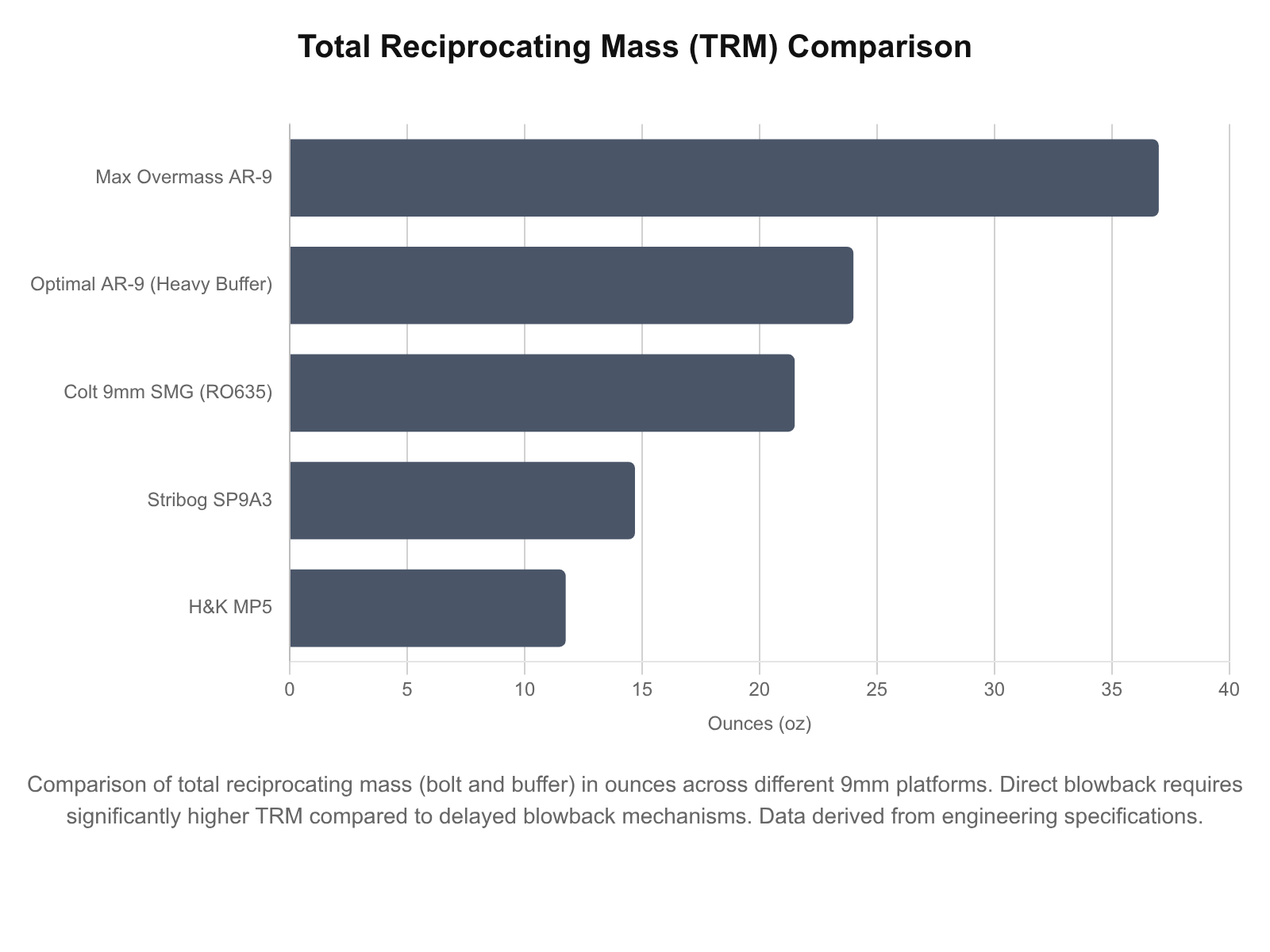
For an AR-9 style direct blowback system to function safely and reliably with standard 9mm factory ammunition, the Total Reciprocating Mass (TRM),defined as the combined physical weight of the bolt assembly and the buffer,must meet a highly specific threshold. Extensive engineering testing dictates that a TRM range of 22 to 24 ounces is optimal for the vast majority of “out of the box” 9mm AR platforms.10
Historical precedent supports this metric. The original Colt 9mm SMG (RO635), developed in the 1980s, utilized a heavy 15.9-ounce unramped bolt paired with a 5.6-ounce steel buffer, resulting in a TRM of 21.5 ounces.10 Modern consumer AR-9 bolts typically weigh between 12 ounces and 15.5 ounces.10 Because standard 5.56mm AR-15 buffers weigh only 3.0 ounces (Carbine) to 5.4 ounces (H3), they are dangerously insufficient for use in a 9mm direct blowback system.10 Utilizing a standard AR-15 buffer in a 9mm PCC will result in the TRM falling woefully short of the 22-ounce minimum, leading to excessively high bolt velocities, violent recoil, broken hammer pins, and potential case ruptures.10 To achieve the necessary 22 to 24-ounce TRM, operators must procure specialized, heavy 9mm extended buffers weighing between 7.5 and 12 ounces.10 Increasing the reciprocating mass up to approximately 37 ounces is generally acceptable and mechanically beneficial, as heavier masses further decrease bolt velocity, reduce wear and damage on internal receiver parts, and slightly elongate the cycle time.10
3.3 Deadblow Buffers, Bolt Bounce, and Catastrophic Failure Mitigation
The violent, high-velocity nature of the direct blowback cycle introduces a dangerous mechanical phenomenon known as “bolt bounce.” When the heavy, 24-ounce mass of the bolt and buffer slams forward under spring tension to strip a new cartridge from the magazine and chamber it, the violent kinetic impact of the steel bolt against the steel barrel face acts like a hammer striking an anvil.10 This impact causes the bolt to physically bounce backward, momentarily unlocking the breech.10
If the weapon’s trigger is pulled, or if the hammer falls automatically during this micro-second of bolt bounce, the firing pin will strike the primer while the cartridge is partially unsupported by the chamber. This results in a devastating out-of-battery (OOB) detonation.10 To mitigate this hazard, specialized 9mm buffers must incorporate internal sliding weights. These internal weights shift forward slightly after the main body of the buffer strikes the bolt, acting as a “deadblow” hammer.10 The secondary impact of the sliding weights mathematically cancels out the rearward momentum of the bolt bounce, ensuring the breech remains securely closed during ignition.10 Solid buffers (those manufactured without internal sliding weights) should be categorically avoided in all direct blowback PCC builds to prevent this catastrophic failure mechanism.10
3.4 The Hazard of Over-Sprung Systems and the .308 Spring Myth
As previously established in Section 2.3, recoil springs offer negligible resistance against chamber pressure.17 However, many amateur armorers attempt to cure AR-9 feeding and ejection issues by installing extra-power or .308 Winchester rifle springs.15 This is a severe mechanical error.
A 9mm direct blowback system does not benefit from being “oversprung”.10 An overpowered .308 spring drastically increases the forward velocity of the heavy 24-ounce bolt mass. When this mass crashes into the breech face at heightened speeds, it causes severe battering of the aluminum receiver and the barrel trunnion.10 Furthermore, the excessive forward speed frequently induces “nosedive” feeding malfunctions, where the bolt rams the cartridge into the bottom of the feed cone rather than sliding it into the chamber.10 Worse still, the impact can force the projectile deeper into the brass casing,a malfunction known as bullet setback,which exponentially decreases the internal case volume and dangerously spikes the chamber pressure upon subsequent detonation.10 Standard-strength, mil-spec 5.56mm carbine recoil springs remain the universal, mechanically optimal choice for 9mm direct blowback operations.6
4.0 Mechanical Architecture Analysis: Roller-Delayed and Advanced Systems
In stark contrast to the brute-force inertia of the direct blowback system, the roller-delayed blowback system,pioneered by German engineers in the mid-20th century and perfected in the iconic Heckler & Koch MP5,utilizes an elegant, complex mechanical disadvantage to safely regulate chamber pressure.18
4.1 The Kinematics of Roller-Delayed Blowback (H&K MP5)
The roller-delayed system operates on a fundamentally different paradigm. While the bolt is not solidly, permanently locked by rotating lugs like a gas-operated AR-15, it is far from a simple sliding block of steel.18 The system features a multi-part bolt assembly consisting of a bolt head, an angled locking piece, a heavier bolt carrier, and two steel rollers.18
When the weapon cycles forward and goes into battery, the angled locking piece drives the two steel rollers outward, laterally engaging with recessed trunnions machined directly into the barrel extension.18 At this moment, the bolt is effectively sealed in place. Upon firing, the rearward force of the expanding gases pushes against the face of the bolt head. However, because the rollers are firmly seated in the trunnions, the bolt head cannot immediately travel rearward.18
Before the bolt head can move backward to extract the casing, the rearward force must squeeze the steel rollers inward, out of the trunnion recesses. Because the rollers are pressed against the angled wedge of the locking piece, forcing them inward violently accelerates the heavier bolt carrier to the rear at a much faster rate than the bolt head itself.18 The specific angle of the locking piece (typically 100 degrees for standard MP5s, or 80-90 degrees for suppressed/K-models) dictates the exact ratio of mechanical disadvantage.28
4.2 Mechanical Disadvantage as a Pressure Regulator
This mechanical disadvantage is the genius of the roller-delayed system. It acts as an automatic, precision-timed pressure regulator. The system ensures that the breech remains effectively sealed until the bullet has exited the muzzle and the bore pressures have dropped to highly manageable, safe levels.18 Because the delay is achieved mechanically rather than strictly through static inertia, roller-delayed platforms are considered inherently safer when operating with high-pressure (+P or +P+) 9mm cartridges, drastically reducing the risk of premature case ruptures.18
4.3 Weight Reduction and Systemic Efficiency
The most profound mechanical benefit of this delayed unlocking process is the massive reduction in required bolt weight. Because the rollers and the locking piece handle the burden of delaying the action, the entire bolt assembly can be made significantly lighter.18 The complete, fully assembled bolt carrier group of an H&K MP5, including the recoil spring assembly, weighs approximately 11.75 ounces (333 grams).30
When compared to the 24-ounce TRM requirement of an optimal AR-9 direct blowback system, the MP5 operates with less than half the reciprocating mass.10 This dramatic reduction in moving mass is the primary reason why roller-delayed firearms are universally celebrated for their smooth cycling and minimal felt recoil.18 The primary disadvantage of this architecture is its complexity; machining the trunnions, precisely angling the locking pieces, and perfectly aligning the rollers requires exceptional manufacturing tolerances, leading to a significantly higher initial acquisition cost.18
4.4 Alternative Delay Mechanisms: Hydraulic and Radial Architectures
The modern PCC market also features hybrid delay mechanisms that attempt to bridge the gap between the simplicity of direct blowback and the smoothness of roller-delay. The Swiss-manufactured B&T APC9 utilizes a direct blowback bolt but incorporates a sophisticated, proprietary hydraulic buffer system built directly into the rear of the receiver endcap.20 This hydraulic damper decelerates the heavy bolt mass over a longer duration, absorbing the violent rearward impact and transforming the sharp punch into a smoother push.32
Similarly, the CMMG Banshee utilizes a proprietary “Radial Delayed Blowback” system. This hybrid architecture forces the bolt lugs to rotate and unlock along specially angled cuts within the barrel extension, mimicking the mechanical delay of a traditional roller system.33 This radial delay allows the Banshee to utilize a lighter bolt group than a standard AR-9, taming the recoil impulse while maintaining standard AR-15 dimensions and parts compatibility.33
5.0 Biomechanical Operator Feedback and Recoil Impulse Profiles
The deep mechanical differences between direct and delayed blowback architectures do not exist solely in a vacuum of engineering data; they directly and profoundly translate into the biomechanical feedback experienced by the human operator. In high-stress CQB environments, the recoil impulse of a weapon system dictates the speed of initial target acquisition, the accuracy of rapid follow-up shots, and the overall split times during dynamic, multi-target engagements.20
5.1 The “Sharp Punch” of Direct Blowback Kinematics
Direct blowback systems are widely criticized by professional operators for their harsh, snapping recoil impulse. As established in Section 3.2, a massive 24-ounce steel weight is violently propelled backward by 35,000 PSI of chamber pressure. This mass must eventually stop. In an AR-9 or a CZ Scorpion EVO 3, the heavy bolt travels rearward until it abruptly bottoms out against the rear of the aluminum buffer tube or the polymer receiver housing.10
This sudden, violent deceleration transfers the accumulated kinetic energy directly into the operator’s shoulder. Rather than a steady push, the operator experiences a sharp, disruptive “punch”.33 This sudden energy transfer disrupts the operator’s sight picture, forces the red dot optic or iron sights to jump erratically, and causes significant upward muzzle rise.35 To effectively manage a direct blowback PCC during rapid fire, the operator must utilize an aggressive, highly tensioned forward grip and exert substantial muscular force to drive the muzzle back down onto the target after every shot.35 As the author of a comparative analysis noted, “Physics dictates they will have more ‘thump.’ The Scorpion is known for being snappy… you will definitely feel more movement compared to the delayed guns”.33
5.2 The “Gentle Thwap” of Roller-Delayed Deceleration
Conversely, the recoil profile of the Heckler & Koch MP5 and its high-tier clones (such as the Zenith ZF-5 or Century Arms AP5) is universally lauded for its unparalleled smoothness.18 Because the roller-delayed system requires only 11.75 ounces of reciprocating mass, there is substantially less kinetic energy slamming into the rear of the receiver.18 Furthermore, the mechanical unlocking of the rollers naturally absorbs a fraction of the initial energy peak, distributing the recoil impulse over a slightly longer temporal duration.18
Operators frequently describe the MP5 recoil impulse as a “gentle thwap” or a smooth, rolling push rather than an abrupt strike.12 This allows the weapon’s sights to track linearly, reciprocating straight back and returning exactly to the original point of aim without violently lifting off the target. In direct comparative testing, shooters utilizing roller-delayed platforms report buttery-smooth cycling that occasionally feels akin to firing a.22 caliber rimfire weapon.12
5.3 Empirical Split Times, Target Acquisition, and The Bill Drill
This biomechanical advantage directly impacts tactical performance metrics. A standard assessment in tactical firearms training is the “Bill Drill,” an exercise designed to measure recoil management and speed.36 From a low-ready or holstered position, the operator must fire six consecutive shots as rapidly as possible into an 8-inch circular target at a distance of 7 yards.36
When executing a Bill Drill with a direct blowback AR-9 or CZ Scorpion, the operator must consciously fight the heavy reciprocating mass to keep all six rounds within the A-zone, often resulting in slightly slower split times (the time elapsed between individual shots).37 However, when utilizing a premium roller-delayed platform, such as the competition-tuned JP5, operators consistently report the ability to execute a clean, six-shot Bill Drill in approximately 3.0 seconds flat, with all impacts clustered tightly in the center mass.38 The linear tracking of the delayed action allows the operator’s visual processing to stay ahead of the recoil cycle, enabling significantly faster and more accurate target saturation.38
6.0 Select-Fire Cyclic Rate Optimization
For law enforcement SWAT applications, specialized VIP protection details, and defense contractors supplying fully automatic or burst-fire weapon systems, the cyclic rate of fire,measured in Rounds Per Minute (RPM),is a critical performance metric. A cyclic rate that is excessively high renders the weapon entirely uncontrollable during automatic fire, causing severe muzzle climb and rapidly depleting the 30-round ammunition reserves in less than two seconds without achieving accurate target saturation. Conversely, a rate that is too low can cause the weapon to feel sluggish, leading to a “chugging” recoil impulse that throws off the shooter’s natural cadence and allows the target to maneuver between impacts.
6.1 The Engineering Challenge of High-Velocity Actions
Operating a 9mm direct blowback system in a fully automatic configuration presents a severe engineering challenge. Because the system relies purely on a heavy bolt and a stout recoil spring, the action naturally wants to cycle at a blistering, uncontrollable speed. When the trigger is depressed, the bolt strips a round, fires it, flies back, bounces off the rear buffer, and violently slams forward again with unmitigated ferocity.
6.2 The 1150 RPM Extreme: The CZ Scorpion EVO 3 A1
The select-fire variant of the CZ Scorpion, designated the EVO 3 A1 (specifically designed for military and LE contracts), operates via pure, unmitigated direct blowback.40 Because it relies entirely on its massive bolt block and spring tension, the action cycles exceptionally fast. The official factory cyclic rate for the Scorpion A1 is an astonishing 1150 RPM.40
At this immense speed, the weapon can completely empty a standard 30-round magazine in approximately 1.5 seconds.41 While this provides devastating, overwhelming suppressive fire in extremely tight, phone-booth-sized CQB spaces, it is widely considered too fast for practical patrol use. It requires intense, specialized operator training to deliver controlled, short bursts, as the sharp direct-blowback recoil combined with the blistering fire rate leads to rapid, aggressive muzzle climb.41
6.3 Hydraulic Damping and Rate Reduction (Colt RO635 & B&T APC9)
When Colt developed the original RO635 9mm submachine gun for LE and military use in the 1980s, they encountered the same high-velocity problem. Early iterations of the direct blowback Colt SMG cycled at nearly 1000 RPM, making the weapon incredibly difficult to control on full-auto.42 To make the weapon viable for tactical teams, Colt Senior Engineer Henry “Hank” Tatro designed a specialized hydraulic buffer.26 This hydraulic damper absorbed the rearward momentum of the heavy steel buffer, successfully mitigating the bolt velocity and dropping the cyclic rate down to a highly manageable 650 to 850 RPM.26
The modern B&T APC9 PRO select-fire SMG utilizes a highly refined evolution of this concept. It employs a hydraulic-assisted blowback mechanism built into the receiver to decelerate the bolt, allowing the weapon to maintain a brisk but extremely steady cyclic rate of 1080 RPM.44 The hydraulic buffer absorbs the rearward impact so effectively that the weapon remains highly controllable despite operating at over 1000 rounds per minute, preventing the muzzle climb normally associated with such high cyclic rates.32
6.4 The 800 RPM Golden Mean of the MP5
The H&K MP5 (specifically the A2 and A3 variants) features an optimized, naturally governed cyclic rate of approximately 800 RPM.27 This specific rate is widely considered by tactical instructors and defense analysts to be the “gold standard” for 9mm submachine guns. It strikes a perfect, harmonious balance between rapid target saturation and complete operator controllability.27 The mechanical delay of the rollers acts as a natural governor on the bolt’s velocity, ensuring that the weapon cycles at a consistent, rhythmic 800 RPM without the need for additional hydraulic dampers or overly complex buffer systems.
7.0 Acoustic Suppression and Gas System Dynamics
In contemporary tactical operations, the acoustic suppression of entry weapons is no longer considered a luxury or a niche accessory; it is an absolute tactical necessity. Suppressors preserve vital team communication during chaotic CQB entries, protect officer hearing in enclosed concrete spaces, and reduce the disorienting physical concussions that occur during indoor firefights.33 However, the physical mechanics of the blowback system drastically affect a weapon’s viability as a suppressor host.
7.1 Premature Breech Opening and “Port Pop” in Direct Blowback
A sound suppressor functions by capturing and slowing the rapidly expanding, high-pressure gases exiting the muzzle. This inherently creates significant backpressure, forcing gases back down the barrel toward the chamber. In a direct blowback AR-9 or CZ Scorpion, the breech begins to move backward the exact millisecond the cartridge detonates, held closed only by inertia.10
Because the suppressor holds high-pressure gas in the barrel for a longer duration, opening the breech quickly under these conditions results in high-velocity, highly compressed gas escaping backward directly out of the ejection port.33 This phenomenon, known in the industry as “port pop,” severely increases the decibel reading directly at the shooter’s ear, effectively neutralizing much of the suppressor’s intended acoustic benefit.33 Furthermore, this intense backpressure blows toxic carbon fouling, unburnt powder, and vaporized lead particulate directly backward into the operator’s face. During sustained engagements, this gas blowback severely irritates the operator’s eyes and respiratory tract, compromising their vision and combat effectiveness.18
7.2 Backpressure Mitigation and Subsonic Efficiency in Delayed Actions
Roller-delayed systems, particularly the MP5 and its variants, are universally regarded by the industry as the ultimate, tier-one suppressor hosts.18 The mechanical delay of the rollers keeps the breech firmly locked shut for a critical fraction of a second longer than a simple direct blowback system.18 By the time the rollers unlock, the mechanical disadvantage is overcome, and the bolt head finally moves rearward, the vast majority of the expanded, high-pressure gases have already vented forward safely out of the suppressor.18
As a result, there is virtually zero port pop.33 The operator experiences a remarkably clean, exceptionally quiet shooting experience with zero toxic gas blowback to the face.18 For elite SWAT teams deploying heavy, subsonic 147-grain or 150-grain 9mm ammunition, a suppressed MP5 provides unparalleled acoustic stealth, rendering the weapon nearly silent beyond the mechanical clatter of the bolt group.28
8.0 Motor Skill Perishability and the Manual of Arms
The acquisition of a new weapon system by a law enforcement agency inherently demands a massive, often under-calculated investment in officer training. Transitioning a department from one firearm platform to another is not simply a matter of a brief qualification course; it requires the overriding of deeply ingrained, highly perishable motor skills.7
8.1 The Psychological Reality of Lethal Force Engagements
Under the extreme physiological and psychological stress of a lethal force encounter, the human brain experiences severe auditory exclusion, tunnel vision, and a catastrophic loss of fine motor skills. In these life-or-death microseconds, officers default entirely to subconscious muscle memory built through thousands of hours of repetitive training.7 The courts have strictly ruled on this matter; the landmark legal case Popow v. City of Margate definitively established that mere “qualification is not training”.46 If an officer fumbles a weapon transition or a reload because the manual of arms is unfamiliar, the legal liability falls squarely on the agency for failure to train.46
8.2 Ergonomic Crossover: The AR-15 to AR-9 Paradigm
This physiological reality presents the most profound operational advantage of the modern AR-9 Pistol Caliber Carbine. The AR-9 shares an absolutely identical ergonomic identity with the standard 5.56mm AR-15 patrol rifle.6 The safety selector, the push-button magazine release, the T-handle charging handle, and the bolt catch are all located in the exact same physical space on the receiver.6
When an agency adopts an AR-9 for its tactical teams, motor units, or school resource officers, effectively zero hours must be spent retraining officers on the manual of arms. An officer who has spent the last five years building deep neural motor pathways on a 5.56mm M4 can pick up a 9mm AR-9 and intuitively, subconsciously operate it in complete darkness.7 This seamless hardware transition drastically reduces the financial burden of training ammunition, range time, and instructor overtime, significantly offsetting the initial lifecycle cost of the weapon itself.4
8.3 Motor Skill Partitioning and Legacy Ergonomics
Conversely, legacy platforms like the H&K MP5, originally designed in the 1960s, possess a severely outdated manual of arms by modern standards.27 The most glaring deficiency is that the MP5 completely lacks a Last Round Bolt Hold Open (LRBHO) feature.33 When an AR-15 or an AR-9 runs out of ammunition, the bolt locks to the rear, providing a tactile and visual indicator to the operator. When the MP5 runs dry, the bolt closes on an empty chamber, and the officer feels a dead trigger click during a firefight.33
Furthermore, the MP5 reload sequence is complex, idiosyncratic, and highly motor-skill intensive. Upon recognizing an empty weapon, the officer must manually reach forward, pull the charging handle to the rear, and physically lock it upward into a notch.48 They must then strip the empty magazine using a paddle release behind the magazine well, insert a fresh magazine, and aggressively slap the charging handle downward (the iconic “HK Slap”) to chamber a new round.48
If an agency transitions from an AR-15 patrol rifle to an MP5 for entry work, the officers must partition their brains to maintain two entirely different, highly perishable reloading and malfunction-clearing protocols. In high-stress situations, an officer attempting to hit a non-existent AR-15 bolt release on the side of an MP5 can result in fatal hesitation.46 The CZ Scorpion suffers a similar fate, requiring unique training for its distinct forward side-charging handle and paddle magazine release, though it does feature a modern LRBHO system.49
9.0 Lifecycle Costing (LCC) and Long-Term Durability
Procurement decisions made by law enforcement command staff and municipal accountants cannot be based solely on the initial unit acquisition price. The true, comprehensive financial impact of a weapon system over a ten-year deployment cycle is determined by Lifecycle Costing (LCC).50
9.1 Breaking the Acquisition-Centric Procurement Model
LCC models evaluate the entire lifespan of an asset, moving far beyond the sticker price to include operational costs, component wear rates, armorer maintenance hours, part replacement frequencies, and eventual end-of-life disposal.50 Institutional studies consistently demonstrate that acquisition costs typically account for only 20 to 40 percent of a public asset’s total expenditures, while the remaining 65 to 75 percent of costs arise strictly during the weapon’s long-term usage phase.52 Evaluating firearms solely by their upfront cost is a severe procurement failure.
9.2 High-Velocity Wear Rates in Direct Blowback Platforms
The CZ Scorpion EVO 3 and standard AR-9 builds represent a highly cost-effective initial purchase, often retailing for $800 to $1,500, which is frequently less than half the price of a genuine MP5 or premium roller-delayed clone.53 However, as established in Section 3, direct blowback systems are inherently “dirty” and exceptionally violent on their internal components.10
The massive bolt assemblies violently batter hammer pins, trigger groups, and bolt catches.10 This violence necessitates a strict, highly active armorer maintenance schedule to prevent catastrophic failure in the field. The official CZ armorer guidelines explicitly mandate replacing the slide stop, the trigger-return spring, the main spring, and the recoil spring every 10,000 rounds.55 By 20,000 rounds, the entire firing pin, firing pin spring, extractor, extractor pin, and extractor spring must be entirely gutted and replaced.55 Furthermore, civilian and LE users have documented issues with the Scorpion’s factory bolt block deforming over time from the repeated high-velocity impacts, sometimes requiring the purchase of enhanced, hardened aftermarket bolts for $249.00 to maintain operational status.56
9.3 Roller-Delayed Attrition: The Extractor Spring Vulnerability
The H&K MP5 operates much cleaner and subjects its receiver to significantly less internal battering due to the mechanical delay and lighter 11.75-ounce bolt mass.18 MP5 cold-hammer-forged barrels are remarkably durable; specialized armorers report that fully automatic MP5s maintain exceptional accuracy and reliability well past 40,000 rounds of sustained fire without requiring a barrel or receiver replacement.29 Even the recoil springs on the MP5 routinely last tens of thousands of rounds without suffering significant degradation.29
However, the MP5 contains a distinct, highly specific Achilles’ heel that severely impacts its LCC: the extractor spring. The small, copper-colored extractor spring is universally recognized as the single most common point of failure in the entire MP5 platform.57 Because there is no mechanical over-travel stop, if an empty casing fails to clear the ejection port and causes a “stovepipe” jam, the returning heavy bolt will force the extractor outward, permanently bending or breaking the thin copper spring.57 Once bent, the weapon will suffer continuous, debilitating failure-to-eject (FTE) malfunctions until the spring is replaced.57
While a replacement copper spring is financially inexpensive (approximately $10.95), the labor, diagnostic time, and operational downtime required to replace it factor heavily into the LCC.58 Armorers must explicitly avoid using the thicker, more durable silver-colored rifle extractor springs in the MP5K models, as the increased tension severely alters the delicate ejection timing of the faster, lighter K-model bolt, leading to further malfunctions.57
TABLE 2: LIFECYCLE COSTING (LCC) AND MAINTENANCE METRICS OVER 20,000 ROUNDS
| Analytical Cost Factor | CZ Scorpion / AR-9 (Direct Blowback) | H&K MP5 / Clones (Roller-Delayed) |
| Initial Acquisition Cost | Low to Moderate ($800 – $1,500) | High Premium ($2,000 – $3,500+) |
| System Cleanliness | Poor (Heavy carbon fouling in receiver) | Excellent (Action remains sealed longer) |
| Receiver Battering | High (Heavy mass impact degradation) | Low (Mechanical deceleration saves wear) |
| 10k Round Replacement | Trigger springs, recoil springs, slide stop | Visual inspection; minimal parts required |
| 20k Round Replacement | Firing pin, complete extractor assembly | Standard preventative maintenance |
| Unique Vulnerabilities | Bolt catch breakage, bolt block deformation | Copper extractor spring bending/breakage |
| Armorer Labor Burden | High (Frequent teardowns and part swaps) | Low (Excepting extractor spring failures) |
Data synthesized from OEM Armorer Manuals (CZ-USA, H&K) and municipal LCC frameworks.
10.0 Strategic Sourcing and Procurement Directives
The selection between a direct blowback PCC and a roller-delayed SMG cannot be determined by a single metric. It demands a comprehensive, holistic assessment of an agency’s operational budget, primary mission set, and existing training infrastructure.
10.1 High-Tier Tactical and Hostage Rescue Deployments
If the primary mission profile of the unit involves covert entry, hostage rescue, and exclusively suppressed operations, the roller-delayed architecture (H&K MP5, SP5, or high-tier clones) remains statistically and operationally unmatched. The buttery-smooth recoil impulse allows for surgical, sub-second precision during fully automatic or rapid semi-automatic fire, and the delayed breech opening provides optimal, gas-free acoustic suppression. The significantly higher initial acquisition cost and the outdated, complex manual of arms are highly acceptable trade-offs for elite tactical units that possess the dedicated training budgets required to maintain specialized motor skills.
10.2 Broad Patrol and Budget-Constrained Implementations
For general patrol integration, school resource officers (SROs), and budget-constrained municipal agencies, the AR-9 direct blowback platform is the definitive, fiscally responsible choice. While the recoil impulse is noticeably sharper and the acoustic suppression capabilities are vastly inferior to delayed systems, the AR-9 offers unparalleled, immediately quantifiable training efficiency. By mirroring the 5.56mm AR-15 patrol rifle exactly, agencies completely eliminate the need for cross-training, saving thousands of dollars in perishable skill maintenance. To mitigate the inherent violence of the direct blowback action, procurement officers must ensure that AR-9 contract specifications mandate a 22-to-24-ounce total reciprocating mass utilizing an extended deadblow hydraulic or sliding-weight buffer system to guarantee long-term reliability and strictly prevent catastrophic out-of-battery detonations.
10.3 Hybrid Deployments and Future Trajectories
Agencies seeking a modern middle ground that compromises neither ergonomics nor recoil mitigation should heavily evaluate advanced hydraulic systems, such as the B&T APC9 PRO. It successfully combines modern, AR-style ambidextrous ergonomics, LRBHO functionality, and flawless reliability with a proprietary hydraulic buffer system that thoroughly tames the violent direct blowback recoil impulse. While commanding a higher price point than standard AR-9s, it represents a highly formidable, future-proof option for the 2025-2035 procurement cycle.
Appendix: Methodology & Data Sources
The analytical conclusions presented in this white paper were synthesized through a rigorous, cross-source Open-Source Intelligence (OSINT) methodology. Data collection focused strictly on the mechanical engineering specifications, ballistic physics formulas, and historical procurement trends of 9x19mm submachine guns and Pistol Caliber Carbines (PCCs). Source material included original manufacturer armorer manuals (Heckler & Koch, CZ-USA, Colt), technical teardown analyses, fluid dynamics and momentum physics documentation, and law enforcement lifecycle costing (LCC) frameworks. Cyclic rate data and total reciprocating mass (TRM) figures were verified across multiple technical databases to establish accurate, unbiased comparative baselines. Subjective recoil impulses were quantified by correlating mechanical bolt deceleration mechanics with documented operator feedback and empirical “Bill Drill” performance metrics. Financial procurement models were adapted from standard municipal investment goods lifecycle matrices, isolating the initial acquisition costs from long-term maintenance overhead. The synthesis of this comprehensive data ensures that all findings are grounded in empirical mechanical reality rather than manufacturer marketing claims.
Ronin’s Grips Analytics provides custom, agency-specific data on this topic. Contact us to commission a tailored internal audit or procurement forecast for your department.
Please share the link on Facebook, Forums, with colleagues, etc. Your support is much appreciated and if you have any feedback, please email us in**@*********ps.com. If you’d like to request a report or order a reprint, please click here for the corresponding page to open in new tab.
Sources Used
- Select Fire Carbines vs. Submachine Guns – Police Magazine, accessed March 5, 2026, https://www.policemag.com/articles/select-fire-carbines-vs-submachine-guns
- The United States Military and Law Enforcement relationship with PCCs and SMGs – Reddit, accessed March 5, 2026, https://www.reddit.com/r/WarCollege/comments/1lqao9f/the_united_states_military_and_law_enforcement/
- implementing the .223 carbine for patrol – SHSU, accessed March 5, 2026, https://shsu-ir.tdl.org/bitstreams/44637334-0f01-4130-adbc-af25fea199ee/download
- Alternative Calibers For Police Rifle Training – American Cop, accessed March 5, 2026, https://americancop.com/alternative-calibers-for-police-rifle-training/
- AR-15 vs PCC for Home Defense/Range/SHTF: Seeking Pros and Cons – Reddit, accessed March 5, 2026, https://www.reddit.com/r/liberalgunowners/comments/1f3cd8w/ar15_vs_pcc_for_home_defenserangeshtf_seeking/
- Quick Tip: Converting a 5.56 AR-15 to 9mm – YouTube, accessed March 5, 2026, https://www.youtube.com/watch?v=XQAnhpsRySw
- Weapon Transition Training: The Evolution of Law Enforcement Training – Chris Sajnog, accessed March 5, 2026, https://chrissajnog.com/blog/le-weapon-transition/training/
- Submachine Guns Market Size, Competitors & Forecast to 2030 – Research and Markets, accessed March 5, 2026, https://www.researchandmarkets.com/report/sub-machine-gun-market
- GAO-19-175, FEDERAL LAW ENFORCEMENT: Purchases and Inventory Controls of Firearms, Ammunition, and Tactical Equipment, accessed March 5, 2026, https://www.gao.gov/assets/gao-19-175.pdf
- Everything about the “AR9” – Blowback9.com, accessed March 5, 2026, https://blowback9.wordpress.com/2021/04/02/everything-about-the-ar9/
- How Does it Work: Blowback Action – Forgotten Weapons, accessed March 5, 2026, https://www.forgottenweapons.com/how-does-it-work-blowback-action/
- How does the recoil on your MP5 feel? – Reddit, accessed March 5, 2026, https://www.reddit.com/r/MP5/comments/1i9guas/how_does_the_recoil_on_your_mp5_feel/
- Blowback Bolt Weight Calculations | PDF | Bullet | Cartridge (Firearms) – Scribd, accessed March 5, 2026, https://www.scribd.com/document/58128755/Blowback-Bolt-Weights
- Blowback formula needed – Google Groups, accessed March 5, 2026, https://groups.google.com/g/rec.guns/c/elEl5lAnYcg
- Math Breakdown:308 spring vs Standard AR15 spring : r/AR9 – Reddit, accessed March 5, 2026, https://www.reddit.com/r/AR9/comments/10el6gq/math_breakdown308_spring_vs_standard_ar15_spring/
- 308 buffer spring or standard Milspec spring with H3 (or heavier) buffer? : r/AR9 – Reddit, accessed March 5, 2026, https://www.reddit.com/r/AR9/comments/ye7kkc/308_buffer_spring_or_standard_milspec_spring_with/
- The case against .308 (XP, etc.) recoil springs in a 9mm AR – Blowback9.com, accessed March 5, 2026, https://blowback9.wordpress.com/2021/04/07/the-case-against-308-rifle-recoil-springs-in-a-9mm-ar/
- Roller-Delayed vs. Direct Blowback: An Overview , Zenith Firearms, accessed March 5, 2026, https://zenithfirearms.com/roller-delayed-vs-direct-blowback-an-overview/
- Ruger PC Carbine Review [Video] – Gun University, accessed March 5, 2026, https://gununiversity.com/ruger-pc-carbine/
- Best Pistol-Caliber Carbines (PCC): 9mm & Beyond – Pew Pew Tactical, accessed March 5, 2026, https://www.pewpewtactical.com/pistol-caliber-carbines/
- The 9mm Carbine: Part SMG, Part Pistol, Pure Utility – Recoil Magazine, accessed March 5, 2026, https://www.recoilweb.com/the-9mm-carbine-part-smg-part-pistol-pure-utility-162050.html
- Know Your Blowback? Roller-Delayed vs. Direct – The Armory Life, accessed March 5, 2026, https://www.thearmorylife.com/roller-delayed-vs-direct-blowback/
- Understanding Direct Blowback and Roller Delayed Systems in Firearms – Oreate AI Blog, accessed March 5, 2026, https://www.oreateai.com/blog/understanding-direct-blowback-and-roller-delayed-systems-in-firearms/2485c39797c4b6967f743d3bd82d3a42
- How often do you clean your scorpion? : r/czscorpion – Reddit, accessed March 5, 2026, https://www.reddit.com/r/czscorpion/comments/kl7qfb/how_often_do_you_clean_your_scorpion/
- Quick Tip: H&K MP5K vs CZ Scorpion Micro – YouTube, accessed March 5, 2026, https://www.youtube.com/watch?v=NW63vDJou9I
- THE COLT 9mm NATO SMG/CARBINE – Small Arms Review, accessed March 5, 2026, https://smallarmsreview.com/the-colt-9mm-nato-smg-carbine/
- Heckler & Koch MP5 – Wikipedia, accessed March 5, 2026, https://en.wikipedia.org/wiki/Heckler_%26_Koch_MP5
- Democratization of Cyclic Fire Rate : r/MP5 – Reddit, accessed March 5, 2026, https://www.reddit.com/r/MP5/comments/1msq8aa/democratization_of_cyclic_fire_rate/
- How often are you guys changing out the recoil spring on a MP5(K) gun? – Reddit, accessed March 5, 2026, https://www.reddit.com/r/MP5/comments/tzjm67/how_often_are_you_guys_changing_out_the_recoil/
- Can anyone tell me the weight of a complete MP5 bolt carrier group? – Reddit, accessed March 5, 2026, https://www.reddit.com/r/MP5/comments/hs3be3/can_anyone_tell_me_the_weight_of_a_complete_mp5/
- APC9 – B&T USA, accessed March 5, 2026, https://bt-usa.com/product-category/apc-smg/
- The APC9KSD2 has very similar recoil impulse to an MP5, finally got to test them. – Reddit, accessed March 5, 2026, https://www.reddit.com/r/BT_APC/comments/1gia8uf/the_apc9ksd2_has_very_similar_recoil_impulse_to/
- Comparing Short-Barrel 9mm AR Pistols: AR9, MP5 & More – Blog.GritrSports.com, accessed March 5, 2026, https://blog.gritrsports.com/9mm-ar-pistols-comparison/
- Non physics guy here. Why does my 9mm direct blowback AR-9 seem like it has slightly more recoil than my direct blowback 5.56 AR-15? : r/guns – Reddit, accessed March 5, 2026, https://www.reddit.com/r/guns/comments/16yqfjr/non_physics_guy_here_why_does_my_9mm_direct/
- Thoughts on the ruger pc carbine 9mm? I’ve heard they’re a lot of fun. – Reddit, accessed March 5, 2026, https://www.reddit.com/r/liberalgunowners/comments/1kg6zdm/thoughts_on_the_ruger_pc_carbine_9mm_ive_heard/
- The Importance of Proper Firearm Training – Ammunition Depot, accessed March 5, 2026, https://www.ammunitiondepot.com/blog/yes-you-need-to-practice
- Full-sized handgun vs. micro-PDW. When would you carry each one? : r/Firearms – Reddit, accessed March 5, 2026, https://www.reddit.com/r/Firearms/comments/1hpre3x/fullsized_handgun_vs_micropdw_when_would_you/
- The JP5 Roller Delayed PCC , If Stoner and Hans had a Baby – GunMag Warehouse, accessed March 5, 2026, https://gunmagwarehouse.com/blog/the-jp5-roller-delayed-pcc-if-stoner-and-hans-had-a-baby/
- Standard drills with MP5 – Reddit, accessed March 5, 2026, https://www.reddit.com/r/MP5/comments/1580jjt/standard_drills_with_mp5/
- CZ Scorpion Evo 3 – Wikipedia, accessed March 5, 2026, https://en.wikipedia.org/wiki/CZ_Scorpion_Evo_3
- CZ Scorpion EVO 3 – Gun Wiki | Fandom, accessed March 5, 2026, https://guns.fandom.com/wiki/CZ_Scorpion_EVO_3
- Colt 9mm SMG – Weaponsystems.net, accessed March 5, 2026, https://weaponsystems.net/system/1571-Colt%209mm%20SMG
- Colt SMG: First of the 9mm ARs – YouTube, accessed March 5, 2026, https://www.youtube.com/watch?v=cwhCl8VdYh0
- Brügger & Thomet APC – Wikipedia, accessed March 5, 2026, https://en.wikipedia.org/wiki/Br%C3%BCgger_%26_Thomet_APC
- Blowback VS Roller Delay : r/pistolcalibercarbine – Reddit, accessed March 5, 2026, https://www.reddit.com/r/pistolcalibercarbine/comments/1p9sup0/blowback_vs_roller_delay/
- Firearms Transition Training – American Cop, accessed March 5, 2026, https://americancop.com/firearms-transition-training/
- MP5 vs AR-9 – Which PCC Is Right For You? – YouTube, accessed March 5, 2026, https://www.youtube.com/watch?v=5P8I02VfEAQ
- Which is better you decide! : r/guns – Reddit, accessed March 5, 2026, https://www.reddit.com/r/guns/comments/17y8v78/which_is_better_you_decide/
- : r/czscorpion – Reddit, accessed March 5, 2026, https://www.reddit.com/r/czscorpion/comments/g365rm/_/
- Life Cycle Costing in Sustainable Public Procurement: A Question of Value, accessed March 5, 2026, https://www.iisd.org/publications/report/life-cycle-costing-sustainable-public-procurement-question-value
- Procurement 101: Lifecycle Costing (LCC) – How it works and why it’s important – CADDi, accessed March 5, 2026, https://us.caddi.com/resources/insights/lifecycle-costing
- Life Cycle Costs: A Guide to Preparing and Executing Contracts, accessed March 5, 2026, https://ncmahq.org/Web/Shared_Content/CM-Magazine/CM-Magazine-June-2025/Life-Cycle-Costs–A-Guide-to-Preparing-and-Executing-Contracts.aspx
- Scorpion or MP5? : r/czscorpion – Reddit, accessed March 5, 2026, https://www.reddit.com/r/czscorpion/comments/15tyuhi/scorpion_or_mp5/
- CZ Scorpion vs. MP5 : r/CAguns – Reddit, accessed March 5, 2026, https://www.reddit.com/r/CAguns/comments/1q4xkif/cz_scorpion_vs_mp5/
- Maintenance Schedule – CZ – Brian Enos’s Forums… Maku mozo!, accessed March 5, 2026, https://forums.brianenos.com/topic/206488-maintenance-schedule/
- Enhanced Bolt For CZ Scorpion (Complete) – Nexus Firearms, accessed March 5, 2026, https://nexusfirearms.com/enhanced-bolt-for-cz-scorpion-complete/
- r/MP5 Guide: Extractor Spring Replacement – Reddit, accessed March 5, 2026, https://www.reddit.com/r/MP5/wiki/guide/extractor-spring/
- HK MP5, MP5K Extractor Spring – 9mm – HK Parts, accessed March 5, 2026, https://hkparts.net/hk-rifle-smg-parts/hk-mp5-mp5k-extractor-spring-9mm/
- Hk Mp5 ARmorers Manual.pdf – Tiropratico.com, accessed March 5, 2026, https://www.tiropratico.com/manuali-pdf/2015-H/Hk%20Mp5%20ARmorers%20Manual.pdf