1. Executive Summary
The geopolitical architecture of the Indo-Pacific has undergone a fundamental structural transformation, prompting a rapid and extensive recalibration of Japan’s national security apparatus. Driven by an increasingly volatile strategic environment—characterized by the deepening strategic alignment of the People’s Republic of China (PRC), the Russian Federation, and North Korea, alongside shifting political dynamics within the United States—Tokyo has transitioned from a passive security consumer reliant on post-war constitutional constraints to a proactive, forward-leaning regional security architect.1 The administration of Prime Minister Sanae Takaichi, succeeding the foundational shifts initiated by previous governments, has accelerated this trajectory, embracing a doctrine of “comprehensive national power” designed to establish both strategic autonomy and strategic indispensability within the broader Western alliance network.1
Central to this transformation is the physical and doctrinal buildup of Japan’s military capabilities, underwritten by a record draft fiscal year 2026 defense budget of ¥9.04 trillion (approximately $58 billion).3This funding mechanism explicitly prioritizes the acquisition of long-range counterstrike capabilities, the deployment of an expansive unmanned littoral defense network, and the integration of cross-domain operations under the newly established Japan Self-Defense Forces (JSDF) Joint Operations Command (JJOC).5Concurrently, Tokyo is forging a dense web of strategic dependencies throughout the First Island Chain and the broader Association of Southeast Asian Nations (ASEAN) bloc. Through the implementation of the National Security Policy framework and the historic normalization of lethal arms exports, Japan is actively equipping regional partners to contest the PRC’s maritime coercion and gray-zone tactics.7
The convergence of Japanese and Philippine security perimeters, supported by United States military power and formalized through bilateral access agreements, represents a critical tactical evolution toward a posture of persistent, trilateral sea denial across the Luzon Strait and the South China Sea.10 This report details the specific mechanisms of Japan’s strategic modernization, analyzing current budgetary allocations, operational force reorganizations, bilateral security initiatives, defense industrial base reforms, and the strategic imperatives necessary to sustain credible deterrence against regional adversaries over the coming decade.
2. The Geopolitical Imperative: Drivers of Japan’s Strategic Shift
The strategic calculus within Tokyo is no longer predicated on the absolute guarantee of uninterrupted United States military intervention. Observations of prolonged global conflicts, the structural paralysis within the United Nations Security Council, and the emerging variability in allied political commitments have catalyzed an intellectual and doctrinal shift within the Ministry of Defense.1
2.1. The Erosion of Regional Strategic Stability
Japanese security analysts operating within government advisory panels have characterized the current decade as a period of profound global turmoil, where the traditional boundaries separating peacetime from wartime have fundamentally dissolved.1 A primary driver of this instability is the deepening coordination between the PRC, the Russian Federation, and North Korea. The convergence of these state actors has evolved from parallel, intersecting interests into a coordinated strategic plane, manifesting in joint military exercises, technological transfers, and mutual diplomatic shielding.1 For Japan, this alignment presents the reality of a multi-front security dilemma, forcing the JSDF to simultaneously plan for potential contingencies in the East China Sea, the Sea of Japan, and the airspace surrounding the northern territories.
Simultaneously, the expiration of the New START treaty on February 5, 2026, has precipitated an arms control vacuum.1 The absence of a legally binding framework limiting deployed strategic nuclear warheads between the United States and Russia has dramatically lowered the threshold for nuclear posturing. In East Asia, this systemic lack of regulation, combined with the rapid modernization of the PRC’s nuclear arsenal and North Korea’s continued ballistic missile development, forces Japan to re-evaluate the ultimate reliability of the extended nuclear deterrence guarantees historically provided by Washington.1
2.2. Evolving United States Strategic Posture
A significant variable influencing Japan’s military awakening is the shifting political sentiment within the United States. Analysis of the 2026 United States National Defense Strategy (NDS) reveals a pronounced pivot toward hemispheric security, prioritizing the defense of the United States homeland and the Western Hemisphere above forward-deployed global commitments.1 This strategic restraint is coupled with an explicit demand for burden-shifting, where the United States increasingly categorizes historical allies as either capable partners or defense dependents based primarily on their domestic military expenditure and operational self-sufficiency.1
Japanese strategists perceive a latent risk associated with this evolving doctrine, specifically the potential emergence of a “US-China G2” scenario. In such a framework, Washington might opt to prioritize its own sphere of influence in the Americas, effectively trading away intensive engagement in Asian affairs in exchange for localized stability.1 This theoretical withdrawal would exponentially increase the probability of Taiwan being absorbed by the PRC, effectively neutralizing Japan’s southwestern security buffer. Consequently, Japanese policymakers have recognized that preferential treatment within the alliance can no longer be assumed, dictating an urgent transition toward a security policy capable of independent tactical action.1
3. Doctrinal Overhaul: The 2026 Strategic Documents and Comprehensive National Power
In recognition of these intersecting threat vectors, the Japanese government has initiated an accelerated overhaul of its foundational strategic framework. Prime Minister Takaichi, signaling a departure from decades of cautious incrementalism, mandated the expedited revision of three core security policy documents: the National Security Strategy (NSS), the National Defense Strategy (NDS), and the Defense Buildup Program (DBP).13 Initially adopted in 2013 and previously revised in 2022, these doctrines are being reshaped by a high-level committee convened within the Ministry of Defense to reflect a significantly elevated threat environment.13
3.1. Strategic Autonomy and Strategic Indispensability
The intellectual core of Japan’s revised doctrine is the pursuit of “comprehensive national power.” This concept mandates that national defense can no longer be relegated solely to the military domain; it must systematically integrate diplomatic leverage, economic resilience, technological innovation, and intelligence operations.2 To operationalize this, the government is pursuing dual objectives: strategic autonomy and strategic indispensability.1
Strategic autonomy requires the physical and economic capacity to respond independently to immediate security threats and state-sponsored economic coercion without awaiting allied consensus or intervention.1 This necessitates robust domestic supply chains, secure energy routes, and a military capable of localized sea denial and counterstrike operations. Conversely, strategic indispensability focuses on augmenting Japan’s value as an irreplaceable partner within the global system.1 By capturing critical nodes in the global supply chain—particularly in advanced semiconductor manufacturing, artificial intelligence applications, and specialized defense component production—Japan ensures that its domestic security becomes inextricably linked to the economic and security interests of the United States, Europe, and key Indo-Pacific partners.
3.2. Demographic Realities and the Mandate for Survivability
A defining characteristic of the 2026 strategic revisions is the explicit acknowledgment of Japan’s severe demographic trajectory. The preliminary doctrinal document, titled “Directions of Change in Defense Capabilities 1,” identifies the irreversible decline in the national population as a critical structural vulnerability for the JSDF.13 Traditional force generation models relying on massed infantry and large, heavily crewed naval vessels are no longer sustainable.
Consequently, the revised strategy dictates a fundamental shift toward stand-off capabilities and the integration of unmanned platforms.13 By utilizing extended-range munitions and autonomous systems, defense planners aim to conduct overlapping, multi-axis responses that maximize the survivability of JSDF personnel.13 The doctrine posits that forcing adversaries to simultaneously process and counter multiple, disparate technological threat vectors fundamentally alters their risk calculus, effectively deterring direct assaults on Japanese outlying islands.13
3.3. The Cognitive Dimension and Democratic Resilience
The 2025 Defense White Paper formally codified a profound expansion in the conceptualization of warfare, explicitly recognizing the “cognitive dimension” as an active battleground.15 Drawing lessons from the conflict in Ukraine and observing the normalization of hybrid threats—including airspace violations by high-altitude surveillance platforms, sabotage against subsea communications cables, and cyber intrusions into critical infrastructure—Japanese analysts have concluded that contemporary conflict seeks to bypass physical borders entirely.1
The doctrine asserts that the true center of gravity for contemporary democracies is not strictly military infrastructure, but rather popular trust in public institutions and electoral integrity.15 Adversaries routinely deploy Foreign Information Manipulation and Interference (FIMI) to exploit societal divisions and paralyze national decision-making.1 In response, the Defense White Paper outlines the necessity of cognitive deterrence, mandating institutional reforms, the integration of information literacy into educational curricula, and the establishment of intelligence-sharing networks with allied nations to identify and neutralize state-sponsored disinformation campaigns before they can erode public resolve.15
4. Fiscal Trajectory and the FY2026 Defense Budget Matrix
To underwrite this expansive doctrinal shift, the Japanese government has decisively abandoned its historical, self-imposed defense spending limit of one percent of Gross Domestic Product (GDP). The administration is aggressively executing a mandate to elevate defense expenditures to two percent of GDP by the end of 2027.14
4.1. Record Allocations and Structural Procurement
In late 2025, the Cabinet approved a record draft defense budget of ¥9.04 trillion (approximately $58 billion) for fiscal year 2026.3 This allocation represents a 3.8 percent increase from the previous fiscal year and marks the fourteenth consecutive year of record military spending.4 Fiscal year 2026 is structurally significant as it represents the fourth year of the comprehensive five-year, ¥43.5 trillion Defense Buildup Program.3 According to the Ministry of Defense, by the conclusion of FY2026, the JSDF expects to have executed 81 percent of the total planned contract budget for the five-year cycle, indicating a rapid and efficient acquisition tempo.5
On a contract basis, the FY2026 budget authorizes ¥8.261 trillion for new initiatives, allocating capital across several core capability areas necessary for the fundamental reinforcement of the nation’s defense posture.5
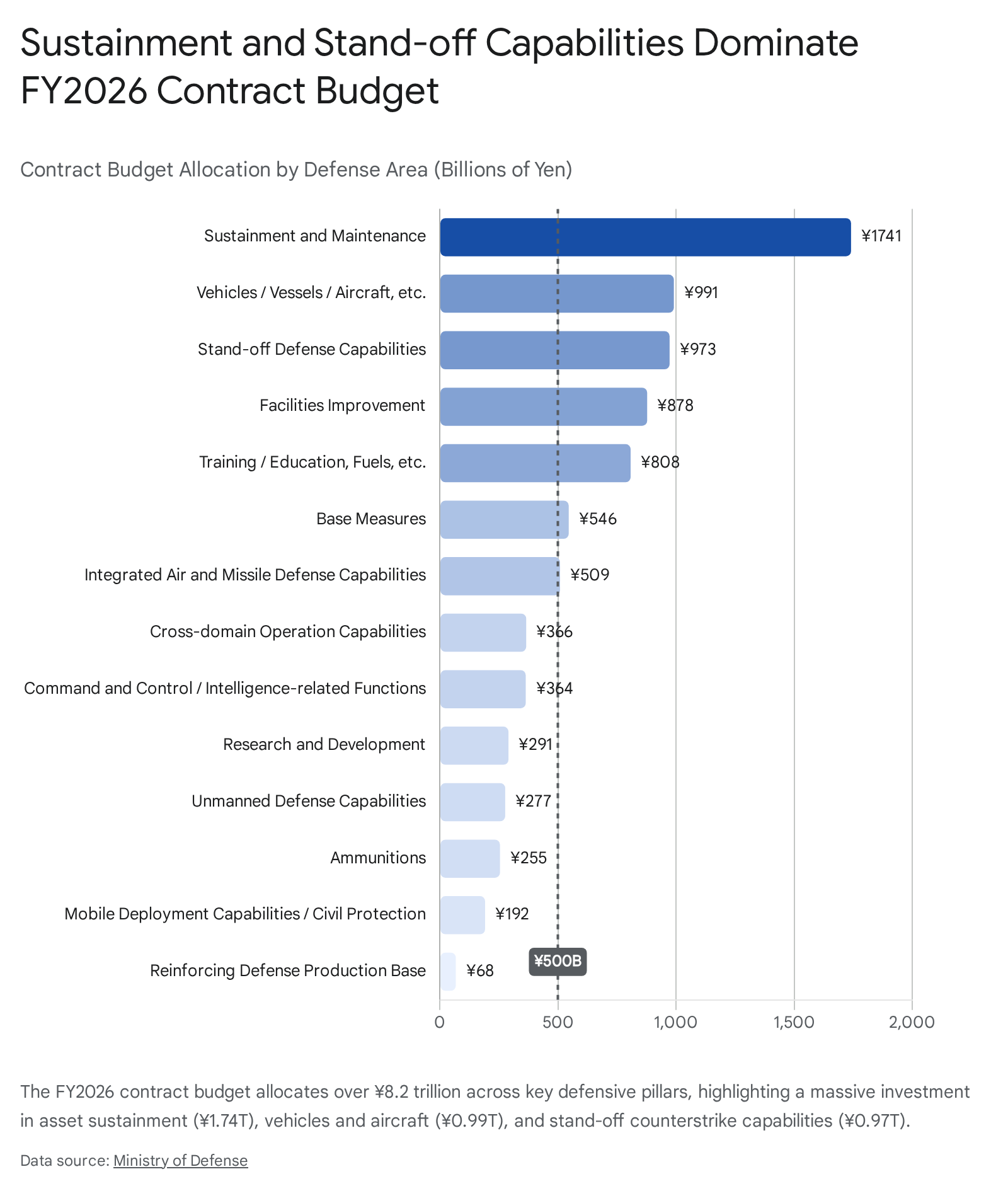
The detailed fiscal distribution reflects a deliberate prioritization of operational readiness, platform modernization, and advanced technological research. The following table provides a comprehensive breakdown of the FY2026 contract budget across specific defense pillars.
| Capability Area | FY2026 Contract Budget (Billions JPY) | Strategic Purpose & Key Platforms |
| Sustainment and Maintenance | 1,741 | Ensuring operational availability of existing platforms; maximizing lifecycle efficiency of naval and aerial assets.5 |
| Vehicles, Vessels, and Aircraft | 991 | Procurement of 8 F-35A and 3 F-35B stealth fighters, Taigei-class submarines, Mogami-class frigates (New FFM), and SH-60L patrol helicopters.5 |
| Stand-off Defense Capabilities | 973 | Acquisition of Tomahawk cruise missiles, Joint Strike Missiles (JSM), and production of the Type 25 Surface-to-Ship Missile.5 |
| Facilities Improvement | 878 | Hardening of military infrastructure; construction of resilient command centers and ammunition depots.5 |
| Training, Education, and Fuels | 808 | Funding for multilateral exercises (e.g., Balikatan, Cope Thunder) and maintaining high operational tempo readiness.5 |
| Integrated Air & Missile Defense | 509 | Addressing hypersonic and ballistic threats; land-based integration of SPY-7 radar systems for Aegis-equipped vessels.5 |
| Cross-Domain Operations | 366 | Allocation split between Cyber operations (¥231B) and Space domain awareness (¥135B), including the Kirameki-3 satellite.5 |
| Command, Control, & Intelligence | 364 | Construction of the unified MOD Cloud network (¥67.6B) and regional edge computing centers for real-time targeting.5 |
| Research and Development | 291 | Advancing next-generation fighter aircraft support, artificial intelligence command integration, and multi-purpose USVs.5 |
| Unmanned Defense Capabilities | 277 | Establishment of the SHIELD littoral defense network utilizing varied UAV and UUV platforms.5 |
| Ammunitions | 255 | Expanding precision-guided munition stockpiles to sustain prolonged localized engagements.5 |
4.2. Reinforcing the Human Resource Base
While technological acquisition commands the majority of capital, the MOD recognizes that personnel shortages pose an existential threat to force generation. The FY2026 budget allocates ¥765.8 billion specifically for initiatives designed to secure outstanding JSDF personnel in a highly competitive, shrinking labor market.5 This funding mechanism improves overall compensation structures, provides enhanced allowances for specialized operations, and modernizes living conditions across domestic bases.5 Furthermore, the budget introduces robust re-employment support systems for retiring personnel and modernizes recruitment infrastructure through the digital expansion of Provincial Cooperation Offices.5
5. Kinetic Modernization: Stand-off Capabilities and the SHIELD Architecture
The physical manifestation of Japan’s doctrinal shift is evident in the rapid modernization of its kinetic strike portfolio. Moving aggressively beyond the historical constraints of a strictly defensive posture, the JSDF is acquiring the capability to hold adversarial launch sites, command nodes, and surface action groups at risk from extended ranges.
5.1. Long-Range Precision Strike Portfolios
A critical development in early 2026 was the operational deployment of the Type 25 Surface-to-Ship Missile (SSM) by the Japan Ground Self-Defense Force (JGSDF) at Camp Kengun in Kumamoto Prefecture, strategically located on the southern island of Kyushu.20 Developed as an evolution of the Upgraded Type-12 SSM program, the Type 25 fundamentally alters the tactical geometry of the East China Sea. While the legacy Type 12 system possessed an engagement range of approximately 200 kilometers, the Type 25 extends this lethal envelope to an estimated 1,000 kilometers.17
The system incorporates advanced low-observable, stealth-conscious shaping to evade detection by modern naval radar systems.20 Crucially, the missile is equipped with an “Update-to-Date Command” (UTDC) datalink capability.20 This allows operators to utilize satellite communications to retarget the weapon while it is in flight, dynamically adjusting its trajectory to intercept highly mobile maritime targets, such as aircraft carrier strike groups maneuvering in the Philippine Sea or the Taiwan Strait.20
Simultaneously, the MOD is advancing its deployment of hypersonic delivery vehicles. Following successful launch tests in the summer of 2025, the Hyper Velocity Gliding Projectile (HVGP) has completed its core development phase and is transitioning to active deployment.5 To provide immediate capability while domestic systems are scaled, Japan has secured the delivery of United States-manufactured Tomahawk cruise missiles, which offer a range of 1,600 kilometers, alongside Joint Strike Missiles (JSM) designed for aerial launch platforms.5 This multi-layered, multi-platform approach generates an intersecting threat matrix that complicates the air defense calculations of regional adversaries.
5.2. Unmanned Systems and Littoral Defense
Recognizing the tactical necessity of mass and the strategic reality of manpower constraints, the JSDF is executing a transition toward large-scale unmanned architectures. The focal point of this effort is the Synchronized, Hybrid, Integrated and Enhanced Littoral Defense (SHIELD) system.18 Supported by a specialized ¥277 billion allocation, the SHIELD program intends to saturate Japan’s extensive archipelagic coastline with thousands of interconnected autonomous sensors and strike platforms by fiscal year 2027.5
The SHIELD architecture is designed as a layered, resilient kill web rather than a traditional linear kill chain. Key components include:
- Aerial Swarm Capabilities: The network integrates large, land-launched anti-ship kamikaze UAVs alongside smaller, catapult-launched variants specifically engineered to interdict amphibious landing craft approaching contested beaches.22 The system also includes vertical take-off and landing (VTOL) armed drones, which can be recovered on austere helipads or mobile platforms, providing persistent overhead surveillance and localized strike options.22
- Maritime Autonomous Assets: The MOD is accelerating research and development into combat-supporting multi-purpose Unmanned Surface Vehicles (USVs).5 These platforms are designed to conduct autonomous patrols, electronic warfare, and coordinated swarm attacks against hostile surface combatants, projecting power into contested maritime zones while maintaining zero risk to human crews.
5.3. Space and Cyber Domain Integration
Effective deployment of stand-off munitions and unmanned swarms requires uncompromised command and control networks and persistent overhead surveillance. To strengthen its cross-domain operational capabilities, Japan is reorganizing its aerospace assets. The JSDF is establishing a dedicated Space Operations Wing and is in the process of officially rebranding the Air Self-Defense Force as the Air and Space Self-Defense Force.3
Operational milestones include the launch and management of the Kirameki-3 X-band communication satellite in early 2025, ensuring secure, high-bandwidth data transmission for military communications across the Indo-Pacific.5 Additionally, the Space Operations Group operates advanced Space Situational Awareness (SSA) radar systems to track orbital threats and protect critical satellite infrastructure from adversarial kinetic or electromagnetic interference.3 In the cyber domain, defense planners are reinforcing the architecture of the entire government network, allocating funds to counter sophisticated intrusions aimed at degrading the military’s logistical and command networks during the critical early phases of a conflict.5
6. Command and Control Integration: The JJOC and USFJ Restructuring
The acquisition of advanced physical weaponry and complex sensor networks is tactically inert without the requisite command architecture to coordinate multi-domain operations. Historically, the ground, maritime, and air branches of the JSDF operated with a significant degree of institutional insularity. This structural fragmentation generated operational friction, hindering the capacity to conduct the complex, sustained joint operations required in a modern threat environment.6
6.1. The Establishment of the JSDF Joint Operations Command
To rectify these operational deficiencies and realize the vision outlined in the 2022 defense documents, the Japanese government officially established the JSDF Joint Operations Command (JJOC) in March 2025.24 Headquartered in Ichigaya, Tokyo, and initially staffed by a cadre of 240 specialized personnel, the JJOC represents the most consequential structural reorganization of the Japanese military hierarchy in the post-war era.6 The command is led by a four-star flag officer, granting the commander parity with the respective chiefs of staff of the individual JSDF service branches.6
The primary mandate of the JJOC is to serve as the singular, centralized node for organizing and executing seamless cross-domain operations across the entire conflict spectrum.6 The command is designed to fluidly transition the national defense apparatus from peacetime gray-zone monitoring and disaster relief directly into active combat contingency management.6 This centralization allows for the rapid fusion of Intelligence, Surveillance, and Reconnaissance (ISR) data with kinetic strike assets. By routing spatial telemetry, maritime tracking data, and cyber threat intelligence through a unified hub, the JJOC drastically reduces the latency between target identification and the authorization of a counterstrike utilizing assets like the Type 25 SSM or the SHIELD drone network. To facilitate this data fusion, the Ministry of Defense is deploying a unified “MOD Cloud” computing environment, supported by regional edge computing infrastructure, ensuring that tactical data remains accessible and resilient even if central nodes are compromised.5
6.2. Upgrading United States Forces Japan (USFJ)
The establishment of the JJOC is intrinsically linked to simultaneous, highly coordinated command reforms within the United States military presence in the region. In March 2025, during a joint press conference in Tokyo featuring United States Defense Secretary Pete Hegseth and Japanese Defense Minister Gen Nakatani (who preceded Shinjiro Koizumi in the role), the Department of Defense announced the initiation of phase one to upgrade U.S. Forces Japan (USFJ).26
Historically functioning primarily as an administrative headquarters, the USFJ is being transformed into a fully operational Joint Force Headquarters endowed with expansive warfighting and operational planning responsibilities.26 This reorganization establishes a direct, empowered, and synchronized counterpart to the JJOC.24 By operating parallel, integrated command structures at Yokota Air Base and Ichigaya, the United States and Japan aim to eliminate bureaucratic friction, enable real-time bilateral operational planning, and foster rapid decision-making during crises—such as a potential contingency involving Taiwan or the Senkaku Islands.24 The stationing of rotational liaison personnel and the empowerment of the USFJ commander underscore a deliberate transition of the alliance from a patron-client relationship into a highly interoperable, unified warfighting coalition.24
7. The First Island Chain: Trilateral Defense and Persistent Sea Denial
The geographical reality of the Indo-Pacific dictates that Japan cannot secure its southwestern flank in geopolitical isolation. The defense of the critical maritime chokepoints within the First Island Chain—a strategic perimeter stretching from the Japanese archipelago southward through Taiwan to the Philippines—requires deep, structural multilateral coordination.
7.1. The U.S.-Japan-Philippines Strategic Axis
The most consequential diplomatic evolution regarding regional defense architecture is the rapid institutionalization of the U.S.-Japan-Philippines trilateral relationship. Security analysts and military planners consistently emphasize that the southern Ryukyu Islands of Japan and the northern Philippine island of Luzon form natural geographic barriers that divide the East China Sea and the Philippine Sea from the broader expanses of the Pacific Ocean.27 Control of the Luzon Strait, bounded by Taiwan to the north and the Philippine province of Batanes to the south, is an absolute prerequisite for any adversary attempting to project naval power outward or secure a maritime blockade of Taiwan.27
Recognizing this critical geography, military leaders have conceptually merged the region into a singular theater of operations. In early 2026, the Armed Forces of the Philippines (AFP) Chief of Staff, General Romeo Brawner Jr., explicitly articulated that Japan and the Philippines now consider the entire First Island Chain as a unified operational area where bilateral forces must cooperate across multiple domains.28
This integration was vividly demonstrated during the expansive Balikatan 2026 military exercises.29 The exercises, which featured the participation of over 17,000 troops from the United States, the Philippines, Japan, Australia, and other allied nations, marked the first active participation of JSDF personnel in combat simulation roles outside of their home territory since World War II.29 Operating across key flashpoints in Luzon, allied forces practiced repelling amphibious assaults and executing complex “see, sense, strike, and protect” operational doctrines, as described by U.S. Army Pacific Commander General Ronald Clark.30
7.2. Transitioning to Persistent Sea Denial
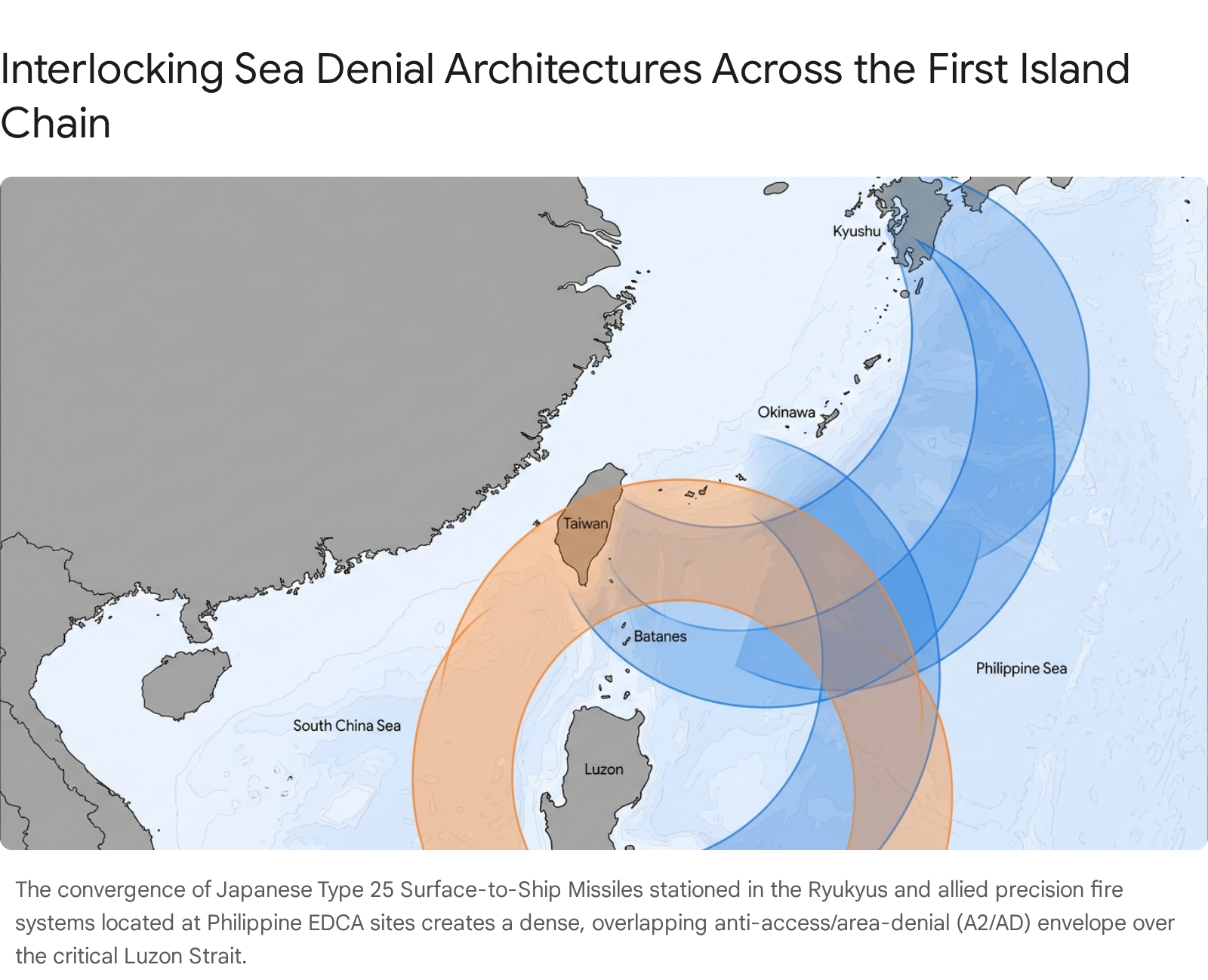
Think tank analyses and military strategists recommend a paradigm shift from episodic, event-based exercises toward a permanent posture of persistent, trilateral sea denial across the Luzon Strait.10 This operational design relies on the establishment of interlocking arcs of precision fire and seamless intelligence sharing.
The strategy envisions a Northern Arc anchored by the JSDF, which is systematically establishing coastal missile batteries, long-range radar installations, and electronic warfare units across the Ryukyu and Kyushu Islands.10 Complementing this is a Southern Arc, where, contingent upon ongoing Philippine government approval, the United States plans to permanently deploy a mix of ground-based medium and long-range precision fires—such as the HIMARS or the Typhon missile system—at Enhanced Defense Cooperation Agreement (EDCA) sites in northern Luzon and Batanes.10 By interlocking these highly lethal defensive envelopes, the trilateral partners can hold People’s Liberation Army Navy (PLAN) surface and subsurface assets at severe risk, effectively neutralizing attempts to flank Taiwan or project dominance into the Philippine Sea.10
7.3. Infrastructure Modernization and Economic Security
Beyond the deployment of kinetic assets, establishing a robust logistical and informational backbone is paramount for the sustainability of the trilateral alliance. Strategic analyses stress the urgent need to finalize a bilateral General Security of Military Information Agreement (GSOMIA) between Japan and the Philippines.10 This agreement is essential to legally and safely fuse the intelligence networks of both nations, allowing for the real-time sharing of classified maritime domain awareness data.10
Furthermore, there is a concerted trilateral push to modernize Philippine maritime infrastructure. A critical proposal involves the development of Subic Bay into a highly resilient regional hub for naval maintenance, repair, and overhaul (MRO).10 Establishing robust MRO capabilities in the Philippines would allow allied naval vessels to undergo rapid repairs and sustain surge operations locally during a crisis, significantly circumventing the logistical vulnerabilities and transit times associated with returning assets to shipyards in the Japanese home islands or Hawaii.10
Concurrently, the alliance is addressing vulnerabilities in economic security. Recognizing the strategic danger of reliance on adversarial supply chains, the United States and Japan are partnering with the Philippines to leverage its substantial reserves of critical minerals and rare-earth elements.10 By funding exploration and establishing secure extraction and processing facilities within the Philippines, the trilateral partners aim to reduce global dependency on the PRC for the materials essential to modern defense manufacturing and energy transitions.10 Additionally, the nations are pooling resources to diversify subsea communications cable infrastructure, moving landing stations away from highly contentious maritime zones to ensure the uninterrupted flow of data necessary for modern command and control.10
8. Defense Diplomacy: The OSA Framework and Strategic Export Normalization
Japan’s strategy for regional stability extends far beyond bilateral alliances with the United States. Recognizing that traditional economic development aid alone cannot secure the geopolitical stability of the Indo-Pacific or deter gray-zone coercion, Tokyo has radically expanded its security engagement with Southeast Asian and Pacific Island nations.
8.1. The Official Security Assistance (OSA) Framework
Established in April 2023, the Official Security Assistance (OSA) program represents a historic, fundamental departure from Japan’s long-standing policy of restricting foreign aid exclusively to non-military, socio-economic development under the Official Development Assistance (ODA) framework.7 The OSA mechanism explicitly authorizes the direct provision of military equipment, operational supplies, and defense infrastructure development funding to the armed forces of “like-minded countries”.7
The explicit objective of the program is to enhance the autonomous deterrence capabilities of partner nations against unilateral attempts to alter the status quo by force, particularly in the maritime domain.7 Reflecting its high strategic priority within the broader national security strategy, the OSA budget has experienced a massive and rapid escalation, rising from a modest initial allocation of ¥2 billion in FY2023 to a substantial ¥18.1 billion in the draft FY2026 budget proposal.8
The distribution of OSA operates within a broader, layered architectural strategy termed the One Cooperative Effort Among Nations (OCEAN) framework, unveiled in 2025.28 The OCEAN framework synchronizes defense equipment transfers, joint military training, and high-level strategic dialogues across the Indo-Pacific, shifting Japan’s approach from isolated bilateral aid deals toward the construction of a networked, regional deterrence model.28 A specific operational component of this architecture is the Japan-ASEAN Ministerial Initiative for Enhanced Defense Cooperation (JASMINE).28 Under JASMINE, JSDF personnel conduct highly practical defense training for ASEAN member states, prioritizing critical capabilities such as maritime domain awareness (MDA) and cybersecurity.28
The footprint of Japanese security assistance illustrates a concerted effort to fortify the southern perimeter of the South China Sea and push back against adversarial influence in Oceania.
| Recipient Nation | Strategic Objective & Equipment Transferred / Pledged | Key Agreements (2023-2026) |
| Philippines | First Island Chain defense; sea denial in the Luzon Strait. Provided coastal radar systems, 6 Abukuma-class destroyers, and TC-90 aircraft.29 | Reciprocal Access Agreement (RAA), Acquisition and Cross-Servicing Agreement (ACSA).36 |
| Indonesia | Undersea denial in archipelagic chokepoints. Advanced negotiations for the procurement of MSDF used submarines.9 | Defense Cooperation Arrangement.38 |
| Malaysia | Securing maritime law enforcement capacity. Provided diving support vessel, operational communications, and surveillance equipment.7 | OSA FY2025 Project Agreement.41 |
| Vietnam | Fortifying the western flank of the South China Sea. Provision of maritime law enforcement aid; structural alignment with OSA requirements.42 | Elevated Economic/Security Partnerships.42 |
| Fiji & Tonga | Securing secondary logistical lines in Oceania. Provided patrol boats, UAVs for surveillance, heavy machinery, and military uniforms.7 | OSA FY2025 Project Agreements.7 |
8.2. Defense Industrial Base Reforms and Export Normalization
Underpinning Japan’s expanding diplomatic footprint is a radical overhaul of its defense-industrial regulations. Decades of strict adherence to the Three Principles on Arms Exports created a highly capable but commercially isolated domestic defense industry, suffering from low production volumes, prohibitively high unit costs, and near-zero export viability.45
In a watershed policy shift executed in late April 2026, the Takaichi cabinet revised the Implementation Guidelines for the Three Principles on Transfer of Defense Equipment and Technology.38 The revision decisively dismantled the previous constraints that restricted defense exports strictly to five non-lethal categories: rescue, transport, warning, surveillance, and minesweeping.38 The National Security Council is now legally authorized to transfer finished, lethal defense equipment to 17 designated partner nations with which Tokyo maintains formal defense cooperation agreements.47 While maintaining a general prohibition on transfers to active conflict zones, the revised policy includes a strategic caveat permitting exceptions in circumstances where Japan’s own national security is directly implicated.47
The liberalization of arms exports serves a dual strategic purpose: revitalizing the domestic industrial base through economies of scale and engineering long-term diplomatic alignment. During a highly publicized “Golden Week” tour in May 2026, Defense Minister Koizumi traveled across Southeast Asia to actively market Japanese defense platforms, confirming Tokyo’s emergence as an Indo-Pacific defense export power.38
The rapid transfer of six used Abukuma-class destroyers to the Philippine Navy provides a massive upgrade to Manila’s anti-submarine and anti-ship capabilities, acting as a direct, kinetic counter to the China Coast Guard’s gray-zone tactics.34 Furthermore, the pursuit of submarine exports to Indonesia highlights the profound strategic logic of this endeavor.38 Supplying advanced diesel-electric submarines introduces complex undersea denial capabilities into vital maritime chokepoints currently navigated freely by the PRC.39 Crucially, complex naval platforms require decades of ongoing maintenance, specialized operational training, and doctrinal alignment. By supplying such equipment, Tokyo effectively builds a web of hardware dependencies, locking recipient nations into a structural, long-term alliance with Japan that transcends the vagaries of short-term domestic political shifts.39
9. Adversarial Escalation: PRC Military Responses and Economic Coercion
Japan’s military awakening and its successful orchestration of a regional defense coalition have not occurred in a strategic vacuum. The People’s Republic of China views the militarization of the First Island Chain, the expansion of the JSDF, and the proliferation of United States alliances as a direct containment strategy and a severe violation of post-World War II regional norms.3 Consequently, Beijing has initiated a comprehensive, multi-domain campaign of military intimidation and economic retaliation designed to fracture the coalition and deter further Japanese intervention in regional disputes.
9.1. People’s Liberation Army (PLA) Counter-Deployments
The People’s Liberation Army has significantly increased its operational tempo throughout the Indo-Pacific, utilizing large-scale joint exercises to signal its expanding capacity to project power beyond the geographical confines of the First Island Chain.49 In late 2025, the PLA’s Eastern Theater Command executed “Justice Mission 2025,” an expansive joint force exercise surrounding the island of Taiwan, mobilizing land, sea, air, and rocket forces to simulate blockade and invasion scenarios.48
More recently, the PLA responded aggressively to the unprecedented integration of Japanese forces during the Balikatan 2026 exercises in the Philippines.16 The PLA Navy surged a highly capable surface task group—including Type 055 and Type 052D guided-missile destroyers, accompanied by a Type 054A frigate and auxiliary replenishment vessels—into the waters immediately east of the Luzon Strait, directly mirroring and monitoring the allied operating areas.16 Furthermore, the deployment of the aircraft carrier Liaoning transiting southward through the Taiwan Strait, alongside unverified operations in the South China Sea, demonstrates Beijing’s intent to display a credible, rapid surge capacity.16 Concurrently, the PLAN’s new Type 076 landing helicopter dock departed for sea trials in the South China Sea, enhancing China’s amphibious assault capabilities.16 These maneuvers serve as an explicit warning to regional actors that military alignment with the United States and Japan guarantees heightened PLA scrutiny and potential kinetic friction.16
9.2. Diplomatic and Economic Statecraft
Beyond direct military posturing, Beijing has deployed targeted economic statecraft and aggressive diplomatic rhetoric to punish Tokyo. In early 2026, diplomatic friction intensified dramatically following statements by Prime Minister Takaichi during parliamentary sessions regarding Japan’s potential military involvement in a Taiwan Strait contingency.14 PRC officials demanded an immediate retraction, characterizing the statements as a brazen intervention in China’s internal affairs and an open breach of Japan’s post-war obligations.48 The rhetoric reached extreme levels, with the PRC consul-general in Osaka suggesting physical violence against the Prime Minister.14 During a UN Security Council meeting on international rule of law in January 2026, the diplomatic dispute spilled onto the global stage, with direct verbal clashes between the respective representatives.48
In response to Tokyo’s steadfast refusal to retract the statements, the PRC initiated a multifaceted economic coercion campaign. This included the imposition of travel advisories, the suspension of cultural exchanges, and bans on seafood imports.48 Most critically, the dispute escalated into the industrial sector, with China severely restricting the export of dual-use items and rare earth materials to Japan.48 This restriction on rare earths directly targets the foundational vulnerabilities in Japan’s advanced manufacturing sector and its defense industrial base. The production of high-tech sensors, aerospace alloys, electric propulsion systems, and advanced munitions relies heavily on these imported critical minerals.10 By weaponizing its dominance over the global critical mineral supply chain, Beijing aims to degrade Japan’s capacity to sustain its military modernization, underscoring the urgent strategic necessity for the US-Japan-Philippines trilateral alliance to secure and diversify alternative supply routes outside of Chinese control.10
10. Strategic Recommendations for Regional Alliance Management
As Japan solidifies its historical transition from a passive, pacifist nation to a proactive, highly capable regional security provider, navigating the volatile decade ahead requires sustained operational execution and the aggressive mitigation of structural vulnerabilities. Based on the intelligence and strategic assessments presented within this report, the following core imperatives emerge for policymakers in Tokyo and allied capitals:
First, the alliance must accelerate the formal institutionalization of trilateral command and intelligence structures. While the establishment of the JJOC and the elevation of USFJ to a Joint Force Headquarters provide a necessary foundation, bureaucratic inertia must be overcome to ensure genuine, real-time interoperability. The trilateral framework involving the Philippines must mature past episodic joint exercises into a standing mechanism for joint operational planning, intelligence fusion, and crisis response, permanently formalized through a bilateral General Security of Military Information Agreement (GSOMIA) between Tokyo and Manila.10
Second, to maintain a credible, persistent sea denial posture across the Luzon Strait and the South China Sea, naval and aerial assets require localized, highly resilient logistical support. The alliance must fast-track infrastructure investments to convert Philippine ports, particularly Subic Bay, into secure maintenance, repair, and overhaul (MRO) facilities. Establishing this capability reduces the critical downtime associated with returning damaged or depleted assets to shipyards in the Japanese home islands or Hawaii during a high-intensity conflict.10
Third, the coalition must secure the defense industrial supply chain against ongoing economic coercion. The PRC’s weaponization of rare earth element exports highlights a critical failure point in Japan’s defense buildup. The coalition must aggressively leverage government funding and diplomatic incentives to spur private-sector exploration, extraction, and refinement of critical minerals within allied nations like the Philippines and Australia, guaranteeing the uninterrupted production of the advanced sensor and missile technologies essential to the SHIELD architecture.10
Finally, the alliance must balance its enhanced kinetic deterrence with viable diplomatic off-ramps. While the proliferation of stand-off munitions and autonomous unmanned systems drastically improves Japan’s capacity to inflict unacceptable costs on an invading force, an exclusively militarized approach risks spiraling security dilemmas. Japan must maintain robust, high-level channels of communication with Beijing to clearly delineate strategic red lines, signal defensive intentions, and prevent tactical gray-zone encounters in the East and South China Seas from unintentionally cascading into broad strategic conflict.50
Japan’s military awakening is no longer a theoretical debate regarding constitutional interpretation; it is an established operational reality. By effectively marrying its massive economic and technological capacity with a proactive, forward-deployed defense posture, Japan has cemented its role as the indispensable anchor of the Indo-Pacific security architecture.
Please share the link on Facebook, Forums, with colleagues, etc. Your support is much appreciated and if you have any feedback, please email us in**@*********ps.com. If you’d like to request a report or order a reprint, please click here for the corresponding page to open in new tab.
Sources Used
- Strategic Outlook 2026, accessed May 9, 2026, https://www.jiia.or.jp/eng/upload/eng/outlook2026_all.pdf
- Japan to raise defence budget, accessed May 9, 2026, https://www.australiandefence.com.au/news/news/japan-to-raise-defence-budget
- Japan approves record $58B defense budget for fiscal 2026 amid tensions with China, accessed May 9, 2026, https://www.aa.com.tr/en/asia-pacific/japan-approves-record-58b-defense-budget-for-fiscal-2026-amid-tensions-with-china/3781220
- Japan Defense Industry – International Trade Administration, accessed May 9, 2026, https://www.trade.gov/market-intelligence/japan-defense-industry
- Progress and Budget in Fundamental Reinforcement of Defense Capabilities, accessed May 9, 2026, https://www.mod.go.jp/en/d_act/d_budget/pdf/fy2026_20251226a.pdf
- What Japan’s Military Reorganization Means for US-Japanese Bilateral Operations, accessed May 9, 2026, https://mwi.westpoint.edu/what-japans-military-reorganization-means-for-us-japanese-bilateral-operations/
- Official Security Assistance (OSA) | Ministry of Foreign Affairs of Japan, accessed May 9, 2026, https://www.mofa.go.jp/fp/ipc/page4e_001366.html
- Japan uses military aid as a pretext for expansion, accessed May 9, 2026, http://eng.chinamil.com.cn/2025xb/O_251451/16438892.html
- Japan steps up defence equipment export drive in Southeast Asia – Nation Thailand, accessed May 9, 2026, https://www.nationthailand.com/news/world/40065900
- U.S.-Japan-Philippines Trilateral Cooperation | CNAS, accessed May 9, 2026, https://www.cnas.org/publications/reports/u-s-japan-philippines-trilateral-cooperation
- [Japan’s Voices No.6] Safeguarding Maritime Security in the Indo-Pacific : Challenges and Prospects for Maritime Security Cooperation between Japan and Southeast Asia | Research Findings | The Japan Institute of International Affairs, accessed May 9, 2026, https://www.jiia.or.jp/eng/report/2026/03/20260327.html
- The 2026 National Defense Strategy by the Numbers: Radical Changes, Moderate Changes, and Some Continuities – CSIS, accessed May 9, 2026, https://www.csis.org/analysis/2026-national-defense-strategy-numbers-radical-changes-moderate-changes-and-some
- Japan’s Evolving Security Strategy – MP-IDSA, accessed May 9, 2026, https://idsa.in/publisher/comments/japans-evolving-security-strategy
- Japan’s Present and Future National Security Strategy: Five Key Challenges to Watch, accessed May 9, 2026, https://www.csis.org/analysis/japans-present-and-future-national-security-strategy-five-key-challenges-watch
- Japan: the 2025 White Paper and Lessons for the West | Defense.info, accessed May 9, 2026, https://defense.info/defense-decisions/2025/09/japan-the-2025-white-paper-and-lessons-for-the-west/
- China & Taiwan Update, May 1, 2026, accessed May 9, 2026, https://understandingwar.org/research/china-taiwan/china-taiwan-update-may-1-2026/
- Japan’s Defence Budget Surge: A New Security Paradigm – RUSI, accessed May 9, 2026, https://www.rusi.org/explore-our-research/publications/commentary/japans-defence-budget-surge-new-security-paradigm
- Japan to build drone-based coastal defense system – The Defence Blog, accessed May 9, 2026, https://defence-blog.com/japan-to-build-drone-based-coastal-defense-system/
- Progress and Budget in Fundamental Reinforcement of Defense Capabilities, accessed May 9, 2026, https://www.mod.go.jp/en/d_act/d_budget/pdf/fy2026_20251210a.pdf
- Japan to Field Multiple Advanced Coastal Defense Missiles by 2032 – Naval News, accessed May 9, 2026, https://www.navalnews.com/naval-news/2026/04/japan-to-field-multiple-advanced-coastal-defense-missiles-by-2032/
- Overview of FY2026 Budget Request – Progress and Budget in Fundamental Reinforcement of Defense Capabilities, accessed May 9, 2026, https://www.mod.go.jp/en/d_act/d_budget/pdf/fy2026_20250924a.pdf
- Japan Announces SHIELD Coastal Defence System with UxVs – TURDEF, accessed May 9, 2026, https://turdef.com/article/japan-announces-shield-coastal-defence-system-with-uxvs
- MINISTRY OF DEFENSE, accessed May 9, 2026, https://www.mod.go.jp/j/press/wp/wp2025/pdf/DOJ2025_Digest_EN.pdf
- Deepening Strategic Alignment: Priorities for the U.S.-Japan Alliance, accessed May 9, 2026, https://www.csis.org/analysis/deepening-strategic-alignment-priorities-us-japan-alliance
- Operationalizing US Forces Japan: Why Japan Is the Optimal Location for a Joint Force Headquarters – Army University Press – U.S. Army, accessed May 9, 2026, https://www.armyupress.army.mil/Journals/Military-Review/Online-Exclusive/2026-OLE/US-Forces-Japan/
- Defense Secretary Announces U.S. Forces Japan’s Upgrade to Joint Force Command, accessed May 9, 2026, https://www.war.gov/News/News-Stories/Article/Article/4139213/defense-secretary-announces-us-forces-japans-upgrade-to-joint-force-command/
- Japan builds up its ‘southern shield’ as faith in US security cover falters | Military News, accessed May 9, 2026, https://www.aljazeera.com/news/2026/4/24/japan-builds-up-its-southern-shield-as-faith-in-us-security-cover-falters
- Japan’s expanding defense partnerships signal strategic shift, accessed May 9, 2026, https://ipdefenseforum.com/2026/04/japans-expanding-defense-partnerships-signal-strategic-shift/
- Philippines, Japan sign defense equipment deal, eye expanded security cooperation | ABS-CBN News, accessed May 9, 2026, https://www.abs-cbn.com/news/nation/2026/5/6/philippines-japan-sign-defense-equipment-deal-eye-expanded-security-cooperation-0003
- Military drills on the edge: U.S. and allies test capabilities near Asia’s flash points | NPR Illinois, accessed May 9, 2026, https://www.nprillinois.org/2026-05-08/military-drills-on-the-edge-u-s-and-allies-test-capabilities-near-asias-flash-points
- China Bulletin: May 5, 2026 – U.S.-China Economic and Security Review Commission, accessed May 9, 2026, https://www.uscc.gov/trade-bulletins/china-bulletin-may-5-2026
- Japan’s Latest Chapter in Military Cooperation: Official Security Alliance (OSA) | New Perspectives on Asia | CSIS, accessed May 9, 2026, https://www.csis.org/blogs/new-perspectives-asia/japans-latest-chapter-military-cooperation-official-security-alliance
- Japan’s shifting foreign-assistance schemes – The International Institute for Strategic Studies, accessed May 9, 2026, https://www.iiss.org/online-analysis/online-analysis/2024/04/japans-shifting-foreign-assistance-schemes/
- Japan Is Arming the Philippines to Deter China in the South China Sea – YouTube, accessed May 9, 2026, https://www.youtube.com/watch?v=haxW74wpeJY
- Japan, Philippines to Set Up Panel for Destroyer Exports – nippon.com, accessed May 9, 2026, https://www.nippon.com/en/news/yjj2026050500425/
- Japan, Philippines Sign New Security Pacts As Regional Tensions Rise – YouTube, accessed May 9, 2026, https://www.youtube.com/watch?v=bHvizk6RvnY
- Seventy Years On: Philippines-Japan Security Ties in the Indo-Pacific, accessed May 9, 2026, https://www.orfonline.org/expert-speak/seventy-years-on-philippines-japan-security-ties-in-the-indo-pacific
- Japan defence minister Koizumi begins promotion of defence equipment sales in Southeast Asia tour – Asia News Network, accessed May 9, 2026, https://asianews.network/japan-defence-minister-koizumi-begins-promotion-of-defence-equipment-sales-in-southeast-asia-tour/
- – YouTube, accessed May 9, 2026, https://www.youtube.com/post/Ugkx4hKNjXvhEZzg24EKV7pYBgipFIRZZAhn
- Handover Ceremony of the Equipment to Support the Activities of ASEAN Observer Teams, accessed May 9, 2026, https://www.my.emb-japan.go.jp/itpr_en/newinfo_08042026.html
- Official Security Assistance (OSA) Programme in implementation FY2025 | Ministry of Foreign Affairs of Japan, accessed May 9, 2026, https://www.mofa.go.jp/fp/ipc/pagewe_000001_00268.html
- Takaichi vows support for int’l order, economic security in Indo-Pacific, accessed May 9, 2026, https://english.kyodonews.net/articles/-/75303
- Recalibrating Aid, Reshaping Security Strategy: The Strategic Logic Behind Japan’s Official Security Assistance – The Korean Journal of International Studies, accessed May 9, 2026, https://kjis.org/journal/view.html?pn=mostdownload&uid=327&vmd=Full
- Japan’s Pacific Moment: Recalibrating Japan’s Pacific Islands Engagement – CSIS, accessed May 9, 2026, https://www.csis.org/analysis/japans-pacific-moment-recalibrating-japans-pacific-islands-engagement
- Japan loosens the reins on defence exports – The International Institute for Strategic Studies, accessed May 9, 2026, https://www.iiss.org/online-analysis/online-analysis/2026/04/japan-loosens-the-reins-on-defence-exports/
- Japan’s Easing of Arms Exports Is a Defense Game Changer | The Heritage Foundation, accessed May 9, 2026, https://www.heritage.org/defense/commentary/japans-easing-arms-exports-defense-game-changer
- Japan’s Tentative Entry Into a Shifting Global Arms Market – Stimson Center, accessed May 9, 2026, https://www.stimson.org/2026/japans-tentative-entry-into-a-shifting-global-arms-market/
- 2025–2026 China–Japan diplomatic crisis – Wikipedia, accessed May 9, 2026, https://en.wikipedia.org/wiki/2025%E2%80%932026_China%E2%80%93Japan_diplomatic_crisis
- Tracking China’s Increased Military Activities in the Indo-Pacific in 2025, accessed May 9, 2026, https://chinapower.csis.org/china-increased-military-activities-indo-pacific-2025/
- Embracing Arms: Securing Japan in a “New Era of Crisis” | International Crisis Group, accessed May 9, 2026, https://www.crisisgroup.org/rpt/asia-pacific/japan-united-states-china/351-embracing-arms-securing-japan-new-era-crisis