1. Executive Summary
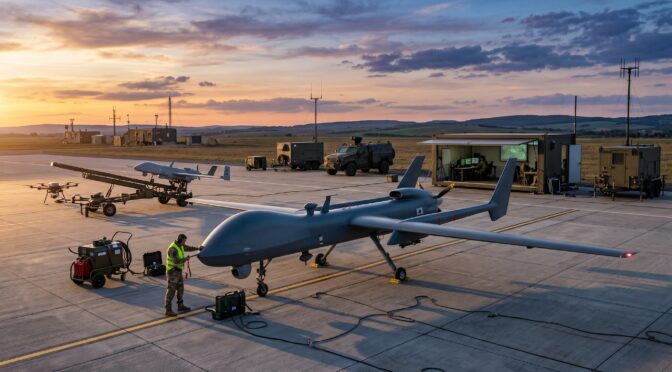
During the trailing seven-day reporting period ending May 30, 2026, the global operational landscape for unmanned systems across the air, land, sea, and space domains exhibited rapid technological maturation and profound strategic convergence. The collected open-source intelligence indicates a definitive shift away from utilizing unmanned systems purely as supplementary intelligence, surveillance, and reconnaissance (ISR) assets. Instead, militaries and non-state actors are aggressively integrating autonomous platforms as primary mechanisms for kinetic fires, contested logistics, and extraterrestrial infrastructure development. The data over the past week underscores that autonomous systems are no longer merely tools of the battlefield; they represent the foundational architecture dictating the pace, scope, and geometry of modern multidomain operations.
Three overarching trends define the current reporting period. First, the hybridization of tactical logistics and lethality has crossed a critical developmental threshold. Military forces are increasingly modifying heavy-lift resupply drones to serve as organic, battalion-level precision strike platforms. This development effectively flattens the traditional kill chain, significantly reducing the reliance of forward-deployed infantry on higher-echelon fire support and manned aviation. Second, the rapid proliferation of electronic warfare (EW) countermeasures has catalyzed urgent physical hardware adaptations on the battlefield. Most notably, non-state actors in the Levant have achieved widespread deployment of fiber-optic-tethered first-person view (FPV) drones. Because these systems rely on a physical wire for command and control rather than a radio frequency (RF) link, they remain entirely immune to traditional signal jamming, completely altering the defensive calculus for mechanized units. Third, the space domain is undergoing a massive architectural pivot. The United States military is actively transitioning critical airborne early warning capabilities from vulnerable, crewed atmospheric aircraft to proliferated low-earth orbit (LEO) autonomous satellite networks, while civilian space agencies are contracting autonomous, propulsive drone swarms for complex lunar surface exploration.
Geopolitically, unmanned systems continue to exacerbate cross-border friction and gray-zone escalation. Repeated incursions of long-range loitering munitions into North Atlantic Treaty Organization (NATO) airspace have highlighted the rigid constraints of peacetime air defense rules of engagement, prompting urgent alliance-wide policy reviews and the mobilization of airborne early warning assets. Concurrently, the mass conversion of legacy, decommissioned fighter aircraft into autonomous saturation strike vehicles in the Indo-Pacific region demonstrates a highly asymmetric approach to exhausting adversary air defense magazines. The events logged over this period confirm that the technological advantage currently favors offensive action, specifically empowering actors who embrace mass, expendability, and rapid, iterative commercial adaptation over traditional defense acquisition models.
2. Global Situation Log
This section details the military events, battles, kinetic engagements, and accidents involving unmanned systems during the reporting period. The log is sorted strictly chronologically, and subsequently alphabetically by the primary country involved.
2.1 May 24, 2026
Russia
Russian forces initiated a massive, synchronized long-range drone and missile strike targeting Ukrainian military and civilian infrastructure.1 The operational package consisted of a reported 262 unmanned aerial systems (UAS), heavily utilizing Iranian-designed Shahed variants, alongside newer Gerbera, Italmas, and Parodiya platforms. These munitions were launched from multiple disparate geographic vectors, including Oryol, Kursk, Bryansk, Millerovo, Primorsko-Akhtarsk, and occupied Crimea.1 The Ukrainian Air Force reported successful interceptions of 246 of these platforms, though ten drones penetrated the defensive umbrella, striking nine distinct locations across the Kharkiv and Dnipropetrovsk oblasts.1
Ukraine
The Ukrainian Unmanned Systems Forces (USF) executed a successful deep-strike operation against the rear logistics hub of the Russian 6th Air Force and Air Defense Army, located in Rovenky, approximately 125 kilometers behind the forward line of own troops (FLOT).1 This strike specifically targeted the aviation fuel and logistical repositories supporting the Leningrad Military District. Additionally, geolocation data from the National Aeronautics and Space Administration (NASA) Fire Information for Resource Management System (FIRMS) confirmed secondary explosions and severe heat anomalies at an oil depot in southern Luhansk City, located roughly 105 kilometers from the active frontline.1
2.2 May 25, 2026
Russia
Continuing a sustained offensive air campaign, Russian forces launched a subsequent wave of 122 unmanned aerial vehicles accompanied by two ballistic missiles against Ukrainian targets.2 Concurrently, Russian maritime units expanded the threat vector by executing an uncrewed surface vessel (USV) strike against commercial and logistical infrastructure at the Odesa Port in the Black Sea.2 Reports from the ground indicated that a United Nations (UN) humanitarian aid warehouse was struck and destroyed during this operational window, marking the second such facility targeted within a one-week period.2
Ukraine
Ukrainian military forces successfully targeted and neutralized a highly valuable Russian 1L125 “Niobium-SV” mobile radar station situated in occupied Yarsk, located 157 kilometers from the frontline.2
2.3 May 26, 2026
Russia
Open-source intelligence and official Ukrainian reporting indicated that the Russian Federation and Belarus began explicitly setting operational conditions to justify the launch of Russian drone strikes directly from Belarusian airspace.2 Due to the heightened activity and the shifting launch vectors of Russian long-range drones, Russian domestic authorities were forced to temporarily restrict airspace operations in the Moscow air zone and close the Kaliningrad airport due to reported drone threats, marking a significant domestic disruption resulting from the drone war.2
Ukraine
Ukrainian forces continued their campaign of systemic degradation against Russian rear-echelon assets. Utilizing deep-penetration drone strikes, Ukrainian forces targeted and destroyed a Russian fuel transport convoy near Yurivka, located approximately 76 kilometers from the frontline.2 The intelligence gathered by precursor drone flights subsequently enabled a successful Storm Shadow cruise missile strike against a fortified Russian command and communications node in the same operational sector.2
Yemen
Responding to continuous Houthi harassment of commercial shipping in the Red Sea and the Gulf of Aden, United States and United Kingdom military forces conducted a fifth wave of combined kinetic airstrikes against Houthi infrastructure.3 The coalition strikes targeted specific intelligence-verified locations near Hudaydah and Ghulayfiqah on the Yemeni coast.3 The munitions successfully destroyed several buildings identified as housing drone ground control facilities, as well as hardened storage bunkers utilized for housing very long-range aerial drones and surface-to-air missile systems.3
2.4 May 27, 2026
Taiwan (United States Private Sector Engagement)
Seasats, a marine uncrewed systems company headquartered in the United States, announced that its Lightfish Uncrewed Surface Vessel (USV) completed a historic five-day, fully autonomous transit of the highly contested Taiwan Strait.5 During the 1,000-nautical-mile voyage, which was operated remotely from hundreds of miles away, the autonomous craft successfully detected, tracked, and photographed multiple Chinese People’s Liberation Army Navy (PLAN) warships.5 The Lightfish identified several vessels, including a Type 056 corvette, operating deep within Taiwan’s exclusive economic zone (EEZ).6 Crucially, the PLAN warships had deliberately deactivated their Automatic Identification Systems (AIS) to mask their presence, but the drone’s optical and electronic sensors successfully recorded and geolocated their positions.6
Ukraine
The Ukrainian General Staff confirmed the successful execution of an integrated strike on occupied Sevastopol.11 Ukrainian forces utilized unmanned aerial systems to locate, fix, and illuminate Russian Aerospace Forces (VKS) reconnaissance equipment, subsequently destroying the assets with a coordinated barrage of air-launched Storm Shadow cruise missiles.11
2.5 May 28, 2026
Romania
During a massive overnight Russian strike targeting Ukrainian port infrastructure on the Danube River (likely Reni or Izmail), a Russian Geran-2 (Shahed-type) loitering munition veered off its programmed course and penetrated NATO airspace.12 The drone breached Romanian territory by approximately 15 kilometers, traveling at nearly 200 kilometers per hour, before crashing into the roof of a multi-story apartment complex in the southeastern Romanian city of Galați.12 The explosive payload detonated upon impact, sparking a severe structural fire that required the immediate evacuation of 70 residents.13 Two civilians sustained injuries requiring medical treatment.12 In response to the radar detection of the incoming drone, the Romanian Ministry of Defense scrambled two F-16 fighter jets and an IAR-330 helicopter, while NATO immediately deployed an Airborne Early Warning E-3A AWACS aircraft to increase domain awareness.12
Russia
Russian forces escalated their strategic bombardment campaign, launching a highly complex overnight barrage comprising one Kinzhal aeroballistic missile launched from Lipetsk Oblast, and 147 Shahed, Gerbera, and Italmas drones.11 Notably, this strike package included the deployment of jet-powered Shahed variants, launched from multiple vectors including Crimea and Krasnodar Krai.11 Ukrainian air defenses intercepted 138 of the drones, but the remaining munitions and the Kinzhal missile successfully struck agricultural, residential, and educational infrastructure, causing widespread power outages across the Sumy, Kharkiv, Donetsk, and Dnipropetrovsk oblasts.11 Concurrently, Russian forces executed strikes against three foreign merchant vessels navigating the Black Sea corridor, hitting a Vanuatu-flagged, a Comoros-flagged, and a Panama-flagged ship with Shahed drones.16
Ukraine
The Ukrainian Unmanned Systems Forces continued their systemic interdiction of Russian logistics. During coordinated night operations, Ukrainian long-range drones successfully struck railway logistics hubs, destroying fuel and lubricant tank cars near Makiivka (48 kilometers from the FLOT), Kuteinykove (98 kilometers from the FLOT), and Tretyaky (67 kilometers from the FLOT) in occupied Donetsk Oblast.16
2.6 May 29, 2026
China
Regional intelligence agencies and open-source satellite imagery confirmed that the Chinese People’s Liberation Army (PLA) has completed the conversion of over 500 retired J-6 fighter jets into J-6W autonomous attack drones.17 These converted uncrewed assets have been forward-deployed to six critical air bases near the Taiwan Strait in Fujian and Guangdong provinces.17 Satellite reconnaissance reveals that these heavy drones are stationed explicitly alongside advanced J-16 fighter squadrons, indicating integration into frontline strike packages.17
Iran
Regional media channels in the Middle East reported that an Iranian precision strike targeted a Kuwaiti airbase, allegedly causing severe physical damage to two United States military drones stationed at the facility.18 While U.S. Central Command (CENTCOM) has denied concurrent Iranian claims regarding the downing of U.S. aircraft near Bushehr Province, the reported strike in Kuwait highlights the ongoing threat to stationary drone assets.18
Romania
The diplomatic and strategic fallout from the Galați drone crash continued. NATO Secretary-General Mark Rutte condemned Russia’s “reckless behavior” as a danger to the entire alliance, reaffirming that NATO stands ready to defend every inch of allied territory.20 Romanian President Nicușor Dan convened an emergency meeting of the Supreme Council of National Defense, while the foreign ministry summoned the Russian ambassador.21 The Romanian government formally requested that NATO accelerate the transfer of advanced anti-drone capabilities and initiated preliminary discussions regarding the invocation of Article 4 of the NATO treaty.21
2.7 May 30, 2026
Israel
Following continuous, low-intensity hostilities across the Blue Line, Hezbollah publicly claimed to have executed multiple drone and missile strikes over the previous 24 hours, resulting in direct hits on six Israeli Merkava main battle tanks across southern Lebanon, specifically in the towns of Yahmar al-Shaqif and Dibbine.22 The Israel Defense Forces (IDF) reported the death of a soldier caused by a Hezbollah drone strike in northern Israel near the border.23 The IDF confirmed that while warning sirens were triggered, the incoming drones were not successfully intercepted.23
United States
The U.S. Army’s V Corps formally concluded “Project Flytrap 5.0” at the Pabradė Training Area in Lithuania.25 The multinational exercise, which ran throughout May, heavily integrated allied forces from the United Kingdom and focused on defeating complex drone swarms.26 Soldiers integrated counter-unmanned systems, AI-enabled command and control networks, and live data feeds to accelerate the decision-making cycle in electronic-warfare saturated environments.25
3. Product Developments, Platform Reveals, and Capability Upgrades
This section catalogs the major technological advancements, prototype unveilings, and structural acquisition programs that matured during the reporting period, sorted chronologically and alphabetically by country.
3.1 May 25, 2026
United States
The United States Navy released its updated 30-year shipbuilding plan (fiscal year 2027 update), marking a historic structural pivot toward autonomous maritime operations.28 The blueprint outlines a vision for a 450-vessel fleet by 2031, heavily featuring the procurement of 83 unmanned vessels.28 Specifically, the service aims to acquire 47 Medium Unmanned Surface Vessels (MUSVs) by 2031, scaling to 72 by 2056.28 To support this rapid scaling, the Navy announced the selection of seven distinct industry consortia for the MUSV program, demanding successful at-sea demonstrations of viable prototype hulls by October 2026.29
| MUSV Program Contenders | Strategic Teaming and Capability Focus |
| Saronic | Commercial rapid prototyping and hull scaling. |
| Hanwha / HavocAI | International defense teaming integrating advanced autonomous navigation AI. |
| Hanwha / Magnet Defense | High-volume production capability leveraging allied shipbuilding scale. |
| Blue Water Autonomy / Conrad Shipyard | Integration of traditional commercial shipyard capacity for defense needs. |
| Sea Machines | Advanced computer vision, obstacle avoidance, and maritime swarming logic. |
| Anduril / HD Hyundai | AI-driven target recognition and lethality integration across multiple domains. |
| Saildrone / Fincantieri / Lockheed Martin | Long-endurance architecture focusing on heavy payload delivery systems. |
Concurrently, during the Sea Air Space 2026 exposition, Saildrone unveiled the “Spectre,” its largest uncrewed surface vessel to date.30 Measuring 52 meters (170 feet) in length, the diesel-electric USV is capable of ultra-quiet propulsion at 12 knots, with a top sprint speed of 27 knots generated by over 5,000 horsepower.30 The Spectre is designed for extreme endurance, offering a range of 3,280 nautical miles, and can carry 25,000 kilograms of payload.30 The platform is explicitly designed to carry heavy combat systems, including Lockheed Martin’s MK-70 Payload Delivery System (which adapts four Mk-41 vertical launch system cells into a standard shipping container format), Thales’s CAPTAS-4 variable depth active sonar for anti-submarine warfare (ASW), and SH Defence’s “The Cube” mine-laying module.30
3.2 May 26, 2026
United States
NASA officially updated its Moon Base initiative, focusing on establishing a sustained human and robotic presence at the lunar South Pole.31 As part of this architectural rollout, Firefly Aerospace announced a $75 million subcontract from NASA’s Jet Propulsion Laboratory (JPL) for the “MoonFall” mission.33 Targeted for launch in 2028, Firefly’s Elytra spacecraft (specifically the Elytra Dark configuration, capable of carrying 1,000 kilograms) will transport and deploy four fully autonomous, JPL-built drones.33 The spacecraft will release the drones approximately 50 kilometers above the lunar surface.33
| Lunar Drone Specification | Description |
| Dimensions | 7 feet in diameter, 4 feet tall.33 |
| Weight | Approximately 550 pounds (including propellant).33 |
| Mobility Architecture | Propulsive “hopping” system derived from the Mars Ingenuity helicopter.33 |
| Mission Duration | One lunar day (up to 14 Earth days) of active flight.33 |
| Payload | Lunar Dashcam, Laser Retroreflector, Neutron Spectrometer, Radiation Spectrometer.33 |
| End-of-Life Role | “Survive-the-night” stationary beacons for sustained long-term presence.33 |
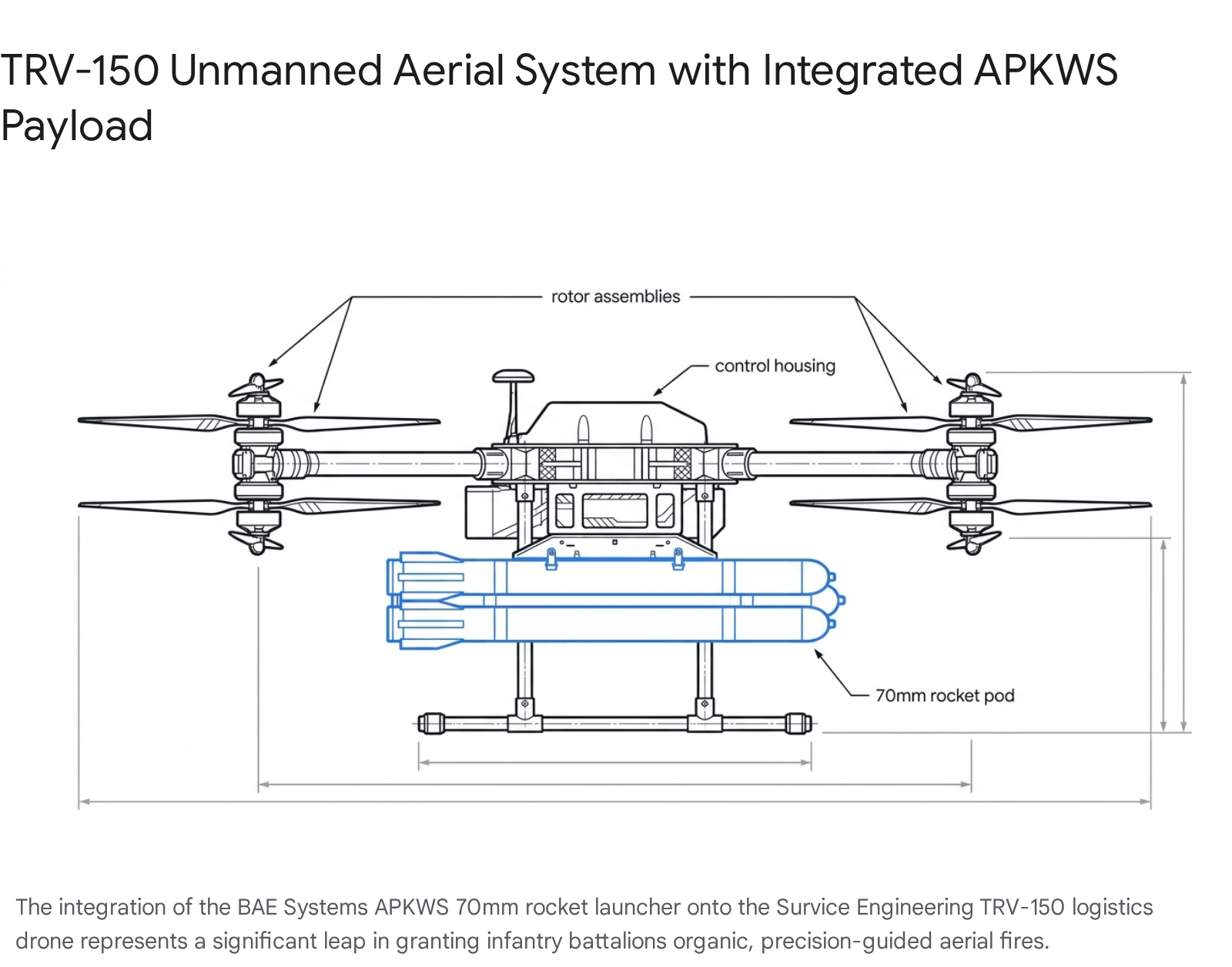
Also reported on this date, the U.S. Army formalized the results of an unprecedented live-fire test conducted at Fort Rucker, Alabama. Engineers successfully mounted and fired an Advanced Precision Kill Weapon System (APKWS) 70mm rocket launcher from a TRV-150 tactical resupply drone.34 The TRV-150, manufactured by Survice Engineering, is traditionally a logistics platform capable of carrying 150 pounds.36 Working with BAE Systems FalconWorks, the industry team self-funded the integration of a three-tube laser-guided rocket pod.35
3.3 May 27, 2026
United States
U.S. Special Operations Command (SOCOM), via its Joint Acquisition Task Force and SOFWERX, published a directive to establish an “all-domain” autonomous warfare proving ground at NASA’s Stennis Space Center in Mississippi.37 This facility will focus exclusively on the integration, testing, and employment of complex unmanned systems as dictated by the Pentagon’s “Drone Dominance” initiative.37
3.4 May 28, 2026
United States
Hermeus, a venture-backed aerospace startup, secured a $159 million contract from the Defense Innovation Unit (DIU) to transition its Quarterhorse unmanned aircraft into a reliable platform for sustained high-Mach military testing.38 The Quarterhorse Mk 2.1 recently achieved Mach 1.21 in autonomous flight at White Sands Missile Range, becoming the first privately funded unmanned aircraft to break the sound barrier.38 The DIU contract aims to push the uncrewed airframe to sustained Mach 3 speeds by 2027, providing critical flight data to the Air Force and Navy.38
3.5 May 29, 2026
United States
The U.S. Space Force awarded SpaceX a landmark $4.16 billion Other Transaction Authority (OTA) contract for the Space-Based Airborne Moving Target Indicator (SB-AMTI) program.39 The contract mandates the rapid development, integration, and fielding of a classified constellation of LEO satellites by 2028.40 These satellites will be equipped with advanced radar sensors capable of continuously tracking moving aircraft, cruise missiles, and drones deep inside adversary airspace.40
4. Strategic, Operational, and Tactical Lessons Learned
This section synthesizes the profound doctrinal shifts and operational realities exposed by the events of the reporting period, providing deep contextual analysis of the cause-and-effect relationships governing modern unmanned warfare.
4.1 May 24, 2026
Russia
The launch of 262 drones in a single evening highlights a continuing Russian doctrine of “magazine depletion”.1 By launching overwhelming numbers of low-cost, mass-produced loitering munitions simultaneously from disparate geographical azimuths, the Russian military forces the defending military to expend highly sophisticated, mathematically finite, and expensive surface-to-air interceptors (such as Patriot or NASAMS missiles). The inclusion of newer Gerbera and Parodiya variants alongside the foundational Shahed-136 framework indicates an iterative adaptation designed to lower radar cross-sections and acoustic signatures, further straining defensive detection algorithms.1
Ukraine
The targeting of the 6th Air Force’s logistical hub 125 kilometers behind the lines proves that the establishment of a dedicated Unmanned Systems Force (USF) allows for centralized, strategic planning of asymmetric deep strikes.1 By persistently targeting aviation fuel repositories at long ranges, Ukrainian forces are actively degrading Russian sortie generation capabilities before aircraft ever leave the tarmac. This operational reality proves that long-range drone strikes are a highly efficient, attritable substitute for traditional counter-air operations, which would otherwise require risking expensive, crewed fighter aircraft.1
4.2 May 25, 2026
United States
The explicit inclusion of 47 MUSVs in the Navy’s 2031 procurement plan codifies the “high-low mix” doctrine into federal law.28 High-end, multi-billion-dollar crewed combatants (like Arleigh Burke-class destroyers) will increasingly be preserved for complex fleet defense, while attritable, mass-produced robotic vessels (like the Saildrone Spectre) will be pushed forward as distributed sensory nodes and external missile magazines.28 Furthermore, forcing industry contenders to absorb initial R&D costs via the MUSV “marketplace” concept signals an aggressive departure from slow, traditional defense acquisition models, transferring financial risk away from the taxpayer and accelerating fielding timelines.29
4.3 May 26, 2026
Russia
The utilization of Belarusian airspace for drone launches severely complicates defensive geometry for Ukraine.2 Drones launched from Belarus arrive at targets from northern vectors, forcing air defense systems to constantly reposition and monitor a much wider, 360-degree geographic arc. This stretches radar and interceptor coverage thin, drastically reducing interception reaction times and increasing the probability of a munition successfully penetrating the defensive screen.2
United States
The development of NASA’s MoonFall drones requires a fundamental reimagining of autonomous navigation physics.33 The vacuum of space completely negates the aerodynamic principles of traditional rotorcraft. Therefore, these extraterrestrial drones are engineered as “propulsive hoppers,” using directed thrust to navigate.33 Because the extreme communications delay to Earth mandates that these drones cannot be manually piloted, they must conduct hazard avoidance, trajectory calculation, and terrain mapping entirely on the edge, without a human-in-the-loop.33 This represents the absolute apex of autonomous navigation technology.
4.4 May 27, 2026
United States
Operational data released from the 3rd Brigade, 82nd Airborne Division’s “Panther Avalanche” exercise proved that the most immediate, critical value of autonomous ground vehicles (UGVs) is not in direct kinetic combat, but in unglamorous, high-friction tactical logistics.42
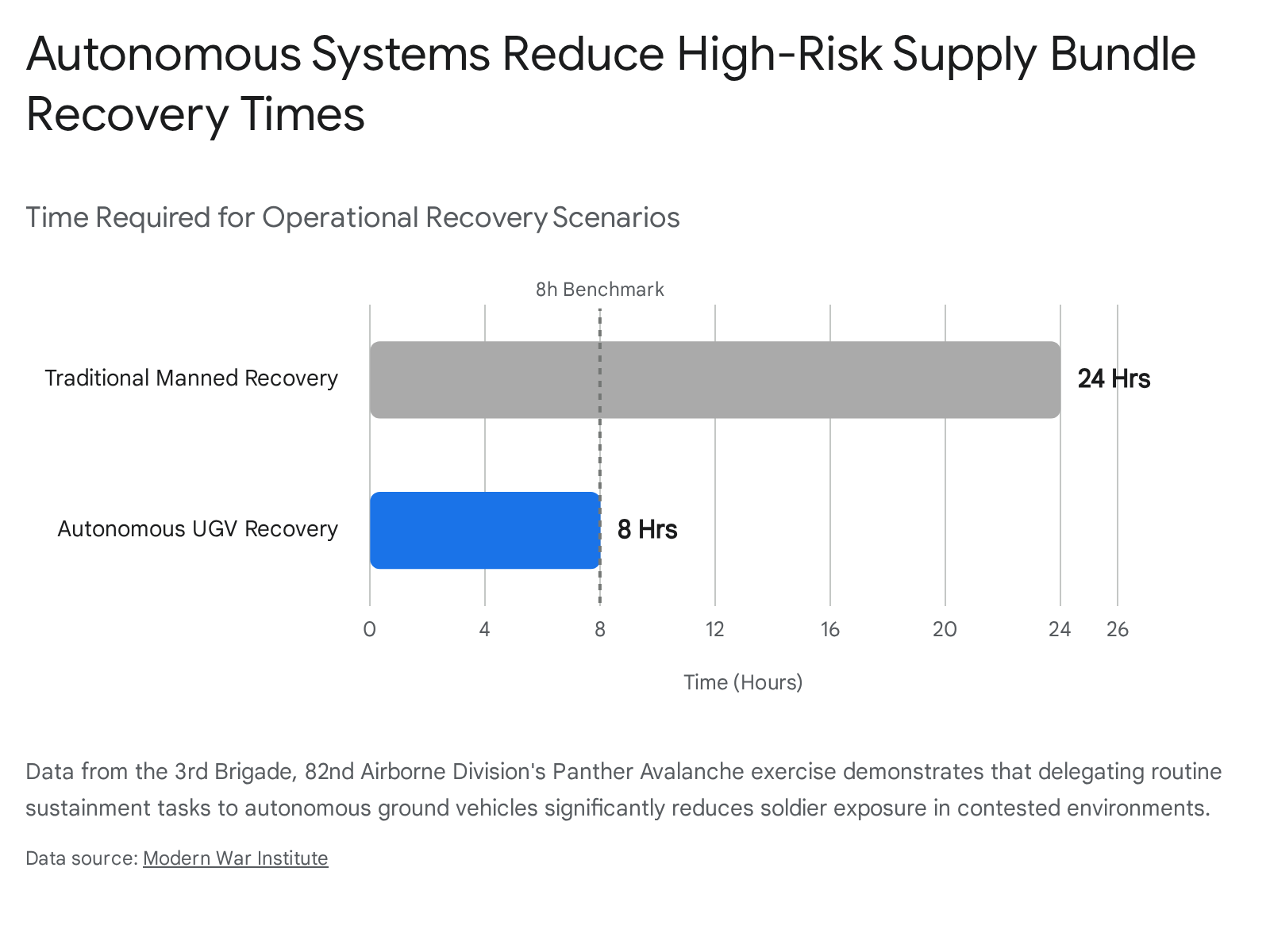
During the rotation, the Overland AI ULTRA UGV executed over 50 autonomous runs, some exceeding nine kilometers, to resupply isolated sniper teams under simulated hostile fire.42 By delegating mundane, dangerous transport tasks to robots, tactical commanders preserve human combat power and drastically reduce casualty risks along highly targeted main supply routes (MSRs).42 The data indicates that UGVs do not need to entirely replace legacy manned platforms to be useful; delegating niche, predictable tasks generates massive gains in operational speed.42
Yemen
The international supply chain supporting proxy warfare has fundamentally shifted. Investigative reports revealed that a commercial Chinese firm used AI-driven marketing software to solicit sales of Limbach L550 engines directly to Iranian and Houthi networks.43 Despite heavy international sanctions, commercial, dual-use components are flowing freely to non-state actors. The automation of this illicit marketing highlights a massive blind spot in global export control enforcement, permanently lowering the barrier to entry for proxy groups to acquire the components necessary for long-range precision strike capabilities.43
4.5 May 28, 2026
Romania
The crash of a Russian drone into a Galați apartment complex highlights the severe operational constraints facing NATO border states.12 Despite advanced warning and continuous radar tracking by NATO E-3A AWACS and ground stations, the drone spent only a few minutes inside Romanian airspace before striking a populated area.12 Current peacetime rules of engagement, combined with the physical realities of attempting to intercept low-flying, low-speed targets over civilian centers, make safe neutralization incredibly difficult without risking catastrophic collateral damage from falling debris. The incident underscores how navigation errors by autonomous systems can rapidly bypass political firebreaks, instantly triggering international strategic crises.15
United States
The integration of the APKWS rocket pod onto the TRV-150 drone fundamentally blurs the doctrinal lines between sustainment and maneuver warfare.35 By proving that flight control software can autonomously compensate for the violent physical recoil of a rocket launch, the Army is creating a paradigm where tactical commanders have organic, precision-strike options instantly at their disposal.35 Instead of waiting for an Apache helicopter or higher-echelon artillery support, a local squad leader can use a logistical heavy-lift drone to independently engage targets.
Furthermore, during Project Flytrap 5.0, the U.S. Army successfully utilized a regimental additive manufacturing (3D printing) platoon to repair drones and fabricate mounting brackets for Counter-UAS equipment directly on the frontline.26 As drone attrition rates skyrocket in modern conflicts due to EW and kinetic interception, the ability to print replacement chassis parts in the field will outpace traditional, continent-spanning logistical supply chains, making decentralized manufacturing a critical pillar of drone warfare.27
4.6 May 29, 2026
China
The conversion of over 500 retired J-6 fighter jets into autonomous drones by the PLA is a textbook manifestation of massed, asymmetric warfare.17 The J-6 airframe is entirely obsolete for modern air-to-air combat. However, by removing the human life support systems and installing autonomous flight computers and heavy explosive payloads, China has created a massive fleet of heavy cruise missiles at a fraction of the cost of purpose-built munitions.17 Their deployment alongside advanced J-16 fighters suggests a doctrine of saturation and deception. The PLA intends to launch these drones en masse to force Taiwanese air defense batteries to deplete their high-cost interceptors on empty, recycled airframes, deliberately clearing the airspace for the actual crewed strike packages that follow.17
United States
The $4.16 billion Space Force contract awarded to SpaceX for the SB-AMTI program represents the impending death of the traditional atmospheric Airborne Warning and Control System (AWACS).40 Legacy platforms like the E-3 Sentry emit massive radar signatures, making them highly visible and prime targets for adversary ultra-long-range air-to-air missiles operating within dense anti-access/area-denial (A2/AD) bubbles. By moving the moving target indicator (MTI) radar mission to space, the U.S. military achieves persistent, un-targetable, and global radar coverage.41 Relying on a proliferated orbital mesh network rather than a handful of high-value aircraft ensures that the destruction of a single node does not blind the joint force.41
4.7 May 30, 2026
Israel
The successful destruction of Israeli Merkava tanks by Hezbollah FPV drones represents a critical inflection point in the offense-defense balance.19 The IDF’s extensive electronic warfare network generally relies on severing the radio frequency command link between a drone and its operator. By spooling miles of microscopic fiber-optic wire behind the drone as it flies, Hezbollah operators maintain a physical, un-jammable, high-bandwidth connection to the munition up until the moment of impact.19
Furthermore, the addition of thermal optics negates the IDF’s tactical shift toward operating exclusively at night to avoid visual detection.19 Even heavy armor equipped with advanced active protection systems (APS)—which are optimized for horizontal threats like anti-tank guided missiles—struggle to track and intercept the steep, top-attack dive profiles utilized by skilled FPV operators.22 Consequently, modern militaries must urgently pivot away from soft-kill EW solutions and invest heavily in kinetic, hard-kill counter-drone defenses to defeat physical, tethered threats, as the cost-exchange ratio currently remains overwhelmingly in favor of the drone operator.19
Please share the link on Facebook, Forums, with colleagues, etc. Your support is much appreciated and if you have any feedback, please email us in**@*********ps.com. If you’d like to request a report or order a reprint, please click here for the corresponding page to open in new tab.
Sources Used
- Russian Offensive Campaign Assessment, May 25, 2026 | ISW, accessed May 30, 2026, https://understandingwar.org/research/russia-ukraine/russian-offensive-campaign-assessment-may-25-2026/
- Russian Offensive Campaign Assessment, May 26, 2026 | ISW, accessed May 30, 2026, https://understandingwar.org/research/russia-ukraine/russian-offensive-campaign-assessment-may-26-2026/
- US and UK militaries strike Houthi targets in Yemen in the fifth combined operation, accessed May 30, 2026, https://newsonair.gov.in/us-and-uk-militaries-strike-houthi-targets-in-yemen-in-the-fifth-combined-operation/
- Red Sea crisis – Wikipedia, accessed May 30, 2026, https://en.wikipedia.org/wiki/Red_Sea_crisis
- U.S. uncrewed surface vessel completes first autonomous crossing of Taiwan Strait, tracks Chinese warships, accessed May 30, 2026, https://www.digitaltoday.co.kr/en/view/59049/us-uncrewed-surface-vessel-crosses-taiwan-strait-first-time-tracks-chinese-warships
- Seasats Completes First Autonomous Transit of the Taiwan Strait, accessed May 30, 2026, https://www.prnewswire.com/news-releases/seasats-completes-first-autonomous-transit-of-the-taiwan-strait-302783719.html
- Uncrewed US craft transits the Taiwan Strait – Taipei Times, accessed May 30, 2026, https://www.taipeitimes.com/News/front/archives/2026/05/29/2003858167
- Uncrewed US craft transits the Taiwan Strait : r/Military – Reddit, accessed May 30, 2026, https://www.reddit.com/r/Military/comments/1troirg/uncrewed_us_craft_transits_the_taiwan_strait/
- US uncrewed surface vehicle completes 1st autonomous Taiwan Strait transit | Taiwan News | May. 28, 2026 18:33, accessed May 30, 2026, https://www.taiwannews.com.tw/news/6371812
- US Sea Drone Tracks Chinese Warships in Taiwan Strait|TaiwanPlus News – YouTube, accessed May 30, 2026, https://www.youtube.com/watch?v=3jkUMVVq1vc
- Russian Offensive Campaign Assessment, May 28, 2026, accessed May 30, 2026, https://understandingwar.org/research/russia-ukraine/russian-offensive-campaign-assessment-may-28-2026/
- Romania says Russian drone hit apartment building, lightly …, accessed May 30, 2026, https://www.cbsnews.com/news/russian-drone-strikes-romanian-apartment-building/
- NATO condemns Russia’s ‘reckless behavior’ after drone strike in Romania injures two, accessed May 30, 2026, https://kyivindependent.com/drone-reportedly-strikes-residential-building-in-romania/
- Russian drone hits apartment building in Romania, accessed May 30, 2026, https://www.ft.com/content/c834acfc-1c9c-4181-bb75-683cc3a9292f?syn-25a6b1a6=1
- What does Russia’s drone hit mean for Romania and NATO?, accessed May 30, 2026, https://acleddata.com/expert-comment/what-does-russias-drone-hit-mean-romania-and-nato
- Russian Offensive Campaign Assessment, May 29, 2026 | ISW, accessed May 30, 2026, https://understandingwar.org/research/russia-ukraine/russian-offensive-campaign-assessment-may-29-2026/
- Taiwan says China deploying over 500 converted fighter-jet drones, accessed May 30, 2026, https://www.taiwannews.com.tw/news/6364427
- Media: Iranian strike on Kuwait airbase damages two US drones – Caliber.Az, accessed May 30, 2026, https://caliber.az/en/post/media-iranian-strike-on-kuwait-airbase-damages-two-us-drones
- Iran Update Special Report, May 29, 2026, accessed May 30, 2026, https://understandingwar.org/research/middle-east/iran-update-special-report-may-29-2026/
- First Thing: Nato ready to defend ‘every inch’ of territory as Russian drone hits Romania, accessed May 30, 2026, https://www.theguardian.com/us-news/2026/may/29/first-thing-nato-ready-to-defend-as-russian-drone-hits-romania
- Nato ready to defend ‘every inch’ of territory as Russian drone hits Romania, accessed May 30, 2026, https://www.theguardian.com/world/2026/may/29/russian-drone-romanian-apartments-wounding-two-people-and-starting-fire
- Hezbollah says it hit 6 Israeli tanks amid drone, missile attacks in southern Lebanon, accessed May 30, 2026, https://www.aa.com.tr/en/middle-east/hezbollah-says-it-hit-6-israeli-tanks-amid-drone-missile-attacks-in-southern-lebanon/3951600
- Soldier killed in Hezbollah drone attack as Israel widens strikes on terror group, accessed May 30, 2026, https://www.timesofisrael.com/soldier-killed-in-hezbollah-drone-attack-as-israel-widens-strikes-on-terror-group/
- Hezbollah drone strikes military zone near Lebanon border, another intercepted, IDF says; none injured, accessed May 30, 2026, https://www.timesofisrael.com/liveblog_entry/hezbollah-drone-strikes-military-zone-near-lebanon-border-another-intercepted-idf-says-none-injured/
- Defeating the swarm: Project Flytrap accelerates NATO’s counter-drone lethality – U.S. Army, accessed May 30, 2026, https://www.army.mil/article/292622/defeating_the_swarm_project_flytrap_accelerates_natos_counter_drone_lethality
- Army flexes additive manufacturing capabilities during Flytrap counter-drone exercise, accessed May 30, 2026, https://defensescoop.com/2026/05/14/army-additive-manufacturing-flytrap-counter-drone-exercise/
- Army Brings 3D Printing into Project Flytrap Exercise, accessed May 30, 2026, https://www.nationaldefensemagazine.org/articles/2026/5/18/army-bring-3d-printing-into-project-flytrap-exercise
- Drone boats make debut in Navy’s 30-year shipbuilding plan, accessed May 30, 2026, https://www.defenseone.com/defense-systems/2026/05/drone-boats-navy-shipbuilding-plan/413504/
- U.S. Navy Picks Seven Contenders for Medium USV Program, accessed May 30, 2026, https://maritime-executive.com/article/u-s-navy-picks-seven-contenders-for-medium-usv-program
- Saildrone: New Spectre USV at Sea Air Space 2026 – YouTube, accessed May 30, 2026, https://www.youtube.com/watch?v=0bEvS6-Qyig
- A Moon base, Moon buggies, hopping rovers… NASA just revealed a stack of ambitious plans to send astronauts and spacecraft to the Moon | BBC Sky at Night Magazine, accessed May 30, 2026, https://www.skyatnightmagazine.com/news/nasa-moon-base-announcement-may-2026
- NASA Provides Update on Moon Base Rovers, Landers, Missions, accessed May 30, 2026, https://www.nasa.gov/news-release/nasa-provides-update-on-moon-base-rovers-landers-missions/
- Firefly Aerospace Wins $75 Million NASA JPL MoonFall Subcontract …, accessed May 30, 2026, https://fireflyspace.com/news/firefly-aerospace-wins-75-million-nasa-jpl-moonfall-subcontract-to-deliver-drones-to-the-moons-south-pole/
- US Army turns resupply drone into rocket launcher in new test, accessed May 30, 2026, https://www.defensenews.com/news/your-military/2026/05/28/army-turns-resupply-drone-into-rocket-launcher-in-new-test/
- Industry partners test drone-mounted rocket launcher at Fort Rucker, accessed May 30, 2026, https://www.army.mil/article/292791/industry_partners_test_drone_mounted_rocket_launcher_at_fort_rucker
- US Army turns resupply drone into rocket launcher in new test, accessed May 30, 2026, https://www.militarytimes.com/news/your-military/2026/05/28/army-turns-resupply-drone-into-rocket-launcher-in-new-test/
- SOCOM seeks autonomous warfare proving ground, accessed May 30, 2026, https://defensescoop.com/2026/05/27/socom-seeks-autonomous-warfare-proving-ground/
- Hypersonic Startup Nabs Contract For High-Speed Drone Testing, accessed May 30, 2026, https://www.airandspaceforces.com/hypersonic-startup-heremus-diu-contract-drone-testing/
- Space Force Awards SpaceX $4.16B Airborne Tracking Deal | KeepTrack X Report, accessed May 30, 2026, https://keeptrack.space/x-report/spacex-brief-2026-05-30
- SpaceX wins $4B deal to accelerate deployment of aircraft-tracking satellites, accessed May 30, 2026, https://defensescoop.com/2026/05/29/spacex-amti-contract-space-force/
- SpaceX wins $4.16B Space Force contract to detect airborne …, accessed May 30, 2026, https://breakingdefense.com/2026/05/spacex-wins-4-16b-space-force-contract-to-detect-airborne-moving-targets/
- Autonomous Ground Vehicles and the Sustainment Problem: One …, accessed May 30, 2026, https://mwi.westpoint.edu/autonomous-ground-vehicles-and-the-sustainment-problem-one-brigades-experiment-and-what-the-army-should-do-next/
- Victory and Profit: Shahed Drone Engines, Chinese Entrepreneurs, and the Pitfalls of AI-Driven Marketing, accessed May 30, 2026, https://www.iranwatch.org/our-publications/articles-reports/victory-profit-shahed-drone-engines-chinese-entrepreneurs-pitfalls-ai-driven-marketing