1.0 Executive Summary
The integration of artificial intelligence into military operations has fundamentally altered the character of modern warfare, initiating a structural shift in global power dynamics. As the international security environment grows increasingly volatile, defense ministries worldwide are actively abandoning legacy, hardware-centric procurement models. In their place, military planners are adopting Software-Defined Defense architectures.1 This paradigm shift positions software, massive data processing capabilities, and algorithmic decision-making as the primary drivers of military superiority. Consequently, physical platforms such as aircraft, naval vessels, and ground vehicles are increasingly relegated to the role of delivery mechanisms for advanced digital capabilities.
This research report evaluates and ranks the top ten nations globally in terms of their military utilization of artificial intelligence as of April 2026. The assessment deliberately diverges from traditional military strength metrics that prioritize sheer troop numbers or static equipment inventories, such as those historically prioritized by early iterations of the Global Firepower Index.2 Instead, this report measures the precise capacity of a nation to develop, scale, and operationalize advanced algorithms in contested, high-intensity environments. The analysis reveals a stark divergence between nations treating artificial intelligence as a theoretical or purely academic pursuit and those actively testing machine learning models in active combat zones.
The findings indicate that the United States retains the premier position due to its unparalleled integration of commercial technology into defense applications and its sheer volume of venture-backed defense startups. However, the People’s Republic of China is rapidly closing this gap through state-directed military-civil fusion, heavily prioritizing autonomous systems and simulation.4 Concurrently, nations engaged in active conflicts, specifically Israel, Ukraine, and the Russian Federation, have demonstrated the highest rates of battlefield operationalization. These nations are utilizing algorithmic target generation, drone swarming, and autonomous strike platforms at scales previously unseen in human history.6 The transition from human-speed to machine-speed warfare is no longer a future concept, but a current operational reality.
2.0 Ranking Methodology
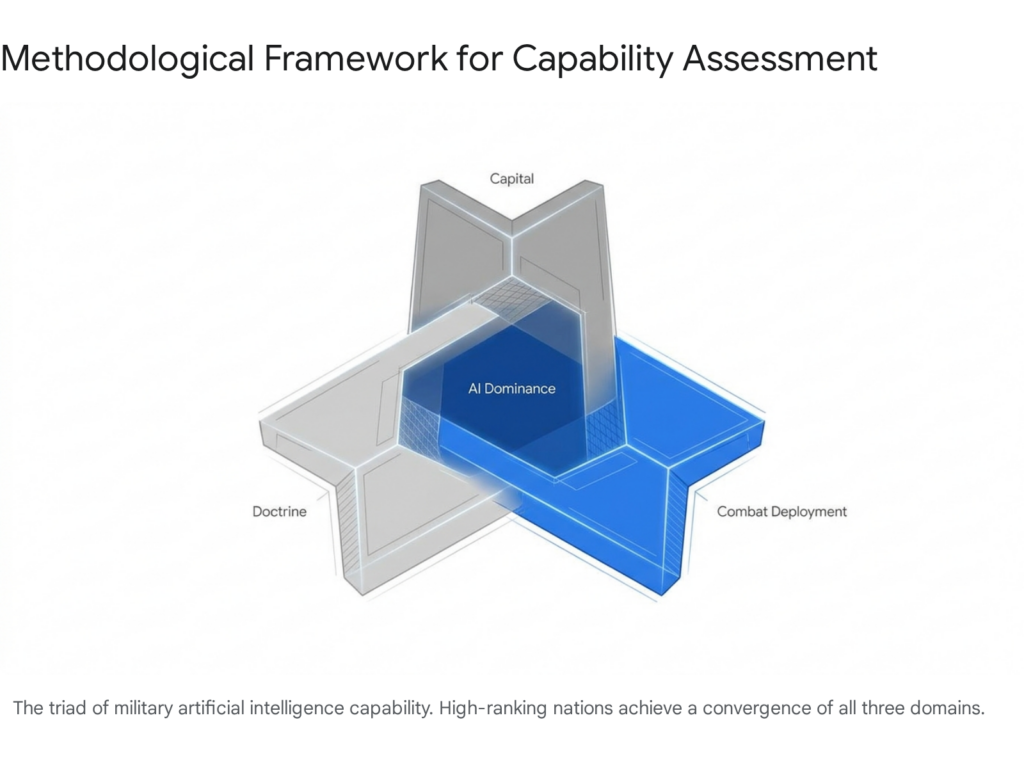
To establish an objective and robust hierarchy of global military artificial intelligence capabilities, this report relies on a tripartite methodological framework. This approach synthesizes structural readiness, financial commitment, and empirical battlefield evidence to generate a highly detailed capability profile for each nation. This framework draws inspiration from indices such as the Oxford Insights Government AI Readiness Index and the Tortoise Media Global AI Index, but narrows the focus strictly to defense applications, lethal autonomy, and tactical command capabilities.9
2.1 Theoretical Frameworks and Doctrine
The first pillar evaluates a nation’s strategic architecture and policy environment. Effective military artificial intelligence requires a foundation of coherent doctrine, agile governance structures, and organizational alignment. This metric assesses the presence of dedicated defense innovation units, published national artificial intelligence strategies, and the formal adoption of Software-Defined Defense principles within the military’s central command.1 Furthermore, it examines the frameworks governing the ethical deployment of autonomous systems. These doctrines are critical because they dictate the speed at which commanders can legally and operationally deploy algorithmic tools in the field.12 A military force with advanced technology but restrictive or poorly defined deployment doctrines will ultimately be outpaced by an adversary with streamlined approval processes.
2.2 Investment and Industrial Ecosystem
The second pillar quantifies the depth and vitality of the defense-industrial base. Modern algorithmic warfare relies heavily on the commercial technology sector, as traditional defense contractors have historically struggled with the rapid iteration cycles required for software development. This metric evaluates government defense budgets allocated specifically to digital transformation, alongside the vitality of the private defense-technology ecosystem.9 Nations that successfully bridge the gap between agile technology startups and rigid military procurement systems score highest in this category.14 The capacity to manufacture autonomous platforms domestically, secure semiconductor supply chains, and fund large-scale data infrastructure is heavily weighted.16 Sovereign control over the supply chain is treated as a critical multiplier.
2.3 Demonstrated Operational Outcomes
The final and most heavily weighted pillar assesses actual performance and deployment. Theoretical capabilities and fiscal investments hold limited value if they fail to function under the strain of electronic warfare, degraded communications, and active combat. This metric measures the deployment of artificial intelligence in live operations, including automated target recognition, autonomous swarm coordination, predictive maintenance, and algorithmic battle management.6 Nations that have transitioned systems from controlled testing environments to active deployment receive the highest scores in this domain. Battlefield testing provides an irreplaceable feedback loop, allowing for the rapid refinement of algorithms based on real-world data rather than simulated projections.
3.0 Summary Ranking of the Top 10 Nations
The following table provides a consolidated view of the top ten nations, highlighting their primary technological focus areas and notable platform deployments based on the established methodology. A thorough validation process confirms that the commercial vendors and platforms listed are currently active and their software solutions are available for defense procurement.
| Rank | Nation | Primary Operational Focus | Key Deployed Platforms, Vendors, or Systems |
| 1 | United States | Multi-domain command and control, advanced autonomous aviation, algorithmic targeting | Palantir AIP, Anduril Lattice,(https://shield.ai/enterprise/) |
| 2 | People’s Republic of China | Military-civil fusion, intelligentized warfare, strategic simulation, swarm logic | DeepSeek military simulations, PLA autonomous vehicles |
| 3 | Israel | Algorithmic target generation, facial recognition, rapid decision support systems | Gospel, Lavender,(https://www.elbitsystems.com/networked-warfare/robotic-and-autonomous-solutions) |
| 4 | Ukraine | Rapid prototyping, autonomous drone swarms, asymmetric digital combat | Swarmer interceptors, Delta command system, Strilla UAVs |
| 5 | Russian Federation | Terminal autonomous guidance, sovereign drone manufacturing, C2 digitalization | ZALA Lancet, Astra Linux C2, adapted open-weight models |
| 6 | United Kingdom | Agentic artificial intelligence, joint force integration, synthetic training | (https://www.baesystems.com/en-us/article/bae-systems-and-scale-ai-combine-forces-to-bring-agentic-ai-to-defense-missions-and-platforms) |
| 7 | Republic of Korea | Unmanned surface vessels, force multiplier automation, demographic mitigation | (https://www.hd.com/en/newsroom/media-hub/press/view?detailsKey=3444), K-Moonshot strategy |
| 8 | Republic of Turkiye | Autonomous strike UAVs, networked air dominance, naval drone integration | (https://baykartech.com/en/uav/bayraktar-tb3/), Havelsan MAIN AI, SAYZEK cluster |
| 9 | France | Sovereign data processing, digital independence, classified environment modeling | Artemis.IA by(https://www.thalesgroup.com/en/advanced-technologies/artificial-intelligence) / Atos |
| 10 | India | Border surveillance, force modernization, domestic robotics | Silent Sentry, DRDO ETAI Framework, Defence AI Council |
4.0 Detailed Capability Assessments
4.1 United States
The United States secures the premier position in this ranking due to its vast capital markets, deeply integrated software ecosystems, and a deliberate strategic shift toward Software-Defined Defense. The U.S. Department of Defense has recognized that future conflicts will be decided by the speed of data processing and the ability to maintain decision advantage over adversaries.20 Consequently, the nation is racing to embed machine learning models into every layer of its military architecture, from strategic combatant command centers down to tactical edge devices utilized by frontline operators.
4.1.1 Strategic Doctrine and Investment
The strength of the United States lies in its commercial defense-technology sector. Unlike traditional defense prime contractors that prioritize multi-decade hardware programs, a new generation of venture-backed vendors is delivering continuously updated software platforms that can be iteratively improved based on operator feedback. This shift is supported by new software-dedicated acquisition pathways within the military branches, allowing for agile deployment models.1 The defense budget actively funds artificial intelligence research and development, with significant capital dedicated to the Combined Joint All Domain Command and Control (CJADC2) initiative, which seeks to connect sensors from all military branches into a unified, artificial intelligence-powered network.
4.1.2 Demonstrated Outcomes and Vendor Integration
Palantir serves as a critical enabler of this unified network capability. The company’s Artificial Intelligence Platform provides advanced large language model capabilities across classified military networks, ensuring legal and ethical governance while allowing operators to fuse vast amounts of disparate intelligence data into actionable insights.21Palantir’s Maven Smart System forms the software backbone of CJADC2 initiatives, effectively creating an operational digital nervous system that provides near real-time domain awareness from the sensor directly to the end user.21
In the realm of autonomous systems and hardware integration, Anduril Industries has revolutionized the deployment of networked sensors and effectors. Their software platform, Lattice, is currently available and acts as an artificial intelligence-powered battle management engine designed specifically to accelerate complex kill chains.23Lattice integrates thousands of third-party, legacy, and autonomous systems, utilizing intelligent mesh networking to process sensor fusion at the tactical edge.23This software allows a single human operator to command multiple autonomous assets, breaking down complex strategic objectives into discrete, executable tasks for collaborative drone teams across land, sea, and air.23
Furthermore,Shield.AI has achieved extraordinary, highly documented milestones in autonomous military aviation. Their Hivemind autonomy software stack functions as a universal artificial intelligence pilot, capable of flying combat aircraft without reliance on GPS or external communications, a critical requirement for operating in contested electronic warfare environments.25Shield AI has successfully demonstrated this technology on modified F-16 fighter jets under the DARPA Air Combat Evolution program, where the software successfully engaged in dogfighting maneuvers against human pilots.27The company is rapidly scaling this software to control their V-BAT unmanned aerial systems and the newly unveiled X-BAT vertical takeoff and landing fighter, a platform designed to operate independently of traditional runway infrastructure while carrying both air-to-air and air-to-surface munitions.27This capacity to operate intelligently and lethally in heavily degraded environments secures the tactical superiority of the United States.
4.2 People’s Republic of China
The People’s Republic of China holds the second position, driven by a national strategy of “intelligentized” warfare and a strict, state-mandated policy of military-civil fusion.4 Beijing views artificial intelligence not merely as a capability enhancement, but as the foundational technology required to leapfrog legacy systems and erode Western military dominance by the target year of 2035.5
4.2.1 Strategic Doctrine and Investment
China’s approach is characterized by massive state investment and the mandatory integration of civilian technological breakthroughs into the People’s Liberation Army. This synergy allows the military establishment to directly leverage advancements from the nation’s robust commercial technology sector, bypassing the traditional procurement bottlenecks seen in Western democracies.5 Research output has surged dramatically, with Chinese academic institutions now producing highly cited research in computer science and artificial intelligence at rates that frequently surpass United States institutions, particularly in computer vision and drone swarm algorithms.29 The state’s ability to direct corporate resources ensures that breakthroughs in commercial artificial intelligence are immediately repurposed for national security objectives.
4.2.2 Demonstrated Outcomes and Priorities
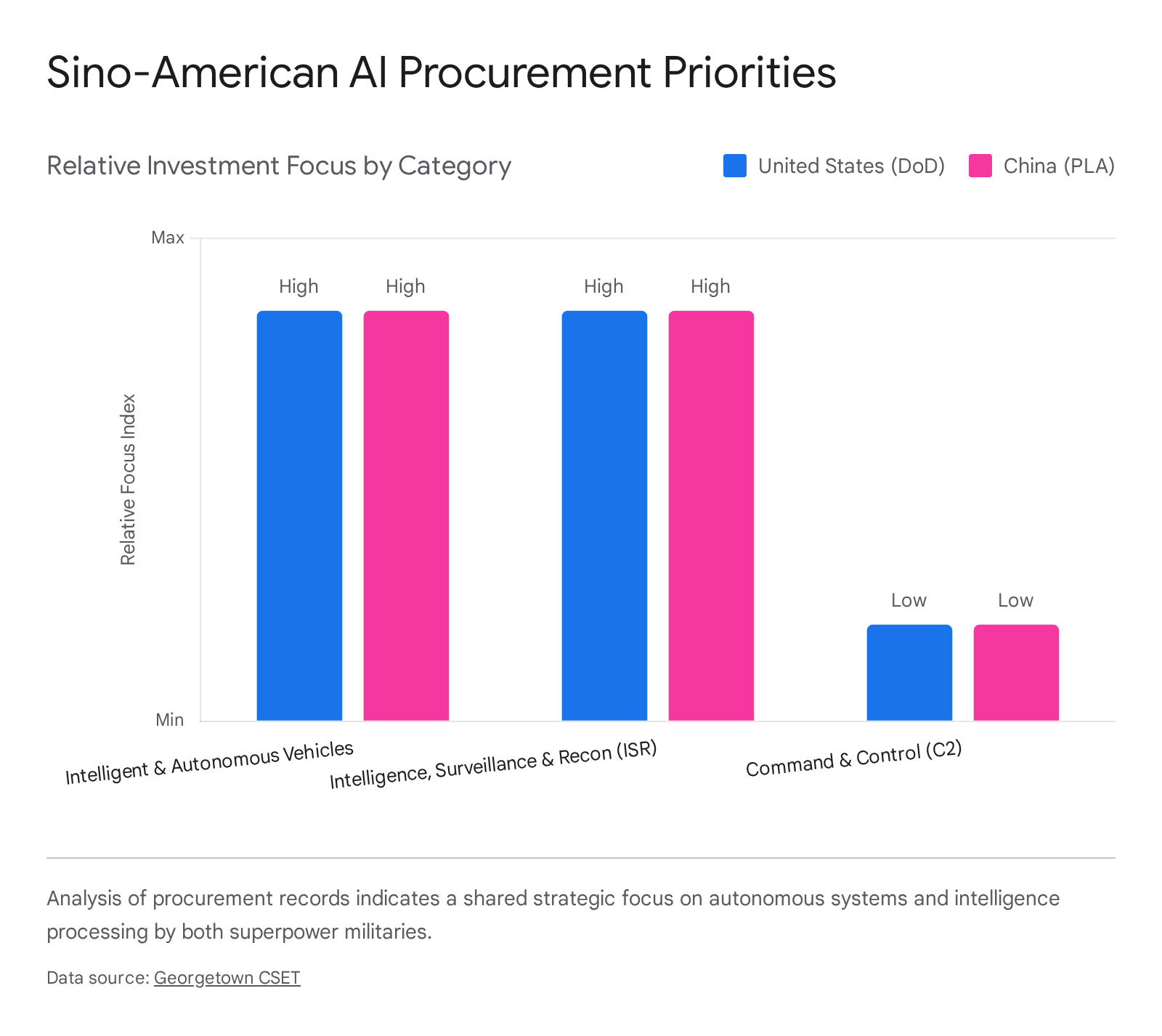
Procurement data indicates that the People’s Liberation Army is heavily prioritizing intelligent and autonomous vehicles, as well as tools for intelligence, surveillance, and reconnaissance.30 Rather than relying solely on monolithic, state-owned defense contractors, China has cultivated a distributed ecosystem of artificial intelligence suppliers, increasing the resilience and innovation speed of its defense industrial base.30
A notable recent advancement involves the use of the DeepSeek foundation model by military researchers at Xi’an Technological University. This commercial model is being utilized to autonomously generate complex military simulations, providing a highly sophisticated digital testing ground for future combat scenarios against peer adversaries.5 China’s rapid scaling of autonomous infrastructure, combined with its ability to mandate commercial compliance and its vast data collection capabilities, make it the most formidable strategic competitor to the United States in the digital domain.
4.3 Israel
Israel occupies the third position, distinguished entirely by its unprecedented operationalization of algorithmic systems in active, high-intensity combat environments. While other nations possess larger theoretical research budgets or greater overall manpower, the Israel Defense Forces have deployed artificial intelligence decision support systems at a scale and tempo previously unseen in the history of warfare, compressing the sensor-to-shooter loop from hours to mere seconds.6
4.3.1 Strategic Doctrine and Investment
Israel has invested heavily in integrating artificial intelligence across its military hierarchy. This is evidenced by the establishment of a dedicated AI and Autonomy Administration within the Directorate of Defense Research & Development, as well as empowering the elite signals-intelligence Unit 8200 to develop specialized, in-house software tools.6 The nation leverages its dense, highly innovative domestic startup ecosystem, frequently partnering with commercial entities to rapidly adapt civilian data processing capabilities for military applications.6
4.3.2 Demonstrated Outcomes and Vendor Integration
The most prominent examples of this operational shift are the Gospel and Lavender systems, which gained global attention during operations in the Gaza Strip. Developed to support rapid targeting operations, the Gospel utilizes machine learning to ingest massive streams of surveillance data and automatically identify enemy infrastructure, command posts, and equipment.31 Concurrently, the Lavender system functions as an advanced database that evaluates vast quantities of behavioral and communications intelligence to identify individuals linked to militant organizations. Reports indicate that during the initial phases of high-intensity conflict, Lavender was utilized to generate an active target list of approximately 37,000 individuals.6
The deployment of these algorithmic systems has fundamentally altered traditional operational workflows. Human personnel often have highly constrained timeframes to verify the outputs generated by the machine, relying heavily on the system’s accuracy parameters. This reliance has sparked intense international legal debate regarding accountability, the limits of human review, and adherence to the laws of armed conflict.31
Elbit Systems, a major defense contractor, has deeply integrated algorithmic logic into its product lines to support the fully digital military force. Their Dominion-X system is a powerful, autonomous management tool designed to coordinate multiple robotic platforms across the battlespace efficiently.34Furthermore, Elbit’s Artificial Intelligence-driven Decision Support Systems analyze the aerial arena in real-time, simulating every potential course of action to provide commanders with calculated risks and optimal tactical recommendations.35This tight, real-world coupling of innovative software, established hardware contractors, and active combat units gives Israel a distinct, albeit highly scrutinized, advantage in applied artificial intelligence.
4.4 Ukraine
Ukraine secures the fourth position through absolute necessity and the pressures of existential conflict. The ongoing Russo-Ukrainian war has become the definitive proving ground for algorithmic warfare, transforming the nation into the most vital innovation ecosystem for defense technology globally. Ukraine lacks the massive peacetime budgets of superpower nations, yet it compensates through extreme operational agility, rapid battlefield feedback loops, and a booming venture-backed defense sector.15
4.4.1 Strategic Doctrine and Investment
To institutionalize this rapid innovation, the Ukrainian government established the Brave1 defense technology cluster. This government-backed innovation hub coordinates military technology development and has issued over 600 grants totaling approximately $50 million to scale domestic solutions rapidly.37 The international venture capital community has recognized this potential, with over fifty Ukrainian defense startups securing more than $105 million in private investment in 2025 alone, elevating Ukraine’s status in global startup indices.15
4.4.2 Demonstrated Outcomes and Priorities
A critical focus for Ukrainian developers has been the creation of autonomous capabilities to overcome severe Russian electronic warfare, which frequently jams signals and severs the connection between human operators and their remote-controlled drones. Startups such as Swarmer have gained international prominence by developing autonomous drone swarm technology. Their software allows for the coordination of multiple drone types, and they have successfully tested scenarios involving over 100 coordinated unmanned aerial vehicles in simulated combat conditions.18
Furthermore, Ukraine has effectively absorbed advanced hardware from NATO partners and integrated it with domestic command systems. The deployment of Strilla interceptor drones, funded by the German government and produced as a joint venture between Ukrainian manufacturer WIY Drones and German company Quantum Systems, exemplifies this capability.40 These rocket-boosted quadcopters feature automatic targeting and anti-jamming systems to intercept incoming threat drones.40 Ukrainian forces utilize the domestically developed Delta command system to manage hundreds of these diverse assets simultaneously, providing NATO observers with vital lessons on multi-domain operations.7 By necessity, Ukraine has accelerated the evolution of military artificial intelligence from a strategic luxury to a daily tactical imperative, experiencing an innovation cycle measured in weeks rather than years.36
4.5 Russian Federation
The Russian Federation ranks fifth. Despite facing severe international economic sanctions and possessing a weaker domestic commercial technology sector compared to the United States or China, the Russian military has demonstrated a ruthless capacity to learn, adapt, and scale technologies forged in the crucible of the Ukrainian conflict.41
4.5.1 Strategic Doctrine and Investment
Russia has successfully built a sovereign drone ecosystem that tightly integrates state policy with frontline battlefield lessons.42 The Kremlin has prioritized domestic production and independence from Western supply chains. This strategy extends to cultivating future talent, evidenced by the launch of programs like Berloga, which introduce schoolchildren to combat drone production and operation, setting the conditions for a deeply integrated military-technical workforce.43 Furthermore, the government has provided tax incentives and preferential lending to small technology companies to encourage the rapid innovation of military-applicable software.43
4.5.2 Demonstrated Outcomes and System Integration
This sovereign architecture is most visible in the deployment and continuous refinement of the ZALA Lancet loitering munition, produced by the ZALA Aero Group.8 Recent iterations of the Lancet have been observed utilizing advanced optical-electronic guidance and algorithmic thermal tracking. This allows the munition to autonomously identify, track, and strike targets during the terminal phase of flight, ensuring successful engagements even when subjected to intense Ukrainian electronic jamming that would otherwise sever human control.8
Behind the front lines, the Russian Ministry of Defense is undertaking a massive, systematic data collection initiative. This program aggregates video feeds, operator telemetry, and strike outcomes from thousands of drone deployments to train and refine their proprietary target-recognition models, establishing a direct feedback loop between battlefield performance and software updates.44 To secure their command and control networks, Russian forces have mandated the transition to the domestically controlled Astra Linux operating system, providing a unified technical foundation for future algorithmic integration.44 Notably, Russian developers have demonstrated high proficiency in adapting commercially available, open-weight language and vision models, such as Mistral and Qwen, for military applications. By embedding these civilian models into tightly secured, on-premise military networks, Russia efficiently bridges its software development gaps, allowing it to field lethal autonomous capabilities at scale.44
4.6 United Kingdom
The United Kingdom ranks sixth, characterized by its deep strategic alignment with United States defense initiatives, a highly ambitious national strategy for digital modernization, and a strong academic foundation in machine learning. The British Ministry of Defence has recognized that maintaining interoperability with allied forces and defending the homeland requires a rapid transition toward Software-Defined Defense and autonomous systems.1
4.6.1 Strategic Doctrine and Investment
The UK government has committed significant capital to this transition. The Strategic Defence Review 2025 outlines a vision to establish the UK Armed Forces as a combination of conventional and digital warfighters, where the power of drones and autonomy complements heavy artillery.45 To achieve this, the government established the UK Defence Innovation organization with a ringfenced annual budget of at least £400 million to harness dual-use commercial technologies and foster partnerships with universities to develop talent.45 This is supported by a broader national commitment of £86 billion for research and development over four years, a significant portion of which is allocated to defense to rebuild depleted munitions stockpiles and modernize the nuclear deterrent.47
4.6.2 Demonstrated Outcomes and Industry Partnerships
The UK’s industrial base is aggressively pursuing next-generation capabilities, moving beyond simple automation toward intelligent systems. A prime example is the strategic partnership between major defense contractor BAE Systems and the commercial technology firm Scale AI. This collaboration specifically aims to integrate “agentic” artificial intelligence directly into the architecture of the nation’s combat vehicles and future operational platforms.20
Agentic artificial intelligence represents a significant leap forward; it moves beyond simple data analysis to allow software agents to autonomously plan, execute, and adapt complex tasks within defined parameters. By deploying tools such as BAE Systems’ Aided Target Recognition, the UK aims to translate raw sensor data into coordinated, multi-domain effects in real time, ensuring a critical human-machine advantage at the tactical edge where missions are executed.20 This focus on integrating advanced commercial AI models into heavy military platforms positions the UK as a leader in European defense technology.
4.7 Republic of Korea (South Korea)
The Republic of Korea secures the seventh position. Seoul’s accelerated adoption of military artificial intelligence is driven not only by the persistent, evolving nuclear and conventional threats posed by North Korea but by acute, unavoidable demographic realities. A rapidly shrinking national population is sharply reducing the available pool of military manpower. This structural deficit forces the Ministry of National Defense to rapidly substitute human soldiers with autonomous platforms to maintain combat readiness.17
4.7.1 Strategic Doctrine and Investment
To manage this critical transition, the Defense Acquisition Program Administration (DAPA) has restructured its operational framework to place algorithmic strategies at the forefront of procurement. DAPA has established a dedicated unit specifically tasked with shaping policy for next-generation, AI-driven weapon systems and fostering the domestic defense semiconductor industry.17 At the national level, the government has passed the AI Framework Act, balancing commercial innovation with targeted oversight, while specifically exempting military applications from restrictive regulations to accelerate deployment.51 Furthermore, the government is aggressively fostering dual-use startups through programs like the “Defense Startup Challenge,” bridging the gap between commercial venture capital and military system integrators.14
4.7.2 Demonstrated Outcomes and Naval Innovation
South Korea’s robust commercial technology, semiconductor, and massive shipbuilding sectors provide a unique industrial advantage. This is vividly demonstrated by the Tenebris project, a heavily armed, AI-driven unmanned surface vessel (USV) developed jointly by HD and the United States software firm Palantir Technologies.52
Scheduled for completion by 2026, the 14-ton Tenebris vessel integrates HD Hyundai’s advanced autonomous navigation architecture with Palantir’s artificial intelligence mission autonomy system.53 This vessel represents the leading edge of the Republic of Korea Navy’s “Navy Sea Ghost” combat system, which envisions seamless tactical integration between manned and unmanned naval forces to dominate the maritime domain.52 By combining world-class heavy manufacturing with elite software partnerships, South Korea is effectively mitigating its manpower crisis through intelligent automation.
4.8 Republic of Turkiye
The Republic of Turkiye ranks eighth, having successfully established itself over the past decade as a global powerhouse in the production and export of unmanned combat aerial vehicles. Turkiye’s defense industry has steadily moved toward technological self-sufficiency, with artificial intelligence now serving as the central driver of its national strategy, appropriately branded “AI for Defense”.54
4.8.1 Strategic Doctrine and Investment
The Turkish government views defense technology as both a national security imperative and a major economic export driver. To sustain growth and technological relevance, the Presidency of Defense Industries established the SAYZEK program. This artificial intelligence talent cluster is explicitly designed to channel civilian academic innovation directly into military applications, ensuring a steady pipeline of domestic engineering expertise and shared infrastructure.54 The government actively supports this with massive funding initiatives, such as the $1.6 billion HIT-AI call aimed at expanding cloud infrastructures and artificial intelligence capabilities.56
4.8.2 Demonstrated Outcomes and Platform Capabilities
Bayraktar, a leading Turkish defense contractor, has consistently delivered combat-proven platforms that have altered the course of multiple regional conflicts. The latest iteration of their flagship drone line, the Bayraktar TB3, features highly advanced autonomous capabilities, including fully automated takeoff and landing procedures utilizing visual line tracking and runway identification.57The TB3 recently proved this capability by successfully operating from the short runway of the naval vessel TCG Anadolu during NATO exercises in severe weather conditions.59Equipped with beyond-line-of-sight communication systems, the TB3 serves as a strategic overseas force multiplier.61
Beyond flagship drones, Baykar is developing the K2 Kamikaze UAV, which recently demonstrated intelligent swarm autonomy by completing formation flights involving multiple aircraft.60 Furthermore, state-owned contractor Havelsan is deploying the MAIN AI product, focusing on multi-domain command architectures, advanced simulators, and manned-unmanned teaming algorithms to network these various platforms together.54
4.9 France
France ranks ninth, distinguishing itself through a rigid, uncompromising commitment to digital and technological sovereignty. The French Ministry of the Armed Forces operates under the strict strategic directive that true national security requires absolute domestic control over critical software architecture, cloud infrastructure, and data processing.63 Consequently, France actively avoids over-reliance on foreign commercial technology providers, even allied ones, viewing digital sovereignty as a core security issue equal to physical defense.64
4.9.1 Strategic Doctrine and Investment
This sovereign approach requires significant state involvement and capital. The French military’s spending plan, the LPM 2019-2025, specifically earmarked approximately €700 million toward the development of artificial intelligence technologies.65 The Defence Digital Agency coordinates these efforts, collaborating with a broad domestic industrial ecosystem of startups, major groups, and academic players to develop sovereign solutions that meet the strict security standards of the French National Agency for the Security of Information Systems (ANSSI).63
4.9.2 Demonstrated Outcomes and Specialized AI
The crown jewel of this sovereign architecture is the Artemis.IA program. Awarded to ATHEA, a joint venture between domestic technology giants Thales and Atos, Artemis.IA is a massive data processing and artificial intelligence platform designed exclusively to meet the classified business and operational needs of the French military.66 Designed entirely in France, it provides secure, interoperable Big Data analytics without exposing French military intelligence to foreign servers.66
Thales Group further supports this ecosystem by developing highly specialized models tailored for austere military environments. Their artificial intelligence solutions are engineered to operate in technically constrained environments characterized by limited power, restricted connectivity, and classified training data, setting them apart from general-purpose commercial models.67While the insistence on absolute sovereignty requires substantial time and resources, it ensures that French command networks and autonomous combat functions remain entirely shielded from external supply chain vulnerabilities or foreign intelligence access.63
4.10 India
India completes the top ten. Possessing one of the world’s largest standing militaries and facing complex border security challenges with multiple neighbors, India faces a significant challenge in modernizing its massive conventional forces to meet the standards of algorithmic warfare.68 However, the Ministry of Defence has laid a strong foundational roadmap, emphasizing domestic production to reduce a historical reliance on arms imports through the “Make in India” initiative.68
4.10.1 Strategic Doctrine and Investment
The Indian military has formally mandated the integration of machine learning into combat readiness protocols. The Indian Army implemented an AI Roadmap for 2025-2027, aiming to transform the force into a technologically advanced entity capable of addressing modern warfare challenges.70 To institutionalize this, the government established the Defence AI Council (DAIC) and the Defence AI Project Agency to oversee procurement and development, heavily engaging with domestic startups and innovators.72 India also possesses a unique structural advantage in the Defence Research and Development Organisation’s (DRDO) Evaluating Trustworthy AI (ETAI) Framework. This framework provides a technically informed, ethical roadmap for deployment, positioning India to help shape international norms regarding the governance of military algorithms.12
4.10.2 Demonstrated Outcomes and Border Security
A key milestone in India’s modernization was the launch of 75 specific artificial intelligence products designed for immediate deployment across logistics, surveillance, and robotics.73 Notable among these is the Silent Sentry, an autonomous, rail-mounted robotic system developed by the design bureau of the Indian Army.75 Utilizing facial recognition and 3D printing technology, the Silent Sentry is deployed along highly contested borders, such as the Line of Control, to conduct continuous, autonomous perimeter surveillance.76 The robot can detect intrusions, capture images, and issue alerts without continuous human oversight, effectively closing gaps in human patrol networks and protecting soldiers from hostile covering fire.76 Other products include predictive maintenance for gun fire control systems and AI-enabled maritime domain awareness platforms, demonstrating a broad, albeit nascent, application of the technology across the force.72
5.0 Emerging Contenders and Market Dynamics
While the top ten nations represent current leadership in military artificial intelligence, the landscape is highly fluid. Several other states, driven by shifting geopolitical realities, are initiating massive modernization programs that threaten to disrupt this established hierarchy. Chief among these emerging contenders is Japan.
Historically constrained by post-war pacifist policies, Japan is now facing an increasingly severe security environment characterized by North Korean missile development, Russian military activities, and aggressive Chinese posturing in the East China Sea.78 In response, the Japanese Ministry of Defense is fundamentally reinforcing its defense capabilities and aggressively pivoting away from conventional, slow-moving procurement models.78 The government’s strategic plan explicitly aims to make Japan the most “AI-friendly country in the world,” viewing the technology as directly linked to national survival.79
This urgency has materialized in the SHIELD (Synchronized, Hybrid, Integrated and Enhanced Littoral Defense) program. The fiscal 2026 defense budget bill allocates approximately 100 billion yen (roughly $628.7 million) to establish a layered coastal defense architecture.80 Rather than relying solely on expensive, heavily manned naval vessels, SHIELD envisions networking thousands of uncrewed aerial, surface, and underwater vehicles into a single, cohesive defensive grid.80 The program will utilize over ten types of drones for surveillance, targeting, and direct attack, including plans to procure MQ-9 Sea Guardians and potentially inexpensive attack drones like the Bayraktar TB2.80 Slated for initial operation by 2028, this program reflects a profound doctrinal shift toward affordable mass, autonomous swarming, and rapid deployment. Given Japan’s immense technological and industrial base, the successful execution of the SHIELD program indicates that Japan will likely ascend into the highest tiers of global military artificial intelligence capability before the end of the decade.81
6.0 Strategic Conclusions
The empirical data across the global defense technology landscape points to a singular, unavoidable conclusion: the era of human-speed warfare has effectively ended. Command architectures that rely on manual sensor processing, linear communication channels, and human-in-the-loop target verification are mathematically incapable of surviving against adversaries equipped with autonomous target recognition, swarm logic, and algorithmic decision support systems.
The nations occupying the highest tiers of this ranking share common structural characteristics. First, they have successfully bypassed ossified military procurement bureaucracies, establishing direct, heavily funded pathways for commercial technology startups to integrate with defense prime contractors. Second, they have prioritized data collection and software infrastructure over the acquisition of singular, exquisite hardware platforms. Finally, and most critically, the leading nations have demonstrated a willingness to test imperfect software in live, often chaotic combat scenarios, utilizing the battlefield as an iterative testing ground to refine their algorithms.
As the capability gap between the fully digitalized militaries of the top nations and the legacy forces of the rest of the world continues to widen exponentially, military artificial intelligence has completed its transition. It is no longer viewed merely as a tactical force multiplier or a logistical aid; it has become the fundamental architecture of modern combat and the ultimate arbiter of geopolitical power in the twenty-first century.
Please share the link on Facebook, Forums, with colleagues, etc. Your support is much appreciated and if you have any feedback, please email us in**@*********ps.com. If you’d like to request a report or order a reprint, please click here for the corresponding page to open in new tab.
Sources Used
- Software-defined Defence: Algorithms at War – The International …, accessed April 18, 2026, https://www.iiss.org/globalassets/media-library—content–migration/files/research-papers/iiss_software-defined-defence_17022023.pdf
- Ranked: The World’s 50 Most Powerful Militaries – Visual Capitalist, accessed April 18, 2026, https://www.visualcapitalist.com/ranked-the-worlds-50-most-powerful-militaries/
- World’s most powerful militaries of 2025: Global Firepower Index top 10, accessed April 18, 2026, https://m.economictimes.com/us/news/worlds-most-powerful-militaries-of-2025-global-firepower-index-top-10/articleshow/126461667.cms
- The Tech Revolution and Irregular Warfare: Leveraging Commercial Innovation for Great Power Competition – CSIS, accessed April 18, 2026, https://www.csis.org/analysis/tech-revolution-and-irregular-warfare-leveraging-commercial-innovation-great-power
- Code, Command, and Conflict: Charting the Future of Military AI – Belfer Center, accessed April 18, 2026, https://www.belfercenter.org/research-analysis/code-command-and-conflict-charting-future-military-ai
- The proliferation of AI-enabled military technology in the Middle East, accessed April 18, 2026, https://www.iiss.org/online-analysis/charting-middle-east/2026/04/the-proliferation-of-ai-enabled-military-technology-in-the-middle-east/
- Germany Taps Ukraine’s Battlefield Data in Landmark Defense AI Deal, accessed April 18, 2026, https://united24media.com/latest-news/germany-taps-ukraines-battlefield-data-in-landmark-defense-ai-deal-17944
- ZALA Lancet – Wikipedia, accessed April 18, 2026, https://en.wikipedia.org/wiki/ZALA_Lancet
- Government AI Readiness Index 2025 – Oxford Insights, accessed April 18, 2026, https://oxfordinsights.com/ai-readiness/government-ai-readiness-index-2025/
- Saudi Arabia Surges to 14th Position in Global AI Index, 1st in Arab World, accessed April 18, 2026, https://www.spa.gov.sa/en/N2174231
- National Strategy for Artificial Intelligence | OECD.AI, accessed April 18, 2026, https://wp.oecd.ai/app/uploads/2021/12/Korea_National_Strategy_for_Artificial_Intelligence_2019.pdf
- India’s Approach to Military AI – CSDR, accessed April 18, 2026, https://csdronline.com/wp-content/uploads/2026/02/CSDR_Feb-26_Indias-Approach-to-Military-AI-1.pdf
- Turkey Built a Defense Giant. Now It’s Trying to Turn It Into Civilian Tech – Medium, accessed April 18, 2026, https://medium.com/@thecuriousthread/turkey-built-a-defense-giant-now-its-trying-to-turn-it-into-civilian-tech-8a9ba6b668dd
- Roadmap Sets 2030 Targets for Defense Startup Growth and Dual-Use Innovation – Ministry of SMEs and Startups, accessed April 18, 2026, https://www.mss.go.kr/site/eng/ex/bbs/View.do?cbIdx=244&bcIdx=1065749
- Ukraine’s military tech startups are pushing the boundaries of modern warfare—and rapidly drawing investor interest | Bitget News, accessed April 18, 2026, https://www.bitget.com/news/detail/12560605297370
- Artificial Intelligence Index Report 2025 – AWS, accessed April 18, 2026, https://hai-production.s3.amazonaws.com/files/hai_ai_index_report_2025.pdf
- South Korea accelerates AI Push in next-generation weapons programs, accessed April 18, 2026, https://www.koreaherald.com/article/10602299
- Ukraine’s Most Talked‑About Startups of 2025 – IT Arena Lviv 2026, accessed April 18, 2026, https://itarena.ua/ukraines-most-talked-about-startups-of-2025/
- Putin’s New Deadly Weapon: AI-powered Lancet Drone | GRAVITAS – YouTube, accessed April 18, 2026, https://www.youtube.com/watch?v=i9Ye0Rpxrxw
- BAE Systems and Scale AI combine forces to bring agentic AI to defense missions and platforms, accessed April 18, 2026, https://www.baesystems.com/en-us/article/bae-systems-and-scale-ai-combine-forces-to-bring-agentic-ai-to-defense-missions-and-platforms
- Palantir Defense | US Air & Space Forces, accessed April 18, 2026, https://www.palantir.com/offerings/defense/air-space/
- AIP for Defense – Palantir, accessed April 18, 2026, https://www.palantir.com/platforms/aip/defense/
- Command & Control – Anduril, accessed April 18, 2026, https://www.anduril.com/lattice/command-and-control
- Mission Autonomy – Anduril, accessed April 18, 2026, https://www.anduril.com/lattice/mission-autonomy
- About Us – Shield AI, accessed April 18, 2026, https://shield.ai/about/
- Shield AI, accessed April 18, 2026, https://shield.ai/
- Hivemind Solutions – Shield AI, accessed April 18, 2026, https://shield.ai/hivemind-solutions/
- [EARTH IS OUR RUNWAY] X-BAT The world’s first AI-piloted VTOL fighter jet. – Shield AI, accessed April 18, 2026, https://shield.ai/x-bat/
- On the new Tortoise Global AI Index. Interview with Alexandra Mousavizadeh. – ODBMS.org, accessed April 18, 2026, https://www.odbms.org/blog/2021/04/on-the-new-tortoise-global-ai-index-interview-with-alexandra-mousavizadeh/
- U.S. and Chinese Military AI Purchases | Center for Security and Emerging Technology, accessed April 18, 2026, https://cset.georgetown.edu/publication/u-s-and-chinese-military-ai-purchases/
- Israel – Hamas 2024 Symposium – The Gospel, Lavender, and the Law of Armed Conflict, accessed April 18, 2026, https://lieber.westpoint.edu/gospel-lavender-law-armed-conflict/
- AI-assisted targeting in the Gaza Strip – Wikipedia, accessed April 18, 2026, https://en.wikipedia.org/wiki/AI-assisted_targeting_in_the_Gaza_Strip
- The Use of the ‘Lavender’ in Gaza and the Law of Targeting: ai-Decision Support Systems and Facial Recognition Technology in – Brill, accessed April 18, 2026, https://brill.com/view/journals/ihls/16/2/article-p336_003.xml
- Robotic and Autonomous Solutions | Elbit Systems, accessed April 18, 2026, https://www.elbitsystems.com/networked-warfare/robotic-and-autonomous-solutions
- AI-Driven Decision Support Systems, accessed April 18, 2026, https://www.elbitsystems.com/ai-driven-decision-support-systems
- Drone swarms: The potential AI future of drone warfare – CBS News, accessed April 18, 2026, https://www.cbsnews.com/news/drone-swarms-the-potential-ai-future-of-drone-warfare-60-minutes/
- Ukrainian defense technology market hits $6.8 billion in 2025 – Odessa Journal, accessed April 18, 2026, https://odessa-journal.com/ukrainian-defense-technology-market-hits-68-billion-in-2025
- Navigating Ukraine’s Defense Tech Market October 2025 – EY, accessed April 18, 2026, https://www.ey.com/content/dam/ey-unified-site/ey-com/en-ua/insights/defense-tech/navigating-ukraine-defense-tech-market.pdf
- Drone swarms: The potential AI future of drone warfare – YouTube, accessed April 18, 2026, https://www.youtube.com/watch?v=_7lMQB_QvpU
- Ukraine Just Got A Powerful New Fleet Of 15,000 Drones – Here’s How They Work, accessed April 18, 2026, https://www.bgr.com/2142729/ukraine-powerful-fleet-strila-drones/
- Intelligence in a Transparent World – CSIS, accessed April 18, 2026, https://www.csis.org/analysis/chapter-7-intelligence-transparent-world
- CSIS Report | How Russia Is Building a Sovereign Drone Ecosystem for AI-Driven Autonomy, accessed April 18, 2026, https://smallwarsjournal.com/2026/04/17/russia-ai-drone-ecosystem-csis-report/
- Russian Force Generation and Technological Adaptations Update July 25, 2025, accessed April 18, 2026, https://understandingwar.org/research/russia-ukraine/russian-force-generation-and-technological-adaptations-update-july-25-2025/
- How Russia Is Reshaping Command and Control for AI-Enabled Warfare – CSIS, accessed April 18, 2026, https://www.csis.org/analysis/how-russia-reshaping-command-and-control-ai-enabled-warfare
- The Strategic Defence Review 2025 – Making Britain Safer: secure at home, strong abroad, accessed April 18, 2026, https://www.gov.uk/government/publications/the-strategic-defence-review-2025-making-britain-safer-secure-at-home-strong-abroad
- AI and Defence: Insights from the Strategic Defence Review 2025 – Burges Salmon, accessed April 18, 2026, https://www.burges-salmon.com/articles/102kdtq/ai-and-defence-insights-from-the-strategic-defence-review-2025/
- Defence: the UK places AI at the heart of its innovation strategy – Maddyness, accessed April 18, 2026, https://www.maddyness.com/uk/2026/04/01/defence-the-uk-places-ai-at-the-heart-of-its-innovation-strategy/
- Strategic Defence Review 2025: Key points and paper series – House of Commons Library, accessed April 18, 2026, https://commonslibrary.parliament.uk/research-briefings/cbp-10406/
- BAE Systems partners with Scale AI on agentic AI for defence, accessed April 18, 2026, https://www.adsadvance.co.uk/bae-systems-partners-with-scale-ai-on-agentic-ai-for-defence.html
- South Korean Military-AI Integration: Opportunities and Risks, accessed April 18, 2026, https://www.apln.network/analysis/policy-briefs/south-korean-military-ai-integration-opportunities-and-risks
- South Korea’s New AI Framework Act: A Balancing Act Between Innovation and Regulation, accessed April 18, 2026, https://fpf.org/blog/south-koreas-new-ai-framework-act-a-balancing-act-between-innovation-and-regulation/
- Unmanned Vessels Cutting Through the Seas: Where Do We Stand? – Press Releases | HD Hyundai, accessed April 18, 2026, https://www.hd.com/en/newsroom/media-hub/press/view?detailsKey=3444
- HD Hyundai showcases USV technology at REAIM Summit – The Korea Times, accessed April 18, 2026, https://www.koreatimes.co.kr/business/tech-science/20240909/hd-hyundai-showcases-usv-technology-at-reaim-summit
- Türkiye harnesses AI to power defense industry | Daily Sabah, accessed April 18, 2026, https://www.dailysabah.com/business/tech/turkiye-harnesses-ai-to-power-defense-industry
- Defense Industry Artificial Intelligence Talent Cluster – Sayzek, accessed April 18, 2026, https://sayzek.org.tr/en
- Türkiye: Introduction of a funding call worth USD 1.6 billion to support investments in cloud infrastructures and AI – Global Trade Alert, accessed April 18, 2026, https://globaltradealert.org/state-act/95015-turkiye-introduction-of-a-funding-call-worth-usd-16-billion-to-support-investments-in-cloud-infrastructures-and-ai
- Bayraktar TB3 – BAYKAR Technology, accessed April 18, 2026, https://baykartech.com/en/uav/bayraktar-tb3/
- BAYRAKTAR TB3 COMPLETES 100 SORTIES ONBOARD VESSEL – Baykar, accessed April 18, 2026, https://baykartech.com/en/press/bayraktar-tb3-completes-100-sorties-onboard-vessel/
- BAYRAKTAR TB3 COMPLETES 4 SUCCESSFUL SORTIES ON TCG ANADOLU – Baykar, accessed April 18, 2026, https://baykartech.com/en/press/bayraktar-tb3-completes-4-successful-sorties-on-tcg-anadolu/
- Turkey’s first tech company to develop indigenous UAVs – BAYKAR Technology, accessed April 18, 2026, https://baykartech.com/en/
- BAYRAKTAR TB3: IT’S ARMED – BAYKAR Technology, accessed April 18, 2026, https://baykartech.com/en/press/bayraktar-tb3-its-armed/
- Turkish defense firm Havelsan showcases AI-supported systems at IDEF 2025, accessed April 18, 2026, https://en.yenisafak.com/technology/turkish-defense-firm-havelsan-showcases-ai-supported-systems-at-idef-2025-3705288
- European Digital Defence Priorities in an Uncertain World – RUSI, accessed April 18, 2026, https://static.rusi.org/european-digital-defence-priorities-march-2025.pdf
- Digital sovereignty: the other front for the French armed forces – L’IHEDN, accessed April 18, 2026, https://ihedn.fr/en/notre-selection/souverainete-numerique-lautre-front-des-armees-francaises/
- France approves final phase of Artemis big-data processing platform – Defense News, accessed April 18, 2026, https://www.defensenews.com/global/europe/2022/07/11/france-approves-final-phase-of-artemis-big-data-processing-platform/
- ATHEA selected by the French Ministry of the Armed Forces for last phase of project ARTEMIS.IA | Thales Group, accessed April 18, 2026, https://www.thalesgroup.com/en/news-centre/press-releases/athea-selected-french-ministry-armed-forces-last-phase-project-artemisia
- Artificial intelligence | Thales Group, accessed April 18, 2026, https://www.thalesgroup.com/en/advanced-technologies/artificial-intelligence
- Defence industry of India – Wikipedia, accessed April 18, 2026, https://en.wikipedia.org/wiki/Defence_industry_of_India
- Implementing Artificial Intelligence in the Indian Military – Delhi Policy Group, accessed April 18, 2026, https://www.delhipolicygroup.org/publication/policy-briefs/implementing-artificial-intelligence-in-the-indian-military.html
- indian army ai roadmap 2026-27 – defence – P L RAJ IAS & IPS ACADEMY, accessed April 18, 2026, https://plrajiasacademy.com/pdf/current-affairs/20250728-688711f80b5f7.pdf
- AI Roadmap for Indian Army Operations – Sanskriti IAS, accessed April 18, 2026, https://www.sanskritiias.com/current-affairs/ai-roadmap-for-indian-army-operations
- Artificial Intelligence (AI) in Defence Modernisation – KPMG International, accessed April 18, 2026, https://kpmg.com/in/en/blogs/2025/06/artificial-intelligence-in-defence-modernisation.html
- AI – Department of Defence Production, accessed April 18, 2026, https://www.ddpmod.gov.in/sites/default/files/61a0610ef9b3b4b5eaa9f355ad215e0db6c7ec4e236f879128662cc95ac2427d/bafe22f37a8dce18386013646ccd47e5c9885c37597920282791f80479bc4909.pdf
- Raksha Mantri launches 75 Artificial Intelligence products/technologies during first-ever ‘AI in Defence’ symposium & exhibition in New Delhi; Terms AI as a revolutionary step in the development of humanity – PIB, accessed April 18, 2026, https://www.pib.gov.in/PressReleasePage.aspx?PRID=1840740
- draft National Strategy on Robotics – Ministry of Electronics and Information Technology, accessed April 18, 2026, https://www.meity.gov.in/static/uploads/2024/02/Draft-National-Strategy-Robotics.pdf
- Silent Sentry: Rail-mounted robots with AI for surveillance along LoC – Investment Guru, accessed April 18, 2026, https://investmentguruindia.com/newsdetail/Silent-Sentry-Rail-mounted-robots-with-AI-for-surveillance-along-LoC
- AI-Driven Tools in the Indian Defense Sector – IndiaAI, accessed April 18, 2026, https://indiaai.gov.in/article/ai-driven-tools-in-the-indian-defense-sector
- MINISTRY OF DEFENSE, accessed April 18, 2026, https://www.mod.go.jp/j/press/wp/wp2025/pdf/DOJ2025_Digest_EN.pdf
- ARTIFICIAL INTELLIGENCE BASIC PLAN, accessed April 18, 2026, https://www8.cao.go.jp/cstp/ai/ai_plan/aiplan_eng_20260116.pdf
- Japan considers mass drone use for coastal defense – The Japan Times, accessed April 18, 2026, https://www.japantimes.co.jp/news/2026/03/13/japan/japan-coastal-defense-drones/
- Extraordinary Press Conference by Defense Minister Koizumi on Wednesday, December 24, 2025, at 10:44 AM, accessed April 18, 2026, https://www.mod.go.jp/en/article/2025/12/f8dbd04f42df62f236e232f6f87f1c337fce1885.html
- Japan to Build $875M Multi-Domain Coastal Defense Drone Network, accessed April 18, 2026, https://www.govconexec.com/2025/09/japan-coastal-defense-drone-budget/
- SHIELD coastal defense program (Japan) – Secret Projects Forum, accessed April 18, 2026, https://www.secretprojects.co.uk/threads/shield-coastal-defense-program-japan.49181/