1.0 Executive Summary
The transition of the United States military apparatus from a posture optimized for counterinsurgency operations to one capable of deterring and defeating great-power rivals necessitates a fundamental restructuring of its procurement, development, and operational frameworks.1 A critical strategic question has emerged regarding whether the immense size, scale, and deeply entrenched operating models of the United States military and its traditional prime contractors will act as a structural vulnerability in future conflicts. The operational environment is rapidly evolving toward an era defined by “precise mass,” where low-cost, attritable, and highly autonomous systems can be deployed at unprecedented scales to overwhelm exquisitely engineered, highly expensive legacy platforms.2
The intelligence analysis indicates that the vast size and traditional mindsets of the defense establishment and its legacy industrial base present severe risks to the agility required for modern warfare. The traditional procurement system is characterized by extreme risk aversion, rigid doctrinal requirements, and prolonged development cycles. This system is fundamentally poorly equipped to integrate rapidly evolving commercial technologies, such as artificial intelligence and autonomous unmanned aerial systems.3 While initiatives like the Replicator program and the recent Drone Dominance initiative represent concerted efforts to bypass bureaucratic inertia, data from 2026 indicates that the institutional immune system of the defense establishment continues to resist transformational speed.6 Rapid acquisition timelines for the Replicator initiative still average nineteen months from solicitation to first-article delivery, a pace that fails to match the iteration cycles of commercial technology or the demands of a high-intensity conflict.7
Furthermore, the operating models of traditional defense prime contractors stand in direct opposition to the requirements of the modern battlefield.4 These legacy entities favor corporate consolidation, vendor lock-in, and the production of low-quantity but high-margin exquisite systems.4 A failure to pivot decisively from exquisite platforms to attritable systems risks an unfavorable cost-exchange ratio that could rapidly deplete United States resources in a protracted symmetric conflict.2 The emergence of venture-backed defense technology disruptors provides a viable pathway to agility, but integrating these entities requires overcoming profound policy vacuums, particularly concerning artificial intelligence governance and the misapplication of supply chain risk assessments.3 The strategic risk is not a lack of domestic technological capacity, but rather an institutional inability to adapt acquisition models to the speed of modern technological evolution.
2.0 The Strategic Environment and the Evolution of Modern Warfare
For several decades following the Cold War, the United States maintained an unquestioned monopoly on sophisticated military technologies, particularly those enabling long-range precision strikes.2 This technological overmatch allowed the military to prioritize quality over quantity, investing heavily in stealth, advanced sensors, and multi-role capabilities packed into a limited number of platforms. However, the global proliferation of commercial processing power, advanced sensors, and artificial intelligence has eroded the historical binary between scale and sophistication.2
2.1 The Erosion of the Precision Strike Advantage
The democratization of technology over the last decade has fundamentally altered the global threat landscape. Adversaries ranging from near-peer competitors to non-state militant groups now possess the capability to produce and deploy deadly accurate systems at scale.2The utilization of Iranian-designed Shahed-136 one-way precision attack systems by Houthi forces in Yemen to disrupt global shipping in the Red Sea serves as a primary indicator of this shift.2These relatively inexpensive uncrewed systems force the United States Navy to utilize interceptor missiles that cost millions of dollars each, generating a strategically unsustainable economic burden on defending forces.2
This environment has been formally categorized by defense analysts as the era of “precise mass”.2 In this paradigm, comparatively cheap uncrewed systems can be deployed in overwhelming numbers while retaining advanced targeting capabilities and lethal accuracy.2 The United States can no longer rely solely on the technological edge of its precision strike complex, as the core components of that complex have been replicated, commoditized, and weaponized by global competitors.2 The strategic implications of this shift are profound, as the cost of entry for precision strike capabilities has plummeted, allowing lesser-resourced adversaries to pose significant threats to critical infrastructure and high-value military assets.
2.2 The Unsustainability of Exquisite Platforms
The risk of failing to pivot toward attritable systems is not merely a matter of doctrinal debate, it is an acutely mathematical vulnerability. Competing against massed, low-cost autonomous weapons using only highly complex, exquisite systems leads to an inherent disadvantage in the cost-exchange ratio.2 When a defending force must expend a two-million-dollar interceptor to neutralize a drone that costs mere tens of thousands of dollars to manufacture, the defending force will inevitably face financial and logistical exhaustion before the offensive force depletes its munitions.2
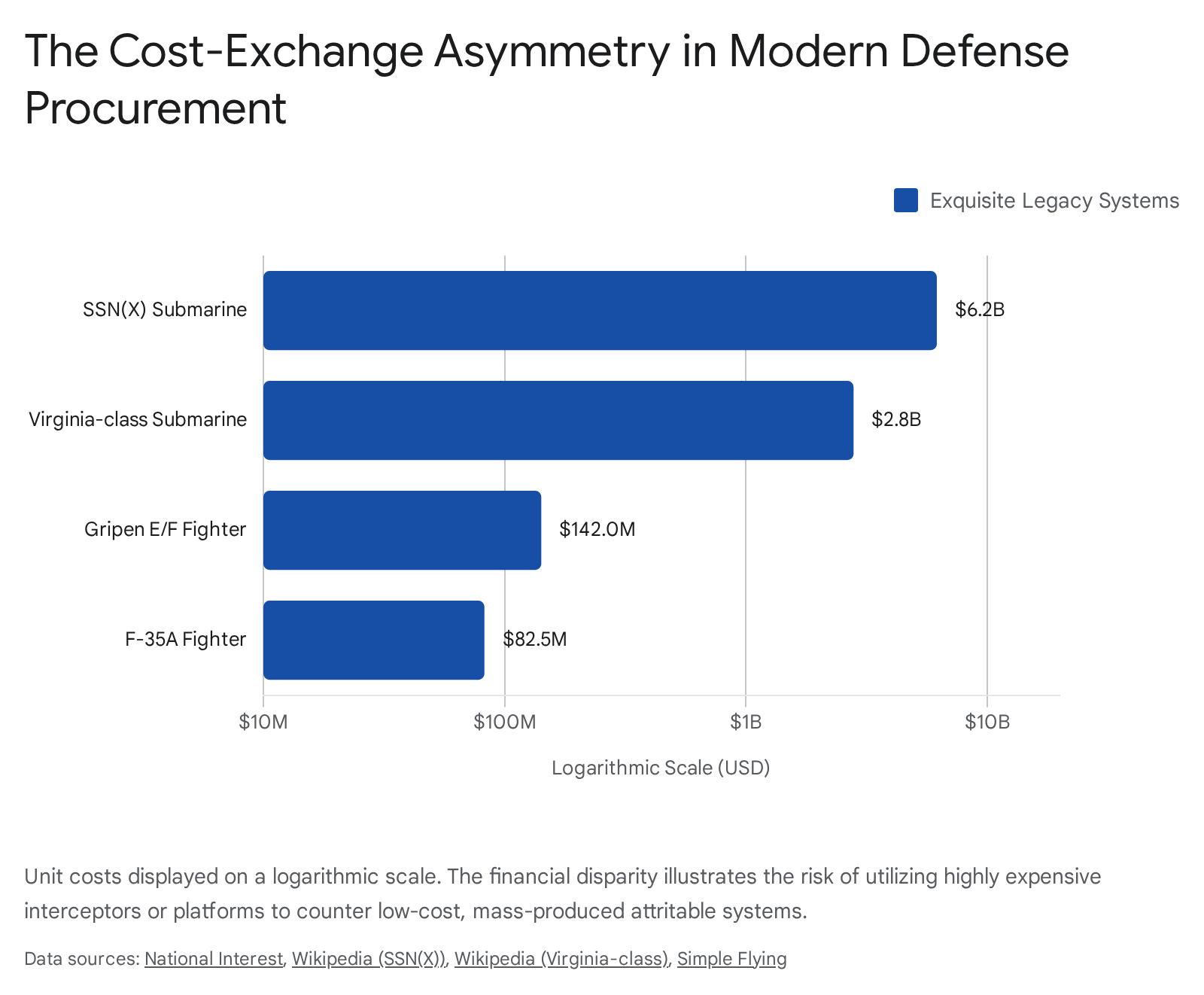
The financial footprint of the current United States legacy systems illustrates this vulnerability clearly. The Fiscal Year 2025 investment funding requested by the Department of Defense totaled $310.7 billion, which included $167.5 billion for procurement and $143.2 billion for research, development, test, and evaluation.8 Within this massive budget, traditional platforms consume the vast majority of resources. For example, the F-35 Lightning II program continues to demand massive capital, with the average flyaway cost for Production Lots 15 through 17 ranging from $82.5 million for the F-35A variant to $109 million for the F-35B variant, and $102.1 million for the F-35C.9 These figures only represent the initial procurement costs, excluding the massive sustainment, maintenance, and upgrade expenses that accompany the lifecycle of the aircraft.9
In the maritime domain, the financial burden of exquisite platforms is even more pronounced. The Virginia-class attack submarine, a cornerstone of United States naval superiority, carries an estimated unit cost ranging from $2.8 billion to $4.3 billion.10 The proposed successor to this platform, the SSN(X) class submarine, is currently facing projected unit costs escalating to between $6.2 billion and $8.0 billion per hull.11 These astronomical costs force the military to procure fewer units, centralizing combat power into highly valuable, tightly concentrated assets. Congress has already shown hesitation to fully back the SSN(X) program due to these staggering costs and industrial base limitations.13
In the era of precise mass, these exquisite assets become prime targets that can be overwhelmed by swarms of autonomous systems.2 Even a nation with the vast economic capacity of the United States possesses finite resources and cannot sustain a protracted conflict against a near-peer adversary if its fundamental unit of combat power requires years to build and billions of dollars to replace.2 Failing to invest in lower-end, attritable capabilities means the military will inevitably lack the depth required for sustained conflict against nation-states.2
2.3 The Necessity of Tactical Synergy
The transition away from an exclusive reliance on exquisite platforms does not imply the complete abandonment of advanced systems. Instead, strategic analysis highlights the necessity of tactical synergy between mass and sophistication. A future force requires attritable systems to overwhelm enemy defenses, generate sensor data across vast geographic areas, and execute localized strikes in highly contested airspace.2 Concurrently, expensive stealthy systems must be retained and utilized to strike principal, high-value targets with absolute confidence.2 However, prioritizing quality at the complete expense of platforms that leverage mass is considered a severe strategic risk.2 The global defense landscape demonstrates that wars today are fought with drones functioning not merely as niche enablers, but as the central instruments of warfare.14 In ongoing global conflicts, attritable drones have become the primary means of reconnaissance and targeting, carrying out continuous strikes that account for the majority of battlefield casualties.14
3.0 Structural Vulnerabilities of the Defense Industrial Base
The architecture of the United States defense industrial base is largely a product of post-Cold War market forces and deliberate government policies. During the 1990s, in response to declining defense budgets, traditional defense prime contractors executed a strategy of massive mergers and acquisitions.4 This consolidation was explicitly intended to optimize peacetime efficiency and handle limited budgets by dominating specific doctrinal domains of warfare.4
3.1 Consolidation and the Legacy Prime Contractor Model
While this consolidation playbook achieved corporate efficiency and stabilized the industrial base during a period of reduced military threat, it resulted in a structural framework that is fundamentally flawed for the current threat environment. The modern defense industrial base is hampered by severe risk aversion, diminished surge capacity, pervasive cost overruns, and routine schedule delays.4 The operating models of these traditional organizations are characterized by prolonged research and development cycles designed to produce the ultimate, flawless platform before fielding it to the operational forces.
This legacy approach inherently results in “vendor lock-in,” a scenario where the government becomes permanently tied to a single supplier for the entire lifecycle of a platform.4 Because traditional primes integrate highly proprietary hardware and software systems, the government cannot easily upgrade specific components using third-party commercial technology.4 In areas such as artificial intelligence, satellite constellations, and unmanned platforms, these traditional firms often fail to invest their own capital into rapidly emerging technologies, relying instead on guaranteed, cost-plus government contracts to fund their research and development efforts.15 As a result, the size and scale of these legacy organizations act as a massive impediment to agility. Their corporate structures are highly incentivized to produce massive, generational platforms that secure decades of sustainment revenue, rather than cheap, expendable hardware or open-architecture software.4
3.2 The Bureaucratic Immune System and Acquisition Paralysis
The structural inertia of the prime contractors is mirrored, and indeed fostered, by the bureaucratic rigidity of the defense establishment itself. The Pentagon’s acquisition system was engineered over decades to manage the procurement of aircraft carriers, strategic bombers, and fighter jets.5 It was not designed to rapidly iterate software code or to procure artificial intelligence models that can become obsolete within months.5 This bureaucratic inertia is deeply embedded in the federal acquisition regulations, which demand extensive requirements gathering, protracted testing phases, and rigid budget cycles.3
Congressional hearings and independent investigations repeatedly demonstrate that the acquisition system is not built to meet a moment where rapid technological change is shifting the very definition of military capability.5 The focus on exquisite systems has created a culture where failure is not tolerated, leading to an extreme aversion to risk that suffocates rapid prototyping and iterative design. When facing adversaries that are rapidly producing missiles, fighters, ships, and drones that appear on par with or superior to United States capabilities, this lack of acquisition speed becomes a critical point of failure.5
3.3 Assessing the Replicator Initiative and the Illusion of Speed
The Department of Defense has recognized this vulnerability and attempted to circumvent it through specialized initiatives. A primary example is the Replicator initiative, announced in August 2023 by Deputy Secretary of Defense Kathleen Hicks.17 The Replicator program was explicitly designed to bypass the traditional “valley of death” in defense procurement, a term describing the gap between successful prototype development and large-scale production contracts.7 The stated mission of the initiative was to field attritable autonomous systems at a scale of multiple thousands, across multiple domains, within an aggressive eighteen to twenty-four month timeframe.17 The Defense Innovation Unit was charged with spearheading this effort, focusing on systems that are small, smart, cheap, and many.17
However, intelligence collected in early 2026 indicates that the bureaucratic “immune system” of the defense establishment is successfully resisting this push for ultimate speed.7 An analysis of twenty-seven publicly disclosed Replicator-related contract awards reveals that the average timeline from initial solicitation to the delivery of the first article is approximately nineteen months.7 While this timeframe technically falls within the original twenty-four-month objective, it is only marginally faster than standard expedited acquisition programs within the traditional system, which often exceed two years.7
The initiative successfully selected different maritime and aerial drones, and associated counter-drone assets for mass domestic manufacturing through its Replicator 1.1 and 1.2 tranches.17 Yet, the program met the letter of its mandate while struggling to deliver the spirit of genuine industrial transformation.7 The reality remains that future conflicts will not reward exquisite reliability or flawless integration, they will reward the ability to generate, lose, and regenerate combat power at industrial speeds.7 The failure to compress the acquisition timeline significantly below the nineteen-month mark suggests that the sheer size and established processes of the military organization remain a profound weakness.
4.0 The Policy Vacuum and Artificial Intelligence Integration Risks
The integration of artificial intelligence into military operations exposes another critical vulnerability stemming from the traditional mindset of the defense establishment. The future of United States military capabilities depends heavily on technologies developed by commercial research laboratories and startups located entirely outside the traditional defense industry ecosystem.3 However, integrating these commercial entities requires navigating a profound policy vacuum regarding artificial intelligence governance and procurement rules.3
4.1 Governance Ambiguity and the Defense Department Mindset
The United States currently operates without comprehensive statutory guardrails set by Congress regarding the use of artificial intelligence in military systems.3 Instead, policy relies on general guidance from the defense establishment calling for “appropriate levels of human judgment”.3 This language is highly ambiguous and leaves critical questions unanswered regarding the ethical and operational boundaries of autonomous systems.3 Because artificial intelligence is increasingly developed by commercial entities, there is a lack of historical precedent and established rules for adapting this commercial technology for military applications, particularly those involving lethal force.3 Consequently, the boundaries for these uses are often left to be negotiated in real-time between government contracting officers and corporate executives, creating massive friction.3
Traditional government contracts are fundamentally not designed to resolve disputes over the basic rules of artificial intelligence use.3 Furthermore, there is a severe lack of baseline safety and governance standards within the Federal Acquisition Regulations that artificial intelligence laboratories must meet before operational integration occurs.3 This ambiguity places immense strain on the agility of the procurement process, as risk-averse contracting officers struggle to evaluate capabilities that do not fit into legacy frameworks.
4.2 The Anthropic Precedent and Supply Chain Risk Designation
The tension between traditional military operating models and commercial technology providers reached a critical and highly public inflection point in early 2026 during a dispute with the artificial intelligence firm Anthropic. Anthropic was a significant partner to the defense establishment, holding a $200 million contract and functioning as the only artificial intelligence company deployed directly on classified military networks.21 However, Anthropic, known for its safety-first principles, sought to retain strict ethical guardrails on its “Claude” model.21 The company pushed for explicit contractual clauses banning the military from using its technology to power fully autonomous lethal weapons or to conduct mass domestic surveillance on civilians.21
The defense establishment, operating under its traditional mandate for absolute control over procured capabilities, demanded unrestricted use of the advanced models for “all lawful purposes”.21 Officials argued that the specific uses Anthropic feared were already regulated by existing military laws of armed conflict and that accepting corporate-mandated ethical limits would set a dangerous precedent for future acquisitions.21 When negotiations reached an impasse, Defense Secretary Pete Hegseth took the unprecedented step of formally designating Anthropic as a “supply chain risk” and ordered the phasing out of the technology from all military networks within six months.21
This incident exposes a fundamental structural weakness in how the massive military organization handles agile commercial partners. The government attempted to utilize procurement authorities originally intended to mitigate espionage threats from foreign adversaries to punish a domestic commercial entity over an ethical and contractual dispute.3This approach threatens to alienate the exact sector the military desperately needs to innovate. If commercial innovators believe that cooperating with the United States government risks their corporate reputation, or exposes them to national security threat designations upon disagreement, they will simply refuse defense contracts.3This chilling effect on Silicon Valley represents a massive risk to the agility of the defense industrial base.
4.3 Programmatic Deficiencies in Software Acquisition
The structural inability to procure modern technology efficiently is further corroborated by government watchdog reports analyzing software and artificial intelligence acquisitions throughout 2024 and 2025.24 Federal agencies reported that their use of artificial intelligence more than doubled during this period, yet they completely lack standardized approaches for acquisition.25
The Government Accountability Office identified several strategic and programmatic challenges facing agencies. A major point of friction involves the dichotomy between agency-directed and vendor-driven approaches.25 In many instances, commercial industry introduces highly capable artificial intelligence systems to defense agencies in the absence of specific military requirements.25 The traditional acquisition system, which relies on the government defining the requirement before soliciting bids, struggles to procure solutions that it did not explicitly invent or request.25
Furthermore, defense agencies struggle with the distinction between buying artificial intelligence as a product versus acquiring it as a service.25 When artificial intelligence is delivered as a service, the vendor provides capabilities and outputs on an ongoing basis, requiring complex, flexible contracts that legacy procurement models handle poorly.25 Agency officials also report immense difficulty in accessing qualified technical experts, such as data scientists, to adequately evaluate contractor proposals, leading to poor understanding of artificial intelligence-related costs.27
Crucially, the Government Accountability Office found that defense agencies were systematically failing to collect or share lessons learned from these novel acquisitions.24 By failing to capture this knowledge, the massive military bureaucracy ensures that the same contractual mistakes and delays are repeated across different branches, severely degrading the overall agility of the enterprise.26
5.0 The Rise of Venture-Backed Defense Technology Disruptors
To counteract the stagnation of traditional prime contractors and the bureaucratic hurdles of the acquisition system, a new generation of defense technology companies has emerged. These disruptors are heavily backed by private venture capital, aiming to fundamentally alter the industrial base.4 Data from 2026 indicates that over $130 billion in private capital has been injected into this sector over recent years, funding companies that prioritize software integration, rapid iteration, and large-scale manufacturing of attritable systems.4
5.1 Agile Capital and the New Operating Model
Firms such as Anduril Industries, Shield AI, Skydio, and Neros Technologies operate on a premise that directly challenges the traditional defense industry mindset. Rather than waiting for complex government requirements and guaranteed cost-plus contracts, these companies utilize agile capital markets to fund the development of prototype systems internally.4 They test these emerging technologies continuously in active field environments to ensure they meet the demands of modern warfare before securing massive government contracts.15
A critical distinction of this new operating model is the championing of a modular open systems architecture.4 Unlike the vendor lock-in strategies of legacy primes, these disruptors build hardware and software that can be integrated via standard government reference interfaces.4 This “plug and play” approach ensures continuous competition among suppliers and allows the military to rapidly upgrade individual components without overhauling entire platforms.4 Furthermore, these technology companies position smaller businesses as vital partners rather than competitors, often bringing dozens of small businesses into their supply chains to foster resilience and diversity.4
Despite their positioning as disruptors, these combined defense technology companies currently account for a fraction of total defense contract awards when compared to the legacy giants.4 The challenge remains whether these agile firms can scale their operations quickly enough to meet the demands of a global conflict.
5.2 Overcoming Manufacturing and Scaling Challenges
While the software-first mentality of these disruptors provides immense agility, they face significant hurdles as they transition into large-scale hardware manufacturing. Most defense technology companies ultimately become hardware companies, and they are now facing the same scaling challenges as their established competitors.29 Maintaining manufacturing speed, ensuring quality control, building resilient supply chains, and acquiring technical machining talent are massive hurdles for rapidly growing startups.29
To overcome these challenges, strategic analysis indicates that these firms must build scaling infrastructure into their initial business plans, moving beyond prototyping into mass production rapidly.29 The establishment of the Office of Strategic Capital within the defense establishment, designed to employ financial tools such as loans and guarantees rather than traditional contracts, aims to support these startups in crossing the manufacturing threshold.15
To fully understand the landscape of this new industrial base, it is essential to map the key disruptors according to their technological focus and operational domains.
| Defense Technology Disruptor | Primary Operational Domain | Core Technological Focus |
| Anduril Industries | Tactical Strike & ISR (Multi-Domain) | Hardware/Software Hybrid (Autonomous platforms & Lattice OS) |
| Shield AI | Air Combat & Tactical Edge | Software/Autonomy Focus (Hivemind AI pilot) |
| Skydio | Tactical ISR (Ground & Air units) | Hardware/Autonomy Focus (GPS-denied navigation) |
| Palantir Technologies | Enterprise Data & Command Architecture | Software Focus (AIP for Defense, secure data meshes) |
| Neros Technologies | Tactical Strike & Kinetic Interception | Hardware Focus (Attritable FPV drones, secure supply chains) |
| Napatree Technology | Counter-UAS (Infrastructure & Unit Defense) | Hardware Focus (Semi-autonomous kinetic interceptors) |
6.0 Validated Capabilities and the Asymmetric Arsenal
Despite the immense bureaucratic friction inherent in the United States military organization, several key vendors have successfully navigated the procurement maze to deliver agile, artificial intelligence-enabled capabilities to the armed forces. A validation pass of current market offerings in 2026 confirms the availability and deployment status of several critical systems designed to enable the “precise mass” doctrine.
6.1 Tactical Intelligence, Surveillance, and Reconnaissance
The demand for organic, unit-level intelligence collection in highly contested, GPS-denied environments has driven massive procurement of small unmanned aerial systems. The traditional military reliance on large, expensive aircraft for intelligence gathering is shifting toward decentralized, attritable platforms.30
A primary vendor satisfying this requirement is(https://www.skydio.com/solutions/national-security/tactical-isr), which currently supplies the Skydio X10D platform. The X10D is fully compliant with the National Defense Authorization Act, carries Blue UAS certification, and is actively available for procurement via GSA Advantage.31 The viability of this platform was definitively proven in March 2026, when the United States Army awarded Skydio a record-setting order exceeding $52 million to procure over 2,500 X10D drones.30 This contract represents the largest small unmanned aircraft system procurement from a single manufacturer in Army history, and notably, the process moved from bid to award in less than seventy-two hours.30
The X10D system delivers world-leading tactical intelligence capabilities directly to the platoon level.34 Crucially, the drone is specifically engineered for environments subjected to severe electronic warfare. It operates without relying on GPS, utilizing onboard navigation cameras and computer vision to map terrain in real time, a feature critical for maintaining flight in contested zones.30 The platform features a multiband radio system that optimizes frequency use to maintain connectivity in high-interference areas, and includes “NightSense” technology for autonomous navigation in total darkness.30 The rapid acquisition of the X10D demonstrates a rare instance of procurement agility, reflecting the immediate operational necessity of these systems.
6.2 Autonomous Strike and Loitering Munitions
To extend lethality beyond the visual line of sight without expending exquisite, multi-million dollar missiles, the military is rapidly adopting autonomous air vehicles capable of executing kinetic strikes. These loitering munitions offer a cost-effective alternative to traditional air support, allowing ground units to prosecute targets at significant ranges.
Anduril Industries has emerged as a dominant provider in this category with its ALTIUS family of autonomous air vehicles, specifically the ALTIUS-600M and ALTIUS-700M.35 The production status and availability of these systems are active, validated by a highly significant $1.1 billion foreign military sale authorization to Taiwan in late 2025 and early 2026.36 This transaction involves the procurement of 1,554 ALTIUS-700M systems specifically designed for attacks against armored targets, alongside 478 ALTIUS-600ISR units.36
The ALTIUS platforms exemplify the modular, attritable design philosophy. They are tube-launched and can be deployed from various ground vehicles, helicopters, naval vessels, and even larger unmanned aircraft like the MQ-9.35 The ALTIUS-700M variant delivers immense kinetic potential, carrying a thirty-three-pound warhead with an operational range of approximately 160 kilometers.35 The smaller ALTIUS-600M carries a nine-pound warhead with similar range capabilities.35 These hardware platforms are tightly integrated with Anduril’s Lattice software, an autonomous sensemaking and command platform that utilizes artificial intelligence to detect and classify threats across domains, drastically reducing the cognitive load on human operators.40
6.3 Artificial Intelligence Pilots and Combat Autonomy
The transition from remote-controlled drones to fully autonomous combat aircraft requires highly sophisticated software capable of executing complex maneuvers and tactical decision-making at machine speed.
(https://shield.ai/) is at the forefront of this software revolution, providing its Hivemind artificial intelligence pilot to the defense establishment.41 The availability of Shield AI’s technology is confirmed by its selection in February 2026 as the mission autonomy provider for the United States Air Force Collaborative Combat Aircraft program.43 Under this critical program, the Hivemind software has been successfully integrated onto Anduril’s Fury aircraft to support system-level testing for future combat operations.43
Hivemind acts as an artificial intelligence pilot that assumes the role of a human operator, enabling unmanned defense systems to sense, decide, and act autonomously.43 Unlike traditional autopilots that follow preplanned routes, Hivemind can dynamically reroute around no-fly zones, engage obstacles, and safely complete missions in degraded environments where communication links are severed and GPS is denied.42 Shield AI also continues to offer the Nova 2 quadcopter, an attritable drone designed for autonomous close-quarters room clearance, and the long-range V-BAT system.41
6.4 The Drone Dominance Program and Kinetic Interception
The proliferation of enemy drones necessitates the deployment of cheap, kinetic interceptors to protect critical infrastructure and combat personnel. Relying on expensive air defense missiles to shoot down commercial quadcopters is an unsustainable strategy. Recognizing this vulnerability, the defense establishment launched the “Drone Dominance” initiative, an iterative $1 billion plan to purchase over 200,000 small, lethal drones by 2027.6 Guided by a “fight tonight” philosophy, the initiative utilizes rapid “Gauntlet” competitions to bypass traditional procurement delays and rapidly award production contracts to commercial vendors.6
The results of the Gauntlet I competition in early 2026 validate the emergence of several highly capable, agile vendors producing National Defense Authorization Act-compliant systems.
(https://www.neros.tech/) secured a top-tier ranking in the Gauntlet competition, earning significant production orders for its systems.47 The company produces the Archer, a first-person view drone built for modular payloads and resilient communications.49 Notably, the Archer is mass-produced utilizing a completely secure, allied supply chain devoid of Chinese components, and has achieved Blue UAS certification.49 To meet the scaling demands of modern conflict, Neros recently announced a £10 million investment to establish a manufacturing headquarters in the United Kingdom, strengthening the industrial base of allied nations.50 Furthermore, Neros has partnered with counter-drone technology firm CX2 to integrate radio-frequency seeking capabilities onto the Archer drone, creating an attritable system capable of autonomously locating and destroying enemy drone operators.51
(https://sam.gov/opp/e488b3bedea847e3af0f481e75f3696e/view) also emerged as a critical vendor through its partnership with Perennial Autonomy to produce the Bumblebee V2 kinetic interceptor.52 Napatree secured a $5.2 million agreement in January 2026 from the Joint Interagency Task Force 401, with deliveries to the Army’s Global Response Force commencing immediately in March.52 The Bumblebee V2 functions as a semi-autonomous interceptor designed to physically collide with hostile small unmanned aircraft systems.52 This drone-on-drone collision method provides a precise, low-collateral damage countermeasure that is essential for protecting troops on the battlefield and infrastructure in populated areas.52
6.5 Enterprise Data Integration and Command Architecture
The ability to deploy thousands of attritable drones is strategically meaningless without a robust, secure enterprise data architecture capable of processing the massive volume of sensor data generated by these systems. Managing swarms and executing distributed operations requires artificial intelligence platforms that can operate across all classification levels and geographic domains.
(https://www.palantir.com/platforms/aip/defense/) provides the foundational software architecture for this requirement through its Artificial Intelligence Platform for Defense.55 The platform enables military organizations to securely activate large language models and advanced analytics on private, classified networks.55 The active procurement and availability of this platform were highlighted during the Army’s “Vantage Edge 2” event in April 2026, where over 300 military personnel utilized Palantir’s tooling to build production-ready artificial intelligence workflows designed to solve real-world operational problems.56
To address the critical issue of data readiness at the tactical edge, Palantir and Anduril formed a strategic consortium in early 2024.57 This partnership aims to integrate Anduril’s tactical hardware with Palantir’s enterprise software, ensuring that data collected by drones and sensors on the battlefield is securely backhauled into government enclaves.57 This data retention is vital for training the next generation of artificial intelligence models, turning raw battlefield information into a sustained asymmetric advantage.57
7.0 Strategic Conclusions and Risk Prognosis
The central inquiry of this intelligence assessment questions whether the vast size and deeply ingrained operating models of the United States military and its traditional contractor base constitute a strategic weakness in preparing for future warfare. The aggregated intelligence and analysis strongly affirm this hypothesis.
The traditional defense apparatus is optimized for a strategic environment that no longer exists. The pursuit of highly integrated, generational weapon systems developed over decades by monopolistic prime contractors has resulted in a fragile force structure. While these exquisite platforms remain technologically superior in isolated, asymmetrical engagements, they are economically and logistically unsuited for the emerging era of precise mass. If a conflict requires the United States to absorb significant equipment losses, the traditional industrial base simply lacks the velocity to regenerate combat power at the speed required to sustain operations.
The emergence of agile, venture-backed technology firms provides the necessary hardware and software to execute an attritable warfare doctrine. These disruptors have proven capable of delivering autonomous intelligence platforms, kinetic interceptors, and robust artificial intelligence architectures at commercial speeds, often utilizing their own capital for research and development. However, the military’s bureaucratic immune system, characterized by rigid procurement cycles, an adversarial approach to dual-use technology governance, and a failure to standardize software acquisition, continuously throttles the integration of these critical capabilities.
The immediate strategic risk facing the United States is not a lack of domestic technological capability or innovation. The true vulnerability is an institutional refusal to fully abandon obsolete acquisition philosophies. To secure an asymmetric advantage in future conflicts, the defense establishment must structurally decentralize its procurement mechanisms, normalize the rapid, continuous acquisition of consumable autonomous systems, and establish stable, statute-driven governance for artificial intelligence that respects the nuances of the commercial technology sector. Failure to implement these structural reforms will ensure that the massive size of the United States military remains its greatest operational vulnerability in the wars of the future.
Please share the link on Facebook, Forums, with colleagues, etc. Your support is much appreciated and if you have any feedback, please email us in**@*********ps.com. If you’d like to request a report or order a reprint, please click here for the corresponding page to open in new tab.
Sources Used
- Defense Industry – Atlantic Council, accessed April 19, 2026, https://www.atlanticcouncil.org/issue/defense-industry/
- Stealth and Scale: Quality, Quantity, and Modern Military Power, accessed April 19, 2026, https://warontherocks.com/2024/12/stealth-and-scale-quality-quantity-and-modern-military-power/
- A policy gap is threatening the Pentagon’s AI innovation pipeline …, accessed April 19, 2026, https://defensescoop.com/2026/03/26/policy-gap-threatening-pentagon-ai-innovation-pipeline/
- Giants and the Myth of America’s New Defense Consolidation, accessed April 19, 2026, https://warontherocks.com/2025/06/giants-and-the-myth-of-americas-new-defense-consolidation/
- Time to Accept Risk in Defense Acquisitions | Council on Foreign Relations, accessed April 19, 2026, https://www.cfr.org/articles/time-accept-risk-defense-acquisitions
- Drone Dominance, accessed April 19, 2026, https://drone-dominance.io/
- The Pentagon’s Replicator Initiatives’ Real Challenge Is Cultural, Not Technical, accessed April 19, 2026, https://www.gotechinsights.com/blog/replicator
- FY 2025 Program Acquisition Cost by Weapon System – Under Secretary of War (Comptroller), accessed April 19, 2026, https://comptroller.war.gov/portals/45/Documents/defbudget/FY2025/FY2025_Weapons.pdf
- How Much Does Lockheed Martin’s F-35 Program Cost In 2026? – Simple Flying, accessed April 19, 2026, https://simpleflying.com/how-much-lockheed-martin-f-35-program-cost-2026/
- Virginia-class submarine – Wikipedia, accessed April 19, 2026, https://en.wikipedia.org/wiki/Virginia-class_submarine
- SSN(X)-class submarine – Wikipedia, accessed April 19, 2026, https://en.wikipedia.org/wiki/SSN(X)-class_submarine
- Too Much for a U.S. Navy Attack Submarine? Meet SSN(X) – The National Interest, accessed April 19, 2026, https://nationalinterest.org/blog/buzz/6200000000-too-much-us-navy-attack-submarine-meet-ssnx-213575
- The Navy’s $8 Billion SSN(X) Stealth Submarine Is Now a Giant Headache – 19FortyFive, accessed April 19, 2026, https://www.19fortyfive.com/2026/02/the-navys-8-billion-ssnx-stealth-submarine-is-now-a-giant-headache/
- The Drone Gap: Why the U.S. Industrial Base Continues to Fall Behind in a World at War by Drone, accessed April 19, 2026, https://www.icitech.org/post/the-drone-gap-why-the-u-s-industrial-base-continues-to-fall-behind-in-a-world-at-war-by-drone
- FOOL’S GOLD: OVERHYPED TECH STARTUPS DISTRACT FROM MILITARY INNOVATION, accessed April 19, 2026, https://warroom.armywarcollege.edu/articles/fools-gold/
- The most innovative defense tech companies of 2026, accessed April 19, 2026, https://www.fastcompany.com/91497105/defense-tech-most-innovative-companies-2026
- DOD touts ‘successful transition’ for Replicator initiative — but questions linger, accessed April 19, 2026, https://defensescoop.com/2025/09/03/dod-replicator-drone-tech-transition-fielding-questions-linger/
- DOD Innovation Official Discusses Progress on Replicator – Department of War, accessed April 19, 2026, https://www.war.gov/News/News-Stories/Article/Article/3999474/dod-innovation-official-discusses-progress-on-replicator/
- Replicator: A Bold New Path for DoD | Center for Security and Emerging Technology %, accessed April 19, 2026, https://cset.georgetown.edu/article/replicator-a-bold-new-path-for-dod/
- The latest news and events from DIU – Defense Innovation Unit, accessed April 19, 2026, https://www.diu.mil/latest?categoryType=news&newsFilter=true
- Pentagon formally designates Anthropic a supply chain risk amid feud over AI guardrails, accessed April 19, 2026, https://www.cbsnews.com/news/pentagon-anthropic-supply-chain-risk-feud-ai-guardrails/
- Media Tip Sheet: Pentagon Threatens “Supply Chain Risk” Label Over AI Guardrails, accessed April 19, 2026, https://mediarelations.gwu.edu/media-tip-sheet-pentagon-threatens-supply-chain-risk-label-over-ai-guardrails
- Pentagon Designates Anthropic a Supply Chain Risk — What Government Contractors Need to Know | Insights | Mayer Brown, accessed April 19, 2026, https://www.mayerbrown.com/en/insights/publications/2026/03/pentagon-designates-anthropic-a-supply-chain-risk-what-government-contractors-need-to-know
- GAO-26-107859, ARTIFICIAL INTELLIGENCE ACQUISITIONS: Agencies Should Collect and Apply Lessons Learned to Improve Future Procure, accessed April 19, 2026, https://www.gao.gov/assets/gao-26-107859.pdf
- GAO-26-107859 Highlights, ARTIFICIAL INTELLIGENCE ACQUISITIONS: Agencies Should Collect and Apply Lessons Learned to Improve Fut, accessed April 19, 2026, https://www.gao.gov/assets/gao-26-107859-highlights.pdf
- GAO-26-107859, ARTIFICIAL INTELLIGENCE ACQUISITIONS: Agencies Should Collect and Apply Lessons Learned to Improve Future Procurements, accessed April 19, 2026, https://files.gao.gov/reports/GAO-26-107859/index.html
- Artificial Intelligence Acquisitions: Agencies Should Collect and Apply Lessons Learned to Improve Future Procurements – GAO, accessed April 19, 2026, https://www.gao.gov/products/gao-26-107859
- GAO: Agencies Must Strengthen AI Procurement Practices by Capturing Lessons Learned – HSToday, accessed April 19, 2026, https://www.hstoday.us/federal-pages/dhs/gao-agencies-must-strengthen-ai-procurement-practices-by-capturing-lessons-learned/
- A rising wave of tech disruptors: The future of defense innovation? – McKinsey, accessed April 19, 2026, https://www.mckinsey.com/industries/aerospace-and-defense/our-insights/a-rising-wave-of-tech-disruptors-the-future-of-defense-innovation
- US Army orders 2500 Skydio drones in record deal – DroneDJ, accessed April 19, 2026, https://dronedj.com/2026/03/24/skydio-us-army-drone-order/
- Military and Tactical Drones | Skydio, accessed April 19, 2026, https://www.skydio.com/solutions/national-security/tactical-isr
- Contracts – Skydio, accessed April 19, 2026, https://www.skydio.com/contracts
- U.S. Army Places $52M Order for 2,500 Skydio X10D ISR Drones for Platoon Reconnaissance, accessed April 19, 2026, https://www.armyrecognition.com/news/army-news/2026/u-s-army-places-52m-order-for-2-500-skydio-x10d-isr-drones-for-platoon-reconnaissance
- U.S. Army Places $52+ Million Order for Skydio X10D, the Largest Single-Vendor Tactical sUAS Order in Army History, accessed April 19, 2026, https://www.skydio.com/blog/u-s-army-usd52-million-order-skydio-x10d
- Altius | Anduril, accessed April 19, 2026, https://www.anduril.com/altius
- Taiwan’s Armed Forces will move forward with the purchase of thousands of ALTIUS 600 and 700 loitering munitions from the U.S – Zona Militar, accessed April 19, 2026, https://www.zona-militar.com/en/2026/01/20/taiwans-armed-forces-will-move-forward-with-the-purchase-of-thousands-of-altius-600-and-700-loitering-munitions-from-the-u-s/
- For US$1.1 billion, the US authorized the sale of thousands of ALTIUS loitering munitions to the Taiwanese Armed Forces – Zona Militar, accessed April 19, 2026, https://www.zona-militar.com/en/2025/12/19/for-us1-1-billion-the-us-authorized-the-sale-of-thousands-of-altius-loitering-munitions-to-the-taiwanese-armed-forces/
- Air Force Buying $50M in Small Drones to Support Special Ops, accessed April 19, 2026, https://www.airandspaceforces.com/air-force-anduril-altius-drones-afsoc-mq-9/
- IAI’s Loitering Munitions Family – Security & Defence European, accessed April 19, 2026, https://euro-sd.com/wp-content/uploads/2023/11/ESD_11_12_2023.pdf
- 9 Innovative AI Companies Shaping The Future of National Security – Karve International, accessed April 19, 2026, https://www.karveinternational.com/insights/9-innovative-ai-companies-shaping-the-future-of-national-security
- Invest in Series Shield AI | StartEngine, accessed April 19, 2026, https://www.startengine.com/offering/shield-ai
- Shield AI, accessed April 19, 2026, https://shield.ai/
- Shield AI selected as mission autonomy provider for the U.S. Air Force Collaborative Combat Aircraft program, accessed April 19, 2026, https://shield.ai/shield-ai-selected-as-mission-autonomy-provider-for-the-u-s-air-force-collaborative-combat-aircraft-program/
- Invest In Shield AI Stock | Buy Pre-IPO Shares – EquityZen, accessed April 19, 2026, https://equityzen.com/company/shieldai/
- Shield AI Stock: $12.7B Valuation — Is It a Buy? | TSG Invest, accessed April 19, 2026, https://tsginvest.com/shield-ai/
- 30000 New Drones: Pentagon Names Winners Of Air Dominance ‘Gauntlet’ – SlashGear, accessed April 19, 2026, https://www.slashgear.com/2133463/pentagon-drone-dominance-initiative-winners/
- Drone Dominance Gauntlet I: Skycutter Tops Leaderboard As Pentagon Prepares $150 Million Attack Drone Order, accessed April 19, 2026, https://dronexl.co/2026/03/06/drone-dominance-program-gauntlet-1-winners/
- Leaderboard – Drone Dominance, accessed April 19, 2026, https://drone-dominance.io/leaderboard.html
- Neros Technologies, accessed April 19, 2026, https://www.neros.tech/
- Neros launches UK subsidiary with up to £10m investment into British defence, accessed April 19, 2026, https://www.neros.tech/articles/neros-launches-uk-subsidiary-with-up-to-ps10m-investment-into-british-defence
- Exclusive: Neros and CX2 Team Up – Tectonic Defense, accessed April 19, 2026, https://www.tectonicdefense.com/exclusive-neros-and-cx2-team-up/
- JIATF-401 acquires advanced kinetic counter-drone system to enhance warfighter lethality, accessed April 19, 2026, https://www.army.mil/article/290392/jiatf_401_acquires_advanced_kinetic_counter_drone_system_to_enhance_warfighter_lethality
- US Army to debut FPV Bumblebee V2 drone interceptor next month – Military Times, accessed April 19, 2026, https://www.militarytimes.com/news/your-military/2026/02/13/us-army-to-debut-fpv-bumblebee-v2-drone-interceptor-next-month/
- Bumblebee drone to bolster US counter-UAS capabilities – Calibre Defence, accessed April 19, 2026, https://www.calibredefence.co.uk/bumblebee-drone-to-bolster-us-counter-uas-capabilities/
- Palantir AIP for Defense, accessed April 19, 2026, https://www.palantir.com/platforms/aip/defense/
- Soldiers Don’t Wait for AI. They Build It. | Article | The United States Army, accessed April 19, 2026, https://www.army.mil/article/291806/soldiers_dont_wait_for_ai_they_build_it
- Anduril and Palantir to Accelerate AI Capabilities for National Security, accessed April 19, 2026, https://investors.palantir.com/news-details/2024/Anduril-and-Palantir-to-Accelerate-AI-Capabilities-for-National-Security/
- Anduril and Palantir to Accelerate AI Capabilities for National Security, accessed April 19, 2026, https://www.anduril.com/news/anduril-and-palantir-to-accelerate-ai-capabilities-for-national-security