
Executive Summary
Overall Fragility Score: 8.8 / 10
Assessed Lifecycle Stage: Stage 3 (Crisis) transitioning rapidly toward Stage 4 (Collapse)
The Islamic Republic of Iran is currently operating within the late, most volatile phases of Stage 3 (Crisis) of the state lifecycle model. The state exhibits an accelerating and arguably irreversible momentum toward Stage 4 (Collapse) within the designated 36-month forecast horizon. State capacity is visibly, severely, and simultaneously impaired across all core functional domains. The convergence of a devastating international conflict, an unprecedented and suffocating United States naval blockade, the assassination of the Supreme Leader, and a domestic climate catastrophe has pushed the complex adaptive system of the Iranian state far beyond its historical resilience thresholds. The state is currently failing to execute its foundational mandate, maintaining order almost exclusively through extreme, unsustainable coercive violence.
Top Key Drivers of Fragility:
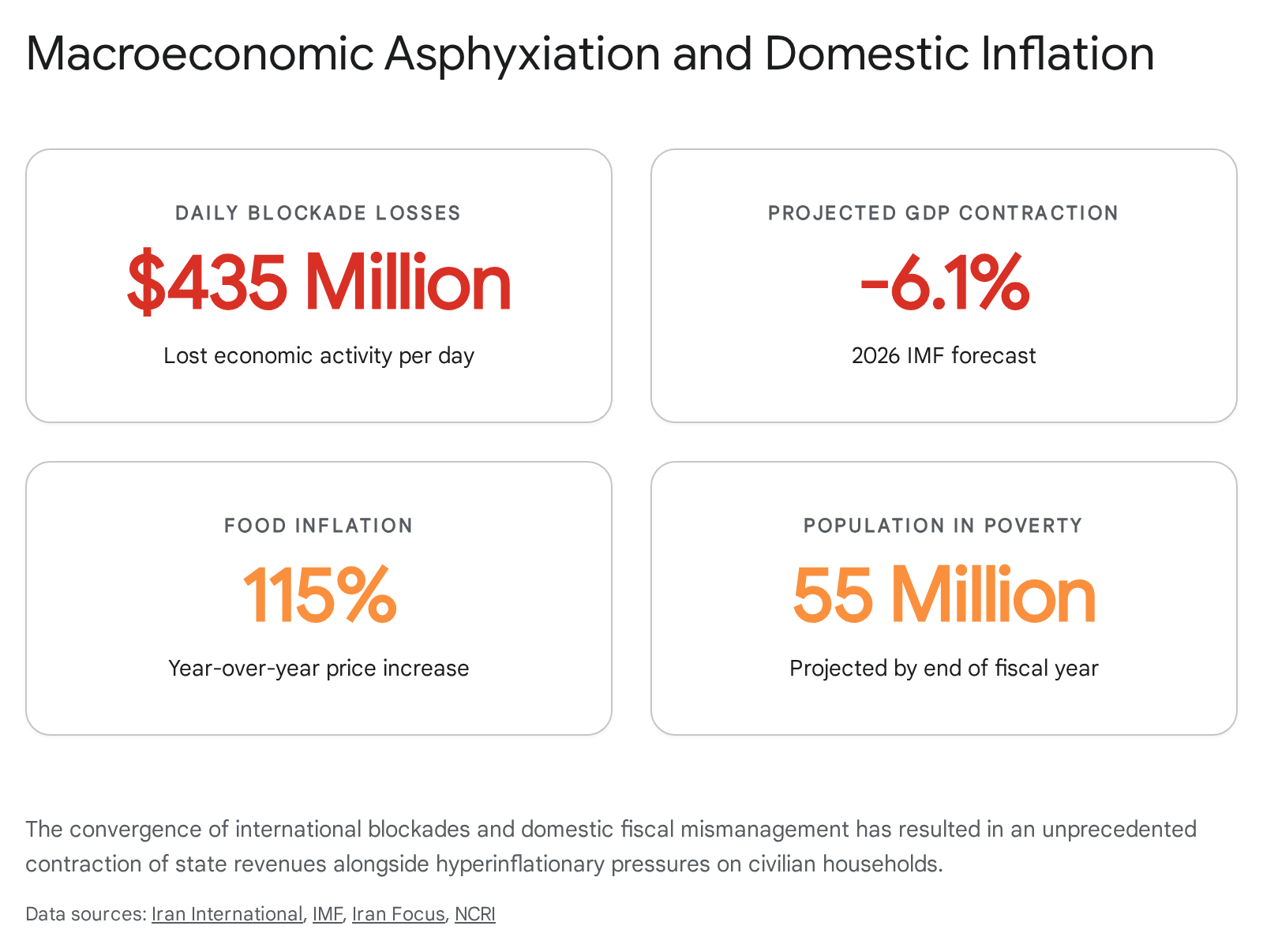
- Macroeconomic Asphyxiation: A comprehensive United States naval blockade is eliminating approximately 435 million dollars in daily economic activity, crippling state revenues, and driving domestic food inflation past the 115 percent threshold.
- Security Apparatus Fracture: Acute logistical shortages, coupled with the systemic hoarding of medical supplies and ammunition by the Islamic Revolutionary Guard Corps, have triggered severe institutional friction, insubordination, and rising desertion rates within the conventional military.
- Leadership Vacuum and Elite Schisms: The targeted killing of Ali Khamenei and the highly contested, opaque succession of his severely injured son, Mojtaba Khamenei, have catalyzed open hostility between the civilian presidency and the military establishment over the strategic direction of the state.
- Existential Resource Depletion: Critical water infrastructure failure has brought the capital city of Tehran, alongside other major urban centers, to the brink of “Day Zero,” raising the immediate specter of mass, unmanageable climate-induced urban evacuation.
Forecast Trajectory:
The systemic trajectory is steeply negative and highly volatile. The compounding nature of the identified systemic shocks indicates that non-linear deterioration is highly probable. Without a rapid diplomatic resolution to external blockades and immediate structural interventions in resource management, the central political authority is projected to lose its monopoly on the legitimate use of violence and territorial control within the forecast period, precipitating a formal transition to a collapse state.
State Fragility Dashboard
| Domain / Indicator | Current Score (1-10) | Trend | Volatility | Weighted Impact | Brief Rationale |
| A.1 Public Finances | 9.0 | Deteriorating | High | 15.0% | Maritime blockade halts trade, zeroing oil export revenues and driving severe budget deficits funded entirely by inflationary currency printing. |
| A.2 Economic Structure | 8.5 | Deteriorating | Medium | 10.0% | Massive human capital flight and parastatal monopolization suffocate civilian productivity and destroy long-term macroeconomic recovery potential. |
| A.3 Household Health | 9.0 | Deteriorating | High | 10.0% | Currency collapse and extreme food inflation force over 55 million citizens below the absolute poverty line, completely dissolving the social contract. |
| B.1 Governance & Law | 8.0 | Deteriorating | High | 10.0% | Opaque succession crisis and Guardian Council electoral engineering erode all remaining pillars of representative legitimacy and public mandate. |
| B.2 State Legitimacy | 8.5 | Static | Low | 10.0% | Public trust is irreparably broken, evidenced by historically low voter turnouts and a complete reliance on extreme coercive violence for survival. |
| B.3 Security Cohesion | 9.5 | Deteriorating | High | 15.0% | Critical institutional rift between the conventional military and the IRGC over resource allocation threatens the state’s monopoly on force. |
| C.1 Social Cohesion | 8.0 | Deteriorating | Medium | 5.0% | Deepening ethnic disenfranchisement in border regions drives up to half of all protest fatalities, risking geographic and territorial fragmentation. |
| C.2 Public Services | 8.5 | Deteriorating | High | 10.0% | Pension fund insolvency and rolling power grid blackouts demonstrate daily, undeniable state failure to the increasingly hostile urban population. |
| D.1 Climate Vulnerability | 9.5 | Deteriorating | Low | 10.0% | Multi-year droughts and extreme heat events threaten the immediate biological habitability of major population and economic centers. |
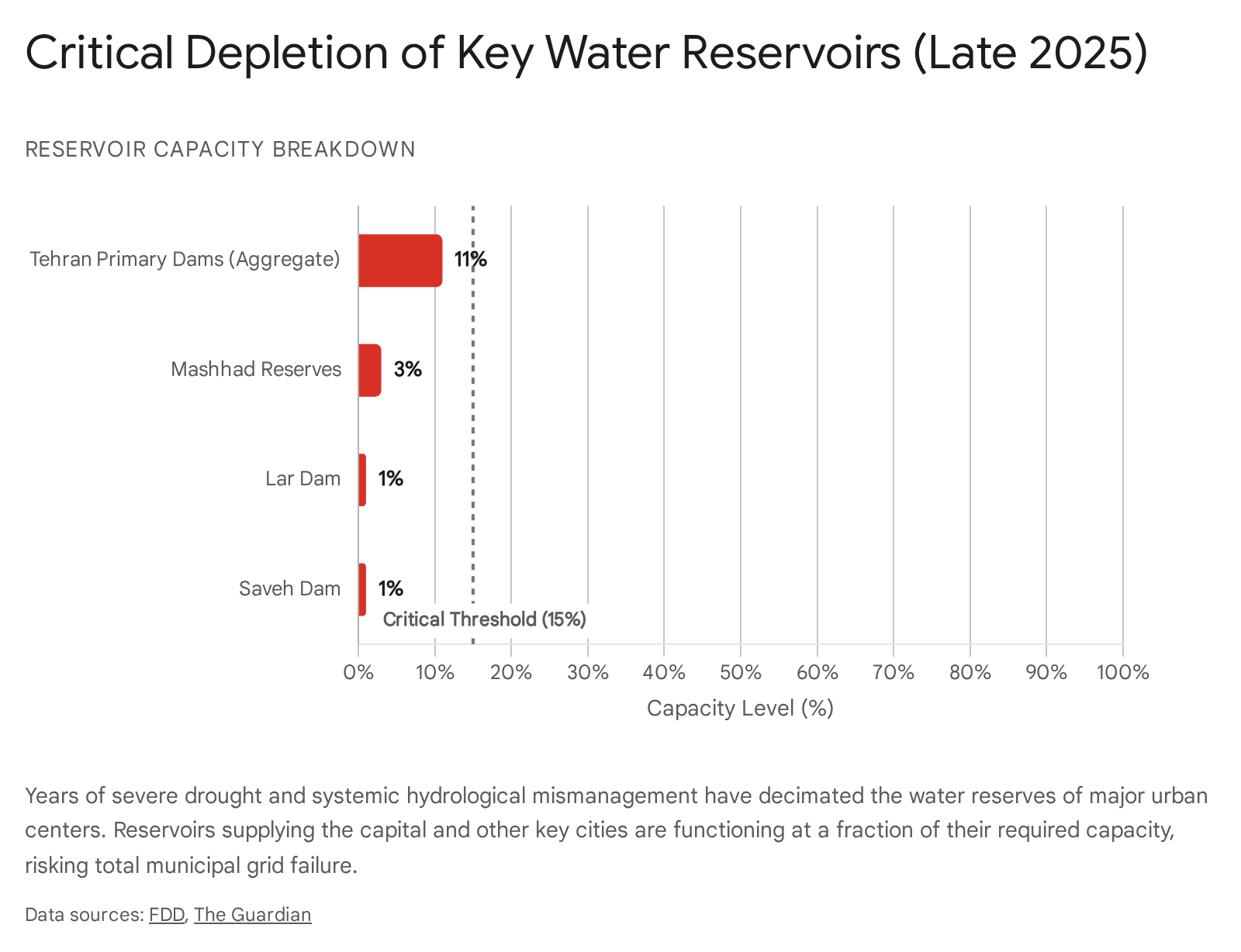
| D.2 Resource Stress | 9.5 | Deteriorating | Low | 5.0% | Primary dam levels operating between 1 percent and 11 percent capacity push Tehran toward Day Zero, ensuring catastrophic internal displacement. |
Detailed Domain Analysis
Module A: Economic Resilience and State Capacity
A.1 Public Finances
The foundational pillar of Iranian macroeconomic stability has been systematically dismantled by an unprecedented United States naval blockade and intense international sanctions. This maritime interdiction campaign has effectively neutralized the state’s capacity to engage in seaborne trade, which historically served as the primary conduit for both licit and illicit revenue generation. Quantitative assessments indicate that the blockade is eliminating an estimated 435 million dollars in daily economic activity.1 Central to this catastrophic contraction is the absolute cessation of crude oil shipments. Prior to the escalation of hostilities, the state successfully exported approximately 1.5 million barrels per day through shadow networks. The truncation of these export volumes deprives the central treasury of roughly 139 million dollars in daily revenue, compounding to a monthly fiscal deficit approaching 13 billion dollars when factoring in broader trade disruptions.2
This absolute revenue collapse has triggered a severe and inescapable “subsidy trap” for the central government. The state is bound by structural, non-discretionary spending pressures to subsidize basic goods for a rapidly impoverishing population to prevent immediate mass starvation and rioting. In a desperate bid to manage the bankrupt treasury, the administration of President Masoud Pezeshkian implemented quarterly fuel price indexing based on refinery costs.3 This mechanism creates an uncontrollable inflationary spiral: as inflation drives up refining costs, retail fuel prices automatically climb every 90 days, which in turn drives up the cost of agricultural transport and basic goods.3
Lacking foreign exchange reserves, the central bank has resorted to printing unbacked currency to cover domestic obligations, resulting in hyperinflationary conditions. The rial has experienced a record devaluation, surging past 1.8 million rials to the United States dollar on the open market 4, while alternative metrics place the exchange rate at a staggering 136,400 tomans.3 The International Monetary Fund projects a severe contraction, with real gross domestic product expected to shrink by 6.1 percent in 2026.5 Meanwhile, the parallel financing of the regional proxy network via shadow banking architectures diverts what little foreign exchange remains directly into the hands of the Islamic Revolutionary Guard Corps and its foreign subsidiaries, further starving the domestic economy.7
- Current State: Critical insolvency. The state is unable to generate sufficient foreign exchange to meet basic import requirements or service domestic subsidy obligations without printing unbacked fiat currency.
- Trajectory (Delta): Rapidly deteriorating. The compounding effects of the blockade and the quarterly fuel indexing mechanism ensure that the fiscal deficit will continue to widen exponentially over the next 12 to 36 months.
- Volatility: Extremely high. The currency markets are subject to wild, daily fluctuations driven by geopolitical developments, rumors of leadership changes, and the unpredictable nature of the ongoing conflict.
A.2 Economic Structure and Productivity
The long-term growth potential of the Iranian economy has been structurally dismantled, transitioning from a developing mixed economy to a heavily militarized, rent-seeking system. The dominance of parastatal organizations and the Islamic Revolutionary Guard Corps has completely crowded out private enterprise. The IRGC operates as the most powerful controller of all important economic sectors across Iran, securing no-bid contracts from the state for servicing the oil sector, developing infrastructure, and controlling consumer imports.8 This monopolization degrades the civilian economy’s ability to compete, innovate, or generate high-wage employment, locking the nation into a cycle of low productivity and high corruption.
Simultaneously, the nation is suffering from an unprecedented and catastrophic human capital flight. Brain drain has reached critical velocity, effectively permanently altering the demographic dividend. Data indicates that an estimated 150,000 to 180,000 scientific professionals left the country between 2007 and 2021, and the exodus has vastly accelerated through 2025 and 2026.9 The return rate for these highly skilled migrants is a mere 1 percent, compared to a global average of 7 percent for similar demographics.9
The demographic profile of this emigration is deeply alarming for state survival: 83 out of 86 recent scientific Olympiad medalists have emigrated, alongside 6,500 medical specialists in a single recent year.9 The healthcare sector is particularly devastated, losing approximately 3,000 nurses annually.9 This represents a massive destruction of state financial investment, as the government spends roughly 68,000 dollars to train each individual nurse.9 The loss of this educated, technically proficient demographic removes the exact cohort necessary for any future economic reconstruction, cementing long-term systemic stagnation regardless of geopolitical outcomes. Consumer price changes underscore this structural failure, with the International Monetary Fund projecting a 68.9 percent inflation rate.5
- Current State: Structurally stagnant and heavily monopolized. The private sector is entirely subjugated to the military-industrial complex, and the technical workforce has largely fled the jurisdiction.
- Trajectory (Delta): Deteriorating. The rate of professional emigration is accelerating, and the IRGC is consolidating its grip on the remaining functional sectors of the economy to fund its survival.
- Volatility: Medium. The structural decay is a steady, linear decline rather than a volatile fluctuation, though sudden spikes in inflation introduce localized market chaos.
A.3 Household Financial Health
The financial health of the average Iranian household is in a state of terminal, irreversible distress. The middle class, once the stabilizing anchor of the republic, has effectively collapsed and merged entirely into the impoverished demographic.10 Internal parliamentary reports and economic analyses indicate that up to 55 million citizens are projected to fall below the absolute poverty line by the end of the current fiscal year.3 Real household disposable income has been decimated by an official food inflation rate documented at 115 percent.9
A highly illustrative metric of this localized financial precarity is the cost of basic caloric sustenance: in downtown Tehran, a single fried egg currently costs one million rials, and a standard hamburger costs five million rials.4 These hyper-inflated costs are juxtaposed against a minimum wage that hovers just above 200 million rials per month, rendering basic survival mathematically impossible for the average wage earner without participating in the informal or illicit economy.4
This absolute financial precarity has fractured the foundational social contract entirely. Systemic, inescapable poverty directly fuels violent sociopolitical unrest, as citizens realize that compliance with the state no longer guarantees baseline survival. The transition from political dissidence to desperate bread riots represents a dangerous shift in the nature of domestic security threats.
- Current State: Catastrophic poverty. The vast majority of the population cannot afford basic sustenance through formal employment channels.
- Trajectory (Delta): Deteriorating. As the central bank continues to monetize debt, purchasing power parity will continue to collapse, pushing millions more into severe malnutrition and poverty.
- Volatility: High. The cost of essential goods fluctuates daily based on the black market exchange rate of the rial, creating immense psychological and financial stress for households.
Module B: Political Legitimacy and Institutional Integrity
B.1 Governance and Rule of Law
Institutional integrity has been fatally compromised by a systemic reliance on exclusionary electoral engineering and an opaque, highly destabilizing succession crisis. The Guardian Council continues to enforce strict, ideologically driven vetting processes, heavily restricting candidate eligibility and ensuring that only absolute loyalists can participate in the political process. During the special presidential election, the council permitted only 6 out of 80 potential candidates to run, deliberately engineering a loyalist outcome.11 This “legitimacy deficit dilemma” dictates that as the state faces rising public rejection, it relies increasingly on exclusionary tactics, thereby accelerating the public’s alienation and driving voter turnout to the lowest levels recorded in the history of the republic.11
Following the assassination of Supreme Leader Ali Khamenei in a targeted airstrike in February 2026 12, the state entered a critical, perilous power vacuum. The subsequent rapid election of his son, Mojtaba Khamenei, by the Assembly of Experts 13 has triggered widespread questions of legitimacy and systemic stability. Mojtaba lacks formal administrative experience and possesses modest theological credentials, blatantly violating the regime’s historical aversion to hereditary rule, which was a core ideological pillar of the 1979 revolution.14 Furthermore, Mojtaba was reportedly injured during the strikes and has not been seen in public, forcing the state into a highly defensive media posture to deny persistent rumors of his death or permanent incapacitation.16
This vacuum has catalyzed extreme elite fragmentation. The civilian government, led by President Masoud Pezeshkian, is currently engaged in a severe, open factional conflict with the military establishment, specifically IRGC Chief Commander Ahmad Vahidi.18 Pezeshkian has demanded a return of executive powers to his civilian administration to manage the economic collapse, explicitly warning that without a ceasefire, the economy faces total ruin within weeks.18 Vahidi has rejected these demands outright, blaming the civilian government for failing to implement structural reforms and effectively taking control of the state’s negotiating posture.18 This elite fragmentation paralyzes the state apparatus at the exact moment when unified, decisive action is required to manage compounding existential crises.
- Current State: Severely compromised and fractured. The central authority is divided, the succession is contested, and electoral legitimacy is entirely absent.
- Trajectory (Delta): Deteriorating. The open conflict between the presidency and the IRGC is escalating, moving from private bureaucratic struggles to public denunciations.
- Volatility: High. The unconfirmed physical status of the new Supreme Leader introduces massive unpredictability into the daily functioning of the state.
B.2 State Legitimacy and Public Trust
Public trust in the state apparatus, the clerical establishment, and the judiciary has collapsed entirely. The regime relies almost exclusively on ideological narrative control and the immediate threat of lethal force to maintain superficial domestic order. The state’s perceived efficacy is at an absolute nadir, driven by its inability to protect its own leadership, defend its airspace, or provide basic economic stability.
To maintain control over the domestic narrative and prevent dissident coordination, the state enforced a draconian 53-day internet blackout.21 This blackout, the longest nationwide disruption recorded, cost the already fragile economy an estimated 1.8 billion dollars and further alienated the business and youth demographics.21 The framing of internal politics as a struggle between “moderates” and “hardliners” is increasingly viewed by the public as a false dichotomy engineered to preserve the system rather than reform it.22 The public recognizes that the state no longer governs; it merely occupies.
- Current State: Trust is non-existent. The state is viewed universally as a hostile, occupying force by the majority of the civilian population.
- Trajectory (Delta): Static. Trust has already reached absolute zero; it cannot materially degrade further, it can only manifest in increasingly violent resistance.
- Volatility: Low. The population’s complete rejection of the state’s foundational mandate is a hardened, universally accepted reality.
B.3 Security Apparatus Cohesion
The state’s monopoly on the legitimate use of force is actively and dangerously deteriorating. The cohesion of the security apparatus is breaking down along deep institutional fault lines, specifically between the conventional military (Artesh) and the Islamic Revolutionary Guard Corps.
An organizational mapping of the Iranian power structure reveals severe, arguably terminal, institutional friction. The Supreme Leader, currently injured and operating opaquely, sits atop a fractured hierarchy. Parallel state institutions are increasingly adversarial. The IRGC has established absolute resource dominance, maintaining a firm grip on internal security functions, shadow revenues, and military logistics. This has marginalized the civilian Presidency, which finds itself sidelined despite desperate demands for a return of executive power to manage the macroeconomic collapse. Most critically, the connection between the IRGC and the conventional military, the Artesh, has been effectively severed by logistical refusal.
Reports from the frontlines indicate acute supply shortages and rising desertions within the regular army.23 The most critical and incendiary flashpoint involves medical support: IRGC personnel have reportedly explicitly refused to transport wounded Artesh soldiers to hospitals, citing fabricated shortages of ambulances and blood supplies, despite having clear access to functional medical facilities.23 This callous refusal has deepened intense anger and resentment between the personnel of the two forces.
Furthermore, frontline Artesh units have reported receiving as few as 10 rounds of ammunition per soldier, leaving them entirely exposed.23 The severe disparity in resources, combined with the undeniable perception of neglect and expendability by IRGC commanders, has prompted mass desertions among conventional forces.23 The systemic risk here is extreme: if the Artesh fully fractures, or formally refuses to suppress domestic protests out of resentment toward the IRGC, the regime’s coercive backbone will snap. The state’s survival currently relies entirely on its ability to suppress dissent violently; the loss of the Artesh removes the manpower necessary to execute this strategy, directly triggering a Stage 4 Collapse.
- Current State: Highly fractured and antagonistic. The two primary pillars of state security are engaged in active logistical warfare against one another.
- Trajectory (Delta): Deteriorating rapidly. Desertions are increasing, and mutual resentment is hardening into institutional hatred.
- Volatility: High. A single mass casualty event involving unsupported Artesh troops could trigger a formalized, battalion-level mutiny overnight.
Module C: Social Cohesion and Human Development
C.1 Social Fragmentation
Social cohesion within the borders of the Islamic Republic has fractured along deep, cross-cutting ethnic and generational cleavages. The regime’s historical reliance on a Persian-centric, orthodox Shiite nationalism has fundamentally alienated significant minority populations residing in the geographic periphery of the state.
During recent, sustained protest waves, fatalities in the ethnic minority regions, specifically the Kurdish provinces and the Baluch regions in Sistan and Baluchestan, accounted for a staggering 40 to 50 percent of the roughly 500 civilians killed nationwide.25 The state views these minority groups not merely as domestic dissidents requesting reform, but as existential, armed threats capable of geographical secession. Security forces have launched targeted, brutal repression campaigns in these areas, including arbitrary detentions, mass executions, and the heavy militarization of the borders.25
This intense, ethnically targeted persecution ensures that any future uprising will possess a strong separatist or federalist character. The generational divide further exacerbates this fragmentation, with a highly connected, secular-leaning youth population entirely rejecting the theocratic strictures of an aging clerical elite. The state lacks any unifying national narrative capable of bridging these divides, relying instead on the threat of foreign invasion to manufacture temporary, fragile unity.
- Current State: Deeply fragmented and hostile. Peripheral ethnic regions are highly militarized and alienated from the central Persian authority.
- Trajectory (Delta): Deteriorating. State violence specifically targeting minority groups is radicalizing formerly moderate populations toward armed separatism.
- Volatility: Medium. Ethnic unrest flares predictably in response to state executions or economic shocks.
C.2 Public Services and Welfare
The state’s capacity to deliver core public services has evaporated, providing daily, tangible, and undeniable reminders of governance failure to the urban population. The national pension system is effectively insolvent, destroying the livelihoods of the elderly demographic. In the 2025 fiscal year, the government failed entirely to settle legally mandated debts to the Social Security Organization. Of a required 200 trillion tomans, the state approved only 185 trillion, and realized a mere 70 trillion in heavily discounted bonds.29 This catastrophic shortfall has severely reduced healthcare access for pensioners, prompting retirees to hold dozens of coordinated protests across multiple cities to demand basic survival stipends.29
The healthcare system itself is collapsing under the weight of economic ruin and brain drain. Working conditions have deteriorated to the point where fully employed medical professionals are unable to afford basic housing. Reports confirm that nurses in Tehran are rendered homeless by hyperinflation, forced to sleep in their personal vehicles between grueling shifts and use hospital facilities for basic hygiene.9
Furthermore, the state has struggled to maintain basic municipal infrastructure. Energy facilities have sustained damage, and despite official claims of grid stability, the energy ministry has warned of imminent, severe summer power cuts and brownouts.30 These rolling blackouts place massive physical stress on populations facing extreme heat, spoiling scarce food supplies and paralyzing what remains of the commercial economy.
- Current State: Failing. Core municipal and welfare services are either insolvent or operating severely below required capacity.
- Trajectory (Delta): Deteriorating. The state lacks the capital to repair the power grid or inject liquidity into the pension funds.
- Volatility: High. Service interruptions, such as sudden blackouts or delayed pension checks, act as immediate, unpredictable catalysts for street protests.
Module D: Environmental and Resource Security
D.1 Climate Change Vulnerability
Iran faces an immediate, existential threat from climate-driven environmental collapse, which acts as a massive threat multiplier across all other domains. The nation is currently experiencing unprecedented, multi-year droughts that have severely depleted both surface water and deep groundwater reserves.
Research indicates that temperatures in Iranian cities have risen twice as fast as the global average between 1990 and 2022.31 The combination of extreme heat events and absolute water scarcity threatens the fundamental biological habitability of massive urban centers. The agricultural sector, entirely reliant on predictable precipitation and groundwater extraction, has been decimated, forcing the state to rely heavily on expensive food imports precisely when the naval blockade has cut off foreign exchange capabilities. The state possesses virtually zero capacity for proactive water infrastructure adaptation, having exhausted its capital on military expenditures.
- Current State: Highly vulnerable and actively degrading. The climate has shifted beyond the parameters that historical Iranian infrastructure was built to handle.
- Trajectory (Delta): Deteriorating. Temperature baselines continue to rise, and precipitation levels continue to fall below historical averages.
- Volatility: Low. The warming trend and drought are persistent, long-term realities with little to no fluctuation toward positive outcomes.
D.2 Resource Stress and Environmental Degradation
Decades of systemic, hubristic resource mismanagement, characterized by a state-sponsored mania for megaprojects, poorly planned dam building, deep wells, and inter-basin water transfers, have resulted in absolute, undeniable water bankruptcy.32 The ancient qanat underground aquifer systems, which sustained life on the plateau for millennia, have been abandoned or destroyed by industrial pumping.31 This depletion has led to massive, irreversible land subsidence that is actively cracking buildings, collapsing highways, and destroying infrastructure in historic cities like Isfahan and Yazd.33
Critical, world-renowned ecosystems have been eradicated: Lake Urmia has lost over 90 percent of its surface area, transforming into vast salt marshes that generate toxic, agricultural-destroying dust storms across the northwest, while the Zayandeh Rud river regularly runs completely dry.33
The immediate, existential crisis is localized in the nation’s largest population centers. Major dams supplying vital drinking water to Tehran, Tabriz, and Mashhad are approaching total depletion. By late 2025, the Lar Dam and the Saveh Dam had fallen to a catastrophic 1 percent capacity.35 The five primary dams supplying Tehran were collectively operating at just 11 percent capacity.31
This depletion has brought the capital city of over 10 million people to the absolute brink of “Day Zero”, the defined point at which municipal water systems cease to function entirely and taps run permanently dry.31 Taps in southern Tehran have already run dry, and nightly pressure cuts are standard operating procedure.31 President Pezeshkian has explicitly and publicly warned that if the drought continues without relief, the state will be forced to attempt the evacuation of the capital.31 The logistical impossibility of evacuating 10 million people in a state experiencing a fuel crisis and hyperinflation guarantees catastrophic loss of life and total state collapse.
- Current State: Terminal resource depletion. The hydrology of the state has been broken, and municipal reserves are exhausted.
- Trajectory (Delta): Deteriorating. Without massive, unprecedented rainfall, the reservoirs will hit absolute zero within the forecast period.
- Volatility: Low. The drying of the reservoirs is a mathematical certainty based on current consumption and evaporation rates.
Synthesis and Predictive Outlook
Dynamic Weighting Algorithm
To accurately predict the trajectory of the Iranian state, the impact of the analyzed indicators must be dynamically weighted based on its current position deep within Stage 3 (Crisis). The algorithm rejects static weighting models. In a stable system, long-term environmental sustainability and structural economic indicators carry balanced weight. However, in a severe, late-stage crisis state, immediate survival mechanics dictate state viability. Therefore, the weighting rationale aggressively prioritizes metrics that directly dictate the state’s day-to-day capacity to suppress unrest and fund its most basic, immediate operations.
The analytical weighting is distributed as follows:
- Module A (Economic Resilience) and Module B (Political Legitimacy and Security Cohesion) are weighted heavily at 35 percent each. The immediate loss of state revenue due to the blockade and the active fracturing of the security apparatus are the most rapid, lethal vectors for state collapse. If the state cannot pay its security forces, or if those forces mutiny, the state ceases to exist immediately.
- Module D (Environmental Security) is weighted at 15 percent. While environmental degradation is typically a slow-moving, long-term indicator, the sheer imminence of “Day Zero” in Tehran alters the calculus. This acts as a direct, near-term catalyst for systemic failure, elevating its immediate importance in the 36-month horizon.
- Module C (Social Cohesion) is weighted at 15 percent. The social contract is already thoroughly broken; intense public unrest is a constant, established baseline. The critical variable is no longer whether the public will rebel, but whether the state retains the financial and coercive means to suppress them.
Feedback Loop and Cascade Failure Analysis
The Iranian state is currently trapped in multiple reinforcing feedback loops, widely known in systems dynamics as vicious cycles, that are exponentially accelerating its decline toward a Stage 4 Collapse. A systems dynamic causal loop mapping of these crises reveals three distinct, highly interconnected cycles.
- The Water Mismanagement and Unrest Loop (The Environmental Cycle):
Decades of state policy prioritizing water-intensive agriculture and corrupt dam construction permanently depleted rural aquifers. This induced water bankruptcy destroys rural agricultural livelihoods, forcing desperate farmers to migrate into already overburdened urban centers like Tehran and Mashhad. This massive, unplanned demographic influx drastically strains municipal infrastructure, accelerating the depletion of city reservoirs toward Day Zero. The lack of basic resources sparks intense, desperate urban protests. The state responds with violent suppression, depleting finite security resources and completely destroying public trust, while failing entirely to address the root hydrological crisis, ensuring the cycle repeats with increased severity the following season. - The Subsidy and Hyperinflation Trap (The Economic Cycle):
The international naval blockade has eliminated the state’s primary source of foreign exchange and trade revenue. To prevent immediate mass starvation and nationwide rioting, the state is forced to maintain massive subsidies on food and fuel. Lacking real revenue, the central bank prints unbacked currency to fund these non-discretionary obligations. This vastly expands the money supply, resulting in immediate hyperinflation and currency devaluation. The devaluation increases the real cost of importing basic goods and refining fuel, which in turn demands exponentially higher subsidies. This loop destroys the purchasing power of the population, driving the middle class into absolute poverty and increasing the frequency of economic protests, feeding back into the need for more subsidies. - The Coercion and Fragmentation Loop (The Security Cycle):
As domestic unrest and economic failure mount, the civilian government loses all effectiveness and legitimacy, forcing the regime to rely entirely on the Islamic Revolutionary Guard Corps for basic survival. This reliance elevates the IRGC’s political and economic power, allowing them to hoard shrinking state resources, weaponry, and critical medical supplies. This hoarding deprives the conventional military (Artesh) of basic operational necessities. The resulting logistical starvation leads to plummeting morale, severe institutional friction, and mass desertions within the regular army. As the Artesh weakens or actively mutinies, the state’s overall capacity to project force diminishes, forcing the IRGC to stretch its own loyalist forces thinner across multiple crisis zones, thereby exponentially increasing the likelihood of a successful localized uprising that the state cannot suppress.
These three loops intersect at the critical node of urban resource strain and civil unrest, creating an accelerating, inescapable vortex of state failure.
Scenario Modeling and Tipping Points
Reasonable Worst-Case Scenario (36-Month Horizon):
By the summer of 2027, the combination of the sustained United States naval blockade and an unmitigated, record-breaking drought triggers “Day Zero” in Tehran. The municipal water grid fails completely for a metropolitan population of over 10 million residents. The civilian government’s panicked attempts to organize a systematic evacuation collapse immediately due to severe fuel shortages and hyperinflationary paralysis. Mass, desperate riots over drinking water erupt across the capital and secondary cities like Mashhad and Tabriz.
The IRGC attempts to violently suppress the riots to protect the regime core, but finds its ranks fatigued, under-supplied, and spread too thinly across the vast geography of the unrest. The IRGC commands the Artesh to deploy lethal force against unarmed civilians to maintain order. The Artesh, already suffering from extreme logistical deprivation, deep resentment toward the IRGC’s hoarding of medical supplies, and profound ideological alignment with the suffering populace, formally mutinies. Units of the Artesh refuse orders and engage in direct, sustained firefights with IRGC forces in the streets of Tehran to protect civilian populations.
Simultaneously, heavily armed ethnic minority groups in Sistan, Baluchestan, and Kurdistan seize upon the chaos in the capital to expel weakened, distracted security forces from their peripheral provinces, formally declaring autonomous, self-governing zones. The central government loses its monopoly on violence and territorial control. Supreme Leader Mojtaba Khamenei, unable to project authority, is either ousted by a military junta or completely isolated in a fortified bunker. The Islamic Republic formally transitions into Stage 4 (Collapse), resembling a fractured, warlord-dominated geography with competing centers of power, collapsed infrastructure, and massive outbound refugee flows destabilizing neighboring states.
Key Tipping Points:
- Economic: The official food inflation rate breaches 200 percent, or the state formally defaults entirely on pension payments, triggering the permanent defection of the remaining bureaucratic class and transitioning the crisis from political protests to pure survival-driven resource riots.
- Environmental: The water reserves of the Lar, Saveh, or primary Tehran dams drop to absolute zero, triggering systemic, unrecoverable municipal grid failure in the capital.
- Political: Independent confirmation of Mojtaba Khamenei’s permanent incapacitation or death, sparking an open, violent succession war between competing IRGC factions and the remnants of the civilian presidency.
- Security: A formalized battalion-level mutiny within the Artesh, or recorded, verified instances of Artesh personnel engaging in sustained, organized firefights with IRGC or Basij units over resource distribution or civilian protection.
Appendix: Methodology
The methodology utilized for this predictive modeling relies strictly on a Systems Dynamic Framework. This advanced analytical approach rejects traditional, linear, isolated indicator analysis, recognizing instead that state fragility is an emergent property of a complex, adaptive system characterized by continuous interactions across economic, political, social, and environmental domains.
The analysis synthesizes highly distinct, seemingly disparate data points to identify causal linkages and amplifying feedback loops. For example, the critical assessment of the Artesh and IRGC friction was derived not merely from tracking isolated desertion rates, but by correlating those desertion metrics with localized logistical deprivation and the deliberate hoarding of medical supplies during periods of heightened operational tempo and domestic unrest. Similarly, macroeconomic hyperinflation was evaluated not merely as an isolated monetary phenomenon governed by central bank policy, but as a direct, inescapable consequence of the state’s inability to fund the foundational social contract under the crushing pressure of a maritime blockade and a collapsing industrial base.
The dynamic weighting algorithm was calibrated specifically to the defined parameters of a “Stage 3: Crisis” lifecycle phase, ensuring that the predictive modeling accurately reflects the immediate survival mechanics of a state on the brink of total failure, rather than applying peacetime metrics to a wartime environment.
Please share the link on Facebook, Forums, with colleagues, etc. Your support is much appreciated and if you have any feedback, please email us in**@*********ps.com. If you’d like to request a report or order a reprint, please click here for the corresponding page to open in new tab.
Sources Used
- Has the U.S.-imposed blockade on Iran been effective? – Connecticut Public Radio, accessed May 5, 2026, https://www.ctpublic.org/2026-05-04/has-the-u-s-imposed-blockade-on-iran-been-effective
- What the US naval blockade would mean for Iran’s economy, accessed May 5, 2026, https://www.iranintl.com/en/202604135100
- Iran’s Polycrisis: A Regime Entrapped by a Convergence of Failures …, accessed May 5, 2026, https://www.ncr-iran.org/en/news/economy/irans-polycrisis-a-regime-entrapped-by-a-convergence-of-failures/
- Even state media sounds alarm as Iran’s economy sinks, accessed May 5, 2026, https://www.iranintl.com/en/202604294396
- Islamic Republic of Iran and the IMF, accessed May 5, 2026, https://www.imf.org/en/countries/irn
- Iran – IMF DataMapper, accessed May 5, 2026, https://www.imf.org/external/datamapper/profile/IRN
- Economic Fury Targets Iran Shadow Banking Facilitators | U.S. Department of the Treasury, accessed May 5, 2026, https://home.treasury.gov/news/press-releases/sb0477
- The Islamic Revolutionary Guard Corps (IRGC) | Council on Foreign …, accessed May 5, 2026, https://www.cfr.org/backgrounders/irans-revolutionary-guards
- Iran’s Brain Drain Crisis: How Corruption and Repression Are …, accessed May 5, 2026, https://iranfocus.com/economy/54492-irans-brain-drain-crisis-how-corruption-and-repression-are-driving-a-generation-away/
- Iran’s Political Instability: Capital and Brain Drain – Jewish Journal, accessed May 5, 2026, https://jewishjournal.com/commentary/opinion/383295/irans-political-instability-capital-and-brain-drain/
- Iran’s Presidential ‘Election’ Seeks to Consolidate Regime’s Control – FDD, accessed May 5, 2026, https://www.fdd.org/analysis/2024/06/22/irans-presidential-election-seeks-to-consolidate-regimes-control/
- Assassination of Ali Khamenei – Wikipedia, accessed May 5, 2026, https://en.wikipedia.org/wiki/Assassination_of_Ali_Khamenei
- 2026 Iran war – Wikipedia, accessed May 5, 2026, https://en.wikipedia.org/wiki/2026_Iran_war
- Mojtaba Khamenei front-runner for supreme leader – bne IntelliNews, accessed May 5, 2026, https://www.intellinews.com/mojtaba-khamenei-front-runner-for-supreme-leader-429626/
- After Khamenei: Planning for Iran’s Leadership Transition | Council on Foreign Relations, accessed May 5, 2026, https://www.cfr.org/reports/leadership-transition-in-iran
- Is Iran regime losing control? Khamenei rumors fuel command crisis, expert says, accessed May 5, 2026, https://www.jpost.com/israel-news/article-895187
- Beyond The Blackout, Who Really Runs Iran Now? – OpEd – Eurasia Review, accessed May 5, 2026, https://www.eurasiareview.com/04052026-beyond-the-blackout-who-really-runs-iran-now-oped/
- Rift deepens between Iran’s president and Guards chief over war, economy, accessed May 5, 2026, https://www.iranintl.com/en/202603288722
- A clash has broken out between ruling factions in Iran; shadow leader overthrows Mojtaba Khamenei – YouTube, accessed May 5, 2026, https://www.youtube.com/watch?v=wQtkVOFueaI
- Iran Update Special Report, April 18, 2026 | ISW, accessed May 5, 2026, https://understandingwar.org/research/middle-east/iran-update-special-report-april-18-2026/
- 2026 Internet blackout in Iran – Wikipedia, accessed May 5, 2026, https://en.wikipedia.org/wiki/2026_Internet_blackout_in_Iran
- War shadow lays bare divisions among Iran’s clerics, accessed May 5, 2026, https://www.iranintl.com/en/202605049026
- Desertions, Supply Shortages, and Fractures Between the Army and …, accessed May 5, 2026, https://militarnyi.com/en/blogs/desertions-fractures-army-irgc-iran-war/
- Desertions, shortages and army-IRGC rift strain Iran’s military | Iran …, accessed May 5, 2026, https://www.iranintl.com/en/202603127596
- Iran: Freedom in the World 2026 Country Report, accessed May 5, 2026, https://freedomhouse.org/country/iran/freedom-world/2026
- A geography of protest: Inside the rise of Iran’s minority factor – Atlantic Council, accessed May 5, 2026, https://www.atlanticcouncil.org/blogs/menasource/a-geography-of-protest-inside-the-rise-of-irans-minority-factor/
- Iran’s Fear of Kurdish Opposition and the Potential of an Internal Uprising – Fair Observer, accessed May 5, 2026, https://www.fairobserver.com/world-news/middle-east-news/irans-fear-of-kurdish-opposition-and-the-potential-of-an-internal-uprising/
- Punishing Vulnerability: Iran’s Minority Crackdown After the 12-Day War, accessed May 5, 2026, https://newlinesinstitute.org/middle-east-center/punishing-vulnerability-irans-minority-crackdown-after-the-12-day-war/
- Iran’s Pensioners Face Deepening Livelihood and Healthcare Crisis …, accessed May 5, 2026, https://irannewsupdate.com/news/society/irans-pensioners-face-deepening-livelihood-and-healthcare-crisis/
- Iran’s power grid stable but energy minister warns of summer pressure after war damage, accessed May 5, 2026, https://www.intellinews.com/iran-s-power-grid-stable-but-energy-minister-warns-of-summer-pressure-after-war-damage-436304/
- How ‘day zero’ water shortages in Iran are fuelling protests | Iran …, accessed May 5, 2026, https://www.theguardian.com/world/2026/jan/15/how-day-zero-water-shortages-in-iran-are-fuelling-protests
- Iran’s Water Crisis Is Its Greatest Threat – TIME, accessed May 5, 2026, https://time.com/7321571/iran-water-crisis-greatest-threat/
- Water and Security in the Middle East: Lessons from the Iranian Crisis – Resilience.org, accessed May 5, 2026, https://www.resilience.org/stories/2026-03-05/water-and-security-in-the-middle-east-lessons-from-the-iranian-crisis/
- Iran’s capital faces unprecedented water shortages and even possible evacuation. What changes could help?, accessed May 5, 2026, https://www.citystgeorges.ac.uk/news-and-events/news/2025/december/iran-water-shortages
- Seeing Iran’s Environmental Crisis Clearly: People Are Paying the …, accessed May 5, 2026, https://www.fdd.org/analysis/2026/02/20/seeing-irans-environmental-crisis-clearly-people-are-paying-the-price-for-the-islamic-republics-failures/
- Tehran’s “Day Zero”: A Threat or an Opportunity to Revive Water Governance and Adaptive Water Policy Making in Iran? | Al Jazeera Centre for Studies, accessed May 5, 2026, https://studies.aljazeera.net/en/analyses/tehran%E2%80%99s-%E2%80%9Cday-zero%E2%80%9D-threat-or-opportunity-revive-water-governance-and-adaptive-water
- Iranian President Warns Tehran May Have to Evacuate If Water Crisis Persists, accessed May 5, 2026, https://caspiannews.com/news-detail/iranian-president-warns-tehran-may-have-to-evacuate-if-water-crisis-persists-2025-11-7-0/