Tag Archives: Iran

The American Impulse vs. Iranian Patience: A Strategic Analysis

Executive Summary

The ongoing military confrontation between the United States and the Islamic Republic of Iran, which dramatically escalated with the commencement of Operation Epic Fury in early 2026, presents a profound strategic paradox that fundamentally challenges traditional assessments of national power. At the core of this conflict lies a severe temporal mismatch: Washington seeks swift, decisive victory through the application of overwhelming kinetic force and economic blockade, while Tehran aims for long-term endurance, regime survival, and the gradual attrition of adversary resolve.1 This exhaustive intelligence assessment investigates how the American penchant for immediate gratification—rooted deeply in its sociological development, economic systems, and political structures—impacts its strategic calculus and overall efficacy against an adversary operating on a generational time horizon.

By analyzing the conflict across three distinct but deeply interconnected domains—governmental structures, military doctrines, and civilian morale—this report reveals that the United States is essentially playing a “finite game” with strictly defined short-term outcomes (such as restored deterrence and nuclear dismantlement), whereas Iran is engaged in an “infinite game” where success is measured by continuity, the absorption of pressure, and historical survival.1 The failure of American policymakers, military commanders, and the broader civilian populace to reconcile these competing temporal realities frequently leads to a condition of “strategic narcissism,” wherein U.S. policy erroneously assumes the adversary will conform to American timetables, economic pressures, and behavioral expectations.2 Understanding what the American apparatus fails to realize about Iranian time scale perspectives is paramount for recalibrating U.S. strategy, preventing the continuous cycle of inconclusive military engagements, and avoiding long-term strategic overextension in the Middle East.4

1. The Sociological and Historical Roots of Temporal Dissonance

To accurately comprehend the strategic behavior, vulnerabilities, and strengths of both the United States and the Islamic Republic of Iran, it is necessary to examine the underlying cultural, historical, and sociological frameworks that govern their respective concepts of time, success, and sacrifice. The strategies deployed in the Strait of Hormuz or the diplomatic corridors of international summits are direct manifestations of these deeply ingrained societal temporalities.

1.1 The American Transformation: From Enduring Ideals to the Impulse Society

The historical trajectory of American foreign policy reveals a distinct shift in temporal horizons. During the foundational era of the United States, the nation’s architects sought to define a national good that transcended local, immediate interests.5 The strategic purpose was to demonstrate the long-term feasibility of self-government and to establish a sustainable ground for relations among nations, an ideal that required profound patience and a generational perspective on national honor and international justice.5 For much of its early history, the United States focused on becoming an “Empire of Liberty,” expanding across the continent, and gradually asserting its role in global affairs without the urgent necessity of rapid global dominance.6 Even in the aftermath of World War I, Woodrow Wilson’s promotion of liberal internationalism laid the groundwork for institutions that were designed to endure over decades, reflecting a capacity for long-term strategic architectural planning.6

However, the modern American strategic mindset is now deeply intertwined with, and heavily constrained by, the nation’s post-World War II socio-economic evolution. Following the end of the Second World War, vast wartime industrial production capacities were seamlessly redirected to fuel a dynamic mass-consumption economy.8 The American citizen was increasingly defined as a consumer, and national economic recovery depended directly on the rapid, continuous acquisition of goods, creating a pervasive cultural expectation for “more, newer, and better”.8 Purchasing for the home and upgrading living standards became synonymous with patriotic duty, permanently altering the societal baseline for delayed gratification.8 The notion of human beings as consumers, which took shape before World War I, became the undeniable center of American life.9

Over subsequent decades, this consumer-centric identity transitioned into what sociologists term the “Impulse Society,” where discretionary consumption and the pursuit of short-term corporate profitability became the absolute center of economic activity.10 As individualistic identity merged with purchasing habits, the American populace transitioned from being active, long-term civic participants to passive consumers demanding immediate satisfaction.10 In the contemporary digital age, this expectation of immediate returns has been exponentially amplified by the “attention economy”.11 Algorithmic social media platforms and digital environments cultivate highly compressed attention spans, an urgent desire to keep up with rapidly shifting trends, and a culture of severe overconsumption.11

When translated into the realm of foreign policy and national security, this cultural penchant demands rapid returns on military and diplomatic investments. The American societal baseline expects rapid solutions, immediate feedback, and swift resolutions to complex geopolitical problems. The American public, heavily influenced by this consumer paradigm, consistently demonstrates an inability to tolerate prolonged, inconclusive foreign engagements, preferring strategies that promise quick, highly visible, and measurable victories.13 This overconsumption and demand for immediate results form the psychological fuel for America’s economic and military power, yet simultaneously constitute its greatest strategic vulnerability when facing an adversary capable of enduring long-term hardship.12

1.2 The Iranian Paradigm: Historical Consciousness and Strategic Patience

In stark contrast to the American impulse-driven temporality, Iranian strategic culture is underpinned by an expansive, deeply rooted conception of time. This perspective is drawn from a national and political history that spans twenty-five centuries of empires, catastrophic invasions, systemic collapses, and eventual resurrections.13 The Iranian national consciousness is built upon an “accumulated” political experience, allowing the state to contextualize present conflicts—even highly destructive ones like the current U.S.-Israeli military campaign—within a vast historical continuum.13 While the United States views history largely as a post-1776 phenomenon driven by progress and technological innovation, the Iranian cultural memory recognizes the cyclical nature of power and the inevitability of enduring periods of severe adversity.

This temporal depth is powerfully reinforced by Shiite historical narratives and Islamic theology, which elevate the virtues of patience, endurance, and long-term triumph over immediate, short-term gratification. Iranian leaders and military commanders frequently reference historical precedents to justify their operational timelines. For instance, Imam Ali was initially passed over to lead the ummah after the death of the Prophet Muhammad but demonstrated strategic patience and eventually ascended to become the fourth caliph.14 Similarly, following the Arab conquest of Iran, the underlying Persian culture and influence did not immediately rebel in a decisive, catastrophic war; instead, it bided its time, eventually prevailing and dominating the Islamic empire with the rise of the Abbasid dynasty more than a century later.14 Culturally, this preference for delay and indirection is mirrored in classical literature, such as Sheherezade’s strategy of extending her survival night by night in One Thousand and One Nights.14

Consequently, the leadership of the Islamic Republic has operationalized and formalized “strategic patience” as a core tenet of its foreign policy and military doctrine.14 This approach deliberately utilizes delay, indirection, and attrition, operating on the fundamental assumption that time inherently favors the defender.13 Iranian strategists calculate that the United States, constrained by the impatience of its own domestic populace and the rigidities of its electoral and financial systems, cannot sustain an open-ended conflict.13

Temporal asymmetry of US and Iranian strategic cultures: finite vs infinite game.

2. Governmental Horizons: Electoral Ephemera vs. Regime Perpetuity

The temporal dissonance highlighted in the sociological domain is most visibly and consequentially manifested at the highest levels of government policy formulation. The structural mechanisms of governance in Washington and Tehran create fundamentally incompatible strategic rhythms, dictating how each state engages in diplomacy, threat assessment, and crisis management.

2.1 The United States: Policy Oscillation and Strategic Narcissism

The American political system is strictly dictated by two-year congressional and four-year presidential electoral cycles. This rigid, short-term structural reality forces U.S. administrations to prioritize foreign policy “wins” that can be easily communicated to the electorate within a highly compressed timeframe.16 Because American voters expect a tangible return on their political investment rapidly, administrations frequently oscillate in their strategic approach to Iran, perpetually seeking a silver bullet that will resolve the conflict before the next election. Since the 1979 Islamic Revolution, Washington’s policy has been characterized by a constant state of “recovery” mode, playing a double-speed game that rapidly shifts between attempted engagement and punitive coercion.18 Policy has swung from the “dual containment” strategies of the 1990s, to conciliation during moderate Iranian administrations, to the aggressive “maximum pressure” campaigns of recent years, creating an environment that appears to the outside world as chronically lacking in long-term consistency.16

This structural inconsistency is profoundly exacerbated by the modern 24-hour news cycle, which compresses the time policymakers have to deliberate and respond to international crises.20 The advent of real-time, emotive news coverage—often referred to historically as the “CNN Effect”—forces the government to react to sudden global developments instantly to appease public demand, occasionally overriding sober, long-term strategic deliberation.20 The classic example occurred in 1993, when heartbreaking footage from Somalia pressured U.S. officials to deploy troops, and subsequent horrifying footage of American casualties prompted an equally rapid withdrawal, demonstrating how live media can completely dictate military deployment timelines.20 Today, algorithms further polarize the public into partisan information bubbles, heavily favoring extreme liberal or conservative viewpoints.22 This media ecosystem deprives viewers of opposing perspectives, intensifying domestic divisions and making nuanced, long-term, bipartisan foreign policy discourse regarding Iran nearly impossible.22

The culmination of these electoral and media pressures leads directly to what former National Security Advisor H.R. McMaster identifies as “strategic narcissism”—the pervasive tendency of American policymakers to define the world only in relation to the United States and to assume that U.S. actions alone are the decisive factors in achieving favorable global outcomes.2 Drawing upon concepts formulated by classical realist Hans Morgenthau, strategic narcissism fosters a dangerous optimism bias within the U.S. government.3 American administrations frequently develop policies based on their own preferences rather than what the situational reality demands.3 Consequently, the U.S. engages in wishful thinking, believing that brief, intense applications of military or economic pressure will instantly force a fundamental change in the nature of the Iranian regime.3 American leaders repeatedly fail to account for the agency, influence, and long-term authorship that Iranian leaders possess over their own future, operating under the delusion that adversaries will simply capitulate according to Washington’s desired timeline.3

2.2 Iran: Institutional Continuity, “Maslahat,” and Iranian Realism

Conversely, the Islamic Republic of Iran operates under a system explicitly designed for regime perpetuity rather than public accountability. Key political, intelligence, and military figures often hold their positions for decades, allowing for seamless, uninterrupted generational planning.14 This institutional continuity largely inoculates the regime against the erratic, short-term shifts characteristic of Western democracies, enabling Tehran to plot strategic objectives spanning decades rather than mere months.

Iranian decision-making is heavily insulated from immediate public pressure and is guided by the foundational principle of maslahat (the expediency and interest of the regime).14 Established by Ayatollah Ruhollah Khomeini, the doctrine of maslahat formalizes the supremacy of raison d’etat over all other considerations, mandating that the preservation of the Islamic Republic supersedes all other religious obligations and tenets.14 Under this axiom, the regime has no theological or moral qualms about violating ordinary Islamic rules, engaging in deception, or sacrificing immediate tactical positions if it serves the ultimate goal of state survival.14 This highly pragmatic framework enables the regime to absorb immense short-term tactical losses while keeping its focus locked on long-term endurance. When the devastating Iran-Iraq war became existentially untenable in 1988, Khomeini famously “drank the cup of poison” to accept a ceasefire, demonstrating conclusively that the regime will prioritize survival and continuity over ideological purity or immediate victory when facing true existential threats.14

Furthermore, Iran’s foreign policy is driven by an indigenous theoretical framework defined as “Iranian Realism”.28 This doctrine harbors a profound, structural distrust of American diplomacy and the broader international system.28 Iranian leadership views U.S. behavior—such as the unilateral withdrawal from the Joint Comprehensive Plan of Action (JCPOA), the sudden abandonment of allies in Afghanistan, and the broader withdrawal from numerous international treaties under the Trump administration—as empirical evidence of an inherent inability of the American system to uphold long-term commitments.28 Therefore, Tehran places zero intrinsic value on diplomatic assurances, written agreements, or international institutions, viewing them as functions of classical liberal diplomacy that are wholly ineffectual against America’s structural interests and habitual pattern of abrogating agreements.28 Instead, Iranian Realism dictates that only tangible, operational capabilities on the ground and a posture of “active deterrence” can guarantee national security and regime survival.28 To Tehran, negotiations are merely an extension of the battlefield; recognition at the diplomatic table is only accorded to the power that has already been unequivocally established in the theater of conflict.28

3. Military Doctrines: The “American Way of War” vs. Asymmetric Attrition

The stark contrast in government timeframes trickles down directly into military doctrine and procurement, where the U.S. reliance on immediate tactical dominance clashes inevitably with Iran’s complex architecture of protracted, asymmetric attrition.

3.1 The Military-Industrial Complex and the Illusion of Decisive Force

The U.S. military doctrine is historically predicated on achieving rapid, decisive victories through the application of overwhelming industrial capacity and technological superiority—a paradigm often referred to by military historians as the “American Way of War”.13 Supported by the ideological belief in “Manifest Destiny,” the American military apparatus is designed to press forward through massive destruction until the enemy is entirely annihilated.13 This approach was highly effective during periods of immeasurable economic superiority, such as the American Civil War and World War II, but has consistently struggled against determined resistance in prolonged, geographically diffuse conflicts, as evidenced by the wars in Vietnam, Iraq, and Afghanistan.13 The United States can strike targets with extraordinary precision and project force across multiple theaters, yet translating that raw kinetic power into stable, long-term political outcomes has become an enduring challenge.29

The U.S. expectation of rapid military results is inextricably tied to its military-industrial complex and its domestic procurement cycles. As President Dwight D. Eisenhower warned in 1961, the intricate network of governmental and private industrial entities exerts unwarranted influence over national security policy.30 Defense contractors, functioning as for-profit corporate entities, rely heavily on annual congressional budgets and the continuous development of next-generation, high-cost military hardware.24 These entities underwent massive restructuring and consolidation in the 1990s, increasing their reliance on continuous government revenues.34

When conflicts arise, the financial burn rate of the U.S. military is staggering, demanding rapid operational success before political will evaporates. For instance, during the early phases of Operation Epic Fury against Iran, the Pentagon expended an estimated $11.3 billion within just the first six days.35 The Center for Strategic and International Studies estimated that the first 100 hours of the operation cost roughly $891.4 million each day.35 This exorbitant burn rate demands quick victories, as prolonged operations rapidly deplete finite congressional funding and trigger fierce domestic political debates regarding the massive opportunity costs. Critics immediately point out that the $12 billion spent in mere days on an inconclusive war could have fully funded the training of 100,000 new nurses or provided healthcare for 1.3 million Americans for an entire year.35 Because the U.S. cannot sustain these financial and political costs indefinitely without congressional authorization—which is often politically fraught or entirely absent—the military is forced to seek rapid, decisive blows.35

However, against an adversary like Iran, the U.S. operates under the dangerous illusion that destroying physical infrastructure inherently changes the strategic calculus of the enemy.29 Hegemonic powers often experience an erosion of authority long before their physical capabilities decline; they transition from an ability to organically compel outcomes to a desperate need to enforce them through visible demonstrations of force, consuming vital political capital in the process.29

Structural asymmetry: U.S. conventional might (high burn rate) vs. Iranian mosaic defense (risk management & deniability).

3.2 Iranian Doctrine: The Fabian Strategy and “Mosaic Defense”

Iran, acutely aware of its inability to match the conventional military hardware, air supremacy, or defense budgets of the United States, has spent decades engineering an entirely asymmetric military doctrine designed specifically to exploit American impatience and the structural weaknesses of the American Way of War. The Iranian military approach is fundamentally “Fabian”—centered on delay, indirection, the conservation of forces, and the absolute avoidance of direct, decisive, head-on confrontations.14

To counter technologically advanced opponents, Iran utilizes a sophisticated “layered defense strategy,” commonly referred to as a “mosaic defense”.38 This involves a highly decentralized command structure designed to survive decapitation strikes, the massive proliferation of relatively inexpensive ballistic missiles and suicide drones, offensive cyber warfare capabilities, and, most crucially, a vast, deeply entrenched network of regional proxy militias (such as Lebanese Hezbollah, the Houthis in Yemen, and various Iraqi Shia militias).38 By distributing its forces and military assets across various geographic domains, subterranean facilities, and non-state actors, Iran effectively prevents the possibility of a single, decisive defeat that the U.S. military is structurally designed to inflict.38

Furthermore, Iran manages existential risk through deliberate ambiguity and plausible deniability. By operating primarily through these surrogates, Iran aims to drain the political will and resources of its adversaries without triggering massive, regime-ending conventional retaliation against the Iranian homeland.14 When the United States initiates kinetic campaigns aimed at degrading Iranian capabilities, it often mistakenly assumes that the destruction of naval assets or missile silos equates to strategic capitulation.37 However, Iran’s objective is not to “win” the military exchange in a traditional, territorial sense. Its goal is to endure the barrage, regenerate its capabilities through its decentralized networks, and impose ongoing, unacceptable psychological and economic costs on the United States and its allies until American public support inevitably collapses.1 The Iranian strategy recognizes that a ground invasion of Iran by the U.S. is strategically unfeasible, given that modeling points to a U.S. inability to actually win and pacify such a vast, mountainous, and heavily populated terrain; such an invasion would only demonstrate the limits of U.S. strength.38

4. Civilian Morale, Information Ecosystems, and Economic Endurance

The ultimate determinant of foreign policy sustainability in any protracted conflict is the resilience of the civilian populace. The United States and Iran possess highly divergent thresholds for economic hardship, human casualties, and societal disruption, driven by distinct historical experiences and information environments.

4.1 The Fragility of American Public Support and the 24-Hour News Cycle

Historically, American public opinion regarding Iran has not been guided by consistent strategic principles, but rather has been abruptly molded by moments of acute crisis. During the early years of the Cold War in 1952, only 35% of Americans believed it would matter a “great deal” if communists took control of Iran, demonstrating a general apathy toward the region.41 Even by 1976, public appetite for involvement remained limited, with merely 23% of the populace supporting military aid to the Shah.41

This apathy was violently shattered by the 1979 Iran Hostage Crisis, a defining watershed moment that permanently cemented Iran as a primary, visceral adversary in the American imagination. Driven by daily television coverage of the crisis, an overwhelming 66% of Americans supported a direct military attack on Iran if hostages were harmed.41 Following the September 11, 2001 attacks, perceptions became inextricably tied to overarching national security anxieties. By 2004, 77% of Americans viewed Iran unfavorably, and 58% explicitly viewed the nation as a long-term threat to the United States, fearing nuclear attacks on Israel or the provisioning of weapons of mass destruction to transnational terrorist groups.41

YearMilestone Event / Polling ContextKey U.S. Public Sentiment Data
1952Cold War / Communism ThreatOnly 35% believed communist control of Iran would matter a “great deal.” 41
1976Pre-RevolutionJust 23% supported sending military aid to the Shah of Iran. 41
1979Iran Hostage Crisis66% supported an attack on Iran if hostages were harmed. 41
2004Post-9/11 Threat Assessment77% viewed Iran unfavorably; 58% viewed it as a long-term threat. 41
2015Mid-2010s Tensions84% held an unfavorable view (highest recorded negative perception). 41
2026Operation Epic FurySupport for the war remains below 40%; major opposition among younger cohorts. 41

Despite recognizing Iran as a consistent, long-term threat, American support for direct, sustained military conflict remains remarkably low and highly hesitant. During the initial phases of the current 2026 conflict, support for the war was mostly stable but hovered at just below the 40% mark.42 As undecided Americans formed opinions, disapproval climbed steeply.42 The primary catalyst for this rapid erosion of support is not necessarily the volume of military casualties, but severe economic sentiment and domestic financial pain. The conflict’s disruption of the Strait of Hormuz caused immediate spikes in gasoline prices to near-record highs, contributing to one of the steepest month-over-month drops in U.S. consumer confidence since the COVID-19 pandemic.42 When half of the American populace reports that a foreign conflict is having a direct, negative impact on their personal finances, the political pressure on elected officials to terminate the engagement mounts exponentially.42 The American public is unwilling to weather economic uncertainty for abstract strategic gains in the Middle East without a massive, galvanizing domestic attack.42

Furthermore, generational divides and shifts in media consumption heavily influence the U.S. time horizon. Younger cohorts (Millennials and Generation Z), whose political socialization occurs primarily via online platforms rather than traditional broadcast networks, overwhelmingly oppose protracted military interventions.23 These demographics find it increasingly difficult to determine if news is accurate, exacerbating societal divisions and a lack of consensus on foreign policy objectives.23 As these younger, highly digitally-native cohorts age into greater political power, the societal appetite for sustained overseas military commitments is expected to wane even further, severely limiting the options available to future administrations.23

War costs vs. US public support: Expenditure rises to $11.3B by day 6, approval stagnant at 39%.

4.2 Iranian Civilian Resilience and the Mechanisms of State Control

Conversely, the Iranian populace has historically demonstrated a demonstrably higher threshold for pain absorption, heavily influenced by intense state indoctrination, a deep security apparatus, and cultural conditioning. The psychological asymmetry in this conflict tilts decisively in Iran’s favor because the state successfully frames its conflicts as existential struggles for defense and survival against imperialist aggressors—a narrative that generally generates much stronger national cohesion than the elective wars of choice frequently undertaken by the United States.13 Culturally, the Iranian regime continually leverages the narratives of sacrifice and martyrdom, heavily utilized during the brutal eight-year war with Iraq, to maintain a populace accustomed to enduring immense hardship without capitulation.13

To survive decades of crippling Western economic sanctions, Iran has proactively engineered a “Resistance Economy”.45 The state has minimized its exposure to U.S.-dominated financial systems by fundamentally restructuring its internal markets. Reduced oil revenues have compelled the government to rely more heavily on domestic taxation and assume direct control over manufacturing and services sectors.47 This process has deeply expanded the state’s reach into the daily economy and society, while simultaneously expanding the deep state security apparatus.47 Furthermore, Tehran has cultivated a strategic, continent-wide alignment with a Eurasian zone encompassing Russia and China, effectively creating alternate global economic pathways and black-market trade networks that blunt the immediate, catastrophic impact of Western financial embargoes.46

However, intelligence assessments must maintain strict analytical nuance: Iranian civilian resilience is formidable, but it is not infinite. Decades of heavy sanctions have undeniably degraded public health, reduced access to critical drugs and medical equipment, and fostered severe, persistent economic crises characterized by income inequality and poverty.48 The Iranian state is currently facing an internal “perfect storm” composed of poor economic management, crippling inflation, and deep-seated public unrest.51 Nationwide protests, particularly those following the death of Mahsa Amini in late 2022 and continuing into recent years, reveal that the regime’s foundational social contract is severely fraying.51 A highly diverse range of Iranians are increasingly willing to openly challenge the state despite the certainty of lethal repression.51

Despite these glaring domestic vulnerabilities, the Iranian state apparatus remains ruthlessly efficient at ensuring regime survival. Much of the domestic activism is localized, and the state successfully utilizes violent suppression to hinder broader, organized cross-community or nationwide mobilization.48 The U.S. tendency to eagerly interpret localized domestic Iranian protests as the imminent, inevitable collapse of the entire regime is a classic symptom of American strategic optimism bias and strategic narcissism.3 The regime’s security forces are heavily militarized, and current intelligence assessments strongly suggest that external military strikes on the homeland by the U.S. and Israel may inadvertently cause the government to emerge even more hardline, heavily militarized, and dangerous, rather than causing it to fracture.14

5. Economic Horizons: Market Pressures vs. Institutional Funding Mechanisms

The disparate time horizons between the two states are acutely visible in their respective macroeconomic arenas and defense funding mechanisms. The U.S. relies on immediate market stability and congressional approval, whereas Iran relies on opaque, deeply entrenched institutional funding that bypasses traditional markets entirely.

5.1 The Velocity of U.S. Capital and Domestic Markets

American foreign policy is deeply sensitive to the velocity of global capital and the immediate reactions of financial markets. Even within the U.S. defense sector, investors exhibit a strictly short-term mentality. Analysts note that during the military buildup prior to Operation Epic Fury, U.S. defense stocks initially surged due to a perceived “conflict premium.” However, these stocks quickly declined by nearly 8% in March as the war dragged on without clear resolution, as investors rapidly unwound their positions to secure immediate profits rather than waiting for long-term defense contracts to materialize.54 This dynamic demonstrates that even the domestic sectors directly benefiting from kinetic operations are subject to rapid, short-term valuation cycles rather than long-term strategic commitments.54

Furthermore, broader financial markets view prolonged geopolitical instability as a severe risk to underlying economic themes, particularly regarding inflation.55 The closure of the Strait of Hormuz by Iran, which prompted major marine insurers to withdraw coverage for vessels, instantly reverberated through global energy markets, causing oil prices to surge.43 Prolonged disruptions to energy supplies introduce inflation risks that the U.S. Federal Reserve and political leaders are loath to manage during election cycles.44 Because U.S. political pressures demand rapid resolutions to avoid alienating voters through economic strain, financial analysts often correctly predict that Washington will seek a swift “off-ramp” or declare a premature “victory” to placate domestic markets, invariably leaving the underlying strategic threats unresolved.44

5.2 Iran’s Institutional Funding and Evasion Networks

Iran, largely cut off from the SWIFT banking system and traditional global capital markets, does not face the same immediate market volatility or shareholder pressure. Instead, it plays a highly sophisticated, long-term game of financial evasion and institutional funding. The economic system is explicitly designed around the paramount goal of ensuring the regime can divert streams of income to fund its military and proxy terror operations, often to the profound detriment of all other forms of civilian economic activity.56

The Islamic Revolutionary Guard Corps (IRGC) benefits from opaque, long-term strategic funding streams that are not subject to public democratic debate. The IRGC operates expansive economic empires through religious-political foundations (bonyads) that control vast swaths of the domestic economy with virtually zero oversight from the Supreme Audit Court or parliament, ensuring their operations are well-capitalized regardless of domestic political shifts or civilian poverty.48 For example, in recent budgets, the regime increased funding for the IRGC’s Shahid Ebrahimi program by 386%, and the budget for the Ministry of Intelligence increased by nearly 30%, which included a 326% increase to the Shahid Shateri program.56 Iran’s financing is often conducted directly through the Central Bank of Iran, utilizing complex networks of front companies to evade sanctions.56

Moreover, the imposition of broad U.S. sanctions on multiple global actors has inadvertently facilitated Iran’s long-term survival strategy. By alienating countries like Russia and China from the Western financial order, the United States has allowed Iran to forge strategic alliances with these major powers.40 These states benefit strategically from prolonged U.S. entanglement in the Middle East—Russia profits immensely from sanction-free, high-priced oil, while China studies U.S. multi-domain warfare capabilities in real-time—and in return, they provide Iran with vital economic relief, intelligence, and a guaranteed market for its heavily sanctioned energy exports.40 Iran’s expansive time horizon allows it to painstakingly build these alternate international architectures, permanently insulating itself from the immediate economic shocks that so heavily dictate Washington’s erratic behavior.47

6. Operation Epic Fury: The Collision of Temporal Realities

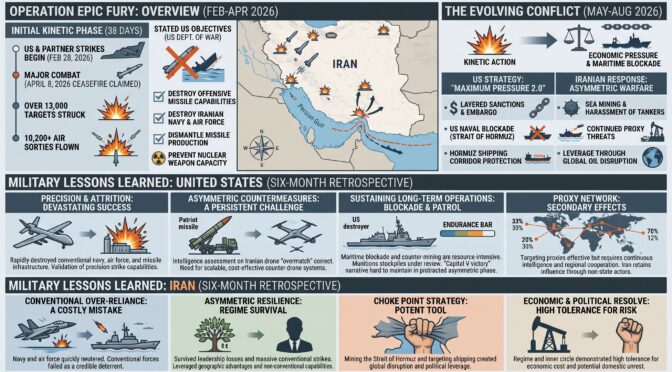
The theoretical mismatch in time horizons detailed in the preceding sections is currently playing out in real-time through the kinetic events of early 2026. The U.S. and Israeli military campaign, dubbed Operation Epic Fury, commenced with highly defined, immediate, and ambitious objectives: destroying Iranian missile production sites, degrading proxy networks, annihilating the Iranian navy, and permanently preventing nuclear acquisition.4

In pursuit of these rapid objectives, the United States amassed a massive naval armada—including the USS Gerald R. Ford and the USS Abraham Lincoln carrier strike groups, alongside 16 surface warships—to launch punitive strikes and institute a severe naval blockade of Iranian ports in the Strait of Hormuz.57 Concurrently, the U.S. Treasury initiated the financial equivalent of a military campaign, expanding sanctions and actively pursuing ships worldwide attempting to provide material support to Iran.58

From a purely kinetic standpoint, the United States has undeniably achieved significant short-term degradation of Iranian physical military assets and leadership.37 However, as the conflict extends into its second month and multiple rounds of ceasefire negotiations in Islamabad and Qatar continuously falter, the severe limits of American temporal endurance are becoming glaringly apparent.57 The U.S. delegation, driven by domestic political necessity for swift resolution, has sought comprehensive capitulation from Iran—demanding zero Iranian enrichment, the complete destruction of major nuclear facilities, the elimination of uranium stockpiles, and a full reopening of the Strait of Hormuz—all while offering virtually zero long-term incentives that Iran can trust to outlast the current U.S. administration.24

Iran’s response is highly characteristic of its infinite game strategy and its reliance on asymmetric attrition. Rather than attempting to meet U.S. carrier groups in decisive conventional naval battles, Iran’s escalation strategy centers on unrestrained, widely distributed retaliation.61 Tehran is hitting back by expanding the theater of war, launching waves of ballistic missiles and drones against civilian and military infrastructure across Bahrain, Kuwait, Iraq, Saudi Arabia, Israel, and the UAE.39 Furthermore, Iran is utilizing aggressive cyber and electronic warfare to target U.S. critical infrastructure and military logistics globally, demonstrating an intent to inflict pain beyond the immediate theater.62

The Iranian strategic calculus is remarkably straightforward: they do not need to militarily defeat the U.S. Navy; they merely need to endure the physical damage while systematically increasing the economic and psychological pain felt by the United States and its allies. They aim to push the conflict to a point where the political and economic cost of maintaining the blockade and the bombing campaign becomes domestically unviable in Washington.39 By threatening an increase in international terrorism and maintaining the closure of the Strait of Hormuz, Tehran is actively, deliberately draining the finite political will of the American administration and its impatient electorate.39

7. Strategic Implications and Conclusions

The American penchant for immediate gratification, rooted deeply in its consumer-driven society, reinforced by the 24-hour digital news cycle, and mandated by rigid electoral and budgetary timelines, acts as a severe, systemic vulnerability when engaged in protracted conflict with the Islamic Republic of Iran. The primary intelligence takeaway is that American policymakers, military planners, and the civilian populace consistently fail to realize that their adversaries are operating on an entirely different, generational temporal plane. To mitigate further strategic overextension, U.S. planners must internalize several critical assessments:

  1. The Fallacy of Decisive Force: The United States must abandon the deep-seated assumption that overwhelming kinetic strikes and infrastructure destruction will yield rapid political capitulation.1 Iran’s mosaic defense, distributed proxy networks, and resistance economy are specifically engineered to absorb such strikes, prevent decisive defeat, and prolong the conflict indefinitely.38
  2. Vulnerability to Economic Attrition: The U.S. government must recognize that its highest strategic vulnerability in the Middle East is not conventional military defeat, but rather the rapid erosion of domestic public support caused by economic shocks (such as fluctuating gas prices) and media fatigue.20 Iran’s entire asymmetric strategy is built around exploiting this specific domestic American vulnerability.38
  3. The Danger of Strategic Narcissism: U.S. strategy must account for Iranian agency and historical continuity. Iran’s leadership will rely on absolute pragmatism (maslahat) and generational planning to outlast American attention spans.3 Attempting to force an immediate, fundamental regime change through maximum pressure often backfires, resulting in a more militarized, hardline, and dangerous adversary rather than a compliant one.45

To successfully manage the ongoing conflict and broader relationship with Iran, the United States must fundamentally transition from a strategy of rapid escalation aimed at decisive victory toward a patient, endurance-based, incentive-driven strategy.1 This requires securing bipartisan, long-term diplomatic frameworks that do not wildly vacillate with every presidential election cycle.18 It also requires redefining strategic success not as immediate, total adversary capitulation, but as the steady, long-term management of regional stability and deterrence. Until the United States adjusts its temporal horizons to match the endurance of its adversary, it will continue to achieve localized tactical military successes that ultimately fail to translate into durable, long-term strategic victories.


Please share the link on Facebook, Forums, with colleagues, etc. Your support is much appreciated and if you have any feedback, please email us in**@*********ps.com. If you’d like to request a report or order a reprint, please click here for the corresponding page to open in new tab.


Sources Used

  1. America Wants Victory, Iran Wants Time – Fair Observer, accessed April 20, 2026, https://www.fairobserver.com/world-news/middle-east-news/america-wants-victory-iran-wants-time/
  2. Testimony of Lt. General H.R. McMaster (U.S. Army, Retired) Senior Fellow, Hoover Institution at Stanford University Before the, accessed April 20, 2026, https://www.hoover.org/sites/default/files/research/docs/FILE_1998.pdf
  3. The Need to Compete on Multiple Battlegrounds: An Interview with Lt. Gen. H.R. McMaster, accessed April 20, 2026, https://smallwarsjournal.com/2020/11/17/need-compete-multiple-battlegrounds-interview-lt-gen-hr-mcmaster/
  4. The War Against Iran and Global Risks: “Tell Me How This Ends”, accessed April 20, 2026, https://gjia.georgetown.edu/conflict-security/the-war-against-iran-and-global-risks-tell-me-how-this-ends/
  5. America’s Founders and the Principles of Foreign Policy: Sovereign Independence, National Interests, and the Cause of Liberty in the World | The Heritage Foundation, accessed April 20, 2026, https://www.heritage.org/political-process/report/americas-founders-and-the-principles-foreign-policy-sovereign-independence
  6. History of the foreign policy of the United States – Wikipedia, accessed April 20, 2026, https://en.wikipedia.org/wiki/History_of_the_foreign_policy_of_the_United_States
  7. The Top Ten Decisions in U.S. Foreign Policy – The Institute of World Politics, accessed April 20, 2026, https://www.iwp.edu/articles/2023/02/08/the-top-ten-decisions-in-u-s-foreign-policy/
  8. The Rise of American Consumerism | American Experience | Official Site – PBS, accessed April 20, 2026, https://www.pbs.org/wgbh/americanexperience/features/tupperware-consumer/
  9. A Brief History of Consumer Culture | The MIT Press Reader, accessed April 20, 2026, https://thereader.mitpress.mit.edu/a-brief-history-of-consumer-culture/
  10. American Consumer Culture and Social Media Polarization: Analyzing Twentieth Century Trends and Their Effects on Twenty First Ce – PDXScholar, accessed April 20, 2026, https://pdxscholar.library.pdx.edu/cgi/viewcontent.cgi?article=2884&context=honorstheses
  11. The Excessive Nature of Overconsumption in American Culture – The University of Alabama at Birmingham, accessed April 20, 2026, https://sites.uab.edu/humanrights/2023/10/24/the-excessive-nature-of-overconsumption-in-american-culture/
  12. Social Engineering, The Consumer Culture And US Foreign Policy – Resilience.org, accessed April 20, 2026, https://www.resilience.org/stories/2024-08-30/social-engineering-the-consumer-culture-and-us-foreign-policy/
  13. The Real Asymmetric War Between the United States and Iran, accessed April 20, 2026, https://www.spykmancenter.org/the-real-asymmetric-war-between-the-us-and-iran
  14. The Strategic Culture of the Islamic Republic of Iran – GovInfo, accessed April 20, 2026, https://www.govinfo.gov/content/pkg/GOVPUB-D214-PURL-gpo81047/pdf/GOVPUB-D214-PURL-gpo81047.pdf
  15. The Strategic Culture of the Islamic Republic of Iran – The Washington Institute, accessed April 20, 2026, https://www.washingtoninstitute.org/media/2293
  16. The US Policy Towards the Persian Gulf: Continuity and Change, accessed April 20, 2026, https://ciaotest.cc.columbia.edu/olj/sa/sa_may01khm01.html
  17. U.S. Elections and Iran – Brookings Institution, accessed April 20, 2026, https://www.brookings.edu/articles/u-s-elections-and-iran/
  18. The Presidential Elections in the United States: What Impact on Iranian-American Relations?, accessed April 20, 2026, https://ras-nsa.ca/the-presidential-elections-in-the-united-states-what-impact-on-iranian-american-relations/
  19. U.S.-Iran Relations: 40 Years of Antagonism, Distrust, and Frustration Reflected in New Volume of Declassified Documents, accessed April 20, 2026, https://nsarchive.gwu.edu/briefing-book/iran/2021-09-20/us-iran-relations-40-years-antagonism-distrust-and-frustration
  20. View of Effects of Real-Time News Coverage on Foreign Policy | Journal of Conflict Studies, accessed April 20, 2026, https://journals.lib.unb.ca/index.php/jcs/article/view/4309/4920
  21. “The CNN Effect”: How 24-Hour News Coverage Affects Government Decisions and Public Opinion | Brookings, accessed April 20, 2026, https://www.brookings.edu/events/the-cnn-effect-how-24-hour-news-coverage-affects-government-decisions-and-public-opinion/
  22. 24-Hour News Deepening Partisan Divides – – College of Liberal Arts – Purdue University, accessed April 20, 2026, https://www.cla.purdue.edu/academic/history/debate/opeds/Op-Ed-jake.html
  23. How Media Habits Shape American Foreign Policy Views, accessed April 20, 2026, https://globalaffairs.org/research/public-opinion-survey/how-media-habits-shape-american-foreign-policy-views
  24. THE FUTURE OF US STRATEGY TOWARD IRAN – Atlantic Council, accessed April 20, 2026, https://www.atlanticcouncil.org/wp-content/uploads/2024/10/The-future-of-US-strategy-toward-Iran.pdf
  25. Contending With McMaster – War on the Rocks, accessed April 20, 2026, https://warontherocks.com/2021/03/battlegrounds-the-fight-for-american-foreign-policy/
  26. Statement of LTG HR McMaster (US Army, retired), accessed April 20, 2026, https://www.armed-services.senate.gov/imo/media/doc/McMaster–Statement%20for%20the%20Record_03-02-21.pdf
  27. Ali Khamenei: the guardian of Iran’s strategic patience doctrine | Al Majalla, accessed April 20, 2026, https://en.majalla.com/node/326120/profiles/ali-khamenei-guardian-irans-strategic-patience-doctrine
  28. Iran’s Strategic Options: Rethinking Negotiation with America | Al …, accessed April 20, 2026, https://studies.aljazeera.net/en/analyses/iran%E2%80%99s-strategic-options-rethinking-negotiation-america
  29. The Iran war and the limits of American power, accessed April 20, 2026, https://www.epc.eu/publication/the-iran-war-and-the-limits-of-american-power/
  30. U.S. Politics: The Military-Industrial Complex | Social Sciences and Humanities – EBSCO, accessed April 20, 2026, https://www.ebsco.com/research-starters/social-sciences-and-humanities/us-politics-military-industrial-complex
  31. Ike’s Fears Reexamined: Modern Developments in the Military Industrial Complex, accessed April 20, 2026, https://www.youtube.com/watch?v=PiSd2dC8Aac
  32. The Complex | Article | The United States Army, accessed April 20, 2026, https://www.army.mil/article/281926/the_complex
  33. Policy Forum: The Military-Industrial Complex at 50 | Cato Institute, accessed April 20, 2026, https://www.cato.org/policy-report/march/april-2011/policy-forum-military-industrial-complex-50
  34. The Military-Industrial Complex and US Military Spending After 9/11 – Semantic Scholar, accessed April 20, 2026, https://pdfs.semanticscholar.org/27ce/a90a3ddf7c508ea2862a319b12828938f3ee.pdf
  35. What US Spending on the War in Iran Could Fund Instead – Time Magazine, accessed April 20, 2026, https://time.com/article/2026/03/16/what-us-spending-on-the-war-in-iran-could-fund-instead/
  36. BWAF Podcast — Ep. 111: Iran, War Powers, and the Budget, accessed April 20, 2026, https://www.taxpayer.net/national-security/bwaf-podcast-ep-111-iran-war-powers-and-the-budget/
  37. Mission Accomplished? Taking Stock of the War in Iran | Council on Foreign Relations, accessed April 20, 2026, https://www.cfr.org/articles/taking-stock-of-the-war-in-iran
  38. A Ground War in Iran Would Be America’s Worst Strategic Mistake Yet – FPIF, accessed April 20, 2026, https://fpif.org/a-ground-war-in-iran-would-be-americas-worst-strategic-mistake-yet/
  39. What Are the Unintended Consequences of the U.S.-Iran Conflict for Defense and Security?, accessed April 20, 2026, https://www.csis.org/analysis/what-are-unintended-consequences-us-iran-conflict-defense-and-security
  40. How the Iran War Confirmed, Contradicted, and Complicated U.S. Policy, accessed April 20, 2026, https://www.cfr.org/articles/how-the-iran-war-confirmed-contradicted-and-complicated-u-s-policy
  41. Time Machine: Iran from the American Perspective – Home of the …, accessed April 20, 2026, https://maristpoll.marist.edu/time-machine-iran-from-the-american-perspective/
  42. How public opinion on the Iran war has evolved | Ipsos, accessed April 20, 2026, https://www.ipsos.com/en-us/how-public-opinion-iran-war-has-evolved
  43. US & Iran Conflict: What it means for the Markets | Lifetime Wealth Strategies, accessed April 20, 2026, https://www.lifetimewealthstrategies.net/blog/us-iran-conflict-what-it-means-markets
  44. Investment considerations of prolonged uncertainty over Iran – Janus Henderson Investors, accessed April 20, 2026, https://www.janushenderson.com/en-us/advisor/article/investment-considerations-of-prolonged-uncertainty-over-iran/
  45. U.S. Intel’s Sobering Assessment of Iran’s War Resilience – The Cipher Brief, accessed April 20, 2026, https://www.thecipherbrief.com/sobering-assessment-of-irans-resilience
  46. Iran – Intelligence and Security Committee of Parliament, accessed April 20, 2026, https://isc.independent.gov.uk/wp-content/uploads/2025/07/Intelligence-and-Security-Committee-of-Parliament-Iran.pdf
  47. Competing visions of international order | 04 Resistance: the mantra …, accessed April 20, 2026, https://www.chathamhouse.org/2025/03/competing-visions-international-order/04-resistance-mantra-behind-irans-worldview
  48. Iran Country Report 2026 – Bti-project.org, accessed April 20, 2026, https://bti-project.org/en/reports/country-report/IRN
  49. The Impact of Economic Sanctions on Health and Strategies for Mitigation: A Glance at the Case of Iran – PMC, accessed April 20, 2026, https://pmc.ncbi.nlm.nih.gov/articles/PMC12440346/
  50. Sanctions and Impacts on Lasting Peace with Iran, accessed April 20, 2026, https://ucfglobalperspectives.org/blog/2025/01/03/sanctions-and-impacts-on-lasting-peace-with-iran/
  51. About the unravelling of Iran’s social contract – Clingendael, accessed April 20, 2026, https://www.clingendael.org/publication/about-unravelling-irans-social-contract
  52. Is Iran on the brink of change? – Brookings Institution, accessed April 20, 2026, https://www.brookings.edu/articles/is-iran-on-the-brink-of-change/
  53. Fact-checking Trump and Hegseth’s claims of U.S. ‘victory’ in the Iran war | PBS News, accessed April 20, 2026, https://www.pbs.org/newshour/politics/fact-checking-trump-and-hegseths-claims-of-u-s-victory-in-the-iran-war
  54. Analysis-US defense stocks see no Iran war lift after early surge By Reuters – Investing.com, accessed April 20, 2026, https://www.investing.com/news/stock-market-news/analysisus-defense-stocks-see-no-iran-war-lift-after-early-surge-4595559
  55. The War with Iran and the Impact On Investment Portfolios – NEPC, accessed April 20, 2026, https://www.nepc.com/the-war-with-iran-and-the-impact-on-investment-portfolios/
  56. How America and Its Allies Can Stop Hamas, Hezbollah, and Iran from Evading Sanctions and Financing Terror – House.gov, accessed April 20, 2026, https://docs.house.gov/meetings/ba/ba10/20231025/116509/hhrg-118-ba10-wstate-noronhag-20231025.pdf
  57. The global ripple effects of the United States’ diplomacy with Iran – Defense Priorities, accessed April 20, 2026, https://www.defensepriorities.org/opinion/the-global-ripple-effects-of-the-united-states-diplomacy-with-iran/
  58. U.S. Continues Economic and Diplomatic Pressure on Iran | Council on Foreign Relations, accessed April 20, 2026, https://www.cfr.org/articles/u-s-continues-economic-and-diplomatic-pressure-on-iran
  59. U.S. Military in the Middle East: Numbers Behind Trump’s Threats Against Iran – CSIS, accessed April 20, 2026, https://www.csis.org/analysis/us-military-middle-east-numbers-behind-trumps-threats-against-iran
  60. Who Is Winning the Iran War? – CSIS, accessed April 20, 2026, https://www.csis.org/analysis/who-winning-iran-war
  61. Visualizing Iran’s Escalation Strategy – CSIS, accessed April 20, 2026, https://www.csis.org/analysis/visualizing-irans-escalation-strategy
  62. Iran War: Kinetic, Cyber, Electronic and Psychological Warfare Convergence – Resecurity, accessed April 20, 2026, https://www.resecurity.com/blog/article/iran-war-kinetic-cyber-electronic-and-psychological-warfare-convergence

Public Sentiment in the Islamic Republic of Iran – April 19, 2026

Executive Summary

This intelligence assessment provides a detailed evaluation of the domestic environment within the Islamic Republic of Iran as of April 2026. Following a period of unprecedented internal and external shocks, including the June 2025 “12-Day War,” the nationwide economic protests beginning in December 2025, and the recent United States military campaign designated “Operation Epic Fury,” the Iranian state is experiencing acute systemic distress. The intelligence indicates a profound disconnect between the ruling clerico-military elite and the general populace. Public sentiment is characterized by overwhelming opposition to the theocratic system, a deep desire for democratic governance, and severe economic anxiety.

Despite this widespread discontent, a successful uprising has not materialized. The failure of the populace to overthrow the government is not due to a lack of popular will, but rather a combination of an extreme absence of organized leadership, a totalizing telecommunications blackout, and a willingness by the state security apparatus to deploy asymmetric, lethal force against unarmed civilians. Furthermore, while the Iranian diaspora actively advocates for regime collapse, the internal population harbors nuanced and often unfavorable views of the United States. Iranians inside the country are severely traumatized by foreign military intervention, fearing the destruction of their national infrastructure and the mass civilian casualties associated with kinetic warfare. The recent ascension of Mojtaba Khamenei to the position of Supreme Leader following the death of his father has triggered a new phase of unrest, fundamentally altering the ideological legitimacy of the regime and framing it strictly as a military autocracy.

1.0 The Strategic Environment and Macroeconomic Collapse

To understand the current psychological and political disposition of the Iranian people, it is necessary to analyze the cascading crises that have severely degraded the structural integrity of the Iranian state over the past year. The Iranian populace is currently navigating an environment defined by catastrophic economic collapse and the traumatic aftermath of successive military conflicts.

1.1 The Bifurcation of the Iranian Economy

The current wave of nationwide unrest, which is categorized as the largest and most sustained uprising since the 1979 Islamic Revolution, was initially triggered by severe economic grievances.1 Beginning in late December 2025, the national currency experienced a precipitous devaluation. The disparity between the official exchange rate and the black market rate expanded drastically, effectively wiping out the savings of the middle and lower classes.3

The Iranian economy has fundamentally bifurcated into a dual system. The formal economy, operating in depreciating rials, sustains the vast civilian bureaucracy and the general public, while a shadow economy, accessible only to regime insiders and the Islamic Revolutionary Guard Corps, operates through oil barter and hard currency.3 This structural inequality has generated immense resentment among the working class. The central budget can no longer transfer funds through normal channels due to international sanctions and the collapse of the formal banking sector. Consequently, the defense ministry has been forced to bypass the central bank entirely, selling crude oil directly to foreign customers to finance its operations and maintain its proxy networks.3

1.2 Hyperinflation and the Collapse of Civilian Purchasing Power

This currency collapse catalyzed hyperinflationary pressures on basic goods. Official inflation metrics from late 2025 indicated an inflation rate of approximately 48.6 percent, marking the highest reading since May 2023, though on-the-ground intelligence suggests the real market inflation rate for essential foodstuffs and medicine is significantly higher.4 Historical tracking indicates that the inflation rate in Iran averaged 16.62 percent from 1957 until 2025, demonstrating the unprecedented nature of the current economic crisis.4

The domestic economic crisis has been vastly exacerbated by the regime’s mismanagement of essential services. Ordinary Iranians face daily shortages of water, fuel, and electricity.1 Food prices have significantly outpaced wages, while fuel subsidies, originally intended to alleviate the cost of living for the poorest citizens, are routinely exploited by regime-connected middlemen for illegal export across the borders.3 This systemic corruption sparked the initial protests on December 28, 2025, when shopkeepers in Tehran’s Grand Bazaar shut down their businesses to protest the falling rial and worsening economic conditions, an action that quickly cascaded into demonstrations across 675 locations in all 31 provinces.1

1.3 The Impact of Kinetic Warfare and the United States Naval Blockade

The domestic economic crisis has been heavily compounded by foreign policy miscalculations, leading to what regional analysts describe as the regime’s “strategic vertigo”.5 A string of major military decisions backfired sequentially, culminating in the June 2025 “12-Day War” with Israel and the United States.5 This conflict resulted in the targeted destruction of Iranian military installations, nuclear facilities, and critical defense infrastructure, stripping the regime of its aura of invincibility.3

More recently, the United States launched “Operation Epic Fury” in March and April 2026. This operation was designed to decisively crush the Iranian security apparatus and dismantle the regime’s ballistic missile industrial base.7 According to the United States Department of War, over 80 percent of Iran’s missile facilities and solid rocket motor production capabilities were neutralized during these strikes.7 Furthermore, the Israel Defense Forces targeted over 400 military installations in western and central Iran, reportedly destroying approximately 75 percent of the country’s missile launchers.10

Concurrently, a United States naval blockade in the Arabian Sea and the Strait of Hormuz has severely restricted commercial shipping, placing an unprecedented stranglehold on the domestic economy.11 Although Iran announced an agreement to reopen the Strait of Hormuz on April 17, 2026, the United States explicitly stated that the naval blockade of Iranian ports would remain in place pending the completion of a final political deal.12 The combination of domestic mismanagement and the physical destruction of state assets has resulted in a scenario where President Masoud Pezeshkian was privately warned by the Iranian central bank that repairing the economy could take upwards of twelve years.14

Macroeconomic IndicatorStatistical Reality (2024-2026)Source Data
Official Inflation Rate (CPI)48.6 percent (October 2025 peak)4
Unemployment Rate8.3 to 9.2 percent (rampant among youth and graduates)15
GDP Growth3.7 percent (2024), contracting sharply in 202615
Currency Disparity35-to-1 ratio between shadow market and official rate3

2.0 Domestic Public Sentiment and the Ideological Rupture

The Iranian population’s sentiment is characterized by a deep, unifying rejection of the current theocratic framework, paired with a desperate prioritization of basic security and economic survival. The ideological foundation of the state, rooted in the doctrine of Velayat-e Faqih, has lost nearly all resonance with the general public.

2.1 The Rejection of Theocratic and Military Governance

Extensive polling data from the Group for Analyzing and Measuring Attitudes in Iran and Stasis Consulting reveals a society that has fundamentally rejected the founding principles of the Islamic Republic. Based on a representative sample of literate adults, an overwhelming 89 percent of the Iranian population expressed support for a democratic political system.18 Conversely, governance based on religious law faces widespread opposition, with 66 percent of the population actively rejecting theocratic rule, and 71 percent opposing military governance.18

When surveyed on hypothetical political party preferences, Iranians predominantly favor platforms that prioritize individual freedoms and human rights (37 percent), followed closely by parties seeking social justice and workers’ rights (33 percent), and those emphasizing national pride and Iranian nationalism (26 percent).18 Support for parties focusing on environmentalism (10 percent) and free-market economics (9 percent) is notably highest among the educated youth.18 This data indicates that the population is not merely anti-regime, but possesses a coherent desire for a secular, rights-based republic.

Chart: Iranians favor democracy (89%) over religious (66% oppose) or military rule (71% oppose). Public sentiment in Iran.

2.2 The Prioritization of Economic Survival Over Democratic Ideals

However, the cascading crises of 2025 and 2026 have shifted immediate public priorities. While the desire for democracy remains the long-term goal, the daily reality of starvation and kinetic warfare has altered short-term focus. In recent surveys asking Iranians if they could change one thing about Iran, 48 percent of respondents prioritized making the country “more economically prosperous”.19 The desire for a “more safe and secure” environment rose significantly to 25 percent, up from 14 percent in March 2024.19

Strikingly, the demand for the country to be “more democratic and free” actually dropped from 13 percent in the aftermath of the 2022 protests to just 6 percent in late 2025.19 This statistical drop does not imply an abandonment of democratic ideals, rather, it reflects a society operating at the lowest levels of Maslow’s hierarchy of needs, where the immediate threats of starvation, hyperinflation, and foreign military strikes supersede high-level political aspirations. Furthermore, 49 percent of respondents stated that government officials appointed by President Pezeshkian simply do not care what average people think, indicating a complete loss of faith in the civilian reformist movement.19

2.3 Psychological Trauma and the Legacy of the 12-Day War

The psychological condition of the Iranian populace has been heavily battered by the 12-Day War in June 2025. Survey data collected shortly after the conflict reflects a highly traumatized society that blames its own government for its suffering. Approximately 44 percent of the population held the Islamic Republic responsible for initiating the war, while 33 percent blamed Israel, and 16 percent believed both sides were equally at fault.20 When assessing the outcome of the conflict, 51 percent believed that Israel was successful in achieving its objectives, compared to only 16 percent who believed the Islamic Republic was successful.20

The most prominent emotion experienced during the conflict was “anger at the Islamic Republic,” reported by 42 percent of the population, followed closely by “worry about the future” at 38 percent, and “anger at Israel” at 30 percent.20 Crucially, the data reveals a high degree of distress regarding the physical toll of the war. A significant 73 percent of respondents stated they were deeply upset by civilian casualties, 46 percent were distressed by direct attacks on Iranian territory, and 30 percent were upset by the killing of nuclear scientists.20 Furthermore, 63 percent of the population believed that the 12-Day War was fundamentally a conflict between the states of Israel and the Islamic Republic, and not a war involving the Iranian people.20 This highlights a critical nuance in public sentiment. While the populace overwhelmingly despises the regime, they do not view the destruction of their national infrastructure or the loss of civilian life as an acceptable cost for regime change.

3.0 The Divergence Between the Iranian Diaspora and the Internal Population

Intelligence assessments must carefully differentiate between the vocal Iranian diaspora living in exile and the internal population living under the daily threat of state violence. While both demographics largely share the ultimate goal of regime change, their strategic preferences and risk tolerances diverge significantly.

3.1 Diaspora Advocacy and the Restoration of Historical Identity

The Iranian diaspora, operating from safe havens in the West, frequently expresses sentiments that are heavily pro-Western and pro-Israel, a dynamic that often surprises external observers.21 Expatriates have been observed celebrating the degradation of the state’s ideological apparatus, viewing the recent military strikes as a necessary catalyst for liberation.21 The diaspora narrative frequently focuses on casting down the religious constraints of the 1979 Islamic Revolution and restoring the historical identity of ancient Persia, emphasizing religious tolerance and cultural openness.21

Polling conducted by the National Iranian American Council and YouGov in 2025 provides concrete data on these diaspora preferences. When asked what type of government would work best in Iran, a majority of Iranian Americans (55 percent) favored a parliamentary democracy or republic, while 17 percent supported a constitutional monarchy, likely indicating support for the exiled Crown Prince Reza Pahlavi.22 Only 6 percent preferred a reformed Islamic republic, and a mere 3 percent favored maintaining the current system.22

3.2 Internal Pragmatism and the Fear of State Collapse

This perspective is not universally shared with the same level of revolutionary enthusiasm by those living inside the country. Internal populations are subjected to the direct physical consequences of conflict and economic blockade. While one in six Iranians inside the country actively agree with calls for the Islamic Republic to be replaced with another form of government, the intensity of this opposition is tempered by the fear of state collapse and internal chaos.19

The internal population is acutely aware that a power vacuum could lead to a protracted civil war. Interestingly, GAMAAN polling indicates that about half of the internal population (43 percent) is open to authoritarian rule by a strong individual leader, a view that is more common among rural residents and people with lower levels of education.18 This suggests that a significant portion of the populace values order and stability above all else, fearing that the sudden collapse of the central government without a viable transitional authority would lead to warlordism and societal disintegration.5 Analysts note the danger of “anchoring bias,” warning that observers should not assume the Iranian regime is as fragile as the Russian Empire during World War I, the state remains remarkably institutionalized and capable of defending itself against internal rupture.23

3.3 Diaspora Perspectives on United States Military Action

Even within the diaspora, the prospect of direct military intervention generates deep apprehension. The NIAC survey revealed that Iranian Americans are evenly divided over the June 2025 United States airstrikes on Iran’s nuclear facilities, with 45 percent agreeing with the strikes and 44 percent disagreeing.22 Among those who opposed the strikes, 56 percent cited the fear of civilian casualties as their primary concern.22 This data underscores that while the diaspora is highly mobilized against the regime, there is no consensus on utilizing foreign military force to achieve political change, primarily due to the unavoidable toll on the civilian population.

4.0 Iranian Perspectives on the United States and Foreign Intervention

The relationship between the Iranian people and the United States is complex, shaped by decades of mutual antagonism, crippling economic sanctions, and the reality of recent direct military confrontations.

4.1 Historical Animosity and Public Opinion Polling

Polling data from early 2026 indicates that anti-American sentiment remains highly prevalent within the general Iranian population. According to Gallup tracking, 81 percent of Iranians hold an unfavorable view of the United States, representing the highest unfavorable reading since 1991.24 Conversely, the favorable rating sits at a marginal 13 percent, having never risen above 17 percent in the history of the survey.24 This deep-seated animosity is fueled by the long-standing economic sanctions that have devastated the civilian economy, alongside the historical narrative of foreign interference continuously propagated by the state educational apparatus.

4.2 Reactions to Operation Epic Fury

The initiation of Operation Epic Fury by the United States has introduced a highly volatile new dynamic. The operation specifically targeted the internal security apparatus, including Basij checkpoints and equipment in major cities like Tehran.25 The Israel Defense Forces similarly targeted facilities associated with the Islamic Republic’s internal security apparatus used to suppress dissent.25 In the immediate aftermath of these strikes, some internal factions expressed cautious optimism, viewing the degradation of the Basij as an opportunity to reclaim the streets and operate with less fear of immediate reprisal.25

However, this optimism is heavily constrained by the strategic realities of the United States naval blockade and the resulting destruction of the broader economy.12 The populace recognizes that even if the regime collapses under the weight of Operation Epic Fury, the country they inherit will be fundamentally broken and devoid of essential infrastructure. Furthermore, public statements from United States leadership regarding the permanent opening of the Strait of Hormuz and the enforcement of the blockade are viewed by many Iranians as violations of national sovereignty, regardless of their intense hatred for the ruling clerics.13

4.3 The Paradox of Pragmatic Exhaustion

Despite the overwhelmingly unfavorable views of the United States, a significant portion of the population recognizes that the regime’s belligerent foreign policy is the root cause of their isolation. The realization that the regime is an “empty shell” that spent billions of dollars on the Islamic Revolutionary Guard Corps and proxy groups across the Middle East while the domestic economy stagnated has generated immense resentment.5 Consequently, while Iranians may not favor the United States culturally or politically, there is a pragmatic subset of the population that views American military pressure as the only force capable of fracturing the IRGC’s absolute monopoly on violence. The populace is trapped in a paradox where their desired outcome, the removal of the theocracy, currently appears achievable only through the actions of a foreign power they deeply distrust.

5.0 The Mechanics of Regime Survival and Asymmetric Repression

Given the catastrophic state of the economy, the destruction of military infrastructure, and the overwhelming public desire for democratic transition, the central intelligence question remains, why have the Iranian people not successfully overthrown the government? The analysis indicates several primary factors, asymmetric lethality, the elite’s sunk cost fallacy, and a critical deficit in organizational leadership.

5.1 The Application of Maximum Violence and Lethal Force

The Islamic Republic is not a fragile dictatorship, it is a highly institutionalized, closed autocracy designed specifically to withstand internal rupture.23 The regime’s survival strategy relies on the unhesitating application of maximum violence against unarmed civilians. During the protest waves of January 2026, Supreme Leader Ali Khamenei and senior security officials issued direct orders to use live ammunition on demonstrators, initiating a campaign of brutal suppression.1

The scale of the resultant massacres is unprecedented in modern Iranian history. Intelligence confirms that security forces, including the IRGC, Basij paramilitaries, and plainclothes agents, positioned themselves on rooftops and utilized assault rifles and shotguns loaded with metal pellets to explicitly target the heads and torsos of protesters.27 The violence was particularly acute on January 8 and 9, 2026, when the death toll rose into the thousands, marking the deadliest period of repression documented by human rights researchers in decades.27

The application of this asymmetric lethality creates a paralyzing environment of terror. When a state demonstrates a willingness to slaughter tens of thousands of its own citizens without hesitation, the cost of participation in street protests becomes prohibitive for the average citizen.

Source of EstimateReported Death Toll (Jan-Feb 2026)Verification MethodologySource Data
Official Iranian Government3,117State-controlled reporting via Supreme National Security Council28
HRANA (Human Rights Activists)7,007 verified (6,488 protesters, 236 minors)Grassroots network verification, with 11,000+ cases under investigation28
UN Human Rights Experts“Tens of thousands”Independent diplomatic channels and special rapporteur assessments28
Medical / Morgue Staff Leaks30,000 to over 36,500Morgue capacity tracking and hospital intake reports28

5.2 The Sunk Cost Fallacy and the Prioritization of Proxy Networks

Rather than realizing the major shift needed in domestic policy to address economic problems at home, the supreme leadership doubled down on old habits.5 The regime is effectively trapped in a “sunk cost fallacy.” Instead of reallocating funds to stabilize the rial or subsidize basic food commodities, the regime continues to pour vast sums of money into rebuilding its degraded proxy networks abroad.5 The state has calculated that conceding political space to domestic protesters is a greater threat to its survival than enduring international condemnation for mass killings.

5.3 The Critical Deficit in Organizational Leadership

A successful revolution requires more than widespread anger, it requires strategic coordination, a unifying leadership structure, and a viable transitional plan. The 2025-2026 uprising in Iran suffers from a severe leadership vacuum.29 While local neighborhood councils attempt to coordinate localized actions, there is an absolute absence of a popular national leadership capable of converting repeated protest waves into sustained political agency.29

The regime has spent decades systematically assassinating, imprisoning, or exiling any charismatic figures, journalists, and human rights defenders who could serve as a unifying opposition leader.2 Consequently, the protests operate horizontally. While this horizontal structure makes the movement difficult for the state to decapitate with a single arrest, it also prevents the protesters from executing complex, sustained campaigns or negotiating a transition of power.29 Information and outrage spread rapidly, but without centralized leadership, the mobilization erupts violently and dissipates quickly under the pressure of live fire, leaving the political status quo intact.29

5.4 Calibrated Concessions and Reputational Triage

While the security line is hardening, the regime simultaneously utilizes a parallel track of calibrated concessions to relieve social pressure without ceding political power. For example, during the height of the crackdowns, the cabinet moved to formalize a long-contested social issue by allowing law enforcement to issue motorcycle licenses for women.30 This action functioned as reputational triage, signaling a false sense of normalization and offering a non-political topic for public attention, all while conceding absolutely nothing regarding accountability for state violence or the right to protest.30 This dual approach attempts to deter collective mobilization through brute force while selectively relaxing certain daily controls to repackage the regime as adaptable.

6.0 Information Warfare and the Telecommunications Blackout

To prevent the localized neighborhood councils from coordinating a national strategy and to conceal the scale of the massacres, the Iranian state relies heavily on absolute information control. The digital siege is a core pillar of the regime’s domestic security apparatus.

6.1 The Disconnection of the National Information Network

On January 8, 2026, the twelfth day of the protests, the Iranian authorities initiated the most sophisticated and severe internet blackout in the country’s history.31 The Ministry of Information and Communications Technology completely disconnected the National Information Network, severing both international connections and disrupting internal traffic within Iran.32 Cybersecurity experts reported widespread telephone and internet blackouts originating in Tehran and spreading to Isfahan, Shiraz, and Kermanshah.32

This blackout serves a dual purpose. Tactically, it prevents protesters from sharing staging locations, accessing independent news, or coordinating mass movements. Strategically, it provides a cloak of darkness under which the IRGC can conduct mass executions and arbitrary detentions without digital evidence reaching the international community.27 The economic cost of this blackout is staggering, costing the Iranian economy between 35.7 million and 80 million United States dollars per day, leading to an 80 percent drop in online sales and a reduction of 185 million financial transactions within a single month.32 The state’s willingness to inflict this level of economic self-harm underscores its prioritization of immediate regime survival over the long-term viability of the national economy.

Digital siege architecture: Iran's national network, state firewall, VPN tunnels, and Starlink circumvention.

6.2 The Black Market for Satellite Connectivity and Hardware Procurement

In response to the digital siege, the Iranian populace has increasingly turned to decentralized, open-source, and satellite-based circumvention tools. Satellite internet has become a critical lifeline for coordinating dissent and transmitting evidence of human rights abuses to the outside world. While the service provider SpaceX has waived subscription fees for Iranian users and activated free access in response to the crackdowns, the physical procurement of the terminal kits remains exceptionally difficult.33

The Iranian regime has classified the possession of satellite internet hardware as a severe national security threat. Individuals discovered using or distributing these terminals risk lengthy prison sentences, and human rights organizations have warned of the possibility of execution for users caught maintaining the network.33 Consequently, the hardware is smuggled across the border, creating a lucrative and highly dangerous black market. Following the escalation of war with the United States and the deployment of the naval blockade, the black market price for a single satellite terminal surged from approximately 700 United States dollars to as much as 4,000 United States dollars, placing it far beyond the reach of the average citizen.34

6.3 Virtual Private Networks and the Reliance on Diaspora Infrastructure

For the vast majority of Iranians who cannot afford or safely harbor satellite equipment, Virtual Private Networks remain the primary method of evading state censorship. However, the Iranian government utilizes highly aggressive Deep Packet Inspection, Domain Name System manipulation, and Server Name Identification blocking to sever connections to standard commercial VPN providers.35

Consequently, the populace relies heavily on specialized circumvention tools like Psiphon and Lantern, which disguise users’ data as different types of internet traffic to evade detection.36 The resilience of these networks is fundamentally dependent on the active participation of the Iranian diaspora. Thousands of expatriates run conduit applications on their personal devices, leaving unused phones or computers connected to home Wi-Fi networks to securely share part of their bandwidth.38 By doing so, they create small, fragile bridges that allow users inside Iran to connect to the global internet. As of early 2026, intelligence indicated that approximately 400,000 Iranians abroad were maintaining these nodes, serving as a critical digital lifeline for those trapped behind the state firewall.32

Tool / ServiceTechnical Evasion MethodologyCurrent Procurement and Availability StatusOfficial Vendor Link
StarlinkLow Earth Orbit Satellite InternetHardware in stock globally; Black market access only in Iran at highly inflated prices(https://www.starlink.com/)
PsiphonMulti-protocol proxy network utilizing VPN, SSH, and HTTPSoftware actively available for download; Relies heavily on diaspora conduit nodes(https://psiphon.ca/)
LanternPeer-to-peer routing and disguised TLS traffic protocolsSoftware actively available for global download(https://lantern.io/)

7.0 The Succession Crisis and the Shift in State Identity

The Iranian political landscape experienced a seismic shift in early 2026. Following the death of Supreme Leader Ali Khamenei, the Assembly of Experts selected his son, Mojtaba Khamenei, as the next Supreme Leader on March 8, 2026.1 This transition represents the most vulnerable point in the history of the Islamic Republic and has fundamentally altered the domestic political calculus and the ideological foundation of the state.

7.1 The Elevation of Mojtaba Khamenei and the Hardline Consolidation

The rapid selection of Mojtaba Khamenei represents a decisive and uncompromising victory for the most extreme hardline factions within the IRGC and the Office of the Supreme Leader.10 Mojtaba, a cleric with deep, entrenched ties to the security apparatus and a documented history of orchestrating severe domestic crackdowns, is widely feared by the public.10 His ascension guarantees that the state will pursue domestic and foreign policies remarkably similar to, or potentially more aggressive than, those of his father.

7.2 The “Death to Mojtaba” Movement and the Loss of Ideological Legitimacy

The immediate public reaction to his appointment was explosive and highly telling of the current national mood. Despite the ongoing lethal crackdowns, internet blackouts, and the presence of heavily armed security forces, citizens defied curfews to gather in residential neighborhoods, chanting “Death to Mojtaba” from their rooftops.1

This specific chant is highly significant from an intelligence perspective. It signifies that the public views the transition not as a legitimate religious succession guided by Islamic jurisprudence, but as the naked establishment of a hereditary dictatorship. By installing the son of the former leader, the regime has stripped away its remaining theological veneer. It has exposed itself entirely as a military autocracy governed by the IRGC, utilizing the clerical establishment merely as a rubber stamp.5 This ideological collapse permanently alienates any remaining moderate or reformist factions within the political establishment, ensuring that future conflicts between the state and the populace will be defined solely by the application of physical force rather than political debate.

7.3 The Marginalization of the Civilian Government

Within this highly volatile environment, the civilian government led by President Masoud Pezeshkian has been entirely marginalized. Pezeshkian has publicly acknowledged the depth of the systemic failure and has occasionally attempted to strike a softer tone, noting in public statements that the government is obligated to listen to peaceful protesters and involve the people in decision-making.3 He has even signaled a conditional openness to diplomacy with the United States to alleviate the crushing economic sanctions, publishing open letters urging a move beyond political rhetoric.41

However, intelligence indicates that Pezeshkian wields no actual authority over the security apparatus, the national economy, or the direction of foreign policy. He has explicitly noted his own powerlessness in private, admitting that his attempts to negotiate or alter the state’s trajectory have been routinely overruled by the supreme leadership and the IRGC high command.3 The civilian government is currently utilized by the regime merely as a diplomatic facade for the international community and an administrative body tasked with managing the impossible logistics of a collapsed economy, while the true levers of power remain firmly and exclusively under the control of Mojtaba Khamenei and the military elite.

8.0 Strategic Outlook and Key Intelligence Takeaways

The intelligence assessment of the Iranian populace in April 2026 paints a picture of a society pushed to the absolute limits of human endurance. The Iranian people are locked in a sophisticated, highly lethal struggle against a heavily armed and deeply entrenched security state. The failure of the populace to topple the government is not indicative of support or complacency, rather, it is a testament to the ruthless efficiency of the IRGC’s domestic suppression tactics, the paralyzing effects of the telecommunications blackout, and the strategic disadvantage of a leaderless, horizontal protest movement facing coordinated military violence.

The installation of Mojtaba Khamenei has catalyzed a permanent ideological rupture, finalizing the transformation of the Islamic Republic into a hereditary military dictatorship devoid of popular legitimacy. While the populace overwhelmingly desires a transition to a secular democracy, they are simultaneously deeply fearful of the chaotic consequences of state collapse and hold highly unfavorable views of the foreign military interventions that have shattered their national infrastructure.

The regime currently survives solely through the application of brute force and the enforcement of digital darkness. However, the macroeconomic foundations required to sustain the patronage networks of the security apparatus have been decimated by the shadow economy, international blockades, and the systematic destruction of the defense industrial base. The state is operating in a condition of permanent emergency, generating cohesion solely through the suppression of an internal enemy. While the security forces remain coherent in the immediate term, the absolute alienation of the population and the mathematical impossibility of economic recovery suggest that the current paradigm is structurally unsustainable, leaving the state exceptionally vulnerable to any future catalyst that disrupts the IRGC’s chain of command.


Please share the link on Facebook, Forums, with colleagues, etc. Your support is much appreciated and if you have any feedback, please email us in**@*********ps.com. If you’d like to request a report or order a reprint, please click here for the corresponding page to open in new tab.


Sources Used

  1. 2025–2026 Iranian protests – Wikipedia, accessed April 19, 2026, https://en.wikipedia.org/wiki/2025%E2%80%932026_Iranian_protests
  2. Iran: Chokehold on Dissent – Human Rights Watch, accessed April 19, 2026, https://www.hrw.org/news/2024/01/11/iran-chokehold-dissent
  3. The Ayatollah’s Regime Is Crumbling | Hudson Institute, accessed April 19, 2026, https://www.hudson.org/foreign-policy/ayatollahs-regime-crumbling-michael-doran
  4. Iran Inflation Rate – Trading Economics, accessed April 19, 2026, https://tradingeconomics.com/iran/inflation-cpi
  5. Iran’s regime is suffering from strategic vertigo. Its next misstep may …, accessed April 19, 2026, https://www.atlanticcouncil.org/blogs/menasource/irans-regime-is-suffering-from-strategic-vertigo-its-next-misstep-may-be-its-last/
  6. Iran in the Aftermath of the Twelve-Day War – GIGA Hamburg, accessed April 19, 2026, https://www.giga-hamburg.de/en/publications/giga-focus/iran-in-the-aftermath-of-the-twelve-day-war
  7. Epic Fury Quelled for Now, Objectives Accomplished, U.S. Forces Remain Ready, accessed April 19, 2026, https://www.war.gov/News/News-Stories/Article/Article/4454276/epic-fury-quelled-for-now-objectives-accomplished-us-forces-remain-ready/
  8. Peace Through Strength: Operation Epic Fury Crushes Iranian Threat as Ceasefire Takes Hold – The White House, accessed April 19, 2026, https://www.whitehouse.gov/releases/2026/04/peace-through-strength-operation-epic-fury-crushes-iranian-threat-as-ceasefire-takes-hold/
  9. Operation Epic Fury – U.S. Central Command, accessed April 19, 2026, https://www.centcom.mil/OPERATIONS-AND-EXERCISES/EPIC-FURY/
  10. Iran Update Evening Special Report: March 8, 2026 | ISW, accessed April 19, 2026, https://understandingwar.org/research/middle-east/iran-update-evening-special-report-march-8-2026/
  11. The Iran Conflict | Ipsos, accessed April 19, 2026, https://www.ipsos.com/en/global-opinion-polls/the-iran-conflict
  12. The Strait of Hormuz is ‘open,’ but the US blockade remains in place. Here’s what that means., accessed April 19, 2026, https://www.atlanticcouncil.org/dispatches/the-strait-of-hormuz-is-open-but-the-us-blockade-remains-in-place-heres-what-that-means/
  13. Iran war updates: Trump voices optimism about deal; Tehran cautious, accessed April 19, 2026, https://www.aljazeera.com/news/liveblog/2026/4/17/iran-war-live-ceasefire-starts-in-lebanon-as-trump-says-tehran-deal-close
  14. Iran’s central bank warns economy may take 12 years to rebuild after war, accessed April 19, 2026, https://www.iranintl.com/en/202604139864
  15. Iran, Islamic Rep. – World Bank Open Data, accessed April 19, 2026, https://data.worldbank.org/country/iran-islamic-rep
  16. Iran – IMF DataMapper, accessed April 19, 2026, https://www.imf.org/external/datamapper/profile/IRN
  17. BTI 2024 Country Report – Iran, accessed April 19, 2026, https://bti-project.org/fileadmin/api/content/en/downloads/reports/country_report_2024_IRN.pdf
  18. Analytical Report on “Iranians’ Political Preferences in 2024 …, accessed April 19, 2026, https://gamaan.org/2025/08/20/analytical-report-on-iranians-political-preferences-in-2024/
  19. GAMAAN Survey of Iranians’ Political Preferences (Sept 2025, Post 12-Day War) : r/fivethirtyeight – Reddit, accessed April 19, 2026, https://www.reddit.com/r/fivethirtyeight/comments/1ri3x9f/gamaan_survey_of_iranians_political_preferences/
  20. GAMAAN-12-Day-War-Survey-Report-Nov-2025-Final-English.pdf, accessed April 19, 2026, https://gamaan.org/wp-content/uploads/2026/02/GAMAAN-12-Day-War-Survey-Report-Nov-2025-Final-English.pdf
  21. How Iran’s diaspora thinks differently than Iran’s regime – Mission Network News, accessed April 19, 2026, https://www.mnnonline.org/news/how-irans-diaspora-thinks-differently-than-irans-regime/
  22. 2025 National Survey – PAAIA, accessed April 19, 2026, https://paaia.org/wp-content/uploads/2025/11/2025-National-Survey-Final-Copy.pdf
  23. Regime Change in Iran, Underpants Gnomes, and the Phase II Problem – War on the Rocks, accessed April 19, 2026, https://warontherocks.com/regime-change-in-iran-underpants-gnomes-and-the-phase-ii-problem/
  24. Iran | Gallup Historical Trends, accessed April 19, 2026, https://news.gallup.com/poll/116236/iran.aspx
  25. Mass arrests, intensifying crackdown sweep Iran amid attacks, accessed April 19, 2026, https://www.iranintl.com/en/202603145682
  26. What They’re Saying About Operation Epic Fury—April 15, 2026, accessed April 19, 2026, https://www.unitedagainstnucleariran.com/press-releases/what-theyre-saying-about-operation-epic-fury-april-15-2026
  27. What happened at the protests in Iran? – Amnesty International, accessed April 19, 2026, https://www.amnesty.org/en/latest/campaigns/2026/01/what-happened-at-the-protests-in-iran/
  28. 2026 Iran massacres – Wikipedia, accessed April 19, 2026, https://en.wikipedia.org/wiki/2026_Iran_massacres
  29. In Iran Protests, Information Spreads Faster than Organization – Stimson Center, accessed April 19, 2026, https://www.stimson.org/2026/in-iran-protests-information-spreads-faster-than-organization/
  30. Iran’s Ruling System Tightens the Security Vise—While Letting Flashes Of “Permitted Criticism” Leak Through – NCRI, accessed April 19, 2026, https://www.ncr-iran.org/en/news/iran-protests/irans-ruling-system-tightens-the-security-vise-while-letting-flashes-of-permitted-criticism-leak-through/
  31. Iran’s Latest Internet Blackout Extends to Phones and Starlink – Georgia Tech, accessed April 19, 2026, https://www.gatech.edu/news/2026/01/16/irans-latest-internet-blackout-extends-phones-and-starlink
  32. 2026 Internet blackout in Iran – Wikipedia, accessed April 19, 2026, https://en.wikipedia.org/wiki/2026_Internet_blackout_in_Iran
  33. Iran: Free satellite internet access has been activated; however, individuals using Starlink may allegedly be subject to severe penalties, incl. the possibility of execution – Business and Human Rights Centre, accessed April 19, 2026, https://www.business-humanrights.org/en/latest-news/iran-free-satellite-internet-access-has-been-activated-however-individuals-using-starlink-may-be-subject-to-severe-penalties-incl-the-possibility-of-execution/
  34. Price of Musk’s Starlink kits in Iran soars as US threatens war – Al Arabiya, accessed April 19, 2026, https://english.alarabiya.net/News/middle-east/2026/02/23/price-of-musk-s-starlink-kits-in-iran-soars-as-us-threatens-war-
  35. Souped-up VPNs play ‘cat and mouse’ game with Iran censors – CP24, accessed April 19, 2026, https://www.cp24.com/news/world/2026/03/21/souped-up-vpns-play-cat-and-mouse-game-with-iran-censors/
  36. Iran’s January 2026 Internet Shutdown: Public Data, Censorship Methods, and Circumvention Techniques – arXiv, accessed April 19, 2026, https://arxiv.org/html/2603.28753v1
  37. How Iranians are communicating through internet blackout – The Japan Times, accessed April 19, 2026, https://www.japantimes.co.jp/news/2026/03/16/world/how-iran-internet-blackout/
  38. Volunteers abroad deploy tech to pierce Iran’s internet iron curtain | Iran International, accessed April 19, 2026, https://www.iranintl.com/en/202601240957
  39. CONTENTS – TopRankers, accessed April 19, 2026, https://cdn.toprankers.net.in/docs/weekly-current-affairs-8th-march-to-14th-march-2026-0294bc195378e.pdf
  40. Iranian president urges justice, warns of exploitation of protests to divide nation, accessed April 19, 2026, https://www.aa.com.tr/en/middle-east/iranian-president-urges-justice-warns-of-exploitation-of-protests-to-divide-nation/3816170
  41. Iran’s President Issues Open Letter to the American Public – YouTube, accessed April 19, 2026, https://www.youtube.com/watch?v=hB-DIM8mqpE
  42. Full text of Iranian President Masoud Pezeshkian’s letter to Americans | The Straits Times, accessed April 19, 2026, https://www.straitstimes.com/world/middle-east/full-text-of-iranian-president-masoud-pezeshkians-letter-to-americans

Iran’s Leadership Crisis – April 19, 2026

Executive Summary

The targeted elimination of Iranian Supreme Leader Ali Khamenei on February 28, 2026, during the United States and Israeli military offensive designated as Operation Epic Fury, precipitated a profound and irreversible systemic rupture within the Islamic Republic of Iran.1 The violent removal of the ultimate arbiter in a political system structured entirely around a singular, absolute religious authority has catalyzed an intense internal power struggle.3 This assessment evaluates the current operational state of the Iranian civilian and military leadership, detailing the severe fractures emerging within the military command and control complex and analyzing how these internal schisms directly impede the resolution of ongoing hostilities.

Intelligence analysis indicates that the Iranian state has effectively transitioned from a competitive, theocratic republic into a rigid military-security state dominated by hardline factions of the Islamic Revolutionary Guard Corps.5 This transition has completely marginalized pragmatic civilian elements and elevated a triumvirate of military commanders who now dictate all aspects of national policy.5 Concurrently, severe logistical and operational schisms have developed between the Islamic Revolutionary Guard Corps and the conventional armed forces, known as the Artesh, critically undermining the regime’s defensive cohesion.6 The regime’s historical reliance on a decentralized military strategy, known as the Mosaic Defense doctrine, has prevented a rapid state collapse but has simultaneously engineered a paradox of decapitation.5 In this paradox, no single surviving authority possesses the internal consensus or the operational control required to negotiate a binding cessation of hostilities.5

Geopolitically, the conflict has been actively instrumentalized by the Russian Federation and the People’s Republic of China. Both nations are executing a sophisticated strategy of strategic attrition.9 They seek to prolong the conflict to erode United States global primacy, distract Western military resources, and secure lucrative economic and technological concessions from an isolated administration in Tehran.9 Meanwhile, efforts by foreign elements to prop up exiled opposition figures, such as Reza Pahlavi and Maryam Rajavi, lack internal traction due to the complete absence of domestic organizational structures within Iran.10 Based on current intelligence, this report projects the top five most likely outcomes for the conflict, analyzing the structural variables that will dictate the future of the Iranian state and the broader Middle Eastern security architecture over the coming decade.

1.0 Historical Context and the Pre-2026 Strategic Baseline

To accurately assess the current fragility of the Iranian government, it is necessary to examine the structural degradation the regime experienced prior to the decapitation strikes of February 2026. The geopolitical landscape of the Middle East was fundamentally altered by the events of the preceding year, which systematically dismantled the external deterrence architecture relied upon by Tehran.

1.1 The June 2025 Twelve-Day War

The strategic power of the Islamic Republic suffered its most devastating historical blow during the Twelve-Day War of June 2025.12 During this conflict, Israeli forces executed Operation Rising Lion, launching five waves of airstrikes involving over two hundred aircraft against Iranian nuclear facilities, military installations, and leadership targets.12 Intelligence operatives sabotaged air defense systems and detonated explosives across Tehran, eliminating numerous senior nuclear scientists.12 The campaign decapitated the intelligence leadership of the Islamic Revolutionary Guard Corps and destroyed approximately 80 percent of Iran’s ballistic missile launchers.12

On June 22, 2025, the United States directly entered the conflict through Operation Midnight Hammer, deploying stealth bombers to destroy deeply buried enrichment facilities.12 By the time a ceasefire was established, Iran’s nuclear program had been set back by years, and the external network of allied militias, known as the Axis of Resistance, was left severely degraded.12 This prior conflict established a baseline of severe military vulnerability and economic exhaustion that profoundly limited the regime’s capacity to absorb the shocks of early 2026.

1.2 Degradation of the Regional Proxy Model

For decades, Iran pursued a strategy of projecting influence and maintaining deterrence through the sponsorship of armed non-state actors across Lebanon, Syria, Iraq, and Yemen.13 This model entered a phase of structural degradation following the regional fallout of the October 2023 attacks on Israel.13 The subsequent military attrition, intelligence penetration, and leadership losses exposed the limits of proxy-based power projection.13

By the onset of the 2026 conflict, Hezbollah in Lebanon had suffered immense military attrition and a collapse of the Syrian logistical corridors that underpinned its strategic depth.13 The Houthi movement in Yemen, attempting to raise its regional profile through maritime attacks, exposed its own capacity limits and increased its diplomatic vulnerability.13 Iraqi militias became increasingly fragmented, prioritizing local survival over unified resistance.13 Consequently, rather than serving as a coherent deterrent architecture, Iran’s regional network became a source of strategic exposure, forcing Tehran to face the 2026 offensive with limited external support.13

2.0 State of Iranian Civilian Leadership and Succession Dynamics

The sudden vacuum at the apex of the Iranian political structure has exposed the extreme fragility of the regime’s institutional equilibrium. For over three decades, Ali Khamenei maintained stability by balancing competing clerical, bureaucratic, and military factions, ensuring that no single entity could challenge his supreme authority.3 His death has replaced this carefully managed, competitive oligarchy with naked institutional survivalism, leading to the complete marginalization of civilian governance.

2.1 The Decapitation Event and Interim Governance Mechanisms

The targeted airstrikes on February 28, 2026, eliminated approximately 50 top Iranian officials, heavily degrading the upper echelons of the regime.2 Constitutionally, Article 111 of the Iranian constitution dictates that the death of the Supreme Leader triggers the formation of a Provisional Leadership Council tasked with executive oversight until a permanent successor is selected.14 The current Provisional Leadership Council consists of President Masoud Pezeshkian, Chief Justice Gholam-Hossein Mohseni-Eje’i, and Guardian Council member Alireza Arafi.16

This tripartite arrangement is structurally flawed due to profound ideological divergences among its members. President Pezeshkian represents the remnants of the reformist and moderate political factions, advocating for diplomatic engagement and economic stabilization.14 Conversely, Chief Justice Mohseni-Eje’i is a staunch hardliner with a background as intelligence minister, directly responsible for the brutal suppression of the 2025 and 2026 nationwide domestic protests.14 Alireza Arafi, a dual member of the Assembly of Experts and the Guardian Council, holds significant influence within the traditional power structure but lacks operational military command.16

Intelligence indicates that the authority of the Provisional Leadership Council is largely nominal. Real operational, economic, and strategic authority has migrated entirely to the military-security establishment, bypassing formal constitutional norms and civilian oversight mechanisms entirely.17 The civilian government is systematically contradicted by military commanders, rendering the constitutional framework practically irrelevant in day-to-day wartime governance.5

2.2 The Rise of the Military Triumvirate

Power in Tehran is currently concentrated in a triumvirate of hardline commanders from the Islamic Revolutionary Guard Corps.5 This triumvirate consists of IRGC Commander-in-Chief Ahmad Vahidi, Supreme National Security Council Secretary Mohammad Bagher Zolghadr, and senior military adviser Mohsen Rezaei.5 General Vahidi functions as the undisputed de facto leader of the country. His authority supersedes that of the civilian government, evidenced by his systematic blocking of President Pezeshkian’s preferred cabinet appointments and his total control over military strategy.5

To consolidate this power, the military-security apparatus has actively eliminated political bridge builders who traditionally negotiated compromises between the civilian government and the armed forces. A critical turning point occurred in mid-March 2026 with the orchestrated removal of Ali Larijani.5 Larijani, a veteran establishment figure, former parliament speaker, and former secretary of the Supreme National Security Council, was widely viewed as a pragmatist capable of negotiating a ceasefire with the United States.18 He had effectively been running the country’s day-to-day operations prior to the airstrikes, attempting to maintain the status quo.2

Larijani was systematically marginalized and replaced by Zolghadr, an IRGC hardliner with deep connections to the judicial apparatus and absolutely no diplomatic experience.5 Zolghadr previously served as the IRGC coordination deputy and was a primary architect of former hardline President Mahmoud Ahmadinejad’s election in 2005.19 This deliberate purge of pragmatists has left the regime ideologically rigid, institutionally isolated, and entirely dependent on coercive force.

Diagram: Post-Khamenei power structure in Iran, indicating a de facto military junta with the IRGC triumvirate controlling Mojtaba Khamenei.

2.3 The Succession Mechanism and Clerical Legitimacy

The Assembly of Experts is the 88-member clerical body constitutionally mandated to select the Supreme Leader.14 Candidates for this assembly are heavily vetted by the Guardian Council, ensuring strict adherence to the ideological tenets of the state.14 Following the death of Ali Khamenei, the assembly’s proceedings were violently disrupted on March 3, 2026, when its offices in Qom were bombed during a session convened for electoral purposes, highlighting the extreme domestic volatility.21

Despite this disruption, Iranian media and international intelligence assessments indicated that Mojtaba Khamenei, the son of the late Supreme Leader, was selected as the new Supreme Leader on March 8, 2026.5 Other potential candidates, such as Hassan Khomeini, the grandson of the republic’s founder, were sidelined due to their reformist orientations and prior exclusion from the upper echelons of the regime.17

Mojtaba Khamenei’s elevation represents a critical vulnerability for the regime. He lacks the requisite religious credentials, formal governmental experience, and public legitimacy necessary to unite the populace or command the genuine respect of the clerical establishment.5 Analysts assess that Mojtaba was installed under direct military pressure from the Islamic Revolutionary Guard Corps, bypassing standard constitutional vetting processes.5 He serves merely as a puppet to provide a thin veneer of religious continuity, while the Vahidi-led triumvirate exercises true control.5

The mutation of the Islamic Republic into a criminal-oligarchic state is now fully realized.5 The military functions simultaneously as an armed force, an intelligence service, a political party, and a vast economic empire estimated to control between 30 and 40 percent of the total Iranian Gross Domestic Product.5 Religious institutions have been captured and instrumentalized strictly as tools for external legitimacy, devoid of their original ideological authority.5

3.0 Fractures in the Military Command and Control Complex

The Iranian armed forces operate under a deliberately dualized structure designed by the founders of the 1979 revolution to prevent military coups.23 This structure maintains the regular conventional army, known as the Artesh, parallel to the ideological Islamic Revolutionary Guard Corps.23 Both branches historically answered directly to the Supreme Leader, keeping the armed forces institutionally subordinate to civilian and clerical oversight.24 However, the intense military pressure applied by United States and Israeli forces has fractured this fragile dual system, revealing severe operational and logistical schisms that threaten the regime’s defensive viability.

3.1 The Decentralized Mosaic Defense Doctrine

To understand the resilience and subsequent fragmentation of the Iranian military, it is vital to examine the strategic logic of the Mosaic Defense doctrine. Developed under former Islamic Revolutionary Guard Corps commander Mohammad Ali Jafari between 2007 and 2019, this doctrine was a direct response to the rapid collapse of Saddam Hussein’s highly centralized regime during the United States invasion of Iraq.8

The Mosaic Defense doctrine organizes the state into multiple regional, semi-independent layers spanning Iran’s 31 provinces.8 The doctrine fundamentally assumes that adversaries will always possess superior conventional technology, air power, and intelligence capabilities.8 Therefore, the strategic priority is not symmetrical confrontation or centralized coordination, but rather the survival of individual combat units capable of launching decentralized ambushes, disrupting supply lines, and waging a protracted war of attrition across diverse terrain.8

In this structure, the regular army, the Artesh, is tasked with absorbing the initial conventional blow, utilizing its armored and infantry formations to slow enemy advances.8 Concurrently, the Islamic Revolutionary Guard Corps and the Basij paramilitary forces retreat to urban centers and mountainous redoubts to conduct prolonged guerrilla operations.8 This doctrine heavily emphasizes redundancy and succession planning. Prior to his death, Ali Khamenei authorized a system where multiple successors were predesignated for every key military post, ensuring that targeted decapitation strikes would not paralyze local commands.8 While this extreme diffusion of power has prevented a systemic collapse, it has severely compromised the regime’s ability to exert unified national command.

3.2 The Artesh and Islamic Revolutionary Guard Corps Operational Schism

The execution of the Mosaic Defense doctrine has exacerbated deep historical animosities between the Artesh and the Islamic Revolutionary Guard Corps. The Islamic Revolutionary Guard Corps functions as a heavily funded, ideological praetorian guard dedicated strictly to regime survival, whereas the Artesh preserves the traditions and ethos of a traditional national military.7 Under the strain of sustained airstrikes, the resource disparity between the two branches has escalated into overt hostility.

Intelligence sources indicate that the armed forces are facing acute supply shortages and rapidly rising desertion rates.6 The most critical friction point involves medical logistics and casualty evacuation. Artesh units on the front lines are suffering significant casualties, yet Islamic Revolutionary Guard Corps personnel have reportedly refused repeated requests to transport injured Artesh soldiers or grant them access to superior medical facilities and blood supplies.6

Furthermore, basic logistical supply chains for the regular army have essentially broken down. Certain field units of the Artesh have been issued as few as 20 bullets for every two soldiers, leaving them effectively defenseless against coordinated assaults.6 These units also report critical shortages of food and reliable drinking water, leading to localized group desertions and a total collapse in operational morale.6 The active hoarding of critical resources by the Islamic Revolutionary Guard Corps to protect its own ideological cadres has validated the perception within the Artesh that they are being utilized as expendable shock absorbers, quietly widening the institutional gap between the two forces.7

3.3 The Paradox of Decapitation

The very military doctrine designed to save the regime is now actively obstructing its ability to end the war. The paradox of decapitation dictates that while the decentralized network successfully survives kinetic strikes, the fragmented chain of command lacks a centralized authority with the legitimacy and control necessary to enforce a surrender or a comprehensive ceasefire.5 Local military commanders, operating under the autonomy granted by the provincial Mosaic Defense structure, possess the capacity to continue launching localized strikes, asymmetric ambushes, and maritime harassment operations even if political figures in Tehran agree to international terms.8 This structural reality fundamentally undermines any diplomatic process, as external actors cannot guarantee that agreements made at the negotiating table will be respected by field commanders.

4.0 Geopolitical Impediments to Conflict Resolution

The structural fractures within the Iranian leadership and military apparatus directly impact the international community’s hope of ending the conflict. The stated United States strategy of utilizing calibrated force to shift the internal balance toward factions amenable to compromise has, thus far, failed to produce a unified Iranian negotiating partner capable of delivering on promises.25

4.1 Diplomatic Stalemates and the Islamabad Summit

Efforts to broker a resolution have yielded minimal tangible results, marked by public posturing and irreconcilable demands. Recent direct negotiations held in Islamabad, Pakistan, highlighted the vast diplomatic chasm between the belligerents.26 The United States delegation, led by Vice President JD Vance, Steve Witkoff, and Jared Kushner, engaged with an Iranian delegation headed by Parliament Speaker Mohammad Bagher Ghalibaf and Foreign Minister Abbas Araghchi.5

Ghalibaf represents a unique and problematic contradiction within the Iranian system. He is widely characterized as a pragmatic hawk, acting as the architect of the hardline military doctrine focused on missiles and maritime dominance, yet he is also the most senior military-aligned figure willing to serve as a diplomatic back-channel.5 However, Ghalibaf’s pragmatism is severely constrained by his institutional subordination. He answers directly to Commander Ahmad Vahidi and lacks the independent authority to commit Iran to any binding agreement without explicit military approval from the hardline triumvirate.5

During the Islamabad talks, the United States presented demands including a 20-year suspension of uranium enrichment, whereas the Iranian delegation offered a maximum suspension of five years.5 Tehran continues to aggressively reject claims that it will surrender its enriched uranium stockpiles, with Foreign Ministry spokespersons declaring the material sacred and unequivocally not open for discussion.8 Analysts note that Iran requires substantial economic inducements to justify any concessions, such as the immediate release of 100 billion USD in frozen assets and comprehensive sanctions relief, which the United States is currently unwilling to provide without total capitulation.8 Consequently, the talks concluded after 21 hours without an agreement, leading to a resumption of hostilities.26

Divergent negotiating positions between the US and Iran at the 2026 Islamabad Diplomatic Summit.

4.2 Weaponization of the Strait of Hormuz and Global Blockades

In the absence of conventional military parity, Iran has weaponized global energy markets by interdicting maritime traffic in the Strait of Hormuz.8 Maritime traffic through this vital corridor, which historically handled one-fifth of all global oil and gas shipments, has plummeted by an astonishing 95 percent.8 According to tracking data, transit fell to a mere fraction of the pre-war average of 100 ships per day, triggering the world’s largest-ever fuel supply disruption.8 The Islamic Revolutionary Guard Corps Navy declared the strait closed to hostile traffic, utilizing naval mines, fast attack craft, and coastal missile batteries to enforce a blockade and generate psychological terror among commercial operators.8

The United States responded by implementing a comprehensive naval blockade of all Iranian ports, further escalating the maritime standoff.5 Iran has attempted to exploit this situation by charging transit fees to specific nations. Maritime intelligence reports indicate that vessels taking a Tehran-approved route near Larak Island are forced to pay exorbitant fees, with one Chinese state-owned tanker reportedly paying 2 million USD for safe passage through the contested waters.19 The ability to hold the global economy hostage serves as Iran’s strongest asymmetric deterrent, compensating for the severe degradation of its nuclear and ballistic missile infrastructure.8

To counter this disruption, European nations have initiated independent diplomatic and military efforts. The Paris Summit on Freedom of Navigation, co-chaired by French President Emmanuel Macron and United Kingdom Prime Minister Keir Starmer, brought together 30 leaders to organize a multinational defensive mission in the strait, notably excluding the United States.5 This initiative includes discussions on the deployment of mine-hunting drones and the positioning of nuclear-powered aircraft carriers to ensure the safety of trapped seafarers, highlighting growing international frustration with the broader geopolitical stalemate.5

4.3 Global Economic Fallout and Risk Metrics

The protracted nature of the conflict and the ongoing maritime blockades have triggered severe global economic repercussions. The systematic reduction in global oil supply by 20 percent boosted oil prices by roughly 50 percent, creating a systemic fracture in international markets.8 The International Monetary Fund forecast for global growth in 2026 was subsequently downgraded to 3.1 percent, accompanied by an inflation rise to 4.4 percent due to the persistent shadow of war.5

The International Country Risk Guide ratings, a vital metric for geopolitical risk assessments, clearly illustrate the growing instability.9

Risk Metric CategoryCurrent AssessmentGlobal Implication
External Conflict & Sovereign RiskDegraded to “High Risk” category due to infrastructure strikes.Correlates directly with a sharp rise in sovereign bond spreads, significantly increasing global capital borrowing costs.9
Government Stability & Domestic Policy“Popular Support” sub-component under severe pressure in Western nations.High energy costs complicate long-term strategic planning, particularly for the United States administration ahead of midterm elections.9
Investment Profile & Market ContagionDamaged scores for allied nations in Europe and Asia.The logistics shock deters foreign direct investment and forces a costly re-evaluation of global supply chain security architectures.9

This data indicates that while the United States maintains overwhelming military dominance, adversaries are actively winning the risk war by systematically lowering Western risk scores, aiming to force a strategic retreat through economic exhaustion.9

5.0 The Strategic Calculus of the Sino-Russian Axis

Neither the Russian Federation nor the People’s Republic of China desires a swift conclusion to the conflict in the Middle East. Both nations are currently executing a highly calculated playbook of strategic attrition, utilizing the Iranian theater to recalibrate global influence, drain United States resources, and fracture Western economic stability without committing to direct kinetic involvement.9 The Iran conflict represents a systemic geopolitical rupture that actively accelerates the consolidation of the Sino-Russian partnership, effectively reversing decades of United States grand strategy historically aimed at keeping Moscow and Beijing diplomatically and militarily divided.29

5.1 Russian Objectives: Fiscal Windfalls and Tactical Spoiling

The primary immediate beneficiary of the conflict is the Russian Federation. Prior to the outbreak of war in the Gulf, the Russian economy was severely constrained by extensive Western sanctions and the immense fiscal demands of its ongoing military operations in Ukraine.29 The Russian federal budget was predicated on oil prices remaining stable near 60 USD per barrel.29 The abrupt disruption of the Strait of Hormuz caused Brent crude prices to surge toward 120 USD per barrel, generating a massive, unexpected fiscal windfall for Moscow.9 Current financial projections suggest this sustained price spike could yield the Kremlin a budget surplus exceeding 150 billion USD in 2026, effectively subsidizing its military objectives in Eastern Europe at the expense of global stability.9

Militarily, Russia acts as a tactical spoiler in the Middle East.9 To prevent a rapid United States victory and ensure the conflict remains a protracted, resource-draining quagmire, Moscow has engaged in a structured exchange of military capabilities with Tehran.30 Russia supplies Iran with critical signals intelligence and essential access to high-resolution satellite imagery via the GLONASS navigation system.30 This technical support grants Iranian forces enhanced operational awareness and enables the continuation of asymmetric defensive measures, ensuring that United States naval and air assets remain permanently tied down in the region.9 Furthermore, cooperation has expanded into advanced missile technology, focusing on terminal guidance improvements and the development of maneuvering reentry vehicles to penetrate Western air defenses.30

5.2 Chinese Objectives: Economic Insulation and Covert Facilitation

China’s strategic approach is highly nuanced, carefully balancing its massive reliance on Arab energy partners with its deep, long-term strategic partnership with Iran. Beijing has positioned itself diplomatically as an economic stabilizer and a responsible global mediator, actively championing a Five-Point Peace Plan to contrast its stability-first rhetoric with the aggressive military posture of the United States.9

However, beneath this diplomatic veneer, China is actively sustaining the Iranian war effort to serve its own geopolitical ends. Beijing successfully insulated its domestic economy from the massive 40 percent surge in global oil prices through years of strategic energy stockpiling, allowing it to weather the initial shocks far better than Western counterparts.9 Concurrently, China continues to purchase roughly 80 percent of Iran’s remaining oil exports, deliberately settling these massive transactions in yuan to actively circumvent United States sanctions and systematically erode the global dominance of the dollar.5 Despite this insulation, recent Chinese economic data reveals vulnerabilities, with first-quarter GDP growth dropping and factory-gate industrial prices rising, signaling that prolonged energy costs are beginning to impact China’s productive fabric.5

5.3 Intelligence and Technological Transfers

China’s shadow support extends deeply into the military-technological domain, providing the hardware necessary for Iran to maintain its asymmetric war. Beijing covertly supplies Iran with critical dual-use technologies, including advanced radio frequency connectors, precision turbine blades for missile production, and vast shipments of sodium perchlorate, a vital oxidizer required for solid rocket fuel propellant.30

Most critically, United States intelligence agencies have confirmed that the Islamic Revolutionary Guard Corps Aerospace Force is actively utilizing a Chinese spy satellite to track United States military bases across the Middle East.32 The satellite, identified in military documents as the TEE-01B, was built and launched by the Beijing-based firm Earth Eye Co in late 2024.34 Current validation passes confirm that the remote sensing technology and imagery packages provided by Earth Eye Co remain fully in stock and available for commercial and military procurement.

As part of this technological alliance, the Islamic Revolutionary Guard Corps also received secure access to commercial ground stations operated by Emposat, a Beijing-based satellite control provider with a network spanning Asia and Latin America.33 Iranian military commanders utilized this capability to capture high-resolution imagery of critical installations, such as the Prince Sultan Air Base in Saudi Arabia, facilitating precise targeting for subsequent drone and missile strikes.32

Furthermore, Iran’s domestic defense production continues to rely on advanced optical hardware. An analysis of military supply chains confirms that optical hardware produced by Esfahan Optics Industries, including tactical lenses and prisms used in small arms and drone guidance systems, remains actively in stock and available for integration into domestic weapons programs, despite widespread Western sanctions.19 By providing these capabilities and supply chain redundancies, China ensures Iran remains combat-effective and lethal without requiring Beijing to openly declare a formal military allegiance.30

6.0 Regional Dynamics and Foreign Sponsorship of Exiled Leaders

The conflict has forced neighboring regional powers to drastically recalibrate their security postures. As the internal stability of the Islamic Republic degrades, various foreign entities and political factions in Washington have also attempted to prop up exiled Iranian opposition figures to lead a theoretical post-conflict transition.

6.1 Gulf State Alignments and Pakistani Mediation

Saudi Arabia and the United Arab Emirates have adopted divergent strategies in response to the regional crisis. Saudi Arabia prefers a predictable global order and is actively pursuing a dual-track approach, maximizing security guarantees from Washington while simultaneously exploring diverse partnerships with Turkey, Egypt, Pakistan, and South Korea to avoid being trapped in a binary alliance system.36 Riyadh remains highly concerned that the war might ultimately strengthen and radicalize the Iranian regime rather than dismantling it.36 In stark contrast, the United Arab Emirates has chosen to double down on its partnership with Israel and the United States, fully integrating into the Israeli-led regional security framework, which has caused an open eruption of diplomatic tensions between Abu Dhabi and Riyadh.36

Meanwhile, regional states attempt to facilitate dialogue to prevent a broader war. The Pakistani mediation effort has been particularly prominent, with Field Marshal Syed Asim Munir, Chief of the Pakistani Army, and Prime Minister Shehbaz Sharif acting as crucial intermediaries between Washington and Tehran during the Islamabad summits.5 These mediation efforts highlight the reliance on regional middle powers to bridge the communication gap between the primary belligerents.

6.2 The Exiled Opposition Mirage

The Iranian opposition is ideologically diverse, encompassing monarchists, republicans, and secularists.37 However, intelligence assessments definitively conclude that external candidates favored by foreign powers lack the necessary internal infrastructure to seize or hold power in a post-conflict environment.7

Reza Pahlavi, the son of the deposed Shah of Iran, operates under the banner of secular democracy and Iranian nationalism and is currently the most internationally recognized opposition figure.37 Pahlavi has actively cultivated deep ties with the United States administration, frequently praising the leadership style of President Donald Trump and receiving logistical support from elements of the domestic political apparatus, including advocacy groups like the Log Cabin Republicans and retired military figures.11 He has also engaged directly with the Israeli government, conducting meetings in Tel Aviv to consolidate foreign backing for a transitional government.11

Despite his international profile and significant popularity among diaspora communities in Europe and North America, Pahlavi’s movement lacks any realistic viability on the ground inside Iran.10 His strategy relies entirely on foreign military intervention to collapse the regime, recently stating that massive outside action is required to prevent further bloodshed.10 Critically, he possesses no leadership cadres, internal financing networks, or operational command structures within the country.7 The historical precedent of revolutionary transitions dictates that power is inevitably captured by groups with disciplined, organized structures within the contested territory, a metric by which the monarchist faction fails entirely.7

6.3 The Mujahedin-e Khalq and International Skepticism

The other prominent faction heavily lobbying for foreign anointment is the Mujahedin-e Khalq, led by Paris-based Maryam Rajavi.11 The organization operates the National Council of Resistance of Iran as its political lobbying arm and has successfully cultivated deep financial and political ties within the Washington security establishment.11 Prominent American figures, including former Central Intelligence Agency Director Mike Pompeo, former National Security Adviser John Bolton, and former attorney Rudy Giuliani, serve as vocal advocates, with Giuliani aggressively asserting that the group has a fully operational shadow government ready to deploy.11

However, the Mujahedin-e Khalq is broadly rejected by the Iranian populace and intelligence professionals alike.11 The organization carries highly controversial historical baggage, including its active military alignment with Saddam Hussein against Iranian forces during the Iran-Iraq War, and its past official designation by the United States State Department as a foreign terrorist organization.11 Rajavi’s preemptive announcement of a provisional government at the immediate onset of the United States bombing campaign was viewed internally as an illegitimate and opportunistic power grab.11

The international community’s efforts to anoint an exiled leader are viewed with profound skepticism by the current United States administration. While regional allies and specific domestic political factions aggressively promote their preferred candidates, President Trump has explicitly stated that his administration has not prioritized selecting a leader to run Iran, noting that it would be vastly more appropriate and legitimate for a leader to organically emerge from within the country’s borders.11 The United States intelligence apparatus assesses that anointing either Pahlavi or Rajavi would yield fundamentally implausible leaders, concluding that there are absolutely no viable options among the current exile networks capable of governing a fractured and heavily armed Iranian state.11

7.0 United States Domestic Political Constraints

The United States approach to the conflict is heavily influenced by internal domestic pressures and political alignments. The post-liberal shift in Washington is redefining traditional alliance structures.36 The conflict has intensified debates regarding the basis of United States military involvement in the Middle East, with bipartisan backing for unconditional support to regional allies beginning to erode.36

Elements of the political landscape, functioning under an “America First” framework, are challenging the necessity of endless regional wars. Think tanks such as the Heritage Foundation have published reports arguing that current military financing agreements should be seized as opportunities to recalibrate strategic partnerships onto a more equal footing over the coming decades.36 Influential media voices argue that regional ambitions are dragging the United States into protracted conflicts to the detriment of its own sovereign interests.36

Furthermore, the executive branch faces intense pressure from the War Powers Resolution of 1973, which strictly requires congressional authorization for sustained military operations after a 60-day window.5 This legislative constraint forces the administration to either achieve a rapid, decisive victory or negotiate a settlement before congressional funding and authorization face extreme scrutiny, heavily influencing the urgency of the diplomatic efforts in Islamabad.5 For broader theoretical frameworks on United States alliances and the complexities of managing geopolitical partners, the text by Barbara Slavin,(https://dokumen.pub/the-iran-nuclear-deal-non-proliferation-and-us-iran-conflict-resolution-studies-in-iranian-politics-3031501950-9783031501951.html), is confirmed to be in stock and available for academic purchase through the publisher, offering vital context on how these domestic pressures shape foreign policy outcomes.

8.0 Prognostications: The Top Five Most Likely Outcomes

The future trajectory of the conflict and the ultimate survival of the Iranian state depend entirely on the complex interplay between United States military commitment, Sino-Russian covert intervention, and the internal cohesion of the military-security apparatus.40 Based on current quantitative risk metrics, maritime deployments, and diplomatic postures, the following represent the five most likely outcomes, ranked by probability.

8.1 Outcome One: Consolidation of a Military-Security State (Suppression and Succession)

The most immediate and highly probable outcome is the permanent mutation of the Islamic Republic into a totalitarian quasi-military junta.2 In this scenario, the military triumvirate, led by General Vahidi, formally sheds the historical pretense of clerical governance. Mojtaba Khamenei remains a captive figurehead, providing minimal religious cover while the military reasserts absolute authority through brutal domestic suppression.2 The conventional Artesh forces are either violently purged of dissenting elements or fully subjugated to eliminate internal military friction.7 The regime doubles down on its resistance narrative, refusing comprehensive international negotiations and relying entirely on Chinese economic lifelines and Russian intelligence to survive.5 This results in a highly dangerous, institutionally weak, but heavily armed state apparatus dedicated solely to internal survival and regional disruption.5

8.2 Outcome Two: Managed Erosion of United States Primacy (Uneasy Peace)

This scenario envisions an inconclusive, uneasy peace where the current tenuous ceasefire holds, but falls drastically short of a comprehensive political settlement.40 The United States maintains a limited military engagement posture, heavily degrading Iranian drone and missile infrastructure but ultimately failing to achieve regime change or total capitulation.40 Iran retains the asymmetric capacity to sporadically harass commercial shipping in the Strait of Hormuz, implementing a tolling dynamic to illegally extract passage fees and offset economic sanctions.40 China remains passive militarily but significantly deepens its economic ties with a weakened Tehran, purchasing energy at steep discounts.40 Consequently, global alliances begin to fracture as nations like Japan and South Korea are forced to prioritize domestic energy security over strict adherence to United States sanctions, resulting in a systemic, managed erosion of Western geopolitical primacy in the region.40

8.3 Outcome Three: Strategic Windfall for Beijing (Sino-Russian Alliance Deepens)

In a more dangerous variant of the previous scenario, Beijing concludes that Washington’s limited military approach signals an inherent inability to sustain decisive force over a prolonged period, prompting China to actively shape the outcome.40 Chinese support for Iran shifts from passive economic opportunism to substantial material assistance, deep intelligence sharing, and aggressive diplomatic cover in multilateral forums.40 This shields Tehran from further isolation and enables it to inflict greater economic pain using its remaining coercive instruments, actively tying down the United States military in the Middle East.40 The Sino-Russian-Persian alliance deepens significantly, allowing Tehran to bounce back rapidly from the costs imposed by airstrikes.40 If China receives priority energy access while allied nations are blocked at Hormuz, United States alliances suffer catastrophic fractures as regional actors hedge toward Beijing.40

8.4 Outcome Four: Institutional Chaos and State Fragmentation (Cut and Run)

If sustained, high-intensity airstrikes successfully decapitate the mid-level operational commanders of the military apparatus, and the extreme economic pain threshold triggers widespread, uncontainable domestic uprisings, the regime may collapse entirely.2 Unlike the 1979 revolution, there is absolutely no organized internal civilian opposition prepared to fill the immense power vacuum.2 Key regime leaders and wealthy oligarchs may attempt to flee the country with expropriated state wealth.2 The resulting vacuum leads to catastrophic institutional chaos, rampant warlordism among competing military factions, and a protracted, bloody civil war that floods neighboring states with refugees and permanently destabilizes the Middle Eastern security architecture.2

8.5 Outcome Five: Great Power Inflection Point and Coalition Warfare

The least likely, yet most globally catastrophic scenario involves the United States deciding to recommit to a sustained, maximalist military campaign to achieve definitive regime collapse and total victory.40 Observing this aggressive escalation, Beijing concludes that it cannot allow a vital strategic partner to fall to Western hegemony and shifts to active, direct facilitation.40 China and Russia provide advanced electronic countermeasures, direct logistical supply lines, and deploy covert assets to assist Iranian forces.40 The conflict rapidly transitions into a proxy World War dynamic, solidifying a formal, hostile revisionist coalition between Moscow, Beijing, Tehran, and Pyongyang.40 Even if the United States ultimately achieves a tactical military victory over Iranian forces, the outcome is rendered pyrrhic due to the massive depletion of critical munitions required for deterrence in the Indo-Pacific theater and the creation of a permanently fractured, highly hostile international environment.40

9.0 Strategic Conclusions

The Iranian government and its associated military command and control complex are deeply and irrevocably fractured, yet they possess a unique structural resilience designed specifically to withstand decapitation and conventional assault.8 The violent death of Ali Khamenei has fundamentally altered the character of the state, transferring absolute authority from a balanced clerical oligarchy to a rigid military junta that prioritizes ideological survival and corrupt economic monopolies over the welfare of the civilian populace.5

The intense friction between the regular Artesh forces and the ideological cadres of the Islamic Revolutionary Guard Corps represents the most significant internal vulnerability for the regime, driving mass desertions and logistical collapse.6 However, the highly decentralized nature of the Mosaic Defense doctrine ensures that local hostilities, asymmetric ambushes, and maritime blockades will inevitably continue even if central communications with Tehran are entirely severed.8 This structural fragmentation makes the prospect of ending the conflict through traditional, centralized diplomacy highly improbable, as no single entity within Iran currently possesses the unassailable authority to enforce a total cessation of hostilities across all provincial commands.5

Foreign efforts to install exiled opposition leaders are fundamentally flawed, relying on historical sentiment and lobbying rather than established operational structures or domestic support inside Iran.7 Furthermore, the conflict has been actively co-opted by the Russian Federation and the People’s Republic of China, who view the ongoing hostilities not as a crisis to be solved, but as a vital mechanism to degrade United States military readiness, generate fiscal windfalls, and fracture Western economic alliances.9 Until the United States and its regional allies can adequately address the extensive shadow support provided by Beijing and Moscow, and until internal economic attrition forces a total collapse of the military patronage networks, the region will remain locked in a highly volatile, inconclusive, and globally disruptive state of conflict.


Please share the link on Facebook, Forums, with colleagues, etc. Your support is much appreciated and if you have any feedback, please email us in**@*********ps.com. If you’d like to request a report or order a reprint, please click here for the corresponding page to open in new tab.


Sources Used

  1. After the strike: The danger of war in Iran – Brookings Institution, accessed April 19, 2026, https://www.brookings.edu/articles/after-the-strike-the-danger-of-war-in-iran/
  2. Who—or What—Will Replace Iran’s Supreme Leader Ali Khamenei …, accessed April 19, 2026, https://www.rand.org/pubs/commentary/2026/03/who-or-what-will-replace-irans-supreme-leader-ali-khamenei.html
  3. The Future of Iran After Khamenei – TRENDS Research & Advisory, accessed April 19, 2026, https://trendsresearch.org/insight/the-future-of-iran-after-khamenei/
  4. After Khamenei: What Iran, and the World, Face Next – Time Magazine, accessed April 19, 2026, https://time.com/7381954/iran-ayatollah-khamenei-trump-israel/
  5. Iran’s Internal Struggle: Factions, Power and the Paths to Peace …, accessed April 19, 2026, https://www.atalayar.com/en/articulo/gustavo-aristegui/iran-s-internal-struggle-factions-power-and-the-paths-to-peace-or-the-opposite/20260406120632224529.html
  6. Desertions, shortages and army-IRGC rift strain Iran’s military | Iran …, accessed April 19, 2026, https://www.iranintl.com/en/202603127596
  7. Toward a Theory of Victory for the War in Iran | Hudson Institute, accessed April 19, 2026, https://www.hudson.org/national-security-defense/toward-theory-victory-war-iran-can-kasapoglu
  8. The ‘Fourth Successor’: Iran’s plan for a long war with the US and …, accessed April 19, 2026, https://www.aljazeera.com/features/2026/3/10/the-fourth-successor-how-iran-planned-to-fight-a-long-war-with-the-us-and-israel
  9. Strategic Attrition: How Are Russia and China Shaping the 2026 Iran …, accessed April 19, 2026, https://www.prsgroup.com/strategic-attrition-how-are-russia-and-china-shaping-the-2026-iran-conflict/
  10. The Pahlavi Mirage – FPIF – Foreign Policy in Focus, accessed April 19, 2026, https://fpif.org/the-pahlavi-mirage/
  11. Iranian exile factions vie for US leaders’ blessing to lead Iran | US …, accessed April 19, 2026, https://www.theguardian.com/us-news/2026/mar/11/iran-leaders-us-trump-support
  12. Inter-Arab Rivalry and Regional Hierarchy in the Post–Liberal Middle East, accessed April 19, 2026, https://www.meforum.org/meq/inter-arab-rivalry-and-regional-hierarchy-in-the-post-liberal-middle-east
  13. The Degradation of Iran’s Proxy Model – Belfer Center, accessed April 19, 2026, https://www.belfercenter.org/research-analysis/degradation-irans-proxy-model
  14. Who could replace Khamenei under Iran’s succession process? – The National News, accessed April 19, 2026, https://www.thenationalnews.com/news/mena/2026/03/01/how-succession-works-in-iran-and-who-could-replace-khamenei/
  15. Explained: Who will lead Iran now and what happens next? | Middle East Eye, accessed April 19, 2026, https://www.middleeasteye.net/explainers/explained-who-will-lead-iran-now-and-what-happens-next
  16. EXPLAINER – Who are candidates for Iran’s next supreme leader? – Anadolu Ajansı, accessed April 19, 2026, https://www.aa.com.tr/en/middle-east/explainer-who-are-candidates-for-iran-s-next-supreme-leader/3845356
  17. Iran’s Leadership Transition in the Shadow of War with the U.S. and Israel, accessed April 19, 2026, https://thesoufancenter.org/intelbrief-2026-march-1b/
  18. Iran After Khamenei: Recalibration or Retrenchment? – Stimson Center, accessed April 19, 2026, https://www.stimson.org/2026/iran-after-khamenei-recalibration-or-retrenchment/
  19. Iran Update Special Report, March 24, 2026 | ISW, accessed April 19, 2026, https://understandingwar.org/research/middle-east/iran-update-special-report-march-24-2026/
  20. An Orderly Regime Transition is Possible in Iran – RealClearWorld, accessed April 19, 2026, https://www.realclearworld.com/articles/2026/03/05/an_orderly_regime_transition_is_possible_in_iran_1168475.html
  21. 2026 Iranian supreme leader election – Wikipedia, accessed April 19, 2026, https://en.wikipedia.org/wiki/2026_Iranian_supreme_leader_election
  22. Iran Update Evening Special Report, March 12, 2026 – Institute for the Study of War, accessed April 19, 2026, https://understandingwar.org/research/middle-east/iran-update-evening-special-report-march-12-2026/
  23. How Iran’s parallel armies and intelligence services protect the regime – YouTube, accessed April 19, 2026, https://www.youtube.com/watch?v=7lFjBEp4fpE
  24. The War with Iran Made the IRGC Stronger | Journal of Democracy, accessed April 19, 2026, https://www.journalofdemocracy.org/online-exclusive/the-war-with-iran-made-the-irgc-stronger/
  25. Real-Time Analysis: Iran Regime Change Unlikely With Airstrikes Alone, accessed April 19, 2026, https://newlinesinstitute.org/middle-east-center/why-airstrikes-alone-are-unlikely-to-prompt-a-regime-change-in-iran/
  26. US blockade of Iran ports is de facto confrontation with China, accessed April 19, 2026, https://en.mehrnews.com/news/243637/US-blockade-of-Iran-ports-de-facto-confrontation-with-China
  27. Middle East War’s Next Phase: Who Will Open the Strait of Hormuz? – Part I, accessed April 19, 2026, https://manaramagazine.org/2026/04/who-will-open-strait-of-hormuz-part-i/
  28. How Russia and China are winning the war in Iran | PIIE, accessed April 19, 2026, https://www.piie.com/blogs/realtime-economics/2026/how-russia-and-china-are-winning-war-iran
  29. Iran War Unravels U.S. Strategy and Strengthens Russia–China Axis | Toda Peace Institute, accessed April 19, 2026, https://toda.org/global-outlooks/iran-war-unravels-us-strategy-and-strengthens-russia-china-axis/
  30. Russia and China deepen shadow support for Iran – JNS.org, accessed April 19, 2026, https://www.jns.org/analysis/russia-and-china-deepen-shadow-support-for-iran
  31. China in the 2026 Iran war – Wikipedia, accessed April 19, 2026, https://en.wikipedia.org/wiki/China_in_the_2026_Iran_war
  32. West Asia conflict: All about TEE 01B, the Chinese satellite used by Iran to track US bases in Middle East – Business Today, accessed April 19, 2026, https://www.businesstoday.in/world/story/west-asia-conflict-all-about-tee-01b-the-chinese-satellite-used-by-iran-to-track-us-bases-in-middle-east-525734-2026-04-15
  33. Iran used Chinese spy satellite to target US bases – The Economic Times, accessed April 19, 2026, https://m.economictimes.com/news/defence/iran-used-chinese-spy-satellite-to-target-us-bases/articleshow/130273600.cms
  34. Beijing set to launch Satellite Town as China’s aerospace industry grows, accessed April 19, 2026, https://www.tbsnews.net/worldbiz/china/beijing-set-launch-satellite-town-chinas-aerospace-industry-grows-1414226
  35. Iran used Chinese spy satellite to target US bases during conflict – Business Standard, accessed April 19, 2026, https://www.business-standard.com/world-news/iran-used-chinese-spy-satellite-to-target-us-bases-during-conflict-126041500351_1.html
  36. Towards an Israeli-Saudi standoff? The Middle East and the …, accessed April 19, 2026, https://www.frstrategie.org/en/publications/notes/towards-israeli-saudi-standoff-middle-east-and-brutalization-new-world-order-2026
  37. Iranian opposition – Wikipedia, accessed April 19, 2026, https://en.wikipedia.org/wiki/Iranian_opposition
  38. MEPs line up Iran opposition invites, Reza Pahlavi tops the list – Euractiv, accessed April 19, 2026, https://www.euractiv.com/news/meps-line-up-iran-opposition-invites-reza-pahlavi-tops-the-list/
  39. Reza Pahlavi: Foreign Pawn, Regime’s Useful Tool Exposed by Iran War – NCRI, accessed April 19, 2026, https://www.ncr-iran.org/en/fake-opposition/reza-pahlavi-foreign-pawn-regimes-useful-tool-exposed-by-iran-war/
  40. Four scenarios for geopolitics after the Iran war, accessed April 19, 2026, https://www.atlanticcouncil.org/dispatches/four-scenarios-for-geopolitics-after-the-iran-war/

Operation Epic Fury Weekly SITREP – Apr 18, 2026

1.0 Executive Summary

This Weekly Situation Report provides an exhaustive, granular analysis of the military, diplomatic, and economic developments defining the Middle East conflict for the week ending April 18, 2026. The geopolitical landscape is currently characterized by a highly fragile, bifurcated cessation of hostilities. A temporary, fourteen-day ceasefire between the United States and the Islamic Republic of Iran remains in effect until April 22, 2026, following unprecedented allied bombardment.1 Simultaneously, a ten-day ceasefire between Israel and the Lebanese militant group Hezbollah commenced at midnight on April 16, 2026, offering a temporary reprieve to the devastated Levant region.3 However, these operational pauses do not indicate a resolution to the underlying strategic contest; rather, the conflict has metamorphosed from overt kinetic strikes into a sophisticated campaign of economic strangulation, maritime interdiction, and intense asymmetric posturing.

The United States has formally transitioned from the heavy bombardment phase of Operation Epic Fury into a phase of maximalist economic warfare, officially designated as “Operation Economic Fury”.5 This strategy relies heavily on a comprehensive naval blockade of all Iranian ports, enforced impartially by United States Central Command, coupled with aggressive secondary sanctions targeting foreign financial institutions that facilitate Iranian petroleum exports.5 The explicit objective of the United States and Israel is to inflict catastrophic, compounding economic damage to compel the newly consolidated Iranian government to permanently dismantle its nuclear program and cede its asymmetric control over the Strait of Hormuz.9 Defense officials estimate that the combined allied operations have already inflicted over $145 billion in direct economic damage upon the Iranian state, decimating vital gas, steel, and petrochemical infrastructure.9

In response, the Islamic Republic of Iran has adopted a posture of strategic endurance and internal consolidation. Following the targeted assassination of Supreme Leader Ali Khamenei and the severe degradation of its conventional military architecture, the government under Mojtaba Khamenei is leveraging its remaining asymmetric advantages.1 Despite sustaining the destruction of over 190 ballistic missile launchers and 155 naval vessels, Iran maintains de facto administrative control over maritime traffic within the Strait of Hormuz.11 While formally declaring the waterway “open” on April 17, the Islamic Revolutionary Guard Corps Navy requires all transiting commercial vessels to register, pay substantial transit tolls, and navigate under Iranian warship escort.13 Diplomatic negotiations in Islamabad between American and Iranian delegations collapsed over the weekend, with Tehran flatly refusing piecemeal concessions and insisting on a comprehensive geopolitical settlement that guarantees regime survival and sanctions relief.13

Regional actors, specifically the member states of the Gulf Cooperation Council, find themselves in a highly precarious strategic position. Nations such as the United Arab Emirates, Saudi Arabia, Qatar, and Oman are attempting to balance their fundamental security reliance on the United States with an acute vulnerability to Iranian retaliatory strikes.16 The closure or restriction of regional airspace, the severe disruption of global energy markets, and the displacement of over 1.2 million civilians in Lebanon underscore the profound systemic impacts of the conflict.1 As the expiration of the United States-Iran ceasefire approaches on April 22, the probability of a return to high-intensity combat operations remains exceptionally high, contingent entirely upon the success or failure of ongoing backchannel mediation efforts led by the Republic of Pakistan.2

2.0 Chronological Timeline of Key Events (Last 7 days)

The following timeline details the critical military, diplomatic, and economic events recorded between April 11 and April 18, 2026. All times are recorded in Coordinated Universal Time or standard regional timeframes where noted.

  • April 11, 2026:Delegations representing the United States and the Islamic Republic of Iran commence indirect negotiations in Islamabad, Pakistan.13The United States delegation is led by Jared Kushner and Steve Witkoff, accompanied by Vice President J.D. Vance.13
  • April 12, 2026: Following a twenty-one-hour marathon negotiation session, the Islamabad talks collapse.13 Vice President Vance holds a press conference explicitly stating that an agreement was not reached because the Iranian delegation chose not to accept American terms regarding freedom of navigation and nuclear enrichment halts.13
  • April 13, 2026, 1400 UTC (1000 ET): United States Central Command officially implements a comprehensive naval blockade on all maritime traffic entering or exiting Iranian ports, executing a formal proclamation issued by President Donald Trump.7
  • April 15, 2026: United States Treasury Secretary Scott Bessent formally outlines the parameters of “Operation Economic Fury”.5 The Treasury Department issues warning letters to financial institutions in China, the United Arab Emirates, Oman, and Hong Kong regarding the imminent application of secondary sanctions.2
  • April 16, 2026: President Donald Trump announces a ten-day ceasefire agreement between Israel and Lebanon, facilitated through direct diplomatic negotiations held in Washington.3
  • April 16, 2026: United States Secretary of War Pete Hegseth and Chairman of the Joint Chiefs of Staff General Dan Caine hold a joint press briefing at the Pentagon.21 Secretary Hegseth warns the Iranian military leadership that United States forces are fully postured to restart combat operations, reminding Tehran that its defense industry has been decimated.21
  • April 16, 2026: Hours prior to the implementation of the Levant ceasefire, an Israeli strike on the southern Lebanese town of Ghazieh results in at least seven fatalities and thirty-three injuries, an event local media describes as a massacre against civilians.23
  • April 17, 2026, 0300 UTC (Midnight Beirut Time): The ten-day ceasefire between Israel and Hezbollah officially takes effect.4 Thousands of displaced Lebanese civilians immediately begin migrating southward toward their homes.23
  • April 17, 2026: Iranian Foreign Minister Abbas Araghchi and United States President Donald Trump separately declare the Strait of Hormuz “open” to commercial shipping.23 However, the Islamic Revolutionary Guard Corps clarifies that passage requires strict coordination with Iranian Armed Forces, while the United States confirms its naval blockade on Iranian ports remains strictly enforced.23
  • April 17, 2026: An Israeli uncrewed aerial vehicle conducts a strike in Kounine, Lebanon, resulting in one fatality and three injuries.23 This incident marks the first recorded kinetic violation of the fragile Lebanon ceasefire.23
  • April 18, 2026: Field Marshal Asim Munir, Chief of the Pakistan Army, concludes a highly sensitive three-day diplomatic visit to Tehran.26 The visit, which included meetings with Iranian President Masoud Pezeshkian and Parliament Speaker Bagher Qalibaf, aims to facilitate a negotiated settlement to prevent the resumption of hostilities when the ceasefire expires on April 22.19
  • April 18, 2026: The Islamic Revolutionary Guard Corps announces the mass detention of more than 120 individuals across East Azerbaijan, Mazandaran, and Kerman.15 Authorities accuse the detainees of forming espionage networks and sharing sensitive coordinates with intelligence services from the United States, the United Kingdom, and Israel.15

3.0 Situation by Primary Country

3.1 Iran

3.1.1 Military Actions & Posture

The Iranian armed forces are currently utilizing the fourteen-day operational pause to aggressively reconstitute their surviving tactical capabilities following the devastating bombardments of late February and March.2 The initial phase of Operation Epic Fury inflicted catastrophic structural damage upon the Iranian military apparatus. The United States Department of Defense and Israeli Defense Forces intelligence estimate that allied strikes successfully destroyed over 190 ballistic missile launchers, incapacitated or sank 155 naval vessels (including submarines and fast attack craft), and systematically dismantled the national integrated air defense system.11 This included the targeted elimination of highly advanced, domestically produced Bavar-373 batteries and imported S-300 systems.12 Open-source intelligence and commercial satellite imagery analyzed by independent conflict monitors indicate that the Islamic Revolutionary Guard Corps Aerospace Force is actively retrieving its remaining ballistic missile inventories from subterranean storage facilities and repositioning them across the national interior to maximize survivability.2

A critical component of the allied air campaign focused on eliminating Iran’s long-range strike potential. The combined United States and Israeli forces executed precision strikes against the Iranian Space Research Center on March 14, followed by the total destruction of the satellite launch site at the Shahroud Space Complex in Semnan Province.28 Western intelligence agencies, including the United States Defense Intelligence Agency, have long assessed that Iran’s space launch vehicle program serves as a dual-use incubator designed to enable the regime to develop a militarily viable intercontinental ballistic missile capability by 2035.28 The eradication of these facilities represents a permanent strategic setback for Iranian power projection.

In response to these conventional vulnerabilities, Iranian military doctrine has shifted entirely toward asymmetric naval harassment and Anti-Access/Area Denial operations within the critical maritime chokepoints of the Persian Gulf and the Gulf of Oman.13 Despite the severe attrition of its conventional surface fleet, Iran maintains a highly restrictive posture within the Strait of Hormuz. While Iranian authorities publicly declared the waterway “completely open” on April 17 following the implementation of the Lebanon ceasefire, the reality on the water remains strictly managed by the Islamic Revolutionary Guard Corps Navy.23 Transiting commercial vessels are forced to comply with a rigorous Iranian framework that requires advance registration, the payment of an transit toll (estimated by industry analysts at $1.00 per barrel of petroleum or roughly $2 million per supertanker), and mandatory navigation under the escort of Iranian fast attack craft.13 This localized maritime control represents Iran’s primary point of strategic leverage against the global economy, directly challenging the United States Navy’s traditional role as the guarantor of international freedom of navigation.

3.1.2 Policy & Diplomacy

The diplomatic strategy of the Islamic Republic is characterized by steadfast resistance to piecemeal concessions, reflecting the hardline ideological composition of the newly consolidated government.15 Following the targeted assassination of Supreme Leader Ali Khamenei during the opening salvos of Operation Roaring Lion on February 28, the rapid elevation of Mojtaba Khamenei to the position of Supreme Leader has solidified the dominance of the faction most closely intertwined with the Islamic Revolutionary Guard Corps.1

During the high-stakes negotiations held in Islamabad on April 11 and April 12, the Iranian delegation fundamentally rejected American demands.13 The United States proposed a framework focused narrowly on ensuring freedom of navigation in the Strait of Hormuz and securing an immediate halt to Iran’s highly enriched uranium program.29 In contrast, Iranian negotiators sought a comprehensive, all-encompassing geopolitical settlement.15 Foreign Minister Abbas Araghchi communicated that Tehran requires a holistic security architecture that provides binding guarantees against future military strikes, the total lifting of economic sanctions, the cessation of secondary blockades, and international recognition of Iran’s sovereign right to manage transit through its territorial waters.13 Deputy Foreign Minister Saeed Khatibzadeh reinforced this posture, stating that Iran will not accept being treated as an exception to international law and will not schedule fresh talks until a common framework is agreed upon.15

Diplomatic communications between Tehran and Washington remain highly contentious and highly public. The Iranian Embassy in Japan issued a formal, highly unusual rebuke of United States President Donald Trump for utilizing the social media platform “Truth Social” to conduct diplomatic signaling.15 The embassy statement explicitly warned that unilateral messaging aboard Air Force One or via digital platforms does not constitute a legitimate negotiating table and risks overshadowing serious, structural diplomatic efforts.15

3.1.3 Civilian Impact

The civilian population of Iran is currently enduring an unprecedented humanitarian and economic catastrophe. The economic damage inflicted by the allied air campaign is assessed to exceed $145 billion in direct structural losses.11 The Israeli Defense Forces Military Intelligence Directorate claims to have successfully destroyed 23 percent of the nation’s total gas processing capacity, along with major steel manufacturing hubs and petrochemical facilities critical to the national export economy.9 The national currency, the Rial, is experiencing rapid devaluation, driving severe inflation across all essential consumer goods.30

The human cost of the conflict is staggering. Various human rights organizations and conflict monitors estimate that between 3,375 and 7,650 Iranian citizens and military personnel have been killed since the onset of hostilities, with over 26,500 individuals sustaining injuries.11 The systemic degradation of the economy and the destruction of civilian infrastructure triggered widespread anti-government protests in late March and early April.32 Driven by economic despair and a perceived loss of regime legitimacy, these demonstrations were met with severe force by the state security apparatus.32

The regime continues to execute an intense internal crackdown aimed at preserving stability amid immense external pressure. On April 18, 2026, the Islamic Revolutionary Guard Corps announced the mass arrest of over 120 citizens across East Azerbaijan, Mazandaran, and Kerman provinces.15 Authorities accused the detainees of forming sophisticated espionage networks and sharing sensitive targeting coordinates with intelligence services affiliated with the United States, the United Kingdom, and Israel.15 This sweeping security operation underscores the deep paranoia within the Iranian establishment regarding the extent of foreign intelligence penetration that enabled the highly precise allied strikes against regime leadership.

3.2 Israel

3.2.1 Military Actions & Posture

The Israeli Defense Forces are currently maintaining a state of maximum combat readiness despite the initiation of the ten-day ceasefire in the Lebanese theater.9 Operation Roaring Lion, the Israeli component of the joint campaign against Iran, achieved unprecedented tactical success and fundamentally altered the regional balance of power.33 The operation began with the largest military flyover in the history of the Israeli Air Force, systematically dismantling Iranian air defenses before executing precision strikes against military production sites and decapitating senior Iranian and Hezbollah leadership.33

In the northern theater, the Israeli military executed a brutal campaign of attrition against Hezbollah infrastructure, heavily bombarding southern Lebanon right up until the midnight deadline on April 16, 2026.23 Just hours prior to the ceasefire, an Israeli strike on the town of Ghazieh resulted in at least seven fatalities and thirty-three injuries.23 Following the implementation of the ceasefire, Prime Minister Benjamin Netanyahu announced a profound shift in Israeli border security doctrine.35 Rejecting international calls to return to the previously recognized borders, Netanyahu declared that Israeli ground forces will not retreat.35 Instead, the Israeli Defense Forces are actively occupying and enforcing a “reinforced security buffer zone” extending up to ten kilometers deep into southern Lebanon.24 This newly established occupation zone spans horizontally from the Mediterranean Sea to the foothills of Mount Hermon, terminating at the Syrian border.35

Within this buffer zone, the Israeli military has established strict operational control, utilizing heavy engineering equipment and bulldozers to systematically demolish civilian infrastructure, residential housing, and agricultural assets to deny Hezbollah any future operational cover.15 The enforcement of this zone is highly kinetic. On April 17, 2026, an Israeli uncrewed aerial vehicle conducted a targeted strike on a vehicle in the Lebanese town of Kounine, resulting in one fatality and three injuries.23 This incident marks the first recorded violation of the Levant ceasefire and signals Israel’s absolute willingness to utilize lethal force to maintain its newly conquered territorial buffer.23 Furthermore, senior Israeli military officials have explicitly warned the press that they have generated detailed contingency plans in coordination with United States Central Command to resume long-range strikes on Iranian nuclear and energy infrastructure if the April 22 ceasefire expires without a permanent, satisfactory resolution.9

3.2.2 Policy & Diplomacy

Israeli diplomatic efforts are heavily focused on securing the permanent disarmament of Hezbollah and ensuring a fundamental restructuring of the security architecture on its northern border.24 Prime Minister Benjamin Netanyahu has publicly and repeatedly rebuked the historical “quiet for quiet” paradigm that defined previous, inconclusive conflicts with Lebanon.35 During the Washington negotiations that produced the Lebanon ceasefire, Israel maintained a maximalist stance, insisting that any long-term peace agreement must be predicated on the total degradation of Hezbollah’s military capabilities and the permanent exile of its forces from the border region.24

Significant strategic friction exists between Jerusalem and Washington regarding the scope and duration of future military operations. President Donald Trump has publicly stated on social media that Israel is “prohibited” by the United States from conducting further offensive strikes on Lebanon during the ceasefire window, declaring that “enough is enough”.36 However, the Israeli political establishment remains defiant. Israeli Defense Minister Israel Katz has promised that any resumption of hostilities by Iranian proxies, or any Iranian rejection of American proposals regarding nuclear disarmament, will be met with “even more painful” retaliation targeting new infrastructure sectors within Iran.3 Israel’s fundamental, non-negotiable diplomatic objective remains the total eradication of the Iranian nuclear threat, arguing consistently that a nuclear-armed Iran poses an unacceptable, existential threat to global security and the survival of the Israeli state.21

3.2.3 Civilian Impact

The domestic impact on the Israeli home front has been severe, resulting in substantial casualties, mass displacement, and profound economic disruption, though the physical devastation is significantly less catastrophic than that experienced by Iran and Lebanon. Official casualty figures indicate that 41 Israelis have been killed during the conflict, comprising 14 soldiers and 27 civilians.11 Additionally, over 8,356 individuals have sustained injuries resulting from the combination of Iranian ballistic missile barrages and relentless Hezbollah rocket fire directed at northern population centers.11

The economic toll on the State of Israel is currently estimated at $11.52 billion.11 This massive financial burden is driven by the sustained mobilization of hundreds of thousands of military reserves, the exorbitant interception costs associated with operating the Iron Dome, David’s Sling, and Arrow missile defense systems continuously for over forty days, and the widespread disruption of commercial and technological activity.11 Over 60,000 residents of northern Israel remain displaced from their homes, residing in government-funded hotels and temporary shelters due to the persistent threat of cross-border fire.36 The civilian population remains strictly bound by Home Front Command emergency guidelines, with widespread public anxiety regarding the potential collapse of the dual ceasefires and the initiation of a protracted, multi-front war of attrition.

3.3 United States

3.3.1 Military Actions & Posture

The United States military has achieved total air and maritime supremacy across the primary operational theaters in the Middle East.13 United States Central Command has utilized the current fourteen-day operational pause to aggressively refit, rearm, and rest personnel, ensuring that forces remain maximally postured to resume high-intensity combat operations should negotiations fail.13 The scale of the initial bombardment during Operation Epic Fury was unprecedented, utilizing a vast array of advanced aviation assets. The strike packages included B-1, B-2, and B-52 strategic bombers, F-22 and F-35 fifth-generation stealth fighters, A-10 attack jets, and specialized electronic warfare aircraft such as the EA-18G and EC-130H to completely blind Iranian radar networks.12

The defining military action of the current week is the implementation of a comprehensive, ironclad naval blockade against Iran, which officially commenced on April 13, 2026, at 10:00 AM Eastern Time.7 Enforced impartially against vessels of all nations, the blockade is designed to completely sever Iranian maritime commerce and deny the regime access to global energy markets.7 Central Command utilizes a highly integrated combination of surface vessels, aerial assets, and intelligence surveillance to maintain the cordon east of the Strait of Hormuz in the Gulf of Oman, placing American assets beyond the easy reach of remaining Iranian coastal defense cruise missiles.10 Key naval assets actively enforcing the blockade include Arleigh Burke-class guided-missile destroyers such as the USS Michael Murphy and the USS Spruance, supported by the amphibious transport dock ship USS New Orleans and the 31st Marine Expeditionary Unit.39 Additionally, United States Air Force F-16 Fighting Falcons are conducting continuous readiness flights over the Central Command area of responsibility to deter Iranian fast attack craft from harassing international shipping.40

By April 18, 2026, military officials reported that 21 commercial vessels had fully complied with interception orders from United States forces and turned back from Iranian ports.39 However, the blockade is not entirely impermeable. Commercial shipping data provided by international maritime tracking firms such as LSEG and Kpler indicates that several sanctioned supertankers have successfully navigated through coverage gaps in the enforcement net, highlighting the extreme operational difficulties associated with blockading an extensive, complex coastline against highly motivated smuggling syndicates.42

3.3.2 Policy & Diplomacy

The diplomatic posture of the Trump administration is defined by a rigid adherence to a “Peace Through Strength” doctrine.43 The administration considers the severe degradation of Iranian military capabilities an unmitigated, historic victory and is actively utilizing the threat of resumed, overwhelming bombardment to force a favorable diplomatic settlement.13 The United States has explicitly linked the lifting of the naval blockade to Iran’s complete, verifiable abandonment of uranium enrichment and the unconditional reopening of the Strait of Hormuz to international shipping.10

During the indirect negotiations in Islamabad, the American delegation, led by Vice President J.D. Vance, Jared Kushner, and Steve Witkoff, refused to compromise on these core demands.13 When the talks collapsed after twenty-one hours, Vice President Vance publicly placed the blame entirely on Tehran, stating that the failure to reach an agreement was “bad news for Iran much more than it’s bad news for the US”.13 The administration’s rhetoric remains highly aggressive. During a Pentagon press briefing on April 16, Secretary of War Pete Hegseth warned the new Iranian regime to “choose wisely,” bluntly stating, “Remember, this is not a fair fight. We know what military assets you are moving and where you are moving them to”.21 The United States has also flatly refused requests from Pakistani mediators to extend the ceasefire by forty-five days, maintaining the strict April 22 expiration deadline to maximize psychological and political pressure on the Iranian leadership.2

3.3.3 Civilian Impact & Economic Warfare (Operation Economic Fury)

The civilian impact within the United States is primarily economic, driven by the severe, unpredictable fluctuations in global energy markets caused by the disruption of traffic through the Strait of Hormuz, which initially triggered a spike in crude oil prices to over $114 a barrel.20 To counter Iranian intransigence and force a capitulation, the United States Treasury Department, under the direction of Secretary Scott Bessent, officially launched “Operation Economic Fury” on April 15, 2026.5

Operation Economic Fury represents a massive, whole-of-government escalation in financial warfare, designed to parallel the kinetic destruction of Operation Epic Fury by systematically starving the Iranian state of all remaining external revenue.5 The Treasury Department has aggressively weaponized secondary sanctions, issuing formal warning letters to foreign financial institutions operating in China, Hong Kong, the United Arab Emirates, and Oman.2 Secretary Bessent explicitly named Chinese banking entities, warning that any institution found facilitating Iranian oil transactions will face immediate secondary sanctions, resulting in total exclusion from the United States financial system.8 This maneuver carries profound geopolitical risks, introducing severe friction into bilateral relations ahead of a highly anticipated summit between President Donald Trump and Chinese President Xi Jinping.8

Furthermore, the Office of Foreign Assets Control executed targeted sanctions against the vast, illicit oil smuggling network operated by Hossein Shamkhani, sanctioning dozens of individuals, corporate entities, and front companies.2 Shamkhani is the son of former Iranian Defense Council Secretary Ali Shamkhani, who was killed by allied strikes on the first day of the war, adding a highly personal dimension to the financial targeting.2 To close remaining loopholes, the administration announced that it will absolutely not renew the general licenses that previously permitted the sale of Russian and Iranian oil stranded at sea prior to the initiation of hostilities.8

4.0 Regional and Gulf State Impacts

The conflict has generated profound, destabilizing spillover effects across the wider Middle East, placing the member states of the Gulf Cooperation Council in a highly precarious strategic paradigm.16 These nations host critical United States military infrastructure, command centers, and logistical hubs, making them legally and geographically vulnerable to Iranian asymmetric retaliation.1 A substantial United States and Israeli air campaign failed to eliminate Iran’s capability to exert power in the Gulf, transforming historically secure neighbor states into active war zones overnight.16

Regional Casualties

The human cost of the conflict has rippled far beyond the borders of the primary belligerents. The destruction of infrastructure and the interception of ballistic trajectories have resulted in numerous fatalities and injuries across the Gulf. The following table aggregates the reported casualties outside of the primary belligerent nations, highlighting the broad geographic scope of the violence.

Country / EntityReported FatalitiesReported InjuriesContext / Status
Lebanon2,196+7,185+Over 1.2 million displaced. Civilian and Hezbollah operative figures are combined in official Ministry of Health data.17
Iraq110357Includes Iraqi military personnel, Iranian-backed proxy militia members, and 23 civilians killed in cross-border strikes.11
United Arab Emirates13224Includes 2 military personnel and 11 civilians killed during the conflict.11
Kuwait10109Fatalities include 4 soldiers and 6 civilians. Injuries include 77 military personnel and 32 civilians.11
Qatar720Fatalities resulted from a military helicopter crash in Qatari territorial waters on March 22 due to a technical issue during heightened alert operations.11
Bahrain346Fatalities include a Moroccan contractor. Injuries include five Emirati soldiers stationed in-country.11
Saudi Arabia323Fatalities include one Saudi national and two foreign nationals.11
Oman315Casualties resulting from regional maritime security incidents and airspace defense operations.11
Jordan031Injuries sustained from falling debris during the interception of Iranian drones violating sovereign airspace.11

Airspace Restrictions and Aviation Security

The continuous threat of ballistic missile trajectories and the deployment of loitering munitions have severely disrupted regional aviation networks, effectively severing normal commercial travel across the Middle East. Muscat International Airport in Oman functions as the primary relief and evacuation hub, though international aviation authorities warn that non-essential transit remains highly dangerous.48

CountryAirspace Status (As of April 18, 2026)Operational Details
KuwaitClosedTotal airspace closure to all civil and commercial operations.18
IraqClosedTechnical closure due to high risk in adjacent Kuwaiti and Iranian airspace.18
BahrainRestrictedEffectively closed with minimal exceptions. Operations are slowly attempting to resume.50
QatarRestrictedEmergency Security Control of Air Traffic activated. Only select Qatar Airways flights operate via strictly designated corridors.49
UAERestrictedPartial reopening via designated waypoint corridors. Emergency Security Control of Air Traffic remains highly active.49
OmanOpenHighly congested. Functioning as the primary southern bypass corridor for international reroutes. Interference advisories reported.49
Saudi ArabiaOpenAir traffic control congestion reported due to heavy rerouting volume across the peninsula.49
JordanOpenOpen but highly volatile, subject to sudden closures during interception events.50

Diplomatic Maneuvering and Base Security

The Gulf states are currently executing a complex diplomatic strategy, attempting to project military strength to their domestic populations while quietly lobbying international partners for an immediate de-escalation of hostilities.16 A primary grievance among the Gulf Cooperation Council is their total exclusion from the Islamabad peace talks, despite bearing the brunt of the economic and physical spillover effects.16

Saudi Arabia: The Kingdom activated its sophisticated national air defense networks to intercept stray projectiles throughout the conflict.16 Riyadh is currently leading “intensive political consultations” across the region to maintain the fragile calm.16 Saudi leadership is acutely aware that a resumption of hostilities could prompt Iran to target vital domestic oil infrastructure, replicating the devastation inflicted upon Iranian facilities. Consequently, Saudi Arabia is actively resisting intense United States pressure to formally normalize relations with Israel under the Abraham Accords framework, preferring to maintain quiet, backchannel diplomacy with Tehran to secure localized non-aggression understandings.16

United Arab Emirates: The UAE suffered structural damage and military casualties during the initial phases of the war but has sought to project resilience.11 Emirati diplomatic adviser Anwar Gargash publicly praised the success of the national air defense forces, stating, “We prevailed through an epic national defense… in the face of treacherous aggression”.16 The UAE has positioned itself as the premier United States security partner in the region.16 It is actively complying with the Treasury Department’s “Operation Economic Fury” initiatives by cracking down on illicit Iranian financial networks operating within Dubai’s banking sector.16

Qatar & Oman: Both nations are leveraging their traditional, historically neutral roles as regional mediators. Oman’s airspace remains a vital logistical lifeline for the entire region.48 However, the Omani government retains subtle sympathies for Iran; the Grand Mufti of Oman sent official condolences following the death of Ali Khamenei, praying for strikes against Israel.53 Qatar suffered military casualties during the heightened alert period and is utilizing its diplomatic leverage to host talks.47 Qatari Emir Sheikh Tamim bin Hamad Al Thani met with Pakistan’s Prime Minister Shehbaz Sharif to coordinate mediation strategies aimed at preventing a wider war.3

Jordan: The Hashemite Kingdom has found itself directly in the crossfire of the conflict.54 The Jordanian Air Force actively conducted combat sorties to intercept Iranian drones that violated its airspace en route to Israel.55 Foreign Minister Ayman al-Safadi vehemently condemned the Iranian incursions, formally expelled Iranian diplomats from Amman, and declared unequivocally that Jordan will not permit its sovereign territory to become a battleground for foreign adversaries.54 Jordan’s firm stance was backed by United States Secretary of State Marco Rubio, who reaffirmed American solidarity with the Kingdom.41

Pakistan: Outside the immediate Gulf Cooperation Council, the Republic of Pakistan has emerged as the primary interlocutor and power broker. Army Chief Field Marshal Asim Munir conducted a high-stakes, three-day diplomatic mission to Tehran, accompanied by Interior Minister Mohsin Naqvi.26 The delegation met directly with Iranian President Masoud Pezeshkian, Parliament Speaker Bagher Qalibaf, and Foreign Minister Abbas Araghchi in an attempt to bridge the seemingly insurmountable gap between American ultimatums and Iranian redlines.26 The Pakistani military stated the visit reflects an “unwavering resolve to facilitate a negotiated settlement,” as Islamabad prepares to host a potential second round of peace talks before the ceasefire expires.19

5.0 Appendices

Appendix A: Methodology

This Situation Report was synthesized utilizing a comprehensive, real-time research sweep of open-source intelligence, military press releases, global news syndicates, and financial tracking data covering the operational period up to April 18, 2026. Primary data regarding military posture and allied intentions was extracted directly from United States Central Command public briefings, Israeli Defense Forces situational updates, and official transcripts from the United States Department of War. Economic intelligence and sanctions data were sourced exclusively from United States Department of the Treasury press releases. Maritime tracking analytics, which occasionally conflicted with official military claims regarding the absolute efficacy of the naval blockade, were weighed objectively to provide a nuanced, realistic operational picture. Casualty figures were rigorously cross-referenced between the United Nations High Commissioner for Human Rights, regional ministries of health, and independent conflict monitors (such as ACLED and HRANA) to ensure accuracy and maintain analytical neutrality.

Appendix B: Glossary of Acronyms

  • A2/AD: Anti-Access/Area Denial. A military strategy designed to prevent an adversary from occupying or traversing an area of land, sea, or air.
  • CENTCOM: United States Central Command. The unified combatant command responsible for United States military operations in the Middle East, Central Asia, and parts of South Asia.
  • ESCAT: Emergency Security Control of Air Traffic. Protocols enacted during times of war or high tension to restrict and manage civilian aircraft movements.
  • GCC: Gulf Cooperation Council. A regional, intergovernmental political and economic union comprising Bahrain, Kuwait, Oman, Qatar, Saudi Arabia, and the United Arab Emirates.
  • IDF: Israeli Defense Forces. The national military of the State of Israel.
  • IRGC: Islamic Revolutionary Guard Corps. A multi-service primary branch of the Iranian Armed Forces, tasked with protecting the country’s Islamic republic political system.
  • JCS: Joint Chiefs of Staff. The body of the most senior uniformed leaders within the United States Department of Defense.
  • MEU: Marine Expeditionary Unit. The smallest Marine air-ground task force in the United States Fleet Marine Force.
  • OSINT: Open-Source Intelligence. Data collected from publicly available sources to be used in an intelligence context.
  • SITREP: Situation Report. A report on the current military, political, or economic situation.
  • UAV: Uncrewed Aerial Vehicle. An aircraft without a human pilot on board, commonly referred to as a drone.
  • UNIFIL: United Nations Interim Force in Lebanon. A UN peacekeeping mission established to confirm Israeli withdrawal from Lebanon and restore international peace and security.

Appendix C: Glossary of Foreign Words

  • Bavar-373: An Iranian long-range, road-mobile surface-to-air missile system. The name translates to “Belief-373.”
  • Hezbollah: A Lebanese Shia Islamist political party and militant group closely allied with and funded by Iran. The name translates to “Party of Allah.”
  • Khamenei: Refers to the Supreme Leader of Iran. Ali Khamenei was assassinated during the opening strikes of the conflict; Mojtaba Khamenei is his son and the newly appointed successor.
  • Majlis: The Islamic Consultative Assembly, the national legislative body of the Islamic Republic of Iran.
  • Rial: The official fiat currency of the Islamic Republic of Iran.

Please share the link on Facebook, Forums, with colleagues, etc. Your support is much appreciated and if you have any feedback, please email us in**@*********ps.com. If you’d like to request a report or order a reprint, please click here for the corresponding page to open in new tab.


Sources Used

  1. 2026 Iran war | Explained, United States, Israel, Strait of Hormuz, Map, & Conflict, accessed April 18, 2026, https://www.britannica.com/event/2026-Iran-war
  2. Iran Update Special Report, April 15, 2026, accessed April 18, 2026, https://understandingwar.org/research/middle-east/iran-update-special-report-april-15-2026/
  3. Iran-Israel war on April 16, 2026: 10-day ceasefire deal between Israel, Lebanon takes effect midnight; Lebanon reports ceasefire violations, accessed April 18, 2026, https://www.thehindu.com/news/international/iran-israel-us-war-west-asia-conflict-live-updates-april-16-2026/article70867467.ece
  4. MIDDLE EAST LIVE 17 April: Israel-Lebanon ceasefire begins; Iran announces opening of Strait of Hormuz | UN News, accessed April 18, 2026, https://news.un.org/en/story/2026/04/1167318
  5. U.S. launches ‘Operation Economic Fury’ to obstruct Iran’s revenue streams amid blockade, accessed April 18, 2026, https://defensescoop.com/2026/04/16/trump-economic-pressure-iran-blockade/
  6. Readout from Secretary of the Treasury Scott Bessent’s Meeting with UK Chancellor of the Exchequer Rachel Reeves, accessed April 18, 2026, https://home.treasury.gov/news/press-releases/sb0454
  7. U.S. to Blockade Ships Entering or Exiting Iranian Ports – centcom, accessed April 18, 2026, https://www.centcom.mil/MEDIA/PRESS-RELEASES/Press-Release-View/Article/4457255/us-to-blockade-ships-entering-or-exiting-iranian-ports/
  8. U.S. Imposes ‘Economic Fury’ Sanctions on Chinese Banks Aiding Iran, accessed April 18, 2026, https://www.chosun.com/english/world-en/2026/04/17/RMVR4OQKRVBPHFDZXJ2M6JQ7Z4/
  9. IDF on high alert amid fragile, temporary ceasefires in Iran and Lebanon, accessed April 18, 2026, https://www.timesofisrael.com/idf-on-high-alert-amid-fragile-temporary-ceasefires-in-iran-and-lebanon/
  10. First Thing: US starts naval blockade of Iranian ports after deadline passes, accessed April 18, 2026, https://www.theguardian.com/us-news/2026/apr/14/first-thing-us-starts-naval-blockade-of-iranian-ports-after-deadline-passes
  11. 2026 Iran war – Wikipedia, accessed April 18, 2026, https://en.wikipedia.org/wiki/2026_Iran_war
  12. Operation Epic Fury Fact Sheet: April 6, 2026, accessed April 18, 2026, https://media.defense.gov/2026/Apr/06/2003907108/-1/-1/1/OPERATION-EPIC-FURY-FACT-SHEET-APRIL-6-2026.PDF
  13. Operation Epic Fury Update – Latest Developments | SOF News, accessed April 18, 2026, https://sof.news/middle-east/epic-fury-update-20260412/
  14. Iran war updates: Trump voices optimism about deal; Tehran cautious – Al Jazeera, accessed April 18, 2026, https://www.aljazeera.com/news/liveblog/2026/4/17/iran-war-live-ceasefire-starts-in-lebanon-as-trump-says-tehran-deal-close
  15. US-Israel-Iran War Live: Hormuz sees first tanker movement in …, accessed April 18, 2026, https://www.indiatoday.in/world/story/us-iran-israel-war-strait-of-hormuz-trump-araghchi-lebanon-netanyahu-markets-oil-prices-deal-nuclear-stocks-ceasefire-hezbollah-live-updates-2898000-2026-04-18
  16. Three Scenarios for the Gulf States After the Iran War | Carnegie …, accessed April 18, 2026, https://carnegieendowment.org/emissary/2026/04/gulf-states-gcc-iran-war-three-scenarios
  17. Lebanon: Flash Update #17 – Escalation of hostilities in Lebanon (as of 13 April 2026), accessed April 18, 2026, https://reliefweb.int/report/lebanon/lebanon-flash-update-17-escalation-hostilities-lebanon-13-april-2026
  18. Middle East Tension Escalation – April 10, 2026 – Expeditors, accessed April 18, 2026, https://info.expeditors.com/operational-impact/middle-east-tension-escalation-april-10-2026
  19. Pakistan Army Chief Munir Concludes Three-Day Iran Visit, accessed April 18, 2026, https://www.etvbharat.com/en/international/pakistan-army-chief-munir-concludes-three-day-iran-visit-enn26041802600
  20. US Enforces Hormuz Blockade: Trump’s “Operation Economic Fury” Explained – YouTube, accessed April 18, 2026, https://www.youtube.com/watch?v=jsjNnuGMMu8
  21. Hegseth Urges Iran to ‘Choose Wisely’ During Epic Fury Ceasefire, Blockade, accessed April 18, 2026, https://www.war.gov/News/News-Stories/Article/Article/4461708/hegseth-urges-iran-to-choose-wisely-during-epic-fury-ceasefire-blockade/
  22. Secretary of War Pete Hegseth and Chairman of the Joint Chiefs of Staff Gen. Dan Caine Hold a Press Briefing, accessed April 18, 2026, https://www.war.gov/News/Transcripts/Transcript/Article/4462029/secretary-of-war-pete-hegseth-and-chairman-of-the-joint-chiefs-of-staff-gen-dan/
  23. US Israel-Iran War Day 49: Trump hints at ‘end’ to war; Israel …, accessed April 18, 2026, https://m.economictimes.com/news/defence/us-israel-iran-war-news-day-49-updates-strait-of-hormuz-blockage-peace-talk-donald-trump-us-israel-iran-middle-east-war/articleshow/130321499.cms
  24. The U.S. blockade continues despite Iran’s announcement the Strait of Hormuz is open, accessed April 18, 2026, https://www.opb.org/article/2026/04/17/iran-says-strait-of-hormuz-is-open-trump-says-u-s-blockade-continues/
  25. Middle East Conflict: Situational Updates and Implications for Global Mobility, accessed April 18, 2026, https://newlandchase.com/middle-east-crisis-situation-update/
  26. The Latest: Iran says it has closed Hormuz again over US blockade | National News | 2news.com, accessed April 18, 2026, https://www.2news.com/news/national/the-latest-iran-says-it-has-closed-hormuz-again-over-us-blockade/article_7818273d-487a-5d02-aec8-7f23d45ba107.html
  27. Pakistan’s army chief concludes three-day visit to Iran – Al Arabiya, accessed April 18, 2026, https://english.alarabiya.net/News/middle-east/2026/04/18/pakistan-s-army-chief-concludes-threeday-visit-to-iran
  28. Iran Update Special Report, April 17, 2026 | ISW, accessed April 18, 2026, https://understandingwar.org/research/middle-east/iran-update-special-report-april-17-2026/
  29. Iran Update Special Report, April 12, 2026 | ISW, accessed April 18, 2026, https://understandingwar.org/research/middle-east/iran-update-special-report-april-12-2026/
  30. Operation Economic Fury – FDD, accessed April 18, 2026, https://www.fdd.org/podcasts/2026/04/16/operation-economic-fury/
  31. Casualties of the 2026 Iran war – Wikipedia, accessed April 18, 2026, https://en.wikipedia.org/wiki/Casualties_of_the_2026_Iran_war
  32. US/Israel-Iran conflict 2026 – The House of Commons Library – UK Parliament, accessed April 18, 2026, https://commonslibrary.parliament.uk/research-briefings/cbp-10521/
  33. Iran-Israel War 2026 | IDF, accessed April 18, 2026, https://www.idf.il/en/mini-sites/iran-israel-war-2026/
  34. Iran Update Special Report, April 8, 2026 | ISW, accessed April 18, 2026, https://understandingwar.org/research/middle-east/iran-update-special-report-april-8-2026/
  35. Israel will not retreat back to international border with Lebanon: Netanyahu, accessed April 18, 2026, https://www.dawn.com/news/1992393/israel-will-not-retreat-back-to-international-border-with-lebanon-netanyahu
  36. Iran reopens Strait of Hormuz, but threatens to close it again as the US maintains its blockade, accessed April 18, 2026, https://apnews.com/article/us-iran-war-lebanon-israel-talks-pakistan-hormuz-17-april-2026-4bd5a29af608ecbd72356559b3c55d67
  37. Netanyahu: ‘Road to peace’ with Lebanon begins; Trump: Israel ‘PROHIBITED’ from bombing there, accessed April 18, 2026, https://www.timesofisrael.com/netanyahu-long-road-to-peace-begins-as-trump-says-israel-prohibited-from-bombing-lebanon/
  38. The Iran Strikes, Explained: How We Got Here and What It Means | AJC, accessed April 18, 2026, https://www.ajc.org/news/the-iran-strikes-explained-how-we-got-here-and-what-it-means
  39. 21 ships turned back to Iran since US blockade began, says CENTCOM, accessed April 18, 2026, https://m.economictimes.com/news/international/world-news/21-ships-turned-back-to-iran-since-us-blockade-began-says-centcom/articleshow/130346627.cms
  40. US forces are forward and ready across Middle East – CENTCOM, accessed April 18, 2026, https://www.iranintl.com/en/202604176877
  41. Jordan warns of wider conflict as regional escalation deepens, accessed April 18, 2026, https://jordantimes.com/news/local/jordan-warns-of-wider-conflict-as-us-israeli-strikes-deepen-iran-crisis
  42. US Sanctioned Supertankers Enter Gulf Despite Blockade, accessed April 18, 2026, https://discoveryalert.com.au/us-sanctioned-supertankers-gulf-despite-blockade-2026/
  43. Peace Through Strength: Operation Epic Fury Crushes Iranian Threat as Ceasefire Takes Hold – The White House, accessed April 18, 2026, https://www.whitehouse.gov/releases/2026/04/peace-through-strength-operation-epic-fury-crushes-iranian-threat-as-ceasefire-takes-hold/
  44. MIDDLE EAST LIVE 15 April: Civilian dangers intensify as Israel expands Lebanon evacuation orders | UN News, accessed April 18, 2026, https://news.un.org/en/story/2026/04/1167302
  45. US increases economic pressure on Iran to get a deal done, accessed April 18, 2026, https://www.washingtonexaminer.com/policy/economy/4530644/us-iran-bessent-economic-pressure/
  46. UN-GCC Cooperation, April 2026 Monthly Forecast – Security Council Report, accessed April 18, 2026, https://www.securitycouncilreport.org/monthly-forecast/2026-04/un-gcc-cooperation.php
  47. Operations Epic Fury and Roaring Lion: 4/17/26 Update – JINSA, accessed April 18, 2026, https://jinsa.org/wp-content/uploads/2026/04/Operations-Epic-Fury-and-Roaring-Lion-04.17.26.pdf
  48. Is It Safe to Fly Through Muscat After the US-Iran Ceasefire? What Travellers Need to Know, accessed April 18, 2026, https://blog.wego.com/is-it-safe-to-fly-through-muscat-what-travellers-need-to-know-2026/
  49. Middle East Tension Escalation – April 3, 2026 – Expeditors, accessed April 18, 2026, https://info.expeditors.com/operational-impact/middle-east-tension-escalation-april-3-2026
  50. Gulf States: Situation & Travel Update | 10 APRIL 2026 – Solace Global, accessed April 18, 2026, https://www.solaceglobal.com/news/2026/04/10/gulf-sitrep-1004/
  51. Gulf States: Situation & Travel Update | 2 APRIL 2026 – Solace Global, accessed April 18, 2026, https://www.solaceglobal.com/news/2026/04/02/gulf-sitrep-0204/
  52. Safe Airspace – Conflict Zone and Risk Database, accessed April 18, 2026, https://safeairspace.net/
  53. The Gulf states’ offensive options against Iran, accessed April 18, 2026, https://www.iiss.org/online-analysis/online-analysis/2026/03/the-gulf-states-offensive-options-against-iran/
  54. Jordan says expelling Iranian diplomats sends clear message to Tehran – Middle East Eye, accessed April 18, 2026, https://www.middleeasteye.net/live-blog/live-blog-update/jordan-says-expelling-iranian-diplomats-sends-clear-message-tehran-0
  55. Jordan condemns Iranian missile attack, reaffirms solidarity with Gulf states, accessed April 18, 2026, https://jordantimes.com/news/local/jordan-air-force-conducts-sorties-to-protect-kingdoms-skies-military
  56. Jordan says it will not be ‘battleground’ in any regional conflict amid US-Iran tension, accessed April 18, 2026, https://www.middleeastmonitor.com/20260202-jordan-says-it-will-not-be-battleground-in-any-regional-conflict-amid-us-iran-tension/
  57. Islamabad, Pakistan, April 18, 2026 (AFP) – Pakistan military chief, PM head home after Iran war diplomacy blitz | NAMPA, accessed April 18, 2026, https://www.nampa.org/text/22912151

Operation Epic Fury Weekly SITREP – April 11, 2026

1.0 Executive Summary

The seven-day reporting period concluding on April 11, 2026, marks a critical inflection point and a highly volatile transitional phase in the broader Middle Eastern conflict that commenced on February 28, 2026. Following 38 days of high-intensity kinetic engagements executed under the operational frameworks of Operation Epic Fury by the United States and Operation Roaring Lion by Israel, a fragile, two-week ceasefire was successfully brokered by the Government of Pakistan.1 This diplomatic pause officially commenced on April 8, shifting the primary theater of United States and Iranian engagement from the military domain to complex diplomatic negotiations currently underway in Islamabad.4

Despite the formal cessation of direct hostilities between Washington and Tehran, the regional security environment remains severely degraded and systemically disrupted.6 The ceasefire agreement is notably asymmetrical and geographically limited. Israeli military and political leadership has explicitly excluded the Lebanese theater from the operational pause, resulting in the most intense aerial bombardment of Hezbollah positions in the Levant since the conflict began.4 Concurrently, Iranian-aligned proxy forces and potentially decentralized or rogue elements of the Islamic Revolutionary Guard Corps have continued to launch sporadic unmanned aerial vehicle and ballistic missile attacks against Gulf Cooperation Council states and United States military installations in Iraq and Kuwait.4 These persistent strikes underscore the severe command and control challenges inherent in managing decentralized proxy networks during a formal ceasefire.

The systemic effects of Operation Epic Fury have fundamentally altered the regional balance of power. United States Central Command reports the functional destruction of the Iranian conventional naval fleet, the total degradation of Iranian integrated air defense systems, and the severe curtailment of the Iranian defense industrial base, particularly targeting solid rocket motor production and drone manufacturing capabilities.3 In response, the newly reconstituted Iranian leadership apparatus, functioning under the presumed authority of Mojtaba Khamenei following the February 28 assassination of Supreme Leader Ali Khamenei, has pivoted to a strategy of asymmetric economic warfare.6 Tehran has established de facto control over the Strait of Hormuz, effectively reducing commercial maritime traffic by 94 percent and demanding transit tolls payable in alternative currencies such as Bitcoin or the Chinese Yuan.4 This strategic chokehold has driven global oil prices above $104 per barrel and introduced severe inflationary pressures into the global economy, threatening to destabilize international markets.5

The Gulf Arab states, which host critical United States military infrastructure and provide logistical support nodes, find themselves in a highly precarious strategic position. Nations such as Saudi Arabia, the United Arab Emirates, Kuwait, and Bahrain have absorbed hundreds of retaliatory drone and missile strikes, suffering significant damage to civilian and energy infrastructure.8 This continuous bombardment has forced a rapid evolution in Gulf domestic security postures, resulting in widespread arrests of individuals displaying pro-Iranian sentiment and a unified diplomatic push for a permanent resolution that completely neutralizes the Iranian ballistic missile threat.15 The prior strategy of maintaining a fragile détente with Tehran has been largely abandoned in favor of alignment with United States maximalist security demands.

As delegations led by United States Vice President JD Vance and Iranian Foreign Minister Abbas Araghchi convene in Pakistan, the prospect for a durable peace remains highly uncertain.5 The United States Department of War continues to deploy supplementary forces, including elements of the 82nd Airborne Division and Marine Expeditionary Units, signaling a definitive readiness to resume kinetic operations if diplomatic avenues collapse.16 Consequently, the current operational environment is best characterized not as a post-conflict stabilization phase, but as a heavily armed operational pause fraught with the immediate risk of regional re-escalation.

2.0 Chronological Timeline of Key Events (Last 7 Days)

The following timeline details key military, diplomatic, and civilian events recorded between April 4 and April 11, 2026. All times are normalized to Coordinated Universal Time (UTC) based on regional reporting parameters and synthesized from multi-source open-source intelligence monitoring.

  • April 4, 2026
    • 03:00 UTC: Iranian-aligned militias target the North Rumaila oil field in Iraq utilizing unmanned aerial vehicles, striking commercial infrastructure and injuring three personnel.8
    • 08:30 UTC: United States Central Command and allied forces conduct dynamic strikes against Iranian railways, bridges, and transportation nodes to disrupt the logistical movement of mobile ballistic missile launchers across Iranian territory.1
    • 14:00 UTC: The United Arab Emirates Ministry of Defense reports the successful interception of 23 ballistic missiles and 56 unmanned aerial vehicles. Falling shrapnel damages commercial structures in the Marina area and Dubai Internet City.8
    • 18:00 UTC: Drones strike the Buzurgan oil field in Maysan, Iraq, causing operational damage to extraction facilities.8
  • April 5, 2026
    • 01:00 UTC: An Iranian ballistic missile utilizing cluster munitions strikes a residential building in Haifa, Israel. Rescue operations commence, later recovering four bodies from the collapsed structure.17
    • 05:30 UTC: United States search and rescue forces successfully extract the second crew member of a downed F-15E Strike Eagle deep within Iranian territory. The extraction concludes a massive 155-aircraft deception and recovery operation that utilized decoying tactics to divert Iranian security forces.3
    • 11:00 UTC: Kuwaiti air defenses intercept four cruise missiles, 31 drones, and nine ballistic missiles. Drone impacts are recorded at the Kuwait Petroleum Company oil complex in Shuwaikh and the Ministries Complex in Kuwait City.8
    • 19:00 UTC: The Israeli military eliminates Masoud Zare, the commander of the Iranian army air defense academy, during a precision aerial strike in Shahin Shahr.17
  • April 6, 2026
    • 04:00 UTC: Israeli intelligence operations culminate in the targeted killing of Majid Khademi, the Chief of Intelligence for the Islamic Revolutionary Guard Corps.17
    • 12:00 UTC: Iran officially rejects an initial United States ceasefire proposal, demanding the unconditional reopening of the Strait of Hormuz and a cessation of all allied strikes before engaging in substantive talks.18
    • 16:00 UTC: Iran, Hezbollah, and Houthi forces execute a coordinated, multi-front saturation attack against Israeli air defenses in an attempt to maximize psychological impact and test the limits of the Iron Dome and David’s Sling systems.18
    • 20:00 UTC: United States President Donald Trump issues a public statement warning that failure to negotiate will result in catastrophic consequences for the Iranian state, utilizing highly coercive rhetoric.13
  • April 7, 2026
    • 08:00 UTC: The United States and Iran announce a two-week ceasefire agreement, heavily mediated by the Government of Pakistan.1
    • 10:00 UTC: Iran submits a 10-point negotiation framework demanding reparations, United States troop withdrawals, recognition of nuclear enrichment rights, and the termination of all United Nations Security Council resolutions against the Islamic Republic.4
    • 14:00 UTC: The Israel Defense Forces launch their largest single-day aerial campaign against Lebanon, striking over 100 Hezbollah command nodes, missile sites, and Radwan Force installations, explicitly demonstrating that Lebanon is excluded from the Iran-United States ceasefire agreement.4
  • April 8, 2026
    • 00:01 UTC: The official ceasefire between the United States and Iran takes effect across all primary theaters.4
    • 01:00 UTC: In a direct violation of the ceasefire or a demonstration of rogue proxy action, Iran-based platforms launch 42 drones and four ballistic missiles toward Kuwait, and 17 ballistic missiles at the United Arab Emirates.4
    • 04:00 UTC: Unidentified aircraft strike the Iranian Lavan oil refinery and petrochemical facilities on Siri Island. The Israel Defense Forces officially deny involvement in the operation.4
    • 15:00 UTC: United States Secretary of War Pete Hegseth and Chairman of the Joint Chiefs of Staff General Dan Caine hold a Pentagon briefing declaring the primary military objectives of Operation Epic Fury accomplished, confirming the destruction of the Iranian fleet and air defense networks.3
  • April 9, 2026
    • 09:00 UTC: The European Union Aviation Safety Agency officially extends its Conflict Zone Information Bulletin, advising all civilian aircraft to avoid the majority of Middle Eastern and Gulf airspace at all flight levels until April 24 due to the severe risk of misidentification.19
    • 11:00 UTC: The Lebanese presidency announces upcoming diplomatic talks at the United States Department of State regarding a separate Israel-Lebanon ceasefire track, acknowledging the intense pressure from Israeli bombardments.5
  • April 10, 2026
    • 05:30 UTC: The United States delegation, led by Vice President JD Vance and Secretary of State Marco Rubio, arrives at Nur Khan Airbase in Islamabad for negotiations.16
    • 08:00 UTC: The Iranian delegation, led by Parliament Speaker Mohammad Bagher Ghalibaf and Foreign Minister Abbas Araghchi, arrives in Islamabad.5
  • April 11, 2026
    • 06:00 UTC: Saudia Airlines announces the partial resumption of flights to the United Arab Emirates and Jordan, reflecting a cautious stabilization of regional airspace management.20
    • 12:00 UTC: United States defense officials confirm the Pentagon is proceeding with the deployment of 1,500 to 2,000 troops from the 82nd Airborne Division to the Middle East to maintain maximum leverage and deterrence during the Islamabad negotiations.16

3.0 Situation by Primary Country

3.1 Iran

3.1.1 Military Actions & Posture

The Iranian military apparatus has suffered catastrophic, generational degradation over the 38-day course of Operation Epic Fury. According to definitive battle damage assessments provided by United States Central Command, the Iranian regular navy has been functionally eliminated as a cohesive fighting force. Over 150 surface vessels across 16 classes have been sunk, representing over 90 percent of the fleet, alongside the destruction of 97 percent of Iran’s inventory of naval mines.3 The Islamic Revolutionary Guard Corps navy suffered similar attrition, losing half of its small fast-attack craft inventory.3 Furthermore, 80 percent of Iran’s integrated air defense systems and 90 percent of its defense industrial base have been systematically dismantled, completely neutralizing domestic ballistic missile and unmanned aerial vehicle production.3 The targeted destruction of national infrastructure extends to the aerospace sector, where 70 percent of space launch facilities and ground control stations have been neutralized.22

Despite these systemic conventional losses, the Iranian military posture has rapidly adapted by decentralizing its command structure and relying entirely on asymmetric warfare, anti-access capabilities, and regional proxy mobilization. Following the February 28 decapitation strike that killed Supreme Leader Ali Khamenei and Defense Minister Mohammad Reza Ashtiani, command and control of the Islamic Revolutionary Guard Corps has demonstrated signs of severe fragmentation.4 This is evidenced by the continuation of drone and ballistic missile launches against the United Arab Emirates, Kuwait, and Saudi Arabia in the hours immediately following the implementation of the April 8 ceasefire.4 Intelligence assessments indicate that hardline factions within the Islamic Revolutionary Guard Corps initially resisted the ceasefire parameters, forcing Foreign Minister Araghchi to expend significant political capital to secure military compliance.4

The primary vector of Iranian military leverage remains its geographic control over the Strait of Hormuz. Deprived of a conventional navy, the Islamic Revolutionary Guard Corps relies on remaining coastal defense cruise missiles, surviving fast-attack craft, and the credible threat of loitering munition swarms to deter commercial shipping.4 The military is currently enforcing a stringent blockade, attempting to exact a toll of one United States Dollar per barrel of transiting oil, payable in non-Western currencies such as Bitcoin or the Chinese Yuan to bypass financial sanctions and challenge the petrodollar hegemony.12 This posture suggests a transition from a doctrine of conventional deterrence to a strategy of managed instability, utilizing global economic disruption as its primary weapon.6

3.1.2 Policy & Diplomacy

Iranian diplomatic strategy is currently focused on translating its asymmetric disruption capabilities into concrete geopolitical concessions at the negotiating table in Islamabad. The Iranian delegation, spearheaded by Parliament Speaker Mohammad Bagher Ghalibaf and Foreign Minister Abbas Araghchi, entered the Pakistan-brokered talks with a highly ambitious 10-point proposal.4

The core tenets of this diplomatic framework reveal a regime attempting to negotiate from a perceived position of strength despite total conventional military defeat. Iran’s demands include absolute guarantees against future United States or Israeli strikes, formal recognition of Iranian sovereignty and control over the Strait of Hormuz, the total withdrawal of United States combat forces from all regional bases in the Gulf, massive financial reparations for wartime infrastructural damages, and the immediate lifting of all primary and secondary economic sanctions.4 Furthermore, Tehran is attempting to link the United States ceasefire to the broader regional conflict, demanding an immediate halt to Israeli operations against Hezbollah in Lebanon.4

This diplomatic posture suggests that the newly consolidated regime, likely operating under the absolute guidance of Mojtaba Khamenei, recognizes its inability to project conventional power but believes it possesses sufficient structural leverage to dictate terms.6 By holding global energy markets hostage, the Iranian diplomatic corps is betting that domestic economic pressures within the United States and Europe will force Washington into accepting terms that guarantee the survival of the Islamic Republic.

3.1.3 Civilian Impact

The civilian toll within the Islamic Republic of Iran is staggering, driven by both foreign military strikes and severe internal security crackdowns. Conservative estimates from conflict monitors indicate that over 3,546 Iranians have been killed, a figure that includes at least 1,219 military personnel and thousands of civilians caught in the crossfire or situated near dual-use facilities.17 Humanitarian organizations, including the United Nations Human Rights Council, report that allied strikes have impacted over 67,414 civilian-adjacent sites, resulting in widespread disruptions to electrical grids, water desalination infrastructure, and basic medical supply chains.24

The psychological and humanitarian impact of the conflict was heavily exacerbated by the opening salvo on February 28, which included a highly controversial United States strike on a girls’ school adjacent to a naval base in Minab, resulting in over 170 civilian fatalities.9 Independent fact-finding missions have highlighted the plight of the Iranian populace, caught between overwhelming foreign bombardment and systemic domestic repression.26

Domestically, the regime has implemented draconian measures to control the flow of information and suppress domestic dissent that could capitalize on the state’s military weakness. Monitoring groups report that a state-imposed internet blackout has exceeded 1,000 continuous hours, severely limiting the ability of civilians to communicate, coordinate emergency responses, or access independent news.5 Furthermore, the environmental degradation caused by the targeted destruction of petrochemical facilities has resulted in toxic pollution, characterized locally as “black rain,” falling over major metropolitan areas including Tehran, presenting a long-term public health catastrophe.27

3.2 Israel

3.2.1 Military Actions & Posture

The Israel Defense Forces continue to operate under a highly stressful dual-front paradigm, balancing defensive homeland security against incoming Iranian ballistic missiles with aggressive offensive operations in Lebanon. Operation Roaring Lion, the Israeli counterpart to the United States campaign, successfully achieved its primary objective of decapitating the highest echelons of the Iranian leadership and neutralizing the immediate threat of Iranian nuclear breakout through precision strikes on facilities like the Arak heavy water plant.23

With the implementation of the April 8 ceasefire regarding direct Iranian sovereign territory, the Israel Defense Forces executed a rapid and brutal strategic pivot to the northern front. Capitalizing on the degradation of Iranian supply lines and the distraction of Tehran’s leadership, the Israeli Air Force launched its most intensive operational wave against Hezbollah infrastructure on April 7, conducting over 100 precision strikes.4 Target matrices included command and control centers, subterranean missile launch sites, and Radwan Force staging areas heavily concentrated in southern Lebanon, the Bekaa Valley, and central Beirut neighborhoods such as Ain al Mraiseh and Mazraa.4

Domestically, the Israeli integrated air defense system, comprising the Arrow, David’s Sling, and Iron Dome platforms, has been tested to its absolute operational limits. Throughout the reporting period, Iranian and proxy forces launched sustained ballistic missile barrages, frequently utilizing indiscriminate cluster munitions, targeting densely populated urban centers including Ramat Gan, Givatayim, Bnei Brak, Petah Tikva, and Haifa.17 The military posture remains heavily mobilized, with significant infantry and armored elements operating forward defensive lines in southern Lebanon, frequently sustaining casualties from anti-tank guided missiles.31

3.2.2 Policy & Diplomacy

The diplomatic posture of the government in Jerusalem is characterized by a firm, uncompromising compartmentalization of the conflict theaters. Prime Minister Benjamin Netanyahu and the war cabinet have explicitly communicated to Washington that while Israel will observe the pause on direct strikes against Iranian sovereign territory to facilitate the Islamabad negotiations, the military campaign against Hezbollah in Lebanon is strictly excluded from any such agreement.4

Israeli policymakers are demanding the total, verifiable disarmament of Hezbollah and have instructed diplomatic envoys to seek direct negotiations with the sovereign government of Lebanon to enforce United Nations Security Council resolutions regarding the demilitarization of the southern border.7 The Israeli government views the current operational pause with Iran not as an end to the broader proxy conflict, but as a tactical window to systematically dismantle Iran’s most potent proxy force situated on its immediate borders. Furthermore, Israel continues to issue immediate evacuation warnings to Iranian diplomatic personnel and representatives residing in Lebanon, demonstrating a commitment to severing the logistical and command ties between Tehran and Beirut.31

3.2.3 Civilian Impact

The civilian population of Israel remains under significant duress, experiencing daily disruptions due to the persistent threat of aerial bombardment. Since the commencement of hostilities on February 28, 42 Israelis have been killed, a figure that includes 11 soldiers operating in Lebanon and 27 civilians.17 Over 7,451 individuals have required medical treatment for injuries sustained during missile impacts, shrapnel dispersion, or while seeking shelter.17

The introduction of cluster munitions by Iranian forces has vastly increased the complexity of civilian defense, resulting in direct, unexploded ordnance impacts on residential structures in central Israel.17 Beyond the immediate physical casualties, the conflict has resulted in mass internal displacement, severe economic contraction, and the constant psychological strain of operating under wartime conditions. The normalization of daily life has been entirely suspended, with the education system disrupted, agricultural sectors in the north abandoned, and commercial aviation heavily restricted due to the overarching risk of regional airspace contamination. The ongoing missile fire continues to demand long hours spent in bomb shelters for hundreds of thousands of residents.28

3.3 United States

3.3.1 Military Actions & Posture

United States Central Command has executed Operation Epic Fury with a focus on overwhelming technological superiority and precision targeting, aiming to achieve total spectrum dominance. The operational methodology relied heavily on standoff munitions, utilizing B-1 and B-2 Spirit bombers, Tomahawk Land Attack Missiles launched from Arleigh Burke-class destroyers, and F-16 Fighting Falcons supported by extensive aerial refueling networks.3

The military achievements, as articulated by the Pentagon, are absolute in their scope. Utilizing less than ten percent of the nation’s total combat power, United States forces struck over 13,000 targets, including 4,000 dynamic targets.3 This campaign achieved the functional destruction of the Iranian missile program, including all solid rocket motor production facilities, 450 ballistic missile storage sites, and every factory producing Shahed one-way attack drones.3 A critical sub-component of the operation was the highly successful Combat Search and Rescue mission executed over Easter weekend. Following the downing of an F-15E Strike Eagle on April 3, Central Command deployed a massive package of 155 aircraft to provide close air support and execute a sophisticated deception operation, successfully recovering the stranded crew members within 48 hours without sustaining further casualties.3

Despite the April 8 ceasefire, the United States maintains an aggressive, forward-deployed posture globally. Joint Task Force Southern Border continues to utilize counter-unmanned aerial systems to protect strategic domestic installations, highlighting the asymmetric threat of drone surveillance reaching the homeland, potentially orchestrated by foreign actors.33 Furthermore, the Department of War is actively reinforcing the Middle Eastern theater, deploying up to 2,000 additional personnel from the 82nd Airborne Division and thousands of Marines via Expeditionary Units to ensure maximum leverage and ground-combat readiness during the diplomatic negotiations.16

3.3.2 Policy & Diplomacy

The policy directives originating from the White House are defined by the administration’s stated doctrine of “Peace Through Strength.” President Donald Trump has consistently framed the conflict as a necessary, decisive corrective action to eliminate a generational terror threat and correct previous diplomatic failures.22 The diplomatic strategy, currently being executed by Vice President JD Vance and Secretary of State Marco Rubio in Islamabad, involves utilizing the catastrophic damage inflicted upon Iran as absolute leverage to force structural concessions.5

The administration is operating under significant domestic and international pressure to achieve a rapid, definitive diplomatic victory. The closure of the Strait of Hormuz has triggered a severe spike in global energy prices, leading to surging inflation and political volatility within the United States.5 Consequently, the diplomatic messaging is inherently coercive and escalatory. President Trump has publicly threatened that a failure to reach an acceptable peace deal and reopen the maritime chokepoints will result in the resumption of military operations capable of ensuring that a “whole civilization will die”.13 Secretary of War Pete Hegseth echoed this sentiment, stating the administration is prepared to “negotiate with bombs” if talks fail.34 The core United States demands include the verifiable abandonment of the Iranian nuclear program, the permanent cessation of proxy funding, and the unconditional restoration of freedom of navigation in the Persian Gulf.3

3.3.3 Civilian Impact

While the United States homeland has not suffered direct kinetic military attacks, the civilian impact is acutely felt through severe economic disruptions and the tragic human cost of military deployments abroad. Fifteen American service members have been killed in action during Operation Epic Fury, including casualties resulting from proxy drone strikes on logistics hubs in Kuwait and Saudi Arabia, and the loss of a KC-135 Stratotanker crew over western Iraq.17 An additional 538 military personnel have sustained injuries.32

The economic fallout is the most pervasive civilian impact affecting the daily lives of Americans. With global oil prices surging by 90 percent to over $104 per barrel, domestic gasoline prices have increased by more than 33 percent over the past 40 days, hitting a national average of $4 a gallon.11 This economic friction has compounded existing inflationary pressures, creating a tangible sense of urgency and frustration among the electorate. In response to the societal impact, the newly designated Department of War has attempted to bolster domestic support through institutional rebranding initiatives, officially renaming military installations to remove legacy titles (e.g., reverting Fort Liberty back to Fort Bragg) and aggressively promoting the technological successes of the military campaign to reassure the public of the operation’s necessity.3

4.0 Regional and Gulf State Impacts

The strategic geography of the Gulf Cooperation Council states has placed them at the epicenter of the Iranian asymmetric retaliatory campaign. Nations hosting United States military bases or providing critical logistical support have absorbed the brunt of Iran’s strikes, resulting in profound shifts in their domestic security postures, economic stability, and diplomatic alignments. The fundamental premise that hosting United States forces guarantees security has been severely tested by the reality of persistent exposure to drone and missile saturation.

4.1 Base Security and Infrastructure Degradation

Iran’s military doctrine relies heavily on holding the host nations of United States forces equally responsible for the actions of Operation Epic Fury, utilizing geographical proximity to offset its conventional disadvantages.35 This has resulted in a sustained campaign of drone and ballistic missile saturation attacks aimed at overwhelming the integrated air defense systems of Saudi Arabia, the United Arab Emirates, Kuwait, Bahrain, and Qatar.

Gulf StateKey Infrastructure TargetedNotable Interception Events (April 4-11)Casualties & Infrastructure Impact
United Arab EmiratesHabshan Gas Facility, Oracle Building (Dubai), Borouge Petrochemicals, Khor Fakkan PortIntercepted 23 ballistic missiles and 56 drones on April 4; 17 missiles and 35 drones on April 8.8At least 13 fatalities since the conflict began; over 221 injured. Multiple civilian injuries from falling shrapnel. Severe disruption to commercial zones.8
KuwaitMina al Ahmadi Refinery, Kuwait Petroleum Company complex, Desalination plantsIntercepted 46 drones and 14 ballistic missiles on April 6; 42 drones on April 8.8Seven fatalities overall (including naval and interior ministry personnel). Severe infrastructural damage to energy and water processing sectors, highlighting critical vulnerabilities.8
BahrainBAPCO Refinery (Sitra), National Data CentersIntercepted 13 drones on April 5; 31 drones and six missiles on April 8.8Three fatalities; 46 injured (including Emirati soldiers). Significant damage to industrial sectors and refining capabilities.8
Saudi ArabiaJubail Petrochemical Complex, Eastern Province oil fields, U.S. Embassy in RiyadhIntercepted 22 drones and four missiles on April 7; 9 drones and 5 missiles on April 8.8Two fatalities; 16 injured. Persistent threats to Aramco infrastructure and diplomatic compounds.8
QatarPearl GTL Facility (March), General AirspaceIntercepted multiple drone swarms and cruise missiles throughout the week.8Seven fatalities (prior helicopter incident). Loss of roughly 17 percent of energy export capacity following the March Pearl GTL strike.15

The sustained nature of these attacks, continuing unabated even after the April 8 ceasefire declaration, indicates a profound breakdown in command and control within the Islamic Revolutionary Guard Corps or a deliberate strategy by Tehran to maintain psychological pressure during negotiations.12 The targeting methodology has explicitly shifted from purely military installations to critical civilian and economic infrastructure, including desalination plants and petrochemical refineries. This demonstrates an intent to inflict maximum economic pain and render urban centers uninhabitable if the conflict escalates further, effectively using the Gulf states as hostages to deter further United States military action.8

4.2 Airspace Restrictions and Economic Paralysis

The rampant proliferation of ballistic missiles and unmanned aerial vehicles across the Persian Gulf has resulted in the near-total paralysis of regional commercial aviation. Recognizing the severe risk of misidentification, interception failures, and collateral damage to civilian aircraft, the European Union Aviation Safety Agency officially extended its Conflict Zone Information Bulletin on April 9.19 This sweeping directive strictly advises airlines to avoid the airspace of Bahrain, Iran, Iraq, Israel, Jordan, Kuwait, Lebanon, Oman, Qatar, the United Arab Emirates, and parts of Saudi Arabia at all altitudes until at least April 24.19 Similarly, regional carriers like Pegasus Airlines have canceled all flights to these destinations.37

The economic implications for the Gulf states, which have structured their modern economies heavily around their status as global aviation and transit hubs, are profound. While carriers such as Saudia Airlines announced a phased resumption of limited routes to Dubai, Abu Dhabi, and Amman by April 11, the overall aviation capacity in the Gulf remains restricted to approximately 52 percent of pre-conflict levels.20 Financial projections suggest that Kuwait and Qatar could face gross domestic product contractions of up to 14 percent, while the United Arab Emirates and Saudi Arabia may experience declines of 5 percent and 3 percent, respectively, if the systemic disruptions to trade and transit persist.14

4.3 Domestic Security and Diplomatic Realignment

The internal security environment within the Gulf Cooperation Council states has hardened significantly in response to the sustained Iranian bombardment. Fearing the activation of sleeper cells or the incitement of domestic unrest by Iranian-aligned sympathetic populations, state security apparatuses have launched aggressive internal crackdowns. Authorities in Bahrain, Kuwait, Qatar, and the United Arab Emirates have conducted widespread waves of arrests targeting individuals suspected of maintaining links to the Axis of Resistance.15 In a bid to control the domestic narrative and prevent the dissemination of battle damage intelligence to Iranian targeting officers, civilians in Qatar and the United Arab Emirates have been detained simply for filming and distributing footage of incoming Iranian strikes.15 Bahrain has witnessed specific arrests linked to protests demanding the removal of foreign military bases, highlighting the growing domestic political friction caused by the United States military presence.15

Diplomatically, the unprecedented targeting of Gulf infrastructure has catalyzed a unified and highly hawkish shift within the Gulf Cooperation Council. Prior to the conflict, states like Qatar and Oman frequently served as neutral mediators, seeking to balance relations between Washington and Tehran. However, following the devastating strike on Qatar’s Pearl GTL facility, Doha initiated a severe diplomatic rupture with Tehran, stepping back from its traditional mediating role and aligning closely with demands for structural concessions.14 Oman remains the primary, albeit strained, diplomatic link.15

The Gulf states are currently utilizing the diplomatic window provided by the Islamabad negotiations to press the United States to ensure that any final treaty explicitly addresses the asymmetric threats that plague the Arabian Peninsula. The collective demands of the Gulf Cooperation Council now mirror those of the United States, insisting on the permanent dismantlement of Iran’s ballistic missile capabilities, the guaranteed reopening of the Strait of Hormuz, and the total cessation of proxy militia activities.15 The fundamental realization among the Gulf monarchies is that the traditional security architecture, reliant heavily on the forward deployment of United States forces as a deterrent, has failed to prevent an unprecedented level of infrastructural and economic damage to their sovereign territories, necessitating a permanent degradation of Iranian strike capabilities.38

5.0 Appendices

Appendix A: Methodology

This Situation Report was synthesized through an exhaustive, real-time analysis of global open-source intelligence, military monitor logs, official state broadcasts, and independent conflict observatories. The primary chronological anchor for this report spans the seven-day period ending April 11, 2026.

Data reconciliation protocols were strictly enforced to manage conflicting reports typical of the fog of war and state-sponsored information operations. Casualty figures and battle damage assessments released by United States Central Command and the Israel Defense Forces were cross-referenced against incident tracking databases maintained by the Armed Conflict Location & Event Data Project (ACLED) and the Foundation for Defense of Democracies’ Long War Journal. In instances where official state claims (e.g., Iranian reports of completely disabling United States bases in Kuwait) contradicted observable satellite imagery or independent verification, the data was presented with appropriate analytical caveats, attributing claims directly to the reporting entity. The structural analysis of diplomatic maneuvering was sourced from a synthesis of primary statements from the White House, the Iranian Ministry of Foreign Affairs, and regional diplomatic communiqués from the Gulf Cooperation Council and the League of Arab States. The calculation of overlapping events focused heavily on the transition period between the April 8 ceasefire implementation and the subsequent asymmetric violations recorded across the Gulf.

Appendix B: Glossary of Acronyms

  • ACLED: Armed Conflict Location & Event Data Project. An independent organization tracking political violence and protests globally, utilized for verifying strike locations and casualties.
  • A2/AD: Anti-Access/Area Denial. A strategy utilized by Iran using missiles and fast attack craft to prevent opposing forces from entering or operating within the Persian Gulf.
  • BAPCO: Bahrain Petroleum Company. The national oil company of Bahrain, whose facilities were targeted by drone strikes.
  • CENTCOM: United States Central Command. The geographic combatant command responsible for United States military operations in the Middle East, Central Asia, and parts of South Asia.
  • CSAR: Combat Search and Rescue. Highly specialized military operations to recover distressed personnel in hostile environments, such as the mission executed for the downed F-15E crew.
  • EASA: European Union Aviation Safety Agency. The European authority responsible for civil aviation safety, which issued widespread airspace warnings.
  • GCC: Gulf Cooperation Council. A political and economic union of six Arab states bordering the Persian Gulf (Bahrain, Kuwait, Oman, Qatar, Saudi Arabia, and the United Arab Emirates).
  • GTL: Gas-to-Liquids. A refinery process to convert natural gas into liquid hydrocarbons, notably referring to the Pearl facility in Qatar.
  • IADS: Integrated Air Defense System. A network of radars, command centers, and anti-aircraft weapons designed to protect airspace, heavily degraded in Iran during the conflict.
  • IDF: Israel Defense Forces. The national military of the State of Israel.
  • IRGC: Islamic Revolutionary Guard Corps. A multi-service primary branch of the Iranian Armed Forces, tasked with protecting the Islamic Republic’s political system, heavily reliant on asymmetric warfare.
  • JTF-SB: Joint Task Force Southern Border. A United States military command tasked with homeland defense and border security operations, notably engaging drone threats domestically.
  • OSINT: Open-Source Intelligence. Data collected from publicly available sources to be used in an intelligence context.
  • UAV: Unmanned Aerial Vehicle. Commonly referred to as a drone, extensively used by Iranian proxies for saturation attacks.
  • UTC: Coordinated Universal Time. The primary time standard by which the world regulates clocks and time, utilized for the chronological timeline.

Appendix C: Glossary of Foreign Words

  • Artesh: The conventional military forces of the Islamic Republic of Iran, operating parallel to the Islamic Revolutionary Guard Corps, significantly degraded during the initial strikes.
  • Axis of Resistance: A political and military network of Iranian-aligned state and non-state actors across the Middle East, including Hezbollah, Hamas, the Houthis, and various Iraqi and Syrian militias.
  • Basij: A paramilitary volunteer militia established in Iran, operating under the command of the Islamic Revolutionary Guard Corps, primarily utilized for internal security and suppressing domestic dissent.
  • Fattah: An Iranian domestically produced hypersonic ballistic missile, representing the upper tier of Iran’s strategic strike capabilities.
  • Khamenei: Refers either to Ali Khamenei, the former Supreme Leader of Iran assassinated in the opening salvo on February 28, 2026, or Mojtaba Khamenei, his son and presumed hardline successor.
  • Knesset: The unicameral national legislature of the State of Israel.
  • Majlis: The Islamic Consultative Assembly, which serves as the national legislative body of Iran.
  • Radwan Force: A highly trained special operations unit of Hezbollah, tasked with cross-border infiltration and high-value targeting, heavily targeted by Israeli airstrikes in Lebanon.
  • Shahed: A series of Iranian-manufactured unmanned aerial vehicles, predominantly utilized as one-way attack drones (loitering munitions), manufactured in facilities heavily targeted by United States forces.

Please share the link on Facebook, Forums, with colleagues, etc. Your support is much appreciated and if you have any feedback, please email us in**@*********ps.com. If you’d like to request a report or order a reprint, please click here for the corresponding page to open in new tab.


Sources Used

  1. Iran Update Special Report, April 7, 2026 | ISW, accessed April 11, 2026, https://understandingwar.org/research/middle-east/iran-update-special-report-april-7-2026/
  2. Live Updates: Latest from Israel, Iran, and the Middle East | The Jerusalem Post, accessed April 11, 2026, https://www.jpost.com/middle-east/iran-news/2026-04-07/live-updates-892285
  3. This Week in DOW: Iran Ceasefire, Daring Rescue, Honoring Gold …, accessed April 11, 2026, https://www.war.gov/News/News-Stories/Article/Article/4456466/this-week-in-dow-iran-ceasefire-daring-rescue-honoring-gold-star-spouses/
  4. Iran Update Special Report, April 8, 2026 | ISW, accessed April 11, 2026, https://understandingwar.org/research/middle-east/iran-update-special-report-april-8-2026/
  5. Iran war: What is happening on day 43 of the US-Iran conflict? | US …, accessed April 11, 2026, https://www.aljazeera.com/news/2026/4/11/iran-war-what-is-happening-on-day-43-of-the-us-iran-conflict
  6. The Long Tail of Operation Epic Fury: Structural Disorder After the Guns Fall Silent, accessed April 11, 2026, https://manaramagazine.org/2026/04/epic-fury-structural-disorder/
  7. Iran Update Special Report, April 9, 2026 | ISW, accessed April 11, 2026, https://understandingwar.org/research/middle-east/iran-update-special-report-april-9-2026/
  8. Despite ceasefire, Iran and its militias continue attacking regional …, accessed April 11, 2026, https://www.longwarjournal.org/archives/2026/04/despite-ceasefire-iran-and-its-militias-continue-attacking-regional-states-april-2-8-updates.php
  9. 2026 Iran war | Explained, United States, Israel, Strait of Hormuz, Map, & Conflict | Britannica, accessed April 11, 2026, https://www.britannica.com/event/2026-Iran-war
  10. What They’re Saying About Operation Epic Fury—March 30, 2026 | UANI, accessed April 11, 2026, https://www.unitedagainstnucleariran.com/press-releases/what-theyre-saying-about-operation-epic-fury-march-30-2026
  11. Tehran Goes Quiet as Pentagon Reports 90% Drop in Missile Fire – House of Saud, accessed April 11, 2026, https://houseofsaud.com/pentagon-operation-epic-fury-90-percent-missile-reduction-iran-war/
  12. An Already Tenuous Ceasefire in Iran Hovers on the Verge of Collapse – The Soufan Center, accessed April 11, 2026, https://thesoufancenter.org/intelbrief-2026-april-9/
  13. Temporary cease fire reached in Iran after Trump threatened “a whole civilization will die;” conflict takes toll on U.S. economy, accessed April 11, 2026, https://www.eastcountymagazine.org/temporary-cease-fire-reached-iran-after-trump-threatened-%E2%80%9C-whole-civilization-will-die%E2%80%9D-conflict
  14. ACLED Regional Overview Middle East: April 2026, accessed April 11, 2026, https://reliefweb.int/report/iran-islamic-republic/acled-regional-overview-middle-east-april-2026
  15. Middle East Overview: April 2026 | ACLED, accessed April 11, 2026, https://acleddata.com/update/middle-east-overview-april-2026
  16. US reportedly to deploy up to 2000 more troops to the Middle East despite talks, accessed April 11, 2026, https://www.turkiyetoday.com/region/us-reportedly-to-deploy-up-to-2000-more-troops-to-middle-east-despite-talks-3217885
  17. Operations Epic Fury and Roaring Lion: 4/6/26 Update 1 … – JINSA, accessed April 11, 2026, https://jinsa.org/wp-content/uploads/2026/04/Operations-Epic-Fury-and-Roaring-Lion-04-06-26.pdf
  18. Iran Update Special Report, April 6, 2026 | ISW, accessed April 11, 2026, https://understandingwar.org/research/middle-east/iran-update-special-report-april-6-2026/
  19. EU aviation safety agency extends advisory against flights in most Middle East, Gulf airspace until April 24, accessed April 11, 2026, https://www.aa.com.tr/en/economy/eu-aviation-safety-agency-extends-advisory-against-flights-in-most-middle-east-gulf-airspace-until-april-24/3899395
  20. Saudia Airlines to resume UAE and Jordan flights from Saudi Arabia, accessed April 11, 2026, https://connectingtravel.com/news/saudia-airlines-to-resume-uae-and-jordan-flights-from-saudi-arabia
  21. The Iran ceasefire is a pause, and it may be a short one, accessed April 11, 2026, https://www.washingtonexaminer.com/opinion/editorials/4521115/iran-ceasefire-pause-may-be-short/
  22. Peace Through Strength: Operation Epic Fury Crushes Iranian Threat as Ceasefire Takes Hold, accessed April 11, 2026, https://www.whitehouse.gov/releases/2026/04/peace-through-strength-operation-epic-fury-crushes-iranian-threat-as-ceasefire-takes-hold/
  23. Live Updates: Israel, US intensify campaign against Iran | The Jerusalem Post, accessed April 11, 2026, https://www.jpost.com/middle-east/iran-news/2026-03-04/live-updates-888739
  24. Civilians bear brunt of reckless war in the Middle East, says Türk | OHCHR, accessed April 11, 2026, https://www.ohchr.org/en/press-releases/2026/03/civilians-bear-brunt-reckless-war-middle-east-says-turk
  25. U.S./Israel–Iran War on Course for Cataclysmic Civilian Harm, Displacement, and Humanitarian Need – Refugees International, accessed April 11, 2026, https://www.refugeesinternational.org/statements-and-news/u-s-israel-iran-war-on-course-for-cataclysmic-civilian-harm-displacement-and-humanitarian-need/
  26. Middle East war’s ‘spiral of conflict’ drives mounting civilian toll | UN News, accessed April 11, 2026, https://news.un.org/en/story/2026/03/1167138
  27. The Human Dimension of the Iran War: The Intolerable Plight of Civilians, accessed April 11, 2026, https://thesoufancenter.org/intelbrief-2026-april-7/
  28. On The Hour – March 28, 2026 | Israel Strikes Iran Nuclear Sites, Houthis Join Conflict, accessed April 11, 2026, https://www.youtube.com/watch?v=EoXm7YuTVtU
  29. Epic Fury: The Campaign Against Iran’s Missile & Nuclear Infrastructure – CSIS, accessed April 11, 2026, https://www.csis.org/analysis/epic-fury-campaign-against-irans-missile-nuclear-infrastructure
  30. TIMELINE Missile Fire Follows Israeli Strikes on Iran; Over 100 Injured in Israel, accessed April 11, 2026, https://jewishjournal.com/israel/387316/timeline-missile-fire-follows-israeli-strikes-on-iran-over-100-injured-in-israel/
  31. Live Updates: Israel ramps up strikes on Iran’s regime | The Jerusalem Post, accessed April 11, 2026, https://www.jpost.com/middle-east/iran-news/2026-03-07/live-updates-889131
  32. 2026 Iran war – Wikipedia, accessed April 11, 2026, https://en.wikipedia.org/wiki/2026_Iran_war
  33. U.S. Northern Command says it thwarted a drone threat over a ‘strategic’ installation hours into the Iran war | DefenseScoop, accessed April 11, 2026, https://defensescoop.com/2026/03/19/drone-incursion-strategic-us-military-base/
  34. Trump hints at an end to military action in Iran, saying U.S. will leave in 2-3 weeks – KNKX, accessed April 11, 2026, https://www.knkx.org/2026-03-31/trump-hints-at-an-end-to-military-action-in-iran-saying-u-s-will-leave-in-2-3-weeks
  35. Where the American-Israeli War on Iran Leaves the Gulf Arabs – Stimson Center, accessed April 11, 2026, https://www.stimson.org/2026/where-the-american-israeli-war-on-iran-leaves-the-gulf-arabs/
  36. European aviation safety body urges airlines to avoid Middle East airspace until April 24, accessed April 11, 2026, https://gulfnews.com/business/aviation/european-aviation-safety-body-urges-airlines-to-avoid-middle-east-airspace-until-april-24-1.500501518
  37. Flight Cancellations Due to Airspace Restrictions in the Middle East and Passenger Rights, accessed April 11, 2026, https://www.flypgs.com/en/press-room/announcement/flight-cancellations-due-to-airspace-restrictions-in-the-middle-east
  38. Why Gulf states might want to shut down US bases, accessed April 11, 2026, https://responsiblestatecraft.org/us-bases-in-middle-east/

US-Iran Conflict: Top Five Mistakes

Executive Summary

The military confrontation between the United States and the Islamic Republic of Iran, which reached a state of open hostilities on February 28, 2026, represents the most significant shift in Middle Eastern security architecture since the 1979 revolution. This report, formulated from the perspective of national intelligence and military analysis, provides an exhaustive evaluation of the strategic errors committed by both Washington and Tehran during the initial five weeks of the conflict. The assessment identifies that while the United States and its primary regional ally, Israel, have achieved unprecedented tactical success through the decapitation of Iranian leadership and the degradation of conventional military infrastructure, they have simultaneously incurred significant strategic liabilities.

For the United States, the primary miscalculations involve a persistent ambiguity regarding political end-states, a failure to synchronize military actions with multilateral diplomatic frameworks, and a critical depletion of high-end precision munitions that may compromise global readiness.1 For Iran, the conflict has exposed the catastrophic failure of its “forward defense” doctrine, as its proxy network proved unable to deter direct strikes on Persian soil.4 Furthermore, Tehran’s decision to retaliate against neutral regional mediators has effectively dismantled its own diplomatic leverage, leading to a state of near-total international isolation.5

As of early April 2026, the conflict remains in a high-intensity hybrid phase, characterized by the effective closure of the Strait of Hormuz, unprecedented volatility in global energy markets, and a hardening of the Iranian regime’s internal structure under a more militant leadership council.7 This report ranks and analyzes the top five strategic mistakes of each actor, integrating operational data with second- and third-order geopolitical insights.

1. Historical and Theoretical Framework of the 2026 Conflict

The current hostilities are the culmination of a decade-long escalatory spiral, significantly accelerated by the “Twelve-Day War” of June 2025. This earlier conflict established the precedent for direct kinetic engagement between Israel, the United States, and Iran, moving beyond the traditional shadow war.10 During the 2025 engagement, U.S. and Israeli forces conducted high-precision strikes against Iranian nuclear facilities at Natanz, Fordow, and Isfahan using GBU-57 A/B “bunker buster” bombs, which were then believed to have set the program back by several years.11 However, the failure of subsequent diplomatic efforts in early 2026 revealed that kinetic degradation alone was insufficient to compel a fundamental change in Tehran’s strategic calculus.

The outbreak of war on February 28, 2026, occurred under the codename Operation Epic Fury, a joint U.S.-Israeli campaign that utilized fused intelligence—comprising HUMINT, technical surveillance, and AI-driven targeting—to achieve what was intended to be a paralyzing opening blow.12 Despite the tactical brilliance of the initial strikes, which eliminated Supreme Leader Ali Khamenei and dozens of senior IRGC officials, the conflict quickly devolved into a multidomain punishment campaign.12

1.1 The Failure of Deterrence and the Transition to Hybrid Warfare

The transition from the 2025 Twelve-Day War to the 2026 conflict illustrates a profound failure of classical deterrence. Iran’s military doctrine, historically predicated on asymmetry and proxy-led “forward defense,” was unable to prevent the breach of its own borders.4 Conversely, the U.S. assumption that decapitating strikes would lead to a rapid regime collapse or a “Venezuela-style” transition has thus far been proven incorrect.2 Instead, the region has entered a state of “hyperwar,” where kinetic strikes are inextricably linked with cyber operations targeting critical infrastructure across the Gulf.13

2. Analysis and Ranking of United States Strategic Miscalculations

The U.S. intervention, while militarily dominant, has been criticized by analysts for its lack of a cohesive strategic anchor. The following ranking evaluates the most significant errors in the U.S. approach.

2.1 Rank 1: Strategic Ambiguity and the Absence of a Defined Political End-State

The foremost error committed by the United States is the persistent failure to define a clear and achievable political objective for Operation Epic Fury. From the first hours of the conflict, the administration issued contradictory signals regarding its ultimate goals.12 President Trump initially urged the Iranian people to “take over your government,” suggesting a goal of total regime change, yet within 24 hours, he indicated to the New York Times that he was open to a settlement where the regime remained in place but cooperated with U.S. demands.12

This ambiguity has created a “strategic vacuum” that has been exploited by the harder elements of the Iranian regime. By failing to offer a clear “off-ramp” or a set of verifiable conditions for the cessation of hostilities, the U.S. has inadvertently forced the Iranian leadership into a corner where surrender is equated with annihilation.1 This has second-order effects on U.S. allies, particularly in Europe, who remain hesitant to commit naval assets to the Strait of Hormuz without knowing if they are supporting a limited counter-proliferation mission or a maximalist war of regime replacement.1

Strategic ObjectiveStated Administration PositionExpert Consensus on Outcome
Nuclear Disarmament“Annihilation” of the program 17Program delayed but hardline resolve for a bomb strengthened.18
Regime ChangeUrged internal uprising 12Resulted in hardline consolidation and militarized repression.12
Maritime SecurityReopening the Strait of Hormuz 17Effective closure driven by insurance withdrawal and risk perception.8
Regional DeterrenceEnding the “Axis of Resistance” 3Proxies degraded but remain independent, virulent threats.4

2.2 Rank 2: Failure of Multilateral Consultation and Diplomatic Synchronization

The decision to launch Operation Epic Fury without prior consultation with key European and regional allies represents a critical breakdown in coalition management.1 While the U.S. frequently relies on its “special relationship” with Israel for Middle Eastern operations, the failure to engage NATO partners and GCC states prior to the February 28 strikes created a “transatlantic rift” and fueled resentment among Gulf leadership.1

European allies, specifically France, Germany, and the United Kingdom, were taken by surprise, leading to a rebuff of Trump’s demands for warships in the Strait of Hormuz.22 In the Gulf, countries like Qatar and Oman—who had been serving as neutral mediators—found their sovereignty threatened by Iranian retaliation against U.S. bases on their soil.1 This unilateralism has shifted the diplomatic burden from Iran to the United States, as the international community focuses on the “illegality” of an unprovoked strike rather than Iran’s prior provocations.22

2.3 Rank 3: Strategic Munitions Depletion and Theater Overextension

Operation Epic Fury has consumed high-end munitions at a rate that is structurally unsustainable and poses a significant risk to U.S. readiness in other theaters, most notably the Western Pacific.3 In the first six days of the conflict, the U.S. fired 850 Tomahawk missiles, surpassing the total used in the 2003 invasion of Iraq.3

Table 2: U.S. Munitions Expenditure vs. Production Capabilities (Operation Epic Fury)

Munition TypeExpended in First 6 DaysEstimated Total InventoryFY 2026 Planned DeliveryInventory Risk Level
Tomahawk (TLAM)850 26Low 3,000s 3110-190 3High – Depleting ~27% of stock in a week.
Standard Missile (SM-3)Significant (Defensive)Limited / Classified76 3Critical – Replacement takes years.
SM-6Heavy Use (Anti-Drone)Limited / Classified125 3High – Diversion from Pacific theater.
ATACMS / PrSMSelective Use~1,000 (ATACMS)70 (PrSM) 3Moderate – Sensitive to ground escalation.

The mistake here is one of “munitions-to-target” mismatch. Analysts suggest that the U.S. relied too heavily on “exquisite” long-range munitions in the opening phase, rather than transitioning more quickly to lower-cost gravity bombs once Iranian air defenses were suppressed.3 This has left the U.S. Navy’s VLS (Vertical Launch System) cells in the region nearly empty, with ships forced to return to port for reloads that cannot be conducted at sea.26

2.4 Rank 4: Underestimation of Asymmetric Maritime and Economic Leverage

The U.S. military strategy assumed that the destruction of 90% of the Iranian Navy would ensure control over the Strait of Hormuz.2 However, this reflects a conventional bias that failed to account for Iran’s “multidomain punishment campaign”.14 Iran has successfully used shore-based anti-ship missiles, expendable drones, and sea mines to create an environment of “unacceptable risk” for commercial shipping.7

The result is an “effective closure” of the Strait that is psychological and financial rather than purely physical. On March 2, major marine insurers Gard and Skuld cancelled war-risk coverage for the region, a move that halted 20% of global oil flow more effectively than a naval blockade could have.8 The U.S. failure to pre-position escort assets or coordinate a global insurance guarantee prior to the strikes allowed Tehran to “weaponize” the global economy, leading to a 39% surge in Brent crude prices and a “grocery supply emergency” in the GCC.8

2.5 Rank 5: Incomplete Degradation of the Internal Security Apparatus

While the decapitation strikes eliminated top-tier leadership, the U.S. campaign has arguably focused too much on “strategic” targets (nuclear sites and missile silos) and not enough on the “tactical” control mechanisms of the IRGC Ground Forces and Basij.4 By leaving the regime’s internal repressive capacity largely intact, the U.S. has enabled the hardline transition to proceed with minimal internal disruption.4

If the U.S. agrees to a ceasefire now, the Iranian security apparatus remains capable of violently suppressing the very civilian protests that the Trump administration hoped would lead to regime change.1 This is a fundamental error in “Warden’s Five Ring” theory application: by striking the center (leadership) but failing to neutralize the fourth ring (the population’s control mechanisms), the U.S. has created chaos without facilitating a viable alternative governance structure.25

3. Analysis and Ranking of Iranian Strategic Miscalculations

Iran’s response to the 2026 conflict has been characterized by ideological rigidity and a catastrophic series of intelligence failures.

3.1 Rank 1: The Collapse of the “Forward Defense” Doctrine

The single greatest strategic failure for the Islamic Republic is the total collapse of its “forward defense” doctrine.4 For decades, Tehran invested billions of dollars into its “Axis of Resistance” proxies—Hezbollah, Hamas, and various Shia militias—under the assumption that these groups would serve as a buffer to absorb threats before they reached Iranian soil.4

The 2026 conflict proved this assumption to be fundamentally flawed. U.S. and Israeli forces bypassed the proxies and struck the “head of the snake” directly on February 28.4 Furthermore, the years of sustained Israeli pressure on Hezbollah (2023-2025) had already degraded the group to the point where its retaliatory rocket barrages were “tolerable” for Israel and failed to compel a halt to the strikes on Iran.2 Iran found itself in the worst possible position: its main deterrent had been proven ineffective, yet its own territory was now a primary theater of war.4

3.2 Rank 2: Alienation of Neutral Regional Mediators and Strategic Isolation

Iran’s decision to launch retaliatory strikes against the territories of its neighbors—specifically Oman, Qatar, Turkey, and the UAE—represents a “strategic blunder” that has accelerated a regional alignment against Tehran.5 Prior to 2026, many Gulf states had sought a policy of “balancing,” maintaining diplomatic channels with Tehran to avoid becoming targets.2

By striking these states’ energy infrastructure and airports, Iran “definitively broke trust” and eliminated the very mediation channels it now desperately needs to secure a ceasefire.5 The case of Oman is particularly emblematic: despite its role as the primary mediator for the 2026 nuclear talks, it was targeted, leading to a “shrinking of the space for mediation”.5 This has unified the Arab world to the point where even the Palestinian Authority issued a “strong condemnation” of Iran’s attacks on its Arab neighbors.6

Table 3: Impact of Iranian Retaliation on Regional Partners

Target CountryPre-Conflict StanceIranian ActionPost-Conflict Strategic Shift
OmanActive neutral mediator.5Perceived or actual strikes on territory.5Abandoned neutral posture; closer to West.5
UAESought de-escalation; Abraham Accords.5Strikes on industrial zones and AWS data centers.14Strengthened defense ties with US/Israel.5
QatarPragmatic intermediary; hosted Al Udeid.4Strikes on Ras Laffan LNG and Al Udeid radar.8Increased military cooperation with US.2
TurkeyBalancing actor; NATO member.4Missile interceptions over territory.4Heightened alertness; increased NATO integration.4

3.3 Rank 3: Intelligence Failure Regarding Leadership Survivability

The success of the U.S.-Israeli decapitation strikes on February 28 indicates a systemic failure of Iran’s internal security and counter-intelligence apparatus.12 The timing of the initial attack was specifically tied to the ability to target Supreme Leader Ali Khamenei before he could go into hiding, suggesting that the “shadow war” of previous years had allowed Israeli and U.S. intelligence to deeply penetrate the most sensitive levels of the Iranian regime.12

This intelligence failure had immediate strategic consequences:

  1. Command and Control Paralysis: The death of the Supreme Leader and senior IRGC commanders caused a 90% drop in Iranian missile coordination within the first week.2
  2. Succession Turmoil: The transition to Mojtaba Khamenei was conducted under the pressure of active bombardment, leading to a “disciplined but rapid” succession that may lack long-term legitimacy.9
  3. Vulnerability Exposure: It shattered the state-cultivated image of Khamenei as “infallible and invincible,” shaking the confidence of younger hardliners and loyalists.11

3.4 Rank 4: Miscalculation of Global Energy Resilience and Patrons’ Patience

Iran likely calculated that by closing the Strait of Hormuz and attacking energy facilities, it could force the international community—particularly China and the European Union—to pressure the United States for an immediate ceasefire.4 This miscalculation failed to account for the structural changes in the global energy market and the strategic patience of its own patrons.2

While oil prices have surged, the U.S. and its partners had spent years preparing for this exact contingency.4 The release of 400 million barrels from strategic reserves by the IEA, combined with increased U.S. domestic production, has buffered Western economies from the full force of the shock.8 More importantly, Iran’s disruption of oil and LNG primarily hurts its own customers: China, India, Japan, and South Korea account for 75% of Gulf oil exports.8 By strangling the energy supply of its only major trade partners, Iran has risked losing the “shadow support” of Beijing and Moscow at its moment of greatest need.2

3.5 Rank 5: Hardline Entrenchment and the Elimination of Negotiating “Off-Ramps”

The final strategic mistake is the Iranian regime’s decision to respond to the crisis by “digging in” with the most militant possible leadership.4 The appointment of Mojtaba Khamenei as Supreme Leader and Mohammad Bagher Zolghadr to oversee the wartime apparatus reflects the “paramountcy of the IRGC” over the political establishment.12

While this may ensure short-term regime survival through repression, it has effectively closed all diplomatic off-ramps.2 Figures like Ali Larijani, who were instrumental in previous negotiations and the JCPOA, have been killed or sidelined, leaving a leadership that views any talk of de-escalation as treason.12 This “primitive thinking” has locked Iran into a war of attrition that it cannot win conventionally and which ensures the continued systematic destruction of its defense assets.20

4. Kinetic Assessment and Tactical Realities

The military campaign, dubbed Operation Epic Fury by the United States and Operation Roaring Lion by Israel, has been defined by an extreme asymmetry in technological capability and precision.12

4.1 Comparison of Material and Personnel Losses

The data collected from OSINT and official military briefings reveals the stark contrast in the conflict’s toll on each side’s conventional capabilities.

Table 4: Reported Military Equipment and Personnel Losses (As of late March 2026)

CategoryUnited States / Israel Reported LossesIran Reported Losses
Personnel (KIA)~27 (US: 15, Israel: 12) 106,000+ (Military), ~3,500+ (Combined) 10
Personnel (Wounded)~832 (US: 520, Israel: 312) 1015,000+ (Military) 10
Naval VesselsMinimal / Not Confirmed 10150 (approx. 90% of Navy) 2
Ballistic Missile Launchers0190-330 (approx. 70% of arsenal) 10
High-Value Radar Systems2 (AN/FPS-132, AN/TPY-2) 34Unknown (Extensive degradation) 2
Fighter Jets / Aviation3-4 (F-15E, KC-135) 3Extensive (Dezful and Bandar Abbas bases) 39
Infrastructure Costs$800M (US bases) 10Tens of Billions (Nuclear, Oil, Government) 8

4.2 Analysis of Iranian Retaliatory Strikes

Despite the degradation of its central command, Iran has maintained a “multidomain punishment campaign” using Russian-produced and modified Shahed drones.14 These strikes have been tactically significant in their choice of high-value targets.

  1. Al Udeid Air Base (Qatar): A strike on March 1 destroyed the AN/FPS-132 early warning radar, a system valued at $1.1 billion.34
  2. Al-Ruwais Industrial City (UAE): An Iranian drone successfully targeted the AN/TPY-2 radar component of the THAAD system, valued at $500 million.34
  3. Fifth Fleet Headquarters (Bahrain): Missiles struck the Navy’s communication hub, destroying two AN/GSC-52B satellite terminals.34
  4. Cyberfront: Iran has launched over 150 recorded hacktivist incidents, focusing on AI-enabled attacks against UAE government systems and U.S. medical tech firms.14

These strikes demonstrate that while Iran cannot win a conventional engagement, it can impose “asymmetric costs” that challenge the U.S. Navy’s ability to maintain long-term presence and protection.14

5. Global Economic and Geopolitical Ripple Effects

The 2026 conflict has echoed the 1970s energy crisis, creating shocks that transcend the regional theater.

5.1 Energy Markets and Shipping Insurance

The “Hormuz Impasse” has transformed from a military standoff into a global financial crisis.21 Brent crude surged to over $110 per barrel by mid-March 2026, a 39% increase from pre-conflict levels.28 The primary driver is not the physical blockade but the “withdrawal of insurance coverage”.21

Table 5: Economic Indicators of the 2026 Conflict

IndicatorPre-Conflict (Feb 27)Peak Conflict (March/April)Percentage Change
Brent Crude Oil~$63.85 37~$110 – $120 8+39% to +88%
U.S. WTI Crude~$60.38 37~$76 – $80 21+26% to +32%
LNG Spot Price (Asia)Baseline+140% 8+140%
Global TIV (Auto Sales)Baseline-800,000 to -900,000 units 43Reduction in growth
Shipping InsuranceStandard War RiskCancelled / Prohibitive 21N/A (Market failure)

5.2 The “Grocery Supply Emergency” in the GCC

A largely overlooked but critical impact of the war is its effect on food security in the Gulf states. Countries like Saudi Arabia, the UAE, and Kuwait rely on the Strait of Hormuz for over 80% of their caloric intake.8 By mid-March, 70% of food imports were disrupted, forcing retailers like Lulu Retail to airlift staples, resulting in a 40–120% increase in food prices across the region.8 This has created significant internal political pressure on Gulf governments to seek an end to the war, even if it means pressuring the United States to make concessions.1

6. Intra-Regime Dynamics and the Succession of Power in Tehran

The assassination of Ali Khamenei on February 28 triggered the second leadership transition in the history of the Islamic Republic, occurring under the most catastrophic conditions imaginable.35

6.1 The Rise of Mojtaba Khamenei and the IRGC Junta

The selection of Mojtaba Khamenei as Supreme Leader on March 8 was a move intended to project stability, but it carries significant long-term risks.4 Mojtaba lacks the theological credentials of his father and is widely viewed as a figurehead for a “military junta” composed of senior IRGC commanders like Mohammad Bagher Zolghadr.12

  • Ideological Shift: The new leadership has rejected the “pragmatism” associated with figures like Ali Larijani, who was killed on March 17.12
  • Militarized Repression: Real power has shifted to the “triumvirate” of leaders and the Supreme National Security Council, which has prioritized “internal security” and the violent suppression of any nascent protests.25
  • Public Response: The move to a dynastic succession contradicts the founding principles of the 1979 revolution and is likely to be unpopular with the Iranian public, potentially fueling long-term internal instability once the immediate fog of war dissipates.4

6.2 The Sidelining of the Clerical Establishment

The 2026 war has effectively marginalized the traditional clerical establishment in Qom. The Assembly of Experts, which is constitutionally tasked with choosing the leader, was targeted by an Israeli strike on March 5 to prevent their meeting.12 While they eventually appointed Mojtaba, the process was clearly dictated by the security services.12 This shift from a theocracy to a “theocratic military dictatorship” significantly alters the nature of the Iranian state, making it more predictable in its aggression but harder to engage in traditional diplomacy.4

7. Synthesis of the Five Biggest U.S. Strategic Mistakes

The ranking of U.S. mistakes is based on their impact on long-term national interest and the stability of the global order.

  1. Absence of Political End-State: By failing to define what “victory” looks like, the U.S. has entered a “forever war” scenario in a theater it was attempting to de-prioritize.1
  2. Unilateralism and Ally Alienation: The “Epic Fury” approach has strained NATO and GCC relationships, making it harder to build a sustainable post-war regional security framework.1
  3. Munitions Inventory Depletion: The excessive use of TLAMs and SM-6s has created a “vulnerability window” in the Pacific that adversaries like China may exploit.3
  4. Economic Blindness (Maritime/Insurance): Underestimating the psychological impact of the war on global shipping has allowed Iran to hold the global economy hostage despite having no navy.8
  5. Focus on Decapitation Over Control: By striking the leadership but leaving the IRGC’s internal control mechanisms intact, the U.S. has ensured that any successor regime will be more hardline and repressive.4

8. Synthesis of the Five Biggest Iranian Strategic Mistakes

Iran’s mistakes have led to the systematic destruction of its conventional power and the decapitation of its leadership.

  1. Failure of “Forward Defense”: The assumption that proxies would protect the homeland proved fatal when the U.S. and Israel chose to strike the “head”.4
  2. Alienation of Neutral Mediators: Striking Oman and the UAE was a “strategic blunder” that turned potential de-escalation partners into hostile neighbors.5
  3. Intelligence Failure (Leadership Vulnerability): The inability to protect Ali Khamenei revealed a catastrophic compromise of Iran’s internal security apparatus.11
  4. Miscalculation of Global Energy Resilience: Assuming the world could not handle a Hormuz closure failed to account for modern strategic reserves and production buffers.4
  5. Hardline Entrenchment: Choosing a militant IRGC-backed junta as the successor leadership ensures a prolonged conflict and eliminates the possibility of a negotiated settlement.2

9. Strategic Outlook: The “Brittle Accommodation” Scenario

As the conflict enters its second month, the most likely outcome is a “brittle accommodation” rather than a total regime collapse or a clear U.S. victory.22 The U.S. lacks the political will for a ground invasion of a country with 93 million people, and Iran lacks the conventional means to push U.S. forces out of the region.22

The risk is a “grinding destabilization,” where energy volatility, cyber disruptions, and periodic kinetic exchanges become the new normal.22 To secure a strategic victory, the United States must transition from “pulse operations” to a sustained diplomatic outreach that shores up its regional alliances and provides a clear, verifiable pathway for the new Iranian leadership to end the conflict.14 Failure to do so will result in a “strategic overextension” that leaves the United States less safe and more isolated, despite its overwhelming military success.1


Please share the link on Facebook, Forums, with colleagues, etc. Your support is much appreciated and if you have any feedback, please email us in**@*********ps.com. If you’d like to request a report or order a reprint, please click here for the corresponding page to open in new tab.


Sources Used

  1. The Iran War Is Making America Less Safe | Carnegie Endowment …, accessed April 7, 2026, https://carnegieendowment.org/emissary/2026/03/iran-war-us-less-safe
  2. Who Is Winning the Iran War? – CSIS, accessed April 7, 2026, https://www.csis.org/analysis/who-winning-iran-war
  3. Iran War Cost Estimate Update: $11.3 Billion at Day 6, $16.5 Billion at Day 12 – CSIS, accessed April 7, 2026, https://www.csis.org/analysis/iran-war-cost-estimate-update-113-billion-day-6-165-billion-day-12
  4. War in Iran: Q&A with RAND Experts | RAND, accessed April 7, 2026, https://www.rand.org/pubs/commentary/2026/03/war-in-iran-qa-with-rand-experts.html
  5. Iran’s Strategic Miscalculation – eismena.com, accessed April 7, 2026, https://eismena.com/en/article/irans-strategic-miscalculation-2026-03-02
  6. Iran’s strategic blunder is reshaping the Middle East – JNS.org – Jewish News Syndicate, accessed April 7, 2026, https://www.jns.org/column/fiamma-nirenstein/irans-strategic-blunder-is-reshaping-the-middle-east
  7. Visualizing Iran’s Escalation Strategy – CSIS, accessed April 7, 2026, https://www.csis.org/analysis/visualizing-irans-escalation-strategy
  8. Economic impact of the 2026 Iran war – Wikipedia, accessed April 7, 2026, https://en.wikipedia.org/wiki/Economic_impact_of_the_2026_Iran_war
  9. The US-Iran War: How It Is Redefining the Global Order – Observer Research Foundation, accessed April 7, 2026, https://www.orfonline.org/research/the-us-iran-war-how-it-is-redefining-the-global-order
  10. 2026 Iran war – Wikipedia, accessed April 7, 2026, https://en.wikipedia.org/wiki/2026_Iran_war
  11. Humiliation and Transformation: The Islamic Republic After the 12-Day War, accessed April 7, 2026, https://www.fpri.org/article/2025/10/humiliation-and-transformation-the-islamic-republic-after-the-12-day-war/
  12. 2026 Iran war | Explained, United States, Israel, Strait of Hormuz, Map, & Conflict | Britannica, accessed April 7, 2026, https://www.britannica.com/event/2026-Iran-war
  13. Tracking the Intelligence Landscape in the 2026 Iran War – Observer Research Foundation, accessed April 7, 2026, https://www.orfonline.org/expert-speak/intelligence-for-hyperwar-tracking-the-intelligence-landscape-in-the-2026-iran-war
  14. Iran’s Next Move: How to Counter Tehran’s Multidomain Punishment Campaign – CSIS, accessed April 7, 2026, https://www.csis.org/analysis/irans-next-move-how-counter-tehrans-multidomain-punishment-campaign
  15. Q&A | Twelve days that shook the region: Inside the Iran-Israel war | ACLED, accessed April 7, 2026, https://acleddata.com/qa/qa-twelve-days-shook-region-inside-iran-israel-war
  16. Situation Report: Middle East Escalation (February 27–1st March, 2026) | CloudSEK, accessed April 7, 2026, https://www.cloudsek.com/blog/middle-east-escalation-israel-iran-us-cyber-war-2026
  17. US/Israel-Iran conflict 2026 – UK Parliament, accessed April 7, 2026, https://researchbriefings.files.parliament.uk/documents/CBP-10521/CBP-10521.pdf
  18. Trump And The Unplanned Trap Of War With Iran – Analysis – Eurasia Review, accessed April 7, 2026, https://www.eurasiareview.com/07042026-trump-and-the-unplanned-trap-of-war-with-iran-analysis/
  19. Rationale for Iran war questioned after Trump says ‘I don’t care’ about regime’s uranium stockpiles, accessed April 7, 2026, https://www.theguardian.com/world/2026/apr/02/trump-iran-war-rationale-uranium-stockpiles
  20. Three Calculations, One War: Inside the Minds of the United States, Israel, and Iran, accessed April 7, 2026, https://gulfif.org/three-calculations-one-war-inside-the-minds-of-the-united-states-israel-and-iran/
  21. The US-Iran War: The potential economic impact and how businesses can react, accessed April 7, 2026, https://www.thomsonreuters.com/en-us/posts/corporates/iran-war-economic-business-impact/
  22. Eight Experts on What You’re Not Being Told about the War in Iran | The Walrus, accessed April 7, 2026, https://thewalrus.ca/iran-foreign-policy-experts/
  23. Iran’s War With Israel and the United States | Global Conflict Tracker, accessed April 7, 2026, https://www.cfr.org/global-conflict-tracker/conflict/confrontation-between-united-states-and-iran
  24. US/Israel-Iran conflict 2026 – The House of Commons Library – UK Parliament, accessed April 7, 2026, https://commonslibrary.parliament.uk/research-briefings/cbp-10521/
  25. The war with Iran: Expert analysis | University of Cambridge, accessed April 7, 2026, https://www.cam.ac.uk/news/the-war-with-iran-expert-analysis
  26. The 850 Tomahawks Launched in Operation Epic Fury Is the Most Fired in a Single Campaign – CSIS, accessed April 7, 2026, https://www.csis.org/analysis/850-tomahawks-launched-operation-epic-fury-most-fired-single-campaign
  27. Latest Analysis: War with Iran | CSIS, accessed April 7, 2026, https://www.csis.org/programs/latest-analysis-war-iran
  28. The Middle East conflict begins to cast a shadow on the global economy – Deloitte, accessed April 7, 2026, https://www.deloitte.com/us/en/insights/topics/economy/iran-middle-east-conflict-impacts-global-economy.html
  29. The Iranian Regime in Wartime Transformation: Why Mojtaba Khamene’i is far from Supreme – The Jerusalem Strategic Tribune, accessed April 7, 2026, https://jstribune.com/the-iranian-regime-in-wartime-transformation-why-mojtaba-khamenei-is-far-from-supreme/
  30. On the Brink of War: US and Iranian Calculations in the New Negotiations, accessed April 7, 2026, https://studies.aljazeera.net/en/policy-briefs/brink-war-us-and-iranian-calculations-new-negotiations
  31. Trump’s Iran own goal, accessed April 7, 2026, https://www.washingtonpost.com/opinions/2026/04/03/iran-war-trump-hormuz-mistake/
  32. Analysis – The Iran War: Strategic Implications for Israel, the Gulf states and Beyond – ELNET, accessed April 7, 2026, https://elnetwork.eu/policypaper/analysis-iran-war-israel-gulf-states/
  33. Timeline of the 2026 U.S. and Israel–Iran conflict – Detective-store Blog, accessed April 7, 2026, https://www.detective-store.com/blog_en/timeline-of-the-2026-u-s-and-israel-iran-conflict/
  34. US Military Equipment Losses Near $2 Billion After Four Days of Iran Strikes – Aviation A2Z, accessed April 7, 2026, https://aviationa2z.com/index.php/2026/03/04/us-military-equipment-losses-near-2-billion-after-four-days-of-iran-strikes/
  35. Who—or What—Will Replace Iran’s Supreme Leader Ali Khamenei? – RAND, accessed April 7, 2026, https://www.rand.org/pubs/commentary/2026/03/who-or-what-will-replace-irans-supreme-leader-ali-khamenei.html
  36. Oil Prices Rise as US-Israeli War Disrupts Supply, accessed April 7, 2026, https://discoveryalert.com.au/oil-prices-rise-us-israeli-war-2026/
  37. Global Market | Oil Shockwave: Iran conflict triggers record surge in 2026 price forecasts, accessed April 7, 2026, https://m.economictimes.com/markets/us-stocks/news/global-market-oil-shockwave-iran-conflict-triggers-record-surge-in-2026-price-forecasts/articleshow/129940954.cms
  38. The Iran Strikes, Explained: How We Got Here and What It Means | AJC, accessed April 7, 2026, https://www.ajc.org/news/the-iran-strikes-explained-how-we-got-here-and-what-it-means
  39. Iran Update Special Report, March 23, 2026 – Institute for the Study of War, accessed April 7, 2026, https://understandingwar.org/research/middle-east/iran-update-special-report-march-23-2026/
  40. Iran Update Special Report, March 15, 2026 – Institute for the Study of War, accessed April 7, 2026, https://understandingwar.org/research/middle-east/iran-update-evening-special-report-march-15-2026/
  41. Report: Many Middle East US Bases “All But Uninhabitable” Due to Iran Strikes – Truthout, accessed April 7, 2026, https://truthout.org/articles/report-many-middle-east-us-bases-all-but-uninhabitable-due-to-iran-strikes/
  42. The War Against Iran and Global Risks: “Tell Me How This Ends”, accessed April 7, 2026, https://gjia.georgetown.edu/conflict-security/the-war-against-iran-and-global-risks-tell-me-how-this-ends/
  43. US–Iran war continues uncertainty for global auto industry, accessed April 7, 2026, https://www.spglobal.com/automotive-insights/en/rapid-impact-analysis/us-iran-war-global-auto-industry-impact
  44. After Khamenei: Planning for Iran’s Leadership Transition | Council on Foreign Relations, accessed April 7, 2026, https://www.cfr.org/reports/leadership-transition-in-iran
  45. Iran’s Leadership Transition in the Shadow of War with the U.S. and Israel, accessed April 7, 2026, https://thesoufancenter.org/intelbrief-2026-march-1b/
  46. Assessing U.S. Progress in the Iran War | The Washington Institute, accessed April 7, 2026, https://www.washingtoninstitute.org/policy-analysis/assessing-us-progress-iran-war

Strategic Assessment of the Iranian Armed Forces Attrition & Sustainability – 2023–2026

1. Executive Summary

The initiation of Operation Epic Fury by the United States and Israel on February 28, 2026, has fundamentally altered the strategic equilibrium of the Middle East and triggered a profound restructuring of the Islamic Republic of Iran’s internal security and military apparatus.1 This comprehensive report provides an exhaustive comparative analysis of Iran’s dual military institutions—the Islamic Revolutionary Guard Corps (IRGC) and the regular armed forces (Artesh)—establishing a pre-conflict baseline (2023–2024) and rigorously evaluating their current operational status and shifting power dynamics as of April 2026.

The analysis yields the following primary strategic conclusions regarding the state of the Iranian armed forces and the sustainability of the ongoing conflict:

First, the conflict has precipitated an unprecedented inversion of the military power balance within Iran. Prior to the escalation cycle of 2024–2025, the IRGC exercised unchallenged dominance over Iran’s strategic posture, controlling the nation’s ballistic missile arsenal, advanced drone programs, and vast internal security apparatus, while the Artesh was relegated to conventional, frequently underfunded territorial defense operations.4 However, following systemic decapitation strikes and the severe degradation of the IRGC’s aerospace assets during the 12-day war in June 2025 and the massive 2026 air campaign, the Artesh has experienced a rapid ascendancy in strategic influence. This influence has been formally consolidated through the newly empowered National Defense Council.7

Second, the offensive capabilities of the IRGC have suffered severe, structural degradation. The U.S.-Israeli air campaign has rendered a majority of Iran’s medium-range ballistic missile (MRBM) stockpiles combat-ineffective.8 Approximately 50 percent of Iranian missile launchers are assessed as either destroyed or buried under rubble, and the launch rate directed against Israel has plummeted by roughly 90 percent since the onset of the war.8 Furthermore, the targeted assassination of Supreme Leader Ali Khamenei and the subsequent, highly controversial installation of his son, Mojtaba Khamenei, has exacerbated factional fissures within the IRGC, significantly diminishing its regime-preservation cohesion.3

Third, the conflict is increasingly defined by the economics of attrition and the concept of “Command of the Reload.” While Iran’s high-end, strategic conventional capabilities are deeply degraded, Tehran has successfully pivoted to a strategy of “precise mass”.11 By utilizing vast quantities of low-cost loitering munitions and decoy systems, the Iranian military has effectively forced the coalition into a coupling trap, exhausting highly expensive, slow-to-produce interceptor stockpiles.11 The U.S. and Israeli forces expended over 11,000 advanced munitions in the opening 16 days of the conflict alone, creating acute defense industrial base bottlenecks for critical systems such as the Terminal High Altitude Area Defense (THAAD), Patriot, and Arrow 3 interceptors.11

Fourth, to offset its conventional military defeats and subsidize its wartime operations, Iran has operationalized a highly structured, selective blockade of the Strait of Hormuz. By levying a transit toll on commercial shipping through IRGC-linked brokerages—strictly denominated in Chinese yuan or cryptocurrency—Tehran is executing a sophisticated geoeconomic strategy designed to fracture global energy markets, bypass Western financial sanctions infrastructure, and internationalize the costs of the conflict.12

Finally, regarding conflict sustainability, the assessment indicates a profound strategic asymmetry. The United States possesses overwhelming conventional and technological superiority but faces severe limitations regarding interceptor replenishment and the strategic “second-theatre tax” on its Indo-Pacific and European deterrence postures.11 Conversely, Iran lacks the capacity to achieve a conventional military victory but possesses the asymmetrical endurance and decentralized structure to sustain a protracted, low-intensity war of attrition. Ultimately, the paramount risk to the Iranian state is no longer external military invasion, but rather internal institutional collapse—specifically, the growing potential for the Artesh to intervene domestically, prioritizing the preservation of the Iranian nation-state over the survival of the clerical regime.7

2. Strategic Context and the Genesis of the Dual Military Structure

To comprehend the magnitude of the structural shifts occurring within the Iranian military apparatus in 2026, it is imperative to examine the historical and doctrinal origins of its unique “two-headed” security architecture.15 The national security framework of the Islamic Republic of Iran was not designed for optimal battlefield efficiency; rather, it was deliberately engineered to be complex, fragmented, and inherently competitive, prioritizing coup-proofing and regime survival above all other considerations.4

2.1. The Legacy of the 1979 Revolution

Emerging from the crucible of the 1979 Islamic Revolution, the state’s founder, Grand Ayatollah Ruhollah Khomeini, harbored profound and enduring suspicions toward the Imperial Iranian Army.5 The army was a conventionally trained, well-equipped force with deep historical ties to the deposed Shah, Mohammad Reza Pahlavi, and operated largely on Western military doctrines.5 Recognizing that the regular military possessed the organizational capacity to overthrow the nascent theocracy, the revolutionary leadership executed brutal purges of the officer corps in the immediate aftermath of the monarchy’s collapse.5

However, Khomeini recognized that dismantling the army entirely would leave the country defenseless—a fear validated by the subsequent Iraqi invasion in 1980.5 Consequently, Khomeini preserved the regular army, rebranding it as the Islamic Republic of Iran Army (Artesh), but simultaneously established the Islamic Revolutionary Guard Corps (IRGC), or Sepah-e Pasdaran-e Enqelab-e Eslami, as a parallel, ideologically pure praetorian guard.5

2.2. Doctrinal Bifurcation and Institutional Rivalry

For over four decades, this dual-military structure has defined Iranian security policy. The civilian leadership fostered a state of permanent, managed rivalry between the two forces, ensuring that neither could consolidate sufficient power to threaten the clerical establishment.5 This rivalry was structurally enforced through constitutional mandates, uneven resource allocation, and differing levels of subjective civilian control.5

The IRGC was granted vast economic empires, operating massive construction, engineering, and telecommunications conglomerates that accounted for a substantial portion of the Iranian Gross Domestic Product.5 This financial autonomy allowed the IRGC to bypass traditional state budgeting mechanisms, independently funding advanced weapons research, proxy support networks, and internal security operations. Conversely, the Artesh was frequently starved of funding and prestige, treated as a secondary priority by the Supreme Leader, and subjected to highly restrictive control mechanisms.5

3. Pre-Conflict Organizational Baseline (2023–2024)

Prior to the escalation cycle that began in 2024, the Iranian armed forces operated under a strict division of labor, dictated by their ideological imperatives and distinct threat perceptions.4 Estimates from the Global Firepower index and the International Institute for Strategic Studies (IISS) indicated that Iran maintained one of the largest standing armed forces in the Middle East, with over 600,000 active-duty personnel distributed across its various branches.19

3.1. The Artesh: Conventional Territorial Defense

The Artesh was the larger of the two forces in terms of raw manpower, boasting approximately 350,000 active-duty troops.19 However, this numerical superiority did not equate to strategic influence. The Artesh’s constitutional mandate was strictly limited to the defense of Iran’s borders, territorial integrity, and political independence against conventional foreign invasion.6

Doctrinally, the Artesh was organized for defense-in-depth, tasked with absorbing external shocks rather than projecting power abroad.15 Its force posture was heavily conventional. The Iranian Air Force (IRIAF), a branch of the Artesh, was widely considered the weakest link in Iran’s conventional military matrix.19 It operated roughly 250 combat-capable aircraft, the vast majority of which were pre-1979 U.S. airframes (such as F-14 Tomcats and F-4 Phantoms) or aging Soviet-era imports.19 The Artesh Navy maintained a traditional blue-water aspiration, operating primarily in the Gulf of Oman and the Caspian Sea, while the Artesh Ground Forces were deployed to secure the nation’s porous land borders.19

Culturally and ideologically, the Artesh maintained a more secular, professional, and nationalistic ethos compared to the IRGC.20 Its officer corps viewed their primary loyalty as directed toward the ancient nation-state of Iran, rather than the specific clerical architecture of the post-1979 Islamic Republic.7 Because of this inherent nationalism, the Supreme Leader deliberately marginalized the Artesh from domestic security operations, ensuring it possessed no formal role in suppressing internal dissent or maintaining public order.7

3.2. The IRGC: Asymmetric Dominance and Regime Preservation

The Islamic Revolutionary Guard Corps (comprising approximately 190,000 personnel) was the undisputed center of gravity for Iranian military power, deterrence, and regime survival.17 Unlike the Artesh, the IRGC’s mandate was expressly political and ideological: to defend the revolution, enforce clerical rule, and expand Iranian influence regionally.6

To execute this mandate, the IRGC monopolized Iran’s most critical, lethal, and technologically advanced capabilities:

  • Aerospace Force (IRGC-AF): This branch exercised total control over Iran’s massive, diverse arsenal of ballistic missiles, cruise missiles, and unmanned aerial vehicles (UAVs).4 Prior to the 2026 conflict, Iran possessed the largest missile inventory in the Middle East, estimated by Israeli and independent intelligence at 2,500 to 6,000 operational ballistic missiles.19 The IRGC-AF was the primary instrument of Iranian deterrence and forward strike capability, operating from deep, hardened underground complexes.15
  • Quds Force: Responsible for extraterritorial operations and unconventional warfare, the Quds Force managed the so-called “Axis of Resistance”—a vast network of proxy militias across Lebanon (Hezbollah), Yemen (Houthis), Iraq, Syria, and the Palestinian territories.3 This network provided Iran with strategic depth and plausible deniability.
  • Navy (IRGCN): Operating primarily in the confined, strategically vital waters of the Persian Gulf and the Strait of Hormuz, the IRGCN utilized asymmetric swarming tactics, fast attack craft, and extensive naval mine warfare, establishing a distinct operational paradigm from the Artesh Navy.17
  • Internal Coercion: The IRGC exercised total, uncontested control over domestic security. Through its Intelligence Organization and its command of the Basij paramilitary forces, the IRGC served as the ultimate guarantor of regime survival against recurring waves of domestic uprisings and civil unrest.6

The following table summarizes the comparative baseline of the Iranian Armed Forces prior to the onset of high-intensity conflict.

Capability / AttributeIslamic Republic of Iran Army (Artesh)Islamic Revolutionary Guard Corps (IRGC)
Primary Doctrinal MandateTerritorial defense; protection of political independence.Regime survival; ideological expansion; asymmetric deterrence.
Pre-War Personnel Strength~350,000 active-duty personnel.~190,000 personnel (plus vast Basij reserves).
Aerospace & Missile AssetsLegacy combat aircraft (F-14, F-4); limited tactical strikes.Control of all strategic ballistic and cruise missiles; advanced UAVs.
Naval OperationsBlue-water presence; Caspian Sea; Gulf of Oman.Asymmetric coastal defense; swarming tactics in Persian Gulf/Hormuz.
Internal Security RoleConstitutionally prohibited from domestic policing.Total control via Intelligence Organization and Basij militias.
Economic AutonomyHighly reliant on standard state budget allocations.Massive independent revenue via engineering/commercial conglomerates.

4. The Escalation Pathway and Operation Rising Lion (2024–2025)

The structural dominance of the IRGC began to erode significantly during a prolonged period of escalation with Israel and the United States, culminating in a critical, albeit contained, confrontation in mid-2025.3 Recognizing the growing threat posed by Iran’s advancing nuclear enrichment and its proliferation of advanced precision-guided munitions to regional proxies, Israeli strategy transitioned from containing Iranian proxies to executing direct strikes against Iranian sovereign territory and critical infrastructure.23

In June 2025, this strategy materialized in the 12-day war, subsequently referred to by regional analysts as Operation “Rising Lion” (June 13–24, 2025).23 During this conflict, Israeli and U.S. forces systematically degraded the IRGC’s forward-deployed assets. The campaign successfully neutralized Hezbollah’s highly touted second-strike capability in Lebanon and decimated integrated air defense systems in Syria.3 Crucially, the destruction of these regional air defense nodes opened a direct flight path for coalition aircraft, establishing an environment of absolute aerial freedom of operation in Iranian skies.23

The immediate aftermath of Operation Rising Lion exposed severe vulnerabilities in the IRGC’s defensive planning. The failure to protect its regional proxies or deter direct strikes on its nuclear and military infrastructure resulted in profound institutional fatigue, the loss of highly experienced senior commanders, and deepening factionalism within the Guard Corps.7 To address the strategic vacuum created by the IRGC’s perceived failures, the Iranian civilian leadership established the National Defense Council.7 This body deliberately elevated senior Artesh commanders into strategic decision-making roles, marking the first significant dilution of the IRGC’s monopoly on national security policy in decades.7

5. Operation Epic Fury: The 2026 U.S.-Israeli Air Campaign

The creeping degradation of 2025 set the stage for a catastrophic escalation in early 2026. Against a backdrop of severe domestic unrest in Iran, collapsing economic conditions, and stalled diplomatic negotiations in Muscat, Oman, the United States and Israel launched a massive, coordinated military offensive against the Islamic Republic.3

5.1. The Initial Assault and Leadership Decapitation

On the morning of February 28, 2026, the U.S. and Israel initiated Operation Epic Fury.1 The opening salvos were characterized by overwhelming speed and mass, comprising nearly 900 joint strikes within the first 12 hours of the campaign.2 The initial assault wave utilized Tomahawk land-attack cruise missiles launched from U.S. naval assets in the Mediterranean and the Red Sea, supported by advanced fifth-generation fighter aircraft.11

The targeting matrix for Operation Epic Fury signaled a decisive shift in coalition strategy. Rather than merely engaging deployed forces, the strikes focused on high-intensity decapitation and the systematic destruction of Iran’s defense industrial base.27 Key governance centers in Tehran were struck precisely at 09:40 Iran Standard Time—the start of the Iranian working week—maximizing the disruption of administrative and ministerial command structures.27

Most significantly, the initial wave of airstrikes successfully assassinated Supreme Leader Ali Khamenei, alongside several other senior military and political officials.1 Khamenei had ruled for 37 years, meticulously managing the complex rivalries within the security state.7 His abrupt removal stripped the regime of its central stabilizing node, plunging the political and military establishment into acute disarray.7

5.2. Degradation of IRGC Aerospace and Missile Infrastructure

The primary military objective of Operation Epic Fury was the eradication of the IRGC’s strategic strike capabilities.2 The coalition systematically targeted the IRGC Aerospace Force’s underground missile bases, reinforced silos, and extensive tunnel networks.8

By April 2026, the cumulative impact of these strikes had profoundly altered the regional threat landscape. U.S. intelligence assessments indicate that approximately 50 percent of Iran’s ballistic missile launchers have been destroyed, buried under collapsed tunnel entrances, or rendered combat-ineffective due to lack of access.8 The combined force targeted at least five major underground facilities; geospatial analysis of 107 known Iranian tunnel entrances revealed that 77 percent had sustained direct strikes by late March.8

The operational attrition of the IRGC-AF is most evident in its diminished capacity to project power against highly defended targets. The rate of medium-range ballistic missile (MRBM) fire directed at Israel has decreased by approximately 90 percent since the war’s initial days.8 Early salvos, which involved massive, coordinated barrages designed to overwhelm Israeli air defenses, have been reduced to sporadic single or double missile launches.8 Furthermore, due to the sustained destruction of launch sites in western Iran, the IRGC has been forced to relocate its surviving missile assets to the country’s central interior.30 This geographic retreat imposes severe tactical limitations, as many of Iran’s remaining missiles lack the necessary range to reach Israeli territory from central launch points.30

The following table outlines the assessed status of key Iranian military infrastructure as of April 2026, demonstrating the severe degradation of the IRGC’s primary assets.

Infrastructure CategoryAssessed Status (April 2026)Strategic Impact
Ballistic Missile Launchers~50% destroyed, buried, or rendered combat-ineffective.MRBM fire rate against Israel reduced by 90%; shift to single-missile salvos.
UAV/Drone Production~50% of overall capability retained; heavy damage to assembly sites.Shift toward lower-cost decoys; reliance on pre-war stockpiles.
Underground Facilities77% of known tunnel entrances struck; 5 major complexes neutralized.Forced relocation of assets to central Iran, reducing effective strike range.
Integrated Air DefenseForward radars destroyed; Syrian/Lebanese nodes neutralized.Absolute coalition aerial freedom of operation over Iranian sovereign airspace.
Defense Industrial BaseSevere damage to ISOICO steel facilities, MODAFL engine sites.Near-total inability to rapidly replenish expended solid-fuel rocket motors.

6. The Inversion of Power: Artesh Ascendancy and the Crisis of Regime Cohesion

The conspicuous and highly visible operational failures of the IRGC have precipitated a profound inversion of the Iranian security landscape.25 As the IRGC grapples with massive infrastructure losses, debilitating command friction, and reports of some ballistic missile units refusing deployment orders out of fear of immediate coalition counter-strikes, the Artesh has capitalized on the strategic vacuum.7

6.1. The Strategic Window for the Regular Armed Forces

The weakening of the IRGC has opened a historic strategic window for the Artesh.25 By virtue of its constitutional mandate to defend the nation’s territorial integrity against conventional threats, the Artesh is inherently better positioned to manage the state’s survival amidst a massive, conventional military onslaught than the ideologically focused IRGC.7

This shift is not merely theoretical; it is actively altering the command structure. The influence of the Artesh has expanded significantly within strategic deliberations, reinforced by its growing prominence on the Supreme National Security Council and its dominant role within the National Defense Council.7 The U.S. strategy of applying calibrated, targeted military pressure is explicitly designed to exploit these elite fissures.7 By directing the brunt of the kinetic strikes against the IRGC’s coercive apparatus, Washington hopes to empower more cooperative or nationally focused factions within the Artesh.7 President Trump has publicly issued ultimatums offering immunity to elements of the regular military that lay down their arms, attempting to catalyze mass defections.7

While Western media reports indicate no mass, organized defections have occurred yet, anti-regime outlets and internal intelligence sources point to acute supply shortages and deepening, bitter friction between the Artesh and the IRGC.18 As the IRGC’s resources are depleted fighting a multi-front external war, its control over internal security is degrading.7 Analysts assess a high probability that, should domestic unrest threaten to collapse the state entirely, the Artesh may be compelled to intervene. In such a scenario, the Artesh is highly likely to prioritize the preservation of the Iranian nation-state over loyalty to the clerical regime, heightening the risk of a violent intra-security force conflict that echoes the dynamics of the 1979 revolution.7

6.2. The Succession of Mojtaba Khamenei and Theological Rupture

The institutional crisis within the military is exponentially compounded by a severe crisis of political and theological legitimacy. Following the assassination of Ali Khamenei, the 88-member Assembly of Experts convened an emergency session on March 8, 2026.7 Driven by wartime expediency and a desperate need to prevent a paralyzing power vacuum, the Assembly bypassed constitutional protocols—which mandate a three-man interim leadership council comprising the president, chief justice, and a Guardian Council cleric—and hastily installed Khamenei’s 56-year-old son, Mojtaba Khamenei, as the third Supreme Leader.7

This succession represents a catastrophic ideological rupture for the Islamic Republic. The regime’s foundational legitimacy was predicated on the violent repudiation of monarchical, dynastic rule.7 In the Sufi and mystical traditions that shaped Iran’s political theology, legitimate authority must pass through a silsila—a chain of spiritual succession where authority is earned through merit, religious scholarship, and consensus, never through bloodline.10 By installing a son in his father’s seat, the regime broke this vital chain.10

Mojtaba Khamenei lacks formal religious credentials, possesses a weak stature as a politician, and inherits none of his father’s accumulated, carefully curated authority.7 Prior to his ascension, he operated largely in the shadows as his father’s trusted aide and gatekeeper.7 Since becoming Supreme Leader, he has remained entirely hidden from public view, communicating only through written statements read by proxies, fueling intense speculation regarding his health following the airstrikes.32 His authority relies entirely on fragile, wartime factional deals with surviving elements of the IRGC who view him as a necessary placeholder.7 Consequently, the regime is rapidly losing coherence, stripping the IRGC of the ideological zeal required to sustain high-casualty operations.

7. The Economics of Attrition: “Command of the Reload” and Interceptor Asymmetry

By April 2026, the nature of the conflict has evolved. It is no longer defined by the high-intensity decapitation strikes of the opening days, but rather by a grueling, asymmetric war of attrition.11 In this phase of the conflict, the decisive variable is not battlefield dominance, but “Command of the Reload”—the industrial capacity of either side to replenish critical munitions and sustain its defensive economy under severe stress.11

7.1. The Coupling Trap and Cost-Exchange Asymmetry

The United States and its regional allies possess absolute technological superiority, but they have been drawn into a highly unfavorable cost-exchange paradigm engineered by Iran. Acknowledging that its high-end ballistic missiles cannot reliably penetrate intact coalition air defenses, Tehran has pivoted to a strategy of “precise mass”.11 This strategy utilizes overwhelming volumes of low-cost, long-range drones—primarily the Shahed-136—and inexpensive decoys to saturate airspace, forcing the coalition to expend its most sophisticated and expensive interceptors.11

The financial and material burden of this interception strategy is staggering. In the first 16 days of Operation Epic Fury, coalition forces fired an unprecedented 11,294 munitions.11 Over 5,000 of these were expended in the first 96 hours alone, making it the most intensive opening air campaign in modern history, dwarfing operations like the 2011 intervention in Libya.11 The coalition has spent roughly $19 billion on advanced missile interceptors, compared to a mere $25 million for gun-based, close-in weapon systems (C-RAM).11

The asymmetry is mathematically unsustainable for the West. A single Iranian Shahed-136 drone costs approximately $20,000 to manufacture.11 To defeat these massed drone swarms, the U.S. and Israel are frequently forced to launch Patriot interceptors (costing approximately $4 million each), Terminal High Altitude Area Defense (THAAD) interceptors (costing $12 million to $15 million each), and Arrow 3 exo-atmospheric interceptors (costing roughly $640,000 each).11 By turning cheap offensive mass into a costly defensive burden, Iran executes a “cheap defeat” strategy that bleeds coalition resources at an alarming rate.11

7.2. Radar Attrition and Tactical Efficiency Degradation

Compounding the interceptor cost asymmetry, Iran has demonstrated a concerning proficiency in targeting the specific sensory nodes required to guide Western interceptors. Iranian strikes have successfully hit at least 12 U.S. and allied radar systems and satellite communication terminals across the region, resulting in over $3.1 billion in damages.11

Key losses include:

  • AN/TPY-2 Radars: Four of these highly advanced radars, which form the backbone of the THAAD missile defense system, were struck at locations including the UAE, Jordan, and Saudi Arabia.11 Valued at over $1 billion each, the destruction of these sensors creates a staggering 30,000-to-1 cost-exchange ratio when disabled by a $30,000 drone.11
  • AN/FPS-132 Early Warning Radar: A massive, $1.1 billion early warning installation at Al-Udeid Air Base in Qatar was heavily damaged, degrading long-range detection capabilities across the Gulf.11
  • Saab Giraffe 1X Systems: Essential for local, short-range defense (C-RAM), multiple units were destroyed, notably at the U.S. Embassy compound in Baghdad.11

The destruction of these radars severely degrades the efficiency of coalition defensive networks. With impaired early warning and diminished targeting resolution, the U.S. and Israel are occasionally forced to launch 10 or 11 interceptors to defeat a single incoming missile, rapidly accelerating the depletion of critical stockpiles.11

7.3. Munitions Depletion and Industrial Bottlenecks

The rate of expenditure has exposed severe, structural vulnerabilities within the Western defense industrial base. The U.S. is currently exhausting its supply of ground-attack missiles (ATACMS and PrSM) and THAAD interceptors at an alarming pace.11 In Israel, defense sources indicate that the stockpile of Arrow 3 interceptors—vital for exo-atmospheric defense against Iranian MRBMs—was projected to be completely expended by the end of March 2026.11

Replenishment is obstructed by profound industrial and supply chain bottlenecks.11 Replacing the munitions fired in just the first 96 hours of the war requires over 600 tons of Ammonium Perchlorate (representing 6.7 percent of the entire annual production capacity of the single domestic source in the United States).11 Furthermore, the production of offensive weapons, such as the Tomahawk land-attack cruise missile, is glacially slow. The U.S. Navy launched over 500 Tomahawks in the opening salvos; given the current minimum sustainment production rate of 90 missiles per year, and a 24-month build time per missile due to complex solid rocket motor sourcing, it will take up to five years simply to replace the inventory expended in the war’s first week.11

Despite this critical shortfall, political and bureaucratic inertia has delayed the necessary industrial mobilization. As of mid-March 2026, the sole American factory responsible for high explosives—the Holston Army Ammunition Plant in Tennessee—had not yet received formal orders from the Department of Defense to surge production.11

8. Geoeconomic Warfare: The Strait of Hormuz Blockade

Recognizing its conventional military inferiority and the degradation of its strategic missile forces, Iran has aggressively weaponized its geographic control over the Strait of Hormuz.12 By transforming this vital maritime chokepoint into an instrument of geoeconomic extortion, Tehran has succeeded in internationalizing the conflict, imposing massive costs on the global economy in an effort to force a diplomatic cessation of coalition airstrikes.3

8.1. The Institutionalization of the Toll System

The Strait of Hormuz is the world’s most critical energy jugular; prior to the conflict, approximately 20 million barrels of crude oil and one-fifth of the global liquefied natural gas (LNG) trade transited the narrow waterway daily.12 On March 2, 2026, the IRGC Navy formally declared the Strait closed to standard commercial traffic.36 Subsequently, on March 30, the Iranian parliament’s National Security Committee passed the “Strait of Hormuz Management Plan,” asserting sovereign control over the international waterway and implementing a formal, heavily regulated toll system.13

This toll system represents a highly sophisticated mechanism for sanctions evasion and wartime revenue generation. The architecture operates through the following sequence:

  1. Mandatory Data Submission: Ship operators seeking passage must contact specific brokerage firms linked directly to the IRGC.13 Operators must submit highly sensitive documentation, including the vessel’s complete ownership structure, cargo manifests, crew lists, destination ports, and live Automatic Identification System (AIS) data.13
  2. IRGC Security Screening: The submitted data is forwarded to the Hormozgan Province Command of the IRGC Navy.13 This military command center verifies that the vessel, its owners, and its cargo possess no connections to nations Iran considers hostile—primarily Israel and the United States.13
  3. Tiered Tariff Negotiation: Once security clearance is granted, fee negotiations commence based on a five-tier classification system.13 Iran categorizes flag states based on their political utility and alignment; vessels from “friendly” nations (such as China, Russia, India, and Pakistan) receive more favorable passage terms.13 The foundational toll rate is set at approximately $1 USD per barrel of cargo.13 For a standard Very Large Crude Carrier (VLCC) carrying 2 million barrels, the transit fee equates to a staggering $2 million per passage.13
  4. Non-Dollar Settlement: Crucially, the IRGC strictly prohibits payment in U.S. dollars. Transiting vessels must settle the toll utilizing Chinese yuan (RMB) or cryptocurrency stablecoins pegged to fiat assets.13 Upon confirmation of payment, the IRGC issues a permit code and provides an armed escort through an approved navigation corridor near Larak Island.13

8.2. Circumventing Global Financial Infrastructure

The enforcement of yuan and cryptocurrency payments represents a structural threat to Western financial hegemony. To facilitate these massive, continuous transactions without triggering U.S. sanctions, Iran relies on China’s Cross-Border Interbank Payment System (CIPS), a clearing network launched by the People’s Bank of China to process cross-border renminbi transactions outside the SWIFT messaging network.35

Financial analysis of CIPS data reveals the staggering scale of this shadow economy. Historically, monthly averages for daily CIPS transaction volumes hovered between $85 billion and $105 billion.35 However, following the onset of the war and the implementation of the Hormuz toll, daily observations surged dramatically. By April 1, 2026, CIPS reported that the daily average transaction volume in March reached $134 billion (920.45 billion yuan).35 While this spike includes broader global trade, it strongly correlates with the forced shift to non-dollar energy settlements necessitated by the Iranian blockade, underscoring Tehran’s ability to seamlessly integrate its illicit wartime financing into alternative global structures.35

8.3. Global Macroeconomic Ramifications

The Iranian blockade has triggered profound macroeconomic volatility, echoing the severe disruptions of the 1970s energy crises.40 Following the closure of the Strait, global oil prices surged past $120 per barrel, representing a severe structural shock delivered at a moment of preexisting geoeconomic fragility.12 The oil production of major Gulf states—including Kuwait, Iraq, Saudi Arabia, and the UAE—collectively plummeted by at least 10 million barrels per day by mid-March, as exports were left stranded.40

The crisis extends beyond crude oil. QatarEnergy was forced to declare force majeure on all LNG exports, and the war threatens to permanently delay Doha’s massive North Field East expansion project (designed to add 33 million tonnes per annum of capacity), fundamentally altering global energy supply projections through the end of the decade.40 The resulting “war premium” on shipping and insurance has severely impacted global supply chains, generating acute shortages of industrial inputs, such as fertilizers and helium, and forcing Western central banks to reconsider planned interest rate reductions amid renewed inflationary pressures.42

9. The “Axis of Evasion”: Russian and Chinese Strategic Anchoring

While U.S. airstrikes meticulously dismantle Iran’s domestic defense industrial base, Tehran’s ability to sustain operations relies heavily on an intricate “Axis of Evasion” engineered by China and Russia.45 Neither Beijing nor Moscow desires direct military confrontation with the United States in the Middle East; however, they recognize immense strategic value in utilizing Iran to drain American military resources, political capital, and munitions stockpiles.45 Consequently, they have transitioned from standard diplomatic partners to vital “technological anchors” for the Islamic Republic.46

9.1. Supply Chain Circumvention and Technology Transfers

China operates as the primary economic lifeline for the Iranian state. Prior to the war, China was importing approximately 1.4 million barrels of discounted Iranian crude per day, providing the regime with billions in untraceable revenue.39 During the conflict, Chinese entities continue to facilitate the transfer of sophisticated, dual-use technology essential for Iran to rebuild its shattered drone and missile arrays.45

Iran systematically bypasses Western export controls by utilizing complex networks of shell companies and high-diversion risk addresses based in Hong Kong, Turkey, and the United Arab Emirates.47 These networks procure vast quantities of specialized electronic components, guidance systems, and microchips required for UAV manufacturing.47 Furthermore, as coalition strikes destroy domestic chemical processing facilities, Iran has rapidly established new, covert supply chains originating in China to replenish critical stocks of solid rocket fuel, ensuring that surviving missile forces remain operational.23

9.2. Russian Intelligence and Asymmetric Support

Russia’s involvement centers on intelligence sharing and operational synergy. Having relied heavily on Iranian-supplied Shahed drones to prosecute its own war in Ukraine since 2022, Moscow is deeply integrated into Iran’s military-industrial complex.48

As the U.S. and Israel degrade Iran’s organic Intelligence, Surveillance, and Reconnaissance (ISR) capabilities, Russia has stepped in to provide critical targeting data. Western intelligence and Ukrainian sources confirm that Russia has provided Iran with high-resolution satellite imagery of vital U.S. and allied installations.38 This intelligence sharing included detailed imagery of the U.S.-UK base in Diego Garcia, the Incirlik Airbase in Turkey, Al-Udeid Airbase in Qatar, and the Shaybah oil field in Saudi Arabia.38 By supplying this targeting data, Russia directly enables the highly precise Iranian drone strikes that have successfully destroyed multi-billion-dollar coalition radar systems.11

10. Conflict Sustainability Forecast and Strategic Prognosis

As the conflict progresses through April 2026, the question of sustainability dominates strategic planning in Washington, Tel Aviv, and Tehran. Evaluating this sustainability requires abandoning the outdated assumption that overwhelming conventional battlefield dominance automatically equates to victory. Escalation, endurance, and ultimate resolution now hinge entirely on industrial capacity, institutional resilience, and geoeconomic leverage.27

10.1. Coalition Constraints and the “Second-Theatre Tax”

For the United States and Israel, prosecuting the conflict at its current intensity is mechanically and strategically unsustainable. The military-industrial reality is absolute: Washington cannot endlessly expend $15 million THAAD interceptors to defeat $20,000 Shahed drones without eventually exhausting its reserves and bankrupting its defense posture.11

The vulnerability of the U.S. defense industrial base is glaring. Severe supply chain bottlenecks for critical minerals (such as Gallium, Neodymium, and Tungsten—largely controlled by China) and highly specialized chemical propellants prevent any rapid surge in munitions production.11 Consequently, the Middle East conflict is imposing a devastating “second-theatre tax” on U.S. global hegemony.11 Every Tomahawk missile launched at an Iranian bunker, and every Patriot battery deployed to shield a Saudi refinery, is a critical asset physically removed from the Indo-Pacific (where it is required to deter Chinese aggression against Taiwan) or the European theater (where it is required to support Ukraine).11

The U.S. is rapidly approaching a strategic inflection point. In the near term, Washington will be forced to make a catastrophic choice: drastically scale back its air defense umbrella in the Middle East—leaving critical global energy infrastructure and regional partners highly exposed to Iranian strikes—or accept unacceptable gaps in its deterrence posture against peer adversaries in Asia and Europe.11

10.2. Iranian Endurance and the Breaking Point

Conversely, Iran possesses an exceptionally high threshold for material attrition and human suffering, a hallmark of its military doctrine forged during the grueling eight-year Iran-Iraq War.19 Despite the loss of its Supreme Leader, the destruction of half its ballistic missile force, and the degradation of the IRGC command structure, the Iranian military apparatus demonstrates a remarkable, decentralized ability to endure.6 By leveraging the Strait of Hormuz toll system, Tehran ensures a steady stream of non-dollar capital to fund proxy operations, maintain basic state functions, and procure black-market arms.36

However, Iran’s endurance faces a terminal, internal threat. The primary vulnerability of the Islamic Republic is not the exhaustion of its drone supply, but the exhaustion of its internal political coherence and its coercive security forces. Every historical instance of mass domestic unrest in Iran (2009, 2019, 2022) has required exponentially greater applications of state violence to suppress.10 The ongoing war exacerbates this pressure to an unprecedented degree. The regime is attempting to fight a sophisticated, high-intensity external adversary while simultaneously coercing an increasingly hostile, economically devastated domestic population.3

Furthermore, the installation of Mojtaba Khamenei has shattered the ideological consensus within the ruling elite, depriving the regime of its theological legitimacy.7 As the IRGC expends its resources and manpower fighting external threats, its iron grip over domestic security is inevitably weakening.7

10.3. Conclusion

The 2026 war will likely not end through a decisive, conventional military victory, nor will precision airstrikes alone engineer a clean regime change.7 The conflict has devolved into a brutal test of systemic endurance.

The United States is bound by the hard industrial limits of interceptor production and the overriding imperatives of global great-power competition.11 Iran is bound by the extreme fragility of its domestic political coherence and the unproven legitimacy of its new, dynastic Supreme Leader.10 Ultimately, the resolution of this conflict will be dictated by the internal dynamics of the Iranian armed forces. If the IRGC’s coercive apparatus falters under the dual strain of coalition airstrikes and mass civil uprisings, the Artesh will face a historic mandate. The regular army may become the final arbiter of Iran’s political future, executing a transition that ends the war, preserves the nation-state, and fundamentally permanently dismantles the revolutionary architecture of the Islamic Republic.7


Please share the link on Facebook, Forums, with colleagues, etc. Your support is much appreciated and if you have any feedback, please email us in**@*********ps.com. If you’d like to request a report or order a reprint, please click here for the corresponding page to open in new tab.


Sources Used

  1. 2026 Iran war – Wikipedia, accessed April 4, 2026, https://en.wikipedia.org/wiki/2026_Iran_war
  2. 2026 Iran war | Explained, United States, Israel, Strait of Hormuz, Map, & Conflict | Britannica, accessed April 4, 2026, https://www.britannica.com/event/2026-Iran-war
  3. US/Israel-Iran conflict 2026 – House of Commons Library, accessed April 4, 2026, https://commonslibrary.parliament.uk/research-briefings/cbp-10521/
  4. How Iran’s parallel armies and intelligence services protect the regime – YouTube, accessed April 4, 2026, https://www.youtube.com/watch?v=7lFjBEp4fpE
  5. Eternal Rivals? The Artesh and the IRGC – Middle East Institute, accessed April 4, 2026, https://mei.edu/publication/eternal-rivals-artesh-and-irgc/
  6. Explainer: the Iranian Armed Forces | ISW, accessed April 4, 2026, https://understandingwar.org/research/middle-east/explainer-the-iranian-armed-forces/
  7. Real-Time Analysis: Iran Regime Change Unlikely With Airstrikes …, accessed April 4, 2026, https://newlinesinstitute.org/middle-east-center/why-airstrikes-alone-are-unlikely-to-prompt-a-regime-change-in-iran/
  8. Iran Update, Special Report, April 3, 2026 | ISW, accessed April 4, 2026, https://understandingwar.org/research/middle-east/iran-update-special-report-april-3-2026/
  9. Iran said restoring bombed missile bunkers within hours after being struck, accessed April 4, 2026, https://www.timesofisrael.com/iran-said-restoring-bombed-missile-bunkers-within-hours-after-being-struck/
  10. How the War with Iran Ends – War on the Rocks, accessed April 4, 2026, https://warontherocks.com/2026/04/how-the-war-with-iran-ends/
  11. Over 11,000 munitions in 16 Days of the Iran War: ‘Command of the …, accessed April 4, 2026, https://my.rusi.org/resource/over-11000-munitions-in-16-days-of-the-iran-war-command-of-the-reload-governs-endurance.html
  12. The global price tag of war in the Middle East – The World Economic Forum, accessed April 4, 2026, https://www.weforum.org/stories/2026/03/the-global-price-tag-of-war-in-the-middle-east/
  13. Iran Charges $1 Per Barrel Toll via Yuan, Stablecoins, accessed April 4, 2026, https://www.chosun.com/english/world-en/2026/04/02/N6JNT5MPLRA7JEWLBH6NDVKCK4/
  14. Iran’s Revolutionary Guard imposes yuan-based tolls for Strait of Hormuz transit: Bloomberg, accessed April 4, 2026, https://www.dailynewsegypt.com/2026/04/04/irans-revolutionary-guard-imposes-yuan-based-tolls-for-strait-of-hormuz-transit-bloomberg/
  15. What to Know About the Artesh, Iran’s Conventional Military – Geopolitical Futures, accessed April 4, 2026, https://geopoliticalfutures.com/what-to-know-about-the-artesh-irans-conventional-military/
  16. Order of Battle of the Iranian Artesh Ground Forces | ISW, accessed April 4, 2026, https://understandingwar.org/research/middle-east/order-of-battle-of-the-iranian-artesh-ground-forces/
  17. A United States Marine’s View of the Artesh and IRGC – Middle East Institute, accessed April 4, 2026, https://mei.edu/publication/united-states-marines-view-artesh-and-irgc/
  18. Desertions, Supply Shortages, and Fractures Between the Army and …, accessed April 4, 2026, https://militarnyi.com/en/blogs/desertions-fractures-army-irgc-iran-war/
  19. FACTBOX – Iran’s military power: Missiles, drones and deterrence – Anadolu Ajansı, accessed April 4, 2026, https://www.aa.com.tr/en/middle-east/factbox-iran-s-military-power-missiles-drones-and-deterrence/3822798
  20. Can someone explain the differing roles and capabilities of the Artesh and the IRGC? : r/WarCollege – Reddit, accessed April 4, 2026, https://www.reddit.com/r/WarCollege/comments/1r3zyxk/can_someone_explain_the_differing_roles_and/
  21. List of equipment of the Iranian Army – Wikipedia, accessed April 4, 2026, https://en.wikipedia.org/wiki/List_of_equipment_of_the_Iranian_Army
  22. How well armed is Iran, and can it replenish missiles? | ABS-CBN News, accessed April 4, 2026, https://www.abs-cbn.com/news/world/2026/3/26/how-well-armed-is-iran-and-can-it-replenish-missiles-1236
  23. Iran – Situation Assessment (February 2026): The Race to Rebuild the Nuclear and Missile Array, Casual Terror and the CRINK, accessed April 4, 2026, https://israel-alma.org/iran-situation-assessment-february-2026-the-race-to-rebuild-the-nuclear-and-missile-array-casual-terror-and-the-crink/
  24. Iran Update Special Report, March 31, 2026 | ISW, accessed April 4, 2026, https://understandingwar.org/research/middle-east/iran-update-special-report-march-31-2026/
  25. Iran’s Future Hinges on IRGC-Artesh Power-Sharing – Geopolitical Futures, accessed April 4, 2026, https://geopoliticalfutures.com/irans-future-hinges-on-irgc-artesh-power-sharing/
  26. 2025–2026 Iran–United States negotiations – Wikipedia, accessed April 4, 2026, https://en.wikipedia.org/wiki/2025%E2%80%932026_Iran%E2%80%93United_States_negotiations
  27. Strategic Escalation and Conflict Sustainability in the US-Iran War, accessed April 4, 2026, https://studies.aljazeera.net/en/analyses/strategic-escalation-and-conflict-sustainability-us-iran-war
  28. The Arsenal as the Battlefield: The War on Iran and the Return of Counter-Industrial Targeting, accessed April 4, 2026, https://warontherocks.com/2026/04/the-arsenal-as-the-battlefield-the-war-on-iran-and-the-return-of-counter-industrial-targeting/
  29. US–Israel Military Operation Against Iran: Are Markets on Edge? – J.P. Morgan, accessed April 4, 2026, https://www.jpmorgan.com/insights/global-research/commodities/iran-us-tensions-market-effect
  30. Iran Update Special Report, April 2, 2026 – Institute for the Study of War, accessed April 4, 2026, https://understandingwar.org/research/middle-east/iran-update-special-report-april-2-2026/
  31. Iran Update Evening Special Report, March 12, 2026 – Institute for the Study of War, accessed April 4, 2026, https://understandingwar.org/research/middle-east/iran-update-evening-special-report-march-12-2026/
  32. Iran new Supreme Leader in good health, foreign ministry says, accessed April 4, 2026, https://www.iranintl.com/en/202604029496
  33. Mojtaba Khamenei lauds Iraq’s support in new message, remains out of public eye, accessed April 4, 2026, https://timesofindia.indiatimes.com/world/middle-east/mojtaba-khamenei-lauds-iraqs-support-in-new-message-remains-out-of-public-eye/articleshow/129887453.cms
  34. Rapid depletion of missile stockpiles in Iran raises concerns about US readiness, accessed April 4, 2026, https://smallwarsjournal.com/2026/03/27/magazine-depth-iran-missiles-stockpile-readiness/
  35. Inside Tehran’s toll booth – Atlantic Council, accessed April 4, 2026, https://www.atlanticcouncil.org/dispatches/inside-tehrans-toll-booth/
  36. Iran Hormuz Toll Law: What the Strait Fee Means for Gulf Oil – House of Saud, accessed April 4, 2026, https://houseofsaud.com/iran-hormuz-toll-law/
  37. Iran Hormuz Toll Shocker: $1/Barrel Fee Mandates Yuan or Crypto Payments, accessed April 4, 2026, https://cryptorank.io/news/feed/5e75b-iran-hormuz-toll-yuan-crypto
  38. Iran Update Special Report, March 29, 2026 | ISW, accessed April 4, 2026, https://understandingwar.org/research/middle-east/iran-update-special-report-march-29-2026/
  39. What the war in Iran means for China, accessed April 4, 2026, https://www.bruegel.org/analysis/what-war-iran-means-china
  40. Economic impact of the 2026 Iran war – Wikipedia, accessed April 4, 2026, https://en.wikipedia.org/wiki/Economic_impact_of_the_2026_Iran_war
  41. What Does the Iran War Mean for Global Energy Markets? – CSIS, accessed April 4, 2026, https://www.csis.org/analysis/what-does-iran-war-mean-global-energy-markets
  42. How will the Iran war affect the global economy? | Chatham House, accessed April 4, 2026, https://www.chathamhouse.org/2026/03/how-will-iran-war-affect-global-economy
  43. How could strait of Hormuz closure affect UK food and medicine supplies?, accessed April 4, 2026, https://www.theguardian.com/world/2026/apr/02/strait-of-hormuz-iran-closure-uk-food-medicine-supplies
  44. It’s not just oil — the Iran war is disrupting helium and aluminum supplies. Here’s the impact., accessed April 4, 2026, https://www.cbsnews.com/news/iran-war-helium-aluminum-shortage-impact/
  45. From drones to rocket fuel, China and Russia are helping Iran through supply chains, accessed April 4, 2026, https://www.atlanticcouncil.org/dispatches/from-drones-to-rocket-fuel-china-and-russia-are-helping-iran-through-supply-chains/
  46. How Russian and China Tech Underpins Iranian Strategic Depth – SpecialEurasia, accessed April 4, 2026, https://www.specialeurasia.com/2026/03/01/russia-china-iran-tech-military/
  47. Iran Watch Newsletter: February 2026, accessed April 4, 2026, https://www.iranwatch.org/our-publications/newsletters/iran-watch-newsletter-february-2026
  48. Iranian Officials’ Legal Liability in Russia’s Drone War on Ukraine, accessed April 4, 2026, https://www.justsecurity.org/134930/iran-legal-liability-russia-ukraine/

Based on Special Warfare and Support Movements, Ground Invasion Likelihood is High (April 4, 2026)

Executive Summary and Strategic Baseline

As of April 4, 2026, the operational environment within the United States Central Command (CENTCOM) Area of Responsibility (AOR) has entered a critical phase of structural transition. Following five weeks of intensive joint U.S. and Israeli standoff bombardment under the auspices of Operation Epic Fury, exhaustive analysis of open-source intelligence (OSINT), flight telemetry, maritime automatic identification system (AIS) data, and diplomatic posturing reveals a definitive shift in U.S. military strategy. The campaign is rapidly evolving from a purely kinetic air and naval strike paradigm toward the immediate preparation for complex, limited-objective ground assaults and deep-penetration special operations raids.1

The President of the United States has issued an explicit 48-hour ultimatum to the Iranian regime, demanding the reopening of the Strait of Hormuz and capitulation on nuclear material retention, warning that “all Hell will reign down” if compliance is not achieved.4 In direct correlation with this political deadline, OSINT tracking confirms an unprecedented, sustained surge in the movement of U.S. special warfare units, airborne quick-reaction forces, and marine infantry from the continental United States (CONUS) and European staging areas into advanced forward operating bases surrounding the Persian Gulf and the Caspian Basin.2

The volume of military traffic has not only increased but has structurally shifted in its composition. The arrival of massive logistical airlifters, dedicated special operations infiltration platforms, and specialized trauma medical networks indicates that the U.S. is no longer merely replenishing aviation ordnance. The convergence of these force posture modifications, coupled with the sudden suspension of routine consular services and non-combatant evacuation orders (NEOs) across key allied Gulf nations, serves as a classic intelligence indicator of impending ground escalation.9 Based on the alignment of force readiness with the expiration of the presidential ultimatum, the likelihood of a U.S. ground attack in Iran—specifically characterized by coastal interdiction and deep inland special operations—within the next 3 to 5 days is assessed as highly probable.

The Evolution of Operation Epic Fury: Air Supremacy to Tactical Friction

To understand the necessity of the current ground force buildup, it is imperative to analyze the diminishing marginal returns and emerging tactical friction of the ongoing air campaign. Since its initiation on February 28, 2026, Operation Epic Fury has executed a staggering volume of strikes, conducting over 13,000 combat flights and successfully prosecuting more than 12,300 targets.12 The initial phases of the campaign effectively degraded the command and control networks of the Islamic Revolutionary Guard Corps (IRGC), inflicted severe damage on the Iranian Navy, and forced a 90% reduction in Iran’s daily missile and drone launch rates.14 Strategic assets, including B-1, B-2, and B-52 bombers, alongside U.S. Navy destroyers and submarines, have expended vast quantities of precision munitions, including over 850 Tomahawk Land Attack Missiles (TLAMs), marking the highest expenditure in a single campaign.13

However, despite this overwhelming application of firepower, the campaign is encountering the inherent limitations of standoff warfare against a heavily fortified, deeply entrenched adversary. U.S. intelligence assessments indicate that while Iranian capabilities have been degraded, the regime retains approximately 50% of its mobile ballistic missile launchers and a vast, dispersed arsenal of one-way attack drones.16 Iranian military engineering units are demonstrating significant resilience, rapidly restoring missile shelters, fortifying subterranean complexes, and utilizing complex terrain to shield high-value assets.6

Furthermore, the air campaign has begun to incur tangible and strategically significant losses, forcing a shift in operational realities. On April 3, 2026, Iraqi and Iranian ground fire successfully targeted a multi-ship U.S. formation operating deep within hostile airspace.16 This engagement resulted in the downing of an F-15E Strike Eagle, an A-10 Thunderbolt II, an MQ-9 Reaper drone, and severe damage to two HH-60 rescue helicopters.16 While the pilots of the fighter aircraft survived the immediate engagements, a Weapons Systems Officer (WSO) from the downed F-15E remains missing in action behind enemy lines.12

The presence of downed, unrecovered airmen fundamentally alters the risk calculus of the campaign. It necessitates the immediate execution of high-risk Combat Search and Rescue (CSAR) operations, which inherently require the insertion of specialized ground and rotary-wing elements into non-permissive environments. The transition from pure standoff strikes to physical infiltration is therefore not merely a strategic option, but an immediate operational necessity. Concurrently, the targeting strategy has evolved to physically isolate specific geographic theaters within Iran. On April 2, U.S. forces severed the B1 (Bileghan) Bridge connecting Tehran to the Alborz Province.18 This deliberate infrastructure strike was designed to physically interdict the transfer of short-range ballistic missiles—such as the Haj Qassem and Kheibar Shekan—from production facilities in the capital to launch sites in western Iran.18 Isolating the battlespace by cutting major logistical arteries is fundamentally a shaping operation, historically utilized to prevent adversary mechanized reinforcement prior to the insertion of ground troops.

Special Warfare Force Posture: Tracking the Northern and Southern Infiltration Vectors

The most critical indicators answering the intelligence requirement regarding the likelihood of a ground attack lie in the highly anomalous tracking signatures of U.S. special operations forces. While conventional forces are visibly massing in the Persian Gulf, specialized tracking reveals the preparation of distinct, highly classified operational vectors designed for deep penetration.

The Transponder-Silent Northern Vector: Azerbaijan Staging

OSINT analysis of automated dependent surveillance-broadcast (ADS-B) data has uncovered the deliberate positioning of elite Air Force Special Operations Command (AFSOC) assets along Iran’s northern border. On January 29, 2026, analysts tracked an MC-130J Commando II executing a direct, highly unusual flight profile from U.S. facilities in the United Kingdom (specifically RAF Mildenhall or RAF Fairford) directly to Baku, Azerbaijan.2 Open-source tracking noted intermittent transponder deactivation during critical segments of the flight, a measure routinely employed to limit real-time visibility during sensitive force positioning associated with covert contingency planning.2

The arrival of the MC-130J in Baku is a profound escalation indicator. The MC-130J is specifically engineered to infiltrate, exfiltrate, and resupply special operations forces in hostile, denied territory, as well as to provide low-altitude, in-flight refueling for specialized rotary-wing assets.2 Bypassing the congested, highly monitored, and politically sensitive airspace of the Persian Gulf to stage in Azerbaijan establishes a northern operational geometry directly on the Caspian Sea.2 This arrival perfectly correlates with earlier, discrete staging of rotary-wing elements from the elite 160th Special Operations Aviation Regiment (SOAR)—the “Night Stalkers”—including MH-60 Black Hawks and extended-range MH-47G Chinooks, in the same region.2

The aggregation of these specific airframes indicates the assembly of a layered special operations strike package. The tactical profile of these units strongly aligns with documented intelligence briefings detailing a deeply penetrating raid into the Iranian mainland.1 Specifically, operational planners have assessed the feasibility of inserting elite commandos (likely Joint Special Operations Command elements) to retrieve or permanently neutralize highly enriched uranium from Iranian nuclear facilities—such as Fordow or Natanz—that were previously damaged by U.S. GBU-57 Massive Ordnance Penetrator (MOP) bunker-buster munitions during earlier phases of the conflict.1 The use of a northern staging ground in Azerbaijan significantly reduces the flight distance to central Iranian nuclear sites compared to launching from the Persian Gulf, minimizing exposure to Iran’s dense southern integrated air defense networks (IADS) and exploiting radar gaps in the mountainous terrain. Experts draw direct parallels between this anticipated operation and the spectacular, helicopter-borne special operations assault executed on January 3, 2026, to extract Nicolás Maduro from a fortified compound in Caracas, Venezuela.1

The Southern Vector: Gulf Staging and Over-the-Horizon Capabilities

Simultaneously, specialized tracking indicates an expansion of AFSOC and conventional special warfare capabilities in the southern theater. Flight routing data from late January and extending into early April demonstrates a persistent buildup of CV-22B Osprey tiltrotor aircraft and AC-130J Ghostrider gunships transitioning from the European theater into the CENTCOM AOR.2 The AC-130J, recently slated for integration with Harpoon anti-ship missiles, provides unparalleled close air support, armed reconnaissance, and overwatch for ground forces operating in austere environments.19

The movement of these assets correlates with the massing of U.S. Navy SEAL and Marine Raider elements, likely staging from afloat forward staging bases (AFSBs) or allied installations in Bahrain and the UAE. The presence of the 160th SOAR in this theater suggests preparations for highly complex maritime boarding operations. Intelligence indicates that the Russian-flagged Marinera tanker, currently operating in the region, has been identified as a hardened target that may require specialized boarding teams to interdict illicit cargo or regime leadership attempting exfiltration.19 The simultaneous development of both a northern deep-penetration vector and a southern littoral interdiction vector demonstrates a mature, multi-axis special warfare campaign plan ready for immediate execution.

Strategic Airlift and the Global Logistics Surge: The Indisputable Air Bridge

The deployment of specialized operators requires a massive conventional logistical tail. The global strategic airlift operations observed over the past weeks provide the most undeniable OSINT signatures of an impending shift to ground combat operations.

C-17 and C-5M Heavy Armor Transport

Data compiled from publicly available flight trackers, including Flightradar24, highlights an astronomical surge in heavy transport traffic. During a compressed window, the U.S. Air Force deployed at least 42 heavy transport aircraft into the Middle East, comprising 41 C-17A Globemaster III aircraft and one C-5M Super Galaxy.7 These flights primarily originated from major global logistics hubs, including Ramstein and Spangdahlem Air Bases in Germany, RAF Lakenheath in the United Kingdom, and Robert Gray Airfield in Texas.7

Global strategic airlift map showing convergence on the Middle East from NATO/CONUS bases, indicating potential ground invasion.

The destinations for this massive airlift were the critical U.S. forward staging bases: Al Udeid Air Base in Qatar, Muwaffaq Salti Air Base in Jordan, Ali Al Salem Air Base in Kuwait, Prince Sultan Air Base in Saudi Arabia, and various facilities in Israel, including Nevatim Airbase.7 The specific capabilities of the airframes involved reveal the nature of the buildup. The C-17A has a payload capacity exceeding 170,000 pounds, engineered specifically to transport outsized combat cargo, including M1 Abrams main battle tanks, Bradley infantry fighting vehicles, High Mobility Artillery Rocket Systems (HIMARS), and modular air defense systems such as Patriot and THAAD interceptors.13 The simultaneous massing of these logistical assets confirms the forward deployment of heavy ground combat equipment and the establishment of robust staging areas capable of supporting sustained mechanized and infantry operations, rather than merely replenishing aviation ordnance.

Aerial Refueling Armada and Tactical Fighter Positioning

As of April 3, flight monitoring analysts recorded an ongoing, large-scale intercontinental airlift involving at least 19 KC-135R/T Stratotanker and KC-46A Pegasus aircraft crossing the Atlantic toward the Middle East.6 This armada of aerial refueling assets is essential for dragging short-range tactical fighters—including stealth F-35 Lightnings, F-22 Raptors, and F-16 Fighting Falcons—into the theater without relying on vulnerable intermediate landing strips.6 The density of tanker traffic indicates a desire to maximize localized air superiority umbrellas, a strict prerequisite for protecting vulnerable amphibious landing craft, low-flying troop transport helicopters, and slow-moving A-10 Thunderbolt II ground-attack aircraft deployed for close air support and counter-drone missions.6

Medical Logistics and the Ready Reserve Force Activation

In modern expeditionary warfare, the movement of medical supplies—specifically bulk whole blood, surgical units, and trauma kits—is one of the most reliable predictors of anticipated ground casualties. Open-source humanitarian reports indicate that emergency medical needs within Iran are already surging exponentially due to the air campaign, with the International Federation of Red Cross and Red Crescent Societies warning of severe shortages.27

Concurrently, the U.S. military is closely managing its own medical and logistical posture. The activation of elements within the Ready Reserve Force (RRF), alongside the strategic positioning of specialized medical evacuation protocols managed by U.S. Transportation Command (TRANSCOM), points directly to preparations for managing traumatic injuries sustained during ground combat.29 The Marine Corps Reserve has issued stark directives to its personnel to “prepare your family” for rapid activation, ensuring that the 33,600 reservists are postured to backfill active-duty casualties or provide strategic depth.32 While the massive hospital ships USNS Mercy and USNS Comfort currently remain moored in U.S. ports, the broader logistical supply chain is heavily prioritizing trauma readiness and field hospital deployment across the CENTCOM AOR.34

Airborne Quick Reaction Forces and Theater Infantry Massing

Complementing the logistical buildup is the rapid, highly publicized deployment of the U.S. military’s premier rapid-reaction infantry forces. The character of these deployments leaves little ambiguity regarding their intended use.

The 82nd and 101st Airborne Divisions

The Pentagon has initiated the deployment of thousands of paratroopers from the 82nd Airborne Division, specifically the 1st Brigade Combat Team (the “Devil Brigade”), from Fort Bragg, North Carolina, into the Middle East.1 Consisting of approximately 3,000 to 4,000 elite infantrymen, the 82nd Airborne serves as the Department of Defense’s Immediate Response Force. They are uniquely trained to parachute into contested or hostile territory, rapidly secure key infrastructure, seize airfields, and establish robust defensive perimeters against mechanized counterattacks.36

The arrival of the division’s command headquarters, logistics enablers, and primary combat elements into undisclosed staging bases within Israel and Jordan provides theater commanders with a highly lethal, highly mobile hammer.8 Furthermore, elements of the 101st Airborne Division (Air Assault), the 1st Cavalry Division, and the 10th Mountain Division have been actively rotating and staging to provide follow-on forces and logistical sustainment.40 The specific integration of the 82nd Airborne into the theater suggests a concept of operations where special operations commandos infiltrate high-value sites (such as nuclear facilities), while larger airborne or marine forces rapidly drop in to cordon off the area, repel IRGC counterattacks, and secure extraction routes.1

Amphibious Envelopment and Marine Expeditionary Units

Complementing the airborne forces is a massive concentration of naval infantry. The U.S. Navy has effectively collapsed two separate Amphibious Ready Groups (ARGs) into the CENTCOM AOR, fundamentally altering the maritime balance of power.

The USS Tripoli (LHA-7) ARG has arrived in the Persian Gulf carrying the 31st Marine Expeditionary Unit (MEU).1 The Tripoli is currently operating as a “Lightning Carrier,” uniquely configured without a well deck to maximize its aviation complement, heavily laden with F-35B short-takeoff vertical-landing stealth fighters for sea control and inland strikes.43 The 31st MEU comprises over 2,200 Marines equipped with amphibious assault vehicles and a dedicated aviation combat element.44

Simultaneously, the USS Boxer ARG, carrying the 11th MEU and the battle-hardened 3rd Battalion, 5th Marines, was accelerated across the Pacific Ocean to join the buildup.1 Together, these dual MEUs provide approximately 5,000 to 7,000 Marines postured directly off the Iranian coast. This maritime force is specifically engineered for forced-entry amphibious landings, coastal interdiction, small boat defense, and the rapid seizure of littoral chokepoints.

Timeline of Force Convergence

The arrival of these diverse combat elements is not coincidental but highly synchronized. The operational readiness of Carrier Strike Groups (including the USS Abraham Lincoln, USS George H.W. Bush, and USS Gerald R. Ford), Amphibious Ready Groups, and Airborne units aligns perfectly with the expiration of the diplomatic windows.

Table 1: U.S. Strike Force Convergence and Readiness Posture

Strategic Combat ElementForce Type / CapabilitiesDeployment Status & LocationEstimated PersonnelAlignment with April 6 Deadline
82nd Airborne Div. (1st BCT)Rapid Response Infantry, Airfield SeizureArriving/In Theater (Jordan, Israel) 8~3,000 – 4,000 38Fully operational; postured for immediate insertion.
31st MEU (USS Tripoli ARG)Amphibious Assault, Coastal Interdiction, F-35B StrikesIn Theater (Persian Gulf) 43~3,500 43On station; immediate amphibious capability established.
11th MEU (USS Boxer ARG)Follow-on Amphibious Assault, Blockade EnforcementEn Route (Transiting Pacific) 1~2,500 1Providing strategic depth and follow-on reinforcement.
Carrier Strike Groups (CSG)Sustained Air Supremacy, TLAM StrikesIn Theater (Arabian Sea, Mediterranean) 44>18,000 combinedSustaining airspace control to cover ground insertions.
160th SOAR & AFSOCDeep Infiltration, High-Value Target Raids, CSARIn Theater (Baku, UK, Gulf bases) 2ClassifiedCovertly staged; awaiting execution orders.

Data compiled from OSINT flight tracking, CENTCOM press releases, and global maritime AIS data.

The Geopolitical Trigger: The Strait of Hormuz, Kharg Island, and Economic Warfare

The overarching catalyst driving the necessity of an immediate ground assault is the complete breakdown of maritime security and the resultant economic strangulation in the Strait of Hormuz. The Iranian regime has effectively choked the transit of global oil, gas, and fertilizer through this critical chokepoint, anchoring their strategic leverage to a territorial zone where their authority under international law is fiercely contested.16

The IRGC Blockade and Yuan-Based Toll Enforcement

Intelligence reports indicate that Western-linked vessels are increasingly being forced to navigate through an IRGC-controlled corridor within Iranian territorial waters, abandoning international traffic separation schemes.47 To secure passage, international shipping conglomerates are allegedly being coerced into paying extortionate transit fees directly to the IRGC, transacted exclusively in Chinese yuan to bypass Western financial sanctions.47 On April 3, the French-operated container ship CMA CGM Kribi became the first Western vessel to transit the strait under IRGC escort after submitting to these demands, highlighting the failure of current deterrence.47

Furthermore, UANI (United Against Nuclear Iran) tracking data has identified a massive “ghost fleet.” At least 27 ghost fleet tankers laden with approximately 38 million barrels of Iranian crude are currently operating inside the Persian Gulf.49 This illicit trade is generating an estimated $3 billion in revenue, directly funding the IRGC’s war effort and its continued production of ballistic missiles and drones.49 The U.S. Navy acutely recognizes that sailing standard surface action groups—composed of multi-billion-dollar Arleigh Burke-class destroyers—directly into the narrow confines of the strait exposes them to unacceptable, asymmetrical risks from shore-based anti-ship missiles, fast-attack swarm boat tactics, and sophisticated naval mines.48 Because the U.S. Navy cannot easily or safely secure the strait solely from the water, the physical neutralization of the land-based threats overseeing the chokepoint becomes an absolute tactical imperative.

Infographic: Persian Gulf shipping status (April 2026). Strait of Hormuz transits, oil loadings, and IRGC revenue.

The Kharg Island Vulnerability and Territorial Seizure

Consequently, military planners have actively briefed the administration on the operational feasibility of seizing Iranian sovereign territory to break the maritime deadlock. The primary objective is Kharg Island.1 Located just 16 miles off the Iranian mainland in the northern Persian Gulf, Kharg Island is the vital, beating heart of the Iranian economy, serving as the terminal for 90% of Iran’s crude oil exports.52

Satellite imagery from mid-March confirms that U.S. airstrikes have already heavily targeted and “totally obliterated” the military infrastructure defending the island, softening the target for a ground assault.52 The insertion of the 31st MEU, supported by the 82nd Airborne, to physically occupy Kharg Island presents the U.S. with a massive, decisive strategic bargaining chip. Controlling the island would totally sever the IRGC’s primary revenue stream and cripple the national economy without requiring a protracted, bloody, and politically unviable march toward Tehran.52 An alternative or concurrent objective involves seizing Qeshm Island or the Greater and Lesser Tunbs, located directly in the Strait of Hormuz, to systematically dismantle the coastal radar arrays and anti-ship missile batteries currently enforcing the toll corridor.1

Escalation Precursors: Diplomacy, Intelligence, and Adversary Response

Military operations of this magnitude and complexity are rarely initiated without distinct bureaucratic, diplomatic, and logistical precursors. Across multiple domains, non-combat indicators are flashing red, aligning perfectly with the 3-to-5-day attack window.

Diplomatic Evacuations and Consular Suspensions

The U.S. Department of State has taken drastic, highly visible measures to clear the regional battlespace of vulnerable American non-combatants. The U.S. Embassy in Kuwait City has entirely suspended routine consular services, operating solely on an emergency basis to facilitate rapid departures.9 Similarly, an ordered departure of non-emergency U.S. government personnel and their families has been executed in Qatar due to the specific “risk of armed conflict”.11 Travel advisories demanding immediate commercial departure have been broadcast for Iraq, Saudi Arabia, Israel, Jordan, and Lebanon.10 Historically, the synchronized drawdown of diplomatic footprints and the initiation of Non-Combatant Evacuation Operations (NEOs) in allied staging nations serve as the final administrative phase prior to the commencement of high-intensity kinetic operations.

Adversary Force Posture and Horizontal Escalation

Iran and its Axis of Resistance are acutely aware of these amassing threats and have shifted their defensive postures accordingly. The Iranian aviation authority has issued urgent Notices to Airmen (NOTAMs) declaring restricted, hazardous airspace up to 25,000 feet over the entirety of the Strait of Hormuz to facilitate live-fire military drills and position air defense assets.57

Domestically, the Iranian high command has initiated mass mobilization efforts—reportedly including the recruitment of minors, reminiscent of the darkest days of the Iran-Iraq war—to fortify coastal defenses, man anti-aircraft batteries, and prepare for an anticipated amphibious landing.17 Iran has explicitly threatened to “obliterate” regional desalination plants and energy infrastructure across the Gulf if Kharg Island is seized, promising that “the doors of hell will be opened”.61

Furthermore, Iranian proxy forces, specifically Hezbollah in Lebanon, the Houthis in Yemen, and the Islamic Resistance in Iraq, have dramatically increased the tempo of their drone, ballistic missile, and anti-tank guided missile attacks against U.S. bases in the region and civilian centers in northern Israel.18 This surge in proxy violence is a deliberate attempt to horizontally escalate the conflict, stretch U.S. and Israeli defensive capabilities (such as the Patriot and THAAD interceptor networks), and deter Washington from initiating the main ground assault by threatening a regional conflagration.13 The international community is also reacting to the imminent threat; Russia has begun evacuating nearly 200 workers from the Bushehr nuclear facility following nearby strikes, and a European coalition led by the U.K. and France is desperately attempting to negotiate a separate peace to open the Strait of Hormuz without U.S. military intervention.6

Strategic Assessment and Operational Prognosis: The 3-to-5 Day Outlook

Based on the synthesis of OSINT tracking data, force posture modifications, strategic airlift volumes, and stated political objectives, the likelihood of a U.S. ground attack in Iran within the next 3-to-5 days is assessed to be HIGH.

The President’s public 48-hour ultimatum serves as the primary temporal forcing function.5 The synchronized arrival of the 31st MEU in the Persian Gulf and the forward deployment of the 82nd Airborne Division place U.S. forces at absolute optimal readiness precisely as this deadline expires.1 Furthermore, the transition of the air campaign toward isolating western Iran via infrastructure strikes, the urgent operational requirement to conduct CSAR missions for downed aircrews, and the untenable economic reality of the IRGC’s yuan-based toll system in the Strait of Hormuz indicate that the battlespace has been fully shaped for physical entry.16

However, intelligence and doctrinal analysis suggest this will not manifest as a sweeping, conventional mechanized invasion of the Iranian mainland aimed at regime change via a march on Tehran. The mountainous terrain, the intact remnants of Iran’s drone and ballistic missile arsenal, and domestic U.S. political sensitivities regarding high casualties preclude a massive, protracted occupation footprint.52

Instead, the operational design will likely execute simultaneously along two distinct, highly focused axes:

  1. The Coastal Interdiction Axis: A combined airborne and amphibious assault spearheaded by the Marine Expeditionary Units and the 82nd Airborne targeting key littoral nodes. The seizure of Kharg Island offers maximum economic leverage by neutralizing 90% of Iran’s oil export capacity, effectively bankrupting the regime’s war machine.52 Concurrent raids on Qeshm Island or the Greater/Lesser Tunbs would physically dismantle the IRGC coastal defense cruise missile (CDCM) batteries currently enforcing the blockade in the Strait of Hormuz.1
  2. The Deep Infiltration Axis: Covert operations executed by AFSOC and JSOC elements, leveraging the transponder-silent northern vector through Azerbaijan.2 These highly specialized teams, utilizing MC-130Js and MH-47Gs, will likely conduct rapid, helicopter-borne raids into central Iran to secure, sabotage, or extract highly enriched uranium stockpiles previously exposed by bunker-buster munitions.1

The U.S. military has amassed an unparalleled concentration of combat power in the Middle East, representing the largest buildup since the 2003 invasion of Iraq.3 The logistical lifelines have been solidified, the diplomatic footprint has been evacuated, and the political rhetoric has boxed the administration into an enforcement paradigm from which there is little retreat. Absent an immediate, total, and publicly verifiable capitulation by the Iranian regime regarding the reopening of the Strait of Hormuz and the relinquishment of nuclear material, the commencement of Phase II ground operations is imminent.


Please share the link on Facebook, Forums, with colleagues, etc. Your support is much appreciated and if you have any feedback, please email us in**@*********ps.com. If you’d like to request a report or order a reprint, please click here for the corresponding page to open in new tab.


Sources Used

  1. US deployments fuel speculation of ground combat against Iran, accessed April 4, 2026, https://signalscv.com/2026/04/us-deployments-fuel-speculation-of-ground-combat-against-iran/
  2. US MC-130J Commando II Flight to Azerbaijan Signals Escalating Special Operations Posture as Iran Tensions Intensify – Defence Security Asia, accessed April 4, 2026, https://defencesecurityasia.com/en/us-mc130j-commando-ii-azerbaijan-iran-special-operations-escalation/
  3. U.S. Forces Launch Operation Epic Fury – centcom, accessed April 4, 2026, https://www.centcom.mil/MEDIA/PRESS-RELEASES/Press-Release-View/Article/4418396/us-forces-launch-operation-epic-fury/
  4. Iran to Trump’s Deadline: Get Ready for $150 Oil – WANA News, accessed April 4, 2026, https://wanaen.com/iran-to-trumps-deadline-get-ready-for-150-oil/
  5. Trump warns ‘all hell will reign down’ on Iran as 48-hour Hormuz deadline nears, accessed April 4, 2026, https://www.fox5dc.com/news/trump-warns-all-hell-will-reign-down-iran-within-48-hours
  6. US Redirects 19 More Tanker Aircraft to Middle East, accessed April 4, 2026, https://militarnyi.com/en/news/us-redirects-19-aircraft-to-middle-east/
  7. U.S. Air Force sends dozens of cargo aircraft to Middle East, accessed April 4, 2026, https://defence-blog.com/u-s-air-force-sends-dozens-of-cargo-aircraft-to-middle-east/
  8. US Deploys Special Forces, Airborne Troops to Middle East – Hunter Today, accessed April 4, 2026, https://nationaltoday.com/us/tn/hunter-tn/news/2026/03/31/us-deploys-special-forces-airborne-troops-to-middle-east/
  9. Security Alert – U.S. Embassy Kuwait – April 1, 2026, accessed April 4, 2026, https://kw.usembassy.gov/security-alert-u-s-embassy-kuwait-april-1-2026/
  10. Vital Information for U.S. Citizens Traveling in the Middle East | Congressman Abe Hamadeh, accessed April 4, 2026, https://hamadeh.house.gov/news/documentsingle.aspx?DocumentID=728
  11. Qatar International Travel Information, accessed April 4, 2026, https://travel.state.gov/content/travel/en/international-travel/International-Travel-Country-Information-Pages/Qatar.html
  12. Live Updates: Trump warns Iran has 48 hours to reopen Strait of Hormuz as search for U.S. crew member continues, accessed April 4, 2026, https://www.cbsnews.com/live-updates/iran-war-us-trump-warns-more-coming-oil-gas-strait-hormuz/
  13. OPERATION EPIC FURY, accessed April 4, 2026, https://media.defense.gov/2026/Apr/01/2003905658/-1/-1/1/OPERATION-EPIC-FURY-FACT-SHEET-APRIL-1-UPDATE.PDF
  14. US hit over 10,000 targets in Iran, CENTCOM commander says, accessed April 4, 2026, https://www.iranintl.com/en/202603251291
  15. The 850 Tomahawks Launched in Operation Epic Fury Is the Most Fired in a Single Campaign – CSIS, accessed April 4, 2026, https://www.csis.org/analysis/850-tomahawks-launched-operation-epic-fury-most-fired-single-campaign
  16. Epic Fury Update 5 April 2026 | SOF News, accessed April 4, 2026, https://sof.news/middle-east/epic-fury-update-5-april-2026/
  17. April 3, 2026 – FDD, accessed April 4, 2026, https://www.fdd.org/overnight-brief/april-3-2026/
  18. Iran Update, April 2, 2026 | ISW, accessed April 4, 2026, https://understandingwar.org/research/middle-east/iran-update-special-report-april-2-2026/
  19. U.S. Special Ops Aircraft Arriving In UK Could Point To Looming Oil Tanker Boarding Operation – The War Zone, accessed April 4, 2026, https://www.twz.com/air/u-s-special-ops-aircraft-arriving-in-uk-could-point-to-looming-oil-tanker-boarding-operation
  20. Epic Fury Update – April 3, 2026, accessed April 4, 2026, https://sof.news/middle-east/20260403/
  21. U.S. Military in the Middle East: Numbers Behind Trump’s Threats Against Iran – CSIS, accessed April 4, 2026, https://www.csis.org/analysis/us-military-middle-east-numbers-behind-trumps-threats-against-iran
  22. U.S. Deploys CV-22B Tiltrotors and MC-130J Commando II Aircraft Closer to Venezuela, accessed April 4, 2026, https://militarnyi.com/en/news/u-s-deploys-cv-22b-tiltrotors-and-mc-130j-commando-ii-aircraft-closer-to-venezuela/
  23. Flightradar24: US military transport aircraft fly cargo from Texas to Middle East | Caliber.Az, accessed April 4, 2026, https://caliber.az/en/post/flightradar24-us-military-transport-aircraft-fly-cargo-from-texas-to-middle-east
  24. US monitor Persian Gulf after considerable military build-up – Airforce Technology, accessed April 4, 2026, https://www.airforce-technology.com/features/us-monitor-persian-gulf-after-considerable-military-build-up/
  25. US monitor Persian Gulf after considerable military build-up – Naval Technology, accessed April 4, 2026, https://www.naval-technology.com/features/us-monitor-persian-gulf-after-considerable-military-build-up/
  26. US military activity expands in Europe with A-10 deployment, B-52 bombers amid war with Iran, accessed April 4, 2026, https://www.aa.com.tr/en/middle-east/us-military-activity-expands-in-europe-with-a-10-deployment-b-52-bombers-amid-war-with-iran/3888314
  27. Iran medical needs surge as supplies under threat: Red Cross – The New Arab, accessed April 4, 2026, https://www.newarab.com/news/iran-medical-needs-surge-supplies-under-threat-red-cross
  28. Medical needs surging in Iran and supplies under threat, Red Cross warns, accessed April 4, 2026, https://www.straitstimes.com/world/europe/medical-needs-surging-in-iran-and-supplies-under-threat-red-cross-warns?ref=latest
  29. Pentagon eyes ‘more and more bunkers’ and other tech to shield troops in Operation Epic Fury | DefenseScoop, accessed April 4, 2026, https://defensescoop.com/2026/03/31/iran-war-casualties-force-protection-operation-epic-fury/
  30. Into the Desert: Mobilizing for Desert Shield | Air & Space Forces Magazine, accessed April 4, 2026, https://www.airandspaceforces.com/article/into-the-desert-mobilizing-for-desert-shield/
  31. The Ready Reserve Force (RRF) | MARAD – Department of Transportation, accessed April 4, 2026, https://www.maritime.dot.gov/national-defense-reserve-fleet/ndrf/maritime-administration%E2%80%99s-ready-reserve-force
  32. ‘Prepare your family’: Marine Reserve commander gives warlike safety brief – Military Times, accessed April 4, 2026, https://www.militarytimes.com/news/your-military/2026/04/02/prepare-your-family-marine-reserve-commander-gives-warlike-safety-brief/
  33. CAMPAIGN PLAN – Marine Forces Reserve, accessed April 4, 2026, https://www.marforres.marines.mil/portals/116/Docs/CmdDeck/Campaign%20Plan/2026%20Campaign%20Plan.pdf
  34. Mercy – Other Ship, IMO 7390454, MMSI 367816000, Callsign NMER, Flag United States of America – vesseltracker.com, accessed April 4, 2026, https://www.vesseltracker.com/en/Ships/Mercy-7390454.html
  35. USNS Mercy – Military Sealift Command, accessed April 4, 2026, https://www.msc.usff.navy.mil/Ships/Mercy/
  36. Thousands of US Army paratroopers arrive in Middle East as buildup intensifies, accessed April 4, 2026, https://m.economictimes.com/news/defence/thousands-of-us-army-paratroopers-arrive-in-middle-east-as-buildup-intensifies/articleshow/129907491.cms
  37. At Least 1,000 US Troops from 82nd Airborne Set to Deploy to Mideast, Sources Say, accessed April 4, 2026, https://www.military.com/daily-news/2026/03/25/least-1000-us-troops-82nd-airborne-set-deploy-mideast-sources-say.html
  38. Thousands of more US troops to deploy to Middle East: Report | LiveNOW from FOX, accessed April 4, 2026, https://www.livenowfox.com/news/thousands-more-us-troops-deploy-middle-east-report
  39. 82nd Airborne Division cancels All American Week amid Iran war deployments, accessed April 4, 2026, https://taskandpurpose.com/news/82nd-airbone-event-cancelled-iran-war/
  40. Army announces upcoming unit deployments | Article | The United States Army, accessed April 4, 2026, https://www.army.mil/article/290877/army_announces_upcoming_unit_deployments
  41. Army begins deployment of units to Europe | Article, accessed April 4, 2026, https://www.army.mil/article/264585/army_begins_deployment_of_units_to_europe
  42. 101st Airborne Division (Air Assault) – DVIDS, accessed April 4, 2026, https://www.dvidshub.net/unit/HQ-101ABN
  43. US Marine Corps Expeditionary Unit Arrives in Persian Gulf Region, accessed April 4, 2026, https://militarnyi.com/en/news/us-marine-corps-expeditionary-unit-arrives-in-persian-gulf-region/
  44. Carrier Tracker As Of April 3, 2026 – The War Zone, accessed April 4, 2026, https://www.twz.com/sea/carrier-tracker-as-of-april-3-2026
  45. Iran War: What a Marine Expeditionary Unit is – and other US military terms – Al Jazeera, accessed April 4, 2026, https://www.aljazeera.com/news/2026/4/1/iran-war-what-a-marine-expeditionary-unit-is-and-other-us-military-terms
  46. Thousands more US troops are heading to the Middle East, accessed April 4, 2026, https://apnews.com/article/iran-war-us-troops-deployment-aircraft-carrier-7c015aa5156525fcc95c42897de52e0f
  47. First Western Ships Cross Hormuz Since War Began, Paying Iran in Yuan – House of Saud, accessed April 4, 2026, https://houseofsaud.com/hormuz-iran-toll-gate-western-ships-april-2026/
  48. Why the US Navy won’t blast the Iranians and ‘open’ Strait of Hormuz, accessed April 4, 2026, https://responsiblestatecraft.org/iran-strait-of-hormuz/
  49. Iran War Shipping Update – April 2, 2026 | UANI, accessed April 4, 2026, https://www.unitedagainstnucleariran.com/blog/iran-war-shipping-update-april-2-2026
  50. Iran War Shipping Update—April 1, 2026 | UANI, accessed April 4, 2026, https://www.unitedagainstnucleariran.com/blog/iran-war-shipping-update-april-1-2026
  51. How to Lose a Navy in 10 Days – CSIS, accessed April 4, 2026, https://www.csis.org/analysis/how-lose-navy-10-days
  52. Explainer-Drones and mines: taking Kharg Island would pose risks for US troops, accessed April 4, 2026, https://www.al-monitor.com/originals/2026/03/explainer-drones-and-mines-taking-kharg-island-would-pose-risks-us-troops
  53. Satellite images show impact sites across Kharg Island after U.S. strikes hit strategic Gulf oil hub – YouTube, accessed April 4, 2026, https://www.youtube.com/watch?v=QxPvo7rv1js
  54. Chances of US-Iran deal ‘very small,’ Israeli officials tell ‘Post’, accessed April 4, 2026, https://www.jpost.com/middle-east/iran-news/article-891012
  55. Kuwait International Travel Information – State Department, accessed April 4, 2026, https://travel.state.gov/content/travel/en/international-travel/International-Travel-Country-Information-Pages/Kuwait.html
  56. Consular Information for Americans in the Middle East – Travel – State Department, accessed April 4, 2026, https://travel.state.gov/en/international-travel/travel-advisories/global-events/middle-east.html
  57. Iran declares restricted airspace over the Strait of Hormuz amid escalating US tensions, accessed April 4, 2026, https://www.turkiyetoday.com/region/iran-declares-restricted-airspace-over-the-strait-of-hormuz-amid-escalating-us-tensio-3213643
  58. Iran issues airspace notice for military drills near Strait of Hormuz – Anadolu Ajansı, accessed April 4, 2026, https://www.aa.com.tr/en/middle-east/iran-issues-airspace-notice-for-military-drills-near-strait-of-hormuz/3812508
  59. Iran issues NOTAM over planned rocket launches on Thursday | The Jerusalem Post, accessed April 4, 2026, https://www.jpost.com/middle-east/iran-news/article-887169
  60. Iran alerts airspace ahead of military exercises near Strait of Hormuz – News.az, accessed April 4, 2026, https://news.az/news/iran-alerts-airspace-ahead-of-military-exercises-near-strait-of-hormuz
  61. Trump Threatens To ‘Obliterate’ Iran Oil Hub Due to Strait of Hormuz Closure | Military.com, accessed April 4, 2026, https://www.military.com/daily-news/headlines/2026/03/30/Iran-Threatens-Obliterate-Iran-Oil-Hub-War
  62. Trump gives Iran 48 hours to open Strait of Hormuz as search continues for missing US pilot, accessed April 4, 2026, https://apnews.com/article/iran-us-israel-trump-lebanon-april-4-2026-b1f73e5c2a88ddcf71d93f49f9494e1b
  63. Iran Update Evening Special Report, March 1, 2026 | ISW, accessed April 4, 2026, https://understandingwar.org/research/middle-east/iran-update-evening-special-report-march-1-2026/
  64. 2026 United States military buildup in the Middle East – Wikipedia, accessed April 4, 2026, https://en.wikipedia.org/wiki/2026_United_States_military_buildup_in_the_Middle_East