1.0 Executive Summary
This Weekly Situation Report details the strategic, operational, and geopolitical developments surrounding the ongoing military conflict between the United States, Israel, and the Islamic Republic of Iran for the week ending April 4, 2026. The conflict, officially designated Operation Epic Fury by the United States and Operation Roaring Lion by Israel, has entered its sixth week. The Iranian retaliatory campaign is designated Operation True Promise IV.1 The operational environment over the past seven days has been characterized by a systemic transition from counter-force engagements to counter-value targeting, horizontal regional escalation, and the first confirmed loss of American combat aircraft over Iranian territory.2
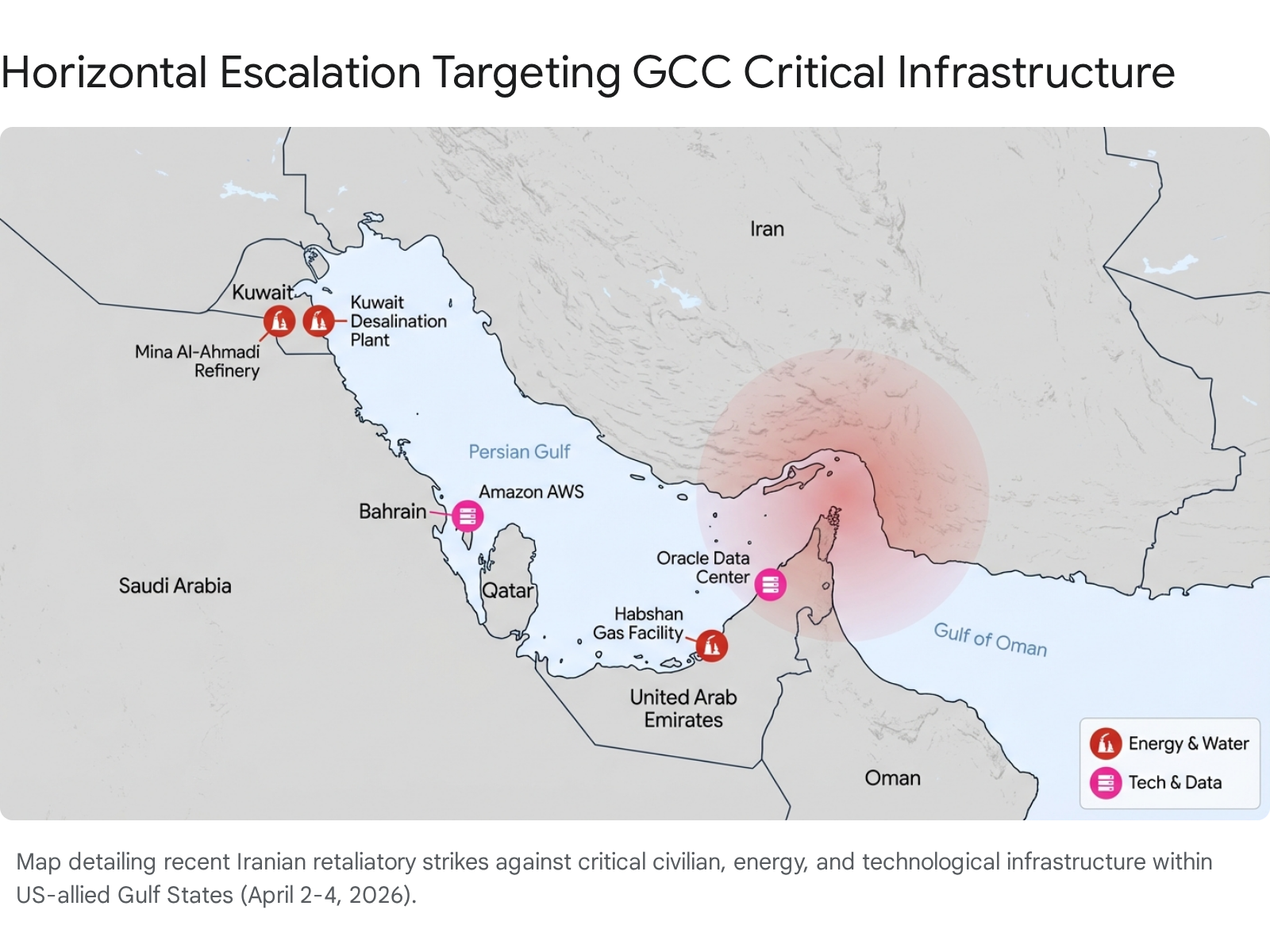
The most critical systemic shift this week involves Iran’s tactical reorientation toward “hydro-strategic” and technological vulnerabilities within the Gulf Cooperation Council states. Facing a heavily degraded conventional ballistic missile capability, the Islamic Revolutionary Guard Corps has initiated a campaign against critical civilian infrastructure in nations hosting United States military assets. This includes confirmed drone and missile strikes on water desalination plants in Kuwait, the Habshan gas facilities in the United Arab Emirates, and global technology data centers located in Bahrain and the UAE.4 This shift indicates an Iranian strategy designed to impose severe economic and humanitarian costs on allied nations, attempting to fracture the logistical and diplomatic support structure underpinning United States operations in the region.
Concurrently, the United States and Israel have expanded their target matrices beyond traditional military installations. Allied strikes have increasingly focused on Iran’s defense industrial base, civil-military infrastructure, and potential biological or chemical sites, including the Pasteur Institute and the Darou Pakhsh pharmaceutical complex in Tehran Province.7 The destruction of the B1 Bileghan Bridge connecting Tehran and Karaj demonstrates a deliberate effort to sever ground lines of communication and halt the transfer of missile components from central manufacturing hubs to western launch sites.7 Furthermore, the deployment of B-52 Stratofortresses utilizing Joint Direct Attack Munitions over Iranian airspace signals that the Iranian Integrated Air Defense System is sufficiently degraded to permit non-stealth, stand-in bomber operations.8
Despite this degradation, the operational environment remains highly lethal. On April 3, 2026, a United States Air Force F-15E Strike Eagle was shot down over southwestern Iran.2 While one crew member was rescued, Combat Search and Rescue operations remain ongoing for the missing pilot.9 An A-10 Thunderbolt II supporting the rescue effort subsequently crashed near the Strait of Hormuz, marking a significant inflection point in the air campaign and highlighting residual Iranian anti-aircraft capabilities.9
Diplomatically, the situation has reached a highly volatile impasse. United States President Donald Trump claimed that Iranian President Masoud Pezeshkian requested a ceasefire, an assertion rapidly and categorically denied by the Iranian Foreign Ministry.10 President Pezeshkian subsequently issued an open letter to the American populace questioning the strategic validity of the conflict.11 Domestically, the United States administration has submitted a historic 1.5 trillion dollar defense budget request to Congress for fiscal year 2027 to recapitalize munitions depleted by the conflict and fund the “Golden Dome” missile defense initiative.12 As global energy markets react to the sustained closure of the Strait of Hormuz, with Brent crude surpassing 109 dollars per barrel, the conflict displays no immediate signs of de-escalation.14
2.0 Chronological Timeline of Key Events (Last 7 days)
The following timeline utilizes Coordinated Universal Time to document the primary kinetic and diplomatic events from March 29 through April 4, 2026.
- March 29, 2026: United States Central Command reports the interception of two Houthi unmanned aerial vehicles near Eilat, southern Israel, marking sustained Houthi involvement in the theater.15
- March 30, 2026: United States President Donald Trump claims that “serious discussions” are underway with a “new, more reasonable” Iranian leadership, threatening to target Iranian energy generating plants and the Kharg Island oil terminal if the Strait of Hormuz is not reopened.16
- March 30, 2026: The Iranian Parliament passes the “Strait of Hormuz Management Plan,” formally asserting Iranian sovereignty over the waterway and mandating toll collections in Chinese Yuan for transiting vessels.18
- March 25, 2026: Major multinational defense firms, including Lockheed Martin and BAE Systems, agree to accelerate the production of critical munitions under framework agreements with the Pentagon to replenish depleted United States stockpiles.20
- March 30, 2026: The Israel Defense Forces issues a statement claiming the destruction of over 80 percent of Iran’s functional air defense network, enabling expanded allied air operations and non-stealth bomber sorties.15
- March 31, 2026: The Islamic Revolutionary Guard Corps public relations office issues a statement threatening to strike United States-linked information, communications, and artificial intelligence firms operating in the Middle East, accusing them of providing intelligence and surveillance support.18
- March 31, 2026: Israeli Defense Minister Israel Katz announces that Israeli forces will occupy Lebanese territory up to the Litani River, approximately 18 miles north of the Israeli border, to secure the northern sector against Hezbollah.21
- April 1, 2026: A combined Hezbollah and Iranian missile barrage targets Tel Aviv and northern Israel. The Israel Defense Forces confirms successful interceptions, though shrapnel impacts are recorded in the central civilian sector, injuring several civilians.22
- April 1, 2026: Iranian President Masoud Pezeshkian publishes an open letter addressed to the American public, disputing the official narratives surrounding the war and questioning the strategic utility of the United States military campaign and the “America First” agenda.10
- April 2, 2026, 01:00 UTC: In a primetime televised address, President Trump declares that the primary strategic objectives of Operation Epic Fury are “nearing completion” but notes that heavy strikes will continue for an estimated two to three weeks.23
- April 2, 2026: United States precision airstrikes destroy the B1 Bileghan Bridge in Alborz Province. The strike is designed to sever a primary logistics artery used by the Islamic Revolutionary Guard Corps to transport ballistic missiles from central Iran to western launch zones.7
- April 2, 2026, 20:29 UTC: The Israel Defense Forces conducts a targeted strike in the Kermanshah area of western Iran, confirming the elimination of Makram Atimi, the regional commander of the Islamic Revolutionary Guard Corps Ballistic Missile Unit.25
- April 2, 2026: The United Nations Security Council holds a high-level briefing on cooperation with the Gulf Cooperation Council. A presidential statement authored by Bahrain is adopted to encourage regional stabilization and condemn attacks on civilian infrastructure.26
- April 2, 2026: The Islamic Revolutionary Guard Corps claims to have successfully struck an Oracle cloud computing data center in Dubai, United Arab Emirates, and a diplomatic facility near Baghdad Airport. Dubai authorities issue a statement denying the data center attack.28
- April 3, 2026, 04:00 UTC: Kuwaiti air defenses engage incoming Iranian projectiles. The Kuwaiti Ministry of Electricity, Water and Renewable Energy confirms an Iranian strike damaged a water desalination plant and triggered a fire at the Mina Al-Ahmadi oil refinery.6
- April 3, 2026: The Abu Dhabi Media Office reports falling debris at the Habshan gas facilities following successful air defense interceptions of Iranian missiles. Operations at the facility are temporarily suspended to manage resulting fires.5
- April 3, 2026: A United States Air Force F-15E Strike Eagle is shot down by residual Iranian air defenses over southwestern Iran. A massive Combat Search and Rescue operation is initiated.2
- April 3, 2026, 23:29 UTC: An A-10 Thunderbolt II aircraft, deployed in a counter-drone and Combat Search and Rescue support capacity, crashes near the Strait of Hormuz after taking heavy Iranian ground fire.9
- April 3, 2026: The United States Office of Management and Budget formally unveils a 1.5 trillion dollar defense budget request for fiscal year 2027 to address theater munitions depletion and fund comprehensive air defense networks.13
- April 3, 2026: The Pentagon releases updated casualty figures indicating 13 to 15 United States service members have been killed since the inception of Operation Epic Fury, with between 365 and 520 personnel wounded in action.19
3.0 Situation by Primary Country
3.1 Iran
3.1.1 Military Actions & Posture
The Iranian military apparatus, comprising both the conventional Artesh and the Islamic Revolutionary Guard Corps, has suffered systemic degradation since the onset of the conflict on February 28. United States and Israeli intelligence assessments indicate that allied forces have engaged over 13,000 targets, fundamentally dismantling Iran’s integrated air defense network.15 This degradation has resulted in the destruction of over 80 percent of Iran’s functional air defense systems, permitting United States B-52 Stratofortress bombers to operate directly over Iranian airspace utilizing gravity-based Joint Direct Attack Munitions rather than relying solely on expensive, long-range standoff cruise missiles.8
The Islamic Revolutionary Guard Corps’ ballistic missile and naval capabilities have sustained severe attrition. Official allied estimates report the destruction of over 190 ballistic missile launchers and 150 naval vessels, equating to 92 percent of Iran’s large maritime assets.19 Consequently, the volume of Iranian missile strikes targeting Israel has declined by approximately 90 percent.32 Despite these losses, United States intelligence warns that up to 50 percent of Iran’s total ballistic missile launcher capacity may remain functionally intact.33 Many of these launchers are currently combat-ineffective due to being trapped within deeply buried subterranean tunnel networks, with allied forces having struck an estimated 77 percent of known tunnel entrances to deny egress.2
To circumvent the destruction of infrastructure in western border provinces such as Kermanshah and Kurdistan, the Islamic Revolutionary Guard Corps has shifted its launch operations to central and eastern provinces including Yazd, Markazi, and Esfahan.2 This geographic displacement necessitates the transportation of heavy missile components across exposed ground lines of communication. To exploit this vulnerability, United States forces executed a precision strike on the B1 Bileghan Bridge connecting Tehran and Karaj in Alborz Province, explicitly designed to sever a vital logistics artery.7
Despite operating with a severely degraded conventional deterrent, Iran retains a potent asymmetric strike capability. On April 3, residual Iranian air defense elements achieved their most significant tactical victory of the conflict by downing a United States F-15E Strike Eagle over southwestern Iran, followed by the downing of an A-10 Thunderbolt II near the Strait of Hormuz.3 Furthermore, Iran has altered its offensive doctrine. Shifting away from heavily defended Israeli airspace, the Islamic Revolutionary Guard Corps has initiated Operation True Promise IV, which focuses on horizontal escalation against “soft” strategic targets in the Persian Gulf.1 This includes the utilization of cluster munitions and “shotgun type” warheads designed to maximize area damage against critical civilian infrastructure, data centers, and water desalination plants in neighboring states.4
3.1.2 Policy & Diplomacy
The internal political landscape in Tehran remains highly opaque following the decapitation strike that killed Supreme Leader Ali Khamenei and numerous senior officials on the first day of the war.19 His successor, Mojtaba Khamenei, has adopted a cloistered leadership style, remaining absent from public view.36 Mojtaba Khamenei has issued rare written directives emphasizing national unity, warning regional governments against complicity with United States operations, and threatening continued military resistance, while simultaneously leaving diplomatic channels open for conflict termination.37
President Masoud Pezeshkian has assumed the role of the primary public diplomat for the regime. On April 1, Pezeshkian released an open letter addressed directly to the American public.11 The letter challenged the official narratives surrounding the war, framing the United States military intervention as an aggressive extension of the military-industrial complex designed to manufacture external threats to justify defense spending.10 Pezeshkian denied that Iran initiated the conflict and questioned the strategic utility of the “America First” agenda in the context of regional destruction.11
Diplomatic efforts to secure a ceasefire have repeatedly stalled. The Iranian government formally rejected a 15-point ceasefire proposal drafted by the United States, issuing counter-demands that require full reparations and binding international guarantees against future aggression.39 Furthermore, indirect backchannel negotiations mediated by Pakistan and Oman have reportedly reached a dead end, with Iranian delegates refusing to meet United States officials.2 Institutionalizing its asymmetric leverage, the Iranian Parliament passed the “Strait of Hormuz Management Plan.” This legislation asserts absolute Iranian sovereignty over the vital maritime chokepoint and mandates the collection of transit tolls in Chinese Yuan, effectively weaponizing global energy supply chains to extract postwar concessions.7
3.1.3 Civilian Impact
The humanitarian crisis within the Islamic Republic has reached catastrophic proportions. The Iranian Ministry of Health reports over 2,076 fatalities and 26,500 injuries.9 However, independent monitoring organizations, including the Human Rights Activists News Agency and Hengaw, estimate the total death toll, encompassing both military and civilian casualties, exceeds 7,300 individuals.19 The initial days of the conflict witnessed severe civilian casualty events, including a strike on a school in Minab that resulted in 170 deaths, and strikes on sports facilities.19 Furthermore, Amnesty International has documented the recruitment of child soldiers by Iranian state forces, characterizing the practice as a war crime.41
The domestic infrastructure grid has been severely compromised by targeted allied strikes. Widespread power outages have paralyzed Tehran, Alborz province, and surrounding regions, severely restricting access to medical care and basic services.42 Allied forces have broadened their targeting parameters to include civil-military infrastructure, conducting strikes on the Pasteur Institute and the Darou Pakhsh pharmaceutical complex in Tehran Province under the justification that these facilities are linked to biological and chemical weapons activities.7 Economic conditions have collapsed under the dual weight of destroyed petroleum infrastructure and a severed global trade network. Internal displacement is massive; Iranian government sources acknowledge that up to 3.2 million citizens have been temporarily displaced from heavily targeted zones, while cross-border refugee movements show thousands of Iranians fleeing into neighboring Turkey and displaced Afghan populations returning to Afghanistan.43
3.2 Israel
3.2.1 Military Actions & Posture
The Israel Defense Forces are executing simultaneous, high-intensity combat operations on two primary fronts under the banner of Operation Roaring Lion.44 The Israeli Air Force has played a decisive role in the systematic dismantling of the Iranian war machine. Following an initial wave of 1,200 munitions deployed in the first 24 hours of the conflict, Israeli strikes have consistently targeted high-value leadership nodes, aerospace manufacturing hubs, and residual nuclear infrastructure, including sites at Natanz, Isfahan, and a covert facility designated Min Zadai.19
On April 2, Israel Defense Forces precision strikes in the Kermanshah area of western Iran successfully eliminated Makram Atimi, the regional commander of the Islamic Revolutionary Guard Corps Ballistic Missile Unit.25 This targeted assassination campaign has severely degraded the command-and-control capabilities of local Iranian commanders, paralyzing their ability to coordinate large-scale retaliatory barrages.18 Furthermore, Israeli Defense Minister Israel Katz confirmed that the systematic targeting of the Iranian industrial base has destroyed an estimated 70 percent of the country’s steel production capacity, critically hampering the regime’s ability to reconstitute its missile and drone forces.2
On the northern front, the Israel Defense Forces have significantly expanded their ground incursion into southern Lebanon. The military seeks to establish a permanent security buffer zone extending up to the Litani River, approximately 18 miles north of the Blue Line.21 The Israel Defense Forces are implementing what Defense Minister Katz described as the “Rafah and Beit Hanoun models,” systematically demolishing infrastructure and residential buildings in border villages to deny cover to Hezbollah militants.21 Hezbollah continues to mount fierce resistance, claiming 65 attacks against Israeli forces and northern communities between March 29 and March 30.15
3.2.2 Policy & Diplomacy
The Israeli government maintains a unified, maximalist posture regarding the eradication of the Iranian nuclear and proxy threats. Prime Minister Benjamin Netanyahu’s war cabinet has consistently rejected international calls for premature de-escalation, insisting that the complete destruction of Iran’s offensive capabilities is an existential necessity for the State of Israel.44 While United States President Donald Trump has publicly signaled a desire to wind down operations, Israeli leadership remains focused on long-term strategic denial.23 To sustain prolonged multi-front operations, the Israeli Knesset is advancing a revised 2026 national budget that incorporates a massive 10 billion dollar augmentation to baseline defense spending, pushing the total military budget beyond 45 billion dollars.42
3.2.3 Civilian Impact
Israel’s multi-layered air defense architecture, which integrates the Iron Dome, David’s Sling, and Arrow systems, has successfully intercepted the vast majority of incoming Iranian and Hezbollah projectiles.45 However, the civilian populace remains under intense psychological and physical pressure. According to official casualty figures, 11 soldiers and 23 civilians have been killed directly by hostile fire since February 28, with 6,594 individuals requiring medical treatment for injuries or acute trauma.19
During the Passover holiday week (April 1 to April 2), Iran fired approximately 20 ballistic missiles at central Israel.7 Intelligence reports indicate that at least two of these missiles utilized cluster munition warheads designed to maximize area damage against soft targets.7 Debris and submunitions impacted the cities of Petah Tikva and Bnei Brak, resulting in multiple civilian casualties, including critical injuries to children.22 The continuous barrage of rockets from Lebanon, combined with ballistic threats from Iran and Houthi forces in Yemen, requires maintaining high alert statuses across the nation.
3.3 United States
3.3.1 Military Actions & Posture
United States Central Command is executing Operation Epic Fury with an unprecedented aggregation of aerospace, naval, and logistical assets deployed across the Middle East.48 Over the past seven days, the operational tempo has seen a strategic shift in munitions deployment. As the Iranian integrated air defense network has crumbled under relentless suppression, the United States Air Force has transitioned from relying exclusively on expensive, long-range standoff weapons to utilizing B-52 Stratofortresses for overland, direct-attack missions using Joint Direct Attack Munitions.8 This transition allows for a higher volume of precise ordnance delivery against dynamic, mobile, and hardened targets, accelerating the destruction of the Iranian military-industrial complex.4
The United States force posture continues to expand to support sustained combat operations. The USS Tripoli amphibious assault ship arrived in the theater carrying 3,500 Marines of the 31st Marine Expeditionary Unit, joining multiple Carrier Strike Groups already on station.21 However, the operational footprint is facing sophisticated Iranian counter-attacks targeting the logistical and sensory nodes that enable American air superiority.32 Iranian drones and ballistic missiles have systematically targeted localized radar infrastructure, successfully destroying or damaging at least 12 early warning and tracking systems, including AN/TPY-2 radars associated with Terminal High Altitude Area Defense batteries, AN/FPS-132 radars in Qatar, and AN/TPS-59 systems in Bahrain.19 Furthermore, parked E-3 Sentry Airborne Warning and Control System aircraft and KC-135 Stratotanker refueling aircraft have sustained damage from drone strikes at Prince Sultan Air Base in Saudi Arabia.32
The conflict reached a critical inflection point on April 3 with the highest profile aircraft losses of the campaign to date. An F-15E Strike Eagle was shot down deep within Iranian territory, forcing the crew to eject.2 While one crew member was successfully recovered by combat search and rescue teams, the search for the missing Weapons Systems Officer continues in a highly permissive hostile environment.9 A subsequent rescue operation resulted in the loss of an A-10 Thunderbolt II near the Strait of Hormuz after taking heavy Iranian ground fire.9 Total United States casualties since the operation’s inception stand at 13 to 15 service members killed in action and between 365 and 520 wounded.19
3.3.2 Policy & Diplomacy
The executive branch is projecting contradictory messaging regarding the timeline for conflict termination. On March 30, President Trump stated that “great progress has been made” in negotiations with the Iranian regime and indicated the conflict could conclude shortly.17 Conversely, the administration authorized the destruction of critical civilian infrastructure and issued ultimatums threatening the total annihilation of Iran’s energy grid and desalination infrastructure if maritime transit is not immediately restored.17 In a primetime address on April 1, President Trump declared the strategic objectives were “nearing completion” but warned of severe strikes continuing for several weeks.23
Domestically, the administration released its fiscal year 2027 budget proposal on April 3. The request seeks an unprecedented 1.5 trillion dollars for the Department of Defense, representing a 44 percent increase over the previous fiscal year.12 This massive budget allocation is designed to rapidly replenish precision-guided munition stockpiles depleted in the Middle East and Ukraine, and allocates 17.5 billion dollars to initiate the “Golden Dome” continental missile defense shield.13 To offset these historic military expenditures, the administration proposed a 10 percent reduction in non-defense discretionary spending, sparking intense political debate.50 Internationally, tensions are rising between the United States and its European allies; President Trump has severely criticized NATO members, specifically France and the United Kingdom, for failing to contribute militarily to the reopening of the Strait of Hormuz and for occasionally restricting airspace access for allied military aircraft.51
3.3.3 Civilian Impact
The primary impact of Operation Epic Fury on the United States civilian sector is profound economic disruption. The effective closure of the Strait of Hormuz, a maritime chokepoint through which 20 percent of global oil production historically transits, has triggered severe shocks in global energy markets.14 Brent crude prices surged by 7.8 percent on April 3 alone, settling at 109.03 dollars per barrel.14 This represents an approximate 50 percent increase in fuel costs since the conflict began.14 This energy crisis is generating massive inflationary pressure across the global supply chain, increasing domestic consumer fuel prices, and impacting the transportation and logistics sectors. Furthermore, the Iranian threat to target multinational corporate infrastructure, including Amazon and Oracle data centers, introduces a novel vector of economic warfare that threatens global digital supply chains and cloud computing stability.34
4.0 Regional and Gulf State Impacts
The strategic spillover of the Iran-United States conflict has fundamentally altered the security architecture of the Persian Gulf. Recognizing the conventional overmatch of the United States military, Iran has initiated a campaign of horizontal escalation aimed directly at the Gulf Cooperation Council states. The strategic objective is to impose unbearable domestic economic and humanitarian costs on host nations, coercing them into evicting United States Central Command forces or denying them access to critical airspace and logistical nodes. This strategy weaponizes the profound vulnerabilities of desert nations heavily reliant on centralized infrastructure.
4.1 United Arab Emirates (UAE)
The United Arab Emirates has absorbed the highest volume of inbound Iranian projectiles among the Gulf states, with Iran utilizing over 1,440 drones and hundreds of ballistic missiles against Emirati territory since the conflict began.4 On April 3, the UAE Ministry of Defense reported that air defense systems intercepted multiple incoming ballistic missiles and drones.5 Debris from these interceptions cascaded onto the massive Habshan gas facilities in Abu Dhabi, triggering significant fires that forced the government to temporarily suspend operations at the complex.5 Earlier in the week, the Islamic Revolutionary Guard Corps claimed a direct drone strike against an Oracle cloud computing data center located in Dubai, demonstrating an intent to disrupt global technological supply chains, though Dubai authorities officially denied the facility suffered damage.28 Consequently, civil aviation remains severely disrupted. The European Union Aviation Safety Agency has restricted the Emirates Flight Information Region, leading carriers such as Emirates and FlyDubai to operate on highly restricted schedules, while multiple international airlines have canceled all flights transiting the area.52
4.2 Kuwait
Kuwait represents a critical logistical hub for United States ground and air forces, hosting facilities such as Ali Al Salem Air Base. On April 3, an Iranian drone and missile barrage penetrated Kuwaiti airspace. The Ministry of Electricity, Water and Renewable Energy confirmed that an Iranian strike successfully impacted a combined power generation and water desalination plant, causing material damage to the infrastructure and resulting in the death of at least one Indian expatriate worker.6 Simultaneously, a drone strike triggered a fire at the Mina Al-Ahmadi oil refinery, requiring emergency intervention by the Kuwait Petroleum Corporation to contain the blaze.6 Because Kuwait derives approximately 90 percent of its potable water from desalination, these strikes represent an existential “hydro-strategic” threat designed to instill panic within the civilian population and pressure the government to curtail its military cooperation with the United States.54
4.3 Saudi Arabia
Saudi Arabia remains heavily targeted due to the presence of United States aircraft and radar installations. Specifically, Prince Sultan Air Base has repeatedly suffered damage from Iranian drone strikes targeting E-3 Sentry Airborne Warning and Control System aircraft and KC-135 Stratotanker refueling platforms.32 On April 3, the Saudi Ministry of Defense, via spokesperson Brigadier General Turki Al-Malki, announced the successful interception and destruction of seven Iranian drones operating over the kingdom’s Eastern Province.55 In response to the persistent threat of aerial bombardment and falling interceptor debris, Saudi Arabia has upgraded its travel advisories and severely restricted its airspace. The Jeddah Flight Information Region is largely closed to commercial traffic, with exceptions permitted only for military aircraft and strictly vetted commercial flights operating under high-altitude constraints above flight level 320.53
4.4 Bahrain, Qatar, and Oman
Bahrain, which serves as the headquarters for the United States Navy’s Fifth Fleet, experienced multiple air raid sirens on April 3, forcing residents into shelters.57 The Islamic Revolutionary Guard Corps claimed to have successfully destroyed an Amazon Web Services cloud computing operations center in Bahrain, signifying an unprecedented expansion of targeting parameters into the multinational digital sector.58 Qatar, hosting the pivotal Al Udeid Air Base, continues to facilitate United States military operations while engaging in frantic diplomatic efforts to de-escalate the conflict to protect its vulnerable Ras Laffan liquefied natural gas export facilities.34
The United Nations Security Council, currently under the presidency of Bahrain, held an emergency session on April 2 to address the regional crisis. The Gulf Cooperation Council issued a unified statement vehemently condemning the Iranian targeting of civilian infrastructure, characterizing it as a flagrant violation of international law and state sovereignty.59 Oman remains partially isolated from the direct kinetic exchanges, operating as a crucial conduit for backchannel diplomatic communications between Washington and Tehran. Oman is currently attempting to broker a framework to monitor transit and facilitate the reopening of the Strait of Hormuz, though its airspace remains heavily restricted by European Union Aviation Safety Agency directives.41
4.5 Jordan
Jordanian airspace remains a primary transit corridor for allied aircraft executing strikes in Iran and a contested zone for intercepted projectiles. Iran has repeatedly targeted the Muwaffaq Salti Air Base in Azraq, Jordan, which houses critical United States fighter squadrons and logistical assets.39 Furthermore, Iranian-backed proxy militias operating from Iraq launched a drone that crashed into the Trebil border crossing between Iraq and Jordan, damaging customs clearance facilities and disrupting cross-border trade.28 The constant threat of falling debris from intercepted missiles has forced Jordan to close its airspace intermittently, heavily disrupting regional mobility and supply chains, while the nation navigates intense domestic pressure regarding its cooperation with United States and Israeli air defense networks.39
| Host Nation | Primary US Asset Location | Airspace Status (EASA) | Recent Infrastructure Impact (Apr 1 – Apr 4) |
| United Arab Emirates | Al Dhafra Air Base | Restricted (OMAE FIR) | Habshan Gas Facility fires; Oracle data center targeted. |
| Kuwait | Ali Al Salem / Camp Arifjan | Restricted (OKAC FIR) | Desalination plant struck; Mina Al-Ahmadi refinery fire. |
| Saudi Arabia | Prince Sultan Air Base | Restricted (OEJD FIR) | Seven UAVs intercepted over Eastern Province. |
| Bahrain | NSA Bahrain (Fifth Fleet) | Restricted (OBBB FIR) | Amazon AWS facility targeted; widespread civilian sirens. |
| Qatar | Al Udeid Air Base | Restricted (OTDF FIR) | None directly reported; severe airspace disruption. |
| Jordan | Muwaffaq Salti Air Base | Restricted (OJAC FIR) | Trebil border crossing damaged by proxy drone strike. |
5.0 Appendices
Appendix A: Methodology
This Situation Report was compiled utilizing a comprehensive, real-time sweep of global Open-Source Intelligence. Data aggregation prioritized official state broadcasts and press releases (e.g., United States Department of Defense, United States Central Command, Israel Defense Forces operational updates, and Iranian state media including the Islamic Republic of Iran Broadcasting and Syrian Arab News Agency). Furthermore, intelligence was gathered from verified military monitors, international diplomatic statements (United Nations Security Council readouts, Gulf Cooperation Council official portals), and global financial tracking networks.
To calculate the 7-day operational overlap (March 29 to April 4, 2026), events were strictly filtered against Coordinated Universal Time timestamps to eliminate reporting latency across different global time zones. Where casualty figures and operational successes directly conflict (for example, United States and Israeli claims of Iranian equipment destroyed versus Iranian claims of United States radar and aircraft destroyed), the data is presented neutrally, attributing the specific claim to the originating entity. Casualty statistics incorporate aggregated data from the Armed Conflict Location and Event Data Project, the United Nations Office for the Coordination of Humanitarian Affairs, the Iranian Human Rights Activists News Agency, and Hengaw to provide a balanced overview of the humanitarian impact. Airspace restrictions were cross-referenced with the European Union Aviation Safety Agency Conflict Zone Information Bulletins.
Appendix B: Glossary of Acronyms
- AOR: Area of Responsibility. The specific geographic region assigned to a military commander to execute military operations.
- AWACS: Airborne Warning and Control System. An airborne radar system designed to detect aircraft, ships, and vehicles at long ranges and control the battle space in an air engagement (e.g., the E-3 Sentry).
- CENTCOM: United States Central Command. The unified combatant command responsible for United States military operations in the Middle East, Central Asia, and parts of South Asia.
- CSAR: Combat Search and Rescue. Highly specialized military operations conducted to recover personnel in hostile environments under combat conditions.
- EASA: European Union Aviation Safety Agency. The agency responsible for civilian aviation safety across the European Union, which issues binding airspace advisories.
- FIR: Flight Information Region. A specified region of airspace in which flight information service and alerting service are provided to aviation traffic.
- GCC: Gulf Cooperation Council. A regional intergovernmental political and economic union consisting of Bahrain, Kuwait, Oman, Qatar, Saudi Arabia, and the United Arab Emirates.
- IADS: Integrated Air Defense System. A network of radars, anti-aircraft weaponry, and command centers operating cooperatively to defend airspace.
- IDF: Israel Defense Forces. The national military of the State of Israel.
- IRGC: Islamic Revolutionary Guard Corps. A multi-service primary branch of the Iranian Armed Forces, distinct from the conventional military, responsible for internal security, asymmetric warfare, and the ballistic missile program.
- JDAM: Joint Direct Attack Munition. A guidance kit that converts unguided gravity bombs into all-weather precision-guided munitions utilizing GPS technology.
- OSINT: Open-Source Intelligence. Data collected from publicly available sources to be used in an intelligence context.
- THAAD: Terminal High Altitude Area Defense. An American anti-ballistic missile defense system designed to intercept short, medium, and intermediate-range ballistic missiles in their terminal phase.
- UAV: Unmanned Aerial Vehicle. Commonly referred to as a drone, used for surveillance or kinetic strikes.
- WSO: Weapons Systems Officer. The flight officer directly involved in all air operations and weapon systems of a military aircraft, such as the F-15E Strike Eagle.
Appendix C: Glossary of Foreign Words
- Artesh: The conventional military of the Islamic Republic of Iran, operating in parallel with the Islamic Revolutionary Guard Corps.
- Khamenei, Ali: The former Supreme Leader of Iran, possessing ultimate political and religious authority, who was assassinated in the opening salvos of Operation Epic Fury on February 28, 2026.
- Khamenei, Mojtaba: The son of Ali Khamenei and the newly elevated Supreme Leader of Iran, currently exercising ultimate authority over the state and armed forces.
- Knesset: The unicameral national legislature of the State of Israel, responsible for passing laws and approving the national budget.
- Majlis: The Islamic Consultative Assembly, the national legislative body (parliament) of Iran.
- Operation Epic Fury: The official United States military codename for the ongoing joint military operations against the Islamic Republic of Iran.
- Operation Roaring Lion: The official Israel Defense Forces codename for operations targeting the Iranian state, its nuclear infrastructure, and its regional proxy network.
- Operation True Promise IV: The official Iranian military codename for its retaliatory ballistic missile and drone campaign against Israel, the United States, and host nations in the Persian Gulf.
- Pezeshkian, Masoud: The incumbent President of the Islamic Republic of Iran, operating under the ultimate authority of the Supreme Leader, serving as the primary public face of the government.
Please share the link on Facebook, Forums, with colleagues, etc. Your support is much appreciated and if you have any feedback, please email us in**@*********ps.com. If you’d like to request a report or order a reprint, please click here for the corresponding page to open in new tab.
Sources Used
- Operation True Promise – Wikipedia, accessed April 4, 2026, https://en.wikipedia.org/wiki/Operation_True_Promise
- Iran Update, Special Report, April 3, 2026 | ISW, accessed April 4, 2026, https://understandingwar.org/research/middle-east/iran-update-special-report-april-3-2026/
- US presses search for a missing serviceman as Iran calls on public to find ‘enemy pilot’, accessed April 4, 2026, https://www.click2houston.com/news/2026/04/04/iran-says-strike-hit-close-to-its-bushehr-nuclear-facility-killing-a-guard-and-damaging-a-building/
- Operation Epic Fury Situation Report | Battlefield Effects and Early …, accessed April 4, 2026, https://www.hudson.org/missile-defense/operation-epic-fury-situation-report-battlefield-effects-strategic-outcomes-can-kasapoglu
- UAE halts operations at Habshan gas facility following air defense interception, accessed April 4, 2026, https://sana.sy/en/international/2307528/
- Kuwait says power and desalination plant damaged in attack, accessed April 4, 2026, https://www.aa.com.tr/en/middle-east/kuwait-says-power-and-desalination-plant-damaged-in-attack/3890325
- Iran Update, April 2, 2026 | ISW, accessed April 4, 2026, https://understandingwar.org/research/middle-east/iran-update-special-report-april-2-2026/
- B-52s Carrying JDAMs over Iran as US Bombers Play Growing Role in Air War, accessed April 4, 2026, https://www.airandspaceforces.com/b-52-jdams-iran-us-bombers-growing-role-air-war/
- Iran war updates: Tehran says two US planes shot down | US-Israel …, accessed April 4, 2026, https://www.aljazeera.com/news/liveblog/2026/4/3/iran-war-live-trump-warns-assault-on-infrastructure-hasnt-even-started
- Iranian President Pens Open Letter to American People, accessed April 4, 2026, https://time.com/article/2026/04/01/iran-war-president-open-letter-american-people/
- Iranian President Questions ‘America First’ Agenda in Letter Hours Before Trump’s US Address, accessed April 4, 2026, https://www.military.com/daily-news/2026/04/01/iranian-president-questions-america-first-agenda-letter-hours-trumps-us-address.html
- The $1.5 trillion olive branch: Trump proposes history’s costliest peace, accessed April 4, 2026, https://timesofindia.indiatimes.com/world/us/the-1-5-trillion-olive-branch-trump-proposes-historys-costliest-peace/articleshow/130012305.cms
- White House Unveils $1.5 Trillion Defense Budget. What Comes Next?, accessed April 4, 2026, https://www.airandspaceforces.com/white-house-unveils-1-5-trillion-defense-budget-what-comes-next/
- 2 U.S. planes are down and Iran hits Gulf refineries as the war wraps its 5th week | TPR, accessed April 4, 2026, https://www.tpr.org/news/2026-04-03/2-u-s-planes-are-down-and-iran-hits-gulf-refineries-as-the-war-wraps-its-5th-week
- Iran Update Special Report, March 30, 2026 | ISW, accessed April 4, 2026, https://understandingwar.org/research/middle-east/iran-update-special-report-march-30-2026/
- What They’re Saying About Operation Epic Fury—March 30, 2026 | UANI, accessed April 4, 2026, https://www.unitedagainstnucleariran.com/press-releases/what-theyre-saying-about-operation-epic-fury-march-30-2026
- Operations Epic Fury and Roaring Lion: 3/30/26 Update – JINSA, accessed April 4, 2026, https://jinsa.org/wp-content/uploads/2026/03/Operations-Epic-Fury-and-Roaring-Lion-03.30.2026.pdf
- Iran Update Special Report, March 31, 2026 | ISW, accessed April 4, 2026, https://understandingwar.org/research/middle-east/iran-update-special-report-march-31-2026/
- 2026 Iran war – Wikipedia, accessed April 4, 2026, https://en.wikipedia.org/wiki/2026_Iran_war
- Operations Epic Fury and Roaring Lion: 3/25/26 Update – JINSA, accessed April 4, 2026, https://jinsa.org/wp-content/uploads/2026/03/Operations-Epic-Fury-and-Roaring-Lion-03-25-26.pdf
- Iran war timeline: 1 month of escalating strikes, broadening conflict, accessed April 4, 2026, https://www.everettpost.com/world/iran-war-timeline-1-month-of-escalating-strikes-broadening-conflict/
- Live Updates: Latest from Israel, Iran, and the Middle East | The …, accessed April 4, 2026, https://www.jpost.com/middle-east/iran-news/2026-04-03/live-updates-891973
- Trump: Operation Epic Fury ‘nearing completion’ in first prime-time address since launch, accessed April 4, 2026, https://www.legion.org/information-center/news/security/2026/april/trump-operation-epic-fury-nearing-completion-in-first-prime-time-address-since-launch
- Trump makes his case for war with Iran, saying the conflict is ‘nearing completion’ – WUNC, accessed April 4, 2026, https://www.wunc.org/2026-04-01/trump-makes-his-case-for-war-with-iran-saying-the-conflict-is-nearing-completion
- April 2, 2026: Iran-Israel War 2026 – Live Updates, accessed April 4, 2026, https://www.idf.il/en/mini-sites/iran-israel-war-2026/iran-israel-war-2026-live-updates-1/april-2-2026-iran-israel-war-2026-live-updates/
- UN Security Council issues toned down statement on the Strait of Hormuz, accessed April 4, 2026, https://www.commonspace.eu/node/13784
- Cooperation between the UN and the Gulf Cooperation Council (GCC): Briefing and Adoption of a Presidential Statement, accessed April 4, 2026, https://www.securitycouncilreport.org/whatsinblue/2026/04/cooperation-between-the-un-and-the-gulf-cooperation-council-gcc-briefing-and-adoption-of-a-presidential-statement.php
- IRGC claims to have attacked Dubai Oracle data center, US fighter jets at Jordan’s Al Azraq base, accessed April 4, 2026, https://www.jpost.com/middle-east/iran-news/article-891951
- Kuwait reports damage to power, desalination facility following attack – Xinhua, accessed April 4, 2026, https://english.news.cn/20260403/c794d75370a5460cbd41620ab2691897/c.html
- UAE’s Habshan gas facilities shut as fire erupts following intercepted attack, accessed April 4, 2026, https://english.news.cn/20260403/d3db39fc458c4b6abbcba02602d3bfa4/c.html
- 13 US Service Members Killed, 365 Injured in Five Weeks of Iran Campaign, accessed April 4, 2026, https://www.kyivpost.com/post/73221
- Iranian strikes target the infrastructure behind US airpower – Defense News, accessed April 4, 2026, https://www.defensenews.com/global/mideast-africa/2026/04/01/iranian-strikes-target-the-infrastructure-behind-us-airpower/
- US intelligence believes Iran still has ‘significant’ missile launching capabilities as the war continues, accessed April 4, 2026, https://www.livemint.com/news/us-news/us-intelligence-believes-iran-still-has-significant-missile-launching-capabilities-as-war-continues-11775229260027.html
- Iran’s target list: taking the war to multinationals | Pearls and Irritations, accessed April 4, 2026, https://johnmenadue.com/post/2026/03/irans-target-list-taking-the-war-to-multinationals/
- 2026 Iran war | Explained, United States, Israel, Strait of Hormuz, Map, & Conflict, accessed April 4, 2026, https://www.britannica.com/event/2026-Iran-war
- Iran-Israel war highlights: U.N. force in southern Lebanon says peacekeeper killed, accessed April 4, 2026, https://www.thehindu.com/news/international/iran-israel-us-war-updates-live-march-29-2026/article70798605.ece
- Iran’s unseen new leader issues first message in writing, accessed April 4, 2026, https://www.iranintl.com/en/202603125349
- Mojtaba Khamenei’s First Statement Signals Escalation and Regional Pressure, accessed April 4, 2026, https://thesoufancenter.org/intelbrief-2026-march-12b/
- Middle East Conflict: Situational Updates and Implications for Global Mobility, accessed April 4, 2026, https://newlandchase.com/middle-east-crisis-situation-update/
- Iran’s President Masoud Pezeshkian outlines three conditions to end the war – YouTube, accessed April 4, 2026, https://www.youtube.com/watch?v=l_j3EW-YIXk
- Iran Strikes Defiant Tone After Trump Speech, accessed April 4, 2026, https://www.cfr.org/articles/iran-strikes-defiant-tone-after-trump-speech
- Indian worker killed in Iranian attack on Kuwait power, desalination plants, accessed April 4, 2026, https://timesofindia.indiatimes.com/world/middle-east/indian-worker-killed-in-iranian-attack-on-kuwait-power-desalination-plants/articleshow/129889431.cms
- UNHCR Middle East Situation: Emergency Flash Update #9 as of 2 April 2026, accessed April 4, 2026, https://reliefweb.int/report/iran-islamic-republic/unhcr-middle-east-situation-emergency-flash-update-9-2-april-2026
- Iran-Israel War 2026 | IDF, accessed April 4, 2026, https://www.idf.il/en/mini-sites/iran-israel-war-2026/
- Operation Roaring Lion—Initial Insights, accessed April 4, 2026, https://www.inss.org.il/social_media/operation-roaring-lion-initial-insights/
- Iran-Israel war updates: Iran military says downed second U.S. jet in Gulf, accessed April 4, 2026, https://www.thehindu.com/news/international/iran-israel-war-live-updates-april-3-2026-west-asia-crisis-conflict/article70818422.ece
- Daily Report: The Second Iran War – April 3, 2026 (16:00), accessed April 4, 2026, https://israel-alma.org/daily-report-the-second-iran-war-april-3-2026-1600/
- Operation Epic Fury – U.S. Central Command, accessed April 4, 2026, https://www.centcom.mil/OPERATIONS-AND-EXERCISES/EPIC-FURY/
- Operation Epic Fury First 48 Hours, accessed April 4, 2026, https://media.defense.gov/2026/Mar/03/2003882612/-1/-1/0/OPERATION-EPIC-FURY-FIRST-48-HOURS.PDF
- Trump budget seeks $1.5T in defense spending alongside cuts in domestic programs, accessed April 4, 2026, https://apnews.com/article/trump-2027-annual-budget-congress-defense-f95715d838be17afd9799208cd3182e3
- Trump’s ‘Art of the Deal’ Is Losing Friends and Alienating Allies, accessed April 4, 2026, https://www.defensepriorities.org/opinion/trumps-art-of-the-deal-is-losing-friends-and-alienating-allies/
- Flight Cancellations Due to Airspace Restrictions in the Middle East and Passenger Rights, accessed April 4, 2026, https://www.flypgs.com/en/press-room/announcement/flight-cancellations-due-to-airspace-restrictions-in-the-middle-east
- Airspace of the Middle East and Persian Gulf – EASA – European Union, accessed April 4, 2026, https://www.easa.europa.eu/en/domains/air-operations/czibs/2026-03-r5
- Iran Condemns Attack on Kuwaiti Desalination Facilities, accessed April 4, 2026, https://kashmirobserver.net/2026/04/03/iran-condemns-attack-on-kuwaiti-desalination-facilities/
- Saudi Arabia, Kuwait intercept missiles and drones as regional tensions rise, accessed April 4, 2026, https://sana.sy/en/international/2307475/
- Middle East Airspace – Current Operational Picture – International Ops 2025 – OpsGroup, accessed April 4, 2026, https://ops.group/blog/middle-east-airspace-current-operational-picture/
- Kuwait, Saudis, Bahrain repel overnight drone attacks, accessed April 4, 2026, https://en.yenisafak.com/world/kuwait-saudis-bahrain-repel-overnight-drone-attacks-3716654
- Daily brief about U.S.-Israeli strikes on Iran: Day 34, accessed April 4, 2026, https://english.news.cn/20260403/f364c813bb804c558b7af1aa78289af8/c.html
- Security Council Recognizes Expertise of Gulf Cooperation Council in First-Ever Presidential Statement, as Briefers Call for Broad Cooperation in Middle East, accessed April 4, 2026, https://press.un.org/en/2026/sc16328.doc.htm
- Guterres warns of ‘wider war’ as Middle East conflict enters second month | UN News, accessed April 4, 2026, https://news.un.org/en/story/2026/04/1167244