1. Executive Summary
This intelligence assessment evaluates the strategic, military, macroeconomic, and diplomatic operating environment following the formal conclusion of the kinetic phases of Operation Epic Fury. Initiated on February 28, 2026, the joint United States and Israeli military campaign was designed to systematically dismantle Iranian offensive missile capabilities, neutralize naval security infrastructure, and permanently degrade the state’s nuclear weapons program.1 After 38 days of high-intensity conflict and over 13,000 combat sorties, the battlespace has evolved from active aerial bombardment into a complex, multi-domain standoff characterized by a suffocating U.S. naval blockade, asymmetric maritime retaliation, and highly fragmented diplomatic backchannels.3
The operational landscape as of early May 2026 is defined by several converging and highly volatile crises. First, the Iranian state is experiencing an unprecedented internal power struggle catalyzed by the targeted assassination of Supreme Leader Ali Khamenei at the onset of the conflict.2 While the Assembly of Experts quickly appointed Mojtaba Khamenei as his successor, the Islamic Revolutionary Guard Corps (IRGC), under the command of Major General Ahmad Vahidi, has effectively usurping executive authority from the civilian government led by President Masoud Pezeshkian.6 This institutional coup has paralyzed Tehran’s strategic decision-making apparatus.
Second, the U.S. strategy of maximum economic coercion, formalized as the “Economic Fury” campaign, has severely degraded Iran’s macroeconomic stability.9 However, a recent Central Intelligence Agency (CIA) assessment indicates that Tehran retains the economic resilience and smuggling infrastructure necessary to endure the current U.S. naval blockade for an additional 90 to 120 days before domestic economic collapse forces a total capitulation.10
Third, the closure of the Strait of Hormuz has triggered a systemic economic shock across the Gulf Cooperation Council (GCC) states.5 The resulting disruption to global energy markets and the acute localized food supply shortages have fundamentally altered the risk calculus of key U.S. allies.5 Efforts to restore maritime navigation via “Project Freedom” have been indefinitely paused due to Saudi Arabia and Kuwait denying the U.S. military access to regional airspace and airbases, highlighting a significant divergence in risk tolerance between Washington and its Gulf partners.11
Finally, diplomatic backchannels managed through the “Islamabad Talks” have produced a fragile 14-point draft memorandum of understanding (MoU) aimed at a 30-day framework for de-escalation.13 Analysis of Iranian strategic posturing suggests a bifurcated intent regarding conflict resolution: the pragmatic civilian government urgently seeks a ceasefire to avert imminent economic ruin, while the hardline IRGC actively spoils diplomatic off-ramps in order to consolidate its domestic hegemony and isolate U.S. regional allies.14
2. Strategic Context and the Retrospective of Operation Epic Fury
The roots of the current conflagration extend back to the collapse of the Joint Comprehensive Plan of Action (JCPOA) and the subsequent failure of the 2025-2026 bilateral negotiations.16 The immediate precursor to Operation Epic Fury was the “Twelve-Day War” of June 2025, during which Israel launched unilateral strikes against Iranian military and nuclear facilities, prompting severe Iranian counter-strikes before a fragile ceasefire was implemented.17 In early 2026, Israeli Prime Minister Benjamin Netanyahu presented intelligence to U.S. President Donald Trump indicating imminent Iranian nuclear breakout and regional escalation.17 Based on these assessments, the U.S. administration authorized a decapitation and demilitarization campaign.17
2.1 The Kinetic Campaign: Execution and Asset Attrition
Midmorning on February 28, 2026, U.S. Central Command (CENTCOM) and Israeli forces commenced Operation Epic Fury.2 The campaign opened with overwhelming force, executing nearly 900 precision strikes within the first 12 hours.2 The primary objectives, as articulated by the(https://www.war.gov/Spotlights/Operation-Epic-Fury/), were to destroy Iranian offensive missiles, dismantle missile production networks, degrade the IRGC navy, and ensure the permanent neutralization of the nuclear program.20
Over the 39-day operation, U.S. and allied aviation assets flew over 13,000 sorties, representing an operational tempo rarely seen in modern combat.3 The campaign achieved significant degradation of the Iranian command structure, most notably the targeted killing of Supreme Leader Ali Khamenei and dozens of top-tier officials before they could disperse to subterranean command bunkers.2
However, the intensity of the operational tempo and the density of Iran’s integrated air defense systems exacted a measurable toll on U.S. aviation assets. Open-source intelligence tracking confirms the loss of 39 U.S. aircraft, with an additional 10 suffering various degrees of battle damage.3 Unmanned aerial vehicles (UAVs) absorbed the bulk of combat attrition, with up to 24 U.S. Air Force MQ-9 Reaper drones destroyed over the course of the conflict.3
Manned aircraft losses were notable and reflect the hazards of sustained operations in a highly contested airspace. The United States lost four F-15E Strike Eagles and one A-10 Warthog in direct combat operations.3 Furthermore, an F-35A Lightning II sustained combat damage over Iranian airspace—marking the first known instance of battle damage to a 5th-generation fighter—though the pilot successfully executed an emergency landing.3 Operational friction also contributed to the attrition rate; intelligence indicates that 20% of the aircraft losses were attributed to friendly fire incidents, including the downing of three F-15Es over Kuwait, or the deliberate destruction of assets to prevent capture during combat search and rescue (CSAR) missions inside Iranian territory.3 A severe logistical blow was the total destruction of an E-3G Sentry airborne early warning and control aircraft, a highly prized command and control asset.3 Additionally, a KC-135 Stratotanker was lost over Iraq on March 12, resulting in the deaths of four U.S. crew members.19
| Asset Type | Verified Losses | Operational Status and Contextual Notes |
| MQ-9 Reaper | 24 | Accounted for greater than 60% of total combat attrition; highly vulnerable to dense low-altitude air defenses.3 |
| F-15E Strike Eagle | 4 | Three airframes lost to friendly fire over Kuwait; one involved in a complex CSAR operation.3 |
| A-10 Warthog | 1 | Destroyed during close air support or interdiction operations.3 |
| KC-135 Stratotanker | 1 | Lost over Iraqi airspace on March 12; all four crew members confirmed deceased.19 |
| E-3G Sentry | 1 | Total destruction of a critical command and control node.3 |
| F-35A Lightning II | 0 (1 Damaged) | First known combat damage to a 5th-generation fighter; airframe recovered via emergency landing.3 |
2.2 Infrastructure Targeting and Collateral Impacts
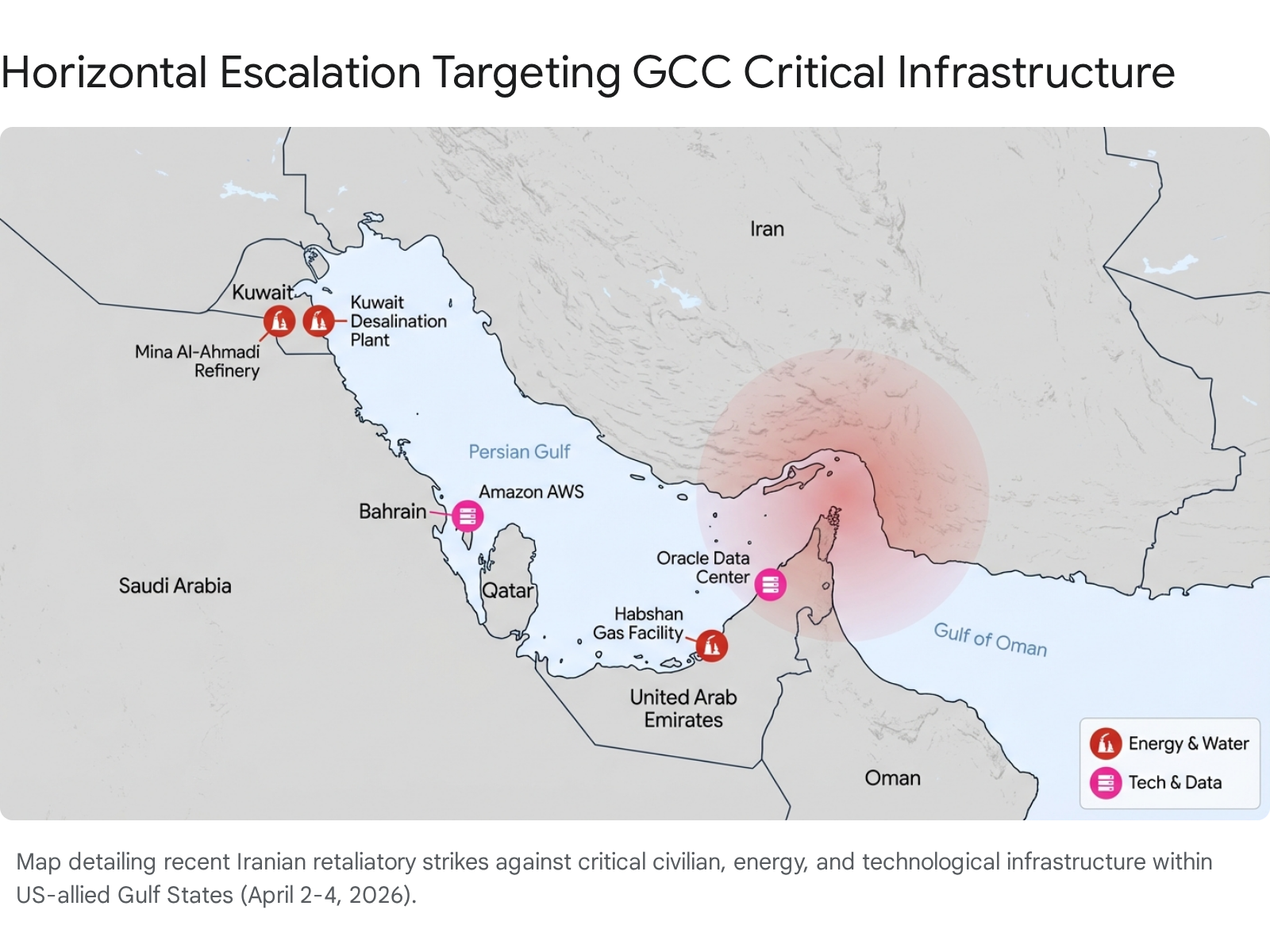
The strike packages systematically dismantled critical nodes of the Iranian defense industrial base and broader macroeconomic infrastructure. Key national assets targeted included the Kharg Island oil terminal, the South Pars gas field, and the Qeshm Island desalination plant.5 The destruction of these facilities was designed to cripple the state’s ability to generate revenue and sustain its population, thereby accelerating the timeline for capitulation.5
The campaign generated immediate diplomatic controversy and provided the regime with substantial propaganda leverage following a catastrophic targeting failure on February 28. A U.S. missile struck a girls’ school adjacent to an IRGC naval base in the town of Minab, near Bandar Abbas, resulting in approximately 170 civilian fatalities.2 The physical destruction of state apparatus buildings, including the Assembly of Experts facility in Tehran, temporarily disrupted the regime’s administrative continuity, delaying the formal selection of a new Supreme Leader.2
3. The Current State of Iran: Political Decapitation and Factional Bifurcation
The assassination of Ali Khamenei fundamentally altered the institutional power dynamics within the Islamic Republic. The U.S. intelligence community had assessed that an aggressive decapitation strike would so degrade the Iranian command structure that the regime would fracture, allowing the United States to impose a more pliant government in Tehran—a strategy modeled on the U.S. operation in Venezuela in January 2026.18 This assumption proved overly optimistic. The regime demonstrated remarkable initial resilience, moving swiftly to prevent a power vacuum. Ali Larijani, the secretary of the Supreme National Security Council, served as the de facto leader immediately following the strikes, executing pre-planned continuity of government protocols.2 On March 8, the Assembly of Experts officially appointed Mojtaba Khamenei as the third Supreme Leader of the Revolution.6
3.1 The Crisis of Executive Authority and the IRGC Coup
Since his appointment, the internal stability of the Iranian state has deteriorated into a profound crisis of executive authority. Mojtaba Khamenei has not made a single verifiable public appearance and has released no primary video or audio directives, fueling intense international and domestic speculation regarding his health and the actual locus of control within the state.6 In his prolonged absence, a severe factional rift has paralyzed the Iranian government, exposing deep vulnerabilities within a security infrastructure that had long been presented domestically as a symbol of unyielding strength.22
The civilian executive branch, led by President Masoud Pezeshkian, is currently locked in an escalating power struggle with the IRGC, commanded by Major General Ahmad Vahidi.7 The IRGC has utilized the wartime environment and the ambiguity surrounding the Supreme Leader to execute a silent institutional coup, systematically dismantling presidential authority.
General Vahidi has successfully blocked President Pezeshkian’s cabinet appointments, including the outright rejection of all candidates for intelligence minister, such as Hossein Dehghan.8 Vahidi insists that given the ongoing wartime conditions, all critical leadership positions must be managed directly by the military apparatus.8 Furthermore, the IRGC directly pressured Pezeshkian into appointing Mohammad Bagher Zolghadr as the secretary of the Supreme National Security Council, solidifying the military’s unilateral grip on foreign and security policy.14 Pezeshkian’s persistent calls for executive and managerial powers to be returned to the civilian administration have been firmly and publicly rejected by Vahidi.14
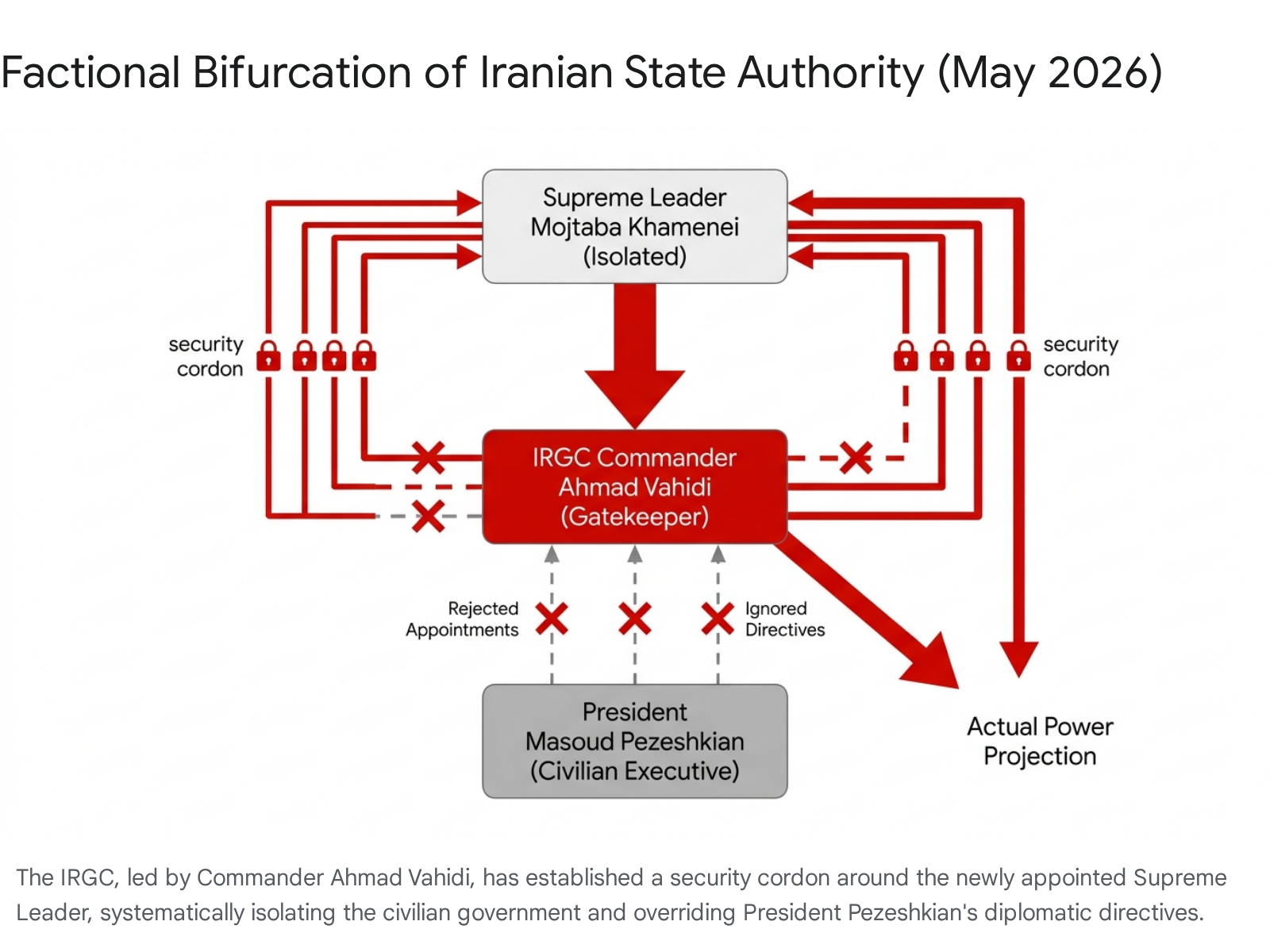
Intelligence indicates that the IRGC has erected a physical and informational security cordon around Supreme Leader Mojtaba Khamenei, preventing independent government reports from reaching him.8 Pezeshkian has repeatedly sought urgent meetings with the Supreme Leader to lodge complaints regarding the IRGC’s behavior, but these requests have largely been stonewalled.8 When a meeting reportedly did occur in early May, Pezeshkian described it as an unmediated discussion lasting over two hours, yet there is no indication that the Supreme Leader reined in the IRGC’s activities following the summit.6
4. Asymmetric Intentions: Do Iranian Leaders Want the Conflict to End?
A critical intelligence requirement is determining the true intentions of the Iranian leadership regarding conflict resolution. The answer is deeply bifurcated: Iranian leaders do not share a unified objective, and the institutional schizophrenia of the state dictates two diametrically opposed foreign policies.24
4.1 The Pragmatist Imperative: Economic Survival
The civilian government, led by President Pezeshkian and supported by pragmatist officials, urgently desires a termination of hostilities. Economic indicators presented to the civilian cabinet warn of total macroeconomic collapse within three to four weeks absent a ceasefire.14 The civilian leadership recognizes that the state cannot physically or economically sustain a protracted war of attrition against the combined weight of the U.S. and Israeli militaries.
Demonstrating this desperation, Pezeshkian issued a highly irregular public video on March 7 in which he apologized for what he termed “fire at will” attacks by the country’s armed forces on neighboring Gulf states.14 He explicitly instructed the military to cease such attacks, marking an unprecedented concession aimed at regional de-escalation and signaling to Washington that the civilian government was ready to negotiate.7 Consequently, the civilian leadership wants the conflict to end as much, if not more, than U.S. leaders do.
4.2 The Hardliner Imperative: Martial Hegemony
Conversely, the IRGC and the hardline security establishment view the continuation of the conflict as both a strategic necessity and a supreme domestic utility. General Vahidi and his inner circle have explicitly ignored the President’s directives. Shortly after Pezeshkian’s apology video, the IRGC unilaterally launched drone and missile strikes against the United Arab Emirates (UAE) during active ceasefire negotiations.14 Pezeshkian expressed severe anger over these strikes, labeling them completely irresponsible actions taken without the government’s knowledge.7
This insubordination serves a dual purpose for the IRGC. Strategically, striking the UAE aims to drive a wedge between the U.S. and its Gulf partners, imposing costs on nations that facilitate U.S. operations and isolating them from the American security umbrella.15 Domestically, sabotaging Pezeshkian’s diplomatic leverage ensures that the civilian government cannot negotiate a settlement that might diminish the military’s power. By maintaining a state of continuous, managed crisis, the IRGC justifies its martial law status and remains the uncontested arbiter of the state’s survival.15 Furthermore, powerful figures like Parliament Speaker Mohammad Bagher Ghalibaf, whose standing rests on the support of former military figures, continue to lay down maximalist demands—such as halting Israeli operations in Lebanon—that make diplomatic compromises virtually impossible.21
5. Economic Coercion and the “Economic Fury” Campaign
To force capitulation following the conclusion of the kinetic phase, the US Treasury and the Office of Foreign Assets Control (OFAC) initiated “Economic Fury,” a maximum-pressure campaign designed to sever the regime’s financial lifelines, dismantle its defense procurement networks, and spark domestic unrest.9
5.1 Sanctions, Smuggling Networks, and Shadow Banking
On May 8, OFAC executed sweeping sanctions targeting ten individuals and entities across the Middle East, Asia, and Eastern Europe.9 These networks were identified as critical logistics nodes facilitating the supply of raw materials for Iran’s Shahed-series UAVs and ballistic missile programs.9 Prominent among the sanctioned entities were the Center for Progress and Development of Iran (CDPI), which coordinates technology acquisitions, the China-based Yushita Shanghai International Trade Co., Hong Kong-based AE International Trade Co., and the Belarus-based Armoury Alliance LLC.27
Simultaneously, the U.S. Treasury targeted Chinese “teapot” independent oil refineries situated primarily in the Shandong Province.28 These facilities have historically served as the primary processing centers for billions of dollars of illicit Iranian crude oil.28 Specific entities designated included Qingdao Haiye Oil Terminal, Shandong Shouguang Luqing Petrochemical, Hebei Xinhai Chemical Group, and Hengli Petrochemical.28
To bypass traditional SWIFT networks and the dollar-dominated global financial system, Iranian operators have increasingly relied on shadow banking networks and cryptocurrency exchanges to convert yuan-denominated oil revenues into usable foreign currency.9 In response, OFAC designated three major Iranian foreign currency exchange houses and their associated front companies, freezing nearly half a billion dollars in regime-linked cryptocurrency assets.9 Furthermore, OFAC published FAQ 1249, explicitly warning global shipping firms that any “toll” payments made to the Government of Iran or the IRGC for safe passage through the Strait of Hormuz are unauthorized and subject to severe U.S. secondary sanctions.28
5.2 Domestic Economic Impact and Social Instability
The macroeconomic impact of Economic Fury on the Iranian populace has been severe and immediate. The national currency is experiencing extreme volatility, leading to hyperinflation in basic commodities, food supplies, and energy markets.5 Reports from major urban centers, including Tehran, indicate systemic liquidity crises, with automated teller machines (ATMs) lacking physical cash, malfunctioning, or being rendered physically inaccessible due to security concerns.14 Small business owners report that years of prior sanctions, combined with the acute shocks of the current war, have pushed the domestic economy to a breaking point.30
The combination of wartime infrastructure destruction and intense economic coercion has catalyzed renewed domestic protests and labor strikes, reminiscent of the widespread 2025-2026 Iranian protests.5 On May 1, marking International Workers’ Day, resistance units launched public campaigns in cities like Zahedan to defy state executions and economic tyranny.29 The Iranian regime is actively preparing contingency mechanisms for widespread economic instability, recognizing that the primary internal threat to its survival is a popular uprising triggered by economic deprivation.31
5.3 Intelligence Assessment: The Limits of Economic Warfare
Despite the localized devastation and the political friction it has caused, a highly classified CIA assessment circulated in May 2026 directly challenges the prevailing policy narrative that the U.S. naval blockade is producing immediate, decisive pressure on Tehran.10
The intelligence analysis concludes that Iran retains sufficient macroeconomic resilience, deep state reserves, and sophisticated smuggling infrastructure to withstand the U.S. naval blockade for an additional three to four months (approximately 90 to 120 days) before experiencing the kind of severe deterioration that would force unconditional surrender.10 This indicates a profound misalignment in the U.S. strategic timeline, which had relied on the assumption that military depletion and economic exhaustion would rapidly converge within a short window.10 The regime has adapted its logistical footprint by repurposing its tanker fleet for offshore floating storage and utilizing complex ship-to-ship transfers to obscure cargo origins and bypass interdiction efforts.33
6. Military Posture and the Nuclear Threat Landscape
While Operation Epic Fury successfully degraded Iran’s forward-projection capabilities and eliminated key leadership nodes, the state’s foundational deterrents—its ballistic missile arsenal and its nuclear program—remain highly potent operational threats.34
6.1 Conventional Asset Retention
The U.S. and Israeli air campaigns degraded both Iranian ballistic missile forces and the supporting infrastructure that allows the force to function.34 However, the intelligence estimates from May 2026 suggest that a significant portion of the defense apparatus survived by utilizing deep subterranean silos and highly mobile launch platforms.
| Military Asset Category | Estimated Remaining Capacity | Strategic Implication |
| Mobile Missile Launchers | ~75% of pre-conflict inventory | High residual capacity for asymmetric retaliation against regional U.S. bases and Gulf infrastructure.10 |
| Ballistic Missile Arsenal | ~70% of pre-conflict stockpile | Deeply buried silos successfully protected assets from sustained aerial bombardment.10 |
| Shahed UAV Production | Ongoing | Production is sustained via illicit supply chains and smuggled dual-use components.10 |
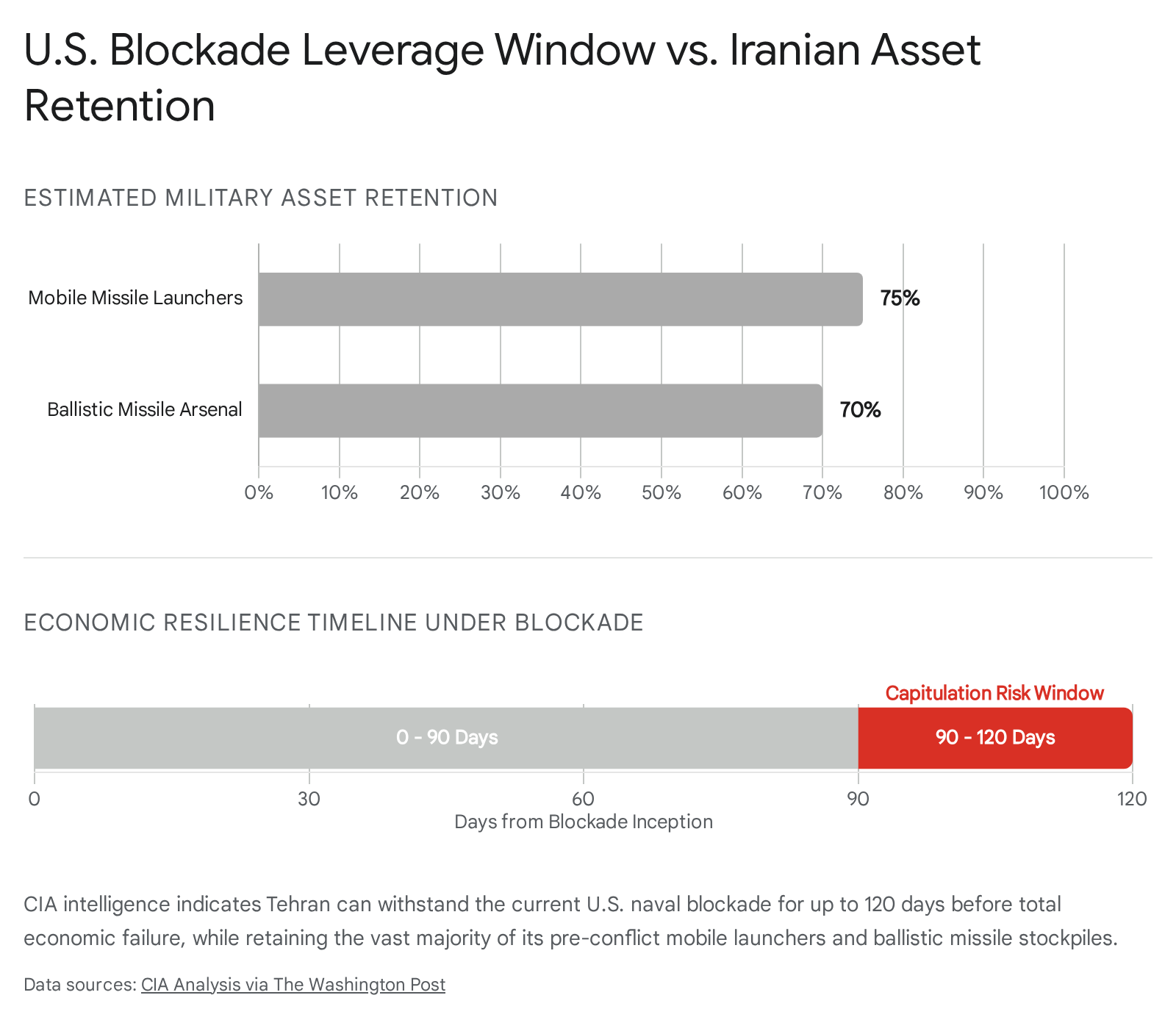
These figures are highly significant. Because the IRGC views a continued state of conflict as beneficial to its domestic standing, the retention of 75% of its mobile launchers provides the military with the physical means to sustain a low-intensity regional war for months, irrespective of the civilian government’s desire for peace.10
6.2 The Nuclear Ecosystem and Breakout Timelines
Operation Epic Fury specifically targeted what U.S. and Israeli intelligence described as the entire “ecosystem” of Iran’s nuclear program.34 This included domestic uranium mining operations, processing facilities, enrichment sites using advanced centrifuges, specialized machinery plants, and associated university research departments.34
Specific kinetic successes included severe damage to Iran’s heavy water production plant at Khondab, which the International Atomic Energy Agency (IAEA) confirmed via satellite imagery is no longer operational.35 The Shahid Rezayee Nejad Yellow Cake Production Facility in Ardakan was also attacked and heavily damaged.35 Furthermore, significant international attention was paid to the targeting of the Bushehr nuclear power plant, where a structure adjacent to the reactor was destroyed, prompting the unconfirmed evacuation of Russian Rosatom technical staff.35 These strikes built upon the successes of operations in June 2025, which had previously devastated the primary enrichment complexes at Natanz, Fordow, and Isfahan.36
Despite this physical degradation, the strategic threat of an Iranian nuclear breakout has paradoxically increased in the fog of war. Iran has systematically evicted IAEA inspectors from all but its safeguarded power and research reactors, creating critical intelligence blind spots across the country.37 The most alarming intelligence gap involves approximately 440 kilograms of uranium enriched to 60% purity.36 Prior to the conflict, the IAEA believed roughly half of this stockpile was stored in an underground tunnel complex at the Isfahan Nuclear Research Center, but without inspections, the current location of the material is unverified.36 This stockpile is sufficient to produce up to ten nuclear weapons if further enriched to weapons-grade purity.36
Prior to the June 2025 strikes, U.S. intelligence estimated Iran’s nuclear breakout timeline at a mere three to six months.36 Following the extensive bombardments of the past year, current estimates have pushed that timeline back to roughly nine to twelve months.36 However, U.S. defense analysts assess that the surviving regime hardliners—particularly the IRGC leadership that now dominates the state apparatus—will pursue weaponization with renewed determination and absolute urgency.37 The hardliners view the acquisition of a nuclear weapon as the ultimate insurance policy to ensure that the regime’s existence is never threatened by a decapitation campaign again.37 As a diplomatic maneuver to defuse this specific threat, Russia, via Kremlin spokesman Dmitry Peskov, has renewed a pre-war offer to take physical custody of Iran’s highly enriched uranium (HEU) stockpile as part of a final peace agreement, though Tehran has thus far rebuffed the proposal.38
7. The Maritime Domain: The Strait of Hormuz Crisis
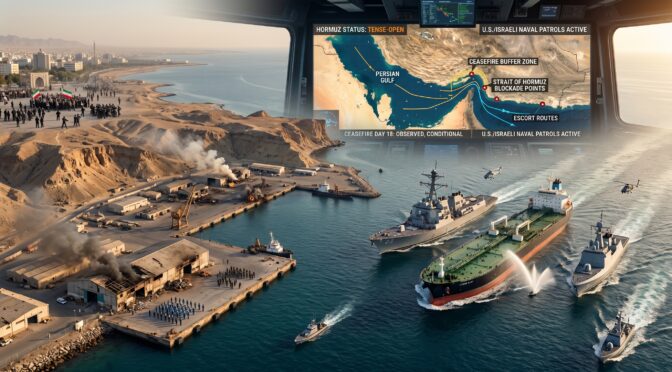
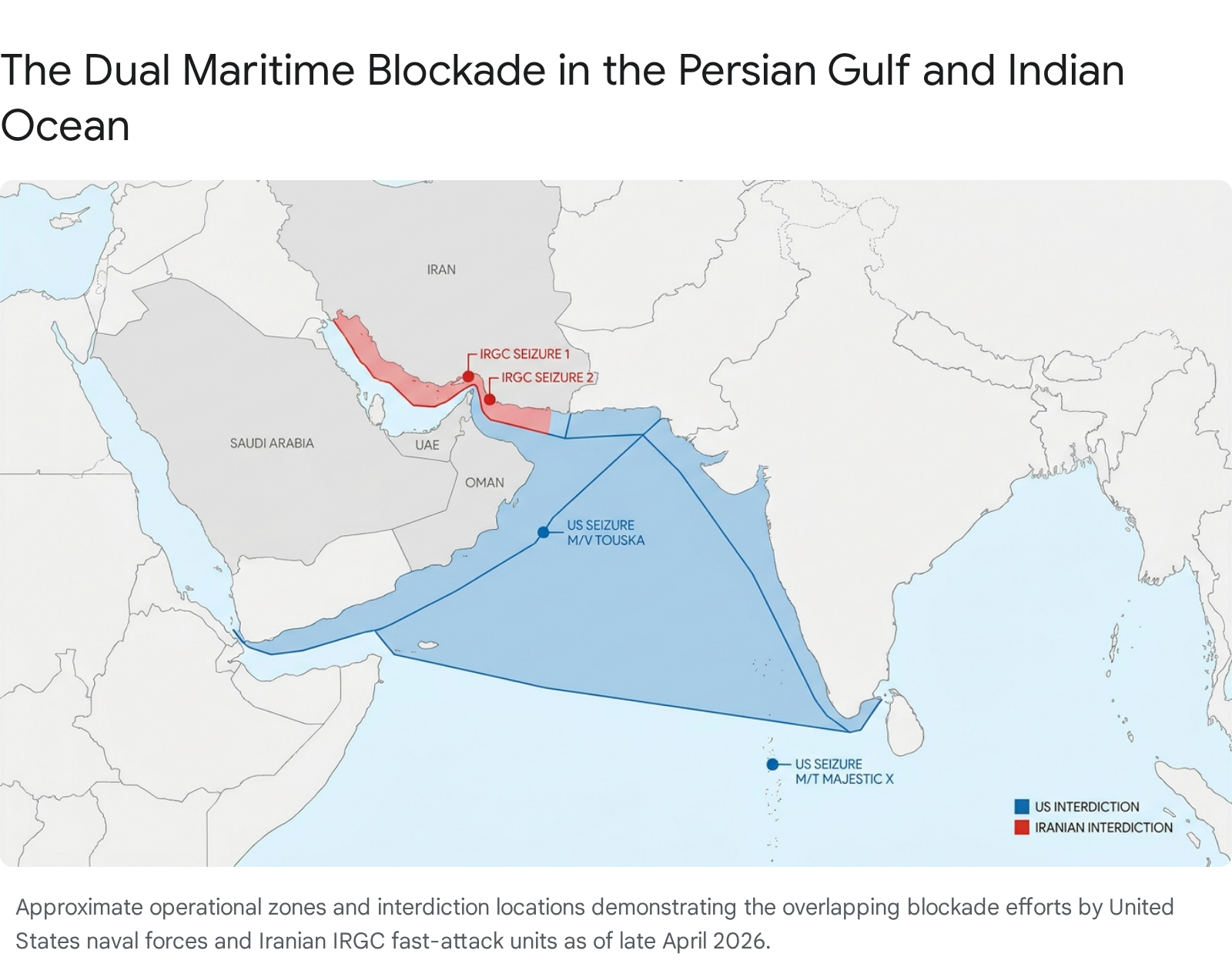
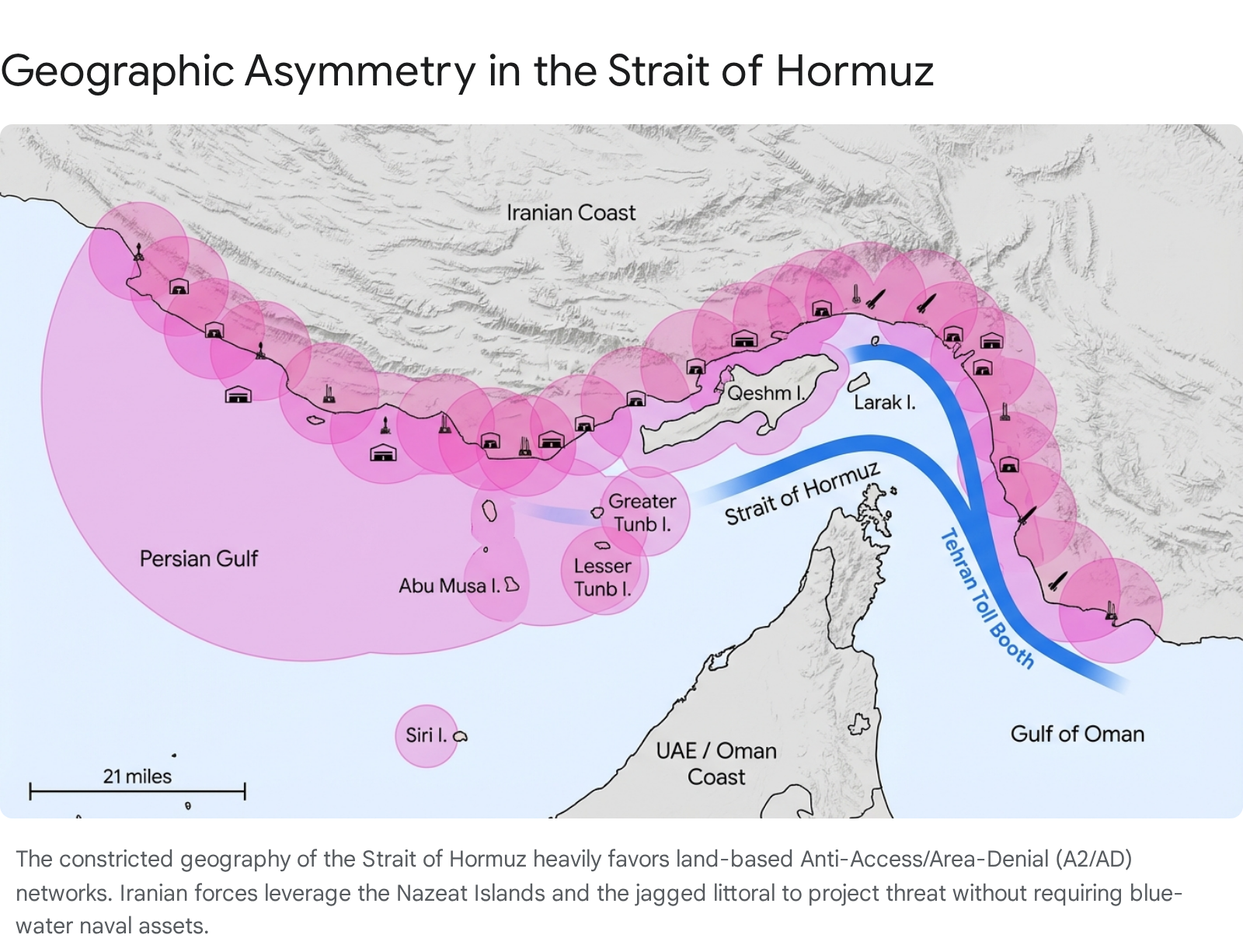
The geographic epicenter of the ongoing standoff lies in the Strait of Hormuz, one of the world’s most critical maritime chokepoints.32 Following the initiation of U.S.-Israeli strikes on February 28, Iran effectively closed the waterway on March 2, asserting that any commercial or military transit must be explicitly coordinated with, and approved by, the IRGC navy.5 To enforce this unilateral claim of sovereignty, Iran has heavily mined sectors of the strait and maintains growing clusters of loitering military vessels on both sides of the transit corridors.23
7.1 Global and Regional Economic Fallout
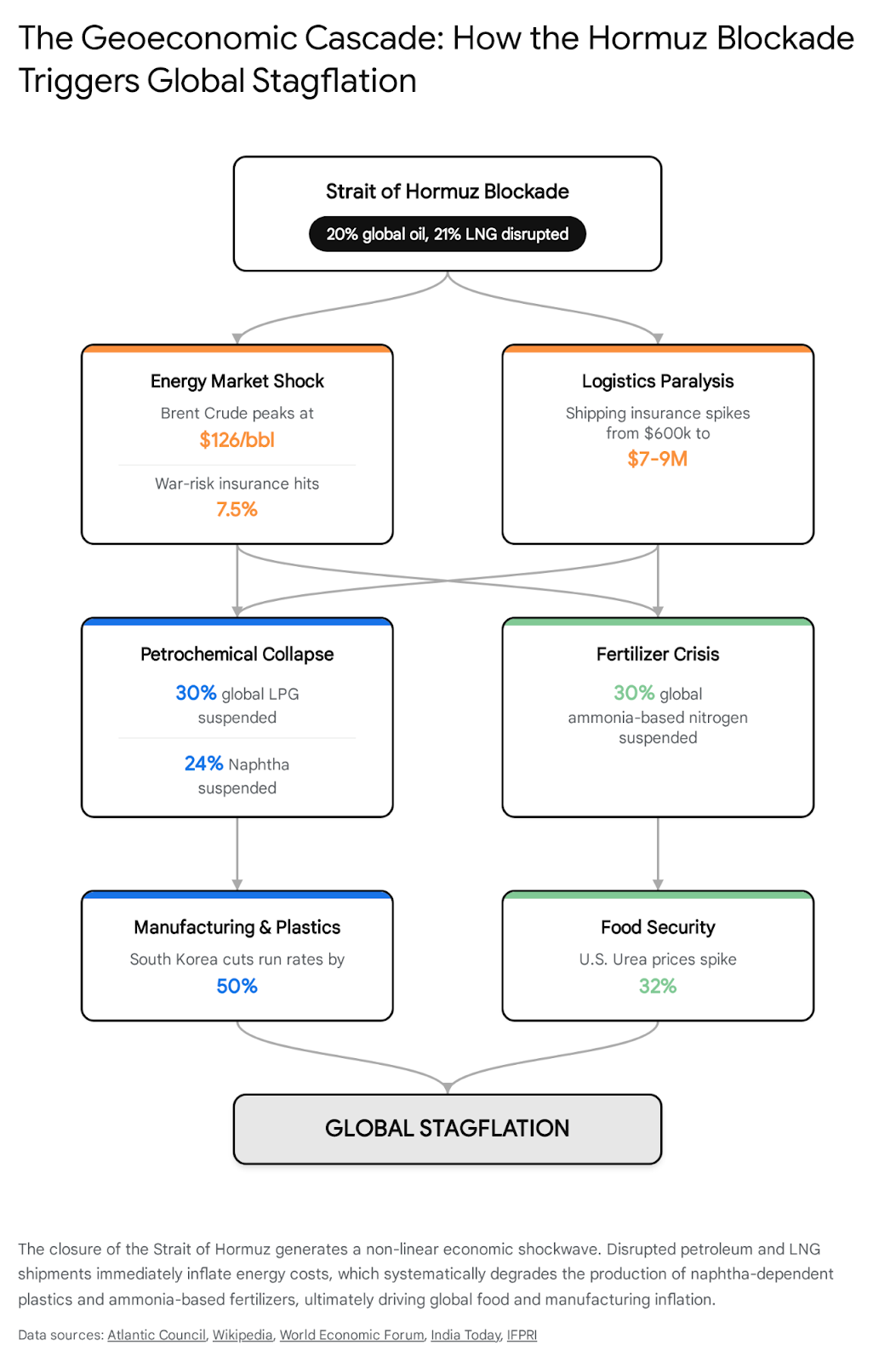
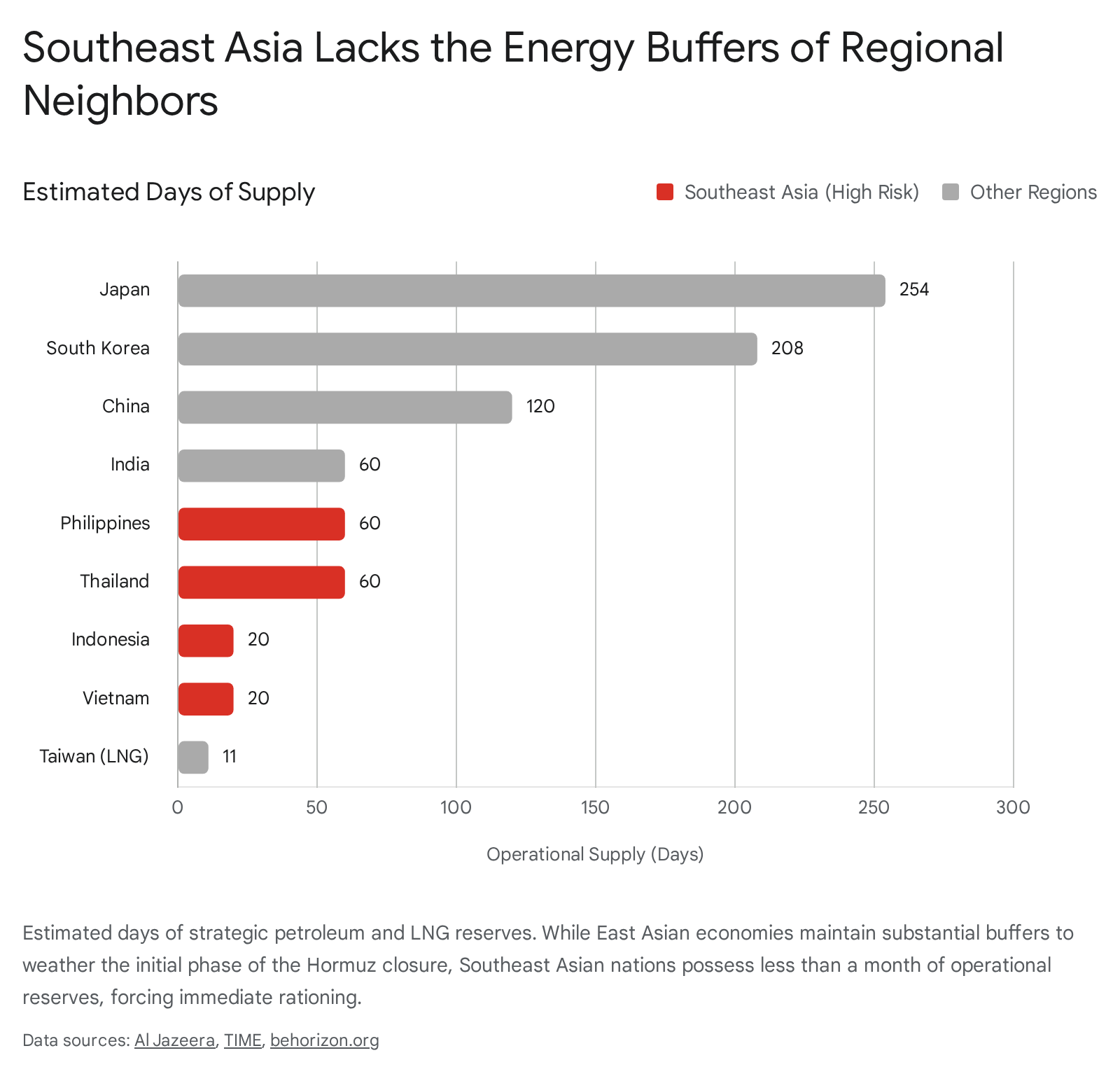
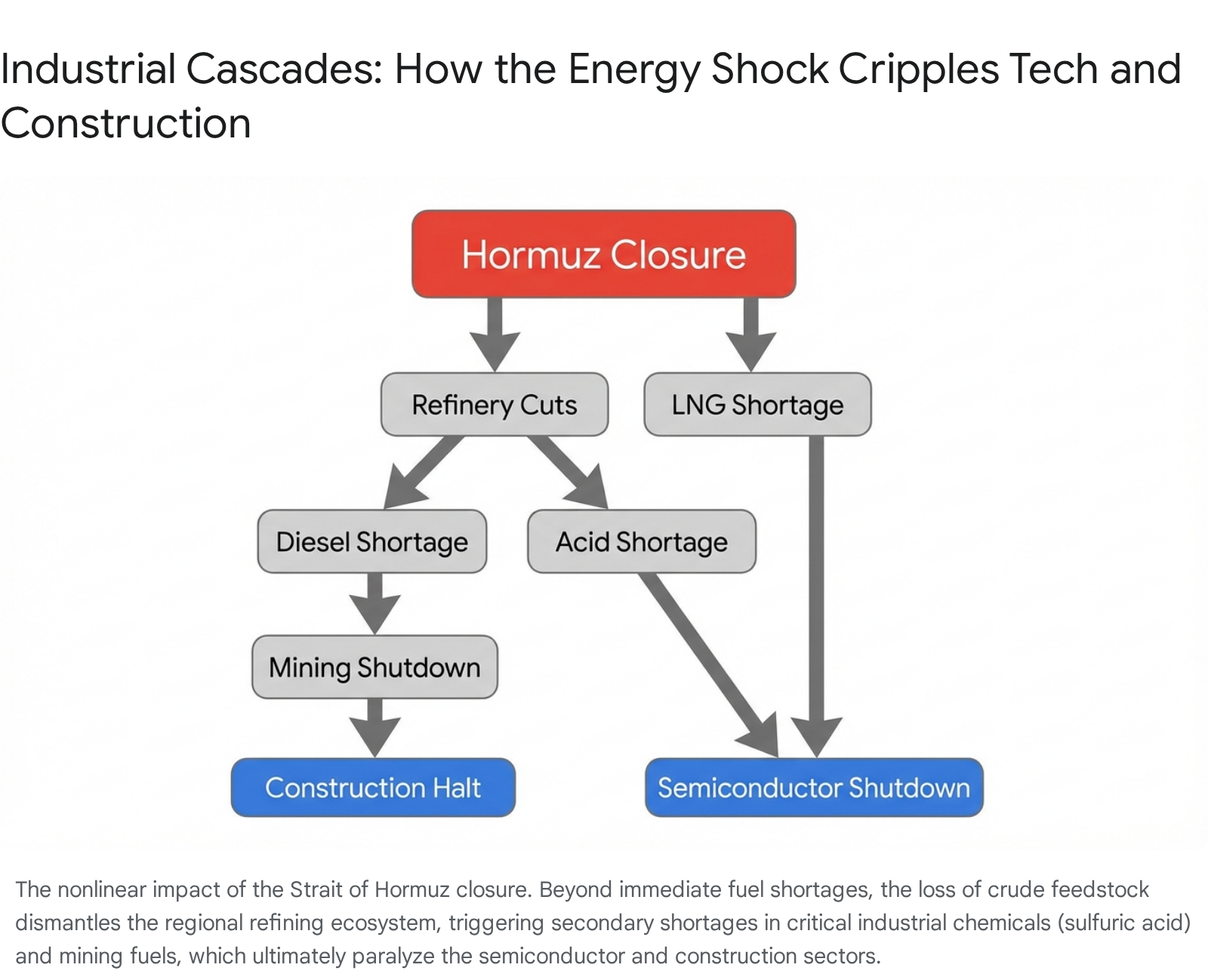
The blockade represents what the International Energy Agency has characterized as the largest supply disruption in the history of the global oil market.5 The flow of global oil and liquefied natural gas (LNG), which typically accounts for 20% of the world’s supply, has reached a virtual standstill, trapping more than 850 commercial vessels within the Persian Gulf.40 Consequently, Brent Crude surged past $120 per barrel, echoing the macroeconomic shocks of the 1970s energy crisis and elevating the global risks of severe stagflation and recession.5
The localized impact on the GCC has been catastrophic, causing a systemic collapse of the regional economic model.5 Oil production in Kuwait, Iraq, Saudi Arabia, and the UAE collectively dropped by over 10 million barrels per day.5 More critically, GCC states rely on the Strait of Hormuz for over 80% of their total caloric intake.5 The maritime blockade triggered an immediate “grocery supply emergency” across the Arabian Peninsula.5 By mid-March, 70% of the region’s food imports were disrupted, forcing major retail chains like Lulu Retail to airlift essential staples, causing food prices to spike by 40% to 120%.5 The broader economic fallout has decimated regional tourism and commerce; for example, hotel occupancy in Dubai is projected to collapse to 10% in the second quarter of 2026, down from 80% prior to the war.11
8. The Failure of “Project Freedom” and Escalatory Risks
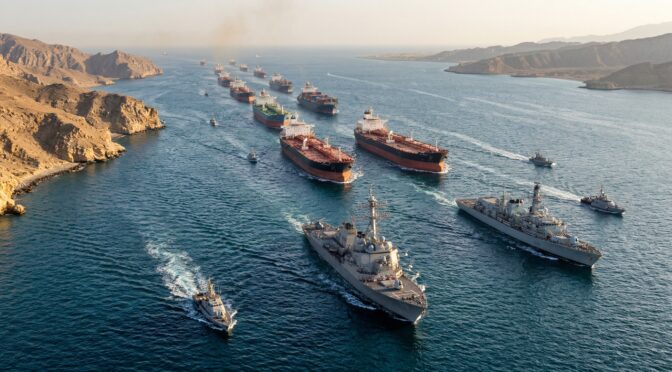
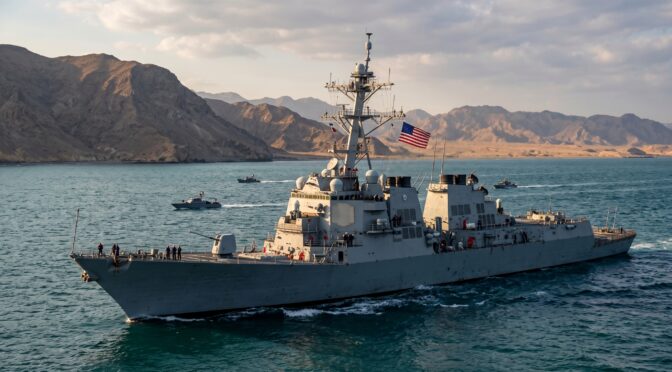
In response to the suffocating economic impact of the Iranian blockade, President Donald Trump announced “Project Freedom” on May 3 via social media.40 The operation was billed as a humanitarian gesture and a maritime security initiative designed to provide U.S. military escorts to guide stranded commercial vessels safely out of the waterway.40 CENTCOM committed massive resources to the operation, deploying guided-missile destroyers, over 100 land- and sea-based aircraft, multidomain unmanned platforms, and 15,000 service members to enforce freedom of navigation.40
Iran responded immediately and aggressively to the announcement. The IRGC attacked an Emirati-linked vessel and launched strikes into UAE territory to demonstrate its persistent control over the strait and to deter vessels from attempting to transit under U.S. protection.15 The U.S. military responded by actively enforcing its own naval blockade on Iranian ports, with U.S. fighter jets firing upon and disabling two Iranian-flagged oil tankers attempting to run the blockade, sparking reprisals and mutual accusations of ceasefire violations.32
8.1 The Saudi Derailment of Project Freedom
However, Project Freedom was abruptly paused on May 5, barely 48 hours after its initiation.42 While the U.S. administration publicly cited requests from Pakistan and progress in diplomatic negotiations as the reason for the pause, intelligence confirms that the operation was derailed by U.S. regional allies.12
Saudi Arabia and Kuwait explicitly denied the U.S. military the use of their airspace and bases to carry out the operation.12 Specifically, Riyadh informed the White House that it would not allow U.S. military aircraft to fly from the Prince Sultan Airbase to provide the necessary air cover for the naval escorts.11 Deprived of the land-based defensive umbrella required to protect the vulnerable ships transiting the strait, Washington was forced to suspend the operation.11
This unprecedented refusal by Saudi Arabia to support a major U.S. security initiative stems from a profound strategic divergence. First, the U.S. administration reportedly failed to consult its Gulf partners prior to the public announcement, blindsiding Riyadh and prompting a political signal that Gulf consent for U.S. operations is no longer automatic.11 Second, despite a direct telephone call between President Trump and Crown Prince Mohammed bin Salman, the Saudis maintained their refusal because they deeply fear that Project Freedom lacked clear rules of engagement and would inevitably trigger a massive, direct naval confrontation between the U.S. and Iran.11 Riyadh calculates that a full-scale regional war resulting in a “functionally failed Iranian state” would be a localized nightmare, exposing Saudi critical infrastructure to devastating Iranian missile barrages.11
The Saudi refusal has created immense diplomatic friction within the GCC. The UAE, which has absorbed the brunt of Iran’s retaliatory strikes, is reportedly furious with Riyadh’s caution and the perceived lack of regional solidarity.47 Consequently, the UAE is considering drastic diplomatic measures, including potentially withdrawing from the Saudi-dominated OPEC cartel and the Arab League.47
8.2 Escalatory Threats: “Project Freedom Plus”
Following the suspension of the escort initiative, the U.S. maintained its strict naval blockade, interdicting ships entering or departing Iranian ports.42 To maintain leverage over the stalled negotiations, President Trump has publicly threatened to revive the operation as “Project Freedom Plus” if a diplomatic deal is not reached swiftly.49 While the specifics of this expanded operation remain highly classified, the rhetoric implies a more aggressive, kinetic posture in the Strait of Hormuz, potentially ignoring Iranian warnings that any such escorts constitute an act of war.45 Furthermore, leaked Iranian military documents indicate that the IRGC Aerospace Force is utilizing a Chinese-launched satellite to monitor major U.S. military sites, suggesting Tehran is actively preparing targeting packages for a regional escalation if Project Freedom Plus is activated.51
9. The Diplomatic Horizon: The Islamabad Talks and Draft Agreements
Despite the aggressive kinetic posturing and the failure of Project Freedom, substantive back-channel diplomacy is actively underway, heavily mediated by the government of Pakistan.52
9.1 The Islamabad Framework
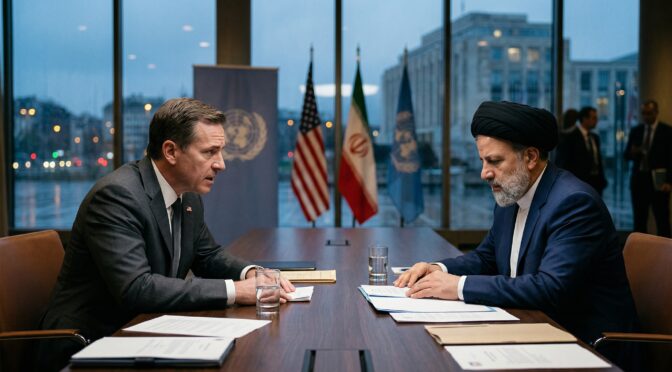
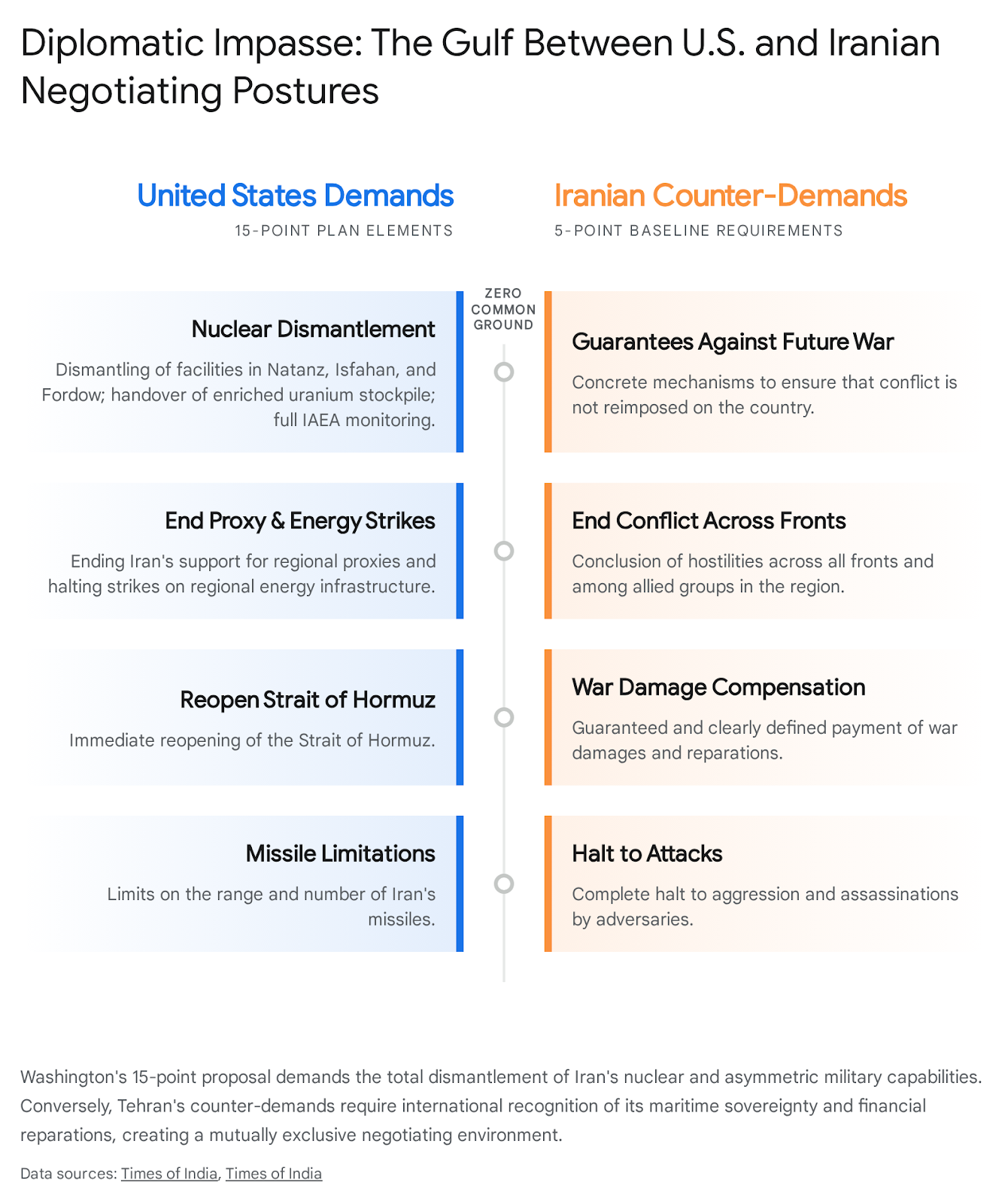
The initial “Islamabad Talks” occurred between April 11 and 12, featuring face-to-face negotiations led by U.S. envoys Steve Witkoff and Jared Kushner.13 While these talks failed to produce a comprehensive resolution, they succeeded in establishing a temporary, rolling ceasefire.48 The primary obstacles during the initial rounds were the maximalist demands from both sides: the U.S. demanded an unconditional opening of the Strait of Hormuz and a permanent dismantlement of Iran’s nuclear program, while Iranian Parliament Speaker Mohammad Bagher Ghalibaf demanded the immediate unfreezing of assets and a halt to Israeli military operations in Lebanon.26
Through sustained diplomatic pressure, intermediaries succeeded in drafting a 14-point Memorandum of Understanding (MoU) by early May, designed to outline a 30-day framework for broader negotiations.13 This preliminary document represents the closest the two sides have come to an initial deal since the conflict began.13 According to leaked parameters, the draft agreement requires significant structural concessions from both parties:
| Negotiating Domain | Proposed Iranian Concession | Proposed U.S. / Coalition Concession |
| Maritime Security | Iran will ease sovereign control and restrictions over commercial transit in the Strait of Hormuz.13 | The U.S. will enact a 30-day suspension of the naval blockade on Iranian ports.13 |
| Nuclear Program | Iran will implement a moratorium on uranium enrichment and accept snap UN inspections.55 | The U.S. will gradually ease economic sanctions and release billions in frozen offshore funds.55 |
| Future Trajectory | Iran commits to refraining from all weaponization-related activities.56 | The U.S. formally ends the state of war and establishes normalized regional parameters.56 |
9.2 Sticking Points and Factional Sabotage
Despite the existence of the draft MoU, two major strategic hurdles prevent its finalization. The first is the duration of the proposed nuclear moratorium. The U.S. initially demanded a 20-year freeze on all enrichment activities, while Iran countered with an offer of five years; current negotiations are reportedly centering on a highly contested compromise of 12 to 15 years.13 The second, and arguably more intractable issue, is the physical disposition of the existing HEU stockpile. Washington demands that the 60% enriched uranium be transferred out of the country, potentially to Russia, a red line that Iranian negotiators have historically refused to cross, as surrendering the physical material removes their primary strategic leverage and deterrent value.13
Domestically, the Iranian negotiating team is operating under intense political fire. Hardline lawmakers, closely aligned with the IRGC, argue that the civilian negotiators have violated the strict “red lines” established by Supreme Leader Mojtaba Khamenei by engaging in nuclear discussions with the United States at all.33 Hardline figures such as Mahmoud Nabavian, who traveled with the delegation to Islamabad, have publicly criticized the negotiating team for making unacceptable concessions.33 Foreign Ministry spokesman Esmail Baghaei and former diplomat Jalal Sadatian have also publicly argued that U.S. military threats undermine any possibility of good-faith diplomacy, pointing to previous U.S. strikes that occurred in the middle of negotiations.14
This internal sabotage by the military establishment is the primary reason for the delay in finalizing the draft agreement.25 President Pezeshkian struggles to secure institutional backing from an IRGC that benefits from continued isolation and actively seeks to derail the peace process to maintain its domestic hegemony.15
10. Strategic Outlook and Conclusions
The U.S.-Iran conflict has transitioned from a high-intensity campaign of aerial decapitation into a grueling, multi-domain war of economic attrition. The underlying U.S. strategy hinges on the premise that maximum economic pressure, enforced by a tight naval blockade and secondary sanctions, will eventually force a fractured Iranian leadership to accept the terms outlined in the 14-point Islamabad MoU. However, the CIA intelligence assessments indicating that Tehran possesses a 120-day economic runway severely complicate this strategy, suggesting that the conflict is highly likely to settle into a prolonged, destructive stalemate that will continue to exact a massive toll on the global economy.10
The most significant variable dictating the trajectory of the conflict in the coming weeks will be the internal Iranian power struggle. If the IRGC succeeds in totally marginalizing President Pezeshkian and consolidating absolute control over the state apparatus, diplomacy will inevitably collapse. Such a collapse would likely trigger the activation of “Project Freedom Plus” and a violent resumption of direct naval hostilities in the Strait of Hormuz.50 Conversely, if the civilian government can leverage the threat of imminent macroeconomic collapse to override the military hardliners, the 30-day Islamabad framework provides a viable, albeit exceptionally fragile, architecture for regional de-escalation.13
Concurrently, Washington faces a severe diplomatic crisis with its traditional Gulf partners. The explicit refusal by Saudi Arabia and Kuwait to facilitate Project Freedom signals a historic realignment in regional security dynamics.12 Gulf partners have clearly indicated that their sovereign territory will no longer serve as an automatic staging ground for maximalist U.S. security operations that prioritize Iranian regime change over regional stability.11 To achieve a sustainable resolution to the conflict, the United States must not only navigate the institutional schizophrenia of the Iranian state but also re-establish a unified strategic consensus with a deeply fractured Gulf Cooperation Council.
Please share the link on Facebook, Forums, with colleagues, etc. Your support is much appreciated and if you have any feedback, please email us in**@*********ps.com. If you’d like to request a report or order a reprint, please click here for the corresponding page to open in new tab.
Sources Used
- Operation Epic Fury and International Law – United States Department of State, accessed May 9, 2026, https://www.state.gov/releases/office-of-the-legal-adviser/2026/04/operation-epic-fury-and-international-law
- 2026 Iran war | Explained, United States, Israel, Strait of Hormuz …, accessed May 9, 2026, https://www.britannica.com/event/2026-Iran-war
- Operation Epic Fury U.S. Aircraft Losses Visualized, accessed May 9, 2026, https://www.twz.com/air/operation-epic-fury-u-s-aircraft-losses-visualized
- Peace Through Strength: Operation Epic Fury Crushes Iranian Threat as Ceasefire Takes Hold – The White House, accessed May 9, 2026, https://www.whitehouse.gov/releases/2026/04/peace-through-strength-operation-epic-fury-crushes-iranian-threat-as-ceasefire-takes-hold/
- Economic impact of the 2026 Iran war – Wikipedia, accessed May 9, 2026, https://en.wikipedia.org/wiki/Economic_impact_of_the_2026_Iran_war
- Mojtaba Khamenei meets president Pezeshkian for first time since appointment – Daily Jang, accessed May 9, 2026, https://jang.com.pk/en/65210-mojtaba-khamenei-meets-president-pezeshkian-for-first-time-since-appointment-news
- Pezeshkian complained to Khamenei about IRGC – New DETAILS of the meeting, accessed May 9, 2026, https://modern.az/en/analitika/601003/pezeshkian-complained-to-khamenei-about-irgc-new-details-of-the-meeting/
- Revolutionary Guard takes over Iran’s government, blocks President’s authority, accessed May 9, 2026, https://m.economictimes.com/news/defence/irans-revolutionary-guard-seizes-power-dismantles-presidential-authority-amid-crisis/articleshow/129947157.cms
- Economic Fury Disrupts Networks Supplying Weapons and UAV Components to Iran, accessed May 9, 2026, https://home.treasury.gov/news/press-releases/sb0496
- CIA Report: Iran’s Naval Blockade Endurance Window Revealed 2026, accessed May 9, 2026, https://discoveryalert.com.au/iran-naval-blockade-cia-report-hormuz-oil-prices-2026/
- What does end of ‘Project Freedom’ signal for US-Saudi relations …, accessed May 9, 2026, https://www.turkiyetoday.com/region/what-does-the-end-of-project-freedom-signal-for-the-future-of-us-saudi-relations-3219645
- Trump Abandons “Project Freedom” After Saudi Arabia and Kuwait Suspend Access to Bases and Airspace, accessed May 9, 2026, https://www.democracynow.org/2026/5/7/headlines/trump_abandons_project_freedom_after_saudi_arabia_and_kuwait_suspend_access_to_bases_and_airspace
- US and Iran May Resume Peace Talks in Islamabad Next Week, accessed May 9, 2026, https://www.kyivpost.com/post/75758
- Rift deepens between Iran’s president and Guards chief over war, economy, accessed May 9, 2026, https://www.iranintl.com/en/202603288722
- Iran Update Special Report, May 5, 2026, accessed May 9, 2026, https://understandingwar.org/research/middle-east/iran-update-special-report-may-5-2026/
- What is Operation Epic Fury? – Britannica, accessed May 9, 2026, https://www.britannica.com/question/What-is-Operation-Epic-Fury
- 2026 Iran war – Wikipedia, accessed May 9, 2026, https://en.wikipedia.org/wiki/2026_Iran_war
- The war on Iran will likely end in American retreat – Al Jazeera, accessed May 9, 2026, https://www.aljazeera.com/opinions/2026/5/9/the-war-on-iran-will-likely-end-in-american-retreat
- Operation Epic Fury – U.S. Central Command, accessed May 9, 2026, https://www.centcom.mil/OPERATIONS-AND-EXERCISES/EPIC-FURY/
- Operation Epic Fury | U.S. Department of War, accessed May 9, 2026, https://www.war.gov/Spotlights/Operation-Epic-Fury/
- Beyond the blackout, who really runs Iran now?, accessed May 9, 2026, https://www.arabnews.jp/en/uncategorized/article_169467/
- Pressure is exposing Iran’s internal divisions, accessed May 9, 2026, https://www.washingtonexaminer.com/op-eds/4559844/pressure-is-exposing-iran-internal-divisions/
- Iran Update Special Report, May 7, 2026, accessed May 9, 2026, https://understandingwar.org/research/middle-east/iran-update-special-report-may-7-2026/
- Rift in Iran leadership? What Pezeshkian’s U-turn, Mojtaba’s rushed appointment reveal, accessed May 9, 2026, https://www.indiatoday.in/world/story/iran-us-war-rift-in-tehran-leadership-president-masoud-pezeshkian-apology-uproar-mojtaba-khamenei-2879342-2026-03-09
- U.S. and Iran Offer Mixed Messages on Deal to End War, accessed May 9, 2026, https://time.com/article/2026/05/07/us-iran-war-deal-mou-axios-report-negotiations-strait-nuclear/
- U.S.-Iran Peace Talks Hit an Impasse. What Comes Next?, accessed May 9, 2026, https://www.cfr.org/articles/u-s-iran-peace-talks-hit-an-impasse-what-comes-next
- New US sanctions target Iran’s military procurement networks under Trump’s “Economic Fury” campaign, accessed May 9, 2026, https://www.aninews.in/news/world/us/new-us-sanctions-target-irans-military-procurement-networks-under-trumps-economic-fury-campaign20260509132216/
- OFAC Continues “Economic Fury” Campaign Against Iran, accessed May 9, 2026, https://sanctionsnews.bakermckenzie.com/ofac-continues-economic-fury-campaign-against-iran/
- Iran News in Brief – May 3, 2026, accessed May 9, 2026, https://www.ncr-iran.org/en/news/iran-news-in-brief-news/iran-news-in-brief-may-3-2026/
- Iran’s economy under pressure as ceasefire fails to ease rising costs – YouTube, accessed May 9, 2026, https://www.youtube.com/watch?v=UCPNcwmi8gU
- Iran Update Special Report, May 6, 2026 | ISW, accessed May 9, 2026, https://understandingwar.org/research/middle-east/iran-update-special-report-may-6-2026/
- Iran-Israel war LIVE: Iran reviewing U.S. proposal at ‘own pace’ as Trump awaits response, says report – The Hindu, accessed May 9, 2026, https://www.thehindu.com/news/international/iran-israel-war-us-ceasefire-talks-strait-of-hormuz-issue-live-updates-may-9-2026/article70958008.ece
- Iran taps reserves again as inflation bites and layoffs mount, accessed May 9, 2026, https://www.iranintl.com/en/202604289119
- Iran Update Special Report, May 8, 2026 | ISW, accessed May 9, 2026, https://understandingwar.org/research/middle-east/iran-update-special-report-may-8-2026/
- IAEA provides updates on Iran nuclear facilities, accessed May 9, 2026, https://www.ans.org/news/article-7911/iaea-provides-updates-on-iran-nuclear-facilities/
- Iran’s nuclear weapon timeline barely set back despite US-Israeli strikes, accessed May 9, 2026, https://www.jpost.com/middle-east/iran-news/article-895127
- End States, Not End Dates: – JINSA, accessed May 9, 2026, https://jinsa.org/wp-content/uploads/2026/04/April-2026-Iran-TF-Report-3.pdf
- 7 Things that Will Decide It | Alhurra, accessed May 9, 2026, https://alhurra.com/en/18591
- The Strait of Hormuz in 8 Charts – CSIS, accessed May 9, 2026, https://www.csis.org/analysis/strait-hormuz-8-charts
- Shipping firms question safety in strait of Hormuz despite Trump …, accessed May 9, 2026, https://www.theguardian.com/business/2026/may/04/strait-of-hormuz-donald-trump-us-navy-iran-shipping
- Iran War Shipping Update – May 7, 2026, accessed May 9, 2026, https://www.unitedagainstnucleariran.com/blog/iran-war-shipping-update-may-7-2026
- Trump puts ‘Project Freedom’ on hold, saying he hopes to finalise a deal with Iran, accessed May 9, 2026, https://www.theguardian.com/world/2026/may/06/trump-project-freedom-strait-of-hormuz-ships-iran-ceasefire
- Has the US accepted Iran’s demand to settle Hormuz first, nuclear later?, accessed May 9, 2026, https://www.aljazeera.com/news/2026/5/6/has-the-us-accepted-irans-demand-to-settle-hormuz-first-nuclear-later
- “Project Freedom plus”: Trump hints at revival of initiative to escort vessels in Hormuz if Iran deal not “signed up”, accessed May 9, 2026, https://www.aninews.in/news/world/us/project-freedom-plus-trump-hints-at-revival-of-initiative-to-escort-vessels-in-hormuz-if-iran-deal-not-signed-up20260509064141
- Trump threatens ‘Project Freedom Plus’ if Iran diplomacy fails, accessed May 9, 2026, https://shafaq.com/amp/en/World/Trump-threatens-Project-Freedom-Plus-if-Iran-diplomacy-fails
- Trump news at a glance: US and Iran exchange fire, which president calls ‘love tap’, accessed May 9, 2026, https://www.theguardian.com/us-news/2026/may/07/trump-news-latest-updates-today
- Trump shelved ‘Project Freedom’ after Saudis refused use of bases and airspace, accessed May 9, 2026, https://www.theguardian.com/world/2026/may/07/trump-project-freedom-saudi-arabia-strait-of-hormuz
- Islamabad Talks – Wikipedia, accessed May 9, 2026, https://en.wikipedia.org/wiki/Islamabad_Talks
- Donald Trump: US will start new Hormuz operation if Iran talks fail, accessed May 9, 2026, https://www.jpost.com/middle-east/iran-news/article-895598
- Trump warns US may escalate Hormuz posture if no Iran deal, threatening ‘Project Freedom Plus’ – Yeni Safak English, accessed May 9, 2026, https://en.yenisafak.com/world/trump-warns-us-may-escalate-hormuz-posture-if-no-iran-deal-threatening-project-freedom-plus-3718047
- How do Israel, China view their dispute over Iran | The Jerusalem Post, accessed May 9, 2026, https://www.jpost.com/middle-east/iran-news/article-894606
- Iran says no talks with US for now, casting doubt over Pakistan efforts, accessed May 9, 2026, https://www.aljazeera.com/news/2026/4/20/pakistan-ready-for-multi-day-us-iran-talks-but-tehran-unsure-about-joining
- Trump threatens to resume ‘Project Freedom Plus’ if Iran deal not sealed, accessed May 9, 2026, https://www.aa.com.tr/en/world/trump-threatens-to-resume-project-freedom-plus-if-iran-deal-not-sealed/3932054
- 2026 Iran war ceasefire – Wikipedia, accessed May 9, 2026, https://en.wikipedia.org/wiki/2026_Iran_war_ceasefire
- Axios: US and Islamic Republic Close to a Draft Agreement to End War – IranWire, accessed May 9, 2026, https://iranwire.com/en/news/152071-axios-us-and-islamic-republic-close-to-a-draft-agreement-to-end-war/
- US, Iran nearing framework memo to end war, launch nuclear talks, report says, accessed May 9, 2026, https://m.aa.com.tr/en/middle-east/us-iran-nearing-framework-memo-to-end-war-launch-nuclear-talks-report-says/3928746