Tag Archives: Operation Epic Fury

Operation Epic Fury Weekly SITREP – Apr 18, 2026

1.0 Executive Summary

This Weekly Situation Report provides an exhaustive, granular analysis of the military, diplomatic, and economic developments defining the Middle East conflict for the week ending April 18, 2026. The geopolitical landscape is currently characterized by a highly fragile, bifurcated cessation of hostilities. A temporary, fourteen-day ceasefire between the United States and the Islamic Republic of Iran remains in effect until April 22, 2026, following unprecedented allied bombardment.1 Simultaneously, a ten-day ceasefire between Israel and the Lebanese militant group Hezbollah commenced at midnight on April 16, 2026, offering a temporary reprieve to the devastated Levant region.3 However, these operational pauses do not indicate a resolution to the underlying strategic contest; rather, the conflict has metamorphosed from overt kinetic strikes into a sophisticated campaign of economic strangulation, maritime interdiction, and intense asymmetric posturing.

The United States has formally transitioned from the heavy bombardment phase of Operation Epic Fury into a phase of maximalist economic warfare, officially designated as “Operation Economic Fury”.5 This strategy relies heavily on a comprehensive naval blockade of all Iranian ports, enforced impartially by United States Central Command, coupled with aggressive secondary sanctions targeting foreign financial institutions that facilitate Iranian petroleum exports.5 The explicit objective of the United States and Israel is to inflict catastrophic, compounding economic damage to compel the newly consolidated Iranian government to permanently dismantle its nuclear program and cede its asymmetric control over the Strait of Hormuz.9 Defense officials estimate that the combined allied operations have already inflicted over $145 billion in direct economic damage upon the Iranian state, decimating vital gas, steel, and petrochemical infrastructure.9

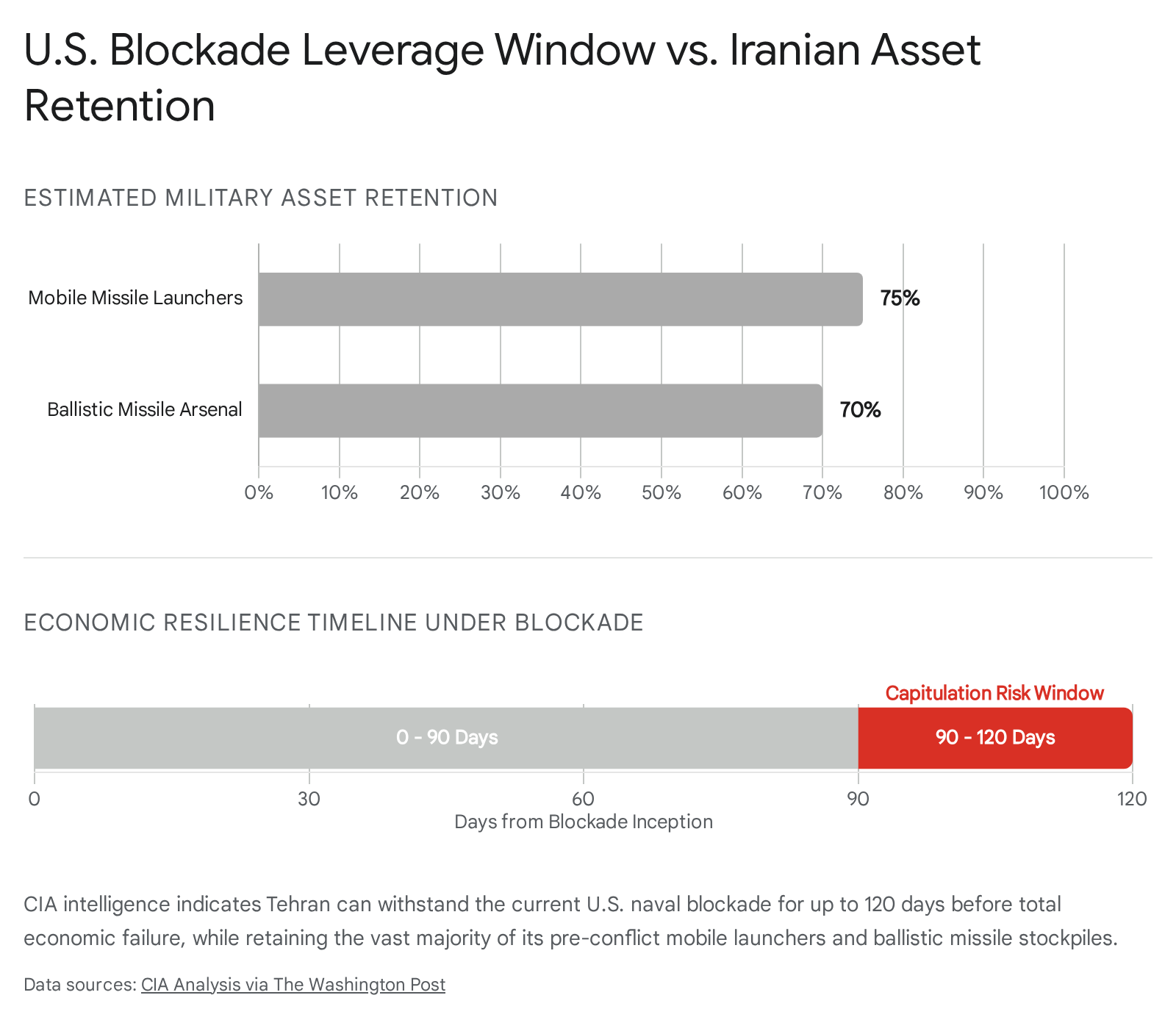
In response, the Islamic Republic of Iran has adopted a posture of strategic endurance and internal consolidation. Following the targeted assassination of Supreme Leader Ali Khamenei and the severe degradation of its conventional military architecture, the government under Mojtaba Khamenei is leveraging its remaining asymmetric advantages.1 Despite sustaining the destruction of over 190 ballistic missile launchers and 155 naval vessels, Iran maintains de facto administrative control over maritime traffic within the Strait of Hormuz.11 While formally declaring the waterway “open” on April 17, the Islamic Revolutionary Guard Corps Navy requires all transiting commercial vessels to register, pay substantial transit tolls, and navigate under Iranian warship escort.13 Diplomatic negotiations in Islamabad between American and Iranian delegations collapsed over the weekend, with Tehran flatly refusing piecemeal concessions and insisting on a comprehensive geopolitical settlement that guarantees regime survival and sanctions relief.13

Regional actors, specifically the member states of the Gulf Cooperation Council, find themselves in a highly precarious strategic position. Nations such as the United Arab Emirates, Saudi Arabia, Qatar, and Oman are attempting to balance their fundamental security reliance on the United States with an acute vulnerability to Iranian retaliatory strikes.16 The closure or restriction of regional airspace, the severe disruption of global energy markets, and the displacement of over 1.2 million civilians in Lebanon underscore the profound systemic impacts of the conflict.1 As the expiration of the United States-Iran ceasefire approaches on April 22, the probability of a return to high-intensity combat operations remains exceptionally high, contingent entirely upon the success or failure of ongoing backchannel mediation efforts led by the Republic of Pakistan.2

2.0 Chronological Timeline of Key Events (Last 7 days)

The following timeline details the critical military, diplomatic, and economic events recorded between April 11 and April 18, 2026. All times are recorded in Coordinated Universal Time or standard regional timeframes where noted.

  • April 11, 2026:Delegations representing the United States and the Islamic Republic of Iran commence indirect negotiations in Islamabad, Pakistan.13The United States delegation is led by Jared Kushner and Steve Witkoff, accompanied by Vice President J.D. Vance.13
  • April 12, 2026: Following a twenty-one-hour marathon negotiation session, the Islamabad talks collapse.13 Vice President Vance holds a press conference explicitly stating that an agreement was not reached because the Iranian delegation chose not to accept American terms regarding freedom of navigation and nuclear enrichment halts.13
  • April 13, 2026, 1400 UTC (1000 ET): United States Central Command officially implements a comprehensive naval blockade on all maritime traffic entering or exiting Iranian ports, executing a formal proclamation issued by President Donald Trump.7
  • April 15, 2026: United States Treasury Secretary Scott Bessent formally outlines the parameters of “Operation Economic Fury”.5 The Treasury Department issues warning letters to financial institutions in China, the United Arab Emirates, Oman, and Hong Kong regarding the imminent application of secondary sanctions.2
  • April 16, 2026: President Donald Trump announces a ten-day ceasefire agreement between Israel and Lebanon, facilitated through direct diplomatic negotiations held in Washington.3
  • April 16, 2026: United States Secretary of War Pete Hegseth and Chairman of the Joint Chiefs of Staff General Dan Caine hold a joint press briefing at the Pentagon.21 Secretary Hegseth warns the Iranian military leadership that United States forces are fully postured to restart combat operations, reminding Tehran that its defense industry has been decimated.21
  • April 16, 2026: Hours prior to the implementation of the Levant ceasefire, an Israeli strike on the southern Lebanese town of Ghazieh results in at least seven fatalities and thirty-three injuries, an event local media describes as a massacre against civilians.23
  • April 17, 2026, 0300 UTC (Midnight Beirut Time): The ten-day ceasefire between Israel and Hezbollah officially takes effect.4 Thousands of displaced Lebanese civilians immediately begin migrating southward toward their homes.23
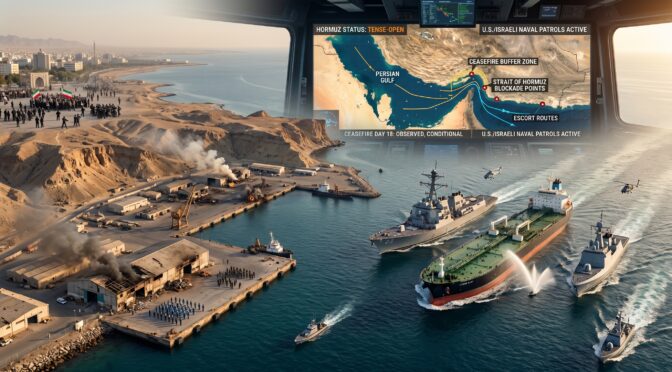
  • April 17, 2026: Iranian Foreign Minister Abbas Araghchi and United States President Donald Trump separately declare the Strait of Hormuz “open” to commercial shipping.23 However, the Islamic Revolutionary Guard Corps clarifies that passage requires strict coordination with Iranian Armed Forces, while the United States confirms its naval blockade on Iranian ports remains strictly enforced.23
  • April 17, 2026: An Israeli uncrewed aerial vehicle conducts a strike in Kounine, Lebanon, resulting in one fatality and three injuries.23 This incident marks the first recorded kinetic violation of the fragile Lebanon ceasefire.23
  • April 18, 2026: Field Marshal Asim Munir, Chief of the Pakistan Army, concludes a highly sensitive three-day diplomatic visit to Tehran.26 The visit, which included meetings with Iranian President Masoud Pezeshkian and Parliament Speaker Bagher Qalibaf, aims to facilitate a negotiated settlement to prevent the resumption of hostilities when the ceasefire expires on April 22.19
  • April 18, 2026: The Islamic Revolutionary Guard Corps announces the mass detention of more than 120 individuals across East Azerbaijan, Mazandaran, and Kerman.15 Authorities accuse the detainees of forming espionage networks and sharing sensitive coordinates with intelligence services from the United States, the United Kingdom, and Israel.15

3.0 Situation by Primary Country

3.1 Iran

3.1.1 Military Actions & Posture

The Iranian armed forces are currently utilizing the fourteen-day operational pause to aggressively reconstitute their surviving tactical capabilities following the devastating bombardments of late February and March.2 The initial phase of Operation Epic Fury inflicted catastrophic structural damage upon the Iranian military apparatus. The United States Department of Defense and Israeli Defense Forces intelligence estimate that allied strikes successfully destroyed over 190 ballistic missile launchers, incapacitated or sank 155 naval vessels (including submarines and fast attack craft), and systematically dismantled the national integrated air defense system.11 This included the targeted elimination of highly advanced, domestically produced Bavar-373 batteries and imported S-300 systems.12 Open-source intelligence and commercial satellite imagery analyzed by independent conflict monitors indicate that the Islamic Revolutionary Guard Corps Aerospace Force is actively retrieving its remaining ballistic missile inventories from subterranean storage facilities and repositioning them across the national interior to maximize survivability.2

A critical component of the allied air campaign focused on eliminating Iran’s long-range strike potential. The combined United States and Israeli forces executed precision strikes against the Iranian Space Research Center on March 14, followed by the total destruction of the satellite launch site at the Shahroud Space Complex in Semnan Province.28 Western intelligence agencies, including the United States Defense Intelligence Agency, have long assessed that Iran’s space launch vehicle program serves as a dual-use incubator designed to enable the regime to develop a militarily viable intercontinental ballistic missile capability by 2035.28 The eradication of these facilities represents a permanent strategic setback for Iranian power projection.

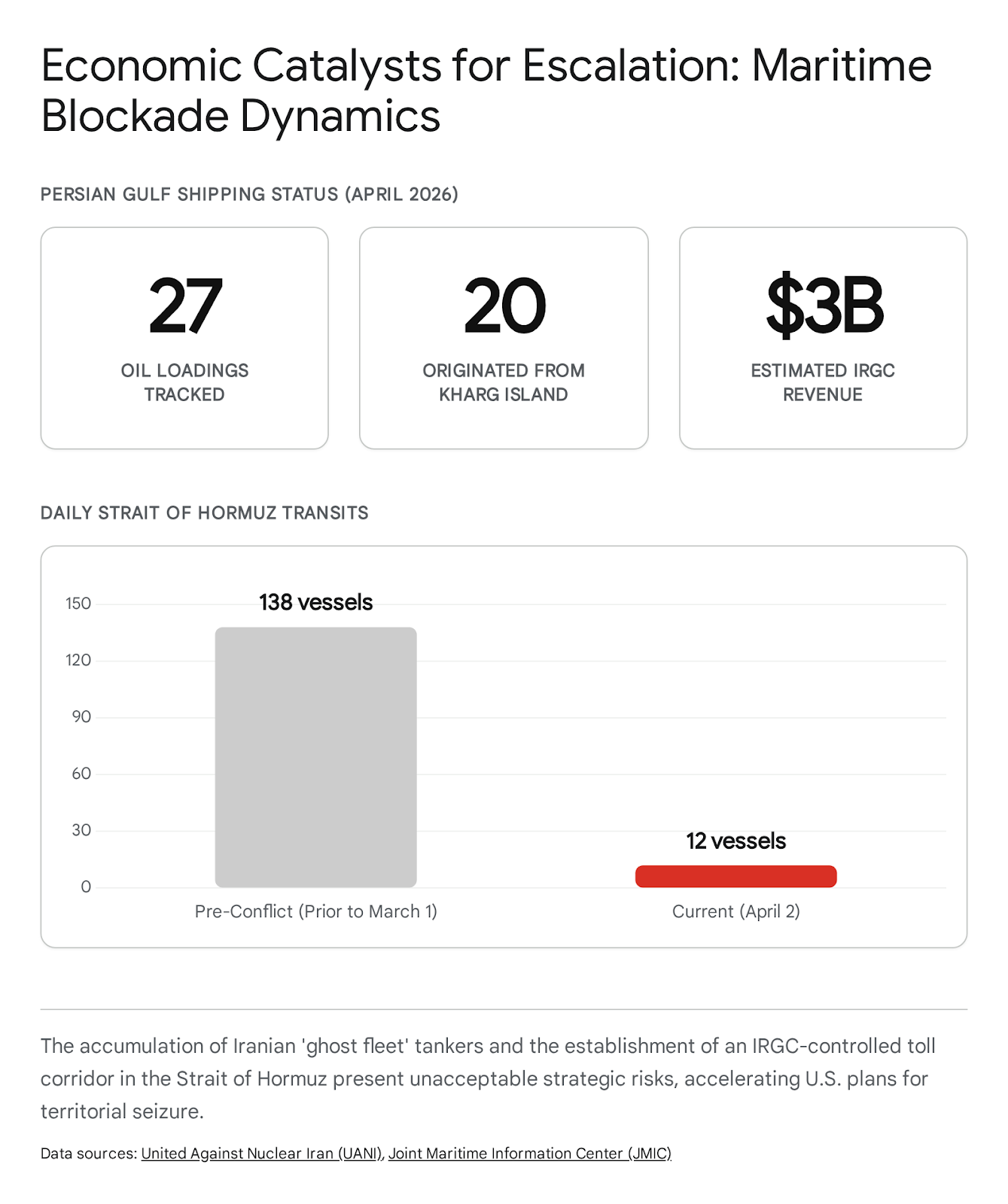
In response to these conventional vulnerabilities, Iranian military doctrine has shifted entirely toward asymmetric naval harassment and Anti-Access/Area Denial operations within the critical maritime chokepoints of the Persian Gulf and the Gulf of Oman.13 Despite the severe attrition of its conventional surface fleet, Iran maintains a highly restrictive posture within the Strait of Hormuz. While Iranian authorities publicly declared the waterway “completely open” on April 17 following the implementation of the Lebanon ceasefire, the reality on the water remains strictly managed by the Islamic Revolutionary Guard Corps Navy.23 Transiting commercial vessels are forced to comply with a rigorous Iranian framework that requires advance registration, the payment of an transit toll (estimated by industry analysts at $1.00 per barrel of petroleum or roughly $2 million per supertanker), and mandatory navigation under the escort of Iranian fast attack craft.13 This localized maritime control represents Iran’s primary point of strategic leverage against the global economy, directly challenging the United States Navy’s traditional role as the guarantor of international freedom of navigation.

3.1.2 Policy & Diplomacy

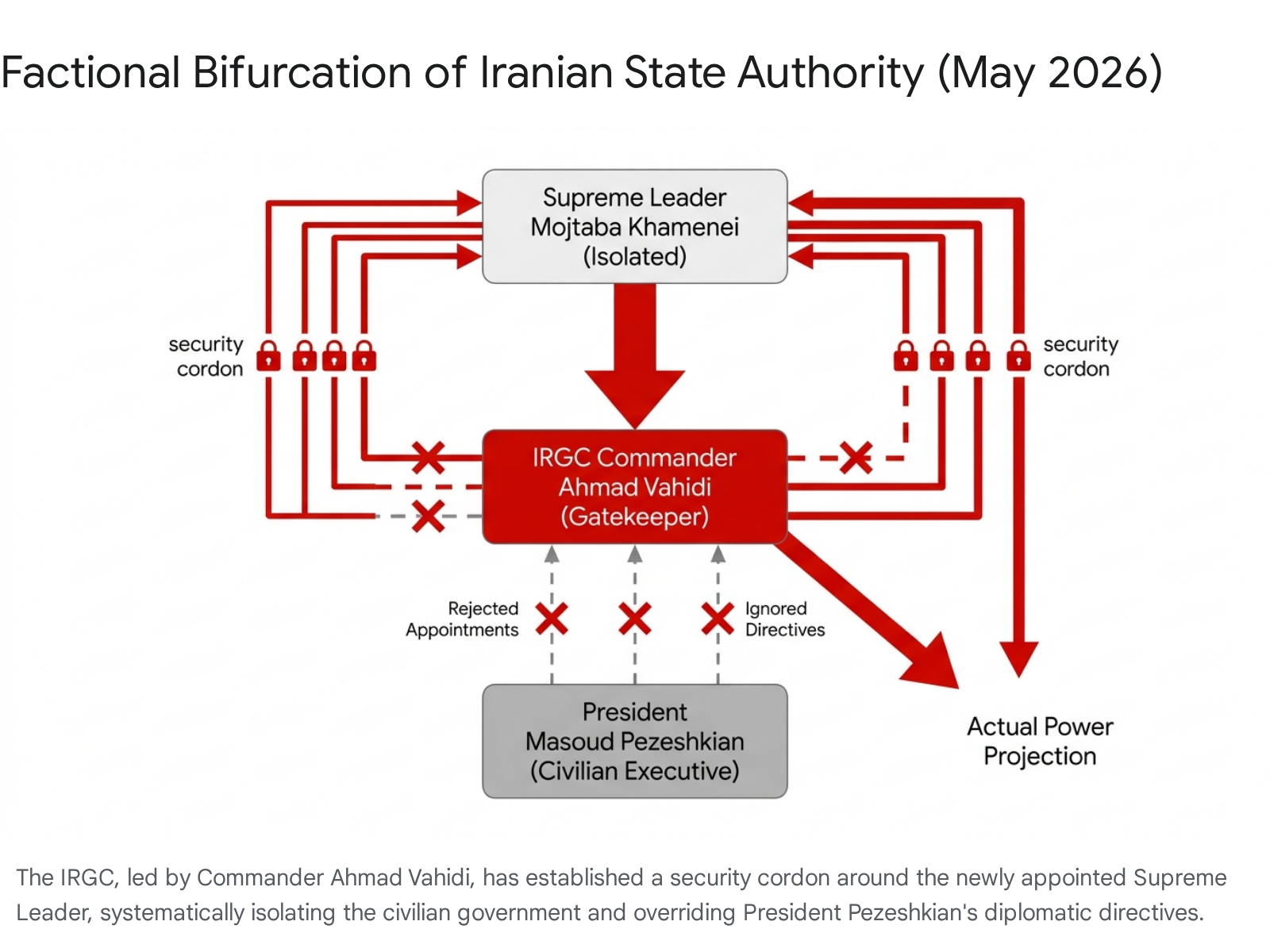
The diplomatic strategy of the Islamic Republic is characterized by steadfast resistance to piecemeal concessions, reflecting the hardline ideological composition of the newly consolidated government.15 Following the targeted assassination of Supreme Leader Ali Khamenei during the opening salvos of Operation Roaring Lion on February 28, the rapid elevation of Mojtaba Khamenei to the position of Supreme Leader has solidified the dominance of the faction most closely intertwined with the Islamic Revolutionary Guard Corps.1

During the high-stakes negotiations held in Islamabad on April 11 and April 12, the Iranian delegation fundamentally rejected American demands.13 The United States proposed a framework focused narrowly on ensuring freedom of navigation in the Strait of Hormuz and securing an immediate halt to Iran’s highly enriched uranium program.29 In contrast, Iranian negotiators sought a comprehensive, all-encompassing geopolitical settlement.15 Foreign Minister Abbas Araghchi communicated that Tehran requires a holistic security architecture that provides binding guarantees against future military strikes, the total lifting of economic sanctions, the cessation of secondary blockades, and international recognition of Iran’s sovereign right to manage transit through its territorial waters.13 Deputy Foreign Minister Saeed Khatibzadeh reinforced this posture, stating that Iran will not accept being treated as an exception to international law and will not schedule fresh talks until a common framework is agreed upon.15

Diplomatic communications between Tehran and Washington remain highly contentious and highly public. The Iranian Embassy in Japan issued a formal, highly unusual rebuke of United States President Donald Trump for utilizing the social media platform “Truth Social” to conduct diplomatic signaling.15 The embassy statement explicitly warned that unilateral messaging aboard Air Force One or via digital platforms does not constitute a legitimate negotiating table and risks overshadowing serious, structural diplomatic efforts.15

3.1.3 Civilian Impact

The civilian population of Iran is currently enduring an unprecedented humanitarian and economic catastrophe. The economic damage inflicted by the allied air campaign is assessed to exceed $145 billion in direct structural losses.11 The Israeli Defense Forces Military Intelligence Directorate claims to have successfully destroyed 23 percent of the nation’s total gas processing capacity, along with major steel manufacturing hubs and petrochemical facilities critical to the national export economy.9 The national currency, the Rial, is experiencing rapid devaluation, driving severe inflation across all essential consumer goods.30

The human cost of the conflict is staggering. Various human rights organizations and conflict monitors estimate that between 3,375 and 7,650 Iranian citizens and military personnel have been killed since the onset of hostilities, with over 26,500 individuals sustaining injuries.11 The systemic degradation of the economy and the destruction of civilian infrastructure triggered widespread anti-government protests in late March and early April.32 Driven by economic despair and a perceived loss of regime legitimacy, these demonstrations were met with severe force by the state security apparatus.32

The regime continues to execute an intense internal crackdown aimed at preserving stability amid immense external pressure. On April 18, 2026, the Islamic Revolutionary Guard Corps announced the mass arrest of over 120 citizens across East Azerbaijan, Mazandaran, and Kerman provinces.15 Authorities accused the detainees of forming sophisticated espionage networks and sharing sensitive targeting coordinates with intelligence services affiliated with the United States, the United Kingdom, and Israel.15 This sweeping security operation underscores the deep paranoia within the Iranian establishment regarding the extent of foreign intelligence penetration that enabled the highly precise allied strikes against regime leadership.

3.2 Israel

3.2.1 Military Actions & Posture

The Israeli Defense Forces are currently maintaining a state of maximum combat readiness despite the initiation of the ten-day ceasefire in the Lebanese theater.9 Operation Roaring Lion, the Israeli component of the joint campaign against Iran, achieved unprecedented tactical success and fundamentally altered the regional balance of power.33 The operation began with the largest military flyover in the history of the Israeli Air Force, systematically dismantling Iranian air defenses before executing precision strikes against military production sites and decapitating senior Iranian and Hezbollah leadership.33

In the northern theater, the Israeli military executed a brutal campaign of attrition against Hezbollah infrastructure, heavily bombarding southern Lebanon right up until the midnight deadline on April 16, 2026.23 Just hours prior to the ceasefire, an Israeli strike on the town of Ghazieh resulted in at least seven fatalities and thirty-three injuries.23 Following the implementation of the ceasefire, Prime Minister Benjamin Netanyahu announced a profound shift in Israeli border security doctrine.35 Rejecting international calls to return to the previously recognized borders, Netanyahu declared that Israeli ground forces will not retreat.35 Instead, the Israeli Defense Forces are actively occupying and enforcing a “reinforced security buffer zone” extending up to ten kilometers deep into southern Lebanon.24 This newly established occupation zone spans horizontally from the Mediterranean Sea to the foothills of Mount Hermon, terminating at the Syrian border.35

Within this buffer zone, the Israeli military has established strict operational control, utilizing heavy engineering equipment and bulldozers to systematically demolish civilian infrastructure, residential housing, and agricultural assets to deny Hezbollah any future operational cover.15 The enforcement of this zone is highly kinetic. On April 17, 2026, an Israeli uncrewed aerial vehicle conducted a targeted strike on a vehicle in the Lebanese town of Kounine, resulting in one fatality and three injuries.23 This incident marks the first recorded violation of the Levant ceasefire and signals Israel’s absolute willingness to utilize lethal force to maintain its newly conquered territorial buffer.23 Furthermore, senior Israeli military officials have explicitly warned the press that they have generated detailed contingency plans in coordination with United States Central Command to resume long-range strikes on Iranian nuclear and energy infrastructure if the April 22 ceasefire expires without a permanent, satisfactory resolution.9

3.2.2 Policy & Diplomacy

Israeli diplomatic efforts are heavily focused on securing the permanent disarmament of Hezbollah and ensuring a fundamental restructuring of the security architecture on its northern border.24 Prime Minister Benjamin Netanyahu has publicly and repeatedly rebuked the historical “quiet for quiet” paradigm that defined previous, inconclusive conflicts with Lebanon.35 During the Washington negotiations that produced the Lebanon ceasefire, Israel maintained a maximalist stance, insisting that any long-term peace agreement must be predicated on the total degradation of Hezbollah’s military capabilities and the permanent exile of its forces from the border region.24

Significant strategic friction exists between Jerusalem and Washington regarding the scope and duration of future military operations. President Donald Trump has publicly stated on social media that Israel is “prohibited” by the United States from conducting further offensive strikes on Lebanon during the ceasefire window, declaring that “enough is enough”.36 However, the Israeli political establishment remains defiant. Israeli Defense Minister Israel Katz has promised that any resumption of hostilities by Iranian proxies, or any Iranian rejection of American proposals regarding nuclear disarmament, will be met with “even more painful” retaliation targeting new infrastructure sectors within Iran.3 Israel’s fundamental, non-negotiable diplomatic objective remains the total eradication of the Iranian nuclear threat, arguing consistently that a nuclear-armed Iran poses an unacceptable, existential threat to global security and the survival of the Israeli state.21

3.2.3 Civilian Impact

The domestic impact on the Israeli home front has been severe, resulting in substantial casualties, mass displacement, and profound economic disruption, though the physical devastation is significantly less catastrophic than that experienced by Iran and Lebanon. Official casualty figures indicate that 41 Israelis have been killed during the conflict, comprising 14 soldiers and 27 civilians.11 Additionally, over 8,356 individuals have sustained injuries resulting from the combination of Iranian ballistic missile barrages and relentless Hezbollah rocket fire directed at northern population centers.11

The economic toll on the State of Israel is currently estimated at $11.52 billion.11 This massive financial burden is driven by the sustained mobilization of hundreds of thousands of military reserves, the exorbitant interception costs associated with operating the Iron Dome, David’s Sling, and Arrow missile defense systems continuously for over forty days, and the widespread disruption of commercial and technological activity.11 Over 60,000 residents of northern Israel remain displaced from their homes, residing in government-funded hotels and temporary shelters due to the persistent threat of cross-border fire.36 The civilian population remains strictly bound by Home Front Command emergency guidelines, with widespread public anxiety regarding the potential collapse of the dual ceasefires and the initiation of a protracted, multi-front war of attrition.

3.3 United States

3.3.1 Military Actions & Posture

The United States military has achieved total air and maritime supremacy across the primary operational theaters in the Middle East.13 United States Central Command has utilized the current fourteen-day operational pause to aggressively refit, rearm, and rest personnel, ensuring that forces remain maximally postured to resume high-intensity combat operations should negotiations fail.13 The scale of the initial bombardment during Operation Epic Fury was unprecedented, utilizing a vast array of advanced aviation assets. The strike packages included B-1, B-2, and B-52 strategic bombers, F-22 and F-35 fifth-generation stealth fighters, A-10 attack jets, and specialized electronic warfare aircraft such as the EA-18G and EC-130H to completely blind Iranian radar networks.12

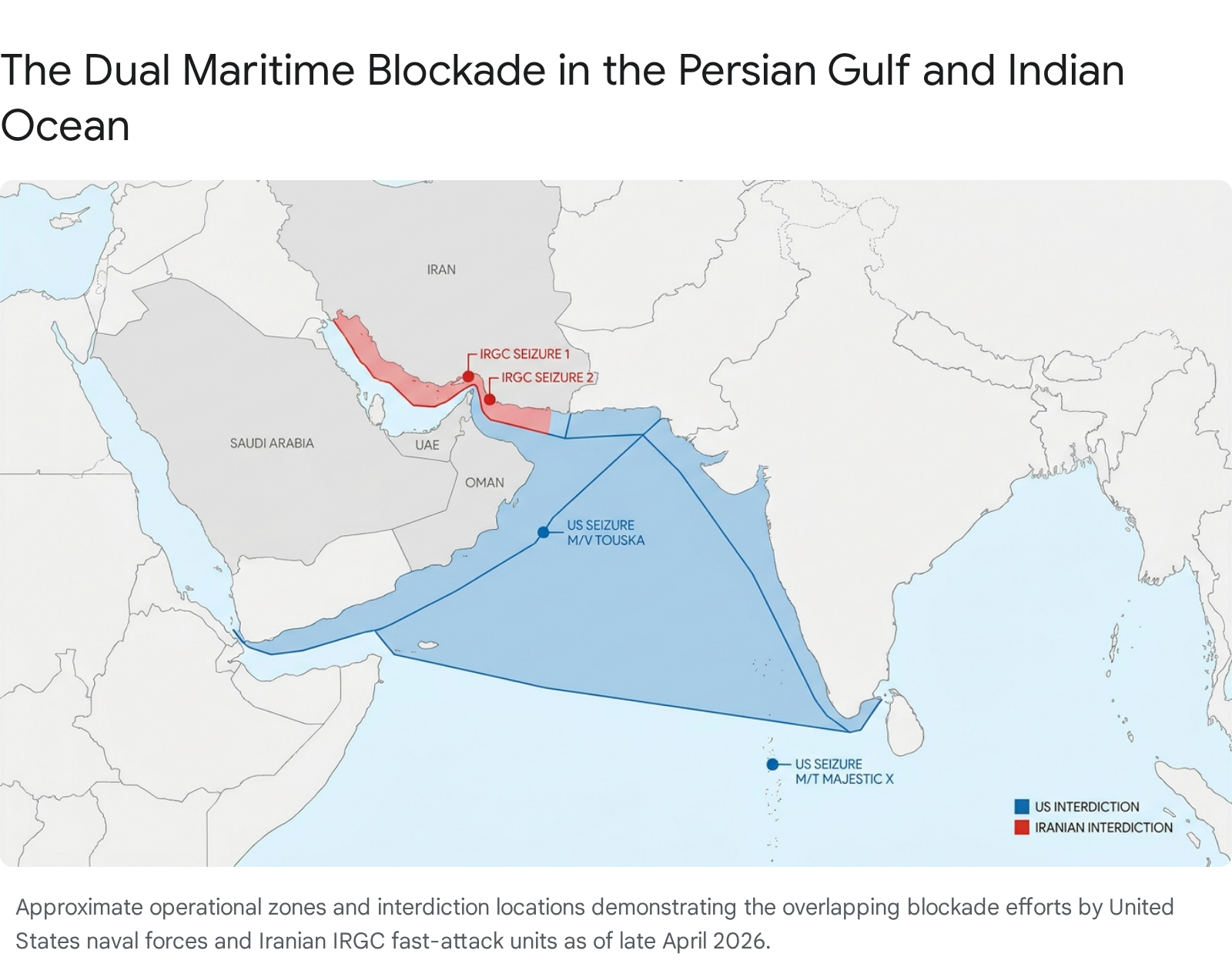
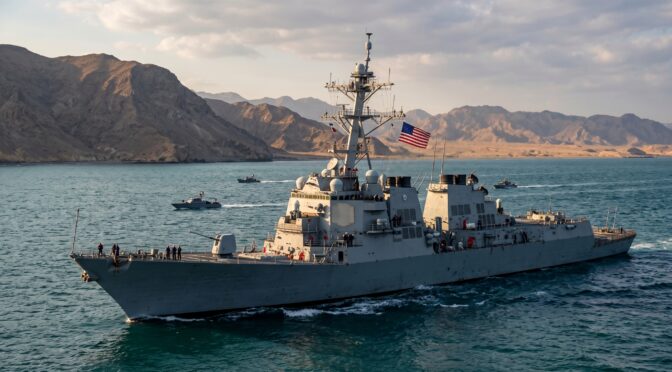
The defining military action of the current week is the implementation of a comprehensive, ironclad naval blockade against Iran, which officially commenced on April 13, 2026, at 10:00 AM Eastern Time.7 Enforced impartially against vessels of all nations, the blockade is designed to completely sever Iranian maritime commerce and deny the regime access to global energy markets.7 Central Command utilizes a highly integrated combination of surface vessels, aerial assets, and intelligence surveillance to maintain the cordon east of the Strait of Hormuz in the Gulf of Oman, placing American assets beyond the easy reach of remaining Iranian coastal defense cruise missiles.10 Key naval assets actively enforcing the blockade include Arleigh Burke-class guided-missile destroyers such as the USS Michael Murphy and the USS Spruance, supported by the amphibious transport dock ship USS New Orleans and the 31st Marine Expeditionary Unit.39 Additionally, United States Air Force F-16 Fighting Falcons are conducting continuous readiness flights over the Central Command area of responsibility to deter Iranian fast attack craft from harassing international shipping.40

By April 18, 2026, military officials reported that 21 commercial vessels had fully complied with interception orders from United States forces and turned back from Iranian ports.39 However, the blockade is not entirely impermeable. Commercial shipping data provided by international maritime tracking firms such as LSEG and Kpler indicates that several sanctioned supertankers have successfully navigated through coverage gaps in the enforcement net, highlighting the extreme operational difficulties associated with blockading an extensive, complex coastline against highly motivated smuggling syndicates.42

3.3.2 Policy & Diplomacy

The diplomatic posture of the Trump administration is defined by a rigid adherence to a “Peace Through Strength” doctrine.43 The administration considers the severe degradation of Iranian military capabilities an unmitigated, historic victory and is actively utilizing the threat of resumed, overwhelming bombardment to force a favorable diplomatic settlement.13 The United States has explicitly linked the lifting of the naval blockade to Iran’s complete, verifiable abandonment of uranium enrichment and the unconditional reopening of the Strait of Hormuz to international shipping.10

During the indirect negotiations in Islamabad, the American delegation, led by Vice President J.D. Vance, Jared Kushner, and Steve Witkoff, refused to compromise on these core demands.13 When the talks collapsed after twenty-one hours, Vice President Vance publicly placed the blame entirely on Tehran, stating that the failure to reach an agreement was “bad news for Iran much more than it’s bad news for the US”.13 The administration’s rhetoric remains highly aggressive. During a Pentagon press briefing on April 16, Secretary of War Pete Hegseth warned the new Iranian regime to “choose wisely,” bluntly stating, “Remember, this is not a fair fight. We know what military assets you are moving and where you are moving them to”.21 The United States has also flatly refused requests from Pakistani mediators to extend the ceasefire by forty-five days, maintaining the strict April 22 expiration deadline to maximize psychological and political pressure on the Iranian leadership.2

3.3.3 Civilian Impact & Economic Warfare (Operation Economic Fury)

The civilian impact within the United States is primarily economic, driven by the severe, unpredictable fluctuations in global energy markets caused by the disruption of traffic through the Strait of Hormuz, which initially triggered a spike in crude oil prices to over $114 a barrel.20 To counter Iranian intransigence and force a capitulation, the United States Treasury Department, under the direction of Secretary Scott Bessent, officially launched “Operation Economic Fury” on April 15, 2026.5

Operation Economic Fury represents a massive, whole-of-government escalation in financial warfare, designed to parallel the kinetic destruction of Operation Epic Fury by systematically starving the Iranian state of all remaining external revenue.5 The Treasury Department has aggressively weaponized secondary sanctions, issuing formal warning letters to foreign financial institutions operating in China, Hong Kong, the United Arab Emirates, and Oman.2 Secretary Bessent explicitly named Chinese banking entities, warning that any institution found facilitating Iranian oil transactions will face immediate secondary sanctions, resulting in total exclusion from the United States financial system.8 This maneuver carries profound geopolitical risks, introducing severe friction into bilateral relations ahead of a highly anticipated summit between President Donald Trump and Chinese President Xi Jinping.8

Furthermore, the Office of Foreign Assets Control executed targeted sanctions against the vast, illicit oil smuggling network operated by Hossein Shamkhani, sanctioning dozens of individuals, corporate entities, and front companies.2 Shamkhani is the son of former Iranian Defense Council Secretary Ali Shamkhani, who was killed by allied strikes on the first day of the war, adding a highly personal dimension to the financial targeting.2 To close remaining loopholes, the administration announced that it will absolutely not renew the general licenses that previously permitted the sale of Russian and Iranian oil stranded at sea prior to the initiation of hostilities.8

4.0 Regional and Gulf State Impacts

The conflict has generated profound, destabilizing spillover effects across the wider Middle East, placing the member states of the Gulf Cooperation Council in a highly precarious strategic paradigm.16 These nations host critical United States military infrastructure, command centers, and logistical hubs, making them legally and geographically vulnerable to Iranian asymmetric retaliation.1 A substantial United States and Israeli air campaign failed to eliminate Iran’s capability to exert power in the Gulf, transforming historically secure neighbor states into active war zones overnight.16

Regional Casualties

The human cost of the conflict has rippled far beyond the borders of the primary belligerents. The destruction of infrastructure and the interception of ballistic trajectories have resulted in numerous fatalities and injuries across the Gulf. The following table aggregates the reported casualties outside of the primary belligerent nations, highlighting the broad geographic scope of the violence.

Country / EntityReported FatalitiesReported InjuriesContext / Status
Lebanon2,196+7,185+Over 1.2 million displaced. Civilian and Hezbollah operative figures are combined in official Ministry of Health data.17
Iraq110357Includes Iraqi military personnel, Iranian-backed proxy militia members, and 23 civilians killed in cross-border strikes.11
United Arab Emirates13224Includes 2 military personnel and 11 civilians killed during the conflict.11
Kuwait10109Fatalities include 4 soldiers and 6 civilians. Injuries include 77 military personnel and 32 civilians.11
Qatar720Fatalities resulted from a military helicopter crash in Qatari territorial waters on March 22 due to a technical issue during heightened alert operations.11
Bahrain346Fatalities include a Moroccan contractor. Injuries include five Emirati soldiers stationed in-country.11
Saudi Arabia323Fatalities include one Saudi national and two foreign nationals.11
Oman315Casualties resulting from regional maritime security incidents and airspace defense operations.11
Jordan031Injuries sustained from falling debris during the interception of Iranian drones violating sovereign airspace.11

Airspace Restrictions and Aviation Security

The continuous threat of ballistic missile trajectories and the deployment of loitering munitions have severely disrupted regional aviation networks, effectively severing normal commercial travel across the Middle East. Muscat International Airport in Oman functions as the primary relief and evacuation hub, though international aviation authorities warn that non-essential transit remains highly dangerous.48

CountryAirspace Status (As of April 18, 2026)Operational Details
KuwaitClosedTotal airspace closure to all civil and commercial operations.18
IraqClosedTechnical closure due to high risk in adjacent Kuwaiti and Iranian airspace.18
BahrainRestrictedEffectively closed with minimal exceptions. Operations are slowly attempting to resume.50
QatarRestrictedEmergency Security Control of Air Traffic activated. Only select Qatar Airways flights operate via strictly designated corridors.49
UAERestrictedPartial reopening via designated waypoint corridors. Emergency Security Control of Air Traffic remains highly active.49
OmanOpenHighly congested. Functioning as the primary southern bypass corridor for international reroutes. Interference advisories reported.49
Saudi ArabiaOpenAir traffic control congestion reported due to heavy rerouting volume across the peninsula.49
JordanOpenOpen but highly volatile, subject to sudden closures during interception events.50

Diplomatic Maneuvering and Base Security

The Gulf states are currently executing a complex diplomatic strategy, attempting to project military strength to their domestic populations while quietly lobbying international partners for an immediate de-escalation of hostilities.16 A primary grievance among the Gulf Cooperation Council is their total exclusion from the Islamabad peace talks, despite bearing the brunt of the economic and physical spillover effects.16

Saudi Arabia: The Kingdom activated its sophisticated national air defense networks to intercept stray projectiles throughout the conflict.16 Riyadh is currently leading “intensive political consultations” across the region to maintain the fragile calm.16 Saudi leadership is acutely aware that a resumption of hostilities could prompt Iran to target vital domestic oil infrastructure, replicating the devastation inflicted upon Iranian facilities. Consequently, Saudi Arabia is actively resisting intense United States pressure to formally normalize relations with Israel under the Abraham Accords framework, preferring to maintain quiet, backchannel diplomacy with Tehran to secure localized non-aggression understandings.16

United Arab Emirates: The UAE suffered structural damage and military casualties during the initial phases of the war but has sought to project resilience.11 Emirati diplomatic adviser Anwar Gargash publicly praised the success of the national air defense forces, stating, “We prevailed through an epic national defense… in the face of treacherous aggression”.16 The UAE has positioned itself as the premier United States security partner in the region.16 It is actively complying with the Treasury Department’s “Operation Economic Fury” initiatives by cracking down on illicit Iranian financial networks operating within Dubai’s banking sector.16

Qatar & Oman: Both nations are leveraging their traditional, historically neutral roles as regional mediators. Oman’s airspace remains a vital logistical lifeline for the entire region.48 However, the Omani government retains subtle sympathies for Iran; the Grand Mufti of Oman sent official condolences following the death of Ali Khamenei, praying for strikes against Israel.53 Qatar suffered military casualties during the heightened alert period and is utilizing its diplomatic leverage to host talks.47 Qatari Emir Sheikh Tamim bin Hamad Al Thani met with Pakistan’s Prime Minister Shehbaz Sharif to coordinate mediation strategies aimed at preventing a wider war.3

Jordan: The Hashemite Kingdom has found itself directly in the crossfire of the conflict.54 The Jordanian Air Force actively conducted combat sorties to intercept Iranian drones that violated its airspace en route to Israel.55 Foreign Minister Ayman al-Safadi vehemently condemned the Iranian incursions, formally expelled Iranian diplomats from Amman, and declared unequivocally that Jordan will not permit its sovereign territory to become a battleground for foreign adversaries.54 Jordan’s firm stance was backed by United States Secretary of State Marco Rubio, who reaffirmed American solidarity with the Kingdom.41

Pakistan: Outside the immediate Gulf Cooperation Council, the Republic of Pakistan has emerged as the primary interlocutor and power broker. Army Chief Field Marshal Asim Munir conducted a high-stakes, three-day diplomatic mission to Tehran, accompanied by Interior Minister Mohsin Naqvi.26 The delegation met directly with Iranian President Masoud Pezeshkian, Parliament Speaker Bagher Qalibaf, and Foreign Minister Abbas Araghchi in an attempt to bridge the seemingly insurmountable gap between American ultimatums and Iranian redlines.26 The Pakistani military stated the visit reflects an “unwavering resolve to facilitate a negotiated settlement,” as Islamabad prepares to host a potential second round of peace talks before the ceasefire expires.19

5.0 Appendices

Appendix A: Methodology

This Situation Report was synthesized utilizing a comprehensive, real-time research sweep of open-source intelligence, military press releases, global news syndicates, and financial tracking data covering the operational period up to April 18, 2026. Primary data regarding military posture and allied intentions was extracted directly from United States Central Command public briefings, Israeli Defense Forces situational updates, and official transcripts from the United States Department of War. Economic intelligence and sanctions data were sourced exclusively from United States Department of the Treasury press releases. Maritime tracking analytics, which occasionally conflicted with official military claims regarding the absolute efficacy of the naval blockade, were weighed objectively to provide a nuanced, realistic operational picture. Casualty figures were rigorously cross-referenced between the United Nations High Commissioner for Human Rights, regional ministries of health, and independent conflict monitors (such as ACLED and HRANA) to ensure accuracy and maintain analytical neutrality.

Appendix B: Glossary of Acronyms

  • A2/AD: Anti-Access/Area Denial. A military strategy designed to prevent an adversary from occupying or traversing an area of land, sea, or air.
  • CENTCOM: United States Central Command. The unified combatant command responsible for United States military operations in the Middle East, Central Asia, and parts of South Asia.
  • ESCAT: Emergency Security Control of Air Traffic. Protocols enacted during times of war or high tension to restrict and manage civilian aircraft movements.
  • GCC: Gulf Cooperation Council. A regional, intergovernmental political and economic union comprising Bahrain, Kuwait, Oman, Qatar, Saudi Arabia, and the United Arab Emirates.
  • IDF: Israeli Defense Forces. The national military of the State of Israel.
  • IRGC: Islamic Revolutionary Guard Corps. A multi-service primary branch of the Iranian Armed Forces, tasked with protecting the country’s Islamic republic political system.
  • JCS: Joint Chiefs of Staff. The body of the most senior uniformed leaders within the United States Department of Defense.
  • MEU: Marine Expeditionary Unit. The smallest Marine air-ground task force in the United States Fleet Marine Force.
  • OSINT: Open-Source Intelligence. Data collected from publicly available sources to be used in an intelligence context.
  • SITREP: Situation Report. A report on the current military, political, or economic situation.
  • UAV: Uncrewed Aerial Vehicle. An aircraft without a human pilot on board, commonly referred to as a drone.
  • UNIFIL: United Nations Interim Force in Lebanon. A UN peacekeeping mission established to confirm Israeli withdrawal from Lebanon and restore international peace and security.

Appendix C: Glossary of Foreign Words

  • Bavar-373: An Iranian long-range, road-mobile surface-to-air missile system. The name translates to “Belief-373.”
  • Hezbollah: A Lebanese Shia Islamist political party and militant group closely allied with and funded by Iran. The name translates to “Party of Allah.”
  • Khamenei: Refers to the Supreme Leader of Iran. Ali Khamenei was assassinated during the opening strikes of the conflict; Mojtaba Khamenei is his son and the newly appointed successor.
  • Majlis: The Islamic Consultative Assembly, the national legislative body of the Islamic Republic of Iran.
  • Rial: The official fiat currency of the Islamic Republic of Iran.

Please share the link on Facebook, Forums, with colleagues, etc. Your support is much appreciated and if you have any feedback, please email us in**@*********ps.com. If you’d like to request a report or order a reprint, please click here for the corresponding page to open in new tab.


Sources Used

  1. 2026 Iran war | Explained, United States, Israel, Strait of Hormuz, Map, & Conflict, accessed April 18, 2026, https://www.britannica.com/event/2026-Iran-war
  2. Iran Update Special Report, April 15, 2026, accessed April 18, 2026, https://understandingwar.org/research/middle-east/iran-update-special-report-april-15-2026/
  3. Iran-Israel war on April 16, 2026: 10-day ceasefire deal between Israel, Lebanon takes effect midnight; Lebanon reports ceasefire violations, accessed April 18, 2026, https://www.thehindu.com/news/international/iran-israel-us-war-west-asia-conflict-live-updates-april-16-2026/article70867467.ece
  4. MIDDLE EAST LIVE 17 April: Israel-Lebanon ceasefire begins; Iran announces opening of Strait of Hormuz | UN News, accessed April 18, 2026, https://news.un.org/en/story/2026/04/1167318
  5. U.S. launches ‘Operation Economic Fury’ to obstruct Iran’s revenue streams amid blockade, accessed April 18, 2026, https://defensescoop.com/2026/04/16/trump-economic-pressure-iran-blockade/
  6. Readout from Secretary of the Treasury Scott Bessent’s Meeting with UK Chancellor of the Exchequer Rachel Reeves, accessed April 18, 2026, https://home.treasury.gov/news/press-releases/sb0454
  7. U.S. to Blockade Ships Entering or Exiting Iranian Ports – centcom, accessed April 18, 2026, https://www.centcom.mil/MEDIA/PRESS-RELEASES/Press-Release-View/Article/4457255/us-to-blockade-ships-entering-or-exiting-iranian-ports/
  8. U.S. Imposes ‘Economic Fury’ Sanctions on Chinese Banks Aiding Iran, accessed April 18, 2026, https://www.chosun.com/english/world-en/2026/04/17/RMVR4OQKRVBPHFDZXJ2M6JQ7Z4/
  9. IDF on high alert amid fragile, temporary ceasefires in Iran and Lebanon, accessed April 18, 2026, https://www.timesofisrael.com/idf-on-high-alert-amid-fragile-temporary-ceasefires-in-iran-and-lebanon/
  10. First Thing: US starts naval blockade of Iranian ports after deadline passes, accessed April 18, 2026, https://www.theguardian.com/us-news/2026/apr/14/first-thing-us-starts-naval-blockade-of-iranian-ports-after-deadline-passes
  11. 2026 Iran war – Wikipedia, accessed April 18, 2026, https://en.wikipedia.org/wiki/2026_Iran_war
  12. Operation Epic Fury Fact Sheet: April 6, 2026, accessed April 18, 2026, https://media.defense.gov/2026/Apr/06/2003907108/-1/-1/1/OPERATION-EPIC-FURY-FACT-SHEET-APRIL-6-2026.PDF
  13. Operation Epic Fury Update – Latest Developments | SOF News, accessed April 18, 2026, https://sof.news/middle-east/epic-fury-update-20260412/
  14. Iran war updates: Trump voices optimism about deal; Tehran cautious – Al Jazeera, accessed April 18, 2026, https://www.aljazeera.com/news/liveblog/2026/4/17/iran-war-live-ceasefire-starts-in-lebanon-as-trump-says-tehran-deal-close
  15. US-Israel-Iran War Live: Hormuz sees first tanker movement in …, accessed April 18, 2026, https://www.indiatoday.in/world/story/us-iran-israel-war-strait-of-hormuz-trump-araghchi-lebanon-netanyahu-markets-oil-prices-deal-nuclear-stocks-ceasefire-hezbollah-live-updates-2898000-2026-04-18
  16. Three Scenarios for the Gulf States After the Iran War | Carnegie …, accessed April 18, 2026, https://carnegieendowment.org/emissary/2026/04/gulf-states-gcc-iran-war-three-scenarios
  17. Lebanon: Flash Update #17 – Escalation of hostilities in Lebanon (as of 13 April 2026), accessed April 18, 2026, https://reliefweb.int/report/lebanon/lebanon-flash-update-17-escalation-hostilities-lebanon-13-april-2026
  18. Middle East Tension Escalation – April 10, 2026 – Expeditors, accessed April 18, 2026, https://info.expeditors.com/operational-impact/middle-east-tension-escalation-april-10-2026
  19. Pakistan Army Chief Munir Concludes Three-Day Iran Visit, accessed April 18, 2026, https://www.etvbharat.com/en/international/pakistan-army-chief-munir-concludes-three-day-iran-visit-enn26041802600
  20. US Enforces Hormuz Blockade: Trump’s “Operation Economic Fury” Explained – YouTube, accessed April 18, 2026, https://www.youtube.com/watch?v=jsjNnuGMMu8
  21. Hegseth Urges Iran to ‘Choose Wisely’ During Epic Fury Ceasefire, Blockade, accessed April 18, 2026, https://www.war.gov/News/News-Stories/Article/Article/4461708/hegseth-urges-iran-to-choose-wisely-during-epic-fury-ceasefire-blockade/
  22. Secretary of War Pete Hegseth and Chairman of the Joint Chiefs of Staff Gen. Dan Caine Hold a Press Briefing, accessed April 18, 2026, https://www.war.gov/News/Transcripts/Transcript/Article/4462029/secretary-of-war-pete-hegseth-and-chairman-of-the-joint-chiefs-of-staff-gen-dan/
  23. US Israel-Iran War Day 49: Trump hints at ‘end’ to war; Israel …, accessed April 18, 2026, https://m.economictimes.com/news/defence/us-israel-iran-war-news-day-49-updates-strait-of-hormuz-blockage-peace-talk-donald-trump-us-israel-iran-middle-east-war/articleshow/130321499.cms
  24. The U.S. blockade continues despite Iran’s announcement the Strait of Hormuz is open, accessed April 18, 2026, https://www.opb.org/article/2026/04/17/iran-says-strait-of-hormuz-is-open-trump-says-u-s-blockade-continues/
  25. Middle East Conflict: Situational Updates and Implications for Global Mobility, accessed April 18, 2026, https://newlandchase.com/middle-east-crisis-situation-update/
  26. The Latest: Iran says it has closed Hormuz again over US blockade | National News | 2news.com, accessed April 18, 2026, https://www.2news.com/news/national/the-latest-iran-says-it-has-closed-hormuz-again-over-us-blockade/article_7818273d-487a-5d02-aec8-7f23d45ba107.html
  27. Pakistan’s army chief concludes three-day visit to Iran – Al Arabiya, accessed April 18, 2026, https://english.alarabiya.net/News/middle-east/2026/04/18/pakistan-s-army-chief-concludes-threeday-visit-to-iran
  28. Iran Update Special Report, April 17, 2026 | ISW, accessed April 18, 2026, https://understandingwar.org/research/middle-east/iran-update-special-report-april-17-2026/
  29. Iran Update Special Report, April 12, 2026 | ISW, accessed April 18, 2026, https://understandingwar.org/research/middle-east/iran-update-special-report-april-12-2026/
  30. Operation Economic Fury – FDD, accessed April 18, 2026, https://www.fdd.org/podcasts/2026/04/16/operation-economic-fury/
  31. Casualties of the 2026 Iran war – Wikipedia, accessed April 18, 2026, https://en.wikipedia.org/wiki/Casualties_of_the_2026_Iran_war
  32. US/Israel-Iran conflict 2026 – The House of Commons Library – UK Parliament, accessed April 18, 2026, https://commonslibrary.parliament.uk/research-briefings/cbp-10521/
  33. Iran-Israel War 2026 | IDF, accessed April 18, 2026, https://www.idf.il/en/mini-sites/iran-israel-war-2026/
  34. Iran Update Special Report, April 8, 2026 | ISW, accessed April 18, 2026, https://understandingwar.org/research/middle-east/iran-update-special-report-april-8-2026/
  35. Israel will not retreat back to international border with Lebanon: Netanyahu, accessed April 18, 2026, https://www.dawn.com/news/1992393/israel-will-not-retreat-back-to-international-border-with-lebanon-netanyahu
  36. Iran reopens Strait of Hormuz, but threatens to close it again as the US maintains its blockade, accessed April 18, 2026, https://apnews.com/article/us-iran-war-lebanon-israel-talks-pakistan-hormuz-17-april-2026-4bd5a29af608ecbd72356559b3c55d67
  37. Netanyahu: ‘Road to peace’ with Lebanon begins; Trump: Israel ‘PROHIBITED’ from bombing there, accessed April 18, 2026, https://www.timesofisrael.com/netanyahu-long-road-to-peace-begins-as-trump-says-israel-prohibited-from-bombing-lebanon/
  38. The Iran Strikes, Explained: How We Got Here and What It Means | AJC, accessed April 18, 2026, https://www.ajc.org/news/the-iran-strikes-explained-how-we-got-here-and-what-it-means
  39. 21 ships turned back to Iran since US blockade began, says CENTCOM, accessed April 18, 2026, https://m.economictimes.com/news/international/world-news/21-ships-turned-back-to-iran-since-us-blockade-began-says-centcom/articleshow/130346627.cms
  40. US forces are forward and ready across Middle East – CENTCOM, accessed April 18, 2026, https://www.iranintl.com/en/202604176877
  41. Jordan warns of wider conflict as regional escalation deepens, accessed April 18, 2026, https://jordantimes.com/news/local/jordan-warns-of-wider-conflict-as-us-israeli-strikes-deepen-iran-crisis
  42. US Sanctioned Supertankers Enter Gulf Despite Blockade, accessed April 18, 2026, https://discoveryalert.com.au/us-sanctioned-supertankers-gulf-despite-blockade-2026/
  43. Peace Through Strength: Operation Epic Fury Crushes Iranian Threat as Ceasefire Takes Hold – The White House, accessed April 18, 2026, https://www.whitehouse.gov/releases/2026/04/peace-through-strength-operation-epic-fury-crushes-iranian-threat-as-ceasefire-takes-hold/
  44. MIDDLE EAST LIVE 15 April: Civilian dangers intensify as Israel expands Lebanon evacuation orders | UN News, accessed April 18, 2026, https://news.un.org/en/story/2026/04/1167302
  45. US increases economic pressure on Iran to get a deal done, accessed April 18, 2026, https://www.washingtonexaminer.com/policy/economy/4530644/us-iran-bessent-economic-pressure/
  46. UN-GCC Cooperation, April 2026 Monthly Forecast – Security Council Report, accessed April 18, 2026, https://www.securitycouncilreport.org/monthly-forecast/2026-04/un-gcc-cooperation.php
  47. Operations Epic Fury and Roaring Lion: 4/17/26 Update – JINSA, accessed April 18, 2026, https://jinsa.org/wp-content/uploads/2026/04/Operations-Epic-Fury-and-Roaring-Lion-04.17.26.pdf
  48. Is It Safe to Fly Through Muscat After the US-Iran Ceasefire? What Travellers Need to Know, accessed April 18, 2026, https://blog.wego.com/is-it-safe-to-fly-through-muscat-what-travellers-need-to-know-2026/
  49. Middle East Tension Escalation – April 3, 2026 – Expeditors, accessed April 18, 2026, https://info.expeditors.com/operational-impact/middle-east-tension-escalation-april-3-2026
  50. Gulf States: Situation & Travel Update | 10 APRIL 2026 – Solace Global, accessed April 18, 2026, https://www.solaceglobal.com/news/2026/04/10/gulf-sitrep-1004/
  51. Gulf States: Situation & Travel Update | 2 APRIL 2026 – Solace Global, accessed April 18, 2026, https://www.solaceglobal.com/news/2026/04/02/gulf-sitrep-0204/
  52. Safe Airspace – Conflict Zone and Risk Database, accessed April 18, 2026, https://safeairspace.net/
  53. The Gulf states’ offensive options against Iran, accessed April 18, 2026, https://www.iiss.org/online-analysis/online-analysis/2026/03/the-gulf-states-offensive-options-against-iran/
  54. Jordan says expelling Iranian diplomats sends clear message to Tehran – Middle East Eye, accessed April 18, 2026, https://www.middleeasteye.net/live-blog/live-blog-update/jordan-says-expelling-iranian-diplomats-sends-clear-message-tehran-0
  55. Jordan condemns Iranian missile attack, reaffirms solidarity with Gulf states, accessed April 18, 2026, https://jordantimes.com/news/local/jordan-air-force-conducts-sorties-to-protect-kingdoms-skies-military
  56. Jordan says it will not be ‘battleground’ in any regional conflict amid US-Iran tension, accessed April 18, 2026, https://www.middleeastmonitor.com/20260202-jordan-says-it-will-not-be-battleground-in-any-regional-conflict-amid-us-iran-tension/
  57. Islamabad, Pakistan, April 18, 2026 (AFP) – Pakistan military chief, PM head home after Iran war diplomacy blitz | NAMPA, accessed April 18, 2026, https://www.nampa.org/text/22912151

Operation Epic Fury Weekly SITREP – April 11, 2026

1.0 Executive Summary

The seven-day reporting period concluding on April 11, 2026, marks a critical inflection point and a highly volatile transitional phase in the broader Middle Eastern conflict that commenced on February 28, 2026. Following 38 days of high-intensity kinetic engagements executed under the operational frameworks of Operation Epic Fury by the United States and Operation Roaring Lion by Israel, a fragile, two-week ceasefire was successfully brokered by the Government of Pakistan.1 This diplomatic pause officially commenced on April 8, shifting the primary theater of United States and Iranian engagement from the military domain to complex diplomatic negotiations currently underway in Islamabad.4

Despite the formal cessation of direct hostilities between Washington and Tehran, the regional security environment remains severely degraded and systemically disrupted.6 The ceasefire agreement is notably asymmetrical and geographically limited. Israeli military and political leadership has explicitly excluded the Lebanese theater from the operational pause, resulting in the most intense aerial bombardment of Hezbollah positions in the Levant since the conflict began.4 Concurrently, Iranian-aligned proxy forces and potentially decentralized or rogue elements of the Islamic Revolutionary Guard Corps have continued to launch sporadic unmanned aerial vehicle and ballistic missile attacks against Gulf Cooperation Council states and United States military installations in Iraq and Kuwait.4 These persistent strikes underscore the severe command and control challenges inherent in managing decentralized proxy networks during a formal ceasefire.

The systemic effects of Operation Epic Fury have fundamentally altered the regional balance of power. United States Central Command reports the functional destruction of the Iranian conventional naval fleet, the total degradation of Iranian integrated air defense systems, and the severe curtailment of the Iranian defense industrial base, particularly targeting solid rocket motor production and drone manufacturing capabilities.3 In response, the newly reconstituted Iranian leadership apparatus, functioning under the presumed authority of Mojtaba Khamenei following the February 28 assassination of Supreme Leader Ali Khamenei, has pivoted to a strategy of asymmetric economic warfare.6 Tehran has established de facto control over the Strait of Hormuz, effectively reducing commercial maritime traffic by 94 percent and demanding transit tolls payable in alternative currencies such as Bitcoin or the Chinese Yuan.4 This strategic chokehold has driven global oil prices above $104 per barrel and introduced severe inflationary pressures into the global economy, threatening to destabilize international markets.5

The Gulf Arab states, which host critical United States military infrastructure and provide logistical support nodes, find themselves in a highly precarious strategic position. Nations such as Saudi Arabia, the United Arab Emirates, Kuwait, and Bahrain have absorbed hundreds of retaliatory drone and missile strikes, suffering significant damage to civilian and energy infrastructure.8 This continuous bombardment has forced a rapid evolution in Gulf domestic security postures, resulting in widespread arrests of individuals displaying pro-Iranian sentiment and a unified diplomatic push for a permanent resolution that completely neutralizes the Iranian ballistic missile threat.15 The prior strategy of maintaining a fragile détente with Tehran has been largely abandoned in favor of alignment with United States maximalist security demands.

As delegations led by United States Vice President JD Vance and Iranian Foreign Minister Abbas Araghchi convene in Pakistan, the prospect for a durable peace remains highly uncertain.5 The United States Department of War continues to deploy supplementary forces, including elements of the 82nd Airborne Division and Marine Expeditionary Units, signaling a definitive readiness to resume kinetic operations if diplomatic avenues collapse.16 Consequently, the current operational environment is best characterized not as a post-conflict stabilization phase, but as a heavily armed operational pause fraught with the immediate risk of regional re-escalation.

2.0 Chronological Timeline of Key Events (Last 7 Days)

The following timeline details key military, diplomatic, and civilian events recorded between April 4 and April 11, 2026. All times are normalized to Coordinated Universal Time (UTC) based on regional reporting parameters and synthesized from multi-source open-source intelligence monitoring.

  • April 4, 2026
    • 03:00 UTC: Iranian-aligned militias target the North Rumaila oil field in Iraq utilizing unmanned aerial vehicles, striking commercial infrastructure and injuring three personnel.8
    • 08:30 UTC: United States Central Command and allied forces conduct dynamic strikes against Iranian railways, bridges, and transportation nodes to disrupt the logistical movement of mobile ballistic missile launchers across Iranian territory.1
    • 14:00 UTC: The United Arab Emirates Ministry of Defense reports the successful interception of 23 ballistic missiles and 56 unmanned aerial vehicles. Falling shrapnel damages commercial structures in the Marina area and Dubai Internet City.8
    • 18:00 UTC: Drones strike the Buzurgan oil field in Maysan, Iraq, causing operational damage to extraction facilities.8
  • April 5, 2026
    • 01:00 UTC: An Iranian ballistic missile utilizing cluster munitions strikes a residential building in Haifa, Israel. Rescue operations commence, later recovering four bodies from the collapsed structure.17
    • 05:30 UTC: United States search and rescue forces successfully extract the second crew member of a downed F-15E Strike Eagle deep within Iranian territory. The extraction concludes a massive 155-aircraft deception and recovery operation that utilized decoying tactics to divert Iranian security forces.3
    • 11:00 UTC: Kuwaiti air defenses intercept four cruise missiles, 31 drones, and nine ballistic missiles. Drone impacts are recorded at the Kuwait Petroleum Company oil complex in Shuwaikh and the Ministries Complex in Kuwait City.8
    • 19:00 UTC: The Israeli military eliminates Masoud Zare, the commander of the Iranian army air defense academy, during a precision aerial strike in Shahin Shahr.17
  • April 6, 2026
    • 04:00 UTC: Israeli intelligence operations culminate in the targeted killing of Majid Khademi, the Chief of Intelligence for the Islamic Revolutionary Guard Corps.17
    • 12:00 UTC: Iran officially rejects an initial United States ceasefire proposal, demanding the unconditional reopening of the Strait of Hormuz and a cessation of all allied strikes before engaging in substantive talks.18
    • 16:00 UTC: Iran, Hezbollah, and Houthi forces execute a coordinated, multi-front saturation attack against Israeli air defenses in an attempt to maximize psychological impact and test the limits of the Iron Dome and David’s Sling systems.18
    • 20:00 UTC: United States President Donald Trump issues a public statement warning that failure to negotiate will result in catastrophic consequences for the Iranian state, utilizing highly coercive rhetoric.13
  • April 7, 2026
    • 08:00 UTC: The United States and Iran announce a two-week ceasefire agreement, heavily mediated by the Government of Pakistan.1
    • 10:00 UTC: Iran submits a 10-point negotiation framework demanding reparations, United States troop withdrawals, recognition of nuclear enrichment rights, and the termination of all United Nations Security Council resolutions against the Islamic Republic.4
    • 14:00 UTC: The Israel Defense Forces launch their largest single-day aerial campaign against Lebanon, striking over 100 Hezbollah command nodes, missile sites, and Radwan Force installations, explicitly demonstrating that Lebanon is excluded from the Iran-United States ceasefire agreement.4
  • April 8, 2026
    • 00:01 UTC: The official ceasefire between the United States and Iran takes effect across all primary theaters.4
    • 01:00 UTC: In a direct violation of the ceasefire or a demonstration of rogue proxy action, Iran-based platforms launch 42 drones and four ballistic missiles toward Kuwait, and 17 ballistic missiles at the United Arab Emirates.4
    • 04:00 UTC: Unidentified aircraft strike the Iranian Lavan oil refinery and petrochemical facilities on Siri Island. The Israel Defense Forces officially deny involvement in the operation.4
    • 15:00 UTC: United States Secretary of War Pete Hegseth and Chairman of the Joint Chiefs of Staff General Dan Caine hold a Pentagon briefing declaring the primary military objectives of Operation Epic Fury accomplished, confirming the destruction of the Iranian fleet and air defense networks.3
  • April 9, 2026
    • 09:00 UTC: The European Union Aviation Safety Agency officially extends its Conflict Zone Information Bulletin, advising all civilian aircraft to avoid the majority of Middle Eastern and Gulf airspace at all flight levels until April 24 due to the severe risk of misidentification.19
    • 11:00 UTC: The Lebanese presidency announces upcoming diplomatic talks at the United States Department of State regarding a separate Israel-Lebanon ceasefire track, acknowledging the intense pressure from Israeli bombardments.5
  • April 10, 2026
    • 05:30 UTC: The United States delegation, led by Vice President JD Vance and Secretary of State Marco Rubio, arrives at Nur Khan Airbase in Islamabad for negotiations.16
    • 08:00 UTC: The Iranian delegation, led by Parliament Speaker Mohammad Bagher Ghalibaf and Foreign Minister Abbas Araghchi, arrives in Islamabad.5
  • April 11, 2026
    • 06:00 UTC: Saudia Airlines announces the partial resumption of flights to the United Arab Emirates and Jordan, reflecting a cautious stabilization of regional airspace management.20
    • 12:00 UTC: United States defense officials confirm the Pentagon is proceeding with the deployment of 1,500 to 2,000 troops from the 82nd Airborne Division to the Middle East to maintain maximum leverage and deterrence during the Islamabad negotiations.16

3.0 Situation by Primary Country

3.1 Iran

3.1.1 Military Actions & Posture

The Iranian military apparatus has suffered catastrophic, generational degradation over the 38-day course of Operation Epic Fury. According to definitive battle damage assessments provided by United States Central Command, the Iranian regular navy has been functionally eliminated as a cohesive fighting force. Over 150 surface vessels across 16 classes have been sunk, representing over 90 percent of the fleet, alongside the destruction of 97 percent of Iran’s inventory of naval mines.3 The Islamic Revolutionary Guard Corps navy suffered similar attrition, losing half of its small fast-attack craft inventory.3 Furthermore, 80 percent of Iran’s integrated air defense systems and 90 percent of its defense industrial base have been systematically dismantled, completely neutralizing domestic ballistic missile and unmanned aerial vehicle production.3 The targeted destruction of national infrastructure extends to the aerospace sector, where 70 percent of space launch facilities and ground control stations have been neutralized.22

Despite these systemic conventional losses, the Iranian military posture has rapidly adapted by decentralizing its command structure and relying entirely on asymmetric warfare, anti-access capabilities, and regional proxy mobilization. Following the February 28 decapitation strike that killed Supreme Leader Ali Khamenei and Defense Minister Mohammad Reza Ashtiani, command and control of the Islamic Revolutionary Guard Corps has demonstrated signs of severe fragmentation.4 This is evidenced by the continuation of drone and ballistic missile launches against the United Arab Emirates, Kuwait, and Saudi Arabia in the hours immediately following the implementation of the April 8 ceasefire.4 Intelligence assessments indicate that hardline factions within the Islamic Revolutionary Guard Corps initially resisted the ceasefire parameters, forcing Foreign Minister Araghchi to expend significant political capital to secure military compliance.4

The primary vector of Iranian military leverage remains its geographic control over the Strait of Hormuz. Deprived of a conventional navy, the Islamic Revolutionary Guard Corps relies on remaining coastal defense cruise missiles, surviving fast-attack craft, and the credible threat of loitering munition swarms to deter commercial shipping.4 The military is currently enforcing a stringent blockade, attempting to exact a toll of one United States Dollar per barrel of transiting oil, payable in non-Western currencies such as Bitcoin or the Chinese Yuan to bypass financial sanctions and challenge the petrodollar hegemony.12 This posture suggests a transition from a doctrine of conventional deterrence to a strategy of managed instability, utilizing global economic disruption as its primary weapon.6

3.1.2 Policy & Diplomacy

Iranian diplomatic strategy is currently focused on translating its asymmetric disruption capabilities into concrete geopolitical concessions at the negotiating table in Islamabad. The Iranian delegation, spearheaded by Parliament Speaker Mohammad Bagher Ghalibaf and Foreign Minister Abbas Araghchi, entered the Pakistan-brokered talks with a highly ambitious 10-point proposal.4

The core tenets of this diplomatic framework reveal a regime attempting to negotiate from a perceived position of strength despite total conventional military defeat. Iran’s demands include absolute guarantees against future United States or Israeli strikes, formal recognition of Iranian sovereignty and control over the Strait of Hormuz, the total withdrawal of United States combat forces from all regional bases in the Gulf, massive financial reparations for wartime infrastructural damages, and the immediate lifting of all primary and secondary economic sanctions.4 Furthermore, Tehran is attempting to link the United States ceasefire to the broader regional conflict, demanding an immediate halt to Israeli operations against Hezbollah in Lebanon.4

This diplomatic posture suggests that the newly consolidated regime, likely operating under the absolute guidance of Mojtaba Khamenei, recognizes its inability to project conventional power but believes it possesses sufficient structural leverage to dictate terms.6 By holding global energy markets hostage, the Iranian diplomatic corps is betting that domestic economic pressures within the United States and Europe will force Washington into accepting terms that guarantee the survival of the Islamic Republic.

3.1.3 Civilian Impact

The civilian toll within the Islamic Republic of Iran is staggering, driven by both foreign military strikes and severe internal security crackdowns. Conservative estimates from conflict monitors indicate that over 3,546 Iranians have been killed, a figure that includes at least 1,219 military personnel and thousands of civilians caught in the crossfire or situated near dual-use facilities.17 Humanitarian organizations, including the United Nations Human Rights Council, report that allied strikes have impacted over 67,414 civilian-adjacent sites, resulting in widespread disruptions to electrical grids, water desalination infrastructure, and basic medical supply chains.24

The psychological and humanitarian impact of the conflict was heavily exacerbated by the opening salvo on February 28, which included a highly controversial United States strike on a girls’ school adjacent to a naval base in Minab, resulting in over 170 civilian fatalities.9 Independent fact-finding missions have highlighted the plight of the Iranian populace, caught between overwhelming foreign bombardment and systemic domestic repression.26

Domestically, the regime has implemented draconian measures to control the flow of information and suppress domestic dissent that could capitalize on the state’s military weakness. Monitoring groups report that a state-imposed internet blackout has exceeded 1,000 continuous hours, severely limiting the ability of civilians to communicate, coordinate emergency responses, or access independent news.5 Furthermore, the environmental degradation caused by the targeted destruction of petrochemical facilities has resulted in toxic pollution, characterized locally as “black rain,” falling over major metropolitan areas including Tehran, presenting a long-term public health catastrophe.27

3.2 Israel

3.2.1 Military Actions & Posture

The Israel Defense Forces continue to operate under a highly stressful dual-front paradigm, balancing defensive homeland security against incoming Iranian ballistic missiles with aggressive offensive operations in Lebanon. Operation Roaring Lion, the Israeli counterpart to the United States campaign, successfully achieved its primary objective of decapitating the highest echelons of the Iranian leadership and neutralizing the immediate threat of Iranian nuclear breakout through precision strikes on facilities like the Arak heavy water plant.23

With the implementation of the April 8 ceasefire regarding direct Iranian sovereign territory, the Israel Defense Forces executed a rapid and brutal strategic pivot to the northern front. Capitalizing on the degradation of Iranian supply lines and the distraction of Tehran’s leadership, the Israeli Air Force launched its most intensive operational wave against Hezbollah infrastructure on April 7, conducting over 100 precision strikes.4 Target matrices included command and control centers, subterranean missile launch sites, and Radwan Force staging areas heavily concentrated in southern Lebanon, the Bekaa Valley, and central Beirut neighborhoods such as Ain al Mraiseh and Mazraa.4

Domestically, the Israeli integrated air defense system, comprising the Arrow, David’s Sling, and Iron Dome platforms, has been tested to its absolute operational limits. Throughout the reporting period, Iranian and proxy forces launched sustained ballistic missile barrages, frequently utilizing indiscriminate cluster munitions, targeting densely populated urban centers including Ramat Gan, Givatayim, Bnei Brak, Petah Tikva, and Haifa.17 The military posture remains heavily mobilized, with significant infantry and armored elements operating forward defensive lines in southern Lebanon, frequently sustaining casualties from anti-tank guided missiles.31

3.2.2 Policy & Diplomacy

The diplomatic posture of the government in Jerusalem is characterized by a firm, uncompromising compartmentalization of the conflict theaters. Prime Minister Benjamin Netanyahu and the war cabinet have explicitly communicated to Washington that while Israel will observe the pause on direct strikes against Iranian sovereign territory to facilitate the Islamabad negotiations, the military campaign against Hezbollah in Lebanon is strictly excluded from any such agreement.4

Israeli policymakers are demanding the total, verifiable disarmament of Hezbollah and have instructed diplomatic envoys to seek direct negotiations with the sovereign government of Lebanon to enforce United Nations Security Council resolutions regarding the demilitarization of the southern border.7 The Israeli government views the current operational pause with Iran not as an end to the broader proxy conflict, but as a tactical window to systematically dismantle Iran’s most potent proxy force situated on its immediate borders. Furthermore, Israel continues to issue immediate evacuation warnings to Iranian diplomatic personnel and representatives residing in Lebanon, demonstrating a commitment to severing the logistical and command ties between Tehran and Beirut.31

3.2.3 Civilian Impact

The civilian population of Israel remains under significant duress, experiencing daily disruptions due to the persistent threat of aerial bombardment. Since the commencement of hostilities on February 28, 42 Israelis have been killed, a figure that includes 11 soldiers operating in Lebanon and 27 civilians.17 Over 7,451 individuals have required medical treatment for injuries sustained during missile impacts, shrapnel dispersion, or while seeking shelter.17

The introduction of cluster munitions by Iranian forces has vastly increased the complexity of civilian defense, resulting in direct, unexploded ordnance impacts on residential structures in central Israel.17 Beyond the immediate physical casualties, the conflict has resulted in mass internal displacement, severe economic contraction, and the constant psychological strain of operating under wartime conditions. The normalization of daily life has been entirely suspended, with the education system disrupted, agricultural sectors in the north abandoned, and commercial aviation heavily restricted due to the overarching risk of regional airspace contamination. The ongoing missile fire continues to demand long hours spent in bomb shelters for hundreds of thousands of residents.28

3.3 United States

3.3.1 Military Actions & Posture

United States Central Command has executed Operation Epic Fury with a focus on overwhelming technological superiority and precision targeting, aiming to achieve total spectrum dominance. The operational methodology relied heavily on standoff munitions, utilizing B-1 and B-2 Spirit bombers, Tomahawk Land Attack Missiles launched from Arleigh Burke-class destroyers, and F-16 Fighting Falcons supported by extensive aerial refueling networks.3

The military achievements, as articulated by the Pentagon, are absolute in their scope. Utilizing less than ten percent of the nation’s total combat power, United States forces struck over 13,000 targets, including 4,000 dynamic targets.3 This campaign achieved the functional destruction of the Iranian missile program, including all solid rocket motor production facilities, 450 ballistic missile storage sites, and every factory producing Shahed one-way attack drones.3 A critical sub-component of the operation was the highly successful Combat Search and Rescue mission executed over Easter weekend. Following the downing of an F-15E Strike Eagle on April 3, Central Command deployed a massive package of 155 aircraft to provide close air support and execute a sophisticated deception operation, successfully recovering the stranded crew members within 48 hours without sustaining further casualties.3

Despite the April 8 ceasefire, the United States maintains an aggressive, forward-deployed posture globally. Joint Task Force Southern Border continues to utilize counter-unmanned aerial systems to protect strategic domestic installations, highlighting the asymmetric threat of drone surveillance reaching the homeland, potentially orchestrated by foreign actors.33 Furthermore, the Department of War is actively reinforcing the Middle Eastern theater, deploying up to 2,000 additional personnel from the 82nd Airborne Division and thousands of Marines via Expeditionary Units to ensure maximum leverage and ground-combat readiness during the diplomatic negotiations.16

3.3.2 Policy & Diplomacy

The policy directives originating from the White House are defined by the administration’s stated doctrine of “Peace Through Strength.” President Donald Trump has consistently framed the conflict as a necessary, decisive corrective action to eliminate a generational terror threat and correct previous diplomatic failures.22 The diplomatic strategy, currently being executed by Vice President JD Vance and Secretary of State Marco Rubio in Islamabad, involves utilizing the catastrophic damage inflicted upon Iran as absolute leverage to force structural concessions.5

The administration is operating under significant domestic and international pressure to achieve a rapid, definitive diplomatic victory. The closure of the Strait of Hormuz has triggered a severe spike in global energy prices, leading to surging inflation and political volatility within the United States.5 Consequently, the diplomatic messaging is inherently coercive and escalatory. President Trump has publicly threatened that a failure to reach an acceptable peace deal and reopen the maritime chokepoints will result in the resumption of military operations capable of ensuring that a “whole civilization will die”.13 Secretary of War Pete Hegseth echoed this sentiment, stating the administration is prepared to “negotiate with bombs” if talks fail.34 The core United States demands include the verifiable abandonment of the Iranian nuclear program, the permanent cessation of proxy funding, and the unconditional restoration of freedom of navigation in the Persian Gulf.3

3.3.3 Civilian Impact

While the United States homeland has not suffered direct kinetic military attacks, the civilian impact is acutely felt through severe economic disruptions and the tragic human cost of military deployments abroad. Fifteen American service members have been killed in action during Operation Epic Fury, including casualties resulting from proxy drone strikes on logistics hubs in Kuwait and Saudi Arabia, and the loss of a KC-135 Stratotanker crew over western Iraq.17 An additional 538 military personnel have sustained injuries.32

The economic fallout is the most pervasive civilian impact affecting the daily lives of Americans. With global oil prices surging by 90 percent to over $104 per barrel, domestic gasoline prices have increased by more than 33 percent over the past 40 days, hitting a national average of $4 a gallon.11 This economic friction has compounded existing inflationary pressures, creating a tangible sense of urgency and frustration among the electorate. In response to the societal impact, the newly designated Department of War has attempted to bolster domestic support through institutional rebranding initiatives, officially renaming military installations to remove legacy titles (e.g., reverting Fort Liberty back to Fort Bragg) and aggressively promoting the technological successes of the military campaign to reassure the public of the operation’s necessity.3

4.0 Regional and Gulf State Impacts

The strategic geography of the Gulf Cooperation Council states has placed them at the epicenter of the Iranian asymmetric retaliatory campaign. Nations hosting United States military bases or providing critical logistical support have absorbed the brunt of Iran’s strikes, resulting in profound shifts in their domestic security postures, economic stability, and diplomatic alignments. The fundamental premise that hosting United States forces guarantees security has been severely tested by the reality of persistent exposure to drone and missile saturation.

4.1 Base Security and Infrastructure Degradation

Iran’s military doctrine relies heavily on holding the host nations of United States forces equally responsible for the actions of Operation Epic Fury, utilizing geographical proximity to offset its conventional disadvantages.35 This has resulted in a sustained campaign of drone and ballistic missile saturation attacks aimed at overwhelming the integrated air defense systems of Saudi Arabia, the United Arab Emirates, Kuwait, Bahrain, and Qatar.

Gulf StateKey Infrastructure TargetedNotable Interception Events (April 4-11)Casualties & Infrastructure Impact
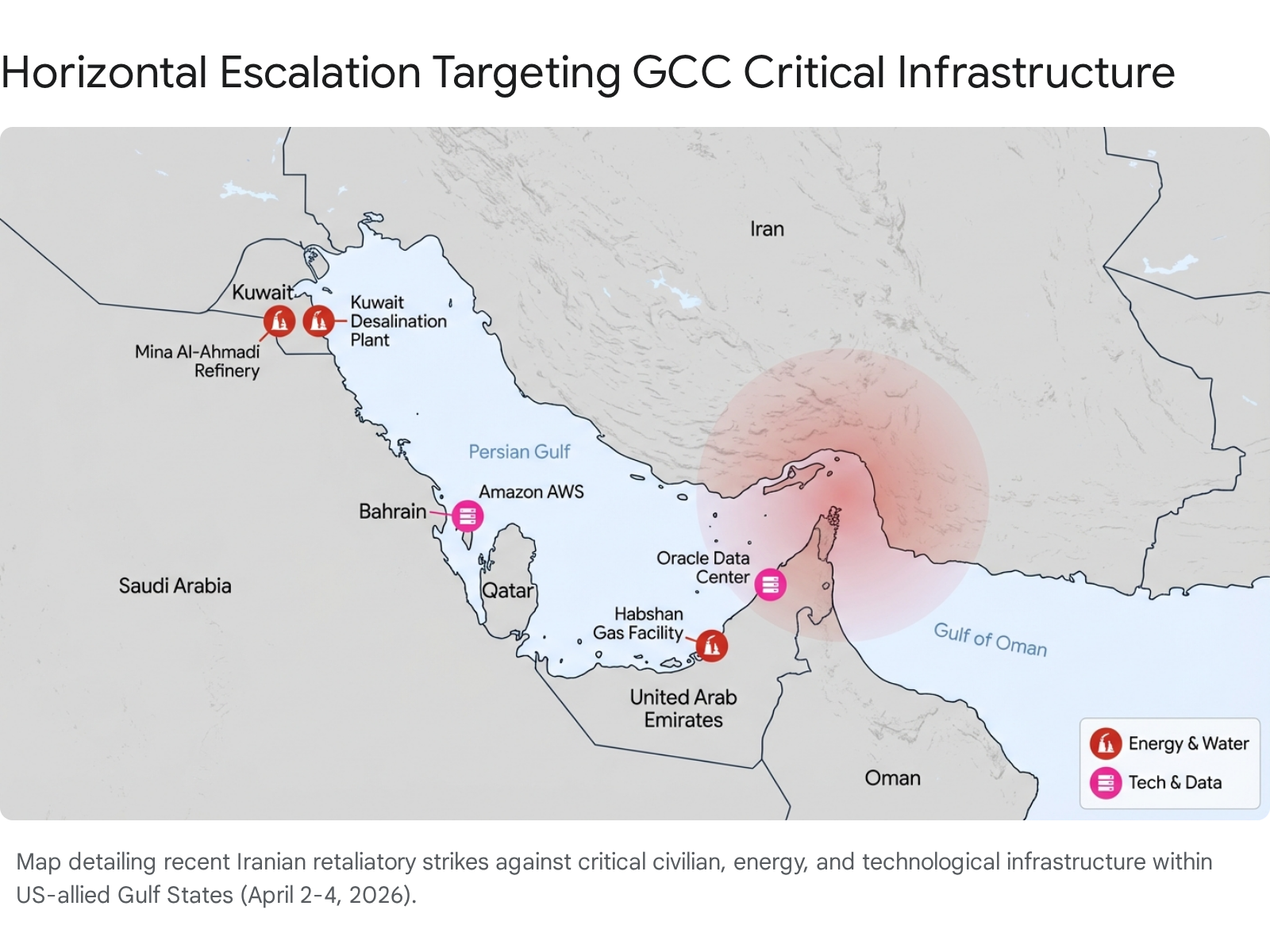
United Arab EmiratesHabshan Gas Facility, Oracle Building (Dubai), Borouge Petrochemicals, Khor Fakkan PortIntercepted 23 ballistic missiles and 56 drones on April 4; 17 missiles and 35 drones on April 8.8At least 13 fatalities since the conflict began; over 221 injured. Multiple civilian injuries from falling shrapnel. Severe disruption to commercial zones.8
KuwaitMina al Ahmadi Refinery, Kuwait Petroleum Company complex, Desalination plantsIntercepted 46 drones and 14 ballistic missiles on April 6; 42 drones on April 8.8Seven fatalities overall (including naval and interior ministry personnel). Severe infrastructural damage to energy and water processing sectors, highlighting critical vulnerabilities.8
BahrainBAPCO Refinery (Sitra), National Data CentersIntercepted 13 drones on April 5; 31 drones and six missiles on April 8.8Three fatalities; 46 injured (including Emirati soldiers). Significant damage to industrial sectors and refining capabilities.8
Saudi ArabiaJubail Petrochemical Complex, Eastern Province oil fields, U.S. Embassy in RiyadhIntercepted 22 drones and four missiles on April 7; 9 drones and 5 missiles on April 8.8Two fatalities; 16 injured. Persistent threats to Aramco infrastructure and diplomatic compounds.8
QatarPearl GTL Facility (March), General AirspaceIntercepted multiple drone swarms and cruise missiles throughout the week.8Seven fatalities (prior helicopter incident). Loss of roughly 17 percent of energy export capacity following the March Pearl GTL strike.15

The sustained nature of these attacks, continuing unabated even after the April 8 ceasefire declaration, indicates a profound breakdown in command and control within the Islamic Revolutionary Guard Corps or a deliberate strategy by Tehran to maintain psychological pressure during negotiations.12 The targeting methodology has explicitly shifted from purely military installations to critical civilian and economic infrastructure, including desalination plants and petrochemical refineries. This demonstrates an intent to inflict maximum economic pain and render urban centers uninhabitable if the conflict escalates further, effectively using the Gulf states as hostages to deter further United States military action.8

4.2 Airspace Restrictions and Economic Paralysis

The rampant proliferation of ballistic missiles and unmanned aerial vehicles across the Persian Gulf has resulted in the near-total paralysis of regional commercial aviation. Recognizing the severe risk of misidentification, interception failures, and collateral damage to civilian aircraft, the European Union Aviation Safety Agency officially extended its Conflict Zone Information Bulletin on April 9.19 This sweeping directive strictly advises airlines to avoid the airspace of Bahrain, Iran, Iraq, Israel, Jordan, Kuwait, Lebanon, Oman, Qatar, the United Arab Emirates, and parts of Saudi Arabia at all altitudes until at least April 24.19 Similarly, regional carriers like Pegasus Airlines have canceled all flights to these destinations.37

The economic implications for the Gulf states, which have structured their modern economies heavily around their status as global aviation and transit hubs, are profound. While carriers such as Saudia Airlines announced a phased resumption of limited routes to Dubai, Abu Dhabi, and Amman by April 11, the overall aviation capacity in the Gulf remains restricted to approximately 52 percent of pre-conflict levels.20 Financial projections suggest that Kuwait and Qatar could face gross domestic product contractions of up to 14 percent, while the United Arab Emirates and Saudi Arabia may experience declines of 5 percent and 3 percent, respectively, if the systemic disruptions to trade and transit persist.14

4.3 Domestic Security and Diplomatic Realignment

The internal security environment within the Gulf Cooperation Council states has hardened significantly in response to the sustained Iranian bombardment. Fearing the activation of sleeper cells or the incitement of domestic unrest by Iranian-aligned sympathetic populations, state security apparatuses have launched aggressive internal crackdowns. Authorities in Bahrain, Kuwait, Qatar, and the United Arab Emirates have conducted widespread waves of arrests targeting individuals suspected of maintaining links to the Axis of Resistance.15 In a bid to control the domestic narrative and prevent the dissemination of battle damage intelligence to Iranian targeting officers, civilians in Qatar and the United Arab Emirates have been detained simply for filming and distributing footage of incoming Iranian strikes.15 Bahrain has witnessed specific arrests linked to protests demanding the removal of foreign military bases, highlighting the growing domestic political friction caused by the United States military presence.15

Diplomatically, the unprecedented targeting of Gulf infrastructure has catalyzed a unified and highly hawkish shift within the Gulf Cooperation Council. Prior to the conflict, states like Qatar and Oman frequently served as neutral mediators, seeking to balance relations between Washington and Tehran. However, following the devastating strike on Qatar’s Pearl GTL facility, Doha initiated a severe diplomatic rupture with Tehran, stepping back from its traditional mediating role and aligning closely with demands for structural concessions.14 Oman remains the primary, albeit strained, diplomatic link.15

The Gulf states are currently utilizing the diplomatic window provided by the Islamabad negotiations to press the United States to ensure that any final treaty explicitly addresses the asymmetric threats that plague the Arabian Peninsula. The collective demands of the Gulf Cooperation Council now mirror those of the United States, insisting on the permanent dismantlement of Iran’s ballistic missile capabilities, the guaranteed reopening of the Strait of Hormuz, and the total cessation of proxy militia activities.15 The fundamental realization among the Gulf monarchies is that the traditional security architecture, reliant heavily on the forward deployment of United States forces as a deterrent, has failed to prevent an unprecedented level of infrastructural and economic damage to their sovereign territories, necessitating a permanent degradation of Iranian strike capabilities.38

5.0 Appendices

Appendix A: Methodology

This Situation Report was synthesized through an exhaustive, real-time analysis of global open-source intelligence, military monitor logs, official state broadcasts, and independent conflict observatories. The primary chronological anchor for this report spans the seven-day period ending April 11, 2026.

Data reconciliation protocols were strictly enforced to manage conflicting reports typical of the fog of war and state-sponsored information operations. Casualty figures and battle damage assessments released by United States Central Command and the Israel Defense Forces were cross-referenced against incident tracking databases maintained by the Armed Conflict Location & Event Data Project (ACLED) and the Foundation for Defense of Democracies’ Long War Journal. In instances where official state claims (e.g., Iranian reports of completely disabling United States bases in Kuwait) contradicted observable satellite imagery or independent verification, the data was presented with appropriate analytical caveats, attributing claims directly to the reporting entity. The structural analysis of diplomatic maneuvering was sourced from a synthesis of primary statements from the White House, the Iranian Ministry of Foreign Affairs, and regional diplomatic communiqués from the Gulf Cooperation Council and the League of Arab States. The calculation of overlapping events focused heavily on the transition period between the April 8 ceasefire implementation and the subsequent asymmetric violations recorded across the Gulf.

Appendix B: Glossary of Acronyms

  • ACLED: Armed Conflict Location & Event Data Project. An independent organization tracking political violence and protests globally, utilized for verifying strike locations and casualties.
  • A2/AD: Anti-Access/Area Denial. A strategy utilized by Iran using missiles and fast attack craft to prevent opposing forces from entering or operating within the Persian Gulf.
  • BAPCO: Bahrain Petroleum Company. The national oil company of Bahrain, whose facilities were targeted by drone strikes.
  • CENTCOM: United States Central Command. The geographic combatant command responsible for United States military operations in the Middle East, Central Asia, and parts of South Asia.
  • CSAR: Combat Search and Rescue. Highly specialized military operations to recover distressed personnel in hostile environments, such as the mission executed for the downed F-15E crew.
  • EASA: European Union Aviation Safety Agency. The European authority responsible for civil aviation safety, which issued widespread airspace warnings.
  • GCC: Gulf Cooperation Council. A political and economic union of six Arab states bordering the Persian Gulf (Bahrain, Kuwait, Oman, Qatar, Saudi Arabia, and the United Arab Emirates).
  • GTL: Gas-to-Liquids. A refinery process to convert natural gas into liquid hydrocarbons, notably referring to the Pearl facility in Qatar.
  • IADS: Integrated Air Defense System. A network of radars, command centers, and anti-aircraft weapons designed to protect airspace, heavily degraded in Iran during the conflict.
  • IDF: Israel Defense Forces. The national military of the State of Israel.
  • IRGC: Islamic Revolutionary Guard Corps. A multi-service primary branch of the Iranian Armed Forces, tasked with protecting the Islamic Republic’s political system, heavily reliant on asymmetric warfare.
  • JTF-SB: Joint Task Force Southern Border. A United States military command tasked with homeland defense and border security operations, notably engaging drone threats domestically.
  • OSINT: Open-Source Intelligence. Data collected from publicly available sources to be used in an intelligence context.
  • UAV: Unmanned Aerial Vehicle. Commonly referred to as a drone, extensively used by Iranian proxies for saturation attacks.
  • UTC: Coordinated Universal Time. The primary time standard by which the world regulates clocks and time, utilized for the chronological timeline.

Appendix C: Glossary of Foreign Words

  • Artesh: The conventional military forces of the Islamic Republic of Iran, operating parallel to the Islamic Revolutionary Guard Corps, significantly degraded during the initial strikes.
  • Axis of Resistance: A political and military network of Iranian-aligned state and non-state actors across the Middle East, including Hezbollah, Hamas, the Houthis, and various Iraqi and Syrian militias.
  • Basij: A paramilitary volunteer militia established in Iran, operating under the command of the Islamic Revolutionary Guard Corps, primarily utilized for internal security and suppressing domestic dissent.
  • Fattah: An Iranian domestically produced hypersonic ballistic missile, representing the upper tier of Iran’s strategic strike capabilities.
  • Khamenei: Refers either to Ali Khamenei, the former Supreme Leader of Iran assassinated in the opening salvo on February 28, 2026, or Mojtaba Khamenei, his son and presumed hardline successor.
  • Knesset: The unicameral national legislature of the State of Israel.
  • Majlis: The Islamic Consultative Assembly, which serves as the national legislative body of Iran.
  • Radwan Force: A highly trained special operations unit of Hezbollah, tasked with cross-border infiltration and high-value targeting, heavily targeted by Israeli airstrikes in Lebanon.
  • Shahed: A series of Iranian-manufactured unmanned aerial vehicles, predominantly utilized as one-way attack drones (loitering munitions), manufactured in facilities heavily targeted by United States forces.

Please share the link on Facebook, Forums, with colleagues, etc. Your support is much appreciated and if you have any feedback, please email us in**@*********ps.com. If you’d like to request a report or order a reprint, please click here for the corresponding page to open in new tab.


Sources Used

  1. Iran Update Special Report, April 7, 2026 | ISW, accessed April 11, 2026, https://understandingwar.org/research/middle-east/iran-update-special-report-april-7-2026/
  2. Live Updates: Latest from Israel, Iran, and the Middle East | The Jerusalem Post, accessed April 11, 2026, https://www.jpost.com/middle-east/iran-news/2026-04-07/live-updates-892285
  3. This Week in DOW: Iran Ceasefire, Daring Rescue, Honoring Gold …, accessed April 11, 2026, https://www.war.gov/News/News-Stories/Article/Article/4456466/this-week-in-dow-iran-ceasefire-daring-rescue-honoring-gold-star-spouses/
  4. Iran Update Special Report, April 8, 2026 | ISW, accessed April 11, 2026, https://understandingwar.org/research/middle-east/iran-update-special-report-april-8-2026/
  5. Iran war: What is happening on day 43 of the US-Iran conflict? | US …, accessed April 11, 2026, https://www.aljazeera.com/news/2026/4/11/iran-war-what-is-happening-on-day-43-of-the-us-iran-conflict
  6. The Long Tail of Operation Epic Fury: Structural Disorder After the Guns Fall Silent, accessed April 11, 2026, https://manaramagazine.org/2026/04/epic-fury-structural-disorder/
  7. Iran Update Special Report, April 9, 2026 | ISW, accessed April 11, 2026, https://understandingwar.org/research/middle-east/iran-update-special-report-april-9-2026/
  8. Despite ceasefire, Iran and its militias continue attacking regional …, accessed April 11, 2026, https://www.longwarjournal.org/archives/2026/04/despite-ceasefire-iran-and-its-militias-continue-attacking-regional-states-april-2-8-updates.php
  9. 2026 Iran war | Explained, United States, Israel, Strait of Hormuz, Map, & Conflict | Britannica, accessed April 11, 2026, https://www.britannica.com/event/2026-Iran-war
  10. What They’re Saying About Operation Epic Fury—March 30, 2026 | UANI, accessed April 11, 2026, https://www.unitedagainstnucleariran.com/press-releases/what-theyre-saying-about-operation-epic-fury-march-30-2026
  11. Tehran Goes Quiet as Pentagon Reports 90% Drop in Missile Fire – House of Saud, accessed April 11, 2026, https://houseofsaud.com/pentagon-operation-epic-fury-90-percent-missile-reduction-iran-war/
  12. An Already Tenuous Ceasefire in Iran Hovers on the Verge of Collapse – The Soufan Center, accessed April 11, 2026, https://thesoufancenter.org/intelbrief-2026-april-9/
  13. Temporary cease fire reached in Iran after Trump threatened “a whole civilization will die;” conflict takes toll on U.S. economy, accessed April 11, 2026, https://www.eastcountymagazine.org/temporary-cease-fire-reached-iran-after-trump-threatened-%E2%80%9C-whole-civilization-will-die%E2%80%9D-conflict
  14. ACLED Regional Overview Middle East: April 2026, accessed April 11, 2026, https://reliefweb.int/report/iran-islamic-republic/acled-regional-overview-middle-east-april-2026
  15. Middle East Overview: April 2026 | ACLED, accessed April 11, 2026, https://acleddata.com/update/middle-east-overview-april-2026
  16. US reportedly to deploy up to 2000 more troops to the Middle East despite talks, accessed April 11, 2026, https://www.turkiyetoday.com/region/us-reportedly-to-deploy-up-to-2000-more-troops-to-middle-east-despite-talks-3217885
  17. Operations Epic Fury and Roaring Lion: 4/6/26 Update 1 … – JINSA, accessed April 11, 2026, https://jinsa.org/wp-content/uploads/2026/04/Operations-Epic-Fury-and-Roaring-Lion-04-06-26.pdf
  18. Iran Update Special Report, April 6, 2026 | ISW, accessed April 11, 2026, https://understandingwar.org/research/middle-east/iran-update-special-report-april-6-2026/
  19. EU aviation safety agency extends advisory against flights in most Middle East, Gulf airspace until April 24, accessed April 11, 2026, https://www.aa.com.tr/en/economy/eu-aviation-safety-agency-extends-advisory-against-flights-in-most-middle-east-gulf-airspace-until-april-24/3899395
  20. Saudia Airlines to resume UAE and Jordan flights from Saudi Arabia, accessed April 11, 2026, https://connectingtravel.com/news/saudia-airlines-to-resume-uae-and-jordan-flights-from-saudi-arabia
  21. The Iran ceasefire is a pause, and it may be a short one, accessed April 11, 2026, https://www.washingtonexaminer.com/opinion/editorials/4521115/iran-ceasefire-pause-may-be-short/
  22. Peace Through Strength: Operation Epic Fury Crushes Iranian Threat as Ceasefire Takes Hold, accessed April 11, 2026, https://www.whitehouse.gov/releases/2026/04/peace-through-strength-operation-epic-fury-crushes-iranian-threat-as-ceasefire-takes-hold/
  23. Live Updates: Israel, US intensify campaign against Iran | The Jerusalem Post, accessed April 11, 2026, https://www.jpost.com/middle-east/iran-news/2026-03-04/live-updates-888739
  24. Civilians bear brunt of reckless war in the Middle East, says Türk | OHCHR, accessed April 11, 2026, https://www.ohchr.org/en/press-releases/2026/03/civilians-bear-brunt-reckless-war-middle-east-says-turk
  25. U.S./Israel–Iran War on Course for Cataclysmic Civilian Harm, Displacement, and Humanitarian Need – Refugees International, accessed April 11, 2026, https://www.refugeesinternational.org/statements-and-news/u-s-israel-iran-war-on-course-for-cataclysmic-civilian-harm-displacement-and-humanitarian-need/
  26. Middle East war’s ‘spiral of conflict’ drives mounting civilian toll | UN News, accessed April 11, 2026, https://news.un.org/en/story/2026/03/1167138
  27. The Human Dimension of the Iran War: The Intolerable Plight of Civilians, accessed April 11, 2026, https://thesoufancenter.org/intelbrief-2026-april-7/
  28. On The Hour – March 28, 2026 | Israel Strikes Iran Nuclear Sites, Houthis Join Conflict, accessed April 11, 2026, https://www.youtube.com/watch?v=EoXm7YuTVtU
  29. Epic Fury: The Campaign Against Iran’s Missile & Nuclear Infrastructure – CSIS, accessed April 11, 2026, https://www.csis.org/analysis/epic-fury-campaign-against-irans-missile-nuclear-infrastructure
  30. TIMELINE Missile Fire Follows Israeli Strikes on Iran; Over 100 Injured in Israel, accessed April 11, 2026, https://jewishjournal.com/israel/387316/timeline-missile-fire-follows-israeli-strikes-on-iran-over-100-injured-in-israel/
  31. Live Updates: Israel ramps up strikes on Iran’s regime | The Jerusalem Post, accessed April 11, 2026, https://www.jpost.com/middle-east/iran-news/2026-03-07/live-updates-889131
  32. 2026 Iran war – Wikipedia, accessed April 11, 2026, https://en.wikipedia.org/wiki/2026_Iran_war
  33. U.S. Northern Command says it thwarted a drone threat over a ‘strategic’ installation hours into the Iran war | DefenseScoop, accessed April 11, 2026, https://defensescoop.com/2026/03/19/drone-incursion-strategic-us-military-base/
  34. Trump hints at an end to military action in Iran, saying U.S. will leave in 2-3 weeks – KNKX, accessed April 11, 2026, https://www.knkx.org/2026-03-31/trump-hints-at-an-end-to-military-action-in-iran-saying-u-s-will-leave-in-2-3-weeks
  35. Where the American-Israeli War on Iran Leaves the Gulf Arabs – Stimson Center, accessed April 11, 2026, https://www.stimson.org/2026/where-the-american-israeli-war-on-iran-leaves-the-gulf-arabs/
  36. European aviation safety body urges airlines to avoid Middle East airspace until April 24, accessed April 11, 2026, https://gulfnews.com/business/aviation/european-aviation-safety-body-urges-airlines-to-avoid-middle-east-airspace-until-april-24-1.500501518
  37. Flight Cancellations Due to Airspace Restrictions in the Middle East and Passenger Rights, accessed April 11, 2026, https://www.flypgs.com/en/press-room/announcement/flight-cancellations-due-to-airspace-restrictions-in-the-middle-east
  38. Why Gulf states might want to shut down US bases, accessed April 11, 2026, https://responsiblestatecraft.org/us-bases-in-middle-east/

US-Iran Conflict: Top Five Mistakes

Executive Summary

The military confrontation between the United States and the Islamic Republic of Iran, which reached a state of open hostilities on February 28, 2026, represents the most significant shift in Middle Eastern security architecture since the 1979 revolution. This report, formulated from the perspective of national intelligence and military analysis, provides an exhaustive evaluation of the strategic errors committed by both Washington and Tehran during the initial five weeks of the conflict. The assessment identifies that while the United States and its primary regional ally, Israel, have achieved unprecedented tactical success through the decapitation of Iranian leadership and the degradation of conventional military infrastructure, they have simultaneously incurred significant strategic liabilities.

For the United States, the primary miscalculations involve a persistent ambiguity regarding political end-states, a failure to synchronize military actions with multilateral diplomatic frameworks, and a critical depletion of high-end precision munitions that may compromise global readiness.1 For Iran, the conflict has exposed the catastrophic failure of its “forward defense” doctrine, as its proxy network proved unable to deter direct strikes on Persian soil.4 Furthermore, Tehran’s decision to retaliate against neutral regional mediators has effectively dismantled its own diplomatic leverage, leading to a state of near-total international isolation.5

As of early April 2026, the conflict remains in a high-intensity hybrid phase, characterized by the effective closure of the Strait of Hormuz, unprecedented volatility in global energy markets, and a hardening of the Iranian regime’s internal structure under a more militant leadership council.7 This report ranks and analyzes the top five strategic mistakes of each actor, integrating operational data with second- and third-order geopolitical insights.

1. Historical and Theoretical Framework of the 2026 Conflict

The current hostilities are the culmination of a decade-long escalatory spiral, significantly accelerated by the “Twelve-Day War” of June 2025. This earlier conflict established the precedent for direct kinetic engagement between Israel, the United States, and Iran, moving beyond the traditional shadow war.10 During the 2025 engagement, U.S. and Israeli forces conducted high-precision strikes against Iranian nuclear facilities at Natanz, Fordow, and Isfahan using GBU-57 A/B “bunker buster” bombs, which were then believed to have set the program back by several years.11 However, the failure of subsequent diplomatic efforts in early 2026 revealed that kinetic degradation alone was insufficient to compel a fundamental change in Tehran’s strategic calculus.

The outbreak of war on February 28, 2026, occurred under the codename Operation Epic Fury, a joint U.S.-Israeli campaign that utilized fused intelligence—comprising HUMINT, technical surveillance, and AI-driven targeting—to achieve what was intended to be a paralyzing opening blow.12 Despite the tactical brilliance of the initial strikes, which eliminated Supreme Leader Ali Khamenei and dozens of senior IRGC officials, the conflict quickly devolved into a multidomain punishment campaign.12

1.1 The Failure of Deterrence and the Transition to Hybrid Warfare

The transition from the 2025 Twelve-Day War to the 2026 conflict illustrates a profound failure of classical deterrence. Iran’s military doctrine, historically predicated on asymmetry and proxy-led “forward defense,” was unable to prevent the breach of its own borders.4 Conversely, the U.S. assumption that decapitating strikes would lead to a rapid regime collapse or a “Venezuela-style” transition has thus far been proven incorrect.2 Instead, the region has entered a state of “hyperwar,” where kinetic strikes are inextricably linked with cyber operations targeting critical infrastructure across the Gulf.13

2. Analysis and Ranking of United States Strategic Miscalculations

The U.S. intervention, while militarily dominant, has been criticized by analysts for its lack of a cohesive strategic anchor. The following ranking evaluates the most significant errors in the U.S. approach.

2.1 Rank 1: Strategic Ambiguity and the Absence of a Defined Political End-State

The foremost error committed by the United States is the persistent failure to define a clear and achievable political objective for Operation Epic Fury. From the first hours of the conflict, the administration issued contradictory signals regarding its ultimate goals.12 President Trump initially urged the Iranian people to “take over your government,” suggesting a goal of total regime change, yet within 24 hours, he indicated to the New York Times that he was open to a settlement where the regime remained in place but cooperated with U.S. demands.12

This ambiguity has created a “strategic vacuum” that has been exploited by the harder elements of the Iranian regime. By failing to offer a clear “off-ramp” or a set of verifiable conditions for the cessation of hostilities, the U.S. has inadvertently forced the Iranian leadership into a corner where surrender is equated with annihilation.1 This has second-order effects on U.S. allies, particularly in Europe, who remain hesitant to commit naval assets to the Strait of Hormuz without knowing if they are supporting a limited counter-proliferation mission or a maximalist war of regime replacement.1

Strategic ObjectiveStated Administration PositionExpert Consensus on Outcome
Nuclear Disarmament“Annihilation” of the program 17Program delayed but hardline resolve for a bomb strengthened.18
Regime ChangeUrged internal uprising 12Resulted in hardline consolidation and militarized repression.12
Maritime SecurityReopening the Strait of Hormuz 17Effective closure driven by insurance withdrawal and risk perception.8
Regional DeterrenceEnding the “Axis of Resistance” 3Proxies degraded but remain independent, virulent threats.4

2.2 Rank 2: Failure of Multilateral Consultation and Diplomatic Synchronization

The decision to launch Operation Epic Fury without prior consultation with key European and regional allies represents a critical breakdown in coalition management.1 While the U.S. frequently relies on its “special relationship” with Israel for Middle Eastern operations, the failure to engage NATO partners and GCC states prior to the February 28 strikes created a “transatlantic rift” and fueled resentment among Gulf leadership.1

European allies, specifically France, Germany, and the United Kingdom, were taken by surprise, leading to a rebuff of Trump’s demands for warships in the Strait of Hormuz.22 In the Gulf, countries like Qatar and Oman—who had been serving as neutral mediators—found their sovereignty threatened by Iranian retaliation against U.S. bases on their soil.1 This unilateralism has shifted the diplomatic burden from Iran to the United States, as the international community focuses on the “illegality” of an unprovoked strike rather than Iran’s prior provocations.22

2.3 Rank 3: Strategic Munitions Depletion and Theater Overextension

Operation Epic Fury has consumed high-end munitions at a rate that is structurally unsustainable and poses a significant risk to U.S. readiness in other theaters, most notably the Western Pacific.3 In the first six days of the conflict, the U.S. fired 850 Tomahawk missiles, surpassing the total used in the 2003 invasion of Iraq.3

Table 2: U.S. Munitions Expenditure vs. Production Capabilities (Operation Epic Fury)

Munition TypeExpended in First 6 DaysEstimated Total InventoryFY 2026 Planned DeliveryInventory Risk Level
Tomahawk (TLAM)850 26Low 3,000s 3110-190 3High – Depleting ~27% of stock in a week.
Standard Missile (SM-3)Significant (Defensive)Limited / Classified76 3Critical – Replacement takes years.
SM-6Heavy Use (Anti-Drone)Limited / Classified125 3High – Diversion from Pacific theater.
ATACMS / PrSMSelective Use~1,000 (ATACMS)70 (PrSM) 3Moderate – Sensitive to ground escalation.

The mistake here is one of “munitions-to-target” mismatch. Analysts suggest that the U.S. relied too heavily on “exquisite” long-range munitions in the opening phase, rather than transitioning more quickly to lower-cost gravity bombs once Iranian air defenses were suppressed.3 This has left the U.S. Navy’s VLS (Vertical Launch System) cells in the region nearly empty, with ships forced to return to port for reloads that cannot be conducted at sea.26

2.4 Rank 4: Underestimation of Asymmetric Maritime and Economic Leverage

The U.S. military strategy assumed that the destruction of 90% of the Iranian Navy would ensure control over the Strait of Hormuz.2 However, this reflects a conventional bias that failed to account for Iran’s “multidomain punishment campaign”.14 Iran has successfully used shore-based anti-ship missiles, expendable drones, and sea mines to create an environment of “unacceptable risk” for commercial shipping.7

The result is an “effective closure” of the Strait that is psychological and financial rather than purely physical. On March 2, major marine insurers Gard and Skuld cancelled war-risk coverage for the region, a move that halted 20% of global oil flow more effectively than a naval blockade could have.8 The U.S. failure to pre-position escort assets or coordinate a global insurance guarantee prior to the strikes allowed Tehran to “weaponize” the global economy, leading to a 39% surge in Brent crude prices and a “grocery supply emergency” in the GCC.8

2.5 Rank 5: Incomplete Degradation of the Internal Security Apparatus

While the decapitation strikes eliminated top-tier leadership, the U.S. campaign has arguably focused too much on “strategic” targets (nuclear sites and missile silos) and not enough on the “tactical” control mechanisms of the IRGC Ground Forces and Basij.4 By leaving the regime’s internal repressive capacity largely intact, the U.S. has enabled the hardline transition to proceed with minimal internal disruption.4

If the U.S. agrees to a ceasefire now, the Iranian security apparatus remains capable of violently suppressing the very civilian protests that the Trump administration hoped would lead to regime change.1 This is a fundamental error in “Warden’s Five Ring” theory application: by striking the center (leadership) but failing to neutralize the fourth ring (the population’s control mechanisms), the U.S. has created chaos without facilitating a viable alternative governance structure.25

3. Analysis and Ranking of Iranian Strategic Miscalculations

Iran’s response to the 2026 conflict has been characterized by ideological rigidity and a catastrophic series of intelligence failures.

3.1 Rank 1: The Collapse of the “Forward Defense” Doctrine

The single greatest strategic failure for the Islamic Republic is the total collapse of its “forward defense” doctrine.4 For decades, Tehran invested billions of dollars into its “Axis of Resistance” proxies—Hezbollah, Hamas, and various Shia militias—under the assumption that these groups would serve as a buffer to absorb threats before they reached Iranian soil.4

The 2026 conflict proved this assumption to be fundamentally flawed. U.S. and Israeli forces bypassed the proxies and struck the “head of the snake” directly on February 28.4 Furthermore, the years of sustained Israeli pressure on Hezbollah (2023-2025) had already degraded the group to the point where its retaliatory rocket barrages were “tolerable” for Israel and failed to compel a halt to the strikes on Iran.2 Iran found itself in the worst possible position: its main deterrent had been proven ineffective, yet its own territory was now a primary theater of war.4

3.2 Rank 2: Alienation of Neutral Regional Mediators and Strategic Isolation

Iran’s decision to launch retaliatory strikes against the territories of its neighbors—specifically Oman, Qatar, Turkey, and the UAE—represents a “strategic blunder” that has accelerated a regional alignment against Tehran.5 Prior to 2026, many Gulf states had sought a policy of “balancing,” maintaining diplomatic channels with Tehran to avoid becoming targets.2

By striking these states’ energy infrastructure and airports, Iran “definitively broke trust” and eliminated the very mediation channels it now desperately needs to secure a ceasefire.5 The case of Oman is particularly emblematic: despite its role as the primary mediator for the 2026 nuclear talks, it was targeted, leading to a “shrinking of the space for mediation”.5 This has unified the Arab world to the point where even the Palestinian Authority issued a “strong condemnation” of Iran’s attacks on its Arab neighbors.6

Table 3: Impact of Iranian Retaliation on Regional Partners

Target CountryPre-Conflict StanceIranian ActionPost-Conflict Strategic Shift
OmanActive neutral mediator.5Perceived or actual strikes on territory.5Abandoned neutral posture; closer to West.5
UAESought de-escalation; Abraham Accords.5Strikes on industrial zones and AWS data centers.14Strengthened defense ties with US/Israel.5
QatarPragmatic intermediary; hosted Al Udeid.4Strikes on Ras Laffan LNG and Al Udeid radar.8Increased military cooperation with US.2
TurkeyBalancing actor; NATO member.4Missile interceptions over territory.4Heightened alertness; increased NATO integration.4

3.3 Rank 3: Intelligence Failure Regarding Leadership Survivability

The success of the U.S.-Israeli decapitation strikes on February 28 indicates a systemic failure of Iran’s internal security and counter-intelligence apparatus.12 The timing of the initial attack was specifically tied to the ability to target Supreme Leader Ali Khamenei before he could go into hiding, suggesting that the “shadow war” of previous years had allowed Israeli and U.S. intelligence to deeply penetrate the most sensitive levels of the Iranian regime.12

This intelligence failure had immediate strategic consequences:

  1. Command and Control Paralysis: The death of the Supreme Leader and senior IRGC commanders caused a 90% drop in Iranian missile coordination within the first week.2
  2. Succession Turmoil: The transition to Mojtaba Khamenei was conducted under the pressure of active bombardment, leading to a “disciplined but rapid” succession that may lack long-term legitimacy.9
  3. Vulnerability Exposure: It shattered the state-cultivated image of Khamenei as “infallible and invincible,” shaking the confidence of younger hardliners and loyalists.11

3.4 Rank 4: Miscalculation of Global Energy Resilience and Patrons’ Patience

Iran likely calculated that by closing the Strait of Hormuz and attacking energy facilities, it could force the international community—particularly China and the European Union—to pressure the United States for an immediate ceasefire.4 This miscalculation failed to account for the structural changes in the global energy market and the strategic patience of its own patrons.2

While oil prices have surged, the U.S. and its partners had spent years preparing for this exact contingency.4 The release of 400 million barrels from strategic reserves by the IEA, combined with increased U.S. domestic production, has buffered Western economies from the full force of the shock.8 More importantly, Iran’s disruption of oil and LNG primarily hurts its own customers: China, India, Japan, and South Korea account for 75% of Gulf oil exports.8 By strangling the energy supply of its only major trade partners, Iran has risked losing the “shadow support” of Beijing and Moscow at its moment of greatest need.2

3.5 Rank 5: Hardline Entrenchment and the Elimination of Negotiating “Off-Ramps”

The final strategic mistake is the Iranian regime’s decision to respond to the crisis by “digging in” with the most militant possible leadership.4 The appointment of Mojtaba Khamenei as Supreme Leader and Mohammad Bagher Zolghadr to oversee the wartime apparatus reflects the “paramountcy of the IRGC” over the political establishment.12

While this may ensure short-term regime survival through repression, it has effectively closed all diplomatic off-ramps.2 Figures like Ali Larijani, who were instrumental in previous negotiations and the JCPOA, have been killed or sidelined, leaving a leadership that views any talk of de-escalation as treason.12 This “primitive thinking” has locked Iran into a war of attrition that it cannot win conventionally and which ensures the continued systematic destruction of its defense assets.20

4. Kinetic Assessment and Tactical Realities

The military campaign, dubbed Operation Epic Fury by the United States and Operation Roaring Lion by Israel, has been defined by an extreme asymmetry in technological capability and precision.12

4.1 Comparison of Material and Personnel Losses

The data collected from OSINT and official military briefings reveals the stark contrast in the conflict’s toll on each side’s conventional capabilities.

Table 4: Reported Military Equipment and Personnel Losses (As of late March 2026)

CategoryUnited States / Israel Reported LossesIran Reported Losses
Personnel (KIA)~27 (US: 15, Israel: 12) 106,000+ (Military), ~3,500+ (Combined) 10
Personnel (Wounded)~832 (US: 520, Israel: 312) 1015,000+ (Military) 10
Naval VesselsMinimal / Not Confirmed 10150 (approx. 90% of Navy) 2
Ballistic Missile Launchers0190-330 (approx. 70% of arsenal) 10
High-Value Radar Systems2 (AN/FPS-132, AN/TPY-2) 34Unknown (Extensive degradation) 2
Fighter Jets / Aviation3-4 (F-15E, KC-135) 3Extensive (Dezful and Bandar Abbas bases) 39
Infrastructure Costs$800M (US bases) 10Tens of Billions (Nuclear, Oil, Government) 8

4.2 Analysis of Iranian Retaliatory Strikes

Despite the degradation of its central command, Iran has maintained a “multidomain punishment campaign” using Russian-produced and modified Shahed drones.14 These strikes have been tactically significant in their choice of high-value targets.

  1. Al Udeid Air Base (Qatar): A strike on March 1 destroyed the AN/FPS-132 early warning radar, a system valued at $1.1 billion.34
  2. Al-Ruwais Industrial City (UAE): An Iranian drone successfully targeted the AN/TPY-2 radar component of the THAAD system, valued at $500 million.34
  3. Fifth Fleet Headquarters (Bahrain): Missiles struck the Navy’s communication hub, destroying two AN/GSC-52B satellite terminals.34
  4. Cyberfront: Iran has launched over 150 recorded hacktivist incidents, focusing on AI-enabled attacks against UAE government systems and U.S. medical tech firms.14

These strikes demonstrate that while Iran cannot win a conventional engagement, it can impose “asymmetric costs” that challenge the U.S. Navy’s ability to maintain long-term presence and protection.14

5. Global Economic and Geopolitical Ripple Effects

The 2026 conflict has echoed the 1970s energy crisis, creating shocks that transcend the regional theater.

5.1 Energy Markets and Shipping Insurance

The “Hormuz Impasse” has transformed from a military standoff into a global financial crisis.21 Brent crude surged to over $110 per barrel by mid-March 2026, a 39% increase from pre-conflict levels.28 The primary driver is not the physical blockade but the “withdrawal of insurance coverage”.21

Table 5: Economic Indicators of the 2026 Conflict

IndicatorPre-Conflict (Feb 27)Peak Conflict (March/April)Percentage Change
Brent Crude Oil~$63.85 37~$110 – $120 8+39% to +88%
U.S. WTI Crude~$60.38 37~$76 – $80 21+26% to +32%
LNG Spot Price (Asia)Baseline+140% 8+140%
Global TIV (Auto Sales)Baseline-800,000 to -900,000 units 43Reduction in growth
Shipping InsuranceStandard War RiskCancelled / Prohibitive 21N/A (Market failure)

5.2 The “Grocery Supply Emergency” in the GCC

A largely overlooked but critical impact of the war is its effect on food security in the Gulf states. Countries like Saudi Arabia, the UAE, and Kuwait rely on the Strait of Hormuz for over 80% of their caloric intake.8 By mid-March, 70% of food imports were disrupted, forcing retailers like Lulu Retail to airlift staples, resulting in a 40–120% increase in food prices across the region.8 This has created significant internal political pressure on Gulf governments to seek an end to the war, even if it means pressuring the United States to make concessions.1

6. Intra-Regime Dynamics and the Succession of Power in Tehran

The assassination of Ali Khamenei on February 28 triggered the second leadership transition in the history of the Islamic Republic, occurring under the most catastrophic conditions imaginable.35

6.1 The Rise of Mojtaba Khamenei and the IRGC Junta

The selection of Mojtaba Khamenei as Supreme Leader on March 8 was a move intended to project stability, but it carries significant long-term risks.4 Mojtaba lacks the theological credentials of his father and is widely viewed as a figurehead for a “military junta” composed of senior IRGC commanders like Mohammad Bagher Zolghadr.12

  • Ideological Shift: The new leadership has rejected the “pragmatism” associated with figures like Ali Larijani, who was killed on March 17.12
  • Militarized Repression: Real power has shifted to the “triumvirate” of leaders and the Supreme National Security Council, which has prioritized “internal security” and the violent suppression of any nascent protests.25
  • Public Response: The move to a dynastic succession contradicts the founding principles of the 1979 revolution and is likely to be unpopular with the Iranian public, potentially fueling long-term internal instability once the immediate fog of war dissipates.4

6.2 The Sidelining of the Clerical Establishment

The 2026 war has effectively marginalized the traditional clerical establishment in Qom. The Assembly of Experts, which is constitutionally tasked with choosing the leader, was targeted by an Israeli strike on March 5 to prevent their meeting.12 While they eventually appointed Mojtaba, the process was clearly dictated by the security services.12 This shift from a theocracy to a “theocratic military dictatorship” significantly alters the nature of the Iranian state, making it more predictable in its aggression but harder to engage in traditional diplomacy.4

7. Synthesis of the Five Biggest U.S. Strategic Mistakes

The ranking of U.S. mistakes is based on their impact on long-term national interest and the stability of the global order.

  1. Absence of Political End-State: By failing to define what “victory” looks like, the U.S. has entered a “forever war” scenario in a theater it was attempting to de-prioritize.1
  2. Unilateralism and Ally Alienation: The “Epic Fury” approach has strained NATO and GCC relationships, making it harder to build a sustainable post-war regional security framework.1
  3. Munitions Inventory Depletion: The excessive use of TLAMs and SM-6s has created a “vulnerability window” in the Pacific that adversaries like China may exploit.3
  4. Economic Blindness (Maritime/Insurance): Underestimating the psychological impact of the war on global shipping has allowed Iran to hold the global economy hostage despite having no navy.8
  5. Focus on Decapitation Over Control: By striking the leadership but leaving the IRGC’s internal control mechanisms intact, the U.S. has ensured that any successor regime will be more hardline and repressive.4

8. Synthesis of the Five Biggest Iranian Strategic Mistakes

Iran’s mistakes have led to the systematic destruction of its conventional power and the decapitation of its leadership.

  1. Failure of “Forward Defense”: The assumption that proxies would protect the homeland proved fatal when the U.S. and Israel chose to strike the “head”.4
  2. Alienation of Neutral Mediators: Striking Oman and the UAE was a “strategic blunder” that turned potential de-escalation partners into hostile neighbors.5
  3. Intelligence Failure (Leadership Vulnerability): The inability to protect Ali Khamenei revealed a catastrophic compromise of Iran’s internal security apparatus.11
  4. Miscalculation of Global Energy Resilience: Assuming the world could not handle a Hormuz closure failed to account for modern strategic reserves and production buffers.4
  5. Hardline Entrenchment: Choosing a militant IRGC-backed junta as the successor leadership ensures a prolonged conflict and eliminates the possibility of a negotiated settlement.2

9. Strategic Outlook: The “Brittle Accommodation” Scenario

As the conflict enters its second month, the most likely outcome is a “brittle accommodation” rather than a total regime collapse or a clear U.S. victory.22 The U.S. lacks the political will for a ground invasion of a country with 93 million people, and Iran lacks the conventional means to push U.S. forces out of the region.22

The risk is a “grinding destabilization,” where energy volatility, cyber disruptions, and periodic kinetic exchanges become the new normal.22 To secure a strategic victory, the United States must transition from “pulse operations” to a sustained diplomatic outreach that shores up its regional alliances and provides a clear, verifiable pathway for the new Iranian leadership to end the conflict.14 Failure to do so will result in a “strategic overextension” that leaves the United States less safe and more isolated, despite its overwhelming military success.1


Please share the link on Facebook, Forums, with colleagues, etc. Your support is much appreciated and if you have any feedback, please email us in**@*********ps.com. If you’d like to request a report or order a reprint, please click here for the corresponding page to open in new tab.


Sources Used

  1. The Iran War Is Making America Less Safe | Carnegie Endowment …, accessed April 7, 2026, https://carnegieendowment.org/emissary/2026/03/iran-war-us-less-safe
  2. Who Is Winning the Iran War? – CSIS, accessed April 7, 2026, https://www.csis.org/analysis/who-winning-iran-war
  3. Iran War Cost Estimate Update: $11.3 Billion at Day 6, $16.5 Billion at Day 12 – CSIS, accessed April 7, 2026, https://www.csis.org/analysis/iran-war-cost-estimate-update-113-billion-day-6-165-billion-day-12
  4. War in Iran: Q&A with RAND Experts | RAND, accessed April 7, 2026, https://www.rand.org/pubs/commentary/2026/03/war-in-iran-qa-with-rand-experts.html
  5. Iran’s Strategic Miscalculation – eismena.com, accessed April 7, 2026, https://eismena.com/en/article/irans-strategic-miscalculation-2026-03-02
  6. Iran’s strategic blunder is reshaping the Middle East – JNS.org – Jewish News Syndicate, accessed April 7, 2026, https://www.jns.org/column/fiamma-nirenstein/irans-strategic-blunder-is-reshaping-the-middle-east
  7. Visualizing Iran’s Escalation Strategy – CSIS, accessed April 7, 2026, https://www.csis.org/analysis/visualizing-irans-escalation-strategy
  8. Economic impact of the 2026 Iran war – Wikipedia, accessed April 7, 2026, https://en.wikipedia.org/wiki/Economic_impact_of_the_2026_Iran_war
  9. The US-Iran War: How It Is Redefining the Global Order – Observer Research Foundation, accessed April 7, 2026, https://www.orfonline.org/research/the-us-iran-war-how-it-is-redefining-the-global-order
  10. 2026 Iran war – Wikipedia, accessed April 7, 2026, https://en.wikipedia.org/wiki/2026_Iran_war
  11. Humiliation and Transformation: The Islamic Republic After the 12-Day War, accessed April 7, 2026, https://www.fpri.org/article/2025/10/humiliation-and-transformation-the-islamic-republic-after-the-12-day-war/
  12. 2026 Iran war | Explained, United States, Israel, Strait of Hormuz, Map, & Conflict | Britannica, accessed April 7, 2026, https://www.britannica.com/event/2026-Iran-war
  13. Tracking the Intelligence Landscape in the 2026 Iran War – Observer Research Foundation, accessed April 7, 2026, https://www.orfonline.org/expert-speak/intelligence-for-hyperwar-tracking-the-intelligence-landscape-in-the-2026-iran-war
  14. Iran’s Next Move: How to Counter Tehran’s Multidomain Punishment Campaign – CSIS, accessed April 7, 2026, https://www.csis.org/analysis/irans-next-move-how-counter-tehrans-multidomain-punishment-campaign
  15. Q&A | Twelve days that shook the region: Inside the Iran-Israel war | ACLED, accessed April 7, 2026, https://acleddata.com/qa/qa-twelve-days-shook-region-inside-iran-israel-war
  16. Situation Report: Middle East Escalation (February 27–1st March, 2026) | CloudSEK, accessed April 7, 2026, https://www.cloudsek.com/blog/middle-east-escalation-israel-iran-us-cyber-war-2026
  17. US/Israel-Iran conflict 2026 – UK Parliament, accessed April 7, 2026, https://researchbriefings.files.parliament.uk/documents/CBP-10521/CBP-10521.pdf
  18. Trump And The Unplanned Trap Of War With Iran – Analysis – Eurasia Review, accessed April 7, 2026, https://www.eurasiareview.com/07042026-trump-and-the-unplanned-trap-of-war-with-iran-analysis/
  19. Rationale for Iran war questioned after Trump says ‘I don’t care’ about regime’s uranium stockpiles, accessed April 7, 2026, https://www.theguardian.com/world/2026/apr/02/trump-iran-war-rationale-uranium-stockpiles
  20. Three Calculations, One War: Inside the Minds of the United States, Israel, and Iran, accessed April 7, 2026, https://gulfif.org/three-calculations-one-war-inside-the-minds-of-the-united-states-israel-and-iran/
  21. The US-Iran War: The potential economic impact and how businesses can react, accessed April 7, 2026, https://www.thomsonreuters.com/en-us/posts/corporates/iran-war-economic-business-impact/
  22. Eight Experts on What You’re Not Being Told about the War in Iran | The Walrus, accessed April 7, 2026, https://thewalrus.ca/iran-foreign-policy-experts/
  23. Iran’s War With Israel and the United States | Global Conflict Tracker, accessed April 7, 2026, https://www.cfr.org/global-conflict-tracker/conflict/confrontation-between-united-states-and-iran
  24. US/Israel-Iran conflict 2026 – The House of Commons Library – UK Parliament, accessed April 7, 2026, https://commonslibrary.parliament.uk/research-briefings/cbp-10521/
  25. The war with Iran: Expert analysis | University of Cambridge, accessed April 7, 2026, https://www.cam.ac.uk/news/the-war-with-iran-expert-analysis
  26. The 850 Tomahawks Launched in Operation Epic Fury Is the Most Fired in a Single Campaign – CSIS, accessed April 7, 2026, https://www.csis.org/analysis/850-tomahawks-launched-operation-epic-fury-most-fired-single-campaign
  27. Latest Analysis: War with Iran | CSIS, accessed April 7, 2026, https://www.csis.org/programs/latest-analysis-war-iran
  28. The Middle East conflict begins to cast a shadow on the global economy – Deloitte, accessed April 7, 2026, https://www.deloitte.com/us/en/insights/topics/economy/iran-middle-east-conflict-impacts-global-economy.html
  29. The Iranian Regime in Wartime Transformation: Why Mojtaba Khamene’i is far from Supreme – The Jerusalem Strategic Tribune, accessed April 7, 2026, https://jstribune.com/the-iranian-regime-in-wartime-transformation-why-mojtaba-khamenei-is-far-from-supreme/
  30. On the Brink of War: US and Iranian Calculations in the New Negotiations, accessed April 7, 2026, https://studies.aljazeera.net/en/policy-briefs/brink-war-us-and-iranian-calculations-new-negotiations
  31. Trump’s Iran own goal, accessed April 7, 2026, https://www.washingtonpost.com/opinions/2026/04/03/iran-war-trump-hormuz-mistake/
  32. Analysis – The Iran War: Strategic Implications for Israel, the Gulf states and Beyond – ELNET, accessed April 7, 2026, https://elnetwork.eu/policypaper/analysis-iran-war-israel-gulf-states/
  33. Timeline of the 2026 U.S. and Israel–Iran conflict – Detective-store Blog, accessed April 7, 2026, https://www.detective-store.com/blog_en/timeline-of-the-2026-u-s-and-israel-iran-conflict/
  34. US Military Equipment Losses Near $2 Billion After Four Days of Iran Strikes – Aviation A2Z, accessed April 7, 2026, https://aviationa2z.com/index.php/2026/03/04/us-military-equipment-losses-near-2-billion-after-four-days-of-iran-strikes/
  35. Who—or What—Will Replace Iran’s Supreme Leader Ali Khamenei? – RAND, accessed April 7, 2026, https://www.rand.org/pubs/commentary/2026/03/who-or-what-will-replace-irans-supreme-leader-ali-khamenei.html
  36. Oil Prices Rise as US-Israeli War Disrupts Supply, accessed April 7, 2026, https://discoveryalert.com.au/oil-prices-rise-us-israeli-war-2026/
  37. Global Market | Oil Shockwave: Iran conflict triggers record surge in 2026 price forecasts, accessed April 7, 2026, https://m.economictimes.com/markets/us-stocks/news/global-market-oil-shockwave-iran-conflict-triggers-record-surge-in-2026-price-forecasts/articleshow/129940954.cms
  38. The Iran Strikes, Explained: How We Got Here and What It Means | AJC, accessed April 7, 2026, https://www.ajc.org/news/the-iran-strikes-explained-how-we-got-here-and-what-it-means
  39. Iran Update Special Report, March 23, 2026 – Institute for the Study of War, accessed April 7, 2026, https://understandingwar.org/research/middle-east/iran-update-special-report-march-23-2026/
  40. Iran Update Special Report, March 15, 2026 – Institute for the Study of War, accessed April 7, 2026, https://understandingwar.org/research/middle-east/iran-update-evening-special-report-march-15-2026/
  41. Report: Many Middle East US Bases “All But Uninhabitable” Due to Iran Strikes – Truthout, accessed April 7, 2026, https://truthout.org/articles/report-many-middle-east-us-bases-all-but-uninhabitable-due-to-iran-strikes/
  42. The War Against Iran and Global Risks: “Tell Me How This Ends”, accessed April 7, 2026, https://gjia.georgetown.edu/conflict-security/the-war-against-iran-and-global-risks-tell-me-how-this-ends/
  43. US–Iran war continues uncertainty for global auto industry, accessed April 7, 2026, https://www.spglobal.com/automotive-insights/en/rapid-impact-analysis/us-iran-war-global-auto-industry-impact
  44. After Khamenei: Planning for Iran’s Leadership Transition | Council on Foreign Relations, accessed April 7, 2026, https://www.cfr.org/reports/leadership-transition-in-iran
  45. Iran’s Leadership Transition in the Shadow of War with the U.S. and Israel, accessed April 7, 2026, https://thesoufancenter.org/intelbrief-2026-march-1b/
  46. Assessing U.S. Progress in the Iran War | The Washington Institute, accessed April 7, 2026, https://www.washingtoninstitute.org/policy-analysis/assessing-us-progress-iran-war

Based on Special Warfare and Support Movements, Ground Invasion Likelihood is High (April 4, 2026)

Executive Summary and Strategic Baseline

As of April 4, 2026, the operational environment within the United States Central Command (CENTCOM) Area of Responsibility (AOR) has entered a critical phase of structural transition. Following five weeks of intensive joint U.S. and Israeli standoff bombardment under the auspices of Operation Epic Fury, exhaustive analysis of open-source intelligence (OSINT), flight telemetry, maritime automatic identification system (AIS) data, and diplomatic posturing reveals a definitive shift in U.S. military strategy. The campaign is rapidly evolving from a purely kinetic air and naval strike paradigm toward the immediate preparation for complex, limited-objective ground assaults and deep-penetration special operations raids.1

The President of the United States has issued an explicit 48-hour ultimatum to the Iranian regime, demanding the reopening of the Strait of Hormuz and capitulation on nuclear material retention, warning that “all Hell will reign down” if compliance is not achieved.4 In direct correlation with this political deadline, OSINT tracking confirms an unprecedented, sustained surge in the movement of U.S. special warfare units, airborne quick-reaction forces, and marine infantry from the continental United States (CONUS) and European staging areas into advanced forward operating bases surrounding the Persian Gulf and the Caspian Basin.2

The volume of military traffic has not only increased but has structurally shifted in its composition. The arrival of massive logistical airlifters, dedicated special operations infiltration platforms, and specialized trauma medical networks indicates that the U.S. is no longer merely replenishing aviation ordnance. The convergence of these force posture modifications, coupled with the sudden suspension of routine consular services and non-combatant evacuation orders (NEOs) across key allied Gulf nations, serves as a classic intelligence indicator of impending ground escalation.9 Based on the alignment of force readiness with the expiration of the presidential ultimatum, the likelihood of a U.S. ground attack in Iran—specifically characterized by coastal interdiction and deep inland special operations—within the next 3 to 5 days is assessed as highly probable.

The Evolution of Operation Epic Fury: Air Supremacy to Tactical Friction

To understand the necessity of the current ground force buildup, it is imperative to analyze the diminishing marginal returns and emerging tactical friction of the ongoing air campaign. Since its initiation on February 28, 2026, Operation Epic Fury has executed a staggering volume of strikes, conducting over 13,000 combat flights and successfully prosecuting more than 12,300 targets.12 The initial phases of the campaign effectively degraded the command and control networks of the Islamic Revolutionary Guard Corps (IRGC), inflicted severe damage on the Iranian Navy, and forced a 90% reduction in Iran’s daily missile and drone launch rates.14 Strategic assets, including B-1, B-2, and B-52 bombers, alongside U.S. Navy destroyers and submarines, have expended vast quantities of precision munitions, including over 850 Tomahawk Land Attack Missiles (TLAMs), marking the highest expenditure in a single campaign.13

However, despite this overwhelming application of firepower, the campaign is encountering the inherent limitations of standoff warfare against a heavily fortified, deeply entrenched adversary. U.S. intelligence assessments indicate that while Iranian capabilities have been degraded, the regime retains approximately 50% of its mobile ballistic missile launchers and a vast, dispersed arsenal of one-way attack drones.16 Iranian military engineering units are demonstrating significant resilience, rapidly restoring missile shelters, fortifying subterranean complexes, and utilizing complex terrain to shield high-value assets.6

Furthermore, the air campaign has begun to incur tangible and strategically significant losses, forcing a shift in operational realities. On April 3, 2026, Iraqi and Iranian ground fire successfully targeted a multi-ship U.S. formation operating deep within hostile airspace.16 This engagement resulted in the downing of an F-15E Strike Eagle, an A-10 Thunderbolt II, an MQ-9 Reaper drone, and severe damage to two HH-60 rescue helicopters.16 While the pilots of the fighter aircraft survived the immediate engagements, a Weapons Systems Officer (WSO) from the downed F-15E remains missing in action behind enemy lines.12

The presence of downed, unrecovered airmen fundamentally alters the risk calculus of the campaign. It necessitates the immediate execution of high-risk Combat Search and Rescue (CSAR) operations, which inherently require the insertion of specialized ground and rotary-wing elements into non-permissive environments. The transition from pure standoff strikes to physical infiltration is therefore not merely a strategic option, but an immediate operational necessity. Concurrently, the targeting strategy has evolved to physically isolate specific geographic theaters within Iran. On April 2, U.S. forces severed the B1 (Bileghan) Bridge connecting Tehran to the Alborz Province.18 This deliberate infrastructure strike was designed to physically interdict the transfer of short-range ballistic missiles—such as the Haj Qassem and Kheibar Shekan—from production facilities in the capital to launch sites in western Iran.18 Isolating the battlespace by cutting major logistical arteries is fundamentally a shaping operation, historically utilized to prevent adversary mechanized reinforcement prior to the insertion of ground troops.

Special Warfare Force Posture: Tracking the Northern and Southern Infiltration Vectors

The most critical indicators answering the intelligence requirement regarding the likelihood of a ground attack lie in the highly anomalous tracking signatures of U.S. special operations forces. While conventional forces are visibly massing in the Persian Gulf, specialized tracking reveals the preparation of distinct, highly classified operational vectors designed for deep penetration.

The Transponder-Silent Northern Vector: Azerbaijan Staging

OSINT analysis of automated dependent surveillance-broadcast (ADS-B) data has uncovered the deliberate positioning of elite Air Force Special Operations Command (AFSOC) assets along Iran’s northern border. On January 29, 2026, analysts tracked an MC-130J Commando II executing a direct, highly unusual flight profile from U.S. facilities in the United Kingdom (specifically RAF Mildenhall or RAF Fairford) directly to Baku, Azerbaijan.2 Open-source tracking noted intermittent transponder deactivation during critical segments of the flight, a measure routinely employed to limit real-time visibility during sensitive force positioning associated with covert contingency planning.2

The arrival of the MC-130J in Baku is a profound escalation indicator. The MC-130J is specifically engineered to infiltrate, exfiltrate, and resupply special operations forces in hostile, denied territory, as well as to provide low-altitude, in-flight refueling for specialized rotary-wing assets.2 Bypassing the congested, highly monitored, and politically sensitive airspace of the Persian Gulf to stage in Azerbaijan establishes a northern operational geometry directly on the Caspian Sea.2 This arrival perfectly correlates with earlier, discrete staging of rotary-wing elements from the elite 160th Special Operations Aviation Regiment (SOAR)—the “Night Stalkers”—including MH-60 Black Hawks and extended-range MH-47G Chinooks, in the same region.2

The aggregation of these specific airframes indicates the assembly of a layered special operations strike package. The tactical profile of these units strongly aligns with documented intelligence briefings detailing a deeply penetrating raid into the Iranian mainland.1 Specifically, operational planners have assessed the feasibility of inserting elite commandos (likely Joint Special Operations Command elements) to retrieve or permanently neutralize highly enriched uranium from Iranian nuclear facilities—such as Fordow or Natanz—that were previously damaged by U.S. GBU-57 Massive Ordnance Penetrator (MOP) bunker-buster munitions during earlier phases of the conflict.1 The use of a northern staging ground in Azerbaijan significantly reduces the flight distance to central Iranian nuclear sites compared to launching from the Persian Gulf, minimizing exposure to Iran’s dense southern integrated air defense networks (IADS) and exploiting radar gaps in the mountainous terrain. Experts draw direct parallels between this anticipated operation and the spectacular, helicopter-borne special operations assault executed on January 3, 2026, to extract Nicolás Maduro from a fortified compound in Caracas, Venezuela.1

The Southern Vector: Gulf Staging and Over-the-Horizon Capabilities

Simultaneously, specialized tracking indicates an expansion of AFSOC and conventional special warfare capabilities in the southern theater. Flight routing data from late January and extending into early April demonstrates a persistent buildup of CV-22B Osprey tiltrotor aircraft and AC-130J Ghostrider gunships transitioning from the European theater into the CENTCOM AOR.2 The AC-130J, recently slated for integration with Harpoon anti-ship missiles, provides unparalleled close air support, armed reconnaissance, and overwatch for ground forces operating in austere environments.19

The movement of these assets correlates with the massing of U.S. Navy SEAL and Marine Raider elements, likely staging from afloat forward staging bases (AFSBs) or allied installations in Bahrain and the UAE. The presence of the 160th SOAR in this theater suggests preparations for highly complex maritime boarding operations. Intelligence indicates that the Russian-flagged Marinera tanker, currently operating in the region, has been identified as a hardened target that may require specialized boarding teams to interdict illicit cargo or regime leadership attempting exfiltration.19 The simultaneous development of both a northern deep-penetration vector and a southern littoral interdiction vector demonstrates a mature, multi-axis special warfare campaign plan ready for immediate execution.

Strategic Airlift and the Global Logistics Surge: The Indisputable Air Bridge

The deployment of specialized operators requires a massive conventional logistical tail. The global strategic airlift operations observed over the past weeks provide the most undeniable OSINT signatures of an impending shift to ground combat operations.

C-17 and C-5M Heavy Armor Transport

Data compiled from publicly available flight trackers, including Flightradar24, highlights an astronomical surge in heavy transport traffic. During a compressed window, the U.S. Air Force deployed at least 42 heavy transport aircraft into the Middle East, comprising 41 C-17A Globemaster III aircraft and one C-5M Super Galaxy.7 These flights primarily originated from major global logistics hubs, including Ramstein and Spangdahlem Air Bases in Germany, RAF Lakenheath in the United Kingdom, and Robert Gray Airfield in Texas.7

Global strategic airlift map showing convergence on the Middle East from NATO/CONUS bases, indicating potential ground invasion.

The destinations for this massive airlift were the critical U.S. forward staging bases: Al Udeid Air Base in Qatar, Muwaffaq Salti Air Base in Jordan, Ali Al Salem Air Base in Kuwait, Prince Sultan Air Base in Saudi Arabia, and various facilities in Israel, including Nevatim Airbase.7 The specific capabilities of the airframes involved reveal the nature of the buildup. The C-17A has a payload capacity exceeding 170,000 pounds, engineered specifically to transport outsized combat cargo, including M1 Abrams main battle tanks, Bradley infantry fighting vehicles, High Mobility Artillery Rocket Systems (HIMARS), and modular air defense systems such as Patriot and THAAD interceptors.13 The simultaneous massing of these logistical assets confirms the forward deployment of heavy ground combat equipment and the establishment of robust staging areas capable of supporting sustained mechanized and infantry operations, rather than merely replenishing aviation ordnance.

Aerial Refueling Armada and Tactical Fighter Positioning

As of April 3, flight monitoring analysts recorded an ongoing, large-scale intercontinental airlift involving at least 19 KC-135R/T Stratotanker and KC-46A Pegasus aircraft crossing the Atlantic toward the Middle East.6 This armada of aerial refueling assets is essential for dragging short-range tactical fighters—including stealth F-35 Lightnings, F-22 Raptors, and F-16 Fighting Falcons—into the theater without relying on vulnerable intermediate landing strips.6 The density of tanker traffic indicates a desire to maximize localized air superiority umbrellas, a strict prerequisite for protecting vulnerable amphibious landing craft, low-flying troop transport helicopters, and slow-moving A-10 Thunderbolt II ground-attack aircraft deployed for close air support and counter-drone missions.6

Medical Logistics and the Ready Reserve Force Activation

In modern expeditionary warfare, the movement of medical supplies—specifically bulk whole blood, surgical units, and trauma kits—is one of the most reliable predictors of anticipated ground casualties. Open-source humanitarian reports indicate that emergency medical needs within Iran are already surging exponentially due to the air campaign, with the International Federation of Red Cross and Red Crescent Societies warning of severe shortages.27

Concurrently, the U.S. military is closely managing its own medical and logistical posture. The activation of elements within the Ready Reserve Force (RRF), alongside the strategic positioning of specialized medical evacuation protocols managed by U.S. Transportation Command (TRANSCOM), points directly to preparations for managing traumatic injuries sustained during ground combat.29 The Marine Corps Reserve has issued stark directives to its personnel to “prepare your family” for rapid activation, ensuring that the 33,600 reservists are postured to backfill active-duty casualties or provide strategic depth.32 While the massive hospital ships USNS Mercy and USNS Comfort currently remain moored in U.S. ports, the broader logistical supply chain is heavily prioritizing trauma readiness and field hospital deployment across the CENTCOM AOR.34

Airborne Quick Reaction Forces and Theater Infantry Massing

Complementing the logistical buildup is the rapid, highly publicized deployment of the U.S. military’s premier rapid-reaction infantry forces. The character of these deployments leaves little ambiguity regarding their intended use.

The 82nd and 101st Airborne Divisions

The Pentagon has initiated the deployment of thousands of paratroopers from the 82nd Airborne Division, specifically the 1st Brigade Combat Team (the “Devil Brigade”), from Fort Bragg, North Carolina, into the Middle East.1 Consisting of approximately 3,000 to 4,000 elite infantrymen, the 82nd Airborne serves as the Department of Defense’s Immediate Response Force. They are uniquely trained to parachute into contested or hostile territory, rapidly secure key infrastructure, seize airfields, and establish robust defensive perimeters against mechanized counterattacks.36

The arrival of the division’s command headquarters, logistics enablers, and primary combat elements into undisclosed staging bases within Israel and Jordan provides theater commanders with a highly lethal, highly mobile hammer.8 Furthermore, elements of the 101st Airborne Division (Air Assault), the 1st Cavalry Division, and the 10th Mountain Division have been actively rotating and staging to provide follow-on forces and logistical sustainment.40 The specific integration of the 82nd Airborne into the theater suggests a concept of operations where special operations commandos infiltrate high-value sites (such as nuclear facilities), while larger airborne or marine forces rapidly drop in to cordon off the area, repel IRGC counterattacks, and secure extraction routes.1

Amphibious Envelopment and Marine Expeditionary Units

Complementing the airborne forces is a massive concentration of naval infantry. The U.S. Navy has effectively collapsed two separate Amphibious Ready Groups (ARGs) into the CENTCOM AOR, fundamentally altering the maritime balance of power.

The USS Tripoli (LHA-7) ARG has arrived in the Persian Gulf carrying the 31st Marine Expeditionary Unit (MEU).1 The Tripoli is currently operating as a “Lightning Carrier,” uniquely configured without a well deck to maximize its aviation complement, heavily laden with F-35B short-takeoff vertical-landing stealth fighters for sea control and inland strikes.43 The 31st MEU comprises over 2,200 Marines equipped with amphibious assault vehicles and a dedicated aviation combat element.44

Simultaneously, the USS Boxer ARG, carrying the 11th MEU and the battle-hardened 3rd Battalion, 5th Marines, was accelerated across the Pacific Ocean to join the buildup.1 Together, these dual MEUs provide approximately 5,000 to 7,000 Marines postured directly off the Iranian coast. This maritime force is specifically engineered for forced-entry amphibious landings, coastal interdiction, small boat defense, and the rapid seizure of littoral chokepoints.

Timeline of Force Convergence

The arrival of these diverse combat elements is not coincidental but highly synchronized. The operational readiness of Carrier Strike Groups (including the USS Abraham Lincoln, USS George H.W. Bush, and USS Gerald R. Ford), Amphibious Ready Groups, and Airborne units aligns perfectly with the expiration of the diplomatic windows.

Table 1: U.S. Strike Force Convergence and Readiness Posture

Strategic Combat ElementForce Type / CapabilitiesDeployment Status & LocationEstimated PersonnelAlignment with April 6 Deadline
82nd Airborne Div. (1st BCT)Rapid Response Infantry, Airfield SeizureArriving/In Theater (Jordan, Israel) 8~3,000 – 4,000 38Fully operational; postured for immediate insertion.
31st MEU (USS Tripoli ARG)Amphibious Assault, Coastal Interdiction, F-35B StrikesIn Theater (Persian Gulf) 43~3,500 43On station; immediate amphibious capability established.
11th MEU (USS Boxer ARG)Follow-on Amphibious Assault, Blockade EnforcementEn Route (Transiting Pacific) 1~2,500 1Providing strategic depth and follow-on reinforcement.
Carrier Strike Groups (CSG)Sustained Air Supremacy, TLAM StrikesIn Theater (Arabian Sea, Mediterranean) 44>18,000 combinedSustaining airspace control to cover ground insertions.
160th SOAR & AFSOCDeep Infiltration, High-Value Target Raids, CSARIn Theater (Baku, UK, Gulf bases) 2ClassifiedCovertly staged; awaiting execution orders.

Data compiled from OSINT flight tracking, CENTCOM press releases, and global maritime AIS data.

The Geopolitical Trigger: The Strait of Hormuz, Kharg Island, and Economic Warfare

The overarching catalyst driving the necessity of an immediate ground assault is the complete breakdown of maritime security and the resultant economic strangulation in the Strait of Hormuz. The Iranian regime has effectively choked the transit of global oil, gas, and fertilizer through this critical chokepoint, anchoring their strategic leverage to a territorial zone where their authority under international law is fiercely contested.16

The IRGC Blockade and Yuan-Based Toll Enforcement

Intelligence reports indicate that Western-linked vessels are increasingly being forced to navigate through an IRGC-controlled corridor within Iranian territorial waters, abandoning international traffic separation schemes.47 To secure passage, international shipping conglomerates are allegedly being coerced into paying extortionate transit fees directly to the IRGC, transacted exclusively in Chinese yuan to bypass Western financial sanctions.47 On April 3, the French-operated container ship CMA CGM Kribi became the first Western vessel to transit the strait under IRGC escort after submitting to these demands, highlighting the failure of current deterrence.47

Furthermore, UANI (United Against Nuclear Iran) tracking data has identified a massive “ghost fleet.” At least 27 ghost fleet tankers laden with approximately 38 million barrels of Iranian crude are currently operating inside the Persian Gulf.49 This illicit trade is generating an estimated $3 billion in revenue, directly funding the IRGC’s war effort and its continued production of ballistic missiles and drones.49 The U.S. Navy acutely recognizes that sailing standard surface action groups—composed of multi-billion-dollar Arleigh Burke-class destroyers—directly into the narrow confines of the strait exposes them to unacceptable, asymmetrical risks from shore-based anti-ship missiles, fast-attack swarm boat tactics, and sophisticated naval mines.48 Because the U.S. Navy cannot easily or safely secure the strait solely from the water, the physical neutralization of the land-based threats overseeing the chokepoint becomes an absolute tactical imperative.

Infographic: Persian Gulf shipping status (April 2026). Strait of Hormuz transits, oil loadings, and IRGC revenue.

The Kharg Island Vulnerability and Territorial Seizure

Consequently, military planners have actively briefed the administration on the operational feasibility of seizing Iranian sovereign territory to break the maritime deadlock. The primary objective is Kharg Island.1 Located just 16 miles off the Iranian mainland in the northern Persian Gulf, Kharg Island is the vital, beating heart of the Iranian economy, serving as the terminal for 90% of Iran’s crude oil exports.52

Satellite imagery from mid-March confirms that U.S. airstrikes have already heavily targeted and “totally obliterated” the military infrastructure defending the island, softening the target for a ground assault.52 The insertion of the 31st MEU, supported by the 82nd Airborne, to physically occupy Kharg Island presents the U.S. with a massive, decisive strategic bargaining chip. Controlling the island would totally sever the IRGC’s primary revenue stream and cripple the national economy without requiring a protracted, bloody, and politically unviable march toward Tehran.52 An alternative or concurrent objective involves seizing Qeshm Island or the Greater and Lesser Tunbs, located directly in the Strait of Hormuz, to systematically dismantle the coastal radar arrays and anti-ship missile batteries currently enforcing the toll corridor.1

Escalation Precursors: Diplomacy, Intelligence, and Adversary Response

Military operations of this magnitude and complexity are rarely initiated without distinct bureaucratic, diplomatic, and logistical precursors. Across multiple domains, non-combat indicators are flashing red, aligning perfectly with the 3-to-5-day attack window.

Diplomatic Evacuations and Consular Suspensions

The U.S. Department of State has taken drastic, highly visible measures to clear the regional battlespace of vulnerable American non-combatants. The U.S. Embassy in Kuwait City has entirely suspended routine consular services, operating solely on an emergency basis to facilitate rapid departures.9 Similarly, an ordered departure of non-emergency U.S. government personnel and their families has been executed in Qatar due to the specific “risk of armed conflict”.11 Travel advisories demanding immediate commercial departure have been broadcast for Iraq, Saudi Arabia, Israel, Jordan, and Lebanon.10 Historically, the synchronized drawdown of diplomatic footprints and the initiation of Non-Combatant Evacuation Operations (NEOs) in allied staging nations serve as the final administrative phase prior to the commencement of high-intensity kinetic operations.

Adversary Force Posture and Horizontal Escalation

Iran and its Axis of Resistance are acutely aware of these amassing threats and have shifted their defensive postures accordingly. The Iranian aviation authority has issued urgent Notices to Airmen (NOTAMs) declaring restricted, hazardous airspace up to 25,000 feet over the entirety of the Strait of Hormuz to facilitate live-fire military drills and position air defense assets.57

Domestically, the Iranian high command has initiated mass mobilization efforts—reportedly including the recruitment of minors, reminiscent of the darkest days of the Iran-Iraq war—to fortify coastal defenses, man anti-aircraft batteries, and prepare for an anticipated amphibious landing.17 Iran has explicitly threatened to “obliterate” regional desalination plants and energy infrastructure across the Gulf if Kharg Island is seized, promising that “the doors of hell will be opened”.61

Furthermore, Iranian proxy forces, specifically Hezbollah in Lebanon, the Houthis in Yemen, and the Islamic Resistance in Iraq, have dramatically increased the tempo of their drone, ballistic missile, and anti-tank guided missile attacks against U.S. bases in the region and civilian centers in northern Israel.18 This surge in proxy violence is a deliberate attempt to horizontally escalate the conflict, stretch U.S. and Israeli defensive capabilities (such as the Patriot and THAAD interceptor networks), and deter Washington from initiating the main ground assault by threatening a regional conflagration.13 The international community is also reacting to the imminent threat; Russia has begun evacuating nearly 200 workers from the Bushehr nuclear facility following nearby strikes, and a European coalition led by the U.K. and France is desperately attempting to negotiate a separate peace to open the Strait of Hormuz without U.S. military intervention.6

Strategic Assessment and Operational Prognosis: The 3-to-5 Day Outlook

Based on the synthesis of OSINT tracking data, force posture modifications, strategic airlift volumes, and stated political objectives, the likelihood of a U.S. ground attack in Iran within the next 3-to-5 days is assessed to be HIGH.

The President’s public 48-hour ultimatum serves as the primary temporal forcing function.5 The synchronized arrival of the 31st MEU in the Persian Gulf and the forward deployment of the 82nd Airborne Division place U.S. forces at absolute optimal readiness precisely as this deadline expires.1 Furthermore, the transition of the air campaign toward isolating western Iran via infrastructure strikes, the urgent operational requirement to conduct CSAR missions for downed aircrews, and the untenable economic reality of the IRGC’s yuan-based toll system in the Strait of Hormuz indicate that the battlespace has been fully shaped for physical entry.16

However, intelligence and doctrinal analysis suggest this will not manifest as a sweeping, conventional mechanized invasion of the Iranian mainland aimed at regime change via a march on Tehran. The mountainous terrain, the intact remnants of Iran’s drone and ballistic missile arsenal, and domestic U.S. political sensitivities regarding high casualties preclude a massive, protracted occupation footprint.52

Instead, the operational design will likely execute simultaneously along two distinct, highly focused axes:

  1. The Coastal Interdiction Axis: A combined airborne and amphibious assault spearheaded by the Marine Expeditionary Units and the 82nd Airborne targeting key littoral nodes. The seizure of Kharg Island offers maximum economic leverage by neutralizing 90% of Iran’s oil export capacity, effectively bankrupting the regime’s war machine.52 Concurrent raids on Qeshm Island or the Greater/Lesser Tunbs would physically dismantle the IRGC coastal defense cruise missile (CDCM) batteries currently enforcing the blockade in the Strait of Hormuz.1
  2. The Deep Infiltration Axis: Covert operations executed by AFSOC and JSOC elements, leveraging the transponder-silent northern vector through Azerbaijan.2 These highly specialized teams, utilizing MC-130Js and MH-47Gs, will likely conduct rapid, helicopter-borne raids into central Iran to secure, sabotage, or extract highly enriched uranium stockpiles previously exposed by bunker-buster munitions.1

The U.S. military has amassed an unparalleled concentration of combat power in the Middle East, representing the largest buildup since the 2003 invasion of Iraq.3 The logistical lifelines have been solidified, the diplomatic footprint has been evacuated, and the political rhetoric has boxed the administration into an enforcement paradigm from which there is little retreat. Absent an immediate, total, and publicly verifiable capitulation by the Iranian regime regarding the reopening of the Strait of Hormuz and the relinquishment of nuclear material, the commencement of Phase II ground operations is imminent.


Please share the link on Facebook, Forums, with colleagues, etc. Your support is much appreciated and if you have any feedback, please email us in**@*********ps.com. If you’d like to request a report or order a reprint, please click here for the corresponding page to open in new tab.


Sources Used

  1. US deployments fuel speculation of ground combat against Iran, accessed April 4, 2026, https://signalscv.com/2026/04/us-deployments-fuel-speculation-of-ground-combat-against-iran/
  2. US MC-130J Commando II Flight to Azerbaijan Signals Escalating Special Operations Posture as Iran Tensions Intensify – Defence Security Asia, accessed April 4, 2026, https://defencesecurityasia.com/en/us-mc130j-commando-ii-azerbaijan-iran-special-operations-escalation/
  3. U.S. Forces Launch Operation Epic Fury – centcom, accessed April 4, 2026, https://www.centcom.mil/MEDIA/PRESS-RELEASES/Press-Release-View/Article/4418396/us-forces-launch-operation-epic-fury/
  4. Iran to Trump’s Deadline: Get Ready for $150 Oil – WANA News, accessed April 4, 2026, https://wanaen.com/iran-to-trumps-deadline-get-ready-for-150-oil/
  5. Trump warns ‘all hell will reign down’ on Iran as 48-hour Hormuz deadline nears, accessed April 4, 2026, https://www.fox5dc.com/news/trump-warns-all-hell-will-reign-down-iran-within-48-hours
  6. US Redirects 19 More Tanker Aircraft to Middle East, accessed April 4, 2026, https://militarnyi.com/en/news/us-redirects-19-aircraft-to-middle-east/
  7. U.S. Air Force sends dozens of cargo aircraft to Middle East, accessed April 4, 2026, https://defence-blog.com/u-s-air-force-sends-dozens-of-cargo-aircraft-to-middle-east/
  8. US Deploys Special Forces, Airborne Troops to Middle East – Hunter Today, accessed April 4, 2026, https://nationaltoday.com/us/tn/hunter-tn/news/2026/03/31/us-deploys-special-forces-airborne-troops-to-middle-east/
  9. Security Alert – U.S. Embassy Kuwait – April 1, 2026, accessed April 4, 2026, https://kw.usembassy.gov/security-alert-u-s-embassy-kuwait-april-1-2026/
  10. Vital Information for U.S. Citizens Traveling in the Middle East | Congressman Abe Hamadeh, accessed April 4, 2026, https://hamadeh.house.gov/news/documentsingle.aspx?DocumentID=728
  11. Qatar International Travel Information, accessed April 4, 2026, https://travel.state.gov/content/travel/en/international-travel/International-Travel-Country-Information-Pages/Qatar.html
  12. Live Updates: Trump warns Iran has 48 hours to reopen Strait of Hormuz as search for U.S. crew member continues, accessed April 4, 2026, https://www.cbsnews.com/live-updates/iran-war-us-trump-warns-more-coming-oil-gas-strait-hormuz/
  13. OPERATION EPIC FURY, accessed April 4, 2026, https://media.defense.gov/2026/Apr/01/2003905658/-1/-1/1/OPERATION-EPIC-FURY-FACT-SHEET-APRIL-1-UPDATE.PDF
  14. US hit over 10,000 targets in Iran, CENTCOM commander says, accessed April 4, 2026, https://www.iranintl.com/en/202603251291
  15. The 850 Tomahawks Launched in Operation Epic Fury Is the Most Fired in a Single Campaign – CSIS, accessed April 4, 2026, https://www.csis.org/analysis/850-tomahawks-launched-operation-epic-fury-most-fired-single-campaign
  16. Epic Fury Update 5 April 2026 | SOF News, accessed April 4, 2026, https://sof.news/middle-east/epic-fury-update-5-april-2026/
  17. April 3, 2026 – FDD, accessed April 4, 2026, https://www.fdd.org/overnight-brief/april-3-2026/
  18. Iran Update, April 2, 2026 | ISW, accessed April 4, 2026, https://understandingwar.org/research/middle-east/iran-update-special-report-april-2-2026/
  19. U.S. Special Ops Aircraft Arriving In UK Could Point To Looming Oil Tanker Boarding Operation – The War Zone, accessed April 4, 2026, https://www.twz.com/air/u-s-special-ops-aircraft-arriving-in-uk-could-point-to-looming-oil-tanker-boarding-operation
  20. Epic Fury Update – April 3, 2026, accessed April 4, 2026, https://sof.news/middle-east/20260403/
  21. U.S. Military in the Middle East: Numbers Behind Trump’s Threats Against Iran – CSIS, accessed April 4, 2026, https://www.csis.org/analysis/us-military-middle-east-numbers-behind-trumps-threats-against-iran
  22. U.S. Deploys CV-22B Tiltrotors and MC-130J Commando II Aircraft Closer to Venezuela, accessed April 4, 2026, https://militarnyi.com/en/news/u-s-deploys-cv-22b-tiltrotors-and-mc-130j-commando-ii-aircraft-closer-to-venezuela/
  23. Flightradar24: US military transport aircraft fly cargo from Texas to Middle East | Caliber.Az, accessed April 4, 2026, https://caliber.az/en/post/flightradar24-us-military-transport-aircraft-fly-cargo-from-texas-to-middle-east
  24. US monitor Persian Gulf after considerable military build-up – Airforce Technology, accessed April 4, 2026, https://www.airforce-technology.com/features/us-monitor-persian-gulf-after-considerable-military-build-up/
  25. US monitor Persian Gulf after considerable military build-up – Naval Technology, accessed April 4, 2026, https://www.naval-technology.com/features/us-monitor-persian-gulf-after-considerable-military-build-up/
  26. US military activity expands in Europe with A-10 deployment, B-52 bombers amid war with Iran, accessed April 4, 2026, https://www.aa.com.tr/en/middle-east/us-military-activity-expands-in-europe-with-a-10-deployment-b-52-bombers-amid-war-with-iran/3888314
  27. Iran medical needs surge as supplies under threat: Red Cross – The New Arab, accessed April 4, 2026, https://www.newarab.com/news/iran-medical-needs-surge-supplies-under-threat-red-cross
  28. Medical needs surging in Iran and supplies under threat, Red Cross warns, accessed April 4, 2026, https://www.straitstimes.com/world/europe/medical-needs-surging-in-iran-and-supplies-under-threat-red-cross-warns?ref=latest
  29. Pentagon eyes ‘more and more bunkers’ and other tech to shield troops in Operation Epic Fury | DefenseScoop, accessed April 4, 2026, https://defensescoop.com/2026/03/31/iran-war-casualties-force-protection-operation-epic-fury/
  30. Into the Desert: Mobilizing for Desert Shield | Air & Space Forces Magazine, accessed April 4, 2026, https://www.airandspaceforces.com/article/into-the-desert-mobilizing-for-desert-shield/
  31. The Ready Reserve Force (RRF) | MARAD – Department of Transportation, accessed April 4, 2026, https://www.maritime.dot.gov/national-defense-reserve-fleet/ndrf/maritime-administration%E2%80%99s-ready-reserve-force
  32. ‘Prepare your family’: Marine Reserve commander gives warlike safety brief – Military Times, accessed April 4, 2026, https://www.militarytimes.com/news/your-military/2026/04/02/prepare-your-family-marine-reserve-commander-gives-warlike-safety-brief/
  33. CAMPAIGN PLAN – Marine Forces Reserve, accessed April 4, 2026, https://www.marforres.marines.mil/portals/116/Docs/CmdDeck/Campaign%20Plan/2026%20Campaign%20Plan.pdf
  34. Mercy – Other Ship, IMO 7390454, MMSI 367816000, Callsign NMER, Flag United States of America – vesseltracker.com, accessed April 4, 2026, https://www.vesseltracker.com/en/Ships/Mercy-7390454.html
  35. USNS Mercy – Military Sealift Command, accessed April 4, 2026, https://www.msc.usff.navy.mil/Ships/Mercy/
  36. Thousands of US Army paratroopers arrive in Middle East as buildup intensifies, accessed April 4, 2026, https://m.economictimes.com/news/defence/thousands-of-us-army-paratroopers-arrive-in-middle-east-as-buildup-intensifies/articleshow/129907491.cms
  37. At Least 1,000 US Troops from 82nd Airborne Set to Deploy to Mideast, Sources Say, accessed April 4, 2026, https://www.military.com/daily-news/2026/03/25/least-1000-us-troops-82nd-airborne-set-deploy-mideast-sources-say.html
  38. Thousands of more US troops to deploy to Middle East: Report | LiveNOW from FOX, accessed April 4, 2026, https://www.livenowfox.com/news/thousands-more-us-troops-deploy-middle-east-report
  39. 82nd Airborne Division cancels All American Week amid Iran war deployments, accessed April 4, 2026, https://taskandpurpose.com/news/82nd-airbone-event-cancelled-iran-war/
  40. Army announces upcoming unit deployments | Article | The United States Army, accessed April 4, 2026, https://www.army.mil/article/290877/army_announces_upcoming_unit_deployments
  41. Army begins deployment of units to Europe | Article, accessed April 4, 2026, https://www.army.mil/article/264585/army_begins_deployment_of_units_to_europe
  42. 101st Airborne Division (Air Assault) – DVIDS, accessed April 4, 2026, https://www.dvidshub.net/unit/HQ-101ABN
  43. US Marine Corps Expeditionary Unit Arrives in Persian Gulf Region, accessed April 4, 2026, https://militarnyi.com/en/news/us-marine-corps-expeditionary-unit-arrives-in-persian-gulf-region/
  44. Carrier Tracker As Of April 3, 2026 – The War Zone, accessed April 4, 2026, https://www.twz.com/sea/carrier-tracker-as-of-april-3-2026
  45. Iran War: What a Marine Expeditionary Unit is – and other US military terms – Al Jazeera, accessed April 4, 2026, https://www.aljazeera.com/news/2026/4/1/iran-war-what-a-marine-expeditionary-unit-is-and-other-us-military-terms
  46. Thousands more US troops are heading to the Middle East, accessed April 4, 2026, https://apnews.com/article/iran-war-us-troops-deployment-aircraft-carrier-7c015aa5156525fcc95c42897de52e0f
  47. First Western Ships Cross Hormuz Since War Began, Paying Iran in Yuan – House of Saud, accessed April 4, 2026, https://houseofsaud.com/hormuz-iran-toll-gate-western-ships-april-2026/
  48. Why the US Navy won’t blast the Iranians and ‘open’ Strait of Hormuz, accessed April 4, 2026, https://responsiblestatecraft.org/iran-strait-of-hormuz/
  49. Iran War Shipping Update – April 2, 2026 | UANI, accessed April 4, 2026, https://www.unitedagainstnucleariran.com/blog/iran-war-shipping-update-april-2-2026
  50. Iran War Shipping Update—April 1, 2026 | UANI, accessed April 4, 2026, https://www.unitedagainstnucleariran.com/blog/iran-war-shipping-update-april-1-2026
  51. How to Lose a Navy in 10 Days – CSIS, accessed April 4, 2026, https://www.csis.org/analysis/how-lose-navy-10-days
  52. Explainer-Drones and mines: taking Kharg Island would pose risks for US troops, accessed April 4, 2026, https://www.al-monitor.com/originals/2026/03/explainer-drones-and-mines-taking-kharg-island-would-pose-risks-us-troops
  53. Satellite images show impact sites across Kharg Island after U.S. strikes hit strategic Gulf oil hub – YouTube, accessed April 4, 2026, https://www.youtube.com/watch?v=QxPvo7rv1js
  54. Chances of US-Iran deal ‘very small,’ Israeli officials tell ‘Post’, accessed April 4, 2026, https://www.jpost.com/middle-east/iran-news/article-891012
  55. Kuwait International Travel Information – State Department, accessed April 4, 2026, https://travel.state.gov/content/travel/en/international-travel/International-Travel-Country-Information-Pages/Kuwait.html
  56. Consular Information for Americans in the Middle East – Travel – State Department, accessed April 4, 2026, https://travel.state.gov/en/international-travel/travel-advisories/global-events/middle-east.html
  57. Iran declares restricted airspace over the Strait of Hormuz amid escalating US tensions, accessed April 4, 2026, https://www.turkiyetoday.com/region/iran-declares-restricted-airspace-over-the-strait-of-hormuz-amid-escalating-us-tensio-3213643
  58. Iran issues airspace notice for military drills near Strait of Hormuz – Anadolu Ajansı, accessed April 4, 2026, https://www.aa.com.tr/en/middle-east/iran-issues-airspace-notice-for-military-drills-near-strait-of-hormuz/3812508
  59. Iran issues NOTAM over planned rocket launches on Thursday | The Jerusalem Post, accessed April 4, 2026, https://www.jpost.com/middle-east/iran-news/article-887169
  60. Iran alerts airspace ahead of military exercises near Strait of Hormuz – News.az, accessed April 4, 2026, https://news.az/news/iran-alerts-airspace-ahead-of-military-exercises-near-strait-of-hormuz
  61. Trump Threatens To ‘Obliterate’ Iran Oil Hub Due to Strait of Hormuz Closure | Military.com, accessed April 4, 2026, https://www.military.com/daily-news/headlines/2026/03/30/Iran-Threatens-Obliterate-Iran-Oil-Hub-War
  62. Trump gives Iran 48 hours to open Strait of Hormuz as search continues for missing US pilot, accessed April 4, 2026, https://apnews.com/article/iran-us-israel-trump-lebanon-april-4-2026-b1f73e5c2a88ddcf71d93f49f9494e1b
  63. Iran Update Evening Special Report, March 1, 2026 | ISW, accessed April 4, 2026, https://understandingwar.org/research/middle-east/iran-update-evening-special-report-march-1-2026/
  64. 2026 United States military buildup in the Middle East – Wikipedia, accessed April 4, 2026, https://en.wikipedia.org/wiki/2026_United_States_military_buildup_in_the_Middle_East

Operation Epic Fury Weekly SITREP – Apr 04, 2026

1.0 Executive Summary

This Weekly Situation Report details the strategic, operational, and geopolitical developments surrounding the ongoing military conflict between the United States, Israel, and the Islamic Republic of Iran for the week ending April 4, 2026. The conflict, officially designated Operation Epic Fury by the United States and Operation Roaring Lion by Israel, has entered its sixth week. The Iranian retaliatory campaign is designated Operation True Promise IV.1 The operational environment over the past seven days has been characterized by a systemic transition from counter-force engagements to counter-value targeting, horizontal regional escalation, and the first confirmed loss of American combat aircraft over Iranian territory.2

The most critical systemic shift this week involves Iran’s tactical reorientation toward “hydro-strategic” and technological vulnerabilities within the Gulf Cooperation Council states. Facing a heavily degraded conventional ballistic missile capability, the Islamic Revolutionary Guard Corps has initiated a campaign against critical civilian infrastructure in nations hosting United States military assets. This includes confirmed drone and missile strikes on water desalination plants in Kuwait, the Habshan gas facilities in the United Arab Emirates, and global technology data centers located in Bahrain and the UAE.4 This shift indicates an Iranian strategy designed to impose severe economic and humanitarian costs on allied nations, attempting to fracture the logistical and diplomatic support structure underpinning United States operations in the region.

Concurrently, the United States and Israel have expanded their target matrices beyond traditional military installations. Allied strikes have increasingly focused on Iran’s defense industrial base, civil-military infrastructure, and potential biological or chemical sites, including the Pasteur Institute and the Darou Pakhsh pharmaceutical complex in Tehran Province.7 The destruction of the B1 Bileghan Bridge connecting Tehran and Karaj demonstrates a deliberate effort to sever ground lines of communication and halt the transfer of missile components from central manufacturing hubs to western launch sites.7 Furthermore, the deployment of B-52 Stratofortresses utilizing Joint Direct Attack Munitions over Iranian airspace signals that the Iranian Integrated Air Defense System is sufficiently degraded to permit non-stealth, stand-in bomber operations.8

Despite this degradation, the operational environment remains highly lethal. On April 3, 2026, a United States Air Force F-15E Strike Eagle was shot down over southwestern Iran.2 While one crew member was rescued, Combat Search and Rescue operations remain ongoing for the missing pilot.9 An A-10 Thunderbolt II supporting the rescue effort subsequently crashed near the Strait of Hormuz, marking a significant inflection point in the air campaign and highlighting residual Iranian anti-aircraft capabilities.9

Diplomatically, the situation has reached a highly volatile impasse. United States President Donald Trump claimed that Iranian President Masoud Pezeshkian requested a ceasefire, an assertion rapidly and categorically denied by the Iranian Foreign Ministry.10 President Pezeshkian subsequently issued an open letter to the American populace questioning the strategic validity of the conflict.11 Domestically, the United States administration has submitted a historic 1.5 trillion dollar defense budget request to Congress for fiscal year 2027 to recapitalize munitions depleted by the conflict and fund the “Golden Dome” missile defense initiative.12 As global energy markets react to the sustained closure of the Strait of Hormuz, with Brent crude surpassing 109 dollars per barrel, the conflict displays no immediate signs of de-escalation.14

2.0 Chronological Timeline of Key Events (Last 7 days)

The following timeline utilizes Coordinated Universal Time to document the primary kinetic and diplomatic events from March 29 through April 4, 2026.

  • March 29, 2026: United States Central Command reports the interception of two Houthi unmanned aerial vehicles near Eilat, southern Israel, marking sustained Houthi involvement in the theater.15
  • March 30, 2026: United States President Donald Trump claims that “serious discussions” are underway with a “new, more reasonable” Iranian leadership, threatening to target Iranian energy generating plants and the Kharg Island oil terminal if the Strait of Hormuz is not reopened.16
  • March 30, 2026: The Iranian Parliament passes the “Strait of Hormuz Management Plan,” formally asserting Iranian sovereignty over the waterway and mandating toll collections in Chinese Yuan for transiting vessels.18
  • March 25, 2026: Major multinational defense firms, including Lockheed Martin and BAE Systems, agree to accelerate the production of critical munitions under framework agreements with the Pentagon to replenish depleted United States stockpiles.20
  • March 30, 2026: The Israel Defense Forces issues a statement claiming the destruction of over 80 percent of Iran’s functional air defense network, enabling expanded allied air operations and non-stealth bomber sorties.15
  • March 31, 2026: The Islamic Revolutionary Guard Corps public relations office issues a statement threatening to strike United States-linked information, communications, and artificial intelligence firms operating in the Middle East, accusing them of providing intelligence and surveillance support.18
  • March 31, 2026: Israeli Defense Minister Israel Katz announces that Israeli forces will occupy Lebanese territory up to the Litani River, approximately 18 miles north of the Israeli border, to secure the northern sector against Hezbollah.21
  • April 1, 2026: A combined Hezbollah and Iranian missile barrage targets Tel Aviv and northern Israel. The Israel Defense Forces confirms successful interceptions, though shrapnel impacts are recorded in the central civilian sector, injuring several civilians.22
  • April 1, 2026: Iranian President Masoud Pezeshkian publishes an open letter addressed to the American public, disputing the official narratives surrounding the war and questioning the strategic utility of the United States military campaign and the “America First” agenda.10
  • April 2, 2026, 01:00 UTC: In a primetime televised address, President Trump declares that the primary strategic objectives of Operation Epic Fury are “nearing completion” but notes that heavy strikes will continue for an estimated two to three weeks.23
  • April 2, 2026: United States precision airstrikes destroy the B1 Bileghan Bridge in Alborz Province. The strike is designed to sever a primary logistics artery used by the Islamic Revolutionary Guard Corps to transport ballistic missiles from central Iran to western launch zones.7
  • April 2, 2026, 20:29 UTC: The Israel Defense Forces conducts a targeted strike in the Kermanshah area of western Iran, confirming the elimination of Makram Atimi, the regional commander of the Islamic Revolutionary Guard Corps Ballistic Missile Unit.25
  • April 2, 2026: The United Nations Security Council holds a high-level briefing on cooperation with the Gulf Cooperation Council. A presidential statement authored by Bahrain is adopted to encourage regional stabilization and condemn attacks on civilian infrastructure.26
  • April 2, 2026: The Islamic Revolutionary Guard Corps claims to have successfully struck an Oracle cloud computing data center in Dubai, United Arab Emirates, and a diplomatic facility near Baghdad Airport. Dubai authorities issue a statement denying the data center attack.28
  • April 3, 2026, 04:00 UTC: Kuwaiti air defenses engage incoming Iranian projectiles. The Kuwaiti Ministry of Electricity, Water and Renewable Energy confirms an Iranian strike damaged a water desalination plant and triggered a fire at the Mina Al-Ahmadi oil refinery.6
  • April 3, 2026: The Abu Dhabi Media Office reports falling debris at the Habshan gas facilities following successful air defense interceptions of Iranian missiles. Operations at the facility are temporarily suspended to manage resulting fires.5
  • April 3, 2026: A United States Air Force F-15E Strike Eagle is shot down by residual Iranian air defenses over southwestern Iran. A massive Combat Search and Rescue operation is initiated.2
  • April 3, 2026, 23:29 UTC: An A-10 Thunderbolt II aircraft, deployed in a counter-drone and Combat Search and Rescue support capacity, crashes near the Strait of Hormuz after taking heavy Iranian ground fire.9
  • April 3, 2026: The United States Office of Management and Budget formally unveils a 1.5 trillion dollar defense budget request for fiscal year 2027 to address theater munitions depletion and fund comprehensive air defense networks.13
  • April 3, 2026: The Pentagon releases updated casualty figures indicating 13 to 15 United States service members have been killed since the inception of Operation Epic Fury, with between 365 and 520 personnel wounded in action.19

3.0 Situation by Primary Country

3.1 Iran

3.1.1 Military Actions & Posture

The Iranian military apparatus, comprising both the conventional Artesh and the Islamic Revolutionary Guard Corps, has suffered systemic degradation since the onset of the conflict on February 28. United States and Israeli intelligence assessments indicate that allied forces have engaged over 13,000 targets, fundamentally dismantling Iran’s integrated air defense network.15 This degradation has resulted in the destruction of over 80 percent of Iran’s functional air defense systems, permitting United States B-52 Stratofortress bombers to operate directly over Iranian airspace utilizing gravity-based Joint Direct Attack Munitions rather than relying solely on expensive, long-range standoff cruise missiles.8

The Islamic Revolutionary Guard Corps’ ballistic missile and naval capabilities have sustained severe attrition. Official allied estimates report the destruction of over 190 ballistic missile launchers and 150 naval vessels, equating to 92 percent of Iran’s large maritime assets.19 Consequently, the volume of Iranian missile strikes targeting Israel has declined by approximately 90 percent.32 Despite these losses, United States intelligence warns that up to 50 percent of Iran’s total ballistic missile launcher capacity may remain functionally intact.33 Many of these launchers are currently combat-ineffective due to being trapped within deeply buried subterranean tunnel networks, with allied forces having struck an estimated 77 percent of known tunnel entrances to deny egress.2

To circumvent the destruction of infrastructure in western border provinces such as Kermanshah and Kurdistan, the Islamic Revolutionary Guard Corps has shifted its launch operations to central and eastern provinces including Yazd, Markazi, and Esfahan.2 This geographic displacement necessitates the transportation of heavy missile components across exposed ground lines of communication. To exploit this vulnerability, United States forces executed a precision strike on the B1 Bileghan Bridge connecting Tehran and Karaj in Alborz Province, explicitly designed to sever a vital logistics artery.7

Despite operating with a severely degraded conventional deterrent, Iran retains a potent asymmetric strike capability. On April 3, residual Iranian air defense elements achieved their most significant tactical victory of the conflict by downing a United States F-15E Strike Eagle over southwestern Iran, followed by the downing of an A-10 Thunderbolt II near the Strait of Hormuz.3 Furthermore, Iran has altered its offensive doctrine. Shifting away from heavily defended Israeli airspace, the Islamic Revolutionary Guard Corps has initiated Operation True Promise IV, which focuses on horizontal escalation against “soft” strategic targets in the Persian Gulf.1 This includes the utilization of cluster munitions and “shotgun type” warheads designed to maximize area damage against critical civilian infrastructure, data centers, and water desalination plants in neighboring states.4

3.1.2 Policy & Diplomacy

The internal political landscape in Tehran remains highly opaque following the decapitation strike that killed Supreme Leader Ali Khamenei and numerous senior officials on the first day of the war.19 His successor, Mojtaba Khamenei, has adopted a cloistered leadership style, remaining absent from public view.36 Mojtaba Khamenei has issued rare written directives emphasizing national unity, warning regional governments against complicity with United States operations, and threatening continued military resistance, while simultaneously leaving diplomatic channels open for conflict termination.37

President Masoud Pezeshkian has assumed the role of the primary public diplomat for the regime. On April 1, Pezeshkian released an open letter addressed directly to the American public.11 The letter challenged the official narratives surrounding the war, framing the United States military intervention as an aggressive extension of the military-industrial complex designed to manufacture external threats to justify defense spending.10 Pezeshkian denied that Iran initiated the conflict and questioned the strategic utility of the “America First” agenda in the context of regional destruction.11

Diplomatic efforts to secure a ceasefire have repeatedly stalled. The Iranian government formally rejected a 15-point ceasefire proposal drafted by the United States, issuing counter-demands that require full reparations and binding international guarantees against future aggression.39 Furthermore, indirect backchannel negotiations mediated by Pakistan and Oman have reportedly reached a dead end, with Iranian delegates refusing to meet United States officials.2 Institutionalizing its asymmetric leverage, the Iranian Parliament passed the “Strait of Hormuz Management Plan.” This legislation asserts absolute Iranian sovereignty over the vital maritime chokepoint and mandates the collection of transit tolls in Chinese Yuan, effectively weaponizing global energy supply chains to extract postwar concessions.7

3.1.3 Civilian Impact

The humanitarian crisis within the Islamic Republic has reached catastrophic proportions. The Iranian Ministry of Health reports over 2,076 fatalities and 26,500 injuries.9 However, independent monitoring organizations, including the Human Rights Activists News Agency and Hengaw, estimate the total death toll, encompassing both military and civilian casualties, exceeds 7,300 individuals.19 The initial days of the conflict witnessed severe civilian casualty events, including a strike on a school in Minab that resulted in 170 deaths, and strikes on sports facilities.19 Furthermore, Amnesty International has documented the recruitment of child soldiers by Iranian state forces, characterizing the practice as a war crime.41

The domestic infrastructure grid has been severely compromised by targeted allied strikes. Widespread power outages have paralyzed Tehran, Alborz province, and surrounding regions, severely restricting access to medical care and basic services.42 Allied forces have broadened their targeting parameters to include civil-military infrastructure, conducting strikes on the Pasteur Institute and the Darou Pakhsh pharmaceutical complex in Tehran Province under the justification that these facilities are linked to biological and chemical weapons activities.7 Economic conditions have collapsed under the dual weight of destroyed petroleum infrastructure and a severed global trade network. Internal displacement is massive; Iranian government sources acknowledge that up to 3.2 million citizens have been temporarily displaced from heavily targeted zones, while cross-border refugee movements show thousands of Iranians fleeing into neighboring Turkey and displaced Afghan populations returning to Afghanistan.43

3.2 Israel

3.2.1 Military Actions & Posture

The Israel Defense Forces are executing simultaneous, high-intensity combat operations on two primary fronts under the banner of Operation Roaring Lion.44 The Israeli Air Force has played a decisive role in the systematic dismantling of the Iranian war machine. Following an initial wave of 1,200 munitions deployed in the first 24 hours of the conflict, Israeli strikes have consistently targeted high-value leadership nodes, aerospace manufacturing hubs, and residual nuclear infrastructure, including sites at Natanz, Isfahan, and a covert facility designated Min Zadai.19

On April 2, Israel Defense Forces precision strikes in the Kermanshah area of western Iran successfully eliminated Makram Atimi, the regional commander of the Islamic Revolutionary Guard Corps Ballistic Missile Unit.25 This targeted assassination campaign has severely degraded the command-and-control capabilities of local Iranian commanders, paralyzing their ability to coordinate large-scale retaliatory barrages.18 Furthermore, Israeli Defense Minister Israel Katz confirmed that the systematic targeting of the Iranian industrial base has destroyed an estimated 70 percent of the country’s steel production capacity, critically hampering the regime’s ability to reconstitute its missile and drone forces.2

On the northern front, the Israel Defense Forces have significantly expanded their ground incursion into southern Lebanon. The military seeks to establish a permanent security buffer zone extending up to the Litani River, approximately 18 miles north of the Blue Line.21 The Israel Defense Forces are implementing what Defense Minister Katz described as the “Rafah and Beit Hanoun models,” systematically demolishing infrastructure and residential buildings in border villages to deny cover to Hezbollah militants.21 Hezbollah continues to mount fierce resistance, claiming 65 attacks against Israeli forces and northern communities between March 29 and March 30.15

3.2.2 Policy & Diplomacy

The Israeli government maintains a unified, maximalist posture regarding the eradication of the Iranian nuclear and proxy threats. Prime Minister Benjamin Netanyahu’s war cabinet has consistently rejected international calls for premature de-escalation, insisting that the complete destruction of Iran’s offensive capabilities is an existential necessity for the State of Israel.44 While United States President Donald Trump has publicly signaled a desire to wind down operations, Israeli leadership remains focused on long-term strategic denial.23 To sustain prolonged multi-front operations, the Israeli Knesset is advancing a revised 2026 national budget that incorporates a massive 10 billion dollar augmentation to baseline defense spending, pushing the total military budget beyond 45 billion dollars.42

3.2.3 Civilian Impact

Israel’s multi-layered air defense architecture, which integrates the Iron Dome, David’s Sling, and Arrow systems, has successfully intercepted the vast majority of incoming Iranian and Hezbollah projectiles.45 However, the civilian populace remains under intense psychological and physical pressure. According to official casualty figures, 11 soldiers and 23 civilians have been killed directly by hostile fire since February 28, with 6,594 individuals requiring medical treatment for injuries or acute trauma.19

During the Passover holiday week (April 1 to April 2), Iran fired approximately 20 ballistic missiles at central Israel.7 Intelligence reports indicate that at least two of these missiles utilized cluster munition warheads designed to maximize area damage against soft targets.7 Debris and submunitions impacted the cities of Petah Tikva and Bnei Brak, resulting in multiple civilian casualties, including critical injuries to children.22 The continuous barrage of rockets from Lebanon, combined with ballistic threats from Iran and Houthi forces in Yemen, requires maintaining high alert statuses across the nation.

3.3 United States

3.3.1 Military Actions & Posture

United States Central Command is executing Operation Epic Fury with an unprecedented aggregation of aerospace, naval, and logistical assets deployed across the Middle East.48 Over the past seven days, the operational tempo has seen a strategic shift in munitions deployment. As the Iranian integrated air defense network has crumbled under relentless suppression, the United States Air Force has transitioned from relying exclusively on expensive, long-range standoff weapons to utilizing B-52 Stratofortresses for overland, direct-attack missions using Joint Direct Attack Munitions.8 This transition allows for a higher volume of precise ordnance delivery against dynamic, mobile, and hardened targets, accelerating the destruction of the Iranian military-industrial complex.4

The United States force posture continues to expand to support sustained combat operations. The USS Tripoli amphibious assault ship arrived in the theater carrying 3,500 Marines of the 31st Marine Expeditionary Unit, joining multiple Carrier Strike Groups already on station.21 However, the operational footprint is facing sophisticated Iranian counter-attacks targeting the logistical and sensory nodes that enable American air superiority.32 Iranian drones and ballistic missiles have systematically targeted localized radar infrastructure, successfully destroying or damaging at least 12 early warning and tracking systems, including AN/TPY-2 radars associated with Terminal High Altitude Area Defense batteries, AN/FPS-132 radars in Qatar, and AN/TPS-59 systems in Bahrain.19 Furthermore, parked E-3 Sentry Airborne Warning and Control System aircraft and KC-135 Stratotanker refueling aircraft have sustained damage from drone strikes at Prince Sultan Air Base in Saudi Arabia.32

The conflict reached a critical inflection point on April 3 with the highest profile aircraft losses of the campaign to date. An F-15E Strike Eagle was shot down deep within Iranian territory, forcing the crew to eject.2 While one crew member was successfully recovered by combat search and rescue teams, the search for the missing Weapons Systems Officer continues in a highly permissive hostile environment.9 A subsequent rescue operation resulted in the loss of an A-10 Thunderbolt II near the Strait of Hormuz after taking heavy Iranian ground fire.9 Total United States casualties since the operation’s inception stand at 13 to 15 service members killed in action and between 365 and 520 wounded.19

3.3.2 Policy & Diplomacy

The executive branch is projecting contradictory messaging regarding the timeline for conflict termination. On March 30, President Trump stated that “great progress has been made” in negotiations with the Iranian regime and indicated the conflict could conclude shortly.17 Conversely, the administration authorized the destruction of critical civilian infrastructure and issued ultimatums threatening the total annihilation of Iran’s energy grid and desalination infrastructure if maritime transit is not immediately restored.17 In a primetime address on April 1, President Trump declared the strategic objectives were “nearing completion” but warned of severe strikes continuing for several weeks.23

Domestically, the administration released its fiscal year 2027 budget proposal on April 3. The request seeks an unprecedented 1.5 trillion dollars for the Department of Defense, representing a 44 percent increase over the previous fiscal year.12 This massive budget allocation is designed to rapidly replenish precision-guided munition stockpiles depleted in the Middle East and Ukraine, and allocates 17.5 billion dollars to initiate the “Golden Dome” continental missile defense shield.13 To offset these historic military expenditures, the administration proposed a 10 percent reduction in non-defense discretionary spending, sparking intense political debate.50 Internationally, tensions are rising between the United States and its European allies; President Trump has severely criticized NATO members, specifically France and the United Kingdom, for failing to contribute militarily to the reopening of the Strait of Hormuz and for occasionally restricting airspace access for allied military aircraft.51

3.3.3 Civilian Impact

The primary impact of Operation Epic Fury on the United States civilian sector is profound economic disruption. The effective closure of the Strait of Hormuz, a maritime chokepoint through which 20 percent of global oil production historically transits, has triggered severe shocks in global energy markets.14 Brent crude prices surged by 7.8 percent on April 3 alone, settling at 109.03 dollars per barrel.14 This represents an approximate 50 percent increase in fuel costs since the conflict began.14 This energy crisis is generating massive inflationary pressure across the global supply chain, increasing domestic consumer fuel prices, and impacting the transportation and logistics sectors. Furthermore, the Iranian threat to target multinational corporate infrastructure, including Amazon and Oracle data centers, introduces a novel vector of economic warfare that threatens global digital supply chains and cloud computing stability.34

Map of Iranian strikes on GCC critical infrastructure (energy, water, tech) in US-allied Gulf States. "Horizontal Escalation.

4.0 Regional and Gulf State Impacts

The strategic spillover of the Iran-United States conflict has fundamentally altered the security architecture of the Persian Gulf. Recognizing the conventional overmatch of the United States military, Iran has initiated a campaign of horizontal escalation aimed directly at the Gulf Cooperation Council states. The strategic objective is to impose unbearable domestic economic and humanitarian costs on host nations, coercing them into evicting United States Central Command forces or denying them access to critical airspace and logistical nodes. This strategy weaponizes the profound vulnerabilities of desert nations heavily reliant on centralized infrastructure.

4.1 United Arab Emirates (UAE)

The United Arab Emirates has absorbed the highest volume of inbound Iranian projectiles among the Gulf states, with Iran utilizing over 1,440 drones and hundreds of ballistic missiles against Emirati territory since the conflict began.4 On April 3, the UAE Ministry of Defense reported that air defense systems intercepted multiple incoming ballistic missiles and drones.5 Debris from these interceptions cascaded onto the massive Habshan gas facilities in Abu Dhabi, triggering significant fires that forced the government to temporarily suspend operations at the complex.5 Earlier in the week, the Islamic Revolutionary Guard Corps claimed a direct drone strike against an Oracle cloud computing data center located in Dubai, demonstrating an intent to disrupt global technological supply chains, though Dubai authorities officially denied the facility suffered damage.28 Consequently, civil aviation remains severely disrupted. The European Union Aviation Safety Agency has restricted the Emirates Flight Information Region, leading carriers such as Emirates and FlyDubai to operate on highly restricted schedules, while multiple international airlines have canceled all flights transiting the area.52

4.2 Kuwait

Kuwait represents a critical logistical hub for United States ground and air forces, hosting facilities such as Ali Al Salem Air Base. On April 3, an Iranian drone and missile barrage penetrated Kuwaiti airspace. The Ministry of Electricity, Water and Renewable Energy confirmed that an Iranian strike successfully impacted a combined power generation and water desalination plant, causing material damage to the infrastructure and resulting in the death of at least one Indian expatriate worker.6 Simultaneously, a drone strike triggered a fire at the Mina Al-Ahmadi oil refinery, requiring emergency intervention by the Kuwait Petroleum Corporation to contain the blaze.6 Because Kuwait derives approximately 90 percent of its potable water from desalination, these strikes represent an existential “hydro-strategic” threat designed to instill panic within the civilian population and pressure the government to curtail its military cooperation with the United States.54

4.3 Saudi Arabia

Saudi Arabia remains heavily targeted due to the presence of United States aircraft and radar installations. Specifically, Prince Sultan Air Base has repeatedly suffered damage from Iranian drone strikes targeting E-3 Sentry Airborne Warning and Control System aircraft and KC-135 Stratotanker refueling platforms.32 On April 3, the Saudi Ministry of Defense, via spokesperson Brigadier General Turki Al-Malki, announced the successful interception and destruction of seven Iranian drones operating over the kingdom’s Eastern Province.55 In response to the persistent threat of aerial bombardment and falling interceptor debris, Saudi Arabia has upgraded its travel advisories and severely restricted its airspace. The Jeddah Flight Information Region is largely closed to commercial traffic, with exceptions permitted only for military aircraft and strictly vetted commercial flights operating under high-altitude constraints above flight level 320.53

4.4 Bahrain, Qatar, and Oman

Bahrain, which serves as the headquarters for the United States Navy’s Fifth Fleet, experienced multiple air raid sirens on April 3, forcing residents into shelters.57 The Islamic Revolutionary Guard Corps claimed to have successfully destroyed an Amazon Web Services cloud computing operations center in Bahrain, signifying an unprecedented expansion of targeting parameters into the multinational digital sector.58 Qatar, hosting the pivotal Al Udeid Air Base, continues to facilitate United States military operations while engaging in frantic diplomatic efforts to de-escalate the conflict to protect its vulnerable Ras Laffan liquefied natural gas export facilities.34

The United Nations Security Council, currently under the presidency of Bahrain, held an emergency session on April 2 to address the regional crisis. The Gulf Cooperation Council issued a unified statement vehemently condemning the Iranian targeting of civilian infrastructure, characterizing it as a flagrant violation of international law and state sovereignty.59 Oman remains partially isolated from the direct kinetic exchanges, operating as a crucial conduit for backchannel diplomatic communications between Washington and Tehran. Oman is currently attempting to broker a framework to monitor transit and facilitate the reopening of the Strait of Hormuz, though its airspace remains heavily restricted by European Union Aviation Safety Agency directives.41

4.5 Jordan

Jordanian airspace remains a primary transit corridor for allied aircraft executing strikes in Iran and a contested zone for intercepted projectiles. Iran has repeatedly targeted the Muwaffaq Salti Air Base in Azraq, Jordan, which houses critical United States fighter squadrons and logistical assets.39 Furthermore, Iranian-backed proxy militias operating from Iraq launched a drone that crashed into the Trebil border crossing between Iraq and Jordan, damaging customs clearance facilities and disrupting cross-border trade.28 The constant threat of falling debris from intercepted missiles has forced Jordan to close its airspace intermittently, heavily disrupting regional mobility and supply chains, while the nation navigates intense domestic pressure regarding its cooperation with United States and Israeli air defense networks.39

Host NationPrimary US Asset LocationAirspace Status (EASA)Recent Infrastructure Impact (Apr 1 – Apr 4)
United Arab EmiratesAl Dhafra Air BaseRestricted (OMAE FIR)Habshan Gas Facility fires; Oracle data center targeted.
KuwaitAli Al Salem / Camp ArifjanRestricted (OKAC FIR)Desalination plant struck; Mina Al-Ahmadi refinery fire.
Saudi ArabiaPrince Sultan Air BaseRestricted (OEJD FIR)Seven UAVs intercepted over Eastern Province.
BahrainNSA Bahrain (Fifth Fleet)Restricted (OBBB FIR)Amazon AWS facility targeted; widespread civilian sirens.
QatarAl Udeid Air BaseRestricted (OTDF FIR)None directly reported; severe airspace disruption.
JordanMuwaffaq Salti Air BaseRestricted (OJAC FIR)Trebil border crossing damaged by proxy drone strike.

5.0 Appendices

Appendix A: Methodology

This Situation Report was compiled utilizing a comprehensive, real-time sweep of global Open-Source Intelligence. Data aggregation prioritized official state broadcasts and press releases (e.g., United States Department of Defense, United States Central Command, Israel Defense Forces operational updates, and Iranian state media including the Islamic Republic of Iran Broadcasting and Syrian Arab News Agency). Furthermore, intelligence was gathered from verified military monitors, international diplomatic statements (United Nations Security Council readouts, Gulf Cooperation Council official portals), and global financial tracking networks.

To calculate the 7-day operational overlap (March 29 to April 4, 2026), events were strictly filtered against Coordinated Universal Time timestamps to eliminate reporting latency across different global time zones. Where casualty figures and operational successes directly conflict (for example, United States and Israeli claims of Iranian equipment destroyed versus Iranian claims of United States radar and aircraft destroyed), the data is presented neutrally, attributing the specific claim to the originating entity. Casualty statistics incorporate aggregated data from the Armed Conflict Location and Event Data Project, the United Nations Office for the Coordination of Humanitarian Affairs, the Iranian Human Rights Activists News Agency, and Hengaw to provide a balanced overview of the humanitarian impact. Airspace restrictions were cross-referenced with the European Union Aviation Safety Agency Conflict Zone Information Bulletins.

Appendix B: Glossary of Acronyms

  • AOR: Area of Responsibility. The specific geographic region assigned to a military commander to execute military operations.
  • AWACS: Airborne Warning and Control System. An airborne radar system designed to detect aircraft, ships, and vehicles at long ranges and control the battle space in an air engagement (e.g., the E-3 Sentry).
  • CENTCOM: United States Central Command. The unified combatant command responsible for United States military operations in the Middle East, Central Asia, and parts of South Asia.
  • CSAR: Combat Search and Rescue. Highly specialized military operations conducted to recover personnel in hostile environments under combat conditions.
  • EASA: European Union Aviation Safety Agency. The agency responsible for civilian aviation safety across the European Union, which issues binding airspace advisories.
  • FIR: Flight Information Region. A specified region of airspace in which flight information service and alerting service are provided to aviation traffic.
  • GCC: Gulf Cooperation Council. A regional intergovernmental political and economic union consisting of Bahrain, Kuwait, Oman, Qatar, Saudi Arabia, and the United Arab Emirates.
  • IADS: Integrated Air Defense System. A network of radars, anti-aircraft weaponry, and command centers operating cooperatively to defend airspace.
  • IDF: Israel Defense Forces. The national military of the State of Israel.
  • IRGC: Islamic Revolutionary Guard Corps. A multi-service primary branch of the Iranian Armed Forces, distinct from the conventional military, responsible for internal security, asymmetric warfare, and the ballistic missile program.
  • JDAM: Joint Direct Attack Munition. A guidance kit that converts unguided gravity bombs into all-weather precision-guided munitions utilizing GPS technology.
  • OSINT: Open-Source Intelligence. Data collected from publicly available sources to be used in an intelligence context.
  • THAAD: Terminal High Altitude Area Defense. An American anti-ballistic missile defense system designed to intercept short, medium, and intermediate-range ballistic missiles in their terminal phase.
  • UAV: Unmanned Aerial Vehicle. Commonly referred to as a drone, used for surveillance or kinetic strikes.
  • WSO: Weapons Systems Officer. The flight officer directly involved in all air operations and weapon systems of a military aircraft, such as the F-15E Strike Eagle.

Appendix C: Glossary of Foreign Words

  • Artesh: The conventional military of the Islamic Republic of Iran, operating in parallel with the Islamic Revolutionary Guard Corps.
  • Khamenei, Ali: The former Supreme Leader of Iran, possessing ultimate political and religious authority, who was assassinated in the opening salvos of Operation Epic Fury on February 28, 2026.
  • Khamenei, Mojtaba: The son of Ali Khamenei and the newly elevated Supreme Leader of Iran, currently exercising ultimate authority over the state and armed forces.
  • Knesset: The unicameral national legislature of the State of Israel, responsible for passing laws and approving the national budget.
  • Majlis: The Islamic Consultative Assembly, the national legislative body (parliament) of Iran.
  • Operation Epic Fury: The official United States military codename for the ongoing joint military operations against the Islamic Republic of Iran.
  • Operation Roaring Lion: The official Israel Defense Forces codename for operations targeting the Iranian state, its nuclear infrastructure, and its regional proxy network.
  • Operation True Promise IV: The official Iranian military codename for its retaliatory ballistic missile and drone campaign against Israel, the United States, and host nations in the Persian Gulf.
  • Pezeshkian, Masoud: The incumbent President of the Islamic Republic of Iran, operating under the ultimate authority of the Supreme Leader, serving as the primary public face of the government.

Please share the link on Facebook, Forums, with colleagues, etc. Your support is much appreciated and if you have any feedback, please email us in**@*********ps.com. If you’d like to request a report or order a reprint, please click here for the corresponding page to open in new tab.


Sources Used

  1. Operation True Promise – Wikipedia, accessed April 4, 2026, https://en.wikipedia.org/wiki/Operation_True_Promise
  2. Iran Update, Special Report, April 3, 2026 | ISW, accessed April 4, 2026, https://understandingwar.org/research/middle-east/iran-update-special-report-april-3-2026/
  3. US presses search for a missing serviceman as Iran calls on public to find ‘enemy pilot’, accessed April 4, 2026, https://www.click2houston.com/news/2026/04/04/iran-says-strike-hit-close-to-its-bushehr-nuclear-facility-killing-a-guard-and-damaging-a-building/
  4. Operation Epic Fury Situation Report | Battlefield Effects and Early …, accessed April 4, 2026, https://www.hudson.org/missile-defense/operation-epic-fury-situation-report-battlefield-effects-strategic-outcomes-can-kasapoglu
  5. UAE halts operations at Habshan gas facility following air defense interception, accessed April 4, 2026, https://sana.sy/en/international/2307528/
  6. Kuwait says power and desalination plant damaged in attack, accessed April 4, 2026, https://www.aa.com.tr/en/middle-east/kuwait-says-power-and-desalination-plant-damaged-in-attack/3890325
  7. Iran Update, April 2, 2026 | ISW, accessed April 4, 2026, https://understandingwar.org/research/middle-east/iran-update-special-report-april-2-2026/
  8. B-52s Carrying JDAMs over Iran as US Bombers Play Growing Role in Air War, accessed April 4, 2026, https://www.airandspaceforces.com/b-52-jdams-iran-us-bombers-growing-role-air-war/
  9. Iran war updates: Tehran says two US planes shot down | US-Israel …, accessed April 4, 2026, https://www.aljazeera.com/news/liveblog/2026/4/3/iran-war-live-trump-warns-assault-on-infrastructure-hasnt-even-started
  10. Iranian President Pens Open Letter to American People, accessed April 4, 2026, https://time.com/article/2026/04/01/iran-war-president-open-letter-american-people/
  11. Iranian President Questions ‘America First’ Agenda in Letter Hours Before Trump’s US Address, accessed April 4, 2026, https://www.military.com/daily-news/2026/04/01/iranian-president-questions-america-first-agenda-letter-hours-trumps-us-address.html
  12. The $1.5 trillion olive branch: Trump proposes history’s costliest peace, accessed April 4, 2026, https://timesofindia.indiatimes.com/world/us/the-1-5-trillion-olive-branch-trump-proposes-historys-costliest-peace/articleshow/130012305.cms
  13. White House Unveils $1.5 Trillion Defense Budget. What Comes Next?, accessed April 4, 2026, https://www.airandspaceforces.com/white-house-unveils-1-5-trillion-defense-budget-what-comes-next/
  14. 2 U.S. planes are down and Iran hits Gulf refineries as the war wraps its 5th week | TPR, accessed April 4, 2026, https://www.tpr.org/news/2026-04-03/2-u-s-planes-are-down-and-iran-hits-gulf-refineries-as-the-war-wraps-its-5th-week
  15. Iran Update Special Report, March 30, 2026 | ISW, accessed April 4, 2026, https://understandingwar.org/research/middle-east/iran-update-special-report-march-30-2026/
  16. What They’re Saying About Operation Epic Fury—March 30, 2026 | UANI, accessed April 4, 2026, https://www.unitedagainstnucleariran.com/press-releases/what-theyre-saying-about-operation-epic-fury-march-30-2026
  17. Operations Epic Fury and Roaring Lion: 3/30/26 Update – JINSA, accessed April 4, 2026, https://jinsa.org/wp-content/uploads/2026/03/Operations-Epic-Fury-and-Roaring-Lion-03.30.2026.pdf
  18. Iran Update Special Report, March 31, 2026 | ISW, accessed April 4, 2026, https://understandingwar.org/research/middle-east/iran-update-special-report-march-31-2026/
  19. 2026 Iran war – Wikipedia, accessed April 4, 2026, https://en.wikipedia.org/wiki/2026_Iran_war
  20. Operations Epic Fury and Roaring Lion: 3/25/26 Update – JINSA, accessed April 4, 2026, https://jinsa.org/wp-content/uploads/2026/03/Operations-Epic-Fury-and-Roaring-Lion-03-25-26.pdf
  21. Iran war timeline: 1 month of escalating strikes, broadening conflict, accessed April 4, 2026, https://www.everettpost.com/world/iran-war-timeline-1-month-of-escalating-strikes-broadening-conflict/
  22. Live Updates: Latest from Israel, Iran, and the Middle East | The …, accessed April 4, 2026, https://www.jpost.com/middle-east/iran-news/2026-04-03/live-updates-891973
  23. Trump: Operation Epic Fury ‘nearing completion’ in first prime-time address since launch, accessed April 4, 2026, https://www.legion.org/information-center/news/security/2026/april/trump-operation-epic-fury-nearing-completion-in-first-prime-time-address-since-launch
  24. Trump makes his case for war with Iran, saying the conflict is ‘nearing completion’ – WUNC, accessed April 4, 2026, https://www.wunc.org/2026-04-01/trump-makes-his-case-for-war-with-iran-saying-the-conflict-is-nearing-completion
  25. April 2, 2026: Iran-Israel War 2026 – Live Updates, accessed April 4, 2026, https://www.idf.il/en/mini-sites/iran-israel-war-2026/iran-israel-war-2026-live-updates-1/april-2-2026-iran-israel-war-2026-live-updates/
  26. UN Security Council issues toned down statement on the Strait of Hormuz, accessed April 4, 2026, https://www.commonspace.eu/node/13784
  27. Cooperation between the UN and the Gulf Cooperation Council (GCC): Briefing and Adoption of a Presidential Statement, accessed April 4, 2026, https://www.securitycouncilreport.org/whatsinblue/2026/04/cooperation-between-the-un-and-the-gulf-cooperation-council-gcc-briefing-and-adoption-of-a-presidential-statement.php
  28. IRGC claims to have attacked Dubai Oracle data center, US fighter jets at Jordan’s Al Azraq base, accessed April 4, 2026, https://www.jpost.com/middle-east/iran-news/article-891951
  29. Kuwait reports damage to power, desalination facility following attack – Xinhua, accessed April 4, 2026, https://english.news.cn/20260403/c794d75370a5460cbd41620ab2691897/c.html
  30. UAE’s Habshan gas facilities shut as fire erupts following intercepted attack, accessed April 4, 2026, https://english.news.cn/20260403/d3db39fc458c4b6abbcba02602d3bfa4/c.html
  31. 13 US Service Members Killed, 365 Injured in Five Weeks of Iran Campaign, accessed April 4, 2026, https://www.kyivpost.com/post/73221
  32. Iranian strikes target the infrastructure behind US airpower – Defense News, accessed April 4, 2026, https://www.defensenews.com/global/mideast-africa/2026/04/01/iranian-strikes-target-the-infrastructure-behind-us-airpower/
  33. US intelligence believes Iran still has ‘significant’ missile launching capabilities as the war continues, accessed April 4, 2026, https://www.livemint.com/news/us-news/us-intelligence-believes-iran-still-has-significant-missile-launching-capabilities-as-war-continues-11775229260027.html
  34. Iran’s target list: taking the war to multinationals | Pearls and Irritations, accessed April 4, 2026, https://johnmenadue.com/post/2026/03/irans-target-list-taking-the-war-to-multinationals/
  35. 2026 Iran war | Explained, United States, Israel, Strait of Hormuz, Map, & Conflict, accessed April 4, 2026, https://www.britannica.com/event/2026-Iran-war
  36. Iran-Israel war highlights: U.N. force in southern Lebanon says peacekeeper killed, accessed April 4, 2026, https://www.thehindu.com/news/international/iran-israel-us-war-updates-live-march-29-2026/article70798605.ece
  37. Iran’s unseen new leader issues first message in writing, accessed April 4, 2026, https://www.iranintl.com/en/202603125349
  38. Mojtaba Khamenei’s First Statement Signals Escalation and Regional Pressure, accessed April 4, 2026, https://thesoufancenter.org/intelbrief-2026-march-12b/
  39. Middle East Conflict: Situational Updates and Implications for Global Mobility, accessed April 4, 2026, https://newlandchase.com/middle-east-crisis-situation-update/
  40. Iran’s President Masoud Pezeshkian outlines three conditions to end the war – YouTube, accessed April 4, 2026, https://www.youtube.com/watch?v=l_j3EW-YIXk
  41. Iran Strikes Defiant Tone After Trump Speech, accessed April 4, 2026, https://www.cfr.org/articles/iran-strikes-defiant-tone-after-trump-speech
  42. Indian worker killed in Iranian attack on Kuwait power, desalination plants, accessed April 4, 2026, https://timesofindia.indiatimes.com/world/middle-east/indian-worker-killed-in-iranian-attack-on-kuwait-power-desalination-plants/articleshow/129889431.cms
  43. UNHCR Middle East Situation: Emergency Flash Update #9 as of 2 April 2026, accessed April 4, 2026, https://reliefweb.int/report/iran-islamic-republic/unhcr-middle-east-situation-emergency-flash-update-9-2-april-2026
  44. Iran-Israel War 2026 | IDF, accessed April 4, 2026, https://www.idf.il/en/mini-sites/iran-israel-war-2026/
  45. Operation Roaring Lion—Initial Insights, accessed April 4, 2026, https://www.inss.org.il/social_media/operation-roaring-lion-initial-insights/
  46. Iran-Israel war updates: Iran military says downed second U.S. jet in Gulf, accessed April 4, 2026, https://www.thehindu.com/news/international/iran-israel-war-live-updates-april-3-2026-west-asia-crisis-conflict/article70818422.ece
  47. Daily Report: The Second Iran War – April 3, 2026 (16:00), accessed April 4, 2026, https://israel-alma.org/daily-report-the-second-iran-war-april-3-2026-1600/
  48. Operation Epic Fury – U.S. Central Command, accessed April 4, 2026, https://www.centcom.mil/OPERATIONS-AND-EXERCISES/EPIC-FURY/
  49. Operation Epic Fury First 48 Hours, accessed April 4, 2026, https://media.defense.gov/2026/Mar/03/2003882612/-1/-1/0/OPERATION-EPIC-FURY-FIRST-48-HOURS.PDF
  50. Trump budget seeks $1.5T in defense spending alongside cuts in domestic programs, accessed April 4, 2026, https://apnews.com/article/trump-2027-annual-budget-congress-defense-f95715d838be17afd9799208cd3182e3
  51. Trump’s ‘Art of the Deal’ Is Losing Friends and Alienating Allies, accessed April 4, 2026, https://www.defensepriorities.org/opinion/trumps-art-of-the-deal-is-losing-friends-and-alienating-allies/
  52. Flight Cancellations Due to Airspace Restrictions in the Middle East and Passenger Rights, accessed April 4, 2026, https://www.flypgs.com/en/press-room/announcement/flight-cancellations-due-to-airspace-restrictions-in-the-middle-east
  53. Airspace of the Middle East and Persian Gulf – EASA – European Union, accessed April 4, 2026, https://www.easa.europa.eu/en/domains/air-operations/czibs/2026-03-r5
  54. Iran Condemns Attack on Kuwaiti Desalination Facilities, accessed April 4, 2026, https://kashmirobserver.net/2026/04/03/iran-condemns-attack-on-kuwaiti-desalination-facilities/
  55. Saudi Arabia, Kuwait intercept missiles and drones as regional tensions rise, accessed April 4, 2026, https://sana.sy/en/international/2307475/
  56. Middle East Airspace – Current Operational Picture – International Ops 2025 – OpsGroup, accessed April 4, 2026, https://ops.group/blog/middle-east-airspace-current-operational-picture/
  57. Kuwait, Saudis, Bahrain repel overnight drone attacks, accessed April 4, 2026, https://en.yenisafak.com/world/kuwait-saudis-bahrain-repel-overnight-drone-attacks-3716654
  58. Daily brief about U.S.-Israeli strikes on Iran: Day 34, accessed April 4, 2026, https://english.news.cn/20260403/f364c813bb804c558b7af1aa78289af8/c.html
  59. Security Council Recognizes Expertise of Gulf Cooperation Council in First-Ever Presidential Statement, as Briefers Call for Broad Cooperation in Middle East, accessed April 4, 2026, https://press.un.org/en/2026/sc16328.doc.htm
  60. Guterres warns of ‘wider war’ as Middle East conflict enters second month | UN News, accessed April 4, 2026, https://news.un.org/en/story/2026/04/1167244

Operation Epic Fury: Top 5 Scenarios for US Ground Operations in Iran

Executive Summary

The initiation of Operation Epic Fury by the United States and Operation Roaring Lion by Israel on February 28, 2026, fundamentally altered the deterrence equilibrium in the Middle East, transforming a long-standing shadow war into a direct, high-intensity conflict.1 Initially conceived as a massive, multi-domain air and naval campaign aimed at the rapid decapitation of the Islamic Republic’s leadership and the obliteration of its nuclear and ballistic missile infrastructure, the conflict has rapidly evolved into a protracted war of attrition.1 While the campaign succeeded in eliminating Supreme Leader Ayatollah Ali Khamenei and degrading centralized command and control nodes, the foundational assumption that structural decapitation would precipitate systemic military collapse has proven catastrophically flawed.4

Instead, the Islamic Republic of Iran has activated its “Decentralized Mosaic Defense” doctrine, absorbing massive infrastructural damage while maintaining operational resilience through semi-autonomous proxy networks, localized ground forces, and highly distributed asymmetric naval assets.6 The strategic fallout—evidenced by the effective closure of the Strait of Hormuz, the targeting of multiple Gulf nations, and an unabated nuclear proliferation threat at subterranean facilities—has vividly demonstrated the intrinsic limitations of standoff munitions and aerial bombardment.9

Consequently, the United States Department of Defense, under the Trump administration, is actively staging assets for potential ground interventions to achieve strategic objectives that airpower alone cannot secure.11 The deployment of the 31st Marine Expeditionary Unit (MEU) aboard the USS Tripoli, alongside the mobilization of paratroopers from the 82nd Airborne Division, indicates a definitive transition from punitive air strikes to the contemplation of targeted territorial control and specialized ground operations.13 This report exhaustively analyzes the five most probable scenarios for United States ground force engagement in Iran, ranked from most to least likely. It assesses the tactical objectives, deployment vectors, force compositions, Iranian counter-maneuvers, likelihood of success, and projected human costs associated with each strategic option, grounding the analysis strictly in the operational realities of the 2026 theater.

The Strategic Operating Environment: Aerial Limitations and The Cost of Attrition

To accurately contextualize the necessity of ground operations, it is imperative to analyze the operational limitations and logistical exhaustion of the preceding aerial phases of the conflict. The current war represents the culmination of escalating hostilities that previously peaked during the Twelve-Day War in June 2025. During that precursor conflict, the United States executed Operation Midnight Hammer, deploying B-2 Spirit stealth bombers to drop 30,000-pound GBU-57A/B Massive Ordnance Penetrators (MOPs) on the Fordow and Natanz enrichment facilities, while concurrently launching cruise missiles at the Isfahan nuclear research complex.15 While these strikes severely damaged physical infrastructure, they failed to neutralize the underlying nuclear material, leaving an estimated 440.9 kg of 60 percent highly enriched uranium (HEU) largely intact and providing Tehran with the material foundation for continued proliferation.12

Operation Epic Fury, launched eight months later on February 28, 2026, attempted a more comprehensive dismantling of the Iranian state apparatus. The operation involved the largest regional concentration of American military firepower in a generation, prioritizing the destruction of Islamic Revolutionary Guard Corps (IRGC) command and control facilities, air defense networks, and drone launch sites.5 The tactical successes of the campaign were initially significant. The strikes resulted in the deaths of Supreme Leader Ayatollah Ali Khamenei, Defense Minister Aziz Nasirzadeh, IRGC Ground Forces Commander Mohammad Pakpour, and Supreme National Security Council member Ali Larijani, effectively decimating the upper echelons of the Iranian command hierarchy.2 The combined United States and Israeli air campaign severely degraded Iran’s ballistic missile and drone manufacturing capabilities, with reports indicating that missile launch volumes dropped by up to 95 percent by the second week of the war.19

However, the financial and logistical costs of sustaining this level of aerial dominance have been staggering, exposing vulnerabilities in United States magazine depth. The Center for Strategic and International Studies (CSIS) estimates that the first 100 hours of Operation Epic Fury cost the United States approximately billion dollars, driven primarily by billion dollars in unbudgeted munitions expenditures.1 The intense early phases of the war rapidly depleted stockpiles of expensive standoff weapons and interceptors. Estimated expenditures in the first six days alone reduced the United States Tomahawk Land Attack Missile (TLAM) inventory to approximately 2,700 units, a critical concern given that only 190 Tomahawks are slated for delivery in Fiscal Year 2026.23 Similarly, the heavy utilization of Standard Missiles (SM-3s for ballistic threats and SM-6s for cruise missiles and drones) has outpaced resupply rates, forcing a tactical shift.23 As the coalition achieved air superiority, the military was compelled to transition to less expensive, shorter-range “stand-in” munitions, such as the Joint Direct Attack Munition (JDAM) and the newly introduced Low-cost Unmanned Combat Attack System (LUCAS) drones, which mimic the design of Iranian Shahed drones.18

The limitations of airpower are most evident in the failure to secure the maritime domain and fully eradicate the nuclear threat. The geography of the Persian Gulf and the Strait of Hormuz heavily favors defensive anti-access/area denial (A2/AD) networks. Iran has spent decades embedding mobile missile systems, drone launch infrastructure, and naval fast-attack craft staging areas within the rugged, mountainous topography of its southern coast and the Zagros Mountains.24 This geological shielding severely restricts the efficacy of aerial reconnaissance and standoff strikes, creating a scenario where high-value United States naval platforms remain under constant threat from sudden, short-range barrages.24 The effective closure of the Strait of Hormuz by Iranian mining operations and anti-ship cruise missiles has caused global Brent crude oil prices to surge past dollars per barrel, highlighting the global economic vulnerability tied to the conflict.1

The Geopolitical and Domestic Dimensions

The operational trajectory of the war is intrinsically linked to complex geopolitical negotiations and the shifting internal dynamics of the Iranian state. Following the assassination of Ali Khamenei, the Assembly of Experts selected his son, Mojtaba Khamenei, as the new Supreme Leader.4 While this selection contradicted the founding principles of the Islamic Republic regarding hereditary succession, it signaled a consolidation of power by the IRGC, which views Mojtaba as a figurehead it can largely control.4 The regime’s survival instinct has resulted in a brutal internal crackdown, with reports indicating a high tolerance for bloodshed against domestic protesters who view the war as an opportunity for revolution.4

Simultaneously, the Iranian diaspora has mobilized to present a viable democratic alternative. The Iran Freedom Congress convened in London in late March 2026, bringing together hundreds of ideologically diverse civil society activists, political figures, and academics.26 Organized by figures such as Majid Zamani and supported by a broad spectrum of the opposition, the Congress seeks to establish a pluralistic framework for a transitional government, distinct from the historical monarchist factions led by Reza Pahlavi or the controversial Mojahedin-e Khalq (MEK).28 The emergence of a unified opposition is a critical variable for United States strategists, as the Trump administration’s stated metric for ultimate success involves the Iranian people overthrowing the regime.31

On the diplomatic front, the United States has attempted to leverage its military successes to force a negotiated settlement. A 15-point peace plan, transmitted to Tehran via Pakistani and Egyptian intermediaries, outlines terms for a 30-day ceasefire.14 The proposal demands the total dismantling of Iran’s nuclear facilities at Natanz, Isfahan, and Fordow; the handover of all enriched uranium to the IAEA; the reopening of the Strait of Hormuz; and the cessation of support for regional proxy groups such as Hezbollah, Hamas, and the Houthis.33 In exchange, the United States offered comprehensive sanctions relief and assistance in developing a civilian nuclear energy project at Bushehr.33 Iran, however, rejected the proposal as “excessive,” interpreting the diplomatic overture as a sign of American operational exhaustion and countered with demands for official control over the Strait of Hormuz and reparations for war damages.13 This diplomatic deadlock directly necessitates the preparation of ground force options to compel compliance or physically achieve the stated objectives.

Iranian Defensive Architecture: The Mosaic Defense Doctrine

Understanding the likely outcomes of any United States ground intervention requires a deep analysis of Iranian military doctrine, which was specifically engineered to counter the technological overmatch of Western conventional forces. At the core of Iran’s military strategy is the concept of “Decentralized Mosaic Defense” (DMD), a doctrine heavily refined under former IRGC commander Mohammad Ali Jafari.7

The Mosaic Defense doctrine operates on the foundational assumption that in any conflict with the United States or Israel, Iran will inevitably suffer the loss of senior commanders, centralized communications networks, and major infrastructure.7 The doctrine is born from the strategic traumas of the Iran-Iraq War, which demonstrated the acute vulnerability of rigid, centralized command structures when confronted with superior firepower.35 Consequently, Iranian strategists have organized the state’s defensive apparatus into multiple, semi-independent regional layers. The IRGC, the regular army (Artesh), the Basij paramilitary forces, and naval assets are integrated into a distributed system that lacks a single, paralyzing center of gravity.7

Under this framework, command authority is highly decentralized. In the event of a decapitation strike—such as the one that killed Ali Khamenei and top defense officials during the opening hours of Operation Epic Fury—pre-delegated authority protocols are instantly activated.7 Lower-level regional commanders are empowered to conduct autonomous, asymmetric operations without requiring authorization from Tehran.8 This ensures that the destruction of the capital’s command hubs has a minimal impact on the operational continuity of forces in the field, a reality explicitly articulated by Iranian Foreign Minister Abbas Araghchi, who noted that two decades of studying United States military operations informed this resilient architecture.7

Iranian Decentralized Mosaic Defense Architecture diagram. Central Command, IRGC, Basij.

The conventional warfare application of this doctrine relies heavily on the IRGC Ground Forces (IRGC-GF), which consist of approximately 100,000 active personnel supplemented by a massive reserve force of roughly 350,000 fighters.8 Operating in tandem with the Basij—a volunteer paramilitary group capable of mobilizing hundreds of thousands of combatants—the IRGC-GF is designed to execute a strategy of “popular resistance,” where the invader is fought everywhere by highly mobile, lightly equipped units rather than engaged in conventional, set-piece battles.8 The strategic objective of Mosaic Defense is not to achieve a decisive military victory against American forces, but rather to subject the occupying force to a relentless war of attrition, thereby deciding the timeline and terms of the conflict’s conclusion through cost asymmetry.7 Any United States ground intervention must calculate its operational parameters against this heavily entrenched, ideologically motivated, and structurally diffuse adversary.

Scenario 1: Specialized Operations for Nuclear Material Retrieval (Most Likely)

The most acute and globally destabilizing threat facing the United States administration is the risk of unregulated nuclear proliferation resulting from the potential fragmentation of the Iranian state. While aerial bombardments during Operations Midnight Hammer and Epic Fury decimated the physical infrastructure of Iran’s nuclear program, they did not eliminate the core fissile material.12 Intelligence assessments confirm that Iran possesses a stockpile of 440.9 kg of 60 percent highly enriched uranium, capable of being converted to weapons-grade material within days or weeks.4 This material is stored primarily in the form of uranium hexafluoride (UF6) gas in heavily fortified subterranean facilities, rendering it immune to standoff destruction without risking catastrophic radiological dispersion across the region.12 Consequently, physical retrieval via highly specialized ground forces represents the most statistically and strategically probable scenario for United States intervention.

The Tactical Goal

The primary objective is to covertly breach the subterranean nuclear complexes—principally the underground facility near Isfahan—neutralize local security elements, secure the UF6 cylinders, and physically extract the material for international custody and down-blending under the supervision of the International Atomic Energy Agency (IAEA).12 This action is deemed essential to prevent a “loose nuke” scenario, whereby rogue factions of the IRGC or external terrorist organizations might acquire the material amid a regime collapse.12

Conflict Starting Point and Movement

Due to the extreme sensitivity of the operation and the political constraints of utilizing regional Gulf host nations for direct offensive ground action, the operation would likely not originate from local Middle Eastern bases.38 Instead, the insertion would be staged from the strategic perimeter, utilizing European bases or facilities in the United Kingdom.12 The Department of Defense has already prepositioned vital assets for this contingency, including six MC-130J Commando II cargo aircraft, which are heavily modified for covert special operations transport.12 These aircraft would execute low-altitude, terrain-following ingress routes into Iranian airspace, relying on total United States air superiority, extensive electronic warfare (EW) suppression, and an armada of KC-135 Stratotankers acting as “flying gas stations” to manage the immense logistical distances.38

United States Forces and Capabilities Employed

This scenario relies exclusively on elite Special Operations Forces (SOF), specifically Tier 1 units with deep-penetration and subterranean warfare capabilities. The operation would require a sizable footprint, involving several hundred to potentially over a thousand specialized personnel, depending on the depth of the excavation and the number of interconnected tunnel networks.12 The force composition must include advanced breaching teams to penetrate the heavy blast doors of the Isfahan complex, alongside specialized Chemical, Biological, Radiological, and Nuclear (CBRN) units.12 The environment presents unprecedented operational hazards; UF6 is highly volatile, reacting violently with atmospheric moisture to produce highly toxic, corrosive hydrogen fluoride gas and uranyl fluoride.12 Consequently, operators would be required to conduct high-intensity close-quarters combat while wearing cumbersome self-contained breathing apparatuses (SCBA) and heavy chemical protective suits, severely degrading mobility and endurance.12

Iranian Tactical and Strategic Responses

The Isfahan facility, representing the crown jewel of Iran’s strategic deterrence, is guarded by elite, fanatically loyal units of the IRGC. Adhering to the Decentralized Mosaic Defense doctrine, these localized units would not require authorization from a central command to initiate a total defense.7 Upon detecting the breach, Iranian forces would likely engage in brutal subterranean warfare, utilizing choke points within the tunnel architecture. In a worst-case scenario, defending forces might intentionally rupture the propane-sized UF6 cylinders, weaponizing the facility’s atmosphere to lethally stall the United States advance and deny the extraction of the material.12 Simultaneously, regional IRGC-GF quick reaction forces on the surface would attempt to encircle the extraction zone, employing mortar fire, mobile artillery, and localized drone swarms to target the highly vulnerable MC-130J aircraft waiting on the tarmac or makeshift runways.8

Likelihood of Accomplishing the Goal

Moderate to High. The United States military possesses unparalleled proficiency in localized, high-intensity special operations raids. However, the success of this mission is entirely contingent upon the absolute fidelity of intelligence regarding the exact location of the UF6 cylinders within the vast, recently excavated tunnel networks at Isfahan.12 This would necessitate deep integration with Israeli intelligence services, which reportedly possess granular understanding of the facility’s internal architecture.12 Furthermore, success requires the United States Air Force to maintain an impenetrable defensive perimeter against Iranian ground reinforcements during the hours-long breaching and extraction phase.

Projected Casualties

  • United States: Moderate numerically, but politically highly sensitive (Dozens of elite SOF operators). The primary vectors of lethality would be subterranean ambushes and severe toxic chemical exposure resulting from compromised CBRN suits during firefights. The loss of any MC-130J aircraft during the extraction phase would dramatically escalate the casualty count.
  • Iran: High within the localized operational theater (Hundreds). The entire IRGC garrison defending the subterranean complex, as well as the initial waves of surface quick reaction forces, would likely be eradicated by United States operators and the overwhelming application of loitering close air support.

Scenario 2: Amphibious Seizure of the Strait Chokepoints (Highly Likely)

While the nuclear threat poses an existential global security risk, the effective closure of the Strait of Hormuz presents an immediate, crippling macroeconomic crisis. Iran’s systematic anti-shipping campaign, leveraging proxy attacks and naval mines, has paralyzed the critical waterway, causing global energy markets to panic and threatening to drag allied economies into severe recession.1 As diplomatic avenues stagnate, military planners are forced to confront the structural reality that securing navigation in a highly militarized, narrow waterway cannot be achieved solely from the air.24 The “Hormuz Islands Strategy” necessitates a shift from sea to land-based control, involving the physical occupation of the strategic islands that act as unsinkable aircraft carriers for the Iranian regime.11

The Tactical Goal

The objective is to conduct massive, synchronized amphibious and airborne assaults to seize and occupy Larak Island, Abu Musa, and the Greater and Lesser Tunbs.11 Securing these specific geographic nodes would neutralize the Iranian coastal radar arrays, anti-ship cruise missile (ASCM) bunkers, and fast-attack craft staging areas that currently enforce the blockade, thereby forcibly reopening the Strait of Hormuz to commercial shipping and international energy flows.11

Conflict Starting Point and Movement

The assault would launch from the Arabian Sea and the Gulf of Oman, utilizing the United States Navy’s Amphibious Readiness Groups (ARGs). The USS Tripoli, acting as the primary staging vessel and command center, has already been repositioned to the eastern periphery of the strait, signaling intent.13 The operation would commence with a massive Suppression of Enemy Air Defenses (SEAD) barrage utilizing submarine-launched cruise missiles and stealth aviation, before heavily armed landing craft and tilt-rotor aircraft initiate the physical island invasions from over-the-horizon staging points.

United States Forces and Capabilities Employed

This operation represents a major conventional commitment, relying fundamentally on the 31st Marine Expeditionary Unit (MEU), which comprises roughly 3,500 Marines and sailors, supported by robust organic aviation and logistics assets.13 To expedite the seizure of deeply entrenched facilities and prevent organized resistance, elements of the 82nd Airborne Division—numbering up to 2,000 paratroopers recently mobilized for regional deployment—would be utilized for rapid vertical envelopment behind coastal defense lines.14 A critical, novel capability deployed in this scenario is Task Force Scorpion Strike.5 Operating under CENTCOM, this task force would deploy massive swarms of Low-cost Unmanned Combat Attack System (LUCAS) drones ahead of the Marine landing force.5 These drones, operating with autonomous coordination features, are specifically designed to hunt and destroy the radar systems protecting hardened bunkers and the fuel depots sustaining the Iranian defense, blinding the garrison before the Marines hit the beaches.42

Iranian Tactical and Strategic Responses

The strategic difficulty of the Hormuz intervention is entirely geographic. Larak, Abu Musa, and the Tunbs are situated in close proximity to the Iranian mainland, placing any occupying United States amphibious forces within the immediate 100 to 200-kilometer operational range of Iran’s mobile coastal artillery and fast-attack craft swarms.24 The geography of the Strait shrinks engagement windows to mere minutes, heavily favoring the defender.24 The islands themselves are heavily fortified with subterranean tunnel networks and hidden missile batteries.11 The Islamic Revolutionary Guard Corps Navy (IRGCN) operates an estimated 45 to 50 fast-attack craft equipped with potent ASCMs.44 Utilizing shoot-and-scoot tactics, these craft would swarm the United States amphibious flotilla from concealed mainland inlets, attempting to overwhelm Aegis missile defense systems.44 Furthermore, Iran would immediately deploy extensive naval mines across the approaches, a tactic that historically halted maritime traffic and complicates amphibious landings.24 Strategically, because Abu Musa and the Tunbs are claimed by the United Arab Emirates, Iran has explicitly threatened to launch massive, relentless ballistic missile barrages at vital UAE infrastructure should those islands be occupied, attempting to fracture the United States-Gulf geopolitical alliance through economic terror.11

Likelihood of Accomplishing the Goal

High militarily, but strategically precarious. The United States Marine Corps is uniquely structured and highly capable of executing complex amphibious assaults to seize island territory. However, the long-term viability of this strategy is highly questionable. Occupying these islands places United States forces in a static, defensive posture within the immediate range of Iran’s vast mainland artillery, ballistic missile forces, and drone swarms.24 It effectively transforms the highly mobile MEU into a stationary, high-value target, requiring constant, expensive aerial and naval defense umbrellas to prevent the garrisons from being annihilated.

Projected Casualties

  • United States: High (Hundreds). Amphibious assaults against prepared, heavily fortified, and geographically isolated positions are historically costly endeavors. The severe risk lies in the potential for an Iranian ASCM to penetrate the fleet’s terminal defense systems and strike a densely packed troop transport or amphibious assault ship, which would result in a catastrophic mass casualty event.24
  • Iran: Very High (Over a thousand). The United States would employ overwhelming naval gunfire, relentless close air support, and concentrated drone swarms to systematically annihilate the island garrisons and any approaching IRGCN vessels. The defending forces would face near-total attrition.

Scenario 3: Strategic Economic Interdiction via Kharg Island (Moderately Likely)

If diplomatic negotiations completely disintegrate and the 15-point peace plan is permanently shelved, the Trump administration may pivot to a strategy of total economic strangulation to force capitulation.14 Kharg Island represents the absolute vital artery of the Iranian state; it is the primary export terminal for the vast majority of the nation’s crude oil, which funds the entire governmental apparatus.

The Tactical Goal

The objective is to execute a surgical invasion to seize, hold, or systematically blockade Kharg Island, capturing its oil infrastructure largely intact.11 By severing the Islamic Republic’s primary economic avenue, the United States aims to definitively deprive the regime of the capital required to sustain its sprawling proxy networks across the Middle East, fund its military-industrial complex, and pay the internal security forces currently suppressing domestic unrest.11

Conflict Starting Point and Movement

Kharg Island is a narrow, 8-kilometer-long rocky outcrop situated approximately 50 kilometers off the southern Iranian coast, deep within the hostile waters of the Persian Gulf.11 A United States naval task force would be required to push aggressively past the contested chokepoint of the Strait of Hormuz, navigating heavily mined waters and constant harassment by IRGCN elements, to position a robust amphibious assault force directly off the island’s vulnerable coast.

United States Forces and Capabilities Employed

Similar to the broader Hormuz operation, this maneuver relies heavily on Marine Expeditionary Units for the initial beachhead assault. However, due to the extreme density of mainland threats, it would necessitate an exceptionally heavy integration of naval surface combatants—specifically Aegis-equipped cruisers and destroyers—to provide a localized, high-capacity ballistic missile defense umbrella over the occupying force. Because the strategic goal is economic control rather than mere destruction, United States planners would deploy specialized combat engineering battalions to secure the delicate pipelines, storage tanks, and terminal facilities.11 These units must rapidly disable potential booby traps and prevent environmental self-destruct protocols from being triggered by retreating Iranian forces.

Iranian Tactical and Strategic Responses

The defense of Kharg Island is viewed as an existential imperative by Tehran. Because the island is a mere 50 kilometers from the mainland, it rests comfortably within the effective range of conventional Iranian tube artillery, short-range ballistic missiles (SRBMs), and relentless waves of suicide drones.11 Operating under the Mosaic Defense mandate of decentralized resistance, mainland IRGC artillery units would subject the occupying United States forces to a continuous, low-cost bombardment.7 Furthermore, if Iranian commanders assess that the island cannot be held or recaptured, they are highly likely to implement a “scorched earth” policy. Sabotaging their own oil facilities to deny their utility to United States forces would not only thwart the strategic objective but would simultaneously trigger an unprecedented, catastrophic ecological disaster within the enclosed waters of the Persian Gulf, forcing a complex international crisis.11

Likelihood of Accomplishing the Goal

Moderate. The United States possesses the overwhelming tactical combat power necessary to successfully invade and clear the island of its initial defenders. However, maintaining a continuous, functional presence on a small, exposed landmass under persistent, unrelenting bombardment from the mainland renders the tactical victory strategically pyrrhic. The cost of defending the garrison would likely exceed the economic leverage gained.

Projected Casualties

  • United States: Moderate to High. Military analysts explicitly warn that United States troop casualties would be “all but certain” in this scenario.11 A static garrison confined to an 8-kilometer-long island offers minimal defensive depth or concealment against constant, coordinated indirect fire from the mainland.
  • Iran: High. The defending garrison on Kharg Island would be rapidly eliminated. However, the mainland artillery crews and drone operators executing the counter-bombardment would likely suffer continuous, heavy attrition from United States counter-battery fire and punitive air strikes directed at the mainland coast.

Scenario 4: Coastal Penetration and A2/AD Degradation Raids (Less Likely)

The failure of the massive aerial campaigns to completely neutralize Iran’s missile forces is deeply rooted in the country’s vast, rugged geography. The Zagros Mountains, stretching along the western and southern borders, offer natural, virtually impregnable subterranean bunkers for mobile ballistic missile launchers and early warning radar arrays.24 When total air dominance proves insufficient to autonomously hunt and destroy these dispersed assets, the necessity for ground-based intelligence, laser target designation, and direct sabotage becomes paramount.

The Tactical Goal

The objective is to covertly insert small, highly specialized, and lethal ground reconnaissance units into the hostile southern Iranian mainland.11 These teams are tasked with conducting deep reconnaissance, laser-designating hidden targets for precision aerial bombardment, and physically destroying critical command and control nodes, fiber-optic communication hubs, and missile storage facilities that are immune to standoff munitions or hidden from satellite surveillance.11

Conflict Starting Point and Movement

This scenario avoids large-scale, overt troop movements, relying instead on covert, over-the-horizon insertions to achieve tactical surprise. Special Operations teams would infiltrate the mountainous terrain bordering the Strait of Hormuz and the Persian Gulf via stealth fast-boats, specialized submarine deployment systems, or high-altitude, low-opening (HALO) parachute jumps originating from high-flying transport aircraft operating at the edges of Iranian airspace.

United States Forces and Capabilities Employed

The operational footprint is exceptionally small, relying entirely on elite detachments of Tier 1 and Tier 2 Special Operations Forces, such as Navy SEALs, Delta Force, or Marine Raiders, operating deep behind enemy lines.11 These highly autonomous units would carry advanced, encrypted satellite communications gear to establish secure datalinks directly with loitering B-2 stealth bombers and high-altitude unmanned aerial vehicles (UAVs). In this capacity, the ground forces act as the forward eyes and trigger mechanism for the entire United States aerial strike complex, guiding munitions with pinpoint accuracy into mountain cave entrances.

Iranian Tactical and Strategic Responses

This scenario directly engages the core strength of Iran’s IRGC Ground Forces (IRGC-GF), which commands 100,000 active personnel and an expansive reserve force of 350,000 fighters.8 Operating under the established doctrine where “everyone fights the invader everywhere,” these units are explicitly trained for rugged mountain combat and asymmetric guerrilla warfare within their home terrain.8 Rather than engaging United States airpower, the IRGC-GF would mobilize vast, localized networks of informants and highly motivated Basij militias to physically hunt down the isolated United States teams.8 During Mosaic Defense exercises, Iranian forces extensively tested systems such as the Arash 20mm anti-helicopter shoulder-fired rifles and automated heavy machine guns designed to counter specialized insertions.40 The environment is a densely populated, hostile matrix where operational secrecy is exceptionally difficult to maintain.

Likelihood of Accomplishing the Goal

Low. Iran is a massive country with incredibly difficult topography that inherently favors defensive, guerrilla warfare operations.11 The operational impact of neutralizing a few hidden bunkers or missile launchers must be carefully weighed against the extreme strategic risk. The capture or public execution of an elite Tier 1 SOF team would provide Tehran with immense, morale-boosting propaganda leverage and severely humiliate the United States administration on the global stage.

Projected Casualties

  • United States: Low numerically, but strategically devastating (Dozens). The loss, capture, or public parading of elite operators carries profound domestic and international political consequences that far outweigh the tactical numbers.
  • Iran: Moderate. Local IRGC units and Basij militias would undoubtedly suffer casualties in localized skirmishes and from the subsequent, devastating close air support strikes called in by compromised SOF teams attempting to extract under fire.

Scenario 5: Large-Scale Conventional Invasion and Occupation (Least Likely)

The most extreme and consequential scenario involves abandoning limited, punitive military objectives in favor of total regime change achieved through a massive, conventional military occupation. While President Trump has publicly defined a successful campaign as one where the current Iranian regime is entirely dismantled and replaced, the geopolitical and military realities of achieving this end state via ground forces are staggering in their complexity and cost.10

The Tactical Goal

The objective is to launch a massive, multi-axis conventional invasion of the Iranian mainland to systematically dismantle the Islamic Republic’s military forces, internal security apparatus, and political leadership. Following the destruction of the state, the United States would aim to install a transitional, democratic government, potentially brokered in conjunction with diaspora groups such as the Iran Freedom Congress, fundamentally reshaping the geopolitical architecture of the Middle East.26

Conflict Starting Point and Movement

An operation of this magnitude requires a colossal logistical buildup spanning months. It would necessitate massive staging areas in neighboring, compliant Gulf states, or the execution of a monumental amphibious landing on the southern coast, reminiscent of historical global conflicts. United States armored columns, mechanized infantry divisions, and vast logistical supply trains would attempt to secure major arterial highways and push relentlessly toward Tehran, navigating treacherous mountain passes and deeply hostile, densely populated urban centers.

United States Forces and Capabilities Employed

This operation requires a theater-level deployment of hundreds of thousands of conventional troops, encompassing multiple divisions of the United States Army and Marine Corps.11 It would completely eclipse the scale, cost, and complexity of the 2003 invasion of Iraq, requiring a massive mobilization of the military-industrial base and the prolonged commitment of a significant percentage of global United States military assets, thereby leaving other strategic theaters, such as the Indo-Pacific, severely vulnerable.26

Iranian Tactical and Strategic Responses

Iran has spent over four decades specifically preparing for this exact existential scenario. The Decentralized Mosaic Defense was expressly designed to absorb and ultimately defeat a massive conventional invasion through attrition.7 The regular army (Artesh) would fight a calculated delaying action, sacrificing conventional units to exact a toll on advancing columns. Simultaneously, the IRGC-GF and the vast Basij paramilitary network would melt into the civilian population and the impenetrable mountain ranges to launch a protracted, brutal, and sophisticated insurgency.8 The decentralized nature of their command architecture means that capturing Tehran or toppling the formal government would not end the war; it would merely signal the beginning of an endless, horrific asymmetric conflict spanning decades.7

Likelihood of Accomplishing the Goal

Extremely Low. The Trump administration is acutely aware of the historical failures of the Iraq War in 2003 and the intervention in Libya in 2011.10 National security analysts explicitly note that the administration views the deployment of massive conventional ground forces and the disbanding of established government structures as strategic traps that inevitably lead to costly, unwinnable insurgencies.11 Wargaming simulations by institutions like RAND and CSIS indicate a 65 percent probability of a protracted, bloody insurgency resulting from any ground invasion.48 Consequently, the administration’s overwhelming preference remains maximum economic strangulation and relentless aerial pressure to induce internal regime collapse, heavily avoiding external conventional occupation.49

Projected Casualties

  • United States: Devastating (Thousands to Tens of Thousands). A full-scale occupation of a vast, mountainous nation of nearly 90 million people, facing a highly motivated, well-armed, and decentralized insurgency, would result in catastrophic troop losses that would quickly erode domestic political support.
  • Iran: Catastrophic (Tens of thousands to hundreds of thousands). The ensuing civil war, combined with the application of unrestrained United States conventional military firepower in urban centers, would decimate both the formal military apparatus and the civilian population, creating a humanitarian crisis of unprecedented proportions.

Conclusion and Strategic Calculus

The operational transition from long-range aerial bombardment to direct ground intervention in the 2026 Iran theater represents a profound escalation of geopolitical and military risk. The data indicates that United States military operations currently face a severe strategic paradox: unparalleled air superiority has proven insufficient to decisively neutralize the existential global threats of nuclear proliferation and economic strangulation via the closure of the Strait of Hormuz, yet the application of ground forces exposes United States personnel to the exact asymmetric, attritional advantages that Iran has meticulously cultivated for decades through its Mosaic Defense doctrine.

The strategic calculus overwhelmingly favors limited, highly specialized, and brief ground interventions. Operations aimed at physically removing nuclear material (Scenario 1) or breaking the crippling blockade of the Strait (Scenario 2) are driven by immediate, non-negotiable global security and macroeconomic imperatives that cannot be ignored or resolved through diplomacy alone. Conversely, operations involving prolonged territorial holding, such as the occupation of Kharg Island or a conventional invasion of the mainland (Scenarios 3 and 5), face virtually insurmountable geographic and doctrinal resistance. These extended scenarios run counter to the United States military’s tolerance for casualties and the current administration’s established aversion to protracted nation-building exercises.

President Trump’s overarching objective—fostering an internal collapse of the Islamic Republic—relies heavily on the premise that sustained military and economic pressure will eventually catalyze massive civil uprisings or critical elite defections within the security apparatus.31 However, until a unified internal opposition, such as the factions coalescing around the Iran Freedom Congress, demonstrates the tangible capability to topple the heavily armed IRGC, the United States will be forced to manage the conflict externally.28 Given the administration’s stated aversion to “forever wars,” United States ground forces will almost certainly be restricted to surgical, high-stakes tactical missions designed to degrade specific capabilities, rather than sweeping strategic occupations designed to hold territory.11

Summary of Historical and Projected Operational Impacts

The human and material cost of the conflict to date underscores the scale of the ongoing war, providing context for the severe casualty projections inherent in any future ground engagement.

Conflict PhaseScope & Key EventsReported Casualties & Losses
Twelve-Day War (June 2025)Operations Midnight Hammer (US) & Rising Lion (Israel). Targeted nuclear sites and air defenses.Iran: ~1,190 killed; 200+ missile launchers, 5 F-14s destroyed.51
Israel: 32 civilians killed.51
Operation Epic Fury (Feb-Mar 2026)Massive US/Israeli decapitation and infrastructure strikes. Iran retaliates across the Gulf.Iran: 6,000+ military killed; Khamenei dead; 140+ naval vessels destroyed.53
US/Allies: 13 US service members dead, KC-135 loss, 3 F-15 incidents.25
Overall: 13,260+ total casualties reported.25

Summary of Ground Force Scenarios

RankOperational ScenarioPrimary Strategic GoalLikelihoodProjected U.S. CasualtiesProjected Iranian Casualties
1Nuclear Material Retrieval (Isfahan)Secure 440.9 kg of 60% enriched UF6 gas to prevent “loose nuke” proliferation.Most LikelyModerate (Dozens of elite SOF operators)High (Hundreds of local IRGC guards)
2Hormuz Chokepoint Amphibious SeizureReopen Strait by occupying Larak, Abu Musa, and Tunbs via MEU assault.Highly LikelyHigh (Hundreds of Marines/Sailors)Very High (1,000+ naval/island forces)
3Kharg Island Blockade/SeizureNeutralize primary oil export hub to achieve total economic decapitation.Moderately LikelyModerate to High (Vulnerable to mainland artillery)High (Garrison and artillery units)
4Coastal A2/AD Degradation RaidsDeep SOF insertion to designate and destroy hidden mountain bunkers/radars.Less LikelyLow numerically, but high strategic/political riskModerate (Localized skirmishes)
5Full-Scale Conventional InvasionTopple the regime, dismantle the IRGC, and occupy the mainland.Least LikelyDevastating (Thousands)Catastrophic (Tens to hundreds of thousands)

Appendix A: Analytical Framework and Source Synthesis

The findings within this comprehensive report are synthesized utilizing a rigorous Open-Source Intelligence (OSINT) methodology, aggregating quantitative data and qualitative assessments from leading defense, geopolitical, and intelligence think tanks. The analytical framework is predicated on systematically analyzing the divergence between stated United States military objectives, logistical constraints, and the proven reality of Iranian operational resilience.

  1. Chronological and Data Triangulation: The operational baseline relies on tracing the progression of the conflict from the precursor Twelve-Day War in June 2025 through the initiation of Operation Epic Fury on February 28, 2026.4 Tactical specifics regarding United States capabilities—such as the deployment of the 31st MEU, the mobilization of the 82nd Airborne, and the combat debut of LUCAS drones by Task Force Scorpion Strike—are strictly cross-referenced against official CENTCOM releases and authoritative defense journalism to ensure accuracy and prevent hallucination.5
  2. Nuclear Proliferation Calculus: The precise intelligence metric of 440.9 kg of 60 percent enriched uranium, its highly volatile chemical state as UF6 gas, and its subterranean location at Isfahan heavily dictate the necessity, complexity, and structure of Scenario 1. This specific data forms the crux of the assessment that specialized, CBRN-equipped SOF raids are the most pressing operational requirement to avert global destabilization.12
  3. Adversary Doctrine Analysis: The assessment of Iranian tactical responses relies heavily on the study of their “Decentralized Mosaic Defense” (DMD) doctrine.6 Recognizing that the IRGC-GF operates as an autonomous, decentralized entity designed for “popular resistance,” rather than a traditional top-down military hierarchy, is vital for projecting the nature of the horrific insurgency United States ground forces would face.8 This doctrinal understanding refutes the efficacy of simple decapitation strikes and severely diminishes the viability of Scenario 5.
  4. Geopolitical and Domestic Constraints: Finally, the ranking of scenarios incorporates the domestic political posture of the United States administration and the economic realities of the conflict, such as the 3.7 billion dollar cost of the first 100 hours of combat and the rapid depletion of Tomahawk inventories.22 The administration’s stated aversion to prolonged insurgencies (“forever wars”), the historical context of the Iraq War, and the diplomatic maneuvers surrounding the 15-point peace plan serve as negative weighting factors against large-scale conventional deployments, ensuring that limited, goal-oriented raids rank highest in probability.11

Appendix B: Glossary of Abbreviations

  • A2/AD: Anti-Access/Area Denial
  • ARG: Amphibious Readiness Group
  • ASCM: Anti-Ship Cruise Missile
  • CBRN: Chemical, Biological, Radiological, and Nuclear
  • CENTCOM: United States Central Command
  • CSIS: Center for Strategic and International Studies
  • DMD: Decentralized Mosaic Defense
  • EW: Electronic Warfare
  • HALO: High-Altitude, Low-Opening
  • HEU: Highly Enriched Uranium
  • IAEA: International Atomic Energy Agency
  • IRGC: Islamic Revolutionary Guard Corps
  • IRGC-GF: Islamic Revolutionary Guard Corps Ground Forces
  • IRGCN: Islamic Revolutionary Guard Corps Navy
  • JDAM: Joint Direct Attack Munition
  • LUCAS: Low-cost Unmanned Combat Attack System
  • MEK: Mojahedin-e Khalq
  • MEU: Marine Expeditionary Unit
  • MOP: Massive Ordnance Penetrator
  • OSINT: Open-Source Intelligence
  • SCBA: Self-Contained Breathing Apparatus
  • SEAD: Suppression of Enemy Air Defenses
  • SM: Standard Missile
  • SOF: Special Operations Forces
  • SRBM: Short-Range Ballistic Missile
  • TLAM: Tomahawk Land Attack Missile
  • UAE: United Arab Emirates
  • UAV: Unmanned Aerial Vehicle
  • UF6: Uranium Hexafluoride

Appendix C: Glossary of Foreign Terms

  • Artesh: The conventional military forces of the Islamic Republic of Iran, distinct from the Islamic Revolutionary Guard Corps (IRGC).
  • Basij: A volunteer paramilitary militia established in Iran, operating under the command of the IRGC, heavily utilized for internal security, regime preservation, and asymmetric warfare.
  • Shahed: A Persian/Arabic word meaning “witness” or “martyr,” used by the Iranian military to designate its series of loitering munitions and unmanned combat aerial vehicles (drones).

Please share the link on Facebook, Forums, with colleagues, etc. Your support is much appreciated and if you have any feedback, please email us in**@*********ps.com. If you’d like to request a report or order a reprint, please click here for the corresponding page to open in new tab.


Sources Used

  1. When Deterrence Dies: A Game-Theoretic Reckoning with the Iran-Israel-U.S. War and What It Means for the Global South – Guyana Business Journal & Magazine, accessed March 30, 2026, https://guyanabusinessjournal.com/2026/03/when-deterrence-dies-a-game-theoretic-reckoning-with-the-iran-israel-u-s-war-and-what-it-means-for-the-global-south/
  2. U.S. and Israel Strikes on Iran: Day One – SETA, accessed March 30, 2026, https://www.setav.org/en/u-s-and-israel-strikes-on-iran-day-one
  3. Epic Fury: The Campaign Against Iran’s Missile & Nuclear Infrastructure – CSIS, accessed March 30, 2026, https://www.csis.org/analysis/epic-fury-campaign-against-irans-missile-nuclear-infrastructure
  4. War in Iran: Q&A with RAND Experts | RAND, accessed March 30, 2026, https://www.rand.org/pubs/commentary/2026/03/war-in-iran-qa-with-rand-experts.html
  5. U.S. Forces Launch Operation Epic Fury > U.S. Central Command …, accessed March 30, 2026, https://www.centcom.mil/MEDIA/PRESS-RELEASES/Press-Release-View/Article/4418396/us-forces-launch-operation-epic-fury/
  6. Iran’s Mosaic Defence: A New Doctrine in Evolving Warfare – ResearchGate, accessed March 30, 2026, https://www.researchgate.net/publication/402975270_Iran’s_Mosaic_Defence_A_New_Doctrine_in_Evolving_Warfare
  7. The ‘Fourth Successor’: Iran’s plan for a long war with the US and Israel – Al Jazeera, accessed March 30, 2026, https://www.aljazeera.com/features/2026/3/10/the-fourth-successor-how-iran-planned-to-fight-a-long-war-with-the-us-and-israel
  8. Iran Quick Reference Guide, accessed March 30, 2026, https://g2webcontent.z2.web.core.usgovcloudapi.net/OEE/Iran%20LZ/Iran%20Quick%20Reference%20Guide.pdf
  9. A Sprawling Middle East War Explodes | International Crisis Group, accessed March 30, 2026, https://www.crisisgroup.org/cmt/middle-east-north-africa/iran-israelpalestine-united-states/sprawling-middle-east-war-explodes
  10. Twice Bombed, Still Nuclear: The Limits of Force Against Iran’s Atomic Program, accessed March 30, 2026, https://warontherocks.com/2026/02/twice-bombed-still-nuclear-the-limits-of-force-against-irans-atomic-program/
  11. Iran War Explained: 4 US Military Options, Risks, Public Opinion, accessed March 30, 2026, https://indianexpress.com/article/explained/explained-global/us-options-against-iran-explained-hormuz-islands-strategy-10608061/
  12. Trump May Seize Iran’s Nuclear Stockpile: Why Airstrikes Alone …, accessed March 30, 2026, https://www.csis.org/analysis/trump-may-seize-irans-nuclear-stockpile-why-airstrikes-alone-arent-enough
  13. Iran warns U.S. against ground invasion, as Pakistan holds diplomatic talks | KGOU – Oklahoma’s NPR Source, accessed March 30, 2026, https://www.kgou.org/politics-and-government/2026-03-29/iran-warns-u-s-against-ground-invasion-as-pakistan-holds-diplomatic-talks
  14. U.S. plan to end war seeks removal of Iran’s enriched uranium, officials say, accessed March 30, 2026, https://www.washingtonpost.com/world/2026/03/25/us-iran-war-trump-talks-pakistan/
  15. The Most Significant Long-Term Consequence of the U.S. Strikes on Iran, accessed March 30, 2026, https://carnegieendowment.org/emissary/2025/06/iran-strikes-us-impacts-iaea-nuclear-weapons-monitoring
  16. 2025 United States strikes on Iranian nuclear sites – Wikipedia, accessed March 30, 2026, https://en.wikipedia.org/wiki/2025_United_States_strikes_on_Iranian_nuclear_sites
  17. Iran Update Special Report, March 17, 2026 – Institute for the Study of War, accessed March 30, 2026, https://understandingwar.org/research/middle-east/iran-update-special-report-march-17-2026/
  18. PERSPECTIVE: Operation Epic Fury Ends Negotiating Deadlock, Targets Iran’s 47-Year “Death to America” Campaign – HSToday, accessed March 30, 2026, https://www.hstoday.us/perspective/perspective-operation-epic-fury-ends-negotiating-deadlock-targets-irans-47-year-death-to-america-campaign/
  19. Twenty questions (and expert answers) about the Iran war, accessed March 30, 2026, https://www.atlanticcouncil.org/dispatches/twenty-questions-and-expert-answers-about-the-iran-war/
  20. Assessing the Air Campaign After Three Weeks: Iran War By the Numbers – CSIS, accessed March 30, 2026, https://www.csis.org/analysis/assessing-air-campaign-after-three-weeks-iran-war-numbers
  21. How realistic is a US ground operation in Iran? – The New Arab, accessed March 30, 2026, https://www.newarab.com/analysis/how-realistic-us-ground-operation-iran
  22. ThinkTankWeekly — 智庫週報, accessed March 30, 2026, https://thinktankweekly.pages.dev/
  23. Iran War Cost Estimate Update: $11.3 Billion at Day 6, $16.5 Billion at Day 12 – CSIS, accessed March 30, 2026, https://www.csis.org/analysis/iran-war-cost-estimate-update-113-billion-day-6-165-billion-day-12
  24. The Hormuz Knot: Why Forcing the Strait Open Has Become Impossible for Trump, accessed March 30, 2026, https://www.palestinechronicle.com/the-hormuz-knot-why-forcing-the-strait-open-has-become-impossible-for-trump/
  25. Was the Iran War Caused by AI Psychosis? | House of Saud, accessed March 30, 2026, https://houseofsaud.com/iran-war-ai-psychosis-sycophancy-rlhf/
  26. Ten lessons from the first month of the Iran war – Atlantic Council, accessed March 30, 2026, https://www.atlanticcouncil.org/dispatches/ten-lessons-from-the-first-month-of-the-iran-war/
  27. live Iran Confirms IRGC Naval Commander Killed – Radio Free Europe, accessed March 30, 2026, https://www.rferl.org/a/iran-protests-live-blog-trump-khamenei/33640284/lbl0lbi447303.html
  28. The Regime’s Worst Nightmare: Iran’s Opposition Unites – Middle East Forum, accessed March 30, 2026, https://www.meforum.org/press-releases/the-regimes-worst-nightmare-irans-opposition-unites
  29. Iran’s Democratic Hopes Amid the Smoke of War | Journal of Democracy, accessed March 30, 2026, https://www.journalofdemocracy.org/online-exclusive/irans-democratic-hopes-amid-the-smoke-of-war/
  30. Iranian investor brings together opposition groups at London summit – The National News, accessed March 30, 2026, https://www.thenationalnews.com/news/uk/2026/03/26/iranian-investor-bringing-together-opposition-groups-at-london-summit/
  31. Experts react: The US and Israel just unleashed a major attack on Iran. What’s next?, accessed March 30, 2026, https://www.atlanticcouncil.org/dispatches/experts-react-the-us-and-israel-just-unleashed-a-major-attack-on-iran-whats-next/
  32. What They’re Saying About Operation Epic Fury—March 2, 2026 | UANI, accessed March 30, 2026, https://www.unitedagainstnucleariran.com/press-releases/what-theyre-saying-about-operation-epic-fury-march-2-2026
  33. What to know about U.S. 15-point ceasefire plan with Iran?, accessed March 30, 2026, https://english.news.cn/20260326/88b003f2d03d4a22a564c7718c3b5ae7/c.html
  34. What’s inside Trump’s 15-point plan to end war with Iran?, accessed March 30, 2026, https://timesofindia.indiatimes.com/world/us/whats-inside-trumps-15-point-plan-to-end-war-with-iran/articleshow/129802951.cms
  35. War Without a Center: Iran’s Mosaic Defense – Modern Diplomacy, accessed March 30, 2026, https://moderndiplomacy.eu/2026/03/11/war-without-a-center-irans-mosaic-defense/
  36. 2 Mar The Wall Street Journal | PDF | Iran | Ali Khamenei, accessed March 30, 2026, https://www.scribd.com/document/1007396071/2-Mar-The-Wall-Street-Journal
  37. Iran’s ‘Mosaic Defense’ Strategy: Decentralization as Resilience Factor – The Soufan Center, accessed March 30, 2026, https://thesoufancenter.org/intelbrief-2026-march-9a/
  38. America’s New Attack Strategy for Iran Explained – YouTube, accessed March 30, 2026, https://www.youtube.com/watch?v=RNOizrZtsPI
  39. Tell Me How This Ends: Six Questions That Will Shape the Outcome of the US-Israeli Operations Against Iran – Modern War Institute, accessed March 30, 2026, https://mwi.westpoint.edu/tell-me-how-this-ends-six-questions-that-will-shape-the-outcome-of-the-us-israeli-operations-against-iran/
  40. FARZIN NADIMI – The Washington Institute, accessed March 30, 2026, https://www.washingtoninstitute.org/sites/default/files/pdf/PolicyFocus164-Nadimi-v2.pdf
  41. If US plans Iran ground war, where does it launch it from?, accessed March 30, 2026, https://thefederal.com/category/international/us-plans-iran-ground-invasion-west-asia-crisis-donald0trump-middle-east-west-asia-strait-of-hormuz-persian-gulf-236718
  42. Use of LUCAS drones in Iran puts focus on affordable, fast-moving acquisition, accessed March 30, 2026, https://aerospaceamerica.aiaa.org/use-of-lucas-drones-in-iran-puts-focus-on-affordable-fast-moving-acquisition/
  43. US confirms first combat use of LUCAS one-way attack drone in Iran strikes – Military Times, accessed March 30, 2026, https://www.militarytimes.com/news/your-military/2026/02/28/us-confirms-first-combat-use-of-lucas-one-way-attack-drone-in-iran-strikes/
  44. Why Military Force Alone Cannot Reopen Strait of Hormuz, accessed March 30, 2026, https://discoveryalert.com.au/modern-energy-chokepoints-maritime-security-2026/
  45. Iran’s Gray Zone Strategy: Cornerstone of its Asymmetric Way of War – The Washington Institute, accessed March 30, 2026, https://www.washingtoninstitute.org/media/4505
  46. Putin’s next move? Five Russian attack scenarios Europe must prepare for – Atlantic Council, accessed March 30, 2026, https://www.atlanticcouncil.org/in-depth-research-reports/report/putins-next-move-five-russian-attack-scenarios-europe-must-prepare-for/
  47. Iran Strike Exposes U.S. Capacity Vulnerabilities, Experts Say – National Defense Magazine, accessed March 30, 2026, https://www.nationaldefensemagazine.org/articles/2026/3/3/iran-strike-exposes-us-capacity-vulnerabilities-experts-say
  48. US Military Posture in the Caribbean: Counter-Narcotics Pretext and Escalatory Risks in Venezuela (2025) – https://debuglies.com, accessed March 30, 2026, https://debuglies.com/2025/11/23/us-military-posture-in-the-caribbean-counter-narcotics-pretext-and-escalatory-risks-in-venezuela-2025/
  49. Why America is at War with Iran and Where the Conflict Might Go From Here​, accessed March 30, 2026, https://centerformaritimestrategy.org/publications/why-america-is-at-war-with-iran-and-where-the-conflict-might-go-from-here/
  50. Why There’s No Organized Opposition Inside Iran Waiting to Take Over – TIME, accessed March 30, 2026, https://time.com/article/2026/03/16/why-no-opposition-inside-iran-to-take-over/
  51. Twelve-Day War – Wikipedia, accessed March 30, 2026, https://en.wikipedia.org/wiki/Twelve-Day_War
  52. The Iran Strikes, Explained: How We Got Here and What It Means | AJC, accessed March 30, 2026, https://www.ajc.org/news/the-iran-strikes-explained-how-we-got-here-and-what-it-means
  53. 2026 Iran war – Wikipedia, accessed March 30, 2026, https://en.wikipedia.org/wiki/2026_Iran_war
  54. U.S. Central Command Media | Official Photos and Videos – Tag Task Force Scorpion Strike, accessed March 30, 2026, https://www.centcom.mil/MEDIA/?igtag=Task%20Force%20Scorpion%20Strike
  55. The Iran War and the Global Terrorism Threat – Vision of Humanity, accessed March 30, 2026, https://www.visionofhumanity.org/wp-content/uploads/2026/03/The-Iran-War-and-The-Global-Terrorism-Threat.pdf

Operation Epic Fury Weekly SITREP – March 28, 2026

1.0 Executive Summary

The fourth operational week of the integrated United States and Israeli military campaign against the Islamic Republic of Iran, designated Operation Epic Fury by United States Central Command and Operation Roaring Lion by the Israel Defense Forces, has catalyzed a fundamental transition in the conflict’s strategic character.1 Initially conceived and executed as a rapid decapitation strike aimed at neutralizing supreme leadership and degrading the Iranian nuclear threshold, the conflict has officially devolved into a protracted, multi-front war of attrition spanning the broader Middle East.3 For the week ending March 28, 2026, the operational environment was defined by high-intensity coalition aerial bombardment, a profound and highly disruptive shift in Iranian asymmetric maritime strategy, and the formal activation of regional proxy networks in Yemen, Lebanon, and Iraq.5

Coalition forces have achieved substantial tactical successes in the kinetic domain. The Israel Defense Forces and United States Central Command collectively report striking over 15,000 targets across Iranian territory since the commencement of hostilities on February 28, 2026, utilizing an estimated 12,000 precision munitions from the Israeli side alone alongside over 9,000 United States combat sorties.4 These operations have systematically degraded Iran’s integrated air defense systems and reportedly destroyed approximately 330 of the nation’s 470 primary ballistic missile launchers.9 However, the overarching strategic objective of inducing regime collapse or securing an unconditional surrender has not materialized. The Iranian command and control structure, operating under the newly formed Interim Leadership Council and Supreme Leader Mojtaba Khamenei, has demonstrated remarkable resilience, decentralization, and operational adaptability.3

The most critical systemic shift observed during this reporting period is Iran’s novel economic and geopolitical approach to the Strait of Hormuz. Abandoning a simple, static military blockade, the Islamic Revolutionary Guard Corps Navy has successfully implemented a highly formalized maritime extortion matrix.11 By establishing a rigorous vetting and “toll booth” system that charges commercial vessels up to $2 million per transit, payable exclusively in Chinese yuan, Iran is achieving multiple strategic imperatives simultaneously.11 This framework allows Tehran to bypass Western financial sanctions, generate critical sovereign revenue to fund its war effort, and mount a direct, structural challenge to the global petrodollar system.13 This asymmetric economic warfare has triggered severe cascading effects across global commodity markets, particularly concerning liquefied natural gas spot prices and agricultural fertilizer supply chains, fundamentally altering the macroeconomic calculus of the war.12

Diplomatically, the geopolitical landscape remains highly polarized and gridlocked. The United Nations Security Council successfully adopted Resolution 2817, condemning Iranian aggression against Gulf Cooperation Council member states, thereby signaling robust international support for the territorial integrity of United States-aligned host nations.16 Concurrently, the Group of Seven issued a joint statement demanding the immediate and permanent restoration of toll-free navigation in the Persian Gulf.18 Despite these diplomatic censures, negotiations remain fluid but unresolved. The United States extended a deadline to halt the targeted destruction of Iranian energy infrastructure until April 6, 2026, citing the utilization of backdoor diplomatic channels facilitated by Pakistan and Oman.9 Nevertheless, Iranian public rhetoric continues to demand complete coalition capitulation, illustrating a stark dichotomy between public posturing and private negotiation.9

Regionally, the conflict has metastasized beyond the primary belligerents, engulfing the Arabian Peninsula and the Levant. Gulf Cooperation Council states are experiencing sustained, retaliatory drone and ballistic missile strikes from Iranian forces.21 Critical military and civilian infrastructure in Saudi Arabia, the United Arab Emirates, and Kuwait have sustained damage, exposing the acute vulnerabilities of deeply integrated global energy hubs.5 The humanitarian situation continues to deteriorate at a catastrophic pace, with significant civilian casualties reported in Iran and a massive displacement crisis unfolding in Lebanon as Israeli ground and air forces establish a formalized security buffer zone extending up to the Litani River.5 Furthermore, the official entry of Houthi forces into the kinetic conflict, marked by their first verified direct missile launch at Israeli territory since the war began, guarantees continued instability and the stretching of coalition air defense resources across the Red Sea and the Arabian Peninsula for the foreseeable future.5

2.0 Chronological Timeline of Key Events (Last 7 days)

The following chronological timeline details verified military, diplomatic, and economic events from March 22 through March 28, 2026. All recorded times are standardized to Coordinated Universal Time (UTC) to provide a sequential understanding of the conflict’s escalation matrix.

  • March 22, 2026
  • 08:00 UTC: The Khatam ol Anbia Central Headquarters issues a formal declaration threatening the complete closure of the Strait of Hormuz and the targeted destruction of regional energy infrastructure if the United States executes strikes on Iranian power plants.25
  • 12:30 UTC: Two Iranian ballistic missiles successfully bypass Israeli integrated air defenses due to reported, unrelated technical anomalies, impacting the southern Israeli municipalities of Dimona and Arad. The strikes result in nearly 200 civilian injuries and significant infrastructure damage.25
  • 15:00 UTC: Islamic Revolutionary Guard Corps Ground Forces Commander Brigadier General Mohammad Karami conducts unannounced inspections of frontline units in western and northwestern Iran to assess operational readiness and unit cohesion following sustained coalition bombardments.25
  • 20:00 UTC: United States President Donald Trump issues a public 48-hour ultimatum, demanding that Iran fully open the Strait of Hormuz to commercial shipping, threatening the complete obliteration of Iranian power generation infrastructure if compliance is not immediately met.25
  • March 23, 2026
  • 04:00 UTC: An unidentified proxy militant group fires a barrage of rockets from Rabia, Iraq, specifically targeting the United States Rumaylan Landing Zone in Syria. Iraqi security forces subsequently recover the launch platform abandoned in the desert.9
  • 11:00 UTC: The Israel Defense Forces release an operational assessment reporting the successful degradation of approximately 330 out of an estimated 470 Iranian ballistic missile launchers since the commencement of hostilities on February 28.9
  • 16:00 UTC: President Trump formally extends his initial infrastructure strike deadline to March 27, 2026, citing the establishment of backdoor communications and a 15-point peace proposal actively being transmitted via Pakistani and Omani diplomatic intermediaries.9
  • 18:30 UTC: Iranian Parliament Speaker Mohammad Bagher Ghalibaf publicly rejects reports of ongoing negotiations, utilizing state broadcasts to declare that the regime demands the complete and remorseful punishment of the United States and Israel before any cessation of hostilities.9
  • March 24, 2026
  • 09:15 UTC: The Israel Defense Forces, acting on intelligence provided by the Israel Security Agency, conduct a targeted precision strike in Beirut, Lebanon, successfully eliminating Muhammad Ali Kourani, a senior Quds Force operative responsible for coordinating regional terror networks.9
  • 14:00 UTC: Lloyd’s List Intelligence publishes data confirming that 26 commercial vessels have transited the Strait of Hormuz using a specialized Islamic Revolutionary Guard Corps corridor, with at least two vessels verified to have paid transit tolls directly in Chinese yuan.11
  • 22:00 UTC: Coalition forces launch an extensive wave of precision airstrikes targeting the Chamran missile base near Jam City, Bushehr Province, effectively destroying deep-storage stockpiles of Ghiam-1 ballistic missiles.9
  • March 25, 2026
  • 03:30 UTC: An Iranian-origin one-way attack drone directly targets the international airport in Kuwait, causing significant material damage to the facility’s primary radar systems and further disrupting commercial aviation corridors across the northern Gulf.5
  • 10:00 UTC: United States Central Command Commander Admiral Brad Cooper delivers a public briefing confirming that coalition forces have successfully struck over 10,000 individual targets within Iranian territory since Operation Epic Fury began.1
  • 14:00 UTC: Coalition strike packages reach their northeastern-most operational limit to date, executing localized bombardments near the Mashhad International Airport in Khorasan Razavi Province, specifically targeting co-located Artesh Air Force and Ground Forces aviation bases.29
  • 19:00 UTC: The United States Department of Justice unseals a federal indictment against Alen Zheng for an attempted domestic terrorist bombing at the visitor center of MacDill Air Force Base, the headquarters of United States Central Command, highlighting the domestic security spillover of the conflict.30
  • March 26, 2026
  • 06:00 UTC: The United Arab Emirates, Saudi Arabia, Kuwait, Bahrain, Qatar, and Jordan release a highly unusual and blunt unified diplomatic communique denouncing the sustained barrage of Iranian missiles and drones as an intolerable threat to civilian life and regional aviation.31
  • 14:00 UTC: The Israel Defense Forces mobilize a massive strike package consisting of over 60 fighter jets, deploying more than 150 heavy penetrator munitions against deep-buried weapons production infrastructure in central Iran, including the highly fortified Parchin military complex.29
  • 18:00 UTC: United States officials utilize their presidency of the United Nations Security Council to schedule an emergency, closed-door consultation regarding the escalating regional fallout and the targeted attacks on Gulf infrastructure.32
  • March 27, 2026
  • 10:00 UTC: Group of Seven Foreign Ministers release a joint statement from Ottawa, Canada, categorically condemning Iranian aggression against neighboring states and demanding the permanent restoration of safe, toll-free freedom of navigation in the Strait of Hormuz.18
  • 14:30 UTC: The United Nations Security Council formally adopts Resolution 2817, condemning Iranian attacks on Gulf nations. The resolution passes decisively with 13 votes in favor, while the Russian Federation and China abstain from the vote.16
  • 19:56 UTC: Iran executes a complex, multi-vector ballistic missile and drone strike against the Prince Sultan Air Base in the Kingdom of Saudi Arabia. The attack severely injures 12 United States service members and damages several aerial refueling aircraft stationed on the tarmac.5
  • 21:46 UTC: Magen David Adom emergency services confirm a civilian fatality in Tel Aviv, Israel, following a specialized Iranian missile attack utilizing cluster munitions designed to maximize a wide area of effect in densely populated urban centers.5
  • 23:00 UTC: United States Secretary of State Marco Rubio publicly asserts during a press briefing that the military operation against Iran is expected to conclude in “weeks, not months,” providing the most concrete timeline for coalition operations to date.5
  • March 28, 2026
  • 00:03 UTC: The Israel Defense Forces radar arrays identify, and air defense systems successfully intercept, a ballistic missile launched from Yemen toward Israeli territory. This marks the first verified, direct Houthi military intervention in the conflict since Operation Epic Fury began.5
  • 02:00 UTC: Heavy explosions are reported by state media in the Syrian capital of Damascus, indicating a broadening of the coalition target matrix against Iranian proxy logistics lines and command nodes in the Levant.5
  • 04:15 UTC: The Israel Defense Forces conclude a massive dawn wave of airstrikes targeting regime infrastructure deep within the heart of Tehran, maintaining the campaign’s high-tempo psychological and physical pressure on the capital.5

3.0 Situation by Primary Country

3.1 Iran

3.1.1 Military Actions & Posture

The Iranian military apparatus has sustained catastrophic damage to its conventional power projection capabilities over the past four weeks but continues to execute a highly effective and resilient asymmetric defense strategy.4 Coalition forces have systematically degraded the nation’s integrated air defense systems and destroyed an estimated 330 of 470 primary ballistic missile launchers, severely limiting Tehran’s ability to launch massed conventional barrages.4 Furthermore, United States Central Command estimates that 92 percent of the large vessels within the Iranian Navy have been eliminated, fundamentally stripping the regime of its blue-water projection capabilities.20 Despite this extreme degradation, the Islamic Revolutionary Guard Corps retains a robust, decentralized localized command structure.9 General Mohammad Karami has been actively inspecting surviving ground force units in the western provinces, indicating that localized command nodes are maintaining unit cohesion and operational readiness despite the profound loss of central leadership and communications infrastructure.25

In a profound tactical shift that has reshaped the economic dimensions of the war, the Islamic Revolutionary Guard Corps Navy has abandoned the traditional, indiscriminate strategy of mining the Strait of Hormuz.11 Instead, they have established a sophisticated and highly formalized maritime extortion corridor.12 By utilizing Larak Island as a forward monitoring and command hub, Iranian naval forces are hailing approaching commercial vessels via VHF radio, demanding complete cargo manifests, crew lists, and corporate ownership documentation.11 Vessels that are cleared through this geopolitical vetting process are charged a transit fee reaching upwards of $2 million per passage.12 Crucially, this toll is settled exclusively in Chinese yuan through intermediaries, structurally bypassing Western financial monitoring.11 This strategy limits direct coalition military retaliation by wrapping the extortion in the guise of sovereign territorial administration and environmental protection, while simultaneously generating vital capital and degrading the dominance of the United States dollar in global energy trading.12

Furthermore, domestic military recruitment and supply chain logistics are undergoing radical, emergency shifts. Iranian state media officials confirmed that the Islamic Revolutionary Guard Corps has lowered the minimum recruitment age to 12 years old for war-related support roles, a desperate measure designed to backfill logistical, civil defense, and courier positions left vacant by extensive front-line casualties.29 To mitigate the destruction of its domestic defense industrial base, Iran has exponentially expanded its reliance on the Russian Federation.29 Western intelligence reports indicate that Moscow is currently finalizing phased shipments of Geran-2 drones, modified electronic components, and high-resolution satellite imagery to actively assist Iranian targeting of United States assets across the Middle East, cementing a deeply symbiotic military alliance born of necessity.29

3.1.2 Policy & Diplomacy

Following the assassination of Supreme Leader Ali Khamenei at the absolute onset of the conflict, the newly formed Interim Leadership Council, operating under the authority of Mojtaba Khamenei, is aggressively consolidating power to prevent internal fragmentation.10 The regime’s diplomatic posture is defined by a calculated two-track strategy. Publicly, officials such as Parliament Speaker Mohammad Bagher Ghalibaf project absolute defiance and revolutionary zeal, repeatedly stating on state media platforms that Iran will only accept the complete and remorseful punishment of the United States and Israel.9 The government categorically denies any direct dialogue with Washington, framing the conflict as an existential defense of Islamic sovereignty against Western imperialism.9

Privately, however, Iran is engaging in complex, high-stakes backdoor diplomacy.9 Pakistan and Oman have emerged as the primary, trusted interlocutors.5 The United States has transmitted a comprehensive 15-point peace proposal through these channels, which reportedly includes non-negotiable demands for the verifiable dismantling of Iran’s nuclear enrichment capabilities and the total cessation of its heavy ballistic missile programs.5 Iran has skillfully utilized these negotiations to secure temporary tactical advantages, such as successfully requesting a 10-day operational pause on the coalition’s targeted destruction of Iranian power plants, set to expire on April 6, 2026.20 The regime is heavily leveraging the economic pain inflicted upon global energy markets by the Hormuz toll system to force the United States into a diplomatic off-ramp that preserves the current theocratic structure and guarantees regime survival.9

3.1.3 Civilian Impact

The civilian toll inside the Islamic Republic is staggering and continues to mount rapidly. A consortium of international human rights monitors reports a verified minimum of 1,443 civilian fatalities, including at least 217 children, with total estimated casualties exceeding 2,000 dead and 20,000 critically injured since February 28.5 Coalition strikes, while heavily reliant on precision-guided munitions, have frequently impacted dual-use infrastructure resulting in devastating collateral damage to hospitals, residential complexes, and urban centers.21 A highly publicized incident involved the bombing of the Minab girls’ school, which was severely damaged during a strike on adjacent, embedded military infrastructure, sparking international humanitarian outrage.5

The macroeconomic catastrophe is accelerating the total erosion of the Iranian middle class.40 The Persian New Year (Nowruz), typically a period of heightened consumer spending and social gathering, was marked by severe austerity and nationwide mourning.40 The complete collapse of supply chains and the degradation of domestic energy infrastructure have triggered rampant hyperinflation, leading to widespread shortages of essential foodstuffs and medical supplies.40 Psychologically, the population is deeply fractured.37 While some segments of the citizenry are rallying around the regime in a nationalist response to foreign bombardment, significant anti-government factions and diaspora networks have openly celebrated the degradation of the Islamic Revolutionary Guard Corps.10 Iranian economists have publicly warned that the compounding effects of pre-existing sanctions combined with the current physical infrastructure destruction will require decades of recovery, fundamentally altering the nation’s developmental trajectory irrespective of any immediate ceasefire agreement.40 Internal security forces remain highly active, carrying out widespread espionage arrests in Shiraz and East Azerbaijan to suppress dissent and seize contraband satellite communication equipment.9

3.2 Israel

3.2.1 Military Actions & Posture

Operating under the operational designation of Operation Roaring Lion, the Israel Defense Forces are currently engaged in the most extensive, geographically sprawling, and complex military campaign in their modern history.2 Serving as the primary aerial spearhead alongside United States forces, Israeli combat aircraft have struck over 8,500 individual targets deep within Iranian territory.4 The operational tempo remains absolutely relentless. On March 26 alone, Israel mobilized a massive strike package consisting of over 60 fighter jets, utilizing more than 150 heavy precision munitions to strike the Parchin military complex and other deep-buried weapons production facilities in central Iran.29

Israel’s military strategy is explicitly designed to achieve the functional collapse of the Iranian regime and the total eradication of its nuclear threshold status.4 Building upon the partial successes of the June 2025 “12-Day War” (Operation Midnight Hammer), the current campaign seeks irreversible strategic victories.4 Recent strikes have directly targeted the uranium processing facilities near Arak and the perimeter defenses of the Bushehr nuclear power plant.5 While the International Atomic Energy Agency has reported no active radiation leaks to date, the strikes demonstrate Israel’s willingness to operate at the absolute limits of escalation.5

Simultaneously, Israel is fighting a massive, high-intensity conventional war on its northern borders. Following the immediate reactivation of the Lebanese front by Hezbollah in retaliation for the death of Ali Khamenei, the Israel Defense Forces have initiated a sprawling ground and air offensive into southern Lebanon.23 Israeli military engineers and infantry units are actively attempting to carve out a permanent, demilitarized security buffer zone extending up to the Litani River.5 Airstrikes have aggressively targeted bridging equipment on the Litani to prevent Hezbollah from reinforcing its frontline positions, while also executing decapitation strikes against urban command centers in the Bashoura neighborhood of Beirut.5 This multi-front posture forces the Israel Defense Forces to continuously balance munitions stockpiles and air defense interceptors across drastically different threat environments.

3.2.2 Policy & Diplomacy

Prime Minister Benjamin Netanyahu is leveraging the unprecedented wartime environment to solidify his domestic political standing ahead of upcoming national elections.5 The Prime Minister has publicly framed Operation Roaring Lion as an absolute existential imperative, necessary to permanently remove the Iranian nuclear threat and secure the long-term survival of the Jewish State.26 The Israeli government has maintained tight operational alignment with the Trump administration regarding broad military objectives but faces increasing diplomatic friction regarding the ultimate timeline of the war.24 While United States officials, such as Secretary of State Marco Rubio, have explicitly signaled a desire to conclude operations in “weeks, not months,” senior Israeli defense officials have indicated a steadfast willingness to endure a protracted conflict until Iran’s proxy networks in Lebanon and Syria are entirely dismantled and incapable of reconstitution.5

Israel continues to categorically reject any diplomatic settlement or United States-brokered ceasefire that leaves the Iranian theocracy with domestic uranium enrichment capabilities or a functioning ballistic missile program.37 Jerusalem is also heavily lobbying its European allies to formally designate the entirety of the Islamic Revolutionary Guard Corps as a terrorist organization and to support the military campaign materially.5 However, most European nations have opted to maintain a strictly defensive posture, deploying naval assets to Cyprus and the Mediterranean focused solely on protecting commercial maritime trade and deterring further regional spillover.10

3.2.3 Civilian Impact

The Israeli home front is operating under severe, sustained psychological and physical stress. In a calculated effort to maximize terror and overwhelm defense systems, Iran has transitioned from targeting strictly military installations to launching specialized cluster munitions at populated civilian centers.5 Strikes on the southern cities of Dimona and Arad resulted in nearly 200 injuries as air defense systems were locally overwhelmed.25 A direct impact in a residential sector of Tel Aviv on March 27 resulted in one confirmed fatality and several critical injuries, triggering nationwide anxiety and reliance on fortified shelters.5

The northern region of Israel remains largely uninhabitable for civilian populations due to relentless rocket, mortar, and drone barrages from Hezbollah forces entrenched in southern Lebanon.29 Economically, the war is draining Israeli financial reserves at a catastrophic rate, with the Ministry of Finance estimating direct daily operational costs at approximately $300 million.45 The mass mobilization of hundreds of thousands of reservists has effectively stalled major sectors of the domestic economy, particularly the highly lucrative technology sector and agricultural production.5 This severe economic contraction is forcing the government to seek expanded emergency military aid, munitions resupply, and loan guarantees from the United States to sustain the war effort without triggering a domestic financial crisis.46

3.3 United States

3.3.1 Military Actions & Posture

United States Central Command is executing Operation Epic Fury with an unparalleled deployment of expeditionary firepower, integrating air, sea, and space assets into a cohesive strike matrix.8 The military strategy relies heavily on distributed, fifth-generation naval aviation to bypass vulnerable regional land bases that are susceptible to Iranian missile barrages.48 Carrier Air Wing 9, operating from the Nimitz-class aircraft carrier USS Abraham Lincoln, is heavily utilizing F-35C Lightning II stealth fighters to conduct deep penetration strikes into highly contested Iranian airspace.48 The extended combat radius of the carrier-variant F-35C (estimated at over 1,200 km) allows United States forces to persistently hunt mobile ballistic missile launchers, degrade integrated air defense systems, and provide close air support without over-relying on fixed regional infrastructure or aerial refueling tankers.48

In direct response to the escalating geopolitical threat in the Strait of Hormuz, the Pentagon has ordered a massive surge of amphibious assault forces.44 Over 4,500 sailors and Marines, comprising the 11th and 31st Marine Expeditionary Units, have been rapidly repositioned to the operational theater.44 These infantry battalion landing teams, supported by armored landing vehicles, MV-22 Ospreys, and attack helicopters, provide combatant commanders with highly flexible ground options.44 These options range from rapid maritime boarding operations to counter the IRGC’s toll system, to the potential amphibious seizure of strategic choke points like Kharg or Larak Island.52 The Department of Defense is currently evaluating the deployment of an additional 10,000 troops, including airborne elements of the 82nd Airborne Division, signaling advanced preparations for a potential escalation in ground-based contingencies should air power alone fail to secure the strait.27

To mitigate the threat of Iranian retaliation against host nations and forward-deployed forces, the United States Army has deployed an expansive, integrated network of Patriot and Terminal High Altitude Area Defense (THAAD) interceptor batteries across the Arabian Peninsula.8 Despite these advanced defenses, the United States has suffered notable casualties in the grey zone. A complex, multi-vector drone and missile attack on Prince Sultan Air Base in Saudi Arabia on March 27 severely injured 12 personnel, raising the total number of wounded United States service members to over 303 since the operation began.5 To date, 13 United States military personnel have been confirmed killed in action, including six airmen lost in a tragic mid-air collision involving a KC-135 Stratotanker over western Iraq on March 12.5

3.3.2 Policy & Diplomacy

The Trump administration’s foreign policy regarding the conflict is anchored in a doctrine of maximum kinetic pressure, aimed at forcing an unconditional Iranian surrender and the permanent, verifiable termination of its nuclear and ballistic missile programs.54 President Trump has heavily utilized public ultimatums to project strength, including a highly publicized threat to obliterate Iranian energy infrastructure if the Strait of Hormuz is not immediately reopened to free trade.25 However, the administration has simultaneously demonstrated a pragmatic willingness to engage in highly transactional backdoor diplomacy.5 This duality was evidenced by the granting of a 10-day operational pause on infrastructure strikes to allow Pakistani and Omani intermediaries to negotiate the specifics of a comprehensive 15-point peace framework.20

The United States achieved a significant diplomatic and public relations victory at the United Nations Security Council by facilitating the passage of Resolution 2817.16 By co-sponsoring the Bahraini-drafted resolution, the United States successfully isolated Iran internationally, focusing global condemnation strictly on Tehran’s aggressive attacks against sovereign Gulf states rather than the coalition’s preemptive strikes.16 Furthermore, diplomatic efforts led by Secretary of State Marco Rubio and Special Envoy Steve Witkoff have been instrumental in aligning Group of Seven partners against Iran’s illicit maritime toll system.5 This coordination ensures that Western allies do not inadvertently legitimize the IRGC’s extortion scheme by allowing flagged vessels to pay the transit fees, maintaining a unified economic front.5

3.3.3 Civilian Impact

The domestic impact within the United States homeland is becoming increasingly pronounced, driven primarily by severe economic volatility and rapidly coalescing anti-war sentiment.27 While record levels of domestic oil production have buffered the United States from absolute fuel shortages, the deeply interconnected nature of global energy markets has resulted in gasoline prices rising by 5 to 10 cents per gallon daily as markets react to the removal of one-fifth of the global oil supply from the Strait of Hormuz.15 More critically for the domestic economy, the disruption of Middle Eastern shipping has triggered a massive 68 percent surge in urea fertilizer prices.12 The Food Policy Institute warns that this critical shortage of agricultural inputs will lead to long-term, systemic increases in domestic food prices, directly impacting the upcoming spring agricultural planting season and fueling broader inflationary pressures.12

Socially, the conflict has sparked widespread domestic unrest. A coalition of anti-war and anti-administration organizations mobilized the “No Kings” demonstrations, drawing thousands of participants across 7,000 planned events in all 50 states.27 These protests focus on the lack of formal congressional authorization for the war, the mounting civilian death toll in the Middle East, and the economic burden placed on the American working class.27 Domestic security concerns have also manifested violently; on March 25, the Department of Justice unsealed an indictment against Alen Zheng for attempting to detonate a homemade improvised explosive device at the visitor center of MacDill Air Force Base in Florida.30 This foiled attack highlights the severely heightened risk of lone-wolf or sympathetic domestic terrorism aimed at military installations within the homeland as the conflict drags on.30

4.0 Regional and Gulf State Impacts

The geopolitical landscape of the Arabian Peninsula has been violently destabilized, rendering the concept of a localized conflict entirely obsolete.21 Gulf Cooperation Council states find themselves caught in an unwinnable strategic dilemma: they rely almost entirely on the United States security umbrella and advanced weaponry for their defense, yet their hosting of United States military bases makes them primary targets for Iranian asymmetric retaliation.21 The illusion of Gulf neutrality has been irrevocably shattered, with Iran executing over 4,000 projectile launches aimed at military, energy, and civilian infrastructure across the bloc.22 This systemic targeting has forced a rapid realignment of security postures and crippled regional aviation and maritime logistics.22

Saudi Arabia: The Kingdom is bearing the brunt of targeted Iranian operations aimed specifically at degrading United States installations and testing the Saudi defense network. The severe March 27 ballistic missile and drone attack on Prince Sultan Air Base highlights the acute vulnerability of the Kingdom’s airspace to swarm tactics.5 Despite this vulnerability, Crown Prince Mohammed bin Salman reportedly views the coalition campaign as a historic, once-in-a-generation opportunity to permanently neutralize Iranian regional hegemony and secure Saudi dominance.5 Saudi intelligence sources confirm that Riyadh is actively urging the Trump administration to intensify the bombing campaign, calculating that a premature ceasefire would leave a deeply antagonistic, wounded, and heavily armed Iran right on its borders.5 Saudi Arabia has successfully intercepted dozens of drones targeting its eastern oil installations, but the threat to global energy stability remains critically high.7

United Arab Emirates: The Emirates have suffered the highest regional civilian toll outside the primary combatants, with 11 fatalities and 169 injuries reported since the conflict began.31 The UAE relies heavily on a layered, technologically advanced missile defense network, but the sheer volume of interceptions means that falling debris has repeatedly forced the emergency temporary closure of both Dubai International and Al Maktoum airports, severely disrupting global transit routes.31 The sustained, unpredictable threat environment prompted the United States Mission to the UAE to indefinitely suspend routine consular services, a highly unusual step indicating severe security concerns.59 Global aviation insurers have quietly but drastically increased war-risk premiums for any aircraft transiting the Emirates Flight Information Region, threatening the viability of the UAE’s hub-based economic model.31

Qatar: While traditionally serving as a vital diplomatic interlocutor and maintaining pragmatic relations with Iran, Qatar has not been spared from the physical fallout of the war.22 A devastating early Iranian strike on the Ras Laffan Industrial City LNG complex reduced Qatar’s total liquefied natural gas production capacity by 17 percent.15 Energy analysts estimate that repairing this bespoke infrastructure will take between three to five years, a long-term disruption that has caused Asian spot LNG prices to spike by over 140 percent, fundamentally altering global energy flows and winter heating projections for the northern hemisphere.15

Kuwait and Bahrain: Kuwait’s civilian aviation sector was directly and successfully targeted on March 25 when a drone strike caused significant damage to the international airport’s primary radar system, effectively grounding commercial traffic.5 Earlier in the week, Kuwaiti domestic intelligence foiled a high-level assassination plot orchestrated by Hezbollah sleeper cells, underscoring the severe threat of internal subversion and proxy violence within Gulf states.60 Bahrain, which hosts the highly strategic United States Navy’s Fifth Fleet, has suffered two fatalities due to the conflict.5 In response, Bahrain abandoned its typical diplomatic caution and successfully authored and sponsored the United Nations Security Council resolution condemning Iranian aggression, signaling a hardline pivot.16

Oman and Jordan: Oman continues to act as the primary, indispensable diplomatic back-channel between Washington and Tehran, leveraging its historical neutrality.21 However, even its vital infrastructure was impacted when a drone strike damaged heavy lifting cranes at the Port of Salalah, a key transshipment hub.5 Jordan has faced continuous airspace incursions from both Iranian projectiles and coalition interceptors, alongside targeted strikes on its overland transit hubs which are utilized by Western logistics networks to supply Israel, forcing Amman into a precarious balancing act between its Western alliances and domestic stability.59

Table 1: Airspace and Maritime Security Posture (GCC & Regional Allies)

NationAirspace Operational StatusPrimary Maritime / Infrastructure ThreatsDiplomatic Posture
Saudi ArabiaOpen but heavily restricted. European Union Aviation Safety Agency (EASA) Level 3 warning. Arrivals via approved southern corridors only.Direct ballistic strikes on Prince Sultan Air Base and eastern province oil installations. Red Sea ports under high alert.Urging the United States to escalate strikes. Threatening direct military entry if peace talks fail.
UAEPartially open. Flight corridors heavily restricted. Dubai and Al Maktoum airports facing intermittent closures due to interception debris.Commercial naval vessels actively avoiding the Strait. Debris from interceptions posing critical ground risks to urban centers.Signatory to joint condemnation block. Suspended United States consular services due to threat environment.
QatarRestricted. EASA Level 3 warning. Approaching airlines rerouting north via Caucasus or south via Egypt.Ras Laffan LNG complex offline (17% capacity loss). Long-term export degradation affecting global supply.Condemning attacks while desperately attempting to maintain diplomatic neutrality and communication lines.
KuwaitClosed to standard commercial transit.Airport radar systems damaged by direct drone strikes. Major operations at Port Shuaiba suspended.High alert for domestic terrorism following foiled Hezbollah assassination plot against state leaders.
BahrainClosed to standard commercial transit.Naval blockades impacting Fifth Fleet logistics. Civil defense sirens active daily.Authored and championed UN Security Council Resolution 2817 condemning Iranian state aggression.
OmanOpen south of OBSOT-DANOM line (FL320+ only) with active risk assessment.Port of Salalah crane infrastructure damaged. Commercial shipping halted to avoid Hormuz toll system.Active mediator. Attempting to de-escalate through critical backdoor channels with Tehran.
JordanHeavily restricted. EASA Level 3 warning. Overflights severely limited.Overland transit hubs and logistics corridors directly targeted by Iranian proxy militias operating from Iraq and Syria.Signatory to joint condemnation block. Balancing Western alliances against domestic unrest.

5.0 Appendices

Appendix A: Methodology

This Situation Report (SITREP) was synthesized using a comprehensive, real-time intelligence sweep of global open-source intelligence (OSINT), official state broadcasts, and military monitor databases for the precise seven-day period ending March 28, 2026. The methodology prioritizes the triangulation of data to mitigate the fog of war and state-sponsored propaganda.

Primary data was extracted and cross-referenced from the following prioritized sources:

  1. Official Military Dispatches: United States Central Command (CENTCOM) operational updates, Department of Defense press briefings, and Israel Defense Forces (IDF) Home Front Command alerts provided the baseline for kinetic strike data and casualty figures.
  2. State Diplomacy and International Bodies: United Nations Security Council transcripts (specifically regarding the debate and passage of Resolution 2817), Group of Seven (G7) joint statements, and official press releases from the United States Department of State and the Iranian Ministry of Foreign Affairs were utilized to map the geopolitical maneuvering.
  3. Global Maritime and Aviation Monitors: Lloyd’s List Intelligence data was critical for understanding the novel mechanics of the Strait of Hormuz toll system. European Union Aviation Safety Agency (EASA) Conflict Zone Information Bulletins (CZIB) and Flightradar24 operational tracking were used to assess the degradation of regional airspace.
  4. Independent Think Tanks and Human Rights Monitors: Analytical frameworks were informed by publications from the Institute for the Study of War (ISW), the Foundation for Defense of Democracies (FDD), the ALMA Research and Education Center, and the Human Rights Activists in Iran (HRA) consortium to provide context on proxy networks and civilian impacts.

Conflicting reports regarding casualty figures and operational successes were weighed by prioritizing verified third-party visual evidence (such as satellite imagery of base damage and OSINT video verification of interceptions) over uncorroborated state media claims. The calculation of the 7-day overlap was strictly bounded between 00:00 UTC March 22, 2026, and 23:59 UTC March 28, 2026, to ensure temporal accuracy.

Appendix B: Glossary of Acronyms

  • CENTCOM: United States Central Command. The geographic combatant command responsible for all United States military operations in the Middle East, Central Asia, and parts of South Asia.
  • CZIB: Conflict Zone Information Bulletin. Formal safety alerts issued by aviation authorities detailing acute airspace risks in active war zones.
  • EASA: European Union Aviation Safety Agency. The primary regulatory body for civilian aviation safety in Europe.
  • FIR: Flight Information Region. A specified region of airspace in which a flight information service and an alerting service are provided to civilian aircraft.
  • GCC: Gulf Cooperation Council. A regional, intergovernmental political and economic union comprising Bahrain, Kuwait, Oman, Qatar, Saudi Arabia, and the United Arab Emirates.
  • HIMARS: High Mobility Artillery Rocket System. A light multiple rocket launcher mounted on a standard Army medium tactical vehicle frame, utilized for precision ground-based strikes.
  • IADS: Integrated Air Defense System. A complex network of early-warning radars, surface-to-air missiles, and command and control centers designed to protect sovereign airspace.
  • IDF: Israel Defense Forces. The national military forces of the State of Israel.
  • IRGC: Islamic Revolutionary Guard Corps. A multi-service primary branch of the Iranian Armed Forces explicitly responsible for regime survival, internal security, and extraterritorial operations.
  • IRGC-N: Islamic Revolutionary Guard Corps Navy. The specialized naval warfare branch of the IRGC, primarily responsible for asymmetric fast-boat operations and mine warfare in the Persian Gulf and the Strait of Hormuz.
  • ISA: Israel Security Agency. Also commonly known as Shin Bet, the agency is responsible for Israel’s internal security and counter-intelligence operations.
  • JCPOA: Joint Comprehensive Plan of Action. The collapsed 2015 multilateral agreement regarding the monitoring and limitation of the Iranian nuclear enrichment program.
  • LNG: Liquefied Natural Gas. Natural gas that has been cooled to a liquid state for ease and safety of non-pressurized storage and transport, primarily exported by Qatar in the Gulf region.
  • MEU: Marine Expeditionary Unit. A highly mobile, rapid-response expeditionary task force of the United States Marine Corps, capable of amphibious assault and crisis response.
  • OSINT: Open-Source Intelligence. Actionable data collected from publicly available sources (social media, commercial satellites, public flight tracking) to be used in an intelligence context.
  • PMF: Popular Mobilization Forces. An Iraqi state-sponsored umbrella organization composed of various armed factions, many of which are heavily backed, trained, and directed by Iran.
  • THAAD: Terminal High Altitude Area Defense. An advanced United States anti-ballistic missile defense system designed to intercept and destroy incoming short, medium, and intermediate-range ballistic missile threats in their terminal phase.
  • UNSC: United Nations Security Council. The principal organ of the UN charged with ensuring international peace and security.
  • VHF: Very High Frequency. The standard radio frequency range internationally utilized for primary, unencrypted maritime communication and hailing.

Appendix C: Glossary of Foreign Words

  • Artesh: The conventional military forces of the Islamic Republic of Iran, operating parallel to the IRGC. The Artesh is primarily responsible for traditional national border defense rather than ideological regime protection.
  • Ayatollah: A high-ranking title given to major Shia clerics; frequently used in Western and regional media in direct reference to the Supreme Leader of Iran.
  • Geran-2: The Russian military designation for the Iranian-designed Shahed-136 loitering munition (commonly referred to as a kamikaze drone), which Russia is currently supplying back to Iran.
  • Ghiam-1: An Iranian short-range, liquid-fueled ballistic missile designed for precision strikes against regional targets, heavily targeted by coalition airstrikes.
  • Khamenei (Ali / Mojtaba): Ali Khamenei was the second Supreme Leader of Iran, confirmed killed in the opening decapitation strikes of the conflict. Mojtaba Khamenei is his son and the newly appointed acting Supreme Leader functioning under the direction of the Interim Leadership Council.
  • Knesset: The unicameral national legislature of the State of Israel, located in Jerusalem.
  • Majlis: The Islamic Consultative Assembly, which serves as the primary national legislative body of Iran.
  • Nowruz: The Persian New Year, typically a period of major economic activity and celebration, heavily disrupted by the ongoing conflict.
  • Quds Force: The elite branch of the IRGC specializing in unconventional warfare, military intelligence, and the cultivation and direction of extraterritorial proxy networks across the Middle East.
  • Yuan: The base unit of a number of modern Chinese currencies, specifically the renminbi. It is currently being utilized by Iran to bypass dollar-based global financial sanctions to process transit tolls in the Strait of Hormuz.

Please share the link on Facebook, Forums, with colleagues, etc. Your support is much appreciated and if you have any feedback, please email us in**@*********ps.com. If you’d like to request a report or order a reprint, please click here for the corresponding page to open in new tab.


Sources Used

  1. Operation Epic Fury – U.S. Central Command, accessed March 28, 2026, https://www.centcom.mil/OPERATIONS-AND-EXERCISES/EPIC-FURY/
  2. Operation Roaring Lion | IDF, accessed March 28, 2026, https://www.idf.il/en/mini-sites/operation-roaring-lion/
  3. How Donald Trump and team ‘miscalculated’ Iran response and now feel the pressure: Explained in 10 points, accessed March 28, 2026, https://timesofindia.indiatimes.com/world/us/how-donald-trump-and-team-miscalculated-iran-response-and-now-feel-the-pressure-explained-in-10-points/articleshow/129716571.cms
  4. Interim Assessment: Evaluating the Strategic Damage Caused to Iran in Operation “Roaring Lion” (Week 3 – March 21), accessed March 28, 2026, https://israel-alma.org/interim-assessment-evaluating-the-strategic-damage-caused-to-iran-in-operation-roaring-lion-week-3-march-21/
  5. UAE targeted with missiles and drones – as it happened | US-Israel …, accessed March 28, 2026, https://www.theguardian.com/world/live/2026/mar/27/iran-war-live-updates-trump-negotiations-bombing-hormuz-energy-oil-prices-middle-east
  6. Middle East crisis live: Yemen’s Houthis claim first attack on Israel since outbreak of Iran war and warn ‘operations will continue’, accessed March 28, 2026, https://www.theguardian.com/world/live/2026/mar/28/middle-east-crisis-live-iran-war-updates-trump-us-negotiations-israel-strikes-lebanon-tehran-syria-explosions
  7. Iran strikes near Israeli nuclear research center as Trump threatens attacks on Iranian power plants, accessed March 28, 2026, https://apnews.com/article/iran-us-israel-trump-lebanon-march-21-2026-260bac76e5554ff31aaf5a3a30c92a2e
  8. Fact Sheet – MAR23 – centcom, accessed March 28, 2026, https://www.centcom.mil/Portals/6/Documents/Publications/260323-Operation%20Epic%20Fury%20Fact%20Sheet.pdf?ver=ezk_KiJvld1N84sCwrTJEg%3D%3D
  9. Iran Update, March 23, 2026 | ISW, accessed March 28, 2026, https://understandingwar.org/research/middle-east/iran-update-special-report-march-23-2026/
  10. 2026 Iran war – Wikipedia, accessed March 28, 2026, https://en.wikipedia.org/wiki/2026_Iran_war
  11. Tehran’s ‘toll booth’ system is now controlling Hormuz traffic, accessed March 28, 2026, https://mykn.kuehne-nagel.com/news/article/tehrans-toll-booth-system-is-25-mar-2026
  12. Tehran’s “toll booth” in Hormuz cuts Western buyers out of fertilizer supply chain, accessed March 28, 2026, https://www.foodingredientsfirst.com/news/hormuz-toll-fertilizer-food-costs.html
  13. Rs 18 crore toll, Iran nod: Why crossing Strait of Hormuz is not so straight, accessed March 28, 2026, https://www.indiatoday.in/world/story/iran-war-strait-of-hormuz-countries-oil-ships-safe-passage-toll-losses-2886784-2026-03-25
  14. Iran’s Strait of Hormuz ‘toll booth’ – FDD, accessed March 28, 2026, https://www.fdd.org/analysis/2026/03/24/irans-shakedown-in-the-strait/
  15. Economic impact of the 2026 Iran war – Wikipedia, accessed March 28, 2026, https://en.wikipedia.org/wiki/Economic_impact_of_the_2026_Iran_war
  16. Security Council Adopts Resolution 2817 (2026) Condemning Iran’s ‘Egregious Attacks’ against Neighbours as Middle East Violence Rapidly Escalates, accessed March 28, 2026, https://press.un.org/en/2026/sc16315.doc.htm
  17. UN Security Council Condemns ‘Egregious Attacks’ by Iran in the Mideast, accessed March 28, 2026, https://passblue.com/2026/03/11/un-security-council-condemns-egregious-attacks-by-iran-in-the-mideast/
  18. Joint Statement of G7 Foreign Ministers on Iran – Ministero degli Affari Esteri e della Cooperazione Internazionale, accessed March 28, 2026, https://www.esteri.it/en/sala_stampa/archivionotizie/comunicati/2026/03/dichiarazione-congiunta-dei-ministri-degli-esteri-del-g7-sulliran/
  19. G7 Foreign Ministers’ Statement on support to partners in the Middle East, accessed March 28, 2026, https://www.canada.ca/en/global-affairs/news/2026/03/g7-foreign-ministers-statement-on-support-to-partners-in-the-middle-east.html
  20. What They’re Saying About Operation Epic Fury—March 26, 2026, accessed March 28, 2026, https://www.unitedagainstnucleariran.com/press-releases/what-theyre-saying-about-operation-epic-fury-march-26-2026
  21. Where the American-Israeli War on Iran Leaves the Gulf Arabs – Stimson Center, accessed March 28, 2026, https://www.stimson.org/2026/where-the-american-israeli-war-on-iran-leaves-the-gulf-arabs/
  22. Mapping the damage: Iranian strikes on the GCC, accessed March 28, 2026, https://www.iiss.org/online-analysis/online-analysis/2026/03/mapping-the-damage-iranian-strikes-on-the-gcc/
  23. ‘Humanitarian catastrophe’: While the world is focused on the war in Iran, something much worse is unfolding in Lebanon, accessed March 28, 2026, https://www.livemint.com/news/world/humanitarian-catastrophe-while-the-world-is-focused-on-war-in-iran-much-worse-is-unfolding-in-lebanon-11774629810013.html
  24. Yemen’s Houthis launch first attack on Israel since outbreak of conflict, as Rubio says war to end in ‘weeks’, accessed March 28, 2026, https://www.theguardian.com/world/2026/mar/27/us-expects-iran-operation-to-end-in-weeks-not-months-says-marco-rubio
  25. Iran Update Evening Special Report, March 22, 2026 | ISW, accessed March 28, 2026, https://understandingwar.org/research/middle-east/iran-update-evening-special-report-march-22-2026/
  26. Iran threatens to ‘completely’ close Strait of Hormuz and hit power plants after Trump ultimatum, accessed March 28, 2026, https://apnews.com/article/iran-us-israel-trump-lebanon-march-22-2026-16cc60862529b873666ce4c1f6529d78
  27. March 28 “No Kings” protests: The fight against the war on Iran is at the center of the fight against Trump’s dictatorship, accessed March 28, 2026, https://www.wsws.org/en/articles/2026/03/27/bmua-m27.html
  28. March 24, 2026: Real Time Updates – Operation Roaring Lion, accessed March 28, 2026, https://www.idf.il/en/mini-sites/operation-roaring-lion/real-time-updates-day-by-day/march-24-2026-real-time-updates-operation-roaring-lion/
  29. Iran Update Special Report, March 26, 2026 | ISW, accessed March 28, 2026, https://understandingwar.org/research/middle-east/iran-update-special-report-march-26-2026/
  30. MacDill Remains on Alert as Indictments Drop in Failed Bomb Attack, accessed March 28, 2026, https://www.airandspaceforces.com/macdill-remains-on-alert-as-indictments-drop-in-failed-bomb-attack/
  31. Gulf bloc condemns Iran as UAE urges vigilance for travellers, accessed March 28, 2026, https://www.visahq.com/news/2026-03-26/ae/gulf-bloc-condemns-iran-as-uae-urges-vigilance-for-travellers/
  32. Trump reveals ‘present’ from Iran, confirms estimated timeline for war, accessed March 28, 2026, https://www.foxnews.com/live-news/us-israel-iran-war-strait-hormuz-updates-march-26
  33. Trump weighs deploying up to 10,000 more troops to Middle East during war with Iran: report, accessed March 28, 2026, https://www.foxnews.com/live-news/us-israel-iran-war-strait-hormuz-updates-03-27-2026
  34. Iran-Israel war LIVE: Israel says it intercepted first incoming missile from Yemen as war in West Asia intensifies, accessed March 28, 2026, https://www.thehindu.com/news/international/iran-israel-us-war-west-asia-conflict-strait-of-hormuz-attacks-march-28-2026/article70795241.ece
  35. Iran-Israel war highlights: Attacks ramp up in Iran war including strikes on Iranian nuclear facilities and U.S. troops in Saudi, accessed March 28, 2026, https://www.thehindu.com/news/international/iran-israel-war-highlights-west-asia-conflict-march-27-2026/article70790939.ece
  36. Iran-Israel War Day 29 Updates: Trump says Iran ‘decimated’, Tehran steps up attacks on Gulf as West Asia conflict rages, accessed March 28, 2026, https://m.economictimes.com/news/defence/iran-israel-war-news-day-29-middle-east-conflict-strait-of-hormuz-crude-oil-latest-news/articleshow/129859281.cms
  37. After the strike: The danger of war in Iran – Brookings Institution, accessed March 28, 2026, https://www.brookings.edu/articles/after-the-strike-the-danger-of-war-in-iran/
  38. How the Iran war could change the US relationship with Gulf states, accessed March 28, 2026, https://www.atlanticcouncil.org/dispatches/how-the-iran-war-could-change-the-us-relationship-with-gulf-states/
  39. Nearly 1,500 Iranian civilians killed in U.S., Israeli strikes, report says, accessed March 28, 2026, https://www.washingtonpost.com/national-security/2026/03/27/iran-war-civilian-deaths/
  40. War-Stricken Economy Fuels Prospect of Renewed Protests as Citizens Say They Have Reached a ‘Breaking Point’, accessed March 28, 2026, https://themedialine.org/top-stories/war-stricken-economy-fuels-prospect-of-renewed-protests-as-citizens-say-they-have-reached-a-breaking-point/
  41. US-Israel strikes on Iran: February/March 2026 – House of Commons Library, accessed March 28, 2026, https://commonslibrary.parliament.uk/research-briefings/cbp-10521/
  42. Iran Strike Operation Epic Fury Underway: Why Has DHS Not Issued an NTAS Alert?, accessed March 28, 2026, https://www.hstoday.us/perspective/iran-strike-operation-epic-fury-underway-why-has-dhs-not-issued-an-ntas-alert/
  43. The Iran Strikes, Explained: How We Got Here and What It Means, accessed March 28, 2026, https://www.ajc.org/news/the-iran-strikes-explained-how-we-got-here-and-what-it-means
  44. Trump threats, U.S. troop build-up raise specter of battle for Hormuz, accessed March 28, 2026, https://www.washingtonpost.com/world/2026/03/22/marines-hormuz-strait-decisive-battle-iran-trump/
  45. A war of regression: how Trump bombed the US into a worse position with Iran, accessed March 28, 2026, https://www.theguardian.com/world/2026/mar/27/how-trump-bombed-us-into-worse-position-iran-strategic-failure
  46. Ten lessons from the first month of the Iran war, accessed March 28, 2026, https://www.atlanticcouncil.org/dispatches/ten-lessons-from-the-first-month-of-the-iran-war/
  47. Operation Epic Fury | U.S. Department of War, accessed March 28, 2026, https://www.war.gov/Spotlights/Operation-Epic-Fury/
  48. Why U.S. Carrier-Based F-35C Fighter Jet Enables Deep Strikes on Iran in Epic Fury Operation, accessed March 28, 2026, https://www.armyrecognition.com/news/navy-news/2026/why-carrier-based-f-35c-fighter-jet-enables-deep-strikes-on-iran-in-epic-fury-operation
  49. OPERATION EPIC FURY – DVIDS, accessed March 28, 2026, https://www.dvidshub.net/feature/operationepicfury
  50. US Sends Another 2,500 Marines to Iran as Ground Option Emerges in War, accessed March 28, 2026, https://www.military.com/daily-news/headlines/2026/03/20/us-send-another-2500-marines-ground-option-emerges-iran-war.html
  51. How US Sending of Marines to Strait of Hormuz Signals Posture Shift | Military.com, accessed March 28, 2026, https://www.military.com/daily-news/headlines/2026/03/14/us-sends-marines-toward-strait-of-hormuz-crisis.html
  52. Analysis: Why seizing Iran’s Kharg Island could be a trap of America’s own making, accessed March 28, 2026, https://www.longwarjournal.org/archives/2026/03/analysis-why-seizing-irans-kharg-island-could-be-a-trap-of-americas-own-making.php
  53. Operations Epic Fury and Roaring Lion: 3/13/26 Update – JINSA, accessed March 28, 2026, https://jinsa.org/wp-content/uploads/2026/03/Operations-Epic-Fury-and-Roaring-Lion-03-13-26.pdf
  54. Peace Through Strength: President Trump Launches Operation Epic Fury to Crush Iranian Regime, End Nuclear Threat, accessed March 28, 2026, https://www.whitehouse.gov/releases/2026/03/peace-through-strength-president-trump-launches-operation-epic-fury-to-crush-iranian-regime-end-nuclear-threat/
  55. Americans Agree that Operation Epic Fury Is an Overwhelming Success – The White House, accessed March 28, 2026, https://www.whitehouse.gov/releases/2026/03/americans-agree-that-operation-epic-fury-is-an-overwhelming-success/
  56. The War in Iran Will Raise Fuel Prices and Costs Throughout the Economy, accessed March 28, 2026, https://www.americanprogress.org/article/the-war-in-iran-will-raise-fuel-prices-and-costs-throughout-the-economy/
  57. Middle East Airspace – Current Operational Picture – International Ops 2025 – OpsGroup, accessed March 28, 2026, https://ops.group/blog/middle-east-airspace-current-operational-picture/
  58. Saudi Arabia urging US to ramp up Iran attacks, intelligence source confirms, accessed March 28, 2026, https://www.theguardian.com/world/2026/mar/27/saudi-arabia-us-iran-attacks-mohammed-bin-salman
  59. Middle East Conflict: Situational Updates and Implications for Global Mobility, accessed March 28, 2026, https://newlandchase.com/middle-east-crisis-situation-update/
  60. Gulf countries warn of rising threat from Iran-backed militias and proxies – The Guardian, accessed March 28, 2026, https://www.theguardian.com/world/2026/mar/28/gulf-countries-threat-iran-backed-militias-proxies-war-us-israel-middle-east

Iran-US Ceasefire Talks: A Temporary Pause or Strategic Maneuver? – March 23, 2026

Executive Summary

As of March 23, 2026, the geopolitical and security architecture of the Middle East remains in a state of severe, unprecedented volatility. The operational theater is currently defined by a complex intersection of kinetic military operations, catastrophic economic warfare, and highly contested, contradictory diplomatic narratives. Following the initiation of the joint United States and Israeli military campaigns—designated Operation Epic Fury and Operation Roaring Lion, respectively—on February 28, 2026, the conflict has resulted in the severe degradation of Iranian strategic military assets, the decapitation of senior Islamic Revolutionary Guard Corps (IRGC) leadership, and cascading disruptions to global energy supply chains.1

On the morning of March 23, 2026, United States President Donald Trump issued a declaration via the social media platform Truth Social, claiming that the U.S. and the Islamic Republic of Iran had engaged in “very good and productive conversations” over the preceding 48 hours.4 Predicated on the purported success of these diplomatic backchannels, the U.S. administration announced an immediate five-day suspension of planned military strikes against Iranian power plants and critical energy infrastructure.4 This sudden de-escalatory announcement immediately followed a severe 48-hour ultimatum issued by Washington, which had explicitly threatened the total obliteration of the Iranian domestic energy grid if Tehran failed to unconditionally reopen the Strait of Hormuz to international maritime traffic.7

An exhaustive review and verification of multi-source, multi-lingual open-source intelligence (OSINT)—encompassing English, Farsi, Arabic, and Hebrew media, alongside official military communiqués—reveals a profound operational and strategic disconnect between the U.S. diplomatic narrative, the Iranian official state response, and the kinetic realities maintained by the Israel Defense Forces (IDF).

Key intelligence determinations derived from this assessment include:

  1. Diplomatic Dissonance and Denial: The Iranian government, operating through multiple state-aligned apparatuses including the Ministry of Foreign Affairs and state media organs (IRNA, Fars, Tasnim, Press TV), has categorically and aggressively denied the existence of any direct or indirect negotiations with the United States.10 The strategic messaging from Tehran frames the U.S. operational pause not as a diplomatic breakthrough, but as a unilateral tactical retreat driven by the credible, verified threat of Iranian asymmetric retaliation against U.S. regional bases and highly vulnerable Gulf Arab energy and desalination infrastructure.13
  2. Unilateral U.S. Posture Driven by Macroeconomics: The five-day suspension appears to be a purely unilateral U.S. decision, heavily influenced by extreme volatility in global energy markets and domestic economic pressures ahead of the U.S. election cycle. Global Brent crude prices, which had surged past $126 per barrel, briefly plunged by up to 13-14% (down to approximately $96-$99) following the suspension announcement, highlighting the overwhelming macroeconomic imperatives driving Washington’s sudden de-escalatory signaling.16
  3. Israeli Operational Divergence: The State of Israel and the IDF have visibly decoupled from the U.S. operational pause. Concurrent with the U.S. announcement of a suspension in energy infrastructure strikes, the IDF launched a massive new wave of precision strikes against infrastructure and Basij paramilitary safe houses in the heart of Tehran, alongside expanded ground and air operations in southern Lebanon.20 This divergence indicates that Israel remains rigidly committed to the maximalist objectives of Operation Roaring Lion, namely the complete dismantling of the Iranian regime’s coercive internal security apparatus and the permanent neutralization of its nuclear capabilities.24
  4. U.S. Force Generation and Contingency Planning: Despite the diplomatic rhetoric of a potential ceasefire, the U.S. Department of Defense continues to aggressively surge amphibious expeditionary forces into the United States Central Command (CENTCOM) area of responsibility. The accelerated deployment of the USS Boxer Amphibious Ready Group (ARG) and the 11th Marine Expeditionary Unit (MEU) introduces thousands of combat-ready personnel to the theater.27 High-confidence intelligence indicates robust contingency planning for a potential U.S. ground operation to seize Kharg Island—Iran’s primary crude oil export terminal—should the economic blockade of the Strait of Hormuz persist.30

The fundamental conclusion of this assessment is that the U.S. claim of an impending, comprehensive ceasefire currently lacks empirical verification on the ground. While third-party intermediaries are highly active in attempting to establish viable backchannels, the maximalist, mutually exclusive conditions set by both Washington and Tehran render an immediate, bilateral cessation of hostilities highly implausible.33 The operational environment remains heavily primed for further severe escalation.

Strategic Context and the Operational Baseline

To accurately evaluate the veracity, intent, and plausibility of the current diplomatic signaling surrounding the March 23 ceasefire claims, it is essential to establish a comprehensive understanding of the operational baseline. The conflict, which commenced on February 28, 2026, represents the most significant, multi-domain conventional military engagement in the Persian Gulf region in the 21st century.1

The Kinetic Framework: Operations Epic Fury and Roaring Lion

The joint military campaign was initiated with coordinated, massive surprise airstrikes across Iranian territory. Operation Epic Fury (the U.S. component) and Operation Roaring Lion (the Israeli component) were architected to achieve several primary strategic objectives: the systematic degradation of the Iranian defense industrial base, the total neutralization of the Iranian Navy and Air Force, the elimination of short-range ballistic missile threats, and the permanent denial of Iranian nuclear weapons capabilities.3

The opening phases of the campaign achieved unprecedented tactical success through a decapitation strategy. Precision strikes resulted in the assassination of Iran’s Supreme Leader, Ayatollah Ali Khamenei, alongside dozens of senior political and military figures.1 On March 17, 2026, further Israeli airstrikes killed Ali Larijani, the Secretary of the Supreme National Security Council and a highly influential pragmatist managing core regime functions during the wartime transition.38 Furthermore, the combined forces executed deep-penetration strikes utilizing bunker-buster munitions against the Natanz Nuclear Facility and the Fordow Fuel Enrichment Plant, marking the first direct kinetic assaults on Iranian nuclear sites since the conflict began.7

The human toll of the conflict has been severe. Verified casualty reports indicate that more than 1,500 to 3,230 individuals have been killed in Iran (with some opposition estimates claiming up to 5,000 military fatalities), over 1,000 casualties in Lebanon, 15 fatalities within Israel due to Iranian missile impacts, and the deaths of 13 United States military service members across various regional installations.43

The Iranian Retaliatory Doctrine and Economic Warfare

Faced with overwhelming conventional military asymmetry and the rapid degradation of its integrated air defense systems, the Islamic Republic activated its primary strategic deterrent: asymmetric economic warfare and the closure of global maritime chokepoints.

By the first week of March, the IRGC Navy (IRGCN) began aggressively harassing merchant vessels, effectively severing the Strait of Hormuz to Western and allied shipping.17 This blockade choked off approximately 20% of the world’s daily crude oil supply and highly critical liquefied natural gas (LNG) exports from Qatar.30 The macroeconomic shock was immediate and violent. Brent crude prices surged past $126 per barrel, creating what the International Energy Agency (IEA) described as the largest disruption to global energy supplies since the 1970s energy crisis, surpassing the combined impacts of previous historical oil shocks and the Russia-Ukraine war.17 Beyond energy, the conflict has severely disrupted the global supply chains for aluminum, fertilizer, and industrial helium, directly threatening the manufacturing capacity of the global artificial intelligence and semiconductor sectors.17

Furthermore, Iran escalated its kinetic targeting of regional economic infrastructure. In retaliation for Israeli strikes on Iran’s South Pars gas field, Iranian forces launched precision strikes against Qatar’s giant Ras Laffan refinery—which accounts for 20% of the global LNG supply—and targeted the Habshan gas facility and Bab field in the United Arab Emirates.19 Iran also directed ballistic missiles at the joint U.S.-U.K. military facility at Diego Garcia in the Indian Ocean, demonstrating an extended operational reach.53

It is within this highly pressurized, economically destabilizing, and kinetically active context that the diplomatic maneuvers of late March 2026 must be analyzed.

Chronological Analysis of Diplomatic and Kinetic Escalation

To establish what can be empirically determined regarding the ceasefire claims, a detailed timeline format is required to map the rapid oscillation between maximalist military threats, backchannel negotiations, and concurrent military operations over the critical 72-hour period from March 21 to March 23, 2026.

Timeline of Events: March 21 – March 23, 2026

Date / TimeActorEvent / ActionStrategic ImplicationSource(s)
March 21U.S. (President Trump)Issues a 48-hour ultimatum demanding Iran fully reopen the Strait of Hormuz. Threatens to “hit and obliterate” Iranian power plants, starting with the largest.Establishes a hard deadline for severe escalation, directly targeting domestic Iranian civilian and industrial infrastructure.7
March 21Iran (IRGC / State Media)Issues reciprocal threats to destroy regional energy infrastructure, specifically naming the Barakah nuclear plant in the UAE and desalination plants in Saudi Arabia.Demonstrates the Iranian doctrine of mutually assured economic destruction to deter U.S. strikes.9
March 21U.S. (President Trump)Contradicts the concept of a ceasefire in a televised interview, stating, “You don’t do a ceasefire when you’re literally obliterating the other side.”Highlights the U.S. desire to declare absolute military victory rather than negotiate parity.8
March 22U.S. (Witkoff / Kushner)U.S. envoys Steve Witkoff and Jared Kushner reportedly engage in intensive, indirect negotiations running late into Sunday evening.Suggests the activation of high-level diplomatic backchannels to find an off-ramp before the 48-hour ultimatum expires.56
March 22Third-Party MediatorsForeign ministers of Turkey, Egypt, and Pakistan physically shuttle messages between Washington and Tehran.Confirms the operational mechanism of the negotiations; there is no direct U.S.-Iran contact.33
March 22Iran / IsraelIranian ballistic missiles successfully penetrate Israeli air defenses, striking the southern cities of Dimona and Arad.Proves that kinetic operations are continuing unabated despite ongoing diplomatic backchannel activity.14
March 23 (Morning)U.S. (President Trump)Announces a five-day suspension of planned strikes on Iranian energy infrastructure via Truth Social, citing “very good and productive conversations.”Averts an immediate regional infrastructure war; triggers a massive drop in global oil prices (up to 14%).4
March 23 (Afternoon)Iran (Foreign Ministry)Categorically denies any direct or indirect negotiations with the U.S. Claims Trump backed down due to Iranian deterrence.Weaponizes the U.S. pause for domestic propaganda; highlights the fragility of the supposed “agreement.”8
March 23 (Afternoon)Israel (IDF)Launches a “wide-scale wave of strikes” targeting infrastructure and Basij safe houses in central Tehran (Aghdasieh, Majidiyeh, Chizar).Demonstrates severe operational decoupling between U.S. and Israeli strategic timelines.20

Detailed Analysis of the Timeline

The 48-Hour Ultimatum (March 21): The timeline clearly demonstrates that the impetus for the current diplomatic maneuver was the hard deadline imposed by the U.S. administration. President Trump’s declaration that the U.S. would “hit and obliterate” Iranian power plants within 48 hours unless the Strait of Hormuz was reopened placed the conflict on a trajectory toward total infrastructure war.7 The explicit threat to target the domestic power grid marked a shift from military-industrial targeting to inflicting severe societal pain.

Iran’s immediate response was predictable and highly calibrated. By threatening to target the Barakah nuclear power plant in the UAE, the Al-Qurayyah power plant in Saudi Arabia, and vital desalination facilities across the Gulf Cooperation Council (GCC) states, Tehran leveraged the vulnerability of U.S. allies to enforce deterrence.13 The destruction of regional desalination plants would represent an existential threat to populations in the Arabian Peninsula, effectively holding allied civilian populations hostage.

The Backchannel Activation (March 22): Faced with the expiration of the ultimatum and the unacceptable risk to allied infrastructure and global energy markets, Washington activated indirect diplomatic backchannels. Intelligence verifies that U.S. Middle East Envoy Steve Witkoff and Presidential Advisor Jared Kushner led these efforts.56 However, contrary to initial U.S. political claims of speaking with a “respected Iranian leader,” OSINT confirms that all communications were strictly indirect. Turkey, Egypt, Oman, and Pakistan acted as the primary intermediaries, passing messages between the U.S. delegation and Iranian Foreign Minister Abbas Araghchi.33

The Five-Day Suspension and the Israeli Rejection (March 23): The culmination of these indirect talks was the U.S. announcement of a five-day suspension of strikes specifically targeting Iranian energy infrastructure.6 Crucially, this suspension was heavily caveated. It did not constitute a cessation of overall military operations, nor did it bind the State of Israel.

This reality was starkly demonstrated within hours of the U.S. announcement. The IDF launched a massive new wave of strikes directly into the heart of the Iranian capital.21 Eyewitness accounts and intelligence reports confirmed that these strikes targeted high-value safe houses utilized by the Basij paramilitary forces in the Aghdasieh, Majidiyeh, and Chizar neighborhoods of Tehran.9 This indicates that while the U.S. sought to de-escalate the economic and energy dimensions of the war, Israel accelerated its campaign to dismantle the regime’s internal security apparatus.

OSINT Verification: The Information War Across Languages

To assess the true nature of the ceasefire claims, a rigorous analysis of multilingual open-source intelligence is required. The conflict is being fought as fiercely in the information domain as it is in the physical theater.

English and Western OSINT: The Economic Imperative

Western analysis of the U.S. ceasefire claim overwhelmingly points to domestic political and macroeconomic pressures as the primary drivers of the five-day suspension. The U.S. administration, facing an impending election cycle, cannot sustain the political damage of prolonged, record-high domestic gasoline prices triggered by the closure of the Strait of Hormuz.49

The Truth Social announcement was immediately interpreted by global markets as a massive de-escalation of tail risks. Within hours of the post, Brent crude futures dropped dramatically from their peaks, falling by over 14% to trade around $96-$99 per barrel.16 Simultaneously, the Dow Jones Industrial Average surged over 1,000 points, and European indices collectively rallied.18 Western intelligence assessments suggest that the U.S. administration utilized the vague promise of “productive conversations” primarily as a mechanism to puncture the geopolitical risk premium inflating global oil markets, effectively buying time and economic relief without formally conceding to Iranian demands.6

Furthermore, Western leaks, notably from Axios, outlined the stringent demands the U.S. was purportedly attempting to enforce through the intermediaries. These “six commitments” require Iran to abandon its missile program for five years, achieve zero uranium enrichment, decommission the Natanz, Isfahan, and Fordow nuclear facilities, submit to strict external monitoring, cap its missile inventory at 1,000 units, and entirely cease funding for proxy forces such as Hezbollah, the Houthis, and Hamas.63 These demands represent a call for total strategic capitulation, making a near-term diplomatic resolution highly unlikely.

Farsi and Arabic OSINT: The Narrative of Deterrence and Defiance

Analysis of Iranian state-run media (IRNA, Fars, Tasnim) and Arabic outlets aligned with the Axis of Resistance (Al Mayadeen) reveals a coordinated effort to frame the U.S. suspension as a humiliating military retreat.

The Iranian Ministry of Foreign Affairs swiftly issued statements denying that any negotiations—direct or indirect—were taking place with the United States.10 Iranian state television broadcast graphics declaring that the U.S. President “backs down following Iran’s firm warning”.14 This narrative is essential for internal regime cohesion. Following the devastating losses of its senior leadership and the destruction of its conventional military assets, the regime must project strength to its domestic populace and its regional proxies. By asserting that the U.S. was deterred by the threat to Gulf energy facilities, the IRGC validates its doctrine of asymmetric deterrence.14

Crucially, Arabic intelligence sources, specifically Al Mayadeen, leaked Iran’s counter-demands for any potential ceasefire. Tehran’s six conditions include: absolute guarantees against the resumption of war, the total closure of all U.S. military bases in the Middle East, financial compensation paid to Iran by the attacking forces, an end to all active conflict fronts in the region, a new legal framework governing the Strait of Hormuz, and the prosecution or extradition of individuals accused of anti-Iran activities.34

These demands are structurally incompatible with the U.S. position. The disparity between the two frameworks highlights the implausibility of a genuine diplomatic breakthrough.

US vs Iran ceasefire demands: Missile programs halt, zero enrichment vs. guarantees against attacks and base closure.

As illustrated by the analysis of the conflicting six-point frameworks, the U.S. essentially demands the voluntary disarmament of the Iranian state and the dismantling of its regional proxy network. Conversely, the Iranian framework demands the total capitulation of the U.S. strategic posture in the Middle East. Given the current military realities, neither belligerent possesses the requisite leverage to compel the other to accept these terms.

Hebrew and Israeli OSINT: The Drive for Regime Change

An analysis of Israeli media, official statements, and military actions reveals a profound skepticism regarding the U.S. diplomatic efforts and a hardened resolve to continue the war.

The Israeli government, led by Prime Minister Benjamin Netanyahu, views Operation Roaring Lion not merely as a punitive measure, but as a generational opportunity to induce systemic regime change in Tehran.24 Following the U.S. announcement of the five-day suspension, Netanyahu conspicuously failed to endorse the pause. Instead, he signaled the continuation of the campaign, stating, “We are working to bring Israel to places it has never been, and Iran to places it has never been. They are down, we are up”.64

Furthermore, Israeli Ambassador to Washington, Yechiel Leiter, explicitly outlined the end-state parameters, declaring, “The war will end when there’s not an entity in Tehran that’s going to threaten the region”.66 This rhetoric confirms that Israel’s strategic objective extends far beyond reopening maritime shipping lanes; it is the fundamental eradication of the Islamic Republic’s current power structure.

This objective is operationally reflected in the IDF’s targeting matrix. The March 23 strikes on central Tehran specifically targeted the Basij forces, the paramilitary arm responsible for internal security and protest suppression.9 By systematically dismantling the regime’s riot-control and coercive apparatus, Israeli intelligence likely assesses they can foment the necessary conditions for a massive civilian uprising against the weakened government.25 Consequently, Israel is highly unlikely to adhere to any U.S.-brokered ceasefire that leaves the current Iranian regime intact and capable of reconstitution.

Military Posture and the Kharg Island Contingency

While the diplomatic theater occupies the public narrative, an analysis of U.S. force generation and maritime intelligence provides a clearer picture of the strategic trajectory. The disposition of military assets strongly suggests preparations for protracted conflict and potential geographic escalation.

The Status of the Strait of Hormuz

The status of the Strait of Hormuz remains the critical flashpoint. Iranian Foreign Minister Abbas Araghchi has engaged in a semantic defense, claiming the Strait is technically “open” and blaming Western maritime insurers for the lack of traffic, stating, “Ships hesitate because insurers fear the war of choice you initiated—not Iran”.46

However, maritime intelligence and commercial satellite imagery contradict this narrative. The IRGCN has established a de facto blockade, transmitting VHF warnings to vessels and actively harassing ships deemed hostile.17 The reality on the water is the existence of highly regulated “zombie corridors.” Ships linked to China, India, or those transporting Iranian agricultural and energy commodities are permitted safe transit under IRGC supervision, while all Western and allied vessels are barred.30 This selective blockade maximizes economic pain on the West while preserving Iran’s vital trade links with Asia.

The Amphibious Build-Up and Kharg Island

To counter this economic stranglehold, the U.S. Department of Defense is rapidly aggregating amphibious assault capabilities within the Persian Gulf.

The accelerated deployment of the USS Boxer Amphibious Ready Group (ARG)—comprising the USS Boxer, USS Portland, and USS Comstock—is a highly significant operational indicator. This task force carries elements of the 11th Marine Expeditionary Unit (MEU), totaling approximately 2,500 to 4,500 combat-ready Marines.27 When combined with the USS Tripoli group already operating in the region, the U.S. is amassing a specialized ground force of roughly 8,000 service members specifically trained for amphibious assaults, maritime security, and the seizure of key terrain.27

High-confidence intelligence leaks from U.S. and Israeli sources indicate that the Pentagon is actively evaluating a massive ground operation to seize or blockade Kharg Island.28

Map of Kharg Island contingency, Strait of Hormuz chokepoint, and U.S. Naval assets. "Force Convergence: The Kharg Island Contingency

Kharg Island represents the absolute center of gravity for the Iranian economy, processing an estimated 90% of the nation’s crude oil exports.30 Seizing this terminal would effectively amputate the regime’s primary revenue artery, achieving what sanctions and aerial bombardment have thus far failed to accomplish.

However, executing an amphibious landing on Kharg Island represents a severe military escalation. The island is located a mere 20 miles off the Iranian mainland, placing any inbound U.S. landing force within the immediate, dense threat rings of Iranian coastal artillery, swarming fast-attack craft, and surviving short-range ballistic missile systems.28 The fact that the U.S. military is positioning the architecture required for such a high-risk, protracted ground occupation directly contradicts the political narrative of an imminent, comprehensive peace deal.

The Iranian Leadership Crisis

Compounding the military instability is a profound crisis within the Iranian command and control structure. Following the assassination of Ali Khamenei, the Assembly of Experts hastily appointed his 56-year-old son, Mojtaba Khamenei, as the new Supreme Leader.69

However, deep OSINT analysis reveals severe anomalies regarding Mojtaba’s physical status and operational control. As of late March, the newly appointed Supreme Leader has not made a single verifiable public appearance, nor has he released any direct audio or video addresses to the nation.70 All communications attributed to him have been disseminated via written text read by state television anchors.71

Diplomatic leaks and intelligence assessments suggest a grim reality. The Iranian ambassador to Cyprus, Alireza Salarian, publicly confirmed that Mojtaba was present at the presidential complex during the initial February 28 bombardment and sustained injuries, stating he is likely hospitalized.72 Unverified but persistent intelligence leaks—publicly referenced by U.S. officials—suggest Mojtaba may have suffered severe disfigurement or the amputation of a limb.71

The absence of a visible, unifying figurehead during an existential, multi-front war is highly detrimental to the regime’s national cohesion and chain of command. Furthermore, the targeted assassination of Ali Larijani—who had been managing day-to-day regime functions and acting as the primary pragmatic voice within the Supreme National Security Council—has created a severe leadership vacuum.38 This vacuum almost certainly concentrates operational and strategic authority in the hands of hardline IRGC commanders. These commanders, whose institutional survival is tied to continuous resistance, are inherently less likely to authorize the massive concessions required by the U.S. ceasefire framework, favoring instead a strategy of prolonged attrition and escalation.

Plausibility Assessment

Based on the rigorous synthesis of available intelligence, force dispositions, and the irreconcilable strategic objectives of the primary belligerents, the assessment of the current diplomatic environment is as follows:

  • A formal, bilateral ceasefire agreement is currently highly implausible. The six-point demands issued by both Washington and Tehran represent maximalist positions requiring the effective surrender of the opposing party.34 Neither side has suffered sufficient operational degradation to warrant such capitulation, nor do they possess the leverage to enforce these demands.
  • The U.S. five-day suspension is highly plausible as a unilateral, tactical maneuver. Driven by the urgent need to deflate the geopolitical risk premium inflating global oil markets and to delay an attack that would trigger the destruction of allied Gulf energy infrastructure, the U.S. administration has utilized the existence of low-level, indirect backchannels to justify a temporary, stabilizing pause in strikes specifically targeting energy grids.6
  • Israeli compliance with the ceasefire is highly implausible. The IDF’s immediate, concurrent strikes on internal security targets within Tehran confirm that Israel views the conflict as a unique opportunity to achieve regime change, decoupling its operational timeline from Washington’s macroeconomic priorities.20

Strategic Foresight and Potential Next Steps

The short-to-medium term trajectory of the conflict (the next 5 to 14 days) remains highly volatile. Based on the established operational baseline, three primary scenarios are likely to unfold.

1. The Extended Holding Pattern (High Probability)

The most likely immediate scenario involves a continuation of the current “Rashomon-like” reality, where all parties claim victory while maintaining a tense, localized holding pattern.74 The United States may quietly extend the five-day suspension to prevent oil markets from spiking back above $100 per barrel, utilizing the ongoing Turkish and Omani mediation efforts as political cover.33

Concurrently, Iran will maintain its selective blockade of the Strait of Hormuz, allowing Asian-linked vessels to pass while barring Western shipping, thereby preserving its economic leverage without crossing the threshold that would trigger a U.S. strike on its domestic grid.46 Under the cover of this macro-level pause, Israel will persist in its specialized, highly targeted campaign against the IRGC and Basij leadership nodes, attempting to fracture the regime from within without inciting a regional infrastructure war.20

2. Breakdown of Mediation and Infrastructure War (Moderate Probability)

If the indirect diplomatic backchannels collapse—a strong possibility given the inflexible demands of both the U.S. and the IRGC hardliners currently managing the Iranian state—the five-day suspension will expire.75 Facing the continued closure of the Strait of Hormuz and mounting political pressure to demonstrate resolve, the U.S. administration may be forced to execute strikes on Iranian energy infrastructure, such as the vital South Pars gas field.7

In accordance with their established and publicly broadcast doctrine, Iranian forces would immediately retaliate by launching swarms of ballistic missiles and UAVs at critical desalination and power generation facilities across Saudi Arabia, the UAE, Qatar, and Kuwait.9 This scenario would plunge the global economy into a severe recession and trigger an unprecedented humanitarian crisis on the Arabian Peninsula due to water shortages.

3. The Kharg Island Amphibious Operation (Low but Increasing Probability)

Should the economic blockade of the Strait of Hormuz persist for weeks, inflicting intolerable inflationary pain on the global economy, and should standoff aerial bombardment prove insufficient to break Iranian resolve, CENTCOM may transition to territorial operations.28

Utilizing the aggregated force of the 11th MEU and the USS Boxer ARG, the U.S. military could launch a highly kinetic amphibious assault to physically seize or impose a hard naval blockade upon Kharg Island.30 By capturing the terminal responsible for 90% of Iran’s oil exports, the U.S. would achieve the ultimate economic leverage over Tehran. However, this operation would fundamentally alter the character of the war, shifting from a punitive air campaign to a perilous ground occupation in a highly contested, anti-access/area denial (A2/AD) environment, likely resulting in significant U.S. casualties and a protracted regional entanglement.

Conclusion

The intelligence verification process strongly indicates that the diplomatic signaling regarding an imminent ceasefire is a veneer covering deep, unresolved structural conflict. The five-day suspension serves immediate, localized interests—market stabilization for the U.S. and survival messaging for Iran—but fails to address the core strategic objectives driving the war. As the United States continues to amass expeditionary combat power in the Persian Gulf and Israel accelerates its decapitation campaign within Tehran, the operational environment remains primed for further, potentially catastrophic escalation.


Please share the link on Facebook, Forums, with colleagues, etc. Your support is much appreciated and if you have any feedback, please email us in**@*********ps.com. If you’d like to request a report or order a reprint, please click here for the corresponding page to open in new tab.


Sources Used

  1. 2026 Iran war – Wikipedia, accessed March 23, 2026, https://en.wikipedia.org/wiki/2026_Iran_war
  2. Escalation in the Middle East: Tracking “Operation Epic Fury” Across Military and Cyber Domains | Flashpoint, accessed March 23, 2026, https://flashpoint.io/blog/escalation-in-the-middle-east-operation-epic-fury/
  3. Operation Epic Fury and the Remnants of Iran’s Nuclear Program – CSIS, accessed March 23, 2026, https://www.csis.org/analysis/operation-epic-fury-and-remnants-irans-nuclear-program
  4. Trump Hints At Possible Middle East Breakthrough, Then Iran Rubs It In, accessed March 23, 2026, https://www.ndtv.com/world-news/iran-war-live-news-no-military-strikes-against-iranian-power-plants-for-5-day-period-says-trump-then-adds-a-caveat-11254622
  5. Just how volatile! Swift shift from ‘ultimatum’ to ‘TACO’ scenario as Trump’s five-day ceasefire reignites market hopes for bottom-fishing., accessed March 23, 2026, https://news.futunn.com/en/post/70468327/just-how-volatile-swift-shift-from-ultimatum-to-taco-scenario
  6. Trump suspends Iran power plant strikes for five days, citing ‘productive’ direct talks with Tehran, accessed March 23, 2026, https://www.intellinews.com/trump-suspends-iran-power-plant-strikes-for-five-days-citing-productive-direct-talks-with-tehran-433097/
  7. Trump tells Iran it has 48 hours to open Hormuz or US will ‘obliterate’ its power plants, accessed March 23, 2026, https://www.theguardian.com/world/2026/mar/22/iran-donald-trump-48-hours-open-hormuz-strait
  8. Trump’s 48-hour Iran ultimatum: The Hormuz deadline, war funding, and a strategy with no exit. What it means, accessed March 23, 2026, https://indianexpress.com/article/world/us-news/donald-trump-iran-war-strait-of-hormuz-deadline-israel-dimona-strike-oil-prices-10595303/
  9. Iran Update Special Report, March 22, 2026, accessed March 23, 2026, https://understandingwar.org/research/middle-east/iran-update-evening-special-report-march-22-2026/
  10. الخارجية الإيرانية: لا مفاوضات مع واشنطن وترامب يراوغ لخفض أسعار الطاقة وتنفيذ خططه, accessed March 23, 2026, https://www.iranintl.com/ar/202603239693
  11. إيران تُكذّب ترامب وتنفي إجراء مفاوضات مع الولايات المتحدة, accessed March 23, 2026, https://www.mosaiquefm.net/ar/%D8%A7%D9%84%D8%A3%D8%AE%D8%A8%D8%A7%D8%B1-%D8%A7%D9%84%D8%B9%D8%A7%D9%84%D9%85%D9%8A%D8%A9/1509935/%D8%A5%D9%8A%D8%B1%D8%A7%D9%86-%D8%AA-%D9%83%D8%B0-%D8%A8-%D8%AA%D8%B1%D8%A7%D9%85%D8%A8-%D9%88%D8%AA%D9%86%D9%81%D9%8A-%D8%A5%D8%AC%D8%B1%D8%A7%D8%A1-%D9%85%D9%81%D8%A7%D9%88%D8%B6%D8%A7%D8%AA-%D9%85%D8%B9-%D8%A7%D9%84%D9%88%D9%84%D8%A7%D9%8A%D8%A7%D8%AA-%D8%A7%D9%84%D9%85%D8%AA%D8%AD%D8%AF%D8%A9
  12. إيران تنفي وجود أي مفاوضات مع ترامب وتؤكد على إغلاق هرمز, accessed March 23, 2026, https://www.albawabhnews.com/5334359
  13. אלו 6 התנאים של איראן להפסקת המלחמה – מול האולטימטום של טראמפ | N12, accessed March 23, 2026, https://www.mako.co.il/news-military/2026_q1/Article-c948d5761651d91027.htm
  14. U.S. won’t strike Iran’s power plants for 5 days, Trump says in turnaround on Strait of Hormuz deadline, accessed March 23, 2026, https://www.pbs.org/newshour/world/u-s-wont-strike-irans-power-plants-for-5-days-trump-says-in-turnaround-on-strait-of-hormuz-deadline
  15. Iran threatens to ‘completely’ close Strait of Hormuz and hit power plants following Trump’s ultimatum, accessed March 23, 2026, https://www.pbs.org/newshour/world/iran-threatens-to-completely-close-strait-of-hormuz-and-hit-power-plants-following-trumps-ultimatum
  16. U.S. and Iran Engage in Productive Talks, Oil Prices Drop, accessed March 23, 2026, https://www.binance.com/sv/square/post/304640078741362
  17. 2026 Strait of Hormuz crisis – Wikipedia, accessed March 23, 2026, https://en.wikipedia.org/wiki/2026_Strait_of_Hormuz_crisis
  18. Trump Delays Strike on Iran’s Energy Facilities; Three Major U.S. Stock Index Futures Rise Nearly 2% | Tonight’s Key Points, accessed March 23, 2026, https://news.futunn.com/en/post/70471166/trump-delays-strike-on-iran-s-energy-facilities-three-major
  19. Trump says Iran deal could be reached in five days or sooner – The New Region, accessed March 23, 2026, https://thenewregion.com/posts/4928
  20. Strikes hit Tehran safe houses as checkpoints spread nationwide …, accessed March 23, 2026, https://www.iranintl.com/en/202603237455
  21. Israel hits central Tehran after Iranian missiles injure 120 in southern Israel, accessed March 23, 2026, https://efe.com/en/latest-news/2026-03-22/attack-near-israel-nuclear-research/
  22. Trump says US is talking with an Iranian leader as he extends deadline for striking power plants, accessed March 23, 2026, https://apnews.com/article/iran-us-israel-trump-lebanon-march-23-2026-93c6b3234a5e8917aaf599bf85a03044
  23. Trump says he’s holding productive talks with Iran on ending all hostilities; postpones ultimatum to bomb Iran energy sites | The Times of Israel, accessed March 23, 2026, https://www.timesofisrael.com/liveblog-march-23-2026/
  24. Gauging the Impact of Massive U.S.-Israeli Strikes on Iran – Council on Foreign Relations, accessed March 23, 2026, https://www.cfr.org/articles/gauging-the-impact-of-massive-u-s-israeli-strikes-on-iran
  25. Iran’s Future Remains Uncertain With (or Without) Regime Change, accessed March 23, 2026, https://smallwarsjournal.com/2026/03/23/irans-future-remains-uncertain/
  26. Goal of ‘Operation Roaring Lion’ is regime change, accessed March 23, 2026, https://www.jns.org/world/operation-roaring-lions-goal-is-regime-change
  27. US deploying additional warships, Marines to Middle East: Report, accessed March 23, 2026, https://www.aa.com.tr/en/americas/us-deploying-additional-warships-marines-to-middle-east-report/3872404
  28. USS Boxer The Second Amphibious Assault Ship Now Heading To …, accessed March 23, 2026, https://www.twz.com/news-features/uss-boxer-the-second-amphibious-assault-ship-now-heading-to-middle-east
  29. US considers ground operation to seize Iran’s Kharg Island amid tensions, source tells Post, accessed March 23, 2026, https://www.jpost.com/international/article-890834
  30. US Reportedly Considering Ground Operation to Seize Iran’s Kharg Island, accessed March 23, 2026, https://en.tempo.co/read/2094145/us-reportedly-considering-ground-operation-to-seize-irans-kharg-island
  31. Washington considers strategic operation to seize Iran’s primary oil export hub on Kharg Island, accessed March 23, 2026, https://english.nv.ua/nation/us-forces-eye-strategic-kharg-outpost-thousands-of-marines-head-to-the-persian-gulf-50594025.html
  32. AMERICA INFORMED ALLIES: A ground invasion of Iran increasingly likely, here’s what the first target will be!, accessed March 23, 2026, https://serbiantimes.info/en/america-informed-allies-a-ground-invasion-of-iran-increasingly-likely-heres-what-the-first-target-will-be/
  33. Türkiye, Pakistan, Egypt mediated Iran-US talks: Report | Daily Sabah, accessed March 23, 2026, https://www.dailysabah.com/politics/diplomacy/turkiye-pakistan-egypt-mediated-iran-us-talks-report/amp
  34. Trump Team Explores Iran Peace Talks After Weeks of War – Blooming Trade Data, accessed March 23, 2026, https://www.bloominglobal.com/media/detail/trump-team-explores-iran-peace-talks-after-weeks-of-war
  35. Türkiye, Pakistan, Egypt mediated Iran-US talks: Report | Daily Sabah, accessed March 23, 2026, https://www.dailysabah.com/politics/diplomacy/turkiye-pakistan-egypt-mediated-iran-us-talks-report
  36. Operation Epic Fury: Decisive American Power to Crush Iran’s Terror Regime, accessed March 23, 2026, https://www.whitehouse.gov/articles/2026/03/operation-epic-fury-decisive-american-power-to-crush-irans-terror-regime/
  37. Iran outlines 6 conditions to end conflict: Lebanese media, accessed March 23, 2026, http://www.china.org.cn/world/Off_the_Wire/2026-03/22/content_118395751.shtml
  38. Iran’s Leadership Transition in the Shadow of War with the U.S. and Israel, accessed March 23, 2026, https://thesoufancenter.org/intelbrief-2026-march-1b/
  39. Ali Larijani – Wikipedia, accessed March 23, 2026, https://en.wikipedia.org/wiki/Ali_Larijani
  40. Iran says it will retaliate after key figure killed – as it happened – The Guardian, accessed March 23, 2026, https://www.theguardian.com/world/live/2026/mar/17/iran-war-live-updates-news-israel-trump-strikes-us-embassy-baghdad-strait-of-hormuz-middle-east-latest?page=with%3Ablock-69b921cd8f08b1d7c2e14d97
  41. Iran Update Special Report, March 21, 2026 | ISW, accessed March 23, 2026, https://understandingwar.org/research/middle-east/iran-update-special-report-march-21-2026/
  42. Iran Update Evening Special Report, March 2, 2026 | ISW, accessed March 23, 2026, https://understandingwar.org/research/middle-east/iran-update-evening-special-report-march-2-2026/
  43. The Latest: Trump extends Iran deadline to reopen the Strait of Hormuz by 5 days, accessed March 23, 2026, https://www.2news.com/news/national/the-latest-trump-extends-iran-deadline-to-reopen-the-strait-of-hormuz-by-5-days/article_fd2b76a8-2280-518e-9317-0c763b900fbf.html
  44. Operations Epic Fury and Roaring Lion: 3/21/26 – 3/22/26 Update – JINSA, accessed March 23, 2026, https://jinsa.org/wp-content/uploads/2026/03/Operations-Epic-Fury-and-Roaring-Lion-03.21-03.22.26.pdf
  45. Live Updates: Trump says ultimatum for Iran to reopen Strait of Hormuz postponed amid negotiations – CBS News, accessed March 23, 2026, https://www.cbsnews.com/live-updates/iran-war-us-israel-trump-ultimatum-strait-of-hormuz/
  46. Iran says Strait of Hormuz ‘open,’ but ships fear passage, accessed March 23, 2026, https://www.aa.com.tr/en/middle-east/iran-says-strait-of-hormuz-open-but-ships-fear-passage/3875160
  47. Iran military says Strait of Hormuz will be “completely closed” if U.S. delivers on Trump threat, accessed March 23, 2026, https://www.cbsnews.com/live-updates/iran-war-us-israel-gas-and-oil-prices-trump-netanyahu-strait-hormuz/
  48. Iran War Disrupts Maritime Trade: Week Three Analysis, accessed March 23, 2026, https://windward.ai/blog/three-weeks-into-the-iran-war/
  49. US-Israeli war on Iran LIVE: Trump says postponing Iran power plant strikes for five days after ‘very good’ talks, accessed March 23, 2026, https://www.thehindu.com/news/international/iran-israel-war-usa-strait-of-hormuz-donald-trump-iran-israel-west-asia-live-updates-march-23-2026/article70774180.ece
  50. Iran threatens strikes on Gulf power plants following Trump’s Strait of Hormuz ultimatum, accessed March 23, 2026, https://www.cfpublic.org/2026-03-23/iran-threatens-strikes-on-gulf-power-plants-following-trumps-strait-of-hormuz-ultimatum
  51. Operation Epic Fury: The Geopolitical Stranglehold on the Global AI Chip Supply Chain, accessed March 23, 2026, http://markets.chroniclejournal.com/chroniclejournal/article/marketminute-2026-3-23-operation-epic-fury-the-geopolitical-stranglehold-on-the-global-ai-chip-supply-chain
  52. Strikes hit world’s largest natural gas field in Iran, and Tehran retaliates with more attacks, accessed March 23, 2026, https://apnews.com/article/iran-iraq-us-israel-trump-march-18-2026-d7ca062ba1bf99d1f8dc00c8073cf10f
  53. US-Israel-Iran War Updates: Iran Says Trump “Backed Down” After His Middle East Breakthrough Hint, accessed March 23, 2026, https://www.ndtv.com/world-news/us-israel-iran-war-iran-missile-strike-on-israel-iran-targets-israeli-nuclear-facility-dimona-arad-trump-warns-iran-strait-of-hormuz-diego-garcia-11249333
  54. Trump Says He’s Pausing Attacks on Iranian Power Plants and Energy Infrastructure for Five Days, accessed March 23, 2026, https://www.democracynow.org/2026/3/23/headlines/trump_says_hes_pausing_attacks_on_iranian_power_plants_and_energy_infrastructure_for_five_days
  55. Is US‑Iran war ending soon? Donald Trump considers ‘winding down’ military efforts, lists 5 objectives, accessed March 23, 2026, https://timesofindia.indiatimes.com/world/us/is-usiran-war-ending-soon-donald-trump-considers-winding-down-military-efforts-lists-5-objectives/articleshow/129712856.cms
  56. The Latest: Trump says Iran wants a deal to end the war as Tehran denies negotiating, accessed March 23, 2026, https://www.expressnews.com/business/article/the-latest-us-central-command-leader-says-iran-22091162.php
  57. Trump says Iran wants a deal and claims US has been holding talks with ‘respected’ Iranian leader, accessed March 23, 2026, https://www.townandcountrytoday.com/world-news/trump-says-iran-wants-a-deal-and-claims-us-has-been-holding-talks-with-respected-iranian-leader-12042184
  58. The Latest: Trump extends Iran deadline to reopen the Strait of Hormuz by 5 days, accessed March 23, 2026, https://www.rmoutlook.com/religion-news/the-latest-trump-extends-iran-deadline-to-reopen-the-strait-of-hormuz-by-5-days-12042150
  59. Early Edition: March 23, 2026 – Just Security, accessed March 23, 2026, https://www.justsecurity.org/134643/early-edition-march-23-2026/
  60. Trump says Iran wants a deal and claims US holding talks with ‘respected’ leader, accessed March 23, 2026, https://www.breakingnews.ie/world/trump-says-iran-wants-a-deal-and-claims-us-holding-talks-with-respected-leader-1878200.html
  61. Trump says planned strikes on Iranian power plants suspended, accessed March 23, 2026, https://www.newarab.com/news/trump-says-planned-strikes-iranian-power-plants-suspended
  62. Middle East crisis live: Trump says both Iran and US ‘want to make a deal’ and claims they will talk today, accessed March 23, 2026, https://www.theguardian.com/world/live/2026/mar/23/middle-east-crisis-live-iea-chief-says-iran-war-energy-crunch-worse-than-1970s-oil-crises-and-ukraine-war-combined
  63. Axios: Trump administration begins discussing possible peace deal with Iran, accessed March 23, 2026, https://babel.ua/en/news/125696-axios-trump-administration-begins-discussing-possible-peace-deal-with-iran
  64. Trump delays Iran power plant strikes for five days after ‘productive’ talks, accessed March 23, 2026, https://www.iranintl.com/en/liveblog/202603192844
  65. How have countries reacted to Trump’s halt to new Iran strikes? – The New Arab, accessed March 23, 2026, https://www.newarab.com/news/how-have-countries-reacted-trumps-halt-new-iran-strikes
  66. Trump pauses strikes on energy sites after talks with Tehran – JNS.org, accessed March 23, 2026, https://www.jns.org/news/israel-news/iran-rejects-trump-ultimatum-threatens-to-target-israels-power-grid
  67. Is the Strait of Hormuz really closed to shipping? – Seatrade Maritime News, accessed March 23, 2026, https://www.seatrade-maritime.com/security/is-the-strait-of-hormuz-really-closed-
  68. US Sends Another 2,500 Marines to Iran as Ground Option Emerges in War | Military.com, accessed March 23, 2026, https://www.military.com/daily-news/headlines/2026/03/20/us-send-another-2500-marines-ground-option-emerges-iran-war.html
  69. 2026 Iranian supreme leader election – Wikipedia, accessed March 23, 2026, https://en.wikipedia.org/wiki/2026_Iranian_supreme_leader_election
  70. Iranian Officials Seek To Quell Rumors About Supreme Leader Mojtaba Khamenei’s Health, accessed March 23, 2026, https://www.rferl.org/a/iran-supreme-leader-mojtaba-khamenei-health/33702161.html
  71. Iran’s new supreme leader purportedly issues fresh statement as questions linger over his health, accessed March 23, 2026, https://www.timesofisrael.com/irans-new-supreme-leader-issues-fresh-statement-as-questions-linger-over-his-health/
  72. Mojtaba Khamenei was hurt in strike that killed his father, Iran’s Cyprus ambassador confirms, accessed March 23, 2026, https://www.theguardian.com/world/2026/mar/11/mojtaba-khamenei-was-hurt-in-strike-that-killed-his-father-irans-cyprus-ambassador-confirms
  73. How Mojtaba Khamenei cheated death and escaped seconds before US-Israel strike, accessed March 23, 2026, https://www.hindustantimes.com/world-news/how-mojtaba-khamenei-cheated-death-and-escaped-seconds-before-us-israel-strike-101773721705875.html
  74. The U.S.-Iran conflict descends into a Rashomon-like scenario, with Trump’s five-day ceasefire window reigniting market hopes for a rebound. Is the ‘TACO playbook’ making a comeback?, accessed March 23, 2026, https://news.futunn.com/en/post/70468314/the-us-iran-conflict-descends-into-a-rashomon-like-scenario
  75. Trump suspends Iran power plant strikes for five days, citing ‘productive’ direct talks with Tehran, accessed March 23, 2026, https://www.intellinews.com/trump-suspends-iran-power-plant-strikes-for-five-days-citing-productive-direct-talks-with-tehran-433097/?source=iran
  76. Israel hits Tehran with airstrikes on Persian New Year as war jolts energy markets, accessed March 23, 2026, https://apnews.com/article/iran-iraq-us-israel-trump-march-19-2026-52e94398f2432b3aba9b02b51fbe5000
  77. Iran threatens to completely close Strait of Hormuz if US attacks its power plants, accessed March 23, 2026, https://www.newsonair.gov.in/iran-threatens-to-completely-close-strait-of-hormuz-if-us-attacks-its-power-plants/