
1. Introduction to the Modern General Purpose Rifle
The concept of the General Purpose Rifle represents a massive paradigm shift in modern small arms tactical doctrine. Historically, military personnel, law enforcement officers, and civilian shooters relied on highly specialized rifle platforms tailored to highly specific operational environments. Close Quarters Battle scenarios were strictly dominated by short barreled rifles equipped with unmagnified red dot sights or holographic weapon sights. Conversely, mid range to long range engagements required heavy precision rifles outfitted with high power variable optics. However, the realities of modern tactical engagements dictate that a threat can materialize at three yards and quickly transition to distances exceeding three hundred yards. This highly dynamic operational environment necessitates a single rifle system capable of handling the entire spectrum of potential engagement distances.1 The 16 inch AR-15 platform chambered in 5.56x45mm NATO has emerged over the last decade as the definitive standard for this specific role, providing an optimal balance of ballistic terminal velocity, physical maneuverability, and mechanical reliability.2
Parallel to the physical evolution of the rifle platform itself is the rapid evolution of the optical systems that guide it. The Low Power Variable Optic, commonly abbreviated as LPVO, has rapidly ascended to absolute dominance within the General Purpose Rifle ecosystem.3 By strict definition, an LPVO is a specialized riflescope that begins at a base magnification of 1x, representing true zero magnification, and scales up to a variable high end of 4x, 6x, 8x, or even 10x.3 This singular piece of optical equipment effectively bridges the historical gap between the rapid target acquisition speed of a reflex sight and the precise target identification and engagement capabilities of a traditional telescopic sight.6
The widespread adoption of LPVO systems by elite military units underscores a decisive operational consensus.2 For instance, the United States Marine Corps recently transitioned to the Squad Common Optic program, heavily favoring a 1 to 8 magnification variable optic, while the United States Special Operations Command has adopted various 1 to 6 and 1 to 8 platforms for frontline deployment.7 The LPVO is no longer viewed as an experimental compromise between two distinct optical families. It is now recognized as the foundational aiming solution for the modern tactical carbine, rendering older sighting methodologies increasingly obsolete in mixed environment theaters.
The primary objective of this comprehensive research report is to dissect the underlying optical and mechanical mechanisms driving this market dominance. This extensive analysis will explore the complex optical engineering that enables true one power magnification performance, evaluate the distinct tactical advantages of the LPVO over legacy red dot and magnifier combinations, outline precise reticle pairing strategies specifically tuned for the 16 inch AR-15, and provide a definitive market analysis of the top tier LPVO platforms available to the professional end user in April 2026.
2. Optical Engineering: The Mechanics of True One Power and Variable Zoom
To fully appreciate the operational capability of a modern LPVO, one must intimately understand the immense engineering challenges involved in forcing a single cylindrical optical tube to act as both a rapid reflex sight and a precision telescopic instrument. A traditional riflescope is not merely a magnified viewing device. It is a precision aligned optical and mechanical system designed to gather ambient light, invert images, and maintain absolute collimation under the violent, repetitive recoil of a firearm.10 When the requirement is added to dynamically shift the focal lengths from 1x to 10x within a fraction of a second, the complexity of the manufacturing process increases exponentially.
2.1 The Architecture of the Internal Optical Path
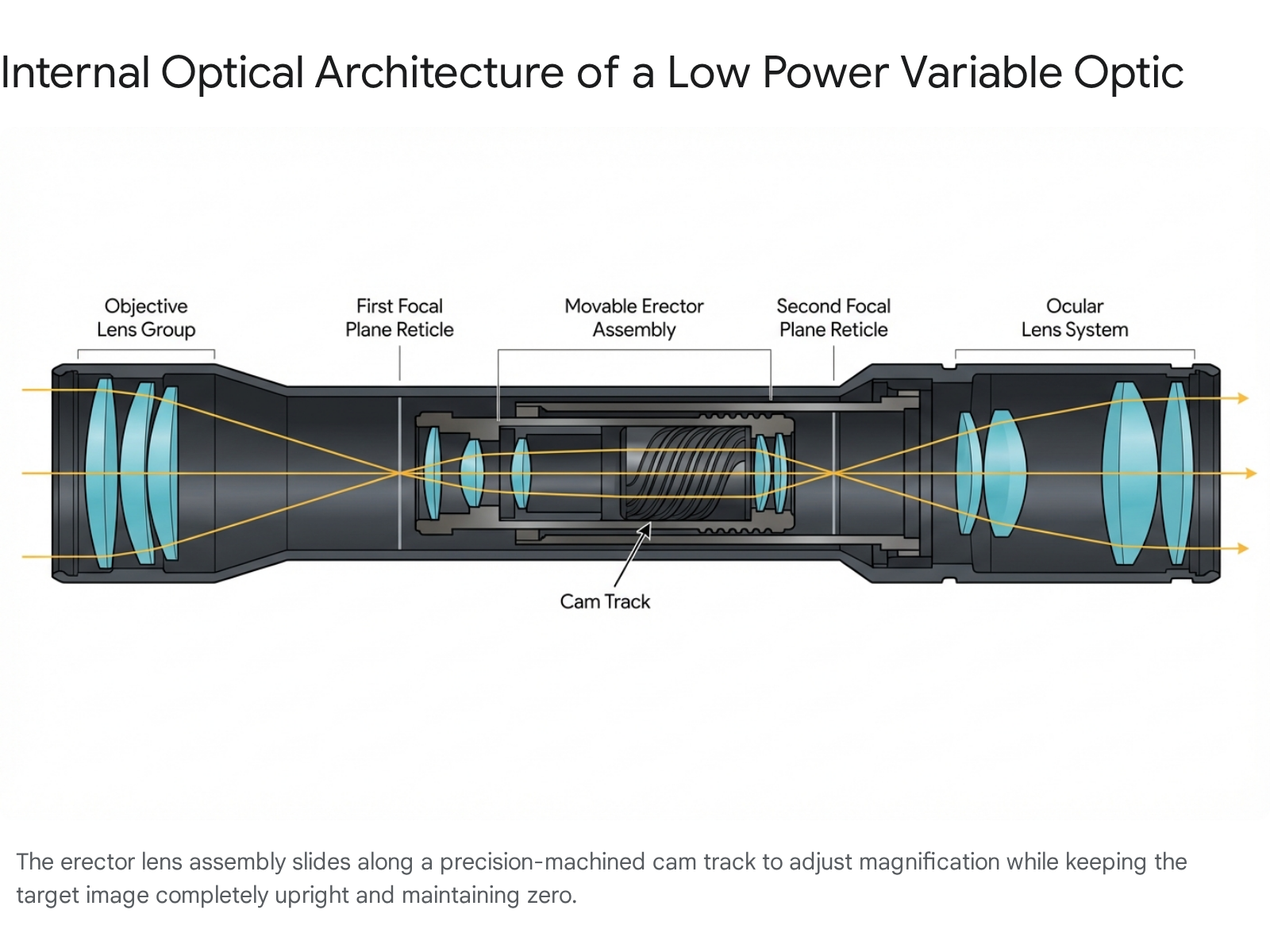
The optical system of any modern LPVO consists of four primary interacting components. These components are the objective lens group, the erector lens assembly, the reticle plane, and the ocular lens system.10 Light first enters the optic through the objective lens group. This forward element gathers the ambient light from the target environment and forms a real, inverted image inside the main scope tube.10 The optical quality of this specific objective lens dictates the foundational resolution, clarity, and color fidelity of the entire resulting image. Premium LPVO models heavily utilize Extra Low Dispersion glass formulations and proprietary multi coated layers to maximize light transmission while actively mitigating chromatic aberration.11 Chromatic aberration occurs when different wavelengths of light refract at slightly different angles, causing a blurring effect or color fringing around the edges of a target. High density glass elements correct this refraction, ensuring crisp target identification.12
The absolute core of the LPVO variable zoom capability lies deep within the erector lens assembly.10 This mechanism is essentially a secondary optical tube suspended precisely inside the primary main chassis of the scope. The erector assembly contains a series of movable magnifying lenses controlled by a highly complex, precision machined cam track system.10 When the shooter physically rotates the external magnification ring located near the rear of the scope, this action physically slides the internal lenses forward or backward along the cam track.10
This precise linear movement adjusts the overall angular magnification of the gathered light while simultaneously righting the initially inverted image so that it appears correctly oriented to the user.10 Designing a mechanical cam system that can transition smoothly from a 1x state to a 10x state without shifting the actual point of aim requires extraordinary mechanical tolerances.10 Even a microscopic deviation in the alignment of the erector lenses as they travel along the cam track will cause the reticle to shift off the target, completely destroying the zero of the rifle.
2.2 Achieving True One Power Magnification
Achieving a state of true 1x magnification is arguably the single most difficult aspect of modern LPVO optical engineering.14 In a true 1x state, the optical system must perfectly counteract the natural physical refraction of the objective lens so that the image passing out through the ocular lens matches the exact scale, perspective, and depth perception of the image seen by the shooter unaided eye.14
If the base magnification is even slightly imperfect, yielding a magnification of 1.1x or 0.9x, the shooter will immediately experience an optical distortion commonly referred to as the fishbowl effect.14 This distortion prevents the human brain from effortlessly merging the image from the dominant eye looking through the scope with the peripheral vision of the non dominant eye. This binocular rivalry induces motion sickness and severely degrades the shooter ability to quickly transition between multiple targets in a close quarters environment.14
To permanently solve this optical dilemma, leading engineers rely heavily on specialized aspherical lens shapes and highly calibrated focal lengths to artificially flatten the image at the 1x setting.1 By employing these advanced aspherical geometries, the light rays are bent in a non uniform manner that precisely compensates for the inherent spherical aberration of traditional convex lenses.15 This extreme level of calibration ensures that the shooter can keep both eyes wide open for maximum peripheral situational awareness, allowing the optic to function seamlessly as a reflex sight.1
2.3 First Focal Plane Versus Second Focal Plane Mechanics
The exact physical placement of the reticle element within this complex optical path fundamentally alters the operational functionality of the LPVO. Reticles can be placed in one of two locations, either the First Focal Plane or the Second Focal Plane.10
In a Second Focal Plane optic, the reticle glass is located physically behind the moving magnifying erector assembly, placing it very near the ocular lens.16 Because the reticle is positioned after the target image has already been magnified by the erector system, the size of the reticle appears completely constant to the shooter regardless of the chosen magnification setting.16 This mechanical layout guarantees that the reticle is always large, highly visible, and incredibly easy to acquire at the 1x setting. However, this design creates a significant secondary issue. Because the target image scales up and down in size while the reticle remains totally static, the ballistic holdovers and ranging stadia lines built into the reticle are only mathematically accurate at one specific magnification level, which is almost universally the absolute maximum magnification.16 If a shooter attempts to use a bullet drop compensator hash mark at 3x magnification on a 1 to 6 scope, the bullet will miss the intended target by a substantial margin.17
Conversely, in a First Focal Plane optic, the reticle glass is permanently placed in front of the moving erector lens assembly.16 In this specific configuration, the reticle itself is magnified simultaneously with the target image.16 As the shooter dials the magnification ring from 1x to 10x, the reticle grows in perfect mathematical proportion to the target.16 This represents a massive tactical advantage for the General Purpose Rifle, as it explicitly allows the shooter to utilize their bullet drop compensation lines and wind holds at absolutely any magnification setting without being forced to perform complex mental math or risk a catastrophic miss.7
However, FFP optics introduce their own unique engineering hurdle. A complex grid reticle that is perfectly sized and highly visible for 10x precision shooting inevitably becomes microscopically small when the optic is zoomed all the way out to the 1x setting.16 Without a powerful illumination source, the FFP reticle can easily vanish against dark clothing, heavily shaded foliage, or complex urban backgrounds, severely hindering close quarters combat speed.18 To adequately solve this specific issue, optical engineers have had to completely revolutionize the way reticles receive illumination.
2.4 Breakthroughs in Reticle Illumination Technologies
For an LPVO to truly replace a dedicated red dot sight at close quarters distances, the center aiming point of the reticle must be categorized as daylight bright. This specific industry term dictates that the reticle illumination must be clearly and distinctly visible even when viewed against brightly lit, highly reflective backgrounds like sunlit concrete walls, bright white vehicles, or arid desert sand.19
Traditional etched glass reticles typically use a standard LED emitter mounted inside the wall of the scope tube. This emitter bounces light directly off the physically etched grooves of the internal glass element. While this etch and fill method is extremely durable and highly resistant to recoil, it inherently scatters a significant portion of the light. Consequently, this older technology frequently struggles to overpower bright ambient sunlight, especially when the physical reticle shrinks down to a tiny footprint in an FFP design.18
To achieve the necessary nuclear bright illumination demanded by professional operators, the optics industry has successfully developed two groundbreaking alternative technologies. The first major advancement is Fiber Optic Wire illumination. In this innovative design, a microscopic, highly flexible fiber optic cable is laminated directly onto the crosshair axis.20 A powerful LED emitter pumps intense light into the base of the fiber.20 This light travels rapidly through the core of the fiber via the scientific principle of total internal reflection until it successfully reaches the exposed tip of the wire, which is positioned precisely at the center of the crosshair.20 Because the light is perfectly concentrated and released at a singular microscopic point, the resulting dot is totally indistinguishable from a standalone electronic red dot sight in terms of sheer daylight brightness.19 This specific technology has largely dominated modern high end SFP optics.
For FFP optics, where a physical fiber wire cannot practically scale up and down alongside complex ranging grids without obstructing the view, optical engineers have recently pioneered Diffractive Reticle Technology.18 Instead of merely etching crude physical grooves into the glass plane, modern manufacturing facilities use incredibly advanced amplitude gratings etched at the microscopic level.18 When highly collimated LED light passes through these highly specific microscopic gratings, the light aggressively diffracts and projects a highly concentrated, incredibly efficient glow precisely onto the center horseshoe or center dot of the reticle.18 This technological leap allows premium FFP optics to generate a stunningly daylight bright aiming point without simultaneously sacrificing overall battery life.18 The final operational result is an optic that genuinely performs exactly like a red dot reflex sight at 1x magnification, while still retaining a fully functional, highly complex precision grid when magnified to 8x or 10x.4
3. Tactical Advantages: LPVO Platforms Versus Red Dot and Magnifier Combinations
The professional debate regarding the absolute optimal sighting system for a modern General Purpose Rifle heavily features the LPVO matched directly against the traditional pairing of an unmagnified red dot sight placed immediately in front of a flip to side magnifier mechanism. Both disparate optical systems ultimately aim to provide the shooter with extreme 1x speed combined with magnified precision capability. However, they achieve this intended versatility through entirely different mechanical and optical paradigms. A thorough, objective analysis of the field of view, the physical eyebox mechanics, and the total environmental resilience of each system quickly reveals distinct, overwhelming tactical advantages in favor of the LPVO.
3.1 Field of View and the Impact of Ocular Occlusion
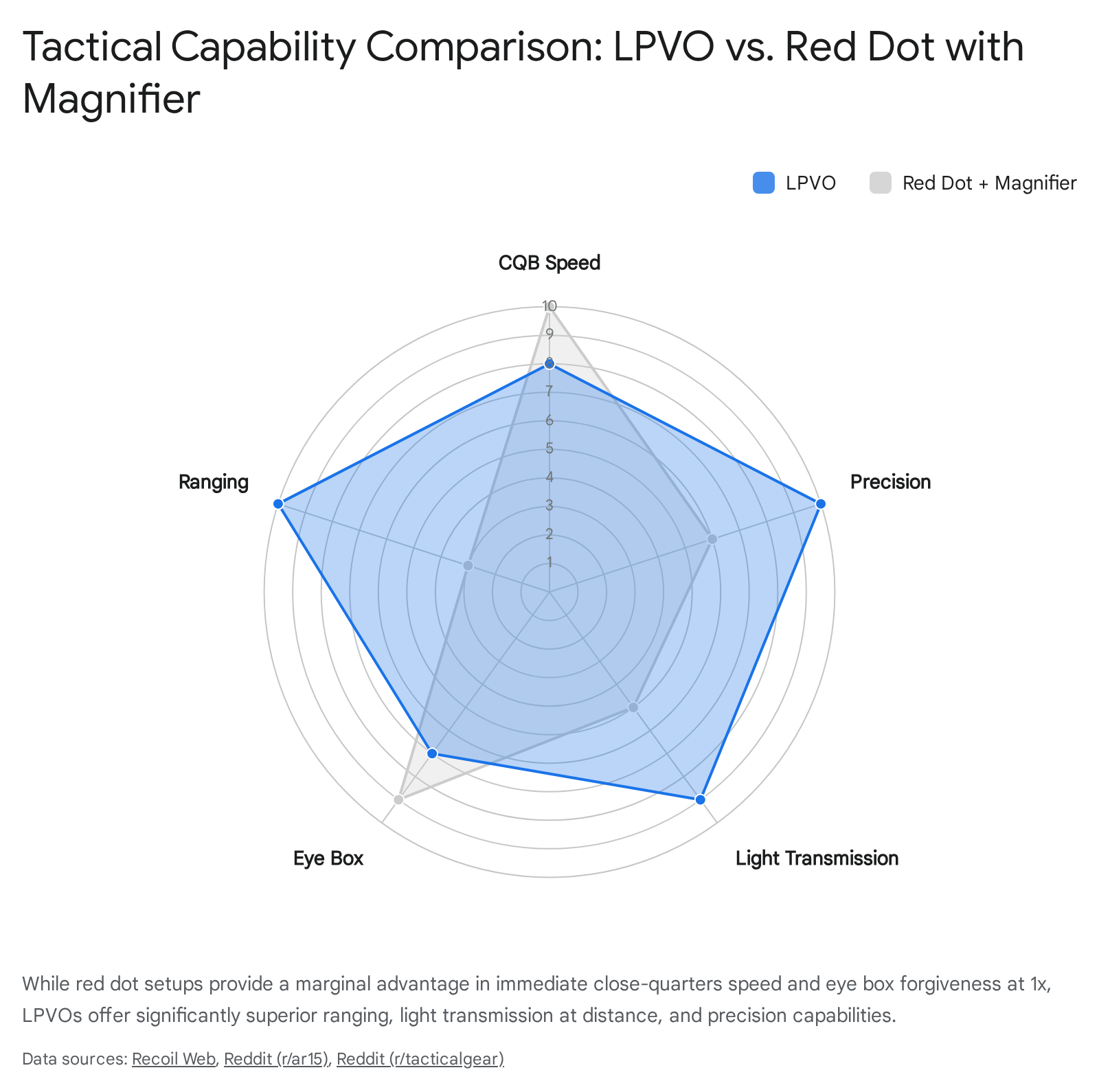
The Field of View, universally abbreviated as FOV, strictly dictates exactly how much of the target area the shooter can visibly see through the optic at a given specific distance. In close quarters combat engagements, a massive FOV is absolutely critical for maintaining overarching situational awareness, maximizing target transition speed between multiple adversaries, and successfully tracking laterally moving threats.21 Red dot sights are frequently perceived by novice shooters to possess an infinite field of view simply because they consist of a single thin pane of glass enclosed in a highly minimal aluminum housing.22 When utilizing a red dot with both eyes open, the housing seemingly disappears from the vision plane.
However, the optical math changes drastically the moment a 3x or 5x magnifier unit is introduced behind that red dot.23 When the magnifier is engaged, the shooter is now physically looking through two completely separate optic bodies containing multiple distinct lenses separated by open air.23 This extended, physically disjointed optical footprint severely restricts the total amount of light and visual information reaching the shooter retina. Magnifiers inherently suffer from a substantially narrow FOV and notoriously poor light transmission metrics, resulting directly in a much dimmer, noticeably more confined sight picture at distance.23
In stark contrast, an LPVO provides a continuous, highly optimized optical corridor perfectly sealed within a single continuous aluminum tube. High quality LPVOs consistently boast massive fields of view at the 1x setting, frequently exceeding 115 horizontal feet of visibility at a distance of 100 yards.24 When dialed to maximum magnification, the LPVO easily maintains superior light transmission and sharp edge to edge clarity compared to the disjointed, multi lens red dot and magnifier setup.21 While an LPVO mounted intimately close to the human eye may initially induce a subjective feeling of tube shadow due to the presence of the ocular housing, the actual mathematical field of view it projects to the retina is significantly wider and definitively brighter than any magnified red dot configuration on the current market.21
3.2 Eye Box Mechanics and Dynamic Head Placement
In optical terminology, the eye box refers to the specific three dimensional cone of space located directly behind the optic where the shooter eye must be physically positioned to achieve a full, totally unobstructed sight picture.1 If the shooter eye moves too far forward, backward, left, or right out of this specific box, the target image immediately begins to eclipse, creating thick black visual rings commonly known as scope shadow.
Standard red dot sights essentially possess a near infinite eye relief distance and operate with virtually zero eye box constraints. As long as the shooter can physically see the glass pane from any angle, they can generally see the illuminated dot.4 This optical reality makes red dots exceptionally forgiving when an operator is actively firing from awkward, highly unconventional barricade positions where achieving a perfect, repeatable cheek weld on the rifle stock is completely impossible.4
LPVOs, firmly bound by the uncompromising physics of light refraction, have a highly finite eye relief parameter. This distance usually dictates a mandatory spacing ranging between 3.5 inches and 4.0 inches from the ocular lens.25 Furthermore, as the magnification setting of an LPVO linearly increases, the exit pupil physically shrinks. The exit pupil is defined as the exact diameter of the shaft of light physically exiting the ocular lens.10 For example, an LPVO with a 24mm objective lens dialed to 8x magnification yields an incredibly tight 3mm exit pupil, calculated simply by dividing 24 by 8. The average human pupil in standard daylight conditions is roughly 2mm to 3mm wide, meaning the shooter must perfectly and completely align their pupil within that tiny 3mm shaft of exiting light to see the image clearly at distance.10 This strict alignment requires extensive training and muscle memory.
However, when the optic is dialed down to 1x magnification, the entire optical dynamic shifts favorably.1 At 1x, that same 24mm objective lens technically generates a massive 24mm exit pupil. While the internal physical geometry of the scope chassis usually restricts the final effective exit pupil to a highly forgiving 8mm to 11mm, this is still an exceptionally large column of light.27 This large exit pupil allows for tremendous leeway in head placement, directly enabling modern, top tier LPVOs to be driven nearly as fast as a reflex red dot in close quarters combat, provided the shooter practices highly consistent weapon mounting mechanics.1
By extreme contrast, when a shooter flips a standard 3x magnifier behind a red dot sight, the operational eye box instantly collapses to roughly 2 inches or less.23 This severe restriction forces the shooter to dramatically shift their head forward along the rifle stock, totally destroying their natural, practiced shooting posture and creating significant muscular tension.23 The LPVO maintains a much more consistent, predictable eye relief distance across its entire magnification range, cementing a far more stable and repeatable shooting platform under stress.23
3.3 Reticle Complexity and Absolute Environmental Resilience
The most profound and measurable tactical advantage of the LPVO over the red dot and magnifier setup is the inherent capability of the reticle itself.28 A red dot relies entirely on an electronic LED bouncing light off a dichroic coating, meaning the physical aiming point is typically limited to a highly simplistic 2 MOA dot or a basic 65 MOA circle.28 While incredibly fast for close range center mass engagements, this basic projection provides absolutely no reference data for the broader environment.28 If a shooter needs to engage a hostile target at 400 yards using a standard red dot, they must simply guess the severe bullet drop by holding the glowing dot in completely empty space high above the target.29 If a moderate crosswind is simultaneously present, hitting a target rapidly becomes largely a matter of pure luck and excessive ammunition expenditure.29
An LPVO actively incorporates a physically etched glass reticle containing highly sophisticated ballistic data points.28 These complex reticles heavily feature precise subtensions specifically designed for Bullet Drop Compensation, designated windage holdover dots, and distinct moving target leads.28 At maximum magnification settings, the shooter can easily measure the exact width of a vehicle tire or the standard height of a structural doorway in MILs to accurately determine the exact distance to the target. They can then effortlessly utilize the corresponding internal holdover mark to guarantee a first round ballistic impact.31
Furthermore, this etched glass reticle provides total environmental resilience.30 If the internal battery unexpectedly dies, or if a severe electromagnetic pulse completely disables all electronic circuitry, a standard red dot sight instantly becomes a useless, opaque block of metal.30 An LPVO, conversely, permanently retains its deeply etched black crosshairs.30 This fail safe mechanical guarantee ensures the weapon system remains fully operational and highly lethal in the most austere conditions imaginable, entirely regardless of battery status or electrical failure.21
4. Reticle Selection and Ballistic Pairing for the 16 Inch AR-15 Platform
The 16 inch barrel is widely and universally considered the absolute optimal length for a General Purpose AR-15 rifle.2 This specific length offers a flawless, highly tested synergy of terminal ballistic velocity and physical agility.2 When firing standard 5.56x45mm NATO ammunition, such as the widely issued 62 grain M855 projectile or the highly precise 77 grain OTM Mk262 variant, the 16 inch barrel consistently generates highly predictable and extremely effective ballistic trajectories. Pairing this specific ballistic profile with the correct, mathematically aligned LPVO reticle is absolutely critical for maximizing the overall lethality of the platform.
When outfitting a General Purpose Rifle, shooters must deliberately choose between a dedicated Bullet Drop Compensator reticle and a standard MIL or MRAD grid reticle. A BDC reticle, such as the highly popular ACSS Raptor series, is rigidly pre calibrated to match the specific parabolic drop of the 5.56 NATO cartridge when fired from standard barrel lengths.32 The vertical stadia line descends from the center aiming point and features distinct horizontal hash marks that correspond exactly to expected bullet impacts at 300, 400, 500, and 600 yards.32
The primary tactical advantage of a dedicated BDC is supreme cognitive speed under extreme combat stress. If the operator successfully identifies a hostile target at 400 yards, the shooter completely bypasses complex math, simply places the 400 yard hash mark directly on the target center mass, and presses the trigger.32 However, BDC reticles are inherently rigid in their design. They rely entirely on a fixed assumption regarding specific muzzle velocity, a specific bullet aerodynamic weight, and highly standard atmospheric conditions.31 If the shooter drastically changes ammunition to a significantly heavier bullet, or deploys to an operational theater at a drastically different physical altitude, the pre calibrated hash marks will no longer perfectly align with the actual physical point of bullet impact.31 This requires the shooter to memorize offset values, complicating the engagement process.
For highly trained professionals operating in extremely variable conditions, an MRAD grid reticle, such as the Vortex EBR-9 or the Nightforce FC-DMx, is heavily preferred and widely issued.24 An MRAD reticle is fundamentally a standardized unit of angular measurement that acts essentially as a blank, highly precise ruler overlaid on the target area.17 The etched hash marks are spaced exactly 0.5 or 1.0 MRAD apart in a vast grid.17 The professional shooter actively utilizes a dedicated ballistic calculator application to determine their exact expected bullet drop based on real time atmospheric data and the precisely chronographed velocity of their specific 16 inch barrel, thereby generating a highly custom dope card for the mission.31
For example, the shooter might mathematically determine that their chosen 77 grain round drops precisely 2.4 MRAD at a confirmed distance of 400 yards in current weather conditions. They then simply hold the 2.4 MRAD mark on the internal grid over the target. While requiring significantly more initial data collection and baseline training, the MRAD grid provides unparalleled mathematical precision and absolute operational adaptability, remaining flawlessly accurate regardless of the specific ammunition type utilized or the environmental conditions encountered.31
5. Tier One LPVO Market Analysis and Pricing Data (April 2026)
Selecting an optimal LPVO for a duty or defensive rifle requires a highly careful, objective analysis of the mechanical features, optical clarity, structural integrity, and current market pricing. The following structured data represents the absolute apex of the current General Purpose Rifle optic market, providing exhaustive technical specifications and verified online market pricing constraints actively observed in April 2026.
5.1 Vortex Razor HD Gen III 1 to 10×24 FFP
The Vortex Razor series has long been recognized as the commercial gold standard against which all other tactical LPVOs are directly measured.35 The Gen III iteration violently pushes the known boundaries of optical engineering by offering a massive 1 to 10 magnification range housed entirely within a compact 10.1 inch long chassis.36 Astonishingly, this massive optical capability weighs only 21.5 ounces, perfectly matching the weight of their previous, less capable 1 to 6 magnification model without sacrificing any structural durability.37 Built around an incredibly robust 34mm main tube, the heavy duty optic provides a staggering 120 MOA of internal elevation travel to facilitate extreme long range engagements.38 The internal HD optical system, rigorously treated with proprietary XR fully multi coated layers, actively eliminates chromatic aberration and maximizes ambient light transmission, yielding an industry leading, massive field of view measuring 116 feet at 100 yards when set on 1x.25
The Razor HD Gen III is primarily equipped with the highly complex EBR-9 reticle, available to consumers in both MOA and MRAD grid configurations.24 Placed strategically in the first focal plane, the advanced EBR-9 features a brilliant, daylight illuminated center ring specifically designed for rapid CQB engagements, completely surrounded by a comprehensive Christmas tree style grid for high magnification wind holds and precise target ranging.25 It is heavily favored by Special Operations communities and elite competitive shooters for its unparalleled versatility across all distances.1
Manufacturer Website: https://vortexoptics.com
| Retail Vendor | Listed Price | Product Link |
| Midway USA | $2,499.99 | View Product |
| Brownells | $2,499.99 | View Product |
| Sportsmans Warehouse | $2,499.99 | View Product |
| EuroOptic | $2,499.00 | View Product |
| Adorama | $2,099.95 | View Product |
5.2 Nightforce ATACR 1 to 8×24 F1
The Nightforce ATACR 1 to 8×24 F1 is engineered with an uncompromising, absolute focus on bomb proof physical durability and extreme optical performance, rendering it the definitive choice for harsh duty use by frontline military assets.40 Constructed with an immensely thick 34mm body tube to resist crushing impacts, the ATACR measures exactly 10.1 inches in overall length and weighs 21.0 ounces.40 Nightforce exclusively utilizes pristine Extra Low Dispersion glass elements to produce brilliant target images with superb color contrast, easily resolving even the smallest camouflaged targets at extreme combat distances.34
The optic features the highly intelligent FC-DMx first focal plane reticle design.40 Recognizing the critical tactical need for low signature operations, the optic utilizes heavily capped, extremely low profile adjustments offering precise 0.1 MRAD clicks.40 The internal illumination system is externally adjustable on the fly, featuring multiple daylight bright settings that rival any standalone red dot, alongside two highly dedicated settings tailored specifically for compatibility with clip on night vision devices.42 The true 1x optical setting, combined perfectly with the massive 11.3mm exit pupil, yields an incredibly forgiving eye box tailored specifically for rapid, dynamic engagements under fire.40
Manufacturer Website: https://www.nightforceoptics.com
| Retail Vendor | Listed Price | Product Link |
| Midway USA | $2,800.00 | View Product |
| Primary Arms | $2,800.00 | View Product |
| Brownells | $2,800.00 | View Product |
| Sportsmans Warehouse | $2,800.00 | View Product |
| EuroOptic | $2,800.00 | View Product |
5.3 Primary Arms Compact PLxC 1 to 8×24 FFP
Primary Arms has completely revolutionized the expected physical dimensions of the modern tactical LPVO with the release of the PLxC 1 to 8×24.43 Weighing a mere 16.95 ounces and measuring an astonishingly short 9.28 inches in overall length, the PLxC drastically mitigates the traditional weight penalty associated with mounting variable optics on a carbine.43 Despite its incredibly compact exterior profile, it utilizes premium grade Japanese ED glass components, delivering exceptional light transmission, an ultra wide 121 foot field of view at 100 yards, and highly forgiving eye relief ranging smoothly from 3.2 to 3.7 inches.43
The absolute most significant technological advancement housed within the PLxC is its flawless implementation of Red Dot Bright diffractive reticle technology within a true first focal plane configuration.4 The popular ACSS Griffin MIL M8 reticle leverages this new amplitude grating technology to produce an intensely bright center horseshoe that functions exactly like a reflex red dot at 1x magnification, all without draining the internal CR2032 battery prematurely.18 The thoughtful inclusion of AutoLive motion sensing illumination ensures the reticle is immediately active upon any weapon deployment, removing the need to manually press buttons during an ambush.43
Manufacturer Website: https://www.primaryarms.com
| Retail Vendor | Listed Price | Product Link |
| Primary Arms | $1,499.99 | View Product |
| Midway USA | $1,499.99 | View Product |
| Sportsmans Warehouse | $1,499.99 | View Product |
| Bauer Precision | $1,499.99 | View Product |
| Simmons Sporting Goods | $1,499.99 | View Product |
5.4 Trijicon VCOG 1 to 8×28 SCO
The Trijicon Variable Combat Optical Gunsight deeply distinguishes itself from absolutely all other optics on the current market through its highly proprietary, monolithic exterior construction.7 Forged entirely from a single solid block of 7075-T6 aircraft grade aluminum, the massive housing successfully incorporates an integrated mounting adapter built directly into the base, completely eliminating the need for separate scope rings and decisively removing the associated mechanical failure points they traditionally introduce.7 This specific optic was subjected to incredibly rigorous MIL-STD-810G physical testing and ultimately selected as the official Squad Common Optic for the United States Marine Corps, verifying its battlefield lethality.7
Unlike standard civilian LPVOs, the VCOG utilizes a significantly larger 28mm objective lens, which substantially increases the exit pupil diameter for the user and dramatically enhances low light transmission capability at dusk and dawn.46 Powered intelligently by a single, easily sourced lithium AA battery rather than a standard delicate coin cell, the VCOG provides a staggering 633 hours of continuous battery life when left on setting 6.46 The first focal plane MRAD Segmented Circle reticle is fully supported by eleven user selectable brightness settings, strictly including a super bright day setting and two dedicated night vision modes for absolute tactical supremacy.46
Manufacturer Website: https://www.trijicon.com
| Retail Vendor | Listed Price | Product Link |
| Midway USA | $2,364.99 | View Product |
| GunMagWarehouse | $2,199.99 | View Product |
| Brownells | $2,313.99 | View Product |
| EuroOptic | $1,979.99 | View Product |
| Charlie’s Custom Clones | $2,129.99 | View Product |
5.5 Sig Sauer Tango6T 1 to 6×24
Officially selected by the U.S. Army specifically for the Squad Designated Marksman Rifle program, the Sig Sauer Tango6T 1 to 6×24 provides exceptional combat performance heavily verified in a traditional, field proven 30mm tube configuration.9 The optic relies on Sig Sauer proprietary HDX optical system, seamlessly merging extra low dispersion glass elements with high transmittance glass coatings to fully maximize visual clarity and totally minimize chromatic degradation across the entire visible light spectrum.48
The highly versatile Tango6T excels rapidly in transitional mid range engagements through its flawless implementation of the DWLR6 and Hellfire illuminated reticle options.50 The external optical controls thoughtfully include a laser engraved mounting line located on the tube to ensure perfect mechanical alignment during installation by the armorer, and a factory installed power throw lever for immediate, high stress magnification adjustments in the field.51 Boasting highly rigorous IPX-8 deep waterproofing standards, the 20.9 ounce Tango6T guarantees absolutely zero internal fogging or mechanical failure during sustained, punishing environmental exposure.49
Manufacturer Website: https://www.sigsauer.com
| Retail Vendor | Listed Price | Product Link |
| Midway USA | $1,799.99 | View Product |
| GunMagWarehouse | $1,499.99 | View Product |
| Brownells | $1,499.99 | View Product |
| Palmetto State Armory | $1,799.99 | View Product |
| OpticsPlanet | $1,399.99 | View Product |
6. Strategic Conclusion
The aggressive operational transition from outdated red dot magnifiers and highly rigid fixed power prisms directly over to Low Power Variable Optics is definitively not a superficial market trend. It represents a permanent, necessary evolution in modern small arms tactical doctrine. The fundamental, unyielding superiority of the LPVO platform heavily stems from its unbroken optical corridor design, generating truly unparalleled light transmission values, vastly wider physical fields of view, and highly forgiving exit pupils at true 1x magnification. By seamlessly integrating highly advanced, mathematically complex reticle systems directly inside the first focal plane, modern shooters utilizing a 16 inch AR-15 can instantly and reliably solve complex ballistic drop problems that would otherwise be completely impossible with unmagnified dot sights.
Recent massive technological breakthroughs in diffractive amplitude gratings and fiber optic light manipulation have finally, permanently solved the LPVO historical weakness regarding poor daylight bright illumination. As aggressive optical engineering continues to relentlessly drive down the physical footprint and raw weight of the internal erector assemblies, as plainly seen in the newest compact iterations from top tier manufacturers, the minor functional gaps between a dedicated reflex sight and an LPVO will completely cease to exist. For the modern professional actively operating in a highly dynamic environment where rapid threat identification and precise, devastating ballistic engagements at unpredictable ranges are equally probable, the Low Power Variable Optic stands completely unmatched as the premier sighting solution.
Note: Vendor Sources listed are not an endorsement of any given vendor. It is our software reporting a product page given the direction to list products that are between the minimum and average sales price when last scanned.
Please share the link on Facebook, Forums, with colleagues, etc. Your support is much appreciated and if you have any feedback, please email us in**@*********ps.com. If you’d like to request a report or order a reprint, please click here for the corresponding page to open in new tab.
Sources Used
- Making Sense of Magnified Optics on a Tactical Carbine Part 1, accessed April 14, 2026, https://vortexoptics.com/blog/making-sense-of-magnified-optics-on-a-tactical-carbine-part-1.html
- The Ultimate 2026 AR-15 Optics Buyer’s Guide – Black Rifle Depot, accessed April 14, 2026, https://blackrifledepot.com/the-ultimate-2026-ar-15-optics-buyers-guide/
- Is an LPVO right for you? – Vortex Optics, accessed April 14, 2026, https://vortexoptics.com/blog/is-an-lpvo-right-for-you.html
- Understanding Variable Optics: LPVO vs. MPVO – Swampfox Optics, accessed April 14, 2026, https://www.swampfoxoptics.com/understanding-variable-optics-lpvo-vs-mpvo
- What Is an LPVO Scope? – The Armory Life, accessed April 14, 2026, https://www.thearmorylife.com/what-is-an-lpvo-scope/
- Jack of All Optics: Low Power Variable Optic (LPVO) Use Cases – Swampfox Optics, accessed April 14, 2026, https://www.swampfoxoptics.com/jack-of-all-optics-lpvo-use-cases
- Trijicon VCOG® Rifle Scope, accessed April 14, 2026, https://www.trijicon.com/products/subcategory/trijicon-vcog-riflescope
- 9 Best LPVO Scopes: Low, Mid & High Power, accessed April 14, 2026, https://www.pewpewtactical.com/best-lpvo/
- Sig Sauer Tango6T 1-6x 24mm Rifle Scope – DWLR6 – Sportsman’s Warehouse, accessed April 14, 2026, https://www.sportsmans.com/hunting-gear-supplies/optics-binoculars-scopes-rangefinders/rifle-scopes-red-dots/sig-sauer-tango6t-1-6x-24mm-rifle-scope-dwlr6/p/1754574
- Rifle Scope Engineering Guide: Optical Design, Mechanical Precision, and Performance Factors That Truly Matter – OPTIS TECHNOLOGY CO., LTD., accessed April 14, 2026, https://www.optis.com.tw/blog/rifle-scope-engineering-guide-optical-design-mechanical-precision-and-performance-factors-that-truly-matter/?lang=en
- Nightforce ATACR – 1-8x24mm F1 – T.REX ARMS, accessed April 14, 2026, https://www.trex-arms.com/store/nightforce-atacr-1-8x24mm-f1/
- Primary Arms PLx 1-8x24mm Compact LPVO Rifle Scope, 30mm Tube, First Focal Plane (FFP) – OpticsPlanet, accessed April 14, 2026, https://www.opticsplanet.com/primary-arms-the-plx-1-8x24mm-rifle-scope.html
- LPVO Scopes Wholesale Manufacturer – Foreseen Optics, accessed April 14, 2026, https://www.foreseenoptics.com/lpvo
- Mastering the LPVO: Part 1 – Low-Power Variable Optic Buyer’s Guide | RECOIL OFFGRID, accessed April 14, 2026, https://www.offgridweb.com/gear/lpvo-buyers-guide/
- Field Guide to Optical Engineering | (2025) | Sun | Publications – SPIE, accessed April 14, 2026, https://spie.org/publications/book/100331
- The Variable-Power Optic: History & Performance | An Official Journal Of The NRA, accessed April 14, 2026, https://www.americanrifleman.org/content/the-variable-power-optic-history-performance/
- Guide to LPVO Selection : r/tacticalgear – Reddit, accessed April 14, 2026, https://www.reddit.com/r/tacticalgear/comments/u02ejz/guide_to_lpvo_selection/
- Emerging Trends in Rifle Scopes and Reflex Sights | Soldier Systems Daily, accessed April 14, 2026, https://soldiersystems.net/2024/06/01/emerging-trends-in-rifle-scopes-and-reflex-sights/
- Why Do You Need a Daylight Bright LPVO? – Victoptics, accessed April 14, 2026, https://www.victoptics.com/medias/why-do-you-need-a-daylight-bright-lpvo/
- Understanding Fiber Optic Reticles, accessed April 14, 2026, https://www.swampfoxoptics.com/understanding-fiber-optic-reticles
- Optics Test: LPVO vs Red Dot Sights – AmmoMan School of Guns Blog, accessed April 14, 2026, https://www.ammoman.com/blog/optics-test-lpvo-vs-red-dot-sights/
- Red Dot Magnifier vs LPVO in 2026: Which Setup Makes More Sense on Your AR?, accessed April 14, 2026, https://genius.gunbroker.com/red-dot-magnifier-vs-lpvo-2026/
- LVPO vs Red dot w/ Magnification : r/ar15 – Reddit, accessed April 14, 2026, https://www.reddit.com/r/ar15/comments/1qb1pn6/lvpo_vs_red_dot_w_magnification/
- Vortex Razor HD Gen III 1-10×24 FFP Riflescope, accessed April 14, 2026, https://vortexoptics.com/vortex-razor-hd-gen-iii-1-10×24-riflescope+reticle-EBR-9~MRAD
- Vortex Razor HD Gen III 1-10x24mm Rifle Scope, 34mm Tube, First Focal Plane (FFP), accessed April 14, 2026, https://www.opticsplanet.com/vortex-razor-hd-gen-iii-1-10×24-riflescope.html
- Primary Arms Compact PLxC 1-8X24 FFP Rifle Scope – Black, accessed April 14, 2026, https://primaryarmsoptics.com/optics/rifle-scopes/low-power-variable-optics/primary-arms-compact-plxc-1-8×24-ffp-rifle-scope-black/
- LPVO 101 – Vortex Optics, accessed April 14, 2026, https://vortexoptics.com/blog/lpvo-101.html
- LPVO vs. Magnifiers: What Works Best? – Recoil Magazine, accessed April 14, 2026, https://www.recoilweb.com/grudge-match-lpvo-vs-magnifiers-163374.html
- Red Dot w magnifier vs LPVO : r/ar15 – Reddit, accessed April 14, 2026, https://www.reddit.com/r/ar15/comments/1qy33r6/red_dot_w_magnifier_vs_lpvo/
- Low Power Variable Optic (LPVO) Vs Red Dot And Magnifier – Primary Arms Blog!, accessed April 14, 2026, https://blog.primaryarms.com/guide/low-power-variable-optic-vs-red-dot-and-magnifier/
- Best LPVO for AR-15 (2026 Buyer’s Guide) – Swat Optics, accessed April 14, 2026, https://swatoptics.com/pages/best-lpvo-for-ar-15-2026-buyer-s-guide
- Vortex Optics AR-BDC3 Reticle – Uncle Zo, accessed April 14, 2026, https://unclezo.com/2021/02/10/vortex-optics-ar-bdc3-reticle/
- Primary Arms Compact PLxC 1-8×24 FFP Rifle Scope – Illuminated ACSS Raptor M8 Yard 5.56 / .308 Reticle – Flat Dark Earth, accessed April 14, 2026, https://www.primaryarms.com/primary-arms-compact-plxc-1-8×24-ffp-rifle-scope-illuminated-acss-raptor-m8-yard-556-308-reticle-fde
- Riflescopes | Ultimate Precision – Nightforce Optics, accessed April 14, 2026, https://www.nightforceoptics.com/riflescopes
- 10 Best LPVOs for 2026: Budget to Premium Scopes Tested – Lynx Defense, accessed April 14, 2026, https://lynxdefense.com/best-lpvo/
- Vortex Razor HD Gen III Rifle Scope – 1x10x24mm – Cabela’s, accessed April 14, 2026, https://www.cabelas.com/shop/en/vortex-razor-hd-gen-iii-rifle-scope-1x10x24mm-2850759
- Vortex Razor Gen III 1-10×24 EBR-9 BDC Rifle Scope – Exchange, accessed April 14, 2026, https://www.shopmyexchange.com/vortex-razor-gen-iii-1-10×24-ebr-9-bdc-rifle-scope/3544506
- Black Razor HD Gen III 1-10×24 FFP – Vortex Optics, accessed April 14, 2026, https://vortexoptics.com/vortex-razor-hd-gen-iii-1-10×24-riflescope-black.html
- Razor HD Gen III 1-10×24 FFP – Vortex Optics, accessed April 14, 2026, https://vortexoptics.com/vortex-razor-hd-gen-iii-1-10×24-riflescope.html
- ATACR – 1-8x24mm F1 – Nightforce Optics, accessed April 14, 2026, https://www.nightforceoptics.com/riflescopes/atacr/atacr-1-8×24-f1
- NIGHTFORCE ATACR 1-8X24MM F1 FFP ILLUMINATED RIFLE SCOPE – Brownells, accessed April 14, 2026, https://www.brownells.com/optics/scopes/rifle-scopes/atacr-1-8x24mm-f1-ffp-illuminated-rifle-scope/
- NIGHTFORCE ATACR 1-8x24mm FFP Illuminated FC-DMX Reticle Black SKU: 524000292, accessed April 14, 2026, https://www.brownells.com/optics/scopes/rifle-scopes/atacr-1-8x24mm-f1-ffp-illuminated-rifle-scope/?sku=524000292
- Primary Arms Compact PLxC 1-8×24 FFP RDB Rifle Scope – ACSS Raptor 5.56/.308 Yard G2 Reticle, accessed April 14, 2026, https://www.primaryarms.com/primary-arms-compact-plxc-1-8×24-ffp-rdb-riflescope-acss-raptor-yard-556-308-reticle
- Primary Arms Compact PLxC 1-8X24 FFP Rifle Scope – Illuminated ACSS Griffin MIL M8 Reticle – Flat Dark Earth, accessed April 14, 2026, https://www.primaryarms.com/primary-arms-compact-plxc-1-8×24-ffp-rifle-scope-illuminated-acss-griffin-mil-m8-reticle-fde
- Primary Arms Compact PLxC 1-8X24 SFP Rifle Scope – Illuminated ACSS Nova Fiber Wire Reticle, accessed April 14, 2026, https://www.primaryarms.com/primary-arms-compact-plxc-1-8×24-sfp-rifle-scope-illuminated-acss-nova-fiber-wire-reticle
- Trijicon VCOG® 1-8×28 LED Riflescope- MRAD, accessed April 14, 2026, https://www.trijicon.com/products/details/vc18-c-2400003
- Trijicon USMC SCO VCOG 1-8x28mm Red MRAD Tree Reticle Riflescope w/LaRue LT799 Mount, Tenebraex Flip Caps & Soft Case VC18-C-2400012 For Sale – EuroOptic.com, accessed April 14, 2026, https://www.eurooptic.com/trijicon-usmc-sco-vcog-1-8x28mm-red-mrad-tree-reticle-riflescope-w-larue-lt799-m
- Sig Sauer TANGO6T 1-6x24mm Rifle Scope with Dual Windhold Long Range Reticle, accessed April 14, 2026, https://gunmagwarehouse.com/sig-sauer-tango6t-1-6x24mm-rifle-scope-with-dual-windhold-long-range-reticle.html
- SIG SAUER TANGO6T 1-6x24mm Rifle Scope, 30mm Tube, Second Focal Plane (SFP) | 28% Off 4.6 Star Rating w – OpticsPlanet, accessed April 14, 2026, https://www.opticsplanet.com/sig-sauer-tango6t-5-56-7-62mm-1-6x24mm-30mm-riflescope-w-illuminated-reticle.html
- SIG SAUER TANGO6T 1-6×24 30mm SFP FL-6 SVPS Kit FDE – Alexander’s Store, accessed April 14, 2026, https://alexandersstore.com/product/sig-tango6t-1-6x24mm-fl-6-ill-fde/
- Sig Sauer TANGO6T 1-6x 24mm Rifle Scope – FL-6 Hellfire | Sportsman’s Warehouse, accessed April 14, 2026, https://www.sportsmans.com/hunting-gear-supplies/optics-binoculars-scopes-rangefinders/rifle-scopes-red-dots/sig-sauer-electro-optics-tango6t-1-6x-24mm-rifle-scope-fl-6-hellfire/p/1754572
- Sig Sauer Tango 6T Rifle Scope 1-6x 24mm Illuminated FL-6 Reticle Flat – MidwayUSA, accessed April 14, 2026, https://www.midwayusa.com/product/1026624763