1. Introduction to the Micro-Compact Defensive Paradigm
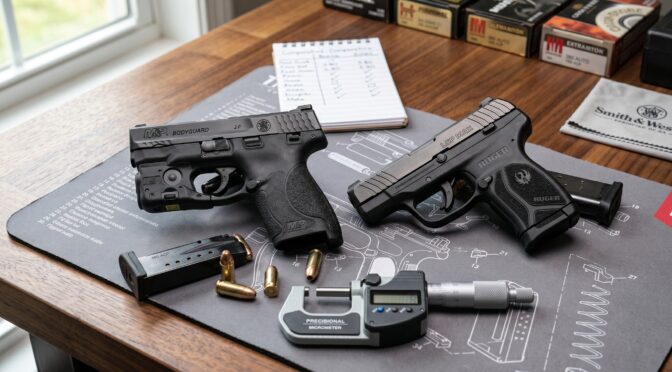
The evolution of the deep concealment firearm has reached a profound historical inflection point with the introduction of high-capacity, micro-compact platforms chambered in the.380 Automatic Colt Pistol caliber. Historically, the pocket pistol market was dominated by ultra-lightweight, low-capacity, single-stack designs that prioritized minimal spatial dimensions over shootability and operational capacity. The traditional paradigm required a severe compromise from the end user. Individuals carrying these older platforms were forced to accept a meager six-round capacity and marginal ergonomic profiles simply to achieve true pocket concealability. However, the modern tactical and engineering landscape has shifted dramatically over the past several years. The integration of staggered-column magazines, advanced polymer frame architectures, and sophisticated metallurgical treatments has successfully bridged the gap between microscopic form factors and primary-carry capacities.
Two distinct firearms currently dominate this new era of the high-capacity micro-compact market. These are the Smith & Wesson Bodyguard 2.0 and the Ruger LCP Max. Both pistols represent absolute engineering triumphs in spatial efficiency. They manage to house double-digit ammunition capacities within physical footprints that were once strictly the domain of single-stack derringers and legacy pocket pistols. The Smith & Wesson Bodyguard 2.0, released in the year 2024, operates as a thoroughly modern striker-fired system boasting a completely redesigned ergonomic profile, an optimized 18-degree grip angle, and a highly refined flat-face trigger mechanism.1 Conversely, the Ruger LCP Max utilizes a highly proven internal hammer-fired mechanism known as the Secure Action fire-control system.3 The Ruger LCP Max capitalizes on the manufacturer’s extensive history in the pocket pistol domain to deliver ten or twelve rounds in a remarkably lightweight package.4
This exhaustive research report provides an expert-level comparative analysis of the Smith & Wesson Bodyguard 2.0 and the Ruger LCP Max. The subsequent analysis evaluates technical specifications, metallurgical components, ergonomic design philosophies, historical operational reliability, aftermarket support ecosystems, and primary strategic use cases. The objective is to inform defense professionals, civilian concealed carriers, and industry analysts with a nuanced, data-driven understanding of how these two leading platforms perform in real-world applications. Every dimension, operational characteristic, and market variable will be scrutinized to provide a definitive assessment of the current micro-compact defensive tier.
2. Engineering Architecture and Dimensional Analysis
The foundational engineering of any defensive firearm dictates its absolute operational limits. Both Smith & Wesson and Sturm, Ruger & Company have employed highly advanced manufacturing techniques to maximize structural durability while meticulously minimizing mass and volume. In the highly specialized realm of deep concealment, geometric dimensions and empty mass are the most critical variables defining the success of the platform.
2.1. Spatial Constraints and Mass Metrics
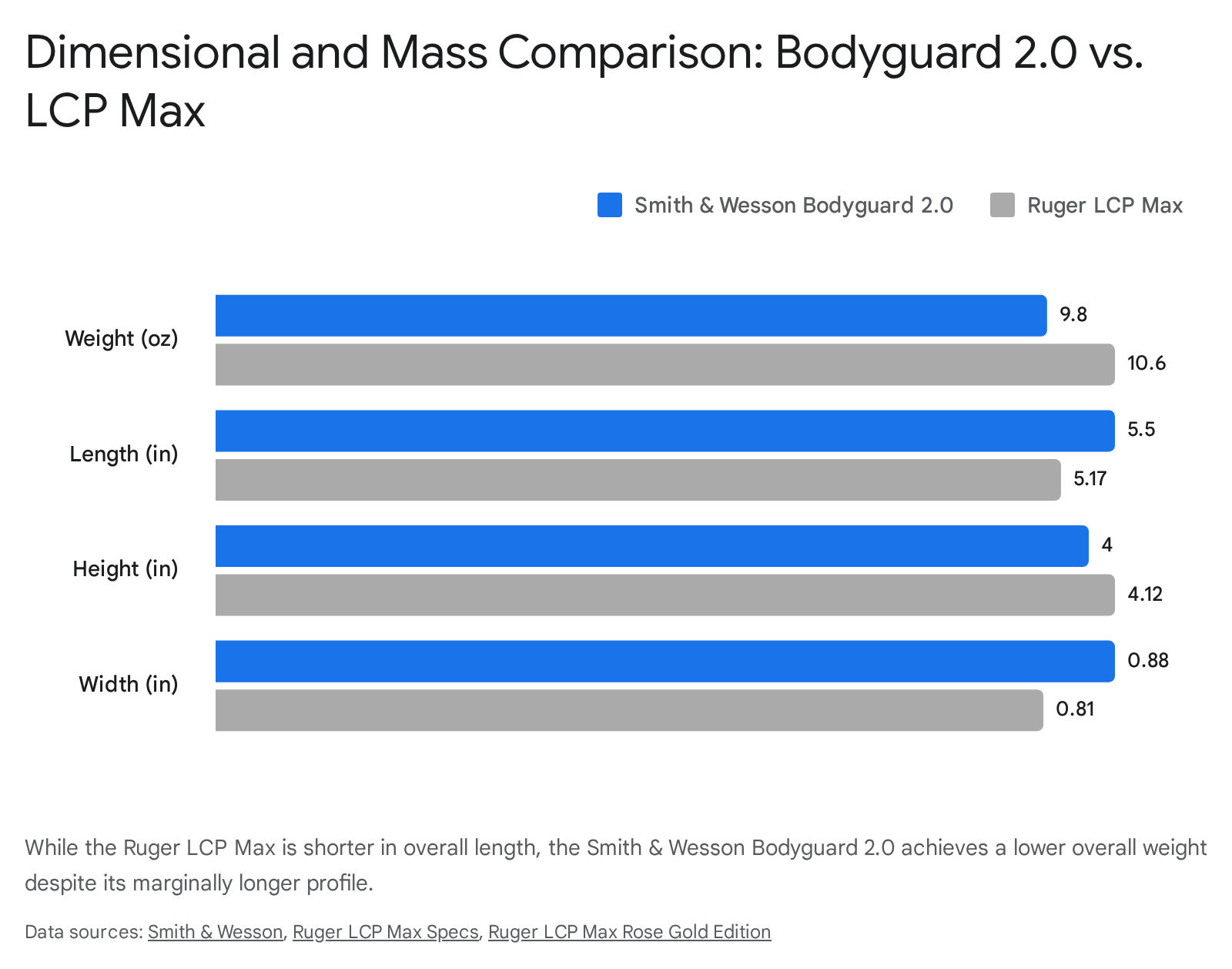
When evaluating firearms designed for pocket or ankle carry, fractions of an inch and single ounces dictate concealability and physical comfort. The Smith & Wesson Bodyguard 2.0 features an overall slide width of exactly 0.88 inches, an overall length of 5.5 inches, and an overall height of 4.0 inches.1 The empty weight of this platform registers at a remarkably low 9.8 ounces.1 This extreme reduction in mass is achieved through a meticulously sculpted polymer frame and a heavily optimized stainless steel slide.
The Ruger LCP Max presents an even narrower slide width of 0.75 inches, though the overall width across the controls measures 0.81 inches.3 The Ruger features a slightly shorter overall length of 5.17 inches and a marginally taller height of 4.12 inches.3 Interestingly, the Ruger LCP Max weighs slightly more than the Bodyguard at 10.6 ounces unloaded.4 This inversion of expectations, where the slightly shorter firearm weighs marginally more, speaks to the different density distributions within the polymer compounds and the specific mass of the internal fire control components utilized by each manufacturer.
The specific variation in mass and spatial geometry translates directly to kinematic behavior during the firing cycle. The lighter mass of the Smith & Wesson Bodyguard 2.0 necessitates incredibly careful recoil spring tuning from the factory to prevent slide velocity from outpacing magazine spring pressure. This is a common physical challenge in ultra-lightweight semiautomatic pistols. The Ruger LCP Max is slightly heavier and shorter. This geometric reality concentrates its center of gravity more directly above the web of the shooter’s hand, subtly altering the subjective perception of muzzle flip during rapid strings of fire.
2.2. Metallurgical Composition and Protective Surface Treatments
The specific metallurgy of the slide and barrel ultimately determines the lifespan and environmental resilience of the pressure-bearing components. Smith & Wesson utilizes a 2.75-inch stainless steel barrel featuring a 1:10-inch twist rate.1 This relatively fast twist rate is mathematically optimized to stabilize the 90-grain to 95-grain projectiles standard to the.380 Automatic Colt Pistol cartridge within an exceptionally short physical distance. Both the barrel and the stainless steel slide are treated with Smith & Wesson’s proprietary Armornite finish.1 Armornite is a highly advanced ferritic nitrocarburizing surface treatment. This chemical process deeply penetrates the molecular structure of the steel, significantly increasing surface hardness, drastically lowering the coefficient of friction, and providing exceptional resistance to ambient corrosion. This is an optimal treatment for firearms intended to be carried tightly against the human body, a scenario where corrosive saline sweat is a constant environmental factor.
Ruger opts for a slightly different metallurgical approach, utilizing an alloy steel barrel measuring 2.80 inches with a 1:16-inch right-hand twist rate and six internal rifling grooves.3 The slide material varies slightly depending on the specific model sub-type. The standard Ruger LCP Max features an alloy steel slide treated with a Black Oxide finish, while other premium variants use Black Nitride, Matte Stainless, or Rose Gold Cerakote finishes applied over stainless or alloy steel base metals.3 Black Nitride is chemically analogous to Armornite and provides excellent protection against the elements. Black Oxide, however, is a traditional chemical conversion coating that offers minimal intrinsic corrosion resistance when compared directly to ferritic nitrocarburizing. Owners of Black Oxide models must maintain a more rigorous and scheduled cleaning protocol to prevent surface oxidation resulting from bodily perspiration and humid atmospheric conditions.
2.3. Kinematic Architecture and Barrel Geometries
Both firearms utilize locked-breech short-recoil operating systems, entirely abandoning the direct blowback mechanisms seen in older.380 caliber pistols. The Ruger LCP Max specifically utilizes a patented barrel cam geometry designed to delay unlocking during the initial milliseconds of the firing cycle.3 By delaying the unlocking of the breech, the internal pressure of the fired cartridge is allowed to drop to a safer, more manageable level before the slide moves fully rearward. Slowing the slide velocity through this specific cam geometry engineered by Ruger ultimately reduces felt recoil compared to aggressively tuned direct blowback pistols.3
Smith & Wesson achieves recoil mitigation primarily through its overall ergonomic profile and mass distribution rather than isolated internal cam adjustments.6 The Bodyguard 2.0 incorporates an exceptionally low bore axis, meaning the central axis of the barrel sits physically lower in the shooter’s hand compared to the Ruger. This physical alignment ensures that the rearward kinetic force of the recoiling slide is directed linearly into the radius bone of the shooter’s forearm. Directing the energy linearly prevents the creation of a rotational torque that would otherwise flip the muzzle upward, resulting in a remarkably flat-shooting experience for such a lightweight tool.
3. Firing Mechanisms and Trigger Dynamics
The defining mechanical distinction between these two modern defensive firearms lies in their respective fire-control systems. This internal architectural choice heavily impacts trigger feel, safety profiles, and overall mechanical complexity.
3.1. The Striker-Fired System: Smith & Wesson Bodyguard 2.0
The Smith & Wesson Bodyguard 2.0 definitively abandons the long, heavy double-action-only hammer system that defined the original generation of the Bodyguard pistol.2 Instead, it adopts a highly refined, modern striker-fired mechanism.2 In a striker-fired system, the firing pin itself is heavily spring-loaded. Racking the slide to chamber a round partially or fully cocks this internal striker mechanism. The rearward press of the trigger then completes the cocking phase and releases the sear, allowing the striker to fly forward and ignite the cartridge primer.
Smith & Wesson implemented a prominent flat-face trigger design on this platform.1 Flat-faced triggers have become highly sought after within the tactical community because they allow the user’s index finger to rest lower on the trigger shoe. This lower placement increases mechanical leverage and effectively reduces the perceived trigger pull weight. Independent evaluations indicate the Bodyguard 2.0 has an exceptionally clean take-up, a clearly defined wall, a crisp break measured at roughly five pounds and ten ounces, and a short, highly tactile reset.2 This specific trigger mechanism is widely considered superior for precision accuracy and rapid follow-up shots when compared to legacy pocket pistol triggers. The Bodyguard 2.0 is offered in distinct models both with and without a manual thumb safety, accommodating different end-user philosophies regarding the necessity of external mechanical safeties.6
3.2. The Internal Hammer System: Ruger LCP Max
The Ruger LCP Max operates on Ruger’s proprietary Secure Action fire-control system.3 Unlike the striker-fired Bodyguard 2.0, the LCP Max utilizes a protected internal hammer. This system relies on a bladed-safety trigger mechanism, wherein a central lever located within the trigger shoe must be intentionally depressed by the firing finger before the trigger itself can move rearward.3 This drop-safety mechanism is standard across modern polymer pistols but is executed here alongside a hammer rather than a striker.
The Secure Action system is engineered to provide a short, smooth pull followed by a clean break and a positive reset.3 However, independent evaluations and widespread consumer feedback frequently note that the trigger on the LCP Max feels notably different from a premium striker-fired system. Evaluators have described the LCP Max trigger as somewhat mushy, lacking the distinct glass-rod crispness found in the Smith & Wesson Bodyguard 2.0.10 The average pull weight is approximately six pounds.10 While fully functional and entirely adequate for close-range defensive engagements, the Ruger’s internal hammer system exhibits a slower reset travel requirement. This demands that the user let the trigger out slightly further between shots compared to the Smith & Wesson.11 Furthermore, most models of the Ruger LCP Max lack a manual thumb safety, relying entirely on the internal drop safeties and the bladed trigger shoe, though highly specific state-compliant models featuring a manual safety do exist for restricted markets like California.12
| Specification Category | Smith & Wesson Bodyguard 2.0 | Ruger LCP Max |
| Operating System | Striker-Fired | Internal Hammer (Secure Action) |
| Standard Capacity | 10+1 or 12+1 Rounds | 10+1 Rounds (12-round available) |
| Barrel Length | 2.75 Inches | 2.80 Inches |
| Overall Weight | 9.8 Ounces | 10.6 Ounces |
| Overall Width | 0.88 Inches | 0.81 Inches |
| Trigger Style | Flat-Faced Polymer | Bladed-Safety Curved Polymer |
| Slide Material | Stainless Steel | Alloy Steel (Standard Model) |
| Slide Finish | Armornite (Nitrocarburizing) | Black Oxide (Standard Model) |
4. Ergonomic Human-Machine Interface
The dedicated study of ergonomics dictates exactly how effectively the human hand interfaces with a mechanical tool under the extreme physical stress of recoil. Managing the recoil of a lightweight.380 Automatic Colt Pistol requires meticulous frame design and intelligent texture mapping.
4.1. Grip Geometry and Polymer Texturing
Smith & Wesson integrated an aggressive polymer frame texturing strategy on the Bodyguard 2.0.13 The texture pattern is sufficiently aggressive to lock deeply into the epidermis of the hand during rapid fire but intentionally avoids being sharp enough to chafe the user’s skin or degrade clothing when carried inside the waistband.13 The highly calculated 18-degree grip angle actively mimics the highly successful ergonomic profile of the larger M&P M2.0 series pistols. This specific angle aligns naturally with the biomechanical structure of the human wrist, forcing the sights to present intuitively upon drawing the weapon.1
The Ruger LCP Max utilizes a black, high-performance, glass-filled nylon frame.4 The grip texture is frequently described by professional evaluators as occupying a Goldilocks zone, perfectly balancing the absolute need for friction with the operational reality of pocket carry where snagging on interior fabric must be avoided.14 The primary ergonomic constraint associated with the Ruger LCP Max is its grip length when utilizing the standard flush-fit ten-round magazine. For individuals with average to large hands, the pinky finger will invariably hang completely off the bottom of the grip frame.10 This specific physical reality reduces mechanical leverage and makes mitigating the snappy recoil profile somewhat more difficult. Ruger directly addresses this by including a finger grip extension floorplate in the box, or users can deploy the slightly longer twelve-round magazine to facilitate a full firing grip.15 The Smith & Wesson Bodyguard 2.0 features a slightly elongated base grip architecture that provides somewhat better baseline purchase without relying entirely on magazine baseplate extensions.16
4.2. Slide Manipulation and Racking Mechanics
Both manufacturers have thoughtfully addressed the historical difficulty of manipulating the slides of small, tightly sprung firearms. Micro-compact pistols require heavy recoil springs to manage slide velocity, which traditionally makes them difficult to physically rack. The Bodyguard 2.0 features an exceptionally aggressive slide design with increased coverage of deep serrations, allowing the user to grip and rack the slide effectively regardless of hand strength or environmental moisture.6
The Ruger LCP Max counteracts slide stiffness by incorporating raised cocking ears at the extreme rear of the slide, along with crisp functional serrations.4 These raised ears provide distinct, highly tactile ledges for the fingers to engage during slide manipulation, a feature that significantly aids individuals with diminished hand strength or arthritis.
5. Optical Alignment and Sight Configurations
The historical standard for pocket pistol sights involved small, unpainted bumps milled directly into the slide steel, rendering them virtually useless under low-light or high-stress conditions. Both the Bodyguard 2.0 and the LCP Max forcefully reject this outdated industry standard, integrating robust, highly visible sighting systems directly from the factory.
5.1. Smith & Wesson Bodyguard 2.0 Sights
The Bodyguard 2.0 comes equipped from the factory with a rapid-acquisition, blacked-out U-notch rear sight combined directly with a bright dot front sight containing a Tritium insert.1 Tritium is a radioactive isotope of hydrogen that produces a continuous radioluminescent glow without requiring prior exposure to an external light source. This specific feature provides critical aiming capabilities in complete darkness. The completely blacked-out rear sight prevents focal distraction, forcing the shooter’s visual attention directly onto the glowing front dot where it mechanically belongs during a defensive encounter. While generally praised for rapid target acquisition, some end-users have criticized the rear sight channel for being exceptionally wide.18 A wide rear notch can introduce lateral aiming errors during slow-fire precision shooting at extended distances, though it undeniably speeds up alignment at close contact ranges.
5.2. Ruger LCP Max Sights
Ruger outfits the LCP Max with a high-quality Tritium front sight featuring a highly visible white outline for daytime contrast, paired with a drift-adjustable rear U-notch sight.4 The rear sight features a perfectly square front face, representing a critical tactical addition that allows the user to rack the slide using only one hand by hooking the rear sight against a rigid belt, rigid holster, or boot heel during a physical emergency.4 A highly unique engineering decision made by Ruger was sizing the sight dovetails to accept aftermarket Bodyguard-pattern sights, creating an interesting cross-compatibility matrix for future upgrades.7 Certain owners have reported issues with the LCP Max shooting exceptionally low or laterally, which is frequently a symptom of factory sight misalignment or the inherent biomechanical difficulty of managing the recoil kinematics of a tiny firearm, which leads directly to anticipatory flinching.19
6. Historical Reliability and Operational Diagnostics
The definitive, non-negotiable metric for any personal defense weapon is mechanical reliability. A firearm that fails to complete the full cycle of operations under extreme stress is a profound liability. By analyzing independent expert evaluations, extensive forum diagnostics, and widespread consumer reports, a distinct reliability profile emerges for each of these micro-compact platforms.
6.1. Bodyguard 2.0 Reliability Profile
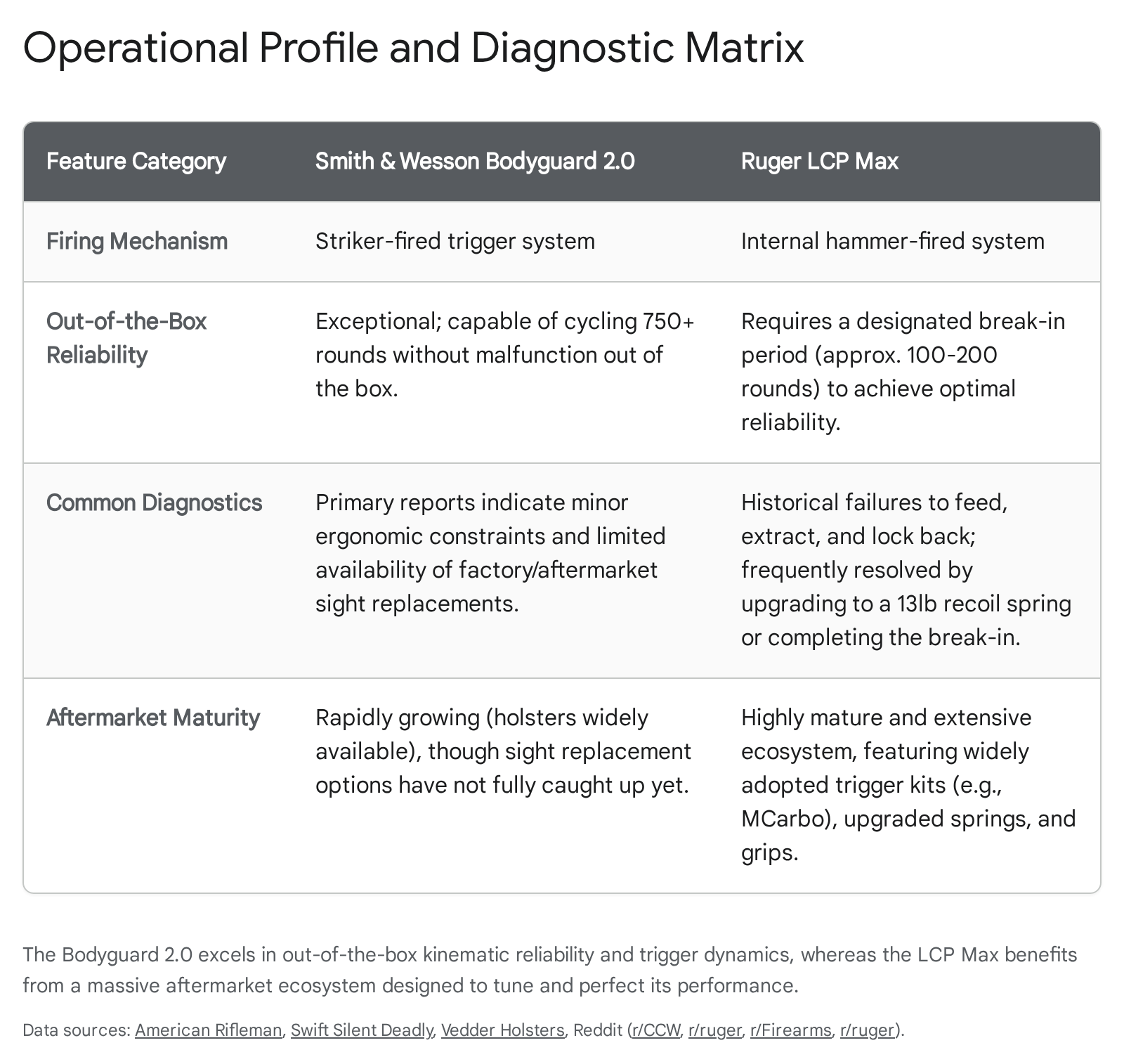
The Smith & Wesson Bodyguard 2.0 has generally demonstrated exceptional out-of-the-box kinematic reliability since its launch. Independent reviewers have thoroughly documented testing cycles exceeding 750 rounds without encountering a single mechanical malfunction.21 The firearm reliably cycles a wide variety of full-metal jacket ball ammunition and complex defensive hollow points. The primary negative feedback surrounding the Bodyguard 2.0 is entirely unrelated to internal cycle failures but points rather directly to magazine spring tension. Consumers widely report that the factory magazines are exceptionally stiff out of the box, making it physically arduous to load the final rounds without the use of a mechanical speed loader.22 There were highly isolated early reports from media demonstration units experiencing light primer strikes due to intermittent firing pin deployment, but subsequent production units have operated flawlessly, strongly suggesting this was a pre-production anomaly rapidly corrected by the manufacturer prior to mass release.13
6.2. Ruger LCP Max Reliability Profile
The historical reliability profile of the Ruger LCP Max is slightly more nuanced and requires deeper analysis. While many individual units run perfectly straight out of the box, a statistically significant portion of the user base reports that the LCP Max requires a strict, dedicated break-in period of 100 to 200 rounds before achieving acceptable defensive reliability.11 During this initial break-in phase, or when dealing with heavily fouled weapons, users frequently document failures to feed and failures to extract.25
A failure to feed occurs specifically when the kinetic energy of the slide moving forward is biologically or mechanically insufficient to strip the top round from the magazine and drive it forcefully up the feed ramp into the chamber. Some knowledgeable users have identified that the specific geometry and surface finish of the factory feed ramp can cause wide-cavity jacketed hollow points to hang up on the steel. Polishing the feed ramp to a mirror-like finish frequently resolves this specific diagnostic failure entirely.20
Furthermore, expert users have diagnosed that the factory recoil spring tension may occasionally be marginal for the dynamic mass of the slide when the weapon is heavily fouled with carbon. To systematically correct failure-to-feed and failure-to-go-into-battery issues, the aftermarket community widely advocates for replacing the factory recoil assembly with a heavier 13-pound aftermarket spring and a solid stainless steel guide rod.20 The installation of a heavier spring provides the necessary forward kinetic energy to reliably chamber difficult ammunition profiles. Additionally, instances of the slide failing to lock back on the last round have been documented, which is typically attributed either to magazine follower geometry constraints or to the user inadvertently resting a high thumb on the slide catch lever during the recoil cycle.20 Ultimately, while the Ruger LCP Max can be tuned to absolute reliability, it inherently may demand more user intervention and diagnostic vetting than the Smith & Wesson Bodyguard 2.0.
7. The Aftermarket Ecosystem and Customization Support
A robust aftermarket ecosystem is utterly vital for the long-term viability of a defensive firearm. Extensive third-party support allows end users to tailor the weapon’s interface, modify the carry profile, and adjust internal mechanics to meet their exact biological requirements and operational needs.
7.1. Deep Ecosystem Support for the Ruger LCP Max
Given that the Ruger LCP Max has been available on the commercial market significantly longer than the Bodyguard 2.0, its aftermarket ecosystem is vastly superior in both depth and breadth.
Regarding internal upgrades, specialized companies like MCarbo manufacture upgraded flat-faced aluminum triggers equipped with adjustable set screws. These trigger modifications allow users to reduce overtravel and reset distances by up to seventy percent, completely transforming the mushy factory feel into a crisp, predictable break.11 Furthermore, companies like Galloway Precision supply the highly recommended 13-pound recoil springs and stainless steel guide rods explicitly required to rectify the feeding maladies discussed in the previous section.20
The holster market for the Ruger is completely saturated with premium options. Premium Kydex inside-the-waistband holsters from vendors like Vedder, dedicated pocket holsters such as the DeSantis Nemesis or Super Fly, and highly specialized driving holsters are widely available across the retail spectrum.26 For optical enhancements, Ruger themselves offer an optics-ready variant bundled with the ReadyDot micro reflex sight, and companies like ArmaLaser and Viridian produce trigger-guard-mounted green and red laser systems designed specifically to match the LCP Max frame geometry flawlessly.28 Magazine loading tools, specifically the UpLULA loaders, are highly recommended to save thumb fatigue during extended range sessions, and various aftermarket baseplates exist to further enhance grip surface area.30
7.2. Rapid Ecosystem Growth for the Bodyguard 2.0
As a substantially newer platform released to the public in 2024, the Smith & Wesson Bodyguard 2.0 is still actively growing its aftermarket support structure. However, commercial adoption has been incredibly rapid due to the manufacturer’s immense overarching market share and brand loyalty.
Industry leaders moved incredibly quickly to support this new release. The innovative PHLster Enigma chassis system fully supports the Bodyguard 2.0, allowing users to achieve deep concealment totally independent of standard belts or rigid waistbands.21 Custom Kydex builders on platforms like Etsy, operating alongside major commercial brands like Alien Gear, DeSantis, and Vedder, already produce highly dedicated inside-the-waistband, ankle, and pocket holsters for the platform.26
Regarding sighting systems, XS Sights manufactures the DXT2 Big Dot night sights specifically milled for the Bodyguard 2.0, providing an immediate upgrade path for shooters who remain dissatisfied with the wide factory U-notch.34 Additionally, Crimson Trace provides a Green LaserGuard system that integrates seamlessly onto the polymer trigger guard.26 Beyond the factory ten and twelve-round stainless steel magazines, aftermarket companies like ProMag have already developed extended thirty-two-round polymer drum magazines, though these high-capacity novelties are typically reserved strictly for recreational shooting rather than serious defensive applications.26
8. Strategic Use Cases and Tactical Deployment Theory
Firearms belonging to this specific geometric class are not intended for offensive tactical operations, extended firefights, or sustained combat scenarios. They are highly specialized tools meticulously designed for extremely specific tactical niches where larger firearms simply cannot operate.
8.1. Deep Concealment and Non-Permissive Environments
The primary strategic deployment scenario for both the Bodyguard 2.0 and the LCP Max is absolute deep concealment. In specialized scenarios where printing through clothing is socially or occupationally unacceptable, traditional micro-9mm pistols are often still too large and dense. The sub-one-inch width and extremely light overall mass of these.380 Automatic Colt Pistol platforms allow them to be carried comfortably in environments requiring tailored clothing, lightweight athletic wear, or formal business attire.14
Pocket carry remains a highly viable and popular protocol for both of these pistols. When utilizing a dedicated, sticky pocket holster, such as the DeSantis Super Fly, the distinct geometric outline of the firearm is completely broken up, making the weapon visually indistinguishable from a standard mobile phone or a thick leather wallet.26 The exceptionally light mass ensures the garment pocket does not drag heavily toward the ground or swing violently during normal pedestrian locomotion. The Smith & Wesson Bodyguard 2.0 is specifically praised by industry evaluators for its absolute suitability in hideout, non-permissive environment carry roles.21
8.2. The Secondary Backup Gun Protocol
In professional law enforcement circles and dedicated civilian defense strategies, the Backup Gun protocol dictates carrying a secondary, deeply hidden firearm to physically augment a primary duty weapon. If the primary weapon experiences a catastrophic mechanical failure, or if the user is engaged in a violent close-quarters physical struggle where the primary weapon cannot be physically drawn from its retention holster, the backup gun is rapidly deployed. Both the Smith & Wesson and the Ruger excel magnificently in this specific role. The Bodyguard 2.0 has been successfully deployed in rigid ankle holster configurations by uniformed professionals, perfectly combining immense utility with imperceptible weight.13 The incredible capacity increase to ten or twelve rounds makes these modern platforms vastly superior to the legacy five-shot J-frame revolvers that historically dominated the backup gun role for decades.
9. Terminal Ballistics and Advanced Ammunition Selection
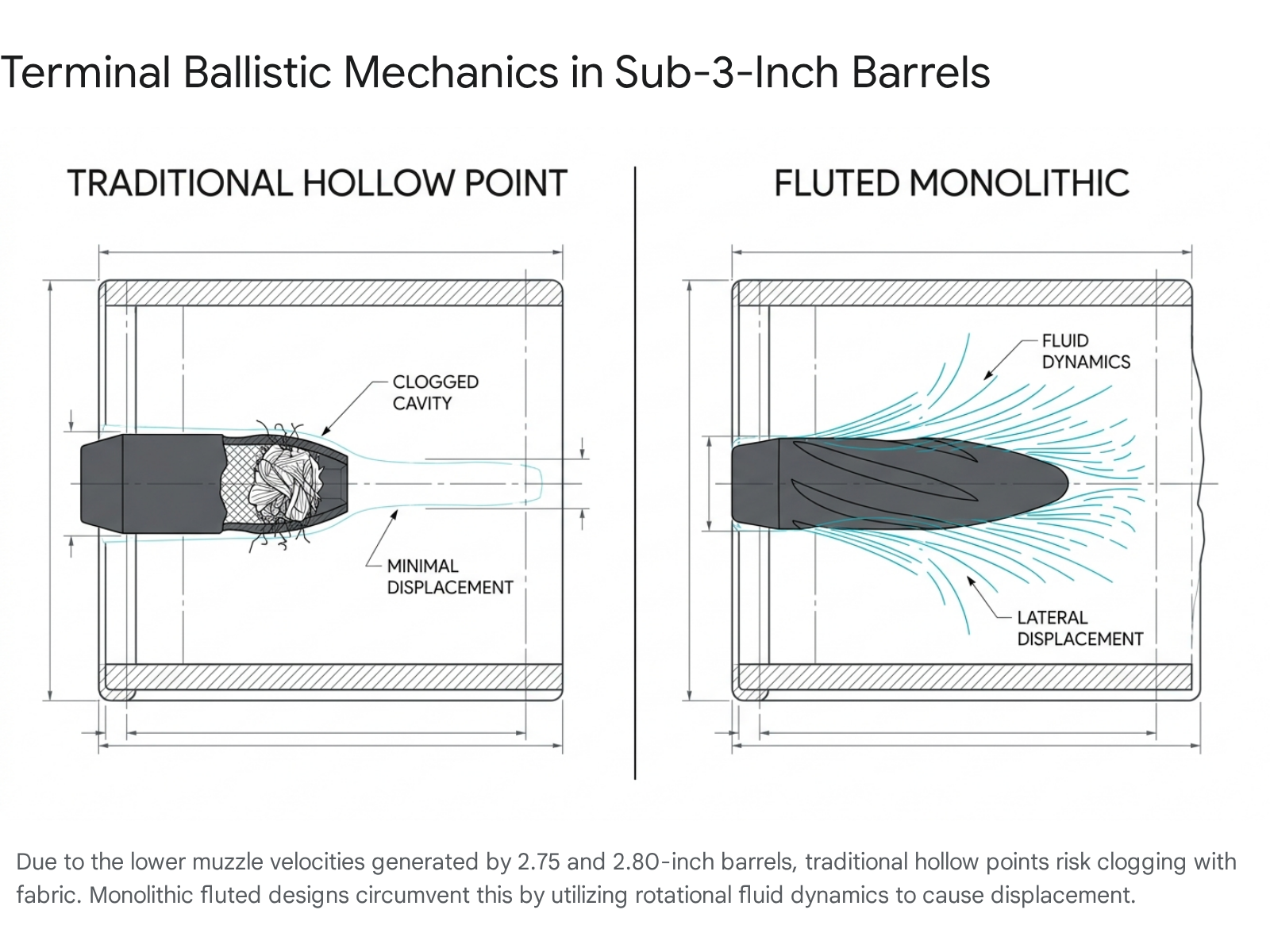
Because the barrels on these specific firearms are extremely short, measuring under three inches, generating sufficient muzzle velocity to guarantee the reliable expansion of traditional jacketed hollow point ammunition is scientifically challenging. Muzzle velocity is the critical catalyst for mechanical expansion. If the velocity drops below a highly specific threshold, the hollow cavity of the bullet simply clogs with denim or cotton clothing barriers. This clogging causes the bullet to act exactly like a non-expanding full metal jacket projectile, resulting in dangerous over-penetration and exceptionally narrow permanent wound cavities that fail to rapidly incapacitate threats.
Consequently, intelligent ammunition selection is utterly vital for these platforms. End-users frequently deploy highly engineered defensive loads designed specifically for micro-barrels to circumvent this physics problem. Precision One XTP ammunition is widely recommended by LCP Max operators for achieving highly reliable feeding and consistent expansion.11 Furthermore, modern monolithic copper projectiles featuring radically fluted designs, such as the Lehigh Defense Xtreme Defender or the Underwood Xtreme Penetrator, completely alter the ballistic paradigm. These advanced projectiles rely purely on fluid dynamics rather than mechanical expansion to create massive wound channels. As the non-expanding fluted bullet spins through soft tissue, it creates a high-pressure radial wave, violently displacing tissue outward. These specific fluted rounds are highly effective in the Bodyguard 2.0 and the LCP Max, entirely negating the velocity dependency inherent to traditional hollow points while simultaneously guaranteeing deep, reliable penetration that meets stringent federal ballistic protocols.36
| Note, the copper fluted monoliths have varying reliability in the BodyGuard 2.0 due to the split ramp design so research before you buy. We have a report on this topic that will publish on April 25th at 12 noon US Eastern – click here to read it after that time. |
10. Market Pricing, Vendor Availability, and Sourcing Strategies
Market pricing for micro-compact firearms fluctuates consistently based on seasonal retail demand, manufacturer production runs, and vendor inventory constraints. The pricing data detailed below explicitly reflects the average and minimum observed costs across preferred retail channels, allowing potential buyers to identify optimal acquisition points based on current market dynamics.
10.1. Smith & Wesson Bodyguard 2.0 Pricing Ecosystem
The manufacturer’s suggested retail price for the base Smith & Wesson Bodyguard 2.0, available with or without the manual thumb safety, is definitively set at $449.00.1 The specialized Performance Center Carry Comp model carries a predictably higher suggested retail price of $549.00.39
The average online retail price currently stabilizes near the $399.00 mark, representing significant financial savings over the factory suggested pricing. The following preferred vendors currently inventory the standard Bodyguard 2.0 model at highly competitive pricing falling perfectly within the average market bracket:
- (https://www.brownells.com/guns/handguns/semi-auto-handguns/mp-bodyguard-2.0-380-acp-semi-auto-handgun/) offers the unit at the highly standard market rate of $399.00.40
- (https://www.midwayusa.com/product/1027462969) currently inventories the No Thumb Safety variant at $399.00.41
- Primary Arms lists the manual safety model consistently at $399.00.42
- (https://www.kygunco.com/product/smith-wesson-bodyguard-2.0-380-acp-2.75-10-12rd-pistol-w-manual-safety-black) provides identical pricing set at $399.00 alongside competitive fulfillment options.37
- (https://www.sportsmans.com/shooting-gear-gun-supplies/handguns/smith-wesson-bodyguard-20-380-auto-acp-275in-black-armonite-pistol-121-rounds/p/1891543) matches the $399.99 price point exactly, frequently offering valuable in-store pickup logistical advantages.45
Further granular details regarding highly specialized models and state-compliant units can be systematically validated directly through the(https://www.smith-wesson.com/products/bodyguard-2) manufacturer portal.
10.2. Ruger LCP Max Pricing Ecosystem
The manufacturer’s suggested retail price for the base standard Ruger LCP Max is officially positioned at $379.00.4 The specialized California compliant version lists slightly lower at $359.00, while premium optic-ready variants reach upward to $449.00.7
Because the Ruger platform has thoroughly saturated the commercial market over several consecutive years of high-volume production, the true street price frequently falls dramatically below the manufacturer’s suggestion. Prices range aggressively from an observed minimum of $219.00 up to $367.00 depending heavily on seasonal sales events and immediate vendor stock levels.
- (https://palmettostatearmory.com/ruger-lcp-max-75th-anniversary-380-acp-2-80-10rd-pistol.html) frequently provides the absolute lowest minimum observed pricing, occasionally listing base or anniversary models down to an incredible $219.99 during massive inventory clearance events.46
- (https://www.kygunco.com/product/ruger-lcp-max-380-auto-2.8-10rd-w-slide-cutout-manual-safety-black) offers deeply aggressive pricing structures, with observed sales reducing the final consumer cost to $278.06.48
- (https://www.sportsmans.com/shooting-gear-gun-supplies/handguns/ruger-lcp-max-380-auto-acp-28in-matte-stainless-pistol-101-rounds/p/1923603) lists standard and stainless variants dependably around the $279.99 mark.49
- (https://shootingsurplus.com/ruger-lcp-max-380acp-2-8in-barrel-10rd-silver-slide-black-13744/) serves the middle-market average accurately, stocking models at $329.99.50
- (https://www.brownells.com/guns/handguns/semi-auto-handguns/lcp-max-380-acp-semi-auto-handgun/?sku=100042874) rounds out the upper average pricing tier at $367.99, catering primarily to buyers leveraging specific site-wide discount codes or requiring highly accelerated shipping logistics.51
Detailed specifications on every variant finish and highly regulated state-compliant models can be comprehensively reviewed at the(https://ruger.com/products/lcpMax/models.html) manufacturer database.
11. Final Nuanced Conclusions and Strategic Recommendations
The micro-compact.380 Automatic Colt Pistol market constantly demands an inherent, unavoidable compromise between kinetic stability and physical footprint. The comprehensive evaluation of the Smith & Wesson Bodyguard 2.0 and the Ruger LCP Max reveals two highly capable platforms that approach this fundamental physical compromise through markedly different engineering philosophies.
The Smith & Wesson Bodyguard 2.0 undeniably represents the absolute vanguard of modern ergonomic theory scaled down to a microscopic footprint. The highly intelligent implementation of the 18-degree grip angle, combined dynamically with aggressive slide serrations and a remarkably crisp striker-fired flat-face trigger, yields a specialized firearm that behaves kinematically like a much larger duty pistol. Its out-of-the-box reliability profile is genuinely stellar, capable of cycling thousands of rounds without the absolute necessity of aftermarket spring interventions. The primary drawbacks observed are the extremely high spring tension found in the factory magazines and a rear sight notch that some precision shooters find too expansive for accurate marksmanship at extended ranges. The Bodyguard 2.0 stands as the superior choice for operators who prioritize immediate flawless factory performance, modern striker-fired trigger dynamics, and optimal ergonomic leverage without possessing any desire to modify internal mechanical components.
Conversely, the Ruger LCP Max relies heavily on its well-earned legacy as the true progenitor of the modern high-capacity pocket pistol. It remains incredibly diminutive, slightly lighter, and notably shorter in overall length, making it the apex choice for absolute deep concealment in highly restrictive occupational environments. The Secure Action internal hammer system is entirely functional, though it undeniably lacks the refined, crisp break of the Bodyguard’s striker system. The primary consideration for the prospective LCP Max buyer is its historical reliability curve. A statistically significant number of these specific firearms absolutely require a dedicated break-in period, manual polishing of internal feed ramps, and the mandatory installation of aftermarket 13-pound recoil springs to run difficult hollow-point ammunition flawlessly. However, the LCP Max boasts a mature, incredibly immense aftermarket ecosystem. For the specific user who genuinely enjoys tuning, modifying, and completely customizing their platform, the LCP Max provides an excellent blank canvas with endless aftermarket support that the newer Bodyguard 2.0 simply cannot yet match. Furthermore, the highly aggressive street pricing of the LCP Max makes it an exceptional value proposition for those building a capable defense system on a highly stringent financial budget.
Ultimately, both platforms succeed magnificently in their primary operational mission. They have effectively eradicated the dark era of the six-round pocket pistol, successfully providing defense professionals and armed civilians with ten to thirteen rounds of critical life-saving capability in form factors that disappear entirely into modern daily life.
Note: Vendor Sources listed are not an endorsement of any given vendor. It is our software reporting a product page given the direction to list products that are between the minimum and average sales price when last scanned.
Please share the link on Facebook, Forums, with colleagues, etc. Your support is much appreciated and if you have any feedback, please email us in**@*********ps.com. If you’d like to request a report or order a reprint, please click here for the corresponding page to open in new tab.
Sources Used
- S&W® BODYGUARD® 2.0 TS | Smith & Wesson, accessed April 16, 2026, https://www.smith-wesson.com/product/sw-bodyguard-2-ts
- Rifleman Review: Smith & Wesson Bodyguard 2.0 – YouTube, accessed April 16, 2026, https://www.youtube.com/watch?v=8SvHNq_O14Q
- Ruger® LCP® MAX Centerfire Pistol Model 13719, accessed April 16, 2026, https://ruger.com/products/lcpMax/specSheets/13719.html
- Ruger® LCP® MAX Centerfire Pistol Model 13753, accessed April 16, 2026, https://ruger.com/products/lcpMax/specSheets/13753.html
- LCP Max – Ruger, accessed April 16, 2026, https://ruger.com/products/lcpMax/models.html
- S&W® BODYGUARD® 2.0 NTS | Smith & Wesson, accessed April 16, 2026, https://www.smith-wesson.com/product/sw-bodyguard-2-nts
- Ruger® LCP® MAX Centerfire Pistol Model 13758, accessed April 16, 2026, https://www.ruger.com/products/lcpMax/specSheets/13758.html
- S&W® BODYGUARD®38 2.0 | Smith & Wesson, accessed April 16, 2026, https://www.smith-wesson.com/product/sw-bodyguard-38-2
- S&W® BODYGUARD® 2.0 NO THUMB SAFETY OD GREEN/BLACK | Smith & Wesson, accessed April 16, 2026, https://www.smith-wesson.com/product/s-w-bodyguard-2-0-no-thumb-safety-od-green-black
- Ruger LCP Max Review: 3 Years Of Carry – Don’s Weaponry, Inc, accessed April 16, 2026, https://donsweaponry.com/ruger-lcp-max-review-3-years-of-carry/
- Ruger lcp max reliability : r/Firearms – Reddit, accessed April 16, 2026, https://www.reddit.com/r/Firearms/comments/1asbexp/ruger_lcp_max_reliability/
- Ruger® LCP® MAX Centerfire Pistol Model 13754, accessed April 16, 2026, https://ruger.com/products/lcpMax/specSheets/13754.html
- PPT Review: Smith & Wesson Bodyguard 2.0 – Pew Pew Tactical, accessed April 16, 2026, https://www.pewpewtactical.com/smith-wesson-bodyguard-2-0-review/
- Ruger LCP Max Review: 3 Years of Carry, accessed April 16, 2026, https://www.pewpewtactical.com/ruger-lcp-max-review/
- Ruger® LCP® MAX Centerfire Pistol Model 13758, accessed April 16, 2026, https://ruger.com/products/lcpMax/specSheets/13758.html
- Ruger LCP Max vs Bodyguard 2.0: Which is the Mightier Pocket Pistol? – Vedder Holsters, accessed April 16, 2026, https://www.vedderholsters.com/blog/ruger-lcp-max-vs-bodyguard-2-0/
- RUGER LCP Max 380 ACP 2.8in 10rd Stainless/Black Semi-Auto Pistol (13753), accessed April 16, 2026, https://gritrsports.com/ruger-lcp-max-380-acp-10rd-semi-auto-pistol-13753
- Love the bodyguard 2.0, hate the wide rear sight : r/SmithAndWesson – Reddit, accessed April 16, 2026, https://www.reddit.com/r/SmithAndWesson/comments/1io53yi/love_the_bodyguard_20_hate_the_wide_rear_sight/
- Ruger LCP Max – Accuracy Issues : r/CCW – Reddit, accessed April 16, 2026, https://www.reddit.com/r/CCW/comments/1n3nchz/ruger_lcp_max_accuracy_issues/
- LCP Max failures diagnosis : r/ruger – Reddit, accessed April 16, 2026, https://www.reddit.com/r/ruger/comments/1q17cy9/lcp_max_failures_diagnosis/
- S&W Bodyguard 2.0 Review: A Bit of a Disappointment – Swift | Silent | Deadly, accessed April 16, 2026, https://www.swiftsilentdeadly.com/blog/sw-bodyguard-2-0-review-bit-of-a-disappointment
- Disappointed with the bodyguard 2.0 ? : r/SmithAndWesson – Reddit, accessed April 16, 2026, https://www.reddit.com/r/SmithAndWesson/comments/1n9el5c/disappointed_with_the_bodyguard_20/
- S&W Bodyguard 2.0 Reviews? : r/CCW – Reddit, accessed April 16, 2026, https://www.reddit.com/r/CCW/comments/1l4wkic/sw_bodyguard_20_reviews/
- The LCP Max is quite possibly the most comfortable gun I’ve carried. : r/CCW – Reddit, accessed April 16, 2026, https://www.reddit.com/r/CCW/comments/123nrqs/the_lcp_max_is_quite_possibly_the_most/
- LCP Max reliability issues : r/ruger – Reddit, accessed April 16, 2026, https://www.reddit.com/r/ruger/comments/10es8hk/lcp_max_reliability_issues/
- S&W Bodyguard .380 Parts & Accessories – Cheaper Than Dirt, accessed April 16, 2026, https://www.cheaperthandirt.com/parts-and-accessories/parts-by-gun-model/smith-and-wesson/bodyguard-380
- Ruger Lcp Accessories – Etsy, accessed April 16, 2026, https://www.etsy.com/market/ruger_lcp_accessories
- Ruger LCP Parts & Accessories – Cheaper Than Dirt, accessed April 16, 2026, https://www.cheaperthandirt.com/parts-and-accessories/parts-by-gun-model/ruger/lcp
- Ruger LCP MAX with Extended Mag, Grip Sleeve, Holster and Laser Tabletop Review – Episode #202516 – YouTube, accessed April 16, 2026, https://www.youtube.com/watch?v=kXO0HBCiq0c
- Best Ruger LCP Accessories for Concealed Carry – Alien Gear Holsters, accessed April 16, 2026, https://aliengearholsters.com/blogs/news/best-ruger-lcp-accessories
- Holsters for Bodyguard 2.0 – Etsy, accessed April 16, 2026, https://www.etsy.com/market/holsters_for_bodyguard_2.0
- Bodyguard 2.0 Accessories: Essential Upgrades for Your .380 Micro-Compact, accessed April 16, 2026, https://aliengearholsters.com/blogs/news/bodyguard-2-0-accessories
- Smith & Wesson Performance Center Bodyguard 2.0 380 ACP TS Accessory Compatibility & Recommendation Guide | DLD VIP, accessed April 16, 2026, https://dld-vip.com/guides/accessorysmith-wesson-performance-center-bodyguard-20-380-acp-ts/
- DXT2 Big Dot Night Sights – Ruger, accessed April 16, 2026, https://xssights.com/products/dxt2-big-dot-night-sights-ruger.html
- Review: NEW XS Sights for S&W Bodyguard 2.0 – YouTube, accessed April 16, 2026, https://www.youtube.com/watch?v=RYTBs7sE1Bg
- Ruger LCP Max.. What NO ONE is telling you! – YouTube, accessed April 16, 2026, https://www.youtube.com/watch?v=gJpL1TMxBu4
- SMITH & WESSON Bodyguard 2.0 380 ACP 2.75″ 10/12rd Pistol w/ Manual Safety – Black, accessed April 16, 2026, https://www.kygunco.com/product/smith-wesson-bodyguard-2.0-380-acp-2.75-10-12rd-pistol-w-manual-safety-black
- Ruger LCP Max 75th Anniversary 380 ACP Pistol 2.8 Barrel 10+1 Round – MidwayUSA, accessed April 16, 2026, https://www.midwayusa.com/product/1027085342
- PERFORMANCE CENTER® S&W® BODYGUARD® 2.0 CARRY COMP® NO THUMB SAFETY – Smith & Wesson, accessed April 16, 2026, https://www.smith-wesson.com/product/performance-center-s-w-bodyguard-2-0-carry-comp-no-thumb-safety
- SMITH & WESSON BODYGUARD 2.0 380 ACP SEMI-AUTO HANDGUN – Brownells, accessed April 16, 2026, https://www.brownells.com/guns/handguns/semi-auto-handguns/mp-bodyguard-2.0-380-acp-semi-auto-handgun/
- Smith & Wesson Bodyguard 2.0 NTS 380 ACP Pistol 2.75 Barrel 12+1 Round – MidwayUSA, accessed April 16, 2026, https://www.midwayusa.com/product/1027462969
- Smith & Wesson Bodyguard 2.0 .380 ACP Pistol with Thumb Safety – Primary Arms, accessed April 16, 2026, https://www.primaryarms.com/smith-wesson-bodyguard-2.0-380acp-121-ts-sm13926
- Marketing Categories: all-handguns, State Specific Products: false | Page 11 – Primary Arms, accessed April 16, 2026, https://www.primaryarms.com/marketing-categories/all-handguns/state-specific-products/false?page=11
- Smith & Wesson Bodyguard 2.0 380 ACP | Handguns – kygunco, accessed April 16, 2026, https://www.kygunco.com/group/smith-wesson-bodyguard-2-0-pistol
- Smith & Wesson Bodyguard 2.0 380 Auto (ACP) 2.75in Black Armonite Pistol – 12+1 Rounds, accessed April 16, 2026, https://www.sportsmans.com/shooting-gear-gun-supplies/handguns/smith-wesson-bodyguard-20-380-auto-acp-275in-black-armonite-pistol-121-rounds/p/1891543
- [Handgun] Ruger LCP Max, 10 round .380, Black&Stainless, $200, Palmetto State – Reddit, accessed April 16, 2026, https://www.reddit.com/r/gundeals/comments/1p9da4u/handgun_ruger_lcp_max_10_round_380_blackstainless/
- Ruger LCP MAX 75th Anniversary .380 ACP 2.80″ 10rd Pistol | Palmetto State Armory, accessed April 16, 2026, https://palmettostatearmory.com/ruger-lcp-max-75th-anniversary-380-acp-2-80-10rd-pistol.html
- RUGER LCP MAX 380 AUTO 2.8″ 10RD w/ Slide Cutout & Manual Safety – Black – kygunco, accessed April 16, 2026, https://www.kygunco.com/product/ruger-lcp-max-380-auto-2.8-10rd-w-slide-cutout-manual-safety-black
- Ruger LCP MAX 380 Auto (ACP) 2.8in Matte Stainless Pistol – 10+1 Rounds, accessed April 16, 2026, https://www.sportsmans.com/shooting-gear-gun-supplies/handguns/ruger-lcp-max-380-auto-acp-28in-matte-stainless-pistol-101-rounds/p/1923603
- Ruger LCP Max 380 ACP 2.8 inch Barrel 10 Rounds Silver Slide – Shooting Surplus, accessed April 16, 2026, https://shootingsurplus.com/ruger-lcp-max-380acp-2-8in-barrel-10rd-silver-slide-black-13744/
- RUGER LCP MAX 380 ACP 2.8″ BBL (1)10RD Mag Black SKU: 100042874 – Brownells, accessed April 16, 2026, https://www.brownells.com/guns/handguns/semi-auto-handguns/lcp-max-380-acp-semi-auto-handgun/?sku=100042874