
1. Executive Summary
The capability of the United States military to deter and defeat peer adversaries is fundamentally linked to the lethality, range, and reliability of its kinetic systems. Underpinning this operational capability is the defense energetics industrial base, a highly specialized sector responsible for the chemical formulations—explosives, propellants, and pyrotechnics—that provide munitions with their thrust and destructive power. For decades, the prominent role of energetic materials has been undervalued within the broader defense acquisition ecosystem. Treated largely as commoditized components rather than critical technological discriminators, the domestic production capability for these materials has severely atrophied. Consequently, the United States faces acute structural vulnerabilities across its commercial Defense Munitions Industrial Base (DMIB) and its government-owned Organic Industrial Base (OIB).
The National Energetics Plan, officially released in May 2023 by the Office of the Under Secretary of Defense for Research and Engineering (OUSD(R&E)), represents a comprehensive, systemic effort to correct this downward trajectory.1 The plan details the specific strategic and material actions required to maintain technical superiority, efficiently transition advanced energetics into operational use, and sustain a robust industrial base capable of meeting wartime surge requirements.1 The present strategic environment, characterized by protracted, high-intensity conventional operations in Eastern Europe and the pacing threat of the People’s Republic of China (PRC) in the Indo-Pacific, has exposed the brittle nature of the United States’ supply chains. This reality has highlighted a dangerous dependency on foreign-sourced critical chemicals and a domestic manufacturing infrastructure that has been heavily degraded by decades of under-investment and market consolidation.2
This report evaluates the operational framework of the National Energetics Plan, assessing its core components, the structural risks inherent in the current acquisition environment, and the probability that the plan’s strategic objectives will be met. Furthermore, it outlines the necessary statutory, cultural, and financial actions required to secure the domestic supply chain. Recent defense initiatives, such as the public-private Munitions Campus infrastructure model and the establishment of the Wartime Production Unit (WPU), indicate a significant paradigm shift toward rapid capability expansion.4 However, deeply entrenched bureaucratic inertia, programmatic risk aversion within acquisition offices, and inconsistent funding profiles threaten to impede the transition of next-generation high-performance materials, such as CL-20, into the active military stockpile.6 Ultimately, achieving the objectives of the National Energetics Plan will depend not merely on discrete capital injections, but on a holistic, sustained realignment of the entire defense capability development and acquisition ecosystem.
2. Origin and Strategic Mandate of the National Energetics Plan
The National Energetics Plan emerged from a growing consensus within the defense, intelligence, and legislative communities that the United States was falling precipitously behind peer competitors in the basic research, development, and fielding of high-performance energetic materials.1 Mandated by prior defense authorization cycles, the plan was systematically formulated through the collaborative analytical efforts of seven senior executive-led working groups.1
The Lifecycle Analytical Framework
These interagency working groups integrated representatives from across the military services, the Missile Defense Agency (MDA), the National Institute of Standards and Technology (NIST), the Department of Energy’s National Nuclear Security Administration (DOE-NNSA), and the National Aeronautics and Space Administration (NASA).1 To ensure a comprehensive assessment, the analytical methodology of the plan was organized strictly around the chronological lifecycle of weapon systems. By dividing the problem set into distinct phases—from early-stage basic research occurring in Science and Technology (S&T) Budget Activities 1, 2, and 3, through to full-scale production, operational deployment, and eventual demilitarization—the working groups were able to identify distinct friction points that have historically stranded promising chemical formulations.1
Historically, defense planning has compartmentalized energetics development across the individual military services and various defense agencies. This siloed approach has resulted in duplicative research efforts, inefficient capital allocation, and an inability to present a unified, sustained demand signal to the commercial chemical industry.7 The plan specifically notes that over the last several decades, energetic materials have been taken for granted, minimized in their innovation, and treated as legacy commodities.2
The Call for a Strategic Responsible Authority
To resolve these systemic operational inefficiencies and coordinate a whole-of-government response, a central recommendation of the National Energetics Plan is the establishment of a strategic energetics responsible authority.1 This proposed governing body is intended to conduct continuous oversight, provide top-down strategic direction, and support the overarching development of the Department of Defense’s energetics competency.1 Without a singular, accountable entity driving the transition of advanced chemistry from the laboratory to the production line, the plan argues that the United States will remain trapped in a cycle of iterative, marginal improvements to legacy World War II-era formulations, rather than achieving the disruptive leaps in capability necessary for future combat operations.
3. Structural Vulnerabilities: The Valley of Death and Acquisition Friction
A core finding of the National Energetics Plan is that the failure to field new capabilities is rarely a failure of American scientific ingenuity; rather, it is a failure of the defense acquisition architecture. The transition of novel energetics from the laboratory into active Programs of Record (PoR) is fraught with structural hurdles, commonly referred to in defense acquisition as the “valley of death.”
Misaligned Timelines and Coordination
A persistent, structural disconnect exists between the Science and Technology communities developing novel energetics and the acquisition Program Offices responsible for fielding operational systems. The National Energetics Plan identifies that there is insufficient coordination and misaligned timelines between these two communities, which severely stifles the transition of advanced energetics into operational use.1 The S&T community often operates on long-term discovery timelines, while Program Offices are constrained by rigid fielding schedules and immediate operational requirements. Consequently, when a new energetic material reaches a baseline level of technological maturity, there is rarely a corresponding acquisition program ready or willing to absorb it into its design baseline.
Unfunded Qualification Burdens
The regulatory, safety, and environmental qualification processes for energetic systems are uniquely rigorous compared to other defense components. Unlike software or solid-state electronics, energetic materials are inherently volatile chemical compounds designed to detonate or combust. The costs associated with certifying a new energetic material for operational use—ensuring it meets Insensitive Munitions (IM) standards, environmental regulations, and long-term storage stability requirements—are immense.1 The National Energetics Plan highlights that these qualification costs are frequently not accounted for in initial Research and Development budgets, nor are they absorbed by the procurement budgets of acquisition programs.1 This creates a funding vacuum, effectively disincentivizing both government researchers and commercial industry from attempting to operationalize novel materials.
Antiquated Test and Evaluation (T&E) Infrastructure
Compounding the qualification burden is the state of the physical testing infrastructure. Existing Test and Evaluation standards, methodologies, and physical infrastructure are deeply antiquated.1 Current ranges and instrumentation are optimized for legacy materials and are often inadequate for accurately characterizing the advanced blast effects, extended range potentials, and specific target lethality mechanisms of next-generation energetics.1 As experts from the Energetics Technology Center (ETC) point out, testing these compounds is expensive, time-consuming, and outdated; the inability to adequately test new materials acts as a hard physical barrier to moving technology from one readiness level to the next.8
The Cultural Impediment: Programmatic Risk Aversion
Beyond physical infrastructure and funding lines, the National Energetics Plan and corollary assessments identify a profound cultural barrier to modernization. Program Managers (PMs) and Program Executive Officers (PEOs) operate under strict cost, schedule, and performance parameters mandated by Congress and the Department of Defense. The integration of a novel energetic material into a major weapon system introduces significant technical and programmatic risk. Consequently, acquisition professionals are often unwilling to jeopardize their program’s success on transformative but unproven chemical capabilities, preferring instead to iterate on highly predictable legacy formulations.2 This institutional risk aversion creates a self-reinforcing cycle of technological stagnation that is highly resistant to top-down policy directives.
4. Market Consolidation and DMIB Fragility
The commercial Defense Munitions Industrial Base (DMIB) and the government-owned Organic Industrial Base (OIB) are currently characterized by systemic fragility, lacking the necessary elasticity to respond to the wartime surge requirements expected in a near-peer conflict.2 A comprehensive assessment by the Army Science Board revealed that the true state of the munitions industrial base has been obscured for decades by faulty planning assumptions and a prioritization of peacetime economic efficiency over strategic resilience.2
The Erosion of the Industrial Base
Reviving the defense industrial base requires confronting the reality that the United States’ overall industrial capacity has grown at a slower rate than the broader economy, with manufacturing accounting for just 10 percent of GDP in 2024, down from 16 percent in 1997.9 A considerable share of this industrial decline has been concentrated in the defense sector, which saw defense-related employment fall by 2.1 million between 1985 and 2021.9 Decades of under-investment have left the industrial base strained, overly consolidated, and at high risk of failing to keep pace with modern threats in a protracted conflict.9
Market Consolidation and Single Points of Failure
The defense energetics sector, in particular, is a highly consolidated and brittle market. Over the past three decades, more than 50 major mergers and acquisitions have reduced the number of prime contractors operating within the DMIB to just five primary entities.2 This hyper-consolidation at the prime contractor level has cascaded down the lower tiers of the supply chain, squeezing out mid-sized chemical manufacturers and specialized component vendors.
The result is a supply chain riddled with critical bottlenecks. The Army Science Board estimates that there are over one hundred single points of failure throughout the munitions supply chain.2 When a single commercial vendor represents the entirety of the domestic production capacity for a specific precursor chemical, any disruption—whether due to natural disaster, financial insolvency, regulatory shutdowns, or targeted adversarial cyber-attacks—can immediately halt the production of multiple critical weapon systems across all branches of the military.
To systematically understand and map these vulnerabilities, the Department of Defense relies heavily on the Critical Energetic Materials Working Group (CEMWG).10 The CEMWG continuously monitors the supply chain to identify the most critical chemicals required for kinetic production, using this prioritized intelligence to inform fiscal year funding, direct Defense Production Act (DPA) Title III investments, and guide strategic stockpiling decisions.10
5. Supply Chain Fragility and Foreign Dependency
A paramount vulnerability explicitly identified by the National Energetics Plan, the Army Science Board, and subsequent defense audits is the heavy reliance on foreign sources—primarily the People’s Republic of China—for critical energetic precursors and strategic minerals.2
The geopolitical implications of this reliance are severe and immediate. Upstream chemical chokepoints allow hostile or competitive actors the theoretical capacity to control, restrict, or entirely embargo chemical precursors, thereby severely restricting the United States’ ability to manufacture finished munitions during a crisis scenario.12 This vulnerability is compounded by the Defense Department’s historical reluctance to stockpile precursor materials, relying instead on “just-in-time” commercial logistics models that are highly efficient in peacetime but fail catastrophically under the stress of wartime consumption rates.2
Recent exogenous variables—most notably the heavy expenditure of munitions in Ukraine and the accelerating military modernization of the PRC—have forced legislators and defense planners to recognize that supply chain resilience is a core component of deterrence.3
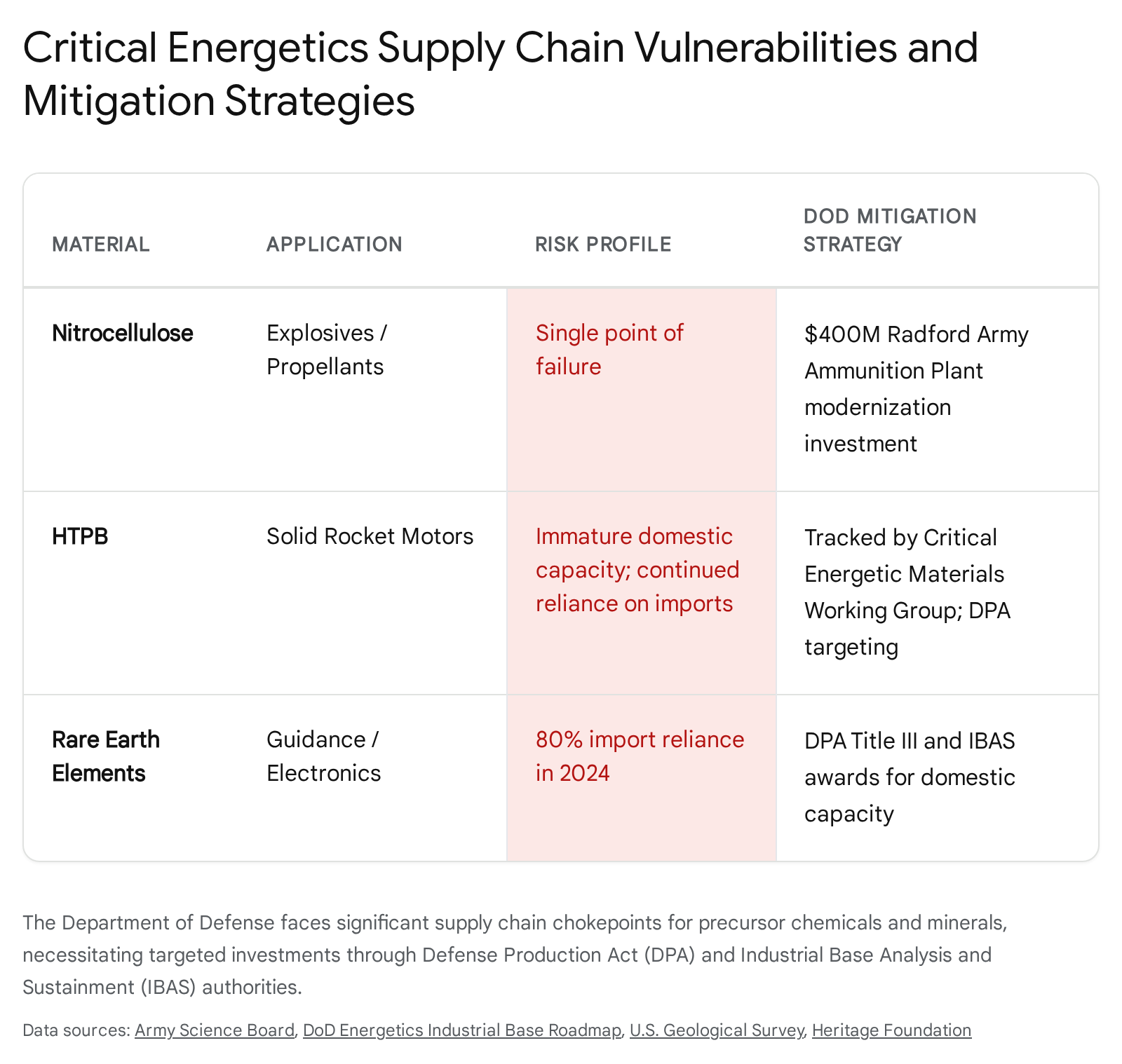
To counter these vulnerabilities, the Department of Defense is deploying substantial capital to stand up domestic manufacturing for a wide array of specialized precursor chemicals identified by the CEMWG and the broader Energetic Materials Technology Working Group (EMTWG).13
The table below outlines a selection of critical chemicals and recent Department of Defense funding awards intended to reshore their production capabilities, reflecting a $192.5 million initiative to establish domestic manufacturing 13:
| Manufacturer / Entity | Critical Chemicals / Materials Funded | Award Value | Award Date |
| Lacamas Laboratories | 4-Nitroanisole, Diphenylamine (DPA), Ethyl Centralite, Methyl Centralite, Salicylic Acid, Sebacic Acid, Trichlorobenzene | $86.0 Million | December 2023 |
| CoorsTek Inc. | Boron Carbide | $49.6 Million | December 2023 |
| GOEX / Estes Energetics | Barium Nitrate, Potassium Chlorate, Potassium Nitrate, Potassium Perchlorate, Potassium Sulfate, Strontium Nitrate, Strontium Oxalate, Strontium Peroxide | $13.0 Million | September 2023 |
These targeted investments signify a departure from passive market reliance. By directly subsidizing the capital expenditures required to build chemical manufacturing plants, the government is attempting to rapidly reconstruct the foundational layers of the energetics supply chain that were outsourced over the previous three decades.
6. The Competitive Disadvantage: CL-20 and the Shifting Balance of Power
The consequences of structural vulnerabilities, unfunded testing mandates, and cultural risk aversion are most starkly evident in the United States’ failure to transition advanced high-explosives into the operational stockpile. While the United States has prioritized safety, stability, and cost reduction over pure lethality since the dissolution of the Soviet Union, peer adversaries have aggressively pursued basic research in high-performance energetics.6
The Trajectory of CL-20
The energetic material hexanitrohexaazaisowurtzitane, universally referred to within the industry as CL-20, serves as the primary case study for this technological lag. Developed in 1987 at the United States Navy’s China Lake research and engineering facility, CL-20 offers profound improvements in explosive performance over legacy materials like RDX and HMX.6 It provides greater metal-pushing capabilities, enhanced blast pressures, and increased propellant specific impulse.15 The widespread incorporation of CL-20 could substantially enhance the kinetic range, terminal lethality, stealth profile, and overall survivability of modern precision-strike and missile systems.16
Despite being an American invention with clear, validated operational benefits, CL-20 has only seen highly specialized, limited application and has not been transitioned into United States weapon systems at a large scale.6 The shift in national munitions priorities after the Cold War redirected focus away from maximizing lethality and toward enhancing Insensitive Munitions (IM) compliance to reduce accidental detonations. This policy shift, combined with a lack of specific, centralized funding to mature the synthesis process of CL-20 for cost-effective industrial production, means that US forces continue to rely on baseline energetic materials that largely trace their developmental origins to the Second World War.6
Adversarial Advancements
Conversely, the defense industrial bases of the PRC and the Russian Federation have recognized the strategic asymmetric advantage provided by novel energetics. Unburdened by the same degree of peacetime commercial market dynamics, state-directed scientists in these nations have aggressively pursued the industrialization of CL-20 and similar compounds.6 By experimenting with and producing more powerful energetic materials at scale, the PRC has theoretically enabled its baseline munitions to travel longer distances and achieve greater target destruction upon impact.3 This advancement directly challenges US operational stand-off distances, particularly in the vast maritime expanses of the Indo-Pacific theater, where missile range is the paramount tactical variable.3
Legislative and RDT&E Responses
Recognizing this critical shortfall as a matter of national security, recent defense authorization legislation has mandated direct intervention. Congress directed a pilot program to aggressively integrate CL-20 as the primary energetic material in selected weapon systems to empirically evaluate the improvements in performance against the integration costs.16
To support these mandates, the Research, Development, Test, and Evaluation (RDT&E) budget for Fiscal Year 2026 includes specific, expanded allocations. The Joint Munitions Technology program (PE 0602000D8Z) is funded to conduct performance evaluations of CL-20 based explosives and develop scaled-up process methodologies to validate applications in targeted warhead and propulsion systems.15 Furthermore, Lethality Technology programs are advancing computational chemistry tools to predict the influence of CL-20 on structures and critical logistical targets.18 However, the physical execution of these mandates has faced friction rooted in institutional bureaucracy, underscoring the extreme difficulty of altering long-standing acquisition baselines.17
7. Strategic Mitigation: Infrastructure Modernization and the Munitions Campus
To address the physical constraints of the industrial base and bypass the capital limitations of commercial industry, the Department of Defense is executing a major strategic shift. Rather than relying solely on isolated, bespoke facility construction, the government is pioneering collaborative, public-private infrastructure models. The flagship initiative in this strategic evolution is the “Munitions Campus.”
The Hub-and-Spoke Ecosystem
Led by the Office of the Assistant Secretary of Defense for Industrial Base Policy through its Manufacturing Capability Expansion and Investment Prioritization (MCEIP) office, the Munitions Campus is designed around a novel “hub-and-spoke” architectural model.8
At the center of this industrial hub are capital-intensive, government-supported testing and evaluation facilities. Because testing volatile chemical compounds is a dangerous, highly regulated, and prohibitively expensive necessity for transitioning technology, these centralized facilities absorb the heaviest capital burdens.8 The “spokes” of this ecosystem consist of various private defense companies—ranging from agile, venture-backed start-ups to established prime contractors—that co-locate on the campus to utilize these shared, specialized tools.19 By centralizing the testing and regulatory infrastructure, the Munitions Campus model drastically lowers the barrier to entry for commercial firms, reduces their internal capital expenditure requirements, and dramatically accelerates the timeline from early-stage prototype to full-scale operational production.5
Operationalizing the Model: The Indiana National Security Industrial Hub
The Munitions Campus concept successfully transitioned from a theoretical policy framework to physical reality in early 2026. On February 19, 2026, the American Center for Manufacturing & Innovation (ACMI) officially broke ground on the first National Security Industrial Hub (NSIH) in Bloomfield, Indiana.5 Strategically located adjacent to the Naval Surface Warfare Center – Crane Division (NSWC Crane) and the Crane Army Ammunition Activity, the campus is supported by a foundational $75 million Defense Production Act Title III award from the Department of Defense, aimed at stimulating private capital for specialty facilities.5
The anchor tenant for this expansive 1,100-acre development is Prometheus Energetics, a specialized merchant supplier of solid rocket motors (SRMs) and energetic compounds.21 Prometheus was established as a strategic joint venture between United States-based Kratos Defense & Security Solutions and Israel’s RAFAEL Advanced Defense Systems.21 Backed by an initial $175 million private capital commitment, Prometheus is constructing its corporate headquarters and main SRM manufacturing facility on 600 acres of the campus site.21
Projected to reach initial operational capacity in 2027, the Prometheus facility aims to close critical gaps in America’s propulsion manufacturing base.23 By leveraging Kratos’ expertise in advanced propulsion and RAFAEL’s combat-proven energetics technologies (utilized in systems like Iron Dome and David’s Sling), the joint venture adapts advanced energetics for US platforms under secure, domestic control.21 This project perfectly exemplifies the strategic intent of the National Energetics Plan: utilizing targeted government funding to attract and stimulate significant private capital investment, thereby clustering industrial capacity in one location to enable faster, highly resilient, and cost-effective supply chains.4
Recapitalizing the Organic Industrial Base (OIB)
In parallel with expanding the commercial sector via the Munitions Campus, the Department of Defense is executing a massive, long-term recapitalization of its government-owned Organic Industrial Base. The Army has initiated a comprehensive 15-year modernization plan for its ammunition plants and depots, designed to bring aging, Cold War-era infrastructure up to modern safety and efficiency standards while significantly expanding surge capacity.2
A critical focal point of this effort is the $400 million investment directed at the Radford Army Ammunition Plant.27 This specific modernization project targets the expansion of nitrocellulose production capacity. Nitrocellulose is a fundamental precursor required for almost all conventional propellants and explosives. By restoring organic capacity for this vital priority chemical, the Department aims to directly mitigate the severe strategic risks associated with procuring explosive precursors from external, potentially vulnerable sources.27 The estimated resource requirements for broader Army ammunition plant modernization underscore the immense scale of the necessary recapitalization, with projected funding needs of $644 million in FY 2025, scaling up to $863 million in FY 2026, and reaching $1.29 billion by FY 2027.27
8. Bureaucratic Reorganization and Implementation Vectors
Executing a plan as complex as the National Energetics Plan requires navigating a deeply entrenched bureaucratic environment. Recognizing that existing structures were insufficient to drive rapid change, the Department of Defense has established multiple cross-functional entities designed to break down institutional silos, streamline acquisition processes, and expedite capability fielding.
Key Organizational Entities in the Energetics Ecosystem
The current interagency and departmental ecosystem responsible for tracking, funding, and transitioning energetics capabilities involves several highly specialized groups and offices.4
| Organization / Entity | Primary Strategic Mandate | Operational Role regarding Energetics | Source Identifiers |
| Critical Energetic Materials Working Group (CEMWG) | Supply chain intelligence and prioritization. | Identifies and monitors the most critical chemicals required for kinetic production; directly informs DPA and IBAS funding. | 10 |
| Joint Production Accelerator Cell (JPAC) | Mitigation of industrial bottlenecks. | Provides deep analytical focus to identify constraints in the defense industrial base and recommends rapid interventions for critical munitions. | 4 |
| Wartime Production Unit (WPU) | Acquisition acceleration and industrial surge. | Merges JPAC’s analytics with specialized “deal teams” to manage urgent acquisition priorities, optimizing corporate-wide agreements to scale capacity. | 4 |
| Joint Energetic Transition Office (JETO) | Coordination of novel energetics integration. | Authorized by Congress to oversee and force the transition of novel energetic materials into weapon systems; currently navigating bureaucratic delays. | 17 |
| Energetic Materials Technology Working Group (EMTWG) | International and joint-service technical collaboration. | Successor to the IMTS; prepares advanced energetics and insensitive munitions for high-intensity warfare, coordinating technical standards with allies. | 13 |
The Role of JPAC and the Wartime Production Unit (WPU)
A critical development in accelerating production is the evolution of the Joint Production Accelerator Cell (JPAC). Originally designed to provide high-level analysis to leadership regarding operational requirements and material shortfalls, JPAC’s mission is being integrated into a more aggressive framework.27 The Department is combining JPAC’s analytical focus on mitigating production bottlenecks with specialized contracting teams to create the Wartime Production Unit (WPU).4 The WPU is explicitly tasked with managing the direct support of urgent acquisition production priorities, shifting the procurement culture away from peacetime efficiency and toward a “war footing” capable of surging American manufacturing capacity at the speed of relevance.4
9. Funding Alignments and Legislative Support
Congressional intent has largely aligned with the strategic priorities established in the National Energetics Plan, as evidenced by specific programmatic increases and reprogramming actions across recent appropriation cycles. For fiscal years 2024 through 2026, consistent budget enhancements have been directed toward energetics resilience and basic research.
Key discretionary funding increases explicitly labeled in execution and reprogramming documents demonstrate a multi-pronged approach to the problem:
- An $8 million direct programmatic increase specifically designated to support the execution of the “national energetics plan”.30
- A $4 million targeted increase for “sustainable energetic materials manufacturing,” emphasizing the need for modern, environmentally compliant, domestic production methodologies that do not rely on toxic legacy processes.30
- A $19 million program increase specifically targeting “energetics capacity for solid rocket motors,” reflecting the urgent, high-volume demand generated by advanced kinetic systems like precision guided multiple launch rocket systems.32
- Targeted RDT&E increases, including a $4 million program increase for “advanced energetics for deeply buried targets” in FY26.29
Furthermore, broad legislative efforts to maintain force readiness, such as the use of authorities under Section 614 and Section 621 of Public Law 118-131, provide millions in incentive bonuses to retain the necessary personnel and warfighter readiness required to operate these advanced systems.32 Legislative frameworks, such as the support voiced during the debate of the “One Big Beautiful Bill for America,” indicate a continued willingness to deploy significant federal funding—potentially including an additional $150 million—to bolster efforts like the Munitions Campus.25
Under the purview of the Office of the Assistant Secretary of Defense for Industrial Base Policy, the MCEIP office obligated massive capital in FY 2024, deploying $533.98 million through the Defense Production Act and $892.07 million through the IBAS program for kinetic capabilities and critical materials.27 These investments represent the tangible financial backing necessary to transition the objectives of the National Energetics Plan from theoretical policy frameworks into active, pouring-concrete industrial capacity.27
10. Probability of Success and Systemic Risks
Evaluating the true probability that the United States will successfully meet the objectives outlined in the National Energetics Plan requires weighing substantial positive momentum against deeply entrenched institutional and structural headwinds.
Tailwinds: Indicators of Probable Success
The likelihood of success is strongly bolstered by an unprecedented convergence of strategic necessity, intelligence validation, and political will. The ongoing conflicts in Ukraine and the Middle East have provided undeniable, empirical evidence regarding the extreme burn-rates of modern munitions in high-intensity combat, shattering previous peacetime assumptions regarding stockpile sufficiency.2 This undeniable reality has forced a bipartisan acknowledgment of the crisis, resulting in the robust funding allocations detailed previously.
The rapid materialization of the Munitions Campus in Indiana serves as a powerful leading indicator that the Department of Defense is capable of executing novel, agile acquisition strategies that successfully attract substantial private capital.5 By securing entities like Prometheus Energetics, the government is successfully sharing the immense capital risk of establishing heavy manufacturing infrastructure. Furthermore, the systematic, data-driven identification of supply chain vulnerabilities by the CEMWG demonstrates a mature analytical capability that is now actively directing DPA Title III funds to close specific, identified chemical gaps, rather than relying on generalized, untargeted industrial subsidies.10
Headwinds: Systemic Risks to Implementation
Conversely, the risks to the National Energetics Plan are predominantly cultural, bureaucratic, and fiscal. The notable delay in fully operationalizing the Joint Energetic Transition Office (JETO) suggests that inter-service rivalries, jurisdictional disputes, and general organizational inertia continue to hamper centralized oversight.17 If the Department cannot successfully enforce a unified demand signal across all military branches, the commercial chemical industry will remain highly hesitant to invest their own capital in unproven formulations.
Additionally, the acquisition culture within the Pentagon remains fundamentally risk-averse. Unless the institutional incentive structures for Program Managers and PEOs are radically altered to reward the successful transition of high-performance materials like CL-20—rather than exclusively prioritizing cost containment, risk avoidance, and schedule adherence on legacy systems—the technological gap with peer adversaries will persist.2
Finally, the defense industrial base remains highly sensitive to fluctuations in the federal budget cycle. Continuing Resolutions (CRs) and unpredictable appropriation timelines severely disrupt the long-term capital planning necessary for chemical manufacturing, which inherently requires sustained, multi-year investment horizons.
11. Strategic Imperatives: What Must Be Done
To ensure the National Energetics Plan successfully achieves its mandate of restoring United States technical superiority and deep industrial resilience, the Department of Defense and Congress must execute a series of targeted, sustained interventions.
1. Mandate and Fund Flexible Pilot Plants
As heavily recommended by the Army Science Board, the establishment of “flexible pilot plant lines” is a vital operational imperative.2 The transition from laboratory-scale chemical synthesis (producing grams of a new material) to full-scale industrial production (producing tons safely and reliably) is a highly volatile and complex engineering challenge.8 Flexible, government-funded pilot facilities would allow the defense enterprise to aggressively de-risk new explosive syntheses and mature advanced manufacturing technologies before requiring commercial prime contractors to scale them, bridging a critical gap in the “valley of death”.2
2. Institute Multi-Year Procurement Authority for Energetics
The commercial chemical industry cannot logically justify the massive capital expenditures required to build specialized, hazardous energetics facilities based on unpredictable, single-year Department of Defense contracts. Congress must aggressively authorize and utilize multi-year procurement (MYP) deals for munitions, particularly those with funding caps exceeding $500 million, to establish minimum sustaining rates for critical production lines.2 This approach provides the long-term demand predictability necessary for the private sector to confidently invest in workforce development, facility modernization, and supply chain redundancy.4 The Department’s strategy to stabilize demand signals via the Wartime Production Unit is a necessary step in this direction.4
3. Overhaul Test and Evaluation (T&E) Infrastructure
The modernization of energetic materials must be tightly coupled with the modernization of the environments in which they are tested. Current T&E standards are antiquated and often fail to capture the multi-domain effects of next-generation kinetic systems.1 The Department must continue to aggressively fund scalable, operationally realistic test environments—such as the Enhanced Environment for Multi Domain Operations Cybersecurity Testing (EEMDO)—that can accurately validate the performance, terminal lethality, and cyber-resilience of new formulations under highly contested conditions.36 Furthermore, the Munitions Campus model should be replicated to establish additional regional testing hubs, further eliminating the testing bottleneck for emerging commercial industry players.19
4. Empower Centralized Energetics Governance
The core recommendation of the National Energetics Plan—to establish a strategic energetics responsible authority—must be fully and aggressively realized.1 The Joint Energetic Transition Office (JETO) must be untangled from bureaucratic delays, elevated in its reporting structure, and granted the statutory authority and dedicated funding lines required to force the integration of novel energetics across the joint force.17 This authority must act as a single point of accountability for tracking the lifecycle of energetics from basic S&T research through to the final integration into major weapon systems, ensuring that capabilities like CL-20 are no longer stranded by programmatic risk aversion.6
5. Secure Upstream Chemical Supply Chains
While the high-profile efforts to establish domestic production of finished energetics and solid rocket motors are critical, the vulnerability of upstream raw materials remains acutely dangerous. The Department of Defense, guided by the continuous data streams of the Critical Energetic Materials Working Group (CEMWG), must expand its strategy to secure alternative global sources or develop deep domestic synthesis capabilities for foundational elements. This includes securing the supply lines for titanium, specialized binders like HTPB, rare earth elements, and high-grade nitrocellulose precursors.2 The utilization of DPA Title III and IBAS authorities must be continuously aggressive, proactive, and targeted to successfully isolate the United States’ supply network from reliance on the PRC and other strategic competitors.3
The successful implementation of the National Energetics Plan represents a vital inflection point for the defense industrial base. The current alignment of deep analytical rigor, sustained congressional funding, and highly innovative public-private infrastructure models provides a viable, strategic pathway to mitigating the severe vulnerabilities currently inherent in the munitions supply chain. Executing this complex industrial transition is a non-negotiable prerequisite for the long-term sustainment of the nation’s kinetic deterrence capabilities.
Please share the link on Facebook, Forums, with colleagues, etc. Your support is much appreciated and if you have any feedback, please email us in**@*********ps.com. If you’d like to request a report or order a reprint, please click here for the corresponding page to open in new tab.
Sources Used
- NATIONAL ENERGETICS PLAN – National Armaments Consortium, accessed April 25, 2026, https://www.nacconsortium.org/wp-content/uploads/2023/08/National_Energetics-Plan_DRAFT_DISTRO_A.pdf
- Surge Capacity in the Defense Munitions Industrial Base, accessed April 25, 2026, https://asb.army.mil/Portals/105/Reports/2020s/ASB%20FY%2023%20DMIB%20Report%20(E).pdf?ver=jZRw9v2VxCIqIvsBFsDG4g%3D%3D
- Congress Adds Energetics, Critical Chemical Provisions to Defense Bill, accessed April 25, 2026, https://www.nationaldefensemagazine.org/articles/2023/8/17/congress-adds-energetics-critical-chemical-provisions-to-defense-bill
- Acquisition Transformation Strategy – Department of War, accessed April 25, 2026, https://media.defense.gov/2025/Nov/10/2003819441/-1/-1/1/ACQUISITION-TRANSFORMATION-STRATEGY.PDF
- ACMI Breaks Ground on First National Manufacturing Campus in …, accessed April 25, 2026, https://acmigroup.com/2026/02/20/acmi-breaks-ground-on-first-national-manufacturing-campus-in-indiana-pioneering-a-new-model-for-american-defense-production/
- The US is losing the race for better munitions. Here’s how to help. – Breaking Defense, accessed April 25, 2026, https://breakingdefense.com/2024/06/the-us-is-losing-the-race-for-better-munitions-heres-how-to-help/
- Indian Wells Valley 2000 Committee China Lake Presentation – UNT Digital Library, accessed April 25, 2026, https://digital.library.unt.edu/ark:/67531/metadc26870/m2/1/high_res_d/BRAC-1995_00375.pdf
- Hoover Digest Winter 2024 Overview | PDF | Inflation | Sovereign Default – Scribd, accessed April 25, 2026, https://www.scribd.com/document/698240053/Hoover-Digest-2024-No-1-Fall
- Strengthening the United States’ Defense Industrial Base | The White House, accessed April 25, 2026, https://www.whitehouse.gov/wp-content/uploads/2026/04/ERP-2026-8.-Strengthening-the-United-States-Defense-Industrial-Base.pdf
- Fiscal Year 2021 Annual Industrial Capabilities Report to Congress, accessed April 25, 2026, https://www.businessdefense.gov/docs/resources/FY2021-Industrial-Capabilities-Report-to-Congress.pdf
- Securing Defense-Critical Supply Chains – Department of War, accessed April 25, 2026, https://media.defense.gov/2022/Feb/24/2002944158/-1/-1/1/DOD-EO-14017-REPORT-SECURING-DEFENSE-CRITICAL-SUPPLY-CHAINS.PDF
- Chapter 6: Assessing the U.S. Indo-Pacific Munitions System | The Heritage Foundation, accessed April 25, 2026, https://www.heritage.org/tidalwave/chapters/chapter-6-assessing-the-us-indo-pacific-munitions-system
- Energetic Materials Technology Working Group – IMEMG, accessed April 25, 2026, https://imemg.org/wp-content/uploads/2024/05/PS2-C_Zember_EMTWG_2024.pdf
- Energetic Chemicals – NAC – National Armaments Consortium, accessed April 25, 2026, https://www.nacconsortium.org/working-groups/energetic-materials/
- Department of Defense Fiscal Year (FY) 2026 Budget Estimates – Justification Book, accessed April 25, 2026, https://comptroller.war.gov/Portals/45/Documents/defbudget/FY2026/budget_justification/pdfs/03_RDT_and_E/RDTE_OSD_PB_2026.pdf
- STREAMLINING PROCUREMENT FOR EFFECTIVE EXECUTION …, accessed April 25, 2026, https://armedservices.house.gov/uploadedfiles/h.r._3838_fy26_ndaa_as_reported_to_the_house.pdf
- Wittman: Modern Conflicts Demand Modern Munitions—Not …, accessed April 25, 2026, https://armedservices.house.gov/news/documentsingle.aspx?DocumentID=5198
- Budget Activity 2 – Justification Book – U.S. Army, accessed April 25, 2026, https://www.asafm.army.mil/Portals/72/Documents/BudgetMaterial/2027/Discretionary%20Budget/rdte/RDTE%20-%20Vol%201%20-%20Budget%20Activity%202.pdf
- Pioneering Progress: How a Munitions Campus Propels the US Defense Industrial Base Forward | Hudson Institute, accessed April 25, 2026, https://www.hudson.org/defense-strategy/pioneering-progress-how-munitions-campus-propels-us-defense-industrial-base-nadia-schadlow
- Department of War Announces Groundbreaking of New Munitions Campus in Indiana, accessed April 25, 2026, https://www.war.gov/News/Releases/Release/Article/4411124/department-of-war-announces-groundbreaking-of-new-munitions-campus-in-indiana/
- Indiana Breaks Ground on New Munitions Campus to Support U.S. Defense Capabilities, accessed April 25, 2026, https://iedc.in.gov/events/news/details/2026/02/19/indiana-breaks-ground-on-new-munitions-campus-to-support-u.s.-defense-capabilities
- Prometheus Energetics, accessed April 25, 2026, https://www.prometheusenergetics.com/
- Kratos & RAFAEL Establish Prometheus Energetics Joint Venture, a U.S.-Based Merchant Supplier of Solid Rocket Motors, accessed April 25, 2026, https://www.kratosdefense.com/newsroom/kratos-rafael-establish-prometheus-energetics-joint-venture-a-u-s-based-merchant-supplier-of-solid-rocket-motors
- Prometheus Energetics to Establish an Approximate 550 Acre Solid Rocket Motor and Munitions Production Facility in Indiana as Part of DOD’s Munitions Campus Pilot Program Led by the American Center for Manufacturing & Innovation – ACMI Group, accessed April 25, 2026, https://acmigroup.com/2025/03/07/acmi-prometheus-in/
- Chairman Wicker and Sen. Banks Commend Groundbreaking of New Munitions Campus in Indiana, accessed April 25, 2026, https://www.wicker.senate.gov/2026/3/chairman-wicker-and-sen-banks-commend-groundbreaking-of-new-munitions-campus-in-indiana
- Prometheus Energetics Breaks Ground on New Solid Rocket Motor Manufacturing Campus in Indiana – PR Newswire, accessed April 25, 2026, https://www.prnewswire.com/news-releases/prometheus-energetics-breaks-ground-on-new-solid-rocket-motor-manufacturing-campus-in-indiana-302693326.html
- NDIS Implementation Plan ii – GovInfo, accessed April 25, 2026, https://www.govinfo.gov/content/pkg/GOVPUB-D-PURL-gpo234260/pdf/GOVPUB-D-PURL-gpo234260.pdf
- GAO-25-107016, NATIONAL NUCLEAR SECURITY ADMINISTRATION: Explosives Program Is Mitigating Some Supply Chain Risks but Should Take Additional Actions to Enhance Resiliency, accessed April 25, 2026, https://files.gao.gov/reports/GAO-25-107016/index.html
- FY26 DEF JES – Senate Appropriations Committee, accessed April 25, 2026, https://www.appropriations.senate.gov/imo/media/doc/fy26_def_jes.pdf
- department of defense dd 1414 base for reprogramming actions division a of public law 118-47, department, accessed April 25, 2026, https://comptroller.war.gov/Portals/45/Documents/execution/FY_2024_DD_1414_Base_for_Reprogramming_Actions.pdf
- Congressional Record – GovInfo, accessed April 25, 2026, https://www.govinfo.gov/content/pkg/CREC-2024-03-22/pdf/CREC-2024-03-22-bk2.pdf
- DIVISION -DEPARTMENT OF DEFENSE APPROPRIATIONS ACT, 2024 The following is an explanation of the effects of this Act, which makes, accessed April 25, 2026, https://docs.house.gov/billsthisweek/20240318/Division%20A%20Defense.pdf
- Calendar No. 470 – Senate Appropriations Committee, accessed April 25, 2026, https://www.appropriations.senate.gov/download/fy25-fsgg-senate-report
- Congressional Record, Volume 170 Issue 51 (Friday, March 22, 2024) – GovInfo, accessed April 25, 2026, https://www.govinfo.gov/content/pkg/CREC-2024-03-22/html/CREC-2024-03-22-pt2-PgH1501.htm
- Congressional Record, Volume 171 Issue 37 (Tuesday, February 25, 2025) – GovInfo, accessed April 25, 2026, https://www.govinfo.gov/content/pkg/CREC-2025-02-25/html/CREC-2025-02-25-pt1-PgH791-3.htm
- SERVICEMEMBER QUALITY OF LIFE IMPROVEMENT AND NATIONAL DEFENSE AUTHORIZATION ACT FOR FISCAL YEAR 2025 R E P O R T COMMITTEE ON A, accessed April 25, 2026, https://www.nationalguard.mil/Portals/31/Documents/PersonalStaff/LegislativeLiaison/FY25/FY25%20NDAA%20Report%20(H.R.%208070).pdf