1. Executive Summary
Jose Victor Hugo “Pepe” Banzon (1913–1990) stands as a uniquely multidimensional figure in the military history of the Philippines and Southeast Asia. A native of Balanga, Bataan, Banzon’s career spanned the most volatile decades of the twentieth century, requiring him to transition across the entire spectrum of human conflict. His operational history includes service as a conventional infantry commander during the initial Japanese invasion of World War II, a guerrilla fighter in the occupied Philippines, an expeditionary force officer in the Korean War, a diplomatic military attaché across Southeast Asia, and ultimately an architect of humanitarian and intelligence operations in Vietnam and Laos.1
This report reconstructs Banzon’s trajectory through the dual lenses of military history and psychological analysis. It examines his early tactical command of the Second Battalion, 71st Infantry Regiment during the grueling defense of the Bataan Peninsula, where his leadership under extreme duress earned him the Silver Star.1 The analysis investigates the severe psychological crucible of his surrender, his endurance of the Bataan Death March, and his subsequent incarceration at the notorious Camp O’Donnell.1 Furthermore, the report addresses specific historical ambiguities surrounding his purported “escape” from Japanese captivity. It clarifies that archival records and historical context point to a conditional release, which Banzon immediately subverted by reintegrating into the armed resistance in Central Luzon, demonstrating a profound instance of post-traumatic growth.1
Beyond the Second World War, Banzon’s operational footprint extended deeply into the geopolitical machinations of the Cold War. As an organizer of “Operation Brotherhood,” he deployed to South Vietnam and the Kingdom of Laos, utilizing humanitarian aid and medical relief as sophisticated instruments of soft-power diplomacy and counterinsurgency.1 His later roles as a military adviser to Philippine President Ramon Magsaysay, a regional military attaché, and a director at the Philippine Refugee Processing Center in Morong, Bataan, reveal a consistent psychological and ideological drive.1 Banzon’s life illustrates a profound evolution from kinetic warfare to geopolitical diplomacy and humanitarian administration, driven by an enduring commitment to regional stability and an internalized ethos of resilience.
2. Ancestral Lineage and the Genesis of Identity
To understand the psychological framework that guided Jose Victor Hugo “Pepe” Banzon through multiple theaters of war, one must first examine the socio-political environment of his formative years. Banzon was born on April 11, 1913, in Balanga, the capital municipality of Bataan province.1 He was born into an era of deep transition, during the American colonial period of the Philippines, a time characterized by the tension between assimilation into American democratic ideals and the lingering, fierce nationalism of the recent Philippine Revolution against Spain.
The Banzon Family Context
Banzon belonged to a highly prominent and influential family in Bataan, a lineage that carried an implicit expectation of public service and leadership. This familial environment provided both a platform for advancement and a heavy psychological burden of legacy.
| Family Member | Relationship to Pepe Banzon | Notable Achievements / Historical Significance |
| Manuel de Leon Banzon Sr. | Father | Served as the sixth Congressman of Bataan; established the family’s modern political prominence.1 |
| Hugo Banzon | Uncle | A revolutionary leader and patriot. He was the lone fatality during the successful uprising of Balanga rebels against Spanish colonial forces in May 1898.4 |
| Conrado Arca Banzon | Relative (Likely brother/cousin) | Renowned ophthalmologist; named “Most Outstanding Professional in Medicine” by the Professional Regulatory Commission in 2000.1 |
| Julian Arca Banzon | Relative (Likely brother/cousin) | Noted biochemist; conferred the title of “National Scientist of the Philippines” in 1986 for research in alternative fuels.5 |
| Rolando Banzon | Relative | Regional Director of the Department of Health (Bicol) and Vice Mayor of Orion.4 |
The legacy of his uncle, Hugo Banzon, who died leading bolo-wielding militiamen against Spanish soldiers in Balanga, established a powerful template of martyrdom and martial duty within the family narrative.4 Growing up in the shadow of a recognized local hero inevitably shapes a young man’s locus of control, embedding the idea that personal sacrifice for the collective good is not merely an abstract concept, but a familial obligation.
The Psychology of the Nom de Guerre
A highly revealing aspect of Banzon’s early psychological profile is his deliberate, conscious alteration of his legal identity. Born to Manuel Banzon Sr. and Teofila Garcia, conventional Philippine naming customs dictated that his middle initial be “G” for Garcia. However, he actively chose to discard this convention, instead utilizing the initials “VH,” representing “Victor Hugo”.1
From a psychological standpoint, self-naming is one of the most powerful mechanisms of identity construction available to an individual. The name Victor Hugo carries immense global resonance. The renowned nineteenth-century French author is universally associated with monumental narratives of social justice, relentless rebellion against systemic tyranny, and the inherent dignity of the oppressed—most notably articulated in his magnum opus, Les Misérables, a text that historically inspired previous generations of Filipino revolutionaries, including Andres Bonifacio.6
By adopting this specific name, Banzon was not merely expressing literary appreciation; he was signaling a romanticized, deeply idealistic self-concept. He was explicitly aligning his personal identity with themes of structural resistance, moral fortitude, and humanitarian empathy. This cognitive framework—viewing oneself as a protagonist in a larger, historic struggle against injustice—would later serve as a vital psychological anchor, providing a wellspring of resilience during the extreme traumas of combat, captivity, and the complexities of Cold War geopolitics. The nickname “Pepe,” a common diminutive for Jose in the Philippines (famously shared with the national hero, Dr. Jose Rizal), further solidified his grounding in the Philippine nationalist tradition.6
3. The Philippine Army and the Gathering Storm
Long before the outbreak of the Pacific War, Banzon pursued a career in the Philippine Army, achieving the rank of Captain.1 His pre-war commission suggests a high degree of trait conscientiousness and a gravitation toward structured, hierarchical environments that offered a clear avenue for national service.
During the 1930s, the Philippine Commonwealth, under the leadership of President Manuel L. Quezon, was preparing for eventual full independence from the United States, scheduled for 1946. A critical component of this preparation was the establishment of a credible national defense force. General Douglas MacArthur was brought in as a defense advisor to build the Philippine Army from the ground up.9 Banzon entered this nascent military apparatus during a period of intense organizational development, chronic resource shortages, and looming geopolitical anxiety regarding the expansionist policies of the Empire of Japan.
In July 1941, as relations between the United States and Japan deteriorated, President Franklin D. Roosevelt recalled MacArthur to active duty to command the United States Army Forces in the Far East (USAFFE), amalgamating the Philippine and United States armies under a single command structure.9 Captain Banzon was assigned to command the Second Battalion of the 71st Infantry Regiment, 71st Division, which was initially mobilized and based in Capas, Tarlac.1 The 71st Division was a reserve unit, primarily composed of young, lightly trained Filipino conscripts led by a mix of American and experienced Filipino officers. Banzon’s responsibility was to transform these raw recruits into a cohesive fighting force in the rapidly closing window before hostilities commenced.
4. The Outbreak of War and Strategic Withdrawal
The geopolitical tension shattered on December 8, 1941 (Philippine time), when Imperial Japanese forces launched synchronized attacks across the Pacific, striking the Philippines mere hours after the bombardment of Pearl Harbor.10 The ensuing days were characterized by the destruction of the Far East Air Force on the ground and massive amphibious landings by the battle-hardened Japanese 14th Army.
The invasion forced USAFFE forces into immediate, high-intensity defensive operations. Banzon’s command abilities were tested instantly in an environment of total operational chaos. On December 20, 1941, as the Japanese pushed inland, General Jonathan Wainwright ordered Banzon’s Second Battalion to deploy to Pangasinan to reinforce the critically stretched 11th Division.1 This deployment placed Banzon’s unit directly in the path of the main Japanese thrust originating from the Lingayen Gulf.
However, the strategic reality quickly dictated a change in doctrine. Unable to halt the overwhelming Japanese advance on the beaches or the central plains, General MacArthur abandoned the initial strategy of contesting the landings and activated War Plan Orange-3.10 This pre-war contingency strategy required all Luzon-based units to execute a complex, synchronized retrograde movement, withdrawing into the rugged, jungle-clad terrain of the Bataan Peninsula. The objective was to deny the Japanese the use of Manila Bay and to fight a protracted delaying action, theoretically buying time for the United States Navy to cross the Pacific with reinforcements—a hope that would ultimately prove to be an illusion.9
The withdrawal to Bataan was a monumental logistical and tactical maneuver. It required units to hold “delay phase lines”—temporary, highly volatile defensive perimeters designed to bleed the advancing enemy, force them to deploy from marching columns into combat formations, and buy precious hours for the main body of USAFFE troops to entrench further south. Captain Banzon’s 2nd Battalion, 71st Infantry, was assigned one of the most critical sectors of this retreat.
5. Tactical Command at the Dinalupihan-Hermosa Line
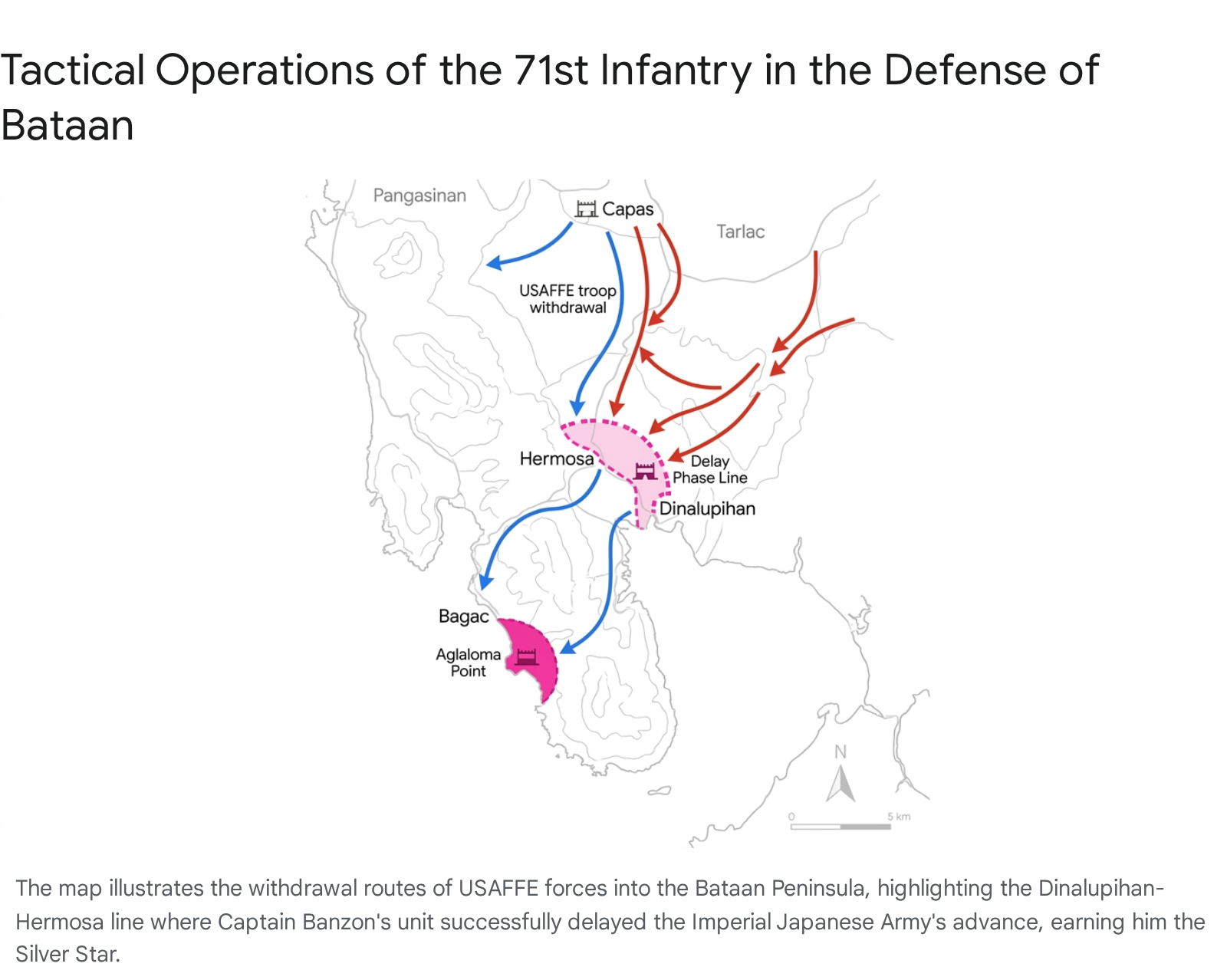
As the USAFFE forces funneled into the neck of the Bataan Peninsula, the 71st Division was tasked with defending the Dinalupihan-Hermosa Delay Phase Line.1 This line represented the final gateway into Bataan.
The 71st Division occupied the eastern portion of the Bataan Highway, specifically anchoring their defense in the marshy, difficult terrain around the barrios of Pulo and Almacen in the municipality of Hermosa.1 The strategic imperative here was absolute: if the Japanese broke through the Hermosa line too quickly, their mechanized units could race down the eastern coastal road, outflank the retreating USAFFE forces, and sever the peninsula, effectively destroying MacArthur’s army before it could establish its main defensive positions.
Military and historical records indicate that the 71st Division was subjected to continuous, “bloody attacks” by the Imperial Japanese Army in this sector.1 The Japanese utilized coordinated artillery barrages, aerial strafing, and aggressive infantry assaults to break the line. Captain Banzon demonstrated exceptional combat leadership and tactical composure under heavy fire during this phase. He was awarded the Silver Star medal for his conspicuous gallantry and bravery during the intense engagements at the Dinalupihan-Hermosa line.1
Psychological analysis of effective combat leadership indicates that performance in such desperate delaying actions requires high cognitive flexibility, profound emotional regulation, and the ability to project a stabilizing calm to subordinates despite the presence of imminent, lethal threat. Banzon had to manage the morale of young, under-equipped soldiers facing a technologically superior and seemingly invincible enemy, all while executing a fighting retreat—widely considered one of the most difficult maneuvers in military doctrine.
6. Coastal Defense and the Battle of the Points
Following the inevitable abandonment of the delay line once its purpose was served, the USAFFE forces established their main line of resistance deep within the peninsula. However, the Japanese sought to bypass these entrenched positions by exploiting the porous, rugged western coastline.
Banzon’s 2nd Battalion, 71st Infantry, having survived the withdrawal, was repositioned to the western coast of Bataan at Aglaloma, Bagac.1 Here, they participated in what became known as the “Battle of the Points.” In late January and early February 1942, the Japanese launched a series of amphibious landings behind USAFFE lines at various points along the western coast (including Quinauan, Longoskawayan, and Aglaloma) to sever the coastal road and outflank the defenders.1
The fighting at these points was fundamentally different from the conventional delay action at Hermosa. It was characterized by brutal, close-quarters jungle combat. The Japanese landing forces dug into the dense vegetation and cliff faces, requiring USAFFE units to painstakingly root them out. The psychological toll of this warfare was immense. The dense canopy restricted visibility to mere meters, creating an environment of constant paranoia and sensory overload. Banzon’s participation in both the northern delay lines and the western coastal defense underscores his unit’s critical role as a highly utilized, mobile reaction force within the geographically constrained theater of Bataan.
As the siege dragged on into March and April, the operational capacity of the USAFFE forces degraded exponentially. Cut off from all reinforcement and resupply, the men subsisted on quarter-rations, eventually resorting to eating cavalry horses, monkeys, and whatever the jungle could provide. The primary enemy became disease; malaria, dysentery, and beriberi incapacitated more men than Japanese bullets.10 Through this systemic collapse, field commanders like Banzon had to maintain operational cohesion, relying heavily on the bonds of unit solidarity and the internalized ethos of duty.
7. Capitulation, the Death March, and Camp O’Donnell
Despite the fierce and globally celebrated resistance that turned Bataan into a symbol of Allied defiance, the logistical strangulation of the peninsula ultimately forced a collapse.9 On April 9, 1942, Major General Edward P. King, recognizing that his men were starving, riddled with disease, and devoid of ammunition, surrendered the USAFFE forces on Bataan to the Imperial Japanese Army.10 General MacArthur and his staff had previously been evacuated to Australia by PT boat under orders from President Roosevelt.9
The Psychological Toll of Capitulation
For a career officer like Captain Banzon, who had internalized the warrior ethos and deliberately constructed an identity around the ideals of “Victor Hugo,” the order to surrender represents a profound psychological trauma. The abrupt transition from an autonomous combat commander dictating tactical maneuvers to a disarmed, subjugated prisoner of war induces severe cognitive dissonance. It forces a fundamental re-evaluation of the self and often leads to a state of learned helplessness. The psychological contract of military service—that one fights until victory or death—is suddenly voided by a higher command decision, leaving field officers to manage the collective despair of their men.
The Bataan Death March
The immediate aftermath of the surrender was the infamous Bataan Death March. Banzon was among the approximately 75,000 Filipino and American troops who were forced to march upwards of 65 miles from the tip of Bataan to the railhead at San Fernando, Pampanga, under the brutal heat of the Philippine summer.1
The Death March was an exercise in systematic degradation. The Japanese logistics system was completely unprepared for the sheer volume of prisoners, resulting in catastrophic failures in providing food or water. Prisoners were subjected to extreme physical deprivation, arbitrary beatings, bayoneting of those who fell out of line, and the profound psychological torture of marching past artesian wells they were forbidden to drink from. Banzon’s survival of this atrocity is a testament to extraordinary physical endurance and mental fortitude.
Incarceration at Camp O’Donnell
The survivors of the march were loaded into stifling boxcars and transported to Camp O’Donnell in Capas, Tarlac. Ironically, this was the very municipality where Banzon’s 71st Division had been headquartered before the outbreak of the war.1 The familiar geography must have added a surreal, deeply demoralizing layer to the experience of captivity.
At Camp O’Donnell, Banzon endured the severe hardships of mass incarceration.1 The camp was a nightmare of overcrowding, abysmal sanitation, and unchecked disease. Mortality rates from malaria, dysentery, and profound malnutrition were catastrophic, with thousands of Filipino soldiers dying in the first few months of captivity. Survival in such environments is rarely arbitrary; psychologists note that it frequently correlates with strong internal loci of control, the maintenance of social cohesion among small unit groups, and an overriding ideological or familial purpose that prevents psychological capitulation. Banzon’s prior self-identification with resilience likely served as a critical mental shield during this period.
8. The “Escape” Paradigm and the Return to Resistance
A persistent point of historical inquiry regarding Banzon is the exact nature of his departure from Japanese captivity. The specific query posed by historical researchers often frames this event as an evasion: “How did he escape?”
Analyzing the Historical Record versus Mythos
A rigorous examination of the historical and military records reveals that the premise of a cinematic, covert “escape” from the confines of Camp O’Donnell is likely a mythologized interpretation of his survival. The archival consensus, supported by contemporary analyses of his service, indicates that Banzon was released from incarceration rather than having executed a breakout.1
To understand this, one must examine the Japanese occupation policies in mid-to-late 1942. The Japanese military administration was rapidly overwhelmed by the sheer logistical burden of maintaining the dying prisoners at Camp O’Donnell. Furthermore, as part of a broader political strategy to pacify the local Filipino populace and encourage cooperation with the newly established puppet government, the Japanese command initiated a program to conditionally release severely ill Filipino prisoners of war. Prisoners who were deemed too incapacitated by malaria or dysentery to pose a viable military threat, and who possessed local civil guarantors (often mayors or prominent local figures who pledged responsibility for their conduct), were permitted to leave the camp.
It is highly probable, given the near-universal affliction rates in the camp, that Banzon was paroled under this policy, ostensibly returning to civilian life to recover from the physical devastation of the march and the camp.
Post-Traumatic Growth and the Guerrilla War
What is psychologically and historically remarkable about Banzon is not the administrative mechanism of his departure from the camp, but his immediate actions upon regaining his freedom. Upon his release, rather than withdrawing into civilian life to recover—a highly justifiable and common response to such severe trauma—Banzon sought out and integrated into a guerrilla unit operating in the rugged terrain of Central Luzon.1
This action is indicative of a psychological phenomenon known as “Post-Traumatic Growth.” Instead of being paralyzed by the trauma of defeat, the Death March, and captivity, Banzon utilized those experiences as a catalyst for continued, localized resistance. The cognitive framework he established with the “Victor Hugo” identity refused to accept subjugation.
Operating in the clandestine, decentralized network of Central Luzon, he engaged in asymmetrical warfare against the occupying Japanese forces. The guerrilla movement in Central Luzon was a complex tapestry of former USAFFE soldiers, local militias, and the communist-aligned Hukbalahap (Hukbo ng Bayan Laban sa mga Hapon).11 These units specialized in intelligence gathering, ambushes, sabotage of Japanese supply lines, and the liquidation of collaborators. Transitioning from a conventional battalion commander to an irregular guerrilla officer required a massive paradigm shift. Banzon had to discard the rigid doctrines of conventional warfare and adopt the fluid, politically sensitive, and highly perilous tactics of insurgency. He continued to fight in this clandestine capacity until the liberation of the Philippines by Allied forces in 1945.
9. Cold War Engagements: PEFTOK and the Korean War
The conclusion of World War II and the subsequent granting of full independence to the Republic of the Philippines in 1946 did not result in Banzon’s demobilization. He remained in the military, transitioning his commission from the colonial Commonwealth force to the regular Armed Forces of the Philippines (AFP).
When the Korean War broke out in June 1950, the geopolitical landscape had fundamentally shifted from the struggle against fascism to the global containment of communism. The Philippines was the first Asian nation to respond to the United Nations Security Council’s call for military assistance to defend South Korea, organizing the Philippine Expeditionary Force to Korea (PEFTOK).1 Colonel Banzon was placed in command of a PEFTOK battalion deployed to the Korean peninsula.1
The Shift to Foreign Expeditionary Power
This deployment marked a significant evolution in his military career and a profound shift in the strategic posture of the Philippine military. For the first time, Banzon was not defending his own homeland from direct invasion, nor was he operating as a localized guerrilla. He was projecting national power internationally, serving as an instrument of United Nations policy within the context of the Cold War.
Commanding a battalion in the harsh, freezing, mountainous terrain of the Korean peninsula required a drastically different tactical paradigm than the tropical jungles of Bataan or the plains of Central Luzon. The Korean War was characterized by massive artillery barrages, mechanized thrusts, and brutal static trench warfare in extreme weather conditions. His selection for this specific command indicates that the high command of the Philippine armed forces viewed him as a highly competent, battle-tested officer, capable of handling complex multinational operations alongside American, British, and other UN forces.
The historical data regarding his operational deployments clearly illustrates a career defined by continuous adaptation to radically different forms of warfare. The table below delineates the diverse phases of his military service, highlighting his transition from domestic defense to international expeditionary operations.
| Military Deployment Phase | Conflict Era | Specific Role / Unit | Key Operational Location | Tactical Paradigm |
| Homeland Defense | World War II (1941-1942) | Commander, 2nd Battalion, 71st Infantry | Bataan (Hermosa, Bagac) | Conventional Delaying Action, Jungle Defense |
| Irregular Warfare | World War II (1942-1945) | Guerrilla Officer | Central Luzon | Asymmetrical Warfare, Sabotage, Intelligence |
| Expeditionary Combat | Korean War (1950s) | Battalion Commander, PEFTOK | South Korea | Multinational Coalition, Conventional/Trench Warfare |
| Covert / Humanitarian | Cold War (1957-1975) | Organizer, Operation Brotherhood | Vietnam, Laos | Soft-Power Diplomacy, Medical Relief, Civic Action |
10. The Magsaysay Doctrine and Soft Power Counterinsurgency
Following his service in the Korean War, Banzon’s career trajectory moved away from frontline kinetic operations and deeper into the realms of strategic advisory, intelligence, and diplomacy. His deep experience in both conventional warfare and rural guerrilla tactics made him an invaluable asset to the highest levels of the Philippine government. During the 1950s, he served as a military adviser to Philippine President Ramon Magsaysay.1
The Psychological Shift in Warfare
President Magsaysay’s administration (1953–1957) was defined by its highly successful campaign to suppress the Hukbalahap rebellion—a communist insurgency that had grown out of the anti-Japanese guerrilla networks in Central Luzon. Magsaysay’s approach was revolutionary for the era; he realized that traditional military force alone could not defeat an insurgency fueled by agrarian poverty and social injustice.
Magsaysay developed a doctrine that combined targeted military pressure with massive socio-economic reforms, infrastructure development, and psychological warfare—summarized by the ethos of offering “all-out force or all-out friendship.” This approach relied heavily on military officers who possessed the cognitive flexibility to understand that the center of gravity in irregular warfare is the civilian population, not the enemy combatant.
Banzon, having been a guerrilla in the very same region (Central Luzon) where the Huks operated, perfectly fit this analytical profile. He intimately understood the psychological dynamics of rural insurgencies and the conditions that drive peasants to take up arms. His advisory role to Magsaysay would have centered on integrating military intelligence operations with rural development initiatives. This period fundamentally shaped Banzon’s understanding of “civic action”—the use of military or paramilitary logistics to provide social services—as a primary weapon of the Cold War.
11. Operation Brotherhood: Vietnam and the Laotian Theater
The culmination of Banzon’s evolution from a kinetic combatant to a practitioner of geopolitical soft power was his involvement in “Operation Brotherhood” (OB). Banzon served as one of the key organizers of this initiative.1
The Mechanics and Geopolitics of Operation Brotherhood
Operation Brotherhood was ostensibly founded as a private, humanitarian medical mission in 1954 to provide critical relief to hundreds of thousands of refugees fleeing communist North Vietnam to the South following the partition of the country at the Geneva Conference. However, the historical consensus acknowledges that OB was deeply intertwined with Cold War geopolitics. Covertly backed by the United States Central Intelligence Agency (specifically operative Edward Lansdale, a close associate of Magsaysay) and heavily supported by the Philippine government, OB was a highly sophisticated instrument of counterinsurgency.
By establishing clinics and providing desperately needed medical care to rural populations, the initiative aimed to win the “hearts and minds” of the Vietnamese peasantry, effectively immunizing them against the appeal of communist ideology. Banzon’s role in organizing the logistical and operational framework of OB reflects a masterful application of the civic action principles he had refined during the Magsaysay era.1 He recognized that a doctor or a nurse could secure a village more effectively than an infantry squad.
The Mission in Laos
Historical records specifically query: Where did he go in Laos and why?
Following its initial deployment in Vietnam, Operation Brotherhood expanded its mission into the neighboring Kingdom of Laos. OB personnel arrived in Laos on January 7, 1957, and maintained operations there for eighteen years, finally withdrawing on May 29, 1975, as the region fell to communist forces.3
In Laos, Banzon and the organizational leadership deployed medical teams to several strategic locations across the country. Key operational nodes included the administrative capital, Vientiane, and critical provincial centers in the south, such as Paksong on the strategic Bolaven Plateau.3 The Philippine medical personnel, including doctors, nurses, and technicians 12, established primary care clinics, trained local Laotian health workers, and provided essential medical services in highly austere and frequently dangerous environments.
The Geopolitical Rationale: Why was Banzon directing resources to Laos? The underlying imperative was the American “Domino Theory.” The United States and its regional allies in the Southeast Asia Treaty Organization (SEATO), including the Philippines, viewed Laos as a critical geographic buffer state. If Laos fell to the communist Pathet Lao, it was believed that Thailand, and subsequently the rest of Southeast Asia, would inevitably follow.
However, the 1954 Geneva Accords officially mandated that Laos remain a neutral country, strictly prohibiting the presence of foreign military forces. Because overt conventional military intervention was illegal under international law, the United States and its allies had to rely on covert operations (the “Secret War”) and humanitarian non-governmental organizations to influence the outcome. Operation Brotherhood served as a crucial, deniable mechanism to provide support to the Royal Lao Government and allied ethnic militias (such as the Hmong forces) by stabilizing the rural populace and providing medical infrastructure. Banzon’s involvement in organizing this apparatus was a direct extension of his military service, seamlessly translated into the language of international humanitarian aid.
12. Diplomatic Service as a Military Attaché
As he transitioned out of direct organizational roles, Colonel Banzon entered the realm of formal military diplomacy. He served sequential assignments as a military attaché to multiple critical Southeast Asian nations: Thailand, Cambodia, Indonesia, and South Vietnam.1
The role of a military attaché during the height of the Cold War was a highly sensitive and multifaceted position. Overtly, the attaché acts as the official diplomatic representative of their nation’s armed forces to the host government, facilitating military-to-military relations, arms sales, and joint training exercises. Covertly, however, the position is fundamentally concerned with intelligence gathering, strategic assessment, and alliance management.
Stationed in the frontline states of the ideological conflict, Banzon was responsible for analyzing regional military capabilities, monitoring the political stability of host governments, and tracking the proliferation of communist insurgencies across porous borders. His postings were strategically vital. Thailand was the primary staging ground for American air operations in Vietnam and covert actions in Laos; Cambodia was a delicate neutral state struggling to keep the conflict from spilling over its borders; Indonesia had just emerged from a massive internal purge of its communist party; and Vietnam was the epicenter of the global conflict. Banzon’s vast experiential knowledge—spanning guerrilla warfare, conventional mechanized combat, and counterinsurgency civic action—made his intelligence assessments invaluable to both the Philippine government and its SEATO allies.
13. Twilight Years: The Philippine Refugee Processing Center
The final major chapter of Banzon’s public service serves as a profound psychological and historical coda to his life. Following his retirement from active military and diplomatic duty, he was appointed as a director at the Philippine Refugee Processing Center (PRPC) located in Morong, Bataan.1
A Return to Bataan and the Cycle of Resilience
The PRPC, which operated from 1980 until 1994, was a massive, internationally funded facility that served as the final transit and preparation point for hundreds of thousands of refugees from Vietnam, Laos, and Cambodia (frequently referred to collectively as the “Boat People”). These individuals had fled the communist takeovers of their respective nations and were residing at the PRPC to receive cultural orientation and language training prior to their permanent resettlement in the United States, Canada, Australia, and Western Europe.
From a psychological perspective, Banzon’s tenure at the PRPC represents an extraordinary instance of narrative closure. As a young man in his twenties, he had fought a desperate, losing war in the jungles of Bataan, witnessing mass death and suffering before becoming a prisoner of war and essentially a refugee in his own occupied nation. Decades later, he returned to the province of Bataan not as a besieged soldier, but as a senior humanitarian administrator.
Furthermore, the populations he was tasked with assisting at the PRPC—the displaced citizens of Vietnam, Laos, and Cambodia—were the very people he had spent the prime years of his career attempting to stabilize and protect through Operation Brotherhood and his diplomatic postings. The tragic fall of Indochina in 1975 meant that his earlier efforts had ultimately been eclipsed by geopolitical forces. Yet, at the PRPC, he was able to provide tangible, life-saving assistance to the survivors of those fallen nations. The trauma of his youth was ultimately transmuted into the administrative capacity to offer safe harbor to the world’s most vulnerable. This final transition solidifies his legacy not merely as a tactician of war, but as an architect of human resilience.
14. Conclusion and Final Assessment
Jose Victor Hugo “Pepe” Banzon passed away on January 23, 1990, leaving behind his wife, Maria Nicolas, and their four children: Marietta, Rolando, Angelo, and Victor.1
An analysis of the archival records, military history, and geopolitical context reveals that Banzon was far more complex than the traditional archetype of a World War II hero. While his receipt of the Silver Star for the defense of the Dinalupihan-Hermosa Delay Phase Line permanently cements his status in the annals of combat history 1, it is his post-trauma trajectory that commands the greatest analytical interest from a psychological and historical perspective.
The popular mythos surrounding his “escape” from Japanese captivity masks a much more profound psychological reality: that he survived the systematic, intentional degradation of Camp O’Donnell 1 and immediately utilized that survival to wage a shadow war as a guerrilla.1 His subsequent career—leading a battalion in the frozen trenches of Korea 1, organizing covert humanitarian relief via Operation Brotherhood in the contested villages of Laos and Vietnam 3, advising a president on the mechanics of rural insurgency 1, and finally directing a massive refugee center in the province of his birth 1—demonstrates an extraordinary, lifelong adaptive capacity.
Banzon’s life maps the complete trajectory of the modern Philippine military experience. He was forged in the anti-colonial and anti-imperial defense of the homeland during World War II, refined his command in the international coalitions of the Korean War, and ultimately actualized his potential in the complex realms of regional diplomacy and humanitarian crisis management during the Cold War. He adopted the name “Victor Hugo” as a young man, a projection of a highly idealistic, justice-oriented identity. Over the course of seventy-seven years, through three major wars and multiple regional crises, Banzon successfully materialized the humanitarian and resilient ethos embedded within that chosen name.
Please share the link on Facebook, Forums, with colleagues, etc. Your support is much appreciated and if you have any feedback, please email us in**@*********ps.com. If you’d like to request a report or order a reprint, please click here for the corresponding page to open in new tab.
Sources Used
- Who’s Who in Bataan – The Banzons of Bataan – 1Bataan, accessed April 24, 2026, https://1bataan.com/whos-who-in-bataan-the-banzons-of-bataan/
- accessed April 24, 2026, https://1bataan.com/whos-who-in-bataan-the-banzons-of-bataan/#:~:text=Banzon%20was%20among%20the%20USAFFE,incarcerated%20at%20Camp%20O’Donnel.
- CELEBRATING OUR 10TH – Mekong Circle International, accessed April 24, 2026, http://www.mekongcircle.org/Data/Publications/2014_journal/2014_journal.pdf
- Who’s Who in Bataan – The Banzons of Bataan Part II – 1Bataan, accessed April 24, 2026, https://1bataan.com/whos-who-in-bataan-the-banzons-of-bataan-part-ii/
- Julian Banzon – Wikipedia, accessed April 24, 2026, https://en.wikipedia.org/wiki/Julian_Banzon
- 15 Filipino icons who shaped the nation – Gulf News, accessed April 24, 2026, https://gulfnews.com/world/asia/philippines/15-influential-filipino-heroes-who-shaped-the-nation-how-they-lived-and-died-1.500243370
- Living legacy – DOST-STII, accessed April 24, 2026, https://www.stii.dost.gov.ph/images/jdownloads/pdf_files/sntposts/2022_2Q_STPost_ONLINEv.pdf
- The Routledge concise history of Southeast Asian writing in English 9780203874035, 020387403X, 9781780342672, 1780342675 – DOKUMEN.PUB, accessed April 24, 2026, https://dokumen.pub/the-routledge-concise-history-of-southeast-asian-writing-in-english-9780203874035-020387403x-9781780342672-1780342675.html
- Douglas MacArthur’s escape from the Philippines – Wikipedia, accessed April 24, 2026, https://en.wikipedia.org/wiki/Douglas_MacArthur%27s_escape_from_the_Philippines
- Surrender of the Philippines | Battle of Bataan – YouTube, accessed April 24, 2026, https://www.youtube.com/watch?v=YetDRYOj9uk
- The Kingly Treasures Auction 2023 – Leon Gallery, accessed April 24, 2026, https://leon-gallery.com/pdf/TKTA_2023.pdf
- 102nd LD SouvenirProgram | PDF | Agriculture | Foods – Scribd, accessed April 24, 2026, https://www.scribd.com/document/541445115/102nd-LD-SouvenirProgram