1. Executive Summary
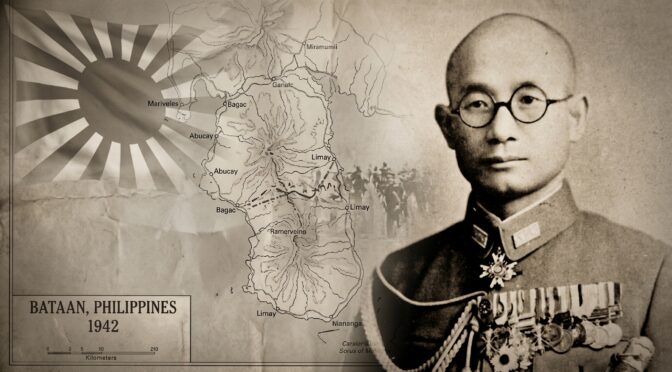
Colonel Masanobu Tsuji remains one of the most heavily scrutinized, consequential, and enigmatic figures in the operational history of the Imperial Japanese Army (IJA). Operating at the perilous intersection of strategic ingenuity and unrestrained ideological brutality, Tsuji was a defining architect of Japan’s early military successes during the Pacific War. He earned the moniker “God of Strategy” for his meticulous and highly effective planning of the Malayan campaign and the subsequent capture of Singapore.1 Simultaneously, however, historical and psychological analyses characterize him as a fanatical ideologue and a pathological staff officer whose unilateral actions resulted in the extrajudicial slaughter of thousands of prisoners of war and civilians.1
This report synthesizes Filipino, American, Japanese, and Laotian archival records to construct a detailed historical and psychological profile of Tsuji. It examines his official roles within the IJA, focusing specifically on his subversion of the established military command structure during the Philippines campaign, and his direct, documented role in masterminding the Pantingan River massacre during the Bataan Death March.4 Furthermore, this analysis explores the psychological and institutional drivers behind his actions. Predominant among these is the deeply ingrained doctrine of gekokujō (insubordination from below), an institutional pathology that allowed Tsuji to manipulate the rigidly hierarchical Japanese military apparatus to execute his own radical Pan-Asian vision.6
Beyond his wartime command and the subsequent atrocities, Tsuji’s post-war trajectory provides a stark illustration of the complexities and moral compromises of Cold War geopolitics. Evading prosecution as a major war criminal, he undertook a multi-year underground escape through Southeast Asia and China, aided by the Chinese Nationalist intelligence apparatus.9 He later returned to Japan, achieved immense literary and political success as a member of the Diet, and collaborated extensively with American intelligence agencies.3 The report concludes with an analysis of his unresolved and highly speculative disappearance in Laos in 1961, evaluating competing intelligence assessments regarding his final operational mission and his ultimate fate.13
2. Formative Years and the Psychology of Japanese Militarism
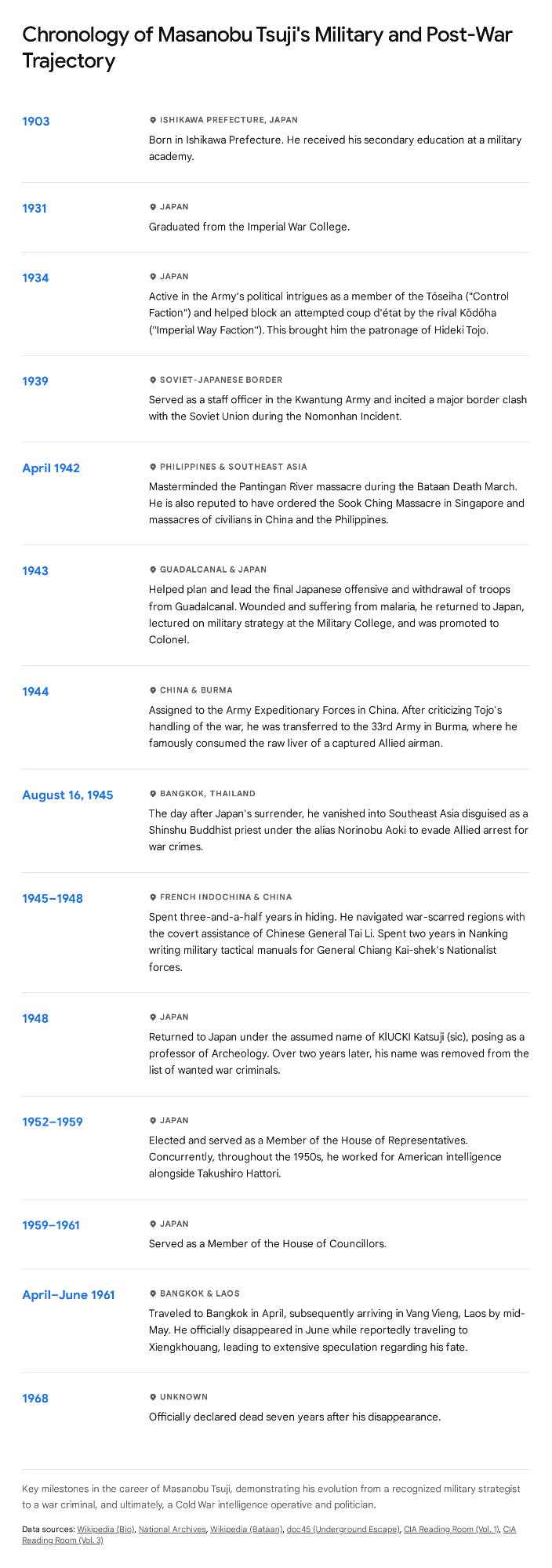
Masanobu Tsuji was born on October 11, 1902, in the rural environment of Ishikawa Prefecture, Japan.3 His early life and intellectual development were defined by the rigorous, highly structured, and intensely indoctrinated environment of the Japanese military education system. He graduated from the Japanese Military Academy in 1924, a period during which the Japanese military was beginning to exert increasing influence over the civilian government.3 He subsequently attended the prestigious Army War College, the elite training ground for the IJA’s general staff, where he distinguished himself academically, graduating with the highest class honors in 1931.3
To understand Tsuji’s psychological profile, it is necessary to examine the ideological environment of the IJA during the 1920s and 1930s. The military apparatus was characterized by an intense focus on seishin (spiritual power or martial spirit), which was often elevated above material or logistical considerations.16 Across all social classes, but particularly within the officer corps, militarism and fanatical loyalty to the Emperor were instilled from the earliest stages of training.17 Young men were indoctrinated to believe that dying in battle was the most noble of deaths, that surrender was the ultimate dishonor, and that the execution of the Empire’s will justified any action, regardless of its brutality.17
During the early 1930s, the Japanese military was deeply fractured by internal political struggles, primarily between two opposing ideological camps: the radical Kōdōha (Imperial Way Faction) and the more systematic, modernization-focused Tōseiha (Control Faction).3 The Kōdōha advocated for a direct military dictatorship and a preemptive strike against the Soviet Union, heavily emphasizing spiritual purity. The Tōseiha, conversely, favored a more calculated, total-war mobilization of the state economy and continued expansion into China.
By 1934, Tsuji had firmly aligned himself with the Tōseiha.3 While serving as a company commander at the Military Academy, he uncovered a plot by Kōdōha cadets to launch a coup d’état. Tsuji infiltrated the conspiracy and reported the cadets to the authorities, effectively neutralizing the threat.3 This action earned him the enduring patronage of highly influential senior officers within the Tōseiha, including future Prime Minister Hideki Tojo and War Minister Seishirō Itagaki.3 This political insulation proved to be a critical element of his career, as it provided him with an unprecedented degree of impunity and allowed him to operate outside the standard boundaries of military discipline.
3. The Nomonhan Incident and the Weaponization of Gekokujō
Tsuji’s early staff assignments placed him in the Kwantung Army in Manchuria, where he quickly developed a reputation for extreme aggression, unilateral action, and a profound contempt for central authority.15 It was in this theater that Tsuji fully embraced and weaponized the concept of gekokujō.
Gekokujō, translating roughly to “the lower overcomes the higher” or “loyal insubordination,” was a historical concept dating back to the Sengoku (Warring States) period.6 Within the context of the 1930s IJA, it had evolved into a pervasive institutional pathology.6 It manifested as a highly toxic organizational culture where junior and mid-ranking officers routinely ignored, modified, or directly contravened the orders of their superiors.8 These subordinates operated under the ideological justification that their radical actions better served the Emperor and the ultimate strategic goals of the Empire than the cautious directives issued by the civilian government or the Army General Staff in Tokyo.8
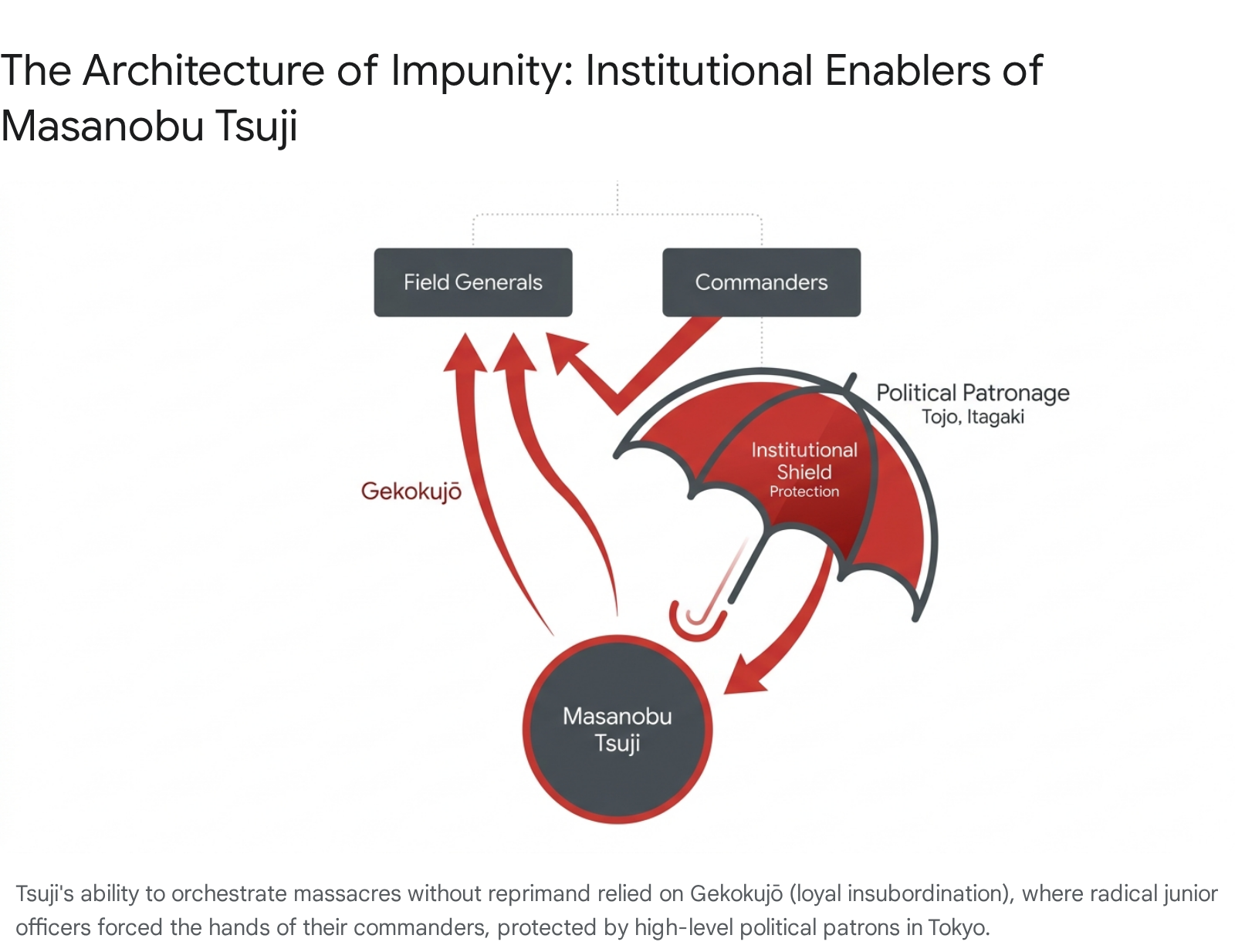
In a standard Western military hierarchy, Tsuji’s actions would have resulted in immediate court-martial and dismissal.17 However, the IJA’s culture tolerated and often tacitly rewarded excessive displays of aggression. Senior commanders were frequently paralyzed by the fear that disciplining overly zealous officers would result in a loss of face, or that they themselves would be perceived as insufficiently patriotic or lacking in martial spirit.19
As a staff officer with the Kwantung Army from 1937 to 1939, Tsuji was instrumental in fomenting border clashes with the Soviet Union, actions that directly contradicted the central command in Tokyo, which was actively seeking to avoid a full-scale multi-front war.3 Tsuji drafted orders empowering local commanders to annihilate intruders and actively lure Soviet troops into disputed territory.22
In a stark display of psychological warfare and insubordination in March 1939, Tsuji led a force of forty men to within two hundred yards of Russian border outposts. To demonstrate a lack of hostile intent and deliberately humiliate the opposition, the troops slung their rifles, undid their trousers, and urinated in plain view of the Soviet forces.19 They then consumed boxed lunches, sang military songs, and left behind gifts of meat, chocolate, and whiskey before withdrawing.19 This bizarre and highly aggressive provocation was an elaborate diversion to conduct photographic reconnaissance, intended to force the hand of the Army General Staff by proving Soviet encroachment.19
These instigations eventually culminated in the Nomonhan Incident (the Battle of Khalkhin Gol), a massive and disastrous military engagement against Soviet forces commanded by Georgy Zhukov.3 The Japanese suffered a severe defeat. Typically, such a catastrophic failure orchestrated by a mid-level staff officer would end a career. However, Tsuji’s political connections within the Tōseiha shielded him from permanent disgrace. Instead of facing a tribunal, he was merely transferred to the headquarters of the Japanese Expeditionary Forces in China, and later to the General Staff Office in Tokyo, entirely insulated from the consequences of his rogue command.15
4. The Malayan Campaign and the Sook Ching Purges
Tsuji’s reputation as a tactical savant was firmly solidified during the opening phases of the Pacific War. Starting in January 1941, he led the Taiwan Army Research section, tasked with investigating the logistical and tactical requirements for a potential campaign in Malaya and Singapore.25 His resulting analysis was highly accurate; he correctly identified that while the Singapore Fortress was heavily fortified against a seaward naval assault, it was critically vulnerable to a rapid overland assault originating from the peninsular side facing the Johore Strait.25
Assigned as the Chief of Operations and Planning for the 25th Army under the command of General Tomoyuki Yamashita (the “Tiger of Malaya”), Tsuji meticulously planned and executed the invasion.10 The resulting military operation was a stunning success, characterized by speed, aggressive flanking maneuvers, and the rapid collapse of British colonial defenses. This operational triumph elevated Tsuji to the status of a national hero, earning him the title “God of Strategy” among the Japanese public, the media, and the junior officer corps.1
However, this military victory was immediately followed by systemic atrocities that revealed the depth of Tsuji’s ideological fanaticism. Tsuji’s worldview was governed by a radical, exclusionary variant of Pan-Asianism. While this ideology nominally espoused the liberation of Asia from Western colonial influence, in practice, it demanded absolute subjugation to Japanese hegemony.3 Tsuji viewed any non-Japanese Asian populations that did not actively support the Greater East Asia Co-Prosperity Sphere not as civilians, but as hostile entities requiring eradication.28
Upon the capitulation of Singapore in February 1942, the Japanese military, directed by the high command and influenced by staff officers like Tsuji, initiated Operation Kakyou Shukusei (or Dai Kenshou), widely known in the local Chinese community as the Sook Ching (Purge).29 This was a systematic ethnic cleansing operation targeting perceived anti-Japanese elements within the ethnic Chinese population of Malaya and Singapore.29
Tsuji was deeply and directly involved in the planning and execution of the Sook Ching. He utilized his authority within the 25th Army headquarters to counter-sign orders that mandated the mass execution of civilians.23 The operation involved the Kempeitai (military police) screening the Chinese population and subsequently transporting thousands of men to remote locations for execution by machine gun and bayonet.30 Archival records and post-war investigations estimate that Tsuji was responsible for the deaths of between 5,000 and 25,000 Chinese merchants, intellectuals, and ordinary civilians.23 The Sook Ching massacres established a clear operational pattern: Tsuji routinely utilized the fog of military operations as a pretext to enact ideological purges, leveraging his staff authority to bypass standard military justice and command local units to execute unarmed captives.30
5. The Philippines Campaign and Institutional Subversion
The stark ideological divide within the Imperial Japanese Army—between traditional military professionalism and radical, unrestrained militarism—was most vividly illustrated during the Philippines campaign in early 1942. Following the success in Malaya, Tsuji was dispatched to the Philippines to assist the 14th Army, which was tasked with capturing the islands and defeating the combined American and Filipino forces under General Douglas MacArthur.4 The 14th Army was commanded by Lieutenant General Masaharu Homma, an officer whose background and temperament were antithetical to Tsuji’s.4
General Homma was considered a moderate within the IJA. Having served as a military attaché in Great Britain, he possessed a broader international perspective and a more lenient attitude toward civilian populations in occupied territories.18 Upon initiating the invasion, Homma issued strict directives forbidding pillaging and rape, ordering his troops to respect Filipino customs, traditions, and religion.3 He explicitly stated that the Filipinos were not to be regarded as enemies, viewing his mission through the lens of traditional Bushido ethics and attempting to bring a “benevolent supervision” to the archipelago.3 This approach actively displeased his superior, General Count Hisaichi Terauchi, commander of the South Army, who favored a much harsher occupation policy.33
Into this volatile command environment arrived Masanobu Tsuji, representing the extreme, total-war faction of the military. Tsuji viewed Homma’s leniency and adherence to international norms not as honorable, but as a strategic liability, a sign of weakness, and a fundamental ideological failure.17 Upon attaching himself to the 14th Army staff, Tsuji immediately began a campaign of subversion, utilizing the principles of gekokujō to undermine Homma’s authority.32
Operating under the perceived aegis of the Imperial General Headquarters in Tokyo, Tsuji bypassed Homma and acted as a virtual commanding officer.32 He forged and issued “secret and immediate” operational orders directly to local regimental and brigade commanders.3 These rogue directives demanded the immediate, summary execution of surrendered Filipino and American military officers, as well as civilian government officials.3
| Command Philosophy | Lt. General Masaharu Homma | Colonel Masanobu Tsuji |
| Ideological Stance | Moderate, internationally aware; adhered to traditional Bushido ethics.3 | Radical Pan-Asianist, fanatical militarist; proponent of total war and gekokujō.3 |
| Civilian Policy | Ordered troops to respect customs/religion; explicitly forbade pillage and rape.33 | Viewed non-compliant populations as hostile entities requiring systematic eradication.28 |
| Treatment of Captives | Sought to adhere to international norms; countermanded execution orders.3 | Issued “secret and immediate” orders for the mass execution of POWs and officials.3 |
| Command Authority | Official Commander of the 14th Army.33 | Subordinate staff officer who subverted the chain of command to enact rogue directives.32 |
The depth of Tsuji’s interference was profound. He personally ordered the execution of the Chief Justice of the Philippine Supreme Court, José Abad Santos, a highly respected civilian leader.3 Furthermore, Tsuji attempted to orchestrate the execution of former Speaker of the House of Representatives (and future President of the Philippines) Manuel Roxas.3 When General Homma discovered the extent of the rogue execution orders pushed through by the “Tsuji clique,” he was violently enraged.3 Homma successfully countermanded the order to execute Roxas and attempted to rein in his staff, viewing the executions as a dishonorable stain on the army.3 However, the chain of command had been fatally compromised, and the atmosphere of authorized brutality established by Tsuji laid the groundwork for one of the worst atrocities of the Pacific War.
6. The Bataan Death March and the Pantingan River Massacre
The most devastating consequence of the ideological fanaticism cultivated by officers like Tsuji occurred in the aftermath of the Battle of Bataan in April 1942. Following three months of intense fighting, the combined American and Filipino forces, suffering from severe malnutrition, disease, and lack of ammunition, surrendered to the Japanese 14th Army.4
What followed was the forcible transfer of approximately 72,000 to 78,000 prisoners of war (consisting of about 66,000 Filipinos and 12,000 Americans) from the municipalities of Bagac and Mariveles on the Bataan Peninsula to Camp O’Donnell, a distance of approximately 105 kilometers (65 miles).4 This transfer, which became known globally as the Bataan Death March, was characterized by unimaginable cruelty, severe physical abuse, denial of food and water, and wanton killings.4 Prisoners who fell out of line due to exhaustion or illness were routinely bayoneted, shot, or buried alive.4 Estimates of the fatalities vary, but records indicate that between 5,000 and 18,000 Filipino soldiers and 500 to 650 American soldiers died before reaching the internment camps.4
While the general, horrific conditions of the march were the result of severe logistical failures by the Japanese command and a pervasive cultural contempt for soldiers who chose surrender over death, specific instances of orchestrated mass murder during the march were directly masterminded by Masanobu Tsuji.4 The most infamous and heavily documented of these incidents is the Pantingan River massacre.5
On April 12, 1942, as the chaotic columns of prisoners proceeded north of Mount Samat, several hundred soldiers were forcibly segregated from the main group.5 These men were officers and non-commissioned officers belonging to the Philippine Commonwealth Army’s 1st, 11th, 71st, and 91st Divisions.5 They were marched off the Pilar-Bagac Road and taken to the ravines bordering the Pantingan River.5
Operating entirely outside his official commission and subverting General Homma’s authority, Tsuji issued abnormal, explicit orders to the Japanese 122nd Regiment of the 65th Brigade to liquidate these captives.5 The Filipino and American prisoners were systematically hog-tied using military telephone wire to prevent resistance or escape.5 They were then systematically shot, bayoneted, or beheaded by the Japanese troops.5 Approximately 400 men were murdered in this single, highly organized atrocity.5
The illegitimate nature of Tsuji’s authority is underscored by the varied reactions of other Japanese field officers. Colonel Takeo Imai, the commander of another Japanese regiment, received the same extermination orders from Tsuji.5 Recognizing the orders as a gross violation of military law and noting that they lacked the official seal of General Homma, Imai openly doubted their authority.5 Exhibiting a rare instance of moral courage within the IJA, Imai completely ignored the cruel mandate and refused to execute the prisoners under his command.5 Imai’s refusal clearly demonstrates that Tsuji’s orders could be resisted; however, the prevailing atmosphere of fanaticism, coupled with the fear of Tsuji’s high-level political connections, meant that units like the 122nd Regiment willingly complied with the extrajudicial killings.
A small number of men miraculously survived the Pantingan River massacre, providing critical post-war testimony. Among them were Lieutenant Manuel Yan, who would later rise to become the head of the Armed Forces of the Philippines and an ambassador, and Captain Ricardo Papa, a G-3 Officer of the 91st Division who later served as a Chief of Police in Manila.5 Their accounts form the bedrock of the historical record regarding Tsuji’s direct culpability.
In the post-war war crimes tribunals convened by the Allies, justice was applied unevenly. General Masaharu Homma was held strictly accountable under the doctrine of command responsibility for the atrocities committed by the 14th Army, despite his efforts to mitigate the brutality and his active countermanding of the Tsuji clique’s execution orders.3 General Douglas MacArthur refused to accept Homma’s defense, and the general was convicted and executed by firing squad outside Manila on April 3, 1946.4 Two of Homma’s subordinates, Major General Yoshitaka Kawane and Colonel Kurataro Hirano, were prosecuted by an American military commission in Yokohama in 1948 and executed by hanging at Sugamo Prison in 1949.4
Masanobu Tsuji, the direct architect, inciting force, and mastermind behind the Pantingan River massacre and the execution of Philippine officials, faced no such justice.3 He had vanished into the chaos of the war’s end, successfully evading the tribunals that condemned his superior officers to death.4
7. Atrocities in Burma and Psychological Fanaticism
Following the conclusion of the Philippines campaign, Tsuji’s career continued to be marked by a combination of high-level strategic planning and descent into profound psychological fanaticism. He was involved in planning the final, ultimately unsuccessful, Japanese offensives during the Guadalcanal campaign.3 By mid-1944, as the strategic situation for Japan deteriorated rapidly, Tsuji was transferred to the China-Burma-India theater and assigned as a staff officer to the 33rd Army in Burma.3
The Japanese forces in Burma were in a state of severe crisis, having been disastrously repulsed by British and Indian forces at the Battle of Imphal.3 The army was suffering from catastrophic logistical failures, mass starvation, and disease. Tsuji, maintaining his reputation for extreme energetic efficiency and notorious arrogance, attempted to restore discipline and operational tempo.3 In one instance, he purportedly helped quell a panic in the ranks by ostentatiously taking a bath under enemy fire in the front lines, a calculated display of bravado meant to shame his subordinates into holding their positions.3
However, the immense stress of the failing campaign and his own ideological zealotry led to actions that transcended mere brutality and entered the realm of the pathological. While serving in Burma, Tsuji actively engaged in, and commanded his subordinates to participate in, acts of ritualistic cannibalism.3 Following the capture of an Allied airman (American or British), Tsuji ordered the execution of the prisoner, extracted the raw liver, and consumed it.3
This was not an act driven by the desperate starvation that plagued many Japanese units late in the war; rather, it was a deliberate, psychologically driven act of psychological warfare and spiritual indoctrination. Tsuji commanded his staff to partake in the consumption, declaring, “The more we consume, the more we shall be infused with a hostile spirit toward the enemy”.3 By forcing his officers to violate a profound human taboo, Tsuji sought to bind them to him through shared complicity in an atrocity, while simultaneously attempting to merge wartime brutality with a pseudo-religious, animistic zealotry.3 This incident perfectly illustrates the assessment of historians who classify Tsuji not merely as a war criminal, but as a “fanatical ideologue” whose understanding of warfare lacked any moral or ethical boundaries.1
8. The Underground Escape to China (1945-1948)
When Emperor Hirohito broadcast the surrender of the Japanese Empire on August 15, 1945, Colonel Masanobu Tsuji was stationed in Bangkok, Thailand, attached to the Japanese 39th Army.9 Acutely aware that he was listed by the British authorities as a high-priority Class A war criminal for his orchestration of the Sook Ching massacres in Singapore and Malaya, as well as his actions in Burma and the Philippines, Tsuji made the calculated decision to evade capture rather than face a military tribunal or commit ritual suicide.10
With the tacit, clandestine approval of certain sympathizers within the dissolving Japanese Army authority, Tsuji shed his military uniform and assumed the alias Norinobu Aoki.9 Disguising himself as a wandering Shinshu Buddhist priest—complete with traditional robes and a begging bowl—he vanished into the chaotic, post-war landscape of Southeast Asia.9 What followed was a remarkable and harrowing 7,500-mile evasion across hostile territory, an experience he later chronicled in detail in his 1952 best-selling memoir, Senkō Sanzenri (Hidden Journey of 3,000 Li, published in English as Underground Escape).3
Tsuji’s journey took him from the shattered remnants of Bangkok, navigating the political upheaval and emerging anti-colonial conflicts of French Indochina, moving through Laos and Vietnam (including Vientiane and Hanoi), before finally crossing the border into Nationalist-held China.7 His survival during this period was entirely dependent on his ability to adapt to the rapidly shifting geopolitical priorities of the early Cold War.
Recognizing that the emerging conflict between the Chinese Nationalists (Kuomintang, or KMT) and Mao Zedong’s Communists offered a mechanism for his own preservation, Tsuji actively sought out the KMT.3 He leveraged prior wartime contacts, specifically reaching out to the network of General Tai Li, the notorious head of Chiang Kai-shek’s intelligence and secret police apparatus.10 According to Tsuji’s later claims, he had previously intervened to protect the families of Chinese intelligence agents in Shanghai, a favor Tai Li repaid by facilitating Tsuji’s safe passage through Indochina and into the KMT capital of Chungking (Chongqing), and later Nanking.10
During his time in China from 1946 to 1948, Tsuji occupied a highly ambiguous and liminal space: he was simultaneously a prisoner of war, a fugitive from Allied justice, and an employed strategic advisor to Chinese military intelligence.3 Chiang Kai-shek, desperately needing experienced military planners to combat the growing momentum of the Communist forces, absorbed Tsuji and several other former IJA officers into the Nationalist war effort.7 Tsuji utilized his tactical expertise to draft military manuals and operational plans for the KMT forces.7
However, Tsuji quickly recognized the systemic weaknesses, corruption, and disunity plaguing the Nationalist ranks, noting in his writings that the KMT officers were highly inattentive to their duties.9 In a dramatic display characteristic of his intense personality, Tsuji claimed to have written a strategic memorandum to Chiang Kai-shek not with ink, but by cutting his own thumb with a razor and writing the document in his own blood.9 By May 1948, as the Nationalist position in mainland China became increasingly untenable and collapse appeared imminent, Tsuji was permitted to resign from Chinese service.3 He was secretly repatriated to a defeated, prostrate Japan via Shanghai, remaining completely underground and out of the public eye.3
9. Post-War Resurgence: Intelligence Collaboration and the Japanese Diet
The advent of the Cold War and the escalation of hostilities on the Korean Peninsula fundamentally altered the strategic calculus of the American occupation authorities in Japan. The Supreme Commander for the Allied Powers (SCAP), specifically its intelligence directorate (G-2) commanded by Major General Charles A. Willoughby, initiated a “reverse course” in occupation policy.3 Anti-communism rapidly superseded the prosecution of war crimes as the primary American objective.3
Benefiting from this geopolitical shift, Tsuji’s legal status changed dramatically. By late 1949, the British Mission concluded its active war crimes trials, and in December 1949, SCAP officially deleted Colonel Masanobu Tsuji’s name from the suspected war criminals apprehension list.10 With the threat of the gallows removed, Tsuji emerged from his underground existence in 1950, reassumed his real identity, and immediately capitalized on his notoriety.10
He published several books, most notably Senkō Sanzenri (Underground Escape), which detailed his evasion of Allied capture.3 The book became a massive best-seller in Japan.3 Tsuji utilized his publications to craft a revisionist historical narrative, framing the disastrous Pacific War not as a war of aggression, but as an idealistic Pan-Asian crusade to liberate the continent from Western imperialism.3 This narrative deeply resonated with segments of the Japanese public eager to find meaning in their devastating defeat and willing to overlook the atrocities committed by the military.34
Despite his well-documented status as the mastermind behind the Bataan massacres and the Sook Ching ethnic cleansing, Tsuji was actively recruited by American intelligence agencies.12 Declassified CIA and U.S. Army files reveal that Tsuji collaborated extensively with Willoughby’s G-2 apparatus.3 He operated within a clandestine network known as the “Hattori kikan” (often referred to in American intelligence documents as “Willoughby’s Stable”), working alongside other unindicted war criminals and ultra-nationalists, such as Takushiro Hattori and the Yakuza-linked political fixer Yoshio Kodama.12
This network, initially funded and protected by American intelligence, sought to illegally resurrect the Imperial Japanese Army (under the guise of self-defense forces) and ran intelligence operations targeting North Korea, the Soviet Union, and communist China.23 Tsuji was involved in highly ambitious, if unrealistic, planning, including schemes to utilize Japanese mercenaries to assist Taiwanese defenses and even encouraging Chiang Kai-shek to launch an invasion of the Chinese mainland.12
However, the newly formed Central Intelligence Agency (CIA) held a deeply skeptical and highly critical view of Tsuji’s reliability as an intelligence asset.12 Internal CIA assessments from the early 1950s described him as “hopelessly lost both by reason of personality and lack of experience” in actual clandestine espionage.12 The agency noted that his primary motivations were political self-aggrandizement, media publicity, and furthering his own right-wing, pan-Asian causes rather than providing actionable intelligence.12 One particularly chilling CIA report concluded that Tsuji was “the type of man who, given the chance, would start World War III without any misgivings”.12 Consequently, the CIA considered efforts to utilize him as largely ineffective.12
Rebuffed by the professional intelligence community but highly popular with the public, Tsuji pivoted to domestic politics. Taking advantage of the massive publicity generated by his books, he ran for the House of Representatives from his home district in Ishikawa Prefecture in 1952.3 Campaigning as an independent and later associating with conservative parties, he secured a landslide victory with the highest vote count in the district.10 He served multiple terms in the Lower House before being elected to the House of Councillors (the Upper House) in 1959.3
As a politician, Tsuji remained a polarizing figure. He advocated for a revived “Emperor System,” rapid rearmament free of United States interference, and a policy of armed, anti-communist neutrality.10 His political success highlighted a deliberate, willful amnesia within the post-war Japanese electorate, demonstrating a willingness to elevate a known orchestrator of war crimes to national leadership.34
10. The 1961 Disappearance in Laos: Theories and Assessments
In April 1961, at the height of his political career as an incumbent member of the House of Councillors, Masanobu Tsuji vanished while traveling in Southeast Asia, initiating one of the most enduring mysteries of the Cold War era.3
Ostensibly utilizing an official diplomatic passport and operating under the guise of a 40-day government “inspection tour,” Tsuji departed Haneda Airport in Tokyo on an Air France flight on April 4, 1961.13 His stated itinerary was highly ambitious, including stops in Singapore, Burma, Thailand, South Vietnam, Laos, and Cambodia.13 However, intelligence files indicate the trip was privately funded, though heavily insured.13
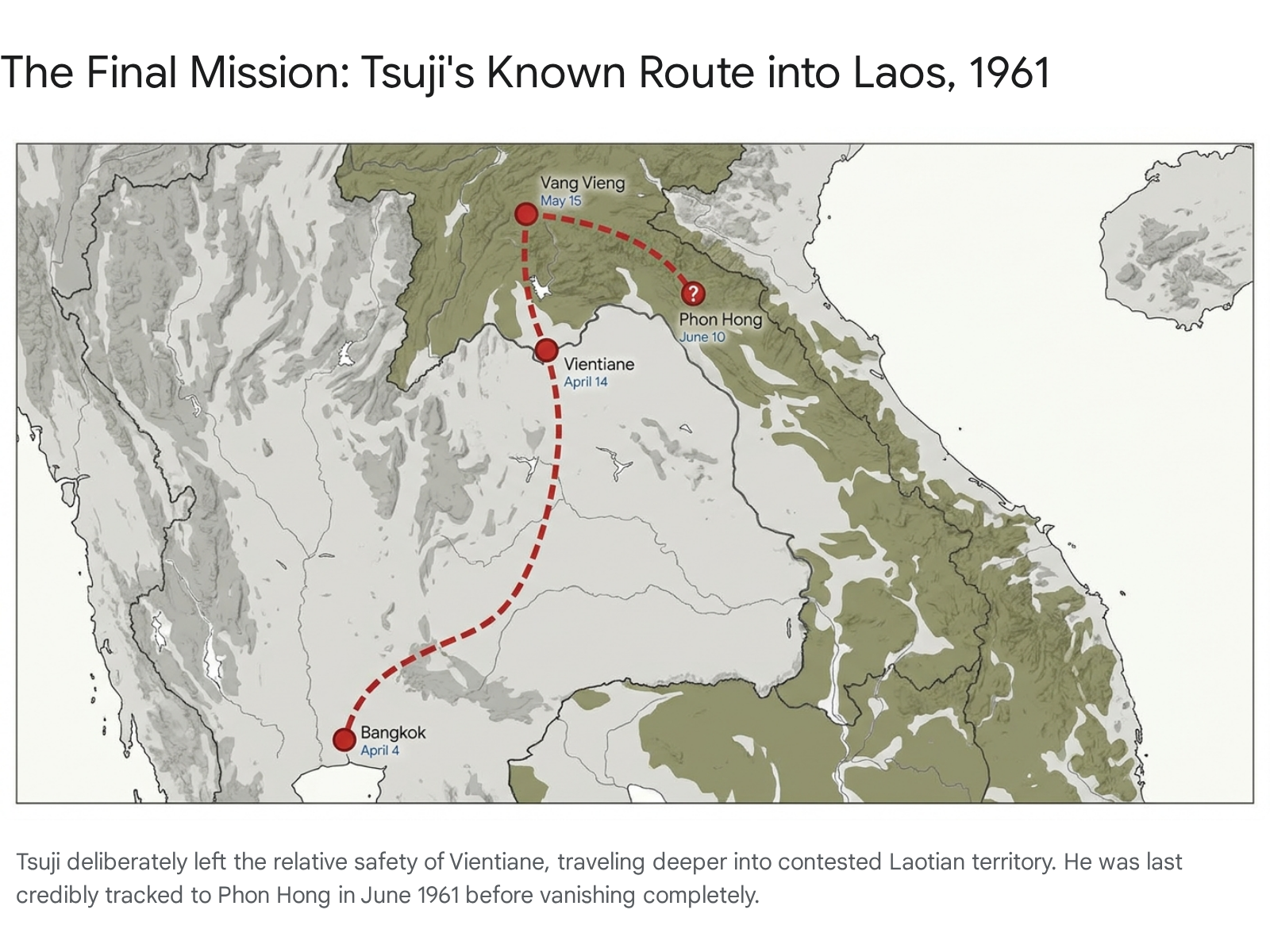
The Final Known Route
Tracing his movements through declassified CIA files and Japanese diplomatic reports reveals a deliberate and dangerous push into active, highly volatile conflict zones during the Laotian Civil War.
- April 4, 1961: Tsuji arrived in Bangkok, Thailand, where he rendezvoused with Colonel Ito Chikashi, an old acquaintance and a Japanese Self-Defense Force attaché.13
- April 14, 1961: Tsuji and Colonel Ito traveled together to Vientiane, the capital of Laos.13 In Vientiane, Tsuji visited the Tokyo Bank, converting a significant amount of American dollars into local Laotian currency.13 At this point, Tsuji and Ito parted ways. Demonstrating an awareness of the risks ahead, Tsuji entrusted Ito with his briefcase, instructing him to return it to Japan.13
- May 15, 1961: Rumors and sightings placed Tsuji further north in Vang Vieng, a strategic location heavily contested by various factions in the Laotian conflict.14
- June 10, 1961: According to an investigation by a Japanese Embassy staff member named Yoshikawa, Tsuji received permission to visit leaders of the communist Pathet Lao.14 He reportedly departed Vang Vieng and arrived at a location identified as “Phon Hong”.14
This arrival in Phon Hong in June 1961 is the last credible geographic fix on Masanobu Tsuji.14 A scheduled return flight from Vientiane to Bangkok for April 22 was canceled, and he was never seen or heard from again.13
Intelligence Assessments and Theories of Disappearance
The disappearance of a sitting Japanese parliamentarian and former high-ranking military officer triggered extensive, albeit disjointed, investigations by the CIA, the Japanese Foreign Ministry, and various international news organizations.13 These investigations generated a matrix of conflicting theories regarding his true operational objectives and his ultimate fate.
| Operational Objective / Theory of Fate | Source of Intelligence / Assessment | Plausibility & Analytical Conclusion |
| Advising the Communist Bloc (North Vietnam / Viet Cong) | CIA reports from April 1961 suggested Tsuji intended to travel to Hanoi to broker a deal or teach guerrilla warfare at an Army Officers’ School. He believed his Pan-Asian, anti-Western ideology aligned with their anti-colonial struggle, and that his past could be overlooked.13 | Moderate to Low. While Tsuji may have desired this, intelligence casts doubt on whether the North Vietnamese Army would accept a former Imperial Japanese officer, especially one known for extreme anti-communism and atrocities.13 |
| Infiltration of Communist China | Japanese Foreign Minister Kosaka speculated that Tsuji utilized Hanoi as a transit point to enter Yunnan, China. Unconfirmed reports in 1962 claimed he was imprisoned by the Chinese Communist Party to be leveraged against Japanese-American relations.3 | Low. The Chinese Red Cross explicitly denied his presence, and the new Communist regime would likely have publicized the capture of a notorious war criminal rather than hold him secretly for years.24 |
| Assassination by the CIA or U.S. Forces | Rumors circulated by Japanese Socialist Party members and Chinese sources claimed Tsuji was shot by American forces or kidnapped by CIA operatives while trying to enter Pathet Lao territory.13 | Low. Internal, declassified CIA files indicate the agency was actively searching for him and had no clear idea of his whereabouts. The CIA expressed frustration at his rogue actions, rather than claiming a successful elimination.13 |
| Execution by the Pathet Lao | The general consensus among several Japanese investigators on the ground was that upon entering the interior (Phon Hong), his disguise failed, or the Pathet Lao simply executed him as a suspected spy or enemy combatant.14 | Very High. Moving alone through a highly volatile civil war zone with a heavily documented history of anti-communist war crimes made his summary execution by local guerilla forces the most highly probable outcome.24 |
Despite pleas from his family—including a personal investigative trip to Vietnam by his son, Toru, in 1962—and repeated diplomatic inquiries, no definitive proof of his death was ever recovered, nor was his body found.13 Because no corpse was produced, under Japanese law, he officially retained his seat in the House of Councillors until his term naturally expired in 1965.3 Finally, after the requisite seven years had passed without contact, the Japanese government formally declared Masanobu Tsuji dead on July 20, 1968.3
11. Historiographical Legacy and Psychological Synthesis
The archival records surrounding Masanobu Tsuji—fractured across American intelligence repositories, Japanese political registries, and the traumatized historical memory of the Philippines and Singapore—present a jarring and irreconcilable dichotomy.
In the Philippines, the National Historical Commission and the collective institutional memory of the Armed Forces retain a stark, unmitigated awareness of the atrocities committed during the Bataan Death March.4 For the survivors of the Pantingan River massacre, and for the historical record of the Pacific War, Tsuji represents the absolute apex of Imperial Japanese savagery.5 He is remembered as a rogue commander whose fanatical adherence to a racialized, total-war ideology superseded even the basic tenets of military honor and international law espoused by his own commanding general.3
Conversely, the American and Japanese records from the post-war era reflect the ruthless pragmatism and moral compromises inherent in the Cold War. In the United States, declassified files held by the Investigative Records Repository (IRR) document how quickly a wanted mastermind of mass slaughter was politically rehabilitated and transformed into a protected intelligence asset against the perceived greater threat of Communism.12
Within Japan, Tsuji successfully manipulated his own legacy. Utilizing his evasion of Allied justice not as a mark of cowardice or criminal guilt, but as a badge of anti-establishment resilience, he crafted a narrative that resonated deeply with a populace eager to rebuild and reassert national pride.10 His election to the Diet stands as a testament to a society’s willingness to compartmentalize horrific war crimes in favor of strongman leadership and historical revisionism.34
Ultimately, Masanobu Tsuji remains a profound study in pathological extremism shielded by institutional dysfunction. His life and career highlight the fatal, systemic flaws of the gekokujō doctrine within the Imperial Japanese Army, demonstrating how a rigid hierarchy can paradoxically enable the most radical elements to seize control. His escape and subsequent political resurrection serve as a sobering indictment of the selective amnesia and pragmatic compromises that often characterize post-war international justice.
Note: The image was created using Gemini. The photo of Tsuji is from the Wikipedia article on him. Accessed April 24, 2026.
Please share the link on Facebook, Forums, with colleagues, etc. Your support is much appreciated and if you have any feedback, please email us in**@*********ps.com. If you’d like to request a report or order a reprint, please click here for the corresponding page to open in new tab.
Sources Used
- Biography of Tsuji Masanobu (1901-1968) – YouTube, accessed April 24, 2026, https://www.youtube.com/watch?v=oNk0h-0RBiI
- A historical desktop study of the Kokoda Track – DCCEEW, accessed April 24, 2026, https://www.dcceew.gov.au/sites/default/files/documents/awm-kokoda-report.pdf
- Masanobu Tsuji – Wikipedia, accessed April 24, 2026, https://en.wikipedia.org/wiki/Masanobu_Tsuji
- Bataan Death March – Wikipedia, accessed April 24, 2026, https://en.wikipedia.org/wiki/Bataan_Death_March
- Pantingan River massacre – Wikipedia, accessed April 24, 2026, https://en.wikipedia.org/wiki/Pantingan_River_massacre
- imperial, accessed April 24, 2026, https://api.pageplace.de/preview/DT0400.9781782009818_A26654156/preview-9781782009818_A26654156.pdf
- Hirohito: The Sho¯wa Emperor in War and Peace, accessed April 24, 2026, https://alatinacolonia2013.wordpress.com/wp-content/uploads/2013/04/hwp_2.pdf
- Japonius Tyrannus The Japanese Warlord Oda Nobunaga Reconsidered – Brill, accessed April 24, 2026, https://brill.com/downloadpdf/display/title/13300.pdf
- Underground Escape and The God of Strategy, A Biography of Masanobu Tsuji, accessed April 24, 2026, https://doc45.com/underground-escape-and-the-god-of-strategy-a-biography-of-masanobu-tsuji/
- 1 . FOR COORDINATION WITH :517.5x-/—e- NAZI WAR CRIMES DISCLOSURE by the Central Intelligence Agency Date: c,-e) – CIA, accessed April 24, 2026, https://www.cia.gov/readingroom/docs/TSUJI,%20MASANOBU%20%20%20VOL.%201_0032.pdf
- MASANOBU TSUJI’S ‘UNDERGROUND ESCAPE’ FROM SIAM AFTER THE JAPANESE SURRENDER – Brill, accessed April 24, 2026, https://brill.com/display/book/edcoll/9789004212688/B9789004212688-s001.pdf
- Sleeping with the enemy – Taipei Times, accessed April 24, 2026, https://www.taipeitimes.com/News/feat/archives/2007/02/25/2003350043
- DISPATCH] – CIA, accessed April 24, 2026, https://www.cia.gov/readingroom/docs/TSUJI,%20MASANOBU%20%20%20VOL.%203_0047.pdf
- E:EPTIONS Section 3(b) Date: :1 – CIA, accessed April 24, 2026, https://www.cia.gov/readingroom/docs/TSUJI%2C%20MASANOBU%20%20%20VOL.%203_0038.pdf
- TSUJI, MASANOBU VOL. 1_0031.pdf – CIA, accessed April 24, 2026, https://www.cia.gov/readingroom/docs/TSUJI%2C%20MASANOBU%20%20%20VOL.%201_0031.pdf
- The Writings of Louis Alien – Brill, accessed April 24, 2026, https://brill.com/downloadpdf/display/title/19470.pdf
- Why were the Japanese so brutal in WW2? : r/AskHistory – Reddit, accessed April 24, 2026, https://www.reddit.com/r/AskHistory/comments/1izwsgl/why_were_the_japanese_so_brutal_in_ww2/
- Four samurai: a quartet of Japanese army commanders in the Second World War, accessed April 24, 2026, https://dokumen.pub/four-samurai-a-quartet-of-japanese-army-commanders-in-the-second-world-war.html
- Tsuji Masanobu – The Pacific War Online Encyclopedia, accessed April 24, 2026, http://pwencycl.kgbudge.com/T/s/Tsuji_Masanobu.htm
- Paradise in Peril. Western colonial power and Japanese expansion in Sout-East Asia, 1905-1941 – UvA-DARE (Digital Academic Repository), accessed April 24, 2026, https://pure.uva.nl/ws/files/3097494/11107_UBA002000496_16.pdf
- The Story of World War II – Fair Observer, accessed April 24, 2026, https://www.fairobserver.com/interactive/world-war-ii/
- Ages of Conquest: a Kings and Generals Podcast – Libsyn Directory, accessed April 24, 2026, https://directory.libsyn.com/shows/view/id/kingsandgenerals
- RESEARCHING JAPANESE WAR CRIMES – National Archives, accessed April 24, 2026, https://www.archives.gov/files/iwg/japanese-war-crimes/introductory-essays.pdf
- TSUJI, MASANOBU VOL. 1_0036.pdf – CIA, accessed April 24, 2026, https://www.cia.gov/readingroom/docs/TSUJI%2C%20MASANOBU%20%20%20VOL.%201_0036.pdf
- The Pacific War – week by week | kingsandgenerals, accessed April 24, 2026, https://thepacificwar.podbean.com/
- The killer they called a god / by Ian Ward – FHL-Roderick Hall, accessed April 24, 2026, https://fhl.omeka.net/items/show/236
- Seeing the Enemy with Clarity: The Case of Colonel Masanobu Tsuji, accessed April 24, 2026, https://www.conciliators-guild.org/media/blog/seeing-the-enemy-with-clarity-masanobu-tsuji-singapore-malaya-world-war-two
- JAPANESE NATIONALISM: A TRANSNATIONAL CASE STUDY OF PAN-ASIANISM IN CHINA AND VIETNAM, 1931 – ShareOK, accessed April 24, 2026, https://shareok.org/bitstreams/669c8874-0121-4598-b219-fb356580cff9/download
- MASSACRE OR GENOCIDE? REDEFINING THE SOOK CHING – Scholars’ Bank, accessed April 24, 2026, https://scholarsbank.uoregon.edu/bitstreams/e8b93e77-bed5-41f0-a4a2-beac0f82cdd5/download
- The Battle of Singapore, the Massacre of Chinese and Understanding of the Issue in Postwar Japan – Asia-Pacific Journal, accessed April 24, 2026, https://apjjf.org/hayashi-hirofumi/3187/article
- TSUJI, MASANOBU VOL. 2_0023.pdf – CIA, accessed April 24, 2026, https://www.cia.gov/readingroom/docs/TSUJI%2C%20MASANOBU%20%20%20VOL.%202_0023.pdf
- Ofi-/ LI – CIA, accessed April 24, 2026, https://www.cia.gov/readingroom/docs/TSUJI%2C%20MASANOBU%20%20%20VOL.%201_0033.pdf
- History often seems cruel and hard, when are some times that being a good person didn’t work out? – Reddit, accessed April 24, 2026, https://www.reddit.com/r/history/comments/7thly8/history_often_seems_cruel_and_hard_when_are_some/
- The Battle of Bataan and the Bataan Death March – The Strategy Bridge, accessed April 24, 2026, https://thestrategybridge.org/the-bridge/2018/4/10/the-battle-of-bataan-and-the-bataan-death-march
- TRANSNATIONAL BATAAN MEMORIES: TEXT, FILM, MONUMENT, AND COMMEMORATION A DISSERTATION SUBMITTED TO THE GRADUATE DIVISION OF THE – ScholarSpace, accessed April 24, 2026, https://scholarspace.manoa.hawaii.edu/server/api/core/bitstreams/ed5b2627-59a0-4f6e-a118-3bdd67e47650/content
- Masanobu Tsuji’s ‘Underground Escape’ from Siam after the Japanese Surrender, accessed April 24, 2026, https://www.researchgate.net/publication/291283256_Masanobu_Tsuji’s_’Underground_Escape’_from_Siam_after_the_Japanese_Surrender
- Declassified and Approved for Release by the Central Intelligence Agency Date: – CIA, accessed April 24, 2026, https://www.cia.gov/readingroom/docs/TSUJI%2C%20MASANOBU%20%20%20VOL.%201_0022.pdf
- Twelve Japanese War Criminals and one Who Got Away – ANU Researcher Portal, accessed April 24, 2026, https://researchportalplus.anu.edu.au/en/publications/twelve-japanese-war-criminals-and-one-who-got-away/
- Breaking News — History News Network, accessed April 24, 2026, https://www.historynewsnetwork.org/article/category/55/page/1826
- Democracy’s Porous Borders: Espionage, Smuggling and the Making of Japan’s Transwar Regime (Part 2) 民主主義の境界は隙だらけ スパイ活動、密輸などで形成された日本の貫戦期(トランスウォー)体制 (下) – Asia-Pacific Journal: Japan Focus, accessed April 24, 2026, https://apjjf.org/2014/12/41/tessa-morris-suzuki/4201
- TIL Masanobu Tsuji, a Japanese parliament member and former World War II war criminal vanished without a trace in Laos in 1961. Despite his disappearance he held his seat until 1965 when his term ended. : r/todayilearned – Reddit, accessed April 24, 2026, https://www.reddit.com/r/todayilearned/comments/1mpi7ik/til_masanobu_tsuji_a_japanese_parliament_member/
- According to Anthony Beevor’s “The Second World War”, the Japanese Military had an officer led policy of eating prisoners. Is this true, and if so why aren’t people mad as hell about it? : r/AskHistorians – Reddit, accessed April 24, 2026, https://www.reddit.com/r/AskHistorians/comments/3ribf6/according_to_anthony_beevors_the_second_world_war/
- TSUJI, MASANOBU VOL. 3_0037.pdf – CIA, accessed April 24, 2026, https://www.cia.gov/readingroom/docs/TSUJI%2C%20MASANOBU%20%20%20VOL.%203_0037.pdf
- -4-. MIMI* (5/6 Sunmary) Ere., April 15, 1962 The fate of Upper House member Mmenobu TSUJI has been unknown since he disappeared – CIA, accessed April 24, 2026, https://www.cia.gov/readingroom/docs/TSUJI%2C%20MASANOBU%20%20%20VOL.%203_0040.pdf
- Full text of “Soldier of Fortune Magazine” – Internet Archive, accessed April 24, 2026, https://archive.org/stream/soldieroffortunemagazine/Soldier%20of%20Fortune%20%5B1986%2711%5D_djvu.txt