1. Executive Summary
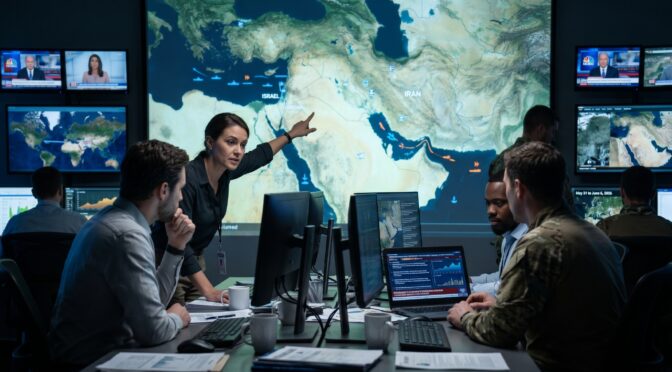
This strategic assessment details the operational, economic, and diplomatic developments characterizing the conflict between the United States, Israel, and the Islamic Republic of Iran for the period encompassing the past week (May 31 to June 6, 2026). The regional security environment remains structurally volatile, governed by a deteriorating and frequently violated ceasefire framework, acute macroeconomic degradation within the Iranian state, and sustained kinetic engagements across both the Persian Gulf maritime theater and the Levantine front.1
Over the past seven days, the operational architecture of the conflict has demonstrated a sharp escalation in enforcement and retaliation. The United States has aggressively tightened its naval blockade of Iranian commercial ports, moving from deterrence to direct kinetic interdiction. This shift was underscored by the targeted disabling of commercial shipping attempting to breach the naval cordon, notably via precision airstrikes against unladen tankers.3 In immediate, asymmetric retaliation, Iranian paramilitary and conventional forces launched complex barrages of uncrewed aerial vehicles (UAVs) and ballistic missiles against US military infrastructure and regional civilian logistics hubs. This retaliatory sequence resulted in civilian fatalities and critical infrastructure damage at Kuwait International Airport, significantly increasing diplomatic friction among Gulf Cooperation Council (GCC) states.5
Simultaneously, diplomatic back-channels aimed at finalizing a Memorandum of Understanding (MOU) to formalize a 60-day ceasefire extension have stalled, revealing a profound asymmetry in strategic urgency between Washington and Tehran.1 A central intelligence question driving current policy formulation is whether Iranian leadership desires an end to the conflict with the same urgency as United States policymakers. Analysis of recent diplomatic posturing, economic data, and internal regime communications indicates that while Iran urgently requires economic relief, its leadership is strategically positioned to outwait the United States on the diplomatic front.
The primary friction points preventing immediate conflict resolution revolve around fundamentally incompatible strategic objectives. The United States requires the total, verifiable removal of Iran’s highly enriched uranium stockpile and an immediate cessation of hostilities in Lebanon to secure northern Israel.1 Conversely, Iran demands the upfront release of up to $24 billion in frozen foreign assets to stabilize a rapidly collapsing domestic economy, while explicitly utilizing the Lebanese theater—and the preservation of Hezbollah as an active paramilitary force—as a strategic bargaining chip to deflect from US demands for nuclear concessions.8
The internal state of Iran is approaching a critical threshold of instability. The US blockade successfully reduced Iranian crude oil exports to zero for the month of May, triggering hyperinflationary shocks and severe localized resource scarcities.10 Concurrently, the internal power vacuum created by the initial decapitation strikes of the conflict is driving a significant political reconfiguration. Actual administrative control is consolidating away from the elected executive branch and into the hands of the Islamic Revolutionary Guard Corps (IRGC) and select hardline legislative figures, who are attempting to construct a sanction-resistant wartime economy heavily reliant on the People’s Republic of China.11
2. The Internal State of the Islamic Republic of Iran: Macroeconomic Attrition and Civil Fragility
The current domestic state of the Islamic Republic of Iran is defined by a compounding macroeconomic crisis and a deeply fragile civil environment. The wartime conditions and the absolute nature of the US maritime blockade have accelerated existing structural vulnerabilities, pushing the state’s fiscal solvency and social stability to their breaking points.
2.1 Macroeconomic Decoupling and Hyperinflationary Shocks
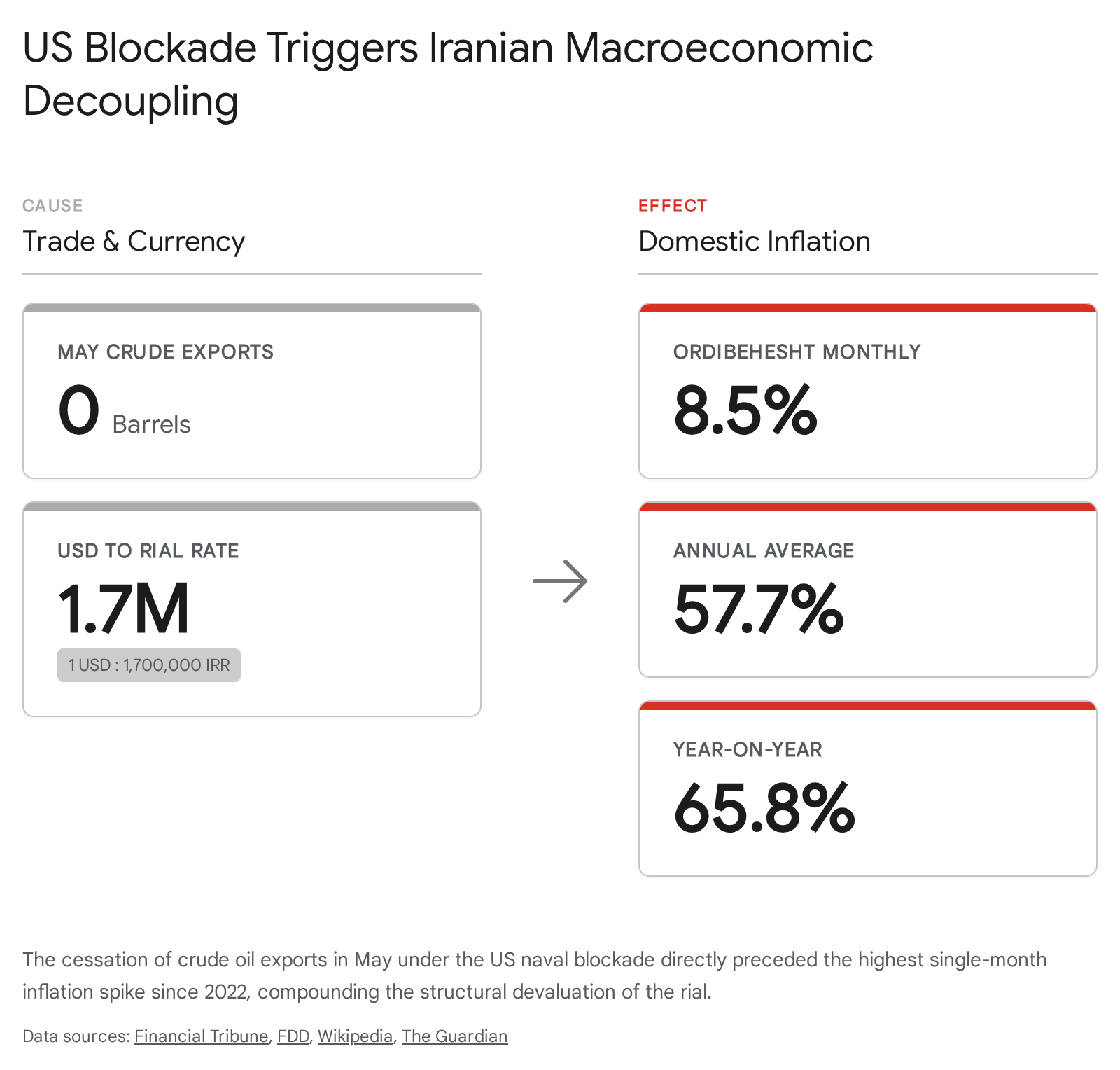
The US-led blockade has inflicted unprecedented systemic damage on the Iranian economy, effectively severing the state’s primary sovereign revenue streams. Data emerging in early June indicates that Iran exported zero crude oil in the month of May, a devastating blow to the fiscal baseline of the regime.10 The immediate macroeconomic consequence of this revenue isolation has been a rapid, uncontrolled devaluation of the national currency and surging consumer price indices.
According to figures released by the Central Bank of Iran (CBI) for the second month of the Iranian calendar (Ordibehesht, ending in late May), the monthly inflation rate reached 8.5%.13 This figure represents the highest single-month price surge recorded since the structural removal of the 4,200-rial preferential exchange rate in 2022.13 To contextualize the severity of this metric, an inflation rate exceeding 8% in a single month signals an extremely rapid degradation of purchasing power. The annual average inflation rate has subsequently climbed to 57.7%, with year-over-year inflation reported at an extraordinary 65.8%.10
The foreign exchange markets reflect this structural panic. The rial has plummeted to a street exchange rate of approximately 1.7 million to a single US dollar.7 The localized impact on the Iranian populace is severe and systemic. Essential commodities are experiencing extreme price volatility, with certain critical food products witnessing up to 100% price increases within a single week.14 The state-subsidized National Credit Network ration coupons are reportedly insufficient to meet basic caloric needs, leaving highly vulnerable demographics—particularly female workers and the urban poor—unable to afford staples such as bread.14 Furthermore, prescription drug prices have skyrocketed beyond the reach of the average consumer, and the housing crisis has deepened, forcing multiple families into shared, high-density accommodations to avoid homelessness.14
2.2 Indicators of Civil Unrest and Domestic Threat
This economic suffocation presents the most immediate and acute threat to regime continuity. The Iranian security establishment remains highly cognizant of the January 2026 domestic protests, which were violently suppressed at the cost of over 7,000 lives according to international human rights estimates.7 The current economic conditions are markedly worse than the conditions that triggered the January unrest.
The regime is currently managing a fragile domestic environment characterized by rolling electrical blackouts, hyperinflation, and deep-seated, systemic dissent.7 Analysts tracking internal Iranian communications note that the dire conditions which previously sparked bloody prewar protests have deteriorated further, creating a highly combustible social atmosphere.7 The regime’s security apparatus recognizes that the population’s current lack of mobilization is largely attributable to the immediate fear of aerial bombardment rather than domestic pacification.7 Should the external military threat diminish without concurrent economic relief, domestic intelligence indicates a high probability of renewed, widespread civil unrest.
3. Political Reconfiguration and the Consolidation of the IRGC Wartime Economy
The vacuum created by the initial February 28 decapitation strikes, which successfully eliminated Supreme Leader Ali Khamenei, continues to reshape Iranian governance and power projection. The internal political fabric of the regime is fracturing across structural fault lines, leading to the rise of a shadow leadership structure dominated by paramilitary factions.
3.1 The Absent Supreme Leader and Psychological Operations
The newly installed Supreme Leader, Mojtaba Khamenei, remains entirely isolated from public view.16 Having sustained injuries during the opening salvos of the war, he has not delivered any addresses in person, via video, or through audio recordings since his ascension.17 On June 4, the anniversary of the death of the Islamic Republic’s founder, Ayatollah Ruhollah Khomeini, an empty chair bearing Mojtaba Khamenei’s portrait stood at the mausoleum, visually underscoring his physical absence from the state apparatus.16
Despite this absence, a written statement attributed to Mojtaba Khamenei was released and heavily promoted across state media this week.16 The statement declared a definitive tactical victory over the United States and Israel, claiming the adversaries had been dealt a “decisive blow” and were experiencing a “profound, significant humiliation”.16 This rhetoric is recognized as a psychological operation designed to project internal strength, maintain ideological cohesion among the armed forces, and deter domestic dissidents. The statement explicitly warned against the enemy’s use of “hybrid warfare” intended to sow “the seeds of doubt, despair, fear, mistrust, and discord” among the Iranian populace.17 It called for “steadfastness” and “clear-sightedness,” instructing officials to prevent actions that could lead to social discontent—a clear indicator of the regime’s heightened anxiety regarding civil compliance.17
3.2 Executive Marginalization and the Rise of Ghalibaf
Beneath the ideological messaging of the Supreme Leader’s office, actual administrative and economic control is bypassing the traditional executive branch. Parliament Speaker Mohammad Bagher Ghalibaf has essentially sidelined President Masoud Pezeshkian, assuming an executive-level role in the formulation of Iran’s wartime economic survival strategy.12
Recently appointed by Mojtaba Khamenei as Iran’s Special Representative for China Affairs, Ghalibaf convened an unprecedented, high-level policy summit on June 3.12 This meeting included the core of the state’s economic apparatus: the Economy Minister, the Oil Minister, the Central Bank Governor, and the head of the Plan and Budget Organization.19 The explicit objective of this summit was to coordinate a unified economic policy directly with the People’s Republic of China, attempting to leverage bilateral trade and Chinese economic integration to offset the catastrophic effects of western sanctions and the naval blockade.19 The fact that a parliament speaker is convening cabinet-level ministers to implement foreign economic policy is highly anomalous in Iranian governance and signifies a fundamental shift in internal power dynamics.12
3.3 The Entrenchment of the IRGC
Concurrently, the Islamic Revolutionary Guard Corps (IRGC) is actively utilizing the state of war to establish absolute, long-term dominance over the domestic economy. The wartime environment positions the Guards to command future reconstruction contracts, monopolize the highly lucrative sanctions-evasion smuggling networks, and position themselves to extract fee-based maritime revenues should they formalize operational control over the Strait of Hormuz.11
This trajectory is critically important for long-term strategic planning. It ensures that even if a diplomatic peace settlement is achieved, the Iranian state apparatus will be intrinsically dependent on the IRGC for both security and economic distribution.11 This entrenched reliance will heavily complicate any future normalization of diplomatic relations with Western powers, as the IRGC views perpetual low-intensity conflict and isolationism as beneficial to its domestic monopoly. Furthermore, hardline elements within the legislature are pushing for further militarization; recently, 85 parliamentarians sent a letter to the Supreme Leader implicitly calling for the development of intercontinental ballistic missile (ICBM) capabilities, signaling a desire to permanently escalate Iran’s deterrent posture.12
4. The Maritime Theater: Blockade Enforcement and Asymmetric Retaliation in the Gulf
The Strait of Hormuz and the broader Persian Gulf remain the geographical and logistical epicenters of the US-Iran military confrontation. The waterway, which historically facilitated the transit of approximately one-fifth of global oil consumption, has been effectively paralyzed since the outbreak of hostilities.21 The events of the past week demonstrate a sharp, dangerous escalation in kinetic maritime enforcement by the United States and immediate, asymmetric retaliation by Iranian forces against regional civilian and military infrastructure.
4.1 US Naval Blockade Enforcement and the M/T Lexie Incident
The US military’s Central Command (CENTCOM) initiated a strict naval blockade of all maritime traffic entering and exiting Iranian ports on April 13, 2026.4 The strategic objective is to enforce an absolute economic embargo by physically preventing unauthorized vessels from loading or discharging crude oil and other sanctioned cargo at Iranian facilities, with a particular focus on the Kharg Island oil terminal.
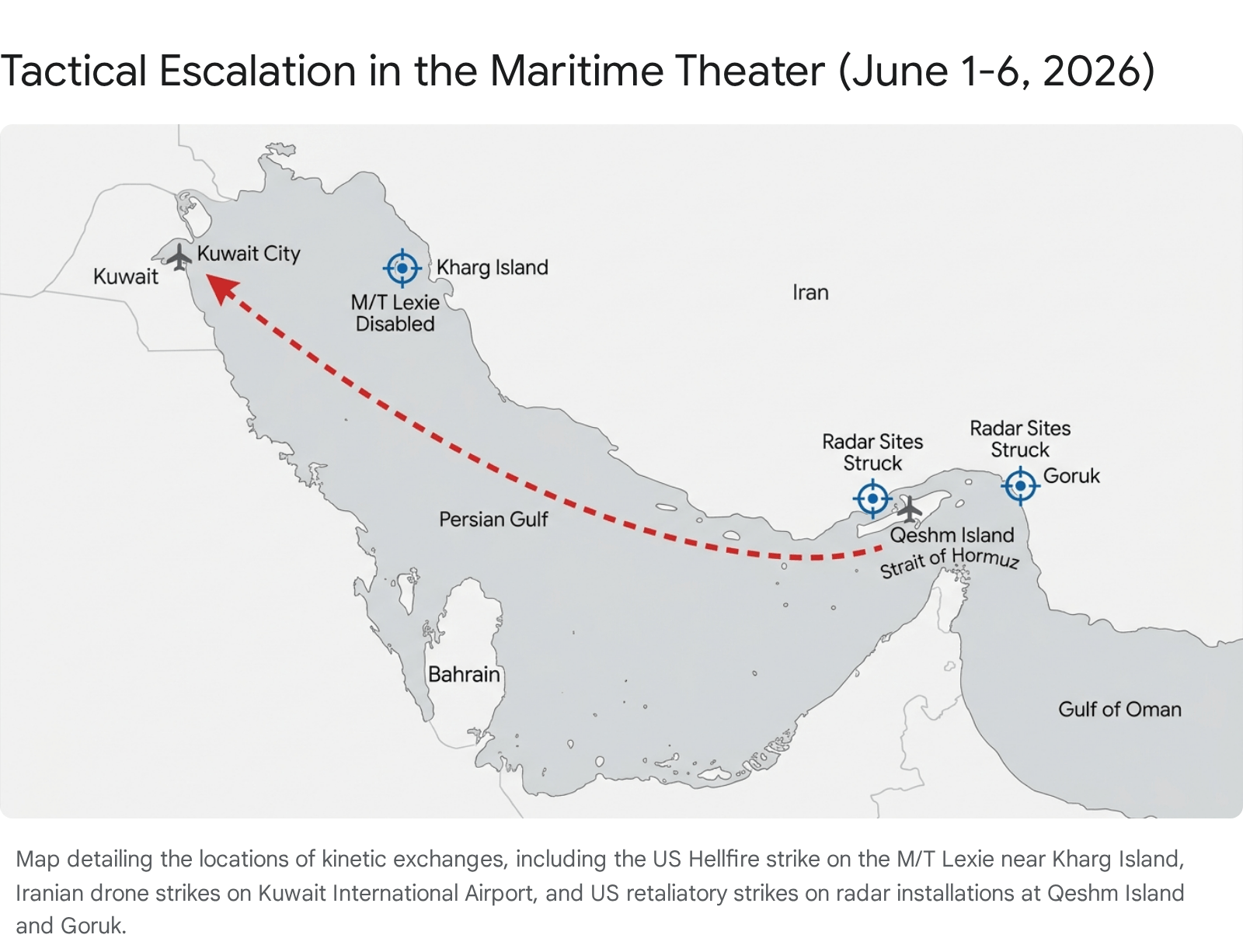
Over the past week, this enforcement posture escalated from verbal warnings and navigational redirection to direct kinetic immobilization. On June 2, the M/T Lexie, an unladen, Botswana-flagged commercial oil tanker, attempted to transit international waters toward Iran’s Kharg Island.3 According to detailed statements released by CENTCOM, US naval and air forces issued repeated warnings and directed the vessel to alter its course over a 24-hour period.4 When the ship’s crew continually ignored these directives, a US military aircraft deployed an AGM-114 Hellfire missile directly into the tanker’s engine room.3 The precision strike successfully disabled the vessel’s propulsion systems, preventing its arrival in Iran without causing reported casualties among the crew.3
This incident represents a significant escalation in the rules of engagement, marking the sixth commercial vessel forcibly disabled by US kinetic action since the blockade began, while an additional 122 vessels have been successfully intercepted and redirected via non-kinetic means.4 Concurrently, maritime risk intelligence confirms that the threat environment extends to the northern Gulf, with reports confirming that the commercial container ship MSC Sariska V was struck by two projectiles while departing the port of Um-Qasr, Iraq, on June 1.23
4.2 Iranian Retaliatory Strikes on Gulf Infrastructure
Iran’s tactical response to the successful enforcement of the US blockade has been to bypass direct naval confrontation with the technologically superior US Fifth Fleet. Instead, Iran has opted to target US surveillance infrastructure and execute asymmetric strikes against US-allied Gulf nations hosting American military assets, aiming to fracture the regional coalition.
The escalation sequence over the past week was rapid and highly destructive:
- June 2-3: Following the disablement of the M/T Lexie, Iran launched a complex barrage of one-way attack drones and ballistic missiles aimed at regional maritime traffic and neighboring states.24
- June 3 (Kuwait Airport Strike): The most significant escalation occurred when a major Iranian drone strike successfully penetrated Kuwaiti airspace and targeted Kuwait International Airport. A projectile struck the roof of Passenger Terminal 1, resulting in a large explosion that killed one civilian (an Indian national) and injured 63 others, including seven individuals who required critical, major surgery.5 Kuwait’s Defense Ministry reported engaging and destroying over a dozen ballistic missiles and a similar number of drones during the broader barrage.6 While Iran’s IRGC officially denied responsibility for the airport strike—implausibly claiming the damage was caused by a malfunctioning US Patriot interceptor missile—CCTV footage released by Kuwaiti civil aviation authorities and categorical statements from CENTCOM unequivocally confirmed it was a deliberate, calculated Iranian drone strike against a civilian hub.6
- June 5 (Drone Interception and Radar Strikes): The US military intercepted and shot down four Iranian one-way attack drones that were launched toward commercial shipping lanes in the Strait of Hormuz.24 In immediate retaliation for the drone launch, US forces conducted “self-defense” airstrikes against Iranian coastal surveillance and radar sites located in Goruk and on Qeshm Island, strategically blinding Iranian maritime tracking capabilities in the sector.21
- June 5-6 (Ballistic Missile Retaliation): In a tit-for-tat response to the destruction of the radar sites, Iran fired seven ballistic missiles toward US Fifth Fleet headquarters infrastructure in Bahrain and military targets in Kuwait. CENTCOM reported that six of the incoming missiles were successfully intercepted by air defense systems, while the seventh failed to reach its intended target.24
This aggressive exchange highlights the extreme fragility of the operational environment. Iran officially justifies these actions as legitimate “self-defense strikes” against US platforms utilized to enforce the blockade.1 However, the targeting of Kuwaiti civilian infrastructure has triggered severe diplomatic fallout. Kuwait and Bahrain have responded by formally protesting the aggression, summoning Iranian diplomats, and ordering the expulsion of Iranian embassy staff.1 Internally, Bahrain also moved to secure its domestic front, dismantling a domestic espionage ring and arresting 15 individuals accused of operating as field agents and saboteurs for the IRGC.30
4.3 Global Supply Chain Disruption and Omani Diplomacy
The logistical and economic fallout from the continued closure of the Strait is massive and compounding globally. Prior to the outbreak of hostilities, approximately 138 vessels transited the Strait daily, ensuring the steady flow of global energy supplies.31 Currently, marine traffic data illustrates severe, unprecedented congestion, with over 2,000 captive ships clustered outside the conflict zone, refusing to transit due to extreme safety concerns.31
Among these captive vessels are an estimated 200 large-capacity tankers holding a stockpiled volume of roughly 160 million barrels of oil.32 It is imperative for intelligence consumers to note that should a diplomatic breakthrough occur and the Strait reopen, the initial outflow of vessels will consist entirely of this trapped stockpile rather than fresh supply.32 This dynamic represents a delayed market normalization that could take months to untangle, indicating that global energy markets will remain constrained well into late 2026 regardless of immediate diplomatic successes.
On the diplomatic front, the United States is exerting intense pressure on the Sultanate of Oman to sever its ties with Iran over Tehran’s behavior in the Strait. Oman, which shares territorial stewardship of the Strait of Hormuz with Iran, has historically maintained strict neutrality and served as a vital back-channel mediator between Washington and Tehran.33 Last week, US President Donald Trump threatened Oman with severe repercussions—suggesting the US could “blow ’em up”—if it assisted Iran in controlling or taxing the waterway.33 Furthermore, Secretary of State Marco Rubio publicly suggested Oman was “flirting” with supporting Iranian maritime actions.33
Oman has firmly resisted this pressure, defending its diplomatic engagement with Tehran as strictly limited to negotiating a future, lawful management system for the Strait. Omani officials have stressed that any such system would be implemented only after consultation with the UN’s International Maritime Organization (IMO), and they have categorically rejected any Iranian attempts to impose a unilateral toll-based “protection scheme” on international shipping.33
Table 1: Kinetic Maritime Engagements and Escalation (May 31 – June 6, 2026)
| Date | Location | Incident Description | Primary Actor | Casualties / Damage |
| June 1 | Um-Qasr, Iraq | MSC Sariska V struck by two projectiles while departing port. | Unspecified (Assessed Iranian proxy) | Vessel damage reported; no casualties. |
| June 2 | Near Kharg Island | M/T Lexie disabled by US Hellfire missile after ignoring blockade warnings. | US CENTCOM | Vessel propulsion disabled; zero casualties. |
| June 3 | Kuwait City | Drone strike on Kuwait International Airport Terminal 1. | IRGC / Iranian Forces | 1 civilian fatality; 63 injured; severe structural damage. |
| June 5 | Strait of Hormuz | US forces intercept and destroy four Iranian one-way attack drones. | US CENTCOM | Drones destroyed. |
| June 5 | Qeshm Island / Goruk | US self-defense airstrikes destroy Iranian coastal radar and surveillance sites. | US CENTCOM | Radar infrastructure destroyed. |
| June 6 | Kuwait / Bahrain | Iran launches 7 ballistic missiles at US Fifth Fleet and allied bases; 6 intercepted. | IRGC / Iranian Forces | Intercepted; minimal ground damage reported. |
3
5. The Levantine Fulcrum: Tactical Linkage and the Collapse of the Lebanon Ceasefire
While the primary, high-intensity conflict involves the US and Iran in the Persian Gulf, the concurrent war between Israel and Hezbollah in Lebanon is intrinsically linked to the broader peace process. Iran is actively utilizing the Lebanese theater as a strategic fulcrum, refusing to decouple the fronts and using the ongoing violence to gain leverage over Washington.
5.1 The Defunct Israel-Lebanon Ceasefire Framework
On June 3 and 4, the United States mediated a highly detailed proposed ceasefire agreement between the Israeli and Lebanese state governments.2 The framework was structured as a phased, reciprocal de-escalation: Hezbollah was required to halt all cross-border fire into northern Israel and completely withdraw its paramilitary fighters from southern Lebanon (specifically evacuating positions south of the Litani and Zahrani rivers).35 This withdrawal was designed to allow the Lebanese Armed Forces (LAF) to establish non-state armed group-free “pilot zones,” thereby reasserting state sovereignty over the border region.35 In return for this withdrawal, Israel agreed to refrain from further escalation and halt strikes in Beirut.36
The agreement collapsed almost immediately upon its public presentation. Hezbollah is not an official party to the state-level agreement and wholly rejected the terms dictated by Washington and Beirut. In a televised address on June 4, Hezbollah Deputy Secretary-General Naim Qassem denounced the Washington-backed declaration as a “farce” and characterized the terms as “absurd, humiliating, and insulting”.35 Qassem stated unequivocally that the group would not withdraw under fire, arguing that abandoning southern Lebanon would constitute a surrender that fulfilled all of Israel’s military objectives.37 Following Hezbollah’s public rejection, the Israel Defense Forces (IDF) resumed airstrikes near the southern Lebanese town of Nabatieh, and Israeli Defense Minister Israel Katz confirmed that Israeli operations in the country would continue unabated to ensure the security of Israel’s northern border.2
5.2 Iran’s Tactical Linkage and Strategic Deflection
Hezbollah’s rejection of the ceasefire is not an isolated decision; it is directly coordinated with, and mandated by, Tehran. Iranian leadership views the preservation of Hezbollah as a vital geopolitical asset and a core national security imperative. Iran utilizes the militia to deter Israeli aggression, project power across the Levant, and absorb military pressure from both Israel and the United States.8
Consequently, Iran has established the cessation of hostilities in Lebanon as a mandatory, non-negotiable precondition for advancing US-Iran bilateral negotiations.8 Iranian Foreign Affairs Minister Abbas Araghchi declared on June 3 that the broader US-Iran war will not conclude until the IDF entirely withdraws from Lebanese territory.8 Furthermore, Supreme Leader Military Adviser Mohsen Rezaei stated on June 5 that the resolution of the Lebanon conflict is an “inseparable part” of any US-Iran agreement.8
This linkage serves as a highly effective tactical delaying mechanism for the Iranian regime. By centering international diplomatic energy on the intractable issue of Lebanese pilot zones and the disarmament of Hezbollah, Iran successfully diverts attention from the core US demands that it wishes to avoid: the status of the Strait of Hormuz and the dismantling of Iran’s advanced nuclear enrichment capabilities.8 Lebanese state officials are acutely aware of this manipulation. Lebanese President Joseph Aoun and Prime Minister Nawaf Salam publicly condemned Tehran’s strategy on June 5, stating explicitly that Iran is exploiting Lebanon as a mere “bargaining chip” in its negotiations with the US, fighting a proxy war on Lebanese soil at the catastrophic expense of the Lebanese civilian population.8
6. Asymmetric Negotiation Postures and Strategic Intentions
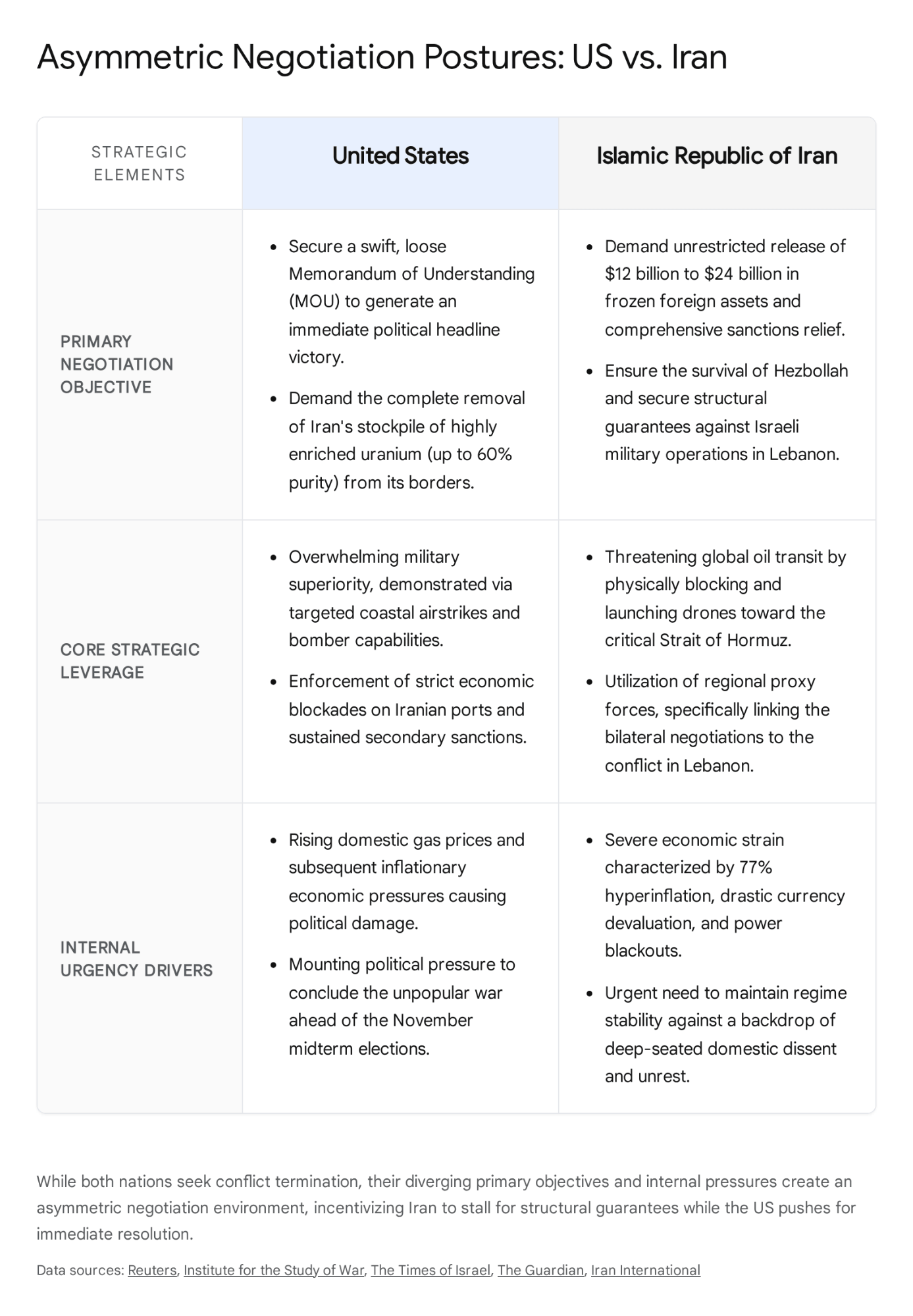
Despite the intense military exchanges in the Gulf and the collapse of the Levantine ceasefire, indirect negotiations between Washington and Tehran continue via regional intermediaries, primarily utilizing back-channels in Qatar and Pakistan.7 However, the structural dynamics of these talks reveal a vast chasm between what each administration requires to successfully terminate the conflict.
6.1 Do Iranian Leaders Want the Conflict to End?
A central intelligence question explicitly posed in current policy assessments is whether Iranian leadership desires an end to the conflict with the same urgency as United States leaders do. The analytical assessment is highly nuanced: Iran urgently requires the economic relief that a ceasefire provides, but the regime is strategically positioned, and ideologically willing, to outwait the United States on the diplomatic front.
The United States operates on an inflexible, compressed political timeline dictated by the November electoral cycle, the immediate economic pain of energy markets, and a restless legislature.7 President Donald Trump is facing acute domestic political pressure driven by soaring domestic gasoline prices tied directly to the Hormuz closure.7 Furthermore, the US Congress is actively pushing back against the executive branch; the US House of Representatives recently passed a resolution attempting to curb the President’s war powers regarding the ongoing conflict with Iran.24 Consequently, the US administration desires a swift Memorandum of Understanding (MOU)—a high-level, fast-tracked agreement that can be announced as a definitive diplomatic breakthrough and a political victory to rapidly reopen the Strait of Hormuz before the elections.7
Iran, conversely, operates under an existential economic timeline but possesses profound asymmetrical leverage. While the hyperinflation destroying the Iranian middle class is devastating, the regime has demonstrated a historical capacity to violently suppress domestic unrest and absorb profound economic shocks.15
For the upcoming generation of Iranian leaders, agreeing to a vague, fast-tracked MOU after enduring months of US aerial bombardment is perceived internally as a humiliating surrender.7 Tehran demands highly specific, granular commitments regarding the exact timeline for sanctions relief, the mechanics of enforcement, and ironclad legal protection against subsequent US policy reversals (driven by the historical precedent of the US withdrawal from the JCPOA).7
Therefore, Iranian leaders do want the conflict to end, as the state economy cannot survive a prolonged, zero-export environment. However, they do not share the US administration’s desperation for a rapid resolution. By employing the strategy of “issue linkage”—tying the release of frozen assets to the reopening of the Strait, and tying the Strait to the intractable Lebanese conflict—Iran has effectively slowed the negotiation pace to its advantage. Tehran is willing to endure continued infrastructure damage in the short term to extract maximalist concessions, calculating that US domestic political anxiety will force Washington to capitulate on the finer details of the agreement.7
6.2 The Core Financial Dispute: $12B vs $24B
The primary immediate friction point holding up the negotiations is financial. To mitigate its internal hyperinflationary collapse, Iran is demanding guaranteed, upfront access to a significant portion of its frozen foreign assets. Reports indicate that negotiators in Qatar are currently discussing an initial package worth approximately $12 billion.9 This partial access could stabilize Iran’s currency market and allow the Central Bank of Iran to import essential goods.9
However, Iranian negotiators are demanding more. Senior adviser Mohsen Rezaei has publicly stated that the release of up to $24 billion (out of an estimated $100+ billion frozen globally) is a mandatory “test of trust” that the US must pass before any final agreement is ratified.1 Iran is seeking absolute guarantees that access to these funds will be irreversible, linking the release of assets directly to the implementation of any future security agreement regarding the Strait.9
6.3 Nuclear Capability and the Oak Ridge Consultations
The ultimate, non-negotiable requirement for the United States in any comprehensive peace settlement is the verifiable neutralization of Iran’s nuclear weapons capability. President Trump has stated unequivocally that under any deal, the US “will get” Tehran’s stockpile of highly enriched uranium and ensure it is physically removed from the country’s borders.1 Iran, however, has consistently maintained its sovereign right to enrich uranium for civilian purposes and strongly opposes removing its domestic stockpile, which currently consists of approximately 900 pounds (408 kg) of uranium enriched to 60% purity—a technical threshold alarmingly close to weapons-grade material.1
To prepare for the complex logistical realities of neutralizing this threat, US Special Envoy Steve Witkoff and presidential adviser Jared Kushner traveled to the Oak Ridge National Laboratory in Tennessee on June 4.40 The envoys consulted with leading American nuclear specialists regarding the practical and technical requirements for the verification, limitation, and physical disposal of existing Iranian nuclear materials should an agreement be reached.42
Intelligence indicates that approximately 100 technical experts have been identified and vetted to potentially deploy for this verification mission, leveraging institutional knowledge from past operations involving the removal of enriched uranium from nations such as Kazakhstan and Venezuela.41 While US officials cautioned that the Oak Ridge meetings do not guarantee a diplomatic deal is imminent, the consultations strongly signal that negotiations regarding the nuclear technicalities have entered a highly serious and practical phase, indicating the US is preparing the necessary infrastructure to execute a deal if Iran accepts the terms.43
7. Strategic Outlook
The intelligence gathered over the past week confirms that the conflict has settled into a dangerous, highly institutionalized war of attrition. The tentative diplomatic ceasefire exists in name only, regularly and violently punctuated by high-stakes maritime interdictions, ballistic missile exchanges, and proxy warfare in the Levant.
Looking forward to the coming weeks, the diplomatic track hinges entirely on resolving the financial dispute over frozen assets. If US and Iranian negotiators can agree upon a secure, verified mechanism to release an initial $12 billion to $24 billion tranche to the Central Bank of Iran, it may provide Tehran with sufficient domestic breathing room to temporarily de-link the Levantine theater from the Gulf negotiations, opening a narrow pathway to a broader ceasefire.1
However, if negotiations remain stalled and the US blockade successfully maintains zero crude exports through the month of June, Iranian internal economic instability will reach unprecedented, existential levels.10 In this scenario, it is highly probable that the IRGC will authorize further, severe kinetic escalation in the Gulf. This could potentially escalate from drone strikes on civilian airports to the direct, sustained targeting of US naval assets, allied GCC energy infrastructure, or critical desalination plants. Iran’s objective in such an escalation would be to inflict unacceptable economic pain on global markets in a desperate bid to force international intervention and break the financial siege before the domestic economy completely fractures. The high-level technical consultations at Oak Ridge confirm that the framework for a nuclear stand-down is actively being built by the United States 40; the critical variable remains whether the political will exists in either Washington or Tehran to utilize it before a catastrophic regional miscalculation occurs.
Please share the link on Facebook, Forums, with colleagues, etc. Your support is much appreciated and if you have any feedback, please email us in**@*********ps.com. If you’d like to request a report or order a reprint, please click here for the corresponding page to open in new tab.
Sources Used
- Trump suggests Iran talks could yield deal by weekend while Tehran …, accessed June 6, 2026, https://www.timesofisrael.com/trump-suggests-iran-talks-could-yield-deal-by-weekend-while-tehran-denies-progress/
- Hezbollah rejection clouds Lebanon ceasefire and prospects for ending Iran war, accessed June 6, 2026, https://www.tbsnews.net/world/hezbollah-rejection-clouds-lebanon-ceasefire-and-prospects-ending-iran-war-1454146
- U.S. Forces Disable Sanctioned Tanker M/T Lexie Bound for Iran – Maritime Optima, accessed June 6, 2026, https://maritimeoptima.com/maritime-news/u-s-forces-disable-sanctioned-tanker-m-t-lexie-bound-for-iran
- US military says it disabled Botswana-flagged oil tanker near Iran’s Kharg Island, accessed June 6, 2026, https://www.aa.com.tr/en/us-israel-iran-war/us-military-says-it-disabled-botswana-flagged-oil-tanker-near-irans-kharg-island/3954709
- Israel, Lebanon agree to renew ceasefire as Iran launches deadly attack on Kuwait airport, accessed June 6, 2026, https://www.cbsnews.com/live-updates/trump-iran-war-attacks-kuwait-airport-israel-hezbollah-ceasefire/
- Kuwait releases footage of deadly airport attack after Iran denies responsibility, accessed June 6, 2026, https://www.thenationalnews.com/news/mena/2026/06/04/kuwait-releases-footage-of-deadly-airport-attack-after-iran-denies-responsibility/
- Iran and the US both think they are winning the war. The truth is they …, accessed June 6, 2026, https://www.theguardian.com/commentisfree/2026/jun/04/iran-us-winning-war-truth-losing-ceasefire
- Iran Update Special Report, June 5, 2026, accessed June 6, 2026, https://understandingwar.org/research/middle-east/iran-update-special-report-june-5-2026/
- Explained: Iran’s frozen assets around the world, accessed June 6, 2026, https://www.iranintl.com/en/202606055170
- Trump’s Blockade Is Zeroing Out Iran’s Oil Exports, accessed June 6, 2026, https://www.fdd.org/analysis/2026/06/05/trumps-blockade-is-zeroing-out-irans-oil-exports/
- The wartime economic takeover of the Iranian state – Clingendael Institute, accessed June 6, 2026, https://www.clingendael.org/publication/wartime-economic-takeover-iranian-state
- Iran Update Special Report, June 3, 2026, accessed June 6, 2026, https://understandingwar.org/research/middle-east/iran-update-special-report-june-3-2026/
- Inflation Shock: Economic Pressures in Iran Reach a New Peak | FinancialTribune, accessed June 6, 2026, https://financialtribune.com/node/119727
- Iranian economic crisis – Wikipedia, accessed June 6, 2026, https://en.wikipedia.org/wiki/Iranian_economic_crisis
- Iran stops talking to mediators, Iranian reports say, but Trump says talks continue, accessed June 6, 2026, https://www.clickorlando.com/news/world/2026/06/02/irans-inflation-hits-world-war-ii-levels-deepening-economic-pain/
- ‘Khamenei’ says US, Israel hit by ‘decisive blow’ amid mixed signals on talks, US security alert, accessed June 6, 2026, https://www.timesofisrael.com/statement-by-irans-leader-says-us-israel-hit-by-decisive-blow-amid-mixed-signals-on-talks/
- Ayatollah says Iran has ‘defeated’ US as Trump, Rubio acknowledge he’s playing active role in regime, accessed June 6, 2026, https://www.washingtonexaminer.com/news/world/4595133/ayatollah-iran-defeated-us-trump-rubio-active/
- Khamenei claims Israel-US plot against Iran, calls for national trust | The Jerusalem Post, accessed June 6, 2026, https://www.jpost.com/middle-east/iran-news/article-898364
- Qalibaf Weighs Plans to Enhance Iran-China Cooperation – Politics news, accessed June 6, 2026, https://www.tasnimnews.ir/en/news/2026/06/03/3607960/qalibaf-weighs-plans-to-enhance-iran-china-cooperation
- Qalibaf Weighs Plans to Enhance Iran-China Cooperation, accessed June 6, 2026, https://www.islamtimes.com/en/news/1283772/qalibaf-weighs-plans-to-enhance-iran-china-cooperation
- US attacks Iranian coastal sites after Iran launches drones in latest …, accessed June 6, 2026, https://www.al-monitor.com/originals/2026/06/us-attacks-iranian-coastal-sites-after-iran-launches-drones-latest-flare
- Iran Fires Missiles, Drones After US Strikes Blockade-Busting Ship – Air & Space Forces Magazine, accessed June 6, 2026, https://www.airandspaceforces.com/iran-fires-missiles-drones-after-us-strikes-blockade-busting-ship-in-latest-flare-up/
- DeepDraft SITREP | U.S. Disables M/T Lexie: Hellfire Strike Marks Sixth Blockade Enforcement Action as MSC Sariska V Confirms Northern Gulf Missile Risk (June 3, 2026), accessed June 6, 2026, https://thedeepdraft.com/2026/06/03/deepdraft-sitrep-u-s-disables-m-t-lexie-hellfire-strike-marks-sixth-blockade-enforcement-action-as-msc-sariska-v-confirms-northern-gulf-missile-risk-june-3-2026/
- US downs Iranian ballistic missiles and drones headed toward Kuwait, Bahrain, and Strait of Hormuz, accessed June 6, 2026, https://www.washingtonexaminer.com/news/world/4597589/us-downs-iranian-drones-strait-of-hormuz/
- Iran strikes Kuwait’s main airport and kills 1 as ceasefire is tested again | PBS News, accessed June 6, 2026, https://www.pbs.org/newshour/world/iran-strikes-kuwaits-main-airport-and-kills-1-as-ceasefire-is-tested-again
- Kuwait says Iranian drones hit airport and killed 1 as ceasefire is tested again, accessed June 6, 2026, https://apnews.com/article/iran-us-israel-lebanon-war-kuwait-ceasefire-3-june-2026-de2d1814c0f38252bf0383be859c870b
- US military denies its vessel was hit in Sea of Oman, says “Iran is lying” about Strait of Hormuz rules violation, accessed June 6, 2026, https://www.aninews.in/news/world/middle-east/us-military-denies-its-vessel-was-hit-in-sea-of-oman-says-iran-is-lying-about-strait-of-hormuz-rules-violation20260604022822
- West Asia war LIVE: Kuwait says new Iran attack ‘dangerous escalation’, accessed June 6, 2026, https://www.thehindu.com/news/international/west-asia-conflict-iran-us-israel-war-strait-of-hormuz-live-updates-june-6-2026/article71068325.ece
- One killed and 63 hurt in Iran attack on Kuwait airport as Trump says ceasefire talks ongoing, accessed June 6, 2026, https://www.theguardian.com/world/2026/jun/03/us-fires-missile-tanker-strait-of-hormuz
- Iran News in Brief – June 4, 2026, accessed June 6, 2026, https://www.ncr-iran.org/en/news/iran-news-in-brief-news/iran-news-in-brief-june-4-2026/
- Iran War Shipping Update – June 4, 2026 | UANI, accessed June 6, 2026, https://www.unitedagainstnucleariran.com/blog/iran-war-shipping-update-june-4-2026
- A Beginner’s Guide to Reopening the Strait, accessed June 6, 2026, https://thedispatch.com/newsletter/dispatch-energy/oil-shipments-production-strait-hormuz-iran-war/
- Oman resists US pressure to break ties with Iran over strait of Hormuz, accessed June 6, 2026, https://www.theguardian.com/world/2026/jun/04/oman-resists-us-pressure-to-break-ties-with-iran-over-strait-of-hormuz
- US threatens Oman with sanctions over Iran’s Hormuz tolling system; experts debate, accessed June 6, 2026, https://www.youtube.com/watch?v=egV0svNXdDU
- Hezbollah denounces Israel-Lebanon ceasefire deal as a ‘farce’, accessed June 6, 2026, https://www.washingtonpost.com/world/2026/06/04/israel-lebanon-renew-ceasefire-deal-without-hezbollah/
- US proposes phased de-escalation plan between Israel and Lebanon | Iran International, accessed June 6, 2026, https://www.iranintl.com/en/202606014713
- Israel and Hezbollah Trade Fresh Strikes as Militant Group Rejects Cease-Fire Plan – TIME, accessed June 6, 2026, https://time.com/article/2026/06/04/hezbollah-rejects-israel-lebanon-ceasefire-agreement-strikes/
- Hezbollah rejects latest ceasefire agreement as Israeli strikes kill 4 in Lebanon, accessed June 6, 2026, https://apnews.com/article/iran-us-war-israel-lebanon-hezbollah-ceasefire-06ea585ce43fd28e26c4d21d46a4df83
- What the US-Israel war on Iran will not change in the Middle East, accessed June 6, 2026, https://www.aljazeera.com/opinions/2026/6/4/what-the-us-israel-war-on-iran-will-not-change-in-the-middle-east
- Witkoff, Kushner meet nuclear experts at national lab in Tennessee, source says, accessed June 6, 2026, https://www.straitstimes.com/world/middle-east/witkoff-kushner-meet-nuclear-experts-at-national-lab-in-tennessee-source-says
- Witkoff, Kushner met nuclear experts at US national laboratory – report – The Times of Israel, accessed June 6, 2026, https://www.timesofisrael.com/liveblog_entry/witkoff-kushner-met-nuclear-experts-at-us-national-laboratory-report/
- Witkoff, Kushner consult with Oak Ridge nuclear experts on Iran – report, accessed June 6, 2026, https://www.jpost.com/international/article-898519
- Witkoff, Kushner hold nuclear consultations amid Iran talks – AzerNews, accessed June 6, 2026, https://www.azernews.az/region/259404.html