
1. Executive Summary
In the aftermath of Operation Epic Fury (February–May 2026) and the subsequent signing of the Islamabad Memorandum of Understanding (MoU) on June 17, 2026, the strategic and geopolitical landscape of the Middle East has been fundamentally and permanently altered. Despite facing an unprecedented and overwhelming application of conventional military force by the United States and Israel—an offensive that included the successful decapitation strike against Supreme Leader Ayatollah Ali Khamenei and the decimation of Iran’s conventional military infrastructure—the Islamic Republic of Iran has resolutely refused to capitulate. Consequently, the United States failed to achieve its primary strategic objectives: regime change, the complete dismantlement of the Iranian nuclear program, and the neutralization of Tehran’s regional proxy network known as the Axis of Resistance.
This intelligence assessment leverages open-source intelligence (OSINT) to conduct a deep-dive analysis into the systemic blind spots that plague both U.S. and Western policy regarding Iran, as well as the equally critical blind spots overlooked by the Iranian regime itself. The United States consistently fails to recognize that its vast tactical superiority does not translate to strategic victory against a state architecture explicitly designed to absorb massive infrastructural and leadership losses. Western policymakers fundamentally misunderstand the Iranian calculus, routinely projecting Western rational-actor models onto a regime driven by historical memory, a deep-seated strategic culture of resistance, and an asymmetric tolerance for economic and military pain.
Furthermore, the core drivers of Iranian resistance are shifting, requiring a reassessment of fundamental assumptions. While revolutionary Shiite theology and the traditions of the 1979 revolution provided the foundational rhetoric of the republic, the modern Iranian state is increasingly defined by the pursuit of raw power, the preservation of monopolistic wealth, and the maintenance of national prestige—assets managed almost exclusively by the Islamic Revolutionary Guard Corps (IRGC). For the IRGC, capitulation is viewed not merely as a diplomatic concession or an avenue for economic integration, but as existential death. By operationalizing its “Mosaic Defense” doctrine, Iran has successfully democratized cost asymmetry, trading conventional military attrition for catastrophic geo-economic disruption, particularly through the weaponization of the Strait of Hormuz.
Conversely, the Iranian regime harbors severe blind spots regarding its own domestic longevity. In prioritizing absolute regime survival through militarized coercion, the state has entirely alienated its populace, guaranteeing that future societal crises will be explosive. While the current trajectory indicates an entrenchment of hardline military governance under the newly elevated Supreme Leader Mojtaba Khamenei, the systemic factors driving Iranian resistance are not entirely immutable. Change, however, will not be driven by external conventional military pressure, which only serves to unify the security apparatus. Instead, future shifts in Iran’s strategic posture will likely stem from the internal unsustainability of its coercive domestic governance and the potential fracturing of the IRGC’s monolithic control over a deeply fractured and economically ruined society.
2. The Strategic Landscape of 2026: Operational Review
To understand the current geopolitical stalemate, one must first analyze the scale, scope, and ultimate failure of the military campaigns that defined the first half of 2026. The strategic environment is characterized by the limits of conventional power projection and the triumph of asymmetric deterrence.
2.1 Operation Epic Fury and the Illusion of Decisive Force
The early months of 2026 witnessed an unprecedented escalation in direct, state-on-state hostilities between the United States, Israel, and the Islamic Republic of Iran. Driven by Iran’s advancing nuclear threshold capabilities, its continued regional destabilization efforts, and the unresolved geopolitical legacy of the 2025 Twelve-Day War, the United States and Israel launched Operation Epic Fury on February 28, 2026.1
Operation Epic Fury represented the apex of Western conventional military projection. The opening salvo achieved what many intelligence analysts previously considered the ultimate strategic blow: a historic decapitation strike that killed Supreme Leader Ayatollah Ali Khamenei, alongside his daughter, son-in-law, and granddaughter, within his compound in Tehran.4 The working hypothesis in Washington and Tel Aviv was that the sudden removal of the absolute apex of the Iranian leadership structure, combined with overwhelming kinetic pressure, would fracture the regime’s command and control, leading to rapid capitulation or internal collapse.2
Over the subsequent weeks, U.S. Central Command (CENTCOM) executed a relentless and highly sophisticated air campaign. The sheer volume of munitions deployed was intended to fundamentally erase Iran’s capacity to function as a regional military power.
| Metric / Asset Category | Quantitative Impact / Assets Deployed | Strategic Objective |
| Total Air Sorties | Over 10,200 sorties flown 6 | Establish total air supremacy and sustained kinetic pressure. |
| Total Targets Struck | Over 13,000 targets 6 | Systemic dismantlement of the regime’s security apparatus. |
| Command & Control | 2,000+ targets struck 6 | Sever communication between leadership and operational units. |
| Air Defense Systems | 1,500+ targets struck 6 | Blind Iranian radar and neutralize surface-to-air capabilities. |
| Naval Assets | 155+ vessels damaged/destroyed, 600+ naval targets 7 | Eliminate the Iranian blue-water navy and coastal defense. |
| Strategic Bombers | B-1, B-2 Stealth, B-52 Bombers 7 | Penetrate fortified, deeply buried nuclear and missile sites. |
| Fighter Aircraft | F-15, F-16, F-18, F-22, F-35 Stealth 7 | Precision strike, electronic warfare, and dynamic targeting. |
| Ballistic Missile Infrastructure | 450+ ballistic missile targets 6 | Degrade Iran’s primary long-range deterrent capability. |
The stated objectives of the U.S. administration were decidedly maximalist. The United States sought to enforce complete regime change, achieve the total dismantling of Iran’s nuclear enrichment capabilities, eradicate its ballistic missile and drone manufacturing programs, and terminate Iranian financial and military support for non-state armed groups in the Levant, Iraq, and the Arabian Peninsula.5 Yet, after more than two months of the most intense bombardment seen in the twenty-first century, the United States failed to achieve a single one of these overarching strategic goals.5 Iran absorbed the punishment and retaliated with hundreds of missiles and thousands of drones across the Middle East, striking U.S. embassies, military installations, and critical oil infrastructure.1
2.2 The Islamabad Memorandum of Understanding (MoU)
Facing a rapidly escalating global economic crisis triggered by Iranian asymmetric retaliation—specifically the interdiction of commercial shipping in the Strait of Hormuz—the United States was forced to abandon its maximalist military objectives and enter into diplomatic negotiations. Mediated by Pakistan, these negotiations culminated in the signing of a 14-point agreement officially titled the Islamabad Memorandum of Understanding (MoU) on June 17, 2026.8
The optics of the signing were historically laden. U.S. President Donald Trump signed the document at the Palace of Versailles in France, flanked by French President Emmanuel Macron and Foreign Minister Jean-Noël Barrot.8 Meanwhile, Iranian President Masoud Pezeshkian signed the document remotely from Tehran, alongside the Prime Minister of Pakistan who signed as the official mediator.9 This followed an earlier digital signing of the same framework by Vice President JD Vance and Iranian Parliamentary Speaker Mohammad Bagher Ghalibaf.10 The MoU established a 60-day ceasefire timeline designed to facilitate the negotiation of a final, permanent peace deal, offering prospective sanctions waivers on Iranian oil and financial reconstruction mechanisms in exchange for a temporary halt to Iranian hostilities.10
However, the MoU is widely viewed within the intelligence community as a de facto capitulation by the West. By explicitly excluding Iran’s ballistic missile program and its Axis of Resistance proxy network from the core disarmament agenda, the memorandum effectively left Tehran’s primary asymmetric deterrents completely intact.11 The Iranian parliament and the IRGC rapidly seized upon this, framing the MoU not as a pragmatic compromise, but as a historic strategic defeat for the United States. Parliamentary Speaker Mohammad Bagher Ghalibaf publicly characterized the agreement as a victory, declaring that the U.S. and Israel were “forced to practically recognise Iran’s allies in the Axis of Resistance” by agreeing to the terms.12
Furthermore, the document contains vague and highly contested language. Paragraph 5 of the agreement, for instance, requires Iran to “make arrangements using its best efforts” to discuss the future administration of the Strait of Hormuz.13 This ambiguity has allowed Iran to continue asserting practical control over the strait post-ceasefire, testing the limits of the agreement and continuing to strike commercial vessels to exact economic tolls.14
3. The Western Blind Spot: Flawed Assumptions in Strategic Culture
The operational failure of Epic Fury and the subsequent diplomatic concessions of the Islamabad MoU highlight a severe and systemic intelligence blind spot in Washington and allied Western capitals. U.S. policy operates on a foundational, yet fatally flawed, assumption: that extreme conventional pressure will inevitably force a rational adversary to capitulate in order to preserve its state infrastructure, civilian economy, and standard of living. This approach fundamentally ignores the unique tenets of Iranian strategic culture.
3.1 Asymmetry of Commitment and Divergent Pain Thresholds
A critical oversight by Western military planners is the profound asymmetry of commitment between the belligerents. For the United States, the conflict with Iran remains, fundamentally, a “war of choice.” U.S. strategic decision-making is heavily governed by short-term domestic political timelines, specifically the impending 2026 midterm elections, and an acute sensitivity to global energy prices and domestic inflation.5
For the Islamic Republic of Iran, however, the conflict is not a matter of geopolitical positioning; it is an existential war for absolute survival.5 Because the United States and Israel openly signaled their intent to physically overthrow the regime and assassinate its leadership, Tehran’s threshold for absorbing pain expanded exponentially.5 Operating on the belief that capitulation meant execution, the Iranian leadership demonstrated a willingness to absorb massive infrastructural damage, the systemic destruction of its conventional military, the loss of its Supreme Leader, and severe civilian casualties rather than surrender.5
The U.S. intelligence apparatus vastly overestimated its ability to compel Tehran to overturn four decades of established security doctrine through high-altitude bombing alone.5 As the war progressed, it became a contest not of military hardware, but of societal pain tolerance. As civilian casualties mounted across the region and the global economic fallout from maritime disruptions spiked energy prices, it was the United States—highly sensitive to political pressure and economic instability—that blinked first, rushing to the negotiating table from a position of eroding leverage.5
3.2 The Geopolitics of Geography and the Power of Spoiling
The West routinely overlooks or underestimates the inherent, immutable strategic advantages provided by Iran’s physical geography. Iran commands the entire northern shore of the Persian Gulf and the Strait of Hormuz, a maritime chokepoint through which approximately one-third of the world’s energy resources and critical fertilizer shipments transit daily.5 The highly mountainous, rugged terrain of southern Iran, particularly the Zagros range, magnifies this geographic advantage. It allows the IRGC to conceal highly decentralized, highly mobile missile and drone launch sites deep within subterranean tunnel networks, creating a permanent threat architecture that cannot be eliminated by conventional airstrikes, only temporarily managed.5
Furthermore, U.S. military assessments suffer from a reliance on metrics of conventional destruction, such as counting destroyed launchers, blinded radar stations, or bombed depots.16 In a conventional war against a peer adversary, these metrics define victory. However, to maintain strategic leverage against the United States, Iran did not need to preserve its entire arsenal; it only needed to preserve a small fraction of its asymmetric capabilities to act as a regional “spoiler”.5 By maintaining just enough capacity to disrupt commercial shipping and intermittently strike neighboring Gulf states, Iran retained its primary economic weapon.5 The U.S. military’s inability to fully eradicate this spoiling capacity rendered Western tactical successes strategically moot.
3.3 Historical Memory vs. Rational Actor Models
Western analysts frequently project Western rational-actor models onto the Iranian leadership. In this paradigm, if the costs of conflict outweigh the benefits, a state should logically seek peace. However, Iranian strategic culture views the international system as deeply anarchic, hypocritical, and inherently hostile to Iranian sovereignty.17 This perspective is not merely a cynical theoretical construct; it is forged by deep historical memory.
The Iranian worldview is heavily influenced by foreign interventions, ranging from the 1953 coup that overthrew Mohammad Mosaddegh, to the devastating eight-year Iran-Iraq War (where the West supported Saddam Hussein), to decades of crippling modern economic sanctions, and the post-9/11 U.S. invasions of neighboring Iraq and Afghanistan.17 Consequently, Iran does not trust international law, global institutions, or the diplomatic guarantees offered by the West.17
When the United States offers ceasefire terms or memorandums of understanding, Tehran inevitably views them through a lens of profound suspicion.18 Iranian strategists suspect that any Western diplomatic overture is merely a tactical ruse designed to lull the Republic into complacency, dismantle its deterrents, and pave the way for renewed military action and regime change.18 Therefore, Iran evaluates any negotiation not by the immediate economic relief it might bring, but strictly by how it impacts the regime’s long-term capacity to resist foreign hegemony. In this calculus, maintaining a hardened, resistant posture is viewed as the only rational choice for long-term survival.
3.4 Supply Chain Blind Spots and Proxy Resiliency
A secondary, yet highly consequential Western blind spot is the failure to comprehensively map and sever the complex financial and material supply chains that sustain the Axis of Resistance. The network remains highly adaptable. Intelligence indicates that U.S. and UK allies sometimes participate—unknowingly—in these illicit supply chains, contributing to the proxy network’s adaptability across both formal and informal economies.19 A narrow focus on kinetic military strikes fails to address the underlying economic architecture that allows these proxy groups to repeatedly regenerate capabilities.
4. The Iranian Blind Spot: The Illusion of Permanent Coercion
While the West fails to understand Iranian resilience, the Iranian regime is entirely blind to its own internal fragility. The Islamic Republic has survived the 2026 war, but it has done so by mortgaging its domestic future. The Iranian leadership operates under the illusion that permanent, absolute coercion can substitute for political legitimacy and social cohesion.
4.1 The Hubris of Regional Overextension
Prior to the outbreak of the 2026 war, Iran suffered from a severe strategic blind spot regarding the limits of its regional proxy network. In 2023, Iranian strategists developed the hubristic “Unity of the Arenas” strategy, operating on the assumption that all non-state allies across the Middle East could seamlessly intervene together militarily against Israel or the United States.20 This grand strategy heavily influenced Hamas leader Yahya Sinwar to launch the October 7, 2023 attacks, believing the entire Axis of Resistance would overwhelm Israel and achieve ultimate victory.20
Instead, this miscalculation initiated a multi-year cascade of conflicts that led to the severe degradation of Hezbollah—putting the group near collapse15—the heavy bombardment of Iranian infrastructure, and the eventual death of the Supreme Leader.15 Iran failed to realize that its non-state allies, while functioning as force multipliers, are heavily constrained by the political and social realities of their host countries. Following the 2023 attacks and the subsequent Gaza war, the Axis of Resistance suffered severe and repeated military setbacks.21 Consequently, the network eroded significantly and failed to provide the expected deterrence or play a major role in the direct defense of Iranian territory during the 2026 conflict.5
4.2 Economic Ruin and the Alienation of Society
Domestically, the regime has entirely blinded itself to the catastrophic economic reality faced by its citizens. By prioritizing regional adventurism, military prestige, and proxy warfare over pragmatic governance and public welfare, the state has driven the Iranian economy into the abyss.22
While economic conditions preceding the 2026 war were already dire, they have become catastrophic in its aftermath.22 In December 2025 and January 2026, the national currency, the rial, collapsed entirely, plunging to an unprecedented 1.4 million to the U.S. dollar.23 Inflation spiraled beyond 40 percent, and the cost of basic food staples surged by an average of 72 percent.23 The government’s decision to alter fuel subsidy tiers in the midst of this crisis effectively triggered nationwide economic protests. These demonstrations originally began on December 28, 2025, with shopkeepers shuttering Tehran’s Grand Bazaar, but rapidly evolved into intense, nationwide political revolts aimed directly at the clerical establishment, with some factions even chanting in support of the exiled Reza Pahlavi.23
For the post-revolutionary generation—where 67 percent of the population is under forty—the destruction of multi-billion-dollar military investments during Epic Fury, while the state failed to provide basic economic security or public services, severed the last remaining threads of the social contract.22
4.3 The Unseen Cost of Mass Repression
Rather than addressing the underlying economic grievances or attempting to politically reintegrate society, the Iranian regime has chosen to manage its populace entirely through force, fear, and exhaustion.23 During the January 2026 uprisings, the state enacted total internet blackouts and deployed security forces to brutally suppress dissent. Human rights organizations documented extensive evidence of coordinated mass killings beginning on January 8, 2026, noting that security forces specifically targeted protesters and bystanders with lethal shots to the head and torso.23
The regime utilizes a “dual reality” tactic: it selectively eases the day-to-day enforcement of minor social restrictions (such as the mandatory hijab) to serve as a superficial pressure valve, while simultaneously intensifying political executions, arbitrary detentions, and militarized urban control to crush any organized opposition.23 While this extreme brutality ensures the regime’s short-term survival, it constitutes a massive strategic blind spot. The leadership fails to realize that each application of mass lethal force deepens societal alienation, ensuring that future crises will be increasingly violent and harder to contain. The regime retains coercive capacity, but it rules a population waiting for an opportunity to revolt.
5. Deconstructing the Drivers of Non-Capitulation
To answer why Iran will not surrender, intelligence analysis must deconstruct the specific ideological, material, and psychological drivers of the regime. The West frequently and erroneously attributes Iranian intransigence solely to religious fanaticism. While theology plays a role, OSINT analysis indicates that the actual drivers of state behavior are deeply rooted in power preservation, economic monopolization, and the maintenance of national prestige.
5.1 Religion and Tradition: Fading yet Foundational Lexicons
In the immediate aftermath of the 1979 Islamic Revolution, ideological export and Shiite religious zealotry heavily dictated Iranian foreign and domestic policy. Today, however, religion functions less as the primary driver of strategic decision-making and more as the mandatory lexicon through which state actions must be justified.24
The tradition of the revolution was explicitly anti-monarchical and anti-dynastic.26 Yet, the events of early 2026 highlight a profound contradiction. The rapid elevation of Mojtaba Khamenei, the 56-year-old second son of the late Ali Khamenei, to the position of Supreme Leader signals the introduction of a quasi-hereditary, dynastic logic into the heart of the Republic.26 Mojtaba lacks the deep theological erudition and revolutionary prestige of his predecessors; he has maintained a low public profile, never holding elected office, and is largely unknown to the general public.26 Compounding this lack of organic legitimacy is the fact that Mojtaba has not appeared in public since the February 28 decapitation strike. Intelligence suggests he may have been seriously injured in the bombing, forcing Iranian state media to rely on artificial intelligence-augmented videos splicing past footage to project his active leadership.26
His succession was heavily orchestrated and forced through by the IRGC and hardline power centers, which pressured the Assembly of Experts during the chaos of the war.3 This transition fundamentally damages the regime’s founding revolutionary claims against hereditary rule.26 It proves that the tradition of clerical republicanism has been subjugated by the immediate need for regime survival.23 The regime will not capitulate because doing so would require admitting that the divine mandate they claim has failed; they must maintain the facade of religious tradition to legitimize their authoritarian control.
5.2 Power and Wealth: The IRGC Conglomerate
The refusal to surrender is inextricably linked to the raw material interests, power, and wealth of the Islamic Revolutionary Guard Corps (IRGC). Over the past two decades, the IRGC has mutated from a purely ideological military organization into an expansive, monopolistic economic and political conglomerate.23 The IRGC commands between 150,000 and 190,000 active soldiers, oversees roughly 1 million Basij militiamen, and controls vast, lucrative sectors of the Iranian economy, including construction, energy, telecommunications, and illicit smuggling networks.27
For the IRGC, capitulation to U.S. demands and subsequent Western economic integration is viewed as an existential economic threat. Opening the Iranian economy to foreign investment and international banking transparency would directly threaten the IRGC’s monopolistic control over national wealth. The IRGC requires a state of perpetual, managed geopolitical conflict and heavy sanctions to justify its outsized military budgets, its extralegal domestic authority, and its dominance over the civilian government.23 Surrender does not mean peace for the IRGC elite; it means the systematic dismantling of their power structure and the loss of their vast wealth. Consequently, they will force the nation to endure any level of hardship to maintain their hegemony.
5.3 Prestige and Image: The Mythos of Resistance
Prestige and national image are critical, frequently underestimated elements in Iran’s decision-making calculus. The regime’s entire internal justification relies on projecting an image of invulnerability, divine favor, and steadfast resistance to Western imperialism.22 Surrendering to the United States would shatter the foundational mythos of the Islamic Republic: that it is the successful vanguard of anti-imperial resistance in the Middle East.
This was vividly demonstrated following the assassination of Ali Khamenei. Rather than hiding in fear, the state orchestrated a massive, six-day funeral procession that traveled across multiple cities in Iraq and Iran, culminating in his burial at the holiest Shia shrine in Mashhad.4 Iranian state media reported that between 41 and 43 million people participated in the ceremonies, which spanned five cities across Iraq and Iran.4 The crowds carried red placards demanding revenge, waved banners reading “Kill Trump,” and participated in a highly choreographed assertion of national prestige and social cohesion.4
This funeral was not merely an act of mourning; it was a psychological mobilization designed to broadcast the regime’s unbroken ideological fire and physical resilience to the world.29 Conceding defeat or capitulating to U.S. demands shortly after such a monumental display of nationalistic fervor would permanently fracture the regime’s internal credibility and destroy its image among its remaining regional proxies.
6. Operationalizing Survival: The “Mosaic Defense” Doctrine
Iran’s ability to survive the massive kinetic onslaught of Operation Epic Fury was not a matter of luck or accidental resilience; it was the direct result of a deliberate, long-term military doctrine designed over two decades. Recognizing that it could never quantitatively or qualitatively match the conventional blue-water naval power or air superiority of the United States or Israel, Iran developed the “Mosaic Defense” doctrine, reportedly incorporating it into its strategy as early as 2005 in response to the threat of a U.S. invasion.30 This doctrine functions as a comprehensive political-military framework that operationalizes guerrilla warfare logic on a state-wide scale.30
6.1 Trading Time for Space and Prioritizing Endurance
Western strategic thought heavily relies on conventional metrics of success—rapid maneuvers, decapitation strikes, and advanced technological platforms driven by artificial intelligence.16 The Mosaic Defense doctrine fundamentally rejects this paradigm. It is built on the guerrilla premise that a weaker party cannot prevail by fighting on a stronger party’s terms.
Instead of seeking a decisive conventional victory, the doctrine prioritizes absolute survival and endurance.16 By regulating the tempo of violence, absorbing initial strikes, and extending the conflict’s timeline, Iran effectively converted the material superiority of the U.S. and Israel into a massive logistical and political liability.16 The strategic goal was to sustain asymmetric pressure globally until the domestic political willingness of its adversaries to continue the war eroded faster than Iran’s physical capacity to fight.16 This strategy successfully outlasted the Trump administration’s patience, leaving the U.S. with no option but to settle for the Islamabad MoU to reopen shipping lanes.16
6.2 Decentralization and “Mosquito Fleets”
When the U.S. military degraded and destroyed most of Iran’s centralized conventional navy, air defense, and command structures, the Mosaic doctrine adapted seamlessly through rapid decentralization.16 The doctrine relies on highly autonomous local commands that are empowered to continue military operations even when central communications to Tehran are severed.5
In the maritime domain, rather than relying on a vulnerable, concentrated blue-water navy, the IRGC deployed highly dispersed formations of armed speedboats, colloquially referred to by analysts as “mosquito fleets”.16 These fleets asserted practical control over the Strait of Hormuz without presenting a concentrated, high-value target for Western bombers to strike.16 They effectively implemented a “coastal inspection corridor,” routing westbound commercial tankers north around Larak Island under strict Iranian supervision.16 This allowed Tehran to dominate the waterway without initiating formal, heavy-handed military interdictions that would provide clear targets for the U.S. Navy.
6.3 Democratized Cost Asymmetry
Perhaps the most devastating element of the Mosaic Defense, and the one most thoroughly overlooked by Western military planners, is its exploitation of severe economic cost imbalances. Iran successfully democratized precision strike capabilities using low-tech innovations, creating a completely unsustainable financial dynamic for the United States and Israel.16
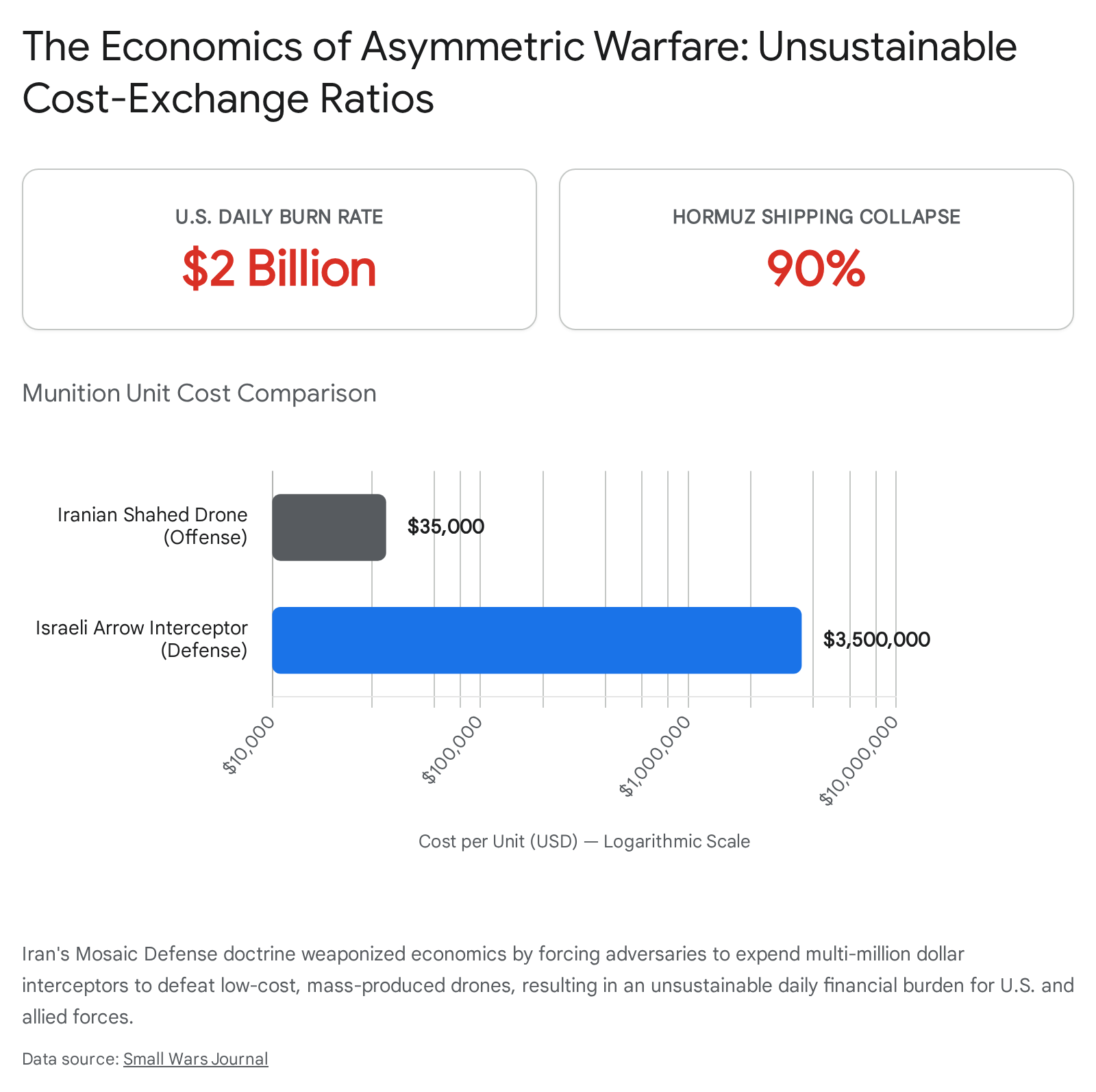
During the conflict, U.S. and allied forces were forced to expend highly sophisticated, immensely expensive munitions against swarms of cheap, expendable projectiles. To illustrate this disparity:
| Munition Type | Estimated Unit Cost | Strategic Application |
| Iranian Shahed Drone | $20,000 – $35,000 | Mass offensive deployment, overwhelming radar systems. |
| Iranian 3D-Printed Drone | $300 – $400 | Penetrating advanced active protection systems (e.g., Merkava Trophy). |
| Israeli Arrow Interceptor | $3,500,000 | Defensive interception of incoming ballistic and drone threats. |
This dynamic resulted in an operational reality where “hundreds of dollars defeated millions of dollars”.16 The United States suffered a staggering financial burn rate of approximately $2 billion per day during the campaign, raising serious logistical alarms within the Pentagon regarding the rapid depletion of critical interceptor stockpiles.16 Furthermore, by effectively shutting down 90% of commercial transit in the Strait of Hormuz, Iran successfully exported the financial burden of the war globally, devastating Asian fuel supplies and the international shipping insurance industry.16 Iran did not defeat the U.S. military on the battlefield; it bypassed it entirely, forcing an economic capitulation from the West before its own capacity to resist was exhausted.
7. Geopolitical Leverage: Lebanon, the Gulf, and Strategic Wedges
Iran’s refusal to capitulate is significantly bolstered by its ability to leverage its regional assets at the negotiating table. The United States frequently fails to realize how masterfully Iran intertwines disparate geopolitical theaters to subjugate U.S. war aims and fracture allied coalitions.
7.1 The Lebanon Equation and Strategic Containment
Despite the severe casualties and degradation suffered by Hezbollah during the prolonged Israel-Lebanon conflict, Iran continues to utilize the Lebanese theater as a primary diplomatic bargaining chip and a critical element of its wartime deterrence.15 During the Pakistani-mediated negotiations leading to the Islamabad MoU, Tehran explicitly tied the status of the Lebanese conflict to any permanent peace deal with the United States.15
Tehran established a diplomatic red line: all fronts of the war, including Lebanon, must be halted before it will make any concessions regarding the demilitarization of the Strait of Hormuz or the release of its highly enriched uranium stockpiles.15 Hezbollah, despite being near collapse, serves as the ultimate shield for the Iranian regime.15 By maintaining a continuous barrage of projectile attacks against northern Israel utilizing expanding fiber-optic and first-person view (FPV) drone capabilities, Hezbollah forces the IDF to divert substantial military resources away from the Gulf theater, providing Tehran with critical strategic breathing room.15
7.2 Driving a Wedge in the U.S.-Israeli Alliance
By successfully linking the Israel-Hezbollah conflict—a theater in which the United States is not directly involved militarily—to the broader MoU regarding maritime security, Iran has brilliantly exploited the strategic friction between Washington and Jerusalem.15
The grand strategic priorities of the two allies have starkly diverged. The United States is primarily focused on preserving global macroeconomic stability by reopening the Strait of Hormuz ahead of the 2026 midterm elections.15 Israel, conversely, views the elimination of the Hezbollah threat on its northern border as an immediate existential imperative, and is reluctant to forego an opportunity to permanently eliminate Iran’s regional position.11 Because the Trump administration prioritized energy markets, it demonstrated a willingness to accommodate Iran’s demands regarding a ceasefire in Lebanon, deeply angering the Israeli government.15 This dynamic effectively subjugates Israeli national security policy to U.S. economic imperatives, and Iran calculates that maintaining this alliance friction severely limits the possibility of unified, future military action against the Republic.
7.3 The Alienation and Coercion of the Arab Gulf States
The 2026 war also thoroughly exposed the vulnerabilities of the U.S. security umbrella in the Persian Gulf, leading to a profound realignment among Arab states. Prior to the conflict, several Gulf nations privately favored a decisive U.S. military strike against Iran. However, once Operation Epic Fury commenced, Gulf states hosting U.S. military bases immediately became targets for Iranian retaliatory missile and drone strikes.31
The inability of the U.S. military to deter these attacks or fully intercept the incursions shattered Gulf confidence in American protection.31 Consequently, a deep aversion to prolonged war settled over the region.
| Gulf State / Entity | Pre-War Stance | Post-War Posture | Strategic Motivation |
| United Arab Emirates (UAE) | Favored military approach to neutralize Iranian threat. | Rallied behind the MoU ceasefire agreement. | Protect vulnerable economic infrastructure from retaliatory strikes.32 |
| Saudi Arabia (GCC Majority) | Cautiously supportive of U.S. containment. | Instructed ships to avoid Iranian confrontation; backs MoU. | Loss of confidence in U.S. reliability; prioritization of Vision 2030 economic goals.32 |
| Qatar | Diplomatic mediator. | Softened stance on Iran collecting temporary transit fees in Hormuz. | Maintaining independent foreign policy and avoiding direct crossfire.32 |
Recognizing this fear, Iranian President Pezeshkian issued a calculated public apology to the Gulf states, cleverly framing the United States as the aggressive occupying force while highlighting the Gulf’s accommodation of U.S. military interests.31 Iran has continued to capitalize on this Gulf anxiety post-ceasefire, threatening further strikes on civilian vessels and Gulf state infrastructure to cement its demand for permanent control over the Strait of Hormuz.14 The Gulf states are now acutely aware that they possess insufficient leverage to shape the final regional security order, and that in any future conflict, they will bear the highest economic risks.32
7.4 Covert Retaliation and the “Mukhtar” Unit
Even as Iran negotiates diplomatic settlements, its security apparatus continues to operationalize covert offensive capabilities, proving that capitulation is not within its strategic framework. Recent Israeli intelligence reports indicate that the IRGC Quds Force has established a new covert unit named “Mukhtar.”12 This unit is reportedly tasked with planning assassination operations against high-ranking U.S. officials, including President Donald Trump, and is actively seeking cooperation with Mexican cartels to facilitate these attacks.12 This development underscores that the regime views the MoU as a tactical pause in conventional hostilities, while simultaneously expanding its asymmetric and covert warfare capabilities globally.
8. Catalysts for Change: Can the Underlying Factors Evolve?
The intelligence assessment indicates that Iran’s current strategic posture—characterized by unyielding resistance, asymmetric warfare doctrine, and absolute IRGC dominance—is rigid and highly entrenched. However, the factors driving this posture are not entirely immune to change. Crucially, the United States must realize that if change occurs, it will not manifest through external capitulation driven by bombing campaigns; rather, it will emerge through internal systemic evolution, elite fragmentation, or state fracture.
8.1 The Consolidation and Potential Fracturing of the IRGC
The most significant internal dynamic is the total consolidation of power by the IRGC. The IRGC has transitioned from protecting the system to actively organizing it, tightening its grip over all wartime decision-making.23 Following the death of Ali Khamenei, the regime rapidly purged moderate elements. The Israeli assassination of security chief Ali Larijani on March 17, 2026—who had been tasked with creating the regime’s continuity of government plan—further accelerated this trend. This precise strike also eliminated Gholamreza Soleimani, the commander of the paramilitary Basij Resistance Force, removing key figures and centralizing power even further into the remaining hardline core.23 The subsequent appointment of hardliner Mohammad Bagher Zolghadr to head the Supreme National Security Council confirms the narrowing of the decision-making core.23
However, this consolidation is inherently unstable. The succession of Mojtaba Khamenei lacks deep, organic legitimacy, particularly as he remains unseen by the public following the February strikes.26 His rule is highly dependent on constantly balancing competing factions and patronage networks within the IRGC.27 Should Mojtaba fail to adequately distribute the diminishing economic spoils of the state, or should the IRGC suffer a catastrophic intelligence or operational failure, the organization could fracture. A genuine shift in Iran’s strategic culture would only become possible if a pragmatic, economically focused faction within the military apparatus calculates that the total isolation caused by perpetual resistance is a greater threat to their wealth and survival than negotiated integration.
8.2 The Unsustainability of Coercive Governance
The long-term viability of the Islamic Republic is severely threatened by its own domestic policies. The decision to abandon any attempt at social reconciliation in favor of absolute coercion carries a terminal cost.23 The economic devastation wrought by hyperinflation, currency collapse, and constant war mobilization ensures a perpetual state of latent domestic insurgency.23
If the central control of the IRGC were to buckle under the weight of future, inevitably explosive popular uprisings, the result would not be a peaceful transition to a democratic, Western-aligned government. Rather, intelligence modeling suggests the outcome would be state fragmentation and mass civil strife.33 A collapse of central control in Tehran would effectively open Iran’s eastern borders with Afghanistan and its western borders with Iraq.33 This would create a contiguous, uncontrolled corridor for terrorism, organized crime, arms trafficking, and sectarian violence stretching from the Af-Pak region all the way to the Levant, profoundly destabilizing global security.33
Currently, the overwhelming application of external military force by the United States has suppressed any latent pragmatism within the Iranian elite. The kinetic pressure of Operation Epic Fury has convinced the Iranian leadership that their physical survival is inextricably linked to maintaining their asymmetric defenses and refusing capitulation at all costs. Change is possible, but it requires the West to step back and allow the profound internal contradictions of Iran’s military dictatorship to run their course.
9. Conclusion
The United States continues to fail in its strategic objectives regarding the Islamic Republic of Iran because it views the geopolitical struggle through a lens of conventional compellence and rational economic trade-offs. The United States fails to realize that the Iranian leadership views the conflict in absolute, existential terms, where survival supersedes all economic and infrastructural costs. Western policy blind spots—specifically the overestimation of conventional military destruction, the unwitting participation in proxy supply chains, and the profound misunderstanding of Iran’s decentralized, guerrilla-style “Mosaic Defense” doctrine—have repeatedly led to strategic stalemates despite overwhelming American tactical superiority.
Iran will not capitulate because the regime, now fully organized and dominated by the IRGC, equates surrender with political annihilation and the loss of its vast domestic wealth and regional prestige. By effectively democratizing the cost of conflict with cheap drone technology and globalizing the economic pain via the interdiction of the Strait of Hormuz, Iran has forged a highly resilient survival strategy. While this strategy successfully repels external regime change and fractures U.S.-allied coalitions in the Gulf and the Levant, it comes at the catastrophic cost of intense domestic repression and total economic ruin. Meaningful change in Iran’s strategic posture will never be bombed into existence; it will only arise when the internal contradictions of the IRGC’s military dictatorship and its alienated society can no longer be contained by state violence.
10. Appendix: Methodology
This intelligence assessment was compiled utilizing advanced Open-Source Intelligence (OSINT) analytical frameworks. The analysis synthesizes a diverse and comprehensive array of publicly available data streams, including think-tank geopolitical reports, military doctrine evaluations (such as those analyzing Mosaic Defense), human rights organization documentation regarding domestic unrest, and international news media syndications covering the 2026 conflict and diplomatic negotiations.
The synthesis process prioritized the identification of second and third-order strategic effects, specifically examining the complex cause-and-effect relationships between Western military applications and Iranian domestic, operational, and diplomatic responses. Adversarial intent was modeled by evaluating historical behavioral patterns against current strategic capabilities, prioritizing structural realities and economic leverage points over stated diplomatic rhetoric. Data points regarding military assets, economic indicators, and force structures were cross-referenced to build a holistic assessment of state resilience and vulnerability.
Works cited
- 2026 Iran war | Deal, Explained, United States, Israel, Strait of Hormuz, Map, & Conflict, accessed July 10, 2026, https://www.britannica.com/event/2026-Iran-war
- Operation Epic Fury and International Law – United States Department of State, accessed July 10, 2026, https://www.state.gov/releases/office-of-the-legal-adviser/2026/04/operation-epic-fury-and-international-law
- 2026 Iranian supreme leader election – Wikipedia, accessed July 10, 2026, https://en.wikipedia.org/wiki/2026_Iranian_supreme_leader_election
- Iran’s late supreme leader Khamenei buried in Mashhad after week-long funeral, accessed July 10, 2026, https://www.middleeasteye.net/news/irans-late-supreme-leader-khamenei-buried-after-week-long-funeral
- Why the US Failed to Defeat Iran and What it Means for the Axis of …, accessed July 10, 2026, https://sanaacenter.org/publications/perspectives-and-analyses/27637
- Peace Through Strength: Operation Epic Fury Crushes Iranian Threat as Ceasefire Takes Hold – The White House, accessed July 10, 2026, https://www.whitehouse.gov/releases/2026/04/peace-through-strength-operation-epic-fury-crushes-iranian-threat-as-ceasefire-takes-hold/
- Operation Epic Fury Fact Sheet: April 6, 2026, accessed July 10, 2026, https://media.defense.gov/2026/Apr/06/2003907108/-1/-1/1/OPERATION-EPIC-FURY-FACT-SHEET-APRIL-6-2026.PDF
- Islamabad Memorandum – Wikipedia, accessed July 10, 2026, https://en.wikipedia.org/wiki/Islamabad_Memorandum
- Read the full text of Trump’s preliminary U.S.-Iran agreement to end the war – WFAE, accessed July 10, 2026, https://www.wfae.org/world/2026-06-18/read-the-full-text-of-trumps-preliminary-u-s-iran-agreement-to-end-the-war
- Trump and Iran’s President Pezeshkian sign memorandum aimed to end war – CNBC Africa, accessed July 10, 2026, https://www.cnbcafrica.com/2026/trump-and-irans-president-pezeshkian-sign-memorandum-aimed-to-end-war
- 60-Day Countdown to U.S.-Iran Cease-Fire, accessed July 10, 2026, https://www.chinausfocus.com/peace-security/60-day-countdown-to-us-iran-cease-fire
- Ghalibaf calls US MoU a victory for Iran’s ‘axis of resistance’, accessed July 10, 2026, https://www.iranintl.com/en/202607060956
- Does Trump have a Plan C for Iran? – The Irish Times, accessed July 10, 2026, https://www.irishtimes.com/world/us/2026/07/10/does-trump-have-a-plan-c-for-iran/
- Iran Update Special Report, July 9, 2026 | ISW, accessed July 10, 2026, https://understandingwar.org/research/middle-east/iran-update-special-report-july-9-2026/
- Lebanon as the Centrepiece of Iran’s Diplomatic Strategy, accessed July 10, 2026, https://manaramagazine.org/2026/07/lebanon-irans-diplomatic-strategy/
- Iran Didn’t Need to Win the War. It Needed to Outlast It, accessed July 10, 2026, https://smallwarsjournal.com/2026/07/08/iran-didnt-need-to-win-the-war-it-needed-to-outlast-it/
- No Conquest, No Defeat: Iran’s National Security Strategy 9780197554586, 019755458X, 9780197566916, 019756691X, 9780197566923, 0197566928 – DOKUMEN.PUB, accessed July 10, 2026, https://dokumen.pub/no-conquest-no-defeat-irans-national-security-strategy-9780197554586-019755458x-9780197566916-019756691x-9780197566923-0197566928.html
- Geopolitical Tensions Rise as Iran Views U.S. Ceasefire Terms with Suspicion, Expert Warns of Potential Ruse – Earnings Revision Report – Market Intelligence, accessed July 10, 2026, https://denuncias.uta.edu.ec/first-dry/Geopolitical-Tensions-Rise-as-Iran-Views-US-Ceasefire-Terms-with-Suspicion-Expert-Warns-of-Potential-Ruse-24-2904
- The shape-shifting ‘axis of resistance’ | Chatham House – International Affairs Think Tank, accessed July 10, 2026, https://www.chathamhouse.org/2025/03/shape-shifting-axis-resistance
- Axis of Resistance or Suicide? | Carnegie Endowment for International Peace, accessed July 10, 2026, https://carnegieendowment.org/middle-east/diwan/2026/03/an-existential-war-or-one-preparing-negotiations
- Axis of Resistance – Wikipedia, accessed July 10, 2026, https://en.wikipedia.org/wiki/Axis_of_Resistance
- Iran at a Strategic Breaking Point – The Cairo Review of Global Affairs, accessed July 10, 2026, https://www.thecairoreview.com/essays/iran-at-a-strategic-breaking-point/
- Mojtaba Khamenei’s Iran and the Politics of Succession – Gulf …, accessed July 10, 2026, https://gulfif.org/mojtaba-khameneis-iran-and-the-politics-of-succession/
- DIA Iran Military Power – Defense Intelligence Agency, accessed July 10, 2026, https://www.dia.mil/portals/110/images/news/military_powers_publications/iran_military_power_lr.pdf
- From Ideological Animosity to Strategic Rivalry: The Evolution of Iran’s Perception of Israel, accessed July 10, 2026, https://www.inss.org.il/strategic_assessment/evolution-of-irans-perception-of-israel/
- How Will Mojtaba Khamenei Rule Iran — and for How Long …, accessed July 10, 2026, https://www.stimson.org/2026/how-will-mojtaba-khamenei-rule-iran-and-for-how-long/
- Iran’s fragmented decision-making structure – GIS Reports, accessed July 10, 2026, https://www.gisreportsonline.com/r/iran-decision-making-structure/
- journal of advanced military studies – jams – Marine Corps University, accessed July 10, 2026, https://www.usmcu.edu/Portals/218/JAMS_SpecialIssue_StrategicCulture_web.pdf?ver=59lms7WJtPVlGLLGUTO3BA%3D%3D
- ‘People here all seek revenge’: Crowds mass for Khamenei’s burial, banners call to kill Trump, accessed July 10, 2026, https://www.timesofisrael.com/people-here-all-seek-revenge-crowds-mass-for-khameneis-burial-banners-call-to-kill-trump/
- Iran’s Path Dependent Military Doctrine – CSS/ETH Zürich, accessed July 10, 2026, https://css.ethz.ch/content/dam/ethz/special-interest/gess/cis/center-for-securities-studies/resources/docs/Olson.pdf
- Gulf States Caught in the Crossfire of War with Iran – The Soufan Center, accessed July 10, 2026, https://thesoufancenter.org/intelbrief-2026-march-7/
- A bad peace: the Arab Gulf states and the US–Iran memorandum of …, accessed July 10, 2026, https://www.iiss.org/online-analysis/online-analysis/2026/06/a-bad-peace-the-arab-gulf-states-and-the-usiran-memorandum-of-understanding/
- War on Iran: Tactical Success, Strategic Risk? – Egmont Institute, accessed July 10, 2026, https://egmontinstitute.be/war-on-iran-tactical-success-strategic-risk/