1. Executive Summary
This Situation Report (SITREP) details a tactical analysis of Special Weapons and Tactics (SWAT) and specialized tactical team deployments across federal, state, and local law enforcement jurisdictions within the United States during the operational period of July 4 through July 10, 2026. The intelligence gathered indicates a sustained, high-tempo operational environment driven primarily by the execution of high-risk warrants, incidents involving armed barricaded subjects, and the severe escalation of domestic violence disputes.
Throughout the observed period, tactical resolutions favored deliberate, technology-assisted containment strategies over dynamic, kinetic entry. The integration of Crisis Negotiation Teams (CNT), Unmanned Aerial Vehicles (UAVs), Unmanned Ground Vehicles (UGVs), and chemical agents demonstrated a consistent, cross-jurisdictional operational doctrine aimed at minimizing lethal force encounters. Despite the inherently high-risk nature of these incidents—many of which involved heavily armed subjects with violent felony warrants or individuals experiencing acute mental health crises—the majority of tactical deployments concluded with peaceful surrenders and the safe apprehension of the target subjects.
Key strategic observations derived from the week include the physical vulnerabilities of indoor UAVs to suspect sabotage, the psychological impact of social media broadcasting during active armed standoffs, and the vital role of cross-jurisdictional intelligence sharing in locating interstate fugitive targets. This document synthesizes the tactical methodologies, asset utilizations, and post-incident lessons learned from twelve distinct tactical operations to inform ongoing training, procurement, and deployment doctrines for modern law enforcement agencies.
2. Operational Environment and Threat Landscape
The tactical landscape for the week of July 4–10, 2026, required law enforcement agencies to frequently transition from routine patrol operations to specialized, high-tier ballistic protection and extraction methodologies. Local and regional tactical teams operated as the primary response elements in municipal disputes, while state and federal task forces executed deliberate, intelligence-driven operations against established criminal targets.
2.1 Macro-Level Trends in Tactical Deployments
Analysis of the week’s tactical deployments reveals three primary drivers for SWAT activation:
- Fugitive Apprehension and High-Risk Warrant Service: Operations targeting individuals with outstanding warrants for violent felonies (e.g., armed robbery, aggravated assault, kidnapping, and sexual assault). These operations generally involve subjects who have demonstrated a historical willingness to utilize lethal force.
- Domestic Violence Escalations: Incidents that originated as domestic disturbances but rapidly escalated into armed barricades. These situations require specialized extraction and negotiation assets due to the heightened emotional volatility of the subjects and the frequent proximity of hostages or bystanders.
- Mental Health Crises and Suicidal Ideation: Encounters involving subjects experiencing acute psychological distress. These individuals are frequently armed and often exhibit behaviors indicative of seeking kinetic confrontations with law enforcement, commonly referred to as “Suicide by Cop” (SbC) scenarios.
2.2 Summary of Analyzed Deployments
The following table categorizes the tactical deployments analyzed within this reporting period, arranged chronologically and geographically to provide a structured overview of the operational tempo.
| Date | Geography | Primary Agency/Team | Incident Catalyst | Resolution Methodology |
| July 7, 2026 | Arkansas (Texarkana) | Miller County SWAT / FBI | CSAM Warrant Service | Arrested (Dynamic Entry/Secured) |
| July 7, 2026 | Massachusetts (Townsend) | NEMLEC SWAT | Warrant Service (Barricaded) | Arrested (CNT Negotiation) |
| July 8, 2026 | Florida (Clay County) | Clay County Sheriff SWAT | Suicidal Subject (Livestream) | Lethal Force (Non-Fatal) |
| July 8, 2026 | New York (Upstate) | FBI Albany SWAT | Federal Bank Robbery Warrants | Arrested (Perimeter Secured) |
| July 9, 2026 | Florida (Clay County) | Clay County Sheriff SWAT | Armed/Barricaded (Vehicle) | Arrested (Vehicle Pin/Containment) |
| July 9, 2026 | Florida (Clay County) | Clay County Sheriff SWAT | Armed/Barricaded (Church) | Arrested (CNT Negotiation) |
| July 9, 2026 | Georgia (Atlanta) | APD SWAT / DeKalb Sheriff | Rape Warrant (Barricaded) | Arrested (Attic Extraction) |
| July 9, 2026 | Louisiana (Alexandria) | Alexandria PD SWAT | Armed/Barricaded (Hotel) | Attempted Escape / Fall (Injured) |
| July 9, 2026 | New Mexico (Rio Arriba) | NMSP Tactical Team | Kidnapping/Shooting Warrants | Arrested (Simultaneous Strikes) |
| July 10, 2026 | Texas (Houston) | HPD SWAT | Domestic Assault (Barricaded) | Arrested (CS Gas Extraction) |
| July 10, 2026 | Wisconsin (Fond du Lac) | FDLPD / FDL Sheriff SWAT | Domestic Violence (Barricaded) | Arrested (CNT Negotiation) |
| July 10, 2026 | Wisconsin (Brown Deer) | Brown Deer PD / MPD | Warrant Service (Barricaded) | Arrested (Secured) |
3. Tactical Operations: July 7, 2026
The initial phase of the reporting period was characterized by planned, high-risk warrant executions that required the integration of specialized technology and regional task forces to mitigate suspect resistance and preserve critical evidence.
3.1 State and Federal Coordination in Cybercrime: Texarkana, Arkansas
On Tuesday, July 7, 2026, the Arkansas State Police (ASP) Internet Crimes Against Children (ICAC) Task Force, operating in direct coordination with the Federal Bureau of Investigation (FBI), ASP Company C, and the Miller County SWAT Team, executed a high-risk search warrant at a residential structure located in the 8000 block of Old Harrison Chapel Road in Texarkana, Arkansas.1
The operational mandate stemmed from an active, intelligence-driven investigation into an IP address confirmed to be sharing Child Sexual Abuse Material (CSAM).2 During the execution of the search warrant, investigators localized their efforts on the bedroom of a 17-year-old male resident, seizing multiple electronic devices and discovering numerous files depicting CSAM.2 The juvenile male was taken into custody and charged with 99 counts of Distributing, Possessing, or Viewing Matter Depicting Sexually Explicit Conduct Involving a Child, with bond set at $100,000.2 For further details on the operation, see the(https://dps.arkansas.gov/news/asp-icac-task-force-arrests-texarkana-teen-on-child-sexual-abuse-material-charges/).
Tactical Asset Analysis and Lessons Learned: While the execution of warrants on juvenile suspects may intuitively present as a lower kinetic risk compared to adult organized crime, the deployment of the Miller County SWAT team alongside state and federal assets reflects a precise, risk-averse tactical doctrine. In ICAC investigations, tactical teams are primarily utilized for two distinct operational reasons.
First, the preservation of digital evidence requires absolute speed and surprise. Dynamic entry methodologies are frequently necessary to rapidly dominate and secure the premises before a suspect can initiate data-wiping protocols, physically encrypt hard drives, or submerge electronic devices in liquids. The “surround and call out” method, which is standard for traditional barricades, is antithetical to cyber warrants, as it provides the suspect with a vital time buffer to destroy the requisite forensic artifacts.
Second, behavioral science unit data indicates that individuals involved in the distribution of CSAM exhibit a high statistical correlation with the possession of firearms and other illicit contraband. The rapid domination of the structure by heavily armed, armored personnel ensures the environment is kinetically neutralized, allowing forensic analysts to operate within the “golden hour” of digital evidence collection without the threat of ambush.
3.2 Regional Task Force Deployment and UAV Vulnerabilities: Townsend, Massachusetts
During the evening hours of July 7, 2026, at approximately 9:15 p.m., officers from the Townsend, Pepperell, and Groton Police Departments approached a residence on Kaneohe Court in Townsend to serve outstanding arrest warrants on Matthew Francis (37) and Deanna Shattuck (40).3 Francis was wanted on nine warrants for charges including larceny and receiving stolen property, while Shattuck faced warrants for drug possession.3 Upon the announcement of police presence, both subjects refused to exit and barricaded themselves inside the home.3
As officers developed reasonable suspicion that Francis had armed himself with a kitchen knife, the tactical geometry shifted from a standard warrant service to an armed barricade, prompting the activation of the Northeastern Massachusetts Law Enforcement Council (NEMLEC) SWAT Team.3 NEMLEC deployed specialized negotiators to de-escalate the situation, which eventually resulted in the successful arrest of both subjects on new charges of Resisting Arrest, in addition to their outstanding warrants.3
Tactical Asset Analysis and Lessons Learned: A critical juncture in this operation occurred prior to the SWAT team’s physical entry. The Pepperell Police Department deployed an Unmanned Aerial Vehicle (UAV) into the residence to locate the suspects and gather interior intelligence.3 While the drone successfully penetrated the initial structural envelope and navigated to the basement, it was intentionally vandalized and disabled by the suspect, Shattuck.3
The active destruction of the UAV highlights a persistent operational vulnerability in current tactical drone deployments: they are physical assets operating in hostile, confined spaces. When a drone is piloted into a close-quarters environment containing uncooperative or erratic suspects, its lack of physical defensive capabilities renders it highly susceptible to being swatted, captured, or destroyed. Tactical units must adjust their doctrine to account for asset attrition. When utilizing UAVs for interior mapping, operators should maintain a standoff distance from the suspect once visual contact is made, utilizing optical zoom rather than physical proximity, to preserve the intelligence feed and prevent the drone from becoming a piece of debris that alerts the suspect to the team’s operational tempo.
4. Tactical Operations: July 8, 2026
Operations on July 8 highlighted the increasing complexity of modern law enforcement, contrasting the rapid, highly volatile nature of socially broadcasted mental health crises with the deliberate, heavily coordinated interdiction of interstate violent felons.
4.1 Social Media Broadcasting and Lethal Force Encounters: Clay County, Florida
On Wednesday, July 8, 2026, the Clay County Sheriff’s Office (CCSO) managed a highly volatile, prolonged mental health crisis that ultimately resulted in a deputy-involved shooting along Blanding Boulevard. The incident began around 1:00 p.m. when deputies responded to the residence of 21-year-old Daniel Siewert following reports that he was broadcasting suicidal threats on the social media platform TikTok.5 During the initial contact, Siewert denied making threats, and deputies observed no immediate criteria to initiate a Baker Act hold, though they did note the presence of what appeared to be a firearm resting on a table.5
Hours later, family members contacted CCSO, reporting that Siewert had threatened to overdose on ibuprofen and explicitly stated he was “ready to take on” law enforcement.5 Siewert, who possessed a documented history of mental health issues, subsequently left his residence. Around 2:30 p.m., reports indicated he was positioned behind a garbage can on Blanding Boulevard, texting about engaging in a shootout with police.5 When deputies located Siewert, they attempted verbal de-escalation; however, Siewert pointed his firearm at a deputy. The lethal threat prompted a secondary deputy to discharge their weapon, neutralizing the threat.5 Siewert was transported to a hospital in non-life-threatening condition, and no deputies were injured.5 The Florida Department of Law Enforcement (FDLE) and the State Attorney’s Office assumed the investigation of the shooting.5 Detailed coverage is available via News4JAX.
Tactical Asset Analysis and Lessons Learned: This incident encapsulates the emerging tactical phenomenon known as the “Performance Barricade.” The utilization of live-streaming platforms during a mental health crisis fundamentally alters the psychological and tactical environment. The presence of a virtual audience acts as an accelerant, frequently incentivizing the subject to perform kinetic fantasies and rapidly shortening the timeline from ideation to violence.
Siewert’s explicit text messages outlining his intent to “take on” law enforcement, followed by pointing a firearm at deputies, are textbook indicators of Suicide by Cop (SbC) dynamics. In these scenarios, the subject seeks to force the tactical element into delivering a lethal outcome. For responding tactical and patrol units, identifying SbC indicators must immediately trigger a shift in geometry. Officers must prioritize maximizing distance and utilizing hard cover (such as engine blocks or ballistic shields) to extend the negotiation window. While the deputies successfully neutralized the threat without sustaining casualties, the incident underscores the difficulty of managing mobile, armed subjects who are actively seeking kinetic engagement in populated areas.
4.2 Interstate Fugitive Interdiction: Upstate New York / FBI Albany
On the night of Wednesday, July 8, 2026, the FBI Albany SWAT team executed a high-risk apprehension operation in Upstate New York, successfully capturing 52-year-old Joseph Sawyer of Townsend, Massachusetts.8 The arrest was the culmination of a multi-agency, interstate intelligence effort.
Sawyer was the primary suspect in two distinct, highly organized armed bank robberies: a June 12 incident at St. Mary’s Bank in Nashua, New Hampshire, and a June 27 incident at a Chase Bank in Boonton, New Jersey, where approximately $12,000 in cash was stolen.8 In both robberies, Sawyer allegedly brandished a black semiautomatic handgun, established immediate physical dominance by ordering occupants to the ground, and demanded the surrender of all civilian cellular phones to delay police response protocols.8 He was noted to flee the scenes in a gray or silver Honda Odyssey.9 For more details, see the(https://www.fbi.gov/contact-us/field-offices/boston/news/massachusetts-man-arrested-for-bank-robbery).
Tactical Asset Analysis and Lessons Learned: The operational success of this interdiction relied heavily on the effective synthesis of intelligence across geographic and jurisdictional boundaries. The FBI Boston field office and the Nashua Police Department acted as the primary intelligence aggregation nodes, synthesizing data from the New Jersey State Police, New York State Police, Warren County Sheriff’s Office, and local departments to pinpoint Sawyer’s location in Upstate New York.8
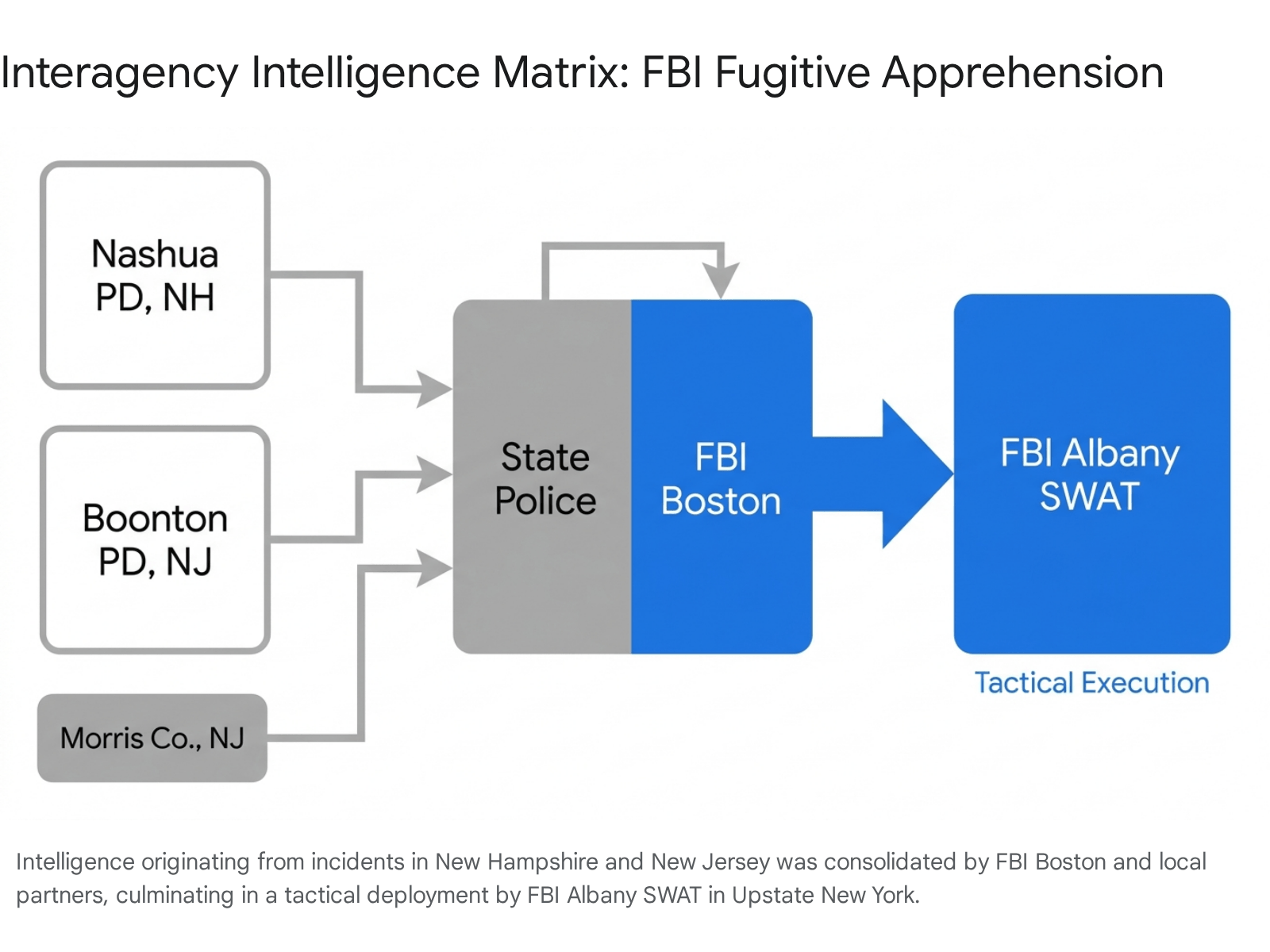
The decision to utilize the FBI Albany SWAT element for the physical apprehension rather than standard patrol units reflects the necessary tactical patience required for engaging serial offenders. Sawyer’s demonstrated methodology—controlling large spaces, brandishing firearms, and preemptively neutralizing communications—categorized him as a high-tier threat. Deploying a specialized tactical unit mitigates the risk of a chaotic, unstructured kinetic engagement, ensuring the suspect is enveloped by a coordinated tactical presence and allowing for a controlled, zero-casualty arrest.
5. Tactical Operations: July 9, 2026
July 9 presented a high volume of complex barricade scenarios, characterized by mobile threats, hostage risks, and the necessity to clear hazardous architectural environments. The tempo required local agencies to deploy multiple tactical elements simultaneously.
5.1 Mobile Barricades and Evading Suspects: Clay County, Florida (Arora Blvd)
The Clay County Sheriff’s Office experienced an unusually dense operational tempo, managing multiple distinct tactical incidents on this date. In the early morning hours, Jacksonville Sheriff’s Office (JSO) deputies responded to a dispute in the Hillcrest neighborhood on Royce Avenue.10 The suspect fled the scene in a red Dodge Ram pickup truck, traveling into the jurisdiction of Clay County near Blanding Boulevard and I-295.10
CCSO deputies successfully intercepted the vehicle, resulting in a standoff at the intersection of Canis Drive and Arora Boulevard.10 Operating from inside the pickup truck, the suspect initially refused to surrender. Following a coordinated containment effort by law enforcement, the individual was taken into custody.10
Tactical Asset Analysis and Lessons Learned: Mobile barricades present unique challenges compared to structural barricades. The primary threat is the suspect’s ability to re-initiate a high-speed pursuit or utilize the vehicle as a multi-ton kinetic weapon against the perimeter. Tactical resolution requires immediately nullifying the vehicle’s mobility. This is traditionally achieved through the strategic placement of heavy armored vehicles (e.g., BearCats or MRAPs) to physically pin the suspect’s vehicle—often utilizing a V-formation to trap the engine block and prevent forward or reverse egress. Furthermore, heavily tinted windows frequently obscure the suspect’s actions, requiring operators to establish covered angles and utilize specialized glass-break tactics if chemical agents must be introduced into the cab to force compliance.
5.2 High-Density Civilian Risk and Shelter-in-Place Protocols: Clay County, Florida (Oakleaf)
Later that afternoon, CCSO deputies responded to an individual sitting inside a vehicle backed into a roadway near Oakleaf Baptist Church.11 As a deputy approached the vehicle to investigate, the suspect displayed a weapon. Adhering to standard operating procedures for an armed encounter lacking immediate cover, the deputy retreated to a safe distance, and a hard perimeter was established.11
Given the immediate proximity of the church and an active on-site daycare, the tactical priority shifted to civilian preservation. The church and children were placed on an immediate lockdown, sheltering in place rather than attempting an evacuation.11 Oakleaf Plantation Parkway was shut down between Ivory Crossing and Eagle Landing Parkway to control the operational environment.11 SWAT and CNT elements were deployed to the scene. Through sustained communication efforts by the negotiators, the armed individual was eventually persuaded to surrender peacefully, and the lockdown was lifted without injury to any parties.11 Review the local coverage via News4JAX.
Tactical Asset Analysis and Lessons Learned: The critical decision matrix in this incident revolves around the handling of the civilian population. Ordering a shelter-in-place rather than an evacuation is tactically sound when a suspect is contained within a vehicle and the lines of sight to the evacuation routes cannot be definitively secured by ballistic shielding. Moving small children across an open parking lot exposes them to potential crossfire. By hardening the exterior of the church and maintaining the suspect’s focus on the tactical element, commanders successfully isolated the threat geometry, allowing the CNT to work the suspect down from their heightened emotional state.
5.3 Prolonged Containment and Attic Extractions: Atlanta, Georgia
At approximately noon on July 9, 2026, the Atlanta Police Department (APD) SWAT team, with operational assistance from the DeKalb County Sheriff’s Office, arrived at a residence on Brownlee Road in a west Atlanta neighborhood to serve a high-risk warrant.12 The target was 50-year-old Deacon Tyrone Hopkinsbey, wanted for a May 26 incident in Stone Mountain where he allegedly raped a woman while she slept in her home.12
Hopkinsbey refused to surrender, initiating a standoff that lasted approximately six hours.13 APD SWAT maintained a rigid perimeter, preventing egress. After exhausting external communication efforts, tactical elements systematically cleared the interior of the residence. The suspect was ultimately located attempting to evade capture by hiding in the structural attic of the home.14 He was extracted without lethal force and transported to the DeKalb County Jail without bond.13 The original report can be viewed at 11Alive.
Tactical Asset Analysis and Lessons Learned: The extraction of a non-compliant suspect from an attic space represents one of the most hazardous close quarters battle (CQB) operations a SWAT team can undertake. Attic access points—typically narrow scuttle holes or drop-down stairs—serve as significant “fatal funnels.” They severely restrict the mobility, speed, and fields of fire of the ascending operator, while simultaneously granting the suspect a significant tactical advantage and heavy concealment behind insulation, HVAC ductwork, and structural joists. Furthermore, standard K-9 deployment is generally unfeasible in attics due to the risk of the dog falling through the drywall ceiling.
The successful resolution of this incident underscores the doctrine of tactical patience. By maintaining the exterior perimeter for six hours, APD SWAT allowed the physiological and psychological stress of the barricade (compounded by the extreme heat typical of an unventilated Atlanta attic in July) to wear on the suspect. When the physical clearance was initiated, the suspect’s capacity and will to resist had likely been degraded, facilitating a safe, physical extraction without the necessity of exchanging gunfire in a highly disadvantageous structural environment.
5.4 Hospitality Industry Barricades and Desperation Hazards: Alexandria, Louisiana
In the early morning hours of July 9, 2026 (approximately 2:00 a.m.), the Alexandria Police Department responded to reports of an armed individual threatening suicide at the Siegel Select hotel located in the 1000 block of MacArthur Drive.15 Recognizing the acute threat profile of a barricaded, armed subject in a hotel structure, the APD SWAT Team and Crisis Negotiators were immediately dispatched to initiate communication and de-escalate the event.15
During the standoff, the barricaded individual attempted to evade law enforcement by exiting through a fourth-floor window using a bedsheet. The subject subsequently fell approximately three stories, sustaining serious injuries, and was transported to a local hospital for medical treatment. Officers then secured the room and recovered multiple firearms.17
Tactical Asset Analysis and Lessons Learned: Hotel standoffs introduce a unique set of architectural and logistical hazards. Beyond the standard difficulties of high civilian density separated only by commercial drywall, this incident highlights the critical need for a full 360-degree, three-dimensional perimeter. Barricaded subjects experiencing acute crisis frequently engage in unpredictable, high-risk behaviors to avoid apprehension.
When establishing a perimeter on multi-story structures, commanders must immediately position tactical operators or K-9 units at ground-level points of egress beneath the target room’s windows. This prevents the suspect from successfully executing an improvised vertical escape or ambushing perimeter units from above. The attempted escape utilizing a bedsheet underscores that desperation often overrides self-preservation in barricaded individuals, requiring tactical elements to anticipate non-traditional egress methodologies even when CNT dialogue is ongoing.
5.5 Kinetic Apprehension in Violent Felonies: Rio Arriba County, New Mexico
Also on July 9, 2026, the New Mexico State Police (NMSP) Tactical Team executed a complex, multi-node apprehension operation targeting two violent fugitives.18 The investigation began at 2:37 a.m. when NMSP received a report from a male victim who had been shot in the arm during a carjacking.18 The victim and his girlfriend, Jeanette Salazar, had traveled to Danny Trujillo’s residence in Rio Chiquito to collect money.18 Following an altercation, Trujillo fired a weapon at the male victim while he sat in his vehicle.18 After the victim fled the vehicle, an associate, Marcos Romero, forced Salazar into the car, and the group fled the area, effectively kidnapping her.18 The vehicle was later found abandoned in Cordova.18 For incident specifics, refer to the(https://losalamosreporter.com/2026/07/10/nmsp-arrests-two-men-in-shooting-and-kidnapping-investigation-in-rio-arriba-county-kidnapping-victim-jeanette-salazar-remains-missing/).
Given the kinetic risk—Trujillo had already demonstrated a willingness to use lethal force and a hostage was unaccounted for—the NMSP Tactical Team was mobilized to execute dynamic warrants. In a coordinated effort, the team arrested Trujillo at his residence in Cordova without incident, charging him with Aggravated Battery, Kidnapping, and Assault with Intent to Commit a Violent Felony.18 Simultaneously, Romero was located and taken into custody without incident at his residence in Chimayo by the Tactical Team, assisted by the Rio Arriba County Sheriff’s Office.18 Despite the successful apprehensions, the kidnapping victim, Salazar, remained missing at the time of the reporting.18
Tactical Asset Analysis and Lessons Learned: The tactical execution of this operation highlights the necessity of multi-node target neutralization. When dealing with co-conspirators involved in an ongoing felony (kidnapping), law enforcement must strike multiple geographic locations (Cordova and Chimayo) simultaneously. A staggered operational timeline allows one suspect to communicate with the other, leading to the destruction of evidence, the relocation or execution of the hostage, or the establishment of a fortified ambush against incoming SWAT units. The ability of the NMSP Tactical Team to coordinate concurrent, zero-casualty strikes against armed suspects is a testament to rigorous operational planning. However, the ongoing missing status of the hostage underscores that tactical success does not always immediately yield total investigative success, necessitating rapid post-kinetic site exploitation and intelligence gathering.
6. Tactical Operations: July 10, 2026
The concluding days of the reporting period demonstrated extensive technological integration in resolving high-stakes domestic violence barricades, relying heavily on robotics and chemical munitions to force compliance without lethal engagement.
6.1 Technology Escalation and Chemical Agent Deployment: Houston, Texas
On Friday, July 10, 2026, Houston Police responded to a severe family disturbance in the 7700 block of Hornwood in the Sharpstown neighborhood.19 A male suspect in his late 30s engaged in an argument with family members, escalated the confrontation by drawing two knives, and slashed his older brother’s throat.19 The brother survived the laceration and was treated on the scene without requiring hospital transport.19 When patrol officers arrived, they confronted the suspect outside the home; he refused repeated commands to drop the knife and fled back inside the residence.19 The other occupants (the brother’s wife and two children) had evacuated, confirming no hostages remained inside.19 See Click2Houston for the full timeline.
The Patrol Support Team secured the perimeter, and HPD SWAT and the Hostage Negotiation Team were summoned.19 For hours, negotiators attempted to establish a dialogue, which the suspect continually rebuffed.19
Initiating a calculated escalation of force, SWAT operators breached a window and deployed an indoor UAV to locate the suspect and confirm his status.19 Following the drone, a robotic dog (an Unmanned Ground Vehicle or UGV quadruped) was sent into the residence.19 Despite the presence of these advanced technological assets, the suspect remained entrenched and refused to surrender.19 Having exhausted negotiation and technological deterrence, tactical commanders authorized the deployment of CS (o-chlorobenzylidene malononitrile) gas into the structure.19 The physiological effects of the chemical agent forced the suspect to exit the residence, where he was safely taken into custody by SWAT operators without sustaining any injuries.19 The suspect was charged with aggravated assault of a family member, and police recovered a knife from the scene.19
Tactical Asset Analysis and Lessons Learned: This incident serves as a clear example of the modern tactical escalation model: isolate the threat, attempt communication, deploy unmanned intelligence gatherers, and finally, utilize chemical compliance tools.
While drones and robotic dogs provide valuable situational awareness, map interior architecture, and significantly reduce the physical risk to human operators, they possess a strict operational ceiling. They lack the physical capability to force compliance from a highly motivated, mentally disturbed, or deeply entrenched suspect. They are intelligence tools, not enforcement mechanisms.
When psychological deterrence fails, CS gas remains the most reliable non-lethal method for resolving barricades. The agent operates by aggressively irritating the mucous membranes and respiratory tract, causing profound lachrymatory responses (tearing), coughing, and a sensation of asphyxiation. This intense physiological response bypasses the psychological determination of the subject, disrupting their decision-making process and compelling them to seek fresh air, effectively delivering them into the hands of the arrest team without the need for operators to clear corners in a CQB environment.
6.2 Armored Vehicle Deterrence in Domestic Violence: Fond du Lac, Wisconsin
At 1:39 a.m. on July 10, 2026, the City of Fond du Lac Police Department (FDLPD) responded to a domestic violence report at The Press Box Tavern on Forest Avenue.4 The 43-year-old male suspect had fled prior to police arrival.4 During interviews, the 37-year-old female victim disclosed multiple recent, unreported acts of severe domestic violence, significantly elevating the suspect’s threat matrix.4
Officers tracked the suspect to a residence in the 100 block of Hamilton Place.4 He refused to exit or communicate. Given the subject’s violent history and intelligence indicating the potential presence of firearms within the home, patrol units proactively deployed an Armored Rescue Vehicle (ARV) to shield the perimeter and protect nearby residents during initial negotiation attempts.4
As the standoff persisted, FDLPD activated its SWAT and Crisis Negotiations Teams, further requesting mutual aid from the Fond du Lac County Sheriff’s Office SWAT and CNT elements.4 The combined tactical force deployed K-9 units, drones, and robotic resources to gather real-time intelligence while enforcing a neighborhood evacuation and shelter-in-place order.4 At 11:00 a.m., surrounded by specialized assets and facing sustained negotiation, the suspect voluntarily surrendered and was taken into custody without incident.4 Reference KFIZ News for comprehensive details.
Tactical Asset Analysis and Lessons Learned: The Fond du Lac operation highlights the principle of “Visual Deterrence.” The early deployment of heavy armor (such as ARVs or BearCats) and highly visible specialized technology exerts profound psychological pressure on a barricaded subject. In many instances, the realization of a coordinated tactical presence acts as the primary catalyst for peaceful surrender. The suspect calculates that kinetic resistance is futile against armored platforms. The seamless integration of municipal and county SWAT assets, alongside specialized technology response groups, demonstrates a mature, highly effective regional command structure capable of scaling up force presence to de-escalate violence.
6.3 Cross-Jurisdictional High-Risk Warrants: Brown Deer, Wisconsin
On the morning of Friday, July 10, 2026, a 33-year-old man was arrested following a police standoff at an apartment complex located on Deerwood Drive in Brown Deer, Wisconsin.20 The operation was primarily executed by officers from the Milwaukee Police Department (MPD), operating outside their primary municipal jurisdiction.20 The suspect was wanted in connection to a recklessly endangering safety incident that had occurred days prior, on July 4th, near 12th and Fiebrantz in Milwaukee.20 Following the standoff and arrest, a search warrant was executed on the premises, with charges pending review by the Milwaukee County District Attorney’s Office.20
Tactical Asset Analysis and Lessons Learned: Violent offenders frequently migrate across municipal boundaries in an attempt to evade immediate capture, requiring tactical elements to operate in unfamiliar suburban terrain. The execution of high-risk warrants in dense apartment complexes presents severe ballistic challenges. Multi-family dwellings feature shared walls with minimal stopping power. Tactical teams must execute precise perimeter containment and establish strict fields of fire to mitigate crossfire hazards that could endanger residents in adjoining units.
7. Strategic Doctrine and Hardware Utilization Summary
The aggregate data from the reporting period illustrates a shift in modern tactical operations away from the dynamic entries of previous decades, moving heavily toward a doctrine of “Contain, Communicate, and Extract.”
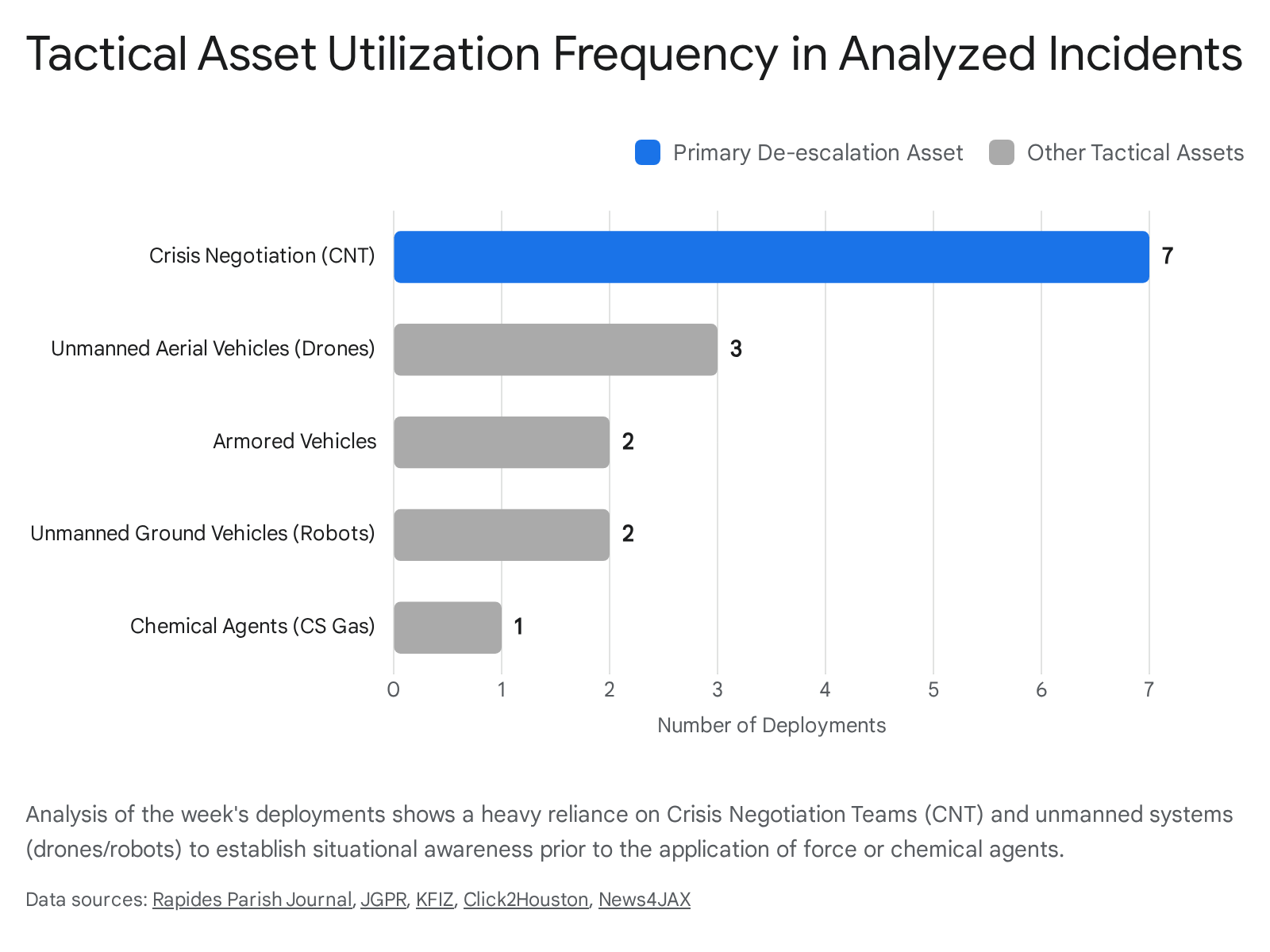
As evidenced by the visual data, the most critical asset in the modern tactical inventory is not kinetic, but communicative. The deployment of Crisis Negotiation Teams is ubiquitous, acting as the primary mechanism for resolving armed standoffs. Tactical operators are now largely utilized to create a secure, armored perimeter that buys negotiators the necessary time to de-escalate emotionally volatile subjects.
Table: Tactical Hardware and Methodologies Assessed
| Asset/Methodology | Primary Function | Observed Limitations | Strategic Recommendation |
| UAVs (Drones) | Interior mapping, suspect location, drawing fire. | Highly susceptible to sabotage/destruction by uncooperative subjects. | Maintain standoff distance upon visual contact; avoid closing with suspect. |
| UGVs (Robotic Dogs) | Ground-level recon, two-way audio, physical deterrence. | Blocked by physical barricades; lacks physical compliance capability. | Integrate manipulator arms for door breaching and payload delivery. |
| CS Gas (Chemical) | Physiological disruption, forced egress. | Decontamination requirements; potential fire hazard with pyrotechnics. | Maintain robust inventory of barricade-penetrating 40mm non-burning rounds. |
| Armored Vehicles | Perimeter shielding, vehicle pinning, psychological deterrence. | Low maneuverability in dense urban architecture. | Utilize as mobile command posts and direct cover for CNT operators. |
8. Conclusions and Forward Outlook
The tactical law enforcement data synthesized from the week of July 4-10, 2026, confirms that SWAT operations across the United States operate on a highly refined continuum of force. This modern doctrine heavily favors technological mediation, containment, and psychological de-escalation over the high-casualty risks associated with dynamic, kinetic entries.
Federal and state tactical assets continue to concentrate their specialized capabilities on multi-jurisdictional fugitives and organized criminal elements—such as cybercrime syndicates and kidnapping networks. These operations rely deeply on robust intelligence fusion centers, demonstrating that the success of a raid is often determined hours before operators leave the staging area. Meanwhile, local and county tactical teams are disproportionately engaged in resolving highly volatile, emotionally driven barricades stemming from domestic violence or severe mental health crises, frequently involving social media performative elements.
The successful resolution of these incidents—which overwhelmingly resulted in zero casualties to officers, hostages, or suspects—validates the effectiveness of current containment doctrines. However, the operational data also illuminates critical areas requiring immediate tactical refinement. The physical vulnerability of drones to active suspect sabotage, alongside the unpredictable vertical escape attempts documented in commercial hotel barricades, dictates a need for more robust 360-degree containment doctrines. Furthermore, as the prevalence of “Suicide by Cop” scenarios and social media-broadcasted standoffs increases, law enforcement agencies must continuously adapt their psychological tactics, ensuring that negotiators and tactical commanders are trained to navigate the unique pressures of the digital audience.
In summary, the modern SWAT team functions less as a blunt instrument of force and more as a highly specialized, technology-driven containment apparatus designed to systematically dismantle the physical and psychological barriers erected by violent offenders.
Appendix: Methodology and Data Sources
Methodology: This SITREP was generated utilizing a rigorous qualitative and quantitative analysis of Open-Source Intelligence (OSINT), authoritative law enforcement press releases, media syndicates, and public statements published during the operational period of July 4 through July 10, 2026.
The analytical framework employed a chronological and geographical sorting mechanism to isolate distinct tactical incidents. Each incident was subjected to a detailed tactical deconstruction, isolating variables such as the inciting criminal offense, the nature of the architectural barricade, the specific specialized assets deployed (including UAVs, UGVs, CNTs, Chemical Agents, and Armored Vehicles), and the ultimate mechanism of resolution.
Second and third-order insights were derived by applying standard tactical doctrines to the observed events. This process involved evaluating the decision-making matrices of tactical commanders—specifically regarding the escalation of force, the integration of robotics, and the deployment of chemical munitions—to extract actionable “lessons learned” and shape forward-looking operational recommendations.
Data Sources: The analysis relied on cross-referenced intelligence from local news organizations, federal press releases, and state department of public safety disclosures. Specific event data, including suspect demographics, locations, geographical geometries, and asset utilizations, were drawn directly from these primary and secondary OSINT feeds to ensure maximum reporting accuracy and contextual fidelity.
Please share the link on Facebook, Forums, with colleagues, etc. Your support is much appreciated and if you have any feedback, please email us in**@*********ps.com. If you’d like to request a report or order a reprint, please click here for the corresponding page to open in new tab.
Sources Used
- State Police – Arkansas Department of Public Safety, accessed July 11, 2026, https://dps.arkansas.gov/law-enforcement/arkansas-state-police/
- ASP ICAC TASK FORCE ARRESTS TEXARKANA TEEN ON CHILD …, accessed July 11, 2026, https://dps.arkansas.gov/news/asp-icac-task-force-arrests-texarkana-teen-on-child-sexual-abuse-material-charges/
- Townsend Police Department Arrests Two On Warrants With …, accessed July 11, 2026, https://news.jgpr.net/2026/07/08/townsend-police-department-arrests-two-on-warrants-with-assistance-from-northeastern-massachusetts-law-enforcement-council-swat/
- Fond du Lac man taken into custody after SWAT deployed domestic …, accessed July 11, 2026, https://kfiz.com/fond-du-lac-man-taken-into-custody-after-swat-deployed-domestic-incident/
- Man making suicidal threats on livestream shot after standoff with deputies on Blanding Blvd., sheriff says, accessed July 11, 2026, https://www.news4jax.com/news/local/2026/07/08/suspect-taken-to-the-hospital-after-deputy-involved-shooting-near-home-on-blanding-blvd/
- Deputy-involved shooting on Blanding Boulevard under investigation; suspect shot after standoff | firstcoastnews.com, accessed July 11, 2026, https://www.firstcoastnews.com/article/news/crime/clay-county-deputy-involved-shooting-blanding-boulevard/77-29e65097-d236-4bc3-ba09-99af4906762c
- Clay County sheriff details deputy-involved shooting off Blanding Boulevard, accessed July 11, 2026, https://www.youtube.com/watch?v=bz3EQKYNmNU
- Massachusetts Man Arrested for Bank Robbery, accessed July 11, 2026, https://www.fbi.gov/contact-us/field-offices/boston/news/massachusetts-man-arrested-for-bank-robbery
- Man arrested in connection with Morris County, New Hampshire armed bank robberies, accessed July 11, 2026, https://wrnjradio.com/man-arrested-in-connection-with-morris-county-new-hampshire-armed-bank-robberies/
- Dispute on Westside leads to man being taken into custody in Clay County after standoff in pickup truck, accessed July 11, 2026, https://www.news4jax.com/news/local/2026/07/09/heavy-law-enforcement-presence-near-arora-boulevard-avoid-area-clay-county-sheriffs-office/
- Armed barricaded person near Oakleaf Baptist Church taken into …, accessed July 11, 2026, https://www.news4jax.com/news/local/2026/07/09/clay-county-deputies-on-scene-of-armed-barricaded-person-inside-car-near-oakleaf-plantation-pkwy/
- Man accused of raping woman as she slept in her Stone Mountain home arrested after SWAT standoff: deputies, accessed July 11, 2026, https://www.11alive.com/article/news/local/swat-situation-underway-atlanta-neighborhood/85-98ce553b-0860-40a4-9579-6ee8a3f4fc2c
- DeKalb County rape suspect arrested after hours-long standoff at Atlanta home, deputies say, accessed July 11, 2026, https://www.cbsnews.com/atlanta/news/dekalb-county-rape-suspect-arrested-after-hours-long-standoff-at-atlanta-home-deputies-say/
- Atlanta SWAT standoff ends with rape suspect in custody, accessed July 11, 2026, https://www.11alive.com/video/news/crime/atlanta-swat-standoff-ends-with-rape-suspect-in-custody/85-417882a5-25c8-4a16-9797-737414bf0771
- Alexandria Police respond to barricaded, armed individual at local hotel, accessed July 11, 2026, https://rapidesparishjournal.com/2026/07/10/alexandria-police-respond-to-barricaded-armed-individual-at-local-hotel/
- News – Alexandria, Louisiana Police Department, accessed July 11, 2026, https://alexandrialapolice.org/public-resources/news/
- Alexandria Police Respond to Barricaded, Armed Individual at Local …, accessed July 11, 2026, https://alexandrialapolice.org/alexandria-police-respond-to-barricaded-armed-individual-at-local-hotel/
- NMSP Arrests Two Men In Shooting And Kidnapping Investigation In …, accessed July 11, 2026, https://losalamosreporter.com/2026/07/10/nmsp-arrests-two-men-in-shooting-and-kidnapping-investigation-in-rio-arriba-county-kidnapping-victim-jeanette-salazar-remains-missing/
- Man accused of slashing brother’s throat arrested after SWAT …, accessed July 11, 2026, https://www.click2houston.com/news/local/2026/07/10/man-accused-of-slashing-brothers-throat-with-knife-arrested-after-hourslong-swat-standoff-at-family-home/
- Police standoff in Brown Deer, 33-year-old man arrested – FOX6 News Milwaukee, accessed July 11, 2026, https://www.fox6now.com/news/police-standoff-brown-deer-33-year-old-man-arrested
- Brown Deer | FOX6 News Milwaukee, accessed July 11, 2026, https://www.fox6now.com/tag/us/wi/milwaukee-county/brown-deer