1. Executive Summary
During the operational period of July 9 through July 17, 2026, law enforcement special operations units at the federal, state, and local levels responded to a series of critical incidents across the United States. This Situation Report (SITREP) analyzes distinct tactical deployments that required the activation of Special Weapons and Tactics (SWAT), Special Emergency Reaction Teams (SERT), Crisis Negotiation Teams (CNT), and equivalent specialized units. This includes deployments by local municipal agencies, county sheriff’s offices, state police, and federal entities such as the Federal Bureau of Investigation’s Hostage Rescue Team (HRT) and the United States Marshals Service (USMS) Violent Offender Task Forces.
The primary triggers for specialized tactical intervention during this operational cycle were barricaded subjects involved in domestic violence incidents, high-risk warrant services for violent felonies, and a complex remote hostage rescue operation. A review of the week’s tactical data indicates a continued reliance on less-lethal munitions and extended crisis negotiation cycles to achieve peaceful resolutions. Law enforcement command staff consistently demonstrated a preference for tactical patience, prioritizing containment and communication over dynamic entry whenever feasible.
The inherent volatility of these operations was underscored by several escalations. The reporting period witnessed one line-of-duty death (LODD) of a federal officer during a warrant service, one suspect suicide from a high-rise structure, two fatal officer-involved shootings following prolonged standoffs (including a specialized maritime deployment), and multiple deployments of specialized breaching equipment to mitigate active threats to life and property. The data reflects an operational environment where tactical units must transition between static containment and dynamic operations.
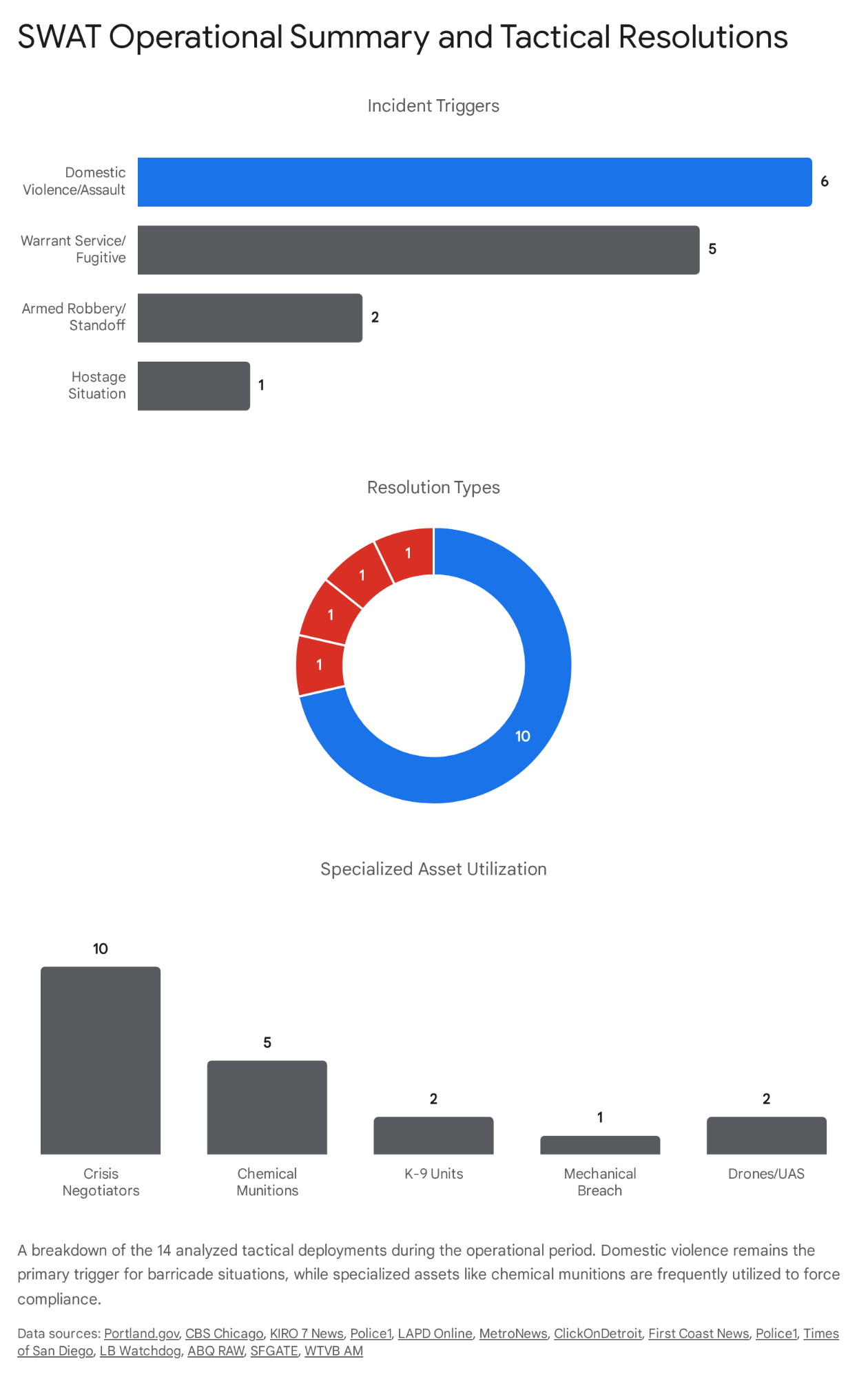
Key analytical takeaways from this operational period include the hazards associated with close-quarters forced entry, even when executing warrants with numerical superiority1. Furthermore, tactical timelines were severely compressed during events involving environmental exigencies, such as active fires within multi-family dwellings, forcing immediate mechanical breaches to prevent casualties2. The successful recovery of two federal hostages in a remote region of Northern California demonstrated the capability of integrating local county tactical assets with national-level federal units in austere environments4. Finally, the deployment of less-lethal systems, including flashbang grenades, CS gas, and pepperball delivery systems, mitigated active threats and forced suspect compliance without the application of deadly force in a majority of the reviewed incidents5.
2. Strategic and Policy Environment
The tactical operations conducted during this period were influenced by broader national security postures, federal funding directives, and ongoing interagency initiatives designed to combat violent crime. Understanding this macro-level environment is essential for contextualizing the frequency and scale of task force deployments.
2.1. Federal Task Force Operations and Threat Landscapes
The United States Marshals Service (USMS) continues to experience a high operational tempo, driven by a mandate to apprehend violent fugitives. Data released during this period indicates substantial volume for regional task forces. For example, the Nevada Violent Offender Task Force reported 134 fugitive arrests in the second quarter alone, while Operation Silver Spur in Osceola County, Florida, yielded 126 arrests8. The high volume of fugitive apprehensions inherently increases the statistical probability of kinetic encounters.
Concurrently, the threat landscape directed at federal judicial officials has necessitated enhanced protective postures. Recent testimony before the House Appropriations Subcommittee on Financial Services and General Government highlighted a significant number of threats directed at Supreme Court Justices9. The USMS tracked 383 total threats to judges in the current fiscal year, requiring continuous tactical readiness and diversion of protective assets10. This environment of elevated threat dictates that federal task forces operate with a high degree of tactical vigilance, often requiring local SWAT teams to provide armored vehicles and specialized entry support when serving federal warrants on known violent offenders.
2.2. Interagency Initiatives and Resource Allocation
Federal interagency operations focused heavily on violent crime reduction during the summer months. The Federal Bureau of Investigation (FBI) initiated “Operation Summer Heat 2.0,” a nationwide ninety-five-day surge designed to disrupt violent gangs, cartels, and transnational criminal organizations11. This initiative, modeled after earlier successes like Operation Turf War in West Virginia, relies on the integration of federal intelligence with state and local SWAT capabilities to execute coordinated, multi-location search and arrest warrants4. The deployment of FBI Rapid DNA systems to operational command posts represents an advancement, allowing tactical teams to match suspect DNA against intelligence databases while still in the field4.
Conversely, budget allocations remain a concern for agencies like the Bureau of Alcohol, Tobacco, Firearms and Explosives (ATF). Proposed federal budgets aiming to reduce ATF funding by twenty-nine percent threaten the operational capacity of Crime Gun Intelligence Centers (CGICs)12. CGICs are centralized law enforcement hubs that utilize the National Integrated Ballistic Information Network (NIBIN) to provide real-time data to local police. A reduction in these investigative capabilities places an increased burden on local tactical units, as the inability to proactively disrupt firearms trafficking networks often results in more frequent reactive SWAT deployments to armed barricade situations.
Additionally, the continued deployment of the National Guard in Washington, D.C., extended to last through January 2029, illustrates a sustained domestic security posture that influences the availability and interoperability of military and civilian tactical assets within the National Capital Region13.
3. Evolution of Tactical Methodologies and Operational Trends
An analysis of the operational period reveals several evolving trends in the application of special weapons and tactics. Law enforcement agencies face a delicate balance between tactical patience, frequently known as the “surround and call out” doctrine, and the necessity for dynamic intervention. The incidents reviewed this week provide examples of how suspect behavior dictates the tactical response.
3.1. The Shift in Warrant Service Doctrine and Fatal Funnels
The execution of high-risk arrest warrants represents one of the most perilous activities for tactical teams. Traditional Close Quarters Battle (CQB) methodologies heavily favored dynamic entry—breaching a structure rapidly to rely on speed, surprise, and violence of action to overwhelm a suspect before they could mount a defense. However, modern tactical doctrine increasingly favors establishing a containment perimeter and utilizing crisis negotiators to compel the suspect to exit voluntarily.
When forced entry is unavoidable, the architectural limitations of residential structures heavily favor the barricaded suspect. Doorways and narrow hallways act as “fatal funnels,” concentrating the entry team into a predictable path of travel. When suspects are deeply embedded within a structure, heavily armed, and barricaded in a point of tactical advantage, officers face tactical disadvantages. The loss of a federal officer in Louisiana this week emphasizes the ongoing reevaluation of when to initiate interior structural clearance versus maintaining an exterior perimeter1. Tactical commanders must continuously weigh the imperative of apprehension against the residual risks of forced entry.
3.2. Environmental Exigency and Mechanical Breaching
Tactical patience relies on a static environment. As long as the suspect is contained and no hostages are in immediate jeopardy, time is generally on the side of law enforcement. However, when a suspect introduces an environmental hazard, the operational tempo must accelerate immediately. The introduction of fire transitions an incident from a barricaded suspect scenario to an active threat to life, particularly in occupied multi-family dwellings2.
Standard manual breaching tools, such as battering rams and halligan bars, may be too slow against heavily fortified doors or barricades. The deployment of power tools, such as a chainsaw, allows for a rapid mechanical breach3. This capability enables tactical teams to gain immediate entry, neutralize the threat, and facilitate fire suppression efforts before the blaze can spread. This highlights the necessity for tactical teams to maintain diverse breaching capabilities, including mechanical, ballistic, and explosive options, to adapt to rapidly changing interior environments.
3.3. The Efficacy and Limitations of Less-Lethal Systems
Throughout the week, the deployment of chemical agents and kinetic impact munitions played a decisive role in resolving standoffs safely. Chemical agents, primarily Oleoresin Capsicum (OC) and 2-chlorobenzalmalononitrile (CS) gas, are utilized to deny suspects the use of favorable interior terrain. By saturating a barricaded environment with chemical irritants, tactical teams force the suspect to either surrender or move to a predictable egress point.
Distraction devices, commonly known as flashbang or concussion grenades, deliver a bright flash and sound, typically exceeding one hundred and seventy decibels. This overloads the suspect’s sensory processing and creates a momentary window of disorientation5. Officers can exploit this brief period of sensory deprivation to effect an arrest without resorting to lethal force.
However, less-lethal systems are not universally effective. The deployment of chemical agents can be mitigated by suspects utilizing gas masks or improvised breathing apparatuses7. Furthermore, highly motivated or chemically impaired individuals may demonstrate a high tolerance to pain compliance techniques, necessitating a physical entry that can precipitate a lethal force encounter.
3.4. Remote and Austere Environment Operations
Urban tactical operations benefit from rapid logistics, clear communications, and abundant staging areas. Operations in remote or wilderness environments present entirely different logistical hurdles10. Access routes are often restricted to single-lane dirt roads, complicating the movement of heavy armored vehicles, such as Lenco BearCats, and mobile command posts.
Furthermore, dense canopy and rugged terrain severely degrade standard radio frequencies, necessitating specialized communication relays and satellite uplinks. In these environments, the deployment of Unmanned Aerial Systems (UAS), or drones, proves vital for establishing an intelligence perimeter when physical ground units cannot move closely without compromising hostages or officer safety10. Remote operations require specialized rural patrolling tactics, camouflage, and long-range overwatch capabilities that differ significantly from urban CQB training.
4. Incident Synopses (Chronological and Geographic)
The following sections detail the specific SWAT and tactical unit deployments during the operational period, sorted chronologically and then geographically. These synopses provide the operational context, timeline, and tactical outcomes for each event.
4.1. July 9, 2026
4.1.1. Seattle, Washington (King County)
- Lead Agency: King County Sheriff’s Office – Tac-30 (SWAT)
- Context: High-rise warrant service resulting in a barricade and subsequent suspect suicide.
Law enforcement personnel attempted to apprehend a suspect wanted on warrants from the King County Sheriff’s Office and the Department of Corrections for weapons violations18. The operation was focused on an apartment building near Spring Street and 8th Avenue in Seattle. What commenced as a standard fugitive apprehension rapidly devolved into a barricaded person scenario when the suspect detected law enforcement presence and retreated into a ninth-floor apartment.
Given the suspect’s history of weapons violations and the elevated position, the King County Sheriff’s Office activated its Tac-30 SWAT unit, crisis negotiators, and aerial support assets to establish total containment. Tactical operators simultaneously initiated the evacuation of nearby apartments to protect civilian residents. As authorities tightened the perimeter and attempted to initiate dialogue, the suspect circumvented the interior containment by intentionally jumping from a window or balcony on the ninth floor. Staged paramedics immediately treated the suspect at the scene and transported him to Harborview Medical Center; however, the suspect succumbed to his injuries during transport or shortly after arrival.
Analytical Insights and Lessons Learned: High-rise structures present significant challenges for establishing a secure inner perimeter. While vertical containment—securing the hallways and stairwells above and below the target unit—is standard operating procedure, preventing a suspect from utilizing exterior windows for suicide or escape is difficult without compromising officer safety. The deployment of aerial assets provides essential exterior overwatch, but cannot physically intercept a falling individual. This incident emphasizes the psychological volatility of wanted subjects when cornered and the inherent limitations of tactical containment against suspects intent on self-harm.
4.1.2. Whittier, Alaska (Prince William Sound)
- Lead Agency: Alaska State Troopers – SWAT Team
- Context: Marine barricade and fatal officer-involved shooting involving an absconded offender.
At approximately 8:07 p.m., the Alaska State Troopers SWAT Team, in coordination with Alaska Wildlife Troopers, located 58-year-old fugitive Philip Phillips19. Phillips had absconded during his trial and was convicted in absentia of multiple counts of sexual abuse of a minor19. He was located on a vessel anchored in the Whittier area19.
Upon contact, Phillips armed himself with a handgun and refused to participate in negotiations17. Tactical operators deployed less-lethal munitions and chemical agents into the vessel20. In response, Phillips donned ballistic body armor, retrieved a gas mask, and brandished his firearm in the direction of the officers19. This lethal threat resulted in an officer-involved shooting by SWAT personnel19. Phillips was pronounced deceased at the scene20.
Analytical Insights and Lessons Learned: Maritime tactical operations present unique challenges, primarily the instability of the operational platform and the limitations on mobility and cover. The suspect’s preparedness—specifically possessing ballistic armor and a gas mask—demonstrates threat anticipation, successfully neutralizing the SWAT element’s chemical and less-lethal options. This incident highlights the necessity for tactical teams to possess specialized maritime training and the capability to rapidly transition from less-lethal to lethal force when environmental and suspect countermeasures defeat initial apprehension strategies.
4.2. July 11, 2026
4.2.1. Portland, Oregon (Multnomah County)
- Lead Agency: Portland Police Bureau (PPB) – Special Emergency Reaction Team (SERT)
- Context: Urban domestic violence disturbance involving an armed, barricaded suspect with outstanding warrants.
| Phase | Time | Tactical Action |
| Initial Response | 6:03 p.m. | PPB Central Precinct officers responded to a 911 call reporting a threat with a firearm inside an apartment21. The caller disconnected. Officers established an outer perimeter and attempted contact. |
| Escalation | 9:27 p.m. | Due to the suspect’s non-compliance and outstanding warrants, the Special Emergency Reaction Team (SERT) and Crisis Negotiation Team (CNT) were activated. |
| Containment | 9:30 p.m. – 12:00 a.m. | Tactical elements initiated a shelter-in-place order via the PublicAlerts system and evacuated adjacent units21. Loudspeaker announcements and phone calls went unanswered. |
| Resolution | 12:28 a.m. (July 12) | PPB officers breached the apartment door. The suspect, Quayshawn L. Sanders, 34, and an adult female victim were found inside. Sanders was arrested without injury. |
Analytical Insights and Lessons Learned: The Portland operation demonstrates the standard escalation protocol for armed domestic violence incidents within dense urban environments. The transition from patrol response to a specialized tactical deployment was executed methodically, prioritizing area containment. The utilization of the PublicAlerts system to issue a shelter-in-place order effectively minimized civilian exposure to potential crossfire. The extensive period dedicated to communication attempts, even when unanswered, satisfies the requirement to exhaust all de-escalation avenues prior to initiating a deliberate mechanical breach. The successful recovery of the victim without injury, alongside the seizure of a loaded revolver, validates the pacing of the operation. The subsequent involvement of the Special Victims Unit (SVU) highlights the necessity of coupling tactical resolution with specialized investigative follow-up in domestic violence scenarios.
4.2.2. Munster, Indiana (Lake County)
- Lead Agency: Munster Police Department / Northwest Regional SWAT
- Context: Active shooter transitioning into a barricaded subject scenario following a domestic assault.
At 9:45 p.m., Munster police were dispatched to the 9300 block of Chestnut Lane in response to a reported shooting23. Upon arrival, first responders located a female victim suffering from a gunshot wound to the face. Officers established an initial perimeter to facilitate the immediate casualty evacuation of the victim to an area hospital. Intelligence indicated that the suspected shooter remained barricaded inside the residence. Recognizing the threat posed by a barricaded suspect who had already deployed lethal force, command staff requested the activation of the Northwest Regional SWAT team.
The tactical element relieved patrol units on the inner perimeter and initiated formal crisis negotiations. Despite the suspect’s demonstrated willingness to use deadly force, negotiators maintained a dialogue that systematically de-escalated the suspect’s posture. Following an extended negotiation phase, the suspect surrendered to tactical personnel and was taken into custody without further violence.
Analytical Insights and Lessons Learned: This incident underscores the importance of immediate triage and casualty evacuation under the cover of an initial patrol perimeter. By rapidly removing the critically injured victim from the hot zone, officers transitioned the incident from a dynamic active shooter response to a static barricaded subject posture. This transition affords tactical commanders time. The patience exhibited during the negotiation phase prevented a secondary lethal force encounter, demonstrating that suspects who have recently committed severe violence can be compelled to surrender through professional crisis negotiation techniques.
4.2.3. Olympia, Washington (Thurston County)
- Lead Agency: Olympia Police Department / Regional SWAT
- Context: Environmental exigency requiring a chainsaw breach to neutralize an arson threat.
Olympia Police located a violent felony suspect barricaded inside an apartment building on early Saturday morning24. The individual was dangerous, possessing five prior assault convictions and an active Department of Corrections escape warrant. He was actively sought for an assault that occurred earlier in the week at a homeless encampment known as “The Jungle,” where he allegedly struck a woman in the head with a propane tank, causing injuries that required multiple stitches15.
A regional SWAT team and crisis negotiators responded to the barricade. After negotiators failed to establish a productive dialogue, the suspect escalated the situation by throwing burning objects at the officers and attempting to set the apartment complex on fire. Law enforcement evacuated twenty-six residents and their pets to ensure their safety from the active arson threat.
| Tactic | Action | Outcome |
| Breach | Chainsaw utilized to cut down the fortified front door3. | Defeated the barricade rapidly, bypassing manual ramming delays. |
| Suppression | Pepperball munitions deployed into the breach point15. | Degraded suspect’s vision and breathing, limiting his ability to attack or fuel the fire. |
| Apprehension | K-9 unit deployed into the structure2. | K-9 located and bit the suspect near the kitchen, allowing SWAT to safely secure him in restraints. |
Analytical Insights and Lessons Learned: As discussed in the trends section, the introduction of fire represents an ultimate tactical exigency. The integration of mechanical breaching (chainsaw), chemical delivery (pepperball), and biological apprehension (K-9) within a highly compressed timeline demonstrates strong tactical coordination under duress. Standard manual breaching may have taken too long, allowing the fire to become fully involved. The immediate application of diverse tactical tools prevented the destruction of the multi-family dwelling and safely apprehended a volatile suspect. Medics were required to sedate the combative suspect for transport, highlighting the physiological arousal states encountered in these scenarios5.
4.3. July 13, 2026
4.3.1. Alexandria, Louisiana (Rapides Parish)
- Lead Agency: United States Marshals Service (USMS) / Rapides Parish Sheriff’s Office
- Context: High-risk warrant service resulting in an officer line-of-duty death (LODD) and a prolonged standoff.
Members of the USMS Violent Offender Task Force, working in conjunction with deputies from the Rapides Parish Sheriff’s Office, conducted an operation to execute an arrest warrant on Clarence A. Frazier, Jr., 4814. Frazier was classified as a fugitive after failing to appear for trial in state court on charges of sexual battery of a person with infirmities20. The multi-agency element tracked Frazier to a residential address on Rutland Road.
Armed with a federal search warrant, the team of clearly marked officers approached the residence, announced their presence and purpose, and initiated a forced entry at approximately 3:00 p.m.20. Upon breaching the exterior door, officers advanced into the structure and located Frazier deeply barricaded inside a bedroom. Frazier immediately opened fire on the entry team from his position of advantage20. During the ensuing exchange of gunfire, 36-year-old Deputy U.S. Marshal Michael Andrew “Drew” Hanson was struck20.
The task force members initiated an immediate tactical withdrawal to extract the wounded deputy, establishing a hard perimeter around the residence. Deputy Marshal Hanson tragically succumbed to his injuries. The suspect, Frazier, remained barricaded, initiating a tense three-hour standoff that required additional heavy tactical support from the Alexandria Police Department, Louisiana State Police, and the FBI25. Following negotiations and tactical maneuvering, Frazier was ultimately taken into custody. Reports indicate he sustained unspecified injuries during the standoff and was transported to a local hospital. He was subsequently federally charged with the murder of a federal officer20.
Analytical Insights and Lessons Learned: The fatal shooting of Deputy U.S. Marshal Hanson highlights the inherent dangers of dynamic or deliberate room entry, particularly during fugitive apprehension operations. The fatal funnels associated with interior residential doorways heavily favor a barricaded shooter, who can pre-sight a single point of entry. This tragic incident raises critical debriefing points regarding pre-breach intelligence gathering. The use of technological assets, such as pole cameras, under-door cameras, or small unmanned ground vehicles (robotics), is essential to clear deep interior rooms before committing human operators to a threshold. Furthermore, tactical commanders must continuously evaluate the thresholds for transitioning from a warrant service to a static barricade operation prior to executing a forced entry, particularly when the suspect’s location within the structure and armament are unknown.
4.3.2. Chatsworth, Los Angeles, California (Los Angeles County)
- Lead Agency: Los Angeles Police Department (LAPD) SWAT
- Context: Domestic barricade involving an armed subject, resolved with chemical agents, followed by an in-custody death.
At roughly 6:30 p.m., LAPD patrol units responded to reports of an assault with a deadly weapon (ADW) directed against family members at a residence in Chatsworth27. The suspect, identified as 59-year-old Jose Carlos Hoyos-Munoz, retreated into the home and barricaded himself against law enforcement intervention. Recognizing the severity of the ADW charge, the LAPD deployed its Crisis Negotiation Team (CNT) and Special Weapons and Tactics (SWAT) unit.
The standoff persisted for eight hours. When negotiations failed to yield a voluntary surrender, SWAT commanders authorized the deployment of chemical agents into the structure. The introduction of the gas successfully degraded the suspect’s operational environment, forcing Hoyos-Munoz to surrender to SWAT personnel without the application of deadly force. Due to his exposure to the chemical munitions, he was transported to a local hospital for medical evaluation and clearance before being transported to the Valley Jail Section for booking.
Note on Post-Incident Fatality: On the morning of July 15, while in custody at the Valley Jail Section, Hoyos-Munoz was involved in two non-categorical uses of force with Custody Services Division (CSD) personnel while being processed and placed in a 5-point restraint chair. Approximately twenty minutes after being placed prone on a cell bunk with handcuffs removed, he was discovered unconscious and not breathing. Despite medical intervention by jail staff and the Los Angeles Fire Department, Hoyos-Munoz was pronounced deceased. Three detention officers sustained minor injuries during the altercations.
Analytical Insights and Lessons Learned: The tactical phase of this incident was successful; the use of chemical agents resolved a lengthy standoff with an armed suspect without requiring SWAT operators to discharge their firearms. However, the subsequent in-custody death underscores the physical and psychological toll that extended standoffs, combat stress, and chemical exposure take on suspects. It highlights the critical need for routine medical evaluations post-incident and continuous monitoring of subjects during the booking and intake phases, particularly following tactical encounters.
4.3.3. Centerville, Michigan (St. Joseph County)
- Lead Agency: St. Joseph County Sheriff’s Department / St. Joe Valley Special Response Team (SRT)
- Context: Vehicular assault on a law enforcement facility transitioning into an armed standoff, resolved with a conducted energy weapon (Taser).
Isaiah Christopher Merkle, 44, initiated a high-risk encounter by intentionally driving his vehicle onto a secured sidewalk at the St. Joseph County Sheriff’s Office, attempting to ram the building10. Following this initial attack at 3:43 p.m., Merkle fled the scene and was later located near the west village limits of Centreville. Upon being intercepted, he claimed to be armed, prompting the immediate activation of the multi-agency St. Joe Valley Special Response Team (SRT) and a temporary halt to local traffic13.
SRT operators engaged Merkle in negotiations, but these efforts failed to yield a peaceful surrender. Merkle actively resisted arrest, forcing deputies to escalate their use of force. To neutralize his resistance without resorting to lethal firearms, deputies successfully deployed a Taser, immediately incapacitating Merkle and allowing tactical operators to safely take him into custody13. He was charged with Operating While Intoxicated (3rd offense) and four counts of Resisting and Obstructing a Police Officer, with bond set at $50,00013.
Analytical Insights and Lessons Learned: The rapid transition from an active vehicular threat to a static, armed barricade requires multi-agency coordination. The deployment of a conducted energy weapon (Taser) by the tactical element efficiently subdued the suspect, demonstrating the operational value of integrating patrol-level less-lethal tools into formal SRT operations. This capability bridges the critical gap between verbal commands and deadly force, allowing operators to neutralize active resistance safely.
4.4. July 14, 2026
4.4.1. Chelyan, West Virginia (Kanawha County)
- Lead Agency: Kanawha County Sheriff’s Department / West Virginia State Police
- Context: Violent stabbing suspect barricade resulting in severe injury to a police K-9 and a fatal officer-involved shooting.
At 9:05 a.m., deputies responded to a stabbing report after a heavily bleeding male victim sought refuge at a local gas station along State Route 61, reporting he had been stabbed in the back28. Deputies rapidly developed intelligence and tracked the suspect to a residence located two doors down from the gas station. After securing a search warrant, the tactical element attempted an initial entry utilizing a police K-9 unit, named Jett.
The suspect, deeply barricaded and still armed with a knife, engaged the K-9 upon entry, inflicting a severe laceration to the dog’s head. The K-9 was immediately evacuated for emergency veterinary care in Charleston. Following the attack on the K-9, the situation escalated into a multi-hour standoff involving deputies, state police, and U.S. Marshals. Negotiators attempted to secure a surrender, while tactical operators systematically introduced tear gas into the structure in an effort to force compliance.
The suspect demonstrated a high tolerance to the chemical agents and refused to surrender. When officers eventually attempted to take the suspect into custody following the prolonged gas exposure, the suspect exhibited lethal aggression toward law enforcement. This immediate threat resulted in an officer-involved shooting. The suspect was pronounced dead at the scene despite immediate lifesaving measures administered by tactical medics.
Analytical Insights and Lessons Learned: This incident provides a clear assessment of the limitations of specific tactical tools. K-9 units are highly susceptible to edged weapons in confined spaces. While they provide excellent non-lethal apprehension capabilities against unarmed, concealed, or fleeing suspects, deploying them against subjects known to possess knives in a barricaded setting carries a probability of severe injury or death to the animal. Furthermore, chemical agents are not a panacea; motivated, mentally distressed, or deeply barricaded suspects may withstand significant gas deployments. When non-lethal and chemical options fail, tactical teams are ultimately forced to conduct a physical entry, which, against an armed and non-compliant suspect, frequently precipitates a lethal force encounter.
4.4.2. Romulus, Michigan (Wayne County)
- Lead Agency: Romulus Police Department / Western Wayne SWAT
- Context: Domestic violence barricade involving specific threats to kill responding officers.
Police were dispatched to a home on Cogswell Street regarding a domestic violence incident involving a 32-year-old male, Kevin Tylor Clark, and his 37-year-old girlfriend19. Upon the arrival of initial patrol units, Clark immediately confronted the officers and threatened to “shoot and kill” anyone who attempted to enter the residence. This overt threat of lethal force effectively transitioned the situation from a standard domestic response into a high-risk hostage/barricaded subject scenario, as the female victim remained trapped inside the home with the suspect.
The Western Wayne SWAT team was immediately activated to secure a hard perimeter and initiate specialized crisis negotiations. Through coordinated dialogue, negotiators were able to de-escalate Clark’s hostile posture. Following a tense two-hour standoff, the negotiations proved successful. Clark released the victim unharmed and subsequently surrendered to tactical personnel. He was charged with domestic violence and obstructing a police officer, with bond set at $100,000.
Analytical Insights and Lessons Learned: Verbal threats to shoot responding personnel dictate an immediate halt to standard patrol procedures and the mandatory deployment of specialized tactical units. Attempting a hasty rescue or entry under direct threat of gunfire without the ballistic protection, specialized weaponry, and numerical superiority of a SWAT team significantly increases the risk of officer casualties. The relatively swift, two-hour resolution illustrates the efficacy of utilizing trained professional negotiators to manage and de-escalate emotionally charged domestic disputes, safely extracting victims without the application of force.
4.5. July 15, 2026
4.5.1. Orange Park, Florida (Clay County)
- Lead Agency: Clay County Sheriff’s Office (CCSO)
- Context: Armed robbery suspect barricaded in a densely populated apartment complex.
An individual wanted in connection with an armed robbery fled from law enforcement and barricaded himself inside an apartment complex off Burwick Avenue29. Recognizing the suspect’s history of violence and current armed status, the Clay County Sheriff’s Office established a tight law enforcement perimeter. Concurrently, deputies initiated the systematic evacuation of civilian residents from nearby apartments within the complex to ensure public safety.
The CCSO SWAT team and crisis negotiators deployed to the scene to manage the standoff. Under the command of Sheriff Michelle Cook, the tactical operation maintained a secure perimeter and engaged the suspect in dialogue. The display of tactical force and patient negotiation ultimately succeeded, and the suspect peacefully surrendered and was taken into custody shortly after 3:20 p.m..
Analytical Insights and Lessons Learned: The proactive civilian evacuation of adjacent multi-dwelling units is a standard operating procedure (SOP) that was effectively executed in this incident. Evacuation removes potential secondary hostages or collateral damage victims from the potential line of fire. Furthermore, it affords tactical teams more operational freedom; commanders can authorize the deployment of chemical gas or ballistic breaching without the concern of exposing innocent bystanders to chemical irritants or over-penetrating rounds.
4.5.2. Long Beach, California (Bixby Park)
- Lead Agency: Long Beach Police Department (LBPD) SWAT
- Context: Domestic violence barricade involving a trapped victim, resolved through prolonged negotiation.
LBPD officers responded to a domestic violence incident on the 100 block of Cherry Avenue at approximately 9:54 p.m.20. Initial attempts by patrol officers to de-escalate the volatile situation failed, and the suspect barricaded himself alongside the victim inside the residence. Recognizing the potential for hostage-taking or further violence, LBPD SWAT personnel were requested and deployed to the scene11.
SWAT operators secured the perimeter and initiated specialized crisis negotiations. After approximately four hours of tactical containment and continuous dialogue, SWAT officers successfully convinced the suspect to surrender. He was taken into custody without incident, and no injuries were reported to either the victim or the suspect11.
Analytical Insights and Lessons Learned: This incident serves as a resolution demonstrating that rigorous perimeter containment coupled with sustained, professional dialogue are reliable tools for preventing injury during emotionally charged domestic disputes. By slowing down the operational tempo and refusing to force a breach, LBPD SWAT ensured the safe extraction of the victim.
4.6. July 16, 2026
4.6.1. Shasta-Trinity National Forest, California (Siskiyou/Shasta Counties)
- Lead Agency: FBI Hostage Rescue Team (HRT) / Shasta County Sheriff’s Office
- Context: Complex, multi-agency federal hostage rescue operation in a remote wilderness environment.
In a complex incident, two U.S. Forest Service employees conducting routine seasonal fieldwork were kidnapped in the remote Gumboot Lake area of the Shasta-Trinity National Forest10. The victims were zip-tied and held at gunpoint inside a privately owned trailer by 49-year-old Joseph Charles Henrichsen and his adult son, Phoenix10. Due to the federal status of the victims and the rugged, isolated terrain, a large-scale multi-agency response was coordinated.
Shasta County deployed 30 sworn and civilian personnel, encompassing SWAT, sniper units, bomb squad elements, hostage negotiators, and drone operators10. Recognizing the potential for extreme violence and the specialized requirements of a deliberate hostage rescue, the FBI scrambled its Hostage Rescue Team (HRT) from Quantico, Virginia, transporting them via a Boeing 757 to Redding to assume primary tactical command10. The suspect claimed to possess an AR-15-style rifle, knives, and grenades, elevating the threat matrix10.
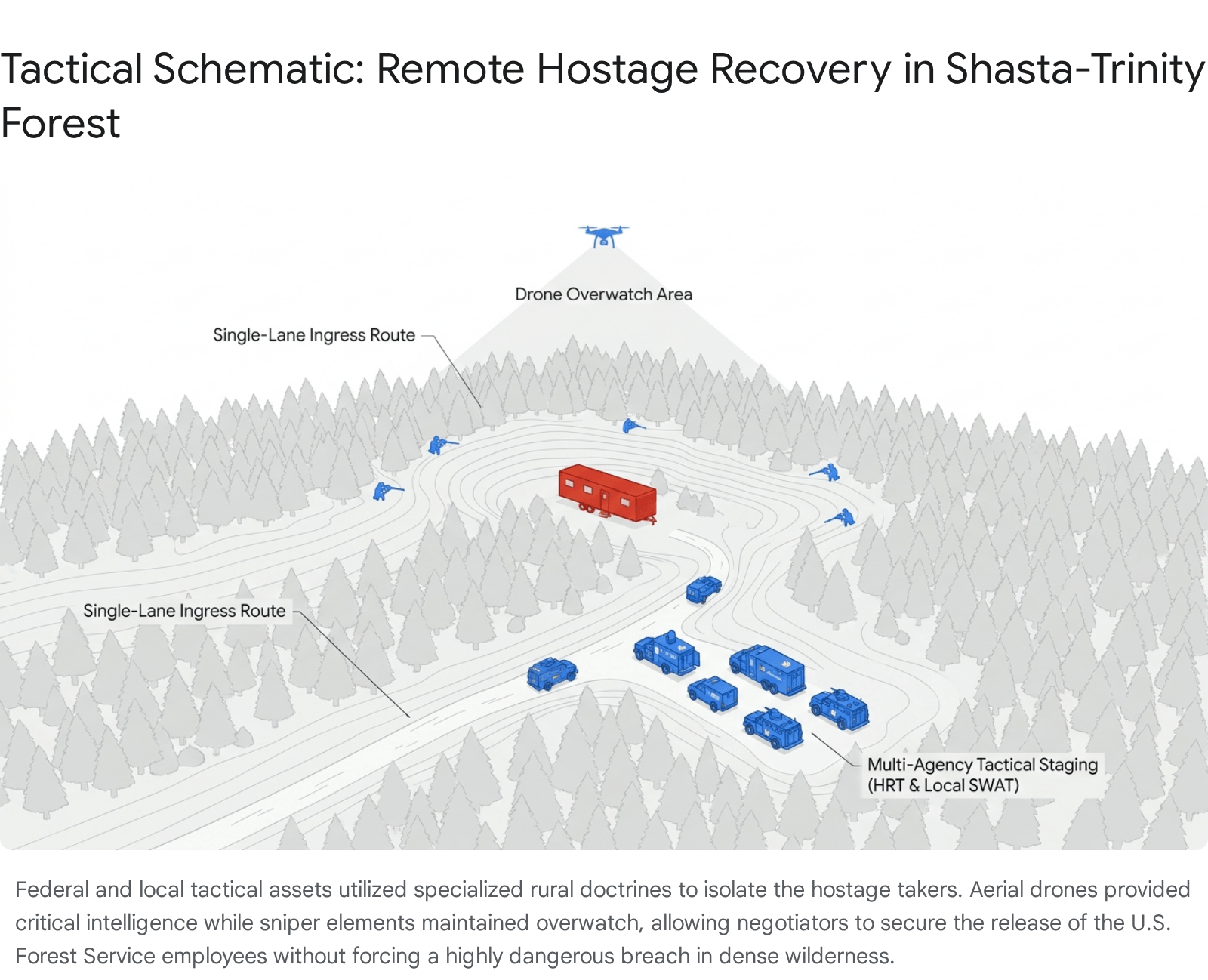
Negotiations officially commenced at 4:20 p.m. Utilizing tactical patience and highly trained federal negotiators, a breakthrough was achieved in the early morning hours of July 17. At 1:35 a.m., the first hostage was released unharmed, followed by the second hostage fifteen minutes later10. At 2:30 a.m., approximately forty minutes after the final hostage was freed, Joseph and Phoenix Henrichsen surrendered to authorities10. Joseph Henrichsen was carrying an AR-15-style rifle and knives at the time of surrender10. Both suspects will face federal kidnapping charges10.
Analytical Insights and Lessons Learned: Rural tactical operations require entirely different logistics than urban callouts. Access was complicated by narrow, single-lane dirt roads, which hindered the movement of heavy armored vehicles and required law enforcement to commandeer civilian transport early in the operation10. The deployment of drones was critical for maintaining visual containment on the trailer without exposing human operators to potential rifle fire in the dense woods10. The decision to request national-level assets (FBI HRT) was a prudent acknowledgment of the unique capabilities required for deliberate hostage rescue scenarios. Hostage rescue differs fundamentally from barricaded suspect training; it prioritizes the immediate recovery of the victims through speed and surgical precision over standard containment protocols. The seamless integration of federal HRT with local SWAT and drone assets resulted in an effective resolution.
4.6.2. San Diego, California (Normal Heights)
- Lead Agency: San Diego Police Department (SDPD) – Special Response Team (SRT)
- Context: Violent landlord-tenant dispute resulting in a barricade and utilization of a concussion grenade.
At 6:30 a.m., a dispute between a landlord and his tenant escalated violently when the landlord allegedly struck the tenant in the head with a baseball bat in the 4800 block of 35th Street5. When SDPD patrol officers arrived on the scene, the suspect retreated into his home, refused to exit, and barricaded himself despite commands to surrender2. The victim was evacuated to a hospital for treatment of non-life-threatening injuries2.
SDPD initiated a multi-hour standoff, dispatching the Special Response Team (SRT). The tactical unit established a hard perimeter, taped off adjacent city blocks, and positioned snipers on the roofs of neighboring houses to ensure total overwatch of the target structure2. After several hours of stalled negotiations and a refusal by the suspect to comply, tactical commanders authorized the deployment of a distraction device. At roughly 11:00 a.m., officers detonated a concussion grenade on the property. The sensory impact of the device prompted the suspect to immediately exit the residence and surrender to custody without further incident2.
Analytical Insights and Lessons Learned: Roof-mounted sniper elements not only provide lethal cover but also serve as the primary intelligence gatherers for the tactical command post, offering a 360-degree, elevated view of the target structure’s perimeter. The use of a concussion grenade in this incident effectively broke the psychological stalemate. By deploying the device on the property (exterior or within the threshold), officers created an acoustic and visual shockwave that disoriented the suspect, breaking his cycle of defiance and forcing immediate compliance without the need for chemical gas or physical force.
4.6.3. Albuquerque, New Mexico (Four Hills and Candelaria)
- Lead Agency: Albuquerque Police Department (APD) SWAT / Bernalillo County Sheriff’s Office (BCSO) SWAT
- Context: Simultaneous deployment of multiple specialized tactical units across different jurisdictions within a single metropolitan area.
The Albuquerque metropolitan area experienced operational strain as two separate, prolonged barricade situations unfolded concurrently on July 16.
- Four Hills Standoff: APD SWAT responded to the 600 block of Stagecoach Road NE regarding a barricaded individual. A heavy police presence, including unmarked units responding with lights and sirens, remained on scene from 11:45 a.m. throughout the afternoon. By 4:35 p.m., the suspect had been safely taken into custody, and the perimeter was broken down31.
- Candelaria Standoff: Simultaneously, at around 1:15 p.m., the Bernalillo County Sheriff’s Office (BCSO) SWAT team was actively working a separate barricaded subject incident at the Days Inn on Candelaria near I-2532. The major thoroughfare was closed as tactical operators searched the building and issued commands for compliance over loudspeakers.
Analytical Insights and Lessons Learned: The simultaneous deployment of specialized tactical units highlights a critical vulnerability in metropolitan response capabilities: resource depletion. SWAT operations require significant manpower, specialized vehicles, and dedicated communications networks. When two extended standoffs occur concurrently, agencies must rely heavily on mutual aid agreements. This underscores the necessity for deep rosters of tactical personnel and interoperable radio systems to prevent command and control failures during simultaneous crises.
4.7. July 17, 2026
4.7.1. Maui, Hawaii (Wailuku)
- Lead Agency: Maui Police Department
- Context: Burglary suspect engages in violent resistance, injuring officers, resolved with Taser deployment.
At 5:04 a.m., officers responded to a burglary in progress at a business on Vineyard Street in Wailuku33. The suspect, a 43-year-old male, had forced entry through an exterior door. Upon law enforcement arrival, the suspect threatened responding officers and attempted to flee the scene1.
As officers attempted to take the man into custody, he actively resisted arrest and assaulted police personnel. Responding officers engaged the suspect, bringing him to the ground, where he continued to kick and fight1. During the violent struggle, officers deployed a Taser to gain neuro-muscular control of the suspect1. Three officers sustained non-life-threatening injuries during the melee, including a bite wound, strained ligaments, and abrasions1. The suspect was subsequently arrested.
Analytical Insights and Lessons Learned: While not a formal SWAT callout, this incident highlights the physical demands and inherent risks of close-quarters arrests. The suspect’s willingness to fight multiple officers and inflict bite wounds demonstrates extreme resistance. The successful deployment of the Taser was critical in ending the physical struggle and preventing further, potentially more severe, injuries to the responding officers.
4.7.2. Charlotte, North Carolina (Mecklenburg County)
- Lead Agency: Charlotte-Mecklenburg Police Department (CMPD) / Multi-Agency Task Force
- Context: Proactive, intelligence-driven violent crime reduction initiative.
The Charlotte-Mecklenburg Police Department, in partnership with the North Carolina State Highway Patrol and the Mecklenburg County Sheriff’s Office, concluded a successful two-day proactive enforcement initiative dubbed “Operation Queen City Overwatch”34. Unlike reactive barricade operations, this was an intelligence-driven, high-visibility task force operation aimed at removing illegal firearms and narcotics from the streets.
The statistical outcomes of the operation validate the efficacy of large-scale, multi-agency saturation patrols:
| Operation Queen City Overwatch Metrics | Total |
| Traffic Stops Conducted | 1,281 |
| Citations Issued | 2,209 |
| Total Arrests Made | 73 |
| Outstanding Warrants Served | 26 |
| Illegal Firearms Seized | 18 |
| Stolen Vehicles Recovered | 4 |
| Driving While Intoxicated (DWI) Arrests | 39 |
Analytical Insights and Lessons Learned: Proactive interagency operations like Queen City Overwatch disrupt the logistical networks of violent criminals before they culminate in reactive SWAT standoffs. The seizure of eighteen illegal firearms and the execution of twenty-six outstanding warrants represent significant threat mitigation for the Charlotte metropolitan area. These operations require pre-planning, unified command structures, and significant manpower allocation, but they yield highly measurable impacts on community safety.
5. Multi-Agency Coordination and Federal Integration Data
A review of the week’s tactical events firmly establishes that modern specialized law enforcement operations are rarely isolated to a single agency. The integration of local, state, and federal assets is a primary driver of operational success.
The deployment of the Hostage Rescue Team (HRT) to the Shasta-Trinity National Forest underscores the tiered nature of tactical response10. Local agencies provide the initial perimeter and intelligence, state and regional SWAT elements provide containment and specialized vehicles, and Tier 1 federal assets like the HRT bring highly specialized hostage-rescue breaching and close-quarters capabilities.
The United States Marshals Service (USMS) relies heavily on regional fugitive task forces that deputize local officers to serve federal warrants. This hybrid approach aggregates manpower but also distributes risk. The fatal shooting of Deputy U.S. Marshal Drew Hanson in Alexandria, Louisiana, involved a joint team of Marshals and Rapides Parish deputies20. Similarly, the heavy reliance on local SWAT teams by federal fugitive task forces to provide armored vehicles and specialized entry tools during high-risk apprehensions is a continuing trend in modern policing.
6. Summary of Equipment and Methodology Evaluations
Based on the operational outcomes documented between July 9 and July 17, the following equipment and tactical methodologies are highlighted for their specific impacts on incident resolution:
| Asset/Methodology | Incident Example | Efficacy Assessment & Operational Impact |
| Mechanical Breach (Chainsaw) | Olympia, WA | High. Rapidly defeated a fortified door during an active arson event, allowing immediate entry to prevent structural fire and mass casualties. |
| Chemical Agents (CS/Tear Gas) | Chatsworth, CA; Chelyan, WV | Variable. Highly effective in forcing surrender in CA; failed to induce surrender in WV, leading to a lethal encounter. |
| Distraction Devices (Flashbang) | San Diego, CA | High. Overwhelmed suspect sensory processing without physical injury, instantly resolving a multi-hour armed barricade2. |
| Unmanned Aerial Systems (Drones) | Shasta-Trinity, CA | Critical. Provided standoff visual intelligence in dense woodland, mitigating the need for dangerous ground reconnaissance10. |
| Canine (K-9) Deployment | Olympia, WA; Chelyan, WV | Variable. Successful apprehension in WA5; however, a K-9 was severely wounded by an edged weapon in WV. |
| Crisis Negotiation Teams (CNT) | Portland, OR; Long Beach, CA | High. Achieved peaceful surrenders during complex domestic standoffs, reducing liability and preventing loss of life20. |
Appendix: Methodology and Data Sources
Methodology: This SITREP was compiled utilizing a structured analytical review of Open Source Intelligence (OSINT) gathered from local and national media reporting, official law enforcement press releases, and authorized departmental public disclosures. The data pertains specifically to incidents occurring between July 9 and July 17, 2026. Incidents were filtered to isolate those requiring the activation of specialized tactical units (SWAT, SERT, SRT, HRT, CNT) rather than standard patrol responses. The analytical process involved cross-referencing initial breaking news reports with subsequent official law enforcement updates to verify timelines, agencies involved, and ultimate tactical resolutions.
Data Source Typology:
- Federal Law Enforcement Releases: Department of Justice (DOJ) Press Releases, United States Marshals Service (USMS) Public Affairs announcements, and FBI operational briefings.
- Local/State Agency Bulletins: Officer Down Memorial Page (ODMP) incident summaries, Alaska Department of Public Safety daily dispatches, LAPD Force Investigation Division statements, Portland Police Bureau press releases, and Charlotte-Mecklenburg Police Department communications.
- OSINT / Regional Media Reporting: Verified journalistic reporting from CBS News Chicago, KIRO 7 Seattle, SFGate, Times of San Diego, ClickOnDetroit, and Albuquerque RAW to provide localized context, civilian bystander timelines, and operational impacts on surrounding communities.
Please share the link on Facebook, Forums, with colleagues, etc. Your support is much appreciated and if you have any feedback, please email us in**@*********ps.com. If you’d like to request a report or order a reprint, please click here for the corresponding page to open in new tab.
Sources Used
- Deputy U.S. Marshal fatally shot while serving arrest warrant in La., suspect in custody, https://www.police1.com/officer-down/deputy-u-s-marshal-fatally-shot-while-serving-arrest-warrant-in-la-suspect-in-custody
- BWC shows Wash. SWAT team, K-9 apprehend suspect after chainsaw breach, https://www.police1.com/arrests-sentencing/bwc-swat-team-uses-chainsaw-k-9-to-apprehend-assault-suspect
- Olympia SWAT arrest follows alleged propane tank assault, sheriff says | king5.com, https://www.king5.com/article/news/crime/olympia-swat-arrest-alleged-propane-tank-assault/281-88e22c70-fff3-4f55-881b-96f870378c6f
- US Forest Service employees zip-tied, held at gunpoint in California, https://www.sfgate.com/bayarea/article/california-lake-hostage-standoff-22349514.php
- Reports of attack by landlord with baseball bat leads to hours-long SWAT standoff in Normal Heights – Times of San Diego, https://timesofsandiego.com/crime/2026/07/16/landlord-swat-normal-heights/
- Update on Vehicular Assault and SWAT Standoff in Headlands Area – City of Mentor, Ohio, https://cityofmentor.com/update-on-vehicular-assault-and-swat-standoff-in-headlands-area/
- Troopers fatally shoot Wasilla man on boat near Whittier after conviction for child sexual abuse – KMXT, https://www.kmxt.org/alaska-statewide-news/2026-07-10/troopers-fatally-shoot-wasilla-man-on-boat-near-whittier-after-conviction-for-child-sexual-abuse
- News Release – U.S. Marshals Service, https://www.usmarshals.gov/news
- U.S. Supreme Court Justices Request Increased Funding to Enhance Their Executive Protection Teams – ASIS International, https://www.asisonline.org/security-management-magazine/latest-news/today-in-security/2026/july/Supreme-Court-Funding-Executive-Protection/
- Centerville man faces multiple charges following police standoff – WTVB, https://wtvbam.com/2026/07/18/960761/
- FBI Kicks Off Summer Heat 2.0 with Massive HSTF Takedown, https://www.fbi.gov/news/stories/fbi-kicks-off-summer-heat-2-0-with-massive-hstf-takedown
- The Trump Administration’s Budget Will Undermine ATF’s Efforts To Prevent Violent Crime, https://www.americanprogress.org/article/the-trump-administrations-budget-will-undermine-atfs-efforts-to-prevent-violent-crime/
- National Guard deployment to D.C. extended to last through Trump’s term – Police1, https://www.police1.com/military/national-guard-deployment-to-d-c-extended-to-last-through-trumps-term
- Alexandria Man Charged with Murder of Federal Officer After Standoff with Federal and State Law Enforcement, https://www.justice.gov/usao-wdla/pr/alexandria-man-charged-murder-federal-officer-after-standoff-federal-and-state-law
- Bodycam shows Olympia, WA propane tank attack suspect captured – FOX 13 Seattle, https://www.fox13seattle.com/news/bodycam-olympia-wa-propane-tank-suspect
- Bodycam: Wash. SWAT Unit Uses Chainsaw to End Standoff with Propane Tank Attack Suspect – OFFICER Magazine, https://www.officer.com/tactical/swat/news/55390997/bodycam-olympia-swat-uses-chainsaw-to-arrest-suspect-accused-of-propane-tank-attack
- AK26065954 – Department of Public Safety, https://dailydispatch.dps.alaska.gov/Home/DisplayIncident?incidentNumber=AK26065954
- Wanted man jumps nine stories to his death during SWAT standoff in Seattle – KIRO 7, https://www.kiro7.com/news/local/wanted-man-jumps-nine-stories-his-death-during-swat-standoff-seattle/HQICDUCUOJFYVNZ7XETWJNJXMM/
- Romulus SWAT standoff ends in arrest after man barricades girlfriend, threatens police – ClickOnDetroit, https://www.clickondetroit.com/news/local/2026/07/17/romulus-swat-standoff-ends-in-arrest-after-man-barricades-girlfriend-threatens-police/
- Suspect arrested after SWAT standoff in Bixby Park neighborhood, police say, https://lbwatchdog.com/suspect-arrested-after-swat-standoff-in-bixby-park-neighborhood-police-say/
- UPDATE #2: Suspect in Old Town Disturbance Booked into Jail | Portland.gov, https://www.portland.gov/police/news/2026/7/11/update-2-suspect-old-town-disturbance-booked-jail
- Shelter in place lifted after reported armed disturbance at apartment in Portland’s Old Town, https://www.kgw.com/article/news/crime/shelter-in-place-ordered-after-reported-armed-disturbance-in-portlands-old-town-roads-closed/283-91f69441-55cf-464f-b1db-2f1fab847da6
- Woman shot in face, suspected shooter holds police in standoff in Munster, Indiana, https://www.cbsnews.com/chicago/news/woman-shot-in-face-suspected-shooter-standoff-munster-indiana/
- Man suspected of arson, assault after attacking woman with propane tank in Olympia, https://www.king5.com/article/news/crime/man-arson-assault-woman-propane-tank-attack-olympia/281-74843f09-aad9-4d99-accd-61f61cb89e9f
- Drew Hanson GoFundMe and family: All we know about controversy around fundraiser as US Marshal father breaks silence, https://www.hindustantimes.com/world-news/us-news/drew-hanson-gofundme-and-family-all-we-know-about-controversy-around-fundraiser-as-us-marsha-father-breaks-silence-101784122302964.html
- Deputy U.S. Marshal Drew Hanson Killed While Serving Fugitive Warrant in Louisiana, https://www.hstoday.us/subject-matter-areas/law-enforcement-and-public-safety/deputy-u-s-marshal-drew-hanson-killed-while-serving-fugitive-warrant-in-louisiana/
- Valley Jail Section In-Custody Death (ICD) NRF029-26ag – LAPD Online, https://www.lapdonline.org/newsroom/valley-jail-section-in-custody-death-icd-nrf029-26ag/
- Standoff in Kanawha County ends in death of stabbing suspect; K-9 also stabbed, https://wvmetronews.com/2026/07/14/standoff-reported-after-stabbing-in-eastern-kanawha-county/
- Suspect in custody following standoff with Clay County deputies at Orange Park apartment, https://www.firstcoastnews.com/article/news/local/orange-park-standoff-deputies-police-burwick-avenue/77-69909832-dadb-467f-88be-781e08f8c920
- SWAT standoff in Normal Heights involving tenant-landlord dispute ends, road closure in effect, https://www.cbs8.com/article/news/local/tenant-landlord-dispute-normal-heights-swat-standoff/509-5af75226-3bb1-4d64-9f19-1eb7e0535953
- Suspect Taken Into Custody Following APD SWAT Response in Four Hills – ABQ RAW, https://abqraw.com/post/apd-swat-situation-continues-in-four-hills/
- BCSO SWAT Responds to Barricaded Subject Incident at Days Inn – ABQ RAW, https://abqraw.com/post/bcso-swat-responds-to-barricaded-subject-incident-at-days-inn/
- Man in custody after fleeing from police following alleged burglary in Wailuku – Maui Now, https://mauinow.com/2026/07/17/man-in-custody-after-fleeing-from-police-following-alleged-burglary-in-wailuku/
- Operation Queen City Overwatch Yields Positive Results – Charlotte-Mecklenburg Police Department, https://www.charlottenc.gov/cmpd/News-Information/Newsroom/Operation-Queen-City-Overwatch-Yields-Positive-Results