1. Executive Summary
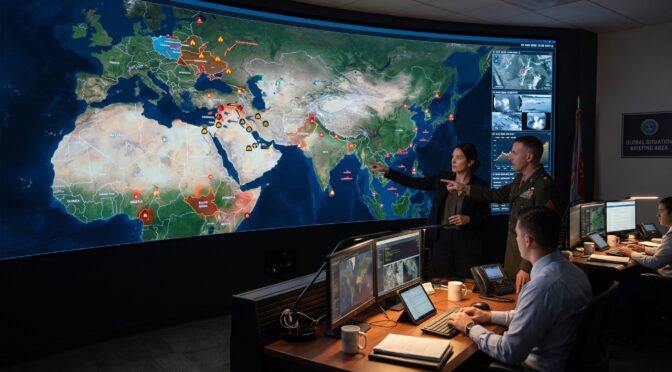
The global threat landscape for the reporting period ending August 1, 2026, is fundamentally defined by a critical supply chain crisis within the defense industrial bases of the United States and its primary allies, particularly regarding advanced air defense munitions. Driven by protracted, concurrent conflicts in Eastern Europe and the Middle East, stockpiles of critical anti-ballistic interceptors, specifically the Terminal High Altitude Area Defense (THAAD) and Patriot (PAC-2/PAC-3) systems, have been severely depleted. This material shortfall has not only precipitated an operational pause in the Middle East but has also left civilian and military infrastructure in Ukraine vulnerable to devastating kinetic strikes, underscoring a systemic shift toward a conventional arms race centered on autonomous strike capabilities and high-volume missile procurement.
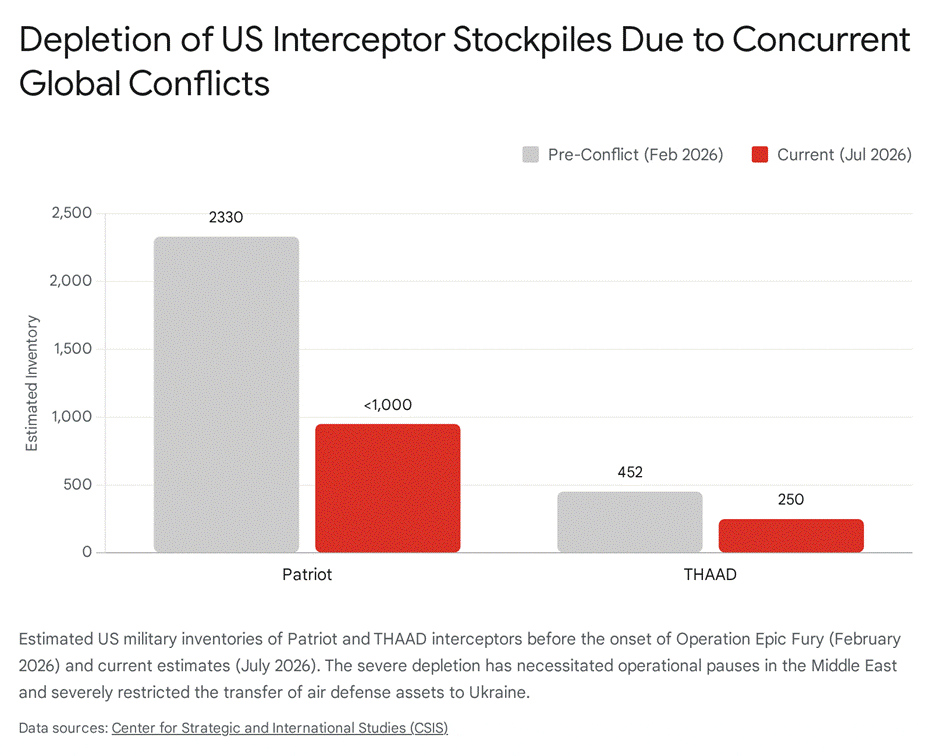
According to joint metrics from the International Institute for Strategic Studies (IISS) and the Stockholm International Peace Research Institute (SIPRI), the global volume of major arms transfers has expanded by 9.2%, highlighted by a 210% surge in European imports as nations fortify postures against a rising Russian threat. While the United States remains the dominant exporter accounting for 42% of global arms transfers, its domestic inventories have been severely strained; the high expenditure of interceptors during Operation Epic Fury in the Middle East, estimated at 1,060 to 1,430 Patriots deployed in 2026 alone, has exhausted approximately two-thirds of the pre-war American inventory.
The conflict between Russia and Ukraine has entered a deep-strike attritional phase, with a deceleration of Russian ground movements but an increase in effective ballistic missile strikes on urban targets due to Ukraine’s interceptor shortage. Concurrently, Ukraine has conducted sophisticated, asymmetric deep strikes against strategic electronic warfare (EW) sites and energy infrastructure in the Russian interior and occupied Crimea, undermining command networks and logistics. To protect against potential spillover and grey-zone activities, NATO is implementing layered defensive perimeters to reinforce its eastern flank.
In the Middle East, the US-Iran confrontation has arrived at a major inflection point, leading to a temporary pause in the US military campaign amid depleted munition inventories and macroeconomic worries. Iran’s approach of sustaining losses while launching asymmetric ballistic missile and drone barrages has necessitated a shift in the US defensive stance. Extreme pressure is being exerted on global commodity and energy markets due to the effective closure of the Strait of Hormuz by Iranian naval forces and proxies, marking a severe disruption to maritime supply lines. At the same time, the multi-front Levant conflict displays mixed dynamics: a phased withdrawal and pilot ceasefire zone brokered by the US are unfolding in southern Lebanon, whereas kinetic operations persist in Gaza despite a disarmament pact with Hamas, along with worsening violence in the West Bank.
Within the Indo-Pacific region, grey-zone tactics have progressed into physical encounters, as the People’s Republic of China (PRC) ramps up maritime coercion against the Philippines via water cannons and physical confrontations with naval personnel. These maneuvers show Beijing’s intent to heighten tactical friction below the threshold of open warfare, creating further regional instability after the Association of Southeast Asian Nations (ASEAN) missed its July 2026 target to finalize a Code of Conduct.
Sub-Saharan Africa remains highly unstable, exacerbated by the spread of advanced asymmetric warfare technologies. Drone warfare and heavy artillery deployments in civilian areas have escalated the conflict in the eastern Democratic Republic of the Congo (DRC), resulting in widespread civilian displacement and severe humanitarian challenges. Meanwhile, Sudan’s civil war continues in a fragmented manner, characterized by expanding drone operations and the systematic weaponization of access to humanitarian aid. On a global scale, the environment remains volatile as state actors utilize grey-zone coercion, proxy networks, and vulnerabilities in Western defense industries to advance strategic objectives while attempting to avoid uncontrolled escalation.
2. Regional Conflict Breakdowns
EUROPE & EURASIA
Russia-Ukraine War
Weekly Key Events:
The current reporting period highlighted a stark contrast in the aerial campaign: Russia dramatically intensified its strategic missile and drone bombardments against Ukrainian cities, while Ukraine executed a highly precise, asymmetric deep-strike offensive aimed at neutralizing Russian logistics, energy assets, and electronic warfare infrastructure.
A massive, coordinated assault was unleashed by the Russian Armed Forces on August 1, 2026, striking Kyiv and no fewer than ten additional regions across Ukraine. The attacking force comprised 185 strike drones and 35 missiles, 27 of which were ballistic variants. Severely hampered by a critical deficit of interceptor munitions, Ukrainian air defense networks managed to neutralize just a single ballistic missile out of the 27 launched. In the capital city, the onslaught claimed at least nine lives and left 28 individuals injured, with the Solomianskyi and Darnytskyi districts bearing the brunt of the devastation, including severe damage to a five-story apartment building and local administrative facilities. Analysts attribute this unprecedentedly low interception rate directly to an acute, theater-wide scarcity of US-provided Patriot PAC-2 and PAC-3 interceptors. This supply crisis, intensified by the extensive deployment of identical interceptors by American forces operating in the Middle East, has exposed a significant defensive gap that Russian forces are aggressively targeting.
This critical shortfall persists despite pledges from the July 2026 NATO Summit in Ankara, where US President Donald Trump publicized a licensing accord permitting Ukraine to manufacture Patriot missiles locally. Defense sector experts emphasize that setting up these domestic manufacturing operations will consume at least 18 to 24 months, offering zero immediate relief to the frontline munition drought. Consequently, European nations have moved forward with the Ukrainian “Freya” program and the European Anti-Ballistic Missile Coalition to engineer high-volume, mass-produced interceptors, though these concepts remain years away from active combat operational status. To mitigate the immediate crisis, the US Army finalized a $441 million procurement contract for legacy PAC-2 Guidance Enhanced Missile-T (GEM-T) interceptors to serve as a temporary stopgap. Concurrently, following threatening nuclear statements issued by the Kremlin on August 1, President Trump directed two US nuclear submarines to deploy to undisclosed maritime areas.
To counter its failing air defense capabilities, the Armed Forces of Ukraine (AFU) alongside defense intelligence (HUR) aggressively stepped up their intermediate-range counter-strikes to systematically dismantle Russia’s high-value strategic capabilities. Over the night spanning July 31 to August 1, Ukrainian drone operations touched off major conflagrations deep within Russian territory. In the city of Ufa, located in the Russian republic of Bashkortostan, strikes successfully hit vital oil refining installations, sparking localized blazes and forcing the Federal Air Transport Agency (Rosaviatsiya) to halt all incoming and outgoing flights at Ufa International Airport.
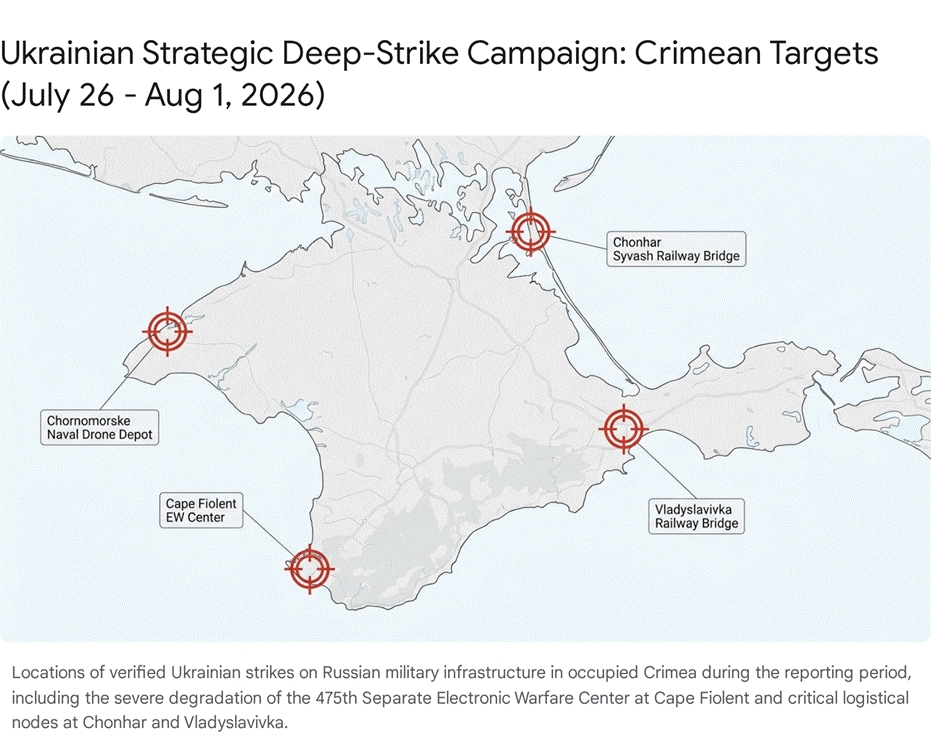
At the same time, carefully synchronized Ukrainian operations inflicted heavy damage on vital Russian military hubs throughout occupied Crimea. Focusing their fire on Cape Fiolent and the Kaya-Bash heights in Sevastopol, Ukrainian forces successfully struck the Black Sea Fleet’s 475th Separate Electronic Warfare Center. The targeted base operated premium strategic equipment, including the advanced Murmansk-BN system, mobile Krasukha-2 and Krasukha-4 complexes, as well as Infauna and Zhitel jamming arrays. A sequence of eight large explosions was documented at the scene, culminating in intense secondary fires.
On the ground, the operational reality reflects a grinding, attritional stalemate. Independent monitoring by the Institute for the Study of War (ISW) assesses that the Russian rate of advance has steadily decreased since November 2025. In June 2026, Russian forces advanced at an average pace of only 1.01 square kilometers per day, seizing or infiltrating roughly 30.42 square kilometers over the entire month while suffering an estimated 1,298 casualties per square kilometer14. This high attrition rate is further compounded by severe equipment deficits; Ukrainian General Staff reports indicate that Russian forces lost 12,867 fuel vehicles and 60,849 drones in June 2026 alone14. The primary axis of Russian effort remains focused on Kostyantynivka in the Donetsk Oblast, where Russian units have infiltrated roughly 37% of the urban environs but struggle to consolidate enduring tactical gains14.
| Territorial Control Metric (June – July 2026) | ISW Assessment | DeepState OSINT Assessment |
| Net Russian Territory Gained (4-Week Avg) | -1 Square Mile (Loss) | +10 Square Miles |
| Current Total Ukrainian Territory Occupied | ~20% (45,666 sq miles) | ~19% (45,159 sq miles) |
| Ukrainian Foothold in Russian Territory | 2 Square Miles | N/A |
| Average Daily Rate of Advance (Theater-wide) | ~1.01 sq km/day | N/A |
The Russian Northern Grouping of Forces continues to issue exaggerated claims of advances in the Sumy and Kharkiv oblasts, which intelligence analysts assess as a cognitive warfare effort directed at the Kremlin and Western audiences, as battlefield evidence indicates Ukrainian counterattacks are actively contesting these sectors16.
NATO Eastern Flank Fortification
Weekly Key Events: In response to escalating Russian grey-zone provocations, NATO frontline states have accelerated a massive, layered fortification initiative. During the reporting period, construction expanded on the Baltic Defense Line (BDL) and Poland’s “East Shield,” which collectively aim to secure over 2,300 kilometers of border shared with Russia, Kaliningrad, and Belarus17. The defensive networks incorporate anti-mobility installations, including “dragon’s teeth” tank obstacles, up to 600 planned bunkers, and deep-sensor surveillance arrays designed to mitigate the region’s lack of strategic depth17. The urgency of these fortifications was punctuated by a recent incident wherein up to 23 Russian “Gerbera” decoy drones penetrated Polish airspace from Belarus, prompting Warsaw to invoke NATO Article 4 and initiate Operation Eastern Sentry to bolster air defense17. Discussions regarding the potential deployment of anti-personnel landmines, necessitating withdrawal from the Ottawa Treaty, remain a point of intense geopolitical debate among Baltic and Polish defense ministries17.
Armenia-Azerbaijan Border Tensions
Weekly Key Events: Despite the historic peace agreement signed in Washington D.C. in August 2025 that formally ended decades of conflict, diplomatic and economic friction remains elevated. During the reporting period, Armenian Prime Minister Nikol Pashinyan appealed to Russian President Vladimir Putin to intervene in a widening trade dispute involving the Eurasian Economic Union (EAEU)18. Russia has imposed severe restrictions on Armenian goods entering the Russian market, including dairy, fruits, vegetables, and high-value exports18. This economic coercion aligns with broader geopolitical shifts, as Armenia continues to orient its security and economic frameworks toward the European Union and the United States, utilizing the newly established “Trump Route for International Peace and Prosperity” (TRIPP) transport corridor18. Concurrently, post-conflict reconciliation efforts continue, with Azerbaijani authorities updating the official count of missing persons from the First Garabagh War and recent conflicts to 4,01020. No kinetic border incidents or territorial exchanges were recorded during the reporting week.
MIDDLE EAST & NORTH AFRICA
US-Iran War & Strait of Hormuz Blockade
Weekly Key Events: The high-intensity conflict between the United States and the Islamic Republic of Iran experienced a notable operational pause during the reporting week, driven fundamentally by severe logistical and economic constraints rather than diplomatic breakthroughs. The US military campaign, Operation Epic Fury, which aimed to degrade Iranian missile and proxy capabilities, reached the limits of its current operational effectiveness21. Top US military commanders, including CENTCOM leadership, advised the White House that continued strikes risked completely exhausting the Pentagon’s stockpiles of Patriot and THAAD interceptors22. The US inventory of Patriot missiles has dropped below 1,000 (from 2,330), and THAAD interceptors have fallen to approximately 250 (from 452)24. This shortage leaves forward-deployed US troops, Gulf partners, and strategic installations highly vulnerable to sustained Iranian ballistic retaliation23.
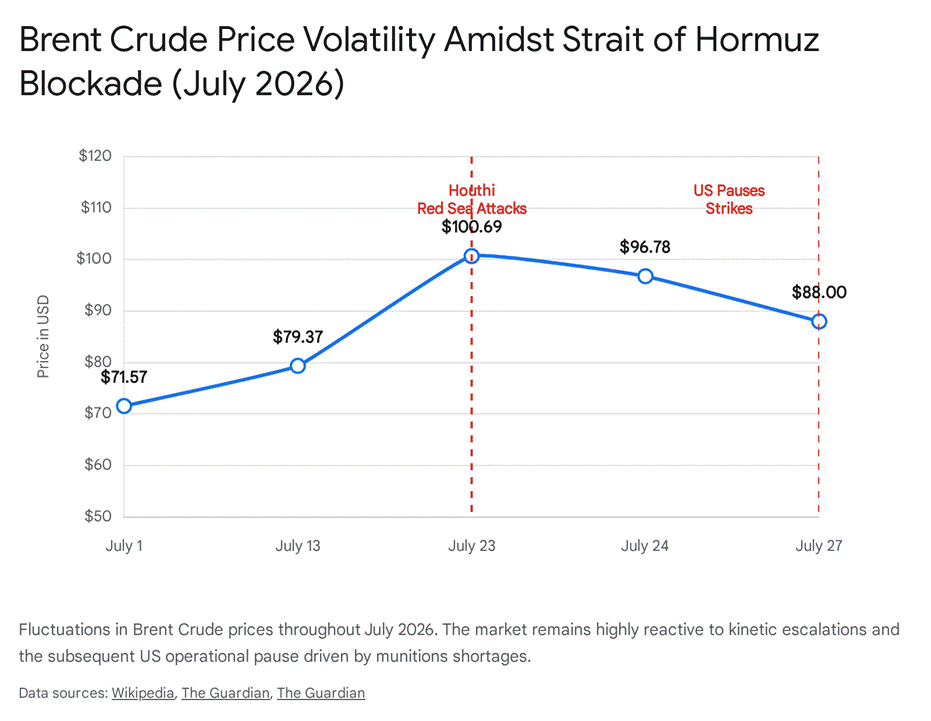
Iran’s strategic doctrine of absorbing significant kinetic losses while maintaining a steady output of asymmetric drone and ballistic missile strikes has effectively contested US air superiority25. Iran utilized the operational pause to consolidate its maritime coercion strategy. The Islamic Revolutionary Guard Corps (IRGC) continues to strictly enforce a naval blockade of the Strait of Hormuz, maintaining the closure of a waterway responsible for 20% of global oil and liquefied natural gas (LNG) transits26. To further deter commercial shipping, the IRGC highlighted the presence of naval mines in the southern maritime corridor, claiming on July 22 that an oil tanker was disabled by a mine strike28. Iranian-aligned proxy forces, including the Houthi movement in Yemen, continued to target vessels in the Red Sea and Bab el-Mandeb Strait, while Iranian forces claimed strikes on US military installations in Bahrain and unauthorized tankers in the Gulf29.
The geopolitical standoff has triggered acute global economic shocks reminiscent of the 1970s energy crises. Brent crude oil experienced extreme volatility, dropping 8% to below $88 a barrel following news of the US operational pause, but baseline prices remain highly elevated compared to pre-conflict levels due to the stranded output of Kuwait, Iraq, Saudi Arabia, and the UAE26.
The crisis has sparked severe food security emergencies across Gulf Cooperation Council (GCC) states, which rely on the Strait for 80% of their caloric intake; by mid-March, 70% of the region’s food imports were disrupted, forcing major retailers to airlift staples and resulting in 40-120% price inflation26. In an effort to assert dominance, US President Trump announced intentions to impose a 20% toll on all eligible cargo passing through the Strait to cover the costs of US naval protection, further complicating the commercial viability of maritime transit in the region27.
The conflict has also catalyzed a massive acceleration in conventional missile procurement. A declassified US intelligence assessment projects that adversarial states (China, Iran, North Korea, Russia) will field over 16,000 ballistic and cruise missiles capable of striking the US homeland by 203532. In response, the US Department of War is planning to procure 10,000 low-cost containerized cruise missiles over the next three years, as well as up to 12,000 aero-ballistic systems and 4,300 ALCMs over the next five years32. This signals a definitive shift toward a high-volume conventional arms race designed to overwhelm adversarial air defense networks.
Israel-Hezbollah-Hamas (Levant Multi-Front War)
Weekly Key Events:
The multi-front conflict in the Levant exhibits significant tactical divergence across its three primary theaters: Gaza, Lebanon, and the West Bank.
In Gaza, despite the announcement of a landmark US-brokered ceasefire and disarmament agreement with Hamas, the Israel Defense Forces (IDF) continued intense kinetic operations. Overnight strikes in central Gaza following military evacuation orders resulted in multiple casualties33. The IDF confirmed the targeted elimination of high-level operatives, including Fares al-Masri, a commander overseeing Hamas’s weapons production, and members of the elite Nukhba Force, including Muhammad Abu Shakyan and Amro Abu Alrish34. In northern Gaza, east of the Yellow Line buffer zone, combat engineers dismantled subterranean tunnel infrastructure35. The continuation of strikes indicates that while a macro-level political framework exists, tactical clearance operations remain ongoing.
In southern Lebanon, the landscape is shifting from active high-intensity warfare (which resumed in March 2026) toward tentative stabilization. Under a US-mediated framework overseen by Secretary of State Marco Rubio, Israel is executing a phased withdrawal from occupied pilot zones. During the reporting week, the Lebanese Armed Forces began deploying into Zawtar al-Gharbiyeh following the departure of IDF units35. The Lebanese government is moving to restrict Hezbollah’s military activities within these zones, though Hezbollah officially rejected the disarmament clauses of the US framework36. Clearance operations revealed ideological material, including drawings of Adolf Hitler, inside a private home in the village of Taybeh, allegedly prepared for a Hezbollah-operated school35. To finance its reconstruction following severe degradation by IDF operations, Hezbollah is increasingly relying on a global illicit finance network overseen by figures such as Talal Hamiyah, who reportedly siphoned over $100 million from Iraq-Lebanon trade agreements through European shell companies37.
Conversely, the West Bank represents an actively deteriorating flashpoint. The IDF has significantly increased its regional deployment to 26 combat battalions in response to a sharp escalation in Palestinian militant attacks and settler violence35. On July 24, a deadly confrontation erupted near the village of Tal after Israeli civilians entered Palestinian Authority-controlled territory uncoordinated; a Palestinian assailant seized a weapon, killing an IDF Artillery Corps major and a local emergency response squad member35. Subsequent counterterrorism sweeps by the IDF and Shin Bet resulted in over 70 arrests across the West Bank, underscoring the extreme fragility of the internal security environment35.
Libya Political Deadlock
Weekly Key Events:
No material updates this period.
INDO-PACIFIC
South China Sea Maritime Disputes
Weekly Key Events:
The grey-zone conflict between the People’s Republic of China (PRC) and the Philippines escalated from coercive maneuvering to direct physical violence during the reporting week. Between July 20 and July 25, a series of manufactured confrontations occurred near the highly contested Second Thomas Shoal and Scarborough Shoal.
On July 20, personnel from the China Coast Guard (CCG) operating a rigid-hull inflatable boat clashed directly with Philippine Navy personnel conducting resupply operations near the grounded BRP Sierra Madre at Second Thomas Shoal38. The encounter escalated to hand-to-hand combat, during which a CCG officer struck a Filipino sailor in the head with a wooden baton, causing serious injury and damaging the Philippine rubber boat38. Subsequently, on July 24 and 25, CCG vessels deployed high-pressure water cannons against Philippine coast guard and Bureau of Fisheries and Aquatic Resources (BFAR) vessels attempting to deliver fuel to Filipino fishermen near Scarborough Shoal, physically striking the government ships and executing dangerous blocking maneuvers within seven meters of the Philippine hulls41.
The Armed Forces of the Philippines (AFP) reported tracking 26 Chinese vessels, including 22 CCG ships and four People’s Liberation Army Navy (PLAN) warships, operating within the Philippine Exclusive Economic Zone (EEZ) during this period, indicating a sustained and robust presence43.
Strategically, this escalation coincided precisely with the 59th ASEAN Foreign Ministers’ Meeting in Manila and the conclusion of the massive US-led “Exercise Salaknib 2026,” which involved 7,000 allied troops (including the first full combat deployment of Japanese soldiers to the Philippines since WWII)39. The timing underscores Beijing’s calculated intent to demonstrate that large-scale US military posturing will not deter its territorial assertions. Furthermore, July 2026 marked the expiration of a long-standing deadline for China and ASEAN to finalize a legally binding Code of Conduct for the South China Sea, a diplomatic failure that leaves the maritime domain devoid of enforceable rules of engagement44. A coalition of 14 nations issued a joint statement condemning China’s destabilizing activities, which Beijing swiftly rejected as an endorsement of an “illegal” arbitral award39.
Taiwan Strait Tensions
Weekly Key Events: The PRC continues to apply sustained military pressure against Taiwan, utilizing airspace incursions and naval deployments to normalize a persistent threat posture as part of the ongoing Fourth Taiwan Strait Crisis46. On July 24, the Ministry of National Defense (MND) in Taipei tracked eight PLA aircraft, six PLAN vessels, and four official Chinese ships operating around the island47. Crucially, six of the eight aircraft deliberately crossed the median line of the Taiwan Strait, a de facto boundary Beijing publicly renounced during the 2022 crisis, entering Taiwan’s northern, southwestern, and eastern air defense identification zones (ADIZ)46. By July 26, tracking identified an additional four PLA aircraft and seven PLAN vessels, with further incursions reported throughout the week48.
Taiwanese forces responded with standard operational procedures, scrambling fighter jets, deploying naval vessels, and activating coastal missile defense systems47. These maneuvers serve as a practical precursor to Taiwan’s highly anticipated “Han Kuang 41” live-fire military exercises scheduled for August 2026. The upcoming drills will simulate defending against a PLA blockade and full-scale invasion scenario, focusing on decentralized weapons manufacturing to sustain combat operations during a maritime cordon50.
In a parallel grey-zone escalation, Taiwan’s Mainland Affairs Council (MAC) reported an alarming trend of Taiwanese nationals, particularly civil servants and academics, being detained, interrogated, or disappearing while visiting mainland China51. Analysts assess this as a coordinated PRC intelligence gathering and intimidation campaign51. Concurrently, Chinese state media and academic institutions have initiated an information operations campaign asserting sovereignty over the Batanes Islands in the Luzon Strait, likely setting conditions to normalize a coercive maritime presence in a vital waterway designed to contain the PLAN within the first island chain51. In response to the growing regional espionage threat, Japan is actively developing its first central intelligence agency since World War II to counter PRC and Russian infiltration51.
SUB-SAHARAN AFRICA
Eastern DRC Instability
Weekly Key Events: The protracted conflict in the eastern Democratic Republic of the Congo (DRC) has entered a highly lethal phase, characterized by the introduction of advanced asymmetric warfare technologies into densely populated areas. Hostilities between the Congolese national armed forces (FARDC), supported by Burundian troops and local Mai-Mai militias, and the Rwandan-backed M23 (March 23 Movement) escalated dramatically in the South Kivu territories of Fizi, Mwenga, and Uvira52.
The reporting week saw both belligerents deploy armed offensive drones, heavy artillery, and GPS jamming equipment in urban environments52. This technological shift has resulted in indiscriminate civilian casualties, the destruction of civilian infrastructure (including over 350 attacks on schools across the region), and the displacement of at least 6,000 civilians toward Kipupu and Malanda52. The United Nations Organization Stabilization Mission in the DRC (MONUSCO) noted that the use of such capabilities in urban settings represents a grave violation of international humanitarian law56.
In the diplomatic and political arena, the DRC government continues to pursue legal accountability, having recently filed a case against Rwanda at the International Court of Justice (ICJ) for its financing and operational support of the M23 insurgency58. Additionally, Kinshasa announced that the FDLR (Democratic Forces for the Liberation of Rwanda) accepted a surrender protocol to disarm and move into cantonment, though Rwandan officials dismissed this as a delaying tactic58. Internally, the DRC Constitutional Court validated a controversial law allowing President Felix Tshisekedi to amend the constitution via a constituent assembly, sparking widespread civilian protests and fears of democratic backsliding58.
Sudan Civil Conflict
Weekly Key Events: The civil war in Sudan continues to fragment the state, with the Sudanese Armed Forces (SAF) and the paramilitary Rapid Support Forces (RSF) engaged in localized battles of attrition characterized by the systematic weaponization of humanitarian access. On July 31, a notable tactical shift occurred in Omdurman, where a fully equipped contingent of RSF fighters surrendered to the SAF59. This surrender follows recent SAF military gains in the North Kordofan region, suggesting localized breakdowns in RSF command cohesion59.
However, the broader conflict remains devastating for non-combatants. The systematic use of aerial bombardment and drone warfare by both sides continues unabated, particularly in the Darfur and Kordofan regions. International rights organizations have documented the use of “double tap” drone strikes deliberately designed to target first responders and civilians rushing to aid victims of initial bombardments60. The violence is occurring against the backdrop of a comprehensive collapse of the humanitarian system, marked by widespread famine and a lethal cholera outbreak in besieged cities such as El Obeid61. In response to the continued financing of the conflict through illicit means, the European Union announced new sanctions restricting the trade of Sudanese gold60.
Somalia Insurgency
Weekly Key Events: The war between the Somali federal government and the al-Qaeda-affiliated Al-Shabaab insurgency remains locked in a structural stalemate. Neither force possesses the capacity to secure a decisive military victory, leading to a cycle of temporary, reversible territorial gains64. During the reporting period, cross-border security operations dominated the operational landscape. Kenyan security forces, utilizing intelligence and aerial support, executed a targeted raid near the Kenya-Somalia border in Mandera County, neutralizing 11 suspected Al-Shabaab militants60. The operation disrupted a planned cross-border assault and recovered weaponry and financial documents related to the group’s mandatory taxation and checkpoint collection networks60.
Within central Somalia, Al-Shabaab continues to adapt its governance model, easing certain draconian restrictions to mitigate local backlash while maintaining strict ideological control over rural territories65. Politically, the Somali federal government is navigating a severe constitutional crisis following the passage of amendments that extended presidential and parliamentary terms without political consensus, deepening divisions between Mogadishu and the federal member states65.
Mali Insurgency
Weekly Key Events: The security environment in the Sahel continues to deteriorate under military junta rule. During the reporting week, human rights monitors verified that the Russian state-backed Africa Corps (formerly the Wagner Group), operating in conjunction with Malian armed forces, engaged in indiscriminate attacks that resulted in significant civilian casualties near the northern town of Anéfis61. The incident underscores the escalating lethality of the corridor war against Islamist insurgents (JNIM) and Tuareg separatist groups, and highlights the Malian junta’s heavy reliance on foreign mercenaries operating outside the bounds of international humanitarian law60.
WESTERN HEMISPHERE
Haiti, Ecuador, and Jamaica Internal Security
Weekly Key Events: Internal security environments in the Caribbean basin and South America remain highly volatile due to the entrenchment of transnational criminal organizations. Gang violence targeting civilians reached a monthly high in Ecuador, while police operations in Jamaica demonstrated increased lethality67. In Port-au-Prince, Haiti, gang coalitions continue to contest state authority and severely restrict humanitarian access despite ongoing international stabilization efforts67.
Venezuela-Guyana Essequibo Dispute
Weekly Key Events:
No material updates this period.
3. Appendix: Methodology
Analytical Framework and OSINT Collection:
This Situation Report (SITREP) is generated utilizing a comprehensive Open-Source Intelligence (OSINT) collection framework designed to aggregate, verify, and synthesize data from global conflict zones. The analytical model relies on a tiered collection strategy:
- Primary Institutional Reporting: Quantitative and qualitative data is harvested from highly reputable defense and geopolitical research institutes. This report relies heavily on battlefield geometry and casualty assessments from the Institute for the Study of War (ISW), global arms transfer and defense industrial base metrics from the Stockholm International Peace Research Institute (SIPRI), force posture assessments from the International Institute for Strategic Studies (IISS), and conflict event tracking from the Armed Conflict Location & Event Data Project (ACLED).
- Official State Declarations: The framework processes official communications from Ministries of Defense, military general staffs (e.g., AFU General Staff, US CENTCOM, Taiwan MND), and multilateral organizations (e.g., UN OCHA, NATO).
- Verified Regional Media and Telemetry: Localized reporting, satellite imagery analysis, and verified geospatial tracking (e.g., maritime shipping data via the Strait of Hormuz, thermal anomaly mapping in Crimea) are utilized to corroborate kinetic events on the ground.
Source Credibility and Materiality Criteria:
Source credibility is established through rigorous cross-verification. A kinetic event (e.g., a missile strike, territorial capture) is only integrated into the SITREP if corroborated by at least two independent nodes (e.g., a local monitoring group like Crimean Wind cross-referenced with official General Staff reports or satellite imagery).
The “Materiality” of an event is determined by its potential to alter the tactical or strategic status quo. Routine artillery exchanges along a static frontline or routine diplomatic rhetoric are excluded. Events are deemed material if they involve:
- Verifiable changes in territorial control or significant shifts in casualty rates.
- The destruction of high-value strategic assets (e.g., Electronic Warfare centers, critical bridges, oil refineries).
- The introduction of novel tactical capabilities (e.g., urban drone warfare in the DRC, hypersonic glide vehicles).
- Macro-level shifts in defense logistics and supply chains (e.g., the exhaustion of US Patriot interceptor stockpiles and the subsequent operational pause).
If a monitored conflict zone yields no events meeting these specific thresholds during the reporting window, the strict materiality rule dictates the entry: “No material updates this period.”
Distinguishing Grey-Zone Operations:
Grey-zone operations are analytically distinguished from routine diplomatic friction or conventional warfare through a specific behavioral matrix. An activity is classified as a grey-zone provocation if it involves state or state-sponsored actors utilizing coercive, physical, or highly disruptive tactics that deliberately remain below the threshold of conventional armed conflict (e.g., Article 5 of the NATO treaty or a formal declaration of war).
Examples identified in this report include the China Coast Guard’s use of high-pressure water cannons and physical baton strikes against Philippine naval personnel, the weaponization of economic tolls in international waterways, the deployment of decoy drones to test NATO air defense response times, and the targeted detention of foreign nationals for intelligence gathering. These actions are designed to achieve incremental strategic gains, normalize aggressive postures, and force the adversary to bear the burden of military escalation.
Please share the link on Facebook, Forums, with colleagues, etc. Your support is much appreciated and if you have any feedback, please email us in**@*********ps.com. If you’d like to request a report or order a reprint, please click here for the corresponding page to open in new tab.
Sources Used
- A European Way of War Without the United States, https://www.iiss.org/online-analysis/survival-online/2026/06/a-european-way-of-war-without-the-united-states/
- Trends in International Arms Transfers, 2025 – SIPRI, https://www.sipri.org/sites/default/files/2026-03/fs_2603_at_2025.pdf
- Global arms flows jump nearly 10 per cent as European demand soars – SIPRI, https://www.sipri.org/media/press-release/2026/global-arms-flows-jump-nearly-10-cent-european-demand-soars
- The arms race for cheaper anti-ballistic weapons is underway, https://www.defensenews.com/industry/techwatch/2026/07/30/the-arms-race-for-cheaper-anti-ballistic-weapons-is-underway/
- Ukraine Downs Only 1 Ballistic Missile During Massive Attack on Kyiv – Kyiv Post, https://www.kyivpost.com/post/81526
- Russia pounds Kyiv with missiles, killing at least nine – AL-MONITOR, https://www.al-monitor.com/originals/2026/07/russia-pounds-kyiv-missiles-killing-least-nine
- Missile shortage forces US Army to return to older PAC-2 Patriot interceptors, https://timesofindia.indiatimes.com/defence/international/missile-shortage-forces-us-army-to-return-to-older-pac-2-patriot-interceptors/articleshow/132683847.cms
- Patriot missile shortage has created ‘window of vulnerability’ Russia is exploiting in Ukraine – The Guardian, https://www.theguardian.com/world/2026/jun/02/patriot-missile-shortage-window-vulnerability-russia-exploiting-ukraine
- Washington said Ukraine’s Patriot shortage was solved. Lockheed and RTX hadn’t been told. – Euromaidan Press, https://euromaidanpress.com/2026/07/10/ukraine-patriot-license-nato-summit/
- Ukraine needs help against Russian missiles now. What more can allies do?, https://www.chathamhouse.org/2026/07/ukraine-needs-help-against-russian-missiles-now-what-more-can-allies-do
- Russian Offensive Campaign Assessment, August 1, 2025 | ISW, https://understandingwar.org/research/russia-ukraine/russian-offensive-campaign-assessment-august-1-2025/
- Ukrainian drone strikes hit oil refinery infrastructure in Russia’s Bashkortostan, military sites in Crimea – Apa.az, https://en.apa.az/cis-countries/ukrainian-drone-strikes-hit-oil-refinery-infrastructure-in-russias-bashkortostan-military-sites-in-crimea-518602
- Crimea strikes: Fires reported at Russian electronic warfare and air defense positions, https://english.nv.ua/russian-war/fires-reported-at-russian-electronic-warfare-and-air-defense-sites-in-crimea-50628989.html
- Russian Offensive Campaign Assessment, July 1, 2026| ISW, https://understandingwar.org/research/russia-ukraine/russian-offensive-campaign-assessment-july-1-2026/
- Russian Offensive Campaign Assessment, July 14, 2026, https://understandingwar.org/research/russia-ukraine/russian-offensive-campaign-assessment-july-14-2026/
- ISW Russian Offensive Campaign Assessment, July 31, 2026 – Kyiv Post, https://www.kyivpost.com/post/81501
- The Military Balance 2026: Fortifying NATO’s eastern flank, https://www.iiss.org/publications/the-military-balance/2026/the-military-balance-2026/fortifying-natos-eastern-flank/
- Yerevan faces European uncertainty as EAEU tensions deepen – The Armenian Weekly, https://armenianweekly.com/2026/07/30/yerevan-faces-european-uncertainty-as-eaeu-tensions-deepen/
- Historic moment in Washington as Armenia and Azerbaijan end decades of conflict and open the door for a new era | commonspace.eu, https://www.commonspace.eu/news/historic-moment-washington-armenia-and-azerbaijan-end-decades-conflict-and-open-door-new-era
- More Than 4,000 Azerbaijanis Remain Missing from Conflicts with Armenia – Caspian News, https://caspiannews.com/news-detail/more-than-4000-azerbaijanis-remain-missing-from-conflicts-with-armenia-2026-6-30-6/
- July 26: Israel said to boost ties with Middle East nations amid Iran threat, https://www.timesofisrael.com/liveblog-july-26-2026/
- US pauses Iran attacks after Trump advised to halt bombing, https://www.theguardian.com/world/2026/jul/26/us-pauses-trump-netanyahu-attacks-on-iran-talks-hormuz
- “Guardians of the World”: Trump shares barrage of AI-generated images signalling US military might and political ambition, https://www.aninews.in/news/world/us/guardians-of-the-world-trump-shares-barrage-of-ai-generated-images-signalling-us-military-might-and-political-ambition20260727045916
- ‘Heavy wave of strikes’ could be first of a two-week campaign to finish off Iran’s missile arsenal, https://www.washingtonexaminer.com/daily-on-defense/4668757/heavy-wave-strikes-two-week-campaign-finish-iran-missile-arsenal/
- Analysis | The Interceptor Shortage That Changed the Balance of the War – Israel Defense, https://www.israeldefense.co.il/en/node/69953
- Economic impact of the 2026 Iran war – Wikipedia, https://en.wikipedia.org/wiki/Economic_impact_of_the_2026_Iran_war
- Oil prices leap and stocks fall as Trump reinstates Hormuz blockade on Iranian shipping – The Guardian, https://www.theguardian.com/business/2026/jul/13/oil-prices-leap-stocks-fall-us-iran-strait-of-hormuz-brent-crude-markets
- Iran Update Special Report, July 23, 2026, https://understandingwar.org/research/middle-east/iran-update-special-report-july-23-2026/
- Crude prices retreat as oil continues flowing through Hormuz alternatives, https://timesofindia.indiatimes.com/business/international-business/crude-prices-retreat-as-oil-continues-flowing-through-hormuz-alternatives/articleshow/132724856.cms
- Hormuz Tensions Rise After UAE Tankers Hit | Horizons Middle East & Africa 7/14/2026, https://www.youtube.com/watch?v=eu0nJbwgDRo
- Oil prices fall as US pauses strikes on Iran over strait of Hormuz, https://www.theguardian.com/business/2026/jul/27/oil-prices-fall-us-strikes-iran-brent-crude-bp-shell-ftse-100
- A growing missile threat to the US homeland and the emerging arms race, https://www.iiss.org/online-analysis/missile-dialogue-initiative/2026/06/a-growing-missile-threat-to-the-us-homeland-and-the-emerging-arms-race/
- President Trump threatens more strikes on Iran as US pushes to reopen the Strait of Hormuz, https://www.kgw.com/article/news/nation-world/attack-on-iran/iran-war-united-states-strait-hormuz-strikes-middle-east-conflict-attack/507-05a8c06d-4d4b-45dd-89eb-6ed88f245e26
- Israel Confirms Killing of Hamas Commander Involved in Arms Manufacturing, https://www.aninews.in/news/world/middle-east/israel-confirms-killing-of-hamas-commander-involved-in-arms-manufacturing20260726143832
- IDF increases West Bank deployment to 26 battalions as violence rises, https://www.jpost.com/israel-news/defense-news/article-903825
- 2026 Lebanon war – Wikipedia, https://en.wikipedia.org/wiki/2026_Lebanon_war
- Hezbollah’s Financing Strategies: Recovering From War With Israel – FDD, https://www.fdd.org/analysis/2026/07/24/hezbollahs-financing-strategies-recovering-from-war-with-israel/
- Chinese, Philippine personnel clash in the South China Sea, https://www.theguardian.com/world/video/2026/jul/21/chinese-philippine-personnel-clash-in-the-south-china-sea
- As ASEAN meets, manufactured confrontations in the South China Sea, https://www.wsws.org/en/articles/2026/07/30/zwtu-j30.html
- China, Philippines trade accusations over South China Sea encounter, https://www.internazionale.it/ultime-notizie-reuters/2026/07/20/chinese-coast-guard-struck-navy-sailor-in-south-china-sea-encounter-says-philippine-military
- South China Sea Tensions Rise After China-Philippines Clashes – Institute for Applied Geopolitics, https://appliedgeopolitics.com/blog/south-china-sea-philippines-clash
- China coast guard uses water cannons on 2 Philippine vessels as top diplomats meet in Manila, https://apnews.com/article/south-china-sea-philippines-scarborough-shoal-66eccdf9a171a1acd7bd1d8b13aeb1e3
- AFP monitors 26 Chinese naval, coast guard ships in West PH Sea in past week – ABS-CBN, https://www.abs-cbn.com/news/nation/2026/7/30/afp-monitors-26-chinese-naval-coast-guard-ships-in-west-ph-sea-in-past-week-1318
- Washington Sent 7000 Troops to Deter China – FPIF.org, https://fpif.org/washington-sent-7000-troops-to-deter-china/
- Fourteen nations and EU express concern over China’s destabilising activities in SCS, https://timesofindia.indiatimes.com/toi-blogs/beyond-borders/fourteen-nations-and-eu-express-concern-over-chinas-destabilising-activities-in-scs/articleshow/132773342.cms
- Fourth Taiwan Strait Crisis – Wikipedia, https://en.wikipedia.org/wiki/Fourth_Taiwan_Strait_Crisis
- Taiwan tracks 10 Chinese ships, 8 military aircraft, https://www.taiwannews.com.tw/news/6407572
- Military activity detected at Taiwan Strait on Sunday (26 July) – datasurfr, https://datasurfr.ai/news/military-activity-detected-at-taiwan-strait-on-sunday-26-july/
- China to ‘Invade’ Taiwan Soon? PLA Warships Encircle Island, Aircraft Enters Air Defence Zone | 4K – YouTube, https://www.youtube.com/watch?v=M-D-7T9I7LA
- Han Kuang drills rehearse invasion fighting, https://www.taipeitimes.com/News/taiwan/archives/2026/07/29/2003861566
- China & Taiwan Update, July 17, 2026 | ISW, https://understandingwar.org/research/china-taiwan/china-taiwan-update-july-17-2026/
- Thousands flee clashes in DR Congo’s South Kivu province – CGTN, https://newsaf.cgtn.com/news/2026-07-07/Thousands-flee-clashes-in-DR-Congo-s-South-Kivu-province-1OABHDzy9ws/p.html
- Kivu conflict – Wikipedia, https://en.wikipedia.org/wiki/Kivu_conflict
- DR Congo: Aid, Movements Hindered in South Kivu Highlands | Human Rights Watch, https://www.hrw.org/news/2026/04/14/dr-congo-aid-movements-hindered-in-south-kivu-highlands
- Use of explosive weapons ‘must stop’ in eastern DR Congo: Türk | UN News, https://news.un.org/en/story/2026/07/1167906
- DRC: Conflict Widens, 26.6 Million Face Hunger Amid Rising Violence – Briefing | United Nations – YouTube, https://www.youtube.com/watch?v=b8bz6DCau0U
- Democratic Republic of the Congo – Global Coalition to Protect Education from Attack, https://protectingeducation.org/wp-content/uploads/eua_2026_drc.pdf
- Conflict in the Democratic Republic of Congo | Global Conflict Tracker – Council on Foreign Relations, https://www.cfr.org/global-conflict-tracker/conflict/violence-democratic-republic-congo
- Sudan army says RSF fighters surrender after field gains, https://sudantribune.com/article/316867
- Africa Media Review for July 14, 2026, https://africacenter.org/daily-media-review/africa-media-review-for-july-14-2026/
- ASA Situation Reports – African Security Analysis, https://www.africansecurityanalysis.com/reports
- New cholera outbreak alert for Sudan’s war-weary communities | UN News, https://news.un.org/en/story/2026/07/1167913
- UNFPA Flash Update #2 on the situation in El Obeid, North Kordofan, Sudan (3 – 19 July 2026) – ReliefWeb, https://reliefweb.int/report/sudan/unfpa-flash-update-2-situation-el-obeid-north-kordofan-sudan-3-19-july-2026
- Somalia’s 2026 security impasse: The geography of an unwinnable war | Somali Guardian, https://www.somaliguardian.com/news/somalia-news/somalia-security-impasse-2026/
- New Chapter, Same Stalemate: Somalia’s War with Al-Shabaab | International Crisis Group, https://www.crisisgroup.org/brf/africa/somalia/b212-new-chapter-same-stalemate-somalias-war-al-shabaab
- Russia’s Africa Corps kills Mali civilians in ‘indiscriminate’ attack, rights group says, https://www.polity.org.za/article/russias-africa-corps-kills-mali-civilians-in-indiscriminate-attack-rights-group-says-2026-07-31
- Latin America and the Caribbean Overview: July 2026 – ACLED, https://acleddata.com/update/latin-america-and-caribbean-overview-july-2026