
Executive Summary
The operational environment in the Persian Gulf and the broader Middle East theater during the period of August 8 to August 14, 2026, was characterized by the rapid and systemic deterioration of the diplomatic guardrails established by the June 17 Islamabad Memorandum of Understanding (MoU)1. As the initial 60-day window of the interim agreement approaches its August 16 expiration, both the United States and the Islamic Republic of Iran have actively entrenched themselves within a precarious “dual-track” paradigm. This paradigm involves ostensibly maintaining diplomatic channels through intermediaries in Oman, Qatar, and Switzerland, while simultaneously escalating kinetic, economic, and geopolitical pressure to maximize leverage ahead of a potential structural collapse of the talks2.
Diplomatic breakthroughs have stalled dramatically across all fronts. The Bürgenstock technical negotiations remain paralyzed by maximalist Iranian demands regarding the permanent withdrawal of United States forces, the total lifting of the naval blockade, and comprehensive war reparations3. In a signal of strategic hardening, Iranian Supreme Leader Mojtaba Khamenei orchestrated a critical leadership reshuffle within the Supreme National Security Council (SNSC), elevating hardline Islamic Revolutionary Guard Corps (IRGC) veteran Major General Mohsen Rezaei to the position of Secretary. This appointment aligns with a profound doctrinal shift articulated by Iranian parliamentarians, who now openly assert that sovereign control over the Strait of Hormuz provides greater strategic deterrence than a nuclear weapons program4.
Concurrently, kinetic and economic escalations have intensified. The United States Central Command (CENTCOM) formalized “Task Force Falcon Strike,” a multi-domain multinational drone unit designed to indefinitely enforce the maritime blockade6. In tandem with this ongoing blockade, the Department of the Treasury’s Office of Foreign Assets Control (OFAC) continues to aggressively pursue the IRGC’s $4 billion shadow banking and digital asset laundering network, following sweeping sanctions issued just prior to this reporting window8. Iran retaliated symmetrically in the maritime domain, conducting precision drone and missile strikes against three United Arab Emirates (UAE) ADNOC tankers exiting the Strait of Hormuz during this week10. Finally, the continued fallout from the “Mecca Joint Defence Agreement” between Saudi Arabia, Turkey, and Pakistan has fundamentally altered the calculus of both Iranian aggression and American regional hegemony13.
Detailed Operational and Diplomatic Developments
Bilateral Interactions: The Stalled Bürgenstock Architecture and the Islamabad MoU
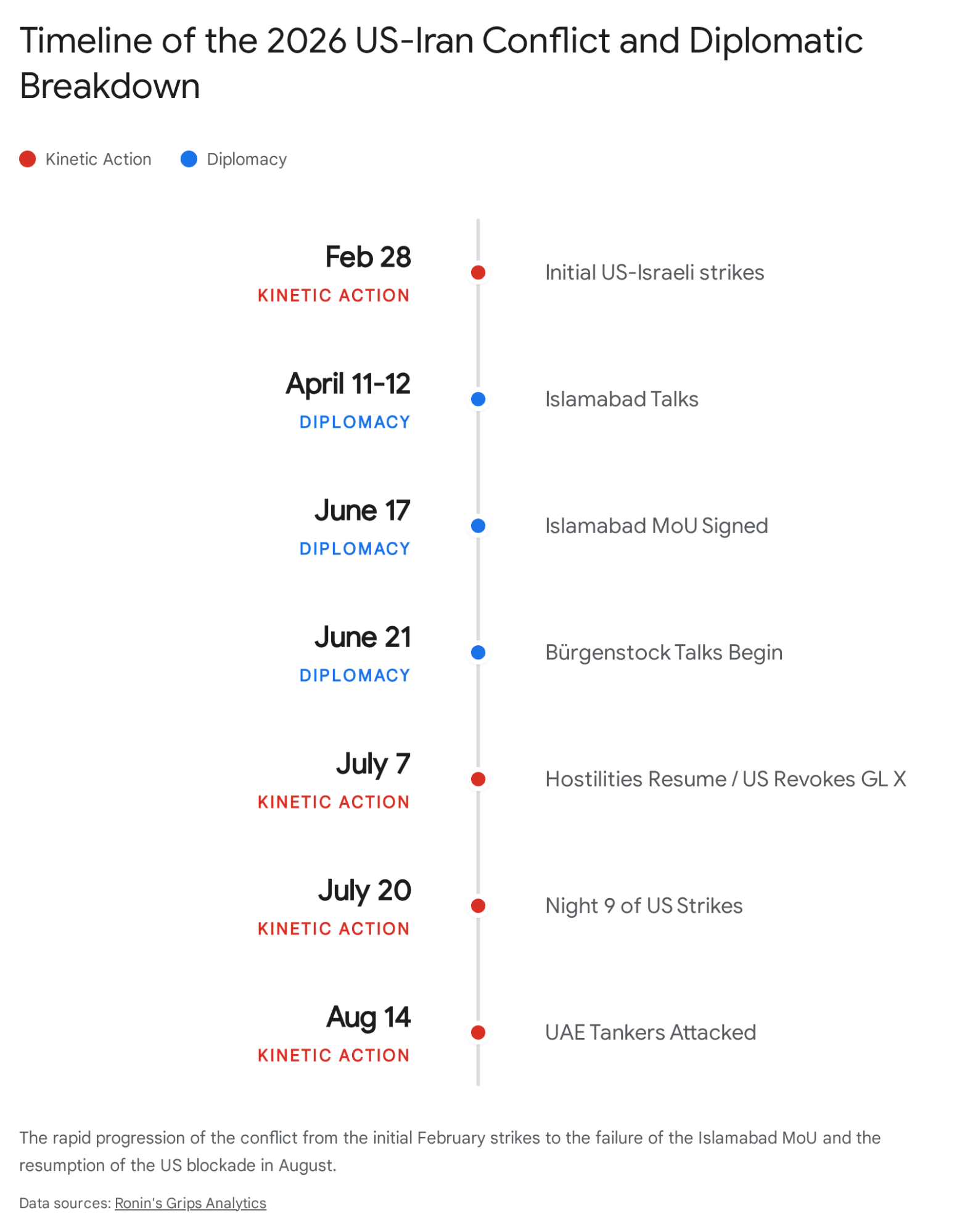
The diplomatic framework established by the 14-point Islamabad MoU, signed at the Palace of Versailles on June 17, 2026, is currently operating under severe systemic stress1. Brokered primarily by Pakistan and Qatar, the interim agreement was intended to convert a highly volatile military stalemate into a structured, 60-day negotiation window1. The objective was to address the Iranian nuclear file, ensure maritime security, and facilitate regional de-escalation prior to the August 16 deadline2. However, the transition from this broad political framework to actionable implementation at the Bürgenstock technical talks in Switzerland has yielded minimal operational success16.
The core friction at Bürgenstock stems from diametrically opposed interpretations of the MoU’s sequencing and the deliberate ambiguities drafted into the initial text18. The United States delegation, spearheaded by Vice President JD Vance alongside special envoys Steve Witkoff and Jared Kushner, insists on tying any further sanctions relief to Iranian compliance with International Atomic Energy Agency (IAEA) inspections16. The US objective is to secure access to heavily fortified or previously bombed sites, including the Fordow Fuel Enrichment Plant, the Natanz Nuclear Facility, and the Isfahan Nuclear Technology Center, following the suspension of IAEA cooperation in the aftermath of the 12-day war in June 202616. Washington also demands the immediate cessation of regional proxy aggression16.
Conversely, Iran’s delegation, led by Parliament Speaker Mohammad Bagher Ghalibaf and Foreign Minister Abbas Araghchi, demands front-loaded, irreversible concessions1. Tehran’s baseline requirements include the immediate lifting of the US naval blockade, the unconditional unfreezing of billions in sovereign assets currently held in intermediary nations like Qatar, and the formalization of an internationally recognized, toll-generating transit corridor through the Strait of Hormuz20.
Over the past week, Tehran’s diplomatic posture has hardened significantly, driven by consequential internal political realignments. On August 9, Supreme Leader Mojtaba Khamenei appointed Major General Mohsen Rezaei as the new Secretary of the Supreme National Security Council (SNSC), effectively demoting the outgoing secretary, Mohammad Bagher Zolghadr, to a diminished advisory role4. The SNSC functions as the Islamic Republic’s highest consensus-building security apparatus, where the presidency, parliament, judiciary, and armed forces formalize policy. Rezaei, a former commander of the IRGC with deep historical ties to the Quds Force’s asymmetric and extraterritorial operations, represents the vanguard of the “anti-concession” faction3. His appointment signals a prevailing consensus among the Iranian elite that their wartime absorption of kinetic strikes has successfully exhausted US political will, thereby negating the necessity for Iranian compromises at the negotiating table.
This leadership shift is mirrored by a remarkable, highly public evolution in Iranian strategic doctrine regarding maritime geography. Alireza Salimi, a senior member of the parliament’s presiding board, declared on August 13 that “the Strait of Hormuz is currently more valuable to Iran than an atomic bomb”4. This assessment indicates a profound pivot in Tehran’s theory of deterrence. While the nuclear program served as a latent, escalatory threat, the physical control of a maritime chokepoint through which approximately 20% of global oil and 30% of global fertilizers transit provides immediate, actionable coercive leverage over the global economy21. To codify this leverage, the Iranian Parliament’s National Security and Foreign Policy Commission unanimously approved the broad outlines of legislation designed to tighten sovereign control over Hormuz4. If enacted, this legislation will severely constrain the Iranian negotiating team’s legal authority to accept compromise proposals mediated by Oman regarding internationalized or demilitarized transit corridors4.
Bilateral Interactions: The Lebanon Deconfliction Cell and Pilot Zone Operations
A critical, localized component of the Bürgenstock architecture was the establishment of a “Lebanon deconfliction cell” mediated by Qatar and Pakistan25. This mechanism was designed to isolate the Levant theater from the broader Persian Gulf conflict and enforce the termination of military operations between the Israel Defense Forces (IDF) and Hezbollah19.
During this reporting period, the operationalization of this mechanism—which commenced with pilot zone deployments in late July—faced severe structural stress27. Managed by the Military Coordination Group for Lebanon, these pilot zones target the villages of Froun, Srifa, and Zawtar al-Gharbiya27. The trilateral framework governing these operations dictates a highly choreographed sequence: a phased, verified withdrawal of the IDF, followed immediately by the deployment of the Lebanese Armed Forces (LAF), who are subsequently tasked with securing the areas, dismantling non-state armed groups, and certifying the removal of Hezbollah weapons infrastructure27.
However, the execution of this protocol has exposed severe structural flaws and highlighted the fragile nature of the deconfliction cell. The geography of the pilot zones is highly contested. While Zawtar al-Gharbiya rests inside the unilaterally declared IDF buffer zone and requires an active Israeli military withdrawal, Froun and Srifa sit outside direct Israeli occupation but remain heavily impacted by ongoing hostilities28.
Israeli officials have expressed deep, public skepticism regarding the LAF’s institutional capacity and political will to dismantle Hezbollah’s entrenched military infrastructure. Despite reports of the LAF uncovering small ammunition caches upon deployment, Israeli defense sources stated on August 11 that the Lebanese military is “not doing enough” to confront the proxy group30. Consequently, the IDF has warned that it will not expand the pilot program to additional areas unless the LAF fully demilitarizes the current zones, explicitly reserving full freedom of action to re-engage if Hezbollah reconstitutes its positions.
The fragility of these pilot zones was violently underscored when Israeli troops previously fired warning shots near deploying LAF units, demonstrating a severe lack of tactical coordination and the ever-present risk of inadvertent escalation28. Hezbollah, entirely excluded from the trilateral negotiations, has unequivocally rejected the disarmament mandate, viewing the pilot zones as an American-engineered capitulation31. Consequently, the Lebanon deconfliction cell currently functions more as a diplomatic holding pattern than a robust, sustainable security architecture, leaving the northern front highly volatile.
Economic Statecraft: General License X Wind-Down and Targeted Sanctions Regimes
The economic theater has witnessed an aggressive intensification of US actions aimed at dismantling Iran’s financial lifelines and increasing coercive pressure. Prior to this reporting period, on July 7, OFAC formally revoked General License X (GL X)—a measure which had temporarily authorized the production, delivery, and sale of Iranian crude oil and petrochemical products as a localized goodwill gesture under the early days of the MoU32. The immediate replacement, GL X1, mandated a rapid wind-down of these authorized activities, signaling a return to strict enforcement of secondary sanctions32.
This policy pivot was heavily reinforced just prior to this reporting week on August 7, when the US Treasury executed a sweeping, highly sophisticated sanctions package targeting the IRGC’s digital asset evasion network9. OFAC designated major cryptocurrency exchanges, notably Shelbit Exchange and Aban Tether, alongside the network’s chief operator, Siavash Kayvanpour. Intelligence operations revealed that this unlicensed network successfully processed an estimated $4 billion on behalf of the IRGC8. The network utilized a complex labyrinth of shell companies spanning jurisdictions in Georgia, Poland, and the UAE, while leveraging loosely regulated online gambling platforms to layer funds and obscure the audit trail of assets destined for Iranian military branches.
Treasury Secretary Scott Bessent explicitly framed these designations as proof that “Economic Fury is working,” committing the US to aggressively dismantling the shadow banking structures that sustain Iranian proxy operations9. The Financial Crimes Enforcement Network (FinCEN) continues to warn financial institutions regarding the IRGC’s increasingly sophisticated use of stablecoins and nested digital asset services, which are designed to bypass traditional correspondent banking choke points entirely35.
Economic Statecraft: Macroeconomic Shocks and Global Supply Chain Disruption
The macroeconomic impact of the prolonged war and the sustained US sanctions regime on the Iranian domestic economy has been devastating. Central bank data indicates that year-on-year inflation within the Islamic Republic has surged to 77%. Furthermore, the Iranian rial has depreciated by over 10% from its pre-war levels, severely straining domestic stability and eroding purchasing power across the civilian population.
However, the economic fallout is highly asymmetric, with global ramifications extending far beyond the immediate combat zone. The continued Iranian obstruction of the Strait of Hormuz has triggered systemic shocks to global agricultural and energy supply chains. The UN Food and Agriculture Organization (FAO) Chief Economist, Maximo Torero, has issued stark warnings regarding the catastrophic consequences of the blockade36. The Strait of Hormuz normally facilitates the transit of up to 30% of globally traded fertilizers, including critical supplies of urea and ammonia originating from Gulf state producers21.
As a direct result of the maritime disruption, urea prices have spiked by an unprecedented 55%, while freight and bunker fuel costs have risen by 43% and 58%, respectively36. Because global agricultural cycles are highly time-sensitive, the failure to secure fertilizer inputs for the current planting seasons guarantees reduced global crop yields and tightening food supplies through 202738. This dynamic disproportionately threatens food security in import-dependent nations across Africa and Asia. Furthermore, the maritime logistics industry warns of secondary costs associated with the blockade; vessels idling in the Persian Gulf are experiencing severe “biofouling” (marine growth on hulls), which can increase fuel usage by 15% to 30% once transit resumes, further inflating global shipping costs.
Kinetic Escalation: Maritime Blockade Enforcement and Task Force Falcon Strike
Despite the nominal political ceasefire outlined in the MoU, the maritime domain remains a highly active and escalating combat theater. The United States has transitioned to a rigid posture of indefinite blockade enforcement. On August 13, CENTCOM officially announced the establishment of “Task Force Falcon Strike,” marking the US military’s first multinational, multi-domain attack drone unit6.
Led by personnel from US Special Operations Command Central (SOCCENT), Falcon Strike builds upon the operational legacy of Task Force Scorpion Strike6. The new unit integrates aerial, surface, and subsurface uncrewed systems to systematically degrade Iranian naval assets, interdict illicit shipping, and strike port infrastructure6. The objective, as articulated by CENTCOM Commander Adm. Brad Cooper, is to scale attack drone capabilities across the Middle East into a unified deterrent alongside regional partners7. As detailed in the 2026 Defense Strategy: Autonomous Systems and Modern Warfare analysis by Ronin’s Grips, the rapid scaling of drone task forces like Falcon Strike reflects a broader military pivot toward an “affordable mass” doctrine, necessitated by the realities of a “transparent battlefield” where traditional naval massing is highly vulnerable42. Furthermore, their recent Sitrep on Military Drones highlights that integrating these autonomous, multi-domain nodes into the kinetic kill chain is a critical step in enforcing the blockade indefinitely without risking human pilots43. The efficacy of CENTCOM’s “steel wall” blockade is evident in recent metrics; forces have redirected over 50 commercial vessels attempting to navigate the interdiction lines, while disabling and boarding several others44.
The sustained operational tempo required to maintain this blockade has placed an unprecedented strain on US naval assets and personnel. The USS Abraham Lincoln Carrier Strike Group has now been deployed in the region for over 260 days total, including a modern naval record of 250 consecutive days without making a port call46. Defense reports indicate an escalating mental health crisis among the 5,000 sailors and marines aboard the carrier, including multiple reported suicide attempts46. This has prompted severe concerns from military families and congressional leaders regarding the human sustainability of an indefinite maritime standoff. US Defense Secretary Pete Hegseth and Secretary of State Marco Rubio have both publicly asserted that the US Navy can maintain the blockade “indefinitely” via ship rotations, effectively removing the MoU’s 60-day timeline from US military calculus20.
Kinetic Escalation: Retaliatory Strikes and the Strait of Hormuz Chokepoint
Iran has actively challenged the US blockade through asymmetric naval harassment and the aggressive weaponization of the Persian Gulf Security Arrangement (PGSA). The PGSA currently operates as an Iranian-imposed extortion regime, demanding exorbitant protection fees from commercial shipping transiting the strait. Saudi Arabia alone currently faces $253 million in outstanding PGSA fees, which are expected to begin accruing at a rate of $5.5 million per day once the current suspension expires on August 1848.
Tactically, the IRGC Navy has demonstrated its continued capacity to threaten commercial shipping, proving that the US blockade is not entirely porous. On August 8, Iranian forces launched a missile attack on a vessel owned by the Abu Dhabi National Oil Company (ADNOC) while it transited the Strait12. Subsequently, on Thursday evening, August 13 (reported August 14), two additional ADNOC tankers were targeted by uncrewed aerial vehicles (UAVs) while executing an outbound transit of the strait, causing minor hull damage but resulting in no casualties11. The UAE Foreign Ministry issued sharp condemnations following the incidents, labeling the attacks as blatant acts of “piracy” and a direct threat to global energy security11.
Proxy Group Activities: The Southern Red Sea and Gulf of Aden Theaters
Iran’s “Axis of Resistance” continues to execute horizontal escalation to maintain pressure on US regional partners, disrupt global shipping, and stretch allied air defense resources across multiple theaters. The Houthi movement in Yemen remains the most active and disruptive proxy force in this regard.
- August 8: Houthi militants launched a targeted drone strike against a Saudi Aramco refinery located in the southern Saudi city of Jizan. The Saudi Ministry of Energy reported that fires were initiated at the facility but were successfully extinguished without long-term disruption to output.
- August 9/10: Houthi forces launched a coordinated swarm of ballistic missiles and drones at the port of Mokha in southwestern Yemen, situated near the Bab el-Mandeb Strait11. The strike specifically targeted military reinforcements and warehouses aligned with the internationally recognized, Saudi-backed Yemeni government, resulting in substantial fires and civilian casualties within the port infrastructure49.
These actions in the Red Sea and Gulf of Aden demonstrate the Houthis’ robust capability to threaten vital energy infrastructure and maritime trade routes independently of the primary Strait of Hormuz theater. This serves as a critical force multiplier for Tehran’s broader regional coercion strategy, forcing the US and its allies to defend a vastly expanded geographic perimeter50.
Geopolitical Postures
The systemic shock of the US-Iran war and the subsequent disruption of the global energy and agricultural markets have catalyzed profound geopolitical realignments. Serving as the geopolitical backdrop for this week’s events is the formalization of the Mecca Joint Defence Agreement, signed just prior to the reporting period on August 7, 2026, by Saudi Crown Prince Mohammed bin Salman, Turkish President Recep Tayyip Erdogan, and Pakistani Prime Minister Shehbaz Sharif13.
This unprecedented trilateral pact establishes an Article 5-style collective defense principle, stipulating that an armed attack on one member state shall be regarded as an attack on all three14. The agreement is a direct, structural consequence of the perceived unreliability of the American security umbrella, particularly following Washington’s inability to provide blanket air defense coverage for the Gulf states during the initial phases of the war51. By combining Saudi Arabia’s vast financial resources, Turkey’s advanced NATO-integrated defense-industrial base (specifically Baykar’s unmanned aerial systems and the KAAN fighter program), and Pakistan’s operational military capacity and nuclear deterrent, the Mecca Pact seeks to establish regional strategic autonomy13. While officially described as purely defensive, it functions as a formidable Sunni deterrence framework designed to counter Iranian coercion independently of Washington’s fluctuating commitments51.
The comparative postures of key extra-regional and regional actors over the past week are outlined in the table below:
| Actor | Primary Posture | Key Actions (Aug 8 – Aug 14, 2026) | Strategic Implication |
| China | Opportunistic Hedging | Increased purchases of discounted Russian crude via non-sanctioned intermediaries; abstained from overt military support to Iran. Maintains dominance over critical mineral processing55. | Beijing is capitalizing on the US diversion of naval assets to the Middle East while insulating its own economy from Hormuz shocks through vast strategic reserves and deepening Russian energy integration56. |
| Saudi Arabia / GCC | Autonomous Deterrence | Operated under the newly minted Mecca Joint Defence Agreement. The UAE strongly condemned Iranian drone strikes on ADNOC tankers as “piracy” and a threat to energy security10. | The Gulf states are aggressively diversifying their security architecture away from sole reliance on the US, building regional minilateral coalitions to counter Iranian coercion and secure supply lines15. |
| Pakistan | Integrated Diplomatic Facilitation | Acted as key intermediary for the Bürgenstock technical talks alongside Qatar. Embedded within the new Mecca Joint Defence Agreement14. | Islamabad is simultaneously acting as an indispensable diplomatic conduit for the US-Iran de-escalation track while embedding itself deeper into the permanent Middle Eastern military architecture16. |
| Russia | Strategic Facilitation | Supplying Iran with vital geospatial intelligence, satellite imagery, and targeting data regarding US naval movements. Redirecting energy exports to Asian markets55. | Moscow is actively exploiting the conflict to harden the Russia-China-Iran axis, degrading US regional influence while mitigating the impact of Western economic sanctions by filling the void left by disrupted Gulf oil57. |
| Israel | Tactical Preservation | Maintained full freedom of action regarding Hezbollah. Explicitly expressed deep skepticism on August 11 regarding the LAF’s ability to disarm Hezbollah within the pilot zones29. | Tel Aviv views the US-brokered Lebanon deconfliction cell as structurally insufficient, prioritizing the physical degradation of Hezbollah’s capabilities over diplomatic optics on its northern border30. |
Chronological Timeline
The following timeline details the critical events of the strict seven-day reporting window, highlighting the rapid interplay between diplomacy and kinetic military action:
- August 8, 2026: Houthi militants launch a targeted drone attack against a Saudi Aramco refinery facility in Jizan, Saudi Arabia3.
- August 8, 2026: Iran targets a UAE ADNOC-affiliated oil tanker transiting the Strait of Hormuz with a missile strike12.
- August 8, 2026: The Iranian Supreme National Security Council issues strict, maximalist conditions for reopening Hormuz, demanding total US military withdrawal and full reparations61.
- August 9, 2026: Supreme Leader Mojtaba Khamenei appoints hardliner Major General Mohsen Rezaei as the new Secretary of the Supreme National Security Council, replacing the more pragmatic Mohammad Bagher Zolghadr.
- August 9/10, 2026: Houthi forces execute a coordinated ballistic missile and drone strike on the port of Mokha in southwestern Yemen, causing fires and casualties49.
- August 11, 2026: Israeli defense officials publicly state that the Lebanese Armed Forces are failing to adequately disarm Hezbollah within the designated Lebanon pilot zones30.
- August 12, 2026: Military reports surface detailing a severe mental health crisis aboard the USS Abraham Lincoln, which has surpassed 260 days deployed (including 250 days without making a port call) enforcing the maritime blockade.
- August 13, 2026: CENTCOM officially launches “Task Force Falcon Strike,” a multi-domain multinational attack drone unit dedicated to operations and deterrence in the Middle East59.
- August 13, 2026: Iranian parliamentarian Alireza Salimi publicly declares the Strait of Hormuz is strategically “more valuable to Iran than an atomic bomb”.
- August 13/14, 2026: Two additional ADNOC commercial tankers are struck by uncrewed aerial vehicles (UAVs) while executing an outbound transit of the Strait of Hormuz, sustaining minor damage.
Please share the link on Facebook, Forums, with colleagues, etc. Your support is much appreciated and if you have any feedback, please email us in**@*********ps.com. If you’d like to request a report or order a reprint, please click here for the corresponding page to open in new tab.
Sources Used
- Islamabad Memorandum – Wikipedia, https://en.wikipedia.org/wiki/Islamabad_Memorandum
- The 60-Day Test: Fault Lines in the U.S.-Iran Deal – Middle East Council on Global Affairs, https://mecouncil.org/publication/the-60-day-test-fault-lines-in-the-u-s-iran-deal/
- Iran’s Conditions for Reopening Hormuz and International Law – Just Security, https://www.justsecurity.org/153505/iran-conditions-hormuz-international-law/
- ‘Better than nukes’? Iran digs in on Hormuz as US deal nears end, https://www.iranintl.com/en/202608144138
- Iran’s security reshuffle lays bare political drama at the top, https://www.iranintl.com/en/202608145427
- CENTCOM launches first multinational attack drone task force, https://qazinform.com/news/centcom-launches-first-multinational-attack-drone-task-force-2b95d5
- US Central Command unveils 1st-ever multinational attack drone task force – Anadolu Ajansı, https://www.aa.com.tr/en/americas/us-central-command-unveils-1st-ever-multinational-attack-drone-task-force/4026817
- OFAC sanctions crypto exchanges Shelbit and Aban Tether over IRGC funding network, https://fincrimeagent.com/news/issue-11/treasury-sanctions-crypto-exchanges-funding-irans-irgc/
- US sanctions Iran-linked exchange houses, shell companies – Anadolu Ajansı, https://www.aa.com.tr/en/middle-east/us-sanctions-iran-linked-exchange-houses-shell-companies/4021414
- UAE accuses Iran of attacks on two ADNOC vessels in Strait of Hormuz, https://www.aljazeera.com/news/2026/8/14/uae-accuses-iran-of-attacks-on-two-adnoc-vessels-in-strait-of-hormuz
- 2 UAE tankers attacked while transiting Strait of Hormuz, and other news from the Middle East, https://apnews.com/article/iran-uae-us-strait-hormuz-august-14-2026-e8565c608ac5283ec8103c85df924b13
- West Asia war updates: Iran says strait won’t open until U.S. corrects behaviour – The Hindu, https://www.thehindu.com/news/international/west-asia-war-us-iran-deal-strait-of-hormuz-yemen-houthis-saudi-arabia-live-updates-august-8-2026/article71320445.ece
- Mecca Pact: How Saudi Arabia, Türkiye and Pakistan Are Reshaping West Asia’s Security, https://moderndiplomacy.eu/2026/08/08/mecca-pact-how-saudi-arabia-turkiye-and-pakistan-are-reshaping-west-asias-security/
- Mecca Joint Defence Agreement – Wikipedia, https://en.wikipedia.org/wiki/Mecca_Joint_Defence_Agreement
- The Mecca Defence Pact | Mohamed Chtatou | The Times of Israel – The Blogs, https://blogs.timesofisrael.com/the-mecca-defence-pact/
- Analysis: Could A Fragile Wartime Memorandum Turn Into A Broader Political Settlement?, https://www.rferl.org/a/iran-burgenstock-ceasefire-vance-witkoff-kushner-araqchi/33785268.html
- US, Iran hold follow-up talks in Switzerland amid Hormuz dispute and Lebanon tensions; expert says both sides seek ceasefire deal while bargaining through pressure – Global Times, https://www.globaltimes.cn/page/202606/1364022.shtml
- Fourteen-Point Peace Illusion: How It Fell Apart in Weeks – CAPSS India, https://capssindia.org/fourteen-point-peace-illusion-how-it-fell-apart-in-weeks/
- Assessing the Islamabad MOU and the U.S.-Iran Nuclear Negotiations, https://www.armscontrol.org/issue-briefs/2026-06/assessing-islamabad-mou-and-us-iran-nuclear-negotiations
- Two UAE oil tankers attacked in Strait of Hormuz as US warns Iran of more pressure, https://indianexpress.com/article/world/adnoc-oil-tankers-attacked-strait-of-hormuz-us-blockade-iran-india-lng-disruption-10833400/
- The next food crisis is already in motion – The World Economic Forum, https://www.weforum.org/stories/economic-growth/strait-hormuz-food-security-crisis-fertilizer/
- The Clock Is Ticking: Fertilizer, Food, and the Fragility of Global Agriculture, https://www.cfr.org/articles/the-clock-is-ticking-fertilizer-food-and-the-fragility-of-global-agriculture
- Iran cleric says missile power has ‘humiliated’ US, https://www.iranintl.com/en/202608143316
- Oil prices rise as faltering US-Iran talks keep war risks high, https://www.iranintl.com/en/202608140009
- Lebanon discusses ‘deconfliction’ mechanism ahead of Israel talks | News – Al Jazeera, https://www.aljazeera.com/news/2026/6/22/lebanon-discusses-de-confliction-mechanism-ahead-of-israel-talks
- Mediators announce a new de-conflicting mechanism aimed at containing violence in Lebanon | Arab News, https://www.arabnews.com/node/2648091/middle-east
- Pilot zone operations begin in 3 southern Lebanon villages: US State Department, https://www.aa.com.tr/en/americas/pilot-zone-operations-begin-in-3-southern-lebanon-villages-us-state-department/4003786
- Everything we know about the first pilot zones in south Lebanon – The New Arab, https://www.newarab.com/news/everything-we-know-about-first-pilot-zones-south-lebanon
- US indicates Lebanese army deploying to ‘pilot zones,’ including one IDF will withdraw from, https://www.timesofisrael.com/us-says-lebanese-army-deploying-to-pilot-zones-including-one-idf-will-withdraw-from/
- Lebanese Army is not doing enough to disarm Hezbollah in pilot area, sources tell ‘Post’, https://www.jpost.com/middle-east/article-905237
- Pilot zone operations launched in Lebanon – Middle East Eye, https://www.middleeasteye.net/live-blog/live-blog-update/pilot-zone-operations-launched-lebanon
- Issuance of Amended Iran-related General License – Office of Foreign Assets Control, https://ofac.treasury.gov/recent-actions/20260707
- Sanctions 2026 – USA – Washington, DC | Global Practice Guides | Chambers and Partners, https://practiceguides.chambers.com/practice-guides/sanctions-2026/usa-washington-dc/trends-and-developments
- US sanctions Iran-linked crypto exchanges and shadow banking networks – Arab News, https://www.arabnews.com/node/2653831/middle-east
- FinCEN Alert: AML Compliance Implications of IRGC Sanctions Evasion and Illicit Finance, https://www.moneylaunderingnews.com/2026/06/fincen-alert-aml-compliance-implications-of-irgc-sanctions-evasion-and-illicit-finance/
- Strait of Hormuz disruptions may boost food inflation, UN FAO chief economist warns, https://www.aa.com.tr/en/features/strait-of-hormuz-disruptions-may-boost-food-inflation-un-fao-chief-economist-warns/3969045
- Strait of Hormuz conflict threatens global food prices as FAO warns time is running out, https://www.fao.org/newsroom/detail/strait-of-hormuz-conflict-threatens-global-food-prices-as-fao-warns-time-is-running-out/en
- Hormuz Crisis Sparks UN Warning Over Global Crop Yields and Food Supplies, https://www.dtnpf.com/agriculture/web/ag/news/article/2026/05/07/hormuz-crisis-sparks-un-warning-crop
- Strait of Hormuz crisis: Fertilizer scarcity will affect next harvests and food supplies, FAO warns, https://www.fao.org/newsroom/detail/strait-of-hormuz-crisis–fertilizer-scarcity-will-affect-next-harvests-and-food-supplies–fao-warns/en
- ‘Falcon Strike’: US launches first-ever multinational attack-drone task force; Iran in crosshairs, https://timesofindia.indiatimes.com/defence/international/falcon-strike-us-launches-first-ever-multinational-attack-drone-task-force-iran-in-crosshairs/amp_articleshow/133220583.cms
- CENTCOM launches first-ever multinational drone task force – Al Arabiya, https://english.alarabiya.net/News/middle-east/2026/08/13/centcom-launches-firstever-multinational-drone-task-force-
- 2026 Defense Strategy: Autonomous Systems and Modern Warfare – Ronin’s Grips, https://blog.roninsgrips.com/2026-defense-strategy-autonomous-systems-and-modern-warfare/
- SITREP Military Drones – July 25, 2026 to August 1, 2026 – Ronin’s Grips, https://blog.roninsgrips.com/sitrep-military-drones-july-25-2026-to-august-1-2026/
- https://www.iranintl.com/en/202608143096
- Vance details ongoing Iran talks, says US in ‘middle of the game’ – Fox News, https://www.foxnews.com/live-news/iran-war-us-trump-strait-of-hormuz-08-08-2026
- USS Abraham Lincoln sailors tried to jump overboard amid extended deployment – reports | US military, https://www.theguardian.com/us-news/2026/aug/12/uss-abraham-lincoln-overboard-extended-deployment
- What to Know About Concerns Over the Long-Deployed USS Abraham Lincoln – TIME, https://time.com/article/2026/08/14/uss-abraham-lincoln-conditions-trump-iran-war/
- Night Nine Hit Eight Iranian Cities and Rubio Removed the Deadline – House of Saud, https://houseofsaud.com/night-nine-hit-eight-iranian-cities-and-rubio-removed-the-deadline/
- Iran says Strait of Hormuz won’t open until the U.S. “corrects” behavior – CBS News, https://www.cbsnews.com/live-updates/iran-war-yemen-saudi-arabia-houthis-donald-trump-deadly-attacks/
- Trump scoffs at Iran’s demand for war reparations and other Mideast developments, https://apnews.com/article/iran-us-strait-hormuz-august-10-2026-0bdaae8f1d7b781918e76dca4317c897
- How the Mecca Agreement aims to manage US separation from Middle East, https://www.middleeasteye.net/news/how-mecca-agreement-aims-manage-us-separation-middle-east-region
- A pact, divided within, with no single threat, https://indianexpress.com/article/opinion/editorials/saudi-pakistan-turkey-defence-pact-10827043/
- Turkiye, Saudi Arabia, Pakistan’s Mecca Pact: What it means for India, https://m.economictimes.com/opinion/et-editorial/turkiye-saudi-arabia-pakistans-mecca-pact-what-it-means-for-india/articleshow/133162829.cms
- Saudi Arabia, Turkiye, Pakistan Sign Mecca Joint Defence Agreement With NATO Article 5 Clause: how 19 outlets framed it | NewsCord, https://newscord.org/article/saudi-arabia-turkiye-pakistan-sign-mecca-joint-defence-agreement-with-nato-artic–Story_20260808_MakkahagreementNewsp2388365b
- USA, China, and Russia. Three Moves on a Single Chessboard, https://www.pressenza.com/2026/08/usa-china-and-russia-three-moves-on-a-single-chessboard/
- China in the 2026 Iran war – Wikipedia, https://en.wikipedia.org/wiki/China_in_the_2026_Iran_war
- Great Power Spillover from the Iran War: Implications for China, Russia, Turkey, and Europe, https://www.washingtoninstitute.org/policy-analysis/great-power-spillover-iran-war-implications-china-russia-turkey-and-europe
- Great Power Implications of the War in Iran – The Soufan Center, https://thesoufancenter.org/intelbrief-2026-june-26/
- How the Iran War Is Reordering the World, Second and Third-Order Effects, https://www.thecipherbrief.com/iran-war-reordering-the-world
- Escalation must cost: Current Switzerland talks leave Iran stronger, Israel exposed – editorial, https://www.jpost.com/opinion/article-900184
- Iran says deal with Oman is close — but its demands leave Hormuz opening uncertain, https://www.washingtonpost.com/world/2026/08/08/iran-says-deal-with-oman-is-close-its-demands-leave-hormuz-opening-uncertain/