
1. Executive Summary
During the reporting period of August 9, 2026, to August 15, 2026, the global threat landscape was defined by the intersection of protracted wars of attrition, severe interdictions of strategic maritime chokepoints, and the rapid proliferation of asymmetric drone warfare capabilities. Across all primary theaters, belligerent actors increasingly prioritized the systematic destruction of critical economic infrastructure and logistics over rapid territorial acquisition, indicating a global shift toward long-term resource depletion strategies. (For broader context on the evolution of these unmanned capabilities, see Ronin’s Grips’ SITREP Military Drones analysis1).
In the Europe/Eurasia theater, the Russia-Ukraine War featured an expansive and highly effective Ukrainian deep-strike campaign. By targeting Russian energy refineries and logistics hubs deep within the Russian interior, Ukrainian forces successfully degraded processing capacity, triggering widespread fuel rationing across more than a dozen Russian oblasts. Simultaneously, verifiable intelligence indicates the imminent operational integration of Democratic People’s Republic of Korea (DPRK) missile units and combat personnel into the Russian order of battle, representing a significant internationalization of the conflict. Tactical adaptations continue on the frontline, with Russian mechanized units deploying modernized active protection systems to counter Ukraine’s pervasive first-person view (FPV) drone superiority.
In the Middle East and North Africa, the geopolitical fallout of the 2026 Iran War remains the primary vector for global economic disruption. The Iranian Islamic Revolutionary Guard Corps (IRGC) maintained its blockade of the Strait of Hormuz, conducting targeted drone strikes against commercial vessels. This maritime interdiction campaign has resulted in a near-total collapse of liquefied natural gas (LNG) and fertilizer exports through the corridor, precipitating a systemic global energy and agricultural shock. Concurrently, the Israel-Hezbollah conflict in Lebanon and Houthi proxy operations in Yemen feature high-intensity kinetic strikes, with the Houthis notably deploying advanced fiber-optic FPV drones capable of bypassing standard electronic warfare countermeasures.
In the Indo-Pacific, Taiwan’s Han Kuang 42 military exercises marked a paradigm shift in the island’s defense posture. The Republic of China (ROC) Armed Forces transitioned from scripted, set-piece demonstrations to decentralized, unscripted combat scenarios designed to test civil-military resilience against a prospective blockade or invasion. The People’s Liberation Army (PLA) responded with elevated grey-zone aerial and naval incursions, signaling Beijing’s continued intent to normalize military encirclement.
Across Sub-Saharan Africa, the Sudanese Civil War remains a theater of high-intensity conflict, with belligerents utilizing drones for high-casualty strikes against military headquarters. Meanwhile, the security apparatus in the Western Hemisphere continues to face severe strain, prompting a new state of emergency in Ecuador due to cartel violence.
2. Regional Conflict Breakdowns
Europe/Eurasia
- Conflict/Threat Name: Russia-Ukraine War
- Weekly Key Events: The reporting period was defined by an intensification of Ukraine’s asymmetric deep-strike campaign against Russian economic infrastructure, alongside significant developments in foreign military integration within the Russian armed forces. (Additional background on these tactical shifts can be found in Ronin’s Grips’ SITREP: Russian Offensive Campaign and Ukrainian Asymmetric Operations1).
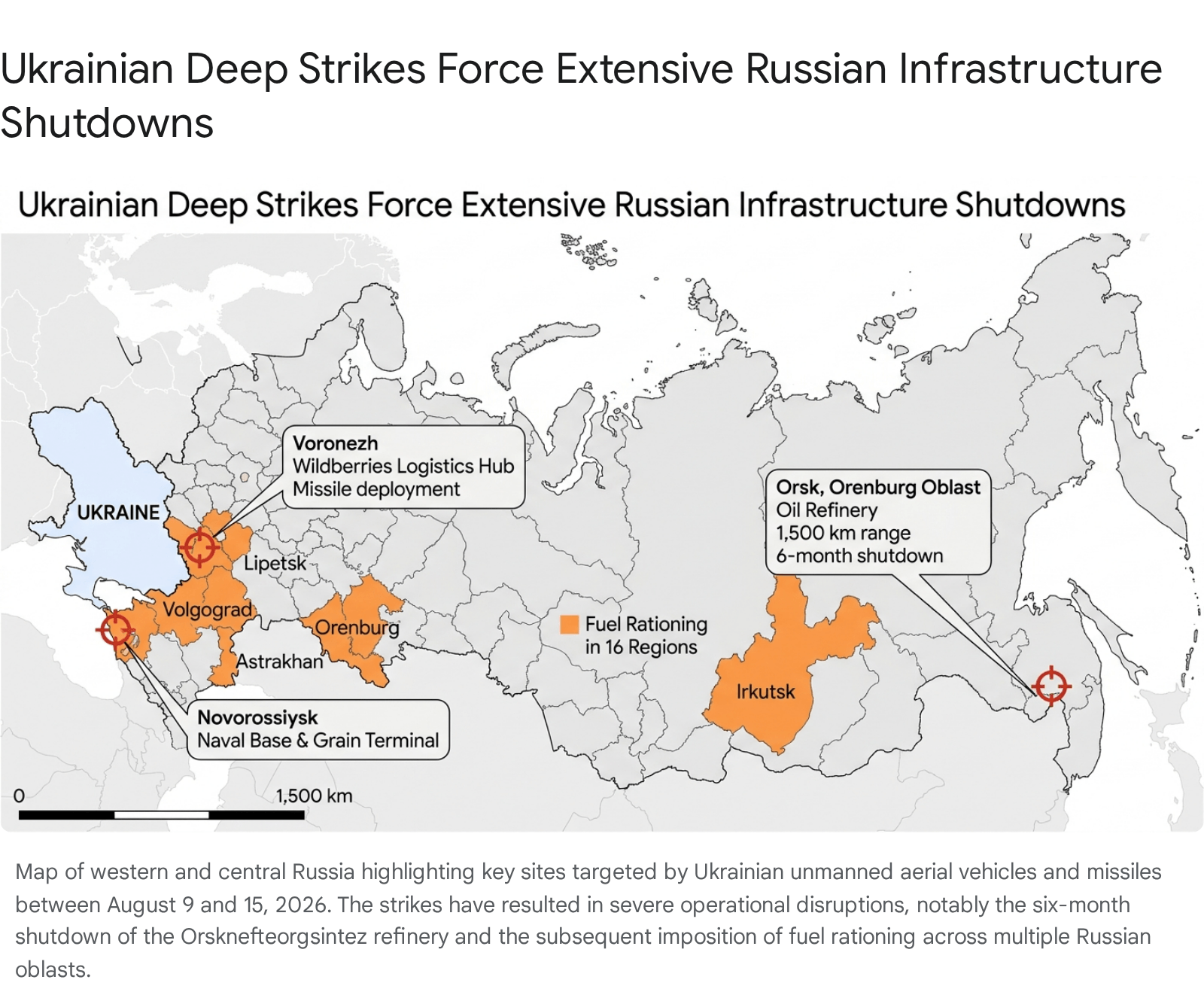
On August 11, Ukrainian unmanned aerial vehicles executed a precision strike on the Orsknefteorgsintez oil refinery in Russia’s Orenburg Oblast, located approximately 1,500 kilometers from the Ukrainian border2. The strike successfully knocked out the primary oil refining unit, forcing a complete halt in processing operations at the facility, which possesses an annual capacity of 6.6 million metric tons4. The strategic impact of this strike is compounded by international sanctions; regional authorities assessed that replacing the damaged, imported infrastructure will require up to six months2.
The operational loss of the Orsk refinery precipitated a cascading fuel crisis across multiple Russian regions. The geographic depth of the attack demonstrated the vulnerability of the Russian interior, leading to immediate domestic economic repercussions. By August 13, Orenburg Oblast, alongside Lipetsk, Astrakhan, Volgograd, and Irkutsk, reinstated strict fuel rationing protocols, marking the 16th region to impose such measures5. Local authorities limited purchases to 15 to 30 liters per vehicle, instituted odd-even license plate rationing systems, and prioritized distribution exclusively to emergency services6.
Concurrent with the refinery strikes, Ukrainian forces targeted Russian maritime and logistical hubs. An August 12 strike on the Black Sea port of Novorossiysk utilized a combination of drones and missiles to inflict damage on the naval base, reportedly striking two frigates, a large landing ship, and a corvette9. The attack forced two major grain export terminals to halt operations, further constraining Russia’s export logistics9. Deep-strike operations also targeted supply chain infrastructure, notably a massive Wildberries logistics warehouse in Voronezh Oblast. This strike affected 400,000 sellers, inflicting an estimated $7.2 billion to $8.4 billion in combined seller losses and up to $2.4 billion in direct losses for the company5. Ukrainian forces also struck the Gazprom Neftekhim Salavat complex in the Republic of Bashkortostan3.
The war’s economic attrition is manifesting in broader macroeconomic indicators within the Russian Federation. Central bank data indicates that the ongoing mobilization and resource diversion have resulted in severe labor-market shortages, driving annual inflation to 8.6 percent and prompting the benchmark interest rate to rise to 19.2 percent12.
A critical strategic development during this period involves the verified deployment of Democratic People’s Republic of Korea (DPRK) military assets to the Russian Federation. Ukrainian Main Military Intelligence Directorate (GUR) assessments indicate that a North Korean missile unit is deploying to Russia’s 112th Missile Brigade (1st Guards Tank Army, Moscow Military District) in Voronezh Oblast13. The unit is reportedly equipping with up to 120 KN-23 ballistic missiles, utilizing a newly constructed forward training base to reduce flight times to Ukrainian targets12. Nightly strike packages over the reporting period featured a mix of Iskander-M and KN-23 ballistic missiles, likely utilized to battle-test the North Korean munitions and calibrate targeting systems12. Intelligence further indicates that Russia is preparing to receive up to 50,000 North Korean combat personnel9. In a related incident on August 14, unconfirmed reports suggested that a Ukrainian intelligence operation sabotaged a segment of the Trans-Siberian Railway to destroy a transit shipment of KN-23 missiles heading toward the theater15.
On the frontline, Russian and Ukrainian forces continue to grapple with positional warfare and technological adaptation. The Ukrainian Airborne Assault Forces Command confirmed the results of a prolonged counteroffensive in the Oleksandrivskyi sector (spanning parts of Dnipropetrovsk, Zaporizhzhia, and Donetsk oblasts), reporting the recapture of 745 square kilometers and 26 settlements between January and August 12, 20269. Conversely, OSINT assessments indicate that Russian forces made marginal net gains of 33 square miles across the broader theater between mid-July and mid-August, primarily threatening cities in the eastern Donetsk region17.
| Combatant | Strategic Sector | Territorial Delta (Recent Reporting) | Primary Tactical Objective |
| Ukraine | Oleksandrivskyi Sector | +745 sq km (Jan-Aug 2026) | Disruption of Russian Spring-Summer offensive capabilities16. |
| Russia | Eastern Donetsk | +33 sq miles (July-Aug 2026) | Incremental attrition of Ukrainian defensive strongholds9. |
To counter the pervasive threat of Ukraine’s tactical reconnaissance strike complex—a dense network of FPV drones integrated with artillery—Russian armored units have begun deploying the Arena-M active protection system (APS)14. Geolocated footage from the Volodymyrivka sector confirmed the presence of T-72B3M tanks equipped with the system. While the Arena-M provides kinetic interception capabilities against approaching drones, its limited magazine depth of twelve counter-munitions remains insufficient to guarantee vehicle survivability in high-density drone environments, failing to fully restore mechanized maneuverability.
Diplomatically, the Kremlin maintained a hardline posture. Russian Foreign Minister Sergei Lavrov and Security Council Deputy Chairperson Dmitry Medvedev explicitly rejected the possibility of a ceasefire that freezes the current frontline, reiterating demands for complete Ukrainian capitulation18. Domestically, the Russian Supreme Court disqualified the opposition party Yabloko from the September 2026 State Duma elections, further consolidating the state’s monopoly on political power12.
- Conflict/Threat Name: Armenia-Azerbaijan Border Tensions (Nagorno-Karabakh Conflict Fallout)
- Materiality Rule: No material updates this period.
Middle East/North Africa
- Conflict/Threat Name: 2026 Iran War and Strait of Hormuz Crisis
- Weekly Key Events: The regional conflict initiated in late February 2026 following United States and Israeli strikes against Iranian leadership has precipitated a historic disruption of global maritime trade and energy markets19. Throughout the reporting week, the Iranian Islamic Revolutionary Guard Corps (IRGC) maintained a rigid blockade of the Strait of Hormuz, declaring sovereignty over the waterway and restricting passage exclusively to vessels complying with Iranian directives21. The United States, through Central Command (CENTCOM), continues to enforce a counter-blockade of Iranian ports, engaging in vessel redirections and boardings23.
The risk to commercial shipping escalated significantly between August 13 and 15, when the IRGC launched unmanned aerial vehicle strikes against commercial tankers transiting the Strait. Specifically, three vessels affiliated with the Abu Dhabi National Oil Company (ADNOC) were targeted by Iranian drones, bringing the total number of ADNOC vessels attacked since the conflict began to 1523. While ADNOC reported that the situations were contained with no casualties and only minor damage, the strikes represent a deliberate Iranian signaling of its capacity to target Gulf Cooperation Council (GCC) state assets23. The United Arab Emirates Ministry of Foreign Affairs condemned the actions as acts of piracy and economic coercion, underscoring the severe deterioration of maritime security25.
The macroeconomic impact of the dual blockades remains catastrophic. Data analyzed during the reporting period confirms that the Strait of Hormuz, which historically accommodated roughly 20 percent of global seaborne oil and liquefied natural gas (LNG) trade, has seen transit volumes plummet from over 130 vessels per day to an average of 1525. The International Energy Agency characterizes this as the largest supply disruption in the history of the global oil market, citing a crash of 10.1 million barrels per day in global supply33. The closure has led to an estimated $25 billion in damage to Middle Eastern energy facilities and has stranded major Qatari and UAE exports, forcing facilities like the Das Island LNG plant to halt most of its production capacity35.
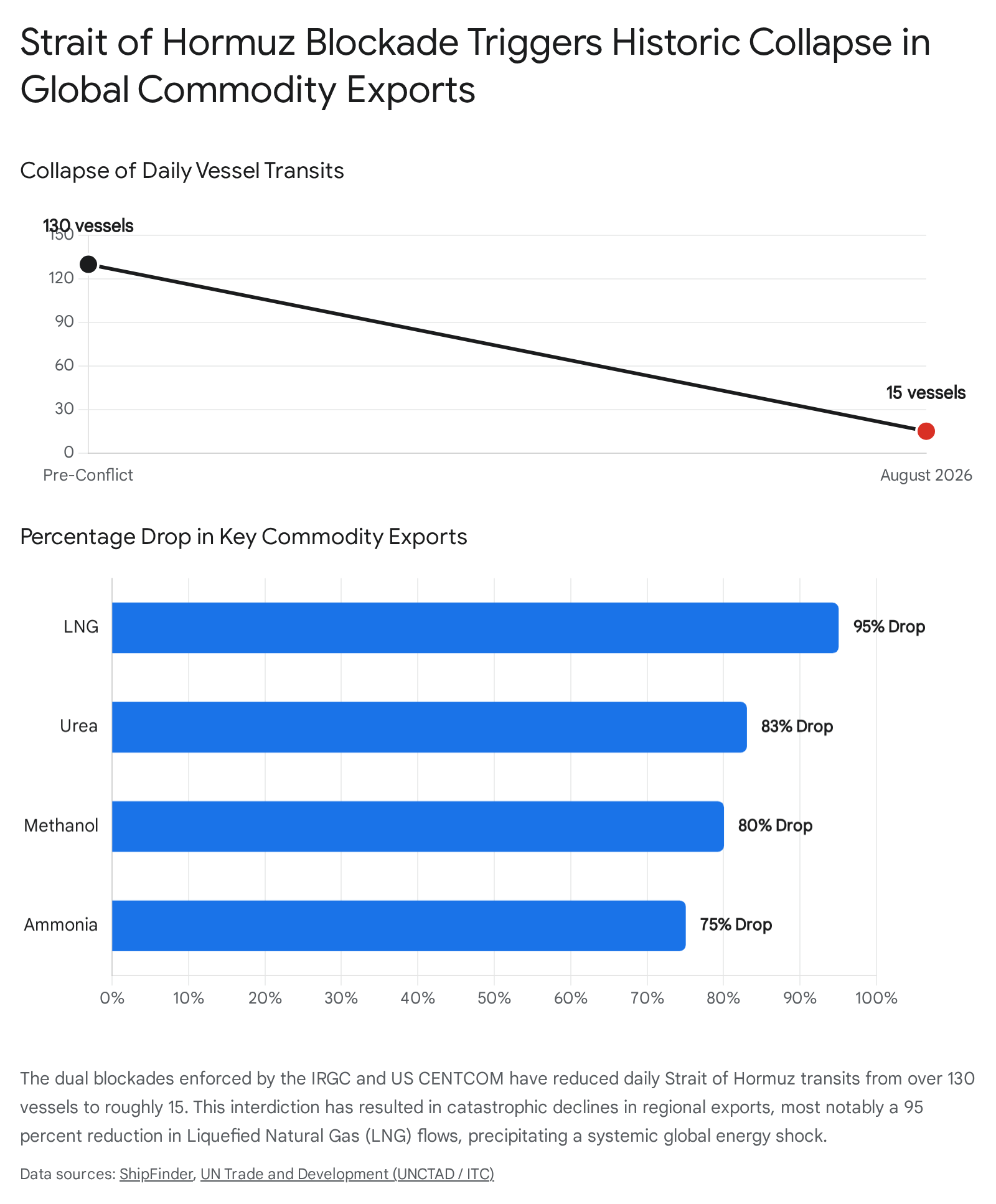
The blockade’s ripple effects extend beyond energy. Fertilizer exports, of which the region normally supplies 30 to 35 percent of the global urea trade, have plummeted by 83 percent, severely threatening global agricultural yields22. The maritime interdiction has also triggered a grocery supply emergency across GCC states, disrupting 70 percent of regional food imports and forcing emergency airlift operations33. The sustained disruption has embedded a high geopolitical risk premium into global crude markets, with physical friction costs manifesting in exorbitant war risk insurance premiums—now accounting for up to 10 percent of total vessel value32.
Politically, the Iranian state apparatus continues its wartime reorganization. On August 9, Mohsen Rezaei, a former IRGC commander, was appointed as the secretary of the Supreme National Security Council, indicating a consolidation of hardline military influence over the state’s strategic decision-making apparatus20. Attempts to operationalize the United States-brokered Islamabad Memorandum, intended to de-escalate the broader war, remain stalled due to violations and a lack of compliance mechanisms22.
- Conflict/Threat Name: Israel-Hezbollah War
- Weekly Key Events: The northern front of the broader regional conflict remains highly volatile, characterized by persistent Israeli airstrikes and ground operations across southern Lebanon, juxtaposed against Hezbollah’s ongoing rocket barrages. Since the resumption of large-scale hostilities and the subsequent Israeli ground incursion in March 2026, the Israel Defense Forces (IDF) have maintained operational control over sectors up to the Litani River, deliberately demolishing border villages to establish a formalized buffer zone36.
During the reporting week, the Israeli Defense Minister explicitly stated on August 12 that the IDF will not withdraw from established security zones in Lebanon, Syria, or Gaza under any circumstances38. Kinetic actions remained deadly; local health authorities reported at least nine fatalities resulting from targeted Israeli airstrikes in southern Lebanon, including drone strikes on the village of Ansar on August 1527. Hezbollah forces, despite suffering severe degradation of their command structures and the loss of an estimated 1,000 fighters according to independent estimates (or up to 2,500 according to Israeli claims) since the conflict’s onset, continue to launch retaliatory strikes against northern Israel, utilizing the remaining cadres of their disorganized forces19.
- Conflict/Threat Name: Houthi Insurgency and Maritime Coercion
- Weekly Key Events: Houthi militant forces, operating as a key node in Iran’s axis of resistance, have introduced new tactical capabilities to the Yemeni theater. On August 11, Houthi fighters deployed fiber-optic first-person view (FPV) drones to attack Republic of Yemen Government (ROYG) forces in Marib Governorate18. The introduction of fiber-optic tethers in FPV operations is a highly significant development, as the physical wire connection renders the munition completely immune to standard radio-frequency electronic warfare (EW) jamming, ensuring high precision in dense EW environments. In addition to localized combat, Houthi forces launched missiles targeting port infrastructure in Mokha, causing a large fire, and claimed responsibility for a drone strike against a Saudi Aramco facility in Najran29.
- Conflict/Threat Name: Regional Spillover and Proxy Operations (Syria/Iraq)
- Materiality Rule: No material updates this period.
Indo-Pacific
- Conflict/Threat Name: Cross-Strait Tensions and Han Kuang 42
- Weekly Key Events: The reporting period encompassed the conclusion of Taiwan’s annual Han Kuang 42 military exercises, held from August 5 to August 1440. The 42nd iteration marked a fundamental doctrinal shift for the Republic of China (ROC) Armed Forces, pivoting away from highly choreographed firepower displays toward unscripted, decentralized combat scenarios designed to test true operational readiness and societal resilience41.
The exercises focused heavily on mitigating the threat of a preemptive Chinese strike and a subsequent blockade. To ensure force preservation, the ROC Air Force executed dispersal drills, relocating six Mirage 2000 and eight Indigenous Defense Fighter (IDF) aircraft into the heavily fortified Chiashan mountain base in Hualien41. Carved out of solid granite, the Chiashan complex is designed to shelter over 200 aircraft from an initial bombardment, allowing the ROC Air Force to maintain counterattack capabilities45.
| Han Kuang 42 Exercise Focus | Strategic Rationale | Operational Execution |
| Force Preservation | Survive a massive PLA first-strike bombardment. | Relocation of fighter aircraft to underground granite complexes in Hualien45. |
| Infrastructure Denial | Prevent rapid amphibious or airborne advances toward Taipei. | Simulated blockades of the Danjiang Bridge and Hsuehshan Tunnel42. |
| Command Continuity | Maintain command under severe communications degradation. | Implementing the US-style “backbrief” protocol; conducting 30-minute deliberate internet blackouts across northern Taiwan42. |
| Whole-of-Society Mobilization | Integrate civilian assets into military logistics. | Mobilizing 20,000 reservists; utilizing civilian trucks for transport and roadblocks; integrating local hospitals41. |
Civil-military integration was a central pillar of the drills. The newly established Littoral Combat Command integrated naval mobile radar units and drones on the Penghu Islands to test asymmetric defense networks42. At the conclusion of the exercises, President Lai Ching-te emphasized the necessity of accelerating domestic military drone production to secure a resilient defense supply chain, indicating a pivot toward asymmetric mass over legacy platforms47.
In direct response to the exercises, the People’s Liberation Army (PLA) escalated its grey-zone coercive measures. The ROC Ministry of National Defense tracked elevated sortie rates throughout the week, peaking on August 13 with the detection of 18 PLA aircraft, 11 People’s Liberation Army Navy (PLAN) vessels, and 3 official Chinese ships operating in the surrounding airspace and waters48. Fifteen of the eighteen aircraft crossed the median line of the Taiwan Strait, penetrating the northern, central, southwestern, and eastern sectors of Taiwan’s Air Defense Identification Zone (ADIZ)25.
Further heightening regional tensions, the Chinese Defense Ministry announced plans to conduct an unprecedented joint “navigation exercise” with an Indonesian Navy frigate (the KRI I Gusti Ngurah Rai-332) in the waters east of Taiwan in mid-August50. Taipei condemned the drill as dangerous political manipulation designed to assert Chinese jurisdictional claims over the eastern waters, while regional analysts noted Beijing’s intent to demonstrate its ability to court Southeast Asian partners into a co-belligerent posture50.
- Conflict/Threat Name: South China Sea Maritime Disputes
- Materiality Rule: No material updates this period.
- Conflict/Threat Name: Myanmar Civil War
- Materiality Rule: No material updates this period.
Sub-Saharan Africa
- Conflict/Threat Name: Sudan Civil War
- Weekly Key Events: During the reporting week, the paramilitary Rapid Support Forces (RSF) utilized an unmanned aerial vehicle to strike the 17th Infantry Division headquarters of the Sudanese Armed Forces (SAF) in the southeastern city of Sinja. The attack, which targeted a meeting of military and government officials, resulted in 27 fatalities and 73 injuries52.
- Conflict/Threat Name: Eastern DRC Instability and M23 Rebellion
- Weekly Key Events: Diplomatic and security conditions in the eastern Democratic Republic of the Congo (DRC) remain fragile. On August 10, a planned prisoner swap between the DRC government and the Rwandan-backed M23 rebel group collapsed, threatening the integrity of the Washington Accords53. This followed the initial release of fifteen detainees by DRC authorities to the M23 on August 745. Concurrently, suspected Allied Democratic Forces (ADF) militants killed at least thirteen civilians and looted residences in the Banana École village near the Ugandan border45.
- Conflict/Threat Name: Somalia-Egypt-Ethiopia Tensions
- Materiality Rule: No material updates this period.
- Conflict/Threat Name: Tigray Tensions
- Materiality Rule: No material updates this period.
- Conflict/Threat Name: West African Salafi-Jihadist Insurgency
- Materiality Rule: No material updates this period.
- Conflict/Threat Name: Sahel Insurgency (Mali/Burkina Faso/Niger)
- Materiality Rule: No material updates this period.
Western Hemisphere
- Conflict/Threat Name: Ecuador Cartel Conflict
- Weekly Key Events: The security apparatus in Ecuador remains severely strained by pervasive transnational organized crime. On August 13, President Daniel Noboa declared a new 60-day state of emergency in response to escalating drug cartel violence, which resulted in 879 fatalities over a six-week period54.
- Conflict/Threat Name: Haitian Gang Crisis
- Materiality Rule: No material updates this period.
3. Appendix: Methodology
The intelligence compiled in this Situation Report is derived from a systematic review of open-source intelligence (OSINT), authoritative defense research institutes (including the Institute for the Study of War, the International Institute for Strategic Studies, and the Stockholm International Peace Research Institute), official government press releases, and verified regional reporting networks.
Verification and Materiality Criteria:
Events are subjected to a rigorous verification matrix. Claims regarding kinetic strikes, territorial acquisitions, troop movements, or infrastructure damage must be corroborated by geolocated visual evidence, multi-source regional reporting, satellite telemetry, or official acknowledgments from belligerent parties. The principle of materiality dictates that only events representing a significant tactical evolution, a shift in strategic posture, a verifiable change in territorial control, or substantial macroeconomic impact are included. Routine artillery exchanges, unverified casualty claims, and static political rhetoric lacking operational follow-through are excluded to eliminate analytical noise. When a monitored active or frozen conflict registers no significant deviation from its baseline status quo during the reporting period, the materiality rule mandates the explicit declaration: ‘No material updates this period.’
Grey-Zone Delineation:
Grey-zone operations are analytically distinguished from routine statecraft or standard military maneuvers based on intent, deniability, and the exploitation of legal ambiguity. Actions classified as grey-zone—such as the weaponization of maritime transit regulations, unacknowledged proxy militia strikes, deliberate electronic warfare interference, cyber disruptions, and the deployment of non-uniformed maritime militias or private military companies—are characterized by their design to achieve strategic coercion or operational advantage without crossing the threshold of formalized, overt warfare. These activities are monitored closely as they frequently serve as precursors to kinetic escalation or attempt to alter the strategic environment through incremental sub-threshold actions.
Please share the link on Facebook, Forums, with colleagues, etc. Your support is much appreciated and if you have any feedback, please email us in**@*********ps.com. If you’d like to request a report or order a reprint, please click here for the corresponding page to open in new tab.
Sources Used
- Top 20 Tactical Training Programs In the US for Law Enforcement – Ronin’s Grips, https://blog.roninsgrips.com/top-20-tactical-training-programs-in-the-us-for-law-enforcement/
- Ukrainian drone strike fully shuts down oil refinery Russia’s Orsk, governor says. Repairs could take 6 months. – Meduza, https://meduza.io/amp/en/news/2026/08/13/ukrainian-drone-strike-fully-shuts-down-oil-refinery-russia-s-orsk-governor-says-repairs-could-take-6-months
- Russian oil refinery ‘completely shut down’ for months following Ukrainian attack, local governor says – The Kyiv Independent, https://kyivindependent.com/russian-far-east-oil-refinery-completely-shut-down-for-months-following-ukrainian-attack-governor-says/
- Russian refinery shuts down completely after Ukrainian drone attack | Ukrainska Pravda, https://www.pravda.com.ua/eng/news/2026/08/13/8048579/
- Orsk Refinery Shutters for 6 Months After Ukrainian Attack – The Moscow Times, https://www.themoscowtimes.com/2026/08/13/orsk-refinery-shutters-for-6-months-after-ukrainian-attack-a93489
- Russia’s Fuel Crisis Returns as Regions Bring Back Gasoline Rationing, https://united24media.com/war-in-ukraine/russias-fuel-crisis-returns-as-regions-bring-back-gasoline-rationing-21718
- Russian regions report new fuel crunch as Kyiv hits refineries – The Japan Times, https://www.japantimes.co.jp/news/2026/08/14/world/russia-fuel-oil-refineries-ukraine/
- Orenburg Region Imposes Fuel Rationing After Ukrainian Refinery Attack, https://www.themoscowtimes.com/2026/08/12/orenburg-region-imposes-fuel-rationing-after-ukrainian-refinery-attack-a93468
- Ukraine war briefing: ‘With precision, as planned’ – Kyiv outlines battlefield gains, https://www.theguardian.com/world/2026/aug/13/ukraine-war-briefing-kyiv-outlines-battlefield-gains
- Ukraine Kills Three, Halts Two Grain Terminals in Novorossiysk Drone Attack: how 25 outlets framed it | NewsCord, https://newscord.org/article/ukraine-drone-attack-puts-two-novorossiysk-grain-terminals-out-of-action–Story_20260812_MajorRussiangrainexpa92335ff
- Russia-Ukraine War Surge Again Disrupting Black Sea Grain, https://farmpolicynews.illinois.edu/2026/08/russia-ukraine-war-surge-again-disrupting-black-sea-grain/
- On the costs of economic attrition: A look at the Russia-Ukraine War – Anadolu Ajansı, https://www.aa.com.tr/en/opinion/on-the-costs-of-economic-attrition-a-look-at-the-russia-ukraine-war/4027468
- Russian Offensive Campaign Assessment, August 11, 2026 | ISW, https://understandingwar.org/research/russia-ukraine/russian-offensive-campaign-assessment-august-11-2026/
- Russian Offensive Campaign Assessment, August 9, 2026 | ISW, https://understandingwar.org/research/russia-ukraine/russian-offensive-campaign-assessment-august-9-2026/
- Russian Offensive Campaign Assessment, August 14, 2026 | ISW, https://understandingwar.org/research/russia-ukraine/russian-offensive-campaign-assessment-august-14-2026/
- Russian Offensive Campaign Assessment, August 12, 2026, https://understandingwar.org/research/russia-ukraine/russian-offensive-campaign-assessment-august-12-2026/
- The Russia-Ukraine War Report Card, Aug. 12, 2026, https://www.russiamatters.org/news/russia-ukraine-war-report-card/russia-ukraine-war-report-card-aug-12-2026
- Iran Update Special Report, August 13, 2026, https://understandingwar.org/research/middle-east/iran-update-special-report-august-13-2026/
- 2026 Iran war – Wikipedia, https://en.wikipedia.org/wiki/2026_Iran_war
- Iran’s War With Israel and the United States | Global Conflict Tracker – Council on Foreign Relations, https://www.cfr.org/global-conflict-tracker/conflict/confrontation-between-united-states-and-iran
- Iran targets tankers in ‘unprovoked attacks’ in Strait of Hormuz, UAE says, https://www.foxnews.com/live-news/iran-war-trump-strait-of-hormuz-08-14-26
- 2026 Strait of Hormuz crisis – Wikipedia, https://en.wikipedia.org/wiki/2026_Strait_of_Hormuz_crisis
- UAE’s ADNOC vessel attacked again in Strait of Hormuz: All you need to know so far, https://gulfnews.com/uae/uaes-adnoc-vessel-attacked-again-in-strait-of-hormuz-all-you-need-to-know-so-far-1.500641705
- Golan Heights and South/West Syria | International Crisis Group, https://www.crisisgroup.org/trigger-list/iran-usisrael-trigger-list/flashpoints/golan-heights-and-southwest-syria
- Acts of piracy: UAE slams Iran for attacking oil vessel in Strait of Hormuz, https://www.indiatoday.in/world/story/strait-of-hormuz-attack-uae-accuses-iran-hitting-adnoc-oil-vessel-2966656-2026-08-08
- UAE says ADNOC vessel attacked in Hormuz, vows to defend navigation rights, https://english.alarabiya.net/News/gulf/2026/08/15/uae-state-oil-company-says-vessel-attacked-in-strait-of-hormuz
- Vessel is attacked in Hormuz, Israeli strike kills 9 in Lebanon, and other news from the Middle East, https://m.mysanantonio.com/business/article/israeli-strike-kills-7-in-lebanon-2-tankers-22389520.php
- Two UAE oil tankers struck by Iranian drones in Strait of Hormuz, https://www.washingtonexaminer.com/news/world/4688290/uae-oil-tankers-attacked-blames-iran-drones-strait-of-hormuz-piracy-economic/
- 2 UAE tankers hit by drone attacks while transiting Strait of Hormuz – AP News, https://apnews.com/article/iran-uae-us-strait-hormuz-august-14-2026-e8565c608ac5283ec8103c85df924b13
- UAE accuses Iran of attacks on two ADNOC vessels in Strait of Hormuz – Al Jazeera, https://www.aljazeera.com/news/2026/8/14/uae-accuses-iran-of-attacks-on-two-adnoc-vessels-in-strait-of-hormuz
- Strait of Hormuz disruption hits energy, fertilizer and industrial trade, https://news.un.org/en/story/2026/08/1168074
- Hormuz Live Vessel Traffic & Crude Oil Prices | ShipFinder, https://www.shipfinder.com/special/hormuz
- Economic impact of the 2026 Iran war – Wikipedia, https://en.wikipedia.org/wiki/Economic_impact_of_the_2026_Iran_war
- Strait of Hormuz disruption sends oil prices surging – World Bank Blogs, https://blogs.worldbank.org/en/opendata/strait-of-hormuz-disruption-sends-oil-prices-surging
- The U.S.-Iran Ceasefire Illusion: Energy Shortages Far from Over – ORF Middle East, https://orfme.org/expert-speak/the-us-iran-ceasefire-illusion-energy-shortages-far-from-over/
- 2026 Lebanon war – Wikipedia, https://en.wikipedia.org/wiki/2026_Lebanon_war
- 2026 Iran war | Deal, Explained, United States, Israel, Strait of Hormuz, Map, & Conflict, https://www.britannica.com/event/2026-Iran-war
- Lebanon | International Crisis Group, https://www.crisisgroup.org/trigger-list/iran-usisrael-trigger-list/flashpoints/lebanon
- 7 said killed in Lebanon strikes; IDF says it targeted Hezbollah sites after attack on troops, https://www.timesofisrael.com/liveblog-august-15-2026/
- The “Han Kuang” military and civil defense drills will continue until August 14 across Taiwan; expect heightened security. – SafeAbroad, https://safeabroad.com/advisories/the-han-kuang-military-and-civil-defense-drills-will-continue-until-august-14-across-taiwan-expect-heightened-security/
- Han Kuang 42: Taiwan Hides Jets in a Mountain – MiGFlug, https://migflug.com/jetflights/taiwan-han-kuang-42-chiashan-mountain-fighter-shelter-2026/
- Han Kuang exercise grows in ambition to counter China’s invasion strategy, https://www.taiwannews.com.tw/en/news/6422090
- Han Kuang drills begin, testing command flexibility – Taipei Times, https://www.taipeitimes.com/News/front/archives/2026/08/05/2003861988
- Schriver: Taiwan’s “Han Kuang Exercise” Has Taken a Step Forward by Being Unscripted and Incorporating Real-Life Scenarios. – Ground News, https://ground.news/article/schriver-taiwans-han-kuang-exercise-has-taken-a-step-forward-by-being-unscripted-and-incorporating-real-life-scenarios
- Conflict in the Democratic Republic of Congo | Global Conflict Tracker – Council on Foreign Relations, https://www.cfr.org/global-conflict-tracker/conflict/violence-democratic-republic-congo
- Military simulates tunnel blockade to stop Chinese advance on Taipei, https://www.taipeitimes.com/News/taiwan/archives/2026/08/14/2003862494
- Lai announces end to Han Kuang 42 drills | Taiwan News | Aug. 14, 2026 20:57, https://www.taiwannews.com.tw/en/news/6421850
- Taiwan detects nine PLA aircraft, 12 PLAN vessels, two official ships around its territory, https://www.aninews.in/news/world/asia/taiwan-detects-nine-pla-aircraft-12-plan-vessels-two-official-ships-around-its-territory20260814070101/
- Taiwan detects heightened Chinese military activity around territory, https://www.aninews.in/news/world/asia/taiwan-detects-heightened-chinese-military-activity-around-territory20260813083823
- Taiwan hits out at China over naval drill with Indonesia, https://www.ft.com/content/e0ca4cab-c8ba-47d6-9465-13e2d73285fc?syn-25a6b1a6=1
- China, Indonesia plan naval drill in waters east of Taiwan Island, https://en.antaranews.com/news/426717/china-indonesia-plan-naval-drill-in-waters-east-of-taiwan-island
- Iran says protests ‘under control’ as Trump floats negotiations – The New Arab, https://www.newarab.com/news/iran-says-protests-under-control-trump-floats-negotiations
- AFC-M23 questions release of 15 prisoners under Doha peace process – The Great Lakes Eye, https://www.thegreatlakeseye.com/post?s=AFC-M23–questions–release–of–15–prisoners–under–Doha–peace–process_2307
- Ecuador declares new 60-day state of emergency as cartel violence kills 879 in 6 weeks, https://en.yenisafak.com/world/ecuador-declares-new-60-day-state-of-emergency-as-cartel-violence-kills-879-in-6-weeks-3719643