1. Executive Summary
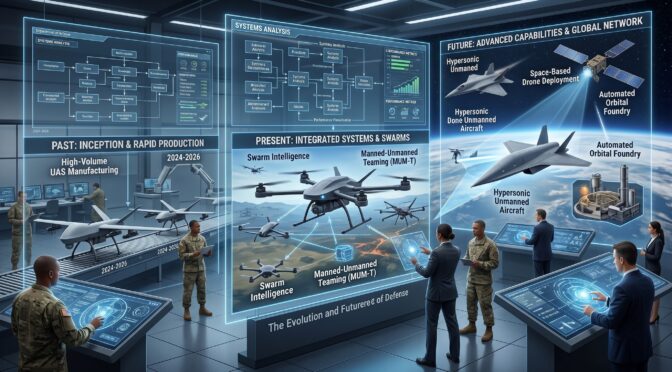
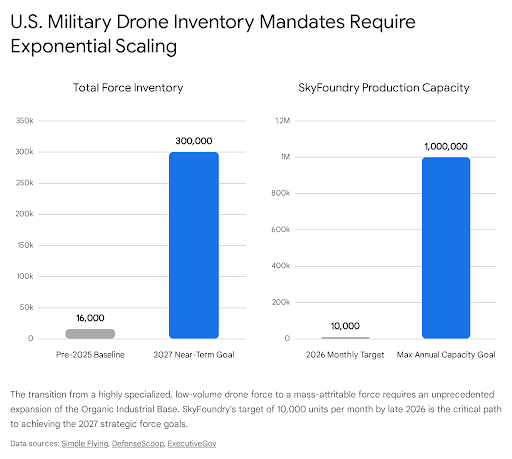
The transition of the United States military apparatus into an era characterized by autonomous, attritable, and scalable systems has precipitated a fundamental restructuring of the nation’s Organic Industrial Base (OIB)1. Central to this monumental industrial pivot is the SkyFoundry initiative, a flagship program managed by the Army Materiel Command. Originating from a critical strategic deficit in domestic unmanned aerial systems (UAS) manufacturing capacity relative to peer adversaries, SkyFoundry represents an unprecedented industrial mobilization. Its statutory mandate is to transform traditional military depots into high-volume, advanced manufacturing hubs theoretically capable of producing up to one million small UAS annually, with interim capacities expected to reach 10,000 units per month.
The initiative requires a major shift from traditional defense acquisition protocols, moving away from buying expensive, multi-million-dollar platforms and instead using a Government-Owned, Government-Operated Contractor Augmented (GOGO/CA) model that focuses on mass-producing low-cost, open-architecture systems. However, executing an industrial mobilization of this magnitude requires overcoming severe structural management, deep-tier supply chain, and systems engineering challenges. While this statutory framework secures government control over intellectual property and surge production allocation, it inherently creates friction with private-sector innovators who rely heavily on proprietary hardware designs and closed-loop software algorithms1. Furthermore, profound vulnerabilities exist within the deep-tier supply chain—specifically regarding critical rare earth elements necessary for brushless motors.
This exhaustive systems-level report analyzes the genesis, evolution, and likely future trajectory of the SkyFoundry initiative. It evaluates the critical engineering pivot toward decoupled, modular component production, dissects the structural management challenges inherent in public-private defense partnerships, and proposes rigorous acquisition and engineering recommendations to ensure the initiative fulfills its strategic mandate.
2. Strategic Catalyst: The “Affordable Mass” Doctrine
2.1 The Geopolitical Imbalance and Battlefield Realities
The fundamental catalyst for the SkyFoundry initiative is derived from empirical combat data, demonstrating unequivocally that conventional, symmetric force structures are highly vulnerable to asymmetric, low-cost, mass-produced unmanned systems. With casualty rates in modern mechanized warfare increasingly attributed to drones—often exceeding 80% of total combat casualties in certain theaters—the Department of Defense (DoD) officially recognized that qualitative overmatch in exquisite platforms could be rendered strategically inert by an adversary’s sheer quantitative advantage.
Peer adversaries, most notably the People’s Republic of China and the Russian Federation, have successfully established heavily integrated industrial bases capable of churning out millions of tactical drones annually. In stark contrast, legacy U.S. inventories were quantitatively insufficient and optimized for permissive airspace. Congressman Pat Harrigan noted the severity of this deficit, stating that allowing adversaries to flood the battlefield with millions of drones while the U.S. lacked scalable manufacturing capacity constituted a “reckless” failure that left forward-deployed troops perilously exposed.
2.2 Centralization Under the DRPM-UxS
To rectify this strategic vulnerability, Defense Secretary Pete Hegseth mandated the rapid operationalization of the “affordable mass” doctrine2. The DoD has shifted away from isolated service-level capabilities and centralized procurement under the newly established Direct Reporting Portfolio Manager for Unmanned Systems (DRPM-UxS). This office absorbs Group 1-3 unmanned aerial systems, autonomous ground vehicles, and most unmanned surface vessels, bypassing traditional, sluggish acquisition bureaucracies to serve as a single joint integrator.
A prime example of the capability sought at scale is the Ground-Based Affordable Mass (G-BAM) initiative. Launched by the Defense Innovation Unit (DIU), G-BAM targets the procurement of ground-launched, long-range precision strike systems with operational ranges exceeding 600 nautical miles. By mandating a system cost of less than $250,000 per round and demanding production scaling of over 100 units per month within 12 to 18 months, the DoD is structurally enforcing cost-imposition on adversaries.
3. Legislative Framework and Alternative Acquisition Pathways
To physicalize the ambitions of scalable drone production, sweeping legislative action was required to decouple the initiative from the lethargy of traditional defense procurement protocols.
3.1 The SkyFoundry Act of 2025
Introduced by a coalition of Senators including Ted Cruz (R-TX), John Cornyn (R-TX), Tom Cotton (R-AR), and John Boozman (R-AR), alongside companion legislation authored by Representative Pat Harrigan (R-NC), the SkyFoundry Act of 2025 (S. 2506) provides the definitive statutory authority for the program. The legislation explicitly directs the Secretary of Defense, administered through the Secretary of the Army, to establish a program enabling the rapid development, testing, and scalable manufacture of small unmanned aircraft systems. The foundational elements of this act have since been rolled into the broader National Defense Authorization Act (NDAA).
Crucially, the Act allows the DoD to renovate, modify, or build necessary facilities with available funds, waiving the strict real estate and construction rules in Chapter 169 of Title 10, United States Code. This unprecedented waiver authority is designed to bypass multi-year military construction delays. The Act also dictates that the program be integrated into the broader Defense Industrial Resilience Consortium.
3.2 Bypassing the Federal Acquisition Regulation (FAR)
Standard Department of Defense procurement historically requires years to advance a system from requirement definition to fielding. Recognizing that the technological half-life of commercial drone software is measured in mere months, Section 2(b) of the SkyFoundry Act legally mandates the use of alternative acquisition mechanisms. The Secretary is explicitly directed to leverage Other Transaction Authority (OTA) under 10 U.S.C. 4022, which allows the military to engage in flexible business arrangements with non-traditional defense contractors. Furthermore, the Act mandates the utilization of Middle Tier of Acquisition (MTA) pathways for rapid prototyping and fielding under 10 U.S.C. 3602.
| Program / Legislative Initiative | Primary Function and Mandate | Strategic Impact on Acquisition Timeline |
| SkyFoundry Act (S. 2506) | Establishes at least two GOGO/CA facility sites; authorizes OTA and MTA pathways; waives 10 U.S.C. Chapter 169 construction rules. | Bypasses multi-year military construction delays; enables rapid public-private partnerships. |
| DRPM-UxS Centralization | Serves as the single joint integrator for autonomous assets across the military branches. | Absorbs disparate programs to unify procurement and standardize AI/swarming logic across the joint force. |
| G-BAM Initiative | Dedicates $250M to field low-cost, long-range precision strike systems at scale. | Drives non-proprietary strike platforms to operational scale (100+ units/month) within a 12 to 18-month window. |
| Swarm Forge (Crucible Tests) | Utilizes quarterly operational evaluations to co-develop hardware and multi-agent swarm tactics. | Compresses delivery of validated autonomous swarm packages to operational units in 90 days or less3. |
4. Architectural Evolution: Modular Open Systems Approach (MOSA)
A critical inflection point in the execution of the SkyFoundry program is the enforcement of a Modular Open Systems Approach (MOSA). Historically, military acquisitions resulted in highly “stovepiped” systems—proprietary hardware running closed software that could not interface with platforms manufactured by other vendors.
Advanced military drones rely on complex algorithms for autonomous navigation and electronic warfare (EW) resilience. In an environment where adversaries rapidly adapt tactics, algorithmic stagnation equates to platform obsolescence. If a drone cannot rapidly update to counter a new GPS spoofing technique, its physical availability becomes tactically irrelevant. By mandating open architectures, the DoD structurally decouples the lifecycle of a drone’s physical airframe from the lifecycle of its rapidly evolving digital and sensor payloads.
Furthermore, this architecture is an operational necessity for allied interoperability. MOSA compliance permits the military to strip out proprietary communication modules and substitute an allied nation’s sovereign radio systems, ensuring drones can seamlessly share targeting data and ISR feeds within the Combined Joint All-Domain Command and Control (CJADC2) framework4.
5. The Organic Industrial Base (OIB) Depot Network Architecture
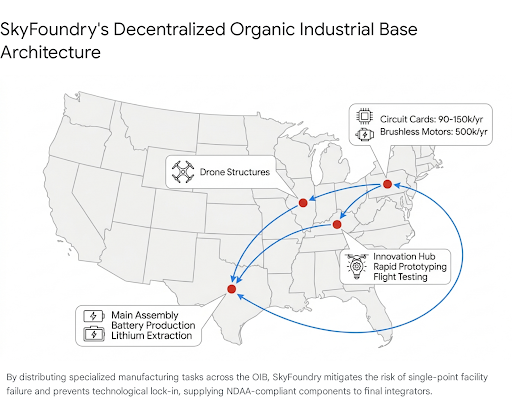
To execute this strategy, the Army is heavily leaning on its Organic Industrial Base. The SkyFoundry Act requires the prioritization of existing Army Depot facilities, specifically mandating the selection of at least two separate sites: one to house a dedicated innovation facility, and one to house the high-volume production facility.
5.1 Red River Army Depot (Texas)
Heavily championed by lawmakers and military leadership, the Red River Army Depot (RRAD) in Texas has emerged as a centerpiece of the OIB modernization effort supporting SkyFoundry. During a site visit by Under Secretary of the Army Mike Obadal and AMC Commanding General Lt. Gen. Chris Mohan, leadership emphasized that RRAD represents the foundation of the capability chain. The facility is slated to balance existing heavy vehicle maintenance with new aerospace production innovation through public-private partnerships. Establishing a high-volume manufacturing center at Red River leverages its highly skilled workforce while fulfilling the statutory push to reshore production away from adversarial supply lines.
5.2 Tobyhanna Army Depot & Component Manufacturing
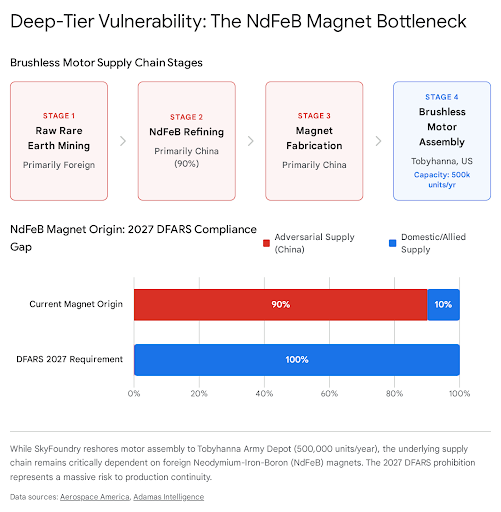
While final integration occurs at primary nodes, other OIB facilities like Tobyhanna Army Depot play vital roles in decentralized subcomponent manufacturing. By establishing production lines for critical internals, such as brushless motors and electronic control units, the military ensures it can act as a primary supplier of NDAA-compliant cores to commercial vendors. This prevents bottlenecking at the final airframe assembly stage and supports the decentralized architecture required for massive scale.
6. Structural Management Challenges: The Public-Private Paradox
The legislation mandates a Government-Owned, Government-Operated facility model augmented by contractor personnel (GOGO/CA). This introduces massive historical deviations from the post-Cold War defense acquisition standard, creating unique management challenges.
6.1 The Intellectual Property Friction
A central friction point between the DoD and private industry revolves around Intellectual Property (IP). Current defense innovation relies heavily on venture capital-backed firms that base valuations on proprietary software algorithms and closed-loop designs. Forcing these firms to surrender complete Technical Data Packages to a government-run facility for mass replication threatens their business models. The DoD must actively structure solicitations to isolate proprietary subsystems, allowing vendors to retain specially negotiated license rights over cognitive AI while the government controls the physical carrier.
6.2 Managing the GOGO/CA Hybrid Workforce
Operating a facility capable of producing 1,000,000 units annually requires a complex labor ecosystem. The SkyFoundry model utilizes a “hybrid team” approach, explicitly integrating specialized contractor personnel directly alongside military and civilian government employees within the same facilities. From an industrial management perspective, ensuring that highly compensated private-sector engineers integrate smoothly with civilian union workers requires precise contracting constructs and clear demarcations of operational liability.
7. Deep-Tier Supply Chain Vulnerabilities
While SkyFoundry seeks to reshore final assembly, the entire initiative remains acutely vulnerable to disruption at the deepest tiers of the global supply chain, particularly regarding raw materials.
7.1 The Rare Earth and Magnet Bottleneck
High-performance brushless drone motors rely heavily on Neodymium-Iron-Boron (NdFeB) rare earth magnets to achieve necessary power-to-weight ratios. Currently, roughly 90% of the global supply of manufactured NdFeB magnets and rare earth refinement originates in China. The Defense Federal Acquisition Regulation Supplement (DFARS) strictly prohibits the use of Chinese-origin rare earth magnets in covered defense systems, with full enforcement directly impacting near-term production scaling. To mitigate this, the SkyFoundry Act explicitly incorporates Title III of the Defense Production Act (DPA) to allow for investments in production scale-up, establishment of strategic materials stockpiles, and domestic surge manufacturing capacity.
8. Synergistic Programs: Counter-UAS and Exquisite Autonomous Systems
SkyFoundry is deeply integrated with concurrent DoD efforts focused on both defeating adversarial mass and fielding complementary, higher-tier systems.
The proliferation of small UAS has necessitated massive parallel investments in Counter-sUAS capabilities to restructure the cost-exchange ratio4. The Army is aggressively pursuing effectors like the Next Generation Counter-sUAS Missile (NGCM), specifically designed to defeat Group 2 and 3 threats at ranges up to 25km for less than $150,000 per unit, protecting legacy high-value interceptors from depletion5. Also, EUCOM operations have shown that it is important to find ways to get around dense EW jamming. For example, fiber-optic drones can do this by using physical tethers to avoid RF jamming completely.
At the same time, the Air Force has made significant progress with its Collaborative Combat Aircraft (CCA) program. By validating the Autonomy Government Reference Architecture (A-GRA) on CCA platforms, the military has successfully integrated third-party mission software onto decoupled hardware, acting as a blueprint for SkyFoundry’s modular ambitions. Finally, Space Force’s $615 million investment in low-earth orbit tracking “Flatellites” aims to provide the resilient, space-based ISR network required to command and control this massive terrestrial drone fleet.
9. Strategic Recommendations and Future Outlook
To successfully navigate the structural and engineering hurdles facing the SkyFoundry initiative, the DoD must adopt the following approaches:
- Enforce Strict MOSA Compliance: Assert MOSA as a mandatory evaluation factor to prevent algorithmic stagnation and vendor lock-in. The DoD must structurally isolate proprietary subsystems from foundational hardware.
- Aggressive Application of Defense Production Act (Title III): The Secretary of Defense must deploy Title III authorities—explicitly integrated into S. 2506—to fund the rapid capitalization of domestic rare earth refinement and NdFeB magnet manufacturing, ensuring material output scales proportionally with assembly lines.
- Institutionalize Iterative Field Testing: Following the model of the CDAO and DIU’s “Swarm Forge” Crucible evaluations, SkyFoundry must continuously deploy early-rate production hardware into operational 90-day testing cycles with special operations and conventional end-users to co-develop swarm tactics and refine software under realistic EW conditions.
In conclusion, the SkyFoundry initiative represents a profound attempt to re-engineer the American defense industrial base for the realities of 21st-century autonomous warfare. By pivoting toward the mass production of modular components within modernized organic depots, the DoD has established a highly scalable framework. Success dictates that military leadership must operate with unprecedented commercial agility, bridging the public-private paradox to equip the warfighter with the attritable mass necessary to maintain global overmatch.
10. References & Further Reading
For ongoing situational awareness, policy analysis, and a deeper exploration of the structural transitions outlined in this report, the following sources were directly consulted:
- Reforming DoD Drone Acquisitions: Overcoming Vendor Lock-In: An analysis of MOSA requirements to prevent algorithmic stagnation1.
- Strengthening Drone Interoperability: US Military’s Key Initiatives: Focuses on CJADC2 integration and allied data-centric networking4.
- Swarm Forge: Revolutionizing Military Drone Warfare: Details the 90-day “Crucible” field evaluations led by the CDAO and DIU3.
- SITREP: Military Drones July 25, 2026 to August 1, 2026: Situational updates on the “affordable mass” doctrine and DRPM-UxS centralization2.
- SITREP: Military Unmanned Systems — August 1–9, 2026: Insights into fiber-optic drones and the Next Generation Counter-sUAS Missile (NGCM) development5.
Please share the link on Facebook, Forums, with colleagues, etc. Your support is much appreciated and if you have any feedback, please email us in**@*********ps.com. If you’d like to request a report or order a reprint, please click here for the corresponding page to open in new tab.
Sources Used
- Reforming DoD Drone Acquisitions: Overcoming Vendor Lock-In – Ronin’s Grips, https://blog.roninsgrips.com/reforming-dod-drone-acquisitions-overcoming-vendor-lock-in/
- SITREP Military Drones – July 25, 2026 to August 1, 2026 – Ronin’s Grips, https://blog.roninsgrips.com/sitrep-military-drones-july-25-2026-to-august-1-2026/
- Swarm Forge: Revolutionizing Military Drone Warfare – Ronin’s Grips, https://blog.roninsgrips.com/swarm-forge-revolutionizing-military-drone-warfare/
- Strengthening Drone Interoperability: US Military’s Key Initiatives – Ronin’s Grips, https://blog.roninsgrips.com/strengthening-drone-interoperability-us-militarys-key-initiatives/
- SITREP: Military Unmanned Systems — August 1–9, 2026 – Ronin’s Grips, https://blog.roninsgrips.com/sitrep-military-unmanned-systems-august-1-9-2026/