1. Executive Summary
The reporting period from July 25, 2026, to August 1, 2026, marks a structural inflection point in the deployment, integration, and institutionalization of unmanned and autonomous systems across the global battlespace. Throughout this timeframe, the United States Department of Defense (DoD) has rapidly operationalized the “affordable mass” doctrine1, transitioning advanced autonomous systems from isolated Intelligence, Surveillance, and Reconnaissance (ISR) platforms into highly integrated, decentralized nodes within the kinetic kill chain. Driven by the centralization of procurement under the newly established Direct Reporting Portfolio Manager for Unmanned Systems (DRPM-UxS), the U.S. military and its allies are fielding systems that emphasize cross-domain lethality, modular software architectures, and resilience in Global Navigation Satellite System (GNSS)-denied environments.
In the air and space domains, the validation of the Autonomy Government Reference Architecture (A-GRA) stands as a critical leap forward. By successfully demonstrating the integration of third-party mission autonomy software onto decoupled Collaborative Combat Aircraft (CCA) hardware, the Air Force has effectively shattered legacy vendor lock, allowing for rapid, software-defined capability upgrades. Concurrently, the introduction of Group 5 rotary-wing autonomous escorts signals an evolution in Army and Marine Corps tactical aviation, extending the protective envelope and strike range of crewed helicopters. Furthermore, the Space Force’s recent investments in training ranges highlight the critical need to secure the orbital layer against the electronic warfare (EW) and cyber threats that directly impact terrestrial unmanned command and control (C2).
Across the maritime and littoral domains, the culmination of Rim of the Pacific (RIMPAC) 2026 exercises and real-world combat operations in the Middle East and Eastern Europe have proven the viability of autonomous naval strike and logistics. The integration of advanced air-to-ground missiles onto unmanned surface vessels (USVs), alongside historic autonomous well-deck resupply operations, validates the Navy’s Distributed Maritime Operations (DMO) concept. Simultaneously, Ukraine’s execution of the first fully unmanned cross-domain amphibious raid has set a new historical precedent for high-risk littoral maneuver warfare, demonstrating the capacity to project power ashore without exposing human operators to the extreme lethality of modern coastal defense networks.
Finally, the land domain has seen rapid procurement of AI-driven kinetic systems designed for the realities of modern symmetric and asymmetric warfare. The Marine Corps’ acquisition of autonomous, computer-vision-enabled counter-UAS (C-UAS) weapon stations introduces localized lethality against high-speed, frequency-hopping drone threats. Meanwhile, the Defense Innovation Unit’s (DIU) Ground-Based Affordable Mass (G-BAM) initiative seeks to arm ground commanders with organic, long-range autonomous precision strike capabilities at a highly attritable price point. Underpinning all these hardware advancements is a ubiquitous shift toward Visual-Inertial Odometry (VIO) and Visual Simultaneous Localization and Mapping (VSLAM), enabling swarm navigation and terminal guidance even under severe adversarial electromagnetic suppression.
2. Global Situation Log
2.1 CONUS & Department of Defense (Acquisition and Doctrinal Shifts)
Consolidation Under DRPM-UxS and DIU Reorganization
Event & Development: Following a memorandum from Defense Secretary Pete Hegseth, the Pentagon has established the Direct Reporting Portfolio Manager for Unmanned Systems (DRPM-UxS) to serve as the single joint integrator for the majority of the military’s autonomous and drone assets2. This new office absorbs Group 1-3 unmanned aerial systems (UAS), autonomous ground vehicles (UGVs), and most unmanned surface and underwater vessels, bypassing traditional service-level acquisition bureaucracies2. The Defense Innovation Unit (DIU), operating under a reorganized portfolio structure emphasizing “cost per kill,” will serve as the primary commercial interface for the DRPM-UxS, managing initiatives like the $1 billion Drone Dominance Program (DDP)4.
Tactical & Operational Lessons: The establishment of the DRPM-UxS addresses the critical lag between commercial drone innovation and military fielding. Tactically, this centralization ensures that software—specifically AI, swarming logic, and autonomy algorithms—is standardized across the joint force. By consolidating the Defense Autonomous Warfare Group (DAWG) and Joint Interagency Task Force 401 (JIATF-401) under this umbrella, unit commanders will receive standardized counter-drone (C-UAS) and offensive drone capabilities that are natively interoperable, eliminating the friction of disparate, service-specific control stations2.
Strategic Lessons: Strategically, this reorganization reflects an acknowledgment that global unmanned systems production has outpaced U.S. fielding capabilities. By granting the DRPM-UxS directive authority directly below the Deputy Defense Secretary, the DoD is enforcing a top-down mandate to scale attritable mass. The DIU’s complementary focus on reducing the “cost per kill” indicates a shift away from exquisite, multi-million-dollar platforms toward high-volume, disposable assets4. This structural realignment positions the United States to better compete in industrial-scale robotic warfare, treating unmanned systems as a distinct, cross-domain warfighting function rather than mere adjuncts to traditional platforms.
Launch of Ground-Based Affordable Mass (G-BAM) Initiative
Event & Development: On July 24, 2026, the Defense Innovation Unit (DIU) initiated the Ground-Based Affordable Mass (G-BAM) challenge, dedicating $250 million to field low-cost, long-range precision strike systems at scale5. Submissions must demonstrate flight capabilities by November 2026 and reach production scale within 12 to 18 months5. The DoD requires these systems to incorporate autonomous target recognition, Alternative Position, Navigation, and Timing (PNT), and open architecture compatibility with existing C2 systems6.
| G-BAM Requirement Parameter | Target Specification |
| Operational Range | > 600 Nautical Miles5 |
| Payload Capacity | Minimum 35 lbs; Preferred > 100 lbs5 |
| Cost Per Round | < $250,0005 |
| System Cost-Per-Effect | < $500,0005 |
| Production Scalability | 100+ units per month5 |
| Launch Platform | Ground-launched, low-signature, non-proprietary5 |
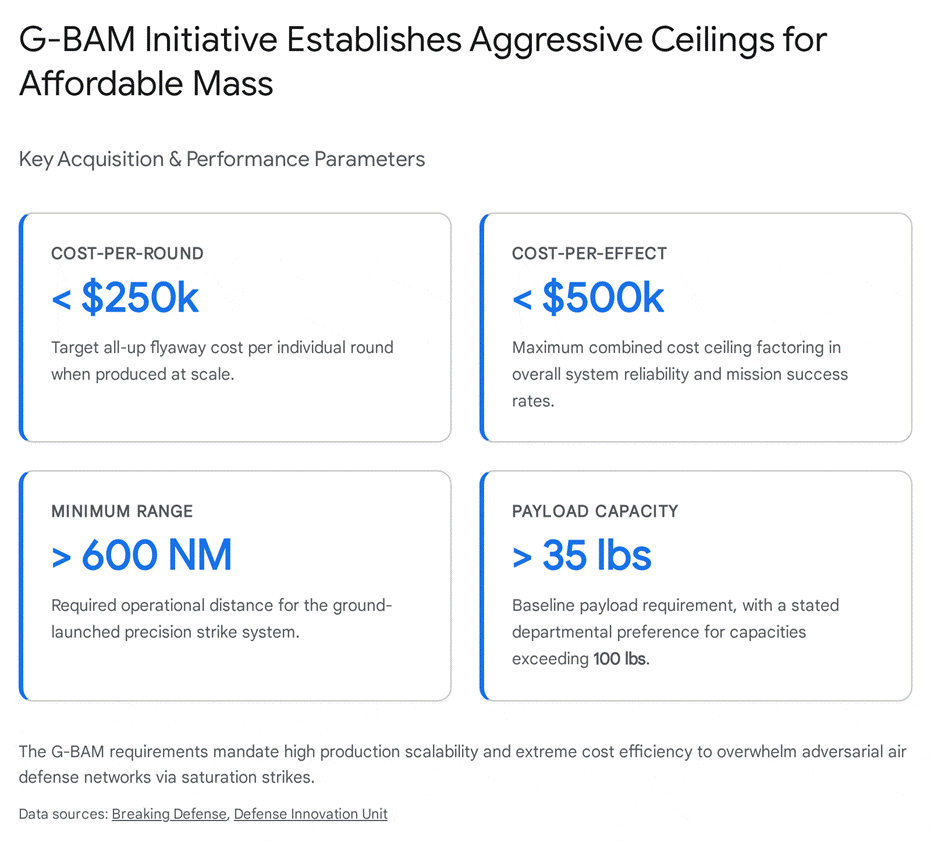
Tactical & Operational Lessons: The G-BAM initiative is designed to untether long-range precision fires from complex, vulnerable air-launched platforms and static launch infrastructure. By stipulating low-signature, remote launch methods, the DoD is ensuring that distributed ground forces can initiate deep strikes against operational-depth targets, such as enemy command nodes and logistics hubs, independently of Air Force sorties5. The strict requirement for Alternative PNT ensures that the kinetic kill chain remains intact even in heavily jammed electromagnetic environments, relying on onboard sensors for terminal guidance rather than easily spoofed satellite uplinks6.
Strategic Lessons: G-BAM represents a definitive doctrinal shift toward attritable saturation warfare. By establishing a rigid cost ceiling of $250,000 per round, the Pentagon intends to invert the asymmetric cost curve, forcing near-peer adversaries to expend sophisticated surface-to-air interceptors that cost exponentially more than the incoming threat5. Operationally, this shifts the strategic burden of mass production to the commercial sector, requiring vendors to demonstrate an immediate capacity to produce over 100 systems monthly5. This initiative aligns perfectly with the DRPM-UxS mandate, proving that the military is prioritizing volume, production speed, and software integration over exquisite but scarce hardware.
Validation of A-GRA and CCA Live-Fire Milestones
Event & Development: The U.S. Air Force achieved a critical milestone by validating the Autonomy Government Reference Architecture (A-GRA) across its Increment 1 Collaborative Combat Aircraft (CCA) platforms7. Demonstrations included the integration of Shield AI’s “Hivemind” software onto the Anduril YFQ-44A and Collins Aerospace’s “Sidekick” software onto the General Atomics YFQ-42A9. Concurrently, the YFQ-44A executed the first live-fire of an AIM-120 AMRAAM by a U.S. CCA, successfully tracking and engaging a simulated target in a beyond-line-of-sight strike over the Mojave Desert, managed entirely by Anduril’s Lattice AI software12. Furthermore, the UK Royal Air Force officially christened its CCA program the “Storm Fighter,” revealing plans for the “Storm Chrome” electronic warfare drone and the “Storm Fire” long-range attack drone16.
| CCA Platform / Software | Developer | Primary Role | Key Recent Milestone |
| YFQ-44A (Fury) | Anduril Industries | Attack / Loyal Wingman | Live-fire of AIM-120 AMRAAM via Lattice AI12 |
| YFQ-42A | General Atomics | Collaborative Combat | Validation of Collins Aerospace “Sidekick” via A-GRA9 |
| Hivemind Autonomy | Shield AI | Mission Autonomy | Successful integration onto YFQ-44A decoupled from hardware9 |
| Storm Chrome / Fire | UK Royal Air Force | EW / Long-Range Strike | Program initiation under “Storm Fighter” CCA umbrella16 |
Tactical & Operational Lessons: The validation of A-GRA via a Modular Open Systems Approach (MOSA) fundamentally alters tactical aviation7. Tactically, this open architecture allows commanders to rapidly update a CCA’s autonomous behaviors, electronic warfare libraries, and tactical algorithms at the edge without requiring hardware modifications or grounding aircraft8. The YFQ-44A live-fire test proved that AI systems can reliably handle complex target ingestion, weapon sequencing, and terminal engagement under the supervision of a human operator, radically extending the sensor and weapons engagement zone (WEZ) of crewed fifth- and sixth-generation fighters13. By flying ahead of manned fighters, CCAs absorb risk and execute kinetic strikes while human pilots remain at safe standoff distances13.
Strategic Lessons: A-GRA effectively dismantles the legacy paradigm of “vendor lock,” where hardware original equipment manufacturers (OEMs) monopolized the software ecosystem of their airframes7. By enforcing a government-owned API standard, the DoD can dynamically scale software capabilities by continuously competing algorithms from commercial tech startups against prime defense contractors8. This capability ensures that the U.S. and allied forces can seamlessly share modular software updates across coalition CCA fleets, standardizing interoperability in contested theaters17. The simultaneous advancement of the UK’s Storm Fighter program indicates a growing NATO consensus that affordable mass and AI-driven combat mass are prerequisites for future air dominance16.
Introduction of Group 5 Rotary Loyal Wingmen
Event & Development: In late July 2026, the defense industry unveiled new Group 5 autonomous Vertical Take-Off and Landing (VTOL) aircraft designed to serve as “loyal wingmen” for rotary forces. Anduril, in partnership with commercial aviation firm Archer, unveiled the “Thunder,” a fully autonomous, hybrid-electric tiltrotor capable of matching the speed and range of the future Cheyenne fleet while carrying an Apache-equivalent payload (e.g., 10 Hellfires, 16 air-launched effects, or 76 rockets), managed by Lattice software18. Concurrently, BETA Technologies, allied with GE Aerospace and Sikorsky, debuted the “MV250,” a militarized hybrid-electric VTOL utilizing Sikorsky’s MATRIX autonomy stack, capable of carrying a 2,000-pound payload over a 1,300-nautical-mile range20.
Tactical & Operational Lessons: Traditionally, attack aviation relies heavily on crewed helicopters like the AH-64 Apache, which are highly vulnerable to modern short-range air defense (SHORAD), electronic warfare, and localized MANPADS in contested airspace. The Thunder and MV250 systems fundamentally alter rotary-wing tactics by pushing autonomous, heavily armed nodes into the adversary’s WEZ. Operating in groups of three to six, the Thunder can act as a forward sensor array and weapons bay, autonomously engaging ground armor and intercepting hostile UAVs with its nose-mounted C-UAS systems, while the crewed Apache remains masked behind terrain18.
Strategic Lessons: The deployment of these platforms extends the loyal wingman concept from high-altitude fighter combat into the extreme complexities of the tactical air-ground littoral fight, directly applying hard lessons that the United States and European allies observed in Ukraine regarding the severe lethality of low-altitude airspace18. Furthermore, incorporating commercial eVTOL technology (from Archer and BETA) into military systems successfully bypasses the decades-long development cycles typical of traditional military rotorcraft18. This proves that leveraging dual-use commercial engineering can rapidly field high-endurance, high-payload military assets at scale and at a fraction of historical procurement costs.
Space Force NITE-STAR Orbital Training Complex
Event & Development: The U.S. Space Force awarded a $981 million indefinite-delivery contract to 15 companies for the National Space Test and Training Complex (NITE-STAR)21. The six-year program is designed to develop live satellites, sensors, and ground systems to support realistic military space training against threats including cyberattacks and electronic jamming21. Concurrently, Boeing received a $2.8 billion contract to modernize space-based nuclear command, control, and communications (NC3)22.
Tactical & Operational Lessons: While technically operating in the space domain, the NITE-STAR complex has profound tactical implications for terrestrial autonomous systems. Drone swarms, autonomous surface vessels, and long-range precision strikes rely heavily on orbital architecture for secure data-links, persistent ISR, and highly accurate positioning data. By training operators against live electronic jamming and cyber intrusion in orbit, the Space Force is directly hardening the command and control backbone required to operate global drone fleets.
Strategic Lessons: The strategic institutionalization of live-fire orbital training reflects the reality that space is no longer a benign support domain, but a highly contested warfighting theater. Adversarial disruption of satellite communications or GPS can instantly degrade the effectiveness of remote-controlled systems. The massive financial commitments to NITE-STAR and NC3 modernization demonstrate the DoD’s imperative to secure the underlying networks that make global, AI-enabled autonomous warfare possible, ensuring network resilience against near-peer suppression.
2.2 INDOPACOM Theater (Maritime Operations & RIMPAC 2026)
USV Autonomous Lethality and Logistics at RIMPAC
Event & Development: During the ongoing Rim of the Pacific (RIMPAC) 2026 exercises, over 35 autonomous systems were actively integrated into multinational naval operations23. A major kinetic milestone was achieved when a 20-meter Saildrone Surveyor USV deployed with a custom launcher and successfully integrated with four AGM-179 Joint Air-to-Ground Missiles (JAGM)24. In the logistics domain, the Splash Industries “Typhoon” USV—capable of sustained speeds of 50+ knots and a 600+ nautical mile range—completed the first-ever autonomous underway resupply by navigating directly into the well deck of the USS Essex (LHD-2) while at sea25.
Tactical & Operational Lessons: The JAGM-armed Surveyor provides fleet commanders with an attritable, persistent surface-strike node capable of lingering in contested waters for months without risking human sailors24. Armed with modernized seekers, this USV can intercept asymmetric threats, such as one-way attack drones or fast attack craft, long before they enter the defensive envelopes of high-value Arleigh Burke-class destroyers24. Concurrently, the Typhoon’s autonomous well-deck docking demonstrates that the grueling requirement of “last-mile” naval logistics—moving high-priority parts or supplies between distributed task forces—can be automated, providing a novel capability to sustain vessels underway without constant operator oversight25.
Strategic Lessons: These deployments transition the Navy’s unmanned surface fleet from a purely ISR-focused asset to a hybrid fleet capable of localized kinetic lethality and organic, decentralized sustainment. As part of the broader Medium Unmanned Surface Vessel (MUSV) expansion, RIMPAC 2026 proved that commercial-off-the-shelf autonomy can successfully execute the Navy’s Distributed Maritime Operations (DMO) doctrine. By flooding the maritime battlespace with armed, autonomous nodes, the U.S. and its allies are vastly complicating adversarial targeting matrices in the Indo-Pacific, forcing near-peer competitors to allocate expensive surveillance and strike assets against relatively cheap sea drones.
Scaling the Medium Unmanned Surface Vessel (MUSV) Program
Event & Development: The U.S. Navy’s MUSV program advanced seven distinct designs from firms including Sea Machines, Leidos, Saronic Technologies, and Huntington Ingalls Industries (HII) to at-sea testing, supported by a $1.95 billion FY26 budget26. The requirements mandate a 2,500-nautical-mile range, a 25-metric-ton payload, and operational capability in Sea State 4 at 25 knots26. HII’s ROMULUS USV, utilizing the Odyssey Autonomous Control Solutions software, recently commenced sea trials to validate multi-vehicle collaborative autonomy and modular payload integration27.
Tactical & Operational Lessons: The MUSV program relies heavily on modular, containerized payloads, allowing a standard hull to rapidly transition between strike, ISR, mine countermeasures, and logistics roles based on immediate theater requirements26. Tactically, the use of software like HII’s Odyssey enables intuitive command and control over autonomous swarms across domains, enhancing fleet survivability by distributing the sensor and weapons architecture across dozens of hulls rather than concentrating it in a single vessel27.
Strategic Lessons: The Navy’s projection to field 83 unmanned vessels by FY 2031 underscores a strategic pivot toward regenerating fleet mass at a fraction of traditional shipbuilding costs26. The implementation of a “marketplace” procurement model shifts research, development, and basic production risks onto the commercial defense industry, accelerating the transition from prototype to active service26. This ensures the Navy can rapidly iterate its autonomous surface fleet to match the pacing threat in the Pacific, establishing a highly resilient, distributed naval architecture.
2.3 CENTCOM Theater (Middle East Operations)
Operation Epic Fury, C-UAS Integration, and L-MADIS Bullfrog
Event & Development: Under the banner of “Operation Epic Fury,” U.S. Central Command forces conducted multiple consecutive nights of strikes against Iranian security apparatuses and proxy infrastructure throughout late July to dismantle imminent threats28. Concurrently, U.S. Marines integrated specialized Counter-small Unmanned Aerial Systems (C-sUAS) training into standard infantry operations28. To significantly harden infrastructure against drone swarms, the Marine Corps selected the Allen Control Systems “Bullfrog M240” for integration into its Light Marine Air Defense Integrated System (L-MADIS) through a $6.2 million prototype contract31. The Bullfrog utilizes computer vision and AI to autonomously detect, track, and engage small UAS threats with a legacy 7.62mm machine gun firing at 850 rounds per minute31.
Tactical & Operational Lessons: Base defense forces and mobile maneuver elements are shifting away from relying solely on expensive directed energy or missile-based interceptors. The Bullfrog M240 effectively converts a standard legacy kinetic weapon into a smart, closed-loop autonomous turret31. Because small First-Person View (FPV) drones operate at extreme speeds (80+ mph) and often utilize frequency-hopping communication to resist electronic warfare (EW) jamming, human reaction times are often insufficient. AI-driven computer vision and autonomous terminal guidance allow the Bullfrog to calculate lead and achieve hard kinetic kills in microseconds without human latency31.
Strategic Lessons: The rapid deployment of autonomous weapon stations on light, all-terrain MRZR vehicles signifies that the Marine Corps anticipates a ubiquitous threat from low-cost drone swarms in every future conflict31. By incorporating relatively cheap 7.62mm ammunition into a highly sophisticated AI tracking loop, CENTCOM and USMC commands are directly addressing the unsustainable cost-exchange ratio of using multi-million-dollar Patriot or SM-2 missiles against adversarial suicide drones that cost less than a thousand dollars. This institutionalization of autonomous kinetic C-UAS reflects a permanent doctrinal adjustment to the realities of asymmetric drone warfare.
2.4 EUCOM Theater (Ukraine/Russia)
First Fully Unmanned Amphibious Raid at Kinburn Split
Event & Development: In mid-to-late July 2026, Ukraine’s 123rd Territorial Defence Brigade executed what is recognized as the first completely automated, cross-domain amphibious assault in military history under wartime conditions at the Russian-occupied Kinburn Split34. The operation physically separated human operators from the battlespace, utilizing three distinct autonomous platforms. A Ukrainian USV functioned as an automated landing craft, navigating the Black Sea to transport a Roboneers “Rys” UGV, which was armed with a 7.62mm PKT machine gun, directly to the hostile shoreline34. Upon beaching, the UGV autonomously disembarked, took cover in the coastal vegetation, and engaged Russian shoreline targets with suppressive fire, while the USV safely retreated34. The entire kinetic maneuver was monitored, filmed, and coordinated by an overhead UAV providing real-time ISR34.
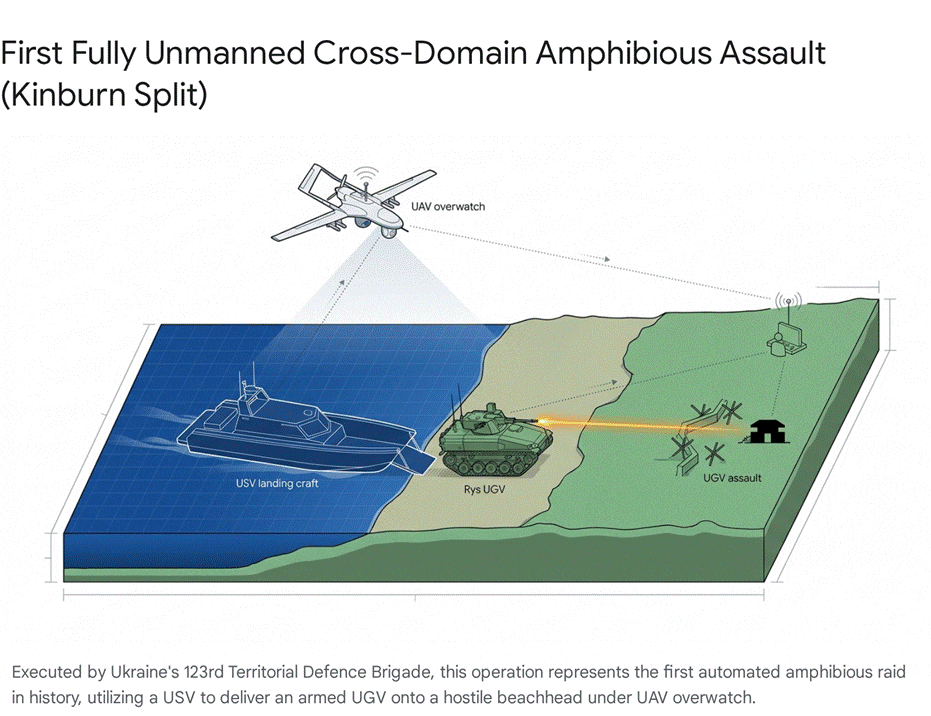
Tactical & Operational Lessons: The seamless integration of air, sea, and land unmanned systems allowed Ukrainian forces to probe Russian coastal defenses, suppress fortified frontline positions, and extract vital intelligence without risking a single human Marine34. Traditional amphibious landings are inherently the most dangerous and exposed military maneuvers, made exponentially more lethal by the modern prevalence of FPV attack drones and precision artillery. By utilizing an armed UGV for the initial beachhead assault, the attacking force can draw enemy fire, identify camouflaged defensive positions, and deplete adversary ammunition stockpiles before ever committing human shock troops to the landing zone34.
Strategic Lessons: This operation sets a profound doctrinal precedent for littoral warfare globally35. It signals that multi-domain autonomous swarms are no longer theoretical simulations or controlled exercises, but actively deployed combat realities capable of executing complex combined-arms maneuvers34. As adversaries analyze and adapt to this capability, coastal defense protocols will require fundamental overhauls. Navies and ground forces will be forced to shift investments away from traditional anti-ship missile batteries toward localized, highly dense C-UAS and C-USV electronic and kinetic countermeasures designed specifically to halt automated, multi-axis robotic incursions34.
2.5 Cross-Domain Technology Analysis (GPS-Denied Navigation & Electronic Warfare)
Advancements in GPS-Denied Navigation (VIO/VSLAM)
Event & Development: A defining technical trend of the past week is the accelerated integration of AI-driven, GPS-denied navigation systems into both aerial and ground drones. As adversarial EW systems increasingly jam Global Navigation Satellite System (GNSS) signals, defense technology has pivoted to Visual-Inertial Odometry (VIO) and Visual Simultaneous Localization and Mapping (VSLAM)36. These systems fuse raw optical data from onboard cameras (RGB and thermal) with Inertial Measurement Units (IMUs) through Extended Kalman Filters (EKF), allowing drones to calculate their precise 6-Degree-of-Freedom (6-DoF) physical location in real-time without relying on external satellite signals36. Recent research highlights the deployment of these algorithms on low-SWaP (Size, Weight, and Power) edge computers like the Jetson Orin Nano, utilizing image-based visual servoing (IBVS) for collision avoidance36.
Tactical & Operational Lessons: VSLAM and VIO eliminate a drone’s dependence on pre-mapped terrain or external RF signals39. For kinetic systems like the G-BAM munitions or tactical FPVs, this means that even if a target area is heavily shielded by GPS spoofing and radio frequency jamming, the drone’s onboard edge computing can visually track terrain features, navigate, and achieve terminal guidance autonomously38. Advanced frameworks now integrate deep reinforcement learning and monocular depth-estimation to execute complex collision avoidance at high speeds in highly dense or unstructured environments (e.g., urban canyons, subterranean structures, or dense forests)43.
Strategic Lessons: The maturation of VIO signifies the realization of true “human-out-of-the-loop” lethal autonomy47. By localizing computation entirely on the edge device, military planners are accepting that future battlefields will feature severe electromagnetic spectrum denial. The ability of an autonomous system to accurately navigate and engage targets when entirely severed from its human operator or satellite architecture inoculates allied unmanned assets against the primary asymmetric advantage currently held by near-peer EW capabilities.
Swarm Electronic Warfare (EW) Resilience
Event & Development: Alongside VIO, the defense industry is rapidly deploying decentralized communication architectures to ensure drone swarms survive intense electronic warfare48. Technologies developed by firms like Doodle Labs and Skyradar focus on self-organizing rules and algorithm-driven decentralized coordination49. Rather than relying on a central command node, modern swarms utilize deterministic rotor-router algorithms and peer-to-peer gossip protocols49. Furthermore, adaptive encryption mechanisms, frequency hopping, and dynamic channel switching (including optical and Li-Fi channels) are being integrated to bypass RF interference50.
Tactical & Operational Lessons: Traditional EW tactics rely on blunt jamming or denial-of-service attacks to sever the link between a drone and its operator. However, swarms utilizing local deterministic rules become highly resilient to link degradation; if partial communications fail, the swarm continues its mission organically rather than wandering aimlessly or returning to base49. Some drones within the swarm are now being tasked specifically with EW disruption, jamming enemy radar while the rest of the swarm executes the kinetic strike47.
Strategic Lessons: When coordination emerges from local self-organizing rules rather than a single remote pilot, the swarm evolves from a fragile collection of remote-controlled toys into a resilient, adaptive node in the electromagnetic battlespace49. This forces EW defenders to abandon brute-force jamming and attempt highly complex cyber-tactics, such as spoofing state messages to “poison” the mission graph or inducing erroneous loop reversals49. The cat-and-mouse game of electronic warfare is fundamentally shifting from sheer broadcast power to algorithmic superiority and signal-level hygiene.
3. Conclusions and Strategic Outlook
The events of late July to August 1, 2026, demonstrate that the global defense apparatus is moving aggressively past the conceptual phase of Manned-Unmanned Teaming (MUM-T) and into the reality of large-scale, modular hardware procurement. The implementation of the DRPM-UxS and the success of the A-GRA software standards indicate that the DoD has fundamentally recognized the necessity of operating hardware platforms like commercial software ecosystems—where airframes and ground chassis serve merely as generic delivery mechanisms for constantly iterating, interchangeable AI architectures.
Going forward, military planners must account for an operational environment where “affordable mass” is the primary metric of tactical success. Systems like the Anduril Thunder, the BETA MV250, and the G-BAM initiative illustrate that maintaining defensive standoff distance is no longer sufficient; victory requires actively pushing attritable, highly autonomous systems into the deepest layers of the adversary’s A2/AD (Anti-Access/Area Denial) envelope.
Furthermore, as demonstrated by the Kinburn Split amphibious raid and the integration of VIO navigation, cross-domain integration of these unmanned systems will fundamentally rewrite the rulebook for high-attrition, complex maneuvers. By relying on deterministic swarm logic and edge-computed terminal guidance, military forces are rapidly approaching the capability to execute lethal, combined-arms operations with zero human exposure at the tactical edge, ensuring continuous kinetic pressure even when the electromagnetic spectrum is entirely denied.
Please share the link on Facebook, Forums, with colleagues, etc. Your support is much appreciated and if you have any feedback, please email us in**@*********ps.com. If you’d like to request a report or order a reprint, please click here for the corresponding page to open in new tab.
Sources Used
- 2026 Defense Strategy: Autonomous Systems and Modern Warfare – Ronin’s Grips, https://blog.roninsgrips.com/2026-defense-strategy-autonomous-systems-and-modern-warfare/
- Hegseth realigning DOD’s scattered unmanned and autonomy work under new drone boss, https://defensescoop.com/2026/07/01/hegseth-realigning-unmanned-systems-programs-under-new-drone-boss/
- Strengthening Drone Interoperability: US Military’s Key Initiatives – Ronin’s Grips, https://blog.roninsgrips.com/strengthening-drone-interoperability-us-militarys-key-initiatives/
- In its next chapter, DIU aims to reduce the military’s ‘cost per kill’ | DefenseScoop, https://defensescoop.com/2026/07/15/diu-owen-west-aims-to-reduce-the-militarys-cost-per-kill/
- Pentagon eyes November to demo ground-launched, precision strike weapons, https://breakingdefense.com/2026/07/pentagon-eyes-november-to-demo-ground-launched-precision-strike-weapons/
- DIU Submission – Ground-Based Affordable Mass Prize Challenge, https://www.diu.mil/work-with-us/submit-solution/PROJ00672
- Air Force validates open architecture, expands Collaborative Combat Aircraft ecosystem, https://www.af.mil/News/Article-Display/Article/4405471/air-force-validates-open-architecture-expands-collaborative-combat-aircraft-eco/
- Collaborative Combat Aircraft autonomy architecture, air vehicle being developed separately, official says – Military Embedded Systems, https://militaryembedded.com/avionics/software/collaborative-combat-aircraft-autonomy-architecture-air-vehicle-being-developed-separately-official-says
- U.S. Air Force Integrates Open-Architecture for Mission Autonomy on CCAs – The Aviationist, https://theaviationist.com/2026/02/14/usaf-integrates-a-gra-architecture-mission-autonomy-ccas/
- Air Force Validates Software Architecture for Collaborative Combat Aircraft Program, https://www.mobilityengineeringtech.com/component/content/article/54669-air-force-validates-software-architecture-for-collaborative-combat-aircraft-program
- YFQ-44A CCA Tests Shield AI’s Hivemind and Anduril’s Lattice AIs During Single Flight, https://theaviationist.com/2026/03/03/yfq-44a-tests-shivemind-lattice-ais/
- In first, Air Force fires live shot off CCA wingman drone – Breaking Defense, https://breakingdefense.com/2026/07/in-first-air-force-fires-live-shot-off-cca-wingman-drone/
- US Fury drone fires live AMRAAM missile, advancing unmanned air combat, https://defenceaviationpost.in/us-fury-drone-fires-live-amraam-missile-advancing-unmanned-air-combat/
- U.S. Air Force live-fire test of Anduril YFQ-44A CCA advances semi-autonomous fighter drone program with AIM-120 launch – Defence Industry Europe, https://defence-industry.eu/u-s-air-force-live-fire-test-of-anduril-yfq-44a-cca-advances-semi-autonomous-fighter-drone-program-with-aim-120-launch/
- Anduril YFQ-44 Fires Live Air-to-Air Missile in Landmark CCA Test, https://ground.news/article/anduril-yfq-44-fires-live-air-to-air-missile-in-landmark-cca-test
- Storm Fighter: UK christens drone wingman program, unveils new designs, https://breakingdefense.com/2026/07/storm-fighter-uk-christens-drone-wingman-program-unveils-new-designs/
- Burden Sharing via Modular Open Systems Approaches: A Collaborative Path to Affordable Mass – CSIS, https://www.csis.org/analysis/burden-sharing-modular-open-systems-approaches-collaborative-path-affordable-mass
- Anduril reveals Thunder, a ‘loyal wingman’ drone for helicopters – Breaking Defense, https://breakingdefense.com/2026/07/anduril-reveals-thunder-a-loyal-wingman-drone-for-helicopters/
- A tiltrotor drone just broke cover in England with 76 laser-guided rockets in its belly and a dozen counter-drone interceptors in its nose, built to fly on an Apache’s wing at treetop height and fold into a shipping container between fights – Autonocion.com, https://www.autonocion.com/us/anduril-thunder-helicopter/
- BETA teams with GE, Sikorsky for militarized unmanned aircraft – Breaking Defense, https://breakingdefense.com/2026/07/beta-teams-with-ge-sikorsky-for-militarized-unmanned-aircraft/
- Industrial Base Monitor · Industrial Base Alpha, https://industrialbasealpha.com/
- Space Force awards Boeing $2.8B deal to deliver next-gen nuclear communication satellites | DefenseScoop, https://defensescoop.com/2025/07/07/space-force-boeing-contract-ess-nuclear-command-control-nc3/
- U.S. Tests More Than 35 Autonomous Systems for Naval Warfare – RealClearDefense, https://www.realcleardefense.com/2026/07/30/us_tests_more_than_35_autonomous_systems_for_naval_warfare_1197497.html
- JAGM-Armed Saildrone Surveyor USV Joins RIMPAC 2026 – Naval News, https://www.navalnews.com/naval-news/2026/07/jagm-armed-saildrone-surveyor-usv-rimpac-2026/
- Typhoon USV Completes First-Ever At-Sea Resupply with USS Essex – Naval News, https://www.navalnews.com/naval-news/2026/07/typhoon-usv-uss-essex-at-sea-resupply/
- U.S. Navy Selects 7 Contenders for the MUSV Program – Naval News, https://www.navalnews.com/naval-news/2026/05/u-s-navy-selects-7-contenders-for-the-musv-program/
- HII’s ROMULUS USV Advances to U.S. Navy Medium USV At-Sea Testing Phase, https://www.navalnews.com/naval-news/2026/06/hiis-romulus-usv-advances-to-u-s-navy-medium-usv-at-sea-testing-phase/
- U.S. Central Command | Operation Epic Fury, https://www.centcom.mil/OPERATIONS-AND-EXERCISES/EPIC-FURY/?videoid=1015527&dvpmoduleid=41413&dvpTag=FPV
- Counter UAS Mission at ADAB – centcom, https://www.centcom.mil/MEDIA/igphoto/2002904938/
- Kuwaiti-led Exercise Enhances Combined Counter-Drone Capabilities – centcom, https://www.centcom.mil/MEDIA/igphoto/2003841804/
- Marine Corps selects new robotic weapon system for L-MADIS integration, https://breakingdefense.com/2026/07/marine-corps-selects-new-robotic-weapon-system-for-l-madis-integration/
- Marines’ AI That Turns M240 Machine Guns Into Drone Killers | RealClearDefense, https://www.realcleardefense.com/2026/07/28/marines_ai_that_turns_m240_machine_guns_into_drone_killers_1197029.html
- Government & Military News – National Defense Transportation Association, https://www.ndtahq.com/news-issue-papers/government-military-news/
- Ukraine Conducts First Fully Unmanned Amphibious Raid at Kinburn Split – Naval News, https://www.navalnews.com/naval-news/2026/07/ukraine-unmanned-amphibious-raid-kinburn-split/
- The Unmanned Battlespace: Ten Core Strategies for Drone Employment in Modern Warfare, https://blog.roninsgrips.com/the-unmanned-battlespace-ten-core-strategies-for-drone-employment-in-modern-warfare/
- GPS-Denied UAV with Visual SLAM – Andrew Bernas, https://www.andrewbernas.com/docs/projects/robots/vslam
- Visual Odometry in GPS-Denied Zones for Fixed-Wing Unmanned Aerial Vehicle with Reduced Accumulative Error Based on Satellite Imagery – MDPI, https://www.mdpi.com/2076-3417/14/16/7420
- Visual Odometry in GPS Denied Zones for Fixed-Wing UAV with Reduced Accumulative Error Based on Satellite Imaginary – Preprints.org, https://www.preprints.org/manuscript/202404.1853
- A Survey on Odometry for Autonomous Navigation Systems – UTUPub, https://www.utupub.fi/bitstream/10024/171215/1/08764393.pdf
- NorthStrive Defense Tech Secures Option on GPS-Denied Drone Navigation Patent, https://insidegnss.com/northstrive-defense-tech-secures-option-on-gps-denied-drone-navigation-patent/
- Relative navigation of fixed-wing aircraft in GPS-denied environments, https://navi.ion.org/content/67/2/255
- NOVA: Navigation via Object-Centric Visual Autonomy for High-Speed Target Tracking in Unstructured GPS-Denied Environments – arXiv, https://arxiv.org/html/2506.18689v2
- GPS Denied IBVS-Based Navigation and Collision Avoidance of UAV Using a Low-Cost RGB Camera* – arXiv, https://arxiv.org/html/2509.17435v1
- Autonomous Navigation at the Nano-Scale: Algorithms, Architectures, and Constraints, https://arxiv.org/html/2601.13252v1
- (PDF) NOVA: Navigation via Object-Centric Visual Autonomy for High-Speed Target Tracking in Unstructured GPS-Denied Environments – ResearchGate, https://www.researchgate.net/publication/392942019_NOVA_Navigation_via_Object-Centric_Visual_Autonomy_for_High-Speed_Target_Tracking_in_Unstructured_GPS-Denied_Environments
- AI-Enhanced Thermal–Visual–Inertial Odometry and Autonomous Planning for GPS-Denied Search-and- Rescue Robotics – MDPI, https://www.mdpi.com/1424-8220/26/8/2462
- The Future of Autonomous Drone Swarms in Modern Warfare – UAV Defence, https://uav-defence.com/the-future-of-autonomous-drone-swarms-in-modern-warfare/
- Swarm Forge: Revolutionizing Military Drone Warfare – Ronin’s Grips, https://blog.roninsgrips.com/swarm-forge-revolutionizing-military-drone-warfare/
- Self-organizing Drone Swarms and the Changing Face of Electronic Warfare – SkyRadar, https://www.skyradar.com/blog/self-organizing-drone-swarms-and-the-changing-face-of-electronic-warfare
- Electronic Warfare – Doodle Labs, https://doodlelabs.com/capabilities/electronic-warfare/
- SWARM: Pioneering The Future of Autonomous Drone Operations and Electronic Warfare, https://www.cyberdefensemagazine.com/swarm-pioneering-the-future-of-autonomous-drone-operations-and-electronic-warfare/
- Electronic Warfare vs. Directed Energy: Which C-UAS Approach Wins the Scaling War?, https://www.dronesense.ai/electronic-warfare-vs-directed-energy-which-c-uas-approach-wins-the-scaling-war-2/