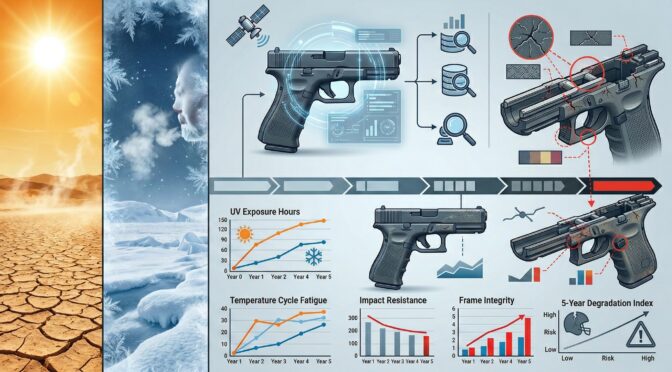
Executive Summary (BLUF)
The widespread adoption of polymer-framed handguns by law enforcement agencies and military units over the past four decades has fundamentally shifted duty weapon life-cycle management and capital procurement strategies. While modern polymer frames,predominantly manufactured from thirty percent glass fiber-reinforced Polyamide 66 (PA66-GF30),offer exceptional weight reduction, corrosion resistance, and manufacturing scalability, they are not immune to the laws of thermodynamics and environmental degradation. This technical intelligence report exhaustively analyzes the five-year degradation cycle of PA66-GF30 duty handgun frames when exposed to extreme operational climates, providing critical insights for law enforcement command staff, procurement officers, and defense contractors.
The analysis reveals that while high-quality polymer frames are engineered to withstand significant kinetic abuse, their molecular integrity is fundamentally finite. Over a standard sixty-month deployment cycle, duty handguns face compounding and synergistic environmental stressors: ultraviolet (UV) photo-oxidation, extreme thermal cycling ranging from sub-zero arctic conditions to desert heat, hygrothermal aging combining moisture absorption with elevated temperatures, and Environmental Stress Cracking (ESC) induced by routine exposure to field chemicals such as N,N-Diethyl-meta-toluamide (DEET) and hydrocarbon-based lubricants.
Key findings from cross-source open-source intelligence indicate that unmitigated ultraviolet exposure can reduce the flexural strength of glass-fiber-reinforced plastics by up to forty-one percent, severely compromising the weapon’s ability to absorb recoil impulses.1 Thermal cycling introduces severe mechanical fatigue at the precise interface of the polymer frame and the molded-in steel chassis inserts due to a Coefficient of Thermal Expansion (CTE) mismatch. In these critical zones, the polymer matrix expands and contracts at a rate two to five times greater than the steel components, leading to micro-cavitation and interface debonding.2 Furthermore, hygrothermal aging acts as a permeating plasticizer, significantly lowering the tensile modulus of the frame while increasing the risk of irreversible chain hydrolysis at elevated internal vehicle temperatures.4
For command staff and procurement officers, understanding these intricate degradation pathways is absolutely critical for transitioning from reactive armorer maintenance to proactive fleet life-cycle management. While the average duty pistol may theoretically survive a 10,000 to 25,000-round service life under controlled, indoor range conditions 7, real-world environmental extremes drastically accelerate polymer fatigue and structural compromise. This report provides the necessary material science data, environmental threat assessments, and predictive degradation modeling to inform future procurement cycles, evaluate transition strategies such as the shift toward modular chassis systems, and establish rigorous departmental maintenance protocols.
1.0 Introduction to Polymer Duty Handgun Life Cycles and Procurement
The integration of synthetic polymers into firearm manufacturing represents one of the most significant technological leaps in the history of the defense and law enforcement industries. Moving away from heavy, corrosion-prone carbon steel and forged aluminum frames, the industry has universally embraced specialized thermoplastic composites. From the experimental introduction of the Remington Nylon 66 rifle in 1959, which utilized an early formulation of DuPont’s Zytel polymer to create a unibody stock and receiver 8, to the paradigm-shifting debut of the recoil-operated Glock 17 in the 1980s 10, polymer science has conclusively proven its viability in high-stress, kinetic applications. Today, polymer-framed handguns account for the vast majority of law enforcement duty weapons globally, establishing a new baseline for weight, capacity, and manufacturing efficiency.
1.1 The Evolution of Polymer in Service Firearms
The historical trajectory of polymer in firearms demonstrates a continuous refinement of material properties to meet the punishing demands of military and law enforcement use. Early attempts at polymer integration, such as the Heckler & Koch VP70 introduced in 1970, met with lukewarm commercial reception but validated the concept of a lightweight, blowback-operated polymer handgun.10 However, it was Gaston Glock’s background in synthetic polymers and injection molding, rather than traditional firearms design, that catalyzed the modern era.12 By utilizing a proprietary nylon-based polymer, often referred to internally as Polymer 2, Glock achieved a frame that matched the functional strength of steel while reducing overall weapon weight by as much as forty percent compared to contemporary alloy-framed pistols like the Beretta 92.13
This lightweight construction significantly improved officer handling, reduced the physiological fatigue associated with daily duty carry, and enhanced recoil control through the polymer’s inherent ability to flex and damp kinetic energy.13 Consequently, over seventy percent of the top tier handgun original equipment manufacturers,including Glock, SIG Sauer, Smith & Wesson, and Heckler & Koch,have standardized their primary duty lines on advanced polymer composites.14
1.2 The Five-Year Capital Procurement Cycle in Law Enforcement
Law enforcement agencies typically operate on a five-to-ten-year capital procurement cycle for duty sidearms, a timeline dictated by complex operational, financial, and liability factors.15 This cyclic replacement strategy is rarely driven solely by the catastrophic mechanical failure of the firearms. Instead, it is heavily influenced by budget amortization schedules, the necessity of managing institutional liability, the pursuit of advancing technology (such as the recent widespread transition to optics-ready platforms and modular chassis systems), and the subtle, often invisible, degradation of the firearm’s baseline reliability due to environmental exposure.
During a standard five-year cycle, comprising sixty months of continuous deployment, a duty handgun assigned to a patrol officer is subjected to a unique and punishing matrix of environmental and mechanical stressors. Unlike civilian firearms, which typically reside in climate-controlled safes and experience only occasional range use, duty weapons are exposed daily to severe diurnal temperature shifts, prolonged solar radiation, heavy precipitation, corrosive bodily sweat, abrasive particulate matter, and a wide variety of chemical agents. Understanding the specific material science behind how the polymer frame reacts, degrades, and ultimately fatigues under these cumulative stressors over a sixty-month timeline is essential for establishing realistic service limits and mitigating the risk of critical failure in the line of duty.
2.0 Molecular Architecture of Polyamide 66 and PA66-GF30 Composites
To accurately assess the degradation mechanisms of a duty handgun, it is imperative to first understand the complex molecular architecture of the baseline material. The vast majority of modern polymer firearm frames are injection-molded from glass-filled nylon, specifically Polyamide 6 (PA6) or Polyamide 66 (PA66).14 Polyamide 66 serves as the industry gold standard due to its superior thermal stability and higher melting point compared to standard Polyamide 6.20
2.1 Semi-Crystalline Thermoplastics in Kinetic Applications
Nylon 66, scientifically designated as polyhexamethylene adipamide, is a semi-crystalline engineering thermoplastic. It is synthesized through the polycondensation of two distinct monomers: hexamethylenediamine and adipic acid, each containing exactly six carbon atoms, which gives the polymer its numerical designation.22 The polymer chains in PA66 are held together by strong intermolecular hydrogen bonds occurring between the amide functional groups.6
This specific molecular arrangement creates a semi-crystalline structure, meaning the material contains both highly ordered, tightly packed crystalline regions and randomly organized, flexible amorphous regions.24 The crystalline regions provide the material with its exceptional chemical resistance, thermal stability, and high melting point, which typically ranges from 254 degrees Celsius to 264 degrees Celsius (489 to 507 degrees Fahrenheit).21 Concurrently, the amorphous regions afford the polymer a degree of flexibility and impact resistance, allowing it to absorb and dissipate the violent kinetic shockwaves generated by the detonation of modern high-pressure duty ammunition.
2.2 The Role of Short Glass Fiber Reinforcement
While pure, unreinforced Polyamide 66 possesses excellent chemical resistance and thermal properties, it fundamentally lacks the absolute rigidity, tensile strength, and dimensional stability required to serve as the structural foundation of a firearm frame experiencing chamber pressures exceeding 35,000 pounds per square inch. To bridge this structural gap, firearms manufacturers reinforce the base PA66 matrix with microscopic short glass fibers, typically at a volume ratio of thirty percent, creating the composite known industrially as PA66-GF30.14
The integration of thirty percent glass fiber radically transforms the mechanical profile of the base polymer. The glass fibers act as a rigid structural skeleton within the flexible polymer matrix, dramatically enhancing the material’s load-bearing capabilities. However, this reinforcement strategy introduces a critical vulnerability: the structural integrity of the entire composite relies absolutely on the interfacial adhesion between the PA66 polymer matrix and the embedded glass fibers.4 Chemical coupling agents, such as silanes, are utilized to bond the organic polymer to the inorganic glass. When environmental stressors attack the frame, they frequently target this exact microscopic interface, leading to micro-voids, a loss of stiffness, and eventual macroscopic cracking.4
2.3 Baseline Mechanical Properties and Performance Metrics
The mechanical superiority of PA66-GF30 over unreinforced plastics is evident in standardized laboratory testing. The precise formulation and alignment of the glass fibers during the injection molding process dictate the final strength of the firearm frame. Fibers naturally align in the direction of the molten material flow within the mold, creating anisotropic properties where the frame is significantly stronger along the flow lines than across them.28
The following table synthesizes cross-source data regarding the baseline mechanical and thermal properties of standard PA66-GF30 utilized in engineering and tactical applications.
| Mechanical & Thermal Property | Metric Value | Imperial Value | Standardized Testing Norm |
| Density / Specific Gravity | 1.34 – 1.38 g/cm3 | 0.048 – 0.050 lb/in3 | ISO 1183 |
| Tensile Strength (Yield/Break) | 85 – 180 MPa | 12,200 – 26,100 psi | ISO 527-2 / ASTM D638 |
| Tensile Modulus (Stiffness) | 5,000 – 10,500 MPa | 725,000 – 1,522,000 psi | ISO 527-2 / ASTM D638 |
| Elongation at Break | 3.0 – 14.0 % | 3.0 – 14.0 % | ISO 527-2 / ASTM D638 |
| Flexural Strength | 135 – 195 MPa | 19,575 – 28,280 psi | ISO 178 |
| Charpy Impact Strength (Notched) | 10 – 13 kJ/m2 | 4.7 – 6.1 ft-lb/in2 | ISO 179-1eA |
| Melting Temperature | 254 – 264 C | 489 – 507 F | ISO 11357 |
| Continuous Service Temp (Air) | 110 – 120 C | 230 – 248 F | IEC 216 |
(Data derived from industrial material specifications including Ensinger Plastics, Toray, and Mitsubishi Chemical Advanced Materials 20)
The data clearly illustrates that the inclusion of thirty percent glass fibers pushes the tensile strength of the polymer well above 12,000 psi, providing the necessary resistance to deformation required for reliable weapon cycling.27 However, the relatively low elongation at break (as low as 3 percent in some highly rigid formulations) indicates that the material favors stiffness over elasticity, making it susceptible to brittle fracture if the matrix is compromised by environmental degradation.20
3.0 Photodegradation: Ultraviolet Embrittlement Over 60 Months
For duty weapons carried in exposed Level III retention holsters by officers on foot patrol, motorcycle units, or marine divisions, solar radiation constitutes a persistent and insidious threat. While modern holsters provide some physical shielding, the exposed grip modules, backstraps, and magazine floorplates are continuously bombarded by sunlight. Polyamides are inherently susceptible to ultraviolet (UV) degradation, a photochemical process that slowly and irreversibly dismantles the polymer chain over the five-year duty cycle.31
3.1 Mechanisms of Photo-Oxidative Degradation
The degradation of Polyamide 66 under sunlight is primarily driven by photo-oxidative reactions occurring when the material is exposed to the ultraviolet spectrum, specifically within the 290 to 400 nanometer wavelength band.31 The mechanism is initiated by the absorption of UV energy by chromophoric groups residing within the polymer structure. In many cases, these chromophores are trace carbonyl groups or hydroperoxides that were inadvertently formed due to the extreme thermal history of the polymer during the high-heat injection molding process at the OEM factory.31
When these chromophoric sites absorb high-energy UV photons, the energy exceeds the bond dissociation energy of the polymer backbone. This results in the homolytic cleavage of the polymer chains, generating highly unstable and reactive free radicals.1 Once free radicals are formed, and in the presence of atmospheric oxygen, an autocatalytic cascade of chemical reactions commences, fundamentally altering the polymer’s molecular structure.
3.2 Chain Scission and Aberrant Crosslinking
The free radical cascade induces two primary, conflicting destructive processes within the PA66 matrix: chain scission and aberrant crosslinking.31
Chain scission involves the direct severing of the long polymer chains, effectively reducing the overall molecular weight of the matrix. In polyamides, this is primarily driven by the scission of the weaker bonds within the polymer structure, particularly the N-alkylamide bond (CH2-NHCO), followed by the decomposition of the newly formed amide groups.4 As the molecular weight decreases, the polymer loses its inherent toughness and impact resistance, becoming increasingly brittle.
Conversely, aberrant crosslinking occurs when free radicals bond with adjacent, severed polymer chains. Unlike the controlled, intentional crosslinking utilized in vulcanized rubbers or thermoset plastics to enhance strength, this UV-induced crosslinking is highly irregular and rigidifies the amorphous regions of the polyamide. This eliminates the polymer’s natural flexibility and vibration-damping characteristics, further contributing to catastrophic embrittlement.31
3.3 Surface Micro-Defect Propagation and Flexural Strength Reduction
The physical manifestation of photodegradation originates at the exterior surface of the firearm frame and works inward. Accelerated laboratory weathering tests, which simulate long-term outdoor exposure using specialized UV chambers over 2000-hour durations, demonstrate the severe vulnerability of un-stabilized glass-fiber-reinforced plastics. Research indicates that prolonged UV exposure can result in a significant reduction in flexural strength, plummeting to between 59 percent and 64 percent of the material’s original baseline value.1
As the polymer matrix breaks down photochemically, it physically recedes and erodes away from the embedded glass fibers near the surface. This creates a visually identifiable phenomenon known as “fiber blooming” or surface chalking, accompanied by a measurable increase in surface roughness.1 More critically, this erosion leads to the formation of micro-defect cavities and interfacial cracking.
Over a five-year deployment cycle, these micro-defects act as profound stress concentrators. When the weapon is fired, the violent recoil forces and harmonic vibrations channel directly into these microscopic surface cracks. Instead of the force being evenly distributed across a smooth polymer matrix, the stress concentrates at the apex of the cracks, accelerating mechanical fatigue and dramatically increasing the likelihood of sudden brittle fracture, particularly in thin-walled areas such as the trigger guard undercut or the grip tang.24
3.4 OEM Mitigation Strategies: Carbon Black and UV Stabilizers
Recognizing the severe threat of photodegradation, firearm OEMs employ advanced chemical engineering to protect the PA66-GF30 matrix. Duty handguns are rarely manufactured from raw, natural-colored polyamide. The distinctive, uniform black coloration of most duty sidearms is a highly functional engineering necessity, not merely a tactical aesthetic preference.
The polymer is heavily doped with Carbon Black, typically at a volume ranging from 1.0 to 2.5 percent, alongside specialized chemical additives known as Hindered Amine Light Stabilizers (HALS).25 Carbon black acts as an exceptionally effective physical shield. The microscopic carbon particles absorb and scatter incoming UV radiation before the photons can penetrate deep into the polymer matrix, effectively restricting the photo-oxidative degradation to a superficial layer just a few microns thick.
Meanwhile, HALS operate chemically. They do not absorb UV light; instead, they act as radical scavengers. When UV light manages to generate free radicals within the matrix, the HALS immediately neutralize them, interrupting the autocatalytic degradation cycle before chain scission can propagate.31 While this sophisticated dual-layer stabilization ensures the core structural integrity of the firearm frame remains intact for decades, the superficial surface embrittlement can still subtly impact external pin hole tolerances, lanyard loop integrity, and accessory rail dimensions over prolonged, high-intensity desert deployments.36
4.0 Thermal Cycling: Sub-Zero Embrittlement to Desert Heat
Law enforcement and military handguns operate within extreme thermal envelopes that severely challenge the dimensional stability and mechanical endurance of composite materials. An officer’s weapon may sit in an air-conditioned cruiser at 20 degrees Celsius (68 degrees Fahrenheit), be abruptly deployed into a humid, high-temperature environment exceeding 45 degrees Celsius (113 degrees Fahrenheit), or be left in a secure vehicle trunk where ambient internal temperatures can rapidly soar to between 60 degrees Celsius and 70 degrees Celsius (140 to 158 degrees Fahrenheit) due to the greenhouse effect.37 Conversely, northern agencies and specialized alpine units routinely operate in sub-zero environments approaching negative 40 degrees Celsius (negative 40 degrees Fahrenheit).38
4.1 High-Temperature Degradation and Thermo-Oxidation Mechanisms
The conventional scientific model for thermal degradation in polyamides is an autoxidation process, which shares similarities with photodegradation but is initiated by thermal energy rather than photon absorption.40 At elevated temperatures, the thermal energy provides the activation energy necessary to initiate hydrogen extraction from the polymer backbone, creating reactive radical sites.
While PA66-GF30 boasts an impressively high melting point of approximately 254 to 264 degrees Celsius (489 to 507 degrees Fahrenheit), structural and chemical changes occur at temperatures far below the melting threshold.22 Sustained exposure to temperatures above 80 degrees Celsius (176 degrees Fahrenheit) initiates chronic thermo-oxidation and simultaneously increases the crystallinity of the polymer.4
Interestingly, the thermal history of the polymer creates a complex dynamic. Short-term exposure to high heat,such as the localized heat generated in the frame dust cover during rapid, sustained strings of fire,can paradoxically increase the flexural strength of the frame. This occurs due to an annealing effect, which relieves internal, localized stresses left over from the high-pressure injection molding process.4
However, this short-term benefit is completely negated by long-term heat exposure. Prolonged thermal soaking causes progressive chain scission and the formation of destructive degradation products such as carbonyls and peroxides.4
4.2 Arrhenius Lifetime Prediction Models and Activation Energy
Material scientists utilize the Arrhenius lifetime prediction model to estimate the long-term reliability of PA66-GF30 composites under varying thermal loads. The Arrhenius equation calculates the rate of chemical reactions (in this case, degradation) based on temperature and a specific Activation Energy (Ea).4
Studies determining the failure point of glass-reinforced polyamides,defined as the time necessary to reach a critical twenty percent decline in flexural strength,reveal an activation energy ranging from 93.5 kJ/mol to 151 kJ/mol, depending on the specific testing methodology and formulation.4
Applying the Arrhenius model yields highly relevant predictive data for duty handguns:
- At a constant temperature of 80 degrees Celsius (176 degrees Fahrenheit), the material is predicted to maintain its operational performance for approximately 22 to 25 years.4
- However, if the sustained temperature is increased to 130 degrees Celsius (266 degrees Fahrenheit), the predicted service life collapses precipitously to approximately 3,706 hours, or roughly 155 days.4
While duty weapons rarely experience continuous 130-degree Celsius temperatures, the non-linear nature of thermal degradation means that repeated thermal peaks,such as daily storage in the trunk of a patrol vehicle during a southwestern summer,cumulatively degrade the tensile and fatigue strength of the frame at an accelerated rate.37
4.3 Cryogenic Shock and Sub-Zero Embrittlement Dynamics
At the opposite extreme of the thermal spectrum, sub-zero temperatures present an entirely different mechanical threat vector. Polyamide 66 possesses a Glass Transition Temperature (Tg) of approximately 48 to 55 degrees Celsius in a completely dry, as-molded state.26 The Glass Transition Temperature is the critical threshold where an amorphous solid transitions from a hard, glassy state into a softer, more rubbery state. While moisture absorption significantly lowers this Tg in real-world conditions, extreme cold ensures the polymer remains firmly in its glassy phase.
When a duty handgun is deployed in extreme cold weather environments (ranging from negative 20 to negative 40 degrees Celsius), the amorphous regions of the polymer matrix become highly rigid and unyielding.30 High-quality OEM frames from manufacturers like Glock or Heckler & Koch are meticulously engineered to survive these temperatures, passing stringent military drop-tests and maintaining operational reliability by utilizing specialized cold-weather impact modifiers.35
However, the laws of physics dictate that as temperature drops, impact resistance and elongation at break plummet simultaneously.30 If a microscopic stress concentration exists in the frame,perhaps a micro-void originating from previous UV damage, or minor chemical exposure,a sudden kinetic impact in sub-zero temperatures, such as dropping the weapon onto frozen concrete or hard ice, can bypass the material’s limited ductility and result in catastrophic brittle fracture.39
4.4 The Coefficient of Thermal Expansion (CTE) Mismatch Crisis
The most critical, yet frequently overlooked, failure point in a polymer-framed handgun is not the plastic itself, but the boundary layer where the plastic directly interfaces with metal. Polymer duty handguns invariably utilize metal inserts to handle the high-friction, high-stress actions of the firing cycle. These include molded-in slide rails, locking blocks, trigger pivot pins, and serialized internal chassis components.7 These precision inserts are typically manufactured from robust alloys such as 4140 Chromoly Steel, 416 Stainless Steel, or 17-4 PH precipitation-hardened Stainless Steel.3
All materials expand and contract with temperature fluctuations, a physical property measured as the Coefficient of Linear Thermal Expansion (CLTE or CTE). The CTE formula is expressed as: alpha = delta L / (L0 * delta T) where alpha represents the coefficient of expansion per degree Celsius, delta L is the change in length, L0 is the original length, and delta T is the change in temperature.48
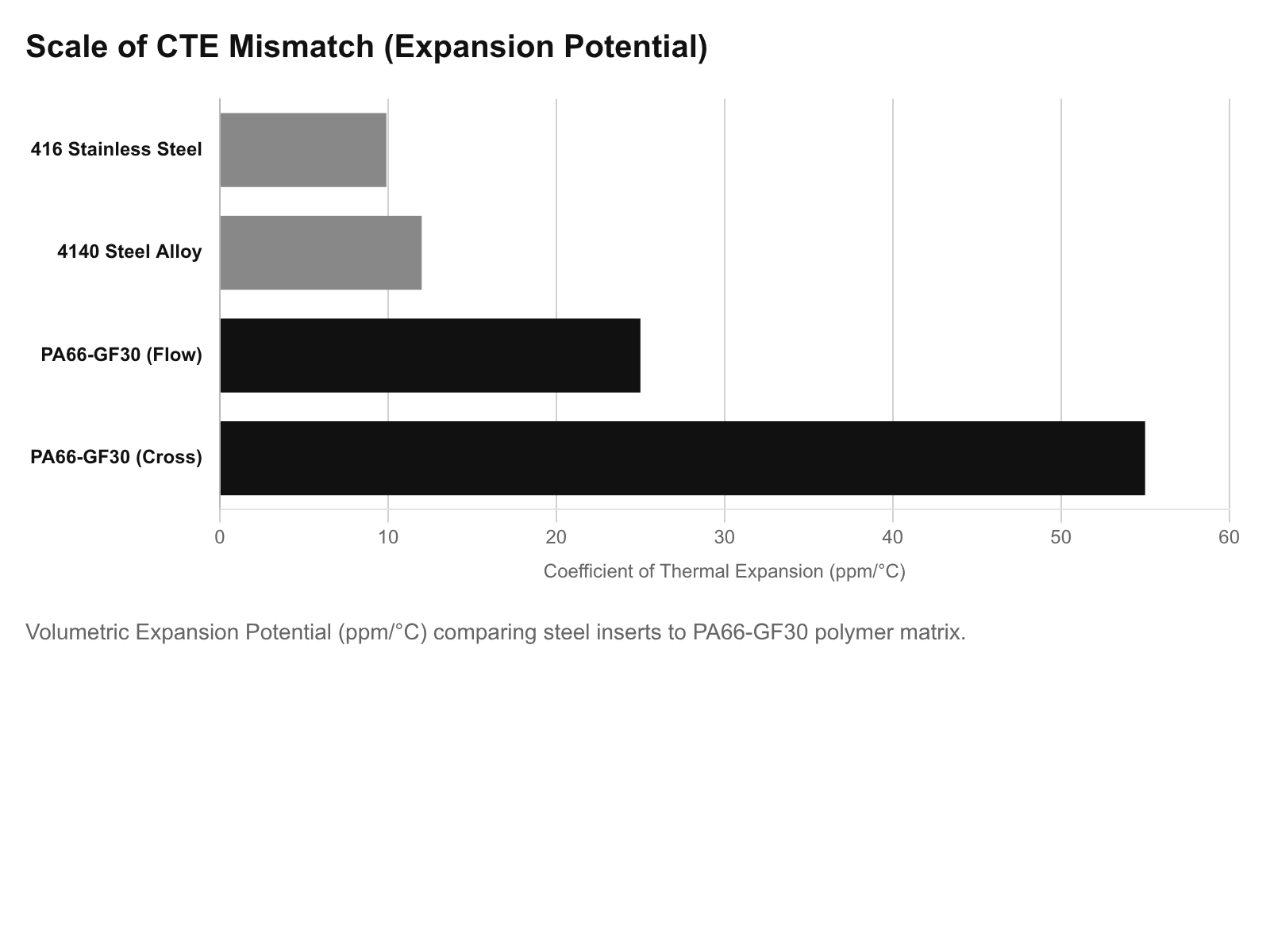
The CTE values of PA66-GF30 and firearm-grade steels are vastly disparate, creating a severe mechanical conflict during routine thermal cycling.
| Material Designation | Coefficient of Thermal Expansion (Metric: µm/m-°C or ppm/°C) | Documented Source Data |
| 416 Stainless Steel | 9.9 ppm/°C | 46 |
| 4140 Alloy Steel | 11.5 – 12.5 ppm/°C | 3 |
| PA66-GF30 (Longitudinal / Flow Direction) | 20.0 – 30.0 ppm/°C | 30 |
| PA66-GF30 (Transverse / Cross-Flow Direction) | 50.0 – 60.0 ppm/°C | 30 |
As detailed in the comparative data, the polymer matrix expands and contracts at a rate between two and five times greater than the steel inserts.3 Over a five-year deployment cycle, as the handgun transitions repeatedly from a freezing winter patrol environment into a heated interior, or from an air-conditioned armory to a sun-baked shooting range, the polymer attempts to aggressively shrink and expand around the rigidly static steel inserts.
4.5 Metal-to-Polymer Interface Debonding
This relentless thermal cycling generates a profound internal stress field, characterized by intense shear forces localized exactly at the metal-polymer interface.2 The adhesive and mechanical bonds between the PA66-GF30 matrix and the steel rails are tested constantly. Over thousands of alternating thermal cycles, these plastic strains result in cumulative low-cycle fatigue.
The mechanical bond begins to fundamentally fail, resulting in microscopic interface cavitation, the generation of micro-voids, and eventual total debonding of the polymer from the metal insert.2 In the operational context of a duty weapon, this interface debonding subtly reduces the structural pull-out strength of the frame rails. This degradation manifests operationally as slide-to-frame tolerance stacking, degraded mechanical accuracy, erratic ejection patterns, and in worst-case scenarios, the catastrophic separation of the steel rail from the polymer frame during the violent recoil cycle.29
5.0 Hygrothermal Aging: The Convergence of Heat and Moisture
Polyamides are inherently hygroscopic materials; they readily absorb moisture from the surrounding atmosphere until they reach a state of equilibrium with the ambient relative humidity.21 This characteristic is one of the most defining factors in the long-term performance of a polymer-framed firearm. Polyamide 66 can absorb up to 8.5 percent of its total weight in water at maximum saturation, while the glass-filled GF30 variant absorbs approximately 5.5 percent due to the non-absorbent nature of the glass fibers occupying volume.21
5.1 Plasticization and the Drop in Tensile Modulus
Water molecules act as a highly potent plasticizer when they penetrate the polyamide matrix. The water molecules physically insert themselves between the polymer chains and disrupt the intermolecular hydrogen bonding that normally exists between the polar amide functional groups.6 This absorption dramatically and measurably alters the mechanical profile of the handgun frame.
First, the frame undergoes dimensional swelling; it physically expands as the water molecules occupy interstitial space.57 Second, and more critically, the tensile modulus (the material’s stiffness and resistance to elastic deformation) drops precipitously. The tensile modulus of PA66-GF30 can plummet from a highly rigid 10,500 MPa in a “dry-as-molded” state to approximately 7,000 MPa once conditioned and saturated with moisture.21 Concurrently, the overall flexural strength of the frame can decrease by upwards of 25 percent following prolonged hygrothermal aging.58
It is important to note that moisture absorption is not universally detrimental in the short term. The plasticizing effect significantly increases the material’s impact toughness and Charpy impact strength.21 A moisture-conditioned polymer frame is actually far less likely to shatter if dropped on hard concrete compared to a bone-dry frame straight from the injection mold. However, the benefits of increased toughness are heavily outweighed by the long-term destructive effects of combining moisture with high temperatures.
5.2 Hydrolysis and Irreversible Molecular Weight Reduction
When moisture absorption is combined with elevated temperatures,a condition known as hygrothermal aging,the degradation crosses from reversible plasticization into irreversible chemical destruction. At elevated temperatures, the absorbed water molecules drive a chemical hydrolysis reaction.4
Hydrolysis actively attacks the polymer backbone, leading to the chemical scission of the polymer chains.4 This permanent reduction in molecular weight drastically degrades the fatigue life of the firearm frame. Research indicates that accelerated hydrolytic degradation leads to a linear reduction in molar mass over time, eventually reaching a degraded equilibrium point (e.g., 10 kg/mol at 95 degrees Celsius) where the material has lost a massive fraction of its structural integrity.5
Furthermore, hygrothermal aging specifically attacks the critical glass fiber interface. Water naturally accumulates at the boundary between the glass and the polymer. At elevated temperatures, this water chemically degrades the silane coupling agents that bind the glass to the polymer matrix.4 Once the silane bond is broken, the glass fibers simply float within the matrix rather than reinforcing it, rendering the thirty percent glass fill mechanically ineffective and leading to rapid structural compromise under the shock of recoil.
6.0 Chemical Solvent Degradation and Environmental Stress Cracking (ESC)
Law enforcement sidearms are subjected to regular and varied chemical exposure. While departmental armorers generally possess a thorough understanding of which maintenance solvents are safe for polymer frames, field officers often inadvertently expose their weapons to a myriad of undocumented and potentially hazardous chemical agents during daily patrol operations.
6.1 Routine Armory Solvents: CLP, Hoppe’s No. 9, and Mineral Spirits
Traditional firearms maintenance chemicals are largely safe for use on PA66-GF30. The semi-crystalline nature of Nylon 66 provides exceptionally high resistance to aliphatic hydrocarbons, aromatic hydrocarbons, lubricating oils, and greases.25
Standard bore solvents and universally issued Clean, Lubricate, Protect (CLP) fluids,which largely consist of kerosene, mineral spirits, synthetic oils, and ethanol,have a negligible chemical effect on the PA66-GF30 matrix.63 Military-grade solvents, specifically non-water-based distilled petroleum solvents designed for aggressive carbon removal, will not melt, swell, or degrade the polymer frame even over a continuous five-year maintenance cycle.67 Consequently, routine armory cleaning poses no threat to the weapon’s lifecycle.
6.2 Highly Reactive Agents and Unintended Field Exposure
The chemical danger arises when the polymer is exposed to strong organic solvents, concentrated acids, or phenols. Chemicals such as acetone, chlorobenzenes, and highly concentrated hydrochloric or acetic acids will actively dissolve, etch, or severely swell the PA66 matrix.61 While officers do not routinely clean weapons with industrial acids, the use of non-standard automotive cleaners (e.g., non-chlorinated brake cleaner containing high concentrations of acetone) by untrained personnel can induce rapid degradation.
However, the most insidious chemical threat to duty handguns is the unintended, routine field exposure to common consumer chemicals, specifically N,N-Diethyl-meta-toluamide (DEET) found in high-concentration bug repellents, and certain emulsifiers found in modern sunscreens.71 DEET is a potent plasticizer that acts as a highly aggressive solvent against synthetic polymers. In documented military and law enforcement deployments in tropical or heavily wooded environments, the overspray or transfer of high-DEET repellents from an operator’s hands to the weapon has caused catastrophic melting, structural softening, and permanent surface destruction of polymer pistol frames and rifle furniture.71
6.3 The Mechanics of Environmental Stress Cracking (ESC)
When chemical exposure is combined with mechanical stress, it triggers a devastating failure mechanism known as Environmental Stress Cracking (ESC). ESC is widely recognized as one of the leading causes of plastic failure globally, responsible for approximately twenty-five percent of all catastrophic plastic component failures across industries.24
ESC occurs when a seemingly benign chemical agent,such as a mild surfactant, a common detergent, a hand sanitizer, or a lotion like sunscreen,acts upon a polymer that is currently under internal or external tensile stress.24 The chemical agent does not possess the solvency power to directly dissolve or melt the plastic. Rather, the chemical permeates into microscopic surface flaws and significantly lowers the surface energy of the polymer. By lowering the surface energy, the chemical drastically reduces the activation energy required for a microscopic crack to propagate into a macroscopic fracture.34
For a duty handgun, the polymer frame is constantly subjected to complex stress fields. It retains internal, molded-in stresses from the factory injection process, and it experiences constant external stress from being tightly locked into a rigid Kydex Level III duty holster, as well as absorbing the kinetic shock of daily handling and range fire. If an officer inadvertently transfers DEET, aggressive hand sanitizer, or sunscreen onto the grip frame, the chemical acts as a silent ESC accelerator. Over a period of weeks or months, macro-cracks will spontaneously develop and propagate in high-stress geometries,such as the sharp radius of the trigger guard undercut, the thin walls of the magazine release housing, or the upper grip tang,leading to sudden, brittle failure of the weapon without any prior warning or extreme kinetic impact.24
| Chemical Agent Classification | PA66-GF30 Compatibility Rating | Environmental Stress Cracking (ESC) Risk | Operational Threat Vector |
| CLP / Mineral Spirits | Excellent (No Attack) | Low Risk | Routine Armory Maintenance |
| Acetone (Brake Cleaner) | Fair to Severe (Varies by concentration) | Moderate Risk | Unauthorized / Aggressive Carbon Cleaning |
| Hydrochloric Acid (10%) | Severe Effect (Dissolves matrix) | High Risk | Industrial or Hazmat Accidents |
| Phenol / Chlorobenzenes | Severe Effect (Dissolves matrix) | High Risk | Specialized Industrial Solvents |
| DEET (Insect Repellent) | Poor (Actively Melts/Plasticizes) | CRITICAL RISK | Routine Field/Patrol Exposure |
| Sunscreens / Lotions | Varies (Surfactant action lowers energy) | High Risk | Daily Officer Handling and Transfer |
(Data derived from chemical compatibility matrices and ESC literature 24)
7.0 Quantitative Impact on Service Life and Predictive Modeling
Synthesizing the empirical data regarding UV photo-oxidation, thermal cycling, CTE mismatch, hygrothermal aging, and chemical ESC provides a comprehensive, quantifiable picture of polymer frame degradation. This multi-variate degradation model definitively answers why a five-to-seven-year replacement cycle is optimal for high-use law enforcement agencies, moving the justification from institutional anecdote to hard material science.
7.1 Fatigue Behavior and S-N Curve Degradation in Kinetic Testing
The operational fatigue life of a duty handgun is mathematically quantified using an S-N curve, which plots the applied Stress (S) against the Number of cycles to failure (N). During the firing cycle, the polymer frame must repeatedly absorb, distribute, and dissipate the violent rearward velocity of the steel slide and the expanding gases. While PA66-GF30 excels at vibration damping, this cyclic loading induces cumulative, irreversible damage at the microscopic level.30
Experimental fatigue testing of PA66-GF30 under pulsating loads reveals that fatigue strength is strictly temperature-dependent and orientation-dependent.28 At standard ambient temperatures (22 degrees Celsius), the S-N curve remains relatively flat and highly predictable, allowing the polymer to withstand tens of thousands of cycles without yielding.42 However, when operating temperatures increase to 100 degrees Celsius,a temperature easily reached within the internal components of a firearm during rapid fire strings in a hot desert climate,the fatigue strength of the polymer decreases significantly.29 The elevated thermal energy softens the amorphous regions of the matrix, and the repeated kinetic impact forces cause the rigid glass fibers to shear microscopically against the yielding polymer, creating extensive internal cavitation that drastically shortens the weapon’s service life.
7.2 The Modular Handgun System (MHS) Paradigm Shift
The engineering recognition of finite polymer degradation has driven a recent, massive paradigm shift in duty weapon design and procurement, most prominently demonstrated by the U.S. Army’s Modular Handgun System (MHS) selection of the SIG Sauer P320 platform (designated M17/M18).7
Traditional polymer pistols, such as early generation Glocks, Smith & Wesson M&Ps, and H&K USPs, mold the steel slide rails directly into the serialized polymer frame.11 Consequently, if the polymer degrades via UV embrittlement, Environmental Stress Cracking, or CTE mismatch shear at the rail interface, the entire serialized firearm is legally and mechanically compromised. It must be destroyed, removed from inventory, and replaced with an entirely new serialized weapon, incurring significant capital expenditure and administrative overhead.12
The MHS design philosophy entirely circumvents this limitation by isolating the serialized, legally regulated component to a rigid, stainless-steel Fire Control Unit (FCU) chassis. The PA66-GF30 polymer grip module is completely un-serialized and relegated to the status of a disposable, non-regulated housing.7 This modularity directly counters the five-year polymer degradation cycle. When the polymer grip becomes embrittled by years of UV radiation, saturated and weakened by extreme humidity, or fractured via inadvertent DEET exposure, the agency armorer can simply discard the inexpensive, fifty-dollar polymer grip and drop the robust, serialized steel FCU into a brand new frame.7
This architecture exponentially increases the effective service life of the weapon system, pushing the limits of the serialized chassis and barrel well past 25,000 rounds, while correctly treating the vulnerable polymer components as expendable, low-cost wear items.7
7.3 Structural Fatigue Matrix Over a 60-Month Timeline
The culmination of environmental stressors results in a predictable degradation of structural capability. The following visualization models the estimated loss of ideal structural integrity (flexural strength, modulus, and interface adhesion) for a continuously deployed PA66-GF30 frame operating in high-stress, mixed environments over a sixty-month cycle.
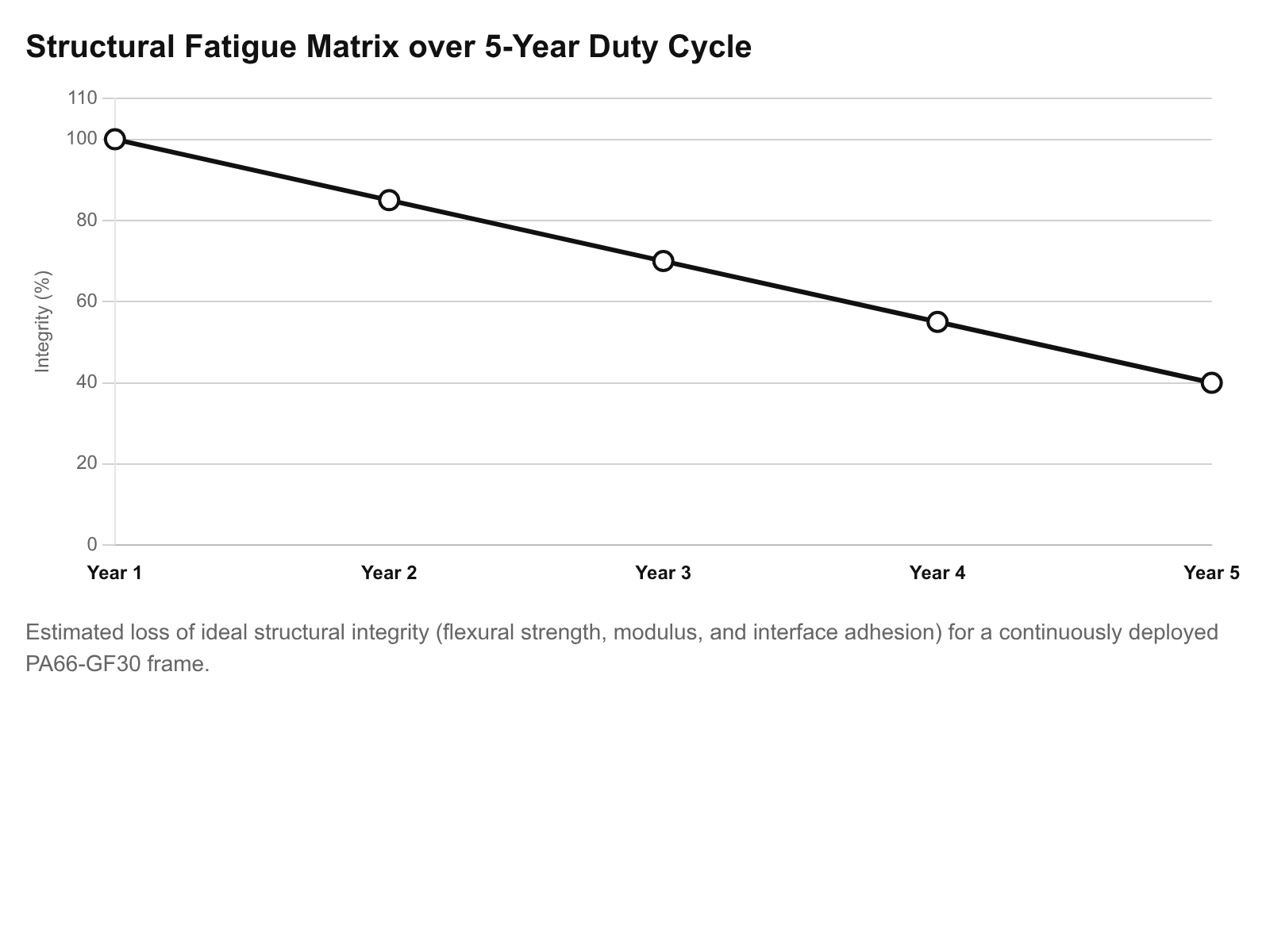
- Year 1: 100% – Factory baseline. Annealing via early firing relieves mold stress.
- Year 2: 85% – Moisture equilibrium reached. Modulus drops. Minor ESC vulnerabilities.
- Year 3: 70% – UV micro-defects form. CTE sheer interface cavitation begins.
- Year 4: 55% – Superficial fiber blooming. High susceptibility to sub-zero shock.
- Year 5: 40% – End of reliable duty life for frames in extreme environmental use.
8.0 Strategic Procurement Recommendations for LE Command Staff
Based on the exhaustive OSINT material science analysis of PA66-GF30 degradation mechanisms, the following actionable protocols and strategic directives are recommended for law enforcement command staff, chief armorers, and capital procurement officers:
8.1 Implementing Time-Based and Environmental Degradation Audits
Do not rely solely on ammunition round-count tracking to determine the health of a duty pistol fleet. A duty pistol that has fired only 1,000 rounds but has spent five years subjected to diurnal temperature shifts in a vehicle trunk, routine DEET exposure during woodland tracking operations, and relentless UV radiation on foot patrol is mechanically compromised compared to a “safe-queen” administrative pistol that has fired 5,000 rounds on an indoor range. Departments must implement strict, time-based lifecycle audits. Frames exceeding the sixty-month deployment threshold in severe climates should undergo rigorous armorer inspection specifically targeting micro-fractures in high-stress geometries (trigger guard undercuts, locking block pin holes) utilizing magnifying optics.
8.2 Revising Chemical Exposure Directives for Patrol Officers
Standardize and strictly enforce chemical exposure protocols within departmental standard operating procedures. Update armorer manuals and patrol officer training to explicitly ban the application of high-DEET insect repellents and surfactant-heavy sunscreens immediately prior to or while handling duty weapons. Treat documented chemical exposure to consumer solvents as a critical incident requiring immediate armorer inspection and decontamination to arrest Environmental Stress Cracking (ESC) before catastrophic brittle fracture occurs on duty.
8.3 Financial Justification for Modular Chassis Systems
Future capital expenditures for duty sidearms should heavily prioritize modular chassis systems (e.g., SIG Sauer P320, Springfield Echelon, Steyr A2 MF). By decoupling the serialized firearm registry from the environmentally vulnerable polymer grip module, agencies can replace degraded polymer for a tiny fraction of the cost of a full firearm replacement. This effectively bypasses the CTE mismatch fatigue inherent in older, molded-in rail designs and extends the amortization schedule of the primary capital investment (the steel chassis and slide assembly) from a five-year cycle to a ten-to-fifteen-year cycle, representing massive long-term taxpayer savings.
8.4 Environmental Sub-Zero Drop Testing Mandates
For agencies operating in extreme northern climates or high-altitude alpine regions, mandate rigorous sub-zero drop-testing during the procurement evaluation phase. Do not accept standard room-temperature drop test data. Potential procurement weapons must be frozen to negative 20 degrees Celsius and subjected to multi-angle drop tests on concrete to ensure the selected OEM’s proprietary PA66-GF30 blend utilizes adequate and modern impact modifiers to prevent cryogenic brittle fracture during winter operations.
By evolving from an anecdotal, generalized understanding of “plastic guns” to a rigorous, material-science-based approach to polymer lifecycle management, law enforcement agencies can actively mitigate the risk of catastrophic equipment failure, significantly reduce long-term procurement budgets, and ensure optimal officer safety across all environmental extremes.
Appendix: Methodology & Data Sources
This intelligence white paper was generated through a comprehensive, cross-source Open-Source Intelligence (OSINT) methodology, aggregating and analyzing disparate datasets including material science literature, industrial chemical compatibility matrices, and mechanical engineering specifications regarding polymer composites in kinetic firearm applications.
- Material Science Properties: Raw empirical data regarding Polyamide 66, PA66-GF30, and baseline thermal and mechanical properties were sourced directly from industrial plastic manufacturers and technical datasheets, including Ensinger Plastics (TECAMID 66 GF30), Albis, and Professional Plastics.14
- Environmental Degradation Mechanics: Complex insights on UV photodegradation, hygrothermal aging, and thermal oxidation were synthesized from peer-reviewed engineering papers, accelerated laboratory weathering chamber studies, and National Center for Biotechnology Information (NCBI) archives.1
- Chemical Resistance & ESC: Chemical compatibility parameters and the precise mechanics of Environmental Stress Cracking (ESC) were collated from chemical resistance guides (BASF, Entec Polymers) and material engineering texts focusing on solvent-induced failure mechanisms in polyamides.24
- Firearm-Specific Application: Firearm testing limits, Modular Handgun System (MHS) procurement data, and thermal cyclic stress limits were sourced from defense procurement news, United States Army operational reports, and historical firearm engineering data.7
Ronin’s Grips Analytics provides custom, agency-specific data on this topic. Contact us to commission a tailored internal audit or procurement forecast for your department.
Please share the link on Facebook, Forums, with colleagues, etc. Your support is much appreciated and if you have any feedback, please email us in**@*********ps.com. If you’d like to request a report or order a reprint, please click here for the corresponding page to open in new tab.
Sources Used
- Effect of 2000-Hour Ultraviolet Irradiation on Surface Degradation of …, accessed March 1, 2026, https://pmc.ncbi.nlm.nih.gov/articles/PMC12299305/
- How Does Thermal Cycling Affect Threaded Inserts in Automotive Plastics?, accessed March 1, 2026, https://blog.componentsforindustry.com/how-does-thermal-cycling-affect-threaded-inserts-in-automotive-plastics/
- 4140 Steel Thermal Expansion: Understanding the Impact on Performance, accessed March 1, 2026, https://www.otaisteel.com/4140-steel-thermal-expansion/
- Thermal Degradation of Glass Fibre-Reinforced Polyamide 6,6 Composites: Investigation by Accelerated Thermal Ageing – PMC, accessed March 1, 2026, https://pmc.ncbi.nlm.nih.gov/articles/PMC11859150/
- Accelerated hydrolytic degradation of glass fiber-polyamide (PA66) composites, accessed March 1, 2026, https://orbit.dtu.dk/en/publications/accelerated-hydrolytic-degradation-of-glass-fiber-polyamide-pa66-/
- measurement of moisture effects on the mechanical properties of 66 nylon, TA-133, accessed March 1, 2026, https://www.tainstruments.com/pdf/literature/TA133.pdf
- Army fields new handgun system to military police, accessed March 1, 2026, https://www.army.mil/article/217460/army_fields_new_handgun_system_to_military_police
- I Have This Old Gun: Remington Nylon 66 | An Official Journal Of The NRA, accessed March 1, 2026, https://www.americanrifleman.org/content/i-have-this-old-gun-remington-nylon-66/
- Remington Nylon 66 , Synthetic Before Synthetic was Cool – The Shooter’s Log, accessed March 1, 2026, https://blog.cheaperthandirt.com/remington-nylon-66-synthetic-before-synthetic-was-cool/
- How Long Will Polymer Handguns Last and is Acetone a Killer – Guy J. Sagi, accessed March 1, 2026, https://guyjsagi.com/2019/02/26/how-long-will-polymer-handguns-last-and-is-acetone-a-killer/
- The Gen5 Glock 17 and 19: Evolutionary, Not Revolutionary – USCCA, accessed March 1, 2026, https://www.usconcealedcarry.com/blog/gen5-glock-17-19-evolutionary-not-revolutionary/
- Glock Gun , Design Life-Cycle, accessed March 1, 2026, http://www.designlife-cycle.com/new-page-53
- Unlocking the Glock Frame: Innovation, Evolution, and Customization – AR15Discounts, accessed March 1, 2026, https://ar15discounts.com/unlocking-the-glock-frame-innovation-evolution-and-customization/
- Glass-Filled Nylon – The Gold Standard for High-Stress Tactical Parts – H&H Molds, accessed March 1, 2026, https://hhmoldsinc.com/glass-filled-nylon-gold-standard-high-stress-parts/
- US Park Police Requirement for Duty Pistol Lifecycle Replacement – Acquisition Gateway, accessed March 1, 2026, https://acquisitiongateway.gov/forecast/resources/26057
- Indiana State Police select Sig Sauer P320 as next duty handgun – Police1, accessed March 1, 2026, https://www.police1.com/firearms/ind-state-police-select-p320-as-next-duty-handgun
- Sanford approves budget transfer to begin replacing department pistols with Glocks, accessed March 1, 2026, https://citizenportal.ai/articles/6009783/florida/seminole-county/sanford/sanford-approves-budget-transfer-to-begin-replacing-department-pistols-with-glocks
- Can you inform me about the gun polymer? : r/Firearms – Reddit, accessed March 1, 2026, https://www.reddit.com/r/Firearms/comments/1bgd035/can_you_inform_me_about_the_gun_polymer/
- POLYMERS FOR FIREARMS – Amazon S3, accessed March 1, 2026, https://s3.amazonaws.com/entecpolymers.com/v3/uploads/content/Polymers-for-Firearms.pdf
- PA66 GF30 material- Ardlon® 30% Glass Fiber Reinforced Nylon, accessed March 1, 2026, https://www.nylon.com.tw/en/Products/pa66_gf30
- PA6 and PA66 – ALBIS, accessed March 1, 2026, https://www.albis.com/dam/jcr:8d76ea1b-fad7-4dc0-91ec-79c9b4223062/PA6%20vs%20PA66_Chart_ALBIS%20PLASTIC%20GmbH.pdf
- Nylon 66 – Wikipedia, accessed March 1, 2026, https://en.wikipedia.org/wiki/Nylon_66
- (PDF) Effect of hygrothermal aging on mechanical and tribological behaviors of short glass-fiber-reinforced PA66 – ResearchGate, accessed March 1, 2026, https://www.researchgate.net/publication/327865861_Effect_of_hygrothermal_aging_on_mechanical_and_tribological_behaviors_of_short_glass-fiber-reinforced_PA66
- Environmental Stress Cracking – The Madison Group, accessed March 1, 2026, https://madisongroup.com/wp-content/uploads/2023/12/Environmental-Stress-Cracking-ASM-Chapter.pdf
- Glass fibre reinforced PA 66 – TECAMID 66 GF30 black – Ensinger, accessed March 1, 2026, https://www.ensingerplastics.com/en/shapes/pa66-tecamid-66-gf30-black
- Material data sheet PA66 GF30 black – WHM, accessed March 1, 2026, https://whm.net/wp-content/uploads/2023/09/pa66-gf30-black.pdf
- Glass fiber reinforced PA 66 – TECAMID 66 GF30 black | Ensinger, accessed March 1, 2026, https://www.ensingerplastics.com/en-us/shapes/pa66-tecamid-66-gf30-black
- In situ X-ray tomography investigation on damage mechanisms in short glass fibre reinforced thermoplastics – SciSpace, accessed March 1, 2026, https://scispace.com/pdf/in-situ-x-ray-tomography-investigation-on-damage-mechanisms-620ru3vncl.pdf
- Fatigue Behaviour of PA66 GF30 at Different Temperatures – PMC – NIH, accessed March 1, 2026, https://pmc.ncbi.nlm.nih.gov/articles/PMC11722864/
- Nylatron GF30 / Ertalon 66 GF30 PA66 – MCAM, accessed March 1, 2026, https://www.mcam.com/mam/34616/Nylaplas-GEP-Ertalon%C2%AE%2066%20GF30%20PA66_en_US.pdf
- Enhance Nylon 66 UV Stability with Stabilizers – Patsnap Eureka, accessed March 1, 2026, https://eureka.patsnap.com/report-research-on-enhancing-nylon-66-uv-stability-with-stabilizers
- The effects of UV degradation on the physical, thermal, and morphological properties of industrial nylon 66 conveyor belt fabrics – ResearchGate, accessed March 1, 2026, https://www.researchgate.net/publication/330417540_The_effects_of_UV_degradation_on_the_physical_thermal_and_morphological_properties_of_industrial_nylon_66_conveyor_belt_fabrics
- What are the aging mechanisms in Nylon 6 exposed to UV radiation – Patsnap Eureka, accessed March 1, 2026, https://eureka.patsnap.com/report-what-are-the-aging-mechanisms-in-nylon-6-exposed-to-uv-radiation
- Environmental stress cracking (ESC) on device performance – Eastman, accessed March 1, 2026, https://www.eastman.com/content/dam/eastman/corporate/en/literature/s/spmbs7664.pdf
- Polymer Frame Pistols – Review & Durability – Mizo Guns, accessed March 1, 2026, https://www.mizoguns.com/post/polymer-frame-pistols-review-durability
- Glock Polymer Half Life? Can the “Tupperware” get too old? – Forums, accessed March 1, 2026, https://forums.brianenos.com/topic/209011-glock-polymer-half-life-can-the-tupperware-get-too-old/
- Hot Car vs Modern Polymer Handgun : r/CCW – Reddit, accessed March 1, 2026, https://www.reddit.com/r/CCW/comments/27blg3/hot_car_vs_modern_polymer_handgun/
- Cold-Proof Firearms – Reliable Defense in Sub-Zero Environments – American Grit, accessed March 1, 2026, https://www.americangrit.com/post/cold-proof-firearms—reliable-defense-in-sub-zero-environments
- Should I be concerned about cold temperatures with polmer frame pistol?, accessed March 1, 2026, https://www.canadiangunnutz.com/forum/threads/should-i-be-concerned-about-cold-temperatures-with-polmer-frame-pistol.1195409/
- Thermal Degradation of Plastics, accessed March 1, 2026, https://www.appstate.edu/~clementsjs/polymerproperties/zeus_thermal_degradation.pdf
- Characterization of the thermal and mechanical properties of additively manufactured carbon fiber reinforced polymer exposed to above-zero and sub-zero temperatures – ResearchGate, accessed March 1, 2026, https://www.researchgate.net/publication/386431720_Characterization_of_the_thermal_and_mechanical_properties_of_additively_manufactured_carbon_fiber_reinforced_polymer_exposed_to_above-zero_and_sub-zero_temperatures
- (PDF) Fatigue Behaviour of PA66 GF30 at Different Temperatures – ResearchGate, accessed March 1, 2026, https://www.researchgate.net/publication/387587788_Fatigue_Behaviour_of_PA66_GF30_at_Different_Temperatures
- Are Glocks Heat Resistant? – Ghost Inc., accessed March 1, 2026, https://ghostinc.com/ghost-inc-blog/are-glocks-heat-resistant/
- Does the cold/snow mess with certain handguns? Looking for an EDC CCW. – Reddit, accessed March 1, 2026, https://www.reddit.com/r/CCW/comments/15k8ulg/does_the_coldsnow_mess_with_certain_handguns/
- If the entire US government abandons the Sig P320, who do they jump to? – Reddit, accessed March 1, 2026, https://www.reddit.com/r/Firearms/comments/1m6z5ve/if_the_entire_us_government_abandons_the_sig_p320/
- Coefficient of Thermal Expansion for Various Materials at Different Temperatures – Bal Seal Engineering, accessed March 1, 2026, https://www.balseal.com/wp-content/uploads/2019/03/coefficient_of_thermal_expansion_of_bal_seal_materialsTR_18.pdf
- AISI 416 Stainless Steel vs. Normalized SAE-AISI 4140 – MakeItFrom.com, accessed March 1, 2026, https://www.makeitfrom.com/compare/AISI-416-S41600-Stainless-Steel/Normalized-4140-Cr-Mo-Steel
- Coefficient of Linear Thermal Expansion (CLTE): Formula & Values – SpecialChem, accessed March 1, 2026, https://www.specialchem.com/plastics/guide/coefficient-of-linear-thermal-expansion
- CLTE Coefficient of Linear Thermal Expansion on Polymers – Passive Components, accessed March 1, 2026, https://passive-components.eu/coefficient-of-linear-thermal-expansion-on-polymers-explained/
- AISI 4140 Alloy Steel (UNS G41400) – AZoM, accessed March 1, 2026, https://www.azom.com/article.aspx?ArticleID=6769
- Thermal Properties of Plastic Materials – Professional Plastics, accessed March 1, 2026, https://www.professionalplastics.com/professionalplastics/ThermalPropertiesofPlasticMaterials.pdf
- PA 6.6 GF30 – Schmidt & Bartl GmbH, accessed March 1, 2026, http://www.schmidt-bartl.de/pdfs_en/halbzeuge/technischedatenblaetter/PA_6_6_GF30_en.pdf
- The Core Problem: CTE Mismatch – INCURE INC. – Incurelab, accessed March 1, 2026, https://incurelab.com/wp/the-core-problem-cte-mismatch
- ETP 9 (EXTERNAL TECHNICAL PAPER NUMBER 9) – Tappex Thread Inserts Ltd, accessed March 1, 2026, https://www.tappex.co.uk/wp-content/uploads/2018/02/ETP51-General-Performance.pdf
- Influence of moisture absorption on properties of fiber reinforced polyamide 6 composites, accessed March 1, 2026, https://backend.orbit.dtu.dk/ws/files/5854257/Influence%20of%20moisture.pdf
- Tensile properties versus ageing time for PA66 composite aged at 135°C… – ResearchGate, accessed March 1, 2026, https://www.researchgate.net/figure/Tensile-properties-versus-ageing-time-for-PA66-composite-aged-at-135C-and-for-PET-and_fig5_234136097
- Nylon PA6 and PA66: differences, properties and applications in industrial injection moulding – Corti srl, accessed March 1, 2026, https://corti-srl.it/en/nylon-pa6-and-pa66-differences-properties-and-applications-in-industrial-injection-moulding/
- Hygrothermal Aging and Recycling Effects on Mechanical and Thermal Properties of Recyclable Thermoplastic Glass Fiber Composites, accessed March 1, 2026, https://docs.nrel.gov/docs/fy25osti/91758.pdf
- HYGROTHERMAL AGEING EFFECT ON GLASS FIBER COMPOSITES: A REVIEW – Ijarse, accessed March 1, 2026, https://www.ijarse.com/images/fullpdf/1516450524_VCET239IJARSE.pdf
- The Dynisco Extrusion Processors Handbook, accessed March 1, 2026, https://www.dynisco.com/userfiles/files/27429_Legacy_Txt.pdf
- Ultramid® Nylon Chemical Resistance | BASF, accessed March 1, 2026, https://chemicals.basf.com/dam/jcr:7c5b6f87-b64c-4974-83d9-b261c5a25032/BASF_Ultramid_Nylon_Chemical_Resistance_Guide.pdf
- Nylon Chemical Resistance Guide, accessed March 1, 2026, https://s3.amazonaws.com/static.entecpolymers.com/v3/uploads/content/Nylon-Chemical-Resistance-Guide.pdf
- Cleaning polymer pistols – Guns & Gear – USCCA Community, accessed March 1, 2026, https://community.usconcealedcarry.com/t/cleaning-polymer-pistols/9031
- Cleaning a polymer pistol? – Cleaning Products and Techniques – Practically Shooting, accessed March 1, 2026, https://practicallyshooting.com/community/topic/130-cleaning-a-polymer-pistol/
- Hoppe’s No. 9 Solvent | Big 5 Sporting Goods, accessed March 1, 2026, https://www.big5sportinggoods.com/store/details/hoppes-no-9-solvent/0330106130027
- Nylon Chemical Compatibility Chart, accessed March 1, 2026, https://www.calpaclab.com/nylon-chemical-compatibility-chart/
- Military-Grade Solvent – Solvents & Cleaners – Breakthrough Clean Technologies®, accessed March 1, 2026, https://www.breakthroughclean.com/solvents-cleaners/military-grade-solvent
- Breakthrough Clean Technologies® Military-Grade Solvent, 16oz Bottle, Clear, accessed March 1, 2026, https://www.breakthroughclean.com/breakthrough-clean-technologies-military-grade-solvent-16oz-bottle-clear
- Solvents/Cleaners – Breakthrough Clean Technologies®, accessed March 1, 2026, https://www.breakthroughclean.com/breakthrough-solvents-cleaners
- Chemical Compatibility Plastic Material Chart for PA66, PEEK, PPS, PVDF and POM, accessed March 1, 2026, https://www.microtonano.com/download/Chemical_compatibility_plastic_material_chart_ca_cp_lc_st_gn.pdf
- Does DEET damage gear? – YouTube, accessed March 1, 2026, https://www.youtube.com/watch?v=mvozkVmCtqY
- Apparently some components on insect repellant may damage your gun’s finish : r/airsoft, accessed March 1, 2026, https://www.reddit.com/r/airsoft/comments/w2yf0b/apparently_some_components_on_insect_repellant/
- DEET insect repellents can damage synthetics – YouTube, accessed March 1, 2026, https://www.youtube.com/watch?v=IHCZu3aQ504
- accessed March 1, 2026, https://opus4.kobv.de/opus4-bam/export/index/ris/searchtype/collection/id/16411
- W. V. Titow M. Phil., PH.D., C. Chem., F. R. S. C., F. P. R. I., C. Text., A.T.I. (Auth.) – PVC Plastics – Properties, Processing, and Applications-Springer Netherlands (1990) PDF – Scribd, accessed March 1, 2026, https://www.scribd.com/document/407644435/W-V-Titow-M-Phil-Ph-D-C-Chem-F-R-S-C-F-P-R-I-C-Text-A-T-I-auth-PVC-Plastics-Properties-Processing-and-Applications-Spr
- Oligomers: Hidden sources of bisphenol A from reusable food contact materials | Request PDF – ResearchGate, accessed March 1, 2026, https://www.researchgate.net/publication/347769520_Oligomers_Hidden_sources_of_bisphenol_A_from_reusable_food_contact_materials
- Chemical Contamination of Soft Drinks in Sealed… : Journal of, accessed March 1, 2026, https://www.ovid.com/journals/jofsc/fulltext/00004794-200901000-00019~chemical-contamination-of-soft-drinks-in-sealed-plastic
- PLASTIC PART FAILURE CAUSED BY ENVIRONMENTAL STRESS CRACKING – Curbell Plastics, accessed March 1, 2026, https://www.curbellplastics.com/wp-content/uploads/2022/11/Plastics-Environmental-Stress-Cracking-White-Paper.pdf
- Fatigue Behaviour of PA66 GF30 at Different Temperatures – Semantic Scholar, accessed March 1, 2026, https://www.semanticscholar.org/paper/Fatigue-Behaviour-of-PA66-GF30-at-Different-Zadravec-Kramberger/eaf0338d6ecf9a4ed56a2d5c17ed8041e17b1ae8
- Fatigue Behaviour of PA66 GF30 at Different Temperatures – MDPI, accessed March 1, 2026, https://www.mdpi.com/2073-4360/17/1/42
- What Made the M17 Pistol Better Than the Rest? – Free Range American, accessed March 1, 2026, https://freerangeamerican.us/m17-pistol/
- Federal Agencies Reject SIG Sauer P320 Amid Growing Safety Concerns – The Trace, accessed March 1, 2026, https://www.thetrace.org/2025/07/sig-sauer-p320-pistol-safety-ice-ban/
- Polifil® GFN/MRN 66 – Glass and Mineral-reinforced Nylons 6/6 – The Plastics Group of America, accessed March 1, 2026, https://www.plasticsgroup.com/polifil-product/polifil-gfn-mrn-6-6/
- Analytical Series: Principles of Accelerated Weathering: Evaluations of Coatings, accessed March 1, 2026, https://www.paint.org/coatingstech-magazine/articles/analytical-series-principles-of-accelerated-weathering-evaluations-of-coatings/