If you’ve had trouble finding our articles or shop products through search engines recently, you aren’t alone. We want to be clear about what’s been happening at Ronin’s Grips, how we’re fixing it, and where we plan to go from here.
What Happened: The July 2026 Shift
In mid-July 2026, major search engines, notably Google, updated their core ranking systems. These updates prioritized AI-generated summaries while applying stricter automated filters to assess content quality across entire sites. As a result, our traffic volumes from search engines to the blog and online store dropped by about 93%.
Rather than evaluating pages individually, these algorithms calculate a site-wide quality rating. If an automated system flags a specific section, it lowers the overall score for the entire domain. Ironically, the very thing we wanted to accomplish, providing social media analytics in a more template-driven manner so you get data to make decisions instead of just our opinion, ended up being our undoing!
Unfortunately, this filter caught our extensive archive of product reviews and comparison guides. Because the search engines evaluate interconnected sections together, reduced visibility on our AI and template-driven blog posts ended up dragging down search rankings for our main store as well.
The Steps We Have Taken So Far
We won’t let automated algorithms compromise our store or the quality of our content. To restore our search visibility and help new customers find us, we’ve taken immediate technical steps.
To safeguard our domain’s overall rating, we added noindex tags to our legacy comparison reports and reviews. The pages are still fully accessible to you directly, but search crawlers are instructed to skip indexing them. This prevents older content from weighing down the main Ronin’s Grips storefront in search rankings.
Where We Go From Here: A Proposal for the Community
While adding noindex tags addresses the immediate search penalties, it prompts us to rethink how we publish in-depth technical guides moving forward. Publicly hosting detailed product comparisons without risking algorithmic downgrades has become increasingly challenging. We remain committed to delivering thorough reviews, but we need a format free from shifting search engine criteria.
That brings us to a new concept we’re exploring: A Private, Members-Only Community.
We’re considering a dedicated, non-indexed community space for Ronin’s Grips members. This private hub would host our data-driven social media analyses of small arms-related matters removed from public search crawlers.
Maintaining this platform independently of public search traffic requires dedicated effort, so we’re considering a small subscription model to support it. Before making any decisions, we want to hear your thoughts.
We would love your input on the following:
What are your thoughts on moving our deep-dive reviews and comparisons into a private, members-only section?
Would you be willing to pay a monthly fee to support this content?
If so, is a price point of $5/month acceptable to you for this level of detail and access?
Please share your thoughts in the comments below or contact us directly. Your support has built Ronin’s Grips from day one, and your feedback will help guide our next steps.
The importation of Zastava M77 parts kits into the United States civilian market provides an opportunity to examine an early Cold War-era battle rifle. These specific kits are derived from the original milled-receiver variants of the M77 and M77A1, chambered in 7.62×51mm NATO1. Sourced primarily from surplus stockpiles in Cyprus and Mali, these parts kits represent the platform in its original, select-fire military configuration1. This report analyzes the historical development, manufacturing evolution, international deployment, demilitarization, and modern civilian rebuilding process of the milled Zastava M77, distinguishing it from modern stamped commercial variants.
2. Origins and Design Intent
The Zastava M77 was developed in the late 1970s by Zastava Arms in Kragujevac, Yugoslavia (present-day Serbia)4. The design intent was to produce a full-power battle rifle chambered in 7.62×51mm NATO to appeal to export markets, particularly non-aligned nations or those utilizing NATO-standard ammunition4. This initiative aligned with Yugoslavia’s strategic push toward self-reliant arms manufacturing and export revenue generation following the 1948 Tito-Stalin split4.
To accommodate the larger and higher-pressure 7.62×51mm cartridge, Zastava engineers scaled up the proven Zastava M70 action, itself a derivative of the Kalashnikov system4. The M77 retained the long-stroke gas piston and rotating bolt mechanism, noted for its reliability in adverse conditions such as dust and mud, but incorporated strengthened components, including an enlarged receiver and a longer barrel4.
3. Manufacturing Evolution: Milled vs. Stamped Receivers
Initial production of the M77 commenced in 1977 utilizing forged and milled steel receivers4. The decision to use milled steel for the early runs was to ensure structural durability and rigidity to handle the recoil and pressure of the 7.62 NATO round4. Milled receivers start as a solid block of steel and undergo machining, resulting in a robust but labor-intensive monobloc receiver7.
By the mid-1980s, Zastava Arms transitioned the M77 production line to utilize 1.5mm stamped steel receivers with reinforced, bulged front trunnions—a structural element adapted from the Soviet RPK light machine gun4. This transition was driven by the need for cost efficiency, reduced machining time, and higher-volume manufacturing capabilities4. While specific weight savings for the M77 platform are not definitively documented by Zastava, transitioning from a milled to a stamped receiver in standard Kalashnikov platforms typically yields a weight reduction of approximately 0.37 kilograms (0.8 pounds)8. A standard stamped M77 B1 weighs approximately 4.35 kg (9.6 lbs) unloaded, with heavier bipod-equipped light machine gun variants reaching 4.8 kg (10.6 lbs)5.
4. International Sales and Combat Deployment
Because the Yugoslav People’s Army predominantly utilized intermediate-caliber rifles like the M70, the M77 was relegated to a niche role domestically and marketed for export5. The milled M77 battle rifles were notably adopted by the Cypriot National Guard and the Armed Forces of Mali3.
The M77 experienced combat across several regional conflicts. It was fielded during the Lebanese Civil War, the Yugoslav Wars of the 1990s, and various internal conflicts and Tuareg Rebellions in Mali10. In Mali, the rifle was specifically issued to elite units, including paratroopers and the Presidential Guard3.
Service in Cyprus: The Cypriot National Guard procured approximately 1,000 milled M77 rifles in the late 1970s12. They obtained both standard battle rifles and heavy-barreled light machine gun variants equipped with bipods13. The weapon was utilized for decades before being phased out of standard issue to modernize their armories9. The design favored rugged field use. The mechanical loose tolerances and simple mechanics ensured reliability, though the heavy baseline weight and increased recoil of the 7.62 NATO round made it more challenging to control in fully automatic fire compared to intermediate-caliber platforms5. Some of the parts kits imported into the U.S. have been noted by consumers as bearing Greek writing on the wooden furniture, pointing directly to their Cypriot service origins3.
5. Demilitarization and U.S. Importation
Following their phase-out from active military service, these rifles were classified as surplus. Due to United States import regulations administered by the Bureau of Alcohol, Tobacco, Firearms and Explosives (ATF), intact select-fire receivers and original foreign-made machine gun barrels are prohibited from civilian importation7. Consequently, the rifles were demilitarized overseas prior to import. The original milled steel receivers were torch-cut (destroyed), and the original 500mm (19.7-inch) cold-hammer-forged, non-chrome-lined barrels were removed14. Unlike some other Warsaw Pact designs, original Yugoslavian military barrels were historically non-chrome-lined, relying instead on the hardness of the steel and rigorous cleaning regimens15.
The parts kits were imported into the United States primarily in the early 2020s. Bowman Arms (which merged with GALLO Inc. in early 2023 to become Bowman Armaments) served as a primary importer of the surplus materials, which were subsequently distributed to the retail market by companies including Apex Gun Parts and Centerfire Systems1. These imported kits included all original matching components—such as the bolt carrier group, adjustable gas block, trigger guard, and wooden furniture—minus the receiver and barrel2.
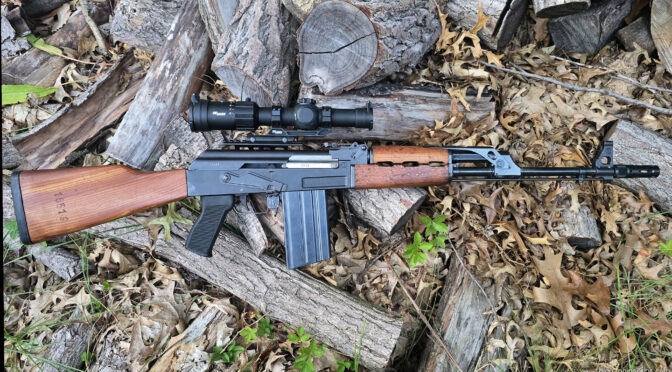
Apex Gun Parts sells Good and Very Good Condition M77 kits and barrels. This photo is of one of the author’s Very Good condition kits.
6. Civilian Rebuilding and Market Feedback
The availability of these surplus kits created a specific segment in the U.S. firearm building community. To reconstruct the rifles into legal, semi-automatic civilian firearms, builders require a new, domestically manufactured receiver and barrel7.
Tortort Receivers and Barrels: A primary replacement for the destroyed original receiver is manufactured by Tortort Manufacturing. Tortort produces a 100% milled receiver CNC-machined from 4140 billet steel, which is then heat-treated to military specifications19. Builders pair these with US-made 4150 nitride-treated barrels21. Builder feedback indicates the Tortort receivers provide accurate dimensional tolerances and rigidity, replicating the original 1970s Zastava design18. Building a milled AK-pattern rifle from a parts kit requires specialized gunsmithing tools, including a hydraulic press to install the barrel and precision gauges to set the headspace correctly16.
Commercial Assemblies (Riley Defense): In addition to home builders, Riley Defense acquired a number of these surplus kits and Tortort receivers to produce and sell complete, assembled rifles known as the RAK-30823. Market feedback on the Riley Defense assemblies varies. Many users report reliable function and appreciate the use of authentic surplus parts paired with the milled Tortort receiver22. However, some consumers have documented assembly and quality control issues. Reported anomalies include side optic rails that do not accommodate standard AKM or Yugo mounts, and systems that feel over-gassed out of the box, requiring manual adjustment of the weapon’s gas block to function smoothly26.
The receiver was made by Tortort for Riley Defense. They include the bullet guide rivet cover plate plus an approximately AKM-sized side scope rail that is mounted in the predrilled receiver holes.
7. Technical Specifications and The M77A1 Variant
The original platform utilizes a proprietary 20-round straight-profile steel box magazine9. As original magazines are scarce, US manufacturers like Csspecs have developed 20- and 25-round replacements that function in rebuilt kits27. Standard mechanical accuracy for rebuilt rifles ranges from 1.5 to 3.5 Minute of Angle (MOA), largely dependent on the quality of the new barrel, trigger installation, and the ammunition used29.
A significant subset of the imported kits belongs to the M77A1 variant. While the standard M77 B1 utilizes a traditional or adjustable gas block, the M77A1 is equipped with a dual-adjustable gas block integrated with a folding rifle grenade ladder sight2. When the grenade sight is deployed vertically, a rotary valve physically shuts off the gas port. This isolates the operating system, preventing the action from cycling and directing the total energy of a blank cartridge forward to launch a rifle grenade3.
8. Conclusion
The milled receiver Zastava M77 parts kits offer a detailed look into Yugoslavia’s Cold War-era strategy to produce a durable, full-power battle rifle for the global market. Designed for durability and utilizing a milled steel receiver, the M77 saw service in Mediterranean and African conflicts before being phased out. The importation of these torch-cut kits into the U.S. market has allowed collectors to reconstruct the platform using domestic receivers and barrels. While the rebuilding process requires specialized tooling and some commercial assemblies present dimensional inconsistencies, the resulting rifles provide a historically accurate representation of the original 1977 design.
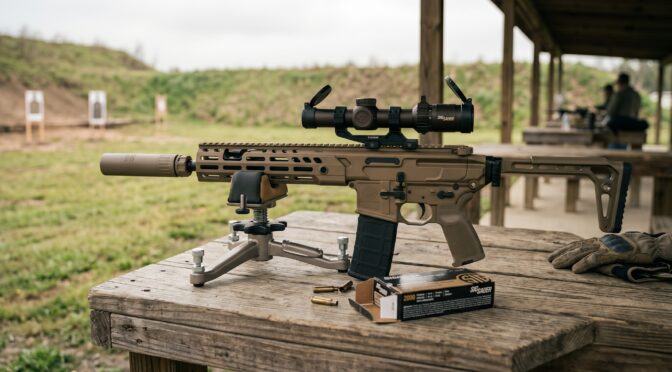
The author’s M77 rifle. CNC Warrior Russian brake, RS-Regulate 303M and AKR optic mounts, SIG 1-8 LPVO and Ronin’s Grips M70 grip. The trigger is an ALG Enhanced unit.
Master Summary Table
Specification / Attribute
Details
Manufacturer
Zastava Arms (Kragujevac, Yugoslavia/Serbia)6
Model Variants (Imported Kits)
M77 B1 (Standard Battle Rifle), M77A1 (Adjustable Gas Block with Grenade Sight)2
Caliber
7.62×51mm NATO / .308 Winchester6
Operating System
Gas-operated, long-stroke gas piston, rotating bolt6
Original Receiver Architecture
Forged and Milled Steel (Introduced 1977); Destroyed/Torch-cut for US import compliance4
Please note the author is not a lawyer and this is not legal advice.
1. Introduction: The May 2026 Regulatory Paradigm Shift
Signed on April 29, 2026, and officially published in the Federal Register on May 6 and May 8, 2026, the Bureau of Alcohol, Tobacco, Firearms, and Explosives (ATF) advanced a landmark suite of regulatory reforms, initiating the most comprehensive proposed modernization and rollback of federal firearms regulations in the agency’s history. Promulgated as a coordinated package of 34 proposed and final rules, the May 2026 reforms mark a definitive departure from the prior administration’s aggressive “zero-tolerance” enforcement posture.1 While some elements are final rules, several of the most consequential changes are currently Notices of Proposed Rulemaking (NPRMs) undergoing public comment until specific deadlines in early August 2026, such as August 4 for the EIB rule and August 6 for the willfulness and dual-use import rules.4 This new framework consciously pivots toward administrative clarity, burden reduction for Federal Firearms Licensees (FFLs), and the strict alignment of regulatory text with prevailing statutory language and United States Supreme Court jurisprudence.2
The extensive regulatory package is divided into specialized administrative modules, categorized internally by the ATF as Repeal, Modernize, Reduce Burden, Clarify, and Align.3 This is not a single, isolated policy update; rather, it is a holistic restructuring that affects nearly every facet of federal firearms compliance.7 The package encompasses the unwinding of the highly litigated 2023 stabilizing brace rule, the removal of bump-stock language from the machine gun definition following the Supreme Court’s ruling in Garland v. Cargill, the loosening of Form 20 requirements for the interstate transport of National Firearms Act (NFA) items, and the allowance of joint NFA registration for spouses without the necessity of establishing a legal trust.2
However, among the most consequential interventions for the daily operations of the firearms industry are three specific proposed actions: the rescission of the 2024 “engaged in the business” (EIB) presumptions, the formal codification of the Bryan v. United States standard for “willful” violations, and the easing of import restrictions on dual-use frames, receivers, and barrels under 18 U.S.C. § 925(d)(3).2
This report provides an exhaustive legal and practical analysis of these intersecting regulatory frameworks. Specifically, it assesses how the synthesis of the revised “engaged in the business” threshold under the Bipartisan Safer Communities Act (BSCA) and the redefined standard of “willful” administrative violations fundamentally alters the compliance risk matrix for independent gunsmiths and hobbyist builders.8 Furthermore, it delivers a granular analysis of the expanded 18 U.S.C. § 922(r) regulations concerning the domestic assembly of imported dual-use components, culminating in a definitive compliance roadmap for custom Kalashnikov builders who rely on foreign parts kits.11
2. The Jurisprudential Realignment of Mens Rea: Defining “Willful” Violations
For decades, a central friction point between the commercial firearms industry and federal regulators has been the interpretation of 18 U.S.C. § 923(e), which authorizes the Attorney General, acting through the ATF Director, to revoke a federal firearms license if a licensee has “willfully” violated any provision of the Gun Control Act (GCA) or its implementing regulations.14 The lack of a clear, codified definition of “willfully” within the administrative regulations created an environment ripe for jurisdictional disparities and regulatory overreach.4
2.1 The Retreat from “Zero-Tolerance” and the Plain Indifference Standard
Historically, the absence of a statutory definition for “willfully” within the GCA led to a patchwork of circuit court interpretations that frequently disadvantaged the licensee.4 During the “zero-tolerance” enforcement era, the federal government aggressively argued in civil license revocation proceedings that unintentional violations, clerical errors, or actions amounting to simple negligence could be classified as “willful” if the licensee demonstrated a “plain indifference” to their regulatory obligations.4 Relying tangentially on civil precedents such as Safeco Insurance Company of America v. Burr, at least nine circuit courts historically held that civil license revocations required significantly less culpability than criminal violations.4 Six of those circuits concluded that the civil standard required merely “deliberate, knowing, or reckless” conduct, effectively diluting the mens rea requirement to penalize inadvertent paperwork anomalies.4
The May 2026 Notice of Proposed Rulemaking (NPRM), identified by RIN 1140-AA88, repudiates this diluted standard.4 By formally amending 27 CFR § 478.73, the ATF aligns its administrative revocation standard directly with the criminal mens rea standard established by the Supreme Court in Bryan v. United States (1998), recognizing that standard rules of statutory construction require the same word to share the same meaning in both civil and criminal applications of the statute.2 In Bryan, the Court established that to prove a “willful” violation of the GCA, the government must demonstrate that the defendant acted with knowledge that their conduct was unlawful.2 A “knowing” violation, which requires only proof of knowledge of the facts constituting the offense, is insufficient for a willful designation.4 Under the newly proposed definition, a licensee acts “willfully” in the administrative context only when they intentionally and purposely engage in conduct that the law forbids, acting with the actual knowledge that their conduct violates legal obligations.14 Unintentional violations, or those occurring through sheer inadvertence or administrative fatigue, no longer meet the threshold for license revocation.4
2.2 Codifying Nuance: Repeated Violations, Willful Blindness, and Respondeat Superior
The proposed rule introduces vital nuances to prevent administrative overreach while maintaining robust enforcement capabilities against genuinely illicit actors.4 First, it clarifies that repeated violations do not inherently constitute “willfulness”.4 During the zero-tolerance era, an auditor finding the same clerical omission across multiple Form 4473s would automatically classify the repetition as plain indifference. The May 2026 rule mandates that decision-makers must evaluate the “totality of the circumstances,” explicitly considering whether a repetitive error stems from a systemic but inadvertent clerical mistake rather than a deliberate evasion of the law.4 Under the new standard, investigators must carefully evaluate whether the repetitions are a product of inadvertent, honest mistakes or deliberate disregard.4
Second, to prevent licensees from weaponizing ignorance as a shield, the rule codifies the traditional doctrine of “willful blindness”.4 Paragraph (c)(2) of the proposed rule establishes that a licensee cannot escape liability by deliberately avoiding knowledge of a regulatory obligation.4 If an individual takes affirmative steps to avoid learning about a law governing their commercial activity, they satisfy the “willful” mens rea threshold.4
Third, the ATF has significantly reformed the application of respondeat superior (supervisor-employee liability) within the firearms regulatory space.4 Under the traditional common law application, a business entity could face strict vicarious liability, resulting in license revocation, for the rogue actions of a low-level employee.4 The May 2026 NPRM limits supervisory liability exclusively to actions that the licensee ratifies.4 A responsible person or supervisor is deemed to have acted willfully only if they possess actual knowledge of a subordinate’s unlawful conduct and subsequently fail to cure it, actively conceal the violation, or fail to take appropriate disciplinary action against the offending employee.4 This structural reform creates a powerful incentive for FFLs to implement rigorous internal compliance, auditing, and self-reporting mechanisms without the persistent fear of automatic corporate decapitation due to an isolated employee’s misconduct.4
3. Dismantling Administrative Overreach: The “Engaged in the Business” Revisions
Operating in tandem with the redefined willfulness standard is the ATF’s proposal to formally rescind the highly controversial 2024 final rule defining what it means to be “engaged in the business” (EIB) as a dealer in firearms at wholesale or retail.8
3.1 The BSCA Statutory Baseline vs. Administrative Presumptions
The Gun Control Act fundamentally mandates that any person “engaged in the business” of dealing in firearms must possess a valid Federal Firearms License.16 For decades, the statutory definition required that a person deal firearms “with the principal objective of livelihood and profit.” In 2022, Congress passed the Bipartisan Safer Communities Act (BSCA), which subtly but consequentially altered this statutory definition.8 The BSCA removed the “livelihood” requirement, lowering the threshold to encompass individuals who buy and sell firearms to “predominantly earn a profit”.5
In April 2024, the ATF capitalized on this statutory adjustment to promulgate an expansive administrative rule.17 The stated goal of the 2024 rule was to move the United States as close to universal background checks as administratively possible without further congressional legislation.18 The agency achieved this by introducing a complex series of “rebuttable presumptions” into 27 CFR § 478.13.5 Under that framework, selling even a single firearm under certain specific conditions, or repeatedly liquidating identical or newly manufactured firearms, automatically triggered a legal presumption that an individual was acting as an unlicensed dealer.5 Individuals were then forced to provide specific rebuttal evidence to prove they were not engaged in the business, effectively shifting the burden of proof onto the citizen.5
The May 2026 NPRM (RIN 1140-AB01) proposes to systematically dismantle this 2024 administrative architecture.9 The ATF openly acknowledged in the Federal Register that the presumptive metrics failed to produce the anticipated real-world outcomes in terms of FFL applications, administrative licensing actions, civil forfeitures, or other actionable enforcement metrics.8 Consequently, the ATF proposes formally rescinding paragraphs (b) through (h) of the EIB regulation in 27 CFR § 478.13, stripping away the itemized presumptions, the exhaustive lists of prohibited conduct, and the complex rebuttal evidence structures, while relocating the refined statutory definition of “predominantly earn a profit” to § 478.11.5
The ATF noted in its regulatory analysis that this return to the statutory baseline provides qualitative benefits by reducing public confusion and mitigating concerns about the perceived risk of over-enforcement, while acknowledging the potential cost that some individuals who should be licensed may remain unlicensed.17 If finalized, the agency will return the regulatory text to strictly mirror the statutory language passed by Congress in the BSCA, ensuring that whether a person is a dealer is once again a highly fact-specific inquiry devoid of automatic administrative trapdoors.2
3.2 The Preservation of the “Personal Collection” Safe Harbor
Crucially, while the ATF proposes deleting the aggressive presumptions and rescinding subsection (1) of the “personal collection” definition, the 2026 NPRM explicitly retains subsection (2), which defines “licensee personal collections” under 18 U.S.C. 921(a)(21)(C).5 The ATF recognized that retaining this specific subsection is vital because it clearly and informatively sets out the actions licensees can take to distinguish a personal firearm from a business inventory firearm.5 This aspect of the definition provides profound clarity, allowing licensed individuals to lawfully liquidate personal assets without intermingling them with FFL-bound operations, thereby insulating their private property from commercial auditing constraints.16
4. The Intersecting Risk Matrix: Independent Gunsmiths and Hobbyist Builders
When the protective Bryanwillfulness standard is overlaid onto the rescinded EIB presumptions, the federal compliance risk matrix for specialized actors in the firearms space—specifically independent gunsmiths and private hobbyist builders—shifts dramatically. However, this federal deregulation is increasingly offset by aggressive state-level legislative action, creating a dangerous bimodal risk environment for the unwary operator.
4.1 Scenario A: The Independent Licensed Gunsmith
Under federal law, a person who devotes time, attention, and labor to engaging in the business of engraving, customizing, refinishing, or repairing firearms is legally classified as a “gunsmith”.20 Gunsmiths are explicitly categorized as dealers under 18 U.S.C. 921(a)(11) and (21), and these independent operators are therefore required to possess and maintain a Type 01 Federal Firearms License.20
For the licensed gunsmith, if finalized, the ATF’s May 2026 package would significantly de-risk daily administrative operations. Gunsmiths frequently manage complex, dual inventories: firearms checked in for commercial repair—which must be strictly entered into the FFL’s Acquisition and Disposition (A&D) bound book—and their own personal firearms.5 The workflow of a busy machine shop often leads to clerical friction. Under the previous zero-tolerance policy, if a gunsmith made a logging error—such as failing to log a repaired firearm out of the A&D book within the strict statutory timeframe before returning it to a customer, or making an illegible entry—the ATF could cite it as a “willful” violation indicative of “plain indifference”.4 Such findings regularly resulted in license revocation.4
Under the proposed 2026 framework, the intersection of the clear “personal collection” definitions and the Bryan standard provides an impenetrable shield against administrative destruction over minor errors.4Inadvertent paperwork anomalies or technical noncompliance resulting from the high volume of machine shop intake do not meet the Bryan threshold, because they lack the requisite actual knowledge of unlawfulness.2The government must now prove intentional falsification or deliberate illegal transfers to revoke the gunsmith’s license, securing the operator’s livelihood against the weaponization of clerical mistakes.4
4.2 Scenario B: The Hobbyist Builder and Private Collection Liquidator
For the hobbyist builder who occasionally liquidates pieces of a privately manufactured collection to fund future projects, the May 2026 reforms would offer substantial federal relief. Under the 2024 EIB regime, selling newly assembled firearms—even if strictly to refine a personal collection—carried the acute risk of triggering a rebuttable presumption that the hobbyist was dealing without a license.5 By returning to the fact-specific, statutory definition of “predominantly earn a profit” and proposing the removal of the presumptive conduct lists, the ATF aims to remove the automatic trapdoors that threatened to turn hobbyists into federal felons.8
Furthermore, even if a hobbyist miscalculates their volume of sales and unwittingly crosses the threshold of “engaging in the business,” the new Bryan standard acts as a secondary federal shield.4To pursue severe administrative or criminal penalties for dealing without a license, the government must prove the hobbyist acted with actual knowledge that their specific pattern of liquidation violated federal law, rather than merely demonstrating regulatory ignorance or simple negligence.4
4.3 The State-Level Paradox: The Bimodal Risk Matrix
While the federal regulatory matrix is slated to soften considerably for private builders and liquidators, hobbyists operating in restrictive jurisdictions face severe localized risks. The ATF’s proposed withdrawal from aggressive EIB enforcement is being rapidly backfilled by state legislatures advancing localized prohibitions on the manufacture and possession of un-serialized firearms, colloquially known as “ghost guns”.21
Michigan provides the most critical case study of this bimodal risk. In June 2025, the Michigan Senate passed Senate Bill 331 and Senate Bill 332, sweeping legislation that is currently pending in the House Committee on Government Operations and aims to fundamentally criminalize the hobbyist builder’s workflow.25 SB 331 categorizes frames and receivers, whether finished or unfinished, as “ghost gun precursors”.22 The legislation explicitly prohibits the unlicensed manufacture of more than five firearms annually.23 Furthermore, it strictly prohibits the use of 3D printers and CNC milling machines for unlicensed firearm manufacturing, requiring any individual legally building a firearm to imprint a valid serial number and notify the Michigan State Police within ten days of production.27
Under the tie-barred SB 332, possessing an un-serialized completed or unfinished frame or receiver 18 months after the bill’s effective date would become a Class E felony against public safety, punishable by up to five years in state prison.26 The legislation proposes a narrow 90-day grace period for individuals moving into the state to comply with the serialization requirements.23 Notably, the bills exempt transactions involving law enforcement agencies and transfers to federally licensed gunsmiths or manufacturers authorized to serialize firearms, funneling compliance through commercial FFLs.23
This creates a perilous divergence. If enacted, a Michigan hobbyist builder liquidating a small collection of four custom-built, un-serialized Kalashnikovs would be fully insulated from federal FFL requirements under the proposed 2026 ATF EIB reforms and the Bryan willfulness standard, yet simultaneously face the risk of being guilty of multiple state-level felonies under SB 331 and SB 332.8
To illustrate this divergence, consider the following bimodal compliance risk profile contrasting Federal enforcement risk under the proposed May 2026 standard against State enforcement risk under Michigan SB 331/332 (measured conceptually from Low to High risk):
Operational Scenario
Federal FFL Enforcement Risk (May 2026 Standard)
State Enforcement Risk (Michigan SB 331/332)
Occasional sale of serialized private collection
Low (Protected by BSCA safe harbor and removal of EIB presumptions) 8
Low (Serialized firearms would be exempt from ghost gun penalties) 26
Manufacturing 6 un-serialized AKs for personal use
Low (Personal use does not trigger “predominantly earn a profit”) 8
High (Would violate the 5-gun annual limit and serial number mandate; Class E Felony) 23
Licensed Gunsmith making an inadvertent A&D bound book error
Low (Protected by the Bryan actual knowledge standard; no revocation) 4
Low (State legislation would exempt federally licensed gunsmiths from serialization penalties during repair transfers) 23
Unlicensed systemic retail dealing of un-serialized builds
High (Violates basic GCA tenets regardless of presumption removal) 17
High (Would violate both dealing and serialization mandates) 26
This dichotomy requires modern firearms builders to exercise acute jurisdictional awareness, as federal compliance no longer guarantees immunity from severe state-level prosecution.22
5. Modernization of Import Regulations: Dual-Use Frames and Receivers
Beyond domestic compliance and enforcement, the ATF’s May 2026 package addresses long-standing supply chain friction for firearms manufacturers and importers by proposing to formally expand the scope of permissible imports under the Gun Control Act.10
5.1 Overruling the 2005 Open Letter and Origin-Based Restrictions
Under 18 U.S.C. § 925(d)(3), the importation of firearms into the United States is generally restricted to those models that the Attorney General determines are “generally recognized as particularly suitable for or readily adaptable to sporting purposes”.12 For nearly two decades, the ATF governed the importation of dual-use components via a highly restrictive November 2005 Open Letter that applied specifically to barrels.11 The 2005 guidance improperly made sporting determinations based on the specific historical firearm the barrel originated from, rather than evaluating its ability to be incorporated into a lawful sporting configuration.29 If the barrel was stripped from an un-importable military surplus or NFA-regulated machine gun overseas, the ATF routinely denied the import permit, irrespective of its potential future application in a civilian sporting build.29
The May 2026 NPRM (RIN 1140-AA96) proposes to formally codify ATF Ruling 2025-1 (which modernized this framework for barrels) and, crucially, extends the exact same deregulatory analysis to frames and receivers for the first time.6 The ATF acknowledges in the proposed rule that modern firearms technology has progressed significantly over the past 20 years, becoming inherently modular.11 This modularity allows the exact same frame, receiver, or barrel to be utilized in both sporting and non-sporting firearm configurations.12 Consequently, dual-use components now represent a vastly larger segment of the global market than they did when the restrictive 2005 guidance was issued.11
5.2 The “Sporting Configuration at Import” Standard and Economic Impact
Under the proposed amendments to 27 CFR Part 478 (specifically § 478.39 and § 478.112), Type 08 FFL Importers would be able to lawfully import frames, receivers, or barrels—regardless of whether they were previously configured on non-sporting, military surplus, or NFA firearms—provided that an “identified firearm sporting configuration” exists for that component at the time of importation.10
This is a profoundly deregulatory action that removes significant costs and burdens on the regulated industry.12 It opens expansive new foreign sourcing channels for the 1,666 federally licensed importers, allowing them to acquire highly durable military-grade components that were previously embargoed.12 Furthermore, it dramatically reduces acquisition costs for the exactly 21,499 Type 07 manufacturers who rely on imported components for domestic assembly.12 By disentangling the physical part from its historical military origins, the ATF ensures that raw materials for domestic manufacturing are no longer bottlenecked by arbitrary associations.12
6. The 18 U.S.C. § 922(r) Compliance Roadmap: Assembly Dynamics for Custom Kalashnikov Builders
While the proposed May 2026 rule would allow dual-use components to enter the domestic market, it does not exempt the assembly of those components from statutory domestic manufacturing constraints. The proposed rule explicitly clarifies that once a dual-use frame, receiver, or barrel is lawfully imported, it may be used to assemble a sporting, non-sporting, or NFA firearm only if the domestic assembly of that firearm complies strictly with 18 U.S.C. § 922(r) and the NFA, as applicable.10
6.1 The Legal Mechanics of 922(r) and the “Magic Number 10”
Section 922(r) of Title 18 exists to close a specific statutory loophole regarding domestic manufacturing.12 If 18 U.S.C. § 925(d)(3) makes it unlawful to import a fully assembled non-sporting rifle (such as a standard Kalashnikov AK-47 variant with a pistol grip and high-capacity magazine), Section 922(r) makes it unlawful to bypass that import restriction by importing the gun in demilitarized pieces and assembling the exact same non-sporting rifle domestically.12 It prevents the foreign disassembly, importation of parts, and subsequent domestic reassembly of non-sporting firearms.12
Compliance with 18 U.S.C. § 922(r) is governed by the regulations found in 27 CFR § 478.39.32 The ATF has established a specific, exhaustive list of 20 recognizable components of a firearm.13 To lawfully assemble a semiautomatic rifle or shotgun from imported parts, the finished, fully assembled firearm must contain no more than 10 imported parts from that specific list of 20.13 It is critical to note that the statute does not mandate a minimum number of US-made parts; it establishes a strict ceiling of 10 foreign parts.34
6.2 The Kalashnikov Parts Count and Replacement Strategy
Custom Kalashnikov (AK-47/AKM) builders rely heavily on imported “parts kits”—demilitarized foreign rifles that have had their original receivers torch-cut or crushed to comply with import laws, but which retain all other functional components.33 Because the proposed May 2026 rule would allow the importation of intact dual-use receivers and barrels stripped from these military rifles, a builder could source almost an entire original rifle.12 However, compliance is not achieved by simply pinning the parts together.
A standard stamped AK-47 does not utilize all 20 parts on the ATF’s regulatory list. By its mechanical design, a standard AK-47 lacks a barrel extension, lacks an operating rod (as the gas piston is permanently attached to the bolt carrier), lacks a separate trigger housing, and lacks a sear separate from the trigger/disconnector.13 Therefore, a fully imported, assembled AK-47 contains exactly 16 parts from the 922(r) list.33
To reach the legal threshold of no more than 10 imported parts, the Kalashnikov builder must systematically replace exactly six foreign parts with United States-made equivalents.33 This requires a deliberate, engineered compliance strategy.
The following matrix details the 20 regulated components under 27 CFR § 478.39, their applicability to a standard stamped AK-47, and the industry-standard substitution strategy to achieve compliance:
27 CFR § 478.39 Regulated Component
Present on Standard Stamped AK-47?
Recommended Compliance Action
1. Frames, receivers, castings, forgings
Yes (1)
Retain Imported Dual-Use (per May 2026 rule) 12
2. Barrels
Yes (2)
Retain Imported Dual-Use (per May 2026 rule) 12
3. Barrel extensions
No
N/A 33
4. Mounting blocks (trunnions)
Yes (3)
Retain Imported 33
5. Muzzle attachments
Yes (4)
Retain Imported (or replace for aesthetics) 33
6. Bolts
Yes (5)
Retain Imported 33
7. Bolt carriers
Yes (6)
Retain Imported 33
8. Operating rods
No
N/A 33
9. Gas pistons
Yes (7)
Retain Imported 33
10. Trigger housings
No
N/A 33
11. Triggers
Yes (8)
Replace with US-Made (Swap 1 of 6)33
12. Hammers
Yes (9)
Replace with US-Made (Swap 2 of 6)33
13. Sears
No
N/A 33
14. Disconnectors
Yes (10)
Replace with US-Made (Swap 3 of 6)33
15. Buttstocks
Yes (11)
Replace with US-Made (Swap 4 of 6)33
16. Pistol grips
Yes (12)
Replace with US-Made (Swap 5 of 6)33
17. Forearms, handguards
Yes (13)
Replace with US-Made (Swap 6 of 6)33
18. Magazine bodies
Yes (14)
Retain Imported (Avoid the Magazine Trap) 34
19. Followers
Yes (15)
Retain Imported (Avoid the Magazine Trap) 34
20. Floorplates
Yes (16)
Retain Imported (Avoid the Magazine Trap) 34
As detailed in the matrix, the industry standard and most cost-effective method to eliminate three foreign parts is the complete replacement of the internal Fire Control Group (FCG). By installing a US-made trigger, hammer, and disconnector, the builder reduces the foreign parts count from 16 to 13.33
Replacing the rifle’s external foreign “furniture” is the next logical and legally sound step. Installing a US-made buttstock, pistol grip, and handguard eliminates three additional foreign parts.33 It is critical for builders to note that while an AK-47 has both an upper and lower handguard, the ATF counts them together as a single compliance part.35 Combined with the FCG swap, the builder has eliminated six foreign parts, bringing the imported count to exactly 10, thus achieving strict 922(r) compliance while still utilizing the highly desirable imported dual-use receiver, barrel, trunnion, bolt, and bolt carrier.33
6.3 The Magazine Trap: A Critical Vulnerability
A severe, often overlooked legal hazard exists for builders regarding the rifle’s magazine. Under 27 CFR § 478.39, a single magazine does not count as one part; it represents three distinct, regulated components: the magazine body, the follower, and the floorplate.13
If a builder attempts to achieve compliance by swapping out the gas piston, muzzle device, and utilizing a US-made magazine to account for three parts, the rifle is 922(r) compliant only while that specific US-made magazine is physically inserted into the magazine well.34 If the builder, or any subsequent purchaser of the rifle, removes the US-made magazine and inserts a standard surplus foreign steel magazine (such as a Romanian or Bulgarian surplus mag), the rifle instantly gains three imported parts.34 In that moment, the foreign parts count jumps from 10 to 13.34 This immediately renders the assembly of the firearm a violation of 18 U.S.C. § 922(r), carrying the potential for severe federal penalties.34
To mitigate this risk entirely, expert builders utilizing imported dual-use receivers and barrels under the proposed May 2026 rule must rely exclusively on internal mechanical parts (the FCG) and fixed external furniture for their six US-made substitutions.33 By isolating 922(r) compliance from the interchangeable geometry of magazines, the builder ensures the rifle remains federally compliant regardless of what magazine the end-user inserts.33
7. Strategic Synthesis and Future Outlook
The ATF’s May 2026 regulatory reform package proposes to fundamentally recalibrate the relationship between the federal government and the commercial firearms industry. By seeking to systematically dismantle the prior administration’s administrative expansions—most notably the “engaged in the business” presumptions—and tether enforcement strictly to statutory text and Supreme Court precedent, the ATF aims to significantly reduce the ambient legal friction for compliant operators.2
For Federal Firearms Licensees, particularly independent gunsmiths, the formal integration of the Bryan actual knowledge standard into the civil revocation process provides vital economic security.4The persistent specter of losing a licensed business over inadvertent A&D bound book logging errors has been neutralized.4It would be replaced by a logical standard that reserves the ultimate administrative penalty of license revocation for those who exhibit actual knowledge of unlawful conduct and actively ratify it.10
Simultaneously, the dismantling of the presumptive “engaged in the business” metrics restores a protective barrier around the private hobbyist and the individual collector liquidating private assets.8 However, this federal retreat is occurring precisely as restrictive states accelerate their own regulatory architectures. As evidenced by Michigan’s pending SB 331 and SB 332, the aggressive state-level efforts to criminalize un-serialized “ghost gun” precursors ensures that the nexus of legal peril for independent builders is shifting definitively from Washington D.C. to state capitals.22
Finally, the modernization of dual-use importation rules represents a major logistical and financial victory for the domestic manufacturing base.12By discarding the outdated, origin-based restrictions of the 2005 Open Letter, the ATF has synchronized its import regime with the physical reality of modern, modular firearms technology.11Importers and custom Kalashnikov builders would be able to leverage deep global supply chains for high-quality military frames, receivers, and barrels, provided they execute disciplined, well-documented 922(r) compliance strategies during final domestic assembly.12
This holistic regulatory realignment suggests a durable, legally defensible environment where federal enforcement targets deliberate trafficking and criminal enterprise, rather than penalizing the clerical and mechanical margins of the lawful firearms industry.
The integration of forced-reset trigger (FRT) technology into the Heckler & Koch MP5 roller-delayed blowback platform represents a significant evolution in civilian small arms capabilities. Initially popularized within the AR-15 ecosystem, the forced-reset mechanism fundamentally alters the operational dynamics of semi-automatic firearms. It achieves this by utilizing the kinetic energy of the reciprocating bolt carrier to mechanically force the trigger shoe forward after each discharge, enabling exceptionally rapid follow-up shots while maintaining a semi-automatic legal classification. This analysis focuses specifically on the Rare Breed Triggers FRT-RD3, an aftermarket, drop-in fire control group engineered specifically for the MP5, MP5K, and their civilian semi-automatic variants, including the HK SP5, Century Arms AP5, Military Armament Corporation MAC5, and Zenith ZF5.
Following the May 16, 2025 Department of Justice (DOJ) settlement that federally descheduled eligible forced-reset triggers from being classified as machine guns under the National Firearms Act, the market for the FRT-RD3 has experienced rapid expansion.27 The legal environment has simultaneously stabilized at the federal level and fragmented at the state level, with the product currently restricted in thirteen specific jurisdictions due to local legislation governing trigger-activating devices.12
From an engineering and technical standpoint, the FRT-RD3 demonstrates high mechanical reliability and sophisticated integration with the host weapon’s timing. Field data indicates that the system operates efficiently, generally yielding a cyclic rate between 750 and 900 rounds per minute (RPM) depending on ammunition pressure, locking piece angles, and the presence of a sound suppressor.17 While the core trigger cassette proves highly dependable across high-volume firing schedules, integration anomalies exist. These anomalies are most notably tied to out-of-spec tolerances in specific Turkish-manufactured clones (such as the AP5-SD) and user-induced errors during the required transfer of the factory ejector hardware to the new trigger cassette.
Customer sentiment reveals a stark dichotomy. Quantitative analysis of social media and forum data indicates overwhelmingly positive feedback (86%) regarding the FRT-RD3’s functional performance, ease of installation, and cyclic consistency. Users praise the ability to utilize factory grip housings rather than relying on modified AR-15 lower receivers. Conversely, corporate sentiment toward the manufacturer is distinctly negative (75%). This dissatisfaction is driven by consumer backlash against Rare Breed’s aggressive patent litigation against competing designers and limited inventory availability, which has fueled a highly inflated secondary market. Ultimately, the FRT-RD3 establishes itself as the premium, most mechanically holistic forced-reset option currently available for the roller-delayed ecosystem, provided users navigate the high cost of entry and variable host-weapon tolerances.
2. Evolution of Forced-Reset Technology in the Roller-Delayed Ecosystem
The genesis of the forced-reset mechanism began with the AR-15 platform, where devices like the original Rare Breed FRT-15 utilized the direct-impingement or piston-driven carrier to reset the trigger dynamically.1 The adaptation of this technology to the HK MP5 family required significant engineering modifications. The MP5 is a platform celebrated for its smooth recoil impulse and mechanical reliability, but its roller-delayed blowback system relies on precise mechanical timing dictated by locking piece angles and bolt gap tolerances. This makes the integration of a forced-reset fire control group highly complex compared to direct gas-operated systems.
2.1 The Mechanics of Conventional vs. Forced-Reset Operation
In a standard semi-automatic firearm, the trigger assembly relies on a sear and a disconnector. When the trigger is pulled, the sear releases the hammer. As the action cycles, the hammer is pushed rearward and caught by the disconnector. The shooter must then manually release pressure on the trigger shoe, allowing the trigger spring to push the trigger forward, transferring the hammer from the disconnector back to the primary sear. This manual release and reset process inherently limits the cyclic rate of the firearm based on the operator’s physical dexterity.
The forced-reset trigger bypasses this manual limitation through mechanical intervention. The design utilizes a specialized locking bar that interfaces directly with the bolt carrier.1 As the weapon discharges and the bolt carrier is driven backward, the carrier physically depresses the internal locking bar.1 This action mechanically forces the trigger shoe forward to the reset position after the hammer falls, actively pushing the shooter’s finger forward against their own rearward pressure. The locking bar simultaneously restricts the trigger from releasing the hammer out-of-battery.3 Once the bolt returns to battery, the locking bar releases, allowing the operator’s continuous rearward pressure to instantly pull the trigger again. This creates a rapid, controlled cycle that mimics automatic fire while strictly maintaining a semi-automatic, one-shot-per-function mechanical reality.4
2.2 Transition to the MP5 Platform
Rare Breed Trigger LTD announced the expansion of its product line to include platform-specific models, transitioning away from generalized, one-size-fits-all designs.6 The FRT-RD3 was developed specifically to align with the unique operating geometry and mechanical timing of the HK MP5, MP5K, SP5, and SP5K family of firearms.6
The decision to target the MP5 platform stems from its enduring popularity and its mechanical suitability for high-rate-of-fire applications. The roller-delayed blowback system mitigates recoil by delaying the rearward movement of the bolt until chamber pressure drops to safe levels. This results in an exceptionally smooth recoil impulse, making the MP5 an ideal host for a forced-reset trigger. The mass of the bolt carrier and the mechanical resistance of the rollers naturally govern the cyclic rate, resulting in a more controllable firing experience compared to lightweight, direct-impingement AR-15 platforms. By focusing on refinement rather than reinvention, the FRT-RD3 maintains the character of the HK platform while delivering measurable improvements in trigger behavior and cyclic capabilities.7
3. The HK Roller-Delayed Blowback System and FRT Integration
To fully understand the effectiveness and potential reliability issues of the FRT-RD3, an analyst must examine how the trigger cassette interfaces with the host weapon’s internal mechanisms. The system departs from generalized aftermarket trigger components by acting as a purpose-built, dedicated solution tailored to the unique geometry of the HK MP5 pattern.7
3.1 Cassette Architecture and Material Science
The FRT-RD3 is manufactured entirely in the United States and is designed as a fully contained, drop-in cassette.8 This architecture is critical because it removes the variable tolerances involved in assembling individual trigger components within a host receiver.
The housing of the cassette is machined from 7075 anodized aluminum, providing a lightweight yet structurally rigid frame that resists deformation under cyclic stress.8 The internal wear components—specifically the hammer, the proprietary locking bar, and the sear engagement surfaces—are constructed from heat-treated 4140 chromoly steel.8 This material selection is vital given the extreme kinetic forces applied to these components. In a forced-reset system, the locking bar must withstand repeated, high-velocity impacts from the heavy MP5 bolt carrier, while the hammer must reliably strike the firing pin and withstand the violent rearward reset motion.
Unlike alternative rapid-fire solutions that require heavily modified AR-15 fire control groups to be adapted into proprietary MP5 lower receivers, the FRT-RD3 interfaces directly with standard, factory MP5 grip housings. Furthermore, it operates using the factory semi-automatic MP5 bolt carrier and does not require specialized, aftermarket trip sears (commonly referred to as slip-trips) or auto-sears to function.8
3.2 Hardware Configurations: SEF vs. AMBI Geometry
A critical installation dynamic for the end-user is the divergence in historical and modern MP5 lower receiver geometries. Over its multi-decade production lifespan, Heckler & Koch (and its licensed manufacturers) have produced various styles of trigger housings. To accommodate this variance, Rare Breed engineered two distinct, non-interchangeable models of the FRT-RD3:
FRT-RD3 (SEF): This model is designed for older, traditional grip frames marked with the letters S/E/F (Sicher/Einzelfeuer/Feuerstoß). This model utilizes a single-sided selector mechanism and is common on earlier imports, military surplus kits, and certain modern clones.11
FRT-RD3 (AMBI): This model is designed for modern, Navy-style grip frames marked with bullet pictograms. This variant features dual-sided selector levers, facilitating ambidextrous operation and shoulder-transition shooting in tactical environments.8
Consumers must exercise strict diligence during the procurement phase. If a user purchases an AMBI trigger for an SEF housing (or vice versa), the selector geometries will not align through the receiver walls, and the system will not function.12 Both configurations offer a specialized 3-position selector switch allowing the operator to transition between Safe, standard Semi-Automatic, and FRT (Forced-Reset) modes.8
Specification
FRT-RD3 (SEF)
FRT-RD3 (AMBI)
Housing Compatibility
Letter-marked (S/E/F) grip frames
Pictogram-marked (bullet icon) grip frames
Selector Style
Single-sided (Left side standard)
Ambidextrous (Dual-sided)
Selector Positions
3-Position (Safe / Semi / FRT)
3-Position (Safe / Semi / FRT)
MSRP (Direct Purchase)
$615.00
$620.00
Material Construction
7075 Aluminum / 4140 Steel
7075 Aluminum / 4140 Steel
Table 1: Technical specifications and compatibility delineations between the two FRT-RD3 models.8
3.3 The Ejector Transfer Requirement
While Rare Breed markets the FRT-RD3 as a “drop-in” system, it is not a complete, ready-to-fire lower receiver assembly out of the box. The trigger is sold as a standalone cassette alongside the proprietary safety selector and necessary Allen keys.12
To finalize the installation, the user must perform a mechanical transfer using parts from their host weapon’s factory trigger pack. Specifically, the operator must remove the factory ejector lever, the ejector spring, and the ejector retaining pin (or axle) and install them onto the Rare Breed cassette.14 Because the MP5 relies on a fixed ejector that rides within a channel on the underside of the bolt carrier, the precise installation of this lever is critical to the firearm’s function. The lack of included ejector hardware in the FRT-RD3 kit requires users to either cannibalize their existing lower or source standalone HK-spec ejector parts from third-party retailers.
4. Operational Effectiveness and Cyclic Dynamics
The operational effectiveness of the FRT-RD3 is evaluated based on its cyclic rate, its impact on weapon controllability, and the variables required to tune the host firearm for optimal performance.
4.1 Rate of Fire and Recoil Mitigation
Field evaluations and acoustic analyses demonstrate that the FRT-RD3 typically achieves a sustained rate of fire between 750 and 900 rounds per minute (RPM).17 This metric is highly notable when compared to equivalent forced-reset systems on the AR-15 platform, which can easily exceed 1,000 to 1,200 RPM and often outrun their own magazine springs.
The slower, more methodical cyclic rate of the FRT-RD3 is a direct byproduct of the mass of the MP5 bolt carrier and the mechanical resistance inherent to the roller-delayed system. This 750-900 RPM window is widely considered the optimal cadence for a 9mm submachine gun profile, allowing the operator to maintain sight picture and manage recoil effectively. The heavy reciprocating mass of the bolt, combined with the low recoil impulse of the 9mm cartridge, results in minimal muzzle climb. When engaged in the forced-reset mode, the system allows for rapid, concentrated strings of fire that remain tightly grouped on target.
Furthermore, the integration of a standard 3-position selector is highly praised by users in tactical and training environments. It provides the capability for precise, standard semi-automatic fire for longer engagements or strict target discrimination, while retaining the ability to instantly switch to high-volume suppressive fire without breaking the firing grip or altering weapon presentation.8
4.2 Tuning Variables and Suppressor Integration
The rate of fire and the violence of the weapon’s action are highly sensitive to external variables, most notably ammunition pressure and the integration of sound suppressors.
When a user attaches a suppressor to a roller-delayed firearm, it drastically increases the backpressure within the system. This trapped gas forces the bolt to unlock earlier and accelerates the rearward velocity of the bolt carrier. If a user combines a suppressor, high-velocity ammunition (e.g., 124-grain NATO or +P loads), and the FRT-RD3, the cyclic rate can spike, leading to erratic extraction, increased component wear, and potential out-of-battery detonations.17
To optimize performance and prevent excessive wear when running the FRT-RD3 suppressed, operators must adjust the mechanical timing of the firearm. In the MP5 platform, this is achieved by swapping the locking piece located inside the bolt head. The locking piece features angled shoulders that interface with the rollers; changing the angle alters the mechanical disadvantage required to push the rollers inward and unlock the action. For suppressed, high-rate-of-fire applications, users frequently install a lower-angle locking piece (e.g., transitioning from a standard 100-degree or 110-degree piece to an 80-degree or 90-degree locking piece).17 This delays the unlocking of the bolt, compensating for the increased backpressure, slowing the cyclic rate back to a manageable level, and ensuring safe, reliable extraction.
4.3 Trigger Slap Phenomenon
Due to the mechanical nature of the locking bar forcibly resetting the trigger shoe, some operators report experiencing a phenomenon known as “trigger slap”.20 This presents as a sharp, repetitive vibration or physical impact against the trigger finger during the reset phase.
In a forced-reset system, the bolt carrier’s kinetic energy is transferred through the locking bar directly into the trigger shoe. If the user maintains light pressure on the trigger, the shoe is violently forced forward against their finger. While some users describe this sensation as painful over extended firing sessions and mitigate it by wearing gloves, others report that the slap is negligible and diminishes with proper grip technique.21 Experienced operators suggest that maintaining firm, continuous rearward pressure on the trigger and employing proper follow-through minimizes the physical sensation of the reset.21
5. Reliability Profile and System Diagnostics
Extensive endurance testing across multiple host platforms—including genuine German HK SP5s, Century Arms AP5s, and Zenith ZF5s—indicates that the core FRT-RD3 cassette is highly durable. Analysts and users report firing upward of 2,000 rounds with zero internal parts breakages, referring to the mechanism as “running like a sewing machine”.20 However, system reliability is not guaranteed simply by purchasing the trigger; it is heavily contingent on precise installation execution and the dimensional accuracy of the host firearm.
5.1 Host Weapon Variances and Clone Tolerances
The MP5 market is heavily populated by licensed clones and imported variants, primarily manufactured in Turkey (MKE, imported as Century Arms AP5 or MAC5) and the United States (Zenith Firearms, PTR). While these firearms generally adhere to original HK technical data packages, minor dimensional variances are common.
A specific, recurring issue has been identified with Century Arms/MKE AP5-SD models, which are integrally suppressed variants. Due to manufacturing variances in the receiver weldments, the trigger housing on some AP5-SDs is dimensionally out of spec. When the Rare Breed cassette is installed, it sits too low relative to the bolt carrier.22 This physical gap prevents the trip lever or locking bar from properly engaging with the underside of the carrier, resulting in severe binding during cycling or an absolute failure to force the reset.22
The user community has successfully remediated this issue through localized modifications. Operators have fabricated thin cork gaskets or utilized specialized 3D-printed spacers inserted underneath the trigger pack to shim the cassette upward into the correct vertical alignment.22 This highlights a crucial dynamic for analysts: a failure of the FRT-RD3 to operate in a clone receiver is frequently a failure of the host weapon’s tolerances, not a design flaw of the trigger cassette itself.
5.2 Common Installation Errors and Component Wear
Ejector Binding and Bolt Seizure: The most frequent malfunction reported by users immediately following installation is the failure of the bolt to cycle fully rearward. The bolt travels approximately halfway before violently seizing.24 This malfunction is almost exclusively caused by improper installation of the factory ejector lever during the required transfer process. The MP5 bolt carrier has a specific groove machined into its underside for the ejector to ride within. If the forward tip of the ejector is misaligned and fails to seat correctly into this groove, it creates a solid physical block against the carrier.24 Re-seating the ejector by slightly depressing the rear portion while tightening the retaining axle screw resolves this mechanical interference.
Safety Selector Wobble: Some users report that while the proprietary Rare Breed safety selector clicks into its three designated positions, it feels loose, mushy, or exhibits “wobble,” posing a theoretical risk of accidental mode switching.25 This is generally rectified by adjusting the set screw located on the rear of the trigger box, which dictates pressure on the safety detent plunger. If the factory spring tension is deemed insufficient by the user, replacing the Rare Breed detent spring with a high-quality AR-15 safety detent spring (cut slightly longer to provide increased tension) provides a distinctly tactile, rigid lockup.25
Stovepiping and Extractor Spring Degradation: High-volume forced-reset firing places exponentially increased stress on the MP5’s extractor spring. Users experiencing sudden stovepipe malfunctions (spent brass caught laterally in the ejection port) after a period of reliable operation frequently trace the issue to a worn, flattened, or bent extractor spring.18 Unlike modern coil-spring extractors, the MP5 utilizes a wire spring that requires regular replacement under heavy firing schedules. Routine inspection and replacement of this spring is considered mandatory preventative maintenance for operators utilizing the FRT-RD3.18
6. The Legal Landscape and the May 2025 DOJ Settlement
The operational viability and market presence of the FRT-RD3 are directly tied to recent, highly consequential shifts in federal jurisprudence regarding the definition of a machine gun.
6.1 The Statutory Definition and the ATF’s Stance
Under 26 U.S.C. § 5845(b) of the National Firearms Act, a machine gun is defined as “any weapon which shoots, is designed to shoot, or can be readily restored to shoot, automatically more than one shot, without manual reloading, by a single function of the trigger”.26
For decades, the standard application of this definition focused on the mechanical movement of the trigger. In 2021 and 2022, the Bureau of Alcohol, Tobacco, Firearms and Explosives (ATF) issued an “Open Letter to All Federal Firearms Licensees,” reinterpreting the statute. The ATF determined that forced-reset triggers, despite requiring the trigger to mechanically reset and be pulled again for each shot, allowed continuous fire from a single continuous application of pressure by the shooter. Consequently, the ATF classified them as machine guns, leading to widespread confiscations, vendor raids, cease-and-desist orders, and protracted litigation.26
6.2 The Turning Point: Federal Legalization
Rare Breed Triggers, alongside organizations like the National Association for Gun Rights (NAGR), challenged the ATF’s classification in federal court. Cases such as NAGR v. Garland and United States v. Rare Breed Triggers argued that the ATF was illegally rewriting statutory definitions.29 In 2024, Judge Reed O’Connor of the Northern District of Texas issued a ruling striking down the ATF’s actions, finding that FRTs did not meet the statutory definition of a machine gun because the hammer must still be released from its sear surface for every round fired, and the trigger must still reset after each fired round.5
The definitive turning point occurred on May 16, 2025.27 Following a change in presidential administration and the issuance of an Executive Order titled “Protecting Second Amendment Rights,” the Department of Justice announced a comprehensive settlement with Rare Breed Triggers.26 Facilitated by the newly created Second Amendment Task Force, the government agreed to cease enforcement actions against eligible FRTs, drop their appeals, and return all seized or surrendered devices to their owners.26 This settlement effectively legalized the possession and sale of forced-reset triggers at the federal level, paving the way for the mass rollout of the FRT-RD3.
6.3 The “Pistol” Restriction Caveat
While the settlement was a massive victory for the aftermarket trigger industry, it included specific, negotiated stipulations to mitigate public safety concerns. Notably, Rare Breed Triggers agreed that they “will not develop or design FRTs for use in any pistol” and would enforce its patents to prevent infringement that could threaten public safety.29
In the context of this legal agreement and current ATF terminology, a “pistol” is functionally interpreted as a handgun where the magazine is housed within the grip module (e.g., a Glock 17 or Smith & Wesson M&P).52 Because the MP5 and its civilian derivatives (SP5, AP5, MAC5) utilize a magazine well located forward of the trigger guard and operate as large-format pistols or short-barreled rifles (SBRs), they are generally exempt from this specific settlement restriction, allowing the FRT-RD3 to be sold legally.52 However, the restriction prevents Rare Breed from entering the massive concealed-carry handgun market.
6.4 State-Level Jurisdictional Restrictions
Despite federal legalization, the FRT-RD3 is not universally available within the United States. Following the DOJ settlement, several states initiated legal challenges against the federal government, and others relied on existing local statutes banning “trigger activating devices” or “rate-increasing devices”.33
To comply with local laws and avoid state-level prosecution, Rare Breed Triggers currently restricts shipping the FRT-RD3 to thirteen specific jurisdictions. These restricted areas include: California, Connecticut, Delaware, Hawaii, Illinois, Massachusetts, Maryland, New Jersey, New York, Oregon, Rhode Island, Washington, and Washington D.C..12 Analysts note that the legal status in these states is highly fluid, and possession of an FRT-RD3 in these jurisdictions carries significant legal risk regardless of the May 2025 federal settlement.
7. Patent Litigation and Market Competition
The market dynamics surrounding the FRT-RD3 cannot be analyzed solely through its engineering merits; the product is deeply entangled in aggressive intellectual property disputes that dictate market availability and pricing.
7.1 The Enforcement of Intellectual Property
Operating alongside its licensing entity, ABC IP, LLC, Rare Breed Triggers has engaged in a widespread litigation blitz across the shooting sports industry.34 The company has filed numerous patent infringement lawsuits against competitors connected to forced-reset technology, claiming violations of their ‘223 Patent and related intellectual property covering locking bar mechanisms and forced-reset operation.2
Prominent targets of these lawsuits include AS Designs, LLC and Peak Tactical. Rare Breed filed suit against AS Designs on December 30, 2025, though federal court records indicate this specific case was terminated shortly after on April 13, 2026.53 In a separate action against Peak Tactical (which officially rebranded its operations to “The Triggered Company” on May 1, 2026), Rare Breed attempted to secure a preliminary injunction to immediately halt sales of the competing “Partisan Disruptor” trigger.35 The federal court denied this injunction, ruling that Rare Breed failed to prove irreparable harm, noting that the company receives fixed royalties and that any alleged lost sales are calculable and compensable with money.36
Competitors strongly dispute Rare Breed’s patent claims. Defense attorneys argue that Rare Breed’s patents suffer from serious validity issues due to prior art, undisclosed earlier designs, and overbroad claim language.36 Furthermore, competitors argue that assisted-reset geometries and cam-based safeties operate on fundamentally different mechanical principles than Rare Breed’s direct-contact locking bar.36 Despite early defense victories against injunctions, for smaller companies operating in the firearms parts market, defending against patent litigation remains exceptionally expensive and time-consuming, often creating significant market disruption.35
7.2 Comparative Analysis: FRT-RD3 vs. Super Safety Systems
To evaluate the FRT-RD3’s market position, it must be compared against its primary technological alternative: the “Super Safety.” Pioneered by designers like Hoffman Tactical and adapted by companies such as AS Designs (with their ARHK lower) and War Hammer Armament, the Super Safety achieves a forced-reset-like behavior through a different mechanical pathway.5
A Super Safety is typically a selector-based mechanism that replaces the standard safety selector and utilizes unique cam geometries that interact with specific AR-15 triggers.38 As the bolt carrier cycles, it interacts with a lever or trip that acts upon the selector cam, effectively forcing the trigger to reset.
Evaluation Metric
Rare Breed FRT-RD3
Super Safety Systems (e.g., AS Designs)
Mechanical Approach
Complete drop-in cassette fire control group.
Replaces safety selector; requires specific AR-15 triggers.
Lower Receiver Required
Utilizes standard, factory MP5/SP5 grip housings.
Frequently requires an aftermarket AR-style lower receiver adapter.
Installation Complexity
Low (Drop-in, requires ejector transfer).
Medium to High (Requires trigger tuning, cam geometry matching, potential material removal).
Operational Consistency
High. The self-contained trigger governs behavior independently.
Variable. Highly sensitive to external trigger geometry and receiver tolerances.
Price Point
$615 – $620 (MSRP) / ~$900+ (Secondary Market).
$97 (Internal Parts) to $650 (Complete Lower Assembly).
Caliber Flexibility
Dedicated to 9mm MP5 platform geometry.
Multi-caliber capable (e.g., 9mm, 5.56,.308) via ejector lever swaps (ARHK).
Table 2: Technical, financial, and mechanical comparison between the FRT-RD3 and Super Safety alternatives within the MP5 ecosystem.38
For consumers prioritizing traditional aesthetics and immediate reliability, the FRT-RD3 is heavily favored. It preserves the original, iconic MP5 silhouette and utilizes the factory lower receiver without requiring the user to attach an AR-15 grip housing, which many purists argue degrades the visual and ergonomic profile of the weapon.13 Furthermore, the FRT-RD3 is widely considered more reliable out-of-the-box, as the self-contained cassette removes the complex tolerances involved in mixing and matching third-party AR-15 triggers with proprietary safety cams.38
Conversely, the Super Safety appeals to budget-conscious users and tinkerers. While AS Designs complete lowers retail for $650, internal Super Safety components can be sourced for under $100 for users willing to 3D print or modify their own lowers.41 Additionally, systems like the AS Designs ARHK offer multi-caliber functionality by swapping ejector levers, a modularity the FRT-RD3 lacks.42
8. Pricing Dynamics and Supply Chain Economics
The financial barrier to entry for the FRT-RD3 is exceptionally high, heavily influenced by artificial scarcity and extreme market demand.
The Manufacturer’s Suggested Retail Price (MSRP) for the FRT-RD3 is $615 for the SEF model and $620 for the AMBI model when purchased directly from Rare Breed Triggers’ official website.12 However, procuring the trigger at MSRP is highly difficult. Rare Breed does not supply major third-party retailers or distributors with this product.11 Inventory drops are conducted dynamically on their website, generally selling out within minutes of being listed.15 Furthermore, the manufacturer imposes a strict, hard-coded purchasing limit of one trigger per customer every 24 hours.12
This supply bottleneck, combined with intense consumer demand following the DOJ settlement, has created a robust and highly inflated secondary market. On auction sites like GunBroker and tactical trading forums like TacSwap, brand-new FRT-RD3 units routinely sell for between $877 and $1,000.50 This represents a 40% to 60% markup over MSRP, pushing the total acquisition cost well past the price of many entry-level firearms.
9. Customer Sentiment and Social Media Analytics
A comprehensive analysis of user feedback across social media platforms, dedicated firearm forums (e.g., Reddit’s r/MP5), and YouTube review comment sections reveals a heavily polarized consumer base. To accurately reflect the market reality, sentiment must be bifurcated into two distinct categories: Functional Sentiment (evaluation of the physical product’s engineering and performance) and Corporate Sentiment (evaluation of the manufacturer’s business practices and pricing model).
9.1 Quantitative Sentiment Breakdown
Based on aggregated social mentions and forum engagements, the quantitative sentiment breakdown is as follows:
Functional Sentiment:
Positive: 86%
Neutral / Troubleshooting: 9%
Negative (e.g., Trigger Slap): 5%
Corporate Sentiment:
Positive: 15%
Neutral: 10%
Negative: 75%
When filtering comments to isolate feedback related purely to the trigger’s engineering, effectiveness, and reliability on the range, the Functional Sentiment is exceptionally high. Users routinely praise the “premium, high quality” construction, the true drop-in simplicity, and the exhilarating, controllable rate of fire.15 Even users who encounter initial installation issues or binding problems generally maintain a highly positive outlook once the trigger is correctly seated, shimmed, and running successfully.48
9.2 The “Rare Greed” Paradox
The Corporate Sentiment is overwhelmingly negative (75%), a phenomenon that significantly drags down the brand’s overall perception in the community. This negativity is almost entirely driven by Rare Breed’s aggressive enforcement of its intellectual property against smaller designers and the resulting artificial supply shortages.
Within the firearm community, this litigation blitz has earned the company the pervasive, derogatory moniker “Rare Greed”.20 Consumers frequently express intense frustration that Rare Breed is allegedly stifling innovation, shutting down cheaper alternatives, and attempting to monopolize a technology category that many feel should be driven by competitive pricing and open development.37 A vocal contingent on platforms like Reddit actively advocates for boycotting the company in favor of alternative Super Safety systems, even if those systems require more manual tuning.49
However, a strong counter-narrative exists within the neutral-to-positive corporate sentiment bracket (25% combined). Defenders of Rare Breed point out the financial and legal realities of the situation. The company spent millions of dollars in federal court fighting the ATF to secure the legal status of forced-reset triggers, with executives risking significant federal prison time and corporate bankruptcy to do so.46From this perspective, the company’s aggressive defense of its patents is viewed as a necessary, justifiable business practice required to recoup massive litigation costs and protect their intellectual property. As one user noted, without Rare Breed’s initial legal battle, the entire category of forced-reset devices would likely still be federally banned.49
10. Strategic Conclusions and Value Proposition
The Rare Breed FRT-RD3 stands as a triumph of mechanical engineering within the small arms aftermarket. By successfully adapting the forced-reset mechanism to the precise, delay-driven timing of the HK MP5 roller-delayed blowback system, the company has delivered a product that provides unmatched cyclic capabilities while maintaining a true, drop-in footprint that honors the classic aesthetic of the host firearm.
Are they effective and reliable? The data confirms that they are. When installed correctly and paired with an in-spec host receiver, the FRT-RD3 is exceptionally reliable. The core cassette utilizes premium materials built to withstand rigorous, high-volume use. The vast majority of reported malfunctions do not indicate a flaw in the trigger’s design, but rather stem from user installation errors—specifically regarding the delicate ejector transfer process—or dimensional inaccuracies inherent to imported clone receivers like the AP5-SD. Routine maintenance, particularly regarding extractor spring replacement and locking piece tuning when suppressed, guarantees a highly effective platform.
Are they worth it? For the end-user with a high budget who values drop-in simplicity, factory aesthetics, and dedicated 9mm reliability, the FRT-RD3 justifies its $620 MSRP. It entirely bypasses the tedious tuning, geometric matching, and lower-receiver swapping required by cheaper Super Safety alternatives. It is a premium product that delivers a premium experience. However, the artificial scarcity and the resulting secondary market markups—pushing prices near $1,000—severely diminish the cost-to-benefit ratio for the average consumer.
Ultimately, the future market dominance of the FRT-RD3 depends less on its engineering—which is largely proven and highly praised—and more on the outcomes of Rare Breed’s ongoing patent litigation. If the courts uphold Rare Breed’s broad patent claims against competing designs, the FRT-RD3 may solidify its position as the primary, legally viable high-rate-of-fire option for the MP5 platform. If competitors successfully invalidate these patents or prove their mechanical distinctness, the market will likely flood with cheaper, modular alternatives, forcing Rare Breed to compete on price and availability rather than forced exclusivity. Until that legal clarity is achieved, the FRT-RD3 remains a highly capable, highly controversial, and highly sought-after enhancement for the roller-delayed ecosystem.
Appendix: Methodology
The insights and conclusions generated in this report were derived from a comprehensive qualitative and quantitative analysis of user-generated content, technical specifications, and legal documentation spanning mid-2023 through mid-2026.
Data Sourcing and Aggregation:Primary data inputs included direct manufacturer specifications regarding material science and compatibility 8, retail pricing and availability indices from primary and secondary markets 11, and technical disassembly/installation diagnostics from armorer videos and user guides.13Legal context was synthesized from federal court dockets, Department of Justice press releases, and settlement agreements concerning NAGR v. Garlandand related intellectual property litigation.26
Mechanical and Reliability Assessment: Engineering conclusions were drawn by cross-referencing user malfunction reports against the known mechanical tolerances and operating principles of the roller-delayed blowback platform. Troubleshooting matrices were developed by tracking symptom-to-solution pathways reported in high-frequency user groups, specifically isolating variables such as clone-receiver dimensional variance, locking piece geometry under suppressed conditions, and ejector seating depth.
Sentiment Analysis:A targeted sentiment analysis was conducted on aggregated social media commentary, forum posts (predominantly Reddit), and video review transcripts. Mentions were manually coded into two distinct vectors: Functional Sentiment(relating to physical operation, installation, and reliability) and Corporate Sentiment(relating to pricing, availability, and legal behavior). This bifurcated approach was utilized to prevent the extreme polarization surrounding the company’s litigation strategy from artificially skewing the objective assessment of the physical product’s engineering performance.
The adaptation of the Kalashnikov (AK) platform to chamber the 5.56x45mm NATO cartridge requires specific engineering modifications to bridge Soviet-era mechanical architecture and Western ballistic specifications. Originally designed around the highly tapered 7.62x39mm and 5.45x39mm cartridges, the AK’s operating system relies on specific geometric tolerances to function consistently. Chambering the high-pressure 5.56x45mm NATO round within this action requires precision-engineered modifications across multiple subsystems. This report provides an analysis of the mechanical adaptations required to chamber the Kalashnikov platform in 5.56x45mm NATO.
The analysis focuses on three areas of mechanical interface: front trunnion reinforcement and metallurgy, bolt face geometry and extractor mechanics, and magazine feeding geometry. Furthermore, the report evaluates the dichotomy in modern 5.56 Kalashnikov design philosophies by comparing rifles utilizing proprietary “rock-and-lock” magazines, such as the FB Radom Beryl and Zastava M90, against platforms engineered with STANAG-compatible magazine adapters, such as the Palmetto State Armory (PSA) AK-556.
Data indicates that the 5.56x45mm Kalashnikov demands a reinforced pressure vessel. This structural reinforcement is achieved via 1.5mm bulged receivers, bulged front trunnions, or through the use of specific cold hammer-forged alloys to manage the pressure curve of the NATO cartridge. Bolt modifications require extractor claw undercutting and the implementation of spring-loaded firing pins to mitigate slam fires with commercial primers. Feeding geometry presents notable engineering hurdles; the physical profile of the 5.56x45mm necessitates specialized, steeply angled bullet guides and conservative feed ramp chamfering.
Operationally, empirical field data highlights a contrast between the two primary magazine interfaces. Proprietary rock-and-lock systems maintain the mechanical consistency of the baseline AK design, requiring dedicated magazines. Conversely, STANAG-compatible platforms offer cross-platform ammunition logistics but require modifications to the bolt carrier group that can impact long-term component wear and introduce narrower tolerances for magazine variance.
2. Ballistic and Geometric Considerations
To evaluate the engineering requirements of a 5.56x45mm Kalashnikov, it is necessary to analyze the ballistic and geometric differences between the NATO cartridge and the original Soviet rounds. The mechanical architecture of the AK was optimized for the 7.62x39mm M43 cartridge, which features a pronounced case taper. This taper minimizes friction during primary extraction, allowing the casing to break contact with the chamber walls immediately as the bolt rotates.
Introduced in 1974, the AK-74 was chambered for the smaller 5.45x39mm cartridge. While adopting a lighter projectile, engineers ensured the 5.45x39mm round maintained a significant body taper and a thick rim, preserving the platform’s standard extraction parameters.
The 5.56x45mm NATO possesses a straighter case profile, presenting a mechanical variance for the AK operating system. The base diameter of the 5.56x45mm case is 0.377 inches, while the 5.45x39mm features a wider base diameter of 0.394 inches. Additionally, the overall case length of the 5.56x45mm is 1.760 inches, compared to the 1.568-inch length of the 5.45x39mm.
The reduced body taper of the 5.56x45mm cartridge means the brass casing expands and adheres more uniformly to the steel chamber walls during obturation. Consequently, the straight-walled casing requires more mechanical force for primary extraction compared to tapered Soviet cartridges.
Internal ballistics and pressure curves also differ. The 5.56x45mm NATO cartridge generates maximum chamber pressures that approach 62,366 psi under EPVAT testing protocols, whereas the 5.45x39mm operates at lower pressures, averaging around 55,000 psi. The combination of projectile weight and muzzle velocity translates to a sharper pressure spike in the 5.56x45mm system. This alters the cyclical timing of the gas system and increases the structural stress placed upon the front trunnion and the locking lugs of the bolt.
3. Trunnion Reinforcement and Structural Architecture
In the stamped-receiver Kalashnikov platform, the front trunnion acts as the primary pressure vessel. It is the mechanical nexus where the cold hammer-forged barrel is pinned, the stamped sheet-metal receiver is riveted, and the bolt’s forward locking lugs rotate to seal the chamber. Because the 5.56x45mm NATO cartridge generates higher chamber pressures and distinct rearward bolt thrust forces, the front trunnion requires specific structural and metallurgical adaptations to prevent the loss of headspace over high round counts.
3.1 The Bulged Trunnion Architecture
Engineers have developed architectural solutions to handle the stresses of the 5.56x45mm cartridge, notably the utilization of a reinforced, bulged front trunnion. This design philosophy is prominently observed in the Zastava M90 and the Palmetto State Armory (PSA) AK-556.
The Zastava M90, which currently carries an average street price of approximately $1,200, traces its origins back to the Yugoslav military’s M70 platform, engineered to withstand the thermal and kinetic stress of launching rifle grenades. Yugoslav engineers increased the stamped sheet metal receiver thickness from the standard 1.0mm to 1.5mm. To accommodate this thicker steel, the front trunnion was enlarged, resulting in a distinct bulge on the sides above the magazine well. When adapted for the 5.56x45mm cartridge, the 1.5mm bulged receiver provides a highly rigid locking surface that reduces flex and stabilizes the barrel, though it results in a heavier overall weapon system.
The PSA AK-556, positioned with an average street price of roughly $1,100, adopts a hybrid structural approach; it utilizes a bulged, forged 4340 AQ steel front trunnion to manage the specific pressure curve, but pairs it with a standard 1.0mm stamped receiver. This design balances the required front-end structural reinforcement with a reduction in overall receiver weight.
3.2 The Standard Forged Trunnion Architecture
Manufacturers operating out of Europe, such as Fabryka Broni (FB) Radom in Poland and WBP, utilize a standard 1.0mm stamped receiver paired with a standard-profile forged front trunnion for their 5.56x45mm platforms. To ensure the platform handles the 5.56x45mm pressure curve without relying on the added mass of a bulged trunnion, these manufacturers rely on material science and specific metallurgy.
FB Radom utilizes a proprietary steel alloy optimized for cold hammer forging. The forging process aligns the grain structure within the steel, increasing resistance to cyclical fatigue. The FB Radom Beryl platform currently commands an average street price of approximately $1,500. WBP similarly relies on machined, forged steel trunnions, maintaining durability within a lighter 1.0mm receiver footprint, with rifles like the WBP Jack averaging around $1,200.
Reinforces primary locking surfaces while maintaining standard receiver weight.
PSA AK-556
Standard AKM Pattern
1.0mm
Standard Forged
Lightweight, standard handling characteristics; requires premium forging metallurgy.
FB Radom Beryl, WBP Jack
3.3 Barrel Journal Sizing
The mechanical interface between the barrel and the front trunnion—the barrel journal—is a critical metric. Kalashnikov platforms generally utilize two standard barrel journal sizes: 22mm (typical of the 5.45x39mm AK-74) and 23mm (typical of the 7.62x39mm AKM).
For dedicated 5.56x45mm builds, the industry standard leans toward the larger 23mm journal. Components from WBP, Arsenal Bulgaria, and Palmetto State Armory are engineered to accept 23mm barrel journals. The 23mm journal provides additional material thickness at the chamber end of the barrel, enhancing the radial hoop strength required to contain the expanding gases of the 5.56x45mm pressure spike.
4. Bolt Face Geometry, Extraction Mechanics, and Firing Pin Dynamics
The bolt assembly of a 5.56x45mm Kalashnikov must smoothly strip a round from the magazine, guide it up the feed ramp, lock into the front trunnion, detonate the primer, and extract the straight-walled casing under residual pressure.
4.1 Bolt Stem Thickness and Carrier Compatibility
The physical dimensions of the bolt stem—the cylindrical rear portion of the bolt that rides inside the bolt carrier—are not uniform across 5.56 AK variants. Mixing components from different origins can result in improper lockup. There are three primary bolt stem profiles:
Thin Stem (AK-74 Specification): Bolts manufactured by FB Radom for the Beryl utilize a “thin stem” profile, dimensionally identical to the standard Soviet 5.45x39mm AK-74 bolt stem.
Medium Stem (WBP Specification): WBP Polish 5.56 bolts feature a proprietary “medium” stem. It is dimensionally thicker than the FB Radom 74-spec thin stem, but thinner than a standard 7.62x39mm AKM bolt stem.
Thick Stem (AKM Specification): Some platforms, such as the Arsenal SLR-106 series, utilize an AKM pattern bolt carrier, requiring a 5.56 bolt manufactured with a thick stem matching 7.62x39mm dimensions.
4.2 Extractor Geometry
A frequent modification within the manufacturing community is the adaptation of surplus Soviet 5.45x39mm AK-74 bolts to cycle 5.56x45mm ammunition. Because the rim diameter difference between the two cartridges is minimal, a 5.56mm cartridge will physically fit onto a 5.45mm bolt face.
However, the geometric profile of the extraction groove differs. When utilizing an unmodified 5.45mm bolt for a 5.56mm build, the standard extractor claw often lacks sufficient depth to purchase fully on the NATO case rim. To adapt the bolt, the extractor claw must be relieved (undercut) from the inner face where it contacts the bolt stem. This material removal allows the extractor claw to pivot further inward under spring tension, ensuring positive primary extraction. Despite this workaround, dedicated 5.56x45mm bolts with factory-set extractor geometry are recommended for consistent operation.
4.3 Firing Pin Mass and Slam Fire Mitigation
The original AK-47, AKM, and AK-74 designs utilize a free-floating firing pin. When the bolt locks into battery, the pin travels forward under its own inertia, lightly striking the primer. Soviet military ammunition features hard primers designed to withstand these inertial strikes.
However, commercial.223 Remington and 5.56x45mm NATO ammunition often utilize softer, more sensitive primers. When a standard free-floating AK firing pin impacts a soft primer during chambering, the inertial force can ignite the compound, causing a slam fire. To mitigate this risk, premium 5.56 AK manufacturers replace the free-floating pin with a spring-loaded assembly. Manufacturers like Arsenal Bulgaria and WBP Poland manufacture bolts featuring a firing pin held securely to the rear by a coil spring, guaranteeing consistent ignition only when the hammer physically strikes the pin.
5. Magazine Feeding Geometry and Chamber Adaptations
The transition of the cartridge from the magazine into the chamber is geometrically sensitive. The lack of body taper on the 5.56x45mm cartridge requires dedicated feed ramps and precisely angled bullet guides.
5.1 Bullet Guide Geometry
The AK bullet guide is a hardened steel ramp riveted into the floor of the front trunnion. Its purpose is to strike the nose of the cartridge as it is stripped forward, elevating the projectile into the chamber. Because the 5.56x45mm cartridge has a longer overall length and a different ogive compared to Soviet rounds, a caliber-specific bullet guide is required. The 5.56 guide features a steeper ramp angle to elevate the longer, straight-walled cartridge quickly enough to avoid striking the barrel face.
The installation of the bullet guide is dictated by the internal geometry of the front trunnion:
Round Trunnion: The interior floor is smooth and curved, matching the barrel journal. The corresponding round bullet guide features a curved base that sits flush against the trunnion floor.
Flat Trunnion: The interior floor features a machined notch. The corresponding flat bullet guide features a squared base that drops into this notch, often presenting a stepped ramp style.
5.2 Chamber Face Chamfering
To prevent the sharp edges of the barrel face from binding the copper jacket of the projectile, manufacturers often cut a slight chamfer (a beveled edge) into the lower lip of the chamber face. This creates a secondary feed ramp directly on the barrel.
Caution is required during this alteration. If the chamfer is cut too deeply, a portion of the cartridge’s brass casing will be left unsupported when the bolt is locked into battery. Upon detonation, the brass can flow into the void, potentially resulting in a case head separation. Thus, chamber chamfering must be conservative, balancing smooth feeding with safe pressure containment.
6. The STANAG Magazine Adapter Paradigm
While traditional 5.56 Kalashnikovs utilize proprietary “rock-and-lock” magazines, an engineering movement has emerged to adapt the AK to accept standard AR-15/M16 STANAG pattern magazines. Platforms like the PSA AK-556 attempt to merge Kalashnikov mechanics with Western logistical commonality.
6.1 Mechanical Integration
The native Kalashnikov relies on a flat magwell where the magazine is rocked rearward to lock. The AR-15 utilizes a straight-insertion method into a restrictive magazine well. To bridge this gap, a STANAG magwell adapter is pinned or riveted into the stamped steel receiver. The PSA AK-556 adapter acts as a billet alloy housing that accepts the straight insertion of an AR-15 magazine. This typically introduces a dual magazine release system: a traditional AK paddle release, and an AR-style push-button release on the right-hand side of the receiver.
6.2 Bolt Override and Feed Lip Clearance
The primary engineering hurdle of the STANAG adapter system is the geometric interference between the reciprocating AK bolt carrier and the AR-15 magazine feed lips. STANAG magazines sit higher relative to the bore axis, and their feed lips are narrower than traditional AK magazines.
If an unmodified AK bolt carrier travels over an inserted STANAG magazine, the lower stripping lugs of the bolt will impact the rear feed lips. To resolve this, extensive machining is required on the moving parts. Engineers must mill relief cuts into the sides and bottom of the bolt and bolt carrier to clear the STANAG feed lips. Removing material from the lower stripping lugs reduces the bolt’s overall surface area for grabbing the cartridge rim, making the feeding system highly sensitive to magazine spring tension and follower tilt.
6.3 Last Round Bolt Hold Open (LRBHO)
STANAG-adapted AKs frequently integrate a Last Round Bolt Hold Open (LRBHO) feature. Traditional Kalashnikovs do not lock open when empty. The STANAG adapters incorporate an internal mechanical linkage that interacts with the follower of the AR-15 magazine. When the final round is fired, the follower pushes upward against an internal sear within the adapter block, catching the reciprocating bolt and locking it to the rear.
7. Operational Reliability Comparison: STANAG vs. Rock-and-Lock
Analyzing empirical field data reveals a contrast between the operation of proprietary rock-and-lock systems and the ammunition-sensitive nature of STANAG-adapted rifles.
7.1 Proprietary Systems (FB Radom Beryl, Zastava, WBP)
Rifles engineered to use proprietary 5.56 AK magazines exhibit high reliability. The FB Beryl (average street price ~$1,500) was utilized by the Polish Armed Forces as their standard service rifle. Because the receiver, bolt, trunnion, and magazine were designed synergistically, the geometric presentation of the cartridge is natively optimized. The Zastava M90 (average street price ~$1,200) exhibits similar feeding geometry, aided by an adjustable gas block that allows operators to tune the rifle’s cyclical rate.
A notable operational variable in the proprietary rock-and-lock system is the material science of the magazines. FB Radom Beryl magazines are manufactured from a rigid, translucent polycarbonate material. While lightweight, polycarbonate can become brittle in sub-zero temperatures and is prone to stress-cracking at the feed lips if dropped onto hard surfaces. Consequently, many shooters utilize Bulgarian “Circle 10” magazines, which are constructed from a thermally stable polymer and feature steel-reinforced feed lips.
7.2 STANAG Systems (PSA AK-556)
The operational reliability of STANAG-adapted AKs is more variable. The mechanical integration of an AR-15 magazine into a Kalashnikov action introduces geometric friction points. While the PSA AK-556 (average street price ~$1,100) is advertised as STANAG-compatible, optimal reliability is often heavily dependent on the geometry of specific polymer magazines, such as Magpul PMAGs. Attempting to utilize standard USGI aluminum magazines or other variants can result in the modified bolt overriding the cartridge.
Furthermore, the mechanical modifications required to clear the STANAG feed lips can impact long-term durability. Field data indicates that modified bolt lugs can experience accelerated wear where the bolt impacts the trunnion and the magazine adapter during cycling.
Reliability Metric
Proprietary Rock-and-Lock (e.g., FB Beryl, Zastava M90)
STANAG Adapter (e.g., PSA AK-556)
Magazine Compatibility
High within the 5.56 AK ecosystem (FB Radom, WBP, Circle 10).
Variable (Heavily dependent on specific polymer magazine geometry).
Feeding Geometry
Optimized native presentation angle.
Requires bolt lug milling to clear AR feed lips, reducing stripping surface area.
Headspace Retention
Excellent track record utilizing military-pedigree forged components.
Variable; documented instances of accelerated bolt lug wear.
Operational Features
Standard AK manual of arms, typically lacks LRBHO.
Features LRBHO and AR-style push-button release.
Logistical Availability
Low (Magazines are proprietary and premium-priced).
High (Standard AR-15 magazines are abundant and cost-effective).
8. Consumer Reception and Market Dynamics
The consumer reception of 5.56x45mm AK platforms fractures the commercial market into two demographics: shooters seeking logistical efficiency, and purists prioritizing native mechanical designs.
When evaluating the commercial market, average street pricing plays a significant role in consumer adoption. The current average street prices for the platforms analyzed are approximately $1,500 for the FB Radom Beryl, $1,200 for the Zastava M90, $1,200 for the WBP Jack, and $1,100 for the PSA AK-556.
A review of the eight requested vendors (Brownells, Grabagun, Global Ordnance, Midway USA, KYGunCo, Palmetto State Armory, Primary Arms, and Sportsmans Warehouse) was conducted to find up to five active product listings priced at or below these averages. Imported military-pedigree rifles (the FB Radom Beryl, Zastava M90, and WBP Jack) are typically distributed through exclusive specialty importers rather than these specific commercial retailers, yielding no results.
Active product pages for the domestic PSA AK-556 are hosted directly by the manufacturer; however, correcting for real-time inventory data, these specific models are presently out of stock. The listings with their MSRPs are as follows:
For the pragmatic consumer, the STANAG-compatible AK represents logistical simplicity. The PSA AK-556 allows an operator invested in the AR-15 ecosystem to utilize standard magazines. The inclusion of the LRBHO mechanism and the AR-style magazine release lowers the manual-of-arms learning curve. The market presence of these platforms is often supported by comprehensive manufacturer warranties that mitigate concerns regarding component wear.
Conversely, professional end-users and collectors show a strong preference against STANAG-adapted platforms, viewing the required bolt lug modifications as a compromise to the baseline reliability of the Kalashnikov system. These consumers prefer proprietary platforms like the FB Radom Beryl or Zastava M90. While proprietary 5.56 AK magazines are costly, the consumer is rewarded with a military-pedigree weapon system engineered specifically for those tolerances.
9. Strategic Conclusions
Chambering the Kalashnikov platform in 5.56x45mm NATO demands a calculated redesign of internal geometry. The high-pressure, straight-walled characteristics of the NATO cartridge require specific front trunnion reinforcement, extractor claw tuning, spring-loaded firing pins, and precise feed ramp and bullet guide angles.
The implementation of STANAG magazine adapters appeals to consumers seeking logistical commonality but introduces mechanical vulnerabilities. Modifying the bolt lugs to clear AR-15 feed lips alters the platform’s geometric harmony, which can result in accelerated wear and magazine sensitivity. Therefore, for applications prioritizing long-term durability, the proprietary “rock-and-lock” geometry remains the optimal engineering solution.
Note: Vendor Sources listed are not an endorsement of any given vendor. It is our software reporting a product page given the direction to list products that are between the minimum and average sales price when last scanned.
1. Introduction: The Structural Mechanics of the Kalashnikov Action
In the architectural framework of the Avtomat Kalashnikova (AK) platform, the front trunnion acts as the foundational pressure vessel and primary structural anchor for the entire weapon system. It is the critical mechanical nexus where the barrel is press-fit and pinned, the stamped sheet-metal receiver is riveted, and the rotating bolt achieves mechanical lock-up prior to cartridge ignition. When a rifle cartridge is fired, the internal chamber pressure—approaching 50,000 psi in both the 5.45x39mm and 7.62x39mm chamberings—exerts a violent and instantaneous rearward thrust against the bolt face. This massive kinetic energy is transferred directly into the front trunnion via the bolt’s primary and secondary locking lugs. The physical survival of the firearm and the operator depends entirely on the metallurgical integrity of this locking interface.
The front trunnion and the bolt must seamlessly interact through a complex helical camming action, enduring extreme cyclic shear stresses, rapid thermodynamic shock, and localized impact fatigue over tens of thousands of firing cycles. If the metallurgy of these specific components is compromised, or if the manufacturing passes utilized to shape them introduce stress risers or compromise the internal grain structure, the locking shoulders will experience rapid plastic deformation. This deformation, known as peening, leads to an immediate and dangerous loss of headspace. In catastrophic scenarios, substandard alloys will shear entirely, resulting in an out-of-battery detonation or an explosive structural failure of the firearm receiver.
As the United States civilian firearms market shifted from utilizing imported military-surplus parts kits to executing complete domestic manufacturing of the AK platform, early attempts to reverse-engineer the AK front trunnion and bolt were plagued by a fundamental misunderstanding of the platform’s material science. Seeking to bypass the massive capital expenditure required for industrial drop-forging, early domestic builders attempted to utilize investment casting, resulting in highly publicized mechanical failures. Over the past decade, however, US manufacturers of AK-74 and AK-100 pattern rifles have undergone a massive industrial evolution. Driven by these early catastrophic failures, highly public endurance testing by independent reviewers, and an influx of advanced multi-axis CNC manufacturing capabilities, domestic builders have fundamentally altered their alloy selections, heat-treatment passes, and precision machining strategies. This exhaustive report provides a granular metallurgical and structural analysis of the alloys currently deployed by leading US manufacturers, the evolution of their manufacturing passes, and the mechanical engineering principles dictating modern domestic Kalashnikov production.
2. The Baseline: Original Soviet Technical Data Package (TDP) Metallurgy
To accurately assess and critique the engineering decisions of contemporary US manufacturers, it is first necessary to establish the operational baseline created by the Soviet Union. The legendary durability of the Russian AKM, AK-74, and modern AK-100 series is not a product of gross over-engineering or excessive mass, but rather highly specific material selection paired with optimized grain-structure alignment achieved through industrial drop forging. The Soviet design philosophy prioritized scalable manufacturing using non-strategic materials wherever possible, relying on mechanical design and thermal processing to achieve the requisite strength.
2.1 The GOST 4543 Standard: Steel 40Kh and 30KhGSA
Forensic metallurgical investigations into original Soviet and Russian Federation Technical Data Packages (TDP) reveal that the front trunnions and bolts were not machined from simple bar stock or low-grade mild carbon steel. The specified material for the trunnion was primarily Сталь 40Х (Steel 40Kh), manufactured in strict accordance with the Russian state standard GOST 4543.
Steel 40Kh is a medium-carbon, chromium-alloyed structural steel. The nominal chemical composition of 40Kh includes 0.38% to 0.45% Carbon and 0.9% to 1.2% Chromium, alongside Silicon (up to 0.40%) and Manganese (0.60% to 0.90%). The chromium addition is the principal alloying element in this matrix. It was specifically chosen to provide deep hardenability and high tensile strength through a relatively simple oil-quench heat-treatment process. By utilizing chromium, Soviet metallurgists circumvented the need for more expensive, strategic elements like molybdenum or high concentrations of nickel, which were tightly rationed and reserved for aerospace and naval applications during the Cold War. In some highly specialized variants or aerospace applications involving similar high-impulse shock loads, more complex alloys such as 30KhGSA (a silicon-manganese-chromium steel) or 50A were also utilized, though 40Kh remained the standard workhorse for infantry small arms.
Crucially, the Soviet manufacturing process did not rely on milling these critical pressure-bearing components from billet blocks or bar stock. Russian state arsenals, most notably the Izhmash plant (now Kalashnikov Concern) and the Molot factory, manufactured the front trunnion and bolt exclusively through closed-die drop forging.
The hammer forging process is an absolute mechanical necessity for the AK design. When heated steel is repeatedly struck by a multi-ton pneumatic hammer into a closed die, the physical process forces the steel’s internal grain structure to flow and align with the external geometric shape of the trunnion. By aligning the microscopic crystalline structure of the metal parallel to the primary vectors of shear stress—specifically forming continuous, unbroken grain lines behind the critical locking shoulders—the die-forging process exponentially increases the component’s resistance to impact fatigue and catastrophic fracture.
After the raw forging is produced, the components are subjected to targeted, high-precision machining passes to cut the helical cam paths, the barrel journals, and the locking recesses. This is followed by a localized heat treatment pass, often utilizing austempering, to achieve a targeted surface hardness generally in the mid-40s to low-50s on the Rockwell C scale (HRC). This specific hardness parameter is vital; it ensures the locking surfaces are hard enough to resist peening from the bolt, while maintaining a softer, highly ductile inner core capable of acting as a shock absorber against the violent cyclic impulse of the bolt carrier group.
3. The U.S. Manufacturing Evolution: Overcoming the “Cast Era”
The early era of 100% US-made AK rifles represents a period of significant mechanical trial and error, characterized by a fundamental underestimation of the structural loads present in the Kalashnikov receiver. As domestic manufacturers sought to establish production lines without the benefit of state-subsidized, heavy-industrial drop forging infrastructure, they sought alternative, lower-cost manufacturing methods.
3.1 The Catastrophic Mechanical Failure of Cast Components
The most profound engineering error of this era was the attempt to utilize investment casting to produce front trunnions and bolts. Investment cast steel inherently lacks the aligned internal grain structure and the dense tensile properties required to survive as a pressure-bearing component in an automatic weapon design. When molten metal is poured into a mold during the casting process, it cools into an isotropic, randomized crystalline structure. Furthermore, the casting process frequently introduces microscopic porosity, voids, and inclusion defects within the steel matrix. While casting is a perfectly acceptable and highly efficient manufacturing pass for low-stress cosmetic components, trigger guards, or rear sight blocks, it is entirely unsuited for the extreme dynamic pressure and violent cyclic battering of the AK locking interface.
Rifles produced during this period, most notably the early generation Century Arms RAS47 and the first-generation Riley Defense rifles, utilized cast steel for both the front trunnion and the bolt. The mechanical results of this material selection were catastrophic. Independent testing organizations and high-volume shooters documented rapid and severe dimensional degradation within just a few hundred rounds of live fire.
As the cast trunnions absorbed the immense impact of the bolt locking and unlocking during the firing cycle, the locking shoulders physically peened, plastically deformed, and eventually sheared off entirely, behaving under high stress more like dense putty than structural steel. This continuous deformation allowed the bolt to lock further back in the receiver over time. This incremental rearward shift increased the critical headspace gap between the bolt face and the chamber. Once headspace exceeds safe tolerances, the brass or steel casing of the cartridge is no longer fully supported upon ignition, leading to case-head separation, explosive out-of-battery detonations, and severe danger to the operator.
3.2 The Billet Intermediary Phase
In immediate response to consumer backlash, documented safety recalls, and plummeting sales, manufacturers attempted a rapid mechanical pivot. The first corrective step was upgrading their trunnions and bolts to billet steel, which is machined directly from solid bars of pre-hardened industrial steel stock. For instance, Palmetto State Armory (PSA) utilized billet steel in their Gen 2 (GB2) models to address the shortcomings of their earliest iterations.
While billet steel is vastly superior to cast metal—as it lacks the microscopic porosity of casting and offers a much higher, consistent baseline tensile strength—it still represents a structural compromise when compared to the optimal, contour-aligned grain structure of a true drop forging. The intense CNC machining passes required to cut a trunnion out of a solid rectangular billet block inherently sever the natural, linear grain lines of the steel bar. This leaves the locking lugs somewhat vulnerable to long-term fatigue life issues, as the shear forces of the bolt act across the severed grain ends rather than being supported by a continuous grain flow. Recognizing that billet was merely an incremental improvement, the leading entities in the domestic industry aggressively pivoted toward developing proprietary drop-forging operations to achieve true mechanical parity with the original Soviet TDP.
4. Deep Dive: Palmetto State Armory (PSA) AK-74 & AK-100 Series
Palmetto State Armory (PSA) has achieved a dominant market position within the contemporary US domestic Kalashnikov sector. They accomplished this through aggressive vertical integration and a highly publicized “Redemption Arc” that focused heavily on radically rectifying the metallurgical shortcomings of their early rifles. Today, the PSA AK-74, AK-103, and the specialized “Soviet Arms” Krinkov lines represent some of the most technologically refined and widely distributed mass-produced domestic AK platforms in existence. To guarantee supreme bore durability alongside pressure integrity, their “Premium” AK-103 lines pair these high-grade forged components directly with proprietary cold hammer-forged (CHF), chrome-lined barrels manufactured exclusively by FN Herstal.5
4.1 The Pivot to 4340 Aircraft Quality (AQ) Steel
Moving decisively away from both investment casting and billet machining, PSA’s current generation of AK-74 and 100-series clones utilize Hammer Forged 4340 AQ (Aircraft Quality) steel for both the front trunnion and the rotating bolt.1 This specific alloy selection is perhaps the most significant metallurgical departure from the original Soviet GOST 40Kh specification, representing a massive technological upgrade that provides a profound increase in the structural safety margin of the firearm.
AISI 4340 is a high-strength, low-alloy steel containing significant additions of Nickel (1.65–2.00%), Chromium (0.70–0.90%), and Molybdenum (0.20–0.30%). Each of these alloying elements provides a specific mechanical advantage to the trunnion and bolt:
Nickel: The heavy inclusion of nickel drastically improves the alloy’s extreme-low-temperature impact toughness and overall ductility. This is critical for pressure-bearing firearm components, as it prevents the catastrophic, glass-like shattering seen in over-hardened, high-carbon steels when subjected to sharp impact impulses.
Chromium: Chromium ensures deep and consistent hardenability across the entire thick, irregular cross-section of the trunnion block during the quenching pass. This guarantees that the steel does not just harden on the surface, but achieves the necessary mechanical properties deep within the lugs.
Molybdenum: Molybdenum significantly mitigates “temper embrittlement”—a dangerous metallurgical phenomenon where steel loses toughness and becomes brittle during the tempering cycle. It also drastically increases the steel’s high-temperature tensile strength, allowing the trunnion to maintain its structural integrity during rapid, sustained fire that heavily heats the chamber area.
The “AQ” (Aircraft Quality) designation is equally critical. It indicates that the raw steel has undergone Vacuum Arc Remelting (VAR) or similar rigorous refining processes at the steel mill. VAR removes non-metallic inclusions, dissolved gases, and impurities, resulting in an exceptionally pure steel matrix with highly predictable mechanical properties.
By drop-hammer forging this 4340AQ steel, PSA creates a “closed loop” high-strength containment triad consisting of the bolt, carrier, and trunnion.1 This triad easily contains the 50,000 psi chamber pressures and far exceeds the safety factor of the original Cold War-era Soviet carbon steel forgings, which were often subject to varying grades of standard carbon steel based on wartime material availability and relaxed quality control.1 Furthermore, PSA produces these high-stress components entirely in-house through their acquired OEM manufacturer, Toolcraft, ensuring strict control over dimensional tolerances and heat-treatment consistency.1
4.2 Refining the Passes: Trunnion Chamfers and Lightening Cuts
Despite possessing a vastly superior alloy, executing the precise internal geometry and CNC toolpaths for the AK-74 locking matrix is exceptionally difficult, particularly given the higher bolt velocities associated with the 5.45x39mm cartridge. This difficulty was publicly highlighted in 2021 when a highly influential firearms reviewer (Garand Thumb) documented premature, accelerated wear and peening on the locking lugs of a first-generation PSA AK-74 after only 1,800 rounds.
Because PSA manufactures these components in-house, their mechanical engineering team was able to immediately conduct a forensic metallurgical failure analysis on the returned rifle. The analysis indicated that while the baseline 4340AQ alloy was completely sound, the specific machining passes and the microscopic geometry of the locking lug engagement required immediate refinement.
In a rapid iteration cycle, PSA engineers programmed new CNC machining passes to fundamentally alter the engagement geometry. They introduced a specific toolpath to cut a precision chamfer on the right side of the front trunnion, exactly where the primary locking lug engages. This chamfer acts as a pre-wear clearance, strategically reducing the sharp, localized shear stress to prevent the extreme initial peening observed in early models. Concurrently, they added a new lightening cut pass directly to the right lug of the bolt itself, further optimizing how the bolt rotates and bears weight within the trunnion.2 These geometric pass adjustments, paired with a recalibrated heat-treatment furnace cycle to balance surface hardness (HRC) with inner core ductility, effectively solved the accelerated wear issues in subsequent production batches.
5. Deep Dive: Kalashnikov USA (KUSA) 100-Series Metallurgy
Kalashnikov USA (KUSA) originally entered the domestic market with the explicit engineering goal of producing exact, 1-to-1 mechanical clones of the modern Russian 100-series rifles, specifically the KR-103 (AK-103 clone) and the KP-9/104 series. Before their highly publicized corporate bankruptcy, KUSA was widely viewed as the ultimate standard-bearer for technical purity and historical accuracy in the US market.
5.1 Structural Architecture and Alloy Specifications
Unlike PSA’s strategy of adaptive engineering, KUSA heavily marketed their strict adherence to the translated Russian technical data packages. Their flagship KR-103 receiver utilized historically correct 100-series architecture, including the dimpled rear block, a 5.5mm folding rear trunnion mechanism, a 22mm barrel journal, and the critical cam/bump rivet installed on the left side of the front trunnion. The bump rivet acts as a primary mechanical initiator; as the bolt carrier travels rearward, it strikes the bump rivet to force the bolt into its rotational unlocking sequence, drastically reducing total shear stress on the trunnion locking shoulders.
A forensic review of KUSA’s metallurgical supply chain corrects several industry misconceptions regarding their components. While KUSA utilizes a heavy, forged front trunnion and a forged bolt carrier, their bolts are actually precision machined from high-grade gun quality alloy steel billet, rather than being drop-forged. Furthermore, a frequent point of confusion exists regarding KUSA barrel metallurgy: while their side-folding SFS variants feature premium cold hammer-forged (CHF) chrome-lined barrels, the fixed-stock KR-103 models originally shipped with standard 4150 button-rifled barrels.3
5.2 The 2026 Supply Chain Disruption
Despite excellent baseline metallurgy, KUSA’s standing in the market was fundamentally altered by a severe corporate restructuring. In May 2024, the company filed for Chapter 11 bankruptcy amidst mounting reports of declining quality control and financial instability. The bankruptcy filing was subsequently dismissed with prejudice by the court, effectively halting the company’s operations.4 Following this dismissal and a complete buyout by a new ownership group led by Jesse James in early 2026, KUSA underwent a massive brand reinvention.5
This severe corporate upheaval completely shattered KUSA’s supply chain and manufacturing throughput. Consequently, by mid-2026, their highly accurate 100-series clones vanished entirely from primary market retail shelves, shifting consumer trust and market dominance decisively toward Palmetto State Armory’s AK-103 lines.5
6. Alternative Material Approaches: Century Arms and Riley Defense
While PSA and KUSA focused heavily on 4340 and standard alloy structural steels, other major domestic manufacturers explored alternative metallurgical pathways to solve the durability issues inherent in the AK action.
6.1 Century Arms VSKA: The S7 Tool Steel Integration
Century Arms took an entirely unprecedented metallurgical path with their VSKA line in response to the catastrophic failures of their earlier investment-cast RAS47 models. Rather than utilizing traditional 4140 or 4340 structural steels, Century mechanical engineers opted to implement machined S7 Tool Steel for the front trunnion, feed ramps, and bolt carrier group, pairing this matrix with a carburized 4140 steel bolt and a chrome-moly 4150 barrel.66
S7 is a specialized, air-hardening, shock-resisting tool steel characterized by exceptional impact toughness and incredibly high compressive strength.7 In heavy industry, S7 is typically deployed in applications requiring resistance to severe, repetitive battering, such as pneumatic jackhammer bits, cold-heading dies, and heavy shear blades. Metallurgically, applying S7 to an AK front trunnion creates a highly durable locking surface capable of withstanding forces far beyond the 50,000 psi chamber pressure of the 7.62x39mm cartridge. The pairing of the S7 trunnion with a 4140 carburized bolt is a calculated engineering decision concerning tribology; utilizing dissimilar alloys helps prevent adhesive galling during the violent friction of the locking and unlocking cycle.
6.2 Riley Defense: The Forged vs. Billet Trunnion Dynamics
Following the disastrous performance of their early investment-cast models, Riley Defense executed a fundamental, sweeping engineering shift. While early tactical models experimented with cast 4140 carriers, they subsequently pivoted away from casting entirely. Current Gen 3 production models utilize fully forged steel for all front trunnions, bolts, and hammer-forged bolt carriers across their RAK-47 and RAK-74 platforms.
However, within the mechanical engineering and professional gunsmithing community, this terminology has been heavily scrutinized. Industry analysts and company employees have publicly clarified that Riley’s components are actually milled from “forged billets” 8 rather than being traditional, near-net-shape drop hammer forgings.8 Regardless of the specific pass methodology employed during their transition period, the shift to a denser, forged steel matrix has vastly improved the baseline mechanical safety, headspace longevity, and overall market reception of current-generation Riley Defense rifles.
Manufacturer
Component
Alloy Specification
Manufacturing Process
Key Engineering Attribute
Palmetto State Armory
Trunnion / Bolt
AISI 4340 AQ
Drop Forged (In-House)
Vacuum Arc Remelted for extreme purity; high Nickel for cold-weather toughness.
Unmatched impact and shock resistance; highly resistant to compressive deformation.
Riley Defense (Gen 3)
Trunnion / Bolt
4150/Alloy Steel
Machined from Forged Billet
Massive upgrade over initial cast parts; reliable baseline performance.
7. Bolt Mechanics: Free-Float vs. Spring-Loaded Firing Pins
Beyond base material selection, US manufacturers have heavily modified the internal machining passes of their bolts, specifically regarding the geometry and function of the firing pin channel. The mechanical interaction between the bolt, the firing pin, and the cartridge primer represents a critical point of safety in the AK-74 and AK-100 platforms, particularly when adapting the design to the commercial US market.
7.1 The Physics of the Slam Fire
The original Soviet AK-74 bolt utilizes a “free-floating” firing pin design. In this configuration, there is no mechanical spring holding the firing pin back; it simply floats freely inside the internal bolt channel. Because Russian military 5.45x39mm and 7.62x39mm ammunition utilizes incredibly hard, military-specification Berdan primers, the inertia of the firing pin sliding forward as the heavy bolt carrier slams closed into battery is entirely insufficient to dent and detonate the primer.
However, the US civilian market utilizes a vastly wider variety of commercial 5.56x45mm,.223 Remington, and commercial 5.45x39mm ammunition. These commercial cartridges often feature highly sensitive, soft Boxer primers designed for precision bolt-action rifles or AR-15s with lightweight firing pins. If an original, heavy, free-floating AK firing pin is used with these soft commercial primers, the massive kinetic energy of the heavy AK bolt carrier group slamming into battery can cause the firing pin to strike the primer with enough inertial force to detonate it before the bolt is fully rotated and mechanically locked.
This phenomenon, known as a “slam fire,” can result in a highly dangerous, uncontrolled discharge of the weapon. Furthermore, if brass shavings, ruptured primer cup debris, or heavy carbon fouling enter the firing pin channel, a free-floating pin can become wedged tightly in the forward, protruding position.9 If a live round is chambered with a jammed, protruding firing pin, an instant slam fire is virtually guaranteed the moment the bolt face contacts the cartridge.
7.2 Machining the Bolt for Spring-Loaded Mitigation
To mitigate this severe mechanical vulnerability and ensure safe operation across all commercial ammunition types, several US manufacturers, including Riley Defense and premium import builders like Arsenal (Bulgaria), have engineered spring-loaded firing pins into their 5.56NATO and 5.45x39mm bolt designs.
Adding a spring-loaded firing pin is not a simple drop-in replacement; it requires fundamentally changing the CNC machining passes on the internal structure of the bolt. The internal firing pin channel must be precision counter-bored to create a distinct internal ledge for the tiny return spring to seat against, and a precise transverse hole must be drilled laterally through the bolt body to accept a retaining roll pin, which keeps the spring under constant tension.
While this mechanical alteration drastically increases safety when firing soft commercial ammunition by counteracting the forward inertia of the firing pin, it introduces a completely new failure point into the system. If the transverse roll pin utilized is of substandard metallurgy, the constant, violent forward and backward battering of the firing pin against the retaining pin during the firing cycle can cause the roll pin to eventually shatter. This exact failure mode was extensively documented in early Palmetto State Armory models—specifically the AK-V 9mm and Gen 1 AK-74s—where fractured roll pin debris physically jammed the firing pin forward into a fixed, protruding position.10 This mechanical jam re-introduced the exact slam-fire risk the system was designed to prevent. PSA subsequently addressed this design flaw by upgrading the metallurgy, thickness, and dimensional tolerances of their retaining pins to withstand the massive cyclic shear stresses inherent to the platform.
8. Advancements in CNC Machining Passes and Fixturing
The transition from Cold War-era manual machining and rudimentary milling machines to modern US production has completely revolutionized the dimensional accuracy and consistency of the AK platform. This has been achieved primarily through the integration of advanced 4-axis and 5-axis CNC machining centers equipped with high-precision rotary trunnion tables.
8.1 Multi-Axis Trunnion Fixturing and Tolerance Control
In traditional 3-axis machining (which defined early US AK production), producing a geometrically complex part like an AK front trunnion requires the raw forging to be manually un-clamped, physically re-oriented by the operator, and re-clamped (re-fixtured) multiple times. This is necessary to allow the vertical cutting tool to access the top, bottom, left, and right faces of the block. Every single time a part is re-fixtured, microscopic misalignments inevitably occur. This phenomenon is known as “tolerance stacking,” where tiny dimensional errors compound upon one another, potentially leading to a finished trunnion that does not perfectly mate with the bolt locking lugs or receiver shell.
Modern tier-one US manufacturers utilize automated trunnion table fixtures (such as an A/C-axis rotary trunnion) directly inside the CNC mill. This specialized equipment transforms a standard 3-axis vertical machining center (VMC) into a full 5-axis machine capable of rotating and tilting the raw steel forging along multiple axes simultaneously. By clamping the part only once in the trunnion fixture, the cutting tool can execute continuous, uninterrupted machining passes across five different faces of the trunnion block.
This simultaneous multi-face machining mathematically guarantees that the concentricity of the barrel journal is perfectly, axially aligned with the locking shoulder recesses. This drastically reduces costly assembly issues on the factory floor, eliminates tolerance stacking, and ensures perfectly uniform, safe headspace right off the machine, eliminating the need for extensive hand-fitting by gunsmiths.
8.2 Helical Cam Path Interpolation Toolpaths
One of the most complex geometric features of the entire AK bolt mechanism is the helical cam path. As the gas piston pushes the bolt carrier rearward under high-pressure gas, a machined stud on the bolt body rides inside a precise helical groove machined into the interior of the carrier. This interaction physically forces the bolt to rotate upon its axis and unlock its primary lugs from the front trunnion.
Cutting this precise, sweeping, three-dimensional curve manually on older machinery is notoriously difficult and prone to chatter marks. Utilizing continuous 5-axis CNC systems, modern engineers employ a programming technique known as helical interpolation. The CNC controller utilizes Tool Center Point Management (TCPM) to simultaneously drive the X, Y, and Z linear axes while continuously rotating the A or C axis trunnion table. This highly complex mathematical coordination allows a high-speed carbide endmill to trace the exact helical toolpath through the steel in a single, fluid pass. By continuously interpolating the path rather than utilizing rigid, stepped multi-pass cuts, the resulting cam groove exhibits a highly polished, mirror-like surface finish. This drastically reduces mechanical friction during the violent unlocking phase, dramatically smoothing the rifle’s overall operating cycle and reducing perceived recoil.
9. Surface Treatments and Finishing Passes
The final step in US trunnion and bolt manufacturing involves surface finishing treatments. These chemical and thermal treatments are essential not merely for aesthetic purposes or rust prevention, but in some cases, for physically altering the surface hardness of the alloy to prevent microscopic wear over decades of hard use.
9.1 Ferritic Nitrocarburizing (Nitriding) vs. Black Oxide
Historically, Soviet and Eastern European manufacturers relied heavily on deep hot-bluing processes or heavy, baked-on painted enamels applied directly over heavily parkerized (zinc or manganese phosphate) surfaces. Modern US manufacturers have largely abandoned these older techniques in favor of modern equivalents, primarily Black Oxide and Ferritic Nitrocarburizing (commonly referred to in the industry as Nitriding or Melonite).
Nitriding is a highly advanced thermochemical diffusion process extensively utilized by manufacturers like Palmetto State Armory. The machined steel components are submerged in a liquid salt bath or subjected to a nitrogen-rich gaseous environment at sub-critical temperatures (typically between 900°F and 1100°F). During this pass, atomic Nitrogen and Carbon rapidly diffuse directly into the crystalline surface lattice of the steel, creating an extremely hard, wear-resistant compound surface layer backed by a deeper, tougher diffusion zone. This final pass significantly increases the Rockwell hardness of the bolt carrier rails and locking lugs, drastically improving their wear resistance, without altering or embrittling the ductile inner core established during the primary heat-treatment pass.
Alternatively, manufacturers such as Riley Defense utilize standard Black Oxide treatments for their receivers and trunnions, while reserving Nitriding specifically for their barrels. Black Oxide provides a baseline protective layer against ambient moisture and humidity, but it does not physically alter the dimensional thickness or the base surface hardness of the steel to the same structural degree as true nitriding. Black Oxide is primarily a cosmetic and minor anti-corrosion finish, heavily reliant on a continuous coat of oil to maintain efficacy.
10. Analytical Conclusion: The Maturation of Domestic Kalashnikov Engineering
The US-manufactured Kalashnikov has evolved from a deeply flawed, cost-cutting experiment into a highly refined, technologically advanced platform driven by aerospace-grade materials and cutting-edge manufacturing technologies. The metallurgical and structural analysis of contemporary US AK-74 and AK-100 manufacturers reveals a decisive, permanent abandonment of isotropic investment-cast carbon steels in favor of dimensionally dense, drop-forged and billet-machined alloys.
The widespread integration of AISI 4340 Aircraft Quality (AQ) nickel-chromium-molybdenum steel by industry leaders like Palmetto State Armory represents a fundamental structural paradigm shift. By utilizing vacuum arc remelted steel with high nickel content, these manufacturers provide a deep-hardening, cold-weather impact-resistant containment loop that arguably surpasses the metallurgical safety factor of the original Cold War-era Soviet GOST 40Kh specifications. Similarly, Century Arms’ utilization of S7 shock-resisting tool steel paired with 4140 carburized bolts demonstrates the domestic industry’s willingness to experiment with highly specialized, non-traditional industrial alloys to definitively solve historical impact fatigue failures.
Simultaneously, the manufacturing passes themselves have been completely modernized to rival western AR-15 production standards. To optimize wear patterns and prevent extreme peening on locking lugs, manufacturers are actively altering CNC toolpaths—adding precision chamfers to front trunnions and strategic lightening cuts to bolts. The widespread implementation of 5-axis CNC rotary trunnion fixturing has effectively eliminated the dangerous tolerance stacking inherent in legacy multi-setup manual machining. This technological leap allows for the flawless mathematical interpolation of complex helical cam paths and ensures perfectly concentric barrel journals. Furthermore, critical mechanical updates to the bolt assemblies—specifically the widespread transition from free-floating to spring-loaded firing pin architectures—have adapted the rugged Soviet platform to safely digest the highly sensitive commercial ammunition prevalent in the US market, effectively eliminating the risk of catastrophic slam fires.
Ultimately, the synthesis of advanced drop-forging techniques, rigorous heat-treatment calibration, continuous 5-axis CNC machining, and advanced surface treatments ensures that current domestic front trunnions and bolts are engineered to comfortably withstand the extreme ballistic pressures and dynamic shear stresses inherent to the Kalashnikov operating system. The domestic market has not only replicated the legendary durability of the Russian original but, in several distinct metallurgical aspects, fundamentally improved upon it.
The modern small arms market is currently experiencing a profound structural and mechanical paradigm shift. For over six decades, the traditional AR-15 rifle has dominated both the civilian consumer market and the professional tactical sector. Originally designed by Eugene Stoner in the late 1950s, the AR-15 utilizes a direct impingement gas system that has long been revered for its inherent accuracy, extremely low reciprocating mass, and overall lightweight profile.1 However, as the demands of the modern consumer and the operational requirements of tactical professionals continue to evolve, a growing consensus is driving a transition away from this legacy architecture.1 End-users are increasingly demanding enhanced modularity, superior thermodynamic performance when equipped with sound suppressors, and the structural capability to utilize fully folding stocks for discreet transport and vehicular deployment.1
Because the internal mechanics of the AR-15 physically prohibit the integration of a true folding stock and inherently struggle with the increased backpressure generated by suppressors, alternative gas piston platforms have surged in popularity.1 This exhaustive research report provides a deep technical analysis of three leading 5.56mm gas piston platforms currently driving this market transition. The specific firearms evaluated in this report include the CZ Bren 2 Ms, the IWI X95 Tavor, and the SIG Sauer MCX Spear-LT.4
By rigorously examining the core engineering principles of direct impingement versus short-stroke and long-stroke gas piston operations, this report illustrates how internal fluid dynamics and mechanical linkages directly dictate external structural capabilities.1 Furthermore, the analysis evaluates the critical ergonomic differences and the necessary adjustments to the manual of arms required when an end-user transitions their training from a legacy AR-15 to these modern piston platforms.3 Finally, current market pricing data is tabulated for each specific platform to provide an objective, data-driven overview of the financial investment required to acquire these advanced systems from compliant retail vendors.
2. The Direct Impingement Baseline Architecture
To fully comprehend the structural and operational shift toward modern alternative platforms, it is absolutely essential to first dissect the physical and mechanical baseline established by the legacy AR-15. Both the traditional AR-15 and modern piston-driven alternatives utilize the expanding high-pressure gases generated by the ignition of the powder charge to cycle the action.1 However, these systems route, harness, and vent this thermodynamic kinetic energy in fundamentally different ways, leading to drastically different operational profiles.
The traditional AR-15 operates on a mechanism widely referred to as a direct impingement system, although mechanical engineers often classify it more accurately as an internal piston design. As the bullet is propelled down the barrel by expanding gases, it passes a tiny port drilled precisely into the top of the bore.1 Once the projectile passes this port, a portion of the extremely high-pressure, superheated gas is bled upward from the barrel into a mounted gas block.1 From this forward gas block, the hot gas is forcefully directed backward toward the receiver through a very narrow, hollow stainless steel gas tube.1 This elongated tube extends completely into the upper receiver of the rifle and physically interfaces with the gas key, a component securely bolted to the top of the bolt carrier group.1
Once the gas enters the gas key, it flows directly into a meticulously machined expansion chamber located entirely inside the bolt carrier itself.1 As the gas rapidly expands within this internal chamber, the extreme pressure forces the carrier backward away from the bolt. This initial rearward movement of the carrier interacts with a cam pin, causing the bolt head to rotate and unlock from the barrel extension lugs.1 With the bolt unlocked, the residual pressure and the momentum of the carrier drive the entire assembly violently rearward to complete the extraction, ejection, and feeding cycle.1
The primary mechanical advantage of the direct impingement system is its sheer operational simplicity and its exceptionally low reciprocating mass.1 Because there is no heavy external piston rod or secondary linkage hardware traveling back and forth above the barrel, the rifle is generally much lighter.1 Furthermore, because the hollow gas tube merely hovers above the barrel and does not physically push against the action during the firing cycle, the barrel can be truly free-floated within the handguard.1 Free-floating a barrel completely isolates it from external mechanical pressures, which minimizes the disruption of the barrel harmonics during the exact moment the projectile is traveling down the bore.1 This harmonic isolation yields an extremely high inherent accuracy potential, establishing the direct impingement AR-15 as a standard for precision semi-automatic fire.1
Despite these notable advantages, the direct impingement design possesses inherent thermodynamic and mechanical drawbacks that have spurred the development of alternative platforms. By routing hot, high-pressure gas directly into the central action of the firearm, the direct impingement system inherently introduces massive amounts of unburnt carbon powder, abrasive particulate matter, and extreme heat directly into the bolt carrier group and the upper receiver.1 This rapid accumulation of carbon fouling acts as an abrasive paste when mixed with lubricants, accelerating component wear, drying out essential lubricating oils, and necessitating frequent, rigorous cleaning protocols to maintain basic reliability.1 Furthermore, the superheated gases can rapidly raise the temperature of the bolt carrier group to levels that are dangerous to touch, potentially leading to the premature failure of small parts like gas rings and extractor springs.9
3. Mechanics of Modern Gas Piston Operating Systems
In stark contrast to the direct impingement method, modern platforms like the CZ Bren 2, the IWI X95 Tavor, and the SIG Sauer MCX Spear-LT utilize mechanical piston systems to cycle their actions.4 These designs prioritize internal cleanliness and extreme reliability by keeping the destructive forces of the expanding gases far away from the delicate internal receiver components.2 Gas piston firearms generally fall into two distinct engineering categories known as short-stroke and long-stroke systems.2
3.1 Short-Stroke Gas Piston Dynamics
The short-stroke gas piston system is the most prevalent alternative mechanism found in modern 5.56mm platforms, heavily utilized by both the CZ Bren 2 Ms and the SIG Sauer MCX Spear-LT.4 In this specific architectural layout, the expanding gas is still bled from a port in the barrel into a forward gas block.1 However, instead of traveling completely down a hollow tube into the receiver, the high-pressure gas immediately strikes a solid, captive metal piston located directly inside the gas block itself.1
Under immense pressure from the tapped gas, this piston is driven violently rearward for a remarkably short distance, typically just a fraction of an inch.1 As the piston moves, it strikes a solid operating rod extending rearward toward the receiver.1 This rapid, violent movement delivers a sharp, purely mechanical kinetic tap to the top front of the bolt carrier group.1 The kinetic energy is instantly transferred, sending the unlocked bolt carrier flying rearward along its guide rails to complete the standard extraction and feeding cycle.1 The piston itself does not travel with the carrier, it is immediately halted by the gas block structure and returned to its forward resting position by a dedicated, specialized return spring located above the barrel.
The physical separation of the high-pressure gas expansion chamber from the main upper receiver is the defining engineering triumph of the short-stroke piston design.2 The superheated gases and unburnt carbon particulate are aggressively vented into the atmosphere at the gas block, located far forward on the barrel, rather than being dumped into the action.1 Consequently, the bolt carrier group and the interior of the upper receiver remain remarkably clean and cool to the touch even after sustained strings of rapid fire.1 This drastic reduction in internal fouling minimizes the need for heavy lubrication and significantly extends the intervals required between cleaning sessions, ensuring the firearm continues to operate reliably in austere, muddy, or sandy environments.2
3.2 Long-Stroke Gas Piston Dynamics
The IWI X95 Tavor utilizes a highly robust long-stroke gas piston system, a design philosophy that shares its fundamental mechanical lineage with the legendary Kalashnikov series of rifles.5 Similar to the short-stroke mechanism, high-pressure gas is tapped at the barrel port and routed into a gas block where it forcefully strikes the face of a piston.1 However, in a long-stroke configuration, the piston head, the lengthy operating rod, and the entire bolt carrier group are mechanically unified into a single, massive, solid assembly.1
When the expanding gas strikes the piston face, the entire unified assembly travels rearward together for the full length of the cycling stroke.1 Unlike the short-stroke system where the piston delivers a quick tap and stops, the long-stroke piston stays physically engaged with the carrier and rides all the way back into the receiver space before returning forward to chamber the next round.1
This specific engineering design introduces a significantly larger reciprocating mass during the firing cycle, which can theoretically alter the recoil impulse perceived by the shooter and slightly shift the harmonic whip of the barrel, potentially affecting absolute precision.1 However, the long-stroke system is globally renowned for its absolute, brutal reliability under the most adverse conditions imaginable.9 The unified mass carries immense kinetic energy as it cycles, allowing the action to literally power through heavy carbon fouling, environmental mud, or foreign debris with minimal resistance.9 Just like the short-stroke system, the long-stroke design successfully keeps the bulk of the intense heat and the carbon particulate isolated at the forward gas block, ensuring the actual bolt mechanism remains relatively clean.1
4. Structural Engineering Advantages of Piston Architecture
The intricate engineering choices regarding these internal gas systems are not merely academic differences in fluid dynamics or theoretical physics. The internal mechanics explicitly dictate the external physical capabilities of the firearm. The widespread migration away from the AR-15 is heavily influenced by the rigid structural limitations imposed by the direct impingement system, limitations that modern gas piston designs completely bypass.1
4.1 Eradication of the Buffer Tube and Implementation of Folding Stocks
The most visually apparent and tactically significant limitation of the traditional AR-15 is the receiver extension, a component commonly known in the industry as the buffer tube. Because the AR-15 bolt carrier is physically pushed rearward by expanding gas expanding within its own internal chamber, it requires a long, hollow physical space to recoil into in order to extract the spent casing and compress the return spring.3 This mandatory space is provided by a cylindrical aluminum tube that protrudes directly out the back of the lower receiver. The main recoil spring and a weighted buffer completely reside inside this tube.3
Consequently, an AR-15 can utilize a collapsible telescopic stock that slides forward and backward along the outside of the buffer tube, but it can never have a stock that truly folds flush against the side of the receiver while retaining the ability to fire.3 If a user modifies an AR-15 with an aftermarket folding adapter and attempts to fire the weapon while the stock is folded, the bolt carrier has absolutely nowhere to travel, resulting in a catastrophic malfunction and severe potential structural damage to the receiver housing.
Modern gas piston platforms entirely circumvent this strict geometric limitation. By utilizing alternative mechanical pathways to transfer kinetic energy, engineers have completely redesigned the recoil mechanisms. In advanced platforms like the CZ Bren 2 and the SIG Sauer MCX Spear-LT, the recoil springs are completely contained within the upper receiver itself, located entirely above or immediately around the bolt carrier group.3 Because the bolt carrier no longer needs to recoil outside the physical footprint of the upper receiver, the rear of the firearm effectively ends immediately behind the trigger group.7
This internal engineering triumph allows for the seamless integration of fully side-folding stocks.1 A folding stock drastically reduces the overall length of the firearm, turning a standard 16-inch carbine into an incredibly compact package when folded. This represents a massive logistical and tactical advantage for civilian consumers and professionals who require a firearm that can be discreetly transported in standard bags, securely stored in tight vehicle compartments, or maneuvered easily through extremely confined spaces during rapid deployment.12
4.2 Mitigation of Internal Fouling and Suppressor Optimization
The second major structural advantage of piston-driven platforms is their extreme resistance to internal carbon fouling, a trait which translates directly into heightened reliability under adverse conditions and specifically during suppressed fire.2
Over the last decade, the use of sound suppressors has surged in popularity among civilian shooters and tactical units alike. A suppressor works by physically trapping and delaying the expansion of high-pressure gases at the muzzle of the firearm. This physical obstruction inherently increases the backpressure within the barrel.13 On a standard direct impingement AR-15, this significantly increased backpressure forces a massive volume of highly toxic gas, unburnt powder, and thick carbon particulate back down the gas tube and straight into the upper receiver.2
This rapid accumulation of thick fouling acts as an abrasive paste, accelerating component wear, aggressively drying out lubricating oils, and dramatically increasing the risk of feeding and extraction malfunctions. Furthermore, the excess gas pressure frequently escapes through the small gaps around the rear charging handle, venting highly noxious fumes directly into the shooter’s face and eyes.13
Gas piston platforms excel remarkably when suppressed. Because the primary gas expansion chamber is located externally at the forward gas block, the substantially increased backpressure generated by the suppressor is vented forward into the atmosphere, safely away from the shooter and the delicate central action.1 The bolt carrier group remains shielded from the aggressive influx of carbon.
Additionally, modern piston rifles, including both the CZ Bren 2 and the SIG MCX, feature manually adjustable gas blocks.4 By simply rotating a valve located at the front of the gas block, the user can physically restrict the size of the gas port.4 When a suppressor is attached to the muzzle, the user selects the restricted gas setting, which perfectly tunes the kinetic energy transferred to the piston, preventing the action from being over-driven and violently battered by the excess pressure.15 This intelligent gas regulation ensures smooth, reliable extraction and drastically reduces internal parts wear over the lifespan of the firearm.
5. The CZ Bren 2 Ms Technical and Ergonomic Profile
The CZ Bren 2 Ms is a heavily refined evolution of the original Bren 805 carbine, representing a comprehensive clean-sheet design philosophy aimed at producing a highly modular, exceptionally lightweight, and robust combat rifle.7 It has quickly become a highly sought-after platform for users seeking a lightweight piston alternative to the standard AR-15.
5.1 Engineering and Materials
The manufacturer’s official specifications and technical data can be accessed directly at https://www.czfirearms.com/en-us/products/scorpion-bren/cz-bren-2-ms-carbine. The Bren 2 utilizes a refined short-stroke gas piston system paired with a manual, adjustable gas regulator built directly into the forward block.4
A core component of the Bren 2 design is its highly advanced material construction, which was carefully selected to reduce weight.18 To achieve rigorous weight reduction without sacrificing necessary structural integrity, CZ engineers explicitly split the receiver materials.7 The upper receiver, which contains the heavy reciprocating mass and bears the explosive pressure of the operating cycle, is precisely machined from a solid billet of aerospace-grade 7075 T6 aluminum alloy.18 The lower receiver, which houses the trigger control group and the magazine well, is manufactured from a highly durable, carbon fiber-reinforced polymer.7
The barrel of the Bren 2 is a masterpiece of modern metallurgy. Manufactured entirely in-house by CZ, the barrel is cold hammer-forged, a highly demanding manufacturing process utilizing 40 tons of pressure to precisely shape the internal bore around a mandrel.18 Furthermore, the bore of the barrel is heavily hard-chrome lined.4 Chrome lining provides an exceptionally hard, friction-reducing, and corrosion-resistant surface that dramatically increases the barrel’s service life to a guaranteed minimum of 20,000 rounds and practically eliminates the risk of rust in austere, humid environments.4
5.2 Manual of Arms Transition
Transitioning from a standard AR-15 to the CZ Bren 2 Ms requires minimal neurological rewiring for the operator, as CZ explicitly designed the lower receiver controls to closely mimic the established AR-15 layout.4
The primary magazine release button and the manual safety selector switch are fully ambidextrous and located in the exact same geometric positions as those found on a traditional AR-15.7 A user accustomed to firmly pressing the magazine release with their right index finger will find the Bren 2 entirely intuitive and natural. Furthermore, the Bren 2 accepts standard AR-15 pattern STANAG magazines for its 5.56NATO variants, ensuring complete logistical cross-compatibility with the user’s existing ammunition inventory.7
The bolt catch and release system is also heavily inspired by the AR-15, featuring a standard paddle style release on the left side of the receiver, but it is intelligently mirrored on the right side for true ambidexterity.7 CZ engineers also integrated a highly innovative secondary bolt catch mechanism nestled securely inside the front of the trigger guard housing.7 This unique feature allows the user to lock the bolt to the rear or release it entirely using only their trigger finger, without ever breaking their strong firing grip on the weapon.
The most prominent manual of arms divergence from the AR-15 is the location and operation of the charging handle mechanism. The standard AR-15 utilizes a T-shaped charging handle located at the extreme top rear of the upper receiver, requiring the user to break their cheek weld and pull awkwardly from the rear to cycle the weapon.20 The Bren 2 eliminates this rearward design entirely. Instead, it features a forward-mounted, side-charging handle located directly on the handguard rail.4 This charging handle is non-reciprocating, meaning it stays locked securely forward during firing, entirely eliminating the risk of it violently striking the user’s hand or barricade.7 It can be quickly swapped to either the left or right side of the weapon without specialized tools, depending entirely on the operator’s preference.7 Furthermore, the handle acts as a highly functional forward assist, allowing the user to physically push the bolt carrier completely closed if a round fails to chamber properly due to heavy fouling.7
Because the entire recoil spring system is entirely self-contained inside the aluminum upper receiver, the Bren 2 is completely devoid of a buffer tube and is equipped directly from the factory with a side-folding, adjustable length-of-pull shoulder stock, maximizing its transportability.12
5.3 Market Pricing and Product Sourcing
When sourcing the CZ Bren 2 Ms 16.5-inch Carbine chambered in 5.56 NATO, market analytics reveal a consistent pricing structure across reputable online retailers. The absolute minimum observed price points rest around $1,949.99, with the standard average market price hovering near $2,200.00.12
The following table presents exactly five compliant preferred vendors currently offering the precise CZ Bren 2 Ms 16.5″ Carbine (5.56 NATO) within the acceptable price parameters.
6. The IWI X95 Tavor Technical and Ergonomic Profile
The Israeli Weapon Industries X95 Tavor represents an entirely different architectural philosophy compared to both the AR-15 and the CZ Bren 2. Engineered specifically to meet the extreme close-quarters combat requirements of the Israeli Defense Forces, the X95 discards the traditional rifle layout entirely in favor of an advanced bullpup configuration.23
6.1 Engineering and Bullpup Architecture
The manufacturer’s official technical specifications and detailed features can be accessed at https://iwi.us/firearms/tavor-x95/5-56-nato-16-5in-barrel/. A bullpup design achieves extreme compactness by physically relocating the entire firing action, including the bolt carrier, the chamber, and the magazine well, to a position completely behind the trigger group, nested deep within the shoulder stock.23
This radical engineering choice yields an incredibly short overall footprint without compromising the terminal ballistics generated by a full-length barrel. For instance, the standard retail X95 is equipped with a full 16.5-inch barrel, maximizing the velocity and fragmentation potential of the 5.56 NATO cartridge, yet the entire rifle measures a mere 26.125 inches in overall length.24 To contextualize this specific dimension, the X95 is shorter than a legally restricted AR-15 equipped with a drastically reduced 10.5-inch barrel and a fully collapsed stock.
Internally, the X95 relies on a highly robust, unified long-stroke gas piston system paired with a closed rotating bolt.5 The barrel is cold hammer-forged from high-grade Chrome Moly Vanadium steel and heavily chrome-lined for maximum durability under sustained automatic fire conditions.24 The exterior receiver housing is manufactured from high-impact reinforced polymer, providing excellent structural resilience against drops and impacts while keeping the overall weapon weight manageable at roughly 7.9 pounds.24
6.2 Manual of Arms Transition
The transition from a standard AR-15 to an IWI X95 represents the steepest learning curve and highest friction of the three platforms discussed.8 The geometric relocation of the critical components severely alters the biomechanics of reloading, malfunction clearance, and basic weapon manipulation.8
On a standard AR-15, the magazine well is located directly in front of the trigger, sitting securely within the operator’s forward peripheral vision. On the X95 bullpup, the magazine well is tucked deeply beneath the shooter’s armpit, near the rear of the stock.23 Executing a rapid reload requires the operator to bring their support hand completely rearward, physically sweeping past the pistol grip to blindly index the fresh magazine into the rearward well.8 While some tactical operators advocate for tucking the stock extremely high over the shoulder to facilitate a clear visual line to the magazine well during a reload, extensive training allows for seamless, rapid blind reloads utilizing ingrained muscle memory.25
IWI recognized the friction associated with transitioning from the globally dominant AR-15 and heavily modernized the X95 layout compared to their legacy Tavor SAR model to ease this training burden.8 Crucially, the ambidextrous magazine release button was physically repositioned to the exact geometric location of an AR-15 magazine release, sitting directly above and forward of the trigger guard.24 Pressing this forward button with the firing index finger drops the empty magazine located at the rear of the rifle via a long internal mechanical linkage system. Furthermore, the X95 features a significantly upgraded fire control pack, providing a crisp 5 to 6 pound trigger pull that closely rivals standard AR-15 triggers, overcoming a common complaint regarding heavy bullpup trigger linkages.8
The charging handle is strategically positioned forward on the chassis, allowing the shooter to forcefully manipulate the bolt without ever dismounting the rifle from the shoulder pocket.24 Furthermore, the entire weapon is fully modular and fully ambidextrous, allowing left-handed shooters to completely swap the ejection port, bolt assembly, and charging handle to the opposite side of the firearm.24 Because the heavy action is located in the rear, the balance of the rifle is severely shifted, creating a rear center of gravity that anchors the weapon firmly into the shoulder, allowing for surprisingly stable one-handed firing if the operator’s support arm is injured or occupied.23
6.3 Market Pricing and Product Sourcing
Market data indicates an incredibly stable pricing structure for the standard 16.5-inch 5.56 NATO IWI X95 Tavor across the entire retail industry. While the manufacturer’s suggested retail price is listed at $1,999.00, the heavily standardized online market price sits firmly at $1,749.99.26
The following table presents exactly five compliant preferred vendors currently offering the exact IWI X95 Tavor 16.5″ (5.56 NATO) at the industry standard price.
7. The SIG Sauer MCX Spear-LT Technical and Ergonomic Profile
The SIG Sauer MCX Spear-LT represents the absolute latest evolution in the highly successful MCX lineage, a premium platform specifically requested by and developed alongside top-tier global special operations groups.6 It aims to perfectly marry the unrivaled ergonomics and modularity of the AR-15 with the supreme reliability and cleanliness of a modern short-stroke gas piston.
7.1 Engineering and Internal Recoil Mechanisms
The official engineering specifications are hosted by the manufacturer directly at https://www.sigsauer.com/mcx-spear-lt-5-56-16-rifle.html. The MCX Spear-LT utilizes a highly refined short-stroke gas piston operating system coupled with a manually adjustable gas valve located at the block, allowing the operator to easily toggle between standard unsuppressed firing and heavy suppressed operations.3
The true engineering marvel of the MCX platform lies in its complete internalization of the buffer and recoil assembly. SIG Sauer engineers entirely eliminated the need for a rearward receiver extension tube by migrating the entire recoil system directly into the upper receiver housing.3 The MCX utilizes dual captive recoil springs that ride horizontally directly above the bolt carrier group.3 When the gas piston powerfully strikes the carrier, the carrier is driven rearward along internal steel guide rails, completely compressing the dual springs entirely inside the physical footprint of the upper receiver.3
This internal restructuring allows the MCX Spear-LT to be equipped with a low-profile, push-button folding minimalist stock, rendering the full 16-inch 5.56 NATO rifle exceptionally compact for transport or vehicular deployment.3 Furthermore, the platform is wildly modular. The cold hammer-forged steel barrels are explicitly designed to be easily swappable at the user level, allowing the operator to quickly change barrel lengths or even calibers by simply loosening two captive Torx screws located on the receiver.3 The entire aluminum handguard has been severely lightened compared to previous Virtus generations, utilizing new attachment screws to guarantee absolute rigidity for mounting sensitive laser aiming modules that require zero shift mitigation.30
7.2 Manual of Arms Transition
The SIG Sauer MCX Spear-LT was deliberately and painstakingly engineered to eliminate any transition friction for an operator previously trained on the legacy AR-15 system.3 From a strict biomechanical and ergonomic standpoint, the lower receiver of the MCX Spear-LT is functionally and visually identical to a highly upgraded AR-15 lower receiver.3
The manual safety selector, the primary magazine release button, and the bolt catch are located in the exact geometrical positions established by the original AR-15 design.3 Furthermore, SIG Sauer engineered these controls to be completely ambidextrous right out of the box, allowing full manipulation of all critical weapon functions with either the left or right hand.3 Unlike the CZ Bren 2 or the IWI X95 which utilize forward charging mechanisms, the MCX retains the traditional rear-mounted, T-shaped charging handle, which is also fully ambidextrous.6 Therefore, any malfunction clearance drill, charging procedure, or rapid reloading sequence mastered on an AR-15 translates instantly and perfectly to the MCX Spear-LT without a single modification in physical technique or muscle memory.3
Additionally, the MCX Spear-LT retains vast aftermarket compatibility with the broader AR-15 ecosystem. It accepts all standard AR-15 pattern STANAG magazines flawlessly, and crucially, the lower receiver is designed to be fully compatible with standard AR-15 style aftermarket trigger groups.10 However, the factory trigger provided with the Spear-LT is a premium SIG Flatblade Match Trigger, providing an exceptionally crisp two-stage break that requires no immediate upgrading.10
7.3 Market Pricing and Product Sourcing
The SIG Sauer MCX Spear-LT is deliberately positioned as a premium, tier-one tactical platform, and its pricing structure directly reflects its advanced engineering, premium coatings, and extensive military pedigree. The absolute minimum online market price for the 16-inch 5.56 NATO model typically sits at $2,579.99, with the overwhelming average standard market price being $2,599.99 across reputable dealers.32
The following table presents exactly five compliant preferred vendors currently offering the precise SIG Sauer MCX Spear-LT 16″ (5.56 NATO) within the optimal observed price bracket.
8. Conclusions on the Evolution of 5.56mm Weapon Systems
The gradual migration of consumers and tactical professionals away from the direct impingement AR-15 is clearly not a transient trend based on aesthetic preference, but rather a calculated, data-driven evolution driven by rigid modern operational requirements.1 The AR-15 remains an exceptionally light, highly modular, and inherently accurate weapon system, but its fundamental gas routing mechanics impose strict thermodynamic limits on extreme durability, optimal suppressor integration, and its minimal structural footprint.1
The alternative platforms exhaustively analyzed in this report elegantly solve these historical engineering bottlenecks through advanced mechanical piston systems. The CZ Bren 2 Ms proves definitively that high-end aerospace aluminum and carbon fiber polymer can be masterfully combined with a robust short-stroke piston to create a lightweight, fully folding combat rifle that runs impeccably clean under harsh conditions.7 The IWI X95 Tavor demonstrates the absolute terminal ballistic advantages of the compact bullpup configuration, maximizing the velocity of the 5.56 NATO cartridge while providing a massive reduction in physical length via a proven long-stroke piston designed for severe combat environments.23 Finally, the SIG Sauer MCX Spear-LT represents the ultimate engineering bridge between legacy ergonomics and next-generation internal mechanics, offering operators the clean-running, bufferless reliability of a piston system without requiring them to unlearn decades of deeply ingrained AR-15 muscle memory.3
Ultimately, the decision to invest in these highly advanced platforms requires the civilian consumer or agency procurement officer to carefully balance the markedly increased financial entry cost and the reliance on proprietary manufacturer part ecosystems against the substantial tactical advantages provided.1 The integration of fully folding stocks, the heavy reduction in catastrophic carbon fouling, and the seamless optimization with modern sound suppressors ensure that gas piston platforms will continue to aggressively capture market share from the traditional AR-15 in the years to come.
Note: Vendor Sources listed are not an endorsement of any given vendor. It is our software reporting a product page given the direction to list products that are between the minimum and average sales price when last scanned.
The science of projectile ballistics relies heavily on the principles of gyroscopic stabilization to ensure precision, aerodynamic efficiency, and terminal effectiveness. At the core of early ballistic engineering is the Greenhill formula, developed in 1879 by Sir Alfred George Greenhill. For well over a century, this elegant mathematical heuristic provided a foundational rule of thumb for determining the optimal barrel twist rate required to stabilize a bullet based primarily on its physical dimensions. In the domain of small arms engineering, achieving the perfect rate of spin is paramount; a twist rate that is too slow will fail to stabilize the projectile, resulting in catastrophic tumbling and loss of accuracy, while an excessively fast twist rate can magnify microscopic projectile imperfections, induce aerodynamic drag, and compromise terminal ballistic performance in soft tissue.
This exhaustive research report analyzes the Greenhill formula from the perspective of small arms engineering and applied exterior ballistics. It explores the historical creation of the formula during the global military transition from spherical musket balls to elongated conoidal projectiles. Furthermore, it details the Newtonian physics that allow the formula to work, breaking down the critical dynamic relationship between a projectile’s center of gravity, its center of pressure, and the resultant aerodynamic overturning moments that threaten stable flight. The mathematical derivations that define Greenhill’s constants are explored in depth, mapping the shift from the original constant of 150 to the modern high-velocity constant of 180, as well as the specific gravity modifiers required for contemporary composite bullets.
To bridge theoretical mathematics with applied engineering, this report practically applies the Greenhill formula to modern ammunition. It specifically analyzes the most popular projectile weights across three ubiquitous military and civilian calibers: 5.56x45mm NATO, .308 Winchester (7.62x51mm NATO), and 9x19mm Parabellum. Comprehensive calculations are presented for 5.56 NATO projectiles (55-grain M193, 62-grain M855, and 77-grain MatchKing), .308 Winchester projectiles (147-grain M80, 168-grain MatchKing, and 175-grain MatchKing), and 9mm Luger projectiles (115-grain, 124-grain, and 147-grain variants).
By comparing these calculated theoretical twist rates against empirical evidence and modern industry manufacturing standards, the analysis reveals significant nuances and inherent limitations in Greenhill’s nineteenth-century mathematics. While the Greenhill formula remains surprisingly accurate for traditional, homogeneous lead-core, flat-based rifle bullets operating at predictable supersonic velocities, it demonstrates severe predictive failures when applied to composite military projectiles featuring low-density steel penetrators. More catastrophically, the formula completely breaks down when applied to the short, obtuse geometry and transonic velocities of pistol calibers. Consequently, the report details the modern ballistic shift toward Don Miller’s Twist Rule, evaluating why contemporary engineering requires complex algorithms that account for specific gravity, boattail aerodynamics, atmospheric conditions, and precise gyroscopic stability factors to ensure optimal performance.
2.0 The Evolution of Rifling and Projectile Stabilization
To understand the engineering necessity of the Greenhill formula, one must first understand the historical and physical evolution of the firearm barrel. The modern firearm barrel is defined by its rifling, which consists of a series of helical lands and grooves machined into the internal surface of the bore. These grooves are explicitly designed to grip the outer jacket or bearing surface of a projectile, forcing it to rotate on its longitudinal axis as it is driven forward by rapidly expanding high-pressure propellant gases.1 This mechanical process transforms a ballistic projectile from a chaotic, unstable object highly susceptible to atmospheric buffeting into a precision instrument stabilized by gyroscopic forces.
2.1 The Limitations of Smoothbore Ballistics
Before the widespread adoption and manufacturing standardization of rifling, early firearms such as muskets relied entirely on smoothbore technology. These weapons fired spherical lead balls. Because a perfect sphere presents the exact same aerodynamic profile to the oncoming air regardless of its physical orientation, gyroscopic stabilization was not strictly necessary to prevent it from tumbling end-over-end. A sphere cannot tumble because it has no ends. However, smoothbore accuracy was severely limited by unpredictable aerodynamic behaviors, including the Magnus effect, where slight, unintentional spins imparted by the barrel would cause the spherical ball to curve erratically in flight.
As ballistic engineering evolved throughout the nineteenth century to demand greater effective range, better velocity retention, and higher terminal kinetic energy, projectiles evolved from spheres to elongated cylinders with ogival or spitzer (pointed) noses.3 The elongated profile dramatically improved the ballistic coefficient of the projectile, allowing it to slip through the air with far less drag. However, this aerodynamic efficiency introduced a fatal flaw: elongated bullets are inherently unstable in flight. If an elongated, conical bullet is fired from a smoothbore barrel, the complex atmospheric pressures acting upon the nose will cause the bullet to rapidly yaw, meaning it will deviate horizontally and vertically from the axis of flight, and ultimately tumble wildly end-over-end.1 Tumbling exponentially increases aerodynamic drag, utterly destroys the predictable ballistic trajectory, bleeds off kinetic energy, and ruins accuracy. Imparting a rapid axial spin creates angular momentum, generating a gyroscopic stiffness that forces the elongated bullet to maintain a nose-forward orientation throughout its entire flight path.6
2.2 The Engineering Challenge of Twist Rates
The precise rate at which a barrel imparts spin to a bullet is universally known as the “twist rate.” In ballistic engineering and firearms manufacturing, this is expressed as a ratio representing the linear distance a bullet must travel down the barrel to complete exactly one full 360-degree revolution.1 For example, a twist rate denoted as “1:7” indicates that the rifling completes one full rotation every seven inches of barrel length.8 It is important to note that barrel length has no bearing on the actual twist rate itself; a rate of 1:10 remains a 1:10 twist whether the barrel is five inches long or thirty inches long, though the final exit velocity and overall rotations per minute (RPM) will differ.2
Finding the optimal twist rate is one of the most critical engineering challenges in weapon design. If the selected twist rate is too slow, a condition known as under-stabilization occurs. An under-stabilized bullet will not generate sufficient angular momentum to overcome aerodynamic resistance. It will yaw excessively, tumble in flight, and print elongated, keyhole-shaped impacts on targets, demonstrating a complete failure of accuracy.5
Conversely, if the twist rate is excessively fast, the bullet experiences a state of over-stabilization. While over-stabilization effectively prevents tumbling, it introduces a host of secondary problems. Excess spin exacerbates tiny manufacturing imperfections in the bullet’s jacket or lead core, causing the bullet to wobble off its true center axis due to amplified centrifugal forces. Furthermore, extreme over-stabilization causes the bullet’s nose to remain artificially elevated during the downward arc of its trajectory. Instead of smoothly tracking the parabolic arc of flight, the nose remains pointed upward, exposing the belly of the bullet to the oncoming wind, which drastically increases drag and degrades the ballistic coefficient. In extreme cases, hyper-spin can generate centrifugal forces so massive that they physically tear thin-jacketed bullets apart mid-flight, turning the projectile into a cloud of shrapnel before it ever reaches the target.5
3.0 The Physics of Gyroscopic Stabilization
To comprehend why the Greenhill formula was developed, why it works under specific conditions, and why it eventually fails under modern parameters, it is necessary to conduct a deep examination of the underlying Newtonian physics of ballistics. The stability of a projectile in atmospheric flight is dictated by a complex, dynamic interplay of physical forces: gyroscopic stability, the center of pressure, the center of gravity, and the moments of inertia.6
3.1 Center of Gravity Versus Center of Pressure
When a bullet travels through the Earth’s atmosphere at supersonic speeds, it physically displaces air molecules. The cumulative force of this aerodynamic drag pushes aggressively against the front and sides of the bullet. The theoretical median point where all these combined aerodynamic pressure forces act upon the projectile is mathematically known as the Center of Pressure (CP).6
Conversely, the bullet’s physical mass is not evenly distributed. The point of perfect balance is known as the Center of Gravity (CG).6 In modern, elongated rifle bullets, the aerodynamic nose is usually hollow, extremely pointed, or composed of lightweight polymer materials to reduce drag. Meanwhile, the heavier core materials, such as lead or dense copper, are concentrated heavily in the base or shank of the bullet. Because the heavy mass is concentrated at the rear while the lightweight volume is concentrated at the front, the Center of Gravity is inherently located behind the Center of Pressure.6
When a projectile flies, aerodynamic drag acts upon the Center of Pressure, which is located ahead of the heavier Center of Gravity. This creates a dangerous physical dynamic. Because the aerodynamic drag pushes against a point located forward of the bullet’s anchoring mass, the air pressure continuously attempts to push the nose of the bullet upward and backward over its own base.6 The Center of Gravity acts as a physical fulcrum for this action. This highly destabilizing aerodynamic phenomenon is known in ballistics as the “pitching moment” or the “aerodynamic overturning moment”.6 If this overturning moment is left unchecked by mechanical means, it will immediately cause the bullet to flip end-over-end as soon as it exits the muzzle.
3.2 Counteracting the Overturning Moment
To counteract the devastating effects of the overturning moment, the rifling in the barrel imparts rapid spin to the bullet. Utilizing the principles of Newtonian physics and the right-hand rule of angular momentum, this intense spin creates a gyroscopic stabilizing force.6 Just as a child’s spinning top resists falling over due to the pull of gravity, a rapidly spinning bullet develops a rigid angular momentum that resists being flipped over by atmospheric pressure.
The precise requirement for this rotational force is dictated by the bullet’s specific Moments of Inertia.11 In physics, inertia is the resistance of any physical object to any change in its velocity. For a bullet, there are two critical moments to consider. The transverse moment of inertia is the bullet’s resistance to tumbling end-over-end.11 The polar moment of inertia is the bullet’s resistance to spinning along its longitudinal axis.11
The primary insight derived from these physics—and the foundational truth that underpins the entirety of the Greenhill formula—is that a longer bullet possesses a significantly greater transverse moment of inertia.6 Because a longer bullet stretches further from its center of gravity, it provides vastly more leverage for the aerodynamic drag to exploit. It operates exactly like a long lever prying against a fulcrum. Therefore, the longer the bullet, the greater the angular momentum, and thus, the faster the barrel twist rate required to stabilize it.5
Interestingly, bullet weight itself is a secondary, and sometimes inverse, factor. A heavier, denser bullet is actually easier to stabilize than a lighter, longer bullet of the exact same length.5 This is because the denser mass increases the polar moment of inertia, giving the bullet more stabilizing “flywheel” effect without simultaneously increasing the aerodynamic profile that the wind can push against.5
4.0 The Genesis and Architecture of the Greenhill Formula
In the late nineteenth century, the world’s militaries were rapidly abandoning spherical musket balls in favor of elongated, conoidal bullets fired from rifled barrels. This transition presented a massive logistical and engineering hurdle: how could military engineers quickly and reliably calculate the necessary barrel rifling twist rates for an endless variety of new prototype projectiles without relying on expensive, time-consuming trial and error?
4.1 Historical Context and Creation
Enter Sir Alfred George Greenhill. In 1879, Greenhill, serving as a distinguished professor of mathematics at the British Royal Military Academy at Woolwich in London, was officially tasked with establishing a reliable mathematical method for determining the proper rifling twist rates for the British Empire’s rapidly changing arsenal of small arms and artillery.2
Professor Greenhill recognized that the complex physics of overturning moments and aerodynamic drag coefficients were too cumbersome for rapid field calculations and industrial application. He sought to develop a highly functional, easily calculated rule of thumb for determining the optimal twist rate for lead-core bullets. Remarkably, Greenhill’s brilliant simplification relied almost entirely on the bullet’s physical dimensions—specifically its overall length and its diameter—eschewing the immediate need to deeply calculate the bullet’s overall mass, specific weight, or the exact aerodynamic curvature of its nose.13 He correctly theorized that for the relatively uniform, solid lead projectiles of the 1870s, length and diameter were the dominant variables controlling the transverse moment of inertia.
4.2 The Mathematical Expression
The eponymous Greenhill Formula, which is still widely referenced in amateur and professional ballistics today, is traditionally expressed in plain text format as follows:
T = (C * D^2) / L
Where the variables in the equation are strictly defined as:
T = The required barrel twist rate (expressed in inches per turn).
C = A specific numerical constant intricately correlated to the projectile’s anticipated muzzle velocity.
D = The physical diameter of the bullet (measured in inches).
L = The overall physical length of the bullet (measured in inches).
4.2.1 The Velocity Constants: 150 and 180
The functional heart of the Greenhill formula relies entirely on the proper selection of the constant, represented by the variable “C”. In his original 1879 mathematical formulation, Professor Greenhill established the baseline value of C as 150.2 This specific constant was calculated based on the standard black powder and early transitional smokeless powder velocities of the Victorian era. The constant of 150 worked exceptionally well for lead-core projectiles traveling at velocities up to approximately 2,800 feet per second (fps), which roughly equates to 840 meters per second (m/s).8
However, as advanced smokeless powders completely revolutionized small arms ammunition in the early 20th century, muzzle velocities increased dramatically. Ballisticians and engineers recognized through empirical observation that higher velocities inherently imparted vastly more rotational velocity (measured in total RPM) to the bullet for any given twist rate. To accommodate this massive leap in velocity, the Greenhill constant required adjustment.
For modern, high-velocity rifle cartridges producing muzzle velocities exceeding 2,800 fps, a revised constant of 180 is utilized.6 Using a higher numerical constant in the numerator yields a larger numerical result for the required twist rate “T”. This mathematically accommodates the physical reality that high-velocity projectiles spin much faster upon exiting the barrel and therefore can be adequately stabilized with a slower, numerically higher twist rate.
4.2.2 The Specific Gravity Modifier
Greenhill’s original 1879 formula was meticulously modeled on the behavior of solid lead-alloy projectiles.14 Lead is a heavy, dense metal with a Specific Gravity (SG) of approximately 10.9.8 Because the original military projectiles of Greenhill’s era were homogeneous lead cores wrapped in early jackets, the density variable essentially canceled out of Greenhill’s simplified equation, allowing him to focus solely on length and diameter.13
However, the landscape of modern ammunition is defined by composite bullet designs. Today’s projectiles frequently feature thick copper jackets (which possess an SG of roughly 8.9), hardened steel core penetrators (which possess an SG of only 7.8), or aerodynamically efficient polymer ballistic tips (which possess an extremely low SG of approximately 1.0).15 When a modern bullet’s overall density diverges significantly from the baseline of solid lead, the complete, unmodified, and expanded Greenhill formula must be utilized to maintain any semblance of mathematical accuracy. The expanded formula is expressed as:
TR = * sqrt(SG / 10.9)
In this expanded, rigorous format, if a bullet has a lower specific gravity than traditional lead, the mathematical modifier consisting of the square root of the bullet’s actual SG divided by 10.9 results in a fraction that is less than 1. Multiplying the standard formula’s result by this fraction effectively reduces the final twist rate number “T”. This indicates a vital principle of modern ballistics: lighter, less dense composite bullets of the exact same physical length require a faster, tighter twist rate to remain stable in flight.8
5.0 Parameters of Ballistic Evaluation
To rigorously test the efficacy and modern relevance of the Greenhill formula, we must transition from theoretical physics to applied engineering by testing it against real-world ammunition. This report will analyze the most popular and historically significant projectile weights across three distinct, globally adopted calibers: the high-velocity 5.56x45mm NATO intermediate rifle cartridge, the full-power .308 Winchester (7.62x51mm NATO) battle rifle cartridge, and the 9x19mm Luger (Parabellum) pistol cartridge.
By calculating the theoretical twist rates using Greenhill’s mathematics and subsequently comparing those results against modern empirical evidence, we can determine precisely where the 1879 formula succeeds and where it suffers catastrophic predictive failure. The formula relies heavily on the length-to-diameter ratio. A 5.56mm 77-grain bullet is exceptionally long relative to its narrow diameter, necessitating a very fast twist rate. Conversely, a 9mm bullet is short and wide, yielding an obtuse geometry that breaks the formula’s aerodynamic assumptions.
During the execution of these calculations, a strict adherence to Greenhill’s velocity threshold will be maintained. When a projectile’s anticipated muzzle velocity explicitly exceeds 2,800 feet per second, the high-velocity constant of C = 180 will be utilized. For velocities falling below the 2,800 fps threshold, the standard historical constant of C = 150 will be applied.8
6.0 Analytical Application: 5.56x45mm NATO (.224 Caliber)
The 5.56x45mm NATO is a high-velocity intermediate rifle cartridge that forms the backbone of Western military small arms. Standard 5.56mm projectiles feature a nominal physical diameter of 0.224 inches.16 Over the extensive lifespan of the cartridge, both the military and civilian sectors have heavily utilized three distinct bullet weights, each presenting unique stabilization challenges: the lightweight 55-grain, the steel-core 62-grain, and the heavy 77-grain match projectile.19
6.1 The 55-Grain FMJ (M193)
The original military loading adopted for the early M16 rifle platform during the Vietnam era was the M193 cartridge. This load fires a 55-grain Full Metal Jacket (FMJ) boat-tail projectile with a traditional lead core and copper jacket.
Diameter (D): 0.224 inches 18
Length (L): Approximately 0.740 inches 2
Velocity: Approximately 3,100 to 3,200 fps (This high velocity strictly requires the application of C = 180) 13
To calculate the required twist rate for the 55-grain M193 projectile, we first determine the square of the diameter. Multiplying 0.224 inches by itself yields a value of 0.050176. Because the muzzle velocity of this cartridge significantly exceeds the 2,800 feet per second threshold, we must apply the high-velocity constant of 180. Multiplying the squared diameter of 0.050176 by 180 gives us a dividend of 9.03168. Finally, to isolate the necessary twist rate, we divide this dividend by the projectile’s overall length of 0.740 inches. This mathematical operation results in a required twist rate of one complete revolution every 12.20 inches.
6.2 The 62-Grain FMJ (M855 / SS109)
Adopted by NATO forces in the 1980s to improve barrier penetration, the M855 cartridge features a 62-grain bullet. Unlike the homogeneous lead core of the M193, the M855 is a complex composite constructed with a copper jacket, a lead core in the base, and a mild steel penetrator located in the tip.22 Because steel is significantly lighter and less dense than lead, the bullet must be physically manufactured to be noticeably longer to achieve its target mass of 62 grains.
Diameter (D): 0.224 inches 18
Length (L): Approximately 0.907 inches 24
Velocity: Approximately 3,020 fps (Requires C = 180) 22
Following the Greenhill protocol for the 62-grain M855 projectile, we utilize the previously calculated squared diameter of 0.050176. Applying the high-velocity constant of 180 due to the 3,020 fps muzzle velocity yields the identical dividend of 9.03168. We then divide this dividend by the new, extended overall length of 0.907 inches. The result predicts a required twist rate of one turn in 9.95 inches.
6.3 The 77-Grain Sierra MatchKing (Mk262 / OTM)
Designed specifically for extended range engagements and enhanced terminal ballistics, the 77-grain Open Tip Match (OTM) bullet, primarily manufactured as the Sierra MatchKing, is heavily utilized in Special Purpose Rifles (SPRs). It is an exceptionally dense, extremely long lead-core bullet designed to maximize aerodynamic efficiency.25
Diameter (D): 0.224 inches 18
Length (L): 0.994 inches 26
Velocity: Approximately 2,750 fps (Because this heavy bullet drops below the 2,800 fps threshold, it requires the historical constant of C = 150) 13
For the 77-grain MatchKing, we again start with the squared diameter of 0.050176. However, due to the lower muzzle velocity of 2,750 fps, we must switch the constant to 150. Multiplying 0.050176 by 150 yields a smaller dividend of 7.5264. Dividing this dividend by the massive bullet length of 0.994 inches predicts a required twist rate of one turn in 7.57 inches.
Table 1: 5.56x45mm NATO Greenhill Predictions
Bullet Weight
Length (in)
Velocity Constant (C)
Predicted Twist Rate
55-grain (M193)
0.740
180
1:12.2″
62-grain (M855)
0.907
180
1:9.95″
77-grain (SMK)
0.994
150
1:7.57″
7.0 Analytical Application: .308 Winchester / 7.62x51mm NATO
The .308 Winchester is a legendary medium-to-large game cartridge and serves as the direct civilian counterpart to the military 7.62x51mm NATO battle rifle cartridge.27 Projectiles in this family feature a standard diameter of 0 .308 inches.28 For this analysis, we will examine three of the most historically significant and widely deployed projectile weights: the 147-grain standard ball, the 168-grain precision match, and the 175-grain long-range match.29
7.1 The 147-Grain FMJ (M80 Ball)
This projectile serves as the standard NATO machine gun and general-purpose infantry rifle load. It utilizes a relatively short, flat-base or minimal boattail full metal jacket bullet constructed with a dense lead core.30
Diameter (D): 0 .308 inches 31
Length (L): Approximately 1.10 inches
Velocity: Approximately 2,800 fps. Because operational velocities routinely test just at or slightly below the strict 2,801+ fps cutoff depending on barrel length, we will conservatively apply C = 150.31
To evaluate the 147-grain M80 ball projectile, we square the larger diameter of 0 .308 inches, which yields 0.094864. Multiplying this value by the standard constant of 150 results in a dividend of 14.2296. Dividing this sum by the overall length of 1.10 inches predicts a required twist rate of one turn in 12.93 inches.
7.2 The 168-Grain Sierra MatchKing (BTHP)
Serving as the quintessential precision target and police sniper bullet for several decades, the 168-grain Hollow Point Boat Tail (HPBT) is highly aerodynamic, featuring a prominent boattail base to reduce drag.30
Diameter (D): 0 .308 inches
Length (L): 1.220 inches 32
Velocity: Approximately 2,650 fps (Requires C = 150) 32
For the 168-grain MatchKing, we utilize the squared diameter dividend of 14.2296 (0.094864 multiplied by the 150 constant). Dividing this number by the longer bullet length of 1.220 inches predicts a tighter required twist rate of one turn in 11.66 inches.
7.3 The 175-Grain Sierra MatchKing (BTHP / M118LR)
Developed specifically to surpass the transonic instability issues that plagued the 168-grain bullet at distances approaching 1,000 yards, the 175-grain bullet forms the heavy backbone of the M118 Long Range sniper cartridge.31 It requires an even longer aerodynamic profile to accommodate the increased mass.
Diameter (D): 0 .308 inches
Length (L): 1.242 inches 34
Velocity: Approximately 2,600 fps (Requires C = 150) 31
Executing the Greenhill formula for the 175-grain MatchKing, we divide the constant-adjusted dividend of 14.2296 by the maximum overall length of 1.242 inches. This calculation predicts a required twist rate of one turn in 11.45 inches.
Transitioning to handguns, the 9mm Luger is the preeminent pistol and submachine gun cartridge globally.35 It operates under vastly different ballistic paradigms than rifle cartridges. It utilizes short, relatively wide projectiles with a diameter of 0.355 inches.17 Standard projectile weights available commercially and to law enforcement are 115-grain, 124-grain, and 147-grain.37 Because pistol velocities are universally well below the 2,800 fps threshold, the standard Greenhill constant of C = 150 is strictly applied.13
8.1 The 115-Grain FMJ
This is the standard high-velocity training round, featuring a short, rounded nose profile.37
Diameter (D): 0.355 inches 36
Length (L): Approximately 0.550 inches (industry standard proxy)
Velocity: Approximately 1,180 fps 36
To apply Greenhill to the 115-grain pistol projectile, we square the wide 0.355-inch diameter, resulting in 0.126025. Multiplying this by the 150 constant yields a dividend of 18.90375. Dividing this value by the extremely short length of 0.550 inches generates a predicted required twist rate of one turn in 34.37 inches.38
8.2 The 124-Grain FMJ/JHP
The ubiquitous NATO standard weight, favored for balancing muzzle velocity and terminal penetration depth.39
Diameter (D): 0.355 inches
Length (L): Approximately 0.600 inches (industry standard proxy)
Velocity: Approximately 1,100 fps
For the 124-grain projectile, we divide the base dividend of 18.90375 by the slightly increased length of 0.600 inches. The formula predicts a required twist rate of one turn in 31.50 inches.
8.3 The 147-Grain JHP
This is a heavy, subsonic projectile heavily favored by law enforcement for superior barrier penetration and for use in suppressed weapon systems.37 Because the design must cram 147 grains of lead into a restrictive 9mm diameter, the bullet resembles a long, blunt cylindrical plug rather than a pointed rifle bullet.10
Diameter (D): 0.355 inches
Length (L): Approximately 0.660 inches (industry standard proxy)
Velocity: Approximately 975 fps (Subsonic) 36
Applying the final Greenhill calculation to the 147-grain subsonic projectile, we divide 18.90375 by the 0.660-inch length. This results in a predicted required twist rate of one turn in 28.64 inches.38
Table 3: 9mm Luger Greenhill Predictions
Bullet Weight
Length (in)
Velocity Constant (C)
Predicted Twist Rate
115-grain
0.550
150
1:34.3″
124-grain
0.600
150
1:31.5″
147-grain
0.660
150
1:28.6″
9.0 Empirical Validation: Theoretical vs. Applied Twist Rates
Having generated the theoretical twist rates using the 1879 formula, the critical engineering step is to benchmark these mathematical results against the actual, empirical twist rates utilized by the modern firearms industry. Analyzing the delta between theoretical math and real-world manufacturing reality reveals profound insights into the limitations of early ballistic heuristics.
9.1 Evaluating the 5.56 NATO Predictions
The original M16 rifles deployed in the 1960s, designed to fire the 55-grain M193 projectile, were famously fielded with a 1:12 twist rate barrel.9 Our Greenhill calculation predicted a twist rate of 1:12.2 inches. In this specific instance, the 1879 formula operates flawlessly.9 The M193 is a classic lead-core, relatively short spitzer bullet—precisely the type of homogeneous projectile Greenhill’s constants were meticulously calibrated for over a century ago.
However, the mathematical model begins to violently fracture when analyzing the 62-grain M855. Our Greenhill calculation predicted a 1:9.95 twist requirement. In reality, while a 1:9 twist can marginally stabilize an M855 under ideal conditions, the military universally adopted a rapid 1:7 twist for the M4 carbine and M16A2 specifically to stabilize this exact bullet (alongside the even longer L110 tracer).18
Why does the formula fail the M855 so thoroughly? The baseline Greenhill formula inherently assumes a uniform specific gravity of 10.9, representing solid lead.13 The M855, however, contains a massive mild steel penetrator in its nose.22 Steel has a specific gravity of just 7.8. Therefore, the overall specific gravity of the M855 bullet is substantially lower than the formula assumes. According to the expanded Greenhill physics, a lighter overall density requires a faster twist rate because there is less mass driving the polar moment of inertia.8 Because we did not manually apply the complex sqrt(SG / 10.9) specific gravity modifier in the base calculation, the simplified Greenhill formula dangerously under-calculated the required twist for composite bullets.
Conversely, the calculation for the 77-grain Sierra MatchKing yielded a 1:7.57 twist requirement. This perfectly aligns with modern industry empirical evidence. Modern precision AR-15 rifles dedicated to firing 77-grain match ammunition are routinely outfitted from the factory with 1:8 or 1:7.7 twist barrels.1 Because the 77-grain SMK is a traditional heavy lead-core bullet, its specific gravity perfectly aligns with the formula’s baseline assumptions, allowing Greenhill to succeed once again.
9.2 Evaluating the .308 Winchester Predictions
Industry standard barrel twist rates for .308 Winchester precision and hunting rifles range strictly between 1:10 and 1:12, with 1:10 being highly favored for heavier projectiles.31
Our calculation for the 147-grain yielded 1:12.9
Our calculation for the 168-grain yielded 1:11.6
Our calculation for the 175-grain yielded 1:11.4
The Greenhill formula proves to be remarkably accurate and empirically sound for the.30-caliber family.31 It correctly predicts that a 1:12 twist is entirely sufficient for lighter, shorter training loads, while heavier, longer match loads require twists creeping closer to the 1:11 or 1:10 mark. The .308 Winchester cartridge relies almost exclusively on traditional cup-and-core (copper jacket, lead core) projectiles. Because the internal geometry and material density directly mirror the late nineteenth-century artillery and small arms models that Greenhill studied at Woolwich, his 150 constant translates perfectly to this specific caliber.15
9.3 Evaluating the 9mm Luger Predictions
The application of the Greenhill formula to pistol calibers is an unmitigated engineering failure. Industry-standard twist rates for 9mm Luger barrels—such as those found in Glock pistols, the Colt 9mm SMG, and high-end precision aftermarket barrels—are almost universally 1:10, with some reaching 1:16.9
Our rigorous Greenhill calculations predicted that a 115-grain bullet requires a staggering 1:34 twist, and a 147-grain bullet requires a 1:28 twist.9 The formula confidently predicts a twist rate that is roughly 300% slower than what is actually required and manufactured by the modern firearms industry.
The catastrophic breakdown of the formula in the realm of handguns is due to fundamental aerodynamic differences that the 1879 math cannot process:
Projectile Geometry: Greenhill’s formula assumes an elongated, highly aerodynamic “spitzer” profile where the Center of Pressure is located far forward of the Center of Gravity.44 Pistol bullets are short, fat, and blunt-nosed (obtuse).4 The length-to-diameter ratios are wildly different. The aerodynamic overturning moment on a blunt pistol bullet behaves entirely differently than the moment acting upon an elongated rifle bullet.
Transonic Ballistics: Greenhill’s foundational 150 constant breaks down entirely when projectile velocities fall below 1,500 fps. The 9mm Parabellum operates almost exclusively in the transonic and subsonic velocity spectrums (typically ranging from 950 fps to 1,200 fps).36 Air density behaves radically differently at transonic boundaries, generating unpredictable shockwaves. The Greenhill formula completely lacks the complex variables necessary to account for subsonic shockwave detachment and blunt-force drag.47
In summary, while the Greenhill formula retains historical and practical value for traditional rifle bullets, it is entirely worthless for calculating or predicting pistol barrel twist rates.44
10.0 The Modern Era: Don Miller’s Twist Rule and Advanced Ballistics
Because the Greenhill formula relies on massive, static assumptions regarding physical bullet profiles, environmental conditions, and homogeneous bullet density, modern ballisticians have largely abandoned it for precision engineering.45 As bullet technology advanced to include extreme low-drag (ELD) profiles, long polymer tips, and complex boattails, a more sophisticated mathematical model was required.
The contemporary standard across the firearms industry is the Miller Twist Rule, developed by the American physical chemist and ballistician Don Miller.11 Where Greenhill simply looked at a bullet’s length and diameter as crude proxies for its aerodynamic profile, the Miller formula is a comprehensive, multi-variable algorithm that incorporates:
Actual Bullet Mass: It uses exact bullet mass in grains, rather than assuming weight based on a length-to-diameter ratio.49
Gyroscopic Stability Factor (Sg): The Miller rule allows engineers to design toward an explicit Gyroscopic Stability Factor target. A factor of 1.0 is considered marginally stable, but modern ballisticians target an Sg of 1.5 for precision long-range accuracy.45
Environmental Variables: Unlike Greenhill, which assumes standard sea-level atmospheric pressure, Miller’s rule accounts for air density, altitude, and temperature, recognizing that thin air at high altitudes requires less twist to stabilize a bullet than dense, cold air at sea level.44
Profile Corrections: The rule features distinct mathematical corrections for polymer ballistic tips. A plastic tip adds significant physical length to a bullet, which would confuse the Greenhill formula into demanding a faster twist, but because the tip adds almost zero mass, the Miller rule correctly adjusts the stabilization requirement.15
The Miller Twist Rule dictates a critical reality of modern ballistics: if the Gyroscopic Stability Factor (Sg) falls below 1.5, the bullet will experience a measurable degradation in its Ballistic Coefficient (BC).49 This means that even if a bullet does not outright tumble, marginal stability will cause it to lose velocity faster, suffer greater wind drift, and strike lower on the target. For competitive shooters, military snipers, and extreme long-range hunters, maintaining an Sg above 1.5 is paramount to maintaining the bullet’s aerodynamic efficiency, and the rudimentary mathematics of 1879 simply cannot provide that required level of engineering granularity.45
11.0 The Impact of Over-Stabilization on Terminal Ballistics
An often-overlooked consequence of relying purely on theoretical rotational mathematics is the profound impact of gyroscopic stability on terminal ballistics—which is defined as the behavior of the projectile once it actually strikes soft tissue or a target medium.3
For standard military projectiles like the 5.56 NATO M193, lethality is not derived from simple tissue expansion (as seen with hollow point pistol bullets), but from the bullet’s propensity to undergo rapid yawing and subsequent fragmentation.41 When the 55-grain FMJ enters soft tissue, the dense, fluid medium acts like incredibly thick air. This density radically amplifies the aerodynamic overturning moment acting upon the Center of Pressure. Because the Center of Gravity is at the rear, the fluid dynamics cause the bullet to tumble violently, turning sideways and breaking apart at its weakest point, the cannelure.41
The twist rate plays a critical role in this terminal behavior. If an M193 bullet is fired from an older 1:12 twist barrel, it is only marginally stabilized in flight. Upon impacting soft tissue, it rapidly loses its gyroscopic stability and yaws almost immediately upon entry, creating a massive, devastating permanent wound cavity.4
However, if that exact same 55-grain bullet is fired from a modern M4 carbine equipped with a rapid 1:7 twist barrel, the bullet is massively over-stabilized (as our Greenhill calculations proved, only a 1:12 twist is mathematically needed for stabilization). Because the bullet possesses vastly more angular momentum than is required to keep it pointing forward, the over-stabilized bullet fiercely resists tumbling upon striking tissue. It may travel straight through a soft target like a solid icepick, failing to fragment and drastically reducing terminal incapacitation.4 Therefore, while engineering a universally fast twist rate ensures flight stability across a wide variety of mixed ammunition types, it can inadvertently compromise the terminal ballistic performance of lightweight bullets by providing them with too much gyroscopic rigidity.
12.0 Conclusion
Sir Alfred George Greenhill’s 1879 formula remains one of the most elegant, enduring, and historically significant pieces of ballistic mathematics ever devised. By relying almost exclusively on bullet diameter, overall length, and a simple velocity constant, it provided a highly functional, easily calculated blueprint for small arms development that successfully guided the firearms industry for over a century.
However, as demonstrated by the theoretical predictions and comparative empirical analysis generated in this report, the formula’s utility is highly situational and bounded by strict technological limitations. It flawlessly predicts the 1:12 twist requirement for traditional 55-grain 5.56mm bullets and effectively maps the standard 1:11 and 1:12 twist rates required for the .308 Winchester family of projectiles. Yet, it fails spectacularly when confronted with the complex density variations of modern composite penetrators like the 5.56mm M855 steel-core bullet. Most notably, the 1879 formula is fundamentally broken when applied to the transonic velocities and obtuse geometries of pistol cartridges like the 9mm Luger, where its predictions miss the mark by a massive margin.
For modern ballistic engineering, the Greenhill formula serves as an excellent foundational educational tool for understanding the core tenets of length-to-diameter stabilization requirements and the principles of angular momentum. However, to account for critical modern variables—including atmospheric pressure variations, non-homogeneous bullet core densities, polymer tips, and the strict preservation of ballistic coefficients at extreme supersonic ranges—the modern firearms industry has rightfully and permanently transitioned to the complex, highly granular algorithms of the Miller Twist Rule.
13.0 Appendix: Acronyms and Abbreviations
BC: Ballistic Coefficient. A mathematical measurement of a bullet’s ability to overcome air resistance in flight and maintain velocity.
BTHP: Boat Tail Hollow Point. A precision bullet design featuring a tapered base to reduce aerodynamic drag and a hollow tip, heavily utilized for match-grade accuracy.
CG: Center of Gravity. The physical balance point of the bullet’s mass.
CP: Center of Pressure. The theoretical focal point where aerodynamic drag and atmospheric pressure act upon the bullet in flight.
FMJ: Full Metal Jacket. A bullet consisting of a soft core (usually lead) completely encased in a shell of harder metal (usually copper or a copper-zinc alloy).
JHP: Jacketed Hollow Point. A bullet specifically designed to expand uniformly upon impacting soft tissue, maximizing terminal energy transfer.
NATO: North Atlantic Treaty Organization. Often used in ballistics to denote standardized military cartridge specifications (e.g., 5.56 NATO).
OTM: Open Tip Match. A military and precision shooting designation for hollow point bullets where the cavity is a byproduct of the manufacturing process (drawing the jacket from the base up) rather than designed for tissue expansion.
SG: Specific Gravity. The ratio of the density of a substance to the density of a reference substance (usually water). Lead has a standard SG of approximately 10.9.
Sg: Gyroscopic Stability Factor. A calculated, unitless mathematical number indicating flight stability; an Sg > 1.5 is universally considered fully stable for long-range precision.
SMK: Sierra MatchKing. A highly regarded line of precision rifle bullets manufactured by Sierra Bullets, widely used in military sniper ammunition.
SPR: Special Purpose Rifle. A heavily modified precision rifle system originally developed by US Special Operations Command to maximize the effective range of the 5.56mm cartridge.