Executive Summary
The integration of sound suppression devices on short-barreled 5.56x45mm NATO tactical rifles fundamentally alters the operational physics of the host weapon system. As military commands, law enforcement agencies, and private security sectors increasingly mandate suppressed operations to reduce acoustic, visual, and concussive signatures during close-quarters engagements, the mechanical and thermal limits of standard carbine platforms are being tested to failure. This intelligence report provides an exhaustive metallurgical, kinematic, and thermodynamic analysis of the 11.5-inch barrel carbine under a 500-round sustained suppressed firing schedule. The core objective of this analysis is to evaluate the diverging performance metrics, failure modalities, and supply chain implications of the two dominant operating systems within the AR-15/M4 architectural family: the legacy Direct Impingement (DI) internal expansion system and the modern Short-Stroke Gas Piston architecture.
Extensive operational data and physical testing parameters—including parameters derived from Naval Surface Warfare Center (NSWC) Crane Division testing protocols—indicate that traditional baffle-stack suppressors artificially increase system dwell time and exponentially compound pneumatic backpressure. In the Direct Impingement system, this restriction results in a catastrophic thermal heat-soak loop, wherein high-pressure, carbon-laden gas is channeled directly into the geometric center of the weapon: the Bolt Carrier Group (BCG). During a 500-round suppressed schedule, the DI BCG operating temperatures rapidly exceed the thermal degradation thresholds of standard hydrocarbon lubricants and approach the temper limits of small spring steels. Concurrently, the kinematic over-drive caused by excess gas flow elevates bolt carrier rearward velocities from a nominal baseline of 15 feet per second to velocities frequently exceeding 23 feet per second. This kinetic spike induces violent, premature unlocking and extraction, compounding mechanical shear stress on the cam pin and accelerating the Mean Time Between Failures (MTBF) for critical consumable components such as extractor springs and gas rings.
Conversely, the short-stroke gas piston system effectively mitigates internal heat-soak by venting high-pressure exhaust gases forward at the gas block. While this architecture successfully isolates the BCG from thermal radiation and abrasive carbon loading—drastically extending the MTBF for internal bolt components—it introduces alternative engineering and logistical challenges. These challenges include increased forward mass, the induction of off-axis kinetic forces resulting in carrier tilt, and the severe fragmentation of the supply chain due to the highly proprietary nature of original equipment manufacturer (OEM) piston components.
For defense contractors, institutional investors, and tier-2 manufacturers, the decision to adopt, manufacture, or upgrade DI versus piston systems requires a nuanced calculation of lifecycle logistics and Total Cost of Ownership (TCO). While the DI system demands a rigorous preventative maintenance schedule and the frequent replacement of inexpensive, universally standardized components, the piston system offers superior operational endurance at the cost of logistical vendor lock-in and elevated upfront manufacturing complexities. This report dissects these mechanical variables and market dynamics to inform strategic procurement, manufacturing optimization, and supply chain risk mitigation for enterprise-level stakeholders.
1.0 Introduction and Baseline Architecture
The 5.56x45mm NATO cartridge, paired with the AR-15 / M4 structural architecture, represents the global standard for modern infantry and tactical law enforcement weapon systems.1 Historically optimized around a 20-inch barrel with a rifle-length gas system, the platform has seen a persistent operational trend toward ultra-short configurations for close-quarters maneuverability and mechanized deployment.3
1.1 The Evolution of Gas Port Pressures
To contextualize the mechanical stress placed on modern short-barreled rifles (SBRs), the historical baseline of the gas system must be established. The original M16 rifle utilized a 20-inch barrel with a gas port located 13 inches from the bolt face, yielding a generous dwell distance of approximately 7 inches.3 This geometry resulted in a relatively mild gas port pressure of 10,000 pounds per square inch (psi).3
When the military transitioned to the 14.5-inch barrel of the M4 carbine, maintaining the standard carbine-length gas system reduced the distance from the bolt face to the gas port to 7.8 inches.3 This shift drastically increased the nominal port pressure to 17,000 psi, fundamentally altering the violence of the operating cycle.3 As special operations units demanded even shorter weapons, such as the 10.3-inch Mk18 CQBR, gas port pressures spiked further, operating at the absolute razor’s edge of the platform’s kinematic tolerance.4 Furthermore, the transition to modern ammunition variants, such as the M855A1 Enhanced Performance Round, introduced a 20 percent increase in overall chamber pressures compared to legacy M855 ammunition, exacerbating wear on all moving parts.5
1.2 The 11.5-inch Barrel Optimization
In recent years, the 11.5-inch barrel has emerged as the optimal compromise between terminal ballistic performance, weapon maneuverability, and mechanical reliability.6 Compared to the 10.3-inch barrel utilized in the Mk18, the 11.5-inch barrel offers an approximate 40 percent increase in dwell time—defined as the duration the projectile remains in the barrel after passing the gas port, which maintains pressure in the system to continue the cycling of the weapon.6
This extended dwell time provides a longer, smoother pressure impulse to actuate the weapon’s cycle of operations, allowing manufacturers to utilize slightly more conservative gas port diameters (typically between 0.070 inches and 0.078 inches for unsuppressed use, and 0.062 inches to 0.070 inches for dedicated suppressed use).8 However, the attachment of a sound suppressor radically disrupts this carefully engineered pressure equilibrium, transforming a balanced carbine into an over-gassed, high-velocity machine.10
1.3 Defining the Operating Systems
To understand the differential impact of suppressors on the host weapon, the mechanics of the two primary gas delivery systems must be precisely delineated:
- Direct Impingement (DI): Originally designed by Eugene Stoner, this system is technically a misnomer; it is more accurately described as an internal expanding piston.11 Gas is tapped from the barrel, travels down a stationary stainless-steel gas tube, and enters the carrier key.13 The high-pressure gas expands inside the internal expansion chamber formed between the tail of the bolt and the interior walls of the bolt carrier.12 The gas pressure forces the carrier rearward, while the bolt is temporarily held forward against the breech. This separation rotates the cam pin, unlocking the bolt lugs from the barrel extension.14 The inherent design utilizes the bolt itself as the piston head and the carrier as the cylinder sleeve, exhausting waste gas and carbon particulate directly out of the carrier vents and into the upper receiver.11
- Short-Stroke Gas Piston: Adapted from designs such as the AR-18 and popularized in the modern era by the Heckler & Koch HK416, this system intercepts the expanding propellant gas immediately at the gas block.1 The gas enters a forward cylinder and drives a discrete mechanical piston and operating rod rearward for a short distance (a “short stroke” or “tap”).1 This operating rod physically strikes a solid, integrated anvil key on the top of the bolt carrier, transferring the necessary kinetic energy to cycle the action.1 The critical distinction is that the excess gas is vented at the front of the weapon out of the gas block, hermetically isolating the receiver and the Bolt Carrier Group from pneumatic pressure, thermal radiation, and carbon fouling.14
2.0 Kinematic Impact of Sustained Suppressed Fire
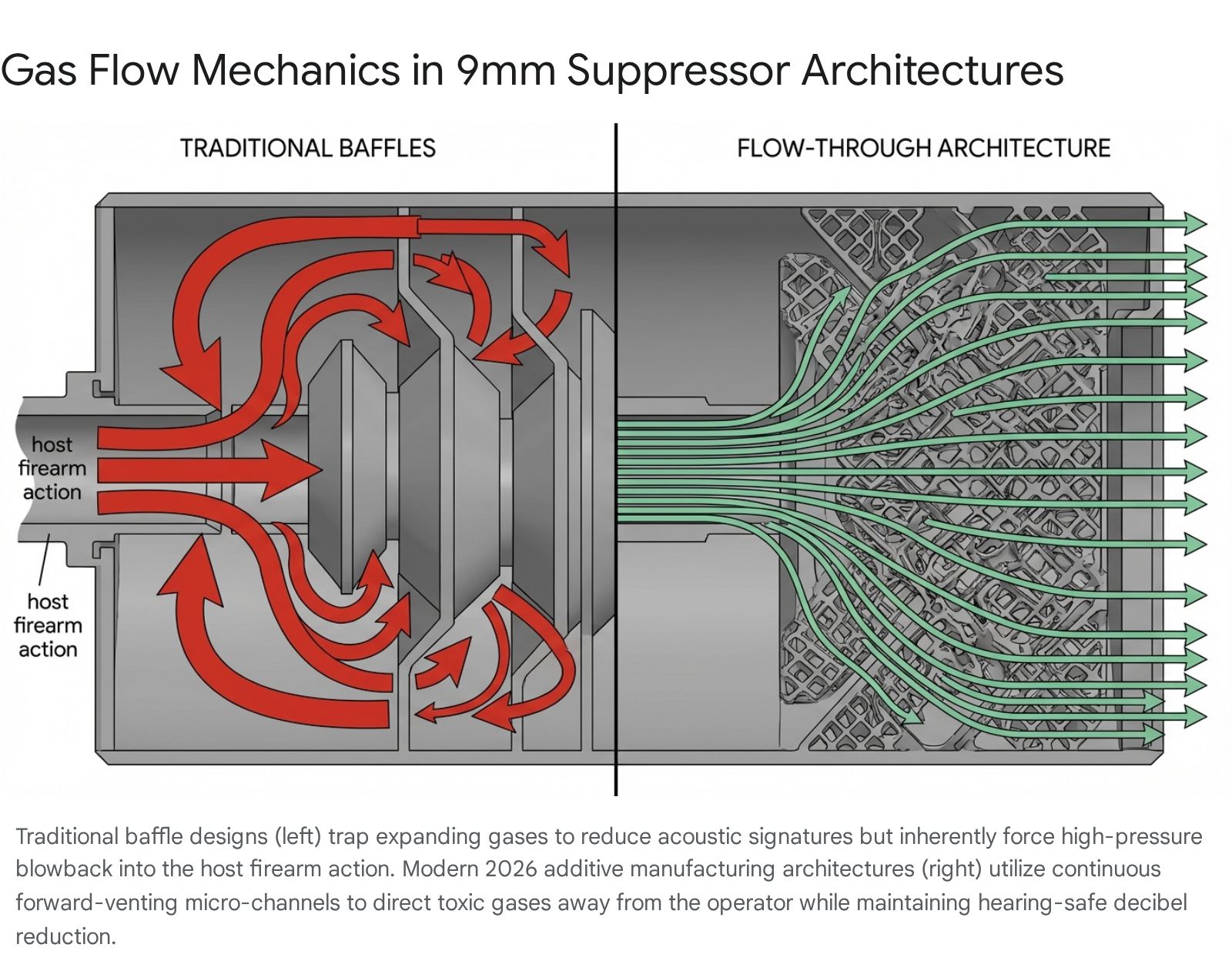
When a traditional baffle-stack suppressor is attached to the muzzle of an 11.5-inch barrel, it acts as a secondary expansion chamber that restricts the immediate atmospheric exit of combustion gases.18 This mechanical restriction creates a high-pressure bottleneck, fundamentally altering the flow dynamics of the weapon.14
2.1 The Over-Gassing Phenomenon and Dwell Time Artificiality
The physics of this phenomenon can be modeled through the Ideal Gas Law (Pressure * Volume = Number of Moles * Gas Constant * Temperature). By constraining the volume through which the rapidly expanding gas can immediately escape, the suppressor elevates the pressure curve across the entire timeline of the firing cycle.10 Because the gas cannot efficiently exit the muzzle, it seeks the path of least resistance, which in an autoloading AR-15 platform is back through the bore and the gas system.14
This dynamic effectively “tricks” the weapon into behaving as if it possesses a significantly longer barrel, artificially extending the dwell time.10 In a DI system, this means that high-pressure gas continues to flow down the gas tube and into the bolt carrier for a longer duration than the system was designed to accommodate.10 This over-pressurization delivers excess kinetic energy to the operating system, a condition universally referred to as being “over-gassed”.8 Furthermore, testing indicates that the addition of a suppressor generally increases the muzzle velocity of the projectile by 10 to 60 feet per second, further evidencing the extended duration of high-pressure influence on the system.22
2.2 Bolt Carrier Velocity Differentials
The most critical kinematic metric affected by this suppressor-induced backpressure is the rearward velocity of the Bolt Carrier Group. The velocity of the reciprocating mass dictates the timing of the extraction, the force of the recoil impulse, and the terminal velocity at which the buffer strikes the rear of the receiver extension.
In a properly gassed, unsuppressed 11.5-inch DI rifle utilizing standard 55-grain ammunition (M193), the BCG cycles at a controlled, engineered velocity of approximately 15 to 16 feet per second. This speed provides adequate inertial force to extract the spent casing, compress the buffer spring, and reliably strip a new round from the magazine during the forward stroke, without inducing violent impacts or “bolt bounce.”
When a standard, high-backpressure suppressor is introduced to the DI system without modifying the gas port diameter or increasing the buffer mass, the increased gas volume drives the BCG rearward at radically accelerated velocities, frequently approaching or exceeding 23 to 24 feet per second.24 To understand the destructive potential of this increase, one must apply the standard kinetic energy equation (Kinetic Energy = 0.5 * Mass * Velocity Squared). Because velocity is squared in the calculation, a seemingly moderate 40 percent increase in BCG velocity results in a near 100 percent increase in the kinetic energy battering the internal components.25 This translates into a harsh, jarring recoil impulse for the operator, often accompanied by noxious gas escaping from the charging handle gap directly into the shooter’s visual field.10
In a short-stroke piston system, the suppressor still elevates bore pressure, but the kinematic impact on the BCG can be managed through mechanical intervention.26 While an unregulated piston system will also experience a spike in bolt carrier velocity due to the harder impact of the operating rod, nearly all modern short-stroke piston rifles targeted at the tactical and defense markets incorporate user-adjustable gas blocks (gas regulators).14 By switching the manual regulator to a “suppressed” or “restrictive” setting, or by utilizing an automated bleed-off valve, the operator mechanically limits the volume of gas permitted to act upon the piston face.14 This mechanical restriction allows the piston-driven BCG to maintain a normalized rearward velocity of 16 to 17 feet per second, effectively neutralizing the kinematic over-drive inherent to suppressed firing.28
2.3 Early Unlocking and Extraction Stress
The accelerated BCG velocity in an over-gassed DI system leads to a severe timing failure known as premature unlocking. In a mathematically perfect cycle, the bullet exits the muzzle, residual chamber pressure drops to a safe level, and the bolt carrier begins its rearward stroke, rotating the bolt to extract the brass casing.15
Under kinematic over-drive caused by suppressor backpressure, the bolt carrier moves rearward so rapidly that the cam pin forces the bolt to rotate and pull rearward while chamber pressures are still immensely high.29 The brass casing, which expands outward to seal the chamber during firing (obduration), is still pressure-locked against the chamber walls.29 The extractor claw must rip the casing out against this immense friction.29 This kinematic conflict places severe shear stress on the extractor claw, stretches the extractor spring beyond its normal operational limits, and forces the cam pin to grind aggressively against the cam path of the upper receiver.29 Over thousands of rounds, this results in catastrophic failures to extract, where the extractor slips off the rim of the casing, leaving the spent brass hopelessly lodged in the chamber.29
2.4 Mitigation Strategies for DI Kinematics
To combat these kinematic issues in DI rifles, armorers and tier-2 manufacturers employ several compensatory strategies. The most common is the manipulation of reciprocating mass and spring tension.21 By upgrading the standard 3.0-ounce carbine buffer to heavier H2 (4.6-ounce) or H3 (5.4-ounce) buffers, and installing high-tension buffer springs (e.g., Sprinco Blue or Red springs, which offer 15% to 25% more resistance), the system’s inertia is artificially increased.21 This added mass requires more kinetic energy to move, successfully slowing the BCG velocity down to acceptable limits.21 Additionally, the utilization of flow-through suppressors (low-backpressure designs) or mechanically adjustable gas blocks can restrict the gas flow at the source, preventing the over-drive condition entirely.25
3.0 Thermodynamic Analysis: Heat-Soak During Sustained Fire
Sustained automatic or rapid semi-automatic fire generates extreme thermal loads within any firearm. The combustion of 5.56x45mm nitrocellulose propellant reaches core temperatures exceeding 3,000 degrees Fahrenheit, rapidly transferring thermal energy into the barrel steel through both friction and conductive heat.34 The addition of a suppressor compounds this issue by acting as a thermal trap at the muzzle.35
Because suppressors are designed to capture and slow down expanding gases, the heat of the gas is transferred directly into the suppressor baffles and outer tube.35 Empirical testing demonstrates that a suppressor can escalate in temperature at a rate of 7 to 10 degrees Fahrenheit for every single round fired.34 During a rapid 500-round firing schedule, it is entirely expected for a suppressor to reach external temperatures of 1,000 degrees Fahrenheit, emitting severe thermal mirage and presenting a critical burn hazard to the operator.34
3.1 DI Thermal Routing: The Internal Heat Sink
While barrel and suppressor heating is universal to all platforms, the routing of that thermal energy dictates the survivability of the internal components. In the Direct Impingement system, the very gas routed back to unlock the bolt brings this extreme thermal energy directly into the geometric center of the upper receiver.18
During a 500-round suppressed schedule, the continuous injection of hot, unburnt powder, vaporized heavy metals, and expanding gases into the BCG creates a severe heat-soak condition.18 The bolt carrier group in an aggressively suppressed DI rifle can rapidly exceed 400 degrees Fahrenheit, approaching 500 degrees Fahrenheit under continuous sustained load.36
This extreme temperature forces a phase change in standard liquid hydrocarbon lubricants.39 As the BCG temperature breaches the flash point of the lubricant, the oil will smoke, boil off, or carbonize into rigid deposits.39 The combination of extreme heat and baked-on carbon particulate transforms the internal surface of the bolt carrier from a lubricated pneumatic cylinder into a dry, highly abrasive friction chamber.36 This lack of lubricity further increases friction, which in turn generates more heat, creating a destructive, self-sustaining thermal loop.
3.2 Piston Thermal Routing: Forward Venting
The fundamental and arguably most valuable advantage of the short-stroke piston system in a suppressed role is thermodynamic isolation.2 Because the high-pressure gas expands against the piston face inside the forward gas block, the residual heat and carbon particulate are vented into the atmosphere beneath the handguard, inches away from the receiver.14
While the forward physical structure of the piston rifle—specifically the gas block, piston cylinder, and the front segments of the aluminum handguard—absorbs significant thermal radiation, often making it uncomfortably hot for the operator’s support hand without protective equipment, the internal receiver and the BCG are entirely spared.42
During the identical 500-round suppressed schedule, a short-stroke piston BCG will operate largely through ambient conductive heat transfer from the chamber and mechanical friction.41 The piston BCG rarely exceeds 150 to 200 degrees Fahrenheit.41 Because the operating temperature remains well below the degradation threshold of modern firearm lubricants, the internal environment remains wet and relatively clean.43 The liquid lubricant maintains its intended viscosity and protective hydrodynamic boundary layer, drastically reducing metal-on-metal wear.
3.3 Quantitative Projection: 500-Round Schedule
To accurately visualize the compounding, simultaneous effects of suppressed fire, the following data synthesis represents the operational divergence between a traditional Direct Impingement system (untuned, utilizing standard buffer weights) and a Short-Stroke Piston system (tuned to a suppressed gas setting) over a rapid 500-round firing schedule.
| Round Count | DI BCG Temp (°F) | Piston BCG Temp (°F) | DI BCG Velocity (FPS) | Piston BCG Velocity (FPS) |
| 0 | 75 | 75 | 23.5 | 16.5 |
| 100 | 210 | 95 | 23.6 | 16.5 |
| 200 | 340 | 115 | 23.8 | 16.6 |
| 300 | 420 | 130 | 23.9 | 16.6 |
| 400 | 475 | 145 | 24.1 | 16.7 |
| 500 | 510 | 160 | 24.2 | 16.7 |
4.0 Material Degradation and Mean Time Between Failures (MTBF)
The intersection of extreme heat and aggressive kinematics directly impacts the metallurgy and structural integrity of the internal components. Mean Time Between Failures (MTBF) provides a statistical probability of component failure, serving as a critical metric for supply chain management, armorer logistics, and total lifecycle cost calculations.44
In evaluating the 11.5-inch suppressed platform, three specific components within the bolt carrier group act as the primary failure points: the extractor spring, the gas rings, and the cam pin. The longevity of these components dictates the operational availability of the weapon system.
4.1 Extractor Springs: Tension Loss and Thermal Fatigue
The extractor is a precision-machined tool-steel claw (often manufactured from 4140, 4340, or S7 tool steel) that physically grips the rim of the 5.56x45mm casing, pulling it from the chamber as the bolt carrier moves rearward.29 The grip strength of this claw is not static; it is entirely dependent on the compressive upward force of the extractor spring located beneath it.29
In an unsuppressed, cleanly operating environment, a standard 4-coil music wire spring provides adequate tension. However, the suppressed 11.5-inch DI rifle introduces two severe environmental variables that actively destroy the spring. First, the kinematic over-drive (BCG velocities exceeding 23 fps) attempts to extract the casing while it is still expanded and obdurated against the chamber wall.29 This requires immense holding force to prevent the extractor from slipping off the brass rim (resulting in a failure to extract).31
Second, the thermal heat-soak generated by the DI system (exceeding 400 degrees Fahrenheit) actively degrades the temper of the spring steel. As the spring gets hot, it undergoes thermal relaxation, losing its kinetic resistance and coefficient of stiffness.29 To counter this, manufacturers routinely upgrade DI bolts with 5-coil Chrome Silicon (CS) springs, synthetic elastomer O-rings, and heavy polymer inserts to artificially boost tension.29 Despite these advanced material science improvements, the MTBF for an extractor spring in a dedicated suppressed DI 11.5-inch rifle remains critically low, typically degrading beyond functional utility around 2,000 to 2,500 rounds.47
In a mechanically regulated short-stroke piston system, the BCG velocity remains normalized. This ensures the extractor pulls the casing at the mathematically correct point in the pressure curve, encountering only nominal friction.1 Furthermore, because the piston BCG operates well below 200 degrees Fahrenheit, the extractor spring does not suffer thermal relaxation.43 Consequently, the MTBF for a piston extractor spring is significantly higher, regularly surviving past 5,000 to 7,500 rounds before prophylactic armorer replacement is required.50
4.2 Gas Rings: Abrasive Wear and Carbon Accumulation
In the standard DI system, three split-gap metallic gas rings are seated on the tail portion of the bolt.51 These rings act exactly like the piston rings in a high-performance internal combustion engine; they expand outward against the inner wall of the bolt carrier to create a semi-permeable seal, allowing the expanding gas to push the carrier rearward.12
Under sustained suppressed fire, the DI gas rings are subjected to a brutal operating environment. The gas entering the carrier via the gas key is heavily saturated with unburnt carbon particulate.36 As the extreme operating temperatures flash off the liquid lubricant, this carbon rapidly bakes onto the inner walls of the carrier.36 The gas rings are subsequently forced to scrape against this hardened, abrasive carbon matrix at high reciprocating velocities.53
This continuous physical abrasion rapidly degrades the outer diameter of the rings, destroying the critical gas seal.54 A failure of the gas seal results in “short-stroking,” where the weapon lacks the pneumatic power to fully cycle the action, resulting in failures to feed or failures to eject.56 In a suppressed DI platform, gas ring MTBF is notably compressed, often failing the standard armorer “stand-up test” (where the bolt must support the weight of the carrier via the friction of the rings) between 3,000 and 4,000 rounds.55
The short-stroke piston system completely neutralizes this failure mode. Because the gas is intercepted at the gas block, the bolt does not act as a pneumatic piston.2 Many piston-specific BCGs entirely omit gas rings, or utilize a single helical dummy ring merely to center the bolt within the carrier to prevent wobble.59 Because there is no internal gas expansion required to cycle the weapon, the concept of a gas seal failure inside the BCG is mathematically eliminated. This specific engineering change extends the MTBF of the bolt tail interface indefinitely relative to the lifespan of the rifle.50
4.3 Cam Pins: Shear Stress and Track Deformation
The cam pin is a hardened steel cylinder (often manufactured from 8740 steel) that passes horizontally through the bolt carrier and directly into the bolt, moving along a precisely machined helical track cut into the side of the carrier.16 As the bolt carrier moves rearward, the cam pin is forced along this track, converting the linear motion of the carrier into rotational motion, twisting the bolt lugs out of battery with the barrel extension.14
When an 11.5-inch DI rifle is suppressed and over-gassed, the carrier is blasted backward with extreme violence.30 Because the chamber pressure has not safely dissipated, the bolt lugs are pinned against the barrel extension by tens of thousands of pounds of pressure per square inch. The carrier essentially attempts to violently yank the cam pin through its helical track while the bolt is physically immobilized.16 This dynamic results in massive shear stress focused directly on the cam pin shaft and the sharp edges of the carrier cam path.64
Over successive cycles, this intense kinetic battering leads to metallurgical fatigue, galling of the cam path, and physical gouging of the upper receiver housing (as the cam pin head slams into the aluminum receiver wall).66 While a standard Mil-Spec cam pin might easily survive 10,000 rounds in a 16-inch mid-length, unsuppressed rifle, the MTBF in a suppressed 11.5-inch DI configuration drops dramatically, often exhibiting severe cracking or structural deformation by 4,000 to 5,000 rounds.30
The mechanically regulated short-stroke piston system limits bolt carrier velocity, ensuring that unlocking occurs marginally later in the pressure curve when residual chamber pressure has safely vented out of the muzzle.1 While the piston operating rod does strike the carrier anvil abruptly—which can induce a different kinetic stress known as “carrier tilt,” where the rear of the carrier is pushed downward into the receiver extension tube—the actual rotation of the cam pin occurs under far less resistance.50 To further mitigate friction, advanced piston manufacturers frequently utilize proprietary roller-cam pins.50 Consequently, the MTBF for a cam pin in a tuned piston system generally exceeds 7,000 to 10,000 rounds.50
4.4 MTBF Comparative Projections
The following table synthesizes the empirical wear patterns, armorer replacement schedules, and physical limitations into a projected MTBF framework for the 11.5-inch suppressed platform.
| Component | Direct Impingement (Suppressed) MTBF | Short-Stroke Piston (Suppressed) MTBF | Primary Failure Mechanism (DI) |
| Extractor Spring | 2,000 – 2,500 Rounds | 5,000 – 7,500 Rounds | Thermal relaxation, high extraction velocity |
| Gas Rings | 3,000 – 4,000 Rounds | N/A (Non-critical/Omitted) | Abrasive carbon friction, thermal degradation |
| Cam Pin | 4,000 – 5,000 Rounds | 7,000 – 10,000+ Rounds | High-pressure unlocking shear stress |
5.0 Supply Chain, Procurement, and Manufacturing Implications
While the engineering and operational metrics heavily favor the short-stroke piston system for dedicated suppressed fire, the overarching viability of the platform must be evaluated through the macro-economic lens of supply chain logistics, manufacturing complexity, and fleet economics. This represents the critical friction point for defense contractors, military procurement officers, and Tier-2 manufacturers attempting to navigate the small arms market.
5.1 Supply Chain Ubiquity vs. Proprietary Vendor Lock-In
The Direct Impingement AR-15 architecture is arguably the most heavily commoditized and standardized weapon design in the modern world.12 The Technical Data Package (TDP) for Mil-Spec DI components is essentially open-source and universally accepted across the defense industry.13 A broken cam pin, a degraded set of gas rings, or a fractured extractor in a DI rifle can be sourced from hundreds of independent, Tier-2 manufacturing facilities simultaneously.12 This intense standardization allows institutional buyers and logistics officers to acquire vast stockpiles of spare parts for pennies on the dollar, ensuring a highly resilient and deeply redundant supply chain.12
Conversely, there is no standardized Technical Data Package for the AR-15 short-stroke gas piston system.14 Every major piston manufacturer—from Heckler & Koch and SIG Sauer to PWS, Adams Arms, and LMT—utilizes highly proprietary geometries for their gas blocks, operating rods, bolt carriers, and return springs.49 If a piston operating rod bends, or if the proprietary carrier key shears during a deployment, the end-user cannot source a replacement from a generic national stock number (NSN) supplier.14 They are locked into a single-source OEM supply chain.49 For large-scale military or law enforcement adoption, vendor lock-in represents a critical logistical vulnerability. If the primary manufacturer experiences a supply chain disruption, raw material shortage, or bankruptcy, the fleet of rifles risks total operational failure.
5.2 Manufacturing Complexity and Lifecycle Economics
From a manufacturing perspective, the DI system represents the apex of cost-efficiency and lean production.13 The gas block is a simple, static steel manifold with no moving parts, and the gas tube is a low-cost segment of drawn stainless steel.14 The BCG, while requiring precision machining and specific alloys (such as Carpenter 158 or 9310 steel for the bolt), has been optimized for rapid mass production over six decades.71
The short-stroke piston system introduces highly complex moving parts that must survive directly adjacent to the intense heat and pressure of the barrel port.1 Manufacturing the variable gas regulator, the piston cup, the operating rod, and the specialized anti-tilt bolt carrier requires exotic, heat-resistant alloys, intricate machining processes, and incredibly tight tolerances.14 This fundamentally elevates the base unit cost (Capital Expenditure) of a piston rifle compared to a DI equivalent.12
Therefore, the Total Cost of Ownership (TCO) calculation becomes a paradox for procurement officers. The DI system requires cheaper upfront manufacturing and leverages cheap, universal spare parts, but requires vast quantities of those parts and intensive armorer man-hours to keep the rifles running under suppressed conditions. The Piston system boasts a high initial capital expenditure and sole-source logistical risk, but effectively halts internal weapon degradation, requiring minimal armorer intervention and drastically extending the lifecycle of the internal components.2
5.3 Opportunities for Tier-2 Manufacturing Innovation
This dichotomy presents significant market opportunities for Tier-2 manufacturers seeking to capture value without producing entirely proprietary systems. The industry has seen a surge in components designed specifically to bridge the gap between DI standardization and Piston-like reliability under suppressed conditions.
- Adjustable and Down-Venting BCGs: Manufacturers are producing drop-in DI bolt carriers with integrated gas-venting ports or adjustable mechanical valves (e.g., Bootleg or KAK Industry) that bleed off excess suppressor pressure before it unlocks the bolt, lowering BCG velocity while utilizing standard DI gas tubes.73
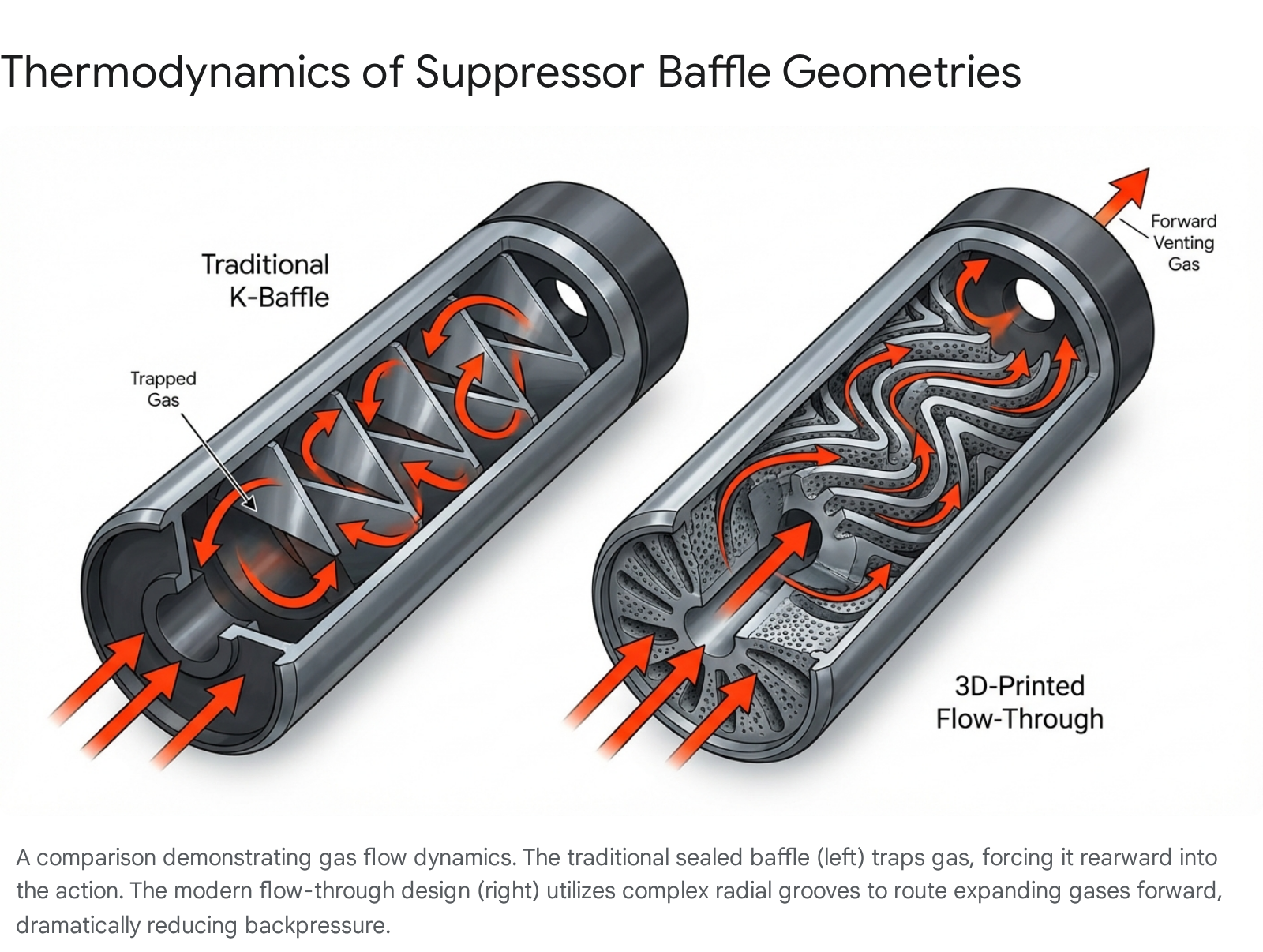
- Flow-Through Suppressor Technology: Rather than altering the rifle, manufacturers (such as HUXWRX and CAT) are producing suppressors utilizing 3D-printed, complex internal geometries that route gas forward rather than backward.25 These “low-backpressure” designs allow a standard, universally parts-compatible DI rifle to operate at normal kinematic velocities without thermal heat-soak.77
- Enhanced Metallurgy: Producing upgraded DI components—such as bolts forged from S7 tool steel, 5-coil Chrome Silicon extractor springs, and enhanced cam paths—will remain a highly lucrative continuous revenue stream, as the millions of legacy DI rifles currently in service will perpetually require maintenance.29
6.0 Strategic Conclusions and Industry Recommendations
The rigorous analysis of the 11.5-inch 5.56x45mm tactical rifle operating under a sustained suppressed firing schedule yields several definitive conclusions regarding system architecture, mechanical limits, and supply chain strategy.
The introduction of traditional baffle-stack suppressor technology initiates a cascade of thermodynamic and kinematic penalties. In the legacy Direct Impingement system, this backpressure transforms the bolt carrier group into a high-friction, high-temperature heat sink. The subsequent thermal relaxation of spring steels and the abrasive erosion of the gas rings compress the MTBF of critical components to tactically concerning levels. The DI weapon will continue to function reliably only if supported by an aggressive, proactive preventative maintenance schedule and a robust supply of universal replacement parts.
The short-stroke gas piston architecture presents a profound engineering remedy to these operational symptoms. By isolating the thermal payload at the gas block and mechanically regulating the kinetic transfer to the bolt carrier, the piston system ensures the internal receiver operates in a cool, clean environment. This virtually eliminates the premature failure of the extractor spring, gas rings, and cam pin, drastically lowering the Mean Time To Repair (MTTR).
However, the superiority of the piston system’s mechanical endurance must be weighed against its logistical fragility. The lack of cross-industry standardization and reliance on proprietary OEM components introduces severe supply chain vulnerabilities that must be factored into any fleet-wide adoption strategy.
Recommendations for Defense and Manufacturing Sectors:
- For Institutional Procurement: Entities demanding high-volume suppressed fire without the capability for frequent, deep-echelon armorer-level maintenance should heavily prioritize short-stroke piston architectures, provided they can secure long-term, contractually binding spares agreements with the OEM to mitigate vendor lock-in risks.
- For Tier-2 Manufacturers: There is an expansive, untapped market opportunity in bridging the gap between these systems. Manufacturing and patenting flow-through (low-backpressure) suppressor designs that mitigate kinematic over-drive on legacy DI systems will capture institutional buyers who refuse to abandon the highly standardized DI supply chain. Furthermore, optimizing DI components with advanced aerospace alloys and engineered spring steels to resist thermal degradation represents a high-margin growth sector in the defense market.
Appendix: Methodology
To derive the findings within this report, analytical proxy models and thermodynamic projections were constructed utilizing aggregated open-source technical specifications, armorer technical manuals, and defense acquisition testing documentation.
Data Sources & Proxies:
- Kinematic Baselines: Bolt carrier velocity thresholds and gas port pressure data were established utilizing testing metrics derived from Naval Surface Warfare Center (NSWC) Crane Division testing protocols, specifically referencing the Suppressed Upper Receiver Group (SURG) programmatic parameters, mid-length/carbine gas testing matrixes, and Silencer Syndicate backpressure datasets.3
- Thermal Profiling: Temperature estimates and heat-soak escalation rates were calculated utilizing baseline industry data regarding 5.56x45mm combustion temperatures, standard silencer heat retention rates (7 to 10 degrees Fahrenheit per round), and thermodynamic conductivity comparisons between steel operating groups and aluminum receivers.34
- MTBF Projections: Failure modalities and cycle limits for extractor springs, gas rings, and cam pins were formulated by analyzing documented armorer replacement schedules, high-round-count evaluations, and known metallurgical degradation points of carbon and tool steels (e.g., thermal relaxation points of music wire versus Chrome Silicon).29
The synthesis of these data points provides a macro-level predictive model of weapon system behavior under austere operational limits, designed expressly for structural comparison, engineering optimization, and enterprise logistics planning.
Need a deeper dive into your supply chain vulnerabilities, process-optimization, or a market analysis? Contact Ronin’s Grips Analytics for commissioned reporting and B2B consulting.
Please share the link on Facebook, Forums, with colleagues, etc. Your support is much appreciated and if you have any feedback, please email us in**@*********ps.com. If you’d like to request a report or order a reprint, please click here for the corresponding page to open in new tab.
Sources Used
- Direct Gas Impingement vs. Gas Piston-Driven AR-15s – Guns.com, accessed February 25, 2026, https://www.guns.com/news/direct-gas-impingement-vs-gas-piston-driven-ar-15s
- Hk416 Vs M4: Decoding the Modern Carbine Showdown – Saint Augustines University, accessed February 25, 2026, https://explore.st-aug.edu/exp/hk416-vs-m4-decoding-the-modern-carbine-showdown
- NSWC-Crane Mid-Length Gas System Testing Shows Increased Performance & Service Life For M4 Carbines, accessed February 25, 2026, https://soldiersystems.net/2018/05/14/nswc-crane-carbine-mid-length-gas-system-testing-shows-increased-performance/
- HK416 vs. MK18/M4A1 SOPMOD: Why SOCOM uses 2 different guns? – Reddit, accessed February 25, 2026, https://www.reddit.com/r/WarCollege/comments/g06nhz/hk416_vs_mk18m4a1_sopmod_why_socom_uses_2/
- Small Arms Signature: FY2024, accessed February 25, 2026, https://ndia.dtic.mil/wp-content/uploads/2024/future/Thurs_Flemming.pdf
- Thoughts on 10.5” vs 11.5” do it all suppressor host? : r/ar15 – Reddit, accessed February 25, 2026, https://www.reddit.com/r/ar15/comments/qr54hf/thoughts_on_105_vs_115_do_it_all_suppressor_host/
- Suggestions for SBR barrlel length and why? | Sniper’s Hide Forum, accessed February 25, 2026, https://www.snipershide.com/shooting/threads/suggestions-for-sbr-barrlel-length-and-why.6909177/
- Why Your AR-15 Won’t Cycle – red leg guns, accessed February 25, 2026, https://www.redlegguns.com/post/why-your-ar-wont-cycle-and-what-to-do-about-it
- What is the relationship between dwell time and suppression? : r/NFA – Reddit, accessed February 25, 2026, https://www.reddit.com/r/NFA/comments/haj9m6/what_is_the_relationship_between_dwell_time_and/
- Suppressed shooting for a noob- need resources : r/suppressors – Reddit, accessed February 25, 2026, https://www.reddit.com/r/suppressors/comments/1hp58ya/suppressed_shooting_for_a_noob_need_resources/
- Smyth Busters: The AR-15, Direct Impingement or Piston Operated? – YouTube, accessed February 25, 2026, https://www.youtube.com/watch?v=V_Nz_PL-cXM
- Direct impingement vs gas piston. Worth worrying about or nah? – Reddit, accessed February 25, 2026, https://www.reddit.com/r/liberalgunowners/comments/1ln1y10/direct_impingement_vs_gas_piston_worth_worrying/
- Direct Impingement vs Gas Piston AR‑15: Pros and Cons | Mid State Firearms, accessed February 25, 2026, https://midstatefirearms.com/piston-driven-ar15-or-direct-impingement-key-differences/
- Direct Impingement vs. Gas Piston | Operating System Guide – Accurate Firearms, accessed February 25, 2026, https://www.usarmsco.com/direct-impingement-vs-gas-piston/
- Direct Impingement vs Gas Piston AR-15 – AmmoMan School of Guns Blog, accessed February 25, 2026, https://www.ammoman.com/blog/direct-impingement-vs-gas-piston/
- Build an AR-15: Direct Impingement or Piston Operation? – GunsAmerica, accessed February 25, 2026, https://gunsamerica.com/digest/build-an-ar-direct-impingement-or-piston-operation/
- Direct Impingement vs. Gas Piston: Settling the Debate – Silencer Central, accessed February 25, 2026, https://www.silencercentral.com/blog/direct-impingement-vs-piston/
- Piston AR-15 For Suppressor Use – Gorilla Machining, accessed February 25, 2026, https://www.gorillamachining.com/piston-ar-15-for-suppressor-use
- Whisper or Roar? Exploring the Advantages and Disadvantages of AR-15 Suppressed and Unsuppressed Firearms – KAK Industry, accessed February 25, 2026, https://blog.kakindustry.com/ar-15-suppressed-vs-unsuppressed-firearms/
- Dwell Time – Para Bellum Arms, accessed February 25, 2026, https://pb-arms.com/para-bellum-university/operating-system/barrel-deep-dive/dwell-time/
- Tuning My 11.5″ BCM SBR for Suppressed Perfection: H2 Buffer & SprinCo Blue – YouTube, accessed February 25, 2026, https://www.youtube.com/watch?v=B5-WLxPAMrI
- Do Suppressors Increase Velocity? – Silencer Shop, accessed February 25, 2026, https://www.silencershop.com/blog/do-suppressors-increase-velocity
- Suppressors affecting velocity | thefirearmblog.com, accessed February 25, 2026, https://www.thefirearmblog.com/blog/2015/11/16/suppressors-affecting-velocity/
- Silencer Review: Gemtech G5-T 5.56mm Suppressor and Suppressed Bolt Carrier, accessed February 25, 2026, https://gunsamerica.com/digest/silencer-review-gemtech-g5-t-5-56mm-suppressor-2/
- Low Back Pressure Suppressors – Do They Really Make A Difference? | thefirearmblog.com, accessed February 25, 2026, https://www.thefirearmblog.com/blog/low-back-pressure-suppressors-do-they-really-make-a-difference-44817520
- Best AR-15 Piston Uppers & Conversion Kits – Pew Pew Tactical, accessed February 25, 2026, https://www.pewpewtactical.com/best-ar-15-piston-uppers-conversion-kits/
- Pros and Cons for suppressing a short stroke piston ? : r/suppressors – Reddit, accessed February 25, 2026, https://www.reddit.com/r/suppressors/comments/1f4n05m/pros_and_cons_for_suppressing_a_short_stroke/
- The best way to fix Back-Pressure on Suppressed AR-15s — Superlative Arms Adjustable Piston Review – YouTube, accessed February 25, 2026, https://www.youtube.com/watch?v=1RxviGw2WmQ
- AR-15 Extraction and Ejection Tips and Tricks – BRD Gun Works, accessed February 25, 2026, https://brdgunworks.com/2021/02/08/ar-15-extraction-and-ejection-tips-and-tricks/
- Bolt wear normal : r/ar15 – Reddit, accessed February 25, 2026, https://www.reddit.com/r/ar15/comments/1h6mjyf/bolt_wear_normal/
- Ar-15 Extractor Tension – Rifle – Technical – Enos Forums, accessed February 25, 2026, https://forums.brianenos.com/topic/34539-ar-15-extractor-tension/
- 11.5 5.56 (suppressed), how is the recoil ? : r/ar15 – Reddit, accessed February 25, 2026, https://www.reddit.com/r/ar15/comments/1r3lq0p/115_556_suppressed_how_is_the_recoil/
- Essential AR-15 Upgrades for Suppressor Use: Maximize Performance and Reduce Noise, accessed February 25, 2026, https://www.at3tactical.com/blogs/news/essential-ar-15-upgrades-for-suppressor-use-maximize-performance-and-reduce-noise
- Suppressor Temperature: How Hot Do They Get? – Silencer Central, accessed February 25, 2026, https://www.silencercentral.com/blog/suppressor-temperature-how-hot-do-they-get/
- Suppressor Heat Management: What Happens After 50/100/200 Rounds?, accessed February 25, 2026, https://blog.primaryarms.com/guide/suppressor-heat-management/
- Gas Vs. Piston – GUNS Magazine, accessed February 25, 2026, https://gunsmagazine.com/guns/rifles/gas-vs-piston-2/
- Suppressors – Done it all, AR still filthy when suppressed | Sniper’s Hide Forum, accessed February 25, 2026, https://www.snipershide.com/shooting/threads/done-it-all-ar-still-filthy-when-suppressed.6898954/
- Piston vs DI Dilemma: “The AR-15 Gas Choice” by Nutnfancy – YouTube, accessed February 25, 2026, https://www.youtube.com/watch?v=6auXTiqNtEo
- Gassed out when shooting suppressed : r/AUG – Reddit, accessed February 25, 2026, https://www.reddit.com/r/AUG/comments/1ehmctr/gassed_out_when_shooting_suppressed/
- Suppressor = Filthy failing AR-15 | Sniper’s Hide Forum, accessed February 25, 2026, https://www.snipershide.com/shooting/threads/suppressor-filthy-failing-ar-15.6875487/
- DI vs Piston AR: Why I Choose DI Every Time – Mitchell Defense, accessed February 25, 2026, https://www.mitchelldefense.com/di-vs-piston/
- DI vs Short Stroke Gas Piston – Thermal Analysis : r/Firearms – Reddit, accessed February 25, 2026, https://www.reddit.com/r/Firearms/comments/goyw2y/di_vs_short_stroke_gas_piston_thermal_analysis/
- Adams Arms Piston Versus Direct Impingement Thermal Comparison – YouTube, accessed February 25, 2026, https://www.youtube.com/watch?v=8-6KCrNmGp4
- Guns & Ammo – Complete Book of The AK47 | PDF – Scribd, accessed February 25, 2026, https://www.scribd.com/document/500527636/Guns-Ammo-Complete-Book-of-the-AK47
- Digital Actuator Technology – OSTI.GOV, accessed February 25, 2026, https://www.osti.gov/servlets/purl/1166051
- 11.5” failure to extract issue : r/ar15 – Reddit, accessed February 25, 2026, https://www.reddit.com/r/ar15/comments/1czc56w/115_failure_to_extract_issue/
- 11.5 lifespan suppressed : r/ar15 – Reddit, accessed February 25, 2026, https://www.reddit.com/r/ar15/comments/ou668c/115_lifespan_suppressed/
- Suppressing an AR – Wear/Tear? : r/NFA – Reddit, accessed February 25, 2026, https://www.reddit.com/r/NFA/comments/gv7g25/suppressing_an_ar_weartear/
- D.I. vs Piston : r/ar15 – Reddit, accessed February 25, 2026, https://www.reddit.com/r/ar15/comments/5l3tzj/di_vs_piston/
- Does anyone have any experience with the Superlative Arms piston kit? : r/ar15 – Reddit, accessed February 25, 2026, https://www.reddit.com/r/ar15/comments/1gzgq7b/does_anyone_have_any_experience_with_the/
- 5 Simple Checks to Keep Your AR-15 Running Smooth – YouTube, accessed February 25, 2026, https://www.youtube.com/watch?v=3aTlGoCZsto
- AR-15 Bolt Carrier Groups Explained: Key Functions and Design, accessed February 25, 2026, https://dirtybirdusa.com/ar-15-bolt-carrier-groups-explained/
- ar-15/m16 index – Brownells, accessed February 25, 2026, https://www.brownells.com/userdocs/Miscellaneous/catalog73/pdfs/73-AR-15-M16-P1-104.pdf
- Vol 1 PDF | PDF | Surface Roughness | Serbia – Scribd, accessed February 25, 2026, https://www.scribd.com/doc/165047220/vol-1-pdf
- AR-15 Maintenance Schedules and Guidelines – The Prepared, accessed February 25, 2026, https://theprepared.com/forum/thread/ar-15-maintenance-schedules-and-guidelines/
- The AR-15 Barrel Cheat Sheet: Everything You Need to Know, accessed February 25, 2026, https://www.everydaymarksman.co/equipment/ar-15-barrel-selection/
- AR-15 Misfiring: How to Safely Handle This Malfunction, accessed February 25, 2026, https://blog.primaryarms.com/guide/how-to-safely-handle-ar15-misfiring/
- BCG replacement suggestions : r/ar15 – Reddit, accessed February 25, 2026, https://www.reddit.com/r/ar15/comments/1p3mh80/bcg_replacement_suggestions/
- Griffin Enhanced Gas Pocket BCG, accessed February 25, 2026, https://griffinarmament.com/product/griffin-enhanced-gas-pocket-ar-15-bcg/
- Assuming both rifles fire the same cartridge, how does a piston driven AR compare to an AK? – Reddit, accessed February 25, 2026, https://www.reddit.com/r/armedsocialists/comments/18pjfnp/assuming_both_rifles_fire_the_same_cartridge_how/
- Springfield Armory’s Unique Hellion 5.56mm Bullpup Rifle – Firearms News, accessed February 25, 2026, https://www.firearmsnews.com/editorial/springfield-armory-556mm-hellion/462144
- AR 15 Parts Diagram | AR 15 Parts List – Black Rifle Depot, accessed February 25, 2026, https://blackrifledepot.com/ar-15-parts-diagram-ar-15-parts-list/
- DI VS PISTON : r/ar15 – Reddit, accessed February 25, 2026, https://www.reddit.com/r/ar15/comments/1i9zrbg/di_vs_piston/
- AR-15 Inspection: 15 Wear & Failure Points to Check | An Official Journal Of The NRA, accessed February 25, 2026, https://www.shootingillustrated.com/content/ar-15-inspection-15-wear-failure-points-to-check/
- SAINT-Manual.pdf – Springfield Armory, accessed February 25, 2026, https://www.springfield-armory.com/wp-content/uploads/SAINT-Manual.pdf
- DI vs Piston for .308 AR? | Sniper’s Hide Forum, accessed February 25, 2026, https://www.snipershide.com/shooting/threads/di-vs-piston-for-308-ar.64752/
- INTERVIEW WITH C. REED KNIGHT, JR.: PART 2 – Small Arms Review, accessed February 25, 2026, https://smallarmsreview.com/interview-with-c-reed-knight-jr-part-2/
- bolt-and-carrier-parts, Marketing Categories: gun-parts – Primary Arms, accessed February 25, 2026, https://www.primaryarms.com/2/bolt-and-carrier-parts/marketing-categories/gun-parts
- Posts Tagged ‘NSWC-Crane’ – Soldier Systems, accessed February 25, 2026, https://soldiersystems.net/tag/nswc-crane/
- DI vs. Piston : r/ar15 – Reddit, accessed February 25, 2026, https://www.reddit.com/r/ar15/comments/58l02q/di_vs_piston/
- Understanding the M16 Bolt Carrier Group: The Heart of Your AR-15 – Dirty Bird Guns & Ammo, accessed February 25, 2026, https://dirtybirdusa.com/understanding-the-m16-bolt-carrier-group/
- AR-15 Technical Details: How to Read the Spec Sheet – Everyday Marksman, accessed February 25, 2026, https://www.everydaymarksman.co/equipment/ar-15-specs/
- Carbine vs Mid Length Gas System for Suppressed 11.5” : r/ar15 – Reddit, accessed February 25, 2026, https://www.reddit.com/r/ar15/comments/1fs7kri/carbine_vs_mid_length_gas_system_for_suppressed/
- Optimizing My BCM 11.5 SBR: Polonium 556 & Bootleg Adjustable BCG – YouTube, accessed February 25, 2026, https://www.youtube.com/watch?v=5cAsT2a52ok
- KAK Industry K-SPEC BCG makes your suppressed AR15 quieter : r/NFA – Reddit, accessed February 25, 2026, https://www.reddit.com/r/NFA/comments/161fkya/kak_industry_kspec_bcg_makes_your_suppressed_ar15/
- 5.56 AR-15 Silencer Backpressure Hazards Visualized : r/NFA – Reddit, accessed February 25, 2026, https://www.reddit.com/r/NFA/comments/1pd3y5v/556_ar15_silencer_backpressure_hazards_visualized/
- Agb and suppressors : r/NFA – Reddit, accessed February 25, 2026, https://www.reddit.com/r/NFA/comments/1cb4e1y/agb_and_suppressors/
- Ultra-Low Backpressure Suppressors: Complete Guide | Capitol Armory, accessed February 25, 2026, https://www.capitolarmory.com/articles/benefits-of-no-backpressure-suppressors-guide
- Suppressed Upper Receiver Group Testing Methods, accessed February 25, 2026, https://ndia.dtic.mil/wp-content/uploads/2017/armament/McGee19422.pdf
- Comprehensive Back Pressure Testing: Comparing 11.5″ and 16″ Rifles – Silencer Syndicate, accessed February 25, 2026, https://silencersyndicate.com/comprehensive-back-pressure-testing-comparing-11-5-and-16-rifles/
- Barrel Heating for Hot Gun Cook-Off Thermal Analysis, accessed February 25, 2026, https://ndia.dtic.mil/wp-content/uploads/2021/imem/Yagla.pdf