
1.0 Strategic Intelligence Overview
As of May 2026, the precision shooting community and the broader tactical firearms industry are undergoing a profound paradigm shift in optical system selection. Operating as a data-driven intelligence resource for the small arms and military equipment sectors, Ronin’s Grips Analytics has identified a definitive transition away from the high-magnification Low Power Variable Optic.1 For nearly a decade, the Low Power Variable Optic dominated the setup of the General Purpose Rifle. The industry witnessed a rapid, almost exponential escalation in magnification ratios, moving sequentially from early 1-4x systems to 1-6x, 1-8x, and eventually 1-10x models. The fundamental premise of this movement was to provide the end-user with a singular, unified optic capable of close-quarters speed at true 1x magnification alongside the magnification necessary for mid-range precision.
However, recent qualitative data and detailed discourse from leading platforms, particularly the May 2026 discussions on the Sniper’s Hide forum, indicate a definitive reversal of this historical trend.3 Analysts, professional end-users, and competitive shooters are collectively recognizing that the 1-10x Low Power Variable Optic represents a conglomeration of physical and optical compromises.3 In attempting to accomplish every possible task on the battlefield or the competition stage, the high-magnification 1-10x optic inherently fails to excel at anything. The strict physical constraints of a 24mm objective lens paired with a massive 10x erector assembly result in degraded light transmission, an uncomfortably tight eyebox, and severe limitations in Positive Target Identification at extended ranges.3
In direct response to these physical limitations, the industry is experiencing an aggressive resurgence of the Mid-Power Variable Optic, specifically models featuring 2-10x, 2-12x, or 3-18x magnification ranges.2 Modern Mid-Power Variable Optics bypass the severe optical compromises required to achieve a perfectly flat 1x image. By intentionally raising the floor of the magnification range to 2x or 2.5x, optical engineers are freed to integrate significantly larger objective lenses, typically 30mm or 42mm, and crucial side-focus parallax adjustments.6 To handle dynamic engagements inside of 50 yards, modern shooters are exclusively pairing these Mid-Power Variable Optics with piggybacked or 45-degree offset red dot sights.8
This comprehensive intelligence report will meticulously dissect the optical physics driving the abandonment of the 1-10x Low Power Variable Optic. It will deeply explore the tactical applications of the Mid-Power Variable Optic paired with offset red dots, analyze the substantial impact of modern thermal clip-on technology on optic selection, and provide an exhaustive technical review of the two flagship optics currently defining the 2026 landscape. These flagship models are the Nightforce NX6 2-12x42mm and the Leupold Mark 5HD 2-10x30mm.
2.0 The Operational Evolution of the General Purpose Rifle
To fully comprehend the transition away from the 1-10x optic, one must first examine the evolving definition and operational requirements of the General Purpose Rifle.4 The General Purpose Rifle is designed to be the primary weapon system for an individual operator, capable of handling the vast majority of engagement scenarios encountered in modern conflicts or practical shooting competitions. In previous decades, the ballistic limitations of standard 5.56 NATO ammunition dictated that engagements beyond 300 or 400 yards were relatively ineffective, making a low-magnification optic perfectly suitable.
Today, the operational landscape has fundamentally changed. The widespread proliferation of match-grade 77-grain 5.56 NATO ammunition, alongside highly efficient, flatter-shooting cartridges like the 6.5 Creedmoor and the 6mm ARC, have drastically extended the lethal, predictable range of the standard infantry or civilian carbine.3 Because the host rifle is now ballistically capable of highly precise strikes at 800 yards, the mounted optical system must match that exact capability.6
A standard 1-6x Low Power Variable Optic simply cannot provide the necessary magnification or the critical parallax adjustment required to read wind, spot bullet trace, and positively identify targets at 800 yards.6 While a 1-10x optic attempts to bridge this gap, the optical penalties incurred at maximum magnification render it suboptimal for dedicated long-range observation.3 The Mid-Power Variable Optic bridges this exact capability gap, transforming the General Purpose Rifle into a true multi-role weapon system. This setup achieves the capabilities of a dedicated sniper platform without the severe weight and length penalties associated with massive 5-25x precision optics.6
3.0 The May 2026 Optics Paradigm Shift
The shift toward the Mid-Power Variable Optic is currently documented as the most significant trend in the tactical optics market for the year 2026.2 The rifle optics market has finally caught up to a need that analysts and professional shooters have been highlighting for several years.2 For a long period, there was a major, distinct gap within the marketplace.2 Manufacturers focused entirely on pushing Low Power Variable Optics to their physical limits, or they built higher magnification optics like 3-15x and 2.5-15x that featured massive objectives and incredibly heavy, bulky designs aimed primarily at the crossover hunting or precision benchrest markets.2
The year 2026 officially marks the point where the Mid-Power Variable Optic has fully matured within the marketplace, offering end-users highly viable, purpose-built options.2 By definition within the modern context, a true Mid-Power Variable Optic must have a reticle that remains fully usable at its lowest magnification setting, usability with illumination is highly acceptable, but a design that functions without illumination is considered ideal.2 This specific category represents a natural, necessary progression from the Low Power Variable Optic.2 Shooters have discovered that while their beloved 1-8x or 1-10x optics are amazing feats of engineering in their own right, they struggle significantly with longer-range engagements and the strict requirements of target identification.2
4.0 Exhaustive Analysis of LPVO Optical Limitations
To rigorously understand why the tactical and precision shooting communities are abandoning the 1-10x configuration, one must evaluate the unyielding, mathematical laws of optical physics. The Low Power Variable Optic was originally conceived as a dedicated solution for urban combat environments and fast-paced 3-Gun competitions.4 In these specific arenas, targets are typically engaged at extremely close ranges, with only occasional shots extending out to 300 yards. The 1-6x optic remains highly regarded within this specific performance envelope because a 6x erector ratio does not drastically overburden the internal optical prescription.4 However, as market demand shifted toward engagements at 500, 600, and 800 yards, manufacturers forced the erector assemblies to reach 8x and 10x while artificially restricting the objective lens to the traditional 24mm size.4
4.1 The Exit Pupil Dilemma and Eyebox Fatigue
The core, inescapable failure of the 1-10x Low Power Variable Optic lies in the mathematical relationship between its magnification and its objective lens diameter. This exact relationship defines the exit pupil, which is the physical diameter of the column of light transmitted from the ocular lens directly to the shooter’s eye. The calculation is mathematically straightforward, the Objective Lens Diameter divided by the Magnification equals the Exit Pupil.
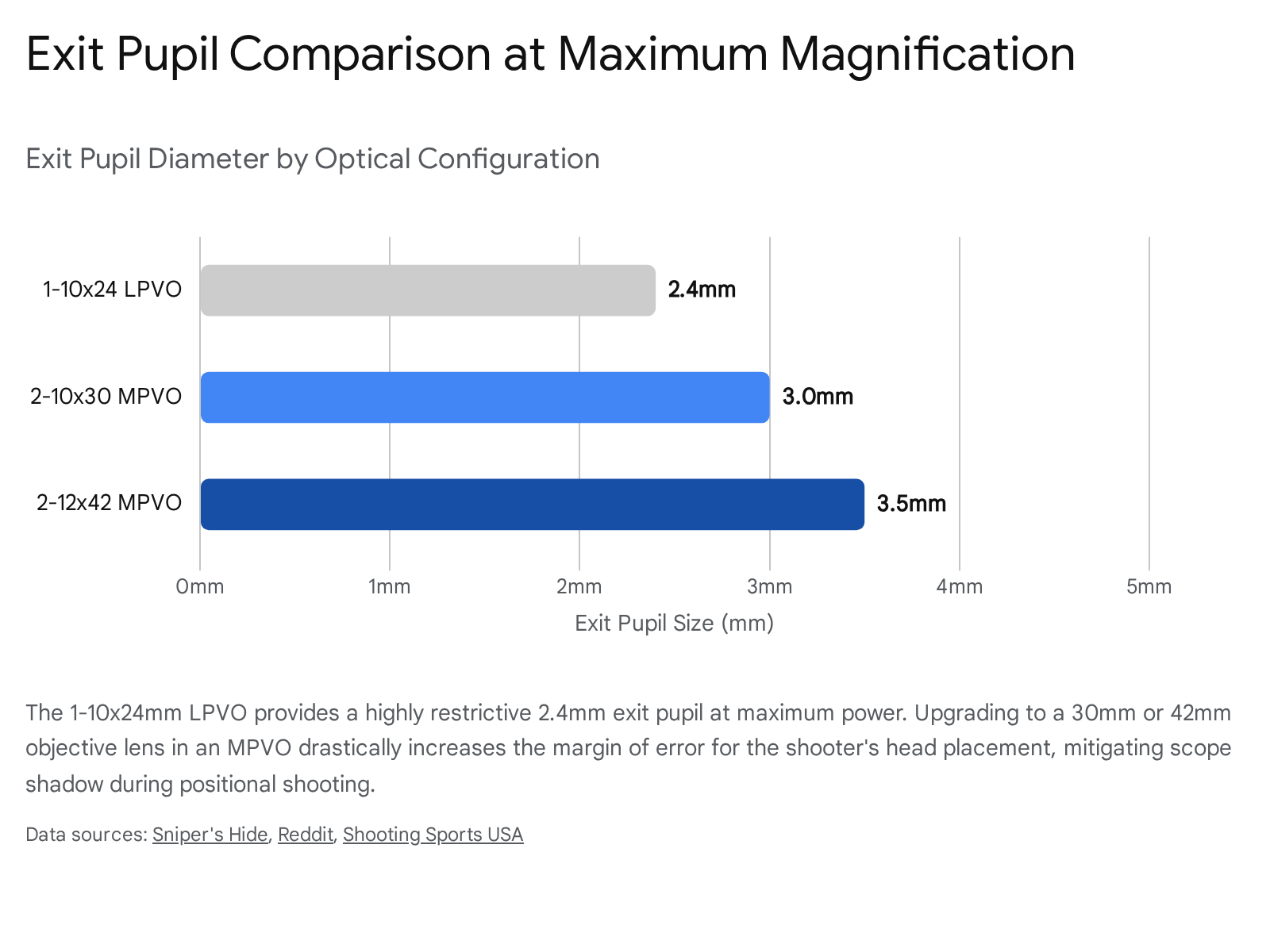
When utilizing a standard 1-6x24mm optic at its maximum magnification, the exit pupil measures exactly 4.0mm. The human pupil in typical daylight conditions dilates to roughly 2.0mm to 4.0mm, making a 4.0mm exit pupil perfectly adequate and relatively forgiving for the shooter. The operator maintains a reasonable physical margin of error for head placement behind the optic without losing the critical sight picture to scope shadow.
Conversely, when an optic is mechanically pushed to a 1-10x24mm configuration, the exit pupil at maximum magnification shrinks to a minuscule 2.4mm. This creates an incredibly restrictive, punishing eyebox for the user.3 In dynamic combat or competition scenarios, such as firing from awkward barricades, shooting from compromised prone positions, or operating under heavy physical duress, achieving perfect ocular alignment with a 2.4mm column of light is exceptionally difficult. The user routinely experiences rapid darkening of the optical edges and complete loss of the sight picture with even millimeter-scale deviations in their cheek weld. The May 2026 Sniper’s Hide discourse heavily criticizes the 1-10x class for this exact reason, noting explicitly that the tight eyebox causes severe visual fatigue and drastically slows target acquisition when compared directly to true Mid-Power Variable Optics.3
4.2 Objective Lens Physics and Light Transmission
In addition to the strict exit pupil constraint, the physical size of the 24mm objective lens severely limits absolute light transmission capability.10 The objective lens acts as the primary light-gathering element of any optical instrument. When an operator is attempting to resolve a camouflaged target hiding in deep shadows at 600 yards, raw optical clarity and resolution are paramount to success.5
At 10x magnification, a diminutive 24mm objective simply cannot gather enough ambient light to provide the high-definition image required for Positive Target Identification. While premium optical glass coatings and extremely expensive high-density lens elements can marginally improve the image quality, they cannot mathematically overcome the geometric reality of a small aperture. The 2026 industry consensus states clearly that thinking a 24mm lens will provide adequate performance for 10x magnification is an outdated concept, and that a straight tube 34mm optic lacks meaningful performance compared to scopes with a traditional objective bell.3
The Mid-Power Variable Optic directly addresses this massive shortcoming by incorporating traditional objective bells measuring 30mm, 42mm, or even 50mm. This drastically larger surface area gathers exponentially more light, which directly yields heavily enhanced contrast, much better color fidelity, and the precise resolution necessary to discern fine target details against complex, cluttered backgrounds.11
5.0 Reticle Dynamics and Focal Plane Constraints
Focal plane design represents another critical failure point for the high-magnification Low Power Variable Optic. A First Focal Plane reticle is designed to scale in exact proportion to the magnification setting.4 At 10x magnification, the First Focal Plane reticle is large, highly detailed, and exceptionally usable for complex wind holds and elevation drops. However, when the user dials the optic down to the 1x setting, a First Focal Plane reticle shrinks so significantly that the fine crosshairs and measurement subtensions become entirely invisible to the naked eye.2 To counter this physical reality, manufacturers are forced to rely heavily on nuclear bright electronic illumination to turn the microscopic center of the First Focal Plane reticle into a pseudo-red dot.7 If the battery dies or the internal electronic illumination system fails, the optic becomes nearly useless at the 1x magnification setting.
Conversely, a Second Focal Plane reticle is designed to remain a constant, fixed size regardless of the magnification setting chosen by the user.2 This design is absolutely excellent for 1x speed, as the crosshair remains bold, prominent, and highly visible without relying on battery power. However, an inherent flaw is that a Second Focal Plane reticle only provides mathematically accurate subtension measurements at a single magnification setting, which is almost exclusively the absolute maximum power.4 If a shooter attempts to use a Second Focal Plane 1-10x scope at 6x magnification to engage a moving target, the MIL or MOA markings in the reticle are mathematically incorrect, rendering all visual holdovers effectively useless and guaranteeing a missed shot.
By strategically eliminating the strict 1x requirement, the Mid-Power Variable Optic brilliantly resolves the focal plane dilemma. Because the lowest magnification on a Mid-Power Variable Optic is typically 2x or 2.5x, a First Focal Plane reticle does not shrink to microscopic, unusable proportions.12 The reticle remains highly visible and entirely usable at the very bottom of the magnification range without any strict reliance on electronic illumination, while still providing perfectly scaled, accurate subtensions at the top of the magnification range for precision work.10
6.0 The Tactical Dominance of the Offset Red Dot System
Recognizing the insurmountable physics holding back the 1-10x optic, the professional shooting industry has officially transitioned to a dual-optic ecosystem. The foundational component of this system is the Mid-Power Variable Optic, tasked exclusively with mid-to-long-range observation, Positive Target Identification, and high-precision engagement.3 The critical secondary component is a miniature red dot sight, mounted either directly on top of the primary optic via a piggyback ring or placed at a 45-degree offset on the rifle rail. This dedicated red dot is tasked exclusively with immediate close-quarters engagements.6
The primary driver for maintaining the Mid-Power Variable Optic is Positive Target Identification. In both military deployments and law enforcement operations, positively identifying a threat is a strict legal and tactical requirement.10 Shooting large steel targets on a flat range at 500 yards is a vastly different scenario from identifying whether an individual hiding in an urban structure is holding a rifle or a non-lethal item. Analysts within the 2026 forums note specifically that if an operator possesses a 1-8x or 1-10x optic, a Mid-Power Variable Optic rated at 3-15x will generate a significantly better picture at the exact same 8x and 10x settings.8
However, the most vocal critique of the Mid-Power Variable Optic transition is the inherent loss of the 1x variable setting. The modern combat paradigm solves this completely by embracing the offset or piggybacked red dot.8 An optic dialed to 1x will never truly match the raw speed, the unlimited eye relief, and the absolute lack of parallax offered by a dedicated holographic or red dot sight. Red dots project a beam of light onto a coated glass pane, allowing the shooter to maintain intense target focus with both eyes completely open without looking through a complex, restrictive tube of magnifying lenses.8
Furthermore, the mechanical action required to transition between targets is vastly superior with a dual-optic setup. To switch a variable optic from a 600-yard engagement down to a 10-yard engagement, the user must completely remove their support hand from the rifle, physically crank the tight magnification ring from 10x down to 1x, reacquire their grip, and then attempt to locate the target. In high-stress, dynamic environments, this mechanical delay is considered a fatal liability. With a Mid-Power Variable Optic and an offset red dot, the primary magnification ring remains permanently set to a high power.8 If a close-range threat suddenly appears, the user simply rolls the rifle 45 degrees or lifts their head slightly to achieve a higher chin weld and immediately acquires the glowing red dot.6 This physical transition requires mere fractions of a second and demands zero manipulation of the primary optic.9 Additionally, piggybacked red dots sit high enough above the rifle bore to permit passive aiming under night vision goggles, a critical combat capability that is physically impossible when attempting to look through a traditional variable scope with head-mounted night vision tubes.9
7.0 Advanced Thermal Imaging Integration
The widespread proliferation and drastic cost reduction of thermal imaging devices have irreversibly altered the entire optics landscape. As of 2026, highly capable thermal clip-on units can be acquired for approximately $2,000, bringing advanced capabilities to the civilian and patrol officer markets.3 These electronic devices mount on the rifle rail directly in front of the day optic, turning a standard daytime rifle into a highly lethal 24-hour precision system. This specific technological advancement has heavily accelerated the abandonment of the 1-10x optic.
7.1 Base Magnification and the Clip-On Interface
Thermal clip-on units are fundamentally digital screens projecting a processed thermal image directly into the objective lens of the day scope. A key limitation of thermal clip-ons is that their digital displays require a specific minimum amount of optical magnification from the day scope to be viewed properly without severe visual distortion.
When a 1-10x optic is used at 1x or 2x with a thermal clip-on, the shooter often sees the physical, internal edges of the thermal unit’s digital screen, creating an unusable, tunnel-like sight picture. Furthermore, the small 24mm objective lens severely restricts the field of view entering the thermal unit. By transitioning to a Mid-Power Variable Optic with a base magnification of 2x or 2.5x and a much larger objective lens, the field of view perfectly matches the internal digital display of the thermal clip-on.3 The primary optic acts as a perfect magnifying lens for the thermal display, allowing the user to seamlessly zoom in on the thermal image to identify heat signatures at long ranges. Current tactical doctrine specifically cites that good thermal clip-ons are highly affordable and modern calibers make 12x magnification absolutely needful.3
7.2 The Screen Door Effect and Modern Illumination
The integration of digital thermal displays introduces a unique optical phenomenon commonly known in the industry as the screen door effect.3 Because a thermal image is rendered via a dense, pixelated digital matrix, high levels of magnification cause the individual pixels to become highly visible to the user. The grid of these digital pixels creates a visual artifact that perfectly mimics the solid black lines of a traditional etched reticle.3
When looking at a highly pixelated thermal image, a non-illuminated black crosshair completely vanishes into the digital background noise.3 The shooter literally loses their point of aim against the thermal target, making precise shots impossible. Consequently, high-quality, daylight-bright illumination is no longer considered a mere luxury, it is designated as absolute table stakes for any modern precision optic.3 When a reticle is illuminated in stark red or green, it contrasts violently against the black, white, or grayscale pixelation of the thermal display, allowing the shooter to maintain a highly precise point of aim regardless of the digital distortion.
8.0 Sniper’s Hide Forum Intelligence and End-User Sentiment
The transition toward the Mid-Power Variable Optic is not a marketing fabrication, it is a grass-roots movement driven entirely by end-user frustration and evolving field requirements. A deep analysis of the May 2026 discourse on the Sniper’s Hide forum reveals a highly consistent narrative regarding the current theory of optical applications.3
The current theory dictates that wide erector spreads are being firmly put back in their place.3 While an optic pushing to 8x or 10x seems incredibly useful on paper, the severe optical compromises mean end-users no longer want to deal with the penalties associated with massive erector ratios.3 The discourse clearly notes that a 4-32x scope is physically incapable of being as optically clear as a 4-24x scope.3 This exact same logic applies to the lower magnification ranges. A 2-10x optic will fundamentally outperform a 1-10x optic in almost every single metric regarding clarity, light transmission, and eyebox forgiveness.
Furthermore, the intelligence gathered highlights a strong shift in turret preferences. Analysts note that capped elevation and windage turrets are becoming highly preferred for general-purpose applications. The prevailing thought process is that wind reading is not a precise enough science for most shooters to click adjustments accurately under stress, making it much faster to simply hold for wind using a well-designed reticle.3 Consequently, overly busy, highly cluttered reticles are slowly washing back out to sea.3 While a massive 30x optic can afford to have dense reticle detail, fine 0.2 MIL holds are considered completely useless and highly distracting on an 8x or 10x optic.3 Shooters are heavily demanding cleaner, more intuitive reticle designs that prioritize speed and clarity over excessive mathematical data points.
9.0 Technical Platform Review: Nightforce NX6 2-12x42mm
To properly quantify this massive paradigm shift, it is strictly necessary to examine the specific hardware currently driving the trend. The Nightforce NX6 2-12x42mm represents a highly refined execution of the modern Mid-Power Variable Optic concept, aggressively addressing the known shortcomings of previous tactical scope generations.
9.1 Technical Specifications and Architecture
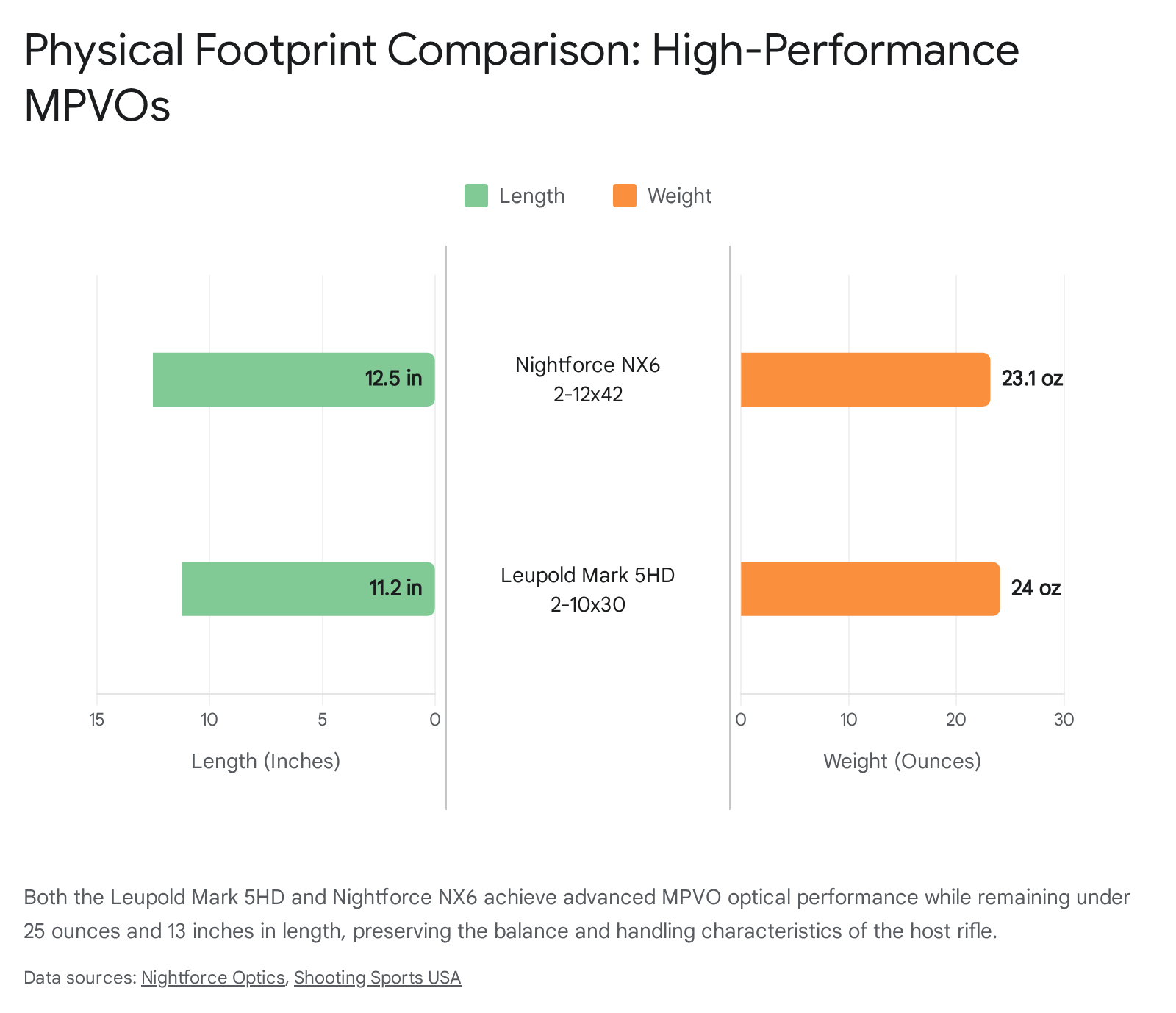
The Nightforce NX6 2-12x42mm is engineered from the ground up to be a compact, exceptionally field-ready optic that perfectly balances rugged, military-grade durability with precise mechanical tracking.15 Weighing exactly 23.1 ounces for the First Focal Plane model and measuring a remarkably short 12.5 inches in overall length, the NX6 perfectly maintains a physical footprint nearly identical to an oversized 1-10x optic, ensuring it does not negatively impact the balance or handling characteristics of an AR-pattern rifle.16
The critical technological advancement in this model is the integration of a 42mm objective lens.16 This massive increase in aperture over a standard 24mm objective provides a 3.5mm exit pupil even at the absolute maximum magnification of 12x. This physical dimension guarantees a highly forgiving eyebox and vastly superior light transmission in low-light environments. The optic is built entirely around a standard 30mm main tube, ensuring broad compatibility with a vast array of lightweight, high-quality mounting solutions.16 Furthermore, the NX6 features a dedicated side-focus parallax adjustment dial capable of focusing from 10 meters out to infinity, allowing for extreme precision at extended ranges and making the optic equally viable for rimfire trainers, centerfire tactical carbines, and dedicated hunting rifles.16
9.2 Reticle Options and the FieldSet Turret System
Nightforce strategically offers the NX6 in both First Focal Plane and Second Focal Plane variants to completely accommodate diverse user preferences.17 The First Focal Plane variant features the FC-MRx reticle, a highly intuitive 20 MRAD grid designed specifically for rapid windage and elevation holds at extended ranges without overly cluttering the field of view.16 The Second Focal Plane variant is offered with the traditional MOAR reticle or the heavily streamlined 4A-i reticle, catering to specific users who greatly prefer a constant reticle size for faster visual acquisition.18
Both unique variants utilize Nightforce’s proprietary Digillum technology, providing the mandatory, high-intensity illumination required to effectively combat the thermal screen door effect discussed previously.3 Furthermore, the NX6 introduces the entirely new FieldSet turret system.17 This advanced system maintains Nightforce’s legendary reputation for indestructible, highly repeatable internal tracking while offering unparalleled modularity to the operator. The user can rapidly configure the elevation dial to be either fully exposed for dialing exact firing solutions or entirely capped for supreme protection against environmental snag hazards. Additionally, the system readily accepts custom Bullet Drop Compensating dials specifically laser-engraved to the user’s chosen ballistic profile.15
10.0 Technical Platform Review: Leupold Mark 5HD 2-10x30mm
Operating in direct, aggressive competition to the Nightforce NX6 is the Leupold Mark 5HD 2-10x30mm. If the Nightforce represents a traditional precision scope architecture scaled down, the Leupold model represents a tactical low-power architecture aggressively scaled up to bridge the capability gap. Leupold openly states that this specific optic is a direct, purposeful evolution of the legendary mid-range scopes utilized heavily on the Mk 12 Special Purpose Rifle during the Global War on Terror.19
10.1 The 35mm Main Tube and Extreme Elevation Travel
The Mark 5HD 2-10x30mm is a masterclass in extreme weight reduction and tactical efficiency. The optic weighs a mere 24 ounces and measures just 11.2 inches long.20 The 30mm objective lens is uniquely compact for a Mid-Power Variable Optic, yet it provides a massive 6mm increase in aperture size over a standard 1-10x24mm model. This hybrid objective size strikes a meticulous balance, it provides significantly better light transmission and a larger exit pupil than older optics, while still allowing the entire system to be mounted extremely low to the rifle bore.20
The most distinctive structural feature of the Mark 5HD 2-10x30mm is the utilization of a massive 35mm main tube.20 While 30mm and 34mm tubes are the general industry standards, Leupold’s 35mm architecture allows for extraordinary internal erector travel. The optic provides an immense 48 MILs of total internal elevation adjustment.21 This immense internal space allows the seamless use of Leupold’s highly regarded M5C3 turret systems. The M5C3 elevation turret features a patented push-button ZeroLock system that utterly prevents accidental adjustments caused by gear snags or violent barricade bumps. The turret allows for three full revolutions of adjustment, providing up to 30 MILs of highly precise, tactile elevation travel.20
The Mark 5HD is offered strictly in a First Focal Plane configuration.21 Reticle options include the precision-oriented TMR, the PR1-MOA, and the fully illuminated CMR-MIL.24 Because the base magnification is 2x, the First Focal Plane reticles remain highly visible at the lowest setting, completely circumventing the primary flaw of older systems.
11.0 Direct Hardware Comparison and Application Scenarios
When comparing the Nightforce NX6 and the Leupold Mark 5HD directly, analysts must evaluate the specific application intended by the end-user. Both optics perfectly embody the modern Mid-Power Variable Optic philosophy, yet they approach the engineering problem from slightly different angles.
The Nightforce NX6, with its 42mm objective lens, holds a distinct mathematical advantage in raw light transmission and exit pupil size at maximum magnification. For operators prioritizing low-light observation, twilight hunting, or extreme long-range target identification in heavily shadowed environments, the 42mm bell provides a highly superior image.16 Additionally, the ability to hot-swap the FieldSet turrets from exposed to capped provides an unparalleled level of user customization not found on the Leupold platform.17
Conversely, the Leupold Mark 5HD excels in strict weight reduction and compact geometry. Measuring over an inch shorter than the Nightforce, the Leupold is incredibly agile on short-barreled rifles and dedicated entry carbines.20 Furthermore, the massive 35mm main tube provides significantly more internal elevation travel than the 30mm tube of the Nightforce, making the Leupold highly attractive to shooters pushing the ballistic limits of cartridges like the 6.5 Creedmoor out past 1,000 yards.21 The push-button ZeroLock turret system on the Leupold is also widely considered one of the most robust and secure elevation systems currently available on the commercial market.20
12.0 Market Economics and Vendor Sourcing Data
The procurement of high-tier optical systems requires substantial financial investment. Both the Nightforce NX6 and the Leupold Mark 5HD maintain premium price points strictly commensurate with their military-grade construction, advanced optical coatings, and complex mechanical tracking systems. Analysts tracking the market in May 2026 note that pricing remains highly stable, with vendors adhering closely to Minimum Advertised Price regulations.
12.1 Nightforce NX6 2-12x42mm Vendor Data
The Nightforce NX6 2-12x42mm is consistently listed at a retail price of $1,800.00 across the authorized vendor network.
| Retail Vendor | Product Variant | Reticle Configuration | Listed Price | Source URL |
| Nightforce Optics (Manufacturer) | FFP & SFP | FC-MRx, MOAR, 4A-i | MSRP | Link |
| Primary Arms | SFP | MOA MOAR | $1,800.00 | Link |
| Brownells | SFP | MOA MOAR | $1,800.00 | Link |
| Midway USA | FFP & SFP | Varies | $1,500.00 to $2,200.00 | Link |
12.2 Leupold Mark 5HD 2-10x30mm Vendor Data
The Leupold Mark 5HD sits in a slightly higher pricing tier, particularly for models equipped with the mandatory illuminated reticles necessary for thermal integration. Baseline non-illuminated models retail near $1,999.99, while illuminated versions command prices near $2,599.99.
| Retail Vendor | Product Variant | Reticle Configuration | Listed Price | Source URL |
| Leupold (Manufacturer) | FFP | TMR | MSRP | Link |
| Brownells | FFP | TMR / CMR-MIL | $1,999.99 to $2,699.99 | Link |
| Palmetto State Armory | FFP | Illuminated TMR | $2,499.99 | Link |
| Sportsmans Warehouse | FFP | TMR | $1,999.99 | Link |
(Note: Pricing data reflects the market standard during the May 2026 observation window and is subject to vendor specific promotions or specialized military pricing structures).
13.0 Final Strategic Conclusions
The expansive intelligence gathered from the May 2026 discourse paints a highly definitive picture of the modern optical landscape. The 1-10x Low Power Variable Optic, while representing an impressive feat of initial engineering, is now widely considered a physical dead end. By forcing extreme erector ratios into a highly constrained 24mm objective profile, manufacturers created optical systems that inherently suffer from restrictive eyeboxes, exceptionally poor light transmission, and heavily compromised focal plane dynamics.3
The precision shooting market has firmly decided that optical clarity, mechanical parallax control, and Positive Target Identification are far more valuable than preserving a compromised 1x setting inside a magnified tube.3 The Mid-Power Variable Optic, exemplified beautifully by the Nightforce NX6 2-12x42mm and the Leupold Mark 5HD 2-10x30mm, has officially emerged as the definitive solution for the modern tactical rifle.16 By actively abandoning the true 1x requirement, these advanced optics integrate much larger objective lenses, superior overall light transmission, and highly precise tracking systems in incredibly lightweight footprints.
When intelligently coupled with an offset or piggybacked red dot for immediate close-quarters speed, and featuring the high-intensity illumination explicitly required to interface flawlessly with modern thermal clip-on devices, the Mid-Power Variable Optic ecosystem provides an absolutely unparalleled operational advantage on the modern battlefield or competition stage. This transition represents the ultimate maturation of the tactical optic, ensuring the professional shooter retains absolute superiority from contact distance out to the maximum effective range of their chosen rifle system.
Please share the link on Facebook, Forums, with colleagues, etc. Your support is much appreciated and if you have any feedback, please email us in**@*********ps.com. If you’d like to request a report or order a reprint, please click here for the corresponding page to open in new tab.
Sources Used
- Ronin’s Grips | Firearms Analytics & Intelligence Reports | Connecticut – Boise Gun Club, accessed May 9, 2026, https://boisegunclub.com/connecticut/directory/blog-20
- Rifle Scopes – The New Landscape of the MPVO (2026 Poll) | Sniper’s Hide Forum, accessed May 9, 2026, https://www.snipershide.com/shooting/threads/the-new-landscape-of-the-mpvo-2026-poll.7280568/
- The current theory… | Sniper’s Hide Forum, accessed May 9, 2026, https://www.snipershide.com/shooting/threads/the-current-theory.7280726/
- Rifle Scopes – Seeking recommendations for LPVO in 2026 under $1500 | Sniper’s Hide Forum, accessed May 9, 2026, https://www.snipershide.com/shooting/threads/seeking-recommendations-for-lpvo-in-2026-under-1500.7286346/
- Best Mid Range Optic? LPVO vs MPVO – YouTube, accessed May 9, 2026, https://www.youtube.com/watch?v=YDk6AxQ5EIw
- LPVO + Dot question | Sniper’s Hide Forum, accessed May 9, 2026, https://www.snipershide.com/shooting/threads/lpvo-dot-question.7209415/
- What defines an MPVO? | Sniper’s Hide Forum, accessed May 9, 2026, https://www.snipershide.com/shooting/threads/what-defines-an-mpvo.7269324/
- There’s no point to an lpvo with a red dot… change my mind. : r/ar15 – Reddit, accessed May 9, 2026, https://www.reddit.com/r/ar15/comments/1gh7mn7/theres_no_point_to_an_lpvo_with_a_red_dot_change/
- LPVO w/ offset red dot, why? | Sniper’s Hide Forum, accessed May 9, 2026, https://www.snipershide.com/shooting/threads/lpvo-w-offset-red-dot-why.7056687/
- LPVO vs Scope (2026 Edition) – Swat Optics, accessed May 9, 2026, https://swatoptics.com/pages/lpvo-vs-scope-2026-edition
- Best 1-10x LPVO? (More in body text) : r/ar15 – Reddit, accessed May 9, 2026, https://www.reddit.com/r/ar15/comments/1s59qqm/best_110x_lpvo_more_in_body_text/
- Rifle Scopes – Is there a market for a good MPVO | Sniper’s Hide Forum, accessed May 9, 2026, https://www.snipershide.com/shooting/threads/is-there-a-market-for-a-good-mpvo.7247829/
- LPVO/Red Dot | Sniper’s Hide Forum, accessed May 9, 2026, https://www.snipershide.com/shooting/threads/lpvo-red-dot.7067339/
- Why run an lpvo with a red dot instead of a fixed with a red dot : r/ar15 – Reddit, accessed May 9, 2026, https://www.reddit.com/r/ar15/comments/1rns93s/why_run_an_lpvo_with_a_red_dot_instead_of_a_fixed/
- Nightforce Optics | Rugged, Reliable, Repeatable, Optics, accessed May 9, 2026, https://www.nightforceoptics.com/
- NX6 2-12x42mm F1 – Nightforce Optics, accessed May 9, 2026, https://www.nightforceoptics.com/riflescopes/products/nx6/nx6-2-12x42mm-f1/
- Nightforce Optics Announces the NX6™ Family of Riflescopes, accessed May 9, 2026, https://www.nightforceoptics.com/blog/nightforce-announces-the-nx6/
- NX6 2-12x42mm – Nightforce Optics, accessed May 9, 2026, https://www.nightforceoptics.com/riflescopes/products/nx6/nx6-2-12x42mm/
- Leupold’s Mark 5HD 2-10X: Ultimate Do-It-All Scope? – Firearms News, accessed May 9, 2026, https://www.firearmsnews.com/editorial/leupold-mark5hd-2-10x-scope-review/499938
- Review: Leupold Mark 5HD 2-10X 30 mm Riflescope | An NRA Shooting Sports Journal, accessed May 9, 2026, https://www.ssusa.org/content/review-leupold-mark-5hd-2-10x-30-mm-riflescope/
- Leupold Mark 5HD 2-10x 30mm Rifle Scope – TMR | Sportsman’s Warehouse, accessed May 9, 2026, https://www.sportsmans.com/hunting-gear-supplies/optics-binoculars-scopes-rangefinders/rifle-scopes-red-dots/leupold-mark-5hd-2-10x-30mm-rifle-scope-tmr/p/1804591
- Mark 5HD Rifle Scope – Leupold, accessed May 9, 2026, https://www.leupold.com/shop/riflescopes/series/mark-5hd-rifle-scopes
- Mark 5HD 2-10×30 M5C3 FFP TMR Riflescope – Leupold, accessed May 9, 2026, https://www.leupold.com/mark-5hd-2-10×30-m5c3-ffp-tmr-riflescope
- Leupold Mark 5HD 2-10×30 – Sport Optics, accessed May 9, 2026, https://www.sportoptics.com/leupold-mark-5hd-2-10-30-rifle-scopes.html