1. Executive Summary
The character of modern warfare is undergoing a structural transformation, driven by the operational realities currently manifesting in the conflicts in Ukraine and the Middle East. For the Republic of Korea (ROK), these distant battlefields serve as a highly relevant, real-world laboratory. The proliferation of cheap, expendable unmanned aerial systems (UAS), the weaponization of the electromagnetic spectrum, and the demonstrated resilience of dispersed, deeply buried military infrastructure have systematically invalidated legacy assumptions regarding conventional air superiority and armored maneuver warfare. Concurrently, the deepening strategic alignment between Pyongyang, Moscow, and Beijing has accelerated the transfer of advanced aerospace, electronic warfare, and missile technologies to North Korea, significantly compressing the early warning and response timelines available to the ROK and its allies.
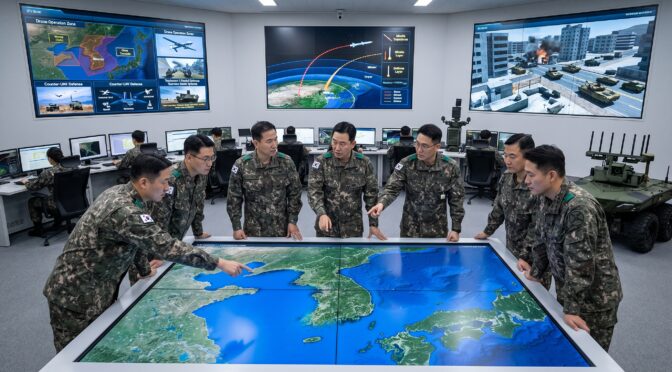
Operating from a defensive posture characterized by extreme geographic proximity to adversarial forces, South Korea is methodically internalizing these combat lessons. The ROK military is fundamentally restructuring its tactical doctrine, procurement pipelines, and technological integrations to counter an evolving North Korean threat matrix, while simultaneously erecting an asymmetric deterrent against the People’s Liberation Army Navy (PLAN) in the West Sea. The prevailing strategic calculus in Seoul has recognized that platform superiority, while necessary, is insufficient without the attendant requirements of mass, resilience, and industrial endurance.
This intelligence report provides an analysis of South Korea’s strategic adaptations across several critical domains. These include the deep integration of unmanned systems into tactical formations, the re-evaluation of mechanized armor survivability, the deployment of directed energy weapons to alter the cost-exchange ratio of air defense, the pursuit of electromagnetic spectrum dominance, the acceleration of multi-layered missile defense architectures, the establishment of maritime anti-access/area denial (A2/AD) capabilities, and the mobilization of the defense industrial base to support global logistical networks. The data indicates that South Korea is moving away from a purely platform-centric defense model toward a highly distributed, sensor-rich, and capacity-driven architecture designed to ensure resilience in protracted, high-intensity conflict scenarios.
2. The Paradigm Shift in Unmanned Aerial Systems and Asymmetric Warfare
The ongoing conflict in Ukraine has definitively established that continuous, network-centered Intelligence, Surveillance, and Reconnaissance (ISR) provided by unmanned aerial systems fundamentally alters battlefield transparency.1 The proliferation of commercial-off-the-shelf (COTS) technologies has democratized aerial strike capabilities, demonstrating to defense planners globally that mass, scale, and expendability are now critical operational metrics.
2.1. North Korean Proliferation and the Ukraine Laboratory
North Korea has not functioned merely as a passive observer of the drone war in Ukraine; the state is an active participant and a direct beneficiary of the conflict’s technological fallout. The deployment of Korean People’s Army (KPA) special operations forces to the Russian frontlines, alongside the continuous rotation of conventional troops, has provided Pyongyang with invaluable, direct combat experience.3 KPA personnel are directly engaging with, and learning from, what is currently the world’s most battle-tested drone operational architecture.3
Satellite imagery analysis of Russia’s Yelabuga Special Economic Zone reveals a massive expansion of dedicated Shahed-class unmanned aerial vehicle production facilities. The industrial footprint has expanded from two small buildings to between a dozen and fifteen structures, heavily bolstered by North Korean labor and an influx of Chinese electronic components.4 Consequently, Pyongyang’s indigenous development and procurement cycle has compressed drastically. In a span of roughly fourteen months, North Korea advanced from testing rudimentary Harop-style airframe prototypes in August 2024 to deploying containerized, truck-mounted kamikaze drone launchers by October 2025.3 This rapid iteration suggests that North Korean forces are successfully reverse-engineering Russian and Iranian methodologies, posing an immediate saturation threat to South Korean forward positions.
2.2. The 500,000 “Drone Warriors” Initiative and Procurement Strategy
To counter North Korea’s rapidly expanding loitering munition capabilities, South Korea has initiated a massive organizational overhaul aimed at decentralizing drone operations down to the lowest tactical echelons. Traditional military doctrine localized unmanned aerial operations within specialized aviation or intelligence units. South Korea is moving to make drone operation a fundamental infantry skill.
In September 2025, the Ministry of National Defense announced an initiative to train 500,000 “drone warriors” at the 36th Infantry Division base in Wonju.3 By integrating drone piloting credentials into the mandatory conscription service, the ROK military ensures a deeply dispersed, organic capability across all infantry, mechanized, and artillery units. To support this human capital investment with necessary hardware, the National Assembly approved a 33 billion won (approximately $22 million) program for 2026 to procure over 11,000 commercial-grade drones for tactical units, a significant increase from the Ministry’s original 20.5 billion won request.3
Crucially, to mitigate supply chain vulnerabilities and prevent the denial of critical components by adversarial states during a contingency, the Ministry of National Defense mandated that these systems be manufactured utilizing purely domestic core components.3
| UAS Procurement Element | Metric / Target | Strategic Rationale |
| Personnel Trained | 500,000 Operators | Decentralize ISR and strike capabilities to the squad and platoon levels. |
| Hardware Acquisition | >11,000 Drones (2026) | Achieve numerical parity with anticipated adversary drone swarms. |
| Budget Allocation | 33 billion won (~$22M) | Scale commercial-off-the-shelf (COTS) technology rapidly. |
| Supply Chain Security | 100% Domestic Components | Prevent critical component denial by strategic competitors. |
2.3. Asymmetric Synergy: The Ukraine-South Korea Partnership
To accelerate its operational learning curve, South Korea is actively pursuing bilateral engagement with Ukraine. While South Korean domestic legislation heavily restricts the direct export of lethal weapons to active conflict zones, the legal framework permits joint ventures, licensing agreements, and technology sharing.5 Ukraine has emerged as a drone superpower, fielding platforms with shortened development-to-production cycles that offer ready-made solutions to asymmetric threats.5
The ROK military has established formal dialogues, including high-level meetings between the South Korean National Assembly and Ukraine’s Ministry of Defense, to facilitate the transfer of Ukraine’s drone warfare playbook.6 A primary focus of this engagement is the procurement and localized production of Ukrainian-made short-range drone interceptors, such as the “Sting” and “Salut” systems.5 By engaging in “mutual localization,” South Korea can domestically produce battle-tested Ukrainian drone interceptors. This strategy dramatically reduces the reliance on multi-million-dollar surface-to-air missiles for intercepting cheap North Korean loitering munitions, thereby preserving high-end kinetic interceptors for advanced ballistic threats.5
3. Mechanized Maneuver and the Survivability of Armored Formations
South Korea fields one of the most formidable and technologically advanced armored forces in the Indo-Pacific region, possessing between 2,300 and 2,500 tanks, anchored by the advanced K2 Black Panther and augmented by K1 variants.1 Historically, ROK defensive doctrine relied heavily on rapid, concentrated armored maneuver to repel a North Korean offensive north of Seoul, specifically along the heavily fortified Kaesong and Cheorwon corridors, and the western corridor leading to the Han River.1
3.1. Re-evaluating the K2 Black Panther in a Transparent Battlespace
The Ukraine conflict has exposed severe, systemic vulnerabilities in traditional armored operations when conducted under conditions of persistent enemy intelligence, surveillance, and reconnaissance. Traditional military staging parameters are highly vulnerable under such surveillance. Assembly areas, logistical nodes, and refueling points are no longer secure behind a defined front line; they are transparent, trackable targets within an adversary’s constantly updating strike network.1
If South Korean armored columns are forced to mobilize within the first 72 hours of a conflict, hundreds of these tanks would operate within the effective range of North Korea’s surveillance and strike networks, exposing them to continuous detection.1 The proliferation of First-Person View (FPV) kamikaze drones, coupled with automated target recognition algorithms, has severely narrowed the sensor-to-shooter loop, allowing adversary artillery and loitering munitions to strike within minutes of detection.7
The strategic concern for South Korean armored commanders is not necessarily the catastrophic destruction of K2 Black Panthers, which feature advanced composite armor and active protection systems. Rather, the primary threat vector is the “mobility kill.” Real-time guided loitering munitions do not need to obliterate a tank to render it operationally useless. Precision drone strikes targeting optical sensors, engine exhausts, treads, or the soft-skinned logistics and fuel convoys required to sustain the armor can disable the platform.1 If a significant percentage of forward-deployed tanks are temporarily suppressed, mobility-killed, or logistically constrained, the cumulative operational impact could stall South Korea’s entire counter-offensive tempo.1
3.2. Dispersed Formations and Organic Low-Altitude Defense
To ensure the survivability of its mechanized forces in a transparent battlespace, the ROK Army is being forced to adapt structurally and tactically. The historical reliance on the heavy concentration of tanks to achieve “armored shock” is being reconsidered. Armored units must abandon large, static assembly areas in favor of persistent displacement, deception, and dispersed operations.1
Furthermore, the military is addressing the critical air defense gap that exists in the airspace below one thousand meters. Traditional air defense systems are optimized for medium-to-high altitude aircraft and ballistic missiles, leaving armored units highly vulnerable to low-flying quadcopters and loitering munitions.1 In response, South Korean divisions are working to integrate counter-drone and anti-ISR capabilities organically at the maneuver formation level, rather than relying on centralized assets.1
This adaptation is evident in recent joint exercises conducted by the United States Eighth Army and the ROK Army. These units have instituted series of counter-small UAS exercises focusing heavily on integrating detection and defeat mechanisms into joint command and control structures.8 A primary focus of these battle drills is the employment of electronic attack defeat capabilities, such as the Drone Defender system, which utilizes localized GPS jamming and signal disruption to neutralize incoming threats before they reach armored columns.8 To survive in a degraded electromagnetic environment, South Korean tank crews are increasingly training to operate without reliable communications or satellite navigation, ensuring operational continuity even when adversarial, or friendly, electronic warfare systems are actively contesting the spectrum.1
4. Directed Energy Weapons and the Economics of Drone Defense
The fundamental economics of drone warfare heavily favor the attacker. Expending a traditional kinetic interceptor, which costs millions of dollars, to destroy a Shahed-class loitering munition or a commercial quadcopter costing a fraction of that amount constitutes an unsustainable attrition strategy. In a high-intensity conflict, relying solely on kinetic interception rapidly depletes defensive stockpiles and exhausts defense budgets.9 South Korea has recognized the absolute necessity of shifting the cost-exchange ratio through the rapid development and deployment of Directed Energy Weapons (DEW).
4.1. The Block-I Laser Air Defense System
South Korea has achieved a significant technological and operational milestone by becoming the first nation to deploy and operate a fully functional laser-based anti-aircraft weapon system for military use.10 Developed jointly by the Agency for Defense Development (ADD) and Hanwha Aerospace, the system is officially designated as the Anti-Aircraft Laser Weapon System, Block-I.10
The Block-I system is designed to neutralize Group I, II, and III UAS platforms by directly irradiating the target with a high-energy laser (HEL). The system achieves a hard kill by burning through engines, battery packs, or critical flight control electronics within 10 to 20 seconds of sustained contact.10 Operating at the speed of light—approximately 300,000 kilometers per second—the laser is entirely immune to the evasive maneuvers of erratic targets or hypersonic profiles, making it practically impossible for drones to evade once the system establishes a lock.13
4.2. Operational Deployment and Iterative Upgrades
The operational deployment of the Block-I system fundamentally alters the defensive calculus for South Korean point-defense operations. The system boasts exceptional accuracy, capable of threading a sustained beam through a spatial gap narrower than a standard 5.56 millimeter rifle bullet.13 More importantly, the operational cost is profoundly asymmetric in favor of the defender. At an operational cost of approximately 2,000 won ($1.45) per shot, the system resolves the economic dilemma of mass drone saturation.10 Furthermore, because the system relies solely on electrical power rather than physical interceptor magazines, it effectively provides a bottomless magazine capacity, eliminating the logistical burden of reloading kinetic launchers during a prolonged engagement.
However, directed energy weapons remain constrained by environmental factors and atmospheric degradation. Rain, dense fog, and battlefield particulate matter can diffuse the laser beam, reducing its effective range and lethality. To address these operational limitations, the Defense Acquisition Program Administration (DAPA) is actively developing a Block-II variant.14 The Block-II program will feature core technological upgrades designed to increase the laser oscillator power to several hundred kilowatts. This increase in power output is intended not only to overcome adverse weather conditions but to potentially expand the system’s target matrix beyond small drones, scaling up to neutralize manned aircraft and incoming ballistic missiles.14
5. Reclaiming the Electromagnetic Spectrum and Cyber Operations
The electromagnetic spectrum functions as the central nervous system of modern military operations. The conflict in Ukraine has underscored a brutal reality: forces that are unable to control the spectrum quickly lose the ability to sense the environment, communicate with dispersed units, and execute precision strikes.2 South Korea is moving aggressively to reclaim spectrum dominance, a capability area historically outsourced to the highly capable assets of the United States military.
5.1. Airborne Standoff Electronic Warfare Capabilities
For decades, Seoul relied on U.S. electronic-attack and suppression capabilities, a vulnerability that North Korea has consistently exploited through GPS jamming, radar-linked artillery, and the spoofing of allied sensors.15 Recently, North Korea’s anti-drone and electronic deception capabilities have demonstrably increased, aided by Russian technical support.15
To establish an independent electronic attack (EA) and spectrum suppression capability, South Korea has allocated 1.77 trillion won (approximately $1.3 billion) to acquire four standoff electronic warfare aircraft by 2034 under the DAPA Block-I electronic warfare aircraft development project.15
This procurement signifies a landmark doctrinal shift. Instead of merely reacting to North Korean interference, the ROK Air Force will possess the organic capability to actively map, manipulate, and weaponize the electromagnetic environment.15 These aircraft will be tasked with executing stand-off jamming, denying enemy radars and communications at long ranges, Suppressing Enemy Air Defenses (SEAD), and safeguarding friendly communication links to ensure the survivability of deep-strike packages in high-intensity scenarios.15
Two domestic consortia are currently competing for this critical contract:
- KAI and Hanwha Systems: Proposing a modification based on the Bombardier Global 6500 business jet. This design utilizes side-mounted equipment housings to optimize aerodynamic stability and minimize drag while carrying heavy jamming suites and advanced cooling systems.15
- Korean Air and LIG Nex1: Offering a Gulfstream G550-class conversion, leveraging a proven airframe family similar to that utilized by the United States Air Force’s EA-37B Compass Call.15
Crucially, the successful deployment of these platforms has profound political and command implications regarding the transition of Wartime Operational Control (OPCON). By demonstrating the ability to independently defend and disrupt the electromagnetic domain, Seoul significantly strengthens the strategic logic for transferring OPCON from a U.S. commander to a South Korean commander.15 However, to prevent spectrum management friction, the U.S. and South Korea must verify frequency-deconfliction procedures and establish cross-domain links prior to any transfer.15
5.2. “Left of Launch” Doctrine and Offensive Cyber Postures
Mirroring its physical military upgrades, South Korea’s 2024 revision of its National Cybersecurity Strategy codifies a definitive shift toward “offensive defense”.16 Recognizing that kinetic preemptive strikes carry an unacceptably high risk of nuclear escalation, the ROK military is prioritizing “soft-kill” deterrence—non-kinetic operations designed to paralyze adversary systems before they can be utilized.
This approach is heavily focused on the “Left of Launch” operational framework. Derived from U.S. military concepts, this strategy involves employing cyber-attacks, network infiltration, and electronic warfare to disrupt North Korean missile command networks, guidance systems, and launch procedures prior to liftoff.16 To execute these active defense missions, the South Korean military has restructured and upgraded the frontline 1st Operations Group within its Cyber Operations Command, elevating its commanding officer to the rank of brigadier general.16 This elevation signifies increased bureaucratic weight and operational authority for cyber strike units.
Furthermore, to physically augment this soft-kill capability, South Korea is developing non-nuclear Electromagnetic Pulse (EMP) weapons and graphite bombs. The Agency for Defense Development (ADD) completed the system design for graphite bombs in 2020 and plans to invest 79.3 billion won starting in 2027 to procure munitions capable of scattering conductive carbon fibers over North Korean power grids, inducing massive, crippling short-circuits.16 Concurrently, the ADD is advancing the miniaturization of EMP devices for delivery via cruise missiles or drones, providing the capability to irreversibly damage enemy electronic infrastructure without causing the mass casualties associated with conventional or nuclear blast effects.16
5.3. Trilateral Spectrum Defense Lattice and International Integration
South Korea’s strategy to dominate the electromagnetic and cyber domains is not isolated; it is actively being integrated into a broader regional architecture. Leveraging agreements formed at the 2023 Camp David summit, the United States, Japan, and South Korea are establishing a comprehensive “spectrum defense lattice”.15
This trilateral synergy is designed to address the individual capability gaps of the partner nations. South Korea provides vital tactical jamming capabilities, Japan contributes wide-area surveillance via its EP-3C platforms and ground-based EW units, and the United States anchors the network with its Indo-Pacific Command Electromagnetic Spectrum Operations grid.15 By combining shared threat databases and joint waveform libraries, the alliance aims to create an invisible, integrated shield stretching 600 miles from Hokkaido to the Yellow Sea, capable of detecting and suppressing Chinese and North Korean emitters within minutes of activation.15
Additionally, South Korea’s integration into global cyber defense frameworks was solidified by its entry into the NATO Cooperative Cyber Defense Center of Excellence (CCDCOE) as the first Asian member, ensuring that lessons learned from Russian cyber warfare in Ukraine are rapidly internalized by ROK network defenders.17
6. Enhancing the Korean Air and Missile Defense (KAMD) Architecture
The intense missile exchanges observed in the Middle East—specifically the high-volume salvos launched between Iran and Israel—have provided stark empirical data regarding the efficacy, and limitations, of modern air defense.9 For South Korea, the lessons are twofold: layered, high-density intercept networks are absolutely vital for national survival, yet relying purely on air superiority to hunt mobile launchers is a fundamentally flawed operational premise.
6.1. The Hard-Target Dilemma: Buried Infrastructure and Mobile Launchers
During the conflict, the Iranian military demonstrated that a deeply dispersed network of mobile missile launchers, combined with highly fortified subterranean munitions depots, could withstand sustained conventional air campaigns conducted by technologically superior adversaries.9 United States and Israeli strike packages failed to achieve a “clean sweep” of high-value targets, proving that conventional air power cannot guarantee the rapid, decisive neutralization of dispersed assets.9
This operational reality validates Kim Jong Un’s decades-long investment in burying critical military infrastructure deep within North Korea’s mountainous terrain, a strategy Kim is expected to double down on by excavating deeper tunnels with more concealed entry points.9 In response to this daunting operational challenge, the U.S.–ROK alliance strategy is shifting. Recognizing that rapid decapitation strikes may fail, the alliance is pivoting toward massive investments in specialized bunker-busting munitions.9 More broadly, defense planners now acknowledge that any future conflict on the peninsula would likely devolve into a prolonged campaign. Consequently, South Korea recognizes the immediate strategic necessity of building up vast munitions stockpiles to endure a sustained war of attrition.9
6.2. Acceleration of the Low-Altitude Missile Defense (LAMD) System
Compounding the ballistic missile threat, North Korea fields tens of thousands of long-range artillery systems and multiple rocket launchers positioned perilously close to the Demilitarized Zone. These systems hold the Seoul metropolitan area—where approximately half of the ROK population resides—at constant risk of catastrophic saturation bombardment.20
Driven by North Korea’s rapid qualitative advancements in rocketry—described by military analysts as a “quantum jump” aided heavily by Russian technological transfers—South Korea has expedited the deployment of its Low-Altitude Missile Defense (LAMD) system.21 Originally scheduled for deployment in 2031, the Defense Acquisition Program Administration has brought the timeline forward by two years, mandating operational deployment by 2029.20
Dubbed the “Korean Iron Dome,” the LAMD system operates under significantly different parameters than its Israeli counterpart. While Israel’s Iron Dome was initially optimized to counter intermittent rocket fire from non-state actors in the Gaza Strip, LAMD is engineered specifically for state-on-state, high-intensity warfare against a peer artillery force.21 The system is designed to intercept simultaneous, massive low-altitude saturation attacks at ranges approaching 15 kilometers and altitudes between 5 and 10 kilometers.23
To achieve this, the system relies on a specialized multi-function radar, currently under development by Hanwha Systems via a 131.5 billion won contract.23 This radar is capable of detecting, classifying, and tracking hundreds of overlapping projectiles simultaneously.23 Because North Korean artillery flight times to Seoul are remarkably short, providing only seconds of early warning, the system operates with near-total automation. LAMD batteries will launch compact 165mm interceptors equipped with active radar seekers for terminal guidance, allowing each missile to autonomously discriminate and lock onto specific targets within highly crowded flight environments.23 The overall program cost has expanded to 842 billion won (approximately $222 million) to support accelerated testing and development through 2030.23
| Defense Tier | Primary System | Operational Altitude | Primary Threat Vector |
| Upper Tier | L-SAM, THAAD, SM-3 (Aegis) | > 40 km | Medium to Long-Range Ballistic Missiles |
| Middle Tier | M-SAM (Cheongung II), PAC-3 | 10 – 40 km | Short-Range Ballistic Missiles, High-Altitude Aircraft |
| Lower Tier | LAMD (Korean Iron Dome) | 5 – 10 km | Long-Range Artillery, MRLs, Short-Range Rockets |
| Point Defense | Block-I Laser, CIWS | < 5 km | Group I-III Drones, Loitering Munitions |
6.3. Strategic De-confliction of Airspace
The accelerated deployment of LAMD is critical for addressing a specific vulnerability in South Korea’s existing multi-layered defense system. By integrating LAMD as the lowest tier of the Korean Air and Missile Defense (KAMD) architecture, South Korea achieves vital strategic de-confliction. By relegating the interception of cheap artillery shells and short-range rockets to the automated LAMD platform, the ROK military preserves its highly expensive and numerically limited inventory of Patriot PAC-3 and Cheongung-II (M-SAM) interceptors. These upper-tier systems can then remain dedicated strictly to their primary mission: engaging North Korean ballistic missiles and advanced aircraft.23
7. Counter-A2/AD and Asymmetric Naval Strategies Against China
While the immediate existential threat to Seoul originates in Pyongyang, South Korean military planners are increasingly focused on the long-term strategic imbalance posed by the People’s Liberation Army Navy (PLAN). In a potential regional conflict or Taiwan contingency, Chinese anti-access/area denial (A2/AD) networks could isolate the Korean peninsula, restrict allied naval operations, and sever vital maritime supply lines.24
To ensure freedom of maneuver and establish a credible minimum deterrence, South Korea’s Agency for Defense Development (ADD) has drafted a comprehensive blueprint to erect its own asymmetric A2/AD bubble over the West Sea (Yellow Sea).26
7.1. Space-Based ISR and Target Acquisition
To effectively target PLAN carrier strike groups and Chinese Coast Guard vessels operating in contested waters, South Korea must overcome the Earth’s curvature to gather persistent, real-time target data. Following the joint decision by Seoul and Washington to repeal the ROK-US missile guidelines, the ADD rapidly advanced the development of localized military satellites utilizing solid-fuel launch vehicles.26
This localized space-based reconnaissance architecture relies on a triad of integrated assets:
- Low-Orbit Reconnaissance Satellites: Providing continuous optical and radar coverage specifically over the Korean Peninsula and the West Sea, enabling military forces to detect and track hostile ship movements.26
- Signal Intelligence (SIGINT) Satellites: Positioned in low earth orbit to actively detect the electronic emissions, radar signatures, and heat plumes generated by enemy naval engines and communications equipment.26
- Communication Satellites: Establishing an integrated, real-time datalink to immediately transmit targeting coordinates from the ISR constellation directly to ground-based missile batteries and naval vessels during hostilities.26
7.2. Anti-Ship Ballistic Missiles (ASBM) and Supersonic Strike
Armed with persistent space-based targeting data, South Korea is fielding highly precise Anti-Ship Ballistic Missiles (ASBMs), frequently referred to by local defense media as the “Korean aircraft carrier killer” system.26 The primary weapon developed for this role is a variant of the solid-fuel Hyunmoo-2B ballistic missile.26
While the Hyunmoo-2B has a relatively short range of 500 kilometers compared to Chinese ASBMs, this shorter range is highly advantageous within the confined geography of the West Sea. It results in a drastically reduced flight time, allowing for a much quicker response from launch to impact. A South Korean military source noted that Chinese naval forces “could not move in the West Sea if our missiles can strike anything within 500 kilometers”.26
The Hyunmoo-2B utilizes a highly sophisticated millimeter-wave Ka-band seeker during its terminal cruising phase. Upon descending to an altitude of 30 kilometers, the missile enters an “action-seeking” mode, utilizing both active and passive sensors simultaneously to detect the target’s shape based on the temperature differential between the hull of a warship and the surrounding seawater.26
To complement the ballistic threat from land-based launchers, South Korea recently unveiled a new supersonic anti-ship missile based on the Russian Yakhont design.26 Intended to provide the anti-surface warfare (ASuW) punch for the ROK Navy’s future KDDX and KDX III Batch 2 destroyers, and potentially serving as a land-based coastal defense asset, this layered anti-ship network guarantees that the PLAN cannot operate with impunity in the waters bordering the Korean peninsula.26
8. The Defense Industrial Base as a Strategic Deterrent
A definitive and sobering lesson derived from the wars in both Ukraine and the Middle East is that in protracted conflicts, national deterrence is ultimately measured by industrial throughput rather than peacetime platform inventory.27 The expenditure rates of artillery shells, drones, and air defense interceptors in Ukraine have vastly outstripped the organic production capacities of both the United States and the European Union.28
8.1. Artillery Depletion and the 155mm Resupply Effort
Recognizing that modern war demands an astronomical volume of munitions, South Korea has leveraged its massive, Cold War-scale production lines to become a central pillar of the global “arsenal of democracy”.29
By law, the South Korean government is required to continuously purchase an undisclosed but massive amount of 155mm artillery shells annually to maintain high war readiness and preserve active production capabilities, resulting in estimates of a strategic reserve exceeding 5 million rounds.30 During the height of the ammunition crisis in Ukraine, South Korea executed a structured backfill arrangement with the United States. Seoul indirectly transferred an estimated 500,000 to 550,000 rounds of 155mm ammunition to the U.S. and Europe, allowing allied nations to replenish their own depleted stocks while funneling existing inventory directly to Kyiv.29 At one point, South Korea’s indirect provision of artillery to Ukraine exceeded the combined total provision of all European nations.29
Furthermore, to alleviate supply pressures, the United States has explored proposals to leverage South Korea’s vast stockpile of older 105mm ammunition—currently used by the ROK’s K105 mobile howitzers—while subsequently replacing those reserves with active-production 155mm rounds, ensuring continuous logistical pressure on Russian forces without degrading Seoul’s readiness.31
8.2. Localized Production in Europe and PURL Integration
South Korea’s defense strategy has evolved beyond merely exporting finished weapons; it is actively exporting industrial resilience. Rather than relying solely on trans-continental shipping from Asia, South Korean defense giants such as Hanwha Aerospace and Poongsan are establishing joint-venture manufacturing plants directly on European soil.29 A proposed Poland-South Korea 155mm ammunition plant is projected to add between 200,000 and 500,000 rounds of annual capacity directly into the European logistical network, directly addressing the severe shortfalls exposed by the Ukraine war.29
This deep industrial integration is further cemented by South Korea’s recent inclusion in the NATO-managed Prioritised Ukraine Requirements List (PURL).29 While Seoul’s direct involvement in PURL is currently framed through the provision of non-lethal equipment and financing to respect domestic political constraints, accessing the list provides South Korean firms with real-time, direct visibility into NATO’s rolling demand signals for ground-based radar, air defense, protected mobility, and artillery.29
This dynamic is particularly evident in the air defense sector. South Korea is aggressively marketing its highly capable M-SAM (Cheongung II) and L-SAM systems to European nations.29 By mating South Korean hit-to-kill interceptor technology with European launchers and command-and-control systems, or through licensed final assembly in nations like Poland, Seoul provides a ready-made, cost-effective solution to NATO’s urgent short- and medium-range defense requirements. This strategy not only supports allied war efforts but definitively secures South Korea’s position as a top-tier global arms exporter capable of supporting Western production frameworks.29
9. Conclusion
The battlefields of Ukraine and the contested airspace over the Middle East have crystallized the requirements for victory and survival in 21st-century warfare. The data clearly indicates that precision and platform superiority, while still necessary, are entirely insufficient without the corresponding elements of mass, operational resilience, and sustained industrial endurance. South Korea’s ongoing military evolution demonstrates a profound, institutional understanding of these new realities.
By decentralizing drone operations to the infantry level, fielding economically viable directed energy weapons to counter massed aerial threats, accelerating automated low-altitude missile defenses to protect civilian centers, and aggressively pursuing offensive control of the electromagnetic spectrum, the ROK military is systematically neutralizing the asymmetric advantages of its regional adversaries. Concurrently, by expanding its defense industrial base into Europe and integrating with NATO supply chains, Seoul has firmly entrenched itself within the broader allied security architecture. Through these comprehensive doctrinal and technological adaptations, South Korea is transforming its domestic manufacturing capacity and tactical posture into a strategic deterrent of global consequence.
Please share the link on Facebook, Forums, with colleagues, etc. Your support is much appreciated and if you have any feedback, please email us in**@*********ps.com. If you’d like to request a report or order a reprint, please click here for the corresponding page to open in new tab.
Sources Used
- Drone Warfare and the Future of Korean Armor – Modern War Institute, accessed May 26, 2026, https://mwi.westpoint.edu/drone-warfare-and-the-future-of-korean-armor/
- Lessons from the Ukraine Conflict: Modern Warfare in the Age of Autonomy, Information, and Resilience – CSIS, accessed May 26, 2026, https://www.csis.org/analysis/lessons-ukraine-conflict-modern-warfare-age-autonomy-information-and-resilience
- South Korea’s 500,000 Drone Warriors Will Be a Hollow Force, accessed May 26, 2026, https://warontherocks.com/south-koreas-500000-drone-warriors-will-be-a-hollow-force/
- Battlefield Lessons: What North Korea Has Learned in Ukraine – YouTube, accessed May 26, 2026, https://www.youtube.com/watch?v=Vw9MPKWxNCw
- Mutual benefits in a Ukraine–South Korea partnership | Lowy Institute, accessed May 26, 2026, https://www.lowyinstitute.org/the-interpreter/mutual-benefits-ukraine-south-korea-partnership
- South Korea Looks To Learn Lessons From Ukraine’s Fight Against North Korea, accessed May 26, 2026, https://defenceleaders.com/news/south-korea-looks-to-learn-lessons-from-ukraines-fight-against-north-korea/
- Lessons for South Korea’s Security from the Russia–Ukraine War: The Three Core Imperatives of Technology, Manpower, and Alli, accessed May 26, 2026, https://sejong.org/web/boad/1/egofiledn.php?conf_seq=22&bd_seq=12383&file_seq=40192
- Eighth Army, ROK Army complete joint counter drone exercises | Article – U.S. Army, accessed May 26, 2026, https://www.army.mil/article/266613/eighth_army_rok_army_complete_joint_counter_drone_exercises
- Tactical and Operational Lessons North Korea Is Learning From the …, accessed May 26, 2026, https://keia.org/analysis/tactical-and-operational-lessons-north-korea-is-learning-from-the-iran-war/
- South Korea’s laser system to counter drones | Project Star Wars to shoot North Korean drones | WION – YouTube, accessed May 26, 2026, https://www.youtube.com/watch?v=-37pc0Ktccg
- Gravitas: South Korea Unveils Advanced “Star Wars” Anti-Drone Laser | World News | WION, accessed May 26, 2026, https://www.youtube.com/watch?v=Bjub9T495Ts
- Anti-Aircraft Laser Weapon System, BLOCK-I – Defense-Korea, accessed May 26, 2026, https://defense-korea.com/web/prdct/view?PRDCT_SEQ=809&searchKeyword2=Block-I%E2%80%A6
- [Exclusive] Korean-style Star Wars Laser Weapon Developed to Capture North Korean Drones [Yang Nakgyu’s Defence Club] – The Asia Business Daily, accessed May 26, 2026, https://www.asiae.co.kr/en/article/2023042609540700656
- Korea’s ‘Star Wars’ era begins as laser drone killer enters mass …, accessed May 26, 2026, https://koreajoongangdaily.joins.com/news/2024-07-11/national/defense/Koreas-Star-Wars-era-begins-as-laser-drone-killer-enters-mass-production/2088091
- South Korea’s Electronic Warfare Leap: Impact on Enemies and the …, accessed May 26, 2026, https://defenseopinion.com/south-koreas-electronic-warfare-leap-the-impact-on-enemies-and-the-u-s/1098/
- S. Korea enhances cyber command unit amid push for ‘soft-kill …, accessed May 26, 2026, https://www.koreaherald.com/article/10741006
- Learning the lessons from Ukraine’s fight against Russian cyber warfare – Atlantic Council, accessed May 26, 2026, https://www.atlanticcouncil.org/blogs/ukrainealert/learning-the-lessons-from-ukraines-fight-against-russian-cyber-warfare/
- South Korea: siding with the west and distancing from Russia – PMC, accessed May 26, 2026, https://pmc.ncbi.nlm.nih.gov/articles/PMC9974045/
- Eight Lessons for North Korea’s Nuclear and Missile Forces From the Ongoing Iran Conflict, accessed May 26, 2026, https://www.38north.org/2026/03/eight-lessons-for-north-koreas-nuclear-and-missile-forces-from-the-ongoing-iran-conflict/
- S. Korea to move up deployment of Iron Dome-like interceptor …, accessed May 26, 2026, https://www.koreatimes.co.kr/southkorea/defense/20260403/s-korea-to-move-up-deployment-of-iron-dome-like-interceptor-against-n-korean-threats-to-2029
- South Korea to fast-track deployment of homegrown Iron Dome-style defense system by 2029, accessed May 26, 2026, https://koreajoongangdaily.joins.com/news/2026-04-03/national/northKorea/South-Korea-to-fasttrack-deployment-of-homegrown-Iron-Domestyle-defense-system-by-2029/2560911
- South Korea’s Sky Shield The Rise of an Advanced Missile Defense System – YouTube, accessed May 26, 2026, https://www.youtube.com/watch?v=wZjB4L-t1CI
- South Korea Rushes ‘Korean Iron Dome’ Into Service by 2029 as …, accessed May 26, 2026, https://defencesecurityasia.com/en/south-korea-korean-iron-dome-2029-north-korea-artillery-rocket-threat-seoul/
- Attaining All-domain Control: China’s Anti-Access/Area Denial (A2/AD) Capabilities in the South China Sea – Pacific Forum, accessed May 26, 2026, https://pacforum.org/publications/issues-insights-issues-and-insights-volume-25-wp-2-attaining-all-domain-control-chinas-anti-access-area-denial-a2-ad-capabilities-in-the-south-china-sea/
- China’s Anti-Access/Area-Denial Strategy – The Defence Horizon Journal, accessed May 26, 2026, https://tdhj.org/blog/post/china-a2ad-strategy/
- South Korea reveals plans to deter China via A2/AD – Naval News, accessed May 26, 2026, https://www.navalnews.com/naval-news/2022/01/south-korea-reveals-plans-to-deter-china-via-a2-ad/
- How Hanwha is reshaping allied defense industrial capacity, accessed May 26, 2026, https://www.hanwha.com/newsroom/news/feature-stories/envisioning-the-future-with-hanwha-group-global-cso-alex-wong.do
- Ukraine’s Artillery Shell Shortfall | Lawfare, accessed May 26, 2026, https://www.lawfaremedia.org/article/ukraine-s-artillery-shell-shortfall
- Building the Arsenal of Democracy Globally | Defense.info, accessed May 26, 2026, https://defense.info/re-shaping-defense-security/2026/03/building-the-arsenal-of-democracy-globally/
- S. Korea indirectly supplied more 155-mm shells for Ukraine than all European countries combined: WP – Reddit, accessed May 26, 2026, https://www.reddit.com/r/ukraine/comments/18avx27/s_korea_indirectly_supplied_more_155mm_shells_for/
- Can South Korean 105-Millimeter Ammunition Rescue Ukraine? – CSIS, accessed May 26, 2026, https://www.csis.org/analysis/can-south-korean-105-millimeter-ammunition-rescue-ukraine
- South Korea as a Rising Defence Exporter: Challenges and Opportunities – The International Institute for Strategic Studies, accessed May 26, 2026, https://www.iiss.org/globalassets/media-library—content–migration/files/research-papers/2025/12/south-korea-as-a-rising-defence-exporter_122025/iiss_south-korea-as-a-rising-defence-exporter_122025.pdf