
Executive Summary
The global security landscape for the week ending February 21, 2026, is defined by an accelerating fragmentation of traditional international order, replaced increasingly by unilateral interventions, ad-hoc diplomatic coalitions, and protracted attritional warfare. Across multiple theaters, the post-Cold War mechanisms of conflict resolution—namely United Nations peacekeeping and regional bloc mediation—are being bypassed or fundamentally dismantled.
In the Middle East, the inaugural meeting of the “Board of Peace” in Washington, D.C., signifies a drastic shift in conflict management. Driven by the United States, this coalition aims to deploy a 32,000-strong International Stabilization Force (ISF) and police contingent to the Gaza Strip, sidelining traditional UN structures in favor of a transactional, donor-driven stabilization model. Simultaneously, U.S.-Iran tensions have reached a critical threshold, with Washington issuing a stringent ten-day deadline for nuclear concessions amidst a massive naval buildup in the Persian Gulf, prompting joint Iranian-Russian naval drills in response.
In Eastern Europe, the Russia-Ukraine war has settled into a grinding, highly lethal phase of positional warfare. Russian forces have sustained extraordinary casualties—now estimated at 1.2 million since February 2022—while achieving only marginal territorial gains. Ukrainian forces remain heavily reliant on asymmetric technological advantages, recently exploiting commercial satellite communications blackouts to mount localized counteroffensives. The conflict continues to drain global military stockpiles and has cemented a hardened alliance between Moscow and Pyongyang, providing North Korea with significant capital to accelerate its nuclear and ballistic missile programs.
Sub-Saharan Africa faces unprecedented humanitarian and institutional crises. Sudan is on the brink of total state collapse as the civil war enters its third year, with the Rapid Support Forces (RSF) committing documented atrocities in Darfur and besieging critical logistical hubs in North Kordofan. In the Sahel, the formal withdrawal of Mali, Burkina Faso, and Niger from the Economic Community of West African States (ECOWAS) cements the region’s geopolitical realignment toward Russian mercenary support, even as jihadist groups expand their territorial reach southward toward the Gulf of Guinea. Concurrently, the Democratic Republic of Congo (DRC) is witnessing intense fighting as the Rwanda-backed M23 rebellion tightens its grip on the eastern provinces, worsening an already catastrophic displacement crisis.
In the Asia-Pacific, diplomatic and military coercion are escalating. China’s gray-zone operations in the Taiwan Strait are now coupled with sophisticated political warfare aimed at domestic Taiwanese opposition parties, attempting to undermine U.S.-Taiwan defense cooperation from within. On the Korean Peninsula, the 9th Workers’ Party Congress has seen North Korea declare its status as a nuclear weapons state “irreversible,” leveraging its newfound economic and military ties with Russia to defy international sanctions. Meanwhile, border skirmishes between Thailand and Cambodia have reignited, uniquely intertwined with transnational cybercrime and scam center operations.
Finally, in the Americas, the aftermath of the unilateral U.S. military extraction of Venezuelan President Nicolás Maduro continues to reverberate, reshaping regional sovereignty norms. In Haiti, the expiration of the Transitional Presidential Council’s mandate has left a severe executive vacuum, prompting aggressive U.S. naval posturing as a Kenya-led security mission attempts to transition into a broader Gang Suppression Force.
The compounding nature of these crises indicates a systemic overload of global crisis management capabilities. The normalization of exorbitant civilian casualties, the weaponization of economic dependencies, and the increasing irrelevance of established diplomatic frameworks suggest that 2026 will be characterized by high-volatility flashpoints and the continuous redrawing of regional power balances.
1. Middle East and North Africa
1.1 The Post-Conflict Architecture of Gaza and the Board of Peace
The geopolitical architecture of the Levant is undergoing a radical restructuring following the inaugural meeting of the Board of Peace (BoP) in Washington, D.C., on February 19, 2026.1 Chaired by U.S. President Donald Trump, the initiative represents a concerted effort to bypass the United Nations and traditional multilateral frameworks, establishing a donor-driven, ad-hoc governance and security apparatus for the Gaza Strip.1 The BoP is a core component of a 20-point peace plan initiated following the October 2025 ceasefire.3 The operationalization of this board demonstrates a shift toward privatized, coalition-based stabilization, heavily reliant on bilateral leverage rather than international consensus.
Financial pledges at the summit highlighted a significant, though ultimately insufficient, capital mobilization. The United States committed 10 billion USD, a figure that remains pending congressional authorization.1 A coalition of nine nations—including Kazakhstan, Azerbaijan, the United Arab Emirates, Morocco, Bahrain, Qatar, Saudi Arabia, Uzbekistan, and Kuwait—collectively pledged 7 billion USD.2 Additional contributions included 2 billion USD from the UN and 75 million USD from FIFA.6 However, this 19 billion USD total falls drastically short of the estimated 70 billion USD required to rebuild Gaza’s devastated infrastructure following more than two years of intense warfare.2
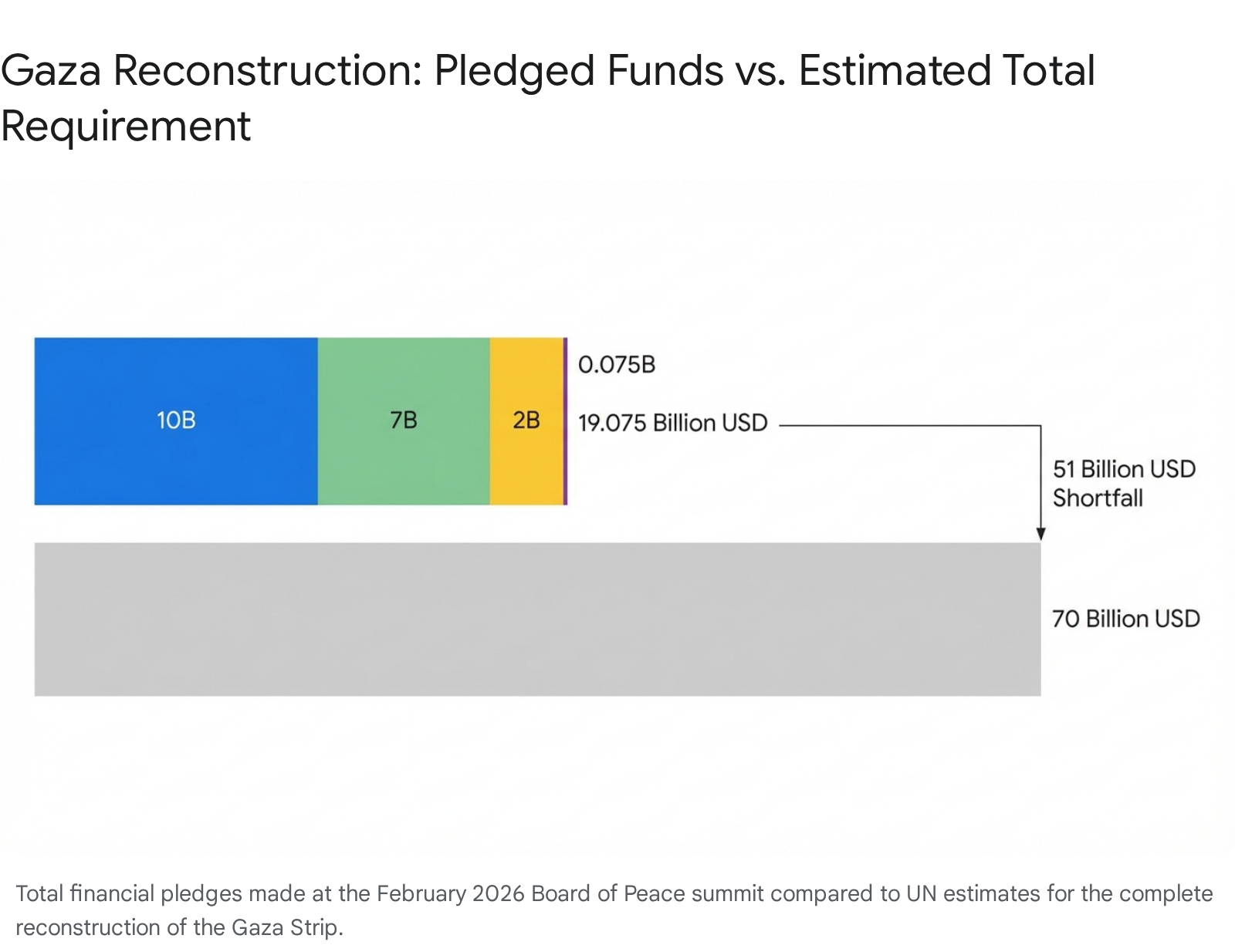
The security architecture for post-war Gaza centers on the deployment of an International Stabilization Force (ISF), commanded by U.S. Army Major General Jasper Jeffers.8 The ISF aims to deploy 20,000 military personnel alongside 12,000 local police officers.5 The logistics of assembling such a force from disparate national militaries present profound interoperability and command-and-control challenges. Initial troop commitments have been secured from a varied coalition, with specialized police training duties delegated to regional actors.
| Contributing Nation | Pledged Contribution / Role within ISF | Current Status |
| Indonesia | Up to 8,000 military personnel; potential deputy command | Committed, deployment expected by June 2026 |
| Morocco | Military personnel; specialized police training | Committed |
| Kazakhstan | Military personnel | Committed |
| Kosovo | Military personnel | Committed |
| Albania | Military personnel | Committed |
| Egypt | Specialized police training | Training underway |
| Jordan | Specialized police training | Training underway |
| United States | Command structure (Maj. Gen. Jasper Jeffers) | Active |
The ISF is tasked with maintaining internal order, supporting the dismantlement of militant infrastructure, and enforcing the disarmament of Hamas—a mandate that carries severe risks of triggering renewed urban combat.3 The Trump administration is reportedly planning the construction of a massive 350-acre military base in Gaza to accommodate up to 5,000 ISF personnel, signaling a long-term occupational footprint.10
Governance under the 20-point plan explicitly excludes both Hamas and the Palestinian Authority, delegating administrative duties to a National Committee for the Administration of Gaza (NCAG) composed of technocrats and international experts.3 This arrangement faces deep skepticism from the local population, who view the initiative as an externally imposed mechanism prone to corruption and disconnected from the reality of their ongoing suffering.7 Residents have expressed concerns that reconstruction funds will be diverted to high administrative salaries rather than tangible rebuilding efforts.7
Furthermore, the viability of the entire stabilization effort is compromised by the revelation of a recently published, peer-reviewed study in the Lancet Global Health journal.11 The study estimates that over 75,000 Palestinians were killed in the first 16 months of the war alone—representing 3 to 4 percent of Gaza’s pre-war population.12 Demographically, the data reveals that 56 percent of the victims were women, children, and the elderly, accounting for 42,200 non-combatant deaths.12 The sheer scale of destruction, coupled with the systemic collapse of sanitary, educational, and medical infrastructure, presents an insurmountable barrier to rapid stabilization.7 Humanitarian access remains severely constrained; while the Rafah crossing has reopened for limited movement, winter weather and transit delays have led to the significant spoilage of vital food commodities, and the water supply remains highly contaminated, leading to outbreaks of Hepatitis A.4
1.2 Iran Nuclear Coercion and Gulf Security Posture
Concurrent with the Gaza stabilization efforts, the United States has engineered an acute escalation with the Islamic Republic of Iran regarding its nuclear enrichment program. At the BoP summit on February 19, President Trump issued a stark ultimatum, giving Tehran “probably 10 days” to agree to a new nuclear framework or face severe, unspecified military consequences.10 This diplomatic coercion is backed by a massive regional deployment of U.S. naval assets, including the imminent arrival of the USS Gerald R. Ford carrier strike group.10 U.S. defense officials have indicated that target packages are in advanced stages of preparation, potentially extending beyond subterranean nuclear facilities to include regime leadership decapitation strikes.17
Iran’s response has been a calibrated mix of diplomatic engagement and military signaling, intended to deter American preemptive strikes while buying time for nuclear consolidation. Indirect negotiations in Geneva between Iranian Foreign Minister Abbas Araghchi and U.S. envoys Steve Witkoff and Jared Kushner have reportedly yielded an understanding on broad “guiding principles,” with Tehran promising a formal counterproposal within days.17 However, Araghchi publicly rebuffed the utility of American military threats, noting that previous kinetic strikes against Iranian facilities and the assassination of its scientists failed to arrest the trajectory of the nuclear program.17 Intelligence assessments indicate that Iran is highly unlikely to meet maximalist U.S. demands, which include zero-enrichment protocols, the capping of its ballistic missile program, and the complete cessation of support for regional proxy networks.16
Militarily, Iran has postured to demonstrate its capacity to disrupt regional maritime corridors and leverage great-power partnerships. On February 19, the Iranian First Artesh Naval Base in Bandar Abbas hosted joint Iranian-Russian naval exercises in the Gulf of Oman and the Strait of Hormuz.16 The drills, involving Islamic Revolutionary Guard Corps (IRGC) units and a Russian Steregushchiy-class corvette, simulated rapid response, combined assault methods, and operations to free hijacked commercial vessels.16 This joint exercise serves as an explicit signal of solidarity between Moscow and Tehran, complicating U.S. military calculus by introducing the risk of Russian military casualties in the event of an American preemptive strike in the Gulf.16
The interplay between the Gaza stabilization plan and the Iran standoff is highly volatile. Any U.S. or Israeli military action against Iran would likely activate the broader “Axis of Resistance.” In Lebanon, Hezbollah has already been conducting rocket attacks against IDF positions, demonstrating its capacity for regional disruption despite taking heavy losses in previous campaigns.18 An escalation with Iran would trigger major Israeli aerial operations in southern Lebanon, instantly derailing the fragile Gaza ceasefire, deterring ISF troop-contributing nations from deploying to a hot combat zone, and collapsing the Board of Peace’s precarious financial commitments.15
2. Europe and Eurasia
2.1 The Russia-Ukraine War: Attritional Dynamics and Strategic Stagnation
The war in Ukraine has entered its fifth year, characterized by brutal attritional warfare, devastating civilian impacts, and marginal, yet highly costly, territorial exchanges. The strategic initiative remains broadly, though haltingly, in the hands of the Russian Armed Forces.19 However, the pace of the Russian advance is historically lethargic; prominent offensives are moving at an average rate of between 15 and 70 meters per day, slower than almost any major offensive campaign in the last century.19
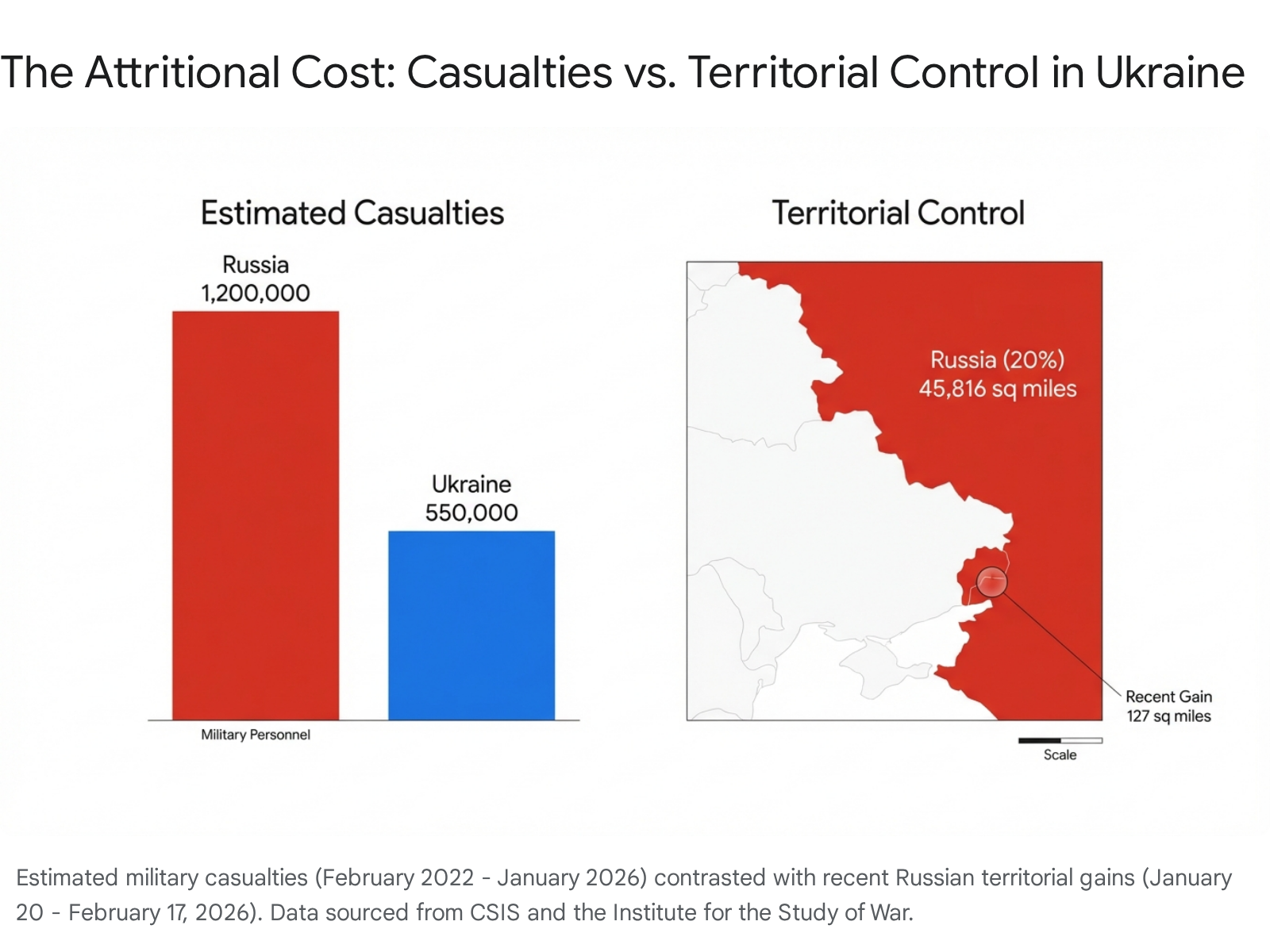
According to analysis from the Institute for the Study of War (ISW), between January 20 and February 17, 2026, Russian forces gained approximately 127 square miles of Ukrainian territory—a slight acceleration from the 63 square miles gained in the preceding four-week period.20 Conversely, the localized tactical picture reveals Ukrainian resilience and adaptive operational capabilities. During the week of February 10 to February 17, 2026, Ukrainian forces launched successful localized counterattacks, actually reclaiming 19 square miles of territory.20 Notably, Ukrainian units liberated several small settlements along the Yanchur and Haichur rivers in the Zaporizhzhia Oblast by exploiting a localized shutdown of Starlink communications that temporarily blinded Russian command and control networks.20 Additionally, Ukraine maintains a persistent 4-square-mile foothold across the Russian border in the Kursk and Belgorod regions, a critical psychological and strategic wedge.20
Despite these tactical fluctuations, Russia currently controls approximately 45,816 square miles, equating to roughly 20 percent of Ukraine’s total sovereign territory.20 The human cost of sustaining this occupation has been historically unprecedented. Estimates compiled by Western intelligence and independent monitors in early 2026 suggest Russian military casualties have reached staggering proportions.
| Source / Organization | Estimated Russian Casualties | Estimated Ukrainian Casualties | Timeframe |
| CSIS Estimate | 1,200,000 (killed, wounded, missing); up to 325k fatalities | 500,000–600,000 (killed, wounded, missing); 100k-140k fatalities | Feb 2022 – Dec 2025 19 |
| U.K. Ministry of Defense | 1,168,000 (killed and wounded) | Not Specified | Feb 2022 – Dec 2025 20 |
| Estonian Foreign Intel | 1,000,000 (killed and wounded) | Not Specified | Feb 2022 – Feb 2026 20 |
| Unnamed Western Officials | 1,200,000 (including 415k in 2025 alone) | Not Specified | Feb 2022 – Feb 2026 20 |
This casualty rate eclipses any losses sustained by a major power in a single conflict since World War II.19 If current attrition rates hold, combined casualties could reach 2 million by the spring of 2026.19
The war’s impact on civilians continues to compound drastically. The year 2025 was recorded as the deadliest for Ukrainian non-combatants since the initial invasion, with civilian casualties caused by explosive violence soaring by 26 percent.21 The UN Human Rights Monitoring Mission in Ukraine recorded 2,514 civilian deaths and 12,142 injuries in 2025, an average of 4.8 civilians killed or injured per Russian strike.21 In early February 2026, Russia launched massive, systematic strikes against Ukraine’s energy grid, damaging 70 percent of the nation’s energy facilities and plunging parts of Kyiv into winter blackouts without heat or water.21 The war has resulted in a staggering 6.9 million registered refugees globally, fundamentally altering European demographics.21
Strategically, the astronomical cost of the war is straining the Russian economy, which is projected to see a slowing growth rate of just 0.6 percent in 2025 alongside a notable decline in domestic manufacturing.19 To compensate for severe personnel shortages, Russian commanders have become increasingly dependent on foreign recruits and mercenary formations.23 Units such as the far-right Rusich group have engaged in the documented execution of Ukrainian prisoners of war, offering cash rewards for execution footage, thereby further degrading the laws of armed conflict.24 Ultimately, President Vladimir Putin remains locked in a war of attrition; as geopolitical analysts suggest, he is trapped in a war he cannot win conclusively but dare not end due to the domestic political risks of admitting strategic failure.23
3. Sub-Saharan Africa
3.1 Sudan’s State Collapse and Geopolitical Mediation
As the conflict in Sudan approaches its third anniversary in April 2026, the country is facing total institutional collapse and the world’s most severe humanitarian emergency.25 The war between the Sudanese Armed Forces (SAF), led by General Abdel Fattah al-Burhan, and the paramilitary Rapid Support Forces (RSF) has resulted in an estimated 400,000 fatalities and the displacement of over 11 million people.25 The crisis is rapidly evolving into a regional catastrophe, with over four million refugees overwhelming ill-equipped camps in neighboring Chad, Ethiopia, and South Sudan, triggering the world’s largest hunger crisis.25
On February 19, 2026, U.S. Senior Adviser Massad Boulos addressed the United Nations Security Council, introducing a comprehensive “five-pillar” strategy designed to halt the violence and restore civilian governance.27 The proposal, coordinated with Egypt, Saudi Arabia, the UAE, and Britain, demands an immediate cessation of hostilities without preconditions.27
| U.S. Five-Pillar Strategy for Sudan | Core Objective |
| Pillar 1 & 2 | Immediate humanitarian truce and the establishment of a UN supervisory mechanism to guarantee safe aid access. 27 |
| Pillar 3 | Phased negotiations for a permanent ceasefire and the creation of comprehensive security arrangements. 27 |
| Pillar 4 | A structured political process to establish a civilian-led transitional government, dismantle militia patronage structures, and prepare for democratic elections. 27 |
| Pillar 5 | A robust international reconstruction effort linked to accountability for atrocities and war crimes. 27 |
Despite this diplomatic initiative, the realities on the ground severely undermine any near-term peace prospects. General al-Burhan has outright rejected any truce unless the RSF completely withdraws from occupied territories, and has barred the United Arab Emirates—which is widely accused of arming and financing the RSF—from participating in mediation efforts.27
The military situation is marked by extreme brutality, shifting frontlines, and the advanced use of drone warfare by both sides.26 In North Darfur, a recent UN fact-finding mission reported that the RSF’s capture of El Fasher involved acts bearing the “hallmarks of genocide,” including mass killings, systematic sexual violence, and the ethnic cleansing of non-Arab communities.28 Strategic warnings from U.S. intelligence regarding the impending massacre at El Fasher were largely sidelined in favor of maintaining strategic relations with the UAE, highlighting the paralyzing effect of proxy interests.29 Currently, violence is intensifying in North Kordofan, where the RSF has besieged the state capital, El Obeid, from three sides.26 The fall of El Obeid to the RSF would deal a catastrophic blow to SAF logistics and effectively sever western Sudan from the government’s remaining strongholds in the east.26
3.2 The Sahel Security Vacuum and the Retreat of ECOWAS
The political geography of West Africa has been permanently altered following the formal withdrawal of Burkina Faso, Mali, and Niger from the Economic Community of West African States (ECOWAS) in late January 2026.30 These three junta-led nations, having seized power through consecutive military coups, have consolidated their breakaway bloc, the Alliance of Sahel States (AES), establishing a collective defense pact and completely severing ties with Western security frameworks, including the withdrawal of French counterterrorism forces.30
This geopolitical realignment has created a massive security vacuum that violent extremist organizations are rapidly exploiting.32 Jama’at Nusrat al-Islam wal-Muslimin (JNIM), the primary Al-Qaeda affiliate in the region, has launched an aggressive expansion campaign.33 JNIM operations are no longer confined to the central Sahel; the group is executing a deliberate, strategic push southward, initiating operations in the northern territories of coastal states such as Benin and Togo, threatening to link the Sahelian insurgency with the Gulf of Guinea.34
To counter the jihadist threat and secure regime survival, the AES juntas have deepened their reliance on Russian paramilitary forces, primarily the Wagner Group (now reorganized under the Africa Corps).35 Despite suffering an unprecedented number of casualties in clashes with Tuareg rebels and jihadists in Mali in late 2025, Russian mercenaries have shown no signs of disengaging from the region.37 Moscow views its presence in the Sahel as a critical vector for projecting power, extracting mineral resources, and systematically challenging Western diplomatic and military influence on the African continent.35
3.3 Eastern DRC Conflict and the Great Lakes Humanitarian Crisis
The eastern provinces of the Democratic Republic of Congo (DRC) remain engulfed in a multifaceted conflict characterized by proxy warfare, massive resource exploitation, and severe human rights abuses. The primary belligerent is the March 23 Movement (M23), a highly organized rebel group operating as a heavily armed proxy for the Rwandan government.38 Operating under the umbrella of the Congo River Alliance (AFC), M23 has effectively annexed large swaths of North and South Kivu, surrounding key economic hubs like Goma and Bukavu and establishing parallel administrative structures.38
The humanitarian impact is catastrophic. M23 fighters have engaged in summary executions, the gang-rape of women and girls, attacks on medical facilities, and the targeted assassination of civil society activists.40 The Congolese government in Kinshasa has exacerbated the crisis by employing a loose, undisciplined coalition of armed militias known as the Wazalendo to fight alongside the national army, leading to widespread indiscipline and further abuses against civilians.40 Furthermore, the DRC government has initiated a severe crackdown on media and political opposition, threatening journalists with the death penalty for reporting on the advance of Rwandan-backed forces.41
Diplomatic efforts remain stalled. While a ceasefire mechanism Terms of Reference was signed in Doha in early 2025 under AU mediation, implementation on the ground has failed entirely.42 During a regional tour on February 20, 2026, EU Commissioner Hadja Lahbib visited the rebel-held city of Goma to announce an 81.2 million EUR humanitarian aid package, pleading for respect for international humanitarian law.43 This was swiftly rebuked by AFC leader Corneille Nangaa, who cynically deflected blame, claiming that humanitarian conditions were far worse in government-controlled areas like Beni and Bunia.43 The weaponization of humanitarian access remains a primary tactic for all belligerents in the Kivu provinces.
3.4 Horn of Africa: Somaliland Sovereignty and Ethiopian Internal Fractures
Stability in the Horn of Africa is threatened by internal fracturing in Ethiopia and deep diplomatic disputes regarding Somali sovereignty. In Ethiopia’s northern Tigray region, the fragile peace established by the 2022 Pretoria Agreement is rapidly unraveling.44 The Tigray People’s Liberation Front (TPLF) has fractured, leading to violent clashes with the Tigray Interim Administration.44 Eritrea is reportedly fueling this dissidence by supporting breakaway TPLF factions, aiming to permanently weaken the region, prevent the disarmament of the Tigray Defense Forces, and block Ethiopian Prime Minister Abiy Ahmed’s ambitions for sovereign sea access.44
Simultaneously, regional diplomacy has been inflamed by external interference in Somalia. The African Union Peace and Security Council convened in February 2026 to strongly condemn the unilateral recognition of the breakaway region of Somaliland by the State of Israel.45 The AU firmly rejected this move, warning that the fragmentation of Somali sovereignty undermines the ongoing, fragile state-building process and emboldens the Al-Shabaab insurgency.45 Concurrently, counterterrorism operations continue; U.S. Africa Command and the Somali National Army launched coordinated airstrikes in the Middle Shabelle region in mid-February, successfully neutralizing Al-Shabaab militants attempting to lay improvised explosive devices along vital civilian and military supply routes.46
4. Asia-Pacific
4.1 Taiwan Strait: Gray-Zone Escalation and Political Warfare
Tensions in the Taiwan Strait have evolved beyond mere military posturing, as the Chinese Communist Party (CCP) intensifies a sophisticated campaign of political warfare alongside its military gray-zone operations. Beijing continues to unequivocally reject the sovereignty of the Democratic Progressive Party (DPP) government in Taipei, pursuing a comprehensive strategy aimed at isolating Taiwan internationally and fracturing it domestically.47
In February 2026, the intersection of CCP influence operations and Taiwanese domestic politics became highly visible. Wang Huning, the CCP’s fourth-highest ranking official, engaged in high-level talks with Hsiao Hsu-tsen, Vice Chairman of Taiwan’s opposition Kuomintang (KMT) party, during a think-tank forum in Beijing.48 According to intelligence leaks published in Taiwanese media, Wang instructed the KMT leadership to advocate more aggressively for “unification,” to actively block the purchase of U.S. military hardware in the legislature, and to prioritize supply chain integration with the PRC.48 While KMT leadership vehemently denied receiving instructions from Beijing, the engagement underscores the CCP’s strategy of utilizing sympathetic factions within Taiwan’s political establishment to achieve strategic paralysis, specifically targeting the $11 billion in U.S. arms sales authorized in late 2025.48
Militarily, the People’s Liberation Army (PLA) continues to establish a “new normal” of relentless incursions across the median line of the Taiwan Strait, maintaining an omnipresent threat vector.50 The PLA Navy is rapidly expanding its power projection capabilities, evidenced by the recent outfitting of the Type 076 amphibious assault vessel with GJ-21 stealth naval drones, designed to support long-distance amphibious operations and establish local air superiority.49 While analysts note that a full-scale amphibious invasion remains unlikely in the immediate term, the persistent gray-zone coercion systematically exhausts Taiwan’s defense resources and tests the limits of U.S. extended deterrence in the Indo-Pacific.51
4.2 The Korean Peninsula: The 9th Workers’ Party Congress and Nuclear Irreversibility
The security environment in Northeast Asia has severely deteriorated as North Korea formally shifts its strategic doctrine away from any pretense of denuclearization. During the opening of the ruling Workers’ Party’s 9th Congress in Pyongyang on February 19, 2026, Supreme Leader Kim Jong Un issued a definitive declaration that North Korea’s status as a nuclear weapons state is firmly consolidated and “irreversible”.52 Notably absent from Kim’s keynote address was any mention of reunification with South Korea or dialogue with the United States—a stark departure from previous congresses, signaling a total abandonment of diplomatic engagement with the West.52
This highly aggressive posture is entirely underwritten by Pyongyang’s deepening strategic and economic alliance with the Russian Federation. Following the June 2024 Comprehensive Strategic Partnership agreement, North Korea has become a vital supplier of munitions, artillery shells, and ballistic missiles for Russia’s war in Ukraine.54 By mid-2025, North Korea had generated an estimated 19.5 billion USD through arms sales and the deployment of engineering and combat troops to support Russian operations.54
This massive influx of capital has insulated the Kim regime from the impact of international sanctions and provided the resources necessary to rapidly modernize the Korean People’s Army (KPA).53 During the current 2026–2030 defense cycle, Pyongyang is accelerating the operational deployment of tactical nuclear weapons and finalizing a nuclear-powered submarine capable of launching nuclear-armed SLBMs.53 With Russian diplomatic protection effectively neutralizing the UN Security Council, North Korea is highly likely to increase its provocations against South Korea, potentially moving to redefine maritime boundaries around the contested Northern Limit Line to force a crisis.53
4.3 The South China Sea: Sino-Philippine Maritime Coercion
The South China Sea remains a highly volatile maritime flashpoint, characterized by frequent, aggressive confrontations between the China Coast Guard (CCG) and Philippine maritime forces. During the week ending February 21, a CCG vessel intentionally blocked a Philippine patrol ship attempting to resupply outposts in a disputed shoal, resulting in a near-collision that highlighted the physical risks of Beijing’s territorial assertiveness.56
The physical altercations are mirrored by an escalating diplomatic war of words that challenges the norms of diplomatic conduct. The Chinese military publicly accused the Philippines of destabilizing the region by organizing joint naval patrols with “countries outside the region” (referring primarily to the United States and Japan).57 In response, Philippine officials, including Coast Guard spokesperson Tarriela and Senator Risa Hontiveros, have openly rebuked Chinese diplomats.58 Hontiveros accused the Chinese embassy of violating the Vienna Convention by attempting to silence and publicly censure Philippine public officials within their own country.58 Despite nominal ongoing negotiations between ASEAN and China regarding a long-delayed Code of Conduct for the South China Sea, the reality on the water demonstrates Beijing’s unwavering commitment to enforcing its expansive territorial claims through physical coercion and diplomatic intimidation.59
4.4 Myanmar’s Electoral Facade and Accelerating State Failure
Myanmar’s trajectory toward complete state failure accelerated following a multi-phase, junta-orchestrated election that concluded in late January 2026. Unsurprisingly, the military-backed Union Solidarity and Development Party (USDP) secured a preordained landslide victory after systematically excluding all major opposition parties and violently suppressing dissent.60 With 25 percent of parliamentary seats automatically reserved for the military under the 2008 Constitution, junta chief Min Aung Hlaing has cemented total legal control, enabling him to enact constitutional amendments to legitimize his continued authoritarian rule.61
Despite this political theater in Naypyidaw, the junta is decisively losing the civil war on the ground. The military is facing fierce, coordinated resistance from a decentralized network of People’s Defense Forces (PDFs) and established Ethnic Armed Organizations (EAOs), notably the Arakan Army, which continues to make significant territorial advances in Rakhine State.61 The regime has survived primarily due to diplomatic and material support from China, which has pressured certain ethnic resistance groups along its border to halt offensives, allowing the junta to temporarily stabilize specific northern fronts.61
The conflict has exacted a horrifying toll on the civilian population. According to the Landmine Monitor report, Myanmar recorded the highest number of landmine casualties globally in 2024.
| Myanmar Landmine Casualties | 2022 | 2023 | 2024 |
| Total Casualties (Killed/Injured) | 545 | 1,003 | 2,029 |
| Civilian Percentage | N/A | N/A | 86% |
The data indicates a staggering exponential increase in explosive ordnance casualties since the 2021 coup.62 Junta troops have reportedly engaged in the systemic use of civilians as human shields and “human minesweepers” in contested areas, constituting grave violations of international humanitarian law.62 Concurrently, the collapse of the rule of law has allowed transnational organized crime to flourish, with Myanmar becoming the epicenter of massive cyber-scam operations fueled by human trafficking, extortion, and forced labor.63
4.5 Transnational Crime and the Thailand-Cambodia Border Crisis
The territorial dispute between Thailand and Cambodia, historically centered around the Preah Vihear temple complex and colonial-era cartography, re-escalated violently in mid-February 2026. Following the collapse of a fragile December 2025 ceasefire, Thai forces detected and engaged increased Cambodian military activity near the border in Ubon Ratchathani on February 16, prompting immediate reinforcement of Thai defensive positions.64
However, this renewed confrontation is heavily influenced by non-traditional security threats. The border dispute has become deeply intertwined with allegations regarding multi-billion-dollar illegal online scam centers operating out of Cambodian territory.64 The Thai government has utilized the military standoff to pressure Phnom Penh regarding its failure to crack down on these transnational criminal syndicates, which routinely target Thai citizens.64
The crisis is also serving domestic political utilities. In Thailand, Prime Minister Anutin Charnvirakul utilized the national security emergency to justify the dissolution of Parliament and the calling of snap elections for late February 2026, temporarily muting public scrutiny of his fragile coalition and contested civil-military relations.67 On the Cambodian side, public discourse—driven by civil society and Buddhist monks—has notably favored restraint, placing pressure on Prime Minister Hun Manet to avoid a full-scale war that would jeopardize the regime’s economic modernization goals and international standing.67
5. South Asia
5.1 India-Pakistan Strategic Friction and Subconventional Conflict
The strategic equilibrium between nuclear-armed rivals India and Pakistan remains dangerously fragile, with a leading U.S. think tank, the Council on Foreign Relations, assessing a “moderate likelihood” of renewed armed conflict in 2026 that would carry severe implications for U.S. interests.68 The primary catalyst for escalation remains cross-border terrorism. Tensions are currently heightened following India’s recent “Operation Sindoor”—a military response comprising drone and missile strikes targeting terror infrastructure in Pakistan-Occupied Kashmir, launched after Pakistan-backed militants killed 22 Indian civilians in Pahalgam.68
The diplomatic environment is highly toxic. Pakistan’s Defense Minister Khawaja Asif recently accused India and the Taliban regime in Afghanistan of colluding in a proxy war against Islamabad.70 New Delhi dismissed these allegations as desperate diversionary tactics by a Pakistani establishment struggling with severe internal instability and an escalating domestic insurgency.70 Furthermore, Pakistan continues to accuse India of orchestrating extraterritorial assassination campaigns against dissidents on Pakistani soil, a claim India vehemently denies, though it echoes similar allegations raised by Canada and the United States.71
Both nations are engaged in rapid, reactionary military modernization. India has recently approved 79,000 crore INR (approximately 9.5 billion USD) in defense acquisitions, focusing heavily on precision-guided munitions, air-to-air missiles, and drone fleets.69 Pakistan, attempting to close the capability gap exposed during recent clashes, is actively negotiating with China and Turkey to overhaul its air defense networks and unmanned aerial capabilities.69 Paradoxically, amidst this military brinkmanship, cultural ties occasionally pierce the hostility; the February 15 India-Pakistan T20 World Cup cricket match in Colombo shattered global digital viewership records with 163 million viewers, highlighting the deeply intertwined, yet fiercely antagonistic, nature of the bilateral relationship.72
5.2 The Afghanistan-Pakistan Border: ISKP, TTP, and Threats of Cross-Border Intervention
Pakistan’s western border with Afghanistan has devolved into a zone of continuous, multi-factional low-intensity conflict. The Pakistani military is engaged in a grueling counterinsurgency campaign against the Tehreek-e-Taliban Pakistan (TTP), which operates with near impunity from safe havens within Taliban-controlled Afghanistan.73 On February 21, 2026, the extreme complexity of the militant landscape was highlighted when fierce infighting erupted in Pakistan’s Khyber Pakhtunkhwa province between the TTP and fighters from the Islamic State Khorasan Province (ISKP).74 The clash, which took place in the Orakzai District, was triggered by a dispute over lucrative extortion networks, resulting in multiple militant casualties, including the death of a senior ISKP commander.74
The Pakistani government’s frustration with Kabul’s refusal to rein in the TTP is boiling over into explicit public threats of cross-border military action. Defense Minister Khawaja Asif openly warned that Pakistan would launch kinetic strikes into sovereign Afghan territory if the Taliban government does not dismantle TTP sanctuaries.73 The Pakistani Ministry of Foreign Affairs echoed this aggressive posture, officially asserting Pakistan’s right to self-defense under Article 51 of the UN Charter.71 This diplomatic framing signals that cross-border aerial or artillery bombardments are actively being considered as a near-term policy option, a move that would drastically escalate regional instability and potentially draw the Afghan Taliban into direct conventional conflict with Islamabad.71
6. The Americas
6.1 The Haitian Institutional Vacuum and Gang Suppression Efforts
Haiti has crossed a critical constitutional and security threshold, moving deeper into state failure. On February 7, 2026, the mandate of the Transitional Presidential Council (TPC)—the executive body established in 2024 to guide the country toward democratic elections following the assassination of President Jovenel Moïse—officially expired without a viable successor mechanism in place.75 This expiration effectively dissolved the council, consolidating all remaining executive authority in the hands of the U.S.-backed Prime Minister, Alix Didier Fils-Aimé.77
The transition of power was facilitated by explicit, modern “gunboat diplomacy.” In the days leading up to the TPC’s expiration, the United States deployed warships and Coast Guard vessels off the coast of Port-au-Prince.76 This naval posturing was designed to demonstrate Washington’s willingness to use force to ensure the council stepped down, effectively averting a messy constitutional challenge to Fils-Aimé’s authority and enforcing a singular executive point of contact.76
Despite this consolidation of political power, the security situation remains apocalyptic. Criminal syndicates now control approximately 90 percent of the capital, Port-au-Prince.76 The UN estimates that nearly 6,000 Haitians were killed by gang violence in 2025 alone, and half the population faces acute hunger due to the strangulation of supply lines.76 The international response hinges entirely on the UN-authorized Multinational Security Support (MSS) mission, led by Kenya. Following UN Security Council Resolution 2793, the MSS is currently attempting to transition into a more robust “Gang Suppression Force” (GSF) with expanded, kinetic rules of engagement.75 However, the mission remains chronically underfunded, and the transition process is hindered by severe logistical bottlenecks, insufficient troop contributions, and ongoing concerns regarding the human rights vetting of international police personnel operating in complex urban terrain.80
6.2 Venezuela: The Strategic Fallout of Operation Absolute Resolve
The geopolitical shockwaves of the unilateral U.S. military intervention in Venezuela on January 3, 2026, continue to dictate the security and economic environment in South America. In a highly classified operation code-named “Absolute Resolve,” U.S. special operations forces extracted President Nicolás Maduro and his wife, Cilia Flores, from a military base in Caracas, transporting them to a U.S. warship bound for New York to face federal narco-terrorism charges.82 The strike was the culmination of a months-long U.S. naval buildup in the Caribbean and Eastern Pacific, justified by the Trump administration under a controversial directive targeting drug cartels designated as foreign terrorist organizations.83
The intervention was executed without authorization from the U.S. Congress and completely outside the bounds of a UN mandate, drawing severe international condemnation for violating established norms of state sovereignty.82 Domestically, the operation achieved immediate regime decapitation but left the broader authoritarian power structure largely intact. Vice President Delcy Rodríguez was immediately sworn in as acting president of Venezuela, urging citizens to resist the “imperialist attack”.83
In the weeks following the extraction, a complex, highly transactional diplomatic and economic recalibration has occurred between Washington and Caracas. By mid-February, the acting Venezuelan government released 444 political prisoners.84 In a reciprocal, deeply controversial move, the U.S. administration lifted crippling sanctions on the Venezuelan oil trade, paving the way for the potential privatization of the nation’s energy sector and the reentry of Western petroleum conglomerates.84 While Washington frames this as a successful operation to restore democratic conditions and secure vital hemispheric energy supplies, the precedent of using overwhelming military force for unilateral regime change has deeply unsettled regional actors. The intervention has permanently altered the security calculus of Latin American states vis-à-vis the United States, likely prompting an accelerated pursuit of asymmetric defense capabilities and deeper alignments with extra-hemispheric powers like China and Russia.
Please share the link on Facebook, Forums, with colleagues, etc. Your support is much appreciated and if you have any feedback, please email us in**@*********ps.com. If you’d like to request a report or order a reprint, please click here for the corresponding page to open in new tab.
Sources Used
- Five Key Takeaways From Trump’s First Gaza Board of Peace Meeting, accessed February 21, 2026, https://time.com/7379788/trump-gaza-board-of-peace-first-meeting-takeaways/
- Trump Announces Gaza Relief Pledges, Troop Pledges at First Board of Peace Meeting, accessed February 21, 2026, https://www.theintelligencer.net/news/top-headlines/2026/02/trump-announces-gaza-relief-pledges-troop-pledges-at-first-board-of-peace-meeting/
- 5 Things to Know About Trump’s Board of Peace | AJC – American Jewish Committee, accessed February 21, 2026, https://www.ajc.org/news/5-things-to-know-about-trumps-board-of-peace
- A Guide to the Gaza Peace Deal | Council on Foreign Relations, accessed February 21, 2026, https://www.cfr.org/articles/guide-trumps-twenty-point-gaza-peace-deal
- Trump gets pledges for Gaza reconstruction and troop commitments at inaugural Board of Peace talks, accessed February 21, 2026, https://apnews.com/article/trump-board-of-peace-first-meeting-22e587df67e27cd1e1d96e446cb88378
- Troops for Gaza and money top agenda as Trump’s Board of Peace meets, accessed February 21, 2026, https://www.theguardian.com/us-news/2026/feb/19/troops-for-gaza-and-money-top-agenda-as-trumps-board-of-peace-meets
- In Gaza, Trump’s Board of Peace met with deep scepticism, little …, accessed February 21, 2026, https://www.aljazeera.com/features/2026/2/20/in-gaza-trumps-board-of-peace-met-with-deep-scepticism-little-hope
- Prabowo confirms Indonesian troop deployment to Gaza within 2 months, accessed February 21, 2026, https://en.antaranews.com/news/405202/prabowo-confirms-indonesian-troop-deployment-to-gaza-within-2-months
- Stabilization force and funding pledged for Gaza at Board of Peace meeting, accessed February 21, 2026, https://www.fdd.org/analysis/2026/02/20/stabilization-force-and-funding-pledged-for-gaza-at-board-of-peace-meeting/
- Trump news at a glance: president weighs ordering ‘bad things’ against Iran as nuclear deal sits in limbo, accessed February 21, 2026, https://www.theguardian.com/us-news/2026/feb/19/trump-news-at-a-glance-latest-updates-today
- Israel-Gaza war | The Guardian, accessed February 21, 2026, https://www.theguardian.com/world/israel-hamas-war
- Gaza death toll for first 16 months of war far higher than reported, says peer-reviewed study, accessed February 21, 2026, https://www.theguardian.com/world/2026/feb/19/gaza-death-toll-higher-than-reported-lancet-study
- OCHA Humanitarian Situation Update #357 – Gaza Strip, accessed February 21, 2026, https://www.un.org/unispal/document/ocha-humanitarian-situation-update-357-gaza-strip/
- Morning Briefing: Feb. 20, 2026, accessed February 21, 2026, https://www.aa.com.tr/en/world/morning-briefing-feb-20-2026/3835289
- Inaugural Board of Peace Meeting: Opportunities, but No Shortage of Challenges, accessed February 21, 2026, https://thesoufancenter.org/intelbrief-2026-february-20/
- Iran Update, February 19, 2026, accessed February 21, 2026, https://understandingwar.org/research/middle-east/iran-update-february-19-2026/
- Iran prepares nuclear counterproposal as US considers limited military strikes, accessed February 21, 2026, https://www.theguardian.com/world/2026/feb/21/iran-nuclear-counterproposal-us-strikes-threat
- Iran Update, February 20, 2026, accessed February 21, 2026, https://understandingwar.org/research/middle-east/iran-update-february-20-2026/
- Russia’s Grinding War in Ukraine – CSIS, accessed February 21, 2026, https://www.csis.org/analysis/russias-grinding-war-ukraine
- The Russia-Ukraine War Report Card, Feb. 18, 2026, accessed February 21, 2026, https://www.russiamatters.org/news/russia-ukraine-war-report-card/russia-ukraine-war-report-card-feb-18-2026
- Country Conditions: Ukraine February 2026, accessed February 21, 2026, https://refugees.org/country-conditions-ukraine-february-2026/
- Ukrainian civilian casualties surged by 26% in 2025, say researchers, accessed February 21, 2026, https://www.theguardian.com/world/2026/feb/16/ukrainian-civilian-casualties-surged-by-26-in-2025-say-researchers
- Ukraine hopes escalating Russian losses will push Putin toward peace, accessed February 21, 2026, https://www.atlanticcouncil.org/blogs/ukrainealert/ukraine-hopes-escalating-russian-losses-will-push-putin-toward-peace/
- Russian Offensive Campaign Assessment, February 20, 2026, accessed February 21, 2026, https://understandingwar.org/research/russia-ukraine/russian-offensive-campaign-assessment-february-20-2026/
- Civil War in Sudan | Global Conflict Tracker – Council on Foreign Relations, accessed February 21, 2026, https://www.cfr.org/global-conflict-tracker/conflict/power-struggle-sudan
- ‘No corner of Sudan is safe’: UN officials warn of famine and atrocities as war intensifies, accessed February 21, 2026, https://news.un.org/en/story/2026/02/1167003
- US Boulos outlines five-step plan to end Sudan conflict – Sudan …, accessed February 21, 2026, https://sudantribune.com/article/310895
- Security Council LIVE: Sudan in focus amid genocide warnings in Darfur, accessed February 21, 2026, https://news.un.org/en/story/2026/02/1166999
- These atrocities in Sudan were entirely predictable. So why did the rest of the world fail to stop them?, accessed February 21, 2026, https://www.theguardian.com/commentisfree/2026/feb/20/atrocities-el-fasher-sudan-predictable
- West Africa and the Sahel, April 2025 Monthly Forecast – Security Council Report, accessed February 21, 2026, https://www.securitycouncilreport.org/monthly-forecast/2025-04/west-africa-and-the-sahel-14.php
- The Wagner Group’s Growing Shadow in the Sahel: What Does It Mean for Counterterrorism in the Region? – Modern War Institute, accessed February 21, 2026, https://mwi.westpoint.edu/the-wagner-groups-growing-shadow-in-the-sahel-what-does-it-mean-for-counterterrorism-in-the-region/
- Violent Extremism in the Sahel | Global Conflict Tracker – Council on Foreign Relations, accessed February 21, 2026, https://www.cfr.org/global-conflict-tracker/conflict/violent-extremism-sahel
- Sahel | International Crisis Group, accessed February 21, 2026, https://www.crisisgroup.org/africa/sahel
- Conflict intensifies and instability spreads beyond Burkina Faso, Mali, and Niger | ACLED, accessed February 21, 2026, https://acleddata.com/report/conflict-intensifies-and-instability-spreads-beyond-burkina-faso-mali-and-niger
- While the focus is on Ukraine, Russia’s presence in the Sahel is steadily growing | Bruce Mutsvairo, Mirjam de Bruijn, Kristin Skare Orgeret | The Guardian, accessed February 21, 2026, https://www.theguardian.com/global-development/2022/feb/03/while-the-focus-is-on-ukraine-russias-presence-in-the-sahel-is-steadily-growing
- The Coups d’État of the Sahel Region: Domestic Causes and International Competition, accessed February 21, 2026, https://arabcenterdc.org/resource/the-coups-detat-of-the-sahel-region-domestic-causes-and-international-competition/
- Wagner Mercenaries Clash with Rebels and Jihadists in the Sahel – The Soufan Center, accessed February 21, 2026, https://thesoufancenter.org/intelbrief-2024-september-13/
- 10 Conflicts to Watch in 2026 | International Crisis Group, accessed February 21, 2026, https://www.crisisgroup.org/cmt/global/10-conflicts-watch-2026
- M23 and Lake Region Conflicts, accessed February 21, 2026, https://www.fairobserver.com/fofeatures/m23-and-lake-region-conflicts/
- DRC: EU must move from concern to action for human rights in Eastern DRC – Joint letter, accessed February 21, 2026, https://www.amnesty.eu/news/drc-eu-must-move-from-concern-to-action-in-eastern-drc/
- World Report 2026: Democratic Republic of Congo | Human Rights Watch, accessed February 21, 2026, https://www.hrw.org/world-report/2026/country-chapters/democratic-republic-of-congo
- African Union Commission Welcomes the Signing of the Terms of Reference for the Ceasefire Mechanism between the Government of the Democratic Republic of the Congo and AFC/M23, accessed February 21, 2026, https://au.int/en/pressreleases/20260212/auc-welcomes-signing-tor-ceasefire-mechanism-between-drc-and-afcm23
- EU official warns of crisis in eastern DR Congo, rebel leader pushes back, accessed February 21, 2026, https://english.news.cn/africa/20260221/f5238fa40e1e476789019c6310ffa06c/c.html
- Conflict in Ethiopia | Global Conflict Tracker – Council on Foreign Relations, accessed February 21, 2026, https://www.cfr.org/global-conflict-tracker/conflict/conflict-ethiopia
- Communiqué of the 1330th meeting of the PSC held, at Ministerial level, on 12 February 2026 on Consideration of the Situation in Somalia and Operations of the AU Support and Stabilization Mission in Somalia (AUSSOM)-African Union – Peace and Security Department, accessed February 21, 2026, https://www.peaceau.org/en/article/communique-of-the-1330th-meeting-of-the-psc-held-at-ministerial-level-on-12-february-2026-on-consideration-of-the-situation-in-somalia-and-operations-of-the-au-support-and-stabilization-mission-in-somalia-aussom
- America’s Counterterrorism Wars: The War in Somalia – New America, accessed February 21, 2026, https://www.newamerica.org/future-security/reports/americas-counterterrorism-wars/the-war-in-somalia/
- Confrontation Over Taiwan | Global Conflict Tracker – Council on Foreign Relations, accessed February 21, 2026, https://www.cfr.org/global-conflict-tracker/conflict/confrontation-over-taiwan
- China & Taiwan Update, February 13, 2026, accessed February 21, 2026, https://understandingwar.org/research/china-taiwan/china-taiwan-update-february-13-2026/
- China & Taiwan Update, February 13, 2026, accessed February 21, 2026, https://www.aei.org/articles/china-taiwan-update-february-13-2026/
- Taiwan: Defense and Military Issues – Congress.gov, accessed February 21, 2026, https://www.congress.gov/crs_external_products/IF/PDF/IF12481/IF12481.19.pdf
- Escalation or Restraint? Tensions Simmer in the Taiwan Strait as Beijing Tests Red Lines, accessed February 21, 2026, https://www.visiontimes.com/2026/02/18/escalation-or-restraint-tensions-simmer-in-the-taiwan-strait-as-beijing-tests-red-lines.html
- As North Korea’s party congress opens, Kim asserts state’s ‘irreversible’ position while avoiding naming South, U.S., accessed February 21, 2026, https://koreajoongangdaily.joins.com/news/2026-02-21/national/northKorea/As-North-Koreas-party-congress-opens-Kim-asserts-states-irreversible-position-while-avoiding-naming-South-US/2527824
- Korean Peninsula Update, February 17, 2026 – American Enterprise Institute, accessed February 21, 2026, https://www.aei.org/articles/korean-peninsula-update-february-17-2026/
- Korean Peninsula Update, February 10, 2026 | AEI – American Enterprise Institute, accessed February 21, 2026, https://www.aei.org/articles/korean-peninsula-update-february-10-2026/
- North Korea in 2026: Will the US and South Korean push for talks succeed?, accessed February 21, 2026, https://www.chathamhouse.org/2026/01/north-korea-2026-will-us-and-south-korea-push-talks-succeed
- Tense face-off: Philippines confronts China over sea claims – AP News, accessed February 21, 2026, https://apnews.com/article/philippines-dispute-south-china-sea-patrol-27ee9778f7302938c5090644e3d153c2
- China Criticizes Philippines Over South China Sea Tensions – Novinite.com – Sofia News Agency, accessed February 21, 2026, https://www.novinite.com/articles/236674/China+Criticizes+Philippines+Over+South+China+Sea+Tensions
- Philippines tells Beijing it is alarmed over escalating verbal tussle in South China Sea dispute | kare11.com, accessed February 21, 2026, https://www.kare11.com/article/syndication/associatedpress/philippines-tells-beijing-it-is-alarmed-over-escalating-verbal-tussle-in-south-china-sea-dispute/616-3075252e-d664-40dc-8603-0122a1ed84de
- Parties involved in South China Sea code of conduct negotiations ‘bent’ on meeting 2026 deadline – YouTube, accessed February 21, 2026, https://www.youtube.com/watch?v=5HVqGXEimg0
- Civil War in Myanmar | Global Conflict Tracker – Council on Foreign Relations, accessed February 21, 2026, https://www.cfr.org/global-conflict-tracker/conflict/rohingya-crisis-myanmar
- Myanmar without a path to recovery | East Asia Forum, accessed February 21, 2026, https://eastasiaforum.org/2026/02/17/myanmar-without-a-path-to-recovery/
- Myanmar records world’s highest landmine casualties as conflict intensifies, says Landmine Monitor, accessed February 21, 2026, https://eng.mizzima.com/2026/02/21/31461
- Sham Elections amid the War in Myanmar – Stiftung Wissenschaft und Politik, accessed February 21, 2026, https://www.swp-berlin.org/10.18449/2026C09/
- Thailand and Cambodia’s diplomatic rivalry intensifies as online scams add complexity to border tensions, accessed February 21, 2026, https://www.nationthailand.com/news/world/40062700
- 2025 Cambodian–Thai border crisis – Wikipedia, accessed February 21, 2026, https://en.wikipedia.org/wiki/2025_Cambodian%E2%80%93Thai_border_crisis
- Cambodia hopes French maps will vindicate it in Thai row, accessed February 21, 2026, https://indianexpress.com/article/world/cambodia-thailand-border-dispute-france-colonial-maps-preah-vihear-icj-explained-10538740/
- Thai-Cambodian Dispute: Differing Configurations of Nationalism and Legitimacy, accessed February 21, 2026, https://fulcrum.sg/thai-cambodian-dispute-differing-configurations-of-nationalism-and-legitimacy/
- India-Pakistan War Risk in 2026? US Think Tank CFR Warns India – YouTube, accessed February 21, 2026, https://www.youtube.com/watch?v=-Xwm7XqTgoI
- India-Pakistan tensions could turn into armed conflict in 2026, warns US Think Tank, accessed February 21, 2026, https://www.ptcnews.tv/world-news/india-pakistan-tensions-armed-conflict-warning-us-think-tank-4419298
- India Delivers Grim Terror Reminder To Pakistan After Khawaja Asif Alleges Delhi-Kabul Proxy Nexus, accessed February 21, 2026, https://timesofindia.indiatimes.com/videos/news/india-delivers-grim-terror-reminder-to-pakistan-after-khawaja-asif-alleges-delhi-kabul-proxy-nexus/videoshow/128616743.cms
- Transcript of the Press Briefing by the Spokesperson on Thursday 19th February 2026, accessed February 21, 2026, https://mofa.gov.pk/press-releases/transcript-of-the-press-briefing-by-the-spokesperson-on-thursday-19th-february-2026
- Record-breaking reach! India-Pakistan clash becomes T20 World Cup’s most-viewed match, accessed February 21, 2026, https://timesofindia.indiatimes.com/sports/cricket/icc-mens-t20-world-cup/record-breaking-reach-india-pakistan-clash-becomes-t20-world-cups-most-viewed-match/articleshow/128595825.cms
- Difficult neighbour – Newspaper – DAWN.COM, accessed February 21, 2026, https://www.dawn.com/news/1974525
- Tehreek-e-Taliban Pakistan & Islamic State Clash In Khyber Pakhtunkhwa, accessed February 21, 2026, https://www.afintl.com/en/202602219765
- Haiti – End of the Transitional Presidential Council mandate (09.02.26) – France Diplomatie, accessed February 21, 2026, https://www.diplomatie.gouv.fr/en/country-files/haiti/news/article/haiti-end-of-the-transitional-presidential-council-mandate-09-02-26
- Further US intervention in Haiti would be worst Trump move of all, accessed February 21, 2026, https://responsiblestatecraft.org/haiti-us-intervention/
- Transitional Presidential Council – Wikipedia, accessed February 21, 2026, https://en.wikipedia.org/wiki/Transitional_Presidential_Council
- Another government transition in Haiti’s quest for stability, accessed February 21, 2026, https://www.mnnonline.org/news/another-government-transition-in-haitis-quest-for-stability/
- Haiti, January 2026 Monthly Forecast – Security Council Report, accessed February 21, 2026, https://www.securitycouncilreport.org/monthly-forecast/2026-01/haiti-33.php
- A roadmap for security and governance reform in Haiti – Chatham House, accessed February 21, 2026, https://www.chathamhouse.org/2026/01/roadmap-security-and-governance-reform-haiti
- Kenya-Led Security Mission Prepares for Deployment in Haiti – Human Rights Watch, accessed February 21, 2026, https://www.hrw.org/news/2024/05/28/kenya-led-security-mission-prepares-deployment-haiti
- Unilateral U.S. military intervention to remove authoritarian dictator Nicolas Maduro from power violates international law and sets a dangerous precedent for the region – WOLA, accessed February 21, 2026, https://www.wola.org/2026/01/military-action-venezuela-united-states-maduro-trump/
- A timeline of U.S. military escalation against Venezuela leading to Maduro’s capture – PBS, accessed February 21, 2026, https://www.pbs.org/newshour/world/a-timeline-of-u-s-military-escalation-against-venezuela-leading-to-maduros-capture
- 2026 United States intervention in Venezuela – Wikipedia, accessed February 21, 2026, https://en.wikipedia.org/wiki/2026_United_States_intervention_in_Venezuela
- U.S. Military’s Boat Strike Escalates Tensions With Venezuela, accessed February 21, 2026, https://www.cfr.org/articles/us-militarys-boat-strike-escalates-tensions-venezuela