
Executive Summary
For the week ending February 21, 2026, the strategic posture of the Russian Federation demonstrates a complex, high-risk synthesis of aggressive frontline military operations, high-stakes coercive diplomacy, and mounting macroeconomic vulnerability. The operational environment is defined by an accelerating, desperate push by Moscow to secure a favorable negotiated settlement in Ukraine before the compounding effects of domestic economic stagnation, demographic attrition, and tightening Western sanctions enforcement fundamentally degrade the Kremlin’s long-term war-making capacity. The culmination of the United States-brokered trilateral talks in Geneva on February 17 and 18 yielded no definitive breakthrough on territorial concessions or security guarantees, highlighting a deep strategic impasse between the negotiating parties. Moscow continues to demand uncompromising territorial maximalism—specifically the formal cession of roughly 2,000 square miles of the Donetsk region and the establishment of a vast demilitarized zone—while simultaneously attempting to fracture the United States-Ukraine alliance through a highly publicized, transactional $14 trillion economic proposal pitched directly to the U.S. administration.
Militarily, the Russian Armed Forces maintain the overarching strategic initiative across the line of contact, but they are experiencing rapidly diminishing marginal returns on their combat investments. The offensive campaign across the Eastern and Northern axes is characterized by grinding, attritional warfare that relies heavily on massed infantry assaults and guided aerial bombardments. This methodology has driven cumulative Russian casualties to an estimated 1.2 million personnel since the commencement of the full-scale invasion in 2022. Despite advancing at a historically sluggish pace of between 15 and 70 meters per day in key sectors, the Kremlin continues to project a rigorous cognitive warfare narrative of inevitable victory. This localized tactical pressure was augmented by a massive, complex combined-arms aerospace strike on February 17, which deployed over 425 drones and missiles against Ukrainian energy and transport infrastructure in a calculated attempt to maximize coercive leverage during the Geneva negotiations.
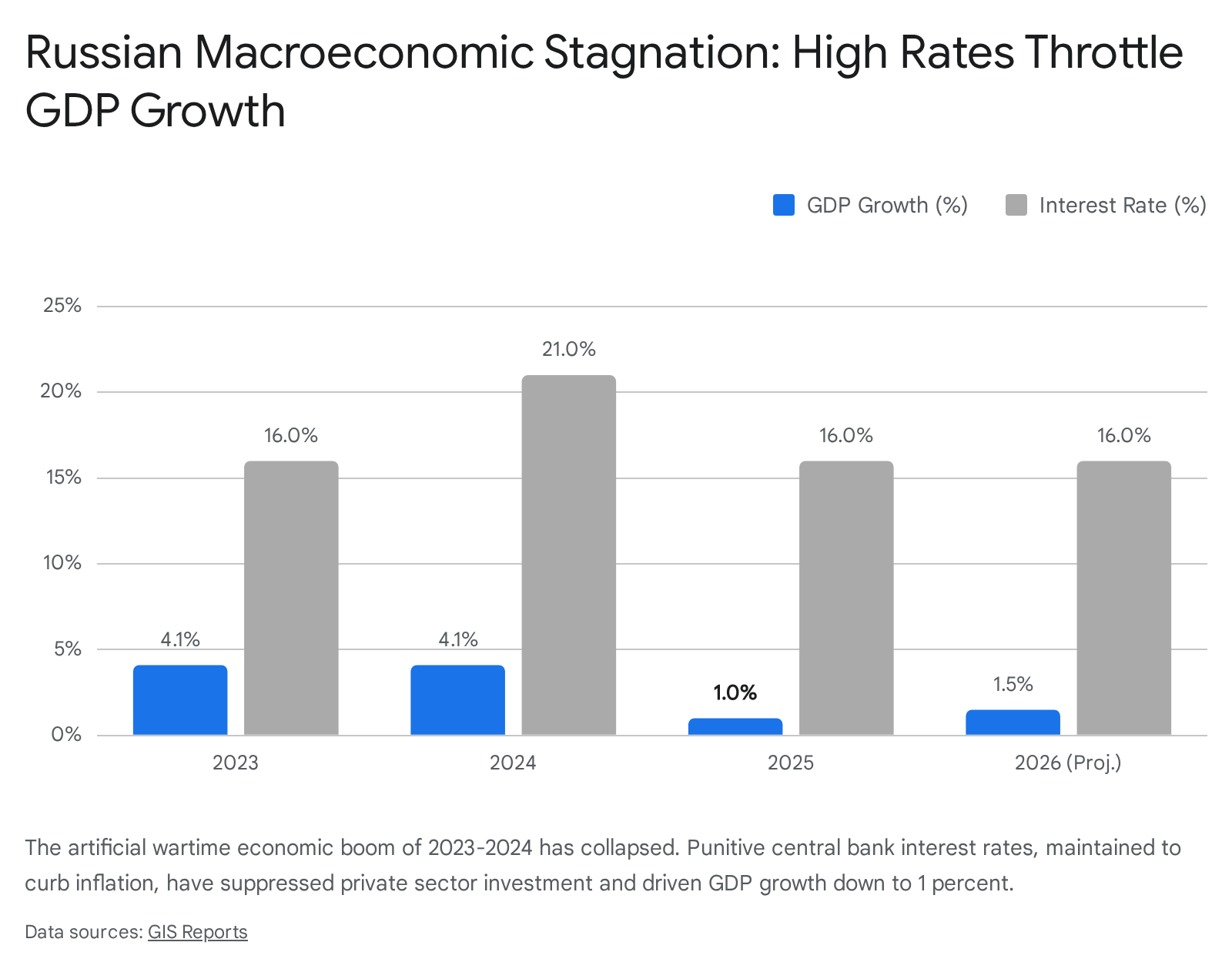
Economically, the Russian state has fully transitioned from a liquidity-fueled wartime boom into a perilous phase of managed macroeconomic stagnation. The artificial stimulation of the defense-industrial base has masked profound, systemic structural deficiencies. Gross Domestic Product (GDP) growth has plummeted to 1 percent, a sharp decline from the 4.1 percent expansion seen in previous years. This contraction is heavily constrained by severe labor shortages, a central bank interest rate holding at a punitive 16 percent to combat rampant inflation, and an impending federal budget deficit that has necessitated drastic increases in corporate and value-added taxes. Furthermore, Russia’s critical hydrocarbon export revenues face immediate, existential threats. The newly minted United States-India trade pact actively disincentivizes New Delhi’s procurement of Russian crude, threatening to collapse Russia’s pivot to Asian markets. Concurrently, Western physical enforcement actions against Russia’s clandestine “shadow fleet” of oil tankers have prompted severe, escalatory threats of naval retaliation from senior Kremlin security officials.
Domestically, the regime is actively hardening the state against internal dissent and preparing the societal substrate for a protracted, generational conflict. New legislative frameworks targeting the “evasion of the duty to defend the Fatherland” signal concrete preparations for a covert, phased, and limited mobilization of strategic reserves in 2026. Simultaneously, the Kremlin is accelerating the militarization of the Russian public sphere and the illegally occupied Ukrainian territories through the “Time of Heroes” program, which structurally embeds combat veterans into civil administration and educational institutions to engineer a new, ultra-loyalist elite. Concurrently, Russian hybrid warfare operations persist globally, evidenced by targeted cyberattacks against the 2026 Winter Olympics in Milan, designed to exact symbolic retribution for Russia’s continued diplomatic and athletic exclusion from the international community.
1. Diplomatic Engagements and Strategic Negotiations
1.1 The Geneva Trilateral Talks and Competing Architectures
The diplomatic landscape for the reporting period was entirely dominated by the high-stakes United States-brokered trilateral negotiations held at the InterContinental Hotel in Geneva, Switzerland, on February 17 and 18, 2026.1 Building upon previous, largely inconclusive bilateral and trilateral meetings in Abu Dhabi, this third round of talks featured senior, multi-agency delegations from the United States, the Russian Federation, and Ukraine.1 The United States delegation was led by special envoys Steve Witkoff and Jared Kushner, signaling intense, top-level prioritization by the White House to force a negotiated settlement, supported by military and intelligence advisors including Daniel P. Driscoll and Alexus Grynkewich.1 The Russian contingent was headed by seasoned negotiators Vladimir Medinsky and Kirill Dmitriev, alongside Mikhail Galuzin and Igor Kostyukov, while the Ukrainian delegation was led by Defense Minister Rustem Umerov, military intelligence chief Kyrylo Budanov, and officials including Andrii Hnatov, David Arakhamia, Serhiy Kyslytsia, and Vadym Skibitsky.3
The negotiations remain deeply gridlocked over fundamentally irreconcilable territorial, political, and sovereignty demands. Intelligence analysis of the proceedings indicates that Moscow’s negotiating posture relies heavily on a psychological strategy of deep anchoring.4 By presenting highly unrealistic, maximalist proposals at the absolute beginning of the talks, Russian negotiators attempt to force the opposing parties to respond and anchor subsequent discussions around Russian views, thereby artificially shifting the potential zone of agreement closer to the Kremlin’s baseline.4
A central point of friction revolves around the architectural parameters of a potential ceasefire line and the establishment of a demilitarized zone (DMZ).5 Throughout the two-day summit, the delegations fiercely debated competing visions for the post-conflict security environment.
| Negotiation Dimension | Russian Federation Position | United States Proposal | Ukrainian Red Lines |
| Territorial Sovereignty | Demands the formal cession of roughly 2,000 square miles of the currently contested Donetsk region.1 | Proposes Ukrainian forces withdraw from highly fortified parts of the Donbas to create a “free economic zone”.1 | Rejects unilateral withdrawal. Demands any pullout must be symmetrically matched by Russian pullbacks.1 |
| Security Architecture | Demands Ukraine formally renounce future NATO membership.1 | Explored the creation of a vast Demilitarized Zone (DMZ) approximately 50 miles long and 40 miles wide.5 | Requires the U.S. to first provide legally binding, 20-year security guarantees before any territorial adjustments.5 |
| Domestic Political & Military Posture | Demands radical, permanent cuts to the Armed Forces of Ukraine and constitutional bans on “Ukrainian nationalism”.1 | Pushing aggressively for a rapid deal on its own timeline, squeezing Kyiv for painful concessions.1 | Insists that any final peace deal must be strictly approved by a national referendum, fearing public backlash.5 |
Despite the deadlock on major political and territorial issues, the working-level military negotiators from the respective teams reported making incremental but significant technical progress regarding the operational parameters of a potential ceasefire.5 According to diplomatic readouts, the military officials successfully agreed on key operational terms and formally defined the specific kinetic actions that would constitute future violations of a cessation of hostilities.5 The leader of the Ukrainian delegation, Rustem Umerov, publicly described the talks as “intensive and substantive,” while his Russian counterpart, Vladimir Medinsky, characterized the atmosphere as “tough but businesslike”.3
1.2 Internal Divisions and United States Coercive Diplomacy
Intelligence assessments indicate that the United States administration is aggressively pushing for an expedited resolution to the conflict, with multiple reports suggesting the White House is disproportionately squeezing Kyiv—rather than Moscow—to make painful, asymmetric concessions.1 The U.S. diplomatic timeline reportedly aimed for Ukrainian President Volodymyr Zelenskyy to announce tangible, definitive progress by February 24, aligning with the highly symbolic fourth anniversary of the full-scale Russian invasion.1 However, Zelenskyy has openly and forcefully pushed back against repeated public calls from the U.S. administration for Ukraine to compromise, warning that it is fundamentally “not fair” to pressure the smaller, defending nation into a deal that would inherently “give victory” to Vladimir Putin.1
This intense, sustained U.S. pressure has begun to expose and exacerbate emerging fault lines within the Ukrainian political and military establishment.1 A specific faction within the Ukrainian delegation, reportedly centered around the influential military intelligence chief Kyrylo Budanov, is assessed to believe that a swift, pragmatic accommodation—even one requiring painful concessions—might best serve Ukraine’s immediate survival interests and preserve its remaining demographic and industrial base.1 This pragmatic wing contrasts sharply with the broader political consensus maintained by Zelenskyy, who acutely understands that his domestic public would “never” forgive a unilateral pullout or the permanent surrender of sovereign territory without symmetric Russian concessions and ironclad Western security guarantees.1
The shifting dynamics were visually evident on the second day of the Geneva summit, February 18. In a clear signal that the high-level political talks had potentially stalled or reached a temporary impasse over these irreconcilable differences, the two lead U.S. negotiators, Steve Witkoff and Jared Kushner, abruptly departed and did not take part in the second day’s meetings, leaving less senior American diplomats to navigate the technical military discussions.3 Switzerland is slated to host the next iterative round of these trilateral talks in approximately ten days.5
1.3 The $14 Trillion Economic Wedge Strategy
In a blatant, highly calculated attempt to exploit the perceived transactional inclinations of the new U.S. administration, the Kremlin publicly floated a massive economic inducement intrinsically tied to the total dismantling of Western sanctions.6 On February 18, Kirill Dmitriev—a top Kremlin economic negotiator, head of the Russian Direct Investment Fund, and a close confidant of Vladimir Putin—publicly pitched a sprawling portfolio of potential U.S.-Russia joint projects purportedly valued at over $14 trillion.6 Dubbed the “Dmitriev package” by wary officials in Kyiv, who first revealed its existence earlier in the month, this proposal represents a multifaceted instrument of economic statecraft designed specifically to drive a strategic wedge between Washington and its European and Ukrainian allies.6
The core tenets of the Dmitriev package are exceptionally broad and tailored to appeal to domestic U.S. corporate interests. The proposals reportedly include offering individuals closely aligned with the U.S. administration lucrative ownership stakes in major, state-backed Russian energy extraction projects.6 Furthermore, the deal suggests a complete strategic reversal of Russia’s heavily promoted “de-dollarization” policy, offering to reintegrate the Russian economy back into the global dollar financial system in exchange for relief from restrictions on cross-border payments.6 Dmitriev explicitly framed the pitch around the unverified assertion that the current sanctions regime has cost U.S. businesses in excess of $300 billion, thereby attempting to reframe sanctions relief not as a geopolitical concession to an aggressor state, but as a domestic economic victory and a massive stimulus for the United States.6
This overture has triggered profound alarm in Kyiv and among hawkish elements in Washington, who view it as a transparent, high-level attempt to bribe the U.S. executive branch into abandoning its security commitments to Ukraine.6 European intelligence chiefs have corroborated this assessment, noting that Russia has spent the past year actively utilizing bilateral business talks to intentionally distract the United States from the primary security and territorial objectives of the Ukraine negotiations.7 Senator Sheldon Whitehouse publicly highlighted the growing concern in the U.S. legislature, noting “a lot of chatter” regarding private business deals being floated to U.S. officials, including envoy Steve Witkoff, stating that such arrangements would constitute “horrifying misconduct”.6 By attempting to bifurcate the diplomatic track—separating the geopolitical reality of the kinetic war from the allure of bilateral economic opportunities—Russia is engaging in advanced cognitive warfare, seeking to fundamentally alter the decision-making calculus in Washington.
2. Military Operations, Frontline Dynamics, and Aerospace Campaigns
2.1 The Attritional Calculus and Systemic Casualty Metrics
The operational reality on the ground in Ukraine stands in stark, empirical contradiction to the Kremlin’s heavily curated domestic narrative of rapid, inevitable victory.8 The Russian Armed Forces continue to maintain the strategic initiative across nearly the entire line of contact, dictating the tempo of engagements, but their tactical execution relies almost entirely on mass infantry assaults that yield only marginal territorial gains at an extraordinary, historically unprecedented human cost.8 Analysis of longitudinal combat data reveals that, after seizing the initiative in 2024, Russian forces are currently advancing at an agonizingly slow average rate of between 15 and 70 meters per day in their most active, highly prioritized offensive sectors.9 Military historians and analysts note that this represents one of the slowest major offensive campaigns documented in any major conflict over the last century.9
The toll of this grinding, highly attritional methodology has been catastrophic for Russian force generation and demographic stability. Aggregated estimates derived from Western intelligence agencies, independent strategic analysis, and open-source verification suggest that cumulative Russian casualties—encompassing personnel killed in action, severely wounded, and missing—have reached approximately 1.2 million since the commencement of the “special military operation” in February 2022.9
| Source of Intelligence Estimate | Date of Estimate | Casualty Metric | Estimated Figure |
| U.K. Ministry of Defense | December 2025 | Killed and Wounded | ~1,168,000 10 |
| Center for Strategic and International Studies (CSIS) | January 2026 | Killed, Wounded, Missing | ~1,200,000 11 |
| Ex-CIA Director William Burns (FT) | January 2026 | Casualties | ~1,100,000 10 |
| Estonian Foreign Intelligence Service | February 2026 | Killed or Wounded | ~1,000,000 10 |
| Western Officials (via Bloomberg) | February 2026 | Casualties (Inc. 430k in ’24, 415k in ’25) | ~1,200,000 10 |
The operational inefficiency of the Russian advance is glaring. In early 2026, Russian forces suffered an estimated 83 casualties for every single square kilometer of territory gained.8 The Kremlin, fully aware of the domestic political vulnerabilities associated with these losses, attempts to obscure this reality through rigorous cognitive warfare and state-mandated censorship, prosecuting a false narrative that Russian forces are securing widespread, sweeping battlefield victories.8 For instance, Russian Chief of the General Staff’s Main Operations Directorate, Colonel General Sergei Rudskoy, publicly claimed that Russian forces seized approximately 900 square kilometers and 42 settlements in early 2026.8 However, independent geospatial intelligence collection verifies the capture of only 572 square kilometers and 19 settlements during that precise period, highlighting the systemic exaggeration embedded within Russian military reporting.8
2.2 Sectoral Analysis of the Line of Contact
The primary axes of Russian offensive operations remain heavily concentrated in the Eastern and Northern theaters, characterized by relentless small-unit infiltrations, the heavy employment of “mothership” drones, and the devastating use of guided aerial bombs against Ukrainian defensive fortifications.8
The Northern Axis (Sumy and Kharkiv Oblasts): The Russian command has intentionally escalated cross-border incursions into previously dormant sectors of northern Sumy Oblast.8 The strategic objective of these localized attacks is not to achieve a deep operational breakthrough, but rather to execute a shaping operation designed to fix Ukrainian reserves in place, stretch logistics, and create the psychological perception of a collapsing, overextended frontline.8 While Colonel General Rudskoy claimed elements of the Northern Grouping of Forces seized 26 settlements in Sumy and 15 in northern Kharkiv to establish a “security zone,” verified data confirms the seizure of only nine settlements in Sumy and seven in Kharkiv.8
In the critical logistics hub of Kupyansk, the situation remains highly fluid despite premature Russian declarations of victory. The commander of the Russian Western Grouping of Forces, Colonel General Sergei Kuzovlev, previously claimed that his forces would completely encircle Ukrainian defenders in Kupyansk by February 2026.12 However, Ukrainian forces have launched aggressive clearing operations, successfully halting the encirclement.8 As of mid-February, Ukrainian Joint Forces Task Force spokespersons report that the Russian presence in Kupyansk has been isolated to a remnant force of approximately 30 to 40 personnel trapped within a localized block of high-rise buildings and the municipal hospital.7 These isolated troops lack the combat power to conduct effective offensive operations, leading Russian milbloggers to fiercely criticize Chief of the General Staff Army General Valery Gerasimov for lying about advances in the Kupyansk direction.7
The Eastern Axis (Donetsk and Luhansk Oblasts): The locus of Russia’s main operational effort remains concentrated in the Central Sector, specifically the Pokrovsk and Toretsk directions.8 The Russian Central Grouping of Forces claimed to have seized 86 settlements in 2025, including the major urban centers of Pokrovsk, Toretsk, and Myrnohrad.8 However, verified evidence supports the capture of only a fraction of these claims.8 Russian forces have achieved incremental advances near Kurakhove, Vozdvyzhenka, and Chasiv Yar, occupying settlements south of Pokrovsk and west of Kurakhove.13 Their claims of controlling major urban centers are frequently exaggerated; the Russian Ministry of Defense claimed control of “more than half” of Kostyantynivka, yet verified evidence indicates their footprint is strictly limited to peripheral infiltration operations covering less than seven percent of the city.8 During the reporting period, Ukrainian forces successfully cleared eastern Hryshyne following infiltrations by Russian small groups, demonstrating the fluid, back-and-forth nature of the urban combat.8
The Southern Axis (Zaporizhia, Dnipropetrovsk, and Kherson Oblasts): The front in the south has seen localized, opportunistic engagements, largely defined by static defense and artillery duels. Following the Russian seizure of Hulyaipole in early 2026, Ukrainian forces launched aggressive, localized counterattacks that have successfully degraded the combat effectiveness of the Russian 36th Combined Arms Army.8 This Ukrainian pressure has largely constrained further Russian momentum toward Zaporizhzhia City; despite Russian claims of advancing within 12 kilometers of the city outskirts, geospatial evidence places them no closer than 20 kilometers from the southern administrative boundary, having seized only two settlements in western Zaporizhia since November 2025.8
2.3 The February 17 Aerospace Strike Package
In direct tactical coordination with the commencement of the Geneva diplomatic talks, the Russian Aerospace Forces and naval assets executed a massive, highly complex combined strike package overnight on February 16-17, targeting Ukrainian critical energy and transport infrastructure.7 This operation was explicitly designed to weaponize the harsh winter weather and generate maximum societal and political pressure on the Ukrainian delegation by demonstrating Russia’s enduring capacity to induce systemic collapse.
The strike package consisted of an unprecedented 425 munitions, demonstrating significant coordination across multiple launch platforms.8 The primary wave comprised 396 strike drones—predominantly Iranian-designed Shahed variants, augmented by cheaper Gerbera and Italmas types used to oversaturate air defenses.8 These swarms were launched from multiple, geographically dispersed vectors, including Kursk, Oryol, and Bryansk in the north; Millerovo in Rostov Oblast; Primorsko-Akhtarsk in Krasnodar Krai; Shatalovo in Smolensk; and occupied Hvardiiske in Crimea.8
This drone screen was layered with 29 high-value precision missiles, including four Iskander-M ballistic missiles, 20 Kh-101 cruise missiles launched from strategic bombers over the Caspian Sea, four Iskander-K cruise missiles, and one Kh-59/69 variant.8 Ukrainian air defenses, heavily reinforced by integrated Western systems including newly deployed F-16 and Mirage fighter aircraft, successfully intercepted 367 drones and 25 missiles, achieving a near-perfect interception rate against the cruise missile variants.8
| Munition Category | Specific Types Deployed | Quantity Launched | Quantity Intercepted |
| Unmanned Aerial Vehicles | Shahed, Gerbera, Italmas | 396 | 367 |
| Cruise Missiles | Kh-101, Iskander-K, Kh-59/69 | 25 | 25 |
| Ballistic Missiles | Iskander-M | 4 | 0 |
Despite the high interception rate, the ballistic components largely penetrated the defense net, striking 13 specific critical infrastructure locations across the Sumy, Chernihiv, Dnipropetrovsk, Ivano-Frankivsk, Kharkiv, and Odesa regions.8 These strikes inflicted devastating localized damage on the energy grid. Ukrainian President Zelenskyy reported to the Munich Security Conference that every single major power plant in Ukraine has now sustained damage.5 The February 17 strikes caused massive power outages, affecting 28,000 consumers in Kharkiv Oblast and up to 90,000 people in Odesa City.8 A specific strike on a thermal power plant in Mykolaiv left 100,000 civilians entirely without centralized heating amidst sub-zero temperatures.13 The human toll of these infrastructure attacks is mounting; UN statistics indicate that in 2025, Russia killed more than 2,500 Ukrainian civilians, a 20 percent increase from 2024, highlighting the increasingly indiscriminate nature of the deep-strike campaign.5
2.4 The Ukrainian Deep-Strike Counter-Campaign
In response to Russian aggression, Ukrainian forces maintain a robust, highly targeted long-range strike campaign against Russian military and logistical assets, both within the occupied territories and deep inside the Russian Federation.7 On the night of February 18-19, units of the Ukrainian Security Service (SBU) executed a successful drone strike against the Velikolukskaya oil depot in Pskov Oblast, hundreds of kilometers from the frontline, triggering massive fires and degrading Russian fuel logistics.7
Within the occupied territories, Ukrainian Special Operations Forces (SSO) and regular units conducted a series of precision strikes utilizing FPV drones and Western-supplied munitions.7 Notable targets neutralized during the reporting period include a temporary deployment point of the Russian Federal Security Service (FSB) in occupied Yurivka (roughly 100km from the front line), an Iskander operational-tactical missile complex storage site near Pasichne in Crimea, and a Russian Ka-27 naval helicopter targeted near occupied Kamyshly.7 Furthermore, Ukrainian forces successfully struck a drone control point near Rodynske and an advanced S-300VM anti-aircraft missile system launcher near occupied Mariupol, systematically degrading the Russian localized air defense umbrella.8
3. Economic Warfare, Sanctions Evasion, and Macroeconomic Indicators
3.1 The Transition to Managed Macroeconomic Stagnation
The widespread illusion of absolute Russian economic resilience, which characterized much of the commentary in 2023 and 2024, has fundamentally evaporated. As of February 2026, the Russian economy has firmly transitioned from a liquidity-fueled, state-subsidized boom into a perilous phase defined by analysts as “managed stagnation”.14 The overarching vulnerability of the Russian state stems from the hyper-militarization of its industrial base. The economy is now classified as a true “war economy,” where defense and security expenditures consume an unsustainable 40 percent of the total federal budget, starving all other sectors of necessary capital.14
The primary macroeconomic indicators reflect this profound systemic strain. Gross Domestic Product (GDP) growth, which previously shocked Western analysts by expanding at 4.1 percent annually in both 2023 and 2024, plummeted steadily throughout 2025.14 President Vladimir Putin was forced to publicly confirm in February 2026 that the total GDP growth for the full year of 2025 was a mere 1 percent, while the International Monetary Fund (IMF) projects an even more dismal 0.6 percent growth rate moving forward.9
The domestic consumer sector, which was previously buoyed by artificially high wartime wages and state transfer payments, is now being systematically crushed by severe, restrictive monetary policy.14 The Central Bank of Russia has been forced to maintain interest rates at a punitive 16 percent (down slightly from a peak of 21% in 2024, but still structurally devastating) to combat rampant, structural inflation.14 This exorbitant cost of borrowing has effectively frozen private-sector investment and made commercial credit prohibitively expensive for non-defense industries.14
To finance the insatiable demands of the war machine and manage a projected federal budget deficit ranging between 1.7 and 2.6 percent of GDP for 2025, the Kremlin has resorted to aggressive wealth extraction from the civilian economy.14 Corporate taxes were drastically hiked from 20 percent to 25 percent at the start of 2025, and the value-added tax (VAT) was raised to 22 percent in January 2026, further dampening consumer spending.14 Compounding these fiscal pressures is a catastrophic depletion of human capital. The economy faces a weakening human capital base driven by the flight of hundreds of thousands of skilled professionals seeking to evade conscription, an inherently aging population, and severe labor shortages driven by the mobilization of prime-age males for the war effort.7
3.2 Hydrocarbon Revenue Collapse and the US-India Trade Pact
The absolute foundation of Russia’s ability to sustain its war economy is its hydrocarbon export revenue. However, these vital receipts have fallen to a five-year low and are facing acute, compounding external threats.7 Russian oil producers drilled 3.4 percent fewer production wells in 2025 compared to 2024 as Western sanctions, a lack of access to high-tech drilling equipment, and a strong ruble reduced overall revenue.7 Finance Minister Anton Siluanov has openly acknowledged that Russian authorities expect the share of federal revenues derived from oil and gas sales to plummet by roughly 30 percent in 2026.7 The broader current-account surplus has already narrowed drastically to approximately $30 billion, down from $49 billion in the previous year.14
The most significant geopolitical development on the economic front this week was the crystallization of the United States-India interim trade pact, a strategic maneuver that directly targets and threatens Moscow’s energy revenue pipeline.15 Following the complete loss of the European energy market, Russia was forced to pivot its oil exports almost entirely to Asia, with India emerging as a critical, high-volume lifeline, albeit demanding steep discounts.14 In response to this lifeline, the previous U.S. administration had imposed punitive 50 percent tariffs on a wide range of Indian exports to coerce New Delhi away from purchasing Russian crude.16
The new, highly negotiated trade deal, which takes full effect in late February 2026, establishes a massive reduction in U.S. tariffs on Indian goods. The agreement drops the base tariff rate on Indian goods from 50 percent down to 18 percent, and institutes a temporary 10 percent uniform tariff replacing the previous penalty structure, providing massive relief to Indian sectors like textiles, gems, and pharmaceuticals.15 Crucially, this lucrative tariff relief is explicitly tied to an unwritten but heavily enforced Indian commitment to phase out the purchase of Russian oil and commit to buying $500 billion worth of U.S. products over five years.17 While major Indian refiners, such as Reliance Industries, are actively attempting to exploit sanctions loopholes by purchasing crude from technically non-sanctioned Russian front entities at widening discounts, the structural reality is clear: the U.S. has successfully weaponized its massive consumer market to force a decoupling between India and the Russian energy sector.20 This represents a catastrophic strategic failure for Russia’s pivot to Asia, as it removes the primary buyer of its discounted crude, threatening to drive export revenues below the absolute threshold of profitability required to fund the state budget.21
3.3 The Shadow Fleet and Escalation toward Naval Confrontation
Compounding the imminent loss of the Indian market, the Western coalition has fundamentally shifted its sanctions enforcement methodology from reliance on bureaucratic financial restrictions to kinetic, physical interdiction on the high seas. Over recent months, the United States and its European allies have actively hunted, intercepted, and seized vessels belonging to Russia’s “shadow fleet”—a vast, clandestine network of aging, poorly maintained, and inadequately insured tankers utilized to smuggle illicit oil, effectively bypassing the G7 price cap.14
Recent maritime operations underscore this newly aggressive, uncompromising posture. Following a months-long journey marked by suspicious automatic identification system (AIS) behavior and identity changes spanning 32 Exclusive Economic Zones, the United States successfully seized the Marinera (formerly Bella-1).21 The Marinera is a very large crude carrier (VLCC) with a deadweight tonnage range between 200,000 and 320,000, deeply involved in the complex, overlapping illicit trade networks transporting sanctioned Russian, Iranian, and Venezuelan oil.21 Similarly, in a robust enforcement action, the French Navy intercepted and seized the Grinch, an Indian-captained shadow fleet tanker operating in the Mediterranean without a legally recognized flag.25 The vessel was moored under armed guard in Marseille and was only released after the Russian owners were forced to pay a massive, multimillion-euro penalty to the French state.25
This physical interdiction campaign represents an existential threat to Moscow’s already fragile revenue logistics, prompting severe, highly escalatory rhetoric from the highest echelons of the Russian security apparatus. Nikolai Patrushev, the former director of the Federal Security Service (FSB), current chairman of Russia’s Maritime Board, and one of Putin’s closest ideological allies, explicitly threatened to deploy the Russian Navy to physically escort merchant tankers and forcefully break what he termed “western piracy”.22 Patrushev warned unambiguously that if the seizures continue, the Russian Navy will “move to eliminate” any perceived blockade, directly raising the specter of armed, state-on-state confrontation between Russian warships and European or U.S. Coast Guard and Naval assets.22
This rhetoric forcefully moves the economic conflict into the highly volatile realm of gunboat diplomacy. For the commercial shipping industry and military planners alike, the immediate risk to the global maritime domain is no longer merely regulatory compliance, but the distinct, terrifying probability of tactical miscalculation. Ambiguous maneuvers, close approaches, or disputed radio exchanges between a heavily armed Russian naval escort and a NATO boarding party could rapidly, inadvertently escalate into a localized kinetic exchange on the high seas, fundamentally altering the scope of the war.22
4. Internal Security, Force Generation, and Societal Militarization
4.1 Legal Frameworks for Covert Mobilization and Dissent Suppression
Recognizing the fundamentally unsustainable nature of current battlefield attrition rates, the Kremlin is systematically altering its domestic legal and administrative architecture to facilitate future troop generation while mitigating the severe domestic political blowback that accompanied the chaotic, highly unpopular 2022 mass mobilization.8 Intelligence reports indicate that the Russian state’s voluntary recruitment model, despite offering exorbitant signing bonuses, is nearing total exhaustion, failing to meet the replacement rate required to sustain the 15 to 70-meter-per-day attrition strategy.8 Reports suggest that in early 2026, Russia sustained approximately 9,000 more battlefield casualties per month than it was able to replace through voluntary channels.8
To bridge this critical manpower deficit, the Russian State Duma advanced a critical, sweeping piece of legislation in its first reading on February 18, introducing severe preventive measures against the “evasion of the duty to defend the Fatherland” and the “distortion of historical truth”.8 This bill proposes amending Article Six of the law “On the Basics of the Crime Prevention System,” effectively criminalizing any domestic criticism of military call-ups and empowering law enforcement to place objectors, or those convicted of “insulting veterans,” under strict “preventive supervision”.29 Authorities will be granted the power to conduct “preventive conversations,” deliver formal warnings, and place individuals on special watchlists.29 Lawmakers also advanced amendments to extend mandatory military genomic registration—previously limited to contract personnel—to civil servants, police officers, Rosgvardia personnel, and conscripts, regardless of their combat deployment status, vastly expanding the state’s biometric surveillance over its population.29
This legal mechanism is not an isolated event; it is the culmination of a deliberate, months-long administrative preparation. Following presidential decrees signed in late 2025 that allowed the year-round conscription of reservists and permitted their deployment abroad in expeditionary missions without officially declaring martial law, intelligence analysts assess that Vladimir Putin has established the statutory grounds for a covert, phased, and rolling draft of strategic reserves slated for later in 2026.8 By masking the draft beneath layers of bureaucratic routine and preemptively criminalizing any form of dissent, the regime seeks to maintain its precarious “guns and butter” equilibrium, supplying the frontlines without triggering the mass civilian exodus witnessed in 2022.28
Concurrently, the regime has intensely escalated its control over the domestic information space to isolate the populace from the uncurated, grim realities of the war. Russian authorities have instituted sweeping, nationwide blocks on WhatsApp and other Western social media platforms, while deliberately throttling the messaging app Telegram.8 Minister of Digital Development Maksut Shadayev publicly justified the Telegram throttling by claiming that foreign intelligence services were systematically exploiting the platform to intercept sensitive Russian military correspondence.8 However, the primary, unstated objective remains the suppression of critical, ultra-nationalist milbloggers who frequently expose military incompetence, allowing the state to consolidate a hermetically sealed domestic cognitive domain.8
4.2 The “Time of Heroes” Program and Elite Renewal
A profound, generational sociological transformation is currently underway within the Russian state apparatus and the illegally occupied territories of Ukraine. The Kremlin has launched and heavily funded the “Time of Heroes” (Vremya Geroev) program, a massive, state-sponsored initiative designed to retrain and embed veterans of the Ukraine war directly into municipal, regional, and federal government positions.8 Far from a simple post-combat veterans’ welfare or transition program, this is a systematic, ideologically driven effort to engineer a new, ultra-loyalist political and administrative elite.32
By elevating traumatized, ideologically hardened combatants to positions of significant administrative power, Putin is actively purging the remnants of the pragmatist, technocratic bureaucracy and replacing them with a cadre whose primary qualification is militant, unquestioning allegiance to the regime’s imperial project.32 The Russian Foreign Ministry has confirmed its involvement in the program, signaling that these veterans will eventually be integrated into the diplomatic corps to project this hardened stance internationally.34 Notable recent appointments underscore this trend: Vladimir Manokhin, a veteran and participant in the program, was appointed as the Deputy Minister of Sports for occupied Crimea in February, directly militarizing civilian governance.8 Furthermore, Russian occupation officials are aggressively staffing educational institutions with combat veterans; in the occupied Donetsk region alone, 622 veterans are currently working as full-time teachers, and approximately 8,000 veterans have been integrated into extracurricular activities to normalize the occupation and militarize the curriculum for Ukrainian children.8
4.3 Militarization and Indoctrination in Occupied Territories
This systematic militarization extends aggressively into the industrial and technological sectors of the occupied territories, constituting a clear, documented violation of international law regarding the treatment of civilian populations in conflict zones.35 Russian authorities are directly utilizing student brigade programs to actively recruit, coerce, and train Ukrainian youth to serve the Russian defense-industrial base (DIB).8 For example, Ukrainian students from occupied Luhansk have been transported deep into Russia to Naberezhnye Chelny, Tatarstan, for specialized training. They are subsequently embedded into the KamAz manufacturing ecosystem—a critical industrial node that has shifted 50 percent of its total manufacturing capacity to produce trucks, engines, and armored vehicles for the Russian military.8
Furthermore, the occupation apparatus is heavily investing in the psychological gamification of warfare to indoctrinate children and build a future pipeline of combat operators. In occupied Crimea, authorities hosted the “Unmanned Technologies Cup,” a national drone racing competition specifically designed to groom 48 teenagers from Simferopol as future combat drone operators, developers, and producers.8 Occupation head Sergey Aksyonov proudly claimed that Crimea possesses a “full cycle” of drone operator talent, capturing youth before they enter the wider military ecosystem.8 A larger “Battle of the Drones” festival is scheduled for Spring 2026 at the Artek Children’s Camp for teenagers aged 14 to 17.8
This indoctrination extends to strategic infrastructure. Hundreds of Ukrainian high school students in occupied Zaporizhia are being forced into career guidance programs funded by Rosenergoatom, such as the “The Path of a Nuclear Worker” forum held at Sevastopol State University (SevGU), aimed at integrating them into Russia’s nuclear energy operation ecosystem to cement long-term, generational control over the Zaporizhzhia Nuclear Power Plant (ZNPP).8 To enforce strict compliance with these programs, Russian authorities continue to utilize “temporary accommodation centers” (TACs) as covert filtration points, aggressively interrogating civilians regarding their loyalties, forcing them into accepting Russian passports, and facilitating forced deportations deep into the Russian Federation under the cynical guise of humanitarian evacuation.8
5. Cyber Operations, Internal Intelligence, and Hybrid Confrontation
5.1 Pro-Russian Hacktivism and the 2026 Winter Olympics
As conventional, kinetic conflict grinds on in Eastern Europe, the Russian Federation continues to project asymmetric power globally through aggressive hybrid and cyber warfare methodologies. During the reporting period, the primary focal point of these operations was the 2026 Winter Olympic Games held in Milan and Cortina d’Ampezzo, Italy.37 Following Russia’s formal exclusion from participating in the Games—stemming directly from the ongoing invasion of Ukraine—international intelligence agencies accurately anticipated significant digital pushback, echoing the state-sponsored sabotage executed during the 2018 PyeongChang Olympics.37
Days prior to the opening ceremonies on February 6, and continuing steadily through the week ending February 21, Italian cybersecurity infrastructure experienced a massive surge of malicious, coordinated activity.37 A prominent, highly active pro-Russian hacktivist syndicate, operating under the designation NoName057(16), launched a sustained wave of Distributed Denial-of-Service (DDoS) attacks.37 The targeting matrix for these attacks was exceptionally broad, encompassing the official Milano-Cortina 2026 websites, the digital booking infrastructure of several prominent hotels in the resort town of Cortina d’Ampezzo, and critical national infrastructure, most notably the Milan Malpensa Airport.37 Furthermore, the group publicly claimed responsibility for targeted digital strikes against the National Olympic Committees of nations that have been highly supportive of Ukraine, specifically Lithuania, Poland, and Spain.38
Italian authorities, led by Foreign Minister Antonio Tajani, confirmed that approximately 120 sites were targeted, but stated that robust pre-event digital hardening successfully mitigated the attacks, preventing large-scale data exfiltration or systemic disruption to the Games’ operations.40 Intelligence analysts assess that, unlike previous Olympic cyber-sabotage events directed explicitly by the GRU (Russian military intelligence), this current campaign is driven by semi-autonomous, relatively unsophisticated hacktivist proxy groups rather than top-tier state actors.38 The primary objective of NoName057(16) is not catastrophic infrastructure failure, but rather symbolic disruption and cognitive warfare—generating propaganda victories for domestic consumption to project defiance against Western diplomatic isolation, while the premier Russian advanced persistent threat (APT) groups remain focused on higher-priority strategic targets directly related to the Ukrainian theater.38
5.2 Domestic Counter-Terrorism Operations
Despite the hyper-focus on the external war effort, the Russian internal security apparatus continues to face significant domestic vulnerabilities. In late January and early February 2026, the Federal Security Service (FSB) executed critical counter-terrorism operations in the volatile Dagestan region.43 The FSB successfully eliminated two active supporters of the Islamic State who were in the advanced stages of organizing a coordinated terrorist attack.43 The operatives, communicating via Telegram with an international Islamic State handler, had manufactured an improvised explosive device (IED) and filmed a video pledging allegiance to IS leader Abu Hafs al-Hashimi al-Qurayshi.43 Their intended targets included a local synagogue and critical railway tracks near the Ullubiyevo railway station in the Karabudakhkent district, highlighting the persistent threat of radical domestic insurgencies operating within Russia’s borders while the bulk of its military and security resources are deployed to Ukraine.43
6. Nuclear Posturing and Escalation Management
Underpinning all conventional, economic, and hybrid operations is Russia’s continuous, highly calculated reliance on nuclear coercion to paralyze Western decision-making and limit support for Ukraine.44 Following the formal lowering of the threshold for nuclear use in Russia’s revised strategic doctrine—which now alarmingly encompasses conventional conflicts against non-nuclear states if they are supported by nuclear powers—senior Russian officials have engaged in deliberate, sustained rhetorical escalation.27
During the sensitive diplomatic window of the Geneva talks, Nikolai Patrushev utilized prominent public forums to emphasize Russia’s readiness to deliver a “firm rebuff” to the West. He explicitly coupled naval threats regarding the defense of the shadow fleet with pointed, baseless criticisms of NATO naval expansion in the Baltic Sea region, specifically criticizing Finland for acquiring modern corvettes.8 This orchestrated brinkmanship is designed to artificially inflate the perceived risk of a localized incident—such as a shadow fleet tanker seizure—spiraling rapidly into a strategic nuclear exchange, thereby coercing Western powers into restraining their material support for Ukraine and pressuring Kyiv to accept the unfavorable Geneva settlement terms.45 Former Deputy Secretary General of NATO Rose Gottemoeller recently highlighted the growing concern over an impending arms race, noting that with the lapse of the New START treaty (which limits the U.S. and Russia to 1,550 strategic warheads) approaching in 2026, Russia has the technical capacity to rapidly sprint away from historic limits, adding a profound layer of global strategic instability to the immediate regional crisis.1
7. Strategic Outlook and Intelligence Assessment
The cumulative events of the week ending February 21, 2026, illuminate a Russian Federation that is exceptionally dangerous, deeply entrenched, yet structurally fragile. The fundamental intelligence assessment indicates that the Kremlin is racing against a rapidly closing temporal window. The convergence of a collapsing GDP growth rate, hyper-inflationary pressures forcing a 16 percent interest rate, the imminent exhaustion of the voluntary military recruitment pool, and the catastrophic collapse of the Asian oil revenue pipeline due to the U.S.-India trade pact creates a hard, unforgiving limit on Russia’s ability to sustain high-intensity operations indefinitely.
Consequently, Vladimir Putin’s overarching strategy is currently defined by maximum exertion across all conceivable domains to force a diplomatic capitulation before these systemic internal failures become critical and irreversible. The $14 trillion Dmitriev economic package is not a genuine offer of geopolitical partnership, but a desperate, asymmetric gambit designed to bribe Washington into breaking the sanctions regime that is slowly strangling the Russian state apparatus. The grinding, high-casualty infantry advances in the Donbas, coupled with the terror bombardment of the Ukrainian energy grid via 400-plus drone swarms, are precisely engineered to break the political will of Kyiv and convince U.S. negotiators that Ukraine’s defensive position is ultimately untenable.
However, Ukraine’s remarkable resilience at critical junctions like Kupyansk, its successful deep-strike counter-operations against Russian energy and military logistics, and its steadfast refusal to yield to unilateral territorial concessions at the Geneva summit demonstrate that Russian kinetic coercion is fundamentally failing to yield decisive, strategic outcomes.1 In the near term, analysts expect a highly dangerous escalation in the maritime domain as Russia attempts to safeguard its illicit shadow fleet against increasingly aggressive Western interdiction, coupled with covert, highly repressive domestic mobilization efforts within the Russian homeland. The international community must remain braced for a proliferation of hybrid provocations, as Moscow attempts to compensate for its diminishing conventional and economic leverage through acts of outsized, asymmetric disruption globally.
Please share the link on Facebook, Forums, with colleagues, etc. Your support is much appreciated and if you have any feedback, please email us in**@*********ps.com. If you’d like to request a report or order a reprint, please click here for the corresponding page to open in new tab.
Sources Used
- Russia Analytical Report, Feb. 9–17, 2026, accessed February 21, 2026, https://www.russiamatters.org/news/russia-analytical-report/russia-analytical-report-feb-9-17-2026
- Russia-Ukraine talks: All the mediation efforts, and where they stand – Al Jazeera, accessed February 21, 2026, https://www.aljazeera.com/news/2026/2/18/russia-ukraine-talks-all-the-mediation-efforts-and-where-they-stand
- 2026 United States–Ukraine–Russia meetings in Geneva – Wikipedia, accessed February 21, 2026, https://en.wikipedia.org/wiki/2026_United_States%E2%80%93Ukraine%E2%80%93Russia_meetings_in_Geneva
- Negotiating with Putin’s Russia, accessed February 21, 2026, https://www.atlanticcouncil.org/content-series/russia-tomorrow/negotiating-with-putins-russia/
- Russia in Review, Feb. 13–20, 2026 | Russia Matters, accessed February 21, 2026, https://www.russiamatters.org/news/russia-review/russia-review-feb-13-20-2026
- Russia publicly pitches $14 trillion economic deal to Trump tied to …, accessed February 21, 2026, https://kyivindependent.com/russia-publicly-pitches-14-trillion-economic-deal-to-trump-tied-to-lifting-sanctions/
- Russian Offensive Campaign Assessment, February 19, 2026 – Institute for the Study of War, accessed February 21, 2026, https://understandingwar.org/research/russia-ukraine/russian-offensive-campaign-assessment-february-19-2026/
- Russian Offensive Campaign Assessment, FEB 20, 2026 | ISW, accessed February 21, 2026, https://understandingwar.org/research/russia-ukraine/russian-offensive-campaign-assessment-february-20-2026/
- Russia’s Grinding War in Ukraine – CSIS, accessed February 21, 2026, https://www.csis.org/analysis/russias-grinding-war-ukraine
- The Russia-Ukraine War Report Card, Feb. 18, 2026, accessed February 21, 2026, https://www.russiamatters.org/news/russia-ukraine-war-report-card/russia-ukraine-war-report-card-feb-18-2026
- The Russia-Ukraine War Report Card, Feb. 11, 2026, accessed February 21, 2026, https://www.russiamatters.org/news/russia-ukraine-war-report-card/russia-ukraine-war-report-card-feb-11-2026
- Russian Offensive Campaign Assessment, January 15, 2026 | ISW, accessed February 21, 2026, https://understandingwar.org/research/russia-ukraine/russian-offensive-campaign-assessment-january-15-2026/
- Ukraine War Situation Update: 15 – 21 February 2025 – ReliefWeb, accessed February 21, 2026, https://reliefweb.int/report/ukraine/ukraine-war-situation-update-15-21-february-2025
- Russia’s economy faces years of low growth – GIS Reports, accessed February 21, 2026, https://www.gisreportsonline.com/r/russia-economy-low-growth/
- Explainer: India-US tariffs after Supreme Court verdict – The Federal, accessed February 21, 2026, https://thefederal.com/category/business/explainer-india-us-tariffs-after-supreme-court-verdict-230927
- India must reassess US trade deal as Trump tariffs lose bite after Supreme Court ruling, accessed February 21, 2026, https://m.economictimes.com/news/economy/foreign-trade/india-us-trade-deal-trump-tariffs-supreme-court-ruling-modi-exports-impact-global-trade-uncertainty/articleshow/128636293.cms
- Moody’s cites Russian crude uncertainty in US trade pact, accessed February 21, 2026, https://m.economictimes.com/news/economy/foreign-trade/moodys-cites-russian-crude-uncertainty-in-us-trade-pact/articleshow/128394080.cms
- Despite reset in India–US relations, New Delhi retains commitment to strategic hedging, accessed February 21, 2026, https://www.chathamhouse.org/2026/02/despite-reset-india-us-relations-new-delhi-retains-commitment-strategic-hedging
- January 2026 — Monthly analysis of Russian fossil fuel exports and sanctions, accessed February 21, 2026, https://energyandcleanair.org/january-2026-monthly-analysis-of-russian-fossil-fuel-exports-and-sanctions/
- India crude imports set to remain elevated in January | Vortexa, accessed February 21, 2026, https://www.vortexa.com/insights/india-crude-imports-stay-elevated
- What the Bella-1 Teaches Us About Targeting Shadow Fleets – CSIS, accessed February 21, 2026, https://www.csis.org/analysis/what-bella-1-teaches-us-about-targeting-shadow-fleets
- Russia Signals Naval Shield for Shadow Fleet as Sanctions Enforcement Turns Physical, accessed February 21, 2026, https://gcaptain.com/russia-signals-naval-shield-for-shadow-fleet-as-sanctions-enforcement-turns-physical/
- When economic warfare meets gunboat diplomacy: What to know about the US seizures of shadow fleet tankers – Atlantic Council, accessed February 21, 2026, https://www.atlanticcouncil.org/dispatches/when-economic-warfare-meets-gunboat-diplomacy-what-to-know-about-the-us-seizures-of-shadow-fleet-tankers/
- How Can the West Sink the Shadow Fleet? We Asked Four Experts., accessed February 21, 2026, https://www.kharon.com/brief/shadow-fleet-iran-news-russia-venezuela-oil-sanctions
- France Releases Grinch ‘Shadow Fleet’ Tanker After Multimillion-Euro Fine, accessed February 21, 2026, https://www.kyivpost.com/post/70246
- Russia threatens to deploy navy to protect vessels from ‘western piracy’ – The Guardian, accessed February 21, 2026, https://www.theguardian.com/world/2026/feb/17/russia-threatens-to-deploy-navy-vessels-shadow-fleet-europe
- Europe-Russia: Balance of Power Review – Ifri, accessed February 21, 2026, https://www.ifri.org/sites/default/files/2025-11/ifri_gomart_ed_europe_russia_2025_1.pdf
- Putin preparing a hidden 2026 draft to compensate for heavy losses – UA.NEWS, accessed February 21, 2026, https://ua.news/en/war-vs-rf/putin-gotuie-prikhovanii-prizov-u-2026-mu-cherez-veliki-vtrati
- Mobilization in Russia for Feb. 17-19, 2026 CIT Volunteer Summary, accessed February 21, 2026, https://notes.citeam.org/mobi-feb-17-19-2026
- Russian Offensive Campaign Assessment, February 12, 2026 – Institute for the Study of War, accessed February 21, 2026, https://understandingwar.org/research/russia-ukraine/russian-offensive-campaign-assessment-february-12-2026/
- Russian Occupation Update February 19, 2026, accessed February 21, 2026, https://understandingwar.org/research/russia-ukraine/russian-occupation-update-february-19-2026/
- From battlefield to ballot box: Why Russia is drafting war veterans into politics, accessed February 21, 2026, https://ecfr.eu/article/from-battlefield-to-ballot-box-why-russia-is-drafting-war-veterans-into-politics/
- Kiriyenko, Sergei – Events ∙ President of Russia, accessed February 21, 2026, http://en.kremlin.ru/catalog/persons/175/events/by-date/11.02.2026
- Briefing by Foreign Ministry Spokeswoman Maria Zakharova, Moscow, October 15, 2025, accessed February 21, 2026, https://mid.ru/en/press_service/spokesman/briefings/2053653/
- Russian Occupation Update, February 12, 2026 | ISW, accessed February 21, 2026, https://understandingwar.org/research/russia-ukraine/russian-occupation-update-february-12-2026/
- A new season of the patriotic project “Keepers of History”has started in Moscow, accessed February 21, 2026, https://xn--90acagbhgpca7c8c7f.xn--p1ai/news/v-moskve-startoval-novyy-sezon-patrioticheskogo-proekta-khraniteli-istorii/
- Inside Russian Cyber Attacks at the 2026 Winter Olympics, accessed February 21, 2026, https://cybermagazine.com/news/inside-russian-cyber-attacks-at-the-2026-winter-olympics
- Weekly Intelligence Report – 20 February 2026, accessed February 21, 2026, https://www.cyfirma.com/news/weekly-intelligence-report-20-february-2026/
- The Milan-Cortina 2026 Olympic Games are a prime cyber target. Here’s why – and how defenders are responding, accessed February 21, 2026, https://www.weforum.org/stories/2026/02/2026-milan-cortina-olympic-games-cyber-target-how-defenders-responding/
- Milan-Cortina 2026: How Winter Olympics embraced AI to fend off cyber attacks, accessed February 21, 2026, https://www.sportspro.com/analysis/technology/milan-cortina-2026-winter-olympics-cybersecurity-ai-tech-february-2026/
- Italy Says It Thwarted Russian Cyberattacks Targeting Winter Olympics – The Moscow Times, accessed February 21, 2026, https://www.themoscowtimes.com/2026/02/05/italy-says-it-thwarted-russian-cyberattacks-targeting-winter-olympics-a91866
- Russia’s Shadow War Against the West – CSIS, accessed February 21, 2026, https://www.csis.org/analysis/russias-shadow-war-against-west
- Russia FSB Eliminated Islamic State Supporters in Dagestan – SpecialEurasia, accessed February 21, 2026, https://www.specialeurasia.com/2026/01/30/islamic-state-dagestan-russia/
- Nuclear rhetoric and escalation management in Russia’s war against Ukraine: A Chronology – Stiftung Wissenschaft und Politik, accessed February 21, 2026, https://www.swp-berlin.org/publications/products/arbeitspapiere/Arndt-Horovitz_Working-Paper_Nuclear_rhetoric_and_escalation_management_in_Russia_s_war_against_Ukraine.pdf
- Full article: Russia’s Failed Nuclear Coercion Against Ukraine – Taylor & Francis, accessed February 21, 2026, https://www.tandfonline.com/doi/full/10.1080/0163660X.2023.2259665
- Russia’s hope for trans-atlantic rift at MSC disappointed, accessed February 21, 2026, https://www.prio.org/comments/1862
- RUSSIA: ARMS CONTROL, DISARMAMENT AND INTERNATIONAL SECURITY – SIPRI, accessed February 21, 2026, https://www.sipri.org/sites/default/files/FFIN%20Supplement%20with%20coverRussia%20Arms%20Control%202022%20%20pdf-a.pdf