Executive Summary
This Situation Report (SITREP) covers the strategic, political, economic, and security developments in the Bolivarian Republic of Venezuela for the week ending February 21, 2026. Seven weeks following the execution of Operation Absolute Resolve—the United States military intervention that resulted in the capture and extradition of former President Nicolás Maduro and his wife, Cilia Flores—the Venezuelan state remains in a period of profound and volatile transition.1 The current operating environment is characterized by a fragile cohabitation between an interim administration led by acting President Delcy Rodríguez and the overwhelming geopolitical and economic leverage exerted by the United States.2
Politically, the interim government has initiated a calculated process of institutional pacification, highlighted by the National Assembly’s unanimous passage of a sweeping amnesty law on February 19, 2026.4 This legislation has facilitated the release of hundreds of political prisoners, though significant carve-outs for military personnel and the requirement for strict judicial approval have drawn deep skepticism from human rights organizations such as Foro Penal.3 The amnesty serves as a critical pressure-release valve designed to satisfy baseline demands from Washington while allowing the Rodríguez administration to maintain the core architectural control of the state’s judiciary and security apparatus.3
On the security front, internal fractures within the Chavista power structure have manifested physically. Armed clashes in Caracas near the Miraflores Presidential Palace have illuminated a deepening schism between technocratic loyalists aligned with Rodríguez and hardline militaristic factions commanded by Interior Minister Diosdado Cabello.6 Cabello, who maintains significant influence over the Bolivarian National Armed Forces (FANB) and irregular civilian militias (colectivos), represents the most acute internal threat to the US-backed transition plan.2 Simultaneously, external security dynamics have deteriorated along the eastern border. A violent ambush on Guyanese soldiers navigating the Cuyuni River by Venezuelan armed gangs (sindicatos) has severely escalated tensions with Georgetown, occurring precisely on the 60th anniversary of the 1966 Geneva Agreement.9
Economically, the country remains in a precarious state, described by the International Monetary Fund (IMF) as “quite fragile,” with public debt at 180 percent of gross domestic product and inflation projected to reach 682.1 percent in 2026.12 However, a massive overhaul of the US sanctions regime—orchestrated through Executive Order 14373 and a suite of new General Licenses from the Office of Foreign Assets Control (OFAC)—has initiated a phased revitalization of the Venezuelan hydrocarbons sector.14 The creation of Foreign Government Deposit Funds effectively shields Venezuelan oil revenues from external creditors, laying the groundwork for international energy conglomerates to boost domestic production by an estimated 300,000 to 400,000 barrels per day by year-end.16
Regionally, the shockwaves of Maduro’s extraction continue to reorder the geopolitical landscape. The abrupt cessation of subsidized Venezuelan oil shipments has plunged Cuba into a catastrophic energy crisis, while neighboring Colombia has pragmatically pivoted to engage the Rodríguez government.19 Concurrently, Russia, China, and Brazil have voiced strident opposition at the United Nations to what they perceive as a dangerous precedent of unilateral US military intervention.22 As Maduro awaits his rescheduled March 26 trial in New York, the incoming weeks will be critical in determining whether the Rodríguez-US cohabitation can stabilize the Venezuelan state or if internal security frictions will ignite a broader domestic conflict.24
1. Political Transition and Institutional Engineering
The political landscape in Venezuela is currently defined by a delicate balancing act engineered by acting President Delcy Rodríguez and her brother, Jorge Rodríguez, the president of the National Assembly.2 As the interim head of state following the January 3 capture of Nicolás Maduro, Delcy Rodríguez is tasked with executing a “stabilization, recovery, and transition” plan largely dictated by the Trump administration, while simultaneously preventing the total collapse of the ruling United Socialist Party of Venezuela (PSUV).3 This week, the centerpiece of this political maneuvering was the passage and implementation of a controversial national amnesty law, designed to project an image of democratic reform while carefully preserving the regime’s structural integrity.
1.1 The Amnesty Law and the Illusion of Pacification
On February 19, 2026, the Venezuelan National Assembly unanimously passed a highly anticipated amnesty bill, which was subsequently signed into law by acting President Rodríguez on the same day.4 The legislation is ostensibly designed to promote “national pacification,” democratic coexistence, and reconciliation following decades of political persecution under the Maduro and Chávez administrations.3 The law officially grants an amnesty for specific crimes and offenses committed during periods of politically driven conflict since 1999, specifically targeting those arrested during the violent aftermath of the July 2024 presidential elections.28
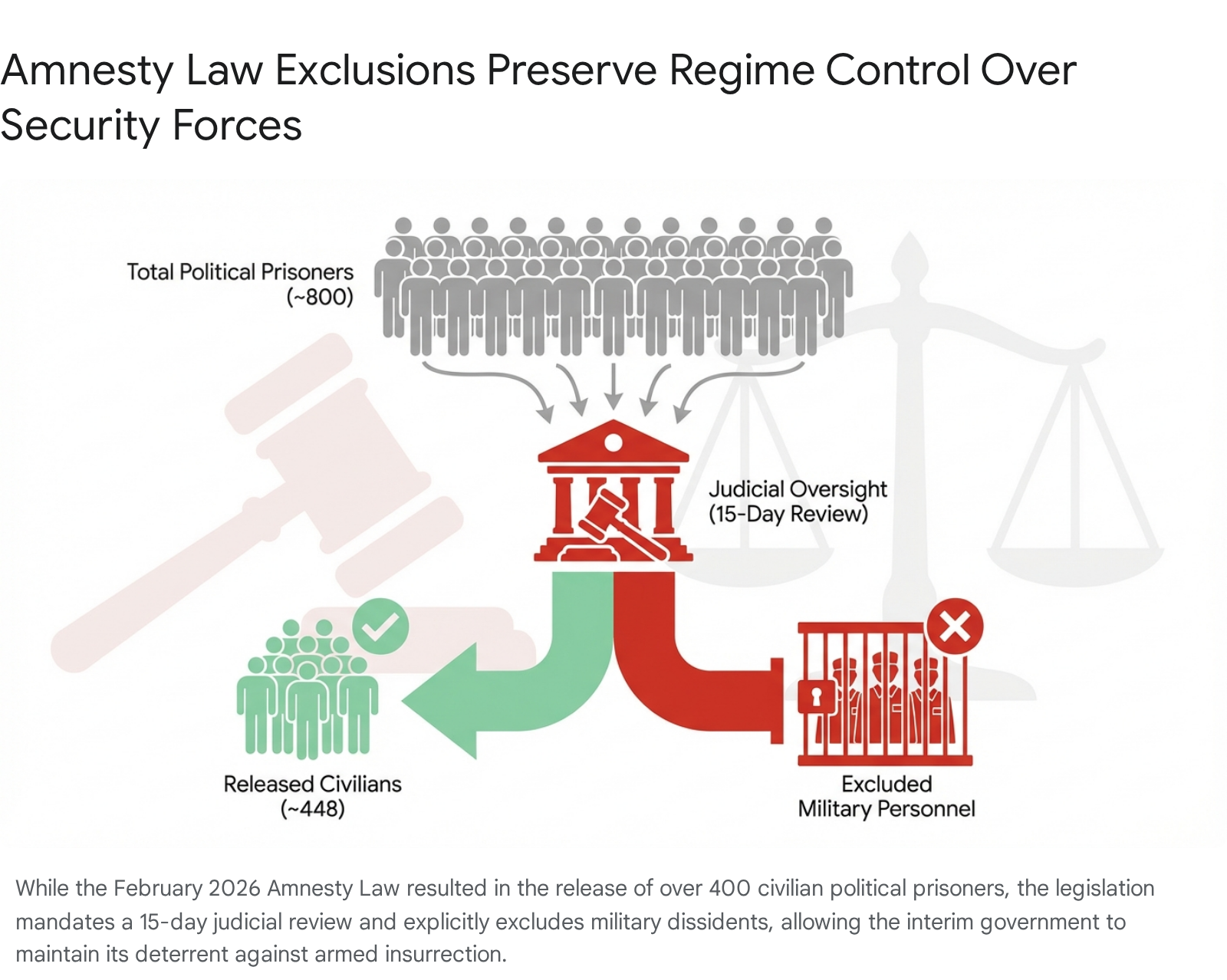
However, intelligence and human rights analyses indicate that the law is less a genuine concession to democratic norms and more a strategic calculation to alleviate international pressure. The legislation mandates that individual amnesty requests must be approved by trial courts within a strict 15-day window following submission.5 This requirement for judicial oversight has drawn severe criticism from domestic and international observers, as it leaves the ultimate authority in the hands of the very same judicial apparatus that was instrumental in executing politically motivated prosecutions in the first place.3
Alfredo Romero, president of the prominent prisoners’ rights group Foro Penal, explicitly noted that while the law benefits a significant group, the underlying system of political persecution remains entirely intact because the same prosecutors and judges remain in power.30 The UN commission of experts welcomed the initial draft but emphasized that the victims must remain at the center of the process, a principle that seems to be sidelined by the bureaucratic hurdles of the final text.27
1.2 Quantitative Assessment of Prisoner Releases and Strategic Carve-Outs
The execution of the amnesty law has resulted in a disjointed and heavily scrutinized release process. Prior to the intervention in January 2026, human rights organizations such as Foro Penal estimated that approximately 600 to 800 political prisoners were languishing in Venezuelan detention centers, including the notorious El Helicoide, Tocorón, and Rodeo 1 prisons.3
Following the immediate aftermath of Maduro’s capture, an initial wave of releases freed roughly 104 individuals.32 This included high-profile human rights lawyers and communications students, such as Kennedy Tejeda, a human rights activist who had been imprisoned in Tocorón since August 2024 for providing legal assistance to detainees, and Juan Francisco Alvarado.32 Under the newly formalized amnesty law, National Assembly deputy Jorge Arreaza announced that 379 additional political prisoners were slated for immediate release between February 20 and February 21.26 Foro Penal has independently verified a total of 448 releases since the political transition began in early January, representing roughly half of the documented political prisoner population.33
Despite these figures, the amnesty contains critical and highly specific exclusions. It explicitly denies clemency to individuals prosecuted for “promoting or facilitating armed or forceful actions against Venezuela’s sovereignty,” a clause widely interpreted as a mechanism to keep figures associated with foreign interventions or coup attempts incarcerated.26 Furthermore, the interim government has leveled such accusations against prominent opposition leaders like María Corina Machado, effectively utilizing the law’s exclusions to prevent her return from the United States.26
Crucially, the law entirely excludes members of the military and security forces convicted of terrorism-related activities.5 For instance, Henryberth Rivas, a former soldier arrested in 2018 for allegedly participating in a drone assassination attempt against Maduro, remains imprisoned in Rodeo 1.26 By keeping dissident military elements locked away, the Rodríguez administration is signaling to the armed forces that insubordination remains a capital offense, thereby mitigating the risk of a military uprising. The administration has stated that the military justice system will handle these cases separately, further obfuscating their potential for release.26
1.3 The Opposition’s Calculated Restraint
The mainstream Venezuelan opposition has responded to the amnesty and the broader political transition with cautious pragmatism. The opposition recognizes that acting President Rodríguez is utilizing the amnesty to whitewash the regime’s image in the eyes of the international community, particularly the United States.3 Instances of bad faith have already been documented; for example, opposition leader Juan Pablo Guanipa was transferred to house arrest on February 9, only to be detained again hours later after he publicly called on citizens to participate in protests.3
Despite these provocations, opposition leaders are largely avoiding mass mobilization or highly inflammatory rhetoric, likely due to back-channel communications with Washington. The US strategy relies heavily on an orderly transition to secure the energy sector; thus, any attempt by the opposition to destabilize the Rodríguez interim government could jeopardize the broader US agenda and risk plunging the country into a failed-state scenario.2
2. Security Apparatus and Internal Factional Friction
The veneer of institutional transition masks a highly volatile security environment within Venezuela. The PSUV was never a monolithic entity; it operated as a “civico-military” alliance held together by the patronage networks and balancing acts controlled by Nicolás Maduro.2 With Maduro abruptly removed, the internal power equilibrium has shattered, leading to a high-stakes standoff between the civilian-technocratic wing and the hardline military-security apparatus.
2.1 The Aftermath of Operation Absolute Resolve
To understand the current security dynamics, one must contextualize the sheer scale of the January 3, 2026, military intervention, codenamed Operation Absolute Resolve.1 Initiated at approximately 02:00 local time, the operation involved a massive deployment of US military assets, including elements of the 160th Special Operations Aviation Regiment, Delta Force, the US Navy, and the US Marine Corps, with tactical support from F-35A jets operating out of Roosevelt Roads Naval Station in Puerto Rico.1 The US Armed Forces conducted suppression of enemy air defenses (SEAD) operations, bombing infrastructure across northern Venezuela, while an apprehension force secured Maduro and his wife at their compound in Caracas.1
The operation was executed with overwhelming force. While the exact casualty figures remain classified by the US Department of Defense, regional diplomatic sources and the Colombian government have cited estimates of approximately 120 Venezuelan casualties resulting from the kinetic strikes.1 The psychological shock of this operation deeply traumatized the upper echelons of the Venezuelan military and intelligence services, creating an atmosphere of intense paranoia and leading to immediate factional splintering as surviving leaders scrambled to consolidate their remaining power bases.
2.2 The Cabello Faction and the Miraflores Clashes
During the week of February 15-21, 2026, intelligence networks and local reporting confirmed alarming armed movements in the capital, Caracas. Elements of the Bolivarian National Armed Forces (FANB) were observed maneuvering in combat postures near the Miraflores Presidential Palace.6 Concurrently, anti-aircraft fire was reported, and locals witnessed the repulsion of an alleged aerial threat.6
These military movements are not indicators of a foreign invasion, but rather symptomatic of a severe internal power struggle. Sources indicate that an armed column of Chavista loyalists, purportedly directed by Interior Minister Diosdado Cabello, marched toward the presidential palace.2 Cabello, who has historically commanded immense loyalty among the radical civilian militias known as colectivos and holds deep roots in the military establishment since participating in Hugo Chávez’s 1992 coup attempt, represents the primary vector for domestic instability.2
The imagery emerging from state media highlights this tension. During Delcy Rodríguez’s swearing-in ceremony, Cabello was visibly circumspect, wearing a cap emblazoned with the phrase “To doubt is treason”.7 Shortly after, he led a march of armed, uniformed men vowing to defend the homeland, sending a clear, physical message to the technocrats in Miraflores: the monopoly on violence remains in his hands.7 The ideological divide is stark; the Rodríguez siblings represent a willingness to cohabit with US interests to preserve their personal wealth and political survival, while Cabello represents the orthodox, anti-imperialist core of the Bolivarian revolution.
2.3 US Coercive Diplomacy and Military Command Calculus
The Trump administration is acutely aware that the success of its “stabilization, recovery, and transition” policy hinges entirely on neutralizing Diosdado Cabello and Defense Minister Vladimir Padrino López. Both men remain under US indictment for narco-terrorism and have multimillion-dollar bounties on their heads, yet they control the physical mechanisms of state coercion.2
Intelligence sources indicate that Washington has established back-channel communications with Cabello, presenting him with a stark ultimatum: facilitate the transition under acting President Rodríguez, ensure the colectivos remain demobilized, and maintain public order, or face the exact same fate as Nicolás Maduro—capture by US special operations forces or targeted elimination.8 The US Department of Justice views Padrino’s collaboration as absolutely essential to preventing a power vacuum that could lead to widespread anarchy.8
Taking direct kinetic action against Cabello is currently viewed as a high-risk contingency. His elimination could trigger a decentralized, violent uprising by the colectivos, plunging Caracas into urban warfare and destroying the very stability the US seeks to foster for the return of international oil companies.8 Consequently, the current US posture is one of coercive containment—keeping Cabello under the constant threat of lethal force while attempting to sever his patronage lines to the mid-level officer corps by promising sanctions relief and economic benefits to the broader military establishment.
3. Territorial Flashpoints: The Essequibo Crisis and Border Security
As the internal power struggle simmers, Venezuela’s external borders remain highly militarized and prone to violent escalation. The most pressing territorial flashpoint remains the resource-rich Essequibo region, a 160,000-square-kilometer area administered by Guyana but historically claimed by Caracas since the 19th century.36 The discovery of massive offshore oil reserves by international energy conglomerates in 2015 dramatically raised the stakes, leading to a severe crisis in late 2023 when Venezuela held a referendum to annex the territory.37
3.1 Historical Context and the 1966 Geneva Agreement Anniversary
The current border was originally established by the Paris Arbitral Award in 1899, a ruling that Venezuela subsequently challenged as fraudulent in 1962.37 February 17, 2026, marked the 60th anniversary of the 1966 Geneva Agreement, the foundational UN treaty that outlined steps to resolve the territorial dispute between Venezuela and the United Kingdom (and subsequently, independent Guyana).38
Coinciding with this anniversary, acting President Rodríguez issued her first major foreign policy statement since taking office, explicitly reaffirming Venezuela’s historical rights over the Essequibo.38 Rodríguez declared that the Geneva Agreement is the “only legally valid instrument” for achieving a mutually acceptable solution, effectively rejecting the jurisdiction of the International Court of Justice (ICJ), which Guyana heavily relies upon.38 The Guyanese government argues that the UN Secretary-General legally referred the matter to the ICJ in 2018 under the terms of the Geneva Agreement, a position Caracas fundamentally disputes.37
This statement was a highly calibrated geopolitical maneuver by the interim government. Domestically, it appeased the deeply ingrained nationalist sentiments of the Venezuelan public and the armed forces, proving that the interim government had not surrendered sovereignty under US pressure.38 Internationally, however, the statement was noticeably devoid of immediate military threats, calling instead for “good faith negotiations”.38 This restraint is almost certainly a product of intense pressure from the Trump administration, which has fortified security ties with Guyana and vehemently opposes any Venezuelan military adventurism that could disrupt regional energy markets.38
3.2 The Cuyuni River Ambush and Diplomatic Fallout
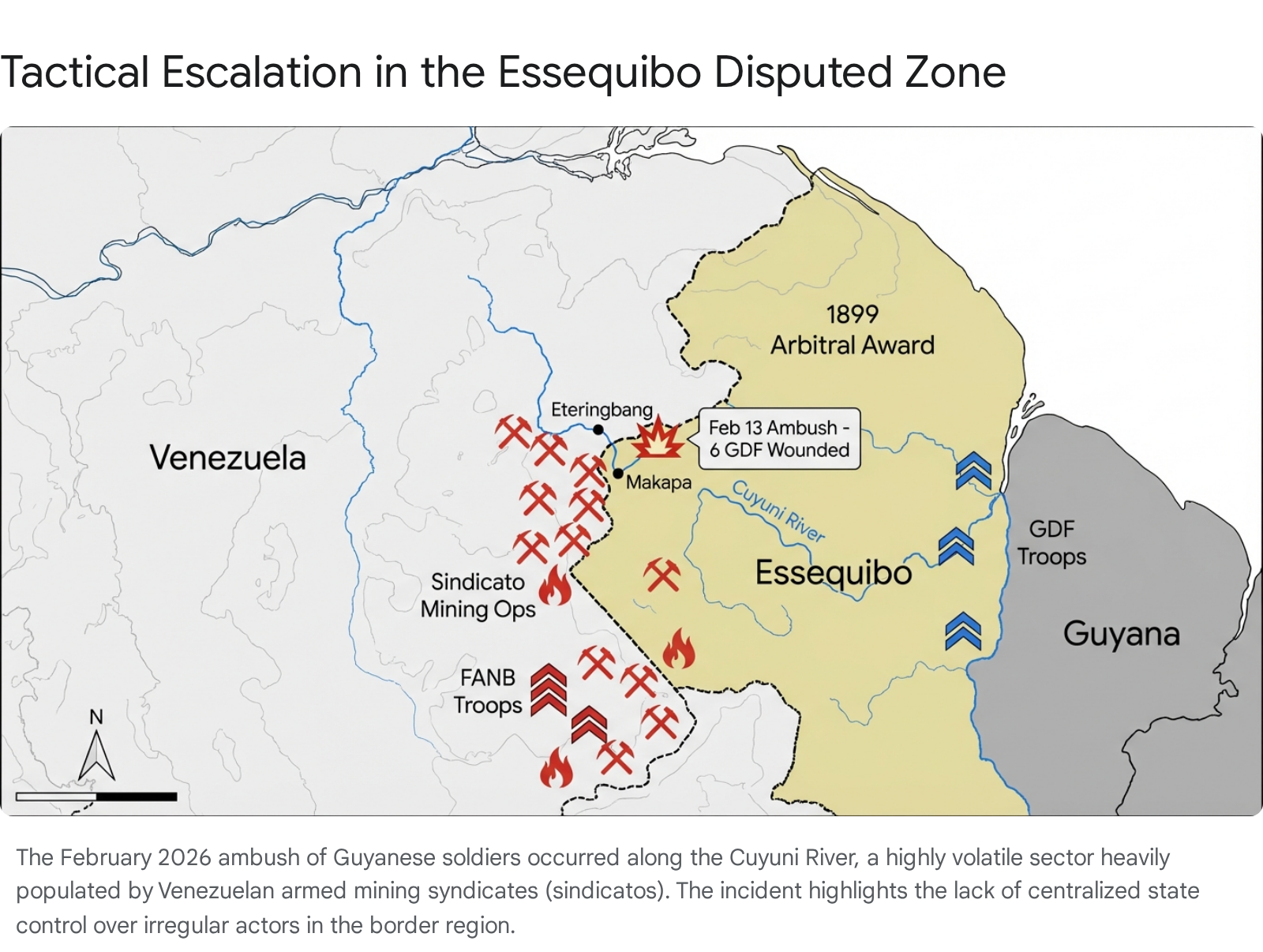
Despite the diplomatic restraint at the executive level, the tactical reality on the ground deteriorated sharply during the reporting period. On February 13, 2026, an armed clash occurred on the Cuyuni River, which serves as a de facto boundary in the disputed zone. A supply vessel belonging to the Guyana Defence Force (GDF), navigating Guyanese waters between Eteringbang and Makapa, was ambushed by armed men in civilian clothing operating from the Venezuelan riverbank.11
The attack was severe, resulting in gunshot wounds to six Guyanese soldiers, including Sergeant Kevon Davis and Second Lieutenant Ansel Murray, one of whom sustained a critical gunshot wound to the head.9 The GDF executed a measured response, returning fire to suppress the attackers, and subsequently evacuated the wounded for surgical care.11
The government of Guyana, led by President Irfaan Ali, expressed profound outrage. Guyanese Foreign Minister Hugh Todd formally summoned the Venezuelan Ambassador to Georgetown, Carlos Pérez, holding the Venezuelan state strictly accountable under international law, regardless of whether the attackers were uniformed military personnel or irregular militias.10 Georgetown characterized the attackers as Venezuelan sindicatos—heavily armed criminal syndicates involved in illegal mining.11 Minister Todd demanded that Venezuela redirect its military presence away from posturing against Guyana and toward eliminating these criminal elements, warning that “inaction is complicity”.11
3.3 Irregular Actors and the Sindicato Threat
Conversely, the Venezuelan Foreign Ministry launched a rapid information operation, denouncing Guyana’s claims as a “false flag and fake news operation” designed to manipulate international public opinion.10 Caracas alleged that Guyanese soldiers had initiated an unprovoked attack on civilian Venezuelan miners engaged in illegal mining activities, resulting in casualties that were subsequently treated on the Venezuelan side of the border.10 Venezuelan Attorney General Tarek William Saab immediately announced a domestic investigation into the incident, framing Guyana as the aggressor facilitating US-backed militarization of the region.10
This skirmish underscores a critical vulnerability in the current transition: the Rodríguez administration does not possess total command and control over the remote border regions. The proliferation of sindicatos, ELN guerrillas, and dissident FARC elements in the Orinoco Mining Arc means that localized violence can easily spark a bilateral diplomatic crisis, irrespective of the strategic desires of Caracas or Washington.11 The Venezuelan military’s capacity to police this region is also highly questionable; much of their air force is grounded due to a lack of parts, and armored elements suffer from severe maintenance deficits, making jungle pacification operations highly complex.42
4. Economic Revitalization, Sanctions Architecture, and Energy Output
The core economic rationale underpinning the United States’ intervention in Venezuela has become explicitly clear: the rapid revival of the Venezuelan hydrocarbons sector to supply the US Gulf Coast and stabilize global energy markets. Following years of hyperinflation, mismanagement, and suffocating international sanctions (including the 2019 designation of PDVSA as a Specially Designated National), the Venezuelan economy remains in a state of structural ruin.12
4.1 Macroeconomic Overview and Humanitarian Conditions
The International Monetary Fund continues to monitor the situation closely, with spokeswoman Julie Kozack describing the economic and humanitarian situation as “quite fragile”.12 The macroeconomic indicators are severe. The IMF estimates public debt at roughly 180 percent of GDP, a figure that does not account for billions in pending arbitration payouts from previous defaults.12 Inflation, which has historically reached astronomical levels, is projected to sit at a staggering 682.1 percent for 2026, accompanied by a rapidly depreciating currency (the Bolívar Soberano), which traded at an official Central Bank rate of 401.83 VES/USD as of February 20.12
The human toll of this economic collapse is catastrophic. Since 2013, approximately eight million Venezuelans—roughly a quarter of the population—have fled the country to escape multidimensional poverty and food shortages, creating one of the largest displacement crises in modern history.12 Domestic wages remain critically low; public sector workers, such as full-time teachers, earn as little as $160 a month, forcing them into multiple jobs to survive.48 To arrest this collapse and simultaneously protect Western financial interests, the Trump administration has engineered a highly complex, phased sanctions relief architecture.
| Macroeconomic Indicator (2026 Projections/Current) | Value | Source Note |
| Inflation Rate (CPI, Projected) | 682.1% | IMF DataMapper 13 |
| Public Debt to GDP | ~180.0% | IMF Briefing 12 |
| Official Exchange Rate (VES/USD) | 401.83 | As of Feb 20, 2026 46 |
| Projected Real GDP Growth | -3.0% | IMF DataMapper 13 |
| Migrant Diaspora (Since 2013/2014) | ~8.0 Million | UN/NGO Estimates 12 |
4.2 Executive Order 14373 and the Foreign Government Deposit Funds (FGDF)
The primary obstacle to revitalizing Venezuela’s oil industry has been the massive overhang of sovereign and corporate debt. If US sanctions were simply lifted, commercial judgment creditors and international arbitration winners would immediately seize Venezuelan oil cargoes and revenues in international waters or financial systems.15
To solve this, President Donald Trump signed Executive Order (EO) 14373 on January 9, 2026, titled “Safeguarding Venezuelan Oil Revenue for the Good of the American and Venezuelan People”.15 This EO declares a national emergency under the International Emergency Economic Powers Act (IEEPA) and creates a targeted legal shield around Venezuelan oil revenues.50
EO 14373 establishes “Foreign Government Deposit Funds” (FGDF)—specialized accounts held by or on behalf of the US Department of the Treasury.15 Under this regime, any monetary payments derived from the sale of Venezuelan natural resources, or the sale of diluents to Venezuela, must be deposited directly into these US-controlled accounts.18 The EO explicitly determines that these funds are the sovereign property of Venezuela held in a custodial capacity by the US, thereby legally immunizing them from attachment, garnishment, or execution by private creditors.15 This aggressive use of executive power effectively overrides the claims of private judgment creditors in favor of US national security and foreign policy objectives—namely, bringing Venezuelan crude to the global market without legal friction.
4.3 The General License Overhaul
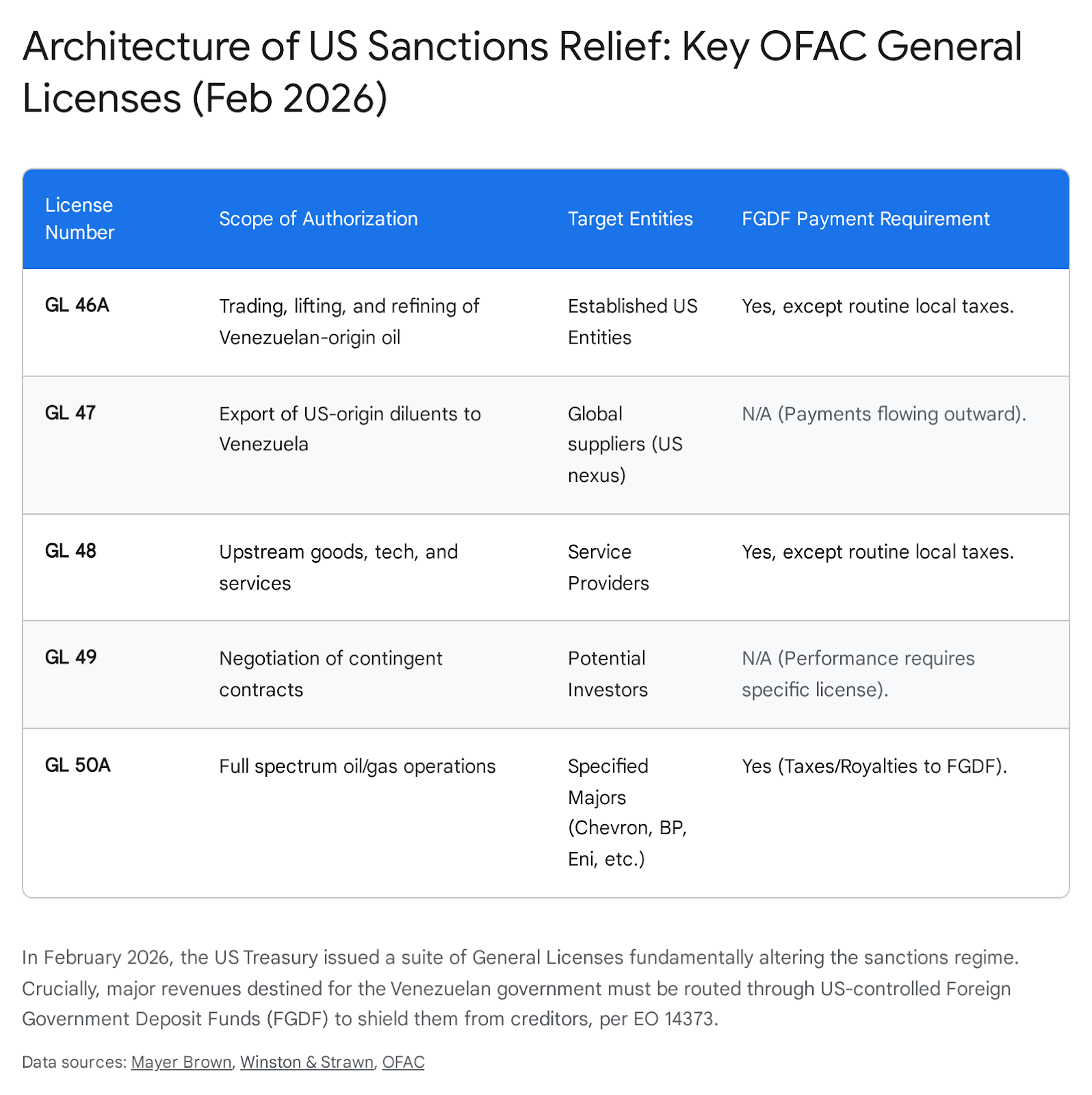
Operating beneath the umbrella of EO 14373, the US Treasury’s Office of Foreign Assets Control (OFAC) has issued a flurry of new General Licenses (GLs) representing the broadest easing of Venezuela-related sanctions in over a decade.14 The architecture is designed in phases to carefully calibrate the opening of the sector:
- Phase 1 (Liquidity and Logistics): Addressed by GL 46A and GL 47. GL 46A authorizes “established U.S. entities” to engage in a wide array of activities involving Venezuelan-origin oil, including lifting, exporting, refining, and transporting.14 GL 47 explicitly authorizes the export of US-origin diluents (such as heavy naphtha) to Venezuela, an absolute necessity for blending and transporting the tar-like extra-heavy crude produced in the Orinoco Belt.14
- Phase 2 (Upstream Revitalization): Addressed by GL 48, GL 49, and GL 50A. GL 48 permits the supply of goods, technology, and services for the exploration, development, and production of oil and gas.14 GL 49 allows companies to negotiate and enter into “contingent contracts” for new investments and joint ventures, pending specific future OFAC approval.14 Crucially, GL 50A provides broad authorization for specified international energy majors—including Chevron, BP, Eni, Repsol, Shell, and Établissements Maurel & Prom SA—to conduct full-spectrum operations within the country.14
- Logistics: GL 30B authorizes transactions incident to the use of ports and airports in Venezuela, which is critical for maritime infrastructure and the export of crude.18
A critical compliance mechanism across all these licenses is the routing of funds. While major payments (royalties, per-barrel levies, federal taxes) to blocked entities like the Government of Venezuela or the state oil company PDVSA must go into the FGDF, OFAC recently issued guidance allowing for the routine payment of local taxes, permits, and operational fees directly to local entities, ensuring day-to-day operations are not paralyzed by compliance bottlenecks.14 Furthermore, these licenses contain strict geopolitical firewalls: transactions involving entities from Russia, Iran, North Korea, Cuba, or China are explicitly prohibited.14
4.4 Upstream and Downstream Infrastructure Reality
The political and legal frameworks are now aligned for a surge in production, and US officials are remarkably bullish. On February 17, US Energy Secretary Chris Wright stated in Paris that Venezuelan oil output could rise by 30 to 40 percent in 2026, equating to an addition of roughly 300,000 to 400,000 barrels per day (bpd) by year-end.16
However, achieving this target requires overcoming a dilapidated, deeply degraded industrial infrastructure. Data from January 2026 indicates that crude oil production actually decreased to 924,000 bpd, down from 1.12 million bpd in December 2025, likely due to operational paralysis during the immediate aftermath of the US military intervention.55
The state of PDVSA’s downstream assets remains abysmal. Currently, the domestic refining network is operating at merely 35 percent of its 1.29 million bpd installed capacity.56 The massive Paraguana Refining Center is only processing 287,000 bpd at five of its nine distillation units following severe power blackouts that took the Amuay refinery temporarily offline.56 The Puerto la Cruz refinery is processing 82,000 bpd, and El Palito is running at 80,000 bpd.56 This lack of refining capacity forces Venezuela to rely heavily on the importation of US naphtha and diluents to maintain operations.56
| Refinery Name | Installed Capacity (bpd) | Current Processing (bpd) | Status / Notes |
| Paraguana Refining Center (Amuay/Cardon) | 955,000 | 287,000 | Recovering from power blackout; Amuay recently offline. |
| Puerto la Cruz | 187,000 | 82,000 | Operating at two distillation units. |
| El Palito | 146,000 | 80,000 | One distillation unit and fluid catalytic cracker operating. |
| Total Domestic Network | 1,290,000 | ~450,000 | Operating at ~35% of total installed capacity. |
| Data derived from industry reporting as of mid-February 2026.56 |
Upstream operations face equally daunting challenges. Incidents such as a Chinese drilling rig (the Alula) striking an underwater pipeline in Lake Maracaibo—resulting in months of crude leakage—highlight the immense environmental and logistical hazards inherent in operating within Venezuela’s oldest oil fields.58 Operators are currently battling insufficient gas supply for well pressure, loss of technical data, and a lack of transportation for workers.58
While major players like Chevron currently produce around 240,000 to 250,000 bpd through joint ventures and plan to increase output by 50 percent in the short term, reaching the Energy Secretary’s target of an additional 400,000 bpd will require billions of dollars in rapid capital expenditure, massive imports of diluents, and the urgent restoration of basic utilities like electricity and water to the oil camps.56 Exxon Mobil has remained noticeably unenthusiastic, describing the environment as “uninvestible,” indicating that not all Western majors are willing to absorb the high risk.57
4.5 The Return to Global Energy Markets: Israel and Beyond
Despite the infrastructural hurdles, the immediate lifting of sanctions has allowed existing production to find new markets, fundamentally altering global energy flows. On February 10, 2026, shipping data confirmed that a cargo of Venezuelan heavy crude was delivered to Israel’s Bazan Group, the operator of the country’s largest refinery in Haifa.60
The shipment, comprising approximately 200,000 barrels from a larger transatlantic delivery (with the remainder destined for Italy and Spain), marks the first Venezuelan delivery to Israel since mid-2020.60 While the volume is modest—supplying a refinery of Haifa’s size for roughly one day—the geopolitical significance is vast.60 Under the Chávez and Maduro regimes, Venezuela maintained a stridently anti-Israel foreign policy, heavily aligned with Iran and Hezbollah.50 Venezuelan Information Minister Miguel Pérez Pirela attempted to deny direct sales to Israel, claiming the oil was sold to independent traders, but the delivery demonstrates that the Rodríguez administration is now thoroughly integrated into Western-aligned supply chains, effectively decoupling from its prior Middle Eastern alliances.60
5. Geopolitical Realignments and Regional Contagion
The gravitational pull of the United States’ military and economic actions in Venezuela has fundamentally altered the geopolitical dynamics of Latin America and the Caribbean, drawing sharp reactions from global adversaries and forcing rapid recalibrations from regional allies.
5.1 The 2026 Cuban Crisis
The most immediate and devastating regional contagion of Maduro’s ouster is occurring in Cuba. The deep symbiotic relationship established in 2002 between Hugo Chávez and Fidel Castro—which birthed the Bolivarian bloc (ALBA) and the Petrocaribe energy alliance—has been completely severed.61 The Trump administration immediately cut off the estimated 27,000 to 35,000 barrels per day of subsidized Venezuelan oil that Havana relied upon for basic survival, triggering what is now being termed the “2026 Cuban Crisis”.21
The sudden termination of this energy lifeline has plunged the island into severe distress. The Cuban government under President Miguel Díaz-Canel has been forced to impose harsh emergency measures, resulting in near-constant power blackouts, the paralysis of public transportation, and families reverting to wood and coal for cooking.20 Washington is explicitly utilizing this energy strangulation to force regime change in Havana by the end of 2026, threatening secondary sanctions and tariffs against any nation attempting to supply oil to the island.21
While Díaz-Canel has expressed a willingness to engage in dialogue without preconditions, stating that Cuba will not negotiate “under pressure,” the White House continues to demand the release of political prisoners and the holding of free elections—demands the Communist Party views as existential threats.21 The US strategy mirrors its approach in Venezuela: utilize absolute economic leverage to force political capitulation, though analysts note that inducing a famine in Cuba risks a massive migratory crisis reminiscent of the 1990s rafter crisis, which would directly impact the Florida coast.21
5.2 Pragmatism in Bogotá: The Colombia-Venezuela Rapprochement
In stark contrast to Cuba’s ideological rigidity and suffering, neighboring Colombia is demonstrating rapid geopolitical pragmatism. Following the US intervention on January 3, Colombian President Gustavo Petro—a prominent leftist leader—was highly critical of the extrajudicial nature of the military operation, which resulted in significant casualties.19
However, recognizing the permanence of the new reality and the potential economic benefits of a stabilized Venezuelan energy sector, Petro has rapidly shifted his rhetoric. On February 18, acting President Rodríguez announced an upcoming bilateral summit with President Petro, potentially to be held in the strategic border city of Cúcuta or the capital, Bogotá.19 The agenda is heavily focused on economic, energy, and border security cooperation.19
For Colombia, engaging with the Rodríguez administration is a matter of strict national security. The porous 2,200-kilometer border region is a sanctuary for transnational criminal organizations, dissident FARC elements, and the ELN.19 Petro recognizes that ignoring the interim government in Caracas would only grant these irregular armed groups total operational impunity along the frontier. Reestablishing bilateral security protocols is essential to prevent the internal factional violence in Venezuela from spilling over into Colombian territory.
5.3 Global Backlash at the United Nations
Outside the immediate sphere of US influence, the military extraction of a sitting head of state has provoked severe diplomatic backlash at the United Nations, highlighting the growing divide between the West and the multipolar bloc. During emergency sessions of the UN Security Council, both the Russian Federation and the People’s Republic of China vehemently condemned the US actions.22
Russian UN Ambassador Vassily Nebenzia categorized the military intervention and the subsequent naval blockade of sanctioned tankers as a “real act of aggression” and “cowboy-like conduct,” warning that it establishes a dangerous template for future acts of force against sovereign states in Latin America.22 He noted that Washington’s actions were aimed at executing an illegal regime change against a government “inconvenient for the United States”.22 China echoed these sentiments, accusing Washington of bullying, coercive practices, and intimidation, while reaffirming its support for the government and people of Venezuela in safeguarding their sovereignty.22
Regionally, Brazil has taken a firm diplomatic stance against the US methodology, despite the ideological differences between Brasilia and the former Maduro regime. President Luiz Inácio Lula da Silva, speaking at an Artificial Intelligence Summit in India, asserted that while the restoration of democracy in Venezuela is the ultimate goal, Nicolás Maduro must face legal accountability within his own borders, not in a foreign courtroom.65 Brazil’s UN Ambassador, Sérgio França Danese, expanded on this, warning that the US had crossed an “unacceptable line” regarding international law and the UN Charter. Danese argued that the use of force to exploit natural resources or illegally change a government jeopardizes South America’s status as a zone of peace, and that “the ends do not justify the means”.23 This diplomatic resistance indicates that while the US has achieved its immediate tactical goals in Caracas, it has suffered significant reputational damage across the Global South.
6. The Judicial Front: The United States v. Nicolás Maduro
As the geopolitical fallout settles, the judicial mechanism against the deposed Venezuelan leadership continues to grind forward in the United States. Nicolás Maduro and his wife, Cilia Flores, captured during the January 3 Operation Absolute Resolve, were immediately transported to New York to face prosecution in the Southern District of New York.1
Both appeared in a Manhattan federal court on January 5, pleading not guilty to severe charges including narco-terrorism conspiracy, cocaine-importation conspiracy, and possession of and conspiracy to possess machine guns.24 During the hearing, Maduro defiantly declared himself a “prisoner of war”.24
Initially scheduled for a follow-up hearing on March 17, 2026, the court appearance has been officially postponed to March 26.24 US prosecutors cited “scheduling and logistical issues,” a request granted by the judge with the consent of the defense counsel.24 Legal experts, including former federal prosecutors, assess that due to the severe security considerations, the massive volume of classified intelligence evidence involved, and the unprecedented nature of trying a captured head of state, the actual jury trial is highly unlikely to commence before the end of 2026.68 In the interim, the trial serves as a powerful deterrent mechanism for the Trump administration, a constant reminder to remaining Chavista holdouts like Diosdado Cabello of the consequences of non-compliance.8
7. Strategic Outlook and Intelligence Forecast (30-90 Days)
The trajectory of the Venezuelan state over the next quarter will be dictated by the interplay between US economic engineering, the resolution of internal factional friction, and the management of territorial disputes. The current operational environment suggests three primary vectors of development:
- Economic Stabilization via Energy Influx: The deployment of the Foreign Government Deposit Funds (FGDF) successfully ring-fences Venezuelan oil assets from historical creditors. Consequently, within the next 60 days, expect a surge in procurement contracts, diluent shipments from the US Gulf Coast, and initial upstream refurbishments by Western majors operating under GL 50A. However, structural degradation (power grid failures, pipeline integrity, and labor shortages) will severely cap the velocity of production increases. The Energy Secretary’s targeted 400,000 bpd increase by year-end is highly ambitious and will likely fall short in the near term, with production stabilizing closer to an additional 150,000 to 200,000 bpd by Q3 2026.
- Neutralization or Escalation of the Cabello Faction: The armed posture of Interior Minister Diosdado Cabello in Caracas is unsustainable in the medium term. The US strategy of coercive containment will either result in Cabello negotiating an exit (exile or heavily monitored internal retirement) or a violent confrontation. If Cabello assesses that his patronage networks within the FANB are successfully being dismantled by the Rodríguez-US alignment, the probability of preemptive kinetic action by colectivo militias in the capital increases significantly within the next 45 days, threatening the broader pacification strategy.
- Border Volatility and the Guyanese Flashpoint: The Rodríguez administration will maintain rhetorical hostility regarding the Essequibo to satisfy domestic nationalist constituencies and the military, but will actively avoid initiating conventional military conflict. However, the prevalence of sindicatos operating autonomously along the Cuyuni River guarantees further localized skirmishes. Guyana will likely respond by further deepening its defense cooperation with the US Southern Command and Brazil, leading to a highly militarized and perpetually tense border environment that will require constant diplomatic de-escalation.
Please share the link on Facebook, Forums, with colleagues, etc. Your support is much appreciated and if you have any feedback, please email us in**@*********ps.com. If you’d like to request a report or order a reprint, please click here for the corresponding page to open in new tab.
Sources Used
- 2026 United States intervention in Venezuela – Wikipedia, accessed February 21, 2026, https://en.wikipedia.org/wiki/2026_United_States_intervention_in_Venezuela
- From Rogue State to Failed State?: The Perils of Intervention in …, accessed February 21, 2026, https://americanaffairsjournal.org/2026/02/from-rogue-state-to-failed-state-the-perils-of-intervention-in-venezuela/
- Venezuela: Dismantle Repressive Apparatus, accessed February 21, 2026, https://www.hrw.org/news/2026/02/18/venezuela-dismantle-repressive-apparatus
- U.S. Confrontation With Venezuela | Global Conflict Tracker, accessed February 21, 2026, https://www.cfr.org/global-conflict-tracker/conflict/instability-venezuela
- Venezuela’s new amnesty law gets a chilly response from the opposition and detainees’ families, accessed February 21, 2026, https://apnews.com/article/venezuela-amnesty-prisoners-delcy-rodriguez-5f34e5dd597f9ac9e307d4eba76d31e5
- BREAKING: Venezuela | Military Clashes In Caracas – Speevr, accessed February 21, 2026, https://speevr.com/2026/01/06/breaking-venezuela-military-clashes-in-caracas/
- Chavismo factions divide presidency of the new Venezuela | International | EL PAÍS English, accessed February 21, 2026, https://english.elpais.com/international/2026-01-07/chavismo-factions-divide-up-presidency-of-the-new-venezuela.html
- Hardline Venezuelan security chief could be targeted next if US demands not met — sources, accessed February 21, 2026, https://www.timesofisrael.com/liveblog_entry/hardline-venezuelan-security-chief-could-be-targeted-next-if-us-demands-not-met-sources/
- Guyanese soldiers ambushed, shot by Venezuelan gang – Kaieteur News, accessed February 21, 2026, https://kaieteurnewsonline.com/2025/02/18/guyanese-soldiers-ambushed-shot-by-venezuelan-gang/
- Venezuela Denounces Guyana ‘False Narrative’ Over Clash in Disputed Essequibo Territory – Venezuelanalysis, accessed February 21, 2026, https://venezuelanalysis.com/news/venezuela-denounces-guyana-false-narrative-over-clash-in-disputed-essequibo-territory/
- Guyana outraged at attack on soldiers – Stabroek News, accessed February 21, 2026, https://www.stabroeknews.com/2025/02/19/news/guyana/guyana-outraged-at-attack-on-soldiers/
- IMF warns Venezuela’s economy and humanitarian situation is ‘quite fragile’ – Al Jazeera, accessed February 21, 2026, https://www.aljazeera.com/news/2026/2/20/imf-warns-venezuelas-economy-and-humanitarian-situation-is-quite-fragile
- República Bolivariana de Venezuela and the IMF, accessed February 21, 2026, https://www.imf.org/en/countries/ven
- OFAC Issues New General Licenses Expanding Permitted Activities …, accessed February 21, 2026, https://www.mayerbrown.com/en/insights/publications/2026/02/ofac-issues-new-general-licenses-expanding-permitted-activities-in-the-venezuelan-energy-sector
- New Executive Order Shields Venezuelan Oil Revenue in US Government Custody, accessed February 21, 2026, https://www.mayerbrown.com/en/insights/publications/2026/01/new-executive-order-shields-venezuelan-oil-revenue-in-us-government-custody
- U.S. Energy Chief Says Venezuela Could Boost Output by “Several Hundred Thousand Bpd by Year‑End” – EnergyNow.com, accessed February 21, 2026, https://energynow.com/2026/02/u-s-energy-chief-says-venezuela-could-boost-output-by-several-hundred-thousand-bpd-by-year-end/
- U.S. says Venezuela oil output could rise 30%–40% in 2026, accessed February 21, 2026, https://worldoil.com/news/2026/2/18/u-s-says-venezuela-oil-output-could-rise-30-40-in-2026/
- United States Issues Significant New Sanctions Relief for …, accessed February 21, 2026, https://www.winston.com/en/blogs-and-podcasts/global-trade-and-foreign-policy-insights/united-states-issues-significant-new-sanctions-relief-for-venezuelas-oil-and-gas-sector
- Venezuela’s Delcy Rodríguez and Colombia’s Gustavo Petro to Meet Amid Shifting Regional Dynamics – Orinoco Tribune, accessed February 21, 2026, https://orinocotribune.com/venezuelas-delcy-rodriguez-and-colombias-gustavo-petro-to-meet-amid-shifting-regional-dynamics/
- From blackouts to food shortages: How US blockade is crippling life in Cuba – Al Jazeera, accessed February 21, 2026, https://www.aljazeera.com/economy/2026/2/8/from-blackouts-to-food-shortages-how-us-blockade-is-crippling-life-in-cuba
- How far will Trump push Cuba? | Chatham House – International Affairs Think Tank, accessed February 21, 2026, https://www.chathamhouse.org/2026/02/how-far-will-trump-push-cuba
- Russia, China condemn US blockade of Venezuela, calling it ‘cowboy behaviour’ at UN, accessed February 21, 2026, https://www.trtworld.com/article/a9f4b22a041b
- Brazil at UN: US action in Venezuela threatens peace in South America – Agência Brasil, accessed February 21, 2026, https://agenciabrasil.ebc.com.br/en/internacional/noticia/2026-01/brazil-un-us-action-venezuela-threatens-peace-south-america
- Maduro’s next US court date pushed back to March 26: filing, accessed February 21, 2026, https://www.bssnews.net/international/361945
- Maduro’s Court Hearing Postponed in New York, accessed February 21, 2026, https://en.isna.ir/news/1404112917504/Maduro-s-Court-Hearing-Postponed-in-New-York
- Venezuela grants amnesty to 379 political prisoners, accessed February 21, 2026, https://www.bssnews.net/international/362660
- Proposed amnesty law offers political prisoners in Venezuela an ‘opportunity’ | UN News, accessed February 21, 2026, https://news.un.org/en/story/2026/02/1166929
- World Report 2026: Rights Trends in Venezuela, accessed February 21, 2026, https://www.hrw.org/world-report/2026/country-chapters/venezuela
- Venezuela approves amnesty bill, paving way for release of … – PBS, accessed February 21, 2026, https://www.pbs.org/newshour/world/venezuela-approves-amnesty-bill-paving-way-for-release-of-hundreds-of-political-detainees
- Venezuela’s new amnesty law gets a chilly response from the opposition and detainees’ families – KSAT, accessed February 21, 2026, https://www.ksat.com/news/2026/02/20/venezuelas-new-amnesty-law-has-a-chilly-response-from-opposition-and-detainees-families/
- Human rights organization in Venezuela: 80 political prisoners released in the country, accessed February 21, 2026, https://www.ynetnews.com/article/fetf9j5js
- Venezuela frees 104 political prisoners, rights group says, accessed February 21, 2026, https://www.aljazeera.com/news/2026/1/26/venezuela-frees-104-political-prisoners-rights-group-says
- Venezuela’s new amnesty law gets a chilly response from the opposition and detainees’ families, accessed February 21, 2026, https://lasvegassun.com/news/2026/feb/20/venezuelas-new-amnesty-law-gets-a-chilly-response-/
- US act of aggression against Venezuela further weakens rules-based order, accessed February 21, 2026, https://www.amnesty.org/en/latest/news/2026/02/usa-aggression-against-venezuela-further-weakens-rules-based-order/
- Crisis in Venezuela: Three Scenarios – Toda Peace Institute, accessed February 21, 2026, https://toda.org/global-outlook/2026/crisis-in-venezuela-three-scenarios.html
- Venezuela rejects US warning over Essequibo dispute – Anadolu Ajansı, accessed February 21, 2026, https://www.aa.com.tr/en/energy/general/venezuela-rejects-us-warning-over-essequibo-dispute/48283
- Guyana–Venezuela crisis (2023–2024) – Wikipedia, accessed February 21, 2026, https://en.wikipedia.org/wiki/Guyana%E2%80%93Venezuela_crisis_(2023%E2%80%932024)
- Venezuela, Guyana: President Rodriguez Issues Statement Regarding Essequibo Region, accessed February 21, 2026, https://worldview.stratfor.com/situation-report/venezuela-guyana-president-rodriguez-issues-statement-regarding-essequibo-region
- Venezuela Reaffirms Claim to Essequibo Territory Disputed With Guyana – Government, accessed February 21, 2026, https://www.nampa.org/text/22862334
- Venezuela Rejects Guyana’s Attempt to Distort Terms of 1966 Geneva Agreement, accessed February 21, 2026, https://orinocotribune.com/venezuela-rejects-guyanas-attempt-to-distort-terms-of-1966-geneva-agreement/
- Guyana Not Letting Its Guard Down Against Venezuela’s Attempt To Invade By Referendum., accessed February 21, 2026, https://www.thestkittsnevisobserver.com/guyana-not-letting-its-guard-down-against-venezuelas-attempt-to-invade-by-referendum/
- Venezuela, Guyana: The shocking war that wasn’t | Responsible Statecraft, accessed February 21, 2026, https://responsiblestatecraft.org/guyana-venezuela/
- Guyana soldiers attacked three times in 24 hours amid tensions with Venezuela, accessed February 21, 2026, https://www.theguardian.com/world/2025/may/15/guyana-venezuela-attack-essquibo
- Colombia And Venezuela Warn US Over Military Moves – Grand Pinnacle Tribune, accessed February 21, 2026, https://evrimagaci.org/gpt/colombia-and-venezuela-warn-us-over-military-moves-513737
- OFAC Issues Several New General Licenses Regarding Oil Trade with Venezuela, accessed February 21, 2026, https://www.jdsupra.com/legalnews/ofac-issues-several-new-general-8972562/
- Venezuelan Bolivar – Quote – Chart – Historical Data – News – Trading Economics, accessed February 21, 2026, https://tradingeconomics.com/venezuela/currency
- ‘Besieged’ Venezuela unveils reduced budget for 2026 – Indo Premier Sekuritas, accessed February 21, 2026, https://www.indopremier.com/ipotnews/newsDetail.php?jdl=_Besieged__Venezuela_unveils_reduced_budget_for_2026&news_id=1713248&group_news=ALLNEWS&news_date=&taging_subtype=VENEZUELA&name=&search=y_general&q=VENEZUELA,%20&halaman=1
- Venezuela’s oil revival brings hope but little relief for workers, accessed February 21, 2026, https://www.wgcu.org/2026-02-17/venezuelas-oil-revival-brings-hope-but-little-relief-for-workers
- US government authorizes US entities to transact in Venezuelan-origin oil | DLA Piper, accessed February 21, 2026, https://www.dlapiper.com/en/insights/publications/2026/02/us-government-authorizes-us-entities-to-transact-in-venezuelan-origin-oil
- Safeguarding Venezuelan Oil Revenue for the Good of the American and Venezuelan People – The White House, accessed February 21, 2026, https://www.whitehouse.gov/presidential-actions/2026/01/safeguarding-venezuelan-oil-revenue-for-the-good-of-the-american-and-venezuelan-people/
- Safeguarding Venezuelan Oil Revenue for the Good of the American and Venezuelan People – Federal Register, accessed February 21, 2026, https://www.federalregister.gov/documents/2026/01/15/2026-00831/safeguarding-venezuelan-oil-revenue-for-the-good-of-the-american-and-venezuelan-people
- US Eases Venezuela Sanctions Through New General Licenses and FAQs, accessed February 21, 2026, https://www.hunton.com/insights/legal/us-eases-venezuela-sanctions-through-new-general-licenses-and-faqs
- 1237 | Office of Foreign Assets Control, accessed February 21, 2026, https://ofac.treasury.gov/faqs/1237
- Venezuela’s Oil Output Can Grow 30%-40% This Year, US Says, accessed February 21, 2026, https://www.ttnews.com/articles/venezuelas-oil-output
- Venezuela Crude Oil Production – Trading Economics, accessed February 21, 2026, https://tradingeconomics.com/venezuela/crude-oil-production
- Venezuela’s Refineries Boost Processing to 35% of Capacity, Sources Say, accessed February 21, 2026, https://tankterminals.com/news/venezuelas-refineries-boost-processing-to-35-of-capacity-sources-say/
- Why Big Oil wants no part of Trump-seized Venezuela, accessed February 21, 2026, https://asiatimes.com/2026/02/why-big-oil-wants-no-part-of-trump-seized-venezuela/
- Oil companies jostle for projects to boost Venezuelan output quickly; a real grind awaits, accessed February 21, 2026, https://boereport.com/2026/02/19/oil-companies-jostle-for-projects-to-boost-venezuelan-output-quickly-a-real-grind-awaits/
- What’s the status of international oil companies in Venezuela?, accessed February 21, 2026, https://boereport.com/2026/02/19/whats-the-status-of-international-oil-companies-in-venezuela/
- Venezuela’s Return to Oil Markets Enhances Israel’s Energy Security, accessed February 21, 2026, https://www.meforum.org/mef-observer/venezuelas-return-to-oil-markets-enhances-israels-energy-security
- Cuba’s alliances are crumbling in Trump’s world – The Pais in English – EL PAÍS, accessed February 21, 2026, https://english.elpais.com/international/2026-02-16/cubas-alliances-are-crumbling-in-trumps-world.html
- 2026 Cuban crisis – Wikipedia, accessed February 21, 2026, https://en.wikipedia.org/wiki/2026_Cuban_crisis
- Cubans wonder if they could be next after Venezuela as rumours swirl about U.S. talks, accessed February 21, 2026, https://www.cbc.ca/news/politics/cuban-cia-castro-energy-collapse-9.7078628
- Russia & China Accuse US of Bullying Nations, Violating Intl Law at UN Over Venezuela, accessed February 21, 2026, https://www.youtube.com/watch?v=sEVY1K6VkG8
- Brazilian President Lula says Maduro should face justice in Venezuela, accessed February 21, 2026, https://www.aa.com.tr/en/americas/brazilian-president-lula-says-maduro-should-face-justice-in-venezuela/3836263
- Brazil Goes Ballistic At UNSC Over Maduro Capture, Demands US’ Accountability For Venezuela Raid – YouTube, accessed February 21, 2026, https://www.youtube.com/watch?v=6M2MQwwtZkM
- FULL REMARKS: Brazil Says US Bombing of Venezuela Crossed a Red Line, Slams Capture of Maduro – YouTube, accessed February 21, 2026, https://www.youtube.com/watch?v=qXf8wpIU__w
- The criminal prosecution of Nicolás Maduro is underway. Here’s what to expect – WUFT, accessed February 21, 2026, https://www.wuft.org/2026-01-06/the-criminal-prosecution-of-nicolas-maduro-is-underway-heres-what-to-expect