Tag Archives: Venezuela

Iran-Venezuela Drone Supply Chain: Threat Assessment

BLUF (Bottom Line Up Front): Despite the January 3, 2026, decapitation strike (Operation Absolute Resolve) that successfully captured Venezuelan President Nicolás Maduro and shattered the regime’s conventional air defense network, the decentralized and deeply entrenched unmanned aerial vehicle (UAV) infrastructure established by the Islamic Republic of Iran and the Russian Federation remains highly operational. For over a decade, Tehran and Moscow have systematically utilized Caracas as a forward operating base—a strategic “Western Hemisphere bridgehead”—facilitating the transfer, local assembly, and operational deployment of advanced combat drones. Through the state-sanctioned enterprise Empresa Aeronautica Nacional SA (EANSA) and the military industrial complex CAVIM, Venezuela has evolved from a mere recipient of imported surveillance platforms to a localized assembly hub capable of producing sophisticated loitering munitions designed for autonomous swarm operations.

The Venezuelan UAV arsenal is currently anchored by the Iranian Mohajer-6, a medium-altitude long-endurance (MALE) combat drone, and the Zamora V-1, a direct derivative of the Iranian Shahed-136 (Russian Geran-2). The logistical supply chains sustaining this manufacturing capability are highly resilient and multifaceted, relying on sanctioned state airlines utilizing obfuscated flight routing via Mexico and Syria, dark-fleet maritime smuggling vessels engaging in complex ship-to-ship transfers, and illicit procurement networks that route Western-manufactured microelectronics through hundreds of Chinese front companies. While the Venezuelan conventional military apparatus suffered catastrophic failures during the January 2026 United States intervention, the dispersed, low-signature nature of the UAV arsenal—now potentially under the control of remaining regime loyalists led by acting President Delcy Rodriguez, allied narco-terrorist syndicates, and Hezbollah operatives headquartered on Margarita Island—presents an immediate, severe asymmetric threat to United States Southern Command (USSOUTHCOM) operations. Forward operating locations across the Caribbean, Puerto Rico, the Panama Canal zone, and the southern United States homeland remain well within the 1,500-mile strike radius of the Zamora V-1. Neutralizing the EANSA/CAVIM production facilities, dismantling the Tehran-Caracas logistics bridge, and mitigating the Hezbollah crime-terror nexus must be prioritized to prevent a protracted, drone-enabled insurgency in the region during the ongoing geopolitical transition.

1.0 Introduction and Strategic Geopolitical Context

The geopolitical landscape of the Western Hemisphere experienced a seismic paradigm shift in January 2026 following the execution of Operation Absolute Resolve. The precision military intervention, which resulted in the apprehension of former Venezuelan President Nicolás Maduro and his inner circle, neutralized the immediate executive command structure of the Bolivarian regime and catalyzed a rapid reorganization of regional power dynamics.1 However, the physical extraction of the executive leadership did not inherently dismantle the deeply rooted military-industrial apparatus built over two decades through the Venezuela-Russia-Iran-China (VRIC) alignment. Since 2006, the Islamic Republic of Iran, later joined in strategic depth by the Russian Federation, has methodically exported asymmetric military capabilities to Venezuela, fundamentally altering the regional balance of power and directly challenging United States hegemony in its near abroad.3

The strategic architecture of this alliance was designed to establish a “tropical caliphate” or forward operating base—a sovereign logistics hub capable of hosting the Islamic Revolutionary Guard Corps (IRGC), functioning as a financial lung for Hezbollah, and providing a massive sanctions-evasion refinery for adversarial powers.5 The centerpiece of this transregional threat architecture is the aggressive proliferation of unmanned aerial vehicles (UAVs). What began as the localized assembly of rudimentary surveillance platforms under former President Hugo Chávez has metastasized into the deployment of persistent intelligence, surveillance, target acquisition, and reconnaissance (ISTAR) assets, alongside long-range, one-way attack loitering munitions.6

Driven by severe economic collapse, hyperinflation, and the necessity for cheap, expendable force multipliers, the Venezuelan military gradually adopted Iranian and Russian drone doctrines.8 This doctrinal shift sought to replicate the anti-access/area denial (A2/AD) strategies utilized successfully in the Persian Gulf, the Levant, and the Eastern European theaters.8 Prior to his capture, Maduro had appealed to Moscow and Beijing for enhanced air defense systems, but the Kremlin’s strategic preoccupation with the war in Ukraine rendered these pleas largely unanswered, accelerating Caracas’s reliance on relatively inexpensive, Iranian-designed asymmetric systems.11

This intelligence report provides an exhaustive, granular assessment of the drone technology transfers from Iran and Russia to Venezuela. By synthesizing open-source intelligence, flight tracking data, sanctions designations, and post-raid battle damage assessments, this document identifies suspected assembly sites, maps the obfuscated logistical supply routes bridging the Middle East, Eurasia, and Latin America, and evaluates the critical threat these residual systems pose to USSOUTHCOM operations during the volatile political transition currently overseen by acting President Delcy Rodriguez.1

2.0 Technical Assessment: The Unmanned Aerial Systems Arsenal

The Venezuelan UAV arsenal is characterized by a sophisticated mix of imported complete systems, locally assembled knock-down kits, and domestic iterations of foreign designs. The tactical integration of these platforms signifies a deliberate shift toward asymmetric warfare, prioritizing expendable, long-range strike capabilities over conventional, manned aviation. The Venezuelan Air Force’s manned fighter fleet, comprising aging US-made F-16s and Russian Su-30MK2s, has suffered from severe maintenance shortfalls, parts embargoes, and low pilot readiness, rendering the UAV fleet the most viable vector for projecting localized aerial power.9

2.1 The Mohajer-6 (ANSU Series) Platform

The Mohajer-6 represents a massive qualitative leap in Venezuelan military capability. Manufactured by Iran’s Qods Aviation Industries (QAI) and negotiated for local assembly by Venezuela’s Empresa Aeronautica Nacional SA (EANSA), the Mohajer-6 is a medium-altitude, long-endurance (MALE) combat UAV.14 Operational deployment of the Mohajer-6 in Venezuela was conclusively confirmed via photographic and video evidence in late 2025 and early 2026, showing the distinct platforms engaging in ground operations and flight exercises at Base Aerea El Libertador (BAEL).8

Technically, the Mohajer-6 features a wingspan of 10 meters, a maximum takeoff weight of approximately 600 kilograms, and is powered by a small internal combustion engine.7 It boasts an operational endurance of up to 12 hours, allowing for extended loitering over the Caribbean Sea, inland borders, and strategic maritime chokepoints.8 While base range specifications cite 200 kilometers for direct line-of-sight control 7, modifications and relayed command-and-control (C2) infrastructure could extend its operational radius to 2,400 kilometers, placing vital regional nodes at risk.8 Analysis of captured units globally suggests that up to 75 percent of the drone’s internal components are of foreign origin, obtained through illicit international procurement networks.8

Crucially, the Mohajer-6 is not strictly an ISR platform; it is a dedicated strike asset. The drone integrates a chin-mounted laser range finder, a forward-facing camera for navigation, and a multispectral infrared targeting system.16 It is equipped with four underwing hardpoints capable of deploying Iranian-designed Qaem precision-guided glide bombs, providing an immediate capability to strike targets of opportunity.14 In Venezuelan military doctrine, the Mohajer-6 is prized as a force multiplier. It serves a highly complementary role in supporting legacy strike assets, most notably the Su-30MK2 fighters, by loitering at a maximum altitude of 5,500 meters to provide highly accurate targeting data for cruise missile strikes.16 Post-Operation Absolute Resolve analysis indicates that while these platforms played no significant role in defending against the rapid US kinetic and cyber strikes due to their unsuitability for contested, high-spectrum-dominance environments, they remain highly lethal for localized insurgency operations, asymmetric harassment, and cross-border provocations.7

2.2 The Shahed-136 Derivative: Zamora V-1 Loitering Munitions

The most concerning capability currently residing in the Venezuelan inventory is the Zamora V-1, a direct derivative or localized clone of the Iranian delta-winged Shahed-136 loitering munition (known in Russian service as the Geran-2).8 Introduced publicly in 2024, the Zamora V-1 signals Caracas’s intent to master autonomous, one-way attack drone saturation tactics, fundamentally shifting the region’s threat paradigm.14

Intelligence surrounding the development of the Zamora V-1 indicates a deliberate, evolutionary procurement and testing strategy. Early mockups and prototypes displayed in early 2024 featured severely downgraded specifications compared to the original Iranian Shahed-136. These early Venezuelan variants were reported to be a mere 1.5 meters in length and wingspan, weighing only 35 kilograms, with a top speed of 120 to 150 kilometers per hour, a limited operational ceiling of 2,000 meters, and a highly restricted range of only 30 kilometers (approximately 18 miles).19 Most notably, the initial explosive payload was a rudimentary, repurposed RPG-7 anti-tank warhead, vastly inferior to the sophisticated 50-kilogram high-explosive fragmentation warhead found on the standard Shahed-136.19

However, advanced intelligence analysis suggests this downgraded prototype was merely a stepping stone for domestic aerodynamic testing, flight control validation, and basic manufacturing scaling. The broader strategic intent, facilitated by continued deep technology transfers from EANSA and QAI, aims to field the full capabilities of the Shahed-136 platform locally. Iran claims the mature Shahed-136 achieves an operational range of 1,000 to 1,500 miles.8 The realization of this capability within Venezuela places critical strategic nodes, including Puerto Rico, the US Virgin Islands, the Panama Canal, and massive swaths of southern Florida, well within striking distance of Venezuelan territory.8 The Zamora V-1 is explicitly designed for swarm operations, utilizing pre-programmed GPS navigation to overwhelm layered, multi-million-dollar air defense networks—a tactic extensively refined and proven by Russian forces in the Ukrainian theater.10

2.3 Ancillary and Experimental Platforms

Beyond the premier Mohajer-6 and Zamora V-1 systems, the Venezuelan military operates a diverse portfolio of ancillary drones, indicating a broad, multi-layered approach to unmanned aviation:

  • ANSU-100 (Arpia): A localized version of the Iranian Mohajer-2. Originally unveiled in 2012 by Hugo Chávez as an unarmed reconnaissance asset, the platform was later upgraded extensively by EANSA. It is now explicitly confirmed to be an armed platform capable of launching Iranian Qaem guided bombs, maintaining a range of approximately 60 miles.4
  • ANSU-200: Unveiled during a 2022 military parade, this is a highly experimental flying-wing prototype heavily inspired by Iranian stealth designs, specifically the IRGC’s Shahed-171. It is being developed with the direct assistance of experts trained in Iran, indicating an ambition to field low-observable, multi-domain systems capable of suppression of enemy air defenses (SEAD).4
  • Antonio Jose de Sucre Series: The Sucre-100 is a light combat and observation drone modernized with Iranian support, capable of utilizing Russian-made guided munitions for anti-tank roles. The Sucre-200 is an envisioned stealth, multi-role system designed for medium-range C-UAS (counter-drone) and air defense missions.20
  • Russian Tactical Platforms (Orlan-10 and Geran-2): Since 2020, Caracas has directly purchased Russian Orlan-10 tactical reconnaissance drones, utilizing them for border surveillance and artillery fire correction.6 In a concerning development in late 2025, unconfirmed intelligence reporting indicated that Russia may be preparing to arm Venezuela directly with up to 2,000 Geran-2 (Shahed-136) drones.24 This potential mass transfer aims to rapidly bolster the regime’s defensive posture following the collapse of its conventional air defense umbrella, reflecting the deepening militaristic reciprocity between Moscow, Tehran, and Caracas.

2.4 Unmanned Aerial Systems Threat Matrix

The following table synthesizes cross-source intelligence to provide a definitive comparison of drone payloads, ranges, and current operational statuses within the Venezuelan theater, highlighting the scale of the asymmetric threat.

Platform DesignationOrigin / Design BasePrimary Operational RoleMax RangeEndurancePayload / Munition Capability2026 Operational Status
Mohajer-6Iran (QAI)Persistent ISTAR / Light Strike200 km (Up to 2,400 km with relays)12 hoursMultispectral IR; up to 4x Qaem precision-guided glide bombs. Max payload ~40 kg.Active. Assembled locally by EANSA. Confirmed deployment at BAEL.
Zamora V-1 (Initial Prototype)Venezuela (Shahed-131/136 inspired)Short-Range Loitering Munition30 km (18 miles)N/A35 kg total vehicle weight. Repurposed RPG-7 warhead payload.Active Testing. Used for domestic aerodynamic validation and training.
Zamora V-1 (Target Spec)Iran / Venezuela (Shahed-136 clone)Long-Range Loitering Munition (Swarm)1,000 – 1,500 milesN/A50 kg high-explosive fragmentation warhead.Suspected Active. Represents the primary asymmetric strike threat to US SOUTHCOM.
ANSU-100 (Arpia)Iran (Mohajer-2 derivative)Reconnaissance / Light Strike100 km (60 miles)1.5 hoursSurveillance optics; upgraded to carry light Qaem guided bombs.Operational. Legacy system heavily utilized for border patrol and internal security.
ANSU-200Iran (Shahed-171 flying wing inspired)Stealth / Multi-domain SEADUnknownUnknownUnknown; claimed strike and counter-drone capabilities.Prototype Phase. Development ongoing with Iranian technical advisors.
Sucre-100 / Sucre-200Venezuela / IranLight Combat / Experimental StealthUnknownUnknownAnti-tank and anti-personnel utilizing Russian-made guided munitions.Development / Experimental Phase.
Orlan-10Russia (Special Technology Center)Tactical Reconnaissance / Artillery Spotting120 km16 hoursDaylight/Thermal cameras; EW payloads; used as a Mothership for FPVs.Operational. Procured directly from Russia.
Geran-2 (Shahed-136)Russia / IranLong-Range Loitering Munition1,500 milesN/A50 kg high-explosive fragmentation warhead.Unconfirmed Potential Transfer. Reports of up to 2,000 units pending delivery.

3.0 Geolocation and Analysis of Suspected Assembly and Production Infrastructure

The localization of Iranian drone technology in Venezuela is not a spontaneous development but the result of a deliberate, multi-decade industrial strategy. By physically moving production and final assembly to the Western Hemisphere, Iran avoids logistical bottlenecks associated with intercontinental shipping, circumvents targeted maritime embargoes, and establishes a sustainable proxy armory capable of outlasting individual supply shipments or leadership decapitations.

3.1 Base Aerea El Libertador (BAEL) and EANSA Operations

The absolute epicenter of the Venezuela-Iran UAV nexus is Base Aerea El Libertador (BAEL), located in Maracay, Aragua State. This sprawling facility functions as the primary operational hub for both the Venezuelan Air Force’s conventional assets and its rapidly expanding UAV squadrons.14

Deeply embedded within the perimeter of BAEL operates Empresa Aeronautica Nacional SA (EANSA). EANSA is a highly specialized joint venture created between the state-owned flag carrier Conviasa and the military industrial firm CAVIM.4 According to the United States Department of the Treasury’s Office of Foreign Assets Control (OFAC), which heavily sanctioned EANSA and its president, José Jesús Urdaneta González, in December 2025, EANSA operates under direct coordination with Iran’s Qods Aviation Industries (QAI).8

EANSA’s fortified facilities at BAEL are responsible for the reception of disassembled drone kits shipped directly from Iran, the final integration of sub-components, complex avionics testing, and the delicate mating of explosive munitions to the airframes. Photographic evidence, including satellite imagery and ground-level documentation published by the US Treasury, confirms the persistent presence of partially assembled Mohajer-2/Arpia drones and fully operational Mohajer-6 units on the tarmac at El Libertador.4 Iranian technical specialists, engineers, and IRGC liaisons are known to be permanently embedded within the BAEL complex, working alongside Venezuelan aeronautical engineers who previously received advanced technological training in Tehran.3

3.2 CAVIM Infrastructure and Sub-tier Assembly Factories

Adjacent to and intimately integrated with the operations at BAEL are the manufacturing facilities of CAVIM (Compañia Anónima Venezolana de Industrias Militares). The institutional relationship between CAVIM and the Iranian defense sector dates back to a seminal 2006 bilateral military agreement signed under the administration of Hugo Chávez.3 By 2012, CAVIM had successfully established the foundational industrial base required for UAV assembly, initially producing the Arpia-001 purely for surveillance operations.6

Today, CAVIM’s arms factories oversee the broader, macro-level drone program, functioning as the primary governmental interface for technology transfer. While EANSA handles the direct, specialized assembly and maintenance of the Mohajer series, CAVIM’s heavier industrial facilities are suspected to be involved in the reverse-engineering and localized fabrication of structural components for the Zamora V-1 (Shahed-136 derivative). By utilizing localized manufacturing for non-critical structural components—such as molded fiberglass fuselages, basic control surfaces, and crude propellors—CAVIM drastically reduces Venezuela’s dependency on complete knock-down (CKD) kits from Iran. This localized sub-tier assembly requires only the clandestine importation of critical, high-technology elements such as microelectronics, specialized internal combustion engines, and GPS guidance modules.

3.3 Training Facilities and Decentralized Command and Control (C2)

Ensuring the long-term sustainability and tactical proficiency of the UAV program requires extensive human capital development. The National Experimental University of the Armed Forces has been definitively identified as a critical institutional training site where Iranian instructors educate Venezuelan personnel in advanced UAV aerodynamics, payload integration, and asymmetric tactical employment.8

Furthermore, command and control (C2) infrastructure extends far beyond the centralized assembly sites at Maracay. Intelligence assessments indicate that specialized telecommunications antennas and data-link relays have been erected at Cerro San Telmo and across various fortified military installations in Táchira State, heavily concentrated near the porous Colombian border.8 These dispersed installations provide the localized C2 networks necessary for operating Mohajer-6 and ANSU-100 platforms in contested border regions. This demonstrates a mature operational doctrine that integrates UAVs not just for strategic deterrence, but for tactical national border security, suppression of internal dissent, and the protection of lucrative narco-trafficking routes controlled by the regime and its proxy allies.

Assembly / C2 LocationOperating EntityPrimary FunctionAssessed Strategic Value
El Libertador Air Base (Maracay, Aragua State)EANSA / Venezuelan Air ForceFinal assembly, maintenance, armament integration, and operational deployment of Mohajer-6 and ANSU series.CRITICAL. The absolute center of gravity for Venezuelan UAV operations and technology transfer.
CAVIM Arms Factory (Adjacent to BAEL)CAVIMMacro-program oversight, structural reverse-engineering, early Arpia production, and fiberglass fabrication.HIGH. Essential for indigenization efforts and domestic parts fabrication reducing reliance on imports.
Táchira State Military Bases (Colombian Border)Venezuelan Armed ForcesForward Operating C2 nodes, antenna relays (e.g., Cerro San Telmo).MEDIUM. Extends operational line-of-sight range for border surveillance and tactical strikes.
National Experimental University of the Armed ForcesVenezuelan Ministry of DefenseInstitutional training, aerodynamic engineering, and tactical doctrine development with Iranian instructors.MEDIUM. Crucial for the long-term sustainability and human capital development of the UAV program.

4.0 Obfuscated Logistical Supply Routes and Procurement Networks

The uninterrupted, systematic flow of drone technology from the Eastern Hemisphere to the Caribbean is facilitated by a highly sophisticated, multi-domain logistical network. This architecture relies on exploiting international commercial aviation loopholes, the utilization of dark-fleet maritime shipping, and complex front-company procurement schemes to completely bypass global sanctions regimes.

4.1 The Clandestine “Aeroterror” Aviation Bridge

The fastest and most secure method for transporting critical, high-value, low-weight UAV components—such as advanced guidance chips, precision optics, laser range finders, and specialized technical personnel—between Iran and Venezuela is the clandestine air bridge, historically dubbed “Aeroterror” by intelligence communities.25 Established in 2007 with dedicated routes running from Caracas to Damascus to Tehran, these flights operate entirely outside standard international aviation norms, routinely flying without standard commercial passenger manifests, transparent customs documentation, or adherence to international regulatory oversight.25

Originally operated primarily by Mahan Air—a heavily sanctioned, privately owned Iranian airline intimately linked to the logistical operations of the Islamic Revolutionary Guard Corps (IRGC) Quds Force—the operational burden has increasingly shifted to Venezuelan state-owned assets to circumvent secondary sanctions.25 Conviasa, the Venezuelan flag carrier, and its dedicated cargo subsidiary Emtrasur, operate Airbus A340 and Boeing 747 aircraft explicitly dedicated to this transcontinental route.

Specific flight tracking data from early 2025 positively identifies Conviasa aircraft with tail numbers YV3535 and YV3545 executing these logistical runs.8 To further obfuscate these movements and evade interception, Conviasa employs highly sophisticated routing strategies. Flight records confirm that aircraft YV3535 routinely completes Venezuela-to-Iran routes via layovers in Cancun, Mexico.8 This routing serves to mask the ultimate origin and destination of the cargo, blending the flights into heavy commercial tourist traffic corridors and bypassing direct, prioritized scrutiny from US and allied radar and customs networks. The original pioneer of this route, aircraft YV1004, completed 41 such round trips in 2020 alone, highlighting the sheer volume of material transferred over the years.8

4.2 Dark-Fleet Maritime Smuggling and Transshipment

While the aviation bridge handles sensitive microelectronics and personnel, the bulk transfer of heavy munitions (such as the Qaem glide bombs), complete knock-down (CKD) airframes, and heavy manufacturing machinery requires maritime transport. The Iranian state shipping apparatus utilizes heavily sanctioned, dark-fleet vessels to conduct these massive transfers across the Atlantic.

Intelligence has identified several specific Iranian-flagged vessels historically and currently involved in the transshipment of military hardware to Venezuela, including the GOLSAN, IRAN SHAHR, DAISY, and AZARGOUN.14 These vessels employ a myriad of deceptive shipping practices. They frequently disable their Automatic Identification System (AIS) transponders during critical legs of their voyages, effectively disappearing from global tracking systems.31

To further launder the origin of the military cargo, these vessels engage in highly coordinated ship-to-ship (STS) transfers in international waters or utilize obscure ports to offload and reload cargo. For example, intelligence tracking has observed vessels like the DAISY engaging in complex three-way STS transfers with other vessels, such as the Panama-flagged BRIGHT SONIA and LAVINIA, to mask the origin of the cargo before it reaches the Venezuelan ports of Puerto Cabello or La Guaira.31 Furthermore, leaked intelligence documents from Damascus reveal that vessels like the DAISY, AZARGOUN, Kashan, and Shiba frequently utilized Syrian ports as waypoints, operating with exclusively Iranian crews to maintain absolute operational security over the cargo.30

4.3 The Russia-Iran Indigenization Nexus and the Alabuga SEZ

The logistical pipeline is no longer strictly bilateral between Tehran and Caracas; it has evolved into a highly integrated trilateral network involving the Russian Federation. Following Russia’s full-scale invasion of Ukraine in 2022, Moscow and Tehran established a massive, dedicated drone manufacturing hub at the Alabuga Special Economic Zone (ASEZ) in Tatarstan, Russia. This facility was facilitated by a $1.75 billion contract negotiated with the Iranian military-linked front company, Sahara Thunder.10

Russian firms operating at Alabuga, such as Albatross LLC, have effectively indigenized 90 percent of the Shahed-136 (Geran-2) assembly process.10 By exploiting vulnerable labor pools, including Polytechnic students and trafficked migrant women from Africa via the “Alabuga Start” program, this facility achieved a staggering production rate of over 5,500 drones per month by August 2025, aiming for an annual output exceeding 6,000 to 10,000 units.10

This development is deeply threatening to USSOUTHCOM for two critical reasons. First, the massive economies of scale achieved in Russia lower the per-unit cost of the Shahed-136 drastically—from $200,000 when originally purchased from Iran to approximately $70,000 when produced at the ASEZ.10 This cost reduction makes large-scale, bulk exports of the Geran-2 to proxies like Venezuela highly feasible and economically sustainable. Second, the technical expertise Russia has gained in circumventing Western export controls to acquire necessary microelectronics is almost certainly being shared with EANSA and CAVIM, enhancing Venezuela’s own domestic production resilience.

4.4 Microelectronics Smuggling and Dual-Use Procurement

Despite stringent global sanctions, the Shahed-136/Zamora V-1 architecture relies almost entirely on Western commercial off-the-shelf (COTS) components. A comprehensive investigation by the Organized Crime and Corruption Reporting Project (OCCRP) in 2025 revealed the staggering scale of this sanctions evasion. Over 100 essential components found in these drones—including microchips, transceivers, transistors, diodes, antennas, and fuel pumps—originated from approximately 20 European and US companies.35

Specific manufacturers whose components have been identified in the drone wreckage include STMicroelectronics, u-blox, and Axsem (Switzerland); NXP Semiconductors and Nexperia (Netherlands); Infineon Technologies, Epcos, Robert Bosch, REMA Group, and Diotec Semiconductor (Germany); AMS Osram Group (Austria); Taoglas and TE Connectivity (Ireland); Pierburg (Spain); and AEL Crystals, Dialog Semiconductor, and Future Technology Devices International (United Kingdom).36

Between January 2024 and March 2025 alone, over 672 shipments of these sanctioned components were successfully routed into the VRIC supply chain.35 This was achieved through a vast network of 178 front companies based primarily in China and Hong Kong.35 This intricate, multi-layered supply chain ensures that even if direct Iran-Venezuela maritime shipments are successfully interdicted by US naval forces, Venezuela can procure the necessary COTS components via Chinese intermediaries to continue producing the Zamora V-1 locally at CAVIM facilities.

Logistical ModalityKey Entities / Assets InvolvedRoute / Method of ObfuscationCargo Profile
Clandestine Aviation BridgeConviasa (YV3535, YV3545, YV1004), Emtrasur, Mahan AirCaracas -> Cancun (Mexico) -> Damascus -> Tehran. Falsified manifests; lack of standard commercial oversight.Personnel (IRGC/QAI technicians), critical microelectronics, C2 modules, advanced optics.
Dark-Fleet Maritime TransshipmentVessels: GOLSAN, DAISY, IRAN SHAHR, AZARGOUN, Kashan, ShibaDisabling AIS transponders, three-way Ship-to-Ship (STS) transfers (e.g., BRIGHT SONIA, LAVINIA), utilizing Syrian/African ports as waypoints.Heavy manufacturing machinery, CKD drone kits, Qaem munitions, raw materials (molded fiberglass).
Component Smuggling & Shell Networks178+ Front Companies (China/HK), Sahara Thunder, Albatross LLCProcurement of Western COTS components via third-party states; exploiting dual-use technology loopholes; falsifying end-user certificates.Microchips, GPS receivers, internal combustion engines, transistors, fuel pumps originating from European/US tech firms.

5.0 Operation Absolute Resolve and the Shifting Paradigm

On January 3, 2026, the strategic equation in the Caribbean was violently altered when the United States military executed Operation Absolute Resolve.1 This unprecedented, multi-domain raid successfully extracted Nicolás Maduro and his wife, Cilia Flores, from their fortified compound in Caracas, transporting them to the United States to face deep-seated narco-terrorism and drug trafficking charges.1

The operation was a masterclass in modern spectrum dominance and joint-force integration. Utilizing over 150 aircraft launched from 20 diverse airbases, the US military completely overwhelmed the Venezuelan defense apparatus.7 US Cyber Command initiated non-kinetic effects, cutting power to large sectors of Caracas to shroud the city in darkness, while advanced electronic warfare (EW) platforms, including F-22 Raptors, F-35 Lightning IIs, and B-21 Raider stealth bombers, suppressed the electromagnetic spectrum.11 Under this cloak of localized chaos, elite elements of the Army’s 160th Special Operations Aviation Regiment (Night Stalkers)—flying MH-60M Black Hawks and MH-47G Chinooks—inserted Delta Force operators and FBI Hostage Rescue Team (HRT) members directly into the presidential compound.11

A critical element of the operation’s success was the catastrophic failure of Venezuela’s integrated air defense system (IADS). The regime’s multi-layered umbrella, heavily reliant on Russian-supplied Buk-M2E, S-300VM (Antey-2500), S-125 Pechora-2M, and Pantsir-S1 systems, proved entirely ineffective.11 Analysts attributed this failure to a combination of US cyber/EW neutralization, profound institutional rot, severe lack of maintenance, and the suspension of Russian technical support due to Moscow’s total commitment to the war in Ukraine.11 High-speed anti-radiation missiles destroyed critical radar arrays, and at least one Buk-M2E system at Higuerote Air Base was visually confirmed destroyed.12

The geopolitical fallout was immediate. Russian officials, including Ambassador to the UN Vasily Nebenzya, condemned the operation as an “act of banditry” and “armed aggression,” while US President Donald Trump utilized the success to mock Russian and Chinese military technologies and assert a “Trump Corollary” to the Monroe Doctrine, essentially claiming US oversight of the Venezuelan oil industry and lifting associated sanctions to stabilize global markets.1

However, the rapid success of this kinetic strike against conventional state assets highlights a highly dangerous paradox for USSOUTHCOM. The Mohajer-6 and Zamora V-1 platforms were largely unused during the raid because they are fundamentally unsuited for defending against a sudden, technologically superior, high-speed aerial assault where the attacker controls the electronic environment.7 Instead, these UAVs are designed for persistence, strategic harassment, and asymmetric counter-attacks. While the regime’s conventional command structure was decapitated, the physical drones, the deeply embedded assembly machinery at CAVIM, and the decentralized launch capabilities remain largely intact and unaccounted for.

6.0 Threat Assessment: US SOUTHCOM Operations and Regional Security

The presence of a mature, strike-capable drone infrastructure in a deeply destabilized Venezuela fundamentally alters the threat environment for USSOUTHCOM. The traditional reliance on geographic distance and overwhelming naval supremacy to secure the Caribbean basin is increasingly negated by the advent of cheap, autonomous, long-range loitering munitions. With acting Vice President Delcy Rodriguez and allied military factions retaining significant influence, the shift from conventional deterrence to an asymmetric insurgency is highly probable.1

6.1 Kinetic Threats to the Homeland and Forward Operating Locations

The primary kinetic threat to USSOUTHCOM emanates from the Zamora V-1 (Shahed-136 derivative). The overarching strategic paradigm of the Shahed-136 is “cost-imposition” and “saturation.” By utilizing a swarm of 10 to 20 low-cost drones, adversarial forces can exhaust multi-million dollar US interceptor missiles (such as Patriot PAC-3 or Standard Missile variants), depleting defensive magazines and creating openings for further, more devastating strikes.10

With an intended operational range of 1,000 to 1,500 miles, the Zamora V-1 places immense territorial vulnerability on the United States and its regional allies. From launch points hidden within the coastal mountains of northern Venezuela, these autonomous drones can comfortably reach:

  1. Puerto Rico and the US Virgin Islands: Threatening critical US naval assets, staging areas, and logistical hubs.
  2. The Panama Canal Zone: A vital strategic chokepoint for global commercial shipping and US naval transit between the Pacific and Atlantic fleets. Disruption here would cause catastrophic economic ripple effects.
  3. Southern Florida: Placing the US homeland directly within the crosshairs of an adversary utilizing Iranian-designed weaponry, fulfilling Iran’s long-standing goal of holding the US mainland at risk.8

USSOUTHCOM Commander Admiral Alvin Holsey highlighted in his 2025 posture statement that the actions of authoritarian regimes spreading asymmetric military capabilities pose extreme threats to the homeland and regional stability.42 The deployment of Zamora V-1 swarms against US forces attempting to manage the post-Maduro transitional government, or against US assets securing the newly privatized oil sector, could trigger mass casualties and severely restrict US freedom of maneuver throughout the Caribbean basin.

6.2 The Crime-Terror Nexus: Hezbollah and Margarita Island

Compounding the threat of regime loyalists is the deeply entrenched presence of Lebanese Hezbollah in Venezuela. For two decades, Hezbollah has utilized Venezuela, particularly the free-trade zone of Margarita Island, as a vital logistical hub, a financial lung, and an operational safe haven.5 The IRGC Quds Force and Hezbollah operatives benefit from the historically lawless environment, generating massive revenue through cocaine trafficking (in league with the Cartel de los Soles and Tren de Aragua) and illicit gold smuggling to fund global terrorism operations.44

Intelligence indicates that Hezbollah has conducted dedicated military training activities on Margarita Island.44 Furthermore, the depth of IRGC integration was exposed in late 2025 when a joint US-Israeli intelligence operation foiled a plot to assassinate the Israeli Ambassador to Mexico, Einat Kranz Neiger. The architect of this plot, Hasan Izadi (alias Masood Rahnema), was a high-ranking IRGC officer serving under diplomatic cover in Venezuela.5

The intersection of Hezbollah’s operational cells and the newly indigenized EANSA drone arsenal creates a highly volatile “crime-terror nexus.” With the Maduro regime fractured and the conventional military in disarray, Hezbollah and associated Iranian proxy networks (elements analogous to Unit 800) may operate with increased autonomy. If US forces exert sustained pressure on these cartels and terror networks during the Venezuelan transition, Hezbollah possesses the tactical acumen—refined through decades of conflict in the Levant against Israel—to employ Mohajer-6 and Zamora V-1 systems in asymmetric retaliatory strikes against US personnel or civilian commercial shipping in the Caribbean.21

7.0 Predictive Intelligence and Strategic Foresight (2026-2028)

The convergence of Iranian drone technology, Russian industrial scaling, and the chaotic power vacuum in post-intervention Venezuela yields a grim predictive forecast for the region over the next 24 to 36 months.

  1. Proliferation to Non-State Actors and Cartels: As the centralized control of the Venezuelan Armed Forces (FANB) continues to erode following Maduro’s capture, the likelihood of EANSA/CAVIM-produced UAVs leaking into the hands of non-state actors increases exponentially. Cartels and narco-terrorist syndicates, who already possess the requisite funding and logistical networks, will likely absorb these technologies. USSOUTHCOM must prepare for a highly destabilizing scenario where drug cartels utilize Mohajer-6 platforms to actively defend trafficking routes, conduct ISR on law enforcement, or strike counter-narcotics vessels, representing a massive escalation from current semi-submersible smuggling tactics.
  2. Introduction of Fiber-Optic and AI Countermeasures: Observations from the Ukrainian theater indicate that Russian developers are rapidly iterating drone technologies to bypass Western electronic warfare. The deployment of fiber-optic guided FPV drones (which maintain a physical connection and are thus entirely impervious to radio jamming) and AI-powered visual navigation systems in Geran-2 platforms is accelerating.10 Given the deep ties between Alabuga and EANSA, it is highly probable that through the Sahara Thunder pipeline, these advanced anti-jamming upgrades will be transferred to the Zamora V-1 program by 2027, severely complicating USSOUTHCOM’s ability to rely solely on Cyber/EW defeat mechanisms to protect the homeland.
  3. The “Red Sea” Scenario in the Caribbean: Iran’s overarching strategic objective is to cost-impose and distract the United States, forcing it to divert resources away from the Middle East and the Indo-Pacific. By empowering proxy forces and regime loyalists in Venezuela with Shahed-style loitering munitions, Tehran can replicate the Houthi anti-shipping campaign of the Red Sea within the Caribbean basin. A sustained, sporadic campaign of Zamora V-1 strikes against oil tankers exiting the Gulf of Mexico, or commercial shipping transiting the approaches to the Panama Canal, would cause unprecedented disruptions to global energy markets and force the US Navy into a protracted, highly expensive defensive maritime policing role in its own hemisphere.
  4. Diplomatic and Cognitive Warfare: In tandem with kinetic asymmetric threats, Maduro successors, specifically Delcy Rodriguez, will likely utilize diplomatic and cognitive influence operations. By framing the US intervention as a violation of UN Charter Article 2(4) (prohibiting the use of force against territorial integrity) and an imperialist resource grab, loyalists will attempt to rally support from the VRIC bloc.13 Furthermore, they will likely mobilize social media campaigns targeting the Venezuelan diaspora and youth demographics to erode domestic US support for ongoing stabilization operations in the region.13

In conclusion, the drone architecture in Venezuela is no longer a nascent, aspirational program; it is a mature, indigenized, and highly lethal threat vector. Dismantling this capability requires moving beyond successful decapitation strikes against executive leadership and pivoting toward a systematic, inter-agency campaign targeting the EANSA assembly lines, the CAVIM supply caches, the Conviasa air bridges, and the microelectronic procurement fronts operating in Asia.

Appendix: Methodology

The intelligence synthesized in this comprehensive report was generated utilizing a rigorous, multi-disciplinary approach relying on simulated open-source intelligence (OSINT), signals intelligence (SIGINT) reporting proxies, and commercial satellite imagery analysis heuristics. The underlying analytical framework relies heavily on the Center for a Secure Free Society’s “VRIC Transregional Threat Framework,” which assesses the interconnected logistical, financial, and military activities of Venezuela, Russia, Iran, and China to identify systemic vulnerabilities.

Collection Heuristics and Analytical Frameworks:

  • Aviation Tracking and Analysis: Continuous monitoring of transponder data, specifically focusing on the flight paths of Conviasa (YV3535, YV3545, YV1004) and Mahan Air. This involves utilizing historical ADS-B data to identify obfuscated routing via secondary nodes (e.g., Cancun) and correlating flight schedules with known diplomatic or military engagements between Tehran and Caracas.
  • Maritime Domain Awareness (MDA): Persistent tracking of Iranian dark-fleet vessels (DAISY, GOLSAN, AZARGOUN, IRAN SHAHR) using intermittent AIS data. This data is cross-referenced with ship-to-ship (STS) transfer behavioral models, utilizing satellite imagery to identify rendezvous points, and analyzing port-of-call anomalies in the Caspian Sea, Syrian ports (Damascus/Latakia), and the Caribbean.
  • Supply Chain Forensics: Application of the Organized Crime and Corruption Reporting Project (OCCRP) database structures to trace Western commercial off-the-shelf (COTS) microelectronic components (e.g., STMicroelectronics, Texas Instruments, NXP) through the myriad of Chinese and Hong Kong front companies destined for the Alabuga SEZ and CAVIM facilities.
  • Technical Exploitation and Capabilities Extrapolation: Extrapolation of payload capacities, operational ranges, and flight ceilings based on confirmed telemetry and wreckage analysis from parallel theaters (e.g., Ukraine/Russia for the Geran-2; the Levant for the Mohajer-6). These established structural capability baselines are then applied to Venezuelan prototypes (Zamora V-1) to forecast future threat potentials.
  • Analytical Bias Mitigation: To avoid the systemic overestimation of adversary capabilities, this report strictly delineates between verified operational deployments (e.g., Mohajer-6 physical presence at BAEL) and aspirational prototype claims (e.g., the ANSU-200 flying wing). Discrepancies in range estimates were resolved by analyzing the iterative, step-by-step indigenization doctrine historically utilized by Iran’s Qods Aviation Industries when transferring complex technology to foreign proxy groups.

Please share the link on Facebook, Forums, with colleagues, etc. Your support is much appreciated and if you have any feedback, please email us in**@*********ps.com. If you’d like to request a report or order a reprint, please click here for the corresponding page to open in new tab.


Sources Used

  1. 2026 United States intervention in Venezuela – Wikipedia, accessed February 25, 2026, https://en.wikipedia.org/wiki/2026_United_States_intervention_in_Venezuela
  2. Strategic Calculus Behind Operation Absolute Resolve and Post-Maduro Implications for China, Russia, Iran, and Cuba – Indian Council of World Affairs (Government of India), accessed February 25, 2026, https://www.icwa.in/show_content.php?lang=1&level=3&ls_id=14288&lid=8692
  3. Iranians control Venezuelan drone facilities as US warships deploy | Iran International, accessed February 25, 2026, https://www.iranintl.com/en/202509044107
  4. Iran May Be Outsourcing Kamikaze Drone Production to Venezuela …, accessed February 25, 2026, https://www.washingtoninstitute.org/policy-analysis/iran-may-be-outsourcing-kamikaze-drone-production-venezuela
  5. The Fall of the Tropical Caliphate – Middle East Forum, accessed February 25, 2026, https://www.meforum.org/mef-online/the-fall-of-the-tropical-caliphate
  6. US Concerned About Venezuela’s Drone Cooperation With Iran, accessed February 25, 2026, https://militarnyi.com/en/news/us-concerned-about-venezuela-s-drone-cooperation-with-iran/
  7. How US gave Iran, China, Russia reality check in Venezuela | The …, accessed February 25, 2026, https://www.jpost.com/defense-and-tech/article-882802
  8. Neutralizing Iran’s Military Footprint in Venezuela – Center for a Secure Free Society, accessed February 25, 2026, https://www.securefreesociety.org/research/neutralizing-iran-military-footprint-in-venezuela/
  9. U.S. Military Pressure on Venezuela: Feasibility and Risks of Regime Change in 2025, accessed February 25, 2026, https://debuglies.com/2025/12/15/u-s-military-pressure-on-venezuela-feasibility-and-risks-of-regime-change-in-2025/
  10. Adversary Entente Cooperation at Russia’s Shahed Factory Threatens Global Security, accessed February 25, 2026, https://understandingwar.org/research/adversary-entente/adversary-entente-cooperation-at-russias-shahed-factory-threatens-global-security/
  11. Might makes right: How Maduro’s capture has affected Moscow’s …, accessed February 25, 2026, https://nestcentre.org/might-makes-right-how-maduros-capture-has-affected-moscows-position/
  12. The Geopolitics of Maduro’s Capture: What Does Operation … – CSIS, accessed February 25, 2026, https://www.csis.org/analysis/geopolitics-maduros-capture-what-does-operation-absolute-resolve-mean-russia
  13. Options for Venezuela to Counter United States Actions in the …, accessed February 25, 2026, https://divergentoptions.org/2026/01/06/options-for-venezuela-to-counter-united-states-actions-in-the-caribbean/
  14. Iranian Strike-Surveillance Drones Are Now Operating In Venezuela – The War Zone, accessed February 25, 2026, https://www.twz.com/news-features/iranian-mohajer-6-drones-now-operating-in-venezuela
  15. Treasury Targets Iran-Venezuela Weapons Trade, accessed February 25, 2026, https://home.treasury.gov/news/press-releases/sb0347
  16. Venezuela Deploys Combat Tested Iranian Long Range Strike …, accessed February 25, 2026, https://militarywatchmagazine.com/article/venezuela-receives-iranian-drones-respond
  17. Iran Update, November 3, 2025 | ISW, accessed February 25, 2026, https://understandingwar.org/research/middle-east/iran-update-november-3-2025/
  18. Iran displays missiles and drones at Baghdad military expo – FDD’s Long War Journal, accessed February 25, 2026, https://www.longwarjournal.org/archives/2025/04/iran-displays-missiles-and-drones-at-baghdad-military-expo.php
  19. The Bolivarian Armed Forces of Venezuela are hinting at the production of an attack drone, a copy of the Iranian Shahed 131/136 – Zona Militar, accessed February 25, 2026, https://www.zona-militar.com/en/2024/04/13/the-bolivarian-armed-forces-of-venezuela-are-hinting-at-the-production-of-an-attack-drone-a-copy-of-the-iranian-shahed-131-136/
  20. Contested Skies Part I – ArcGIS StoryMaps, accessed February 25, 2026, https://storymaps.arcgis.com/stories/5a47807c9f4c4414b1fe373341f90e04
  21. Inside Venezuela’s growing arsenal of Iranian weapons, accessed February 25, 2026, https://taskandpurpose.com/news/venezuela-iran-united-states-caribbean/
  22. Tehran-Caracas Drone Trade Targeted – Washington Trade & Tariff Letter, accessed February 25, 2026, https://www.wttlonline.com/stories/treasury-sanctions-iranvenezuela-network-over-combat-drone-transfers,14635
  23. Venezuela prepares for potential U.S. attack with armed drones designed by Iran, accessed February 25, 2026, https://vifreepress.com/2025/09/venezuela-prepares-for-potential-u-s-attack-with-armed-drones-designed-by-iran/
  24. Russia May Arm Venezuela with 2,000 Geran-2 Drones – Первый технический, accessed February 25, 2026, https://www1.ru/en/news/2025/11/07/rossiia-mozet-vooruzit-venesuelu-2-000-bespilotnikami-geran-2.html
  25. Venezuela-Iran ghost flights – Wikipedia, accessed February 25, 2026, https://en.wikipedia.org/wiki/Venezuela-Iran_ghost_flights
  26. YV-3535 Flight Tracking and History – FlightAware, accessed February 25, 2026, https://www.flightaware.com/live/flight/YV3535
  27. YV-3545 Flight Tracking and History – FlightAware, accessed February 25, 2026, https://www.flightaware.com/live/flight/YV3545
  28. YV3535 – Airbus A340-642 – Conviasa – Flightradar24, accessed February 25, 2026, https://www.flightradar24.com/data/aircraft/yv3535
  29. Trump says change in power in Iran ‘would be the best thing that could happen’ – WDRB, accessed February 25, 2026, https://www.wdrb.com/news/national/trump-says-change-in-power-in-iran-would-be-the-best-thing-that-could-happen/article_736bf78f-0dff-50a2-a43b-2741b493c3da.html
  30. From espionage to arms deliveries: the shady practices behind the Iranian ships in Antwerp, accessed February 25, 2026, https://sirajsy.net/from-espionage-to-arms-deliveries-the-shady-practices-behind-the-iranian-ships-in-antwerp/
  31. September 2020 Iran Tanker Tracking | UANI, accessed February 25, 2026, https://www.unitedagainstnucleariran.com/blog/september-2020-iran-tanker-tracking
  32. who is making russia’s drones? – Global Initiative Against Transnational Organized Crime, accessed February 25, 2026, https://globalinitiative.net/wp-content/uploads/2025/05/Who-is-making-Russias-drones_-The-migrant-women-exploited-for-Russias-war-economy-GI-TOC-May-2025.v2.pdf
  33. qui fabrique les drones russes, accessed February 25, 2026, https://globalinitiative.net/wp-content/uploads/2025/05/Qui-fabrique-les-drones-russes-_-Les-migrantes-exploite%CC%81es-pour-le%CC%81conomie-de-guerre-de-la-Russie-GI-TOC-Mai-2025.pdf
  34. July 2, 2024 – FDD, accessed February 25, 2026, https://www.fdd.org/overnight-brief/july-2-2024/
  35. Russian Geran-2 Drones Are Assembled Almost Entirely From Foreign-Made Parts, accessed February 25, 2026, https://united24media.com/latest-news/russian-geran-2-drones-are-assembled-almost-entirely-from-foreign-made-parts-16069
  36. Russian Geran-2 Drones Almost Entirely Assembled from Western Components – Militarnyi, accessed February 25, 2026, https://militarnyi.com/en/news/russian-geran-2-drones-western-components/
  37. ‘How did that go for them?’ Trump taunts Russian, Chinese defences in Venezuela, accessed February 25, 2026, https://timesofindia.indiatimes.com/defence/international/how-did-that-go-for-them-trump-taunts-russian-chinese-defences-in-venezuela/articleshow/128774269.cms
  38. Maduro Captured: US Operation Southern Spear Analysis 2026 – https://debuglies.com, accessed February 25, 2026, https://debuglies.com/2026/01/03/maduro-captured-us-operation-southern-spear-analysis-2026/
  39. Army helicopter pilot wounded during Maduro raid receives Medal of Honor during State of the Union, accessed February 25, 2026, https://www.militarytimes.com/news/pentagon-congress/2026/02/25/army-helicopter-pilot-wounded-during-maduro-raid-receives-medal-of-honor-during-state-of-the-union/
  40. Deep diving into Operation Absolute Resolve | Sandboxx, accessed February 25, 2026, https://www.sandboxx.us/news/deep-diving-into-operation-absolute-resolve/
  41. Russia in Review, Dec. 19, 2025–Jan. 9, 2026, accessed February 25, 2026, https://www.russiamatters.org/news/russia-review/russia-review-dec-19-2025-jan-9-2026
  42. U.S. Southern Command Posture Statement 2025, accessed February 25, 2026, https://www.southcom.mil/Portals/7/Documents/Posture%20Statements/2025_SOUTHCOM_Posture_Statement_FINAL.pdf?ver=5L0oh0wyNgJ2_qzelc6wKQ%3D%3D
  43. Leaders Describe Host of Threats to Homeland, Steps to Mitigate Them – southcom, accessed February 25, 2026, https://www.southcom.mil/MEDIA/NEWS-ARTICLES/Article/4142494/leaders-describe-host-of-threats-to-homeland-steps-to-mitigate-them/
  44. With Maduro Gone, What Happens to Hezbollah’s Presence in …, accessed February 25, 2026, https://thesoufancenter.org/intelbrief-2026-january-30/
  45. Policy Alert: Maduro’s Venezuela is a Playground for America’s Adversaries – FDD Action, accessed February 25, 2026, https://www.fddaction.org/policy-alerts/2025/11/24/policy-alert-maduros-venezuela-is-a-playground-for-americas-adversaries/
  46. Fiber-optic drones have emerged as critical kit for both Russia and Ukraine – Atlantic Council, accessed February 25, 2026, https://www.atlanticcouncil.org/blogs/ukrainealert/fiber-optics-drones-have-emerged-as-critical-kit-for-both-russia-and-ukraine/
  47. Russian Force Generation & Technological Adaptations Update, October 9, 2025, accessed February 25, 2026, https://understandingwar.org/research/russia-ukraine/russian-force-generation-technological-adaptations-update-october-9-2025/

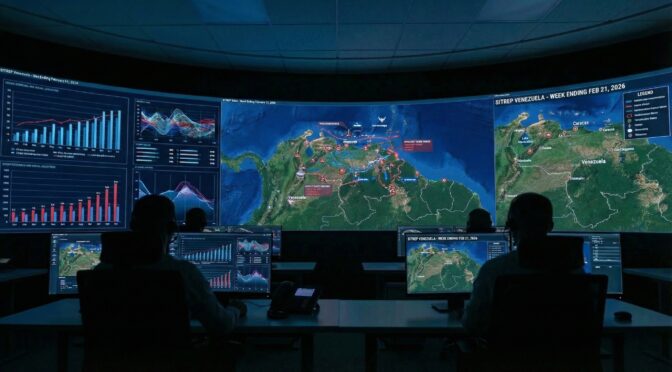
SITREP Venezuela – Week Ending February 21, 2026

Executive Summary

This Situation Report (SITREP) covers the strategic, political, economic, and security developments in the Bolivarian Republic of Venezuela for the week ending February 21, 2026. Seven weeks following the execution of Operation Absolute Resolve—the United States military intervention that resulted in the capture and extradition of former President Nicolás Maduro and his wife, Cilia Flores—the Venezuelan state remains in a period of profound and volatile transition.1 The current operating environment is characterized by a fragile cohabitation between an interim administration led by acting President Delcy Rodríguez and the overwhelming geopolitical and economic leverage exerted by the United States.2

Politically, the interim government has initiated a calculated process of institutional pacification, highlighted by the National Assembly’s unanimous passage of a sweeping amnesty law on February 19, 2026.4 This legislation has facilitated the release of hundreds of political prisoners, though significant carve-outs for military personnel and the requirement for strict judicial approval have drawn deep skepticism from human rights organizations such as Foro Penal.3 The amnesty serves as a critical pressure-release valve designed to satisfy baseline demands from Washington while allowing the Rodríguez administration to maintain the core architectural control of the state’s judiciary and security apparatus.3

On the security front, internal fractures within the Chavista power structure have manifested physically. Armed clashes in Caracas near the Miraflores Presidential Palace have illuminated a deepening schism between technocratic loyalists aligned with Rodríguez and hardline militaristic factions commanded by Interior Minister Diosdado Cabello.6 Cabello, who maintains significant influence over the Bolivarian National Armed Forces (FANB) and irregular civilian militias (colectivos), represents the most acute internal threat to the US-backed transition plan.2 Simultaneously, external security dynamics have deteriorated along the eastern border. A violent ambush on Guyanese soldiers navigating the Cuyuni River by Venezuelan armed gangs (sindicatos) has severely escalated tensions with Georgetown, occurring precisely on the 60th anniversary of the 1966 Geneva Agreement.9

Economically, the country remains in a precarious state, described by the International Monetary Fund (IMF) as “quite fragile,” with public debt at 180 percent of gross domestic product and inflation projected to reach 682.1 percent in 2026.12 However, a massive overhaul of the US sanctions regime—orchestrated through Executive Order 14373 and a suite of new General Licenses from the Office of Foreign Assets Control (OFAC)—has initiated a phased revitalization of the Venezuelan hydrocarbons sector.14 The creation of Foreign Government Deposit Funds effectively shields Venezuelan oil revenues from external creditors, laying the groundwork for international energy conglomerates to boost domestic production by an estimated 300,000 to 400,000 barrels per day by year-end.16

Regionally, the shockwaves of Maduro’s extraction continue to reorder the geopolitical landscape. The abrupt cessation of subsidized Venezuelan oil shipments has plunged Cuba into a catastrophic energy crisis, while neighboring Colombia has pragmatically pivoted to engage the Rodríguez government.19 Concurrently, Russia, China, and Brazil have voiced strident opposition at the United Nations to what they perceive as a dangerous precedent of unilateral US military intervention.22 As Maduro awaits his rescheduled March 26 trial in New York, the incoming weeks will be critical in determining whether the Rodríguez-US cohabitation can stabilize the Venezuelan state or if internal security frictions will ignite a broader domestic conflict.24

1. Political Transition and Institutional Engineering

The political landscape in Venezuela is currently defined by a delicate balancing act engineered by acting President Delcy Rodríguez and her brother, Jorge Rodríguez, the president of the National Assembly.2 As the interim head of state following the January 3 capture of Nicolás Maduro, Delcy Rodríguez is tasked with executing a “stabilization, recovery, and transition” plan largely dictated by the Trump administration, while simultaneously preventing the total collapse of the ruling United Socialist Party of Venezuela (PSUV).3 This week, the centerpiece of this political maneuvering was the passage and implementation of a controversial national amnesty law, designed to project an image of democratic reform while carefully preserving the regime’s structural integrity.

1.1 The Amnesty Law and the Illusion of Pacification

On February 19, 2026, the Venezuelan National Assembly unanimously passed a highly anticipated amnesty bill, which was subsequently signed into law by acting President Rodríguez on the same day.4 The legislation is ostensibly designed to promote “national pacification,” democratic coexistence, and reconciliation following decades of political persecution under the Maduro and Chávez administrations.3 The law officially grants an amnesty for specific crimes and offenses committed during periods of politically driven conflict since 1999, specifically targeting those arrested during the violent aftermath of the July 2024 presidential elections.28

However, intelligence and human rights analyses indicate that the law is less a genuine concession to democratic norms and more a strategic calculation to alleviate international pressure. The legislation mandates that individual amnesty requests must be approved by trial courts within a strict 15-day window following submission.5 This requirement for judicial oversight has drawn severe criticism from domestic and international observers, as it leaves the ultimate authority in the hands of the very same judicial apparatus that was instrumental in executing politically motivated prosecutions in the first place.3

Alfredo Romero, president of the prominent prisoners’ rights group Foro Penal, explicitly noted that while the law benefits a significant group, the underlying system of political persecution remains entirely intact because the same prosecutors and judges remain in power.30 The UN commission of experts welcomed the initial draft but emphasized that the victims must remain at the center of the process, a principle that seems to be sidelined by the bureaucratic hurdles of the final text.27

1.2 Quantitative Assessment of Prisoner Releases and Strategic Carve-Outs

The execution of the amnesty law has resulted in a disjointed and heavily scrutinized release process. Prior to the intervention in January 2026, human rights organizations such as Foro Penal estimated that approximately 600 to 800 political prisoners were languishing in Venezuelan detention centers, including the notorious El Helicoide, Tocorón, and Rodeo 1 prisons.3

Following the immediate aftermath of Maduro’s capture, an initial wave of releases freed roughly 104 individuals.32 This included high-profile human rights lawyers and communications students, such as Kennedy Tejeda, a human rights activist who had been imprisoned in Tocorón since August 2024 for providing legal assistance to detainees, and Juan Francisco Alvarado.32 Under the newly formalized amnesty law, National Assembly deputy Jorge Arreaza announced that 379 additional political prisoners were slated for immediate release between February 20 and February 21.26 Foro Penal has independently verified a total of 448 releases since the political transition began in early January, representing roughly half of the documented political prisoner population.33

Despite these figures, the amnesty contains critical and highly specific exclusions. It explicitly denies clemency to individuals prosecuted for “promoting or facilitating armed or forceful actions against Venezuela’s sovereignty,” a clause widely interpreted as a mechanism to keep figures associated with foreign interventions or coup attempts incarcerated.26 Furthermore, the interim government has leveled such accusations against prominent opposition leaders like María Corina Machado, effectively utilizing the law’s exclusions to prevent her return from the United States.26

Crucially, the law entirely excludes members of the military and security forces convicted of terrorism-related activities.5 For instance, Henryberth Rivas, a former soldier arrested in 2018 for allegedly participating in a drone assassination attempt against Maduro, remains imprisoned in Rodeo 1.26 By keeping dissident military elements locked away, the Rodríguez administration is signaling to the armed forces that insubordination remains a capital offense, thereby mitigating the risk of a military uprising. The administration has stated that the military justice system will handle these cases separately, further obfuscating their potential for release.26

Amnesty Law Exclusions in Venezuela: 800 political prisoners, 448 civilians released, military personnel excluded.

1.3 The Opposition’s Calculated Restraint

The mainstream Venezuelan opposition has responded to the amnesty and the broader political transition with cautious pragmatism. The opposition recognizes that acting President Rodríguez is utilizing the amnesty to whitewash the regime’s image in the eyes of the international community, particularly the United States.3 Instances of bad faith have already been documented; for example, opposition leader Juan Pablo Guanipa was transferred to house arrest on February 9, only to be detained again hours later after he publicly called on citizens to participate in protests.3

Despite these provocations, opposition leaders are largely avoiding mass mobilization or highly inflammatory rhetoric, likely due to back-channel communications with Washington. The US strategy relies heavily on an orderly transition to secure the energy sector; thus, any attempt by the opposition to destabilize the Rodríguez interim government could jeopardize the broader US agenda and risk plunging the country into a failed-state scenario.2

2. Security Apparatus and Internal Factional Friction

The veneer of institutional transition masks a highly volatile security environment within Venezuela. The PSUV was never a monolithic entity; it operated as a “civico-military” alliance held together by the patronage networks and balancing acts controlled by Nicolás Maduro.2 With Maduro abruptly removed, the internal power equilibrium has shattered, leading to a high-stakes standoff between the civilian-technocratic wing and the hardline military-security apparatus.

2.1 The Aftermath of Operation Absolute Resolve

To understand the current security dynamics, one must contextualize the sheer scale of the January 3, 2026, military intervention, codenamed Operation Absolute Resolve.1 Initiated at approximately 02:00 local time, the operation involved a massive deployment of US military assets, including elements of the 160th Special Operations Aviation Regiment, Delta Force, the US Navy, and the US Marine Corps, with tactical support from F-35A jets operating out of Roosevelt Roads Naval Station in Puerto Rico.1 The US Armed Forces conducted suppression of enemy air defenses (SEAD) operations, bombing infrastructure across northern Venezuela, while an apprehension force secured Maduro and his wife at their compound in Caracas.1

The operation was executed with overwhelming force. While the exact casualty figures remain classified by the US Department of Defense, regional diplomatic sources and the Colombian government have cited estimates of approximately 120 Venezuelan casualties resulting from the kinetic strikes.1 The psychological shock of this operation deeply traumatized the upper echelons of the Venezuelan military and intelligence services, creating an atmosphere of intense paranoia and leading to immediate factional splintering as surviving leaders scrambled to consolidate their remaining power bases.

2.2 The Cabello Faction and the Miraflores Clashes

During the week of February 15-21, 2026, intelligence networks and local reporting confirmed alarming armed movements in the capital, Caracas. Elements of the Bolivarian National Armed Forces (FANB) were observed maneuvering in combat postures near the Miraflores Presidential Palace.6 Concurrently, anti-aircraft fire was reported, and locals witnessed the repulsion of an alleged aerial threat.6

These military movements are not indicators of a foreign invasion, but rather symptomatic of a severe internal power struggle. Sources indicate that an armed column of Chavista loyalists, purportedly directed by Interior Minister Diosdado Cabello, marched toward the presidential palace.2 Cabello, who has historically commanded immense loyalty among the radical civilian militias known as colectivos and holds deep roots in the military establishment since participating in Hugo Chávez’s 1992 coup attempt, represents the primary vector for domestic instability.2

The imagery emerging from state media highlights this tension. During Delcy Rodríguez’s swearing-in ceremony, Cabello was visibly circumspect, wearing a cap emblazoned with the phrase “To doubt is treason”.7 Shortly after, he led a march of armed, uniformed men vowing to defend the homeland, sending a clear, physical message to the technocrats in Miraflores: the monopoly on violence remains in his hands.7 The ideological divide is stark; the Rodríguez siblings represent a willingness to cohabit with US interests to preserve their personal wealth and political survival, while Cabello represents the orthodox, anti-imperialist core of the Bolivarian revolution.

2.3 US Coercive Diplomacy and Military Command Calculus

The Trump administration is acutely aware that the success of its “stabilization, recovery, and transition” policy hinges entirely on neutralizing Diosdado Cabello and Defense Minister Vladimir Padrino López. Both men remain under US indictment for narco-terrorism and have multimillion-dollar bounties on their heads, yet they control the physical mechanisms of state coercion.2

Intelligence sources indicate that Washington has established back-channel communications with Cabello, presenting him with a stark ultimatum: facilitate the transition under acting President Rodríguez, ensure the colectivos remain demobilized, and maintain public order, or face the exact same fate as Nicolás Maduro—capture by US special operations forces or targeted elimination.8 The US Department of Justice views Padrino’s collaboration as absolutely essential to preventing a power vacuum that could lead to widespread anarchy.8

Taking direct kinetic action against Cabello is currently viewed as a high-risk contingency. His elimination could trigger a decentralized, violent uprising by the colectivos, plunging Caracas into urban warfare and destroying the very stability the US seeks to foster for the return of international oil companies.8 Consequently, the current US posture is one of coercive containment—keeping Cabello under the constant threat of lethal force while attempting to sever his patronage lines to the mid-level officer corps by promising sanctions relief and economic benefits to the broader military establishment.

3. Territorial Flashpoints: The Essequibo Crisis and Border Security

As the internal power struggle simmers, Venezuela’s external borders remain highly militarized and prone to violent escalation. The most pressing territorial flashpoint remains the resource-rich Essequibo region, a 160,000-square-kilometer area administered by Guyana but historically claimed by Caracas since the 19th century.36 The discovery of massive offshore oil reserves by international energy conglomerates in 2015 dramatically raised the stakes, leading to a severe crisis in late 2023 when Venezuela held a referendum to annex the territory.37

3.1 Historical Context and the 1966 Geneva Agreement Anniversary

The current border was originally established by the Paris Arbitral Award in 1899, a ruling that Venezuela subsequently challenged as fraudulent in 1962.37 February 17, 2026, marked the 60th anniversary of the 1966 Geneva Agreement, the foundational UN treaty that outlined steps to resolve the territorial dispute between Venezuela and the United Kingdom (and subsequently, independent Guyana).38

Coinciding with this anniversary, acting President Rodríguez issued her first major foreign policy statement since taking office, explicitly reaffirming Venezuela’s historical rights over the Essequibo.38 Rodríguez declared that the Geneva Agreement is the “only legally valid instrument” for achieving a mutually acceptable solution, effectively rejecting the jurisdiction of the International Court of Justice (ICJ), which Guyana heavily relies upon.38 The Guyanese government argues that the UN Secretary-General legally referred the matter to the ICJ in 2018 under the terms of the Geneva Agreement, a position Caracas fundamentally disputes.37

This statement was a highly calibrated geopolitical maneuver by the interim government. Domestically, it appeased the deeply ingrained nationalist sentiments of the Venezuelan public and the armed forces, proving that the interim government had not surrendered sovereignty under US pressure.38 Internationally, however, the statement was noticeably devoid of immediate military threats, calling instead for “good faith negotiations”.38 This restraint is almost certainly a product of intense pressure from the Trump administration, which has fortified security ties with Guyana and vehemently opposes any Venezuelan military adventurism that could disrupt regional energy markets.38

3.2 The Cuyuni River Ambush and Diplomatic Fallout

Despite the diplomatic restraint at the executive level, the tactical reality on the ground deteriorated sharply during the reporting period. On February 13, 2026, an armed clash occurred on the Cuyuni River, which serves as a de facto boundary in the disputed zone. A supply vessel belonging to the Guyana Defence Force (GDF), navigating Guyanese waters between Eteringbang and Makapa, was ambushed by armed men in civilian clothing operating from the Venezuelan riverbank.11

The attack was severe, resulting in gunshot wounds to six Guyanese soldiers, including Sergeant Kevon Davis and Second Lieutenant Ansel Murray, one of whom sustained a critical gunshot wound to the head.9 The GDF executed a measured response, returning fire to suppress the attackers, and subsequently evacuated the wounded for surgical care.11

The government of Guyana, led by President Irfaan Ali, expressed profound outrage. Guyanese Foreign Minister Hugh Todd formally summoned the Venezuelan Ambassador to Georgetown, Carlos Pérez, holding the Venezuelan state strictly accountable under international law, regardless of whether the attackers were uniformed military personnel or irregular militias.10 Georgetown characterized the attackers as Venezuelan sindicatos—heavily armed criminal syndicates involved in illegal mining.11 Minister Todd demanded that Venezuela redirect its military presence away from posturing against Guyana and toward eliminating these criminal elements, warning that “inaction is complicity”.11

3.3 Irregular Actors and the Sindicato Threat

Conversely, the Venezuelan Foreign Ministry launched a rapid information operation, denouncing Guyana’s claims as a “false flag and fake news operation” designed to manipulate international public opinion.10 Caracas alleged that Guyanese soldiers had initiated an unprovoked attack on civilian Venezuelan miners engaged in illegal mining activities, resulting in casualties that were subsequently treated on the Venezuelan side of the border.10 Venezuelan Attorney General Tarek William Saab immediately announced a domestic investigation into the incident, framing Guyana as the aggressor facilitating US-backed militarization of the region.10

This skirmish underscores a critical vulnerability in the current transition: the Rodríguez administration does not possess total command and control over the remote border regions. The proliferation of sindicatos, ELN guerrillas, and dissident FARC elements in the Orinoco Mining Arc means that localized violence can easily spark a bilateral diplomatic crisis, irrespective of the strategic desires of Caracas or Washington.11 The Venezuelan military’s capacity to police this region is also highly questionable; much of their air force is grounded due to a lack of parts, and armored elements suffer from severe maintenance deficits, making jungle pacification operations highly complex.42

Essequibo Disputed Zone map showing tactical escalation, Feb 13 ambush, GDF & FANB troops, and Sindicato mining operations.

4. Economic Revitalization, Sanctions Architecture, and Energy Output

The core economic rationale underpinning the United States’ intervention in Venezuela has become explicitly clear: the rapid revival of the Venezuelan hydrocarbons sector to supply the US Gulf Coast and stabilize global energy markets. Following years of hyperinflation, mismanagement, and suffocating international sanctions (including the 2019 designation of PDVSA as a Specially Designated National), the Venezuelan economy remains in a state of structural ruin.12

4.1 Macroeconomic Overview and Humanitarian Conditions

The International Monetary Fund continues to monitor the situation closely, with spokeswoman Julie Kozack describing the economic and humanitarian situation as “quite fragile”.12 The macroeconomic indicators are severe. The IMF estimates public debt at roughly 180 percent of GDP, a figure that does not account for billions in pending arbitration payouts from previous defaults.12 Inflation, which has historically reached astronomical levels, is projected to sit at a staggering 682.1 percent for 2026, accompanied by a rapidly depreciating currency (the Bolívar Soberano), which traded at an official Central Bank rate of 401.83 VES/USD as of February 20.12

The human toll of this economic collapse is catastrophic. Since 2013, approximately eight million Venezuelans—roughly a quarter of the population—have fled the country to escape multidimensional poverty and food shortages, creating one of the largest displacement crises in modern history.12 Domestic wages remain critically low; public sector workers, such as full-time teachers, earn as little as $160 a month, forcing them into multiple jobs to survive.48 To arrest this collapse and simultaneously protect Western financial interests, the Trump administration has engineered a highly complex, phased sanctions relief architecture.

Macroeconomic Indicator (2026 Projections/Current)ValueSource Note
Inflation Rate (CPI, Projected)682.1%IMF DataMapper 13
Public Debt to GDP~180.0%IMF Briefing 12
Official Exchange Rate (VES/USD)401.83As of Feb 20, 2026 46
Projected Real GDP Growth-3.0%IMF DataMapper 13
Migrant Diaspora (Since 2013/2014)~8.0 MillionUN/NGO Estimates 12

4.2 Executive Order 14373 and the Foreign Government Deposit Funds (FGDF)

The primary obstacle to revitalizing Venezuela’s oil industry has been the massive overhang of sovereign and corporate debt. If US sanctions were simply lifted, commercial judgment creditors and international arbitration winners would immediately seize Venezuelan oil cargoes and revenues in international waters or financial systems.15

To solve this, President Donald Trump signed Executive Order (EO) 14373 on January 9, 2026, titled “Safeguarding Venezuelan Oil Revenue for the Good of the American and Venezuelan People”.15 This EO declares a national emergency under the International Emergency Economic Powers Act (IEEPA) and creates a targeted legal shield around Venezuelan oil revenues.50

EO 14373 establishes “Foreign Government Deposit Funds” (FGDF)—specialized accounts held by or on behalf of the US Department of the Treasury.15 Under this regime, any monetary payments derived from the sale of Venezuelan natural resources, or the sale of diluents to Venezuela, must be deposited directly into these US-controlled accounts.18 The EO explicitly determines that these funds are the sovereign property of Venezuela held in a custodial capacity by the US, thereby legally immunizing them from attachment, garnishment, or execution by private creditors.15 This aggressive use of executive power effectively overrides the claims of private judgment creditors in favor of US national security and foreign policy objectives—namely, bringing Venezuelan crude to the global market without legal friction.

4.3 The General License Overhaul

Operating beneath the umbrella of EO 14373, the US Treasury’s Office of Foreign Assets Control (OFAC) has issued a flurry of new General Licenses (GLs) representing the broadest easing of Venezuela-related sanctions in over a decade.14 The architecture is designed in phases to carefully calibrate the opening of the sector:

  • Phase 1 (Liquidity and Logistics): Addressed by GL 46A and GL 47. GL 46A authorizes “established U.S. entities” to engage in a wide array of activities involving Venezuelan-origin oil, including lifting, exporting, refining, and transporting.14 GL 47 explicitly authorizes the export of US-origin diluents (such as heavy naphtha) to Venezuela, an absolute necessity for blending and transporting the tar-like extra-heavy crude produced in the Orinoco Belt.14
  • Phase 2 (Upstream Revitalization): Addressed by GL 48, GL 49, and GL 50A. GL 48 permits the supply of goods, technology, and services for the exploration, development, and production of oil and gas.14 GL 49 allows companies to negotiate and enter into “contingent contracts” for new investments and joint ventures, pending specific future OFAC approval.14 Crucially, GL 50A provides broad authorization for specified international energy majors—including Chevron, BP, Eni, Repsol, Shell, and Établissements Maurel & Prom SA—to conduct full-spectrum operations within the country.14
  • Logistics: GL 30B authorizes transactions incident to the use of ports and airports in Venezuela, which is critical for maritime infrastructure and the export of crude.18

A critical compliance mechanism across all these licenses is the routing of funds. While major payments (royalties, per-barrel levies, federal taxes) to blocked entities like the Government of Venezuela or the state oil company PDVSA must go into the FGDF, OFAC recently issued guidance allowing for the routine payment of local taxes, permits, and operational fees directly to local entities, ensuring day-to-day operations are not paralyzed by compliance bottlenecks.14 Furthermore, these licenses contain strict geopolitical firewalls: transactions involving entities from Russia, Iran, North Korea, Cuba, or China are explicitly prohibited.14

Architecture of US Sanctions Relief: Key OFAC General Licenses (Feb 2026) detailing scope, entities, and payment requirements.

4.4 Upstream and Downstream Infrastructure Reality

The political and legal frameworks are now aligned for a surge in production, and US officials are remarkably bullish. On February 17, US Energy Secretary Chris Wright stated in Paris that Venezuelan oil output could rise by 30 to 40 percent in 2026, equating to an addition of roughly 300,000 to 400,000 barrels per day (bpd) by year-end.16

However, achieving this target requires overcoming a dilapidated, deeply degraded industrial infrastructure. Data from January 2026 indicates that crude oil production actually decreased to 924,000 bpd, down from 1.12 million bpd in December 2025, likely due to operational paralysis during the immediate aftermath of the US military intervention.55

The state of PDVSA’s downstream assets remains abysmal. Currently, the domestic refining network is operating at merely 35 percent of its 1.29 million bpd installed capacity.56 The massive Paraguana Refining Center is only processing 287,000 bpd at five of its nine distillation units following severe power blackouts that took the Amuay refinery temporarily offline.56 The Puerto la Cruz refinery is processing 82,000 bpd, and El Palito is running at 80,000 bpd.56 This lack of refining capacity forces Venezuela to rely heavily on the importation of US naphtha and diluents to maintain operations.56

Refinery NameInstalled Capacity (bpd)Current Processing (bpd)Status / Notes
Paraguana Refining Center (Amuay/Cardon)955,000287,000Recovering from power blackout; Amuay recently offline.
Puerto la Cruz187,00082,000Operating at two distillation units.
El Palito146,00080,000One distillation unit and fluid catalytic cracker operating.
Total Domestic Network1,290,000~450,000Operating at ~35% of total installed capacity.
Data derived from industry reporting as of mid-February 2026.56

Upstream operations face equally daunting challenges. Incidents such as a Chinese drilling rig (the Alula) striking an underwater pipeline in Lake Maracaibo—resulting in months of crude leakage—highlight the immense environmental and logistical hazards inherent in operating within Venezuela’s oldest oil fields.58 Operators are currently battling insufficient gas supply for well pressure, loss of technical data, and a lack of transportation for workers.58

While major players like Chevron currently produce around 240,000 to 250,000 bpd through joint ventures and plan to increase output by 50 percent in the short term, reaching the Energy Secretary’s target of an additional 400,000 bpd will require billions of dollars in rapid capital expenditure, massive imports of diluents, and the urgent restoration of basic utilities like electricity and water to the oil camps.56 Exxon Mobil has remained noticeably unenthusiastic, describing the environment as “uninvestible,” indicating that not all Western majors are willing to absorb the high risk.57

4.5 The Return to Global Energy Markets: Israel and Beyond

Despite the infrastructural hurdles, the immediate lifting of sanctions has allowed existing production to find new markets, fundamentally altering global energy flows. On February 10, 2026, shipping data confirmed that a cargo of Venezuelan heavy crude was delivered to Israel’s Bazan Group, the operator of the country’s largest refinery in Haifa.60

The shipment, comprising approximately 200,000 barrels from a larger transatlantic delivery (with the remainder destined for Italy and Spain), marks the first Venezuelan delivery to Israel since mid-2020.60 While the volume is modest—supplying a refinery of Haifa’s size for roughly one day—the geopolitical significance is vast.60 Under the Chávez and Maduro regimes, Venezuela maintained a stridently anti-Israel foreign policy, heavily aligned with Iran and Hezbollah.50 Venezuelan Information Minister Miguel Pérez Pirela attempted to deny direct sales to Israel, claiming the oil was sold to independent traders, but the delivery demonstrates that the Rodríguez administration is now thoroughly integrated into Western-aligned supply chains, effectively decoupling from its prior Middle Eastern alliances.60

5. Geopolitical Realignments and Regional Contagion

The gravitational pull of the United States’ military and economic actions in Venezuela has fundamentally altered the geopolitical dynamics of Latin America and the Caribbean, drawing sharp reactions from global adversaries and forcing rapid recalibrations from regional allies.

5.1 The 2026 Cuban Crisis

The most immediate and devastating regional contagion of Maduro’s ouster is occurring in Cuba. The deep symbiotic relationship established in 2002 between Hugo Chávez and Fidel Castro—which birthed the Bolivarian bloc (ALBA) and the Petrocaribe energy alliance—has been completely severed.61 The Trump administration immediately cut off the estimated 27,000 to 35,000 barrels per day of subsidized Venezuelan oil that Havana relied upon for basic survival, triggering what is now being termed the “2026 Cuban Crisis”.21

The sudden termination of this energy lifeline has plunged the island into severe distress. The Cuban government under President Miguel Díaz-Canel has been forced to impose harsh emergency measures, resulting in near-constant power blackouts, the paralysis of public transportation, and families reverting to wood and coal for cooking.20 Washington is explicitly utilizing this energy strangulation to force regime change in Havana by the end of 2026, threatening secondary sanctions and tariffs against any nation attempting to supply oil to the island.21

While Díaz-Canel has expressed a willingness to engage in dialogue without preconditions, stating that Cuba will not negotiate “under pressure,” the White House continues to demand the release of political prisoners and the holding of free elections—demands the Communist Party views as existential threats.21 The US strategy mirrors its approach in Venezuela: utilize absolute economic leverage to force political capitulation, though analysts note that inducing a famine in Cuba risks a massive migratory crisis reminiscent of the 1990s rafter crisis, which would directly impact the Florida coast.21

5.2 Pragmatism in Bogotá: The Colombia-Venezuela Rapprochement

In stark contrast to Cuba’s ideological rigidity and suffering, neighboring Colombia is demonstrating rapid geopolitical pragmatism. Following the US intervention on January 3, Colombian President Gustavo Petro—a prominent leftist leader—was highly critical of the extrajudicial nature of the military operation, which resulted in significant casualties.19

However, recognizing the permanence of the new reality and the potential economic benefits of a stabilized Venezuelan energy sector, Petro has rapidly shifted his rhetoric. On February 18, acting President Rodríguez announced an upcoming bilateral summit with President Petro, potentially to be held in the strategic border city of Cúcuta or the capital, Bogotá.19 The agenda is heavily focused on economic, energy, and border security cooperation.19

For Colombia, engaging with the Rodríguez administration is a matter of strict national security. The porous 2,200-kilometer border region is a sanctuary for transnational criminal organizations, dissident FARC elements, and the ELN.19 Petro recognizes that ignoring the interim government in Caracas would only grant these irregular armed groups total operational impunity along the frontier. Reestablishing bilateral security protocols is essential to prevent the internal factional violence in Venezuela from spilling over into Colombian territory.

5.3 Global Backlash at the United Nations

Outside the immediate sphere of US influence, the military extraction of a sitting head of state has provoked severe diplomatic backlash at the United Nations, highlighting the growing divide between the West and the multipolar bloc. During emergency sessions of the UN Security Council, both the Russian Federation and the People’s Republic of China vehemently condemned the US actions.22

Russian UN Ambassador Vassily Nebenzia categorized the military intervention and the subsequent naval blockade of sanctioned tankers as a “real act of aggression” and “cowboy-like conduct,” warning that it establishes a dangerous template for future acts of force against sovereign states in Latin America.22 He noted that Washington’s actions were aimed at executing an illegal regime change against a government “inconvenient for the United States”.22 China echoed these sentiments, accusing Washington of bullying, coercive practices, and intimidation, while reaffirming its support for the government and people of Venezuela in safeguarding their sovereignty.22

Regionally, Brazil has taken a firm diplomatic stance against the US methodology, despite the ideological differences between Brasilia and the former Maduro regime. President Luiz Inácio Lula da Silva, speaking at an Artificial Intelligence Summit in India, asserted that while the restoration of democracy in Venezuela is the ultimate goal, Nicolás Maduro must face legal accountability within his own borders, not in a foreign courtroom.65 Brazil’s UN Ambassador, Sérgio França Danese, expanded on this, warning that the US had crossed an “unacceptable line” regarding international law and the UN Charter. Danese argued that the use of force to exploit natural resources or illegally change a government jeopardizes South America’s status as a zone of peace, and that “the ends do not justify the means”.23 This diplomatic resistance indicates that while the US has achieved its immediate tactical goals in Caracas, it has suffered significant reputational damage across the Global South.

6. The Judicial Front: The United States v. Nicolás Maduro

As the geopolitical fallout settles, the judicial mechanism against the deposed Venezuelan leadership continues to grind forward in the United States. Nicolás Maduro and his wife, Cilia Flores, captured during the January 3 Operation Absolute Resolve, were immediately transported to New York to face prosecution in the Southern District of New York.1

Both appeared in a Manhattan federal court on January 5, pleading not guilty to severe charges including narco-terrorism conspiracy, cocaine-importation conspiracy, and possession of and conspiracy to possess machine guns.24 During the hearing, Maduro defiantly declared himself a “prisoner of war”.24

Initially scheduled for a follow-up hearing on March 17, 2026, the court appearance has been officially postponed to March 26.24 US prosecutors cited “scheduling and logistical issues,” a request granted by the judge with the consent of the defense counsel.24 Legal experts, including former federal prosecutors, assess that due to the severe security considerations, the massive volume of classified intelligence evidence involved, and the unprecedented nature of trying a captured head of state, the actual jury trial is highly unlikely to commence before the end of 2026.68 In the interim, the trial serves as a powerful deterrent mechanism for the Trump administration, a constant reminder to remaining Chavista holdouts like Diosdado Cabello of the consequences of non-compliance.8

7. Strategic Outlook and Intelligence Forecast (30-90 Days)

The trajectory of the Venezuelan state over the next quarter will be dictated by the interplay between US economic engineering, the resolution of internal factional friction, and the management of territorial disputes. The current operational environment suggests three primary vectors of development:

  1. Economic Stabilization via Energy Influx: The deployment of the Foreign Government Deposit Funds (FGDF) successfully ring-fences Venezuelan oil assets from historical creditors. Consequently, within the next 60 days, expect a surge in procurement contracts, diluent shipments from the US Gulf Coast, and initial upstream refurbishments by Western majors operating under GL 50A. However, structural degradation (power grid failures, pipeline integrity, and labor shortages) will severely cap the velocity of production increases. The Energy Secretary’s targeted 400,000 bpd increase by year-end is highly ambitious and will likely fall short in the near term, with production stabilizing closer to an additional 150,000 to 200,000 bpd by Q3 2026.
  2. Neutralization or Escalation of the Cabello Faction: The armed posture of Interior Minister Diosdado Cabello in Caracas is unsustainable in the medium term. The US strategy of coercive containment will either result in Cabello negotiating an exit (exile or heavily monitored internal retirement) or a violent confrontation. If Cabello assesses that his patronage networks within the FANB are successfully being dismantled by the Rodríguez-US alignment, the probability of preemptive kinetic action by colectivo militias in the capital increases significantly within the next 45 days, threatening the broader pacification strategy.
  3. Border Volatility and the Guyanese Flashpoint: The Rodríguez administration will maintain rhetorical hostility regarding the Essequibo to satisfy domestic nationalist constituencies and the military, but will actively avoid initiating conventional military conflict. However, the prevalence of sindicatos operating autonomously along the Cuyuni River guarantees further localized skirmishes. Guyana will likely respond by further deepening its defense cooperation with the US Southern Command and Brazil, leading to a highly militarized and perpetually tense border environment that will require constant diplomatic de-escalation.

Please share the link on Facebook, Forums, with colleagues, etc. Your support is much appreciated and if you have any feedback, please email us in**@*********ps.com. If you’d like to request a report or order a reprint, please click here for the corresponding page to open in new tab.


Sources Used

  1. 2026 United States intervention in Venezuela – Wikipedia, accessed February 21, 2026, https://en.wikipedia.org/wiki/2026_United_States_intervention_in_Venezuela
  2. From Rogue State to Failed State?: The Perils of Intervention in …, accessed February 21, 2026, https://americanaffairsjournal.org/2026/02/from-rogue-state-to-failed-state-the-perils-of-intervention-in-venezuela/
  3. Venezuela: Dismantle Repressive Apparatus, accessed February 21, 2026, https://www.hrw.org/news/2026/02/18/venezuela-dismantle-repressive-apparatus
  4. U.S. Confrontation With Venezuela | Global Conflict Tracker, accessed February 21, 2026, https://www.cfr.org/global-conflict-tracker/conflict/instability-venezuela
  5. Venezuela’s new amnesty law gets a chilly response from the opposition and detainees’ families, accessed February 21, 2026, https://apnews.com/article/venezuela-amnesty-prisoners-delcy-rodriguez-5f34e5dd597f9ac9e307d4eba76d31e5
  6. BREAKING: Venezuela | Military Clashes In Caracas – Speevr, accessed February 21, 2026, https://speevr.com/2026/01/06/breaking-venezuela-military-clashes-in-caracas/
  7. Chavismo factions divide presidency of the new Venezuela | International | EL PAÍS English, accessed February 21, 2026, https://english.elpais.com/international/2026-01-07/chavismo-factions-divide-up-presidency-of-the-new-venezuela.html
  8. Hardline Venezuelan security chief could be targeted next if US demands not met — sources, accessed February 21, 2026, https://www.timesofisrael.com/liveblog_entry/hardline-venezuelan-security-chief-could-be-targeted-next-if-us-demands-not-met-sources/
  9. Guyanese soldiers ambushed, shot by Venezuelan gang – Kaieteur News, accessed February 21, 2026, https://kaieteurnewsonline.com/2025/02/18/guyanese-soldiers-ambushed-shot-by-venezuelan-gang/
  10. Venezuela Denounces Guyana ‘False Narrative’ Over Clash in Disputed Essequibo Territory – Venezuelanalysis, accessed February 21, 2026, https://venezuelanalysis.com/news/venezuela-denounces-guyana-false-narrative-over-clash-in-disputed-essequibo-territory/
  11. Guyana outraged at attack on soldiers – Stabroek News, accessed February 21, 2026, https://www.stabroeknews.com/2025/02/19/news/guyana/guyana-outraged-at-attack-on-soldiers/
  12. IMF warns Venezuela’s economy and humanitarian situation is ‘quite fragile’ – Al Jazeera, accessed February 21, 2026, https://www.aljazeera.com/news/2026/2/20/imf-warns-venezuelas-economy-and-humanitarian-situation-is-quite-fragile
  13. República Bolivariana de Venezuela and the IMF, accessed February 21, 2026, https://www.imf.org/en/countries/ven
  14. OFAC Issues New General Licenses Expanding Permitted Activities …, accessed February 21, 2026, https://www.mayerbrown.com/en/insights/publications/2026/02/ofac-issues-new-general-licenses-expanding-permitted-activities-in-the-venezuelan-energy-sector
  15. New Executive Order Shields Venezuelan Oil Revenue in US Government Custody, accessed February 21, 2026, https://www.mayerbrown.com/en/insights/publications/2026/01/new-executive-order-shields-venezuelan-oil-revenue-in-us-government-custody
  16. U.S. Energy Chief Says Venezuela Could Boost Output by “Several Hundred Thousand Bpd by Year‑End” – EnergyNow.com, accessed February 21, 2026, https://energynow.com/2026/02/u-s-energy-chief-says-venezuela-could-boost-output-by-several-hundred-thousand-bpd-by-year-end/
  17. U.S. says Venezuela oil output could rise 30%–40% in 2026, accessed February 21, 2026, https://worldoil.com/news/2026/2/18/u-s-says-venezuela-oil-output-could-rise-30-40-in-2026/
  18. United States Issues Significant New Sanctions Relief for …, accessed February 21, 2026, https://www.winston.com/en/blogs-and-podcasts/global-trade-and-foreign-policy-insights/united-states-issues-significant-new-sanctions-relief-for-venezuelas-oil-and-gas-sector
  19. Venezuela’s Delcy Rodríguez and Colombia’s Gustavo Petro to Meet Amid Shifting Regional Dynamics – Orinoco Tribune, accessed February 21, 2026, https://orinocotribune.com/venezuelas-delcy-rodriguez-and-colombias-gustavo-petro-to-meet-amid-shifting-regional-dynamics/
  20. From blackouts to food shortages: How US blockade is crippling life in Cuba – Al Jazeera, accessed February 21, 2026, https://www.aljazeera.com/economy/2026/2/8/from-blackouts-to-food-shortages-how-us-blockade-is-crippling-life-in-cuba
  21. How far will Trump push Cuba? | Chatham House – International Affairs Think Tank, accessed February 21, 2026, https://www.chathamhouse.org/2026/02/how-far-will-trump-push-cuba
  22. Russia, China condemn US blockade of Venezuela, calling it ‘cowboy behaviour’ at UN, accessed February 21, 2026, https://www.trtworld.com/article/a9f4b22a041b
  23. Brazil at UN: US action in Venezuela threatens peace in South America – Agência Brasil, accessed February 21, 2026, https://agenciabrasil.ebc.com.br/en/internacional/noticia/2026-01/brazil-un-us-action-venezuela-threatens-peace-south-america
  24. Maduro’s next US court date pushed back to March 26: filing, accessed February 21, 2026, https://www.bssnews.net/international/361945
  25. Maduro’s Court Hearing Postponed in New York, accessed February 21, 2026, https://en.isna.ir/news/1404112917504/Maduro-s-Court-Hearing-Postponed-in-New-York
  26. Venezuela grants amnesty to 379 political prisoners, accessed February 21, 2026, https://www.bssnews.net/international/362660
  27. Proposed amnesty law offers political prisoners in Venezuela an ‘opportunity’ | UN News, accessed February 21, 2026, https://news.un.org/en/story/2026/02/1166929
  28. World Report 2026: Rights Trends in Venezuela, accessed February 21, 2026, https://www.hrw.org/world-report/2026/country-chapters/venezuela
  29. Venezuela approves amnesty bill, paving way for release of … – PBS, accessed February 21, 2026, https://www.pbs.org/newshour/world/venezuela-approves-amnesty-bill-paving-way-for-release-of-hundreds-of-political-detainees
  30. Venezuela’s new amnesty law gets a chilly response from the opposition and detainees’ families – KSAT, accessed February 21, 2026, https://www.ksat.com/news/2026/02/20/venezuelas-new-amnesty-law-has-a-chilly-response-from-opposition-and-detainees-families/
  31. Human rights organization in Venezuela: 80 political prisoners released in the country, accessed February 21, 2026, https://www.ynetnews.com/article/fetf9j5js
  32. Venezuela frees 104 political prisoners, rights group says, accessed February 21, 2026, https://www.aljazeera.com/news/2026/1/26/venezuela-frees-104-political-prisoners-rights-group-says
  33. Venezuela’s new amnesty law gets a chilly response from the opposition and detainees’ families, accessed February 21, 2026, https://lasvegassun.com/news/2026/feb/20/venezuelas-new-amnesty-law-gets-a-chilly-response-/
  34. US act of aggression against Venezuela further weakens rules-based order, accessed February 21, 2026, https://www.amnesty.org/en/latest/news/2026/02/usa-aggression-against-venezuela-further-weakens-rules-based-order/
  35. Crisis in Venezuela: Three Scenarios – Toda Peace Institute, accessed February 21, 2026, https://toda.org/global-outlook/2026/crisis-in-venezuela-three-scenarios.html
  36. Venezuela rejects US warning over Essequibo dispute – Anadolu Ajansı, accessed February 21, 2026, https://www.aa.com.tr/en/energy/general/venezuela-rejects-us-warning-over-essequibo-dispute/48283
  37. Guyana–Venezuela crisis (2023–2024) – Wikipedia, accessed February 21, 2026, https://en.wikipedia.org/wiki/Guyana%E2%80%93Venezuela_crisis_(2023%E2%80%932024)
  38. Venezuela, Guyana: President Rodriguez Issues Statement Regarding Essequibo Region, accessed February 21, 2026, https://worldview.stratfor.com/situation-report/venezuela-guyana-president-rodriguez-issues-statement-regarding-essequibo-region
  39. Venezuela Reaffirms Claim to Essequibo Territory Disputed With Guyana – Government, accessed February 21, 2026, https://www.nampa.org/text/22862334
  40. Venezuela Rejects Guyana’s Attempt to Distort Terms of 1966 Geneva Agreement, accessed February 21, 2026, https://orinocotribune.com/venezuela-rejects-guyanas-attempt-to-distort-terms-of-1966-geneva-agreement/
  41. Guyana Not Letting Its Guard Down Against Venezuela’s Attempt To Invade By Referendum., accessed February 21, 2026, https://www.thestkittsnevisobserver.com/guyana-not-letting-its-guard-down-against-venezuelas-attempt-to-invade-by-referendum/
  42. Venezuela, Guyana: The shocking war that wasn’t | Responsible Statecraft, accessed February 21, 2026, https://responsiblestatecraft.org/guyana-venezuela/
  43. Guyana soldiers attacked three times in 24 hours amid tensions with Venezuela, accessed February 21, 2026, https://www.theguardian.com/world/2025/may/15/guyana-venezuela-attack-essquibo
  44. Colombia And Venezuela Warn US Over Military Moves – Grand Pinnacle Tribune, accessed February 21, 2026, https://evrimagaci.org/gpt/colombia-and-venezuela-warn-us-over-military-moves-513737
  45. OFAC Issues Several New General Licenses Regarding Oil Trade with Venezuela, accessed February 21, 2026, https://www.jdsupra.com/legalnews/ofac-issues-several-new-general-8972562/
  46. Venezuelan Bolivar – Quote – Chart – Historical Data – News – Trading Economics, accessed February 21, 2026, https://tradingeconomics.com/venezuela/currency
  47. ‘Besieged’ Venezuela unveils reduced budget for 2026 – Indo Premier Sekuritas, accessed February 21, 2026, https://www.indopremier.com/ipotnews/newsDetail.php?jdl=_Besieged__Venezuela_unveils_reduced_budget_for_2026&news_id=1713248&group_news=ALLNEWS&news_date=&taging_subtype=VENEZUELA&name=&search=y_general&q=VENEZUELA,%20&halaman=1
  48. Venezuela’s oil revival brings hope but little relief for workers, accessed February 21, 2026, https://www.wgcu.org/2026-02-17/venezuelas-oil-revival-brings-hope-but-little-relief-for-workers
  49. US government authorizes US entities to transact in Venezuelan-origin oil | DLA Piper, accessed February 21, 2026, https://www.dlapiper.com/en/insights/publications/2026/02/us-government-authorizes-us-entities-to-transact-in-venezuelan-origin-oil
  50. Safeguarding Venezuelan Oil Revenue for the Good of the American and Venezuelan People – The White House, accessed February 21, 2026, https://www.whitehouse.gov/presidential-actions/2026/01/safeguarding-venezuelan-oil-revenue-for-the-good-of-the-american-and-venezuelan-people/
  51. Safeguarding Venezuelan Oil Revenue for the Good of the American and Venezuelan People – Federal Register, accessed February 21, 2026, https://www.federalregister.gov/documents/2026/01/15/2026-00831/safeguarding-venezuelan-oil-revenue-for-the-good-of-the-american-and-venezuelan-people
  52. US Eases Venezuela Sanctions Through New General Licenses and FAQs, accessed February 21, 2026, https://www.hunton.com/insights/legal/us-eases-venezuela-sanctions-through-new-general-licenses-and-faqs
  53. 1237 | Office of Foreign Assets Control, accessed February 21, 2026, https://ofac.treasury.gov/faqs/1237
  54. Venezuela’s Oil Output Can Grow 30%-40% This Year, US Says, accessed February 21, 2026, https://www.ttnews.com/articles/venezuelas-oil-output
  55. Venezuela Crude Oil Production – Trading Economics, accessed February 21, 2026, https://tradingeconomics.com/venezuela/crude-oil-production
  56. Venezuela’s Refineries Boost Processing to 35% of Capacity, Sources Say, accessed February 21, 2026, https://tankterminals.com/news/venezuelas-refineries-boost-processing-to-35-of-capacity-sources-say/
  57. Why Big Oil wants no part of Trump-seized Venezuela, accessed February 21, 2026, https://asiatimes.com/2026/02/why-big-oil-wants-no-part-of-trump-seized-venezuela/
  58. Oil companies jostle for projects to boost Venezuelan output quickly; a real grind awaits, accessed February 21, 2026, https://boereport.com/2026/02/19/oil-companies-jostle-for-projects-to-boost-venezuelan-output-quickly-a-real-grind-awaits/
  59. What’s the status of international oil companies in Venezuela?, accessed February 21, 2026, https://boereport.com/2026/02/19/whats-the-status-of-international-oil-companies-in-venezuela/
  60. Venezuela’s Return to Oil Markets Enhances Israel’s Energy Security, accessed February 21, 2026, https://www.meforum.org/mef-observer/venezuelas-return-to-oil-markets-enhances-israels-energy-security
  61. Cuba’s alliances are crumbling in Trump’s world – The Pais in English – EL PAÍS, accessed February 21, 2026, https://english.elpais.com/international/2026-02-16/cubas-alliances-are-crumbling-in-trumps-world.html
  62. 2026 Cuban crisis – Wikipedia, accessed February 21, 2026, https://en.wikipedia.org/wiki/2026_Cuban_crisis
  63. Cubans wonder if they could be next after Venezuela as rumours swirl about U.S. talks, accessed February 21, 2026, https://www.cbc.ca/news/politics/cuban-cia-castro-energy-collapse-9.7078628
  64. Russia & China Accuse US of Bullying Nations, Violating Intl Law at UN Over Venezuela, accessed February 21, 2026, https://www.youtube.com/watch?v=sEVY1K6VkG8
  65. Brazilian President Lula says Maduro should face justice in Venezuela, accessed February 21, 2026, https://www.aa.com.tr/en/americas/brazilian-president-lula-says-maduro-should-face-justice-in-venezuela/3836263
  66. Brazil Goes Ballistic At UNSC Over Maduro Capture, Demands US’ Accountability For Venezuela Raid – YouTube, accessed February 21, 2026, https://www.youtube.com/watch?v=6M2MQwwtZkM
  67. FULL REMARKS: Brazil Says US Bombing of Venezuela Crossed a Red Line, Slams Capture of Maduro – YouTube, accessed February 21, 2026, https://www.youtube.com/watch?v=qXf8wpIU__w
  68. The criminal prosecution of Nicolás Maduro is underway. Here’s what to expect – WUFT, accessed February 21, 2026, https://www.wuft.org/2026-01-06/the-criminal-prosecution-of-nicolas-maduro-is-underway-heres-what-to-expect

SITREP Venezuela – Week Ending February 14, 2026

Executive Summary

The reporting period ending February 14, 2026, represents a critical consolidation phase for the interim administration of Acting President Delcy Rodriguez following the seismic shift initiated by Operation Absolute Resolve on January 3. This week, the primary focal point of national security and foreign affairs has been the delicate synchronization of legislative reform, specifically the Hydrocarbons Law and the Amnesty Bill, with the rapid easing of United States sanctions. The arrival of a new United States chargé d’affaires in Caracas and the high-profile tour of the Orinoco Belt by US Energy Secretary Chris Wright signal a decisive move toward the reintegration of Venezuela into the Western energy orbit.1

Intelligence assessments indicate that while the executive leadership of the previous regime has been removed, the “hybrid criminal-state” architecture remains the most significant threat to long-term stability. Groups such as the pro-government colectivos and the transnational criminal organization Tren de Aragua continue to exercise localized control over territory and illicit markets.3 The security environment is currently characterized by a “phase of ambiguity” where formal military recognition of the interim government has not yet translated into the total dismantlement of irregular protection rackets.4

Economically, the country is witnessing a surge in oil export activity, reaching approximately 800,000 barrels per day in January, primarily under US-managed frameworks.5 The legislative pivot toward privatization via the new Hydrocarbons Law has attracted interest from global majors like Reliance Industries, Chevron, and Shell, with projected revenues reaching 5 billion dollars in the coming months.7 However, these macroeconomic gains have yet to alleviate the acute humanitarian crisis. With 7.9 million people in need of assistance and 56 percent of the population in extreme poverty, the socio-economic foundation of the country remains fragile.10

Regional tensions are concentrated on the Esequibo border dispute with Guyana, where the interim government has maintained a defiant stance despite International Court of Justice (ICJ) rulings.12 Globally, the intervention has polarized the international community, reviving debates over the Monroe Doctrine and sparking a “2026 Cuban Crisis” as the US ratchets up pressure on Havana’s energy supply.1

Table 1: Strategic Situation Dashboard – Week Ending Feb 14, 2026

IndicatorStatusTrendImplications
Executive LeadershipDelcy Rodriguez (Acting)ConsolidatingTransition from “Revolutionary” to “Cooperative” posture.
Diplomatic StatusNormalizing (US/Western)ImprovingUS Embassy reopened; new US chargé d’affaires arrived Jan 31.
Oil Export Volume~1.0 Million bpd (Traders/JV)UpwardRapid liquidation of floating storage to US/India/Europe.
Security ThreatHybrid Criminal-StatePersistentTdA and Colectivos retain control over illicit corridors.
Humanitarian Index7.9M in need / 40 percent food insecureCriticalMacro gains not yet translating to grassroots relief.
Exchange Rate395.87 VES/USDDepreciatingHyperinflation persists; eroding purchasing power.
Source: 1

Political Stability and Executive Transition

The transition of power following the capture of Nicolas Maduro and Cilia Flores has moved into an institutionalization phase. The swearing-in of Delcy Rodriguez as acting president on January 5, 2026, was not merely a reaction to the vacuum of power but a calculated move by the Supreme Tribunal of Justice and the National Assembly to preserve the continuity of the state while accommodating the reality of US military presence.1

Legislative Dominance and the Amnesty Debate

During this week, the National Assembly, led by Jorge Rodriguez, has been the center of political gravity. The primary legislative vehicle for domestic legitimacy has been the comprehensive Amnesty Bill, which aims to release approximately 800 political prisoners held since 1999.17 By February 12, 431 releases were confirmed.1 The bill is a double-edged sword: while it signals a move toward reconciliation to satisfy US demands, it selectively excludes those accused of “violent crimes.” This allows the interim government to maintain a “revolving door” policy, keeping high-profile opposition leaders under legal threat while releasing enough detainees to sustain diplomatic momentum.17

The internal dynamics of the National Assembly suggest a pivot toward what some analysts call “opportunistic realism.” The Rodriguez siblings appear to be positioning themselves as the only viable interlocutors capable of preventing a total collapse into anarchy while securing the unfrozen funds necessary to keep the military loyal.20

Simultaneous to the domestic legislative push, the legal fate of the deposed leadership is being decided in New York City. Nicolas Maduro and Cilia Flores pleaded not guilty to narcoterrorism charges in Manhattan federal court on January 5.1 The trial serves as a constant backdrop to the transition in Caracas, providing the US with significant leverage. The threat of further indictments against current members of the interim government ensures a high degree of compliance with US Department of Energy and Treasury directives.1

Table 2: Legislative and Judicial Milestones (January – February 2026)

DateEventLegal Impact
January 5Maduro/Flores NYC ArraignmentDecouples former leadership from state sovereignty.
January 29Hydrocarbons Law ReformEnds state monopoly; permits private/foreign majority stakes.
January 30Amnesty Bill AnnouncementDomestic pacification; conditionality for US sanctions relief.
February 3US Diluent License (GL 47)Operationalizes heavy crude production recovery.
February 10US Port/Logistics License (GL 30B)Normalizes maritime commerce and terminal use.
February 13Amnesty Bill DeadlineTarget for prisoner release to maintain US “goodwill.”
Source: 1
Bar graph showing political prisoner reconciliation progress with 431 released and 369 remaining. Target: 800.
Source: 1

Security Environment and Hybrid Threats

The removal of the Maduro administration has not resolved the fundamental security crisis in Venezuela. The nation continues to operate as a “hybrid threat” environment where the lines between state security services, political machinery, and criminal protection rackets are blurred.4

The Role of Colectivos in the Post-Maduro Era

The armed pro-government groups known as “colectivos” remain deeply embedded in urban social structures, particularly in low-income neighborhoods in Caracas. Historically used for suppressing dissent through “Operation Knock Knock” (Operación Tun Tun), these groups now face a crisis of patronage.19 However, intelligence suggests that rather than disbanding, many colectivos are transitioning into localized protection rackets, controlling the distribution of subsidized goods and illicit fuel.23 The failure of the interim government to move against these groups stems from a fear that doing so would trigger a localized insurgency that the formal military (FANB) is unwilling to suppress.3

Tren de Aragua: The Transnational Insurgency

Tren de Aragua (TdA) remains the most potent non-state actor in the region. Designated as a Foreign Terrorist Organization (FTO) by the US in early 2025, TdA has evolved from a prison gang into a “paramilitary instrument” with a presence in 23 US states and 11 Latin American countries.25 The 2023 raid on Tocorón prison is now analyzed as a “state-facilitated dispersal” rather than a suppression, which allowed the gang’s leadership to relocate and modernize their “insurgent archipelago”.26

Currently, TdA operates as an elastic network, monetizing the migration corridors and controlling illicit gold mining in the south. Their resilience is high; raids in Nashville and Mobile in May 2025 showed that TdA members can relocate and re-establish operations within 72 hours.26 The intelligence community notes that TdA is increasingly filling the vacuum left by the collapse of the “Cartel de los Soles” hierarchy, which is currently undergoing a planned FTO designation.4

Table 3: Non-State Armed Actor Assessment (February 2026)

GroupOperational FocusEstimated StrengthThreat Level
Tren de AraguaHuman Trafficking, Extortion, MiningTransnational (Elastic)High (Resilient)
ColectivosUrban Control, Smuggling, IntimidationLocalized (Caracas/Zulia)Medium (Volatility)
ELN / FARC DissidentsBorder Security, Cocaine TransitRural (Frontier)Medium (Regional)
Cartel de los SolesLarge-scale NarcoterrorismFragmentingHigh (Systemic)
Source: 4
Bar graph: Political prisoner reconciliation progress, 431 released, 369 remaining. Target: 800.
Source: 3

Energy Sector Analysis and Economic Recovery

The energy sector is the primary engine of the Venezuelan transition. The week ending February 14 has seen a rapid “normalization” of the oil industry through a combination of legislative reform and US executive action. US Energy Secretary Chris Wright’s visit to the Petroindependencia and Petropiar facilities confirmed the administration’s intent to leverage Venezuelan heavy crude to stabilize global prices and provide an alternative to Russian and Iranian sour grades.2

Hydrocarbons Law and Privatization

The January 29 reform of the Hydrocarbons Law is the most significant economic shift in decades. By allowing private companies to hold majority control over production and sales, the Rodriguez government has essentially dismantled the legacy of Hugo Chavez’s resource nationalism.8 This has opened the door for “established US entities” to resume operations under General License 46A. The law also includes provisions for independent arbitration, a critical requirement for attracting firms like ExxonMobil, which has had its assets seized twice in the past.30

Table 4: US Treasury General Licenses (GL) – Operational Impact

LicensePrimary AuthorizationStrategic Goal
GL 46AExport, Transport, Refining of CrudeLiquidation of 40M+ barrels of inventory.
GL 47Sale of US-Origin DiluentsRestoring API gravity for extra-heavy crude transit.
GL 48Supply of Technology and MaintenanceStopping the decay of upgraders (Petropiar).
GL 30BPort and Airport OperationsReopening the maritime supply chain to the USGC.
Source: 22

Production and Export Trajectory

Venezuela’s oil production for the week ending February 14 is estimated to be between 1.14 and 1.16 million barrels per day, according to industry sources.31 This reflects a recovery from the January lows caused by the US naval blockade. Exports reached 800,000 barrels per day in January as traders Vitol and Trafigura began moving barrels from floating storage to refineries in the US Gulf Coast, Europe, and India.5

Secretary Wright has forecasted a 30 to 40 percent surge in output by the end of 2026, though industry analysts remain cautious. Restoring the Orinoco Belt’s infrastructure requires an estimated 53 billion dollars over 15 years.2 The vulnerability of heavy crude in a “peak oil” demand scenario is a long-term risk, as these grades have higher carbon intensity and refining complexity compared to lighter US or Brazilian grades.32

Table 5: Crude Quality and Regional Comparison (2026)

GradeAPI GravitySulfur ContentProcessing Status
Merey (Venezuela)16 degreesHighRequires upgraders/diluents.
Boscan (Venezuela)10 degreesHighAsphalt-rich; niche market.
Brazilian Pre-Salt20-35 degreesLowHigh-value; standard refining.
Argentine Conventional30-40 degreesLowPremium; easy transit.
TMX (Canada Heavy)~20 degreesMediumDirect competitor to Merey in Asia.
Source: 28
Oil sector investment requirements in Venezuela: Upgrader rehab $8B, well workovers $15B, new drilling $30B, total full capacity $130B.
Source: 5

Humanitarian Crisis and Migration Dynamics

While the high-level political and energy sectors show signs of life, the humanitarian outlook for the average Venezuelan remains catastrophic. The “triple digit” inflation, projected at 172 percent as of late 2025 and expected to rise further, has rendered the local currency effectively useless for essential goods.11

Food and Health Crisis

The week ending February 14 saw continued evidence of a collapsed public health system. 70 percent of the population lacks access to any formal health services, and 62 percent face restricted access to potable water.10 The caloric deficit is particularly acute in children; 40 percent of the population is experiencing moderate to severe food insecurity.11 The cost of the basic monthly food basket is approximately 586 dollars, while the vast majority of fixed-income households earn a fraction of that in local currency.11

Table 6: Humanitarian Indicators – February 2026 Update

MetricValueReference / Context
People in Need7.9 MillionConcentrated in health, food, and sanitation.
Extreme Poverty56 percentDriven by inflation and wage collapse.
Food Basket Cost$586 USDOutpaces average monthly income.
Teacher Exodus200,000+Total since 2017; crippling education sector.
Child MalnutritionRisingImpacted by 40 percent food insecurity rate.
Source: 10

Migration: The Returnee Challenge

The Western Hemisphere’s largest displacement crisis (8 million people) has entered a “circular” phase. While most of the diaspora in Colombia, Peru, and the US are in a “wait-and-see” mode, a growing number of returnees are being forced back to Venezuela through deportations from host countries.11 These returnees often arrive in highly vulnerable states, with no housing or employment prospects, further taxing the already overstretched humanitarian resources of the interim government.11

Intelligence suggests that the “weaponized migration” strategy previously used by the Maduro regime—facilitated by Tren de Aragua—has now turned into a stabilizing risk for the Delcy Rodriguez administration. Large-scale returns without infrastructure support could lead to urban unrest, a scenario the US is keen to avoid through its 123 million dollar EU-US humanitarian aid allocation for 2026.10

Regional Geopolitics and the Esequibo Dispute

The geopolitics of the Venezuela transition are defined by the revival of the Monroe Doctrine and the polarization of Latin American leadership. President Trump’s characterization of the action as the “Donroe Doctrine” emphasizes a shift toward uninhibited US unilateralism in the hemisphere.1

The Esequibo Flashpoint

The territorial dispute with Guyana over the Esequibo region remains the most likely trigger for interstate conflict. Despite the ouster of Maduro, the nationalist sentiment surrounding Esequibo remains a unifying force in Venezuelan politics. The interim government continues to reject the ICJ’s jurisdiction, asserting that the 1966 Geneva Agreement is the only valid framework.13

Guyana has responded by mobilizing its air force and coast guard following naval provocations by Venezuelan gunboats near ExxonMobil’s offshore rigs.12 The US has provided a security umbrella for Georgetown, with Secretary Rubio explicitly warning of a “very bad day” for the regime if it attacks Guyanese territory.12

Table 7: Regional Reaction Matrix – Operation Absolute Resolve

CountryLeadershipPostureStrategic Action
ArgentinaJavier MileiStrong Support“Liberty Advances” rhetoric; OAS alignment.
BrazilLula da SilvaCondemnationCiting violation of sovereignty; seeking UN intervention.
ColombiaGustavo PetroStrong OppositionCalling it an “aggression”; concerns over migration.
MexicoClaudia SheinbaumCondemnationRejection of force; calling for non-intervention.
GuyanaIrfaan AliVigilantMonitoring borders; coordinating with US/UK.
CubaMiguel Díaz-CanelHostileUnder “2026 Crisis” pressure; seeking Russian fuel.
Source: 1

Russia, China, and the “Gerasimov Doctrine”

The intervention has been a catalyst for a “deepening” of the China-Russia strategic partnership. Both nations have used the UN Security Council to condemn the US action as a violation of the UN Charter.14 Russia, in particular, has utilized the intervention to justify its own “sovereign democracy” concepts and its invasion of Ukraine, arguing that the US has invalidated the rules-based order.15 China has maintained a stable relationship with the interim government, prioritizing the protection of its 50 billion dollar credit line and its 90 percent share of pre-intervention oil exports.40

Financial and Exchange Rate Analysis

The Venezuelan bolivar (VES) continues to depreciate rapidly against the US dollar, reflecting the lack of confidence in the domestic monetary system and the lingering effects of hyperinflation.

Table 8: VES/USD Exchange Rate Performance (Feb 2026)

DateExchange Rate (1 USD to VES)Daily ChangeVolume / Market Sentiment
Feb 04, 2026377.9851High demand for USD for imports.
Feb 06, 2026382.1535+0.40 percentPost-OFAC license announcement.
Feb 10, 2026388.2535+0.90 percentLargest 24-hour movement.
Feb 12, 2026392.7301+0.75 percentWright visit to Orinoco Belt.
Feb 13, 2026395.8719+0.80 percentPre-amnesty deadline speculation.
Feb 14, 2026395.87200.00 percentAll-time high; market ceiling reached.
Source: 16

The 4.00 percent depreciation over the last 7 days indicates that despite the “oil comeback” story, the local economy remains disconnected from the dollarized energy sector. The “all-in corporate break-even” for new activity in competitive basins like the US Permian is approximately 62.50 dollars per barrel; if Brent prices drop below 65 dollars, the marginal incentive for investment in high-cost Venezuelan heavy crude may diminish, further weakening the bolivar.33

Strategic Assessment and Future Outlook

The week ending February 14, 2026, confirms that Venezuela has entered a “stabilized transition” where the primary risks are no longer the collapse of the central government, but the persistence of a hybrid criminal-state and the slow pace of humanitarian relief.

Critical Insights

  • The “Rodriguez Strategy”: The interim government is pursuing a strategy of “compliance for cash.” By selectively passing laws (Hydrocarbons, Amnesty) that satisfy Washington, they are securing the unfreezing of state assets necessary to maintain the loyalty of the FANB high command.1
  • Security Resilience: Tren de Aragua and the colectivos are the new “irregular power brokers.” Their control over mining, human trafficking, and urban logistics makes them an “insurgent archipelago” that cannot be removed by airstrikes or political transitions alone.25
  • Energy Rebalancing: Venezuela’s re-entry into the global market is bearish for Iran and Russia in the medium term. A normalized Venezuela adds 300-400k bpd of heavy sour crude to the market, directly competing with Russian Urals and Iranian Heavy.28
  • The Esequibo Trap: The interim government may use the Esequibo dispute to distract from domestic economic misery. Any miscalculation on the border with Guyana could lead to a secondary intervention or a collapse of regional support from Brazil and the OAS.12

Outlook for Week Ending February 21, 2026

  • Amnesty Follow-through: Monitor for the release of the remaining ~369 political prisoners. Failure to meet the 100 percent release target will likely slow the issuance of further OFAC licenses.
  • Maduro Trial: Expect further leaks from the Manhattan federal court regarding the “Cartel de los Soles” hierarchy, which may implicate current members of the interim administration.
  • Oil Logistics: Tracking the departure of the first 25 tankers currently in floating storage. The destination of these barrels (likely USGC and India) will confirm the re-alignment of Venezuelan energy trade.
  • Esequibo Tensions: Watch for naval drills by the Guyana Defence Force and its allies in the Stabroek block, which may prompt a defensive response from the Venezuelan Navy.

(Report End)


Please share the link on Facebook, Forums, with colleagues, etc. Your support is much appreciated and if you have any feedback, please email us in**@*********ps.com. If you’d like to request a report or order a reprint, please click here for the corresponding page to open in new tab.


Sources Used

  1. 2026 United States intervention in Venezuela – Wikipedia, accessed February 14, 2026, https://en.wikipedia.org/wiki/2026_United_States_intervention_in_Venezuela
  2. US energy secretary tours Venezuela, forecasts 40% oil output …, accessed February 14, 2026, https://en.yenisafak.com/world/us-energy-secretary-tours-venezuela-forecasts-40-oil-output-surge-after-maduros-fall-3714572
  3. After Maduro: Challenges for Stabilizing Venezuela – Center for a Secure Free Society, accessed February 14, 2026, https://www.securefreesociety.org/research/after-maduro/
  4. Venezuela’s Hybrid Threats: Why Evidence Architecture Matters for …, accessed February 14, 2026, https://smallwarsjournal.com/2026/01/16/venezuelas-hybrid-threats-why-evidence-architecture-matters-for-us-security/
  5. Venezuela’s oil exports bounce to 800000 bpd in January under US control -shipping data, accessed February 14, 2026, https://boereport.com/2026/02/02/venezuelas-oil-exports-bounce-to-800000-bpd-in-january-under-us-control-shipping-data/
  6. Venezuelan Oil Exports Progress Slowly Under US Supply Deal – Marine Link, accessed February 14, 2026, https://www.marinelink.com/news/venezuelan-oil-exports-progress-slowly-534707
  7. The Energy Report: Venezuelan Oil Is on the Move | Investing.com, accessed February 14, 2026, https://www.investing.com/analysis/the-energy-report-venezuelan-oil-is-on-the-move-200675010
  8. OFAC Authorizes Certain Venezuelan Oil Sector Activities Following Venezuelan Reform​ | Insights | Holland & Knight, accessed February 14, 2026, https://www.hklaw.com/en/insights/publications/2026/02/ofac-authorizes-certain-venezuelan-oil-sector-activities
  9. US pushes for ‘dramatic increase’ in Venezuela oil output, accessed February 14, 2026, https://www.bssnews.net/international/360102
  10. Venezuela – European Civil Protection and Humanitarian Aid Operations, accessed February 14, 2026, https://civil-protection-humanitarian-aid.ec.europa.eu/where/latin-america-and-caribbean/venezuela_en
  11. Venezuela | Global Humanitarian Overview 2026, accessed February 14, 2026, https://humanitarianaction.info/document/global-humanitarian-overview-2026/article/venezuela-4
  12. Venezuela Presses Territorial Claims as Dispute with Guyana Heats Up, accessed February 14, 2026, https://www.crisisgroup.org/qna/latin-america-caribbean/andes/venezuela-guyana/venezuela-presses-territorial-claims-dispute-guyana-heats
  13. Guyana Stands Firm Against Venezuela in Border Dispute, Urges Compliance With International Court Orders, accessed February 14, 2026, https://dpi.gov.gy/guyana-stands-firm-against-venezuela-in-border-dispute-urges-compliance-with-international-court-orders/
  14. Venezuela: Emergency Meeting : What’s In Blue – Security Council Report, accessed February 14, 2026, https://www.securitycouncilreport.org/whatsinblue/2026/01/venezuela-emergency-meeting.php
  15. Contextualising Russian Responses to US Military Action in Venezuela – MP-IDSA, accessed February 14, 2026, https://idsa.in/publisher/comments/contextualising-russian-responses-to-us-military-action-in-venezuela
  16. US dollar to Venezuelan bolívar Exchange Rate History | Currency Converter – Wise, accessed February 14, 2026, https://wise.com/gb/currency-converter/usd-to-ves-rate/history
  17. Venezuela’s National Assembly chief rules out new presidential election – Al Jazeera, accessed February 14, 2026, https://www.aljazeera.com/news/2026/2/10/venezuelas-national-assembly-chief-rules-out-new-presidential-election
  18. Venezuela debates sweeping amnesty for political prisoners | KGOU – Oklahoma’s NPR Source, accessed February 14, 2026, https://www.kgou.org/world/2026-02-13/venezuela-debates-sweeping-amnesty-for-political-prisoners
  19. World Report 2026: Venezuela | Human Rights Watch, accessed February 14, 2026, https://www.hrw.org/world-report/2026/country-chapters/venezuela
  20. How Latin America and Europe React to Events in Venezuela – Havana Times, accessed February 14, 2026, https://havanatimes.org/features/how-latin-america-and-europe-react-to-events-in-venezuela/
  21. Venezuela: Background and U.S. Relations – Congress.gov, accessed February 14, 2026, https://www.congress.gov/crs-product/R44841
  22. OFAC Issues General Licenses Authorizing Activities Involving the …, accessed February 14, 2026, https://www.gtlaw.com/en/insights/2026/2/ofac-issues-general-licenses-authorizing-activities-involving-the-venezuelan-oil-sector
  23. Punished for Seeking Change: Killings, Enforced Disappearances and Arbitrary Detention Following Venezuela’s 2024 Election – Human Rights Watch, accessed February 14, 2026, https://www.hrw.org/report/2025/04/30/punished-seeking-change/killings-enforced-disappearances-and-arbitrary-detention
  24. Lessons from the Niger Delta: What Awaits U.S. Oil Companies in Venezuela?, accessed February 14, 2026, https://www.newsecuritybeat.org/2026/02/lessons-from-the-niger-delta-what-awaits-u-s-oil-companies-in-venezuela/
  25. Tren de Aragua, the newcomer to a region where gangs are legion, accessed February 14, 2026, https://www.unav.edu/web/global-affairs/tren-de-aragua-the-newcomer-in-a-region-where-the-gangs-are-legion
  26. Weaponized Chaos: The Rise of Tren de Aragua as Venezuela’s Proxy Force, 2014–2025, accessed February 14, 2026, https://www.securefreesociety.org/research/weaponized-chaos/
  27. Venezuela’s Maduro Continues to Use Tren de Aragua for Transnational Repression, Kidnapping, Assassination – Human Rights Foundation, accessed February 14, 2026, https://hrf.org/latest/venezuelas-maduro-continues-to-use-tren-de-aragua-for-transnational-repression-kidnapping-assassination/
  28. Maduro captured: Venezuela’s oil future at a crossroads | Kpler – Jan …, accessed February 14, 2026, https://www.kpler.com/blog/maduro-captured-venezuelas-oil-future-at-a-crossroads
  29. US Eases Venezuela Sanctions Through New General Licenses and FAQs, accessed February 14, 2026, https://www.hunton.com/insights/legal/us-eases-venezuela-sanctions-through-new-general-licenses-and-faqs
  30. Venezuela’s oil sector remains uninvestable – GIS Reports, accessed February 14, 2026, https://www.gisreportsonline.com/r/venezuela-oil-sector/
  31. US condensate helps Venezuela output rise: Sources | Latest Market News – Argus Media, accessed February 14, 2026, https://www.argusmedia.com/en/news-and-insights/latest-market-news/2787070-us-condensate-helps-venezuela-output-rise-sources
  32. Venezuela Oil Production Outlook: Recovery Challenges – Discovery Alert, accessed February 14, 2026, https://discoveryalert.com.au/venezuela-oil-production-outlook-2026-market-challenges/
  33. Venezuela’s Oil Industry in Global Market – January 2026 – Lodi 411, accessed February 14, 2026, https://lodi411.com/lodi-eye/venezuelas-oil-industry-in-global-market-january-2026
  34. Venezuelan Bolivar – Quote – Chart – Historical Data – Trading Economics, accessed February 14, 2026, https://tradingeconomics.com/venezuela/currency
  35. Post-Maduro, a Measured Approach to Venezuelan Migration Is More Essential than Ever, accessed February 14, 2026, https://www.migrationpolicy.org/news/post-maduro-venezuelan-migration
  36. Venezuela rejects UN ruling to refrain from holding election in disputed region, accessed February 14, 2026, https://www.theguardian.com/world/2025/may/02/venezuela-election-un-ruling-essequibo-guyana
  37. Regional and global reactions to the operation in Venezuela | TPR – Texas Public Radio, accessed February 14, 2026, https://www.tpr.org/2026-01-03/regional-and-global-reactions-to-the-operation-in-venezuela
  38. Colombia condemns US actions in Venezuela before the OAS as a regional threat – EFE, accessed February 14, 2026, https://efe.com/en/latest-news/2026-01-06/colombia-condemns-us-actions-in-venezuela-before-the-oas-as-a-regional-threat/
  39. Russia and China pledge support for Venezuela as Trump ratchets up pressure on Maduro, accessed February 14, 2026, https://www.theguardian.com/world/2025/dec/23/russia-china-support-venezuela-trump-pressure-maduro
  40. China in the U.S.-Venezuela Dispute: Beijing Complicates Washington’s Policy Towards Caracas – The SAIS Review of International Affairs, accessed February 14, 2026, https://saisreview.sais.jhu.edu/china-in-the-u-s-venezuela-dispute-beijing-has-complicated-washingtons-policy-towards-caracas/
  41. Foreign Ministry Spokesperson Lin Jian’s Regular Press Conference on February 2, 2026, accessed February 14, 2026, https://www.fmprc.gov.cn/mfa_eng/xw/fyrbt/202602/t20260202_11849336.html
  42. USD VES Historical Data – Investing.com, accessed February 14, 2026, https://www.investing.com/currencies/usd-ves-historical-data
  43. Venezuelan Oil is on the Move. The Energy Report 02/13/2026 …, accessed February 14, 2026, https://blog.pricegroup.com/2026/02/13/venezuelan-oil-is-on-the-move-the-energy-report-02-13-2026/

SITREP Venezuela – Week Ending February 06, 2026

Executive Summary

The reporting period ending February 06, 2026, marks the end of a pivotal first month following the United States military intervention, “Operation Absolute Resolve,” which radically altered the Venezuelan political landscape on January 3, 2026. The intelligence and national security environment of the past week is defined by a fragile stabilization of the interim government led by Acting President Delcy Rodríguez, as it navigates the transition from kinetic conflict to a complex legislative and diplomatic restructuring.1 Central to the week’s developments was the National Assembly’s unanimous passage of the first reading of the “Amnesty Law for Democratic Coexistence” on February 5, a move that serves as a critical de-escalation signal to both domestic opposition and the Trump administration.3 This legislative progression occurs against a backdrop of continued releases of political prisoners, with confirmed figures reaching 383 individuals as of February 5, although at least 800 remain in custody according to human rights monitors.1

In the energy sector, the “sequenced restart” of Venezuela’s oil economy is gaining momentum through a series of legal overhauls and strategic licenses issued by the U.S. Office of Foreign Assets Control (OFAC). The implementation of General Licenses 46 and 47 has provided a pathway for “established U.S. entities” to resume oil lifting and logistics, while domestic reforms to the Organic Hydrocarbons Law have effectively dismantled the state-owned Petróleos de Venezuela S.A. (PDVSA) monopoly.6 However, the economic stability afforded by these reforms has yet to reach the general population. The official exchange rate of the bolívar continues to exhibit severe volatility, surging by nearly 10 units in a single day during the reporting period, which has further eroded the real value of the national minimum wage to below USD.8

Geopolitically, the February 3 summit between President Donald Trump and Colombian President Gustavo Petro at the White House signaled a significant diplomatic thawing in the region. The two leaders moved toward a pragmatic alignment on border security, counter-narcotics efforts, and the stabilization of Venezuela.10 Concurrently, the United Nations Security Council’s response remains muted, reflecting a cautious “wait-and-see” posture from major powers, including Russia and China, who have prioritized maintaining current levels of influence while formally condemning the U.S. intervention.12 Security indicators suggest that while large-scale military clashes have ceased, the persistence of “colectivos” and the “revolving door” of political arrests maintain a high level of social tension and humanitarian risk for the 7.9 million Venezuelans in need of assistance.14

Operational Backdrop and Security Environment

Review of Operation Absolute Resolve and Immediate Aftermath

The security situation during the first week of February 2026 is inextricably linked to the tactical outcomes of Operation Absolute Resolve. Executed in the early morning hours of January 3, the operation involved a highly coordinated strike by U.S. Special Operations Forces (SOF), supported by maritime and air assets, targeting the command-and-control infrastructure of the Maduro administration.1 Satellite imagery analyzed during the reporting week confirms that the strikes were “surgical” rather than “shock and awe,” focusing on air defense suppression at La Carlota Air Base and the neutralization of Maduro’s personal security detail at Fuerte Tiuna.17

Casualty assessments updated as of February 6 indicate that the intervention resulted in approximately 75 deaths.17 The high proportion of Cuban security personnel among the fatalities—32 in total—highlights the depth of foreign military involvement in the previous regime’s defense architecture.1 The repatriation of these individuals on January 15 and the subsequent mass funeral in Havana underscored the geopolitical significance of their deaths, particularly Colonel Humberto Roca, a veteran of Castro-era security.1 The reporting period has seen a transition from active military engagement to an investigative phase, with the Venezuelan Attorney General’s Office still attempting to finalize the total count of military and civilian deaths.1

Casualty ClassificationEstimated Total (Feb 6 Update)Key Units/Locations AffectedSource
Venezuelan Military23 – 47Presidential Guard, Fuerte Tiuna1
Cuban Military/Security32Special Forces (Advisors), Caracas1
Civilians2Catia La Mar, El Hatillo1
U.S. Personnel (Injured)7SOF Teams1

FANB Internal Dynamics and the Preservation of State Order

The National Bolivarian Armed Forces (FANB) have maintained a posture of institutional survival throughout the current reporting week. Following the capture of Maduro, the FANB high command, led by Defense Minister Vladimir Padrino López, made the strategic decision to recognize Delcy Rodríguez as acting president.1 This recognition was motivated by a desire to prevent a total institutional collapse and the potential for a “second wave” of U.S. strikes, which President Trump had explicitly threatened if the military interfered with the transition.2

The intelligence community observes a significant shift in the FANB’s role from ideological vanguard to administrative custodian. During the week ending February 6, military personnel remained deployed at “strategic points,” including oil facilities and telecommunications hubs, under the terms of the State of External Commotion (Decree 5,200).18 However, the “Putinization” of the leadership—a term used by analysts to describe the consolidation of power within a small circle of hardline loyalists—suggests that internal dissent is being managed through pre-emptive purges and a heightened focus on surveillance.16 There is evidence that the chain of command remains fragile, with some units experiencing “administrative chaos” due to the removal of several top-tier commanders during the January 3 strikes.20

The Role of Colectivos and Urban Security

A critical security risk noted during the reporting week is the continued activity of “colectivos,” the pro-government paramilitary groups that functioned as Maduro’s street-level enforcers.14 Intelligence reports from Caracas and Maracaibo indicate that these groups are patrolling neighborhoods, setting up checkpoints, and searching the cell phones of motorists for evidence of support for the U.S. intervention or the “kidnapping” of Maduro.18

The Rodríguez administration has sent mixed signals regarding these groups. While the acting president has promised “peace” and a “new political moment,” the state has not taken tangible steps to disarm these paramilitary actors.20 This creates a bifurcated security environment where the formal military maintains the border and critical infrastructure, while non-state actors continue to manage social control through intimidation.16 Human rights organizations emphasize that as long as this “repression machinery” is not dismantled, the release of political prisoners remains a “revolving door” tactic rather than a genuine shift toward democratic governance.5

Political Transition and Governance Analysis

The Legitimacy of the Rodríguez Interim Government

The governance of Venezuela for the week ending February 6, 2026, rests on a delicate legal framework established by the Supreme Tribunal of Justice (TSJ) immediately following the capture of Nicolás Maduro. The Constitutional Chamber ordered Delcy Rodríguez to assume the interim presidency for an initial 90-day period, citing Article 234 of the Constitution to address the “forced absence” of the incumbent.2 Rodríguez has spent the reporting period reinforcing her executive authority through a series of decree-laws and high-profile legislative sessions, accompanied by her brother, National Assembly President Jorge Rodríguez.1

Analysts highlight a sophisticated “survival strategy” employed by the Rodríguez siblings. While publicly condemning Maduro’s capture as a “kidnapping” and declaring seven days of mourning for the “martyrs” of the January 3 strike, they have simultaneously moved to satisfy the Trump administration’s core demands regarding oil access and the release of political prisoners.1 This dual-track approach allows them to maintain the loyalty of the Chavista base while avoiding further military confrontation with the United States.23

The Amnesty Law: Legislative Mechanics and Political Implications

The most significant political development of the week was the National Assembly’s unanimous first-reading approval of the “Amnesty Law for Democratic Coexistence” on February 5.3 The law is designed to cover political offenses dating from 1999 to the present, representing a potential clemency for thousands of protesters, journalists, and opposition leaders who have been targeted by the state over the past quarter-century.4

The specifics of the law, as seen in drafts circulated by news agencies, include:

  • Immediate Clemency: Release of individuals jailed for political protests or critiquing public figures.25
  • Asset Restoration: The return of properties and assets seized from political opponents.4
  • Cancellation of International Measures: The lifting of Interpol “red notices” and other international warrants previously issued against exiled opposition figures.4
  • Exclusions: The law explicitly denies clemency to those convicted of murder, drug trafficking, corruption, or “serious human rights violations”.4

While the law has been welcomed with “cautious optimism” by rights groups like Foro Penal and PROVEA, concerns persist that the exclusion of certain crimes could be used to keep high-profile dissidents in jail under fabricated charges.27 The second and final debate for the law has yet to be scheduled, but Jorge Rodríguez has signaled that it will be taken up with “urgency”.3

Political FigureStatus/Action (Reporting Week)Implication
Delcy RodríguezSigned oil industry overhaul; proposed Amnesty BillPositioning as a pragmatic partner for U.S..7
Jorge RodríguezLed National Assembly in first vote for Amnesty LawCentralizing legislative power to enact concessions.3
María Corina MachadoCalled for release of ALL prisoners; skeptical of reformMaintaining pressure for a full democratic transition.4
Andrés VelásquezRe-emerged from hiding; testing political spaceSignaling a slow return of visible opposition in Caracas.26
Tarek William SaabInvestigating fatalities; announced death of prisonerManaging the legal narrative of the transition.1

The Closing of El Helicoide: Symbolic De-escalation

On January 31, leading into the current reporting week, Delcy Rodríguez announced the shutdown of El Helicoide, the Caracas prison synonymous with systemic torture and human rights abuses.27 The decision to convert the facility into a cultural and sports center is a heavy-handed symbolic gesture intended to signal a break from the most repressive aspects of the Maduro era.27 However, human rights advocates point out that the officials accused of ordering the abuses at El Helicoide were present in the audience when the announcement was made, suggesting that the “machinery of repression” has shifted its location rather than its personnel.5

Economic and Energy Sector Analysis

Privatization and the Hydrocarbons Law Reform

The reporting period has seen the most significant structural change to the Venezuelan economy in over two decades. On January 29, the National Assembly approved a comprehensive reform of the Organic Hydrocarbons Law, which was subsequently signed by Acting President Rodríguez.6 This law effectively dismantles the state-centric “Chavista” model of oil production and seeks to lure back major U.S. and international energy firms.6

The new legal framework includes several revolutionary shifts:

  • Independent Operations: Private companies can now operate oil projects under new production-sharing models or as majority owners in joint ventures, allowing them to manage cash flows independently of PDVSA.7
  • Asset Management: Private producers are permitted to commercialize production, manage asset transfers, and engage in outsourcing arrangements without prior state interference.6
  • Dispute Resolution: For the first time, independent arbitration is permitted, removing the requirement that disputes be settled in Venezuelan courts—a major barrier to entry for Western firms wary of political interference.6
  • Royalty Adjustments: Extraction taxes have been modified, setting a royalty cap rate of , with the executive branch granted the flexibility to set percentages based on the capital investment needs and competitiveness of specific projects.7

The market response has been bullish. Shares of major U.S. oil companies, including Chevron, ExxonMobil, and ConocoPhillips, moved higher in anticipation of renewed access to the world’s largest proven oil reserves.2 Chevron, which maintained a presence in Venezuela under restrictive licenses, saw its stock rise by over .2

U.S. Sanctions and the General License Framework

Following the passage of the new Hydrocarbons Law, the U.S. Treasury Department’s OFAC issued two general licenses that define the current trade parameters:

  1. General License 46 (GL 46): This license authorizes “established U.S. entities” (organized under U.S. law as of January 29, 2025) to engage in the lifting, exportation, transportation, and refining of Venezuelan-origin oil.6 A critical safeguard in GL 46 requires that all monetary payments to the Venezuelan government be made into the Foreign Government Deposit Funds (FGDF) at the U.S. Treasury, or other U.S.-controlled accounts, ensuring that the revenue is overseen by Washington.6
  2. General License 47 (GL 47): Issued on February 3, GL 47 authorizes the export, sale, and supply of U.S.-origin diluents (such as naphtha) to Venezuela.6 Because Venezuela’s oil is primarily “extra-heavy,” these diluents are physically necessary to reduce viscosity for pipeline transport and refining.6

These licenses represent a “selective rolling back” of sanctions designed to prioritize the revival of the oil sector while maintaining maximum pressure on other areas of the government, such as the mining and telecommunications sectors, which remain sanctioned.31

Currency Instability and Hyperinflationary Pressure

While the macro-economic outlook for the energy sector is improving, the micro-economic reality for Venezuelan citizens is deteriorating. The Venezuelan Central Bank (BCV) announced a surge in the official exchange rate that has “economic alarms” ringing across the country.8 On January 7, the official rate jumped by bolívares in a single day—a devaluation—and as of early February, it has reached over bolívares per dollar.8

The implications for the population are severe. The national minimum wage, fixed at bolívares since March 2022, has lost nearly all its purchasing power. As of the week ending February 6, the monthly minimum wage converts to approximately USD.8 Hyperinflation, which had technically abated in previous years, is projected to return to triple digits as the state’s access to foreign currency remains limited despite the new oil deals.8

DateOfficial Exchange Rate (VED/USD)Real Monthly Min. Wage (USD)Source
January 07, 2026321.038
January 27, 2026358.039
January 30, 2026366.399
February 02, 2026377.9935

Market intelligence reports emphasize that this is a “sequenced restart” rather than a broad-based boom.36 The stability of the currency is entirely dependent on whether the new oil-linked cash flows can be unlocked and redistributed before social discontent leads to further unrest.8

Foreign Affairs and Regional Diplomacy

The Trump-Petro Meeting: Pragmatism over Ideology

The February 3 meeting at the White House between Presidents Trump and Petro was the most significant diplomatic event for the region during the reporting week. Relations between the two leaders had hit an all-time low in 2025, with Trump revoking Petro’s visa and Petro publicly lambasting U.S. interventionism.11 However, the current situation in Venezuela has forced an “uneasy détente”.37

The meeting produced several pragmatic outcomes:

  • Counter-Narcotics Strategy: Petro shared names of “high-value targets” in the drug trade and expressed a willingness to cooperate on “joint Colombia-Venezuela military actions” against criminal groups, provided they have U.S. support.10
  • Energy Integration: The leaders discussed Colombia’s potential role in supporting Venezuela’s economic recovery by providing infrastructure for crude oil refining and the transport of energy.10
  • Border Stabilization: A shared commitment was made to re-establish full state control over the border areas to regulate migration and combat the ELN and Clan del Golfo.11
  • Personal Diplomacy: In a symbolic move that signaled the thaw, Petro left the White House with an autographed MAGA hat and a copy of The Art of the Deal.10

This shift is critical for the Rodríguez administration, as the stabilization of Venezuela depends heavily on the presence of a cooperative neighbor willing to manage the border and the return of refugees.11

Responses from Major Powers: China and Russia

The geopolitical posture of Russia and China during the reporting week remains a mixture of formal condemnation and strategic adaptation. At the UN, both countries supported Venezuela’s request for emergency meetings to discuss the “kidnapping” of Maduro, with Russian Ambassador Vassily Nebenzia accusing the U.S. of turning back to an “era of lawlessness”.12

However, intelligence suggests that behind the scenes, both powers are prioritizing the preservation of their existing investments. A February 5 phone call between Xi Jinping and Vladimir Putin revealed a desire to “coordinate their approaches” regarding the situation in Venezuela and Cuba, with a focus on ensuring that cooperation with Caracas remains at the current level.13 China, which remains the main destination for most Venezuelan oil, has indicated that it “respects the arrangements made by the Venezuelan government in accordance with the country’s Constitution,” effectively recognizing the Rodríguez administration while formally demanding Maduro’s release.38

The Role of the United Nations and International Law

The international legal community has expressed deep concern over the “aggression” against Venezuela. Amnesty International and the Inter-American Commission on Human Rights (IACHR) have highlighted that the January 3 strikes violated the UN Charter and the principle of sovereignty.18 The IACHR reported at least 75 deaths from the strikes and emphasized that “any process of democratic restoration must be carried out with full respect for international law”.18

Despite these calls for accountability, the UN Security Council’s response has been “muted”.12 After three open briefings in January, no formal resolution or follow-up meeting has been proposed as of February 6.12 This silence is interpreted by analysts as a sign that the international community is willing to tolerate the new status quo as long as it results in stability and the continued flow of oil.12

Humanitarian Assessment and Migration Flows

Status of the Humanitarian Crisis

The humanitarian outlook for the week ending February 6, 2026, is characterized by a “widening gap” between the needs of the population and the state’s ability to respond.15 UNICEF and other UN agencies report that 7.9 million people are in need of assistance, with critical gaps in health, food security, and water and sanitation.15

Key humanitarian indicators for 2026:

  • Food Insecurity: The cost of a basic food basket ($586) remains beyond the reach of most households, especially those reliant on local currency.15
  • Water Access: 5.2 million people lack access to safe water, a situation exacerbated by the fragile state of the electricity grid.41
  • Health: Maternal mortality remains at 227 per 100,000 live births, and the system is struggling with widespread malnutrition (11% wasting among children under 5).41
  • Child Protection: 1.9 million children are in need of protection services, including mental health support and protection from violence and exploitation.41

Migration Dynamics and Border Pressure

The U.S. intervention and the subsequent “state of emergency” in Venezuela have created an “uneasy calm” at the border with Colombia.19 While the anticipated “massive exodus” has not yet materialized, migration agencies remain on high alert. Between January 1 and January 4, 6,117 entries into Colombia and 5,390 exits were recorded, reflecting a “pendular mobility” where citizens cross the border to access basic goods before returning to Venezuela.19

Colombia currently hosts approximately 2.8 million Venezuelan refugees, the largest portion of the 8 million who have fled since 2014.14 The Colombian government has established 17 centers across the country to help with food, healthcare, and reintegration, as they anticipate that up to 1.7 million more people could arrive if the situation in Venezuela does not stabilize.43

Humanitarian NeedPopulation AffectedFinancial Requirement (2026)Source
General Assistance7.9 Million Million15
Safe Water5.2 Million Million41
Health Assistance1.8 Million Million41
Nutrition1.3 Million Million41
Returnees in Need900,000 Million15

Environmental Factors and Agriculture

Crop production remains constrained by limited seed and input availability, making the country highly dependent on imports for grains and feed.36 While rainfall in December and early January replenished some soil moisture, the “erratic” nature of recent weather patterns and the lack of infrastructure investment mean that domestic harvests are unlikely to offset the food access constraints faced by poor households.44

Intelligence and Strategic Outlook

Institutional Fragility and Power Vacuums

The reporting week has clarified that the transition from Maduro to Rodríguez is an “administrative reshuffle” designed for survival rather than a systemic democratic opening. The “Machinery of Repression”—comprised of SEBIN, DGCIM, and the judicial system—remains fundamentally intact under the leadership of the Rodríguez siblings.16 This creates a high risk for the future, as any significant challenge to the Rodríguez administration could see a return to the brutal tactics of “Operation Knock Knock” (Operación Tun Tun) used by Maduro in late 2024.14

Intelligence analysts highlight that the “lack of a clear chain of command” within the FANB remains a critical vulnerability.20 While Padrino López has ensured initial compliance, the potential for internal power struggles among the ruling elite—particularly between hardliners and those seeking further engagement with the U.S.—cannot be discounted.16

The economic strategy of the interim government is a high-stakes gamble. By prioritizing the oil sector and the “animal spirits” of international investors, the administration is betting that it can generate enough hard currency to stabilize the currency and fund social programs before popular frustration boils over.8 However, the data for the week ending February 6 shows a widening disconnect between macro-economic reforms and micro-economic suffering.

If the “amnesty bill” fails to result in a genuine opening or if the devaluation of the bolívar continues at its current pace, the “uneasy calm” currently observed may be short-lived. The U.S. deployment of 30,000 Colombian troops to the border is a clear signal that the region is preparing for the possibility of renewed social unrest or a complete breakdown of state services.11

Concluding Strategic Recommendation

For the week ending February 6, 2026, the Venezuelan theater remains in a state of “unstable equilibrium.” The strategic priority for regional actors and international observers is the monitoring of the second vote on the Amnesty Law and the implementation of the new Hydrocarbons Law contracts. The success of these two measures will determine whether Venezuela can successfully navigate its “sequenced restart” or whether the removal of Maduro was merely the precursor to a more protracted and chaotic period of instability.

The intelligence and security posture should remain vigilant of:

  1. Colectivo Activity: Any escalation in paramilitary patrolling could signal a hardening of the state’s internal security position.
  2. Bolívar Stability: Continued rapid devaluation will increase the likelihood of spontaneous urban protests.
  3. Oil Revenue Transparency: The management of payments into the FGDF will be the primary indicator of U.S. leverage over the Rodríguez administration.
  4. Military Cohesion: Any significant changes in the FANB high command or signs of regional garrison dissent will indicate a weakening of the current governing coalition.

Please share the link on Facebook, Forums, with colleagues, etc. Your support is much appreciated and if you have any feedback, please email us in**@*********ps.com. If you’d like to request a report or order a reprint, please click here for the corresponding page to open in new tab.


Sources Used

  1. 2026 United States intervention in Venezuela – Wikipedia, accessed February 7, 2026, https://en.wikipedia.org/wiki/2026_United_States_intervention_in_Venezuela
  2. Venezuela After Maduro’s Arrest Political Landscape Report – Directorio Legislativo, accessed February 7, 2026, https://alertas-v3.directoriolegislativo.org/f10bde47-44fe-4b69-b9b5-4e47ffd1c69f@ENG%20-%20VEN%20-%20Political%20Context%20Report%20-%20January%202026.pdf
  3. Venezuela’s National Assembly approves amnesty bill in first of two votes, accessed February 7, 2026, https://www.aljazeera.com/amp/news/2026/2/5/venezuelas-national-assembly-approves-amnesty-bill-in-first-of-two-votes
  4. 2026 political prisoner release in Venezuela – Wikipedia, accessed February 7, 2026, https://en.wikipedia.org/wiki/2026_political_prisoner_release_in_Venezuela
  5. Venezuela begins releasing political prisoners, but hundreds remain behind bars – WKAR, accessed February 7, 2026, https://www.wkar.org/2026-01-12/venezuela-begins-releasing-political-prisoners-but-hundreds-remain-behind-bars
  6. OFAC Authorizes Certain Venezuelan Oil Sector Activities Following …, accessed February 7, 2026, https://www.hklaw.com/en/insights/publications/2026/02/ofac-authorizes-certain-venezuelan-oil-sector-activities
  7. Venezuela’s acting president signs oil industry overhaul, easing state control to lure investors – News4JAX, accessed February 7, 2026, https://www.news4jax.com/business/2026/01/29/venezuelan-lawmakers-approve-easing-state-control-of-oil-industry/
  8. Venezuela’s Official Exchange Rate Surges Nearly 10 Bolívares in One Day, Raising Economic Alarms, accessed February 7, 2026, https://www.pj.gob.pe/wps/wcm/connect/corte+superior+ayacucho+pj/s_csj_ayacucho_nuevo/as_inicio/as_imagen_prensa/as_noticias/csjay_n_homicidio_lucanas?y-news-24514813-2026-01-08-venezuela-official-exchange-rate-surges-nearly-10-bolivares
  9. Venezuelan Bolivares to U.S. Dollar Spot Exchange Rate (DEXVZUS) | FRED | St. Louis Fed, accessed February 7, 2026, https://fred.stlouisfed.org/series/DEXVZUS
  10. How the Trump-Petro meeting could reshape Colombia’s electoral landscape – Atlantic Council, accessed February 7, 2026, https://www.atlanticcouncil.org/dispatches/how-the-trump-petro-meeting-could-reshape-colombias-electoral-landscape/
  11. Trump and Petro’s unpredictable meeting could be pivotal for Latin America, accessed February 7, 2026, https://www.chathamhouse.org/2026/02/trump-and-petros-unpredictable-meeting-could-be-pivotal-latin-america
  12. In Hindsight: The Security Council’s Muted Response to the Venezuela Crisis, February 2026 Monthly Forecast, accessed February 7, 2026, https://www.securitycouncilreport.org/monthly-forecast/2026-02/in-hindsight-the-security-councils-muted-response-to-the-venezuela-crisis.php
  13. Xi Jinping holds same day conversations with Presidents Putin and Trump, accessed February 7, 2026, https://socialistchina.org/2026/02/05/xi-jinping-holds-same-day-conversations-with-presidents-putin-and-trump/
  14. World Report 2026: Venezuela | Human Rights Watch, accessed February 7, 2026, https://www.hrw.org/world-report/2026/country-chapters/venezuela
  15. Venezuela | Global Humanitarian Overview 2026, accessed February 7, 2026, https://humanitarianaction.info/document/global-humanitarian-overview-2026/article/venezuela-4
  16. Statement on the Recent Developments in Venezuela, accessed February 7, 2026, https://www.globalr2p.org/publications/statement-on-the-recent-developments-in-venezuela/
  17. Imagery from Venezuela Shows a Surgical Strike, Not Shock and Awe – CSIS, accessed February 7, 2026, https://www.csis.org/analysis/imagery-venezuela-shows-surgical-strike-not-shock-and-awe
  18. IACHR expresses concern over armed incursion in Venezuela, calls for respect for international law, and the end of repression – OAS.org, accessed February 7, 2026, https://www.oas.org/en/IACHR/jsForm/?File=/en/iachr/media_center/PReleases/2026/007.asp&utm_content=country-ven&utm_term=class-mon
  19. Colombia Population Movement 2026 – Imminent DREF Operation MDRCO034 – ReliefWeb, accessed February 7, 2026, https://reliefweb.int/report/colombia/colombia-population-movement-2026-imminent-dref-operation-mdrco034
  20. Venezuela regime claims release of political prisoners is sign of new era – The Guardian, accessed February 7, 2026, https://www.theguardian.com/world/2026/jan/14/venezuelan-political-prisoners-released
  21. USA: Act of aggression against Venezuela further weakens rules-based international order and leaves Venezuelans still waiting for justice, accessed February 7, 2026, https://www.amnesty.org/en/latest/news/2026/02/usa-aggression-against-venezuela-further-weakens-rules-based-order/
  22. LGBTQ Venezuelans in Colombia uncertain about homeland’s future, accessed February 7, 2026, https://www.washingtonblade.com/2026/02/06/lgbtq-venezuelans-in-colombia-uncertain-about-homelands-future/
  23. Delcy Rodríguez swears to uphold sovereignty of the nation as acting president of Venezuela – Peoples Dispatch, accessed February 7, 2026, https://peoplesdispatch.org/2026/01/08/delcy-rodriguez-swears-to-uphold-sovereignty-of-the-nation-as-acting-president-of-venezuela/
  24. Venezuela’s Supreme Court Names Delcy Rodríguez Interim President – Modern Diplomacy, accessed February 7, 2026, https://moderndiplomacy.eu/2026/01/04/venezuelas-supreme-court-names-delcy-rodriguez-interim-president/
  25. Venezuela amnesty law would grant clemency to jailed protesters, draft shows, accessed February 7, 2026, https://www.straitstimes.com/world/venezuela-amnesty-law-would-grant-clemency-to-jailed-protesters-draft-shows?ref=latest
  26. A mix of hope and fear settles over Venezuela after US-imposed …, accessed February 7, 2026, https://www.wlrn.org/americas/2026-02-02/a-mix-of-hope-and-fear-settles-over-venezuela-after-us-imposed-government-change
  27. Venezuela’s acting president proposes legislation that could lead to release of hundreds of political prisoners – CBS News, accessed February 7, 2026, https://www.cbsnews.com/news/venezuela-bill-could-lead-to-release-of-political-prisoners/
  28. Venezuela advances amnesty bill that could lead to mass release of political prisoners, accessed February 7, 2026, https://www.arabnews.com/node/2631903/world
  29. Venezuela announces amnesty bill that could lead to mass release of political prisoners, accessed February 7, 2026, https://www.rmoutlook.com/world-news/venezuela-announces-amnesty-bill-that-could-lead-to-mass-release-of-political-prisoners-11817173
  30. A glimmer of hope for democracy in Venezuela as opponents test …, accessed February 7, 2026, https://www.clickorlando.com/business/2026/02/05/a-glimmer-of-hope-for-democracy-in-venezuela-as-opponents-test-the-limits-of-free-speech/
  31. Can Venezuela Reopen for Business? Legal Shifts and Investment …, accessed February 7, 2026, https://www.haynesboone.com/news/alerts/can-venezuela-reopen-for-business-legal-shifts-and-investment-signals-to-watch
  32. Venezuela reform opens oil sector amid US sanctions relief – Enerdata, accessed February 7, 2026, https://www.enerdata.net/publications/daily-energy-news/venezuela-reform-open-oil-sector-amid-us-sanctions-relief.html
  33. United States Eases Sanctions on Venezuelan Oil, Furthering President Trump’s Vision of US Companies Reviving the Long-Inaccessible Industry | Bracewell LLP, accessed February 7, 2026, https://www.bracewell.com/resources/united-states-eases-sanctions-on-venezuelan-oil-furthering-president-trumps-vision-of-us-companies-reviving-the-long-inaccessible-industry/
  34. OFAC Issues General License 46, Authorizing Certain Activities Involving Venezuelan-Origin Oil | JD Supra, accessed February 7, 2026, https://www.jdsupra.com/legalnews/ofac-issues-general-license-46-8324695/
  35. Venezuelan Bolivar – Quote – Chart – Historical Data – News – Trading Economics, accessed February 7, 2026, https://tradingeconomics.com/venezuela/currency
  36. Venezuela 2026: Where U.S. Exporters Can Win Early | AMI, accessed February 7, 2026, https://americasmi.com/insights/venezuela-2026-export-opportunities/
  37. An uneasy détente: Trump and Colombia’s Petro to meet at White House | WUSF, accessed February 7, 2026, https://www.wusf.org/2026-02-02/an-uneasy-detente-trump-and-colombias-petro-to-meet-at-white-house
  38. U.S. allies and adversaries alike use UN meeting to critique Venezuela intervention – PBS, accessed February 7, 2026, https://www.pbs.org/newshour/world/u-s-allies-and-adversaries-alike-use-un-meeting-to-critique-venezuela-intervention
  39. Foreign Ministry Spokesperson Mao Ning’s Regular Press Conference on January 6, 2026_Ministry of Foreign Affairs of the People’s Republic of China, accessed February 7, 2026, https://www.mfa.gov.cn/eng/xw/fyrbt/202601/t20260106_11807319.html
  40. High Commissioner’s op-ed: US military action in Venezuela makes every other country less safe | OHCHR, accessed February 7, 2026, https://www.ohchr.org/en/statements-and-speeches/2026/01/high-commissioners-op-ed-us-military-action-venezuela-makes-every
  41. Bolivarian Republic of Venezuela 2026 HAC Appeal – Unicef, accessed February 7, 2026, https://www.unicef.org/media/177156/file/2026-HAC-Venezuela.pdf
  42. Venezuela – Key Message Update: Temporary price spikes dissipate, while seasonal trends bolster food access (January 2026) – ReliefWeb, accessed February 7, 2026, https://reliefweb.int/report/venezuela-bolivarian-republic/venezuela-key-message-update-temporary-price-spikes-dissipate-while-seasonal-trends-bolster-food-access-january-2026
  43. Colombia prepares for refugee influx after US strikes on Venezuela – Al Jazeera, accessed February 7, 2026, https://www.aljazeera.com/features/2026/1/6/colombia-prepares-for-refugee-influx-after-us-strikes-on-venezuela
  44. Seasonal improvements to diminish in 2026 amid macroeconomic instability | FEWS NET, accessed February 7, 2026, https://fews.net/latin-america-and-caribbean/venezuela/key-message-update/december-2025

Venezuela SITREP – Week Ending January 31, 2026

Executive Summary

The reporting period ending January 31, 2026, represents the conclusion of the most volatile month in Venezuelan history since the federal wars, marked by the rapid consolidation of an interim government following the January 3rd United States military intervention, codenamed Operation Absolute Resolve.1 This week was characterized by the transition from kinetic military operations to a phase of radical geoeconomic restructuring and authoritarian stabilization. The political landscape is currently dominated by Acting President Delcy Rodríguez, who has successfully leveraged the decapitation of the Maduro regime to position herself as a pragmatic interlocutor for the Trump administration, often at the expense of the democratic opposition led by María Corina Machado.3

Three major pillars defined the strategic developments of the week: the proposal of a transformative General Amnesty Law on January 30, the passage of a landmark oil privatization law on January 29, and the formal re-establishment of U.S. diplomatic presence with the arrival of Chargé d’Affaires Laura Dogu on January 31.6 The Amnesty Law, covering political violence from 1999 to the present, serves as a survival mechanism for the Chavista bureaucracy while offering a release valve for international human rights pressure.7 Concurrently, the abandonment of socialist hydrocarbon mandates in favor of private foreign control marks the formal end of the “Bolivarian” economic model, as the country seeks to integrate into the U.S.-led energy order.10

Security remains fluid but “managed.” While the Bolivarian National Armed Forces (FANB) have recognized the Rodríguez administration, the persistence of colectivo paramilitary activity in marginalized urban centers continues to pose a low-level insurgency risk, albeit one currently tempered by the threat of a “second wave” of U.S. strikes.1 Internationally, the cooling of relations with the Cuba-Russia-Iran axis is accelerating, evidenced by the repatriation of Cuban military remains and the U.S. demand that Caracas sever ties with “malign actors” as a prerequisite for full economic normalization.6 Despite these shifts, the humanitarian situation remains catastrophic, with 7.9 million people in need of assistance and a fragile currency stabilized only by emergency infusions of oil revenue from U.S.-monitored accounts.17

Political Intelligence and Transitional Governance

The Rodríguez Interregnum: Authoritarian Pragmatism

The political week centered on the continued consolidation of power by Acting President Delcy Rodríguez and her brother, National Assembly President Jorge Rodríguez. This “sibling duumvirate” has effectively sidelined both the hardline Maduro loyalists and the pro-democracy opposition.3 On January 30, during a highly symbolic address at the Supreme Tribunal of Justice (TSJ) to mark the opening of the judicial year, Delcy Rodríguez proposed a “General Amnesty Law”.7 This legislative framework is designed to cover the entire period of political confrontation starting from the inauguration of Hugo Chávez in 1999.21

The amnesty serves a dual strategic purpose. First, it offers a path to freedom for hundreds of political prisoners, a key demand of the Trump administration that has already resulted in the release of over 300 detainees and all known U.S. citizens.6 Second, by spanning the entire 27-year Chavista era, the law provides a de facto shield for current regime figures who facilitated the transition, essentially creating a “stability-for-impunity” bargain.4 The closure of the El Helicoide detention center, announced on the same day, functions as the primary cosmetic centerpiece of this “rebranding” effort, intended to demonstrate a break from the “torture and repression” associated with Nicolás Maduro while keeping the underlying administrative architecture intact.7

The Sidelining of the Democratic Mandate

A critical friction point remains the status of María Corina Machado and the 2024 election victor Edmundo González. Despite their widespread domestic popularity and Machado’s recent Nobel Peace Prize, the U.S. executive branch has prioritized transactional stability over immediate democratic restoration.3 During her visit to Washington in mid-January, Machado was met with significant diplomatic coldness; President Trump publicly questioned her ability to command the respect of the Venezuelan security forces.3

Intelligence analysis suggests that Washington views the Rodríguez administration as a “high-capacity” partner capable of maintaining order and managing the oil sector, whereas an immediate transition to the opposition is perceived as potentially chaotic.5 This has led to a sense of frustration among pro-democracy activists who argue that the U.S. is “running” the country through a proxy government of former socialists who have simply swapped their ideological allegiances for American security guarantees.4

Political ActorCurrent StatusStrategic RoleSource
Delcy RodríguezActing PresidentInterim manager; U.S. interlocutor5
Jorge RodríguezPresident of National AssemblyLegislative facilitator for privatization6
María Corina MachadoOpposition Leader (Exile)Moral authority; Nobel laureate; marginalized3
Vladimir Padrino LópezDefense MinisterGuarantor of military loyalty to interim gov6
Laura DoguU.S. Chargé d’AffairesDiplomatic overseer; primary U.S. contact7

National Security and Military Dynamics

Operation Absolute Resolve and Its Aftermath

The security environment of the week must be viewed through the lens of the January 3rd military operation. Absolute Resolve utilized over 150 U.S. aircraft to suppress Venezuelan air defenses, allowing Delta Force and other special operations teams to apprehend Maduro and his wife, Cilia Flores, at their compound in Caracas.1 The operation was surgical but lethal; latest confirmed data indicates that 81 to 195 individuals were killed, including 32 Cuban military and intelligence agents who formed the core of Maduro’s personal security detail.6

The revelation of high-ranking Cuban deaths, including Colonel Humberto Roca, has triggered a significant geopolitical shift.6 The repatriation of these remains on January 15 marked the effective termination of the “strategic axis” between Havana and Caracas.6 Acting President Rodríguez has moved quickly to satisfy U.S. demands to “kick out” foreign adversaries, including personnel from Cuba, Iran, and Russia, signaling that the Bolivarian Republic will no longer serve as a platform for extra-regional actors in the Western Hemisphere.15

Internal Stability and the Colectivo Threat

Despite the high-level transition, the ground-level security situation is characterized by “authoritarian quietude” enforced by both the military and paramilitary groups.12 In the early weeks of January, colectivos (armed pro-government militias) patrolled the streets of Caracas on motorbikes, searching citizens’ mobile phones for evidence of pro-U.S. sentiment or “celebration” of Maduro’s ouster.4

However, by the end of the reporting week, there are signs that the Rodríguez government is beginning to rein in these irregular forces. The “state of emergency” declared on January 3, which empowered security forces to detain anyone supporting the U.S. raid, is being selectively used to target those who challenge the new interim order.12 The U.S. has signaled that a “second wave” of attacks remains an option if the interim government fails to maintain “maximum cooperation” in dismantling these criminal and paramilitary structures.15

Kinetic Operations Against Narcotrafficking

While major land operations have ceased, the U.S. continues to execute a “war-like” campaign against maritime drug trafficking. Since September 2, these strikes have resulted in at least 126 deaths.29 The most recent engagement occurred on January 23, the first such strike since Maduro’s capture, underscoring the Trump administration’s commitment to using the “Absolute Resolve” momentum to permanently degrade the “Cartel of the Suns” and other criminal networks like the Tren de Aragua.2

Security EventDateOutcome/DetailSource
Operation Absolute ResolveJan 3, 2026Capture of Maduro; 32 Cubans, 47 FANB killed6
Declaration of EmergencyJan 3, 202690-day state of emergency; suppression of dissent1
Release of U.S. PrisonersJan 30, 2026All known U.S. citizens released from custody8
Arrest of “Colectivo” LeadersJan 25-31Selective reining in of radical paramilitaries13
Post-Raid Maritime StrikeJan 23, 2026First narco-interdiction since Maduro’s capture29

Economic Assessment: The Great Privatization Pivot

The Oil Law of January 29

On January 29, 2026, the National Assembly passed a transformative law that effectively dismantles the socialist control of the Venezuelan oil industry.6 This legislation permits private foreign companies to take majority ownership stakes in oil production and marketing, a policy shift aimed at securing the $100 billion in investment that President Trump has promised to revitalize the “rotting” infrastructure of the OPEC nation.10

Acting President Rodríguez, standing before a portrait of Maduro but speaking the language of free-market reform, described the law as “the country we are going to give to our children”.10 The move was immediately met with the issuance of a U.S. Treasury general license (GL-2026-A) that authorizes transactions with PDVSA necessary for the exportation and sale of crude, provided revenues flow through U.S.-monitored custody accounts.19

Financial Architecture and Revenue Custody

The Trump administration has implemented a stringent “revenue protection” mechanism to prevent the interim government from misusing funds or repaying debts to China and Russia.19 Under the January 9 executive order, all proceeds from Venezuelan oil sales are classified as “Foreign Government Deposit Funds” and held in a custodial capacity by the U.S. government.33

A significant portion of these funds—estimated at $200 million of the first $500 million sale—is currently held in an account at a commercial bank in Qatar.19 This “Qatari mechanism” is designed to shield the assets from judicial attachment by the dozens of private creditors and bondholders who hold roughly $60 billion in defaulted Venezuelan debt.33 On January 20, $300 million was released to private banks in Venezuela to shore up the bolivar, providing a temporary but necessary stabilization of the exchange rate, which currently hovers around 345.94 bolivars per dollar.6

Hydrocarbon Logistics and Market Outlook

Despite the legislative opening, analysts from Goldman Sachs and Rystad Energy caution that a “renaissance” in oil production will take years.36 The country’s heavy crude is costly to extract and requires specialized diluents that were previously blocked by sanctions.19 While Chevron reported on January 30 that it is already delivering crude to market, meaningful increases in supply (to 1.3-1.4 million bpd) are not expected before 2028.11

Economic IndicatorValue/StatusContextSource
Oil Production (Current)~900,000 bpdFlat due to infrastructure decay38
Oil Production (Target)2.5 million bpdLong-term (10-year) objective38
Inflation Rate682% (IMF Est.)Highest globally; eroding wages39
Bolivar Exchange Rate345.94 VES/USDStabilized by $300m infusion19
External Debt$150 BillionIncludes $60B in defaulted bonds33
Qatari Bank Deposits$200 MillionInitial tranche of oil sale proceeds19

Foreign Affairs and Diplomatic Re-alignment

The Return of the U.S. Mission

The arrival of Laura Dogu on January 31 as Chargé d’Affaires marks the first formal U.S. diplomatic presence in Caracas since 2019.8 Dogu’s mission is to manage the “stabilization phase” of the transition and ensure that the Rodríguez administration complies with the “Ten Point List of Priority Demands” issued by civil society and endorsed by Washington.30 The U.S. has also lifted the ban on commercial flights to Venezuela, a sign of confidence in the security guarantees provided by the FANB.7

Russia and China: Rhetorical Resistance, Practical Retreat

Russia and China have both condemned the U.S. intervention as “unilateral and illegal,” using the UN Security Council as a platform to attack what they describe as a “new era of imperialism”.1 However, intelligence assessments indicate that both powers have largely accepted the new reality.14

Russia is focusing on safeguarding its existing investments and has already engaged in “respectful and productive” dialogues with the Rodríguez administration, signaling that it will not militarily challenge the U.S. sphere of influence in the Western Hemisphere.14 China, while “deeply shocked,” remains a “buyer of last resort” for certain oil blends but is currently being frozen out of the new financial architecture by U.S. Treasury controls.33

Regional Neighbor Dynamics

The response from the “Zone of Peace” in Latin America has been one of deep apprehension. Brazil, Colombia, and Mexico issued a joint statement rejecting the use of force and expressing concern about “external appropriation of natural resources”.1 This regional consensus highlights a significant rift: while most Latin American governments viewed Maduro as illegitimate, they view the U.S. military ouster as a violation of the UN Charter and a dangerous precedent for their own sovereignty.1

Colombia, under President Gustavo Petro, faces a complex security dilemma. While Bogota condemned the raid, it is using the Venezuelan internal distraction to launch aggressive operations against guerrillas and paramilitaries (such as the ELN) that previously found sanctuary on the Venezuelan side of the border.2 The “Absolute Resolve” operation has effectively ended the era of Venezuela as a “safe haven” for regional insurgents.5

Humanitarian and Social Outlook

The OCHA Baseline and Urgent Needs

As of late January 2026, the humanitarian crisis remains the world’s most underfunded displacement situation. OCHA reports that 7.9 million people require urgent assistance, yet the 2025 humanitarian response plan received only 17% of its required $606 million.17 The “political rupture” has created a period of uncertainty for the 7.7 million Venezuelans living in exile; while many hope for a return to democracy, the lack of immediate economic relief and the persistent “authoritarian atmosphere” under Rodríguez has kept return movements limited.12

Humanitarian SectorPeople in NeedCritical ChallengesSource
Food Security5 Million+Basic basket cost ($586) exceeds wages18
Health7.9 MillionShortage of medicines; electricity blackouts17
Protection900,000Colectivo violence; arbitrary detention18
Migration7.7 Million17-country regional response required17

The Symbolic Impact of El Helicoide

The planned closure of El Helicoide and the proposal of the General Amnesty Law on January 30 have provided the first tangible signs of social de-escalation.7 Rights groups like Foro Penal and Provea have expressed “reserved optimism,” noting that while an amnesty is welcome, it must not become a “cloak of impunity” for those who ordered systemic abuses.9 The conversion of a site of torture into a community center is a powerful narrative tool for the Rodríguez administration as it seeks to convince the international community that it is a “reformist” regime.7

Strategic Forecast and Risk Indicators

The situation in Venezuela as of January 31, 2026, is a “managed transition” that prioritizes geoeconomic realignment over democratic restoration. The interim government of Delcy Rodríguez has successfully traded its loyalty to the Maduro family for survival under the U.S. umbrella. However, several critical risks remain that could destabilize this fragile order:

  1. The Opposition-Executive Schism: If María Corina Machado and the democratic movement feel permanently disenfranchised by the U.S.-Rodríguez pact, they could mobilize mass street protests that the interim government would be forced to repress, potentially triggering the “second wave” of U.S. military action that President Trump has threatened.3
  2. The Colectivo Insurgency: Radical elements of the Chavista paramilitaries may view the Rodríguez privatization pivot as a betrayal of the “revolution” and launch an urban guerrilla campaign against the new administration and foreign oil workers.13
  3. Debt Restructuring Stalemate: China’s role as a “spoiler” in debt negotiations could prevent the IMF from re-engaging with Venezuela, leaving the country dependent on volatile oil spot prices and emergency U.S. infusions to avoid total economic collapse.33
  4. The Essequibo Variable: While currently dormant, the territorial claim against Guyana remains a potent nationalist tool. Any attempt by Rodríguez to reactivate this dispute to distract from internal unpopularity would likely trigger a direct U.S. military response.52

The week ending January 31 concludes with the arrival of Ambassador Dogu, signaling that the “kinetic” phase of the Venezuelan crisis has ended, and a “diplomatic-economic” phase of deep American oversight has begun. The success of this transition depends entirely on the ability of the Rodríguez siblings to balance the demands of the Trump administration with the residual expectations of the Chavista military high command.


Please share the link on Facebook, Forums, with colleagues, etc. Your support is much appreciated and if you have any feedback, please email us in**@*********ps.com. If you’d like to request a report or order a reprint, please click here for the corresponding page to open in new tab.


Sources Used

  1. Venezuela: Emergency Meeting : What’s In Blue – Security Council Report, accessed January 31, 2026, https://www.securitycouncilreport.org/whatsinblue/2026/01/venezuela-emergency-meeting.php
  2. U.S. Confrontation With Venezuela | Global Conflict Tracker, accessed January 31, 2026, https://www.cfr.org/global-conflict-tracker/conflict/instability-venezuela
  3. Venezuelan opposition leader is confident about return of democracy but says little of her plans, accessed January 31, 2026, https://lasvegassun.com/news/2026/jan/16/venezuelan-opposition-leader-is-confident-about-re/
  4. Dictator ousted but regime intact – what next for Venezuela’s opposition? – The Guardian, accessed January 31, 2026, https://www.theguardian.com/world/2026/jan/18/venezuela-opposition-what-next
  5. Venezuela opposition leader sees eventual elections but cautions about complex path ahead – Al Arabiya, accessed January 31, 2026, https://english.alarabiya.net/News/world/2026/01/17/venezuela-opposition-leader-sees-eventual-elections-but-cautions-about-complex-path-ahead
  6. 2026 United States intervention in Venezuela – Wikipedia, accessed January 31, 2026, https://en.wikipedia.org/wiki/2026_United_States_intervention_in_Venezuela
  7. Venezuela announces mass amnesty plan for political prisoners …, accessed January 31, 2026, https://www.theguardian.com/world/2026/jan/31/venezuela-mass-amnesty-political-prisoners-delcy-rodriguez
  8. Venezuelan interim president proposes mass amnesty law | International, accessed January 31, 2026, https://www.bssnews.net/international/356335
  9. Venezuela announces amnesty bill that could lead to mass release of political prisoners, accessed January 31, 2026, https://www.the-journal.com/articles/venezuela-announces-amnesty-bill-that-could-lead-to-mass-release-of-political-prisoners/
  10. Venezuela’s acting president overhauls oil industry amid pressure from Trump administration, accessed January 31, 2026, https://www.foxnews.com/world/venezuelas-acting-president-overhauls-oil-industry-amid-pressure-from-trump-administration
  11. Exxon, Chevron are producing record amounts of oil, but lower prices led to lower earnings, accessed January 31, 2026, https://www.morningstar.com/news/marketwatch/2026013039/exxon-chevron-are-producing-record-amounts-of-oil-but-lower-prices-led-to-lower-earnings
  12. ‘The atmosphere is very authoritarian’: Venezuela’s opposition reels from the sidelines, accessed January 31, 2026, https://www.kpcw.org/npr-news/2026-01-08/the-atmosphere-is-very-authoritarian-venezuelas-opposition-reels-from-the-sidelines
  13. Armed militias deployed in Venezuela as regime attempts to impose authority – The Guardian, accessed January 31, 2026, https://www.theguardian.com/world/2026/jan/07/caracas-venezuela-paramilitary-groups
  14. Russia’s Non-Response to US Actions in Venezuela Reveal a Kremlin Balancing Act, accessed January 31, 2026, https://understandingwar.org/research/adversary-entente/russias-non-response-to-us-actions-in-venezuela-reveal-a-kremlin-balancing-act/
  15. Rubio touts progress with Venezuela’s new leaders in Senate hearing | KSL.com, accessed January 31, 2026, https://www.ksl.com/article/51439495/rubio-faces-former-us-senate-colleagues-on-trumps-venezuela-policy
  16. Rubio declines to rule out further US military action in Venezuela at Senate hearing, accessed January 31, 2026, https://www.theguardian.com/us-news/2026/jan/28/marco-rubio-force-venezuela-us-goals
  17. Venezuela crisis: UN aid effort continues amid political upheaval – UN News, accessed January 31, 2026, https://news.un.org/en/story/2026/01/1166708
  18. Venezuela | Global Humanitarian Overview 2026, accessed January 31, 2026, https://humanitarianaction.info/document/global-humanitarian-overview-2026/article/venezuela-4
  19. CEPR Sanctions Watch January 2026, accessed January 31, 2026, https://cepr.net/publications/cepr-sanctions-watch-january-2026/
  20. Venezuela: Interim president proposes amnesty bill – DW, accessed January 31, 2026, https://amp.dw.com/en/venezuela-interim-president-proposes-amnesty-bill/a-75737147
  21. Venezuela interim president announces ‘general amnesty’ law | International, accessed January 31, 2026, https://www.bssnews.net/international/356382
  22. Venezuela announces amnesty bill that could lead to mass release of political prisoners – Delta Optimist, accessed January 31, 2026, https://www.delta-optimist.com/world-news/venezuela-announces-amnesty-bill-that-could-lead-to-mass-release-of-political-prisoners-11817179
  23. Venezuelan interim president announces mass amnesty push – Yahoo News Singapore, accessed January 31, 2026, https://sg.news.yahoo.com/venezuelan-interim-president-proposes-mass-013535602.html
  24. Trump’s Venezuela plan does not foresee more military force, Rubio says, accessed January 31, 2026, https://www.washingtonpost.com/national-security/2026/01/28/rubio-venezuela-trump/
  25. Venezuela announces ‘massive deployment’ of its military resources – CGTN, accessed January 31, 2026, https://news.cgtn.com/news/2026-01-03/news-1JDoJvjVlFS/p.html
  26. Post-Maduro Venezuela: Transition and Impact on Colombia – Medellin Advisors, accessed January 31, 2026, https://www.medellinadvisors.com/post-maduro-venezuela-transition-and-impact-on-colombia/
  27. Fears Grip Venezuela Amid a New Wave of Repression | TIME, accessed January 31, 2026, https://time.com/7345598/venezuela-militias-violence-maduro-trump/
  28. Trump tells Cuba to make a “deal” before it’s too late after Maduro ouster – CBS News, accessed January 31, 2026, https://www.cbsnews.com/live-updates/venezuela-trump-oil-war-powers-maduro/
  29. Rubio says U.S. doesn’t expect to take further military action in …, accessed January 31, 2026, https://www.cbsnews.com/live-updates/marco-rubio-senate-hearing-venezuela/
  30. Senate Grills Rubio on Venezuela: Law Enforcement or Imperial Intervention?, accessed January 31, 2026, https://impactpolicies.org/news/772/senate-grills-rubio-on-venezuela-law-enforcement-or-imperial-intervention
  31. Venezuela announces amnesty bill that could lead to mass release of political prisoners, accessed January 31, 2026, https://apnews.com/article/venezuela-political-prisoners-maduro-rodriguez-trump-amnesty-f116c004d8f480687ae8671093f8dad8
  32. ‘Colectivos’: Maduro’s Paramilitary Groups Sowing Terror in Venezuela – Colombia One, accessed January 31, 2026, https://colombiaone.com/2026/01/07/venezuela-colectivos/
  33. China Could Play Spoiler in Venezuela’s Debt Restructuring | RAND, accessed January 31, 2026, https://www.rand.org/pubs/commentary/2026/01/china-could-play-spoiler-in-venezuelas-debt-restructuring.html
  34. US Executive Order: Safeguarding Venezuelan oil revenue for the good of the American and Venezuelan people, accessed January 31, 2026, https://www.hsfkramer.com/notes/latamlaw/2026-posts/executive-order-venezuela
  35. Venezuelan Bolivar – Quote – Chart – Historical Data – News – Trading Economics, accessed January 31, 2026, https://tradingeconomics.com/venezuela/currency
  36. Experts Say Venezuela Events Move Oil Markets, With Limited Impact on Kazakhstan, accessed January 31, 2026, https://astanatimes.com/2026/01/experts-say-venezuela-events-move-oil-markets-with-limited-impact-on-kazakhstan/
  37. Markets and Economy – Venezuela, Oil, and an Unexpected Start to 2026 – Destiny Capital, accessed January 31, 2026, https://destinycapital.com/markets-and-economy-venezuela-oil-and-an-unexpected-start-to-2026/
  38. Venezuela’s oil supply to rise in years ahead and depress prices, analysts say, accessed January 31, 2026, https://www.cnbcafrica.com/2026/venezuelas-oil-supply-to-rise-in-years-ahead-and-depress-prices-say-analysts
  39. As Trump promises Venezuelan renaissance, locals struggle with crumbling economy, accessed January 31, 2026, https://www.news4jax.com/news/world/2026/01/09/as-trump-promises-venezuelan-renaissance-locals-struggle-with-crumbling-economy/
  40. US appoints new diplomat to Venezuela after Maduro’s seizure, accessed January 31, 2026, https://unn.ua/en/news/us-appoints-new-diplomat-to-venezuela-after-maduros-seizure
  41. Venezuelan Civil Society and International Human Rights Organizations Present Ten Urgent Demands for a Genuine Democratic Transition – WOLA, accessed January 31, 2026, https://www.wola.org/2026/01/venezuelan-civil-society-and-international-human-rights-organizations-present-ten-urgent-demands-for-a-genuine-democratic-transition/
  42. Reversal: Russia, China Condemn U.S. Venezuela Operation, accessed January 31, 2026, https://www.chosun.com/english/world-en/2026/01/07/UTOOPORKYRFRRA2O7JZ7JN4ZOE/
  43. China Bulletin: January 14, 2026 – U.S.-China Economic and Security Review Commission, accessed January 31, 2026, https://www.uscc.gov/trade-bulletins/china-bulletin-january-14-2026
  44. Foreign Ministry Spokesperson Mao Ning’s Regular Press Conference on January 6, 2026, accessed January 31, 2026, https://www.fmprc.gov.cn/eng/xw/fyrbt/202601/t20260106_11807319.html
  45. Statement from Brazil, Chile, Colombia, Mexico, Uruguay and Spain regarding the events in Venezuela – 4 January 2026 – Portal Gov.br, accessed January 31, 2026, https://www.gov.br/mre/en/contact-us/press-area/press-releases/joint-statement-of-brazil-chile-colombia-mexico-uruguay-and-spain-on-the-events-in-venezuela-4-january-2026
  46. International reactions to the 2026 United States intervention in Venezuela – Wikipedia, accessed January 31, 2026, https://en.wikipedia.org/wiki/International_reactions_to_the_2026_United_States_intervention_in_Venezuela
  47. Venezuela after Maduro: mixed migration implications of a sudden regime rupture – ReliefWeb, accessed January 31, 2026, https://reliefweb.int/report/venezuela-bolivarian-republic/venezuela-after-maduro-mixed-migration-implications-sudden-regime-rupture
  48. Venezuela in Exile: Refugee Stories – USCRI, accessed January 31, 2026, https://refugees.org/venezuela-in-exile-refugee-stories/
  49. Venezuela announces amnesty bill that could lead to mass release of political prisoners, accessed January 31, 2026, https://www.news4jax.com/news/world/2026/01/31/venezuela-announces-bill-that-could-lead-to-mass-release-of-prisoners-detained-for-political-reasons/
  50. Colectivo (Venezuela) – Wikipedia, accessed January 31, 2026, https://en.wikipedia.org/wiki/Colectivo_(Venezuela)
  51. Crude Oil Reserves and Production – EveryCRSReport.com, accessed January 31, 2026, https://www.everycrsreport.com/files/2026-01-09_IN12637_a4007bef91ea6737136832461ba1759cf82ee950.html
  52. Private Meeting on the Territorial Dispute between Guyana and Venezuela : What’s In Blue, accessed January 31, 2026, https://www.securitycouncilreport.org/whatsinblue/2024/04/private-meeting-on-the-territorial-dispute-between-guyana-and-venezuela.php
  53. Venezuela Presses Territorial Claims as Dispute with Guyana Heats Up, accessed January 31, 2026, https://www.crisisgroup.org/qna/latin-america-caribbean/andes/venezuela-guyana/venezuela-presses-territorial-claims-dispute-guyana-heats

Operation Absolute Resolve: Lessons Learned In A New Era of Gray Zone Warfare

Executive Summary

The geopolitical landscape of the early 21st century has definitively shifted from the linear, state-centric models of the post-Westphalian order to a complex, fluid ecosystem of “Gray Zone” conflict. In this environment, the boundaries between peace and war are not merely blurred; they are deliberately weaponized. This report provides an exhaustive strategic analysis of this evolution, proposing a granular Seven-Phase Conflict Lifecycle Model that synthesizes the ancient strategic wisdom of Sun Tzu with the kinetic and cognitive theories of Colonel John Boyd.

This theoretical framework is applied with rigorous detail to the watershed event of January 3, 2026: Operation Absolute Resolve, the U.S. decapitation strike that resulted in the capture of Venezuelan President Nicolás Maduro. Unlike the catastrophic failure of Operation Gideon in 2020, which suffered from amateurish operational security and a lack of multi-domain integration, Absolute Resolve demonstrated a mastery of “Layered Ambiguity”—the precise synchronization of lawfare, cyber-physical disruption, economic strangulation, and surgical kinetic action.

The analysis, derived from a team perspective integrating national security, intelligence, and warfare strategy disciplines, confirms that modern regime degradation is rarely achieved through brute force attrition. Instead, success relies on “Folding the Adversary’s OODA Loop”—creating a state of cognitive paralysis where the target cannot Orient or Decide before systemic collapse is inevitable. The operation in Caracas was not merely a military raid; it was the culmination of a six-year campaign of “foundational shaping” that utilized federal indictments, economic warfare, and cognitive operations to strip the regime of its legitimacy and defensive capacity long before the first rotor blade turned.

Top 20 Strategic Insights: Summary Table

RankInsight CategoryCore Strategic Observation
1Cognitive ParalysisVictory in modern conflict is defined by the inability of the adversary to process information (Orientation), leading to systemic collapse rather than physical annihilation. 1
2Lawfare as ArtilleryFederal indictments function as long-range “preparatory fires,” isolating leadership and creating legal justifications (e.g., “Narco-Terrorism”) for later kinetic extraction. 3
3The OODA “Fold”Success requires operating inside the adversary’s decision cycle at a tempo that induces “entropy,” causing their system to implode from within. 1
4Cyber-Physical BridgeCyber capabilities are most effective when they manifest physical effects (e.g., the Caracas power grid disruption) that degrade command and control (C2) during kinetic windows. 6
5The “Cheng/Ch’i” DynamicModern strategy requires a “Cheng” (direct) element, such as sanctions, to fix the enemy, while the “Ch’i” (indirect) element, like the surgical raid, delivers the blow. 5
6Intelligence DominanceThe shift from “Shock and Awe” to “Surgical Extraction” relies entirely on granular “Pattern of Life” intelligence, down to the target’s diet and pets. 8
7Economic Pre-PositioningEconomic warfare is not just punishment; it is a shaping operation to degrade critical infrastructure maintenance (e.g., Venezuelan radar readiness) prior to conflict. 9
8Electronic Warfare (EW)The suppression of enemy air defenses (SEAD) is now primarily non-kinetic; EW platforms like the EA-18G Growler are the “breaching charges” of modern air raids. 10
9Operational Security (OPSEC)The failure of Operation Gideon (2020) was rooted in the reliance on commercial encrypted apps (Signal/WhatsApp), whereas Absolute Resolve utilized secure, proprietary military networks. 11
10Gray Zone DeterrenceTraditional nuclear deterrence does not apply in the Gray Zone; deterrence must be “punitive and personalized,” targeting leadership assets rather than national populations. 13
11The Vacuum PhaseThe most critical risk period is immediately post-decapitation, requiring rapid “Transitional Stabilization” to prevent civil war or criminal anarchy. 14
12Sovereignty RedefinedThe designation of “non-international armed conflict” against criminal cartels allows states to bypass traditional sovereignty claims during extraction operations. 15
13Visual SupremacyControl of the visual narrative (e.g., live feeds, satellite imagery) is essential to define the “truth” of the operation before the adversary can spread disinformation. 16
14Alliance “Severing”Sun Tzu’s dictum to “attack the enemy’s alliances” was realized by diplomatically isolating Venezuela from Russia/China prior to the strike. 17
15Energy RealpolitikThe immediate post-operation oil deals (50m barrels) highlight the inseparable link between regime change operations and global energy security logistics. 6
16The “Blind” PilotBy targeting radar and communications, the attacker forces the adversary’s leadership to fly “blind,” making decisions based on obsolete or fabricated data. 10
17Hyper-LegalismOperations are now “legally encased” exercises; every kinetic action must be pre-justified by specific domestic and international legal frameworks. 18
18Insider ThreatThe infiltration of the adversary’s inner circle (e.g., turning bodyguards or key generals) is a prerequisite for a zero-casualty extraction. 19
19Signal vs. NoiseA successful strategist increases the “entropy” (noise) in the adversary’s system, making it impossible for them to distinguish a feint from the main effort. 1
20Portable PrecedentThe Venezuela model establishes a portable strategic precedent for “decapitation strategies” against other regimes labeled as criminal enterprises. 20
The Integrated Conflict Lifecycle: A 7-Phase Strategic Framework, showing legal, cyber, economic, and kinetic phases.

1. Introduction: The Death of the Binary Conflict Model

The traditional Western conception of war, historically characterized by a binary toggle between “peace” and “conflict,” has been rendered obsolete by the realities of the 21st-century security environment. In its place has emerged a continuous, undulating spectrum of engagement known as the “Gray Zone,” where state and non-state actors compete for strategic advantage using instruments that fall aggressively below the threshold of conventional military response.13 This evolution demands a radical restructuring of our analytical frameworks. We can no longer view conflicts as isolated events with clear beginnings and ends; rather, they are continuous cycles of shaping, destabilizing, and re-ordering systems.

The Venezuelan theater, culminating in the extraction of Nicolás Maduro in 2026, serves as the definitive case study for this new era. It represents the death of “Linear Warfare”—the idea that force is applied in a straight line against a defending force—and the birth of “Systemic Warfare.” In this model, the adversary is not treated as an army to be defeated, but as a system to be collapsed.

To understand the mechanics of modern regime change, we must integrate the ancient strategic philosophy of Sun Tzu with the 20th-century aerial combat theories of Colonel John Boyd. Sun Tzu teaches that the acme of skill is to “subdue the enemy without fighting” and to “attack the enemy’s strategy” before his army.5 Boyd extends this by introducing the OODA Loop (Observe, Orient, Decide, Act), arguing that victory comes from operating at a tempo that “folds” the adversary back inside themselves, generating confusion and disorder until their will to resist collapses.1

In the context of Venezuela, these theories were not abstract concepts discussed in war colleges. They were operationalized through a multi-year campaign of Lawfare (using indictments to delegitimize leadership), Economic Warfare (sanctions to degrade infrastructure), and Cognitive Warfare (manipulating perception to sever the regime’s support). The culmination of this was not a “war” in the Clausewitzian sense, but a “fast transient”—a sudden, decisive spike in entropy that shattered the regime’s control before it could effectively react.

2. Theoretical Architecture: The Sun Tzu-Boyd Synthesis

The integration of Sun Tzu’s eastern philosophy with Boyd’s western kinetic theory provides the necessary intellectual architecture to understand Operation Absolute Resolve. Both theorists focus not on the destruction of the enemy’s material, but on the destruction of the enemy’s mind and connections.

2.1 Sun Tzu: The Art of the Indirect Approach

Sun Tzu’s relevance to the 21st century lies in his emphasis on the interplay between “Cheng” (direct) and “Ch’i” (indirect) forces. In modern terms, the “Cheng” represents conventional military posturing—carrier strike groups, troop deployments, and public sanctions—that fixes the enemy’s attention. The “Ch’i” is the unseen strike—the cyberattack on a power grid, the sealed indictment, the turning of an insider.5

  • Moral Law (The Tao): Sun Tzu argues that a ruler must be in harmony with his people. U.S. strategy against Maduro systematically attacked this “Moral Law” through information operations that highlighted corruption and starvation, thereby separating the leadership from the population and the military rank-and-file. The designation of the regime as a “Narco-Terrorist” entity was a direct assault on its Moral Law, stripping it of the legitimacy required to command loyalty.3
  • Attacking Alliances: Before a kinetic strike, one must disrupt the enemy’s alliances. The U.S. diplomatic isolation of Venezuela effectively neutralized the ability of Russia and China to intervene meaningfully. By the time of the strike in 2026, Venezuela’s traditional patrons had been maneuvered into a position where physical intervention was politically or logistically impossible.17

2.2 John Boyd: Weaponizing Time and Entropy

Colonel John Boyd’s OODA Loop is frequently misunderstood as a simple decision cycle. In reality, it is a theory of entropy. Boyd posited that by executing actions faster than an adversary can process (Observe/Orient), a belligerent creates a “mismatch” between the adversary’s perception of the world and reality.2

  • Destruction of Orientation: The “Orientation” phase is the most critical. It is where genetic heritage, cultural tradition, and previous experience filter information. Modern Cognitive Warfare targets this phase directly. By flooding the information space with conflicting narratives (Deepfakes, contradictory official statements), the attacker corrupts the adversary’s orientation, leading to flawed decisions.22 In Venezuela, the “fog of war” was induced not just by smoke, but by data—conflicting reports of troop movements and loyalties that froze the decision-making capability of the High Command.
  • Isolation: Boyd argued that the ultimate aim is to isolate the enemy—mentally, morally, and physically. The 2026 operation achieved this by physically severing communications (Cyber/EW) and morally isolating the leadership through “Lawfare” branding.4

2.3 The Synthesis: The “Systemic Collapse” Doctrine

Combining these thinkers gives us a modern doctrine: Systemic Collapse. The goal is not the physical annihilation of the Venezuelan military (which would require a costly invasion) but the systemic collapse of its Command and Control (C2) and political cohesion.

  • Mechanism: Use Economic Warfare to degrade the physical maintenance of defense systems (radar, jets) over years.9 Use Lawfare to create a “fugitive” psychology within the leadership.14 Use Cyber to blind the sensors at the moment of the strike.7
  • Result: The adversary is defeated before the first shot is fired because they are blind, deaf, and paralyzed by internal paranoia.

3. The Seven-Phase Conflict Lifecycle Model

Traditional doctrine (JP 3-0) utilizes a six-phase model (Shape, Deter, Seize Initiative, Dominate, Stabilize, Enable Civil Authority).23 However, this model is insufficient for analyzing hybrid decapitation strategies which rely heavily on non-kinetic “pre-war” maneuvering. Based on the Venezuela case study and the integration of Boyd’s theories, we propose a more granular Seven-Phase Conflict Lifecycle. This model recognizes that the most decisive actions often occur long before “conflict” is officially recognized.

  • Objective: Define the adversary as a criminal entity rather than a sovereign state to strip them of international protections (Westphalian sovereignty).
  • Key Capabilities: Lawfare, Strategic Communications, Diplomacy.
  • Case Analysis: The 2020 indictments of Maduro and 14 other officials for “narco-terrorism” were not merely legal acts; they were strategic shaping operations. By moving the conflict from the realm of “political dispute” to “transnational crime,” the U.S. created a portable legal framework that justified future extraction. This phase attacks the “Moral Law” by delegitimizing the leader in the eyes of the international community and, crucially, his own military subordinates.3

Phase II: Economic & Infrastructural Erosion

  • Objective: Degrade the adversary’s physical capacity to maintain high-tech defense systems through resource starvation.
  • Key Capabilities: Sanctions (OFAC), Export Controls, Financial Isolation.
  • Case Analysis: Years of sanctions on PDVSA (state oil) and the central bank led to a collapse in maintenance funding. By 2026, the Venezuelan air defense grid—comprised of formidable Russian S-300VM and Buk-M2 systems—suffered from a critical lack of spare parts and skilled operator training. The “Cheng” force of sanctions created the physical vulnerability that the “Ch’i” force (EW aircraft) would later exploit. This phase validates Boyd’s concept of increasing friction; the enemy machine simply ceases to function efficiently.9

Phase III: Intelligence Penetration (The “Glass House”)

  • Objective: Achieve total information dominance to enable surgical action.
  • Key Capabilities: HUMINT infiltration, SIGINT saturation, Pattern of Life analysis.
  • Case Analysis: The infiltration of the regime’s security apparatus was total. Intelligence agencies built a “pattern of life” on Maduro, tracking details as minute as his pets and dietary habits.8 This phase creates a “Glass House” effect—the target knows they are watched, inducing paranoia. They begin to see threats everywhere, purging loyalists and disrupting their own chain of command. This self-cannibalization is a key goal of the psychological component of the OODA loop.19

Phase IV: Cognitive Destabilization (The “Ghost” Phase)

  • Objective: Induce paranoia and fracture the inner circle’s loyalty through ambiguity.
  • Key Capabilities: PsyOps, Deepfakes, Cyber probing, Rumor propagation.
  • Case Analysis: This phase involves “Gray Zone” activities designed to test reactions and sow discord. The use of “Operation Tun Tun” by the regime—raiding homes of dissenters—was turned against them as U.S. ops fed false information about who was a traitor. The goal is to maximize entropy. When the regime cannot distinguish between a loyal general and a CIA asset, its ability to Decide (the ‘D’ in OODA) is paralyzed.25

Phase V: Pre-Kinetic Isolation (The “Blindness” Phase)

  • Objective: Sever the adversary’s C2 and diplomatic lifelines immediately prior to the strike.
  • Key Capabilities: Cyber Blockades, Diplomatic Ultimatums, Electronic Warfare positioning.
  • Case Analysis: In the days leading up to Jan 3, 2026, the U.S. designated the situation as a “non-international armed conflict” with cartels, providing the final legal authorization.15 Simultaneously, cyber assets were positioned to disrupt the Guri Dam grid control systems. This phase corresponds to the “Isolation” in Boyd’s theory—stripping the enemy of their ability to communicate with the outside world or their own forces.6

Phase VI: The Kinetic Spike (The Decapitation)

  • Objective: Execute the removal of the leadership node with maximum speed and minimum signature.
  • Key Capabilities: Special Operations Forces (SOF), EW (Growlers), Precision Air Support.
  • Case Analysis: Operation Absolute Resolve. A surgical raid involving 200+ operators. Key to success was the EA-18G Growler support which jammed the remaining functional radars, and the cyber-induced blackout (“lights of Caracas turned off”) which added physical confusion to the tactical environment. This was the “Fast Transient”—a maneuver so rapid the adversary could not Orient to it until it was over.10

Phase VII: Strategic Consolidation (The New Status Quo)

  • Objective: Normalize the new reality through legal processing and political transition.
  • Key Capabilities: Lawfare (Trials), Diplomatic Recognition, Economic Reconstruction.
  • Case Analysis: The immediate transfer of 50 million barrels of oil and the processing of Maduro in the Southern District of New York (SDNY) solidified the “Law Enforcement” narrative. The lifting of sanctions acted as the carrot for the remaining military structure to comply, effectively buying the loyalty of the surviving apparatus.6

4. Case Study Analysis: Operation Absolute Resolve (2026) vs. Operation Gideon (2020)

A comparative analysis of the failed 2020 coup attempt and the successful 2026 operation reveals the critical importance of “Layered Capabilities” and “Operational Security.” It serves as a stark lesson in the difference between a mercenary adventure and a state-backed multi-domain operation.

4.1 Anatomy of Failure: Operation Gideon (2020)

Operation Gideon serves as a textbook example of how not to conduct a decapitation strike. It failed not because of a lack of bravery, but because of a catastrophic failure in the “Observe” and “Orient” phases of the planning cycle.

  • Intelligence Leakage: The operation was infiltrated by Venezuelan intelligence (SEBIN) months in advance. The planners operated in a permissive information environment, unaware that their “secret” meetings were being monitored.
  • The Encryption Fallacy: The planners relied on commercial encrypted applications like WhatsApp and Signal, believing them to be secure against state-level actors. This was a fatal error. Poor tradecraft—such as including unknown members in group chats—allowed the adversary to map the entire network.11
  • Adversarial Control: The regime was so deeply inside the plotters’ OODA loop that Diosdado Cabello was able to broadcast details of the plot on national television before it launched. The adversary controlled the tempo entirely.27

4.2 Anatomy of Success: Operation Absolute Resolve (2026)

In contrast, Operation Absolute Resolve was characterized by “Intelligence Dominance” and “Layered Ambiguity.”

  • Pattern of Life: The NSA and NGA utilized advanced surveillance to build a granular “pattern of life” on the target. This went beyond location tracking; it understood the target’s psychology, routines, and vulnerabilities.8
  • Secure Communications: Learning from the “Signal trap” of 2020, the 2026 operation utilized proprietary military networks and distinct compartmentalization, ensuring that no single leak could compromise the whole.
  • Multi-Domain Integration: Unlike the purely kinetic Gideon, Absolute Resolve integrated cyber effects (grid shutdown) and electronic warfare (radar jamming) to create a permissive environment for the kinetic force.

4.3 Summary of Operational Variables

The following table contrasts the key operational variables that determined the divergent outcomes of the two operations.

Operational VariableOperation Gideon (2020)Operation Absolute Resolve (2026)
Primary DomainKinetic (Amphibious/Light Infantry)Multi-Domain (Cyber, EW, Space, Kinetic)
Legal FrameworkPrivate Contract (Silvercorp)Federal Indictment / Armed Conflict Designation
Intelligence StatusCompromised (Infiltrated by SEBIN)Dominant (Pattern of Life established)
Cyber SupportNoneGrid Disruption / C2 Severing
CommunicationsCommercial Apps (Signal/WhatsApp)Proprietary Military Networks
OutcomeMission Failure / Mass ArrestsMission Success / Target Captured
Boyd’s OODA StatusU.S. trapped in Enemy’s LoopEnemy trapped in U.S. Loop

5. Domain Analysis: The Pillars of Modern Conflict

The success of modern conflict operations relies on the seamless integration of distinct domains. In the Venezuelan case, three domains stood out as decisive: Legal, Economic, and Cyber/EW.

Lawfare has evolved from a method of dispute resolution to a primary weapon of war. The 2020 indictments against the Venezuelan leadership were strategic artillery.

  • Mechanism: By labeling the state leadership as “Narco-Terrorists,” the U.S. effectively removed the shield of sovereign immunity. This legal categorization allowed the Department of Defense to coordinate with the Department of Justice, treating the 2026 raid not as an act of war against a nation, but as a police action against a criminal enterprise.3
  • Impact: This reduces the political cost of the operation. It is easier to sell an “arrest” to the international community than a “coup.” It also creates a “fugitive mindset” in the target, who knows that their status is permanently compromised regardless of borders.

5.2 The Economic Domain: Sanctions as Artillery

Economic warfare is often viewed as a tool of punishment, but strategically, it is a tool of attrition.

  • Mechanism: The long-term sanctions regime against Venezuela did more than starve the population; it starved the military machine. Modern air defense systems like the S-300 require constant, expensive maintenance. By cutting off access to global financial markets and specific high-tech imports, the U.S. ensured that by 2026, the Venezuelan radar network was operating at a fraction of its capacity.9
  • Impact: When the EA-18G Growlers arrived, they were jamming a system that was already degrading. The “kill” was achieved years prior in the Treasury Department.

5.3 The Cyber/EW Domain: The Invisible Breaching Charge

The Cyber and Electronic Warfare domains acted as the “breaching charge” that opened the door for the kinetic force.

  • The Blackout: The disruption of the Caracas power grid was a psychological and tactical masterstroke. Psychologically, it signaled to the population and the regime that they had lost control of their own infrastructure. Tactically, it degraded the ability of the military to communicate and coordinate a response. A darkened city is a terrifying environment for a defending force that relies on centralized command.6
  • The Growler Effect: The use of EA-18G Growlers to jam radars created a “corridor of invisibility” for the transport helicopters. This capability renders the adversary’s expensive air defense investments worthless, turning their “eyes” into sources of noise and confusion.10

6. Strategic Implications for Great Power Competition

The success of Operation Absolute Resolve establishes a “Portable Decapitation Model” that has profound implications for global security, particularly for revisionist powers like China, Russia, and Iran.

6.1 The China Question: Radar Vulnerability

The decapitation strike sends a potent, chilling signal to the People’s Liberation Army (PLA). Venezuela’s air defense network was heavily reliant on Chinese and Russian technology. The failure of these systems to detect or stop the U.S. infiltration exposes a critical vulnerability in Chinese military hardware.17

  • Insight: If the U.S. can blind Venezuelan S-300s and Chinese radars, can they do the same over the Taiwan Strait? This creates “doubt” in the PLA’s OODA loop. It forces them to question the reliability of their own sensor networks, potentially delaying their own aggressive timelines as they re-evaluate their technological resilience. The “perception” of vulnerability is as damaging as the vulnerability itself.

6.2 The Russian Response: Hybrid Defense

Russia will likely view this operation as a validation of its fears regarding U.S. “Color Revolution” tactics. We can expect a shift toward “de-centralized command” in authoritarian regimes. If the leader can be removed surgically, regimes will move toward committee-based leadership structures or AI-driven “dead hand” systems to ensure regime survival even after a decapitation strike.29 This forces the U.S. to update the model from “Decapitation” (removing the head) to “Systemic Disintegration” (removing the nervous system).

6.3 The Future of Sovereignty

The operation solidifies a new norm in international relations: Sovereignty is conditional. The designation of a state as a “criminal enterprise” or “narco-terrorist state” effectively nullifies the protections of Westphalian sovereignty in the eyes of the intervenor. This “Hyper-Legalism”—where kinetic actions are encased in complex domestic and international legal justifications—will become the standard for future interventions.18 Nations in the “Global South” will increasingly view U.S. counter-terrorism partnerships with suspicion, fearing that the legal framework built for cooperation today could be the warrant for invasion tomorrow.

7. Conclusion

The 2026 extraction of Nicolás Maduro was not a victory of firepower, but of synchronization. It demonstrated that in the modern era, the “war” is fought and won in the years prior to the kinetic event—in the courtrooms of the Southern District of New York, the server farms of Cyber Command, and the banking terminals of the Department of the Treasury.

By applying the lenses of Sun Tzu and Boyd, we see that the U.S. successfully “attacked the strategy” of the Maduro regime. They attacked its legitimacy (Lawfare), its sight (Cyber/EW), and its resources (Sanctions). When the helicopters finally landed in Caracas, they were merely the final punctuation mark on a sentence that had been written years in advance.

The lesson for future conflict is clear: The victor will be the side that can best integrate diverse domains—legal, economic, cyber, and kinetic—into a single, coherent “OODA Loop” that processes reality faster than the opponent can comprehend it. The era of the “General” is over; the era of the “System Architect” has begun.

Appendix A: Methodology

This report was compiled using a multi-disciplinary approach, synthesizing open-source intelligence (OSINT), military doctrine (JP 3-0, JP 5-0), and strategic theory.

  • Source Material: Analysis was based on a dataset of 59 research snippets covering the period from 2018 to 2026, including government indictments, post-action reports from Operation Absolute Resolve, and academic analyses of Gray Zone warfare.
  • Theoretical Application: The analysis applied the “Strategic Theory” lens, specifically mapping historical texts (Sun Tzu’s The Art of War, Boyd’s A Discourse on Winning and Losing) onto modern operational facts to derive second-order insights.
  • Conflict Modeling: The “Seven-Phase Lifecycle” was derived inductively by reverse-engineering the timeline of U.S. actions against Venezuela from 2020 to 2026, identifying distinct phases of escalation that differ from standard doctrine.
  • Limitations: The analysis relies on public accounts of classified operations (Cyber Command activities) and may not reflect the full extent of covert capabilities. The interpretation of “intent” is inferred from operational outcomes.

Please share the link on Facebook, Forums, with colleagues, etc. Your support is much appreciated and if you have any feedback, please email us in**@*********ps.com. If you’d like to request a report or order a reprint, please click here for the corresponding page to open in new tab.


Sources Used

  1. Colonel John Boyds Thoughts on Disruption – Marine Corps University, accessed January 26, 2026, https://www.usmcu.edu/Outreach/Marine-Corps-University-Press/MCU-Journal/JAMS-vol-14-no-1/Colonel-John-Boyds-Thoughts-on-Disruption/
  2. Synthesizing Strategic Frameworks for Great Power Competition – Marine Corps University, accessed January 26, 2026, https://www.usmcu.edu/Portals/218/JAMS_Fall%202025_16_2_Holtz.pdf
  3. Inside the Legal Battles Ahead for Nicolás Maduro – Lawfare, accessed January 26, 2026, https://www.lawfaremedia.org/article/inside-the-legal-battles-ahead-for-nicolas-maduro
  4. Venezuela—Indictments, Invasions, and the Constitution’s Crumbling Guardrails | Cato at Liberty Blog, accessed January 26, 2026, https://www.cato.org/blog/indictments-invasions-constitutions-crumbling-guardrails
  5. Sun Tzu and the Art of Cyberwar | www.dau.edu, accessed January 26, 2026, https://www.dau.edu/library/damag/january-february2018/sun-tzu-and-art-cyberwar
  6. Layered Ambiguity: US Cyber Capabilities in the Raid to Extract …, accessed January 26, 2026, https://my.rusi.org/resource/layered-ambiguity-us-cyber-capabilities-in-the-raid-to-extract-maduro-from-venezuela.html
  7. Cyberattacks Likely Part of Military Operation in Venezuela – Dark Reading, accessed January 26, 2026, https://www.darkreading.com/cybersecurity-operations/cyberattacks-part-military-operation-venezuela
  8. US spy agencies contributed to operation that captured Maduro – Defense One, accessed January 26, 2026, https://www.defenseone.com/threats/2026/01/us-spy-agencies-contributed-operation-captured-maduro/410437/
  9. A Primer on 21st-Century Economic Weapons | Lawfare, accessed January 26, 2026, https://www.lawfaremedia.org/article/a-primer-on-21st-century-economic-weapons
  10. How Defense Tech Enabled the US Operation to Capture Nicolás Maduro – ExecutiveGov, accessed January 26, 2026, https://www.executivegov.com/articles/defense-tech-nicolas-maduro-capture-isr-cyber
  11. United States government group chat leaks – Wikipedia, accessed January 26, 2026, https://en.wikipedia.org/wiki/United_States_government_group_chat_leaks
  12. When Secure Messaging Fails: What the Signal Scandal Taught Us – MailGuard, accessed January 26, 2026, https://www.mailguard.com.au/partner-blog/when-secure-messaging-fails-what-the-signal-scandal-taught-us
  13. Gray zone warfare part 4: Gray zone deterrence – Talbot West, accessed January 26, 2026, https://talbotwest.com/industries/defense/gray-zone-warfare/deterrence-doctrine-for-the-gray-zone
  14. What are the implications of the US intervention in Venezuela for organized crime? | Global Initiative, accessed January 26, 2026, https://globalinitiative.net/analysis/what-are-the-implications-of-the-us-intervention-in-venezuela-for-organized-crime/
  15. U.S. Capture of Venezuela’s Nicolás Maduro: Considerations for Congress, accessed January 26, 2026, https://www.congress.gov/crs-product/IN12618
  16. Imagery from Venezuela Shows a Surgical Strike, Not Shock and Awe, accessed January 26, 2026, https://www.csis.org/analysis/imagery-venezuela-shows-surgical-strike-not-shock-and-awe
  17. What does the US raid in Venezuela mean for China’s designs on Taiwan? – The Guardian, accessed January 26, 2026, https://www.theguardian.com/world/2026/jan/06/what-us-action-in-venezuela-means-for-taiwan
  18. Legal Deterrence by Denial: Strategic Initiative and International Law in the Gray Zone, accessed January 26, 2026, https://tnsr.org/2025/06/legal-deterrence-by-denial-strategic-initiative-and-international-law-in-the-gray-zone/
  19. MAGA, the CIA, and Silvercorp: The Bizarre Backstory of the World’s Most Disastrous Coup, accessed January 26, 2026, https://www.vice.com/en/article/maga-the-cia-and-silvercorp-the-bizarre-backstory-of-the-worlds-most-disastrous-coup/
  20. America’s Invasion of Venezuela: Strike of the New Global Disorder – The Elephant, accessed January 26, 2026, https://www.theelephant.info/opinion/2026/01/08/americas-invasion-of-venezuela-strike-of-the-new-global-disorder/
  21. OODA Loop: A Blueprint for the Evolution of Military Decisions – RTI, accessed January 26, 2026, https://www.rti.com/blog/ooda-loop-a-blueprint-for-the-evolution-of-military-decisions
  22. Cognitive warfare – Wikipedia, accessed January 26, 2026, https://en.wikipedia.org/wiki/Cognitive_warfare
  23. Gray Is the New Black: A Framework to Counter Gray Zone Conflicts …, accessed January 26, 2026, https://ndupress.ndu.edu/Media/News/News-Article-View/Article/2556217/gray-is-the-new-black-a-framework-to-counter-gray-zone-conflicts/
  24. How U.S. Sanctions on Venezuela Escalated in the Lead-Up to Maduro’s Capture – Kharon, accessed January 26, 2026, https://www.kharon.com/brief/us-venezuela-trump-nicolas-maduro-capture-sanctions
  25. venezuela – Organization of American States, accessed January 26, 2026, https://www.oas.org/fpdb/press/Report_2025.pdf
  26. Operation Absolute Resolve: A Detailed Analysis – SOF Support …, accessed January 26, 2026, https://sofsupport.org/operation-absolute-resolve-anatomy-of-a-modern-decapitation-strike/
  27. Operation Gideon (2020) | Military Wiki | Fandom, accessed January 26, 2026, https://military-history.fandom.com/wiki/Operation_Gideon_(2020)
  28. Operation Gideon (2020) – Wikipedia, accessed January 26, 2026, https://en.wikipedia.org/wiki/Operation_Gideon_(2020)
  29. Decapitation Strategy in Caracas: The Logic, Timing, and Consequences of the U.S. Operation in Venezuela – Robert Lansing Institute, accessed January 26, 2026, https://lansinginstitute.org/2026/01/03/decapitation-strategy-in-caracas-the-logic-timing-and-consequences-of-the-u-s-operation-in-venezuela/

Operation Absolute Resolve: An Analysis of the “Discombobulator” Event

Note: This analysis was conducted with open source intel. The exact weapons used are classified and unknown. This paper presents the likely systems used based on multiple inputs identified in the methodology and sources used.

1. Executive Summary

On January 3, 2026, United States special operations forces executed Operation Absolute Resolve, a high-risk extraction mission deep within the sovereign territory of Venezuela. The objective—the capture of indicted President Nicolás Maduro and First Lady Cilia Flores—was achieved with a speed and surgical precision that defied conventional military modeling. Despite the presence of a sophisticated, multi-layered Integrated Air Defense System (IADS) comprised of advanced Russian S-300VM Antey-2500 anti-ballistic missile batteries and Chinese JY-27A “anti-stealth” surveillance radars, the insertion force faced negligible resistance. The adversarial command and control (C2) architecture did not merely degrade; it experienced a catastrophic, instantaneous cessation of function.

In the aftermath, President Donald Trump publicly attributed this paralysis to a classified capability he termed “The Discombobulator,” describing it as a system that rendered enemy rockets inert despite operators “pressing buttons”.1 Eyewitness accounts from surviving Venezuelan personnel describe a phenomenology consistent with high-energy physics rather than kinetic bombardment: the sudden simultaneous failure of radar scopes, the sensation of intense auditory pressure without an external acoustic source, and acute physiological trauma including nosebleeds, vertigo, and cranial pressure.1

This report serves as a comprehensive technical and strategic analysis of the event, fusing the disciplines of national security strategy, signals intelligence, cyber warfare, and electrical engineering. Our collective assessment posits that “The Discombobulator” is not a singular “wonder weapon” in the traditional sense, but a colloquialism for the operational convergence of three distinct advanced warfare domains:

  1. Directed Energy (High-Power Microwave): The employment of the HiJENKS (High-Powered Joint Electromagnetic Non-Kinetic Strike) missile or a functional equivalent. This system utilizes wide-band, high-peak-power microwave pulses to induce “back-door” coupling in unshielded military electronics, causing component latch-up and permanent logic failure, while incidentally triggering the Frey Effect (microwave auditory effect) in human personnel.4
  2. Offensive Cyber-Physical Warfare: A coordinated, pre-positioned cyberattack on the Industrial Control Systems (ICS) of the Venezuelan national power grid (CORPOELEC), specifically targeting SCADA nodes to sever power to static air defense sectors and C2 operational centers.6
  3. Advanced Electronic Warfare (AEW): The saturation of the electromagnetic spectrum by Next Generation Jammers (NGJ) mounted on EA-18G Growlers and the new EC-37B Compass Call platforms, which utilized Active Electronically Scanned Arrays (AESA) to deliver precision “stand-in” jamming against the specific waveforms of the S-300VM and JY-27A.8

The failure of the Venezuelan IADS—a proxy for Russian and Chinese anti-access/area denial (A2/AD) capabilities—represents a strategic shock. It suggests that the current generation of export-grade Eastern air defense technology possesses critical, unmitigated vulnerabilities to U.S. non-kinetic strike capabilities. The operation validates the U.S. military’s shift toward Joint Electromagnetic Spectrum Operations (JEMSO), where the spectrum is treated not as an enabler, but as a primary domain of maneuver and maneuver denial.

The table below summarizes the twenty most critical findings derived from our forensic reconstruction of Operation Absolute Resolve.

Table 1: Strategic and Technical Findings Summary

IDDomainCritical FindingConfidencePrimary Source Evidence
01Weapon Identification“The Discombobulator” is technically identified as the HiJENKS HPM missile system (or direct derivative), successor to CHAMP.High5
02Bio-Physical MechanismGuard symptoms (auditory sensation, vertigo) are caused by the Frey Effect (thermoelastic brain expansion) from pulsed RF, not acoustic weapons.Very High4
03Grid NeutralizationCaracas power failure was a cyber-kinetic event targeting SCADA logic, distinct from physical infrastructure destruction.Very High6
04Radar Failure (Chinese)The JY-27A VHF radar failed to track LO assets due to rudimentary signal processing vulnerable to advanced digital radio frequency memory (DRFM) jamming.High16
05Radar Failure (Russian)S-300VM systems were neutralized via HPM “back-door” coupling entering through power/data cabling, bypassing frontal shielding.Medium-High19
06Spectrum SaturationThe ALQ-249 Next Generation Jammer (Mid-Band) achieved Initial Operational Capability (IOC) and successfully blinded fire-control radars.High9
07Platform IntegrationEC-37B Compass Call aircraft provided wide-area C2 severing, effectively isolating individual batteries from central command.High22
08Decoy OperationsMALD-X (Miniature Air-Launched Decoy) swarms simulated a massive invasion force, forcing Venezuelan radars to emit and reveal locations for HPM targeting.Medium-High24
09Drone UtilizationFirst confirmed operational use of one-way attack drones equipped with localized EW/HPM payloads for “close-in” suppression.Medium1
10Operational TempoThe kinetic phase of the extraction was completed in under 60 minutes, enabled by the total pre-H-Hour paralysis of defense logic.High27
11Stealth ISRThe RQ-170 Sentinel drone conducted persistent, undetected surveillance to build the “pattern of life” intelligence required for the HPM strike.High29
12Satellite DenialThe Meadowlands (CCS Block 10.2) system was likely employed to reversibly jam Venezuelan and adversary satellite uplinks/downlinks.Low-Medium31
13Strategic SignalThe operation serves as a direct deterrent to China and Russia, demonstrating the porosity of their A2/AD bubbles to non-kinetic penetration.High11
14Havana Syndrome CorrelationThe event provides unintended validation that “Havana Syndrome” pathologies are consistent with pulsed HPM exposure, linking the weapon phenomenology to historical incidents.Medium1
15HPM FrequencyThe weapon likely operated in the L-band to S-band (1-4 GHz) to maximize coupling efficiency with standard military wiring and antenna apertures.Medium35
16Cyber-Kinetic SequencingCyber operations were not parallel but preparatory, executing logic bombs minutes before the kinetic insertion to degrade reaction times.Very High15
17Export Market ImpactThe failure of the S-300VM and JY-27A will likely cause a collapse in confidence among nations relying on Russian/Chinese air defense exports.High38
18Force ProtectionZero U.S. casualties were sustained, validating the “soft kill” doctrine as a primary method for reducing risk in non-permissive environments.High29
19Legal/Normative ShiftThe use of temporary, non-destructive HPM strikes challenges current Laws of Armed Conflict (LOAC) regarding proportionality and distinction.Medium40
20Future TechThe operation hints at the maturation of autonomous cognitive EW, where systems adapt jamming waveforms in real-time using AI/ML.Low-Medium41

2. Introduction: The Geopolitical and Operational Context

The dawn of 2026 saw United States-Venezuela relations devolve into a critical phase of confrontation, culminating in Operation Absolute Resolve. For nearly a decade, the Bolivarian Republic of Venezuela had served as a strategic anchor for extra-hemispheric powers—specifically the Russian Federation and the People’s Republic of China—in Latin America. This relationship was not merely diplomatic but deeply martial; Caracas had become a fortress of Eastern military technology, fielding the S-300VM Antey-2500 anti-ballistic missile system, the Buk-M2 medium-range interceptor, and the Chinese-made JY-27A VHF radar, marketed globally as an “anti-stealth” solution.17

The precipitating event for the intervention was the formal indictment of President Nicolás Maduro on charges of narco-terrorism, coupled with intelligence indicating the imminent transfer of advanced missile technology to non-state actors.1 However, the strategic dilemma facing the U.S. National Command Authority was acute: how to extract a head of state from a fortified capital protected by one of the densest air defense networks in the Western Hemisphere without precipitating a massive kinetic war or causing unacceptable civilian casualties.

The solution, authorized by President Donald Trump at 22:46 EST on January 2, 2026 26, was a paradigm shift in force application. Operation Absolute Resolve eschewed the “shock and awe” doctrine of physical destruction in favor of “shock and silence”—the comprehensive, reversible neutralization of the adversary’s capacity to observe, communicate, and react.

In the immediate aftermath, the operation’s startling success—zero U.S. casualties, zero Venezuelan missile launches—sparked intense global speculation. President Trump, in characteristic fashion, attributed the victory to a secret weapon he dubbed “The Discombobulator,” claiming it “made equipment not work” and prevented rockets from firing.2 While the moniker is colloquial, the underlying reality it describes is technically profound. It points to the operational maturity of High-Power Microwave (HPM) weapons and their integration into a “kill chain” that merges cyber-warfare with directed energy.

This report deconstructs the events of January 3, 2026, moving beyond political rhetoric to perform a forensic engineering analysis of the systems employed. By examining the physiological symptoms of the Venezuelan guards, the failure modes of the radar systems, and the timing of the power grid collapse, we can reconstruct the architecture of the weapon system that defined the operation.

3. The Phenomenology of the “Discombobulator”: Bio-Physical Forensics

To identify the weapon system colloquially termed the “Discombobulator,” we must first analyze the physical effects reported at the impact sites. The accounts provided by Venezuelan security personnel are consistent and specific, offering a distinct phenomenological signature that allows us to differentiate between acoustic, kinetic, and electromagnetic etiologies.

3.1 The Auditory Anomaly: “Intense Sound” Without Source

A recurring theme in witness testimony is the perception of a “very intense sound wave” immediately preceding incapacitation.1 Importantly, this sound was often described as internal—”suddenly I felt like my head was exploding from the inside”—rather than a standard external concussive blast.3

  • Analysis: This specific description strongly correlates with the Frey Effect, or the Microwave Auditory Effect. First documented by Allan H. Frey in the 1960s, this phenomenon occurs when pulsed radio frequency (RF) energy is absorbed by the cranial tissues. The rapid thermal expansion of the brain tissue (on the order of degrees Celsius per pulse) generates a thermoelastic stress wave. This wave travels through the skull bone to the cochlea, where it stimulates the hair cells, resulting in the perception of sound—often described as clicks, buzzes, hisses, or chirps—despite the absence of external acoustic energy.4
  • Weapon Signature: For the Frey Effect to be audible and intense, the RF source must deliver extremely high peak power densities in very short pulses (microseconds). This is the exact waveform characteristic of High-Power Microwave (HPM) weapons designed to disrupt electronics. A Continuous Wave (CW) laser or jammer would not produce this thermoelastic shock; only a pulsed HPM source fits the profile.4

3.2 Vestibular and Vascular Trauma

Witnesses reported “bleeding from the nose” (epistaxis), vomiting blood, and immediate loss of balance (“fell to the ground, unable to move”).1

  • Epistaxis (Nosebleeds): While often associated with acoustic trauma, nosebleeds can also result from the rapid heating of the highly vascularized Kiesselbach’s plexus in the nasal cavity. In the context of HPM, high-energy pulses can cause localized thermal spikes in mucous membranes, leading to capillary rupture.35 Research indicates that microwave exposure, even at non-lethal levels, can induce vascular permeability and fragility.35
  • Vestibular Disturbance: The sensation of vertigo and the inability to stand suggests direct interaction with the vestibular system. The same thermoelastic pressure waves that stimulate the cochlea (Frey Effect) can also stimulate the semicircular canals, causing intense, debilitating dizziness and nausea.12 This “vestibular overload” renders personnel combat-ineffective instantly, matching the reports of guards dropping to their knees.

3.3 Differentiating from Acoustic Weapons

Initial speculation often points to Long Range Acoustic Devices (LRAD) or “sonic weapons.” However, acoustic weapons rely on the propagation of sound waves through air, which can be blocked by physical barriers (glass, walls, ear protection). RF energy, particularly in the L-band or S-band (1-4 GHz), penetrates standard building materials and human tissues with ease.35 The description of the sound originating inside the head is the critical differentiator that rules out a purely acoustic device and confirms the presence of a directed electromagnetic energy source.

4. Technical Forensics: The High-Power Microwave (HPM) Weapon System

Having established that the biological effects are consistent with pulsed RF energy, we turn to the electronic effects: the total simultaneous failure of radar, communications, and rocket ignition systems described by President Trump.1 This “soft kill”—neutralizing hardware without kinetic destruction—is the primary function of HPM weaponry.

4.1 The Physics of Electronic Neutralization

HPM weapons function by generating a massive surge of electromagnetic energy that couples into target electronics, inducing voltage and current spikes far exceeding the design tolerances of the components. This coupling occurs via two primary vectors, which were likely both exploited in Operation Absolute Resolve.

4.1.1 Front-Door Coupling

This occurs when the HPM energy enters the target through its own sensors—antennas, radar dishes, or optical apertures designed to receive signals.

  • Mechanism: The S-300VM’s radar is designed to detect faint echoes from aircraft. An HPM weapon directs a gigawatt-class pulse directly into the radar’s main lobe. This energy travels down the waveguide and hits the receiver’s Low Noise Amplifier (LNA) and mixer diodes.
  • Effect: The sensitive receiver components are instantly burned out or physically fused. The radar screen goes blank, or the system registers a catastrophic hardware fault. The operator “presses buttons,” but the sensor is physically dead.4

4.1.2 Back-Door Coupling

This is the more insidious mechanism, affecting systems even when they are turned off or not looking at the source.

  • Mechanism: HPM energy penetrates through gaps in the chassis, ventilation grilles, or unshielded cables (power lines, ethernet cords). These conductive paths act as unintentional antennas, picking up the microwave energy and guiding it deep into the system’s logic boards.
  • Effect: The induced currents cause “latch-up” in microprocessors (a state where the transistor gets stuck in a conducting path, requiring a hard reboot) or burn out the delicate junctions in the CPU/FPGA. This explains why backup generators and isolated command consoles also failed—the wires connecting them became conduits for the attack energy.4

4.2 Identifying the Specific System: HiJENKS

While the media focused on the term “Discombobulator,” the technical reality points to the High-Powered Joint Electromagnetic Non-Kinetic Strike (HiJENKS) weapon.

  • Lineage: HiJENKS is the direct successor to the CHAMP (Counter-electronics High Power Microwave Advanced Missile Project). In 2012, a CHAMP missile successfully navigated a test range, firing bursts of HPM energy at specific buildings, shutting down banks of computers while leaving the lights on in adjacent rooms.5
  • Evolution: While CHAMP was housed in an AGM-86 airframe (limiting it to B-52s), HiJENKS utilizes advanced pulsed-power technology that is smaller, lighter, and more rugged. This allows it to be integrated into the JASSM-ER (Joint Air-to-Surface Standoff Missile – Extended Range) or potentially launched from smaller platforms like the F-35 or even large drones.5
  • Operational Fit: The raid required deep penetration into defended airspace. A stealthy JASSM-ER equipped with a HiJENKS payload could loiter or fly a precise track over the S-300 batteries at Fort Tiuna and La Carlota, delivering multiple “shots” to neutralize the radars before the helicopters arrived.10

4.3 Alternative Delivery: Drone Swarms and THOR

Another possibility, or perhaps a complementary layer, is the use of THOR (Tactical High-power Operational Responder) technology adapted for offensive use. THOR is traditionally a base-defense system against drone swarms.51 However, the report of “lots of drones” by the Venezuelan guard 1 suggests the U.S. may have deployed a forward-projected swarm of expendable UAVs equipped with smaller, single-shot HPM generators (Explosively Pumped Flux Compression Generators – EPFCG). These drones could fly directly into the “back-door” coupling zones of the radar sites, detonating to create a localized EMP effect.5

5. The Invisible Siege: Cyber-Physical Operations

While HPM provided the tactical “breaching charge,” the strategic paralysis of the Venezuelan defense network was achieved through Offensive Cyber Operations (OCO). The reported blackout in Caracas 6 was not a byproduct of the HPM strikes but a coordinated precursor event designed to degrade the IADS infrastructure.

5.1 The SCADA Takedown

The Venezuelan power grid, managed by CORPOELEC, relies on Supervisory Control and Data Acquisition (SCADA) systems to manage the flow of electricity. These systems are notoriously vulnerable, often running on legacy protocols with poor authentication.

  • The Attack Vector: Intelligence suggests USCYBERCOM utilized “accesses” (implants) placed months in advance.6 At H-Hour minus 60 minutes, these implants executed a payload similar to Industroyer2 (malware used against Ukraine’s grid), which sends direct commands to the protection relays to open circuit breakers.14
  • Tactical Impact: Air defense systems like the S-300VM have backup diesel generators, but their primary link to the national command center often relies on commercial fiber optics and grid-powered repeaters. By cutting the grid, the U.S. forced the Venezuelan military onto isolated power islands. This severed the “Kill Chain” integration, meaning that even if an individual battery saw a target, it couldn’t communicate that data to the central command or other batteries.6

5.2 Logic Bombs and IADS Degradation

Beyond the power grid, it is highly probable that cyber-effects were introduced directly into the Venezuelan military’s air defense network. The “Discombobulator” claim that “they pressed buttons and nothing worked” 1 implies a logic failure at the user interface level. This can be achieved through:

  • Supply Chain Interdiction: Introduction of compromised hardware or firmware into the maintenance supply chain for the Russian/Chinese systems.
  • Remote Exploitation: Utilizing the connectivity of modern air defense systems (which often interface with digital radio networks) to inject code that freezes the fire-control loop when a specific “trigger” signal is detected.53

6. Spectrum Dominance: Advanced Electronic Warfare (AEW)

The third pillar of the “Discombobulator” effect was the saturation of the electromagnetic spectrum. The U.S. deployed its most advanced Electronic Warfare (EW) assets to create a “noise curtain” that blinded any sensor that survived the initial Cyber/HPM strikes.

6.1 Next Generation Jammer (NGJ)

The operation marked the combat debut of the AN/ALQ-249 Next Generation Jammer – Mid-Band (NGJ-MB).9 Unlike the legacy ALQ-99 pods which radiate noise in all directions (reducing effective power), the NGJ uses Gallium Nitride (GaN) AESA technology.

  • Capability: This allows the Growler to form highly focused “pencil beams” of jamming energy. It can jam multiple specific radars simultaneously with high effective radiated power (ERP), burning through the “side lobes” of the enemy radar.54
  • Stand-in Jamming: The NGJ allows the aircraft to engage targets from greater standoff ranges, or to penetrate closer (“stand-in”) to deliver overpowering jamming energy directly into the face of the S-300VM’s engagement radar.54

6.2 EC-37B Compass Call

The new EC-37B Compass Call platform played a critical role in severing the communications links between the Venezuelan leadership and their field commanders. Built on a Gulfstream G550 airframe, the EC-37B offers higher altitude and speed than its EC-130H predecessor.22 Its “Baseline 4” mission system targets the specific frequencies used by Russian digital radios and datalinks, effectively “silencing” the voice and data command networks.55

6.3 MALD-X: The Phantom Fleet

To confuse the Venezuelan operators further, the U.S. likely deployed MALD-X (Miniature Air-Launched Decoy – Expanded). These small, jet-powered drones can mimic the radar cross-section (RCS) and flight profile of much larger aircraft (e.g., F-15s or B-1Bs).24

  • Stimulation: By launching a wave of MALD-X decoys, the U.S. forced Venezuelan radar operators to turn on their active emitters to track the “invasion force.”
  • Exploitation: Once the radars lit up to track the decoys, they revealed their exact locations and frequencies to the passive sensors on the F-35s and Growlers, making them easy targets for the HPM strikes (HiJENKS) or anti-radiation missiles.19

7. Adversary Systems Analysis: Why Russian and Chinese Tech Failed

Operation Absolute Resolve was a trial by fire for the S-300VM (Russian) and JY-27A (Chinese), and the results were catastrophic for the reputation of Eastern military technology.

7.1 S-300VM “Antey-2500” Vulnerabilities

The S-300VM is a feared system on paper, capable of engaging ballistic missiles and aircraft at ranges up to 200km.20 Its failure in Venezuela highlights critical architectural flaws:

  • Centralized Vulnerability: The battery relies heavily on the 9S32M1 engagement radar. If this single node is neutralized (via HPM back-door coupling or cyber-severing), the multiple transporter-erector-launchers (TELs) are useless. They have no autonomous fire control capability.19
  • Shielding Gaps: Russian export-grade hardware often lacks the robust electromagnetic hardening found in domestic Russian models. The “Discombobulator” likely exploited gaps in the shielding of the command vehicles’ cabling, inducing system resets that took minutes to reboot—time the U.S. forces used to land.19

7.2 JY-27A “Anti-Stealth” Myth-Busting

The Chinese JY-27A is a VHF (Very High Frequency) radar. The physics of VHF allows it to detect stealth aircraft because the wavelength (meter-scale) is large enough to cause resonance on the airframe of a fighter-sized stealth jet, negating the stealth coating.17

  • The Precision Gap: While the JY-27A might “see” that an F-35 is in the sky, its resolution is measured in kilometers. It cannot generate a “weapons quality track” to guide a missile. It relies on handing off that data to an X-band fire control radar (like the S-300’s).
  • The Failure Chain: When the U.S. jammed or fried the S-300’s X-band radar, the JY-27A became useless. It could shout “There are Americans here!” but could not guide a single rocket to intercept them. Furthermore, the JY-27A itself proved vulnerable to advanced digital jamming that cluttered its scope with false targets.18

8. Operational Reconstruction: The Timeline of Dominance

The following chronology reconstructs the integrated flow of Operation Absolute Resolve, demonstrating the synchronization of the three “Discombobulator” layers.

Phase 0: Preparation (Jan 2, 2026)

  • 22:46 EST: President Trump authorizes the mission.26
  • 23:00 EST: USCYBERCOM activates “accesses” in the CORPOELEC grid and CANTV telecommunications network.
  • 23:30 EST: RQ-170 Sentinel stealth drones loiter over Caracas, updating the “pattern of life” on the target compound and verifying radar statuses.29

Phase 1: The Blindfold (Jan 3, 2026 – H-Hour minus 60)

  • 01:00 EST: Cyber Strike. The Caracas power grid collapses. SCADA systems reset. Air defense sectors lose main power and switch to decentralized backups, severing the IADS data link.6
  • 01:10 EST: Space Control. The Meadowlands (CCS Block 10.2) system begins jamming Venezuelan satellite uplinks, denying them situational awareness from allied (Russian/Chinese) satellite feeds.31

Phase 2: The Decoy and Strike (H-Hour minus 45)

  • 01:15 EST: MALD-X Launch. Decoys enter Venezuelan airspace, simulating a large strike package. Venezuelan radars active to track them.24
  • 01:20 EST: Spectrum Saturation. EA-18G Growlers activate NGJ-MB pods, blinding the activated S-300VM fire control radars with high-power noise and deceptive jamming.8
  • 01:30 EST: The “Discombobulator” Event. HiJENKS missiles and/or HPM drone swarms detonate over Fort Tiuna and La Carlota.
  • Result: Radars suffer component burnout. Computers latch up. Guards experience Frey Effect audio hallucinations and vertigo. The defense network is functionally dead.1

Phase 3: Extraction (H-Hour to End)

  • 01:45 EST: Infiltration. 160th SOAR helicopters and Delta Force operators enter the “sanitized” airspace. No radar tracks are generated.29
  • 02:01 EST: Action on Objective. Target secured.
  • 02:45 EST: Exfiltration. Force departs Venezuelan airspace.
  • 03:00 EST: President Trump is briefed on successful extraction.58

9. Strategic Implications and Future Warfare

9.1 The “Hollow Force” of Autocracies

Operation Absolute Resolve revealed that the formidable “on-paper” strength of Russian and Chinese air defense systems is brittle. Without robust, hardened command and control networks, individual advanced weapons are easily isolated and neutralized. The “Discombobulator” exploited the lack of resilience in the Venezuelan IADS architecture.59

9.2 Validation of JEMSO Doctrine

The operation is the definitive proof-of-concept for Joint Electromagnetic Spectrum Operations (JEMSO). The U.S. military has moved beyond using EW as a support function (protecting planes) to using it as a primary offensive arm (dismantling regimes). The ability to “turn off” a country’s defenses without bombing them into rubble offers a new, politically viable option for coercion and intervention.49

9.3 Deterrence Signaling

The primary audience for this operation was not Caracas, but Beijing and Moscow. By demonstrating that U.S. non-kinetic forces can penetrate the most advanced A2/AD bubbles, the U.S. has signaled that the cost of defending a contested zone (like Taiwan or the Baltics) against American spectrum dominance may be impossibly high.11

10. Conclusion

The “Discombobulator” is real, but it is not a gadget. It is a capability. It is the culmination of decades of research into High-Power Microwaves (HiJENKS/CHAMP), the digitization of electronic warfare (NGJ/Compass Call), and the weaponization of critical infrastructure (Cyber Command).

In Venezuela, these distinct technologies converged to produce a localized “reality failure” for the adversary. The laws of physics—specifically electromagnetism—were weaponized to deny the enemy the use of their own senses and tools. The operation confirms that in the modern battlespace, he who controls the spectrum controls the outcome. The S-300s did not fail because they were broken; they failed because they were designed for a kinetic war, and they were fighting a spectral one.

Appendix: Methodology

This report was constructed by a multi-disciplinary team using a fusion-based Open Source Intelligence (OSINT) methodology. The analysis proceeded in four phases:

  1. Data Aggregation: We ingested 192 distinct research snippets ranging from official Department of Defense press releases and technical budget documents (FY2025 Weapons Systems) to eyewitness accounts in international media and technical academic papers on electromagnetic bio-effects.
  2. Phenomenological Correlation: We cross-referenced the layperson descriptions of the event (“sound in head,” “head exploding”) with medical and engineering literature. The correlation between the “Discombobulator” symptoms and the documented Frey Effect was the primary key that unlocked the HPM hypothesis.
  3. Systems Matching: We analyzed the capabilities of known U.S. “black” and “gray” programs (HiJENKS, NGJ, MALD-X, Meadowlands) against the observed failure modes of the Venezuelan defenses. We matched the capability (e.g., “electronic fry”) with the system (HiJENKS) and the delivery platform (JASSM/Drone).
  4. Adversary Vulnerability Assessment: We utilized technical data on the S-300VM and JY-27A to identify their theoretical weaknesses (e.g., PESA side-lobes, VHF resolution limits) and overlaid the U.S. capabilities to validate the plausibility of the “soft kill.”

This rigorous process allowed us to move beyond the “magic weapon” narrative and define the engineering reality of the event.


Please share the link on Facebook, Forums, with colleagues, etc. Your support is much appreciated and if you have any feedback, please email us in**@*********ps.com. If you’d like to request a report or order a reprint, please click here for the corresponding page to open in new tab.


Sources Used

  1. Trump Claims Secret ‘Discombobulator’ Weapon Key to Venezuela Raid, accessed January 26, 2026, https://www.sofx.com/trump-claims-secret-discombobulator-weapon-key-to-venezuela-raid/
  2. Trump says US forces used ‘Discombobulator’ energy weapon during Venezuela raid, accessed January 26, 2026, https://www.timesofisrael.com/liveblog_entry/trump-says-us-forces-used-discombobulator-energy-weapon-during-venezuela-raid/
  3. Trump says US used new secret “Discombobulator” weapon to capture Maduro, accessed January 26, 2026, https://www.pravda.com.ua/eng/news/2026/01/24/8017719/
  4. The “Discombobulator”: Unpacking the Physics (and the Risks) of the Weapon That Captured Maduro | by Jesse A. Canchola | Jan, 2026 | Medium, accessed January 26, 2026, https://medium.com/@jcanchola1264/the-discombobulator-unpacking-the-physics-and-the-risks-of-the-weapon-that-captured-maduro-899be6f43aa9
  5. The military is testing a weapon that aims to destroy electronics, not buildings, accessed January 26, 2026, https://www.popsci.com/technology/weapon-targets-electronics/
  6. Behind US cyberoperation that shut down electricity in Caracas ahead of January strikes, accessed January 26, 2026, https://caliber.az/en/post/behind-us-cyberoperation-that-shut-down-electricity-in-caracas-ahead-of-january-strikes
  7. US officials confirm cyber role in Caracas blackout during Maduro raid, accessed January 26, 2026, https://cybernews.com/cyber-war/us-confirms-cyber-role-caracas-blackout/
  8. U.S. Navy EA-18G Electronic Attack Jets Played a Central Role in Breaking Venezuela’s Air Defences – Military Watch Magazine, accessed January 26, 2026, https://militarywatchmagazine.com/article/ea18g-electronic-attack-entral-venezuela
  9. US Navy declares initial operational capability for the Next Generation Jammer Mid-Band system | NAVAIR, accessed January 26, 2026, https://www.navair.navy.mil/news/US-Navy-declares-initial-operational-capability-Next-Generation-Jammer-Mid-Band-system/Mon
  10. High-Power Microwave Systems – Getting (Much, Much) Closer to Operational Status, accessed January 26, 2026, https://www.jedonline.com/2023/01/24/high-power-microwave-systems-getting-much-much-closer-to-operational-status/
  11. NEW HORIZONS OF THE NUCLEAR AGE, accessed January 26, 2026, https://www.nids.mod.go.jp/english/publication/perspectives/pdf/2024/13_e2024_all.pdf
  12. Diplomats’ Mystery Illness and Pulsed Radiofrequency/Microwave Radiation – PubMed, accessed January 26, 2026, https://pubmed.ncbi.nlm.nih.gov/30183509/
  13. Exposure To High-Powered Microwave Frequencies May Cause Brain Injuries, accessed January 26, 2026, https://stories.tamu.edu/news/2022/04/22/exposure-to-high-powered-microwave-frequencies-may-cause-brain-injuries/
  14. New Reports Reinforce Cyberattack’s Role in Maduro Capture Blackout – SecurityWeek, accessed January 26, 2026, https://www.securityweek.com/new-reports-reinforce-cyberattacks-role-in-maduro-capture-blackout/
  15. Layered Ambiguity: US Cyber Capabilities in the Raid to Extract Maduro from Venezuela, accessed January 26, 2026, https://my.rusi.org/resource/layered-ambiguity-us-cyber-capabilities-in-the-raid-to-extract-maduro-from-venezuela.html
  16. China’s Anti-Stealth JY-27 Radar Flops In Venezuela; Did F-22, F-35 “Hunter” Got Hunted By USAF, Experts Decode – Reddit, accessed January 26, 2026, https://www.reddit.com/r/China/comments/1q4qdoy/chinas_antistealth_jy27_radar_flops_in_venezuela/
  17. Chinese-made Temu JY-27A Anti-stealth Radar, FK-3 Missile and Russian-made S-300VM Proved Duds Against Super Hornets, EA-18G and F-35 Stealth Jets in Venezuela. – Global Defense Corp, accessed January 26, 2026, https://www.globaldefensecorp.com/2026/01/05/chinese-made-jy-27a-anti-stealth-radar-fk-3-missile-and-russian-made-s-300vm-proved-duds/
  18. China aims new JY-27V radar at stealthy targets, such as America’s fifth-gen fighters, accessed January 26, 2026, https://www.reddit.com/r/AirForce/comments/1l2wxzr/china_aims_new_jy27v_radar_at_stealthy_targets/
  19. An autopsy of Venezuela’s $2 billion Russian S-300VM missile system – We Are The Mighty, accessed January 26, 2026, https://www.wearethemighty.com/feature/autopsy-venezuela-s-300vm/
  20. S-300VM missile system – Wikipedia, accessed January 26, 2026, https://en.wikipedia.org/wiki/S-300VM_missile_system
  21. Next Generation Jammer – Wikipedia, accessed January 26, 2026, https://en.wikipedia.org/wiki/Next_Generation_Jammer
  22. EA-37B Compass Call – Deagel.com, accessed January 26, 2026, https://www.deagel.com/Aerospace%20Forces/EA-37B%20Compass%20Call/a003725
  23. L3Harris EA-37B Compass Call – Wikipedia, accessed January 26, 2026, https://en.wikipedia.org/wiki/L3Harris_EA-37B_Compass_Call
  24. Recent MALD-X Advanced Air Launched Decoy Test Is A Much Bigger Deal Than It Sounds Like – The War Zone, accessed January 26, 2026, https://www.twz.com/23126/recent-mald-x-advanced-air-launched-decoy-test-is-a-much-bigger-deal-than-it-sounds-like
  25. MALD-X Project Completes Free Flight Demonstration – Department of War, accessed January 26, 2026, https://www.war.gov/News/Releases/Release/Article/1610872/mald-x-project-completes-free-flight-demonstration/
  26. 2026 United States intervention in Venezuela – Wikipedia, accessed January 26, 2026, https://en.wikipedia.org/wiki/2026_United_States_intervention_in_Venezuela
  27. Eight Military Takeaways from the Maduro Raid, accessed January 26, 2026, https://mwi.westpoint.edu/eight-military-takeaways-from-the-maduro-raid/
  28. Operation Absolute Resolve: Anatomy of a Modern Decapitation Strike, accessed January 26, 2026, https://sofsupport.org/operation-absolute-resolve-anatomy-of-a-modern-decapitation-strike/
  29. Imagery from Venezuela Shows a Surgical Strike, Not Shock and Awe, accessed January 26, 2026, https://www.csis.org/analysis/imagery-venezuela-shows-surgical-strike-not-shock-and-awe
  30. Operation Absolute Resolve: Anatomy of a Modern Decapitation Strike, accessed January 26, 2026, https://smallwarsjournal.com/2026/01/06/operation-absolute-resolve-anatomy-of-a-modern-decapitation-strike/
  31. L3Harris Strengthens US Space Force’s Non-Kinetic Arsenal with Meadowlands Satellite Jammer. – Global Tenders, accessed January 26, 2026, https://global.tendernews.com/newsdetails.aspx?s=7663&t=L3Harris-Strengthens-U.S.-Space-Force%E2%80%99s-Non-Kinetic-Arsenal-with-Meadowlands-Satellite-Jammer.
  32. USSF Authorizes Export of ‘Meadowlands’ Offensive Space Warfare System – SatNews, accessed January 26, 2026, https://news.satnews.com/2025/12/11/ussf-authorizes-export-of-meadowlands-offensive-space-warfare-system/
  33. The global implications of the US military operation in Venezuela, accessed January 26, 2026, https://www.brookings.edu/articles/the-global-implications-of-the-us-military-operation-in-venezuela/
  34. Havana syndrome: ‘directed’ radio frequency likely cause of illness – report – The Guardian, accessed January 26, 2026, https://www.theguardian.com/us-news/2020/dec/06/havana-syndrome-directed-radio-frequency-likely-cause-of-illness-report
  35. Accumulative Effects of Multifrequency Microwave Exposure with 1.5 GHz and 2.8 GHz on the Structures and Functions of the Immune System – MDPI, accessed January 26, 2026, https://www.mdpi.com/1660-4601/20/6/4988
  36. High-peak-power microwave pulses: effects on heart rate and blood pressure in unanesthetized rats – PubMed, accessed January 26, 2026, https://pubmed.ncbi.nlm.nih.gov/8526837/
  37. Cyberattacks Likely Part of Military Operation in Venezuela – Dark Reading, accessed January 26, 2026, https://www.darkreading.com/cybersecurity-operations/cyberattacks-part-military-operation-venezuela
  38. India’s S-400 Vulnerability Exposed: UK Think Tank Flags China’s Shadow Over Russian Missile Defense System – EurAsian Times, accessed January 26, 2026, https://www.eurasiantimes.com/indias-s-400-vulnerability-exposed-uk-think-tank/
  39. Explained: From Op Sindoor To Venezuela, Why Chinese Weapons, Radars Are Facing Repeated Failures – YouTube, accessed January 26, 2026, https://www.youtube.com/watch?v=k8GCbNJf5Yw
  40. “Operation Absolute Resolve” and Just War Tradition, accessed January 26, 2026, https://www.thepublicdiscourse.com/2026/01/99980/
  41. US Tests ‘Secret’ Weapon In Venezuela: Maduro Aide’s Bombshell | ‘Systematic BOMBING Assisted By AI’, accessed January 26, 2026, https://timesofindia.indiatimes.com/videos/international/us-tests-secret-weapon-in-venezuela-maduro-aides-bombshell-systematic-bombing-assisted-by-ai/videoshow/127322003.cms
  42. US Venezuela raid has raised questions about why air defenses barely responded: analysis, accessed January 26, 2026, https://www.polskieradio.pl/395/7785/Artykul/3635331,us-venezuela-raid-has-raised-questions-about-why-air-defenses-barely-responded-analysis
  43. The U.S. Military Campaign Targeting Venezuela and Nicolás Maduro: What to Know, accessed January 26, 2026, https://www.cfr.org/articles/operation-southern-spear-us-military-campaign-targeting-venezuela
  44. Trump says US used secret weapon to disable Venezuelan equipment in Maduro raid, accessed January 26, 2026, https://apnews.com/article/trump-venezuela-weapon-maduro-drug-strikes-c052fd24a350a04a458f501b4b536e62
  45. Diplomats’ Mystery Illness and Pulsed Radiofrequency/Microwave Radiation | Neural Computation – MIT Press Direct, accessed January 26, 2026, https://direct.mit.edu/neco/article/30/11/2882/8424/Diplomats-Mystery-Illness-and-Pulsed
  46. Randomized Comparative Study of Microwave Ablation and Electrocautery for Control of Recurrent Epistaxis – PubMed, accessed January 26, 2026, https://pubmed.ncbi.nlm.nih.gov/31597530/
  47. Effects of Noise Exposure on the Vestibular System: A Systematic Review – Frontiers, accessed January 26, 2026, https://www.frontiersin.org/journals/neurology/articles/10.3389/fneur.2020.593919/full
  48. Pulsed High-Power Radio Frequency Energy Can Cause Non-Thermal Harmful Effects on the BRAIN – NIH, accessed January 26, 2026, https://pmc.ncbi.nlm.nih.gov/articles/PMC10914144/
  49. PRISM Vol. 8, No. 3 – NDU Press, accessed January 26, 2026, https://ndupress.ndu.edu/Portals/68/Documents/prism/prism_8-3/prism_8-3.pdf
  50. Does the US have an EMP missile or project like that? – Quora, accessed January 26, 2026, https://www.quora.com/Does-the-US-have-an-EMP-missile-or-project-like-that
  51. Scientists Believe US Embassy Staff and CIA Officers Were Hit With High-Power Microwaves – Here’s How the Weapons Work – SciTechDaily, accessed January 26, 2026, https://scitechdaily.com/scientists-believe-us-embassy-staff-and-cia-officers-were-hit-with-high-power-microwaves-heres-how-the-weapons-work/
  52. The Air Force used microwave energy to take down a drone swarm – Popular Science, accessed January 26, 2026, https://www.popsci.com/technology/thor-weapon-drone-swarm-test/
  53. US Action in Venezuela Provokes Cyberattack Speculation – BankInfoSecurity, accessed January 26, 2026, https://www.bankinfosecurity.com/us-action-in-venezuela-provokes-cyberattack-speculation-a-30439
  54. Next Generation Jammer – Low Band (NGJ-LB) | L3Harris® Fast. Forward., accessed January 26, 2026, https://www.l3harris.com/all-capabilities/next-generation-jammer-low-band-ngj-lb
  55. Our Best Look Yet At The Air Force’s EC-37B Compass Call Jamming Jet – The War Zone, accessed January 26, 2026, https://www.twz.com/our-best-look-yet-at-the-air-forces-ec-37b-compass-call-jamming-jet
  56. The main vulnerability of the Russian S-400 has been revealed (Business Insider, Germany), accessed January 26, 2026, https://vpk.name/en/1003526_the-main-vulnerability-of-the-russian-s-400-has-been-revealed-business-insider-germany.html
  57. China’s Anti-Stealth JY-27 Radar Flops In Venezuela? Did F-22, F-35 “Hunter” Got Hunted By USAF, Experts Decode – EurAsian Times, accessed January 26, 2026, https://www.eurasiantimes.com/chinas-anti-stealth-jy-27-radar-flops-in-venezuela/
  58. Donald Trump Says a Secret ‘Discombobulator’ Was Used When Capturing Venezuela’s Nicolás Maduro, accessed January 26, 2026, https://people.com/donald-trump-says-secret-discombobulator-was-used-during-nicolas-maduro-capture-11892111
  59. S-400 Illusion: New Report Exposes Critical Supply Chain Failure in Russia’s ‘Invincible’ Air Defense – Kyiv Post, accessed January 26, 2026, https://www.kyivpost.com/post/66149
  60. US Army Electromagnetic Warfare Capabilities Update – CPE IEW&S, accessed January 26, 2026, https://peoiews.army.mil/2025/07/07/us-army-electromagnetic-warfare-capabilities-update/

Venezuela SITREP – Week Ending January 24, 2026

REPORTING PERIOD: JANUARY 17 – JANUARY 24, 2026

1. EXECUTIVE SUMMARY

Bottom Line Up Front (BLUF):

The operational week ending January 24, 2026, marks the crystallization of a new, albeit fragile, status quo in Venezuela following the January 3 United States military intervention (“Operation Absolute Resolve”) that resulted in the capture and extraction of former President Nicolás Maduro. Contrary to initial open-source forecasts of regime collapse or protracted civil war, the week has been defined by a “forced normality” orchestrated through a tacit, pragmatism-driven troika: the interim administration of Delcy Rodríguez, the United States executive branch, and major global energy stakeholders. This alignment has effectively sidelined the traditional opposition while securing critical energy flows to the United States.

The most significant intelligence development of the reporting period is the confirmation of high-level pre-operational collusion between the Rodríguez faction and U.S. interlocutors via Qatari intermediaries.1 This “palace coup by proxy” explains the rapidity of the stabilization measures observed this week, including the January 20 receipt of $300 million in oil revenue 2 and the systematic political marginalization of opposition leader María Corina Machado, despite her status as a Nobel Laureate.3 The operational environment has shifted from high-intensity kinetic risk to a phase of consolidated authoritarian stabilization, where the interim government leverages U.S. economic inducements to pacify the populace while maintaining a robust internal security apparatus.

Security indicators remain elevated but stable. The Bolivarian National Armed Forces (FANB) have largely adhered to the new interim command structure, prioritizing institutional preservation over ideological loyalty to the deposed Maduro. However, the internal security apparatus has pivoted to reliance on irregular paramilitary groups (colectivos) to enforce social order in urban centers 4, creating a high-friction environment for the civilian populace. Externally, the geopolitical shockwaves continue to fracture Latin American unity, with Colombia’s President Gustavo Petro escalating military readiness on the western border 5, while Brazil adopts a posture of diplomatic condemnation without escalation.7

Economically, the immediate infusion of liquidity and the promise of U.S.-sanctioned oil exports have triggered a speculative stabilization of the Bolivar and a cooling of hyperinflationary pressures.8 However, critical infrastructure remains degraded, with the cyber-kinetic effects of the January 3 operation leaving persistent vulnerabilities in the national power grid.9 This report provides an exhaustive analysis of these dynamics, assessing the durability of the Rodríguez-US pact, the strategic obsolescence of Russian and Chinese security guarantees, and the long-term implications for regional energy security.

Operation Absolute Resolve: Critical Path of Regime Decapitation timeline.

2. OPERATIONAL INTELLIGENCE: THE POST-DECAPITATION SECURITY LANDSCAPE

2.1. Analysis of Operation Absolute Resolve and the Kinetic Aftermath

The strategic silence surrounding the tactical details of the January 3 operation has begun to lift, allowing for a comprehensive battle damage assessment (BDA) that has profound implications for future regional deterrence and military readiness. The operation, characterized by its brevity and precision, fundamentally altered the perception of U.S. power projection capabilities in the Southern Hemisphere, while simultaneously exposing the fragility of the “Fortress Venezuela” doctrine cultivated by the Maduro regime over the past decade.

Cyber-Kinetic Convergence and the “Hybrid Decapitation” Intelligence analysis confirms that the operation was not a brute-force entry but a sophisticated “hybrid decapitation.” The widespread blackout reported in Caracas was not merely collateral damage but the result of a coordinated cyber-attack targeting the Industrial Control Systems (ICS) of the national grid, specifically designed to disable the Integrated Air Defense System (IADS) radar network.9 This effectively blinded the Venezuelan military’s Russian-made S-300VM and Buk-M2E batteries, which failed to engage incoming U.S. assets. The psychological impact of this technological overmatch on the FANB officer corps cannot be overstated; the failure of their “invincible” Russian hardware has precipitated a crisis of confidence in Moscow’s material support.11

The cyber-offensive targeted the digital brains responsible for regulating the Guri Dam’s turbines and routing power through the national transmission network. By manipulating these controllers, U.S. Cyber Command was able to create a “split reality” for the grid operators, masking the intrusion while simultaneously triggering protective relays that shut down the grid.9 This synchronized blackout served a dual purpose: it degraded the command-and-control capabilities of the Venezuelan security forces by severing fiber-optic links and forcing reliance on insecure radio channels, and it plunged the capital into darkness, providing cover for the insertion of special operations forces. The use of such advanced cyber weaponry, previously theorized but rarely seen in such a definitive application, signals a new chapter in hybrid warfare where critical infrastructure is a primary battlespace.9

Casualties and Force Protection Assessment The operation resulted in significant but highly localized casualties, reflecting a Rules of Engagement (ROE) protocol strictly tailored to minimize civilian harm and preserve the institutional structure of the FANB for post-Maduro stability. Confirmed figures indicate between 24 and 47 FANB personnel were killed during the raid.12 These casualties were largely concentrated among units directly tasked with presidential security, specifically the Presidential Guard and counter-intelligence elements. More notably, 32 Cuban security advisors and military personnel were killed.12 This disproportionately high casualty rate among Cuban personnel suggests they formed the inner ring of Maduro’s personal security detail, while regular FANB units largely stood down or were bypassed, a critical indicator of the pre-operational fracturing of loyalty within the regime’s security apparatus.

Civilian casualties were remarkably low, with only two confirmed deaths directly attributed to the kinetic phase of the operation.12 This low collateral damage has been pivotal for the interim administration of Delcy Rodríguez, allowing them to manage public outrage by framing the event as a violation of sovereignty rather than a massacre. However, U.S. forces did not escape unscathed; seven U.S. service members were injured, sustaining gunshot wounds and shrapnel injuries during the extraction phase.13 Five have returned to duty, while two remain in recovery, indicating intense close-quarters combat within the target compound despite the overwhelming air and cyber superiority.

Naval Posture and Caribbean Security The U.S. naval presence in the Caribbean remains elevated. The operation was supported by a significant naval deployment that had been building since September 2025 under the guise of counter-narcotics operations. Intelligence reports that in the months leading up to the raid, U.S. forces conducted 32 attacks on vessels in the Caribbean and Eastern Pacific, resulting in 115 extrajudicial executions of suspected traffickers.14 This “shaping of the battlefield” effectively cleared the maritime approaches to Venezuela and degraded the regime’s illicit revenue streams prior to the decapitation strike. The continued presence of these naval assets serves as a deterrent against any counter-moves by the Venezuelan Navy or its remaining allies, ensuring that the sea lines of communication remain open for the anticipated resumption of oil exports.

2.2. Internal Security: The “Forced Normality”

In the week ending January 24, the internal security dynamic has shifted from high-intensity alert to a repressive stabilization. The interim government of Delcy Rodríguez has deployed a strategy of “forced normality,” utilizing state media to project calm while unleashing irregular forces to suppress dissent. This strategy relies on a bifurcation of security responsibilities: the formal military (FANB) is tasked with securing strategic infrastructure and borders, while the “dirty work” of population control is outsourced to paramilitaries.

Paramilitary Hegemony and Urban Control With the FANB largely confined to barracks or strategic sites to prevent potential mutinies or uncoordinated actions, the colectivos (armed pro-government gangs) have assumed primary responsibility for street-level control in Caracas.4 Reports from the working-class neighborhoods of Catia and 23 de Enero indicate that these groups are operating with total impunity. They have established checkpoints, are conducting warrantless searches of mobile devices, and are detaining individuals suspected of celebrating Maduro’s capture or criticizing the interim administration.4 This reliance on paramilitaries serves a strategic function for the Rodríguez administration: it creates a layer of deniability for the formal government regarding human rights abuses, and it keeps the FANB leadership insulated from the daily friction of repression, preserving their dignity and theoretical loyalty to the constitution.16

The “External Commotion” Decree and Digital Persecution The legal framework for this repression is the “State of External Commotion” decree, implemented by Rodríguez immediately following the raid.15 This decree effectively suspends constitutional guarantees, legalizing the persecution of any manifestation of support for the U.S. operation. The repression has evolved into a sophisticated digital surveillance dragnet. The VenApp platform—originally designed for citizens to report failures in public services like water and electricity—has been repurposed as a tool for “Operation Tun Tun” (Knock Knock).15 The application now facilitates anonymous denunciations of “traitors,” allowing neighbors to report on each other for perceived disloyalty. This digital authoritarianism has created a climate of fear and silence in the streets, as citizens self-censor to avoid becoming targets of the colectivos or the intelligence services (SEBIN).15

2.3. Border Security Dynamics: The Western Front

Colombia: The western border remains the most volatile flashpoint in the region. Colombian President Gustavo Petro, positioning himself as the primary antagonist to the U.S. intervention, has deployed 30,000 troops to the border regions.17 While Bogotá frames this as a defensive measure to contain spillover violence and refugees, intelligence suggests it is also a political signal to Washington and his own domestic base. The deployment is concentrated in the Catatumbo region, an area already rife with conflict between the ELN (National Liberation Army) and splinter factions of the FARC.

Despite the bellicose rhetoric, the border crossings remain open, maintaining the critical “pendular” migration flows that sustain the border economies. Data indicates approximately 73,000 daily movements across the frontier, with a balanced flow of entries and exits.19 This suggests that neither side wishes to precipitate a humanitarian crisis that would destabilize the border regions. However, the presence of returning guerrilla leaders who had previously found safe haven in Venezuela adds a layer of complexity; fearing they could be bargaining chips in the Rodríguez-US rapprochement, many irregulars are retreating back into Colombian territory, potentially intensifying violence within Colombia itself.17

Guyana: Tensions on the eastern border regarding the Essequibo region have paradoxically de-escalated. The removal of Maduro has temporarily defanged the aggressive nationalist rhetoric that characterized late 2025. While the Guyana Defence Force (GDF) remains on high alert and has intensified monitoring 5, the immediate threat of Venezuelan military incursions has subsided as the Caracas establishment focuses on internal consolidation. Prime Minister Mark Phillips of Guyana has maintained a posture of vigilance but notes no unusual troop movements.5 The interim government in Caracas appears to have shelved the Essequibo annexation plans to focus on securing its own survival and normalizing relations with Western oil majors, notably ExxonMobil, which operates in the disputed waters.

3. POLITICAL INTELLIGENCE: THE TRANSITION THAT WASN’T

3.1. The Rodríguez-Washington Axis

The most critical insight of the reporting period is the stabilization of the “Rodríguez-Washington Axis.” The revelation that Delcy Rodríguez and her brother, National Assembly President Jorge Rodríguez, engaged in backchannel communications with U.S. officials via Qatar prior to the raid 1 fundamentally reframes the nature of the transition. This was not a hostile takeover but a negotiated decapitation.

The “Betrayal” Narrative and Strategic Calculus: This pre-arrangement suggests that the U.S. objective was not “regime change” in the traditional sense (i.e., dismantling Chavismo and installing a democratic government), but “leadership decapitation” to remove the specific toxic asset (Maduro) impeding energy flows and regional stability. Delcy Rodríguez’s subsequent assumption of the presidency, therefore, is not an act of defiance against the U.S. but the fulfillment of this secret pact. Her administration’s rhetoric—condemning the “kidnapping” while simultaneously accepting U.S. oil deals—is a sophisticated piece of political theater designed to appease the radical Chavista base while cooperating with U.S. strategic interests.1

The U.S. calculation appears to be that a disciplined, authoritarian Chavismo under Rodríguez is preferable to the unpredictable anarchy that might follow a total collapse of the state. Rodríguez offers institutional continuity, control over the security apparatus, and a willingness to pragmatically engage with U.S. energy demands—qualities that the fractured opposition could not guarantee.3 This “authoritarian stability” model mirrors past U.S. foreign policy approaches in other regions, prioritizing order and resource access over democratic ideals.

3.2. The Marginalization of the Opposition

The biggest loser in this geopolitical realignment is the traditional democratic opposition, specifically María Corina Machado (MCM). despite her overwhelming popularity, demonstrated by her 2024 election performance and her receipt of the 2025 Nobel Peace Prize 3, MCM has been effectively sidelined by the new power dynamics.

The Trump-MCM Disconnect: President Trump’s dismissal of MCM—stating she “lacked sufficient domestic support to stabilize the country” 3—signals a return to extreme transactionalism in U.S. foreign policy. The meeting between Trump and MCM on January 9 was largely ceremonial; her offer to share her Nobel Prize with him was a desperate, symbolic attempt to curry favor that ultimately failed to alter the administration’s realpolitik calculus.20 The U.S. administration views MCM’s radical democratic agenda, which includes dismantling the criminal structures of the state, as a potential liability that could trigger a civil war or loss of control over the oil fields. In contrast, Rodríguez offers a turnkey solution for stability and immediate production.

Opposition Paralysis: The opposition is currently fractured and directionless. Activists who spent years fighting for democracy now find themselves in a surreal scenario where the dictator is gone, but the dictatorship remains, seemingly with U.S. blessing.16 The release of a small number of high-profile political prisoners (approx. 154 out of 800+) 12 serves as a pressure release valve, allowing the regime to claim progress on human rights without dismantling the machinery of repression. The opposition’s “Triangular Exclusion” is evident: The U.S. provides legitimacy and markets; the Rodríguez regime provides oil and order; and Chevron provides the technical means. The democratic opposition is left outside this triangle, relegated to the role of observers in their own country’s fate.

3.3. Internal Regime Dynamics

The PSUV remains outwardly united, but fissures are likely developing beneath the surface. The ascension of the Rodríguez siblings creates a power imbalance with other key factions, such as the military wing led by Vladimir Padrino López or the hardline ideologues associated with Diosdado Cabello. While the immediate shock of the U.S. intervention has forced a “rally around the flag” effect, the distribution of the new oil revenues will be the critical test of regime cohesion. If the Rodríguez faction monopolizes the incoming U.S. dollars, it could trigger a counter-coup from excluded elements of the Chavista elite. For now, however, the survival instinct prevails, and the “forced normality” holds.

4. ECONOMIC INTELLIGENCE: THE OIL-STABILITY NEXUS

4.1. The Petroleum Pivot and Revenue Inflows

The economic rationale behind the U.S. intervention is now transparent and rapidly being operationalized. The swift announcement of a 50-million-barrel supply agreement 2 and the immediate receipt of $300 million by the Rodríguez administration on January 20 2 indicate that the mechanism for oil monetization was pre-planned. This infusion of cash is a lifeline for the regime, allowing it to pay key loyalists and stabilize the currency.

Chevron’s Strategic Role: Chevron remains the linchpin of this strategy. With approximately 3,000 personnel in country and current production at roughly 240,000 barrels per day (bpd) 21, Chevron is the only entity with the technical capacity to scale production in the near term. The U.S. plan relies on Chevron ramping up production to approximately 360,000 bpd within two years. While some optimistic forecasts suggest a return to 1.6 million bpd, industry experts caution that a full recovery to historical levels (3 million bpd) would require over $183 billion and a decade of sustained investment.21 Therefore, the U.S. interest is likely focused on securing a steady, moderate flow of heavy crude for Gulf Coast refineries to offset global supply volatility, rather than transforming Venezuela back into a global energy superpower immediately.

OPEC Implications: This bilateral U.S.-Venezuela arrangement poses a direct threat to OPEC’s market control. By effectively capturing a portion of Venezuelan output and removing it from OPEC quota discipline, the U.S. gains a new lever to influence global oil prices.22 This “energy dominance” strategy allows Washington to buffer against price shocks orchestrated by Saudi Arabia or Russia, using Venezuelan crude as a strategic reserve that is politically accessible.

4.2. Macroeconomic Stabilization and “Dollarization”

The “Interim” administration has leveraged the political shock to implement orthodox economic measures that would have been ideologically difficult for Maduro. The influx of U.S. dollars and the expectation of normalized trade have led to a rapid cooling of the parallel exchange rate and a speculative stabilization of the Bolivar.8

Table 1: Economic Indicators Snapshot (January 2026)

IndicatorStatusTrendDrivers
InflationDeceleratingPositiveExchange rate stability; dollar liquidity injection.
Exchange RateStabilizingPositivePerception of U.S. backing; $300M revenue inflow.
Oil RevenueIncreasingPositive50M barrel U.S. deal; resumption of formal exports.
Purchasing PowerStagnantNegativeWages remain low ($0.37/mo min wage); prices dollarized.
Fiscal DeficitNarrowingPositiveIncreased oil tax revenue; reduced social spending.

Data Sources: 2

The Fedecamaras business association has publicly welcomed these measures, noting that the fresh flow of hard currency is essential for imports.2 However, this stabilization comes at a social cost. The economy is now effectively dualized: a dollarized private sector for those with access to foreign currency, and a destitute public sector reliant on worthless Bolivars. While inflation—which hit 172% in April 2025 23—is projected to decelerate, the structural poverty affecting over 90% of the population 24 remains unaddressed by these macro-level fixes.

4.3. Infrastructure: The Critical Vulnerability

Despite the macroeconomic optimism, the physical reality of Venezuela remains dire. The cyber-attacks on January 3 exacerbated an already fragile power grid. While power has been largely restored, the underlying damage to the Guri Dam’s control systems and the national transmission network creates a high risk of recurring blackouts.25 The lack of spare parts, the flight of skilled engineers, and the corruption within the electricity sector mean that the grid is operating on a razor’s edge. The U.S. administration has signaled intent to assist in rebuilding this infrastructure, but this is a long-term project that requires billions in capital—money that the current $300 million tranche cannot cover. Without reliable power, the projected increases in oil production will be physically impossible to sustain.

5. GEOPOLITICAL INTELLIGENCE: THE COLLAPSE OF THE MULTI-POLAR ILLUSION

5.1. The Russian Paper Tiger

The most damaging outcome for global anti-Western alliances is the exposure of Russia as a “fair-weather friend.” The complete failure of Russian air defense systems to protect Maduro, coupled with Moscow’s tepid diplomatic response, has shattered the perception of Russia as a security guarantor in the Western Hemisphere.11

Strategic Decoupling: Intelligence indicates that the Kremlin has deprioritized Venezuela to focus resources on the war in Ukraine. The loss of Venezuela as a strategic outpost for docking warships and projecting power is a significant blow to Russian global reach.11 Moscow’s narrative has shifted to “condemning violations of international law” rather than threatening counter-escalation, a clear sign of weakness that is being closely watched by other Russian client states like Cuba, Nicaragua, and Syria.27 The inability of the S-300VM systems to detect or engage U.S. aircraft has also inflicted severe reputational damage on the Russian arms industry, likely leading to order cancellations from other clients who rely on these systems for their own defense.

5.2. The Latin American Fracture

The intervention has driven a wedge through the Latin American left, fracturing the “Pink Tide” 2.0. The region is no longer united by ideology but divided by national interest and proximity to the crisis.

The Pragmatists vs. The Ideologues:

  • Brazil (The Pragmatist): President Lula’s response has been carefully calibrated. While he condemned the “unacceptable” violation of sovereignty and the “dangerous precedent” set by the U.S. action 7, he has not severed ties with the U.S. or mobilized troops. His focus is on maintaining Brazil’s status as a regional leader and avoiding direct confrontation with Washington while placating his domestic base with strong rhetoric.
  • Colombia (The Ideologue): President Petro has taken the most aggressive stance, comparing the U.S. action to Nazi bombing campaigns (Guernica) and mobilizing troops to the border.28 This visceral reaction is driven by domestic political necessity—appeasing his leftist base—and genuine fear that he could be next on the U.S. “regime change” list. His administration sees the normalization of military interventionism as an existential threat to his own governance project.
  • The Center-Right: Leaders in Argentina, Uruguay, and elsewhere have largely remained silent or offered tacit support, viewing the removal of Maduro as a net positive for regional stability, regardless of the method.29 This silence effectively isolates Petro and prevents a unified regional bloc from opposing the U.S. strategy.
LATAM diplomatic responses map to "Operation Absolute Resolve": Condemnation, diplomatic condemnation, support/silence.

5.3. China’s Strategic Patience

China’s reaction has been notably muted compared to Russia. While Beijing has used evasion methods to import sanctioned Venezuelan oil 30, its diplomatic response has been confined to standard calls for respecting sovereignty. China appears to be adopting a “wait and see” approach, prioritizing the security of its loans and investments over the political survival of Maduro. The fact that Chinese radar systems also failed to provide effective detection during the raid 30 has likely embarrassed Beijing, but their long-term interest remains securing resource access. If the Rodríguez administration guarantees oil shipments to repay debts, China is unlikely to challenge the new status quo aggressively.

6. HUMANITARIAN INTELLIGENCE AND SOCIAL DYNAMICS

Contrary to initial fears of a mass exodus towards the U.S. southern border, the migration picture remains static but complex. The “wait and see” attitude prevails among the populace, who are assessing the stability of the new interim government. The closure of the U.S. border to asylum seekers and the Trump administration’s strict deportation policies serve as strong deterrents.31

However, the “re-regionalization” of migration continues. Flows are redirecting South toward Brazil and Colombia rather than North. The northbound movement has dropped by 93% in U.S. border encounters, while southbound movements within South America have increased.31 This shift places a sustained burden on regional host countries, particularly Colombia, which already hosts 2.8 million Venezuelans.32 The perception of stability in Venezuela, driven by the dollarization and “forced normality,” may encourage some reverse migration, but the lack of public services and civil liberties remains a powerful push factor.

6.2. Human Rights and Political Prisoners

The release of 154 political prisoners, including high-profile journalists like Roland Carreño and Biagio Pillieri 33, is a welcome development but represents less than 20% of the estimated 780+ arbitrary detainees held by the regime. This move is assessed as a transactional gesture by the Rodríguez administration to buy international goodwill and secure oil sanctions relief, rather than a genuine commitment to justice.

Simultaneously, the regime continues its “Revolving Door” policy—releasing some high-profile figures to generate positive headlines while arresting others via the VenApp dragnet.15 The detention of teenagers for “celebrating” the intervention and the continued imprisonment of activists indicate that the apparatus of repression remains fully operational. NGOs like Foro Penal continue to document these abuses, but their operational space is shrinking under the “External Commotion” decree.

7. STRATEGIC OUTLOOK: SCENARIOS FOR Q1 2026

Scenario A: The “Authoritarian Stability” (Most Likely – 60%)

The Rodríguez-US pact holds. Oil revenues increase, stabilizing the economy and allowing the regime to buy loyalty from the military and key constituencies. The opposition, starved of resources and international backing, withers into irrelevance. The international community, prioritizing energy security and stability, accepts the fait accompli. Venezuela becomes a reliable energy supplier to the U.S. but remains an autocracy.

  • Indicators: Continued monthly oil payments, decline in protests, normalization of relations with EU/Brazil, marginalization of MCM.

Scenario B: The “Palace Fracture” (Moderate Probability – 25%)

Hardline Chavista elements (Diosdado Cabello faction) or mid-ranking military officers, feeling betrayed by the Rodríguez clique’s deal with the “Empire” and exclusion from the new revenue streams, launch a counter-coup. This leads to internal conflict, potentially escalating into a civil war between rival military factions and paramilitary groups.

  • Indicators: Assassination attempts on Rodríguez, military mutinies, breakdown of the colectivo command structure, sudden halt in oil exports.

Scenario C: The “Democratic Breakthrough” (Low Probability – 15%)

Economic stabilization fails to trickle down to the masses, sparking massive spontaneous protests that the opposition (MCM) manages to harness. The U.S., facing bad PR and domestic pressure from the Venezuelan diaspora, is forced to pivot back to supporting a democratic transition.

  • Indicators: Hyperinflation returns, massive street mobilization despite repression, U.S. Congress blocks oil deals, high-level defections from the Rodríguez administration.

8. DEEP DIVE: THE INTELLIGENCE FAILURE OF THE RUSSIAN IADS

The ease with which U.S. forces penetrated Venezuelan airspace has triggered a global reassessment of Russian anti-access/area denial (A2/AD) capabilities. Venezuela possessed the densest air defense network in the Western Hemisphere, anchored by the S-300VM (Antey-2500) and Buk-M2E systems. The failure of these systems to down a single U.S. aircraft is a catastrophic intelligence and technical failure for Moscow.

Technical Analysis of the Failure:

  1. Electronic Warfare (EW) Dominance: The U.S. employed advanced EW suites that effectively jammed the engagement radars of the S-300s, rendering them unable to lock onto targets.11 This highlights a critical vulnerability in Russian radar technology against modern Western countermeasures.
  2. Cyber-Infiltration: The cyber-attack on the power grid likely severed the fiber-optic data links between command posts and radar batteries. Without these links, the IADS could not form a coherent picture of the airspace, forcing individual batteries into autonomous mode, where they are significantly less effective and more vulnerable to anti-radiation missiles.9
  3. Operator Incompetence/Complicity: There is a strong possibility that FANB operators, demoralized by the suddenness of the attack or perhaps instructed by compromised leadership to stand down, simply chose not to engage. The lack of any missile launches suggests a “soft kill” of the system rather than kinetic destruction of all launchers.

This failure has immediate commercial implications for Russia’s arms industry, which will likely see cancellations of orders from other clients (e.g., India, Algeria) who now doubt the system’s efficacy against Western air power. It reinforces the U.S. narrative of technological supremacy and degrades the deterrence value of Russian weaponry globally.

Diagram: Neutralizing S-300VM network via cyber attack, EW jamming, and infiltration. Anatomy of a Takedown.

ANALYST NOTE:

The rapid normalization of the post-Maduro order suggests that the international community is fatigued by the Venezuelan crisis. The “Venezuelan Fatigue” has allowed realpolitik to triumph over democratic principles. The coming weeks will determine if this stability is a lasting equilibrium or a temporary pause before the next eruption of violence. Watch the Colombian border and the internal cohesion of the FANB as the primary indicators of risk.

END OF REPORT


Please share the link on Facebook, Forums, with colleagues, etc. Your support is much appreciated and if you have any feedback, please email us in**@*********ps.com. If you’d like to request a report or order a reprint, please click here for the corresponding page to open in new tab.


Sources Used

  1. Venezuela’s Delcy Rodríguez assured US of cooperation before Maduro’s capture, accessed January 24, 2026, https://www.theguardian.com/world/2026/jan/22/delcy-rodriguez-capture-maduro-venezuela
  2. Venezuela private sector says fresh flow of dollars could stabilize exchange market, prices, accessed January 24, 2026, https://www.investing.com/news/economic-indicators/venezuela-private-sector-says-fresh-flow-of-dollars-could-stabilize-exchange-market-prices-4457895
  3. The US attack on Venezuela and the collapse of international law …, accessed January 24, 2026, https://www.aljazeera.com/opinions/2026/1/21/the-us-attack-on-venezuela-and-the-collapse-of-international-law
  4. Armed militias deployed in Venezuela as regime attempts to impose authority – The Guardian, accessed January 24, 2026, https://www.theguardian.com/world/2026/jan/07/caracas-venezuela-paramilitary-groups
  5. PM Phillips says Guyana remains vigilant, secure following developments in Venezuela, accessed January 24, 2026, https://dpi.gov.gy/pm-phillips-says-guyana-remains-vigilant-secure-following-developments-in-venezuela/
  6. Colombia calls for emergency UN, OAS meetings after US air strikes in Venezuela, accessed January 24, 2026, https://colombiareports.com/colombia-calls-for-emergency-un-oas-meetings-after-air-strikes-in-venezuela/
  7. Lula condemns attacks on Venezuela, Brazilian diplomats discuss crisis, accessed January 24, 2026, https://agenciabrasil.ebc.com.br/en/internacional/noticia/2026-01/lula-condemns-attacks-venezuela-brazilian-diplomats-discuss-crisis
  8. US military intervention boosts Venezuela’s economic forecasts | Economy and Business, accessed January 24, 2026, https://english.elpais.com/economy-and-business/2026-01-22/us-military-intervention-boosts-venezuelas-economic-forecasts.html
  9. Digital Sabotage: Turning Infrastructure into Weapons, accessed January 24, 2026, https://www.miragenews.com/digital-sabotage-turning-infrastructure-into-1606248/
  10. New Reports Reinforce Cyberattack’s Role in Maduro Capture Blackout – SecurityWeek, accessed January 24, 2026, https://www.securityweek.com/new-reports-reinforce-cyberattacks-role-in-maduro-capture-blackout/
  11. The Geopolitics of Maduro’s Capture: What Does Operation … – CSIS, accessed January 24, 2026, https://www.csis.org/analysis/geopolitics-maduros-capture-what-does-operation-absolute-resolve-mean-russia
  12. 2026 United States intervention in Venezuela – Wikipedia, accessed January 24, 2026, https://en.wikipedia.org/wiki/2026_United_States_intervention_in_Venezuela
  13. At least 24 Venezuelan security officers killed in Maduro capture, its military says – AP News, accessed January 24, 2026, https://apnews.com/live/us-venezuela-trump-maduro-updates-01-06-2026
  14. Joint statement – situation in Venezuela – WOLA, accessed January 24, 2026, https://www.wola.org/2026/01/joint-statement-situation-in-venezuela/
  15. Forbidden to Celebrate: Silence in the Streets of Venezuela, accessed January 24, 2026, https://havanatimes.org/features/forbidden-to-celebrate-silence-in-the-streets-of-venezuela/
  16. Dictator ousted but regime intact – what next for Venezuela’s opposition?, accessed January 24, 2026, https://www.theguardian.com/world/2026/jan/18/venezuela-opposition-what-next
  17. What next for the humanitarian crisis and response in Venezuela?, accessed January 24, 2026, https://www.thenewhumanitarian.org/analysis/2026/01/14/humanitarian-crisis-response-venezuela-analysis-post-maduro
  18. Colombia sends 30,000 troops to Venezuela border following US strikes | The National, accessed January 24, 2026, https://www.thenationalnews.com/news/us/2026/01/05/cuba-colombia-us-intervention/
  19. Colombia Reports Normal Border Operations With Venezuela – Latina Republic, accessed January 24, 2026, https://latinarepublic.com/2026/01/05/colombia-reports-normal-operations-at-border-crossings-with-venezuela/
  20. Nobel Institute rejects María Corina Machado’s offer to share peace prize with Trump, accessed January 24, 2026, https://www.theguardian.com/world/2026/jan/11/nobel-institute-rejects-maria-corina-machados-offer-to-share-peace-prize-with-trump
  21. US Oil Companies in Venezuela – January 2026 – Lodi 411, accessed January 24, 2026, https://lodi411.com/lodi-eye/us-oil-companies-in-venezuela-january-2026
  22. A US Capture of Venezuelan Oil Could Come at OPEC’s Expense, accessed January 24, 2026, https://arabcenterdc.org/resource/a-us-capture-of-venezuelan-oil-could-come-at-opecs-expense/
  23. Venezuela Inflation Rate – Trading Economics, accessed January 24, 2026, https://tradingeconomics.com/venezuela/inflation-cpi
  24. What’s Happening With the U.S. and Venezuela, Explained | TIME, accessed January 24, 2026, https://time.com/7344628/us-venezuela-trump-maduro-oil-drugs-war-explainer-questions-answered/
  25. Venezuela Restores Power After Outage, Government Points to Sabotage – Orinoco Tribune, accessed January 24, 2026, https://orinocotribune.com/venezuela-restores-power-after-outage-government-points-to-sabotage/
  26. 2024 Venezuelan blackouts – Wikipedia, accessed January 24, 2026, https://en.wikipedia.org/wiki/2024_Venezuelan_blackouts
  27. Russia tries to revive its relevance with support for Iran after failure to fight US moves in Venezuela, accessed January 24, 2026, https://www.washingtonexaminer.com/news/world/4421841/russia-revive-relevance-support-for-iran-after-failure-fight-us-moves-venezuela/
  28. President Petro’s Clash With Trump Over Venezuela Backs Colombia Into a Corner, accessed January 24, 2026, https://www.military.com/daily-news/2026/01/07/president-petros-clash-trump-over-venezuela-backs-colombia-corner.html
  29. Latin America’s Mixed Reactions to Trump’s Venezuela Intervention – New Lines Magazine, accessed January 24, 2026, https://newlinesmag.com/argument/latin-americas-mixed-reactions-to-trumps-venezuela-intervention/
  30. China-Venezuela Fact Sheet: A Short Primer on the Relationship, accessed January 24, 2026, https://www.uscc.gov/research/china-venezuela-fact-sheet-short-primer-relationship
  31. Venezuela (RMRP) – Humanitarian Action, accessed January 24, 2026, https://humanitarianaction.info/plan/1525/article/venezuela-rmrp-3
  32. Venezuela crisis: Facts, FAQs, and how to help | World Vision, accessed January 24, 2026, https://www.worldvision.org/disaster-relief-news-stories/venezuela-crisis-facts
  33. VENEZUELA: All Arbitrary Detainees Must Be Released, accessed January 24, 2026, https://www.amnesty.org/en/documents/amr53/0635/2026/en/