Tag Archives: Venezuela

US Control Over Venezuelan Oil: Implications for Russia

This is a time-sensitive special report and is based on information available as of January 5, 2026. Due to the situation being very dynamic the following report should be used to obtain a perspective but not viewed as an absolute.

The decisive execution of Operation Absolute Resolve in January 2026, culminating in the capture of Nicolás Maduro and the assertion of United States administrative control over Venezuela’s energy sector, constitutes a catastrophic strategic reversal for the Russian Federation.1 This event is not merely the displacement of a localized ally; it represents the systematic dismantling of Moscow’s primary forward operating base in the Western Hemisphere and the foreclosure of a multi-decade geopolitical project intended to challenge US hegemony in its “near abroad”.3

The ramifications for Russia are multidimensional and severe. Operationally, the failure of Russian intelligence and military advisors to secure the Maduro regime exposes a critical weakness in the Kremlin’s security guarantees, damaging its reputation among client states globally.3 Financially, the imposition of a US-backed interim administration places billions of dollars in Russian state-backed loans and energy assets—transferred to the state-owned entity Roszarubezhneft to avoid sanctions—at imminent risk of expropriation or devaluation.6

However, the most profound threat lies in the global energy markets. The US seizure of Venezuela’s oil infrastructure threatens to fundamentally reorder the heavy crude supply chain. As US majors move to rehabilitate the dilapidated Venezuelan sector, the reentry of “legitimate” heavy crude—specifically targeting refineries in the US Gulf Coast and eventually Asia—poses a direct competitive threat to Russia’s Urals export blend. The Urals blend, currently Russia’s economic lifeline amidst the war in Ukraine, faces displacement in key markets like India and China, forcing Moscow to deepen discounts and further erode its war chest.8

Furthermore, the operational precedent set by the US naval blockade and the pursuit of the Russian-reflagged tanker Marinera signals a new, aggressive interpretation of maritime law that endangers Russia’s “shadow fleet” globally.11 This report provides an exhaustive analysis of these impacts, mapping the chain of consequences from the loss of the Caribbean bridgehead to the fiscal shocks in Moscow and the likely asymmetric responses available to the Kremlin.

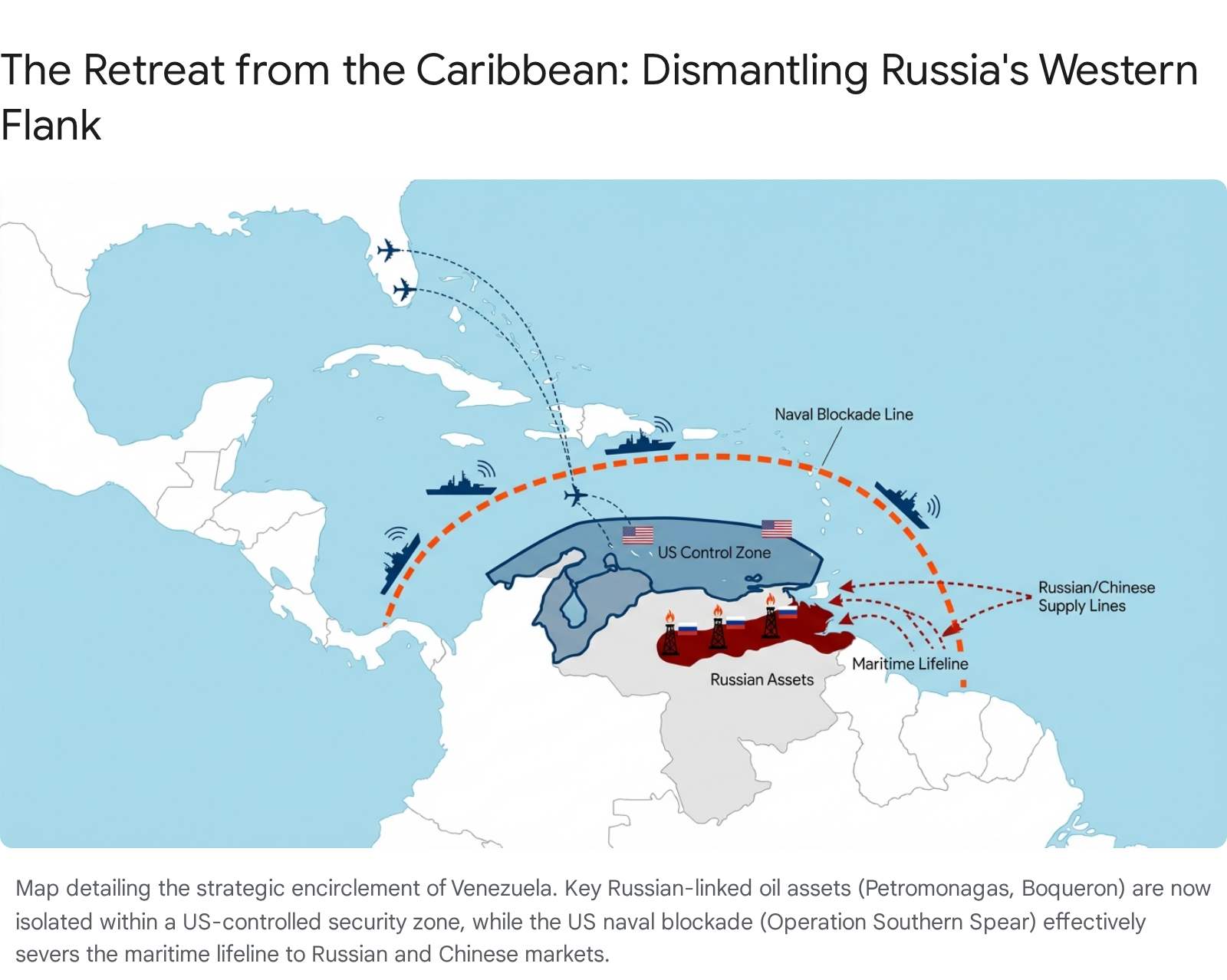
Map: US control zone encircles Venezuela, blocking Russian assets and maritime lifeline. "The Retreat from the Caribbean.

I. The Geopolitical Shockwave: The Revival of the “Don-roe” Doctrine

The extraction of Nicolás Maduro by US forces marks the most significant reassertion of American hard power in the Western Hemisphere since the Cold War era. For Moscow, this intervention is not a peripheral loss but a direct assault on its strategy of “reciprocal pressure.” Since the early 2000s, and accelerating under Hugo Chávez and Nicolás Maduro, Russia has utilized Venezuela as a symmetric counter-weight to US influence in Ukraine and Eastern Europe. The logic was explicit: if Washington could expand NATO into Russia’s “near abroad,” Moscow would cultivate a military and economic foothold in Washington’s “backyard”.4 The sudden and total removal of this lever forces a recalibration of Kremlin foreign policy.

The Collapse of the Forward Operating Base

The speed of Operation Absolute Resolve has inflicted severe reputational and operational damage on the Russian Federation. Moscow had invested heavily in the survival of the Chavista regime, deploying military advisors, S-300 air defense systems, and reportedly Wagner Group personnel to Venezuela to provide regime security.3 These assets were intended to serve as a tripwire against US intervention. Their failure to detect, deter, or repel the US operation exposes a critical weakness in Russian power projection capabilities.

The operational reality revealed by the January 2026 intervention is that Russia lacks the logistical capacity to sustain a high-intensity defense of its allies across the Atlantic while fully committed to the war in Ukraine. Russian military analysts have noted with alarm that the US operation was executed with a speed and decisiveness that contrasts sharply with the protracted nature of Russia’s own “Special Military Operation”.14 This failure resonates beyond Caracas. Client states relying on Russian security guarantees—from Syria to the Sahel—are witnessing a stark demonstration of Moscow’s limitations when confronted by direct US military resolve. The “invincibility” of Russian-backed authoritarian survival strategies has been pierced, potentially encouraging opposition movements in other Russian client states to test the Kremlin’s resolve.

The “Wild West” Precedent and Spheres of Influence

While the loss is acute, Russian strategists are attempting to salvage a diplomatic narrative from the wreckage. By framing the US intervention as a return to 19th-century imperialism—dubbed the “Don-roe Doctrine” by some analysts, a play on the Monroe Doctrine 15—Moscow aims to solidify its own claims to a sphere of influence in Eastern Europe. The Kremlin’s diplomatic messaging has focused on the “illegality” of the US action, arguing that if Washington can claim exclusive rights to manage political outcomes in the Americas, Russia has an identical right to dictate the political future of Ukraine and Belarus.4

However, this rhetorical pivot conceals a grim reality: the global order is shifting toward a raw transactionalist model where “might makes right.” While Russia has long championed this shift away from a rules-based order, it is now on the losing end of the equation in the Caribbean. The Kremlin’s silence and lack of substantive military counter-moves suggest a tacit acknowledgement that it cannot contest the US in the Western Hemisphere.16 The “strategic partnership” signed between Putin and Maduro in May 2025 has been rendered null and void, proving that diplomatic paper is worthless without the force projection to back it.5

II. The Energy War: Displacement of the Urals Blend

The most tangible and damaging impact on Russia will manifest in the global oil markets. The Russian war economy is predicated on the export of medium-sour Urals crude, primarily to India and China, often at a discount to Brent but above the Western price cap. The reentry of Venezuelan heavy crude into the open market, under US administration, poses a direct threat to this market share.

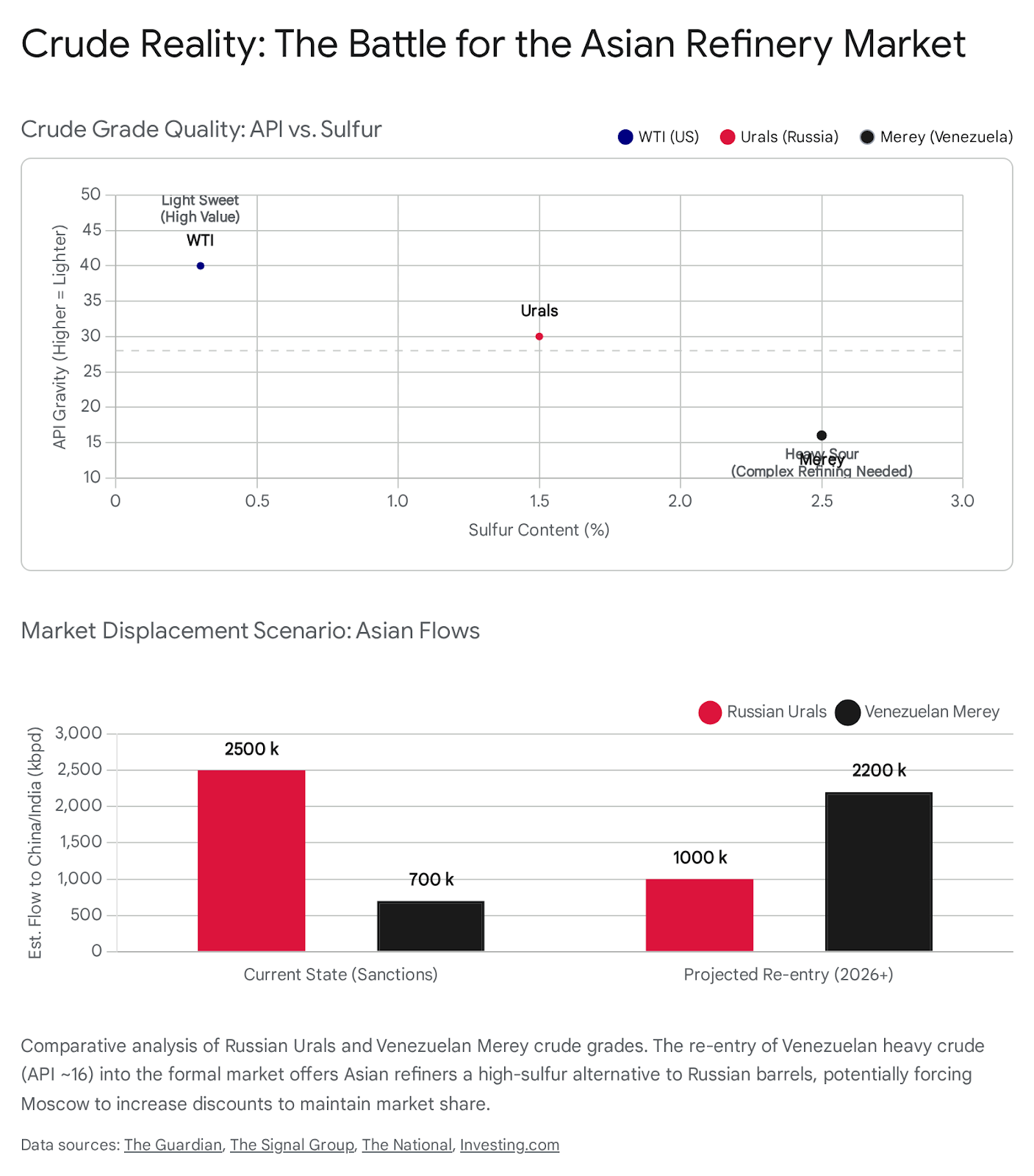
Crude Quality Competition: Heavy vs. Medium Sour

Venezuela possesses the world’s largest proven oil reserves, primarily heavy and extra-heavy crude in the Orinoco Belt.18 Historically, this oil was the ideal feedstock for complex refineries in the US Gulf Coast (USGC), which were specifically engaged to process heavy, high-sulfur barrels.8 Following the imposition of sanctions, this oil was diverted to China, where it competed directly with Russian Urals and Iranian heavy grades for market share among independent “teapot” refiners.9

With the US now controlling the flow, two scenarios emerge, both detrimental to Russia:

  1. The Repatriation of Barrels: The US administration has signaled an intent to direct Venezuelan output back to Gulf Coast refineries to lower domestic gasoline prices and fuel “reindustrialization”.8 This repatriation of barrels accomplishes a strategic dual purpose for the US: it lowers domestic energy costs and, critically, it removes Venezuelan supply from the “dark market.” Every barrel of Venezuelan crude that returns to the USGC is a barrel that is no longer available to Chinese independent refiners at a deep discount. This forces Chinese buyers to look elsewhere, potentially to Russia, but without the leverage of a cheap Venezuelan alternative, or conversely, it forces Russia to compete more aggressively against Iranian barrels for the remaining “dark” market share.
  2. The Asian Displacement: If production is ramped up significantly—Goldman Sachs estimates a potential, though slow, recovery 10—and sanctions are lifted for compliant buyers, Venezuelan oil becomes a legitimate alternative for India and China. Indian refiners, such as Reliance Industries, have historically been significant buyers of Venezuelan crude. They have struggled with payment mechanisms for Russian oil due to sanctions and currency risks.9 If US-controlled Venezuela offers a stable, legal supply of heavy crude, Indian refiners may prefer it over sanctioned Russian barrels, which carry the constant risk of secondary sanctions and logistical disruption.
Crude oil quality comparison: WTI, Urals, Merey. Asian flows: Russian Urals vs. Venezuelan Merey crude. "US Control Over Venezuelan Oil" impact.

The “Price Cap” Evasion Squeeze and Revenue Erosion

Russia’s ability to fund its war in Ukraine relies on the “shadow fleet” and the willingness of Asian buyers to skirt Western sanctions to buy oil. If Venezuela returns to the fold of the global energy market, it introduces a massive volume of “legitimate” heavy crude. This increases the supply elasticity for buyers like China and India.

According to market analysis, even a modest increase in Venezuelan output to 2 million barrels per day (bpd) could depress long-term oil prices by approximately $4 per barrel.10 For Russia, which operates on thin margins due to the high cost of transport, insurance, and the “war risk” premiums attached to its sanctioned oil, a $4 drop is magnified. Furthermore, to compete with legitimate Venezuelan barrels that carry no sanctions risk, Russia would be forced to offer even steeper discounts to Chinese and Indian buyers. This dynamic erodes the net revenue entering the Kremlin’s coffers, directly impacting the fiscal stability of the Russian state.9 The discount on Urals crude, which Russia has fought to narrow, would likely widen again as buyers gain leverage.

III. Next Steps for the Venezuelan Oil Industry: A Challenge to Russian Interests

The immediate post-intervention phase for the Venezuelan oil industry will be defined by a US-led reconstruction effort that systematically excludes Russian participation. The path to recovery for PDVSA (Petróleos de Venezuela, S.A.) is fraught with technical and financial challenges, but the direction of travel—toward Western integration—is unambiguous.

Assessment of Infrastructure Decay

The Venezuelan oil sector has suffered from a decade of catastrophic underinvestment, brain drain, and looting. Production capacity has collapsed from over 3 million bpd in the late 1990s to approximately 800,000–900,000 bpd at the time of the intervention.18 The physical infrastructure—pipelines, pumping stations, and the critical “upgraders” in the Orinoco Belt that convert extra-heavy crude into exportable blends—is in a state of advanced disrepair.20

Reports indicate that looting of equipment has been widespread, and the “asset specificity” of the heavy oil infrastructure means that simply throwing money at the problem will not yield immediate results. Restoring production to 2 million bpd is estimated to require tens of billions of dollars and several years of sustained effort.2 However, unlike the Maduro regime, the US administration can leverage the technical expertise and capital of US supermajors.

The Return of the US Majors

The US strategy is explicitly reliant on private enterprise to fund the reconstruction. President Trump has stated that US oil companies will “go in, spend billions of dollars, fix the badly broken infrastructure… and start making money for the country”.20 This points to a rapid return of companies like Chevron, ConocoPhillips, and ExxonMobil, many of whom have outstanding arbitration claims against Venezuela for past expropriations.

  • Chevron: Already operating under a special license, Chevron is best positioned to lead the immediate stabilization of output.26
  • ConocoPhillips and Exxon: These companies, which left Venezuela under Chávez, may return under a new legal framework that swaps their debt claims for equity in new Joint Ventures.2

This “debt-for-equity” model is particularly dangerous for Russia. As US companies swap their arbitration awards for control of oil fields, they will likely displace existing operators—including Russian entities—whose contracts may be deemed illegitimate by the new administration.

Production Ramp-Up Scenarios

Analysts are divided on the speed of the recovery, but even a slow ramp-up impacts Russia.

  • Short Term (0-12 months): Production is likely to remain flat or dip slightly as the chaos of the transition settles and the US assesses the state of the facilities. The immediate focus will be on stabilizing the power grid and stopping the decline.29
  • Medium Term (1-3 years): With US capital and security, production could rise by 500,000 to 1 million bpd. JPMorgan analysts see a potential rise to 1.3–1.4 million bpd in two years.21
  • Long Term (3+ years): A return to 2.5–3 million bpd is possible but would require sustained political stability and investment exceeding $80 billion.2

OPEC+ Implications

Venezuela is a founding member of OPEC. Under US control, its relationship with the cartel—and specifically with the OPEC+ format led jointly by Saudi Arabia and Russia—becomes highly uncertain.

  • Quota Non-Compliance: A US-administered Venezuela is unlikely to adhere to OPEC+ production quotas designed to prop up oil prices. The US priority will be volume maximization to repay debts and lower global prices, directly undermining Russia’s efforts to restrict supply.2
  • Fracture of the Alliance: If Venezuela exits OPEC or simply ignores its mandates, it weakens the cartel’s cohesion. Russia relies on OPEC+ coordination to maintain the price floor for oil; a rogue producer with massive reserves under US tutelage disrupts this mechanism.

IV. Financial Exposure: The Roszarubezhneft Debacle

The financial linkage between Moscow and Caracas is deep, structural, and now largely toxic. Following the imposition of US sanctions on Rosneft in 2020, the Russian state created Roszarubezhneft, a 100% state-owned entity, to absorb Rosneft’s Venezuelan assets.6 This transfer was designed to protect the publicly traded Rosneft from sanctions, but it effectively concentrated the risk directly onto the Russian state balance sheet.

Asset Expropriation and “Odious Debt”

With the US vowing to “run” Venezuela and rebuild its infrastructure using US oil majors 20, the legal status of Roszarubezhneft’s Joint Ventures (JVs) is in extreme jeopardy. The new US-backed administration is likely to declare contracts signed under the Maduro regime as invalid or subject to renegotiation under terms unfavorable to Moscow.

  • The Debt Stack: Venezuela owes billions to Russia, consisting of sovereign debt and pre-payments for oil that was never delivered.31 Russian state media has estimated the value of stakes in ventures like Petromonagas, Petroperija, and Boqueron at around $5 billion.31
  • The Collateral Trap: Rosneft (now Roszarubezhneft) historically held liens on Venezuelan oil cargos and assets (such as the 49.9% stake in CITGO, though this has been the subject of complex litigation).33 With the US blockading exports and controlling the fields, there is no physical way for Russia to collect on these debts via oil shipments.24
  • Legal Warfare: The US administration has signaled that US oil companies must invest to rebuild the sector before they can recoup their own lost assets.28 In this queue of creditors, Russian state entities will undoubtedly be placed last. Legal scholars anticipate the US may designate Russian loans as “odious debt”—debt incurred by a despotic regime for purposes that did not serve the population—thereby nullifying Russia’s claims entirely.32

The loss of these assets is not just a paper loss; it is a destruction of capital that was intended to serve as a long-term strategic reserve and revenue stream for the Russian state.

V. The “Shadow Fleet” Crisis and Maritime Precedents

Perhaps the most dangerous development for Russia is not taking place on Venezuelan soil, but in the international waters surrounding it. The US pursuit and potential seizure of the tanker Marinera (formerly Bella 1) sets a legal and operational precedent that strikes at the heart of Russia’s ability to export oil globally.11

The Flag-State Immunity Challenge

The Bella 1, a known dark fleet tanker, attempted to evade US interdiction by re-flagging to Russia and renaming itself Marinera mid-voyage.36 Typically, a vessel flying a national flag is considered sovereign territory, and boarding it without the flag state’s consent is a violation of international law. However, the US has proceeded with the pursuit, treating the re-flagging as a fraudulent attempt to evade law enforcement rather than a legitimate sovereign act. US officials have argued that because the vessel was “stateless” or flying a false flag at the time the pursuit began, it does not enjoy retroactive protection from the Russian flag.37

If the US successfully seizes a vessel flying the Russian flag—arguing it is “stateless” due to fraudulent registration or engaged in “criminal” activity (narco-terrorism support via Maduro)—it creates a devastating precedent for Moscow.

  • Implication: The US could theoretically apply this legal logic to any vessel in Russia’s shadow fleet carrying oil above the price cap. If a vessel is deemed to be using deceptive practices (AIS spoofing, false documents), the US could argue it forfeits sovereign immunity.
  • Russian Reaction: Moscow has already filed diplomatic protests, viewing this as a test case.38 If they fail to protect the Marinera, the perceived security of the entire Russian shadow fleet will collapse. Insurance premiums for these vessels will skyrocket, and shipowners may refuse to carry Russian cargo if they believe US naval interdiction is a genuine risk.36

The Naval Blockade (Operation Southern Spear)

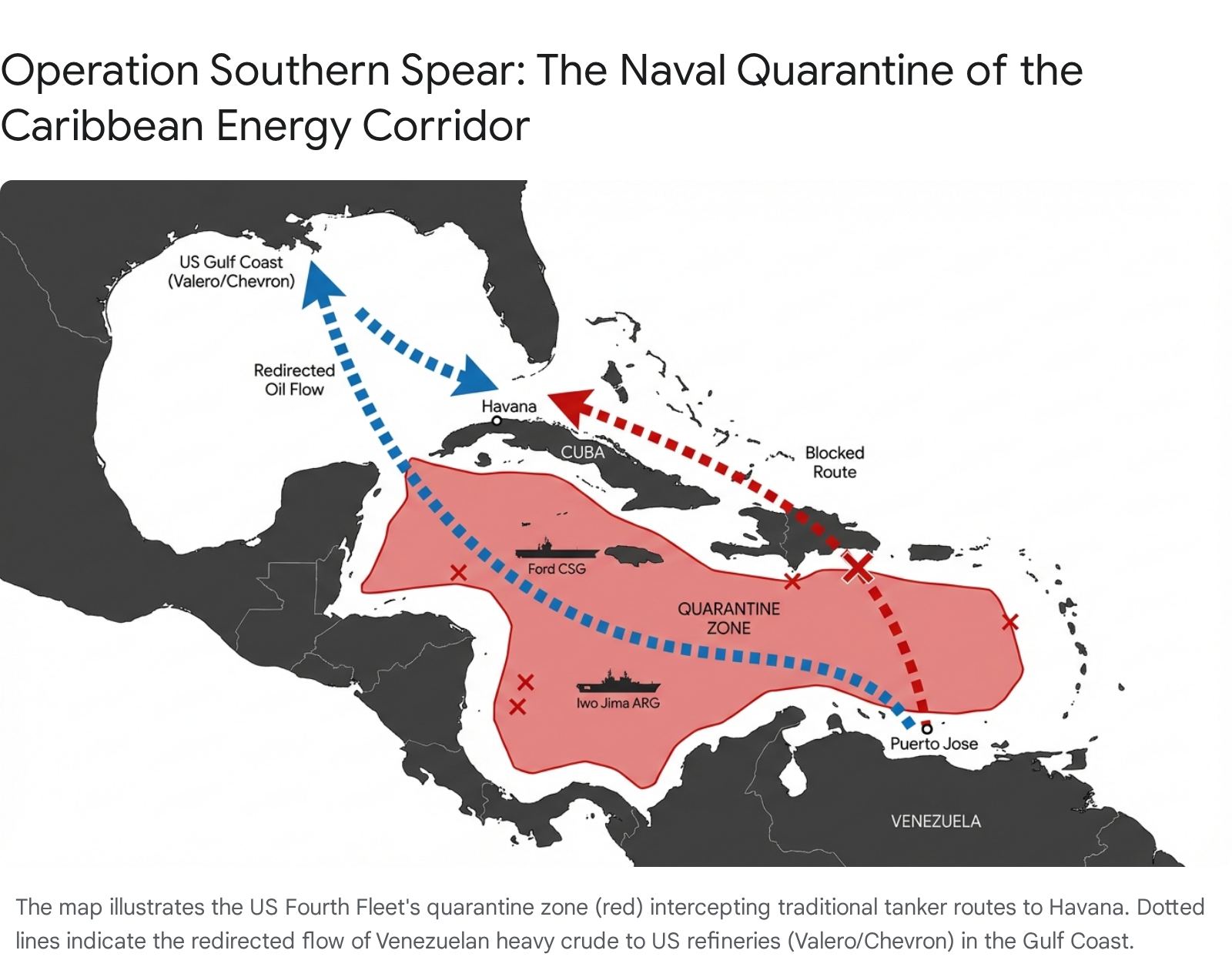
The implementation of a naval blockade (“quarantine”) on Venezuelan oil 39 demonstrates a US willingness to physically interdict energy flows. For Russia, which relies on narrow maritime chokepoints like the Danish Straits and the Bosporus for its oil exports, the normalization of naval blockades against major oil producers is an existential threat. It signals that the “freedom of navigation” for energy carriers is no longer guaranteed for US adversaries. The “quarantine” concept, famously used during the Cuban Missile Crisis, allows the US to filter traffic based on cargo content, effectively strangling a regime’s economic lifeline without declaring a formal war on the shipping nations.

VI. Second-Order Effects: The China Pivot and Eurasian Unity

The US control of Venezuela forces a difficult choice upon the People’s Republic of China, driving a potential wedge in the Sino-Russian “No Limits” partnership.

China’s Energy Pragmatism

China is the world’s largest importer of oil and has been the primary buyer of sanctioned Venezuelan crude, importing roughly 430,000 bpd in 2025.41 With the US now controlling the spigot, Beijing faces a stark dilemma:

  1. Confrontation: Continue buying “black market” Venezuelan oil (if any can slip the blockade) and risk secondary sanctions, naval interdiction, and a trade war with the US.
  2. Compliance: Accept US control, negotiate with the new administration for legitimate access to Venezuelan oil, and diversify away from “risky” suppliers.9

Evidence suggests China is pragmatic. Chinese refiners have already paused purchases of Venezuelan crude to assess the new reality, fearing US seizures.42 If the US successfully rehabilitates the Venezuelan oil sector and allows exports to China (to stabilize global prices and ensure Chinese neutrality), Beijing may reduce its reliance on Russian Urals. This would reduce Russia’s leverage over its most important economic partner. Russia needs China more than China needs Russia; if Venezuela offers a stable, high-quality heavy crude alternative, the “discount” Russia must offer to Beijing will deepen to maintain market share.18

The Fracture of the “Revisionist Bloc”

Venezuela was a key node in the “Axis of Resistance” (Russia, Iran, Venezuela, Cuba). The fall of Maduro isolates Cuba, which relied on Venezuelan oil subsidies for its economic survival.32 The likely economic collapse of Cuba would force Russia to either subsidize the island nation at a massive cost—something the strained Russian budget can ill afford—or watch another ally fall to US pressure. Furthermore, the perception that Russia could not save Maduro may lead other partners (Iran, North Korea) to question the value of Russian security assurances. They may prioritize their own nuclear deterrence over reliance on Russian diplomatic or conventional military support, leading to a more volatile and less coordinated anti-Western bloc.

VII. Russia’s Asymmetric Response Options

Cornered in the Caribbean and squeezed in the energy markets, Russia lacks the conventional projection capacity to reverse the situation in Venezuela. Direct military intervention is logistically impossible given the distance and the ongoing commitment in Ukraine.43 Therefore, Moscow’s response will be asymmetric, designed to inflict pain on US interests elsewhere and re-establish deterrence.

1. Escalation in Ukraine

The most likely venue for retaliation is Ukraine. Viewing the loss of Venezuela as a US escalation of the global conflict, the Kremlin may justify “total war” tactics in Ukraine. This could involve targeting energy infrastructure, leadership nodes, or logistics hubs with renewed intensity, mirroring the US “decapitation” of the Maduro regime.3 The logic of “reciprocal damage” suggests that if the US can topple a Russian ally, Russia must destroy a US ally.

2. The “Grey Zone” Maritime Campaign

Russia may intensify “grey zone” warfare at sea to challenge the US naval dominance asserted in the Caribbean. This could include:

  • Cable Cutting: Sabotage of undersea data cables in the Atlantic, claiming “unknown actors” are responsible, as a warning shot regarding US naval dominance and economic stability.
  • Shadow Fleet Harassment: Retaliatory harassment of Western commercial shipping in the Black Sea or Red Sea (via Houthi proxies), citing the Marinera precedent to justify boarding operations. If the US can board Russian-flagged ships, Russia may argue it can board Western-flagged ships suspected of carrying “contraband” for Ukraine.45

3. Cyber and Hybrid Warfare

The US plan to “run” Venezuela relies on the stability of the interim government and the physical security of the oil infrastructure. Russia retains significant cyber capabilities and human intelligence networks within Venezuela.13 We can expect a sustained campaign of sabotage, disinformation, and cyber-attacks aimed at the new Venezuelan administration and the US oil companies attempting to operate there. The goal will be to make Venezuela ungovernable and the oil unrecoverable, thereby denying the US the fruits of its victory and keeping global oil prices high.

Conclusion

The US assumption of control over Venezuelan oil is a watershed moment that significantly degrades the Russian Federation’s global standing. It strips Moscow of its most important asset in the Western Hemisphere, threatens the financial solvency of its state-owned energy vehicles, and introduces a potent competitor to its oil exports in critical Asian markets.

While the Kremlin projects an image of defiant silence, the strategic reality is one of containment. The “Don-roe Doctrine” has effectively closed the Caribbean to Russian power projection. Russia’s response will likely be defined by increased brutality in its near abroad (Ukraine) and disruptive hybrid warfare globally, but the loss of the Venezuelan bridgehead is irreversible. The era of Russia acting as a global spoiler in the Americas has, for the immediate future, been brought to a close by the realities of energy economics and American naval power.


Please share the link on Facebook, Forums, with colleagues, etc. Your support is much appreciated and if you have any feedback, please email us in**@*********ps.com. If you’d like to request a report or order a reprint, please click here for the corresponding page to open in new tab.


Sources Used

  1. 2026 United States strikes in Venezuela – Wikipedia, accessed January 6, 2026, https://en.wikipedia.org/wiki/2026_United_States_strikes_in_Venezuela
  2. Q&A on US Actions in Venezuela – Center on Global Energy Policy, accessed January 6, 2026, https://www.energypolicy.columbia.edu/qa-on-us-actions-in-venezuela/
  3. The Fall of Maduro: How Russia Lost an Ally but Gained a Like-Minded Thinker, accessed January 6, 2026, https://ridl.io/russia-has-no-allies/
  4. Analysis: Russia Loses Ally in Venezuela, Sees Opportunity in Trump’s ‘Wild West’ Realpolitik, accessed January 6, 2026, https://www.kyivpost.com/analysis/67523
  5. Russia loses ally in Venezuela but hopes to gain from Trump’s ‘Wild West’ realpolitik, accessed January 6, 2026, https://www.cnbcafrica.com/2026/russia-loses-ally-in-venezuela-but-hopes-to-gain-from-trumps-wild-west-realpolitik
  6. Venezuela Approves 15-Year Extension of Russia-Linked Oil Joint Ventures, accessed January 6, 2026, https://energynow.com/2025/11/venezuela-approves-15-year-extension-of-russia-linked-oil-joint-ventures/
  7. Rosneft’s Withdrawal amid U.S. Sanctions Contributes to Venezuela’s Isolation – CSIS, accessed January 6, 2026, https://www.csis.org/analysis/rosnefts-withdrawal-amid-us-sanctions-contributes-venezuelas-isolation
  8. Dense, sticky and heavy: why Venezuelan crude oil appeals to US refineries, accessed January 6, 2026, https://www.theguardian.com/business/2026/jan/05/venezuelan-crude-oil-appeals-to-us-refineries
  9. TSG MARKET INSIGHTS | Venezuela, Russia, and the Oil Balance – The Signal Group, accessed January 6, 2026, https://www.thesignalgroup.com/newsroom/market-insights-venezuela-russia-and-the-oil-balance
  10. Goldman Sachs sees bearish long-term oil risk after Venezuela | Seeking Alpha, accessed January 6, 2026, https://seekingalpha.com/news/4536508-goldman-sachs-sees-bearish-long-term-oil-risk-after-venezuela
  11. Tanker Evading Venezuela Blockade Paints Russian Flag as U.S. Pursuit Continues, accessed January 6, 2026, https://windward.ai/blog/tanker-evading-venezuela-blockade-paints-russian-flag-as-u-s-pursuit-continues/
  12. Report: U.S. Still Plans to Seize Fleeing Russian-Flagged Tanker – The Maritime Executive, accessed January 6, 2026, https://maritime-executive.com/article/report-u-s-still-plans-to-seize-fleeing-russian-flagged-tanker
  13. With Maduro Gone, Putin Risks Being Pushed Out of the Western Hemisphere, accessed January 6, 2026, https://www.themoscowtimes.com/2026/01/05/with-maduro-gone-putin-risks-being-pushed-out-of-the-western-hemisphere-a91608
  14. From grudging respect to unease: Russia weighs up fall of Maduro, accessed January 6, 2026, https://www.theguardian.com/world/2026/jan/05/russia-weighs-up-fall-of-nicolas-maduro-venezuela
  15. Making sense of the US military operation in Venezuela, accessed January 6, 2026, https://www.brookings.edu/articles/making-sense-of-the-us-military-operation-in-venezuela/
  16. Decapitation Strategy in Caracas: The Logic, Timing, and Consequences of the U.S. Operation in Venezuela, accessed January 6, 2026, https://lansinginstitute.org/2026/01/03/decapitation-strategy-in-caracas-the-logic-timing-and-consequences-of-the-u-s-operation-in-venezuela/
  17. The ‘Putinization’ of US foreign policy has arrived in Venezuela – The Guardian, accessed January 6, 2026, https://www.theguardian.com/world/2026/jan/03/putin-russia-us-foreign-policy-venezuela
  18. Venezuelan Political Transition Reshapes Global Oil Market Dynamics – Discovery Alert, accessed January 6, 2026, https://discoveryalert.com.au/venezuelan-political-transition-oil-dynamics-2026/
  19. Trump move to cap oil, Venezuela output in focus, accessed January 6, 2026, https://www.nationthailand.com/news/world/40060760
  20. Trump suggests US taxpayers could reimburse oil firms for Venezuela investment, accessed January 6, 2026, https://www.theguardian.com/business/2026/jan/06/trump-us-taxpayers-oil-firms-venezuela-investment
  21. Analysts predict that Venezuelan oil production will increase in the future and lower prices., accessed January 6, 2026, https://energynews.oedigital.com/oil-gas/2026/01/05/analysts-predict-that-venezuelan-oil-production-will-increase-in-the-future-and-lower-prices
  22. How Venezuelan oil factored into the US capture of Maduro, accessed January 6, 2026, https://www.straitstimes.com/business/companies-markets/how-venezuelan-oil-factored-into-the-us-seizure-of-maduro
  23. Venezuela’s oil supply to rise in years ahead and depress prices, say analysts, accessed January 6, 2026, https://www.cnbcafrica.com/2026/venezuelas-oil-supply-to-rise-in-years-ahead-and-depress-prices-say-analysts
  24. U.S. Oil Companies Face Significant Costs and Risks When Reentering Venezuela, accessed January 6, 2026, https://www.asisonline.org/security-management-magazine/latest-news/today-in-security/2026/january/oil-companies-venezuela/
  25. Reviving Venezuela’s oil industry no easy feat: Update | Latest Market News – Argus Media, accessed January 6, 2026, https://www.argusmedia.com/en/news-and-insights/latest-market-news/2772065-reviving-venezuela-s-oil-industry-no-easy-feat-update
  26. The Commodities Feed: Venezuelan and Russian oil supply risks …, accessed January 6, 2026, https://think.ing.com/articles/the-commodities-feed-venezuelan-and-russian-oil-supply-risks-push-the-market-higher181225/
  27. Houston oil companies react as Venezuela turmoil raises questions about energy markets, accessed January 6, 2026, https://www.click2houston.com/news/local/2026/01/05/houston-oil-companies-react-as-venezuela-turmoil-raises-questions-about-energy-markets/
  28. U.S. pushes oil majors to invest big in Venezuela – Denver Gazette, accessed January 6, 2026, https://www.denvergazette.com/2026/01/05/u-s-pushes-oil-majors-to-invest-big-in-venezuela/
  29. Goldman Sachs sees limited Venezuela oil recovery after U.S. action | Seeking Alpha, accessed January 6, 2026, https://seekingalpha.com/news/4536507-goldman-sachs-sees-limited-venezuela-oil-recovery-after-u-s-action
  30. Opec+ opts for caution as US takeover of Venezuela oil adds supply risks – The National News, accessed January 6, 2026, https://www.thenationalnews.com/business/energy/2026/01/04/opec-opts-for-caution-as-us-takeover-of-venezuela-oil-adds-supply-risks/
  31. Factbox-What’s the status of international oil companies in Venezuela after Maduro’s capture? By Reuters – Investing.com, accessed January 6, 2026, https://www.investing.com/news/commodities-news/factboxwhats-the-status-of-international-oil-companies-in-venezuela-after-maduros-capture-4430480
  32. Venezuela’s billions in distressed debt: Who is in line to collect?, accessed January 6, 2026, https://www.foxbusiness.com/economy/venezuelas-billions-distressed-debt-who-line-collect
  33. 22 USC 9752: Concerns over PDVSA transactions with Rosneft – OLRC Home, accessed January 6, 2026, https://uscode.house.gov/view.xhtml;jsessionid=220ADD9E32B4922036C309D0C259AEDD?path=&req=granuleid%3AUSC-prelim-title22-section9752&f=&fq=&num=0&hl=false&edition=prelim
  34. Trump’s attack leaves China worried about its interests in Venezuela, accessed January 6, 2026, https://www.theguardian.com/world/2026/jan/05/venezuela-trump-attack-china-interests-analysis
  35. Treasury Targets Oil Traders Engaged in Sanctions Evasion for Maduro Regime, accessed January 6, 2026, https://home.treasury.gov/news/press-releases/sb0348
  36. Sanctioned Oil Tanker – Bella 1 – SOF News, accessed January 6, 2026, https://sof.news/news/bella-1-oil-tanker/
  37. Tanker chased by US Coast Guard gains Russian flag and new name – NYT, accessed January 6, 2026, https://www.pravda.com.ua/eng/news/2026/01/01/8014213/
  38. Russia files diplomatic request asking U.S. to stop pursuing oil tanker originally bound for Venezuela, accessed January 6, 2026, https://www.ctvnews.ca/world/article/russia-files-diplomatic-request-asking-us-to-stop-pursuing-oil-tanker-originally-bound-for-venezuela/
  39. United States oil blockade during Operation Southern Spear – Wikipedia, accessed January 6, 2026, https://en.wikipedia.org/wiki/United_States_oil_blockade_during_Operation_Southern_Spear
  40. Venezuela on Notice: What Comes Next for Dark Fleet Enforcement, accessed January 6, 2026, https://windward.ai/blog/venezuela-on-notice-what-comes-next-for-dark-fleet-enforcement/
  41. China demands ‘immediate release’ of Venezuela’s Maduro | Latest Market News, accessed January 6, 2026, https://www.argusmedia.com/en/news-and-insights/latest-market-news/2771768-china-demands-immediate-release-of-venezuela-s-maduro
  42. Chinese refiners seek alternatives to Venezuelan crude, accessed January 6, 2026, https://www.argusmedia.com/en/news-and-insights/latest-market-news/2771875-chinese-refiners-seek-alternatives-to-venezuelan-crude
  43. Why Russia Intervening in a U.S.-Venezuela War Is Plausible, But It’s a Bad Idea – YouTube, accessed January 6, 2026, https://www.youtube.com/watch?v=s0lPlgjfOP8
  44. Russia Demands Release of Maduro After U.S. Military Strikes Venezuela, accessed January 6, 2026, https://www.themoscowtimes.com/2026/01/03/russia-demands-release-of-maduro-after-us-military-strikes-venezuela-a91602
  45. US plans to intercept Venezuela-linked oil tanker claimed by Russia – Al Mayadeen English, accessed January 6, 2026, https://english.almayadeen.net/news/politics/us-plans-to-intercept-venezuela-linked-oil-tanker-claimed-by

US Control Over Venezuelan Oil: Implications for China

This is a time-sensitive special report and is based on information available as of January 5, 2026. Due to the situation being very dynamic the following report should be used to obtain a perspective but not viewed as an absolute.

The January 2026 execution of “Operation Absolute Resolve,” which culminated in the extraction of Nicolás Maduro by United States military forces and the subsequent imposition of a US-administered transitional authority in Caracas, constitutes a geopolitical event of the highest magnitude. While the operation was tactically confined to the Caribbean basin, its strategic shockwaves have registered with immediate and destabilizing force in Beijing. For the People’s Republic of China (PRC), the sudden removal of the Bolivarian government represents a dismantling of a critical node in its Western Hemisphere strategy, a direct threat to tens of billions of dollars in state-backed financial assets, and a forced, costly recalibration of its national energy security architecture.

This report provides an exhaustive analysis of the multi-dimensional impacts radiating from the US takeover of Venezuela. The analysis is anchored in the premise that the “loss” of Venezuela is not merely a diplomatic setback for China, but a systemic shock that challenges the viability of its “resources-for-loans” model, exposes the fragility of its “all-weather” partnerships in the face of American hard power, and creates acute energy supply vulnerabilities for its independent refining sector.

The most immediate operational consequence is the severance of the “shadow fleet” trade that has sustained China’s independent refiners—colloquially known as “teapots”—with deeply discounted heavy crude oil. The imposition of a US-enforced “oil quarantine” has effectively interdicted the flow of Venezuelan Merey 16 crude to Shandong province. This disruption forces Chinese buyers into the open market to compete for increasingly scarce heavy sour grades, such as Western Canadian Select (WCS) and Basra Heavy, thereby eroding the refining margins that underpin the global competitiveness of China’s petrochemical exports. The arbitrage window, closed by the sudden escalation of maritime insurance premiums and the physical diversion of tankers, has precipitated a feedstock crisis that will likely lead to run cuts and consolidation within China’s refining sector.

Financially, Beijing faces the precarious prospect of asset nullification. The China Development Bank (CDB) and other state entities hold an estimated $12 billion to $19 billion in outstanding sovereign debt, historically serviced through direct oil shipments. The US administration’s rhetoric regarding the “rebuilding” of Venezuela implies a legal strategy that may classify these Chinese loans as “odious debt”—liabilities incurred by a despotic regime for purposes contrary to the national interest. Such a classification would legally subordinate Chinese claims to new US capital injections and humanitarian obligations, setting a dangerous precedent for the Belt and Road Initiative (BRI). If the “Venezuela Precedent” establishes that regime change can serve as a mechanism for debt erasure, the risk premium on China’s global lending portfolio will face upward revision.

Geopolitically, the operation serves as a forceful modernization of the Monroe Doctrine. The neutralization of the Maduro regime isolates Cuba, Venezuela’s primary regional client, placing Beijing in a strategic bind: it must either finance a massive emergency energy bailout for Havana at a time of domestic economic constraint or witness the destabilization of another socialist ally. Furthermore, while US and international analysts caution against drawing direct parallels to the Taiwan Strait, Chinese strategists will inevitably interpret the “decapitation” strike as a validation of unilateral force to resolve sovereignty disputes, a perception that may accelerate the hardening of China’s anti-access/area denial (A2/AD) capabilities.

Ultimately, while the US administration promises a swift revitalization of Venezuela’s oil sector, technical realities suggest a protracted recovery requiring over a decade and upwards of $185 billion in capital. This reconstruction phase offers China a narrow window for asymmetric response, likely leveraging its dominance in critical mineral supply chains to negotiate favorable terms for its stranded assets. However, the strategic reality remains that the US has successfully reclaimed the energy advantage in the Western Hemisphere, forcing China into a defensive posture.

1. Contextualizing Operation Absolute Resolve: The Collapse of a Strategic Anchor

To understand the magnitude of the shock to China, one must first appreciate the depth of the Sino-Venezuelan relationship prior to January 2026. Under the presidencies of Hugo Chávez and Nicolás Maduro, Venezuela served as China’s primary bridgehead in Latin America—a region traditionally viewed as Washington’s sphere of influence. This relationship was formalized in 2023 with the elevation of bilateral ties to an “All-Weather Strategic Partnership,” a diplomatic designation Beijing reserves for its most trusted allies.1

The partnership was underpinned by a strategic exchange: China provided diplomatic cover and liquidity (over $60 billion in loans since 2007) in exchange for secured access to the world’s largest proven oil reserves.2 This arrangement was designed to be sanction-proof, utilizing oil shipments to repay debts, thereby bypassing the US dollar system. The US military intervention has violently dismantled this architecture.

The operation itself, characterized by airstrikes on command-and-control nodes and the targeted extraction of the executive leadership, was executed with a speed that precluded any intervention by external powers.3 For Beijing, the surprise nature of the raid and the subsequent rapid installation of a US-backed transitional authority highlight a critical intelligence and capability gap in protecting its overseas interests. The immediate reaction from China’s Ministry of Foreign Affairs—expressing “grave concern” and calling for Maduro’s release—reflects a diplomatic posture struggling to catch up with a new reality on the ground.5 The strategic anchor has been weighed, and China has been cut loose.

2. The Energy Dimension: Supply Shock and Market Realignment

The primary transmission mechanism of this geopolitical shock to the Chinese economy is the disruption of the physical oil trade. While Venezuela’s production had fallen significantly from its peak, it remained a vital, albeit opaque, source of heavy crude for China’s industrial engine. The cessation of these flows triggers a cascade of impacts across the global heavy oil market, with the pain concentrated in Shandong province.

2.1 The “Merey” Dependency and the Teapot Crisis

Venezuela’s flagship export grade, Merey 16, is a unique crude: extra-heavy, high in sulfur, and rich in metals. While these characteristics make it unattractive to many simple refineries, it is the ideal feedstock for complex refineries equipped with deep conversion capacity, such as cokers and asphalt plants. China’s independent refiners, the “teapots,” spent the last decade optimizing their kits to process exactly this type of discounted, “distressed” barrel.

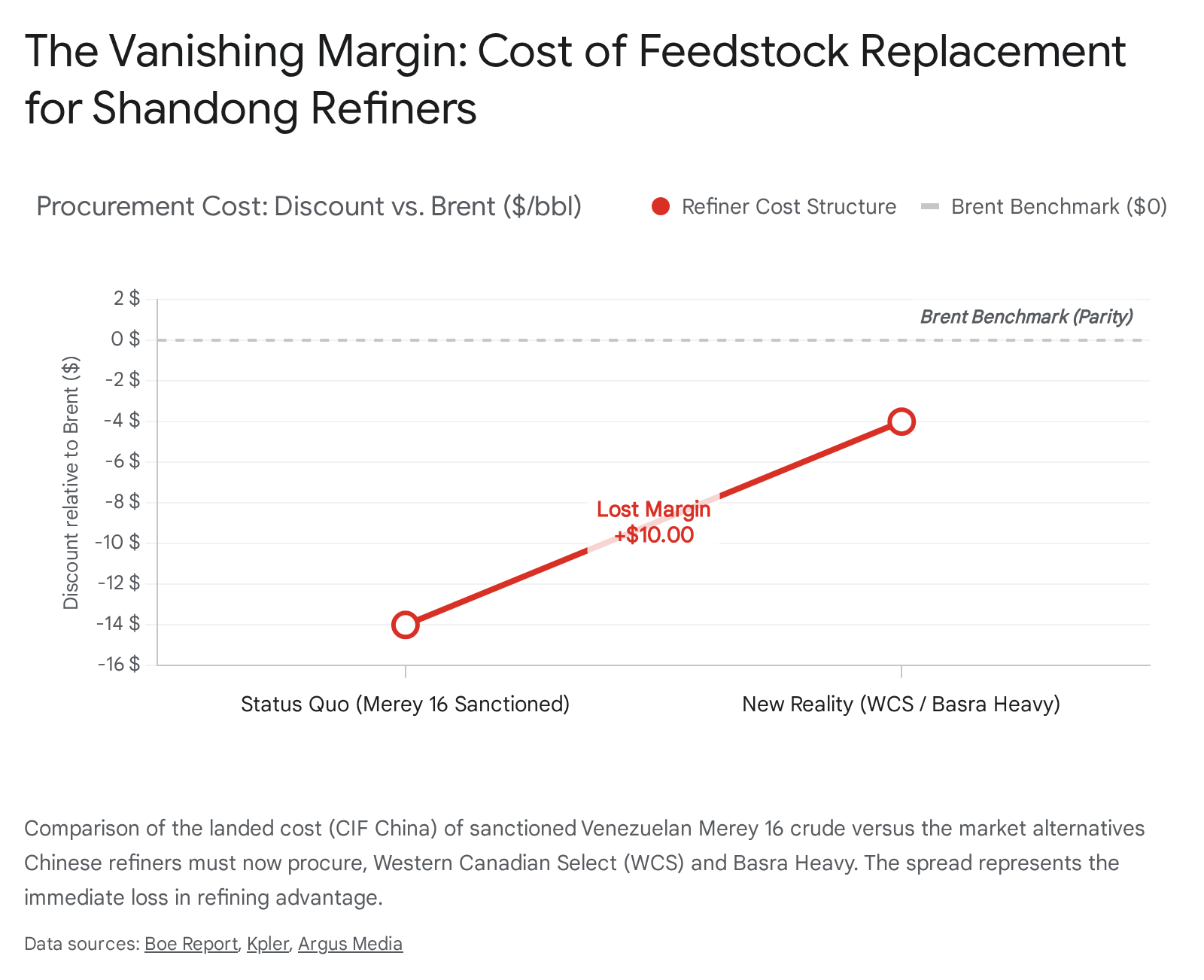
Prior to the intervention, China was importing approximately 470,000 barrels per day (bpd) of Venezuelan crude, which constituted roughly 4.5% of its total seaborne crude imports.2 While this percentage might appear manageable in aggregate, the specific economic reliance was profound. Due to US sanctions, Merey 16 traded at a massive discount—often $10 to $15 per barrel below the Brent benchmark.8 This “sanctions discount” effectively subsidized the margins of independent Chinese refiners, allowing them to remain competitive against state-owned giants like Sinopec and PetroChina, and to export refined products like bitumen and diesel at aggressive prices.

The US takeover has effectively zeroed out this supply. The Trump administration has declared an “oil quarantine,” and the US Treasury has signaled that Venezuelan oil will henceforth be redirected to the US Gulf Coast.4 The Gulf Coast refining complex, comprising majors like Citgo, Valero, and Chevron, was historically designed to process Venezuelan heavy crude and has faced a structural shortage of heavy barrels since the imposition of sanctions in 2019. The redirection of Venezuelan flows to the US is therefore a strategic priority for Washington to suppress domestic gasoline prices, directly at the expense of Chinese buyers.10

The loss of Merey 16 forces Chinese teapots to scramble for substitutes. The only globally traded grades with similar yield profiles are Western Canadian Select (WCS), Mexican Maya, and Iraq’s Basra Heavy. However, these grades trade at market rates, without the deep discounts associated with sanctioned regimes.

Shandong refiners' vanishing margin due to feedstock replacement costs, showing loss after Merey 16 sanctions.

As illustrated, the shift from a sanctioned discount to a market premium represents a catastrophic margin compression for the teapot sector. This “sovereignty premium” will likely force a wave of consolidation in Shandong, as smaller, less capitalized refineries fail to absorb the input cost shock.11

2.2 The Liquidation of the Shadow Fleet

The operational backbone of the China-Venezuela oil trade was a clandestine logistics network known as the “shadow fleet”—a flotilla of aging tankers with obscured ownership structures, registered in permissive jurisdictions, and operating often with disabled Automatic Identification Systems (AIS) to evade detection. This fleet facilitated the transfer of crude from Venezuelan ports to transshipment hubs off the coast of Malaysia, where the oil was blended and rebranded as “Malaysian Bitumen Blend” or “Singma Crude” to mask its origin before entering Chinese ports.7

The US “oil quarantine” has rendered this infrastructure toxic. The US Navy, operating under new, robust rules of engagement in the Caribbean, has begun interdicting vessels suspected of carrying “illicit” cargo. The boarding of the tanker “Skipper” and the designation of vessels like the “Nord Star” and “Lunar Tide” as blocked property have sent a shockwave through the maritime insurance market.4

The impact is binary: the trade has stopped. Mainstream protection and indemnity (P&I) clubs had already abandoned the trade, but now even second-tier insurers and “shadow” insurers are retreating due to the existential risk of vessel seizure. Insurance premiums for any vessel entering Venezuelan waters have spiked by 300-400%.14 For Chinese buyers, the logistical arbitrage—the ability to move sanctioned oil cheaply—has collapsed. The shadow fleet vessels, now marked liabilities, are effectively stranded assets, unable to trade in legitimate markets and too risky to deploy in the Caribbean.

2.3 Global Arbitrage and the Canadian Complication

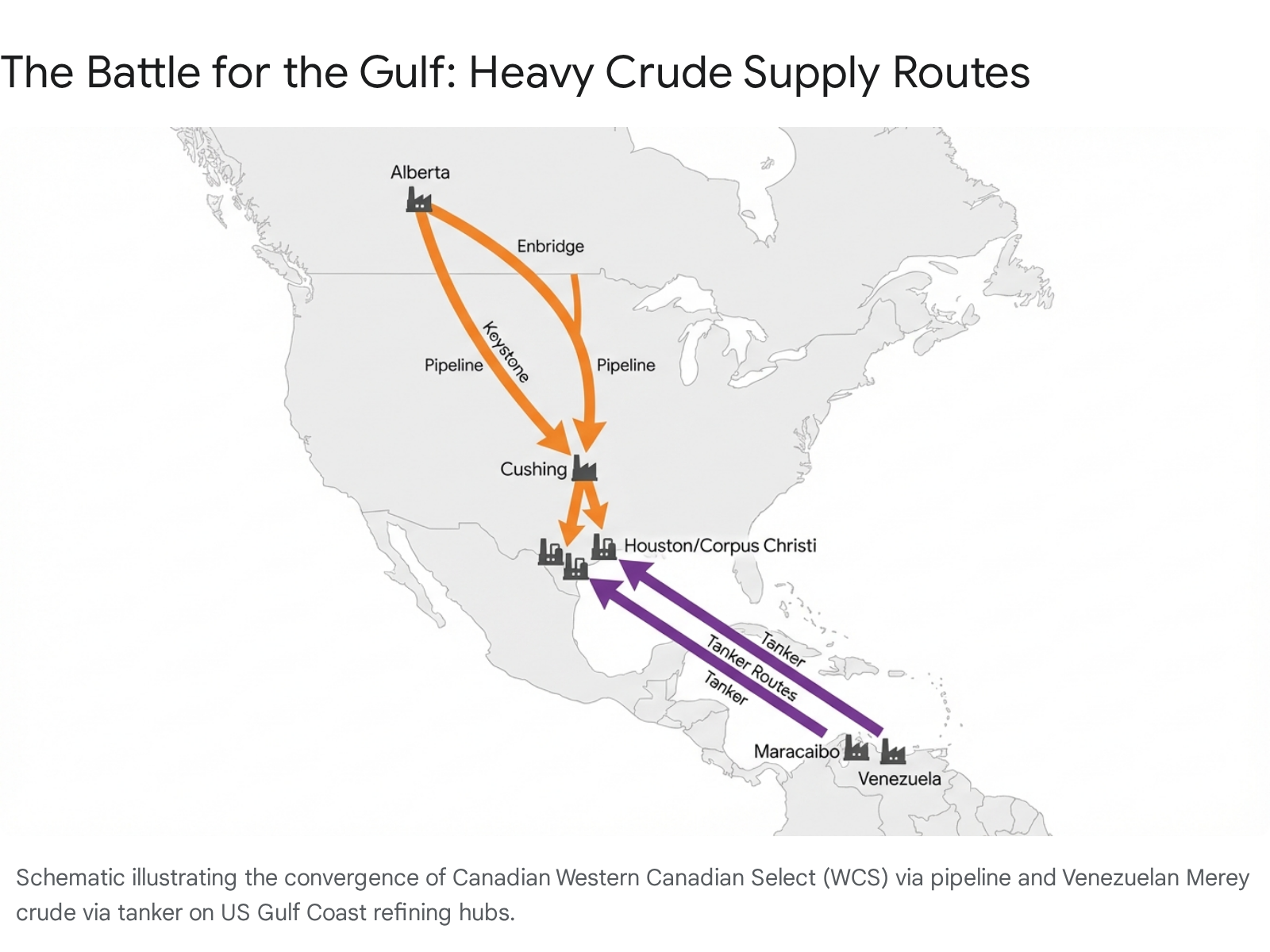
The US seizure of Venezuelan reserves has a secondary, ironic effect on China’s energy security via the Canadian market. With the Trans Mountain Pipeline Expansion (TMX) coming online, China had begun aggressive purchasing of Canadian heavy crude as a diversification play. However, the redirection of Venezuelan crude to the US Gulf Coast alters the North American balance.

Historically, US Gulf Coast refiners relied on heavy crude from Venezuela, Mexico, and Canada. With Venezuelan volumes offline for years, they became increasingly dependent on Canadian imports. Now, if the US successfully restores Venezuelan production for domestic use, it might theoretically displace Canadian barrels in the Gulf, freeing them up for export to Asia.15

However, in the short-to-medium term (1-3 years), the opposite dynamic is more likely. The reconstruction of Venezuela’s oil sector will be slow (see Section 7), meaning the US Gulf Coast will continue to demand Canadian barrels. Simultaneously, Chinese refiners, starved of Merey 16, will bid aggressively for the same Canadian WCS barrels. This puts Chinese buyers in direct competition with US refiners for Canadian supply, driving up the price of WCS relative to WTI. The widening discount that Chinese buyers enjoyed on Venezuelan oil is replaced by a narrowing discount on Canadian oil due to heightened competition.16 The result is a structurally higher energy import bill for the PRC.

3. The Financial Black Hole: Sovereign Debt and Asset Forfeiture

Beyond the immediate flow of commodities, the US intervention poses a grave threat to China’s financial balance sheet. The “resources-for-loans” model, pioneered by the China Development Bank (CDB) in the mid-2000s, was predicated on the assumption that sovereign control of oil reserves provided the ultimate collateral. The US takeover challenges the validity of this collateral and places billions of dollars in outstanding debt at risk of erasure.

3.1 The “Odious Debt” Weapon

Estimates of Venezuela’s outstanding debt to Chinese entities range from $12 billion to $19 billion.17 This debt was being serviced, albeit inconsistently, through oil shipments that have now been halted by the US blockade. The critical question facing Beijing is not just when payment will resume, but if the legal obligation to pay will survive the transition.

The US administration, in its role as the architect of the post-Maduro order, has indicated a willingness to use “economic leverage” to reshape Venezuela.4 A potent tool in this arsenal is the legal doctrine of “odious debt.” This principle of international law posits that sovereign debt incurred by a despotic regime for purposes that do not benefit the population, and with the creditor’s full knowledge of these facts, is personal to the regime and not enforceable against the state after the regime falls.19

There is a high probability that the US-backed transitional government will argue that Chinese loans extended to the Maduro administration—particularly those post-2017, after the National Assembly was sidelined—constitute odious debt. They may argue these funds sustained an illegitimate “narco-terrorist” regime rather than funding national development.9 If successful, this classification would subordinate Chinese claims in any restructuring process.

Legal precedents from Iraq (post-2003) and Ecuador suggest that while wholesale repudiation is rare, the threat of odious debt classification is often used to force creditors to accept massive haircuts (reductions in principal). For the China Development Bank, this implies a potential write-down of nearly its entire Venezuelan portfolio—a loss that would eclipse any previous BRI failure.21

3.2 Stranded Equity: The Joint Venture Trap

In addition to debt, Chinese state-owned enterprises (SOEs) hold significant equity positions in Venezuelan upstream projects. CNPC and Sinopec are minority partners in joint ventures (JVs) such as Sinovensa, Petrozamora, and Petrourica. Sinovensa alone, a partnership with PDVSA, sits atop 1.6 billion barrels of reserves.22

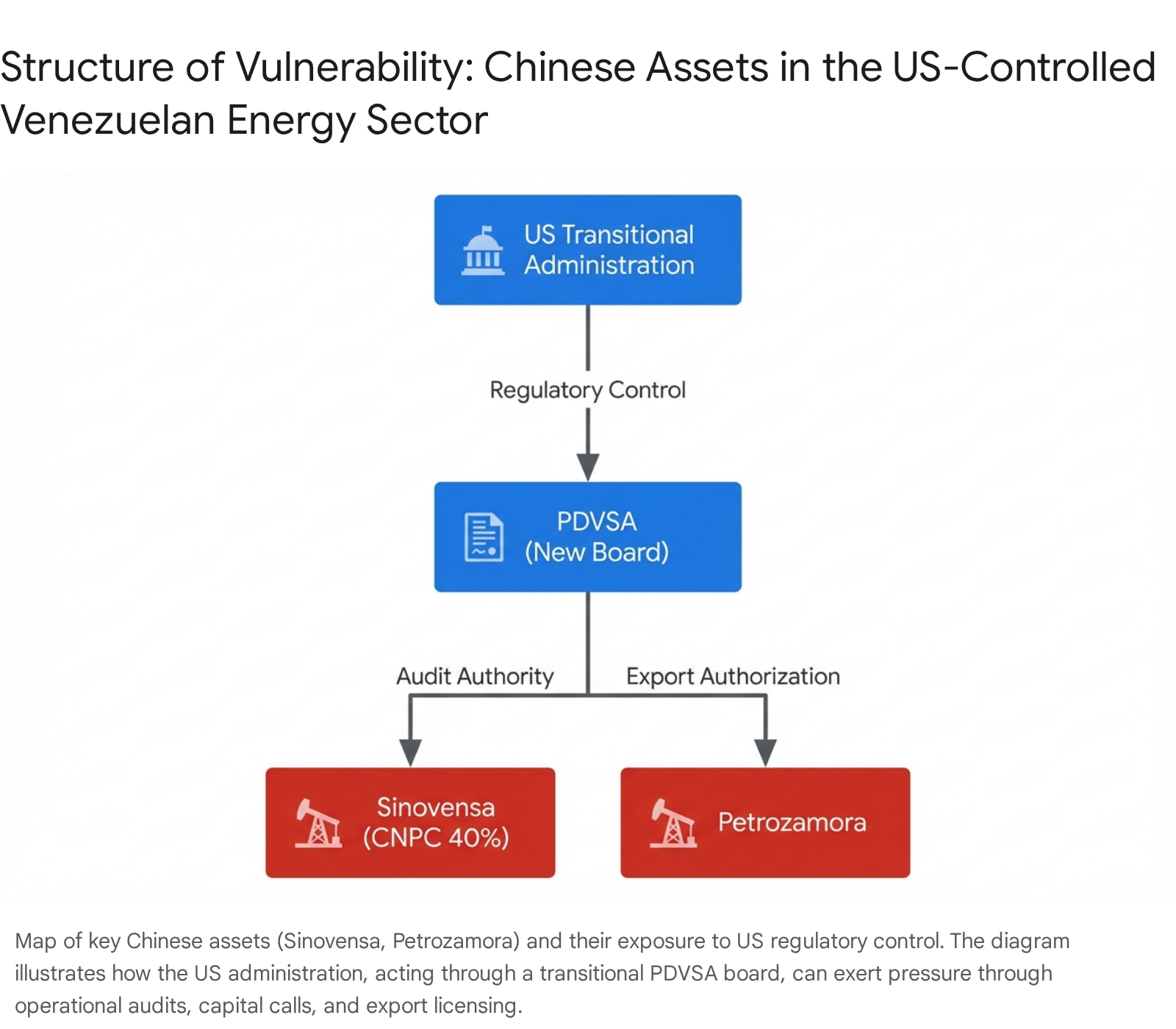
These assets are now in a precarious position. The US administration has declared that “American companies” will be tasked with revitalizing the industry.3 While formal expropriation of Chinese assets might violate bilateral investment treaties and invite retaliation against US firms in China, the US can achieve a de facto expulsion through regulatory strangulation.

The mechanisms for this “soft expropriation” are manifold:

  1. Operational Paralysis: The US-controlled PDVSA board can suspend the operational licenses of Chinese JVs pending “corruption audits” or “environmental reviews,” effectively freezing the assets.
  2. Sanctions Compliance: The US Treasury can maintain sanctions on specific JVs involving Chinese entities, preventing them from accessing the US financial system or importing essential diluents, while granting waivers to US-partnered JVs.
  3. Capital Call Dilution: The reconstruction of these fields requires massive capital injection. The new PDVSA board could issue capital calls for repairs. If Chinese partners cannot transfer funds due to US financial sanctions or internal risk aversion, their equity stakes would be diluted, eventually rendering them negligible.23
Structure of vulnerability: US regulatory control over Chinese assets in Venezuelan oil sector (Sinovensa, Petrozamora).

This strategy forces China into a “wait and see” posture. Chinese firms are unlikely to abandon their stakes voluntarily, but they may be forced into a dormant status, holding paper titles to assets they cannot operate or monetize, while US firms like Chevron and potential returnees like ExxonMobil assume operational dominance.

4. Geopolitical Repercussions: The Monroe Doctrine Revived

The US operation represents a definitive reassertion of the Monroe Doctrine—the 19th-century policy opposing external intervention in the Americas—modernized for the era of great power competition. For two decades, China has cultivated Venezuela as a strategic partner to counterbalance US influence in the Asia-Pacific. The “loss” of Venezuela effectively pushes China back across the Pacific, dismantling its most significant foothold in the Western Hemisphere.

4.1 The Collapse of the “All-Weather” Partnership

In September 2023, President Maduro visited Beijing, where he and President Xi Jinping signed a joint statement elevating relations to an “All-Weather Strategic Partnership”.1 This diplomatic tier implies a relationship that remains stable regardless of the international landscape. The capture of Maduro fundamentally invalidates this status. It demonstrates to the world, and particularly to other “Global South” nations, that Beijing cannot guarantee the security or political survival of its partners in the US “near abroad.”

This creates a crisis of confidence for other nations in the region that have courted Chinese investment, such as Bolivia, Nicaragua, and even Brazil under leftist leadership. The message from Washington is unequivocal: economic alignment with Beijing offers no shield against US security interests. This chilling effect may stall the expansion of the Belt and Road Initiative (BRI) across Latin America, as governments reassess the political risk of antagonizing Washington. The “Venezuela Model”—high-risk lending for resource access—is now visibly broken.2

4.2 The Cuban Dilemma: A Crisis on the Doorstep

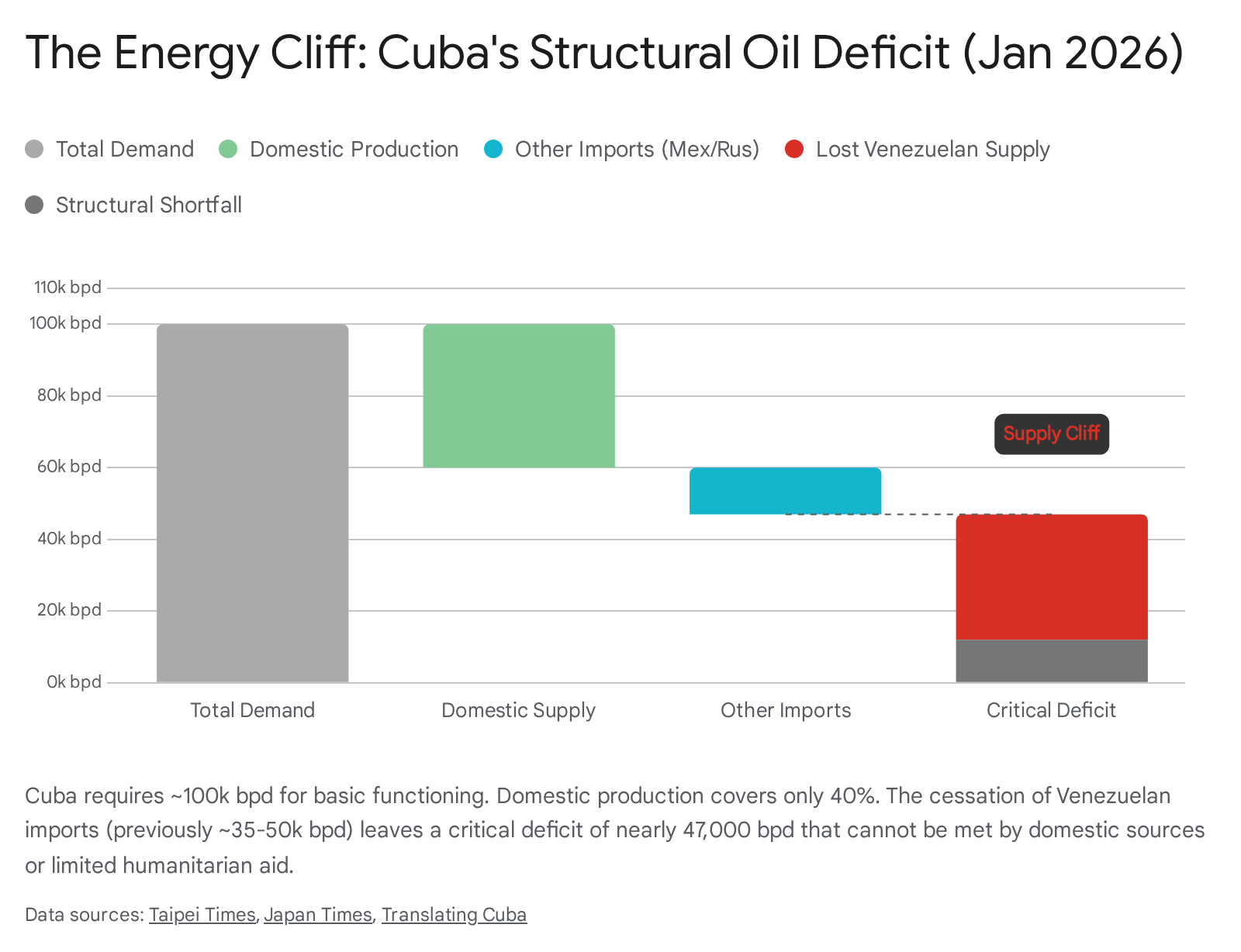
The impact on Cuba is collateral but catastrophic, presenting Beijing with an acute strategic dilemma. Venezuela has been Havana’s economic lifeline for two decades, providing roughly 50,000 to 60,000 barrels of oil per day at subsidized rates or in exchange for services (doctors, intelligence). This oil kept Cuba’s fragile power grid functioning and its economy afloat. The cessation of these shipments precipitates an existential energy crisis for the Cuban government, with experts predicting “total national blackouts” within weeks.25

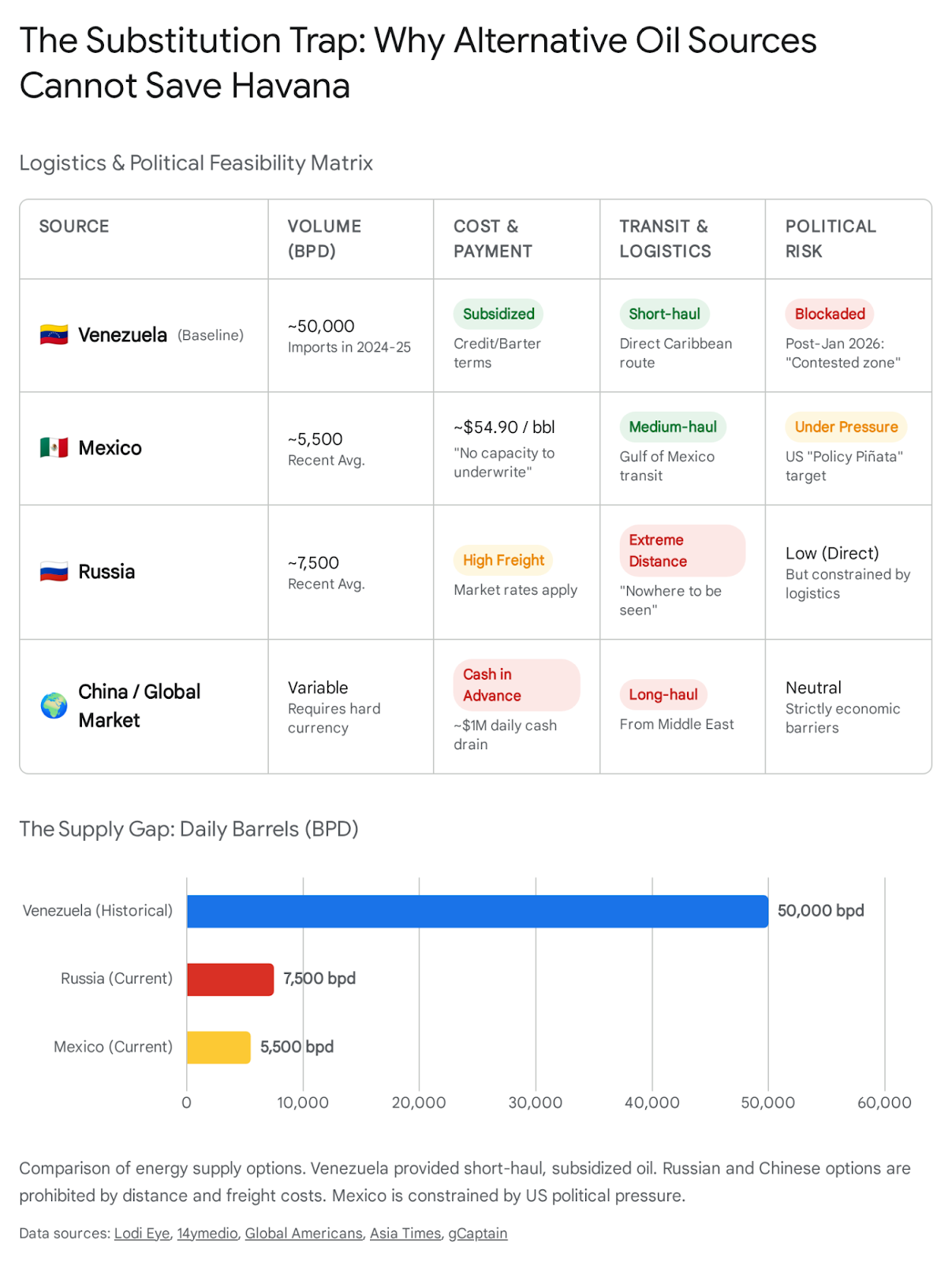
China is the only power capable of filling this void, but the costs are prohibitive. To replace Venezuelan supply, China would need to ship oil halfway around the world, incurring massive logistical costs. Furthermore, any direct “bailout” of Cuba would almost certainly trigger US secondary sanctions on the Chinese entities involved, given the US administration’s aggressive posture.

Beijing faces a binary choice:

  1. Intervene: Provide emergency oil and credit to stabilize the Cuban regime. This preserves a strategic ally and signals reliability to partners, but risks a direct escalation with the US during a delicate transition period and strains China’s own slowing economy.
  2. Abstain: Allow the Cuban crisis to unfold. This avoids US retaliation but risks the collapse of another socialist ally and confirms the “paper tiger” narrative regarding China’s ability to project power in the Americas.

Analysts suggest China will likely pursue a middle path: providing limited humanitarian aid and symbolic support while avoiding a full-scale energy bailout, effectively ceding the strategic initiative to the US.26

4.3 Strategic Signaling and the Taiwan Question

While US officials and international scholars caution against drawing direct parallels between Venezuela and Taiwan due to vastly different historical, legal, and military contexts, the psychological impact on Beijing is profound.2 The operation demonstrates the US willingness to execute a “decapitation” strategy—removing a leadership circle to effect regime change—and to use military force against a sovereign state to secure resource interests.

In Beijing, this reinforces the “Fortress China” mentality. It validates the People’s Liberation Army’s (PLA) focus on anti-access/area denial (A2/AD) capabilities to prevent a similar projection of US power near its shores. It may also accelerate China’s efforts to sanction-proof its own economy and leadership, knowing now that the US toolkit includes direct physical abduction of heads of state.

However, contrary to fears of immediate escalation, China’s response regarding Taiwan is likely to be cautious. The speed and efficacy of the US operation in Venezuela highlight the risks of a conflict with the US military. This may lead Beijing to double down on “gray zone” tactics—coercion below the threshold of war—rather than risking a military adventure that could invite a decisive US counter-response. The “Venezuela shock” is likely to induce a period of strategic reassessment in Beijing rather than immediate aggression.28

Lacking the military capacity to challenge the US in the Caribbean, China represents its interests through diplomatic and legal channels. The battle for the narrative—defining the legitimacy of the US intervention and the status of Venezuela’s obligations—is now the primary front of resistance for Beijing.

5.1 The UN Security Council and the “Global South”

China has strongly condemned the US operation as a “blatant violation of international law” and the UN Charter.5 At the UN Security Council, China, likely in coordination with Russia, will block any resolution that attempts to legitimize the US-installed transitional government. While the US does not need a UN resolution to maintain control on the ground, the lack of international legal recognition complicates the new government’s ability to access Venezuelan assets frozen abroad (e.g., gold in London) or to participate in formal multilateral institutions.29

China will use this platform to rally the “Global South,” framing the US action as a return to imperialist gunboat diplomacy. This narrative is designed to damage US soft power and consolidate China’s standing as the defender of national sovereignty and non-interference—core tenets of its foreign policy. This diplomatic obstructionism serves to delegitimize the US presence and raise the reputational cost of the occupation.30

5.2 Asymmetric Response: The Rare Earths Option

If the US moves to fully nullify Chinese assets in Venezuela, Beijing retains asymmetric economic options. The most potent of these is its dominance in the critical minerals supply chain. China controls approximately 90% of global rare earth refining capacity, materials essential for US defense technologies (including the very precision-guided munitions used in Venezuela) and, ironically, for the catalysts used in oil refining.2

China could implement stricter export controls on processed heavy rare earths, citing “national security” or “environmental compliance.” This would be a direct tit-for-tat response: “You squeeze our energy access; we squeeze your technology supply chain.” This lever is one of the few direct economic tools China has that can inflict pain on the US industrial base without triggering a full-scale kinetic conflict.

6. Future of Venezuelan Oil: The US Quagmire and the Long Road to Recovery

The US administration’s narrative suggests a rapid revitalization of the Venezuelan oil sector, with US majors “fixing” the broken infrastructure and flooding the market with crude.3 However, technical and economic realities suggest a much slower, more difficult path—a reality that China is undoubtedly calculating.

6.1 The Technical Reality: Decay and Capital Intensity

Venezuela’s oil infrastructure is in a state of advanced decay. Production has collapsed from 3.5 million bpd in 1997 to roughly 900,000 bpd today.32 Pipelines are rusted, reservoirs have been damaged by poor management (e.g., shutting in wells without proper procedure), and the sector has suffered a massive brain drain of technical talent.

Restoring this capacity is a monumental engineering task. Analysis by Rystad Energy estimates that returning production to 3 million bpd would require 16 years of sustained effort and $185 billion in capital investment.33 In the short term—the next 12 to 24 months—production is actually likely to fall or stagnate. The new US administration will need to purge the sector of Maduro loyalists, audit operations, and secure facilities against sabotage. The “immediate windfall” is a political fiction; the reality is a decade-long slog.

Table 1: The Reality Gap in Venezuelan Oil Reconstruction

MetricUS Political NarrativeTechnical/Industry Forecast
Recovery TimelineImmediate (“months”)10-16 Years to reach 3M bpd
Capital Requirement“Self-funding” via oil sales$180B – $200B external injection needed
Production TrajectoryRapid V-shaped recoveryL-shaped or slow incremental growth
Key ConstraintsPolitical will (“regime change”)Infrastructure rot, labor shortage, reservoir damage
Investor Appetite“Billions” from US majorsCautious; demand for legal certainty & debt settlement

Data derived from Rystad Energy 33, Wood Mackenzie 4, and industry analyst consensus.31

6.2 The Reluctance of US Majors

While President Trump has called for US companies to “go in,” the majors themselves—ExxonMobil, ConocoPhillips, and Chevron—are cautious. Exxon and Conoco have outstanding arbitration claims against Venezuela totaling billions of dollars from the Chavez-era expropriations.35 They will likely demand that these “legacy claims” be settled—perhaps through “sweat equity” or favorable royalty terms—before committing fresh capital.

This creates a closed loop where early oil revenues are diverted to pay off old US debts rather than funding reconstruction or state services. For China, this delay is strategically relevant. It means the “flood” of Venezuelan oil to the US Gulf Coast will not happen overnight. The global oil market will remain tight, and prices—including the Canadian WCS prices China must now pay—will remain elevated. This buys China time to secure alternative supplies, but it confirms that Venezuelan oil will be locked into the US sphere of influence for the foreseeable future.

7. Strategic Conclusions and Future Scenarios

The US seizure of Venezuela is a watershed moment that forces a fundamental restructuring of China’s approach to the Western Hemisphere. The era of the “All-Weather Partnership” fueled by loans-for-oil is effectively over.

7.1 Scenario A: The “Odious Debt” Precedent

If the US successfully guides the new Venezuelan administration to repudiate Chinese loans using the “odious debt” doctrine, the ripple effects will be global.

  • Mechanism: Legal classification of 2017-2025 loans as illegitimate and non-beneficial to the state.
  • Impact: A $19 billion write-down for Chinese state banks. More critically, it forces China to tighten lending terms for all BRI projects globally, demanding sovereign immunity waivers and tangible collateral outside the borrower country (e.g., ports), potentially sparking political backlash in Africa and Asia.
  • China’s Move: Beijing blocks Venezuela from accessing assets in jurisdictions where it has sway and utilizes the Asian Infrastructure Investment Bank (AIIB) to creating alternative norms that reject this classification.

7.2 Scenario B: The Asymmetric Standoff

China links energy access to technology access.

  • Mechanism: Beijing restricts exports of heavy rare earths or battery precursors to the US, citing the Venezuela intervention as a destabilizing act that requires “defensive” supply chain measures.
  • Impact: A potential “Grand Bargain” where China accepts a haircut on Venezuelan debt in exchange for continued access to certain mineral markets or US restraint in other theaters (e.g., tech sanctions).

7.3 Conclusion: The Defensive Pivot

Ultimately, China’s response will be defined by pragmatism. Unable to contest the US military fait accompli in the Caribbean, Beijing will pivot to damage control: securing what financial assets it can through international courts, diversifying its heavy oil sources to mitigate the price shock, and reinforcing its remaining partnerships in the Global South against similar “interventionist” risks. The “Caracas Pivot” marks the end of China’s offensive expansion in Latin America’s energy sector and the beginning of a defensive consolidation of its global supply lines.


Please share the link on Facebook, Forums, with colleagues, etc. Your support is much appreciated and if you have any feedback, please email us in**@*********ps.com. If you’d like to request a report or order a reprint, please click here for the corresponding page to open in new tab.


Sources Used

  1. Maduro’s downfall puts China’s relationship with Venezuela to the test, accessed January 6, 2026, https://english.elpais.com/international/2026-01-04/maduros-downfall-puts-chinas-relationship-with-venezuela-to-the-test.html
  2. What the US capture of Maduro means for China’s interests in Venezuela and beyond – CNA, accessed January 6, 2026, https://www.channelnewsasia.com/east-asia/us-venezuela-capture-maduro-china-latin-america-taiwan-implications-5817086
  3. Trump’s plan to seize and revitalize Venezuela’s oil industry faces major hurdles – AP News, accessed January 6, 2026, https://apnews.com/article/venezuela-oil-prices-trump-0c2c6ede79d550af53e6d3ddb51bfa04
  4. Venezuela regime change: what it means for oil production, crude and product markets, accessed January 6, 2026, https://www.woodmac.com/news/opinion/venezuela-regime-change-what-it-means-for-oil-production-crude-and-product-markets/
  5. Foreign Ministry Spokesperson’s Remarks on the U.S. Seizing Venezuelan President Nicolás Maduro and His Wife, accessed January 6, 2026, https://www.fmprc.gov.cn/eng/xw/fyrbt/202601/t20260104_11797389.html
  6. U.S.-Venezuela tensions: China says U.S. should immediately release Venezuela’s Maduro, accessed January 6, 2026, https://www.thehindu.com/news/international/china-says-us-should-immediately-release-venezuelas-maduro/article70470228.ece
  7. China’s oil investments in Venezuela – The Economic Times, accessed January 6, 2026, https://m.economictimes.com/news/international/world-news/chinas-oil-investments-in-venezuela/articleshow/126354640.cms
  8. Venezuela forced to double discount on oil to Asia due to flood of sanctioned crude, accessed January 6, 2026, https://boereport.com/2025/12/10/venezuela-forced-to-double-discount-on-oil-to-asia-due-to-flood-of-sanctioned-crude/
  9. US imposes sanctions on 4 Venezuelan oil firms and 4 more tankers in Maduro crackdown, accessed January 6, 2026, https://apnews.com/article/sanctions-oil-tankers-venezuela-trump-maduro-9ffee61472d248aafdc9d9bef6195c2e
  10. US Refiners Win, China Loses in Trump’s Venezuela Oil Play – Offshore Engineer Magazine, accessed January 6, 2026, https://www.oedigital.com/amp/news/534004-us-refiners-win-china-loses-in-trump-s-venezuela-oil-play
  11. Sanctions shake up $20B Chinese refinery, western partners pull out – The Economic Times, accessed January 6, 2026, https://m.economictimes.com/news/international/world-news/sanctions-shake-up-20b-chinese-refinery-western-partners-pull-out/articleshow/125588331.cms
  12. Why Did the United States Seize a Venezuelan Oil Shipment? – CSIS, accessed January 6, 2026, https://www.csis.org/analysis/why-did-united-states-seize-venezuelan-oil-shipment
  13. Treasury Targets Oil Traders Engaged in Sanctions Evasion for Maduro Regime, accessed January 6, 2026, https://home.treasury.gov/news/press-releases/sb0348
  14. US Intervention in Venezuelan Oil Drives Global Energy Disruption – Discovery Alert, accessed January 6, 2026, https://discoveryalert.com.au/strategic-petroleum-2026-us-venezuela-oil-disruption/
  15. Western Canada Select widens; Venezuela a longer-term risk, analysts say – BOE Report, accessed January 6, 2026, https://boereport.com/2026/01/05/western-canada-select-widens-venezuela-a-longer-term-risk-analysts-say/
  16. Heavy sour Canadian grades feel pressure in N America | Latest Market News, accessed January 6, 2026, https://www.argusmedia.com/en/news-and-insights/latest-market-news/2771891-heavy-sour-canadian-grades-feel-pressure-in-n-america
  17. Maduro capture: What’s at stake for China’s economic interests in Venezuela, accessed January 6, 2026, https://www.businesstimes.com.sg/international/maduro-capture-whats-stake-chinas-economic-interests-venezuela
  18. Maduro, Venezuela, the U.S.—and the oil shock China can’t price in | Probe International, accessed January 6, 2026, https://journal.probeinternational.org/2026/01/05/maduro-venezuela-the-u-s-and-the-oil-shock-china-cant-price-in/
  19. Systemic Illegitimacy, Problems, and Opportunities in Traditional Odious Debt Conceptions in Global, accessed January 6, 2026, https://scholarship.law.duke.edu/cgi/viewcontent.cgi?article=1439&context=lcp
  20. Venezuela’s Economic Crisis: Issues for Congress – EveryCRSReport.com, accessed January 6, 2026, https://www.everycrsreport.com/reports/R45072.html
  21. An Economic Framework for Venezuela’s Debt Restructuring – Harvard Kennedy School, accessed January 6, 2026, https://www.hks.harvard.edu/sites/default/files/degree%20programs/MPAID/files/Moatti%2C%20Thomas%20and%20Muci%2C%20Frank%20SYPA.pdf
  22. China’s Oil Investments in Venezuela – Energy News, Top Headlines, Commentaries, Features & Events – EnergyNow.com, accessed January 6, 2026, https://energynow.com/2026/01/chinas-oil-investments-in-venezuela/
  23. Concerns over damage to investment in Venezuela are being cited as the background of China’s increas.., accessed January 6, 2026, https://www.mk.co.kr/en/world/11924858
  24. US actions signal a return to imperialism, colonialism – Opinion – Chinadaily.com.cn, accessed January 6, 2026, https://www.chinadaily.com.cn/a/202601/04/WS695a2881a310d6866eb31d6c.html
  25. ‘Got free oil from Venezuela’: Why Cuba’s collapse looks inevitable after capture of Nicholas Maduro – WION, accessed January 6, 2026, https://www.wionews.com/photos/-got-free-oil-from-venezuela-why-cuba-s-collapse-looks-inevitable-after-capture-of-nicholas-maduro-1767531151243
  26. China decries U.S. action in Venezuela – even as it guards billions at stake – CNBC Africa, accessed January 6, 2026, https://www.cnbcafrica.com/2026/china-decries-u-s-action-in-venezuela-even-as-it-guards-billions-at-stake/
  27. U.S. strike in Venezuela unlikely to alter China’s Taiwan strategy: Scholars, accessed January 6, 2026, https://focustaiwan.tw/politics/202601040007
  28. ‘Dangerous Precedent’: Southeast Asia’s Response to US Venezuela Intervention, accessed January 6, 2026, https://thediplomat.com/2026/01/dangerous-precedent-southeast-asias-response-to-us-venezuela-intervention/
  29. Venezuela: Emergency Meeting : What’s In Blue, accessed January 6, 2026, https://www.securitycouncilreport.org/whatsinblue/2026/01/venezuela-emergency-meeting.php
  30. U.S. Seizure of Maduro Challenges China’s Non-Intervention Diplomacy, accessed January 6, 2026, https://moderndiplomacy.eu/2026/01/06/u-s-seizure-of-maduro-challenges-chinas-non-intervention-diplomacy/
  31. What role could the US play in Venezuela’s ‘bust’ oil industry?, accessed January 6, 2026, https://www.theguardian.com/business/2026/jan/04/venezuela-oil-industry-bust-what-role-could-the-us-play
  32. President Trump Wants Investments in Venezuelan Oil: What Are the Challenges? – AAF, accessed January 6, 2026, https://www.americanactionforum.org/insight/president-trump-wants-investments-in-venezuelan-oil-what-are-the-challenges/
  33. Dense, sticky and heavy: why Venezuelan crude oil appeals to US refineries – The Guardian, accessed January 6, 2026, https://www.theguardian.com/business/2026/jan/05/venezuelan-crude-oil-appeals-to-us-refineries
  34. Venezuela needs $183bn to revive oil output, Rystad says – Energy Voice, accessed January 6, 2026, https://www.energyvoice.com/oilandgas/americas/589136/venezuela-needs-183bn-to-revive-oil-output-rystad-says/
  35. U.S. oil companies won’t rush to re-enter shaky Venezuela, experts say, accessed January 6, 2026, https://www.cbsnews.com/news/venezuela-oil-maduro-chevron-exxon-mobil-conocophiillips/
  36. ConocoPhillips loses Venezuela compensation case | Latest Market News – Argus Media, accessed January 6, 2026, https://www.argusmedia.com/es/news-and-insights/latest-market-news/1952532-conocophillips-loses-venezuela-compensation-case

Operation Absolute Resolve: Strategic Implications of US Control over Venezuelan Energy Assets

This is a time-sensitive special report and is based on information available as of January 5, 2026. Due to the situation being very dynamic the following report should be used to obtain a perspective but not viewed as an absolute.

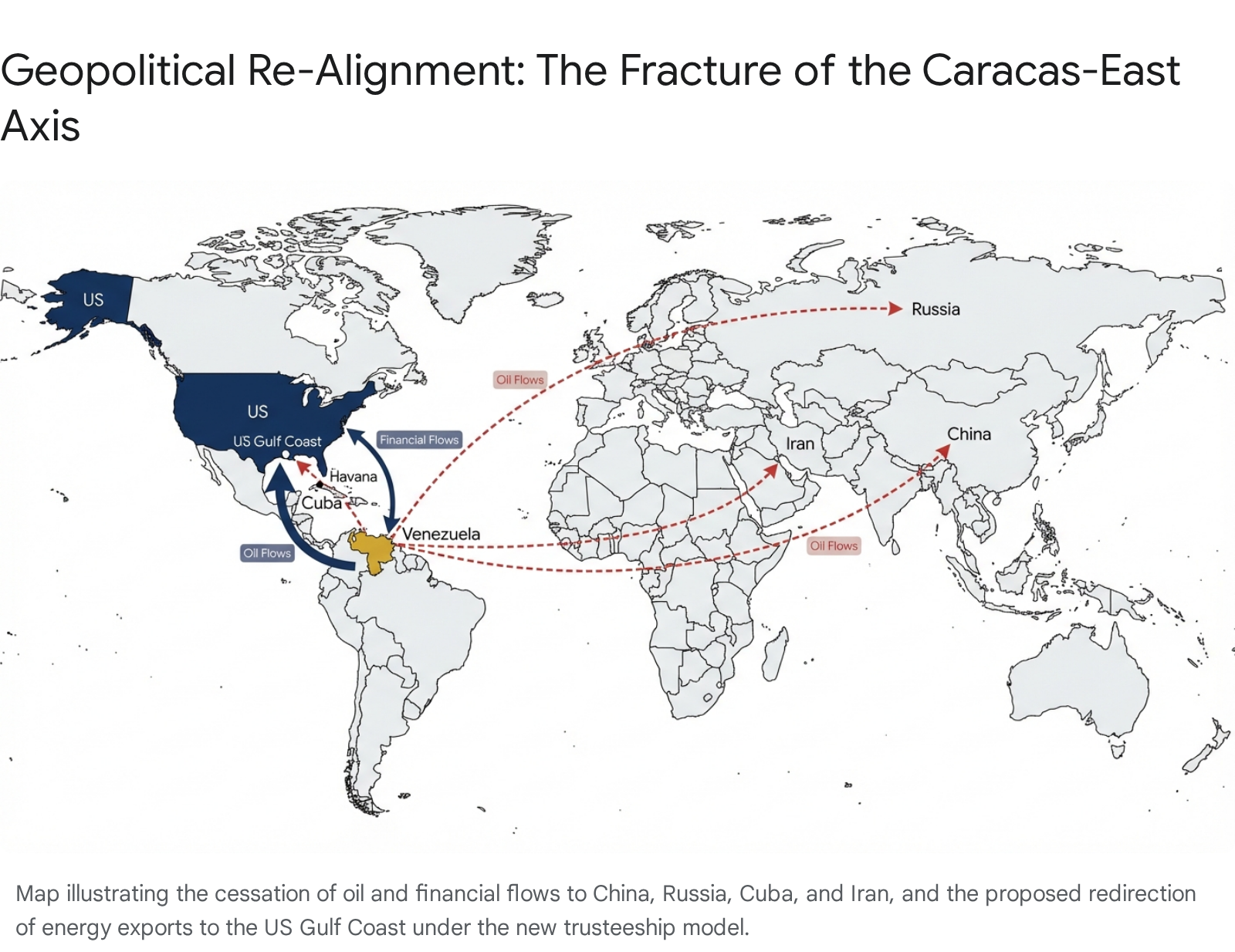
The military intervention in Venezuela, designated operationally as “Operation Absolute Resolve,” marks a definitive inflection point in the geopolitical history of the Western Hemisphere. The seizure of President Nicolás Maduro and the subsequent assertion of a United States-led “trusteeship” over the nation’s energy infrastructure represents more than a regime change operation; it is a fundamental restructuring of the global energy architecture. By placing the world’s largest proven oil reserves under direct US administration, Washington has effectively removed a critical node from the geopolitical “Axis of Resistance”—comprising China, Russia, and Iran—and reoriented Venezuela’s economic gravity back toward the North American energy orbit.

This report, authored by a collaborative team of national security, foreign affairs, and energy market analysts, provides an exhaustive assessment of the cascading impacts of this intervention. Our analysis suggests that the immediate objective extends beyond the removal of a hostile governing clique. The operation serves as a forceful implementation of “Resource Realism,” a doctrine that prioritizes the physical control of strategic assets over traditional diplomatic engagement. The administration’s explicit goal to “reimburse” US intervention costs through Venezuelan oil revenue 1 creates a legal and financial precedent that subordinates sovereign debt obligations to the operational imperatives of the occupying power.

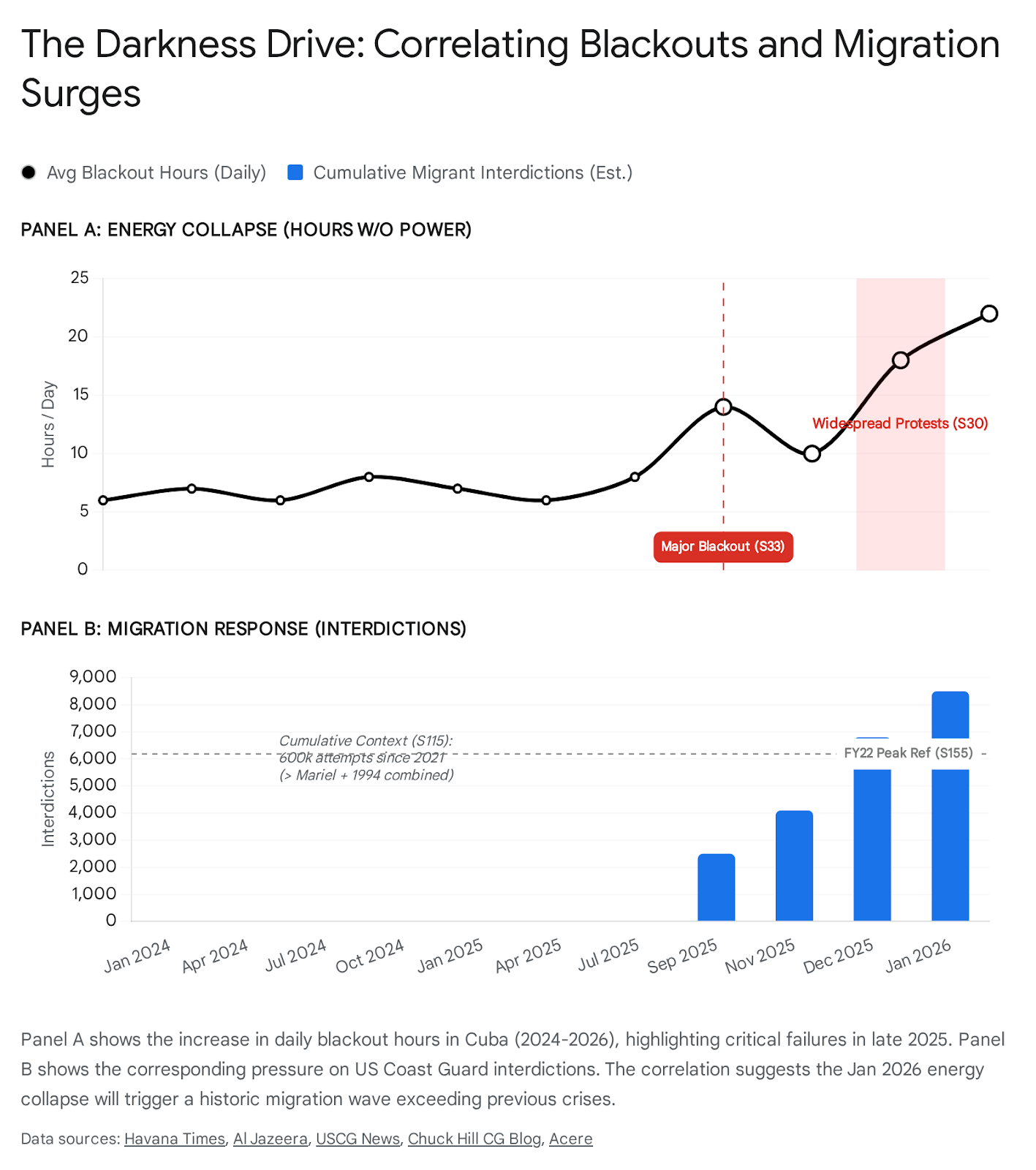
The most acute and immediate impact will be the existential crisis facing Cuba. With Venezuela previously supplying between 40% and 60% of the island’s energy needs through favorable barter arrangements, the abrupt cessation of these flows threatens to precipitate a total collapse of the Cuban electric grid within the current calendar year. This development raises the specter of a humanitarian catastrophe and a mass migration event of a magnitude not seen since the Mariel boatlift. Simultaneously, China faces a “sunk cost” dilemma of historic proportions, with an estimated $10–20 billion in oil-backed loans at risk of nullification under the “Odious Debt” doctrine.

Contrary to the optimistic political rhetoric suggesting a rapid recovery, our forensic analysis of the Venezuelan oil sector indicates a profound “Reality Gap.” The infrastructure of Petróleos de Venezuela, S.A. (PDVSA) suffers from catastrophic degradation. While political leadership suggests a recovery timeline of 18 months, industry consensus points to a requirement of nearly $100 billion in capital investment over a decade to restore production to pre-Chávez levels. Consequently, the “Venezuela Premium” in global oil markets will shift from a risk of supply disruption to a “Reconstruction Lag,” where the anticipated flood of new supply is delayed by technical and legal realities.

This report maps the chain of impacts across the globe, analyzes the legal mechanisms of the takeover, and forecasts the reshaping of the Western Hemisphere’s energy markets, including the displacement of Canadian crude and the nullification of Russian strategic depth in the region.

1. The Strategic Calculus of Operation Absolute Resolve

The transition from a decade-long policy of sanctions and diplomatic isolation to direct kinetic intervention and asset seizure represents a paradigm shift in United States foreign policy. While the operation was framed publicly as a law enforcement action to apprehend indicted “narco-terrorists,” the strategic underpinnings reveal a calculated effort to dismantle the economic lifelines of US adversaries in the Western Hemisphere.

Map: Geopolitical realignment after fracture of Caracas-East axis. Oil flows shift to US Gulf Coast. "Operation Absolute Resolve

1.1 The Doctrine of “Reimbursement” and Trusteeship

Central to the post-intervention strategy is the concept of “reimbursement,” articulated by President Trump immediately following the operation. The declaration that the US will “run” Venezuela until stability is achieved, and that American oil companies will be “reimbursed” for their investments and the nation’s reconstruction costs through oil revenue 1, introduces a de facto trusteeship model. This approach is distinct from nation-building efforts in Iraq or Afghanistan; it is explicitly transactional, treating the Venezuelan state’s primary asset as collateral for the intervention itself.

The “reimbursement” mechanism implies a rigid hierarchy of revenue distribution that fundamentally alters the sovereign risk profile of the country. Revenue generated from the rehabilitation of fields in the Orinoco Belt or the Lake Maracaibo basin will likely be ring-fenced within US-controlled escrow accounts. The prioritization of claims is expected to follow a specific order:

  1. Operational Expenditures (OpEx): Immediate payments to US operators (e.g., Chevron, Halliburton) to maintain flow assurance.
  2. Capital Recovery (CapEx): Repayment of new infrastructure investments required to resuscitate the grid and pipelines.
  3. Intervention Costs: Direct reimbursement to the US Treasury for the logistical and military costs of Operation Absolute Resolve.
  4. Sovereign Debt and State Budget: Only after these primary tranches are satisfied would residual revenue flow to the Venezuelan central bank or legacy creditors.

This structure explicitly subordinates the claims of existing creditors—most notably China and Russia—and creates a legal and financial firewall around Venezuelan production. It effectively treats PDVSA not as a national oil company (NOC) in the traditional sense, but as a distressed asset under administration.3

1.2 Intent Analysis: Deliberate Choking vs. Secondary Effect

A critical question posed by observers is whether the choking of oil flows—and the consequent starvation of hard currency to the Maduro regime—was a deliberate goal of the US government or a secondary outcome of the “narco-terrorism” operation. Our analysis of the timeline and enforcement mechanisms confirms that the economic strangulation was a deliberate, primary strategic objective.

The evidence for this intent is found in the escalation sequence preceding the kinetic operation. The US administration systematically tightened the blockade on the “shadow fleet”—the network of ghost tankers used by PDVSA to evade sanctions.4 By targeting specific vessels like the Nord Star and Lunar Tide, and sanctioning their registered owners just days before the operation 6, the US effectively severed the financial capillaries that kept the regime solvent.

Furthermore, the immediate post-operation blockade of tankers bound for Cuba and China 7 indicates a pre-planned effort to weaponize energy dominance. The goal was twofold: to degrade the regime’s ability to pay its security services in the final hours, and to deny US adversaries (China and Iran) a secure source of energy and revenue. The operation fulfills the administration’s stated geopolitical ambition that “American dominance in the western hemisphere will never be questioned again”.8 The dismantling of the oil-for-loans infrastructure was not collateral damage; it was the target.

1.3 The “Putinization” of US Foreign Policy?

International observers have noted a convergence in style between the US action and the spheres-of-influence strategies typically associated with Russia. Commentators have termed this the “Putinization of US foreign policy,” characterized by the use of overwhelming force to determine political outcomes in the “near abroad”.9 However, unlike the Russian approach in Ukraine, the US strategy in Venezuela relies heavily on the subsequent mobilization of private capital (US oil majors) to consolidate the gain, blending state military power with corporate industrial capacity.

2. The Asset: Forensic Audit of the Venezuelan Oil Industry

The “prize” secured by US forces—the world’s largest proven oil reserves, estimated at over 300 billion barrels—is, in immediate practical terms, a deeply distressed asset. There is a profound disconnect between the political rhetoric of immediate wealth generation and the industrial reality on the ground.

2.1 The Infrastructure Deficit

Decades of mismanagement, the “brain drain” following the 2002–2003 PDVSA strikes, and stringent sanctions have left the industry in a state of collapse. Production has fallen from a peak of approximately 3.5 million barrels per day (bpd) in the late 1990s to roughly 1 million bpd at the time of the intervention.10

Upstream Decay: The unique geology of Venezuela’s Orinoco Belt requires constant diligence. The extra-heavy crude produced there must be diluted or upgraded immediately to be transportable. Due to the lack of diluents (previously imported from Iran or the US) and the failure of upgraders, thousands of wells have been shut in. Once shut, these wells often suffer from reservoir damage that makes reactivation economically unviable; they do not simply turn back on.12

Downstream Paralysis: The refining sector is in equally dire straits. The Paraguaná Refining Center, once one of the largest in the world with a capacity of 940,000 bpd, is operating at roughly 10% capacity.13 Critical units for producing gasoline and diesel are offline due to a lack of spare parts and catalytic agents. Pipelines crossing Lake Maracaibo are riddled with leaks, creating an ecological disaster that complicates immediate reactivation.14

2.2 The Recovery Timeline and Cost: The Reality Gap

President Trump’s suggestion that oil production could ramp up significantly within “18 months” 15 stands in stark contrast to industry consensus.

  • Political Forecast: The administration envisions a rapid turnaround where US efficiency quickly restores output, funding the intervention and stabilizing the global market.
  • Industry Reality: Experts and analysts, including those from Rice University and Rystad Energy, estimate that restoring production to the 3–4 million bpd level will require between $80 billion and $100 billion in capital investment over a period of 7 to 10 years.11

This “Reality Gap” is substantial. Even under the most optimistic scenarios, where US firms assume immediate operational control, output is unlikely to exceed 1.5 million bpd within the first 2–3 years.17 The initial phase of “recovery” will likely consist of stabilizing current decline rates and repairing critical safety infrastructure rather than a boom in new exports.

2.3 The Role of US Majors

While the US President claims American oil companies are “prepared” to enter, the corporate reality is one of extreme caution.

  • Chevron: As the only US major currently operating in Venezuela (under previous OFAC waivers), Chevron is the linchpin of the immediate stabilization plan. They currently ship approximately 150,000 bpd to the US 18 and have the most up-to-date knowledge of the reservoir conditions.
  • ExxonMobil & ConocoPhillips: These firms were expropriated by Hugo Chávez and hold outstanding arbitration awards worth billions ($1.6 billion and $12 billion+, respectively).19 Their return is contingent not just on security, but on the settlement of these past debts. It is highly unlikely they will commit new shareholder capital without a “sovereign guarantee” or a mechanism that prioritizes their debt recovery from new production revenues.20

3. The Primary Casualty: Cuba’s Existential Crisis

The most immediate, severe, and potentially destabilizing impact of the US takeover of Venezuelan oil will be felt not in Caracas, but in Havana. For two decades, Venezuela has been the economic guarantor of the Cuban Revolution, a relationship that is now effectively terminated.

3.1 Energy Dependence and the mechanism of Collapse

Cuba relies on Venezuela for between 40% and 60% of its total oil consumption. This oil was not purchased on the open market but provided through favorable cooperation agreements, often involving the exchange of Cuban medical personnel, intelligence agents, and security advisors for crude oil and refined products.21

The mechanics of this trade have already been disrupted. In the months leading up to the intervention, Venezuelan exports to Cuba plummeted from ~80,000 bpd to near zero due to the US blockade and the seizure of tankers like the Liza and Sandino.22 With the US military now controlling the export terminals at Jose and Puerto Miranda, the possibility of resuming these “solidarity shipments” is non-existent.

Grid Failure: The Cuban electric grid is antiquated, fragile, and almost entirely dependent on floating Turkish power ships and obsolete Soviet-era thermoelectric plants that burn Venezuelan heavy fuel oil. The loss of this specific grade of fuel is catastrophic. Without it, the grid cannot function. Reports indicate that blackouts are already extending to 12–18 hours a day.23 A total collapse of the National Electric System (SEN) is projected within months.

3.2 Regime Stability and Mass Migration

The US administration explicitly views the collapse of the Cuban regime as a likely corollary to the Venezuelan operation. President Trump has stated, “I think it’s just going to fall”.24 The logic is cold but sound: without Venezuelan oil, Havana lacks the hard currency to purchase fuel on the open market, especially given its own economic crisis and US sanctions.

Migration Crisis: The inevitable result of a permanent blackout and economic paralysis is a mass migration event. We forecast a surge in maritime migration toward Florida in mid-to-late 2026 that could dwarf the 1980 Mariel boatlift and the 1994 rafter crisis. This poses a significant domestic political challenge for the US administration, which must balance its pressure campaign with the optics of a humanitarian disaster on its shores.

Regional Isolation: Mexico, which briefly provided emergency fuel shipments in late 2025, has signaled it cannot sustain Cuba. Faced with its own production constraints and the risk of antagonizing a belligerent US administration, Mexico has reduced its aid, leaving Cuba with no alternative lifeline.22

4. The Great Power Pivot: China and the Sunk Cost Fallacy

For the People’s Republic of China, the US intervention represents a massive financial loss and a significant strategic setback. Venezuela was one of the largest recipients of Chinese development finance in the world, a relationship built on the “loans-for-oil” model.

4.1 The Financial Blow: $20 Billion at Risk

China is Venezuela’s largest creditor, with outstanding loans estimated between $10 billion and $20 billion.25 These loans were structured to be repaid in oil shipments, a mechanism that functioned reasonably well until the intensification of sanctions.

Under the new US trusteeship, these debts are in jeopardy. The US strategy likely involves classifying these loans not as sovereign obligations of the Venezuelan state, but as distinct liabilities incurred by the Maduro regime to sustain its grip on power. This classification paves the way for the invocation of the “Odious Debt” doctrine (discussed further in Section 9), which would legally subordinate or nullify China’s claims in favor of US reconstruction costs and pre-Chávez creditors.26

4.2 Asset Vulnerability and Supply Chains

Chinese state-owned enterprises (SOEs), specifically China National Petroleum Corporation (CNPC) and Sinopec, hold significant minority stakes in joint ventures such as Petrosinovensa.27

  • Operational Loss: While CNPC technically owns shares in these fields, their ability to lift oil or influence operations is now zero. The US occupation forces control the physical infrastructure. It is expected that these JVs will be placed under “administrative review,” effectively freezing Chinese equity.
  • Supply Diversion: Approximately 470,000 bpd of Venezuelan crude flowed to China in 2025, largely to independent “teapot” refiners in Shandong province who thrived on the discounted heavy crude.27 This flow has been severed. China must now replace this volume, likely by increasing imports from Iran or Russia. This tightens the “shadow market” and potentially raises costs for Chinese independent refiners, though the global impact is mitigated by weak demand growth in China.

4.3 Diplomatic Stance

Beijing has publicly condemned the US action, emphasizing the inviolability of sovereignty. However, China’s response is constrained by its own economic slowdown and the desire to avoid a direct military confrontation in the Western Hemisphere. China’s strategy will likely focus on “damage control”—using international courts and diplomatic leverage to try and salvage some financial value from its investments, though expectations of a total write-down are high.26

5. The Russian Retreat and Iranian Disconnect

The operation effectively dismantles the “Axis of Resistance” presence in Latin America, dealing a blow to Russian prestige and Iranian logistical networks.

5.1 Russia: Geopolitical Eviction

For Moscow, Venezuela was a strategic beachhead—a way to project power into the US “near abroad” in reciprocity for US presence in Eastern Europe.

  • Roszarubezhneft: This state entity was created specifically to take over Rosneft’s Venezuelan assets in 2020 to shield the parent company from sanctions.30 These assets, including stakes in the Petromonagas upgrader, are now under US control. The physical loss of these fields represents a write-off of billions of dollars in investment.12
  • Strategic Defeat: The intervention serves as a demonstration of Russia’s inability to protect its distant allies. The “Putinization” of US policy essentially beats Russia at its own game, using overwhelming force to secure a sphere of influence and evicting a rival power.9
  • Market Upside? Ironically, Russia may benefit marginally in the short term. The removal of Venezuelan oil from the “shadow market” reduces competition for Russian Urals crude in India and China, potentially allowing Russia to command a higher price from these buyers.31

5.2 Iran: Loss of a Strategic Node

The relationship between Caracas and Tehran was symbiotic, driven by mutual isolation.

  • Condensate Swaps: The trade mechanism involved Iran sending condensate (a light oil needed to dilute Venezuela’s sludge-like crude) in exchange for Venezuelan heavy oil.32 This allowed both nations to sustain production. With US control of the import terminals, this swap is impossible, furthering the degradation of whatever Venezuelan production capacity remains in the short term.
  • Sanctions Evasion Hub: Venezuela served as a “laundromat” for Iranian oil—a place to re-flag vessels, transfer cargoes, and obscure the origin of crude destined for global markets. The loss of PDVSA infrastructure removes a critical node in this network, forcing Iran to restructure its evasion logistics at significant cost.33
  • Financial Loss: Iran’s documented $2 billion in loans/projects (housing, car manufacturing) and undocumented military cooperation debts are likely unrecoverable.34

6. North American Energy Architecture

The re-integration of Venezuela into the US energy orbit is the most significant structural shift in the North American energy market since the Shale Revolution.

6.1 The US Gulf Coast: The Natural Home for Heavy Crude

The US Gulf Coast (USGC) refining complex is the world’s largest consumer of heavy, sour crude. These refineries (owned by Valero, Marathon, and Citgo) invested billions in “coking” capacity specifically to process Venezuelan oil. Since the sanctions in 2019, they have had to source suboptimal replacements from Russia (before 2022) or compete for limited Canadian barrels.

  • Refinery Optimization: The return of Venezuelan Merey crude is a massive boon for US refiners. It allows them to optimize their slates, producing higher margins of diesel and jet fuel. Citgo, a US-based subsidiary of PDVSA, is particularly well-positioned to reintegrate this supply chain.35
  • Citgo’s Fate: The ownership of Citgo is currently entangled in court battles over Venezuela’s defaulted bonds. A US-led “trusteeship” might pause the breakup of Citgo, preserving it as the downstream arm of the reconstructed Venezuelan oil industry to ensure refining capacity for the new production.

6.2 The “Loser”: Canadian Oil Sands

The primary economic casualty of Venezuela’s return, outside of the Axis of Resistance, is Canada.

  • Competition: Canadian Western Canadian Select (WCS) is a direct competitor to Venezuelan Merey. Both are heavy, sour crudes. Currently, Canada enjoys a near-monopoly on heavy crude imports to the US Midwest and Gulf Coast due to the absence of Venezuelan barrels.
  • Price Impact: As Venezuelan volumes ramp up (in the medium term), they will displace heavy crude currently imported from Canada via pipeline and rail. This increased supply competition at the Gulf Coast will likely widen the WCS-WTI differential, effectively lowering the price Canadian producers receive for their oil.36
  • Strategic Imperative: This development makes the Trans Mountain pipeline expansion (shipping Canadian oil to Asia) existentially important for the Canadian energy sector, as the US market becomes saturated with “reimbursed” Venezuelan oil.
Heavy crude supply routes map: Alberta to US Gulf Coast via pipeline, Venezuela via tanker. "The Battle for the Gulf.

7. European Ambivalence and the Atlantic Rift

The reaction from Europe highlights a growing rift in the transatlantic alliance, torn between adherence to international law and energy pragmatism.

7.1 Diplomatic Fracture

European leaders have been visibly uncomfortable with the unilateral nature of the US operation.

  • Spain: As the former colonial power and a major investor, Spain has led the condemnation. Prime Minister Pedro Sánchez, along with leaders from Mexico and Colombia, issued a joint statement rejecting the military operation as a violation of international law.37 This reflects domestic political pressure from left-wing coalition partners but also genuine concern over the precedent of “gunboat diplomacy.”
  • United Kingdom: The UK response has been notably cautious. Prime Minister Keir Starmer has distanced London from the operation (“we were not involved”) but stopped short of condemnation, prioritizing the “special relationship” and potential energy security benefits.39
  • Italy: The Italian government, led by Giorgia Meloni, offered a more supportive stance, framing the action as “legitimate self-defense” against narco-trafficking, likely reflecting Italy’s own hardline stance on organized crime and desire for close ties with the US administration.37

7.2 The Energy Compromise: Repsol and Eni

The key variable for Europe is the fate of its energy majors, Repsol (Spain) and Eni (Italy). Unlike US firms, these companies maintained operations in Venezuela through “oil-for-debt” swaps authorized by the US State Department.

  • Debt Holdings: Eni is owed approximately $2.3 billion, and Repsol is owed roughly €586 million.40
  • Future Status: The US administration faces a choice. It can subordinate these claims (lumping them with China/Russia) or offer a “transatlantic compromise” where Repsol and Eni are allowed to remain as junior partners to US operators. Given the need for technical expertise and political cover, it is likely that the US will allow these firms to continue lifting oil, provided they adhere to the strict “trusteeship” revenue rules. This creates a wedge: Spain may condemn the invasion politically, but its flagship company will likely participate in the economic aftermath.

8. Regional Ripple Effects: Latin America

The intervention has shattered the unspoken norms of Latin American sovereignty, forcing regional powers to realign.

8.1 Colombia: The Border Crisis

Colombia faces the most complex fallout.

  • Short-term Crisis: The immediate aftermath involves a security crisis on the border. Remnants of the Maduro regime, armed “Colectivos,” and ELN guerrillas may flee into the porous border regions, destabilizing Colombian security.41
  • Long-term Gain: However, if the US-led stabilization succeeds, Colombia stands to gain the most. A recovering Venezuelan economy would reverse the migration flow, alleviating the burden of the 2.8 million Venezuelan refugees currently straining Colombia’s social services. The reopening of trade would also revitalize the Colombian border economy.42

8.2 Guyana: The End of the Essequibo Threat

For Guyana, the US intervention is an unmitigated security guarantee. The Maduro regime had increasingly threatened to annex the oil-rich Essequibo region. With the US military effectively guaranteeing the new Venezuelan government, this territorial threat vanishes. The US will likely broker a diplomatic freeze on the dispute to ensure stability for ExxonMobil, which operates massive offshore fields in both Guyana and Venezuela.

8.3 India: The Forgotten Stakeholder

India remains a silent but significant loser. Indian state companies ONGC Videsh and Indian Oil Corp have entitlements to Venezuelan oil.43 Like China, India invested in Venezuela to diversify its energy security. These assets are now in limbo. However, unlike China, India is a strategic partner of the US. We anticipate a diplomatic workaround where Indian firms may be compensated or allowed to retain passive stakes, provided the oil flows are transparent and do not support “Axis” interests.

9. The Financial Warfare Precedent: Mechanism of Control

The US strategy relies on a novel combination of domestic legal frameworks and raw power to reshape the Venezuelan economy.

9.1 The “Odious Debt” Weapon

To make the economics of rebuilding work, the US cannot service Venezuela’s existing ~$150 billion debt mountain. We anticipate the US will encourage the new transitional government to declare debts incurred by the Maduro regime (especially to China and Russia) as “Odious Debt”.

  • Legal Theory: The doctrine of Odious Debt holds that debt incurred by a despotic regime for purposes that do not serve the best interests of the nation should not be enforceable against the people of that nation after the regime falls.44
  • Application: Legal opinions will likely argue that loans from China and Russia sustained an illegitimate “narco-terrorist” regime and are therefore personal liabilities of the Maduro clique.
  • Impact: This would theoretically clear the balance sheet for US investors. However, it is a “nuclear option” in sovereign finance that would trigger years of litigation in New York and London courts and potentially chill Chinese lending to other developing nations.

Table 1: The Creditor Hierarchy Under US Trusteeship

Creditor CategoryEstimated DebtLikely Status Under TrusteeshipStrategic Rationale
US Majors (Exxon/Conoco)~$15 BillionPriority Recovery“Reimbursement” for expropriation; crucial for technical reentry.
Bondholders (Wall St)~$60 BillionRestructuredLikely hair-cut but recognized to maintain access to capital markets.
China (Loans-for-Oil)~$12-20 BillionAt Risk / “Odious”Viewed as sustaining the adversary; likely subordinated or voided.
Russia (Rosneft/State)~$3-5 BillionVoidedTreated as hostile state financing; total write-down expected.
Commercial Suppliers~$15 BillionCase-by-CaseEssential suppliers paid; others written off.

9.2 The Role of OFAC

The Office of Foreign Assets Control (OFAC) will pivot from sanctions enforcement to being the gatekeeper of the Venezuelan economy.

  • Licensing: Instead of general licenses, OFAC will issue specific licenses to US-aligned firms to enter and operate.
  • Revenue Escrow: Oil revenues will likely be deposited into US-controlled escrow accounts (similar to the Iraq “Oil-for-Food” mechanism but more restrictive) to ensure funds are used strictly for approved “reimbursement” and humanitarian aid, bypassing any remaining Chavista bureaucracy.45

10. Conclusion and Future Outlook

The US operation in Venezuela signifies the end of the post-Cold War era of “soft power” in the Western Hemisphere and the beginning of an era of Resource Realism.

For the Venezuelan People: This intervention promises a potential end to the humanitarian disaster of the last decade, but at the cost of national sovereignty. The country faces a long, painful economic trusteeship where its primary resource is mortgaged to pay for its own “liberation.”

For Global Energy Markets: The “Venezuela Premium” (risk of supply disruption) is replaced by the “Reconstruction Lag.” The world will not be flooded with Venezuelan oil tomorrow. The technical reality of the degraded fields means supply will return slowly, over a decade. However, by 2030, a US-aligned Venezuela could act as a significant counterweight to OPEC+ discipline, cementing North American energy dominance for the mid-21st century.

For Geopolitics: The message to US adversaries is stark: economic investments in the US “near-abroad” are insecure and subject to forcible liquidation. China and Russia have learned that without the ability to project military force to protect them, their financial assets in the Western Hemisphere are vulnerable to the stroke of a pen—or the arrival of a carrier strike group.


Please share the link on Facebook, Forums, with colleagues, etc. Your support is much appreciated and if you have any feedback, please email us in**@*********ps.com. If you’d like to request a report or order a reprint, please click here for the corresponding page to open in new tab.


Sources Used

  1. Trump suggests US taxpayers could reimburse oil firms for Venezuela investment, accessed January 6, 2026, https://www.theguardian.com/business/2026/jan/06/trump-us-taxpayers-oil-firms-venezuela-investment
  2. Machado welcomes ‘huge step for humanity’ – as it happened, accessed January 6, 2026, https://www.theguardian.com/world/live/2026/jan/05/venezuela-live-updates-trump-us-interim-president-collaborate
  3. US: Oil and energy companies’ shares rise after intervention in Venezuela, accessed January 6, 2026, https://www.business-humanrights.org/en/latest-news/us-oil-and-energy-companies-shares-rise-after-intervention-in-venezuela/
  4. Chevron Resumes Exports of Venezuelan Oil to US fter Four-Day Pause – Marine Link, accessed January 6, 2026, https://www.marinelink.com/news/chevron-resumes-exports-venezuelan-oil-us-534027
  5. US announces additional sanctions on four oil companies amid Venezuela tensions, accessed January 6, 2026, https://www.jurist.org/news/2026/01/us-announces-additional-sanctions-on-4-venezuela-oil-companies-amid-maduro-crackdown/
  6. Treasury Targets Oil Traders Engaged in Sanctions Evasion for Maduro Regime, accessed January 6, 2026, https://home.treasury.gov/news/press-releases/sb0348
  7. Venezuela crude flows slow, Cuba feels sting | Latest Market News, accessed January 6, 2026, https://www.argusmedia.com/en/news-and-insights/latest-market-news/2766638-venezuela-crude-flows-slow-cuba-feels-sting
  8. How Trump’s Venezuela Takeover Could Change the World, accessed January 6, 2026, https://time.com/7343019/venezuela-trump-oil-china/
  9. The ‘Putinization’ of US foreign policy has arrived in Venezuela, accessed January 6, 2026, https://www.theguardian.com/world/2026/jan/03/putin-russia-us-foreign-policy-venezuela
  10. Venezuela: The Post-Maduro Oil, Gas and Mining Outlook, accessed January 6, 2026, https://www.americasquarterly.org/article/venezuela-the-post-maduro-oil-gas-and-mining-outlook/
  11. Venezuela oil plan: Donald Trump’s takeover idea unlikely to shift global prices soon; analysts flag hurdles, accessed January 6, 2026, https://timesofindia.indiatimes.com/business/international-business/venezuela-oil-plan-donald-trumps-takeover-idea-unlikely-to-shift-global-prices-soon-analysts-flag-hurdles/articleshow/126337786.cms
  12. Venezuela moves to cut oil output due to US export embargo, accessed January 6, 2026, https://www.businesstimes.com.sg/companies-markets/energy-commodities/venezuela-moves-cut-oil-output-due-us-export-embargo
  13. Why Venezuela Struggles to Produce Oil Despite Having the World’s Largest Reserves, accessed January 6, 2026, https://www.investopedia.com/why-does-venezuela-struggle-with-oil-production-despite-having-the-worlds-largest-reserves-11879080
  14. Oil spills in Venezuela – pdvsa ad hoc, accessed January 6, 2026, https://pdvsa-adhoc.com/en/2025/06/oil-spills-in-venezuela/
  15. After U.S. military action in Venezuela, Trump talks about his future plans, accessed January 6, 2026, https://www.local10.com/news/world/2026/01/05/after-us-military-action-in-venezuela-trump-talks-about-his-future-plans/
  16. U.S. seeks to tap Venezuela’s vast oil reserves after military strikes. Here’s what to know., accessed January 6, 2026, https://www.cbsnews.com/news/venezuela-oil-reserves-us-strike-trump-what-to-know/
  17. Why oil-rich Venezuela pumps under 1% of global crude and can Trump push it?, accessed January 6, 2026, https://www.indiatoday.in/world/story/venezuela-oil-production-collapse-reasons-oil-rich-reserves-trump-us-companies-feasibility-investment-2846742-2026-01-05
  18. Explainer: Status of Foreign Oil Companies in Venezuela After Maduro’s Arrest, accessed January 6, 2026, https://www.oedigital.com/news/534029-explainer-status-of-foreign-oil-companies-in-venezuela-after-maduro-s-arrest
  19. US Sets Terms for Oil Giants in Venezuela: Invest First, Get Paid Later – Gotrade, accessed January 6, 2026, https://www.heygotrade.com/en/news/us-sets-terms-for-oil-giants-in-venezuela-invest-first-get-paid-later/
  20. Former Chevron executive seeks $2 billion for oil projects in Venezuela, accessed January 6, 2026, https://americanbazaaronline.com/2026/01/06/former-chevron-executive-seeks-2-billion-venezuela-oil-472665/
  21. Cuba is said to face potential breakdown as U.S. squeezes Venezuelan oil (CO1:COM:Commodity), accessed January 6, 2026, https://seekingalpha.com/news/4533853-cuba-is-said-to-face-potential-breakdown-as-u-s-squeezes-venezuelan-oil
  22. ​Is Cuba next after Maduro’s capture?, accessed January 6, 2026, https://asiatimes.com/2026/01/is-cuba-next-after-maduros-capture/
  23. Cuba hit with fifth blackout in less than a year with 10m people in the dark – The Guardian, accessed January 6, 2026, https://www.theguardian.com/world/2025/sep/10/cuba-electricity-power-blackout
  24. Maduro’s capture puts Cuba’s Venezuelan oil-dependent economy at risk, accessed January 6, 2026, https://www.foxbusiness.com/economy/maduros-capture-puts-cubas-venezuelan-oil-dependent-economy-risk
  25. For a long time, China has been Venezuela’s largest creditor | 破产哥励志重来 on Binance Square, accessed January 6, 2026, https://www.binance.com/en-AE/square/post/34612653999042
  26. Markets Pivot as Venezuela Geopolitical Shock Triggers Massive Rotation into Defense and Energy, accessed January 6, 2026, https://markets.financialcontent.com/wral/article/marketminute-2026-1-5-markets-pivot-as-venezuela-geopolitical-shock-triggers-massive-rotation-into-defense-and-energy
  27. China’s oil investments in Venezuela | BOE Report, accessed January 6, 2026, https://boereport.com/2026/01/05/chinas-oil-investments-in-venezuela/
  28. Concerns over damage to investment in Venezuela are being cited as the background of China’s increas.. – MK, accessed January 6, 2026, https://www.mk.co.kr/en/world/11924858
  29. China decries U.S. action in Venezuela – even as it guards billions at stake – CNBC Africa, accessed January 6, 2026, https://www.cnbcafrica.com/2026/china-decries-u-s-action-in-venezuela-even-as-it-guards-billions-at-stake
  30. US Intervention in Venezuelan Oil Drives Global Energy Disruption, accessed January 6, 2026, https://discoveryalert.com.au/strategic-petroleum-2026-us-venezuela-oil-disruption/
  31. Trump’s plan to seize and revitalize Venezuela’s oil industry faces major hurdles, accessed January 6, 2026, https://apnews.com/article/venezuela-oil-prices-trump-0c2c6ede79d550af53e6d3ddb51bfa04
  32. Venezuelan supply and export scenarios under a US military intervention – Kpler, accessed January 6, 2026, https://www.kpler.com/blog/venezuelan-supply-and-export-scenarios-under-a-us-military-intervention
  33. The US Venezuela operation could have major implications for the Middle East, accessed January 6, 2026, https://thejewishindependent.com.au/us-operation-venezuela-iran-implications
  34. What the fall of Maduro means for Venezuela’s vast debt to Iran, accessed January 6, 2026, https://www.iranintl.com/en/202601055479
  35. Dense, sticky and heavy: why Venezuelan crude oil appeals to US refineries, accessed January 6, 2026, https://www.theguardian.com/business/2026/jan/05/venezuelan-crude-oil-appeals-to-us-refineries
  36. U.S. designs for Venezuelan oil industry put pressure on Canadian oil stocks, accessed January 6, 2026, https://www.nsnews.com/the-mix/us-designs-for-venezuelan-oil-industry-put-pressure-on-canadian-oil-stocks-11696839
  37. Europe’s failure to condemn Trump’s illegal aggression in Venezuela isn’t just wrong – it’s stupid | Nathalie Tocci, accessed January 6, 2026, https://www.theguardian.com/commentisfree/2026/jan/06/europe-venezuela-donald-trump-vladimir-putin
  38. Spain ‘strongly condemns’ violation of international law in Venezuela, PM says By Reuters, accessed January 6, 2026, https://www.investing.com/news/world-news/spain-strongly-condemns-violation-of-international-law-in-venezuela-pm-says-4428569
  39. The Guardian view on Europe’s response to ‘America first’ imperialism: too weak, too timid | Editorial, accessed January 6, 2026, https://www.theguardian.com/commentisfree/2026/jan/05/the-guardian-view-on-europes-response-to-america-first-imperialism-too-weak-too-timid
  40. FACTBOX | Where global oil firms stand in Venezuela following Maduro’s capture, accessed January 6, 2026, https://www.bairdmaritime.com/offshore/drilling-production/factbox-where-global-oil-firms-stand-in-venezuela-following-maduros-capture
  41. Regime Change, Minimum Wage Hikes and AI Among the Forces Reshaping Investment in Latin America in 2026 – Ag Plus, Inc. -, accessed January 6, 2026, https://www.agplusinc.com/news/story/36873102/regime-change-minimum-wage-hikes-and-ai-among-the-forces-reshaping-investment-in-latin-america-in-2026
  42. Venezuela: Focus on stability rather than regime change for now – Janus Henderson, accessed January 6, 2026, https://www.janushenderson.com/en-us/advisor/article/venezuela-focus-on-stability-rather-than-regime-change-for-now/
  43. Foreign Claims to Venezuelan Oil in Doubt after US Intervention, accessed January 6, 2026, https://www.rigzone.com/news/wire/foreign_claims_to_venezuelan_oil_in_doubt_after_us_intervention-05-jan-2026-182679-article/
  44. An Economic Framework for Venezuela’s Debt Restructuring – Harvard Kennedy School, accessed January 6, 2026, https://www.hks.harvard.edu/sites/default/files/degree%20programs/MPAID/files/Moatti%2C%20Thomas%20and%20Muci%2C%20Frank%20SYPA.pdf
  45. Experts react: The US just captured Maduro. What’s next for Venezuela and the region?, accessed January 6, 2026, https://www.atlanticcouncil.org/dispatches/us-just-captured-maduro-whats-next-for-venezuela-and-the-region/