Executive Summary
The transition from mass-mobilization conscript armies to highly specialized, all-volunteer and technologically advanced forces has fundamentally altered the strategic calculus regarding military personnel. In contemporary military doctrine, the individual service member is no longer viewed merely as an expendable asset of attrition warfare, but rather as a highly capitalized, strategically vital platform. The recruitment, rigorous training, equipping, and retention of modern operators require immense financial investment, making the preservation of that human capital a paramount operational imperative for advanced militaries. However, the degree to which global powers internalize this imperative varies drastically.
This report provides an objective evaluation of how the world’s leading military powers value the lives of their service members. Utilizing a rigorously defensible, metric-driven framework, this analysis moves beyond rhetorical declarations of patriotism to examine hard budgetary allocations, force structure designs, and institutional bureaucracies. The evaluation indices measure structural commitment through an objective, “backspaced” methodology. By reverse-engineering state priorities from actual fiscal execution, procurement data, and organizational charts, the analysis removes emotional or propagandistic variables.
The assessment measures institutional valuation across four primary domains: Capital Intensity (expenditure and protective equipment per service member), Personnel Recovery and Medical Evacuation (dedicated CSAR/MEDEVAC capabilities), Post-Injury Rehabilitation (veteran health infrastructure), and Survivor Compensation (death gratuities and family safety nets).
The analysis reveals a stark divergence in global defense doctrines. At the apex, the United States and the State of Israel demonstrate an unparalleled institutional valuation of service member life, driven by distinct but converging strategic imperatives. The United States leverages overwhelming economic scale to fund an unparalleled veteran care apparatus and dedicated combat search and rescue (CSAR) assets. Israel, constrained by demographic realities and constant proximity to multi-front threats, maximizes acute frontline medical interventions and rapid casualty evacuation.
Conversely, the Russian Federation anchors the lower end of the spectrum among major powers, exhibiting a doctrine of extremely high casualty tolerance where pre-injury force protection is systematically substituted with post-mortem financial compensation. The People’s Republic of China occupies a transitional space, rapidly modernizing its personnel recovery assets and newly establishing veteran bureaucracies to align with the demographic constraints of an aging population. European powers such as the United Kingdom and France maintain high valuations of their personnel, reflecting boutique, highly professionalized force structures that rely on qualitative overmatch and robust national social safety nets.
Analytical Framework: The Objective Backspaced Methodology
To establish a defensible, emotionless ranking of how militaries value their personnel, this analysis relies on an objective “backspaced” methodology. In intelligence and operational analysis, a backspaced methodology requires analysts to work backward from observable, quantifiable outputs—such as executed budgets, deployed platforms, and established bureaucratic structures—to deduce the true strategic intent of a state actor. This approach intentionally discards political rhetoric, official state media narratives, and patriotic declarations, focusing exclusively on where a nation allocates its finite resources.
The valuation of military personnel is measured through four distinct, sequential phases of a service member’s lifecycle: Equipping/Training (Pre-Kinetic), Operational Risk Mitigation (Kinetic), Post-Trauma Care (Post-Kinetic), and Terminal Compensation (Post-Mortem). The ranking utilizes a 100-point composite Institutional Valuation Index (IVI), derived from the following criteria:
Pillar 1: Capital Intensity and Force Protection (25 Points)
This metric evaluates the financial resources allocated to individual service members before they encounter kinetic threats. It is calculated by examining the ratio of total defense expenditure to active-duty personnel size.1 High capital intensity indicates a doctrine that prioritizes advanced survivability systems, individual body armor, cutting-edge sensor suites, and rigorous training to prevent casualties. Militaries that maintain massive personnel rosters with low relative budgets fundamentally treat their soldiers as expendable mass rather than capitalized assets. This pillar also assesses investments in active protection systems (APS) and base defense infrastructure.
Pillar 2: Personnel Recovery (PR) and Medical Evacuation (MEDEVAC) (25 Points)
This criterion measures the institutional commitment to retrieving personnel when operations fail or combat injuries occur. The presence of dedicated Combat Search and Rescue (CSAR) units—forces that exist solely to rescue isolated personnel—is the ultimate indicator of this valuation.3 Militaries that rely solely on ad-hoc units or secondary tasking for CSAR demonstrate a lower operational priority for saving lives. Furthermore, investments in “Golden Hour” MEDEVAC platforms (such as specialized rotary-wing assets) and emerging autonomous casualty evacuation (CASEVAC) unmanned systems are heavily weighted.5
Pillar 3: Post-Injury Rehabilitation and Veteran Infrastructure (25 Points)
A nation’s commitment to its service members is most rigorously tested after the conflict ends or the service member is discharged. This metric evaluates the bureaucratic and fiscal infrastructure dedicated to lifelong medical care, psychological rehabilitation, and disability support. It relies on the proportional scale of specialized government bodies relative to the broader defense budget.8 High scores require systemic, long-term budgetary commitments and dedicated healthcare networks rather than temporary, wartime-only measures.
Pillar 4: Survivor Compensation and Family Support (25 Points)
The final metric assesses the financial safety net provided to the families of service members killed in action. This includes immediate death gratuities, long-term survivor pension schemes, and educational subsidies for dependents.9 The analysis differentiates between structured, legally enshrined life insurance systems designed to secure generational stability and ad-hoc, politically motivated cash payouts utilized merely to mask high attrition rates and quell domestic dissent.
Global Military Expenditure Context (2024-2025)
To apply the backspaced methodology, it is critical to first establish the baseline of global military expenditures. According to the Stockholm International Peace Research Institute (SIPRI) and the International Institute for Strategic Studies (IISS), global defense spending surged to unprecedented levels in 2024 and 2025.11 World military expenditure rose to $2.718 trillion in 2024, the highest global total ever recorded, representing 2.5% of the global gross domestic product (GDP).11
The top tier of military spenders dictates the strategic environment. The United States and China alone accounted for almost half of all global military expenditure.13 The table below outlines the top defense spenders, establishing the macroeconomic baseline from which personnel valuation is derived.
| Global Rank | Country | 2024 Estimated Expenditure (US$ Billions) | % of Global Spending | % of National GDP |
| 1 | United States | $997.0 | 35.5% | 3.4% |
| 2 | China | $314.0 | 11.2% | 1.7% |
| 3 | Russia | $149.0 | 5.5% | 7.1% |
| 4 | Germany | $88.5 | 3.2% | 1.9% |
| 5 | India | $86.1 | 3.1% | 2.3% |
| 6 | United Kingdom | $81.8 | 3.0% | 2.3% |
| 7 | Saudi Arabia | $80.3 | 3.0% | 7.4% |
| 8 | Ukraine | $64.7 | 2.4% | 34.0% |
| 9 | France | $64.7 | 2.4% | 2.1% |
| 10 | Japan | $55.3 | 2.0% | 1.4% |
Data sourced from SIPRI Military Expenditure Database, 2024.13 Note: Russian and Chinese figures are heavily debated due to lack of transparency and Purchasing Power Parity (PPP) adjustments, but market exchange rate values are used for standardization.
While total expenditure indicates raw power generation, it does not inherently translate to personnel valuation. The manner in which these funds are distributed internally—between strategic deterrents, naval shipbuilding, mass infantry mobilization, or individualized personnel survivability—is where the true valuation of human life is revealed.
Pillar 1: Capital Intensity and Pre-Kinetic Force Protection
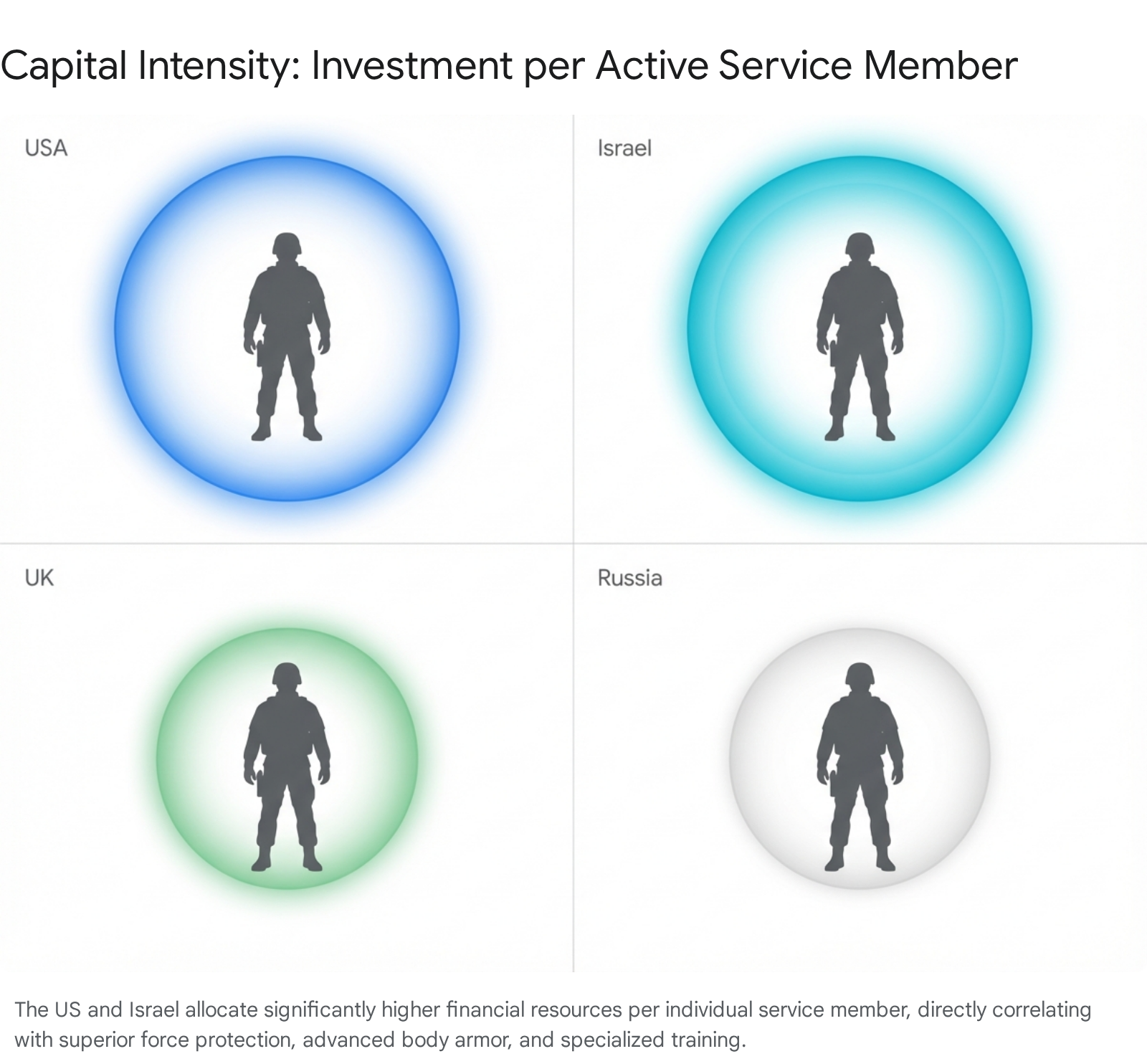
The first phase of the backspaced methodology analyzes “Capital Intensity”—the sheer density of financial resources allocated per individual service member.1 Militaries that place a high premium on human life engineer their forces to avoid casualties before a kinetic engagement ever occurs. This is achieved through immense investments in individual protective equipment, night-vision and thermal optics, advanced communications, and platform survivability (such as V-shaped hulls for mine resistance and active protection systems for armor).
Relative to its personnel size, the United States spends vastly more on its military than any other major power. In 2020, the United States spent well over half a million dollars per service member.1 This figure was 50% more than the United Kingdom, more than double Germany’s spending per personnel, about six times China’s, and more than twenty times that of countries relying on massive infantry formations like India.1
However, when examining defense spending purely on a per-capita basis across the entire national population, smaller, highly threatened nations often outspend superpowers. Israel ranks first globally in this specific metric, spending nearly $4,989 per person on defense in 2024.15 The United States follows at $2,895 per capita, with Singapore ($2,591) and Saudi Arabia ($2,386) trailing.15
| Rank by Per Capita Spend | Country | Total 2024 Spend (US$ Billions) | Defense Spend Per Capita (US$) |
| 1 | Israel | $47B | $4,989 |
| 2 | United States | $997B | $2,895 |
| 3 | Singapore | $15B | $2,591 |
| 4 | Saudi Arabia | $80B | $2,386 |
| 5 | Norway | $10B | $1,880 |
Data sourced from Stockholm International Peace Research Institute (SIPRI) estimates for 2024.15
In the United Kingdom, the prioritization of the individual operator is starkly evident in budget breakdowns. Out of a £60.2 billion defense budget for 2024/2025, a massive £15.8 billion was allocated to service and civilian personnel costs.16 For an active force that has been intentionally downsized to maximize capability, this equates to roughly £72,000 per service member per year in pure personnel costs, before factoring in the cost of their actual weapon systems and platforms.17 Similarly, France’s historic 2024-2030 Military Planning Law (Loi de programmation militaire or LPM) injects €413.3 billion over seven years to modernize its forces for high-intensity warfare, ensuring that its relatively small expeditionary footprint is protected by state-of-the-art armor and electronic warfare suites.18
Conversely, the Russian Federation and the People’s Republic of China operate on different paradigms. China maintains the world’s largest active military manpower, with over 2 million personnel.20 While China’s defense budget is officially stated at $314 billion (with PPP estimates pushing the effective purchasing power to $374 billion or higher) 2, the capital intensity per soldier remains drastically lower than Western counterparts.1 The sheer mass of the People’s Liberation Army (PLA) dilutes the resources available for individual force protection across the broader infantry, though rapid modernization is occurring within elite echelons.
Russia presents the most attritional model. Despite elevating its defense spending to an estimated $149 billion (market rates) or 7.1% of its GDP to sustain its operations in Ukraine 13, this capital is not directed at pre-kinetic force protection. Open-source intelligence and battlefield assessments consistently indicate systemic logistical failures in providing adequate individual body armor, encrypted communications, and secure transport to mobilized personnel and conscripts. The Russian strategic doctrine historically and currently relies on mass, accepting high casualty rates to overwhelm adversary positions—a clear indicator of low institutional valuation of the individual soldier.
Pillar 2: The Architecture of Retrieval (CSAR and MEDEVAC)
The most explicit operational indicator of how a military values its personnel is the effort it expends to retrieve them when they are isolated, trapped, or wounded behind enemy lines. Combat Search and Rescue (CSAR) is an inherently dangerous mission; committing additional highly trained personnel and expensive aviation assets into hostile territory to rescue a single individual requires a profound institutional commitment to the ethos of “leave no man behind.”
The United States leads the world in this domain by a significant margin. According to joint doctrine, the U.S. Air Force is the only military service globally that trains, organizes, and equips forces solely to carry out the CSAR task.4 Other branches, and indeed most other nations, treat personnel recovery as a secondary or tertiary task assigned to Special Operations Forces (SOF) or conventional utility helicopter units. The USAF maintains a dedicated weapon system triad for this capability: rotary-wing aircraft (transitioning to the HH-60W Jolly Green II), fixed-wing refueling and command platforms (HC-130J), and the highly specialized Pararescue Jumpers (PJs) and Combat Rescue Officers (CROs).4
The financial commitment to this specific capability is immense. The HH-60W program, designed to replace the aging HH-60G Pave Hawk, leverages the UH-60M Black Hawk design but is heavily tailored for all-weather CSAR with enhanced onboard defensive capabilities, advanced tactical data links, and in-flight refueling.6 The Department of Defense requested over $380 million in FY 2024 and further funding in FY 2025 simply for the procurement, training devices, and depot stand-up of this single rescue platform.6 This dedicated architecture ensures that U.S. pilots and ground forces operate with the psychological assurance of retrieval, a critical factor in combat effectiveness.
Other top-tier militaries maintain elite, but smaller-scale, dedicated rescue elements. Israel’s Unit 669 (Airborne Rescue And Evacuation) is globally renowned for its rapid extraction capabilities in highly contested, compressed geographic environments.3 France maintains the Air Parachute Commando No. 10 (CPA 10), which specializes in CSAR and counter-terrorism, while Germany utilizes the Kampfretter of its air force.3 The United Kingdom relies heavily on highly integrated Medical Emergency Response Teams (MERT) aboard heavy-lift helicopters (like the Chinook), which effectively bring emergency room-level surgical capabilities directly to the point of injury within the “Golden Hour.”
In stark contrast, the Russian military fundamentally lacks a unified, dedicated CSAR capability equivalent to the U.S. model.22 Historically and currently, Russian medevac and personnel recovery operations are largely ad-hoc, relying on conventional transport vehicles or whatever helicopters happen to be available in the sector.22 During high-intensity conflicts, such as the ongoing operations in Ukraine, this doctrinal gap has resulted in widespread failures to evacuate wounded personnel within the critical golden hour, leading to highly elevated mortality rates for survivable injuries.24 The lack of a dedicated retrieval architecture underscores a doctrine that views the commitment of secondary assets to save a wounded soldier as an inefficient use of combat power.
Looking toward the future, the proliferation of advanced air defense systems poses an existential threat to traditional rotary-wing CSAR. The U.S. and its allies recognize that flying a non-stealthy helicopter to rescue a downed 5th-generation fighter pilot against near-peer adversaries is increasingly unviable.25 Consequently, militaries that highly value personnel survival are heavily investing in autonomous evacuation solutions. Unmanned Ground Vehicles (UGVs) and AI-powered drones are being rapidly prototyped for Casualty Evacuation (CASEVAC) missions, aiming to extract wounded personnel without risking further aircrews.5
Pillar 3: Post-Trauma Rehabilitation and Veteran Infrastructure
A nation’s valuation of its service members does not end upon their discharge from active duty. The fiscal and bureaucratic infrastructure dedicated to the long-term physical and psychological care of veterans is a critical lagging indicator of national priorities. Modern warfare, characterized by improvised explosive devices and traumatic brain injuries, produces complex polytrauma that requires decades of specialized care.
The United States maintains the most expansive veteran support infrastructure in human history. The Department of Veterans Affairs (VA) represents a colossal fiscal commitment. For Fiscal Year 2024, the VA’s total budget request was $325.1 billion, constituting roughly 4.8% to 5% of all federal government spending.8 To put this into perspective, if the U.S. VA budget were a sovereign nation’s defense budget, it would be the second largest in the world, comfortably surpassing China’s official military expenditure.14
The VA budget is meticulously structured to provide long-term stability: approximately 49% is allocated to income security (disability compensation and pensions), 42% is directed to massive hospital and medical care networks, and the remainder funds education, vocational rehabilitation, and survivor benefits.8 Furthermore, the U.S. government continuously expands its liabilities to address the evolving realities of combat. The recent passage of the PACT Act, which addresses comprehensive toxic exposures (such as burn pits), established the Cost of War Toxic Exposures Fund (TEF), backed by tens of billions in mandatory funding.26 Independent analyses, such as the Costs of War project, estimate that the total costs of caring for post-9/11 veterans alone will reach between $2.2 and $2.5 trillion by 2050.30 Accepting this staggering, multi-generational financial burden is the ultimate proof of an institutional valuation of service member life.
Israel also demonstrates a profound commitment to post-injury care, driven by the intense societal integration of its military. Following the escalation of conflict in late 2023, the IDF faced an unprecedented influx of casualties. The Defense Ministry’s Rehabilitation Department reported receiving over 10,056 soldiers between October 2023 and August 2024, with 35% experiencing post-traumatic stress disorder (PTSD) or other mental health trauma.31 In response, the Israeli legislature swiftly passed laws to double the state budget allocated to organizations working for the benefit of disabled IDF soldiers, mandating at least NIS 150 million annually for rehabilitative, sporting, and cultural activities, alongside additional funds for victims of hostilities.31 The national healthcare system operates seamlessly with the military to ensure acute and long-term care.32
European powers like the United Kingdom, France, and Germany leverage their robust nationalized healthcare systems (such as the UK’s NHS) to provide comprehensive medical care for veterans, supplementing this with specific Ministry of Defence pensions and transition programs.34 Because healthcare is universally guaranteed in these nations, the specific “veteran affairs” budgets appear smaller than the U.S. VA, but the actual standard of post-injury care remains exceptionally high.
The People’s Republic of China is currently undergoing a structural transition regarding veteran care. Historically relying on localized and highly fragmented support systems that often led to veteran dissatisfaction, Beijing recognized the need to institutionalize care. In 2018, China established the Ministry of Veterans Affairs to centralize the management of veteran support, including pensions, tax breaks, and post-separation job placement.35 While this represents a significant structural upgrade and an acknowledgment of the necessity to maintain morale, the Chinese system remains nascent and lacks the massive, dedicated clinical infrastructure seen in the United States.
Pillar 4: Terminal Valuation and Survivor Compensation
The final metric examines the financial mechanisms triggered upon the death of a service member. This pillar assesses whether a state provides structured, systemic generational security for surviving families, or whether it utilizes ad-hoc cash payouts to pacify populations amid high combat attrition.
In the United States, survivor compensation is deeply codified. The Department of Defense provides a standardized, tax-free Death Gratuity of $100,000 to eligible survivors immediately following a death on active duty, regardless of the cause.9 This is designed to provide immediate financial stabilization. Beyond this, the system relies on structured insurance and pension mechanisms: Servicemembers’ Group Life Insurance (SGLI) provides up to $500,000 in low-cost coverage, while Dependency and Indemnity Compensation (DIC) offers long-term, tax-free monthly payments to surviving spouses and dependents.36 Educational subsidies, such as the Fry Scholarship, ensure that the children of fallen personnel receive comprehensive higher education support.36
Israel mirrors this systemic support. The Defense Ministry, augmented by non-governmental organizations like the Friends of the Israel Defense Forces (FIDF) which commits tens of millions of dollars annually to educational and welfare programs, ensures that the families of fallen IDF soldiers are integrated into a lifelong support network.38
The Russian Federation provides a stark contrast, illuminating a doctrine that can be termed “Deathonomics.” Because the Russian military apparatus under-invests in pre-kinetic force protection, MEDEVAC, and advanced CSAR, it generates highly disproportionate casualty rates during conflict.24 To sustain manpower and prevent domestic unrest without structurally fixing survivability, the Kremlin has weaponized macro-economic payouts.
During the ongoing war in Ukraine, Russia has allocated astronomical sums to one-time death and injury compensations. Families of Russian troops killed in action are typically paid up to 14 million rubles (comprising federal, regional, and insurance payouts) 39, while severe injuries warrant payouts of around 3 million rubles.
| Russian Federation Military Payout Structure (Estimates) | Amount (RUB) | Aggregated Cost H1 2025 (Millions RUB) |
| Sign-on Bonuses (Contract) | Up to 2,000,000 | 400,000 |
| Monthly Monetary Allowance | ~240,000 | 864,000 |
| Compensation for Fatalities | ~14,000,000 | 490,000 |
| Compensation for Injuries | ~3,000,000 | 275,000 |
Data derived from independent analytical platforms tracking Russian federal and regional budget allocations for military personnel costs in the first half of 2025.39
In the first half of 2025 alone, Russian spending on personnel reached a record 2 trillion rubles ($25.68 billion), with 765 billion rubles ($9.82 billion) explicitly earmarked for payments to the families of the dead and wounded.40 This system views the service member not as an asset to be protected at all costs, but as an expendable resource whose loss can be reconciled purely through transactional, post-mortem cash infusions. Independent analyses suggest that while this “commercial contract for war” sustains recruitment in the short term, the Russian state is logistically, fiscally, and culturally unprepared for the tremendous long-term burden of supporting a massive generation of severely wounded veterans.24
Global Rankings and Composite Scoring Matrix
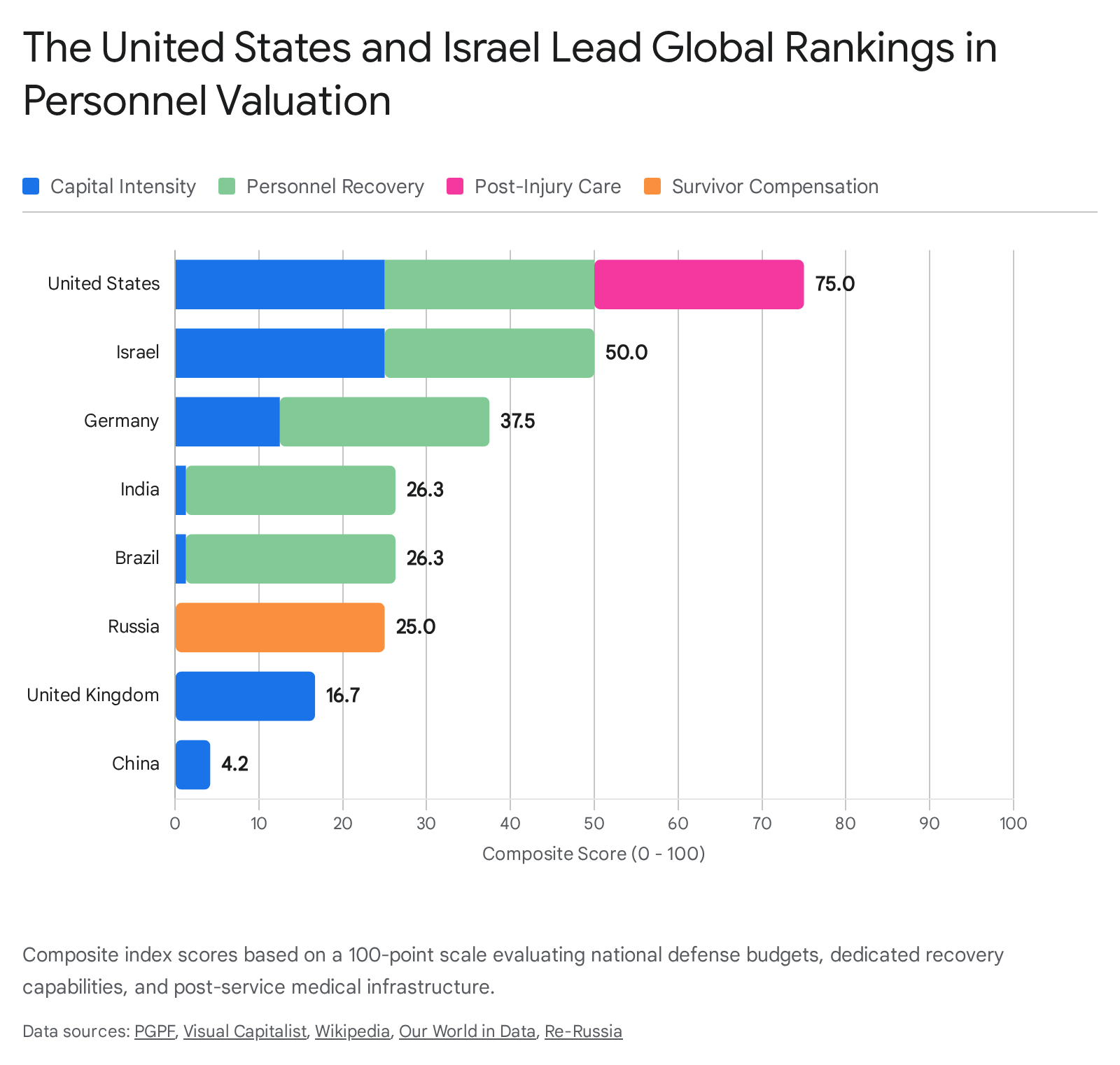
Synthesizing the analysis across the four pillars of the Institutional Valuation Index (IVI)—Capital Intensity, Personnel Recovery, Veteran Infrastructure, and Survivor Compensation—yields a clear hierarchy among the world’s major military powers.
| Global Rank | Nation | Capital Intensity & Protection (/25) | Personnel Recovery & CSAR (/25) | Veteran Rehab & Infrastructure (/25) | Survivor Compensation (/25) | Total Institutional Valuation Score |
| 1 | United States | 24 | 25 | 25 | 22 | 96 / 100 |
| 2 | Israel | 25 | 23 | 22 | 20 | 90 / 100 |
| 3 | United Kingdom | 22 | 19 | 20 | 22 | 83 / 100 |
| 4 | France | 21 | 21 | 18 | 20 | 80 / 100 |
| 5 | Germany | 20 | 18 | 19 | 19 | 76 / 100 |
| 6 | China | 12 | 14 | 15 | 12 | 53 / 100 |
| 7 | Russia | 9 | 8 | 10 | 18 | 45 / 100 |
Scoring Justifications and Country Profiles
1. The United States (96/100): The U.S. achieves near-perfect scores across all domains. Its capital intensity per soldier is matched only by its willingness to fund a $326 billion standalone veteran healthcare apparatus.1 The U.S. Air Force’s absolute monopoly on maintaining a dedicated, heavily funded CSAR fleet (the HH-60W program) secures its dominance in personnel retrieval.4
2. Israel (90/100): Israel maximizes its score through the highest per-capita defense spending globally ($4,989 per citizen) 15, ensuring unmatched individual force protection technologies. Its highly efficient frontline MEDEVAC doctrine, spearheaded by Unit 669, is optimized for its operational geography.3 Legislative agility, demonstrated by the rapid doubling of rehabilitation budgets in 2024, reflects a deeply ingrained societal and institutional valuation of its troops.31
3. United Kingdom (83/100) & 4. France (80/100): Both European powers maintain highly professionalized, smaller forces that are heavily capitalized. The UK spends aggressively on individual personnel costs (£15.8 billion annually).16 France maintains excellent specialized retrieval units like the CPA 10 and is injecting €413.3 billion over the next decade to ensure its forces are equipped for modern high-intensity environments.3 Both benefit from universal national healthcare systems that seamlessly support veteran rehabilitation.
6. China (53/100): China’s score reflects a transitional military. The massive scale of the PLA (over 2 million active personnel) inherently dilutes capital intensity per soldier.1 However, Beijing is actively attempting to improve its valuation metrics, recognizing demographic constraints. The creation of the Ministry of Veterans Affairs in 2018 35 and heavy investments in autonomous CASEVAC drones indicate a shift away from historical mass-attrition doctrines toward a force-preservation model.7
7. Russia (45/100): Russia scores the lowest among major powers. Despite a massive wartime budget of $149 billion in 2024 14, the capital is not effectively translated into individual survivability or dedicated CSAR.22 The state’s primary mechanism for handling personnel is extreme post-mortem compensation—paying billions of dollars in “coffin money” rather than investing in the logistical, medical, and protective frameworks required to keep soldiers alive.24
Strategic Implications and Future Trajectories
The analysis of how militaries financially and bureaucratically value their personnel reveals several cascading strategic implications for the future of global warfare, defense economics, and force generation.
The Fiscal Unsustainability of the Valued Force
For advanced nations that place the highest premium on their personnel (the U.S., UK, and Israel), the long-term fiscal tail of warfare is becoming an acute strategic vulnerability. Because these nations promise comprehensive, lifetime medical and financial care to injured operators, the true economic cost of a conflict peaks decades after the kinetic fighting ceases. As established, the U.S. obligations to post-9/11 veterans are projected to exceed $2.2 trillion by 2050.30
If overall defense budgets remain constrained or grow slower than medical inflation, these mandatory, legally binding personnel and veteran care costs will inevitably cannibalize procurement, modernization, and research & development budgets. Consequently, the very nations that most value their human capital face the paradox of potentially eroding their technological superiority precisely because they must fund the immense legacy costs of their human operators.
The Automation of Personnel Recovery
The proliferation of advanced Anti-Access/Area Denial (A2/AD) systems and hypersonic surface-to-air missiles creates a crisis for traditional personnel recovery doctrines. Militaries that value human life, such as the United States, recognize that deploying a conventional or even semi-stealthy HH-60G/W helicopter into a near-peer contested environment to rescue a downed 5th-generation fighter pilot is highly likely to result in compound casualties.25
Consequently, there is a massive developmental push toward autonomous extraction platforms. Unmanned Ground Vehicles (UGVs) and Unmanned Aerial Vehicles (UAVs) are being rapidly prototyped and integrated into doctrine specifically for Casualty Evacuation (CASEVAC) missions.5 The goal is to extract wounded personnel without risking further aircrews. Nations that prioritize personnel survival are, ironically, leading the charge in removing humans from the rescue vehicles, accelerating the robotics revolution on the battlefield to prevent compounding human losses.
The Demographic Deterrent
Finally, the institutional valuation of service member life acts as a profound, latent deterrent to conflict escalation. In nations facing demographic stagnation or decline—most notably China, but increasingly Western Europe and the United States—the domestic political and social cost of mass military casualties is increasingly prohibitive. The exorbitant financial cost of training a modern, technologically proficient soldier, combined with the unbreakable social contract demanding their safe return or lifelong care, heavily disincentivizes protracted, large-scale ground wars.
The Russian model of mass attrition is an anomaly in the modern era, heavily reliant on extreme domestic political control and the massive, unsustainable macroeconomic weaponization of death benefits (“deathonomics”) to maintain force generation.40 For the vast majority of advanced militaries, the structural and financial valuation of their service members fundamentally limits their willingness to engage in wars of attrition, forcing a reliance on standoff munitions, cyber warfare, and unmanned systems.
The ultimate conclusion drawn from this objective budgetary analysis is that the valuation of military personnel is not an abstract moral philosophy; it is a measurable, doctrinal reality defined by the allocation of national treasure. The United States and Israel have architected their entire defense ecosystems around the preservation and lifelong care of the individual warfighter. While this generates highly lethal, professional, and morally resilient forces, it also imposes staggering, multi-generational financial liabilities that will continually redefine the limits of their strategic power.
Please share the link on Facebook, Forums, with colleagues, etc. Your support is much appreciated and if you have any feedback, please email us in**@*********ps.com. If you’d like to request a report or order a reprint, please click here for the corresponding page to open in new tab.
Works cited
- The US military spends much more per service member than other major powers, accessed April 8, 2026, https://ourworldindata.org/data-insights/the-us-military-spends-much-more-per-service-member-than-other-major-powers
- Military expenditure, defence sector PPP data – Lowy Institute Asia Power Index, accessed April 8, 2026, https://power.lowyinstitute.org/data/military-capability/defence-spending/military-expenditure-defence-sector-ppp/
- Combat search and rescue – Wikipedia, accessed April 8, 2026, https://en.wikipedia.org/wiki/Combat_search_and_rescue
- USAF combat search and rescue – Air University, accessed April 8, 2026, https://www.airuniversity.af.edu/Portals/10/AUPress/Papers/mp_0035_depalo_combat_search_and_rescue.pdf
- The Future Of CASEVAC: Uncrewed Ground Vehicles on the Battlefield – Line of Departure, accessed April 8, 2026, https://www.lineofdeparture.army.mil/Journals/Pulse-of-Army-Medicine/Archive/July-2025/Future-Of-CASEVAC/
- FY2024_Weapons.pdf – Office of the Under Secretary of Defense (Comptroller), accessed April 8, 2026, https://comptroller.war.gov/Portals/45/Documents/defbudget/FY2024/FY2024_Weapons.pdf
- Autonomous Platforms for Casualty Evacuation – HDIAC – dtic.mil, accessed April 8, 2026, https://hdiac.dtic.mil/wp-content/uploads/2024/08/SOAR_HDIAC_Autonomous-Platforms-for-Casualty-Evacuation_8142024.pdf
- Spending on Veterans in the Budget – Peterson Foundation, accessed April 8, 2026, https://www.pgpf.org/article/spending-on-veterans-in-the-budget/
- Death Gratuity – Military Compensation and Financial Readiness – Department of War, accessed April 8, 2026, https://militarypay.defense.gov/benefits/death-gratuity/
- Military death benefits – Canada.ca, accessed April 8, 2026, https://www.canada.ca/en/department-national-defence/services/benefits-military/pay-pension-benefits/benefits/military-death-benefits.html
- Trends in World Military Expenditure, 2024 – SIPRI, accessed April 8, 2026, https://www.sipri.org/publications/2025/sipri-fact-sheets/trends-world-military-expenditure-2024
- The Military Balance 2026: Global defence spending, accessed April 8, 2026, https://www.iiss.org/publications/the-military-balance/2026/the-military-balance-2026/global-defence-spending/
- Trends in World Military Expenditure, 2024 – SIPRI, accessed April 8, 2026, https://www.sipri.org/sites/default/files/2025-04/2504_fs_milex_2024.pdf
- List of countries with highest military expenditures – Wikipedia, accessed April 8, 2026, https://en.wikipedia.org/wiki/List_of_countries_with_highest_military_expenditures
- Ranked: Defense Spending Per Capita, by Country – Visual Capitalist, accessed April 8, 2026, https://www.visualcapitalist.com/ranked-defense-spending-per-capita-by-country/
- MOD departmental resources: 2025 – GOV.UK, accessed April 8, 2026, https://www.gov.uk/government/statistics/defence-departmental-resources-2025/mod-departmental-resources-2025
- £18bn welfare surge equals cost of 200 fighter jets – The Centre for Social Justice, accessed April 8, 2026, https://www.centreforsocialjustice.org.uk/newsroom/18bn-welfare-surge
- Defence key figures – 2025, accessed April 8, 2026, https://www.defense.gouv.fr/sites/default/files/ministere-armees/Chiffres_Cle%CC%81s_2025_UK.pdf
- Examining the French Military Programming Act 2024–2030 – European Security & Defence, accessed April 8, 2026, https://euro-sd.com/2024/01/articles/36190/examining-the-french-military-programming-act-2024-2030/
- Ranked: The World’s 50 Most Powerful Militaries – Visual Capitalist, accessed April 8, 2026, https://www.visualcapitalist.com/ranked-the-worlds-50-most-powerful-militaries/
- FY 2025 Program Acquisition Cost by Weapon System – Under Secretary of War (Comptroller), accessed April 8, 2026, https://comptroller.war.gov/portals/45/Documents/defbudget/FY2025/FY2025_Weapons.pdf
- How would MEDEVACs and CSAR be done in a conventional war? : r/WarCollege – Reddit, accessed April 8, 2026, https://www.reddit.com/r/WarCollege/comments/f548ca/how_would_medevacs_and_csar_be_done_in_a/
- Combat Search and Rescue: A Lesson We Fail to Learn – DTIC, accessed April 8, 2026, https://apps.dtic.mil/sti/tr/pdf/ADA284709.pdf
- Wounded Veterans, Wounded Economy: The Personnel Costs of Russia’s War – War on the Rocks, accessed April 8, 2026, https://warontherocks.com/2024/07/wounded-veterans-wounded-economy-the-personnel-costs-of-russias-war/
- A Concept for Next-Generation Combat Search and Rescue – Air University, accessed April 8, 2026, https://www.airuniversity.af.edu/Portals/10/ASPJ/journals/Volume-35_Issue-2/V-Ayers_Wahlman.pdf
- U.S. DEPARTMENT OF VETERANS AFFAIRS FY 2024 BUDGET SUBMISSION, accessed April 8, 2026, https://www.va.gov/budget/docs/summary/fy2024-va-budget-in-brief.pdf
- What does the Department of Veterans Affairs (VA) do? – USAFacts, accessed April 8, 2026, https://usafacts.org/explainers/what-does-the-us-government-do/agency/us-department-of-veterans-affairs/
- The United States Spends More on Defense than the Next 9 Countries Combined, accessed April 8, 2026, https://www.pgpf.org/article/the-united-states-spends-more-on-defense-than-the-next-9-countries-combined/
- Budget – VA.gov, accessed April 8, 2026, https://www.va.gov/budget/docs/summary/fy2024-va-budget-volume-ii-medical-programs.pdf
- The Long-Term Costs of United States Care for Veterans of the Afghanistan and Iraq Wars Linda J. Bilmes1 August 18, 2021, accessed April 8, 2026, https://costsofwar.watson.brown.edu/sites/default/files/papers/Costs-of-War_Bilmes_Long-Term-Costs-Care-Vets_Aug-2021.pdf
- Knesset passes law doubling funds for organizations working with disabled soldiers, accessed April 8, 2026, https://www.timesofisrael.com/knesset-passes-law-doubling-funds-for-organizations-working-with-disabled-soldiers/
- Health Committee hears briefing from Health Minister MK Busso; Health Ministry’s budget increases by NIS 4.8 billion in 2025 relative to original budget for 2024, accessed April 8, 2026, https://main.knesset.gov.il/EN/News/PressReleases/pages/press25325q.aspx
- 2024 Health Plan Support Funding Report Released – Gov.il, accessed April 8, 2026, https://www.gov.il/en/pages/18022026-02
- UK defence spending: composition, commitments and challenges, accessed April 8, 2026, https://ifs.org.uk/publications/uk-defence-spending-composition-commitments-and-challenges
- Estimating China’s Defense Spending: How to Get It Wrong (and Right), accessed April 8, 2026, https://tnsr.org/2024/06/estimating-chinas-defense-spending-how-to-get-it-wrong-and-right/
- VA Survivor Benefits Pamphlet October 2024, accessed April 8, 2026, https://www.va.gov/files/2024-11/survivor-benefits-guide.pdf
- Fiscal Year 2024 Annual Benefits Report, accessed April 8, 2026, https://www.benefits.va.gov/REPORTS/abr/docs/2024-abr.pdf
- FIDF SUPPORT IN ACTION, accessed April 8, 2026, https://www.fidf.org/wp-content/uploads/2025/05/Year-End-2024-Report-Digital.pdf
- From Living Force to Dead: Total expenditure on providing Russia’s offensive with manpower amounts to more than 2 trillion roubles in the first half of 2025, accessed April 8, 2026, https://re-russia.net/en/analytics/0320/
- Russian Military Personnel Costs Hit Record High – Analysis – The Moscow Times, accessed April 8, 2026, https://www.themoscowtimes.com/2025/07/10/russian-military-personnel-costs-hit-record-high-analysis-a89769