1.0 Executive Summary
The operational environment for the week ending May 2, 2026, marks a critical strategic inflection point in the multifaceted conflict encompassing the United States, the State of Israel, and the Islamic Republic of Iran. While the direct kinetic exchange of aerial bombardments between the United States and Iran remains suspended under a fragile, conditional ceasefire extension brokered by Pakistani mediators, the theater of conflict has metastasized. The primary domains of engagement have definitively shifted from direct territorial strikes to systemic economic warfare, maritime interdiction, and an intense escalation of hostilities in the Levantine theater. The military campaigns, designated as Operation Epic Fury by the United States and Operation Roaring Lion by Israel, have evolved from decapitation and suppression strikes into a protracted war of economic attrition and regional realignment.1
The most profound systemic shift observed this week occurred within the global economic and diplomatic spheres, specifically concerning maritime commerce and energy markets. The United States Central Command (CENTCOM) has successfully operationalized a comprehensive, global naval blockade against Iranian shipping interests. This maritime interdiction campaign, initially limited to the Persian Gulf and the Gulf of Oman, has expanded to global choke points, fundamentally suffocating the Iranian export economy.5 Assessments indicate this blockade has already inflicted an estimated $4.8 billion in lost oil revenue for Tehran, effectively trapping dozens of heavy tankers within the region and forcing operators to seek highly inefficient, longer routes to Asian markets to evade United States maritime interdiction forces.6 In a direct countermeasure designed to circumvent this physical blockade, the Iranian regime has attempted to impose extortionate “safe passage tolls” on international commercial shipping vessels transiting the Strait of Hormuz. In response, the United States Department of the Treasury’s Office of Foreign Assets Control (OFAC) issued a severe, comprehensive alert on May 1. This directive expands the scope of secondary sanctions to any maritime entity, financial institution, or insurance provider facilitating these toll payments, explicitly including payments disguised as charitable contributions to Iranian organizations.8 This development ensures that the economic strangulation of the Iranian state will continue unabated, regardless of the physical ceasefire.
Simultaneously, the geopolitical architecture of the Gulf Cooperation Council (GCC) has sustained a historic fracture. The United Arab Emirates (UAE) formally executed its withdrawal from the Organization of the Petroleum Exporting Countries (OPEC) and the broader OPEC+ alliance, a decision that took effect on May 1, 2026.11 This unprecedented departure, catalyzed by the effective closure of the Strait of Hormuz and sharply diverging national security threat perceptions compared to Saudi Arabia, signals a profound and likely permanent realignment of global energy production strategies.13 The UAE has calculated that its economic future, heavily reliant on its sovereign wealth fund and global market integration, is better served outside the production constraints mandated by Riyadh, especially as the ongoing conflict has forced the shut-in of nearly two million barrels per day of Emirati offshore production.12
In the diplomatic arena, bilateral attempts to forge a permanent cessation of hostilities have completely stalled. A revised Iranian negotiating framework, transmitted via the Pakistani diplomatic backchannel, was summarily rejected by United States President Donald Trump on May 1, with the executive branch expressing deep dissatisfaction with the proposed terms.16 Concurrently, the United States executive branch initiated a highly consequential domestic legal maneuver regarding the continuation of the military campaign. With the statutory 60-day deadline imposed by the War Powers Resolution of 1973 approaching on May 2, President Trump formally notified congressional leadership that direct hostilities had “terminated” as of April 7. The administration’s legal framework asserts that the current ceasefire effectively pauses the legislative clock, thereby bypassing the constitutional requirement to secure explicit congressional authorization to maintain the vast regional military deployment and the ongoing naval blockade.18
Militarily, both the United States and Iran are leveraging the operational pause to rapidly reconstitute their degraded forces. Open-source intelligence (OSINT) and commercial satellite imagery confirm that the Islamic Revolutionary Guard Corps (IRGC) is actively engaged in excavation operations, clearing debris from subterranean missile complexes to recover surviving launch platforms and munitions buried during the initial weeks of Operation Epic Fury.21 To offset the loss of 39 aircraft during the initial 39-day bombing campaign, the United States Department of Defense has surged additional tactical assets to regional bases. This includes the deployment of A-10 Thunderbolt II attack aircraft optimized for maritime interdiction and close air support, alongside advanced EA-37B Compass Call electronic warfare platforms.1 Concurrently, the Israel Defense Forces (IDF) have dramatically escalated kinetic operations in southern Lebanon. Israel has issued expansive mandatory evacuation orders across dozens of Lebanese villages and conducted intensive, sustained airstrikes against Hezbollah infrastructure. This aggressive northern posture demonstrates unequivocally that while the skies over Tehran remain temporarily quiet, the broader regional war shows no signs of comprehensive de-escalation.22
2.0 Chronological Timeline of Key Events (Last 7 Days)
The following timeline details the critical escalations, diplomatic maneuvers, and military actions recorded over the past seven days. All events are logged using Coordinated Universal Time (UTC).
- April 26, 2026, 08:00 UTC: Kuwait International Airport achieves a partial reopening for limited commercial aviation operations. The facility begins servicing Kuwait Airways flights exclusively through Terminal 4, concluding a comprehensive two-month airspace closure mandated by the initial outbreak of hostilities.25
- April 26, 2026, 14:00 UTC: Iranian Foreign Affairs Minister Abbas Araghchi arrives in Muscat, Oman. He engages in high-level strategic discussions with Omani Sultan Haitham al Tariq, focusing heavily on maritime security protocols within the Strait of Hormuz and potential de-escalation frameworks.27
- April 27, 2026, 12:00 UTC: United States Special Envoy to the Middle East Steve Witkoff formally submits significant amendments to the Pakistani-brokered ceasefire proposal. These amendments specifically reintroduce stringent parameters regarding the dismantlement of the Iranian nuclear program.28
- April 28, 2026, 09:00 UTC: The government of the United Arab Emirates issues a historic declaration announcing its complete withdrawal from the OPEC cartel and the affiliated OPEC+ alliance. The exit is scheduled to take effect on May 1, with officials citing long-term strategic economic realignments and the severe constraints imposed by the ongoing maritime conflict.11
- April 28, 2026, 15:00 UTC: Approximately 150 soldiers assigned to the 192nd Military Police Battalion of the Connecticut Army National Guard depart Bradley Air National Guard Base. The unit is deployed to the United States Central Command area of responsibility to provide critical support for the logistical and security requirements of Operation Epic Fury.29
- April 29, 2026, 07:00 UTC: The Iranian economy experiences a catastrophic currency shock. The Iranian rial collapses to an unprecedented all-time low on the open market, trading at 1,800,000 rials to one United States Dollar. United States Treasury Secretary Scott Bessent publicly highlights the collapse as evidence of the regime’s failure.28
- April 30, 2026, 14:00 UTC: CENTCOM Commander Admiral Brad Cooper arrives at the White House to deliver a classified briefing to President Trump. The briefing details contingency plans for a renewed campaign of kinetic strikes targeting Iranian energy infrastructure and potential special operations to physically secure maritime transit routes in the Strait of Hormuz.30
- April 30, 2026, 15:30 UTC: The Israel Defense Forces release urgent, mandatory evacuation warnings for residents across 15 specific villages located in southern Lebanon, signaling an imminent expansion of the aerial bombardment campaign against Hezbollah positions north of the established security zone.24
- May 1, 2026, 10:00 UTC: The United Arab Emirates’ withdrawal from OPEC becomes officially effective, marking a permanent shift in Gulf energy politics.12
- May 1, 2026, 14:00 UTC: The United States Treasury Department’s Office of Foreign Assets Control (OFAC) issues a sweeping, global alert to the maritime industry. The directive explicitly warns that compliance with Iranian demands for safe passage tolls in the Strait of Hormuz constitutes a severe violation of United States sanctions, threatening secondary penalties for any involved entity.8
- May 1, 2026, 18:00 UTC: President Donald Trump submits a formal notification letter to congressional leadership. The document asserts that direct hostilities with Iran “terminated” as of April 7, a legal interpretation designed to preempt the expiration of the 60-day authorization window mandated by the War Powers Resolution of 1973.18
- May 1, 2026, 21:52 UTC: Iran’s Permanent Representative to the United Nations, Amir Saeid Iravani, issues a formal diplomatic letter demanding comprehensive financial reparations from Saudi Arabia, the UAE, Bahrain, Qatar, Kuwait, and Jordan. Iran alleges these states facilitated United States and Israeli military aggression.32
- May 2, 2026, 06:00 UTC: Iranian judicial authorities execute two individuals, Yaghoub Karimpour and Nasser Bekrzadeh, by hanging in Urmia Central Prison. The men were convicted in fast-tracked trials of conducting espionage and transmitting sensitive intelligence regarding nuclear facilities to the Israeli Mossad.34
- May 2, 2026, 08:28 UTC: The IDF issues a secondary wave of urgent evacuation orders targeting nine additional villages in southern Lebanon, including Jibshit and Habboush, immediately preceding intense artillery and aerial bombardments.22
3.0 Situation by Primary Country
3.1 Iran
3.1.1 Military Actions & Posture
The Islamic Republic of Iran is aggressively exploiting the current operational pause to reconstitute its heavily degraded conventional military apparatus. Following weeks of intense bombardment during the opening phases of Operation Epic Fury and Operation Roaring Lion, Iranian strategic forces are prioritizing the recovery of offensive assets. Intelligence assessments, corroborated by commercial satellite reconnaissance, indicate that engineering units affiliated with the Islamic Revolutionary Guard Corps are actively engaged in widespread excavation operations. These units are clearing massive debris fields from the entrances of subterranean ballistic missile bases to recover surviving launch platforms and munitions that were buried to avoid destruction by United States and Israeli bunker-penetrating ordnance.21 This activity strongly suggests an intent to rapidly restore a second-strike capability should the ceasefire architecture collapse.
In the domestic airspace domain, the Iranian integrated air defense network remains at a heightened state of readiness. On April 30, state-affiliated media reported the widespread activation of air defense systems across multiple sectors of Tehran Province, reportedly to intercept suspected hostile reconnaissance drones.21 The Iranian military command publicly anticipates that any resumption of hostilities by the United States would be characterized by short, intensive suppression of enemy air defenses strikes, designed to clear corridors for subsequent Israeli kinetic action.21
In the maritime domain, the IRGC Navy continues to assert nominal territorial control over approximately 2,000 kilometers of the Iranian coastline and the highly contested waters of the Strait of Hormuz.17 However, the physical projection of this sovereign control is severely curtailed by the dominant presence of the United States naval blockade. Unable to freely navigate commercial or military vessels, Iran has resorted to unconventional economic warfare tactics. Reports indicate the regime is attempting to levy safe passage tolls on international commercial shipping vessels attempting to transit the Strait, a coercive tactic that the United States has publicly likened to state-sponsored piracy.8
3.1.2 Policy & Diplomacy
The Iranian diplomatic corps is currently operating under severe internal friction and external pressure. Externally, the diplomatic track has hit a significant impasse. Over the weekend of April 25, Tehran submitted a revised negotiating framework via Pakistani mediators, hoping to secure a permanent cessation of hostilities. However, this proposal was summarily rejected by President Trump on May 1, who publicly stated his dissatisfaction with the terms and expressed doubt regarding the viability of a final agreement.16
In a highly aggressive lawfare maneuver designed to isolate regional adversaries, Iran’s Permanent Representative to the United Nations, Amir Saeid Iravani, submitted a formal diplomatic letter to the UN Secretary-General on May 1. The document demands comprehensive material and moral financial compensation from six regional states, specifically Saudi Arabia, the UAE, Qatar, Bahrain, Kuwait, and Jordan. Iravani alleged that these nations breached their international obligations by actively facilitating United States and Israeli military operations, either through the provision of airspace corridors or logistical support from hosted military installations.32
Internally, the Iranian political establishment is experiencing a profound schism that threatens to undermine its negotiating posture. Intelligence reporting indicates a growing rift between the elected government, led by President Masoud Pezeshkian and Parliament Speaker Mohammad Bagher Ghalibaf, and the diplomatic apparatus led by Foreign Minister Abbas Araghchi.28 Pezeshkian and Ghalibaf are reportedly maneuvering to oust Araghchi, accusing him of insubordination, bypassing civilian oversight, and taking direct strategic directives from the IRGC leadership regarding the parameters of the nuclear negotiations.28 This civil-military divide vastly complicates the peace process, as international mediators struggle to ascertain which Iranian faction holds ultimate negotiating authority in the power vacuum left by the assassination of former Supreme Leader Ali Khamenei.
3.1.3 Civilian Impact
The humanitarian, structural, and economic toll inside the Islamic Republic is catastrophic and compounding daily. To date, independent human rights organizations and state media reports indicate that at least 3,636 individuals have been killed in Iran since the conflict commenced on February 28.39 This figure includes over 1,221 military personnel and members of the IRGC, as well as thousands of civilians.39 Civilian infrastructure has suffered extensive collateral damage, with critical medical facilities in major metropolitan areas, including Tehran, Isfahan, Shiraz, and Mashhad, overwhelmed by mass casualty events stemming from the sustained bombing campaigns.41
Economically, the nation is facing total systemic collapse. The national currency, the rial, plummeted to a historic, devastating low of 1,800,000 rials to one United States Dollar by late April.28 The United States naval blockade is paralyzing the export sector, costing the Iranian state an estimated $500 million daily, with cumulative lost oil revenues reaching an estimated $4.8 billion.6
Amidst this external pressure, the domestic security apparatus has violently intensified its crackdown on internal dissent and perceived espionage. On May 2, Iranian judicial authorities executed two men, Yaghoub Karimpour and Nasser Bekrzadeh, by hanging in Urmia Central Prison.34 Both men, belonging to the minority Yarsan and Kurdish communities respectively, were convicted in fast-tracked, opaque judicial proceedings of conducting espionage and transmitting sensitive intelligence regarding the Natanz nuclear facility to the Israeli intelligence service, Mossad.34
3.2 Israel
3.2.1 Military Actions & Posture
While the deep-strike elements of Operation Roaring Lion targeting Iranian sovereign territory are currently suspended under the ceasefire parameters, the Israel Defense Forces have aggressively and decisively pivoted their combat power toward the northern front. The Israeli political and military establishment has definitively decoupled the Levantine theater from the Iranian ceasefire agreement. Leadership maintains that the total disarmament of Hezbollah and the restoration of security along the northern border require sustained, uninhibited military action, regardless of the status of negotiations with Tehran.1
Throughout the week ending May 2, the IDF executed an intense, systematic campaign of aerial and artillery bombardments across southern Lebanon and the Bekaa Valley. On April 30, the IDF issued expansive, mandatory evacuation orders for 15 villages situated north of the historically established security zone, warning civilians to relocate at least one kilometer away from targeted areas.24 This was followed by a secondary wave of urgent evacuation warnings on May 2 for nine additional municipalities, including Jibshit, Habboush, and Kfar Jouz.22 The subsequent kinetic strikes resulted in severe infrastructural devastation, including the total destruction of the historic Husayniyya gathering hall in the town of Doueir, alongside multiple reported fatalities in the villages of Kfar Dajjal and Al-Louaizeh.23
To sustain this exceptionally high-tempo operational environment, the Israeli military logistics network has relied on a massive influx of United States support. Reporting indicates that the United States successfully delivered 6,500 tons of advanced munitions and military materiel to Israel within a highly compressed 24-hour window, utilizing a combination of heavy sea vessels and strategic cargo airlift operations.45 Tactically, the IDF is rapidly adapting to emerging battlefield threats. Frontline units have begun deploying specialized protective netting on Merkava main battle tanks and armored personnel carriers to specifically counter the proliferation of fiber-optic guided First-Person View drones currently utilized by Hezbollah operatives.1
In a profound regional security development that underscores the evolving geopolitical landscape, Israel deployed a highly advanced Iron Dome air defense battery, complete with accompanying IDF operational personnel, to the United Arab Emirates.27 This deployment, authorized directly by Prime Minister Benjamin Netanyahu following urgent consultations with Emirati President Mohammed bin Zayed, represents a historic, tangible deepening of the Abraham Accords security architecture. It demonstrates a shared commitment to mutual defense against the Iranian ballistic missile and drone threat.27
3.2.2 Policy & Diplomacy
The Israeli security cabinet maintains a highly aggressive and uncompromising diplomatic posture, actively preparing the domestic public and international allies for the high probability of a resumption of direct hostilities with the Iranian state. Defense Minister Israel Katz delivered a forceful public address on April 30, stating unequivocally that Israel is prepared to act unilaterally to ensure Iran is permanently stripped of its capability to threaten the Israeli state.28 He expressed deep skepticism regarding the efficacy of the current diplomatic track brokered by Pakistan.28 Classified Israeli intelligence assessments shared with the cabinet indicate a strong belief that the United States-Iran negotiations could collapse entirely within the coming days. In such an eventuality, Israeli officials anticipate that the United States military will be required to escalate pressure by initiating kinetic strikes against Iranian gas and energy infrastructure to break the diplomatic deadlock.28
3.2.3 Civilian Impact
The domestic situation within Israel remains deeply impacted by the ongoing conflict, operating under a legally declared “special state of emergency on the home front,” a status the government recently extended through the spring of 2026.47 The human cost of the war is significant, with official statistics recording the deaths of 28 Israeli civilians and 19 military personnel, alongside over 8,500 individuals who have sustained injuries from incoming Iranian ballistic missiles and drone attacks since the conflict’s inception.48
The macroeconomic damage to the Israeli state is severe, with current estimates placing the direct economic toll at approximately $50 billion.48 Despite these massive systemic disruptions and financial costs, domestic public support for the war effort remains remarkably robust. Internal polling data compiled by the Institute for National Security Studies indicates that 78.5 percent of the Israeli public firmly supports the joint military strikes on Iran.49 Furthermore, 60 percent of respondents expressed high satisfaction with the military achievements secured thus far. However, the data also reveals a pragmatic shift in expectations, with the percentage of the public believing the war will result in the total collapse of the Ayatollah regime declining from 69 percent at the onset of operations to 58 percent.49
3.3 United States
3.3.1 Military Actions & Posture
United States Central Command is currently executing and managing one of the most complex, multi-domain logistical and operational campaigns in modern military history. Operation Epic Fury has transitioned significantly from its initial phase of deep-strike aerial bombardment into a massive, sustained maritime interdiction effort. The United States Navy’s blockade of the Iranian coastline, the Gulf of Oman, and the Strait of Hormuz is fully operational and expanding its global reach.5 To date, United States naval forces have successfully intercepted and turned around at least 45 commercial vessels attempting to violate the blockade parameters.9 This enforcement relies heavily on Visit, Board, Search, and Seizure operations conducted by specialized Marine Expeditionary Units supported by MH-60 Sea Hawk helicopters operating from guided-missile destroyers.1 To counter the persistent asymmetric threat of Iranian mine-laying operations designed to close the Strait of Hormuz, the Navy recently awarded a $100 million contract to the artificial intelligence firm Domino to rapidly deploy advanced underwater mine-detection drone swarms.28
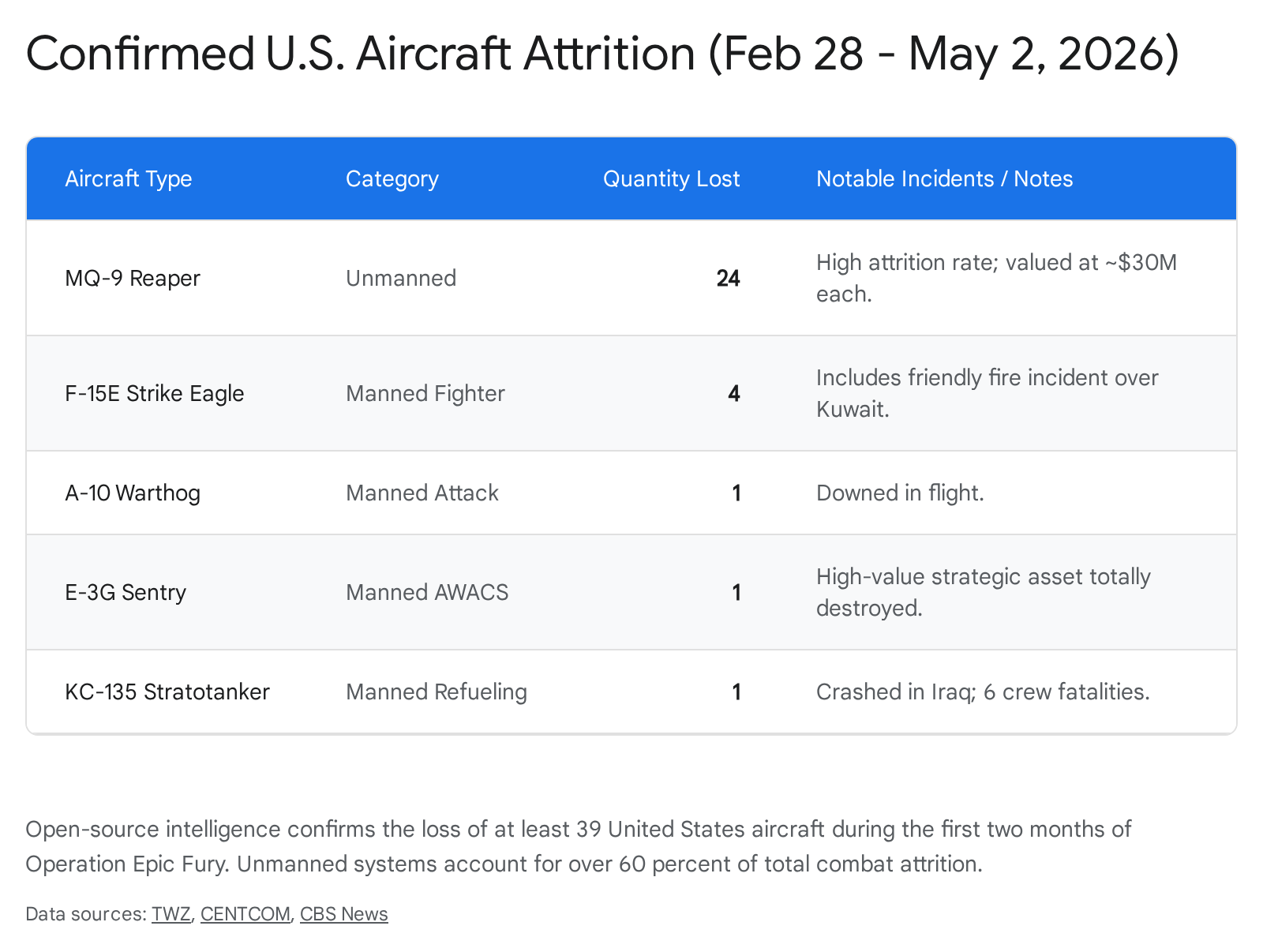
The aerial component of the operation is undergoing continuous reinforcement to replace significant combat losses and maintain air superiority. According to comprehensive open-source tracking and internal reporting, the United States suffered the loss of 39 aircraft during the initial 39 days of the conflict.1 This substantial attrition includes up to 24 high-value MQ-9 Reaper drones, four F-15E Strike Eagles, one A-10 Warthog, and the total destruction of a highly prized E-3G Sentry AWACS surveillance aircraft.1 To immediately replenish combat power and adapt to the shifting mission parameters, CENTCOM has initiated the deployment of dozens of A-10 Thunderbolt II attack aircraft from Air National Guard units to the regional theater.1 These platforms are specifically tasked with providing close air support for maritime interdiction operations and potential future strikes against fortified Iranian energy hubs such as Kharg Island.1 Furthermore, advanced EA-37B Compass Call electronic warfare jets have been forward-deployed to provide critical stand-off jamming capabilities against sophisticated Iranian radar and communication networks.1
A highly somber operational update was provided this week when CENTCOM officially confirmed the deaths of all six United States Air Force crew members aboard a KC-135 Stratotanker.1 The refueling aircraft crashed in western Iraq on March 12 during a routine support sortie for Operation Epic Fury, underscoring the intense strain the high-tempo operations are placing on the logistical and aerial refueling fleets.1
3.3.2 Policy & Diplomacy
The executive branch executed a highly controversial and legally consequential policy maneuver regarding domestic war authorization protocols. Under the stipulations of the War Powers Resolution of 1973, the President is constitutionally required to seek formal congressional authorization within 60 days of initiating unprovoked military hostilities abroad.18 With the critical 60-day deadline falling on May 2, 2026, President Trump submitted a formal letter to congressional leadership on May 1. The document explicitly stated that direct exchanges of fire had ceased on April 7 due to the implementation of the ceasefire agreement.18 The administration’s novel legal position asserts that this operational pause effectively “terminated” the hostilities, thereby freezing the 60-day statutory clock and negating the immediate legal requirement for a highly contentious congressional vote to authorize the continuation of the blockade and regional deployment.19
On the economic warfare front, the Department of the Treasury dramatically escalated its global pressure campaign against the Iranian state. OFAC released a highly detailed, comprehensive alert on May 1 specifically targeting the global maritime shipping and insurance industry. The alert explicitly warned that any shipping company, regardless of national origin, that pays safe passage tolls to the Iranian regime to secure transit through the Strait of Hormuz will be subject to severe secondary sanctions. These penalties include potential exclusion from the United States financial system.8 OFAC specifically noted that Iranian entities have increasingly attempted to disguise these extortionate payments as benign charitable donations routed through organizations such as the Iranian Red Crescent Society or the Bonyad Mostazafan.8 The directive makes clear that the United States views any transfer of value to the Iranian state in exchange for maritime passage as a sanctionable offense.
3.3.3 Civilian Impact
While the continental United States has not experienced direct, kinetic military impacts from the conflict, the financial and logistical burden of the war is compounding at a rapid pace. Internal Pentagon financial assessments, recently leaked to the press, indicate that the true monetary cost of Operation Epic Fury is rapidly approaching $50 billion. This figure is double the $25 billion estimate publicly stated by Defense Department officials during recent congressional testimony.56 This massive discrepancy is largely attributed to the rapid, unanticipated depletion of highly expensive precision-guided munitions stockpiles, such as Tomahawk Land Attack Missiles, and the immense replacement costs required for the 39 destroyed aircraft, which includes the $30 million per unit MQ-9 Reaper drones.1
Domestically, the conflict has resulted in heightened security postures across the homeland. Major military installations have implemented elevated force protection protocols following a series of highly concerning, unauthorized drone incursions detected over critical infrastructure sites, including Barksdale Air Force Base, highlighting vulnerabilities in domestic airspace defense during overseas engagements.1
4.0 Regional and Gulf State Impacts
The geopolitical and security landscape of the Gulf states has been fundamentally and violently altered by the Iranian conflict. What began as a localized kinetic exchange has rapidly metastasized into a region-wide security and economic crisis, forcing allied nations to rapidly reassess their strategic postures, economic alliances, and airspace sovereignty.
| Country | Civilian/Military Casualties | Strategic Developments & Security Posture |
| Lebanon | ~2,521 killed, 7,804 injured 48 | Massive IDF airstrikes ongoing. Mass evacuations ordered in the south. Infrastructure heavily decimated. |
| UAE | 2 soldiers, 11 civilians killed 48 | Exited OPEC. Received Israeli Iron Dome system. Banned citizen travel to conflict zones. Sustained $2B in defense costs. |
| Saudi Arabia | 3 killed, 23 injured 48 | Issued ultimatum to Iran regarding US bases. Forcefully rejected Iranian compensation demands. |
| Kuwait | 4 soldiers, 6 civilians killed 48 | Airspace partially reopened. Fuel tanks previously damaged at Kuwait International Airport by Iranian drones. |
| Bahrain | 3 killed, 42 injured 48 | Airspace open strictly on approval basis. Condemned Iranian strikes. Targeted in UN compensation letter. |
| Qatar | 20 injured 48 | Condemned Iranian strikes. Airspace highly restricted. Targeted in UN compensation letter. |
| Oman | 3 killed, 15 injured 48 | Serving as primary diplomatic backchannel. Ports outside Hormuz seeing 117% export boom. |
| Jordan | 19 injured 48 | Air defense heavily active against Iranian projectiles. Targeted in UN compensation letter. |
4.1 United Arab Emirates (UAE)
The most consequential regional economic development of the week was the UAE’s formal execution of its exit from OPEC and the broader OPEC+ alliance, which became officially effective on May 1, 2026.11 While Emirati officials publicly cited long-term domestic energy investment strategies and the desire to maximize production capacity, intelligence assessments point directly to the ongoing war as the primary catalyst for the departure.11 The effective closure of the Strait of Hormuz has forced the UAE to involuntarily shut in nearly two million barrels per day of highly lucrative offshore production.12 Bound by restrictive OPEC production quotas that historically favored Saudi Arabian market dominance, and bearing the massive brunt of the economic fallout from the maritime blockade, Abu Dhabi calculated that its national security and economic interests had irreparably diverged from Riyadh’s leadership.14 This historic move officially fractures the longstanding UAE-Saudi energy alliance that has dictated global oil policy for decades.
Militarily, the UAE has borne a staggering defensive burden. Since the outbreak of hostilities, Emirati air defense networks have tracked over 174 incoming Iranian ballistic missiles and intercepted 689 hostile drone incursions, resulting in a defensive financial expenditure approaching $2 billion.57 To rapidly bolster its heavily degraded air defense architecture, the UAE accepted the emergency deployment of an Israeli Iron Dome battery, marking an unprecedented level of overt military cooperation and integration between the two nations under the Abraham Accords framework.27 Concurrently, the UAE Ministry of Foreign Affairs issued an emergency directive banning all Emirati citizens from traveling to Iran, Iraq, and Lebanon due to the acute security risks.58
4.2 Saudi Arabia
Riyadh finds itself executing a highly delicate balancing act, attempting to manage diplomatic de-escalation while projecting credible military deterrence against Iranian aggression. Saudi Foreign Minister Prince Faisal bin Farhan delivered a stark, unambiguous ultimatum to his Iranian counterpart, Abbas Araghchi. The Saudi leadership warned that if Iranian attacks on critical Saudi energy infrastructure and civilian centers persist, the Kingdom will abandon its neutral defensive posture and explicitly permit the United States military to launch offensive kinetic strikes directly from sovereign Saudi bases.59 Furthermore, Saudi Arabia forcefully and publicly rejected the formal letter submitted by Iran to the United Nations demanding financial compensation. Riyadh labeled the Iranian claims as entirely baseless and held the regime in Tehran solely responsible for the ongoing regional destabilization.33
4.3 Qatar and Oman
Qatar, which hosts the massive Al Udeid Air Base utilized by CENTCOM as a primary regional command node, remains in a highly precarious diplomatic position. While officially condemning the Iranian strikes that impacted its sovereign territory, Doha faces intense internal and regional pressure regarding its historical relationship with militant groups and its broader utility as a mediating power.61 Qatari airspace remains heavily restricted, with all commercial flight operations managed strictly through predetermined, fixed entry and exit corridors to mitigate the risk of accidental targeting.62
Conversely, Oman has masterfully leveraged its unique geographic position outside the contested waters of the Strait of Hormuz to realize massive economic windfalls. Omani shipping ports have reported an astounding 117 percent increase in exports as global maritime logistics companies bypass the dangerous Persian Gulf entirely.63 Diplomatically, Muscat has solidified its role as the primary, indispensable conduit for direct negotiations, hosting Iranian Foreign Minister Araghchi earlier in the week to facilitate dialogue with Western powers.27 However, neighboring Gulf states view Oman’s increasingly close and lucrative relationship with Tehran with deep, growing suspicion, further straining the cohesion of the GCC.63
4.4 Regional Airspace Security
The civilian aviation sector across the entire Middle East remains severely crippled by the conflict. The European Union Aviation Safety Agency (EASA) formally extended its stringent Conflict Zone Information Bulletin through the first week of May. The directive strictly advises all European operators to entirely avoid the airspace of Bahrain, Iran, Iraq, Israel, Jordan, Kuwait, Lebanon, Oman, Qatar, the UAE, and Saudi Arabia due to the extreme risk of misidentification and crossfire.64 The primary, highly lucrative commercial aviation routing connecting Europe and Asia has been forced to detour entirely around the central Middle East corridor. Airlines are now utilizing extreme southern routes through Egyptian and lower Omani airspace, significantly increasing flight times and fuel costs.62 While Kuwait International Airport achieved a limited, heavily regulated reopening on April 26 for flagship carrier operations, the overall regional airspace environment remains defined by the constant threat of short-notice closures, intense military traffic, and pervasive GPS spoofing and electronic warfare interference.25
5.0 Appendices
Appendix A: Methodology
This Situation Report was generated utilizing a deep, comprehensive sweep of real-time open-source intelligence, official state broadcasts, military press releases, and global financial market data covering the seven-day period ending May 2, 2026. The methodology strictly prioritized primary source documentation, including official operational releases from United States Central Command, the Israel Defense Forces, the United States Department of the Treasury (OFAC), and statements issued by the White House. These primary sources were rigorously cross-referenced with independent geopolitical risk monitors, aviation safety bulletins (such as those from EASA), and established regional press syndicates to ensure factual accuracy. Casualty figures, aircraft attrition rates, and financial damage estimates were triangulated from multiple independent tracking agencies and leaked internal assessments to mitigate the influence of state-sponsored propaganda or inflated claims. Conflicting reports regarding the scope and enforcement mechanisms of the United States naval blockade were resolved by prioritizing official OFAC regulatory alerts and Department of Defense operational briefings over unverified regional reporting.
Appendix B: Glossary of Acronyms
- AWACS: Airborne Warning and Control System
- CAS: Close Air Support
- CENTCOM: United States Central Command
- EASA: European Union Aviation Safety Agency
- FPV: First-Person View (commonly referring to guided drone systems)
- GCC: Gulf Cooperation Council
- IADS: Integrated Air Defense System
- IDF: Israel Defense Forces
- INSS: Institute for National Security Studies
- IRGC: Islamic Revolutionary Guard Corps
- OPEC: Organization of the Petroleum Exporting Countries
- OFAC: Office of Foreign Assets Control (United States Department of the Treasury)
- OSINT: Open-Source Intelligence
- SEAD: Suppression of Enemy Air Defenses
- VBSS: Visit, Board, Search, and Seizure
Appendix C: Glossary of Foreign Words
- Basij: A voluntary paramilitary militia established in Iran following the 1979 revolution, operating subordinate to the command structure of the IRGC.
- Husayniyya: A congregation hall utilized by Shia Muslims for commemoration ceremonies, particularly those associated with the Mourning of Muharram.
- Khamenei: Refers to the Supreme Leader of Iran. Ali Khamenei was assassinated at the onset of the current war; his son, Mojtaba Khamenei, succeeded him in the role.
- Majlis: The Islamic Consultative Assembly, serving as the national legislative body of the Islamic Republic of Iran.
- Rial: The official fiat currency of the Islamic Republic of Iran, currently experiencing severe hyperinflation.
- Wilayat al-Faqih: Translated as “Guardianship of the Islamic Jurist,” this is the foundational political and religious doctrine of the Iranian regime, which grants absolute, unchecked religious and political authority to the Supreme Leader.
Please share the link on Facebook, Forums, with colleagues, etc. Your support is much appreciated and if you have any feedback, please email us in**@*********ps.com. If you’d like to request a report or order a reprint, please click here for the corresponding page to open in new tab.
Sources Used
- Operation Epic Fury U.S. Aircraft Losses Visualized – The War Zone, accessed May 2, 2026, https://www.twz.com/air/operation-epic-fury-u-s-aircraft-losses-visualized
- The US–Israel and Iran War: Implications for the Horn of Africa, accessed May 2, 2026, https://www.ifa.gov.et/2026/05/01/the-us-israel-and-iran-war-implications-for-the-horn-of-africa/
- Peace Through Strength: Operation Epic Fury Crushes Iranian Threat as Ceasefire Takes Hold – The White House, accessed May 2, 2026, https://www.whitehouse.gov/releases/2026/04/peace-through-strength-operation-epic-fury-crushes-iranian-threat-as-ceasefire-takes-hold/
- Interim Assessment: Evaluating the Strategic Damage Caused to Iran in Operation “Roaring Lion” (Week 3 – March 21), accessed May 2, 2026, https://israel-alma.org/interim-assessment-evaluating-the-strategic-damage-caused-to-iran-in-operation-roaring-lion-week-3-march-21/
- Joint Force Enforces Maritime Blockade in Gulf of Oman, Globally – Department of War, accessed May 2, 2026, https://www.war.gov/News/News-Stories/Article/Article/4470128/joint-force-enforces-maritime-blockade-in-gulf-of-oman-globally/
- US believes Iran has lost $4.8 billion in oil earnings due to blockade — report, accessed May 2, 2026, https://www.timesofisrael.com/liveblog_entry/us-believes-iran-has-lost-4-8-billion-in-oil-earnings-due-to-blockade-report/
- US believes naval blockade costs Iran $4.8 billion in oil revenue: Report, accessed May 2, 2026, https://ddnews.gov.in/en/us-believes-naval-blockade-costs-iran-4-8-billion-in-oil-revenue-report/
- U.S. Treasury Expands Hormuz ‘Toll’ Warning, Puts Maritime Industry on Notice, accessed May 2, 2026, https://gcaptain.com/u-s-treasury-expands-hormuz-toll-warning-puts-maritime-industry-on-notice/
- US warns shipping firms they could face sanctions over paying Iranian tolls in the Strait of Hormuz, accessed May 2, 2026, https://apnews.com/article/iran-us-war-ceasefire-negotiations-strait-9317c11e51ba8dfa527b424f931fe04b
- US Treasury Advises Shippers to Not Pay Tolls for Hormuz Passage, accessed May 2, 2026, https://www.marinelink.com/news/us-treasury-advises-shippers-not-pay-538704
- Explained: The UAE’s exit from OPEC, and its possible impact on global oil prices, accessed May 2, 2026, https://indianexpress.com/article/explained/explained-global/uae-exits-opec-oil-prices-impact-india-significance-10660880/
- UAE’s exit rattles OPEC’s grip on the oil market | Wood Mackenzie, accessed May 2, 2026, https://www.woodmac.com/blogs/the-edge/uaes-exit-rattles-opecs-grip-on-the-oil-market/
- Why is the UAE leaving OPEC? – Atlantic Council, accessed May 2, 2026, https://www.atlanticcouncil.org/content-series/fastthinking/why-is-the-uae-leaving-opec/
- Why the UAE Walked Out on OPEC—and What It Means for the Cartel | Council on Foreign Relations, accessed May 2, 2026, https://www.cfr.org/articles/why-the-uae-walked-out-on-opec-and-what-it-means-for-the-cartel
- Why UAE stepped away from OPEC amid Iran war and soaring crude oil prices, accessed May 2, 2026, https://m.economictimes.com/markets/stocks/news/why-uae-stepped-away-from-opec-amid-iran-war-and-soaring-crude-oil-prices/articleshow/130629426.cms
- Israel-Iran war LIVE: Iran military official says renewed war with U.S. …, accessed May 2, 2026, https://www.thehindu.com/news/international/iran-israel-us-war-ceasefire-news-strait-of-hormuz-live-updates-may-2-2026/article70930695.ece
- US-Israel war on Iran updates: Trump ‘not satisfied’ with Tehran’s …, accessed May 2, 2026, https://www.aljazeera.com/news/liveblog/2026/5/1/iran-war-live-tehran-says-us-ports-siege-intolerable-trump-mulls-action
- Trump Declares End to Combat Operations Against Iran as War Powers Deadline Passes, accessed May 2, 2026, https://www.kyivpost.com/post/75246
- Epic Fury Update – May 1, 2026, accessed May 2, 2026, https://sof.news/middle-east/epic-fury-update-2/
- Trump claims hostilities have ended in Iran in letter to congressional leaders, accessed May 2, 2026, https://www.theguardian.com/world/2026/may/01/trump-iran-war-hostilities-letter
- Iran Update Special Report, May 1, 2026 | ISW, accessed May 2, 2026, https://understandingwar.org/research/middle-east/iran-update-special-report-may-1-2026/
- IDF issues evacuation warnings for 9 villages in south Lebanon ahead of Hezbollah airstrikes | The Times of Israel, accessed May 2, 2026, https://www.timesofisrael.com/liveblog_entry/idf-issues-evacuation-warnings-for-9-villages-in-south-lebanon-ahead-of-hezbollah-airstrikes/
- More killed, displaced as Israel strikes south Lebanon villages, accessed May 2, 2026, https://www.newarab.com/news/more-killed-displaced-israel-strikes-south-lebanon-villages
- IDF issues evacuation warnings for another 15 south Lebanon villages, accessed May 2, 2026, https://www.timesofisrael.com/liveblog_entry/idf-issues-evacuation-warnings-for-another-15-south-lebanon-villages/
- Which Countries Have Reopened Airspace After the US-Iran Ceasefire? (April 2026), accessed May 2, 2026, https://blog.wego.com/which-countries-have-reopened-airspace-after-the-us-iran-ceasefire/
- Middle East flight updates: Emirates up to 80 per cent of pre-war operation capacity, accessed May 2, 2026, https://www.thenationalnews.com/travel/2026/04/30/iran-war-middle-east-flight-status/
- Iran Update Special Report, April 26, 2026 – Institute for the Study of War, accessed May 2, 2026, https://understandingwar.org/research/middle-east/iran-update-special-report-april-26-2026/
- Operations Epic Fury and Roaring Lion: 5/1/26 Update – JINSA, accessed May 2, 2026, https://jinsa.org/wp-content/uploads/2026/05/Operations-Epic-Fury-and-Roaring-Lion-05.01.26.pdf
- National Guard Military Police Battalion Deploys in Support of Operation Epic Fury, accessed May 2, 2026, https://www.war.gov/News/News-Stories/Article/Article/4473393/national-guard-military-police-battalion-deploys-in-support-of-operation-epic-f/
- Israel said bracing for Iran fighting to resume soon, as Trump briefed on military options, accessed May 2, 2026, https://www.timesofisrael.com/israel-said-bracing-for-iran-fighting-to-resume-soon-as-trump-briefed-on-military-options/
- CENTCOM chief to brief Trump on new plans for military action against Iran — report, accessed May 2, 2026, https://www.timesofisrael.com/centcom-chief-to-brief-trump-on-new-plans-for-military-action-against-iran-report/
- Iran demands compensation from Gulf states, accessed May 2, 2026, https://www.azernews.az/region/257828.html
- Iran Demands Accountability for Regional Nations Aiding U.S.-Israeli Aggression, accessed May 2, 2026, https://wanaen.com/iran-demands-accountability-for-regional-nations-aiding-u-s-israeli-aggression/
- Two more men hanged in Iran as authorities ramp up executions, accessed May 2, 2026, https://www.iranintl.com/en/202605024526
- Live Updates: Trump “not satisfied” with new peace deal offered by Iran as standoff’s costs multiply, accessed May 2, 2026, https://www.cbsnews.com/live-updates/iran-war-trump-strait-of-hormuz-israel-lebanon-ceasefire/
- US-Israel-Iran War News Live Updates: ‘On way back from Iran, will take Cuba,’ says Trump, shares his ‘war-ending’ plan – The Times of India, accessed May 2, 2026, https://timesofindia.indiatimes.com/world/middle-east/us-israel-iran-war-news-live-updates-ceasefire-donald-trump-iran-talks-strait-of-hormuz-blockade-impact-oil-crisis-latest-updates/liveblog/130708687.cms
- Iran demands compensation from 5 Arab states over alleged participation in US-Israeli strikes – Anadolu Ajansı, accessed May 2, 2026, https://www.aa.com.tr/en/middle-east/iran-demands-compensation-from-5-arab-states-over-alleged-participation-in-us-israeli-strikes/3904666
- Iran demands compensation from five regional states over conflict damages, accessed May 2, 2026, https://qazinform.com/news/iran-demands-compensation-from-five-regional-states-over-conflict-damages-39f6b4
- Operations Epic Fury and Roaring Lion: 4/30/26 Update – JINSA, accessed May 2, 2026, https://jinsa.org/wp-content/uploads/2026/04/Operations-Epic-Fury-and-Roaring-Lion-04.30.26.pdf
- These Are the Civilians Who Have Been Killed in the Iran War – TIME, accessed May 2, 2026, https://time.com/article/2026/04/21/iran-war-civilians-killed/
- More of the same. Epic Fury’s impact on global health and humanitarian actions, accessed May 2, 2026, https://www.kcl.ac.uk/epic-furys-impact-on-global-health-and-humanitarian-actions
- 2026 United States naval blockade of Iran – Wikipedia, accessed May 2, 2026, https://en.wikipedia.org/wiki/2026_United_States_naval_blockade_of_Iran
- 2026 Iran war | Explained, United States, Israel, Strait of Hormuz, Map, & Conflict | Britannica, accessed May 2, 2026, https://www.britannica.com/event/2026-Iran-war
- 2026 Lebanon war – Wikipedia, accessed May 2, 2026, https://en.wikipedia.org/wiki/2026_Lebanon_war
- May 1, 2026 – FDD, accessed May 2, 2026, https://www.fdd.org/overnight-brief/may-1-2026/
- Iran Update Special Report, April 29, 2026, accessed May 2, 2026, https://understandingwar.org/research/middle-east/iran-update-special-report-april-29-2026/
- Operation Roaring Lion: A Special Home Front Situation – The Israel Democracy Institute, accessed May 2, 2026, https://en.idi.org.il/articles/63607
- 2026 Iran war – Wikipedia, accessed May 2, 2026, https://en.wikipedia.org/wiki/2026_Iran_war
- Findings of a Flash Survey—Two Weeks into Operation Roaring Lion | INSS, accessed May 2, 2026, https://www.inss.org.il/publication/survey-lions-roar-2/
- US warns shipping firms they could face sanctions over paying Iranian tolls in the Strait of Hormuz – KVUE, accessed May 2, 2026, https://www.kvue.com/article/syndication/associatedpress/us-warns-shipping-firms-they-could-face-sanctions-over-paying-iranian-tolls-in-the-strait-of-hormuz/616-d790f5b0-60a9-4ff5-926c-b1d74754325c
- The Strait of Hormuz is ‘open,’ but the US blockade remains in place. Here’s what that means., accessed May 2, 2026, https://www.atlanticcouncil.org/dispatches/the-strait-of-hormuz-is-open-but-the-us-blockade-remains-in-place-heres-what-that-means/
- Operation Epic Fury – U.S. Central Command, accessed May 2, 2026, https://www.centcom.mil/OPERATIONS-AND-EXERCISES/EPIC-FURY/
- U.S. Central Command (CENTCOM) Official Website Homepage, accessed May 2, 2026, https://www.centcom.mil/
- Operation Epic Fury: Unilateral Power and the War Powers Resolution, accessed May 2, 2026, https://www.devdiscourse.com/article/law-order/3893967-operation-epic-fury-unilateral-power-and-the-war-powers-resolution
- At the 60-Day Mark, the Iran War is Triply Illegal – Just Security, accessed May 2, 2026, https://www.justsecurity.org/137669/60-day-mark-iran-war-triply-illegal/
- Iran war’s true cost closer to $50 billion, not $25 billion, U.S. officials say, accessed May 2, 2026, https://www.cbsnews.com/news/iran-war-cost-closer-50-billion-us-officials/
- Gulf states on verge of acting against Iran over ‘reckless’ strikes across region, accessed May 2, 2026, https://www.theguardian.com/world/2026/mar/02/gulf-states-iran-strikes-response
- Iran warns of ‘long and painful strikes’ if US resumes attacks, accessed May 2, 2026, https://indianexpress.com/article/world/us-news/iran-warns-of-long-and-painful-strikes-if-us-resumes-attacks-10665044/
- Saudi Arabia has told Iran to stop attacks, warned of possible retaliation, sources say, accessed May 2, 2026, https://www.timesofisrael.com/saudi-arabia-has-told-iran-to-stop-attacks-warned-of-possible-retaliation-sources-say/
- Saudi fury grows as Iran attacks push Gulf to respond | The Jerusalem Post, accessed May 2, 2026, https://www.jpost.com/middle-east/article-889358
- Fractures rock Gulf alliance as UAE quits OPEC during Iran war – analysis, accessed May 2, 2026, https://www.jpost.com/middle-east/article-894853
- Middle East Airspace – Current Operational Picture – International Ops 2025 – OpsGroup, accessed May 2, 2026, https://ops.group/blog/middle-east-airspace-current-operational-picture/
- Can the Gulf Cooperation Council Survive the Oman Rift over the Iran War?, accessed May 2, 2026, https://www.meforum.org/mef-observer/can-the-gulf-cooperation-council-survive-the-oman-rift-over-the-iran-war
- Middle East Escalation 2026: Severe Airspace Restrictions Impact Flights to Asia and Africa, accessed May 2, 2026, https://eurami.org/middle-east-escalation-2026-severe-airspace-restrictions-impact-flights-to-asia-and-africa/
- Airspace of the Middle East and Persian Gulf – EASA – European Union, accessed May 2, 2026, https://www.easa.europa.eu/en/domains/air-operations/czibs/2026-03-r8
- Summary – Safe Airspace, accessed May 2, 2026, https://safeairspace.net/summary/
- Safe Airspace – Conflict Zone and Risk Database, accessed May 2, 2026, https://safeairspace.net/