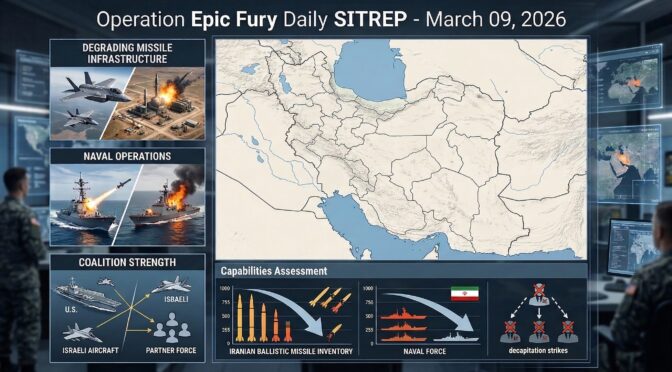
1.0 Executive Summary
The geopolitical and military landscape of the Middle East has undergone a profound and irreversible transformation over the last 36 hours. Operations Epic Fury, executed by the United States, and Roaring Lion, executed by Israel, have transitioned from an initial leadership decapitation and air defense suppression phase into a sustained, high-intensity war of attrition. This campaign is systematically targeting Iranian strategic infrastructure, internal security apparatuses, and leadership succession mechanisms.1 As the conflict enters its tenth day, the systemic shifts observed between March 8 and March 9, 2026, indicate a severe widening of the theater of operations, enveloping the entire Gulf Cooperation Council (GCC) region and fundamentally altering global energy markets and diplomatic paradigms.4
The most critical systemic shift within this reporting period is the formal succession of Iranian leadership. Following the targeted killing of Supreme Leader Ali Khamenei on February 28 during the opening salvos of Operation Epic Fury, Iran’s Assembly of Experts officially elevated his 57-year-old son, Mojtaba Khamenei, to the position of Supreme Leader on the morning of March 9, 2026.6 This transition marks a fundamental departure from the traditional meritocratic clerical ideals of Wilayat al-Faqih, cementing instead a hereditary leadership model heavily patronized and enforced by the Islamic Revolutionary Guard Corps (IRGC).6 The elevation of Mojtaba Khamenei, a known hardliner who has never held elected office but maintains deep, opaque ties to the national security establishment, signals unequivocally that Tehran is preparing for a protracted, multi-domain confrontation rather than seeking diplomatic capitulation or de-escalation.6
Militarily, the United States and Israel have achieved near-complete air superiority over Iranian airspace, allowing for the systematic dismantling of Iran’s ballistic missile infrastructure, space-based communication networks, and naval capabilities.9 The Israeli Defense Forces (IDF) reported the destruction of approximately 75 percent of Iran’s ballistic missile launchers.13 Concurrently, the United States Navy achieved a historic milestone, with a fast attack submarine confirming the sinking of the Iranian frigate IRIS Dena in the Indian Ocean utilizing a Mark 48 torpedo, marking the first successful United States submarine strike against an enemy surface combatant since the Second World War.12 However, despite these catastrophic infrastructural and naval losses, the IRGC has demonstrated highly resilient command and control structures. Over the last 36 hours, Iran unleashed the 28th wave of its retaliatory campaign, designated Operation True Promise 4, deploying heavy ballistic missiles equipped with warheads weighing up to one ton against targets in Israel and across the Persian Gulf.12
The conflict has generated unprecedented regional spillover effects that threaten to destabilize the broader Middle East. For the first time in modern history, a single state actor has simultaneously targeted infrastructure in all six GCC states, as well as Jordan and Iraq.16 Iranian munitions have successfully struck a civilian desalination plant in Bahrain, ignited aviation fuel storage tanks at Kuwait International Airport, and inflicted civilian casualties in residential sectors of Saudi Arabia.12 This regional contagion has forced the United States Department of State to order the immediate evacuation of non-essential personnel from Saudi Arabia and issue urgent travel advisories for 14 nations across the region.18 The human cost to the United States military continues to mount, with the Department of Defense confirming the deaths of a seventh and an eighth service member due to Iranian retaliatory strikes and associated health incidents within the theater of operations.12
Diplomatically, the narrative surrounding the casus belli of Operation Epic Fury has shifted dramatically. United States Secretary of State Marco Rubio publicly acknowledged to the press following a classified Gang of Eight briefing that the preemptive strikes against Iran were initiated primarily to mitigate anticipated casualties among United States forces that would have inevitably resulted from a planned, unilateral Israeli attack on Tehran.21 This admission effectively frames the United States involvement as a war of choice executed to manage the fallout of allied operations. This revelation has complicated the diplomatic position of the United States, drawing fierce condemnation from Iranian officials and generating intense political scrutiny and opposition within the United States Congress.22
Economically, the 36-hour window witnessed a severe and cascading shock to global financial systems. Brent crude oil prices surged to a peak of $119.50 per barrel on March 9 amid mounting fears of prolonged disruptions in the Strait of Hormuz, prompting emergency discussions among G7 finance ministers regarding the release of strategic petroleum reserves.5 Global stock markets suffered heavy, sustained losses, reflecting widespread macroeconomic apprehension regarding the lack of a clear exit strategy for the allied forces, the severe supply chain vulnerabilities exposed by the conflict, and the potential for a catastrophic regional economic collapse.5
2.0 Chronological Timeline of Key Events (Last 36 Hours)
The following timeline exhaustively details the highly kinetic military engagements, cyber operations, and diplomatic maneuvers recorded between March 8 and March 9, 2026. All times are recorded in Coordinated Universal Time (UTC) to ensure global standardization.
- March 8, 05:30 UTC: Israeli Defense Minister Israel Katz publicly confirms that Israeli Air Force (IAF) fighter jets are dropping heavy, unguided munitions directly over the airspace of Tehran, capitalizing on severely degraded Iranian integrated air defense systems.27
- March 8, 07:00 UTC: United States military officials formally announce the death of a seventh American service member. The soldier succumbed to critical injuries sustained during an initial Iranian retaliatory attack on a logistics base in Saudi Arabia on March 1.5
- March 8, 09:05 UTC: The Islamic Republic of Iran launches a massive, coordinated barrage of ballistic missiles and loitering munitions toward Israel and several Gulf states in direct retaliation for overnight strikes on internal security compounds in Tehran.29
- March 8, 09:26 UTC: An Iranian projectile successfully penetrates localized layered air defenses, striking near the United States Navy Fifth Fleet service center located in Bahrain, triggering immediate base lockdown protocols.29
- March 8, 11:29 UTC (1:29 PM Palestine Time): The IRGC officially announces the initiation of the 28th wave of Operation True Promise 4. This wave introduces a new generation of heavy ballistic missiles (specifically identifying Qadr, Emad, and Kheibar Shekan types) targeting Beersheba, Tel Aviv, and the Azraq air base in Jordan.12
- March 8, 12:30 UTC: IDF Home Front Command and military intelligence units issue a preliminary damage assessment estimating that approximately 170 ballistic missiles were launched by Iran in the morning wave alone.29
- March 8, 13:54 UTC: Air raid sirens are continuously triggered across the greater Tel Aviv metropolitan area and central Israel. Concurrently, a senior United States administration official briefs the press pool, stating that Washington intends to maintain the current operational tempo and continue striking targets deep inside Iran for at least the next three weeks.12
- March 8, 15:00 UTC: United Kingdom Prime Minister Keir Starmer announces the emergency deployment of highly experienced Ukrainian counter-unmanned aerial systems (C-UAS) operators to the Persian Gulf. These operators will assist allied forces in defending regional airspace against the proliferation of Iranian Shahed-136 drones.27
- March 8, 15:45 UTC: The Israeli military reports carrying out dozens of precision kinetic strikes against specialized Iranian infrastructure in Tehran. These strikes successfully target and neutralize the control, telemetry, and operation systems of the Khayyam satellite network.12
- March 8, 16:38 UTC: The Israeli military officially claims to have successfully assassinated two senior Iranian officials during precision decapitation strikes. The targets neutralized include the head of the Supreme Leader’s military office and the head of the emergency command at the Khatam al-Anbiya Central Headquarters.12
- March 8, 18:09 UTC: The United Kingdom military successfully intercepts an Iranian drone launched toward coalition facilities in Iraq. In parallel, the Israeli Finance Ministry releases a stark macroeconomic report estimating that a national wartime economic shutdown will cost the State of Israel approximately $2.9 billion per week.12
- March 8, 19:14 UTC: Maritime intelligence sources, subsequently corroborated by the United States Department of Defense, confirm that the Iranian Navy frigate IRIS Dena was sunk by a United States fast attack submarine. The vessel was struck by a Mark 48 heavy torpedo near the coast of Sri Lanka, resulting in over 100 Iranian military casualties and the total loss of the asset.12
- March 8, 20:58 UTC: The Saudi Arabia Defense Ministry announces the successful interception and destruction of two explosive-laden drones traveling on a vector north of the capital city of Riyadh.12
- March 9, 01:00 UTC: Global financial markets open with severe, unmitigated volatility. Brent crude oil spikes to a multi-year high of $119.50 per barrel. Asian markets, including Japan’s Nikkei 225 and South Korea’s Kospi, suffer massive algorithmic sell-offs resulting in temporary, mandated trading halts.5
- March 9, 04:00 UTC: The Assembly of Experts in Iran officially releases a public statement naming 57-year-old Mojtaba Khamenei as the third Supreme Leader of the Islamic Republic of Iran, effectively ending days of intense speculation, internal power struggles, and interim governance.6
- March 9, 06:15 UTC: The sanctioned shadow fleet oil tanker Skylight is struck by an Iranian anti-ship missile in the Strait of Hormuz in what maritime intelligence assesses to be a friendly-fire incident, further disrupting global maritime traffic.27
- March 9, 08:30 UTC: The Pentagon announces the death of an eighth United States service member. The individual, an Army National Guard soldier, died from a health-related incident while deployed in Kuwait supporting combat operations.20
- March 9, 10:00 UTC: Israeli Prime Minister Benjamin Netanyahu addresses an emergency session of the Knesset, declaring that Israel will continue the war with absolute force and warning the new Iranian leadership against any further escalatory miscalculations.30
- March 9, 12:00 UTC: United States President Donald Trump issues a direct statement via the Truth Social platform regarding the global spike in energy prices. He characterizes the economic pain as a temporary and highly acceptable “small price to pay” for the total, permanent destruction of the Iranian nuclear program.5
3.0 Situation by Primary Country
3.1 Iran
3.1.1 Military Actions & Posture
The Islamic Republic of Iran is currently operating under a state of total, existential war, sustaining catastrophic degradation of its conventional military architecture while maintaining highly lethal asymmetric and ballistic strike capabilities. Over the last 36 hours, the combined United States and Israeli forces have systematically targeted the core of Iran’s internal security and missile production networks. Satellite imagery published on March 8 confirmed heavy, structural damage to the Shahroud Missile Facility in Semnan Province.32 Independent nonproliferation analysts identified that precision strikes completely destroyed specialized mixing buildings, casting buildings, and the primary warhead production lines essential for manufacturing solid fuel for medium-range ballistic missiles.32 Furthermore, precision bunker-penetrating munitions cratered runways and destroyed hardened hangars at the 8th Artesh Air Force Tactical Airbase and the 4th Artesh Ground Forces Aviation Base in Esfahan, aiming to permanently suppress Iranian air defenses in the central geographic sector.13
Despite the loss of an estimated 75 percent of its terrestrial missile launch infrastructure and the total annihilation of its naval surface combatants (including the confirmed sinkings of the frigates IRIS Jamaran at Chabahar pier and IRIS Dena off the coast of Sri Lanka), the IRGC Aerospace Force continues to project regional power.13 The IRGC explicitly initiated the 28th wave of Operation True Promise 4 on March 8.12 This wave represented a qualitative escalation, as Iran launched heavy ballistic missiles, including the Kheibar Shekan systems equipped with one-ton warheads, toward Israeli urban centers and Gulf military installations.12 Iranian military spokespersons proudly claimed the successful kinetic destruction of four United States THAAD missile defense radars during these barrages, although this claim remains strictly unverified by United States Central Command.12
The Iranian military strategy has unequivocally pivoted from localized defense to a theater-wide imposition of extreme economic and military costs. By actively targeting critical energy infrastructure, desalination plants, and civilian aviation hubs across the GCC, Tehran seeks to weaponize global economic anxiety. The IRGC explicitly announced strategic plans to double its ballistic missile operations and increase loitering munition (drone) deployments by 20 percent in the coming days, signaling a clear operational intent to overwhelm and deplete allied interceptor stockpiles across the Middle East.12
Table 2: Estimated Iranian Military Asset Degradation (As of March 9, 2026)
| Asset Category | Pre-Conflict Estimate | Estimated Degradation | Operational Status | Source Evidence |
| Ballistic Missile Launchers | Classified | 75% Destroyed | Severely Degraded but Active | IDF Statements 9 |
| Integrated Air Defenses | Layered National Grid | 80% Destroyed | Near-Complete Collapse | US/IDF Assessments 9 |
| Naval Surface Combatants | Dozens of Frigates/Fast Craft | Over 30 Vessels Sunk | Annihilated / Inoperable | CENTCOM 15 |
| Space/Telemetry Command | Khayyam Satellite Control | 100% Destroyed | Offline | IDF Statements 12 |
| Solid Fuel Production | Shahroud Facility Mixers | 100% Destroyed | Production Halted | Satellite Imagery 32 |
3.1.2 Policy & Diplomacy
The political landscape in Tehran experienced a seismic and historic shift with the official appointment of Mojtaba Khamenei as the third Supreme Leader on March 9.6 This appointment resolves the immediate, chaotic succession crisis triggered by the February 28 decapitation strike that killed his father, Ali Khamenei. Mojtaba Khamenei, heavily backed by the IRGC and the ultraconservative Paydari Party, represents the total consolidation of state power by Iran’s hardline military-security nexus.6 His worldview is defined by the strict “Doctrine of Resistance,” which strictly opposes compromise with Western powers and advocates for the aggressive, violent expansion of the Axis of Resistance.6
The transition period preceding his appointment revealed deep, systemic fissures within the Iranian government. Interim executive figures, including President Masoud Pezeshkian, attempted to pursue diplomatic off-ramps to save the domestic economy. On March 7, Pezeshkian reportedly attempted to apologize to Gulf states for Iranian strikes on their sovereign territory, offering to permanently halt attacks if GCC nations closed their airspace to United States and Israeli military aircraft.36 However, the IRGC openly defied this diplomatic overture, continuing to strike targets in Bahrain, Kuwait, and the United Arab Emirates, thereby exposing the total marginalization and impotence of the elected civilian government.6 The succession of Mojtaba Khamenei essentially formalizes an IRGC-led autocracy, ensuring that Iran will categorically reject any international ceasefire proposals that demand structural surrender or nuclear capitulation.
3.1.3 Civilian Impact
The civilian population of the Islamic Republic of Iran is enduring catastrophic physical, social, and economic impacts. Since the onset of Operation Epic Fury, at least 1,332 civilians and military personnel have been killed within Iranian territory, marking the deadliest domestic conflict since the Iran-Iraq War.9 Civilian infrastructure has suffered severe, localized collateral damage. Notably, strikes targeting an IRGC naval base resulted in the accidental destruction of the Shajareh Tayyebeh elementary school in Minab, causing the deaths of approximately 175 civilians, primarily young children.15 Additional strikes have completely destroyed a dialysis center in Karaj and heavily damaged an industrial printing zone in the holy city of Qom.12
Economically, the nation is facing total collapse. The Iranian Rial has plummeted to unprecedented, hyperinflationary lows, and the systematic destruction of domestic fuel storage facilities has paralyzed internal logistics and transportation networks.8 Senior Iranian officials have issued desperate internal warnings regarding the imminent threat of nationwide “bread riots” as inflation surges and basic food commodities become scarce.6 Concurrently, the state security apparatus has adopted an absolute zero-tolerance policy toward domestic dissent. The IRGC Intelligence Organization reported the violent arrest of a 50-member cell in Kohgiluyeh and Boyer Ahmad Province on March 8, accusing the citizens of royalist sabotage and collaboration with foreign intelligence.13 State security forces, including the Basij, have maintained a heavy, militarized presence in all major urban centers to violently suppress any public celebrations of the regime’s military losses or protests against the ongoing war.1
3.2 Israel
3.2.1 Military Actions & Posture
Operating under the strategic designation Operation Roaring Lion, the Israel Defense Forces have achieved near-complete tactical freedom of action over Iranian sovereign airspace.9 Over the last 36 hours, the Israeli Air Force launched a wide-scale wave of strikes targeting deep underground facilities and satellite command networks spanning from Tehran to Isfahan.12 A primary objective achieved on March 8 was the destruction of the control and operation systems of the Iranian Khayyam satellite located in Tehran, severely degrading Iran’s orbital reconnaissance and targeting capabilities.12 Furthermore, Israeli forces utilized advanced ground-penetrating munitions against the Shiraz South Missile Base, neutralizing hardened subterranean launch silos that housed medium-range ballistic missiles.13
Simultaneously, Israel is fighting a high-intensity, multi-domain conflict on its northern border. The IDF reported conducting over 100 airstrikes against Hezbollah targets in Lebanon within a 24-hour window, bringing the total number of strikes in Lebanon to over 600 since the war began on February 28.13 These strikes have specifically targeted the IRGC Quds Force Lebanon Corps commanders stationed in Beirut, attempting to permanently sever the logistical and command link between Tehran and Hezbollah.32 Ground forces are also reported to be pushing significantly deeper into southern Lebanon to physically dismantle rocket launch sites that have maintained steady, disruptive fire on northern Israeli towns.38
3.2.2 Policy & Diplomacy
The Israeli government is operating on a maximalist, existential war footing. In a defiant address to the nation and an emergency session of the Knesset on March 9, Prime Minister Benjamin Netanyahu framed the conflict as a “War of Redemption,” vowing to continue military operations until total victory is achieved across all fronts.30 Netanyahu stated, “Wars are won with initiative and stratagems but the first foundation of success is determination,” confirming that Israel will not scale back its aerial bombardment regardless of international diplomatic pressure.30
Domestic political consensus regarding the military objectives remains highly unified, though tactical disagreements exist. Opposition leader Yair Lapid publicly supported the immediate expansion of the target matrix to include Iranian oil fields and energy export terminals.31 Lapid argued that such severe economic destruction is necessary to ultimately collapse the “Ayatollah regime,” explicitly stating that Israel should pursue this course even if it triggers severe diplomatic friction with the Trump administration in Washington.31 To manage the prolonged domestic crisis, the Knesset Foreign Affairs and Defense Committee unanimously approved emergency wartime measures, authorizing a Special Situation on the Home Front extending through mid-March.39
3.2.3 Civilian Impact
The Israeli civilian populace is subjected to continuous, daily disruptions due to incoming ballistic missiles from Iran and relentless rocket barrages from Hezbollah. On March 8, incoming heavy fire triggered mass alerts across the greater Tel Aviv metropolitan area, central Israel, and the northern port city of Haifa.12 While the Arrow and David’s Sling air defense systems intercepted the vast majority of the projectiles, fragment impacts and cluster munitions resulted in localized casualties. The national emergency medical service, Magen David Adom, reported treating over 2,072 people for physical injuries and severe trauma since the war began, with several specific injuries sustained from Iranian cluster munitions landing in central Israel on March 8.12
The macroeconomic toll on the Israeli civilian sector is mounting rapidly and unsustainably. The Finance Ministry estimates that the national economic shutdown, driven by continuous civilian sheltering protocols and the mass mobilization of military reserves, is costing the state a staggering $2.9 billion per week.12 Despite the ongoing kinetic threats, the Home Front Command is attempting to restore a semblance of normalcy to the domestic economy, initiating controversial plans on March 9 to reopen educational institutions in lower-risk areas provided they feature adequate, reinforced bomb shelters.38 In a significant wartime domestic policy shift, National Security Minister Itamar Ben-Gvir drastically expanded gun license eligibility for Jewish residents in Jerusalem, citing severe internal security concerns and the potential for domestic unrest during the Muslim holy month of Ramadan.38
3.3 United States
3.3.1 Military Actions & Posture
Under the auspices of Operation Epic Fury, United States Central Command has executed what the Department of War describes as the most complex and lethal aerial campaign in modern military history.40 Secretary of War Pete Hegseth and CENTCOM Commander Admiral Brad Cooper reported that United States forces struck approximately 200 high-value targets deep inside Iranian territory over the preceding 72-hour period.9 The United States has heavily leveraged its strategic bomber fleet, deploying B-2 Spirit stealth bombers to deliver GBU-31 2,000-pound precision-guided bombs against heavily hardened IRGC command and control centers.15
The maritime domain has seen unprecedented United States kinetic action. The Pentagon confirmed the first submarine-to-surface vessel kill since World War II when a United States fast attack submarine successfully torpedoed and sank the Iranian frigate IRIS Dena off the coast of Sri Lanka on March 8 utilizing a Mark 48 heavyweight torpedo.12 The conflict has resulted in direct American military casualties. On March 8 and 9, the Pentagon solemnly announced the deaths of a seventh and eighth United States service member. The seventh fatality resulted from severe wounds sustained during an earlier Iranian retaliatory strike on a logistics base in Saudi Arabia, while the eighth involved an Army National Guard soldier who suffered a fatal health-related incident while deployed in Kuwait supporting combat operations.5
Cyber warfare remains a primary, highly active vector for United States offensive operations. Cyber Command, acting as the designated “first mover” in Operation Epic Fury, initiated multi-layered, catastrophic attacks on Iranian BGP routing protocols, DNS infrastructure, and critical SCADA systems.42 Ongoing United States cyber operations have included the weaponization of the Iranian BadeSaba religious calendar application (which boasts over 5 million downloads) to deliver psychological operations messages directly to Iranian citizens, urging them to defect and rise against the regime.42
Table 3: US Military Casualties and Financial Expenditure (March 9, 2026)
| Metric | Current Total | Context / Recent Updates | Source |
| Total US Fatalities | 8 Service Members | 7th died from injuries in Saudi Arabia; 8th died from health incident in Kuwait. | 12 |
| Daily Financial Burn Rate | ~$891 Million | Represents unbudgeted expenditure for advanced munitions and logistics. | 9 |
| Total Campaign Cost (First 100 Hrs) | $3.7 Billion | Requires immediate emergency Congressional supplemental funding. | 9 |
3.3.2 Policy & Diplomacy
The diplomatic narrative originating from Washington experienced a severe, highly controversial disruption following statements made by Secretary of State Marco Rubio. Exiting a classified Gang of Eight intelligence briefing on Capitol Hill, Rubio admitted to the press that the United States preemptively attacked Iran not because of an unprovoked, imminent Iranian threat to the homeland, but because intelligence definitively indicated Israel was about to launch a massive, autonomous strike.21 Rubio explicitly stated that Washington struck first to preempt and degrade the inevitable Iranian retaliation against United States bases that would have followed the Israeli attack.21 This admission categorizes Epic Fury as a “war of choice” initiated primarily to manage the consequences of allied actions, drawing fierce criticism from congressional lawmakers across the political spectrum who argue the administration lacks a coherent strategic endgame or post-conflict political architecture.23
President Donald Trump maintains a maximalist public posture, demanding the “unconditional surrender” of the Iranian regime before any cessation of hostilities.17 Trump flippantly dismissed mounting global concerns regarding the macroeconomic fallout, stating on his social media platform that the severe spike in energy prices is a “small price to pay” for the total, permanent destruction of the Iranian nuclear threat.5 Furthermore, Trump explicitly interjected the United States into the highly sensitive Iranian succession process, declaring that Mojtaba Khamenei is an unacceptable leader and threatening that he will “not last long” without American approval.1 The administration has indicated that there is no set timetable for the conclusion of military operations, signaling a willingness to sustain the multi-billion dollar campaign indefinitely.17
3.3.3 Civilian Impact
The domestic impact within the United States homeland has escalated rapidly, characterized by widespread travel disruptions, profound economic anxiety, and emerging homeland security threats. On the international front, the State Department issued Level 4 “Do Not Travel” advisories and ordered the immediate, mandatory evacuation of United States nationals from 14 countries across the Middle East, citing imminent danger from drone attacks and widespread commercial airspace closures.19 The federal government is actively chartering civilian flights to extract thousands of citizens currently stranded in the UAE, Saudi Arabia, and Jordan.46
Domestically, the Department of Homeland Security (DHS) issued high-level national alerts warning of potential lone-wolf terrorism and sophisticated cyberattacks orchestrated by Iran-aligned sympathizers or state-sponsored threat actors (such as the revived Altoufan Team and HANDALA groups) targeting critical American infrastructure.42 The environment of domestic fear was compounded by a mass shooting incident in Austin, Texas, over the weekend, which the Federal Bureau of Investigation is currently investigating as a potential act of retaliatory terrorism linked to the overseas conflict.47 In financial markets, United States consumers are bracing for severe, immediate inflationary pressures as gasoline and heating costs surge globally due to the disruption of Middle Eastern crude exports, with the Dow Jones Industrial Average experiencing severe drops correlated to the outbreak of hostilities.5
4.0 Regional and Gulf State Impacts
The execution of Operation Epic Fury has effectively erased the geographic and political distinction between the primary combatants and the broader Middle Eastern theater. Iran has utilized its vast ballistic missile and loitering munition arsenal to deliberately target GCC states, viewing them as entirely complicit due to their hosting of United States military installations and logistical hubs. This aggressive Iranian strategy aims to shatter regional economic stability, hold global energy markets hostage, and violently force Arab states to pressure Washington into a unilateral ceasefire.
United Arab Emirates (UAE)
The UAE has activated advanced, layered missile defense protocols, successfully intercepting numerous Iranian projectiles using United States-supplied Patriot and THAAD batteries.5 However, the sheer volume of the barrages has caused significant civilian disruption. Explosions near Dubai resulted in Emirates Airlines temporarily suspending all flights to and from the international aviation hub, severely damaging the UAE’s lucrative status as a secure global transit and tourism point.17 The IRGC explicitly claimed massive strikes against the Al Dhafra Air Base, aiming to neutralize United States and Emirati air assets stationed there, forcing base personnel into continuous bunker protocols.17
Saudi Arabia
Saudi sovereign airspace remains highly volatile and heavily contested. The Saudi Defense Ministry reported the successful interception of multiple explosive-laden drones traveling north toward the capital of Riyadh on March 8.12 The conflict has resulted in tragic, direct casualties on Saudi soil; a military projectile struck a civilian residential area in Al-Kharj, killing two civilians and wounding a dozen more.12 Furthermore, a United States service member critically wounded in an earlier strike in Saudi Arabia succumbed to their injuries on March 8.5 In response to the rapidly degrading security environment, the United States State Department ordered the mandatory evacuation of all non-essential diplomatic personnel and military families from the Kingdom.18 Saudi Arabia has issued harsh diplomatic statements condemning “Iranian aggression” and warned of grave impacts on future bilateral relations.18
Qatar
Qatar, historically a vital diplomatic mediator between Washington and Tehran, has not been spared from the geographic expansion of the conflict. The Al Udeid Air Base, the primary operational headquarters for CENTCOM in the region, was subjected to targeted ballistic missile strikes.27 Unverified Iranian claims suggest the destruction of advanced AN/FPS-132 early warning radars situated in Qatar, which, if true, represents a massive blow to the regional Integrated Air Defense System (IADS).34 The critical energy sector is under severe threat; Qatar’s energy minister, Saad al-Kaabi, issued a dire warning that continued hostilities could force regional producers to declare force majeure and halt liquefied natural gas (LNG) exports entirely, an act that would plunge European and Asian economies into immediate crisis.25
Bahrain
Bahrain, the strategic host to the United States Navy’s Fifth Fleet, suffered direct and damaging strikes on both military installations and critical civilian infrastructure. Iranian Shahed-136 drones successfully impacted the Naval Support Activity (NSA) Bahrain, causing localized facility damage, while a separate projectile strike caused structural damage to a civilian desalination plant, directly threatening the island nation’s fragile potable water supply.13 CENTCOM Commander Admiral Brad Cooper vehemently condemned the strikes on civilian neighborhoods in Bahrain as “unacceptable,” warning of severe retaliatory measures.9 Debris from intercepted missiles also caused civilian injuries and structural damage to a university building in the city of Muharraq.12
Kuwait
Kuwait has experienced severe infrastructure damage and fatal casualties. The fuel storage tanks at Kuwait International Airport were hit by sophisticated drone strikes, igniting large, sustained fires that required extensive emergency response and temporarily halted commercial operations.17 The Ali Al Salem Air Base, a vital logistics and staging hub for the United States Air Force, was continuously targeted by Iranian ballistic missiles.27 The United States suffered direct casualties in Kuwait, including the death of an Army National Guard soldier on March 9, prompting the immediate suspension of standard operations at the United States Embassy in Kuwait City and triggering evacuation preparations for foreign workers.9
Oman
Oman, uniquely positioned geographically adjacent to the heavily contested Strait of Hormuz, has largely focused on urgent diplomatic mitigation while suffering severe economic disruptions due to the maritime shipping crisis. On March 9, the Omani Foreign Ministry issued a formal diplomatic statement calling for an immediate ceasefire and the absolute cessation of all missile strikes across the region.52 Omani Foreign Minister Badr al-Busaidi publicly rejected the United States’ characterization of Iran as an “imminent threat” prior to the strikes, asserting that diplomatic off-ramps were readily available and that nuclear negotiations had been progressing steadily before Operation Epic Fury commenced.53 Meanwhile, the maritime domain remains perilous; the sanctioned oil tanker Skylight was struck by an Iranian missile near Omani waters, highlighting the total breakdown of navigational security.27
Jordan
Jordan serves as a critical geographic buffer state and an essential host to United States aerial forces. The IRGC officially claimed to have targeted the Azraq air base (Muwaffaq al-Salti) during the 28th wave of missile strikes on March 8, attempting to degrade coalition sortie generation capabilities.12 The Jordanian government has joined other Gulf nations in a joint, multilateral statement strongly condemning the “indiscriminate and reckless” missile and drone attacks by the Islamic Republic.54 Amman reaffirmed its sovereign right to self-defense and maintained robust, continuous air defense cooperation with the United States to actively intercept Iranian projectiles transiting Jordanian airspace toward Israel, placing the Hashemite Kingdom directly in the crossfire of the regional war.54
5.0 Appendices
Appendix A: Methodology
This Situation Report (SITREP) was compiled utilizing a comprehensive, real-time sweep of open-source intelligence (OSINT), official state diplomatic broadcasts, and global military news monitors. The temporal scope of the analysis was strictly limited to the 36-hour window corresponding to March 8 and March 9, 2026, with intentional overlaps to ensure narrative continuity regarding the Iranian leadership succession. Data synthesis required the rigorous cross-referencing of official military press briefings (e.g., United States Department of War transcripts, IDF Home Front Command alerts, and IRGC official Telegram channels) with independent geopolitical analyses, macroeconomic market data, and maritime tracking logs. Conflicting reports—such as the Iranian military claim of destroying four United States THAAD radar systems versus allied silence on the matter—were documented strictly as claimed by the originating entity and explicitly noted as unverified by opposing military commands to maintain absolute analytical neutrality and objectivity.
Appendix B: Glossary of Acronyms
- BGP: Border Gateway Protocol (A standardized exterior gateway protocol designed to exchange routing and reachability information among autonomous systems on the Internet, targeted by US Cyber Command).
- CENTCOM: United States Central Command (The geographic combatant command responsible for US military operations in the Middle East).
- C-UAS: Counter-Unmanned Aerial Systems (Defensive technologies deployed to detect and neutralize drone threats).
- DNS: Domain Name System (The hierarchical naming system for computers, targeted during initial cyber operations).
- GCC: Gulf Cooperation Council (The political and economic alliance of six Middle Eastern countries: Saudi Arabia, Kuwait, the UAE, Qatar, Bahrain, and Oman).
- HEU: Highly Enriched Uranium (Fissile material targeted by allied bunker-busting munitions).
- IADS: Integrated Air Defense System (A network of radars and surface-to-air missiles).
- IAF: Israeli Air Force.
- IDF: Israel Defense Forces.
- IRGC: Islamic Revolutionary Guard Corps (The primary multi-domain, ideologically driven military branch of the Iranian Armed Forces).
- LEC: Law Enforcement Command (Iran’s national police force, targeted by allied strikes to degrade internal security).
- LUCAS: Low-cost Uncrewed Combat Attack System (Experimental US drone systems deployed in the conflict).
- MOIS: Ministry of Intelligence of the Islamic Republic of Iran.
- NSA: Naval Support Activity (United States Navy terminology for a military base, e.g., NSA Bahrain).
- SCADA: Supervisory Control and Data Acquisition (Control system architecture used for critical infrastructure management, targeted by US cyber offensives).
- THAAD: Terminal High Altitude Area Defense (An advanced United States anti-ballistic missile defense system).
Appendix C: Glossary of Foreign Words
- Artesh: The conventional military forces of the Islamic Republic of Iran, operating parallel to, but often subordinate to, the IRGC.
- Basij: A paramilitary volunteer militia established in Iran, operating as a subordinate force to the IRGC, heavily utilized for extreme internal security and violent protest suppression.
- Dahiyeh: A predominantly Shia Muslim suburb south of Beirut, Lebanon, known as a primary stronghold, military command, and administrative center for Hezbollah.
- Khamenei: Refers to the family name of Ali Khamenei (the deceased 2nd Supreme Leader assassinated on February 28) and Mojtaba Khamenei (the newly appointed 3rd Supreme Leader of Iran).
- Knesset: The unicameral national legislature of the State of Israel.
- Majlis: The Islamic Consultative Assembly, which serves as the national legislative body of Iran.
- Quds Force: One of five branches of Iran’s IRGC, specializing in unconventional warfare and military intelligence operations, primarily responsible for extraterritorial operations and managing proxy militias across the Axis of Resistance.
- Rial: The official fiat currency of the Islamic Republic of Iran, currently experiencing hyperinflationary collapse.
- Wilayat al-Faqih: “Guardianship of the Islamic Jurist,” the foundational political and theological doctrine of the Islamic Republic of Iran, which theoretically grants absolute political authority to a qualified, meritocratic Islamic scholar (the Supreme Leader).
Please share the link on Facebook, Forums, with colleagues, etc. Your support is much appreciated and if you have any feedback, please email us in**@*********ps.com. If you’d like to request a report or order a reprint, please click here for the corresponding page to open in new tab.
Sources Used
- 2026 Iran conflict | Explained, United States, Israel, Map, & War …, accessed March 9, 2026, https://www.britannica.com/event/2026-Iran-Conflict
- Operation “Epic Fury:” SITREP (2 MAR 2026) – ICT, accessed March 9, 2026, https://ict.org.il/operation-epic-fury-sitrep-2-mar-2026/
- Operation “Epic Fury:” SITREP (3 MAR 2026), accessed March 9, 2026, https://ict.org.il/operation-epic-fury-sitrep-3-mar-2026/
- The war on Iran is already upending the Middle East. Look to the Gulf states to see how, accessed March 9, 2026, https://www.theguardian.com/commentisfree/2026/mar/09/us-israel-war-iran-gulf-monarchies
- Live Updates: Fear U.S.-Israeli war with Iran will drag on sends …, accessed March 9, 2026, https://www.cbsnews.com/live-updates/us-iran-war-israel-stock-prices-down-oil-prices-up-despite-trump-reassurance/
- Mojtaba Khamenei: The shadow prince who became Iran’s supreme …, accessed March 9, 2026, https://www.iranintl.com/en/202603083539
- Mojtaba Khamenei: The shadow prince who became Iran’s supreme leader, accessed March 9, 2026, https://www.iranintl.com/en/202603084245
- The Mojtaba Khamenei Succession and the Post-Decapitation Order in Iran, accessed March 9, 2026, https://debuglies.com/2026/03/09/the-mojtaba-khamenei-succession-and-the-post-decapitation-order-in-iran/
- Iran war: What is happening on day seven of US-Israel attacks? – Al Jazeera, accessed March 9, 2026, https://www.aljazeera.com/news/2026/3/6/iran-war-what-is-happening-on-day-seven-of-us-israel-attacks
- The US-Israel campaign in Iran – The International Institute for Strategic Studies, accessed March 9, 2026, https://www.iiss.org/online-analysis/online-analysis/2026/02/the-us-israel-campaign-in-iran/
- Unclear Justifications and Objectives Risk Operation Epic Fury Becoming an Epic Fail, accessed March 9, 2026, https://www.americansecurityproject.org/unclear-justifications-and-objectives-risk-operation-epic-fury-becoming-an-epic-fail/
- LIVE BLOG: Iran Vows to Defend ‘Every Inch as Missiles and …, accessed March 9, 2026, https://www.palestinechronicle.com/live-blog-iran-vows-to-defend-every-inch-as-missiles-and-regional-strikes-escalate-day-9/
- Iran Update Evening Special Report: March 8, 2026 | ISW, accessed March 9, 2026, https://understandingwar.org/research/middle-east/iran-update-evening-special-report-march-8-2026/
- Iran War Disrupts Maritime Trade: Week One Analysis – Windward, accessed March 9, 2026, https://windward.ai/blog/one-week-into-the-iran-war/
- [OC] Operation Epic Fury / Roaring Lion — Every sourced US-Israel vs Iran strike animated day-by-day (Feb 28 – Mar 5, 2026 UTC) : r/dataisbeautiful – Reddit, accessed March 9, 2026, https://www.reddit.com/r/dataisbeautiful/comments/1rlfguz/oc_operation_epic_fury_roaring_lion_every_sourced/
- Policy – JINSA, accessed March 9, 2026, https://jinsa.org/policy/
- Trump offers vague description of Iran surrender demand – as it …, accessed March 9, 2026, https://www.theguardian.com/world/live/2026/mar/07/middle-east-crisis-live-tehran-explosions-beirut-trump-israel-iran-war-second-week
- Iran names Mojtaba Khamenei to succeed his father as supreme leader and Saudi sharpens warning, accessed March 9, 2026, https://apnews.com/article/iran-israel-us-march-8-2026-f0b20dbffaea9351ae1e54183ffe53ff
- Americans Urged To Leave Middle East But Struggle With Evacuation Options | Military.com, accessed March 9, 2026, https://www.military.com/feature/2026/03/04/americans-urged-leave-middle-east-struggle-evacuation-options.html
- Iran highlights: War intensifies in the Middle East, accessed March 9, 2026, https://www.ms.now/liveblog/iran-war-trump-israel-news-3-08
- Marco Rubio Admits: Israel Triggered U.S. Attack on Iran | by Thomas Karat | ILLUMINATION, accessed March 9, 2026, https://medium.com/illumination/marco-rubio-admits-israel-triggered-u-s-attack-on-iran-8ed9a0b9c152
- Marco Rubio: Planned Israeli strike forced US to launch Iran war | The Jerusalem Post, accessed March 9, 2026, https://www.jpost.com/middle-east/iran-news/article-888615
- Lawmakers react to ‘Operation Epic Fury’ US – Israel military strikes across Iran, accessed March 9, 2026, https://www.livenowfox.com/news/lawmakers-react-operation-epic-fury-us-israel-military-strikes-across-iran
- Middle East crisis live: Mojtaba Khamenei chosen as Iran’s new supreme leader as finance ministers prepare to discuss surging oil prices, accessed March 9, 2026, https://www.theguardian.com/world/live/2026/mar/09/iran-war-live-updates-new-supreme-leader-mojtaba-khamenei-oil-prices-soar?filterKeyEvents=false&page=with%3Ablock-69ae43988f08ef977b472507
- 2026 Iran war – Wikipedia, accessed March 9, 2026, https://en.wikipedia.org/wiki/2026_Iran_war
- Why Trump’s Epic Fury is doomed The West has been out-manufactured, accessed March 9, 2026, https://unherd.com/2026/03/why-trumps-epic-fury-is-doomed/?edition=us
- Escalation in the Middle East: Tracking “Operation Epic Fury” Across Military and Cyber Domains, accessed March 9, 2026, https://securityboulevard.com/2026/03/escalation-in-the-middle-east-tracking-operation-epic-fury-across-military-and-cyber-domains/
- Mojtaba Khamenei has been chosen as Iran’s new supreme leader, accessed March 9, 2026, https://apnews.com/live/iran-war-israel-trump-03-08-2026
- Timeline of the 2026 Iran war – Wikipedia, accessed March 9, 2026, https://en.wikipedia.org/wiki/Timeline_of_the_2026_Iran_war
- Statement by PM Netanyahu – 7 March 2026 Ministry of Foreign Affairs – Gov.il, accessed March 9, 2026, https://www.gov.il/en/pages/statement-by-pm-netanyahu-7-mar-2026
- Netanyahu says Israel faces ‘complex, difficult’ days amid Iran tensions – Anadolu Ajansı, accessed March 9, 2026, https://www.aa.com.tr/en/energy/general/netanyahu-says-israel-faces-complex-difficult-days-amid-iran-tensions/54900
- Iran Update Morning Special Report: March 8, 2026 | ISW, accessed March 9, 2026, https://understandingwar.org/research/middle-east/iran-update-morning-special-report-march-8-2026/
- This Week in DOW: Delivering ‘Shock and Awe’ to Iran, Defense Leaders’ Declaration, Updates on AI, accessed March 9, 2026, https://www.war.gov/News/News-Stories/Article/Article/4425242/this-week-in-dow-delivering-shock-and-awe-to-iran-defense-leaders-declaration-u/
- Template:2026 Iran war infobox – Wikipedia, accessed March 9, 2026, https://en.wikipedia.org/wiki/Template:2026_Iran_war_infobox
- Middle East crisis live: Israel resumes strikes across Tehran and Beirut; finance ministers prepare to discuss surging oil prices, accessed March 9, 2026, https://www.theguardian.com/world/live/2026/mar/09/iran-war-live-updates-new-supreme-leader-mojtaba-khamenei-oil-prices-soar
- Appointing a new leader is the least of Iran’s troubles, accessed March 9, 2026, https://www.theguardian.com/world/2026/mar/08/appointing-a-new-leader-is-the-least-of-irans-troubles
- New strikes light up the night in Tehran as Israel vows ‘many surprises’ – ClickOnDetroit, accessed March 9, 2026, https://www.clickondetroit.com/news/world/2026/03/07/iranian-attacks-target-gulf-states-as-us-warns-bombing-will-intensify/
- Latest News | The Times of Israel, accessed March 9, 2026, https://www.timesofisrael.com/latest/
- Knesset committee approves wartime emergency measures, receives security briefing, accessed March 9, 2026, https://www.timesofisrael.com/liveblog_entry/knesset-committee-approves-wartime-emergency-measures-receives-security-briefing/
- Secretary of War Pete Hegseth and Chairman of the Joint Chiefs of Staff Gen. Dan Caine Hold a Press Briefing, accessed March 9, 2026, https://www.war.gov/News/Transcripts/Transcript/Article/4418959/secretary-of-war-pete-hegseth-and-chairman-of-the-joint-chiefs-of-staff-gen-dan/
- U.S. targeting Iran’s space capabilities early into Operation Epic Fury | DefenseScoop, accessed March 9, 2026, https://defensescoop.com/2026/03/05/operation-epic-fury-targeting-iran-space-capabilities/
- Defending Against Iranian Cyber Threats in the Wake of Operation Epic Fury – AttackIQ, accessed March 9, 2026, https://www.attackiq.com/2026/03/05/operation-epic-fury/
- How Will Cyber Warfare Shape the U.S.-Israel Conflict with Iran? – CSIS, accessed March 9, 2026, https://www.csis.org/analysis/how-will-cyber-warfare-shape-us-israel-conflict-iran
- Operation Epic Fury and the Illusion of Decisive Force: America’s Strategic Miscalculations in the Iran War of 2026 – ResearchGate, accessed March 9, 2026, https://www.researchgate.net/publication/401536789_Operation_Epic_Fury_and_the_Illusion_of_Decisive_Force_America’s_Strategic_Miscalculations_in_the_Iran_War_of_2026
- Hegseth Says There’s No Shortage of American Will, Resources in Operation Epic Fury, accessed March 9, 2026, https://www.war.gov/News/News-Stories/Article/Article/4424786/hegseth-says-theres-no-shortage-of-american-will-resources-in-operation-epic-fu/
- State Dept. scrambles to aid stranded Americans amid attacks, airport closures, accessed March 9, 2026, https://www.washingtonpost.com/national-security/2026/03/03/iran-embassy-closures-stranded-americans/
- U.S. Homeland Security Concerns After Iran Strikes | Council on Foreign Relations, accessed March 9, 2026, https://www.cfr.org/articles/iran-and-terrorism-what-the-u-s-strikes-could-mean-for-homeland-security
- U.S. and Israel expand war with Iran with joint air, sea, and land operations as Tehran hits back – YouTube, accessed March 9, 2026, https://www.youtube.com/watch?v=bqwddkCN7tg
- Iran Responds to Operation Epic Fury with Layered Military, Cyber, and Proxy Strategy Amid Escalation Constraints – HSToday, accessed March 9, 2026, https://www.hstoday.us/subject-matter-areas/counterterrorism/iran-responds-to-operation-epic-fury-with-layered-military-cyber-and-proxy-strategy-amid-escalation-constraints/
- Reactions to the 2026 Iran war – Wikipedia, accessed March 9, 2026, https://en.wikipedia.org/wiki/Reactions_to_the_2026_Iran_war
- Experts react: The US and Israel just unleashed a major attack on Iran. What’s next?, accessed March 9, 2026, https://www.atlanticcouncil.org/dispatches/experts-react-the-us-and-israel-just-unleashed-a-major-attack-on-iran-whats-next/
- Oman calls for immediate halt to attacks against sites in countries across the region, accessed March 9, 2026, https://www.fm.gov.om/en/38129/
- Oman renews push for diplomacy, says ‘off-ramps available’ in Iran war | News – Al Jazeera, accessed March 9, 2026, https://www.aljazeera.com/news/2026/3/3/oman-calls-for-immediate-ceasefire-says-off-ramps
- Joint Statement on Iran’s Missile and Drone Attacks in the Region – U.S. Department of State, accessed March 9, 2026, https://www.state.gov/releases/office-of-the-spokesperson/2026/03/joint-statement-on-irans-missile-and-drone-attacks-in-the-region