1. Executive Summary
The year 2026 represents a profound and irreversible inflection point in the character of modern warfare. Uncrewed systems have transitioned completely from auxiliary assets focused on intelligence, surveillance, and reconnaissance into the primary engines of tactical maneuver, kinetic strike, and multidomain area denial. The first half of 2026 has provided unprecedented volumes of combat data, operational testing, and procurement reform, crystallizing lessons learned from high-intensity conflicts in the Black Sea, the Red Sea, and Eastern Europe, as well as rapid force posture realignments in the Indo-Pacific. This research report synthesizes the top ten insights and lessons learned regarding global military drone technologies, doctrine, and policy year-to-date (YTD) 2026.
The current strategic environment is increasingly defined by the collapse of traditional cost-exchange ratios. Advanced militaries are finding their multi-million-dollar interceptors economically exhausted by asymmetric, attritable mass. Concurrently, technological constraints that have historically limited uncrewed operations—such as battery life and the necessity for continuous human-in-the-loop communication links—are being shattered by innovations in directed energy power beaming and autonomous artificial intelligence.1
State actors have recognized that exquisite, low-volume, heavily crewed platforms cannot survive on the modern battlefield without the screening mass of uncrewed systems. Consequently, defense ministries worldwide are rapidly abandoning slow, centralized acquisition models. In their place, states are standing up mass-production initiatives, state-sponsored dual-use ecosystems, and the aggressive integration of civilian software architectures.3 The resulting paradigm requires military leaders and students of military affairs to understand that uncrewed systems are no longer a subset of aviation or naval doctrine; they constitute a distinct, multidomain center of gravity that fundamentally alters strategic geography, deterrence theory, and force posture on a global scale. The following analysis details the ten most critical developments in this domain thus far this year.
2. Analytical Framework for Identification and Assessment
To identify the top ten military drone insights for YTD 2026, an exhaustive and rigorous analytical methodology was employed. This framework was specifically designed to filter discrete, localized battlefield events and isolated technological announcements through a broader lens of strategic relevance and global military impact. The methodology relies on the comprehensive aggregation, corroboration, and synthesis of Open-Source Intelligence, defense procurement databases, legislative actions, and authoritative strategic assessments from global security institutions.
The selection and ranking process utilized a multi-stage, four-pillar analytical framework to elevate raw intelligence data into actionable, strategic insights. This ensures that the identified trends represent actual shifts in the global balance of power, rather than mere technological novelties.
The first pillar is the Deterrence and Geographic Impact Matrix. This metric evaluates whether a specific technology, doctrinal shift, or battlefield event fundamentally alters the balance of power, geographic vulnerabilities, or deterrence calculations between state or non-state actors. Events demonstrating the capacity to impose sea denial without a conventional navy, erode island geographic advantages, or economically exhaust the capital ship defenses of advanced militaries were heavily prioritized.5 If a drone technology merely improved existing capabilities incrementally, it was excluded; if it created a new paradigm of vulnerability, it was elevated.
The second pillar focuses on Technological Maturity and Operational Deployment. The analysis deliberately filtered out purely conceptual, theoretical, or laboratory-stage innovations. Priority was given exclusively to technologies that have transitioned into active field testing, pilot production, or direct combat deployment within the first half of 2026. This focus on high technological readiness captures mature systems—such as fully autonomous visual-navigation drones, high-energy laser power beaming, and artificial intelligence-driven net-capture interceptors—that are actively reshaping current operational planning.1
The third pillar is Procurement Integration and Industrial Scale. Warfare is fundamentally an industrial endeavor, and prototype capabilities mean little if they cannot be mass-produced and sustained in a contested environment. Insights were weighted heavily by their demonstration of industrial scale. A boutique drone system is tactically interesting, but a sovereign directive to domestically produce thousands of units per month, or the institutional integration of civilian supply chains and open-source software, represents a strategic shift in mobilization.1
The fourth pillar demands Battlefield and Operational Validation. Theoretical doctrine and wargaming simulations were discarded in favor of combat-proven tactics. The methodology heavily weighted empirical data from ongoing, high-intensity conflicts in Eastern Europe and the Middle East, as well as observations from premier multinational military exercises designed to test these systems under stress, such as the Rim of the Pacific (RIMPAC) 2026 exercise.3 Contradictory reporting regarding operational successes was normalized by cross-referencing tactical claims against observable geopolitical shifts—such as the physical rerouting of global commercial shipping lanes or the permanent relocation of naval fleets.5
| Evaluation Pillar | Primary Metric for Inclusion | Rejection Criteria |
| Strategic Impact | Alters cost-exchange ratios or regional deterrence.5 | Merely provides an incremental upgrade to legacy systems. |
| Technological Maturity | System is actively field-tested or in combat (TRL 6-9).2 | System remains in laboratory or conceptual design phase. |
| Industrial Scale | Sovereign capacity for high-volume mass production.4 | System is a boutique, low-volume “exquisite” platform. |
| Operational Validation | Proven in active combat theaters or major exercises.3 | Relies solely on simulation data or contractor claims. |
This rigorous filtering mechanism ensures that the resulting ten insights are not speculative forecasts, but rather the most critical, validated, and consequential developments in uncrewed warfare that have materialized and proven their efficacy in the year to date.
3. Top 10 Global Military Drone Insights and Lessons Learned (YTD 2026)
3.1 The Erosion of Traditional Maritime Deterrence via Asymmetric Uncrewed Systems
The most strategically disruptive lesson of the past two years, which has fully crystallized and been universally recognized by naval planners in 2026, is that traditional maritime deterrence can be eroded—and outright defeated—by actors lacking a conventional blue-water fleet.5 The deployment of Uncrewed Surface Vessels and long-range one-way attack drones has effectively decoupled the concept of sea control from the capability of sea denial.
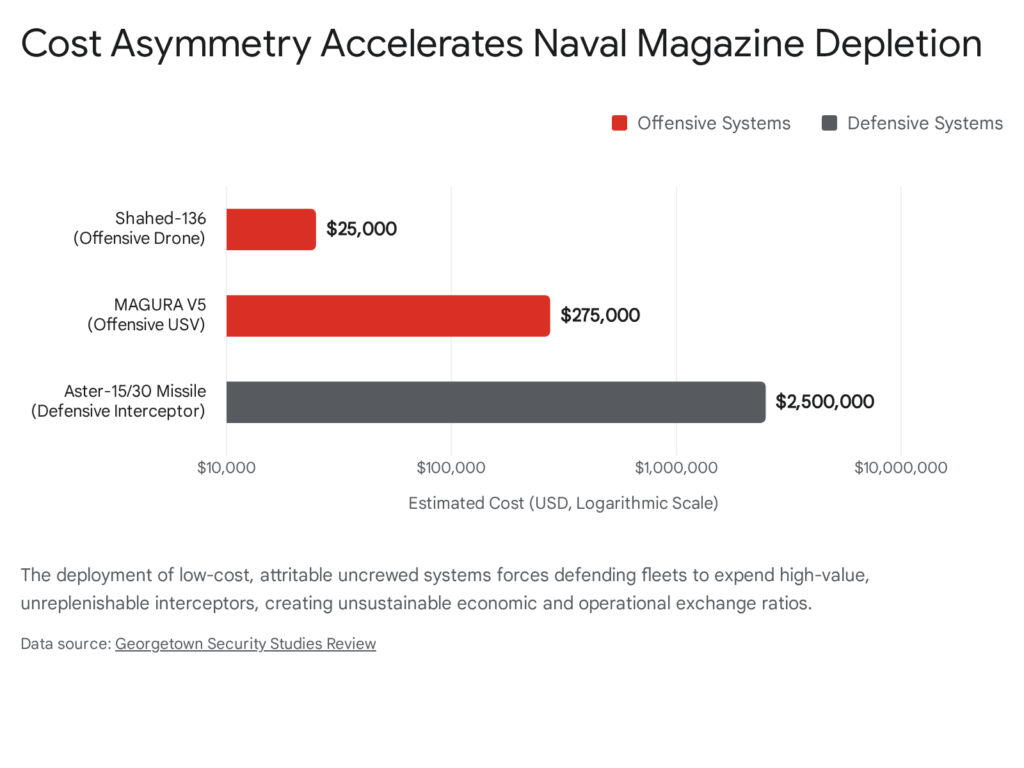
In the Black Sea theater, the operational capacity of the Russian Black Sea Fleet has been fundamentally neutralized by locally produced uncrewed surface vessels.5 Utilizing systems such as the MAGURA V5, which is a low-profile, carbon-fiber stealth vessel sitting merely 1.6 feet above the waterline, operators have achieved devastating effects. Costing approximately $250,000 to $300,000 per unit, these vessels operate in coordinated, human-in-the-loop swarms enabled by high-bandwidth satellite communications.5 By early 2026, the persistent threat of these uncrewed strikes had degraded roughly forty percent of the fleet’s effective capability, destroying eight warships and damaging six others, causing over $500 million in damage.5 This relentless pressure forced a defensive contraction, compelling the fleet to retreat from the western Black Sea and adopt a posture of “active defense” in distant ports, thereby proving that controlling the sea is no longer a prerequisite for denying its use to an adversary.5
This paradigm shift is equally evident in the Red Sea, where Houthi forces have achieved severe economic sea denial without fielding a conventional navy. Utilizing a layered approach of one-way attack drones, uncrewed surface vessels, and anti-ship missiles, this non-state actor successfully targeted commercial shipping, directly striking twenty-one vessels and sinking a bulk carrier by early 2024. Furthermore, these attacks escalated when Houthis sank two additional commercial vessels in the southern Red Sea in July 2025, resulting in four mariner fatalities.27 The strategic effect was massive: they imposed sufficient risk to alter global commercial shipping behavior, disrupting the twelve percent of global trade that passes through the Suez Canal 5 and forcing hundreds of vessels to reroute around the Cape of Good Hope, which spiked Asia-Europe shipping rates and insurance premiums.5
The core mechanism driving this erosion of maritime deterrence is the crisis of “magazine depth” and extreme cost asymmetry. Modern naval combatants, particularly cruisers and destroyers, rely almost exclusively on Vertical Launching Systems populated with multi-million-dollar interceptors (such as the Aster-15 and Aster-30) for layered air defense.5 Defending against highly expendable drones—which can cost as little as $20,000 to $30,000—forces advanced navies into an unsustainable economic exchange.5 Furthermore, because these defensive interceptors cannot be safely or easily replenished at sea in moderate conditions, cheap, attritable mass physically drains the operational endurance of advanced adversaries. This dynamic confirms that in the modern maritime environment, concentration and visibility on the open ocean are now synonymous with extreme vulnerability.
3.2 The Shift from Strategic Command Architectures to Decentralized, Task-Specific Software
For years, major military powers invested heavily in building singular, comprehensive, and automated Command and Control architectures intended to connect all sensors and shooters across every domain. The high-intensity combat of the past two years, however, has exposed the fragility, rigidity, and bureaucratic inertia of centralized modernization under wartime pressure.3
In 2026, intelligence assessments confirm a pragmatic, battlefield-driven shift toward tactical, task-specific software solutions that prioritize speed at the edge over enterprise-wide integration. Because uncrewed systems now conduct up to eighty percent of Russian fire missions, the center of gravity for command innovation has decisively shifted toward localized software. Systems such as the “Svod” Tactical Situational Awareness Complex exemplify this shift toward real-time battlefield management.3 A prime example of this architectural pivot is the rapid deployment and scaling of Russia’s “Glaz/Groza” software complex, utilized alongside “ZOV Maps” for geospatial support.3 It ingests live drone footage and utilizes mature computer vision artificial intelligence—assessed at Technology Readiness Level 6 to 9—to instantly recognize targets and generate precise targeting data.3 This decentralized architecture compresses the critical timeline from target detection to kinetic impact from hours down to mere minutes.
Furthermore, to facilitate this rapid integration, the military has mandated the standardization of its technical foundation, transitioning entirely to the domestically controlled Astra Linux operating system.3 This creates a secure, unified base across the command hierarchy, allowing software developed by civilian volunteers to be seamlessly deployed to the frontline. Complementing this, Defence Minister Andrei Belousov initiated a massive, centralized data collection infrastructure designed to aggregate volumes of drone footage, strike effects, and operator telemetry.3 By linking this data to individual pilot performance and specific weapon impacts, adversaries are actively creating a continuous, closed-loop feedback mechanism to train frontline artificial intelligence without waiting for multi-billion-dollar strategic software programs to mature.3
3.3 The Transition from Automated Flight to AI-Driven Autonomy and Power Continuity
The operational vulnerability of all military drones has historically been dictated by two fundamental constraints: their reliance on continuous command communication links, which makes them highly susceptible to electronic warfare jamming, and their limited battery or fuel capacity, which forces them to land, thereby breaking mission continuity and exposing forward positions. Developments in 2026 indicate that both of these historical constraints are being systematically shattered.
First, the deployment of fully autonomous drone systems has moved from theory to battlefield reality. Technical exploitation of intercepted Russian V2U drones in Ukraine reveals a profound qualitative jump toward onboard, artificial intelligence-driven autonomy.1 These platforms have been recovered completely lacking the communication components typically required for human operator control.1 Instead, they rely on highly capable onboard computing hardware to run perception and decision-making software, enabling autonomous flight even in heavily jammed, GPS-denied environments. They demonstrate independent target selection and coordinated group activity, utilizing visual markings to facilitate swarm-like behavior without emitting detectable radio frequency signatures.1
Second, the limitation of airborne endurance was successfully challenged in a landmark test on April 20, 2026. PowerLight Technologies, working alongside Kraus Hamdani Aerospace and sponsored by the United States Central Command, completed the world’s first wireless power beaming to a fielded military drone during active flight.2 Operating at the Poinsett Electronic Combat Range at Shaw Air Force Base, a ground-based laser transmitter successfully acquired and tracked a fixed-wing K1000ULE drone flying at altitudes up to 5,000 feet.2
The system autonomously delivered kilowatt-class power wirelessly over a distance approaching one mile, adjusting in real-time for atmospheric conditions and aircraft maneuvers without any human operator managing the link.2 This breakthrough establishes a “true never-land capability,” wherein energy can be continuously fed to airborne intelligence, surveillance, and reconnaissance platforms or communication relays from distributed ground outposts or ships. By eliminating the need for periodic recovery and refueling, militaries can maintain persistent, uninterrupted overhead presence, fundamentally altering the logistics and operational tempo of drone warfare.2
3.4 The Rapid Scaling of Domestic Production via State-Sponsored Mass Manufacturing Initiatives
A central, undeniable lesson of modern drone warfare is that mass possesses a distinct quality of its own. A technologically exquisite, highly capable drone is militarily useless if it cannot be attrited and immediately replaced in high volumes. Consequently, 2026 has been defined by unprecedented state-driven directives to aggressively scale sovereign, domestic production capabilities.
In the United States, following a memorandum from the Secretary of Defense in July 2025 demanding the “Unleashing of U.S. Military Drone Dominance,” the Pentagon moved rapidly to dismantle bureaucratic red tape with the explicit goal of outfitting every squad with lethal small drones.4 To achieve this, the U.S. Army Materiel Command launched the “SkyFoundry” pilot program. This initiative represents a radical departure from traditional acquisition, focusing on rapidly developing and testing small drones utilizing innovative manufacturing methods.4 The stated objective is staggering: the Army expects to domestically mass-produce upwards of 10,000 small unmanned aerial systems each month by late 2026.4 Concurrent legislative efforts, including the SkyFoundry Act of 2025, aim to establish permanent government-run production facilities to integrate combat lessons directly into ongoing iterations of drone design.4
In the United Kingdom, the newly published Defence Investment Plan commits over £5 billion to a “drone transformation” of the Armed Forces over the next four years, establishing an Uncrewed Systems Taskforce to ensure continuous, scaled production and integration across all domains.
Globally, the scale of production is escalating equally rapidly. In early 2026, it was reported that Ukraine doubled its already massive 2025 production baseline of 100,000 cheap interceptor drones, which are critical for defending against incoming loitering munitions.11 Meanwhile, Russia has heavily operationalized its National Development Goals, launching a specific Unmanned Aerial Systems National Project aimed at securing comprehensive technological independence.1 The Russian state aims to build a full-cycle ecosystem, mandating that Russian-made drones capture seventy percent of the domestic market by 2030, supported by the creation of a nationwide network of forty-eight specialized research and production centers.1
| Nation | Strategic Initiative | Production/Scale Target | Primary Objective Focus |
| United States | SkyFoundry Pilot Program 4 | Mass-produce 10,000 small UAS per month by late 2026.4 | Supply every Army squad with low-cost, attritable lethal drones.4 |
| Ukraine | Drone Deal Initiative 11 | Doubling of the 100,000 unit/year baseline production rate.11 | Maintain high-volume, continuous defense against incoming Russian loitering munitions.11 |
| Russia | UAS National Project 1 | Build 48 research/production centers; capture 70% of market.1 | Secure complete technological sovereignty and establish an autonomous AI drone ecosystem.1 |
| United Kingdom | Defence Investment Plan | £5 billion investment to continuously scale production. | Accelerate the shift to modern robotics warfare and integrate autonomous capabilities. |
The overarching strategic lesson is clear: national security is no longer solely about possessing the most advanced technology; it requires the sovereign, industrial capacity to mass-produce uncrewed systems at scales that are entirely independent of fragile global supply chains.
3.5 The Institutionalization of Counter-UAS as a Core, Multidomain Acquisition Priority
As the offensive drone threat has multiplied and democratized, the prioritization of Counter-Unmanned Aerial Systems (C-UAS) has shifted from reactionary, ad-hoc force protection measures to a highly dedicated, institutionalized acquisition pathway with massive budgetary backing.
The evolution of the United States Department of Defense’s Replicator initiative perfectly encapsulates this transition. While the highly publicized Replicator 1 focused on fielding offensive, attritable autonomous systems across multiple domains, the subsequently launched Replicator 2 is singularly dedicated to countering the asymmetric threat posed by small unmanned aerial systems.7 In January 2026, the Pentagon’s Joint Interagency Task Force 401 announced the first official acquisition under Replicator 2, procuring advanced DroneHunter F700 systems.7
This specific procurement highlights a shift in counter-drone methodology, particularly concerning homeland defense. Rather than utilizing explosive interceptors or broad-spectrum electronic jammers that pose severe risks to civilian populations and critical infrastructure, the DroneHunter is a reusable interceptor that utilizes onboard artificial intelligence and radar to track threats.7 Once a threat is identified, it deploys a tethered net to capture the hostile drone non-destructively, safely towing it to a designated location for forensic analysis.7
Furthermore, the legal, financial, and regulatory frameworks surrounding counter-drone operations are rapidly maturing. The budgets reflect this urgency: the U.S. Army’s FY2026 budget highlights $858 million dedicated specifically to counter-UAS capabilities, while the Department of Homeland Security moved $115 million toward domestic event security for the 2026 FIFA World Cup and America250 celebrations.13 Legislatively, the SAFER SKIES Act, incorporated into the FY2026 National Defense Authorization Act, represents a massive expansion of practical authority.14 It empowers trained state, local, tribal, and territorial law enforcement and correctional agencies to actively detect, track, disable, or seize drones that pose credible threats, effectively decentralizing homeland drone defense far beyond the traditional purview of federal agencies.14
This institutionalization extends globally. At the July 2026 NATO Summit in Ankara, Allies announced a staggering $40 billion investment in counter-drone capabilities over the next five years. To support rapid procurement, NATO is establishing a dedicated counter-drone marketplace to ensure systems are NATO-tested, interoperable, and immediately available for purchase, reflecting a unified alliance approach to the C-UAS mandate.
3.6 Directed Energy and High-Energy Lasers Achieving Battlefield Maturity and Validation
For decades, directed energy weapons have been confined to controlled demonstrations, prototyping phases, and laboratory environments. In 2026, the overwhelming threat of drone swarms—and the unsustainable economic cost of using traditional missiles to defeat them—has served as the ultimate catalyst for high-energy lasers to reach operational maturity and achieve battlefield validation.
As a defense mechanism, laser systems offer a critical, paradigm-shifting advantage: a near-infinite magazine depth limited only by power generation, and a cost-per-shot measured in cents rather than millions of dollars. This directly solves the economic asymmetry that currently plagues traditional layered air defense architectures.15
In the Ukrainian theater, a mobile directed-energy system known as “Sunray,” developed by the tech firm LAZR, has been rigorously battle-tested and deployed.16 Operating as autonomous network nodes that can be mounted on rooftops, pickup trucks, or uncrewed ground vehicles, these compact systems detect, track, and disable incoming drones at a reported cost of merely fifty cents per kinetic engagement.16 The system was developed rapidly on a $2 million budget, and the Ukrainian Air Force is expected to procure over 20,000 units by 2030 to build an extensive anti-drone shield.16
Simultaneously, Western military hardware is crossing critical regulatory and procurement thresholds to bring directed energy to the frontline. A NATO nation in Europe is currently procuring the Australian-made Electro Optic Systems “Apollo” laser, a high-power system capable of shooting down twenty drones a minute at a cost of less than ten cents per shot.15 In the United States, AV’s LOCUST laser system achieved a major regulatory milestone by passing a thorough safety assessment conducted jointly by the Federal Aviation Administration and the Pentagon’s Joint Interagency Task Force 401.17 This assessment explicitly validates the use of direct energy counter-drone systems for active deployment on domestic U.S. soil.17 The strategic takeaway is absolute: directed energy is no longer conceptual future-tech; it is actively being integrated into standard, operational air defense architectures globally.
3.7 The Convergence of Civilian Innovation with Military Procurement and AI Integration
The rigid, multi-decade timelines characteristic of traditional military-industrial bases have proven wholly inadequate for the blistering pace of uncrewed technological evolution. YTD 2026 highlights the absolute imperative of harnessing civilian innovation, characterized by agile software development, decentralized “garage” experimentation, and direct, unfiltered feedback loops from frontline operators.
Russia’s rapidly evolving drone ecosystem provides a stark case study in this convergence. The ecosystem thrives on an adaptive procurement logic where initial innovation originates deliberately outside of formal, bureaucratic defense structures. Civilian engineers and volunteer groups rapidly experiment with commercially available components and open-weight artificial intelligence architectures.1 Rather than attempting to build frontier foundation models from scratch, Russian developers adapt foreign, civilian models—such as the LLaMA, Mistral, Qwen, and DeepSeek architectures 1—and embed them securely into tightly controlled military environments.1 This approach not only bypasses Western sanctions on proprietary software but also ensures rapid deployment of mature algorithms to the battlefield.
Once these decentralized, volunteer-built systems are validated in combat, the state machinery steps in to finance, standardize, and aggressively scale mass production, entirely bypassing the inefficiencies of centralized design bureaus.1 This civil-military fusion extends deeply into human capital generation. Recognizing a forecasted demand for one million uncrewed systems specialists by 2030, the Russian state is aggressively expanding private drone schools that operate with startup-like agility, continually updating their curricula based on daily combat telemetry.1 The institutionalization of these civilian pipelines into official military structures, such as the newly formed Unmanned Systems Forces and Rubicon 1, underscores a new reality: modern military dominance relies heavily on commercial technology and civilian talent pipelines.1
However, this reliance on commercial ecosystems reveals a critical supply chain vulnerability. Despite massive efforts toward technological sovereignty, the hardware enabling advanced onboard artificial intelligence remains deeply embedded in globally integrated semiconductor markets. Intelligence databases indicate that over fifty percent of recovered AI-enabling components in Russian drones originate from companies headquartered in the West, with U.S. firms accounting for approximately sixty-nine percent of memory hardware and fifty-seven percent of processors.1 This indicates that while software innovation can be decentralized and localized, hardware dominance remains highly consolidated.
3.8 The Escalation of the Uncrewed Surface Vessel Arms Race to Capital Ship Proportions
While small, low-profile, explosive-laden surface vessels have dominated tactical headlines and proven devastating in the Black Sea, 2026 marks the aggressive scaling of uncrewed naval platforms into genuine capital ship proportions. Major state navies are moving decisively beyond experimental, localized patrols and are committing to heavily armed, multi-mission uncrewed combatants designed for extended blue-water operations and serious power projection.
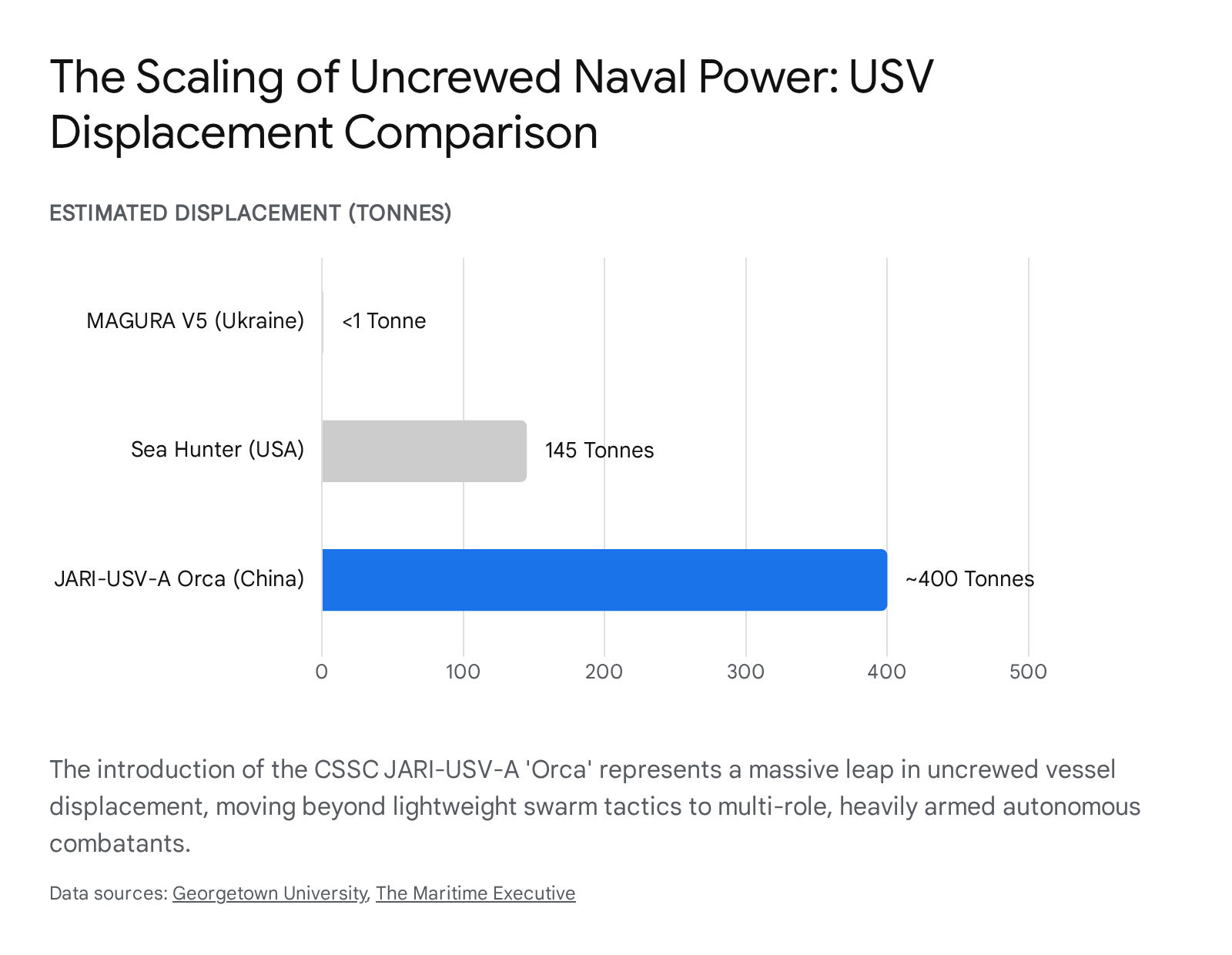
The most significant and highly scrutinized development in this space is China’s unveiling and active sea-trialing of the JARI-USV-A, widely known as the “Orca”.18 Developed by the China State Shipbuilding Corporation, this trimaran represents the world’s largest acknowledged unmanned surface combatant. Displacing between 300 to 500 tonnes and measuring approximately 58 meters in length, the Orca is roughly three times larger than the U.S. Navy’s closest equivalent, the Sea Hunter.18
Crucially, the Orca is not designed merely as a distributed sensor node for crewed fleets; it is heavily armed and capable of autonomous kinetic action. It is outfitted with Vertical Launch System cells, torpedo tubes, an Advanced Electronically Scanned Array radar, and a helideck to facilitate multipurpose operations.18 Defense analysts note that its shallow-draft trimaran design makes it uniquely formidable for littoral operations within contested geographic chokepoints, specifically the Taiwan Strait.18
Simultaneously, the U.S. Navy demonstrated its commitment to operationalizing heavy uncrewed vessels during the massive Rim of the Pacific 2026 multinational exercise. The deployment of the Saildrone Surveyor uncrewed surface vehicle alongside multinational manned fleets illustrates the ongoing, deliberate transition of autonomous technologies from localized experimentation to routine, interconnected contributors to global fleet operations.8
However, the strategic calculus heavily favors industrial base capacity. Defense consultancies warn that Chinese commercial shipbuilding capacity—which produces more tonnage annually than the rest of the world combined 18—presents a massive, structural advantage in scaling these heavy uncrewed combatants rapidly.18 In uncrewed warfare, the ultimate military goal is to rapidly mass-produce dozens or hundreds of units rather than a small handful of highly complex vessels, making industrial shipyard capacity a critical metric of future naval dominance.18
3.9 Drones as Primary Interceptors and the Rise of Drone-on-Drone Aerial Combat
As the lower altitudes of the battlespace become utterly saturated with small, attritable unmanned aerial systems, militaries are coming to a stark realization: utilizing traditional ground-based air defense missiles to counter them is economically and logistically untenable. YTD 2026 has consequently witnessed the rapid formalization of drone-on-drone aerial combat as a primary, foundational pillar of air defense doctrine. The interceptor drone is emerging swiftly as the preferred kinetic response to the offensive loitering munition.
This shift in doctrine is starkly evident in the industrial output of frontline states. Having produced 100,000 highly affordable interceptor drones in 2025 specifically tasked to hunt and down Russian Shahed loitering munitions, Kyiv doubled this massive production pace in the first four months of 2026.11 These specialized interceptors discard the complexity of traditional missiles; they rely instead on high maneuverability and skilled first-person-view control to physically collide with or detonate in close proximity to incoming aerial threats.
Simultaneously, the commercial defense sector is rapidly advancing specialized, autonomous counter-air drone technology to support these evolving military requirements. Platforms such as the SPART thermal interceptor, developed by Thermopylae, represent the next generation of this capability. The SPART utilizes onboard thermal guidance to autonomously pursue and destroy targets at high speeds, reaching up to 220 miles per hour.22 Crucially, unlike a traditional surface-to-air missile that is lost upon launch, if the SPART interceptor fails to reach its target and crashes, the ruggedized airframe is explicitly designed to be recovered, repaired, and reused for another attempted launch.22
This reusability drastically alters the logistical footprint and financial burden of sustained air defense.22 With Thermopylae actively working within a three-to-four-month Air Force evaluation window to validate the solution 22, and the aforementioned integration of net-wielding systems like the DroneHunter F700 into homeland defense protocols 7, it is evident that the most effective and sustainable counter to a drone swarm is increasingly a specialized, opposing fleet of interceptor drones.
3.10 The Erosion of Strategic Geography and the Imperative for All-Island/Homeland Defense
Historically, wide geographic barriers such as vast oceans and turbulent straits have served as the ultimate guarantors of strategic insulation, providing nations with physical distance from their adversaries. However, the rapid convergence of long-range unmanned aerial vehicle technology and persistent hybrid warfare tactics has effectively “shrunk” these geographic moats.6 Low-cost unmanned platforms can now routinely project surveillance and kinetic influence deep into interior territories, entirely bypassing traditional naval cordons and heavily fortified frontline defenses.
This geographic erosion is most acutely felt in the Indo-Pacific theater. The 100-mile-wide Taiwan Strait is no longer viewed by strategic planners as an insurmountable localized barrier, but rather as a highly permeable airspace.6 Recognizing that frequent Chinese drone incursions—initially previewed over the offshore island of Kinmen—threaten both civilian infrastructure and overall military readiness, Taiwan has accelerated its integration of specialized uncrewed surveillance platforms and all-society defense initiatives.6
To secure its maritime borders, the Taiwanese Coast Guard Administration recently acquired advanced systems such as the VTOL-capable Penguin C Mk2.5 drones, developed by US-based Edge Autonomy and assembled locally in Taiwan.24 These platforms possess a ten-hour endurance, a 180-kilometer command-and-control range, and utilize artificial intelligence real-time image recognition to autonomously identify targets in challenging sea conditions.24 Furthermore, there is active procurement of systems like the Shield VBAT, which can launch vertically from moving vessels in high winds.25
These maritime UAVs are critical for countering continuous “gray zone” tactics. They allow Coast Guard operators to extend their detection ranges far beyond the radar horizon of surface vessels, specifically targeting ships that deliberately deactivate their Automatic Identification Systems, without committing expensive, heavily crewed coast guard cutters to investigate every minor incursion. This is especially vital given that a special defense budget recently passed by Taiwan’s legislature stripped out funding for domestic drone production, forcing greater reliance on immediate commercial and coast guard acquisitions.2823
Beyond military procurement, the recognition of this shrinking strategic depth has permeated civilian society. Ordinary citizens in Taiwan are now participating in civil defense drone training programs, learning manual, line-of-sight flying techniques in preparation for scenarios where automated commercial systems fail due to intense electronic jamming.23 The broader lesson for military planners globally is that strategic depth is a rapidly depreciating asset. Adversaries can utilize commercial-off-the-shelf quadcopters or long-range attritable fixed-wing drones to harass domestic infrastructure continuously, forcing a massive reallocation of defense resources back to the homeland. Counter-drone policy can no longer be limited to expeditionary forces or frontline units; it must be enacted as an all-of-nation, domestic security imperative.6
4. Conclusion
The battlefield events, procurement shifts, and staggering technological leaps observed in the year to date 2026 confirm unconditionally that the integration of uncrewed systems into military operations is no longer an experimental or auxiliary endeavor. It is the dominant, defining doctrinal reality of modern, high-intensity conflict. The top ten insights identified through this rigorous analytical framework reveal a global battlespace that is increasingly defined by extreme cost asymmetry, the absolute necessity for sovereign industrial mass, and the rapid, decentralized deployment of autonomous artificial intelligence architectures directly to the tactical edge.
Militaries that stubbornly persist in prioritizing the procurement of a small number of exquisite, heavily crewed platforms—while simultaneously neglecting to build the required defensive “magazine depth” of cheap interceptors and directed energy systems—will find themselves highly vulnerable to rapid economic and operational exhaustion.5 The validated success of non-state actors in the Red Sea and smaller, adaptive naval forces in the Black Sea proves definitively that sea denial and strategic deterrence are now highly accessible to any force capable of massing cheap, networked uncrewed systems.5
Moving forward, the strategic advantage in global military affairs will belong exclusively to the nations that can successfully harness rapid civilian software innovation and open-source models 1, deploy mature directed energy weapons to permanently stabilize air-defense cost curves 15, and sustain continuous autonomous flight architectures via wireless power beaming.2 Ultimately, 2026 will be recorded by military historians as the year the paradigm of military power transitioned fundamentally and permanently from the localized protection of exquisite assets to the aggressive, multidomain orchestration of intelligent, attritable mass.
Please share the link on Facebook, Forums, with colleagues, etc. Your support is much appreciated and if you have any feedback, please email us in**@*********ps.com. If you’d like to request a report or order a reprint, please click here for the corresponding page to open in new tab.
Sources Used
- How Russia Is Building a Sovereign Drone Ecosystem for AI-Driven …, accessed July 12, 2026, https://www.csis.org/analysis/how-russia-building-sovereign-drone-ecosystem-ai-driven-autonomy
- US Military Solves the Biggest Problem in Drone Warfare With a …, accessed July 12, 2026, https://orbitaltoday.com/2026/04/22/us-military-solves-the-biggest-problem-in-drone-warfare-with-a-laser-beam/
- How Russia Is Reshaping Command and Control for AI-Enabled …, accessed July 12, 2026, https://www.csis.org/analysis/how-russia-reshaping-command-and-control-ai-enabled-warfare
- Army aims to manufacture 10,000 drones per month by 2026 – DefenseScoop, accessed July 12, 2026, https://defensescoop.com/2025/10/14/army-small-drones-skyfoundry/
- Swarm at Sea: Autonomous Naval Drones and the Erosion of …, accessed July 12, 2026, https://gssr.georgetown.edu/the-forum/topics/technology/swarm-at-sea-autonomous-naval-drones-and-the-erosion-of-maritime-deterrence/
- Shrinking the Strait: How Drone Warfare and Hybrid Tactics are Erasing Taiwan’s Strategic Depth, accessed July 12, 2026, https://globaltaiwan.org/2026/01/shrinking-the-strait/
- Joint Interagency Task Force 401 makes first C-UAS Replicator 2 …, accessed July 12, 2026, https://www.unmannedairspace.info/counter-uas-systems-and-policies/joint-interagency-task-force-401-makes-first-c-uas-replicator-2-purchase/
- B-Roll: Saildrone Surveyor USV departs Pearl Harbor to begin RIMPAC 2026 sea phase, accessed July 12, 2026, https://www.af.mil/DLE/?videoid=1014060&dvpmoduleid=5710&dvpTag=Preparation
- Transforming Naval Warfare: The Drone Revolution – Ronin’s Grips, accessed July 12, 2026, https://blog.roninsgrips.com/transforming-naval-warfare-the-drone-revolution/
- Under ‘Drone Dominance’ push, Pentagon begins receiving small …, accessed July 12, 2026, https://breakingdefense.com/2026/06/under-drone-dominance-push-pentagon-begins-receiving-small-drones/
- ‘Testing is now underway’: Zelenskyy confirms progress on major US …, accessed July 12, 2026, https://www.defensenews.com/global/europe/2026/07/10/testing-is-now-underway-zelenskyy-confirms-progress-on-major-us-defense-deals/
- Joint Interagency Task Force Announces First Replicator 2 Purchase to Counter Homeland Drone Threats – Department of War, accessed July 12, 2026, https://www.war.gov/News/News-Stories/Article/Article/4377021/joint-interagency-task-force-announces-first-replicator-2-purchase-to-counter-h/
- Counter-UAS for Critical Infrastructure: Defense-Grade Response When Seconds Define the Outcome – IDGA, accessed July 12, 2026, https://www.idga.org/aviation/articles/counter-uas-for-critical-infrastructure-defense-grade-response-when-seconds-decide-the-outcome
- Federal Agencies Move Quickly to Turn SAFER SKIES Act Into Operational Reality, accessed July 12, 2026, https://dronelife.com/2026/07/07/counter-uas-rules-safer-skies-act/
- The hottest new defense against drones? Lasers – Electro Optic Systems, accessed July 12, 2026, https://eos-aus.com/news/the-hottest-new-defense-against-drones-lasers/
- Battle-Tested Ukraine Laser Used to Zap Drones, accessed July 12, 2026, https://www.nationaldefensemagazine.org/articles/2026/5/13/battletested-ukraine-laser-used-to-zap-drones
- Exclusive: AV’s LOCUST Laser Gets the FAA and Pentagon’s Seal of Approval, accessed July 12, 2026, https://www.tectonicdefense.com/exclusive-avs-locust-laser-gets-the-faa-and-pentagons-seal-of-approval/
- Report: The Race is On to Bring Unmanned Combatants to Life, accessed July 12, 2026, https://maritime-executive.com/article/report-the-race-is-on-to-bring-unmanned-combatants-to-life
- China’s Trimaran JARI-USV-A Spotted During Sea Trials | TURDEF, accessed July 12, 2026, https://turdef.com/article/china-s-trimaran-jari-usv-a-spotted-during-sea-trials
- JARI USV – Wikipedia, accessed July 12, 2026, https://en.wikipedia.org/wiki/JARI_USV
- U.S. Navy Expands Unmanned Surface Vessel Operations at RIMPAC 2026 with Saildrone Surveyor – YouTube, accessed July 12, 2026, https://www.youtube.com/watch?v=RVKiNeYGa8g
- Startup Aims to Make Drone Attacks Too Expensive to Wage, accessed July 12, 2026, https://dronelife.com/2026/07/09/startup-aims-to-make-drone-attacks-too-expensive-to-wage/
- Inspired by Ukraine, and worried by China: Taiwan teaches its citizens how to fly drones – The Guardian, accessed July 12, 2026, https://www.theguardian.com/world/2026/jun/18/taiwan-citizens-learn-fly-pilot-drones-courses-china
- Taiwan Coast Guard to receive 2nd-generation VTOL drones …, accessed July 12, 2026, https://www.taiwannews.com.tw/news/6378245
- Drones can counter Chinese ‘gray zone’ tactics, analyst says – Taipei Times, accessed July 12, 2026, https://www.taipeitimes.com/News/taiwan/archives/2026/07/11/2003860574
- V-BAT: Group 3 ISR Drone for Surveillance | Shield AI, accessed July 12, 2026, https://shield.ai/v-bat/
- 2026-006-Red Sea, Bab el Mandeb Strait, Gulf of Aden, Arabian Sea, and Somali Basin-Houthi Attacks on Commercial Vessels | MARAD – Department of Transportation, accessed July 12, 2026, https://www.maritime.dot.gov/msci/2026-006-red-sea-bab-el-mandeb-strait-gulf-aden-arabian-sea-and-somali-basin-houthi-attacks
- China & Taiwan Update, June 5, 2026 | ISW, accessed July 12, 2026, https://understandingwar.org/research/china-taiwan/china-taiwan-update-june-5-2026/