1. Executive Summary
The week of August 15-22, 2026, represents a major change in how global militaries use autonomous systems across air, land, sea, and space. We are seeing a rapid shift away from small-scale experimental projects toward high-volume, combat-ready mass production. This change is driven by a move away from traditional defense manufacturing in favor of commercial technology, software-driven designs, and a push for domestic supply chains. Real-world combat in the Middle East and Eastern Europe has proven that relying on a few expensive, high-end platforms is no longer enough. Instead, the focus has shifted to the ability to quickly build, deploy, and lead multi-domain swarms of affordable, expendable drones.
In the Middle East, U.S. Central Command (CENTCOM) launched Task Force Falcon Strike, the first multinational command dedicated entirely to one-way attack (OWA) drones1. By bringing together uncrewed aerial, surface, and underwater vehicles under one coalition, the U.S. and its Gulf partners are working to change the dynamic with adversaries who have used cheap drones to target expensive defenses for years. This move turns these drones from simple tools for harassment into a powerful, theater-wide deterrent capable of launching massive, synchronized strikes against enemy defenses and maritime targets.
At home, the U.S. Department of Defense has started a major overhaul of its drone policies through the “Drone Dominance” initiative, supported by the $55 billion Defense Autonomous Warfare Group (DAWG)6. Small drones are now being treated as “consumable commodities,” similar to ammunition, rather than expensive equipment that must be carefully tracked. This change lets soldiers use first-person view (FPV) drones more aggressively in the field without worrying about paperwork if they lose them. At the same time, new government mandates aim to remove all components from adversarial nations by 20278. This push is forcing a complete restructuring of the domestic drone industry, favoring companies that can prove their parts are secure and locally sourced.
Finally, the need to defend against these massed drone attacks is driving heavy investment in new defenses. The U.S. Army is working on both affordable interceptor missiles and high-energy lasers to protect troops from incoming swarms10. This trend toward distributed, expendable systems is also reaching the ocean and space. The production of low-cost underwater drones and new networks of small satellites show that the future of combat relies on large groups of affordable sensors rather than a few vulnerable, high-value assets14.
2. Global Situation Log
2.1 Middle East Theater: CENTCOM & Task Force Falcon Strike
Event & Development: On August 13-14, 2026, U.S. Central Command (CENTCOM) officially announced the establishment of Task Force Falcon Strike, the military’s first multinational, multi-domain attack-drone formation1. Building on the proof-of-concept established by Task Force Scorpion Strike in December 2025, Falcon Strike integrates personnel from U.S. Special Operations Command Central (SOCCENT) with invited regional Gulf partners1. The task force is explicitly mandated to employ one-way attack (OWA) systems operating “from above, on, and below the sea”3. Platforms integrated into this architecture include the Low-Cost Uncrewed Combat Attack System (LUCAS), an American platform reverse-engineered from the Iranian Shahed-136, which saw its combat debut on February 28, 2026, during Operation Epic Fury, as well as 16-foot Global Autonomous Reconnaissance Craft (GARC) and Saronic Corsair unmanned surface vessels3.
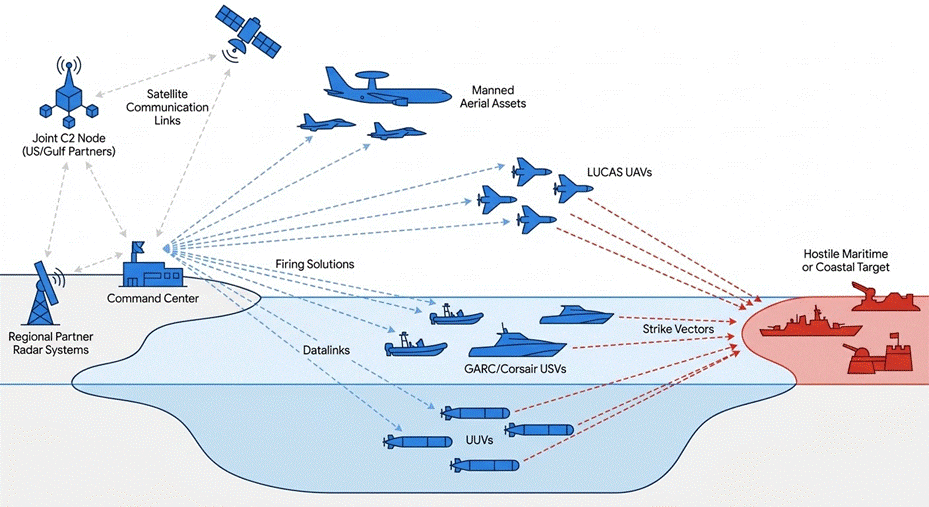
Tactical & Operational Lessons: The mechanical and algorithmic challenge of Task Force Falcon Strike lies in its Command and Control (C2) and data-sharing infrastructure. Integrating uncrewed systems across three distinct fluid dynamics environments (air, surface, and sub-surface) requires robust, low-latency sensor fusion. Aerial drones rely on RF datalinks and GNSS; USVs require line-of-sight or SATCOM for over-the-horizon operations; and UUVs operate in an RF-denied acoustic environment3. Converging these assets on a single target without mutual interference, duplicated strikes, or fratricide demands an AI-enabled C2 node that can standardize mission planning, payload selection, and target identification across heterogeneous national systems3.
By embedding regional partners directly into the targeting loop, CENTCOM is attempting to shorten the kill chain, moving away from slow, external liaison channels to instantaneous, shared situational awareness3. The tactical employment of these systems is already mature; the Saronic Corsair USV has effectively operated in the Gulf of Oman since March, conducting ISR, mapping smuggling routes, and notably executing a successful search and rescue of two downed U.S. Army AH-64 Apache pilots on June 8-9, 202618. Concurrently, the surface vessels are exploiting civilian traffic and shoreline clutter to apply intense pressure on coastal air defense radars and port infrastructure, creating complex multi-axis threats3.
Strategic Lessons: Falcon Strike is a structural response to the magazine depletion observed during sustained U.S. and Israeli defensive operations against Iranian and proxy saturation attacks3. Firing multi-million-dollar interceptors at sub-$50,000 drones is economically unsustainable. By massing cheap, expendable OWA systems and distributing the financial and logistical burden of producing and maintaining those stockpiles among Gulf partners, the U.S. is flipping the asymmetric cost-exchange ratio back onto adversaries2.
Strategically, this approach creates a NATO-style unified drone deterrent2. If CENTCOM can successfully establish shared production standards, software configurations, and replenishment plans, the task force will force adversaries to defend a vastly wider surface area against continuous, multi-domain pressure3. This reduces reliance on scarce crewed aircraft or premium standoff missiles during sustained regional operations, permanently altering the strategic calculus of the Strait of Hormuz and the broader Middle East18.
2.2 U.S. Defense Industrial Base: Drone Dominance & Supply Chain Autarky
Event & Development: On August 20, 2026, the White House hosted the inaugural “Drone Dominance” event, bringing together nearly 100 government officials and representatives from approximately 40 drone and component manufacturing companies6. Led by the Pentagon’s Under Secretary of Defense for Research and Engineering, Emil Michael, the summit sought to align private industry with aggressive new defense acquisition targets and supply chain mandates6. The overarching policy architecture relies on three primary pillars:
- The $55 billion Defense Autonomous Warfare Group (DAWG), the successor to the Replicator initiative6.
- The $1 billion “Drone Dominance” procurement program, administered by the Test Resource Management Center (TRMC) and the Defense Innovation Unit (DIU)6.
- Sweeping supply chain restrictions outlined in Executive Order 14415 (Securing America’s Defense Supply Chains and Ensuring Domestic Acquisition of Critical Materials), which establishes a January 1, 2027 deadline to eliminate critical materials sourced from China, Russia, Iran, and North Korea from the defense ecosystem6.
Drone Dominance Program: Gauntlet 1 Procurement Leaderboard
| Rank | Company Name | Performance Score | Drones Ordered | Delivery Status |
| 1 | Skycutter | 99.3 | 2,560 | Ramping |
| 2 | Neros | 87.5 | 4,400 | 2,400 shipped (2,400 accepted); 2,000 bonus ramping |
| 3 | Napatree | 80.3 | 2,320 | None (listed as “-“) |
| 4 | ModalAI | 77.7 | 2,240 | 1,360 shipped (unverified) |
| 5 | Auterion | 77.0 | 2,160 | 1,120 shipped (400 accepted/verified) |
| 6 | Ukrainian Defense Drones (UDD) | 72.9 | 2,000 | 2,000 shipped (unverified) |
| 7 | Griffon Aerospace | 72.0 | 1,920 | 1,920 shipped (1,160 accepted/verified) |
| 8 | Nokturnal AI | 70.3 | 1,840 | 920 shipped (480 accepted/verified) |
| 9 | Halo Aeronautics | 70.2 | 1,760 | 880 shipped (880 accepted/verified) |
| 10 | Ascent Aerosystems | 70.1 | 1,600 | 800 shipped (400 accepted/verified) |
| 11 | Farage Precision | 70.0 | 1,520 | 760 shipped (760 accepted/verified) |
Tactical & Operational Lessons: The operational shift is fundamentally driven by policy changes that strip bureaucratic friction from the end-user. Defense Secretary Pete Hegseth’s July 2025 memo, “Unleashing US Military Drone Dominance,” mandated that Group 1 and 2 drones be reclassified from “durable property” to “consumable commodities”7. Tactically, this change is monumental. Previously, soldiers were hesitant to deploy small UAS due to the threat of property loss investigations if a drone crashed due to electronic warfare (EW) disruption or battery failure. By treating First-Person View (FPV) and small ISR drones as ammunition, combat units can now utilize them aggressively at the squad level7.
To support this consumption rate, the Drone Dominance Program is utilizing “Gauntlet” competitions, where military operators test systems in live scenarios to generate immediate feedback. Gauntlet 1 resulted in 24,320 aerial weapons ordered from 11 vendors (including Skycutter, Neros, and Auterion)6. In August 2026, Gauntlet 2 brought 19 vendors to Fort Carson, Colorado, to test lethal payloads for a subsequent 60,000-platform order6.
Strategic Lessons: The overarching strategic intent is total autarky in the defense supply chain, moving from mere self-sufficiency to “drone dominance.” The industrial base that supports military unmanned systems relies heavily on dual-use commercial technologies: permanent magnets for electric motors, lithium-ion batteries, thermal sensors, and electronic speed controllers (ESCs)6.
| Supply Chain Policy Mechanism | Objective | Deadline / Status |
| Executive Order 14415 | Mandates an Indentured Bill of Materials (BOM) tracing all components to raw minerals. Eliminates FOCI. | January 1, 20278 |
| FCC Third Report and Order | Requires Hardware and Software Bills of Materials (HBOM/SBOM) to verify provenance and eliminate malicious firmware. | Active / Proposed Expansion8 |
| Presidential Proclamation | Imposes 100% tariffs on foreign drones over 25kg, thermal imagers, and docking stations; 25% on smaller drones under 25kg. | August 13, 20268 |
| Office of Strategic Capital | $820 million conditional loan commitment to Performance Drone Works to scale sovereign manufacturing capacity. | Approved6 |
While industry associations like the Aerospace Industries Association warn that domestic processing capacity for critical minerals is not yet available at scale, the DoD is forcing the issue6. By combining punitive tariffs with massive capital injections and guaranteed demand signals, the Pentagon is deliberately collapsing the “black box” of globalized mineral sourcing to construct a sovereign, war-ready drone ecosystem6.
2.3 Ground Operations & Point Defense: The Kinetic and Directed Energy C-UAS Imperative
Event & Development: Recognizing the vulnerability of ground forces to the very drone swarms the U.S. is seeking to proliferate, the Army has dramatically accelerated its Counter-UAS (C-UAS) acquisitions. On August 20, 2026, the Request for Information (RFI) closed for the Next Generation C-sUAS Missile (NGCM)11. The Army requires an interceptor compatible with the Raytheon Coyote launcher that can destroy Group 2 and 3 drones at ranges exceeding 16 km (ideally 25 km) and altitudes of 6 to 8 km, all while costing under $150,000 per unit11. Concurrently, the Army is negotiating with AeroVironment for the Enduring High-Energy Laser (E-HEL) program of record, aiming to acquire up to 20 LOCUST X3 modular 50-kilowatt class laser systems10. In parallel, academic and commercial R&D continues to mature autonomous detection systems, such as the open-source ROS-based AirSwarm architecture and the multi-modal DroneShield-AI, which fuses RF, acoustic, and YOLOv8 visual detection using Graph Neural Networks22.
Tactical & Operational Lessons: The NGCM represents the physical optimization of kinetic point defense. Achieving a 25 km intercept range against small, low-radar-cross-section (RCS) targets within a strictly mandated under-5-second launch window requires high-impulse solid rocket motors and advanced RF/radar seekers capable of discriminating targets against ground clutter12.
| NGCM Key RFI Parameters | Specification Requirement |
| Target Set | Group 2 (21-55 lbs) & Group 3 (under 1,320 lbs)12 |
| Range & Altitude | Over 16km at 6km alt (Threshold); over 25km at 8km alt (Objective)11 |
| Launch Response | Under 5 seconds from operator initiation11 |
| Radar Agnostic Integration | Sentinel A3/A4, LTAMDS, PATRIOT, TPQ-5311 |
| Cost & Volume | Under $150k per missile; 5,000 unit bulk purchase11 |
| Timeline | TRL 7 and ATEC evaluation by 4QFY2711 |
The requirement that the NGCM be radar-agnostic via an open architecture allows tactical units, deploying either the Fixed-Site (FS-LIDS) or Mobile (M-LIDS) variants, to leverage existing Integrated Air and Missile Defense Battle Command System (IBCS) networks without fielding proprietary sensor suites11. Conversely, the E-HEL addresses the kinetic limitation: magazine depth. The LOCUST X3 provides a reusable layer of defense that utilizes exportable electrical power rather than a finite supply of interceptors10. However, as noted by Army acquisition officials, integrating these systems requires significant advancements in power management; the Army is actively seeking alternatives to liquid fuel generators to provide the dense, exportable power required by directed energy weapons on mobile platforms like the Stryker25.
At the sensor level, integrating AI architectures like DroneShield-AI ensures that disparate sensor modalities (radar, acoustics, RF) are temporally aligned to synthesize a cohesive targeting track, a necessity for defeating low-altitude, autonomous swarms that operate in GNSS-denied environments23. The incorporation of a Behavioral Intent Classification Engine (BICE) within these AI frameworks allows the C2 system to predict swarm flight patterns, extending the operator response horizon23.
Strategic Lessons: Both systems represent engineering solutions to a severe economic problem. Adversaries utilizing $35,000 Shahed-style OWA drones can rapidly bankrupt a defender relying on $4 million Patriot interceptors or $1 million legacy missiles13. The NGCM establishes a kinetic cost-ceiling ($150k per round), while the E-HEL introduces a near-zero marginal cost per shot (generated electricity)10. Strategically, layering these systems allows maneuver forces and fixed installations to absorb sustained saturation attacks, preserving the highly expensive kinetic interceptors strictly for high-end threats like cruise and ballistic missiles.
2.4 Global Maritime Operations: REPMUS 26, Uncrewed Motherships, and Seabed Autonomy
Event & Development: The maritime domain is experiencing a profound shift toward massed unmanned integration, culminating in preparations for NATO’s massive REPMUS 26 (Robotic Experimentation and Prototyping using Maritime Uncrewed Systems) exercise in Tróia and Sesimbra, Portugal, scheduled for August 31 to September 2528. Ahead of the exercise, UK-based ZeroUSV launched the Oceanus17, a 17-meter USV boasting a 4-tonne payload capacity, hybrid diesel-electric propulsion, Level 4 autonomy via the GuardianAI stack, and a 50+ day endurance30.
Concurrently, Anduril Industries is rapidly scaling operations at its new 150,000-square-foot facility in Quonset Point, Rhode Island, designed to manufacture up to 200 Dive-LD and Dive-XL autonomous underwater vehicles (AUVs) annually14. Furthermore, during the U.S. Navy’s Lanternfish 2026 exercise, Ultra Maritime and Anduril successfully demonstrated the integration of the Sea Spear passive array and the Seabed Sentry processing software to detect and classify advanced UUV threats31.
Tactical & Operational Lessons: The Oceanus17 demonstrates how modularity is dominating surface warfare. With an aft deck capable of carrying standard ISO shipping containers and providing 30kW of dedicated payload power, the USV can rapidly transition from acting as a multibeam echosounder (MBES) survey vessel to a launch platform for AUVs, effectively becoming an uncrewed mothership for other uncrewed assets30. This capability echoes the operational profile of the Textron Multi-Mission Uncrewed Surface Vessel (MMUSV), which similarly focuses on high endurance and modular intelligence, surveillance, and reconnaissance (ISR) payloads33.
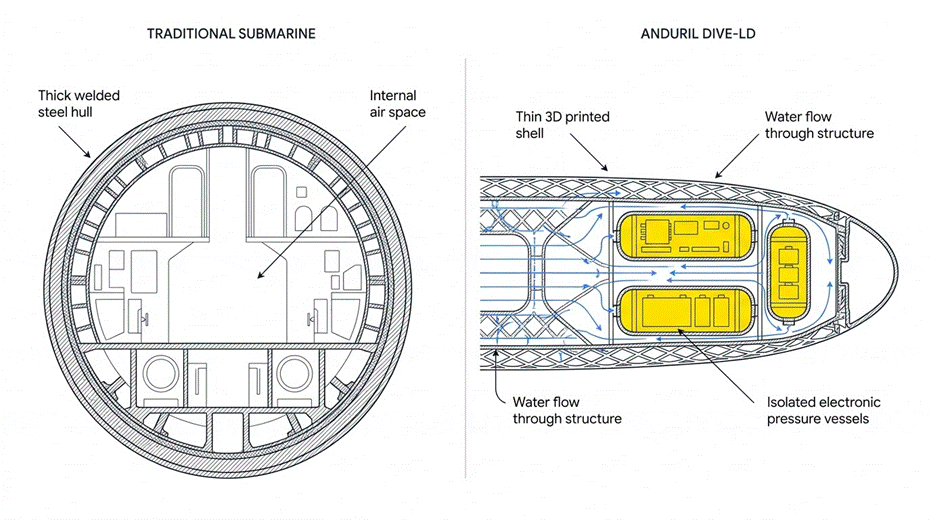
Below the surface, Anduril’s 19-foot Dive-LD survives crushing depths (6,000 meters) not by resisting pressure but by utilizing a “free-flooded” architecture14. Seawater permeates the vehicle’s structure, while critical electronics are housed in individual, small-volume pressure vessels. This eliminates the need for massive, perfectly welded steel pressure hulls. Consequently, the exterior fairings can be manufactured using large-format 3D printing in under two days, bypassing the severe bottlenecks of traditional naval shipyards14. As these UUVs proliferate, tracking them in visually opaque, RF-denied waters requires advanced acoustic fusion, a capability validated by the Sea Spear/Seabed Sentry integration at the Lanternfish exercise31.
Strategic Lessons: The manufacturing methodology pioneered at Quonset Point changes the fundamental calculus of naval power. If a single facility can produce 200 autonomous submarines a year at $2.5 million per unit (roughly the cost of a single heavyweight torpedo), the ocean can be seeded with persistent, untethered sensor grids14. This transitions undersea warfare from a domain dominated by a handful of ultra-expensive nuclear submarines to a saturated environment of disposable acoustic and electronic surveillance nodes. NATO’s REPMUS 26 exercise, utilizing the SEDAP Express tactical data exchange infrastructure, serves as the critical testing ground for the Command, Control, Communications, Computers, and Intelligence (C4I) architecture required to ensure these disparate national systems can share data and form a Common Operational Picture (COP) across allied fleets34.
2.5 The Space Domain: Proliferated Architectures and Orbital Logistics
Event & Development: In mid-August 2026, the U.S. Space Development Agency (SDA) prepared to resume launches of its Tranche 1 Tracking Layer satellites aboard SpaceX Falcon 9 rockets, placing 21 York Space Systems-built satellites into low-Earth orbit (LEO)15. This follows a months-long pause to troubleshoot on-orbit software and propulsion anomalies. To enable communication within this Proliferated Warfighter Space Architecture (PWSA), the Space Force awarded K2 Space a $22.9 million contract to host tests of standardized laser-link terminals under the Enterprise Space Terminal (EST) program, facilitating space-to-space and space-to-air optical communications35. Simultaneously, the Defense Innovation Unit (DIU) and SDA awarded $8.4 million in design contracts to D-Orbit, Firefly Aerospace, and Katalyst Space for the “Deorbit-as-a-Service” (DaaS) project, aiming to launch a prototype by 2028 capable of capturing and de-orbiting dead satellites37.
Tactical & Operational Lessons: The tactical utility of the PWSA relies entirely on its optical mesh network. Traditional RF satellite communications are vulnerable to jamming and interception. The integration of optical laser-light links allows satellites to pass missile warning and fire-control data via tightly focused, highly secure lasers, both to other satellites and directly down to airborne drones35. This provides high-bandwidth, low-latency beyond-line-of-sight (BLOS) targeting data critical for closing the kill chain for the Golden Dome missile defense shield, enabling the tracking and interception of highly maneuverable hypersonic glide vehicles35.
The DaaS contracts address the logistical reality of LEO saturation. Operating large constellations of cheap satellites with 5-year lifespans inevitably leads to orbital debris that degrades operational resilience. The spacecraft designed by D-Orbit, Firefly (utilizing its Elytra line), and Katalyst (NEXUS) must be capable of autonomous rendezvous and proximity operations (RPO) to capture “unprepared” targets that lack docking plates or grappling fixtures37.
Strategic Lessons: The SDA’s architecture mirrors the terrestrial “Drone Dominance” philosophy: swapping monolithic, billion-dollar satellites for a resilient swarm of hundreds of cheap, interconnected nodes16. If an adversary targets a node with a direct-ascent anti-satellite (ASAT) weapon, the mesh network dynamically routes around the failure, rendering traditional kinetic ASAT strikes tactically inefficient16.
However, the DaaS program introduces a significant dual-use strategic capability. While ostensibly designed for space logistics and debris removal, a spacecraft capable of autonomously matching orbits with an uncooperative target and physically capturing it possesses the exact mechanical prerequisites of an orbital weapon37. This capability could theoretically be weaponized to maneuver adversary reconnaissance or communications satellites out of their functional orbits, representing a critical, albeit unstated, evolution in offensive space domain warfare.
2.6 Eastern European Theater: The Strategic Eradication of Depth
Event & Development: On August 16, 2026, Ukraine launched one of the largest massed drone attacks of the war, targeting deep inside the Russian Federation. Moscow Mayor Sergei Sobyanin reported that over 600 uncrewed aerial vehicles were detected heading toward the capital, with the Russian Ministry of Defense claiming to have intercepted and destroyed 822 drones overnight across various regions39. Concurrently, Russian drone strikes continued to target critical infrastructure in Kyiv. In the maritime domain, Ukraine’s Defense Intelligence Directorate (GUR) continues to leverage its Magura 7 uncrewed surface vessels to contest the Black Sea5.
Tactical & Operational Lessons:
The scale of the August 16 strike demonstrates the profound maturation of autonomous swarm manufacturing and long-range flight path programming. To achieve a 600+ drone saturation strike, forces must utilize highly synchronized launch schedules from dispersed ground nodes, employing complex routing algorithms to navigate known electronic warfare (EW) bubbles and short-range air defense (SHORAD) emplacements. The sheer volume of incoming vectors is designed to mechanically overwhelm the tracking limits of target acquisition radars and deplete the ready ammunition of point-defense gun-missile systems.
Strategic Lessons: This event underscores a fundamental shift in modern geopolitics: the complete erasure of strategic depth for non-nuclear powers. Historically, striking the capital of a nuclear-armed state from hundreds of kilometers away required a multi-billion-dollar strategic bomber fleet or intercontinental ballistic missiles. Today, distributed domestic drone production allows a conventionally disadvantaged military to hold an adversary’s political, economic, and logistical centers at risk daily40. This approach operationalizes a new form of strategic deterrence based purely on asymmetric, attritable mass, a doctrine that is actively being studied and replicated by global powers, as evidenced by CENTCOM’s Task Force Falcon Strike.
Please share the link on Facebook, Forums, with colleagues, etc. Your support is much appreciated and if you have any feedback, please email us in**@*********ps.com. If you’d like to request a report or order a reprint, please click here for the corresponding page to open in new tab.
Sources Used
- CENTCOM launches multinational one-way attack drone force – Breaking Defense, https://breakingdefense.com/2026/08/centcom-launches-multinational-one-way-attack-drone-force/
- Task Force Falcon Strike: CENTCOM Drone Force, https://migflug.com/jetflights/centcom-task-force-falcon-strike-attack-drones-2026/
- U.S. Launches Falcon Strike, Building First Multinational Kamikaze Drone Force Against Iran, https://defencesecurityasia.com/en/us-falcon-strike-multinational-kamikaze-drone-force-iran-middle-east/
- Centcom creates first ‘multinational’ attack drone task force after months of war with Iran, https://defensescoop.com/2026/08/13/centcom-creates-multinational-attack-drone-task-force/
- U.S. Launching International One-Way Attack Drone Task Force In The Middle East – TWZ, https://www.twz.com/news-features/u-s-launching-international-one-way-attack-drone-task-force-in-the-middle-east
- Drone companies, admin leaders meet for first White House ‘Drone Dominance’ meeting, https://breakingdefense.com/2026/08/drone-companies-trump-admin-leaders-meet-for-first-white-house-done-dominance-meeting/
- Hegseth orders military to ‘unleash’ use of small drones in new memo – Breaking Defense, https://breakingdefense.com/2025/07/hegseth-signs-unleashing-us-military-drone-dominance-memo/
- The White House Wants Drone Dominance. How Much of the Supply Chain Must Be American?, https://dronelife.com/2026/08/21/us-drone-supply-chain-drone-dominance/
- Introduction to the Unified Agenda of Federal Regulatory and Deregulatory Actions-2026, https://www.federalregister.gov/documents/2026/08/14/2026-16603/introduction-to-the-unified-agenda-of-federal-regulatory-and-deregulatory-actions-2026
- U.S. Army moves to make high-energy lasers a permanent defense against drones, https://english.nv.ua/nation/u-s-army-pursues-high-energy-lasers-for-permanent-counter-drone-defense-50631638.html
- Army launches search for counter-drone missile priced under $150K – Breaking Defense, https://breakingdefense.com/2026/08/army-launches-search-for-counter-drone-missile-priced-under-150k/
- Next Generation Counter-Small UAS Missile (NGCM) – SAM.gov, https://sam.gov/workspace/contract/opp/70591dad2ee84d60b66a879d3194ae9c/view
- US Army wants a surface-to-air missile that can destroy small drones – Defense News, https://www.defensenews.com/industry/techwatch/2026/08/04/us-army-wants-a-surface-to-air-missile-that-can-destroy-small-drones/
- A three-ton American drone submarine survives 19,700 feet by letting the sea straight through it, stays down ten days at a time, and its whole outer shell prints in under two days, which is why a factory can turn out 200 of them a year – Autonocion.com, https://www.autonocion.com/us/drone-submarines-200-a-year-rhode-island/
- SDA to resume satellite launches this week after months-long pause, agency chief says, https://aerospaceamerica.aiaa.org/sda-to-resume-satellite-launches-this-week-after-months-long-pause-agency-chief-says/
- Beyond New Space: Engineering adaptability for military orbit, https://www.militaryaerospace.com/home/article/55390153/beyond-new-space-engineering-adaptability-for-military-orbit
- CENTCOM launches first-ever multinational drone task force – Al Arabiya, https://english.alarabiya.net/News/middle-east/2026/08/13/centcom-launches-firstever-multinational-drone-task-force-
- Top 5 Navy UUV and USV Use Cases Driving 2026 Missions – ExecutiveGov, https://www.executivegov.com/articles/unmanned-vessels-navy-usage-navy-uuv-usv-mcm-musv
- Hormuz after truce: Washington hesitates, Tehran consolidates | Opinion – Daily Sabah, https://www.dailysabah.com/opinion/op-ed/hormuz-after-truce-washington-hesitates-tehran-consolidates
- Drone ETF Report | June 2026 – HANetf – Europe | Independent ETF, https://hanetf.com/monthly-reports/drone-etf-report-june-2026/
- Counter UAS and military drones – Scouts by Yutori, https://scouts.yutori.com/cefa754c-df12-492c-8b69-0816624f7e64
- AirSwarm: Enabling Cost-Effective Multi-UAV Research with COTS drones – arXiv, https://arxiv.org/html/2503.06890v1
- DroneShield-AI: A Multi-Modal Sensor Fusion Framework – arXiv, https://arxiv.org/pdf/2606.11687
- [2606.11687] DroneShield-AI: A Multi-Modal Sensor Fusion Framework for Real-Time Autonomous Drone Threat Detection, Behavioral Intent Classification, and Swarm Intelligence in Contested Airspace – arXiv, https://arxiv.org/abs/2606.11687
- Army tells industry: Soldiers need more power, but don’t just offer batteries and generators, https://breakingdefense.com/2026/08/army-tells-industry-soldiers-need-more-power-but-dont-offer-us-more-batteries-and-generators/
- Sensor-Driven Mission Synthesis for UAV/UGV Swarms: A TB-CSPN Coordination Architecture with Hardware-Enforced Safety – arXiv, https://arxiv.org/html/2608.14306v1
- Radar and Acoustic Sensor Fusion using a Transformer Encoder for Robust Drone Detection and Classification – arXiv, https://arxiv.org/html/2507.19785v2
- REPMUS 2026: How north.io Is Advancing Maritime Unmanned Systems with Ocean Data, https://www.north.io/insights/repmus-2026/
- NATO Exercises 2026: The Complete Guide to Allied Readiness, https://www.grosswald.org/nato-exercises-2026/
- ZeroUSV Launch Larger Drone Boat Ahead Of REPMUS 26 – Navy Leaders, https://navyleaders.com/news/zerousv-launch-larger-drone-boat-ahead-of-repmus-26/
- Ultra Maritime, Anduril Track UUV Threats at US Navy Lanternfish Exercise – Naval News, https://www.navalnews.com/naval-news/2026/07/ultra-maritime-anduril-track-uuv-threats-at-us-navy-lanternfish-exercise/
- Ultra Maritime & U.S. Navy Validate Deployable Counter-UUV Sonar, https://www.oceansciencetechnology.com/news/ultra-maritime-u-s-navy-validate-deployable-counter-uuv-sonar-network/
- Textron Systems Introduces Multi Mission Uncrewed Surface Vessel (MMUSV) – Naval News, https://www.navalnews.com/naval-news/2026/01/textron-systems-introduces-multi-mission-uncrewed-surface-vessel-mmusv/
- REPMUS 2026, https://repmus.cloud/
- K2 tapped to host Space Force satellite laser links tests – Breaking Defense, https://breakingdefense.com/2026/08/k2-tapped-to-host-space-force-satellite-laser-links-tests/
- Opportunities – Space Development Agency, https://www.sda.mil/opportunities/
- DoD expands R&D on clearing expired satellites from orbit – Breaking Defense, https://breakingdefense.com/2026/08/dod-expands-rd-on-clearing-expired-satellites-from-orbit/
- Space Development Agency – Wikipedia, https://en.wikipedia.org/wiki/Space_Development_Agency
- Ukraine launches one of its largest aerial attacks of the war, killing at least 6 people in Russia | National News – WDRB, https://www.wdrb.com/news/national/ukraine-launches-one-of-its-largest-aerial-attacks-of-the-war-killing-at-least-6/article_8c7d3eeb-0620-50c0-9b66-3bb5922d5dfe.html
- Putin’s shrinking map of safety shows how Ukraine’s drone war is erasing Russia’s strategic depth, http://www.milwaukeeindependent.com/explainers/putins-shrinking-map-safety-shows-ukraines-drone-war-erasing-russias-strategic-depth/