
1. Executive Summary
From August 8 to August 22, 2026, the Russian Federation faced a growing set of internal and external pressures. While the government attempts to project economic strength, a closer look at the past two weeks reveals a steady decline in infrastructure, financial stability, and military logistics. These developments suggest that the state is becoming more dependent on domestic intervention and foreign military support to continue its operations in Ukraine.
On the battlefield, Russian forces made slow advances in eastern Ukraine, particularly near Donetsk. However, these small gains were overshadowed by major problems behind the lines. A targeted Ukrainian strike campaign hit the logistics network of Wildberries, the country’s largest e-commerce platform and a vital link in military supply chains. This attack destroyed massive amounts of inventory and caused a cash-flow crisis for major state-backed banks1. At the same time, drone strikes on oil refineries led to national fuel shortages and local protests4.
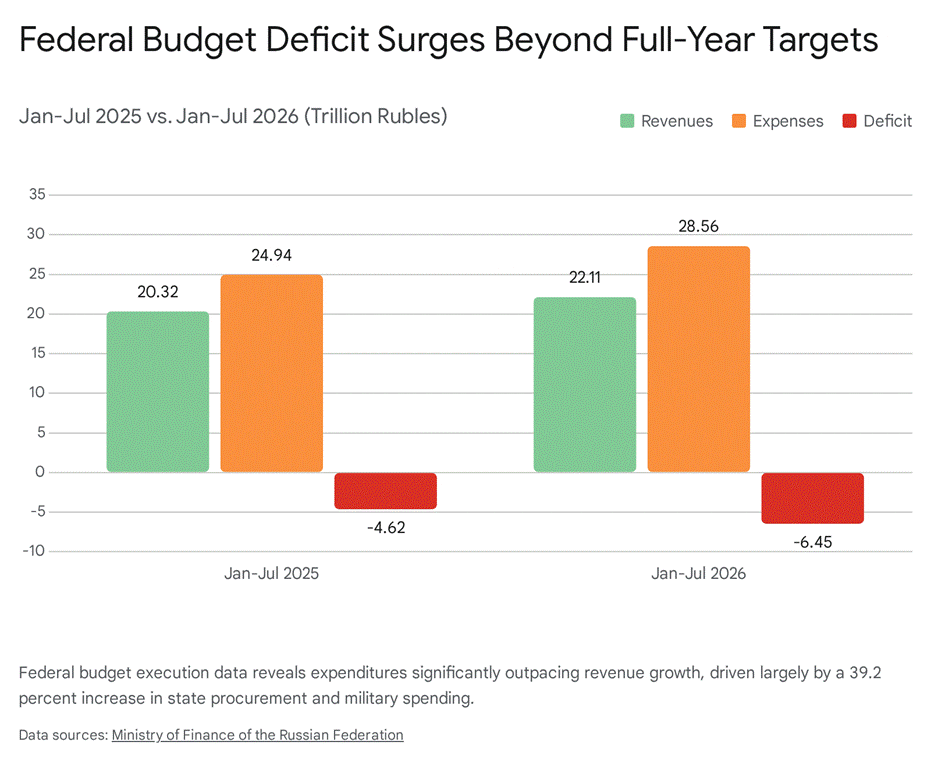
Russia’s finances are also under significant stress. The Ministry of Finance reported a budget deficit of 6.45 trillion rubles for the first seven months of the year, driven by a 40 percent spike in military spending5. Although official figures show a 1.3 percent growth in GDP, this is almost entirely due to defense production, which hides a slump in civilian manufacturing and high inflation5. To keep the economy from overheating, the Central Bank has kept interest rates at 14 percent, which further limits private investment7.
Socially and politically, the government has tightened its grip on information. The anti-war Yabloko party was recently barred from elections, and authorities have arrested citizens protesting fuel shortages4. While many Russians still oppose giving up territory, independent polls show record levels of anxiety and fading enthusiasm for the war10. Finally, the arrival of thousands of North Korean troops suggests that Russia is struggling with manpower as total estimated casualties approach 1.47 million12.
2. Body of the Report
The following section examines the military, economic, and political events of the last 14 days in chronological order.
August 8 to August 10, 2026: Military Escalations and the Onset of Infrastructure Degradation
As reported in the SITREP for August 8 through August 14, 2026, the conflict entered a more volatile phase14. The period began with slow Russian infantry advances in the east, met with strikes on their supply lines in the rear. On August 8 and 9, the DeepState OSINT group confirmed that Russian forces took ground near Illinivka, Chasiv Yar, and Sukhetske9. By August 10, they had also moved near Pishchane9. However, analysts noticed a 16.3 percent drop in Russian casualty rates compared to the previous month. This isn’t necessarily good news for Russia; it likely stems from heavy losses in failed attacks and logistical problems that are preventing reinforcements from reaching the front9.
Ukrainian drones also targeted critical energy sites. On August 8, a strike hit the Ilsky oil refinery in Krasnodar9. This plant has been hit several times recently, and this latest attack caused significant fires and injuries, further reducing Russia’s fuel production capacity9.
In response, Russia launched a massive strike against Ukraine’s Odesa region on August 9, using 11 missiles and 100 drones9. Despite Ukraine shooting down many of the missiles and drones, the attack still damaged key seaport facilities, continuing Russia’s effort to block Ukrainian exports. Meanwhile, the Russian Ministry of Defense claimed to have intercepted 456 Ukrainian drones on August 10, illustrating the scale of the ongoing aerial war9.
August 11 to August 12, 2026: Fiscal Strain, GDP Metrics, and Political Repression
By mid-week, the strain on the Russian economy became harder to ignore. On August 11, the Ministry of Finance released data showing a federal deficit of 6.455 trillion rubles5. This is already 70 percent higher than the government’s target for the entire year6.
| Federal Budget Execution (January to July 2026) | Amount (Billion Rubles) | Year-Over-Year Change |
| Total Revenues | 22,112 | +8.8% |
| Oil and Gas Revenues | 4,595 | -16.8% |
| Non-Oil and Gas Revenues | 17,518 | +18.3% |
| Total Expenses | 28,567 | +14.5% |
| State Procurement (including defense) | 8,440 | +39.2% |
| Total Deficit | -6,455 | +1,833 |
The main reason for this gap is a massive surge in military spending, which rose nearly 40 percent year-over-year6. At the same time, oil and gas revenues—the lifeblood of the Russian budget—fell by almost 17 percent due to global price shifts and damage from Ukrainian strikes5. To cover the shortfall, the state is borrowing heavily at home. However, interest rates have become so high that the government recently had to pause some bond sales5.
On August 12, Rosstat reported that the economy grew by 1.3 percent in the second quarter5. While this sounds positive, independent analysts warn that the growth is artificial. It was driven by high military production and a calendar with more working days than last year. In reality, the civilian economy—like manufacturing for everyday goods—is actually shrinking5.
Politically, the Kremlin continued to silence its critics. On August 11, the Supreme Court banned the anti-war Yabloko party from the upcoming State Duma elections9. This move effectively removes the last legal political group that openly opposed the war. In Pskov, prosecutors also sought a 12-year sentence for Lev Shlosberg, a long-time opposition figure, for “discrediting” the military9.
August 13 to August 15, 2026: Resource Extraction, Censorship, and Economic Dissent
Economic problems worsened on August 13 when the Orsknefteorgsintez refinery shut down after a drone strike; repairs could take six months9. Another strike hit a facility in Bashkortostan, over 1,300 km from Ukraine, proving that almost no site is safe from attack9.
The Kremlin also showed it won’t tolerate bad news from its experts. Andrei Klepach, the chief economist at state-owned VEB.RF, was fired after a presentation where he warned that high interest rates and reliance on China were hurting the economy5. His dismissal sends a clear message that the government values loyalty over honest forecasting.
By mid-August, Russia also intensified its control over occupied Ukrainian lands. The FSB began to blur the legal distinction between Russia and occupied Donetsk and Luhansk, while occupation officials in Crimea reported seizing millions of dollars worth of Ukrainian real estate to fund their local budgets15.
Perhaps most concerning is a new recruitment campaign targeting Ukrainian teenagers in occupied areas. These youth are being funneled into a program at the Alabuga Special Economic Zone, where they are trained to build military drones15. This is part of a broader plan to militarize the education system in occupied territories15.
August 16 to August 17, 2026: The Logistics Collapse and the Second Wave Fuel Crisis
The conflict entered a new phase as Ukraine intensified its deep-strike missions. As detailed in the SITREP (August 15 to 21, 2026), August 16 and 17 were particularly damaging14. Ukraine launched a coordinated drone campaign against Wildberries, Russia’s version of Amazon. The platform had become a key part of the military’s supply chain, selling everything from radios to drone parts2, 3.
Wildberries accounts for nearly half of Russia’s online retail market16. On August 16, a drone strike destroyed its largest warehouse near Moscow. By the next day, Ukraine had disabled seven of the company’s 10 biggest hubs, wiping out a third of its total storage capacity2.
The impact was immediate. Wildberries lost over 100 billion rubles in inventory and now needs 1.3 trillion rubles just to stay afloat2. Because the company’s business model depends on fast cash flow, this destruction triggered a major financial crisis18.
| Wildberries Strike Impact Estimates (August 2026) | Value / Metric |
| Warehouses Disabled/Destroyed | > 20 facilities (7 of top 10) |
| Lost Logistics Capacity | ~ 1.18 million square meters |
| Direct Inventory Loss | > 100 billion Rubles |
| Total Funding Requirement | 1.3 trillion Rubles |
| Sberbank Restructuring Requests | ~ 2,000 applications (August 7) |
State banks like Sberbank and VTB now have to deal with the fallout as thousands of sellers default on their loans3. The banking sector, already short on cash, must now restructure these loans, which leaves even less money available to fund the national deficit3.
At the same time, the national fuel crisis peaked. By August 17, 10 regions had to bring back strict fuel rationing. Most gas stations across Russia reported being completely empty, and even in Moscow, drivers faced two-hour waits. The situation became so desperate that the government allowed the sale of lower-quality, more polluting fuel just to keep cars on the road4.
August 18 to August 19, 2026: Diplomatic Pivots, Public Outrage, and Economic Realities
As domestic crises grew, Putin turned to international allies. On August 18, he hosted Myanmar’s military leader to strengthen ties. Russia promised to supply fuel and build energy infrastructure in exchange for Myanmar’s continued purchase of Russian fighter jets. This meeting highlights how Russia is increasingly turning to autocratic regimes to bypass sanctions and find new markets19.
Back home, the government continued to punish anyone complaining about the economy. A resident in Volgograd was fined for simply filming a video about fuel shortages4. The National Guard was even deployed to Moscow gas stations to prevent violence in long lines. On August 19, Putin claimed the Wildberries strikes were “not critical,” but his words didn’t match the supply shortages and panic seen across the country22.
Despite these pressures, the Central Bank kept interest rates at 14 percent7. While general inflation is around 6 percent, the cost of gas has jumped by nearly 26 percent, and transportation costs are rising rapidly, showing that price pressures are still intense for the average citizen23.
August 20 to August 22, 2026: Foreign Troop Deployments, Security Council Actions, and Societal Fractures
By August 20, the Russian fuel export ban had started affecting its neighbors in Central Asia. Tajikistan, Kyrgyzstan, and Uzbekistan saw prices jump by over 10 percent. Kyrgyzstan, which depends on Russia for most of its fuel, was left with only six weeks of reserves4.
On August 21, Putin met with his Security Council. While they officially discussed Arctic strategy, the real focus was on the immediate military situation24.
The most striking news was the arrival of North Korean troops in Russia. Reports confirmed that 8,500 soldiers are now in the Kursk region, with thousands more expected soon13. While they are currently assigned to rear areas, their presence is a clear sign that Russia is running low on domestic manpower.
Casualty estimates underscore this manpower shortage. Ukraine reports that Russia has lost nearly 1.5 million personnel since the war began, with daily losses still exceeding 1,200 soldiers12.
| Estimated Russian Combat Losses (as of August 22, 2026) | Total Units |
| Military Personnel (Killed and Wounded) | 1,475,270 |
| Tanks | 12,292 |
| Armored Combat Vehicles | 25,176 |
| Artillery Systems | 48,382 |
| Operational-Tactical UAVs | 474,641 |
| Vehicles and Fuel Tankers | 137,804 |
The weight of these losses, fuel shortages, and rising prices is starting to change public opinion. Independent polling from the Levada Center shows support for the army has fallen to 66 percent—the lowest since the invasion began. Public anxiety is also at a four-year high10, 26.
Most Russians now want peace negotiations, yet few are willing to give up any occupied land. This creates a strange situation where people want the war to end but are also calling for even more force if talks fail. It’s a volatile public mood that the Kremlin must carefully manage10, 27.
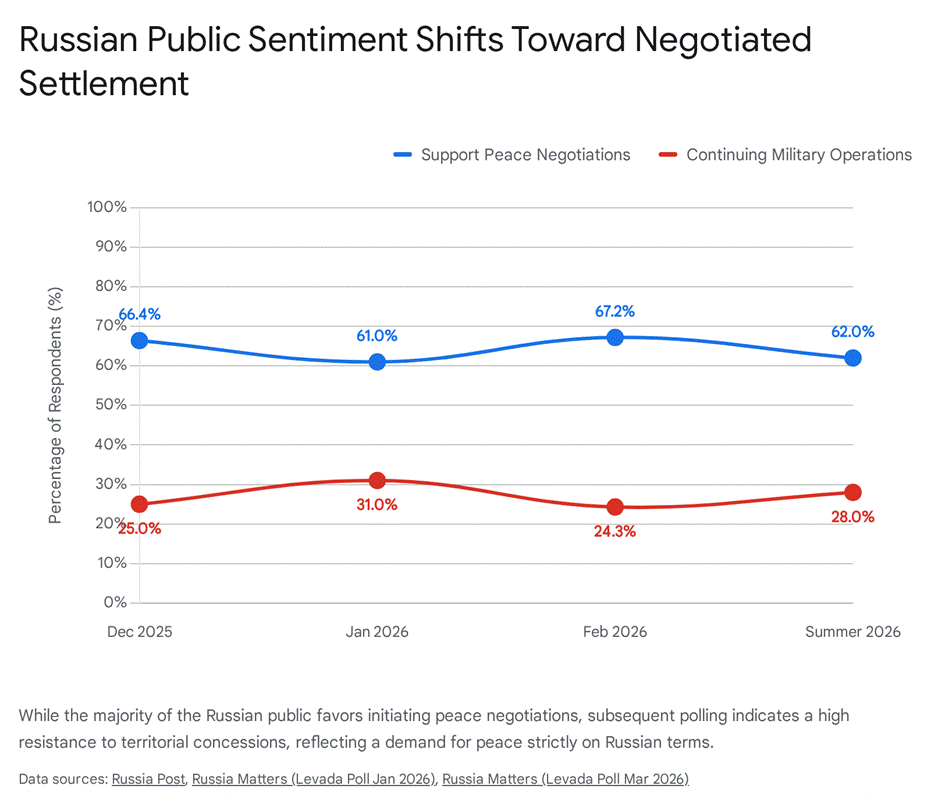
This contradiction points to a society desperate for an end to the conflict but unwilling to accept the geopolitical humiliation of defeat, creating a volatile domestic environment that the Kremlin must meticulously manage through force and narrative control.
3. Conclusion
The events of early August show a Russia trapped by high costs and domestic stress. While the government works to project stability, the reality is one of declining infrastructure and a growing reliance on extreme measures.
The strikes on the Wildberries network and the ongoing fuel crisis have shattered the sense of security in major cities like Moscow. By hitting a trillion-ruble commercial artery, Ukraine has not only disrupted military supplies but also threatened the stability of Russia’s biggest banks2, 4.
The state’s reaction has been purely defensive: hiding data, firing advisors, and arresting protesters. Furthermore, bringing in North Korean troops proves that Russia’s own manpower is being stretched to the limit4, 13.
Ultimately, the Kremlin is managing a steady decline. The Russian people are anxious and divided, and as the state uses up more resources just to handle emergencies, its ability to survive future shocks is fading10.
4. Appendix: Methodology and Data Sources
The analysis provided in this report is synthesized from a structured review of open-source intelligence, official government publications, independent sociological polling, and economic market data collected between August 8, 2026, and August 22, 2026.
Methodology:
Data was processed using a multidisciplinary approach combining geopolitical risk assessment, macroeconomic analysis, and conflict tracking.
- Military and Spatial Analysis: Frontline movements, equipment attrition, and infrastructure degradation were tracked utilizing reports from the DeepState OSINT group, the Ukrainian Main Military Intelligence Directorate, and the General Staff of the Armed Forces of Ukraine.
- Economic Evaluation: Macroeconomic health and fiscal stability were assessed by cross-referencing official releases from the Ministry of Finance and the Federal State Statistics Service with independent financial reporting, regional fuel availability metrics (Yandex Fuel, Gdebenz), and commodity exchange data (SPIMEX).
- Sociological Tracking: Domestic sentiment, political pressures, and censorship initiatives were evaluated using quantitative polling data from the independent Levada Center and the state-affiliated VTsIOM, alongside qualitative reports of civil unrest and judicial actions.
Data Sources:
- Government and State Entities: Ministry of Finance of the Russian Federation; Federal State Statistics Service; Central Bank of Russia; Kremlin Official Press Office; General Staff of the Armed Forces of Ukraine; Ministry of Defense of Ukraine.
- Independent Polling and Research Institutions: Levada Center; Russian Field; Center for Macroeconomic Analysis and Short-Term Forecasting.
- OSINT and Security Analysts: DeepState OSINT Group; Institute for the Study of War; Russia Matters (Harvard Kennedy School).
- Financial and Market Data Platforms: Saint Petersburg International Mercantile Exchange, Trading Economics, and SberCIB Investment Research.
- Independent and International Media: Meduza, The Moscow Times, Reuters, Associated Press, Euronews, and The Bell.
Please share the link on Facebook, Forums, with colleagues, etc. Your support is much appreciated and if you have any feedback, please email us in**@*********ps.com. If you’d like to request a report or order a reprint, please click here for the corresponding page to open in new tab.
Sources Used
- https://apnews.com/article/russia-ukraine-war-putin-wildberries-kim-48c331f100a1d981959c5d75a1397d21
- Ukraine has put 7 of Wildberries’ 10 largest logistics centers out of operation: does Russia have a chance to save the marketplace? | УНН, https://unn.ua/en/news/ukraine-has-disabled-7-of-wildberries-10-largest-logistics-centers-does-russia-have-a-chance-to-save-the-marketplace
- Attacks on Wildberries Warehouses: What Do Russian Banks Have to Do With It?, https://militarnyi.com/en/articles/attacks-on-wildberries-warehouses-what-do-russian-banks-have-to-do-with-it/
- 2025–2026 Russian fuel crisis – Wikipedia, https://en.wikipedia.org/wiki/2025%E2%80%932026_Russian_fuel_crisis
- Russia’s economy is growing faster than expected. It probably won’t last. – Meduza, https://meduza.io/en/feature/2026/08/18/russia-s-economy-is-growing-faster-than-expected-it-probably-won-t-last
- https://minfin.gov.ru/ru/press-center/?id_4=40530-predvaritelnaya_otsenka_ispolneniya_federalnogo_byudzheta_za_yanvar-iyul_2026_goda
- Russia Interest Rate – Trading Economics, https://tradingeconomics.com/russia/interest-rate
- Supply Constraints to Keep Russia’s Economy Under Pressure – Fitch Ratings, https://www.fitchratings.com/research/sovereigns/supply-constraints-to-keep-russias-economy-under-pressure-05-08-2026
- Russia in Review, Aug. 7–14, 2026, https://www.russiamatters.org/news/russia-review/russia-review-aug-7-14-2026
- Russians Continue to Want ‘Peace, But on Russia’s Terms’ Even as Pessimism Spreads Across the Country – Russia Post, https://russiapost.info/articles/russia-polling-in-2026
- Russian Attitudes Are Shifting as the War’s Effects Come Home – CSIS, https://www.csis.org/analysis/russian-attitudes-are-shifting-wars-effects-come-home
- Russia loses 1,240 soldiers over past day, https://www.pravda.com.ua/eng/news/2026/08/22/8049778/
- Russian Offensive Campaign Assessment, August 21, 2026 | ISW, https://understandingwar.org/research/russia-ukraine/russian-offensive-campaign-assessment-august-21-2026/
- Ronin’s Grips Analytics – Ronin’s Grips, https://blog.roninsgrips.com/
- Russian Occupation Update, August 21, 2026, https://understandingwar.org/research/russia-ukraine/russian-occupation-update-august-21-2026/
- Ukraine takes aim at Russia’s economy and morale by attacking online retailer Wildberries, https://www.pbs.org/newshour/world/ukraine-takes-aim-at-russias-economy-and-morale-by-attacking-online-retailer-wildberries
- Ukrainian strikes on Wildberries warehouses – Wikipedia, https://en.wikipedia.org/wiki/Ukrainian_strikes_on_Wildberries_warehouses
- Wildberries E-Commerce Titan Faces About $1.2 Billion Deficit After Ukrainian Drone Strikes, https://united24media.com/world/wildberries-e-commerce-titan-faces-about-12-billion-deficit-after-ukrainian-drone-strikes-21392
- Putin hosts Min Aung Hlaing as Russia-Myanmar ties deepen, https://www.indiatoday.in/world/story/putin-min-aung-hlaing-russia-myanmar-ties-junta-isolation-ptag-2974234-2026-08-18
- Putin hosts Myanmar’s leader at Kremlin | Courthouse News Service, https://courthousenews.com/putin-hosts-myanmars-leader-at-kremlin/
- Putin hosts Myanmar’s leader for talks on deepening their relationship, https://apnews.com/article/myanmar-min-aung-hlaing-russia-putin-539ddb26ae54a4bfd34480b79d0d3982
- Putin: Strikes on Wildberries Warehouses Cause Damage but Aren’t Critical, https://aroundprague.cz/en/news/putin-strikes-on-wildberries-warehouses-cause-damage-but-aren-t-critical
- Russia Inflation Rate – Trading Economics, https://tradingeconomics.com/russia/inflation-cpi
- Meeting with members of the Security Council – President of Russia, http://en.special.kremlin.ru/events/president/news/80568
- http://en.kremlin.ru/events/president/news/80568
- Are Ukraine’s deep strikes simply strengthening Putin’s hand? – The Spectator Australia, https://www.spectator.com.au/2026/08/are-ukraines-deep-strikes-simply-strengthening-putins-hand/
- Levada Poll Shows Rising Support for Peace Talks, But Devil In Details – Russia Matters, https://www.russiamatters.org/blog/levada-poll-shows-rising-support-peace-talks-devil-details
- “Extremely Unsuccessful”: Russians’ Rating of War Hits Historic Low – UNITED24 Media, https://united24media.com/world/extremely-unsuccessful-russians-rating-of-war-hits-historic-low-21479