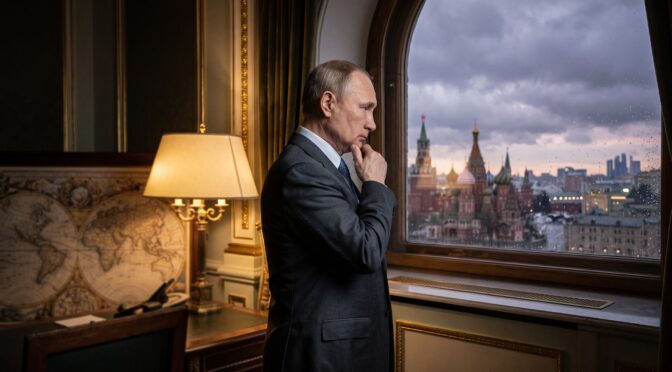
The common belief is that Putin needs an enemy to keep Russians in line. The truth is more dangerous: he has built a state that cannot survive peace.
September 28, 2026
On September 1, the German government did something European capitals have spent a decade avoiding. It publicly named Russia as the author of a sabotage plot on German soil: an attempted drone attack on the Leipzig/Halle cargo airport, a hub for military supplies bound for Ukraine. Analysts at Recorded Future called it the first formal state assignment of responsibility of its kind. Two weeks later, Lithuanian forces shot down a Russian drone over their territory, and Norwegian and allied officials disclosed Russian submarine activity near Svalbard, where the cables that connect the Arctic to the world run along the seabed (Dark Reading). On September 28, European Union foreign ministers gathered to build a common response, with the bloc’s foreign policy chief warning that more sabotage was on the way (Euronews).
None of this surprised anyone who has watched the Kremlin since 2022. What has changed is the pace, along with the willingness of European governments to say out loud what their intelligence services have known for years. Behind these announcements lies a question Western leaders have never fully answered: why does Vladimir Putin do this? Why does a leader whose army is bogged down in Ukraine, whose economy is straining under a war budget, and whose oil revenues are shrinking keep finding new ways to provoke the most powerful military alliance in history?
The standard answer is that he has no choice. In this view, Putin is an authoritarian leader who needs an external enemy. His power depends on convincing Russians that their country is under siege, and a country under siege needs an adversary. He must attack the West, or at least be seen doing so, because a Russia at peace would have no reason to accept his rule. This theory is widely held among political scientists, who call it diversionary war, and it aligns with much of the evidence. However, it misses a key part of the reality.
It misunderstands what Putin needs and who he needs it from. He does not need constant military attacks; he needs standing conflict and the appearance of winning. Furthermore, the audience that matters most is not the general Russian public, which has endured every hardship of the war without widespread protests. The audience that counts is the tight circle of security chiefs, regional governors, and business leaders. Their belief in Putin’s control is the primary line keeping him secure from the fate of rulers who lost the backing of their own inner circle.
This distinction is crucial. If the standard view were correct, the West could lower the risk by reducing tensions through fewer sanctions, less assistance to Ukraine, and less critical rhetoric about Russian aggression. But if the adjusted view is right, danger actually spikes whenever Putin appears weak. The actions that matter most are those that influence what his elite believes about his staying power. To understand why, it helps to look back at when the Putin system first faltered and how he adjusted.
The Bargain That Broke
For the first eight years of his leadership, Putin did not need an external enemy. High oil prices sustained his standing. According to the Levada Center, Russia’s primary independent polling organization, his approval rating grew from 65 percent in September 2000 to 88 percent in September 2008. During this time, the national economy expanded around seven percent each year and average incomes nearly doubled (Levada Center). Although relations with Western nations cooled after 2007, the tension remained largely verbal. Most Russians supported Putin because their standard of living was improving, requiring no narrative about NATO to earn their backing.
The 2008 global financial crisis brought that economic growth to an end. By 2013, annual growth slowed to roughly one percent, and public approval tracked downward accordingly. By September 2011, Putin’s approval stood at 68 percent. By January 2013, it had fallen to 62 percent, his lowest score since taking office, leading Levada’s director to point out a steady decline in the government’s public standing (The Moscow Times). In December 2011, tens of thousands of residents gathered in Moscow’s Bolotnaya Square to protest fraudulent parliamentary elections, forming the largest demonstrations since the dissolution of the Soviet Union (VOA). Many protesters came from the urban middle class generated by the previous economic boom. The system’s main beneficiaries had turned into its most vocal critics.
Putin’s response marked a major turning point. Rather than restructuring the economy, he publicly accused U.S. Secretary of State Hillary Clinton of directing the protests to weaken Russia. Over the next two years, his administration enacted the foreign agents law, restrictions regarding LGBTQ+ messaging, and several policies emphasizing traditional religious identity. State television began portraying Russia as a fortress under pressure from Western influences. This framing was well established before the 2014 political shifts in Kyiv, and the annexation of Crimea demonstrated its domestic effectiveness.
Between September 2013 and September 2014, Putin’s approval rating surged from 64 to 86 percent, reaching a peak of 89 percent in June 2015 (The Moscow Times). It remained above 80 percent through 2017 despite an economic downturn, a currency drop, and initial Western economic sanctions. External confrontation provided the public support that economic growth could no longer deliver, even as household incomes declined.
That surge eventually faded. The 2018 pension reform, which raised the retirement age, reduced Putin’s approval to 67 percent. Throughout 2019, his rating remained in the mid-60s, below the levels seen immediately after Crimea (The Moscow Times). The Kremlin observed that public enthusiasm from foreign events typically lasts three to four years before domestic concerns resurface. The 2022 invasion of Ukraine created a second major surge, driving approval from around 70 percent up to 83 percent in March 2022 (Statista), staying in the mid-80s through 2025.
Eventually, domestic consequences accumulated. In June 2026, Levada recorded a five-point decline in a single month down to 74 percent, marking the largest drop since the military call-ups of September 2022, while disapproval rose to 21 percent (NV). This drop matched fuel supply issues, internet disruptions, and long-range Ukrainian drone strikes affecting domestic airports. Approval held at 74 percent in July (Nemoskva), and state pollster VTsIOM paused releasing public trust tracking after numbers hit war-time lows (The Moscow Times).
This history appears to support the traditional view. Since 2012, tension with the West served as a substitute for economic development, requiring larger actions over time, moving from an annexation in 2014 to a major conflict in 2022. However, the 2026 numbers reveal a limit to this approach. Russian public support fell not because people felt safe, but because war conditions directly impacted daily life and travel. The public is not actively seeking conflict; it tolerates it until personal costs become too high.
Whom Putin Actually Fears
The diversionary theory assumes that a leader who loses public support automatically loses power. In democratic systems, that connection is built into the rules. In highly centralized authoritarian systems, leadership changes happen differently. Dictators lose power when security leaders choose not to support them, when regional administrators and financial leaders conclude the ruler cannot guarantee stability, or when internal rivals see an opening. Public protests matter primarily as a spark for those internal decisions. Large crowds become a direct challenge when security forces choose not to intervene.
Putin structures his system to prevent key figures from coordinating against him rather than to win broad affection. Consider what the Russian population has accepted since February 2022 without significant mass protests: partial military drafts, high casualty rates, elevated inflation, currency limits, reduced availability of Western items, internet restrictions, and recent fuel and travel disruptions. Public approval can fall significantly without directly threatening regime security. The population is managed through strict law enforcement, financial payments to military families, state media control, and widespread acceptance of the status quo.
The main challenge to Putin’s authority during the war came from within military structures. In June 2023, Yevgeny Prigozhin led his Wagner armed forces toward Moscow following extended disputes with defense leadership over resources and tactics (Meduza). The movement ended within a day, not because of public opposition, but because other elite factions remained loyal to the state. The situation was resolved two months later when Prigozhin died in a plane crash. Putin responded by quietly enforcing tighter control across security agencies, addressing the threat where it actually originated.
The expectations of the elite differ from those of the general public. Governors, business figures, generals, and security heads focus on whether the leader retains control and protects their positions. This assessment relies on maintaining momentum and order. A difficult but stable military situation can preserve that impression. Conversely, visible military losses or unmanaged escalation risk undermining it. Consequently, conflict with external powers must appear controlled, explaining the heavy use of indirect and covert operations.
The framing of a nation under siege serves a clear purpose, primarily reassuring key insiders rather than just the general public. It explains to governors why local budgets are redirected toward defense, tells business leaders why international assets are unreachable, and reinforces to officials that internal political changes carry heavy risks. The message reaches top administrators just as directly as it reaches state media viewers.
A Believer, Not a Showman
The diversionary explanation has another flaw: it treats Putin’s stance toward the West purely as a political tool used to manipulate public attention. However, evidence indicates that Putin acts on a genuine belief that Western nations seek to weaken his government. Domestic messaging reflects this underlying viewpoint rather than serving merely as a calculated distraction. A leader acting on conviction is harder to influence and more willing to escalate than one using tension purely for effect.
This perspective is evident across years of statements. In his 2005 speech to parliament, Putin described the dissolution of the Soviet Union as a major historical setback that left millions of Russians outside national borders (NBC News). Subsequent events were viewed through this framework, including NATO expansion, military actions in the Balkans and Middle East, and political uprisings in Georgia and Ukraine. He viewed political shifts in Kyiv not as internal decisions, but as external efforts to establish an unfriendly state on Russia’s border. His claims regarding foreign involvement in Moscow protests reflected his actual assessment of the situation.
A clear indication of his thinking appeared in an article published on the Kremlin website in July 2021, seven months before the military campaign began. Titled “On the Historical Unity of Russians and Ukrainians,” the essay argued that the two populations form one people and asserted that an independent Ukraine aligned with Western partners was unacceptable to Russian interests (Kremlin). Researchers at Poland’s Centre for Eastern Studies characterized it as a rejection of Ukrainian statehood framed through historical narrative (OSW). The piece was not designed for popular mobilization, attracting little attention from the general public. Instead, it served as an internal justification for planned actions.
The high cost paid further supports this conclusion. If conflict were simply a low-cost tool for public control, simpler methods like diplomatic disputes or media campaigns would suffice. Instead, military spending reached a record 10.7 trillion rubles in the first half of 2026 alone, five times pre-war levels, accounting for an estimated 10.5 percent of GDP according to economist Janis Kluge (Kyiv Post). Such resource commitments go far beyond routine public relations, driven by an intent to prevent Ukraine from aligning with Western alliances.
In Putin’s view, the security of the nation and the security of his leadership are identical. An economically successful, democratic neighbor presents a contrasting model to the Russian public. Consequently, Western economic restrictions, political backing for opposition figures, and public commentary on Russian governance are interpreted as direct efforts to alter the leadership. This makes long-term agreements difficult to maintain, as flexibility diminishes when every challenge is seen as an existential threat.
The Trap Closes
If the Russian leadership decided to end the confrontation, current state structures would present major obstacles. Years of conflict have reorganized national institutions around defense priorities, making a return to previous conditions difficult to manage.
Finances reflect this shift. The 2026 federal budget allocates 38 percent of spending to defense and security, down slightly from 41 percent in 2025 but double pre-war levels, funded partly through higher value-added taxes as energy revenues decline (Euromaidan Press). Cumulative war costs have exceeded 42 trillion rubles since February 2022 (Kyiv Post). Entire regions rely on defense manufacturing operating continuously, which draws labor away from civilian sectors. Transitioning away from a defense-centered economy would involve job cuts and reduced income in manufacturing centers key to domestic stability, a transition for which the government lacks a clear framework.
The structure of influential groups has also altered. International sanctions separated traditional business leaders from Western markets, increasing their reliance on state support. Concurrently, new prominent groups emerged, including defense contractors, regional administrators, and military managers whose positions depend on ongoing defense activity. Established figures require current policies due to limited alternatives, while newer figures benefit directly from current priorities. Returning service members also form a significant group requiring ongoing state support, creating strong internal incentives against policy changes.
Political narrative creates additional commitments. The state has described the conflict as vital for national preservation. Analysts at the Observer Research Foundation note that the conflict length has exceeded that of World War II while key regional objectives remain incomplete. Concluding hostilities without clear results would present significant narrative challenges for leadership (ORF). Framing the situation as essential limits the ability to modify goals without facing questions from institutional stakeholders.
Legal adjustments add further constraints. The annexation of four Ukrainian regions was incorporated into the national constitution despite incomplete territorial control. Under current domestic law, relinquishing claims to these areas constitutes an illegal transfer of territory. Meanwhile, media controls and restrictions on public debate prevent traditional political channels from building public support for potential compromises.
These structural realities partially support conventional analysis: the current government cannot easily manage a visible defeat. However, this is less about public opinion and more about an administration built entirely around wartime operation that cannot easily transition back to peacetime conditions. The system remains locked into its current trajectory as time goes on.
Calibrating the Gray Zone
Given the need to maintain pressure without triggering direct conflict with NATO, the practical question centers on calibrating operations. The Russian government aims to balance sufficient pressure to influence European decisions while avoiding actions that provoke a direct, unified military response.
These activities operate along a clear continuum. At the lower end are online information campaigns, using unverified sites and cloned media channels at low cost and risk. Further up are cyber intrusions and GPS signal interference in the Baltic region. Next are indirect operations using third-party actors for localized disruption, arson, or small drone incidents. Higher levels involve actions against undersea cables, infrastructure, and airspace incursions over eastern European nations, carrying higher risks of direct engagement. Near the top are targeted operations on foreign soil and public strategic warnings. Full direct military action against NATO members remains unused at the top of this scale.
Most actions above digital campaigns are designed to obscure direct official responsibility. U.S. intelligence notes that Russia regularly conceals its involvement, complicating international responses (Congressional Research Service). This lack of clarity allows testing of boundaries and tactical adjustments without public setbacks. It fragments international responses by allowing incidents to be handled individually as local law enforcement issues. Additionally, Russian state media generally omits coverage of these operations, indicating that domestic audiences are not the primary target. Instead, targets include logistics centers supplying Ukraine, manufacturing plants, and regional airspace, with the goal of increasing political and economic costs for European governments.
The upper limit of these actions is shaped by resource constraints. Conventional military forces are concentrated in Ukraine, while the domestic economy faces inflation and lower energy income. Direct conflict with NATO would immediately threaten political stability. Strategic messaging serves as a substitute for actions that carry excessive risk. Operational targets aim to create concern among European publics while remaining below thresholds that force mutual defense commitments.
At the same time, reducing activity too much conflicts with the narrative of standing against Western nations, signaling a lack of options to internal stakeholders and reducing diplomatic leverage. Pressure on European states remains a primary method to influence support for Ukraine. Consequently, incentives favor maintaining a steady operational pace.
Diplomatic contact forms part of this overall approach. In early September, following a six-month pause, U.S. representatives Steve Witkoff and Jared Kushner held meetings in Moscow and Kyiv, after which Russian officials indicated openness to discussion (House of Commons Library). On September 25, leadership stated that proposals remained under consideration while emphasizing national interests and pointing to military strikes for delays in talks (Reuters). After extended talks around frameworks involving territorial concessions and neutrality, no formal agreements exist on territory or security arrangements. Meanwhile, official statements point to low unemployment figures as economic indicators while advising private firms to arrange local defensive measures (Critical Threats). Diplomatic engagement maintains international focus and encourages debate among allied nations regarding strategy, offering tactical benefits at limited cost.
The Danger of a Weakening Kremlin
Evaluating these elements reveals a picture that differs from standard accounts. Russian leadership is not merely using external threats to distract domestic citizens. Instead, administrative structures, budget allocations, and legal commitments have been reoriented around opposition to Western alliances. De-escalation remains difficult without results that can be framed as success, leading to continued reliance on indirect operations to exert pressure on European partners.
This assessment leads to an important conclusion: instability is more likely to increase when current operations encounter setbacks rather than when they succeed. The principal risk to leadership stability is not public dissatisfaction, but internal elite consensus that military or political goals are failing. Consequently, periods of stalled momentum, economic disruption in urban centers, or unfavorable settlement terms present heightened risks of indirect escalation, particularly within Europe where direct risks are lower.
Key indicators center on elite cohesion. Public disagreement among security officials, regional leaders, or major business managers would carry more weight than public polling data. Similarly, sudden personnel changes or investigations within defense leadership indicate internal instability. A shift from covert actions to acknowledged operations against foreign territory would signal changing operational assumptions. Additionally, unintended escalation resulting in major casualties increases in likelihood as the frequency of indirect operations rises.
Three policy considerations follow. First, focus efforts on internal elite perceptions rather than general public opinion. Adjustments intended to lower public concern do not alter government decision-making, as public opinion is not the primary operational constraint. Consistent support for Ukraine and enforcement of economic sanctions directly impact internal evaluations of long-term prospects.
Second, use prompt attribution as a preventive measure. Indirect operations rely on ambiguity to limit consequences. Rapid, public, and joint identification of responsible parties reduces the effectiveness of covert actions and increases operational costs. Establishing coordinated response systems among allied nations directly addresses this tactic.
Third, recognize that lasting arrangements require terms that Russian leadership can present internally as viable. Terms that are interpreted internally as complete defeat risk prompting secondary actions elsewhere, requiring long-term security planning to address potential risks.
Current actions reflect a leadership operating within narrow structural limits created by years of policy choices. Understanding these institutional constraints is essential for developing effective international responses.
Please share the link on Facebook, Forums, with colleagues, etc. Your support is much appreciated and if you have any feedback, please email us in**@*********ps.com. If you’d like to request a report or order a reprint, please click here for the corresponding page to open in new tab.
Sources Used
All sources are linked inline where cited. They are listed here in order of first appearance.
- Recorded Future, “Russia’s New Generation Warfare”, 2026.
- Dark Reading, “Russia’s hybrid cyber-physical war on Europe”, September 25, 2026.
- Euronews, “EU ministers plan response to hybrid attacks amid warnings of Russian sabotage”, September 28, 2026.
- Levada Center, Indicators: approval of Vladimir Putin, September 2000 to September 2019.
- The Moscow Times, “Pollster Says Approval for Putin at 12-Year Low”, January 2013.
- Voice of America, “Tens of Thousands Gather in Moscow to Protest Alleged Voter Fraud”, December 10, 2011.
- The Moscow Times, “Putin’s Approval Ratings Hit All-Time High of 89%”, June 24, 2015.
- The Moscow Times, “Putin’s Approval Rating Steadily Increases to 68%, Survey Says”, July 5, 2019.
- Statista, “Putin’s approval rating”, citing Levada Center, February 2023.
- NV, “Putin’s approval slides 5 percentage points in one month”, citing Levada Center, July 3, 2026.
- Nemoskva, “Levada Center poll: 54% of Russians believe the country’s development path is correct”, July 31, 2026.
- The Moscow Times, “Putin’s Job Approval Rating Sees Sharpest Weekly Drop Since Ukraine Invasion, VTsIOM”, July 3, 2026.
- Meduza, “‘We’re no mutineers’: Three years after Yevgeny Prigozhin’s march on Moscow”, June 24, 2026.
- NBC News, “Putin: Soviet collapse a ‘genuine tragedy’”, April 25, 2005.
- Vladimir Putin, “On the Historical Unity of Russians and Ukrainians”, Kremlin, July 12, 2021.
- Centre for Eastern Studies (OSW), “Putin’s article: ‘On the historical unity of Russians and Ukrainians’”, July 13, 2021.
- Kyiv Post, “Russian war spending hits record 10.7 trillion rubles in first half of 2026”, citing Janis Kluge, SWP, 2026.
- Euromaidan Press, “Russia to spend $183 billion on defense and security in 2026”, September 2025.
- Kyiv Post, “Russia’s military spending up 30% year-on-year”, citing Janis Kluge, SWP, 2025.
- Observer Research Foundation, “Russia-Ukraine War in 2026: At the Crossroads of Peace and War”, 2026.
- Congressional Research Service, “Russian Hybrid Warfare Activities in Europe”, R49134, 2026.
- House of Commons Library, “Ukraine: A new push for peace”, CBP-12198, September 2026.
- Reuters via U.S. News, “Putin Says All Ukraine Peace Proposals on Table, but Russia Must Weigh Its Interests”, September 25, 2026.
- Critical Threats / Institute for the Study of War, “Russian Offensive Campaign Assessment, September 3, 2026”.
Editor’s note on data: Levada Center figures are subject to the usual caveats about polling under repression; trends are more reliable than any single reading. Figures for growth rates and real incomes in the 2000s are widely reported approximations and are not separately sourced here.