1. Executive Summary
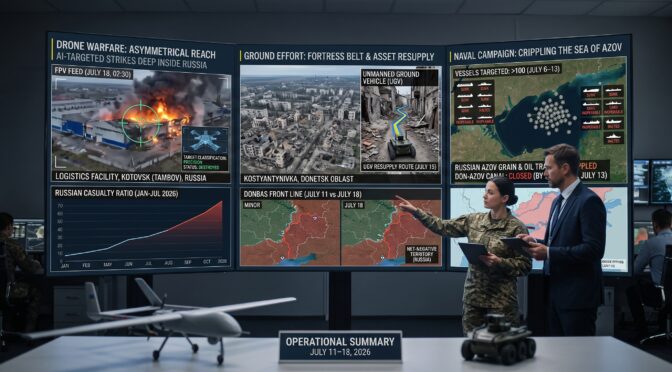
The operational reporting period from July 11 to July 18, 2026, marks a profound inflection point in the Russia-Ukraine conflict, characterized by unprecedented asymmetrical force projection by the Ukrainian Armed Forces and a sweeping, highly consequential political restructuring within the highest echelons of the Ukrainian government. Russian ground forces continue to prosecute an exhausting, slow-paced war of attrition along the eastern front, yielding marginal territorial gains that are increasingly offset by catastrophic personnel and materiel losses1. In stark contrast, Ukraine has aggressively pivoted toward a doctrine of deep strategic interdiction, executing a highly coordinated, multi-domain strike campaign aimed at dismantling the foundational pillars of the Russian war economy: its refining infrastructure and its sanctions-evading maritime logistics network.
The most defining military development of the reporting period is the intensification of “Operation MoLoChKa,” a massive maritime drone offensive led by Ukraine’s Unmanned Systems Forces (USF). Over the span of thirteen days, culminating on July 18, this campaign successfully prosecuted strikes against 172 vessels belonging to the Russian “shadow fleet” operating in the Sea of Azov and the Black Sea3. By disabling feeder tankers, dry cargo ships, and tugboats without causing environmental disasters, Ukraine has effectively paralyzed the maritime logistical corridors vital for Russian crude exports and military supply lines3. The strategic resonance of this campaign is evidenced by the forced redeployment of elite Russian front-line drone operators, specifically the “Rubikon” center, from the eastern combat theater to the Black Sea to provide emergency point-defense for commercial vessels6. This represents a critical strategic vulnerability for Moscow, forcing a dilution of offensive ground capabilities to protect maritime economic assets.
Concurrently, the domestic political landscape in Kyiv experienced a seismic shift. President Volodymyr Zelenskyy executed a sweeping government reshuffle, dismissing Prime Minister Yuliia Svyrydenko and replacing her with Serhii Koretskyi, the crisis-tested CEO of the state-owned energy conglomerate Naftogaz9. This appointment signals an explicit governmental pivot toward winter energy resilience, infrastructure defense, and economic stabilization12. More divisively, Zelenskyy ousted the highly popular Defense Minister Mykhailo Fedorov, a primary architect of Ukraine’s drone innovation ecosystem, following an irreconcilable doctrinal dispute with the Commander-in-Chief of the Armed Forces, General Oleksandr Syrskyi14. The transition of defense leadership to Major General Yevhen Khmara—a seasoned intelligence operative and former head of the Security Service of Ukraine’s (SBU) elite “Alpha” unit—indicates that while civilian oversight of the military may be realigning, Ukraine’s reliance on specialized, intelligence-driven deep-strike operations will remain the cornerstone of its asymmetric warfare strategy17.
2. Detailed Operational and Diplomatic Developments
Bilateral Interactions & Diplomatic Posture
The diplomatic and political theater observed significant realignments, both internally within Ukraine and across international mediation efforts. The most consequential domestic development was President Zelenskyy’s sweeping cabinet reshuffle, which structurally reoriented Ukraine’s wartime administration toward an absolute prioritization of infrastructure resilience and technological strike operations. The dismissal of Prime Minister Yuliia Svyrydenko, who formally submitted her resignation on July 13, paved the way for the overwhelming parliamentary confirmation of Serhii Koretskyi on July 1610. Koretskyi, an engineer and former CEO of the state energy giants Naftogaz and Ukrnafta, represents a technocratic pivot. Under his tenure at Naftogaz, he successfully rebuilt national gas reserves to over 13 billion cubic meters and steered the company to record profitability amidst active wartime conditions13. His appointment clearly indicates that Kyiv anticipates a severe escalation in Russian infrastructure targeting in the impending 2026–2027 winter, requiring a premier crisis manager at the helm of the civilian government.
However, the reshuffle was marred by profound civil-military friction regarding the dismissal of Defense Minister Mykhailo Fedorov. Fedorov’s ouster exposed a deeply rooted doctrinal schism between the traditional military establishment, represented by General Syrskyi, and a new cadre of techno-centric innovators15. Fedorov’s mandate to transform the military via rapid technological integration, competitive procurement, and a shift away from Soviet-era attritional tactics met fatal institutional resistance14. Public protests erupted across Kyiv and other major cities, with demonstrators arguing that Fedorov’s departure threatens the very innovation that has kept Ukraine competitive against a numerically superior adversary15. His replacement, Major General Yevhen Khmara, brings an extensive background in covert “Phase Zero” operations and long-range technological strikes as the former commander of the SBU’s “Alpha” unit and an architect of “Operation Spiderweb”17. This suggests Zelenskyy intends to consolidate asymmetric capabilities directly under intelligence and special operations frameworks rather than civilian bureaucratic channels.
On the international front, direct bilateral coordination between the belligerents yielded moderate humanitarian dividends despite total diplomatic gridlock on peace frameworks. Mediated by the United Arab Emirates, Russia and Ukraine executed a symmetrical prisoner-of-war exchange on July 17, securing the release of 160 personnel from each side26. This was accompanied by a large-scale repatriation of remains, with Ukraine recovering the bodies of 501 fallen soldiers and Russia receiving 3127. The presence of explosive devices concealed within the repatriated remains of Ukrainian personnel has necessitated stringent explosive ordnance disposal (EOD) protocols prior to forensic identification, significantly complicating the recovery process28.
Broader peace negotiations remain entirely stalled. The Vatican’s peace envoy, Cardinal Matteo Zuppi, concluded a diplomatic mission to Kyiv focused explicitly on humanitarian mechanisms—specifically the return of deported Ukrainian children and the establishment of an “all-for-all” POW exchange framework encompassing roughly 7,000 Ukrainians and 4,000 Russians29. Meanwhile, the Russian political posture remains maximalist; the Kremlin categorically rejects Western security guarantees for Ukraine and continues to demand Ukrainian capitulation regarding occupied territories30.
Frontline Combat Updates
Ground combat operations continue to reflect a grinding, localized war of attrition, with the Russian Armed Forces prioritizing slow, methodical advances along the eastern front, heavily supported by glide bomb (KAB) and artillery suppression.
According to consolidated open-source intelligence (OSINT) data from DeepState, Russian forces achieved a net gain of approximately 15 square miles of Ukrainian territory over the four-week period ending July 14, 20261. This represents a marginal acceleration compared to the 10 square miles gained in the preceding four-week cycle. However, alternative assessments utilizing Institute for the Study of War (ISW) polygons indicate a much narrower net gain of only 5 square miles1. This discrepancy highlights the fluid nature of the “gray zones” and the difficulty in asserting permanent control over contested infiltration areas.
The primary locus of Russian offensive operations remains the Pokrovsk and Kostiantynivka-Druzhkivka tactical areas31. Russian units are actively attempting to execute pincer movements to dismantle the defensive nodes of Ukraine’s Donbas “fortress belt,” achieving minor confirmed advances near Ivanopillia, Kryva Luka, and Zatyshok30. The operational tempo remains extraordinarily high, with the Ukrainian General Staff reporting over 100 combat clashes daily, peaking at 43 distinct Russian assaults in the Pokrovsk direction alone over a 24-hour period32. Yet, the geographic pace of these advances is historically anomalous; independent analysis indicates Russian ground offensives are stalling at an average rate of advance of merely 50 meters per day around Kostiantynivka and 70 meters per day near Pokrovsk2.
Conversely, Ukrainian forces have demonstrated localized counter-offensive success. In the Oleksandrivka direction (Dnipropetrovsk Oblast borderlands), Ukrainian mechanized and infantry elements liberated six settlements, reclaiming approximately 120 square kilometers of territory34. The northern fronts in Kharkiv and Sumy remain active but largely static; despite Commander-in-Chief Syrskyi’s warnings of a renewed Russian attempt to carve out a “buffer zone,” Ukrainian defenses have largely contained cross-border incursions, actively fortifying secondary fallback lines near Vovchansk and Kupyansk30.
| Territorial Control Metrics (July 2025 – July 2026) | Source | Value |
| Total Russian Net Gain (Trailing 12 Months) | DeepState / OSINT | 1,130 sq miles (Approx. 0.5% of UKR territory)1 |
| Trailing 4-Week Net Change (June 16 – July 14) | DeepState OSINT | +15 sq miles (Russian Gain)1 |
| Trailing 4-Week Net Change (June 16 – July 14) | ISW / RM | +5 sq miles (Russian Gain)1 |
| Ukraine Counter-Offensive Gains (Oleksandrivka) | ISW / OSINT | +120 sq km (Approx. 46 sq miles)34 |
The 40-Day Deep-Strike Campaign & Maritime Security
Ukraine’s strategic posture has heavily pivoted toward a sustained, multi-domain deep-strike campaign targeting the logistical, energy, and maritime infrastructure that fuels the Russian war effort. The most highly disruptive component of this strategy is “Operation MoLoChKa,” executed by the Unmanned Systems Forces (USF).
Initiated on July 6, Operation MoLoChKa specifically targets the Russian “shadow fleet”—a vast network of feeder tankers, dry cargo vessels, and tugboats utilizing opaque ownership structures to bypass Western sanctions and the G7 oil price cap8. Over a 13-day period, USF aerial and naval drones successfully struck 172 vessels (118 in the Sea of Azov and 54 in the Black Sea)3. The operational methodology is distinctly precise: Ukrainian operators explicitly target the propulsion and steering systems of these vessels to achieve “irreversible paralysis,” transforming them into drifting barges without breaching the hulls, thereby avoiding catastrophic ecological oil spills3.
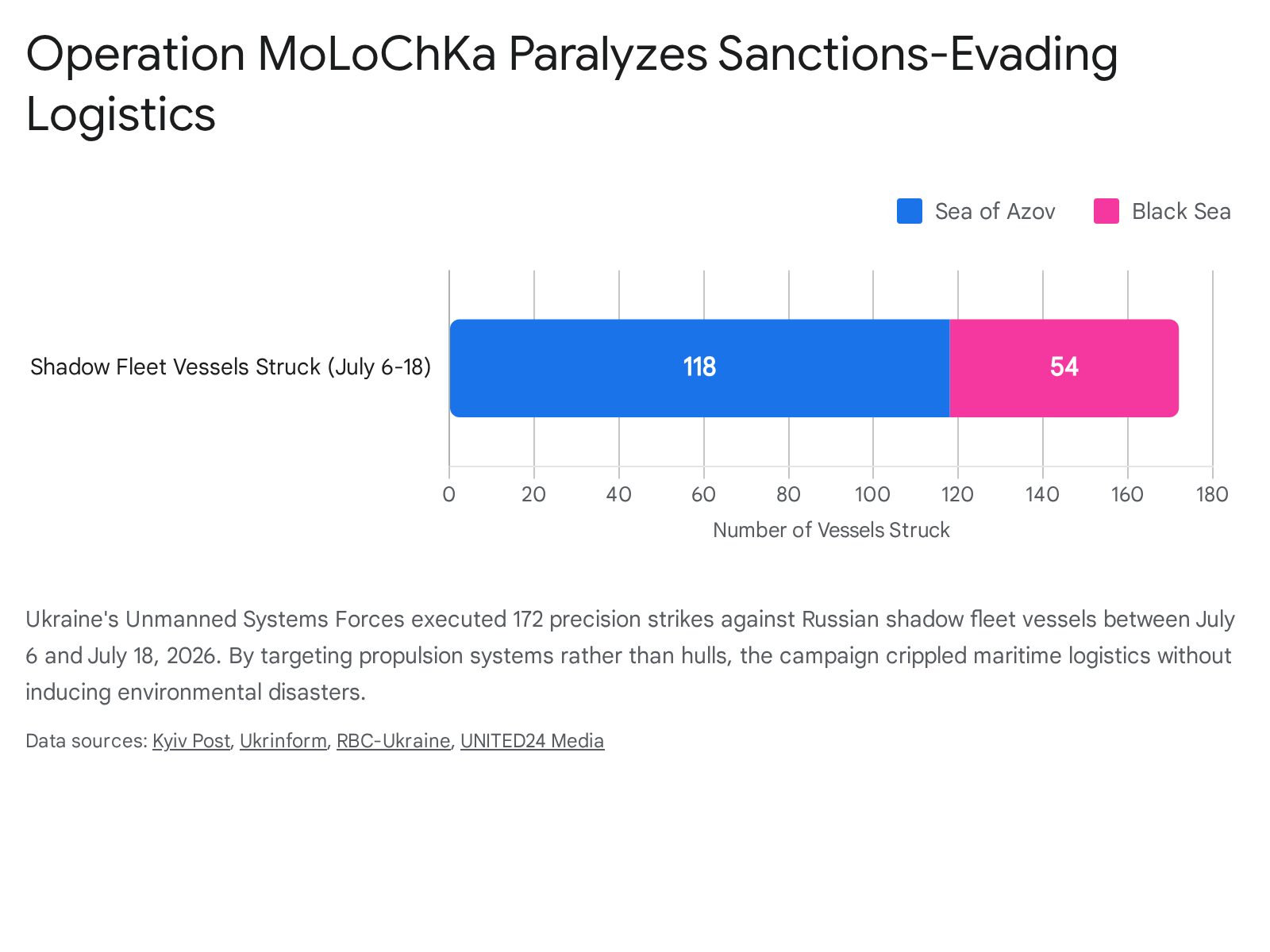
The cascading effects of this maritime interdiction are severe. Shipping through the critical Don-Azov Channel has been temporarily halted, effectively severing a primary artery for Russian crude exports and military logistics flowing into occupied Crimea30. Consequently, an estimated 135 million barrels of Russian crude are currently stranded at sea as the offshore backlog expands5.
Simultaneously, the deep-strike campaign against Russian onshore energy infrastructure continues unabated. Ukrainian long-range systems successfully struck the Salavat Oil Refinery in Bashkortostan (Gazprom’s Neftekhim complex, previously untouched in 2026), the Afipsky refinery in Krasnodar Krai, and the Syzran refinery in the Samara region30. The most spectacular tactical feat was a strike utilizing long-range drone technology against the Omsk refinery—the largest gasoline producer in Russia—located 2,500 kilometers from the Ukrainian border39. The cumulative effect of these strikes has temporarily disabled an estimated 42.7% of Russia’s designed refining capacity, triggering domestic fuel shortages, skyrocketing consumer gasoline prices, and forcing the Kremlin to seek emergency imports from partners like India41. In a parallel targeted action, the chief engineer of the Russian-occupied Zaporizhzhia Nuclear Power Plant, Aleksandr Yakovlev, was killed by a drone strike in Enerhodar, drawing swift condemnation from the IAEA regarding the militarization of nuclear personnel corridors43.
Role of Third-Party Countries
The footprint of the conflict continues to expand across sovereign borders, heightening geopolitical friction and drawing direct involvement from third-party nations. In Moldova, a Russian Geran-2 (Shahed-136) drone breached national airspace and detonated near the village of Copanca during a massive Russian aerial assault targeting the Odesa region46. The Moldovan Ministry of Foreign Affairs condemned the incursion as a severe security threat46. Over the Baltic Sea, Polish fighter jets intercepted a Russian Il-20 reconnaissance aircraft operating without a transponder, marking the tenth such interception by Poland in 202648. Polish and Baltic intelligence agencies assess that these flights are part of a broader “Phase Zero” surveillance effort probing NATO air defense integration42.
Foreign military aid dynamics are also shifting toward indigenous Ukrainian production and component acquisition. The European Union authorized a derogation permitting Ukraine to utilize a portion of a €6 billion defense loan to procure drone components directly from Chinese manufacturers, bypassing standard EU procurement regulations30. This highlights a profound irony in the conflict’s supply chain: while China acts as a key enabler for the Russian defense industry, it simultaneously supplies the critical commercial electronics underpinning Ukraine’s drone superiority. Furthermore, France and Italy have granted Kyiv licenses to domestically produce French SCALP cruise missiles and Franco-Italian glide bombs, significantly bolstering Ukraine’s sovereign defense industrial base49. The German defense firm Helsing also announced the establishment of a new manufacturing facility in West Virginia, USA, strictly for producing HX-2 strike drones intended for the Ukrainian theater50.
| Key Evolving Financial & Military Aid Mechanisms (July 2026) | Contributor | Mechanism / Asset |
| EU Defense Loan Derogation | European Union | Authorization to use €6B loan for Chinese-manufactured drone components30. |
| Sovereign Production Licenses | France / Italy | Domestic Ukrainian production of SCALP cruise missiles and glide bombs49. |
| Advanced AI UAV Supply | Germany (Helsing) | Delivery of 6,000 HX-2 autonomous strike drones51. |
| Defense Loan Scheme Participation | United Kingdom | Commitment to participate in the EU’s €60B long-term defense loan framework30. |
3. Drone Warfare and Unmanned Systems
Tactical & Strategic Deployments
The battlespace is entirely dominated by the proliferation and evolution of unmanned systems. Ukraine has transitioned from utilizing off-the-shelf commercial drones to deploying highly sophisticated, mass-produced indigenous platforms capable of striking thousands of kilometers deep into Russian territory. The Ukrainian Ministry of Defense reported that drone units have struck over one million targets since the beginning of 2026, accounting for roughly 90% of all successful battlefield strikes against Russian targets7.
In the maritime domain, Ukraine’s Unmanned Surface Vessel (USV) fleet has evolved from asymmetric harassment tools into multi-role naval platforms. The Sea Baby drone has been outfitted with modular weapon systems, including 122mm Grad rocket launchers, RPV-16 thermobaric rockets for suppressing coastal defenses, and Italian-made MN-103 Manta bottom mines capable of targeting medium vessels53. Concurrently, the Magura variants (including the W6) have undergone extensive upgrades to integrate the “Sea Dragon” system, fielding AA-11 Archer (R-73) missiles to defend against Russian attack helicopters, neutralizing the primary countermeasure historically used against them54.
In the aerial domain, the standout platform of 2026 is the FP-1 deep-strike drone, developed by the Ukrainian firm Fire Point. The Ukrainian-developed Fire Point FP-1 is a highly cost-effective one-way attack drone, engineered specifically for mass manufacturability39. Mass-produced at roughly 100 units per day using a plywood and foam airframe with a radar-absorbent skin, it relies on a two-cylinder piston engine and carries a modular 60-120kg warhead39. Its unit cost is remarkably low at $55,000, allowing it to act as a cost-asymmetric sponge against multi-million dollar Russian air defense interceptors39. With external fuel tanks added, its range extends up to 2,700km, which enabled the historic July 6 strike on the Omsk refinery deep in Siberia at a range of 2,500 kilometers40. Fire Point is also deploying the FP-5 Flamingo, a cruise missile carrying a 1,150 kg warhead with a 3,000 km range, utilizing a hot-launch carbon fiber rail system, offering strategic parity against Russian standoff weapons56.
Additionally, the integration of Western AI technology is maturing. German defense contractor Helsing is supplying Ukraine with 6,000 HX-2 AI-enabled strike drones51. Featuring an X-wing configuration and software-defined autonomy, the HX-2 demonstrated an 88% effective hit rate during U.S. military evaluations in Lithuania during Project Flytrap 5.057. Its primary advantage is terminal optical targeting and swarm capabilities, rendering it virtually immune to the GPS-spoofing and intense electronic warfare (EW) environments that have degraded earlier Western precision munitions51.
Technical Profile of Systems
| Platform Name | Origin | Range | Payload | Role & Key Features |
| FP-1 | Ukraine (Fire Point) | 1,600 km – 2,700 km | 60 kg – 120 kg | Strategic deep-strike OWA UAV. Plywood/foam airframe, radar-absorbent, $55k unit cost39. |
| FP-5 ‘Flamingo’ | Ukraine (Fire Point) | 3,000 km | 1,150 kg | Long-range cruise missile. Carbon fiber construction, hot launch capability, high terminal velocity56. |
| HX-2 | Germany (Helsing) | Up to 100 km | ~12 kg (estimated) | AI-enabled loitering munition. X-wing, swarm capable, highly EW-resistant51. |
| Sea Baby (2026) | Ukraine (SBU) | 1,000 km | 850 kg | Multi-role USV. Capable of carrying Grad rockets, thermobarics, and Manta naval mines53. |
| Magura V6/W6 | Ukraine (HUR) | 833 km | 320 kg | Anti-ship USV. Integrated ‘Sea Dragon’ air-defense system (R-73 missiles) to counter helicopters54. |
| Molniya-2 | Russia | Tactical (LOS) | Light | FPV/real-time controlled drone. Used by Russian forces for frontline civilian and logistical targeting60. |
Targeting Priorities & Countermeasures
The escalating efficacy of Ukrainian drone operations has forced severe realignments in Russian force posture. The most dramatic shift is the Kremlin’s decision to pull up to 200 crews from the elite “Rubikon” Center for Advanced Unmanned Technologies from active frontlines6. These highly specialized operators, alongside elements of the 51st Air Defense Division and the Black Sea Fleet’s 1096th Anti-Aircraft Missile Regiment, are being redeployed to commercial tankers in the Black and Azov seas, armed with anti-aircraft drones, machine guns, and MANPADS to physically guard the shadow fleet against USV attacks7. This represents a profound victory for Ukrainian asymmetric strategy: naval drones are actively degrading Russian ground-force lethality by forcing the diversion of premium assets to maritime defense.
In retaliation, Russian forces have escalated their own drone operations, specifically targeting civilian logistics. Ukrainian Military Intelligence (HUR) intercepted directives ordering Russian drone units to hunt civilian transport, gas stations, buses, and supply trucks operating near the border and frontline areas60. Utilizing real-time controlled munitions like the Molniya-2 and Geran-Seeker, this campaign is a direct, punitive response designed to terrorize civilian populations and disrupt the “last mile” of Ukrainian military logistics60. However, reports indicate these units are suffering from severe training deficits, resulting in friendly-fire incidents, including a Molniya-2 drone detonating near a Russian civilian vehicle in the Kursk region due to operator disorientation60.
4. Resource Utilization, Constraints, and Sustainability
Manpower dynamics, logistics (fuel/ammo), and industrial capacity
Both belligerents are experiencing acute manpower and resource constraints, though the manifestations differ structurally.
Russia is facing a rapidly tightening demographic and recruitment bottleneck. According to the Institute for the Study of War and Ukrainian intelligence, the Russian Ministry of Defense recruited approximately 195,000 contract soldiers by early July 2026—less than half of the 409,000 targeted for the year61. Daily recruitment rates have steadily declined from roughly 1,200 per day in 2024 to approximately 1,090 per day by mid-202661. Consequently, independent analyses estimate that Russia is currently inducting only about 5,500 personnel per week30. Simultaneously, Western intelligence assesses that Russian battlefield casualties are averaging 7,000 per week, creating a mathematically unsustainable deficit30.
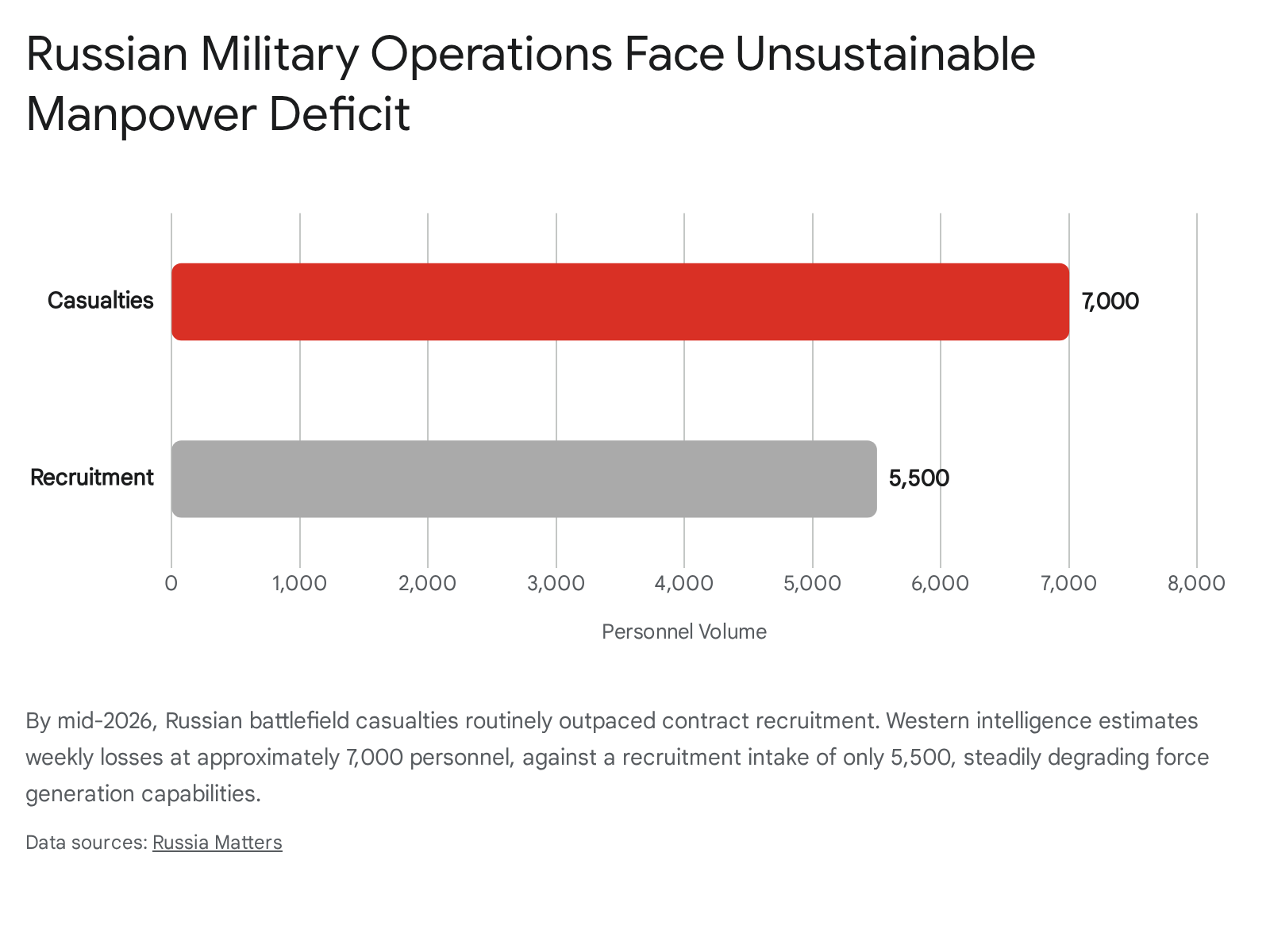
The introduction of Ukrainian AI-guided FPV drones has drastically reduced the survivability of Russian infantry; CIA assessments indicate Russian conscripts now survive an average of only 20 to 30 minutes after reaching the zero line30. To maintain offensive pressure without declaring politically toxic general mobilization, Moscow is increasingly reliant on marginalized populations, penal recruits, and foreign labor, resuming large-scale recruitment of North Koreans on student visas30.
Logistically, the relentless Ukrainian strikes on refining infrastructure have driven Russia’s domestic refining capacity to a 21-year low5. The systemic degradation of facilities like Gazprom’s Neftekhim Salavat and the Afipsky plant has forced the Russian government to implement emergency domestic fuel rationing and initiate fuel imports from India30.
Ukraine’s logistical hurdles center on persistent air defense missile shortages and the deeply unpopular realities of mass mobilization. Russia’s continued ability to penetrate Ukrainian airspace with ballistic missiles—such as the Iskander-M and S-400 systems used in the July 11 and July 17 barrages against Kyiv and Odesa—highlights critical gaps in the Patriot-supplied umbrella30. Manpower generation remains a sensitive domestic issue for Kyiv, marred by public frustration over heavy-handed “busification” recruitment tactics, which former Defense Minister Fedorov argued could be mitigated by replacing raw infantry mass with drone technology14. However, Ukraine’s industrial capacity to produce asymmetric strike weapons has exponentially increased, providing a vital counterbalance to conventional manpower shortages39.
Strategic Sustainability Projection
The conflict has evolved into a hyper-technological war of attrition where conventional industrial output is repeatedly neutralized by cheap, precision software-defined weaponry. The macroeconomic indicators suggest severe long-term strain on the Russian Federation. Russia’s projected GDP growth for 2025 has been revised down to 1.1%, with a budget deficit of 2.6% of GDP, driven entirely by the exorbitant costs of sustaining the military-industrial complex and compensating the families of casualties1. Consequently, Russian state-affiliated polling centers have recorded one of the sharpest drops in President Vladimir Putin’s approval ratings since the start of the war65.
Ukraine’s sustainability relies entirely on maintaining the operational tempo of its DIB and preserving Western financial lifelines. The success of the deep-strike campaign has proven to skeptical Western allies—reportedly altering the rhetoric of U.S. political figures including Donald Trump—that Kyiv possesses a viable, asymmetric pathway to systematically dismantle the Russian war machine without requiring a massive, conventional armored breakthrough65. As the 2026 winter approaches, the core strategic variable will be whether Prime Minister Koretskyi can shield Ukraine’s fragile energy grid from Russian ballistic counter-strikes while the USF continues to strangle Russian oil revenues.
| Macro-Strategic Indicators (Cumulative Estimates, July 2026) | Russia | Ukraine |
| Total Military Casualties (Killed/Wounded) | ~450,000+ (CSIS est. >1.4M total losses)67 | ~525,000 – 625,000 (CSIS / Western est.)1 |
| Confirmed Civilian Fatalities | 8,012 (RF Government)1 | ~16,000+ (U.N. Estimate)1 |
| Tanks and Armored Vehicles Lost | 14,1221 | 5,9631 |
| Displaced Citizens | ~1,000,000 Emigrated1 | 9,600,000 (Internal & External)1 |
5. Chronological Timeline of Key Events
- July 11, 2026:
- Russia launches a massive overnight barrage against Kyiv utilizing over 120 drones and 12 missiles, killing 6 civilians nationwide30.
- Ukrainian maritime drones strike four vessels in Taganrog Bay (Sea of Azov), prompting Russia to halt shipping through the Don-Azov Channel30.
- President Zelenskyy authorizes the creation of a specialized “long-range command” within the Armed Forces30.
- July 12, 2026:
- Russian forces execute glide bomb (KAB) strikes on a civilian bus stop in Sumy, killing 5 and wounding approximately 3030.
- A Russian Geran-2 (Shahed) drone violates Moldovan airspace, detonating near the village of Copanca46.
- Ukraine’s SBU attacks 14 Russian vessels (10 tankers, 4 ferries) in the Kerch area38.
- July 13, 2026:
- Ukrainian forces confirm the liberation of six settlements and 120 square kilometers in the Oleksandrivka direction following sustained counterattacks34.
- Ukrainian drones strike the Salavat Oil Refinery in Bashkortostan, damaging primary distillation units30.
- Prime Minister Yuliia Svyrydenko formally submits her resignation to the Verkhovna Rada11.
- July 14, 2026:
- The Verkhovna Rada officially accepts the resignation of the Svyrydenko cabinet21.
- Russian Foreign Minister Sergei Lavrov publicly denounces Ukraine’s “Operation MoLoChKa” maritime strikes as acts of “terrorism”3.
- OSINT data confirms Russian forces achieved a net gain of between 5 and 15 square miles over the preceding four weeks1.
- July 15, 2026:
- A Ukrainian drone strike kills Aleksandr Yakovlev, the chief engineer of the Russian-occupied Zaporizhzhia Nuclear Power Plant, prompting condemnation from the IAEA43.
- German Chancellor Friedrich Merz and Baltic leaders issue warnings regarding impending Russian kinetic sabotage operations against NATO infrastructure30.
- President Zelenskyy formally nominates Naftogaz CEO Serhii Koretskyi for the position of Prime Minister10.
- July 16, 2026:
- Serhii Koretskyi is overwhelmingly confirmed as Prime Minister by the Verkhovna Rada (289 votes in favor)10.
- Defense Minister Mykhailo Fedorov is dismissed. Widespread protests erupt in Kyiv and other major cities decrying the removal of the drone-innovation advocate14.
- Major General Yevhen Khmara is appointed acting Defense Minister by President Zelenskyy17.
- Russia and Ukraine exchange the bodies of fallen soldiers (501 returned to Ukraine, 31 to Russia)27.
- July 17, 2026:
- Russian ballistic missile strikes target Odesa, killing two civilians and severely damaging port infrastructure30.
- Ukraine executes deep strikes on the Yanos oil refinery in Yaroslavl30.
- Russian and Ukrainian officials confirm an exchange of 160 POWs mediated by the UAE26.
- July 18, 2026:
- Commander Robert “Madyar” Brovdi confirms that Ukraine’s Unmanned Systems Forces struck an additional 13 shadow fleet vessels overnight.
- Operation MoLoChKa’s 13-day tally reaches 172 Russian vessels paralyzed (118 in the Sea of Azov, 54 in the Black Sea)3.
Please share the link on Facebook, Forums, with colleagues, etc. Your support is much appreciated and if you have any feedback, please email us in**@*********ps.com. If you’d like to request a report or order a reprint, please click here for the corresponding page to open in new tab.
Sources Used
- The Russia-Ukraine War Report Card, July 15, 2026, https://www.russiamatters.org/news/russia-ukraine-war-report-card/russia-ukraine-war-report-card-july-15-2026
- Russian Blood and Treasure: The Ballooning Costs of Putin’s War – CSIS, https://www.csis.org/analysis/russian-blood-and-treasure-ballooning-costs-putins-war
- Ukraine’s Unmanned Systems Forces Strike 13 More Russian Shadow Fleet Vessels – Kyiv Post, https://www.kyivpost.com/post/80565
- Further 13 vessels of Russian Federation’s “shadow fleet” have been struck, – Madiar, https://censor.net/en/news/4014174/the-usf-has-struck-a-further-13-vessels-of-the-russian-federation-s-shadow-fleet
- Russia’s Shadow Fleet Takes 12 More Drone Hits, Totalling 159 as Ukraine Expands Black Sea Campaign – UNITED24 Media, https://united24media.com/war-in-ukraine/russias-shadow-fleet-takes-12-more-drone-hits-totalling-159-as-ukraine-expands-black-sea-campaign-20833
- Russia weakens drone operations on battlefield to protect shadow fleet, https://www.pravda.com.ua/eng/news/2026/07/18/8044682/
- Ukraine Hits 13 More Russian Shadow Fleet Vessels, Bringing Total to 172 in 13 Days, https://united24media.com/war-in-ukraine/ukraine-hits-13-more-russian-shadow-fleet-vessels-bringing-total-to-172-in-13-days-20870
- Ukraine hit 147 Russian shadow-fleet ships in 10 days. Now Moscow is pulling its best drone unit off the front to guard the tankers, partisans say – Euromaidan Press, https://euromaidanpress.com/2026/07/16/ukraine-hit-147-russian-shadow-fleet-ships-in-11-days-now-moscow-is-pulling-its-best-drone-unit-off-the-front-to-guard-the-tankers-partisans-say/
- Ukraine gets a new prime minister. Who is Serhii Koretskyi?, https://www.pravda.com.ua/eng/news/2026/07/16/8044351/
- Ukrainian parliament appoints Koretskyi as prime minister – The Kyiv Independent, https://kyivindependent.com/ukrainian-parliament-appoints-koretskyi-as-prime-minister/
- Zelenskyy Announces Sweeping Government Reshuffle as Ukrainian Prime Minister Yuliia Svyrydenko Resigns, https://www.commonspace.eu/news/zelenskyy-announces-sweeping-government-reshuffle-ukrainian-prime-minister-yuliia-svyrydenko
- Serhii Koretskyi: From energy executive to Ukraine’s new prime minister – Anadolu Ajansı, https://www.aa.com.tr/en/world/serhii-koretskyi-from-energy-executive-to-ukraine-s-new-prime-minister/4000576
- Ukraine’s new prime minister takes office with a hard winter looming and protests on the streets – KVUE, https://www.kvue.com/article/syndication/associatedpress/ukraines-new-prime-minister-takes-office-with-a-hard-winter-looming-and-protests-on-the-streets/616-5783613d-297f-4552-92be-aad446c08859
- Dismissal of Ukraine’s defence minister highlights wider issues for Zelenskyy – The Guardian, https://www.theguardian.com/world/2026/jul/17/dismissal-ukraine-defence-minister-mykhailo-fedorov-volodomyr-zelenskyy
- Zelensky ousts popular defense minister, an architect of Ukraine’s drone program, https://www.washingtonpost.com/world/2026/07/16/zelensky-ousts-popular-defense-minister-an-architect-ukraines-drone-program/
- Ukrainians protest Zelenskyy’s ouster of his popular defense minister, https://apnews.com/article/russia-ukraine-war-defense-minister-reshuffle-fedorov-88083e4381b1690f5048088d75954d3a
- Yevhenii Khmara – Wikipedia, https://en.wikipedia.org/wiki/Evhenii_Khmara_(general)
- Zelensky Names SBU’s Khmara Acting Defense Minister, Cites Strike Operations Experience – Kyiv Post, https://www.kyivpost.com/post/80435
- A ‘Gift’ to Moscow: Russian War Bloggers Cheer Dismissal of Ukraine’s Tech Chief – Kyiv Post, https://www.kyivpost.com/post/80443
- Ukraine’s Prime Minister Svyrydenko resigns | Ukrainska Pravda, https://www.pravda.com.ua/eng/news/2026/07/13/8043942/
- Ukrainian PM Svyrydenko’s Resignation Backed by 258 Votes in Parliament – Kyiv Post, https://www.kyivpost.com/post/80250
- Ukraine names energy chief Serhii Koretskyi PM for war’s hardest winter, https://www.indiatoday.in/world/story/ukraine-prime-minister-serhii-koretskyi-hardest-war-winter-ptag-2949570-2026-07-16
- Ukraine’s divisive reshuffle and defense shake-up: what we know – Arab News, https://www.arabnews.com/node/2651292/world
- ‘Syrskyy go away’: Hundreds protest in Kyiv as Zelenskyy ousts defence minister – Watch, https://timesofindia.indiatimes.com/world/europe/syrskyy-go-away-hundreds-protest-in-kyiv-as-zelenskyy-ousts-defence-minister-watch/articleshow/132436038.cms
- Ukraine fights under an interim defense chief after Zelenskyy’s contested government shake-up, https://apnews.com/article/russia-ukraine-war-fedorov-defense-minister-966aa6f66b81df96310531af1f11fba5
- Russia and Ukraine carried out prisoner exchange on principle of 160 for 160 – 1Lurer, https://www.1lurer.am/en/2026/06/26/Russia-and-Ukraine-carried-out-prisoner-exchange-on-principle-of-160-for-160/1536874
- Russia and Ukraine exchange bodies of fallen soldiers – Apa.az, https://en.apa.az/europe/russia-and-ukraine-exchange-bodies-of-fallen-soldiers-516463
- Ukraine Repatriates 501 Bodies Claimed to Be Fallen Soldiers – Kyiv Post, https://www.kyivpost.com/post/80440
- Cardinal Zuppi concludes Ukraine mission: ‘Every effort for peace will be made’, https://ugcc.ua/en/data/cardinal-zuppi-concludes-ukraine-mission-every-effort-for-peace-will-be-made-2368/
- Russia in Review, July 10–17, 2026, https://www.russiamatters.org/news/russia-review/russia-review-july-10-17-2026
- ISW Russian Offensive Campaign Assessment, July 11, 2026 – Kyiv Post, https://www.kyivpost.com/post/80089
- War update: 276 combat clashes on front line over past day, most in Pokrovsk and Huliaipole directions – Ukrinform, https://www.ukrinform.net/rubric-ato/4145497-war-update-276-combat-clashes-on-front-line-over-past-day-most-in-pokrovsk-and-huliaipole-directions.html
- War update: 100 combat clashes on front line since morning – Ukrinform, https://www.ukrinform.net/rubric-ato/4145410-war-update-100-combat-clashes-on-front-line-since-morning.html
- ISW Russian Offensive Campaign Assessment, July 13, 2026 – Kyiv Post, https://www.kyivpost.com/post/80205
- Active Conflicts & News Megathread June 15, 2026 : r/CredibleDefense – Reddit, https://www.reddit.com/r/CredibleDefense/comments/1u6c7u2/active_conflicts_news_megathread_june_15_2026/
- Ukrainian attacks on the Russian shadow fleet – Wikipedia, https://en.wikipedia.org/wiki/Ukrainian_attacks_on_the_Russian_shadow_fleet
- Ukraine Conflict Monitor: Russia-Ukraine war map | ACLED, https://acleddata.com/monitor/ukraine-conflict-monitor
- Madyar posted a video of yet another nighttime hunt for tankers – UA.NEWS, https://ua.news/en/war-vs-rf/madiar-pokazav-video-chergovogo-nichnogo-poliuvannia-na-tankeri
- Fire Point FP-1 – Wikipedia, https://en.wikipedia.org/wiki/Fire_Point_FP-1
- Ukraine conducts record drone strike of 2,500km after 12-hour flight — $55,000 unit made of plywood halts operations at Russia’s largest gasoline producer | Tom’s Hardware, https://www.tomshardware.com/tech-industry/drones/ukraines-55000-plywood-drone-flew-2500-km-and-shut-down-russias-largest-oil-refinery
- How to Pile the Pain on Putin, https://cepa.org/article/how-to-pile-the-pain-on-putin/
- ISW Russian Offensive Campaign Assessment, July 16, 2026 – Kyiv Post, https://www.kyivpost.com/post/80449
- Ukrainian Drone Attack Killed Chief Engineer at Zaporizhzhia Nuclear Plant, Russia Says, https://www.themoscowtimes.com/2026/07/16/ukrainian-drone-attack-killed-chief-engineer-at-zaporizhzhia-nuclear-plant-russia-says-a93261
- Rosatom says Zaporizhzhia nuclear plant chief engineer, driver killed in Ukrainian drone attack, https://www.aa.com.tr/en/eurasia/rosatom-says-zaporizhzhia-nuclear-plant-chief-engineer-driver-killed-in-ukrainian-drone-attack/3999600
- IAEA condemns reported killing of chief engineer at Zaporizhzhia NPP, https://www.world-nuclear-news.org/articles/iaea-condemns-reported-killing-of-zaporizhzhias-chief-engineer
- Russian drone crashes and explodes in Moldovan village – RBC-Ukraine, https://newsukraine.rbc.ua/news/russian-drone-crashes-and-explodes-in-moldovan-1783932773.html
- Russian Shahed crashes in Moldova after Russian strikes on Odesa region | Ukraine Top News – Головне в Україні, https://glavnoe.in.ua/en/news-en/russian-shahed-crashes-in-moldova-after-russian-strikes-on-odesa-region
- Polish Jets Intercept Russian Spy Plane Over Baltic Sea – Kyiv Post, https://www.kyivpost.com/post/80270
- ISW Russian Offensive Campaign Assessment, July 14, 2026 – Kyiv Post, https://www.kyivpost.com/post/80279
- German UAV firm Helsing picks West Virginia for first US manufacturing – Breaking Defense, https://breakingdefense.com/2026/07/german-uav-firm-helsing-picks-west-virginia-for-first-us-manufacturing/
- Helsing to produce 6000 additional strike drones for Ukraine, https://helsing.ai/newsroom/helsing-to-produce-6000-additional-strike-drones-for-ukraine
- Ukrainian drones strike 12 Russian ‘shadow fleet’ vessels in Black Sea as Crimea comes under large-scale attack – The Kyiv Independent, https://kyivindependent.com/fires-drone-strikes-reported-overnight-across-occupied-crimea-as-shadow-fleet-vessels-allegedly-struck-in-black-sea/
- Ukraine’s Sea Baby Maritime Drone (USV) | Covert Shores, https://www.hisutton.com/Ukraine-Sea-Baby-USV.html
- Overview Of Ukrainian Maritime Drones (USVs) Of The Russo-Ukrainian War | Covert Shores, https://www.hisutton.com/Ukrainian-USVs-Russo-Ukraine-War.html
- Magura V5 naval drones to get anti-air and dive capabilities – Euromaidan Press, https://euromaidanpress.com/2024/03/14/magura-v5-naval-drones-to-get-anti-air-and-dive-capabilities/
- Fire Point (Ukrainian firm) – Wikipedia, https://en.wikipedia.org/wiki/Fire_Point_(Ukrainian_firm)
- How U.S. Military Was Impressed by the HX-2 Drones, Those Successfully Are Hitting russians in Ukraine, Showed 88% Effective Hits During Exercises in Lithuania | Defense Express, https://en.defence-ua.com/weapon_and_tech/how_us_military_was_impressed_by_the_hx_2_drones_those_successfully_are_hitting_russians_in_ukraine_showed_88_effective_hits_during_exercises_in_lithuania-18802.html
- Russia Complains German AI-Powered HX-2 Drones Are Now Hunting Targets Deep Behind the Frontline – UNITED24 Media, https://united24media.com/latest-news/russia-complains-german-ai-powered-hx-2-drones-are-now-hunting-targets-deep-behind-the-frontline-16406
- Magura vs. Sea Baby: Closer look at Ukrainian drone warfare against Russian ships, https://newsukraine.rbc.ua/news/magura-vs-sea-baby-closer-look-at-ukrainian-1709831518.html
- Ukrainian Intel Warns of Russian Campaign to Target Frontline Civilian Logistics – Kyiv Post, https://www.kyivpost.com/post/80478
- Russia Is Unable to Replace Its Frontline Casualties Due to a Slowdown in the Recruitment of Contract Soldiers — ISW – UA.NEWS, https://ua.news/en/war-vs-rf/rosiia-ne-vstigaie-popovniuvati-vtrati-na-fronti-cherez-upovilnennia-naboru-kontraktnikiv-isw
- Russian attacks kill 6 and wound 29 as Ukrainian forces target oil tankers, https://apnews.com/article/russia-ukraine-war-missiles-drones-kyiv-578044d589f94cc985b699ffcf301297
- Busification: Is the Ukraine Army Crisis Real? | Eastern Express – Kyiv Post, https://www.kyivpost.com/videos/80457
- The Russia-Ukraine War Report Card, July 1, 2026, https://www.russiamatters.org/news/russia-ukraine-war-report-card/russia-ukraine-war-report-card-july-1-2026
- ISW Russian Offensive Campaign Assessment, July 17, 2026 – Kyiv Post, https://www.kyivpost.com/post/80551
- ISW Russian Offensive Campaign Assessment, July 15, 2026 – Kyiv Post, https://www.kyivpost.com/post/80354
- How Russia turned to saints in its push for ‘traditional values’ — and more babies, https://www.ncronline.org/news/how-russia-turned-saints-its-push-traditional-values-and-more-babies
- Total russian combat losses in Ukraine as of July 17, 2026, https://mod.gov.ua/en/news/total-russian-combat-losses-in-ukraine-as-of-july-17-2026
- The Russia-Ukraine War Report Card, July 8, 2026, https://www.russiamatters.org/news/russia-ukraine-war-report-card/russia-ukraine-war-report-card-july-8-2026
- ‘Crimean Switch Off’ — Ukrainian Drones Hit 13 More Russian Vessels, 5 Substations, Madyar Says – Ground News, https://ground.news/article/13-tank-vessels-were-attacked-in-azoviko-mori-by-ross-madyar
- Ukrainian PM Svyrydenko refused to become ambassador to US – sources, https://www.pravda.com.ua/eng/news/2026/07/14/8044027/
- Video: Madyar Shows Strikes Against Ships of Russia’s Shadow Fleet in the Black Sea, https://ua.news/en/war-vs-rf/video-madiar-pokazav-udari-po-sudnakh-tinovogo-flotu-rosiyi-v-chornomu-mori
- Zelenskyy submits Serhii Koretskyi’s nomination for prime minister to parliament, https://www.pravda.com.ua/eng/news/2026/07/15/8044295/
- Parliament appoints Serhii Koretskyi as Ukraine’s new prime minister amid protests over defense minister dismissal, https://gwaramedia.com/en/parliament-appoints-serhii-koretskyi-as-ukraines-new-prime-minister-amid-protests-over-defense-minister-dismissal/
- Zelenskyy instructs Khmara to act as defense minister – Interfax-Ukraine, https://en.interfax.com.ua/news/general/1185660.html
- Ukraine war briefing: Kyiv ‘will win this war’, Keir Starmer tells Zelenskyy on final trip as PM, https://www.theguardian.com/world/2026/jul/17/ukraine-war-briefing-outgoing-british-pm-starmer-tells-zelenskyy-that-kyiv-will-win-this-war
- Russia and Ukraine Exchange 370 POWs – The Moscow Times, https://www.themoscowtimes.com/2026/06/05/russia-and-ukraine-exchange-370-pows-a92941
- Unmanned Systems Forces hit 13 more vessels of Russia’s shadow fleet – Ukrinform, https://www.ukrinform.net/rubric-ato/4145514-unmanned-systems-forces-hit-13-more-vessels-of-russias-shadow-fleet.html