Tag Archives: Ukraine

The Calculus of Attrition: An Assessment of Russian Capital, Equipment, and Personnel Burn Rates in 2026

1.0 Executive Summary

As the Russo-Ukrainian War enters its fifth year in 2026, the conflict has crystallized into an industrialized war of attrition that is systematically eroding the foundational pillars of the Russian state. The Russian Federation continues to pursue its strategic objectives through a highly resource-intensive operational design, systematically exchanging vast quantities of human capital, legacy Soviet equipment, and macroeconomic stability for incremental territorial gains. This report provides an exhaustive, updated analysis of the Russian “burn rate”—the pace at which Moscow is consuming its military and economic reserves—and assesses the long-term sustainability of this posture through the 2026–2027 strategic horizon.

Current open-source intelligence and authoritative geopolitical and economic data indicate that the Russian defense apparatus and its broader economy are operating under severe, compounding structural strains. While the Russian Defense Industrial Base (DIB) has successfully surged the production of select munitions—most notably unguided artillery shells and tactical ballistic missiles—it is fundamentally failing to replace heavy armored vehicles and complex air defense systems at the rate they are being destroyed on the battlefield. Concurrently, human capital is being exhausted at an unprecedented rate, with first-quarter 2026 personnel losses vastly outpacing the state’s voluntary recruitment mechanisms, forcing regional governments into coercive mobilization practices.

Economically, the Russian state is navigating a precarious fiscal cliff. The National Wealth Fund (NWF) has been critically depleted, forcing the central bank and the Ministry of Finance into inflationary domestic borrowing schemes that mimic fiat currency emission. Although a recent surge in global oil prices—precipitated by regional conflict in the Middle East—has provided a temporary mathematical windfall for the federal budget, Ukraine’s targeted asymmetric strike campaign against Russian energy export infrastructure in the Baltic Sea has physically bottlenecked Moscow’s ability to capitalize on these elevated prices. Furthermore, the transition to extreme military Keynesianism has generated acute labor shortages, suffocated the civilian economy, and driven inflation to highly destabilizing levels.

Ultimately, current projections indicate that Russia’s capacity to sustain high-intensity, mechanized offensive operations will encounter a critical inflection point between late 2026 and mid-2027. At current attrition rates, the readily refurbishable stockpiles of Soviet-era armored vehicles will be functionally exhausted. As conventional capabilities rapidly erode, analysis suggests an inevitable strategic pivot toward asymmetric, hybrid escalation aimed at Western allies, designed to mask the decay of conventional power projection capabilities and force a political settlement before the physical collapse of the Russian military machine.

2.0 Macroeconomic Framework: The Erosion of Fiscal Stability

The foundation of Russia’s ability to sustain high-intensity combat operations in Ukraine is its macroeconomic resilience. However, the comprehensive transition to a wartime economy has introduced systemic distortions that severely threaten long-term state stability. The state is simultaneously battling severe revenue volatility, extreme demographic labor shortages, and runaway inflation, all while attempting to finance record-breaking military budgets that consume an increasingly disproportionate share of the national output.

2.1 Fiscal Exhaustion and the Draining of the National Wealth Fund

The Russian Federation has officially entered what economists classify as a full-blown budget crisis, marked by seven consecutive years of high federal budget deficits—a prolonged macroeconomic vulnerability unseen since the financial instability of 1999.1 For the 2026 fiscal year, the official projected budget deficit stands at 1.6% of Gross Domestic Product (GDP), up from a previously targeted austerity benchmark of 1%.1 For the 2027–2028 planning horizon, projections hover between 1.2% and 1.3%, acknowledging that elevated deficits are now a structural reality.1 The 2025 federal budget underwent drastic mid-year revisions, escalating the projected deficit from an initial, highly optimistic 0.5% to as high as 3.2% (approximately 6.9 trillion rubles, nearly double the previous year’s shortfall).1 In January 2026 alone, the federal budget recorded a deficit of 1.7 trillion rubles, the largest January shortfall on record, driven by plunging energy revenues.3

To finance the war effort, which accounts for an earmarked 12.9 trillion rubles ($157.4 billion) in 2026 (approximately 5.5% of GDP) following an expenditure of 13.5 trillion rubles in 2025, the state has relied heavily on the National Wealth Fund (NWF).1 Historically serving as the Kremlin’s sovereign wealth cushion built on years of hydrocarbon exports, the liquid assets of the NWF have been drawn down precipitously. By October 2025 and moving into early 2026, the liquidity portion of the NWF held a mere 4.2 trillion rubles (approximately $50 billion).1 This remaining liquidity is insufficient to cover even the conservative estimates of the 2025 budget deficit, let alone provide a stabilization buffer for 2026 and beyond.1

Since the pre-war peak of $113.5 billion in early 2022, the fund has shrunk by more than half in ruble terms and by two-thirds when measured in dollars.7 Economists from the Russian Presidential Academy of National Economy and Public Administration (RANEPA) and the Gaidar Institute have explicitly warned that the NWF could be entirely exhausted in 2026 if current public spending and bailouts persist.7 Recent massive withdrawals have included 35.9 billion rubles to cover the federal deficit, 300 billion rubles to state banks for a Moscow-St. Petersburg high-speed rail line, and an additional 50 billion rubles allocated to undisclosed, classified state projects.7

2.2 The Collapse of Conventional Borrowing and the “Repo to OFZ” Scheme

Cut off from Western international financial markets by severe, multi-tiered sanctions, and facing a Chinese government that has provided zero direct loans to the Russian budget while simultaneously blocking the issuance of yuan-denominated bonds, Moscow has been forced to rely exclusively on domestic borrowing to fund its structural deficits.1 By early 2026, total domestic debt had nearly doubled since the onset of the full-scale invasion, approaching a historic high of 30 trillion rubles.3

However, the conventional mechanism for domestic borrowing is collapsing under the weight of the central bank’s own monetary policy. To combat overheating demand and inflation, the Central Bank of Russia (CBR) maintained interest rates at a punishing 21% through the first half of 2025, only marginally stepping them down to 16.5% by the end of the year.5 Consequently, yields on 10-year state OFZ (federal loan) bonds currently exceed 15%.1 At these exorbitant rates, the cost of servicing the debt essentially negates the net capital raised. In a recent fiscal assessment, the net debt raised barely exceeded $4 billion (0.16% of GDP), rendering conventional domestic borrowing highly ineffective and mathematically perilous over the long term.1 While overall federal debt remains relatively low compared to Western peers, the servicing costs have ballooned from 0.9% of GDP in 2021 to critical levels today.1

To circumvent this borrowing paralysis, the Ministry of Finance and the CBR have engineered a thinly veiled money-printing mechanism known as the “repo to OFZ” scheme. Under this opaque arrangement, state-backed banks purchase variable-coupon OFZ bonds from the government and immediately use them as collateral to borrow an equivalent amount of liquid capital back from the Central Bank via weekly repurchase (repo) auctions.1 Outstanding volumes in these repo operations have consistently exceeded 5 trillion rubles.9 This de facto monetary emission operates similarly to the hyper-inflationary credit mechanisms seen in Russia in the 1990s.8 This policy has caused the M2 money supply to skyrocket, doubling from 62 trillion rubles in December 2021 to over 120 trillion rubles by late 2025, heavily skewing the national debt portfolio toward variable-rate securities held by domestic banks.1

2.3 Tax Hikes and the Stifling of the Civilian Economy

Recognizing the limits of both the NWF and the repo scheme, the Russian government is increasingly extracting capital directly from the civilian sector and local governments. Budgetary failures are cascading to the regional level; consolidated regional budgets collapsed at the end of 2025, recording a deficit of roughly 1.5 trillion rubles, accompanied by a sharp rise in regional debt to almost 3.5 trillion rubles.3 This indicates that the central government is pushing the financial burden of the war down to local authorities, starving regional development.3

Furthermore, the state has fundamentally shifted its revenue reliance. The Russian budget now depends much more on domestic tax revenue (over 75%) rather than traditional oil and gas exports (less than 25%).1 The preliminary budget framework for 2026–2028 implements a severe tightening of the fiscal stance.2 Following an increase in the corporate profit tax in 2025, regular citizens face a substantial hike in the value-added tax (VAT) effective at the start of 2026, alongside increased utility rates.2 Total federal non-oil tax revenue collection has already increased by 2.4% of GDP (from 10.3% in 2022 to 12.7% in 2024), reflecting outright tax hikes and aggressive “tax collection administration”.8 These extraction policies are actively depressing domestic economic activity, shrinking the future tax base, and leading to widespread economic stagnation.

3.0 Global Energy Dynamics and Asymmetric Infrastructure Warfare

A highly critical variable in assessing the Russian fiscal burn rate in 2026 is the volatile state of the global energy market, juxtaposed against Ukraine’s evolving strategy to physically deny Russia access to that market. The interplay between global geopolitics and localized asymmetric warfare is generating extreme cross-pressures on the Russian treasury.

3.1 The Middle East Oil Shock Windfall

In early 2026, the Russian budget was slated for austere measures, including a planned 10% cut to “non-sensitive” civil spending, driven by a 45% year-over-year drop in oil and gas revenues in the first quarter.4 These revenues had fallen to 1.44 trillion rubles due to deep discounts on Russian crude, weak export prices, and a strong ruble.10

However, the rapid escalation of the Middle Eastern conflict—specifically the war between Israel, the United States, and Iran—triggered a profound global oil shock. The near-closure of the Strait of Hormuz caused Urals crude, which had been trading near $40 per barrel under tighter US sanctions, to rebound sharply to averages of $75–$80 per barrel.4 Consequently, Russian oil export revenues surged by 120% from late February, hitting $2.48 billion in a single week in late March 2026—the highest level since April 2022.4

Macroeconomic analysts, including those at Freedom Finance Global, project that if these prices hold, Moscow could secure a windfall of 3 to 4 trillion rubles ($36.6–$48.8 billion).4 This unexpected injection of capital mathematically narrows the budget deficit to 1% of GDP, allowing the government to cancel planned austerity measures and channel the windfall directly into the 12.9 trillion ruble defense budget.4 Officials have consequently avoided downgrading the 2026 economic growth forecast, maintaining it at a sluggish 1.3% instead of lowering it to 0.7%.4

3.2 Physical Denial: Ukrainian Strikes on Baltic Infrastructure

Despite the mathematical windfall generated by global market panic, physical realities severely constrain Russia’s ability to monetize it. Recognizing the critical vulnerability of Russian energy exports, Ukraine executed a systematic, mid-range strike campaign against Russian Baltic Sea port and oil infrastructure throughout March 2026.12

This asymmetric campaign has targeted several major facilities, including the Kinef oil refinery in Kirishi, the Novatek Ust-Luga facility, the Transneft oil terminal at the port of Primorsk, and a Purga-class patrol icebreaker at the Vyborg Shipyard.12 On March 31, 2026, the Ust-Luga port sustained severe damage, with a 50,000-ton oil tank catching fire following coordinated drone strikes.12

These strikes created a massive physical bottleneck, neutralizing the high price of crude by preventing its delivery. In the final week of March 2026, the number of tankers loading crude oil at the Primorsk and Ust-Luga ports plummeted from 18 to just six.12 This reduction in volume equated to a staggering loss of 1.75 million barrels a day, costing the Russian state more than $1 billion in income in a single week.12 Insurers estimate that Ukrainian strikes have cumulatively cost the Russian oil sector over $13 billion over the past year.4 Consequently, the fiscal utility of high global oil prices is being directly and physically neutralized by the degradation of export infrastructure, ensuring that the Russian state cannot fully escape its fiscal tightening.

4.0 Industrial Policy and the Limits of Military Keynesianism

The interplay between extreme military spending and the broader economy has created a paradigm of “military Keynesianism.” While this has artificially inflated top-line GDP figures, generating a narrative of resilience, it is hollow growth. Total defense and security spending commands nearly 8% of GDP, effectively shifting massive amounts of capital into non-productive sectors—munitions and vehicles that are rapidly destroyed on the battlefield—while starving the civilian economy of investment.6

4.1 Demographic Drain and Acute Labor Shortages

The most critical bottleneck in the Russian wartime economy is not financial capital, but human capital. The military pulls hundreds of thousands of prime-age males from the workforce, both directly through recruitment and mobilization, and indirectly through catastrophic battlefield casualties. Simultaneously, the DIB is cannibalizing the remaining civilian labor pool through hyper-competitive, state-subsidized wages.13

Consequently, unemployment has fallen to a historic, unhealthy low of just 3%, with up to 60% of Russian companies reporting severe staff shortages.13 This stands in sharp contrast to functional wartime economies (such as the US in 1940, which entered a war footing with an unemployment rate of 14.6%, providing a massive reserve labor pool).13 The Russian labor market has zero remaining elasticity. Civilian enterprises cannot meet aggregate demand, and the economy’s underlying productive weakness—especially its severe import dependency in non-energy sectors—remains unresolved despite years of import-substitution mandates.14

4.2 Inflationary Spirals and the Social Elevator

The supply-demand mismatch created by the labor shortage, aggressively fueled by the central bank’s “repo to OFZ” money printing, has pushed inflation to highly destabilizing levels. Monthly inflation surged to 1.6% in January 2026—a rate more than three times the 2025 monthly average.3 The Central Bank’s 21% interest rate proved insufficient to cool the economy because state-subsidized military industries are immune to borrowing costs, leaving the civilian sector to bear the brunt of the contraction.5

Sociologically, military Keynesianism has acted as a distorted “social elevator” for peripheral Russia. It has partially rebalanced wide disparities in wealth by granting substantial financial and symbolic advantages to impoverished regions through military sign-on bonuses, high salaries, and death payouts.15 However, this wealth transfer comes at the cost of the absolute depletion of public resources, persistent inflation that eats away at real incomes, and the total neglect of civilian sectors.15 The IMF recently cut its growth forecast for Russia to just 0.6%, with confidential central bank reports warning of 1990s-style inflation.9 Overall, the Russian economy is showing clear signs of entering a period of stagflation—low growth coupled with high inflation—which severely constrains long-term stability.1

5.0 Human Capital and the Calculus of Personnel Attrition

The most visible and strategically devastating indicator of the Russian burn rate is the consumption of personnel. The conflict in Ukraine has devolved into a highly attritional, industrialized struggle where terrain is contested meters at a time. The Russian operational design relies fundamentally on mass—specifically, the continuous generation and deployment of infantry to overwhelm defensive positions and identify Ukrainian firing points.

5.1 Staggering Casualty Rates and Fatality Estimates

By early 2026, the human cost of the invasion reached staggering, historically unprecedented proportions. Assessing casualties is inherently imprecise, but consensus among highly informed Western intelligence agencies and authoritative defense think tanks, such as the Center for Strategic and International Studies (CSIS), places total Russian casualties (killed and wounded) between 1.0 million and 1.4 million personnel.20 Of these, an estimated 275,000 to 430,000 are fatalities.20

Independent demographic tracking by Mediazona and the BBC Russian Service successfully verified over 206,200 specific names of the dead by late March 2026.23 This verification process was significantly bolstered by a massive data dump from the Russian Civil Registry (ZAGS) obtained via an illicit background check service known as “Manticore,” which provided thousands of previously hidden death certificates.23 These figures indicate that Russia has suffered more battlefield casualties than any major power in any war since World War II.17

The daily burn rate of personnel has actively accelerated throughout 2026. During the initial phases of the Russian Spring-Summer 2026 offensive, which targeted Ukraine’s heavily fortified “Fortress Belt,” the Russian military command deployed tens of thousands of servicemembers in highly attritional, infantry-led assaults.25 Between March 17 and March 20, 2026, Russian forces suffered an average of 1,520 casualties per day, resulting in over 6,090 killed and wounded in a mere four-day span.25 By the final weeks of March, daily losses peaked as high as 1,710 personnel.26 Total losses for the first quarter of 2026 alone are estimated at 89,000 personnel.27

Casualty Estimation SourceDate of EstimateTotal Casualties (Killed + Wounded)Estimated Fatalities
CSIS / Futures LabJan-Dec 2025/2026~1,200,000275,000 – 325,000
Western Intelligence (Bloomberg)Feb 20261,200,000N/A
The EconomistFeb 20261,100,000 – 1,400,000230,000 – 430,000
Mediazona & BBC (Verified Names)March 2026N/A> 206,200
Estonian Foreign IntelligenceFeb 20261,000,000N/A

5.2 Tactical Doctrine: The Dismounted Infantry Strategy

These unsustainable losses are the direct result of deliberate tactical choices mandated by the realities of the modern battlefield. Due to severe shortages of adequately protected armored vehicles and the total saturation of the battlefield by Ukrainian first-person view (FPV) drones, vehicle movement within 15 kilometers of the front line has become nearly impossible and highly lethal.17

Ukrainian forces have imposed significant costs through a defense-in-depth strategy, utilizing trenches, dragon’s teeth anti-tank obstacles, extensive minefields, and relentless drone surveillance.17 Russian commanders have adapted by utilizing dismounted infantry—often organized into small, poorly trained squads—to conduct what is essentially “reconnaissance by drawing fire.” These infantry groups are ordered to advance toward Ukrainian lines to identify firing positions, which are subsequently mapped and targeted by Russian higher headquarters with artillery and glide bombs.17 While Ukrainian forces also employ small-unit tactics, they prioritize mobility and precision, whereas Russian forces deploy these groups in a fragmented, highly attritional manner that trades extreme personnel losses for marginal tactical advances averaging between 15 and 70 meters per day.17

5.3 Recruitment Deficits and Covert Mobilization Strategies

The central strategic problem for the Russian Ministry of Defense in 2026 is that the personnel attrition rate has decisively eclipsed the voluntary recruitment rate. To sustain its operational tempo, Moscow established a recruitment target of 409,000 troops for 2026 (approximately 34,000 per month).27 However, in the first quarter of 2026, Russian intelligence indicated that the state only managed to recruit approximately 80,000 personnel—achieving just 22% of the annual target and falling vastly short of the 89,000 casualties suffered in that same period.27 This marks the fourth consecutive month where the net manpower balance—the “arrivals-to-departures” ratio—has remained firmly negative.27

To compensate, the Russian government relies heavily on inflated financial incentives, setting records for loan deferrals to attract volunteers from economically depressed areas where military contracts are viewed as a vital financial lifeline.23 The military is also increasingly recruiting foreigners from beyond its borders, including citizens from Kazakhstan and proxy-controlled regions like Abkhazia and South Ossetia.23 Furthermore, there is a growing domestic resistance to service, evidenced by a 180% increase in young Russians applying for alternative civil service since the start of the full-scale invasion, reaching a 14-year high of 3,212 applicants by the end of 2025 despite systematic obstruction by military recruitment offices.30

When financial levers lose efficacy and voluntary recruitment fails, the state pivots to forced covert mobilization. Fearing the severe domestic political backlash of a general mobilization, the Kremlin has decentralized the political risk to regional authorities and private corporations. A prominent example of this strategy occurred on March 20, 2026, when Ryazan Oblast Governor Pavel Malkov signed a decree requiring medium and large businesses to fulfill specific recruitment quotas.12 Businesses employing between 150 and 500 people are legally obligated to select two to five employees to sign combat contracts with the Ministry of Defense.12 This strategy effectively drafts the workforce directly from the civilian economy, further exacerbating the macroeconomic labor shortage and highlighting the desperation of the Russian force generation apparatus.

5.4 Socio-Economic Impact of Asymmetric Regional Losses

The human toll of the war is not distributed evenly across the Russian Federation. The recruitment strategy heavily targets impoverished, peripheral republics, fundamentally altering their demographic profiles and generating severe long-term socio-economic consequences. Mediazona’s demographic mapping reveals that deaths have been recorded in at least 26,600 towns and villages across Russia (roughly 17% of all settlements).23 Crucially, two-thirds of all military fatalities stem from small towns, settlements, and rural villages, while massive metropolitan areas like Moscow and St. Petersburg remain largely insulated from the bloodshed.23

Impoverished republics exhibit staggering per capita death rates. For instance, the Republic of Tyva has suffered 476 deaths per 100,000 residents, Buryatia 400 deaths per 100,000, the Zabaikalsky Krai 362 deaths per 100,000, and the Altai Republic 316 deaths per 100,000.23 In micro-settlements, the impact is devastating; the village of Nerchinsky Zavod (Zabaikalsky Krai) has lost 31 men out of a total population of 2,300.23 The villages of Chikoy and Komsomolskoye (Buryatia) have both lost approximately 2% of their total populations.23 Casualties have reached the furthest extremities of the Federation, from Syndassko in the Arctic North to Kurush in Dagestan, and from Baltiysk in Kaliningrad to Uelen on the Bering Strait.23 This targeted demographic drain permanently removes prime working-age males from regional economies, ensuring that the socio-economic devastation in these republics will persist for generations.

6.0 Territorial Shifts and Tactical Realities

Despite the massive expenditure of blood and treasure, the translation of this attrition into strategic territorial gains remains minimal. As of March 31, 2026, Russian forces control approximately 45,796 square miles of Ukrainian territory, equating to roughly 20% of the country (an area roughly the size of the US state of Pennsylvania).20 This figure includes the Crimean Peninsula and parts of the Donbas seized prior to the full-scale invasion in 2022.20 Since February 24, 2022, Russia has gained 29,171 square miles (13% of Ukraine).20

However, the current pace of advance is glacially slow. From April 2025 to March 2026, Russia captured a total of just 1,927 square miles—averaging a mere 160 square miles per month, representing less than 0.8% of Ukraine’s total territory.20 In the highly contested month of March 2026, despite launching a major spring offensive, the territorial exchanges were negligible. During the week of March 24–31, 2026, Russian forces gained 17 square miles, advancing near 14 settlements and occupying Svyato-Pokrovske and Vasyukivka.20 Yet, for the broader four-week period of March 3–31, 2026, Russia actually saw a net loss of 12 square miles (an area equivalent to half of Manhattan Island) due to systematic Ukrainian counterattacks.20

On April 1, 2026, the Russian Defense Ministry declared that its forces had “completed the liberation” of the Luhansk oblast, seizing the final 0.2% previously held by Ukraine.20 Conversely, Ukrainian forces continue to hold approximately 19.5% of the Donetsk oblast and uniquely maintain a 4-square-mile foothold within the Russian regions of Kursk and Belgorod.20 The data conclusively demonstrates that Russian tactical operations simply do not lend themselves to achieving operationally significant breakthroughs, resulting in a creeping, deadlocked frontline.12

7.0 Heavy Armor and Mechanized Platform Depletion

While personnel can theoretically be sourced through coercive economics and covert mobilization, the replacement of heavy mechanized equipment represents a hard physical limit on Russia’s ability to wage conventional war. The Russian Defense Industrial Base (DIB) is severely constrained by specialized labor shortages, Western sanctions on precision machinery, and an over-reliance on finite legacy Soviet stockpiles.

7.1 The Exhaustion of Soviet-Era Armored Reserves

Russian military doctrine historically relied on overwhelming armored mass to achieve battlefield dominance. However, open-source intelligence and comprehensive satellite imagery analysis by independent researchers reveal a catastrophic depletion of Russia’s strategic reserves. As of early 2026, documented sources confirm that Russia has lost 24,383 units of equipment, including 13,978 tanks and armored fighting vehicles, 361 aircraft, and 29 naval vessels.20

To replace these profound losses, Russia has systematically cannibalized its deep storage bases. Analysis indicates that Russia has pulled 4,799 of its 7,342 pre-war stockpiled tanks from storage, leaving just 19% of its functional pre-war reserve.32 The remaining 19% largely consists of highly obsolete or severely degraded hulls that require total rebuilding rather than standard refurbishment.

The composition of the refurbished fleets underscores a rapid regression in technological capability. The bulk of the reactivated tanks are legacy models: 1,409 T-80B/BV variants, 1,251 T-72B models, and 1,048 highly obsolete T-62s.32 Furthermore, 582 early-model T-72 Ural/A variants and 176 archaic T-54/55 tanks have been returned to service.32 Conversely, the reserves of modern tanks are entirely exhausted. All 112 pre-war T-90s held in reserve have been deployed, and 111 of 193 T-80U/UDs have been utilized.32

A parallel crisis exists within the infantry fighting vehicle (IFV) and artillery fleets. Out of 7,121 pre-war BMP-1/2/3 vehicles in storage, 4,999 (70%) have been refurbished and sent to the front, leaving only 16% of viable stock remaining.32 Artillery depots have seen a 61% reduction in total inventory, with only 39% of the pre-war 23,602 units remaining.32 Furthermore, the DIB has been forced to cannibalize its remaining 611 T-64 tanks exclusively for spare parts, indicating a collapse in the supply chain for foundational mechanical components.33

Vehicle ClassificationPre-War Storage QuantityRemoved / RefurbishedRemaining Functional PercentagePrimary Models Deployed
Main Battle Tanks7,3424,799~19%T-80B/BV, T-72B, T-62
Infantry Fighting Vehicles7,1214,999~16%BMP-1, BMP-2
Towed & Self-Propelled Artillery23,60214,486~39%Various legacy Soviet models

7.2 Tank Production Bottlenecks and CNC Dependency

Recognizing the impending exhaustion of legacy reserves, the Russian defense industry, spearheaded by its primary tank manufacturer Uralvagonzavod (UVZ), has initiated long-term plans to scale up new production to recreate pre-war tank reserves. Leaked internal documents from UVZ outline aspirational targets to increase T-90 production by 80% by 2028 and launch a new variant, the T-90M2 (Project 188MS, also known as Ryvok-1).33 The manufacturer aims to modernize more than 2,000 T-90M, T-90M2, and T-72B3M tanks between 2026 and 2036.33

However, the gap between strategic intent and industrial reality is vast. In 2026, UVZ expects to produce a mere 10 units of the new T-90M2.33 Total production across the T-90M line is currently estimated at an average of 13 to 15 tanks per month, peaking under ideal conditions at 60 to 70 tanks per year.33 This output is grossly insufficient to offset a burn rate where hundreds of armored vehicles are lost in a single offensive operation.

The primary bottleneck constraining UVZ, Plant No. 9, and other manufacturers is a critical lack of high-precision Computer Numerical Control (CNC) machine tools.33 Russia lacks the domestic capability to produce modern CNC machinery, leaving it entirely reliant on imported technology. Currently, UVZ is producing tank engines utilizing European-manufactured CNC machines acquired through complex sanctions evasion schemes, while Plant No. 9 has expanded artillery barrel production using European and Taiwanese machinery.33 To meet 2028 goals, UVZ was forced to launch emergency training programs for CNC operators in March 2025 to mitigate severe specialized labor shortages.33

8.0 The Air Defense Attrition Crisis

The technological degradation of the Russian military extends far beyond heavy armor to its highly vaunted air defense network. Throughout early 2026, Ukrainian forces executed a systematic, targeted attrition campaign against Russian radar and surface-to-air missile (SAM) architecture, exploiting the gaps created to facilitate deeper precision strikes into occupied territories.

In a concentrated two-week period between March 1 and March 15, 2026, the Defence Forces of Ukraine, utilizing Unmanned Systems Forces and advanced strike capabilities, disabled or destroyed over 20 critical air defense assets, increasing to 26 by March 22.36 The attrition spanned the entire spectrum of Russian air defense tiers.

At the strategic and long-range level, Ukraine successfully struck an advanced S-400 Triumf SAM system launcher located in Dalne, Crimea.36 Crucially, Ukrainian forces prioritized the destruction of the engagement radars—such as the 55K6 command post and Triumph radars for the S-400, hit across Mangush, Sadove, Chervone, Novokrasnivka, Sevastopol, and Novorossiysk.36 Without these “eyes,” the highly advanced missile systems cannot detect or engage incoming targets. Earlier in the year, a 9S32 engagement radar—the fire-control backbone capable of directing 12 interceptor missiles simultaneously for the S-300V system—was destroyed by the 412th “Nemesis” Brigade near Novoyanysol, effectively blinding the battery and rendering the entire complex combat-ineffective.39

At the medium and short-range levels, Ukraine systematically degraded the systems designed to protect maneuvering ground forces and rear logistical hubs. Strikes eliminated Buk-M3 systems in Lymanchuk (Luhansk Oblast) and Baranycheve, Buk-M1 systems in Bahativka, and multiple Tor SAM variants in Volnovakha, Balashivka, and Korobkyne.36 Even specialized low-altitude systems like the Pantsir-S1 were destroyed in Yakymivka and Novoozerne.36

The burn rate of these systems creates a cascading, compounding strategic vulnerability. Unlike a T-62 tank, an S-400 battery or a Buk-M3 radar cannot be pulled from a Soviet-era scrapyard; they require modern microelectronics, extensive manufacturing lead times, and highly trained technical operators. As these systems are destroyed, the airspace over Russian rear echelons becomes increasingly porous, allowing Ukraine to conduct long-range strike campaigns with near impunity.

9.0 Precision Strike Capabilities and Munitions Throughput

While the production of complex platforms like tanks and air defense radars is failing to meet battlefield demand, the Russian DIB has demonstrated remarkable resilience and adaptability in the production of consumables—specifically unguided artillery shells and long-range precision missiles. The Russian operational strategy relies entirely on massing these fires to offset the qualitative and quantitative deficiencies of their infantry and armor.

9.1 Artillery Ammunition: Production Outpacing Consumption

The artillery domain represents the only operational sector where the Russian DIB is comfortably outpacing the battlefield burn rate. Driven by massive state capital investment and the reactivation of idle Soviet-era production lines, Russian factories produced a staggering 7 million artillery shells, mortar rounds, and rockets in 2025 (totaling €10.6 billion in value).40 This output marks a seventeenfold increase from the 400,000 rounds produced in 2021.41

The 2025 production breakdown included 3.4 million heavy howitzer rounds (122mm, 152mm, 203mm), 2.3 million mortar rounds (120mm, 240mm), and 0.8 million tank/IFV rounds.41 Concurrently, open-source intelligence estimates that the daily Russian expenditure rate on the front lines fluctuates between 10,000 and 15,000 rounds per day (translating to 3.65 million to 5.4 million rounds annually).42 Orders for 152mm shells alone totaled 1.717 million in 2025, a 10.2% year-over-year increase.35

This production throughput ensures that Russia’s “industrial window”—defined as the period when production plus imports outpaces daily consumption—remains firmly open regarding artillery.42 As long as annual production (7 million) combined with imports from North Korea exceeds annual consumption (~5 million), Russia can maintain intense suppressive fire, utilize artillery to pave the way for its dismounted infantry, and slowly replenish strategic stockpiles that were severely depleted in the initial phases of the war.41

9.2 Long-Range Precision Missiles and Chinese Support

Russia has also successfully shielded its strategic missile production from Western sanctions, scaling up manufacturing through extensive reliance on dual-use goods imported from the People’s Republic of China. Trade turnover between Russia and China reached $250 billion in 2024, with China’s share of Russia’s foreign trade rising to 33.8%.43 Crucially, China supplied 70% of Russia’s ammonium perchlorate—an essential component for ballistic missile fuel—as well as drone airframes, lithium batteries, fiber-optic cables, computer chips, and radar sensors.43

This robust supply chain has facilitated a threefold increase in the production of Iskander-M (9M723) tactical ballistic missiles. By early 2026, production rates reached approximately 50 missiles per month, allowing Moscow to maintain a rolling stockpile of roughly 200 units and execute devastating salvos of up to 30 ballistic missiles simultaneously.43 In January 2026 alone, Russian forces launched a record 91 ballistic missiles against Ukrainian targets.44

Procurement documents for the 2024–2027 planning horizon obtained by independent researchers detail the massive scale and economic prioritization of this missile program. The Ministry of Defense contracted 1,202 Iskander-M missiles for 2024–2025.45 The unit cost varies by warhead: the 1K5 cluster warhead and 1F1 high-explosive variants cost approximately 238 million rubles ($3 million) per unit, while the 1F2 variant is slightly cheaper at 192 million rubles ($2.4 million).45

Other long-range assets show similar prioritization. A large contract for 450 sea-launched 3M14 Kalibr missiles was signed for 2025-2026 at an estimated unit cost of 168 million rubles ($2 million).45 Furthermore, production of the pseudo-hypersonic Kinzhal (9-S-7760) missile has accelerated, with 144 units ordered for 2025 at 366 million rubles ($4.5 million) per unit—the higher cost reflecting its complex navigation systems and all-titanium penetrating warhead.45

Missile DesignationClassification2024-2025 Contracted VolumeEstimated Unit Cost (USD)Primary Function
9M723 (Iskander-M)Tactical Ballistic1,202 units~$2.4 – $3.0 MillionHigh-velocity strikes against hardened/time-sensitive targets
3M14 KalibrSea-Launched Cruise450 units~$2.0 MillionDeep rear infrastructure strikes
9M728 (Iskander-K)Ground-Launched Cruise303 units~$1.5 MillionDeep rear infrastructure strikes
9-S-7760 (Kinzhal)Air-Launched Ballistic188 units~$4.5 MillionPenetration of advanced air defense networks

The continued high-volume production of these highly lethal assets indicates that Russia possesses the capacity to sustain its long-range terror and infrastructure-degradation campaign against the Ukrainian deep rear indefinitely throughout 2026, regardless of battlefield conditions on the front line.

10.0 Strategic Projections 2026-2027: The Convergence of Vulnerabilities

The aggregate data regarding Russian burn rates paints a picture of a military and economic apparatus that is highly lethal, capable of inflicting immense damage, but structurally brittle. The current operational tempo is fundamentally unsustainable in perpetuity. The calculus of attrition dictates that the massive consumption of accumulated historical reserves must eventually collide with the physical limits of modern production and demography.

10.1 The 2027 Equipment Cliff and the “Shoigu Plan”

Projections based on the current burn rate of heavy equipment indicate that Russia will face a severe “equipment cliff” by late 2026 or early 2027.16 Once the final 19% of refurbishable Soviet-era armored hulls are consumed, the Russian military will be entirely dependent on new, off-the-line production.32 Because facilities like Uralvagonzavod can only produce a fraction of the necessary output, the Russian military will undergo a rapid, forced de-mechanization.33

Russian military leadership has attempted to counter this reality with the “Shoigu Plan,” an initiative aimed at pursuing quantitative increases and selective qualitative investments to rebuild the armed forces beyond their pre-February 2022 end strength, specifically to counter the evolution of the threat environment following Finland and Sweden’s admittance to NATO.46 The plan operates on the assumption that Russia’s early failures were due to poor leadership rather than structural flaws, and that the domestic defense base can overcome its limits through foreign partnerships.46 However, this plan remains highly aspirational. The impending lack of armor will force a continued reliance on dismounted infantry assaults, organically driving the daily casualty rate even higher. This creates a vicious cycle: equipment shortages cause higher casualties, which necessitates higher recruitment, which forces the state into broader, economically damaging covert mobilization, which exacerbates labor shortages and inflation, ultimately constraining the defense industrial base’s ability to build the needed equipment.

10.2 The Pivot to Hybrid Escalation

As the conventional military toolkit shrinks and the timeline for physical exhaustion approaches, Russian strategic doctrine dictates a shift toward asymmetric means to achieve strategic parity and dictate terms. Analysts assess that as conventional capacity wanes throughout 2026 and into 2027, hybrid escalation against NATO and European allies will become Moscow’s primary tool—and potentially its only affordable tool—to impose costs and break Western resolve.16

US intelligence reports assess that the continuing war perpetuates strategic risks of unintended escalation to large-scale war and heightened insecurity among NATO allies, particularly in Central, Eastern, and Northern Europe.47 This pivot includes selective security cooperation with adversarial states like China, Iran, and North Korea to bolster collective threats against the West, the employment of advanced cyber-attacks against critical European infrastructure, and heightened nuclear saber-rattling.47 A contingency in the Baltics, for instance, would serve as an immediate test of Western public resolve.48 The overarching objective of this hybrid escalation is to fracture the political unity of the transatlantic alliance, forcing a negotiated settlement that solidifies Russian territorial gains before the complete collapse of their conventional military stockpiles.

10.3 Synthesis and Final Assessment

The Russian Federation remains a highly dangerous and capable adversary in 2026, buoyed by the successful, industrialized generation of artillery munitions, the steady production of ballistic missiles, and temporary, geopolitically driven oil windfalls that momentarily ease fiscal panic. However, an exhaustive analysis of the capital, equipment, and personnel burn rate reveals a state that is actively cannibalizing its future to sustain present operations.

The dual crises of National Wealth Fund depletion and inflationary, repo-driven money printing demonstrate severe macroeconomic fragility. The catastrophic loss of over a million casualties, the socio-economic devastation of peripheral republics, and the functional exhaustion of legacy Soviet armored reserves within the next 12 to 18 months represent an inescapable physical reality. The overarching strategic conclusion is that Russia lacks the material and demographic capacity to sustain high-intensity, mechanized maneuver warfare indefinitely. The current phase of the conflict is a race against time, with Moscow attempting to exhaust Ukrainian defenses and Western political patience through raw attrition before its own structural, economic, and demographic foundations irrevocably fracture.


Please share the link on Facebook, Forums, with colleagues, etc. Your support is much appreciated and if you have any feedback, please email us in**@*********ps.com. If you’d like to request a report or order a reprint, please click here for the corresponding page to open in new tab.


Sources Used

  1. Russia’s Budget Crisis, Explained, accessed April 4, 2026, https://thinktank.4freerussia.org/economics/russias-budget-crisis-explained/
  2. Russian budget framework for 2026‒2028 foresees tax hikes and lots of red ink, accessed April 4, 2026, https://www.bofbulletin.fi/en/blogs/2025/russian-budget-framework-for-2026-2028-foresees-tax-hikes-and-lots-of-red-ink/
  3. WEAK REVENUES PUT SEVERE STRAIN ON THE BUDGET; ECONOMIC GROWTH STALLS AMID HIGHER INFLATION – KSE Sanctions, accessed April 4, 2026, https://sanctions.kse.ua/wp-content/uploads/2026/02/Chartbook_February2026-1.pdf
  4. Russia Drops Budget Cut Plans as Oil Price Surge Boosts Revenues – The Moscow Times, accessed April 4, 2026, https://www.themoscowtimes.com/2026/03/27/russia-drops-budget-cut-plans-as-oil-price-surge-boosts-revenues-bloomberg-a92361
  5. The Russian economy in 2025: Between stagnation and militarization – Atlantic Council, accessed April 4, 2026, https://www.atlanticcouncil.org/in-depth-research-reports/report/the-russian-economy-in-2025-between-stagnation-and-militarization/
  6. New Budget Confirms the Russian Public Is Paying for the War, accessed April 4, 2026, https://carnegieendowment.org/russia-eurasia/politika/2025/10/russian-economy-forecast
  7. Russia’s National Welfare Fund at Risk of Depletion By 2026, Economists Warn, accessed April 4, 2026, https://www.themoscowtimes.com/2025/06/09/russias-national-welfare-fund-at-risk-of-depletion-by-2026-economists-warn-a89395
  8. Record deficits, inflation, recession fears—a moment of reckoning?, accessed April 4, 2026, https://thinktank.4freerussia.org/economics/record-deficits-inflation-recession-fears-a-moment-of-reckoning/
  9. Russia Chartbook by KSE Institute — Spending Cuts Keep Budget on Target; Russian Oil Prices Continue to Plunge – Kyiv School of Economics, accessed April 4, 2026, https://kse.ua/about-the-school/news/russia-chartbook-by-kse-institute-spending-cuts-keep-budget-on-target-russian-oil-prices-continue-to-plunge/
  10. Russia’s oil and gas revenue down 43% y/y in March, finance ministry says, accessed April 4, 2026, https://m.economictimes.com/industry/energy/oil-gas/russias-oil-and-gas-revenue-down-43-y/y-in-march-finance-ministry-says/articleshow/129998258.cms
  11. Russia’s oil and gas revenues fall 43% in March despite rising prices, accessed April 4, 2026, https://english.nv.ua/business/russia-oil-and-gas-revenues-drop-43-in-march-despite-rising-prices-50597438.html
  12. Russian Offensive Campaign Assessment, March 31, 2026 | ISW, accessed April 4, 2026, https://understandingwar.org/research/russia-ukraine/russian-offensive-campaign-assessment-march-31-2026/
  13. Russian Military Keynesianism: Who Benefits from the War in Ukraine? – PONARS Eurasia, accessed April 4, 2026, https://www.ponarseurasia.org/russian-military-keynesianism-who-benefits-from-the-war-in-ukraine/
  14. Against the Clock? Why Russia’s War Economy is Running Out of Time | PeaceRep, accessed April 4, 2026, https://peacerep.org/wp-content/uploads/2025/11/Against-the-Clock-Why-Russias-War-Economy-is-Running-Out-of-Time-PREPRINT.pdf
  15. War as Social Elevator: The Socioeconomic Impact of Russian Military Keynesianism – Ifri, accessed April 4, 2026, https://www.ifri.org/en/papers/war-social-elevator-socioeconomic-impact-russian-military-keynesianism
  16. Russia is Losing – Time for Putin’s 2026 Hybrid Escalation | Royal United Services Institute, accessed April 4, 2026, https://www.rusi.org/explore-our-research/publications/commentary/russia-losing-time-putins-2026-hybrid-escalation
  17. Russia’s Grinding War in Ukraine – CSIS, accessed April 4, 2026, https://www.csis.org/analysis/russias-grinding-war-ukraine
  18. Russia’s 2026 budget: mounting financial challenges and economic stagnation – OSW, accessed April 4, 2026, https://www.osw.waw.pl/en/publikacje/osw-commentary/2025-12-09/russias-2026-budget-mounting-financial-challenges-and-economic
  19. The ‘Fortress Russia’ economy has adapted well to pressure. But stagflation presents an opportunity for the West | Chatham House, accessed April 4, 2026, https://www.chathamhouse.org/2025/09/fortress-russia-economy-has-adapted-well-pressure-stagflation-presents-opportunity-west
  20. The Russia-Ukraine War Report Card, April 1, 2026 | Russia Matters, accessed April 4, 2026, https://www.russiamatters.org/news/russia-ukraine-war-report-card/russia-ukraine-war-report-card-april-1-2026
  21. The Russia-Ukraine War Report Card, March 25, 2026, accessed April 4, 2026, https://www.russiamatters.org/news/russia-ukraine-war-report-card/russia-ukraine-war-report-card-march-25-2026
  22. Russia-Ukraine War in 10 Charts – CSIS, accessed April 4, 2026, https://www.csis.org/analysis/russia-ukraine-war-10-charts
  23. Four years of war. 200,000 confirmed dead and the geography of …, accessed April 4, 2026, https://en.zona.media/article/2026/02/24/mapofwar
  24. Russian losses in the war with Ukraine. Mediazona count, updated, accessed April 4, 2026, https://en.zona.media/article/2026/03/27/casualties_eng-trl
  25. Russian Offensive Campaign Assessment, March 23, 2026 | ISW, accessed April 4, 2026, https://understandingwar.org/research/russia-ukraine/russian-offensive-campaign-assessment-march-23-2026/
  26. Attrition vs. Precision Warfare: How Ukraine Is Disrupting Russia’s Spring Offensive, accessed April 4, 2026, https://www.ukrinform.net/rubric-ato/4106050-attrition-vs-precision-warfare-how-ukraine-is-disrupting-russias-spring-offensive.html
  27. Russia Losing Troops Faster Than It Recruits in 2026 – UNITED24 Media, accessed April 4, 2026, https://united24media.com/war-in-ukraine/ukraine-continues-to-eliminate-more-russian-troops-than-russia-can-recruit-89000-in-3-months-17479
  28. Russian Offensive Campaign Assessment, March 25, 2026 | ISW, accessed April 4, 2026, https://understandingwar.org/research/russia-ukraine/russian-offensive-campaign-assessment-march-25-2026/
  29. Russian war deaths are rising to unsustainable levels, says Ukraine – Al Jazeera, accessed April 4, 2026, https://www.aljazeera.com/news/2026/1/8/russian-war-fatalities-are-rising-to-unsustainable-levels-says-ukraine
  30. Record Number of Russians Opt for Alternative Civil Service – Vyorstka – The Moscow Times, accessed April 4, 2026, https://www.themoscowtimes.com/2026/03/09/recorecord-number-of-russians-opt-for-alternative-civil-service-vyorstkard-number-of-russians-opt-for-alternative-civil-service-vyorstka-a92167
  31. Russia’s fighting capacity will continue to degrade in 2026 — Michael Kofman – The New Voice of Ukraine, accessed April 4, 2026, https://english.nv.ua/russian-war/russia-unlikely-to-bounce-back-in-2026-50592991.html
  32. OSINT Study: Russia Has Exhausted Over Half of Its Stockpiles of Armored Vehicles and Artillery, accessed April 4, 2026, https://militarnyi.com/en/news/osint-study-russia-has-exhausted-over-half-of-its-stockpiles-of-armored-vehicles-and-artillery/
  33. Russia outlines plan to rebuild its armored forces in preparation for …, accessed April 4, 2026, https://www.milwaukeeindependent.com/explainers/russia-outlines-plan-rebuild-armored-forces-preparation-large-scale-war-nato/
  34. Russian Offensive Campaign Assessment, October 11, 2025 | ISW, accessed April 4, 2026, https://understandingwar.org/research/russia-ukraine/russian-offensive-campaign-assessment-october-11-2025/
  35. Russia upgrades artillery plant with European machinery – The Defence Blog, accessed April 4, 2026, https://defence-blog.com/russia-upgrades-artillery-plant-with-european-machinery/
  36. In just half a month, Ukraine’s Defence Forces struck over 20 targets …, accessed April 4, 2026, https://mod.gov.ua/en/news/in-just-half-a-month-ukraine-s-defence-forces-struck-over-20-targets-supporting-enemy-air-defense
  37. Ukrainian USF destroyed 26 Russian air defense units in three weeks of March – “Madyar”, accessed April 4, 2026, https://unn.ua/en/news/ukrainian-armed-forces-destroyed-26-russian-air-defense-units-in-three-weeks-of-march-madyar
  38. Three Russian Air-Defense Systems – Tor, Buk, and S-400 – Destroyed in Donbas, accessed April 4, 2026, https://militarnyi.com/en/news/three-russian-air-defense-systems-tor-buk-and-s-400-destroyed-in-donbas/
  39. January’s attrition of Russia’s Air Defense Hardware – Ukrinform, accessed April 4, 2026, https://www.ukrinform.net/rubric-ato/4092159-januarys-attrition-of-russias-air-defense-hardware.html
  40. In 2025, russia Broke Its Ammunition Output Record, Producing 7M Shells Worth €10.6B, accessed April 4, 2026, https://en.defence-ua.com/news/in_2025_russia_broke_its_ammunition_output_record_producing_7m_shells_worth_106b-17489.html
  41. Russian shell production reaches 7 million annually, 17 times pre-invasion levels – Estonian intelligence – Euromaidan Press, accessed April 4, 2026, https://euromaidanpress.com/2026/02/11/russian-shell-production-reaches-7-million-annually-17-times-pre-invasion-levels-estonian-intelligence/
  42. The Industrial Window of War: How to Measure Russia’s Munitions Throughput—and How to Disrupt It – Modern War Institute, accessed April 4, 2026, https://mwi.westpoint.edu/the-industrial-window-of-war-how-to-measure-russias-munitions-throughput-and-how-to-disrupt-it/
  43. Russia triples Iskander production, analysts say China helps | RBC …, accessed April 4, 2026, https://newsukraine.rbc.ua/news/russia-triples-iskander-missile-production-1769980128.html
  44. Russia can launch up to 30 ballistic missiles against Ukraine in single salvo. Here’s why that changes everything for 2026 – Euromaidan Press, accessed April 4, 2026, https://euromaidanpress.com/2026/02/10/russia-can-launch-up-to-30-ballistic-missiles-in-single-salvo-heres-why-that-changes-everything-for-ukraine-in-2026/
  45. From Kalibr to Kinzhal: How Much Do Russian Missiles Really Cost?, accessed April 4, 2026, https://militarnyi.com/en/articles/from-kalibr-to-kinzhal-how-much-do-russian-missiles-really-cost/
  46. Russia’s Military After Ukraine: Potential Pathways for the Postwar Reconstitution of the Russian Armed Forces – RAND, accessed April 4, 2026, https://www.rand.org/content/dam/rand/pubs/research_reports/RRA2700/RRA2713-1/RAND_RRA2713-1.pdf
  47. US Intel on Russia: Less Attention, But Greater Concern Over Escalation, accessed April 4, 2026, https://www.russiamatters.org/blog/us-intel-russia-less-attention-greater-concern-over-escalation
  48. Russian Threats to NATO’s Eastern Flank: Scenarios, Strategy, and Policy for European Security | The Belfer Center for Science and International Affairs, accessed April 4, 2026, https://www.belfercenter.org/research-analysis/russia-nato-baltics-scenarios-europe-security

SITREP Russia-Ukraine – Week Ending February 21, 2026

Executive Summary

For the week ending February 21, 2026, the Russia-Ukraine conflict experienced several profound strategic, operational, and technological inflections that collectively signal a highly volatile and transformative phase of the war. The multilateral security architecture governing the theater continues to face severe degradation, heavily influenced by geoeconomic friction, the weaponization of critical supply chains, and the terminal impotence of legacy conflict-resolution frameworks. At the geopolitical level, the U.S.-brokered negotiations in Geneva concluded without a territorial breakthrough, though marginal progress was recorded regarding the mechanics of a theoretical ceasefire and the parameters of a demilitarized zone in the Donbas. However, the diplomatic landscape was severely complicated by an acute intra-European crisis, as Hungary formally vetoed a critical €90 billion European Union macro-financial loan package designed to sustain Ukraine through 2026 and 2027. This veto, supported rhetorically by Slovakia, was explicitly retaliatory, functioning as leverage to force Kyiv to reopen the Druzhba pipeline, which has been inoperable since a Russian strike in late January.

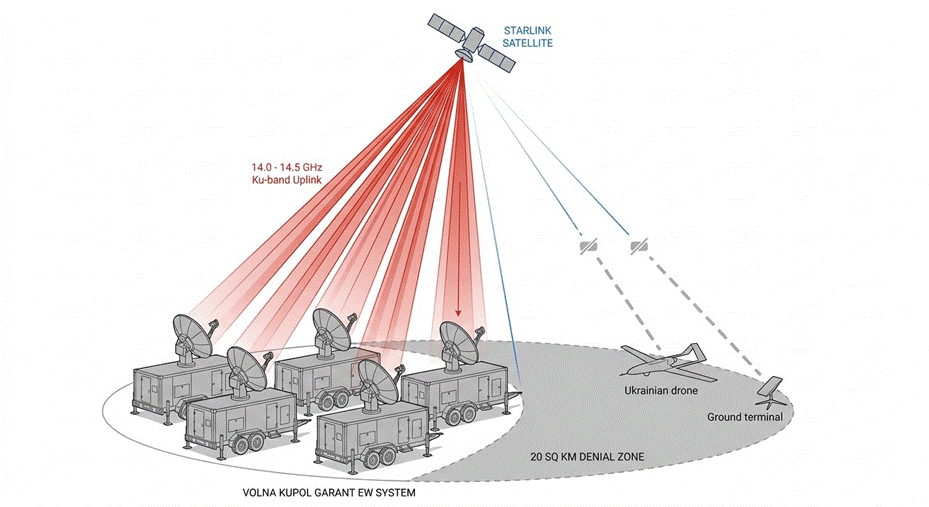
In the operational domain, the Ukrainian Armed Forces capitalized on a severe degradation of Russian command and control (C2) networks to execute a successful counteroffensive in the southern theater, liberating approximately 300 square kilometers of territory. This localized collapse in Russian defensive cohesion was directly precipitated by a joint effort between the Ukrainian government and SpaceX to enforce a strict geographic and cryptographic whitelist on Starlink satellite terminals. By actively disabling thousands of smuggled Starlink units utilized by Russian frontline forces, Ukraine effectively blinded Russian unmanned aerial vehicle (UAV) operators and severed real-time artillery kill chains. Concurrently, Russian offensive operations in the northern and eastern axes—particularly around Sumy and the Vovchansk sector in Kharkiv Oblast—have largely culminated into attritional positional warfare, yielding negligible territorial gains despite maximalist claims propagated by the Russian General Staff. The human toll of this grinding attrition has reached unprecedented levels, with allied intelligence and independent estimates converging on approximately 1.2 million total Russian casualties and upwards of 500,000 to 600,000 Ukrainian casualties since the inception of the full-scale invasion.

The most strategically disruptive development of the reporting period was the dramatic escalation of Ukraine’s indigenous deep-strike campaign. Armed with the newly unveiled FP-5 “Flamingo” subsonic cruise missile, Ukrainian forces executed a precision strike against the Votkinsk Machine Building Plant in Russia’s Udmurt Republic, located over 1,300 kilometers from the Ukrainian border. Because the Votkinsk facility is the primary manufacturing hub for Russia’s intercontinental ballistic missiles (ICBMs) and the Iskander-M ballistic missile systems, this strike crosses a historic threshold: a non-nuclear state successfully executing a conventional precision strike against the core industrial base of a nuclear superpower’s strategic deterrent. This action, coupled with systemic strikes against Russian navigation electronics facilities and ammunition depots, demonstrates that Ukraine has successfully bypassed Western restrictions on the use of imported long-range munitions by establishing a highly capable, sovereign defense industrial base. Meanwhile, the Kremlin has accelerated its domestic security consolidation, with President Vladimir Putin authorizing sweeping new legislation that grants the Federal Security Service (FSB) the power to unilaterally sever mobile and internet communications for individual citizens, a move running parallel to the state’s ongoing throttling of the Telegram messaging network.

1.0 Multilateral Security Architecture and Geopolitical Alignments

1.1 The Geneva Negotiations and Ceasefire Mechanics

The U.S.-brokered diplomatic negotiations held in Geneva on February 17 and 18, 2026, underscored the persistent strategic deadlock between Kyiv and Moscow, even as both sides demonstrated a willingness to discuss the highly technical parameters of conflict suspension. The talks produced no public breakthrough concerning the fundamental issues of territorial sovereignty or political control.1 Western and European intelligence assessments remain highly confident that Russian President Vladimir Putin’s strategic objectives are unchanged; the Kremlin seeks the total restructuring of the European security architecture, the imposition of permanent Ukrainian neutrality, the severe limitation of the Ukrainian Armed Forces, and the eventual installation of a pro-Russian government in Kyiv.2 Consequently, European intelligence chiefs assess that even significant territorial concessions by Ukraine, such as the total cession of the remainder of Donetsk Oblast, would not satisfy the Kremlin’s maximalist aims and would merely serve as a tactical pause for military reconstitution before the issuance of further demands.2

Despite this overarching misalignment, the Geneva summit facilitated granular discussions on the mechanical implementation of a theoretical ceasefire. Negotiators explored the viability of establishing a demilitarized zone (DMZ) in the highly fortified Donbas region, proposing a sector roughly 50 miles in length and 40 miles in width.1 A parallel proposal regarding a joint Russian-Ukrainian civilian administration to govern this proposed zone was swiftly rejected by Ukrainian officials as functionally unrealistic and politically unacceptable, resulting in a diplomatic stalemate.4 Ukrainian President Volodymyr Zelenskyy articulated a posture of conditional openness to a tactical withdrawal from specific fortified frontline positions currently under Kyiv’s control, but strictly predicated this theoretical withdrawal on the prior establishment of the DMZ and the provision of binding, minimum 20-year security guarantees from the United States and its allies.1 Furthermore, Zelenskyy reinforced domestic political boundaries, stating that any final settlement would require ratification via a national referendum, emphasizing that the Ukrainian populace would “never” tolerate a unilateral pullout or the permanent surrender of additional land.1 Negotiating teams made incremental progress in defining the specific military metrics that would constitute a ceasefire violation, and discussions included the future monitoring of the Russian-occupied Zaporizhzhia Nuclear Power Plant.1 A subsequent round of negotiations is scheduled to convene in Switzerland in late February or early March.1

1.2 The Munich Security Conference and the Sino-Russian Axis

The diplomatic friction over the potential shape of a peace settlement occurred against the backdrop of the Munich Security Conference (February 13-15, 2026), where Western officials sought to project strategic unity and address the evolving systemic threats to the global security architecture. NATO Secretary General Mark Rutte utilized the forum to reaffirm the alliance’s commitment to Ukraine, warning that President Putin is engaged in a psychological and attritional campaign designed to break the resolve of the Ukrainian populace through the systematic destruction of critical infrastructure.5 Rutte highlighted the continued necessity of allied support, citing the newly launched NATO PURL initiative, which aims to supply Ukraine with hundreds of millions of euros worth of essential military equipment.5

A central theme of the intelligence briefings at Munich was the rapid expansion of the Sino-Russian strategic partnership, which has effectively shielded the Russian economy from total isolation. According to Western intelligence assessments provided to Bloomberg, the People’s Republic of China (PRC) significantly escalated its material support for the Russian war economy throughout 2025 and early 2026.1 Beijing is now assessed as the primary external facilitator of Moscow’s military-industrial complex, providing massive quantities of dual-use microelectronics, machine tools, and critical minerals essential for the domestic production of UAVs, cruise missiles, and precision-guided munitions.1 Furthermore, China has provided a critical economic lifeline by absorbing immense volumes of Russian crude oil exports displaced by Western sanctions.1 U.S. Ambassador to NATO Matthew Whitaker publicly articulated this assessment in Munich, explicitly stating that the Russian war effort is being “completely enabled by China,” and argued that Beijing possesses the unique geopolitical leverage to terminate the conflict immediately by severing its economic and technological supply lines to Moscow.1

1.3 Institutional Impotence of Legacy Frameworks

The reliance on ad-hoc coalitions and bilateral security guarantees underscores the terminal degradation of legacy conflict-resolution frameworks. Intelligence syntheses evaluating the broader theater note the systemic failure of the United Nations (UN) and the Organization for Security and Co-operation in Europe (OSCE) to provide a viable security guarantee in the face of sustained, high-intensity kinetic warfare and sophisticated hybrid operations.8 The central paradox resides in the fact that a permanent, veto-wielding member of the UN Security Council is the primary aggressor, rendering traditional peacekeeping, mediation, and arms control mechanisms functionally obsolete.8 The Kremlin continues to utilize its position within the UN to conduct sophisticated “Lawfare,” employing the legalistic protections of the UN Charter to shield its tactical maneuvers from collective international intervention.8 Consequently, the defense of Central and Eastern Europe has entirely pivoted to a “Forward Defense” posture spearheaded by the U.S. Department of Defense and NATO, bypassing paralyzed multilateral institutions.8

2.0 Geoeconomic Friction: The EU Financial Blockade

2.1 The Hungarian Veto of the Macro-Financial Loan

The cohesion of the European Union’s financial support apparatus was severely fractured on February 20, 2026, when Hungary executed a formal veto against a critical €90 billion macro-financial loan package intended for Ukraine.9 The financial vehicle, originally championed by the European Parliament, was designed to cover Ukraine’s sovereign budgetary and military expenditure requirements for the 2026-2027 fiscal period.11 The architecture of the loan is structured upon EU borrowing on international capital markets, backed by the bloc’s budget reserves.12

To grant the €90 billion loan, three specific EU regulations must be adopted: one on implementing enhanced cooperation to establish the support loan, one amending the Ukraine Facility, and one amending the 2021-2027 Multiannual Financial Framework.10 While the first two regulations can be adopted by a qualified majority of EU member states, the amendment to the EU’s long-term budget requires the unanimous approval of all 27 member states, granting Budapest absolute leverage.10 By refusing to vote in favor of the Multiannual Financial Framework amendment, Hungary unilaterally halted the entire disbursement process.10

Druzhba pipeline disruption diagram showing blocked EU financial flow to Ukraine due to vetoes. "Geoeconomic Friction" text.

2.2 The Druzhba Pipeline Dispute

Hungarian Prime Minister Viktor Orbán and Foreign Minister Peter Szijjarto explicitly linked the veto to Ukraine’s failure to resume the transit of Russian crude oil through the southern branch of the Soviet-era Druzhba pipeline.9 The pipeline, which traverses Ukrainian territory to supply landlocked Hungary and Slovakia (both of which hold exemptions from the EU embargo on seaborne Russian oil), has been inoperable since a Russian drone and missile strike damaged key pumping infrastructure on January 27, 2026.15

Szijjarto accused Kyiv of intentionally delaying repairs and utilizing the energy bottleneck to blackmail Budapest, claiming the disruption violated the EU-Ukraine Association Agreement and was an attempt to influence the upcoming Hungarian general elections scheduled for April 12.14 Slovakian Prime Minister Robert Fico echoed these sentiments, declaring a state of emergency over domestic fuel supplies and threatening retaliatory economic measures against Kyiv if the transit of Russian crude is not rapidly restored.9

The blockade presents a severe systemic risk to Ukraine’s macroeconomic stability. Without the immediate disbursement of the EU funds, Ukraine faces the risk of a comprehensive financial collapse by the second quarter of 2026, and the delay simultaneously endangers an active $8 billion program managed by the International Monetary Fund (IMF).1 In an attempt to circumvent the crisis, Croatia offered the use of its Adriatic JANAF pipeline to supply seaborne non-Russian (and potentially Russian) crude to Hungarian and Slovakian refineries.18 However, Budapest and Bratislava have historically shunned the JANAF route, citing highly prohibitive transit tariffs and a strategic preference for the discounted pricing structure of Russian pipeline crude.18 Furthermore, Kyiv proposed that the EU utilize alternative elements of Ukraine’s oil transport network, specifically the Odesa-Brody pipeline, to deliver crude to Hungary and Slovakia while the Druzhba network remains offline.12 Ukraine’s energy ministry continues to assert that repair operations on the Druzhba network are proceeding under the constant threat of subsequent Russian aerial bombardment, rejecting the accusations of political manipulation.13

3.0 Operational Theater Developments: The Ground War

3.1 The Southern Vector: Ukrainian Counteroffensive Exploitation

In a highly significant operational development, the Ukrainian Armed Forces successfully executed localized counteroffensive operations in the southern theater, resulting in the liberation of approximately 300 square kilometers of territory.19 President Zelenskyy confirmed the territorial reclamation on February 21 during an interview with Agence France-Presse, noting the advances occurred primarily along the Zaporizhzhia and Dnipropetrovsk Oblast borders.20 Tactical reporting indicates that Ukrainian maneuver elements successfully assaulted and cleared multiple Russian defensive positions along the Yanchur and Haichur river lines, pushing toward the Oleksandrivka and Hulyaipole directions.21

This rapid territorial gain—which represents the fastest pace of Ukrainian advance since late 2023—was not merely a product of overwhelming kinetic force, but rather the exploitation of a catastrophic, technology-induced collapse in Russian tactical command and control.20 The Ukrainian penetration was highly correlated with the sudden, theater-wide blackout of illicitly acquired Starlink satellite terminals utilized by Russian forces (detailed further in Section 5.2).22 By blinding the Russian ISR (Intelligence, Surveillance, and Reconnaissance) architecture and severing the data links between frontline trenches and rear-echelon command posts, Ukrainian mechanized units were able to achieve local tactical surprise and maneuver through highly contested gray zones before Russian artillery could calculate and execute defensive fire missions.22

3.2 The Northern and Eastern Axes: Russian Attritional Offensives

Conversely, Russian offensive operations across the northern and eastern axes have largely devolved into localized, high-attrition positional engagements with minimal operational-level success. In the northern sector, elements of the Russian Northern Grouping of Forces—including the 1443rd Motorized Rifle Regiment and the 83rd Airborne (VDV) Brigade—attempted to breach Ukrainian defensive fortifications in the Sumy Oblast, specifically targeting the Pysarivka and Marine directions.2 Despite the deployment of significant manpower and persistent mechanized assaults, Ukrainian military observers assess that the Russian forces failed to achieve a tactical breakthrough, as well-prepared Ukrainian trench networks and dense minefields effectively absorbed the shock of the advance.2 Drone operators from the 106th VDV Division continue to operate in the area, but their effectiveness has been blunted.2

In northern Kharkiv Oblast, Russian forces continued their protracted campaign to establish a sanitary “buffer zone” to push Ukrainian tube artillery out of range of Belgorod City.2 Russian maneuver elements attempted a push along the T-2104 highway toward Velykyi Burluk but became heavily bogged down in intense urban and suburban combat on the southern outskirts of Vovchansk.2 The pervasive presence of Ukrainian First-Person View (FPV) strike drones, operating effectively up to 20 kilometers into the Russian deep rear, has prohibited Russian commanders from safely accumulating the necessary mass of armored vehicles and infantry reserves required to exploit localized tactical successes.2

Despite these operational realities, the Russian Ministry of Defense engaged in a systemic cognitive warfare campaign designed to project an aura of inevitable victory. Colonel General Sergei Rudskoy, Chief of the General Staff’s Main Operations Directorate, publicly claimed on February 20 that Russian forces had seized approximately 900 square kilometers of territory and 42 settlements since the beginning of 2026, and over 6,700 square kilometers throughout 2025.24 However, independent geospatial analysis by the Institute for the Study of War (ISW) routinely refutes these maximalist figures. The analysis indicates that the Russian General Staff frequently aggrandizes the seizure of tactically insignificant tree lines and depopulated microscopic hamlets to influence the domestic informational space and exert psychological pressure on Western capitals during diplomatic negotiations.3

Reporting SourceTimeframe AssessedClaimed Territorial Gains by RussiaContext / Verification Status
Russian General Staff (Gen. Rudskoy)Jan 1, 2026 – Feb 20, 2026~900 square kilometersUnverified maximalist claim aimed at cognitive warfare.3
Russian General Staff (Gen. Gerasimov)Feb 1, 2026 – Feb 15, 2026200 square kilometersHighly aggrandized; includes microscopic, depopulated hamlets.3
Institute for the Study of War (ISW)Jan 13, 2026 – Feb 10, 2026182 square miles (~471 sq km)Verified via geolocated footage and satellite telemetry.26
Ukrainian Armed Forces (Southern Counteroffensive)Feb 2026-300 square kilometers (Liberated by Ukraine)Verified by multiple sources; nullifies substantial portions of Russian winter gains.19

3.3 Force Generation, Attrition, and Casualty Assessments

The strategic choice to pursue a war of attrition has resulted in catastrophic personnel losses for both combatant nations. The defining characteristic of the Russian tactical approach relies on evolving infiltration ground tactics combined with the use of long-range fires and glide bombs, essentially trading massive expenditures of materiel and human life for marginal territorial gains.27 By mid-February 2026, Western intelligence agencies, the UK Ministry of Defense, and the Estonian Foreign Intelligence Service converged on estimates indicating that Russian military casualties have reached unprecedented levels.21

To sustain this extraordinary rate of attrition without declaring a politically perilous general mobilization, the Kremlin has intensified its efforts to optimize the domestic recruitment pipeline. President Putin seeks to normalize limited, rolling call-ups to sustain the size of the Russian force grouping, utilizing legislative pressure to shape the Russian public consciousness into viewing the evasion of military service as “socially unacceptable”.28

The following table synthesizes the most current consensus estimates regarding military casualties since the onset of the full-scale invasion on February 24, 2022:

Source of AssessmentDate of EstimateEstimated Russian Casualties (Killed, Wounded, Missing)Estimated Ukrainian Casualties (Killed, Wounded, Missing)
Ukrainian General StaffFeb 21, 20261,258,890 (Including 1,010 in the prior 24 hours) 19Classified / Not Disclosed
Western Officials (via Bloomberg)Feb 20261,200,000 (Includes 430K in 2024 and 415K in 2025) 21Not specified
Estonian Foreign Intelligence ServiceFeb 20261,000,000 21Not specified
Ex-CIA Director William BurnsJan 20261,100,000 21Not specified
Center for Strategic and International Studies (CSIS)Jan 20261,200,000 (Including as many as 325,000 killed) 26500,000 – 600,000 (Including 100,000 – 140,000 killed) 26

4.0 The Deep Strike Campaign and Defense Industrial Degradation

4.1 The Votkinsk ICBM Facility Strike

In a paradigm-shifting demonstration of indigenous kinetic capability, Ukrainian forces executed a complex, long-range drone and cruise missile strike against the Votkinsk Machine Building Plant in Russia’s Udmurt Republic on the night of February 20-21, 2026.4 Located deep within the Russian interior, over 1,300 kilometers (800 miles) from the Ukrainian border, the Votkinsk facility is a highly classified, state-owned defense enterprise that serves as the absolute core of Russia’s strategic missile production infrastructure.4 The plant is the primary manufacturing hub for the Iskander-M short-range ballistic missile systems, which are routinely utilized to bombard Ukrainian energy infrastructure and urban centers.4 Crucially, Votkinsk is also the sole producer of Russia’s road-mobile and silo-based intercontinental ballistic missiles (ICBMs), including the RS-24 Yars and the Topol family of missiles, as well as the RSM-56 Bulava submarine-launched ballistic missile.4

Ukrainian deep strike envelope expansion, February 2026. Targets include Votkinsk (>1300km). SITREP Russia-Ukraine.

Open-source intelligence (OSINT), including data from the “CyberBoroshno” project, and subsequent satellite telemetry confirmed that the attack heavily damaged production workshops No. 22 and No. 36.29 The strike caused massive secondary detonations, large-scale fires visible from nearby residential areas, and structural collapse, resulting in at least 11 reported casualties.19 The strike was executed using a combination of long-range loitering munitions and the new FP-5 “Flamingo” cruise missile.29

This operation represents a severe psychological and strategic blow to the Kremlin. It definitively proves that a non-nuclear state, utilizing indigenously produced conventional weaponry, can successfully penetrate deep into Russian airspace and inflict critical damage upon the very facilities that manufacture Russia’s nuclear deterrent. The operation simultaneously degrades the immediate supply chain for the Iskander-M missiles used against Ukrainian cities while exposing the systemic vulnerabilities in Russia’s deep-rear strategic air defense networks.30 Western intelligence analysis, specifically referencing forensic assessments of the strike, suggests that while the physical devastation may not entirely halt ICBM production, the demonstration of capability places Russia’s most guarded assets—including hypersonic reentry technology and MIRV architectures—at perpetual risk.30

4.2 Target Network Analysis: VNIIR-Progress, Kotluban, and Oil Depots

The attack on Votkinsk was not an isolated incident, but rather the apex of a highly coordinated, systemic campaign designed to dismantle specific bottlenecks within the Russian defense-industrial supply chain. On February 18, Ukrainian long-range strike drones penetrated the Chuvash Republic, roughly 1,000 kilometers from the border, to strike the VNIIR-Progress defense plant in the city of Cheboksary.31 The VNIIR-Progress facility is a critical node in the Russian aerospace industry, responsible for the manufacturing of the “Kometa” satellite navigation antennas and Global Navigation Satellite System (GNSS) modules.31 These highly specialized electronic components function as the central nervous system for the Shahed-type suicide drones, Kalibr cruise missiles, and the ubiquitous glide-bomb guidance kits (UMPK) that form the backbone of Russian tactical aviation strikes.31 By targeting the production of the Kometa modules, Ukraine aims to induce a systemic shortage of precision guidance capabilities across the entire spectrum of Russian strike assets.

Furthermore, Ukraine maintained its pressure on Russian logistical nodes closer to the front. On February 12, Ukrainian forces utilized Flamingo missiles to strike a massive ammunition depot operated by the Russian Main Missile and Artillery Directorate (GRAU) near Kotluban in the Volgograd Oblast, approximately 320 kilometers from the border.22 The strike ignited a series of powerful secondary explosions, forcing the emergency evacuation of the local civilian population and destroying vast quantities of stockpiled artillery shells and tactical missiles destined for the southern and eastern fronts.22

Concurrently, the economic foundations of the Russian war machine were targeted. The Security Service of Ukraine’s (SBU) specialized “Alpha” UAV unit successfully navigated anti-drone defenses to strike a major oil depot in the town of Velikiye Luki, located in the northwestern Pskov Oblast.33 Additionally, satellite imagery confirmed severe damage to primary crude oil processing units at an oil refinery in Ukhta following earlier drone strikes, continuing a sustained campaign to constrain Russian fuel production capabilities.34

5.0 Technological, Cyber, and Electromagnetic Warfare Domains

5.1 The FP-5 Flamingo Cruise Missile: Strategic Democratization

The geometric expansion of the Ukrainian deep-strike envelope has been enabled by the rapid operational deployment of the FP-5 “Flamingo,” a heavy, subsonic, ground-launched cruise missile developed indigenously by the Ukrainian defense startup Fire Point.32 Unveiled publicly and rapidly integrated into combat operations, the Flamingo represents a masterclass in the democratization of strategic strike capabilities through asymmetric engineering.36

The technical specifications of the FP-5 are highly ambitious. Designed as a low-cost solution, the massive airframe carries a devastating 1,150-kilogram (1.15 metric ton) conventional fragmentation/high-explosive warhead, dwarfing the payload capacity of the U.S.-manufactured Tomahawk cruise missile.32 The following table outlines the verified technical specifications of the FP-5 Flamingo:

SpecificationDetails
Mass6,000 kg (6.0 metric tons) 32
DimensionsLength: 12-14 meters; Wingspan: 6 meters 32
Warhead Weight1,150 kg (1.15 metric tons) 32
Engine ConfigurationSolid fuel for booster, liquid fuel for the AI-25TL turbofan 32
Operational Range3,000 km (1,900 miles) 32
Flight DynamicsFlight ceiling: 5,000 m; Maximum speed: 950 km/h; Cruising speed: 850-900 km/h 32
Guidance SystemGPS/GNSS with INS backup (No TERCOM/DSMAC verified) 32
Stated Accuracy14 meters (Circular Error Probable) 32

The defining characteristic of the Flamingo is its absolute prioritization of simplicity, affordability, and rapid manufacturability over exquisite, highly expensive technologies.36 Traditional long-range cruise missiles rely on highly controlled, miniaturized turbojet or turbofan engines that require vast, complex supply chains. To bypass this bottleneck, Fire Point engineers integrated the Ivchenko AI-25TL turbofan engine—a full-sized powerplant originally designed in the Soviet era for crewed training aircraft like the Aero L-39 Albatros.36 To further compress production timelines and reduce unit costs, Fire Point explicitly sources AI-25TL engines that are nearing the end of their operational lifespans. Because the Flamingo is a one-way attack platform with a maximum flight duration of approximately 3.5 hours, the manufacturer can safely utilize refurbished jet engines that possess as little as ten hours of remaining operational life.37 During the refurbishment process, Fire Point replaces expensive original titanium components with cheaper, simplified materials, as long-term durability is entirely irrelevant for a kamikaze platform.37

Similarly, the Flamingo eschews highly complex, costly terminal guidance systems such as Terrain Contour Matching (TERCOM) or Digital Scene-Matching Area Correlation (DSMAC) optical systems.36 Instead, it relies on a robust combination of commercially available GPS/GNSS satellite navigation backed by an Inertial Navigation System (INS).32 While potentially vulnerable to intense electronic warfare (EW) jamming, the sheer size of the 1,150-kilogram payload ensures that even a near-miss will inflict catastrophic damage upon soft targets like fuel refineries, ammunition depots, and exposed factory production floors.

In early February 2026, the intersection of commercial space technology and the electromagnetic spectrum drastically altered the tactical equilibrium on the frontline. Responding to the systemic proliferation of smuggled Starlink satellite internet terminals among Russian forces, the Ukrainian Ministry of Defense, in direct collaboration with SpaceX, implemented a stringent geographic and cryptographic “whitelist” protocol.1 Under this new architecture, only verified, cryptographically registered Starlink terminals explicitly authorized by the Ukrainian military are permitted to interface with the Low Earth Orbit (LEO) satellite constellation.38 Any terminal lacking the correct digital authorization, regardless of its physical location within Ukrainian borders, was immediately and permanently disconnected from the network.38

The operational impact on the Russian Armed Forces was immediate and severe. Driven by Western sanctions, the Russian military had grown highly dependent on illicitly acquired Starlink hardware—often smuggled through third-party jurisdictions like Dubai using falsified documents—to bypass the highly contested, EW-saturated environments of eastern Ukraine.39 Starlink provided Russian commanders with a secure, high-bandwidth communication layer that was virtually immune to traditional Ukrainian jamming equipment. Specifically, Russian specialized drone units, such as the Rubikon center, had integrated Starlink dishes directly onto long-range “Molniya” and highly modified “Geran-2” (Shahed) attack drones.1 This integration allowed Russian operators in the deep rear to receive real-time, high-definition video feeds from the drones, actively retargeting the munitions mid-flight to strike dynamic targets, such as fast-moving logistical trains and mobile air defense systems.39

The implementation of the whitelist completely severed this capability. Following the disconnection on February 1, ISW intelligence assessments noted that the Rubikon unit abruptly ceased publishing precision geolocation strike videos, indicating a profound degradation in their real-time targeting telemetry.1 The blindfolding of Russian ISR assets directly correlated with a verified 15% reduction in the efficacy of Russian drone strikes in key frontline sectors.1

The tactical blackout was heavily compounded by the Kremlin’s concurrent decision to throttle the Telegram messaging application.1 Because the official Russian encrypted communications platforms (such as the “Azart” radio systems) are notoriously unreliable and easily intercepted, Russian infantry commanders had grown heavily reliant on Telegram for localized C2 and fire coordination. The simultaneous loss of high-bandwidth Starlink connectivity and low-bandwidth Telegram functionality threw Russian tactical command posts into chaos.22 It was precisely this window of localized paralysis and communication degradation that the Ukrainian Armed Forces exploited to launch their successful 300-square-kilometer penetration in the southern theater.20 Ukrainian unmanned systems commanders assess that the Russian military industrial complex will require a minimum of six months to develop, mass-produce, and deploy a secure, high-bandwidth alternative to Starlink capable of restoring the lost C2 and deep-strike telemetry capabilities.1

6.0 Domestic Security Consolidation and Occupation Dynamics

6.1 The Russian Information Space and the “Kill Switch” Law

As the conflict grinds into a protracted war of attrition, the Kremlin has moved aggressively to consolidate absolute control over the domestic information space and suppress any potential anti-war mobilization. On February 20, 2026, President Putin signed sweeping legislation granting the Federal Security Service (FSB) the legal authority to unilaterally order internet service providers and telecommunications operators to disconnect specific individuals from mobile and home internet networks, citing broad national security prerogatives.19 This targeted digital exile capability essentially provides the state with an individualized “kill switch,” allowing security services to silence dissidents, independent journalists, and military bloggers who contradict the Ministry of Defense’s narrative without the need for prolonged judicial proceedings.

This legislative maneuver operates in tandem with the Russian government’s ongoing, state-level throttling of the Telegram messaging platform, a highly popular network that has served as the primary nexus for both pro-war military bloggers and grassroots opposition.1 FSB Director Alexander Bortnikov justified the Telegram degradation by citing the platform’s alleged facilitation of terrorism and acts of sabotage.1 Bortnikov publicly confirmed that discussions with Telegram founder Pavel Durov had broken down, rejecting criticisms regarding freedom of speech and insisting that the measures were necessary to protect the public interest.1 Intelligence analysts assess that the move is primarily designed to monopolize the domestic information space, prevent the coordination of localized anti-war movements (particularly around sensitive dates such as the anniversary of Alexei Navalny’s death 40), and force the Russian public into reliance on state-controlled media channels. Despite the throttling, the Kremlin ironically announced it would maintain its own official Telegram channel.1

6.2 Occupation Infrastructure and Demographic Engineering

In the occupied territories of eastern and southern Ukraine, the Russian state apparatus continues a systemic, multi-tiered campaign of demographic engineering, economic extraction, and forced assimilation. The occupation administrations rely heavily on a network of “temporary accommodation centers” (TACs) to facilitate the forcible transfer of Ukrainian civilians deeper into occupied territory or directly into the Russian Federation.41 This process is frequently executed under the guise of humanitarian evacuation from frontline combat zones. Furthermore, Russian state-sponsored entities, such as the “Russian Children’s Fund,” have been heavily implicated in the systemic deportation of Ukrainian minors, moving them into the Russian interior for medical examinations and subsequent placement in state facilities or foster homes.41

The occupation authorities are also rapidly accelerating the administrative integration of the conquered territories. The Donetsk Oblast occupation administration has initiated the mandatory issuance of “Donetsk People’s Republic (DNR) Resident Cards” to all remaining civilians, a coercive measure designed to formalize Russian administrative control and force compliance with occupation mandates, including taxation and potential military conscription.41 Veterans of the war are increasingly being installed in public-facing bureaucratic positions within occupied Ukraine to enforce loyalty and manage the civilian populace.41

Simultaneously, the Russian state is deeply engaged in the economic exploitation of the occupied regions. The federal government is directing massive investments into the agricultural sectors of occupied Ukraine, explicitly designed to maximize the extraction of grain and other valuable resources for direct export and profit by the Russian Federation, further stripping the occupied regions of their economic sovereignty.41 In a long-term effort to sustain the war economy, Russian authorities have introduced gamified drone racing competitions in occupied schools and established specific student programs.41 These initiatives are explicitly designed to indoctrinate Ukrainian youth and pipeline them directly into future service within the Russian defense-industrial base as UAV operators, developers, and technicians, effectively weaponizing the occupied population against their own nation.41


Please share the link on Facebook, Forums, with colleagues, etc. Your support is much appreciated and if you have any feedback, please email us in**@*********ps.com. If you’d like to request a report or order a reprint, please click here for the corresponding page to open in new tab.


Sources Used

  1. Russia in Review, Feb. 13–20, 2026 | Russia Matters, accessed February 21, 2026, https://www.russiamatters.org/news/russia-review/russia-review-feb-13-20-2026
  2. Russian Offensive Campaign Assessment, February 19, 2026 – Institute for the Study of War, accessed February 21, 2026, https://understandingwar.org/research/russia-ukraine/russian-offensive-campaign-assessment-february-19-2026/
  3. Russian Offensive Campaign Assessment Updates DEC 2025 – Institute for the Study of War, accessed February 21, 2026, https://understandingwar.org/research/russia-ukraine/russian-offensive-campaign-assessment-updates-2/
  4. One of Russia’s most important ballistic missile factories reportedly hit in Ukrainian long-range strike, at least 11 injured – The Kyiv Independent, accessed February 21, 2026, https://kyivindependent.com/drone-strikes-russian-ballistic-missile-factory-over-1-300-km-from-ukraines-border/
  5. Joint press conference following the meeting of the Ukraine Defence Contact Group, 12 February 2026 – YouTube, accessed February 21, 2026, https://www.youtube.com/watch?v=yditjWQ-y68
  6. Putin ‘trying to break the Ukrainian people – they will not be broken,’ says Nato’s Rutte – Europe live – The Guardian, accessed February 21, 2026, https://www.theguardian.com/world/live/2026/feb/11/europe-live-latest-news-updates-eu-ukraine-russia
  7. Foreign Minister Tsahkna in Munich: Europe has strong levers to strengthen its security and support Ukraine | Välisministeerium, accessed February 21, 2026, https://www.vm.ee/en/news/foreign-minister-tsahkna-munich-europe-has-strong-levers-strengthen-its-security-and-support
  8. The Erosion of the Multilateral Security Architecture in Central and Eastern Europe Amid Systematic Kinetic-Cyber Hybrid Aggression by the Russian Federation – https://debuglies.com, accessed February 21, 2026, https://debuglies.com/2026/02/08/the-erosion-of-the-multilateral-security-architecture-in-central-and-eastern-europe-amid-systematic-kinetic-cyber-hybrid-aggression-by-the-russian-federation/
  9. Ukraine war briefing: Hungary threatens to block €90bn EU loan to Kyiv in oil row, accessed February 21, 2026, https://www.theguardian.com/world/2026/feb/21/ukraine-war-briefing-hungary-threatens-to-block-90bn-eu-loan-to-kyiv-in-oil-row
  10. Revealed: how Orbán blocked €90bn loan for Ukraine, accessed February 21, 2026, https://www.pravda.com.ua/eng/news/2026/02/20/8022012/
  11. Ukraine war: UN appeals for $2.3 billion to support aid teams’ ‘heroic work’, accessed February 21, 2026, https://europeansting.com/2026/01/13/ukraine-war-un-appeals-for-2-3-billion-to-support-aid-teams-heroic-work/
  12. European Commission responds to Hungary’s blocking of €90bn for Ukraine, accessed February 21, 2026, https://www.pravda.com.ua/eng/news/2026/02/21/8022049/
  13. Ukraine offers EU Odesa-Brody pipeline as alternative to damaged Druzhba, accessed February 21, 2026, https://www.pravda.com.ua/eng/news/2026/02/21/8022045/
  14. Hungary to block $106B EU loan for Ukraine until Druzhba oil transit resumes, accessed February 21, 2026, https://www.aa.com.tr/en/europe/hungary-to-block-106b-eu-loan-for-ukraine-until-druzhba-oil-transit-resumes/3836240
  15. EU Quizzes Ukraine On Timeline For Repair Of Druzhba Oil Pipeline – Radio Free Europe, accessed February 21, 2026, https://www.rferl.org/a/eu-ukraine-druzhba-russian-oil-pipeline-hungary-slovakia/33680685.html
  16. Oil Supplies to Hungary and Slovakia Halted After Damage to Druzhba Pipeline, accessed February 21, 2026, https://www.themoscowtimes.com/2026/02/16/oil-supplies-to-hungary-and-slovakia-halted-after-damage-to-druzhba-pipeline-a91964
  17. Kyiv urges Brussels to intervene in Hungary oil pipeline feud, accessed February 21, 2026, https://www.euractiv.com/news/kyiv-urges-brussels-to-intervene-in-hungary-oil-pipeline-feud/
  18. Croatia To Allow Russian Oil To Hungary, Slovakia, accessed February 21, 2026, https://www.marinelink.com/news/croatia-allow-russian-oil-hungary-535963
  19. The Kyiv Independent — News from Ukraine, Eastern Europe, accessed February 21, 2026, https://kyivindependent.com/
  20. Ukraine Reclaims 300km in the South While Russian Lines Crumble Without Starlink, accessed February 21, 2026, https://united24media.com/latest-news/ukraine-reclaims-300km-in-the-south-while-russian-lines-crumble-without-starlink-16127
  21. The Russia-Ukraine War Report Card, Feb. 18, 2026, accessed February 21, 2026, https://www.russiamatters.org/news/russia-ukraine-war-report-card/russia-ukraine-war-report-card-feb-18-2026
  22. Russian Offensive Campaign Assessment, February 12, 2026 – Institute for the Study of War, accessed February 21, 2026, https://understandingwar.org/research/russia-ukraine/russian-offensive-campaign-assessment-february-12-2026/
  23. Russian Offensive Campaign Assessment, February 13, 2026 – Institute for the Study of War, accessed February 21, 2026, https://understandingwar.org/research/russia-ukraine/russian-offensive-campaign-assessment-february-13-2026/
  24. Russian Offensive Campaign Assessment, FEB 20, 2026 | ISW, accessed February 21, 2026, https://understandingwar.org/research/russia-ukraine/russian-offensive-campaign-assessment-february-20-2026/
  25. Russian Offensive Campaign Assessment, February 15, 2026 – Institute for the Study of War, accessed February 21, 2026, https://understandingwar.org/research/russia-ukraine/russian-offensive-campaign-assessment-february-15-2026/
  26. The Russia-Ukraine War Report Card, Feb. 11, 2026, accessed February 21, 2026, https://www.russiamatters.org/news/russia-ukraine-war-report-card/russia-ukraine-war-report-card-feb-11-2026
  27. Russia’s Grinding War in Ukraine – CSIS, accessed February 21, 2026, https://www.csis.org/analysis/russias-grinding-war-ukraine
  28. Russian Offensive Campaign Assessment, February 18, 2026, accessed February 21, 2026, https://understandingwar.org/research/russia-ukraine/russian-offensive-campaign-assessment-february-18-2026/
  29. Ukraine’s Flamingo Missiles Fly 1,300km to Hit Russia’s Nuclear & Iskander Production Hub, accessed February 21, 2026, https://united24media.com/latest-news/ukraines-flamingo-missiles-fly-1300km-to-hit-russias-nuclear-iskander-production-hub-16125
  30. The Invisible Death Factory: A Love Story About Things That Go Boom and Academics Who Don’t Talk… – Christian Baghai, accessed February 21, 2026, https://christianbaghai.medium.com/the-invisible-death-factory-a-love-story-about-things-that-go-boom-and-academics-who-dont-talk-9acc13214ba7
  31. Fire Erupts at Key Russian Missile Component Factory After a Reported Drone Strike, accessed February 21, 2026, https://united24media.com/latest-news/fire-erupts-at-key-russian-missile-plant-after-drone-strike-16017
  32. FP-5 Flamingo – Wikipedia, accessed February 21, 2026, https://en.wikipedia.org/wiki/FP-5_Flamingo
  33. Ukraine war latest: Ukraine reportedly strikes Russian oil depot in Pskov Oblast, hits Belgorod with missiles, accessed February 21, 2026, https://kyivindependent.com/ukraine-war-latest-ukraine-reportedly-strikes-russian-oil-depot-in-pskov-oblast-hits-belgorod-with-missiles/
  34. Satellite images confirm severe damage at Oil Refinery in Ukhta – UA.NEWS, accessed February 21, 2026, https://ua.news/en/war-vs-rf/suputnikovi-znimki-pidtverdzhuiut-seriozni-poshkodzhennia-na-npz-v-ukhti
  35. Ukraine’s New FP-5 Missile Has Twice the Range of a Tomahawk | WSJ Equipped, accessed February 21, 2026, https://www.youtube.com/watch?v=bJjlYSX8XEg
  36. Ukraine’s Flamingos take to the skies – The International Institute for Strategic Studies, accessed February 21, 2026, https://www.iiss.org/online-analysis/missile-dialogue-initiative/2025/09/ukraines-flamingos-take-to-the-skies/
  37. Explained: How Is Ukraine’s Flamingo Missile Made? – Kyiv Post, accessed February 21, 2026, https://www.kyivpost.com/post/60791
  38. To Block Russians, SpaceX to Impose Whitelist for Starlink Access in Ukraine, accessed February 21, 2026, https://au.pcmag.com/networking/115689/to-block-russians-spacex-to-impose-whitelist-for-starlink-access-in-ukraine
  39. How does the cutoff of Starlink terminals affect Russia’s moves in Ukraine? – Al Jazeera, accessed February 21, 2026, https://www.aljazeera.com/news/2026/2/10/how-does-the-cutoff-of-starlink-terminals-affect-russias-moves-in-ukraine
  40. Alexei Navalny – Wikipedia, accessed February 21, 2026, https://en.wikipedia.org/wiki/Alexei_Navalny
  41. Russian Occupation Update February 19, 2026, accessed February 21, 2026, https://understandingwar.org/research/russia-ukraine/russian-occupation-update-february-19-2026/

Ukrainian Military Small Arms: From Legacy to Modernization in 2026

Executive Summary

The military landscape of the Armed Forces of Ukraine (AFU) in early 2026 represents one of the most significant transformations in small arms doctrine and inventory management in modern history. Since the escalation of the full-scale invasion in 2022, the Ukrainian defense establishment has shifted from a force defined by Soviet-era legacy platforms to a hybrid, technologically advanced military that increasingly relies on domestic manufacturing and NATO-standard calibers.1 This report, prepared from the perspective of small arms and foreign intelligence analysis, provides a comprehensive audit of the small arms currently fielded across the various branches of the Ukrainian military, including the Ground Forces, Marine Corps, Air Force, Navy, Air Assault Forces, Special Operations Forces (SOF), and Territorial Defense Forces (TDF).

As of early 2026, Ukraine’s domestic defense industry has achieved a strategic breakthrough, with approximately 76% of centralized procurement spending for weapons and military equipment allocated to Ukrainian manufacturers, a dramatic increase from 46% in 2024.4 The Ministry of Defence (MoD) codified over 1,300 new weapon and equipment models in 2025 alone, reflecting an industrial surge that emphasizes sovereign production of small arms, ammunition, and unmanned systems.5 This surge is supported by an industrial workforce that has grown to over 400,000 personnel, as the state moves toward a goal of 50% domestic inventory across all military branches by mid-2026.3

The current small arms arsenal is characterized by a “mixed-fleet” reality, where units simultaneously manage Soviet-legacy 5.45 mm and 7.62 mm platforms alongside an expanding inventory of 5.56x45mm and 7.62x51mm NATO-standard weapons.9 Intelligence analysts observe a clear prioritization in weapon distribution: elite maneuver units, such as the 30th Marine Corps and various SOF regiments, are almost entirely standardized on Western or high-end domestic platforms like the FN SCAR, SIG MCX, and the localized CZ Bren 2, known as the “Sich”.12 Conversely, the Territorial Defense Forces and reserve components continue to utilize legacy AKM rifles and captured Russian “trophy” weapons like the AK-12, though these are being augmented by new domestic submachine guns like the Fort-230.9

The Macro-Industrial Environment and Standardization Policy

The shift toward a corps-based structure within the AFU—comprising 18 specialized corps across the various branches—has necessitated a more standardized approach to small arms logistics.4 Each corps, generally consisting of five mechanized brigades supported by artillery and specialized unmanned units, requires a reliable and interoperable small arms fleet. In 2025 and 2026, the Ukrainian Council of Defence Industry estimated the domestic production volume at $12 billion, with a target of $50 billion in capacity for late 2026.3 This financial and industrial commitment is primarily directed toward alleviating the dependence on foreign suppliers, particularly for small arms ammunition, which saw a production restart in 2024 for 5.45 mm and 5.56 mm calibers.2

The intelligence community monitors the “Danish model” and other capability coalitions that have provided over $1.4 billion in funding for domestic production in 2025.3 These models allow Ukraine to manufacture Western-designed weapons on home soil, a move that minimizes logistical lag and secures supply lines against Russian strikes on industrial facilities. Despite these strikes, which increased in intensity throughout 2025, the Decentralized production model of the Ukrainian small arms industry has remained resilient.3

Industrial Category2022 Output2024 Output2026 Projected Capacity
Overall Defense Production$1 Billion$9 Billion$50 Billion
Small Arms Types CodifiedLimited~30 Models>50 Models
Domestic Procurement Share<30%46%>76%
Ammunition Types Codified<50~100>270

The codification of 13 new small arms models in 2025 signifies a mature R&D environment where domestic firms like RPC Fort, Zbroyar, and Mayak are increasingly displacing older Soviet-standard equipment.5

Ukrainian Ground Forces (ZSU): Small Arms Doctrine and Distribution

The Ground Forces remain the largest consumer of small arms within the AFU. The transition from a brigade-based to a corps-based structure (thirteen corps as of 2026) has led to a more stratified distribution of weaponry.4 The primary assault rifle for the Ground Forces remains a combination of modernized AK-74 variants and the domestic UAR-15.9

Standard Infantry Rifles and Carbines

The UAR-15, manufactured by Ukrop LLC (the military arm of Zbroyar), has emerged as the definitive modern rifle for mechanized and armored brigades. Produced with American-made components from Daniel Defense—specifically the barrels and trigger mechanisms—the UAR-15 offers superior accuracy and ergonomics compared to the Kalashnikov series.19 Its modular layout allows for the attachment of Western optics, suppressors, and laser aiming devices, which are now standard-issue for front-line Ground Forces units.18

In addition to the UAR-15, the IPI Malyuk, a bullpup conversion of the AK platform, is widely used by Ground Forces personnel who prioritize maneuverability in urban combat or armored vehicle operations.9 The Malyuk is chambered in 5.45 mm, 5.56 mm, and 7.62 mm, allowing it to integrate into various logistical chains as units transition between calibers.9

Support and Suppression Weapons

Ground Forces squads rely heavily on the Fort-401 light machine gun, a licensed variant of the Israeli IWI Negev.23 Its ability to feed from both belts and STANAG magazines provides a tactical flexibility that the Soviet-legacy RPK lacked. For general-purpose roles, the PKM remains prevalent, but it is increasingly augmented or replaced by the FN MAG and MG5, particularly in units equipped with Western-donated armored vehicles.9

Weapon ClassStandard PlatformCaliberOriginStatus
Assault RifleUAR-155.56x45mmUkraine/USAHigh-priority issue
Assault RifleAK-74 / AK-74M5.56x45mmSoviet UnionUbiquitous legacy
Bullpup RifleIPI MalyukVariousUkraineUrban/Mechanized
LMGFort-401 (Negev)5.56x45mmUkraine/IsraelStandard squad support
GPMGPKM / PKP7.52x54mmRSoviet UnionHeavy suppression

The adoption of 40 mm and 84 mm NATO-standard grenade launchers has also revolutionized the Ground Forces’ small-unit tactics. Over 10 models of grenade launchers were codified in 2024, including the Fort-600, which is used for both anti-infantry and specialized anti-drone roles.21

Marine Corps and Naval Infantry: The 30th Marine Corps Inventory

The 30th Marine Corps, commanded by Maj. Gen. Dmytro Delyatsky, represents one of Ukraine’s most elite conventional formations.16 Unlike the broader Ground Forces, the Marine Corps has benefited from a more rapid standardization on Western platforms, largely due to their role in amphibious operations and high-intensity bridgehead defense.

The CZ Bren 2, specifically the “Sich” variant assembled in Ukraine, is the primary rifle for Marine personnel.13 The Marines favor the Bren 2 for its reliability in saline and humid environments, as well as its ambidextrous controls, which are critical for ship-to-shore transitions and close-quarters combat.24 The Bren 2’s modularity allows for the quick change of barrels and calibers, a feature the Marine Corps utilizes to maintain compatibility with NATO partners during riverine and coastal operations.13

In addition to the Bren 2, the Marine Corps utilizes the FN SCAR-L and SCAR-H in significant numbers.9 The SCAR-H, chambered in 7.62x51mm, provides the increased range and terminal ballistics required for coastal defense and long-range engagement on the open terrain of the southern front.

SystemModelCaliberRole
Primary RifleCZ Bren 2 (Sich)5.56x45mmStandard Issue
Battle RifleFN SCAR-H7.62x51mmMarksman/Assault
SidearmGlock 17 / Fort-179x19mmPersonal Defense
Heavy SupportM2 Browning.50 BMG / 12.7x99mmMounted/Fixed Support

Air Assault Forces (DSHV): Rapid Reaction and High Mobility

The Air Assault Forces, organized into two corps as of 2025, have traditionally borne the brunt of offensive operations.1 Their small arms inventory reflects the need for lightweight, high-mobility weaponry. The transition from the AKS-74U “Krinkov” to the domestic Fort-230 submachine gun is a notable trend within this branch.15

The Fort-230 is a 9 mm personal defense weapon (PDW) designed for vehicle crews, drone operators, and paratroopers.15 Weighing only 2.5 kg, it is significantly lighter and more ergonomic than the AKS-74U while offering an 800 RPM cyclic rate.15 For primary combat roles, DSHV units are frequently issued the UAR-15 or captured Russian AK-12s, which they favor for their rail systems and adjustable stocks, allowing for easier use with heavy body armor and specialized paratrooper gear.9

The DSHV also utilizes the FN Minimi (M249) as its primary squad automatic weapon, replacing the heavier RPK-74. The Minimi’s high rate of fire and relative portability align with the branch’s doctrine of rapid, high-intensity assault.9

Special Operations Forces (SSO) and Defense Intelligence (GUR)

The Special Operations Forces and GUR units possess the most specialized small arms inventory in the AFU, often utilizing “contract guns” and high-end Western platforms not seen in general issue. A primary signature weapon for these units in 2026 is the SIG Sauer MCX, typically configured with 11.5-inch barrels and integrated suppressors.14

The MCX platform is chosen for its short-stroke gas piston system, which enhances reliability during the extended use of suppressors.31 These weapons are often equipped with Aimpoint Comp M4 optics and 3x magnifiers, providing a force multiplier in both urban and rural reconnaissance missions.14 For suppressed operations, the SSO also utilizes the SIG MPX and the legacy Soviet PB and APS pistols, though the latter are increasingly being replaced by the Glock 19 and the SIG P320.9

Precision Sniping and Anti-Materiel Roles

SSO sniper teams have standardized the Barrett MRAD, a multi-caliber bolt-action system that can be quickly rechambered for 7.62x51mm, .300 Winchester Magnum, or .338 Lapua Magnum.9 This modularity allows SSO teams to tailor their ballistics to specific mission profiles, ranging from personnel interdiction to long-range anti-materiel tasks.

ModelCaliberOriginPrimary UserNotes
SIG MCX5.56x45mmUSAGUR/SSOSuppressed Assault
Barrett MRADVariousUSASSOTier-1 Precision
Snipex Alligator14.5x114mmUkraineSSOAnti-Materiel 34
FN F20005.56x45mmBelgiumGURLimited Issue Bullpup
SIG P3209x19mmUSASSOStandard Sidearm

For extreme distance and anti-materiel roles, the Snipex Alligator (14.5x114mm) and the Horizon’s Lord (12.7x114mm HL) provide unmatched lethality. The Horizon’s Lord, utilizing polymer-jacketed ammunition developed in 2025, offers a lighter weight-per-round and increased muzzle velocity, allowing for precise engagement of armored targets at distances exceeding 2,000 meters.35

National Guard (NGU) and Territorial Defense Forces (TDF)

The National Guard of Ukraine has undergone a rapid professionalization, forming two army corps based on high-performing units like the 12th Azov Brigade and the 13th Khartia Brigade.16 These units have been among the first to receive large batches of the Fort-230 SMG and the UAR-15.15 The Khartia Brigade specifically reported the transition to the Fort-230 as a replacement for the AKS-74 in 2025.23

The Territorial Defense Forces, while receiving modernized domestic arms where possible, remain the primary operators of the AKM and AKMS (7.62x39mm).9 The TDF also utilizes a wide variety of “second-tier” aid, including the Zastava M70 from Yugoslavia and the vz. 58 from Czechoslovakia.9 These weapons, while effective, create additional logistical strain due to their differing magazine and parts requirements.

BranchPrimary Assault RifleCarbine/SMGDesignated Marksman
NGU (Azov)UAR-15Fort-230UAR-10
NGU (Khartia)UAR-15Fort-230UAR-10
TDFAK-74 / AKMAKS-74USVD

Domestic Small Arms Industry: RPC Fort, Zbroyar, and Mayak Plant

The Resilience of the Ukrainian military is intrinsically tied to its domestic manufacturing base. The year 2025 marked a transition from a reliance on foreign “stockpile” aid to a sustainable industrial model.

RPC Fort: The PDW and Licensed Systems Leader

Located in Vinnytsia, RPC Fort is the primary state-owned manufacturer. After decades of producing pistols based on the CZ-75 design (the Fort-12 and Fort-14 series), the company expanded into the production of IWI-licensed weapons including the Tavor (Fort-221), Galil ACE (Fort-227/228/229), and Negev (Fort-401).22 The 2025 mass production of the Fort-230 SMG represents their most successful original military design to date, filling a critical gap in the AFU’s personal defense weapon requirements.15

Zbroyar (Ukrop LLC): The AR-Concept Specialist

Zbroyar has been instrumental in the AFU’s transition to NATO calibers. The UAR-15 (AR-15 concept) and UAR-10 (AR-10 concept) have largely replaced the AK and SVD in high-priority units.19 The company achieves approximately 85-87% domestic production for its components, although it continues to import specialized barrels and triggers for its most accurate variants.36

The Mayak Plant and Diversified Small Arms

Historically a producer of recording equipment, the Mayak Plant transitioned to firearms in 2014 and by 2025 had codified several AR-10 and AR-15 clones (MZ-10 and MZ-15) as well as the unique GOPAK suppressed sniper rifle, which is an AK-pattern straight-pull bolt-action weapon.38 These systems provide the AFU with a low-cost, domestically supported alternative to high-end Western imports.

Technical Specifications of Primary Small Arms Systems

A granular understanding of the small arms fleet requires an analysis of the technical specifications that define their tactical employment.

Handguns and Sidearms

The AFU is gradually phasing out the 9×18 mm Makarov PM in favor of 9x19mm Parabellum systems. The Fort-14TP and Fort-17 were early efforts to modernize the sidearm inventory, but the Glock 17/19 and SIG P320 are now the preferred platforms for combat personnel.9

ModelCaliberCapacityActionStatus
Makarov PM9x18mm8 rdsDA/SALegacy Standard
Fort-14TP9x18mm14 rdsDA/SAModernized Legacy
Fort-209x19mm16 rdsStrikerSSO Issue 22
Glock 179×19 mm17 rdsStrikerElite Standard
H&K SFP99x19mm15 rdsStrikerGerman Aid (3,500 units)

Submachine Guns and Personal Defense Weapons (PDW)

The requirement for compact, rapid-fire weapons has increased with the proliferation of drone operators and specialized armored vehicle crews.

ModelCaliberRate of FireRangeDetail
Fort-2309x19mm800 RPM200 mProprietary SMG/PDW
Fort-2245.56x45mm and 5.45x39mm750 RPM150 mTavor SMG variant
CZ Scorpion Evo 39x19mm1150 RPM200 mCzech Aid/Licensed 13
AKS-74U5.45x39mm650 RPM200 mLegacy PDW

Assault Rifles and Battle Rifles

The primary battlefield tools are categorized by their cartridge and reliability in extreme conditions.

ModelCaliberOriginEffective RangeNotes
UAR-155.56x45mmUkraine400-500 mPremium Standard
CZ Bren 2 (Sich)5.56x45mmUkraine/CZ500 mLocalized Production
FN SCAR-L5.56x45mmBelgium500 m4,000 units delivered
HK4165.56x45mmGermany500-600 m>4,750 units delivered
MSBS Grot5.56x45mmPoland500 mHigh usage, durability issues
AK-745.45x39mmSoviet Union400 mMain reserve weapon

Logistical Challenges: The Mixed-Fleet Reality

Managing a military with over five primary calibers 5.45x39mm, 5.56x45mm, 7.62x39mm, 7.62x51mm, 7.62x54mmRn 12.7x99mm, 12x108mm and 14.5x114mm presents a significant intelligence and logistical challenge.10 By 2026, the AFU has adopted a “battalion-standardization” policy, where each battalion or regiment attempts to standardize on a single caliber to simplify frontline resupply.10

Ammunition Sustainability

The 2024 production restart was a pivotal moment. Ukraine now produces small-arms cartridges for 5.45 mm and 5.56 mm domestically, mitigating the risk of Western supply delays.2 Furthermore, the introduction of polymer-jacketed ammunition by Horizon’s Lord in 2025 has provided a technological edge, particularly for precision and long-range systems.35 However, the domestic industry remains dependent on foreign components for explosives and certain electronics used in modern small-arms accessories like thermal sights and ballistic computers.2

The “Trophy Weapon” Economy

The AFU has formalized the use of captured Russian weapons, particularly the AK-12 and various high-end sniper rifles like the SV-98 and ASVK Kord.9 These weapons are often refurbished by domestic plants and reissued to units already familiar with Soviet-standard calibers, though the lack of a reliable spare parts chain for the AK-12 has led some units to prefer older AK-74 variants.30

Small Arms for Specialized Roles: Anti-Drone and Unmanned Systems

A significant development in 2024 and 2025 was the codification of small arms specifically designed to counter the drone threat. This includes versatile rifle-shotgun hybrids that can engage both infantry and low-flying UAVs.21 The Fort-500 series of pump-action shotguns has seen a resurgence in use for trench-level drone defense.9

Furthermore, the Unmanned Systems Forces (USF), established as a separate branch in 2024, utilize small arms integrated onto ground robotic platforms.4 Remotely controlled PKT and PKM machine guns are now standard on several domestic robotic systems, allowing for “remote lethality” without risking soldier lives in high-threat sectors.42

Proliferation Risks and National Security Controls

With millions of small arms circulating across active front lines, the risk of illicit proliferation is a primary concern for the Ministry of Internal Affairs (MVD) and foreign partners.43 Seizures of military-grade firearms and grenades from civilians more than doubled between 2022 and 2025.43

In response, Ukraine launched the Unified Register of Weapons (URW) and formalized the “Law on Ensuring the Participation of Civilians in the Defence of Ukraine” in 2024.11 This legal framework allows civilians to possess weapons found during the war for national defense purposes while establishing strict post-conflict disarmament and registration procedures.43 Intelligence analysts track these developments as a bellwether for Ukraine’s long-term democratic resilience and public safety.43

Conclusion: The Future of the Ukrainian Arsenal

The Ukrainian Armed Forces in 2026 have moved beyond the “emergency procurement” phase of the early war and entered a period of strategic industrialization. The successful transition to NATO-caliber rifles like the UAR-15 and Bren 2 (Sich), the mass production of the Fort-230 PDW, and the development of cutting-edge long-range systems like Horizon’s Lord reflect a military that is now a contributor to global small-arms innovation rather than just a consumer of aid.13

The intelligence outlook for 2026-2027 suggests that the AFU will continue to aggressively phase out Soviet legacy systems as domestic capacity reaches its $50 billion target.3 This standardization will alleviate the logistical friction of the “mixed fleet” and ensure that the Ukrainian infantryman is equipped with platforms that are modular, accurate, and interoperable with Western partners. For the foreign intelligence analyst, the Ukrainian model of decentralized, high-tech domestic production serves as a modern template for national defense in the age of high-intensity, peer-to-peer conflict.


Please share the link on Facebook, Forums, with colleagues, etc. Your support is much appreciated and if you have any feedback, please email us in**@*********ps.com. If you’d like to request a report or order a reprint, please click here for the corresponding page to open in new tab.


Sources Used

  1. The Shape of Resistance: The Size and Structure of the Ukrainian Armed Forces, accessed February 1, 2026, https://www.lvivherald.com/post/the-shape-of-resistance-the-size-and-structure-of-the-ukrainian-armed-forces
  2. Defense industry of Ukraine – Wikipedia, accessed February 1, 2026, https://en.wikipedia.org/wiki/Defense_industry_of_Ukraine
  3. Engineers, missile strikes and high technology: can Ukraine produce more weapons in 2026? | Ukrainska Pravda, accessed February 1, 2026, https://www.pravda.com.ua/eng/articles/2026/01/04/8014603/
  4. Weapons, corps-based structure, enhanced protection, digitalization, and more: the Ministry of Defence’s key highlights of 2025 | MoD News, accessed February 1, 2026, https://mod.gov.ua/en/news/weapons-corps-based-structure-enhanced-protection-digitalization-and-more-the-ministry-of-defence-s-key-highlights-of-2025
  5. Over 1,300 new domestic weapons and equipment introduced in AFU in 2025 – Ukrinform, accessed February 1, 2026, https://www.ukrinform.net/rubric-defense/4076803-over-1300-new-domestic-weapons-and-equipment-introduced-in-afu-in-2025.html
  6. In 2025, Ministry of Defence authorized over 1,300 new weapons and military equipment models for operational use | Cabinet of Ministers of Ukraine, accessed February 1, 2026, https://www.kmu.gov.ua/en/news/u-2025-rotsi-minoborony-dopustylo-do-ekspluatatsii-ponad-1300-novykh-zrazkiv-ozbroiennia-ta-viiskovoi-tekhniky-vitchyznianoho-vyrobnytstva
  7. In 2025, Ministry of Defence authorized over 1,300 new weapons and military equipment models for operational use | MoD News, accessed February 1, 2026, https://mod.gov.ua/en/news/in-2025-ministry-of-defence-authorized-over-1-300-new-weapons-and-military-equipment-models-for-operational-use
  8. Ukraine-made weapons to make up 50% of its inventory into 2026 …, accessed February 1, 2026, https://www.army-technology.com/news/ukraine-made-weapons-to-make-up-50-of-its-inventory-into-2026/
  9. List of equipment of the Armed Forces of Ukraine – Wikipedia, accessed February 1, 2026, https://en.wikipedia.org/wiki/List_of_equipment_of_the_Armed_Forces_of_Ukraine
  10. Soldiers from the Azov Assault Brigade of Ukrainian National Guard – at a shooting range, during recent training. : r/UkraineWarVideoReport – Reddit, accessed February 1, 2026, https://www.reddit.com/r/UkraineWarVideoReport/comments/1ccaalp/soldiers_from_the_azov_assault_brigade_of/
  11. Ammo Shortage Looms Over russian Forces: Kremlin Forbids Small Arms Ammunition Export | Defense Express, accessed February 1, 2026, https://en.defence-ua.com/news/ammo_shortage_looms_over_russian_forces_kremlin_forbids_small_arms_ammunition_export-6872.html
  12. List of military aid to Ukraine during the Russo-Ukrainian war – Wikipedia, accessed February 1, 2026, https://en.wikipedia.org/wiki/List_of_military_aid_to_Ukraine_during_the_Russo-Ukrainian_war
  13. The Czech weapons giant replacing the Kalashnikov in Ukraine’s army, accessed February 1, 2026, https://kyivindependent.com/the-czech-weapons-giant-replacing-the-kalashnikov-in-ukraines-army/
  14. Ukrainian SOF MCX Loadout – Help – T.REX ARMS, accessed February 1, 2026, https://help.trex-arms.com/hc/en-us/articles/4585397271959-Ukrainian-SOF-MCX-Loadout
  15. Ukraine’s FORT 230 Submachine Gun – The Armourers Bench, accessed February 1, 2026, https://armourersbench.com/2025/06/29/ukraines-fort-230-submachine-gun/
  16. All known Army Corps as of April 2025 | MilitaryLand.net, accessed February 1, 2026, https://militaryland.net/news/all-known-army-corps-as-of-april-2025/
  17. Ukraine presents new weapons. Day 1280 of the war – Ośrodek Studiów Wschodnich, accessed February 1, 2026, https://www.osw.waw.pl/en/publikacje/analyses/2025-08-26/ukraine-presents-new-weapons-day-1280-war
  18. Ukrainian Special Forces Equip With Advanced UAR-15 Rifle Models – Militarnyi, accessed February 1, 2026, https://militarnyi.com/en/news/ukrainian-special-forces-equip-with-advanced-uar-15-rifle-models/
  19. Go West! New weapons for the National Guard of Ukraine | SPARTANAT, accessed February 1, 2026, https://spartanat.com/en/go-west-neue-waffen-fuer-die-nationalgarde-der-ukraine
  20. UAR-15 ASSAULT RIFLES ALREADY IN SERVICE WITH SPECIAL FORCES OF THE STATE BORDER GUARD SERVICE, accessed February 1, 2026, https://dpsu.gov.ua/en/news/26450-UAR-15-ASSAULT-RIFLES-ALREADY-IN-SERVICE-WITH-SPECIAL-FORCES-OF-THE-STATE-BORDER-GUARD-SERVICE
  21. In 2024, the arsenal of the Defence Forces was expanded with dozens of new models of small arms and grenade launchers | MoD News, accessed February 1, 2026, https://mod.gov.ua/en/news/in-2024-the-arsenal-of-the-defence-forces-was-expanded-with-dozens-of-new-models-of-small-arms-and-grenade-launchers
  22. Ukrainian Arms – Cloudfront.net, accessed February 1, 2026, https://d1vzi28wh99zvq.cloudfront.net/pdf_previews/403114-sample.pdf
  23. RPC Fort – Wikipedia, accessed February 1, 2026, https://en.wikipedia.org/wiki/RPC_Fort
  24. How Bren 2 Became Ukraine’s Rifle of Choice on the Frontline – UNITED24 Media, accessed February 1, 2026, https://united24media.com/latest-news/how-bren-2-became-ukraines-rifle-of-choice-on-the-frontline-9047
  25. CZ Bren 2 Production in Ukraine Confirmed – YouTube, accessed February 1, 2026, https://www.youtube.com/watch?v=NimjqvDbfSs
  26. Ukraine and Czech Republic to Co-Produce Artillery Shells and the BREN 2 Rifles, accessed February 1, 2026, https://en.defence-ua.com/industries/ukraine_and_czech_republic_to_co_produce_artillery_shells_and_the_bren_2_rifles-15312.html
  27. Fort-230 – Gun Wiki | Fandom, accessed February 1, 2026, https://guns.fandom.com/wiki/Fort-230
  28. Ukrainian made FORT-230 sub-machine gun, unveiled in 2021. – Reddit, accessed February 1, 2026, https://www.reddit.com/r/ForgottenWeapons/comments/1m23t1r/ukrainian_made_fort230_submachine_gun_unveiled_in/
  29. FORT-230 sub-machine gun, a new PDW from Ukraine – GUNSweek.com, accessed February 1, 2026, https://gunsweek.com/en/pistols/news/fort-230-sub-machine-gun-new-pdw-ukraine
  30. AK 12 is the newest kalashnikov seeing combat in Ukraine. Any potentiality for Indian defense? : r/IndianDefense – Reddit, accessed February 1, 2026, https://www.reddit.com/r/IndianDefense/comments/1k3e1lo/ak_12_is_the_newest_kalashnikov_seeing_combat_in/
  31. SIG MCX – A Special Forces Rifle of the Ukraine War #shorts – YouTube, accessed February 1, 2026, https://www.youtube.com/shorts/cmUBP_sQ0mc
  32. SIG SAUER Supports SOF Weapon Needs | Defense Media Network, accessed February 1, 2026, https://www.defensemedianetwork.com/stories/sig-sauer-supports-special-operations-weapon-needs/
  33. Sako TRG-42 Technical Dossier | PDF | Projectiles | Weapon Design – Scribd, accessed February 1, 2026, https://www.scribd.com/document/889497170/Sako-TRG-42-Technical-Dossier
  34. Ukraine is using this massive rifle that’s bigger than a Barrett .50 cal – We Are The Mighty, accessed February 1, 2026, https://www.wearethemighty.com/mighty-tactical/ukraine-massive-rifle/
  35. Ukrainian Defense Forces Received Ukrainian Sniper Rifles with Polymer Jacketed Ammunition – Militarnyi, accessed February 1, 2026, https://militarnyi.com/en/news/ukrainian-defense-forces-received-ukrainian-sniper-rifles-with-polymer-jacketed-ammunition/
  36. Zbroyar Z-10 – Wikipedia, accessed February 1, 2026, https://en.wikipedia.org/wiki/Zbroyar_Z-10
  37. UBR-008 – DTO, accessed February 1, 2026, https://dtomega.com/wp-content/uploads/2019/12/katalog-progress-2018-2019_rocket-pa%CC%81ginas-15-20-pa%CC%81ginas-1-35-6.pdf
  38. Mayak – Gun Wiki | Fandom, accessed February 1, 2026, https://guns.fandom.com/wiki/Mayak
  39. Shooting Ukraine in the back: Sniper rifles and ammunition from the EU and U.S. are being supplied to Russia despite sanctions – The Insider, accessed February 1, 2026, https://theins.ru/en/politics/277169
  40. Armed Forces of Ukraine – Wikipedia, accessed February 1, 2026, https://en.wikipedia.org/wiki/Armed_Forces_of_Ukraine
  41. Russian Offensive Campaign Assessment, Dec. 31, 2025 | ISW, accessed February 1, 2026, https://understandingwar.org/research/russia-ukraine/russian-offensive-campaign-assessment-december-31-2025/
  42. PK machine gun – Wikipedia, accessed February 1, 2026, https://en.wikipedia.org/wiki/PK_machine_gun
  43. WEAPONS COMPASS Report – Small Arms Survey, accessed February 1, 2026, https://www.smallarmssurvey.org/sites/default/files/resources/SAS-Report-2025-Ukraine-small-arms-proliferation-final-EN.pdf
  44. Weapons Compass: Proliferation and Control of Arms and Ammunition in Wartime Ukraine, accessed February 1, 2026, https://www.smallarmssurvey.org/resource/weapons-compass-proliferation-and-control-arms-and-ammunition-wartime-ukraine
  45. New Report on small arms proliferation in Ukraine, accessed February 1, 2026, https://www.smallarmssurvey.org/highlight/new-report-small-arms-proliferation-ukraine

SITREP Russia-Ukraine Conflict – Week Ending February 14, 2026

Executive Summary

The military, political, and economic landscape of the Russia-Ukraine conflict during the week ending February 14, 2026, is defined by a paradox of high-intensity attritional combat and a maturing diplomatic framework under intense international pressure. As the war approaches its four-year mark, the Russian Federation maintains a grinding offensive across the Donbas, achieving marginal territorial gains at a cost in personnel and materiel that several assessments characterize as unsustainable for a major power in long-term decline.1 Russian forces have adopted a tactical pace reminiscent of early 20th-century trench warfare, advancing at approximately 15 to 70 meters per day in key sectors, yet managing to seize 182 square miles over the last thirty days—a notable increase from the previous month’s 79 square miles.1

Strategically, the Kremlin has shifted its focus toward the systematic destruction of the Ukrainian energy grid through an “islanding” campaign, targeting high-voltage substations to fragment the national power system.5 This has reduced Ukraine’s available generating capacity to 14 GW, forcing millions into sub-zero conditions with only hours of electricity daily.6 Concurrently, the 33rd Ramstein meeting secured a historic $38 billion assistance package for Ukraine for 2026, signaling a pivot toward long-term defense sustainability despite potential political shifts in the United States.8

On the diplomatic front, the announcement of high-level trilateral peace talks in Geneva for February 17–18, 2026, serves as a critical junction. With a reported U.S.-imposed deadline for a settlement by June 2026, both sides are maneuvering for leverage: Russia through continued territorial pressure and infrastructure warfare, and Ukraine through the expansion of its transnational drone industry and deep strikes against Russian oil and missile infrastructure.3 The involvement of North Korean troops in technical roles and the launch of NATO’s Operation Eastern Sentry further complicate the regional security architecture, as the conflict remains deeply embedded in a broader global competition between the West and a nascent Eurasian security framework.3

Operational Environment and Tactical Frontline Dynamics

The Donbas Theater and the Struggle for the “Fortress Belt”

The central gravity of Russian ground operations remains focused on the “Fortress Belt” of the Donetsk Oblast. This string of heavily fortified urban centers has anchored Ukrainian defenses for over a decade. Throughout the reporting week, Russian forces maintained a high operational tempo in the Pokrovsk and Slovyansk directions, utilizing approximately 150,000 personnel in the Pokrovsk sector alone.10 The tactical reality on the ground is one of agonizingly slow progression; while the Russian Ministry of Defense and President Putin claim confidence and momentum, the data suggests that these gains are being “ground down” rather than achieved through maneuver.1

In the Kupyansk direction, the situation has stabilized into a brutal exchange of attrition. Russian units in central Kupyansk are reportedly facing dire shortages of food, medicine, and water, compounded by Ukrainian electronic warfare efforts that have disrupted Russian communication and supply lines.10 Ukrainian forces have leveraged Starlink outages on the Russian side to conduct localized counterattacks, though the overall frontline remains largely static.10 To the south, in the Chasiv Yar sector, Russian forces achieved confirmed advances on February 12, continuing their efforts to seize the high ground overlooking the central Donbas industrial heartland.3

DateSectorNotable Tactical Developments
Feb 7, 2026DonbasRussian advances confirmed near Yampil, Bondarne, and Stepanivka.3
Feb 8, 2026PokrovskAdvances reported near Tykhe, Pryvillia, and in Vasyukivka.3
Feb 9, 2026KostyantynivkaMarginal Russian advance south of central Kostyantynivka; advances in central Pleshchiivka.10
Feb 11, 2026Luhansk/BorovaRussian forces advanced into central Bohuslavka; Ukrainian forces cleared Chuhunivka.10
Feb 12, 2026Chasiv YarDeepState OSINT confirms Russian advances near Chasiv Yar.3
Feb 13, 2026KupyanskReports of severe food and water shortages among Russian frontline units.10

Northern Axis and Cognitive Warfare

The northern border regions of Sumy and Kharkiv have seen a resurgence of activity that analysts classify as part of a Russian cognitive warfare campaign. By conducting small-scale cross-border attacks and seizing minor settlements like Komarivka and Sydorivka, the Kremlin seeks to portray a narrative of a collapsing Ukrainian defense.15 However, intelligence assessments indicate that the Russian military command has not yet redeployed the necessary forces to sustain a major offensive in the north, lacking the battlefield air interdiction (BAI) capabilities required to degrade Ukrainian defensive logistics.15

These raids serve the dual purpose of creating a “buffer zone” to mitigate Ukrainian shelling of Russian border towns and forcing Ukraine to divert elite reserves from the critical Donbas front. On February 9, Ukrainian forces successfully neutralized a 22-man Russian unit attempting to utilize a gas pipeline for infiltration near Yablunivka, illustrating the high-risk, low-reward nature of these northern operations.10

Southern Axis and Rear Area Conflict

The southern front, encompassing Zaporizhia and Kherson, remains characterized by static positions and intensive drone warfare. Ukrainian forces conducted limited clearing operations near Hulyaipole this week, reclaiming control of Ternuvate and Tsvitkove.10 In response, Russian forces are entrenching their long-term presence by constructing physical military infrastructure, including a large-scale base near occupied Myrne designed for the 291st Motorized Rifle Regiment and drone operator training.10

Ukrainian deep strikes have continued to target Russian command centers and logistics. On the night of February 11–12, Ukrainian forces utilized domestically produced FP-5 Flamingo cruise missiles to strike the Kotluban GRAU arsenal in Volgograd Oblast, roughly 320 kilometers from the border.18 This strike, which caused secondary detonations, highlights Ukraine’s growing capability to strike the Russian defense industrial base (DIB) asymmetrically.9

The Strategic Air Campaign and Infrastructure Systemics

The “Islanding” of the Ukrainian Power Grid

Russia has intensified its aerial campaign against the Ukrainian energy sector, transitioning from generalized strikes to a highly specific strategy of “islanding.” This approach focuses on destroying the 750kV and 330kV high-voltage substations and transmission lines that constitute the foundation of the national energy system.5 By breaking the grid into isolated pockets, Russian commanders prevent the redistribution of electricity from functioning generation sites, such as nuclear power plants, to areas of high demand or critical industrial hubs.5

As of early February 2026, the consequences of this strategy are catastrophic:

  • Generation Deficit: Ukraine’s total generating capacity has plummeted to approximately 14 GW, down from 33.7 GW prior to the full-scale invasion.6
  • Grid Resilience: Approximately 90% of thermal power generation and 50% of hydropower installations have been damaged or destroyed.6
  • Military Impact: Stable power is a requirement for the refurbishment of tanks and the production of artillery. The fragmentation of the grid has slowed military repair cycles, forcing reliance on decentralized generators that are less efficient and harder to sustain.5
Infrastructure TypeStatus as of February 14, 2026Percentage of Pre-War Capacity
Thermal Generation90% destroyed or disabled 6~10%
Hydropower50% damaged; 40% destroyed 6~50%
High-Voltage SubstationsSystematically targeted for “islanding” 5Fragile/Disconnected
Available Capacity~14 GW remaining from 33.7 GW 6~41.5%

Humanitarian and Social Consequences of Energy Warfare

The humanitarian situation in Ukraine has deteriorated as the conflict enters its fifth winter. With temperatures dropping to -15C/5F, the systematic outages of heating, water, and electricity have led to a rise in hypothermia-related deaths and mass internal displacement.6 In Kyiv, residents often face up to 16 hours a day without power, prompting an estimated 600,000 people to leave the capital for the countryside where wood and coal stoves are more reliable.7

The Amnesty International report released on February 10 emphasizes that these strikes are not merely collateral damage but a deliberate attempt to freeze the population into submission.19 This infrastructure warfare serves as a primary lever for the Kremlin in the lead-up to the Geneva peace talks, as it gambles that the humanitarian cost will eventually outweigh the Ukrainian national resolve.

The Socio-Economic Foundation of the Russian War Machine

Economic Stagnation and the Inflationary Spiral

The Russian economy is increasingly described by analysts as experiencing stagflation—a period of stagnant growth coupled with high inflation. Official forecasts for 2026 GDP growth have been revised downward to 2.2% or even 0.6% in some models, reflecting the exhaustion of the initial mobilization-driven boom.1 To curb an inflation rate that has remained stuck at 8.2%, the Russian Central Bank has maintained a key interest rate that, while stabilizing the ruble, has essentially “strangled” non-military sectors of the economy.10

The federal budget is under mounting strain due to the dual pressure of high defense spending (estimated at over 7% of GDP) and declining oil revenues.20 New sanctions regimes have successfully limited Russian hydrocarbon exports to primary buyers such as India and China. In January 2026, Russian oil and gas revenues fell to 393 billion rubles ($5.1 billion), a massive decline from the 1.12 trillion rubles ($14.5 billion) reported in January 2025.20

MetricFebruary 2025 DataFebruary 2026 DataImpact Assessment
Hydrocarbon Revenue1.12 Trillion RUB393 Billion RUB 2065% decrease in primary income
GDP Growth Rate4.9% (2024 avg)1.1% (Forecast) 20Approaching zero growth/recession
Inflation (Consumer)~10% (Peak)8.2% 20Sustained pressure on households
Interest RatesElevatedLowered slightly to support DIB 10DIB priority over civilian welfare

Labor Scarcity and Social Unrest

The requirement to send approximately 30,000 men to the front each month has created a labor market “tighter than ever”.21 This labor shortage is not only driving wage inflation but also leading to the neglect of essential public services. Regional authorities are bracing for prolonged slowdowns, and the risk of social instability is projected to rise throughout 2026.20 Average Russian citizens, particularly retirees on fixed pensions, are reporting significant distress as food prices, such as those for cucumbers and tomatoes, have risen by over in the first two months of the year alone.20

Furthermore, the Kremlin has established “A7,” a state-linked company that utilizes “monopoly money” and ruble-pegged stablecoins to bypass SWIFT and maintain international trade volumes.23 This shadow financial network reflects the increasing desperation of the Russian state to maintain the facade of economic normalcy while its actual liquid reserves in the National Wealth Fund (NWF) face potential depletion by the end of 2026 if oil prices do not recover.22

Technological Hegemony and the Drone Revolution

Ukraine as a Global Laboratory for Asymmetric Warfare

Ukraine has undergone a transformation from a marginal player in unmanned systems to the world’s largest producer of tactical and long-range drones by volume. In 2025, the country manufactured over 2 million first-person-view (FPV) drones, with a projected capacity of 4 to 8 million units annually by early 2026.24 This industry is no longer a collection of “garage startups” but a transnational defense enterprise. On February 8, President Zelenskyy announced that Ukraine would open ten weapon export centers in Europe to internationalize its arms production.16

The technological cycle in this conflict is accelerating rapidly, with key developments this week including:

  • Resistance to Jamming: Ukrainian forces have introduced fiber-optic controlled drones that are immune to radio-frequency electronic warfare, alongside AI-assisted autonomous navigation for GPS-denied environments.24
  • Strategic Deep Strike: Platforms like the Magura V5 maritime drone and deep-strike UAVs now reach ranges of up to 1,700 km, allowing Ukraine to systematically target Russian refineries and launch sites.24
  • C-UAS Interceptors: High-speed interceptor drones (>300 km/h) have emerged as a primary counter to Russian reconnaissance drones, shifting the aerial balance on the frontline.24

Russian Technical Adaptations and Resource Identification

Russian forces have responded to Ukrainian aerial dominance by modifying their own systems. Shahed drones are now being equipped with backward-facing R-60 air-to-air missiles, a tactical adjustment designed to threaten Ukrainian aircraft and interceptor drones that hunt them from the rear.16 Additionally, the Russian military has increasingly integrated UMPB-5R guided glide bombs with ranges of up to 200 kilometers, extending the standoff distance for Russian tactical aviation.14

Ukrainian intelligence (HUR) has been successful in identifying the specific Russian firms driving this production. A report released on February 9 named 21 companies, including LLC “Agency for Digital Development” and the “Mikrob” Design Bureau, as key nodes in the Russian drone supply chain.27 These companies rely heavily on foreign-produced industrial equipment and sophisticated smuggling networks, highlighting the need for more “strategically precise” sanctions to disrupt the Russian war machine.23

International Diplomatic Maneuvering and Peace Negotiations

The Path to Geneva: Feb 17-18, 2026

The trilateral peace talks in Geneva represent the most serious diplomatic effort since the failed Istanbul protocols of 2022. The negotiations will see the return of Vladimir Medinsky, a hawk who has previously pushed for maximalist Russian conditions, as the head of the Russian delegation.2 Ukraine will be represented by Rustem Umerov, Kyrylo Budanov, and other high-ranking security officials.11

The context of these talks is heavily influenced by a June 2026 deadline reportedly set by U.S. President Donald Trump, who has pressured both sides to reach a deal before the U.S. midterm elections.3 The core sticking point remains the future of the Donbas. Russia demands a total Ukrainian withdrawal from the occupied fifth of the Donetsk region, while Ukraine refuses unilateral concessions without ironclad Western security guarantees—something the Kremlin has consistently rejected.10

Domestic Political Pressures in Kyiv

President Zelenskyy faces an increasingly precarious domestic situation. To legitimize any potential “painful compromise” involving territorial loss, there is speculation that he may announce a wartime presidential election and a national referendum on a peace deal by February 24—the fourth anniversary of the full-scale invasion.3 While his office has denied some of these reports, the underlying pressure to renew his mandate while navigating the “garden snail” pace of the war is a primary driver of Ukrainian diplomatic strategy.2

Allied Security Posture and Regional Stability

NATO’s “Eastern Sentry” and the Baltic Sea

The security architecture of NATO’s eastern flank has been fundamentally altered by a series of Russian drone incursions into Polish and Romanian airspace in late 2025. In response, NATO launched Operation Eastern Sentry (or Eastern Sentinel) in September 2025, which has now transitioned into a permanent multi-domain security initiative.12 This operation establishes a collective policy for aerial defense along the eastern flank, moving away from the individual responsibility of member states.

Key Allied contributions to Eastern Sentry include:

  • Aviation: RAF Typhoons, French Rafales, German Eurofighters, and Italian F-35As are conducting 24/7 air policing and intercept missions.12
  • Maritime: Denmark has committed an Iver Huitfeldt-class frigate, and Poland has signed a $1.4 billion contract for Kongsberg counter-drone systems to secure its border regions.12
  • Missile Defense: Italy has deployed a SAMP/T missile system to Estonia, specifically to counter the threat of Russian drones and cruise missiles violating NATO airspace.12

The “Vassalage” of Belarus and the North Korean Contingent

Estonian intelligence’s 2026 report characterizes Belarus as a “Russian vassal state,” noting that the country has been fully integrated into Russia’s policy coordination and military-industrial supply chains.29 This integration has allowed Russia to replenish strategic reserves of artillery ammunition, even as it continues to import shells from Iran and North Korea—estimated at 5 to 7 million shells since 2023.29

The North Korean military presence in the Kursk region is a significant development. Approximately 10,000 North Korean combat troops and 1,000 engineers are currently deployed, with an estimated 6,000 casualties to date.3 These troops have moved into more advanced technical roles, including drone operations and demining.3 In exchange, Pyongyang is receiving technical assistance from Russia for its reconnaissance satellite program and is participating in a new “Eurasian security framework” alongside Belarus, Iran, and Myanmar—a direct challenge to the Western-led international order.30

Human Rights and Occupation Policy

Administrative Coercion and Document Nationalization

In the occupied regions of Kherson and Luhansk, the Russian state is utilizing administrative deadlines to force the “Russification” of the population. Residents have been given until July 1, 2026, to re-register property ownership under Russian law, a process that requires a Russian passport.17 Properties that are not re-registered will be designated as “ownerless” and seized by the state for redistribution to Russian citizens relocating to the region.17

Even more concerning is the March 1, 2026, deadline for the re-registration of Ukrainian guardianship and adoption documents.17 Failure to comply puts Ukrainian children at risk of being removed from their families and placed into the Russian state foster system or adopted by Russian families—a practice that international human rights groups have condemned as a component of a systematic campaign to dismantle Ukrainian national identity.17

Defense Assistance and Sustainability Metrics

The 33rd Ramstein meeting highlighted a pivot toward sustainable, long-term support. The $38 billion package for 2026 is distributed across several critical pillars, with a heavy emphasis on air defense and drone manufacturing.

Assisting Entity2026 Budgetary AllocationPrimary Focus Areas
European Union€90 Billion (Loan)€60B for defense; €30B for macro-finance 31
Germany€11.5 Billion€1B for drones; anti-drone shields for cities 8
Norway$7 Billion$1.4B for drones; $700M for air defense 8
United Kingdom£3 Billion£500M for air defense; PURL funding 8
Sweden€3.7 Billion24th aid package (€1.2B); maritime capabilities 8
Denmark$2 BillionIncreased military assistance budget 8

Through the PURL initiative, the United States makes high-priority defense materiel available to Ukraine, funded by a coalition of Allies including Sweden, the Netherlands, Norway, and the UK.32 This mechanism ensures that even if direct U.S. funding fluctuates, the pipeline of advanced U.S. technology remains open through European financing.

Conclusion and Strategic Forecast

The week ending February 14, 2026, marks a pivotal moment in the Russia-Ukraine conflict. On the battlefield, the Russian military remains committed to a strategy of attrition that yields minimal territorial gains at maximal human cost. However, the systematic “islanding” of the Ukrainian energy grid represents a sophisticated and dangerous evolution in Russian strategy, aimed at achieving the collapse of the Ukrainian industrial base and domestic morale before the June 2026 diplomatic deadline.5

Ukraine’s survival strategy has shifted toward asymmetric deep strikes and the internationalization of its defense industry. By opening export centers and striking Russian missile sites like Kapustin Yar, Kyiv is attempting to make the cost of the war “unbearable” for the Kremlin.9 The Geneva talks will serve as the first true test of whether either side is willing to deviate from their maximalist goals.

The most likely forecast for the coming quarter includes:

  1. Continued Infrastructure Pressure: Russia will likely maintain its focus on the 750kV grid to force a humanitarian crisis in major cities.5
  2. Spring Offensive Preparation: Intelligence indicates Russia is preparing a Summer 2026 offensive, possibly starting in late April, focused on the Slovyansk–Kramatorsk axis.3
  3. Diplomatic Brinkmanship: The lead-up to the June 2026 deadline will see increased volatility as both sides conduct high-profile military operations to improve their bargaining positions at the table.11

As the conflict matures into its fifth year, the sustainability of the Russian war economy—facing 8.2% inflation and potential reserve depletion—will be the ultimate check on the Kremlin’s “garden snail” progression.2 Concurrently, the unity of the NATO-led coalition, now formalized through missions like Eastern Sentry and multi-billion-euro loan packages, remains the indispensable anchor for Ukrainian resistance.12


Please share the link on Facebook, Forums, with colleagues, etc. Your support is much appreciated and if you have any feedback, please email us in**@*********ps.com. If you’d like to request a report or order a reprint, please click here for the corresponding page to open in new tab.


Sources Used

  1. Russia’s Grinding War in Ukraine – CSIS, accessed February 14, 2026, https://www.csis.org/analysis/russias-grinding-war-ukraine
  2. A new round of US-brokered talks between Russia and Ukraine is set for Geneva next week, accessed February 14, 2026, https://lasvegassun.com/news/2026/feb/13/a-new-round-of-us-brokered-talks-between-russia-an/
  3. Russia in Review, Feb. 6–13, 2026, accessed February 14, 2026, https://www.russiamatters.org/news/russia-review/russia-review-feb-6-13-2026
  4. The Russia-Ukraine War Report Card, Feb. 11, 2026, accessed February 14, 2026, https://www.russiamatters.org/news/russia-ukraine-war-report-card/russia-ukraine-war-report-card-feb-11-2026
  5. Saving Ukraine’s Power Grid – CEPA, accessed February 14, 2026, https://cepa.org/article/saving-ukraines-power-grid/
  6. The Russia-Ukraine War Report Card, Jan. 14, 2026, accessed February 14, 2026, https://www.russiamatters.org/news/russia-ukraine-war-report-card/russia-ukraine-war-report-card-jan-14-2026
  7. The Russia-Ukraine War Report Card, Feb. 4, 2026, accessed February 14, 2026, https://www.russiamatters.org/news/russia-ukraine-war-report-card/russia-ukraine-war-report-card-feb-4-2026
  8. Ramstein Meeting Secures $38B in Military Aid for Ukraine in 2026 …, accessed February 14, 2026, https://www.kyivpost.com/post/69990
  9. Ukraine secures nearly $38 billion in military aid after Ramstein meeting, accessed February 14, 2026, https://kyivindependent.com/ukraines-defense-minister-outlines-ukraines-military-priorities-ahead-of-ramstein-meeting/
  10. Russian Offensive Campaign Assessment, Feb. 13, 2026 | ISW, accessed February 14, 2026, https://understandingwar.org/research/russia-ukraine/russian-offensive-campaign-assessment-february-13-2026/
  11. Russia and Ukraine to hold new talks in Geneva next week, accessed February 14, 2026, https://www.aljazeera.com/amp/news/2026/2/13/russia-and-ukraine-to-hold-next-round-of-talks-in-geneva-next-week
  12. Operation Eastern Sentry – Wikipedia, accessed February 14, 2026, https://en.wikipedia.org/wiki/Operation_Eastern_Sentry
  13. SHAPE | Eastern Sentry, accessed February 14, 2026, https://shape.nato.int/operations/operations-and-missions/eastern-sentry
  14. Russian Offensive Campaign Assessment, February 9, 2026 | ISW, accessed February 14, 2026, https://understandingwar.org/research/russia-ukraine/russian-offensive-campaign-assessment-february-9-2026/
  15. Russian Offensive Campaign Assessment, January 14, 2026 | ISW, accessed February 14, 2026, https://understandingwar.org/research/russia-ukraine/russian-offensive-campaign-assessment-january-14-2026/
  16. Russian Offensive Campaign Assessment, February 8, 2026 | ISW, accessed February 14, 2026, https://understandingwar.org/research/russia-ukraine/russian-offensive-campaign-assessment-february-8-2026/
  17. Russian Occupation Update, February 12, 2026 | ISW, accessed February 14, 2026, https://understandingwar.org/research/russia-ukraine/russian-occupation-update-february-12-2026/
  18. Russian Offensive Campaign Assessment, February 12, 2026 – Institute for the Study of War, accessed February 14, 2026, https://understandingwar.org/research/russia-ukraine/russian-offensive-campaign-assessment-february-12-2026/
  19. Russia attacks on Ukraine energy grid cause severe harm, Amnesty Intentional says, accessed February 14, 2026, https://www.jurist.org/news/2026/02/russia-attacks-on-ukraine-energy-grid-cause-severe-harm-rights-group-says/
  20. Guns Or Cucumbers: The Kremlin’s Wartime Economy Steers Into …, accessed February 14, 2026, https://www.rferl.org/a/russia-war-economy-stagnating-wages-prices-unemployment/33675240.html
  21. Rough times for the Russian economy – Bank of Finland Bulletin, accessed February 14, 2026, https://www.bofbulletin.fi/en/blogs/2026/rough-times-for-the-russian-economy/
  22. Russia’s economy in 2026: A rising deficit, regional depression, and the possible depletion of sovereign reserves, accessed February 14, 2026, https://theins.ru/en/economics/289363
  23. Russia Analytical Report, Feb. 2–9, 2026, accessed February 14, 2026, https://www.russiamatters.org/news/russia-analytical-report/russia-analytical-report-feb-2-9-2026
  24. Evolution of Ukrainian Drone Systems Industry as a NATO-Aligned Asymmetric Warfare Laboratory (2022–February 2026) – https://debuglies.com, accessed February 14, 2026, https://debuglies.com/2026/02/08/evolution-of-ukrainian-drone-systems-industry-as-a-nato-aligned-asymmetric-warfare-laboratory-2022-february-2026/
  25. Ukraine to open 10 weapons export centers in Europe in 2026 in major wartime policy shift, accessed February 14, 2026, https://kyivindependent.com/ukraine-to-open-10-weapons-export-centers-in-europe-in-2026-zelensky-says/
  26. When Weapons Cross Borders, Data Follows: Ukraine’s Drone Expansion and the Compliance Reckoning to Come – ComplexDiscovery, accessed February 14, 2026, https://complexdiscovery.com/when-weapons-cross-borders-data-follows-ukraines-drone-expansion-and-the-compliance-reckoning-to-come/
  27. Ukrainian Intelligence Identifies 21 Russian Firms Behind Drones Used in War Against Ukraine – UNITED24 Media, accessed February 14, 2026, https://united24media.com/latest-news/ukrainian-intelligence-identifies-21-russian-firms-behind-drones-used-in-war-against-ukraine-15731
  28. NATO Launches Eastern Sentry To Boost Security – Defence Leaders, accessed February 14, 2026, https://defenceleaders.com/news/nato-launches-eastern-sentry-to-boost-security/
  29. Estonian intelligence: Belarus is a “Russian vassal state,” Moscow preparing for future wars, accessed February 14, 2026, https://en.belsat.eu/91529248/estonian-intelligence-belarus-is-a-russian-vassal-state-moscow-preparing-for-future-wars
  30. Korean Peninsula Update, February 10, 2026 | ISW, accessed February 14, 2026, https://understandingwar.org/research/china-taiwan/korean-peninsula-update-february-10-2026/
  31. Parliament approves €90 billion Ukraine support loan package | News, accessed February 14, 2026, https://www.europarl.europa.eu/news/en/press-room/20260206IPR33903/parliament-approves-EU90-billion-ukraine-support-loan-package
  32. Sweden strengthens Ukraine’s defence with a contribution of USD 100 million to US package, accessed February 14, 2026, https://www.government.se/press-releases/2026/02/sweden-strengthens-ukraines-defence-with-a-contribution-of-usd-100-million-to-us-package/

SITREP Russia-Ukraine – Week Ending February 06, 2026

Executive Summary

The reporting period ending February 6, 2026, marks a critical inflection point in the Russo-Ukrainian conflict as the war enters its fifth year of high-intensity operations. This week was defined by a profound disconnect between high-level diplomatic efforts in Abu Dhabi and a violent escalation of kinetic strikes on the ground, manifesting in the most significant aerial bombardment of the Ukrainian energy sector to date. While trilateral negotiations involving the United States, Russia, and Ukraine yielded a substantive prisoner exchange and the re-establishment of high-level military communication channels, the collapse of a purported “energy truce” suggests that the Kremlin continues to utilize humanitarian coercion as a primary tool of negotiation.

On the frontlines, Russian forces achieved a tactical breakthrough with the seizure of Hulyaipole after a prolonged three-month siege, signaling a shift in operational focus toward the Zaporizhzhia and Dnipropetrovsk administrative boundaries. However, this gain is offset by the increasing “de-mechanization” of the Russian army, which is now heavily reliant on motorized infantry and small-unit probing attacks due to the critical depletion of armored vehicle stocks. The intelligence landscape was further destabilized by a sophisticated assassination attempt in Moscow against Lieutenant General Vladimir Alekseyev, the First Deputy Head of the GRU, an event the Kremlin has characterized as a Ukrainian “terrorist act” designed to derail the peace process.

Strategic stability remains precarious following the expiration of the New Strategic Arms Reduction Treaty (New START) on February 5. Although informal discussions suggest a potential six-month extension, the Kremlin appears to be leveraging nuclear uncertainty to pressure the United States for concessions regarding the Ukrainian theater. Concurrently, the European Union has reinforced its commitment through a landmark €90 billion support package for 2026–2027, highlighting a widening gap between the long-term industrial endurance of the West and the immediate tactical pressures exerted by the Russian Federation.

Strategic Theater Assessment: The Attrition Paradigm

The conflict has evolved into a war of attrition where the traditional definitions of battlefield momentum are being challenged by the sheer scale of personnel and equipment losses. As of early February 2026, the data indicates that Russia is paying an extraordinary price for minimal territorial gains, suggesting a declining trajectory as a major global power.1 Since February 24, 2022, Russian forces have suffered nearly 1.2 million total casualties, including killed, wounded, and missing personnel.1 This represents a higher loss rate than any major power in any conflict since the end of the Second World War.1 At the current rates of engagement, combined casualties for both combatants could reach 2 million by the spring of 2026.1

Despite maintaining the initiative throughout 2024 and 2025, Russian advances have been characterized as glacial, averaging between 15 and 70 meters per day in the most active sectors.1 This pace is notably slower than almost any major offensive campaign in the last century.1 The Russian military command is reportedly planning a significant summer 2026 offensive aimed at seizing the remaining unoccupied parts of Donetsk and Zaporizhzhia oblasts.3 However, intelligence suggests that Moscow lacks the strategic reserves to both prepare for such a large-scale operation and sustain its ongoing tactical objectives.3

CategoryEstimated Russian TotalsEstimated Ukrainian Totals
Total Military Casualties1,200,000500,000–600,000
Fatalities (Military)325,000100,000–140,000
Total Equipment Losses24,02211,290
Tanks and Armored Vehicles Lost13,8555,571
Aircraft Lost361194
Naval Vessels Lost2942
Civilian Fatalities7,24515,954

Comparative Casualty and Equipment Data as of February 2026.1

The “de-mechanization” of the Russian force has become a defining feature of the theater. Over 22,000 Russian vehicles have been destroyed, damaged, or captured, including more than 4,000 tanks and 9,000 armored personnel carriers.5 This has forced a transition from organized armored maneuver to a motorized infantry and motorcycle-based force.5 The reliance on “turtle tanks”—field-modified armored vehicles designed to withstand drone strikes—highlights the tactical desperation of Russian units, with one such vehicle reportedly requiring 60 FPV drone hits before being disabled.5

Frontline Dynamics: Sector Analysis

Southern Axis: The Fall of Hulyaipole

The most significant ground development of the week was the Russian seizure of Hulyaipole, a strategic town in the Zaporizhzhia region.3 The capture of this settlement, which had a pre-war population of approximately 13,000, came after three months of intensive fighting.3 Geolocated footage from February 6 indicates that Russian forces have advanced beyond the town into northern Zaliznychne, suggesting that Ukrainian forces have established new defensive lines further west.4

The fall of Hulyaipole is viewed as a foundational step for future Russian offensive operations in the Orikhiv-Zaporizhzhia City direction.3 However, analysts assess that Russian forces are unlikely to make rapid advances beyond this point without deprioritizing other active fronts, such as Pokrovsk, due to the limited availability of high-readiness operational reserves.3 Ukrainian forces continue to conduct mid-range strikes against Russian rear assets to disrupt the consolidation of these new positions.6

Central Donetsk: The Pokrovsk Main Effort

The Pokrovsk front remains the primary focus of the Russian military command, where an average of 170 attacks are mounted daily.5 These assaults typically involve small groups of five or fewer infantrymen attempting to seize lodgments in treelines.5 This tactic leverages an seemingly inexhaustible supply of volunteer recruits (kontrakniki) to conduct repeated probing attacks regardless of the casualty rate.5

In the Kostyantynivka-Druzhkivka tactical area, Russian forces have made marginal advances, while Ukrainian defenses remain largely intact despite the sustained pressure.3 The use of motorbikes and e-scooters by Russian units has increased as a means to evade Ukrainian drone surveillance and targeting through high speed and maneuverability.5 Despite these innovations, the lack of coordinated air support continues to hinder Russian efforts to achieve a decisive breakthrough.5

Northern Sector: Kupiansk and Kharkiv

In the northern Kharkiv Oblast and the Kupyansk-Lyman directions, the frontline has remained relatively stable despite continued Russian offensive operations.4 Ukrainian forces have successfully conducted clearing operations in the center of Kupiansk, neutralizing a small number of surrounded Russian assault troops and fully securing the southern part of the town.7

The operational environment in the north has been significantly impacted by environmental factors and technological constraints. SpaceX’s decision to block unregistered Starlink terminal operations has reportedly hindered Russian ground operations and tactical strikes, although the blocking is affecting both combatants to varying degrees.3 Ukrainian forces recently achieved localized advances near Borova, demonstrating a capacity for tactical counter-offensives even while maintaining a general defensive posture.3

Diplomatic Maneuvering: The Abu Dhabi Channel

Trilateral Talks and the Prisoner Exchange

A second round of US-brokered trilateral talks concluded in Abu Dhabi on February 5, 2026, marking the most substantive engagement between senior Ukrainian and Russian delegations in months.8 The negotiations, mediated by US Special Envoy Steve Witkoff and Jared Kushner, included high-ranking military and intelligence officials such as Kyrylo Budanov (Ukraine) and Igor Kostyukov (Russia).8

The most concrete outcome was a reciprocal prisoner exchange involving 157 personnel from each side, totaling 314 individuals.8 This included Russian soldiers captured during the Kursk incursion and several civilians.10 While the exchange provided a tangible humanitarian success, negotiators cautioned that significant work remains to address the core territorial and security issues of the conflict.8

Negotiation ComponentStatus/ResultImplications
Prisoner Exchange157 for 157 (Completed)Rare concrete outcome; maintains diplomatic momentum.
Military HotlineRe-established (Feb 5)Channel for consistent contact; intended to avoid collisions.
20-Point ProposalUnder DiscussionRefined from 28 points; focuses on a ceasefire and “neutrality.”
Territorial DemandsDisputedMoscow demands all of Donbas; Kyiv rejects concessions.
Security GuaranteesUnresolvedKyiv demands European presence; Moscow rejects any guarantees.

Outcomes of the Abu Dhabi Trilateral Talks, February 4–5, 2026.8

Re-establishment of Military-to-Military Dialogue

A pivotal development on the sidelines of the Abu Dhabi talks was the agreement between the United States and Russia to re-establish high-level military-to-military dialogue for the first time since 2021.9 This agreement followed meetings between US EUCOM Commander Gen. Alexus Grynkewich and senior Russian and Ukrainian military officials.12 The channel is intended to provide a consistent point of contact as the parties work toward a lasting peace, aiming to reduce the risk of accidental escalation between Russian and Allied forces.9

Strategic Stability and Nuclear Arms Control

The expiration of the New START treaty on February 5, 2026, has introduced a new layer of complexity to the international security environment.12 The treaty, which represents the last standing bilateral nuclear arms control agreement between the US and Russia, had limited strategic warheads and launchers for over a decade.15 On the sidelines of the peace talks, delegations discussed an informal deal to continue observing the treaty’s quantitative limits for an additional six months while negotiating a new permanent agreement.12

However, the Russian Ministry of Foreign Affairs (MFA) has issued contradictory signals, claiming that Russia is no longer bound by any obligations and is “free to choose its next steps,” including “decisive” countermeasures.12 Analysts assess that the Kremlin is utilizing the treaty’s expiration to pressure the US into making concessions regarding Ukraine, effectively linking strategic nuclear stability to the outcome of the war.12 Concurrently, Russia has backed the PRC’s refusal to enter trilateral strategic arms control talks, likely as a means to secure ongoing Chinese support for the invasion.12

Energy Warfare: The Winter Campaign

The Collapse of the “Energy Truce”

The reporting week began with the dramatic collapse of a brief and disputed “energy truce” between Moscow and Kyiv. President Donald Trump announced on February 2 that he had personally convinced Vladimir Putin to pause strikes on Ukrainian energy infrastructure for one week to build momentum for peace talks.16 However, the terms and duration of this moratorium were immediately contested. The Kremlin asserted that Putin had only committed to refrain from striking Kyiv for a week until February 1, while Kyiv understood the truce to extend through the Abu Dhabi talks.16

On the night of February 2–3, 2026, Russia launched the largest aerial assault of the year, involving 450 drones and 71 missiles, including a record number of ballistic weapons.2 This attack targeted electricity generation and distribution infrastructure across eight regions, dealing a “powerful blow” to the energy sector just as temperatures in Kyiv dropped to -20°C (-4°F).2

Humanitarian Impact and Grid Degradation

The bombardment has left the Ukrainian energy system in a state of crisis. In Kyiv, more than 1,170 high-rise buildings lost heating, and residents are currently limited to only 4–6 hours of electricity per day.2 In Kharkiv, a major power plant was damaged beyond repair, leaving 300,000 residents without electricity.2 The cumulative damage has reduced Ukraine’s available generation capacity from 33.7 GW pre-invasion to approximately 14 GW by January 2026.2

Infrastructure MetricPre-2022 StatusCurrent Status (Feb 2026)
Power Generation Capacity33.7 GW~14 GW
Grid FunctionalityFull~33% of Pre-invasion Capacity
Thermal Capacity Loss0%70%–80%
CHP Plants Damaged/Destroyed018
Large Substations Damaged0~50%

Status of the Ukrainian Energy System as of February 6, 2026.2

The strikes on critical nodes like the Vinnytsia 550 and Kyivska 750 substations have caused cascading failures across the backbone power grid, affecting not only Ukraine but also the interconnected energy systems of Moldova and Romania.21 This strategic targeting of infrastructure reflects a Kremlin policy of psychological and economic attrition, aimed at forcing a political capitulation through the weaponization of winter.21

Intelligence and the Shadow War

Assassination Attempt on Lt. Gen. Vladimir Alekseyev

A major intelligence-related event occurred on February 6 in Moscow, when Lieutenant General Vladimir Alekseyev, the First Deputy Head of the GRU, was shot and wounded in an assassination attempt.3 Alekseyev, who has been instrumental in providing intelligence support for the invasion and was a key negotiator during the 2023 Wagner mutiny, was shot multiple times in his apartment building by an unidentified assailant posing as a food delivery courier.25

The general remains in critical condition and a coma following surgery.26 Russian Foreign Minister Sergei Lavrov immediately characterized the shooting as a Ukrainian “terrorist act” intended to disrupt the Abu Dhabi negotiations.27 This incident follows a series of high-profile assassinations of Russian military officials, including car bomb attacks on Lt. Gen. Fanil Sarvarov and Lt. Gen. Igor Kirillov in late 2025.27 The inability of Russian security services to protect senior military personnel in the capital highlights significant vulnerabilities in domestic counter-intelligence.25

Cyber Operations: Operation Neusploit

In the cyber domain, the Russia-linked state-sponsored threat actor APT28 (also known as UAC-0001) has launched a campaign codenamed “Operation Neusploit”.31 The operation exploits a newly disclosed high-severity vulnerability in Microsoft Office (CVE-2026-21509) to target Ukrainian government agencies, Slovakian entities, and European Union institutions.31

Phishing emails, disguised as meteorological bulletins from the Ukrainian Hydrometeorological Center, deliver weaponized documents that trigger a multi-stage infection process.31 This includes the deployment of custom malware payloads such as “MiniDoor,” an Outlook email stealer, and “BEARDSHELL,” a C++ implant.32 The attackers have been observed weaponizing the vulnerability within 24 hours of its public disclosure, demonstrating a high degree of technical agility.31

Economic Endurance and External Support

EU Financial Package: 2026–2027

To bolster Ukrainian resilience, the European Commission proposed a €90 billion financial support package for 2026 and 2027.34 This package is structured into two primary components: €60 billion (two-thirds) for military assistance and €30 billion (one-third) for general budget support.34 The support is intended to help Ukraine strengthen its defense capabilities and ensure the continued functioning of the state as the conflict moves toward its fifth year.34

The package will be financed through common EU borrowing and is expected to cover approximately two-thirds of Ukraine’s overall financing needs for the next two years.34 This commitment underscores Europe’s strategy of providing stable and predictable funding to ensure Ukraine enters negotiations from a “position of strength”.34

Oil Market Dynamics and Russian Revenues

The Russian economy remains heavily reliant on fossil fuel export revenues, which accounted for approximately 30% of total federal revenues in 2025.36 Currently, Russian Urals crude is trading between $62 and $65 per barrel, which is above the original G7 $60 price cap but significantly higher than the new EU floating cap of $47.60 introduced in September 2025.37 To bypass Western sanctions, Russia continues to utilize a “shadow fleet” of tankers, allowing it to maintain export volumes to major buyers like China and India.37

However, falling global oil prices—driven by demand uncertainty and increased OPEC supply—pose a significant risk to the Russian budget.36 The 2026 Russian budget assumes an average export price of $66 per barrel; if the current downward trend continues, Russia could face a budget deficit of up to 5 trillion rubles (2.3% of GDP), potentially forcing a reduction in military spending or increased domestic taxation.36

Oil IndicatorBenchmark/ValueImpact/Context
Brent Crude Price$67.89/bblGlobal benchmark; down 9% YoY.
Urals Crude Price$63.42/bblRussian blend; trading above $60 cap.
Urals-Brent Discount~$4.50Smallest discount since start of war.
EU Floating Price Cap$47.60Aimed at reducing Russian bargaining power.
Russian Budget Target$66.00Price needed to sustain 2026 budget goals.

Oil Market Indicators as of February 6, 2026.36

Regional and Global Geopolitics

The Sino-Russian Alliance

On February 4, 2026, Presidents Xi Jinping and Vladimir Putin held a video call to reaffirm their strategic partnership.40 Both leaders hailed their countries’ “stabilizing” role in a “turbulent” global environment and committed to deepening coordination within multilateral frameworks like BRICS and the Shanghai Cooperation Organization (SCO).40

While China has not officially denounced the war, it has become Russia’s most critical economic lifeline, absorbing redirected energy exports and providing high-tech components.40 The call highlighted a shared vision for an “equal and orderly multipolar world,” contrasting their partnership against what they characterize as “unpredictable” US initiatives like the “Board of Peace”.40 Putin has accepted an invitation to visit China in the first half of 2026, signaling that the relationship will continue to break “new ground” despite Western pressure.40

NATO’s Northern Flank: The Finland Border

In response to Finland and Sweden joining NATO, Russia has begun a long-term military buildup near the Finnish border.6 Satellite imagery reveals new military infrastructure, including expanded helicopter bases near Murmansk and increased concentrations of Tu-22 long-range bombers at the Olenya air base.43 At a restored Cold War-era base in Kamenka, over 130 troop tents and dozens of new buildings have appeared to house military vehicles.43

Finland has responded by indefinitely closing land border crossings to counter Russia’s weaponization of migration and is hosting a forward NATO land force of 4,000–5,000 troops.44 Norwegian defense officials have also warned of a “formidable nuclear fleet” amassing on the Kola Peninsula, signaling that Russia is prioritizing its Northern Fleet and Arctic capabilities even as ground forces are consumed by the war in Ukraine.45

Russian “informational war” strategies have intensified, utilizing the “Gerasimov doctrine” to shape global narratives and demoralize Ukrainian civilians.46 The Russian bot network “Matryoshka” has recently launched a campaign exploiting the release of US Justice Department files related to Jeffrey Epstein to smear European leaders and the Ukrainian government.47 This includes fabricated reports claiming French President Emmanuel Macron visited Epstein’s island 18 times and false suggestions that President Zelenskyy had knowledge of child involvement in the network.47

These operations are designed to create “hybrid confusion,” blending cyberattacks with deepfake audio and video to transform minor technical outages into public safety crises.48 For example, AI-generated disinformation was recently used to manufacture safety threats ahead of the 2026 Winter Olympics, aiming to deter spectators and delegitimize host nations.49 In Ukraine, the Russian military continues to use electronic warfare systems like the Orlan-10 drone to send threatening text messages to the mobile phones of Ukrainian soldiers and their families to spread panic.46

Conclusions and Strategic Forecast

The situation as of February 6, 2026, indicates a high-stakes transition toward a fifth year of conflict, characterized by tactical deadlock and strategic competition. The capture of Hulyaipole represents a marginal Russian success, but the systemic “de-mechanization” of the Russian army suggests that Moscow lacks the armored capacity for a decisive offensive breakthrough in 2026. Conversely, Ukraine’s resilience is increasingly tied to the functionality of its energy grid; the record-breaking strikes this week demonstrate that Russia remains capable of inflicting severe humanitarian and economic costs that could eventually undermine domestic stability.

The “Abu Dhabi channel” has emerged as a vital de-escalation mechanism, facilitating the return of POWs and the re-opening of military hotlines. However, as long as Moscow maintains its maximalist demands for the entirety of the Donbas and Ukrainian neutrality, a comprehensive settlement remains unlikely. The expiration of New START and the subsequent linkage of nuclear arms control to the Ukrainian theater suggests that the Kremlin will continue to utilize strategic uncertainty to leverage concessions from the West.

In the near term, the conflict will likely remain focused on the “energy war” as both sides attempt to endure a particularly harsh winter. Ukraine’s ability to repair and defend its grid, supported by European financial aid and advanced air defenses, will be the decisive factor in preventing a humanitarian catastrophe. Simultaneously, the assassination attempt on Lt. Gen. Alekseyev and the discovery of “Operation Neusploit” indicate that the shadow war of intelligence and cyber operations will continue to escalate, potentially leading to increased paranoia and instability within the Russian military command.


Please share the link on Facebook, Forums, with colleagues, etc. Your support is much appreciated and if you have any feedback, please email us in**@*********ps.com. If you’d like to request a report or order a reprint, please click here for the corresponding page to open in new tab.


Sources Used

  1. Russia’s Grinding War in Ukraine – CSIS, accessed February 7, 2026, https://www.csis.org/analysis/russias-grinding-war-ukraine
  2. The Russia-Ukraine War Report Card, Feb. 4, 2026 | Russia Matters, accessed February 7, 2026, https://www.russiamatters.org/news/russia-ukraine-war-report-card/russia-ukraine-war-report-card-feb-4-2026
  3. ISW Russian Offensive Campaign Assessment, February 6, 2026 – Kyiv Post, accessed February 7, 2026, https://www.kyivpost.com/post/69606
  4. Russian Offensive Campaign Assessment, February 6, 2026 | ISW, accessed February 7, 2026, https://understandingwar.org/research/russia-ukraine/russian-offensive-campaign-assessment-february-6-2026/
  5. How the Russian Army Fights – Wavell Room, accessed February 7, 2026, https://wavellroom.com/2026/02/04/how-the-russian-army-fights/
  6. Russian Offensive Campaign Assessment, February 1, 2026 | ISW, accessed February 7, 2026, https://understandingwar.org/research/russia-ukraine/russian-offensive-campaign-assessment-february-1-2026/
  7. Conflict Intelligence Team — Teletype, accessed February 7, 2026, https://notes.citeam.org/
  8. Second day of Ukraine-Russia peace talks in UAE end without …, accessed February 7, 2026, https://www.theguardian.com/world/2026/feb/05/second-day-of-ukraine-russia-peace-talks-in-uae-end-without-breakthrough
  9. Russia-Ukraine talks conclude without breakthrough on ending war, accessed February 7, 2026, https://www.aljazeera.com/news/2026/2/5/russia-ukraine-talks-end-with-agreement-on-prisoner-swap
  10. US and Russia agree to re-establish military dialogue after Ukraine peace talks in Abu Dhabi – Yahoo News Singapore, accessed February 7, 2026, https://sg.news.yahoo.com/us-russia-agree-establish-military-044518957.html
  11. Russia and Ukraine Conduct First Prisoner Swap in Five Months After Abu Dhabi Talks, accessed February 7, 2026, https://caspiannews.com/news-detail/russia-and-ukraine-conduct-first-prisoner-swap-in-five-months-after-abu-dhabi-talks-2026-2-7-0/
  12. Russian Offensive Campaign Assessment, February 5, 2026 | ISW, accessed February 7, 2026, https://understandingwar.org/research/russia-ukraine/russian-offensive-campaign-assessment-february-5-2026/
  13. US and Russia agree to reestablish military-to-military dialogue after Ukraine talks, accessed February 7, 2026, https://www.coastreporter.net/the-mix/us-and-russia-agree-to-reestablish-military-to-military-dialogue-after-ukraine-talks-11839589
  14. U.S. and Russia agree to reestablish military dialogue after Ukraine talks | PBS News, accessed February 7, 2026, https://www.pbs.org/newshour/world/u-s-and-russia-agree-to-reestablish-military-dialogue-after-ukraine-talks
  15. Strategic Prudence and Extending New START – Quincy Institute for Responsible Statecraft, accessed February 7, 2026, https://quincyinst.org/research/strategic-prudence-and-extending-new-start/
  16. Russia Bombards Ukraine Ahead of Peace Talks, Ending Brief Energy Truce Amid Freezing Weather, accessed February 7, 2026, https://www.fdd.org/analysis/2026/02/03/russia-bombards-ukraine-ahead-of-peace-talks-ending-brief-energy-truce-amid-freezing-weather/
  17. Trump insists Putin ‘kept his word’ on energy truce, contradicting Zelenskyy, accessed February 7, 2026, https://english.nv.ua/russian-war/trump-insists-putin-kept-his-word-on-energy-truce-50580787.html
  18. Trump on ‘energy truce’: Putin kept his word – Hromadske, accessed February 7, 2026, https://hromadske.ua/en/world/258894-tramp-pro-enerhetychne-peremyria-putin-dotrymav-svoho-slova
  19. Russia hammers Ukraine after halt announced by Trump, plunging thousands into frigid dark on eve of talks, accessed February 7, 2026, https://www.cbsnews.com/news/russia-ukraine-war-energy-truce-over-massive-strikes-before-peace-talks/
  20. Ukraine ‘ready to play ball’ on peace deal but Russia ‘creating chaos’ with its attacks, says Nato chief – as it happened, accessed February 7, 2026, https://www.theguardian.com/world/live/2026/feb/03/russia-ukraine-europe-live-eu-us-military-plan-response-latest-news
  21. Russia hit Ukraine’s energy for 257 times this cold season. What makes latest damage different could take months or years to repair, accessed February 7, 2026, https://euromaidanpress.com/2026/02/04/russia-hit-ukraines-energy-for-257-times-this-cold-season-what-makes-latest-damage-different-could-take-months-or-years-to-repair/
  22. A sham “energy truce”. Day 1441 of the war | OSW Centre for Eastern Studies, accessed February 7, 2026, https://www.osw.waw.pl/en/publikacje/analyses/2026-02-03/a-sham-energy-truce-day-1441-war
  23. Ukraine’s energy system under attack – IEA, accessed February 7, 2026, https://www.iea.org/reports/ukraines-energy-security-and-the-coming-winter/ukraines-energy-system-under-attack
  24. The Drone Paradox and Institutional Decay in Modern Conflict, accessed February 7, 2026, https://debuglies.com/2026/02/06/the-drone-paradox-and-institutional-decay-in-modern-conflict/
  25. A deputy chief of Russia’s military intelligence service is shot and wounded in Moscow, accessed February 7, 2026, https://www.courthousenews.com/a-deputy-chief-of-russias-military-intelligence-service-is-shot-and-wounded-in-moscow/
  26. Officials: Top Russian Intelligence General Shot, Wounded In Attempted Assassination, accessed February 7, 2026, https://www.rferl.org/a/russia-general-gru-shooting-assassination-attempt/33671131.html
  27. Senior Russian general wounded in apparent assassination attempt in Moscow, accessed February 7, 2026, https://www.aninews.in/news/world/asia/senior-russian-general-wounded-in-apparent-assassination-attempt-in-moscow20260206210713
  28. Deputy head of Russian military intelligence hospitalised after assassination attempt in Moscow, accessed February 7, 2026, https://novayagazeta.eu/amp/articles/2026/02/06/deputy-head-of-russian-military-intelligence-hospitalised-after-assassination-attempt-in-moscow-en-news
  29. Vladimir Alekseyev (general) – Wikipedia, accessed February 7, 2026, https://en.wikipedia.org/wiki/Vladimir_Alekseyev_(general)
  30. Russian army general shot in Moscow as foreign minister blames Ukraine for “terrorist act”, accessed February 7, 2026, https://www.cbsnews.com/news/russian-army-general-shot-in-moscow-as-foreign-minister-blames-ukraine-for-terrorist-act/
  31. Hackers Actively Exploit Microsoft Office Zero-Day to Deliver Malware – Cyber Press, accessed February 7, 2026, https://cyberpress.org/microsoft-office-zero-day-to-deliver-malware/
  32. APT28 Uses Microsoft Office CVE-2026-21509 in Espionage-Focused Malware Attacks, accessed February 7, 2026, https://thehackernews.com/2026/02/apt28-uses-microsoft-office-cve-2026.html
  33. CVE-2026-21509: APT28 Actively Exploits Microsoft Office Vulnerability in Ukraine, accessed February 7, 2026, https://socradar.io/blog/cve-2026-21509-apt28-microsoft-office-ukraine/
  34. Commission presents a financial support package for Ukraine for 2026–2027, accessed February 7, 2026, https://ec.europa.eu/commission/presscorner/detail/en/ip_26_90
  35. EU to split Ukraine financial support with 30 billion euros for budget, 60 billion for military, accessed February 7, 2026, https://www.globalbankingandfinance.com/eu-split-ukraine-financial-support-30-billion-euros-budget/
  36. Falling oil prices reduce Russia’s budget revenues – Bank of Finland Bulletin, accessed February 7, 2026, https://www.bofbulletin.fi/en/blogs/2025/falling-oil-prices-reduce-russia-s-budget-revenues/
  37. Urals Oil – Price – Chart – Historical Data – News – Trading Economics, accessed February 7, 2026, https://tradingeconomics.com/commodity/urals-oil
  38. New oil price cap adds to Russia’s economic distress – Bank of Finland Bulletin, accessed February 7, 2026, https://www.bofbulletin.fi/en/blogs/2025/new-oil-price-cap-adds-to-russia-s-economic-distress/
  39. Stiffening European sanctions against the Russian oil trade – Brookings Institution, accessed February 7, 2026, https://www.brookings.edu/articles/stiffening-european-sanctions-against-the-russian-oil-trade/
  40. Xi, Putin hail ‘stabilising’ China-Russia alliance – International – World – Ahram Online, accessed February 7, 2026, https://english.ahram.org.eg/News/561784.aspx
  41. Xi and Putin deepen China-Russia coordination, vow broader global cooperation, accessed February 7, 2026, https://biz.chosun.com/en/en-international/2026/02/04/MO4WXLYNNFDWDNRR57VKQ2BGJU/
  42. Xi, Putin hail ‘stabilising’ China-Russia alliance – CNA, accessed February 7, 2026, https://www.channelnewsasia.com/east-asia/xi-jinping-putin-call-china-russia-ties-5907211
  43. Satellite Images Show Russian Military Buildup Near Finland – NYT – The Moscow Times, accessed February 7, 2026, https://www.themoscowtimes.com/2025/05/19/satellite-images-show-russian-military-buildup-near-finland-nyt-a89129
  44. Fortress Finland: Nordic deterrence against Russia – GIS Reports, accessed February 7, 2026, https://www.gisreportsonline.com/r/fortress-finland-nordic-deterrence/
  45. Putin Masses Nuclear Fleet Near NATO Arctic Border – Evrim Ağacı, accessed February 7, 2026, https://evrimagaci.org/gpt/putin-masses-nuclear-fleet-near-nato-arctic-border-513552
  46. Russian information war against Ukraine – Wikipedia, accessed February 7, 2026, https://en.wikipedia.org/wiki/Russian_information_war_against_Ukraine
  47. Russia Turns Epstein Files Into a Disinformation Weapon Against Macron and Ukraine, accessed February 7, 2026, https://united24media.com/latest-news/russia-turns-epstein-files-into-a-disinformation-weapon-against-macron-and-ukraine-15638
  48. Cyber Insights 2026: Cyberwar and Rising Nation State Threats, accessed February 7, 2026, https://www.securityweek.com/cyber-insights-2026-cyberwar-and-rising-nation-state-threats/
  49. Understanding the Russian Cyberthreat to the 2026 Winter Olympics – Unit 42, accessed February 7, 2026, https://unit42.paloaltonetworks.com/russian-cyberthreat-2026-winter-olympics/
  50. Cyber News Roundup – February 6th 2026 – Integrity360, accessed February 7, 2026, https://www.integrity360.com/cyber-news-roundup-february-6th-2026

The Russia-Ukraine Conflict SITREP – Week Ending January 31, 2026

Executive Summary

The strategic situation for the week ending January 31, 2026, is characterized by a high-stakes convergence of attritional warfare, sophisticated psychological operations, and a nascent, albeit fragile, diplomatic process. The kinetic theater continues to witness an unprecedented human and material cost, with the Russian Federation maintaining its offensive posture despite casualty figures that have now surpassed 1.2 million personnel since the commencement of the full-scale invasion.1 While the Kremlin asserts that the strategic initiative remains firmly in its hands, geolocated evidence and operational data suggest that territorial gains are increasingly marginal, achieved through a “grinding” strategy that prioritizes the piecemeal destruction of Ukrainian units over rapid maneuvering.1

The diplomatic landscape has been dominated by the Abu Dhabi trilateral talks, involving the United States, Ukraine, and Russia. These negotiations have produced a temporary, tactical moratorium on long-range strikes against Ukrainian energy infrastructure, a move reportedly mediated by the Trump administration to provide humanitarian relief during a period of extreme climatic distress.4 However, the underlying strategic intentions of this pause remain suspect, with intelligence assessments suggesting it may serve as a window for Russian forces to reconstitute missile stockpiles and manage leverage ahead of a February 1st bilateral meeting.2

Strategically, the deployment of the Oreshnik intermediate-range ballistic missile (IRBM) earlier in the month has fundamentally altered European security perceptions. By striking targets in Lviv near the Polish border, Moscow has demonstrated a willingness to probe NATO’s escalation thresholds while employing hypersonic technologies that currently lack viable Western countermeasures.6 Domestically, both belligerents face severe internal pressures: Ukraine is navigating a constitutional crisis regarding the feasibility of wartime elections amidst a catastrophic energy deficit, while Russia’s war economy is reaching a point of diminishing returns, characterized by unanchored inflation expectations and a critical labor shortage in the manufacturing sector.1

Kinetic Operations and Frontline Tactical Dynamics

The operational environment during the final week of January 2026 has been defined by a shift from large-scale mechanized maneuvers toward small-unit infiltration and high-intensity drone interdiction. Russian forces have intensified assaults in the Pokrovsk and Huliaipole sectors, aiming to exploit gaps in Ukrainian defensive lines caused by acute personnel shortages.2

Attrition Metrics and Personnel Sustainability

The human cost of the conflict has reached a historic inflection point, with combined casualties for both sides projected to reach 2 million by the spring of 2026.1 Russian forces, in particular, are suffering losses at a rate that exceeds any major power’s experience since 1945. Intelligence estimates indicate that since February 24, 2022, total Russian combat losses have reached approximately 1,239,590 personnel, including over 880 losses in the last 24-hour reporting period alone.2

CombatantTotal Estimated Casualties (Killed/Wounded/Missing)Estimated FatalitiesPrimary Information Source
Russian Federation1,239,590275,000 – 325,0001
Ukraine500,000 – 600,000100,000 – 140,0002
Combined Theater~1,800,000+~415,000 – 465,0001

These fatality rates represent a catastrophic demographic drain. Russian fatalities in Ukraine are more than seventeen times the Soviet losses in Afghanistan and five times the combined losses of all Russian and Soviet wars since World War II.1 Despite these numbers, the Russian military command continues to rely on “reconnaissance by fire” tactics, often deploying poorly trained small squads to identify Ukrainian positions, resulting in a casualty ratio often favoring Ukrainian defenders by 11:1 in localized engagements.1

Territorial Fluctuations and Rate of Advance

Geospatial analysis of the front line reveals a decelerating Russian offensive. Between December 30, 2025, and January 27, 2026, Russian forces gained approximately 106 square miles of Ukrainian territory.2 This marks a decrease from the 117 square miles gained in the previous four-week period, suggesting that the Russian military is struggling to maintain even its modest 2025 average monthly gain of 171 square miles.2

In the most active sectors, such as the push toward Pokrovsk, Russian advances are measured at a “snail’s pace” of 15 to 70 meters per day.1 This rate of advance is historically anomalous, being slower than the progress made during the Battle of the Somme in 1916.1 The efficacy of Ukrainian “defense-in-depth”—characterized by dense minefields, extensive trench systems, and pervasive drone surveillance—has effectively saturated the front lines, making vehicle movement nearly impossible within 15 kilometers of the contact line.1

Sectoral Analysis: Donbas and Dnipropetrovsk

The focus of Russian offensive operations remains the capture of the remaining 10% of Donetsk Oblast still under Kyiv’s control.2 This week, Russian units successfully captured Orikhovo-Vasylivka in Donetsk and Zlahoda in Dnipropetrovsk Oblast.2 These tactical successes are largely attributed to the Russian 10:1 numerical superiority in specific sectors, allowing them to overwhelm exhausted Ukrainian battalions that are often operating at 20% of their authorized strength.2

In the Slovyansk direction, Russian forces have increased the tempo of operations near Dronivka.16 Intelligence indicates that the Russian Western Grouping of Forces is accumulating personnel and materiel in the Serebryanske Forest and Siversk with the intent of establishing fire control over Ukrainian positions in rear areas and consolidating positions on local heights along the Siverskyi Donets River.16 Ukrainian brigades in this sector have reported a heightened use of fiber-optic FPV drones by Russian units to conduct ambushes on ground lines of communication (GLOCs).16

Sectoral Analysis: Kharkiv and the Oskil River

Operations in northern Kharkiv Oblast have stalled significantly. The Russian Northern Grouping of Forces, under the command of Colonel General Yevgeny Nikiforov, has reportedly established a commission to investigate the lack of progress toward Vovchansk.4 Despite the heavy application of KAB guided glide bombs and a high volume of tactical UAVs, Russian forces have failed to make confirmed advances in the Vovchanski Khutory and Tykhe areas.4

Along the Oskil River axis, Russian forces are attempting to infiltrate westward toward northern Donetsk. While Russian milbloggers claim the seizure of Kupyansk-Vuzlovyi, geolocated footage and Ukrainian military reports indicate that Russian presence in the area is limited to small infiltration groups that have not yet established firm control of the terrain.3 Specifically, in Petropavlivka and central Kupyansk, Russian servicemen are operating in isolation, reliant on drone-delivered supplies as Ukrainian forces maintain fire control over the primary logistical routes.4

Equipment Attrition and Technological Evolution

The material cost of the war continues to escalate, with Russian losses in tanks and armored vehicles reaching unsustainable levels for long-term conventional warfare.1

Equipment CategoryCumulative Losses (Jan 31, 2026)Weekly Trend / Notable Change
Tanks11,619Continued attrition in Donetsk
Armored Combat Vehicles23,977High losses during “meat assaults”
Artillery Systems36,768Primary target of Ukrainian FPVs
Multiple Launch Rocket Systems1,632Increased targeting of rear logistics
Tactical-level UAVs119,928~700 downed daily 13

A significant technological development this week is the increased Russian use of “Molniya” fixed-wing FPV drones equipped with Starlink satellite terminals.5 These systems are being utilized for battlefield air interdiction (BAI) against Ukrainian highways at depths of 25 to 100 kilometers.5 This adaptation allows Russian forces to bypass traditional electronic warfare (EW) bubbles that are localized to the immediate front line, creating a pervasive threat to Ukrainian logistics and civilian movement.5

Strategic Weaponry and the Oreshnik Escalation

The strategic architecture of the conflict underwent a fundamental transition following the Russian Federation’s combat deployment of the Oreshnik intermediate-range ballistic missile (IRBM) on January 9, 2026. This strike, which targeted a strategic underground gas storage facility in Lviv within 60 kilometers of the Polish border, represents the most aggressive proximity-based signaling toward NATO since the beginning of the full-scale invasion.6

Technical Analysis of the Oreshnik System

The Oreshnik is a road-mobile, solid-fueled system likely derived from the discontinued RS-26 Rubezh intercontinental ballistic missile (ICBM) program.6 It is characterized by its use of a Multiple Independently-targetable Reentry Vehicle (MIRV) bus, which dispersed 36 sub-munitions during the Lviv strike.6 Traveling at speeds exceeding Mach 10 (approximately 12,300 km/h), the Oreshnik is designed specifically to penetrate modern air defenses, including the newly deployed Arrow 3 system in Germany and David’s Sling in Israel.6

The weapon’s impact profile is particularly significant for subterranean targets. The kinetic energy of the warheads entering the atmosphere at hypersonic speeds allows them to destroy reinforced underground bunkers without the need for a massive explosive payload, utilizing the sheer force of the shock to collapse structures.8 While Russian claims about the missile penetrating “dozens of meters” into the ground have been dismissed by experts as unrealistic, visual evidence confirms the system’s ability to pierce multi-story structures and reach basement levels.8

Psychological Operations and “Reflexive Control”

Intelligence analysts identify the Oreshnik deployment as a manifestation of the Kremlin’s “reflexive control” campaign. The objective is to deter Western support for Ukraine by demonstrating that Moscow possesses strategic assets for which the West has no current technical or military-technical means to block.7 By striking near the EU and NATO border, Russia is probing escalation thresholds and testing the transatlantic community’s collective response.8

Head of Russia’s Foreign Intelligence Service (SVR), Sergey Naryshkin, has characterized the effect on Western defense planners as “staggering,” claiming it serves as a warning against direct involvement of Western personnel in the hostilities.7 This sentiment has been echoed by Russian ambassadors, who suggest that the demonstration of Oreshnik has successfully reined in the hostility of certain European capitals.7

The exploitation of commercial satellite technology remains a critical factor in Russia’s long-range strike capability. Ukrainian officials have reported “hundreds of confirmed cases” of Starlink terminals being attached to Russian long-range strike drones, such as the BM-35.18

SystemReported RangeTechnological EnhancementStrategic Implication
BM-35 Drone500 KilometersStarlink-equipped trackingTargets rear infrastructure
Molniya FPV25 – 100 KilometersStarlink/Fiber-optic linkBAI/Logistics disruption
Oreshnik IRBMUp to 6,000 KilometersHypersonic glide vehiclesStrategic signaling/MIRV

The 500-kilometer range of Starlink-equipped BM-35 drones places most of Ukraine, all of Moldova, and parts of Poland, Romania, and Lithuania within strike distance.18 These drones are being used to target civilian infrastructure and have been linked to an attack on a Ukrainian passenger train.18 Kyiv is currently working with SpaceX to implement geofencing measures to prevent Russian forces from utilizing Starlink connectivity for guidance, though the issue has evolved from isolated incidents to a recurring operational problem.18

Diplomatic Maneuvering: The Abu Dhabi Process

The week ending January 31, 2026, has seen the conclusion of the second round of trilateral talks in Abu Dhabi, United Arab Emirates, involving delegations from the United States, Ukraine, and Russia.2 These negotiations are taking place against the backdrop of a significant shift in U.S. foreign policy and increasing pressure on Kyiv to reach a political settlement.

The Energy Strike Moratorium

A key outcome of the recent diplomatic engagement is a reported week-long moratorium on Russian strikes against Ukrainian energy infrastructure and the city of Kyiv.4 U.S. President Donald Trump reportedly persuaded Vladimir Putin to agree to this pause, which is scheduled to run from 0700 on January 29 through February 3, 2026.2

While President Zelenskyy has expressed gratitude for the pause during a period of extreme winter cold, the strategic consensus among analysts is that the moratorium is a tactical maneuver by Moscow.5 The Kremlin has notably refused to comment on the agreement, and Foreign Minister Sergey Lavrov has emphasized that any long-term ceasefire (60+ days) is “unacceptable,” as it would allow Ukraine to “rest, rearm, and reconstitute its military”.5 Intelligence suggests that Russia may use this period to amass drone and missile stockpiles for a large, combined strike once the moratorium expires.5

Security Guarantees and the “Anchorage Formula”

Central to the Abu Dhabi negotiations is the debate over future security guarantees for Ukraine. President Zelenskyy has stated that a bilateral document with the United States is “100 percent ready” and is awaiting a formal signing ceremony.2 These guarantees reportedly mirror NATO’s Article 5 and include promises of a coordinated military response in the event of a sustained Russian attack against post-war Ukraine.3

However, the Trump administration has signaled that these guarantees are contingent on Ukraine agreeing to a peace settlement that would likely involve ceding all territory currently occupied by Russia, including the remainder of Donetsk Oblast.3 This aligns with the so-called “Anchorage formula,” a term frequently used by Kremlin officials to refer to an alleged agreement reached during the August 2025 US-Russian summit in Alaska.3 The Kremlin continues to exploit the lack of clarity surrounding this summit to claim that a joint US-Russian understanding to end the war already exists on terms favorable to Moscow.9

The Role of the “Coalition of the Willing”

Ukraine is also seeking a second layer of security through a “Coalition of the Willing,” which would include guarantees from European partners and eventual EU membership.9 Zelenskyy has set a target for Ukraine to join the EU in 2027, characterizing membership as an “economic security guarantee”.9 Nevertheless, internal U.S. military assessments suggest that the U.S. is no longer a permanent backstop for all European conventional defense, prioritizing Homeland Defense and the Indo-Pacific while demanding that Europe assume “primary responsibility” for its own theater security.6

Ukrainian Internal Politics and the Election Crisis

As the conflict approaches its fifth year, Ukraine is facing a profound internal crisis regarding the maintenance of democratic processes under the constraints of martial law. The confluence of a corruption scandal, U.S. pressure for a vote, and the physical impossibility of organizing an election during wartime has created a significant political challenge for the Zelenskyy administration.10

The Conflict Over Wartime Elections

U.S. President Donald Trump has publicly called for Ukraine to hold elections “as soon as possible,” criticizing the delay as an attempt by Zelenskyy to “cling to power”.10 In response, Zelenskyy has shifted his stance, asking the Ukrainian parliament to draft legislation that would allow for a presidential election during martial law.21 He has stated that Ukraine could be ready to hold a vote within 60 to 90 days, provided that allies help ensure the security of the polling stations and that legal frameworks are updated.21

However, the logistical and security challenges are immense:

  1. Security Risks: Continuous Russian missile and drone strikes pose a direct threat to voters at polling sites.21
  2. Displacement: Millions of Ukrainians are displaced abroad, and roughly one-fifth of the country is under occupation, making a nationwide ballot nearly impossible.21
  3. Military Voting: Finding a way for soldiers on the front line to cast their votes safely is an unresolved challenge.21
  4. Social Unity: There is a broad consensus across the Ukrainian political spectrum that a competitive election during a war of survival would sow division and weaken the national defense.21

Political Rivalries and the Yermak Resignation

Despite the suspension of formal politics, rivalries are intensifying. A survey conducted at the end of last year showed that if a vote were held, former army chief Valerii Zaluzhnyi (currently the ambassador to Britain) would receive nearly 21% support, while Kyrylo Budanov would receive 6%.10 Zelenskyy remains in the lead but by a narrowing margin.10

The administration has also been rocked by a major corruption scandal involving the misuse of funds earmarked for energy infrastructure defense.10 This led to the resignation of Zelenskyy’s influential top aide, Andriy Yermak, and has forced the President to reach out to potential political rivals—such as former Deputy Prime Minister Oleksandr Kubrakov—to maintain political stability.10

Morale and the Manpower Shortage

The internal stability of Ukraine is further strained by an acute manpower crisis. Reports indicate that approximately 2 million Ukrainians are dodging the draft, and over 200,000 have deserted—roughly one-fifth of the total armed forces.2 This has led to critical shortages on the front line, with some battalions fielding only 100 soldiers instead of the required 500.2 This personnel deficit is the primary factor allowing for recent Russian tactical gains in Donetsk and Zaporizhzhia.2

The Russian War Economy and Domestic Stability

While the Russian Federation appears stable on the surface, the “war economy” is showing signs of structural fatigue. The Kremlin has prioritized the defense industrial base (DIB) at the expense of civilian sectors, leading to significant economic distortions that are increasingly felt by the Russian populace.1

Inflation and the VAT Increase

On January 1, 2026, a new law increased the value-added tax (VAT) from 20% to 22%, aimed at funding the massive increase in military spending.9 This has led to an immediate rise in the prices of almost all essential goods and services.9 Official inflation in early January was recorded at 1.91% for the first three weeks of the month, with annual inflation reaching 6.43%.24

Economic IndicatorValue / Status (Jan 2026)Source / Context
Household Inflation Expectations13.7% (Unchanged from Dec)11
Observed Inflation (Public)14.5%11
VAT Rate22% (Effective Jan 1, 2026)9
GDP Growth (2025 Estimate)0.6% – 0.9%1
3-Year Bond Yield14.6%14

Inflation expectations among the population remain “unanchored” at 13.7%, a factor that the Central Bank of Russia (CBR) considers critical for its upcoming February rate-setting meeting.11 Businesses have reported their highest price expectations since April 2022, largely attributed to the increased tax burden and rising labor costs.11

The Industrial Development Fund and Labor Shortages

To maintain the production of military hardware, the Russian government’s Industrial Development Fund has provided trillions of rubles in low-interest loans to manufacturers.27 The DIB now employs 3.8 million people, having added 800,000 workers over the last three years.27 However, this expansion has created a “labor crunch” in the civilian sector, forcing major manufacturers to introduce four-day work weeks or announce layoffs in late 2025.1

The competition for labor has inflated wages, fueling a wage-price spiral that complicates the Central Bank’s efforts to curb inflation.9 Furthermore, the lack of globally competitive technology firms—Russia has zero companies in the world’s top 100 by market capitalization—suggests that the current military-led growth is not sustainable in the long term.1

Internal Disaffection and Recruitment Challenges

Intelligence assessments indicate that the unexpectedly high cost of the war—both in terms of casualties and economic strain—has generated internal disaffection within Russia.28 Western intelligence agencies have reportedly been able to exploit this discontent for recruitment purposes.28

The Russian Ministry of Defense has also faced challenges with its new recruitment efforts for “special contracts.” Reports indicate that recruiters are using “bait and switch” tactics, promising students and university graduates safe positions as drone operators 20 kilometers behind the front line with salaries of up to 5.5 million rubles ($73,000) per year.5 However, many of these recruits are reportedly being diverted into frontline infantry units with no guarantee of their promised assignments.5

Hybrid Warfare and Regional Security Impacts

The conflict continues to spill over into the cyber and hybrid domains, with Russia targeting NATO infrastructure and utilizing unconventional methods to disrupt regional stability.

The Attack on the Polish Power Grid

In late January 2026, Russian state-sponsored threat actors, identified as the Sandworm (or Electrum) group, conducted a sophisticated cyberattack on the Polish power grid.29 The operation targeted communication and control systems at approximately 30 sites, including combined heat and power plants and wind/solar dispatch centers.29

Target CategoryNumber of SitesSpecific Equipment Affected
Combined Heat and Power (CHP)~10Grid safety/stability systems
Renewable Dispatch (Wind/Solar)~20Remote Terminal Units (RTUs)
Communication InfrastructureGlobal to gridWindows-based devices (wiped)

Unlike previous attacks in Ukraine, this strike did not result in immediate outages but instead focused on “bricking” (irreparably damaging) industrial control system (ICS) hardware.29 Cybersecurity firm Dragos described the attack as “rushed and opportunistic,” suggesting it was intended to cause hardware damage and reset configurations rather than execute a precisely planned blackout.29 This incident marks the first major operation specifically targeting distributed energy resources (DER) within a NATO country.29

Sanctions Enforcement and the “Shadow Fleet”

The 19th EU sanctions package, adopted on October 23, 2025, is now moving into its critical implementation phases. Key measures targeting the energy sector include a prohibition on the purchase or transfer of Russian liquefied natural gas (LNG), effective April 25, 2026, for new contracts.2 The package also removes previous exemptions that allowed imports of oil and gas from Rosneft and Gazprom Neft into the EU.31

Sanction MeasureEffective DateTarget / Objective
LNG Import BanApr 25, 2026Decoupling EU energy from RU
Mir/SBP Payment BanJan 25, 2026Financial isolation 31
UK Oil Price Cap ($44.10)Jan 31, 2026Reducing RU oil revenue 32
Space/AI Service BanJan 2026Technological degradation 30

A major escalation in enforcement occurred this week with the UK government identifying a legal basis to board and detain Russian-sanctioned vessels in the “shadow fleet”.32 The UK intends to use the Sanctions and Anti-Money Laundering Act 2018 to authorize the use of military force for these operations, representing a significant shift in the effort to disrupt Russia’s ability to bypass oil price caps.32

The humanitarian crisis in Ukraine has entered a new, more dangerous phase as the war enters its fifth winter. Russian attacks have cost Ukraine’s energy sector over $714 million in damage and reduced the country’s generating capacity from 33.7 GW to approximately 14 GW.2

The Energy Crisis and Winter Displacement

In Kyiv, the Jan 24 combined strike left nearly 6,000 high-rise buildings without heat, forcing some 500,000 residents to evacuate the city.2 Nationwide, approximately 1.2 million customers were left without power during the coldest week of the year.2 The damage to critical infrastructure has heightened protection risks for the most vulnerable, particularly the 3.7 million internally displaced persons (IDPs) who have already depleted their resources over four years of war.33

Humanitarian Metric2026 EstimatePrimary Driver
People in Need (PIN)10.8 MillionInfrastructure destruction
Internally Displaced (IDP)3.7 MillionFrontline shifts / Blackouts
International Refugees3.7 MillionSustained hostilities
Shelter Deficit2.5 Million FamiliesAerial bombardment 33

The European Union has allocated an additional €145 million in emergency humanitarian aid for Ukraine to address these winter-specific needs, alongside €8 million for Moldova.2 Nevertheless, the UN and its partners face a $2 billion funding gap for 4.1 million people prioritized for assistance in 2026.35

War Crimes and Executions

The week has seen a disturbing increase in reported war crimes. Ukraine’s Prosecutor General is investigating the deliberate killing of an elderly couple attempting to evacuate from Hrabovske in Sumy Oblast by Russian FPV drones.2 Furthermore, there are systemic reports of Russian forces executing Ukrainian prisoners-of-war (POW) on the battlefield in violation of international law.4 To date, Russia has taken at least 13,500 Ukrainian soldiers prisoner, with widespread reports of torture and starvation being used as tools of interrogation and psychological pressure.2

Conclusion and Strategic Outlook

The Russia-Ukraine conflict, as of the end of January 2026, remains a war of grinding attrition with no clear path to a decisive military victory for either side. Russia possesses the numerical superiority and the “war economy” structure to sustain its offensive for the foreseeable future, albeit at the cost of long-term economic and demographic decline.1 The deployment of the Oreshnik IRBM and the cyber-strikes against Poland indicate that Moscow is increasingly willing to risk direct confrontation with NATO to achieve its maximalist war aims.6

For Ukraine, the primary challenge is the preservation of its statehood and democratic identity in the face of catastrophic energy losses and a widening manpower gap.2 The Abu Dhabi trilateral talks provide a tenuous diplomatic opening, but the “Anchorage formula” and the pressure for wartime elections create significant internal political risks for the Zelenskyy administration.3

The strategic outlook for the first quarter of 2026 is one of continued high-intensity localized fighting, punctuated by tactical pauses for diplomatic signaling. The expiration of the New START treaty on February 5th will be a critical indicator of the future of US-Russian strategic stability.9 In the absence of a breakthrough in Abu Dhabi, the conflict is likely to remain focused on the “grinding” destruction of personnel and infrastructure, with both sides preparing for a renewed escalation once the current winter moratorium expires.5


Please share the link on Facebook, Forums, with colleagues, etc. Your support is much appreciated and if you have any feedback, please email us in**@*********ps.com. If you’d like to request a report or order a reprint, please click here for the corresponding page to open in new tab.


Sources Used

  1. Russia’s Grinding War in Ukraine – CSIS, accessed January 31, 2026, https://www.csis.org/analysis/russias-grinding-war-ukraine
  2. Russia in Review, Jan. 23–30, 2026, accessed January 31, 2026, https://www.russiamatters.org/news/russia-review/russia-review-jan-23-30-2026
  3. Russian Offensive Campaign Assessment, January 27, 2026 | ISW, accessed January 31, 2026, https://understandingwar.org/research/russia-ukraine/russian-offensive-campaign-assessment-january-27-2026/
  4. Russian Offensive Campaign Assessment, January 30, 2026 | ISW, accessed January 31, 2026, https://understandingwar.org/research/russia-ukraine/russian-offensive-campaign-assessment-january-30-2026/
  5. Russian Offensive Campaign Assessment, January 29, 2026 | ISW, accessed January 31, 2026, https://understandingwar.org/research/russia-ukraine/russian-offensive-campaign-assessment-january-29-2026/
  6. STRATEGIC ANALYSIS OF THE “ORESHNIK” DEPLOYMENT AND THE EVOLUTION OF NORDIC-BALTIC NUCLEAR DETERRENCE – https://debuglies.com, accessed January 31, 2026, https://debuglies.com/2026/01/26/strategic-analysis-of-the-oreshnik-deployment-and-the-evolution-of-nordic-baltic-nuclear-deterrence/
  7. Russia’s Oreshnik Missile Demonstration Had a ‘Staggering’ Effect on Western Defence Planners – Intel Chief – Military Watch Magazine, accessed January 31, 2026, https://militarywatchmagazine.com/article/russia-oreshnik-demonstration-staggering-effect
  8. The Oreshnik ballistic missile: Almost impossible to intercept and designed by Russia for an atomic war – El Pais in English, accessed January 31, 2026, https://english.elpais.com/international/2026-01-09/the-oreshnik-ballistic-missile-almost-impossible-to-intercept-and-designed-by-russia-for-an-atomic-war.html
  9. Russian Offensive Campaign Assessment, January 26, 2026 | ISW, accessed January 31, 2026, https://understandingwar.org/research/russia-ukraine/russian-offensive-campaign-assessment-january-26-2026/
  10. Zelenskyy courts potential challengers as U.S. calls for election – The Japan Times, accessed January 31, 2026, https://www.japantimes.co.jp/news/2026/01/17/world/politics/zelenskyy-political-challengers/
  11. Russian household inflation expectations in Jan remain at previous month’s level of 13.7% – CBR survey – Interfax, accessed January 31, 2026, https://interfax.com/newsroom/top-stories/115796/
  12. The price of stability: What awaits Russia’s economy in 2026?, accessed January 31, 2026, https://nestcentre.org/the-price-of-stability-what-awaits-russias-economy-in-2026/
  13. Russian army loses another 880 soldiers and one air defense …, accessed January 31, 2026, https://www.ukrinform.net/rubric-ato/4086258-russian-army-loses-another-880-soldiers-and-one-air-defense-system-in-war-against-ukraine.html
  14. The Russia-Ukraine War Report Card, Jan. 28, 2026, accessed January 31, 2026, https://www.russiamatters.org/news/russia-ukraine-war-report-card/russia-ukraine-war-report-card-jan-28-2026
  15. Russian Offensive Campaign Assessment, January 22, 2026, accessed January 31, 2026, https://understandingwar.org/research/russia-ukraine/russian-offensive-campaign-assessment-january-22-2026/
  16. Russian Offensive Campaign Assessment, January 28, 2026, accessed January 31, 2026, https://understandingwar.org/research/russia-ukraine/russian-offensive-campaign-assessment-january-28-2026/
  17. Russian Offensive Campaign Assessment, January 29, 2026 – Critical Threats, accessed January 31, 2026, https://www.criticalthreats.org/analysis/russian-offensive-campaign-assessment-january-29-2026
  18. Ukraine is working with SpaceX and Elon Musk to prevent Russia from using Starlink connectivity to guide its drones – Resilience Media, accessed January 31, 2026, https://resiliencemedia.co/ukraine-is-working-with-spacex-and-elon-musk-to-prevent-russia-from-using-starlink-connectivity-to-guide-its-drones/
  19. Russian Offensive Campaign Assessment, January 9, 2026 | ISW, accessed January 31, 2026, https://understandingwar.org/research/russia-ukraine/russian-offensive-campaign-assessment-january-9-2026/
  20. Russian Offensive Campaign Assessment, January 24, 2026, accessed January 31, 2026, https://understandingwar.org/research/russia-ukraine/russian-offensive-campaign-assessment-january-24-2026/
  21. Ukraine Hasn’t Held Elections Since Russia’s Full-Scale Invasion. Here’s Why., accessed January 31, 2026, https://www.mississippifreepress.org/ukraine-hasnt-held-elections-since-russias-full-scale-invasion-heres-why/
  22. Ukraine Considers Legal Path To Elections Under Martial Law As US Pushes For Vote, accessed January 31, 2026, https://www.rferl.org/a/ukraine-elections-martial-law-us-coalition-peace/33619987.html
  23. New year, new deal? Why peace still feels elusive for Ukraine – The Guardian, accessed January 31, 2026, https://www.theguardian.com/world/2026/jan/03/ukraine-2026-peace-deal-elusive
  24. Inflation in the Russian Federation since the beginning of January has been 1.91% – AK&M, accessed January 31, 2026, https://www.akm.ru/eng/news/inflation-in-the-russian-federation-since-the-beginning-of-january-has-been-1-91/
  25. Inflation expectations of Russians do not change in January – Uzbekistan Newsline, accessed January 31, 2026, https://newslineuz.com/article/1231164/
  26. The Russia-Ukraine War Report Card, Jan. 14, 2026, accessed January 31, 2026, https://www.russiamatters.org/news/russia-ukraine-war-report-card/russia-ukraine-war-report-card-jan-14-2026
  27. Russian Offensive Campaign Assessment, January 12, 2026 | ISW, accessed January 31, 2026, https://understandingwar.org/research/russia-ukraine/russian-offensive-campaign-assessment-january-12-2026/
  28. Russia Analytical Report, Jan. 5–12, 2026, accessed January 31, 2026, https://www.russiamatters.org/news/russia-analytical-report/russia-analytical-report-jan-5-12-2026
  29. ICS Devices Bricked Following Russia-Linked Intrusion Into Polish …, accessed January 31, 2026, https://www.securityweek.com/ics-devices-bricked-in-russia-linked-strike-on-polish-power-grid/
  30. European Union Adopts 19th Sanctions Package – Cassidy Levy Kent, accessed January 31, 2026, https://www.cassidylevy.com/news/the-eu-adopts-19th-sanctions-package/
  31. ECONOMIC SANCTIONS AGAINST RUSSIA – www.becp.eu, accessed January 31, 2026, https://www.becp.eu/economic-sanctions-against-russia-13/
  32. UK, EU and US sanctions on Russia – Fieldfisher, accessed January 31, 2026, https://www.fieldfisher.com/en/services/international-trade/trade-sanctions-blog/uk-eu-and-us-sanctions-on-russia
  33. UNHCR Ukraine: 2026 Programme Summary (January 2026) [EN …, accessed January 31, 2026, https://reliefweb.int/report/ukraine/unhcr-ukraine-2026-programme-summary-january-2026-enuk
  34. Ukraine – European Civil Protection and Humanitarian Aid Operations, accessed January 31, 2026, https://civil-protection-humanitarian-aid.ec.europa.eu/where/europe/ukraine_en
  35. Ukraine – OCHA, accessed January 31, 2026, https://www.unocha.org/ukraine
  36. Ukraine | Global Humanitarian Overview 2026, accessed January 31, 2026, https://humanitarianaction.info/document/global-humanitarian-overview-2026/article/ukraine-4

Russia-Ukraine Conflict SITREP – Week Ending January 24, 2026

DATES: January 17 – 24th, 2026

1. STRATEGIC OVERVIEW

The reporting period ending January 24, 2026, marks a pivotal and highly volatile juncture in the nearly four-year Russia-Ukraine conflict. The strategic landscape is currently defined by a “fight-and-talk” dynamic, where intensified kinetic operations are being leveraged to shape the parameters of nascent, high-stakes diplomatic engagements. This week witnessed the convergence of three critical vectors: the commencement of unprecedented trilateral peace negotiations in Abu Dhabi, a massive Russian escalation in the strategic air campaign targeting Ukraine’s crumbling energy infrastructure, and a grinding intensification of positional warfare in the Donbas.

For the first time since the onset of full-scale hostilities in February 2022, senior representatives from the United States, Russia, and Ukraine convened simultaneously, signaling a potential shift from indirect signaling to direct, albeit contentious, dialogue.1 However, the synchronization of these talks with Russia’s largest missile barrage of the year against Kyiv and Kharkiv underscores a Kremlin strategy of “coercive diplomacy”—utilizing terror and infrastructure degradation to force capitulation on territorial demands before any ceasefire can be formalized.3

Strategically, the conflict has moved beyond a stalemate into a phase of acute attritional pressure. Russia is exploiting its material advantages to push for maximalist aims encapsulated in the “Anchorage Formula,” demanding the cession of the entire Donbas region.5 Conversely, Ukraine, fortified by a renewed US diplomatic push under the “20-Point Peace Plan,” remains steadfast in its refusal to trade sovereignty for a pause in fighting, even as its energy generation capacity plummets to critical levels.6 The operational tempo has not slackened; rather, it has adapted, with both sides institutionalizing drone warfare and electronic contestation to a degree that fundamentally alters the doctrine of modern combat.

The following report provides an exhaustive analysis of these developments, integrating intelligence on diplomatic maneuvering, kinetic operations, force generation, and economic warfare to provide a holistic assessment of the conflict’s trajectory.

2. DIPLOMATIC DYNAMICS: THE ABU DHABI PROCESS & COMPETING FRAMEWORKS

The diplomatic domain this week was characterized by a flurry of high-level activity moving from the World Economic Forum in Davos to bilateral meetings in Moscow, culminating in the trilateral summit in Abu Dhabi. This sequence of events represents the most significant diplomatic intervention by the United States since the war’s inception, driven by the Trump administration’s accelerated timeline for conflict resolution.

2.1 The Trilateral Engagement in Abu Dhabi

On January 23 and 24, 2026, delegations from the United States, Russia, and Ukraine met in the United Arab Emirates. The choice of venue—Abu Dhabi—highlights the rising prominence of Gulf states as mediators capable of maintaining dialogue with all belligerents.1

Delegation Composition and Strategic Signaling

The composition of the respective delegations offers deep insight into the substantive focus of the negotiations. Unlike traditional diplomatic summits led by Foreign Ministers, this engagement was dominated by security, intelligence, and “special envoy” figures, indicating a focus on “hard” security parameters—ceasefire lines, demilitarized zones, and enforcement mechanisms—rather than broad political normalization.

  • United States Delegation: The US team was led by Special Envoy to the Middle East Steve Witkoff and former Senior Advisor Jared Kushner, accompanied by Josh Gruenbaum, a senior advisor to the newly formed “Board of Peace”.7 The reliance on Kushner and Witkoff, rather than career diplomats from the State Department, underscores the personalized nature of the Trump administration’s foreign policy and a desire to bypass traditional bureaucratic channels to achieve a rapid deal. Their presence signals that Washington views this not merely as a regional security issue but as a component of a broader geopolitical realignment.9
  • Russian Delegation: Moscow dispatched a highly militarized delegation led by Admiral Igor Kostyukov, head of the Main Directorate of the General Staff (GRU).2 The decision to send the GRU chief—responsible for military intelligence and special operations—rather than a diplomat like Sergey Lavrov represents a clear signal: Russia views these talks through a strictly military-strategic lens. The presence of Kirill Dmitriev, CEO of the Russian Direct Investment Fund (RDIF), indicates that sanctions relief and the unfreezing of assets are Russia’s primary non-military objectives.9
  • Ukrainian Delegation: Kyiv matched the securitized nature of the talks. The delegation was headed by Defense Minister Rustem Umerov and included Intelligence Chief Kyrylo Budanov (HUR), Chief of the General Staff Major General Andriy Hnatov, and SBU First Deputy Head Oleksandr Poklad.7 This lineup confirms that Ukraine is prioritizing the immediate survival of its state and armed forces, focusing discussions on security guarantees and the mechanics of any potential armistice.
Abu Dhabi trilateral diagram: Ukraine, US, and Russia delegations focusing on defense, intelligence, and sanctions.

Outcomes and Assessments While US officials characterized the initial rounds as “productive,” no concrete breakthrough was achieved regarding the core territorial disputes.11 The talks extended into a second day on January 24, even as Russian missiles struck Kyiv, a dichotomy that Ukrainian officials labeled as cynical sabotage.1 The primary friction point remains Russia’s demand for total control over the Donbas, a condition Kyiv views as existential capitulation.

2.2 The “Anchorage Formula” vs. The “20-Point Plan”

The negotiations are currently deadlocked between two competing frameworks. Understanding the nuance of these frameworks is critical to assessing the probability of a ceasefire.

The Russian “Anchorage Formula” Throughout the week, Kremlin aides Yuri Ushakov and Dmitry Peskov repeatedly referenced the “Anchorage Formula,” a set of demands allegedly derived from a summit between Donald Trump and Vladimir Putin in Alaska in August 2025.5

  • Core Demand: The surrender of the entirety of the Donbas (Donetsk and Luhansk oblasts) to Russia.
  • Territorial Implications: This would require Ukrainian forces to voluntarily withdraw from key industrial strongholds they currently hold, including Kramatorsk, Slovyansk, and Pokrovsk. These areas represent approximately 10.6% of the Donbas (roughly 2,187 square miles or 5,000 sq km) that Russia has failed to capture militarily after four years of high-intensity warfare.5
  • Strategic Rationale: Moscow frames this as a prerequisite for “demilitarization” and establishing a defensible line of control. By labeling it the “Anchorage Formula,” the Kremlin is attempting a psychological operation to lock the US administration into a perceived prior agreement, effectively pressuring Washington to force Kyiv’s compliance or risk collapsing the peace process.12
  • Assessment: This is a maximalist demand. Surrendering the industrial heart of the unoccupied Donbas without a fight would be politically fatal for the Zelenskyy administration and would strip Ukraine of its most fortified defensive belts, opening the path to Dnipro.5

The “20-Point Peace Plan” (US/Ukraine) In contrast, the “20-point plan,” an evolution of a previous 28-point draft, represents the framework supported by Ukraine and the US administration.12

  • Status: President Zelenskyy described the plan as “90% ready” during his appearance at Davos.14
  • Key Elements:
  • Territorial Freeze: The plan likely proposes freezing the lines in situ (along the current Line of Contact) rather than demanding Ukrainian withdrawals, creating a de facto partition similar to the Korean scenario.15
  • Security Guarantees: Discussion has centered on a 15-year security guarantee from the United States, which would require ratification by the US Congress, providing a binding commitment short of full NATO Article 5 membership.16
  • Demilitarized Zones (DMZ): The creation of buffer zones monitored by international peacekeepers. However, Russia has preemptively rejected the presence of European NATO troops.17
  • Economic Incentives: The plan includes provisions for a “tariff-free zone” for Ukraine to boost its post-war economic recovery.18
  • Implementation Body: Oversight would be managed by a “Board of Peace,” a controversial new international mechanism.14
Comparison of Russia-Ukraine peace frameworks: Anchorage Formula, 20-Point Plan, Board of Peace.

2.3 The “Board of Peace” Initiative: Structure and Controversy

The “Board of Peace,” championed by the Trump administration, has emerged as a controversial mechanism intended to oversee the implementation of peace deals, not just in Ukraine but globally (including Gaza).

  • Structure: The Board is chaired by Donald Trump (designated as a “member for life”), with an Executive Board that includes high-profile figures such as Jared Kushner, Steve Witkoff, former UK Prime Minister Tony Blair, Apollo Global Management CEO Marc Rowan, and World Bank President Ajay Banga.19
  • Membership Model: Reports indicate a transactional “pay-to-play” model where permanent seats on the board require a $1 billion contribution, ostensibly to fund reconstruction efforts.21
  • Global Reaction: The initiative has received a polarized reception. European allies, notably France and Norway, have rejected joining, viewing the Board as a parallel structure designed to undermine the United Nations Security Council and G7.22 Conversely, over 20 nations, including Israel, Egypt, and Hungary, have reportedly agreed to join.22
  • Russian Manipulation: President Putin has expressed interest in Russia joining the Board, cynically proposing to pay the $1 billion fee using frozen Russian assets currently held in the United States.18 This maneuver presents a strategic trap: accepting this payment would implicitly legitimize the use of frozen assets for Russian-directed projects (potentially rebuilding Russian-occupied Donbas) rather than Ukrainian reparations, effectively releasing the funds back into the Russian economic sphere.18

3. OPERATIONAL ASSESSMENT: KINETIC ACTIVITY

While diplomats convened in air-conditioned suites in Abu Dhabi, the operational reality on the ground and in the air over Ukraine degraded significantly. The reporting period saw a marked escalation in Russia’s strategic air campaign and a grinding, relentless pressure on the eastern front.

3.1 Strategic Air Campaign: The “Negotiation” Strikes

The air domain has seen an escalation directly linked to the diplomatic timeline. Russia is executing a campaign of “maximum pressure” on Ukraine’s energy grid to erode civilian morale and leverage negotiating power.

The January 24 Combined Strike Coinciding with the second day of the Abu Dhabi talks, Russia launched one of its most complex strike packages of the year targeting Kyiv and Kharkiv.1

  • Scale and Composition: The attack involved approximately 396 aerial targets, a mix of missiles and drones designed to overwhelm air defenses.24 This included a high volume of Shahed-136/131 loitering munitions, Kh-22 anti-ship missiles (launched from Tu-22M3 bombers and known for their devastating inaccuracy against ground targets), and at least two 3M22 Zircon hypersonic cruise missiles.4
  • Tactical Significance of Zircon Usage: The deployment of the Zircon, Russia’s premier conventional hypersonic weapon, against Kyiv signifies a high-priority effort to penetrate the Patriot and SAMP-T shields protecting the capital. These missiles are scarce and expensive; their use suggests an intent to guarantee destruction of high-value hardened targets or to send an uninterceptable message to the negotiators.4
  • Targeting and Impact: The primary targets were critical energy generation nodes, specifically CHP-5 and CHP-6 (Combined Heat and Power plants) in Kyiv, and the Darnytsia CHP.4 The strikes resulted in one fatality and 18 injuries in Kyiv.1 More critically, they severed power to 800,000 consumers and cut heating to 6,000 apartment blocks in temperatures plummeting to -13°C.4
  • Strategic Signal: This “diplomacy by fire” demonstrates that the Kremlin feels no pressure to de-escalate during negotiations. By targeting heating infrastructure in the dead of winter, Moscow is attempting to create a humanitarian catastrophe that forces the Ukrainian government to accept the “Anchorage” terms to save its population.
Ukraine&#039;s energy capacity plummeting (2022-2026). Lost capacity: -19.7 GW. Remaining capacity: 14 GW.

3.2 Ground Domain: Eastern Theater (Donbas)

The Donbas remains the primary theater of operations, where Russia is employing an “optimized positional warfare” doctrine. This involves the use of small, dispersed infantry groups supported by massive artillery and drone superiority to achieve incremental gains.

Pokrovsk and Kurakhove Sectors The Pokrovsk axis remains the focal point of the Russian offensive. Russian forces are utilizing “infiltration tactics,” sending small teams disguised in captured uniforms or civilian vehicles to bypass Ukrainian strongpoints before larger assault waves follow.26 This sector has seen the highest intensity of combat engagements, with Russian forces advancing near Shevchenko (northwest of Pokrovsk).18

Velyka Novosilka and the Capture of Vremivka A significant tactical shift occurred on January 17 with the Russian capture of Vremivka.27

  • Operational Context: Vremivka is located on the southern flank of Velyka Novosilka, a key logistics hub for Ukrainian forces in the southern Donetsk region.
  • Implication: The seizure of this village allows Russian forces to threaten the envelopment of Velyka Novosilka from the south, potentially forcing a Ukrainian withdrawal without the need for a costly frontal assault. This aligns with the broader Russian objective of securing the administrative borders of Donetsk Oblast to fulfill the “Anchorage” criteria militarily if diplomacy fails.

3.3 Northern & Southern Fronts

Northeastern Front (Kharkiv/Sumy)

Russia continues to conduct shaping operations along the northern border to pin Ukrainian reserves and stretch air defenses.

  • Kupyansk: The battle for Kupyansk has intensified, with Russian sources claiming to be engaged in street fighting in Kupyansk-Vuzhlovyi.29 However, Ukrainian reports indicate that while infiltration attempts are frequent, the city remains under Ukrainian control, though it is being systematically leveled by glide bombs.26
  • Sumy Border Incursions: The Russian Ministry of Defense claimed the capture of border villages Hrabovske and Komarivka in Sumy Oblast.30 Intelligence assessment suggests these are likely temporary incursions by Reconnaissance-Sabotage Groups (DRGs) rather than a consolidated occupation. The primary goal is psychological—to create the perception of a widening front and force Ukraine to divert critical units from the Donbas to defend the extensive Sumy border region.29

The Kursk Salient

The Ukrainian incursion into Russia’s Kursk Oblast remains a strategic thorn in the Kremlin’s side.

  • Status: Ukraine continues to hold an estimated 600-800 square kilometers of Russian territory.
  • Foreign Fighter Involvement: North Korean troops have been heavily committed to the counter-offensive in this sector. Reports estimate 4,000 DPRK casualties in Kursk, indicating distinct command-and-control issues and a reliance on “human wave” tactics to clear entrenched Ukrainian positions.27
  • Strategic Value: Kyiv intends to hold this territory as a bargaining chip for the ongoing negotiations—offering to withdraw from Kursk only in exchange for reciprocal Russian withdrawals from occupied Ukrainian lands.

Southern Axis (Kherson) In Kherson, the Dnipro River remains the line of contact. Russia has escalated its terror tactics against the civilian population in Ukrainian-controlled Kherson city. Known as “human safari” tactics, Russian FPV drone operators are actively hunting individual civilians and private vehicles, aiming to depopulate the near-rear areas and disrupt logistics through sheer terror.7

4. FORCE GENERATION AND TECHNOLOGICAL ADAPTATION

Both belligerents are racing to adapt their force structures to the realities of a “transparent battlefield,” where persistent drone surveillance makes massed formations suicidal.

4.1 Ukrainian Defense Reforms and Drone Doctrine

Ministry of Defense Leadership Purge On January 22, Ukrainian Defense Minister Mykhailo Fedorov executed a significant leadership overhaul, dismissing five deputy defense ministers, including Anatoliy Klochko and Oleksandr Kozenko.18

  • Analysis: Fedorov, widely recognized for his background in digital transformation, is clearing the “old guard” to streamline procurement and accelerate innovation. The explicit goal stated by the ministry is to strengthen “asymmetric and cyber strikes” capabilities.33 This signals a decisive shift away from Soviet-legacy heavy mechanized warfare doctrine toward a more agile, technology-centric approach that prioritizes unmanned systems and precision strikes.

Institutionalizing Drone Warfare Ukraine has formally established specialized Unmanned Systems Brigades, upgrading units like the 20th Separate Drone Brigade and “Madyar’s Birds” from battalion to brigade status.34

  • Doctrine: These units are no longer merely support elements but are now primary maneuver forces. They are capable of denying terrain, halting armored advances, and conducting deep strikes at a fraction of the cost of traditional artillery. The 20th Brigade alone reportedly neutralized over 350 enemy personnel in January using the latest K-2 drone systems.35

4.2 Russian Force Adaptation and Manpower

Light Mobility Tactics Intelligence indicates a shift in Russian tactical mobility. The Russian command is prioritizing the procurement of light motorized vehicles (buggies, ATVs, motorcycles) over heavy Infantry Fighting Vehicles (IFVs) for transporting infantry to the front.18

  • Tactical Logic: In a drone-saturated environment, heavy armor is easily spotted and destroyed. Small, fast, dispersed teams on motorcycles have a higher survival rate when closing the “last mile” to Ukrainian trenches. This “Mad Max” style of logistics and assault is a direct adaptation to Ukrainian FPV dominance.

AI and Situational Awareness Reports suggest the Russian military is deploying an AI-enabled “tactical situational awareness system” to the front.18

  • Purpose: This system is designed to compensate for the severe degradation in the quality of junior officers (lieutenants and captains). High casualties have decimated the professional officer corps; AI decision-support tools are being introduced to help inexperienced replacements manage complex battlefield geometry and coordinate fire support, attempting to bridge the “competence gap” with technology.

Drone Networking Russian forces are increasingly equipping their drones (specifically Shaheds and FPVs) with Chinese-manufactured mesh networking modules.36 This technology allows swarms of drones to communicate and relay signals to one another, effectively extending their range and allowing them to overcome Ukrainian Electronic Warfare (EW) jamming bubbles by maintaining a signal link through the swarm network rather than a direct line to the operator.

5. ECONOMIC AND MARITIME DOMAINS

The economic war has opened a new front in the Mediterranean, highlighting the West’s belated but escalating enforcement of energy sanctions.

5.1 The Shadow Fleet and Maritime Sanctions

Seizure of the Grinch On January 22, the French Navy intercepted and seized the Russian tanker Grinch in the Mediterranean Sea.37

  • Precedent: This operation marks a major escalation in sanctions enforcement. Previously, Western naval powers monitored but rarely physically interdicted “shadow fleet” vessels—aging, uninsured tankers used by Russia to bypass the G7 oil price cap.
  • Legal Basis: The seizure was predicated on the vessel flying a “false flag” (claiming Comoros registration improperly) and violating safety regulations.37 This provides a legal veneer for what is effectively a blockade action.
  • Strategic Impact: The interception was supported by US and UK intelligence, signaling a coordinated NATO effort to crack down on Russia’s primary revenue stream. If this becomes a pattern, it could significantly raise insurance premiums for Russian cargoes and deter “grey market” shipping operators from carrying Russian oil, constricting the financial lifeline of the war effort.

5.2 Energy Infrastructure and Economic Resilience

Grid Capacity Crisis The cumulative effect of Russian strikes has been devastating. As of late January 2026, Ukraine’s available power generation capacity has plummeted to approximately 14 GW, down from a pre-war capacity of 33.7 GW.6

  • Human Impact: The destruction of substations and distribution nodes has made the grid extremely fragile. The targeting of CHPs (heating) rather than just electricity is a calculated move to make major cities uninhabitable.
  • Economic Impact: With capacity halved, industrial output is severely curtailed. The “20-point plan” proposal for a tariff-free zone is an attempt to provide an economic lifeline, but without reliable power, industrial production and reconstruction efforts remain theoretical.
Ukraine&#039;s energy capacity plummeting from 33.7 GW (Feb 2022) to 14 GW (Jan 2026) due to the Russia-Ukraine conflict.

6. GEOPOLITICAL RAMIFICATIONS

6.1 The Axis of Evasion: Russia-Iran-North Korea

Russia continues to deepen its alliances with rogue states to sustain its war machine, though limits are emerging.

  • Iran: A “Comprehensive Strategic Partnership” was signed between Vladimir Putin and Iranian President Masoud Pezeshkian on January 17.28 Crucially, intelligence analysis reveals that the agreement lacks a mutual defense clause. This indicates that while military-technical cooperation (drone supply, missile technology transfer) will continue, Tehran is wary of a formal defense pact that could drag it into a direct war with NATO, and Russia currently lacks the bandwidth to guarantee Iran’s security.39
  • North Korea: Pyongyang remains Russia’s most reliable source of external manpower. However, the cost is high. With an estimated 4,000 casualties among North Korean troops in the Kursk sector alone, the sustainability of this force is questionable.27 A new deployment of DPRK personnel is expected by mid-March 2026 to backfill these losses and maintain the tempo of infantry assaults.27

6.2 Western Unity and Divergence

The “Board of Peace” initiative has exposed fissures within the Western alliance. While the US administration pushes for this new mechanism, traditional European powers like France and Norway have refused to join, citing its potential to undermine the UN system.22 This divergence complicates the formation of a unified front in negotiations, as Russia can exploit these cracks to drive wedges between Washington and Brussels. The seizure of the Grinch by France, however, demonstrates that on the operational level—sanctions enforcement and military support—European resolve remains hardened.

7. STRATEGIC FORECAST AND INTELLIGENCE OUTLOOK

Near-Term Outlook (1-2 Weeks):

  • Diplomatic Stagnation: The Abu Dhabi talks are unlikely to yield a comprehensive ceasefire agreement in the immediate term. The gap between the “Anchorage Formula” (territorial cession) and Ukraine’s sovereignty is currently too wide to bridge. We anticipate a joint statement may be issued focusing on humanitarian corridors or POW exchanges as a “face-saving” measure, but the core conflict will continue unabated.
  • Military Intensification: Russia will likely intensify its offensive in the Donbas (Pokrovsk/Velyka Novosilka) to maximize territorial control before the spring thaw (Rasputitsa) hampers mobility. The capture of Vremivka suggests a dangerous enveloping maneuver is developing in the south that could destabilize the Ukrainian defense in Donetsk.
  • Strategic Air War: We assess a high probability of follow-on strikes against the Ukrainian energy grid. Russia aims to cause a systemic collapse of the grid during the peak winter freeze (late January/early February) to force the Zelenskyy administration to reconsider the “Anchorage” terms under duress.

Strategic Warning:

The combination of the energy crisis in Ukraine, the “fight-and-talk” diplomatic pressure, and the shifting US political landscape creates a window of extreme vulnerability for Kyiv. The coming weeks will likely determine whether the conflict enters a frozen state along the current line of contact—leaving millions of Ukrainians under occupation—or escalates into a potentially decisive and even more destructive spring campaign.


End of Report


Please share the link on Facebook, Forums, with colleagues, etc. Your support is much appreciated and if you have any feedback, please email us in**@*********ps.com. If you’d like to request a report or order a reprint, please click here for the corresponding page to open in new tab.


Sources Used

  1. Russian attacks on Ukraine kill 1 and wound 18 ahead of second day of peace talks, accessed January 24, 2026, https://www.wboc.com/news/international/russian-attacks-on-ukraine-kill-1-and-wound-18-ahead-of-second-day-of-peace/article_ee4092b6-8365-53a8-ad42-a23f73a5181e.html
  2. Russia keeps up demand for Ukrainian land as three-way talks begin in UAE – The Guardian, accessed January 24, 2026, https://www.theguardian.com/world/2026/jan/23/us-ukraine-russia-abu-dhabi-talks-putin-witkoff-kushner
  3. Russia-Ukraine war live: Kyiv, Kharkiv come under attack amid peace talks, accessed January 24, 2026, https://www.aljazeera.com/news/liveblog/2026/1/24/live-kyiv-kharkiv-come-under-attack-amid-russia-ukraine-peace-talks
  4. 88,000 Homes in Kyiv Cut Off as Russia Launches Massive Strikes …, accessed January 24, 2026, https://www.kyivpost.com/post/68693
  5. Russia in Review, Jan. 16–23, 2026, accessed January 24, 2026, https://www.russiamatters.org/news/russia-review/russia-review-jan-16-23-2026
  6. The Russia-Ukraine War Report Card, Jan. 21, 2026, accessed January 24, 2026, https://www.russiamatters.org/news/russia-ukraine-war-report-card/russia-ukraine-war-report-card-jan-21-2026
  7. Russian Offensive Campaign Assessment, January 23, 2026 | ISW, accessed January 24, 2026, https://understandingwar.org/research/russia-ukraine/russian-offensive-campaign-assessment-january-23-2026/
  8. Putin meets US envoys in Moscow ahead of trilateral talks on Ukraine peace plan, accessed January 24, 2026, https://www.indiatoday.in/world/story/putin-holds-talks-with-trump-envoys-witkoff-kushner-possible-ukraine-peace-plan-2856453-2026-01-23
  9. Russian Offensive Campaign Assessment, January 21, 2026, accessed January 24, 2026, https://www.criticalthreats.org/analysis/russian-offensive-campaign-assessment-january-21-2026
  10. Ahead of Russia-Ukraine-US talks: Kremlin lays down ‘very important condition’ — what is it, accessed January 24, 2026, https://timesofindia.indiatimes.com/world/europe/ahead-of-russia-ukraine-us-talks-kremlin-lays-down-very-important-condition-what-is-it-donbas/articleshow/127270861.cms
  11. Rare US-backed Ukraine-Russia talks open amid deep territorial rifts, accessed January 24, 2026, https://www.indiatoday.in/world/story/ukraine-russia-us-talks-open-in-abu-dhabi-territory-still-a-hurdle-2857040-2026-01-24
  12. Kremlin uses Alaska summit to pressure Trump on Ukraine – ISW, accessed January 24, 2026, https://english.nv.ua/nation/isw-russia-pressures-trump-to-abandon-ukraine-peace-talks-50578172.html
  13. No deal on territory as Ukraine–Russia peace talks begin in Abu Dhabi, accessed January 24, 2026, https://english.nv.ua/nation/peregovori-v-oae-23-sichnya-zakinchilisya-bez-kompromisu-shchodo-donbasu-50578176.html
  14. Trump team considers creating Board of Peace for Ukraine modelled on Gaza – FT, accessed January 24, 2026, https://www.pravda.com.ua/eng/news/2026/01/17/8016596/
  15. Behind the contact line, accessed January 24, 2026, https://meduza.io/en/feature/2026/01/09/behind-the-contact-line
  16. U.S. offers Ukraine 15-year security guarantee as part of peace plan, Zelenskyy says, accessed January 24, 2026, https://www.pbs.org/newshour/politics/u-s-offers-ukraine-15-year-security-guarantee-as-part-of-peace-plan-zelenskyy-says
  17. Putin cannot accept any peace deal that secures Ukrainian statehood, accessed January 24, 2026, https://www.atlanticcouncil.org/blogs/ukrainealert/putin-cannot-accept-any-peace-deal-that-secures-ukrainian-statehood/
  18. Russian Offensive Campaign Assessment, January 22, 2026 – Institute for the Study of War, accessed January 24, 2026, https://understandingwar.org/research/russia-ukraine/russian-offensive-campaign-assessment-january-22-2026/
  19. Board of Peace – Wikipedia, accessed January 24, 2026, https://en.wikipedia.org/wiki/Board_of_Peace
  20. Statement on President Trump’s Comprehensive Plan to End the Gaza Conflict – The White House, accessed January 24, 2026, https://www.whitehouse.gov/briefings-statements/2026/01/statement-on-president-trumps-comprehensive-plan-to-end-the-gaza-conflict/
  21. ‘Imperial’ agenda: What’s Trump’s Gaza development plan, unveiled in Davos?, accessed January 24, 2026, https://www.aljazeera.com/news/2026/1/23/imperial-agenda-whats-trumps-gaza-development-plan-unveiled-in-davos
  22. Trump Overrides Israeli Objections to Advance Gaza Peace Plan, accessed January 24, 2026, https://thesoufancenter.org/intelbrief-2026-january-22/
  23. What to know about Trump’s “Board of Peace” as world leaders sign founding charter in Davos – CBS News, accessed January 24, 2026, https://www.cbsnews.com/news/trump-board-of-peace-what-to-know/
  24. Russia Launches Large-Scale Ballistic Missile and Drone Attack on Kyiv as Peace Talks Take Place in the UAE, accessed January 24, 2026, https://united24media.com/latest-news/russia-launches-large-scale-ballistic-missile-and-drone-attack-on-kyiv-as-peace-talks-take-place-in-the-uae-15297
  25. ‘Massive’ Russian strikes on Ukraine hit negotiation table as well as people, Kyiv says – Europe live – The Guardian, accessed January 24, 2026, https://www.theguardian.com/world/live/2026/jan/24/ukraine-russia-war-us-talks-uae-europe-live-latest-news-updates
  26. Ukrainian battlefield success denies Russia a key city as a bargaining chip, accessed January 24, 2026, https://www.washingtonpost.com/world/2026/01/19/ukraine-kupyansk-russia-war-drones/
  27. Russia in Review, Jan. 17-24, 2025, accessed January 24, 2026, https://www.russiamatters.org/news/russia-review/russia-review-jan-17-24-2025
  28. Russian Offensive Campaign Assessment, January 17, 2025 | ISW, accessed January 24, 2026, https://understandingwar.org/research/russia-ukraine/russian-offensive-campaign-assessment-january-17-2025/
  29. Russian Offensive Campaign Assessment, January 15, 2026 – Critical Threats, accessed January 24, 2026, https://www.criticalthreats.org/analysis/russian-offensive-campaign-assessment-january-15-2026
  30. Russia Reports Control of New Village in Northeast Ukraine, Shoots Down 356 Drones, accessed January 24, 2026, https://qna.org.qa/en/News-Area/News/2026-1/5/russia-reports-control-of-new-village-in-northeast-ukraine-shoots-down-356-drones
  31. Russia claims to have captured another settlement in eastern Ukraine – Anadolu Ajansı, accessed January 24, 2026, https://www.aa.com.tr/en/russia-ukraine-war/russia-claims-to-have-captured-another-settlement-in-eastern-ukraine/3798995
  32. Ukraine dismisses five deputy defense ministers – Xinhua, accessed January 24, 2026, https://english.news.cn/europe/20260123/e2c0b68f188645c0872cb35ca9335c4e/c.html
  33. Government dismisses 5 dpty ministers of defense – Fedorov, accessed January 24, 2026, https://interfax.com.ua/news/general/1138576-amp.html
  34. Russia’s War in Ukraine: Drone-Centric Warfare – International Centre for Defence and Security, accessed January 24, 2026, https://icds.ee/en/russias-war-in-ukraine-drone-centric-warfare/
  35. Ginko Supports Strategic Defense as Drones Halt Russian Attack on Key Frontline – weareiowa.com, accessed January 24, 2026, https://www.weareiowa.com/article/news/local/plea-agreement-reached-in-des-moines-murder-trial/524-3069d9d4-6f9b-4039-b884-1d2146bd744f?y-news-28238163-2026-01-16-ginko-supports-strategic-defense-drones-halt-russian-attack
  36. Russian Offensive Campaign Assessment, January 17, 2026 | Critical Threats, accessed January 24, 2026, https://www.criticalthreats.org/analysis/russian-offensive-campaign-assessment-january-17-2026
  37. French navy intercepts suspected Russian ‘shadow fleet’ tanker in Mediterranean, accessed January 24, 2026, https://www.theguardian.com/world/2026/jan/22/french-navy-intercepts-suspected-russian-shadow-fleet-tanker-mediterranean
  38. French Navy Seizes Russian Shadow Fleet Tanker in Western Mediterranean – Naval News, accessed January 24, 2026, https://www.navalnews.com/naval-news/2026/01/french-navy-seizes-russian-shadow-fleet-tanker-in-western-mediterranean/
  39. Russian Offensive Campaign Assessment, January 17, 2025 | Critical Threats, accessed January 24, 2026, https://www.criticalthreats.org/analysis/russian-offensive-campaign-assessment-january-17-2025-678b0d4c6edca

The Crucible of Modern Warfare: Key Military Lessons from the Russia-Ukraine Conflict

The full-scale Russian invasion of Ukraine in February 2022 marks the first peer-level, industrial-scale war of the 21st century, fundamentally reshaping the global understanding of modern combat. It has served as a brutal corrective to two decades of Western military focus on counter-insurgency and limited interventions, reintroducing the grim realities of large-scale combat operations (LSCO). This conflict, characterized by staggering attrition and a dynamic interplay of old and new technologies, provides an invaluable, if tragic, laboratory for the future of warfare. This report offers a comprehensive military analysis of the key lessons learned thus far, structured through the analytical framework of People, Process, and Technology.

The most critical lessons are stark. Across the People domain, the war has reaffirmed the primacy of the human element. The “will to fight,” leadership quality, and the institutional strength of a professional Non-Commissioned Officer (NCO) corps have proven more decisive than pre-war calculations of material strength. Russia’s initial strategic failures were rooted in a catastrophic underestimation of Ukrainian resolve and a flawed, top-down command culture that stifled initiative. Conversely, Ukrainian resilience, bolstered by a more adaptive command philosophy, proved to be a decisive asymmetric advantage.

In the Process domain, the conflict signals the definitive return of industrial-scale attrition. The initial Russian plan for a swift, maneuver-based victory collapsed, giving way to a grinding war of exhaustion. This has exposed the profound inadequacy of Western defense industrial bases, which are optimized for peacetime efficiency rather than the mass production of munitions and equipment required for a protracted peer conflict. The battlefield itself has become a hyper-lethal, fortified landscape where the defender holds a significant advantage, making large-scale offensive operations immensely costly and difficult.

Finally, the Technology domain has witnessed both revolutionary change and the reinforcement of timeless principles. The proliferation of inexpensive drones and the transparency afforded by commercial space assets have created a “transparent battlefield” where concealment is nearly impossible and massed forces are exceptionally vulnerable. The electromagnetic spectrum has emerged as a primary warfighting domain, where electronic warfare is not an ancillary capability but a prerequisite for survival. This technological shift has created a new class of “attritable” systems, challenging the dominance of expensive legacy platforms and forcing a re-evaluation of force design and risk calculus.

The primary takeaway from this conflict is that success in future LSCO will depend on a nation’s ability to synthesize three critical elements: the industrial mass required to sustain a long war, the advanced technology needed to compete on a transparent and networked battlefield, and a military culture of rapid adaptation. Underpinning all of this is the necessity of a resilient industrial base and the national will to endure a long, hard fight. The lessons from Ukraine are a stark warning against assumptions of short, decisive wars and a call for a fundamental re-examination of Western military doctrine, force structure, and industrial preparedness.

Introduction: The Return of Great Power Conflict

The war in Ukraine is not an anomaly. It is a violent reintroduction to the enduring nature of war as described by the Prussian theorist Carl von Clausewitz: a domain governed by friction, chance, hostility, and political will.1 For a generation of military and political leaders shaped by the post-Cold War era, the conflict has shattered the illusion that major state-on-state warfare was a relic of the past. The sheer scale of the fighting, the staggering casualty rates, and the reversion to trench warfare have provided a sobering reminder that technology changes the character of war, but not its fundamental nature.3

This analysis proceeds from a position of profound respect for the human tragedy unfolding. The disastrous cost in lives, infrastructure, and treasure is the necessary context for any military assessment.3 It is precisely because the stakes are so high that a sober, fact-based examination of the military lessons is imperative. Failure to learn from the real-time example in Eastern Ukraine could result in a needless loss of blood and treasure in a future conflict.6

To dissect the complex interplay of factors that have defined this war, this report utilizes an analytical framework structured around three core domains:

  • People: Examining the human dimension of the conflict, including leadership, morale, training, force generation, and the intangible “will to fight.”
  • Process: Analyzing the operational and strategic art of the war, including planning, doctrine, logistics, industrial capacity, and the shift from maneuver to attrition.
  • Technology: Assessing the impact of new and existing technologies, from drones and space-based assets to electronic warfare and precision munitions, on the character of modern combat.

By examining the war through this lens, we can identify the critical mistakes, key improvements, and durable lessons that will shape the preparation for, and conduct of, future large-scale conflicts.

I. The Human Domain: Will, Skill, and Mass

Despite the proliferation of advanced technology, the war in Ukraine has unequivocally reaffirmed that war is, and always will be, a human endeavor.3 The conflict’s trajectory has been shaped more by the quality of leadership, the resilience of soldiers, the effectiveness of training, and a nation’s ability to mobilize its population than by any single piece of hardware. The initial phases of the war, in particular, were a stark demonstration that the moral and conceptual components of fighting power can overcome material deficits.

I.A. Leadership and Command Culture: Centralization vs. Adaptation

The starkest contrast between the two belligerents has been in their command philosophies. Russia entered the war with a rigid, centralized command structure inherited from its Soviet past, while Ukraine has benefited from a more flexible, decentralized approach fostered since 2014.7

Russia’s initial invasion plan was a catastrophic failure born of this rigid culture. The concept of a swift coup de main was predicated on flawed intelligence and the hubristic assumption that the Ukrainian state was fragile and would quickly collapse.7 The command and control (C2) system designed to execute this plan proved brittle, slow, and incapable of adapting to unexpected resistance. Russian C2 nodes were often static for long periods, unable to operate effectively on the move, which rendered them exceptionally vulnerable to Ukrainian intelligence and precision strikes.9 This led to a systematic and relentless assault on Russian command posts across all tactical echelons, resulting in an unprecedented rate of attrition among senior and mid-level officers, which further degraded C2 and paralyzed decision-making.9 This systemic dysfunction was exacerbated by a deep-seated culture of bureaucratic sycophancy and corruption. Subordinates, fearful of reprisal, were unwilling to report bad news up the chain of command, creating a profound disconnect between President Putin’s strategic assumptions and the grim reality on the battlefield.7

In contrast, Ukraine’s armed forces have been on a journey of transformation since 2014, moving away from their own Soviet legacy and toward a Western-style model of mission command.11 This philosophy emphasizes decentralized execution, empowering junior leaders to exercise initiative and adapt to rapidly changing tactical situations. While the adoption of this culture is incomplete—Ukraine has struggled to scale mission command effectively due to a shortage of well-trained staff officers at the battalion and brigade levels, often leading to a reversion to more centralized control under the immense pressure of LSCO—its influence has been undeniable.11 The tactical initiative and flexibility demonstrated by Ukrainian units were key factors in the successful defense of Kyiv in 2022 and the stunningly effective Kharkiv counteroffensive later that year.8

The performance gap between the two forces reveals a fundamental truth: the “Westernization” of a military is less about acquiring advanced equipment and more about adopting a different philosophy of command and empowerment. This cultural “software” is more decisive than the “hardware” it employs. For nations engaged in military assistance and partnership building, this implies that training focused on mission command, NCO development, and decentralized decision-making is likely to provide a greater return on investment than simply providing high-end platforms. The people and processes of a military enable its technology to be effective, not the other way around.

To provide a foundational context for these differences, the following table distills the core philosophical and structural attributes of the belligerents compared to the idealized NATO standard. It moves beyond simple equipment counts to the cultural and doctrinal DNA of the armies, explaining the why behind many of the successes and failures observed.

AttributeRussian Federation (Adapted Soviet Model)Ukrainian Armed Forces (Hybrid/Transitioning Model)NATO Standard (Ideal)
Command PhilosophyCentralized, Top-Down Control 7Hybrid: Aspiring to Mission Command, often centralized at operational level 11Mission Command (Decentralized Execution) 14
NCO RoleEnforcer/Specialist; limited leadership initiative 14Growing leadership role, but corps not fully developed 12Backbone of the force; empowered tactical leaders 14
Logistics System“Push” system (centralized allocation) 15Hybrid; adapting to “pull” system with Western aid 15“Pull” system (demand-based) 15
Force GenerationMass Conscription/Mobilization 14Professional core with mass mobilization 12Professional All-Volunteer Force (with reserve components)
Combined ArmsDoctrinally central but poorly executed 7Improving through experience and Western training 11Core competency; highly synchronized 11

I.B. Force Generation in Attritional Warfare: Relearning the Art of Mass

The failure of Russia’s initial maneuver-based strategy forced both sides into a protracted war of attrition, a mode of conflict for which most Western militaries are institutionally and industrially unprepared.14 In attritional warfare, victory is determined not by tactical brilliance or operational maneuver, but by a state’s ability to replace its losses in personnel and materiel and generate new formations more effectively than its adversary.14 The conflict becomes a contest of national resilience and industrial capacity.

This reality suggests that the most effective force structure for a protracted, high-intensity conflict is a hybrid model. This model combines a medium-sized, highly professional pre-war army with a large mass of draftees or reservists available for mobilization.14 In this construct, the professional forces act as a “fire brigade,” deployed to critical sectors to stabilize the front or conduct decisive offensive actions. Meanwhile, the newly mobilized, lower-end formations hold the line in secondary sectors, gaining invaluable combat experience over time and gradually increasing their quality.14 Victory is ultimately achieved by forging the highest quality low-end formations possible.

The war has provided several hard-learned principles for this process of force generation in an attritional environment 14:

  • Adequate Training Time: New formations, even if manned by reservists with prior individual training, require a minimum of six months of collective training before being committed to combat. Conscripts require even longer.
  • Preservation of Experience: Experience is a priceless and finite resource. To preserve it, combat formations should not be allowed to fall below 70% of their authorized strength. Withdrawing units from the line early allows combat veterans to integrate with and train new replacements, proliferating skills throughout the force. Allowing a unit to be attrited to destruction means its collective experience is lost forever.
  • Prioritizing Replacements: It is more effective to prioritize sending individual replacements to bring experienced units back up to strength than it is to create entirely new, green formations from scratch.
  • Strategic Misallocation of Experience: Ukraine’s 2023 summer counteroffensive was significantly hampered by a failure to adhere to these principles. Experienced, combat-proven brigades were used to hold the static front line, while the main breakthrough effort was assigned to newly raised brigades that, despite being equipped with Western hardware, lacked the requisite combat experience to execute complex combined arms operations under intense fire.16

The conflict reveals a fundamental tension for modern militaries between the quality needed for complex combined arms operations (empowered NCOs, mission command) and the quantity required to endure protracted attritional warfare (mass mobilization). A key lesson is that a military cannot “surge” a high-quality command culture or an experienced NCO corps in a crisis. These are the products of decades of deliberate, sustained institutional investment. This presents a critical vulnerability for Western militaries, whose qualitative edge in personnel is a “wasting asset” in a long war. A doctrine that relies heavily on a small cadre of exquisitely trained professionals may prove brittle when confronted with the casualty rates seen in Ukraine, forcing a difficult re-evaluation of mobilization plans, reserve component training, and the balance between an all-volunteer force and some form of national service.

I.C. Training, Doctrine, and the NCO Corps: The Widening Gulf

One of the most significant, yet often overlooked, differentiators between the Russian and Ukrainian forces is the role and quality of their respective NCO corps. Modern NATO doctrine is fundamentally dependent on a corps of professional, empowered, and highly trained NCOs who serve as the backbone of small-unit leadership.14 These leaders are responsible for translating officers’ intent into tactical action, maintaining discipline, and training soldiers. Such a corps takes years, if not decades, to build and is exceptionally difficult to replace at scale in a high-attrition environment.14

The Russian military, despite numerous reform efforts since the 2008 Georgia War, largely retains a Soviet-era model where the NCO is a junior specialist or enforcer with minimal leadership authority or initiative.14 This systemic weakness has manifested in poor small-unit tactics, a lack of discipline, and an inability to adapt on the battlefield.

Ukraine, by contrast, has been working with NATO partners since 2014 to build a professional NCO corps modeled on Western standards. While this effort has yielded significant improvements, the corps is not yet fully developed or scaled across the entire armed forces.12 This has created inconsistencies in performance and presents ongoing challenges in executing complex operations that require a high degree of small-unit cohesion and leadership.

The war has repeatedly and brutally demonstrated that competency matters as much as, if not more than, technology.17 Tactical proficiency, sound operational planning, coherent strategy, and the leadership to execute them are often more decisive than a marginal advantage in equipment. These intangible human factors are also the most difficult to accurately assess in peacetime, meaning military analysts must develop better techniques for measuring them before a conflict begins.17

I.D. The Will to Fight: Miscalculations and the Moral Component

Perhaps the most profound strategic failure of the Russian campaign was its gross underestimation of Ukrainian national will and the corresponding overestimation of its own troops’ morale.3 This was not a failure unique to Moscow; U.S. and Western intelligence assessments in the lead-up to the invasion also widely predicted a swift Ukrainian collapse, demonstrating a collective failure to properly assess the moral component of fighting power.3

War remains, at its core, a Clausewitzian contest of opposing and irreconcilable wills.3 It is fundamentally about people, their motivations, their belief in their cause, and their resilience under the extreme physical and psychological pressures of combat. This moral dimension proved decisive in the early days of the war, enabling outnumbered and outgunned Ukrainian defenders to halt the Russian advance on Kyiv, and it continues to be a critical factor in the ongoing struggle.13

The Russian military leadership has demonstrated a callous disregard for the lives of its soldiers, treating its infantry as an expendable resource to be thrown into frontal assaults.18 This approach has resulted in staggering casualties. By some estimates, Russia will likely hit the grim milestone of 1 million casualties (killed and wounded) by the summer of 2025.5 Such losses, while reflecting a high tolerance for attrition, are corrosive to morale and long-term combat effectiveness.

II. The Operational Domain: Process, Planning, and Protraction

The operational level of war—the domain of campaigns and major operations—has been a theater of profound miscalculation, painful adaptation, and the rediscovery of hard-won historical lessons. Russia’s failure to achieve its initial strategic objectives forced a reversion to a brutal, attritional form of warfare that has tested the logistical and industrial limits of both sides and their international partners.

II.A. Strategic Miscalculation: The Failure of the Initial “Special Military Operation”

Russia’s invasion plan in February 2022 was predicated on a series of catastrophic intelligence and strategic failures. The Kremlin leadership fundamentally misunderstood the political and social reality of Ukraine, assuming the population was passively awaiting “liberation” and that the government would crumble at the first show of force.7 This led to a deeply flawed operational concept: a rapid, multi-axis advance aimed at a swift decapitation of the Ukrainian government in Kyiv.13

The primary formation intended to execute this plan was the Battalion Tactical Group (BTG). However, the use of BTGs for rapid, deep offensive maneuvers was doctrinally unsound without first achieving air superiority and ensuring robust, protected logistical support.7 The result was the disastrous “race to Kyiv,” where long, unescorted Russian armored columns were channeled onto a few main roads, making them highly vulnerable to ambushes by mobile Ukrainian anti-tank teams and artillery strikes.20

Ukraine’s successful defense of its capital was a masterclass in asymmetric warfare. Ukrainian forces leveraged their local knowledge, the defensive advantages of urban terrain, and tactical initiative to disrupt, delay, and ultimately defeat a numerically and technologically superior invader.13 They effectively targeted Russia’s vulnerable logistics and command structure, turning the invaders’ planned lightning strike into a logistical and operational quagmire.

II.B. The Attritional Stalemate: The Primacy of Fires and Fortifications

With the failure of its initial maneuver-based campaign, the conflict devolved into a grinding war of attrition, particularly in the Donbas and southern Ukraine. This phase of the war has been characterized by the return of extensive, World War I-style trench networks, heavy reliance on massed artillery fire, and largely static front lines.3

This attritional form of warfare operates on a different logic than a war of maneuver. The primary objective is not the seizure of territory for its own sake, but rather the systematic destruction of the enemy’s personnel and equipment at a favorable exchange ratio.14 It is a contest of industrial output and demographic endurance, a war ultimately won by the economies and societies that can sustain the generation of combat power over a prolonged period.14

In this environment, defensive engineering has become a critical, war-winning capability. Russian forces, drawing on deep-rooted Soviet doctrine, have proven highly proficient in constructing complex, multi-layered defensive belts.6 These defenses typically consist of two to three lines of trenches, infantry fighting positions, and extensive, intricately designed minefields, all covered by pre-planned artillery fires. This is one of the few areas where the Russian military has performed largely according to its Cold War-era doctrine and has done so with considerable effect.6

II.C. The Challenge of the Offensive: Breaching Modern Defenses in Depth

The immense difficulty of conducting successful offensive operations against a prepared, modern defense is one of the most significant lessons of the war. The Ukrainian summer counteroffensive of 2023 provides a stark case study in the modern defender’s advantage.16

The original Ukrainian concept of operations was doctrinally sound: a concentrated armored and mechanized thrust on a narrow 30-kilometer front, designed to achieve a rapid breakthrough, isolate the key logistical hub of Tokmak within a week, and then exploit the success by advancing south towards Melitopol.16 The plan relied on tempo to prevent Russia from bringing the bulk of its reserves to bear. However, this concept was not implemented as planned, due to a combination of Ukrainian and partner errors.16

The offensive ultimately failed to achieve its strategic objectives for several key reasons:

  • Inadequate Enablers: Ukraine and its international partners failed to assemble the doctrinal minimum of critical enabling assets required for a successful combined arms breach. This included a severe lack of air superiority, insufficient numbers of engineering and mine-clearing vehicles, and inadequate stockpiles of artillery ammunition.16
  • Inexperienced Assault Forces: As previously noted, the main assault brigades were largely newly raised formations. While equipped with Western tanks and infantry fighting vehicles, they lacked the deep, collective combat experience necessary to execute highly complex and dangerous breach operations under constant enemy fire, leading to tactical errors and high initial equipment losses.16
  • Loss of Operational Security: The offensive was one of the most widely anticipated military operations in recent history. Poor operational security meant that Russia knew precisely where and approximately when the main effort would take place, allowing it to prepare its defenses and concentrate its reserves accordingly.16
  • Density and Sophistication of Obstacles: Russian engineers created obstacle belts of unprecedented density and depth. These belts, often ranging up to 1,000 meters deep and sometimes much more, were interlaced with multiple types of anti-tank and anti-personnel mines, often rigged with anti-tampering devices.6 Russian engineers also adapted their tactics in real-time, for example, by “double-stacking” anti-tank mines to more quickly disable and destroy Ukrainian mine-clearing equipment.6

The modern battlefield, as demonstrated in Ukraine, has become a “defender’s paradise.” The combination of persistent intelligence, surveillance, and reconnaissance (ISR) from drones and satellites, long-range precision fires, and sophisticated, deep obstacle belts has dramatically shifted the cost-ratio of offense to defense. An attacker must now expend a disproportionate amount of resources and accept immense attrition for even minor territorial gains. The traditional military planning assumption of a 3:1 attacker-to-defender ratio for a successful breach may now be a gross underestimate. The true ratio could be significantly higher, or perhaps the concept itself is becoming irrelevant if the attacker cannot first achieve dominance in the information and fires domains to blind and suppress the defender before the assault begins. This has profound implications for future force sizing, equipment procurement, and operational planning for any military, including that of the United States, which may have a massive shortfall in the bridging and breaching resources required for such an operation.6

II.D. Logistics and the Industrial Engine of War: The Decisive Rear Battle

The conflict has served as a brutal reminder of the old military axiom that amateurs talk strategy while professionals talk logistics. The war has been defined by staggering rates of ammunition consumption, particularly for artillery, that have dwarfed all pre-war planning assumptions and exposed the systemic fragility of Western stockpiles and defense production capacity.7

A central lesson of this war is that victory in a protracted LSCO is impossible without a robust, scalable, and resilient defense industrial base (DIB). Russia, recognizing the conflict would be a long one, began transitioning to a war economy as early as May 2022, placing its industry on a footing to sustain a multi-year effort.16 In contrast, Ukraine’s international partners were slow to recognize the industrial demands of the conflict and to take the necessary steps to ramp up their own production lines, creating critical shortages of key munitions at pivotal moments.16

The conflict also validates the long-standing doctrinal need for a “high-low” mix of military equipment.14 Expensive, technologically sophisticated “high-end” systems like advanced fighter jets and precision missiles are crucial for achieving specific effects, but they are difficult and time-consuming to manufacture and cannot be produced in the sheer numbers required for a war of attrition. Mass, which is a quality of its own, is achieved with cheaper, simpler, and more easily manufactured “low-end” weapons and munitions.14

Furthermore, the transparency of the battlefield has made logistics a contested domain. Once offensive operations are committed, ground lines of communication (GLOCs) become predictable and highly targetable by enemy long-range precision fires and drone attacks.16 This ability to strike deep into an opponent’s operational rear collapses the tempo of operations and makes sustaining an advance incredibly difficult.

This reality signals the probable end of the “short, sharp war” paradigm that has dominated Western military thinking since the end of the Cold War. Future peer conflicts are likely to be protracted, industrial-scale wars of attrition. This elevates a nation’s DIB and its ability to mobilize its economy from a supporting element of military strategy to the strategic center of gravity. National security strategy must now be inextricably linked with a robust industrial policy focused on creating peacetime excess capacity, securing supply chains for critical components, and maintaining a skilled manufacturing workforce. A nation without the ability to mass-produce basic munitions and equipment cannot sustain a high-intensity fight, regardless of how technologically advanced its frontline forces may be at the outset.

III. The Technological Domain: Disruption, Transparency, and Contestation

The war in Ukraine has been a crucible for military technology, accelerating innovation cycles and providing a real-world testbed for new systems and concepts. It has demonstrated how technology can both revolutionize battlefield dynamics and, paradoxically, reinforce timeless principles of warfare. The modern battlefield has become transparent and hyper-lethal, the electromagnetic spectrum has solidified its status as a primary warfighting domain, and new, cheaper technologies are fundamentally challenging the dominance of expensive, legacy platforms.

III.A. The Ubiquitous Drone: Revolutionizing the Tactical and Operational Levels

The single most transformative technology of the conflict has been the proliferation of cheap, effective, and versatile Unmanned Aircraft Systems (UAS). Combined with the widespread availability of commercial satellite imagery, drones have rendered the battlefield almost completely transparent, making traditional concepts of surprise and concealment incredibly difficult to achieve.3 Any force that masses or breaks cover is likely to be seen and targeted within minutes.

This has led to a “democratization of airpower.” Small, inexpensive First-Person-View (FPV) drones, often assembled by soldiers and volunteers from commercially available parts, have become a primary means of reconnaissance, artillery spotting, and direct attack.7 These “kamikaze” drones have given small infantry units a persistent, organic precision-strike capability that was previously the exclusive domain of air forces or specialized artillery units, and at a fraction of the cost.18

This represents a profound asymmetric threat. A drone costing a few thousand dollars can locate and destroy a multi-million dollar main battle tank, air defense system, or artillery piece.7 This dynamic has forced a radical re-evaluation of the survivability and cost-effectiveness of expensive legacy platforms, which were designed for a less transparent battlefield.21

Crucially, the cycle of technological innovation and tactical adaptation in drone warfare is occurring at a blistering pace. Ukrainian forces report updating drone software nightly and making hardware changes every few weeks based on direct feedback from the front lines.23 This rapid, bottom-up innovation cycle is orders of magnitude faster than the traditional, top-down military acquisition processes of Western nations, presenting a significant challenge for maintaining a technological edge.23

III.B. The Electronic Battlefield: The Contest for the Spectrum

The proliferation of drones, sensors, and networked communications has made Electronic Warfare (EW) a central and indispensable component of modern combat. The fight for control of the electromagnetic spectrum is no longer an ancillary activity; it is a core competency essential for survival and success.24 EW is critical for jamming enemy drones to disrupt their command links and navigation, for interfering with enemy communications to degrade their C2, and for protecting friendly forces from detection and targeting.

EW has also become a decisive factor in the duel between precision munitions and their targets. Russia, after initially struggling, has successfully adapted its EW capabilities to degrade the accuracy of GPS-guided munitions supplied to Ukraine, including GMLRS rockets and Excalibur artillery shells.16 This demonstrates that even significant technological advantages can be fleeting and are subject to the continuous development of effective countermeasures. The reliance of modern military forces on the electromagnetic spectrum for C2, ISR, and precision strike makes them inherently vulnerable to jamming and interference. This underscores the need for future systems to be agile, software-defined, and resilient, with the ability to operate in a degraded or denied spectrum environment.16

III.C. Fires and Counter-Fires: The Evolving Duel of Precision and Mass

At its heart, the conflict in Ukraine is an artillery war.21 Massed artillery fire remains the primary cause of casualties and destruction on the battlefield. The war has been a contest between the precision of Western-supplied systems and the sheer mass of Russian artillery.

The introduction of Western Long-Range Precision Fires (LRPF) systems, most notably the M142 High Mobility Artillery Rocket System (HIMARS), had a significant operational impact early on. These systems allowed Ukraine to strike high-value Russian targets—such as command posts, ammunition depots, and logistical hubs—deep in the operational rear, disrupting Russian operations and degrading their combat capability.9

However, no single system is a “wonder weapon.” The Russian military adapted to the HIMARS threat by dispersing its logistics into smaller, more numerous depots, hardening its command posts, and improving its EW capabilities to interfere with the GPS guidance of the rockets.16 This adaptation reduced, though did not eliminate, the effectiveness of these systems over time, highlighting the constant cat-and-mouse game of measure and countermeasure that defines modern warfare.

In a more recent adaptation, Russia has evolved its aerial campaign into a “new salvo war.” This strategy involves launching massed, combined salvos of cruise missiles, ballistic missiles, and one-way attack drones—sometimes exceeding 700 munitions in a single strike—to overwhelm Ukrainian air defenses through sheer volume and complexity.19 This approach underscores the critical importance of deep magazines of interceptor missiles and the need for more cost-effective air defense solutions to counter the threat of cheap but numerous drones.

III.D. The High Ground: The Unprecedented Role of Space and Cyber Assets

The conflict has unequivocally demonstrated that space is a critical warfighting domain.25 The war has seen the unprecedented integration of space-based services—including satellite communications (SATCOM), positioning, navigation, and timing (PNT) from systems like GPS, and satellite-based ISR—into tactical and operational planning.

A truly game-changing development has been the decisive role of commercial space capabilities. Ukraine’s ability to leverage Western commercial space assets has been a significant force multiplier, allowing it to offset Russia’s considerable advantages in national military space capabilities.25 The provision of the Starlink satellite internet service provided resilient battlefield communications when terrestrial networks were destroyed or jammed. Likewise, access to high-resolution commercial satellite imagery provided Ukrainian forces with invaluable intelligence on Russian force dispositions and movements.

However, these space assets are not invulnerable. The war began with a major Russian cyberattack against the Viasat satellite network, which disrupted Ukrainian military communications in the opening hours of the invasion.23 GPS jamming by Russian EW systems is a constant feature of the conflict, affecting everything from drone navigation to the accuracy of guided munitions.26 This highlights the vulnerability of relying on a small number of exquisite satellites and reinforces the need for more resilient, proliferated satellite architectures that are harder to disrupt or destroy. Cyber warfare has been a constant, integrated feature of the conflict, with attacks targeting military, government, and critical infrastructure on both sides, confirming that cyber operations are now an integral part of modern combined arms warfare.24

The conflict has introduced a new category of military asset that sits between “expendable” (like a bullet) and “survivable” (like a fighter jet): the “attritable” system.18 These are platforms like FPV drones or unmanned surface vehicles that are inexpensive enough to be lost in large numbers to achieve tactical effects, yet sophisticated enough to have an operational impact. This fundamentally changes the risk calculus for commanders. They can accept risks with these systems—such as one-way reconnaissance or saturation attacks—that would be unthinkable with a manned aircraft or a main battle tank. Future force design and acquisition must account for this new category. Militaries will need to invest not just in exquisite, survivable platforms, but also in a vast number of cheap, effective, and attritable systems that can provide mass, saturate enemy defenses, and impose disproportionate costs on an adversary.

III.E. The Underperformance of “Classical” Air and Sea Power

One of the greatest surprises of the war has been the striking underperformance of Russia’s conventional air and sea power, which were widely expected to dominate their respective domains.

Despite possessing one of the world’s largest and most modern air forces, the Russian Air Force (VKS) failed to achieve air superiority over Ukraine in the opening days of the war, and has been unable to do so since.21 This failure can be attributed to a combination of poor planning, ineffective Suppression of Enemy Air Defenses (SEAD) operations, a lack of precision-guided munitions, and the surprising resilience and tactical ingenuity of Ukraine’s mobile, layered air defense network.21 The inability of either side to establish control of the air has resulted in a mutually denied airspace. This has forced both air forces to operate cautiously, often at low altitudes and for limited periods over the front lines, severely limiting their effectiveness and contributing to the attritional stalemate on the ground.21

In the maritime domain, the war has been a showcase for asymmetric naval warfare. Ukraine, despite having virtually no functional navy at the start of the full-scale invasion, has successfully challenged the dominance of the Russian Black Sea Fleet. It has sunk numerous vessels, including the fleet’s flagship, the cruiser Moskva, and forced the remainder of the fleet to retreat from the northwestern Black Sea, effectively reopening a maritime corridor for grain exports.23 This remarkable achievement was accomplished through the innovative and integrated use of land-based anti-ship cruise missiles and, critically, domestically produced unmanned surface vehicles (USVs) used in “kamikaze” attacks.23 This demonstrates that smaller powers can effectively achieve sea denial against larger, more powerful navies by leveraging asymmetric, low-cost, and unmanned technologies.

The paradox of the “transparent battlefield” is that it dramatically increases the importance of old-fashioned, fundamental military skills. In an environment where everything can be seen by a vast array of sensors, the most effective weapon is to not be seen at all. This has led to a renaissance of techniques like camouflage, concealment, deception, and dispersal.3 Massed forces are quickly identified and destroyed.6 Survival depends on hiding. This is a reversion to pre-digital age tactics, but now supercharged by the hyper-lethality of the systems that will find and destroy you if you fail. Future military training must re-emphasize “fieldcraft” and active signature management (thermal, electronic, and physical) as core survival skills. Investment in advanced camouflage systems, realistic decoys, and strict emission control (EMCON) techniques may provide a higher survivability payoff than simply adding more armor to a vehicle.

IV. Synthesis and Key Military Lessons for Future Conflict

The Russia-Ukraine conflict provides a comprehensive, if brutal, dataset on the character of modern large-scale warfare. Synthesizing the lessons from the human, operational, and technological domains reveals a series of cross-cutting implications that should inform the doctrine, force structure, and strategic posture of Western militaries for decades to come.

IV.A. Key Russian Failures and Adaptations

Russia’s military performance has been a story of profound initial failure followed by a grinding, costly, but undeniable adaptation.

  • Initial Failures: The campaign was launched on a foundation of hubristic strategic planning and catastrophic intelligence failures regarding Ukraine’s will and ability to resist.7 This was compounded by a brittle, centralized C2 system that could not adapt to battlefield realities, woefully inadequate logistics, a systemic failure to conduct effective combined arms operations, and the inability of its vaunted air force to achieve air superiority.7
  • Subsequent Adaptations: Faced with the collapse of its initial plan, Russia adapted. It shifted from a flawed maneuver strategy to a brutal, grinding attritional strategy that played to its strengths in mass and a high tolerance for casualties.14 Its forces have excelled in defensive engineering, creating formidable obstacles that have proven exceptionally difficult to breach.6 They have improved their EW capabilities to counter Western precision munitions and have successfully mobilized their DIB and society for a long war, demonstrating a strategic resilience that many in the West underestimated.16

IV.B. Key Ukrainian Successes and Shortcomings

Ukraine’s defense has been a testament to national will and tactical ingenuity, but it has also revealed the inherent vulnerabilities of a smaller state reliant on external support.

  • Successes: The primary Ukrainian success has been its unbreakable national will and societal resilience.3 This has been translated into military effectiveness through tactical ingenuity and a culture of rapid, bottom-up adaptation. Ukrainian forces have demonstrated a remarkable ability to effectively integrate and employ Western-supplied systems, particularly LRPF, and have pioneered the use of commercial technology, such as drones and commercial space assets, for military effect.23 Their success in asymmetric naval warfare against the Black Sea Fleet is a textbook example of this innovative spirit.23
  • Shortcomings: Ukraine continues to face significant challenges. It has struggled to fully scale a Western-style mission command philosophy across its rapidly expanded forces.11 It critically lacks the organic resources—particularly airpower, engineering assets, and a deep industrial base—to conduct sustained, large-scale offensive operations against prepared Russian defenses.16 This leads to a heavy and potentially precarious dependence on the political will and industrial capacity of its international partners. Finally, like Russia, it is suffering from the high attrition of its most experienced personnel, a loss that will be difficult to replace.12

IV.C. Cross-Cutting Implications for Western Militaries

The lessons from Ukraine are not just for the belligerents; they are a stark warning for all modern militaries, particularly those in the West that have been optimized for a different kind of warfare.

  • The Industrial Base is a Strategic Weapon: The DIB can no longer be considered a secondary, background concern. It is a primary determinant of strategic success in any protracted conflict. The ability to mass-produce munitions, drones, and replacement equipment is a core component of national power. Peacetime industrial policies and stockpile levels across NATO require an urgent and fundamental re-evaluation.14
  • Mass is a Quality of Its Own: For two decades, Western military thought has prioritized quality over quantity, resulting in smaller, highly professional, and technologically advanced forces. This conflict demonstrates that such forces, while potent, may be insufficient to absorb the attrition of LSCO and hold ground over vast fronts. Force structures, mobilization doctrines, and the balance between professional and reserve components need to be reviewed to ensure sufficient mass for a high-intensity fight.14
  • The Primacy of Counter-ISR and EW: On the transparent battlefield, the prerequisite for any successful operation, whether offensive or defensive, is the ability to win the counter-reconnaissance fight. Denying the enemy the ability to see and target you, while maintaining your own situational awareness, is paramount. This elevates EW and signature management from supporting roles to a central, decisive effort.16
  • Doctrine is Not Dogma: The war has shown that no pre-war doctrine perfectly anticipated the character of this conflict. Both Russian and Ukrainian forces have had to adapt or suffer the consequences. The most critical institutional attribute for a modern military is the ability to learn and adapt faster than the enemy.3 While NATO’s operational-level doctrine may be sound in principle, the alliance’s ability to resource and implement it over the course of a long, attritional war is a serious and open question.4

Conclusion: Preparing for the Next War

The war in Ukraine has been a brutal, clarifying event. It has stripped away assumptions and illusions about the nature of modern warfare, revealing a future that is a complex and lethal hybrid of industrial-age mass and information-age precision. It is a future where the battlefield is transparent, the electromagnetic spectrum is a contested battlespace, and attritional capacity is as important as maneuver skill.

The conflict serves as a stark and unequivocal warning against the persistent Western predilection for assuming future wars will be short, sharp, and decisive. It demands a return to the first principles of military science: the foundational importance of logistics, the unglamorous but essential role of industrial capacity, the grim necessity of mass, and, above all, the indomitable power of the human will to fight.

The most crucial preparation for the next war is therefore not merely the acquisition of new technology or the refinement of existing doctrine. It is the fostering of an institutional culture—across government, industry, and the military—that is intellectually humble, ruthlessly self-critical, and institutionally agile. It requires building a national security enterprise that is resilient, adaptable, and psychologically prepared for a long, hard fight. The soldiers in the trenches of Ukraine have relearned these lessons in blood. The West must now learn them in time.


Please share the link on Facebook, Forums, with colleagues, etc. Your support is much appreciated and if you have any feedback, please email us in**@*********ps.com. If you’d like to request a report or order a reprint, please click here for the corresponding page to open in new tab.


Works cited

  1. MWI Podcast: Clausewitz and the War in Ukraine – Modern War Institute, accessed August 22, 2025, https://mwi.westpoint.edu/mwi-podcast-clausewitz-and-the-war-in-ukraine/
  2. RUSSIAN WAR AGAINST UKRAINE LESSONS LEARNED CURRICULUM GUIDE – NATO, accessed August 22, 2025, https://www.nato.int/nato_static_fl2014/assets/pdf/2023/12/pdf/231208-RusWar-Ukraine-Lessons-Curriculum.pdf
  3. Human Domain Lessons from Russia-Ukraine | Conflict in Focus – CSIS, accessed August 22, 2025, https://www.csis.org/analysis/human-domain-lessons-russia-ukraine-conflict-focus
  4. Russia’s War in Ukraine: Emerging Insights for UK and NATO Joint Doctrine – RAND, accessed August 22, 2025, https://www.rand.org/pubs/research_reports/RRA3400-1.html
  5. Russia’s Battlefield Woes in Ukraine – CSIS, accessed August 22, 2025, https://www.csis.org/analysis/russias-battlefield-woes-ukraine
  6. Engineer Lessons Learned From the War in Ukraine – Line of Departure, accessed August 22, 2025, https://www.lineofdeparture.army.mil/Journals/Engineer/July-24-Engineer/Lessons-Ukraine/
  7. Russia’s War in Ukraine: Misleading Doctrine and Misguided Strategy, accessed August 22, 2025, https://www.defense.gouv.fr/sites/default/files/dgris/Etude%20de%20fond%20n%C2%B01%20-%20Russia%E2%80%99s%20war%20in%20Ukraine.pdf
  8. Russias War in Ukraine – Marine Corps University, accessed August 22, 2025, https://www.usmcu.edu/Outreach/Marine-Corps-University-Press/MCU-Journal/JAMS-vol-14-no-2/Russias-War-in-Ukraine/
  9. The Russia-Ukraine Conflict Laboratory: Observations Informing IAMD, accessed August 22, 2025, https://www.armyupress.army.mil/Journals/Military-Review/English-Edition-Archives/March-2024/Russia-Ukraine-Conflict-Laboratory/
  10. Lessons learned from Ukraine Russia war : r/Military – Reddit, accessed August 22, 2025, https://www.reddit.com/r/Military/comments/192f9r5/lessons_learned_from_ukraine_russia_war/
  11. A Long, Hard Year: Russia-Ukraine War Lessons Learned 2023, accessed August 22, 2025, https://publications.armywarcollege.edu/News/Display/Article/3890256/a-long-hard-year-russia-ukraine-war-lessons-learned-2023/
  12. Ukrainian Military Performance and Outlook | Congress.gov, accessed August 22, 2025, https://www.congress.gov/crs-product/IF12150
  13. The Battle of Kyiv, Three Years On: An Urban Warfare Project Case Study, accessed August 22, 2025, https://mwi.westpoint.edu/the-battle-of-kyiv-three-years-on-an-urban-warfare-project-case-study/
  14. The Attritional Art of War: Lessons from the Russian War on Ukraine …, accessed August 22, 2025, https://rusi.org/explore-our-research/publications/commentary/attritional-art-war-lessons-russian-war-ukraine
  15. How has the change to and from western military doctrine affected Russian gains in Ukraine? : r/WarCollege – Reddit, accessed August 22, 2025, https://www.reddit.com/r/WarCollege/comments/1f92g7y/how_has_the_change_to_and_from_western_military/
  16. Preliminary Lessons from Ukraine’s Offensive Operations, 2022–23 – RUSI, accessed August 22, 2025, https://static.rusi.org/lessons-learned-ukraine-offensive-2022-23.pdf
  17. Dispersed, Disguised, and Degradable: The Implications of the Fighting in Ukraine for Future U.S.-Involved Conflicts – RAND, accessed August 22, 2025, https://www.rand.org/content/dam/rand/pubs/research_reports/RRA3100/RRA3141-2/RAND_RRA3141-2.pdf
  18. Air and Space Domain Lessons from Russia-Ukraine: Part One | Conflict in Focus – CSIS, accessed August 22, 2025, https://www.csis.org/analysis/air-and-space-domain-lessons-russia-ukraine-part-one-conflict-focus
  19. Ukraine War: Research & Analysis – CSIS, accessed August 22, 2025, https://www.csis.org/topics/ukraine-war
  20. The Russia-Ukraine War: It Takes a Land Force to Defeat a Land …, accessed August 22, 2025, https://www.armyupress.army.mil/journals/military-review/online-exclusive/2025-ole/russia-ukraine-war/
  21. The Military Lessons of the Russia-Ukraine War – OBSERVER RESEARCH FOUNDATION, accessed August 22, 2025, https://www.orfonline.org/public/uploads/posts/pdf/20240119104743.pdf
  22. Russian Offensive Campaign Assessment, August 14, 2025 | Institute for the Study of War, accessed August 22, 2025, https://understandingwar.org/backgrounder/russian-offensive-campaign-assessment-august-14-2025
  23. Conflict in Focus: Lessons from Russia-Ukraine – CSIS, accessed August 22, 2025, https://www.csis.org/analysis/conflict-focus-lessons-russia-ukraine
  24. Lessons from the Ukraine Conflict: Modern Warfare in the Age of Autonomy, Information, and Resilience – CSIS, accessed August 22, 2025, https://www.csis.org/analysis/lessons-ukraine-conflict-modern-warfare-age-autonomy-information-and-resilience
  25. Lessons from the War in Ukraine for Space: Challenges and Opportunities for Future Conflicts – RAND, accessed August 22, 2025, https://www.rand.org/content/dam/rand/pubs/research_reports/RRA2900/RRA2950-1/RAND_RRA2950-1.pdf
  26. Lessons from the War in Ukraine for Space – RAND, accessed August 22, 2025, https://www.rand.org/pubs/research_reports/RRA2950-1.html
  27. The Russo-Ukrainian War: A Strategic Assessment Two Years into the Conflict – AUSA, accessed August 22, 2025, https://www.ausa.org/publications/russo-ukrainian-war-strategic-assessment-two-years-conflict