
1. Executive Summary
Over the past seven days (May 16 – May 23, 2026), the geopolitical, military, and diplomatic environment surrounding the United States and the Islamic Republic of Iran has been defined by a highly volatile and precarious diplomatic interregnum. Following the intensive United States military campaign against Iranian assets, designated “Operation Epic Fury,” and the subsequent implementation of a fragile temporary ceasefire in early April 2026, the strategic architecture of the Middle East remains deeply unstable. The primary dynamics observed during this specific reporting period revolve around a desperate, multi-state mediation effort spearheaded by the Islamic Republic of Pakistan, the State of Qatar, and the Sultanate of Oman. These third-party actors successfully engineered a last-minute delay to a massive renewed United States military offensive initially authorized for May 19. Despite these diplomatic extensions, the fundamental incompatibilities between Washington and Tehran persist unabated, primarily concerning the unyielding disposition of Iran’s highly enriched uranium (HEU) stockpiles and the Iranian regime’s aggressive attempts to unilaterally institutionalize a sovereign tolling system over all commercial maritime transit in the critical Strait of Hormuz chokepoint.
Concurrently, the regional operational theater has witnessed a pronounced and highly sophisticated evolution in the asymmetric warfare tactics deployed by the Islamic Revolutionary Guard Corps (IRGC) and its broader proxy network. Open-source intelligence and newly unsealed federal indictments indicate a strategic pivot within Iran’s unconventional warfare doctrine. The regime is actively transitioning away from exclusive reliance on conventional regional proxy engagements—many of which have been severely degraded by sustained Israeli and United States kinetic operations—toward the global outsourcing of transnational terrorism to established criminal syndicates and drug cartels. Regionally, the security environment remains characterized by high-intensity localized escalations, underscored by a targeted, unclaimed drone strike against the United Arab Emirates’ Barakah Nuclear Power Plant on May 17, originating from Iraqi territory. Furthermore, secondary conflict theaters, notably the Lebanese border, have seen repeated, deadly kinetic engagements despite a localized truce extension, demonstrating the decentralized volatility of the broader regional conflict.
The strategic implications of the protracted United States-Iran standoff are now definitively manifesting on a global scale, fundamentally altering great power competition dynamics and exposing vulnerabilities within the United States defense industrial base. The United States Department of the Navy has officially confirmed a highly controversial pause in a $14 billion foreign military arms transfer to Taiwan, explicitly prioritizing the preservation of critical munitions stockpiles for the Middle East theater over Indo-Pacific security commitments. Conversely, rigorous intelligence assessments indicate that Iran is rapidly accelerating the reconstitution of its domestic defense industrial capacity, allegedly facilitated by illicit technological and component transfers from the People’s Republic of China and the Russian Federation. Consequently, the past seven days reflect a critical transitional phase; military pauses are being actively exploited by all state and non-state actors to aggressively rearm, recalibrate transnational proxy networks, and establish favorable diplomatic leverage ahead of either a permanent geopolitical settlement or a devastating resumption of high-intensity regional hostilities.
2. Detailed Operational and Diplomatic Developments
2.1 Direct Bilateral and Indirect Interactions: Diplomatic Channels, Military Posture Adjustments, and Strategic Resource Constraints
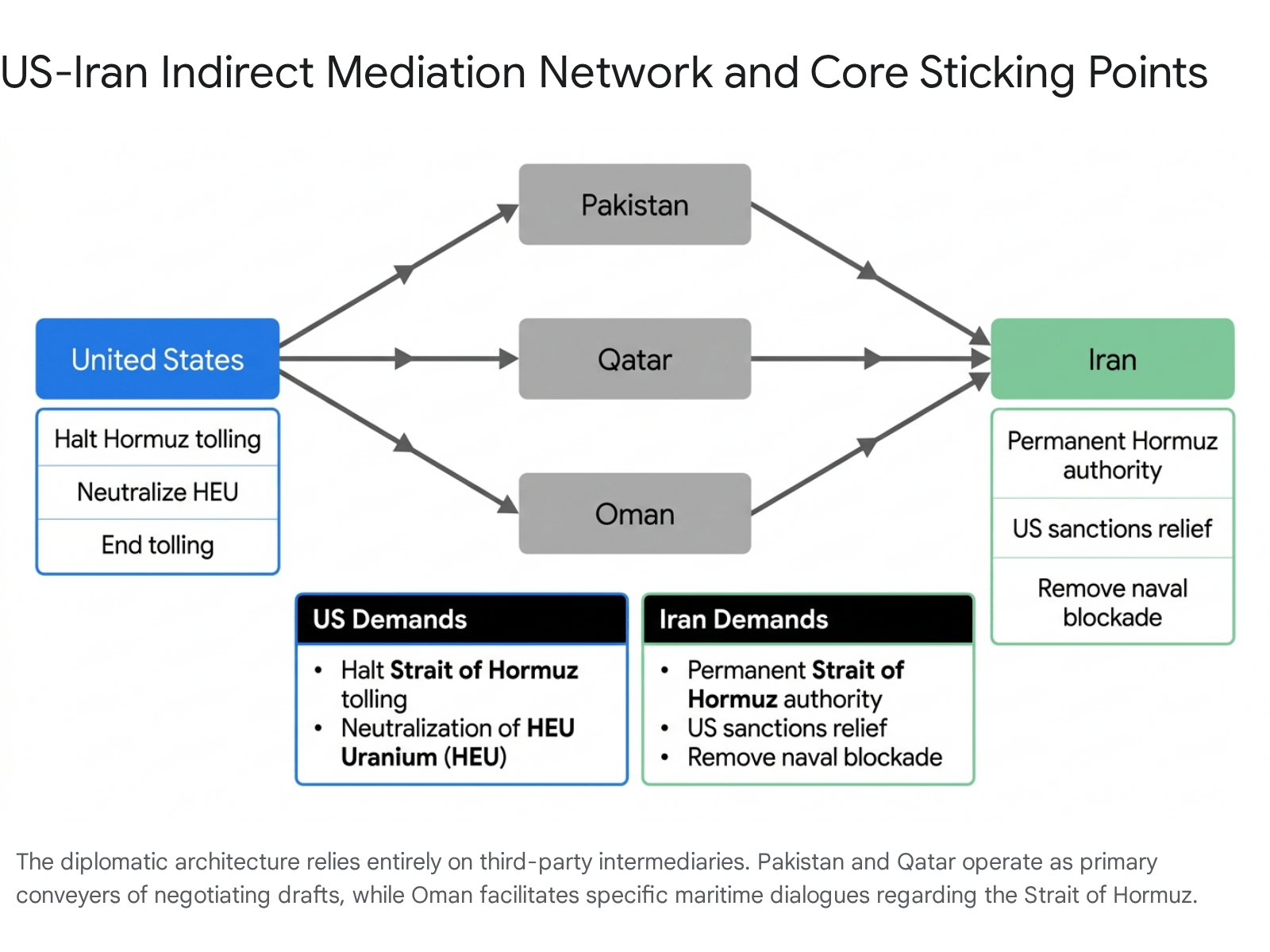
The diplomatic engagement matrix between the United States and Iran during this seven-day operational window has functioned exclusively through indirect, multi-layered intermediary channels. These interactions have been defined by extreme high-stakes brinkmanship, the rigid enforcement of maximalist demands, and the explicit threat of overwhelming kinetic escalation.
The Stalled Diplomatic Framework and Core Sticking Points Negotiations have relentlessly centered on a proposed diplomatic framework intended to convert the temporary, fragile April ceasefire into a durable, formalized conflict resolution mechanism. However, statements from key diplomatic officials on both sides indicate that the talks are progressing only at the margins, with core strategic disputes remaining completely unresolved. On May 21, United States Secretary of State Marco Rubio publicly acknowledged “a little bit of movement” within the indirect talks, yet he forcefully cautioned international observers that the negotiating parties were “not there yet”.1 Conversely, Iranian Foreign Ministry spokesperson Esmaeil Baghaei utilized state media platforms to describe the ideological and strategic differences with Washington as both deep and significant, characterizing the United States’ negotiating posture as containing “excessive demands”.2
Open-source analysis confirms two insurmountable obstacles currently blocking any comprehensive bilateral agreement:
- The Disposition of Highly Enriched Uranium (HEU): The United States maintains an absolute, non-negotiable requirement for the immediate transfer, neutralization, or verifiable destruction of Iran’s accumulated stockpiles of Highly Enriched Uranium.4 The United States’ latest proposal laid out five main conditions, prominently featuring the strict limitation of Iran to a single nuclear facility and the outright rejection of any Iranian demands for post-war reparations.4 The Iranian regime unequivocally considers its advanced nuclear infrastructure to be a sovereign deterrent and views United States demands regarding HEU as an infringement on its fundamental national security doctrine.5
- Strait of Hormuz Tolling and Maritime Sovereignty: Iran has systematically leveraged the ongoing ceasefire period to introduce and formalize a sovereign toll system for all global maritime traffic transiting the Strait of Hormuz.1 Iran is demanding that the United States lift its naval blockade, while simultaneously requiring international shipping conglomerates to enter into bilateral transit agreements with Tehran and pay exorbitant transit fees under the guise of “protection” and “maritime insurance”.1 Secretary of State Rubio explicitly declared this Iranian effort to create a tolling system as fundamentally “unacceptable,” noting that any international normalization of Iranian control over the vital waterway would render a diplomatic deal unfeasible.1
| Core Negotiating Domain | United States Maximalist Position | Iranian Maximalist Position | OSINT Assessment of Current Status |
| Nuclear Infrastructure | Total neutralization of HEU; restriction to a single monitored facility. | Retention of existing HEU stockpiles; unrestricted domestic enrichment rights. | Deadlocked. Neither side is demonstrating a willingness to concede on nuclear capabilities. |
| Maritime Security (Strait of Hormuz) | Immediate cessation of Iranian “protection” rackets; guaranteed freedom of navigation under UNCLOS. | Formalization of an Iranian tolling system; requirement for bilateral transit treaties; end of US blockade. | Deadlocked. US explicitly categorizes Iranian maritime demands as a total dealbreaker. |
| Economic Sanctions & Reparations | Strict cap on frozen asset release (maximum 25%); total rejection of Iranian war reparation demands. | Comprehensive lifting of all primary and secondary sanctions; substantial financial war reparations from the US. | Stalled. Marginal progress reported, but foundational economic disagreements persist. |
United States Military Posture Adjustments and the Aborted May 19 Offensive The extreme fragility of the diplomatic mediation track was explicitly and publicly demonstrated when United States President Donald Trump announced via his social media platform, Truth Social, on May 18 that a massive, pre-planned United States military strike against Iranian targets, scheduled for May 19, had been unilaterally suspended at the eleventh hour.8 This critical suspension was not presented as a bilateral concession to Tehran, but rather as the direct result of urgent, coordinated geopolitical intervention by prominent Gulf Arab leaders. Specifically, President Trump cited direct appeals from Qatari Emir Sheikh Tamim bin Hamad al Thani, Saudi Crown Prince Mohammed bin Salman, and Emirati President Mohamed bin Zayed, who collectively petitioned Washington to suspend the strike for “two or three days” to allow the fragile Pakistani and Qatari mediation tracks to mature.8
Intelligence sources and reporting by Axios indicate that the Gulf leaders issued a stark warning to the United States administration: they would “pay the price” if new strikes were initiated, expressing acute, existential concerns that the IRGC would immediately retaliate by utilizing asymmetric warfare tactics to systematically dismantle the Gulf’s domestic energy and oil infrastructure.8 Demonstrating the severity of the crisis, President Trump abruptly altered his personal schedule, skipping the weekend wedding of his son, Donald Trump Jr., in the Bahamas, citing the necessity to remain in Washington, D.C., due to the volatile “circumstances pertaining to Government” and the Iranian issue.3
Despite this temporary pause, the United States Department of Defense remains positioned for immediate kinetic action. President Trump explicitly noted that he had instructed United States Secretary of Defense Pete Hegseth, Chairman of the Joint Chiefs of Staff General Dan Caine, and the broader United States military apparatus to maintain readiness to launch a “full, large-scale assault” against Iranian assets on extremely short notice should the current diplomatic initiatives collapse.8
Strategic Resource Constraints and the Indo-Pacific Strategic Trade-off The immense operational and logistical requirements of maintaining a deterrent posture and executing “Operation Epic Fury” against Iran have generated severe, cascading downstream effects on the United States’ global military commitments, fundamentally altering the strategic balance in the Indo-Pacific. On May 22, Acting Secretary of the Navy Hung Cao testified before the Senate Appropriations Subcommittee on Defense, formally confirming that a massive $14 billion foreign military sales package destined for Taiwan has been indefinitely paused by the United States government.11
Secretary Cao explicitly attributed this critical decision to the absolute necessity of preserving advanced munitions stockpiles—particularly high-end interceptors and guided weapons systems—for the ongoing military campaign in the Iranian theater.12 Cao stated to lawmakers, “Right now we’re doing a pause in order to make sure we have the munitions we need for Epic Fury… the foreign military sales will continue when the administration deems necessary”.12 The ultimate resumption of the Taiwan arms transfer rests on the authorization of Secretary of Defense Pete Hegseth and Secretary of State Marco Rubio, a situation that prompted Republican Senator Mitch McConnell to express deep distress regarding the depletion of American stockpiles.13
This strategic diversion of defense industrial base outputs from the Indo-Pacific to the Middle East underscores a critical global vulnerability. The announcement arrives just weeks after the specific parameters of Taiwan’s arms purchases were heavily scrutinized during bilateral talks in Beijing between United States President Donald Trump and Chinese President Xi Jinping.12 Despite the United States Navy’s public confirmation, the Taiwanese government—represented by Premier Cho Jung-tai and presidential spokesperson Karen Kuo—reported on May 22 that Taipei had not been officially notified of any structural adjustments to the arms sale, generating significant anxiety regarding the enduring reliability of United States defense commitments in the face of Chinese aggression.13
2.2 Proxy Group Activities, Maritime Security Incidents, and Regional Military Movements
The previous seven days have provided definitive, verified evidence that the IRGC has systematically utilized the cessation of direct bilateral kinetic hostilities to aggressively restructure its regional architecture, normalize asymmetric mechanisms of control over global trade routes, and radically evolve its methodology for transnational terrorism.
The Strait of Hormuz: The Institutionalization of Maritime Extortion Iran is engaged in a systematic, highly coordinated effort to establish permanent de facto sovereignty over the Strait of Hormuz, effectively utilizing economic coercion as an instrument of national power. OSINT reports originating from May 16 through May 22 verify that the IRGC Navy has implemented a sophisticated maritime protection racket, explicitly requiring international commercial shipping vessels to obtain Iranian “permission” and “security” to transit the waterway safely.5 On May 22 alone, the IRGC publicly claimed that 35 commercial vessels successfully transited the strait only after directly coordinating with Iranian naval forces, deliberately framing this blatant extortion as a legitimate, necessary maritime insurance protocol.5
By relentlessly compelling oil-importing nations to establish bilateral transit agreements with Tehran and charging arbitrary fees to vessels operating outside these bilateral deals, the regime aims to entirely circumvent the United States naval blockade.6 This strategic normalization scheme represents a profound, unprecedented challenge to the United Nations Convention on the Law of the Sea (UNCLOS).8 In response to this creeping annexation of international waters, senior NATO officials disclosed to Bloomberg on May 19 that certain NATO member states are actively formulating contingency plans to forcefully escort commercial ships through the Strait of Hormuz beginning in early July if Iran refuses to abandon its blockade and tolling demands.16
The Evolution of the IRGC Proxy Model: Kataib Hezbollah and Transnational Crime A major paradigm shift in global intelligence emerged on May 16 with the unsealing of a comprehensive United States federal indictment against Mohammad Baqer Saad Dawood al-Saadi, a 32-year-old Iraqi national and a senior operations commander for the Iran-backed militia Kataib Hezbollah (KH).9 Arrested in a highly classified joint operation between the United States Federal Bureau of Investigation (FBI) and Turkish intelligence services, al-Saadi was formally charged with orchestrating and financing a minimum of 18 separate terror plots across the United States, Canada, and Europe.9
The extensive details contained within the indictment reveal a systemic, highly calculated shift in Iranian proxy methodology. With traditional regional proxies—such as Lebanese Hezbollah and Hamas—severely degraded by sustained Israeli and United States kinetic operations, the IRGC Quds Force and Kataib Hezbollah have pivoted toward outsourcing operations to global criminal syndicates.9 Utilizing encrypted communications platforms including Telegram and Snapchat, alongside untraceable cryptocurrency financing, Iranian operatives have contracted local gangs, drug cartels, and lone wolves to execute bombings, stabbings, and arson attacks.9
Specific verified plots coordinated by al-Saadi include attacks against the Bank of New York Mellon and a Jewish school in Amsterdam; stabbings and bombings against an American citizen and Jewish individuals in London; an attack against the United States Consulate in Toronto; and planned synchronized attacks utilizing a Mexican cartel contact (who was an undercover FBI informant) targeting a Bank of America facility in France, a synagogue in New York City, and Jewish community centers in Los Angeles and Scottsdale, Arizona.9 Furthermore, the IRGC established a newly recognized front organization, Harakat Ashab al-Yamin al-Islamia (HAYI), in March 2026 to officially claim responsibility for these European plots, thereby maintaining plausible deniability and shielding Tehran from direct diplomatic repercussions.9 This deliberate blurring of organizational lines closely mirrors hybrid warfare tactics and signifies that Kataib Hezbollah has expanded its operational scope far beyond its traditional goal of expelling United States forces from Iraq.9
| Target Location | Intended Target / Asset | Operational Methodology | Front Group / Proxy Deniability Mechanism |
| London, UK | American citizens; Jewish individuals. | Stabbings, shootings, bombings. | Contracted local criminal syndicates via Telegram; claimed by HAYI. |
| Amsterdam, Netherlands | Bank of New York Mellon; Jewish educational facility. | Arson and kinetic attacks. | Financed via cryptocurrency; claimed by HAYI front. |
| Toronto, Canada | United States Consulate. | Kinetic attack. | Outsourced to local criminal elements. |
| Los Angeles, CA / Scottsdale, AZ / New York City, NY | Jewish religious and community centers. | Synchronized kinetic attacks. | Attempted coordination via Mexican cartel networks (intercepted by FBI). |
Maritime Incidents and Regional Escalation: The Barakah Nuclear Plant Drone Attack On May 17, regional security was severely compromised and international non-proliferation norms were threatened when three unmanned aerial vehicles (UAVs) targeted the Barakah Nuclear Power Plant located in the Al Dhafra Region of Abu Dhabi, United Arab Emirates.4 While Emirati air defense arrays successfully intercepted two of the incoming drones, the third UAV breached the perimeter and struck an electrical generator located just outside the facility’s inner core, resulting in a localized fire.4 The International Atomic Energy Agency (IAEA) Director General Rafael Mariano Grossi expressed “grave concern” over the incident, though the UAE’s Federal Authority for Nuclear Regulation (FANR) confirmed that emergency diesel generators maintained power to Unit 3 and that radiological safety levels remained completely normal, with no casualties reported.4
Tactical analysis of the flight paths indicates that the drones approached the nuclear facility from the western border, an attack vector highly consistent with launches originating from Iraqi territory by Iran-backed Shiite militias, specifically elements of the PMF.4 This specific routing was deliberately designed to obscure the origin of the strike, bypass the UAE’s eastern-oriented air defense arrays (which face Iran), and complicate attribution.4 Following the strike, IRGC-affiliated media organizations immediately launched a disinformation operation attempting to blame Saudi Arabia for the attack—noting that the Kingdom lies to the west of the UAE—highlighting a continuous Iranian strategy to fracture the geopolitical alignment between the UAE, Saudi Arabia, and the United States.4 The Armed Forces General Staff-affiliated Defa Press Agency bizarrely claimed the United States and Israel launched the attacks themselves to frame Tehran.4 The United Nations Secretary-General António Guterres unequivocally condemned the attack, stating that military activity threatening civilian nuclear installations is totally unacceptable and a blatant violation of international law.22
The Lebanese Front and the Collapse of the Localized Ceasefire While the primary United States-Iran military theater is currently governed by the April ceasefire, the secondary theater encompassing the Israel-Lebanon border remains highly volatile and immune to broader diplomatic pauses. Despite a formal 45-day extension of the localized Israel-Lebanon truce agreed upon on May 15, intense, deadly kinetic activity has persisted almost daily.24 On May 19, the Lebanese Health Ministry reported that sweeping Israeli airstrikes across southern Lebanon killed at least 19 individuals, including women and children, demonstrating Israel’s absolute intent to continue systematically degrading Hezbollah infrastructure irrespective of regional truce frameworks.25 A single strike on the village of Deir Qanoun En-Nahr in the coastal Tyre province resulted in 10 fatalities, with additional deadly strikes targeting Nabatieh and Kfar Sir.25
The violence continued to escalate through the end of the reporting period. On May 22 and 23, the Lebanese health ministry reported 10 additional fatalities, including the targeted killing of six paramedics affiliated with the Islamic Health Association in the town of Hanaway and Deir Qanoun En-Nahr.3 Israel maintained that it was strictly targeting Hezbollah infrastructure and militants, issuing advance evacuation warnings for areas surrounding Tyre and Burj Rahal.27 Since the latest iteration of the conflict began on March 2, the death toll in Lebanon has now surpassed 3,000.25
Concurrently, on May 16, the United States Department of the Treasury deployed economic warfare tactics, imposing sweeping sanctions on Mohammad Reza Sheibani, Iran’s ambassador-designate to Lebanon.28 Sheibani had previously been declared persona non grata by the Lebanese government for severe violations of diplomatic norms and supporting Hezbollah military operations.11 Alongside Sheibani, the Treasury sanctioned eight Hezbollah-aligned Lebanese political and security officials, accusing them of actively sharing intelligence and obstructing the disarmament of Hezbollah.29
| Sanctioned Individual | Role / Affiliation | Justification for May 16 US Treasury Designation |
| Mohammad Reza Sheibani | Iranian Ambassador-designate to Lebanon | Utilizing diplomatic cover to facilitate IRGC support for Hezbollah operations; violating host-nation norms. |
| Mohamed Abdel-Mottaleb Fanich | Hezbollah Executive Council Leader | Preserving Hezbollah’s influence over Lebanese state institutions; impeding disarmament. |
| Nizammeddine Fadlallah | Hezbollah Member of Parliament | Utilizing legislative authority to block peace processes and protect proxy militant structures. |
| Ibrahim al-Moussawi | Longtime Hezbollah Official | Facilitating the political entrenchment of armed proxy networks within the Lebanese state. |
| Hussein Al-Hajj Hassan | Longtime Hezbollah Official | Facilitating the political entrenchment of armed proxy networks within the Lebanese state. |
| Ahmad Asaad Baalbaki | Amal Movement Security Official | Direct coordination with Hezbollah security apparatus; undermining Lebanese Armed Forces monopoly on force. |
| Ali Ahmad Safawi | Amal Movement Security Official | Direct coordination with Hezbollah security apparatus; undermining Lebanese Armed Forces monopoly on force. |
| Samir Hamadi | Branch Chief, Lebanese Armed Forces | Illegally sharing highly sensitive military intelligence with Hezbollah over the past year. |
| Khattar Nasser Eldin | Official, General Directorate for General Security | Illegally sharing highly sensitive internal security intelligence with Hezbollah. |
2.3 The Role, Reactions, and Involvement of Third-Party Countries and Actors
The 2026 Iran War and its current diplomatic phase have become heavily internationalized. The conflict’s trajectory relies entirely on the intervention, mediation, and technological assistance of third-party nation-states, whose domestic economies and security architectures are intrinsically tied to the outcome of the US-Iran standoff.
The Islamic Republic of Pakistan: The Primary Diplomatic Conduit Islamabad has decisively assumed the role of the foremost, indispensable mediator in the conflict, driven by existential domestic concerns regarding the catastrophic destabilization of its western border and the severe regional economic fallout.34 Over the past week, Pakistan initiated a highly compressed, high-stakes “final push” to secure a 30-day extension to the ceasefire, aiming to prevent a total collapse of the April truce framework.34
Pakistani Interior Minister Syed Mohsin Naqvi conducted an unannounced, continuous three-day diplomatic marathon in Tehran starting on May 20, holding extensive meetings with Iranian President Masoud Pezeshkian, Foreign Minister Abbas Araghchi, and the newly appointed Iranian negotiating spokesperson Esmaeil Baqaei.34 The severity of the diplomatic crisis necessitated the deployment of Pakistan’s highest military authority; Army Chief Field Marshal Syed Asim Munir departed Islamabad and arrived in Tehran late on May 22.3 Intelligence reports suggest Munir’s singular objective is to leverage Pakistan’s strategic military relationship with Iran to enforce a temporary halt to hostilities, though Iranian officials publicly tempered expectations, stating his high-profile arrival did not guarantee an imminent breakthrough.3
The Gulf Cooperation Council (UAE, Saudi Arabia, Qatar, Oman) The Gulf Arab states are currently operating under acute, severe economic and security duress. The prospect of renewed United States strikes on Iran carries the immediate, proven threat of asymmetric Iranian retaliation against undefended Gulf energy infrastructure, a fear concretely realized by the Barakah nuclear plant strike.4
- Saudi Arabia: The Kingdom’s Ministry of Finance reported a staggering first-quarter budget deficit of 125.7 billion Saudi riyals (approximately $33.5 billion)—its largest quarterly shortfall in nearly eight years.39 This massive deficit is a direct result of the economic shockwaves, maritime disruptions, and necessary oil production cuts caused by the war.39 With public-sector compensation consuming nearly 41.8% of government spending, the Saudi state is economically stretched.39 Consequently, Riyadh has aggressively lobbied President Trump to delay military action and is reportedly exploring the unprecedented step of pursuing a non-aggression pact with Tehran to safeguard its Vision 2030 economic initiatives.8
- Qatar: Doha dispatched an official diplomatic negotiating team to Tehran on May 22 to operate in parallel with the Pakistani delegation.1 Qatar’s involvement reflects its unique, vital position as both the host to the largest United States military base in the Middle East (Al Udeid) and a highly trusted financial and diplomatic intermediary for the Iranian regime.1
- Oman: Muscat continues to facilitate specialized, highly sensitive maritime dialogues. On May 23, Omani Foreign Minister Sayyid Badr Albusaidi held direct telephone consultations with Iranian Foreign Minister Araghchi, specifically focusing on ensuring “safe transit” through the Strait of Hormuz.41 This interaction strongly indicates Oman’s potential role as a future guarantor or financial clearinghouse for the proposed, highly controversial maritime transit toll system that Iran is attempting to establish.45
The People’s Republic of China (PRC) and the Russian Federation: Defense Reconstitution While the United States is forced to pause critical arms sales to Taiwan to preserve its own depleted stockpiles, highly classified OSINT and US intelligence reports leaked on May 21 indicate that Iran is rebuilding its domestic military capabilities at an alarmingly accelerated rate, significantly surpassing all timelines previously established by the United States intelligence community.47 Analysts project that Iran could fully restore its pre-war defense industrial capacity, including its advanced UAV and missile production lines, within a mere six months.47
This rapid, robust reconstitution is directly attributed to vast logistical, financial, and technological assistance provided by China and Russia.6 United States Defense Intelligence Agency (DIA) assessments allege that Beijing is actively supplying the Islamic Republic with critical missile components, dual-use technologies, advanced navigation systems, and potentially X-band radar systems, fundamentally enhancing Iran’s electronic warfare capabilities.6 Although the Chinese Foreign Ministry explicitly and categorically denied these reports, framing them as “not based on facts,” Beijing’s strategic enablement of Tehran is highly logical within the context of great power competition.47 By ensuring Iran remains a highly capable, heavily armed adversary, China effectively ties down immense United States military assets in the Middle East theater, yielding a direct, massive strategic dividend for Beijing in the Indo-Pacific—as explicitly proven by the paused $14 billion Taiwan arms package.12
The Republic of Iraq: Internal Political Balancing and State Weakness Iraq remains the geographic and political epicenter for Iranian proxy logistics and transnational operational planning. The newly confirmed Iraqi Prime Minister, billionaire businessman Ali al-Zaidi—who officially assumed office on May 14 following six months of severe electoral gridlock—faces virtually insurmountable pressure from competing regional hegemons.50 The United States is heavily leveraging the recent Kataib Hezbollah indictments to demand that Baghdad unconditionally disarm Iranian-backed Shiite militias operating within the state-sponsored Popular Mobilization Forces (PMF).9
Conversely, Tehran strictly requires these militias to remain institutionalized within the Iraqi state apparatus to maintain its strategic depth and asymmetric deterrence.50 The immense pressure from Iran was underscored by recent, repeated visits to Baghdad by IRGC Quds Force Commander Esmail Qaani.50 Highlighting the extreme fragility of the new government, Prime Minister al-Zaidi’s cabinet was sworn in with critical “sovereign” ministries—specifically the Ministries of Defense and Interior—remaining entirely vacant due to sectarian infighting and demands from parties affiliated with US-designated terror groups like Asaib Ahl al Haq.52 The launch of the Barakah nuclear plant drones from Iraqi territory on May 17 further highlights Baghdad’s total inability to secure its own sovereign airspace or constrain transnational proxy operations originating from within its borders.4
3. Chronological Timeline of Key Events
The following timeline details the verified operational, diplomatic, and military events strictly encompassing the last seven days, ordered chronologically.
- May 16, 2026:
- The United States Department of Justice unseals a federal criminal complaint against Mohammad Baqer Saad Dawood al-Saadi, a senior Kataib Hezbollah commander. The indictment reveals coordinated efforts with global criminal syndicates to execute 18 terror attacks across North America and Europe, utilizing cryptocurrency and cartel networks.9
- The United States Department of the Treasury officially sanctions Mohammad Reza Sheibani, Iran’s ambassador-designate to Lebanon, alongside eight Hezbollah-aligned Lebanese security officials, citing their active, systematic efforts to impede the disarmament of Hezbollah and undermine state sovereignty.28
- May 17, 2026:
- Three unmanned aerial vehicles (UAVs) enter the airspace of the United Arab Emirates from the western border, originating from Iraq. While Emirati air defenses intercept two, one drone successfully strikes an electrical generator located outside the inner perimeter of the Barakah Nuclear Power Plant in Abu Dhabi, igniting a fire. The IAEA confirms radiation levels remain unaffected.4
- The Iraqi federal government officially confirms Ali al-Zaidi has assumed the office of Prime Minister, though critical sovereign positions such as the Ministers of Defense and Interior remain vacant due to intense sectarian gridlock and militia influence.51
- May 18, 2026:
- United States President Donald Trump announces via Truth Social that he has unilaterally suspended a massive, pre-planned military strike against Iran, which was scheduled for execution on May 19. He cites direct, urgent appeals from the leaders of Qatar, Saudi Arabia, and the UAE, who requested a pause to protect their domestic energy infrastructure from Iranian retaliation.8
- Israeli Prime Minister Benjamin Netanyahu publicly addresses the evolving regional drone threat during a cabinet meeting, declaring that Israel possesses “no budget constraint” in developing advanced counter-UAS defensive technologies.54
- May 19, 2026:
- Despite the 45-day extension of the local ceasefire established on May 15, the Israeli military conducts extensive, deadly airstrikes across southern Lebanon. The Lebanese Health Ministry reports at least 19 fatalities, including women and children, marking a severe escalation in the secondary theater and pushing the total death toll past 3,000.24
- May 20, 2026:
- Pakistani Interior Minister Syed Mohsin Naqvi arrives in Tehran for an unannounced diplomatic visit. Over three continuous days, he conducts an intensive diplomatic marathon, holding meetings with Iranian President Masoud Pezeshkian and the Iranian diplomatic core to deliver proposals aimed at bridging the deep US-Iran divide.34
- May 21, 2026:
- United States intelligence assessments are leaked to global media, revealing that Iran is reconstituting its military capabilities—including advanced drone and missile production lines—in a matter of “months, not years.” The assessments directly implicate China and Russia in supplying essential components, a claim Beijing denies.6
- United States Secretary of State Marco Rubio publicly states there has been “a little bit of movement” in the indirect talks with Iran, but explicitly and forcefully rejects Iran’s proposal to establish a permanent, sovereign tolling system in the Strait of Hormuz, categorizing the demand as totally unacceptable.1
- May 22, 2026:
- United States Acting Secretary of the Navy Hung Cao formally testifies before the Senate Appropriations Subcommittee on Defense that the US military has indefinitely paused a $14 billion arms sale to Taiwan. Cao states the unprecedented pause is required to conserve critical munitions stockpiles for “Operation Epic Fury” against Iran.12
- Pakistan’s Army Chief, Field Marshal Syed Asim Munir, arrives in Tehran to conduct high-level military-to-military diplomacy to secure a 30-day truce extension. Concurrently, an official Qatari negotiating delegation arrives in the Iranian capital to support the fragile mediation efforts.1
- May 23, 2026:
- Iranian Foreign Minister Abbas Araghchi holds direct, early-morning telephone consultations with Omani Foreign Minister Sayyid Badr Albusaidi. Official statements indicate the focus of the dialogue was ensuring “safe transit” through the Strait of Hormuz, heavily reinforcing Iran’s diplomatic push for maritime normalization and tolling.41
- Israeli airstrikes continue relentlessly in southern Lebanon, resulting in 10 additional fatalities, including the targeted killing of six paramedics affiliated with the Islamic Health Association. The strikes place immense, near-fatal strain on the localized US-brokered truce framework.3
Please share the link on Facebook, Forums, with colleagues, etc. Your support is much appreciated and if you have any feedback, please email us in**@*********ps.com. If you’d like to request a report or order a reprint, please click here for the corresponding page to open in new tab.
Sources Used
- Live Updates: U.S. preparing for possible strikes against Iran, sources say, as Rubio says tolls on Strait of Hormuz “not acceptable”, accessed May 23, 2026, https://www.cbsnews.com/live-updates/iran-war-trump-us-peace-talks-strait-of-hormuz-control/
- We’re not there yet: Rubio says more work needed as Iran cites deep differences, accessed May 23, 2026, https://www.indiatoday.in/world/story/were-not-there-yet-rubio-says-more-work-needed-as-iran-flags-deep-differences-2915788-2026-05-23
- Pakistan Army Chief in talks with Iran’s Foreign Minister | LIVE, accessed May 23, 2026, https://www.thehindu.com/news/international/iran-israel-war-west-asia-conflict-donald-trump-us-iran-peace-talks-live-updates-may-23-2026/article71013439.ece
- Iran Update Special Report, May 17, 2026 | ISW, accessed May 23, 2026, https://understandingwar.org/research/middle-east/iran-update-special-report-may-17-2026/
- Iran Update Special Report, May 22, 2026, accessed May 23, 2026, https://understandingwar.org/research/middle-east/iran-update-special-report-may-22-2026/
- Iran Update Special Report, May 21, 2026, accessed May 23, 2026, https://understandingwar.org/research/middle-east/iran-update-special-report-may-21-2026/
- Iran Update Special Report, May 16, 2026 | ISW, accessed May 23, 2026, https://understandingwar.org/research/middle-east/iran-update-special-report-may-16-2026/
- Iran Update Special Report, May 18, 2026 | ISW, accessed May 23, 2026, https://understandingwar.org/research/middle-east/iran-update-special-report-may-18-2026/
- U.S. Arrest of Kataib Hezbollah Leader Signals a Shift in Iranian …, accessed May 23, 2026, https://thesoufancenter.org/intelbrief-2026-may-19/
- Qatari team in Tehran for talks; Trump says skipping son’s wedding to stay in capital, accessed May 23, 2026, https://www.timesofisrael.com/qatari-negotiating-team-in-tehran-to-try-to-help-secure-us-iran-deal-to-end-war/
- Iran says it’s mulling latest U.S. peace proposal and Trump says he’ll wait “a couple of days”, accessed May 23, 2026, https://www.cbsnews.com/live-updates/iran-war-trump-us-latest-peace-proposal/
- US pauses $14bn Taiwan arms sale amid Iran war, navy says, accessed May 23, 2026, https://www.middleeasteye.net/live-blog/live-blog-update/us-pauses-14bn-taiwan-arms-sale-amid-iran-war-navy-says
- US pausing $14bn arms sale to Taiwan due to Iran war, navy chief says, accessed May 23, 2026, https://www.aljazeera.com/news/2026/5/22/us-pausing-14bn-arms-sale-to-taiwan-due-to-iran-war-navy-chief-says
- US arms sales to Taiwan on ‘pause’ due to Iran war, says acting …, accessed May 23, 2026, https://www.theguardian.com/world/2026/may/22/us-arms-sales-taiwan-pause-iran-war-says-acting-navy-chief
- Iran Update Special Report, May 20, 2026 | ISW, accessed May 23, 2026, https://understandingwar.org/research/middle-east/iran-update-special-report-may-20-2026/
- Iran Update Special Report, May 19, 2026 | ISW, accessed May 23, 2026, https://understandingwar.org/research/middle-east/iran-update-special-report-may-19-2026/
- US charges alleged Iran-backed Kataib Hezbollah suspect – What we know – Al Jazeera, accessed May 23, 2026, https://www.aljazeera.com/news/2026/5/16/us-charges-alleged-iran-backed-%E2%81%A0kataib-hezbollah-suspect-what-we-know
- UANI Applauds Justice Department Indictment of Iranian Regime-backed Kataib Hezbollah Commander, accessed May 23, 2026, https://www.unitedagainstnucleariran.com/press-releases/uani-applauds-justice-department-indictment-of-iranian-regime-backed-kataib
- IAEA concern after drone strike close to Barakah nuclear power plant, accessed May 23, 2026, https://www.world-nuclear-news.org/articles/iaea-concern-after-drone-strike-close-to-barakah-nuclear-power-plant
- UAE says drone strike caused fire at nuclear plant, accessed May 23, 2026, https://www.ft.com/content/c4b786a6-55d4-4689-b19e-48a48f7946e6?syn-25a6b1a6=1
- Drone strike causes fire at UAE’s Barakah nuclear power plant in Abu Dhabi, accessed May 23, 2026, https://www.hindustantimes.com/world-news/drone-strike-causes-fire-at-uae-barakah-nuclear-power-plant-in-abu-dhabi-us-iran-war-101779013182458.html
- Secretary-General Deeply Alarmed by Reported Drone Strike at Barakah Nuclear Power Plant, United Arab Emirates, accessed May 23, 2026, https://press.un.org/en/2026/sgsm23135.doc.htm
- The UAE says drones that targeted its Barakah nuclear power plant came from Iraqi territory, accessed May 23, 2026, https://apnews.com/article/iran-us-uae-nuclear-drones-uae-gulf-46f5023dc480c3fbe8061c2ed6a94a5c
- 2026 Lebanon war – Wikipedia, accessed May 23, 2026, https://en.wikipedia.org/wiki/2026_Lebanon_war
- Israeli strikes on Lebanon kill at least 19 as clashes with Hezbollah continue despite ceasefire, accessed May 23, 2026, https://www.theguardian.com/world/2026/may/20/deadly-israeli-strikes-lebanon
- 2026 Israel–Lebanon ceasefire – Wikipedia, accessed May 23, 2026, https://en.wikipedia.org/wiki/2026_Israel%E2%80%93Lebanon_ceasefire
- Israeli strikes in Lebanon killed 10, including six paramedics, health ministry says, accessed May 23, 2026, https://www.theguardian.com/world/2026/may/23/israel-lebanon-strikes-deaths-paramedics-health-ministry-says
- Iran condemns U.S. sanctions on envoy to Lebanon, accessed May 23, 2026, https://english.news.cn/20260522/46c210b5fbeb4726a42c3b01d2302407/c.html
- Iran Condemns US Sanctions on Envoy to Beirut, Lebanese Officials – Politics news, accessed May 23, 2026, https://www.tasnimnews.ir/en/news/2026/05/22/3597314/iran-condemns-us-sanctions-on-envoy-to-beirut-lebanese-officials
- US sanctions Iran envoy, Lebanon officials over Hezbollah ties, accessed May 23, 2026, https://www.iranintl.com/en/202605213463
- Treasury Targets Hizballah-Aligned Officials Obstructing Peace and Disarmament, accessed May 23, 2026, https://home.treasury.gov/news/press-releases/sb0505
- US sanctions Lebanese lawmakers, security officials over Hezbollah influence, accessed May 23, 2026, https://www.wsls.com/news/world/2026/05/21/us-sanctions-lebanese-lawmakers-security-officials-over-hezbollah-influence/
- Iran condemns US sanctions on Iranian ambassador and other officials for “undermining Lebanon’s sovereignty”, accessed May 23, 2026, https://www.aninews.in/news/world/middle-east/iran-condemns-us-sanctions-on-iranian-ambassador-and-other-officials-for-undermining-lebanons-sovereignty20260522102104
- Hope for US-Iran deal faces hardliner hostility in Tehran, accessed May 23, 2026, https://www.iranintl.com/en/202605224148
- Pakistan continues quiet push to stop another Iran war, accessed May 23, 2026, https://www.iranintl.com/en/202605229015
- Pak Army Chief leaves for Tehran as peace process picks up pace, accessed May 23, 2026, https://www.aninews.in/news/world/asia/pak-army-chief-leaves-for-tehran-as-peace-process-picks-up-pace20260522193048
- Pakistan military chief Asim Munir arrives in Tehran in push to end Iran war, accessed May 23, 2026, https://www.thehindu.com/news/international/pakistan-military-chief-asim-munir-arrives-in-tehran-in-push-to-end-iran-war/article71012397.ece
- Iran-Israel war highlights: Pakistan Army Chief Munir reaches Tehran to expedite efforts to end war, accessed May 23, 2026, https://www.thehindu.com/news/international/iran-israel-war-west-asia-conflict-donald-trump-us-iran-peace-talks-live-updates-may-22-2026/article71009008.ece
- Saudi Arabia’s Strategic Dilemma in the Iran War, accessed May 23, 2026, https://arabcenterdc.org/resource/saudi-arabias-strategic-dilemma-in-the-iran-war/
- Iran Update Special Report, May 15, 2026, accessed May 23, 2026, https://understandingwar.org/research/middle-east/iran-update-special-report-may-15-2026/
- Iran’s Araghchi discusses efforts to end war with Oman’s Foreign Minister Albusaidi – Dawn, accessed May 23, 2026, https://www.dawn.com/news/2002491/irans-araghchi-discusses-efforts-to-end-war-with-omans-foreign-minister-albusaidi
- Iranian and Omani Foreign Ministers Hold Phone Consultation on Regional Tensions, accessed May 23, 2026, https://wanaen.com/iranian-and-omani-foreign-ministers-hold-phone-consultation-on-regional-tensions/
- Iran, Oman FMs discuss diplomatic push to end war – Mehr News Agency, accessed May 23, 2026, https://en.mehrnews.com/news/244715/Iran-Oman-FMs-discuss-diplomatic-push-to-end-war
- Iranian FM Araghchi, Omani FM Albusaidi discuss diplomatic efforts to ‘prevent escalation of tension’, accessed May 23, 2026, https://www.aninews.in/news/world/middle-east/iranian-fm-araghchi-omani-fm-albusaidi-discuss-diplomatic-efforts-to-prevent-escalation-of-tension20260523145505
- Iran’s foreign minister says Oman talks focused on safe transit in Strait of Hormuz, accessed May 23, 2026, https://www.aa.com.tr/en/middle-east/iran-s-foreign-minister-says-oman-talks-focused-on-safe-transit-in-strait-of-hormuz/3918900
- Iranian Omani FMs hold phone call on regional developments diplomatic efforts to prevent escalation, accessed May 23, 2026, https://en.mfa.ir/portal/newsview/788353
- Iran said recovering military abilities faster than expected, producing …, accessed May 23, 2026, https://www.timesofisrael.com/iran-said-recovering-military-abilities-faster-than-expected-producing-drones-again/
- Iran has restarted drone production, is moving to restore full capabilities faster than expected — CNN report, accessed May 23, 2026, https://www.timesofisrael.com/liveblog_entry/iran-has-restarted-drone-production-is-moving-to-restore-full-capabilities-faster-than-expected-cnn-report/
- China in the 2026 Iran war – Wikipedia, accessed May 23, 2026, https://en.wikipedia.org/wiki/China_in_the_2026_Iran_war
- Iraq’s new prime minister faces ‘mission impossible’ over Iran, accessed May 23, 2026, https://responsiblestatecraft.org/iraq-new-prime-minister/
- Iraq’s new PM Ali al-Zaidi formally takes over, accessed May 23, 2026, https://www.aljazeera.com/video/newsfeed/2026/5/17/aje-onl-nf_clip-iraqs-new-pm-al-zaidi-formally-takes-over-160526
- Ali al-Zaidi – Wikipedia, accessed May 23, 2026, https://en.wikipedia.org/wiki/Ali_al-Zaidi
- Iraq forms new government with only 14 of 23 ministers, accessed May 23, 2026, https://www.longwarjournal.org/archives/2026/05/iraq-forms-new-government-with-only-14-of-23-ministers.php
- Why Hezbollah’s Use of FPV Drones Against Israel Will Backfire, accessed May 23, 2026, https://www.fdd.org/analysis/2026/05/18/why-hezbollahs-use-of-fpv-drones-against-israel-will-backfire/
- Iran’s ability to rebuild damaged military infrastructure set back by months, not years – report, accessed May 23, 2026, https://www.jpost.com/middle-east/iran-news/article-896951