
1. Assessment of Effectiveness (Current State)
As of February 28, 2026, the geopolitical and security environment in the Middle East has entered a period of unprecedented volatility following the commencement of coordinated preemptive military strikes by the United States and Israel against the Islamic Republic of Iran. The joint offensive-designated “Operation Epic Fury” by the United States Department of Defense and “Operation Lion’s Roar” by the Israel Defense Forces (IDF)-marks a paradigm shift from coercive diplomacy to direct, high-intensity kinetic confrontation.1 This section evaluates the current state of military effectiveness regarding both the allied strikes and the immediate Iranian kinetic and non-kinetic responses, situated within the broader strategic context of the collapsed diplomatic negotiations.
1.1 Strategic Context and the Genesis of the Allied Offensive
The immediate catalyst for the allied military campaign was the expiration of a ten-to-fifteen-day ultimatum issued by United States President Donald Trump, which explicitly demanded the total and verifiable dismantlement of Iran’s uranium enrichment capabilities.3 Prior to the initiation of hostilities, diplomatic efforts mediated by Omani Foreign Minister Badr Albusaidi in Geneva, Switzerland, attempted to secure a framework agreement to avert a regional conflagration.4 The United States negotiating delegation, led by Special Envoy Steve Witkoff and Jared Kushner, presented maximalist demands: the total cessation of uranium enrichment, the dismantling of fortified nuclear facilities at Fordow, Natanz, and Isfahan, the transfer of all enriched uranium to United States custody, and a permanent agreement lacking sunset clauses.6
Iranian negotiators, led by Foreign Minister Abbas Araghchi, counter-proposed a framework that would cap enrichment at 1.5 percent for civil research or potentially up to 20 percent for the Tehran Research Reactor, while demanding immediate and comprehensive relief from United States and United Nations sanctions.5 The Iranian delegation fundamentally refused to dismantle physical nuclear infrastructure or export existing fissile material.6 The operational objective of the subsequent military strikes, as stated by the United States administration, is the elimination of imminent threats, the destruction of Iran’s ballistic missile infrastructure, the neutralization of its naval capabilities, and the prevention of nuclear weaponization, ultimately aiming at regime decapitation.1
1.2 The Kinetic Landscape: Allied Preemptive Strikes
To execute Operation Epic Fury, the United States executed a massive regional force posture realignment. In the weeks preceding the strike, the Pentagon deployed the USS Gerald R. Ford and USS Abraham Lincoln carrier strike groups to the region, introducing over 150 tactical aircraft and hundreds of sea-launched cruise missiles into the theater.3 This naval armada was augmented by a substantial airlift operation, including more than ten C-17 Globemaster III flights from the United Kingdom to Jordan, and heavy transport movements to the strategic bomber base at Diego Garcia in the Indian Ocean.12 Furthermore, the United States deployed twelve F-22 Raptor stealth air-superiority fighters to Israeli air bases, representing a historic shift in forward-positioning offensive American assets directly on Israeli soil.8
The tactical execution of the allied strikes demonstrated deep penetration into highly defended Iranian airspace during daylight hours-a timing selected specifically to maximize tactical surprise.11 Targets included the residential and administrative complexes of Supreme Leader Ayatollah Ali Khamenei and President Masoud Pezeshkian in central Tehran, as well as critical military and infrastructure nodes in Isfahan, Qom, Karaj, Kermanshah, Tabriz, and the southern port city of Bushehr.1
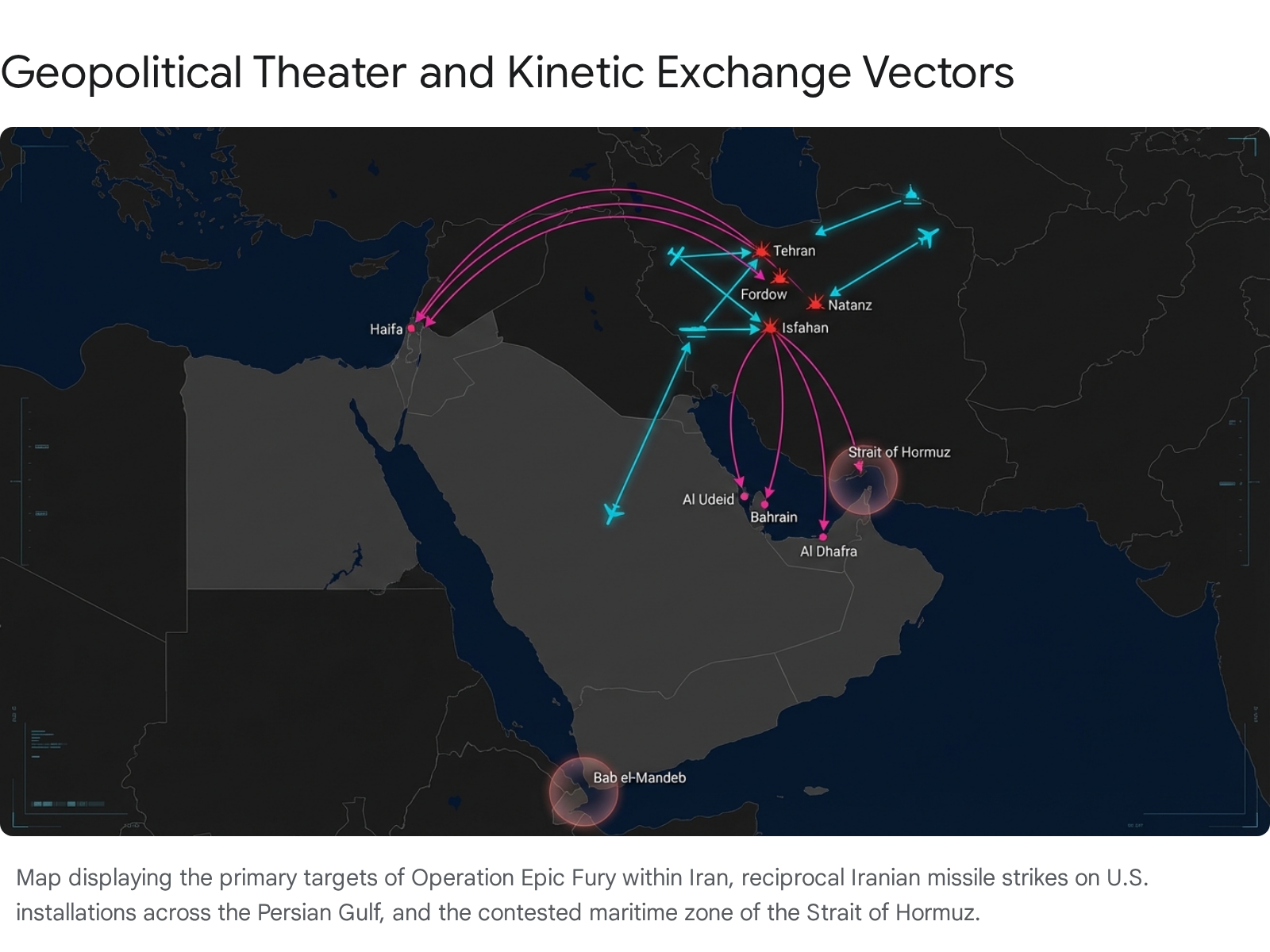
The munitions utilized in the assault indicate a focus on hardened, deeply buried targets. The United States Air Force deployed B-2 Spirit stealth bombers to deliver thirty-thousand-pound GBU-57A/B Massive Ordnance Penetrators (MOPs), which are specialized bunker-buster munitions capable of penetrating subterranean rock formations, specifically targeting the Fordow Uranium Enrichment Plant and the Natanz Nuclear Facility.14 Concurrent naval operations utilized submarine-launched Tomahawk cruise missiles.14 Additionally, the Israel Defense Forces utilized air-launched ballistic missiles to degrade Iranian air defenses and command-and-control centers, preparing the battlespace for manned aircraft operations.2
1.3 Evaluation of Allied Strike Effectiveness
It is assessed with High Confidence that Iran’s Integrated Air Defense System (IADS) failed to repel the allied assault, exposing critical vulnerabilities in the Islamic Republic’s airspace denial capabilities. Iran’s defensive posture had already been severely compromised prior to this operation. During the preceding Israel-Iran War of June 2025, Iran’s domestically produced Bavar-373 ground-based air defense systems systematically failed to intercept United States and Israeli targets.16 Furthermore, targeted Israeli operations in April and October of 2024 successfully destroyed Iran’s advanced Russian-supplied S-300 batteries.16
To compensate for these strategic deficits, the Islamic Revolutionary Guard Corps attempted to implement temporary and extremely suboptimal solutions.16 Intelligence indicates that Iran attached loaded Russian Verba Man-Portable Air-Defense Systems (MANPADS)-which possess a maximum engagement altitude of only 4,500 meters-along with cameras and radios onto domestically produced Shahed drones.16 While this improvisation theoretically increases the altitude at which infrared homing missiles can engage targets, it proved entirely ineffective against high-altitude, low-observable stealth platforms and supersonic cruise missiles utilized in Operation Epic Fury.16 Consequently, allied forces achieved total air superiority, allowing them to prosecute targets at will.17 Open-source intelligence is inconclusive on the precise number of Iranian military casualties, though Iranian state media and regional reporting suggest significant losses within the Islamic Revolutionary Guard Corps, including several senior commanders.1
1.4 Iranian Kinetic Responses: “True Promise 4”
In immediate retaliation to the decapitation strikes, the Islamic Revolutionary Guard Corps launched an operation designated “True Promise 4,” described as a first wave of extensive ballistic missile and drone swarm attacks targeting both Israel and United States assets throughout the Middle East.19 Unlike previous regional escalations where Iran demonstrated calculated restraint to avoid triggering an all-out war, the target selection on February 28 indicated a highly risk-acceptant strategy intended to inflict maximum systemic damage.
Iranian ballistic missiles, likely drawn from its extensive inventory of Sejil, Emad, and Ghadr platforms (which boast ranges up to 2,000 kilometers and are specifically designed to evade conventional radar systems), penetrated Israeli airspace, with confirmed impacts in the northern city of Haifa.2 The Israeli Home Front Command activated nationwide sirens, and civilian medical infrastructure, including hospitals, initiated emergency protocols to transfer patients to underground facilities.23
Simultaneously, Iran broadened the conflict horizontally by targeting the epicenter of United States power projection in the Persian Gulf. Missiles successfully struck the United States Navy’s Fifth Fleet Headquarters in Bahrain, reportedly causing a sizable impact on the facility.2 Additional Iranian strikes targeted Al Udeid Air Base in Qatar, Ali Al Salem Air Base in Kuwait, and Al Dhafra Air Base in the United Arab Emirates.1
The effectiveness of Iran’s retaliatory salvos was significantly blunted by advanced allied air defense networks, though the sheer volume of the attack allowed some munitions to penetrate the shield. The United Arab Emirates Ministry of Defense confirmed the successful interception of multiple incoming missiles, though falling interceptor debris resulted in the death of one civilian in Abu Dhabi.1 Qatari authorities reported successful interceptions utilizing United States-operated Patriot missile defense systems, with no immediate damage reported to Al Udeid.20 The Jordanian military also successfully intercepted two ballistic missiles traversing its sovereign airspace.20 While the exact number of United States and Israeli military casualties remains classified, and open-source intelligence is inconclusive on this point, the psychological and operational disruption across the region was absolute, leading to the uniform closure of civilian airspace across Israel, Iran, Iraq, the United Arab Emirates, and Qatar.26
1.5 Asymmetric, Cyber, and Economic Engagements
The military confrontation on February 28 was heavily augmented by non-kinetic, cyber, and asymmetric warfare. Coinciding with the physical airstrikes, Iran was subjected to a crippling digital offensive. Internet monitor NetBlocks reported that national connectivity plunged to merely four percent of normal levels, inducing a near-total information blackout.28 Western intelligence assessments suggest this cyberattack-likely orchestrated jointly by the United States and Israel-was designed to sever the Islamic Revolutionary Guard Corps’ command-and-control infrastructure, preventing the coordinated launch of additional drones and ballistic missiles by Iranian electronic warfare units.28 Furthermore, state-affiliated media apparatuses, including the Islamic Republic News Agency (IRNA) and the IRGC-aligned Tasnim outlet, were taken offline or hacked to display subversive anti-regime messaging directed against Supreme Leader Khamenei.28 In the domestic sphere, the Tehran Stock Exchange entirely suspended trading, and telecommunications networks experienced severe disruptions.30
The global economic response to the strikes was instantaneous, highlighting Iran’s asymmetric leverage over global energy markets. Anticipation of the strikes drove Brent crude oil prices up significantly to over $72 per barrel, injecting a heavy war premium into global markets as traders assessed the geopolitical risk to maritime energy corridors.31
1.6 Assessment of Overall Effectiveness
The current state of military effectiveness heavily favors the conventional supremacy of the allied forces. It is assessed with High Confidence that the United States and Israel demonstrated overwhelming conventional dominance, achieving air superiority and successfully striking high-value leadership and military targets with impunity. The digital decapitation of Iran’s communication grid was highly effective in the short term, degrading the regime’s ability to coordinate a unified response.28
Conversely, Iran’s military effectiveness is currently limited to its capacity for area denial, economic disruption, and the saturation of regional air defenses. It is assessed with Moderate Confidence that while its indigenous air defense network collapsed entirely, its heavily fortified, underground ballistic missile forces retained sufficient survivability to launch a massive counter-salvo capable of bypassing sophisticated allied interceptors to strike targets as distant as Haifa and Bahrain.2
2. Forecast of Likely Next Steps (Iranian Response Options)
With the collapse of the Geneva nuclear negotiations and the onset of major combat operations, the strategic calculus for the Islamic Republic has fundamentally shifted from maintaining regional deterrence to ensuring absolute regime survival.3 Based on current Iranian military doctrine, recent behavior during the June 2025 conflict, and the unprecedented scale of the February 28 strikes, the following threat matrix forecasts Iran’s most probable next steps in the immediate to medium term.
Threat Matrix: Iranian Response Options
| Response Option | Description of Tactics and Vectors | Probability of Execution | Probability of Success | Anticipated Allied Countermeasures |
| Direct Military Confrontation | Sustained ballistic and cruise missile salvos, accompanied by Shahed drone swarms, targeting Israeli population centers and U.S. Gulf bases (Qatar, Bahrain, UAE, Kuwait). | High | Moderate | Deployment of U.S. THAAD, Patriot PAC-3, and Israeli Arrow/David’s Sling. Preemptive strikes on Iranian mobile launch sites. |
| Proxy Utilization (Iraq/Syria) | Activation of the Popular Mobilization Forces, Kataib Hezbollah, and Harakat al-Nujaba to strike U.S. bases in Erbil and Baghdad, aiming to force an American withdrawal. | High | Moderate to High | Targeted assassinations of militia leadership; sustained aerial bombardment of PMF infrastructure and logistics routes. |
| Proxy Utilization (Levant/Red Sea) | Hezbollah rocket barrages on northern Israel; Houthi closure of the Bab el-Mandeb strait and anti-ship missile targeting in the Red Sea. | High | Moderate | Israeli ground incursions and aerial campaigns in Lebanon; U.S. naval bombardment of Houthi coastal launch facilities in Yemen. |
| Asymmetric/Maritime Warfare | Mining operations, GPS jamming, and fast-attack craft harassment of commercial oil tankers in the Strait of Hormuz. | Medium-High | High (Economic Impact) | U.S. 5th Fleet naval escorts; international maritime security coalitions; preemptive strikes on IRGC Navy coastal bases. |
| Cyber and Global Terrorism | Wiper malware attacks on Israeli/U.S. critical civilian infrastructure; physical targeting of Jewish or Israeli embassies and diplomatic personnel globally. | Medium | Low to Moderate | Defensive cyber protocols; heightened global intelligence sharing; enhanced embassy security protocols. |
2.1 Direct Military Confrontation
It is assessed with High Confidence that Iran will maintain a posture of direct military confrontation. The regime perceives that a failure to respond forcefully to an attack on the Supreme Leader’s compound would fatally undermine its domestic authority and its standing among the Axis of Resistance.1 Iran’s primary operational goal in this domain is not to win a conventional war, but to engage in a war of mathematical attrition.
Iran possesses the largest ballistic missile arsenal in the Middle East, deeply buried in underground missile cities located in Kermanshah, Semnan, and along the Persian Gulf coast, making them highly resilient to preemptive strikes.22 Iran’s strategy relies on volume: launching massive, synchronized swarms designed to mathematically exhaust allied interceptor magazines. While United States and Israeli interceptors are technologically superior, they are constrained by inventory limitations and immense financial costs. For context, during the June 2025 conflict, United States Terminal High Altitude Area Defense (THAAD) batteries expended 92 interceptors defending against Iranian missiles out of a total pre-conflict global inventory of 632.12 Each THAAD battery costs approximately $2.73 billion, with individual interceptors priced at $12.7 million.12 The United States Missile Defense Agency estimates a three-to-eight-year timeline to replenish these stockpiles given current production rates.12 Therefore, the probability of Iranian success in penetrating these defenses increases proportionally with the duration of the conflict.
The anticipated countermeasures by the United States involve relying heavily on destroying Iranian mobile launchers before they can fire, utilizing F-35s and loitering munitions, while selectively utilizing THAAD interceptors only against the most critical inbound threats.12
2.2 Proxy Utilization: The Axis of Resistance (Iraq and Syria)
Iran’s proxy network acts as its strategic depth, allowing Tehran to project power while maintaining a degree of plausible deniability. Despite suffering degradation over the past two years, these groups remain capable of opening multiple geographic fronts.33 It is assessed with High Confidence that Iran will heavily utilize its proxies in Iraq and Syria to target American personnel.
In Iraq, groups operating under the umbrella of the Islamic Resistance in Iraq, including Kataib Hezbollah and Harakat al-Nujaba, possess deep operational experience. Hours after the February 28 strikes began, these militias launched rocket attacks against a United States military base in Erbil, Iraqi Kurdistan.18 The effectiveness of these proxies is high because they force the United States to expend resources defending dispersed, remote outposts. However, the domestic political situation in Iraq presents a severe constraint on Iran’s freedom of action. Major Shiite political blocs comprising the Coordination Framework, including the State of Law Coalition led by Nuri al-Maliki and the Fatah Alliance led by Hadi al-Ameri, view a United States-Iran conflagration on Iraqi soil as an existential threat to their fragile sovereignty and are desperate to stay out of the fight.16 Tehran itself relies on a stable Iraq as an economic lifeline and trade partner to circumvent sanctions.34
Consequently, the United States and Israel are actively preempting proxy mobilization without waiting for Iraqi government permission. Coinciding with the strikes on Tehran, allied aircraft bombed the Popular Mobilization Forces base at Jurf al-Sakhar south of Baghdad, killing at least five Kataib Hezbollah fighters.1 Continuous kinetic suppression of proxy command structures will remain the primary allied countermeasure in this theater.
2.3 Proxy Utilization: The Axis of Resistance (Levant and Red Sea)
It is assessed with High Confidence that Iran will mobilize Hezbollah in Lebanon and the Houthis in Yemen. The Alma Research and Education Center predicts that Hezbollah will play the most significant operational role in retaliation efforts among all proxies, threatening northern Israel with massive rocket barrages.36 Concurrently, the Houthis have already announced their intention to close the Bab el-Mandeb strait, which connects the Red Sea with the Gulf of Aden, threatening a critical node of global maritime trade.2 The anticipated countermeasures will include severe Israeli aerial campaigns in Lebanon and United States naval bombardment of Houthi coastal launch facilities, further expanding the geographical scope of the war.
2.4 Asymmetric and Maritime Warfare: The Strait of Hormuz
As its conventional military options wane under the pressure of allied air superiority, Iran is highly likely to exercise its ultimate asymmetric leverage: disrupting the global economy by choking the Strait of Hormuz. It is assessed with a Medium-High Probability that Iran will escalate maritime hostilities in this sector.
The Strait of Hormuz connects the Persian Gulf to the Indian Ocean and is an essential passage for global oil trade. The waterway is approximately 161 kilometers long and 33 kilometers wide at its narrowest point, with the designated shipping lanes in each direction measuring just two miles wide.37 Approximately twenty percent of the world’s seaborne oil and fifty percent of India’s total crude imports transit through this narrow chokepoint.31
A total physical blockade of the strait is practically difficult and legally complex, as international law mandates the right of transit passage, though Iran has not ratified the 1982 United Nations Convention on the Law of the Sea.37 However, Iran does not need to establish a physical blockade to achieve success; the mere threat of violence drives up commercial maritime insurance premiums and global oil prices. Iran can achieve immense disruption utilizing localized global positioning system (GPS) jamming, deploying naval mines in the shallow shipping lanes, and utilizing Islamic Revolutionary Guard Corps fast-attack patrol boats to harass commercial shipping.37 Current economic modeling suggests that an energy price spike stemming from severe disruption in the Strait of Hormuz could generate additional global inflation pressures of 1.2 to 2.5 percent, with economic recovery timelines extending six to twelve months depending on the duration of the conflict and infrastructure damage assessments.31
Anticipating this move, the United States military has already begun preemptive strikes against major Iranian Navy and IRGC Navy bases in the Persian Gulf and Arabian Sea to preempt mining operations and degrade their capacity to launch fast-attack craft.2
2.5 Cyber Warfare and Global Terrorism
It is assessed with a Medium Probability that Iran will engage in retaliatory cyber warfare and global terrorism. Iran could launch cyberattacks aimed at inflicting economic harm by targeting power grids, financial institutions, and civilian infrastructure within Israel and the United States.36 The historical record demonstrates that following Israel’s military strikes in 2025, there was a 700 percent increase in cyberattacks targeting Israel.39 Furthermore, the Alma Center assesses that Iranian attacks against Israeli and Jewish targets worldwide, including embassies and diplomatic personnel, remain firmly on the table.36 However, the probability of strategic success for these operations is low to moderate, as they are unlikely to alter the fundamental military balance of power, serving primarily as a mechanism to demonstrate reach and undermine the target population’s sense of security.36
3. Assessment of Nuclear Escalation Likelihood
The central justification for Operation Epic Fury was the immediate prevention of Iranian nuclear weaponization following the breakdown of diplomatic negotiations in Geneva.3 The current crisis has brought the possibility of Iran permanently altering its nuclear doctrine to its most acute phase in the history of the Islamic Republic. This section evaluates the technical indicators, the doctrinal shifts, and the threshold for preemptive strikes regarding Iran’s nuclear program.
3.1 Real-Time Indicators and Breakout Time
It is assessed with High Confidence that Iran currently possesses the fissile material necessary for a rapid nuclear breakout. Following the United States’ withdrawal from the Joint Comprehensive Plan of Action (JCPOA) in 2018, Iran systematically breached the agreement’s limitations, which had capped uranium enrichment at 3.67 percent and restricted the total stockpile to 202.8 kilograms using only legacy IR-1 centrifuges.40
By February 2026, Iran’s nuclear advances had entirely eroded these constraints. Prior to the February 28 strikes, the International Atomic Energy Agency (IAEA) reported that Iran maintained vast stockpiles of enriched material. Historical data indicates a severe escalation in highly enriched uranium (HEU) production. The inventory includes 2,595 kilograms of uranium enriched to 5 percent, 840 kilograms enriched to 20 percent, and critically, a stockpile of 440.9 kilograms enriched to 60 percent purity.40 This 60 percent enrichment level has no credible civilian application and represents the most technically challenging hurdle toward achieving weapons-grade (90 percent) material.40
The IAEA assesses that this 60 percent stockpile is theoretically sufficient to construct approximately ten nuclear bombs if enriched further to 90 percent.41 Because the leap from 60 percent to 90 percent requires vastly less time and technical effort than enriching from natural uranium to 20 percent, Iran’s technical breakout time-the time required to produce enough weapons-grade uranium for one nuclear device-is currently measured in a matter of weeks, if not days.7
3.2 Information Gaps and the Loss of Verification
Compounding the threat of a rapid breakout is the fact that international regulatory bodies have been effectively blinded. A confidential IAEA report circulated to member states on February 27, 2026, warned of a total “loss of continuity of knowledge over all previously declared nuclear material at affected facilities” following the June 2025 war.41 The agency explicitly stated it could not verify the current size, composition, or whereabouts of the stockpile of enriched uranium in Iran.41
Specifically, the IAEA pointed to an underground tunnel complex at Isfahan, where Iran had stored its 20 percent and 60 percent enriched uranium, which appeared to have averted destruction during the June 2025 bombings.7 Furthermore, despite strikes on the Natanz facility, Iran had continued construction on the deeply buried Pickaxe Mountain site, which is heavily fortified and capable of housing a new enrichment facility.7 Open-source intelligence is inconclusive on whether the February 28 strikes utilizing GBU-57A/B bunker-buster munitions successfully penetrated and destroyed the Isfahan tunnel complex or the Pickaxe Mountain site, representing a critical intelligence gap regarding the true extent of the damage inflicted on Iran’s nuclear capabilities.
3.3 Doctrine Shift: Rhetoric vs. Actionable Steps
The probability of Iran formally shifting its nuclear doctrine from strategic hedging to active weaponization is now assessed as Moderate to High. Analyzing this probability requires separating diplomatic rhetorical posturing from actionable military imperatives.
In the days preceding the February 28 strikes, Iranian President Masoud Pezeshkian attempted to assure the international community that Iran would not pursue a nuclear bomb, explicitly citing a religious fatwa issued by Supreme Leader Khamenei in the early 2000s forbidding the development of weapons of mass destruction.43 Pezeshkian emphasized that “the religious leader of a society cannot lie like politicians,” attempting to frame the fatwa as an immutable theological constraint.43
However, intelligence analysis dictates that such public political statements are often designed for diplomatic leverage and must be weighed against institutional military imperatives. The Islamic Revolutionary Guard Corps and hardline defense officials operate on a distinct strategic track heavily influenced by historical trauma. Iran’s geopolitical location is conceptualized as a persistent strategic dilemma, deeply shaped by the devastating Iran-Iraq war (1980–1988), during which Saddam Hussein’s systematic use of chemical weapons instilled a profound psychological imperative for military self-reliance and asymmetric defense.45
Following the severe degradation of Iran’s conventional air defense and ballistic missile deterrents in 2024 and 2025, prominent Iranian officials openly began discussing the necessity of a nuclear deterrent to guarantee regime survival.46 Kamal Kharrazi, an advisor to Khamenei, previously stated that if Iran’s existence is threatened, it will have no choice but to change its nuclear doctrine. The threshold for a doctrinal shift is inextricably tied to the perceived threat to the Islamic Republic’s survival. The United States and Israel have crossed a definitive red line by actively targeting Khamenei’s residential complexes and urging the Iranian populace to overthrow the government.1 Under these existential conditions, the religious and political constraints of the anti-nuclear fatwa are highly likely to be overridden by the supreme national security imperative of regime preservation.48
3.4 The Preemptive Strike Threshold
The United States and Israeli calculus for initiating Operation Epic Fury and Lion’s Roar was based precisely on the assessment that Iran was creeping inexorably toward breakout and exploiting diplomatic channels to buy time. During the Geneva negotiations on February 26, the United States presented its maximalist demands.6 While some reports indicated Washington might consider allowing a “token” enrichment of 1 to 1.5 percent, intelligence analysts noted that even 1 percent enrichment represents roughly half the technical effort required to reach weapons-grade uranium.7 When President Trump determined that Iran would not concede to total dismantlement, the threshold for preemptive counter-proliferation strikes was met, prioritizing kinetic disruption over a flawed diplomatic compromise.49
From an intelligence perspective, the critical variable moving forward is whether these strikes successfully eliminated the deeply buried hardware and metallurgic and explosives research-such as operations at the Taleghan 2 facility in Parchin-required to manufacture a workable warhead, or if they merely destroyed surface infrastructure while permanently accelerating Iran’s political resolve to build a device underground.7
4. Executive Summary & Strategic Conclusion
Bottom Line Up Front (BLUF):
The geopolitical paradigm in the Middle East has definitively shifted from proxy attrition and coercive diplomacy to a direct, high-intensity state-on-state conflict. The United States and Israeli preemptive military campaign (Operation Epic Fury and Operation Lion’s Roar) launched on February 28, 2026, aims to permanently dismantle Iran’s nuclear and conventional military infrastructure, neutralize its regional threat, and incite regime change. In immediate response, the Islamic Republic has executed massive retaliatory ballistic missile strikes against Israel and key United States military installations across the Persian Gulf, achieving partial penetrations of allied air defenses and triggering global economic volatility.
The Escalatory Ladder and Immediate Trajectory:
It is assessed with High Confidence that the conflict will not quickly de-escalate. The strategic environment is characterized by the following dynamics:
- The Death of Diplomacy: The structural failure of the Geneva negotiations and the onset of heavy kinetic operations have removed all diplomatic off-ramps in the near term. Iran’s leadership perceives the current allied assault as an existential threat aimed at the total eradication of the Islamic Republic, precluding any near-term return to the negotiating table.1
- A War of Attrition and Saturation: The immediate trajectory points toward a violent, sustained war of attrition. Iran will utilize its vast, deeply buried ballistic missile reserves and expansive proxy network (including Hezbollah, Iraqi militias, and the Houthis) to saturate United States and Israeli air defenses. The operational goal is to inflict unacceptable military and economic costs on the allies, banking on the mathematical exhaustion of expensive interceptor inventories like THAAD and Patriot systems.12
- Global Economic Vulnerability: The global economy faces severe near-term risks due to anticipated Iranian asymmetric operations targeting the Strait of Hormuz. The mere threat of maritime disruptions involving naval mines or GPS jamming has already initiated a spike in crude oil prices, threatening to inject significant inflationary pressure into the global economy.31
- Regional Distractions and Phase 2 Collapse: The conflagration with Iran threatens to completely overshadow and derail the United States-brokered Phase 2 of the Gaza ceasefire. The newly inaugurated National Committee for the Administration of Gaza, designed to manage post-war reconstruction under a technocratic framework led by Dr. Ali Shaath, is likely to be marginalized as regional attention and military resources are entirely consumed by the Iranian theater.50
- The Nuclear Paradox: Paradoxically, while the allied strikes were specifically designed to neutralize Iran’s nuclear threat, they have validated the arguments of Iranian hardliners who claim that conventional deterrence has failed and that a nuclear weapon is the only guarantor of regime survival. If the allied bunker-buster munitions failed to utterly eradicate Iran’s underground highly enriched uranium stockpiles and weaponization hardware, Iran is highly likely to abandon its previous hedging strategy, discard the religious fatwa against weapons of mass destruction, and officially pursue a nuclear device as rapidly as technically feasible.
The Middle East is currently experiencing its most profound security crisis in decades. The ultimate success of the allied campaign hinges on whether it can rapidly and permanently degrade Iran’s command and control infrastructure before Iran’s asymmetric and conventional retaliation inflicts catastrophic economic and strategic damage on United States regional interests. Open-source intelligence will continue to closely monitor the integrity of the Strait of Hormuz, the operational status of the United States Fifth Fleet in Bahrain, and internal Iranian political stability as the leading indicators of the conflict’s ultimate trajectory.
Please share the link on Facebook, Forums, with colleagues, etc. Your support is much appreciated and if you have any feedback, please email us in**@*********ps.com. If you’d like to request a report or order a reprint, please click here for the corresponding page to open in new tab.
Sources Used
- 2026 Israeli–United States strikes on Iran – Wikipedia, accessed February 28, 2026, https://en.wikipedia.org/wiki/2026_Israeli%E2%80%93United_States_strikes_on_Iran
- U.S. And Israel At War With Iran (Updated), accessed February 28, 2026, https://www.twz.com/news-features/iran-is-under-attack
- Israeli Preemptive Military Attack Against Iran: Intel Brief, accessed February 28, 2026, https://www.specialeurasia.com/2026/02/28/israel-military-attack-iran-feb/
- Trump issues ultimatum to Iran, accessed February 28, 2026, https://www.denvergazette.com/2026/02/19/trump-issues-ultimatum-to-iran/
- Trump moves toward Iran attack as mediator says nuclear deal is close, accessed February 28, 2026, https://www.washingtonpost.com/national-security/2026/02/27/us-iran-war-israel-embassy-evacuation/
- Iran Update, February 26, 2026 | ISW, accessed February 28, 2026, https://understandingwar.org/research/middle-east/iran-update-february-26-2026/
- Reported U.S. Demands on Iran Fall Short of Eliminating Tehran’s Threat, accessed February 28, 2026, https://www.fdd.org/analysis/2026/02/26/reported-u-s-demands-on-iran-fall-short-of-eliminating-tehrans-threat/
- Israel Update: February 26, 2026 – Jewish Dallas, accessed February 28, 2026, https://www.jewishdallas.org/news/israel-update-february-26-2026/
- US launches Operation Epic Fury on Iran as Israel joins and Tehran targets American bases, accessed February 28, 2026, https://m.economictimes.com/news/defence/us-donald-trump-launches-operation-epic-fury-on-iran-as-israel-joins-and-tehran-targets-american-bases/articleshow/128882043.cms
- The Latest: US-Iran talks end in Geneva but ‘will resume soon,’ Omani minister says, accessed February 28, 2026, https://www.2news.com/news/world/the-latest-tense-us-iran-talks-in-geneva-as-trump-deploys-warships-and-aircraft-to/article_7ceabc43-68c3-527a-98ef-16e59db0e117.html
- Operation Epic Fury: How U.S., Israel strikes targeted Iran’s top brass, accessed February 28, 2026, https://m.economictimes.com/news/defence/operation-epic-fury-how-u-s-israel-strikes-targeted-irans-top-brass/articleshow/128882836.cms
- America’s Military Buildup Around Iran: What We Know and What It Means, accessed February 28, 2026, https://www.meforum.org/mef-reports/americas-military-buildup-around-iran-what-we-know-and-what-it-means
- Israel, United States strike Islamic Republic, targeting heart of regime, accessed February 28, 2026, https://www.iranintl.com/en/202602289915
- United States strikes on Iranian nuclear sites – Wikipedia, accessed February 28, 2026, https://en.wikipedia.org/wiki/United_States_strikes_on_Iranian_nuclear_sites
- Preliminary Assessment of Iran’s Nuclear Development and the Attacks on Nuclear-Related Facilities | Satellite Image Analysis Project, accessed February 28, 2026, https://www.spf.org/spf-china-observer/en/eisei/eisei-detail013.html
- Iran Update, February 24, 2026, accessed February 28, 2026, https://understandingwar.org/research/middle-east/iran-update-february-24-2026/
- Israel and Iran at War: What Comes Next? – CSIS, accessed February 28, 2026, https://www.csis.org/analysis/israel-and-iran-war-what-comes-next
- Live – Israel and US launch strikes on Iran as Tehran prepares …, accessed February 28, 2026, https://www.iranintl.com/en/liveblog/202602288143
- Sirens sound across Israel amid Iranian ballistic missile attacks; Netanyahu says Israel, US launched strikes to ‘remove existential threat’ posed by Iran, accessed February 28, 2026, https://www.timesofisrael.com/liveblog-february-28-2026/
- Explosions reported across Persian Gulf as Iran retaliates US, Israeli attacks, accessed February 28, 2026, https://www.iranintl.com/en/202602285934
- Israel’s lonely push for war with Iran – +972 Magazine, accessed February 28, 2026, https://www.972mag.com/israel-iran-escalation-regional-war/
- What are Iran’s ballistic missile capabilities?, accessed February 28, 2026, https://www.straitstimes.com/world/middle-east/what-are-irans-ballistic-missile-capabilities
- US and Israel launch a major attack on Iran; President Trump urges Iranians to ‘take over your government’ | newswest9.com, accessed February 28, 2026, https://www.newswest9.com/article/news/nation-world/us-israel-launch-attack-on-iran-latest/507-266ecf05-052a-40a1-8f1d-9ffafcfe0467
- US and Israel launch an attack on Iran with tensions high over nuclear talks, accessed February 28, 2026, https://www.king5.com/article/news/nation-world/us-israel-launch-attack-on-iran-latest/507-266ecf05-052a-40a1-8f1d-9ffafcfe0467
- Iran launches retaliatory strikes after major US-Israel attack – live, accessed February 28, 2026, https://www.theguardian.com/world/live/2026/feb/28/israel-attacks-iran-as-blasts-heard-in-tehran-live-updates
- Iran-Israel war: Air India, IndiGo and multiple other airlines suspend flights. Check full list, accessed February 28, 2026, https://m.economictimes.com/nri/latest-updates/iran-israel-war-multiple-airlines-suspend-flights-check-full-list/articleshow/128879934.cms
- UAE intercepts several Iranian missiles, state news agency says, accessed February 28, 2026, https://iranintl.com/en/202602283447
- Israel performs largest cyberattack in history against Iran | The Jerusalem Post, accessed February 28, 2026, https://www.jpost.com/israel-news/defense-news/article-888271
- Iran Plunged Into Digital Darkness as Internet Blocked Amid US, Israeli Air Strikes, accessed February 28, 2026, https://www.rferl.org/a/iran-internet-blackout-us-israel-military-attack/33690399.html
- War Coverage: Israel Strikes Iran – IranWire, accessed February 28, 2026, https://iranwire.com/en/news/149630-war-coverage-israel-strikes-iran/
- U.S.-Israel Strikes Iran: Energy Market Volatility – Discovery Alert, accessed February 28, 2026, https://discoveryalert.com.au/energy-market-volatility-2026-global-economic-impact/
- Oil prices rise amid fears of US strikes on Iran – as it happened | Business | The Guardian, accessed February 28, 2026, https://www.theguardian.com/business/live/2026/feb/19/british-gas-centrica-profit-gen-z-trades-ai-ftse-sterling-pound-stocks-business-live-news
- Trump Is Potentially Leading the United States Into an Unnecessary War With Iran, accessed February 28, 2026, https://www.americanprogress.org/article/trump-is-potentially-leading-the-united-states-into-an-unnecessary-war-with-iran/
- Why Arab states are terrified of US war with Iran, accessed February 28, 2026, https://responsiblestatecraft.org/iran-war-gulf-states/
- Air strike hits Iraqi base hosting pro-Iran militia, sources say, accessed February 28, 2026, https://www.timesofisrael.com/liveblog_entry/air-strike-hits-iraqi-base-hosting-pro-iran-militia-sources-say/
- How Iran may respond to US military action | The Jerusalem Post, accessed February 28, 2026, https://www.jpost.com/middle-east/iran-news/article-888175
- How strikes on Iran put focus on the Strait of Hormuz – Straitstimes.com, accessed February 28, 2026, https://www.straitstimes.com/world/middle-east/how-strikes-on-iran-put-focus-on-the-strait-of-hormuz
- US-Israel strike on Iran: Attack puts 50% of India’s oil imports at risk via Hormuz, accessed February 28, 2026, https://www.businesstoday.in/latest/economy/story/us-israel-strike-on-iran-attack-puts-50-of-indias-oil-imports-at-risk-via-hormuz-518462-2026-02-28
- How Would Iran Respond to a U.S. Attack?, accessed February 28, 2026, https://www.csis.org/analysis/how-would-iran-respond-us-attack
- The Status of Iran’s Nuclear Program | Arms Control Association, accessed February 28, 2026, https://www.armscontrol.org/factsheets/status-irans-nuclear-program-1
- UN nuclear watchdog says it’s unable to verify whether Iran has suspended all uranium enrichment – 95.5 WSB, accessed February 28, 2026, https://www.wsbradio.com/news/world/un-nuclear-watchdog/UDHVK5MXAI4TNHCQJ5XLREFFBY/
- IAEA report says Iran must allow inspections, points at Isfahan | 1330 & 101.5 WHBL, accessed February 28, 2026, https://whbl.com/2026/02/27/iaea-report-says-iran-must-allow-inspections-points-at-isfahan/
- Khamenei has banned nuclear weapons, Iran president says, accessed February 28, 2026, https://www.iranintl.com/en/202602267062
- Iranian president reiterates Tehran’s opposition to building nuclear weapons, accessed February 28, 2026, https://english.alarabiya.net/News/middle-east/2026/02/26/-iran-president-reiterates-iran-s-opposition-to-building-nuclear-weapons
- Iran’s Nuclear Aspirations: Security Fears And Strategic Consequences – OpEd, accessed February 28, 2026, https://www.eurasiareview.com/18022026-irans-nuclear-aspirations-security-fears-and-strategic-consequences-oped/
- With Its Conventional Deterrence Diminished, Will Iran Go for the Bomb?, accessed February 28, 2026, https://www.washingtoninstitute.org/policy-analysis/its-conventional-deterrence-diminished-will-iran-go-bomb
- U.S. launches ‘major combat operations’ in Iran, Trump says, accessed February 28, 2026, https://www.ms.now/news/trump-attack-iran-israel-strikes
- Total nuclear dismantlement is Iran’s only option to stop an American attack, accessed February 28, 2026, https://www.fdd.org/analysis/2026/02/26/total-nuclear-dismantlement-is-irans-only-option-to-stop-an-american-attack/
- Trump ‘not happy’ with Iran situation and says military force is still an option, accessed February 28, 2026, https://www.theguardian.com/world/2026/feb/27/us-urges-citizens-leave-israel-threat-strike-iran
- Gaza Phase 2 – Human Rights & Public Liberties – Al Jazeera, accessed February 28, 2026, https://liberties.aljazeera.com/en/gaza-phase-2/
- How Netanyahu is sabotaging phase two of the Gaza ceasefire – +972 Magazine, accessed February 28, 2026, https://www.972mag.com/gaza-ceasefire-netanyahu-sabotage-ncag/