1.0 Executive Summary
The past 36 hours of Operation Epic Fury and the concurrent Israeli Operation Roaring Lion have fundamentally altered the strategic landscape of the Middle East. As the conflict enters its twelfth day, the initial phase of overwhelming kinetic preemptive strikes is transitioning into a grinding war of attrition characterized by advanced technological warfare, systemic economic disruption, and severe geopolitical realignments. The United States and Israel have achieved near total air superiority over the Islamic Republic of Iran, systematically dismantling the conventional deterrence architecture of the Iranian military and the Islamic Revolutionary Guard Corps (IRGC). However, the conflict has rapidly metastasized beyond the primary belligerents, enveloping the entire Gulf Cooperation Council (GCC) region in a widening theater of war.
The most critical military development within the last 36 hours is the confirmed integration of advanced artificial intelligence targeting systems by United States Central Command (CENTCOM). This technological deployment has drastically compressed the kill chain, enabling US and Israeli forces to strike more than 5,500 discrete targets since the operation began.1 The utilization of algorithmic data processing to parse vast quantities of intelligence, surveillance, and reconnaissance telemetry has led to the destruction of an estimated 65 percent of Iran’s ballistic missile launchers and the complete eradication of the IRGC Navy’s vanguard Soleimani-class warships.1 Consequently, the volume of Iranian retaliatory missile fire has plummeted by approximately 90 percent compared to the opening days of the conflict.7
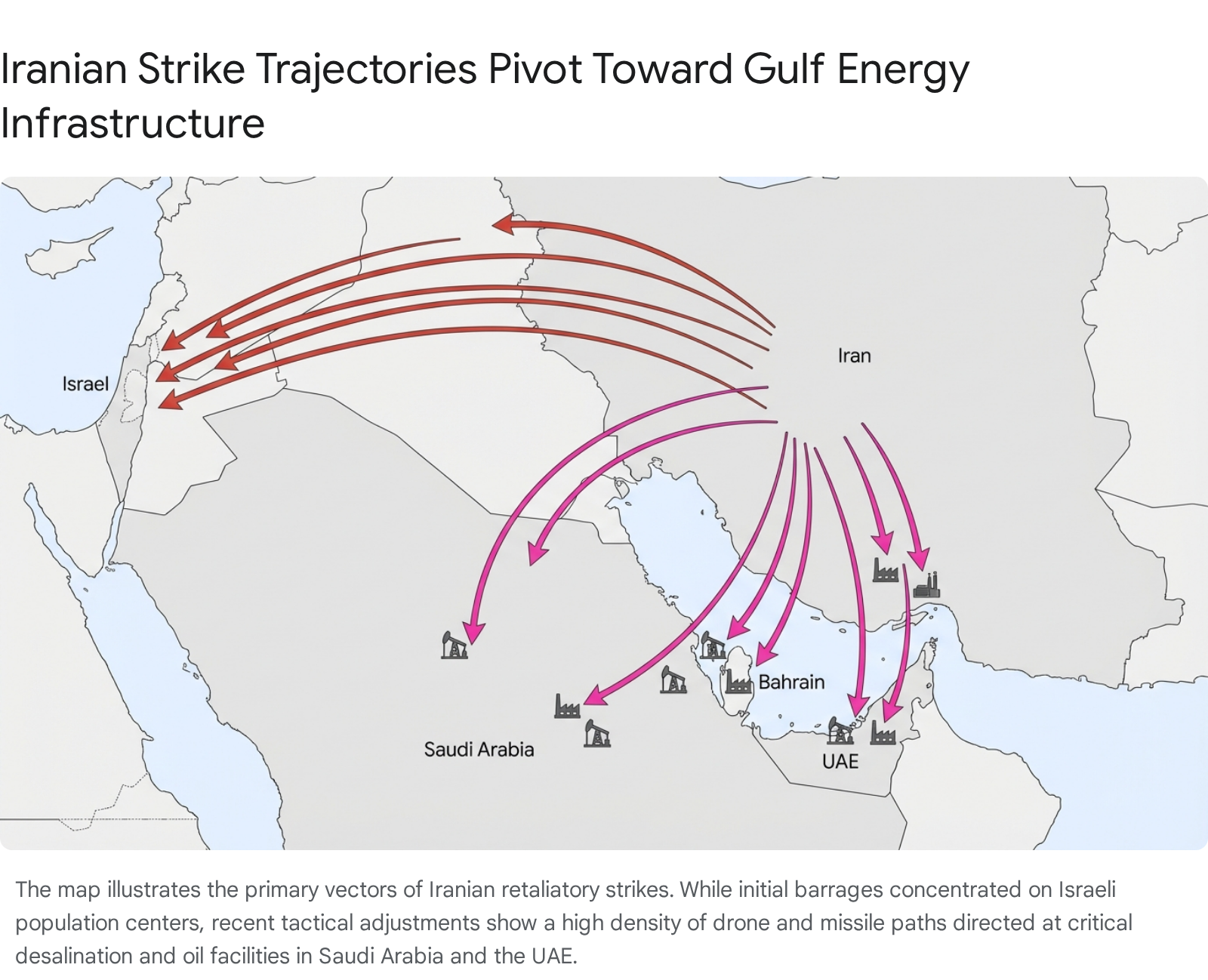
Despite the severe degradation of its conventional capabilities, the Iranian regime has demonstrated lethal tactical adaptability. Facing the imminent destruction of its heavy ballistic missile inventory, Tehran has executed a deliberate pivot in its targeting strategy. Instead of focusing solely on heavily defended Israeli population centers, the IRGC has increasingly directed asymmetric drone swarms and remaining solid-fuel missiles toward critical energy and desalination infrastructure in neighboring Gulf States, specifically the Kingdom of Saudi Arabia and the United Arab Emirates.7 This strategic shift serves a dual purpose. First, it bypasses the densest concentrations of US and Israeli integrated air defense networks. Second, it attempts to impose unacceptable macroeconomic costs on the global energy market, thereby pressuring Washington’s regional allies into demanding an immediate ceasefire.
Diplomatically and politically, the Iranian state apparatus is undergoing a rapid and forceful consolidation. Following the assassination of Supreme Leader Ali Khamenei in the opening salvos of Operation Epic Fury, the IRGC has effectively engineered a succession process, installing his second son, Mojtaba Khamenei, as the new Supreme Leader.5 This transition, executed in a secret bunker by a fractured Assembly of Experts under extreme duress, signals the absolute marginalization of Iran’s pragmatic political factions and the total institutional capture of the state by the military security apparatus.5 The regime has unequivocally rejected any ceasefire proposals, framing the ongoing conflict as an existential struggle of resistance against Western imperialism.10
The civilian toll across the region is escalating into a historic humanitarian catastrophe. In Iran, the expansion of the US and Israeli target list to include dual-use infrastructure, such as the freshwater desalination plant on Qeshm Island and numerous fuel depots, has triggered mass internal displacement as civilians flee urban centers for the rural periphery.11 Concurrently, Israeli civilians remain trapped in a paralyzed economy, subjected to continuous alerts and the indiscriminate deployment of cluster munitions by Iranian forces.13 The regional spillover has brought commercial shipping in the Strait of Hormuz to a virtual standstill, prompting the International Energy Agency to authorize an unprecedented emergency release of 400 million barrels of oil to stabilize panicked global markets.5 The situation remains highly volatile, with indicators pointing toward a protracted conflict that will test the endurance of global supply chains and regional alliances.
2.0 Chronological Timeline of Key Events (Last 36 Hours)
The following timeline details verified military, diplomatic, and civilian events between 08:00 UTC on March 10, 2026, and 20:00 UTC on March 11, 2026.
- March 10, 08:30 UTC: United States and Israeli joint forces commence an intense wave of airstrikes targeting IRGC Quds Force headquarters and underground ballistic missile research facilities at Imam Hossein University in Tehran.16
- March 10, 10:15 UTC: The Iraqi Prime Minister’s Office receives a direct communication from US Secretary of State Marco Rubio, who issues a stern warning against the continued use of Iraqi sovereign territory by Iran-aligned militias for launching attacks against US diplomatic and military facilities.18
- March 10, 11:45 UTC: An Iranian drone swarm targets the Ruwais Oil Refinery in Abu Dhabi, United Arab Emirates, igniting a significant fire and prompting an emergency response from local civil defense units.16
- March 10, 14:00 UTC: The Gulf Cooperation Council holds an extraordinary ministerial meeting via videoconference to draft a unified condemnation of Iranian strikes on sovereign Arab territories, marking a definitive shift away from strategic ambiguity.19
- March 10, 16:30 UTC: Iranian state media officially announces the launch of Wave 37 of Operation True Promise 4. The IRGC claims to utilize heavy Khorramshahr, Kheibar, and Qadr ballistic missiles against targets in Israel and the Gulf.20
- March 10, 19:00 UTC: US Defense Secretary Pete Hegseth conducts a press briefing at the Pentagon, warning that the coming hours will constitute the most intense period of precision strikes on Iranian targets since the war began.5
- March 11, 02:00 UTC: Maritime security firm Ambrey reports a large explosion approximately 31 nautical miles northwest of Khalifa Port in the United Arab Emirates. Simultaneously, a Thai commercial vessel is evacuated near the coast of Oman following a projectile impact.23
- March 11, 04:38 UTC: The UAE Ministry of Interior issues a national emergency alert as integrated air defense systems engage incoming missile threats. Citizens and residents are strongly urged to remain in safe locations.24
- March 11, 07:00 UTC: The International Energy Agency formally announces the emergency release of 400 million barrels of oil from member reserves to counteract the suspension of commercial shipping in the Strait of Hormuz.5
- March 11, 09:30 UTC: Israeli military sources confirm that approximately 50 percent of the ballistic missiles recently fired by Iran are equipped with cluster bomb warheads, escalating the threat to civilian population centers and violating international munitions conventions.5
- March 11, 12:00 UTC: US CENTCOM Commander Admiral Brad Cooper releases a public statement detailing the use of advanced artificial intelligence tools to process battlefield data, confirming that over 5,500 targets and 60 Iranian ships have been successfully destroyed.1
- March 11, 14:30 UTC: Reports indicate a US Tomahawk cruise missile mistakenly impacted an elementary school adjacent to a naval base in Minab, Iran. Iranian health authorities report severe civilian casualties, prompting an immediate investigation by the US Department of Defense.25
- March 11, 15:58 UTC: Air raid sirens activate across the Upper Galilee and the city of Safed in northern Israel due to suspected drone infiltrations launched by Hezbollah forces operating in southern Lebanon.5
- March 11, 16:47 UTC: The International Energy Agency confirms the physical release and distribution of emergency oil stocks has commenced globally.5
- March 11, 18:45 UTC: The Israel Defense Forces detect a new Iranian ballistic missile launch directed toward southern Israel. Air raid sirens are triggered in Beersheba and surrounding municipalities.5
- March 11, 19:03 UTC: In immediate retaliation for a massive Hezbollah rocket barrage targeting northern Israel, the Israeli Air Force launches an extensive wave of precision strikes against Hezbollah command infrastructure in the densely populated Dahiyeh suburb of southern Beirut.5
3.0 Situation by Primary Country
3.1 Iran
3.1.1 Military Actions & Posture
The Iranian military apparatus is currently operating under a state of severe, unprecedented duress, attempting to maintain offensive momentum while absorbing relentless kinetic punishment from two of the world’s most advanced air forces. Over the past 36 hours, the IRGC announced the initiation of the 37th wave of its retaliatory campaign, officially dubbed Operation True Promise 4.20 This specific operational window, which lasted for approximately three hours, utilized heavy solid-fuel munitions, including the Khorramshahr, Fattah, and Khaybar missile families.20 However, underlying telemetry data and open-source intelligence analysis indicate a steep and systemic degradation in Iran’s overall launch capacity. The daily rate of fire dropped precipitously to approximately 18 to 20 missiles on March 11, representing a staggering 91 percent decline from the 428 missiles fired during the opening salvos of the war.1
This dramatic reduction in launch volume is a direct consequence of the systematic destruction of Iran’s transporter-erector-launchers by allied forces. Israeli intelligence estimates that Iran retains only 160 active ballistic missile launchers, constituting roughly 35 percent of its pre-war inventory.1 Fearing immediate detection and destruction by US artificial intelligence assisted aerial platforms, Iranian missile crews are exhibiting extreme reluctance to move surviving launchers out of their fortified subterranean tunnel complexes. To compensate for the significantly reduced volume of fire, the IRGC has modified its munition payloads to maximize area damage. Israel Defense Forces assessments confirm that nearly half of the ballistic missiles deployed by Iran over the past 36 hours contained cluster submunitions.5 This tactical shift reflects a doctrine of area-denial and psychological warfare rather than precision strike capability, as cluster munitions indiscriminately spread dozens of submunitions over a radius of up to ten kilometers, exponentially increasing the risk to civilian populations.20
Simultaneously, the Iranian maritime posture has been aggressively and systematically curtailed. United States Central Command reported the total elimination of the IRGC Navy’s surface combatant vanguard, including all four of the heavily touted Soleimani-class warships, with one specifically targeted and destroyed at the port of Bandar Abbas.1 In response to the catastrophic loss of its conventional naval projection capabilities, Iran has reverted entirely to asymmetric naval warfare, actively deploying naval mines across the Strait of Hormuz and utilizing suicide drone swarms against commercial shipping vessels.1 The IRGC Navy command has issued regional ultimatums declaring that all vessels transiting the strategic waterway require explicit Iranian permission, effectively attempting to enforce a complete blockade of the world’s most vital energy chokepoint.23 Furthermore, the IRGC claimed successful asymmetric engagements against United States military infrastructure, specifically targeting Camp Buehring in Kuwait, where they reportedly destroyed 11 high-value logistical targets including fuel tanks and helicopter ramps.28
3.1.2 Policy & Diplomacy
The internal political dynamics of the Islamic Republic have been radically restructured in the wake of the war’s outbreak. The targeted assassination of Supreme Leader Ali Khamenei triggered an emergency, highly clandestine meeting of the Assembly of Experts. Under intense, undeniable coercion from the upper echelons of the IRGC, the assembly bypassed traditional theological hierarchies and installed Khamenei’s second son, Mojtaba Khamenei, as the new Supreme Leader.5 Reports indicate that Mojtaba Khamenei sustained severe injuries to his legs during the initial February 28 airstrikes and is currently directing state affairs from a heavily fortified, undisclosed subterranean bunker.1 State television anchors have begun referring to him as a “janbaz,” a term denoting a wounded veteran willing to sacrifice his life, attempting to build a cult of personality around the relatively obscure bureaucratic figure.5
This rapid succession represents a critical policy pivot for the Iranian state. The IRGC has definitively transitioned from serving as the praetorian guard of the clerical establishment to becoming the undisputed sovereign power within Iran. Pragmatic voices within the government structure, including President Masoud Pezeshkian, have been aggressively marginalized. When President Pezeshkian attempted to issue a diplomatic apology to neighboring Gulf states in a desperate effort to de-escalate regional tensions and prevent the GCC from fully aligning with Washington, IRGC commanders forced a humiliating public retraction, viewing any such gesture as treasonous capitulation.5 Furthermore, Iranian Parliament Speaker Mohammad Bagher Ghalibaf issued statements categorically rejecting any framework for a ceasefire, asserting that the conflict will persist until the United States and Israel are fundamentally deterred and punished.10 This sentiment was echoed by Ali Larijani, a top security official, who publicly taunted the United States administration, warning that those who attempt to eliminate Iran will themselves be eliminated.11
3.1.3 Civilian Impact
The humanitarian situation within the borders of Iran is rapidly deteriorating into a systemic, multi-faceted crisis. Human rights organizations, including the Human Rights Activists News Agency, estimate that over 1,787 Iranians have been killed since the conflict began, with a significant proportion being non-combatants.30 The Hengaw Organization for Human Rights places the total casualty figure much higher, estimating at least 4,300 deaths, including 390 verified civilian fatalities.30 The United States and Israeli strategy of systematically dismantling regime infrastructure has inevitably and severely degraded civilian lifelines. Extensive damage has been inflicted upon dual-use facilities, including a devastating strike on a freshwater desalination plant on Qeshm Island, which completely severed the potable water supply to 30 surrounding villages.12
Iranian authorities have formally accused the United States and Israel of committing war crimes, specifically citing a double-tap airstrike in Najafabad that reportedly killed 19 civilians, including emergency first responders who had arrived to assist the wounded from the initial blast.12 Additionally, the United States Department of Defense is currently investigating a catastrophic targeting error involving a Tomahawk cruise missile that struck a girls’ school adjacent to a naval base in Minab, resulting in over 160 fatalities.25 The psychological toll of the relentless, round-the-clock bombardment has triggered a mass exodus from major metropolitan centers. Tens of thousands of residents from Tehran, Isfahan, and Shiraz are fleeing to remote mountainous regions and rural villages, seeking refuge from the continuous explosions and the inherent danger of living near military installations embedded within civilian neighborhoods by the regime.11 United States forces have issued explicit warnings to Iranian civilians to remain indoors, noting that the regime is knowingly endangering innocent lives by launching weapons from heavily populated areas.31
Table 2: Verified Civilian and Military Casualties by Nation (As of March 11, 2026)
| Nation | Verified Fatalities | Verified Injuries | Contextual Notes |
| Iran | 1,787 – 4,300+ | Data Unavailable | Figures disputed between state media and independent monitors. Includes high military attrition. |
| Lebanon | 570 | 1,444 | Massive displacement exceeding 750,000 individuals due to IDF strikes. |
| Israel | 14 | 2,557 | High injury rate due to shrapnel and cluster munition dispersal in urban centers. |
| UAE | 6 | 122 | Fatalities primarily foreign nationals working in industrial sectors. |
| Kuwait | 8 | 99 | Includes 4 US/allied servicemen and 4 civilians killed during base attacks. |
| Bahrain | 3 | 38 | Casualties resulting from drone strikes on commercial and military zones. |
| Saudi Arabia | 2 | 12 | Casualties resulting from intercepted debris and direct drone impacts. |
| United States | 7 | 140+ | Service members killed across various forward operating bases in the Gulf. |
3.2 Israel
3.2.1 Military Actions & Posture
The State of Israel is currently executing a highly complex, multi-front war, balancing the strategic, existential imperative of neutralizing the Iranian nuclear and ballistic threat with the immediate tactical necessity of combating Hezbollah forces in the Levant. Operation Roaring Lion, seamlessly integrated with United States Central Command operations, involves continuous, daily sorties deep into sovereign Iranian airspace. The Israeli Air Force heavily targeted regime infrastructure across Tehran, Isfahan, and Shiraz over the last 36 hours, dropping more than 170 precision munitions.17 Specific targets included the primary headquarters of the IRGC Quds Force in Tehran, which acts as the central nervous system for Iran’s proxy network across the Middle East, as well as critical missile production and storage sites in Isfahan intended to target Israeli aircraft.17
Concurrently, the Israel Defense Forces are aggressively escalating their ground and air campaign in Lebanon to secure the volatile northern border. Armored columns and infantry units are advancing along three primary axes into southern Lebanon, pushing steadily toward the districts of Marjaayoun, Bint Jbeil, and Hasbaya.16 To support these grinding ground incursions, Chief of Staff Lieutenant General Eyal Zamir ordered the strategic redeployment of the elite Golani Brigade from the Southern Command directly to the Northern Command.5 The Israeli Air Force has also intensified its strategic bombing of Beirut. Following a massive Hezbollah rocket barrage consisting of approximately 100 projectiles, Israeli fighter jets launched an extensive wave of strikes against Hezbollah command centers, financial institutions linked to the Al Qard al Hassan network, and underground weapons caches in the densely populated Dahiyeh suburb.5 The IDF is utilizing a strategy of continuous pressure, issuing prior evacuation warnings to Lebanese civilians before systematically leveling infrastructure utilized by militant forces.5
3.2.2 Policy & Diplomacy
The Israeli government is radically reorienting its entire domestic and fiscal policy framework to sustain what is anticipated to be a prolonged war economy. Recognizing the massive financial drain of continuous troop mobilization and the exorbitant cost of air defense interceptors like the Arrow and David’s Sling systems, Finance Minister Bezalel Smotrich and Prime Minister Benjamin Netanyahu announced the suspension of highly controversial domestic legislation, including the ultra-Orthodox draft exemption law.10 This political maneuvering is explicitly designed to fast-track the passage of the 2026 state budget, ensuring that billions of shekels are immediately redirected into the defense sector to sustain the momentum of the ongoing war.
Diplomatically, a subtle but distinct friction is emerging between Jerusalem and Washington regarding the ultimate endgame and timeline of the conflict. While United States President Donald Trump has publicly signaled that the military campaign may conclude shortly due to a lack of remaining strategic targets in Iran, Israeli Defense Minister Israel Katz maintains a much harder line, stating that operations will continue without any defined time limit until the Iranian regime is entirely neutralized and poses zero future threat.1 Furthermore, Israeli ministers have briefed the press on a long-term strategic vision, suggesting that while the active kinetic bombing phase may end soon, the ultimate goal of orchestrating a regime collapse in Tehran may take upwards of a year, relying on sustained economic pressure to encourage the Iranian populace to overthrow the weakened IRGC.5
3.2.3 Civilian Impact
The domestic situation within Israel is defined by severe psychological exhaustion and economic strain. Since the commencement of hostilities on February 28, 14 Israeli civilians have been killed and over 2,557 have been hospitalized due to trauma or shrapnel injuries resulting from Iranian ballistic missile and Hezbollah rocket strikes.13 The Home Front Command has placed the entire nation in varying states of lockdown, fundamentally altering the rhythm of daily life. Over 3,000 residents have been forced to permanently leave their homes due to direct missile impacts and widespread interception debris.13
Geopolitical analysts have coined the term “Siren Economy” to describe the current, paralyzed state of the Israeli civilian sector.14 The continuous necessity for citizens, including technology workers in Tel Aviv, to abruptly abandon their desks and evacuate into reinforced concrete stairwells severely disrupts commercial productivity and educational continuity.14 Despite undeniable tactical military successes, such as the assassination of senior Iranian leadership and the degradation of enemy launch sites, the Israeli public is suffering from a profound security achievement gap. This phenomenon occurs when overseas military dominance fails to translate into a tangible sense of physical safety at home.14 The recent Iranian shift toward utilizing cluster munitions has significantly exacerbated civilian anxieties, as these weapons disperse highly explosive submunitions over wide urban areas, increasing the lethality of falling debris even after successful exo-atmospheric interceptions by the national defense grid.5
3.3 United States
3.3.1 Military Actions & Posture
The United States military has deployed the largest regional concentration of combat power and logistical support in a generation to execute Operation Epic Fury.33 Within the last 36 hours, CENTCOM operations have been defined by an unprecedented operational tempo, facilitated by the deep integration of advanced artificial intelligence command and control frameworks. Admiral Brad Cooper, CENTCOM Commander, explicitly confirmed that AI tools are being utilized by warfighters to sift through massive datasets of radar telemetry, satellite imagery, and intercepted communications in mere seconds.4 This algorithmic processing allows United States commanders to identify mobile Iranian transporter-erector-launchers and authorize lethal strikes faster than the enemy can react or relocate, fundamentally overcoming the traditional shoot and scoot tactics that historically protected Iranian missile assets.4
The sheer scale of the aerial bombardment is staggering. United States forces, utilizing strategic assets such as B-1 Lancer and B-52 Stratofortress bombers flying from international bases including RAF Fairford in the United Kingdom, have hit over 5,500 targets.3 The target matrix prioritizes the complete eradication of Iran’s defense industrial base, ballistic missile manufacturing facilities, and naval infrastructure.1 Defense Secretary Pete Hegseth noted that the military is executing these strikes with ruthless precision, utilizing massive ordnance penetrators to obliterate subterranean research and development bunkers, effectively ensuring the permanent denial of Iranian nuclear weapons capabilities.5 Furthermore, to combat the asymmetric mining of the Strait of Hormuz, the United States Navy is deploying specialized technology originally developed for counter-narcotics operations to rapidly detect and destroy Iranian minelaying speedboats.1 The administration estimated that the military utilized approximately $5.6 billion worth of munitions in just the first two days of the operation, prompting American defense firms to quadruple production lines to prevent any stockpile shortfalls.1
3.3.2 Policy & Diplomacy
The diplomatic posture of the United States exhibits a complex, highly charged interplay between aggressive global deterrence and internal administrative friction. The Trump administration has articulated an uncompromising doctrine of peace through strength, preferring overwhelming military action over protracted diplomacy.35 Secretary of Defense Pete Hegseth has publicly stated that the United States will not relent until the Iranian military is completely and decisively defeated, explicitly separating this focused campaign from previous nation-building efforts by flatly stating that the current operation is not a repeat of the 2003 Iraq War.5
However, divergent messaging has emerged regarding the timeline of the conflict. While military commanders push for total systemic degradation of the enemy, President Trump indicated in interviews that the war could conclude swiftly, as there is practically nothing left to target in the country.1 In the diplomatic sphere, Secretary of State Marco Rubio is actively managing the fallout with regional partners, issuing direct warnings to the Iraqi government to rein in Iran-backed militias and cease attacks on American diplomatic outposts.18 This aggressive diplomatic maneuvering is facing intense domestic pushback. A coalition of Senate Democrats, led by Ranking Member Jeanne Shaheen, sent a formal letter to Secretary Rubio severely criticizing the State Department for failing to adequately protect United States embassies and personnel in the lead-up to the preemptive strikes, highlighting a perceived lack of strategic foresight regarding inevitable Iranian retaliation against soft diplomatic targets across the Middle East.36
3.3.3 Civilian Impact
While the continental United States remains geographically insulated from the kinetic impacts of the war, the macroeconomic and social ramifications are significant and compounding. The disruption of commercial shipping in the Strait of Hormuz has sent shockwaves through global energy markets, causing Brent crude prices to surge.15 To mitigate the economic damage and prevent a severe, politically damaging spike in domestic fuel prices, the United States government coordinated with the International Energy Agency to orchestrate the largest emergency oil release in history, unlocking 400 million barrels from strategic reserves worldwide.5 Furthermore, United States Interior Secretary Doug Burgum announced that domestic oil companies would rapidly increase production to stabilize the market in response to the crisis.5
Domestically, the conflict has exacerbated social tensions and triggered heightened security protocols. Law enforcement agencies reported a hate-motivated assault in San Jose, California, where two Israeli-American men were beaten by individuals citing the ongoing war with Iran as justification.5 In response to the elevated threat environment, the National Guard has been activated across several states, including Washington, New Hampshire, and Texas, under the domestic framework of Operation Fury Shield.37 These specialized guard units are tasked with bolstering security at critical domestic infrastructure, maritime ports, and energy facilities against potential asymmetrical cyber attacks or terror threats orchestrated by sleeper cells aligned with Iranian proxy networks.37
4.0 Regional and Gulf State Impacts
The geopolitical containment strategy meticulously cultivated over the past decade has entirely collapsed. The Gulf Cooperation Council states, previously reliant on a doctrine of strategic ambiguity to balance relations between Washington and Tehran, are now active participants and victims in the widening regional war.29 The IRGC’s intentional targeting of Arab states aims to punish nations hosting United States military installations and to weaponize global energy security by creating a crisis of transit.
Saudi Arabia: The Kingdom has experienced a massive, unprecedented surge in Iranian strikes, absorbing approximately 31 percent of all incoming Iranian munitions on March 10, a significant proportional increase from previous days.7 The attacks, primarily utilizing suicide drones launched from southern Iran, have targeted critical energy infrastructure, forcing the closure of major domestic oil refineries and export terminals.8 In response, Saudi integrated air defenses have successfully intercepted numerous ballistic missiles aimed at strategic installations, including the Prince Sultan Air Base.24 Diplomatic sources indicate that Riyadh has issued direct, back-channel warnings to Tehran of potential direct military retaliation if the strikes continue to threaten the economic lifeblood of the nation.38 Highlighting the globalized nature of the conflict, Ukrainian President Volodymyr Zelensky contacted the Saudi Crown Prince, offering to deploy Ukrainian anti-drone teams to the Kingdom to share expertise gained from combating similar Iranian-manufactured Shahed drones in Eastern Europe.1
United Arab Emirates (UAE): The UAE has suffered severe infrastructural damage and economic disruptions. Over the course of the conflict, the Emirates have been targeted by over 1,700 recorded strikes, encompassing both drones and ballistic missiles.9 Within the last 36 hours, drones successfully breached air defenses and struck the vicinity of Dubai International Airport, wounding four foreign nationals and significantly disrupting global aviation traffic at one of the world’s busiest transit hubs.23 Another massive explosion was recorded approximately 31 nautical miles northwest of Khalifa Port, further destabilizing maritime logistics.23 In response to the blatant violation of its sovereignty, the UAE government closed its embassy in Tehran, withdrew all diplomatic staff, and issued a formal condemnation, asserting its absolute right to self-defense under international law and the UN Charter.40
Qatar: Hosting the forward headquarters of United States Central Command at Al Udeid Air Base, Qatar remains a high-value priority target for Iranian forces seeking to disrupt allied command and control nodes. The Qatari Defense Ministry confirmed the successful interception of a dozen missiles aimed at the peninsula over the recent operational period.23 The national airspace has been effectively closed to standard commercial traffic, operating exclusively under strict Emergency Security Control of Air Traffic protocols, causing massive logistical backlogs and operational cancellations for the state carrier, Qatar Airways.42
Bahrain: Home to the United States Navy’s Fifth Fleet, Bahrain was subjected to a highly coordinated attack involving four large explosions triggered by incoming Iranian drones designed to evade standard radar detection.23 One drone successfully bypassed defenses and impacted the Millennium Tower in the capital city of Manama, resulting in civilian casualties and widespread panic.16 The government has placed the nation on high security alert, rapidly relocating civilian aircraft from Bahrain International Airport to mitigate the risk of destruction on the tarmac.23
Kuwait and Oman: The operational impacts have deeply affected both the northern and southern extremities of the Gulf. Iranian naval and aerial units successfully struck Camp Buehring in Kuwait, destroying fuel tanks and logistics infrastructure critical to United States force projection, resulting in the deaths of allied servicemen.28 In Oman, the maritime domain has become an active warzone. A Thai commercial vessel was severely damaged near the Omani coast, requiring the emergency evacuation of the crew.23 The escalating risk to commercial vessels has forced Oman’s state energy company, OQ, to declare force majeure on natural gas exports to South Asia, citing the sheer impossibility of ensuring safe transit through the highly contested waters.23
Jordan: Although geographically removed from the immediate Persian Gulf theater, Jordan’s strategic position nestled between Israel and Iran has resulted in direct kinetic spillover. Missile fragments and interception debris from exo-atmospheric engagements rained down on the northern city of Irbid, triggering nationwide air raid sirens and causing localized damage.23 The Jordanian government has proactively implemented a partial nightly closure of its national airspace to protect civilian aviation from the deadly crossfire of Iranian barrages and Israeli interceptors.44
The collective response of the Gulf States culminated in an unprecedented joint diplomatic statement issued alongside the United States, explicitly condemning the Islamic Republic’s indiscriminate and reckless attacks on sovereign territories.45 This unified diplomatic alignment signifies the definitive end of traditional Gulf neutrality and cements the regional polarization catalyzed by the onset of Operation Epic Fury.
Table 3: Status of Regional Airspace and Maritime Transit (As of March 11, 2026)
| Nation/Region | Airspace Status | Maritime Status | Primary Causation |
| Iran (OIIX) | Total Closure | Heavy Mining/Blockade | Preemptive US strikes and continuous military operations. |
| Israel (LLLL) | Closed (PPR Required) | Restricted | Continuous Iranian and Hezbollah ballistic threats. |
| Iraq (ORBB) | Total Closure | High Risk | Proxy militia operations and cross-border missile transit. |
| Qatar (OTDF) | Restricted (ESCAT) | High Risk | Defense of Al Udeid base requiring strict interception zones. |
| Bahrain (OBBB) | Total Closure | High Risk | Active targeting of US 5th Fleet infrastructure. |
| Kuwait (OKAC) | Total Closure | High Risk | Protection protocols against drone swarms targeting bases. |
| Jordan (OJAC) | Partial Nightly Closure | N/A | Hazard from falling debris resulting from exo-atmospheric interceptions. |
| Strait of Hormuz | N/A | Effectively Halted | Iranian asymmetric mining and regional force majeure declarations. |
5.0 Appendices
Appendix A: Methodology
This Daily Situation Report was meticulously compiled utilizing a comprehensive, real-time sweep of global open-source intelligence, military monitors, state broadcasts, and official press releases over the designated 36-hour operational window encompassing March 10 at 08:00 UTC through March 11 at 20:00 UTC, 2026. To ensure absolute continuity of events and to prevent any analytical blind spots, the 36-hour window was deliberately structured to overlap with the preceding 12-hour reporting period. Data points were rigorously cross-referenced across multiple jurisdictions and institutional sources. For instance, casualty figures within Iran were validated by comparing the independent data of human rights monitors such as the Human Rights Activists News Agency and the Hengaw Organization against state-sanctioned reports from Iranian state media. Military strike statistics, including the number of targets destroyed and munitions expended, were corroborated by matching United States Central Command press briefings with satellite imagery analysis and local ground reporting. Conflicting open-source intelligence reports regarding the use of advanced weaponry, such as the deployment of cluster munitions and artificial intelligence targeting algorithms, were strictly weighed against official confirmations from the respective defense ministries before inclusion in the narrative.
Appendix B: Glossary of Acronyms
- AI: Artificial Intelligence. Refers to the advanced algorithmic systems utilized by CENTCOM for rapid target acquisition and data processing.
- CENTCOM: United States Central Command. The unified combatant command responsible for United States military operations in the Middle East, Central Asia, and parts of South Asia.
- ESCAT: Emergency Security Control of Air Traffic. A protocol used to restrict and manage airspace during times of severe national security threats or active military conflict.
- GCC: Gulf Cooperation Council. A regional intergovernmental political and economic union consisting of Bahrain, Kuwait, Oman, Qatar, Saudi Arabia, and the United Arab Emirates.
- HRANA: Human Rights Activists News Agency. An independent human rights organization that monitors and reports on civilian casualties and rights violations within Iran.
- IADS: Integrated Air Defense System. A complex network of radars, command centers, and interceptor missiles designed to protect a specific airspace from hostile aerial threats.
- IAF: Israeli Air Force. The aerial warfare branch of the Israel Defense Forces.
- IDF: Israel Defense Forces. The combined military forces of the State of Israel.
- IEA: International Energy Agency. A Paris-based autonomous intergovernmental organization that provides policy recommendations, analysis, and coordinates emergency oil releases to ensure global energy security.
- IRGC: Islamic Revolutionary Guard Corps. A multi-service primary branch of the Iranian Armed Forces, distinct from the regular military, tasked with protecting the country’s Islamic republic political system.
- ISR: Intelligence, Surveillance, and Reconnaissance. The integrated intelligence and operations function used to acquire and process information to support military decision-making.
- OSINT: Open-Source Intelligence. Data collected from publicly available sources to be used in an intelligence context.
- PPR: Prior Permission Required. An aviation protocol indicating that an aircraft must receive explicit authorization from air traffic control before entering a restricted airspace or landing at a facility.
- TEL: Transporter-Erector-Launcher. A mobile missile launch vehicle equipped with an integrated erector mechanism, heavily utilized by the Iranian military to hide assets from aerial detection.
Appendix C: Glossary of Foreign Words
- Ayatollah: A high-ranking title given to major Shia clerics in Iran, representing a leading scholar of Islamic law and theology.
- Dahiyeh: A predominantly Shia southern suburb of Beirut, Lebanon. It is widely recognized as a major stronghold, residential hub, and underground command center for the Hezbollah militant organization.
- Fattah: A class of Iranian hypersonic ballistic missiles heavily utilized by the IRGC aerospace forces in the current conflict.
- Janbaz: A Persian term translating literally to “willing to sacrifice one’s life.” It is commonly used in Iranian state discourse to respectfully describe a wounded military veteran. It has been recently deployed by state media to describe the injuries sustained by the newly appointed Supreme Leader, Mojtaba Khamenei.
- Knesset: The unicameral national legislature of the State of Israel, responsible for passing laws, electing the president, and approving the state budget.
- Khorramshahr: A family of Iranian medium-range ballistic missiles known for carrying heavy warheads, named after a city in southwestern Iran.
- Labbayk: An Arabic phrase often used in deeply religious Islamic contexts meaning “Here I am at your service.” This phrase was notably seen inscribed on Iranian ballistic missiles in a gesture of dedication to the new Supreme Leader.
- Majlis: The Islamic Consultative Assembly, or the national legislative body of Iran, which operates alongside the Guardian Council.
- Quds Force: One of five branches of Iran’s Islamic Revolutionary Guard Corps, specializing in unconventional warfare, extraterritorial operations, and the management of Iran’s proxy militia network across the Middle East.
- Shahed: A family of Iranian-manufactured loitering munitions, commonly referred to as suicide or kamikaze drones, utilized extensively to target Gulf State infrastructure and swarm air defense systems.
Please share the link on Facebook, Forums, with colleagues, etc. Your support is much appreciated and if you have any feedback, please email us in**@*********ps.com. If you’d like to request a report or order a reprint, please click here for the corresponding page to open in new tab.
Sources Used
- Operations Epic Fury and Roaring Lion: 3/11/26 Update – JINSA, accessed March 11, 2026, https://jinsa.org/wp-content/uploads/2026/03/Operations-Epic-Fury-and-Roaring-Lion-03-11-26.pdf
- Op Epic Fury Commander reveals US STRATEGY in Iran war – The Economic Times, accessed March 11, 2026, https://m.economictimes.com/news/international/world-news/ai-helped-to-hit-more-than-5500-targets-op-epic-fury-commander-reveals-us-strategy-in-iran-war/amp_podcast/129475720.cms
- CENTCOM chief: US strikes over 5,500 targets in Iran using AI, accessed March 11, 2026, https://caliber.az/en/post/centcom-chief-us-strikes-over-5-500-targets-in-iran-using-ai
- US hits more than 5,500 targets in Iran, including over 60 ships: CENTCOM, accessed March 11, 2026, https://www.koreatimes.co.kr/world/20260312/us-hits-more-than-5500-targets-in-iran-including-over-60-ships-centcom
- Global energy agency: 400 million oil barrels to be brought out of …, accessed March 11, 2026, https://www.timesofisrael.com/liveblog-march-11-2026/
- Operation Epic Fury update: AI playing “important role” and 5,000 targets hit by US, accessed March 11, 2026, https://discover.swns.com/2026/03/operation-epic-fury-update-ai-playing-important-role-and-5000-targets-hit-by-us/
- Operations Epic Fury and Roaring Lion: 3/10/26 Update – JINSA, accessed March 11, 2026, https://jinsa.org/wp-content/uploads/2026/03/Operations-Epic-Fury-and-Roaring-Lion-03-10-26.pdf
- Iran Update Evening Special Report, March 7, 2026 | ISW, accessed March 11, 2026, https://understandingwar.org/research/middle-east/iran-update-evening-special-report-march-7-2026/
- Unpacking Iran’s Drone Campaign in the Gulf: Early Lessons for Future Drone Warfare, accessed March 11, 2026, https://www.csis.org/analysis/unpacking-irans-drone-campaign-gulf-early-lessons-future-drone-warfare
- March 10: Ministers reportedly say Iran regime change may take a year, amid ‘fog’ over war’s length, accessed March 11, 2026, https://www.timesofisrael.com/liveblog-march-10-2026/
- The Latest: Hegseth vows most intense day yet of US strikes as Iran aims to fight on, accessed March 11, 2026, https://www.click2houston.com/news/world/2026/03/10/the-latest-iran-launches-drones-at-saudi-arabia-and-kuwait-as-us-president-sends-mixed-messages/
- US, Israel accused of ‘war crimes’ after deadly strikes on civilian targets, accessed March 11, 2026, https://www.dawn.com/news/1979984
- Daily Report: The Second Iran War – March 11, 2026 (18:00) – Alma …, accessed March 11, 2026, https://israel-alma.org/daily-report-the-second-iran-war-march-11-2026-1800/
- ‘Siren economy’: Why tactical wins fail to bring Israel strategic safety, accessed March 11, 2026, https://www.aljazeera.com/features/2026/3/11/siren-economy-why-tactical-wins-fail-to-bring-israel-strategic-safety
- Gulf Situation Assessment: Iran’s Attacks on Arab States Will Backfire, accessed March 11, 2026, https://www.meforum.org/mef-online/gulf-situation-assessment-irans-attacks-on-arab-states-will-backfire
- Iran Update Morning Special Report, March 10, 2026 | ISW, accessed March 11, 2026, https://understandingwar.org/research/middle-east/iran-update-morning-special-report-march-10-2026/
- Daily Report: The Second Iran War – March 10, 2026 (18:00), accessed March 11, 2026, https://israel-alma.org/daily-report-the-second-iran-war-march-10-2026-1800/
- US condemns Iranian and militia attacks in Iraq amid unclaimed airstrikes on Tehran-backed militias, accessed March 11, 2026, https://www.fdd.org/analysis/2026/03/11/us-condemns-iranian-and-militia-attacks-in-iraq-amid-unclaimed-airstrikes-on-tehran-backed-militias/
- Statement Issued by the 50th Extraordinary Meeting of the Ministerial Council of the Gulf Cooperation Council (GCC) Regarding the Iranian Aggression Against the GCC, accessed March 11, 2026, https://www.gcc-sg.org/en/MediaCenter/News/Pages/news2026-3-1-2.aspx
- Iran’s IRGC says 37th wave of attacks launched against Israel, heavy missiles used, accessed March 11, 2026, https://www.aninews.in/news/world/middle-east/irans-irgc-says-37th-wave-of-attacks-launched-against-israel-heavy-missiles-used20260311093111
- Most Intense Attack: Iran’s Wave 37 Pounds Israel for Three Hours – Palestine Chronicle, accessed March 11, 2026, https://www.palestinechronicle.com/most-intense-attack-irans-wave-37-pounds-israel-for-three-hours/
- Hegseth says ‘Epic Fury’ goals in Iran are ‘laser-focused’ | Article | The United States Army, accessed March 11, 2026, https://www.army.mil/article/290823/hegseth_says_epic_fury_goals_in_iran_are_laser_focused
- LIVE BLOG – Iran Launches ‘Most Intense’ Missile Wave as Israel Expands Strikes to Beirut – Day 12 – Palestine Chronicle, accessed March 11, 2026, https://www.palestinechronicle.com/live-blog-iran-launches-most-violent-missile-wave-as-israel-expands-strikes-to-beirut-day-12/
- US‑Israel war on Iran day 11: US says today will be the ‘most intense’ of attacks; Gulf states face new attacks, accessed March 11, 2026, https://gulfnews.com/uae/usisrael-war-on-iran-day-11-trump-says-us-will-hit-iran-20-times-harder-gulf-states-face-new-attacks-1.500469177
- 2026 Iran conflict | Explained, United States, Israel, Map, & War | Britannica, accessed March 11, 2026, https://www.britannica.com/event/2026-Iran-Conflict
- The Middle East Crisis: Votes on Two Draft Resolutions : What’s In Blue, accessed March 11, 2026, https://www.securitycouncilreport.org/whatsinblue/2026/03/the-middle-east-crisis-votes-on-two-draft-resolutions.php
- Iran-Israel war LIVE: Iran warns ready for long war that would ‘destroy’ world economy, accessed March 11, 2026, https://www.thehindu.com/news/international/iran-israel-war-west-asia-conflict-march-11-2026-live-updates/article70729328.ece
- Iranian Army Launches Operation True Promise 4, Dedicates Strikes To New Supreme Leader, accessed March 11, 2026, https://timesofindia.indiatimes.com/videos/international/iranian-army-launches-operation-true-promise-4-dedicates-strikes-to-new-supreme-leader/videoshow/129347587.cms
- Gulf States must pick sides in Iran war as neutrality no longer viable, accessed March 11, 2026, https://www.washingtonexaminer.com/op-eds/4485845/gulf-states-must-pick-sides-iran-war/
- 2026 Iran war – Wikipedia, accessed March 11, 2026, https://en.wikipedia.org/wiki/2026_Iran_war
- U.S. Forces Issue Safety Warning to Civilians in Iran > U.S. Central Command > Press Release View, accessed March 11, 2026, https://www.centcom.mil/MEDIA/PRESS-RELEASES/Press-Release-View/Article/4428134/us-forces-issue-safety-warning-to-civilians-in-iran/
- IDF launches wave of strikes on IRGC targets across Iran, strikes drone operatives before launch, accessed March 11, 2026, https://www.jpost.com/middle-east/iran-news/article-889553
- Operation Epic Fury: Unmatched Power, Unrelenting Force of America’s Warriors, accessed March 11, 2026, https://www.whitehouse.gov/articles/2026/03/operation-epic-fury-unmatched-power-unrelenting-force-of-americas-warriors/
- Anthropic’s Rift with Pentagon Over Safeguards Could Impact DOE Labs, accessed March 11, 2026, https://www.hpcwire.com/aiwire/2026/03/11/anthropics-rift-with-pentagon-over-safeguards-could-impact-doe-labs/
- Operation Epic Fury Is Peace Through Strength in Action | The Heritage Foundation, accessed March 11, 2026, https://www.heritage.org/defense/commentary/operation-epic-fury-peace-through-strength-action
- [2026-03-05] Ranking Member Shaheen, Foreign Relations Democrats Press…, accessed March 11, 2026, https://www.foreign.senate.gov/press/dem/release/ranking-member-shaheenforeign-relations-democratspress-state-department-on-failure-to-protect-us-diplomatsin-lead-up-toiran-strikes
- National Guard Activated to Support Iran Ops, accessed March 11, 2026, https://defensecommunities.org/2026/03/national-guard-activated-to-support-iran-ops/
- Saudi Arabia has told Iran to stop attacks, warned of possible retaliation, sources say, accessed March 11, 2026, https://www.timesofisrael.com/saudi-arabia-has-told-iran-to-stop-attacks-warned-of-possible-retaliation-sources-say/
- Iran targets commercial ships, Dubai airport and oil facilities as concerns grow over global energy, accessed March 11, 2026, https://www.pbs.org/newshour/world/iran-targets-commercial-ships-dubai-airport-and-oil-facilities-as-concerns-grow-over-global-energy
- 2026 Iranian strikes on the United Arab Emirates – Wikipedia, accessed March 11, 2026, https://en.wikipedia.org/wiki/2026_Iranian_strikes_on_the_United_Arab_Emirates
- Statement by the Ministry of Foreign Affairs, accessed March 11, 2026, https://www.mofa.gov.ae/en/mediahub/news/2026/3/8/uae-iran
- Airspace closures following Israeli and US strikes on Iran | Flightradar24 Blog, accessed March 11, 2026, https://www.flightradar24.com/blog/live/israel-launches-pre-emptive-strikes-on-iran-airspace-closures-going-into-place/
- Jordan reports 73 falling objects amid Iran-US-Israel escalation – Anadolu Ajansı, accessed March 11, 2026, https://www.aa.com.tr/en/middle-east/jordan-reports-73-falling-objects-amid-iran-us-israel-escalation/3844502
- Jordan Announces Partial Airspace Closure From 6PM to 9AM Amid Tensions | NewsX, accessed March 11, 2026, https://www.youtube.com/watch?v=pI_WG4rEfyU
- Joint Statement on Iran’s Missile and Drone Attacks in the Region – U.S. Department of State, accessed March 11, 2026, https://www.state.gov/releases/office-of-the-spokesperson/2026/03/joint-statement-on-irans-missile-and-drone-attacks-in-the-region