
1. Executive Summary
During the reporting period encompassing May 31 to June 6, 2026, the strategic and operational dynamics of the Russia-Ukraine conflict were fundamentally shaped by an unprecedented escalation in deep-strike unmanned aerial vehicle (UAV) campaigns, critical realignments in international military financing mechanisms, and rigid bilateral diplomatic posturing that effectively precluded any near-term cessation of hostilities. The Ukrainian Armed Forces have successfully operationalized a highly sophisticated, multi-domain long-range strike strategy, extending their operational reach up to 1,700 kilometers into the sovereign territory of the Russian Federation. This campaign systematically targeted and severely degraded strategic military-industrial nodes, critical aerospace launch facilities, and the backbone of the Russian hydrocarbon export and domestic fuel logistics network. High-profile, coordinated strikes during this period devastated infrastructure from the Baltic Fleet headquarters in Kronstadt to the major petroleum terminals situated in the Krasnodar region, cumulatively neutralizing an estimated 40% of Russia’s domestic oil refining capacity and triggering verifiable fuel rationing across multiple Russian administrative oblasts.
Conversely, the Russian Armed Forces maintained a relentless, high-intensity operational tempo, executing exhaustive missile and loitering munition barrages against Ukrainian urban centers and critical energy infrastructure grids. This attritional aerospace strategy is explicitly designed to exhaust Ukrainian interceptor stockpiles, forcing a highly asymmetrical cost-exchange ratio that has prompted Ukraine to aggressively field domestically produced, low-cost interceptor drones. On the ground, the tactical environment remained characterized by localized, grinding mechanized and infantry assaults, primarily concentrated in the Donetsk region. While Russian forces secured marginal, localized territorial adjustments near Pokrovsk and Kostyantynivka, they failed to achieve any operational-level breakthroughs, largely due to the saturating presence of Ukrainian First-Person View (FPV) drones and increasingly sophisticated electronic warfare (EW) countermeasures that have rendered massed armored maneuvers tactically inviable.
In the broader geopolitical and diplomatic theater, the period was marked by a formal, public ceasefire overture from the Ukrainian government, which was summarily and explicitly rejected by the Kremlin. Moscow continues to project an image of absolute economic and military invulnerability, utilizing forums such as the St. Petersburg International Economic Forum (SPIEF) to mask severe underlying macroeconomic vulnerabilities, including acute labor shortages and escalating federal deficits. Internationally, the reporting period witnessed highly consequential shifts in defense sustainability architecture. In the United States, legislative factions successfully bypassed executive branch opposition through a rare parliamentary mechanism to authorize massive direct military aid and loans to Kyiv. Concurrently, European NATO allies aggressively maneuvered to institutionalize long-term, multilateral funding frameworks ahead of the upcoming Alliance summit, aiming to insulate Ukrainian defense logistics from bilateral political unpredictability. Overall, the conflict has entrenched itself into a highly industrialized war of attrition, with both combatants desperately racing to scale unmanned systems, stabilize domestic manpower pipelines, and secure external supply lines to sustain their respective operational tempos through the latter half of 2026.
2. Detailed Operational and Diplomatic Developments
Direct Bilateral Diplomacy, Economic Posturing, and Sanctions
The reporting period featured explicit, albeit abortive, bilateral interactions aimed at exploring the cessation of hostilities, highlighting the profound diplomatic impasse between Kyiv and Moscow. On June 4, 2026, Ukrainian President Volodymyr Zelensky transmitted a highly publicized open letter to Russian President Vladimir Putin, proposing an immediate and comprehensive ceasefire along the current forward line of own troops (FLOT).1 The Ukrainian proposal was contingent upon a face-to-face bilateral meeting in a neutral third country and included provisions for an “all-for-all” prisoner of war (POW) exchange.1 To ensure compliance, Kyiv proposed that the United States act as a neutral monitor to oversee the frontline ceasefire during the negotiation process.1
On June 5, Russian President Vladimir Putin explicitly rejected the Ukrainian overture, reiterating the Kremlin’s unwavering commitment to achieving its maximalist war objectives.2 During public remarks, Putin dismissed the utility of a temporary truce and instead referenced “compromise proposals” purportedly discussed during a previous summit in Anchorage, Alaska, with U.S. President Donald Trump.3 Putin insisted that these prior discussions should serve as the foundation for any final settlement, signaling that Moscow demands international recognition of its territorial control over the entirety of the Donbas and other annexed regions as a prerequisite for peace.3 Intelligence analysts assess that Putin’s categorical rejection and his claims of inevitable military victory are designed to project unyielding resolve and exploit perceived war fatigue among Ukraine’s Western benefactors.2
Simultaneously, the Russian government aggressively utilized the St. Petersburg International Economic Forum (SPIEF)—held concurrently with major Ukrainian strikes in the city’s vicinity—to construct a facade of macroeconomic stability.1 Senior Russian officials deployed highly curated statistics to project invulnerability against Western sanctions. Presidential Administration Deputy Head Maxim Oreshkin asserted that the Russian economy had expanded by 10% over the previous three years—comparing favorably to Europe’s 3%—and claimed that Russian unemployment had reached historic global lows.1 Finance Minister Anton Siluanov bolstered this narrative by stating that real incomes had grown by over 24% and that Moscow would soon liquidate its external debt obligations.1
However, verified Open Source Intelligence (OSINT) and independent macroeconomic analysis starkly contradict this official optimism, revealing deep structural vulnerabilities exacerbated by the protracted conflict. The historically low unemployment rate touted by Oreshkin is indicative of a severe, systemic labor shortage directly resulting from military mobilization, high battlefield casualties, and mass emigration.1 This labor deficit is driving intense wage inflation across both the civilian and defense sectors, creating significant liquidity pressures.1 Furthermore, Ukrainian intelligence sources estimate that the Russian federal budget deficit ballooned to nearly $80 billion in just the first five months of 2026, compelling the Kremlin to rapidly deplete the liquid reserves of its sovereign wealth fund to finance the military-industrial complex.1 Dissenting voices within the Russian financial sector have also emerged; VTB Bank CEO Andrei Kostin publicly warned that high borrowing costs designed to combat inflation are choking capital investment, forecasting that economic growth will likely stagnate and fall short of the 0.5% growth projected by the state.1
Frontline Combat Updates, Territorial Shifts, and Aerospace Campaigns
The tactical environment along the line of contact remains defined by intense, attritional warfare that yields marginal territorial adjustments rather than sweeping operational breakthroughs. While independent OSINT groups utilizing different methodologies report slight variations in territorial control metrics, all consensus data indicates a drastically reduced rate of Russian advance compared to the spring of 2025.5 According to geospatial analysis conducted by the Institute for the Study of War (ISW), Russian forces actually experienced a net loss of 93 square miles of Ukrainian territory between May 5 and June 3, 2026.6 During the specific week preceding this reporting period (May 26–June 3), ISW data indicates Russia lost a net 14 square miles.6 Conversely, data compiled by Ukraine’s DeepState OSINT group recorded a marginal net gain for Russian forces of 3 square miles (8 square kilometers) over the same four-week period, with slight fluctuations depending on localized skirmishes.6
| Intelligence Source | Measurement Period | Assessed Territorial Change (Russian Control) |
| Institute for the Study of War (ISW) | May 5, 2026 – June 3, 2026 | Net Loss of 93 square miles |
| Institute for the Study of War (ISW) | May 26, 2026 – June 3, 2026 | Net Loss of 14 square miles |
| DeepState OSINT Group | May 5, 2026 – June 3, 2026 | Net Gain of 3 square miles (8 sq km) |
| DeepState OSINT Group | May 26, 2026 – June 3, 2026 | Net Loss of 11 square miles (27 sq km) |
Despite the broader macro-level stagnation, the localized intensity of combat remains extreme, with over 300 tactical engagements recorded on peak days during the reporting period.7 The heaviest fighting remains concentrated along the eastern front. In the Donetsk direction, Russian forces maintained a high operational tempo, focusing relentless infiltration assaults toward Pokrovsk, Sloviansk, Kramatorsk, and Kostyantynivka.7 Geolocated combat footage confirmed that Russian units secured marginal advances south of Chervone and within the heavily contested Kostyantynivka-Druzhkivka tactical area.2 In response, Ukrainian forces executed localized counterattacks and utilized persistent drone surveillance to target Russian ground lines of communication (GLOCs) along the M-30 highway and near occupied Ocheretyne, successfully interdicting reinforcement columns.1
In the Lyman and Slovyansk directions, Ukrainian forces have actively expanded the role of fixed-wing aviation. Bolstered by a continuous Suppression and Destruction of Enemy Air Defenses (SEAD/DEAD) campaign that has systematically degraded Russian surface-to-air missile coverage, Ukrainian Su-27 pilots are operating closer to the FLOT at higher altitudes.2 This enhanced aerial freedom allowed Ukrainian aviation to deploy domestically produced variants of 1,000-pound Joint Direct Attack Munition-Extended Range (JDAM-ER) glide bombs, neutralizing Russian fortified positions in northern Yampil.2 Meanwhile, on the Southern Axis encompassing the Hulyaipole direction and western Zaporizhia Oblast, Russian offensive operations stalled, yielding no confirmed territorial gains despite sustained artillery preparations.2 Ukrainian forces maintained pressure on this sector by directing continuous drone strikes against Russian command posts and troop concentrations near Kamyanske and Promin.2
Third-Party Geopolitical Maneuvering and Force Realignments
The strategic trajectory of the conflict was heavily influenced by explicit diplomatic and legislative actions undertaken by third-party state actors during this 7-day period.
In the United States, deepening domestic political fractures regarding foreign military assistance culminated in a highly unusual and aggressive legislative maneuver. Facing entrenched opposition from the executive branch—the Trump administration had previously omitted Ukraine funding from its record $1.5 trillion defense budget request for fiscal year 2027—pro-Ukraine lawmakers in the House of Representatives utilized a discharge petition to bypass House leadership and force a floor vote.8 Securing the necessary 218 signatures, with the decisive final signature provided by Independent Congressman Kevin Kiley, the coalition successfully advanced the legislation.8 The bill, which ultimately passed with the support of 211 Democrats, six Republicans, and one Independent, authorizes $1.3 billion in direct military security assistance and provides up to $8 billion in reconstruction and defense loans to Kyiv, while simultaneously mandating harsher economic sanctions against the Russian Federation.8 Representative Don Bacon characterized the vote as a defining “Churchill moment” for American foreign policy, explicitly aimed at preventing Moscow from outlasting Western resolve.8
Concurrently, European NATO allies recognized the inherent volatility of relying solely on bilateral U.S. appropriations and moved to institutionalize a more resilient, multilateral funding architecture. Spearheaded by diplomatic initiatives from Germany, NATO states began structuring a comprehensive €70 billion military funding package for Ukraine, slated for formal announcement at the impending Alliance summit in Ankara on July 7-8.11 The proposed framework is designed to ensure equitable burden-sharing among member states, drawing approximately €30 billion from a pre-approved EU loan mechanism, with the remaining €40 billion sourced through individual national commitments.12 To immediately address the critical shortage of air defense interceptors, Ukraine formally engaged Berlin with a novel procurement proposal; Kyiv requested the immediate transfer of additional Patriot missiles from German stockpiles in exchange for future deliveries of Ukrainian-manufactured interceptor drones, an arrangement currently under review by the German Ministry of Defense.13 Furthermore, the Swedish government advanced its commitment to augmenting Ukraine’s aerial deterrence, announcing plans to transfer up to 16 JAS 39 Gripen C/D fighter aircraft, providing Kyiv with a highly capable, distributed-operations platform alongside its integrating F-16 fleet.7
The geopolitical landscape was also shaped by the deepening strategic consolidation among Russia, China, and North Korea. Chinese President Xi Jinping announced a rare state visit to Pyongyang to meet with North Korean leader Kim Jong Un on June 8-9, marking Xi’s first visit to the isolated nation in seven years.14 Geopolitical intelligence analysts assess that this summit is strategically timed on the heels of Xi’s recent meetings with both Putin and Trump in Beijing, serving to reassert Chinese influence over the Korean Peninsula amid North Korea’s increasingly tight military alignment with Moscow.15 North Korea has emerged as a critical logistical lifeline for the Russian war machine, supplying millions of artillery shells and advanced KN-23 ballistic missiles in direct exchange for Russian economic aid and aerospace technology.15 China’s overarching strategy involves sustaining Russia’s industrial base to tie down U.S. and NATO resources in Europe, while carefully managing the escalatory risks inherent in a newly emboldened, nuclear-armed North Korea that relies heavily on Chinese economic inputs.14
3. Drone Warfare and Unmanned Systems
Tactical and Strategic Deployments
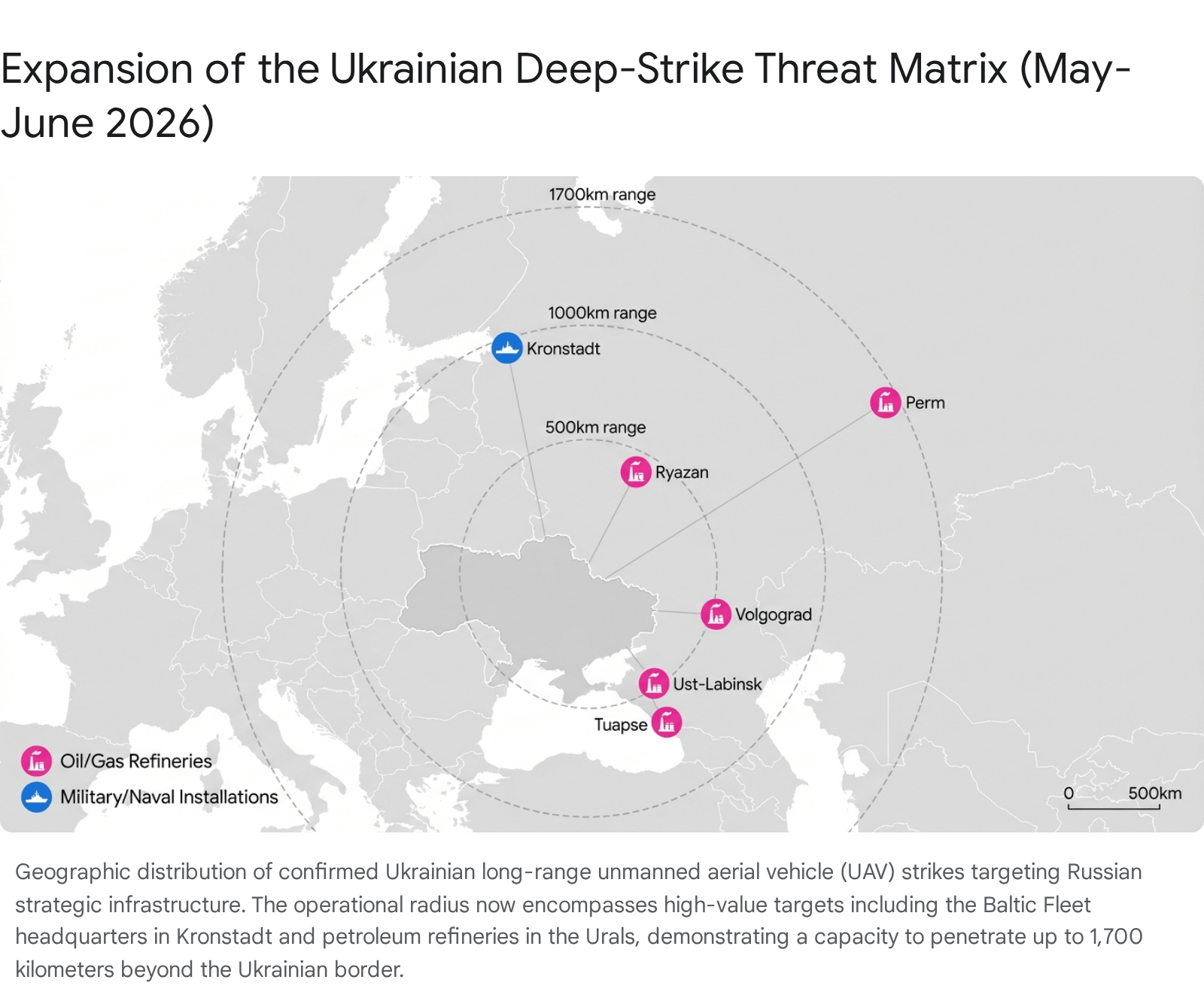
The deployment of unmanned systems by both combatants escalated to unprecedented levels of volume and sophistication during May and early June 2026. This period witnessed the heaviest concentration of Ukrainian deep-strike operations since the conflict’s inception. Driven by scaled domestic production of long-range attack drones, the Armed Forces of Ukraine successfully targeted 18 distinct Russian oil and gas infrastructure assets, four dedicated military-industrial facilities, 15 critical maritime assets, and 10 aviation and missile platforms.18
Demonstrating a newly verified operational range of up to 1,700 kilometers, Ukrainian drones are now capable of striking deep within the Russian hinterland, reaching targets as far as the Perm region on the edge of the Ural Mountains and Kirishi in the northern latitudes.18 A hallmark of this expanded capability occurred on the night of June 5-6, when Ukrainian forces executed a highly coordinated, multi-agency strike against the Kronstadt Naval Base near St. Petersburg.20 Executed jointly by Ukraine’s Special Operations Forces (“Deep Strike” units), the Unmanned Systems Forces (USF), and the Security Service of Ukraine (SBU), the drone swarm successfully traversed approximately 1,000 kilometers of contested airspace to strike the 15th Arsenal of the Russian Navy.20 The attack ignited large-scale fires and secondary detonations within the ammunition depots and severely damaged the Stereguschiy-class guided-missile corvette Boykiy while it underwent maintenance in a dry dock.23 Concurrently, Ukrainian drones struck the Poltavskaya oil depot in the city of Ust-Labinsk (Krasnodar Krai), sparking a massive 5,000-square-meter fire at the fuel storage and distribution facility, which possesses a tank farm capacity of nearly 15,000 cubic meters.26
At the tactical level along the FLOT, the saturation of airspace by First-Person View (FPV) drones has forced a fundamental evolution in infantry and mechanized doctrine. Ukraine has aggressively institutionalized and incentivized tactical drone operations through the implementation of the “Army of Drones Bonus system” (ePoints), an initiative developed by the government defense-technology agency Brave1.29 Under this highly formalized, gamified system, Ukrainian drone units accrue classified point values for verified target eliminations—such as 12 points for incapacitating a Russian infantryman—which can subsequently be redeemed in a centralized government marketplace to procure additional unmanned assets.29
Targeting Priorities and Strike Effectiveness
An analysis of the targeting matrices reveals starkly divergent strategic objectives between the two belligerents.
Kyiv’s strategic bombing campaign is explicitly engineered to degrade the Russian war economy, cripple military logistics, and sever the fiscal lifelines funding the invasion. The systematic targeting of the hydrocarbon sector has yielded severe operational consequences. By striking massive refining facilities—including the Ryazan Refinery (17 million tons annual capacity), the Volgograd Lukoil Refinery (14 million tons capacity), and the Kirishinefteorgsintez Refinery (over 20 million tons capacity)—Ukrainian strikes have neutralized an estimated 40% of Russia’s total operational refining capacity.18 This systematic destruction has catalyzed spreading fuel shortages across the civilian market and directly constrained frontline military logistics in regions like Belgorod and Kursk.1 Furthermore, Ukrainian forces have prioritized strikes against Russian military-industrial plants producing critical components, successfully hitting the Angstrem Plant in Zelenograd (which manufactures microelectronics for precision weapons) and the VNIIR-Progress Plant in Cheboksary (which produces anti-jamming antennas for Russian missiles and drones).18
| Asset Category | Selected Strategic Targets (May – Early June 2026) | Stated Operational Impact |
| Oil & Gas Infrastructure | Ryazan Refinery, Volgograd Refinery, Tuapse Refinery, Perm Refinery, Ust-Labinsk Depot | Estimated 40% reduction in refining capacity; verifiable fuel rationing. |
| Military-Industrial Plants | Angstrem Plant (Microelectronics), VNIIR-Progress (GNSS Receivers), Bryansk Chemical Plant | Disruption of precision-weapon component supply chains. |
| Maritime Assets | Kronstadt Naval Base (15th Arsenal), Boykiy Corvette, Admiral Essen Frigate | Degradation of Baltic Fleet infrastructure and Black Sea patrol capabilities. |
| Aviation & Missile Nodes | Tu-142MR aircraft (Taganrog), Yeysk Military Airfield, Iskander-M Launchers | Interdiction of strategic communication platforms and launch machinery. |
Conversely, the Russian Armed Forces remain committed to a strategy of aerospace attrition, utilizing massed swarms of loitering munitions to overwhelm Ukrainian air defenses and obliterate civilian energy infrastructure. According to ACLED data, Russian forces conducted over 3,400 air and drone strikes in May alone.30 On June 2, Russia executed one of the largest combined assaults of the conflict, deploying 73 ballistic and cruise missiles alongside 656 drones to strike Kyiv, Dnipro, Poltava, Kharkiv, and Zaporizhzhia.31 However, Russian drone tactics are showing signs of localized adaptation. In the Kharkiv region, authorities report that Russian forces have pivoted away from launching massive, concentrated nighttime swarms. Instead, they are deploying single drones continuously over a 24-hour cycle; this psychological and attritional tactic is specifically designed to keep air raid sirens constantly active, exhaust civilian populations, and slowly drain localized air defense magazines.2
Countermeasures, Electronic Warfare, and the Romanian Maritime Incident
The relentless proliferation of unmanned platforms has precipitated a high-stakes technological race in Electronic Warfare (EW) and Counter-Unmanned Aerial Systems (C-UAS). This intensely contested electromagnetic environment triggered a significant international security incident on June 5, highlighting the severe spillover risks associated with autonomous systems.
While operating in the Black Sea, a Ukrainian Unmanned Surface Vehicle (USV) was subjected to overwhelming Russian EW jamming, which successfully severed the encrypted command-and-control link between the vessel and its remote operators.2 Rendered autonomous and unable to receive navigational corrections, the explosive-laden USV drifted erratically into the territorial waters of NATO member Romania.35 The rogue vessel eventually detonated at Pier 78 within the Port of Constanta at approximately 10:30 AM, while a second drone self-destructed just outside the port, and two others detonated 145 kilometers offshore in open waters.2 Fortunately, the Ukrainian Navy immediately notified the Romanian Ministry of National Defence (MApN) and the Romanian Intelligence Service (SRI) upon losing control, facilitating a rapid evacuation of the port facilities and preventing any civilian casualties.2
The geopolitical fallout was immediate. Romanian President Nicusor Dan categorized the explosions as “direct consequences” of Russian military aggression, while the Kremlin rapidly weaponized the incident through its state media apparatus to project Ukraine as a reckless regional threat and to preemptively deflect blame for any future accidental Russian strikes on NATO territory.2
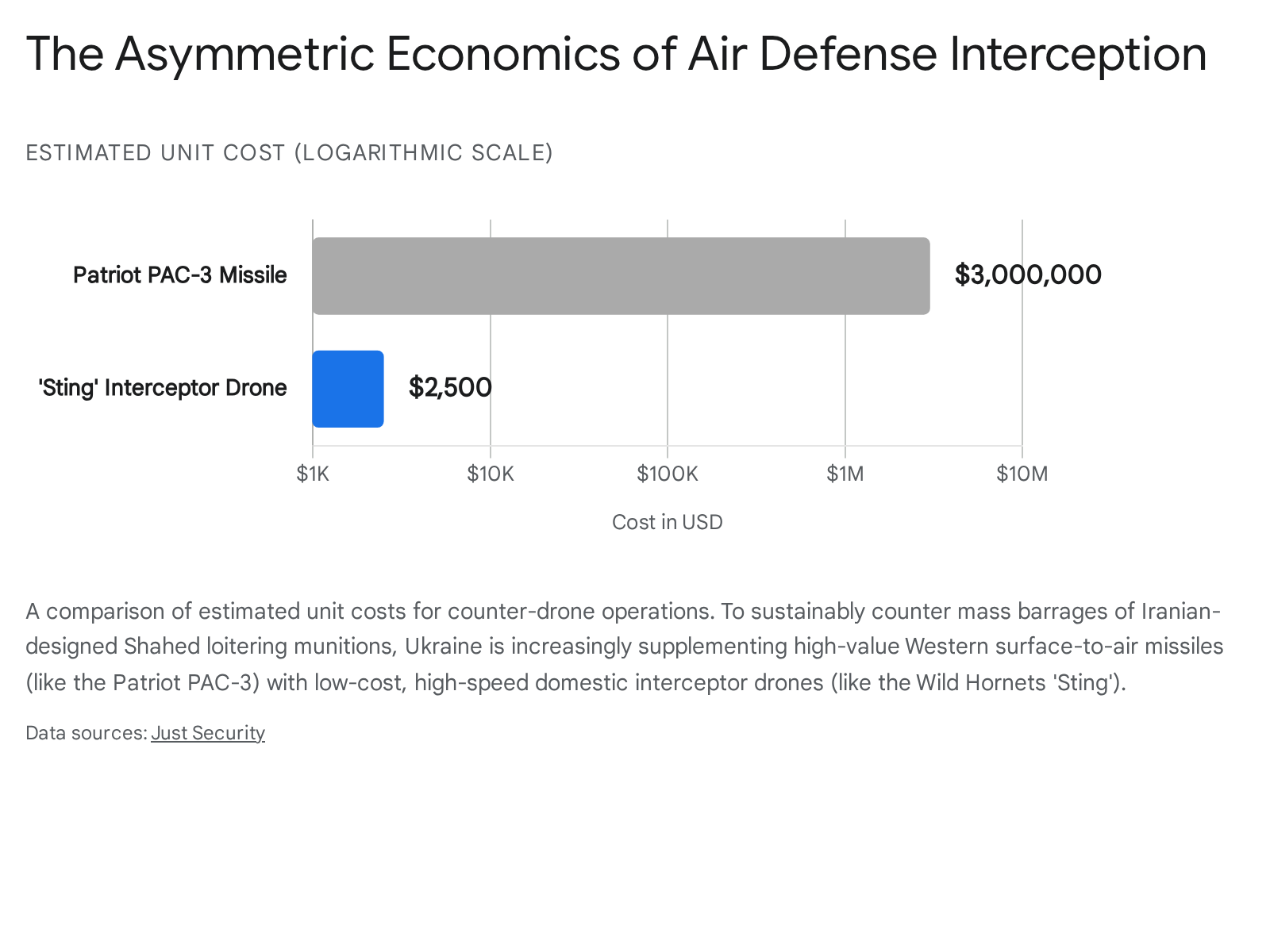
In the aerial domain, the sheer volume of Russian attacks has forced Ukraine to innovate radically cost-effective interception methodologies. Recognizing the unsustainable economics of utilizing finite Western interceptor missiles against cheap loitering munitions, Ukraine has aggressively deployed the domestically manufactured “Sting” interceptor drone.37 Developed by the defense technology firm Wild Hornets, the Sting interceptor utilizes a novel chemical accelerator upgrade—eschewing traditional jet propulsion—to achieve intercept speeds exceeding 500 km/h, allowing it to chase down and destroy Russian Geran-4 variants.37 Costing approximately $2,500 per unit, the Sting represents a critical paradigm shift in C-UAS economics, allowing Ukrainian forces to conserve their multi-million dollar surface-to-air missiles for high-value ballistic threats.37 To further bolster this capability, the Ukrainian defense-industrial complex is currently testing the “Clear Sky” project, an initiative aimed at integrating these high-speed interceptor drones onto light-attack aircraft to create mobile, aerial C-UAS platforms.7
4. Resource Utilization, Constraints, and Sustainability Projection
Ammunition Burn Rates and Defense Output
The conflict continues to be defined by staggering consumption rates of critical materiel, placing unprecedented strain on global defense supply chains and forcing both combatants to fundamentally restructure their military-industrial bases.
Ukraine’s integrated air defense network is operating at an exceptionally high, yet precarious, capacity. Data released by the Ukrainian Ministry of Defense indicates that during the month of May 2026, Ukrainian air defense units intercepted 7,588 out of more than 8,300 aerial targets launched by the Russian Federation, achieving a highly effective aggregate interception rate of 90.75%.39 However, sustaining this protective umbrella has exacted a severe toll on high-end munitions inventories. Reports indicate that Ukrainian forces fired approximately 700 U.S.-manufactured Patriot PAC-3 interceptor missiles over a recent 12-month period.37 Given that Lockheed Martin produces approximately 600 of these advanced interceptors annually globally, Ukraine’s consumption rate is single-handedly exacerbating a critical, worldwide shortfall of these vital systems, leaving the nation highly vulnerable to strategic stock depletion.37
Conversely, the Russian defense industrial base has successfully transitioned to a full wartime footing, largely circumventing Western sanctions through the establishment of illicit procurement networks and deep integration with allied states like North Korea and China. According to compiled intelligence estimates from the Estonian Foreign Intelligence Service, Russian metallurgical and explosive manufacturing facilities produced an estimated 7 million rounds of large-caliber munitions in 2025—including 3.4 million 152mm howitzer shells, 2.3 million mortar rounds, and 500,000 unguided rockets.41 This production scale leverages highly asymmetric economics; the Russian state procures legacy 152mm artillery shells for less than 100,000 rubles (roughly $1,050 USD), a fraction of the cost required to forge a comparable 155mm NATO standard shell.41 Furthermore, to sustain the sheer volume of its ground attack campaign, the Russian defense industry doubled its annual production of RM-48U target missiles from 200 units to over 480 units.43 These heavy anti-aircraft missiles, originally designed for the S-300 and S-400 air defense systems and equipped with 150–180 kg high-explosive fragmentation warheads, have been systematically repurposed to conduct devastating ballistic strikes against Ukrainian ground targets.43
Manpower, Force Generation, and Logistical Bottlenecks
Beyond the consumption of materiel, both militaries face acute, systemic challenges regarding manpower generation and the logistical sustainment of deployed forces.
The Ukrainian government has formally initiated the first phase of a comprehensive military personnel reform framework, scheduled for immediate rollout in June 2026.44 To address severe numerical shortages in frontline infantry units, reduce record rates of absence without leave, and incentivize voluntary recruitment, President Zelensky announced sweeping structural pay increases.44
| Military Assignment Category | Base Compensation Range (UAH) | Estimated USD Equivalent |
| Rear-Echelon / Support Positions | Minimum 30,000 UAH | ~$677 |
| Active Combat Infantry / Assualt | 250,000 – 400,000 UAH | ~$5,644 – $9,031 |
The reform package also introduces specialized, defined-term contracts explicitly for infantry troops and establishes clear chronological criteria for the phased, legal discharge of long-serving conscripts.44 Operationally, Ukrainian Commander-in-Chief Oleksandr Syrskyi declared that the Armed Forces have finally consolidated sufficient personnel across combat brigades to institute a mandatory, standardized two-month rotation schedule.46 To ensure compliance and alleviate the crushing fatigue among frontline units, Syrskyi has mandated rigorous audits to be conducted by officer groups on the 15th of every month to monitor rotation implementation and personnel accounting.47
The Russian Armed Forces face a different, yet highly restrictive, force generation paradigm. The Kremlin remains politically averse to declaring a highly unpopular second wave of mass mobilization. Consequently, Russian military planners struggle to comprehensively reconstitute the staggering casualties sustained during continuous, grinding infiltration assaults.48 To maintain troop levels, Moscow relies exclusively on continuous, localized recruitment drives incentivized by exorbitant signing bonuses.49 While this methodology generates enough replacement personnel to sustain slow, attritional pressure, it structurally prevents the generation of the massive operational reserve necessary to exploit tactical breaches and achieve deep, strategic penetrations.49
Logistically, the verifiable degradation of the Russian domestic hydrocarbon network by Ukrainian long-range strikes has created severe friction points. The disruption of fuel supplies fundamentally limits the mobility of Russian mechanized assets and complicates the sprawling, vulnerable supply chains required to transport the 10,000–15,000 artillery shells expended daily along the frontlines.1 Tactical energy delivery has become highly contested; standard fuel convoys are easily identified and destroyed by Ukrainian FPV drones and electronic surveillance. This vulnerability forces Russian field units to rely heavily on finite generator power for critical command-and-control nodes and localized EW systems, significantly limiting their operational endurance.50
Sustainability Projection
In the short-to-medium term, the trajectory of the battlefield will be dictated by what military logisticians term the “industrial window of war”—the critical period during which a belligerent’s domestic production and foreign imports demonstrably outpace its daily consumption of vital materiel.41
Russia currently maintains a definitive industrial advantage in the raw production of artillery shells, the refurbishment of legacy armor, and the procurement of ballistic missiles from allied states like North Korea.42 However, the operational utility of this materiel advantage is rapidly depreciating. Russian commanders are structurally incapable of safely massing armored columns to achieve breakthroughs due to ubiquitous Ukrainian drone surveillance, and their rear-echelon logistics networks are under continuous, degrading pressure.49 Assuming its recruitment pipeline remains steady, Russia possesses the resources to sustain its current tempo of localized, highly attritional infantry assaults through the remainder of 2026, but it is highly unlikely to achieve any war-terminating operational penetrations.
Ukraine’s strategic sustainability is precariously hinged on two pivotal variables: the stabilization of its critical air defense interceptor stockpiles and the successful execution of its June 2026 manpower and rotation reforms.45 The successful passage of the U.S. House discharge petition and the impending formalization of the €70 billion NATO multilateral framework provide Kyiv with the indispensable fiscal liquidity required to maintain the apparatus of the state and procure vital mid-tier military systems.8 Nevertheless, the exhaustion of high-end interceptors (e.g., Patriot PAC-3) remains a critical vulnerability. If Ukraine can successfully rapidly scale the production and deployment of cheap interceptor drones (such as the Sting) to neutralize the massed Shahed threat, it can preserve its advanced surface-to-air missile systems exclusively to deter Russian tactical aviation and ballistic threats. Furthermore, the deep-strike campaign into the Russian Federation is highly sustainable given Ukraine’s exponentially expanding domestic drone manufacturing base. If current targeting tempos are maintained, these strikes will likely precipitate cascading, systemic economic and logistical crises within the Russian interior by late 2026, fundamentally altering the Kremlin’s strategic calculus.
5. Chronological Timeline of Key Events
- [May 31, 2026]: Ukrainian forces escalate their deep-strike campaign against Russian fuel infrastructure, executing a verified drone strike on a fuel tanker along the M-14 highway and striking the Novoshakhtinsk oil refinery in the Rostov region, severely degrading two major crude oil processing units.27
- [June 2, 2026]: The Russian Federation launches a massive, combined aerial assault against Ukraine, deploying a reported 73 ballistic and cruise missiles alongside 656 drones. The attack targets civilian and energy infrastructure in Kyiv, Dnipro, Poltava, Kharkiv, and Zaporizhzhia, with Ukrainian air defenses successfully intercepting 40 missiles and 602 drones.31
- [June 3, 2026]: Ukrainian long-range unmanned systems successfully strike the St. Petersburg Oil Terminal—destroying one major reservoir and damaging six others—and the Michurinsk Progress Plant in Tambov Oblast, continuing the systematic degradation of Russian military-industrial and logistical capacity.1
- [June 4, 2026]: Ukrainian President Volodymyr Zelensky formally transmits an open letter to Russian President Vladimir Putin, proposing an immediate frontline ceasefire monitored by the United States and a bilateral peace summit in a third country.1
- [June 4, 2026]: Overcoming entrenched executive opposition, the U.S. House of Representatives successfully utilizes a discharge petition—triggered by the 218th signature from Rep. Kevin Kiley—to pass $1.3 billion in direct security aid and $8 billion in loans to Ukraine.8
- [June 5, 2026]: Russian President Vladimir Putin explicitly rejects Ukraine’s ceasefire proposal in public statements, insisting on the fulfillment of Russia’s maximalist territorial objectives and citing prior Anchorage discussions as the only acceptable baseline.2
- [June 5, 2026, ~06:20 AM]: A Ukrainian Unmanned Surface Vehicle (USV), its control link severed by intense Russian electronic warfare jamming, drifts into NATO territorial waters and detonates at Pier 78 within the Romanian Port of Constanta, triggering emergency responses and exposing severe maritime spillover risks.2
- [June 6, 2026]: Executing a strike with an operational radius of approximately 1,000 kilometers, Ukrainian Special Operations Forces and Unmanned Systems Forces target the Russian Baltic Fleet’s Kronstadt Naval Base near St. Petersburg, causing localized fires at the 15th Arsenal and damaging the Boykiy guided-missile corvette.20
- [June 6, 2026]: In a coordinated long-range operation, Ukrainian drones strike the Poltavskaya oil depot in Ust-Labinsk, Krasnodar region, igniting a massive 5,000-square-meter fire at the critical fuel storage facility.26
Please share the link on Facebook, Forums, with colleagues, etc. Your support is much appreciated and if you have any feedback, please email us in**@*********ps.com. If you’d like to request a report or order a reprint, please click here for the corresponding page to open in new tab.
Sources Used
- Russian Offensive Campaign Assessment, June 4, 2026 | ISW, accessed June 6, 2026, https://understandingwar.org/research/russia-ukraine/russian-offensive-campaign-assessment-june-4-2026/
- Russian Offensive Campaign Assessment, June 5, 2026 | ISW, accessed June 6, 2026, https://understandingwar.org/research/russia-ukraine/russian-offensive-campaign-assessment-june-5-2026/
- Putin says Russia will bolster its air defenses in response to Ukrainian drone attacks, accessed June 6, 2026, https://apnews.com/article/russia-putin-ukraine-st-petersburg-forum-33f3e7f260e23563ed8a6b509650079e
- Large-scale drone attack hits Russia and occupied parts of Donetsk Oblast, oil depots and ports on fire – pho, accessed June 6, 2026, https://www.pravda.com.ua/eng/news/2026/06/06/8038011/
- Russian Offensive Campaign Assessment, June 1, 2026 | ISW, accessed June 6, 2026, https://understandingwar.org/research/russia-ukraine/russian-offensive-campaign-assessment-june-1-2026/
- The Russia-Ukraine War Report Card, June 3, 2026, accessed June 6, 2026, https://www.russiamatters.org/news/russia-ukraine-war-report-card/russia-ukraine-war-report-card-june-3-2026
- Russia Maintains High Operational Tempo Across Ukraine As Kyiv Continues Long-Range Drone Campaign – Analysis, accessed June 6, 2026, https://www.eurasiareview.com/05062026-russia-maintains-high-operational-tempo-across-ukraine-as-kyiv-continues-long-range-drone-campaign-analysis/
- U.S. House of Representatives Opens Path for Vote on New Aid to …, accessed June 6, 2026, https://militarnyi.com/en/news/u-s-house-of-representatives-opens-path-for-vote-on-new-aid-to-ukraine/
- Trump says Ukraine “wouldn’t have lasted one or two days” without US military support, accessed June 6, 2026, https://www.eurointegration.com.ua/eng/news/2026/06/5/7239062/
- House passes bill to provide more Ukraine aid and impose new sanctions on Russia, accessed June 6, 2026, https://www.pbs.org/newshour/politics/house-passes-bill-to-provide-more-ukraine-aid-and-impose-new-sanctions-on-russia
- Politico: NATO considers new €70 billion funding package for Ukraine, accessed June 6, 2026, https://unn.ua/en/news/politico-nato-considers-new-euro70-billion-funding-package-for-ukraine
- NATO Discusses €70 Billion Ukraine Aid Package to Balance Financial Load, accessed June 6, 2026, https://www.kyivpost.com/post/77659
- Ukraine Requested Additional Missiles for the Patriot System from …, accessed June 6, 2026, https://militarnyi.com/en/news/ukraine-patriot-german-interceptor-drones/
- Previewing Xi Jinping’s Visit to North Korea | State of Play, accessed June 6, 2026, https://www.csis.org/analysis/previewing-xi-jinpings-visit-north-korea-state-play
- Xi to visit North Korea, showing China’s importance to a nuclear-armed neighbor, accessed June 6, 2026, https://www.washingtonpost.com/world/2026/06/05/xi-visit-north-korea-showing-chinas-importance-nuclear-armed-neighbor/
- Chinese leader Xi Jinping will travel to North Korea next week in first visit since 2019, accessed June 6, 2026, https://apnews.com/article/china-xi-north-korea-kim-4def48720a7cb66f820d3efc256a941c
- Xi’s North Korea Visit Puts a Trump-Kim Summit Back in Play, accessed June 6, 2026, https://keia.org/analysis/xis-north-korea-visit-puts-a-trump-kim-summit-back-in-play/
- Ukraine logs heaviest deep strike month of the year, hitting 18 oil …, accessed June 6, 2026, https://euromaidanpress.com/2026/06/04/ukraine-logs-heaviest-deep-strike-month-of-the-year-hitting-18-oil-and-gas-facilities-in-russia/
- Explosions reported in Russia’s Ust-Labinsk, drone strike on oil depot claimed – Ukrinform, accessed June 6, 2026, https://www.ukrinform.net/rubric-ato/4131036-explosions-reported-in-russias-ustlabinsk-drone-strike-on-oil-depot-claimed.html
- Ukraine’s special forces claim drone strike on Russian Baltic fleet base, accessed June 6, 2026, https://caliber.az/en/post/ukraine-s-special-forces-claim-drone-strike-on-russian-baltic-fleet-base
- Zelensky confirms another drone strike on St. Petersburg Oblast ahead of Putin’s economic forum finale – The Kyiv Independent, accessed June 6, 2026, https://kyivindependent.com/oil-depot-set-ablaze-as-ukraine-reportedly-launches-dozens-of-drones-towards-russia/
- Ukraine Confirms 1,000-km Special Forces Drone Strike on Baltic Base – Kyiv Post, accessed June 6, 2026, https://www.kyivpost.com/post/77650
- Not just the base in Kronstadt – SBU confirms strikes on Russian Navy arsenal and oil depot near Krasnodar | УНН, accessed June 6, 2026, https://unn.ua/en/news/not-just-the-base-in-kronstadt-sbu-confirms-strikes-on-russian-navy-arsenal-and-oil-depot-near-krasnodar
- Ukraine Strikes Russian Navy Arsenals and Kronstadt Base Nearly 1000 Kilometers From the Border – UNITED24 Media, accessed June 6, 2026, https://united24media.com/war-in-ukraine/ukraine-strikes-russian-navy-arsenals-and-kronstadt-base-nearly-1000-kilometers-from-the-border-19569
- Ukrainian drones hit St Petersburg as ‘Russian Davos’ opens in city, accessed June 6, 2026, https://www.theguardian.com/world/2026/jun/03/ukraine-drones-st-petersburg-russia-economic-forum
- Fire breaks out at oil depot in southern Russian city following Ukrainian drone attack, accessed June 6, 2026, https://www.aa.com.tr/en/eurasia/fire-breaks-out-at-oil-depot-in-southern-russian-city-following-ukrainian-drone-attack/3958355
- Russia’s Fuel Network Hit Again as Ust-Labinsk Oil Depot Erupts in Fireball, accessed June 6, 2026, https://united24media.com/war-in-ukraine/russias-fuel-network-hit-again-as-ust-labinsk-oil-depot-erupts-in-fireball-19568
- Ukraine hits major Ust-Labinsk oil storage site in Russian Kuban, accessed June 6, 2026, https://newsukraine.rbc.ua/news/ukraine-hits-major-ust-labinsk-oil-storage-1780745322.html
- Ukraine turns real-life kills into video game thrills for drone pilots, accessed June 6, 2026, https://www.washingtonpost.com/world/2026/05/31/ukrainian-drone-operators-compete-kill-russian-invaders/
- Europe and Central Asia Overview: June 2026 – ACLED, accessed June 6, 2026, https://acleddata.com/update/europe-and-central-asia-overview-june-2026
- Massive Russian attack kills 22 people across Ukraine, officials say, as Moscow escalates fighting, accessed June 6, 2026, https://apnews.com/article/russia-ukraine-war-kyiv-drones-missiles-938c74b107d9bb8dc16b179d76125e50
- War in Ukraine | Global Conflict Tracker – Council on Foreign Relations, accessed June 6, 2026, https://www.cfr.org/global-conflict-tracker/conflict/conflict-ukraine
- Ukrainian drone under influence of russian electronic warfare ended up off coast of Romania – Ukrainian Navy, accessed June 6, 2026, https://ukranews.com/en/news/1156069-ukrainian-drone-under-influence-of-russian-electronic-warfare-ended-up-off-coast-of-romania
- Romanian President Convenes Security Meeting Over Black Sea Naval Drone Detonation – Kyiv Post, accessed June 6, 2026, https://www.kyivpost.com/post/77642
- Four Naval Drones Explode in Romanian Waters in One Day, accessed June 6, 2026, https://www.romaniajournal.ro/society-people/four-naval-drones-explode-in-romanian-waters-in-one-day/
- A Ukrainian maritime drone explodes at a Romanian Black Sea port. No injuries reported., accessed June 6, 2026, https://apnews.com/article/drone-romania-black-sea-explosion-ukraine-defc53b2383a67475230c8349a47d7c6
- How Ukraine Became a Drone Superpower – Just Security, accessed June 6, 2026, https://www.justsecurity.org/138164/ukraine-drone-superpower/
- Russo-Ukrainian war, day 1563: Ukraine doubles its deep strikes …, accessed June 6, 2026, https://euromaidanpress.com/2026/06/06/russo-ukrainian-war-day-1563/
- Air Defense Intercepted Over 7500 Targets in a Month, Efficiency Exceeded 90% – УНН, accessed June 6, 2026, https://unn.ua/en/news/air-defense-intercepted-over-7500-targets-in-a-month-efficiency-exceeded-90percent-ministry-of-defense
- Patriot missile shortage has created ‘window of vulnerability’ Russia is exploiting in Ukraine, accessed June 6, 2026, https://www.theguardian.com/world/2026/jun/02/patriot-missile-shortage-window-vulnerability-russia-exploiting-ukraine
- The Industrial Window of War: How to Measure Russia’s Munitions Throughput—and How to Disrupt It – Modern War Institute, accessed June 6, 2026, https://mwi.westpoint.edu/the-industrial-window-of-war-how-to-measure-russias-munitions-throughput-and-how-to-disrupt-it/
- Russia expands large-calibre ammunition production and stockpiles for potential future conflicts, accessed June 6, 2026, https://raport.valisluureamet.ee/2026/en/5-russian-armed-forces/5-2-russia-expands-large-calibre-ammunition-production-and-stockpiles-for-potential-future-conflicts/
- Russia Doubles Production of RM-48U Missiles for Strikes on Ground Targets, accessed June 6, 2026, https://militarnyi.com/en/news/russia-production-rm-48u-missiles-targets/
- First phase of Ukraine’s military changes to begin in June with higher pay and contract updates, accessed June 6, 2026, https://english.nv.ua/nation/ukraine-s-2026-military-reform-pay-increases-and-new-terms-for-contract-service-to-take-effect-50612441.html
- Rethinking Ukraine’s Manpower Challenge | Carnegie Endowment for International Peace, accessed June 6, 2026, https://carnegieendowment.org/russia-eurasia/research/2026/03/ukraine-military-russia-war-manpower-recruitment
- Ukraine’s Commander Discusses 2-Month Troop Rotations as War Grinds Forward – Kyiv Post, accessed June 6, 2026, https://www.kyivpost.com/post/76466
- Syrskyi outlines conditions for military rotations every two months – УНН, accessed June 6, 2026, https://unn.ua/en/news/syrskyi-outlines-conditions-for-military-rotations-every-two-months
- Russia Analytical Report, May 26–June 1, 2026, accessed June 6, 2026, https://www.russiamatters.org/news/russia-analytical-report/russia-analytical-report-may-26-june-1-2026
- Ukraine’s War Effort in Mid-2026: International Opportunities and Domestic Challenges, accessed June 6, 2026, https://innovation.army.mil/News/Article-View/Article/4509097/ukraines-war-effort-in-mid-2026-international-opportunities-and-domestic-challe/
- No. 26-1116, Powering The Front: Tactical Energy Delivery and Management in the Ukraine War, accessed June 6, 2026, https://api.army.mil/e2/c/downloads/2026/03/30/c260713f/no-26-1116-powering-the-front-tactical-energy-delivery-and-management-in-the-ukraine-war.pdf
- Arms industry of Russia – Wikipedia, accessed June 6, 2026, https://en.wikipedia.org/wiki/Arms_industry_of_Russia
- Russian Offensive Campaign Assessment, May 31, 2026 | ISW, accessed June 6, 2026, https://understandingwar.org/research/russia-ukraine/russian-offensive-campaign-assessment-may-31-2026/