Tag Archives: Russia-Ukraine Conflict

SITREP Russia-Ukraine – Week Ending February 28, 2026

Executive Summary

As the armed conflict between the Russian Federation and Ukraine officially crosses the threshold into its fifth year of high-intensity, conventional warfare, the strategic and operational landscape during the week ending February 28, 2026, is characterized by a violent, grinding war of attrition, escalating deep-strike asymmetric campaigns, and highly volatile, structurally fragile diplomatic maneuvering. The battlefield remains strategically static but tactically hyper-active. Russian military forces have formally initiated artillery and unmanned aerial vehicle (UAV) preparations for a projected Spring-Summer 2026 offensive, with operational vectors converging on the deeply entrenched Ukrainian “Fortress Belt” in the Donetsk Oblast. Simultaneously, the Russian aerospace forces have executed some of the most massive, coordinated strike packages of the war, deliberately targeting Ukraine’s civilian energy, water, and railway infrastructure to maximize societal friction during an unusually harsh winter. Conversely, the Ukrainian Armed Forces have demonstrated significant resilience, executing localized counter-offensive operations in the Kupyansk and southern directions that have successfully stabilized critical sectors and recaptured lost territory, refuting Kremlin narratives of inevitable Russian victory. Furthermore, Ukraine has exponentially expanded its deep-strike footprint, utilizing advanced Western munitions and domestically produced loitering munitions to strike critical logistical nodes and project power directly into the Moscow metropolitan area, forcing the disruption of Russian civil aviation.

The human, demographic, and material toll of this protracted conflict has reached levels without modern precedent since the conclusion of the Second World War. Combined military casualties are currently projected to be approaching 1.8 million personnel, with the Russian military sustaining roughly 1.2 million casualties compared to Ukraine’s estimated 600,000. The extraordinary rate of mechanized and vehicular attrition has forced both belligerent nations into a state of deep reliance on international military, industrial, and economic lifelines. The Russian economy, while historically demonstrating artificial resilience due to a rapid, state-directed transition to a military-industrial footing, is currently exhibiting severe, potentially cascading structural strain. Indicators of this strain include stagnating domestic gross domestic product (GDP) growth, a punitive 20 percent central bank interest rate, and a critical, unfillable shortage of 4.8 million skilled workers across the manufacturing sector, threatening the long-term sustainability of Moscow’s entire war effort. Meanwhile, the macroeconomic survival of the Ukrainian state apparatus has been anchored by a newly approved $8.1 billion International Monetary Fund (IMF) Extended Fund Facility, which serves as the foundational component of a broader $136.5 billion international support package designed to offset catastrophic infrastructure damage and a massive, structural budget deficit.

Diplomatically, the geopolitical architecture surrounding the conflict is undergoing significant tectonic shifts. United States-mediated peace negotiations recently held in Geneva have yielded preliminary, yet highly controversial, draft frameworks. However, these bilateral and trilateral discussions are increasingly complicated by public friction between the current US administration’s aggressive push for a rapid negotiated settlement and the broader international community’s insistence on preserving Ukrainian sovereignty and territorial integrity—a divergence starkly highlighted during a recent, contested vote at the United Nations General Assembly. Within both nations, the pressure cooker of domestic politics is compounding external strategic challenges. The Kremlin has severely escalated its crackdown on the domestic information space, most notably through the deliberate throttling of the Telegram messaging network—a draconian internal security maneuver that paradoxically risks degrading Russian military command and control capabilities on the front lines. In Kyiv, the ongoing debate over the legal and logistical feasibility of holding presidential elections under the constraints of martial law continues to expose underlying political fault lines, particularly highlighting growing tension between the current wartime administration and former senior military leadership.

1. Strategic Battlefield Architecture and Tactical Evolution

1.1 Russian Offensive Operations and Shaping the Donetsk “Fortress Belt”

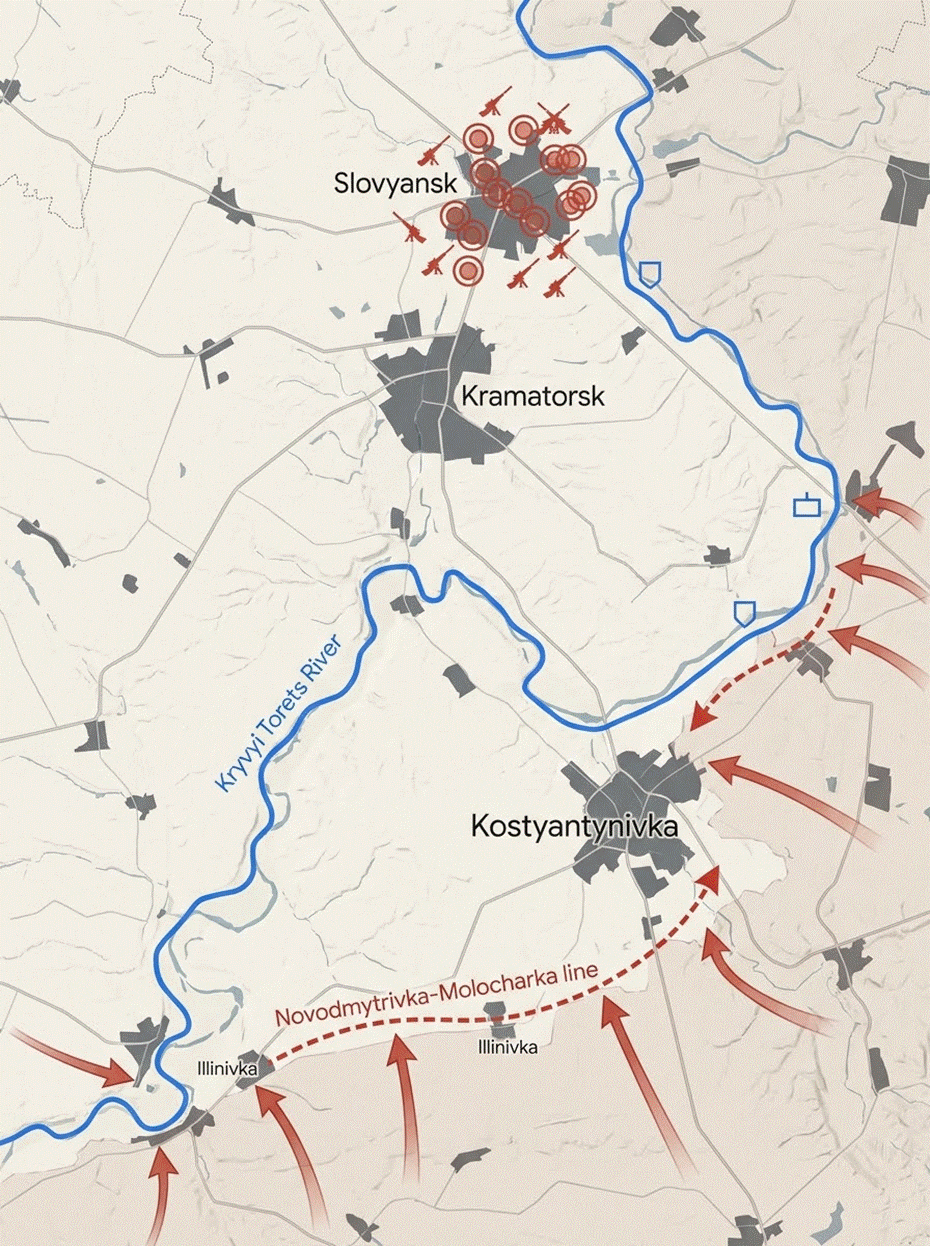
Strategic intelligence analysis indicates that the Russian military command has officially transitioned from winter positional holding patterns to the preliminary shaping phases of its highly anticipated Spring-Summer 2026 offensive. The operational center of gravity for the Russian Federation remains absolutely fixed on the Donetsk Oblast, specifically targeting the Ukrainian “Fortress Belt.” This belt is a deeply entrenched, heavily fortified series of interconnected cities and urban agglomerations that has served as the impenetrable backbone of Ukrainian defensive operations in the eastern theater since the initial hostilities of 2014.1 Intelligence gathered on February 26 and 27 confirms that Russian forces have initiated sustained, high-volume tube artillery bombardment of the settlement of Bilenke.1 Situated approximately 14 kilometers from the current line of contact, Bilenke serves as the immediate northeastern suburb of Kramatorsk, the northern anchor of the Fortress Belt.1 This specific artillery activity marks a significant and dangerous operational escalation; it is the first documented instance in the conflict where Russian forces have successfully advanced their tube artillery systems into firing positions capable of reliably striking Kramatorsk and its immediate suburbs.1

This intense artillery preparation in the northern sector is being systematically accompanied by a protracted Battlefield Air Interdiction (BAI) campaign targeting the southern flank of the Fortress Belt.1 Operating deep within the operational rear—roughly 20 to 100 kilometers behind the established line of contact—Russian forces are heavily and increasingly utilizing loitering munitions and first-person view (FPV) drones to interdict Ukrainian ground lines of communication (GLOCs).1 Geolocated video intelligence published on February 26 confirms precise Russian drone strikes occurring along the critical H-20 Kostyantynivka-Slovyansk highway.1 This highway functions as the primary logistical artery facilitating the movement of troops, ammunition, and medical evacuations between the fortified cities of the belt.1 Further strikes were documented against Ukrainian forces stationed in Oleksiievo-Druzhkivka, positioned at the extreme southern tip of the defensive line.1 Spatial analysis of the operational theater reveals a deliberate dual-pronged pressure system directed at the Ukrainian Fortress Belt. In the northern sector, Russian tube artillery units have established firing positions capable of striking Bilenke, effectively threatening the Kramatorsk suburban anchor. Simultaneously, the southern operational vector is characterized by persistent Battlefield Air Interdiction drone strikes concentrated along the H-20 highway, connecting Slovyansk and Kostyantynivka. This geographic distribution of kinetic activity indicates a concerted effort to isolate, interdict, and degrade the defensive line from both its northern and southern extremities prior to the commitment of massed Russian mechanized ground assault formations.

Despite these intense and resource-heavy shaping operations, the net rate of Russian territorial acquisition has markedly decelerated, indicating an operational culmination or, at minimum, severe logistical friction. Comprehensive analysis of territorial control mapping reveals that between January 27 and February 24, 2026, Russian forces managed to capture approximately 50 square miles of Ukrainian territory—an area only slightly larger than two Manhattan Islands.2 This represents a significant drop, being less than half of the 106 square miles seized during the preceding four-week period ending January 27.2 Furthermore, conflicting open-source intelligence highlights the highly fluid, contested nature of the current front lines. While specific Western analytical models suggest a net territorial loss of 33 square miles for Russia in the final week of February, granular frontline mapping from the Ukrainian DeepState open-source intelligence group indicates a marginal, contested Russian gain of 5 square miles between February 17 and 24.2 DeepState data confirms that while Russian forces advanced near more than a dozen micro-settlements, Ukrainian forces successfully executed localized counter-pushes, driving Russian units back near the settlements of Vyshneve, Verbove, Ternove, and Kalynivske.2 This overarching deceleration suggests that while Russian forces secured high-profile operational victories earlier in the year—most notably the confirmed total seizure of the heavily defended town of Pokrovsk by late January 2026—their broader offensive momentum is currently tightly constrained by overextended logistics, profound equipment losses, and stiffening, adaptive Ukrainian resistance.4

Adding a deeply concerning geopolitical dimension to the tactical battlefield is the confirmed, active integration of foreign military personnel. Intelligence reports indicate that North Korean military fighters have been officially embedded within Russian combat formations operating on the front lines.5 This unprecedented development marks a significant structural adjustment to Pyongyang’s historical force employment trends and highlights the severe, unmitigated manpower constraints currently plaguing the Russian military apparatus.5 The integration of North Korean personnel into Russian mechanized and infantry units introduces substantial, compounding challenges regarding tactical interoperability, linguistic barriers, and unified command-and-control, which may paradoxically impede the tempo and cohesion of future Russian ground assaults while signaling Moscow’s desperate reliance on rogue-state alliances.

1.2 Ukrainian Counter-Offensive Operations and Sector Stabilization

Directly refuting persistent Kremlin strategic narratives asserting that a decisive Russian battlefield victory is mathematically inevitable and that Ukraine must capitulate to maximalist demands, the Ukrainian Armed Forces have recently demonstrated localized operational superiority, achieving their most significant and sustained territorial recaptures since the overarching 2023 counteroffensive and the audacious August 2024 incursion into Russia’s Kursk Oblast.6 As the fifth year of the war commences, Ukrainian forces have proven highly capable of generating local combat power to exploit Russian overextensions.

A series of highly coordinated Ukrainian counterattacks in the Kupyansk direction, initially launched in mid-December 2025, successfully stabilized the critical defense of the town and systematically liberated at least 183 square kilometers of surrounding territory.6 Ukrainian operational commanders have successfully held and consolidated these gains throughout the entirety of February 2026, decisively defeating consecutive, massed Russian attempts to reverse the frontline alterations.6 Current battlefield dynamics and force posture assessments do not suggest that the Russian military will possess the localized combat power required to quickly regain this specific terrain in the near term.6

Simultaneously, the Ukrainian military command initiated limited, precise counterattacks in early February within the Oleksandrivka and Hulyaipole directions, spanning the highly contested Dnipropetrovsk and Zaporizhia oblasts.6 Throughout the month, these targeted operations yielded the verified liberation of approximately 200 square kilometers of territory across the Novopavlivka, Oleksandrivka, and Hulyaipole axes.6 When factoring in localized tactical losses of roughly 35 square kilometers in adjacent sectors during the same timeframe, Ukrainian forces achieved a verified net gain of 165 square kilometers across the southern theater in February.6 While military analysts assess that these localized counterattacks are unlikely to spontaneously transition into a theater-wide, strategic-level offensive capable of collapsing the Russian front, they serve a vital operational purpose. They effectively pin down Russian forces, disrupt staging areas, and force the Russian military command to urgently divert strategic reserves and logistical support away from their primary shaping efforts in the Donetsk Oblast, thereby diluting the combat power available for the anticipated Spring-Summer offensive.6

1.3 Asymmetric Deep-Strike Campaigns and Aerospace Warfare

In tandem with ground operations, the Ukrainian military has exponentially expanded and refined its deep-strike asymmetric warfare campaign, deliberately targeting Russian command, strike, and sustainment nodes located deep within the operational rear and inside the Russian Federation itself.5 On February 22, the Ukrainian Unmanned Systems Forces (USF) executed a highly sophisticated, long-range drone infiltration operation deep into sovereign Russian airspace, directing dozens of advanced loitering munitions toward the heavily defended Moscow metropolitan area.5 Russian civil and military authorities acknowledged that their integrated air defense systems were continuously engaged for several hours, publicly confirming the interception of more than 20 drones on the direct approaches to the capital.5 The psychological and immediate economic impacts of this strike were profound, forcing the emergency temporary cessation of all civil aviation operations at Moscow’s four major international transport hubs: Domodedovo, Sheremetyevo, Vnukovo, and Zhukovsky airports.5 This operation clearly demonstrates Ukraine’s growing capacity to bypass frontline gridlock and impose direct, asymmetric costs on the Russian political and economic center of gravity.

Furthermore, Ukraine’s strategic deployment of advanced Western munitions continues to systematically degrade high-value Russian operational capabilities. Throughout the final week of February, the Ukrainian General Staff reported a series of highly successful mid-range precision strikes utilizing the Army Tactical Missile System (ATACMS) against critical targets in occupied territories.6 Documented strikes definitively neutralized a Russian Uragan Multiple Launch Rocket System (MLRS) positioned near occupied Lyubymivka (roughly 26 kilometers from the frontline), a massed Russian manpower concentration near Novomykolaivka (44 kilometers from the frontline), an ammunition staging depot near Oleksandrivka (53 kilometers from the frontline), and an advanced technological equipment depot operated by the Rubikon Center for Advanced Unmanned Technologies near Vasylivka.6 Ukrainian Unmanned Systems Forces Commander Robert Brovdi further reported that Ukrainian forces successfully targeted and destroyed two highly advanced Russian Tor anti-aircraft missile systems located 45 and 95 kilometers behind the frontline in occupied Donetsk Oblast.7 This systematic counter-logistics, counter-command, and counter-air campaign represents a deliberate, methodical effort to dismantle the specific architectural nodes required to support and sustain the upcoming Russian offensive operations.

Conversely, the Russian aerospace domain strategy remains fundamentally characterized by intense, massed, asymmetric bombardment of the Ukrainian state. The Russian Federation has increasingly relied on enormous drone and missile salvos to circumvent tactical battlefield stagnation and inflict strategic, existential damage on Ukraine’s societal capacity to function.5 The night of February 25 to 26 witnessed one of the largest and most complex combined strike packages of the year, primarily targeting energy infrastructure. The Ukrainian Air Force reported the launch of a staggering 420 drones and 39 missiles in a single overnight barrage.8 This horrific event marked the fourth documented instance in the month of February 2026 alone where Russian forces launched an excess of 400 projectiles in a single night.8

The specific composition of the February 25-26 strike package indicates a deliberate, highly resourced strategy designed to overwhelm and exhaust Ukrainian integrated air defense systems through multi-vector, multi-altitude saturation.8 The volley included 11 Iskander-M ballistic and S-300 surface-to-air missiles operating in a ground-attack role, 24 Kh-101 strategic cruise missiles, two advanced Kh-69 cruise missiles, and two highly sophisticated Zirkon or Onyx anti-ship missiles repurposed for land targets.8 This was accompanied by roughly 280 Shahed-type loitering munitions, alongside Gerbera and Italmas variants.8 While Ukrainian air defense operators performed exceptionally, successfully downing 374 drones and 32 missiles, the sheer volume of the attack guaranteed penetrations.8 Five missiles and 46 drones successfully struck 32 targeted locations across the Poltava, Kyiv, Dnipropetrovsk, Chernihiv, Zaporizhia, Kharkiv, and Odesa oblasts, inflicting catastrophic damage on critical infrastructure.8

A notable, deeply concerning shift in Russian strategic targeting methodology has emerged; while energy infrastructure remains the primary objective, intelligence indicates a deliberate expansion of the target set to include vital water purification facilities and railway infrastructure.7 This expansion is likely designed to maximize civilian hardship, trigger public health crises, and sever the internal logistical movement of Ukrainian military reserves and vital international aid packages.7 Furthermore, Russian asymmetrical tactics have continued to evolve at the absolute tactical edge, highlighted by the confirmed deployment of a Russian fiber-optic first-person view (FPV) drone that reached the immediate outskirts of Kharkiv City for the first time on February 25.8 Fiber-optic drones are entirely immune to standard electronic warfare (EW) jamming, signaling an alarming extension of precision, unjammable tactical drone capabilities directly into major civilian population centers. Concurrently, Ukrainian internal security officials have formally accused Russian intelligence services of escalating a covert sabotage campaign within Ukraine’s borders, designed to degrade societal trust and destabilize the home front.7 On February 22, an improvised explosive device (IED) attack on a civilian shopping center in Lviv City resulted in one fatality and at least 25 injuries, an event the Ukrainian government directly attributes to coordinated Russian intelligence and proxy operations.7

2. The Calculus of Attrition: Casualties and Materiel Depletion

The strategic stalemate that currently defines the conflict is underpinned by an extraordinary, grinding rate of industrial and human attrition that entirely lacks modern precedent. Over the past four years, the war has devolved into a resource-intensive conflict of mutual annihilation, heavily dependent on the sheer mass of artillery, armor, and human capital.

2.1 The Human Cost of the Conflict

According to comprehensive intelligence estimates compiled by leading think tanks and Western defense officials as of late February 2026, the human cost has been catastrophic. The Russian Federation has suffered approximately 1.2 million total military casualties, a sweeping figure encompassing personnel killed in action, wounded, and missing.2 Within this massive total, expert estimates of confirmed Russian military fatalities range broadly from 230,000 to as high as 325,000.2 The scale of this loss is staggering; Western intelligence officials estimate that the Russian military absorbed 430,000 casualties in 2024 alone, followed by an additional 415,000 in 2025.2 Open-source intelligence initiatives, analyzing data verified strictly through public obituaries, cemetery expansions, and probate records, have independently confirmed the identities of over 200,000 deceased Russian soldiers, providing an absolute baseline for the death toll.2

Ukrainian military casualties, while significantly lower than their Russian counterparts, remain absolutely catastrophic for the nation’s demographic future and combat sustainability. Intelligence assessments estimate Ukrainian casualties to be between 500,000 and 600,000 personnel, including between 100,000 and 140,000 estimated fatalities.2 In a rare disclosure in February 2026, President Volodymyr Zelenskyy publicly acknowledged the death of 55,000 Ukrainian service personnel.2 While this official state figure is highly guarded and widely considered a conservative baseline, it is broadly indicative of the severe human cost borne by the defending nation.2 Consequently, the overarching casualty ratio heavily favors Ukraine, with Russian forces sustaining roughly 2 to 2.5 casualties for every single Ukrainian soldier lost in combat.9 Combined, the military casualties of both nations may currently be as high as 1.8 million and are statistically projected to reach 2 million total casualties by the spring of 2026.9 No major global power has suffered anywhere near these numbers of casualties or fatalities in any conflict since World War II.9

EntityTotal Estimated Military Casualties (Killed, Wounded, Missing)Estimated Fatalities
Russian Federation~1,200,000230,000 – 325,000
Ukraine500,000 – 600,000100,000 – 140,000
Combined Total~1,700,000 – 1,800,000330,000 – 465,000
Data synthesized from Center for Strategic and International Studies (CSIS), Wall Street Journal, The Economist, and Western intelligence estimates as of February 2026.2

2.2 Materiel Annihilation and Equipment Depletion

The decimation of conventional mechanized units, aviation assets, and naval power is equally profound, highlighting the industrial scale of the war. Documented photographic and videographic evidence, meticulously compiled by open-source intelligence groups like Oryx, confirms the absolute loss of 24,136 distinct pieces of Russian military equipment since the invasion began.2 This staggering total includes the destruction, abandonment, or capture of 13,894 tanks and armored fighting vehicles, the loss of 361 fixed-wing and rotary aircraft, and the sinking or severe damaging of 29 naval vessels, effectively neutralizing the Russian Black Sea Fleet as an offensive force.2

To sustain this unimaginable rate of attrition and continue prosecuting a war of this scale, Russia has heavily leveraged and expanded its domestic defense industrial base, shifting the economy onto a war footing.9 However, domestic production alone has proven insufficient. The Russian military is now critically reliant on munitions, ballistic missiles, and advanced drone technologies procured from the People’s Republic of China, the Islamic Republic of Iran, and North Korea.8

Ukraine, relying almost predominantly on vast tranches of Western military assistance and domestic innovation, has also suffered massive materiel degradation. Documented open-source data confirms the loss of 11,443 pieces of Ukrainian military equipment, including 5,610 tanks and armored vehicles, 194 aircraft, and 42 minor naval vessels.2 The sustainability of both militaries is now entirely decoupled from their pre-war stockpiles and is strictly governed by their respective industrial capacities and foreign supply chains.

Russia-Ukraine war casualties and equipment losses (2022-2026): Russia 1,200,000 casualties, Ukraine 600,000 casualties.

To illustrate the depth of Russian armored depletion, a granular analysis of documented tank losses reveals that the Russian military has been forced to dig deep into Soviet-era strategic reserves. Out of 4,341 specifically documented tank losses, 377 are relatively modern T-72B3s, while 365 are older T-72Bs.2 More indicative of the strain, Russia has lost 154 severely outdated T-62Ms, 63 rapidly modernized T-62M Obr. 2022s, and at least 10 highly antiquated T-55A variants.2 This technological regression on the battlefield underscores the industrial impossibility of replacing modern armor at the rate it is being destroyed.

Russian Tank VariantDocumented Losses (Destroyed, Damaged, Abandoned, Captured)
T-90 Series (Modern)Data aggregated in broader AFV statistics, highly attrited
T-72B3 (Modernized)377
T-72B (Legacy)365
T-62M (Obsolete/Upgraded)154
T-55 Series (Antiquated)15+
Select sampling of documented Russian main battle tank losses highlighting the reliance on deeply antiquated strategic reserves. Source: Oryx.2

3. Geopolitical Realignments and Diplomatic Impasse

3.1 The Geneva Framework and Bilateral Friction

The diplomatic landscape during the final week of February 2026 has been characterized by intense, high-stakes, yet fundamentally friction-laden peace negotiations. On February 26 and 27, United States-mediated talks were held in Geneva, featuring senior military figures and high-ranking diplomats from both Russia and Ukraine.2 The American delegation, prominently featuring US special envoy Steve Witkoff, engaged in parallel, rigorous discussions with the Russian delegation, which was reportedly led by Kirill Dmitriev, a top negotiator and special envoy for Russian President Vladimir Putin.14 Simultaneously, Ukrainian officials, including top negotiator Rustem Umerov, engaged in intensive bilateral meetings focusing heavily on postwar reconstruction funding, long-term security architecture, and economic integration frameworks.14

Intelligence indicates that these exhaustive talks have successfully narrowed the overarching, multifaceted conflict down to two core, highly intractable issues: ironclad international guarantees of Ukraine’s postwar security architecture (preventing a future Russian re-invasion), and the administrative and sovereign control of heavily fortified, Ukrainian-held territories within the Donetsk region, which currently house approximately 190,000 civilians.2 Despite this intellectual distillation of the core issues, independent observers and intelligence analysts note that meaningful breakthroughs remain entirely elusive.4 Insider reports consistently suggest that the Kremlin remains fundamentally uninterested in genuine, equitable concessions.4 Instead, Moscow is utilizing the negotiation framework as a sophisticated “reflexive control” campaign—a psychological and diplomatic strategy designed to shape Western decision-making, stall military momentum, and freeze the conflict while Russia attempts to alter facts on the ground and rebuild its forces.4

A leaked draft of the proposed peace agreement generated during these talks has sparked significant international controversy. Analysis of the text by geopolitical experts reveals severe technical deficiencies, vague wording, and glaring inconsistencies that strongly indicate a lack of prior consultation with Ukrainian, European, and NATO military leadership.16 Furthermore, the linguistic structure and specific phrasing of the draft strongly suggest Russian origin or, at minimum, substantial Russian input prior to its presentation to the broader group.16 The draft audaciously presumes significant, binding commitments from NATO and the World Bank—entities that have not formally agreed to the roles or financial burdens outlined in the document.16 In an attempt to manage furious domestic and allied expectations, US President Donald Trump publicly clarified that the document is a “living, breathing document” rather than a final, take-it-or-leave-it offer, a sentiment echoed by US officials who emphasized its status merely as a starting point for deeper dialogue.16

Despite the fraught nature of the Geneva talks, diplomatic momentum is artificially accelerating toward direct head-of-state engagement. Following discussions between President Zelenskyy and President Trump, plans are rapidly advancing for high-level trilateral talks to take place in Abu Dhabi in early March.14 These upcoming negotiations are explicitly designed to finalize the parameters and security protocols for a potential in-person summit between President Zelenskyy and President Putin, an event that US special envoy Witkoff suggested could miraculously materialize within “the next three weeks”.2

3.2 Fractures in the International Consensus at the United Nations

The deep diplomatic tension between Washington’s aggressive pursuit of a rapid, negotiated settlement and the broader international community’s staunch stance on international law was starkly exposed on the floor of the United Nations. Marking the somber fourth anniversary of the full-scale invasion, the UN General Assembly adopted a sweeping resolution demanding an immediate, full, and unconditional ceasefire.17 The resolution, co-sponsored by Ukraine and 47 predominantly European allied nations, calls for the immediate release of all unlawfully detained persons and the safe return of all civilians forcibly deported to Russian territory, including thousands of Ukrainian children currently held in Russian “sanatoriums”.17 The measure passed decisively, with 107 nations voting in favor, 12 against, and 51 abstaining.17

However, the true geopolitical significance of the vote lay not in its passage, but in a highly unusual, last-minute intervention by the United States.19 Barely 15 minutes prior to the commencement of the vote, the US delegation initiated a controversial “motion for division,” proposing the surgical deletion of two critical paragraphs from the draft text.19 Crucially, these paragraphs explicitly affirmed Ukraine’s inviolable “sovereignty” and “territorial integrity”.19 US Deputy Permanent Representative Tammy Bruce argued before the assembly that such rigid legal language could “distract from ongoing negotiations” and limit the diplomatic avenues available to forge a durable peace.19

This parliamentary maneuver represents a profound, seismic shift in US diplomatic posture, suggesting a willingness to prioritize the facilitation of bilateral negotiations over the absolute, uncompromising guarantee of Ukrainian territorial restoration. The Ukrainian delegation vigorously opposed the US motion, warning the assembly that diluting the language would send a dangerous, appeasing signal regarding the validity of international legal norms and borders.19 The US motion ultimately failed overwhelmingly, garnering only 11 votes in favor—notably aligning the US voting bloc with Russia, Belarus, Hungary, and several Sahelian military juntas—while 69 nations voted against the deletion, and 62 abstained.19 This incident unambiguously underscores growing, public friction between the US administration and the traditional European-led coalition regarding the acceptable end-state of the conflict and the potential sacrifice of Ukrainian land for peace.

3.3 Intra-European Blackmail Operations and Sanctions Vetoes

Intra-alliance friction is further exacerbated by the opportunistic and highly disruptive maneuvering of Hungarian Prime Minister Viktor Orban within the European Union. On February 26, Orban initiated a high-stakes political pressure campaign aimed simultaneously at Brussels and Kyiv, leveraging Hungary’s status as a veto-wielding EU member state to extract sweeping concessions.20 Orban formally and publicly accused the Ukrainian government of deliberately halting the vital transit of Russian oil through the Druzhba (Friendship) pipeline.20 While Ukraine maintained that the transit disruption was a direct, unavoidable result of massive Russian missile strikes damaging critical energy infrastructure in late January, Orban utilized the incident to execute a sophisticated political blackmail operation.20

In retaliation for the pipeline disruption, Hungary—supported by the similarly aligned government of Slovakia—blocked the formal adoption of the European Union’s 20th sanctions package against the Russian Federation.20 More critically and dangerously, Orban explicitly threatened to indefinitely veto the disbursement of the highly anticipated 90 billion euro ($106 billion) Ukraine Support Loan, a vital, existential macro-financial assistance package that had been previously agreed upon by all member states.20 Four years into the all-out conflict, Hungary and Slovakia remain the only two EU nations still heavily and deliberately reliant on Russian energy imports.20 Neither nation has made serious efforts to diversify their energy portfolios, despite the existence of viable alternatives, such as the Adria oil pipeline connecting Hungary to the Adriatic Sea via Croatia.20 European intelligence analysts assess that Orban’s disruptive actions are primarily driven by domestic electoral strategies—stoking anti-Kyiv, nationalist sentiment to mobilize his political base ahead of upcoming domestic elections—while simultaneously maintaining Hungary’s highly privileged, lucrative economic relationship with Moscow.20

4. Macroeconomic Warfare, Sanctions, and Structural Resilience

4.1 Ukraine’s Financial Lifeline and Macroeconomic Projections

The survival of the Ukrainian state apparatus, the funding of its military, and the maintenance of basic civilian services remain entirely dependent on external, international financial life support. Recognizing the severe fiscal strain induced by entering the fifth year of total war, the Executive Board of the International Monetary Fund (IMF) formally approved a new 48-month Extended Fund Facility (EFF) totaling $8.1 billion for Ukraine on February 26, 2026.21 This facility authorizes the immediate disbursement of $1.5 billion directly to Kyiv and serves as the institutional and macroeconomic anchor for a monumental $136.5 billion total international support package.22 This unprecedented financial framework is engineered specifically to cover a projected, catastrophic $136.5 billion budget deficit over the next four years.14 Crucially, the deal also includes comprehensive debt relief mechanisms, extending the current moratorium on official sovereign debt servicing, providing Ukraine with vital fiscal breathing room.14

Despite the vital stabilization provided by the IMF and the broader international community, Ukraine’s economic outlook remains extraordinarily fragile, governed by what the IMF terms “cautious optimism”.24 The destruction of the industrial base and the displacement of millions of workers have hollowed out the economy. Real GDP growth for 2026 is projected to stagnate between a mere 1.8 and 2.5 percent, heavily constrained by the systemic, daily destruction of the national energy grid and localized, acute labor shortages.24 The National Bank of Ukraine previously downgraded its own 2026 GDP forecast to 1.8 percent, specifically citing the accelerating deterioration of the energy sector as the primary growth constraint.25

Macroeconomic Indicator2022 (Actual – Outbreak of War)2025 (Estimated)2026 (Projected IMF)
Real GDP Growth-28.8%1.8% – 2.2%1.8% – 2.5%
Inflation (Consumer Prices)20.2%12.7%6.1% (Avg) / 7.5% (YoY)
Unemployment Rate24.5%11.6%10.2%
Budget Deficit (% of GDP)-10.14%23.6%19.3%
Public Debt (% of GDP)77.7%108.7%122.6%
International Reserves$28.5 Billion$57.3 Billion$65.5 Billion
Data derived from official IMF Executive Board EFF projections for Ukraine, released February 26, 2026.22

While inflation is expected to cool significantly to an average of 6.1 percent and unemployment may decline to 10.2 percent (largely due to mobilization rather than job creation), nominal wage growth is forecast to slow dramatically from 22.6 percent to 12 percent, severely diminishing the real purchasing power of the civilian populace.24 Furthermore, the financial sustainability of the state is being heavily mortgaged against its postwar future; public debt is projected to surge to an astonishing 122.6 percent of GDP by the end of 2026, an unsustainable trajectory absent massive, permanent post-war restructuring and reparations.24

4.2 Russia’s Economic Stagnation and Critical Labor Crisis

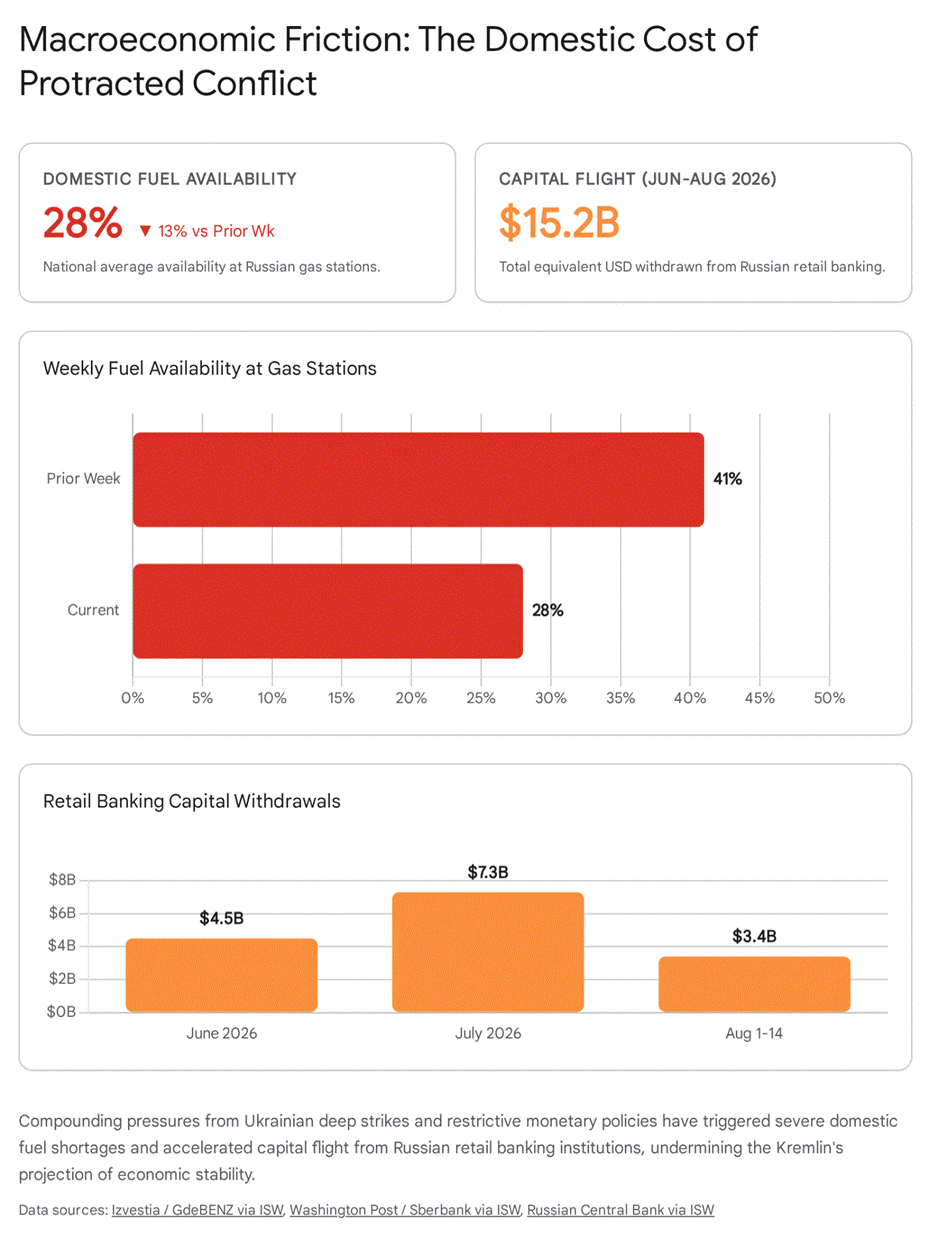
Conversely, the Russian economy is currently navigating a highly dangerous critical inflection point, transitioning rapidly from an artificially stimulated period of military-Keynesian overheating into pronounced, structural stagnation.27 Since the initial sanctions shocks of 2022, Moscow’s pivot to a state-directed war economy drove record production in heavy industries such as steel, machinery, and chemicals, yielding an illusion of profound macroeconomic resilience.27 However, as the conflict enters its fifth year, the deep structural pressures of this military-driven growth model are becoming acute and potentially unmanageable. State development bank VEB now projects that Russian GDP growth will plummet below 1 percent in 2026, with an anticipated contraction of 0.8 percent, marking a stark and dangerous reversal from previous years of growth.27

This looming stagnation is primarily driven by an unprecedented, structural labor crisis that cannot be solved by state decree. The Russian unemployment rate has plummeted to a record low of 2.4 percent; however, intelligence economists emphasize that this metric reflects severe demographic hollowing and workforce depletion rather than genuine economic health.27 The relentless demands of military conscription, mass battlefield casualties, and the panicked emigration of hundreds of thousands of highly educated professionals have completely stripped the domestic labor market.27 The Russian Industry and Trade Ministry projects a catastrophic, systemic shortfall of 4.8 million skilled workers across high-tech, engineering, and manufacturing sectors by early 2026.27

This extreme labor scarcity has triggered a severe, destabilizing wage-price spiral across the Russian economy, as civilian factories and massive defense conglomerates fiercely compete for a shrinking pool of available personnel. Real wages have severely outpaced actual industrial productivity, forcing the Russian Central Bank to maintain a crippling key interest rate of approximately 20 percent in a desperate bid to suppress an inflation rate projected to reach 6.2 percent by year’s end.27 The prolonged high interest rate environment is completely suffocating corporate credit and expansion, leading to a projected 0.9 percent decline in domestic investment in 2026.27 Furthermore, cooling retail demand indicates that domestic consumption is finally faltering under the weight of sustained economic pressure.27 The federal budget structure reveals the immense, unbalanced toll of the conflict, with defense spending projected to consume a staggering 38 percent of total state expenditures in 2026, crowding out all other forms of civil investment.27

Having lost the vast majority of its lucrative European energy market—with the EU’s share of Russian energy exports dropping precipitously from roughly 50 percent to 4 percent—Russia has been forced to aggressively pivot to China and India.27 While this shift has maintained volume, relying on the expansion of the Power of Siberia gas pipeline and Arctic LNG projects, it has exposed Moscow to steeper price discounts dictated by Beijing and New Delhi, alongside vastly higher logistical costs, severely cutting into the state’s profit margins.27

4.3 Expansion of the International Sanctions Regime

Simultaneously, the international sanctions architecture continues to tighten, attempting to close loopholes and strangle the Russian war machine. The European Union formally extended its comprehensive sanctions regime against Russia until February 24, 2027, reinforcing its legal response to Moscow’s violations of international law.28 In a targeted move against internal repression, the EU added eight high-ranking officials from the Russian Federal Penitentiary Service and the judiciary to the sanctions list, a direct response to the inhuman and degrading treatment of political prisoners and anti-war activists within Russian penal colonies.28

The United Kingdom aggressively followed suit, announcing its largest single sanctions package to date. The UK introduced nearly 300 new measures specifically targeting critical Russian energy revenues, including oil exports, and aiming to dismantle global supply chains providing military components to the Russian armed forces.29 The UK government noted that Russian oil revenues are currently at their lowest point since 2020 due to these continued pressures.29 Concurrently, Switzerland fully implemented the remainder of the EU’s 19th sanctions package, executing sweeping prohibitions on the provision of all crypto services to Russian citizens and banning transactions involving certain ruble-backed cryptocurrencies (such as stablecoin A7A5) in an effort to close emerging avenues of digital financial evasion.30

Ukraine has also escalated its direct economic warfare, with President Zelenskyy signing decrees imposing targeted sanctions on ten private Russian transport and logistics companies.27 These entities were specifically targeted for operating within occupied territories and exploiting the hijacked infrastructure of Ukraine’s national postal service (Ukrposhta).27 The sanctioned firms were deeply involved in delivering essential goods to the Russian military, facilitating the parallel imports of dual-use electronics and drones, and operating illegal administrative centers that issued Russian passports and military draft notices to Ukrainian citizens living under occupation.27

5. Humanitarian Attrition and Infrastructure Collapse

The macroeconomic stagnation of Ukraine is intrinsically linked to the catastrophic, systematic degradation of its civilian infrastructure. The Russian Federation’s high-precision campaign against the energy grid has reached a critical culmination point, profoundly affecting the physical survivability of the civilian population during the unusually harsh winter of 2025-2026.32 Throughout January and February, near-daily Russian drone and missile barrages deliberately damaged or destroyed key components of the energy generation and transmission system across 17 distinct regions of the country.32

The cumulative degradation has left Ukraine’s entire energy system capable of meeting only 60 percent of national electricity demand.9 Consequently, millions of civilians have been reduced to relying on electricity for just a few hours per day.32 The cascading effects of these rolling power outages have paralyzed vital municipal heating and water services across the country. In the capital city of Kyiv, sequential Russian missile strikes completely disabled central heating for nearly 6,000 multi-story residential buildings during periods when temperatures routinely dropped to a lethal minus 20 degrees Celsius (minus four degrees Fahrenheit).32 Amnesty International and United Nations human rights monitoring missions unequivocally report that the sheer scale and persistence of infrastructure destruction represents a deliberate Russian strategy to subject the civilian population to extreme cruelty, freeze the population into submission, and break societal morale.33 This strategy dramatically increases the severe risk of mass hypothermia-related fatalities and sparks highly credible fears of new waves of mass displacement into Western Europe, which could further strain allied social systems and political unity.33

This engineered humanitarian crisis is further compounded by a decimated and overwhelmed healthcare system. The World Health Organization (WHO) documented a horrific 20 percent increase in direct attacks on Ukrainian healthcare facilities, ambulances, and medical workers in 2025 compared to the previous year.36 Since the beginning of the full-scale war, the WHO has verified an astonishing 2,881 distinct attacks on Ukrainian healthcare infrastructure.36 The lethal combination of direct infrastructure destruction and the collapse of the power grid has created severe gaps in medical care. Recent WHO assessments reveal that a staggering 59 percent of civilians living in frontline areas now report their health as poor or very poor.36 The stress of continuous bombardment has caused cardiovascular disease to surge dramatically, with one in four Ukrainians now experiencing dangerously high blood pressure.36 Furthermore, the mental health toll is staggering; 72 percent of surveyed individuals exhibit signs of severe depression or anxiety, yet only one in five possesses the means or ability to seek professional help in a country mobilized for total war.36

6. Domestic Political Fragility and Internal Security

6.1 The Kremlin’s Digital Crackdown and Information Control

As the domestic costs of the protracted war mount and economic pressures increase, the Kremlin has drastically escalated its suppression of internal dissent and consolidated absolute control over the domestic information space. Recognizing the existential threat posed by uncontrolled, independent information flows, the Russian government initiated a highly disruptive, nationwide throttling of the Telegram messaging application in February 2026.37 Telegram serves as the primary communication nexus for over 100 million Russians, acting as a critical, final alternative to state-controlled traditional media and propaganda networks.37

However, the throttling of Telegram represents a profound strategic risk for the Russian state, executed blindly in the pursuit of absolute regime security. Because the Kremlin has historically failed to provide secure, modern, encrypted communication equipment to its frontline forces, Telegram has evolved into the de facto command and control (C2) backbone for Russian military units operating in Ukraine.37 The artificial degradation of the network severely disrupted tactical communications on the battlefield, sparking immediate, furious backlash from the highly influential pro-war “milblogger” community.38 While Kremlin officials initially attempted to deny that frontline forces relied on the commercial app, the overwhelming evidence of operational disruption forced a rapid, embarrassing retraction of those statements.38

This incident starkly exposes a critical vulnerability within the Russian system: the Kremlin’s paranoid obsession with domestic information sovereignty is actively cannibalizing its military effectiveness in the field. The government is concurrently attempting to mandate the use of a state-controlled alternative platform, MAX, aiming to funnel citizens and military personnel into a digital environment subject to total surveillance and censorship.37

This digital crackdown is accompanied by a severe escalation in physical state repression. Human Rights Watch and United Nations Special Rapporteurs have documented an institutionalized campaign of terror targeting journalists, human rights lawyers, and anti-war activists.39 Utilizing vaguely defined counter-terrorism laws and draconian legislation prohibiting the spread of “fake news” regarding the military, the state has systematically dismantled civil society.40 For example, novelist Boris Akunin was recently sentenced to 14 years in absentia simply for voicing anti-war sentiments.40 Worryingly, UN investigations reveal the widespread and institutionalized use of torture against detainees, including disturbing evidence of punitive psychiatry, medical complicity, and state-sanctioned violence directed at marginalized groups.40 The internal political climate in Russia has devolved into a state of totalitarian mobilization, where any deviation from the state narrative is treated as an act of treason.

6.2 Ukraine’s Martial Law and the Electoral Dilemma

The domestic political environment in Ukraine is also experiencing heightened tension, driven by the prolonged, exhausting stresses of a war of survival and the complexities of constitutional governance under martial law. On February 26, the Ukrainian parliament, the Verkhovna Rada, voted to extend the implementation of martial law for the 18th consecutive time, ensuring its continuation in 90-day intervals until at least May 4, 2026.41

The extension of martial law sits at the absolute center of a growing, highly contentious domestic and international debate regarding the legitimacy and timing of national elections. President Zelenskyy’s original mandate, alongside the tenure of the current parliament elected in 2019, theoretically expired in 2024.42 However, Article 19 of Ukraine’s law “On the Legal Regime of Martial Law” explicitly forbids the holding of presidential, parliamentary, and local elections while the state remains under martial law, a constitutional provision designed to ensure the continuity of the state and military command during an existential invasion.41 Furthermore, lifting martial law to hold elections is functionally impossible; not only does the law prohibit its termination while a threat to territorial integrity exists, but the legal framework of martial law is the binding contractual mechanism that keeps roughly half of Ukraine’s armed forces in active frontline service.44

Despite these insurmountable legal, constitutional, and practical obstacles (including millions of displaced voters and soldiers in trenches), political competition is cautiously and dangerously re-emerging in Kyiv.45 The debate surrounding the feasibility of elections has transitioned from theoretical speculation to technical preparation, with a special parliamentary working group tasked with drafting legislation on holding elections under wartime conditions presenting its preliminary findings in late February.41

This political unfreezing has exposed underlying, latent fault lines within the Ukrainian leadership. Former Commander-in-Chief Valery Zaluzhny, currently serving as the Ambassador to the United Kingdom, recently issued high-profile public criticisms regarding the execution of the 2023 counteroffensive.45 This represents the first direct, public political challenge to President Zelenskyy by the highly popular former general, reigniting intense speculation about a potential future political rivalry.45 While public polling indicates that 59 percent of Ukrainians firmly believe elections should only be held after the conflict has concluded (with only 10 percent wanting them before the war ends), the relentless pressure from certain Western leaders—coupled with internal political maneuvering—threatens to unnecessarily politicize the wartime administration at a moment of supreme national peril.41

7. Strategic Forecasting and Intelligence Projections

As the conflict progresses into the spring of 2026, intelligence assessments indicate a high probability of intensified, highly lethal kinetic operations, running parallel to increasingly desperate and fraught diplomatic negotiations. The Russian military command is highly likely to conclude its artillery and drone shaping operations and launch massed, mechanized ground assaults against the Kramatorsk and Slovyansk anchors of the Donetsk Fortress Belt within the next 45 to 60 days. However, the severe structural degradation of Russian forces—evidenced by the reliance on antiquated T-55 and T-62 tanks, the integration of North Korean personnel, and the crippling shortage of domestic industrial labor—suggests that Russia lacks the capability to achieve rapid, operational-level breakthroughs. The conflict will almost certainly remain a grinding war of positional attrition, heavily dependent on artillery volumes and drone supremacy.

Ukraine’s strategic imperative over the next quarter will center entirely on surviving the engineered energy crisis while maximizing the efficacy of its deep-strike campaign. The targeted destruction of Russian logistical hubs and air defense architecture via ATACMS and long-range USF UAVs is a critical prerequisite for blunting the upcoming Russian offensive. Furthermore, Ukraine’s success in stabilizing the Kupyansk and southern fronts demonstrates that localized counter-offensives remain viable, provided Western munitions continue to flow uninterrupted and international financial support materializes.

The overall trajectory of the conflict will be heavily dictated by the shifting geopolitical stance of the United States and the resilience of the European alliance. The unprecedented attempt by the US delegation to remove language guaranteeing Ukrainian territorial integrity from the UN resolution is a clear, alarming indicator that Washington is prioritizing an expedited cessation of hostilities, potentially at the cost of Ukrainian land and long-term security. The upcoming trilateral talks in Abu Dhabi will serve as a critical stress test for the Western alliance. If the US attempts to force a settlement framework based on the deeply flawed Geneva drafts, it risks fracturing the European coalition, empowering disruptive actors like Hungary’s Viktor Orban, and perversely incentivizing the Kremlin to prolong the conflict in anticipation of further Western concessions and fatigue.

Economically, the war has become a race against systemic collapse for both belligerents. Ukraine remains wholly reliant on the steady execution of the $136.5 billion international support package to prevent sovereign default and mitigate the catastrophic civilian toll of the energy infrastructure destruction. Conversely, Russia’s military-Keynesian economic model is rapidly approaching its absolute ceiling. The convergence of a 20 percent interest rate, negative investment growth, and a 4.8 million worker deficit indicates that the Kremlin cannot sustain current rates of military production indefinitely without enacting highly destabilizing internal policies. Consequently, the severe throttling of the domestic information space and the escalation of state terror are likely preemptive measures designed to manage the inevitable domestic fallout as the true economic and human costs of the fifth year of war become impossible to conceal.


Please share the link on Facebook, Forums, with colleagues, etc. Your support is much appreciated and if you have any feedback, please email us in**@*********ps.com. If you’d like to request a report or order a reprint, please click here for the corresponding page to open in new tab.


Sources Used

  1. Russian Offensive Campaign Assessment, Feb. 27, 2026 | ISW, accessed February 28, 2026, https://understandingwar.org/research/russia-ukraine/russian-offensive-campaign-assessment-february-27-2026/
  2. The Russia-Ukraine War Report Card, Feb. 25, 2026 | Russia Matters, accessed February 28, 2026, https://www.russiamatters.org/news/russia-ukraine-war-report-card/russia-ukraine-war-report-card-feb-25-2026
  3. The Russia-Ukraine War Report Card, Jan. 28, 2026, accessed February 28, 2026, https://www.russiamatters.org/news/russia-ukraine-war-report-card/russia-ukraine-war-report-card-jan-28-2026
  4. Russian Offensive Campaign Assessment, February 25, 2026 – Institute for the Study of War, accessed February 28, 2026, https://understandingwar.org/research/russia-ukraine/russian-offensive-campaign-assessment-february-25-2026/
  5. Ukraine Military Situation Report | February 25 – Hudson Institute, accessed February 28, 2026, https://www.hudson.org/national-security-defense/ukraine-military-situation-report-february-25-can-kasapoglu
  6. Russian Offensive Campaign Assessment, February 24, 2026 | ISW, accessed February 28, 2026, https://understandingwar.org/research/russia-ukraine/russian-offensive-campaign-assessment-february-24-2026/
  7. Russian Offensive Campaign Assessment, February 22, 2026 – Institute for the Study of War, accessed February 28, 2026, https://understandingwar.org/research/russia-ukraine/russian-offensive-campaign-assessment-february-22-2026/
  8. Russian Offensive Campaign Assessment, February 26, 2026 – Institute for the Study of War, accessed February 28, 2026, https://understandingwar.org/research/russia-ukraine/russian-offensive-campaign-assessment-february-26-2026/
  9. Russia’s Grinding War in Ukraine – CSIS, accessed February 28, 2026, https://www.csis.org/analysis/russias-grinding-war-ukraine
  10. Four years later: The Russia-Ukraine war by the numbers – Northeastern Global News, accessed February 28, 2026, https://news.northeastern.edu/2026/02/23/russia-ukraine-war-four-year-anniversary/
  11. Four years ago, the world expected Ukraine to be crushed, but it has stood firm. So what now for Putin?, accessed February 28, 2026, https://www.theguardian.com/commentisfree/2026/feb/25/world-ukraine-vladimir-putin-geopolitical-conflict-donald-trump
  12. Tuesday briefing: The long and winding road of war in Ukraine, as the human cost mounts, accessed February 28, 2026, https://www.theguardian.com/world/2026/feb/24/tuesday-briefing-long-and-winding-road-of-war-in-ukraine
  13. Russia-Ukraine talks: All the mediation efforts, and where they stand – Al Jazeera, accessed February 28, 2026, https://www.aljazeera.com/news/2026/2/18/russia-ukraine-talks-all-the-mediation-efforts-and-where-they-stand
  14. Ukraine war briefing: IMF approves $8.1bn loan for Kyiv …, accessed February 28, 2026, https://www.theguardian.com/world/2026/feb/27/ukraine-war-briefing-imf-approves-81bn-loan-for-kyiv
  15. 2026 United States–Ukraine–Russia meetings in Geneva – Wikipedia, accessed February 28, 2026, https://en.wikipedia.org/wiki/2026_United_States%E2%80%93Ukraine%E2%80%93Russia_meetings_in_Geneva
  16. The Unfinished Plan for Peace in Ukraine: Provision by Provision – CSIS, accessed February 28, 2026, https://www.csis.org/analysis/unfinished-plan-peace-ukraine-provision-provision
  17. General Assembly Marks ‘Grim’ Fourth Anniversary of War in Ukraine, Adopts Text Calling for Ceasefire, as Eleventh Emergency Special Session Resumes | UN Meetings Coverage and Press Releases, accessed February 28, 2026, https://press.un.org/en/2026/ga12752.doc.htm
  18. Russian Occupation Update, February 26, 2026, accessed February 28, 2026, https://understandingwar.org/research/russia-ukraine/russian-occupation-update-february-26-2026/
  19. UN Resolution on Ukraine Approved Despite US Push to Water It Down – PassBlue, accessed February 28, 2026, https://passblue.com/2026/02/24/un-resolution-on-ukraine-approved-despite-us-push-to-water-it-down/
  20. Orban’s election campaign strategy — blackmail EU, Ukraine over Russian oil and hope for a fight, accessed February 28, 2026, https://kyivindependent.com/orbans-election-campaign-strategy-blackmail-eu-ukraine-over-russian-oil-pipeline-and-hope-for-a-fight/
  21. IMF approves new $8.1 billion four-year program for Ukraine, accessed February 28, 2026, https://english.nv.ua/business/new-8-1b-imf-deal-to-anchor-financial-aid-to-ukraine-50587460.html
  22. IMF Executive Board Approves US$8.1 Billion under an Extended Fund Facility (EFF) Arrangement for Ukraine, accessed February 28, 2026, https://www.imf.org/en/news/articles/2026/02/26/pr-26066-ukraine-imf-executive-board-approves-usd-8point1-billion-under-an-eff-arrangement
  23. IMF Approves $8.1B 4-Year Program for Ukraine, Releases $1.5B Immediately – Kyiv Post, accessed February 28, 2026, https://www.kyivpost.com/post/70892
  24. IMF sees slower but stable growth for Ukraine in 2026, accessed February 28, 2026, https://english.nv.ua/nation/imf-s-forecast-for-ukraine-s-economy-in-2026-gdp-growth-falling-inflation-and-unemployment-50587641.html
  25. IMF projects Ukraine’s real GDP growth at 1.8%-2.5% in 2026, accessed February 28, 2026, https://interfax.com/newsroom/top-stories/116352/
  26. Ukraine – IMF DataMapper, accessed February 28, 2026, https://www.imf.org/external/datamapper/profile/UKR
  27. Russia’s war economy slows as sanctions enter 5th year, accessed February 28, 2026, https://www.aa.com.tr/en/asia-pacific/russia-s-war-economy-slows-as-sanctions-enter-5th-year/3841981
  28. EU Extends Russia Sanctions Until 2027, Adds Eight Officials to List, accessed February 28, 2026, https://caspiannews.com/news-detail/eu-extends-russia-sanctions-until-2027-adds-eight-officials-to-list-2026-2-24-6/
  29. UK announces biggest sanctions package against Russia four years on from full-scale invasion of Ukraine – GOV.UK, accessed February 28, 2026, https://www.gov.uk/government/news/uk-announces-biggest-sanctions-package-against-russia-four-yearson-from-full-scale-invasionof-ukraine
  30. Switzerland Implements Remainder of EU’s 19th Sanctions Package Against Russia, accessed February 28, 2026, https://sanctionsnews.bakermckenzie.com/switzerland-implements-remainder-of-eus-19th-sanctions-package-against-russia/
  31. Ukraine: Federal Council implements 19th package of sanctions, accessed February 28, 2026, https://www.bafu.admin.ch/en/newnsb/O5M0QLVwbVE7A1uwQIJj-
  32. Energy attacks amid an unusually harsh winter are exposing Ukraine’s civilians to extreme hardship UN human rights monitors say, accessed February 28, 2026, https://ukraine.ohchr.org/en/Energy-attacks-amid-an-unusually-harsh-winter-are-exposing-Ukraine-s-civilians-to-extreme-hardship-UN-human-rights-monitors-say
  33. Russia’s attacks on Ukraine’s energy system – Chatham House, accessed February 28, 2026, https://www.chathamhouse.org/events/all/standard-event-research-event/russias-attacks-ukraines-energy-system
  34. Ukraine: New testimonies document brutal conditions for civilians amid Russian attacks on energy infrastructure – Amnesty International, accessed February 28, 2026, https://www.amnesty.org/en/latest/news/2026/02/ukraine-testimonies-brutal-conditions-civilians-russian-attacks-energy-infrastructure/
  35. Country Conditions: Ukraine February 2026 – USCRI, accessed February 28, 2026, https://refugees.org/country-conditions-ukraine-february-2026/
  36. Attacks on Ukraine’s health care increased by 20% in 2025, accessed February 28, 2026, https://ukraine.un.org/en/310610-attacks-ukraine%E2%80%99s-health-care-increased-20-2025
  37. What Russia’s War on Telegram Means for the West – FDD, accessed February 28, 2026, https://www.fdd.org/analysis/2026/02/23/what-russias-war-on-telegram-means-for-the-west/
  38. Putin’s Internet Crackdown Is Rooted in Weakness and a Need to Demand Greater War Sacrifices, accessed February 28, 2026, https://understandingwar.org/research/cognitive-warfare/putins-internet-crackdown-is-rooted-in-weakness-and-a-need-to-demand-greater-war-sacrifices/
  39. Russia: Crackdown on Dissent Escalates – Human Rights Watch, accessed February 28, 2026, https://www.hrw.org/news/2026/02/04/russia-crackdown-on-dissent-escalates
  40. Russia’s Repression Deepens – Human Rights & Public Liberties – Al Jazeera, accessed February 28, 2026, https://liberties.aljazeera.com/en/russias-repression-deepens-dissent-torture-and-legal-abuse/
  41. Next Ukrainian presidential election – Wikipedia, accessed February 28, 2026, https://en.wikipedia.org/wiki/Next_Ukrainian_presidential_election
  42. Can Ukraine Hold Elections This Year? | German Marshall Fund of the United States, accessed February 28, 2026, https://www.gmfus.org/news/can-ukraine-hold-elections-year
  43. Ukraine’s Presidential Elections Amid War: Political, Legal, and Security Challenges, accessed February 28, 2026, https://www.wilsoncenter.org/blog-post/ukraines-presidential-elections-amid-war-political-legal-and-security-challenges
  44. The West Shouldn’t Play Russia’s Game with Ukrainian Elections, accessed February 28, 2026, https://understandingwar.org/research/russia-ukraine/the-west-shouldnt-play-russias-game-with-ukrainian-elections/
  45. Notes From Kyiv: Is Ukraine Preparing for Elections?, accessed February 28, 2026, https://carnegieendowment.org/russia-eurasia/politika/2026/02/ukraine-elections-preparation

SITREP Russia-Ukraine – Week Ending February 21, 2026

Executive Summary

For the week ending February 21, 2026, the Russia-Ukraine conflict experienced several profound strategic, operational, and technological inflections that collectively signal a highly volatile and transformative phase of the war. The multilateral security architecture governing the theater continues to face severe degradation, heavily influenced by geoeconomic friction, the weaponization of critical supply chains, and the terminal impotence of legacy conflict-resolution frameworks. At the geopolitical level, the U.S.-brokered negotiations in Geneva concluded without a territorial breakthrough, though marginal progress was recorded regarding the mechanics of a theoretical ceasefire and the parameters of a demilitarized zone in the Donbas. However, the diplomatic landscape was severely complicated by an acute intra-European crisis, as Hungary formally vetoed a critical €90 billion European Union macro-financial loan package designed to sustain Ukraine through 2026 and 2027. This veto, supported rhetorically by Slovakia, was explicitly retaliatory, functioning as leverage to force Kyiv to reopen the Druzhba pipeline, which has been inoperable since a Russian strike in late January.

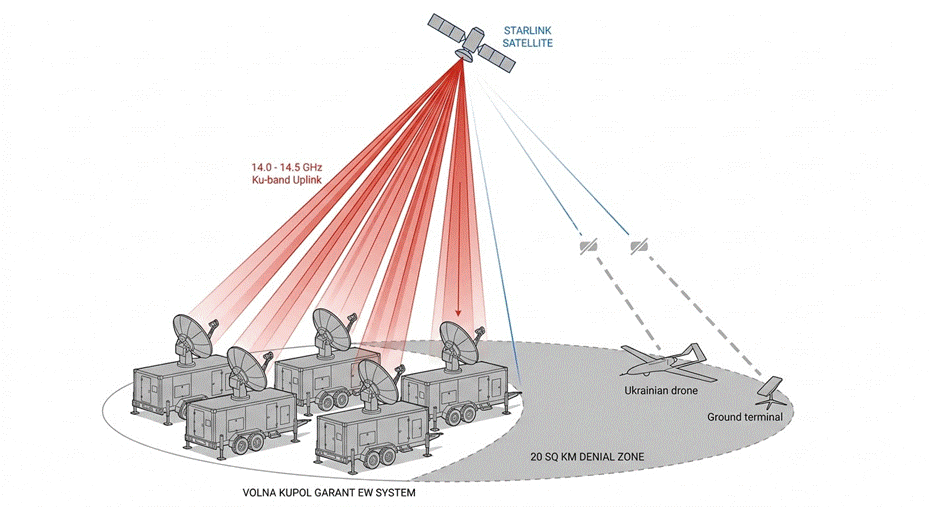
In the operational domain, the Ukrainian Armed Forces capitalized on a severe degradation of Russian command and control (C2) networks to execute a successful counteroffensive in the southern theater, liberating approximately 300 square kilometers of territory. This localized collapse in Russian defensive cohesion was directly precipitated by a joint effort between the Ukrainian government and SpaceX to enforce a strict geographic and cryptographic whitelist on Starlink satellite terminals. By actively disabling thousands of smuggled Starlink units utilized by Russian frontline forces, Ukraine effectively blinded Russian unmanned aerial vehicle (UAV) operators and severed real-time artillery kill chains. Concurrently, Russian offensive operations in the northern and eastern axes—particularly around Sumy and the Vovchansk sector in Kharkiv Oblast—have largely culminated into attritional positional warfare, yielding negligible territorial gains despite maximalist claims propagated by the Russian General Staff. The human toll of this grinding attrition has reached unprecedented levels, with allied intelligence and independent estimates converging on approximately 1.2 million total Russian casualties and upwards of 500,000 to 600,000 Ukrainian casualties since the inception of the full-scale invasion.

The most strategically disruptive development of the reporting period was the dramatic escalation of Ukraine’s indigenous deep-strike campaign. Armed with the newly unveiled FP-5 “Flamingo” subsonic cruise missile, Ukrainian forces executed a precision strike against the Votkinsk Machine Building Plant in Russia’s Udmurt Republic, located over 1,300 kilometers from the Ukrainian border. Because the Votkinsk facility is the primary manufacturing hub for Russia’s intercontinental ballistic missiles (ICBMs) and the Iskander-M ballistic missile systems, this strike crosses a historic threshold: a non-nuclear state successfully executing a conventional precision strike against the core industrial base of a nuclear superpower’s strategic deterrent. This action, coupled with systemic strikes against Russian navigation electronics facilities and ammunition depots, demonstrates that Ukraine has successfully bypassed Western restrictions on the use of imported long-range munitions by establishing a highly capable, sovereign defense industrial base. Meanwhile, the Kremlin has accelerated its domestic security consolidation, with President Vladimir Putin authorizing sweeping new legislation that grants the Federal Security Service (FSB) the power to unilaterally sever mobile and internet communications for individual citizens, a move running parallel to the state’s ongoing throttling of the Telegram messaging network.

1.0 Multilateral Security Architecture and Geopolitical Alignments

1.1 The Geneva Negotiations and Ceasefire Mechanics

The U.S.-brokered diplomatic negotiations held in Geneva on February 17 and 18, 2026, underscored the persistent strategic deadlock between Kyiv and Moscow, even as both sides demonstrated a willingness to discuss the highly technical parameters of conflict suspension. The talks produced no public breakthrough concerning the fundamental issues of territorial sovereignty or political control.1 Western and European intelligence assessments remain highly confident that Russian President Vladimir Putin’s strategic objectives are unchanged; the Kremlin seeks the total restructuring of the European security architecture, the imposition of permanent Ukrainian neutrality, the severe limitation of the Ukrainian Armed Forces, and the eventual installation of a pro-Russian government in Kyiv.2 Consequently, European intelligence chiefs assess that even significant territorial concessions by Ukraine, such as the total cession of the remainder of Donetsk Oblast, would not satisfy the Kremlin’s maximalist aims and would merely serve as a tactical pause for military reconstitution before the issuance of further demands.2

Despite this overarching misalignment, the Geneva summit facilitated granular discussions on the mechanical implementation of a theoretical ceasefire. Negotiators explored the viability of establishing a demilitarized zone (DMZ) in the highly fortified Donbas region, proposing a sector roughly 50 miles in length and 40 miles in width.1 A parallel proposal regarding a joint Russian-Ukrainian civilian administration to govern this proposed zone was swiftly rejected by Ukrainian officials as functionally unrealistic and politically unacceptable, resulting in a diplomatic stalemate.4 Ukrainian President Volodymyr Zelenskyy articulated a posture of conditional openness to a tactical withdrawal from specific fortified frontline positions currently under Kyiv’s control, but strictly predicated this theoretical withdrawal on the prior establishment of the DMZ and the provision of binding, minimum 20-year security guarantees from the United States and its allies.1 Furthermore, Zelenskyy reinforced domestic political boundaries, stating that any final settlement would require ratification via a national referendum, emphasizing that the Ukrainian populace would “never” tolerate a unilateral pullout or the permanent surrender of additional land.1 Negotiating teams made incremental progress in defining the specific military metrics that would constitute a ceasefire violation, and discussions included the future monitoring of the Russian-occupied Zaporizhzhia Nuclear Power Plant.1 A subsequent round of negotiations is scheduled to convene in Switzerland in late February or early March.1

1.2 The Munich Security Conference and the Sino-Russian Axis

The diplomatic friction over the potential shape of a peace settlement occurred against the backdrop of the Munich Security Conference (February 13-15, 2026), where Western officials sought to project strategic unity and address the evolving systemic threats to the global security architecture. NATO Secretary General Mark Rutte utilized the forum to reaffirm the alliance’s commitment to Ukraine, warning that President Putin is engaged in a psychological and attritional campaign designed to break the resolve of the Ukrainian populace through the systematic destruction of critical infrastructure.5 Rutte highlighted the continued necessity of allied support, citing the newly launched NATO PURL initiative, which aims to supply Ukraine with hundreds of millions of euros worth of essential military equipment.5

A central theme of the intelligence briefings at Munich was the rapid expansion of the Sino-Russian strategic partnership, which has effectively shielded the Russian economy from total isolation. According to Western intelligence assessments provided to Bloomberg, the People’s Republic of China (PRC) significantly escalated its material support for the Russian war economy throughout 2025 and early 2026.1 Beijing is now assessed as the primary external facilitator of Moscow’s military-industrial complex, providing massive quantities of dual-use microelectronics, machine tools, and critical minerals essential for the domestic production of UAVs, cruise missiles, and precision-guided munitions.1 Furthermore, China has provided a critical economic lifeline by absorbing immense volumes of Russian crude oil exports displaced by Western sanctions.1 U.S. Ambassador to NATO Matthew Whitaker publicly articulated this assessment in Munich, explicitly stating that the Russian war effort is being “completely enabled by China,” and argued that Beijing possesses the unique geopolitical leverage to terminate the conflict immediately by severing its economic and technological supply lines to Moscow.1

1.3 Institutional Impotence of Legacy Frameworks

The reliance on ad-hoc coalitions and bilateral security guarantees underscores the terminal degradation of legacy conflict-resolution frameworks. Intelligence syntheses evaluating the broader theater note the systemic failure of the United Nations (UN) and the Organization for Security and Co-operation in Europe (OSCE) to provide a viable security guarantee in the face of sustained, high-intensity kinetic warfare and sophisticated hybrid operations.8 The central paradox resides in the fact that a permanent, veto-wielding member of the UN Security Council is the primary aggressor, rendering traditional peacekeeping, mediation, and arms control mechanisms functionally obsolete.8 The Kremlin continues to utilize its position within the UN to conduct sophisticated “Lawfare,” employing the legalistic protections of the UN Charter to shield its tactical maneuvers from collective international intervention.8 Consequently, the defense of Central and Eastern Europe has entirely pivoted to a “Forward Defense” posture spearheaded by the U.S. Department of Defense and NATO, bypassing paralyzed multilateral institutions.8

2.0 Geoeconomic Friction: The EU Financial Blockade

2.1 The Hungarian Veto of the Macro-Financial Loan

The cohesion of the European Union’s financial support apparatus was severely fractured on February 20, 2026, when Hungary executed a formal veto against a critical €90 billion macro-financial loan package intended for Ukraine.9 The financial vehicle, originally championed by the European Parliament, was designed to cover Ukraine’s sovereign budgetary and military expenditure requirements for the 2026-2027 fiscal period.11 The architecture of the loan is structured upon EU borrowing on international capital markets, backed by the bloc’s budget reserves.12

To grant the €90 billion loan, three specific EU regulations must be adopted: one on implementing enhanced cooperation to establish the support loan, one amending the Ukraine Facility, and one amending the 2021-2027 Multiannual Financial Framework.10 While the first two regulations can be adopted by a qualified majority of EU member states, the amendment to the EU’s long-term budget requires the unanimous approval of all 27 member states, granting Budapest absolute leverage.10 By refusing to vote in favor of the Multiannual Financial Framework amendment, Hungary unilaterally halted the entire disbursement process.10

Druzhba pipeline disruption diagram showing blocked EU financial flow to Ukraine due to vetoes. "Geoeconomic Friction" text.

2.2 The Druzhba Pipeline Dispute

Hungarian Prime Minister Viktor Orbán and Foreign Minister Peter Szijjarto explicitly linked the veto to Ukraine’s failure to resume the transit of Russian crude oil through the southern branch of the Soviet-era Druzhba pipeline.9 The pipeline, which traverses Ukrainian territory to supply landlocked Hungary and Slovakia (both of which hold exemptions from the EU embargo on seaborne Russian oil), has been inoperable since a Russian drone and missile strike damaged key pumping infrastructure on January 27, 2026.15

Szijjarto accused Kyiv of intentionally delaying repairs and utilizing the energy bottleneck to blackmail Budapest, claiming the disruption violated the EU-Ukraine Association Agreement and was an attempt to influence the upcoming Hungarian general elections scheduled for April 12.14 Slovakian Prime Minister Robert Fico echoed these sentiments, declaring a state of emergency over domestic fuel supplies and threatening retaliatory economic measures against Kyiv if the transit of Russian crude is not rapidly restored.9

The blockade presents a severe systemic risk to Ukraine’s macroeconomic stability. Without the immediate disbursement of the EU funds, Ukraine faces the risk of a comprehensive financial collapse by the second quarter of 2026, and the delay simultaneously endangers an active $8 billion program managed by the International Monetary Fund (IMF).1 In an attempt to circumvent the crisis, Croatia offered the use of its Adriatic JANAF pipeline to supply seaborne non-Russian (and potentially Russian) crude to Hungarian and Slovakian refineries.18 However, Budapest and Bratislava have historically shunned the JANAF route, citing highly prohibitive transit tariffs and a strategic preference for the discounted pricing structure of Russian pipeline crude.18 Furthermore, Kyiv proposed that the EU utilize alternative elements of Ukraine’s oil transport network, specifically the Odesa-Brody pipeline, to deliver crude to Hungary and Slovakia while the Druzhba network remains offline.12 Ukraine’s energy ministry continues to assert that repair operations on the Druzhba network are proceeding under the constant threat of subsequent Russian aerial bombardment, rejecting the accusations of political manipulation.13

3.0 Operational Theater Developments: The Ground War

3.1 The Southern Vector: Ukrainian Counteroffensive Exploitation

In a highly significant operational development, the Ukrainian Armed Forces successfully executed localized counteroffensive operations in the southern theater, resulting in the liberation of approximately 300 square kilometers of territory.19 President Zelenskyy confirmed the territorial reclamation on February 21 during an interview with Agence France-Presse, noting the advances occurred primarily along the Zaporizhzhia and Dnipropetrovsk Oblast borders.20 Tactical reporting indicates that Ukrainian maneuver elements successfully assaulted and cleared multiple Russian defensive positions along the Yanchur and Haichur river lines, pushing toward the Oleksandrivka and Hulyaipole directions.21

This rapid territorial gain—which represents the fastest pace of Ukrainian advance since late 2023—was not merely a product of overwhelming kinetic force, but rather the exploitation of a catastrophic, technology-induced collapse in Russian tactical command and control.20 The Ukrainian penetration was highly correlated with the sudden, theater-wide blackout of illicitly acquired Starlink satellite terminals utilized by Russian forces (detailed further in Section 5.2).22 By blinding the Russian ISR (Intelligence, Surveillance, and Reconnaissance) architecture and severing the data links between frontline trenches and rear-echelon command posts, Ukrainian mechanized units were able to achieve local tactical surprise and maneuver through highly contested gray zones before Russian artillery could calculate and execute defensive fire missions.22

3.2 The Northern and Eastern Axes: Russian Attritional Offensives

Conversely, Russian offensive operations across the northern and eastern axes have largely devolved into localized, high-attrition positional engagements with minimal operational-level success. In the northern sector, elements of the Russian Northern Grouping of Forces—including the 1443rd Motorized Rifle Regiment and the 83rd Airborne (VDV) Brigade—attempted to breach Ukrainian defensive fortifications in the Sumy Oblast, specifically targeting the Pysarivka and Marine directions.2 Despite the deployment of significant manpower and persistent mechanized assaults, Ukrainian military observers assess that the Russian forces failed to achieve a tactical breakthrough, as well-prepared Ukrainian trench networks and dense minefields effectively absorbed the shock of the advance.2 Drone operators from the 106th VDV Division continue to operate in the area, but their effectiveness has been blunted.2

In northern Kharkiv Oblast, Russian forces continued their protracted campaign to establish a sanitary “buffer zone” to push Ukrainian tube artillery out of range of Belgorod City.2 Russian maneuver elements attempted a push along the T-2104 highway toward Velykyi Burluk but became heavily bogged down in intense urban and suburban combat on the southern outskirts of Vovchansk.2 The pervasive presence of Ukrainian First-Person View (FPV) strike drones, operating effectively up to 20 kilometers into the Russian deep rear, has prohibited Russian commanders from safely accumulating the necessary mass of armored vehicles and infantry reserves required to exploit localized tactical successes.2

Despite these operational realities, the Russian Ministry of Defense engaged in a systemic cognitive warfare campaign designed to project an aura of inevitable victory. Colonel General Sergei Rudskoy, Chief of the General Staff’s Main Operations Directorate, publicly claimed on February 20 that Russian forces had seized approximately 900 square kilometers of territory and 42 settlements since the beginning of 2026, and over 6,700 square kilometers throughout 2025.24 However, independent geospatial analysis by the Institute for the Study of War (ISW) routinely refutes these maximalist figures. The analysis indicates that the Russian General Staff frequently aggrandizes the seizure of tactically insignificant tree lines and depopulated microscopic hamlets to influence the domestic informational space and exert psychological pressure on Western capitals during diplomatic negotiations.3

Reporting SourceTimeframe AssessedClaimed Territorial Gains by RussiaContext / Verification Status
Russian General Staff (Gen. Rudskoy)Jan 1, 2026 – Feb 20, 2026~900 square kilometersUnverified maximalist claim aimed at cognitive warfare.3
Russian General Staff (Gen. Gerasimov)Feb 1, 2026 – Feb 15, 2026200 square kilometersHighly aggrandized; includes microscopic, depopulated hamlets.3
Institute for the Study of War (ISW)Jan 13, 2026 – Feb 10, 2026182 square miles (~471 sq km)Verified via geolocated footage and satellite telemetry.26
Ukrainian Armed Forces (Southern Counteroffensive)Feb 2026-300 square kilometers (Liberated by Ukraine)Verified by multiple sources; nullifies substantial portions of Russian winter gains.19

3.3 Force Generation, Attrition, and Casualty Assessments

The strategic choice to pursue a war of attrition has resulted in catastrophic personnel losses for both combatant nations. The defining characteristic of the Russian tactical approach relies on evolving infiltration ground tactics combined with the use of long-range fires and glide bombs, essentially trading massive expenditures of materiel and human life for marginal territorial gains.27 By mid-February 2026, Western intelligence agencies, the UK Ministry of Defense, and the Estonian Foreign Intelligence Service converged on estimates indicating that Russian military casualties have reached unprecedented levels.21

To sustain this extraordinary rate of attrition without declaring a politically perilous general mobilization, the Kremlin has intensified its efforts to optimize the domestic recruitment pipeline. President Putin seeks to normalize limited, rolling call-ups to sustain the size of the Russian force grouping, utilizing legislative pressure to shape the Russian public consciousness into viewing the evasion of military service as “socially unacceptable”.28

The following table synthesizes the most current consensus estimates regarding military casualties since the onset of the full-scale invasion on February 24, 2022:

Source of AssessmentDate of EstimateEstimated Russian Casualties (Killed, Wounded, Missing)Estimated Ukrainian Casualties (Killed, Wounded, Missing)
Ukrainian General StaffFeb 21, 20261,258,890 (Including 1,010 in the prior 24 hours) 19Classified / Not Disclosed
Western Officials (via Bloomberg)Feb 20261,200,000 (Includes 430K in 2024 and 415K in 2025) 21Not specified
Estonian Foreign Intelligence ServiceFeb 20261,000,000 21Not specified
Ex-CIA Director William BurnsJan 20261,100,000 21Not specified
Center for Strategic and International Studies (CSIS)Jan 20261,200,000 (Including as many as 325,000 killed) 26500,000 – 600,000 (Including 100,000 – 140,000 killed) 26

4.0 The Deep Strike Campaign and Defense Industrial Degradation

4.1 The Votkinsk ICBM Facility Strike

In a paradigm-shifting demonstration of indigenous kinetic capability, Ukrainian forces executed a complex, long-range drone and cruise missile strike against the Votkinsk Machine Building Plant in Russia’s Udmurt Republic on the night of February 20-21, 2026.4 Located deep within the Russian interior, over 1,300 kilometers (800 miles) from the Ukrainian border, the Votkinsk facility is a highly classified, state-owned defense enterprise that serves as the absolute core of Russia’s strategic missile production infrastructure.4 The plant is the primary manufacturing hub for the Iskander-M short-range ballistic missile systems, which are routinely utilized to bombard Ukrainian energy infrastructure and urban centers.4 Crucially, Votkinsk is also the sole producer of Russia’s road-mobile and silo-based intercontinental ballistic missiles (ICBMs), including the RS-24 Yars and the Topol family of missiles, as well as the RSM-56 Bulava submarine-launched ballistic missile.4

Ukrainian deep strike envelope expansion, February 2026. Targets include Votkinsk (>1300km). SITREP Russia-Ukraine.

Open-source intelligence (OSINT), including data from the “CyberBoroshno” project, and subsequent satellite telemetry confirmed that the attack heavily damaged production workshops No. 22 and No. 36.29 The strike caused massive secondary detonations, large-scale fires visible from nearby residential areas, and structural collapse, resulting in at least 11 reported casualties.19 The strike was executed using a combination of long-range loitering munitions and the new FP-5 “Flamingo” cruise missile.29

This operation represents a severe psychological and strategic blow to the Kremlin. It definitively proves that a non-nuclear state, utilizing indigenously produced conventional weaponry, can successfully penetrate deep into Russian airspace and inflict critical damage upon the very facilities that manufacture Russia’s nuclear deterrent. The operation simultaneously degrades the immediate supply chain for the Iskander-M missiles used against Ukrainian cities while exposing the systemic vulnerabilities in Russia’s deep-rear strategic air defense networks.30 Western intelligence analysis, specifically referencing forensic assessments of the strike, suggests that while the physical devastation may not entirely halt ICBM production, the demonstration of capability places Russia’s most guarded assets—including hypersonic reentry technology and MIRV architectures—at perpetual risk.30

4.2 Target Network Analysis: VNIIR-Progress, Kotluban, and Oil Depots

The attack on Votkinsk was not an isolated incident, but rather the apex of a highly coordinated, systemic campaign designed to dismantle specific bottlenecks within the Russian defense-industrial supply chain. On February 18, Ukrainian long-range strike drones penetrated the Chuvash Republic, roughly 1,000 kilometers from the border, to strike the VNIIR-Progress defense plant in the city of Cheboksary.31 The VNIIR-Progress facility is a critical node in the Russian aerospace industry, responsible for the manufacturing of the “Kometa” satellite navigation antennas and Global Navigation Satellite System (GNSS) modules.31 These highly specialized electronic components function as the central nervous system for the Shahed-type suicide drones, Kalibr cruise missiles, and the ubiquitous glide-bomb guidance kits (UMPK) that form the backbone of Russian tactical aviation strikes.31 By targeting the production of the Kometa modules, Ukraine aims to induce a systemic shortage of precision guidance capabilities across the entire spectrum of Russian strike assets.

Furthermore, Ukraine maintained its pressure on Russian logistical nodes closer to the front. On February 12, Ukrainian forces utilized Flamingo missiles to strike a massive ammunition depot operated by the Russian Main Missile and Artillery Directorate (GRAU) near Kotluban in the Volgograd Oblast, approximately 320 kilometers from the border.22 The strike ignited a series of powerful secondary explosions, forcing the emergency evacuation of the local civilian population and destroying vast quantities of stockpiled artillery shells and tactical missiles destined for the southern and eastern fronts.22

Concurrently, the economic foundations of the Russian war machine were targeted. The Security Service of Ukraine’s (SBU) specialized “Alpha” UAV unit successfully navigated anti-drone defenses to strike a major oil depot in the town of Velikiye Luki, located in the northwestern Pskov Oblast.33 Additionally, satellite imagery confirmed severe damage to primary crude oil processing units at an oil refinery in Ukhta following earlier drone strikes, continuing a sustained campaign to constrain Russian fuel production capabilities.34

5.0 Technological, Cyber, and Electromagnetic Warfare Domains

5.1 The FP-5 Flamingo Cruise Missile: Strategic Democratization

The geometric expansion of the Ukrainian deep-strike envelope has been enabled by the rapid operational deployment of the FP-5 “Flamingo,” a heavy, subsonic, ground-launched cruise missile developed indigenously by the Ukrainian defense startup Fire Point.32 Unveiled publicly and rapidly integrated into combat operations, the Flamingo represents a masterclass in the democratization of strategic strike capabilities through asymmetric engineering.36

The technical specifications of the FP-5 are highly ambitious. Designed as a low-cost solution, the massive airframe carries a devastating 1,150-kilogram (1.15 metric ton) conventional fragmentation/high-explosive warhead, dwarfing the payload capacity of the U.S.-manufactured Tomahawk cruise missile.32 The following table outlines the verified technical specifications of the FP-5 Flamingo:

SpecificationDetails
Mass6,000 kg (6.0 metric tons) 32
DimensionsLength: 12-14 meters; Wingspan: 6 meters 32
Warhead Weight1,150 kg (1.15 metric tons) 32
Engine ConfigurationSolid fuel for booster, liquid fuel for the AI-25TL turbofan 32
Operational Range3,000 km (1,900 miles) 32
Flight DynamicsFlight ceiling: 5,000 m; Maximum speed: 950 km/h; Cruising speed: 850-900 km/h 32
Guidance SystemGPS/GNSS with INS backup (No TERCOM/DSMAC verified) 32
Stated Accuracy14 meters (Circular Error Probable) 32

The defining characteristic of the Flamingo is its absolute prioritization of simplicity, affordability, and rapid manufacturability over exquisite, highly expensive technologies.36 Traditional long-range cruise missiles rely on highly controlled, miniaturized turbojet or turbofan engines that require vast, complex supply chains. To bypass this bottleneck, Fire Point engineers integrated the Ivchenko AI-25TL turbofan engine—a full-sized powerplant originally designed in the Soviet era for crewed training aircraft like the Aero L-39 Albatros.36 To further compress production timelines and reduce unit costs, Fire Point explicitly sources AI-25TL engines that are nearing the end of their operational lifespans. Because the Flamingo is a one-way attack platform with a maximum flight duration of approximately 3.5 hours, the manufacturer can safely utilize refurbished jet engines that possess as little as ten hours of remaining operational life.37 During the refurbishment process, Fire Point replaces expensive original titanium components with cheaper, simplified materials, as long-term durability is entirely irrelevant for a kamikaze platform.37

Similarly, the Flamingo eschews highly complex, costly terminal guidance systems such as Terrain Contour Matching (TERCOM) or Digital Scene-Matching Area Correlation (DSMAC) optical systems.36 Instead, it relies on a robust combination of commercially available GPS/GNSS satellite navigation backed by an Inertial Navigation System (INS).32 While potentially vulnerable to intense electronic warfare (EW) jamming, the sheer size of the 1,150-kilogram payload ensures that even a near-miss will inflict catastrophic damage upon soft targets like fuel refineries, ammunition depots, and exposed factory production floors.

In early February 2026, the intersection of commercial space technology and the electromagnetic spectrum drastically altered the tactical equilibrium on the frontline. Responding to the systemic proliferation of smuggled Starlink satellite internet terminals among Russian forces, the Ukrainian Ministry of Defense, in direct collaboration with SpaceX, implemented a stringent geographic and cryptographic “whitelist” protocol.1 Under this new architecture, only verified, cryptographically registered Starlink terminals explicitly authorized by the Ukrainian military are permitted to interface with the Low Earth Orbit (LEO) satellite constellation.38 Any terminal lacking the correct digital authorization, regardless of its physical location within Ukrainian borders, was immediately and permanently disconnected from the network.38

The operational impact on the Russian Armed Forces was immediate and severe. Driven by Western sanctions, the Russian military had grown highly dependent on illicitly acquired Starlink hardware—often smuggled through third-party jurisdictions like Dubai using falsified documents—to bypass the highly contested, EW-saturated environments of eastern Ukraine.39 Starlink provided Russian commanders with a secure, high-bandwidth communication layer that was virtually immune to traditional Ukrainian jamming equipment. Specifically, Russian specialized drone units, such as the Rubikon center, had integrated Starlink dishes directly onto long-range “Molniya” and highly modified “Geran-2” (Shahed) attack drones.1 This integration allowed Russian operators in the deep rear to receive real-time, high-definition video feeds from the drones, actively retargeting the munitions mid-flight to strike dynamic targets, such as fast-moving logistical trains and mobile air defense systems.39

The implementation of the whitelist completely severed this capability. Following the disconnection on February 1, ISW intelligence assessments noted that the Rubikon unit abruptly ceased publishing precision geolocation strike videos, indicating a profound degradation in their real-time targeting telemetry.1 The blindfolding of Russian ISR assets directly correlated with a verified 15% reduction in the efficacy of Russian drone strikes in key frontline sectors.1

The tactical blackout was heavily compounded by the Kremlin’s concurrent decision to throttle the Telegram messaging application.1 Because the official Russian encrypted communications platforms (such as the “Azart” radio systems) are notoriously unreliable and easily intercepted, Russian infantry commanders had grown heavily reliant on Telegram for localized C2 and fire coordination. The simultaneous loss of high-bandwidth Starlink connectivity and low-bandwidth Telegram functionality threw Russian tactical command posts into chaos.22 It was precisely this window of localized paralysis and communication degradation that the Ukrainian Armed Forces exploited to launch their successful 300-square-kilometer penetration in the southern theater.20 Ukrainian unmanned systems commanders assess that the Russian military industrial complex will require a minimum of six months to develop, mass-produce, and deploy a secure, high-bandwidth alternative to Starlink capable of restoring the lost C2 and deep-strike telemetry capabilities.1

6.0 Domestic Security Consolidation and Occupation Dynamics

6.1 The Russian Information Space and the “Kill Switch” Law

As the conflict grinds into a protracted war of attrition, the Kremlin has moved aggressively to consolidate absolute control over the domestic information space and suppress any potential anti-war mobilization. On February 20, 2026, President Putin signed sweeping legislation granting the Federal Security Service (FSB) the legal authority to unilaterally order internet service providers and telecommunications operators to disconnect specific individuals from mobile and home internet networks, citing broad national security prerogatives.19 This targeted digital exile capability essentially provides the state with an individualized “kill switch,” allowing security services to silence dissidents, independent journalists, and military bloggers who contradict the Ministry of Defense’s narrative without the need for prolonged judicial proceedings.

This legislative maneuver operates in tandem with the Russian government’s ongoing, state-level throttling of the Telegram messaging platform, a highly popular network that has served as the primary nexus for both pro-war military bloggers and grassroots opposition.1 FSB Director Alexander Bortnikov justified the Telegram degradation by citing the platform’s alleged facilitation of terrorism and acts of sabotage.1 Bortnikov publicly confirmed that discussions with Telegram founder Pavel Durov had broken down, rejecting criticisms regarding freedom of speech and insisting that the measures were necessary to protect the public interest.1 Intelligence analysts assess that the move is primarily designed to monopolize the domestic information space, prevent the coordination of localized anti-war movements (particularly around sensitive dates such as the anniversary of Alexei Navalny’s death 40), and force the Russian public into reliance on state-controlled media channels. Despite the throttling, the Kremlin ironically announced it would maintain its own official Telegram channel.1

6.2 Occupation Infrastructure and Demographic Engineering

In the occupied territories of eastern and southern Ukraine, the Russian state apparatus continues a systemic, multi-tiered campaign of demographic engineering, economic extraction, and forced assimilation. The occupation administrations rely heavily on a network of “temporary accommodation centers” (TACs) to facilitate the forcible transfer of Ukrainian civilians deeper into occupied territory or directly into the Russian Federation.41 This process is frequently executed under the guise of humanitarian evacuation from frontline combat zones. Furthermore, Russian state-sponsored entities, such as the “Russian Children’s Fund,” have been heavily implicated in the systemic deportation of Ukrainian minors, moving them into the Russian interior for medical examinations and subsequent placement in state facilities or foster homes.41

The occupation authorities are also rapidly accelerating the administrative integration of the conquered territories. The Donetsk Oblast occupation administration has initiated the mandatory issuance of “Donetsk People’s Republic (DNR) Resident Cards” to all remaining civilians, a coercive measure designed to formalize Russian administrative control and force compliance with occupation mandates, including taxation and potential military conscription.41 Veterans of the war are increasingly being installed in public-facing bureaucratic positions within occupied Ukraine to enforce loyalty and manage the civilian populace.41

Simultaneously, the Russian state is deeply engaged in the economic exploitation of the occupied regions. The federal government is directing massive investments into the agricultural sectors of occupied Ukraine, explicitly designed to maximize the extraction of grain and other valuable resources for direct export and profit by the Russian Federation, further stripping the occupied regions of their economic sovereignty.41 In a long-term effort to sustain the war economy, Russian authorities have introduced gamified drone racing competitions in occupied schools and established specific student programs.41 These initiatives are explicitly designed to indoctrinate Ukrainian youth and pipeline them directly into future service within the Russian defense-industrial base as UAV operators, developers, and technicians, effectively weaponizing the occupied population against their own nation.41


Please share the link on Facebook, Forums, with colleagues, etc. Your support is much appreciated and if you have any feedback, please email us in**@*********ps.com. If you’d like to request a report or order a reprint, please click here for the corresponding page to open in new tab.


Sources Used

  1. Russia in Review, Feb. 13–20, 2026 | Russia Matters, accessed February 21, 2026, https://www.russiamatters.org/news/russia-review/russia-review-feb-13-20-2026
  2. Russian Offensive Campaign Assessment, February 19, 2026 – Institute for the Study of War, accessed February 21, 2026, https://understandingwar.org/research/russia-ukraine/russian-offensive-campaign-assessment-february-19-2026/
  3. Russian Offensive Campaign Assessment Updates DEC 2025 – Institute for the Study of War, accessed February 21, 2026, https://understandingwar.org/research/russia-ukraine/russian-offensive-campaign-assessment-updates-2/
  4. One of Russia’s most important ballistic missile factories reportedly hit in Ukrainian long-range strike, at least 11 injured – The Kyiv Independent, accessed February 21, 2026, https://kyivindependent.com/drone-strikes-russian-ballistic-missile-factory-over-1-300-km-from-ukraines-border/
  5. Joint press conference following the meeting of the Ukraine Defence Contact Group, 12 February 2026 – YouTube, accessed February 21, 2026, https://www.youtube.com/watch?v=yditjWQ-y68
  6. Putin ‘trying to break the Ukrainian people – they will not be broken,’ says Nato’s Rutte – Europe live – The Guardian, accessed February 21, 2026, https://www.theguardian.com/world/live/2026/feb/11/europe-live-latest-news-updates-eu-ukraine-russia
  7. Foreign Minister Tsahkna in Munich: Europe has strong levers to strengthen its security and support Ukraine | Välisministeerium, accessed February 21, 2026, https://www.vm.ee/en/news/foreign-minister-tsahkna-munich-europe-has-strong-levers-strengthen-its-security-and-support
  8. The Erosion of the Multilateral Security Architecture in Central and Eastern Europe Amid Systematic Kinetic-Cyber Hybrid Aggression by the Russian Federation – https://debuglies.com, accessed February 21, 2026, https://debuglies.com/2026/02/08/the-erosion-of-the-multilateral-security-architecture-in-central-and-eastern-europe-amid-systematic-kinetic-cyber-hybrid-aggression-by-the-russian-federation/
  9. Ukraine war briefing: Hungary threatens to block €90bn EU loan to Kyiv in oil row, accessed February 21, 2026, https://www.theguardian.com/world/2026/feb/21/ukraine-war-briefing-hungary-threatens-to-block-90bn-eu-loan-to-kyiv-in-oil-row
  10. Revealed: how Orbán blocked €90bn loan for Ukraine, accessed February 21, 2026, https://www.pravda.com.ua/eng/news/2026/02/20/8022012/
  11. Ukraine war: UN appeals for $2.3 billion to support aid teams’ ‘heroic work’, accessed February 21, 2026, https://europeansting.com/2026/01/13/ukraine-war-un-appeals-for-2-3-billion-to-support-aid-teams-heroic-work/
  12. European Commission responds to Hungary’s blocking of €90bn for Ukraine, accessed February 21, 2026, https://www.pravda.com.ua/eng/news/2026/02/21/8022049/
  13. Ukraine offers EU Odesa-Brody pipeline as alternative to damaged Druzhba, accessed February 21, 2026, https://www.pravda.com.ua/eng/news/2026/02/21/8022045/
  14. Hungary to block $106B EU loan for Ukraine until Druzhba oil transit resumes, accessed February 21, 2026, https://www.aa.com.tr/en/europe/hungary-to-block-106b-eu-loan-for-ukraine-until-druzhba-oil-transit-resumes/3836240
  15. EU Quizzes Ukraine On Timeline For Repair Of Druzhba Oil Pipeline – Radio Free Europe, accessed February 21, 2026, https://www.rferl.org/a/eu-ukraine-druzhba-russian-oil-pipeline-hungary-slovakia/33680685.html
  16. Oil Supplies to Hungary and Slovakia Halted After Damage to Druzhba Pipeline, accessed February 21, 2026, https://www.themoscowtimes.com/2026/02/16/oil-supplies-to-hungary-and-slovakia-halted-after-damage-to-druzhba-pipeline-a91964
  17. Kyiv urges Brussels to intervene in Hungary oil pipeline feud, accessed February 21, 2026, https://www.euractiv.com/news/kyiv-urges-brussels-to-intervene-in-hungary-oil-pipeline-feud/
  18. Croatia To Allow Russian Oil To Hungary, Slovakia, accessed February 21, 2026, https://www.marinelink.com/news/croatia-allow-russian-oil-hungary-535963
  19. The Kyiv Independent — News from Ukraine, Eastern Europe, accessed February 21, 2026, https://kyivindependent.com/
  20. Ukraine Reclaims 300km in the South While Russian Lines Crumble Without Starlink, accessed February 21, 2026, https://united24media.com/latest-news/ukraine-reclaims-300km-in-the-south-while-russian-lines-crumble-without-starlink-16127
  21. The Russia-Ukraine War Report Card, Feb. 18, 2026, accessed February 21, 2026, https://www.russiamatters.org/news/russia-ukraine-war-report-card/russia-ukraine-war-report-card-feb-18-2026
  22. Russian Offensive Campaign Assessment, February 12, 2026 – Institute for the Study of War, accessed February 21, 2026, https://understandingwar.org/research/russia-ukraine/russian-offensive-campaign-assessment-february-12-2026/
  23. Russian Offensive Campaign Assessment, February 13, 2026 – Institute for the Study of War, accessed February 21, 2026, https://understandingwar.org/research/russia-ukraine/russian-offensive-campaign-assessment-february-13-2026/
  24. Russian Offensive Campaign Assessment, FEB 20, 2026 | ISW, accessed February 21, 2026, https://understandingwar.org/research/russia-ukraine/russian-offensive-campaign-assessment-february-20-2026/
  25. Russian Offensive Campaign Assessment, February 15, 2026 – Institute for the Study of War, accessed February 21, 2026, https://understandingwar.org/research/russia-ukraine/russian-offensive-campaign-assessment-february-15-2026/
  26. The Russia-Ukraine War Report Card, Feb. 11, 2026, accessed February 21, 2026, https://www.russiamatters.org/news/russia-ukraine-war-report-card/russia-ukraine-war-report-card-feb-11-2026
  27. Russia’s Grinding War in Ukraine – CSIS, accessed February 21, 2026, https://www.csis.org/analysis/russias-grinding-war-ukraine
  28. Russian Offensive Campaign Assessment, February 18, 2026, accessed February 21, 2026, https://understandingwar.org/research/russia-ukraine/russian-offensive-campaign-assessment-february-18-2026/
  29. Ukraine’s Flamingo Missiles Fly 1,300km to Hit Russia’s Nuclear & Iskander Production Hub, accessed February 21, 2026, https://united24media.com/latest-news/ukraines-flamingo-missiles-fly-1300km-to-hit-russias-nuclear-iskander-production-hub-16125
  30. The Invisible Death Factory: A Love Story About Things That Go Boom and Academics Who Don’t Talk… – Christian Baghai, accessed February 21, 2026, https://christianbaghai.medium.com/the-invisible-death-factory-a-love-story-about-things-that-go-boom-and-academics-who-dont-talk-9acc13214ba7
  31. Fire Erupts at Key Russian Missile Component Factory After a Reported Drone Strike, accessed February 21, 2026, https://united24media.com/latest-news/fire-erupts-at-key-russian-missile-plant-after-drone-strike-16017
  32. FP-5 Flamingo – Wikipedia, accessed February 21, 2026, https://en.wikipedia.org/wiki/FP-5_Flamingo
  33. Ukraine war latest: Ukraine reportedly strikes Russian oil depot in Pskov Oblast, hits Belgorod with missiles, accessed February 21, 2026, https://kyivindependent.com/ukraine-war-latest-ukraine-reportedly-strikes-russian-oil-depot-in-pskov-oblast-hits-belgorod-with-missiles/
  34. Satellite images confirm severe damage at Oil Refinery in Ukhta – UA.NEWS, accessed February 21, 2026, https://ua.news/en/war-vs-rf/suputnikovi-znimki-pidtverdzhuiut-seriozni-poshkodzhennia-na-npz-v-ukhti
  35. Ukraine’s New FP-5 Missile Has Twice the Range of a Tomahawk | WSJ Equipped, accessed February 21, 2026, https://www.youtube.com/watch?v=bJjlYSX8XEg
  36. Ukraine’s Flamingos take to the skies – The International Institute for Strategic Studies, accessed February 21, 2026, https://www.iiss.org/online-analysis/missile-dialogue-initiative/2025/09/ukraines-flamingos-take-to-the-skies/
  37. Explained: How Is Ukraine’s Flamingo Missile Made? – Kyiv Post, accessed February 21, 2026, https://www.kyivpost.com/post/60791
  38. To Block Russians, SpaceX to Impose Whitelist for Starlink Access in Ukraine, accessed February 21, 2026, https://au.pcmag.com/networking/115689/to-block-russians-spacex-to-impose-whitelist-for-starlink-access-in-ukraine
  39. How does the cutoff of Starlink terminals affect Russia’s moves in Ukraine? – Al Jazeera, accessed February 21, 2026, https://www.aljazeera.com/news/2026/2/10/how-does-the-cutoff-of-starlink-terminals-affect-russias-moves-in-ukraine
  40. Alexei Navalny – Wikipedia, accessed February 21, 2026, https://en.wikipedia.org/wiki/Alexei_Navalny
  41. Russian Occupation Update February 19, 2026, accessed February 21, 2026, https://understandingwar.org/research/russia-ukraine/russian-occupation-update-february-19-2026/

SITREP Russia-Ukraine Conflict – Week Ending February 14, 2026

Executive Summary

The military, political, and economic landscape of the Russia-Ukraine conflict during the week ending February 14, 2026, is defined by a paradox of high-intensity attritional combat and a maturing diplomatic framework under intense international pressure. As the war approaches its four-year mark, the Russian Federation maintains a grinding offensive across the Donbas, achieving marginal territorial gains at a cost in personnel and materiel that several assessments characterize as unsustainable for a major power in long-term decline.1 Russian forces have adopted a tactical pace reminiscent of early 20th-century trench warfare, advancing at approximately 15 to 70 meters per day in key sectors, yet managing to seize 182 square miles over the last thirty days—a notable increase from the previous month’s 79 square miles.1

Strategically, the Kremlin has shifted its focus toward the systematic destruction of the Ukrainian energy grid through an “islanding” campaign, targeting high-voltage substations to fragment the national power system.5 This has reduced Ukraine’s available generating capacity to 14 GW, forcing millions into sub-zero conditions with only hours of electricity daily.6 Concurrently, the 33rd Ramstein meeting secured a historic $38 billion assistance package for Ukraine for 2026, signaling a pivot toward long-term defense sustainability despite potential political shifts in the United States.8

On the diplomatic front, the announcement of high-level trilateral peace talks in Geneva for February 17–18, 2026, serves as a critical junction. With a reported U.S.-imposed deadline for a settlement by June 2026, both sides are maneuvering for leverage: Russia through continued territorial pressure and infrastructure warfare, and Ukraine through the expansion of its transnational drone industry and deep strikes against Russian oil and missile infrastructure.3 The involvement of North Korean troops in technical roles and the launch of NATO’s Operation Eastern Sentry further complicate the regional security architecture, as the conflict remains deeply embedded in a broader global competition between the West and a nascent Eurasian security framework.3

Operational Environment and Tactical Frontline Dynamics

The Donbas Theater and the Struggle for the “Fortress Belt”

The central gravity of Russian ground operations remains focused on the “Fortress Belt” of the Donetsk Oblast. This string of heavily fortified urban centers has anchored Ukrainian defenses for over a decade. Throughout the reporting week, Russian forces maintained a high operational tempo in the Pokrovsk and Slovyansk directions, utilizing approximately 150,000 personnel in the Pokrovsk sector alone.10 The tactical reality on the ground is one of agonizingly slow progression; while the Russian Ministry of Defense and President Putin claim confidence and momentum, the data suggests that these gains are being “ground down” rather than achieved through maneuver.1

In the Kupyansk direction, the situation has stabilized into a brutal exchange of attrition. Russian units in central Kupyansk are reportedly facing dire shortages of food, medicine, and water, compounded by Ukrainian electronic warfare efforts that have disrupted Russian communication and supply lines.10 Ukrainian forces have leveraged Starlink outages on the Russian side to conduct localized counterattacks, though the overall frontline remains largely static.10 To the south, in the Chasiv Yar sector, Russian forces achieved confirmed advances on February 12, continuing their efforts to seize the high ground overlooking the central Donbas industrial heartland.3

DateSectorNotable Tactical Developments
Feb 7, 2026DonbasRussian advances confirmed near Yampil, Bondarne, and Stepanivka.3
Feb 8, 2026PokrovskAdvances reported near Tykhe, Pryvillia, and in Vasyukivka.3
Feb 9, 2026KostyantynivkaMarginal Russian advance south of central Kostyantynivka; advances in central Pleshchiivka.10
Feb 11, 2026Luhansk/BorovaRussian forces advanced into central Bohuslavka; Ukrainian forces cleared Chuhunivka.10
Feb 12, 2026Chasiv YarDeepState OSINT confirms Russian advances near Chasiv Yar.3
Feb 13, 2026KupyanskReports of severe food and water shortages among Russian frontline units.10

Northern Axis and Cognitive Warfare

The northern border regions of Sumy and Kharkiv have seen a resurgence of activity that analysts classify as part of a Russian cognitive warfare campaign. By conducting small-scale cross-border attacks and seizing minor settlements like Komarivka and Sydorivka, the Kremlin seeks to portray a narrative of a collapsing Ukrainian defense.15 However, intelligence assessments indicate that the Russian military command has not yet redeployed the necessary forces to sustain a major offensive in the north, lacking the battlefield air interdiction (BAI) capabilities required to degrade Ukrainian defensive logistics.15

These raids serve the dual purpose of creating a “buffer zone” to mitigate Ukrainian shelling of Russian border towns and forcing Ukraine to divert elite reserves from the critical Donbas front. On February 9, Ukrainian forces successfully neutralized a 22-man Russian unit attempting to utilize a gas pipeline for infiltration near Yablunivka, illustrating the high-risk, low-reward nature of these northern operations.10

Southern Axis and Rear Area Conflict

The southern front, encompassing Zaporizhia and Kherson, remains characterized by static positions and intensive drone warfare. Ukrainian forces conducted limited clearing operations near Hulyaipole this week, reclaiming control of Ternuvate and Tsvitkove.10 In response, Russian forces are entrenching their long-term presence by constructing physical military infrastructure, including a large-scale base near occupied Myrne designed for the 291st Motorized Rifle Regiment and drone operator training.10

Ukrainian deep strikes have continued to target Russian command centers and logistics. On the night of February 11–12, Ukrainian forces utilized domestically produced FP-5 Flamingo cruise missiles to strike the Kotluban GRAU arsenal in Volgograd Oblast, roughly 320 kilometers from the border.18 This strike, which caused secondary detonations, highlights Ukraine’s growing capability to strike the Russian defense industrial base (DIB) asymmetrically.9

The Strategic Air Campaign and Infrastructure Systemics

The “Islanding” of the Ukrainian Power Grid

Russia has intensified its aerial campaign against the Ukrainian energy sector, transitioning from generalized strikes to a highly specific strategy of “islanding.” This approach focuses on destroying the 750kV and 330kV high-voltage substations and transmission lines that constitute the foundation of the national energy system.5 By breaking the grid into isolated pockets, Russian commanders prevent the redistribution of electricity from functioning generation sites, such as nuclear power plants, to areas of high demand or critical industrial hubs.5

As of early February 2026, the consequences of this strategy are catastrophic:

  • Generation Deficit: Ukraine’s total generating capacity has plummeted to approximately 14 GW, down from 33.7 GW prior to the full-scale invasion.6
  • Grid Resilience: Approximately 90% of thermal power generation and 50% of hydropower installations have been damaged or destroyed.6
  • Military Impact: Stable power is a requirement for the refurbishment of tanks and the production of artillery. The fragmentation of the grid has slowed military repair cycles, forcing reliance on decentralized generators that are less efficient and harder to sustain.5
Infrastructure TypeStatus as of February 14, 2026Percentage of Pre-War Capacity
Thermal Generation90% destroyed or disabled 6~10%
Hydropower50% damaged; 40% destroyed 6~50%
High-Voltage SubstationsSystematically targeted for “islanding” 5Fragile/Disconnected
Available Capacity~14 GW remaining from 33.7 GW 6~41.5%

Humanitarian and Social Consequences of Energy Warfare

The humanitarian situation in Ukraine has deteriorated as the conflict enters its fifth winter. With temperatures dropping to -15C/5F, the systematic outages of heating, water, and electricity have led to a rise in hypothermia-related deaths and mass internal displacement.6 In Kyiv, residents often face up to 16 hours a day without power, prompting an estimated 600,000 people to leave the capital for the countryside where wood and coal stoves are more reliable.7

The Amnesty International report released on February 10 emphasizes that these strikes are not merely collateral damage but a deliberate attempt to freeze the population into submission.19 This infrastructure warfare serves as a primary lever for the Kremlin in the lead-up to the Geneva peace talks, as it gambles that the humanitarian cost will eventually outweigh the Ukrainian national resolve.

The Socio-Economic Foundation of the Russian War Machine

Economic Stagnation and the Inflationary Spiral

The Russian economy is increasingly described by analysts as experiencing stagflation—a period of stagnant growth coupled with high inflation. Official forecasts for 2026 GDP growth have been revised downward to 2.2% or even 0.6% in some models, reflecting the exhaustion of the initial mobilization-driven boom.1 To curb an inflation rate that has remained stuck at 8.2%, the Russian Central Bank has maintained a key interest rate that, while stabilizing the ruble, has essentially “strangled” non-military sectors of the economy.10

The federal budget is under mounting strain due to the dual pressure of high defense spending (estimated at over 7% of GDP) and declining oil revenues.20 New sanctions regimes have successfully limited Russian hydrocarbon exports to primary buyers such as India and China. In January 2026, Russian oil and gas revenues fell to 393 billion rubles ($5.1 billion), a massive decline from the 1.12 trillion rubles ($14.5 billion) reported in January 2025.20

MetricFebruary 2025 DataFebruary 2026 DataImpact Assessment
Hydrocarbon Revenue1.12 Trillion RUB393 Billion RUB 2065% decrease in primary income
GDP Growth Rate4.9% (2024 avg)1.1% (Forecast) 20Approaching zero growth/recession
Inflation (Consumer)~10% (Peak)8.2% 20Sustained pressure on households
Interest RatesElevatedLowered slightly to support DIB 10DIB priority over civilian welfare

Labor Scarcity and Social Unrest

The requirement to send approximately 30,000 men to the front each month has created a labor market “tighter than ever”.21 This labor shortage is not only driving wage inflation but also leading to the neglect of essential public services. Regional authorities are bracing for prolonged slowdowns, and the risk of social instability is projected to rise throughout 2026.20 Average Russian citizens, particularly retirees on fixed pensions, are reporting significant distress as food prices, such as those for cucumbers and tomatoes, have risen by over in the first two months of the year alone.20

Furthermore, the Kremlin has established “A7,” a state-linked company that utilizes “monopoly money” and ruble-pegged stablecoins to bypass SWIFT and maintain international trade volumes.23 This shadow financial network reflects the increasing desperation of the Russian state to maintain the facade of economic normalcy while its actual liquid reserves in the National Wealth Fund (NWF) face potential depletion by the end of 2026 if oil prices do not recover.22

Technological Hegemony and the Drone Revolution

Ukraine as a Global Laboratory for Asymmetric Warfare

Ukraine has undergone a transformation from a marginal player in unmanned systems to the world’s largest producer of tactical and long-range drones by volume. In 2025, the country manufactured over 2 million first-person-view (FPV) drones, with a projected capacity of 4 to 8 million units annually by early 2026.24 This industry is no longer a collection of “garage startups” but a transnational defense enterprise. On February 8, President Zelenskyy announced that Ukraine would open ten weapon export centers in Europe to internationalize its arms production.16

The technological cycle in this conflict is accelerating rapidly, with key developments this week including:

  • Resistance to Jamming: Ukrainian forces have introduced fiber-optic controlled drones that are immune to radio-frequency electronic warfare, alongside AI-assisted autonomous navigation for GPS-denied environments.24
  • Strategic Deep Strike: Platforms like the Magura V5 maritime drone and deep-strike UAVs now reach ranges of up to 1,700 km, allowing Ukraine to systematically target Russian refineries and launch sites.24
  • C-UAS Interceptors: High-speed interceptor drones (>300 km/h) have emerged as a primary counter to Russian reconnaissance drones, shifting the aerial balance on the frontline.24

Russian Technical Adaptations and Resource Identification

Russian forces have responded to Ukrainian aerial dominance by modifying their own systems. Shahed drones are now being equipped with backward-facing R-60 air-to-air missiles, a tactical adjustment designed to threaten Ukrainian aircraft and interceptor drones that hunt them from the rear.16 Additionally, the Russian military has increasingly integrated UMPB-5R guided glide bombs with ranges of up to 200 kilometers, extending the standoff distance for Russian tactical aviation.14

Ukrainian intelligence (HUR) has been successful in identifying the specific Russian firms driving this production. A report released on February 9 named 21 companies, including LLC “Agency for Digital Development” and the “Mikrob” Design Bureau, as key nodes in the Russian drone supply chain.27 These companies rely heavily on foreign-produced industrial equipment and sophisticated smuggling networks, highlighting the need for more “strategically precise” sanctions to disrupt the Russian war machine.23

International Diplomatic Maneuvering and Peace Negotiations

The Path to Geneva: Feb 17-18, 2026

The trilateral peace talks in Geneva represent the most serious diplomatic effort since the failed Istanbul protocols of 2022. The negotiations will see the return of Vladimir Medinsky, a hawk who has previously pushed for maximalist Russian conditions, as the head of the Russian delegation.2 Ukraine will be represented by Rustem Umerov, Kyrylo Budanov, and other high-ranking security officials.11

The context of these talks is heavily influenced by a June 2026 deadline reportedly set by U.S. President Donald Trump, who has pressured both sides to reach a deal before the U.S. midterm elections.3 The core sticking point remains the future of the Donbas. Russia demands a total Ukrainian withdrawal from the occupied fifth of the Donetsk region, while Ukraine refuses unilateral concessions without ironclad Western security guarantees—something the Kremlin has consistently rejected.10

Domestic Political Pressures in Kyiv

President Zelenskyy faces an increasingly precarious domestic situation. To legitimize any potential “painful compromise” involving territorial loss, there is speculation that he may announce a wartime presidential election and a national referendum on a peace deal by February 24—the fourth anniversary of the full-scale invasion.3 While his office has denied some of these reports, the underlying pressure to renew his mandate while navigating the “garden snail” pace of the war is a primary driver of Ukrainian diplomatic strategy.2

Allied Security Posture and Regional Stability

NATO’s “Eastern Sentry” and the Baltic Sea

The security architecture of NATO’s eastern flank has been fundamentally altered by a series of Russian drone incursions into Polish and Romanian airspace in late 2025. In response, NATO launched Operation Eastern Sentry (or Eastern Sentinel) in September 2025, which has now transitioned into a permanent multi-domain security initiative.12 This operation establishes a collective policy for aerial defense along the eastern flank, moving away from the individual responsibility of member states.

Key Allied contributions to Eastern Sentry include:

  • Aviation: RAF Typhoons, French Rafales, German Eurofighters, and Italian F-35As are conducting 24/7 air policing and intercept missions.12
  • Maritime: Denmark has committed an Iver Huitfeldt-class frigate, and Poland has signed a $1.4 billion contract for Kongsberg counter-drone systems to secure its border regions.12
  • Missile Defense: Italy has deployed a SAMP/T missile system to Estonia, specifically to counter the threat of Russian drones and cruise missiles violating NATO airspace.12

The “Vassalage” of Belarus and the North Korean Contingent

Estonian intelligence’s 2026 report characterizes Belarus as a “Russian vassal state,” noting that the country has been fully integrated into Russia’s policy coordination and military-industrial supply chains.29 This integration has allowed Russia to replenish strategic reserves of artillery ammunition, even as it continues to import shells from Iran and North Korea—estimated at 5 to 7 million shells since 2023.29

The North Korean military presence in the Kursk region is a significant development. Approximately 10,000 North Korean combat troops and 1,000 engineers are currently deployed, with an estimated 6,000 casualties to date.3 These troops have moved into more advanced technical roles, including drone operations and demining.3 In exchange, Pyongyang is receiving technical assistance from Russia for its reconnaissance satellite program and is participating in a new “Eurasian security framework” alongside Belarus, Iran, and Myanmar—a direct challenge to the Western-led international order.30

Human Rights and Occupation Policy

Administrative Coercion and Document Nationalization

In the occupied regions of Kherson and Luhansk, the Russian state is utilizing administrative deadlines to force the “Russification” of the population. Residents have been given until July 1, 2026, to re-register property ownership under Russian law, a process that requires a Russian passport.17 Properties that are not re-registered will be designated as “ownerless” and seized by the state for redistribution to Russian citizens relocating to the region.17

Even more concerning is the March 1, 2026, deadline for the re-registration of Ukrainian guardianship and adoption documents.17 Failure to comply puts Ukrainian children at risk of being removed from their families and placed into the Russian state foster system or adopted by Russian families—a practice that international human rights groups have condemned as a component of a systematic campaign to dismantle Ukrainian national identity.17

Defense Assistance and Sustainability Metrics

The 33rd Ramstein meeting highlighted a pivot toward sustainable, long-term support. The $38 billion package for 2026 is distributed across several critical pillars, with a heavy emphasis on air defense and drone manufacturing.

Assisting Entity2026 Budgetary AllocationPrimary Focus Areas
European Union€90 Billion (Loan)€60B for defense; €30B for macro-finance 31
Germany€11.5 Billion€1B for drones; anti-drone shields for cities 8
Norway$7 Billion$1.4B for drones; $700M for air defense 8
United Kingdom£3 Billion£500M for air defense; PURL funding 8
Sweden€3.7 Billion24th aid package (€1.2B); maritime capabilities 8
Denmark$2 BillionIncreased military assistance budget 8

Through the PURL initiative, the United States makes high-priority defense materiel available to Ukraine, funded by a coalition of Allies including Sweden, the Netherlands, Norway, and the UK.32 This mechanism ensures that even if direct U.S. funding fluctuates, the pipeline of advanced U.S. technology remains open through European financing.

Conclusion and Strategic Forecast

The week ending February 14, 2026, marks a pivotal moment in the Russia-Ukraine conflict. On the battlefield, the Russian military remains committed to a strategy of attrition that yields minimal territorial gains at maximal human cost. However, the systematic “islanding” of the Ukrainian energy grid represents a sophisticated and dangerous evolution in Russian strategy, aimed at achieving the collapse of the Ukrainian industrial base and domestic morale before the June 2026 diplomatic deadline.5

Ukraine’s survival strategy has shifted toward asymmetric deep strikes and the internationalization of its defense industry. By opening export centers and striking Russian missile sites like Kapustin Yar, Kyiv is attempting to make the cost of the war “unbearable” for the Kremlin.9 The Geneva talks will serve as the first true test of whether either side is willing to deviate from their maximalist goals.

The most likely forecast for the coming quarter includes:

  1. Continued Infrastructure Pressure: Russia will likely maintain its focus on the 750kV grid to force a humanitarian crisis in major cities.5
  2. Spring Offensive Preparation: Intelligence indicates Russia is preparing a Summer 2026 offensive, possibly starting in late April, focused on the Slovyansk–Kramatorsk axis.3
  3. Diplomatic Brinkmanship: The lead-up to the June 2026 deadline will see increased volatility as both sides conduct high-profile military operations to improve their bargaining positions at the table.11

As the conflict matures into its fifth year, the sustainability of the Russian war economy—facing 8.2% inflation and potential reserve depletion—will be the ultimate check on the Kremlin’s “garden snail” progression.2 Concurrently, the unity of the NATO-led coalition, now formalized through missions like Eastern Sentry and multi-billion-euro loan packages, remains the indispensable anchor for Ukrainian resistance.12


Please share the link on Facebook, Forums, with colleagues, etc. Your support is much appreciated and if you have any feedback, please email us in**@*********ps.com. If you’d like to request a report or order a reprint, please click here for the corresponding page to open in new tab.


Sources Used

  1. Russia’s Grinding War in Ukraine – CSIS, accessed February 14, 2026, https://www.csis.org/analysis/russias-grinding-war-ukraine
  2. A new round of US-brokered talks between Russia and Ukraine is set for Geneva next week, accessed February 14, 2026, https://lasvegassun.com/news/2026/feb/13/a-new-round-of-us-brokered-talks-between-russia-an/
  3. Russia in Review, Feb. 6–13, 2026, accessed February 14, 2026, https://www.russiamatters.org/news/russia-review/russia-review-feb-6-13-2026
  4. The Russia-Ukraine War Report Card, Feb. 11, 2026, accessed February 14, 2026, https://www.russiamatters.org/news/russia-ukraine-war-report-card/russia-ukraine-war-report-card-feb-11-2026
  5. Saving Ukraine’s Power Grid – CEPA, accessed February 14, 2026, https://cepa.org/article/saving-ukraines-power-grid/
  6. The Russia-Ukraine War Report Card, Jan. 14, 2026, accessed February 14, 2026, https://www.russiamatters.org/news/russia-ukraine-war-report-card/russia-ukraine-war-report-card-jan-14-2026
  7. The Russia-Ukraine War Report Card, Feb. 4, 2026, accessed February 14, 2026, https://www.russiamatters.org/news/russia-ukraine-war-report-card/russia-ukraine-war-report-card-feb-4-2026
  8. Ramstein Meeting Secures $38B in Military Aid for Ukraine in 2026 …, accessed February 14, 2026, https://www.kyivpost.com/post/69990
  9. Ukraine secures nearly $38 billion in military aid after Ramstein meeting, accessed February 14, 2026, https://kyivindependent.com/ukraines-defense-minister-outlines-ukraines-military-priorities-ahead-of-ramstein-meeting/
  10. Russian Offensive Campaign Assessment, Feb. 13, 2026 | ISW, accessed February 14, 2026, https://understandingwar.org/research/russia-ukraine/russian-offensive-campaign-assessment-february-13-2026/
  11. Russia and Ukraine to hold new talks in Geneva next week, accessed February 14, 2026, https://www.aljazeera.com/amp/news/2026/2/13/russia-and-ukraine-to-hold-next-round-of-talks-in-geneva-next-week
  12. Operation Eastern Sentry – Wikipedia, accessed February 14, 2026, https://en.wikipedia.org/wiki/Operation_Eastern_Sentry
  13. SHAPE | Eastern Sentry, accessed February 14, 2026, https://shape.nato.int/operations/operations-and-missions/eastern-sentry
  14. Russian Offensive Campaign Assessment, February 9, 2026 | ISW, accessed February 14, 2026, https://understandingwar.org/research/russia-ukraine/russian-offensive-campaign-assessment-february-9-2026/
  15. Russian Offensive Campaign Assessment, January 14, 2026 | ISW, accessed February 14, 2026, https://understandingwar.org/research/russia-ukraine/russian-offensive-campaign-assessment-january-14-2026/
  16. Russian Offensive Campaign Assessment, February 8, 2026 | ISW, accessed February 14, 2026, https://understandingwar.org/research/russia-ukraine/russian-offensive-campaign-assessment-february-8-2026/
  17. Russian Occupation Update, February 12, 2026 | ISW, accessed February 14, 2026, https://understandingwar.org/research/russia-ukraine/russian-occupation-update-february-12-2026/
  18. Russian Offensive Campaign Assessment, February 12, 2026 – Institute for the Study of War, accessed February 14, 2026, https://understandingwar.org/research/russia-ukraine/russian-offensive-campaign-assessment-february-12-2026/
  19. Russia attacks on Ukraine energy grid cause severe harm, Amnesty Intentional says, accessed February 14, 2026, https://www.jurist.org/news/2026/02/russia-attacks-on-ukraine-energy-grid-cause-severe-harm-rights-group-says/
  20. Guns Or Cucumbers: The Kremlin’s Wartime Economy Steers Into …, accessed February 14, 2026, https://www.rferl.org/a/russia-war-economy-stagnating-wages-prices-unemployment/33675240.html
  21. Rough times for the Russian economy – Bank of Finland Bulletin, accessed February 14, 2026, https://www.bofbulletin.fi/en/blogs/2026/rough-times-for-the-russian-economy/
  22. Russia’s economy in 2026: A rising deficit, regional depression, and the possible depletion of sovereign reserves, accessed February 14, 2026, https://theins.ru/en/economics/289363
  23. Russia Analytical Report, Feb. 2–9, 2026, accessed February 14, 2026, https://www.russiamatters.org/news/russia-analytical-report/russia-analytical-report-feb-2-9-2026
  24. Evolution of Ukrainian Drone Systems Industry as a NATO-Aligned Asymmetric Warfare Laboratory (2022–February 2026) – https://debuglies.com, accessed February 14, 2026, https://debuglies.com/2026/02/08/evolution-of-ukrainian-drone-systems-industry-as-a-nato-aligned-asymmetric-warfare-laboratory-2022-february-2026/
  25. Ukraine to open 10 weapons export centers in Europe in 2026 in major wartime policy shift, accessed February 14, 2026, https://kyivindependent.com/ukraine-to-open-10-weapons-export-centers-in-europe-in-2026-zelensky-says/
  26. When Weapons Cross Borders, Data Follows: Ukraine’s Drone Expansion and the Compliance Reckoning to Come – ComplexDiscovery, accessed February 14, 2026, https://complexdiscovery.com/when-weapons-cross-borders-data-follows-ukraines-drone-expansion-and-the-compliance-reckoning-to-come/
  27. Ukrainian Intelligence Identifies 21 Russian Firms Behind Drones Used in War Against Ukraine – UNITED24 Media, accessed February 14, 2026, https://united24media.com/latest-news/ukrainian-intelligence-identifies-21-russian-firms-behind-drones-used-in-war-against-ukraine-15731
  28. NATO Launches Eastern Sentry To Boost Security – Defence Leaders, accessed February 14, 2026, https://defenceleaders.com/news/nato-launches-eastern-sentry-to-boost-security/
  29. Estonian intelligence: Belarus is a “Russian vassal state,” Moscow preparing for future wars, accessed February 14, 2026, https://en.belsat.eu/91529248/estonian-intelligence-belarus-is-a-russian-vassal-state-moscow-preparing-for-future-wars
  30. Korean Peninsula Update, February 10, 2026 | ISW, accessed February 14, 2026, https://understandingwar.org/research/china-taiwan/korean-peninsula-update-february-10-2026/
  31. Parliament approves €90 billion Ukraine support loan package | News, accessed February 14, 2026, https://www.europarl.europa.eu/news/en/press-room/20260206IPR33903/parliament-approves-EU90-billion-ukraine-support-loan-package
  32. Sweden strengthens Ukraine’s defence with a contribution of USD 100 million to US package, accessed February 14, 2026, https://www.government.se/press-releases/2026/02/sweden-strengthens-ukraines-defence-with-a-contribution-of-usd-100-million-to-us-package/