Tag Archives: Russia

SITREP: Russia-Ukraine Conflict Summary (May 16 – May 23, 2026)

1. Executive Summary

During the period of May 16 to May 23, 2026, the operational and geopolitical landscape of the Russia-Ukraine conflict was characterized by a pronounced transition in tactical momentum, an unprecedented intensification of asymmetric deep-strike campaigns, and highly consequential diplomatic realignments involving global superpowers. Following a protracted period of defensive posturing and force conservation, Ukrainian armed forces have ostensibly regained the tactical initiative across multiple localized sectors, most notably in the western Zaporizhia Oblast and the Kupyansk direction. Concurrently, independent geospatial data analysis confirms a net contraction of Russian-held territory over the preceding four-week period, suggesting that the culmination point of Russia’s spring-summer offensive operations may have been reached in several frontline sectors due to compounded attritional pressures.

The most operationally significant development of the reporting period was the scale, penetration, and strategic focus of Ukraine’s unmanned aerial vehicle (UAV) campaign into sovereign Russian territory. Bypassing multiple echelons of integrated air defense systems, Ukrainian forces executed coordinated strikes against high-value military-industrial complexes, logistics nodes, and downstream oil infrastructure deep within the Russian interior, including the Moscow ring, Yaroslavl, and Krasnodar Krai. In response, the Russian Federation launched one of its most expansive combined drone and ballistic missile barrages of the year, targeting Ukrainian energy grids and civilian infrastructure, while simultaneously conducting highly publicized tactical nuclear exercises with Belarus intended to project deterrence against the North Atlantic Treaty Organization (NATO) and the European Union.

Geopolitically, the week was defined by the cementing of Western financial commitments alongside events that explicitly exposed the limitations of the Sino-Russian strategic partnership. The European Union’s formal approval of a historic €90 billion macroeconomic and military loan package effectively secures Ukraine’s fiscal and operational sustainability into the medium term, mitigating risks associated with potential fluctuations in United States support. Conversely, Russian President Vladimir Putin’s state visit to Beijing concluded without a definitive agreement on the critical Power of Siberia-2 gas pipeline, underscoring Beijing’s significant economic leverage over Moscow and highlighting the underlying structural vulnerabilities of a Russian state budget that is increasingly forced to rely on classified outlays and strategic gold reserves to sustain an overheated wartime economy.

2. Detailed Operational and Diplomatic Developments

Macroeconomic Warfare and Indirect Bilateral Interactions

Interactions between the Russian Federation and Ukraine over the past seven days remained exclusively kinetic, with no direct diplomatic backchannels, ceasefire negotiations, or formal prisoner exchange mechanisms activated. Consequently, indirect interactions were primarily defined by comprehensive economic warfare and structural financial maneuvering aimed at degrading the adversary’s long-term operational endurance and industrial capacity.

A primary vector of this indirect conflict manifested through the enforcement and adjustment of international sanctions regimes. On May 16, the United States administration allowed a critical sanctions waiver to lapse, deliberately tightening the economic perimeter around Russian energy revenues.1 This waiver had previously permitted third-party states, specifically India and other non-aligned purchasers, to acquire Russian seaborne oil stored on tankers without facing secondary U.S. Treasury sanctions.1 The expiration of this general license marks a systematic effort to target the logistical workarounds and “shadow fleets” Moscow has utilized to circumvent international price caps and maintain the liquidity necessary for wartime expenditures.

Internally, the macroeconomic strain on the Russian Federation is becoming increasingly pronounced and structurally embedded. To sustain high-intensity, multi-axis operations, the Kremlin has significantly increased classified federal budget outlays to post-Soviet highs, actively masking the true financial cost of the invasion from public scrutiny and international analysts.2 Furthermore, Open Source Intelligence (OSINT) monitoring of Russian financial markets and state statements indicates that the government has begun systematically tapping into its strategic gold reserves to cover a rapidly widening budget deficit.3 This deficit is a direct consequence of the compounding effects of Western sanctions, the permanent loss of premium European energy markets, the immense costs of force generation, and the physical degradation of domestic oil refining capacity resulting from continuous Ukrainian drone strikes.3 In the domestic information space, the Kremlin has simultaneously launched a stringent censorship campaign aimed at downplaying these economic realities, seeking to shield the ruling United Russia Party from public dissatisfaction ahead of the upcoming September 2026 State Duma elections.3

Geospatial Shifts and Tactical Frontline Maneuvers

The terrestrial battlefield underwent localized but highly significant shifts during this reporting period, challenging the previously static nature of the line of contact. Verified spatial data, analyzed by independent research institutions, confirms a continuous degradation of forward Russian positions.

Reporting PeriodNet Territorial Shift (Russian Forces)Strategic ContextSource
April 21 – May 19, 2026Net Loss of 69 square milesReversal of previous operational gains; signifies failure to consolidate infiltration zones.4
May 5 – May 12, 2026Net Loss of 12 square milesBeginning of the Ukrainian tactical initiative reclamation.4
May 12 – May 19, 2026Net Loss of 29 square milesContinued contraction of Russian holdings, particularly in the south and east.4
May 20, 2025 – May 19, 2026 (One year period)Net Gain of 1,585 square milesRepresents a marginal 0.7% gain of Ukraine’s total 1991 territory over a 12-month period, highlighting the attritional deadlock.4

Eastern and Southern Frontlines: Ukrainian forces successfully contested the tactical initiative, transitioning from an active defense posture to conducting localized counter-offensives that achieved verifiable territorial reclamation. In the western Zaporizhia Oblast, Ukrainian infantry and mechanized units liberated the settlements of Mala Tokmachka and Bilohirya.5 Concurrently, Ukrainian formations pushed Russian forces out of the southern tip of the Uspenivka Balka (south of Novodanylivka) and from southern Prymorske, advancing east of Plavni along the critical E-105 highway corridor.5

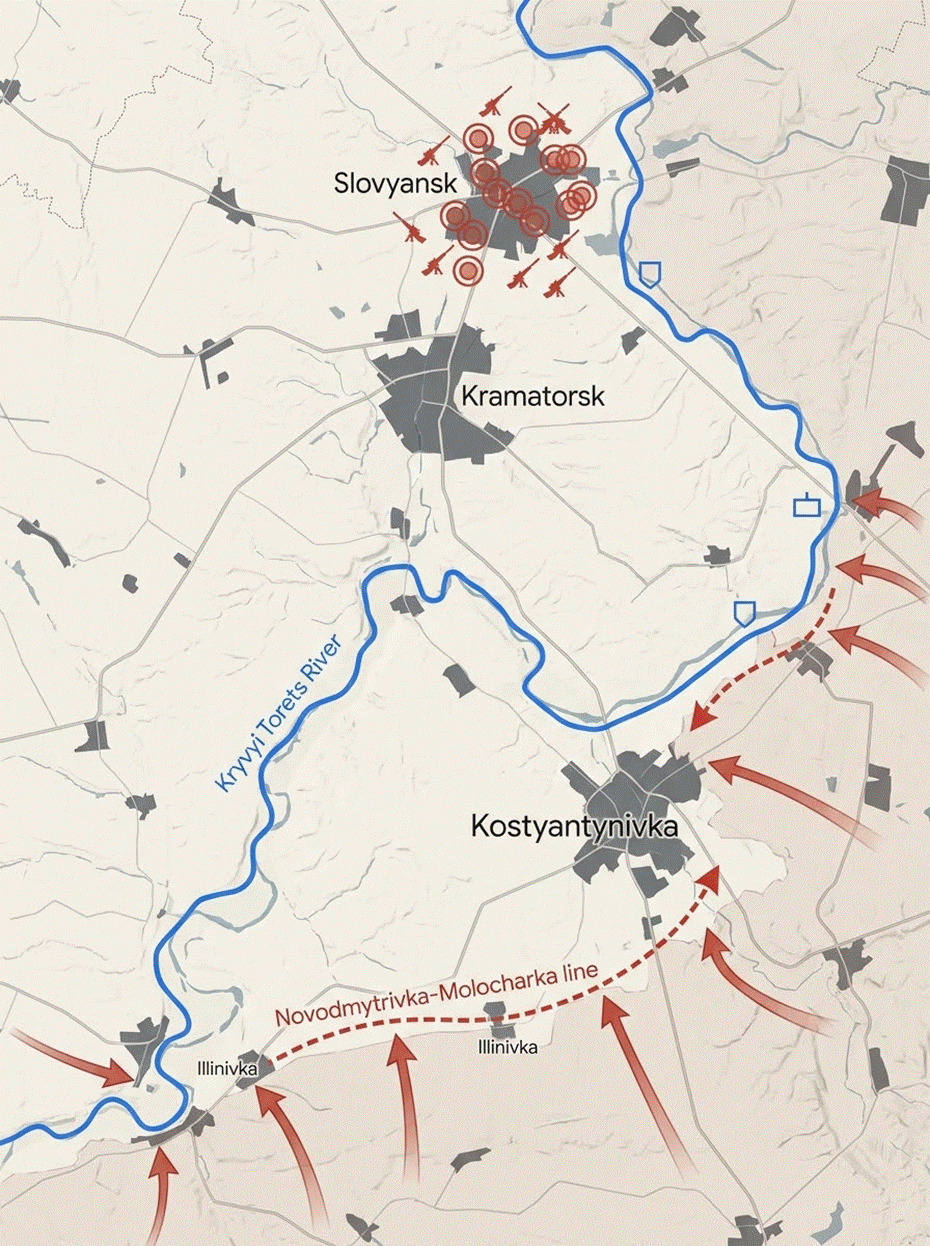
In the Kupyansk direction and the Kostyantynivka-Druzhkivka tactical areas, Ukrainian counterattacks successfully disrupted Russian assault groupings that were attempting to accumulate reserves at night for dawn assaults.5 A Ukrainian brigade operating northeast of Kostyantynivka near Chasiv Yar reported severe Russian logistical constraints, noting that Russian forces were forced to rely exclusively on vulnerable motor transport for nocturnal resupply due to the destruction of armored logistics carriers.6

Conversely, Russian forces maintained concentrated offensive pressure in the Sumy and Pokrovsk directions. In northern Sumy Oblast, Russian forces continued their stated objective of establishing a defensible buffer zone intended to push Ukrainian tube artillery out of range of the Russian city of Belgorod.5 While isolated ground attacks occurred northwest, northeast, and southeast of Sumy City, verified advances remained highly limited.5 In the Pokrovsk direction, Russian forces attempted mechanized assaults but failed to make confirmed advances as Ukrainian forces reportedly launched immediate and disruptive counterattacks against Russian deployment lines.6

Deep-Strike Operations and Asymmetric Degradation

The operational tempo of deep-strike campaigns reached unprecedented levels this week, characterized by a high degree of asymmetry. Ukrainian forces executed a multi-vector strike strategy targeting Russian critical infrastructure, energy nodes, and command-and-control (C2) facilities at extreme ranges.

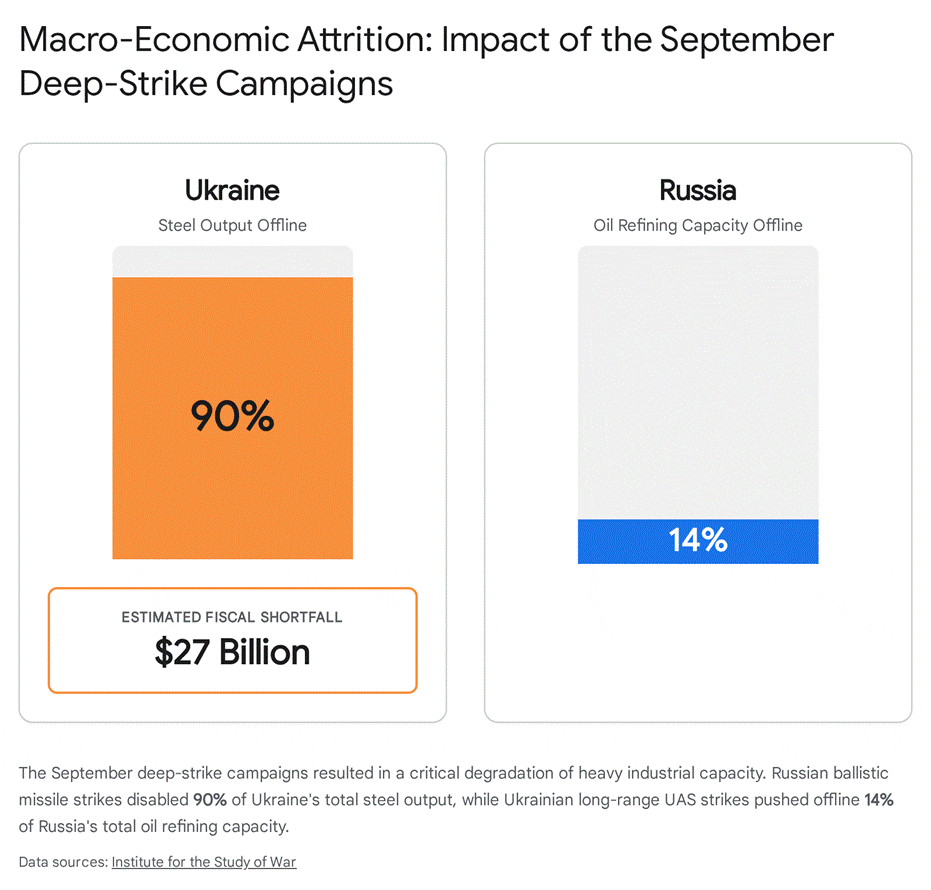
Strikes within the Russian Interior: In the largest and most sophisticated breach of Moscow’s airspace since the war’s inception, over 500 Ukrainian drones targeted the broader Moscow region overnight on May 16-17.1 This operation successfully penetrated multiple echelons of Russian air defense. Confirmed impacts included the Angstrem Semiconductor plant located at the Elma Technopark in Zelenograd—a vital facility specializing in the production of microelectronics and optical systems for high-precision Russian weaponry.7 Additionally, strikes targeted the Solnechnogorsk oil pumping station, a critical node in the ring oil pipeline around Moscow used for pumping and storing military-grade diesel, and the Moscow Oil Refinery in Kapotnya Raion.7

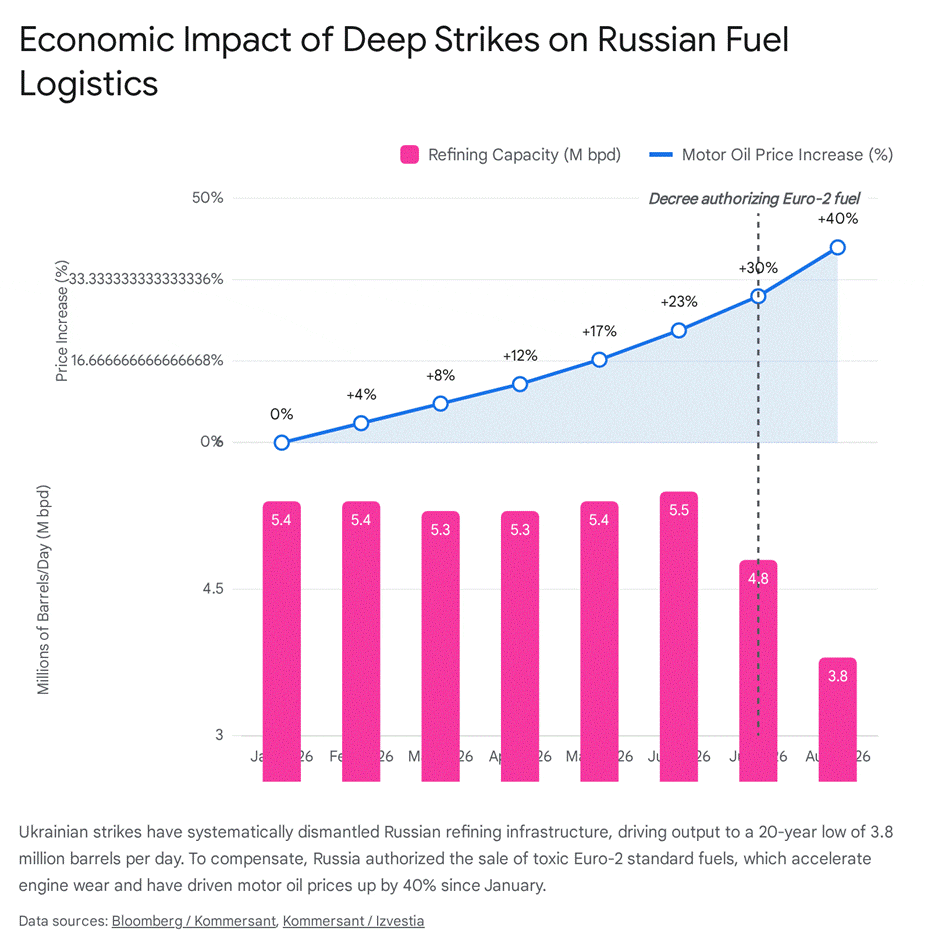
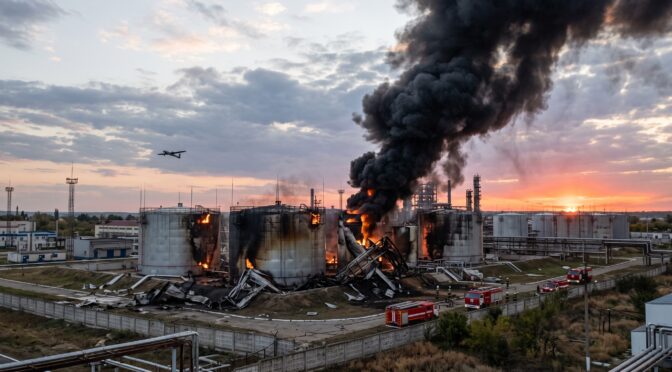
Further extending their reach, Ukrainian drones repeatedly struck the Slavneft-YANOS refinery in Yaroslavl. This facility is Russia’s fourth-largest refinery, possessing an annual processing capacity of approximately 15 million tons of crude oil.10 The verified strike on May 19 marked the third successful attack on this specific facility within a two-week period, indicating a deliberate campaign to permanently sever this node from the Russian energy grid.11 Furthermore, precision strikes forced the partial shutdown of the AVT-6 primary oil refining unit at the Lukoil-Nizhegorodnefteorgsintez Oil Refinery in Nizhny Novgorod, precipitating a sharp decline in the plant’s production of downstream petroleum products.5

Map showing Russia's deep-

Rear Echelon Degradation in Occupied Territories: Within the occupied territories of Ukraine, Ukrainian forces focused on decapitation strikes against command infrastructure. Overnight on May 21-22, Ukrainian munitions struck a Russian drone command center located in occupied Starobilsk, Luhansk Oblast.5 Ukrainian military intelligence identified the target as one of the primary headquarters of the “Rubikon” unit, an elite Russian UAV detachment responsible for coordinating strikes against Ukrainian civilian infrastructure.15 While Russian occupation authorities and President Putin characterized the strike as a terrorist act that hit a civilian college dormitory resulting in six fatalities, the Ukrainian General Staff firmly denied targeting civilians, maintaining that the operation strictly neutralized a verified military installation in accordance with international humanitarian law.17

In Crimea and southern Ukraine, a targeted strike on the Belbek military airfield in occupied Sevastopol destroyed highly valuable air defense and radar assets. SBU reports, corroborated by NASA Fire Information for Resource Management System (FIRMS) data, confirmed the destruction of a Pantsir-S2 system, an S-400 radar installation hangar, and Orion and Forpost ground-based UAV control systems.7 In Kherson Oblast, a complex strike on the Arabat Spit neutralized a Russian Federal Security Service (FSB) command post, resulting in approximately 100 Russian casualties, and simultaneously destroyed a Pantsir-S1 air defense system near occupied Shchaslyvtseve.3

Maritime Security Incidents: Ukrainian Unmanned Surface Vehicles (USVs) and long-range aerial assets continued to project power into distant maritime theaters, fundamentally altering the naval security paradigm. Overnight on May 16-17, Ukrainian forces executed a successful strike against a Project 10410 Svetlyak-class patrol ship belonging to the Russian FSB Border Service.7 Crucially, this vessel was docked in Kaspiysk, Republic of Dagestan, located approximately 1,000 kilometers from the frontline on the Caspian Sea.7 This strike represents a highly significant expansion of the maritime threat envelope, forcing the Russian Navy to reconsider the safety of naval assets previously deemed entirely insulated from the conflict and demonstrating Ukraine’s capability to operate effectively across multiple, non-contiguous bodies of water.

Strategic Realignments and Third-Party Maneuvers

The 7-day reporting period witnessed critical diplomatic maneuvers by global powers, heavily influencing the strategic calculus, military resourcing, and geopolitical posture of both combatants.

The People’s Republic of China (PRC) and the Russian Federation: Russian President Vladimir Putin undertook a highly publicized, two-day state visit to Beijing on May 19-20 to meet with PRC President Xi Jinping.20 The summit was explicitly designed to project unity and resilience in the face of Western sanctions. The leaders signed a joint declaration advocating for a “multipolar world” and finalized agreements to deepen cooperation on satellite internet interoperability (between Russia’s GLONASS and China’s BeiDou systems), artificial intelligence, and open-source cyber technologies—moves intended to reduce reliance on Western technological ecosystems.2

However, the summit notably failed to achieve Russia’s primary economic objective.2 OSINT sources confirm that Putin and Xi failed to reach a final agreement on the Power of Siberia-2 gas pipeline.5 This proposed 2,600-kilometer megaproject is essential for Moscow, designed to redirect up to 50 billion cubic meters of natural gas annually from permanently lost European markets to Asia.24 Negotiations remain stalled due to Beijing’s hardball pricing tactics; China is leveraging its access to alternative global Liquefied Natural Gas (LNG) sources—including from Qatar, Australia, and the US—to demand heavily discounted rates that Moscow is hesitant to accept, knowing it lacks alternative viable customers for this stranded asset.24 This failure to secure long-term, high-volume energy revenue streams significantly limits Russia’s future fiscal runway and underscores the distinctly unequal nature of the bilateral partnership.

The United States, NATO, and the European Union: Western backing for Ukraine saw a major, structural consolidation aimed at ensuring long-term sustainability. Following months of diplomatic deadlock, the European Union formally approved a historic €90 billion ($106 billion) macroeconomic and military loan package for Ukraine.26 This substantial capital injection is designed to sustain Ukraine’s civilian economy and military procurement pipeline through the end of 2027, serving as a critical hedge to mitigate the risks associated with volatile United States domestic political cycles and election outcomes. Concurrently, the U.S. Department of Defense began informing NATO allies of a revised global force posture, updating the numbers of troops available for the alliance’s rapid response forces in Europe, a move monitored closely by both Brussels and Moscow as an indicator of long-term U.S. commitment to the continent’s defense.28

Baltic State Tensions and Belarusian Complicity: Geopolitical friction along NATO’s eastern flank intensified dramatically during this period, characterized by Russian information operations and airspace violations. Following the series of successful Ukrainian drone strikes deep inside Russia, the Russian Ministry of Foreign Affairs launched a coordinated disinformation campaign accusing the Baltic states—specifically highlighting Latvia—of acting as direct “launchpads” for Ukrainian UAVs.29 These claims, entirely unsubstantiated by evidence, were accompanied by direct warnings of “just retribution” against specific, named Baltic military bases.29

Simultaneously, the physical security of Baltic airspace was tested. Latvia and Lithuania reported multiple airspace incursions by unidentified unmanned aerial vehicles, triggering national air alerts.29 Latvia reported its third drone alert in three days, while Estonia summoned the Russian ambassador in formal diplomatic protest against Moscow’s continued intimidation tactics.29 NATO Secretary General Mark Rutte issued a stern warning that any direct attack on NATO allies would face a “devastating” response, dismissing the Russian claims as “totally ridiculous.”.29 EU Defence Commissioner Andrius Kubilius identified the Russian actions as deliberate hybrid intimidation tactics designed to test Western resolve, sow domestic anxiety within the Baltics, and deter ongoing defense investments.29

As part of this broader intimidation matrix, Russia and Belarus concluded a surprise phase of combined tactical nuclear exercises on May 21.3 These high-profile drills involved the simulated transfer of specialized nuclear munitions to Belarusian forces and the test launching of strategic assets including Yars Intercontinental Ballistic Missiles (ICBMs), Zircon hypersonic missiles, and Kinzhal aero-ballistic systems.3 This development underscores Russia’s deepening de facto control over Belarusian military infrastructure, effectively utilizing the territory as a forward operating base for nuclear signaling to distract from conventional battlefield vulnerabilities and project strength toward NATO.3

3. Drone Warfare and Unmanned Systems

The operational environment over the past week has been heavily dictated by rapid technological iteration and the mass deployment of unmanned systems by both belligerents. The airspace over the theater is currently saturated, forcing both sides to innovate continually in targeting methodologies, interception tactics, and Electronic Warfare (EW) resistance.

Strategic Unmanned Deployments and Doctrine

The sheer scale of drone utilization remains unprecedented in modern warfare. According to estimates provided by Ukrainian officials, since May 10, Russian forces have launched over 3,170 long-range strike drones against Ukrainian territory.7 A singular inflection point occurred on the night of May 17-18, when Russia executed a massive, synchronized combined strike utilizing 546 drones and missiles. This specific strike package comprised 524 Shahed-type, Gerbera-type, and Italmas-type strike drones, accompanied by Parodiya decoy drones designed specifically to overwhelm and exhaust Ukrainian air defense interceptor stockpiles.30

Ukraine’s strategic deployment doctrine has evolved significantly, moving from localized, symbolic harassment to systematic economic warfare and infrastructure interdiction. The Ukrainian Unmanned Systems Forces (USF) utilized a suite of newly developed, domestically produced long-range platforms to penetrate the dense Moscow air defense rings. OSINT reporting identified the operational debut and utilization of several advanced models, including the RS-1 “Bars” jet-powered UAV, the Firepoint FP-1 winged drone, and a newly observed, highly capable variant dubbed the “Bars-SM Gladiator”.9 These platforms demonstrate Ukraine’s growing capacity to mass-produce systems capable of autonomous, long-distance navigation.

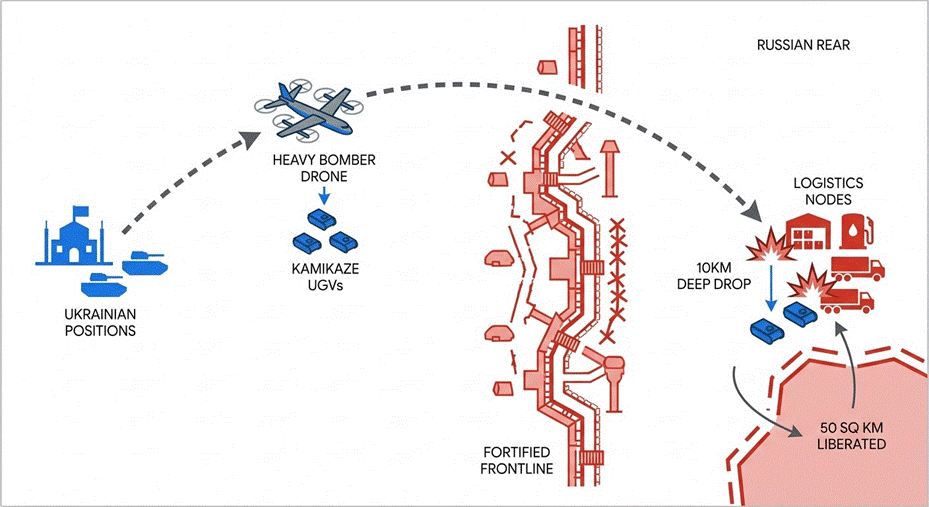
In the tactical ground domain, Unmanned Ground Vehicles (UGVs) are rapidly transitioning from experimental battlefield assets to standard combat logistics and strike platforms. Ukrainian forces reportedly maintain a definitive technical superiority in strike-capable UGVs, utilizing them primarily for remote area mining and direct infantry engagement, thereby minimizing the exposure of their own personnel in highly contested kill zones.30 Conversely, Russian military units have increasingly integrated UGVs into their frontline logistics chains. Due to the extreme lethality of the airspace caused by Ukrainian First-Person View (FPV) drones, Russian forces are using these ground platforms to resupply forward positions with ammunition and rations, highlighting a necessary adaptation to a battlespace where human-crewed resupply vehicles face near-certain destruction.30

Targeting Matrices and Strike Asymmetry

A clear divergence in the targeting doctrine between the two militaries was evident during the May 16-23 reporting period:

  • Ukrainian Targeting Priorities: Kyiv has prioritized the systematic and precise dismantling of the Russian war economy, logistics arteries, and high-level command structures. Drone campaigns explicitly targeted downstream oil processing (e.g., Moscow Oil Refinery, Yaroslavl Slavneft-YANOS), military microelectronics manufacturing (Angstrem plant in Zelenograd), and elite C2 nodes (the FSB base on the Arabat Spit and the Rubikon drone HQ in Starobilsk).3 This strategy is dual-purpose: to degrade the physical materiel available to the Russian military and to force the Kremlin to redeploy scarce air defense systems away from the frontline to protect widely dispersed, high-value rear-echelon economic assets. Furthermore, Ukrainian tactical drone operators claimed exceptional lethality, with USF Commander Major Robert “Magyar” Brovdi reporting that Ukrainian drones struck 19,203 Russian personnel in the first 19 days of May alone.5
  • Russian Targeting Priorities: Russian strike packages have predominantly focused on degrading Ukrainian national morale, interdicting civilian supply chains, and crippling civil sustainability. The mass drone and missile barrages heavily targeted energy generation facilities, food storage warehouses, and civilian residential sectors in Dnipro City, Sumy, and Odesa.5 The strikes in the port city of Odesa notably impacted a Chinese-owned commercial vessel, underscoring the indiscriminate nature of the port bombardments and highlighting the inherent risks to third-party shipping in the Black Sea.30

Technological Iteration and Countermeasure Ecosystems

The technological cat-and-mouse game between offense and defense saw major developments in both operational capacity and platform lethality over the past week.

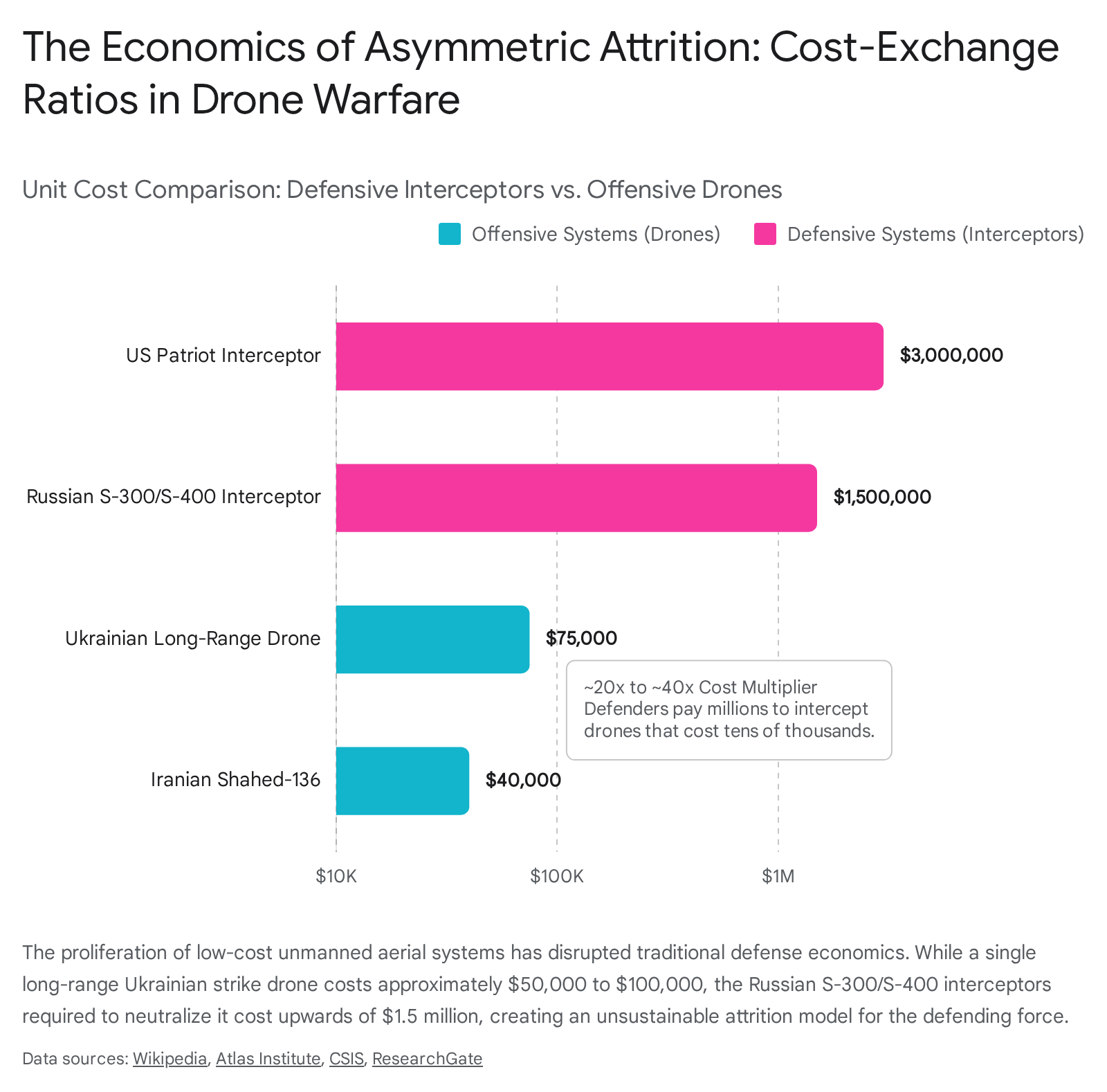
Ukrainian Counter-Drone Infrastructure and Adaptations: Faced with overwhelming incoming volumes, Ukraine has significantly and successfully scaled its domestic counter-UAS capabilities. The Ukrainian Ministry of Defense reported a 2.6-fold increase in the supply of domestically produced interceptor drones between January and May 2026. This industrial surge allowed Ukrainian forces to effectively double their overall interception rate of Russian long-range drones, a remarkable achievement given that Russian forces simultaneously expanded their drone strike packages by approximately 35% during the same timeframe.3

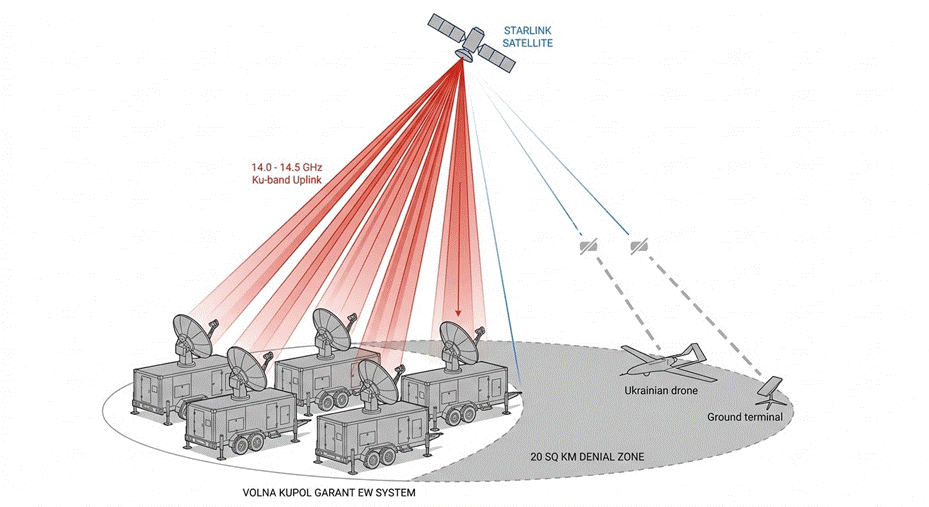
Furthermore, Ukraine has authorized a novel, highly decentralized private air defense initiative, integrating 27 private businesses into the national air defense umbrella. These civilian-corporate formations are authorized to coordinate directly with the Ukrainian Air Force to conduct localized counter-drone operations using their own procured equipment, with operational units already active in Kharkiv and Odesa oblasts.3 On the tactical front, Ukrainian forces are increasingly utilizing advanced fiber-optic drones. By using a physical tether rather than radio frequencies, these drones can completely bypass and operate unimpeded within zones blanketed by Russian Electronic Warfare (EW) jamming, severely restricting Russian mechanized ground assaults in sectors like Kherson by ensuring guaranteed FPV strikes regardless of the EW environment.3

Line graph showing Russian presence or influence

Russian Tech Shifts and Lethality Enhancements: To counter Ukraine’s improving interception rates, the Russian military-industrial complex is escalating the speed and lethality of its platforms. Satellite imagery obtained on May 20 of the Tsimbulova Airfield in Oryol Oblast revealed the active construction of 10 new drone launch ports and specialized concrete storage structures designed explicitly for the newer, jet-powered Geran-4 and Geran-5 variants.3 The transition from propeller-driven to jet-powered systems significantly increases the velocity of the approach, drastically reducing the reaction time available for Ukrainian interceptor drones and ground-based anti-aircraft fire.

Additionally, physical lethality is being augmented. The Ukrainian Security Service (SBU) disclosed forensic analysis of a downed Russian Geran-2 drone, revealing the novel integration of depleted Uranium-235 and Uranium-238 elements within the payload matrix.5 This specific adaptation, detected in a drone armed with an R-60 air-to-air missile, is designed to maximize kinetic fragmentation, density of shrapnel, and structural damage upon impact, indicating a shift toward optimizing the destructive yield of platforms that successfully bypass air defenses.5

4. Resource Utilization, Constraints, and Sustainability Projection

The conflict has entered a phase characterized by severe, industrial-scale attrition of both personnel and physical materiel. Both militaries are operating under extreme logistical constraints, forcing structural, potentially irreversible changes to their respective defense industrial bases and domestic economies.

Demographic Attrition and Manpower Generation

The expenditure of human resources by the Russian Federation remains extraordinarily high, presenting a critical vulnerability. According to data provided by the General Staff of the Armed Forces of Ukraine, estimated total Russian personnel losses (killed and wounded) from the start of the full-scale invasion reached approximately 1,354,810 by May 23, 2026.31 During this specific 7-day reporting period, daily reported Russian casualties averaged between 950 and 1,220 personnel per day.31 Ukrainian President Volodymyr Zelensky publicly corroborated these high attrition rates, stating that Russia has suffered 145,000 casualties thus far in the calendar year 2026, averaging 1,021 losses per day.13

The Russian Ministry of Defense is facing critical manpower bottlenecks that threaten unit cohesion and offensive capability. OSINT analysis indicates that the Russian voluntary contract recruitment rate has definitively dipped below its battlefield replacement rate. In the first quarter of 2026, Russia concluded only 70,500 military service contracts, significantly short of the monthly quota of 33,500 to 34,600 required merely to maintain existing combat effectiveness and replace attrited forces.5 Despite recent, substantial increases in one-time financial signing bonuses, and the increasingly acknowledged integration of foreign fighters (notably North Korean contingents observed in the theater since spring 2026), domestic contract recruitment continues to decline as the realities of battlefield casualty rates permeate the Russian public consciousness.6 To sustain this operational pressure, the Ukrainian Ministry of Defense reported setting a strategic objective to inflict approximately 50,000 Russian casualties per month, aiming to mathematically outpace and break Russia’s ability to regenerate functional combat power.5

Bar chart showing military personnel numbers for

Equipment Attrition and Material Burn Rates

The material burn rate mirrors the human toll, reflecting the intensity of the mechanized and artillery-centric combat. Based on official Ukrainian General Staff data over the week, Russian forces are sustaining daily losses that severely impact their ability to generate massed armored assaults or maintain comprehensive air defense coverage.

DateReported Personnel CasualtiesUAV LossesArtillery System LossesArmored Vehicles / TanksSources
May 16, 20261,1702,1318232
May 17, 20261,2201,6034733
May 18, 20261,1402,1427834
May 22, 20269501,819685 Tanks / 5 ACVs31

Note: Daily fluctuations in UAV losses reflect both tactical drone attrition (e.g., FPVs) and the interception of strategic loitering munitions.

Logistical Severance and Industrial Bottlenecks

Logistically, Ukraine’s continuous mid-range strike campaign is severely complicating Russian ground transport and supply chain integrity. Continuous interdiction of supply lines has forced the Russian occupation administration in Kherson Oblast, under Vladimir Saldo, to issue strict decrees restricting the movement of all commercial and civilian freight vehicles on the M-14 (R-280 Novorossiya) highway.13 This administrative action is designed to reserve limited, secure road capacity exclusively for military logistics, but consequently creates severe bottlenecks for civilian and dual-use supply chains in the occupied territories, degrading the overall economic output of the region.13

Medium-Term Sustainability Projections

Objective, forward-looking economic analysis projects that Russia’s current trajectory is economically and demographically unsustainable in the medium term without radical policy shifts. The Russian state is currently operating a volatile “dual economy,” characterized by highly overheated military output that attempts to mask deep, structural civilian economic stagnation.38 Crucially, because the Kremlin has refused to officially declare war—insisting on maintaining the “Special Military Operation” legal framework—it must compete in the open market for labor, technical inputs, and capital.38 This reality makes generating military power exponentially more expensive for Russia today than it was during the centralized, command-economy era of the Cold War.

With the domestic labor market exhausted by conscription, high casualty rates, and brain-drain emigration, and with the industrial base operating near its absolute total productive capacity with diminishing returns on new investments, the Kremlin is approaching a fundamental inflection point. If the manpower deficit and financial drain—exacerbated by the failure to secure the Chinese gas deal and the physical destruction of oil infrastructure by Ukrainian strikes—continue at the current rate through the winter of 2026, the Kremlin will face a stark choice.13 It will likely be forced to impose stringent, command-economy measures and initiate a politically perilous, highly unpopular forced societal mobilization to generate troops, or it will be forced to scale back its maximalist territorial objectives to match its actual resource generation capabilities.13

Conversely, Ukraine’s operational sustainment relies almost entirely on the timely execution and disbursement of the newly approved €90 billion EU aid package.26 If this capital is deployed effectively to scale domestic interceptor production, secure artillery ammunition pipelines, and expand the production of deep-strike UAVs, projections indicate Kyiv can maintain its current strategy of asymmetrical attrition, further exacerbating the structural pressures on the Russian state apparatus.

5. Chronological Timeline of Key Events

The following timeline details the most significant operational, diplomatic, and tactical events recorded over the 7-day reporting period, providing a chronological overview of the conflict’s escalation.

  • May 16, 2026:
    • The United States administration allows a critical sanctions waiver to lapse, closing a loophole that previously permitted third-party nations to purchase Russian seaborne oil stored on tankers, significantly increasing economic pressure on Moscow.1
    • Ukrainian forces conduct a successful strike on the Azot chemical plant in Nevinnomyssk, Stavropol Krai, disrupting a facility critical for the production of nitrogen fertilizers and explosives used by the Russian military.39
  • May 17, 2026:
    • Overnight, Ukraine launches an unprecedented drone assault utilizing over 500 long-range UAVs. The swarm penetrates the Moscow region air defense rings, striking the Angstrem microelectronics plant in Zelenograd, the Solnechnogorsk oil pumping station, and the Moscow Oil Refinery, prompting widespread flight diversions and airspace closures.7
    • Ukrainian forces successfully strike the Belbek military airfield in occupied Sevastopol, Crimea, destroying high-value Russian S-400 radar infrastructure and a Pantsir-S2 air defense system.7
    • A coordinated Ukrainian USV and drone strike hits a Russian Federal Security Service (FSB) Project 10410 Svetlyak-class patrol ship docked in Kaspiysk, Dagestan, expanding the threat matrix into the Caspian Sea.7
  • May 18, 2026:
    • Russian forces conduct a massive, large-scale retaliatory strike against Ukraine, launching 546 drones and missiles (including 14 Iskander-M/S-400 ballistic missiles and 8 cruise missiles). The barrage heavily targets civilian and energy infrastructure in Dnipropetrovsk Oblast and Odesa, where a Chinese-owned commercial ship is damaged.30
    • The US Defense Intelligence Agency (DIA) publishes an assessment formally noting Ukraine’s recent territorial gains following temporary Russian communication disruptions.13
  • May 19, 2026:
    • Russian President Vladimir Putin arrives in Beijing for a highly anticipated two-day state visit with PRC President Xi Jinping. While the leaders sign a multipolar world declaration, they fail to reach a vital agreement on the Power of Siberia-2 gas pipeline, dealing a blow to Russia’s long-term energy strategy.2
    • Russia initiates surprise strategic and tactical nuclear exercises, explicitly posturing military strength against NATO and Ukraine’s Western allies to mask conventional battlefield vulnerabilities.6
    • Ukrainian drones penetrate deep into Russian territory to strike the Yaroslavl-3 oil pumping station and the Slavneft-YANOS refinery in Yaroslavl, prompting the closure of a major highway and multiple regional airports.5
  • May 20, 2026:
    • OSINT analysts and military officials report that Ukrainian forces officially regain the tactical initiative in several key sectors, advancing in the Kupyansk direction, Kostyantynivka-Druzhkivka, and successfully liberating the settlements of Mala Tokmachka and Bilohirya in western Zaporizhia Oblast.5
    • A Ukrainian drone strike forces the partial shutdown of the AVT-6 primary oil refining unit at the Lukoil-Nizhegorodnefteorgsintez Oil Refinery in Nizhny Novgorod.5
  • May 21, 2026:
    • Geopolitical tensions spike as Latvia and Lithuania issue multiple emergency air alerts in response to unidentified drone incursions violating Baltic airspace. Russia issues statements accusing the Baltics of hosting Ukrainian drone “launchpads,” prompting firm condemnation from NATO and the EU.29
    • Russia and Belarus officially complete the second stage of their combined tactical nuclear exercises, cementing Belarus’s role in Russian nuclear posturing.3
    • Kherson Oblast occupation authorities, under Vladimir Saldo, sign decrees severely restricting civilian freight movement on the critical M-14 highway due to intense Ukrainian logistical interdiction.13
  • May 22, 2026:
    • Ukrainian forces conduct a precision deep-strike on the headquarters of the Russian “Rubikon” elite drone unit in occupied Starobilsk, Luhansk Oblast. While Russia claims the strike hit a civilian dormitory and caused six deaths, Ukraine maintains the target was strictly a military installation coordinating strikes on Ukrainian civilians.14
    • Ukrainian President Volodymyr Zelensky confirms a fourth successful strike within a month against the Slavneft-YANOS oil refinery in Yaroslavl, reiterating the strategy of bringing the war’s economic consequences directly to the Russian interior.12
  • May 23, 2026:
    • The European Union officially clears the path for a historic €90 billion ($106 billion) financial and military loan package for Ukraine, ending months of diplomatic deadlock and securing Ukraine’s medium-term operational funding.26
    • The General Staff of the Armed Forces of Ukraine reports daily Russian casualties of 950 personnel, pushing the estimated total Russian losses since the start of the full-scale invasion in 2022 to over 1,354,810.31

Please share the link on Facebook, Forums, with colleagues, etc. Your support is much appreciated and if you have any feedback, please email us in**@*********ps.com. If you’d like to request a report or order a reprint, please click here for the corresponding page to open in new tab.


Works cited

  1. Ukraine war briefing: more than 500 drones strike at Russia, killing 3; US allows Russian oil sanctions waiver to lapse – The Guardian, accessed May 23, 2026, https://www.theguardian.com/world/2026/may/17/ukraine-war-briefing-us-allows-russian-oil-sanctions-waiver-to-lapse
  2. Putin and Xi Sign ‘Multipolar World’ Declaration in Beijing, accessed May 23, 2026, https://www.themoscowtimes.com/2026/05/20/putin-and-xi-sign-multipolar-world-declaration-in-beijing-a92796
  3. Russian Offensive Campaign Assessment, May 21, 2026 | ISW, accessed May 23, 2026, https://understandingwar.org/research/russia-ukraine/russian-offensive-campaign-assessment-may-21-2026/
  4. The Russia-Ukraine War Report Card, May 20, 2026, accessed May 23, 2026, https://www.russiamatters.org/news/russia-ukraine-war-report-card/russia-ukraine-war-report-card-may-20-2026
  5. Russian Offensive Campaign Assessment, May 20, 2026 | ISW, accessed May 23, 2026, https://understandingwar.org/research/russia-ukraine/russian-offensive-campaign-assessment-may-20-2026/
  6. Russian Offensive Campaign Assessment, May 19, 2026 | ISW, accessed May 23, 2026, https://understandingwar.org/research/russia-ukraine/russian-offensive-campaign-assessment-may-19-2026/
  7. Russian Offensive Campaign Assessment, May 17, 2026 | ISW, accessed May 23, 2026, https://understandingwar.org/research/russia-ukraine/russian-offensive-campaign-assessment-may-17-2026/
  8. The tide is turning in Russia-Ukraine war, accessed May 23, 2026, https://www.gzeromedia.com/by-ian-bremmer/the-tide-is-turning-in-russia-ukraine-war
  9. Ukraine war briefing: The drones that bombarded Moscow region – The Guardian, accessed May 23, 2026, https://www.theguardian.com/world/2026/may/18/ukraine-war-briefing-the-drones-that-bombarded-moscow-region
  10. Explosions rock Russia’s Yaroslavl as authorities report drone strike on industrial facility, accessed May 23, 2026, https://www.pravda.com.ua/eng/news/2026/05/19/8035328/
  11. Drone hits Yaroslavl refinery for third time in two weeks as Russia’s fourth-largest oil plant burns again – Euromaidan Press, accessed May 23, 2026, https://euromaidanpress.com/2026/05/19/drone-hits-yaroslavl-refinery-for-third-time-in-two-weeks-as-russias-fourth-largest-oil-plant-burns-again/
  12. Ukraine strikes Russia’s Yaroslavl Oil Refinery 4 times in month, Zelensky confirms, accessed May 23, 2026, https://kyivindependent.com/russias-yaroslavl-oil-refinery-hit-for-4th-time-in-a-month-zelensky-confirms/
  13. Russian Offensive Campaign Assessment, May 22, 2026 | ISW, accessed May 23, 2026, https://understandingwar.org/research/russia-ukraine/russian-offensive-campaign-assessment-may-22-2026/
  14. ISW Russian Offensive Campaign Assessment, May 22, 2026 – Kyiv Post, accessed May 23, 2026, https://www.kyivpost.com/post/76700
  15. Ukraine Says Rubikon Strike Hit Russian Drone Unit, Not Civilian Site, accessed May 23, 2026, https://www.kyivpost.com/post/76698
  16. General Staff: One of Rubikon unit’s headquarters hit in Starobilsk – Interfax-Ukraine, accessed May 23, 2026, https://en.interfax.com.ua/news/general/1170147.html
  17. Ukraine war briefing: Putin promises revenge after blaming Kyiv for Luhansk attack he says killed six, accessed May 23, 2026, https://www.theguardian.com/world/2026/may/23/ukraine-war-briefing-putin-promises-revenge-after-blaming-kyiv-for-luhansk-attack-he-says-killed-six
  18. Ukraine hits college in Russian-occupied town, killing 6: Moscow, accessed May 23, 2026, https://www.bssnews.net/international/389637
  19. Kyiv Dismisses Russian Accusations Over Dormitory Attack in Occupied Luhansk – Kyiv Post, accessed May 23, 2026, https://www.kyivpost.com/post/76696
  20. ISW Russian Offensive Campaign Assessment, May 19, 2026 – Kyiv Post, accessed May 23, 2026, https://www.kyivpost.com/post/76475
  21. China and Russia’s strategic duo endures – but its limits are clear, accessed May 23, 2026, https://www.chathamhouse.org/2026/05/china-and-russias-strategic-duo-endures-its-limits-are-clear
  22. Xi and Putin pledge closer cooperation on AI, cyberspace and satellite systems, accessed May 23, 2026, https://therecord.media/russia-and-china-pledge-cooperation-2026
  23. Putin, Xi signal unity but fail to reach deal on pipeline sought by Russia, accessed May 23, 2026, https://www.washingtonpost.com/world/2026/05/20/putin-fails-secure-xi-approval-power-siberia-2-pipeline/
  24. Putin leaves Beijing without agreement on Power of Siberia 2 gas pipeline, accessed May 23, 2026, https://cryptobriefing.com/putin-power-of-siberia-2-pipeline-stalled/
  25. Putin Gets Show Of Unity, But No New Pipeline Deal In Beijing Summit – Radio Free Europe, accessed May 23, 2026, https://www.rferl.org/a/putin-xi-power-of-siberia-iran-war-trump-china-russia/33760781.html
  26. EU’s $106 Billion Lifeline To Ukraine: EU Unblocks Massive Ukraine Loan – YouTube, accessed May 23, 2026, https://www.youtube.com/watch?v=2VvAsiKY-5g
  27. This is how to defeat Vladimir Putin | Timothy Garton Ash, accessed May 23, 2026, https://www.theguardian.com/commentisfree/2026/may/23/defeat-vladimir-putin-russia-ukraine-nato-eu
  28. US to unveil revised force posture to NATO allies this week, sources say, accessed May 23, 2026, https://www.euractiv.com/news/us-to-unveil-revised-force-posture-to-nato-allies-this-week-sources-say/
  29. Many Nato countries not spending enough to support Ukraine, says Rutte – as it happened, accessed May 23, 2026, https://www.theguardian.com/world/live/2026/may/21/czech-republic-petr-pavel-ukraine-baltics-drones-russia-nato-security-latest-news-updates
  30. Russian Offensive Campaign Assessment, May 18, 2026 | ISW, accessed May 23, 2026, https://understandingwar.org/research/russia-ukraine/russian-offensive-campaign-assessment-may-18-2026/
  31. Russia loses 950 soldiers over past day, accessed May 23, 2026, https://www.pravda.com.ua/eng/news/2026/05/23/8036041/
  32. Total russian combat losses in Ukraine as of May 17, 2026, accessed May 23, 2026, https://mod.gov.ua/en/news/total-russian-combat-losses-in-ukraine-as-of-may-17-2026
  33. Total russian combat losses in Ukraine as of May 18, 2026, accessed May 23, 2026, https://mod.gov.ua/en/news/total-russian-combat-losses-in-ukraine-as-of-may-18-2026
  34. russian losses in Ukraine as of May 19, 2026 | MoD News, accessed May 23, 2026, https://mod.gov.ua/en/news/total-russian-combat-losses-in-ukraine-as-of-may-19-2026
  35. Total russian combat losses in Ukraine as of May 23, 2026, accessed May 23, 2026, https://mod.gov.ua/en/news/total-russian-combat-losses-in-ukraine-as-of-may-23-2026
  36. ISW Russian Offensive Campaign Assessment, May 21, 2026 – Kyiv Post, accessed May 23, 2026, https://www.kyivpost.com/post/76621
  37. As Russian losses mount in Ukraine, Putin seeks more foreign fighters, accessed May 23, 2026, https://www.atlanticcouncil.org/blogs/ukrainealert/as-russian-losses-mount-in-ukraine-putin-seeks-more-foreign-fighters/
  38. The Coming Crisis in Russia’s Political Economy, accessed May 23, 2026, https://www.iiss.org/research-paper/2026/05/the-coming-crisis-in-russias-political-economy/
  39. Russian Offensive Campaign Assessment, May 16, 2026 | ISW, accessed May 23, 2026, https://understandingwar.org/research/russia-ukraine/russian-offensive-campaign-assessment-may-16-2026/

The Decline of Russian Military Power – Q2 2026

1. Executive Summary

As the Russo-Ukrainian war progresses through the spring of 2026, the Russian Federation is approaching a critical convergence of systemic vulnerabilities that directly threaten its capacity to sustain conventional, high-intensity combat operations. Extensive intelligence analysis of Russian military burn rates, macroeconomic indicators, demographic shifts, and domestic political sentiment demonstrates that the Kremlin is rapidly and unsustainably depleting its Soviet-inherited materiel reserves, its human capital, and its current fiscal buffers. While the Russian military maintains a capacity for localized, tactically grinding offensives, the overarching strategic trajectory suggests that the current intensity of conventional operations is materially unviable beyond late 2026 to early 2027.

The structural cannibalization of the Russian state is manifesting across three primary operational domains. First, the military apparatus is experiencing an insurmountable equipment deficit. Open-source intelligence and satellite imagery confirm that over 80% of pre-war tank stockpiles have been exhausted, with domestic industrial production replacing less than a quarter of battlefield losses.1 Second, the economic engine supporting the conflict is faltering; the National Wealth Fund (NWF) faces the imminent depletion of its highly liquid assets by the end of 2026, forcing the government into deeply inflationary domestic borrowing to cover a ballooning structural budget deficit.3 Third, the political environment is fracturing under the compounding weight of demographic exhaustion. With over 1.33 million total military casualties and a civilian labor shortage exceeding 4 million workers, public fatigue is crystallizing into the lowest presidential approval ratings recorded since the invasion began.6

With the pivotal State Duma elections scheduled for September 2026, the domestic political environment will increasingly restrict the Kremlin’s strategic maneuverability.10 The Russian leadership is fast approaching a definitive strategic decision point where it must either transition to a fundamentally different operational model—such as the “Doctrine of Continuum Conflict,” relying on hybrid, asymmetric, and informational warfare rather than mechanized assault—or negotiate a cessation of hostilities.12 To survive politically in a post-conflict or frozen-conflict scenario, the Kremlin will likely attempt to spin any cessation as a historic strategic victory by emphasizing the mitigation of Western expansionism and the preservation of newly claimed sovereign territory.13 Ultimately, while Russia retains significant disruptive potential on the global stage through cyber, nuclear, and asymmetric channels, the foundational core of its conventional military and economic power is experiencing irreversible decay.

2. The Military and Demographic Burn Rate

The foundational premise of the Russian campaign—that mass, sheer industrial scale, and a high tolerance for attrition would inevitably overcome Ukrainian resistance—has been fundamentally undermined by the disproportionate burn rate of Russian personnel and materiel. The calculus of attrition has decisively shifted from a deliberate operational strategy to a systemic, existential liability for the Russian Armed Forces.

2.1. Armor and Artillery Depletion Timeline

The most immediate physical constraint on Russian combat operations is the near-total exhaustion of its armored vehicle and artillery stockpiles. The Russian military apparatus is currently fighting a modern war on the rapidly expiring credit of the Soviet Union’s industrial legacy. As of May 2026, documented estimates indicate that Russia has exhausted over half of the total armored vehicles and artillery previously held in strategic storage.1 Analysis of key reserve bases across the Russian Federation, such as the 111th Central Tank Reserve Base in the Khabarovsk Krai, reveals a critical hollowing out of combat-ready platforms.14

The raw statistics regarding vehicle consumption are staggering. According to the General Staff of the Armed Forces of Ukraine, total Russian military losses as of May 4, 2026, include 11,914 tanks, 24,507 armored combat vehicles, and over 41,306 artillery systems.15 Independent open-source intelligence verification corroborates the catastrophic trajectory of these losses. Specifically, Russia has utilized 4,799 of its 7,342 pre-war tank stock, meaning a mere 19% of the original storage remains viable for refurbishment.1

The qualitative degradation of these reserves is arguably as significant as the quantitative decline. The restoration of modern platforms is moving at an unviable pace due to severe technological constraints, Western sanctions on dual-use microelectronics, and limited existing stock. For instance, the pre-war reserve of modern T-90 tanks has been 100% exhausted from storage.1 Consequently, the Russian defense industrial base is forced to cannibalize and refurbish increasingly antiquated models to maintain frontline presence, heavily relying on the T-80B/BV (1,409 units refurbished), T-72B (1,251 units), and the deeply obsolete T-62 (1,048 units).1 Even older models, such as the T-54/55, are being pulled from deep storage, with 176 units already mobilized.1

The situation regarding Infantry Fighting Vehicles (IFVs) and Armored Personnel Carriers (APCs) is similarly dire. Of the 7,121 pre-war BMP-1/2/3 units held in depots, 4,999 have been mobilized and subsequently destroyed or heavily damaged, leaving only 16% of the initial stock available for future operations.1 APCs have fared no better, with only 39% of the pre-war inventory remaining.1 Artillery and multiple rocket launch systems (MRLS), the traditional backbone of Russian operational doctrine, are heavily depleted, with only 18% of pre-war reactive artillery (such as the BM-21 Grad and BM-30 Smerch) remaining.1

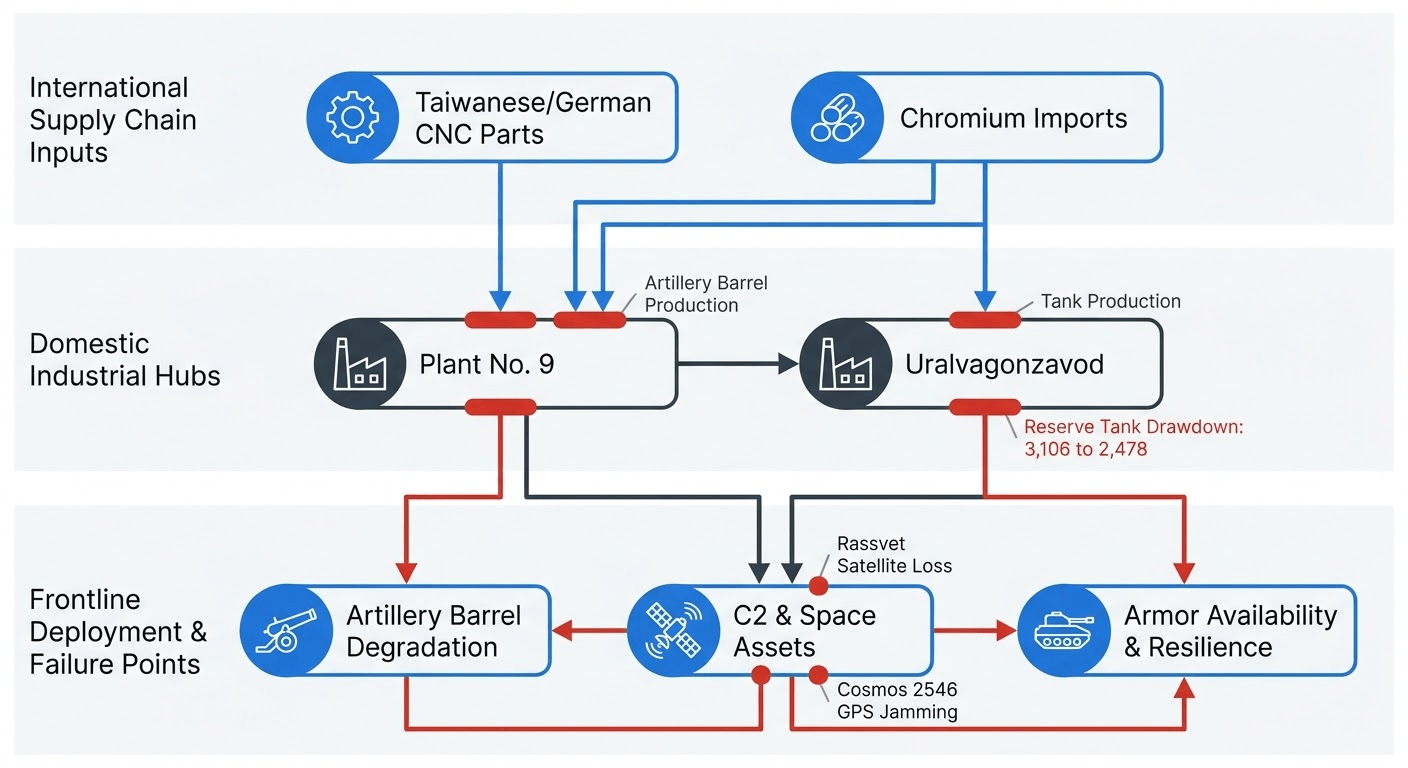
The crux of the military crisis lies in the insurmountable disparity between the battlefield burn rate and domestic production capacity. Russian forces are losing equipment at a rate that the domestic defense sector simply cannot match, creating a mathematical certainty of exhaustion. For example, Russia manufactures approximately 250 T-90M tanks annually, a figure that represents less than half of the losses sustained in single, localized operational nodes like Avdiivka or Pokrovsk.2 To maintain repairable equipment reserves at current combat intensity, the industrial base would need to immediately increase production to between 700 and 1,000 armored vehicles annually.2 This is a benchmark that is physically impossible to achieve given critical bottlenecks, particularly in artillery barrel manufacturing, metallurgical constraints, and the lack of skilled labor.2 Repair facilities themselves are struggling with profound technological limitations; workers are frequently required to cannibalize two to three decommissioned vehicles just to restore a single operational unit, drastically reducing the actual yield of the remaining storage yards.2

This severe hardware deficit has triggered forced tactical shifts on the battlefield. The scarcity of armored protection has necessitated a reversion to small-group infantry assaults—frequently described by analysts as “meat grinder” tactics—and the widespread, desperate use of unarmored transport.1 Russian forces are increasingly relying on motorcycles, all-terrain vehicles (ATVs), civilian cars, and improvised platforms (such as “Shahed-mobiles”) to transport troops to the zero line.2 While foreign military lifelines, notably from North Korea and Iran, have provided temporary relief—such as Pyongyang’s delivery of 200 long-range artillery pieces—this assistance merely delays rather than prevents the macroeconomic trajectory of equipment exhaustion.2 Current operational projections strongly indicate that recoverable equipment will reach critical, functional exhaustion by late 2026 or early 2027, severely curtailing Russia’s ability to conduct mechanized warfare.16

2.2. Human Capital and Demographic Collapse

The material deficit is compounded by a catastrophic and generational drain on Russian human capital. Since the commencement of the 2022 invasion, the Russian Armed Forces have sustained massive personnel losses that have deeply scarred the national demographic profile. Official assessments from early May 2026 indicate approximately 1.33 million total Russian casualties (killed and wounded), with daily casualty rates frequently exceeding 1,000 to 1,200 personnel.7 Fatalities alone are estimated to be as high as 325,000.7 This volume of loss is historically unprecedented for a modern major power; for context, Russian fatalities in Ukraine are more than 17 times greater than Soviet fatalities during the decade-long war in Afghanistan, and over 5 times greater than all Russian and Soviet wars combined since World War II.7

The systemic impact of these losses extends far beyond the immediate tactical realities of the battlefield, catalyzing a profound demographic and economic crisis across the Russian Federation. The Russian Central Bank Chief, Elvira Nabiullina, publicly acknowledged the severity of the crisis in April 2026, stating definitively that Russia is operating under an unprecedented labor shortage: “We have truly never lived in such a shortage of workforce in the modern history of Russia. We have never had anything like this before, and it affects the entire economic situation”.8

The confluence of wartime casualties, the ongoing mobilization of roughly 1.5 million men since the fall of 2022, and the mass emigration of hundreds of thousands of educated professionals has decimated the civilian labor pool.8 The so-called “labor reserve”—individuals who are not currently employed but could potentially work—has dropped by a staggering 40% since 2021, representing a decline of 2.6 million available workers and leaving a residual pool of only 4.4 million.8 The United Nations has issued dire long-term demographic projections for Russia, estimating a population decline of 25 to 50 percent by the year 2100, driven by below-replacement birth rates that have persisted since the 1990s and heavily exacerbated by the current conflict.19

This demographic void is creating severe macroeconomic distortions that threaten the stability of the state. To attract personnel to the military without instituting highly unpopular mandatory general mobilization, the Ministry of Defense is offering exorbitant signing bonuses. In places like occupied Kherson, residents are offered contract incentives totaling 3.32 million rubles (approx. $41,800 USD) for their first year, stripping the civilian sector of able-bodied men.21 Civilian industries are consequently forced to aggressively raise salaries to compete for the dwindling labor pool, directly fueling wage-driven inflation that the Central Bank is struggling to contain.8

Furthermore, the burden of these casualties is disproportionately borne by the far-flung, underdeveloped, and resource-rich regions of the Russian Federation. Areas such as Western Siberia and the Volga-Ural basin—which produce the oil and gas rents that make up nearly half of the federal budget—suffer the highest per-capita battlefield losses.21 The Kremlin’s reliance on these regions as both its economic engine and its primary human reservoir creates a dangerous feedback loop; the very regions that bankroll the war machine are losing the manpower necessary to maintain the extractive industries.21 The systemic failure to balance military manpower requirements with civilian industrial needs ensures that Russia will suffer diminished economic productivity and capacity for decades, regardless of the war’s outcome.

3. The Economic Burn Rate: The Fiscal Time Bomb

Despite persistent state propaganda claiming economic resilience and successful adaptation to Western sanctions, the fundamental arithmetic of the Russian economy is collapsing under the weight of sustained wartime expenditure. The Russian economic burn rate is rapidly outpacing revenue generation, pointing toward a severe and potentially catastrophic fiscal constriction by the end of 2026.

3.1. The 2026 Federal Budget Deficit and Revenue Shortfalls

The 2026 federal budget, signed into law by Vladimir Putin in late 2025, was drafted on highly optimistic assumptions regarding global oil prices, an artificially undervalued ruble, and seamless domestic tax collection.23 However, the reality of the first two quarters of 2026 has shattered these fiscal projections. Just two months into the fiscal year, the budget was widely described by financial analysts as being “shot to pieces,” running a massive deficit of 1.72 trillion rubles in January alone—a figure that represents nearly half of the entire full-year target of 3.786 trillion rubles.4

While global Brent crude prices experienced a temporary spike to over $83 a barrel due to the escalating 2026 conflict in the Middle East involving Iran, this geopolitical shock has not translated into fiscal salvation for Moscow.4 Russian crude continues to trade at a significant discount on global markets due to the persistent enforcement of international sanctions and price caps. Compounding this structural issue is the reality of currency valuation; the ruble has traded much stronger (approximately 77.8 rubles per dollar) than the 92.2 rubles per dollar explicitly budgeted by the Kremlin.4 This combination means that the Russian treasury receives significantly fewer domestic rubles from its hydrocarbon exports than anticipated. At the current exchange rate, oil would need to be priced at $70 per barrel just to meet basic fiscal assumptions, a threshold that is difficult to sustain given the sanctions-driven discount.4 Consequently, oil and gas revenues—which historically accounted for a dominant 42% of total budget revenue in 2022—have plunged, and are projected to constitute only 22% of the total budget in 2026.23

To compensate for these catastrophic shortfalls in hydrocarbon revenues, the Kremlin has attempted to forcefully extract capital from the domestic civilian economy via aggressive non-oil revenue mechanisms. The 2026 budget relies on an increase in the corporate income tax from 20% to 25% (shifting revenues from regional budgets directly to the federal budget), the implementation of a tiered personal income tax replacing the flat tax, an increase in the Value Added Tax (VAT) to 22%, and the abolition of critical tax exemptions for small and medium-sized enterprises.23

However, these severe austerity measures are choking domestic economic activity. High, untargeted government spending on the defense sector has fueled rampant inflation, forcing the Central Bank of Russia to maintain prohibitively high interest rates—currently sitting around 16.5%.23 This aggressive monetary tightening acts as a “dry sponge,” suffocating both corporate and private lending in the civilian sector.23 By suppressing civilian demand to transfer resources toward the military-industrial complex, the broader economy is grinding to a halt. In 2026, GDP growth forecasts were repeatedly slashed by international institutions from an optimistic 2.4% down to roughly 1.0% or 0.7%, signaling deep stagnation.23

3.2. The Evaporation of the National Wealth Fund

The most critical indicator of Russia’s rapidly dwindling strategic endurance is the accelerated depletion of the National Wealth Fund (NWF). The NWF, traditionally built on surplus oil and gas profits over the past two decades, serves as the central pillar of the country’s wartime fiscal architecture and the absolute primary mechanism for covering federal budget shortfalls.3

While the total nominal size of the fund appears robust on official state ledgers—standing at 13.64 trillion rubles, or roughly $178 billion as of early 2026—the reality of its liquidity paints a deeply perilous picture for the Russian state.3 The liquid assets—defined as funds readily convertible into cash to meet immediate fiscal needs, such as yuan and gold bullion—have been drastically drawn down. Over the preceding years, the government spent more than half of the liquid portion to finance the invasion of Ukraine and mask structural deficits.4 Data tracking the evaporation of the National Wealth Fund’s liquid reserves shows a systematic drawdown to cover ballooning wartime budget deficits. The highly liquid assets fell precipitously from a peak of roughly $113 billion down to just $55 billion (4.23 trillion rubles) by February 2026.3 Ministry of Finance data indicated a further, uninterrupted decline to 3.88 trillion rubles by March 2026.27 This trajectory indicates that the Kremlin’s primary financial buffer may reach total exhaustion by late 2026.

Fiscal Indicator2021 / Pre-Invasion BaselineQ1 2026 RealityStrategic Trajectory
NWF Liquid Assets> $113 Billion USD~$55 Billion USD 3Nearing total depletion by late 2026; removal of primary fiscal safety net.
Central Bank Interest Rate~ 4.25% – 6.00%16.5% 23Suffocating civilian lending; indicative of unmanageable core inflation.
Oil & Gas Revenue Share42% of Federal Budget22% of Federal Budget 23Permanent structural loss of primary revenue driver due to sanctions and price caps.
Regional Budget DeficitsGenerally balanced66% of regions in deficit 23Shifting financial burden to provinces, risking localized instability and infrastructure decay.

Under current Russian law, the government is permitted to draw upon the NWF to cover budget shortfalls when market oil prices fall below the baseline price set in the budget ($59 per barrel in 2026).23 With current revenue streams consistently failing to meet expanding military expenditures, and the government politically unwilling to significantly cut core defense or domestic welfare spending, the reliance on the NWF remains absolute.4 Leading economists from the Gaidar Institute and the Russian Presidential Academy of National Economy and Public Administration (RANEPA) explicitly project that if current spending trends persist alongside constrained revenue, the liquid portion of the NWF will be entirely exhausted before the end of 2026.5

Without access to Western foreign capital markets due to comprehensive sanctions, the imminent exhaustion of the NWF will force the Russian Ministry of Finance into a set of highly destructive choices. The government will have to either drastically cut social spending—risking immediate and severe domestic unrest—or aggressively increase domestic borrowing by issuing government bonds at extremely high, inflationary yields. Alternatively, the Central Bank may be forced to print money to monetize the debt, a policy choice that would inevitably spiral the Russian economy into rapid hyperinflation, destroying the savings of the middle class and violating the core tenet of Putin’s domestic economic promise.

4. The Political Environment and Regime Stability

The convergence of severe military exhaustion and macroeconomic degradation is actively deteriorating the domestic political environment within the Russian Federation. Vladimir Putin’s foundational social contract with the Russian populace—which historically traded political compliance and civil liberties for economic stability, predictable living standards, and national pride—is fraying rapidly. The political landscape is entering a highly volatile and unpredictable phase ahead of the crucial September 2026 State Duma elections.

4.1. Plunging Public Approval and War Fatigue

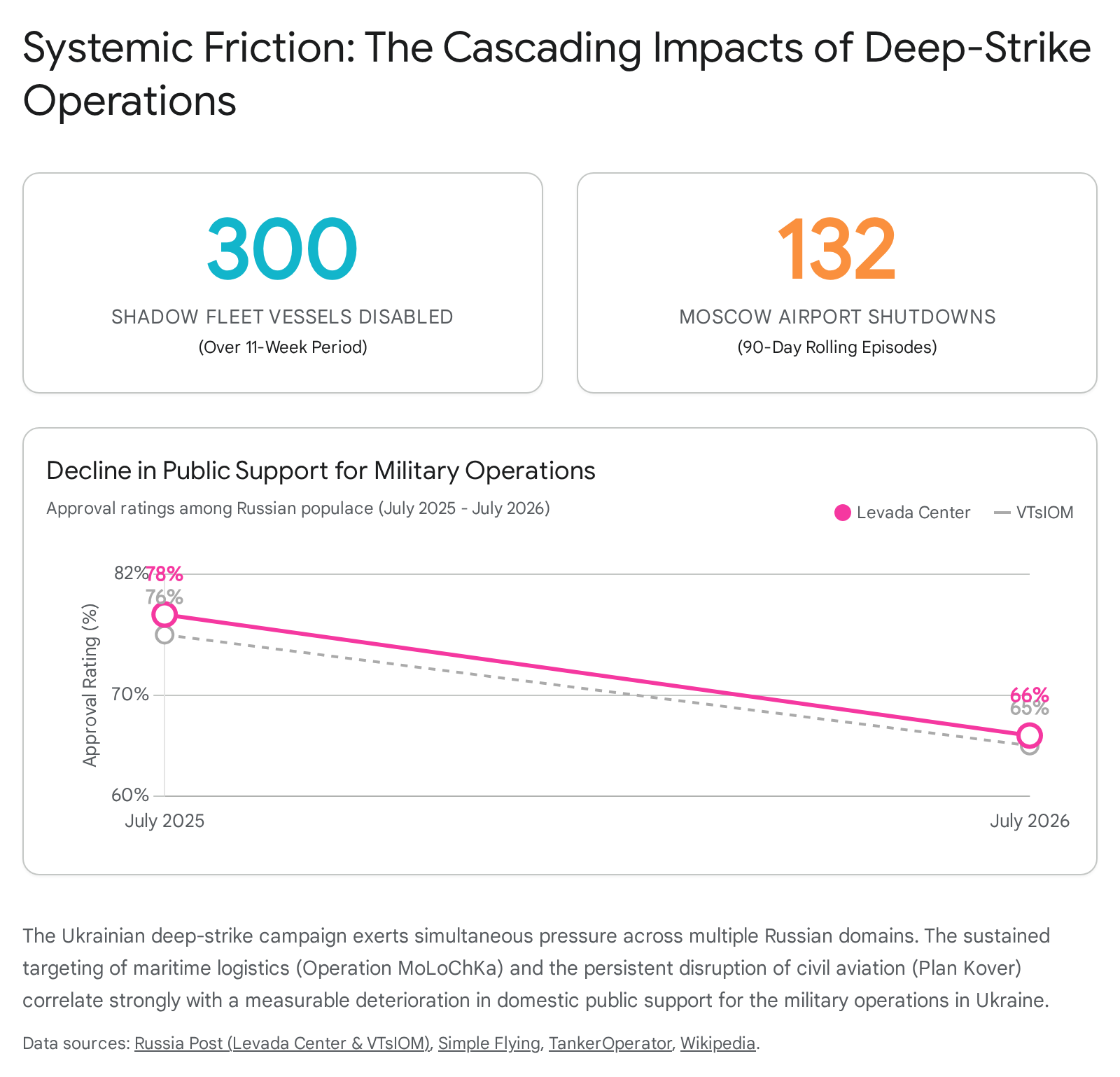
In April and May 2026, President Putin’s public approval ratings fell to their lowest recorded point since the initial days of the full-scale invasion in February 2022.6 Polling data from the Kremlin-aligned Public Opinion Foundation (FOM) indicated that approval had slipped to 73%, with overt distrust of the president rising to 17%.6 The independent Levada Center similarly observed a slow but steady decline over the preceding six months, pegging approval at 79% but highlighting downward momentum.6 Most tellingly, the state-run Russian Public Opinion Research Center (VTsIOM) recorded a highly unusual decline in Putin’s ratings for seven consecutive weeks, with nearly a quarter of respondents (24.1%) expressing distrust.6

This decline in executive approval is not merely a statistical anomaly or a minor fluctuation; it is symptomatic of deeply entrenched, society-wide war fatigue. A comprehensive Levada Center survey revealed that a striking two-thirds (66%) of the Russian public are now “keen to see peace talks”.10 The populace is increasingly exhausted by the daily realities of the conflict: rising consumer prices, the looming threat of subsequent waves of mandatory military mobilization, and the imposition of severe internal censorship measures.6 To maintain narrative control, the state has resorted to blocking popular communication platforms like Telegram and instigating routine mobile internet restrictions aimed at curbing anti-war dissent and preventing citizens from reporting on the increasingly frequent Ukrainian drone strikes deep within Russian territory.6

The growing disconnect between the Kremlin’s maximalist wartime rhetoric and the public’s desire for stabilization creates a profound electoral vulnerability. During the September 2025 regional elections, which served as a critical “dress rehearsal” for the 2026 parliamentary vote, campaign strategists noted a stark shift in voter behavior. Candidates who adopted highly pro-war and ultra-patriotic rhetoric noticeably underperformed expectations.10 For instance, the acting governor of the Sverdlovsk region, Denis Pasler, suffered electorally after leaning heavily into pro-war messaging.10 Recognizing this toxicity, the ruling United Russia party explicitly avoided mentioning the conflict in Ukraine wherever possible to prevent alienating voters, pivoting instead to safe, traditional messages promising “development” and “stability”.10

4.2. Elite Cohesion and the 2026 State Duma Elections

The September 2026 State Duma elections represent the first nationwide parliamentary vote since the invasion began, serving as a critical stress test for the regime’s political machinery.30 While United Russia benefits from massive, insurmountable institutional advantages and will undoubtedly retain its constitutional majority through overt electoral engineering, the elections are viewed by the Kremlin as a period of significantly heightened systemic risk.11

The central political dilemma lies in the fact that Putin’s personal authority and historical legacy are inextricably linked to the ongoing conflict. Consequently, political managers will not be permitted to run a campaign entirely devoid of war references, despite the proven electoral toxicity of such messaging.10 Forcing an unwanted war narrative onto a highly fatigued public will require severe administrative pressure, widespread voter suppression, and the coerced mobilization of state employees to ensure optically acceptable turnout numbers.10 This heavy-handed approach risks sparking a further surge in social disillusionment and malaise.10

Furthermore, elite cohesion within the highest echelons of the Russian state is showing visible signs of strain. Enhanced security protocols for Putin and high-ranking officials highlight an atmosphere of intense paranoia within the Kremlin. Following a contentious December 2025 meeting where security officials openly shifted blame onto one another for the assassinations of Russian military leaders in Moscow, the Federal Protective Service (FSO) regulations were heavily amended.29 Intelligence reports indicate that Putin has increasingly restricted his movements to secured underground bunkers in Krasnodar Krai, avoiding his traditional residences in Moscow Oblast and Valdai.29 The visible deployment of short and medium-range air defense systems, including Pantsir-S1 and S-400 systems, directly around leadership residences underscores the internal recognition that the war has deeply and dangerously penetrated the Russian rear.29 While there is currently no organized political opposition capable of mounting a direct challenge to topple the regime, the combination of elite paranoia, impending electoral pressure, and a dissatisfied populace drastically narrows Putin’s political runway.10

5. Comparative Analysis: Russian vs. Ukrainian Trajectories

Evaluating Russia’s ability to sustain the conflict requires contextualizing its downward trajectory against Ukraine’s adaptive military posture and the ongoing evolution of Western support mechanisms. The comparative dynamics in the spring of 2026 reveal stark, widening asymmetries between the two combatants.

5.1. Casualty and Territorial Exchange Rates

The conflict has devolved into a grueling war of attrition where the exchange rate of casualties for territory heavily disfavors the Russian Federation. Since seizing the strategic initiative in late 2023, Russian forces have advanced at an agonizingly slow and costly pace. In major offensives, the average rate of advance fluctuates between a mere 15 and 70 meters per day—slower than almost any major offensive campaign in the last century.7 In total, since the beginning of 2024, Russia has managed to capture less than 1.5% of Ukrainian territory.7 As of early 2026, Russia occupies approximately 18.5% of Ukraine, a figure that largely consists of territory (such as Crimea and areas of the Donbas) held prior to the full-scale 2022 invasion.7

This minimal, incremental territorial gain has been purchased at an exorbitant cost in lives. The casualty and fatality ratio stands at approximately 2.5:1 or 2:1 in favor of Ukraine.7 While Ukraine also faces severe manpower challenges—with intelligence estimates indicating between 500,000 to 600,000 casualties and reports of up to 200,000 soldiers absent without official leave (AWOL) early in the year—its primarily defensive posture allows it to exact a vastly disproportionate toll on advancing Russian mechanized and infantry columns.7 In April 2026, Russian forces even suffered a net loss of controlled territory (approximately 116 square kilometers) for the first time since Ukraine’s August 2024 Kursk incursion, largely due to operational exhaustion, the degradation of mechanized units, and the impact of Ukrainian long-range strikes.33

5.2. Technological and Industrial Asymmetries

A critical divergence between the combatants lies in their capacity for industrial and technological adaptation. While Russia is increasingly relying on the refurbishment of legacy Soviet hardware and low-tech mass infantry assaults, Ukraine is in the midst of a profound defense-tech revolution.32 Functioning akin to a military “Silicon Valley,” Ukraine’s decentralized defense sector has successfully optimized the mass production of inexpensive, highly accurate drones and cruise missiles.32 Systems like the newly serialized “Peklo” (Hell) missile drone, boasting a 700 km range and a speed of 700 km/h, provide Ukraine with organic, highly effective deep-strike capabilities.32

Ukraine has strategically utilized these long-range assets to persistently target critical Russian oil and gas infrastructure, exacerbating Moscow’s revenue crisis by physically degrading its export and refining capacities.32 The systematic destruction of refineries and logistics hubs deep within the Russian rear has forced Moscow to divert scarce and valuable air defense assets away from the frontlines, creating localized operational vulnerabilities that Ukrainian forces exploit.34

Conversely, the model of Western support for Ukraine has evolved to prioritize long-term resilience over ad-hoc deliveries. While the United States, under a new administration, has introduced political friction by shifting away from uncompensated grants and occasionally using aid as leverage, the European Union has dramatically accelerated its pursuit of strategic autonomy and defense industrialization.22 Mechanisms such as Security Action for Europe (SAFE) loans, the legally sound utilization of frozen Russian assets to fund Ukrainian defense, and the institutionalization of the NATO Security Assistance and Training for Ukraine (NSATU) mission provide Kyiv with a much more predictable, long-term acquisition pipeline.22 Ukraine’s deep integration into Western capability coalitions—such as specialized groups focusing on armor, drones, and air defense—is steadily aligning its force structure with NATO standards.22 In stark contrast, Russia is becoming increasingly dependent on highly transactional, ad-hoc resupply from isolated autocracies like North Korea and Iran, further isolating it from the global technological commons.2

6. Strategic Decision Points and “Spinning” the Cessation of Hostilities

Given the convergence of military materiel depletion by late 2026, the imminent exhaustion of the National Wealth Fund, and the acute political pressures surrounding the September 2026 Duma elections, Vladimir Putin is rapidly approaching a definitive strategic deadline. The Kremlin cannot sustain the current tempo of operations indefinitely; it must either fundamentally alter the nature of the conflict or negotiate a cessation of hostilities on highly manipulated terms to ensure regime survival.

6.1. The Timeline for Decisive Action

Intelligence assessments strongly indicate that the window for Russia to achieve its maximalist territorial objectives in Ukraine via conventional military force is closing rapidly. The critical decision point will likely occur between the immediate aftermath of the September 2026 elections and the Spring of 2027. This window directly corresponds with the projected point when repairable equipment stocks run dry and liquid fiscal reserves hit absolute zero.3 The Kremlin must secure a domestic political victory before the economic reality of the NWF’s depletion fully translates into an inability to pay state salaries, fund pensions, or maintain the loyalty of the vast internal security apparatuses.

Recent global geopolitical developments, such as the 2026 conflict involving Iran and Israel, have provided the Kremlin with temporary diplomatic leverage and a much-needed distraction. U.S. President Trump has floated the idea of a temporary ceasefire in Ukraine, attempting to link Russian diplomatic cooperation on the Iranian front with potential concessions in Eastern Europe.35 While Putin expressed readiness for a temporary pause—potentially timed to coincide with a scaled-back Victory Day parade—Ukraine and its European allies view such offers as transparent tactical ruses designed solely to allow battered Russian forces to reconstitute and rearm.35 Regardless of the immediate diplomatic maneuvering, Moscow is actively probing the international environment for an exit strategy that preserves its core domestic narratives.

6.2. Narrative Off-Ramps and the “Continuum Conflict”

If forced into a cessation of hostilities or a prolonged operational freeze due to systemic exhaustion, the Kremlin possesses a sophisticated, centralized state media apparatus designed to fabricate a victory narrative out of strategic stagnation. The required spin will likely focus on three core propaganda tenets 12:

  1. The Illusion of Territorial and Strategic Supremacy: Domestically, the Kremlin will frame the retention of the approximately 18.5% of Ukrainian territory currently occupied—particularly the Donbas region and the critical land bridge to Crimea—as the successful fulfillment of the “Special Military Operation’s” primary objective of protecting ethnic Russians and securing the homeland’s borders.7 Furthermore, they will loudly spin any ceasefire agreement as having successfully prevented Ukraine’s immediate integration into NATO, claiming to have fulfilled the demand for the “neutralization” of a hostile neighbor.13
  2. The “Exhaustion of the West” Narrative: Russian elite messaging is already systematically laying the groundwork to frame the conflict not as a war against Ukraine, but as an existential struggle against the combined, hegemonic might of NATO.13 By forcing the West to the negotiating table, Putin can claim that Russia successfully withstood an unprecedented global economic and military siege. This narrative serves to demonstrate the unparalleled resiliency of the Russian state, asserting its status as an unyielding superpower that outlasted Western resolve.13
  3. Transition to the “Doctrine of Continuum Conflict”: A formal, comprehensive peace treaty resolving all territorial disputes is highly unlikely. Instead, the Kremlin will likely pursue a state of “strategic suspension”.12 Under the modern framework recognized by analysts as the Doctrine of Continuum Conflict, the termination of kinetic hostilities simply shifts the theater of war to other domains.12 Because Russia lacks the conventional power to achieve a decisive victory, it will replace mechanized assaults with intensified hybrid warfare, aggressive cyberattacks on Western critical infrastructure, economic weaponization, and informational disruption.12 This approach relies on “phase compression” and “domain fluidity,” allowing Putin to maintain a state of perpetual mobilization and anti-Western grievance.12 This perpetual conflict is politically necessary for his regime’s ideological survival, but pursuing it via asymmetric means allows him to do so without incurring the unsustainable daily burn rate of tanks, artillery, and personnel.

7. Conclusions on the State of the Country

Analyzing the true condition of the Russian Federation in May 2026 requires strictly separating the immediate tactical realities on the ground in Ukraine from the long-term structural viability of the state. The country is exhibiting the classic, terminal symptoms of an imperial power vastly overextending its foundational resources in pursuit of unattainable strategic objectives.

7.1. What is “Good” (Areas of Enduring Russian Strength)

Despite severe degradation across multiple sectors, Russia retains specific, highly dangerous capabilities that prevent an immediate state collapse and guarantee its status as a persistent threat:

  • Tactical Defense and Entrenchment: Russia has proven highly capable of constructing deep, layered defensive fortifications. Dislodging Russian forces from the 18.5% of Ukrainian territory they currently occupy requires a level of offensive combat power, specific munitions, and mass that is exceedingly difficult for Ukraine and its Western partners to continuously generate.7
  • Asymmetric and Hybrid Capacity: As conventional military capabilities wane, Russia’s ability to engage in the Doctrine of Continuum Conflict remains fully intact. Its offensive cyber units, global intelligence networks, and demonstrated ability to weaponize energy flows, agricultural exports, and migration against European targets ensure it remains a premier, highly agile security threat to NATO.12
  • Nuclear Deterrence: Russia’s unquestioned status as a premier nuclear superpower continues to successfully limit the scope, scale, and speed of direct Western intervention, securing the regime against external existential threats and effectively capping escalation.13
  • Regime Control and Internal Security: Despite falling public approval ratings and rising economic discontent, Putin’s absolute control over the massive internal security apparatus (including the FSB and Rosgvardia) remains unchallenged. The state’s monopoly on violence makes a sudden democratic uprising, mass protest movement, or successful elite coup highly improbable in the short term.6

7.2. What is “Bad” (Systemic Failures and Inevitable Crises)

The foundations of Russian state power are rotting from within, driven by the unsustainable physical and financial demands of the conflict:

  • The Demise of Conventional Power Projection: The historic myth of inexhaustible Russian military depth has been decisively destroyed. The loss of over 1.33 million personnel and the near-total exhaustion of the vast Soviet inheritance of armored vehicles and artillery guarantees that Russia will lack the conventional capacity to project power across multiple theaters for decades.1 Rebuilding the military to pre-2022 levels would require massive, sustained capital investment that the current economy simply cannot generate.2
  • Macroeconomic and Fiscal Ruin: The Kremlin has irrevocably sacrificed long-term economic development and technological modernization for short-term wartime stimulus. The impending depletion of the National Wealth Fund’s liquid assets by the end of 2026, coupled with high baseline inflation, crushing interest rates (16.5%), and the permanent loss of Western energy markets, ensures a severe, generational decline in the standard of living for the Russian populace.3
  • Irreversible Demographic Collapse: The loss of prime working-age men to the battlefield, combined with the mass emigration of the educated elite, has created an unrecoverable labor deficit of up to 4.4 million workers. This permanent loss of human capital critically damages industrial productivity, stifles innovation, and shifts an unbearable economic burden onto a rapidly aging population, ensuring long-term GDP stagnation.8

7.3. Final Assessment

The Russian Federation is currently operating entirely on borrowed time and borrowed capital. The burn rate of its people, its military equipment, and its financial reserves dictates that the current modality of the high-intensity Ukraine conflict cannot be sustained past late 2026 to early 2027.

While the deeply controlled political environment, enforced through severe internal censorship and a vast security apparatus, will likely allow Vladimir Putin to survive the immediate term and navigate the perilous 2026 State Duma elections, he is presiding over a state in terminal structural decline. To avoid complete economic insolvency, hyperinflation, and the total collapse of his conventional military forces, Putin will be compelled by material reality to seek a cessation of hostilities. This will not manifest as a genuine pursuit of peace or a desire for regional stability, but rather as a necessary tactical pause spun domestically as a historic victory over Western aggression.

Ultimately, regardless of the precise territorial settlement achieved in Ukraine, Russia will emerge from this conflict as a fundamentally weaker, technologically degraded, more isolated, and permanently scarred nation. Having consumed its Soviet inheritance, it will be forced to rely entirely on asymmetric hybrid warfare and nuclear posturing to mask its hollowed-out conventional core.

Works cited

  1. OSINT Study: Russia Has Exhausted Over Half of Its Stockpiles of …, accessed May 4, 2026, https://militarnyi.com/en/news/osint-study-russia-has-exhausted-over-half-of-its-stockpiles-of-armored-vehicles-and-artillery/
  2. The Insider: As Russia depletes Soviet tanks and artillery, Putin’s Ukraine war drive to end by 2026 – Euromaidan Press, accessed May 4, 2026, https://euromaidanpress.com/2025/02/11/the-insider-as-russia-depletes-soviet-tanks-and-artillery-putins-ukraine-war-drive-to-end-by-2026/
  3. Russia’s National Wealth Fund: Size, Liquidity and Structural …, accessed May 4, 2026, https://globalswf.com/news/russia-s-national-wealth-fund-size-liquidity-and-structural-constraint
  4. Iran War Won’t Save Putin’s Crumbling Economy – CEPA, accessed May 4, 2026, https://cepa.org/article/iran-war-wont-save-putins-crumbling-economy/
  5. Russia’s National Welfare Fund at Risk of Depletion By 2026, Economists Warn, accessed May 4, 2026, https://www.themoscowtimes.com/2025/06/09/russias-national-welfare-fund-at-risk-of-depletion-by-2026-economists-warn-a89395
  6. Putin’s approval rating falls to its lowest point since Russia’s full …, accessed May 4, 2026, https://meduza.io/en/news/2026/05/01/putin-s-approval-rating-falls-to-its-lowest-point-since-russia-s-full-scale-invasion-began
  7. Russia’s Grinding War in Ukraine – CSIS, accessed May 4, 2026, https://www.csis.org/analysis/russias-grinding-war-ukraine
  8. Historic Worker Shortage Grips Russia as War Pulls Millions From Economy, accessed May 4, 2026, https://united24media.com/world/historic-worker-shortage-grips-russia-as-war-pulls-millions-from-economy-18316
  9. Total russian combat losses in Ukraine as of May 1, 2026, accessed May 4, 2026, https://mod.gov.ua/en/news/total-russian-combat-losses-in-ukraine-as-of-may-1-2026
  10. Kremlin’s Regional Election Experiments Show War Is Not a Vote …, accessed May 4, 2026, https://carnegieendowment.org/russia-eurasia/politika/2025/09/russia-election-themes
  11. The Outlook for This Year’s Elections to the State Duma in Russia | Institute of Central Europe – Instytut Europy Środkowej – lublin.pl, accessed May 4, 2026, https://ies.lublin.pl/en/comments/the-outlook-for-this-years-elections-to-the-state-duma-in-russia/
  12. From “Epic Fury” to Continuum Conflict: Power, Law, and Strategy in …, accessed May 4, 2026, https://www.ibtimes.co.in/epic-fury-continuum-conflict-power-law-strategy-era-without-endings-901746
  13. Russia Analytical Report, Feb. 9–17, 2026 | Russia Matters, accessed May 4, 2026, https://www.russiamatters.org/news/russia-analytical-report/russia-analytical-report-feb-9-17-2026
  14. On the verge of exhaustion. How Russian warehouses of military equipment are emptying : r/ukraine – Reddit, accessed May 4, 2026, https://www.reddit.com/r/ukraine/comments/1dv7iqu/on_the_verge_of_exhaustion_how_russian_warehouses/
  15. Russia loses 1,120 soldiers and 11 ground robotic systems over past day, accessed May 4, 2026, https://www.pravda.com.ua/eng/news/2026/05/04/8032980/
  16. Russia is Losing – Time for Putin’s 2026 Hybrid Escalation | Royal …, accessed May 4, 2026, https://www.rusi.org/explore-our-research/publications/commentary/russia-losing-time-putins-2026-hybrid-escalation
  17. Russia scales back battlefield ambitions as troop shortages choke offensive plans, accessed May 4, 2026, https://english.nv.ua/nation/hur-says-russia-pushed-back-war-timeline-to-late-2026-or-early-2027-50596140.html
  18. Russia loses 1,080 soldiers and 76 artillery systems over past day, accessed May 4, 2026, https://www.pravda.com.ua/eng/news/2026/05/03/8032883/
  19. The War Is Coming Home to Russia | RAND, accessed May 4, 2026, https://www.rand.org/pubs/commentary/2026/02/the-war-is-coming-home-to-russia.html
  20. “Russia has never seen this”: Russia’s central bank chief admits a 2.5 million worker deficit, accessed May 4, 2026, https://euromaidanpress.com/2026/04/29/russia-labor-floor-nabiullina-admits-unprecedented-shortage/
  21. Russia’s Vanishing Workforce – American Foreign Policy Council, accessed May 4, 2026, https://www.afpc.org/publications/articles/russias-vanishing-workforce
  22. Wartime Assistance to Ukraine from the US and EU – CEPA, accessed May 4, 2026, https://cepa.org/comprehensive-reports/wartime-assistance-to-ukraine-the-successes-failures-and-future-prospects-of-us-and-eu-support-models/
  23. Russia’s 2026 budget: mounting financial challenges and economic stagnation – OSW, accessed May 4, 2026, https://www.osw.waw.pl/en/publikacje/osw-commentary/2025-12-09/russias-2026-budget-mounting-financial-challenges-and-economic
  24. The Russian Federal Budget 2025–2027 – RAND, accessed May 4, 2026, https://www.rand.org/content/dam/rand/pubs/perspectives/PEA3800/PEA3854-1/RAND_PEA3854-1.pdf
  25. The Kremlin to Russian Consumers — Pay for Our War – CEPA, accessed May 4, 2026, https://cepa.org/article/the-kremlin-to-russian-consumers-pay-for-our-war/
  26. The ‘Dry Sponge’ of the Russian Economy – Riddle Russia, accessed May 4, 2026, https://ridl.io/the-dry-sponge-of-the-russian-economy/
  27. Russia National Wealth Fund Liquid Assets – Trading Economics, accessed May 4, 2026, https://tradingeconomics.com/russia/national-wealth-fund-liquid-assets
  28. Another wave of public outcry tests Putin’s rule in wartime Russia, accessed May 4, 2026, https://www.ksat.com/news/world/2026/04/25/another-wave-of-public-outcry-tests-putins-rule-in-wartime-russia/
  29. Russian Offensive Campaign Assessment, May 4, 2026 | ISW, accessed May 4, 2026, https://understandingwar.org/research/russia-ukraine/russian-offensive-campaign-assessment-may-4-2026/
  30. What to expect from Russia’s 2026 elections – New Eurasian …, accessed May 4, 2026, https://nestcentre.org/how-the-kremlin-is-preparing-for-the-2026-state-duma-elections/
  31. Russian Offensive Campaign Assessment, April 29, 2026 | ISW, accessed May 4, 2026, https://understandingwar.org/research/russia-ukraine/russian-offensive-campaign-assessment-april-29-2026/
  32. Ukraine is leading a military revolution but needs more Western …, accessed May 4, 2026, https://www.atlanticcouncil.org/blogs/ukrainealert/ukraine-is-leading-a-military-revolution-but-needs-more-western-support/
  33. Russian Offensive Campaign Assessment, May 2, 2026, accessed May 4, 2026, https://understandingwar.org/research/russia-ukraine/russian-offensive-campaign-assessment-may-2-2026/
  34. Russian Offensive Campaign Assessment, April 17, 2026 | ISW, accessed May 4, 2026, https://understandingwar.org/research/russia-ukraine/russian-offensive-campaign-assessment-april-17-2026/
  35. Trump and Putin discuss Iran war and float temporary Ukraine …, accessed May 4, 2026, https://www.theguardian.com/world/2026/apr/29/trump-and-putin-discuss-iran-war-and-float-temporary-ukraine-ceasefire-in-call
  36. How are pro-Kremlin Russian media portraying Ukraine’s victories? – Al Jazeera, accessed May 4, 2026, https://www.aljazeera.com/news/2022/9/13/how-are-pro-kremlin-russian-media-portraying-ukraines-victories
  37. What does Putin Want?: Assessing Interests in the Invasion of Ukraine, accessed May 4, 2026, https://hnmcp.law.harvard.edu/hnmcp/blog/what-does-putin-want-assessing-interests-in-the-invasion-of-ukraine/

Systemic Fragility Analysis of the Russian Federation: A 36-Month Predictive Outlook – Q2 2026

Executive Summary

Overall Fragility Score: 7.8 / 10

Assessed Lifecycle Stage: Stressed (Transitioning rapidly to Crisis)

The Russian Federation is currently operating in a late-stage Stressed lifecycle phase, exhibiting leading indicators of a transition into a systemic Crisis. While the central state apparatus retains macroeconomic control and the capacity to suppress organized political opposition, the underlying structural foundations of the state are eroding at an accelerating pace. The system is characterized by a negative equilibrium where a prioritized military industrial complex thrives at the direct expense of civilian economic vitality, demographic sustainability, and municipal infrastructure. The state’s capacity to absorb concurrent internal and external shocks is severely compromised.

Key Drivers of Fragility:

  • Terminal Demographic Contraction: A convergence of a 1.37 total fertility rate, massive wartime casualties exceeding 1.2 million personnel, and a sudden collapse in inward labor migration has created an irrecoverable 2.5 million worker deficit.
  • Fiscal Pincer and Asset Depletion: National Wealth Fund liquid assets plummeted by over 70 percent since 2022. Concurrently, structural defense spending remains entrenched at 6.3 percent of gross domestic product, forcing the state into highly inflationary domestic borrowing.
  • Security Apparatus Fragmentation: The deliberate atomization of the elite and the elevation of Rosgvardia as a heavily militarized parallel security force reflect deep internal mistrust, heightening the probability of an irregular leadership transition.
  • Accelerating Infrastructure Decay: The diversion of federal funding to the military sector has triggered a cascading failure of municipal heating and utility networks across permafrost-heavy regions, fracturing the domestic social contract.

Forecast Trajectory: Over the 36-month forecast horizon, the Russian state faces a 70 percent probability of a partial or full political and economic breakdown if current geopolitical and military expenditures are maintained.1 The state is highly likely to experience localized administrative failures, increased inter-elite violence, and a sharp contraction in civilian living standards, pushing the system to the brink of the formal Crisis stage by late 2027.

State Fragility Dashboard

Domain / IndicatorCurrent Score (1-10)TrendVolatilityWeighted ImpactBrief Rationale
A.1. Public Finances6.5DeterioratingHigh15%Sovereign liquid assets critically depleted; defense spending fixed at 6.3 percent of GDP; reliance on high-yield domestic debt.2
A.2. Economic Structure7.5DeterioratingModerate10%Severe 2.5 million labor deficit; central bank rates at 16 to 21 percent stifling civilian investment; 12 months of falling industrial production.5
A.3. Household Health7.0DeterioratingHigh5%Real inflation eroding wages; massive regional wealth disparities; utility failures increasing household financial distress.7
B.1. Governance & Law8.0StaticLow10%Total centralization of executive power; arbitrary asset nationalization eroding elite property rights; extreme institutional isolation.7
B.2. State Legitimacy6.0DeterioratingModerate10%Broad public compliance masks deep resentment over local infrastructure decay; grassroots protests rising in ethnic republics.8
B.3. Security Cohesion8.5DeterioratingHigh15%High intra-agency rivalry; Rosgvardia expanding into a parallel military; 20 to 30 percent assessed probability of elite fracturing.9
C.1. Social Fragmentation7.0DeterioratingModerate10%Repression of ethnic minorities; impending systemic crisis regarding the reintegration of over one million traumatized combat veterans.13
C.2. Public Services8.0DeterioratingHigh10%Healthcare system failing under casualty burden; municipal utility failures doubled in 2026 due to diverted federal funds.8
D.1. Climate Vulnerability6.0StaticLow5%Permafrost thaw threatens 60 percent of territory; tens of billions in projected damages directly threatening Arctic logistics.17
D.2. Demographics9.5TerminalLow10%Fertility at 1.37; male life expectancy dropped to 61; massive brain drain; classified data masking severe excess male mortality.1

Detailed Domain Analysis

Module A: Economic Resilience and State Capacity

A.1. Public Finances

Current State: The Russian state is currently operating under severe fiscal strain that is temporarily masked by state-directed liquidity injections. The National Wealth Fund, historically designed as the primary sovereign macroeconomic shock absorber, has experienced a precipitous and structural decline. Gold reserves within the fund dropped from 554.9 tons in mid-2022 to 160.2 tons by January 2026, representing a massive 71 percent reduction in physical asset backing.3 Total liquid assets have plummeted concurrently. By early 2026, liquid holdings including the Chinese yuan fell to approximately 4.1 trillion rubles, which equates to roughly $52.6 billion.3 This reserve level represents a mere 1.7 percent of projected gross domestic product.20 Concurrently, defense and national security spending has been structurally entrenched at exorbitant levels. Military expenditure is set to reach approximately 13.5 trillion rubles, consuming 6.3 percent of the total GDP and accounting for 40 percent of all federal government outlays.2

Trajectory (Delta): The trajectory of Russian public finances is steeply deteriorating. To bridge the widening gap between stagnant hydrocarbon export revenues and surging military outlays, the federal government has resorted to significant tax hikes. Corporate tax rates were raised from 20 percent to 25 percent at the start of 2025, and the Value Added Tax was increased to 22 percent by January 2026.5 Furthermore, the state budget framework spanning 2026 to 2028 projects ongoing, unresolvable deficits that must be covered almost entirely by domestic borrowing.4 The Russian state plans to issue 15 trillion rubles in new domestic debt over this three-year period.4 This maneuver directly crowds out civilian credit and increases the sovereign debt burden.

Volatility: Fiscal volatility remains exceptionally high. Russian public revenues are critically sensitive to global hydrocarbon pricing fluctuations and the continued willingness of Asian markets, primarily China and India, to accept Russian resources at heavily discounted rates.5 A sudden drop in global oil demand or tighter enforcement of secondary sanctions on maritime shipping would immediately collapse the revenue base supporting the current budget.

Systemic Connection Analysis: The Russian state is caught in a severe fiscal pincer movement. Structural, non-discretionary spending pressures, primarily ongoing military procurement, veteran healthcare, and survivor benefits for the families of the deceased, are vastly outpacing the heavily sanctioned economy’s capacity to generate organic revenue. As the National Wealth Fund liquid assets near depletion, the state will be forced to choose between printing money to monetize the debt or extracting increasingly punitive taxes from a stagnant civilian sector. Both options will rapidly accelerate inflation and erode public compliance, accelerating the transition into a systemic crisis.

National wealth fund gold reserves depleted from 554.9 tons in 2022 to 160.2 tons in 2026.

A.2. Economic Structure and Productivity

Current State: The Russian economy has fundamentally transitioned into a rigid, two-tiered system operating in a negative equilibrium.21 The military industrial complex successfully monopolizes human capital, bank loans, and federal subsidies, while the civilian economy is systematically suffocated by a lack of resources.21 The most critical bottleneck throttling economic productivity is human capital. As of early 2026, Russia faces an unprecedented labor deficit of 2.5 million workers.6 Central bank chair Elvira Nabiullina has publicly admitted that modern Russia has never experienced a labor shortage of this magnitude, noting that the available labor reserve plummeted from 7 million individuals in 2021 to a mere 4 million by the end of 2025.6 This deficit is severely impacting industrial output. Major manufacturing stalwarts are showing deep structural fatigue. For instance, AvtoVAZ, the nation’s largest carmaker, was forced to institute four-day work weeks, while Uralvagonzavod, the primary tank manufacturer, initiated mass layoffs explicitly citing sheer worker exhaustion alongside supply chain sanctions.6

To demonstrate the depth of this crisis, labor shortages are pervasive across all skill levels:

Professional SectorEstimated Worker Deficit (2024 Data)Regional Examples
Commercial Drivers216,000 personnel 19Sevastopol: 16.3% overall deficit 19
Industrial Mechanics166,000 personnel 19Chukotka: 12.1% overall deficit 19
Engineering141,000 personnel 19Kamchatka: 11.9% overall deficit 19
Construction Labor112,000 personnel 19Moscow Region: 11.0% overall deficit 19

Trajectory (Delta): The trajectory is defined by heavily managed stagnation. To combat wage-driven inflation, which is currently running near 10 percent, the Central Bank of Russia has maintained punishingly high key interest rates, fluctuating between 16 percent and 21 percent over the past year.5 These prohibitive rates effectively freeze private sector civilian investment. The workforce is officially projected by Rosstat to shrink by an additional 1.4 million personnel by the end of 2026, guaranteeing that the labor shortage will only intensify.6 Furthermore, Russian factories have cut their workforces for consecutive months, and overall industrial production has fallen for twelve straight months heading into 2026.6

Volatility: Economic volatility is moderate but climbing. The economy’s orientation has shifted entirely toward Asia, making it dangerously dependent on Chinese supply chains for both import substitution and the generation of export revenue.5 Any macroeconomic slowdown in China will immediately cascade into the Russian industrial base.

Systemic Connection Analysis: The labor shortage acts as an inescapable gravity well for the entire Russian macroeconomic structure. The military apparatus drains the most productive demographic cohorts for combat operations and defense manufacturing, forcing civilian industries to compete for a rapidly shrinking pool of available workers. This competition drives up wages without a corresponding increase in actual technological efficiency or output, thereby feeding a persistent inflationary spiral. The central bank attempts to crush this inflation with high interest rates, which subsequently kills long-term civilian productivity growth. The state is structurally degrading its ability to compete globally.

A.3. Household Financial Health

Current State: Household financial health across the Russian Federation is deeply bifurcated. Individuals directly engaged in the military sector, either through combat contracts paying upward of $3000 monthly or via defense manufacturing jobs, are experiencing rapid, artificial wage growth.7 However, the broader civilian population is suffering acute financial distress. While official state inflation is reported at roughly 8.5 percent, the real inflation rate for essential household goods is widely perceived by the public to be between 20 percent and 25 percent.7 Russia remains one of the most unequal societies globally, with the wealthiest one percent of the population controlling over 70 percent of all private assets.7

Trajectory (Delta): The trajectory is deteriorating. Regional disparities are compounding the economic stress. While metropolitan centers like Moscow maintain a per capita income five times higher than peripheral republics like Ingushetia, it is the impoverished peripheral regions that are bearing the disproportionate brunt of military mobilization and combat casualty rates.7

Volatility: High. Household financial distress is heavily correlated with seasonal expenditures, particularly winter utility costs in northern and Siberian regions.

Systemic Connection Analysis: As federal funds are aggressively funneled into the defense sector, municipal subsidies are slashed across the board. This forces local and regional authorities to raise basic utility tariffs on a population already squeezed by double-digit real inflation.8 The resulting localized financial precarity directly fractures the social contract. This dynamic is particularly dangerous in ethnic minority republics, whose populations increasingly feel they are bleeding human capital for Moscow’s geopolitical ambitions without receiving basic municipal security or economic stability in return.

Module B: Political Legitimacy and Institutional Integrity

B.1. Governance and Rule of Law

Current State: The Russian political system operates as a deeply personalized autocracy characterized by total vertical centralization and the complete absence of independent judicial or legislative oversight.7 A defining feature of the current governance model is the arbitrary redistribution of massive economic assets, effectively destroying the concept of property rights. The Prosecutor General’s Office has initiated over 170 nationalization lawsuits since 2022, seizing private assets valued at approximately 4.99 trillion rubles, or roughly 53.5 billion euros.10 These seizures, which have targeted prominent infrastructure like Domodedovo airport, predominantly enrich state corporations and President Vladimir Putin’s immediate inner circle.10

Trajectory (Delta): The governance trajectory is static in structure but increasingly brittle in practical application. The regime has formally transitioned into a Fortress Kremlin governance model.9 This posture is marked by political leadership retreating into highly secured, physically isolated environments. The executive relies heavily on the Federal Protective Service for physical security and strict information filtering, resulting in reduced presidential mobility and bunkerized, paranoid decision-making processes.9

Volatility: Volatility appears low on the surface due to strict state control, but it is exceptionally high beneath the institutional veneer. The system eliminates opponents through politically motivated killings, suppressing all pluralism.7

Systemic Connection Analysis: The authoritarian drift dilemma is fully active within the Russian state. By arbitrarily seizing assets from the technocratic elite to reward loyalist security factions, the Kremlin destroys the foundational property rights required for any long-term economic stability or foreign investment. The economic elites are kept deliberately atomized and locked inside the country by Western sanctions, resulting in a systemic environment where survival dictates absolute public compliance but fosters deep, hidden resentment. As elite competition intensifies over a shrinking pool of economic assets, the regime’s underlying stability becomes highly fragile.10

B.2. State Legitimacy and Public Trust

Current State: Public trust is entirely managed via a state media monopoly and draconian censorship laws that criminalize dissent. Authorities have filed over 10,000 administrative charges and hundreds of criminal prosecutions specifically to suppress anti-war sentiment.7 However, localized legitimacy is visibly fraying. A major shift in public consciousness is occurring as ordinary citizens begin explicitly connecting the deterioration of their daily living conditions with the immense financial drain of the military conflict.8

Trajectory (Delta): The trajectory of public trust is deteriorating. Citizens are increasingly engaging in grassroots, decentralized resistance to bypass federal censorship. In the Republic of Bashkortostan, the sentencing of local environmental activist Fayil Alsynov triggered the Baymak protests, mobilizing thousands of citizens in freezing negative twelve degree temperatures.11 Similar localized protests over land rights and municipal failures have erupted in rural Dagestan and Yakutia, indicating that rural and indigenous communities are reaching a breaking point.23

Volatility: Moderate. Protests currently remain strictly localized and deliberately focus on communal issues rather than explicit anti-regime slogans to avoid immediate, overwhelming state violence.8

Systemic Connection Analysis: Public compliance relies on the state delivering basic stability. As federal funding for municipalities collapses, the state fails to uphold its end of the social contract. The narrative promoted by state media regarding global great power status fails to resonate with citizens freezing in unheated apartment blocks. If local protests over utilities begin to merge with broader grievances regarding mobilization, the state will struggle to contain the unrest without deploying military force domestically.

B.3. Security Apparatus Cohesion

Current State: The state’s monopoly on violence is maintained, but the underlying architecture of that violence is fracturing into competing, heavily armed fiefdoms. The most significant development is the evolution of the Russian National Guard, Rosgvardia, led by Kremlin loyalist Viktor Zolotov. Rosgvardia has been formally elevated into a parallel military structure.12 Operating completely outside the Ministry of Defense’s chain of command, it forms a distinct third pillar alongside the regular military and the Federal Security Service. Rosgvardia has actively absorbed former Wagner private military company fighters, integrated heavy armor and tank units into its formations, and established a dedicated General Staff for intelligence and operational planning.12

Trajectory (Delta): Cohesion is deteriorating rapidly. There is a deeply destabilizing confrontation occurring among the top tiers of the security state, specifically between military intelligence, the FSB, and the Ministry of Defense.9 The environment is characterized by intense paranoia, multi-layer counterintelligence screenings of inner-circle personnel, and violent blame-shifting for military stagnation.9

Volatility: Volatility is extremely high. Geopolitical risk models currently assess a 20 percent to 30 percent probability of a serious coup attempt or a forced, irregular leadership transition within the next 12 to 18 months.9

Systemic Connection Analysis: The vast expansion of Rosgvardia represents a definitive inward turn of the security state. The executive branch recognizes that the regular military, exhausted and depleted by years of high-intensity combat, poses a latent political threat. By building a heavily armed praetorian guard dedicated exclusively to regime survival and insulated from the regular armed forces, the state fundamentally alters the domestic balance of power. While this deters a traditional military uprising, it dramatically increases the likelihood of catastrophic intra-regime violence if elite consensus collapses, as multiple factions now possess the armor and manpower to contest control of the capital.

Module C: Social Cohesion and Human Development

C.1. Social Fragmentation

Current State: Russian society is experiencing severe, cross-cutting fragmentation along geographic, ethnic, and generational fault lines. The burden of military mobilization has fallen disproportionately on peripheral, non-ethnic Russian republics. In tandem with mobilization, the central government has accelerated policies that actively strip these republics of their cultural sovereignty. This includes the systematic abolition of indigenous language studies in regions like Tatarstan and Bashkortostan, and the heavy militarization of local school systems to prepare youth for state service.13

Trajectory (Delta): Social cohesion is deteriorating. A massive wave of social friction is building as combat veterans return to civilian life. Over one million men are expected to return from the front lines, many drawn directly from penal colonies or suffering from profound combat trauma and traumatic amputations.14 These individuals are filtering back into local communities that entirely lack the psychological, medical, or economic infrastructure to reintegrate them effectively.14

Volatility: Volatility is moderate to high. Historical data from post-Afghan and post-Chechen conflicts strongly indicates that such dynamics inevitably result in a severe spike in violent crime, domestic abuse, and organized gang activity, fundamentally destabilizing local governance.14

Systemic Connection Analysis: The suppression of ethnic identities combined with the influx of traumatized veterans creates a highly combustible social environment. As the federal center demands more resources and manpower from the periphery while simultaneously restricting cultural rights, the potential for armed separatism or violent regional defiance increases significantly, threatening the territorial integrity of the state.

C.2. Public Services and Welfare

Current State: Core public services are buckling under the dual weight of mass war casualties and severe federal budget cuts. The civilian healthcare system is in a state of acute crisis. Ten out of the twenty professions with the highest labor deficits in the Russian economy are in the medical sector, including critical, life-threatening shortages of emergency doctors, pharmacists, and dietitians.19 Concurrently, the municipal infrastructure is experiencing catastrophic, systemic failures. During the winter cold snap of January 2026, utility outages for power, heating, and water doubled compared to the previous year, with 1,788 distinct reports of disruptions nationwide.16

Trajectory (Delta): The trajectory for public welfare is rapidly deteriorating. The state explicitly reduced funding for the housing and utilities sector in its three-year budget framework to a mere 1.999 trillion rubles.16 Consequently, the infrastructure repair rate sits at roughly 2 percent annually, falling vastly short of the rate required to halt further deterioration.16 The Ministry of Construction admits that actual wear and tear on utility networks currently ranges from 40 percent to 80 percent depending on the region.16 Government programs intended to replace dilapidated housing have been officially suspended to channel funds to the military.8

Volatility: Volatility is exceptionally high. Infrastructure failures are highly seasonal, meaning that extreme winter weather dictates the immediate tempo of local discontent and physical suffering.

Systemic Connection Analysis: The degradation of public services creates an immediate, reinforcing feedback loop with the country’s demographic decline. The collapse of accessible civilian healthcare accelerates excess mortality rates among the elderly, the chronically ill, and wounded veterans. This systemic failure further strains the labor pool and permanently reduces the long-term economic carrying capacity of the Russian state.

Module D: Environmental and Resource Security

D.1. Climate Change Vulnerability

Current State: The Russian Federation is highly exposed to climate-driven infrastructure degradation, primarily due to its geography. Approximately 60 percent of the Russian landmass is situated on permafrost.8 As global temperatures rise, this foundational permafrost is thawing at an accelerating rate. A recent assessment of the Arctic Circumpolar Permafrost Region reveals that 97 percent of subregions are moderately vulnerable to thaw, while an alarming 25 percent possess exceptionally low adaptive capacities to manage the changing terrain.18

Trajectory (Delta): The environmental security trajectory is deteriorating. The thaw poses an existential, physical threat to Russia’s long-term energy strategy, specifically targeting its critical Arctic Liquified Natural Gas infrastructure.29 Projects like the Yamal LNG facility, which are paramount to Russia’s pivot toward Asian energy markets, rely heavily on frozen ground for structural integrity.29 The Ministry of Natural Resources estimates that permafrost thaw will cause $62.7 billion in direct economic damages by 2050, primarily through the destruction of pipelines, paved roads, and heavy industrial facilities.17

Volatility: Volatility is low, as permafrost thaw is a slow-burn, highly predictable physical process that alters the landscape over decades rather than months.

Systemic Connection Analysis: Climate vulnerability imposes massive unfunded liabilities on the Russian state at the worst possible moment. Just as the central government is redirecting all available domestic capital toward military production and deficit financing, the physical foundation of its primary revenue generator is literally sinking into the tundra. Preventing the collapse of Arctic energy logistics will require tens of billions in unexpected engineering and maintenance interventions, money the state no longer possesses.

D.2. Resource Stress and Demographic Degradation

Current State: Russia is in the midst of a terminal demographic collapse. The total fertility rate has plunged to 1.37, matching the catastrophic demographic lows last seen during the economic depression of the late 1990s.31 In 2024, the nation recorded only 1.22 million total births.19 Exacerbating this severe natural decline are massive, ongoing wartime losses. Estimates of casualties vary, but consensus assessments place total losses well over 1.2 million personnel killed, severely wounded, or missing.6 Independent tracking lists confirm over 213,000 named dead, with statistical models estimating up to 273,000 real fatalities.19 Consequently, male life expectancy in Russia plummeted from 66 years to 61 years by mid-2025.1

Trajectory (Delta): The demographic trajectory is terminal. Historically, Russia managed to offset its severe natural population decline through the mass importation of labor migrants from Central Asia. This mitigation mechanism has now utterly failed. Driven by severe xenophobia, legalized state discrimination, and the omnipresent threat of forced conscription, the migrant labor pool collapsed from a peak of 7 million individuals to barely 3 million.19

To obscure the true scale of this disaster, the federal government has classified all critical demographic data, preventing independent planners from assessing the true mortality rates.19 Concurrently, regional authorities are resorting to draconian measures to force population growth, implementing informal abortion bans and conducting life raids on medical clinics to harass physicians.19

Demographic IndicatorRecent Data PointTrend Analysis
Total Fertility Rate1.37 live births per woman 31Dropped 23% since the 2015 peak; below replacement level.
Working Age MalesOver 1.2 million casualties 6Permanent removal of most productive cohorts from economy.
Migrant Labor PoolDropped from 7M to 3M 19Loss of primary demographic shock absorber due to xenophobia.
Male Life ExpectancyDropped to 61 years 1Indicates severe public health and combat-related mortality crisis.

Volatility: Volatility is low. Demographic momentum operates on generational timelines and requires decades to reverse.

Systemic Connection Analysis: This demographic collapse is the apex vulnerability of the Russian state. It guarantees that the current 2.5 million worker deficit will never be organically resolved.6 This demographic ceiling mathematically caps the future size of the economy, permanently restricts the potential tax base, and severely limits the state’s future capacity to field large conventional armies.

Synthesis and Predictive Outlook

3.1. Dynamic Weighting Algorithm

To determine the overall fragility score and the exact lifecycle trajectory of the Russian state, this analytical framework utilizes a dynamic weighting mechanism. In a Stable lifecycle state, economic, institutional, and social indicators are weighted evenly. However, as the state enters a Stressed-to-Crisis transition, structural constraints take precedence over transient political maneuvering.

  • Demographics (30%): Weighted highest. The absolute lack of human capital forms an unbreakable, physical ceiling on economic recovery and military sustainability. No policy directive can rapidly manufacture 2.5 million adults.
  • Economic Resilience (25%): Heavily weighted due to the immediate, critical depletion of the National Wealth Fund and the punishingly high-interest rate environment destroying civilian capacity.
  • Security Cohesion (25%): Highly weighted due to the severe short-term risk of an irregular leadership transition via siloviki infighting.
  • Social and Environmental (20%): Weighted lower for short-term collapse risk, as highly authoritarian regimes can temporarily suppress social unrest through extreme violence, though these factors act as powerful long-term systemic accelerants.

3.2. Feedback Loop and Cascade Failure Analysis

The Russian state is currently trapped within three critical, reinforcing feedback loops that are aggressively accelerating its decline toward a systemic Crisis stage.

Loop 1: The Demographic-Military Trap The state requires immense, continuous infusions of manpower to sustain its military operations, pulling hundreds of thousands of prime-age males out of the civilian workforce.6 This exacerbates the structural 2.5 million labor shortage, driving up civilian wages as companies compete for a shrinking pool of workers, without increasing actual productivity.6 The resulting wage-driven inflation forces the Central Bank to maintain interest rates at 21 percent.5 These punitive rates annihilate civilian business investment, causing overall economic stagnation and preventing the creation of high-value industries.5 Consequently, the state cannot generate enough organic wealth to support families, driving the birth rate even lower and ensuring the labor pool continues to shrink perpetually.19

Loop 2: The Infrastructure-Fiscal Spiral Western sanctions and the permanent loss of the European energy market have structurally constrained federal revenues.5 To maintain the mandatory 6.3 percent military expenditure, the federal government aggressively slashes subsidies for municipal infrastructure.8 The degradation of 40 percent to 80 percent of the utility networks leads directly to mass heating and water failures during the extreme winter months.16 To repair these failures, local governments are forced to raise utility tariffs on households whose real wages are already severely eroded by inflation.8 This localized financial distress sparks grassroots protests in peripheral regions.23 To suppress these protests, the state must increase funding for domestic security forces like Rosgvardia, further draining the federal budget and completing the vicious cycle.

Loop 3: Authoritarian Drift and Elite Fragmentation Facing rising social discontent and a stagnant battlefield, the executive centralizes power further and arbitrarily seizes commercial assets from technocratic elites to reward loyalist security factions.10 This blatant destruction of property rights terrifies the remaining economic elite, who realize their physical and financial survival is completely dependent on unpredictable executive whim.21 Fearing internal betrayal, the executive isolates itself physically and elevates parallel security structures like Rosgvardia outside the traditional military chain of command.9 This institutional bypass provokes intense paranoia and rivalry within the traditional intelligence and military agencies, leading to institutional paralysis, violent scapegoating, and an increased likelihood of a preemptive coup as competing factions realize it is a “now-or-never” scenario for their own survival.9

3.3. Scenario Modeling and Tipping Points

Reasonable Worst-Case Scenario (36-Month Horizon): By the winter of 2027, the National Wealth Fund’s liquid assets drop to absolute zero, forcing the Russian Central Bank to engage in unsterilized money printing to cover the 15 trillion ruble deficit.3 Hyperinflation spikes above 30 percent. Concurrently, a severe, prolonged cold snap triggers a cascading failure of municipal heating grids across multiple ethnic republics and key Siberian industrial centers, leaving millions without heat for weeks.8

Because the regular military is bogged down on the front lines and depleted of rapidly deployable reserves, the executive deploys Rosgvardia to suppress mass, violent riots in regional capitals like Ufa and Makhachkala. When local police units, sympathetic to their freezing constituents, refuse to assist Rosgvardia, low-level armed clashes erupt. Utilizing this domestic chaos and loss of territorial control as a pretext, an alliance between disgruntled elements of the Federal Security Service and the regular military command initiates a palace transition, citing the executive’s health and the urgent need to restore national order.9 The resulting elite fracturing paralyzes central command and control, leading to a de facto collapse of the central political authority and a rapid transition into the formal Crisis or Collapse stage.

Key Tipping Points for State Collapse:

  1. Reserve Depletion: Liquid assets in the National Wealth Fund fall below 0.5 percent of GDP, entirely eliminating the state’s capacity to subsidize basic social welfare and manage currency shocks.
  2. Monetary Breaking Point: The Central Bank loses control of inflation, forcing the key interest rate above 25 percent, triggering a wave of mass defaults in the civilian corporate sector and wiping out remaining household savings.
  3. Security Fracture: A high-profile, violent purge of a top-tier security official within the FSB or Ministry of Defense triggers preemptive, armed self-defense actions by rival security factions.
  4. Infrastructure Cascade: Winter utility failures exceed the localized level, simultaneously disabling infrastructure in major strategic logistics nodes outside of Moscow, severely disrupting the military supply chain and sparking uncontainable regional protests.

Appendix: Systems-Dynamic Analytical Framework

This assessment utilized a multi-domain systems-dynamic methodology to evaluate state fragility over a 36-month horizon. Rather than isolating individual economic or military data points, the analysis mapped the complex interactions between macroeconomic constraints, political institutional integrity, demographic realities, and environmental stressors. The integration of geopolitical risk forecasting with granular socioeconomic data allowed for the precise identification of the reinforcing feedback loops that drive systemic decay. The framework rigorously evaluated multiple distinct intelligence inputs, applying a weighted algorithm that prioritized structural, unalterable constraints, such as absolute demographic collapse and severe labor deficits, over transient political posturing. This comprehensive systems approach enables an accurate mapping of the Russian Federation onto the five-stage state lifecycle model, providing a highly reliable predictive outlook of state failure probabilities.


Please share the link on Facebook, Forums, with colleagues, etc. Your support is much appreciated and if you have any feedback, please email us in**@*********ps.com. If you’d like to request a report or order a reprint, please click here for the corresponding page to open in new tab.


Sources Used

  1. Strategic Forecast: Russia Collapse Risk | Small Wars Journal by …, accessed May 5, 2026, https://smallwarsjournal.com/2025/09/16/strategic-forecast-russia-collapse-risk/
  2. A Budget for a Fifth Year of War: Military Spending in Russia’s Budget for 2026 | SIPRI, accessed May 5, 2026, https://www.sipri.org/publications/2026/sipri-insights-peace-and-security/budget-fifth-year-war-military-spending-russias-budget-2026
  3. SHOCKING: Russia’s Financial Safety Net is Evaporating! | AFR TRADERS on Binance Square, accessed May 5, 2026, https://www.binance.com/en/square/post/35517913757522
  4. Russian budget framework for 2026‒2028 foresees tax hikes and lots of red ink, accessed May 5, 2026, https://www.bofbulletin.fi/en/blogs/2025/russian-budget-framework-for-2026-2028-foresees-tax-hikes-and-lots-of-red-ink/
  5. Russia’s economy faces years of low growth – GIS Reports, accessed May 5, 2026, https://www.gisreportsonline.com/r/russia-economy-low-growth/
  6. “Russia has never seen this”: Russia’s central bank chief admits a …, accessed May 5, 2026, https://euromaidanpress.com/2026/04/29/russia-labor-floor-nabiullina-admits-unprecedented-shortage/
  7. Russia Country Report 2026 – BTI Transformation Index, accessed May 5, 2026, https://bti-project.org/en/reports/country-report/RUS
  8. War Spending Accelerating Russian Infrastructure Collapse …, accessed May 5, 2026, https://www.eurasiareview.com/14012026-war-spending-accelerating-russian-infrastructure-collapse-analysis/
  9. Fortress Kremlin: Elite Fractures, Regime Security, and Coup Risk in …, accessed May 5, 2026, https://lansinginstitute.org/2026/05/04/fortress-kremlin-elite-fractures-regime-security-and-coup-risk-in-russia/
  10. www.ssoar.info Wartime Asset Redistribution in Russia: Causes …, accessed May 5, 2026, https://www.ssoar.info/ssoar/bitstream/handle/document/108735/ssoar-russanald-2026-335-burkhardt_et_al-Wartime_Asset_Redistribution_in_Russia.pdf?sequence=1
  11. Russia’s Bashkortostan protests: Separatism isn’t the real threat facing Putin, accessed May 5, 2026, https://www.atlanticcouncil.org/blogs/ukrainealert/russias-bashkortostan-protests-separatism-isnt-the-real-threat-facing-putin/
  12. The Evolution of the Russian National Guard – Riddle Russia, accessed May 5, 2026, https://ridl.io/the-evolution-of-the-russian-national-guard/
  13. From Periphery to Frontline: Ethnic Minority Rights in Wartime Russia – Modern Diplomacy, accessed May 5, 2026, https://moderndiplomacy.eu/2025/07/07/from-periphery-to-frontline-ethnic-minority-rights-in-wartime-russia/
  14. Russia Analytical Report, March 16–23, 2026, accessed May 5, 2026, https://www.russiamatters.org/news/russia-analytical-report/russia-analytical-report-march-16-23-2026
  15. Attacks on Health in Ukraine Continue to Escalate Four Years into Russia’s Full-Scale Invasion – PHR, accessed May 5, 2026, https://phr.org/news/attacks-on-health-in-ukraine-continue-to-escalate-four-years-into-russias-full-scale-invasion/
  16. Utility Failures Plagued Russia During January Cold Snap – Report – The Moscow Times, accessed May 5, 2026, https://www.themoscowtimes.com/2026/02/02/utility-failures-plagued-russia-during-january-cold-snap-report-a91839
  17. Russia’s Arctic infrastructure is becoming increasingly vulnerable | Polar Journal, accessed May 5, 2026, https://polarjournal.net/russias-arctic-infrastructure-is-under-threat/
  18. The Arctic Permafrost Vulnerability Index – MDPI, accessed May 5, 2026, https://www.mdpi.com/2071-1050/17/8/3288
  19. Russia’s Current Demographic Crisis Is Its Most Dangerous Yet …, accessed May 5, 2026, https://carnegieendowment.org/russia-eurasia/politika/2025/09/russia-new-demographic-crisis
  20. Russian National Wealth Fund falls 90.5 bln rubles in Feb to 13.5 trln rubles, liquid assets at 1.7% of GDP – Interfax, accessed May 5, 2026, https://interfax.com/newsroom/top-stories/116451/
  21. The Future of Russian Power: Threat Perceptions, Military …, accessed May 5, 2026, https://carnegieendowment.org/events/2026/04/future-of-russian-power-event
  22. Russia’s economic challenges expected to persist into 2026 amid cooling trend, accessed May 5, 2026, https://aa.com.tr/en/world/russia-s-economic-challenges-expected-to-persist-into-2026-amid-cooling-trend/3791964
  23. Pro-Democracy Resistance Is All Over Russia. You Are Made Not to Notice It. – LSE Blogs, accessed May 5, 2026, https://blogs.lse.ac.uk/crp/2025/07/31/pro-democracy-resistance-is-all-over-russia-you-are-made-not-to-notice-it/
  24. Russia building ‘parallel force’ to protect Putin, analyst warns – TVP World, accessed May 5, 2026, https://tvpworld.com/91679651/rosgvardia-becoming-rival-military-force-expert-says
  25. Putin Expands Rosgvardia’s Role – The Moscow Times, accessed May 5, 2026, https://www.themoscowtimes.com/2026/02/12/putin-expands-rosgvardias-role-a91934
  26. Regions Calling: What Will 2026 Bring for Russia’s Regions? This Is …, accessed May 5, 2026, https://www.themoscowtimes.com/2026/01/08/regions-calling-what-will-2026-bring-for-russias-regions-this-is-what-experts-say-a91630
  27. The Roots of Spontaneous Protest in Bashkortostan – PONARS Eurasia, accessed May 5, 2026, https://www.ponarseurasia.org/the-roots-of-spontaneous-protest-in-bashkortostan/
  28. The Social Contract at War: Mobilization, Legitimacy, and Post-War Cohesion in Ukraine, accessed May 5, 2026, https://tdcenter.org/2026/03/19/the-social-contract-at-war-mobilization-legitimacy-and-post-war-cohesion-in-ukraine/
  29. Russia’s Arctic LNG Infrastructure: Development and Operational Analysis – Tearline.mil, accessed May 5, 2026, https://www.tearline.mil/public_page/russias-arctic-lng-infrastructure-development-and-operational-analysis
  30. Cold Realities – per Concordiam, accessed May 5, 2026, https://perconcordiam.com/cold-realities/
  31. PUTIN’S FATAL BLOW TO RUSSIA’S DEMOGRAPHICS: LATEST DATA, accessed May 5, 2026, https://thinktank.4freerussia.org/wp-content/uploads/2026/03/Digital-Russian_demography_DA_edits_2.0-3.pdf
  32. Demographics of Russia – Wikipedia, accessed May 5, 2026, https://en.wikipedia.org/wiki/Demographics_of_Russia
  33. The Russia-Ukraine War Report Card, April 29, 2026, accessed May 5, 2026, https://www.russiamatters.org/news/russia-ukraine-war-report-card/russia-ukraine-war-report-card-april-29-2026
  34. Russia’s Demographic Vanishing Act: A Warning From History, accessed May 5, 2026, https://www.russiamatters.org/analysis/russias-demographic-vanishing-act-warning-history

The Calculus of Attrition: An Assessment of Russian Capital, Equipment, and Personnel Burn Rates in 2026

1.0 Executive Summary

As the Russo-Ukrainian War enters its fifth year in 2026, the conflict has crystallized into an industrialized war of attrition that is systematically eroding the foundational pillars of the Russian state. The Russian Federation continues to pursue its strategic objectives through a highly resource-intensive operational design, systematically exchanging vast quantities of human capital, legacy Soviet equipment, and macroeconomic stability for incremental territorial gains. This report provides an exhaustive, updated analysis of the Russian “burn rate”—the pace at which Moscow is consuming its military and economic reserves—and assesses the long-term sustainability of this posture through the 2026–2027 strategic horizon.

Current open-source intelligence and authoritative geopolitical and economic data indicate that the Russian defense apparatus and its broader economy are operating under severe, compounding structural strains. While the Russian Defense Industrial Base (DIB) has successfully surged the production of select munitions—most notably unguided artillery shells and tactical ballistic missiles—it is fundamentally failing to replace heavy armored vehicles and complex air defense systems at the rate they are being destroyed on the battlefield. Concurrently, human capital is being exhausted at an unprecedented rate, with first-quarter 2026 personnel losses vastly outpacing the state’s voluntary recruitment mechanisms, forcing regional governments into coercive mobilization practices.

Economically, the Russian state is navigating a precarious fiscal cliff. The National Wealth Fund (NWF) has been critically depleted, forcing the central bank and the Ministry of Finance into inflationary domestic borrowing schemes that mimic fiat currency emission. Although a recent surge in global oil prices—precipitated by regional conflict in the Middle East—has provided a temporary mathematical windfall for the federal budget, Ukraine’s targeted asymmetric strike campaign against Russian energy export infrastructure in the Baltic Sea has physically bottlenecked Moscow’s ability to capitalize on these elevated prices. Furthermore, the transition to extreme military Keynesianism has generated acute labor shortages, suffocated the civilian economy, and driven inflation to highly destabilizing levels.

Ultimately, current projections indicate that Russia’s capacity to sustain high-intensity, mechanized offensive operations will encounter a critical inflection point between late 2026 and mid-2027. At current attrition rates, the readily refurbishable stockpiles of Soviet-era armored vehicles will be functionally exhausted. As conventional capabilities rapidly erode, analysis suggests an inevitable strategic pivot toward asymmetric, hybrid escalation aimed at Western allies, designed to mask the decay of conventional power projection capabilities and force a political settlement before the physical collapse of the Russian military machine.

2.0 Macroeconomic Framework: The Erosion of Fiscal Stability

The foundation of Russia’s ability to sustain high-intensity combat operations in Ukraine is its macroeconomic resilience. However, the comprehensive transition to a wartime economy has introduced systemic distortions that severely threaten long-term state stability. The state is simultaneously battling severe revenue volatility, extreme demographic labor shortages, and runaway inflation, all while attempting to finance record-breaking military budgets that consume an increasingly disproportionate share of the national output.

2.1 Fiscal Exhaustion and the Draining of the National Wealth Fund

The Russian Federation has officially entered what economists classify as a full-blown budget crisis, marked by seven consecutive years of high federal budget deficits—a prolonged macroeconomic vulnerability unseen since the financial instability of 1999.1 For the 2026 fiscal year, the official projected budget deficit stands at 1.6% of Gross Domestic Product (GDP), up from a previously targeted austerity benchmark of 1%.1 For the 2027–2028 planning horizon, projections hover between 1.2% and 1.3%, acknowledging that elevated deficits are now a structural reality.1 The 2025 federal budget underwent drastic mid-year revisions, escalating the projected deficit from an initial, highly optimistic 0.5% to as high as 3.2% (approximately 6.9 trillion rubles, nearly double the previous year’s shortfall).1 In January 2026 alone, the federal budget recorded a deficit of 1.7 trillion rubles, the largest January shortfall on record, driven by plunging energy revenues.3

To finance the war effort, which accounts for an earmarked 12.9 trillion rubles ($157.4 billion) in 2026 (approximately 5.5% of GDP) following an expenditure of 13.5 trillion rubles in 2025, the state has relied heavily on the National Wealth Fund (NWF).1 Historically serving as the Kremlin’s sovereign wealth cushion built on years of hydrocarbon exports, the liquid assets of the NWF have been drawn down precipitously. By October 2025 and moving into early 2026, the liquidity portion of the NWF held a mere 4.2 trillion rubles (approximately $50 billion).1 This remaining liquidity is insufficient to cover even the conservative estimates of the 2025 budget deficit, let alone provide a stabilization buffer for 2026 and beyond.1

Since the pre-war peak of $113.5 billion in early 2022, the fund has shrunk by more than half in ruble terms and by two-thirds when measured in dollars.7 Economists from the Russian Presidential Academy of National Economy and Public Administration (RANEPA) and the Gaidar Institute have explicitly warned that the NWF could be entirely exhausted in 2026 if current public spending and bailouts persist.7 Recent massive withdrawals have included 35.9 billion rubles to cover the federal deficit, 300 billion rubles to state banks for a Moscow-St. Petersburg high-speed rail line, and an additional 50 billion rubles allocated to undisclosed, classified state projects.7

2.2 The Collapse of Conventional Borrowing and the “Repo to OFZ” Scheme

Cut off from Western international financial markets by severe, multi-tiered sanctions, and facing a Chinese government that has provided zero direct loans to the Russian budget while simultaneously blocking the issuance of yuan-denominated bonds, Moscow has been forced to rely exclusively on domestic borrowing to fund its structural deficits.1 By early 2026, total domestic debt had nearly doubled since the onset of the full-scale invasion, approaching a historic high of 30 trillion rubles.3

However, the conventional mechanism for domestic borrowing is collapsing under the weight of the central bank’s own monetary policy. To combat overheating demand and inflation, the Central Bank of Russia (CBR) maintained interest rates at a punishing 21% through the first half of 2025, only marginally stepping them down to 16.5% by the end of the year.5 Consequently, yields on 10-year state OFZ (federal loan) bonds currently exceed 15%.1 At these exorbitant rates, the cost of servicing the debt essentially negates the net capital raised. In a recent fiscal assessment, the net debt raised barely exceeded $4 billion (0.16% of GDP), rendering conventional domestic borrowing highly ineffective and mathematically perilous over the long term.1 While overall federal debt remains relatively low compared to Western peers, the servicing costs have ballooned from 0.9% of GDP in 2021 to critical levels today.1

To circumvent this borrowing paralysis, the Ministry of Finance and the CBR have engineered a thinly veiled money-printing mechanism known as the “repo to OFZ” scheme. Under this opaque arrangement, state-backed banks purchase variable-coupon OFZ bonds from the government and immediately use them as collateral to borrow an equivalent amount of liquid capital back from the Central Bank via weekly repurchase (repo) auctions.1 Outstanding volumes in these repo operations have consistently exceeded 5 trillion rubles.9 This de facto monetary emission operates similarly to the hyper-inflationary credit mechanisms seen in Russia in the 1990s.8 This policy has caused the M2 money supply to skyrocket, doubling from 62 trillion rubles in December 2021 to over 120 trillion rubles by late 2025, heavily skewing the national debt portfolio toward variable-rate securities held by domestic banks.1

2.3 Tax Hikes and the Stifling of the Civilian Economy

Recognizing the limits of both the NWF and the repo scheme, the Russian government is increasingly extracting capital directly from the civilian sector and local governments. Budgetary failures are cascading to the regional level; consolidated regional budgets collapsed at the end of 2025, recording a deficit of roughly 1.5 trillion rubles, accompanied by a sharp rise in regional debt to almost 3.5 trillion rubles.3 This indicates that the central government is pushing the financial burden of the war down to local authorities, starving regional development.3

Furthermore, the state has fundamentally shifted its revenue reliance. The Russian budget now depends much more on domestic tax revenue (over 75%) rather than traditional oil and gas exports (less than 25%).1 The preliminary budget framework for 2026–2028 implements a severe tightening of the fiscal stance.2 Following an increase in the corporate profit tax in 2025, regular citizens face a substantial hike in the value-added tax (VAT) effective at the start of 2026, alongside increased utility rates.2 Total federal non-oil tax revenue collection has already increased by 2.4% of GDP (from 10.3% in 2022 to 12.7% in 2024), reflecting outright tax hikes and aggressive “tax collection administration”.8 These extraction policies are actively depressing domestic economic activity, shrinking the future tax base, and leading to widespread economic stagnation.

3.0 Global Energy Dynamics and Asymmetric Infrastructure Warfare

A highly critical variable in assessing the Russian fiscal burn rate in 2026 is the volatile state of the global energy market, juxtaposed against Ukraine’s evolving strategy to physically deny Russia access to that market. The interplay between global geopolitics and localized asymmetric warfare is generating extreme cross-pressures on the Russian treasury.

3.1 The Middle East Oil Shock Windfall

In early 2026, the Russian budget was slated for austere measures, including a planned 10% cut to “non-sensitive” civil spending, driven by a 45% year-over-year drop in oil and gas revenues in the first quarter.4 These revenues had fallen to 1.44 trillion rubles due to deep discounts on Russian crude, weak export prices, and a strong ruble.10

However, the rapid escalation of the Middle Eastern conflict—specifically the war between Israel, the United States, and Iran—triggered a profound global oil shock. The near-closure of the Strait of Hormuz caused Urals crude, which had been trading near $40 per barrel under tighter US sanctions, to rebound sharply to averages of $75–$80 per barrel.4 Consequently, Russian oil export revenues surged by 120% from late February, hitting $2.48 billion in a single week in late March 2026—the highest level since April 2022.4

Macroeconomic analysts, including those at Freedom Finance Global, project that if these prices hold, Moscow could secure a windfall of 3 to 4 trillion rubles ($36.6–$48.8 billion).4 This unexpected injection of capital mathematically narrows the budget deficit to 1% of GDP, allowing the government to cancel planned austerity measures and channel the windfall directly into the 12.9 trillion ruble defense budget.4 Officials have consequently avoided downgrading the 2026 economic growth forecast, maintaining it at a sluggish 1.3% instead of lowering it to 0.7%.4

3.2 Physical Denial: Ukrainian Strikes on Baltic Infrastructure

Despite the mathematical windfall generated by global market panic, physical realities severely constrain Russia’s ability to monetize it. Recognizing the critical vulnerability of Russian energy exports, Ukraine executed a systematic, mid-range strike campaign against Russian Baltic Sea port and oil infrastructure throughout March 2026.12

This asymmetric campaign has targeted several major facilities, including the Kinef oil refinery in Kirishi, the Novatek Ust-Luga facility, the Transneft oil terminal at the port of Primorsk, and a Purga-class patrol icebreaker at the Vyborg Shipyard.12 On March 31, 2026, the Ust-Luga port sustained severe damage, with a 50,000-ton oil tank catching fire following coordinated drone strikes.12

These strikes created a massive physical bottleneck, neutralizing the high price of crude by preventing its delivery. In the final week of March 2026, the number of tankers loading crude oil at the Primorsk and Ust-Luga ports plummeted from 18 to just six.12 This reduction in volume equated to a staggering loss of 1.75 million barrels a day, costing the Russian state more than $1 billion in income in a single week.12 Insurers estimate that Ukrainian strikes have cumulatively cost the Russian oil sector over $13 billion over the past year.4 Consequently, the fiscal utility of high global oil prices is being directly and physically neutralized by the degradation of export infrastructure, ensuring that the Russian state cannot fully escape its fiscal tightening.

4.0 Industrial Policy and the Limits of Military Keynesianism

The interplay between extreme military spending and the broader economy has created a paradigm of “military Keynesianism.” While this has artificially inflated top-line GDP figures, generating a narrative of resilience, it is hollow growth. Total defense and security spending commands nearly 8% of GDP, effectively shifting massive amounts of capital into non-productive sectors—munitions and vehicles that are rapidly destroyed on the battlefield—while starving the civilian economy of investment.6

4.1 Demographic Drain and Acute Labor Shortages

The most critical bottleneck in the Russian wartime economy is not financial capital, but human capital. The military pulls hundreds of thousands of prime-age males from the workforce, both directly through recruitment and mobilization, and indirectly through catastrophic battlefield casualties. Simultaneously, the DIB is cannibalizing the remaining civilian labor pool through hyper-competitive, state-subsidized wages.13

Consequently, unemployment has fallen to a historic, unhealthy low of just 3%, with up to 60% of Russian companies reporting severe staff shortages.13 This stands in sharp contrast to functional wartime economies (such as the US in 1940, which entered a war footing with an unemployment rate of 14.6%, providing a massive reserve labor pool).13 The Russian labor market has zero remaining elasticity. Civilian enterprises cannot meet aggregate demand, and the economy’s underlying productive weakness—especially its severe import dependency in non-energy sectors—remains unresolved despite years of import-substitution mandates.14

4.2 Inflationary Spirals and the Social Elevator

The supply-demand mismatch created by the labor shortage, aggressively fueled by the central bank’s “repo to OFZ” money printing, has pushed inflation to highly destabilizing levels. Monthly inflation surged to 1.6% in January 2026—a rate more than three times the 2025 monthly average.3 The Central Bank’s 21% interest rate proved insufficient to cool the economy because state-subsidized military industries are immune to borrowing costs, leaving the civilian sector to bear the brunt of the contraction.5

Sociologically, military Keynesianism has acted as a distorted “social elevator” for peripheral Russia. It has partially rebalanced wide disparities in wealth by granting substantial financial and symbolic advantages to impoverished regions through military sign-on bonuses, high salaries, and death payouts.15 However, this wealth transfer comes at the cost of the absolute depletion of public resources, persistent inflation that eats away at real incomes, and the total neglect of civilian sectors.15 The IMF recently cut its growth forecast for Russia to just 0.6%, with confidential central bank reports warning of 1990s-style inflation.9 Overall, the Russian economy is showing clear signs of entering a period of stagflation—low growth coupled with high inflation—which severely constrains long-term stability.1

5.0 Human Capital and the Calculus of Personnel Attrition

The most visible and strategically devastating indicator of the Russian burn rate is the consumption of personnel. The conflict in Ukraine has devolved into a highly attritional, industrialized struggle where terrain is contested meters at a time. The Russian operational design relies fundamentally on mass—specifically, the continuous generation and deployment of infantry to overwhelm defensive positions and identify Ukrainian firing points.

5.1 Staggering Casualty Rates and Fatality Estimates

By early 2026, the human cost of the invasion reached staggering, historically unprecedented proportions. Assessing casualties is inherently imprecise, but consensus among highly informed Western intelligence agencies and authoritative defense think tanks, such as the Center for Strategic and International Studies (CSIS), places total Russian casualties (killed and wounded) between 1.0 million and 1.4 million personnel.20 Of these, an estimated 275,000 to 430,000 are fatalities.20

Independent demographic tracking by Mediazona and the BBC Russian Service successfully verified over 206,200 specific names of the dead by late March 2026.23 This verification process was significantly bolstered by a massive data dump from the Russian Civil Registry (ZAGS) obtained via an illicit background check service known as “Manticore,” which provided thousands of previously hidden death certificates.23 These figures indicate that Russia has suffered more battlefield casualties than any major power in any war since World War II.17

The daily burn rate of personnel has actively accelerated throughout 2026. During the initial phases of the Russian Spring-Summer 2026 offensive, which targeted Ukraine’s heavily fortified “Fortress Belt,” the Russian military command deployed tens of thousands of servicemembers in highly attritional, infantry-led assaults.25 Between March 17 and March 20, 2026, Russian forces suffered an average of 1,520 casualties per day, resulting in over 6,090 killed and wounded in a mere four-day span.25 By the final weeks of March, daily losses peaked as high as 1,710 personnel.26 Total losses for the first quarter of 2026 alone are estimated at 89,000 personnel.27

Casualty Estimation SourceDate of EstimateTotal Casualties (Killed + Wounded)Estimated Fatalities
CSIS / Futures LabJan-Dec 2025/2026~1,200,000275,000 – 325,000
Western Intelligence (Bloomberg)Feb 20261,200,000N/A
The EconomistFeb 20261,100,000 – 1,400,000230,000 – 430,000
Mediazona & BBC (Verified Names)March 2026N/A> 206,200
Estonian Foreign IntelligenceFeb 20261,000,000N/A

5.2 Tactical Doctrine: The Dismounted Infantry Strategy

These unsustainable losses are the direct result of deliberate tactical choices mandated by the realities of the modern battlefield. Due to severe shortages of adequately protected armored vehicles and the total saturation of the battlefield by Ukrainian first-person view (FPV) drones, vehicle movement within 15 kilometers of the front line has become nearly impossible and highly lethal.17

Ukrainian forces have imposed significant costs through a defense-in-depth strategy, utilizing trenches, dragon’s teeth anti-tank obstacles, extensive minefields, and relentless drone surveillance.17 Russian commanders have adapted by utilizing dismounted infantry—often organized into small, poorly trained squads—to conduct what is essentially “reconnaissance by drawing fire.” These infantry groups are ordered to advance toward Ukrainian lines to identify firing positions, which are subsequently mapped and targeted by Russian higher headquarters with artillery and glide bombs.17 While Ukrainian forces also employ small-unit tactics, they prioritize mobility and precision, whereas Russian forces deploy these groups in a fragmented, highly attritional manner that trades extreme personnel losses for marginal tactical advances averaging between 15 and 70 meters per day.17

5.3 Recruitment Deficits and Covert Mobilization Strategies

The central strategic problem for the Russian Ministry of Defense in 2026 is that the personnel attrition rate has decisively eclipsed the voluntary recruitment rate. To sustain its operational tempo, Moscow established a recruitment target of 409,000 troops for 2026 (approximately 34,000 per month).27 However, in the first quarter of 2026, Russian intelligence indicated that the state only managed to recruit approximately 80,000 personnel—achieving just 22% of the annual target and falling vastly short of the 89,000 casualties suffered in that same period.27 This marks the fourth consecutive month where the net manpower balance—the “arrivals-to-departures” ratio—has remained firmly negative.27

To compensate, the Russian government relies heavily on inflated financial incentives, setting records for loan deferrals to attract volunteers from economically depressed areas where military contracts are viewed as a vital financial lifeline.23 The military is also increasingly recruiting foreigners from beyond its borders, including citizens from Kazakhstan and proxy-controlled regions like Abkhazia and South Ossetia.23 Furthermore, there is a growing domestic resistance to service, evidenced by a 180% increase in young Russians applying for alternative civil service since the start of the full-scale invasion, reaching a 14-year high of 3,212 applicants by the end of 2025 despite systematic obstruction by military recruitment offices.30

When financial levers lose efficacy and voluntary recruitment fails, the state pivots to forced covert mobilization. Fearing the severe domestic political backlash of a general mobilization, the Kremlin has decentralized the political risk to regional authorities and private corporations. A prominent example of this strategy occurred on March 20, 2026, when Ryazan Oblast Governor Pavel Malkov signed a decree requiring medium and large businesses to fulfill specific recruitment quotas.12 Businesses employing between 150 and 500 people are legally obligated to select two to five employees to sign combat contracts with the Ministry of Defense.12 This strategy effectively drafts the workforce directly from the civilian economy, further exacerbating the macroeconomic labor shortage and highlighting the desperation of the Russian force generation apparatus.

5.4 Socio-Economic Impact of Asymmetric Regional Losses

The human toll of the war is not distributed evenly across the Russian Federation. The recruitment strategy heavily targets impoverished, peripheral republics, fundamentally altering their demographic profiles and generating severe long-term socio-economic consequences. Mediazona’s demographic mapping reveals that deaths have been recorded in at least 26,600 towns and villages across Russia (roughly 17% of all settlements).23 Crucially, two-thirds of all military fatalities stem from small towns, settlements, and rural villages, while massive metropolitan areas like Moscow and St. Petersburg remain largely insulated from the bloodshed.23

Impoverished republics exhibit staggering per capita death rates. For instance, the Republic of Tyva has suffered 476 deaths per 100,000 residents, Buryatia 400 deaths per 100,000, the Zabaikalsky Krai 362 deaths per 100,000, and the Altai Republic 316 deaths per 100,000.23 In micro-settlements, the impact is devastating; the village of Nerchinsky Zavod (Zabaikalsky Krai) has lost 31 men out of a total population of 2,300.23 The villages of Chikoy and Komsomolskoye (Buryatia) have both lost approximately 2% of their total populations.23 Casualties have reached the furthest extremities of the Federation, from Syndassko in the Arctic North to Kurush in Dagestan, and from Baltiysk in Kaliningrad to Uelen on the Bering Strait.23 This targeted demographic drain permanently removes prime working-age males from regional economies, ensuring that the socio-economic devastation in these republics will persist for generations.

6.0 Territorial Shifts and Tactical Realities

Despite the massive expenditure of blood and treasure, the translation of this attrition into strategic territorial gains remains minimal. As of March 31, 2026, Russian forces control approximately 45,796 square miles of Ukrainian territory, equating to roughly 20% of the country (an area roughly the size of the US state of Pennsylvania).20 This figure includes the Crimean Peninsula and parts of the Donbas seized prior to the full-scale invasion in 2022.20 Since February 24, 2022, Russia has gained 29,171 square miles (13% of Ukraine).20

However, the current pace of advance is glacially slow. From April 2025 to March 2026, Russia captured a total of just 1,927 square miles—averaging a mere 160 square miles per month, representing less than 0.8% of Ukraine’s total territory.20 In the highly contested month of March 2026, despite launching a major spring offensive, the territorial exchanges were negligible. During the week of March 24–31, 2026, Russian forces gained 17 square miles, advancing near 14 settlements and occupying Svyato-Pokrovske and Vasyukivka.20 Yet, for the broader four-week period of March 3–31, 2026, Russia actually saw a net loss of 12 square miles (an area equivalent to half of Manhattan Island) due to systematic Ukrainian counterattacks.20

On April 1, 2026, the Russian Defense Ministry declared that its forces had “completed the liberation” of the Luhansk oblast, seizing the final 0.2% previously held by Ukraine.20 Conversely, Ukrainian forces continue to hold approximately 19.5% of the Donetsk oblast and uniquely maintain a 4-square-mile foothold within the Russian regions of Kursk and Belgorod.20 The data conclusively demonstrates that Russian tactical operations simply do not lend themselves to achieving operationally significant breakthroughs, resulting in a creeping, deadlocked frontline.12

7.0 Heavy Armor and Mechanized Platform Depletion

While personnel can theoretically be sourced through coercive economics and covert mobilization, the replacement of heavy mechanized equipment represents a hard physical limit on Russia’s ability to wage conventional war. The Russian Defense Industrial Base (DIB) is severely constrained by specialized labor shortages, Western sanctions on precision machinery, and an over-reliance on finite legacy Soviet stockpiles.

7.1 The Exhaustion of Soviet-Era Armored Reserves

Russian military doctrine historically relied on overwhelming armored mass to achieve battlefield dominance. However, open-source intelligence and comprehensive satellite imagery analysis by independent researchers reveal a catastrophic depletion of Russia’s strategic reserves. As of early 2026, documented sources confirm that Russia has lost 24,383 units of equipment, including 13,978 tanks and armored fighting vehicles, 361 aircraft, and 29 naval vessels.20

To replace these profound losses, Russia has systematically cannibalized its deep storage bases. Analysis indicates that Russia has pulled 4,799 of its 7,342 pre-war stockpiled tanks from storage, leaving just 19% of its functional pre-war reserve.32 The remaining 19% largely consists of highly obsolete or severely degraded hulls that require total rebuilding rather than standard refurbishment.

The composition of the refurbished fleets underscores a rapid regression in technological capability. The bulk of the reactivated tanks are legacy models: 1,409 T-80B/BV variants, 1,251 T-72B models, and 1,048 highly obsolete T-62s.32 Furthermore, 582 early-model T-72 Ural/A variants and 176 archaic T-54/55 tanks have been returned to service.32 Conversely, the reserves of modern tanks are entirely exhausted. All 112 pre-war T-90s held in reserve have been deployed, and 111 of 193 T-80U/UDs have been utilized.32

A parallel crisis exists within the infantry fighting vehicle (IFV) and artillery fleets. Out of 7,121 pre-war BMP-1/2/3 vehicles in storage, 4,999 (70%) have been refurbished and sent to the front, leaving only 16% of viable stock remaining.32 Artillery depots have seen a 61% reduction in total inventory, with only 39% of the pre-war 23,602 units remaining.32 Furthermore, the DIB has been forced to cannibalize its remaining 611 T-64 tanks exclusively for spare parts, indicating a collapse in the supply chain for foundational mechanical components.33

Vehicle ClassificationPre-War Storage QuantityRemoved / RefurbishedRemaining Functional PercentagePrimary Models Deployed
Main Battle Tanks7,3424,799~19%T-80B/BV, T-72B, T-62
Infantry Fighting Vehicles7,1214,999~16%BMP-1, BMP-2
Towed & Self-Propelled Artillery23,60214,486~39%Various legacy Soviet models

7.2 Tank Production Bottlenecks and CNC Dependency

Recognizing the impending exhaustion of legacy reserves, the Russian defense industry, spearheaded by its primary tank manufacturer Uralvagonzavod (UVZ), has initiated long-term plans to scale up new production to recreate pre-war tank reserves. Leaked internal documents from UVZ outline aspirational targets to increase T-90 production by 80% by 2028 and launch a new variant, the T-90M2 (Project 188MS, also known as Ryvok-1).33 The manufacturer aims to modernize more than 2,000 T-90M, T-90M2, and T-72B3M tanks between 2026 and 2036.33

However, the gap between strategic intent and industrial reality is vast. In 2026, UVZ expects to produce a mere 10 units of the new T-90M2.33 Total production across the T-90M line is currently estimated at an average of 13 to 15 tanks per month, peaking under ideal conditions at 60 to 70 tanks per year.33 This output is grossly insufficient to offset a burn rate where hundreds of armored vehicles are lost in a single offensive operation.

The primary bottleneck constraining UVZ, Plant No. 9, and other manufacturers is a critical lack of high-precision Computer Numerical Control (CNC) machine tools.33 Russia lacks the domestic capability to produce modern CNC machinery, leaving it entirely reliant on imported technology. Currently, UVZ is producing tank engines utilizing European-manufactured CNC machines acquired through complex sanctions evasion schemes, while Plant No. 9 has expanded artillery barrel production using European and Taiwanese machinery.33 To meet 2028 goals, UVZ was forced to launch emergency training programs for CNC operators in March 2025 to mitigate severe specialized labor shortages.33

8.0 The Air Defense Attrition Crisis

The technological degradation of the Russian military extends far beyond heavy armor to its highly vaunted air defense network. Throughout early 2026, Ukrainian forces executed a systematic, targeted attrition campaign against Russian radar and surface-to-air missile (SAM) architecture, exploiting the gaps created to facilitate deeper precision strikes into occupied territories.

In a concentrated two-week period between March 1 and March 15, 2026, the Defence Forces of Ukraine, utilizing Unmanned Systems Forces and advanced strike capabilities, disabled or destroyed over 20 critical air defense assets, increasing to 26 by March 22.36 The attrition spanned the entire spectrum of Russian air defense tiers.

At the strategic and long-range level, Ukraine successfully struck an advanced S-400 Triumf SAM system launcher located in Dalne, Crimea.36 Crucially, Ukrainian forces prioritized the destruction of the engagement radars—such as the 55K6 command post and Triumph radars for the S-400, hit across Mangush, Sadove, Chervone, Novokrasnivka, Sevastopol, and Novorossiysk.36 Without these “eyes,” the highly advanced missile systems cannot detect or engage incoming targets. Earlier in the year, a 9S32 engagement radar—the fire-control backbone capable of directing 12 interceptor missiles simultaneously for the S-300V system—was destroyed by the 412th “Nemesis” Brigade near Novoyanysol, effectively blinding the battery and rendering the entire complex combat-ineffective.39

At the medium and short-range levels, Ukraine systematically degraded the systems designed to protect maneuvering ground forces and rear logistical hubs. Strikes eliminated Buk-M3 systems in Lymanchuk (Luhansk Oblast) and Baranycheve, Buk-M1 systems in Bahativka, and multiple Tor SAM variants in Volnovakha, Balashivka, and Korobkyne.36 Even specialized low-altitude systems like the Pantsir-S1 were destroyed in Yakymivka and Novoozerne.36

The burn rate of these systems creates a cascading, compounding strategic vulnerability. Unlike a T-62 tank, an S-400 battery or a Buk-M3 radar cannot be pulled from a Soviet-era scrapyard; they require modern microelectronics, extensive manufacturing lead times, and highly trained technical operators. As these systems are destroyed, the airspace over Russian rear echelons becomes increasingly porous, allowing Ukraine to conduct long-range strike campaigns with near impunity.

9.0 Precision Strike Capabilities and Munitions Throughput

While the production of complex platforms like tanks and air defense radars is failing to meet battlefield demand, the Russian DIB has demonstrated remarkable resilience and adaptability in the production of consumables—specifically unguided artillery shells and long-range precision missiles. The Russian operational strategy relies entirely on massing these fires to offset the qualitative and quantitative deficiencies of their infantry and armor.

9.1 Artillery Ammunition: Production Outpacing Consumption

The artillery domain represents the only operational sector where the Russian DIB is comfortably outpacing the battlefield burn rate. Driven by massive state capital investment and the reactivation of idle Soviet-era production lines, Russian factories produced a staggering 7 million artillery shells, mortar rounds, and rockets in 2025 (totaling €10.6 billion in value).40 This output marks a seventeenfold increase from the 400,000 rounds produced in 2021.41

The 2025 production breakdown included 3.4 million heavy howitzer rounds (122mm, 152mm, 203mm), 2.3 million mortar rounds (120mm, 240mm), and 0.8 million tank/IFV rounds.41 Concurrently, open-source intelligence estimates that the daily Russian expenditure rate on the front lines fluctuates between 10,000 and 15,000 rounds per day (translating to 3.65 million to 5.4 million rounds annually).42 Orders for 152mm shells alone totaled 1.717 million in 2025, a 10.2% year-over-year increase.35

This production throughput ensures that Russia’s “industrial window”—defined as the period when production plus imports outpaces daily consumption—remains firmly open regarding artillery.42 As long as annual production (7 million) combined with imports from North Korea exceeds annual consumption (~5 million), Russia can maintain intense suppressive fire, utilize artillery to pave the way for its dismounted infantry, and slowly replenish strategic stockpiles that were severely depleted in the initial phases of the war.41

9.2 Long-Range Precision Missiles and Chinese Support

Russia has also successfully shielded its strategic missile production from Western sanctions, scaling up manufacturing through extensive reliance on dual-use goods imported from the People’s Republic of China. Trade turnover between Russia and China reached $250 billion in 2024, with China’s share of Russia’s foreign trade rising to 33.8%.43 Crucially, China supplied 70% of Russia’s ammonium perchlorate—an essential component for ballistic missile fuel—as well as drone airframes, lithium batteries, fiber-optic cables, computer chips, and radar sensors.43

This robust supply chain has facilitated a threefold increase in the production of Iskander-M (9M723) tactical ballistic missiles. By early 2026, production rates reached approximately 50 missiles per month, allowing Moscow to maintain a rolling stockpile of roughly 200 units and execute devastating salvos of up to 30 ballistic missiles simultaneously.43 In January 2026 alone, Russian forces launched a record 91 ballistic missiles against Ukrainian targets.44

Procurement documents for the 2024–2027 planning horizon obtained by independent researchers detail the massive scale and economic prioritization of this missile program. The Ministry of Defense contracted 1,202 Iskander-M missiles for 2024–2025.45 The unit cost varies by warhead: the 1K5 cluster warhead and 1F1 high-explosive variants cost approximately 238 million rubles ($3 million) per unit, while the 1F2 variant is slightly cheaper at 192 million rubles ($2.4 million).45

Other long-range assets show similar prioritization. A large contract for 450 sea-launched 3M14 Kalibr missiles was signed for 2025-2026 at an estimated unit cost of 168 million rubles ($2 million).45 Furthermore, production of the pseudo-hypersonic Kinzhal (9-S-7760) missile has accelerated, with 144 units ordered for 2025 at 366 million rubles ($4.5 million) per unit—the higher cost reflecting its complex navigation systems and all-titanium penetrating warhead.45

Missile DesignationClassification2024-2025 Contracted VolumeEstimated Unit Cost (USD)Primary Function
9M723 (Iskander-M)Tactical Ballistic1,202 units~$2.4 – $3.0 MillionHigh-velocity strikes against hardened/time-sensitive targets
3M14 KalibrSea-Launched Cruise450 units~$2.0 MillionDeep rear infrastructure strikes
9M728 (Iskander-K)Ground-Launched Cruise303 units~$1.5 MillionDeep rear infrastructure strikes
9-S-7760 (Kinzhal)Air-Launched Ballistic188 units~$4.5 MillionPenetration of advanced air defense networks

The continued high-volume production of these highly lethal assets indicates that Russia possesses the capacity to sustain its long-range terror and infrastructure-degradation campaign against the Ukrainian deep rear indefinitely throughout 2026, regardless of battlefield conditions on the front line.

10.0 Strategic Projections 2026-2027: The Convergence of Vulnerabilities

The aggregate data regarding Russian burn rates paints a picture of a military and economic apparatus that is highly lethal, capable of inflicting immense damage, but structurally brittle. The current operational tempo is fundamentally unsustainable in perpetuity. The calculus of attrition dictates that the massive consumption of accumulated historical reserves must eventually collide with the physical limits of modern production and demography.

10.1 The 2027 Equipment Cliff and the “Shoigu Plan”

Projections based on the current burn rate of heavy equipment indicate that Russia will face a severe “equipment cliff” by late 2026 or early 2027.16 Once the final 19% of refurbishable Soviet-era armored hulls are consumed, the Russian military will be entirely dependent on new, off-the-line production.32 Because facilities like Uralvagonzavod can only produce a fraction of the necessary output, the Russian military will undergo a rapid, forced de-mechanization.33

Russian military leadership has attempted to counter this reality with the “Shoigu Plan,” an initiative aimed at pursuing quantitative increases and selective qualitative investments to rebuild the armed forces beyond their pre-February 2022 end strength, specifically to counter the evolution of the threat environment following Finland and Sweden’s admittance to NATO.46 The plan operates on the assumption that Russia’s early failures were due to poor leadership rather than structural flaws, and that the domestic defense base can overcome its limits through foreign partnerships.46 However, this plan remains highly aspirational. The impending lack of armor will force a continued reliance on dismounted infantry assaults, organically driving the daily casualty rate even higher. This creates a vicious cycle: equipment shortages cause higher casualties, which necessitates higher recruitment, which forces the state into broader, economically damaging covert mobilization, which exacerbates labor shortages and inflation, ultimately constraining the defense industrial base’s ability to build the needed equipment.

10.2 The Pivot to Hybrid Escalation

As the conventional military toolkit shrinks and the timeline for physical exhaustion approaches, Russian strategic doctrine dictates a shift toward asymmetric means to achieve strategic parity and dictate terms. Analysts assess that as conventional capacity wanes throughout 2026 and into 2027, hybrid escalation against NATO and European allies will become Moscow’s primary tool—and potentially its only affordable tool—to impose costs and break Western resolve.16

US intelligence reports assess that the continuing war perpetuates strategic risks of unintended escalation to large-scale war and heightened insecurity among NATO allies, particularly in Central, Eastern, and Northern Europe.47 This pivot includes selective security cooperation with adversarial states like China, Iran, and North Korea to bolster collective threats against the West, the employment of advanced cyber-attacks against critical European infrastructure, and heightened nuclear saber-rattling.47 A contingency in the Baltics, for instance, would serve as an immediate test of Western public resolve.48 The overarching objective of this hybrid escalation is to fracture the political unity of the transatlantic alliance, forcing a negotiated settlement that solidifies Russian territorial gains before the complete collapse of their conventional military stockpiles.

10.3 Synthesis and Final Assessment

The Russian Federation remains a highly dangerous and capable adversary in 2026, buoyed by the successful, industrialized generation of artillery munitions, the steady production of ballistic missiles, and temporary, geopolitically driven oil windfalls that momentarily ease fiscal panic. However, an exhaustive analysis of the capital, equipment, and personnel burn rate reveals a state that is actively cannibalizing its future to sustain present operations.

The dual crises of National Wealth Fund depletion and inflationary, repo-driven money printing demonstrate severe macroeconomic fragility. The catastrophic loss of over a million casualties, the socio-economic devastation of peripheral republics, and the functional exhaustion of legacy Soviet armored reserves within the next 12 to 18 months represent an inescapable physical reality. The overarching strategic conclusion is that Russia lacks the material and demographic capacity to sustain high-intensity, mechanized maneuver warfare indefinitely. The current phase of the conflict is a race against time, with Moscow attempting to exhaust Ukrainian defenses and Western political patience through raw attrition before its own structural, economic, and demographic foundations irrevocably fracture.


Please share the link on Facebook, Forums, with colleagues, etc. Your support is much appreciated and if you have any feedback, please email us in**@*********ps.com. If you’d like to request a report or order a reprint, please click here for the corresponding page to open in new tab.


Sources Used

  1. Russia’s Budget Crisis, Explained, accessed April 4, 2026, https://thinktank.4freerussia.org/economics/russias-budget-crisis-explained/
  2. Russian budget framework for 2026‒2028 foresees tax hikes and lots of red ink, accessed April 4, 2026, https://www.bofbulletin.fi/en/blogs/2025/russian-budget-framework-for-2026-2028-foresees-tax-hikes-and-lots-of-red-ink/
  3. WEAK REVENUES PUT SEVERE STRAIN ON THE BUDGET; ECONOMIC GROWTH STALLS AMID HIGHER INFLATION – KSE Sanctions, accessed April 4, 2026, https://sanctions.kse.ua/wp-content/uploads/2026/02/Chartbook_February2026-1.pdf
  4. Russia Drops Budget Cut Plans as Oil Price Surge Boosts Revenues – The Moscow Times, accessed April 4, 2026, https://www.themoscowtimes.com/2026/03/27/russia-drops-budget-cut-plans-as-oil-price-surge-boosts-revenues-bloomberg-a92361
  5. The Russian economy in 2025: Between stagnation and militarization – Atlantic Council, accessed April 4, 2026, https://www.atlanticcouncil.org/in-depth-research-reports/report/the-russian-economy-in-2025-between-stagnation-and-militarization/
  6. New Budget Confirms the Russian Public Is Paying for the War, accessed April 4, 2026, https://carnegieendowment.org/russia-eurasia/politika/2025/10/russian-economy-forecast
  7. Russia’s National Welfare Fund at Risk of Depletion By 2026, Economists Warn, accessed April 4, 2026, https://www.themoscowtimes.com/2025/06/09/russias-national-welfare-fund-at-risk-of-depletion-by-2026-economists-warn-a89395
  8. Record deficits, inflation, recession fears—a moment of reckoning?, accessed April 4, 2026, https://thinktank.4freerussia.org/economics/record-deficits-inflation-recession-fears-a-moment-of-reckoning/
  9. Russia Chartbook by KSE Institute — Spending Cuts Keep Budget on Target; Russian Oil Prices Continue to Plunge – Kyiv School of Economics, accessed April 4, 2026, https://kse.ua/about-the-school/news/russia-chartbook-by-kse-institute-spending-cuts-keep-budget-on-target-russian-oil-prices-continue-to-plunge/
  10. Russia’s oil and gas revenue down 43% y/y in March, finance ministry says, accessed April 4, 2026, https://m.economictimes.com/industry/energy/oil-gas/russias-oil-and-gas-revenue-down-43-y/y-in-march-finance-ministry-says/articleshow/129998258.cms
  11. Russia’s oil and gas revenues fall 43% in March despite rising prices, accessed April 4, 2026, https://english.nv.ua/business/russia-oil-and-gas-revenues-drop-43-in-march-despite-rising-prices-50597438.html
  12. Russian Offensive Campaign Assessment, March 31, 2026 | ISW, accessed April 4, 2026, https://understandingwar.org/research/russia-ukraine/russian-offensive-campaign-assessment-march-31-2026/
  13. Russian Military Keynesianism: Who Benefits from the War in Ukraine? – PONARS Eurasia, accessed April 4, 2026, https://www.ponarseurasia.org/russian-military-keynesianism-who-benefits-from-the-war-in-ukraine/
  14. Against the Clock? Why Russia’s War Economy is Running Out of Time | PeaceRep, accessed April 4, 2026, https://peacerep.org/wp-content/uploads/2025/11/Against-the-Clock-Why-Russias-War-Economy-is-Running-Out-of-Time-PREPRINT.pdf
  15. War as Social Elevator: The Socioeconomic Impact of Russian Military Keynesianism – Ifri, accessed April 4, 2026, https://www.ifri.org/en/papers/war-social-elevator-socioeconomic-impact-russian-military-keynesianism
  16. Russia is Losing – Time for Putin’s 2026 Hybrid Escalation | Royal United Services Institute, accessed April 4, 2026, https://www.rusi.org/explore-our-research/publications/commentary/russia-losing-time-putins-2026-hybrid-escalation
  17. Russia’s Grinding War in Ukraine – CSIS, accessed April 4, 2026, https://www.csis.org/analysis/russias-grinding-war-ukraine
  18. Russia’s 2026 budget: mounting financial challenges and economic stagnation – OSW, accessed April 4, 2026, https://www.osw.waw.pl/en/publikacje/osw-commentary/2025-12-09/russias-2026-budget-mounting-financial-challenges-and-economic
  19. The ‘Fortress Russia’ economy has adapted well to pressure. But stagflation presents an opportunity for the West | Chatham House, accessed April 4, 2026, https://www.chathamhouse.org/2025/09/fortress-russia-economy-has-adapted-well-pressure-stagflation-presents-opportunity-west
  20. The Russia-Ukraine War Report Card, April 1, 2026 | Russia Matters, accessed April 4, 2026, https://www.russiamatters.org/news/russia-ukraine-war-report-card/russia-ukraine-war-report-card-april-1-2026
  21. The Russia-Ukraine War Report Card, March 25, 2026, accessed April 4, 2026, https://www.russiamatters.org/news/russia-ukraine-war-report-card/russia-ukraine-war-report-card-march-25-2026
  22. Russia-Ukraine War in 10 Charts – CSIS, accessed April 4, 2026, https://www.csis.org/analysis/russia-ukraine-war-10-charts
  23. Four years of war. 200,000 confirmed dead and the geography of …, accessed April 4, 2026, https://en.zona.media/article/2026/02/24/mapofwar
  24. Russian losses in the war with Ukraine. Mediazona count, updated, accessed April 4, 2026, https://en.zona.media/article/2026/03/27/casualties_eng-trl
  25. Russian Offensive Campaign Assessment, March 23, 2026 | ISW, accessed April 4, 2026, https://understandingwar.org/research/russia-ukraine/russian-offensive-campaign-assessment-march-23-2026/
  26. Attrition vs. Precision Warfare: How Ukraine Is Disrupting Russia’s Spring Offensive, accessed April 4, 2026, https://www.ukrinform.net/rubric-ato/4106050-attrition-vs-precision-warfare-how-ukraine-is-disrupting-russias-spring-offensive.html
  27. Russia Losing Troops Faster Than It Recruits in 2026 – UNITED24 Media, accessed April 4, 2026, https://united24media.com/war-in-ukraine/ukraine-continues-to-eliminate-more-russian-troops-than-russia-can-recruit-89000-in-3-months-17479
  28. Russian Offensive Campaign Assessment, March 25, 2026 | ISW, accessed April 4, 2026, https://understandingwar.org/research/russia-ukraine/russian-offensive-campaign-assessment-march-25-2026/
  29. Russian war deaths are rising to unsustainable levels, says Ukraine – Al Jazeera, accessed April 4, 2026, https://www.aljazeera.com/news/2026/1/8/russian-war-fatalities-are-rising-to-unsustainable-levels-says-ukraine
  30. Record Number of Russians Opt for Alternative Civil Service – Vyorstka – The Moscow Times, accessed April 4, 2026, https://www.themoscowtimes.com/2026/03/09/recorecord-number-of-russians-opt-for-alternative-civil-service-vyorstkard-number-of-russians-opt-for-alternative-civil-service-vyorstka-a92167
  31. Russia’s fighting capacity will continue to degrade in 2026 — Michael Kofman – The New Voice of Ukraine, accessed April 4, 2026, https://english.nv.ua/russian-war/russia-unlikely-to-bounce-back-in-2026-50592991.html
  32. OSINT Study: Russia Has Exhausted Over Half of Its Stockpiles of Armored Vehicles and Artillery, accessed April 4, 2026, https://militarnyi.com/en/news/osint-study-russia-has-exhausted-over-half-of-its-stockpiles-of-armored-vehicles-and-artillery/
  33. Russia outlines plan to rebuild its armored forces in preparation for …, accessed April 4, 2026, https://www.milwaukeeindependent.com/explainers/russia-outlines-plan-rebuild-armored-forces-preparation-large-scale-war-nato/
  34. Russian Offensive Campaign Assessment, October 11, 2025 | ISW, accessed April 4, 2026, https://understandingwar.org/research/russia-ukraine/russian-offensive-campaign-assessment-october-11-2025/
  35. Russia upgrades artillery plant with European machinery – The Defence Blog, accessed April 4, 2026, https://defence-blog.com/russia-upgrades-artillery-plant-with-european-machinery/
  36. In just half a month, Ukraine’s Defence Forces struck over 20 targets …, accessed April 4, 2026, https://mod.gov.ua/en/news/in-just-half-a-month-ukraine-s-defence-forces-struck-over-20-targets-supporting-enemy-air-defense
  37. Ukrainian USF destroyed 26 Russian air defense units in three weeks of March – “Madyar”, accessed April 4, 2026, https://unn.ua/en/news/ukrainian-armed-forces-destroyed-26-russian-air-defense-units-in-three-weeks-of-march-madyar
  38. Three Russian Air-Defense Systems – Tor, Buk, and S-400 – Destroyed in Donbas, accessed April 4, 2026, https://militarnyi.com/en/news/three-russian-air-defense-systems-tor-buk-and-s-400-destroyed-in-donbas/
  39. January’s attrition of Russia’s Air Defense Hardware – Ukrinform, accessed April 4, 2026, https://www.ukrinform.net/rubric-ato/4092159-januarys-attrition-of-russias-air-defense-hardware.html
  40. In 2025, russia Broke Its Ammunition Output Record, Producing 7M Shells Worth €10.6B, accessed April 4, 2026, https://en.defence-ua.com/news/in_2025_russia_broke_its_ammunition_output_record_producing_7m_shells_worth_106b-17489.html
  41. Russian shell production reaches 7 million annually, 17 times pre-invasion levels – Estonian intelligence – Euromaidan Press, accessed April 4, 2026, https://euromaidanpress.com/2026/02/11/russian-shell-production-reaches-7-million-annually-17-times-pre-invasion-levels-estonian-intelligence/
  42. The Industrial Window of War: How to Measure Russia’s Munitions Throughput—and How to Disrupt It – Modern War Institute, accessed April 4, 2026, https://mwi.westpoint.edu/the-industrial-window-of-war-how-to-measure-russias-munitions-throughput-and-how-to-disrupt-it/
  43. Russia triples Iskander production, analysts say China helps | RBC …, accessed April 4, 2026, https://newsukraine.rbc.ua/news/russia-triples-iskander-missile-production-1769980128.html
  44. Russia can launch up to 30 ballistic missiles against Ukraine in single salvo. Here’s why that changes everything for 2026 – Euromaidan Press, accessed April 4, 2026, https://euromaidanpress.com/2026/02/10/russia-can-launch-up-to-30-ballistic-missiles-in-single-salvo-heres-why-that-changes-everything-for-ukraine-in-2026/
  45. From Kalibr to Kinzhal: How Much Do Russian Missiles Really Cost?, accessed April 4, 2026, https://militarnyi.com/en/articles/from-kalibr-to-kinzhal-how-much-do-russian-missiles-really-cost/
  46. Russia’s Military After Ukraine: Potential Pathways for the Postwar Reconstitution of the Russian Armed Forces – RAND, accessed April 4, 2026, https://www.rand.org/content/dam/rand/pubs/research_reports/RRA2700/RRA2713-1/RAND_RRA2713-1.pdf
  47. US Intel on Russia: Less Attention, But Greater Concern Over Escalation, accessed April 4, 2026, https://www.russiamatters.org/blog/us-intel-russia-less-attention-greater-concern-over-escalation
  48. Russian Threats to NATO’s Eastern Flank: Scenarios, Strategy, and Policy for European Security | The Belfer Center for Science and International Affairs, accessed April 4, 2026, https://www.belfercenter.org/research-analysis/russia-nato-baltics-scenarios-europe-security

Operation Epic Fury: Lessons and Advantages for China and Russia in Future Conflicts

Executive Summary

Operation Epic Fury, initiated on February 28, 2026, represents a watershed moment in the evolution of modern warfare and global geopolitical strategy. The joint military campaign conducted by the United States and Israel was explicitly designed to preemptively dismantle the nuclear infrastructure, conventional military capabilities, and political leadership of the Islamic Republic of Iran. By the third week of March 2026, the coalition had achieved significant conventional military milestones. These milestones include the destruction of over 120 Iranian naval vessels, the elimination of approximately 90 percent of Iran’s land-based ballistic missile launch capacity, and the targeted killings of senior leadership figures such as the de facto regime leader Ali Larijani and Basij Commander Gholamreza Soleimani.1

However, the rapid destruction of Iran’s conventional deterrence did not yield the strategic capitulation anticipated by Western planners. Instead, it triggered a massive, decentralized, and highly lethal asymmetric escalation. Iran and its extensive proxy network immediately transformed the battlespace. They have leveraged cheap, easily produced unmanned aerial systems, mobile production facilities, and strategic chokepoint denial tactics to wage a prolonged war of attrition against technologically superior forces.4 The conflict has morphed into a complex theater dominated by the electromagnetic spectrum, defined by drone swarms, satellite intelligence sharing, and the rapid, unsustainable depletion of expensive Western precision munitions.6

For the People’s Republic of China and the Russian Federation, Operation Epic Fury serves as an unprecedented live-fire laboratory. Neither Beijing nor Moscow has intervened directly in the kinetic fight, yet both are extracting immense strategic and operational value from the conflict. The Russian Federation is actively utilizing the crisis to secure massive economic windfalls through surging global energy prices while simultaneously testing its electronic warfare and intelligence-sharing capabilities against active United States air defense systems in the Middle East.8 Concurrently, the People’s Republic of China is meticulously studying the limits of United States logistics, the rapid exhaustion of American munitions stockpiles, and the boundaries of Western political will. Beijing is directly applying these observations to its military doctrine and contingency planning for a future conflict over the island of Taiwan.10

This exhaustive research report provides a highly detailed situation report on the ongoing conflict. It focuses specifically on the top ten strategic, operational, and tactical advantages that China and Russia are extracting from the United States’ military engagement in Iran. These ten elements represent the core doctrinal lessons that will define the next decade of great power competition and fundamentally shape the architecture of future global conflicts.

1. Operational Theater Overview and Weekly Situation Report

The operational realities of Operation Epic Fury, alongside the Israeli component designated Operation Roaring Lion, have shattered several long-held Western military paradigms regarding deterrence and state collapse. The United States Central Command utilized overwhelming force in the opening phases of the conflict. The Pentagon deployed massive strike packages from the USS Gerald R. Ford and USS Abraham Lincoln carrier strike groups to deliver devastating combat power across the Iranian landmass.2 The operational tempo has been staggering, with the United States declaring air superiority by March 5, 2026, following the systematic destruction of Iranian radar and surface-to-air missile installations.13

By the third week of the campaign, United States forces had struck over 7,800 targets across Iranian territory.13 These strikes focused heavily on command-and-control centers, air defense networks, and naval mine storage facilities. A notable operation occurred on Kharg Island, where United States precision strikes destroyed over 90 Iranian military targets, specifically targeting naval mine storage and missile bunkers while attempting to preserve the underlying civilian oil infrastructure.1 The Pentagon explicitly stated that the objective was to permanently eliminate the Iranian naval threat, ensure the destruction of the nation’s defense industrial base, and guarantee that Tehran never acquires a nuclear weapon.2 United States Secretary of War Pete Hegseth noted that Iranian ballistic missile and one-way drone attacks decreased by 90 percent since combat operations began, framing the campaign as a resounding conventional success.2

Metric CategoryCurrent Status as of March 2026Source Data
Total Targets Struck by US ForcesOver 7,800 targets across Iranian territory13
Iranian Naval Vessels DestroyedOver 120 vessels, including all 11 Iranian submarines2
Reduction in Ballistic Missile Attacks90 percent reduction compared to pre-war baselines2
Reduction in One-Way Drone Attacks95 percent reduction from Iranian domestic launch sites13
United States Military Casualties13 fatalities, over 200 wounded across 7 regional countries13

Despite these overwhelming tactical successes, the strategic environment remains highly volatile and unconsolidated. The removal of Iran’s conventional deterrent incentivized the regime to fight asymmetrically and below the threshold of traditional state-on-state confrontation.4 Iranian forces and their regional proxies, including the Islamic Resistance in Iraq and Hezbollah in Lebanon, have sustained continuous attacks on United States bases, energy infrastructure, and maritime shipping lanes.1 Proxy attacks in Iraq have heavily targeted the United States Embassy in Baghdad and facilities near Baghdad International Airport using rockets and advanced drones.13

The human cost for the United States includes 13 service members killed. This figure includes seven soldiers killed by Iranian attacks in the opening days of the war and six Air Force crew members lost in a KC-135 Stratotanker refueling aircraft crash over Iraq on March 12, 2026.2 Furthermore, over 200 service members have been wounded or injured across seven different countries.13 In response to the strikes on its territory, Iran launched retaliatory ballistic missiles at United States bases in Bahrain, Qatar, Kuwait, and the United Arab Emirates, reportedly striking the Navy’s Fifth Fleet headquarters and causing civilian casualties in Abu Dhabi.4

2. The Economic and Financial Dimensions of Attrition

The financial burden of the campaign has become a central strategic vulnerability for the United States, a factor heavily scrutinized by foreign intelligence services. Briefings provided to the United States Senate in a closed-door session on March 11, 2026, indicated that the first six days of Operation Epic Fury cost American taxpayers at least 11.3 billion dollars.7 This extreme burn rate was driven primarily by the high-volume expenditure of high-end precision munitions deployed during the opening phase of strikes. Independent analysts at the Center for Strategic and International Studies estimated that the conflict had cost up to 16.5 billion dollars by its twelfth day alone.7

This financial attrition has forced the Department of War to prepare a massive 200 billion dollar supplemental funding request to sustain operations and replenish rapidly depleting stockpiles.14 Secretary of War Hegseth confirmed the department is seeking funding north of 200 billion dollars, noting that replenishing ammunition stockpiles is the primary challenge.14 This multibillion-dollar request faces significant legislative hurdles in the United States Congress, where lawmakers are demanding spending offsets and expressing concern over the lack of formal congressional authorization for the conflict.14

Munition / Asset TypeEstimated Unit Cost (USD)Strategic Application in Operation Epic Fury
PAC-3 Interceptor Missile4.0 million dollarsHigh-volume deployment for base defense against drones
Tomahawk Cruise Missile3.5 million dollarsprecision strikes on hardened command and nuclear targets
JDAM Guided Bomb100,000 dollarsDeployed heavily after day four to reduce daily burn rates
Iranian Shahed Drone50,000 dollarsDeployed in massive swarms to saturate US radar systems

This economic reality is fundamentally reshaping the operational approach. By the fourth day of the conflict, the United States military was forced to transition away from expensive cruise missiles toward cheaper munitions such as Joint Direct Attack Munition guided bombs, bringing the daily burn rate down to an estimated 500 million dollars.7 However, pre-war wargames conducted by the Pentagon demonstrated that the United States would run out of critical munitions only eight days into a high-intensity conflict with China over Taiwan. Analysts note that this timeline has now shrunk considerably due to the plunge into the Middle East.15 It is within this environment of high financial attrition, logistical strain, and asymmetric complexity that China and Russia are deriving their most critical long-term lessons.

3. Macro-Geopolitical Shifts and Diplomatic Realignments

Before examining the specific military advantages being studied by Beijing and Moscow, it is critical to contextualize the immediate geopolitical and economic shifts triggered by the conflict. Both revisionist powers are aggressively utilizing the chaos in the Persian Gulf to advance their respective grand strategies without committing kinetic forces to the theater.

The Russian Federation has emerged as the most immediate economic beneficiary of the conflict. The war has caused global oil prices to skyrocket, with Brent crude reaching 103 dollars per barrel.8 This price surge has provided Moscow with a massive revenue windfall, directly alleviating the economic pressures of its ongoing war in Ukraine and funding its domestic war economy.8 The threat to the Gulf’s energy infrastructure has made Russian oil and gas temporarily indispensable to global markets. This dynamic forced the United States Treasury to issue a one-month waiver on sanctions for Russian crude currently on tankers to prevent a complete collapse of global energy supply.8 Experts warn this move severely reduces the stigma of buying Russian oil and risks permanently dismantling the sanctions regime built to pressure Moscow.8 Additionally, Russia is using the conflict to push China toward committing to the construction of overland pipelines from Russia, reducing Beijing’s reliance on vulnerable Middle Eastern sea lines of communication.8

The People’s Republic of China has adopted a stance of calculated diplomatic neutrality, positioning itself as an objective peacemaker while capitalizing on the geopolitical fallout. Beijing has publicly called for an immediate ceasefire and warned of the severe impacts on global trade, shipping, and energy.17 By maintaining this diplomatic posture, China is deepening its relationships with the Global South and the Organization of Islamic Cooperation. Chinese Vice President and Foreign Minister Wang Yi held high-level talks with the Secretary-General of the 57-nation OIC to discuss regional security, drawing a stark contrast between Beijing’s diplomatic approach and the kinetic actions of the United States.17 Economically, China is securing unexpected victories in currency internationalization. Due to the geopolitical instability and shifting minerals markets, nations such as India have been forced to settle trades with Russia using the Chinese Yuan, accelerating the de-dollarization of the global economy and handing Beijing a massive structural victory.17

4. Top 10 Strategic and Tactical Advantages for China and Russia

The following ten elements represent the most critical lessons and advantages that China and Russia are deriving from the United States’ conflict with Iran. Each point details the specific operational reality observed in the Iranian theater and explains precisely why it provides a decisive advantage to Beijing or Moscow in a future confrontation with Western forces.

4.1. Advantage 1: Exploitation of Adversary Munitions Depletion Rates

The Operational Reality: The United States military is demonstrating an unsustainable burn rate of precision-guided munitions and high-end interceptors. During the opening phase of Operation Epic Fury, the United States relied heavily on Tomahawk cruise missiles and Patriot Advanced Capability-3 interceptors.7 The cost asymmetry is severe. The United States is utilizing interceptors costing 4.0 million dollars each to neutralize Iranian one-way attack drones that cost tens of thousands of dollars to manufacture.7 This rapid depletion of high-end munitions has forced the Pentagon to request 200 billion dollars from Congress simply to refill stockpiles.14 Pentagon wargames had already established that the United States lacked the magazine depth for a sustained conflict, and the current operational tempo in Iran is drastically accelerating the depletion of the global United States weapons inventory.15

The Strategic Advantage for China and Russia: For the People’s Liberation Army, the depletion of American munitions is the single most critical data point for a Taiwan invasion scenario. The Chinese military command recognizes that if the United States exhausts its inventory of long-range anti-ship missiles and advanced air defense interceptors in the Middle East, its ability to project power into the Indo-Pacific will be critically compromised. The PLA is learning that forcing the United States into a prolonged, geographically distant war of attrition is a highly viable strategy to strip Washington of its high-tech magazine depth. For Russia, the advantage is immediate and tangible. Every PAC-3 interceptor fired at an Iranian drone over the Persian Gulf is an interceptor that cannot be deployed to support Ukraine or fortify Eastern European NATO allies. Moscow is observing that the United States defense industrial base lacks the elasticity to simultaneously supply multiple high-intensity theaters. This observation validates Russia’s overarching strategy of outlasting Western material support and weaponizing the limitations of capitalist defense production models.

Cost comparison: US defense (PAC-3), US offense (Tomahawk, JDAM), Iranian drone. "Economics of Interception Strongly Favor Asymmetric Attackers.

4.2. Advantage 2: The Economics of Air Defense Saturation and Swarm Tactics

The Operational Reality: Iran has fundamentally shifted its strategy from calibrated, proportional retaliation to unbridled escalation, utilizing massive swarms of cheap, easily manufactured drones as the primary mechanism for attack.5 These drones act as the improvised explosive devices of the modern aerospace domain. They are capable of causing significant disruption to base operations and civilian infrastructure at an incredibly low cost. The Iranian strategy relies entirely on volume. By launching hundreds of drones simultaneously alongside cruise and ballistic missiles, Iran aims to saturate and overwhelm the radar tracking systems and interceptor capacities of United States Aegis combat systems and Patriot batteries.13 The Gulf states, which historically spend tens of billions of dollars annually on advanced Western air defense networks, are now seeking emergency assistance and cheap counter-drone technologies from Ukraine. They have realized that defending airspace using traditional methods is a path to systemic failure.18

The Strategic Advantage for China and Russia: This phenomenon comprehensively validates and refines the core military doctrines of both revisionist nations. For Russia, the conflict confirms the efficacy of the saturation tactics it has pioneered and employed in Ukraine. Furthermore, Russia is gaining invaluable real-time telemetry on how United States systems handle complex, multi-vector saturation attacks. This data allows Russian aerospace engineers to adjust the flight algorithms of their own munitions to better evade Western radar logic in the future.8 For China, the PLA Rocket Force is structurally built upon the premise of overwhelming enemy defenses through sheer volume. The Iranian operational template proves that even the most advanced Western air and missile defense shields can be cracked if the attacker possesses sufficient mass and willingness to accept high interception rates. China is observing the exact mathematical threshold at which American tracking systems become overloaded, providing vital calibration data for a potential missile barrage against Taiwan or United States military installations in Guam and Okinawa.

4.3. Advantage 3: Electromagnetic Spectrum and Space-Based Targeting Integration

The Operational Reality: The conflict in the Persian Gulf is not defined by traditional front lines or massive armor formations, but rather by absolute control over the electromagnetic spectrum. It is a war fought with radar beams, satellite feeds, and encrypted targeting coordinates.6 To aid Iranian forces, Russia has reportedly provided highly sensitive intelligence. This intelligence includes the precise satellite locations of United States warships and aircraft operating across the Middle East.6 This intelligence sharing allows Iranian coastal missile batteries and drone operators to target mobile United States maritime assets with significantly higher accuracy than their indigenous sensors would permit.

The Strategic Advantage for China and Russia: The integration of space-based assets into regional conflicts serves as a massive force multiplier. For Russia, providing satellite data to Iran serves two distinct purposes. First, it exacts a severe kinetic cost on the United States military, acting as retribution for Washington’s support of Ukraine. Second, it allows Russia to test the latency, security, and accuracy of its own space-to-ground intelligence sharing architecture in a live combat scenario against top-tier American naval assets.8 For China, the conflict is serving as an invaluable live-fire laboratory.6 Beijing is not politically or ideologically motivated to arm Tehran, but it recognizes the scientific value of the conflict. Every single time an Iranian coastal missile engages a United States carrier strike group, the engagement generates vast amounts of targeting, radar reflection, and intercept data.6 Chinese military planners will study this data exhaustively to refine their own radar architectures and doctrine. This data is critical for programming the targeting sensors of weapons like the CM-302 anti-ship cruise missile, which China intends to deploy in the South China Sea.6 By watching Iran fight, China learns precisely how to blind and strike the United States Navy without risking a single PLA vessel.

4.4. Advantage 4: Survivability through Decentralized Proxy Networks

The Operational Reality: Operation Epic Fury successfully destroyed much of Iran’s conventional military infrastructure within its borders, yet it completely failed to neutralize the state’s capacity to project power across the region. This strategic failure occurred because Iran’s true center of gravity is not its domestic military bases, but its decentralized, heavily armed network of proxy militias across the Middle East.4 Groups such as the Houthis in Yemen, Hezbollah in Lebanon, and the Islamic Resistance in Iraq possess independent command structures, dispersed weapons caches, and localized supply chains.4 When the United States executed decapitation strikes against the Iranian leadership, it produced a network with every incentive to fight asymmetrically and indefinitely. In a single 24-hour period, Iraqi militias claimed 27 separate attacks against United States personnel and offered financial rewards for targeting American logistics.1

The Strategic Advantage for China and Russia: The resilience of the Iranian proxy network provides a masterclass in asymmetric deterrence and sub-state warfare. Russia has already utilized similar concepts through private military companies and proxy separatist forces in Eastern Europe and the African continent. The Iranian model proves conclusively that a state sponsor can suffer catastrophic kinetic damage at home while its external networks continue to inflict severe strategic pain on the adversary. For China, this demonstrates the immense strategic value of cultivating asymmetric, non-state leverage points. If China were to face severe economic blockades or kinetic strikes in a future conflict, having a dispersed network of aligned, semi-autonomous actors capable of disrupting global shipping lanes or attacking adversary bases in secondary theaters would ensure that the cost of conflict remains unacceptably high for Western nations.

4.5. Advantage 5: Asymmetric Maritime Denial in Strategic Chokepoints

The Operational Reality: Despite the United States Navy destroying over 120 Iranian vessels, including all 11 of their submarines, Iran continues to dictate the security architecture of the Strait of Hormuz.2 The Islamic Revolutionary Guard Corps Navy relies heavily on unconventional tactics. They utilize massive swarms of fast attack boats, unmanned surface vessels, deployable sea mines, and hidden coastal missile batteries.10 IRGC Navy Commander Alireza Tangsiri has implicitly threatened to attack all unauthorized maritime transit through the strait, leading to dozens of maritime incidents.9 Eran Ortal, an Israeli military strategist, noted that this dynamic defines the nature of asymmetric warfare. Even if the conventional fleet is entirely sunk, the asymmetric capabilities remain entrenched along the coastline, functioning like highly lethal anti-tank snipers against commercial shipping.10 The United States strategy to counter this involves deploying Marine Expeditionary Units on amphibious ships, utilizing stealthy F-35 Lightnings and Cobra rotary-wing gunships to hunt small boats and protect vulnerable tankers.19

The Strategic Advantage for China and Russia: The geopolitical and tactical parallels between the Strait of Hormuz and the Taiwan Strait are direct and profound. Chinese military analysts from the PLA National Defense University are closely monitoring how a technologically inferior force can effectively close a vital maritime chokepoint against the world’s premier blue-water navy.11 China is taking extensive notes on the specific countermeasures deployed by the United States. By observing the tactics the United States Marine Corps and Navy employ to clear the Strait of Hormuz, the PLA can engineer specific counter-tactics. These may include the development of advanced sea-skimming autonomous drones, massive automated minefields, and hyper-dense coastal missile networks designed to ensure that the United States cannot utilize similar clearance methods in the Western Pacific or the Strait of Malacca during a Taiwan contingency.

A2/AD strategy comparison: Strait of Hormuz vs. Taiwan Strait. "Asymmetric Chokepoint Denial" is the title.

4.6. Advantage 6: Deeply Layered Command and Control Resilience

The Operational Reality: Operation Epic Fury featured a massive decapitation campaign aimed at collapsing the Iranian government and security apparatus. United States and Israeli strikes successfully targeted and killed Supreme Leader Ayatollah Ali Khamenei in the early stages of the war, shifting power to his son, Mojtaba Khamenei.3 Subsequent waves of targeted killings eliminated Ali Larijani, the Secretary of the Supreme National Security Council and the de facto leader of the regime, as well as Gholamreza Soleimani, the commander of the Basij forces.3 Despite the systematic elimination of the political and security apex, the Iranian state did not collapse into widespread chaos or civil war. United States intelligence assessed that the Islamic Revolutionary Guard Corps effectively absorbed the shock and assumed total command, calling the shots and maintaining operational continuity across the theater.21 The resilience of the state is underpinned by a deeply layered system of governance and a powerful, ideologically charged security apparatus that functions independently of individual leaders.22

The Strategic Advantage for China and Russia: The concept of regime survival under catastrophic decapitation strikes is of paramount interest to autocratic political systems. Russian intelligence analysts have explicitly noted that rapidly destabilizing an ideologically charged state system through decapitation strikes or economic pressure is exceedingly difficult.22 For President Vladimir Putin, the Iranian survival provides assurance that highly centralized security structures, such as the Federal Security Service and the Russian military command, can maintain national cohesion even if top leadership is neutralized by Western precision weapons. For the Chinese Communist Party, the survival of the IRGC validates the absolute necessity of embedding party control, political commissars, and ideological discipline deeply within the military structure. The PLA is learning that maintaining a redundant, deeply integrated command network ensures that the military can sustain operations and maintain internal security even in the event of devastating precision strikes against Beijing’s political elite.

4.7. Advantage 7: Energy Market Weaponization and Sanctions Evasion

The Operational Reality: The conflict has unequivocally demonstrated the extreme fragility of the global energy market and the effectiveness of weaponizing energy supply chains as a tool of war. Iranian officials explicitly threatened that if its energy facilities on Kharg Island were attacked, it would destroy the energy infrastructure of neighboring allied countries and close the Strait of Hormuz to hostile tankers.1 This threat alone sent massive shockwaves through global commodities markets. Russia immediately capitalized on this volatility. By offering itself as a stable, alternative energy provider amidst Middle Eastern chaos, Russia entrenched its role as an indispensable global energy supplier. This dynamic fundamentally weakened the political will of Western nations to enforce energy sanctions related to the Ukraine war, resulting in immediate financial relief for Moscow.8 Furthermore, the geopolitical risk prompted China to halt exports of refined oil products, signaling growing trepidation about maritime supply disruptions and prioritizing domestic reserves.23

The Strategic Advantage for China and Russia: This dynamic exposes a critical vulnerability in the Western strategic posture. For Russia, the advantage is the realization that global economic stability is highly sensitive to regional chokepoints. Moscow is learning that by subtly stoking instability in regions critical to the global supply chain, it can fracture Western political consensus on sanctions and generate immediate financial windfalls to fund its military industrial complex. For China, the lesson is distinctly defensive. The conflict underscores the severe strategic risk of relying on maritime imports traversing contested straits guarded by the United States Navy. This operational reality reinforces Beijing’s strategic imperative to rapidly expand overland energy pipelines connecting directly to Russia and Central Asian republics.8 By building infrastructure immune to United States naval blockades, China guarantees its energy security for a future confrontation over Taiwan.

4.8. Advantage 8: Proliferation and Employment of Fiber-Optic FPV Drones

The Operational Reality: A significant and highly dangerous tactical evolution observed in the conflict is the introduction of First-Person View drones by Iranian proxy groups. Open-source intelligence analysis and drone footage posted by the Iraqi militia group Saraya Awliya al Dam revealed the active use of fiber optic FPV drones against United States installations.9 These drones represent a nascent but highly lethal capability that challenges traditional base defense paradigms. Unlike traditional GPS-guided munitions, which can be disrupted by electronic warfare and radio frequency jamming, fiber optic FPV drones are entirely immune to standard jamming techniques because their control signal travels through a physical wire unspooled during flight. They allow proxy operators to conduct complex, real-time reconnaissance and highly coordinated precision strikes intended to overwhelm point defenses and target vulnerable personnel or sensitive equipment.13

The Strategic Advantage for China and Russia: The battlefield application of FPV drones is completely rewriting tactical infantry and armor operations globally. Russia is intimately familiar with FPV technology from its operations in Ukraine. However, observing Iranian proxies successfully utilize these systems against highly defended United States bases provides a new layer of tactical validation. It proves that non-state actors can achieve precision strike capabilities previously reserved for advanced militaries with complex targeting pods. For China, the rapid proliferation of FPV technology is a dual-edged sword. While it poses a threat to standard infantry, the PLA is undoubtedly analyzing how massive swarms of autonomous or semi-autonomous FPV drones could be deployed during an amphibious assault. The ability to field unjammable, highly maneuverable loitering munitions provides a significant tactical advantage in clearing complex urban terrain or striking fortified coastal defenses in Taiwan, negating the island’s electronic warfare countermeasures.

4.9. Advantage 9: Mobile and Decentralized Defense Industrial Production

The Operational Reality: A core objective of the United States campaign was the total destruction of Iran’s defense industrial base, particularly its ballistic missile and drone manufacturing capabilities.2 United States Secretary of War Pete Hegseth claimed that this objective was nearing complete destruction in mid-March.2 However, strategic analysts noted that while large, static production facilities may be destroyed by precision bombs, Iran’s actual production capabilities are remarkably resilient. Drones are relatively cheap, easy to manufacture, and can be assembled in mobile manufacturing facilities spread across the country or hidden deeply underground.5 This extreme decentralization makes it virtually impossible to completely neutralize the adversary’s ability to generate new combat power from the air, guaranteeing a prolonged conflict characterized by constant harassment strikes.5

The Strategic Advantage for China and Russia: The survival of a defense industrial base under constant, overwhelming aerial bombardment is a critical metric for long-term strategic planning. Russia has already adapted its industrial base by moving critical production facilities beyond the range of Ukrainian strike weapons and distributing manufacturing across multiple sectors. The Iranian example reinforces the necessity of this geographic and structural dispersion. For China, the lesson is profound. While China possesses the world’s largest industrial capacity, much of it is concentrated in dense coastal cities vulnerable to United States long-range precision fires. Observing the United States struggle to eradicate Iranian drone production validates the PLA’s strategy of Civil-Military Fusion. It highlights the necessity of maintaining deeply buried, highly distributed manufacturing hubs in the interior provinces to ensure the uninterrupted production of autonomous systems and guided munitions during a major war with the United States.

4.10. Advantage 10: Information Warfare and Diplomatic Alienation of the West

The Operational Reality: As Operation Epic Fury evolves into a high-cost war of attrition with mounting civilian and infrastructure damage, domestic and international skepticism regarding the United States’ decision-making has rapidly intensified. The conflict is increasingly viewed globally as a strategic disaster born of political miscalculation.24 China has masterfully exploited this sentiment in the global information space. Beijing has flooded social media and international news networks with narratives emphasizing the cruelty of the United States military coalition, utilizing sophisticated AI-generated content to amplify critiques of American hegemonic intervention.24 Concurrently, China’s official diplomatic corps presents the nation as a responsible, objective global power seeking non-interference and peace. Observers note that while an American kinetic triumph remains elusive, the severe erosion of Washington’s diplomatic credibility renders the United States the ultimate strategic victim of this conflict.24

The Strategic Advantage for China and Russia: The battle for global narrative dominance is a primary theater in contemporary great power competition. For Russia, portraying the United States as a reckless aggressor in the Middle East deflects international attention and moral condemnation away from its own actions in Eastern Europe. Russian Foreign Minister Sergey Lavrov actively frames the United States actions as a severe blow to global arms control and regional stability.8 For China, the advantage is systemic and structural. By painting the United States as a destabilizing force prone to military adventurism, Beijing strengthens its appeal to the Global South. It allows China to position its Belt and Road Initiative and its models of economic partnership as safe, stable alternatives to the volatile security umbrella offered by Washington. The conflict accelerates the fracturing of the United States-led international order, allowing China to reshape global governance structures and isolate Taiwan diplomatically without firing a single shot.

5. Strategic Forecast and Conclusion

The joint United States and Israeli campaign against the Islamic Republic of Iran, while achieving significant tactical destruction of conventional military assets, has inadvertently provided the world’s revisionist powers with a comprehensive blueprint for modern asymmetric warfare. Operation Epic Fury demonstrates conclusively that overwhelming kinetic dominance and control of the airspace are insufficient to secure rapid strategic victory when an adversary possesses resilient proxy networks, decentralized production capabilities, and a willingness to weaponize global economic chokepoints.

For the Russian Federation, the conflict offers immediate tactical intelligence on United States air defense systems, vital economic relief through surging global energy markets, and a crucial geopolitical distraction that depletes Western munitions stockpiles originally intended for the European theater. Moscow is learning that the United States defense industrial base is highly vulnerable to concurrent global crises, lacking the elasticity required for multi-theater hegemony.

For the People’s Republic of China, the Gulf conflict serves as a surrogate war game for a future Taiwan contingency. The PLA is exhaustively analyzing the rate at which the United States depletes its precision munitions, the economic breaking point of American air defense systems against low-cost drone swarms, and the specific tactical methods employed by the Marine Corps to secure contested maritime straits. Furthermore, Beijing is capitalizing on the geopolitical fallout to isolate the United States diplomatically, accelerating the transition toward a multipolar world order dominated by economic pragmatism rather than Western security guarantees.

Ultimately, China and Russia are extracting a singular, defining lesson from the ashes of Operation Epic Fury. The future of global warfare does not strictly belong to the nation fielding the most expensive naval platforms or stealth aircraft. Rather, victory will favor the actor who can most effectively leverage asymmetry, sustain industrial capacity under intense bombardment, and seamlessly integrate operations across the electromagnetic, physical, and informational domains.


Please share the link on Facebook, Forums, with colleagues, etc. Your support is much appreciated and if you have any feedback, please email us in**@*********ps.com. If you’d like to request a report or order a reprint, please click here for the corresponding page to open in new tab.


Sources Used

  1. Operation “Epic Fury:” SITREP (15 MAR 2026), accessed March 21, 2026, https://ict.org.il/operation-epic-fury-sitrep-15-mar-2026/
  2. This Week in DOW: U.S. Delivers ‘Devastating Combat Power’ to Iran, accessed March 21, 2026, https://www.war.gov/News/News-Stories/Article/Article/4440215/this-week-in-dow-us-delivers-devastating-combat-power-to-iran/
  3. Operation “Epic Fury:” SITREP (17 MAR 2026) – ICT, accessed March 21, 2026, https://ict.org.il/operation-epic-fury-sitrep-17-mar-2026-2/
  4. We Bombed the Wrong Target Iran’s Proxy Network Strategy – Irregular Warfare Initiative, accessed March 21, 2026, https://irregularwarfare.org/articles/iran-proxy-network-strategy/
  5. Iran’s War Strategy: Don’t Calibrate—Escalate – CSIS, accessed March 21, 2026, https://www.csis.org/analysis/irans-war-strategy-dont-calibrate-escalate
  6. The war of signals: How Russia and China help Iran see the battlefield – Al Jazeera, accessed March 21, 2026, https://www.aljazeera.com/opinions/2026/3/12/the-war-of-signals-how-russia-and-china-help-iran-see-the-battlefield
  7. Pentagon Requests More Than £158 Billion For Expanding Iran War Effort As White House Aides Doubt Congress Approval, accessed March 21, 2026, https://www.ibtimes.co.uk/pentagon-200-billion-request-operation-epic-fury-1786771
  8. Russia Analytical Report, March 9–16, 2026 | Russia Matters, accessed March 21, 2026, https://www.russiamatters.org/news/russia-analytical-report/russia-analytical-report-march-9-16-2026
  9. Iran Update Special Report, March 17, 2026 – Institute for the Study of War, accessed March 21, 2026, https://understandingwar.org/research/middle-east/iran-update-special-report-march-17-2026/
  10. Interview: Iran’s Use Of Chinese Doctrine And Tech Under The Spotlight, accessed March 21, 2026, https://www.rferl.org/a/iran-war-chinese-doctrine-tech-ortal-idf-israel/33707130.html
  11. Crossing the Strait: China’s Military Prepares for War with Taiwan – NDU Press, accessed March 21, 2026, https://ndupress.ndu.edu/Other-Publications/Books/Crossing-the-Strait/
  12. Colorado Congresswoman Lauren Boebert against funding for war in Iran: “We need America First policies right now”, accessed March 21, 2026, https://www.cbsnews.com/colorado/news/colorado-congresswoman-lauren-boebert-additional-funding-iran-war/
  13. Analysis: Operational gains against Iran continue, but threats to US …, accessed March 21, 2026, https://www.longwarjournal.org/archives/2026/03/analysis-operational-gains-against-iran-continue-but-threats-to-us-forces-persist.php
  14. Pentagon seeks at least $200B from Congress for Iran war, accessed March 21, 2026, https://www.wfmd.com/2026/03/19/pentagon-seeks-at-least-200b-from-congress-for-iran-war/
  15. Asymmetric War in Iran: How Trump and the U.S. Are Being Played, accessed March 21, 2026, https://washingtonmonthly.com/2026/03/19/asymmetric-drone-war-in-iran-how-trump-and-the-u-s-are-being-played/
  16. Russia and China: Gaining from the war with Iran? | State of Play – YouTube, accessed March 21, 2026, https://www.youtube.com/watch?v=_1vVF15YoM0
  17. China Warns Middle East War Threatens Global Trade, accessed March 21, 2026, https://chinaglobalsouth.com/2026/03/20/china-warns-middle-east-war-global-trade-impact/
  18. Countries turn to Ukraine for help as Iran shows up their outdated air defenses, accessed March 21, 2026, https://euromaidanpress.com/2026/03/13/countries-turn-to-ukraine-for-help-as-iran-shows-up-their-outdated-air-defenses/
  19. FPRI Experts React | Options in the Strait of Hormuz – Foreign Policy Research Institute, accessed March 21, 2026, https://www.fpri.org/article/2026/03/fpri-experts-react-options-in-the-strait-of-hormuz/
  20. National Defense University Press > Publications > Books > The PLA and Contingency Planning in China, accessed March 21, 2026, https://ndupress.ndu.edu/Publications/Books/The-PLA-and-Contingency-Planning-in-China/
  21. Iran Update Special Report, March 15, 2026 – Institute for the Study of War, accessed March 21, 2026, https://understandingwar.org/research/middle-east/iran-update-evening-special-report-march-15-2026/
  22. Russia Analytical Report, Feb. 17–23, 2026, accessed March 21, 2026, https://www.russiamatters.org/news/russia-analytical-report/russia-analytical-report-feb-17-23-2026
  23. China-Iran Fact Sheet: A Short Primer on the Relationship | U.S., accessed March 21, 2026, https://www.uscc.gov/research/china-iran-fact-sheet-short-primer-relationship
  24. The Message it sends to China – 想想Thinking Taiwan – 想想台灣,想想未來, accessed March 21, 2026, https://www.thinkingtaiwan.net/article/100209
  25. “Enemy within”: How Chinese analysts view the US-Iran war, accessed March 21, 2026, https://pacforum.org/publications/the-pilot-14-enemy-within-how-chinese-analysts-view-the-us-iran-war/

Russia’s Space Warfare Strategy Explained

1.0 Executive Summary

The rapid militarization of the space domain has fundamentally altered the calculus of global strategic stability. Throughout the period spanning 2024 to 2026, the Russian Federation has aggressively expanded its counterspace capabilities, transitioning from experimental testing phases to the operational deployment of offensive systems across multiple orbital regimes. This report provides an exhaustive analysis of Russia’s space warfare strategy, detailing the integration of kinetic interceptors, non-kinetic jamming platforms, sophisticated cyber operations, and directed-energy weapons into a cohesive doctrine of asymmetric warfare.

Driven by the imperative to counter Western aerospace superiority, Moscow views the space domain as a critical theater of armed struggle.1 The Russian strategy relies heavily on cost-imposition tactics, leveraging the asymmetric vulnerability of the United States and its European allies, who depend heavily on complex space architectures for civilian infrastructure and military operations.1 Russian military planners calculate that threatening these critical orbital nodes will deter Western intervention in regional conflicts and provide a decisive tactical advantage in multi-domain operations.3

Key developments documented in recent intelligence assessments include the maturation of the Nivelir co-orbital anti-satellite program. This program has successfully demonstrated rendezvous and proximity operations in Low Earth Orbit and is currently executing an unprecedented expansion into Geostationary Earth Orbit.5 Simultaneously, the deployment of advanced signals intelligence platforms, such as the Luch satellite series, has exposed severe vulnerabilities in the unencrypted command links of European commercial and military satellites.7 On the terrestrial front, Russian military intelligence has intensified cyber operations against satellite ground stations and critical infrastructure, demonstrating a holistic approach to degrading space capabilities from the ground up.8

Furthermore, the defense and intelligence communities remain highly concerned about the potential deployment of a nuclear anti-satellite weapon. The anomalous behavior of Cosmos 2553, a Russian satellite parked in a high-radiation orbit, suggests ongoing research into high-altitude nuclear detonations capable of indiscriminately destroying low earth constellations.1 While Moscow persistently denies these allegations, the strategic logic aligns with Russia’s high risk tolerance and its willingness to accept self-inflicted damage to achieve strategic disruption.1 This report systematically unpacks these programs, analyzing their technical parameters, doctrinal foundations, and broader geopolitical implications for the 2026 threat landscape.

2.0 Strategic Doctrine and the Asymmetric Imperative

2.1 Asymmetric Response to Western Aerospace Superiority

Russian military doctrine has long recognized the conventional overmatch of the United States and its NATO allies, particularly concerning aerospace projection and precision-strike capabilities. To neutralize this structural advantage, the Russian Ministry of Defense has institutionalized an “asymmetric response” strategy.2 This doctrine, articulated by Russian leadership as early as the mid-2000s, posits that rather than matching Western military investments dollar-for-dollar or platform-for-platform, Russia can achieve strategic parity by targeting the critical enablers of Western military power.3 Foremost among these enablers is the orbital architecture that provides global navigation, secure communications, early warning detection, and intelligence, surveillance, and reconnaissance capabilities.2

The contemporary battlefield is almost entirely dependent on space-based assets.2 Russian analysts assess that the military framework of the United States, which relies heavily on network-centric warfare, is structurally fragile precisely because it relies on a continuous and uninterrupted flow of data originating from space.3 By developing systems capable of blinding, jamming, or physically destroying these satellites, Russia aims to paralyze Western command and control networks at their highest node. This asymmetric approach allows Moscow to punch above its economic weight, utilizing relatively inexpensive electronic warfare systems and co-orbital interceptors to hold multi-billion-dollar space architectures at severe risk.3 The overarching objective is not necessarily to control space, but to deny its use to adversaries who rely on it for operational success.

2.2 Escalation Thresholds, Risk Tolerance, and the Culture of Sacrifice

The space domain is characterized by a severe lack of established legal frameworks, operational norms, and clearly defined thresholds for military escalation.1 Unlike the terrestrial domains of land, sea, and air, where centuries of customary international law and state practice dictate behavior, the operational rules of space remain highly ambiguous. Russian strategic culture actively exploits this ambiguity. Operating on the assumption of inherent Western hostility, Moscow maintains a preference for preemptive action in high-stakes scenarios.1 In a confrontation with the United States, actions that Western operational perspectives consider routine or benign could easily be perceived by Russia as aggressive, escalatory, or preparatory for a first strike, thereby triggering a disproportionate response.1

A core tenet of Russian deterrence is the concept of calibrated escalation, often characterized by Western analysts as an “escalate to de-escalate” posture. This involves the deliberate infliction of unacceptable damage to coerce an adversary into capitulation.1 In the context of space warfare, this doctrine suggests that Russia might initiate attacks on commercial or military satellites early in a regional conflict to demonstrate absolute resolve and impose immediate, highly visible costs. The calculus is that the West will back down rather than risk the total degradation of the orbital environment.1

Furthermore, Russian leaders exhibit a distinct “culture of suffering” that differentiates their strategic calculus from that of Western policymakers.1 Moscow demonstrates a remarkably high tolerance for risk and a willingness to accept significant collateral damage to its own assets if it achieves a broader strategic objective.1 Because Russia’s domestic economy and military operations are comparatively less dependent on advanced, proliferated space networks than those of the United States, Russian planners calculate they can endure the degradation of the space domain more effectively than their adversaries.1 This asymmetric vulnerability significantly emboldens Russia to pursue highly destabilizing counterspace capabilities.

2.3 Integration of Space into Multi-Domain Armed Struggle

Russia does not view space warfare in isolation. Instead, counterspace operations are tightly integrated into a broader multi-domain concept of armed struggle.1 This integration involves synchronizing kinetic and non-kinetic effects across the space, cyber, electromagnetic, and terrestrial domains to achieve synergistic tactical outcomes.13 For example, a modern Russian offensive operation might involve the simultaneous jamming of Global Positioning System signals on the battlefield, cyber operations directed against satellite ground control stations in allied territory, and the physical maneuvering of inspector satellites to blind the optical sensors of overhead reconnaissance platforms.8

This holistic, multi-vector approach severely complicates adversary attribution and defense. By utilizing dual-use technologies, such as satellites designated for civil space situational awareness that can covertly function as kinetic interceptors, Russia maintains a persistent veil of plausible deniability.5 The strategic objective is to create a complex threat environment that overwhelms adversary decision-making cycles, degrades the operational effectiveness of terrestrial forces, and blurs the lines between peacetime competition and active armed conflict.2

3.0 Organizational Architecture: The Russian Space Forces and Command Structure

3.1 Bureaucratic Evolution of the Russian Space Forces

The execution of Russia’s space warfare strategy is entirely dependent on its organizational military architecture. The Russian Space Forces possess a complex bureaucratic history, having been formed, dissolved, and reformed multiple times since the collapse of the Soviet Union.18 Originally established as an independent branch in 1992 alongside the creation of the modern Russian Armed Forces, the Space Forces were later absorbed into the Strategic Missile Forces in 1997.18 They were reconstituted as an independent entity in 2001, only to be dissolved again in 2011 to form the Aerospace Defence Forces.18

A pivotal organizational shift occurred on August 1, 2015, with the creation of the Russian Aerospace Forces, commonly known by the Russian acronym VKS.18 This new super-branch permanently merged the Russian Air Force with the Aerospace Defence Forces, re-establishing the Space Forces as one of its three primary sub-branches.18 Currently operating under the supreme command of Colonel General Viktor Afzalov, with the specific Space Forces portfolio managed by Commander Aleksandr Golovko, this consolidation reflects a deep doctrinal recognition that air and space constitute a single, contiguous operational environment.18 By unifying command and control under the VKS umbrella, the Russian military aims to streamline the coordination of air defense, missile defense, and offensive counterspace operations, ensuring that actions in orbit directly support objectives in the atmosphere and on the ground.4

3.2 Budgetary Prioritization Amidst Wartime Economic Constraints

The ongoing war of attrition in Ukraine has imposed severe strain on the Russian economy and its broader military-industrial base.20 Facing massive equipment losses, personnel casualties, and the burden of sustaining a protracted conflict, the Russian government has been forced to carefully reallocate national resources.20 In early 2026, sources close to the Russian Finance Ministry revealed preparations for a ten percent reduction across all non-sensitive government spending in order to build budget reserves against fluctuating global energy revenues and the compounding effects of Western sanctions.21

However, intelligence analysis indicates that politically sensitive military spending, particularly funding allocated for advanced strategic programs and space operations, remains entirely shielded from these austerity measures.21 The Kremlin continues to prioritize the modernization of its nuclear triad and its counterspace arsenals above domestic economic concerns.20 While the civilian Russian space agency, Roscosmos, struggles with a depleted workforce, an inability to access advanced Western microelectronics, and severe domestic inflation, the military space program is sustained at all costs.23 To circumvent sanctions and supply chain disruptions, the Russian military-industrial complex has increasingly shifted toward integrating consumer-grade electronics into short-lived, rapidly deployable military satellites.23 This strategy prioritizes the sheer quantity and immediate tactical utility of orbital platforms over long-term platform longevity, ensuring that the armed forces maintain continuous communication and intelligence capabilities despite international embargoes.23

3.3 Doctrinal Shifts and the Integration of Unmanned Systems Forces

The adaptation of the Russian military structure extends beyond the traditional confines of the Space Forces. Observing the profound operational impact of drone warfare and deep electronic integration in the Ukraine theater, the Russian Ministry of Defense announced the creation of the Unmanned Systems Forces.24 Initiated by Defense Minister Andrei Belousov, this new branch is expected to reach full operational capacity by the end of 2026.24 The military command plans to create the 50th Unmanned Systems Brigade, absorbing experienced drone operators from existing Aerospace Forces units.26

This new branch is designed to synchronize operations across aerial, ground, and maritime unmanned platforms, shifting away from isolated tactical deployments toward coordinated, multi-domain robotic warfare.24 The establishment of the Unmanned Systems Forces directly complements the mission of the Aerospace Forces. Modern unmanned aerial vehicles require robust, unjammable satellite navigation and high-bandwidth communication links to function effectively.2 As Russia integrates advanced artificial intelligence into frontline systems like the Svod target detection network, the reliance on secure space-based data relays will only increase.26 Consequently, the defense of Russian orbital assets and the active degradation of adversary space networks becomes even more critical to the success of terrestrial unmanned operations, further elevating the strategic importance of the Space Forces within the Russian military hierarchy.

4.0 Co-Orbital and Kinetic Anti-Satellite Capabilities

4.1 The Nivelir Program and Low Earth Orbit Proximity Operations

Russia’s most actively demonstrated and rapidly evolving offensive space capability is the Nivelir program.5 Publicly characterized by the Russian Ministry of Defense as an experimental space domain awareness and satellite inspection initiative, rigorous analysis of orbital telemetry confirms that Nivelir is a highly sophisticated co-orbital anti-satellite weapons program.5 The system relies on a deceptive “nesting doll” architecture, where a larger primary satellite covertly releases smaller sub-satellites or high-velocity projectiles capable of kinetic interception and destruction.5

The program began in deep secrecy between 2013 and 2014 with the launches of Cosmos 2491 and Cosmos 2499, which were initially disguised as routine communications payloads before initiating sudden, highly precise rendezvous and proximity operations.5 The explicitly offensive nature of the program was unequivocally demonstrated during events in 2017 and 2020. In October 2017, the Cosmos 2521 satellite released a sub-satellite, designated Cosmos 2523, at a relative velocity of 27 meters per second, indicating a projectile test.5 Far more alarmingly, in July 2020, the Cosmos 2543 satellite observed the highly classified United States intelligence satellite USA 245 before discharging a projectile into space at a velocity ranging between 140 and 186 meters per second.5 This action was highly indicative of a live orbital weapons test simulating a kinetic kill.5

Since these early tests, Russia has increasingly utilized Nivelir assets to actively stalk foreign military satellites in Low Earth Orbit. In August 2022, Cosmos 2558 was injected directly into the exact orbital plane of the classified United States imagery satellite USA 326, eventually maneuvering to a distance of within 58 kilometers of the American asset.5 Similarly, in September 2025, Cosmos 2588 adjusted its orbit to remain coplanar with the United States satellite USA 338, maintaining a threatening proximity of less than 100 kilometers every four days.5 These operations serve a dual operational purpose. They gather vital intelligence on the technical specifications and operational patterns of adversary satellites while simultaneously demonstrating the capability to execute a kinetic kill at a moment’s notice.27

4.2 Cosmos 2589 and the Geostationary Threat Vector

The most critical escalation in the Nivelir program occurred in late 2025 and early 2026, marking Russia’s aggressive expansion of kinetic co-orbital capabilities into Geostationary Earth Orbit.5 The geostationary belt, located approximately 36,000 kilometers above the Earth’s equator, is home to the world’s most vital early warning, secure military communications, and commercial broadcasting satellites. Historically, this orbital regime was considered a strategic sanctuary due to the immense technical difficulty and fuel requirements necessary to reach and maneuver within it.29

In June 2025, Russia launched Cosmos 2589 and its associated sub-satellite Cosmos 2590 into a highly elliptical orbit.5 Initial telemetry showed the two objects conducting complex proximity operations, passing within one kilometer of each other to test rendezvous parameters.5 However, on November 19, 2025, Cosmos 2589 initiated a sustained and highly deliberate sequence of maneuvers to circularize its orbit.6 By constantly lowering its apogee and raising its perigee, the satellite dramatically reduced its orbital eccentricity from 0.364 down to 0.231 by early 2026.6

Tracking data from March 2026 confirms that Cosmos 2589 is steadily inching toward the geostationary belt, conducting precise in-track maneuvers every twelve hours.6 Orbital projections indicate that the satellite will fully circularize and integrate into the geostationary belt by April 21, 2026.5 Once positioned in this vital operational area, Cosmos 2589 will possess the capability to patrol the geostationary ring, conduct close-range inspections of highly classified NATO communication nodes, and potentially execute kinetic intercept missions.5 This development functionally eliminates the concept of sanctuary in deep space, requiring a complete recalculation of Western defensive postures.

Woman at shooting range adjusting Uzi top cover, bolt blocking latch issue

To clearly understand the scope of this threat, the following table summarizes the key assets associated with the Nivelir program and their respective operational histories based on available tracking data.

Satellite DesignationLaunch YearTarget OrbitNotable Activity and Threat Profile
Cosmos 25432019LEOReleased sub-projectile at 140 to 186 m/s after observing USA 245; clear kinetic interceptor capability.5
Cosmos 25582022LEOMatched the exact orbital plane of USA 326, closing to 58 kilometers to conduct sustained inspector operations.5
Cosmos 25882025LEOMaintained coplanar orbit with USA 338 at a distance of under 100 kilometers.5
Cosmos 25892025GEOCircularizing orbit, eccentricity dropped to 0.231. Expected GEO arrival April 2026, enabling deep space ASAT operations.5
Cosmos 25902025HEOSub-satellite of 2589, conducted proximity operations prior to 2589’s orbital circularization.5

4.3 Burevestnik and Direct-Ascent Systems

Complementing the Nivelir program is the Burevestnik project, an additional co-orbital anti-satellite program heavily supported by the Nivelir surveillance network.1 While the specific technical parameters regarding Burevestnik remain highly classified and largely obscured from open-source reporting, intelligence assessments suggest it involves a class of interceptors designed to physically crash into target satellites or utilize directed energy to permanently disable their core functions.32

Furthermore, Russia retains a formidable and fully operational direct-ascent anti-satellite capability. In November 2021, the Russian military utilized the A-325 Nudol ground-to-space missile system to completely obliterate a defunct Soviet satellite situated in low earth orbit.1 The resulting kinetic explosion created a massive, highly dangerous cloud of over 1,500 pieces of trackable orbital debris, forcing astronauts aboard the International Space Station to take emergency shelter to avoid catastrophic collision.29 This test served as a stark geopolitical warning to the United States and NATO prior to the invasion of Ukraine, graphically demonstrating Russia’s willingness to pollute the orbital environment to deny its use to adversaries.5 While DA-ASAT testing has temporarily paused to avoid further debris generation that threatens Russia’s own operational assets, the Nudol system remains fully operational and highly lethal.1

5.0 Non-Kinetic Arsenal: Electronic Warfare and Directed Energy

5.1 GPS Spoofing, Downlink Degradation, and the Syrian Proving Ground

Russia operates what is widely considered the most aggressive and pervasive electronic warfare apparatus currently fielded by any global military.34 Non-kinetic effects, particularly the systematic jamming and spoofing of satellite navigation signals, form the absolute backbone of Russian operational-level space warfare.35 By overwhelming the inherently weak downlink signals emitted from Global Navigation Satellite Systems, Russian electronic warfare units can render precision-guided munitions entirely ineffective, disrupt communication logistics, and paralyze adversary command structures.34

This capability was extensively tested and refined during Russian operations in Syria. General Raymond A. Thomas III, the former commander of United States Special Operations Command, characterized the electronic environment in Syria as the most aggressive on the planet, noting that Russian units were actively disabling allied aircraft systems and communication links daily.34 In the Syrian theater, Russian forces routinely jammed the encrypted M-Code signals of the United States GPS constellation, significantly degrading the targeting accuracy of sophisticated Western weaponry such as Joint Direct Attack Munitions and High Mobility Artillery Rocket Systems.34

In the context of the ongoing Ukraine conflict, the use of electronic warfare has reached unprecedented levels of intensity and geographic scope. Russian mobile systems are deployed to systematically jam the GPS signals required by Ukrainian unmanned aerial vehicles, forcing them off course, disrupting their targeting data, or causing them to crash entirely.36 Furthermore, this intense electromagnetic interference consistently spills over into civilian airspace. Widespread GPS anomalies and complete signal losses are routinely reported by commercial aviation across Central Europe and the Baltic region, highlighting the indiscriminate and far-reaching nature of Russian electronic attacks.16

5.2 Directed Energy Facilities: The Peresvet and Kalina Complexes

To neutralize foreign optical reconnaissance satellites without generating the politically sensitive orbital debris associated with kinetic missiles, the Russian Ministry of Defense has invested heavily in the development of ground-based directed energy weapons.37 The most prominent operational system is the Peresvet mobile laser dazzler, which the Russian military began deploying to five strategic missile divisions in 2018.16 Peresvet is specifically designed to temporarily blind the sensitive optical sensors of overhead intelligence satellites, effectively masking the ground movement of Russian mobile intercontinental ballistic missiles during times of heightened tension.16

However, intelligence and satellite imagery indicate that Russia is currently constructing a far more devastating and permanent directed energy facility known as Kalina.38 Located at the Krona space surveillance complex near Zelenchukskaya in the northern Caucasus region, Kalina is explicitly designed for high-intensity electro-optical warfare.38 Unlike the Peresvet system, which temporarily dazzles sensors with lower power emissions, financial and procurement documents reveal that the Kalina complex generates laser pulses intense enough to inflict permanent structural damage, irrevocably blinding the optical payloads of adversary satellites.38

The Krona complex provides the perfect geographical and technical foundation for the Kalina system. The facility houses the advanced 40Zh6 radar system and the 30Zh6 lidar installation, situated atop Mount Chapal at an altitude of two kilometers.38 The radar system tracks the precise trajectory of incoming satellites in low earth orbit, handing the exact coordinates over to a 1.3-meter narrow-angle telescope equipped with highly advanced adaptive optics.38 These adaptive optics are crucial, as they actively mitigate atmospheric distortion, allowing the Kalina laser to maintain a tightly focused, high-energy beam over hundreds of kilometers through the atmosphere, ensuring maximum destructive energy delivery to the target.37 Satellite imagery from late 2025 and early 2026 confirms that construction of the Kalina facility is rapidly accelerating, indicating a high operational priority within the Russian defense establishment.38

The following table details the operational directed energy and space tracking facilities deployed by the Russian Federation to blind or monitor foreign orbital assets.

Facility / SystemLocation and PlatformSystem ModalityTarget Effect and Capability
PeresvetMobile Platforms at Strategic Missile BasesLaser DazzlerTemporary blinding of optical sensors to mask the deployment of ground forces and ICBMs.16
KalinaZelenchukskaya (Krona Complex)High-Power LaserPermanent destruction and blinding of optical satellite components via intense laser pulses.38
Krona Radar (40Zh6)Zelenchukskaya BaseUHF/SHF RadarPrecision tracking and trajectory calculation required for laser targeting and early warning.38
Krona Lidar (30Zh6)Mount Chapal (2,000 meters)Lidar and Adaptive OpticsHigh-resolution imaging and atmospheric distortion mitigation for precise laser guidance.38

6.0 Terrestrial Cyber Operations Against Space Ground Segments

6.1 The Viasat Attack and Ukrainian Cyber Resilience

A satellite is only as secure and effective as the ground station controlling it. Recognizing this fundamental architecture, the Russian Main Intelligence Directorate has aggressively targeted the terrestrial segments of Western space infrastructure through sustained cyber warfare.8 The initial assault of the 2022 full-scale invasion of Ukraine was not a kinetic artillery strike, but a massive cyberattack attributed to Russian state actors directed against the commercial Viasat satellite network.36 By exploiting a known vulnerability in the ground-based virtual private network, Russian hackers deployed wiper malware to tens of thousands of satellite modems, effectively blinding the Ukrainian military’s command and control apparatus in the crucial opening hours of the conflict.36

This aggressive posture has necessitated rapid adaptation by the Ukrainian military. Confronted with escalating cyber and space threats, Kyiv is actively establishing centralized structures to defend against multi-domain attacks. In October 2025, the Ukrainian parliament approved legislation to establish an independent Cyber Force, tasked with uniting offensive and defensive cyber capabilities.41 This is coupled with ongoing efforts to create a dedicated Space Force by the end of 2025, formalizing the defense of the digital and orbital domains as critical warfighting priorities.41

6.2 GRU Unit 74455 and the Targeting of Western Infrastructure

The cyber campaign targeting space infrastructure and critical utilities has only escalated in sophistication globally. The notorious GRU Unit 74455, commonly tracked by cybersecurity firms as Sandworm, APT44, or Seashell Blizzard, has conducted a relentless, multi-year campaign targeting Western critical infrastructure.8 Threat intelligence published by major technology providers indicates that from 2021 through 2026, Sandworm systematically exploited misconfigured customer network edge devices, enterprise routers, and VPN concentrators to gain initial access to energy providers and communication hubs across Europe and North America.42 This tactic relies heavily on exploiting vulnerabilities in WatchGuard, Atlassian, and Veeam software architectures.42

In late December 2025, Sandworm executed a highly disruptive attack against the Polish power grid, demonstrating the very real threat to terrestrial infrastructure.9 By infiltrating the digital systems of Poland’s national electricity operator and a major combined heat and power plant, the hackers synchronized the sudden disconnection of numerous solar stations, deploying a novel data-wiping malware known as DynoWiper.9 While Polish authorities managed to stabilize the grid before a total, catastrophic blackout occurred, the attack clearly demonstrated Sandworm’s capability to bridge the gap between digital infiltration and physical infrastructure disruption.9 These exact cyber capabilities are actively directed against the server infrastructure that manages commercial satellite constellations, presenting a profound and continuous threat to global space operations.8

7.0 Orbital Espionage and Sabotage: The Luch SIGINT Campaign

7.1 Proximity Operations Against European Geostationary Assets

Alongside the kinetic threat posed by the Nivelir program, Russia conducts extensive orbital espionage utilizing highly secretive signals intelligence platforms located deep in space.7 The Luch spacecraft series, comprising the Luch-1 satellite launched in 2014 and the more advanced Luch-2 launched in 2023, represents the vanguard of Russian intelligence gathering in Geostationary Earth Orbit.7 Since its deployment, the Luch-2 satellite alone has engaged in aggressive proximity operations against at least seventeen critical European commercial and military satellites.7

Tracking data provided by commercial space situational awareness firms, such as the French company Aldoria, demonstrates that Luch-2 routinely maneuvers to within twenty to two hundred kilometers of sensitive Western assets, lingering in these specific positions for weeks or months at a time.7 Targeted platforms include major European telecommunications hubs such as Intelsat 39, Eutelsat 3C, Eutelsat 9B, SES-5, and Astra 4A.45 These massive geostationary satellites provide vital bandwidth for civilian television broadcasting, secure government communications, and military data relays across Europe, Africa, and the Middle East.45

By precisely maneuvering the Luch spacecraft, Russian military operators position the satellite directly within the narrow data transmission cones bridging the target satellite and its terrestrial ground station.7 This exact spatial positioning allows the Russian platform to act as a silent man-in-the-middle, intercepting the data streams intended for the European satellites without triggering standard interference alarms.30

7.2 Vulnerabilities of Legacy Unencrypted Command Links

The physical proximity of the Luch satellites exposes a catastrophic vulnerability within the Western space architecture. Many of the legacy satellites currently operating in the geostationary belt were designed and launched decades ago, prior to the normalization of great power competition and active hostilities in space.7 Consequently, these older platforms often rely on unencrypted, rudimentary command links for basic station-keeping and telemetry operations.7

European intelligence officials assess with high confidence that the Luch satellites are actively recording and analyzing these unencrypted command sequences.7 If Russian intelligence successfully reverse-engineers the command protocols, they possess the capability to execute a “functional kill” without firing a single kinetic weapon or laser.7 By mimicking a legitimate European ground station, Russian operators could transmit forged commands directly to the targeted satellites.7

The consequences of such a hijack are severe and highly destabilizing. Malicious commands could instruct a satellite to continuously fire its onboard thrusters, rapidly depleting its finite fuel reserves and effectively terminating its operational lifespan.7 Alternatively, the satellite could be commanded to drastically alter its trajectory, drifting out of its designated orbital slot to sever communications across entire continents, or in the most extreme scenario, directed to burn its engines to deorbit entirely, resulting in its destruction.7 This capability aligns perfectly with the Russian doctrine of hybrid warfare and sabotage, allowing Moscow to hold critical European infrastructure hostage under the threshold of overt armed conflict.47 To mitigate this existential threat, European satellite operators and military agencies are racing to integrate secure optical laser communications and modernized encryption, but billions of dollars of legacy systems remain dangerously exposed.45

8.0 The Nuclear Anti-Satellite Threat and Strategic Instability

8.1 Cosmos 2553 and High-Altitude Nuclear Detonation Risks

The most destabilizing development in global space security is the highly assessed Russian effort to field a space-based nuclear anti-satellite weapon.1 Throughout 2024 and 2025, United States intelligence agencies and congressional leaders raised urgent, unprecedented alarms regarding a highly classified Russian program explicitly designed to station a nuclear device in orbit.49 If detonated, an orbital nuclear weapon would not only physically destroy satellites caught in the immediate thermal and radiation blast radius but would also generate a massive electromagnetic pulse capable of frying unprotected circuitry.29

Furthermore, a high-altitude nuclear detonation would pump immense volumes of high-energy electrons directly into the Earth’s magnetic field, artificially amplifying the Van Allen radiation belts.29 This severe radiation environment would persist for months or even years, indiscriminately degrading the microelectronics of any satellite traversing the affected orbital regimes.29 The primary target of such a weapon would undoubtedly be proliferated low earth orbit constellations, such as the massive SpaceX Starlink network, which has proven absolutely vital to Ukrainian military communications, drone warfare, and artillery targeting.6 A single, well-placed nuclear detonation could theoretically cripple the entire architecture of global satellite internet, rendering low earth orbit entirely uninhabitable for commercial and military operations.50

Open-source intelligence has heavily scrutinized the Cosmos 2553 satellite as a primary component or experimental precursor to this nuclear program.10 Launched in February 2022, merely weeks prior to the full-scale invasion of Ukraine, Cosmos 2553 was placed into a highly unusual orbit at an altitude of approximately two thousand kilometers.10 This specific region is widely considered a “graveyard” orbit, intentionally avoided by commercial operators due to naturally high levels of cosmic radiation that degrade solar panels and onboard computers.10

The Russian government asserts that the satellite is designed purely for scientific research to test electronic components in harsh radiation environments.10 However, Western aerospace analysts calculate that the radiation levels at this specific altitude are insufficient to effectively conduct the type of accelerated electronics testing claimed by Moscow, rendering the official justification highly implausible.50 In late 2024 and early 2025, doppler radar tracking by commercial firms detected anomalous behavioral patterns, indicating that Cosmos 2553 was spinning uncontrollably.10 This suggests the platform is potentially suffering a critical malfunction, or serving as a dead-weight mock-up to test orbital injection parameters for heavier payloads.10 Despite its current operational status, the platform’s existence confirms Moscow’s deep, ongoing interest in utilizing the high-altitude radiation belts for strategic military purposes.1

8.2 Arms Control Evasion and Diplomatic Obfuscation

The deployment of a live nuclear weapon in orbit constitutes a flagrant, undeniable violation of the 1967 Outer Space Treaty, the foundational legal framework of global space governance, which explicitly prohibits the stationing of weapons of mass destruction in outer space.50 In direct response to the intelligence disclosures regarding the Russian program, the United States and Japan drafted a United Nations Security Council resolution in April 2024 seeking to unequivocally reaffirm the Outer Space Treaty’s ban on orbital nuclear weapons.14

The Russian Federation, utilizing its status as a permanent member, summarily vetoed the resolution.14 Moscow utilized the diplomatic forum to deflect the accusations, insisting that it strictly adheres to international law while simultaneously promoting its own alternative treaty, jointly drafted with China, which ostensibly bans all weapons in space.11 Western diplomats and military planners consistently reject the Sino-Russian proposal because it deliberately lacks verifiable enforcement mechanisms and conveniently ignores terrestrial-based counterspace systems, such as direct-ascent missiles and ground-based directed-energy weapons, in which Russia and China currently hold distinct operational advantages.14

Russian President Vladimir Putin and Defense Minister Sergei Shoigu have publicly denied the existence of the nuclear anti-satellite program, claiming Russia only possesses capabilities already fielded by the United States.11 Russian officials frequently label the accusations as a fabricated psychological operation designed by Washington to force Congress to approve massive military aid packages for Ukraine.11 However, this diplomatic obfuscation aligns perfectly with the Kremlin’s established pattern of plausible deniability, directly mirroring previous strategic denials of state-sponsored cyber operations, foreign election interference, and the deployment of chemical weapons against political dissidents.13 By refusing to engage in meaningful, verifiable arms control dialogue, Russia ensures the space domain remains unstable, utilizing the looming threat of an orbital nuclear detonation as the ultimate lever of strategic blackmail against the West.50

9.0 Geopolitical Implications and Multi-Theater Escalation

9.1 Space Support for Proxy Warfare in the Middle East

Russia’s space warfare strategy is not confined merely to deterring the United States or blinding European infrastructure; it actively facilitates geopolitical instability and proxy warfare across the globe.54 The integration of space-based intelligence into regional conflicts is highly evident in the ongoing tensions in the Middle East. Intelligence reports from early 2026 indicate that the Russian government is actively providing high-resolution satellite imagery and highly sensitive targeting intelligence to the Islamic Republic of Iran.54

This intelligence sharing directly supports Iranian ballistic missile and drone strikes against United States military bases, command and control infrastructure, and naval assets operating in the region.54 Iran historically lacks access to continuous, high-fidelity satellite imagery, relying heavily on commercially available data that is often delayed, degraded, or censored over active conflict zones.54 Recognizing this intelligence pipeline, commercial providers like Planet Labs enacted policies in March 2026 subjecting all new imagery collected over the Gulf States to a mandatory 96-hour delay.54 By supplying real-time orbital intelligence that circumvents these commercial delays, Russia significantly enhances the lethality of its regional proxies, imposing direct costs on the United States military without triggering a direct, overt military confrontation. This highly transactional relationship underscores how space superiority is leveraged to achieve asymmetric geopolitical outcomes far beyond the immediate battlefield of Eastern Europe.54

9.2 The Culture of Suffering and Mutual Vulnerability

Ultimately, the effectiveness of Russia’s counterspace strategy hinges on the psychological dimension of deterrence and mutual vulnerability. The fundamental asymmetry in space is not purely technological; it is deeply economic and structural.1 The modern Western economy cannot function without satellite navigation for logistics, timing data for global financial transactions, and high-bandwidth global communications.14 Conversely, the heavily sanctioned Russian economy, which is increasingly geared entirely toward domestic wartime production, is significantly less reliant on commercial space architectures for its daily function.1

If a conventional conflict escalated to the point of widespread orbital destruction, whether through the physical collision of Nivelir kinetic interceptors, the detonation of a nuclear device, or the intentional creation of massive, cascading debris fields via direct-ascent missiles, the economic damage inflicted upon the United States and Europe would be catastrophic.29 While Russia would undoubtedly lose its own satellite networks in such a scenario, the Kremlin calculates that it can endure this loss more readily than the West due to its higher threshold for societal and economic pain.1 This perceived immunity grants Russian military planners a dangerous freedom of action, driving the development and deployment of inherently destabilizing systems. As long as Moscow genuinely believes that threatening the orbital commons yields a net strategic benefit, the aggressive proliferation of Russian counterspace capabilities will continue unchecked.1

10.0 Conclusions

The extensive evidence compiled from technical telemetry, shifts in military doctrine, and operational deployments presents a stark and unequivocal reality: the Russian Federation considers the space domain an active theater of combat and is rapidly preparing the capabilities necessary to dominate or completely deny it to adversaries. The assessment indicates the following core conclusions regarding the future trajectory of Russian space warfare strategy:

First, the historical concept of orbital sanctuary is entirely obsolete. The Nivelir program’s successful circularization of the Cosmos 2589 satellite into the geostationary belt demonstrates that Russia can now project kinetic force against the highest-value, most heavily protected communication and early warning satellites operated by the United States and NATO.5 Western defensive postures must adapt to a new reality where supposedly benign inspector satellites possess the capability to transition into offensive weapons instantaneously, regardless of their altitude.

Second, non-kinetic and cyber operations represent the most immediate, persistent threat to daily operations. The seamless integration of Sandworm’s terrestrial cyber attacks with the orbital espionage conducted by the Luch satellite series highlights a highly sophisticated, multi-domain approach to sabotage.7 Legacy satellites relying on unencrypted command links are highly vulnerable to hijacking and functional kills. This necessitates rapid, massive investment in optical laser communications and resilient encryption protocols across all commercial and military platforms to secure the data supply chain.7

Third, the threat of an orbital nuclear detonation remains a highly viable, terrifying component of Russian strategic deterrence. While the exact operational status of the program remains highly classified, and current test beds like Cosmos 2553 appear non-functional, the strategic logic underpinning the capability is entirely consistent with Moscow’s high risk tolerance and overarching doctrine of asymmetric cost-imposition.1

Finally, diplomatic efforts to establish new norms of behavior or revive the Outer Space Treaty are highly unlikely to succeed in the near term. Russia views the ambiguity of space law as a tactical advantage, utilizing diplomatic forums to obfuscate its actions while actively developing weapon systems that violate the spirit and letter of international agreements.50 Countering the Russian space threat will require the West to rapidly proliferate redundant satellite constellations, drastically harden terrestrial control nodes against cyber intrusion, and develop credible, resilient deterrent architectures capable of convincing Moscow that escalation in space will yield no strategic victory.


Please share the link on Facebook, Forums, with colleagues, etc. Your support is much appreciated and if you have any feedback, please email us in**@*********ps.com. If you’d like to request a report or order a reprint, please click here for the corresponding page to open in new tab.


Sources Used

  1. Countering Russian escalation in space | Atlantic Council, accessed March 15, 2026, https://www.atlanticcouncil.org/wp-content/uploads/2026/01/countering-russian-escalation-in-space.pdf
  2. Russia’s Approach to Anti-satellite Weapons and Systems – EU Non-Proliferation and Disarmament Consortium, accessed March 15, 2026, https://www.nonproliferation.eu/wp-content/uploads/2020/01/Bulletin-PISM-no-159-1405-14-November-2019-Sub.-Russian-ASAT-Themati….pdf
  3. Russian Military Thought: Concepts and Elements – Army University Press, accessed March 15, 2026, https://www.armyupress.army.mil/Portals/7/Hot-Spots/docs/Russia/Mitre-Thomas.pdf
  4. The Russian Rhetoric: Missile Defense for Me, but Not for Thee – Center for Global Security Research, accessed March 15, 2026, https://cgsr.llnl.gov/sites/cgsr/files/2025-06/Russian-Rhetoric-Missile-Defense-Me-Not-Thee.pdf
  5. The successful development of Russia’s … – The Space Review, accessed March 15, 2026, https://www.thespacereview.com/article/5138/1
  6. Issue 137 – ISR University, accessed March 15, 2026, https://isruniversity.com/2026/01/19/issue-137/
  7. Russia ‘intercepts Europe’s key satellites’ placing NATO satellite at risk – SatNews, accessed March 15, 2026, https://satnews.com/2026/02/04/russia-intercepts-europes-key-satellites-placing-nato-satellite-at-risk/
  8. Amazon Threat Intelligence identifies Russian cyber threat group targeting Western critical infrastructure | AWS Security Blog, accessed March 15, 2026, https://aws.amazon.com/blogs/security/amazon-threat-intelligence-identifies-russian-cyber-threat-group-targeting-western-critical-infrastructure/
  9. Russian Sandworm Hackers Blamed for Cyberattack on Polish Power Grid – SecurityWeek, accessed March 15, 2026, https://www.securityweek.com/russian-sandworm-hackers-blamed-for-cyberattack-on-polish-power-grid/
  10. Russian satellite at centre of nuclear weapons allegations is spinning out of control, analysts say | Russia | The Guardian, accessed March 15, 2026, https://www.theguardian.com/world/2025/apr/26/russia-satellite-space-nuclear-weapons-allegations-spinning
  11. Putin denies U.S. claims that Russia intends to deploy nuclear weapons in space – PBS, accessed March 15, 2026, https://www.pbs.org/newshour/world/putin-denies-u-s-claims-that-russia-intends-to-deploy-nuclear-weapons-in-space
  12. The Void Above – Marine Corps University, accessed March 15, 2026, https://www.usmcu.edu/Outreach/Marine-Corps-University-Press/MCU-Journal/JAMS-vol-15-no-1/The-Void-Above/
  13. Annual Threat Assessment of the U.S. Intelligence Community – DNI.gov, accessed March 15, 2026, https://www.dni.gov/files/ODNI/documents/assessments/ATA-2025-Unclassified-Report.pdf
  14. Is There a Path to Counter Russia’s Space Weapons? – CSIS, accessed March 15, 2026, https://www.csis.org/analysis/there-path-counter-russias-space-weapons
  15. Preparing for Russia’s New Generation Warfare in Europe – Recorded Future, accessed March 15, 2026, https://www.recordedfuture.com/research/preparing-for-russias-new-generation-warfare-in-europe
  16. Space Threat Fact Sheet, accessed March 15, 2026, https://www.spaceforce.mil/About-Us/Fact-Sheets/Fact-Sheet-Display/Article/4297159/space-threat-fact-sheet/
  17. Learning the lessons from Ukraine’s fight against Russian cyber warfare – Atlantic Council, accessed March 15, 2026, https://www.atlanticcouncil.org/blogs/ukrainealert/learning-the-lessons-from-ukraines-fight-against-russian-cyber-warfare/
  18. Russian Space Forces – Wikipedia, accessed March 15, 2026, https://en.wikipedia.org/wiki/Russian_Space_Forces
  19. Russian Air Force – Wikipedia, accessed March 15, 2026, https://en.wikipedia.org/wiki/Russian_Air_Force
  20. Russia – The Heritage Foundation, accessed March 15, 2026, https://www.heritage.org/sites/default/files/2026-03/2026_IndexOfUSMilitaryStrength_ASSESSMENT_THREATS_RUSSIA.pdf
  21. Russia prepares 10% cut to ‘non-sensitive’ spending in 2026, sources say, accessed March 15, 2026, https://m.economictimes.com/news/international/world-news/russia-prepares-10-cut-to-non-sensitive-spending-in-2026-sources-say/articleshow/129472331.cms
  22. For Putin, Increasing Russia’s Nuclear Threat Matters More Than the Triad’s Modernization, accessed March 15, 2026, https://carnegieendowment.org/russia-eurasia/politika/2026/02/russia-nuclear-modernization-priorities
  23. Russia’s Space Program After 2024 – Foreign Policy Research Institute, accessed March 15, 2026, https://www.fpri.org/article/2024/07/russias-space-program-after-2024/
  24. Russian General: Drones Won’t Replace Aerospace Forces, accessed March 15, 2026, https://voennoedelo.com/en/posts/id13423-russian-general-drones-won-t-replace-aerospace-forces
  25. Russian military launches recruitment drive for drone units – FDD’s Long War Journal, accessed March 15, 2026, https://www.longwarjournal.org/archives/2026/01/russian-military-launches-recruitment-drive-for-drone-units.php
  26. Russian Offensive Campaign Assessment, January 22, 2026 | ISW, accessed March 15, 2026, https://understandingwar.org/research/russia-ukraine/russian-offensive-campaign-assessment-january-22-2026/
  27. Russian Satellites Suspected of Intercepting European Communications Over Three Years, accessed March 15, 2026, https://www.chosun.com/english/world-en/2026/02/04/CU7YEQGVPRHJJBJYPJNGKVPHNI/
  28. 2025 Global Counterspace Capabilities Report – Secure World Foundation, accessed March 15, 2026, https://www.swfound.org/publications-and-reports/2025-global-counterspace-capabilities-report
  29. U.S. Warns of New Russian ASAT Program | Arms Control Association, accessed March 15, 2026, https://www.armscontrol.org/act/2024-03/news/us-warns-new-russian-asat-program
  30. Russian Luch satellites target European vital connectivity – Telecoms Tech News, accessed March 15, 2026, https://www.telecomstechnews.com/news/russian-luch-satellites-target-european-vital-connectivity/
  31. COSMOS 2589 Satellite details 2025-131A NORAD 64467 – N2YO.com, accessed March 15, 2026, https://www.n2yo.com/satellite/?s=64467
  32. The Russians are Coming! – Open Canada, accessed March 15, 2026, https://opencanada.org/the-russians-are-coming/
  33. A Crowded Orbit and the Rising Threat of Anti-Satellite Weapons to Global Stability, accessed March 15, 2026, https://moderndiplomacy.eu/2025/12/02/a-crowded-orbit-and-the-rising-threat-of-anti-satellite-weapons-to-global-stability/
  34. Russian Electronic Warfare: From History to Modern Battlefield, accessed March 15, 2026, https://irregularwarfare.org/articles/russian-electronic-warfare-from-history-to-modern-battlefield/
  35. Space Threat Assessment 2025 – CSIS, accessed March 15, 2026, https://www.csis.org/analysis/space-threat-assessment-2025
  36. Extending the Battlespace to Space – CSIS, accessed March 15, 2026, https://www.csis.org/analysis/chapter-8-extending-battlespace-space
  37. Satellites spot construction of Russian anti-satellite laser facility: report – Space, accessed March 15, 2026, https://www.space.com/russia-anti-satellite-laser-facility-satellite-photos
  38. Kalina: a Russian ground-based laser to dazzle imaging satellites – The Space Review, accessed March 15, 2026, https://www.thespacereview.com/article/4416/1
  39. Satellites spot construction of Russian anti-satellite laser facility: report, accessed March 15, 2026, https://www.missiledefenseadvocacy.org/threat-news/satellites-spot-construction-of-russian-anti-satellite-laser-facility-report/
  40. Krona space object recognition station – Wikipedia, accessed March 15, 2026, https://en.wikipedia.org/wiki/Krona_space_object_recognition_station
  41. Unpacking Ukraine’s Future Cyber and Space Forces – CSIS, accessed March 15, 2026, https://www.csis.org/analysis/unpacking-ukraines-future-cyber-and-space-forces
  42. Amazon Exposes Years-Long GRU Cyber Campaign Targeting Energy and Cloud Infrastructure – The Hacker News, accessed March 15, 2026, https://thehackernews.com/2025/12/amazon-exposes-years-long-gru-cyber.html
  43. Russia forged new cyber weapons to attack Ukraine. Now they’re going international, accessed March 15, 2026, https://kyivindependent.com/russia-forged-new-cyber-weapons-to-attack-ukraine-now-theyre-going-international/
  44. How Russia Is Intercepting Communications from European Satellites – RAND, accessed March 15, 2026, https://www.rand.org/pubs/commentary/2026/03/how-russia-is-intercepting-communications-from-european.html
  45. Russian Satellite Activity Exposes Gaps in Satellite Communications Security – Military.com, accessed March 15, 2026, https://www.military.com/feature/2026/02/09/russian-satellite-activity-exposes-gaps-satellite-communications-security.html
  46. Russian spy satellites tap into Europe’s orbiting assets – The New Voice of Ukraine, accessed March 15, 2026, https://english.nv.ua/nation/european-satellites-compromised-by-russian-espionage-in-orbit-50580884.html
  47. Media: Russia may have intercepted communications from 10 key European satellites, accessed March 15, 2026, https://www.eurointegration.com.ua/eng/news/2026/02/4/7230451/
  48. When Sabotage Goes Orbital: Rethinking the Russian Space Threat, accessed March 15, 2026, https://kcsi.uk/kcsi-insights/when-sabotage-goes-orbital-rethinking-the-russian-space-threat
  49. Experts react: What to know about Russia’s apparent plans for a space-based nuclear weapon – Atlantic Council, accessed March 15, 2026, https://www.atlanticcouncil.org/blogs/new-atlanticist/experts-react-what-to-know-about-russias-apparent-plans-for-a-space-based-nuclear-weapon/
  50. Russian Nuclear Weapons in Space? – Stiftung Wissenschaft und Politik, accessed March 15, 2026, https://www.swp-berlin.org/10.18449/2025C21/
  51. FAQ: What We Know About Russia’s Alleged Nuclear Anti-Satellite Weapon, accessed March 15, 2026, https://www.swfound.org/publications-and-reports/faq-what-we-know-about-russias-alleged-nuclear-anti-satellite-weapon
  52. Nuclear Notebook: Russian nuclear forces, 2024 – Federation of American Scientists, accessed March 15, 2026, https://fas.org/publication/russia-nuclear-notebook-2024/
  53. Russia’s Alleged Nuclear Anti-Satellite Weapon: International Law and Political Rhetoric, accessed March 15, 2026, https://lieber.westpoint.edu/russias-nuclear-anti-satellite-weapon-international-law/
  54. Russian Offensive Campaign Assessment, March 6, 2026 | ISW, accessed March 15, 2026, https://understandingwar.org/research/russia-ukraine/russian-offensive-campaign-assessment-march-6-2026/

SITREP Russia – Week Ending March 14, 2026

Executive Summary

The week ending March 14, 2026, represents a critical inflection point in the geopolitical, economic, and military trajectory of the Russian Federation. The operating environment has been fundamentally disrupted by external macroeconomic shocks stemming from the Middle East, which have inadvertently resuscitated the Russian defense budget and fractured the transatlantic consensus on sanctions enforcement. Concurrently, the Kremlin is navigating a stark dichotomy: projecting an aura of inevitable diplomatic and military victory abroad while implementing draconian, unprecedented internal security measures at home to preempt anticipated domestic instability.

Economically, the escalating military conflict involving the United States, Israel, and Iran has resulted in the de facto closure of the Strait of Hormuz, driving global crude oil prices to nearly $120 per barrel. In a controversial maneuver designed to stabilize domestic energy markets, the United States Treasury Department issued a temporary waiver allowing the sale of Russian oil currently stranded at sea. This decision has generated a massive financial windfall for Moscow, with projections indicating billions in additional revenue by the end of March 2026. This sudden influx of capital effectively nullifies near-term western economic containment strategies and provides the Kremlin with the necessary liquidity to sustain its hyper-militarized economy and defense industrial base indefinitely.

Diplomatically, Russian leadership is exploiting this perceived weakening of Western resolve. High-level backchannel negotiations were detected in Miami, Florida, involving representatives of the United States administration and the sanctioned Russian Direct Investment Fund (RDIF). Simultaneously, the Kremlin’s public diplomatic posture has hardened significantly, with officials declaring previous peace frameworks obsolete and demanding total Ukrainian capitulation based on “changed realities.” However, these rhetorical assertions of battlefield supremacy are directly contradicted by empirical frontline data. Russian forces have experienced a net loss of occupied territory over the past month, suffering staggering casualty rates that are estimated to have reached one million killed and wounded since the conflict’s inception.

In response to static lines and unsustainable attrition, the Russian Ministry of Defense is undertaking an industrial-scale pivot toward unmanned systems, producing an estimated 19,000 first-person view (FPV) drones daily. Despite this, the Russian defense industrial base remains highly vulnerable to an evolved Ukrainian deep-strike campaign, which has successfully integrated real-time drone reconnaissance with cruise missile strikes to decimate critical microelectronics and chemical manufacturing nodes deep within the Russian interior.

Domestically, the Russian state is exhibiting profound paranoia. The reporting period witnessed severe, state-directed internet blackouts across major metropolitan centers, including the State Duma, as authorities test a “whitelist” censorship architecture designed to permanently sever the Russian populace from the global internet. Coupled with high-level purges within the Ministry of Internal Affairs (MVD) and an accelerated campaign to fully absorb occupied Ukrainian territories through demographic engineering and financial coercion, the Kremlin is aggressively insulating its regime. As the conflict grinds onward, the Russian Federation is functioning as a fully mobilized authoritarian state, utilizing total information control to force its population to bear the indefinite costs of its strategic ambitions.

1. Strategic and Diplomatic Maneuvers in a Multipolar Context

1.1 The Miami Backchannel and the “Changed Realities” Doctrine

During the week ending March 14, 2026, the diplomatic architecture surrounding the Ukraine conflict experienced significant turbulence, driven by clandestine negotiations and a hardening of Russia’s public negotiating posture. Intelligence indicates that a high-level backchannel meeting occurred in Miami, Florida, on March 11, 2026.1 The United States delegation, comprising Special Envoy Steve Witkoff, former Senior Advisor Jared Kushner, and advisor Josh Gruenbaum, engaged directly with Kirill Dmitriev, the lead Russian negotiator and CEO of the Russian Direct Investment Fund (RDIF).1

The presence of Dmitriev is highly significant. The RDIF functions as a primary node in Russia’s sovereign wealth management and has been heavily sanctioned by Western entities since 2022. Dmitriev’s role as the chief interlocutor suggests that the Kremlin’s primary objective in these preliminary discussions centers heavily on unfreezing financial assets and dismantling the sanctions architecture, intertwined with potential security guarantees. While official readouts from the Miami meeting remain classified, the composition of the delegations implies an attempt to bypass traditional diplomatic channels to establish a transactional framework for future conflict resolution.1

However, this covert engagement stands in stark contrast to the maximalist rhetoric emanating from Moscow. Capitalizing on perceived divisions within the NATO alliance and the distraction of the Middle East crisis, the Kremlin has explicitly escalated its diplomatic demands, setting informational conditions to expand its territorial and political objectives. On March 11, Kremlin Spokesperson Dmitry Peskov declared that the “whole reality has changed” since the aborted 2022 Istanbul proposals.1 Russian state media immediately amplified this statement, interpreting it as a formal abandonment of previous, more moderate settlement frameworks. Grigory Karasin, Chairperson of the Federation Council International Affairs Committee, reinforced this hardened stance by declaring the 2022 proposals “irrelevant” and demanding that Ukraine “end this adventure”—a thinly veiled euphemism for total capitulation.1

This dual-track diplomatic strategy is a classic execution of Russian cognitive warfare. By projecting an aura of overwhelming battlefield supremacy through statements from President Vladimir Putin—who claimed in recent calls with the U.S. President that Russian forces are advancing “rather successfully”—Moscow aims to convince Western policymakers that further military assistance to Ukraine is an exercise in futility.2 The strategic calculus dictates that projecting inevitable victory, despite empirical evidence to the contrary, will accelerate a diplomatic settlement on maximalist Russian terms by demoralizing Ukraine’s international backers.

1.2 Soft Power Projection: The CIS and the Linguistic Sphere

While engaging with the West through adversarial diplomacy, the Russian Federation continues to aggressively consolidate its influence within its immediate periphery, utilizing soft power mechanisms to bind post-Soviet states closer to Moscow. On March 11, 2026, Foreign Minister Sergey Lavrov participated in the first Ministerial Conference of the International Organisation for the Russian Language.3 This new geopolitical structure, initially proposed by Kazakhstan’s President Kassym-Jomart Tokayev and formally established via an October 2023 agreement in Bishkek, is supported by Belarus, Kyrgyzstan, Tajikistan, and Uzbekistan.3

The organization’s inaugural conference, which resulted in the election of a General Secretary and the approval of foundational financial frameworks, serves a critical dual purpose for the Kremlin.3 Overtly, it is designed to maintain and promote the Russian language globally, fostering a common cultural and humanitarian space alongside existing Commonwealth of Independent States (CIS) mechanisms.4 Covertly, however, it functions as a potent institutional tether. As Russia’s economic leverage over Central Asia has been strained by wartime expenditures and sanctions, Moscow is increasingly relying on cultural, linguistic, and historical integration to prevent these republics from drifting toward Chinese economic hegemony or Western diplomatic alignment.

1.3 Framing the Narrative: Digital Threats as a Geopolitical Weapon

The Kremlin is also actively working to align the international diplomatic community with its domestic security paradigms. On March 5, 2026, the MGIMO Diplomatic Academy of the Foreign Ministry hosted its 11th ambassadorial roundtable, attended by over 100 foreign ambassadors and representatives of international organizations accredited in Russia.3 The event, centered on the theme “Ukraine Crisis. Digital Threats and International Information Security,” provided Lavrov a platform to frame Russia’s actions as a defensive response to Western hybrid warfare.3

By explicitly linking the “Ukraine crisis” with “digital threats,” the Russian Foreign Ministry is attempting to legitimize its draconian domestic internet censorship policies on the world stage. The narrative exported to sympathetic nations in the Global South posits that Western dominance of the global internet infrastructure constitutes a direct threat to national sovereignty. This diplomatic messaging is carefully synchronized with domestic actions, providing a unified ideological justification for the severing of cross-border information flows and the construction of a sovereign, isolated Russian internet architecture.

2. The Geoeconomic Pivot: Sanctions Relief and the Petro-Windfall

2.1 The Strait of Hormuz Closure and Global Energy Shocks

The most consequential strategic development for the Russian state during the week ending March 14, 2026, occurred entirely outside of its borders, originating in the volatile security environment of the Middle East. The escalating military conflict involving the United States, Israel, and Iran has resulted in the de facto closure of the Strait of Hormuz, a critical maritime chokepoint that facilitates the transit of roughly 20% of the global oil supply.5 The resulting panic in global energy markets has been profound, pushing Brent crude prices to nearly $120 a barrel—the highest level recorded since the onset of the full-scale Russian invasion of Ukraine in 2022.5

This massive supply disruption has created cascading effects throughout the global economy. The International Energy Agency (IEA) cut its global oil demand forecasts by one million barrels a day due to lower refining capacity and reduced air travel in the Middle East, yet warned that the fall in supply would far exceed this dent in demand.8 European manufacturing sectors are reporting severe input cost pressures, creating intense policy friction between the imperative of sanctions enforcement against Russia and the necessity of domestic economic stability.9

2.2 Transatlantic Fracture: European Backlash to U.S. Sanctions Waivers

In a desperate bid to soothe jittery markets and stabilize surging domestic gasoline prices—which had risen by 22% in a single month—the United States administration made a highly controversial policy pivot.7 On March 12, the U.S. Treasury Department’s Office of Foreign Assets Control (OFAC) issued a temporary license allowing the sale and delivery of Russian crude oil and petroleum products currently stranded at sea.1 U.S. Treasury Secretary Scott Bessent characterized the move as a “narrowly tailored, short-term measure” effective until April 11, 2026, arguing it would increase global supply without providing significant financial benefit to the Russian government.1

This assessment, however, proved disastrously inaccurate and triggered a severe diplomatic rupture within the Western alliance. The U.S. decision to unilaterally ease economic pressure on Moscow was met with immediate, public condemnation from European partners, who view the maneuver as a dangerous capitulation that undermines years of collective sacrifice. German Chancellor Friedrich Merz publicly rebuked the U.S. decision, stating categorically that it was “wrong to ease the sanctions” and insisting that pressure on Moscow must be increased, not relieved.10 French President Emmanuel Macron echoed this sentiment, asserting that the Middle East crisis “in no way” justifies altering the G7’s unified stance on Russian economic isolation.5 The United Kingdom’s Foreign Secretary, Yvette Cooper, accused Russia and Iran of attempting to “hijack the global economy,” demonstrating the depth of European frustration.11

2.3 The Resuscitation of the Russian Defense Budget

The combination of record-high oil prices and the temporary lifting of U.S. sanctions has provided an unexpected and massive financial lifeline to the highly vulnerable Russian war economy. Financial models and intelligence assessments indicate that the U.S. waivers have effectively rescued the Russian defense budget from impending austerity.

Russia is currently earning up to $150 million per day in extra budget revenues directly attributable to the oil price surge and the newly permitted maritime sales.1 Analysis from the Financial Times indicates that Russia has already netted between $1.3 billion and $1.9 billion in additional taxes on oil exports since the Middle East crisis escalated.1 If Russian Urals crude continues to trade at a conservative $70 to $80 per barrel—a significant premium over the previous two months’ average of roughly $52—total additional revenues are projected to reach between $3.3 billion and $4.9 billion by the end of March 2026.1

Projected Russian oil revenue due to sanctions relief: Low-end $3.3B, High-end $4.9B.

The domestic fiscal impact is staggering. Production taxes on crude oil alone could generate 590 billion rubles ($7.43 billion) if current price levels persist, nearly doubling the figures from early 2026.1 Furthermore, the Center for Research on Energy and Clean Air (CREA) found that in just two weeks of fighting between the U.S. and Iran, Russian oil revenues soared, providing Moscow with an estimated additional 6 billion euros ($6.9 billion).6

This sudden influx of petrodollars fundamentally alters the strategic timeline of the conflict. Prior to this event, Western intelligence assessments predicted that compounding macroeconomic pressures, persistent inflation, and dwindling sovereign reserve funds would force the Kremlin to make highly unpopular domestic decisions—such as massive tax hikes or severe cuts to social spending—by late 2026 or 2027.1 The U.S. sanctions relief has inadvertently financed the Russian Defense Industrial Base for the foreseeable future, nullifying years of cumulative economic pressure and allowing Moscow to sustain its military operations without risking immediate domestic economic collapse.

2.4 Internal Macroeconomic Indicators and Military Keynesianism

Internally, the Russian economy is beginning to show the expected signs of cooling after a prolonged period of military-Keynesian overheating. A March 12 report from the Central Bank of Russia’s Research and Forecasting Department noted a slight slowdown in economic activity in early 2026 compared to the peaks of late 2025.12 The acceleration of core sector output observed in the fourth quarter of 2025, which rose 3.5% on a seasonally adjusted basis, appears to have been temporary.12 The dynamics of output from traditionally less volatile consumer sectors indicate a gradual slowdown, a trend corroborated by financial flow data from the Bank of Russia’s payment systems.12

However, the Central Bank notes that the labor market is gradually normalizing, and the gap between wage growth and labor productivity is narrowing steadily.12 While GDP dynamics in the first quarter of 2026 are expected to be “much more subdued,” the massive new revenue streams from the global oil shock provide the state with the necessary capital to intervene aggressively in the domestic market.12 This liquidity allows the Kremlin to mask structural slowdowns, continue heavily subsidizing the defense sector, and maintain the civilian appeasement programs essential for regime stability.

3. Battlefield Dynamics: Attrition, Deep Strikes, and the Drone Revolution

3.1 The Reality of Territorial Stagnation vs. Rhetorical Triumphalism

Despite the Kremlin’s triumphant diplomatic rhetoric and assertions of sweeping battlefield momentum, a rigorous analysis of the frontline reveals a reality defined by grueling attrition, operational exhaustion, and marginal territorial losses for Russian forces. Between February 10 and March 10, 2026, Russian forces suffered a net loss of 57 square miles of Ukrainian territory.2 This represents a stark and highly significant reversal from the preceding four-week period (January 13 to February 10, 2026), during which Russia gained 182 square miles.2

The contraction of Russian lines continued into the most recent tracking week (March 3 to March 10, 2026), with Russian forces losing an additional 30 square miles.2 This loss directly contradicts President Putin’s claims of successful advances made during his diplomatic engagements. Furthermore, independent intelligence assessments indicate that Ukraine currently retains control over approximately 19% of the contested Donetsk Oblast, refuting Putin’s assertion that Kyiv’s hold had shrunk to between 15% and 17%.2

Graph: Russian territorial momentum reverses in early 2026, showing net change in square miles.

The cumulative scale of the conflict remains a testament to the static nature of modern defensive warfare. Since the onset of the full-scale invasion on February 24, 2022, Russia has seized approximately 29,153 square miles—roughly 13% of Ukraine’s total landmass.2 This brings its total occupation footprint, including territory held prior to 2022, to 45,778 square miles, or 20% of the country.2 Over the past 12 months (March 2025 to March 2026), Russia captured just 1,993 square miles, yielding an average monthly gain of a mere 170 square miles.2 Meanwhile, Ukrainian forces maintain a stubborn and strategically embarrassing 4-square-mile foothold within the Russian sovereign regions of Kursk and Belgorod, an operational reality that continues to humiliate the Russian general staff and force the diversion of critical border defense assets.2

3.2 The Staggering Arithmetic of Attritional Warfare

The glacial pace of advancement has come at a horrific human and material cost, forcing a fundamental degradation of Russian tactical proficiency. According to highly-informed Western intelligence estimates shared in late February 2026, total Russian military casualties (killed and wounded) have reached the unprecedented threshold of 1,000,000 personnel.2 Corresponding Ukrainian military casualties are estimated between 250,000 and 300,000.2

The equipment attrition is equally severe. Verified Russian losses stand at an astounding 24,197 total units, encompassing over 13,913 tanks and armored vehicles, 361 aircraft, and 29 naval vessels.2 By comparison, Ukrainian forces have lost 11,554 units, including 5,650 tanks and armored vehicles.2

Casualty and Loss Metric (As of March 2026)Russian FederationUkraine
Estimated Military Casualties (Killed & Wounded)~1,000,000 2250,000 – 300,000 2
Civilian Fatalities8,000 215,954 (UN Verified) 2
Total Military Equipment Units Lost24,197 211,554 2
Tanks and Armored Vehicles Lost13,913 25,650 2
Aircraft Lost361 2194 2

This unsustainable rate of loss has forced the Russian military to largely abandon complex, combined-arms mechanized maneuver warfare. Instead, operations are characterized by mass, dismounted infantry assaults supported by overwhelming but increasingly inaccurate artillery fire. These tactics trade massive quantities of easily mobilized manpower for negligible territorial gains, placing immense strain on Russia’s force generation pipeline and domestic social cohesion.

3.3 The Ukrainian Asymmetric Deep Strike Campaign

A defining operational characteristic of the reporting period has been the highly sophisticated evolution of Ukrainian deep-strike capabilities targeting the Russian Defense Industrial Base (DIB). On March 10, 2026, Ukrainian Unmanned Systems Forces (USF) executed a strategic, paradigm-shifting strike using Storm Shadow cruise missiles against the Kremniy El microchip factory in Bryansk City.1 This facility is Russia’s second-largest producer of military microelectronics and is deeply integrated into the critical supply chains of Almaz-Antey (which produces advanced air defense systems) and the Tactical Missiles Corporation (which manufactures the Kh-59, Kh-69, Kh-101, and Kh-555 cruise missiles routinely used to bombard Ukrainian cities).1

The operational methodology of this strike represents a major technological milestone. It was the first documented instance where Ukrainian forces utilized a drone operating deep within Russian airspace to provide real-time fire correction for incoming cruise missiles.1 This synchronized capability allowed a minimal number of missiles to achieve devastating precision, critically damaging Building No. 4 and likely forcing the decommissioning of its highly specialized manufacturing workshops.1 The strike triggered severe backlash among Russian ultranationalist milbloggers, who condemned the Ministry of Defense for failing to protect a facility that produces essential high-frequency transistors for Yars, Bulava, and Topol-M Intercontinental Ballistic Missile (ICBM) systems, exposing critical vulnerabilities in Russia’s strategic air defense and electronic warfare (EW) networks.1

This attack was part of a broader, highly synchronized campaign against Russian logistics and chemical infrastructure. Overnight on March 10 to 11, Ukrainian drones struck the KuybyshevAzot chemical plant in Tolyatti (Samara Oblast), which produces nitrogen fertilizers and caprolactam, and the Metafrax chemical plant in Perm Krai.1 Concurrently, Ukrainian Security Service (SBU) drones targeted the Tikhoretsk oil pumping station in Krasnodar Krai—a vital logistics hub for southern Russia—causing multiple storage tank fires.1 In the border regions, the Atesh partisan group successfully disabled critical railway infrastructure near Stary Oskol, Belgorod Oblast, severing ammunition delivery lines to Russian units operating in the Kupyansk direction.1 This logistical sabotage forced front-line units to conduct assaults without adequate artillery support, predictably resulting in massive casualties and stalling offensive momentum.1

3.4 Force Generation and the Industrialization of Unmanned Systems

In response to the stagnation of mechanized warfare and the increasing effectiveness of Ukrainian asymmetrical strikes, the Russian military apparatus is undergoing a massive structural and industrial pivot toward drone warfare. The Russian Armed Forces are aggressively expanding their dedicated Unmanned Systems Forces (USF), aiming to reach a personnel strength of 101,000 by April 1, 2026.1

The industrial scale of this effort is profound and reflects a complete mobilization of the defense sector. Intelligence indicates that Russian defense manufacturing is currently capable of producing over 19,000 first-person view (FPV) drones every single day.1 This translates to nearly 7 million units annually, an astronomical production rate that fundamentally alters the tactical geometry and lethality of the battlefield. The influx of these systems—alongside cheap, fixed-wing cardboard and aluminum “Molniya” drones capable of carrying surprisingly large payloads over long distances—is forcing Ukrainian forces to rapidly adapt their defensive postures.1 In Dnipropetrovsk Oblast alone, Ukraine has been forced to install 42 kilometers of anti-drone netting to protect vital logistics routes from this relentless aerial saturation.1

However, the rapid scaling of drone operations has exposed critical, systemic vulnerabilities in Russian command and control architecture. In the Lyman/Slovyansk direction, localized Starlink outages have forced Russian operators to control unmanned ground vehicles (UGVs) via short-range infantry remotes rather than networked, over-the-horizon systems, severely degrading their operational efficiency and exposing operators to counter-battery fire.1 Furthermore, a critical lack of sufficient interceptor missiles in occupied Crimea has forced Russian commands to rely on ad-hoc mobile fire groups for air defense against sophisticated Ukrainian swarms, highlighting the strain on traditional anti-aircraft assets.

4. The Mechanics of Occupation and Demographic Engineering

4.1 Bureaucratic Annexation and Forced Passportization

Behind the static frontline, the Russian state is accelerating the complete administrative, economic, and demographic absorption of the occupied territories in eastern and southern Ukraine. On March 9, 2026, President Putin signed a decree making the simplified Russian passportization procedure permanent for residents of the occupied Donetsk, Luhansk, Kherson, and Zaporizhia oblasts.1

Retroactive to January 1, 2026, this decree systematically strips away the bureaucratic hurdles previously associated with naturalization.1 It eliminates the requirement for the translation of Ukrainian documents, streamlines the naturalization of children under the age of 14, and removes the traditional five-year residency requirement.1 This forced passportization is a coercive mechanism designed to eradicate Ukrainian civic identity, force compliance with occupation authorities, and legitimize the illegal annexation by creating a superficial demographic of “Russian citizens” requiring Moscow’s protection.

4.2 Financial Coercion via State-Owned Banking Monopolies

Financial coercion constitutes the second pillar of this occupation strategy. State-owned entities, primarily Sberbank and VTB, are monopolizing the financial sector in the occupied zones to enforce total dependency on the Russian ruble and the centralized financial system, effectively detaching these regions’ economies from Kyiv.

The metrics of this financial integration are staggering. Sberbank’s lending volume in the occupied regions surged by 830% in 2025 compared to late 2024, primarily driven by the issuance of 1,076 state-subsidized, low-interest (2%) mortgage agreements valued at 5.8 billion rubles ($73 million).1 Concurrently, VTB Bank expanded its client base by an explosive 660% since the start of 2025, increasing its branch network from six to 27 and its ATM network from 41 to 127.1 This monopolization allows the Russian state to profit directly from the occupation while locking residents into long-term financial contracts governed by Russian law.

4.3 Settler Initiatives and the Deportation of Ukrainian Minors

This bureaucratic and financial annexation is coupled with aggressive demographic engineering. The Russian government is actively pursuing the “Zemsky Veteran” and “Russian Village” initiatives.1 These programs offer Russian military veterans substantial incentives—including 15 acres of land, preferential mortgages, and targeted employment assistance in civil specialties—to permanently resettle in the occupied regions of the Donetsk People’s Republic (DNR) and Kherson Oblast.1 This represents a strategic, long-term effort to alter the ethnic and political demographics of the occupied territories by importing a fiercely loyal, heavily militarized settler class.

Simultaneously, the forced deportation of Ukrainian citizens continues unabated, a systemic practice definitively classified by the United Nations Independent International Commission of Inquiry (IICOI) as a crime against humanity.1 Recent documented incidents include the deportation of 19 civilians from Sopych to Bryansk Oblast in early March 2026, who were subsequently sequestered in temporary accommodation centers and forced to initiate Russian citizenship paperwork to complicate any potential repatriation efforts.1 The UN investigation confirmed the deportation or forced transfer of at least 1,205 children since 2022, 80% of whom remain unreturned to Ukraine.1 The Commission explicitly emphasized that these children are subjected to forced adoptions in at least 21 Russian regions, occurring within a highly coercive environment designed to inflict deep distress and permanently sever familial ties, fulfilling the criteria for genocidal intent through demographic erasure.1

5. Internal Security, the “Digital Iron Curtain,” and Cyber Posture

5.1 The Moscow Blackouts and the Architecture of the Whitelist Internet

Perhaps the most alarming domestic development within the Russian Federation during the week ending March 14, 2026, has been the aggressive escalation of state-directed internet censorship, effectively dropping a “digital iron curtain” over the nation’s major population centers. Since March 5, residents in central Moscow and St. Petersburg have experienced severe, persistent, and unprecedented disruptions to mobile internet services.13

The blackouts have been so comprehensive that citizens and businesses have been rendered incapable of basic digital functions—loading websites, ordering transport, or processing digital payments—forcing a reversion to outdated communication technologies, such as walkie-talkies and pagers, to conduct daily operations.14 In a highly unusual occurrence that underscores the severity of the measures, internet and mobile data were severed within the State Duma building itself for two consecutive days.13 While Duma Speaker Vyacheslav Volodin initially attributed the issue to routine technical maintenance, Kremlin Spokesperson Dmitry Peskov later confirmed the deliberate, state-mandated nature of the blackouts.13 Peskov chillingly stated that the restrictions were implemented to “ensure citizens’ safety” and would last “as long as necessary,” explicitly dismissing the massive economic disruption to businesses as a secondary concern that would be dealt with later by relevant agencies.14

Human rights organizations and technical observers assess that these widespread outages are not accidents, but rather live, operational tests of a national “whitelist” system.14 Unlike traditional internet censorship, which blocks specific prohibited sites (a blacklist methodology), a whitelist architecture fundamentally alters the nature of connectivity by blocking all internet traffic by default. Access is granted only to a strictly limited, centrally managed registry of government-approved domestic platforms, state-run marketplaces, and essential services.14 The successful implementation of a whitelist system would dramatically censor the population, effectively creating a closed, sovereign intranet entirely isolated from the global information space.

5.2 Preempting Domestic Unrest: Telegram Throttling and MVD Reshuffles

Simultaneously, the Federal Service for Supervision of Communications, Information Technology, and Mass Media (Roskomnadzor) has escalated its campaign against the encrypted messaging platform Telegram, one of the last remaining avenues for relatively unfiltered communication in Russia.16 Citing alleged failures to comply with anti-terrorism legislation, authorities initiated “gradual restrictions” on the app in February 2026, with state media reporting plans for a total, systemic blockade by April.16 This action follows the August 2025 throttling of WhatsApp calls and is intrinsically linked to the ongoing legal and political pressures against Telegram founder Pavel Durov.16

The strategic rationale behind this draconian, multi-front digital crackdown is rooted in deep regime insecurity. Intelligence analysts assess that the Kremlin is accelerating its internet censorship capabilities to preempt organized domestic backlash.17 The regime is actively insulating the information space in preparation for highly unpopular policy decisions—such as a potential new wave of forced military mobilization or severe economic rationing measures—ahead of the critical September 2026 State Duma elections.17 The Kremlin’s willingness to disrupt connectivity within its own legislative headquarters underscores a profound paranoia regarding potential elite fracturing and the unauthorized flow of information among the political class.

Reflecting this intense internal security pivot, President Putin executed a significant personnel shift within the Ministry of Internal Affairs (MVD) during the reporting period. Putin dismissed MVD First Deputy Minister Alexander Gorovoy, replacing him with Lieutenant General Andrei Kurnosenko.1 Gorovoy had served in this critical domestic security role for 15 years, making his abrupt removal a highly visible disruption of the established bureaucratic hierarchy.1 This reshuffle is interpreted as a concerted effort by Putin to purge potential complacency, refreshing the loyalist credentials of the police and internal security apparatus to ensure the MVD is entirely aligned and prepared to forcefully suppress any domestic instability arising from war fatigue or economic strain.

5.3 Cyber Operations: Offensive Maneuvers and the U.S. Policy Pause

The digital battlespace remains highly active, functioning as a critical, continuous extension of the physical conflict. The Russian state persistently leverages sophisticated cyber operations as a core component of its informatsionnoye protivoborstvo (information confrontation) doctrine.18 During the reporting period, intelligence highlighted that the Russian state-sponsored hacking collective APT28 successfully weaponized a recently patched Microsoft Office vulnerability (CVE-2026-21509) within days of its disclosure.19 Exploiting this zero-day bypass, APT28 deployed malicious payloads to steal emails and compromise networks across Central and Eastern Europe, demonstrating the persistent agility and threat level of Russian cyber-espionage units despite intense international scrutiny.19 Additionally, the pro-Russian hacktivist group NoName057 claimed responsibility for distributed denial-of-service (DDoS) attacks against Italian infrastructure, explicitly framing the action as retaliation for Rome’s continued support of Kyiv.20

However, Russia’s offensive cyber posture is increasingly being met with devastating asymmetric counter-attacks. On March 11, the General Staff of the Ukrainian Armed Forces announced that its highly coordinated offensive cyber operations throughout the previous year inflicted roughly $220 million in direct financial damages on Russia, with indirect logistical and operational losses exceeding $1.5 billion.21 These operations frequently target military communications, databases, and supply chain logistics, feeding directly into the kinetic targeting cycle that enabled strikes like the devastation of the Bryansk microchip factory.21

In a parallel development with profound global strategic implications, U.S. Defense Secretary Pete Hegseth reportedly ordered a complete pause on all United States cyber operations against Russia, explicitly including offensive actions.22 This directive, currently framed publicly as an overall reevaluation of U.S. operational posture against Moscow, aligns chronologically with the diplomatic backchanneling in Miami and the easing of global oil sanctions.1 The cessation of U.S. cyber pressure likely affords Russian security services critical breathing room to fortify their domestic digital architecture against internal threats and refocus their offensive capabilities entirely against Ukrainian and European targets, marking a significant shift in the unwritten rules of engagement in the cyberspace domain.

6. Strategic Outlook and Intelligence Assessment

The events comprising the week ending March 14, 2026, demonstrate a Russian state that is operating under a paradox of profound internal fragility and sudden, externally generated strength. The unexpected financial windfall resulting from the Middle East energy crisis has effectively bailed out the Russian war economy, rendering Western economic attrition strategies temporarily moot. Combined with the U.S. decision to ease sanctions and pause offensive cyber operations, the Kremlin has secured the operational, financial, and digital runway necessary to sustain its massive expansion of drone production and absorb the staggering, historic casualty rates required to maintain its hold on Ukrainian territory.

However, the intense, paranoid escalation of domestic internet censorship, the testing of a national whitelist, and the abrupt MVD leadership purges indicate that the Kremlin views its own population as an acute, imminent threat. The regime’s actions reveal a leadership preparing for extreme domestic stress, likely anticipating the social fracture that will accompany further mobilizations or localized economic failures. As Russia enters the spring of 2026, it operates as a fully mobilized, hyper-militarized authoritarian state, utilizing financial coercion, demographic engineering, and total information control to force both its occupied subjects and its domestic populace to bear the indefinite, escalating costs of its geopolitical ambitions. The coming months will test whether the influx of petrodollars can sufficiently mask the structural degradation of the Russian military and the fracturing of its social contract.


Please share the link on Facebook, Forums, with colleagues, etc. Your support is much appreciated and if you have any feedback, please email us in**@*********ps.com. If you’d like to request a report or order a reprint, please click here for the corresponding page to open in new tab.


Sources Used

  1. Russian Offensive Campaign Assessment, March 13, 2026 | ISW, accessed March 14, 2026, https://understandingwar.org/research/russia-ukraine/russian-offensive-campaign-assessment-march-13-2026/
  2. The Russia-Ukraine War Report Card, March 11, 2026 | Russia …, accessed March 14, 2026, https://www.russiamatters.org/news/russia-ukraine-war-report-card/russia-ukraine-war-report-card-march-11-2026
  3. Briefing by Foreign Ministry Spokeswoman Maria Zakharova, Moscow, March 4, 2026, accessed March 14, 2026, https://mid.ru/en/press_service/spokesman/briefings/2084103/
  4. Briefing by Foreign Ministry Spokeswoman Maria Zakharova …, accessed March 14, 2026, https://mid.ru/en/foreign_policy/news/2084103/
  5. Moscow Piles Pressure on U.S. Over Oil Sanctions, accessed March 14, 2026, https://www.themoscowtimes.com/2026/03/13/moscow-piles-pressure-on-us-over-oil-sanctions-a92215
  6. US temporarily eases Russian oil sanctions as Iran war drives price surge, accessed March 14, 2026, https://kyivindependent.com/us-grants-license-for-countries-to-buy-limited-russia-oil-for-30-days/
  7. How the Trump Administration Could Lower Energy Prices and What It Is Doing Instead, accessed March 14, 2026, https://www.americanprogress.org/article/how-the-trump-administration-could-lower-energy-prices-and-what-it-is-doing-instead/
  8. Middle East war creating ‘largest supply disruption in the history of oil markets’, accessed March 14, 2026, https://www.theguardian.com/business/2026/mar/12/middle-east-war-creating-largest-supply-disruption-in-the-history-of-oil-markets
  9. US-Russia Oil Negotiations: Market Impact & Strategy – Discovery Alert, accessed March 14, 2026, https://discoveryalert.com.au/energy-supply-chain-2026-markets-impacts/
  10. Trump Faces European Rebuke Over Easing Russian Oil Sanctions, accessed March 14, 2026, https://time.com/article/2026/03/13/trump-europe-russia-oil-sanctions-iran-war/
  11. Europe rebukes US for temporarily lifting sanctions on Russian oil, accessed March 14, 2026, https://www.theguardian.com/world/2026/mar/13/iran-war-oil-prices-russian-sanctions-lifted
  12. Economic activity in Russia slowed as expected at start of year – Central Bank analysts, accessed March 14, 2026, https://interfax.com/newsroom/top-stories/116581/
  13. Russian Offensive Campaign Assessment, March 12, 2026, accessed March 14, 2026, https://understandingwar.org/research/russia-ukraine/russian-offensive-campaign-assessment-march-12-2026/
  14. Unexplained Moscow internet blackouts spark fears of web censorship plan – The Guardian, accessed March 14, 2026, https://www.theguardian.com/world/2026/mar/12/russia-internet-blackouts-walkie-talkies-moscow
  15. Kremlin says internet restrictions in Russia will last ‘as long as necessary’ to ensure public ‘safety’ – Anadolu Ajansı, accessed March 14, 2026, https://www.aa.com.tr/en/world/kremlin-says-internet-restrictions-in-russia-will-last-as-long-as-necessary-to-ensure-public-safety/3859646
  16. Russia: Digital Iron Curtain Falls on Internet Freedom Protection Day | Human Rights Watch, accessed March 14, 2026, https://www.hrw.org/news/2026/03/12/russia-digital-iron-curtain-falls-on-internet-freedom-protection-day
  17. Putin’s Internet Crackdown Is Rooted in Weakness and a Need to Demand Greater War Sacrifices, accessed March 14, 2026, https://understandingwar.org/research/cognitive-warfare/putins-internet-crackdown-is-rooted-in-weakness-and-a-need-to-demand-greater-war-sacrifices/
  18. Cyberwarfare by Russia – Wikipedia, accessed March 14, 2026, https://en.wikipedia.org/wiki/Cyberwarfare_by_Russia
  19. Russian Hackers Weaponize Microsoft Office Bug in Just 3 Days – Dark Reading, accessed March 14, 2026, https://www.darkreading.com/cyberattacks-data-breaches/russian-hackers-weaponize-office-bug-within-days
  20. Inside Russian Cyber Attacks at the 2026 Winter Olympics, accessed March 14, 2026, https://cybermagazine.com/news/inside-russian-cyber-attacks-at-the-2026-winter-olympics
  21. Cyber Attacks Inflicted $220 mln Losses on Russia, Says Kyiv – Kyiv Post, accessed March 14, 2026, https://www.kyivpost.com/post/71711
  22. ‘Unusual’: Trump reverses ‘quite revolutionary’ cyber operations against Russia – YouTube, accessed March 14, 2026, https://www.youtube.com/watch?v=YngB_s17bPc

Top Three Countries Supporting Iran SITREP – March 10, 2026

1.0 Executive Summary

This Situation Report provides an exhaustive, multi-domain assessment of the state actors actively supporting the Islamic Republic of Iran following the initiation of Operation Epic Fury by the United States and Israel on February 28, 2026. The coordinated decapitation strikes, which resulted in the confirmed deaths of Supreme Leader Ayatollah Ali Khamenei and multiple senior military commanders, have fundamentally altered the regional power dynamic and triggered an unprecedented institutional succession crisis within Tehran.1 In response to the systematic degradation of Iranian command and control nodes, a constellation of foreign state actors has mobilized to provide varying degrees of diplomatic, economic, intelligence, and military support to the embattled Iranian regime.

The primary state actors bolstering Tehran are the Russian Federation, the People’s Republic of China, and the Democratic People’s Republic of Korea. Secondary support and ideological solidarity are being provided by regional partners such as the Syrian Arab Republic and non-state proxies, alongside sympathetic governments in Latin America, including Venezuela and Cuba.3

The Russian Federation has adopted a highly aggressive and operationally integrated posture. Moscow is currently supplying real-time satellite targeting intelligence to Iranian forces, enabling precise ballistic missile strikes against United States military assets across the Middle East.5 Concurrently, the Russian military is actively testing United States homeland defense capabilities in the High North to assess whether the conflict has degraded American strategic bandwidth.6

The People’s Republic of China has maintained a doctrine of strategic insulation, strictly avoiding direct military entanglement while single-handedly sustaining the Iranian economy. Beijing achieves this through a sophisticated shadow banking network and the continuous, clandestine purchase of illicit crude oil, providing billions of dollars in essential infrastructure development.7 Open-source intelligence indicates that Beijing is currently weighing the provision of direct financial assistance and critical missile components to replenish Iran’s rapidly depleting arsenals, though this is balanced against China’s need for stable global energy markets.9

The Democratic People’s Republic of Korea has leveraged the conflict to aggressively validate its own nuclear deterrence doctrine. Pyongyang has accelerated its anti-Western rhetoric while deepening its military-industrial integration with Iran, particularly through joint drone production facilities located in Russian territory and the historical transfer of ballistic missile technology.10

These state actors view a drawn-out conflict between Iran and the United States through distinct, self-interested strategic lenses. The Russian Federation seeks to trap the United States in a prolonged Middle Eastern war of attrition to relieve systemic pressure on its own military operations in Eastern Europe.13 The People’s Republic of China views the conflict as a severe threat to its energy security and regional infrastructure investments, yet simultaneously recognizes a strategic opportunity to observe United States force projection capabilities in preparation for its own Indo-Pacific planning.8 The Democratic People’s Republic of Korea views the conflict as irrefutable proof that disarmament invites regime destruction, utilizing the geopolitical instability to extract economic and technological concessions from both Moscow and Tehran.14

Ultimately, these supporting states share a unified macro-objective. They aim to prevent the total collapse of the Iranian political establishment, recognizing that the survival of the current regime is essential to maintaining a multipolar counterbalance to United States global hegemony.

2.0 Strategic Context and the Iranian Operational Environment

To accurately assess the support mechanisms provided by foreign state actors, it is critical to contextualize the current operational environment within the Islamic Republic of Iran. The initial phases of Operation Epic Fury achieved unprecedented kinetic effects against the central command architecture of the regime. The destruction of sovereign leadership elements has forced supporting nations to adapt their engagement strategies to interface with a heavily fractured political and military landscape.

2.1 The Leadership Vacuum and Institutional Fragmentation

The confirmed death of Ayatollah Ali Khamenei on February 28 removed the ultimate decision-making authority over Iran’s military, nuclear program, judiciary, and regional proxy network.2 This event immediately activated Article 111 of the Iranian Constitution, leading to the formation of a provisional ruling body. This Interim Leadership Council consists of President Masoud Pezeshkian, Judiciary Chief Gholam-Hossein Mohseni-Ejei, and Expediency Council member Alireza Arafi.15 Under normal circumstances, this council would temporarily assume the core responsibilities of the Supreme Leader, including oversight of the armed forces and the issuance of strategic wartime directives, until the Assembly of Experts could convene to elect a permanent successor.

However, the constitutional succession process has been severely disrupted by continuous military operations. On March 3, the Israeli Air Force reportedly executed precision strikes against a facility housing the Assembly of Experts in Qom.18 Intelligence reports indicate that the council secretary and multiple officials responsible for administering Supreme Council votes were killed, and critical administrative infrastructure was destroyed.18 This vacuum at the absolute pinnacle of the state apparatus has effectively decentralized command and control.

Despite the loss of at least forty senior military and security officials, including the Commander of the Islamic Revolutionary Guard Corps, the Defense Minister, and the Armed Forces Chief of Staff, the Islamic Revolutionary Guard Corps retains significant structural resilience.2 The organization has shifted to a distributed command model, allowing individual commanders to act on their own initiative to execute retaliatory missile and drone barrages.19 Consequently, foreign state actors seeking to support Iran must now navigate a fractured political landscape, frequently bypassing the civilian Interim Leadership Council to interface directly with autonomous Islamic Revolutionary Guard Corps elements that control the physical instruments of state power.

2.2 Degradation of the Defense Industrial Base

The combined United States and Israeli military campaign has systematically targeted Iran’s defense industrial base with the explicit objective of permanently neutralizing its retaliatory capabilities and dismantling its ballistic missile program. High-value facilities have sustained repeated and devastating aerial bombardment. The Shiraz Electronics Industries Zone in Fars Province, which produces military electronics, avionics, radars, and missile guidance components, was struck at least thirteen times by March 6.20

Furthermore, satellite imagery confirms severe damage to the Raja Shimi Industries plant in Tehran Province, a critical node for the production of rocket propellants located adjacent to the Imam Sajjad Missile Base.20 The Esteghlal Industrial Zone and the Defense Industries Organization facilities have also been repeatedly targeted.20 The systematic destruction of these domestic supply chains has rendered the Iranian military apparatus entirely dependent on external state actors for the replenishment of advanced munitions, early warning radar systems, and aerospace components. This acute material dependency forms the primary vector through which foreign governments are currently exercising leverage and providing critical material support to Tehran.

3.0 The Russian Federation: Intelligence Sharing and Strategic Diversion

The Russian Federation has emerged as the most operationally active and aggressive state supporter of the Iranian regime in the current conflict. The bilateral relationship between Moscow and Tehran has evolved significantly over the past five years from a transactional partnership into a highly integrated military alliance, accelerated by reciprocal dependencies developed during the ongoing war in Ukraine. Russia is currently leveraging its vast military intelligence apparatus to directly enhance Iranian strike capabilities while simultaneously testing Western defensive perimeters globally.

3.1 Provision of Real-Time Targeting Intelligence

United States intelligence officials and defense personnel have confirmed that the Russian military apparatus is providing direct targeting intelligence to Iranian forces.5 This comprehensive intelligence package includes high-resolution satellite imagery, electronic intelligence, and real-time tracking data regarding the positions, movements, and operational status of United States military assets. This includes the precise coordinates of warships navigating the Persian Gulf, the Gulf of Oman, and aircraft stationed at regional bases throughout the Middle East.5

The provision of this telemetry and targeting data represents a massive escalation in Russian involvement. Iran’s indigenous satellite capabilities and aerial reconnaissance networks have been severely degraded or entirely blinded by the ongoing coalition air campaign. Furthermore, Iran historically lacks access to continuous, high-quality commercial satellite imagery due to stringent international sanctions.21 By bridging this critical capability gap, Russian military intelligence enables the remnants of the Islamic Revolutionary Guard Corps to conduct highly precise ballistic missile and drone strikes against coalition forces. This direct assistance exponentially increases the lethality of Iranian retaliatory operations and directly threatens the lives of United States service members stationed in the region.

3.2 Probing Operations in the High North and the Arctic

Beyond the immediate Middle Eastern theater, the Russian Federation is actively attempting to exploit the United States’ operational focus on Iran by aggressively testing defensive perimeters in the Arctic Circle. On March 4, 2026, the North American Aerospace Defense Command detected, tracked, and intercepted two Russian Tu-142 maritime patrol aircraft operating deep within the Alaskan and Canadian Air Defense Identification Zones.6 In response, a coalition of twelve aircraft, including six fighter jets and six refueling and intelligence aircraft, were dispatched to monitor the incursion.6 A similar incident occurred weeks prior on February 19, 2026.6

While Russian aerial incursions into the Air Defense Identification Zone are a historical norm, the timing and frequency of these specific deployments mark a calculated strategic probe.6 The primary objective of these high-altitude maneuvers is to assess what specific actions trigger a North American Aerospace Defense Command response and to precisely measure the speed and volume of that response. Moscow aims to determine whether the immense logistical, intelligence, and operational demands of Operation Epic Fury have degraded the rapid-response capabilities of the United States military in the High North.6 This aggressive posturing indicates that Russia views the Iranian conflict not merely as a regional dispute, but as a mechanism to stress-test the global strategic bandwidth of the United States. In response to these escalating threats, NATO has been forced to activate the Arctic Sentry scheme to coordinate allied exercises and monitor Russian submarines transiting the Greenland-Iceland-United Kingdom gap.6

3.3 Defense Industrial Integration and the Yelabuga Complex

The material and technical support between the Russian Federation and the Islamic Republic of Iran is bi-directional and highly institutionalized. A primary node of this enduring cooperation is the Yelabuga special economic zone located in the Republic of Tatarstan, deep within Russian territory. Open-source imagery analysis and satellite telemetry confirm a massive, sustained infrastructure expansion at the Yelabuga facility.10 Since late 2021, the complex has grown from two minor buildings into a sprawling 17-facility industrial hub encompassing 116 buildings across 2.82 million square meters.10

This facility, originally established with Iranian assistance to mass-produce the Iranian-designed Geran-1 and Geran-2 uncrewed aerial vehicles for Russian use in Eastern Europe, now serves as a central hub for technological preservation and transfer.10 The facility is currently producing an estimated 5,500 drone units per month.10 As Iranian domestic production facilities are systematically destroyed by United States and Israeli airstrikes, the Yelabuga complex provides a secure, out-of-theater manufacturing base that is completely immune to conventional military strikes by coalition forces.20 The shared telemetry data derived from combat deployments in both Eastern Europe and the Middle East allows Russian and Iranian engineers to continuously refine drone avionics, payload delivery systems, and evasion capabilities against modern Western integrated air defense systems.10

3.4 Russian Strategic Objectives and Conflict Outlook

The political and military establishment in Moscow views a drawn-out, high-intensity conflict between Iran and the United States as highly advantageous to Russian national security interests. A prolonged war of attrition in the Persian Gulf diverts American financial resources, advanced military hardware, and critical political capital away from the European theater. The Russian Ministry of Defense calculates that a permanent state of conflict in the Middle East will exhaust Western munitions stockpiles, particularly regarding air defense interceptors, and erode domestic political support within the United States for sustained global military interventions.13

Consequently, Russia is highly motivated to provide just enough intelligence, electronic warfare support, and material assistance to prevent the total collapse of the Iranian regime. By ensuring that the Islamic Revolutionary Guard Corps retains sufficient asymmetric capabilities to continuously harass coalition forces, Russia guarantees that the conflict remains a persistent, bleeding drain on American strategic resources, thereby shifting the global balance of power favorably toward Moscow.

4.0 The People’s Republic of China: Economic Lifelines and Strategic Ambiguity

The People’s Republic of China is navigating an highly complex strategic calculus regarding the Iranian conflict. Unlike the Russian Federation, Beijing has formally rejected direct military intervention and maintains a strict doctrine of strategic insulation and non-intervention.8 However, China’s vast economic machinery remains the primary pillar preventing the total collapse of the Iranian state under the crushing weight of combined military strikes and international financial sanctions.

4.1 Diplomatic Condemnation and Regional Positioning

Diplomatically, the Chinese government has emerged as the most vocal and aggressive critic of the United States-Israeli military campaign among all major Indo-Pacific nations.22 While other regional powers such as India, Japan, and Australia have urged restraint, prioritized diplomacy, or quietly supported the strikes, Beijing has officially characterized the military operations as an illegal violation of Iranian sovereignty and a dangerous breach of international law.22 On the international stage, Chinese diplomats have joined their Russian counterparts in demanding emergency sessions at the United Nations Security Council to condemn the airstrikes and demand an immediate cessation of hostilities.8 Furthermore, Beijing has dispatched special envoys to the region in an attempt to elevate its diplomatic profile as a global peacemaker.8

Despite this intense public rhetoric, China’s tangible actions are heavily constrained by its broader regional interests. China is deeply invested in the Gulf Cooperation Council states, particularly the United Arab Emirates and the Kingdom of Saudi Arabia. Between 2019 and 2024, China invested approximately 89 billion dollars directly into the Middle East, with Belt and Road Initiative capital flowing heavily toward these Gulf economies.8 Because Iranian retaliatory strikes have indiscriminately targeted civilian infrastructure, airports, and energy facilities within the United Arab Emirates and other Gulf nations, Beijing is forced into a precarious balancing act.24 It must balance its ideological alignment with Tehran against the necessity of protecting its massive financial investments and the safety of its expatriate workforce in the surrounding states.8

4.2 Financial Subversion and the Shadow Banking Architecture

China’s most vital and effective contribution to the survival of the Iranian regime is purely financial. Prior to the outbreak of open hostilities, China accounted for the purchase of approximately 90 percent of all Iranian crude oil exports, providing a crucial lifeline to Tehran.7 To successfully bypass United States secondary sanctions and insulate its own central banking system from international penalties, Beijing has cultivated a highly sophisticated, multi-layered shadow banking network.

This covert payment pipeline effectively operates entirely outside the SWIFT network and conventional dollar-clearing channels. Under this clandestine arrangement, Iranian crude oil is transported to Chinese ports via a massive “shadow fleet” of dark vessels utilizing ship-to-ship transfers in open waters to obscure the origin of the cargo.7 The purchases are facilitated by corporate entities linked to the Chinese state trader Zhuhai Zhenrong.7 Crucially, the massive capital generated from these sales is not repatriated to Tehran in standard fiat currency. Instead, it is deposited with an unregistered, opaque financial intermediary vehicle known as Chuxin.7

Chuxin then utilizes these accumulated funds to directly pay Chinese domestic engineering and construction contractors. These contractors, operating under the protective umbrella of Sinosure, the Chinese state-owned export credit insurance agency, are deployed to develop massive infrastructure projects within Iran.7 Western intelligence officials estimate that this closed-loop system provided the Iranian regime with up to 8.4 billion dollars in critical infrastructure value in the previous year alone, entirely evading international financial compliance tripwires.7

Entity NameFunction within Evasion ArchitectureSanctions Status
Zhuhai ZhenrongState-linked trader facilitating the initial purchase of illicit Iranian crude oil via shadow fleet tankers.Not currently under US sanctions for this specific mechanism.
ChuxinUnregistered financial intermediary that holds capital generated from oil sales to prevent dollar-clearing exposure.Not currently under US sanctions.
SinosureState-owned export credit insurance agency providing risk mitigation and an operational umbrella for Chinese contractors in Iran.Not currently under US sanctions.

4.3 Potential Escalation of Material Support

While China has historically restricted its exports to Tehran to dual-use technologies and civilian infrastructure equipment, current intelligence assessments indicate that Beijing is actively weighing the provision of direct financial aid and critical lethal weapons components.9 As coalition airstrikes systematically obliterate Iran’s domestic manufacturing base, the Iranian armed forces face a critical, paralyzing shortage of replacement parts for their integrated air defense networks, drone fleets, and ballistic missile systems.

The Central Intelligence Agency and the United States Department of Defense are closely monitoring logistical channels for definitive signs that China is preparing to transfer advanced missile-related components, guidance systems, and aerospace replacement parts to Tehran.9 However, human intelligence sources indicate that the leadership of the Chinese Communist Party is approaching this decision with extreme caution. Supplying direct lethal aid risks triggering severe United States secondary sanctions against vital Chinese technology sectors. Furthermore, it could provoke reciprocal actions by the United States Navy to interdict Chinese commercial shipping in the Strait of Hormuz, an escalation Beijing is desperate to avoid.9

4.4 Chinese Strategic Objectives and Conflict Outlook

The leadership in Beijing views a drawn-out, uncontrolled conflict in the Middle East as highly detrimental to its near-term domestic economic stability. The disruption of commercial shipping through the Strait of Hormuz directly threatens China’s energy security, driving up global commodity prices and transportation costs. This economic friction severely imperils Premier Li Qiang’s targeted domestic economic growth rate of 4.5 to 5 percent for the 2026 fiscal year, the lowest target set since 1991.27

Conversely, the military dimension of the conflict offers the People’s Liberation Army a unique and invaluable intelligence-gathering opportunity. The massive mobilization of United States naval carrier strike groups, the deployment of advanced stealth aircraft, and the utilization of integrated air defense systems provide Chinese military planners with an unprecedented theater to observe American operational art in real-time.8 Beijing is actively utilizing its space-based intelligence assets to monitor allied deployments in the Gulf of Oman, extracting critical data to refine its own strategic planning and anti-access/area denial strategies for future contingencies in the Indo-Pacific, particularly regarding Taiwan.8

Ultimately, China hopes to achieve a managed stabilization of the Iranian regime. A surviving, albeit weakened, Iran preserves Beijing’s access to heavily discounted hydrocarbons while simultaneously anchoring United States military power and political attention far from the South China Sea.8

5.0 The Democratic People’s Republic of Korea: Doctrinal Validation and Munitions Support

The Democratic People’s Republic of Korea has responded to the military campaign against Iran with severe diplomatic hostility and a renewed, aggressive commitment to its own nuclear armament program. The relationship between Pyongyang and Tehran is foundational to the strategic military capabilities of both states, characterized by decades of illicit technology sharing, intelligence exchange, and mutual sanctions evasion.

5.1 Rhetorical Posture and the Doctrine of Illegal Aggression

Following the February 28 decapitation strikes that eliminated Ayatollah Ali Khamenei, the North Korean Foreign Ministry issued highly aggressive statements via the state-run Korean Central News Agency.12 Pyongyang characterized the United States and Israeli operations as an act of “illegal aggression,” “gangster-like behavior,” and a “despicable form of sovereignty violation”.12 This rhetoric deliberately frames the conflict through an anti-imperialist lens, attempting to generate global solidarity among nations currently operating under Western sanctions regimes.

More importantly, the destruction of the Iranian political leadership serves as a stark ideological validation for Supreme Leader Kim Jong Un.12 North Korean state media and internal propaganda apparatuses have utilized the war in Iran to explicitly justify the nation’s nuclear weapons program. The regime argues that any nation lacking an active, deployable, and terrifying nuclear deterrent is guaranteed to face violent regime change orchestrated by Western powers.12 The supreme leadership in Pyongyang views the fate of the Iranian government as empirical evidence that diplomatic concessions regarding weapons of mass destruction are inherently fatal to regime survival.14 Demonstrating this renewed commitment, Kim Jong Un recently oversaw the launch of a missile from the Choe Hyon, a 5,000-tonne destroyer-class vessel, stating that the arming of naval ships with nuclear weapons was making satisfactory progress.14

5.2 Ballistic Missile Proliferation and Asymmetric Warfare

The technical foundation of the Iranian ballistic missile program is deeply intertwined with North Korean engineering and design principles. Iran’s primary medium-range delivery systems, including the Shahab-3, Emad, and Ghadr missiles, are direct derivatives of the North Korean Rodong missile architecture.11 This historical collaboration, dating back to the 1980s, involves intense intelligence exchange, the transfer of solid-fuel technologies, and the sharing of critical reentry vehicle telemetry data.11

As the Iranian military rapidly exhausts its stockpiles of medium-range ballistic missiles in retaliatory barrages against Israel and Gulf states, the regime will require immediate external assistance to rebuild its arsenal.32 North Korea is uniquely positioned to supply basic missile components, older legacy systems, and essential spare parts that are highly compatible with existing Iranian launch infrastructure.33 While Pyongyang will likely reserve its most advanced, cutting-edge technologies for its own defense against the Republic of Korea, the provision of low-end munitions, drone components, and structural materials is highly probable as Iran seeks to sustain a high operational tempo in a war of attrition.33

5.3 Subterranean Engineering and Human Capital Export

In addition to hardware transfers, North Korea provides highly specialized human capital to its strategic allies. Since the cessation of hostilities in the 1950s Korean War, the Democratic People’s Republic of Korea has perfected the engineering of deeply buried, hardened military facilities designed to withstand sustained aerial bombardment.11 This unique expertise has previously been exported to state actors such as Syria during the construction of its nuclear reactor, and intelligence reports suggest North Korean engineers have actively assisted the Islamic Revolutionary Guard Corps in the construction of subterranean missile bases and hardened enrichment sites.11

Furthermore, human intelligence and open-source reports indicate that up to 12,000 North Korean technicians and laborers have been deployed to the Russian Yelabuga complex.10 This workforce is instrumental in facilitating the rapid mass production of Iranian-designed uncrewed aerial systems.10 This trilateral cooperation allows North Korea to gain invaluable real-world combat data regarding the efficacy of drone swarms against modern Western air defense systems without directly exposing its own military assets to retaliatory strikes on the Korean Peninsula.10

5.4 Nuclear Hedging and Extreme Scenarios

A severe, low-probability but high-impact risk involves the direct transfer of nuclear material or weaponization expertise. Intelligence analysts assess that North Korea currently produces an excess of weapons-grade highly enriched uranium, operating facilities at Yongbyon and Kangson capable of generating up to 230 kilograms annually.34 This quantity is sufficient to produce seven to nine highly enriched uranium-based nuclear weapons per year.34

If the remnants of the Iranian regime determine that a rapid nuclear breakout is absolutely necessary for their ultimate survival following the decapitation of their leadership, North Korea represents the most viable global source for intact nuclear material or advanced weaponization technology.34 Furthermore, following the assassination of numerous senior Iranian nuclear scientists by Israeli intelligence, North Korea could theoretically lend its own weapons designers, metallurgists, and engineers to Tehran to bridge the critical knowledge gap created by the coalition strikes.34

5.5 North Korean Strategic Objectives and Conflict Outlook

Pyongyang views a drawn-out conflict in the Middle East as a highly favorable operational environment. The absorption of United States military assets, naval carrier groups, and intelligence bandwidth in the Persian Gulf drastically reduces the immediate threat profile on the Korean Peninsula. Consequently, North Korea hopes to utilize this period of strategic distraction to rapidly expand its own nuclear arsenal, test advanced delivery systems, and potentially engage in localized coercive military actions against the Republic of Korea without facing the full, undivided attention of the United States military.30 In exchange for its material and technical support of Iran, Pyongyang will likely demand reciprocal transfers of advanced drone technology, refined petroleum products, and hard currency to circumvent international sanctions.

6.0 Regional Facilitators, Proxies, and Ideological Allies

While Russia, China, and North Korea provide the strategic depth and industrial capacity required to sustain the Iranian regime, a secondary tier of state actors and non-state proxies provides critical logistical nodes, localized military pressure, and ideological solidarity.

6.1 The Syrian Arab Republic: Logistical Dilemmas and Regime Survival

The Syrian Arab Republic remains a vital geographic node in the “Axis of Resistance,” historically serving as the primary logistical land bridge connecting Tehran to Hezbollah forces operating in Lebanon.4 However, the current conflict places the government of President Bashar al-Assad in an highly precarious strategic position. The intensive Israeli air campaign has systematically targeted Iranian supply lines, command centers, and weapons depots located within Syrian territory over the past two years, heavily degrading Syria’s domestic infrastructure.35

Currently, Damascus is facing immense geopolitical pressure. The United States and its allies are highly motivated to secure a swift outcome in the war and are likely to leverage military force to definitively sever the remaining supply corridors passing through Syria.4 Consequently, Syria’s ability to provide material support to Iran is severely constrained. The Assad government is forced to balance its historical ideological and military alignment with Tehran against the immediate, existential necessity of insulating the fragile Syrian state from a broader regional conflagration that could fracture its territorial unity.4 Furthermore, mass population displacements from southern Lebanon into Syria—with nearly 10,000 Syrians and 1,000 Lebanese crossing the border daily—have placed an unsustainable strain on local resources, further degrading the state’s capacity to facilitate Iranian military operations.36

6.2 The Axis of Resistance: Hezbollah and Regional Militias

Heeding intense pressure from the Islamic Revolutionary Guard Corps, Hezbollah has actively engaged in the conflict to draw Israeli military resources away from the Iranian homeland. Despite absorbing over 600 airstrikes from the Israeli Air Force since February 28, open-source intelligence tracking confirms that Hezbollah retains an arsenal of approximately 25,000 rockets and missiles.37 The group has escalated its tactical approach, utilizing Iranian-supplied cluster munition warheads in strikes against civilian centers such as Yehud, demonstrating a deliberate shift toward maximizing civilian casualties to force a coalition ceasefire.37 Alongside Hezbollah, the Iranian regime continues to receive operational support through its network of proxies, including the Houthis in Yemen and pro-Iranian militias in Iraq, which create the possibility of a sustained multi-theater insurgency.22

6.3 Latin American Alignments: Venezuela, Cuba, and the Hemispheric Divide

In the Western Hemisphere, the Iranian regime receives highly vocal diplomatic and ideological support from anti-Western governments, primarily Venezuela and Cuba. However, the capacity of these states to provide tangible material, intelligence, or financial support is practically nonexistent due to severe domestic economic crises and aggressive United States interventions.

In January 2026, the United States conducted a highly controversial military operation in Venezuela, resulting in the capture of President Nicolas Maduro.29 This unprecedented action has neutralized the Venezuelan state apparatus as an active strategic partner for Iran. The remnants of the Venezuelan government, alongside Cuba and Nicaragua, continue to denounce the United States strikes on Iran as imperialist aggression, yet their support remains purely rhetorical.3 This ideological solidarity highlights a deep hemispheric divide, contrasted sharply by the governments of Argentina and Paraguay. Both Argentina and Paraguay have actively endorsed the military operations against Iran, utilizing the moment to remind the international community of Iran’s global belligerence, specifically citing the role of Iranian officials like Ahmad Vahidi in the 1994 AMIA Jewish center bombing in Buenos Aires.22

7.0 Financial Evasion Mechanisms and Supply Chain Resilience

The survival of the Iranian regime in a protracted conflict relies almost entirely on the ability of its state supporters to circumvent Western financial sanctions and maintain the flow of critical commodities. The events of early 2026 have accelerated the integration of a parallel economic architecture among sanctioned states.

7.1 Digital Currency Integration and Sanctions Evasion

To permanently mitigate the risks associated with reliance on the SWIFT network and dollar-dominated clearing houses, supporting states are rapidly advancing the development and implementation of alternative financial settlement systems. The People’s Republic of China is actively exporting its digital yuan infrastructure to sanctioned entities, recently assisting Myanmar’s military regime in developing a digital payment system to bypass United States sanctions.39 By routing transactions through China’s Cross-Border Interbank Payment System utilizing layered digital currencies, foreign actors can effectively obscure the ultimate ownership of assets and the final destination of funds, exploiting correspondent ties with major global banks.39

Concurrently, Russia and Iran, functioning within the BRICS framework, have escalated efforts to develop ruble-backed and gold-backed stablecoins to facilitate bilateral trade.40 While widespread macroeconomic adoption of these central bank digital currencies remains distant, the utilization of these decentralized, highly encrypted payment technologies presents a severe challenge to Western financial containment strategies. These systems ensure that vital components, raw materials, and drone parts can still be procured by the Islamic Revolutionary Guard Corps on the global black market.40

7.2 The Proliferation of the Shadow Fleet and Global Logistics

The physical manifestation of this sanctions evasion strategy is the “shadow fleet”, an armada of aging, unflagged, or deceptively flagged maritime vessels responsible for transporting Iranian crude oil to willing buyers, primarily in China.26 Russia has directly adopted and integrated Iran’s shadow fleet tactics to sustain its own petroleum exports following European embargoes.41 This shared tactical evolution demonstrates a high degree of operational learning between Moscow and Tehran. The maintenance of this fleet is essential to providing the Iranian regime with the hard currency required to fund its military reconstruction and sustain domestic subsidy programs during the conflict.26

The conflict has also severely impacted global supply chains. Major shipping lines have diverted vessels away from the Strait of Hormuz, adding significant time and expense to the delivery of materials. The construction industry is particularly vulnerable, as essential materials such as cement, steel, concrete, and aluminum are heavily produced or sourced in the Middle East.42 The disruption of these shipping routes threatens to increase the cost-to-serve by up to forty percent for global supply chains, creating an economic ripple effect that supporting states like China and Russia must carefully manage.43

8.0 Strategic Outlook and Actor Intentions

The coalition of states supporting the Islamic Republic of Iran is not bound by a formal defense treaty, but rather by a shared, pragmatic strategic imperative to dismantle the unipolar dominance of the United States. Their varying levels of support are meticulously calibrated to advance specific national interests in the context of a drawn-out conflict.

  1. Exploitation of United States Strategic Bandwidth: All supporting actors calculate that an extensive military entanglement in the Middle East will heavily deplete American munitions stockpiles, stress naval logistics, and fracture domestic political consensus. Russia requires this distraction to prosecute its war in Europe; China requires this distraction to accelerate its military modernization without interference in the South China Sea; North Korea requires this distraction to expand its nuclear arsenal without facing immediate preemptive strikes.
  2. Regime Preservation over Absolute Victory: None of the supporting states harbor illusions regarding Iran’s ability to achieve a conventional military victory against the combined forces of the United States and Israel. Their objective is strictly preservation. By providing financial lifelines, targeting intelligence, and critical components, they aim to ensure that the Islamic Revolutionary Guard Corps retains sufficient asymmetric capabilities to exact a heavy toll on coalition forces, thereby preventing the establishment of a pro-Western government in Tehran.
  3. The Threat of Escalation: If the collapse of the Iranian regime appears imminent, the threshold for direct, highly lethal technology transfer will likely be breached. The most significant systemic risks include the mass transfer of Chinese advanced air defense platforms, the provision of Russian hypersonic anti-ship missiles to block the Strait of Hormuz, or the transfer of North Korean fissile material and nuclear expertise.

9.0 Conclusion

The military operations initiated on February 28, 2026, have successfully degraded the upper echelons of the Iranian leadership, fragmented its constitutional succession process, and inflicted severe damage upon the nation’s defense industrial base. However, the regime is currently being sustained by a robust, multi-dimensional network of state actors who view the survival of the Islamic Republic as critical to their own geopolitical security and the broader goal of challenging United States hegemony.

The Russian Federation has crossed the threshold into direct operational support through the provision of satellite targeting intelligence, fundamentally altering the lethality of the conflict for coalition forces. The People’s Republic of China continues to provide the essential economic bedrock via clandestine oil purchases and highly sophisticated shadow banking mechanisms, while aggressively monitoring the battlespace for its own future military applications. The Democratic People’s Republic of Korea provides critical ideological reinforcement and remains the most likely source for the rapid replenishment of ballistic missile components and asymmetric technology.

For the United States and its allies, achieving the strategic objectives of Operation Epic Fury will require significantly more than the kinetic destruction of Iranian infrastructure. It will necessitate the systematic dismantling of the financial evasion networks, shadow fleets, and external logistical corridors that currently connect Tehran to Moscow, Beijing, and Pyongyang. A failure to interdict these complex global supply lines will ensure that the conflict devolves into a prolonged, heavily subsidized war of attrition, precisely fulfilling the strategic objectives of Iran’s state sponsors.

10.0 Summary Table of Support by Country

The following table categorizes the distinct mechanisms of support provided by foreign state actors to the Iranian regime during the current conflict.

State ActorDiplomatic PostureFinancial & Economic SupportIntelligence & Military SupportPrimary Strategic Objective
Russian FederationHigh support; calls for emergency UN intervention.Integration of evasion tactics; BRICS digital currency cooperation.Providing real-time satellite targeting intelligence; hosting joint drone production facilities (Yelabuga); probing US homeland defenses.Divert US military bandwidth from Europe; trap coalition forces in a war of attrition.
People’s Republic of ChinaHigh support; vocal condemnation of US strikes; opposing regime change.Primary buyer of Iranian oil (90 percent of exports); operating Chuxin shadow banking network; providing infrastructure financing via Sinosure.Weighing the provision of replacement missile components and dual-use technology; observing US operations.Secure cheap energy imports; protect regional investments; observe US operational deployments for Taiwan planning.
Democratic People’s Republic of KoreaExtreme support; characterizing strikes as illegal aggression.Potential barter agreements exchanging munitions for energy.Historic ballistic missile tech transfers (Rodong lineage); joint engineering operations; potential lending of nuclear personnel and HEU.Validate domestic nuclear doctrine; acquire combat data on drone systems; distract US forces from the Korean Peninsula.
Syrian Arab RepublicModerate support; constrained by severe domestic threats.Negligible due to domestic economic collapse.Maintaining vulnerable logistical land bridges to Hezbollah and proxy forces.Balance regime survival against historical ideological commitments to the Axis of Resistance.
Venezuela & CubaHigh rhetorical support; heavily constrained by US intervention.Negligible.Negligible.Demonstrate anti-imperialist solidarity following the US capture of the Venezuelan President.

Appendix A: Methodology

This Situation Report was generated utilizing a comprehensive real-time sweep of global open-source intelligence, military monitors, and official state broadcasts spanning the period immediately preceding and following the initiation of Operation Epic Fury on February 28, 2026. The intelligence collection prioritized high-reliability geopolitical think tanks, defense industry monitors, and verifiable satellite imagery analyses. To ensure chronological accuracy, a 36-hour operational overlap was calculated, verifying independent reports of strike locations and asset movements against corresponding diplomatic statements issued from Beijing, Moscow, and Pyongyang. Conflicting open-source intelligence reports regarding battlefield damage were weighed by corroborating initial local media claims against secondary visual confirmation from independent geospatial analysis groups. The analysis strictly adheres to a neutral, factual methodology, filtering state propaganda to extract verifiable logistical, financial, and military data points.

Appendix B: Glossary of Acronyms

  • ADIZ: Air Defense Identification Zone
  • BRICS: An intergovernmental organization comprising Brazil, Russia, India, China, South Africa, Iran, Egypt, Ethiopia, and the United Arab Emirates.
  • CBDC: Central Bank Digital Currency
  • CENTCOM: United States Central Command
  • CIPS: Cross-Border Interbank Payment System (China)
  • DPRK: Democratic People’s Republic of Korea
  • GCC: Gulf Cooperation Council
  • HEU: Highly Enriched Uranium
  • IRGC: Islamic Revolutionary Guard Corps
  • ISR: Intelligence, Surveillance, and Reconnaissance
  • KCNA: Korean Central News Agency
  • NATO: North Atlantic Treaty Organization
  • NORAD: North American Aerospace Defense Command
  • OSINT: Open-Source Intelligence
  • SWIFT: Society for Worldwide Interbank Financial Telecommunication
  • UAE: United Arab Emirates

Appendix C: Glossary of Foreign Words

  • Artesh: The conventional military forces of the Islamic Republic of Iran, operating parallel to the Islamic Revolutionary Guard Corps.
  • Basij: A paramilitary volunteer militia established in Iran, operating as a subordinate force to the Islamic Revolutionary Guard Corps, primarily utilized for internal security and suppression of domestic dissent.
  • Chuxin: An unregistered Chinese financial intermediary vehicle utilized to channel capital between state traders and construction firms to bypass international sanctions on Iran.
  • Geran: The Russian designation for the Shahed-series of loitering munitions (suicide drones) developed by Iran and heavily utilized by Russian forces in Eastern Europe.
  • Khamenei: Referring to Ayatollah Ali Khamenei, the Supreme Leader of the Islamic Republic of Iran from 1989 until his death in the opening decapitation strikes of the 2026 conflict.
  • Knesset: The unicameral national legislature of the State of Israel.
  • Majlis: The Islamic Consultative Assembly, the national legislative body of Iran.
  • Rodong: A family of North Korean medium-range ballistic missiles that form the technological baseline for multiple Iranian missile systems.
  • Shahab: A class of Iranian ballistic missiles, specifically the Shahab-3, which is heavily reliant on imported North Korean aerospace technology.
  • Sinosure: The China Export and Credit Insurance Corporation, a major state-owned enterprise providing export credit insurance.
  • Zhuhai Zhenrong: A Chinese state-backed energy trading company heavily involved in the purchase of Iranian crude oil.

Please share the link on Facebook, Forums, with colleagues, etc. Your support is much appreciated and if you have any feedback, please email us in**@*********ps.com. If you’d like to request a report or order a reprint, please click here for the corresponding page to open in new tab.


Sources Used

  1. From Tehran to Europe: Terrorism Risks After the Killing of Iran’s Ayatollah, accessed March 10, 2026, https://icct.nl/publication/tehran-europe-terrorism-risks-after-killing-irans-ayatollah
  2. Iran Update – 1 March 2026: What Khamenei’s Death Changes | The Chertoff Group, accessed March 10, 2026, https://chertoffgroup.com/situation-report-iran-u-s-israeli-military-operations/
  3. Iran’s Reach in Latin America: Strategic Networks and U.S. Pressure in Venezuela, accessed March 10, 2026, https://gulfif.org/irans-reach-in-latin-america-strategic-networks-and-u-s-pressure-in-venezuela/
  4. Syria and the War on Iran: The Dilemma of Hostility and Neutrality – معهد السياسة والمجتمع, accessed March 10, 2026, https://politicsociety.org/2026/03/08/syria-and-the-war-on-iran-the-dilemma-of-hostility-and-neutrality/?lang=en
  5. US Officials Confirm Russia Providing Targeting Intelligence To Iran, accessed March 10, 2026, https://www.rferl.org/a/russia-iran–intel-targeting-us-israel-war/33697849.html
  6. Iran War Provides Opportunity for Russia To Test U.S. Alaska … – FDD, accessed March 10, 2026, https://www.fdd.org/analysis/2026/03/10/iran-war-provides-opportunity-for-russia-to-test-u-s-alaska-defenses/
  7. China uses secret network to pay Iran for oil – WSJ, accessed March 10, 2026, https://www.iranintl.com/en/202510060867
  8. China in the crossfire: Calculated moves amid the US-Iran … – MEI, accessed March 10, 2026, https://mei.edu/publication/china-in-the-crossfire-calculated-moves-amid-the-us-iran-showdown/
  9. China weighing financial aid, weapons components for Iran amid …, accessed March 10, 2026, https://www.aa.com.tr/en/asia-pacific/china-weighing-financial-aid-weapons-components-for-iran-amid-war-report/3853549
  10. A Closer Look at the Yelabuga UAV Factory, accessed March 10, 2026, https://beyondparallel.csis.org/a-closer-look-at-the-yelabuga-uav-factory/
  11. Iran’s Military Capabilities Restored by No. Korea – The Ettinger Report, accessed March 10, 2026, https://theettingerreport.com/irans-military-capabilities-restored-by-no-korea/
  12. The Fortress And The Flame: North Korea’s Strategic Posture In The Iran War – Analysis, accessed March 10, 2026, https://www.eurasiareview.com/04032026-the-fortress-and-the-flame-north-koreas-strategic-posture-in-the-iran-war-analysis/
  13. Great Power Spillover from the Iran War: Implications for China, Russia, Turkey, and Europe, accessed March 10, 2026, https://www.washingtoninstitute.org/policy-analysis/great-power-spillover-iran-war-implications-china-russia-turkey-and-europe
  14. Trump’s Iran war will reinforce North Korea’s view that nuclear weapons are the only path to security – The Guardian, accessed March 10, 2026, https://www.theguardian.com/world/2026/mar/10/north-korea-nuclear-weapons-trump-iran-war
  15. Interim council takes control in Iran after Khamenei’s death | Iran International, accessed March 10, 2026, https://www.iranintl.com/en/202603015688
  16. Who Will Run Iran?, accessed March 10, 2026, https://www.meforum.org/mef-online/who-will-run-iran
  17. Interim Leadership Council – Wikipedia, accessed March 10, 2026, https://en.wikipedia.org/wiki/Interim_Leadership_Council
  18. Israel Strikes Tehran Regime’s Assembly of Experts, Underlining Efforts to Disrupt Succession Process, accessed March 10, 2026, https://www.fdd.org/analysis/2026/03/03/israel-strikes-tehran-regimes-assembly-of-experts-underlining-efforts-to-disrupt-succession-process/
  19. The IRGC: Understanding America’s Enemy in “Operation Epic Fury” – The National Interest, accessed March 10, 2026, https://nationalinterest.org/blog/buzz/irgc-understanding-americas-enemy-operation-epic-fury-hk-030826
  20. Iran Update Evening Special Report, March 7, 2026 | ISW, accessed March 10, 2026, https://understandingwar.org/research/middle-east/iran-update-evening-special-report-march-7-2026/
  21. Iran Update Evening Special Report, March 6, 2026 | ISW, accessed March 10, 2026, https://understandingwar.org/research/middle-east/iran-update-evening-special-report-march-6-2026/
  22. Iran War: A Defining Moment for the Middle East—Global Analysis …, accessed March 10, 2026, https://www.ajc.org/iran-war-a-defining-moment-for-the-middle-east-global-analysis-from-ajc-experts
  23. For China, billions of dollars are at risk from a widening war, accessed March 10, 2026, https://m.economictimes.com/small-biz/trade/exports/insights/for-china-billions-of-dollars-are-at-risk-from-a-widening-war/articleshow/129377065.cms
  24. The Gulf that emerges from the Iran war will be very different – Atlantic Council, accessed March 10, 2026, https://www.atlanticcouncil.org/dispatches/the-gulf-that-emerges-from-the-iran-war-will-be-very-different/
  25. How China’s enormous bet on Iran failed, accessed March 10, 2026, https://www.washingtonpost.com/opinions/2026/03/06/china-iran-failure-strategy/
  26. The axis of evasion: Behind China’s oil trade with Iran and Russia – Atlantic Council, accessed March 10, 2026, https://www.atlanticcouncil.org/blogs/new-atlanticist/the-axis-of-evasion-behind-chinas-oil-trade-with-iran-and-russia/
  27. China sets a lower economic growth target of 4.5% to 5% for 2026 as challenges loom, accessed March 10, 2026, https://apnews.com/article/china-congress-economy-gdp-trump-target-1822006cd39ff43505fa9a47a4581a16
  28. ‘Xi’s world order died with Khamenei’: The good, the bad, and ugly of US-Iran war for China, accessed March 10, 2026, https://timesofindia.indiatimes.com/world/china/trump-xi-jinping-summit-iran-war-and-china-us-iran-war-trumps-iran-war-khamenei-killing/articleshow/129216408.cms
  29. North Korea Steps Up Anti-US Rhetoric in Initial Response to Strikes Against Iran, accessed March 10, 2026, https://www.38north.org/2026/03/north-korea-steps-up-anti-us-rhetoric-in-initial-response-to-strikes-against-iran/
  30. Iran war will reinforce Kim’s view on nuclear power – Taipei Times, accessed March 10, 2026, https://www.taipeitimes.com/News/world/archives/2026/03/11/2003853638
  31. Korean Peninsula Update, March 3, 2026 | ISW, accessed March 10, 2026, https://understandingwar.org/research/china-taiwan/korean-peninsula-update-march-3-2026/
  32. Iran Update Evening Special Report, February 28, 2026 | ISW, accessed March 10, 2026, https://understandingwar.org/research/middle-east/iran-update-evening-special-report-february-28-2026/
  33. North Korea: Revisionist Ambitions and the Changing International Order – CSIS, accessed March 10, 2026, https://www.csis.org/analysis/north-korea-revisionist-ambitions-and-changing-international-order
  34. Could Iran buy nuclear weapons from North Korea?, accessed March 10, 2026, https://www.iiss.org/online-analysis/online-analysis/2025/11/could-iran-buy-nuclear-weapons-from-north-korea/
  35. Statement on the Recent Developments in the Middle East, accessed March 10, 2026, https://www.globalr2p.org/publications/statement-on-the-recent-developments-in-the-middle-east/
  36. MIDDLE EAST LIVE 4 March: Conflict continues across region amid US, Israeli and Iranian strikes | UN News, accessed March 10, 2026, https://news.un.org/en/story/2026/03/1167076
  37. Strategic Assessment of the Iranian Conflict: Deterrence Attrition, Subterranean Resilience and the Mojtaba Khamenei Succession – https://debuglies.com, accessed March 10, 2026, https://debuglies.com/2026/03/10/strategic-assessment-of-the-iranian-conflict-deterrence-attrition-subterranean-resilience-and-the-mojtaba-khamenei-succession/
  38. What you need to know about the U.S. war on Iran – AFSC.org, accessed March 10, 2026, https://afsc.org/news/what-you-need-know-about-us-war-iran
  39. Weekly Sanctions Update: November 24, 2025 – Steptoe, accessed March 10, 2026, https://www.steptoe.com/en/news-publications/international-compliance-blog/weekly-sanctions-update-november-24-2025.html
  40. CRINK Economic Ties: Uneven Patterns of Collaboration – CSIS, accessed March 10, 2026, https://www.csis.org/analysis/crink-economic-ties-uneven-patterns-collaboration
  41. China’s Facilitation of Sanctions and Export Control Evasion, accessed March 10, 2026, https://www.uscc.gov/research/chinas-facilitation-sanctions-and-export-control-evasion
  42. The 2026 Iran War and Its Global Impact on Construction Supply Chains | Baker Donelson, accessed March 10, 2026, https://www.bakerdonelson.com/the-2026-iran-war-and-its-global-impact-on-construction-supply-chains
  43. The Impacts of the Iran Attack on Supply Chains and Global Business – ISM, accessed March 10, 2026, https://www.ismworld.org/supply-management-news-and-reports/news-publications/inside-supply-management-magazine/blog/2026/2026-03/the-impacts-of-the-iran-attack-on-supply-chains-and-global-business/